EP3099416B1 - Fettgewebezentrifuge und verfahren zur verwendung - Google Patents
Fettgewebezentrifuge und verfahren zur verwendung Download PDFInfo
- Publication number
- EP3099416B1 EP3099416B1 EP15742721.2A EP15742721A EP3099416B1 EP 3099416 B1 EP3099416 B1 EP 3099416B1 EP 15742721 A EP15742721 A EP 15742721A EP 3099416 B1 EP3099416 B1 EP 3099416B1
- Authority
- EP
- European Patent Office
- Prior art keywords
- centrifuge
- chamber
- inner chamber
- port
- tissue
- Prior art date
- Legal status (The legal status is an assumption and is not a legal conclusion. Google has not performed a legal analysis and makes no representation as to the accuracy of the status listed.)
- Active
Links
Images



Classifications
-
- C—CHEMISTRY; METALLURGY
- C12—BIOCHEMISTRY; BEER; SPIRITS; WINE; VINEGAR; MICROBIOLOGY; ENZYMOLOGY; MUTATION OR GENETIC ENGINEERING
- C12M—APPARATUS FOR ENZYMOLOGY OR MICROBIOLOGY; APPARATUS FOR CULTURING MICROORGANISMS FOR PRODUCING BIOMASS, FOR GROWING CELLS OR FOR OBTAINING FERMENTATION OR METABOLIC PRODUCTS, i.e. BIOREACTORS OR FERMENTERS
- C12M33/00—Means for introduction, transport, positioning, extraction, harvesting, peeling or sampling of biological material in or from the apparatus
- C12M33/10—Means for introduction, transport, positioning, extraction, harvesting, peeling or sampling of biological material in or from the apparatus by centrifugation ; Cyclones
-
- C—CHEMISTRY; METALLURGY
- C12—BIOCHEMISTRY; BEER; SPIRITS; WINE; VINEGAR; MICROBIOLOGY; ENZYMOLOGY; MUTATION OR GENETIC ENGINEERING
- C12M—APPARATUS FOR ENZYMOLOGY OR MICROBIOLOGY; APPARATUS FOR CULTURING MICROORGANISMS FOR PRODUCING BIOMASS, FOR GROWING CELLS OR FOR OBTAINING FERMENTATION OR METABOLIC PRODUCTS, i.e. BIOREACTORS OR FERMENTERS
- C12M1/00—Apparatus for enzymology or microbiology
-
- C—CHEMISTRY; METALLURGY
- C12—BIOCHEMISTRY; BEER; SPIRITS; WINE; VINEGAR; MICROBIOLOGY; ENZYMOLOGY; MUTATION OR GENETIC ENGINEERING
- C12M—APPARATUS FOR ENZYMOLOGY OR MICROBIOLOGY; APPARATUS FOR CULTURING MICROORGANISMS FOR PRODUCING BIOMASS, FOR GROWING CELLS OR FOR OBTAINING FERMENTATION OR METABOLIC PRODUCTS, i.e. BIOREACTORS OR FERMENTERS
- C12M45/00—Means for pre-treatment of biological substances
- C12M45/05—Means for pre-treatment of biological substances by centrifugation
-
- C—CHEMISTRY; METALLURGY
- C12—BIOCHEMISTRY; BEER; SPIRITS; WINE; VINEGAR; MICROBIOLOGY; ENZYMOLOGY; MUTATION OR GENETIC ENGINEERING
- C12M—APPARATUS FOR ENZYMOLOGY OR MICROBIOLOGY; APPARATUS FOR CULTURING MICROORGANISMS FOR PRODUCING BIOMASS, FOR GROWING CELLS OR FOR OBTAINING FERMENTATION OR METABOLIC PRODUCTS, i.e. BIOREACTORS OR FERMENTERS
- C12M47/00—Means for after-treatment of the produced biomass or of the fermentation or metabolic products, e.g. storage of biomass
- C12M47/02—Separating microorganisms from the culture medium; Concentration of biomass
-
- C—CHEMISTRY; METALLURGY
- C12—BIOCHEMISTRY; BEER; SPIRITS; WINE; VINEGAR; MICROBIOLOGY; ENZYMOLOGY; MUTATION OR GENETIC ENGINEERING
- C12M—APPARATUS FOR ENZYMOLOGY OR MICROBIOLOGY; APPARATUS FOR CULTURING MICROORGANISMS FOR PRODUCING BIOMASS, FOR GROWING CELLS OR FOR OBTAINING FERMENTATION OR METABOLIC PRODUCTS, i.e. BIOREACTORS OR FERMENTERS
- C12M47/00—Means for after-treatment of the produced biomass or of the fermentation or metabolic products, e.g. storage of biomass
- C12M47/04—Cell isolation or sorting
-
- C—CHEMISTRY; METALLURGY
- C12—BIOCHEMISTRY; BEER; SPIRITS; WINE; VINEGAR; MICROBIOLOGY; ENZYMOLOGY; MUTATION OR GENETIC ENGINEERING
- C12N—MICROORGANISMS OR ENZYMES; COMPOSITIONS THEREOF; PROPAGATING, PRESERVING, OR MAINTAINING MICROORGANISMS; MUTATION OR GENETIC ENGINEERING; CULTURE MEDIA
- C12N5/00—Undifferentiated human, animal or plant cells, e.g. cell lines; Tissues; Cultivation or maintenance thereof; Culture media therefor
- C12N5/0068—General culture methods using substrates
-
- C—CHEMISTRY; METALLURGY
- C12—BIOCHEMISTRY; BEER; SPIRITS; WINE; VINEGAR; MICROBIOLOGY; ENZYMOLOGY; MUTATION OR GENETIC ENGINEERING
- C12N—MICROORGANISMS OR ENZYMES; COMPOSITIONS THEREOF; PROPAGATING, PRESERVING, OR MAINTAINING MICROORGANISMS; MUTATION OR GENETIC ENGINEERING; CULTURE MEDIA
- C12N5/00—Undifferentiated human, animal or plant cells, e.g. cell lines; Tissues; Cultivation or maintenance thereof; Culture media therefor
- C12N5/06—Animal cells or tissues; Human cells or tissues
- C12N5/0602—Vertebrate cells
- C12N5/0652—Cells of skeletal and connective tissues; Mesenchyme
- C12N5/0653—Adipocytes; Adipose tissue
-
- C—CHEMISTRY; METALLURGY
- C12—BIOCHEMISTRY; BEER; SPIRITS; WINE; VINEGAR; MICROBIOLOGY; ENZYMOLOGY; MUTATION OR GENETIC ENGINEERING
- C12N—MICROORGANISMS OR ENZYMES; COMPOSITIONS THEREOF; PROPAGATING, PRESERVING, OR MAINTAINING MICROORGANISMS; MUTATION OR GENETIC ENGINEERING; CULTURE MEDIA
- C12N5/00—Undifferentiated human, animal or plant cells, e.g. cell lines; Tissues; Cultivation or maintenance thereof; Culture media therefor
- C12N5/06—Animal cells or tissues; Human cells or tissues
- C12N5/0602—Vertebrate cells
- C12N5/0652—Cells of skeletal and connective tissues; Mesenchyme
- C12N5/0662—Stem cells
- C12N5/0667—Adipose-derived stem cells [ADSC]; Adipose stromal stem cells
-
- B—PERFORMING OPERATIONS; TRANSPORTING
- B04—CENTRIFUGAL APPARATUS OR MACHINES FOR CARRYING-OUT PHYSICAL OR CHEMICAL PROCESSES
- B04B—CENTRIFUGES
- B04B3/00—Centrifuges with rotary bowls in which solid particles or bodies become separated by centrifugal force and simultaneous sifting or filtering
-
- B—PERFORMING OPERATIONS; TRANSPORTING
- B04—CENTRIFUGAL APPARATUS OR MACHINES FOR CARRYING-OUT PHYSICAL OR CHEMICAL PROCESSES
- B04B—CENTRIFUGES
- B04B7/00—Elements of centrifuges
- B04B7/08—Rotary bowls
- B04B7/12—Inserts, e.g. armouring plates
-
- C—CHEMISTRY; METALLURGY
- C12—BIOCHEMISTRY; BEER; SPIRITS; WINE; VINEGAR; MICROBIOLOGY; ENZYMOLOGY; MUTATION OR GENETIC ENGINEERING
- C12N—MICROORGANISMS OR ENZYMES; COMPOSITIONS THEREOF; PROPAGATING, PRESERVING, OR MAINTAINING MICROORGANISMS; MUTATION OR GENETIC ENGINEERING; CULTURE MEDIA
- C12N2527/00—Culture process characterised by the use of mechanical forces, e.g. strain, vibration
Definitions
- the present invention pertains to centrifuges.
- Multipotent cells are known to be useful in various medical procedures to assist in the healing of an affected area of a patient, for example by providing enhanced cellular regeneration of a treatment site.
- the multipotent cells can be sourced from various tissues of the body of a living being for use in a surgical procedure.
- the multipotent cells may be autologous, where the patient is the donor for the cells that are used to treat the same patient.
- multipotent cells includes adipose-derived stem cells, which have also been described as adipose-derived stem/stromal cells, adipose-derived adult stem cells, adipose-derived adult stromal cells, adipose-derived stromal cells, adipose stromal cells, adipose mesenchymal stem cells, lipoblast, pericyte, preadipocyte, and processed lipoaspirate cells.
- adipose tissue in the human body contains significant numbers of multipotent cells, in fact, far more multipotent cells are stored per unit volume in fat than in bone marrow. Some estimates give factors of 500:1 for the ratio of multipotent cells stored per unit volume in adipose tissue relative to those stored in bone marrow.
- a sample of fat is retrieved from the patient by techniques known in the art, generally, for example, surgery or liposuction. It has been known to utilize enzymes, such as collagenase, or trypsin, etc., to breakdown peptide bonds in the collagen network holding the adipose tissue together, and to break down the basement membrane around the individual cells. Once this has been done, the multipotent cells may be separated out, and concentrated using centrifuge, sedimentation or filtration techniques, and the concentrate is washed to remove the enzyme (residuals) used to treat the fat sample.
- enzymes such as collagenase, or trypsin, etc.
- the multipotent cells could be isolated from a sample of bone marrow.
- the patient has to endure a very uncomfortable puncture of the marrow spaces/cavities in bone (e.g., the iliac crest) before bone marrow aspirate (BMA) is drawn.
- BMA bone marrow aspirate
- the BMA sample is then spun down in a centrifuge to gain a cellular concentrate that can then be injected into the patient for the repair of some injury.
- the timing of this procedure permits the ad-hoc use in an operatory, the concentrate obtained may have an insufficient dose level for some applications without adopting a culturing method to increase the concentration.
- the procedure utilizing BMA may be competitive to procedures using multipotent cells from fat, however, the harvesting of tissue for BMA procedures has the disadvantage of requiring a painful access procedure.
- the subject invention addresses that need (and others) by providing a compact, sterile, self-contained, easy-to-use centrifugal separation unit to provide quick and reliable multipotent cell isolation from collected or harvested fatty tissue and methods for quickly and reliably isolating multipotent cells from collected or harvested fatty tissue.
- the fatty tissue can be collected or harvested by any means known in the art, including, but not limited to, liposuction and surgically harvested fat.
- the biologic mixture consists of the fatty and fibrous tissue, plus a portion of the tumescent fluids used to stabilize the fat for extraction (e.g., saline, epinephrine, lidocaine, etc.), with the multipotent cells residing in the fatty and fibrous tissue.
- the device mechanically breaks down the collagen structure, and separates its fractions by specific gravity, in order to isolate the fraction containing the multipotent cells for collection and use in various types of procedures, be they diagnostic, therapeutic, or surgical.
- Fat transfer involves the removal and re-implantation of a patient's adipose tissue.
- the adipose material is typically removed from areas of the body like the abdomen, thighs, or buttocks.
- the extraction technique e.g., surgical removal, liposuction, etc.
- tissue it may further be necessary, depending on the techniques used to harvest the sample, to size the tissue, in order to create a homogenous product and present a material with appropriate particulate sizes for the purpose intended. Sizing of the tissue is desirable in many clinical applications where there is limited access for re-implanting the sample. For example, where there are aesthetic concerns (e.g., facial cosmetic procedures), in order to minimize scarring from incisions, the procedure may be performed by injecting the material via a small diameter needle. When used as a facial filler, fat grafting can improve the creased and sunken areas of the face, and add fullness to the lips and cheeks. Fat grafting is also commonly used in breast and buttocks augmentation, usually in place of implants.
- aesthetic concerns e.g., facial cosmetic procedures
- fat grafting can improve the creased and sunken areas of the face, and add fullness to the lips and cheeks. Fat grafting is also commonly used in breast and buttocks augmentation, usually in place of implants.
- the preparation techniques and instruments applied to the fat sample for re-implantation may also vary, potentially resulting in a product prepared for re-implanting that may be sized to a particle size that is too small for the intended use of the material, resulting lower cellular viability attributable to the excessive processing, increasing the potential for washout of the implanted material and/or volume loss in the implanted site.
- a sample that is sized to particle size that is too large for the intended use may result in challenges upon implantation, such as uneven texture, blockages of the narrow gauge needles utilized for re-implantation, and difficulty in the revascularization of the large particle size graft which may negatively affect viability.
- US2010/0317099 there is disclosed a device for removing at least a portion of a liquid phase from a whole sample using centrifugal force.
- the liquid phase is driven through a passage region that can be perforated and/or porous and maintain a drier portion within a separation container.
- What is needed is a device that is able to size the material to a useful consistency, and is able to provide a reliable composition of the material for implantation, regardless of the original collection technique, in order to avoid the above mentioned problems.
- What is needed further needed is a unitary device that can quickly process, in a sterile, closed system, the fat harvested for fat grafting, into a homogenous material, having a reliably uniform particle size.
- the ideal device would consistently size the material in a manner that is independent of the manner of initial harvesting of the fat sample.
- the ideal device would minimize the potential for damage to the cellular components and tissue structure within the sample, in order to maximize the viability of cells to be implanted.
- the centrifuge for processing a biologic mixture comprising adipose tissue, and selectively concentrating its constituents. Those constituents have differing specific gravities and are stratifiable in a centrifugal field produced by the centrifuge.
- the centrifuge comprises a processing assembly and a rotation source.
- the processing assembly comprises an inner chamber, an outer chamber, and an annular screen.
- the inner chamber is arranged to contain a biologic mixture, and has a central longitudinal axis about which the inner chamber is arranged to be rotated and comprises a conical member.
- the outer chamber is arranged to receive a biologic mixture from the inner chamber and is arranged coaxially upon the central longitudinal axis of the inner chamber and around the inner chamber.
- the outer chamber is arranged to rotate about the central longitudinal axis and comprises an outer chamber wall and a dish.
- the screen provides a series of openings therein and is arranged to rotate about the central longitudinal axis.
- the rotation source is coupled to the inner and outer chambers.
- a centrifuge for selectively concentrating at least one constituent of a biologic mixture comprising adipose tissue.
- the constituents have differing specific gravities and are stratifiable in a centrifugal field produced by the centrifuge.
- the centrifuge comprises an inner chamber arranged to receive the biologic mixture and has a central longitudinal axis about which the inner chamber is arranged to be rotated.
- the inner chamber comprises a sidewall having a tapered inner surface, a base, an annular screen, and optionally, a trap and at least one roller. If present, the trap is located in the inner chamber adjacent the inner surface of the sidewall.
- the annular screen has an inner surface and is located at a first radial distance from the central longitudinal axis.
- the annular screen projects away from the base.
- the at least one roller is arranged to effectively roll around the inner surface of the screen to propel at least a portion of the biologic mixture through the screen and away from the central longitudinal axis and towards the tapered sidewall.
- a method of for processing a biologic mixture comprising adipose tissue, and selectively concentrating constituents of the biologic mixture.
- the constituents have differing specific gravities and are stratifiable in a centrifugal field.
- the method basically entails providing the biologic mixture into an inner chamber of a centrifuge.
- the morselized biologic mixture is introduced into the outer chamber and the outer chamber is rotated about an axis to cause the morselized biologic mixture to stratify in the outer chamber into at least two concentric stratified constituent layers (e.g., one of which being multipotent cells).
- the method basically entails providing the biologic mixture into an inner chamber of a centrifuge, and while rotating the chamber about a longitudinal axis, causing at least a portion of the biologic mixture in the chamber to be sized by passing through a rotating screen element having small openings therein. Continued rotation of the chamber will cause the sized biologic mixture to stratify in the outer chamber into at least two concentric stratified constituent layers.
- a motor or drive unit which serves as a rotation source for the processing unit.
- the motor unit is separable from the processing unit, such that the motor unit may be reused, while the processing unit is preferably a single-use component, though it is contemplated that the processing unit may be cleaned and sterilized, such that it may be reused as well.
- the processing unit is an assembly, made up of an inner chamber and an outer chamber.
- the inner chamber is constructed of a sidewall and a base.
- the sidewall has a tapered inner surface.
- a static element positioned between the rotating inner and outer chambers.
- Some of these embodiments may also have a screen arranged between the static element and the outer chamber. As the morselized tissue encounters the screen, continued centrifugal force will urge the material through the screen, thereby capturing the fibrous material on the screen, and passing the non-fibrous material to the outer chamber. This screen may also serve to further reduce the particle size of the material as it passes through the openings.
- the larger diameter of the outer chamber will subject the morselized material to greater centrifugal forces, relative to those in the inner chamber, if the rotational speed is kept constant.
- the rate of rotation could be reduced once the majority of the tissue material is in the outer chamber. While in the rotating outer chamber, the morselized material will stratify into annular layers, based upon the specific gravity of the constituents of the biologic mixture. It is understood that the rotation rate may be varied during the processing and separation.
- the processing unit is an inner chamber, with an internal screen element.
- the biologic mixture comprising adipose tissue is added to the interior of the chamber, and as the device is rotated, the material will encounter the screen. Continued rotation will urge the material through the screen, which will morselize the material as it passes through the opening.
- the screen may capture much of the fibrous elements in the material, and passing the non-fibrous elements through the openings to the chamber wall, where the morselized material can separate by specific gravity.
- an optional roller may be provided to further urge the material through the screen.
- the material will encounter a roller arranged parallel to the screen, essentially rolling in place against the rotating screen, thus the material will be pushed through the openings in the screen as the material encounters the roller.
- the chamber wall, and the base of the inner chamber may form a trap in order to capture the highest density fraction of the fluid in the chamber, as the constituents are separated by specific gravity due to the rotation of the centrifuge about the central longitudinal axis.
- This trap is arranged so that upon cessation of rotation of the chambers of the centrifuge device, the effects of gravity overcome the centrifugal force acting on the material within the device, the constituent fraction within the trap will remain within the trap, and not mix with the remaining material within the chamber, as that lighter fraction pools due to gravity in the center of the inner chamber.
- the fraction remaining within the trap may then be harvested by various techniques and applied to tissue to aid in repair.
- a substantial portion of the liquids will be removed from the tissue and accumulate in the trap, however, a substantial portion of the desired cells will remain within the inner chamber in fat for collection and use in surgical procedures where a scaffold material may be useful.
- the isolated fraction containing the multipotent cells may be harvested and stored for later use, or immediately directed into a patient for treatment in a medical procedure.
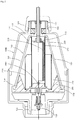
- Fig. 1 one exemplary embodiment of a portion of a centrifuge constructed in accordance with this invention.
- the centrifuge basically comprises a processing unit or assembly and a base or drive unit 20.
- the processing unit includes a rotatable outer chamber 102 and a rotatable inner chamber 103.
- the inner chamber is arranged to receive a biologic mixture comprising adipose (fatty) tissue, and to be rotated where it is broken down mechanically and from whence the broken down tissue is introduced into the outer chamber.
- the outer chamber is also arranged to be rotated to effect the separation of the broken-down tissue components by the centrifugal force produced by the rotation of that chamber.
- the fibrous network in fatty tissue can be broken down by using enzymatic agents
- This mechanical breaking down of the fibrous network should avoid the need to wash out an enzymatic agent, and may be accomplished using the various embodiments of the centrifuge devices described herein.
- morselized is used to describe the process of mechanically reducing a tissue having an initial fragment size into fragments of a smaller size by the centrifuges of this invention, also known as sizing of the tissue.
- the terms "morselize” and "size” are used interchangeable herein.
- the processing assembly or unit 100D of Fig. 1 is arranged to be releasably mounted on the base 20. Once mounted on the base, the centrifuge can be operated to rotate the processing unit at a high rate of speed (to be described later) about a central, longitudinal axis 125 of the processing unit.
- the means for effecting that rotation basically comprises a motor 25 housed in the base unit 20.
- the processing assembly is rotated upon activation of the motor 25 through a coupling 126.
- the coupling is preferably in the form of pair of keyed components that releasably mate together, such that the base unit and the processing assembly can be selectively engaged.
- the base unit 20 be reusable so that it can be used consecutively with multiple processing assemblies. It is, however, contemplated that the base unit can be disposable, if desired.
- the processing unit is, however, preferably disposable, but that is not mandatory providing that it can be sufficiently cleaned and sanitized for reuse. In the embodiment where the drive unit is reusable, the cost for the user can be kept lower than would be the case where the drive unit is disposed along with the rotatable separation unit. It is contemplated that the act of joining of the engageable components (i.e., the drive unit 20 and processing unit 100) may trigger an automatic start-up reaction in the drive unit, in order to begin processing of the fibrous material.
- the act of inserting the processing unit into the drive unit may wake up and optionally start the drive unit.
- the drive unit may include manually operated controls, to allow the operator to have complete control over some or all of the processing steps.
- adipose tissue can be obtained from a patient by known techniques, including liposuction or surgical excision.
- tissue obtained by liposuction the fatty tissue and tumescent solution mixture are likely to be in about a 1:1 ratio and will have passed through suction cannula orifices that will have reduced the fat fragments to a size of about 2 mm.
- This biologic mixture can be fed straight into the various embodiments of a centrifuge device described herein, via the injection port 110 or stationary tube 235, as appropriate.
- the fat will typically be removed from the patient as a semi-coherent mass, in contrast to the tissue collected as particles through liposuction.
- the fat In the case of surgically excised fat, the fat should be broken up into smaller pieces, and then is to be mixed with portions of liquid, typically with saline or tumescent solution, up to two times the volume of fat, though it is contemplated that other proportions may be suitable as well.
- the mixing of the harvested fat and mixing liquid may be performed by passing the mixture to and fro between syringes having nozzles of about 2 mm before placing in the centrifuge device.
- the adipose tissue harvested may optionally be treated with an additive, such as a biologically active agent.
- an additive such as a biologically active agent.
- one or more preservatives or anti-coagulants e.g.
- heparin, coumarin, ethylene diamine tetra acetic acid (EDTA), citrates e.g., Anticoagulant Citrate Dextrose A (ACDA), oxalate
- additives may beneficially aid in separation of cells during centrifugation, may alter the behavior of the cells in the harvested sample for processing as described herein, or enable the storage of the harvested tissue sample for subsequent processing as described herein.
- the addition of ACDA may prevent coagulation, allowing storage of the solution containing red blood cells or platelets, or additionally, the ACDA may serve to alter the morphology of stem cells and platelet cells.
- the ACDA may serve to alter the morphology of stem cells and platelet cells.
- adding ACDA to the charge of biologic mixture may be beneficial, in the case of platelet cells typically having a plate-like morphology, may convert to a more spherical morphology, thereby beneficially affecting the ability of the platelet cells to separate by specific gravity, as the more spherical shape of the cell may maneuver more easily through the other constituents of the biologic mixture, e.g., adipose tissue particles.
- the fatty constituent of the material tends to migrate toward the central longitudinal axis 125, and the heavier cells and aqueous solution tend to move toward the outer walls of the outer chamber 102.
- the heaviest density fluid (having the highest specific gravity), containing the highest concentrations of multipotent cells, moves to the outermost diameter, to the annular trap 136.
- That trap basically comprises an angularly extending channel, though the size and shape of the trap may be modified to capture different fractions of the biologic mixture.
- the trap may not be angled as shown, but rather may be a channel that is arranged parallel to the axis of rotation 125.
- the inner chamber 103 and outer chamber 102 are arranged to rotate together, in a synchronous fashion, however, in the embodiments described herein, it is contemplated that the centrifuge could be arranged so that the inner chamber 103 and outer chamber 102 rotate in an asynchronous manner.
- the inner chamber 103 may rotate at a first speed, so long as that rotation creates a centrifugal field which will generate sufficient pressure upon the charge of tissue; while the outer chamber 102 rotates at a second speed, whether in the same or different direction of rotation, so long as the rotation creates a centrifugal field, so as to effect the stratification of the morselized slurry material.
- the residual fat may, or may not, emulsify into a stable creamy paste.
- the paste material will be self-supporting, at least for a few minutes, rather than flowing, as would a paste that is not self-supporting.
- Fig. 1 shows an embodiment of the processing unit 100D.
- This processing unit is also arranged to be driven from a motor having a drive axis, and housed in a base unit, as has been described previously.
- the processing unit 100D of Fig. 1 includes a roller element 210, acting in concert with a rotating screen 215 to morselize the tissue provided within the inner chamber, prior to causing the tissue to be separated by centrifugation.
- This embodiment includes a revolving inner chamber 103 having a conical sidewall 134.
- An annular screen element 215 is located within the inner chamber 103 and extends concentrically around the central longitudinal axis (i.e., the axis of rotation).
- the screen element extends from where it is joined to the base 118 of the inner chamber, up to the point where it meets the chamber's sidewall.
- the screen thus divides the inner chamber 103, so that material passing from a region within the annulus of screen element 215 to the outside of the screen element must necessarily pass through the openings provided in the screen element.
- the screen element is a mesh-like member that may be a metal or polymer wire material, or alternatively a perforated sheet providing openings sized to pass fluid material, but retain much of the fibrous material. It is envisioned that the openings will be uniformly or non-uniformly sized between 0.002 and 0.040 inches.
- a roller element 210 is provided adjacent to, and arranged to roll against, the inner surface of the screen element.
- the roller element is mounted on an axle 220.
- the axle may be of any sort known in the art. As shown in Fig. 1 , the axle may be a formed stiff wire that extends through the center bore of the roller, and the wire is mounted so that it may be secured in a static (stationary) position within the inner chamber.
- the upper end of the wire that forms an axle 220 that is fixed to a flange 225 at the end of a stationary tube 235 and which extends through an opening in the end cap 106.
- the flange 225 and the stationary tube 235 feature a hollow bore extending through their interior, which serves as the entry port for directing tissue material into the device for processing.
- the flange 225 and stationary tube 235 are isolated from the rotation of the inner chamber 103 by flange bearings 230 and a port bearing 245.
- the lower end of the formed wire that makes up the axle 220 is directed into a bushing 240, placed in the concentric center of the base 118 of the inner chamber 103, in line with the axis of rotation of the inner chamber.
- the bushing 240 serves to isolate the static axle 220 from the rotation of the inner chamber 103.
- roller element 210 which is provided with a freedom of movement, such that it can articulate, as it rotates about the static axle 220.
- Examples of possible articulation mechanisms are shown in Figs. 3A and 3B .
- the roller can move relative to the chamber's axis of rotation as it engages lumpy portions of the tissue material.
- Figs. 3A and 3B show a detailed expanded view of the roller element 210, on the axle 220, against the screen element 215.
- the roller is able to float against the screen element 215, by the nature of the deflection in a direction perpendicular to the axis of rotation, which is allowed by the spring wire formed as axle 220.
- the roller element 210 is able to yaw, demonstrated as the rotation axis of the roller element 210 leaning, as the roller element 210 encounters the tissue against the screen element 215.
- the ability to yaw is provided as the roller may pivot on the axle 220.
- the inner chamber 103 features a tapered sidewall 134.
- the base 118 of the inner chamber 103 is shaped so as to provide a tapered surface as well, relative to the axis of rotation 125, provided by the wedge 265.
- the trap 136 is in this case defined by the outer surface of the wedge 265 and the inner surface of the conical sidewall 134.
- the trap 136 is preferably annular, though it is contemplated that alternate shapes may suffice, for example by being lobed.
- the trap as depicted in Fig.
- the trap 1 in cross section appears as an angled passageway, with an innermost portion at the entrance into the trap, where the mixture component enters from the central area of the rotating chamber, and adjacent to the tapered end of the wedge 265.
- the entrance to the trap forms the end of the trap closest to the axis of rotation 125.
- the trap 136 also features an outermost portion, at the end having the greatest radial distance from the axis of rotation 125.
- the trap 136 may not be angled relative to the axis of rotation, but rather may be arranged parallel to the axis of rotation.
- a first port 275 At the largest outside diameter of the trap, there is provided a first port 275, which is selectively openable, such as through valving, so as to allow access to the trap to harvest the processed material fraction contained therein.
- An access opening 270 may be provided in the outer housing 101 to facilitate access to the first port 275.
- an access needle or cannula (not shown) may be directed through aligned openings, so as to allow the harvest of the processed material fraction in the trap 136. This may be accomplished by placing into alignment the access opening 270, the first port 275, and the sealed port 271. That port may be in the form of a duckbill valve or a self-sealing septum in the wall of a container or vessel 272.
- the container 272 is an annular member located within the lower portion of the processing chamber 100D and its function will be described later.
- the alignment of the access opening 270, the first port 275, and the sealed port 271 may be controlled by various means known in the art, for example, by manually rotating a portion of the exterior housing.
- Cams 273 are provided projecting inward from the bottom portion of the housing to selectively adjust the vertical positioning of selected elements in the device.
- the first port may be selectively openable, and closeable, during the rotation of the inner chamber 103, such that at least a portion of the material contained within the trap 136 may be automatically ejected into a collection area that may be accessed later.
- a charge of fat and solution such as blood, saline, water, tumescent solution
- the inner chamber 103 and screen element 215 are rotated via the coupling 126, by the motor at a first speed, while keeping the roller axle 220 stationery, for a defined first period.
- the fat will tend to spread along the inside of the screen element due to the effect of the centrifugal field created by rotation of the chamber, and the roller element 210 will force the fat through the mesh of the screen element 215, as the fat passes between the roller 210 and the screen element 215.
- the tissue material becomes morselized into smaller particles by being forced through the openings in the mesh, and further, a portion of the collagen fibers become separated from the other materials in the charge and are retained on the mesh by becoming draped around the screen wires. It is also possible that upon encountering the roller and being forced through the screen, the collagen fibers in the fat material are cut by the mesh, and thus the tissue charge is morselized into smaller particles sizes. Subsequent to the charge being forced through the mesh, the inner chamber 103 is then rotated at a second speed to centrifuge the morselized material, and based on the specific gravities of the components making up the morselized material, separate the mixture of liquid and fat for a second defined period of rotation.
- the heavier multipotent cells tend to migrate through the liquid to the outermost surfaces in the inner chamber.
- the centrifugal field created will create stratification of the constituent components by their specific gravity, as the centrifugal field will urge the highest specific gravity components away from the axis of rotation (i.e., outwards), whereupon they will encounter the tapered walls of the inner chamber 103 and the inner surface of the wedge 265.
- the centrifugal field will urge the highest specific gravity components away from the axis of rotation (i.e., outwards), whereupon they will encounter the tapered walls of the inner chamber 103 and the inner surface of the wedge 265.
- Continued rotation will cause these more dense components to displace less dense components, as the higher specific gravity components gather along the tapered sides out from axis of rotation, whereupon the highest specific gravity components will then enter into, and accumulate, in the trap 136.
- the residual liquid settles in the base 118 and is collected within the dished area 250, defined by the area being surrounded by wedge 265 on its perimeter, and having the base 118 as a bottom surface.
- the fat material that had been held towards the center of the centrifugal field, due to the lower specific gravity, will frequently have the consistency of a paste, and either tends to remain stuck to the upper portion of inner surface of the sidewall 134, or alternatively the fat material may settle within the dished area 250.
- the liquid containing multipotent cells remain in the trap 136, on the outside of the wedge 265, and may be retrieved by using a needle or cannula (not shown) to suck out the fluid and cells from the trap 136.
- the embodiment shown in Fig. 1 also provides a first port 275, which may be selectively opened and closed by valving, to allow removal of higher specific gravity components from the trap 136.
- a second port 280 which may be selectively opened and closed by valving, to allow removal of lower specific gravity components from the dished area 250.
- the second port 280 may be located at the base of the wedge 265 within the dished area 250.
- the centrifuge of that application is particularly suitable for obtaining a desired fraction from a biologic liquid mixture, such as platelet rich plasma from whole blood, or stem cells from bone marrow aspirate, however that application provides no capacity for morselizing tissue structure in the biologic mixture, such as adipose material.
- a biologic liquid mixture such as platelet rich plasma from whole blood, or stem cells from bone marrow aspirate
- the ejection of one or more portions of the biologic mixture within the chamber may be accomplished as follows.
- the biologic mixture having been sized by any of the methods described herein, is then rotated within the rotatable chamber to cause the contents to separate by specific gravity.
- an outer band of high density fluid having a higher specific gravity
- An inner band of low density fluid (having a lower specific gravity) will form in the liquid closest to the center of the chamber (closest to the longitudinal axis 125).
- the outermost and innermost layers will be at least intermediate layer comprising at least one fraction having a specific gravity between that of the innermost and outermost layers. It is contemplated that the rotation of the chamber and its contents will form an air core, where there is no fluid at the longitudinal axis, so long as the volume of fluid in the chamber is less than the volume of the chamber itself.
- this outermost fraction may be discharged through selectively openable first port 275 having an inlet within the chamber at the greatest distance from the longitudinal axis, such that when the valving for the first port is opened, the rotation of the chamber will create a centrifugal force urging the liquid with the highest specific gravity to exit the chamber through the first port 275.
- the first port is to remain open to allow at least a portion of the highest specific gravity fraction to exit the chamber, whereupon the first port may be closed, whether by action of the operator monitoring the location of an interface, on the tapered surface of the chamber, or operation of an automatic valve.
- the operator may monitor a color interface that occurs between red blood cells and the multi-potent stem cell fraction, which can be detected through a transparent sidewall of the centrifuge devices described herein.
- this innermost fraction may be discharged through selectively openable second port 280, having an inlet located within the chamber at a radial distance that is less than that of the radial distance for the inlet of the first port 275, such that when the valving for the second port is opened, the rotation of the chamber will create a centrifugal force urging the fraction of the liquid with the lowest specific gravity to exit the chamber through the second port 280.
- the second port may remain open to allow at least a portion of the lowest specific gravity fraction to exit the chamber, whereupon the second port may be closed, whether by action of the operator or operation of an automatic valve.
- the second port may be allowed to remain open until the air core, expanding as fluid exits chamber, reaches the entrance to the second port 280, thereby cutting off the flow of fluid out of the second port.
- the inner band of lower density fluid having a lower specific gravity
- optionally, fat can be discharged through the second port 280 and into the container 272, leaving the desired concentrate fraction within the dished area 250, at the center of the inner chamber 103, once the rotation ceases.
- the at least one fraction, having a specific gravity intermediate that of the 2 ejected fractions, will remain within the chamber, and may then be collected by insertion of a cannula into the chamber.
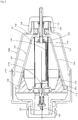
- Fig. 2 shows yet another alternative embodiment of a processing unit 100E. That unit, while somewhat different structurally, operates similarly to the processing unit 100D shown in Fig. 1 , in that the unit 100E includes a screen and roller arrangement that serves to morselize the tissue material, as has been described above.
- a charge of tissue is delivered to the inner chamber 103, and the inner chamber is rotated. The centrifugal field generated by the rotation will cause the charge of tissue to spread along the screen element 215, whereupon the tissue will be forced through the screen element under the pressure of the roller 210, rotating around a roller axis 220.
- the passage through the screen element morselizes the tissue, and may retain or cut, the collagen fibers in the charge.
- the morselized tissue will continue to rotate with the rotation of the inner chamber, causing the stratification of the components of the morselized tissue to separate by specific gravity, with the lowest specific gravity components being displaced at the perimeter by the higher specific gravity components, as the higher specific gravity components are driven away from the axis of rotation 125.
- an optional secondary screen element 216 In this or the other processing unit embodiments having a screen element 215, there may be included an optional secondary screen element 216.
- the morselized tissue that has been directed through the screen element 215, will encounter the secondary screen element 216, as the material is directed outwards by the force of the rotation.
- the secondary screen element 216 is similar to the screen element 215, except that it has a smaller average opening size. While the secondary screen 216 may serve to further morselize the tissue, it is primarily intended to capture the fibrous material that does not readily pass through the openings, while passing the liquid and non-fibrous material therethrough.
- Use of this arrangement may benefit from reducing the rotational velocity while the processed material is encountering the secondary screen, so as to avoid having excessive centrifugal forces propel the material through the screen, where a slower rotation would aid in capturing the fibrous material against the screen while the liquid is urged through the openings.
- a cannula, needle or tubing may then be inserted through an access route created by ports 138 and 137 near the top of the device, optionally directed through an opening provided near the top of the optional secondary screen element 216, and directed into the trap 136, so as to harvest the heaviest specific gravity component, including the multipotent cells, while leaving the non-desired constituents within the dished area 250.
- the angle of the inner chamber and wedge, relative to the axis of rotation will affect how forcefully, and thus how quickly, the stratification of the various components will occur.
- the angle of the inner chamber and wedge is shallow, the separation of the constituents will require an increased period of time of rotation, or alternatively higher rotation speeds may be required to drive the separation.
- this steep angle will tend to produce a more forceful and rapid separation of the components.
- the angle required may be tailored to the viscosity of the fluid being processed.
- the charge of tissue is of a high viscosity
- a steep angle will allow more effective movement of the heaviest components through the fluid.
- the charge of fluid is less viscous, it may be possible to employ a shallow angle, and still achieve adequate separation of the constituents.
- the goal of achieving rapid separation of the constituents is vital, as it is believed that extended duration of the exposure of living cells to elevated G forces during separation may negatively affect the viability of the cells.
- minimizing the period of time in which the cells are rotated at high speed will lead to better viability of the processed cellular material.
- the angle of the inner chamber and wedge will likely be between 5 degrees and 30 degrees, but angles of up to 45 or 60 may also work adequately.
- a benefit in aiding in the separation of the multipotent cells from the fibrous collagen network in the biologic mixture such as by adding a volume of saline or other fluids (e.g., blood, bone marrow aspirate, or other body fluids, buffered solutions, cell culture media, detergent solutions, therapeutic solutions such as antibiotic, or anti-coagulants, etc.), as has been discussed previously.
- This additional fluid added to the harvested fatty tissue may serve to decrease the overall viscosity of the biologic mixture, which will in turn provide for more effective movement of the constituents of the mixture into stratified layers upon exposure to rotational forces. Additionally, the added fluid may enhance the separation of the desired cellular concentration from the other portions of the tissue sample.
- the addition of whole blood or bone marrow aspirate when separated by density, will result in the platelet-rich buffy coat comingling with the multipotent stem cells of the adipose tissue sample, as they would have similar specific gravities.
- the red blood cells due to their highest specific gravity in the combined sample, would tend to accumulate at the outside layer within the rotating chamber.
- the plasma of the whole blood will form a separation layer between the multipotent cells and the fatty tissue.
- the platelets will likely form a layer adjacent to and/or intermingle with the multipotent cells.
- the addition of whole blood or bone marrow aspirate would also provide a visual indicator by color.
- Radial stratification would occur with layers forming, in order from the outermost to the innermost, with the red blood cells outermost, the multipotent cells and platelets next, clear plasma next, and the fatty tissue radially innermost, with the red blood cell boundary marking the edge of the fraction with the desired cellular constituents. Additionally, the addition of a liquid to the adipose tissue would likely serve to dilute out the epinephrine and lidocaine that may have been added for the collection of the fat sample.
- an agitation step after the morselization step wherein the centrifuge device is operated in a manner that would impart a gentle, mixing movement to the biologic mixture, so as to ensure the cells are further separated from the fibrous network.
- the gentle mixing would thereby serve to avoid subjecting the cells to the potentially harmful effects of extended high G forces to achieve separation of the cells from the fibrous network, as it is believed that extensive periods of rotation at high speed may be detrimental to cell viability.
- This gentle mixing action may be achieved by random orbital movement, such as rocking off-axis, or alternately starting and stopping the rotation of the device, or varying the rate of rotation of the device.
- the device may be rotated in an oscillating manner, at low frequency (e.g., less than 10 Hz, preferably around 1 Hz) and subjecting the cells to low G forces, in order to free the multipotent cells from the fatty and residual fiber network, or mix in additional fluid into the charge of tissue.
- the effect of the mixing may be enhanced by including projections, such as fingers, ribs or radial fins, extending into the rotating chamber.
- projections can be arranged as vertical elements, spiral elements, or combinations thereof, on the surface of at least one of the wedge 265, the outer surface of the mesh of the screen element 215, the inner surface of the conical sidewall 134, and the base 118, so long as a mixing feature is extended into the dished area 250.
- the oscillating motion would be quite similar in operation to that of a conventional clothes washing machine, where the alternating start-stop, and optionally, oscillating movement, all at much lower speeds than would be required to achieve centrifugal separation, should not result in significant reduction of cell viability, all the while providing the benefit of aiding in mechanically disassociating the cells from the fatty and residual fibrous material and other constituents of the biologic mixture.
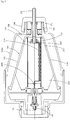
- FIG. 4 Another alternative embodiment of a processing unit 100F constructed in accordance with this invention is shown in Fig. 4 .
- the centrifuge using that embodiment is designed to process the tissue material into smaller fragments by morselizing the tissue, by passing the material through a first screen 215, with the aid of roller element 210, as described previously.
- the first screen 215 is configured to morselize the material into smaller fragments, but not to separate the cells from the structure of the tissue material, so as to ensure that the cells remain contained within the native structure of the morselized tissue material.
- the secondary screen 216 is a smaller band nearer the entrance to the trap 136, and features openings that allow the passage of liquid material, while retaining the cell-containing tissue material.
- any exogenous fluid e.g., saline, epinephrine, lidocaine, etc.
- any exogenous fluid e.g., saline, epinephrine, lidocaine, etc.
- the cell-containing tissue material may be removed from the interior of the inner chamber 103, such as by aspiration with a cannula or other hollow luminal instrument directed through ports 138 and 137.
- the operator may simply open the device, using techniques which would be known to those skilled in the art, in order to access the interior of the inner chamber 103, and manually collect the cell-containing tissue material.
- Fig. 4 should be useful where a particular clinical application warrants the addition of a scaffold, such as where it is necessary to provide a bulking agent to a treatment site (e.g., plastic surgery, cosmetic wrinkle reduction, etc.); or alternatively in procedures where it is desirable to avoid washing away the harvested cells, for example in arthroscopic surgery where saline irrigation is commonly utilized, and maintaining the delivered cells at the desired site would be beneficial.
- a treatment site e.g., plastic surgery, cosmetic wrinkle reduction, etc.
- saline irrigation is commonly utilized, and maintaining the delivered cells at the desired site would be beneficial.
- FIG. 5 Another alternative embodiment of a processing unit 100G constructed in accordance with this invention is shown in Fig. 5 .
- the centrifuge of that embodiment is designed to process the tissue material into smaller fragments by morselizing the tissue, where the tissue material is passed between a roller element 210' arranged to roll in place against a rotating annular element 215', in a manner as has been described previously.
- the annular element 215' may be a mesh screen material, as previously described, or may alternatively feature an impermeable surface.
- either one, or both, of the surface of the roller 210', or the surface of the annular element 215' features an irregular topography.
- the irregular topography of either roller 210' or annular element 215' may feature protruding nubs or bumps, or recessed dimples. What is sought is for the tissue, as it is squeezed between the roller element 210' and the annular element 215', to experience higher degrees of disruption due to the protruding surfaces, and thereby creating concentrated sheer forces in some of the tissue as it passes by the roller.
- the morselized tissue would remain within the interior of the annular element 215' after processing, and may then be collected with a cannula or needle inserted through the stationary tube.
- the tissue material that is processed is anticipated to be reduced to a suitable particle size for re-implantation, but is not anticipated to cause damage to cellular components and the tissue structure, such as may occur by over-processing the tissue to a particle size that is too small. It is anticipated that by providing a tissue that is processed to an appropriate particle size, the material will have preserved cellular viability, while maintaining adequate tissue structure so as to not be susceptible to washout or significant volume loss once implanted.
- FIG. 6 Another embodiment of a processing unit 100J constructed in accordance with this invention is shown in Fig. 6 .
- the embodiment in Fig. 6 is similar to that depicted in Fig. 1 , with the distinction that following elements from Fig. 1 are absent from Fig. 6 : wedge 265, trap 136, first port 275. Additionally, the base 118 now extends directly to the inner surface of the sidewall 134, in a taper, rather than form a wedge element.
- the biologic mixture is to be introduced to the chamber 103 and sized by passing through the screen element 215, as described with reference to Fig. 1 .
- the material Upon rotation of the chamber 103, the material will be urged through screen element 215 by roller element 210, as described previously.
- the act of passing through the screen may disrupt the structure of the tissue material, so as to release the multi-potent stem cells from the structure.
- the separation of the biologic mixture by specific gravity, as has been described previously.
- the biologic mixture comprises fat and water or tumescent solution
- the multipotent stem cells having a higher specific gravity than the fat or the water, will accumulate at the outermost layer within the rotating chamber.
- At least a portion of the innermost fraction may be discharged by opening the valving for the port 280. It is contemplated that the fat and water components would then be discharged from the chamber 103 through port 280, until the air core encounters the entrance to port 280, and halting the discharge. It is contemplated that the fraction of the biologic mixture remaining within the chamber would include the multipotent stem cells, now having been concentrated by removal of fat and water from the biologic mixture. Upon halting the rotation of the chamber, the remaining fraction will pool in the center of the chamber for collection.
- any of the above described exemplary embodiments will produce a concentrated cell fraction that may be usefully combined with (e.g., hydrated into, mixed with, kneaded into, provided as a depot within, or layered onto) a synthetic or natural scaffold or structure which may be implanted into a treatment site of a living being.
- Such combining of the cell fraction with the scaffold may be accomplished in various manners, for example, by hydrating the scaffold with the cellular fraction, mixing the cell fraction with scaffold material, kneading the scaffold material and cell fraction together, providing the cell fraction as a depot contained within the scaffold material, coating the scaffold with the cell fraction, applying the cell fraction as a layer alongside a scaffold material, sequentially adding the cell fraction to a target site followed by placement of a scaffold material to the target site, or vice versa.
- Various other procedures for combining a scaffold with a cell fraction may be well known to those skilled in the art and may be suitable for use with the cell fraction created as described herein.
- the multipotent cells may be concentrated, which may include adipocytes, as well as the stromal vascular fraction (SVF) of cells including preadipocytes, fibroblasts, vascular endothelial cells and a variety of immune cells (e.g., adipose tissue macrophages, etc.).
- adipocytes as well as the stromal vascular fraction (SVF) of cells including preadipocytes, fibroblasts, vascular endothelial cells and a variety of immune cells (e.g., adipose tissue macrophages, etc.).
- SVF stromal vascular fraction
- kit form including the centrifuge device and accessories needed for operation of the device, including instructions for use and packaging suitable for storage and preserving sterility.
- the kit may provide instructions along with the centrifuge device (either as a single unit, or separable components), and optionally including accessories such as any or all of needles, syringes, cannulas, lidocaine, epinephrine, tumescent solution, liposuction kits and instructions for use.
- the apparatus and methods of this invention can be used to provide an injectable concentrate having a larger quantity of multipotent cells that is comparable or better than bone marrow concentrated aspirate of the same volume without requiring the need for a painful iliac crest puncture to harvest cells therefrom.
- the subject invention enables one to reduce the time of the procurement process of a usable multipotent cell sample, to a few minutes, so as to allow the use of the equipment in the operatory ad-hoc , if so required.
- the subject invention eliminates the need for the use of enzymes or chemicals to be added to the sample for processing, yet which would need to be washed from the sample, prior to being injected back into the patient.
- the subject invention overcomes the inefficiencies of enzymatic treatments, which typically lead to lower cellular yields.
- a heating source in order to maintain the biologic mixture at a temperature above ambient temperature.
- a heating source in order to maintain the biologic mixture at a temperature above ambient temperature.
- This may be useful because the increase in temperature, preferably to body temperature (37 °C) would serve to reduce the viscosity of the adipose tissue.
- body temperature 37 °C
- cell viability may be improved as the cells, e.g., multipotent stem cells, would be exposed to lower levels of shear stress during processing.
- the viscosity of the adipose tissue would increase, and potentially harming cell viability due to the increase in shear stress that would occur when processed by any of the embodiments described herein.
Landscapes
- Health & Medical Sciences (AREA)
- Life Sciences & Earth Sciences (AREA)
- Engineering & Computer Science (AREA)
- Chemical & Material Sciences (AREA)
- Bioinformatics & Cheminformatics (AREA)
- Organic Chemistry (AREA)
- Wood Science & Technology (AREA)
- Zoology (AREA)
- Biomedical Technology (AREA)
- Biotechnology (AREA)
- Genetics & Genomics (AREA)
- General Health & Medical Sciences (AREA)
- Biochemistry (AREA)
- General Engineering & Computer Science (AREA)
- Microbiology (AREA)
- Sustainable Development (AREA)
- Cell Biology (AREA)
- Molecular Biology (AREA)
- Rheumatology (AREA)
- Developmental Biology & Embryology (AREA)
- Medicinal Chemistry (AREA)
- Centrifugal Separators (AREA)
- Separation Of Solids By Using Liquids Or Pneumatic Power (AREA)
- Filtration Of Liquid (AREA)
- Micro-Organisms Or Cultivation Processes Thereof (AREA)
- External Artificial Organs (AREA)
- Medicines Containing Material From Animals Or Micro-Organisms (AREA)
- Filtering Materials (AREA)
Claims (14)
- Zentrifuge zum gezielten Konzentrieren mindestens eines Bestandteils eines Fettgewebe umfassenden biologischen Gemischs, wobei die Bestandteile unterschiedliche spezifische Gewichte haben und in einem von der Zentrifuge erzeugten Zentrifugalfeld schichtbar sind, wobei die Zentrifuge eine innere Kammer (103) hat, die zur Aufnahme des biologischen Gemischs angeordnet ist und eine mittlere Längsachse (125) hat, um die die innere Kammer zum Drehen angeordnet ist, wobei die innere Kammer eine Seitenwand (134) mit einer sich verjüngenden Innenfläche, eine Basis (118) und ein ringförmiges Sieb (215, 215') umfasst, wobei das ringförmige Sieb (215, 215') eine Innenfläche hat und in einem ersten radialen Abstand von der mittleren Längsachse (125) angeordnet ist, wobei das ringförmige Sieb von der Basis (118) wegragt, sowie eine erste Öffnung (275) mit einem Einlass in einem zweiten radialen Abstand von der Längsachse,
wobei die innere Kammer zusätzlich mindestens eine Walze (210, 210') umfasst, die dazu angeordnet ist, effektiv um die Innenfläche des ringförmigen Siebs (215, 215') herum zu rollen, um mindestens einen Teil des biologischen Gemischs durch das ringförmige Sieb (215, 215') und weg von der mittleren Längsachse (125) und zu der sich verjüngenden Seitenwand (134) hin zu treiben. - Zentrifuge nach Anspruch 1, wobei die Basis (118) ferner ein Keilelement (265) umfasst, das sich von der Basis (118) in das Innere der Kammer erstreckt und ein Keilende in einem dritten radialen Abstand von der mittleren Längsachse (125) hat.
- Zentrifuge nach Anspruch 1, wobei die innere Kammer (103) ferner einen Fang (136) umfasst, wobei der Fang (136) der Innenfläche der Seitenwand (134) benachbart in der inneren Kammer (103) angeordnet ist, und die innere Kammer (103) ferner eine zweite Öffnung (280) mit einem Einlass in einem vierten radialen Abstand von der Längsachse (125) umfasst, wobei der Einlass für die zweite Öffnung in dem Fang (136) angeordnet ist.
- Zentrifuge nach Anspruch 3, wobei der vierte radiale Abstand größer als der dritte radiale Abstand ist, der dritte radiale Abstand größer als der zweite radiale Abstand ist und der zweite radiale Abstand größer als der erste radiale Abstand ist.
- Zentrifuge nach Anspruch 1, wobei die innere Kammer zusätzlich mindestens eine Walzenachse (220) umfasst, die sich parallel zu der mittleren Längsachse (125) erstreckt, wobei die mindestens eine Walze (210, 210') dazu angeordnet ist, um die mindestens eine Walzenachse (220) zu rotieren, um um die Innenfläche des ringförmigen Siebs (215, 215') herum zu rollen.
- Zentrifuge nach Anspruch 5, wobei die mindestens eine Walzenachse (220) bezüglich der inneren Kammer (103) stationär gehalten wird.
- Zentrifuge nach Anspruch 1, wobei das ringförmige Sieb (215, 215') ein perforiertes Material ist, das aus der aus Maschendrahtsieb, Polymermaschensieb, perforierten Metallröhren und perforierten Polymerröhren bestehenden Gruppe ausgewählt ist.
- Zentrifuge nach Anspruch 1, ferner umfassend einen Fang (136) und mindestens eine Öffnung (280) und ein Ventil, um gezielt mindestens einen Teil mindestens einer der Bestandteilschichten aus dem Fang (136) auszustoßen.
- Zentrifuge nach Anspruch 1, wobei das ringförmige Sieb (215, 215') mehrere Öffnungen im Bereich von ungefähr 0,04 Zoll bis ungefähr 0,002 Zoll umfasst.
- Zentrifuge nach einem der Ansprüche 1 - 9, wobei das ringförmige Sieb (215, 215') dazu ausgestaltet ist, das biologische Gemisch in kleine Teile aufzuteilen.
- Zentrifuge nach Anspruch 1, wobei die erste Öffnung (275) gezielt geöffnet werden kann, um den Austrag mindestens eines Teils eines Bestandteils des biologischen Gemischs aus der Kammer zu gestatten.
- Zentrifuge nach Anspruch 3 oder 4, wobei die erste Öffnung (275) gezielt geöffnet werden kann, um den Austrag mindestens eines Teils eines Bestandteils des biologischen Gemischs aus der Kammer zu gestatten.
- Zentrifuge nach Anspruch 3 oder 4, wobei die erste Öffnung (275) und die zweite Öffnung (280) gezielt geöffnet werden können, um den Austrag mindestens eines Teils eines Bestandteils des biologischen Gemischs aus der Kammer zu gestatten.
- Zentrifuge nach einem der Ansprüche 1 - 13, wobei die Walze (210, 210') so angeordnet ist, dass sie auf der Innenfläche des ringförmigen Siebs (215, 215') rollt.
Priority Applications (1)
| Application Number | Priority Date | Filing Date | Title |
|---|---|---|---|
| EP19184724.3A EP3660140A1 (de) | 2014-01-31 | 2015-01-30 | Zentrifuge zur behandlung von fettgewebe und verfahren zur verwendung |
Applications Claiming Priority (2)
| Application Number | Priority Date | Filing Date | Title |
|---|---|---|---|
| US201461934069P | 2014-01-31 | 2014-01-31 | |
| PCT/US2015/013920 WO2015117007A1 (en) | 2014-01-31 | 2015-01-30 | Adipose tissue centrifuge and method of use |
Related Child Applications (2)
| Application Number | Title | Priority Date | Filing Date |
|---|---|---|---|
| EP19184724.3A Division-Into EP3660140A1 (de) | 2014-01-31 | 2015-01-30 | Zentrifuge zur behandlung von fettgewebe und verfahren zur verwendung |
| EP19184724.3A Division EP3660140A1 (de) | 2014-01-31 | 2015-01-30 | Zentrifuge zur behandlung von fettgewebe und verfahren zur verwendung |
Publications (3)
| Publication Number | Publication Date |
|---|---|
| EP3099416A1 EP3099416A1 (de) | 2016-12-07 |
| EP3099416A4 EP3099416A4 (de) | 2018-03-14 |
| EP3099416B1 true EP3099416B1 (de) | 2019-08-14 |
Family
ID=53754306
Family Applications (2)
| Application Number | Title | Priority Date | Filing Date |
|---|---|---|---|
| EP19184724.3A Pending EP3660140A1 (de) | 2014-01-31 | 2015-01-30 | Zentrifuge zur behandlung von fettgewebe und verfahren zur verwendung |
| EP15742721.2A Active EP3099416B1 (de) | 2014-01-31 | 2015-01-30 | Fettgewebezentrifuge und verfahren zur verwendung |
Family Applications Before (1)
| Application Number | Title | Priority Date | Filing Date |
|---|---|---|---|
| EP19184724.3A Pending EP3660140A1 (de) | 2014-01-31 | 2015-01-30 | Zentrifuge zur behandlung von fettgewebe und verfahren zur verwendung |
Country Status (9)
| Country | Link |
|---|---|
| US (4) | US10125345B2 (de) |
| EP (2) | EP3660140A1 (de) |
| JP (3) | JP2017511748A (de) |
| KR (2) | KR102369602B1 (de) |
| CN (2) | CN106413904A (de) |
| CA (1) | CA2938268A1 (de) |
| ES (1) | ES2754326T3 (de) |
| IL (2) | IL246638B (de) |
| WO (1) | WO2015117007A1 (de) |
Families Citing this family (29)
| Publication number | Priority date | Publication date | Assignee | Title |
|---|---|---|---|---|
| WO2012154301A1 (en) | 2011-03-18 | 2012-11-15 | Tornier, Inc. | Allogeneic microvascular tissue for soft tissue treatments |
| US9872937B2 (en) | 2012-09-19 | 2018-01-23 | Microvascular Tissues, Inc. | Compositions and methods for treating and preventing tissue injury and disease |
| EP3476410B1 (de) | 2012-09-19 | 2021-08-18 | MicroVascular Tissues, Inc. | Zusammensetzungen und verfahren zur behandlung und prävention von gewebeverletzungen und -krankheiten |
| US11819522B2 (en) | 2012-09-19 | 2023-11-21 | Microvascular Tissues, Inc. | Compositions and methods for treating and preventing tissue injury and disease |
| US10596202B2 (en) | 2012-09-19 | 2020-03-24 | Microvascular Tissues, Inc. | Compositions and methods for treating and preventing tissue injury and disease |
| US11866732B2 (en) * | 2016-03-17 | 2024-01-09 | Synova Life Sciences, Inc. | Separation, dissociation and/or disaggregation of cells using shockwaves or mechanical impacts |
| US10702629B2 (en) * | 2016-05-13 | 2020-07-07 | Black Tie Medical Inc. | Conditioning harvested fat for re-injection |
| CN110088590B (zh) | 2016-11-10 | 2022-04-26 | 赛利詹尼克斯私人投资有限公司 | 用于破裂组织的装置 |
| ES3041510T3 (en) * | 2017-04-21 | 2025-11-12 | Terumo Bct Inc | System for high-throughput blood component collection |
| US11091732B2 (en) * | 2017-05-21 | 2021-08-17 | Michael A. Scarpone | Methods and devices for harvesting and processing connective tissue precursor cells from autologous fat |
| TR201716262A2 (tr) | 2017-10-20 | 2017-11-21 | Kemal Tunc Tiryaki | Yağ dokusu parçalama kiti |
| CN107904138A (zh) * | 2017-11-03 | 2018-04-13 | 浙江工业大学 | 从脂肪组织中分离含血管基质成分的脂肪组织制备装置 |
| CN107805605A (zh) * | 2017-11-03 | 2018-03-16 | 浙江工业大学 | 一种制备可填充脂肪组织自动化装置 |
| EP3650531A1 (de) * | 2018-11-09 | 2020-05-13 | DSM IP Assets B.V. | Vorrichtung zur verarbeitung von adipösem gewebe |
| US11964092B2 (en) | 2019-03-11 | 2024-04-23 | ABC Med Tech Corp. | Portable centrifuge and method of use |
| US12558463B2 (en) | 2019-03-11 | 2026-02-24 | ABC Med Tech Corp. | Portable centrifuge device and method of use |
| US12247902B2 (en) | 2019-05-06 | 2025-03-11 | Tissuemill Technologies Llc | Atraumatically formed tissue compositions, devices and methods of preparation and treatment |
| US11033295B2 (en) | 2019-05-06 | 2021-06-15 | Tissuemill Technologies Llc | Atraumatically formed tissue composition, devices and methods of preparation and treatment |
| EP4143292A2 (de) * | 2020-04-30 | 2023-03-08 | Scicotec GmbH | Automatisierte integrierte fettabsaugung und gewebeverarbeitungsvorrichtung und -verfahren |
| US11229779B1 (en) * | 2020-08-12 | 2022-01-25 | Enrico Guarino | Method for skin ligament injection to obtain a lifting effect |
| WO2022125720A1 (en) | 2020-12-10 | 2022-06-16 | Dsm Ip Assets B.V. | Biologic tissue processing device |
| CN112221720B (zh) * | 2020-12-15 | 2021-03-09 | 上海大博医疗科技有限公司 | 一种血液分离离心仓及系统 |
| CN112919558B (zh) * | 2021-01-25 | 2022-10-04 | 杭州欣元印染有限公司 | 一种印染废水处理设备及系统 |
| CN112892891B (zh) * | 2021-03-03 | 2022-12-06 | 武汉伯瑞恒医药科技有限公司 | 一种抗白血病活性分子及中间体提取用离心装置 |
| ES3061318T3 (en) | 2021-07-06 | 2026-04-01 | Prof Dr Dr Prantl Dr Baringer Dr Felthaus Und Eigenberger Gbr Reg 2 | Syringe system for processing a fluid |
| US20240367181A1 (en) | 2021-08-27 | 2024-11-07 | Dsm Ip Assets B.V. | Adipose tissue processing device |
| DE102022104496A1 (de) * | 2022-02-24 | 2023-08-24 | Börger GmbH | Rotationsabscheider zum Abscheiden von Fremdkörpern aus einer Medienströmung |
| EP4687926A2 (de) * | 2023-03-28 | 2026-02-11 | The Regents of University of California | Fluidische vorrichtung zum waschen von lipoaspirat |
| ES3023107A1 (es) * | 2023-11-29 | 2025-05-29 | Herrera Fernando Godoy | Dispositivo de purificación y aislamiento de componentes de un tejido adiposo |
Family Cites Families (228)
| Publication number | Priority date | Publication date | Assignee | Title |
|---|---|---|---|---|
| US3249295A (en) | 1966-05-03 | Method for separating liquid mixtures | ||
| BE380341A (de) | 1930-06-06 | |||
| US2023762A (en) | 1930-11-11 | 1935-12-10 | Fawcett Harold William | Centrifugal separator |
| GB483239A (en) | 1936-10-13 | 1938-04-13 | Harold William Fawcett | Improvements in or relating to centrifugal separators |
| US2596616A (en) | 1951-04-09 | 1952-05-13 | Laval Separator Co De | Method and system for separating solids from liquids |
| US2822315A (en) | 1952-04-12 | 1958-02-04 | Protein Foundation Inc | Separation of formed and fluid blood components |
| US2822126A (en) | 1952-04-12 | 1958-02-04 | Protein Foundation Inc | Continuous feed centrifuge |
| NL192809A (de) | 1954-03-13 | |||
| US4684361A (en) | 1985-10-11 | 1987-08-04 | Cardiovascular Systems, Inc. | Centrifuge |
| US2906452A (en) | 1955-04-12 | 1959-09-29 | Protein Foundation Inc | Separation centrifuge |
| US2906450A (en) | 1955-04-12 | 1959-09-29 | Protein Foundation Inc | Centrifuging apparatus |
| US2906451A (en) | 1955-04-12 | 1959-09-29 | Protein Foundation Inc | Collection centrifuge |
| US2940662A (en) | 1957-12-23 | 1960-06-14 | Protein Foundation Inc | Centrifuge |
| US3092582A (en) | 1959-03-20 | 1963-06-04 | Black Clawson Co | Centrifuge |
| UST955355I4 (de) | 1959-06-24 | 1900-01-01 | ||
| US3096283A (en) | 1959-06-24 | 1963-07-02 | Becton Dickinson Co | Container for blood and machine for separating precipitates from liquid blood constituents |
| US3239136A (en) | 1962-05-07 | 1966-03-08 | George N Hein | Centrifuge and centrifuge head for separating constituents of a liquid and a liner therefor |
| US3104225A (en) | 1960-01-29 | 1963-09-17 | Lourdes Instr Corp | Continuous flow centrifuge rotor and liner element |
| US3085407A (en) | 1962-03-20 | 1963-04-16 | Sprague Engineering Corp | Coupling means |
| US3145713A (en) | 1963-09-12 | 1964-08-25 | Protein Foundation Inc | Method and apparatus for processing blood |
| US3199775A (en) | 1963-11-26 | 1965-08-10 | Kenneth G Drucker | Sedimentation rate centrifuge and method determining sedimentation rate |
| US3332614A (en) | 1964-10-30 | 1967-07-25 | Donald S Webster | Centrifugal extractor |
| US3304990A (en) | 1965-02-15 | 1967-02-21 | Univ Tennessee Res Corp | Explosion proof centrifugal evaporator with magnetic drive |
| US3655123A (en) | 1966-08-08 | 1972-04-11 | Us Health Education & Welfare | Continuous flow blood separator |
| SE227107C1 (de) | 1967-05-18 | 1969-07-29 | Alfa Laval Ab | |
| US3932691A (en) | 1970-03-03 | 1976-01-13 | Wacker-Chemie Gmbh | Method of insulating rotor plates |
| US3703984A (en) | 1970-04-21 | 1972-11-28 | Harold T Pruessner | Method and apparatus of centrifugal separation |
| US3675846A (en) | 1970-06-15 | 1972-07-11 | Bio Consultants Inc | Continuous flow centrifuge head construction |
| US3780936A (en) | 1972-01-05 | 1973-12-25 | Department Of Health Education | Mixer-separator for automated analytical chemistry system |
| DE2220717C2 (de) | 1972-04-27 | 1973-08-23 | Westfalia Separator Ag | Selbstentleerende zentrifugentrommel zum klaeren von fluessigkeiten mit einer schaelscheibe zum ableiten der geklaerten fluessigkeit unter druck |
| AT340194B (de) * | 1972-12-12 | 1977-11-25 | Westfalia Separator Ag | Zentrifuge zum trennen von flussigkeitsgemischen |
| US3838809A (en) | 1973-04-16 | 1974-10-01 | M Williams | Automatic serum preparation station |
| US3982691A (en) | 1974-10-09 | 1976-09-28 | Schlutz Charles A | Centrifuge separation and washing device and method |
| US3955755A (en) | 1975-04-25 | 1976-05-11 | The United States Of America As Represented By The United States Energy Research And Development Administration | Closed continuous-flow centrifuge rotor |
| SE393542B (sv) | 1975-09-17 | 1977-05-16 | Alfa Laval Ab | Anordning vid centrifugalseparator med under drift oppningsbara utlopp vid rotorns periferi samt med stationera skalorgan for bortledning av separerad vetska |
| US4425112A (en) | 1976-02-25 | 1984-01-10 | The United States Of America As Represented By The Department Of Health And Human Services | Flow-through centrifuge |
| US4056225A (en) | 1976-04-29 | 1977-11-01 | Norton George Hein Jr | Centrifuge rotor for separating phases of a liquid |
| US4636193A (en) | 1976-05-14 | 1987-01-13 | Baxter Travenol Laboratories, Inc. | Disposable centrifugal blood processing system |
| US4086924A (en) | 1976-10-06 | 1978-05-02 | Haemonetics Corporation | Plasmapheresis apparatus |
| US4111355A (en) | 1977-06-15 | 1978-09-05 | Beckman Instruments, Inc. | Multi-compartment centrifuge rotor liner |
| FR2400700A1 (fr) | 1977-08-18 | 1979-03-16 | Guigan Jean | Dispositif de conditionnement d'un echantillon de liquide en vue de son analyse |
| US4132349A (en) | 1977-11-11 | 1979-01-02 | Baxter Travenol Laboratories, Inc. | Rotor drive assembly for a centrifugal liquid processing apparatus |
| US4285464A (en) | 1979-01-22 | 1981-08-25 | Haemonetics Corporation | Apparatus for separation of blood into components thereof |
| US4303193A (en) | 1979-01-22 | 1981-12-01 | Haemonetics Corporation | Apparatus for separating blood into components thereof |
| US4226669A (en) | 1979-05-09 | 1980-10-07 | Savant Instruments, Inc. | Vacuum centrifuge with magnetic drive |
| US4304357A (en) | 1980-06-16 | 1981-12-08 | Haemonetics Corporation | Blood processing centrifuge |
| US4332350A (en) | 1980-07-30 | 1982-06-01 | Mcclellan Jack A | Centrifuge apparatus for separating entrained solids from industrial waste water |
| US4332351A (en) | 1980-09-22 | 1982-06-01 | International Business Machines Corporation | Blood fraction extracting centrifuge |
| US4341343A (en) | 1980-09-22 | 1982-07-27 | Stuart Beckman | Magnetically driven centrifuge system |
| US4392846A (en) | 1981-05-18 | 1983-07-12 | Joy Manufacturing Company | Centrifuge apparatus |
| US4421503A (en) | 1981-07-09 | 1983-12-20 | Haemonetics Corporation | Fluid processing centrifuge and apparatus thereof |
| JPS59500340A (ja) * | 1982-03-08 | 1984-03-01 | モトロ−ラ・インコ−ポレ−テツド | 集積回路のリ−ドフレ−ム |
| US5034135A (en) | 1982-12-13 | 1991-07-23 | William F. McLaughlin | Blood fractionation system and method |
| US4530691A (en) | 1983-12-13 | 1985-07-23 | Baxter Travenol Laboratories, Inc. | Centrifuge with movable mandrel |
| SE8401142D0 (sv) | 1984-03-01 | 1984-03-01 | Alfa Laval Separation Ab | Utloppsanordning for en centrifugalseparator |
| EP0177564B1 (de) | 1984-03-21 | 1990-02-07 | McLaughlin, William Francis | Verfahren und vorrichtung zur filtration |
| US4776964A (en) | 1984-08-24 | 1988-10-11 | William F. McLaughlin | Closed hemapheresis system and method |
| US4816151A (en) | 1985-04-26 | 1989-03-28 | Baxter International Inc. | Rotor drive for medical disposables |
| US4753729A (en) | 1985-04-26 | 1988-06-28 | Baxter Travenol Laboratories, Inc. | Rotor drive for medical disposables |
| US4700117A (en) | 1985-05-31 | 1987-10-13 | Beckman Instruments, Inc. | Centrifuge overspeed protection and imbalance detection system |
| US5372945A (en) * | 1985-06-06 | 1994-12-13 | Alchas; Paul G. | Device and method for collecting and processing fat tissue and procuring microvessel endothelial cells to produce endothelial cell product |
| US4944883A (en) | 1987-01-13 | 1990-07-31 | Schoendorfer Donald W | Continuous centrifugation system and method for directly deriving intermediate density material from a suspension |
| US5053127A (en) | 1987-01-13 | 1991-10-01 | William F. McLaughlin | Continuous centrifugation system and method for directly deriving intermediate density material from a suspension |
| US5104526A (en) | 1987-01-30 | 1992-04-14 | Baxter International Inc. | Centrifugation system having an interface detection system |
| US5632893A (en) | 1987-01-30 | 1997-05-27 | Baxter Internatinoal Inc. | Enhanced yield blood processing systems with angled interface control surface |
| US5792372A (en) | 1987-01-30 | 1998-08-11 | Baxter International, Inc. | Enhanced yield collection systems and methods for obtaining concentrated platelets from platelet-rich plasma |
| US5076911A (en) | 1987-01-30 | 1991-12-31 | Baxter International Inc. | Centrifugation chamber having an interface detection surface |
| US5573678A (en) | 1987-01-30 | 1996-11-12 | Baxter International Inc. | Blood processing systems and methods for collecting mono nuclear cells |
| US5628915A (en) | 1987-01-30 | 1997-05-13 | Baxter International Inc. | Enhanced yield blood processing systems and methods establishing controlled vortex flow conditions |
| US5656163A (en) | 1987-01-30 | 1997-08-12 | Baxter International Inc. | Chamber for use in a rotating field to separate blood components |
| SE456888B (sv) | 1987-02-09 | 1988-11-14 | Alfa Laval Separation Ab | Centrifugalseparator, foer intermittent toemning av en separerad komponent, som utmaerkes av att den ena av de tvaa rotordelarna innefattar tvaa separata koaxiella vaeggar, en inre och en yttre |
| US4828716A (en) | 1987-04-03 | 1989-05-09 | Andronic Devices, Ltd. | Apparatus and method for separating phases of blood |
| IT1203461B (it) | 1987-04-08 | 1989-02-15 | Dideco Spa | Cella per la centrifugazione del sangue |
| IT1203462B (it) | 1987-04-08 | 1989-02-15 | Dideco Spa | Cella per la centrifugazione in continuo del sangue |
| US4889524A (en) | 1987-09-04 | 1989-12-26 | Haemonetics Corporation | Portable centrifuge apparatus |
| US4854933A (en) | 1987-10-06 | 1989-08-08 | Mull John D | Plasma separator |
| US4846781A (en) | 1988-06-13 | 1989-07-11 | Knelson Benjamin V | Centrifugal separator |
| US4846780A (en) | 1988-08-10 | 1989-07-11 | Exxon Production Research Company | Centrifuge processor and liquid level control system |
| US5007892A (en) | 1989-03-20 | 1991-04-16 | Eastman Kodak Company | Phase separation container with fixed means preventing remixing |
| US4959158A (en) | 1989-03-30 | 1990-09-25 | The United States Of America As Represented By The Unitd States Department Of Energy | Method for separating disparate components in a fluid stream |
| US5316667A (en) | 1989-05-26 | 1994-05-31 | Baxter International Inc. | Time based interface detection systems for blood processing apparatus |
| US5147186A (en) | 1989-08-04 | 1992-09-15 | Bio Medicus, Inc. | Blood pump drive system |
| US5039401A (en) | 1990-05-16 | 1991-08-13 | Eastman Kodak Company | Blood collection and centrifugal separation device including a valve |
| CA2013021C (en) | 1989-11-29 | 1995-05-09 | Richard Lewis Columbus | Blood collection device |
| US5100372A (en) | 1990-03-02 | 1992-03-31 | Haemonetics Corporation | Core for blood processing apparatus |
| DK119490D0 (da) | 1990-05-14 | 1990-05-14 | Unes As | Apparat til fremstilling af et koncentrat af koagulationsfaktorer, saasom fibrinogen, fra en blodportion |
| JP2953753B2 (ja) | 1990-06-28 | 1999-09-27 | テルモ株式会社 | 血漿採取装置 |
| FR2665378B1 (fr) | 1990-08-03 | 1992-10-09 | Guigan Jean | Dispositif pour separer par centrifugation deux phases d'un echantillon d'un liquide heterogene, utilisable notamment pour la separation du plasma du sang total. |
| JPH0775643B2 (ja) | 1990-12-18 | 1995-08-16 | 動力炉・核燃料開発事業団 | 内部循環型遠心抽出器 |
| FR2674771B1 (fr) | 1991-04-08 | 1995-04-21 | Robatel Slpi | Perfectionnements aux extracteurs centrifuges du type mono-etage et multi-etages. |
| US5149432A (en) | 1991-04-30 | 1992-09-22 | Aaron Lavin | Centrifuge for separating liquids of different specific gravities |
| NZ242533A (en) * | 1991-05-03 | 1995-05-26 | Becton Dickinson Co | Device for collecting and processing fat tissue; vessel with rinsing and digesting chamber, drain chamber and isolation chamber |
| US6007725A (en) | 1991-12-23 | 1999-12-28 | Baxter International Inc. | Systems and methods for on line collection of cellular blood components that assure donor comfort |
| US5643594A (en) | 1992-05-29 | 1997-07-01 | The Regents Of The University Of California | Spin encapsulation apparatus and method of use |
| US5387342A (en) | 1992-06-10 | 1995-02-07 | Charles W. Taggart | Centrifugal separator and method |
| SE470376B (sv) | 1992-06-30 | 1994-02-07 | Pharmacia Biosensor Ab | Anordning och system för blodseparation |
| US5254076A (en) | 1992-08-06 | 1993-10-19 | Arch Development Corporation | Centrifugal pyrocontactor |
| DE4226974C2 (de) | 1992-08-14 | 1994-08-11 | Fresenius Ag | Verfahren und Vorrichtung zur kontinuierlichen Aufbereitung einer Zellsuspension |
| WO1994008721A1 (en) | 1992-10-13 | 1994-04-28 | Haemonetics Corporation | Disposable centrifuge rotor and core |
| CH687505A5 (fr) | 1993-01-29 | 1996-12-31 | Elp Rochat | Séparateur centrifuge pour fluides. |
| US5354256A (en) | 1993-04-28 | 1994-10-11 | Knelson Benjamin V | Apparatus for separating intermixed materials of different specific gravity |
| US5409833A (en) * | 1993-07-01 | 1995-04-25 | Baxter International Inc. | Microvessel cell isolation apparatus |
| ZA948564B (en) | 1993-11-19 | 1995-07-26 | Bristol Myers Squibb Co | Liquid separation apparatus and method |
| US5514070A (en) | 1994-01-21 | 1996-05-07 | Haemonetics Corporation | Plural collector centrifuge bowl for blood processing |
| US5478479A (en) | 1994-05-20 | 1995-12-26 | Haemonetics Corporation | Two-stage cell wash process controlled by optical sensor |
| US5441475A (en) | 1994-06-23 | 1995-08-15 | Haahjem North America, Inc. | Centrifugal separator with axially separable bowl elements |
| US5733446A (en) | 1994-12-02 | 1998-03-31 | Bristol-Myers Squibb Company | Centrifuge with annular filter |
| US6946079B1 (en) | 1994-12-02 | 2005-09-20 | Bristol-Myers Squibb Company | Centrifugal filtration method for separating fibrin monomer from blood |
| AU705790B2 (en) | 1994-12-02 | 1999-06-03 | Vivolution A/S | Method and device for separating fibrin I from blood plasma |
| CN1174515A (zh) | 1994-12-02 | 1998-02-25 | 布里斯托尔-迈尔斯斯奎布公司 | 离心机的试剂释放系统 |
| US5585007A (en) | 1994-12-07 | 1996-12-17 | Plasmaseal Corporation | Plasma concentrate and tissue sealant methods and apparatuses for making concentrated plasma and/or tissue sealant |
| US5637217A (en) * | 1995-01-25 | 1997-06-10 | Fleetguard, Inc. | Self-driven, cone-stack type centrifuge |
| US5674173A (en) | 1995-04-18 | 1997-10-07 | Cobe Laboratories, Inc. | Apparatus for separating particles |
| DE69634860T2 (de) | 1995-04-18 | 2006-05-11 | Gambro Inc., Lakewood | Vorrichtung und Verfahren zur Teilchentrennung |
| US5707331A (en) | 1995-05-05 | 1998-01-13 | John R. Wells | Automatic multiple-decanting centrifuge |
| US5961842A (en) | 1995-06-07 | 1999-10-05 | Baxter International Inc. | Systems and methods for collecting mononuclear cells employing control of packed red blood cell hematocrit |
| AU700988B2 (en) | 1995-10-03 | 1999-01-14 | Beckman Instruments, Inc. | Axial spin blood separation system and method |
| DK0914212T3 (da) | 1995-12-07 | 2002-08-12 | Bristol Myers Squibb Co | Centrifugeringsapparat |
| JPH09192215A (ja) | 1996-01-17 | 1997-07-29 | Takaharu Nakane | 遠心ボウル |
| US5851169A (en) | 1996-01-31 | 1998-12-22 | Medtronic Electromedics, Inc. | Rotary plate and bowl clamp for blood centrifuge |
| US5964724A (en) | 1996-01-31 | 1999-10-12 | Medtronic Electromedics, Inc. | Apparatus and method for blood separation |
| JP3313572B2 (ja) | 1996-04-03 | 2002-08-12 | ヘモネティクス・コーポレーション | 血液処理用遠心分離器ボウル |
| AU6467796A (en) | 1996-04-24 | 1997-05-15 | Claude Fell | Cell separation system for biological fluids like blood |
| WO2000062828A1 (en) | 1996-04-30 | 2000-10-26 | Medtronic, Inc. | Autologous fibrin sealant and method for making the same |
| US5728040A (en) | 1996-09-09 | 1998-03-17 | Schill Enterprises, Inc. | Variable volume cell saver bowl |
| US6966874B2 (en) | 1997-10-14 | 2005-11-22 | Erth Technologies, Inc. | Concentric tubular centrifuge |
| US6123687A (en) | 1996-10-30 | 2000-09-26 | Cohesion Technologies, Inc. | Cell separation device and metering syringe |
| US6132598A (en) | 1997-01-08 | 2000-10-17 | Bristol-Myers Squibb Company | Centrifuge apparatus with temperature control means |
| CA2277861A1 (en) | 1997-01-08 | 1998-07-16 | Bristol-Myers Squibb Company | Apparatus and methods for preparing blood or plasma component solutions of known concentration |
| JP2001508869A (ja) | 1997-01-08 | 2001-07-03 | ブリストル−マイヤーズ スクイブ カンパニー | 血液を分離するための遠心分離装置 |
| US6099740A (en) | 1997-01-08 | 2000-08-08 | Bristol-Myers Squibb Company | Apparatus and methods for preparing blood or plasma component solutions of known concentration |
| SE9700495D0 (sv) | 1997-02-12 | 1997-02-12 | Omega Medicinteknik Ab | Metod och rundpåsesystem samt centrifug för behandling av blod |
| CA2280129C (en) | 1997-02-14 | 2006-10-24 | Dendreon Corporation | Cell washing device and method |
| WO1998048938A1 (en) | 1997-04-25 | 1998-11-05 | Washington State University Research Foundation | Semi-continuous, small volume centrifugal blood separator |
| US6979307B2 (en) | 1997-06-24 | 2005-12-27 | Cascade Medical Enterprises Llc | Systems and methods for preparing autologous fibrin glue |
| US7745106B2 (en) | 1997-06-24 | 2010-06-29 | Cascade Medical Enterprises, Llc | Methods and devices for separating liquid components |
| US5980760A (en) | 1997-07-01 | 1999-11-09 | Baxter International Inc. | System and methods for harvesting mononuclear cells by recirculation of packed red blood cells |
| US6027657A (en) | 1997-07-01 | 2000-02-22 | Baxter International Inc. | Systems and methods for collecting diluted mononuclear cells |
| US6139685A (en) * | 1998-01-16 | 2000-10-31 | Kvaerner Pulping Ab | Method and device for treating a pulp suspension |
| US6051146A (en) | 1998-01-20 | 2000-04-18 | Cobe Laboratories, Inc. | Methods for separation of particles |
| DE19802321C2 (de) | 1998-01-23 | 2000-05-11 | Fresenius Ag | Verfahren und Vorrichtung zur Aufbereitung von intra- oder postoperativen Blutverlusten für die Autotransfusion |
| IT1302015B1 (it) | 1998-08-07 | 2000-07-20 | Dideco Spa | Sistema di controllo automatico di cella per la centrifugazione delsangue. |
| US6302836B1 (en) | 1998-10-01 | 2001-10-16 | Howard L. North, Jr. | Method for partitioning blood and delivering clean serum |
| DE19846535C2 (de) | 1998-10-09 | 2000-12-07 | Westfalia Separator Ag | Zentrifuge |
| CN1182882C (zh) | 1998-12-24 | 2005-01-05 | 生物安全股份有限公司 | 特别用于浓缩造血干细胞的血液分离系统 |
| US6334842B1 (en) | 1999-03-16 | 2002-01-01 | Gambro, Inc. | Centrifugal separation apparatus and method for separating fluid components |
| US6296602B1 (en) | 1999-03-17 | 2001-10-02 | Transfusion Technologies Corporation | Method for collecting platelets and other blood components from whole blood |
| JP4892133B2 (ja) | 1999-04-12 | 2012-03-07 | ハーベスト・テクノロジーズ・コーポレイション | 血小板富有血漿及び/又は血小板濃縮物を製造する方法 |
| DE19922237C2 (de) * | 1999-05-14 | 2003-01-02 | Westfalia Separator Ag | Zentrifuge |
| EP1057534A1 (de) * | 1999-06-03 | 2000-12-06 | Haemonetics Corporation | Zentrifugentrommel mit Filterkern |
| US6629919B2 (en) * | 1999-06-03 | 2003-10-07 | Haemonetics Corporation | Core for blood processing apparatus |
| US6716187B1 (en) | 1999-07-08 | 2004-04-06 | Implant Innovations, Inc. | Platelet concentration syringe kit |
| US6719681B2 (en) | 1999-08-06 | 2004-04-13 | Econova, Inc. | Methods for centrifugally separating mixed components of a fluid stream |
| DE19938287A1 (de) | 1999-08-12 | 2001-03-15 | Fresenius Ag | Vorrichtung und Verfahren zur autologenen Transfusion von Blut |
| US6387263B1 (en) | 1999-09-02 | 2002-05-14 | Bristol-Myers Squibb Company | Apparatus and methods for preparing plasma solutions from blood with improved separation of plasma |
| US6524231B1 (en) | 1999-09-03 | 2003-02-25 | Baxter International Inc. | Blood separation chamber with constricted interior channel and recessed passage |
| US7033501B1 (en) | 1999-09-24 | 2006-04-25 | Bristol-Myers Squibb Company | Centrifuge apparatus and method with improved temperature control |
| CA2439043A1 (en) | 2001-02-26 | 2002-09-06 | Ben-Ami Ballin | Syringe for use in blood analysis |
| US6835316B2 (en) | 2001-04-09 | 2004-12-28 | Medtronic, Inc. | Clam shell blood reservoir holder with index line |
| ITMI20010899A1 (it) | 2001-04-30 | 2002-10-30 | Dideco Spa | Sistema di controllo della fase di lavaggio in cella per la centrifugazione del sangue |
| EP1406492B1 (de) | 2001-06-06 | 2009-12-30 | Perfusion Partners & Associates, Inc. | Zentrifugenröhrenanordnung |
| DE10135317A1 (de) | 2001-07-19 | 2003-01-30 | Bayer Ag | Umlenkring für eine selbstaustragende Zentrifuge |
| DE10139466A1 (de) | 2001-08-10 | 2003-02-20 | Bayer Ag | Verfahren zur Abtrennung von Blutplasmapartikeln aus einer Blutplasmasuspension |
| KR100811995B1 (ko) * | 2001-12-07 | 2008-03-10 | 사이토리 테라퓨틱스, 인크. | 처리된 리포애스퍼레이트 세포로 환자를 치료하기 위한시스템 및 방법 |
| EP1497645A2 (de) | 2002-04-19 | 2005-01-19 | Mission Medical, Inc. | Integrierte automatische blutverarbeitungseinheit |
| US20030205538A1 (en) | 2002-05-03 | 2003-11-06 | Randel Dorian | Methods and apparatus for isolating platelets from blood |
| US7832566B2 (en) | 2002-05-24 | 2010-11-16 | Biomet Biologics, Llc | Method and apparatus for separating and concentrating a component from a multi-component material including macroparticles |
| US6905612B2 (en) | 2003-03-21 | 2005-06-14 | Hanuman Llc | Plasma concentrate apparatus and method |
| US7179391B2 (en) | 2002-05-24 | 2007-02-20 | Biomet Manufacturing Corp. | Apparatus and method for separating and concentrating fluids containing multiple components |
| US7374678B2 (en) | 2002-05-24 | 2008-05-20 | Biomet Biologics, Inc. | Apparatus and method for separating and concentrating fluids containing multiple components |
| DE10220757B4 (de) * | 2002-05-08 | 2004-06-24 | Westfalia Separator Ag | Zentrifuge, insbesondere Separator |
| US7845499B2 (en) | 2002-05-24 | 2010-12-07 | Biomet Biologics, Llc | Apparatus and method for separating and concentrating fluids containing multiple components |
| US6982038B2 (en) | 2002-06-14 | 2006-01-03 | Medtronic, Inc. | Centrifuge system utilizing disposable components and automated processing of blood to collect platelet rich plasma |
| FR2841485B1 (fr) | 2002-07-01 | 2004-08-06 | Commissariat Energie Atomique | Extracteur centrifuge annulaire a rotor d'agitation noye |
| US7520402B2 (en) | 2002-09-19 | 2009-04-21 | Harvest Technologies Corporation | Sterile disposable unit |
| JP2004230255A (ja) * | 2003-01-29 | 2004-08-19 | Watanabe Giichi Seisakusho:Kk | ろ過装置 |
| DE10314387A1 (de) | 2003-03-28 | 2004-10-07 | Abb Research Ltd. | Ventil |
| US20050054506A1 (en) | 2003-07-30 | 2005-03-10 | Bradley Bruce J. | Microbial concentration system |
| US6962560B2 (en) | 2003-07-31 | 2005-11-08 | Knelson Patents Inc. | Continuous centrifugal separation of slurry using balls contained in a recess of a bowl |
| US7347932B2 (en) | 2003-08-25 | 2008-03-25 | Gambro Bct, Inc. | Apparatus and method for separating a volume of composite liquid into at least two components |
| ITMI20031715A1 (it) | 2003-09-05 | 2005-03-06 | Dideco Spa | Dispositivo di comando nella raccolta differenziata dei |
| US7060018B2 (en) | 2003-09-11 | 2006-06-13 | Cobe Cardiovascular, Inc. | Centrifuge apparatus for processing blood |
| US20050124073A1 (en) | 2003-12-09 | 2005-06-09 | Entire Interest | Fat collection and preparation system and method |
| US7354515B2 (en) | 2004-02-23 | 2008-04-08 | Millennium Medical Technologies, Inc. | Fluid concentrator |
| CN101076632A (zh) * | 2004-04-16 | 2007-11-21 | 卡丹特布莱克克劳森公司 | 双区无网洗浆机 |
| US20060104863A1 (en) | 2004-11-12 | 2006-05-18 | Bell Michael L | Sample preparation system for a laboratory apparatus |
| CN2776559Y (zh) | 2004-11-19 | 2006-05-03 | 无锡市瑞江分析仪器有限公司 | 低速医用离心机 |
| JP4142638B2 (ja) * | 2004-12-28 | 2008-09-03 | 株式会社松本機械製作所 | 遠心分離機 |
| EP2080531B1 (de) | 2004-12-28 | 2015-09-02 | Terumo BCT, Inc. | Vorrichtung und Verfahren zur Trennung eines Volumens von Vollblut in mindestens drei Komponenten |
| EP1688183A1 (de) | 2005-02-03 | 2006-08-09 | Jean-Denis Rochat | Verfahren und Wegwerfartikel für die Trennung einer physiologischen Flüssigkeit in einer Zentrifuge |
| US7708152B2 (en) | 2005-02-07 | 2010-05-04 | Hanuman Llc | Method and apparatus for preparing platelet rich plasma and concentrates thereof |
| EP1848472B1 (de) | 2005-02-07 | 2015-04-01 | Hanuman LLC | Vorrichtung und verfahren für ein blutplättchenreiches plasmakonzentrat |
| US7866485B2 (en) | 2005-02-07 | 2011-01-11 | Hanuman, Llc | Apparatus and method for preparing platelet rich plasma and concentrates thereof |
| PL1848473T3 (pl) | 2005-02-07 | 2013-11-29 | Hanuman Llc | Urządzenie - koncentrator osocza |
| US7364657B2 (en) | 2005-03-31 | 2008-04-29 | Abbott Cardiovascular Systems Inc. | Integrated system for on-site cell acquisition, processing, and delivery |
| US7694828B2 (en) | 2005-04-27 | 2010-04-13 | Biomet Manufacturing Corp. | Method and apparatus for producing autologous clotting components |
| JP2007023665A (ja) * | 2005-07-20 | 2007-02-01 | Jfe Shoji Trade Corp | 軽量盛土構造体における壁面部材の固定方法 |
| US7771590B2 (en) | 2005-08-23 | 2010-08-10 | Biomet Manufacturing Corp. | Method and apparatus for collecting biological materials |
| KR100679642B1 (ko) * | 2005-11-16 | 2007-02-06 | 주식회사 알앤엘바이오 | 인간 지방조직 유래 다분화능 줄기세포 및 이를 함유하는세포치료제 |
| JP5036026B2 (ja) * | 2006-03-09 | 2012-09-26 | 旭化成株式会社 | 血液成分分離装置及びその使用方法 |
| KR100767448B1 (ko) * | 2006-06-30 | 2007-10-17 | 메디칸(주) | 원심분리기 및 원심분리방법 |
| EP2146794B1 (de) | 2007-04-12 | 2016-10-19 | Biomet Biologics, LLC | Fraktionierungssystem für suspensionen mit trennungsschwimmer |
| US7857744B2 (en) | 2007-06-19 | 2010-12-28 | Caridianbct, Inc. | Blood processing apparatus with flared cell capture chamber and method |
| JP5078020B2 (ja) | 2008-02-13 | 2012-11-21 | オリンパス株式会社 | 遠心分離容器 |
| US8337711B2 (en) * | 2008-02-29 | 2012-12-25 | Biomet Biologics, Llc | System and process for separating a material |
| WO2009123350A1 (ja) * | 2008-04-04 | 2009-10-08 | 株式会社 城 | 結晶ろ過の方法および装置 |
| BRPI0911390A2 (pt) * | 2008-04-22 | 2015-12-29 | Pneumatic Scale Corp | sistema de centrifugação de uso único para separação centrífuga de células em uma batelada de cultura celular |
| US7828709B2 (en) | 2008-09-30 | 2010-11-09 | Caridianbct, Inc. | Blood processing apparatus with incipient spill-over detection |
| EP2186570A1 (de) | 2008-11-12 | 2010-05-19 | F.Hoffmann-La Roche Ag | Verfahren und Vorrichtung zur Trennung einer an magnetische Teilchen gebundenen Komponente |
| US9199250B2 (en) | 2009-05-01 | 2015-12-01 | Trustees Of Boston University | Disposable separator/concentrator device and method of use |
| US8540078B2 (en) * | 2009-06-16 | 2013-09-24 | Biomet Biologics, Llc | Liquid separation from adipose tissue |
| CN201431923Y (zh) * | 2009-06-24 | 2010-03-31 | 中国石化集团胜利石油管理局钻井工艺研究院 | 一种立式旋流分离机 |
| AU2010336424B2 (en) * | 2009-12-23 | 2013-06-13 | Cytovera, Inc. | A system and method for particle filtration |
| EP2590695B1 (de) * | 2010-07-09 | 2024-11-20 | GID BIO, Inc. | Vorrichtung und verfahren zur erhebung und verarbeitung von menschlichem biologischem material mit fettgewebe |
| WO2013106655A1 (en) * | 2012-01-11 | 2013-07-18 | The Gid Group, Inc. | Method for processing adipose tissue and processing apparatus |
| US20130210601A1 (en) * | 2010-08-27 | 2013-08-15 | Alfa Laval Corporate Ab | Centrifugal separator |
| US20120156177A1 (en) | 2010-10-07 | 2012-06-21 | Scarpone Michael A | Methods and devices for harvesting and processing connective tissue precursor cells from autologous fat |
| US8556794B2 (en) | 2010-11-19 | 2013-10-15 | Kensey Nash Corporation | Centrifuge |
| US8317672B2 (en) | 2010-11-19 | 2012-11-27 | Kensey Nash Corporation | Centrifuge method and apparatus |
| US8469871B2 (en) * | 2010-11-19 | 2013-06-25 | Kensey Nash Corporation | Centrifuge |
| US8870733B2 (en) | 2010-11-19 | 2014-10-28 | Kensey Nash Corporation | Centrifuge |
| US8394006B2 (en) | 2010-11-19 | 2013-03-12 | Kensey Nash Corporation | Centrifuge |
| JP6014045B2 (ja) | 2010-12-16 | 2016-10-25 | アルト,エックハルト,ユー. | 組織サンプルから細胞および細胞濃縮マトリックスを濃縮回収する方法および装置 |
| US9931445B2 (en) * | 2011-07-08 | 2018-04-03 | Jointechlabs, Inc. | System and methods for preparation of adipose-derived stem cells |
| CA2867369A1 (en) * | 2012-03-19 | 2013-09-26 | Purfil Aps | Rotating separator |
| JP2014021147A (ja) * | 2012-07-12 | 2014-02-03 | Sharp Corp | 光拡散部材、光拡散部材の製造方法、及び表示装置 |
| WO2014067658A1 (en) | 2012-10-31 | 2014-05-08 | Philip Morris Products S.A. | Container with removeable portion |
| US11091732B2 (en) | 2017-05-21 | 2021-08-17 | Michael A. Scarpone | Methods and devices for harvesting and processing connective tissue precursor cells from autologous fat |
-
2015
- 2015-01-30 CN CN201580006701.9A patent/CN106413904A/zh active Pending
- 2015-01-30 CA CA2938268A patent/CA2938268A1/en active Pending
- 2015-01-30 CN CN201910180088.2A patent/CN110064527B/zh active Active
- 2015-01-30 EP EP19184724.3A patent/EP3660140A1/de active Pending
- 2015-01-30 JP JP2016545832A patent/JP2017511748A/ja active Pending
- 2015-01-30 US US14/610,613 patent/US10125345B2/en active Active
- 2015-01-30 KR KR1020167023549A patent/KR102369602B1/ko active Active
- 2015-01-30 ES ES15742721T patent/ES2754326T3/es active Active
- 2015-01-30 EP EP15742721.2A patent/EP3099416B1/de active Active
- 2015-01-30 WO PCT/US2015/013920 patent/WO2015117007A1/en not_active Ceased
- 2015-01-30 KR KR1020227005617A patent/KR102502975B1/ko active Active
-
2016
- 2016-07-06 IL IL246638A patent/IL246638B/en active IP Right Grant
-
2018
- 2018-04-10 US US15/949,714 patent/US10711239B2/en active Active
-
2019
- 2019-03-08 JP JP2019042816A patent/JP6673603B2/ja active Active
-
2020
- 2020-03-02 JP JP2020035169A patent/JP2020093257A/ja active Pending
- 2020-05-17 IL IL274717A patent/IL274717B/en active IP Right Grant
- 2020-06-05 US US16/893,464 patent/US11549094B2/en active Active
-
2023
- 2023-01-09 US US18/094,446 patent/US12018244B2/en active Active
Non-Patent Citations (1)
| Title |
|---|
| None * |
Also Published As
| Publication number | Publication date |
|---|---|
| ES2754326T3 (es) | 2020-04-17 |
| JP6673603B2 (ja) | 2020-03-25 |
| CN110064527A (zh) | 2019-07-30 |
| US10711239B2 (en) | 2020-07-14 |
| CA2938268A1 (en) | 2015-08-06 |
| US20180230418A1 (en) | 2018-08-16 |
| WO2015117007A1 (en) | 2015-08-06 |
| US11549094B2 (en) | 2023-01-10 |
| KR102502975B1 (ko) | 2023-02-23 |
| JP2020093257A (ja) | 2020-06-18 |
| US20150218506A1 (en) | 2015-08-06 |
| US10125345B2 (en) | 2018-11-13 |
| EP3099416A1 (de) | 2016-12-07 |
| IL246638B (en) | 2020-06-30 |
| CN110064527B (zh) | 2021-12-14 |
| EP3099416A4 (de) | 2018-03-14 |
| IL246638A0 (en) | 2016-08-31 |
| JP2019081176A (ja) | 2019-05-30 |
| EP3660140A1 (de) | 2020-06-03 |
| US12018244B2 (en) | 2024-06-25 |
| IL274717B (en) | 2021-04-29 |
| US20200299632A1 (en) | 2020-09-24 |
| IL274717A (en) | 2020-07-30 |
| KR20220029756A (ko) | 2022-03-08 |
| KR102369602B1 (ko) | 2022-03-02 |
| US20230159881A1 (en) | 2023-05-25 |
| KR20160107345A (ko) | 2016-09-13 |
| JP2017511748A (ja) | 2017-04-27 |
| CN106413904A (zh) | 2017-02-15 |
Similar Documents
| Publication | Publication Date | Title |
|---|---|---|
| US12018244B2 (en) | Adipose tissue centrifuge and method of use | |
| JP7158605B2 (ja) | 非外傷的に形成された組織組成物、装置、ならびに調製および治療の方法 | |
| AU2020270427B2 (en) | Atraumatically formed tissue compositions, devices and methods of preparation and treatment | |
| KR102961068B1 (ko) | 비외상적으로 형성된 조직 조성물, 디바이스, 그리고 준비 및 치료 방법 | |
| AU2026203271A1 (en) | Atraumatically formed tissue compositions, devices and methods of preparation and treatment | |
| KR20260074400A (ko) | 비외상적으로 형성된 조직 조성물, 디바이스, 그리고 준비 및 치료 방법 | |
| WO2024206527A2 (en) | Fluidic device for washing of lipoaspirate |
Legal Events
| Date | Code | Title | Description |
|---|---|---|---|
| PUAI | Public reference made under article 153(3) epc to a published international application that has entered the european phase |
Free format text: ORIGINAL CODE: 0009012 |
|
| STAA | Information on the status of an ep patent application or granted ep patent |
Free format text: STATUS: REQUEST FOR EXAMINATION WAS MADE |
|
| 17P | Request for examination filed |
Effective date: 20160812 |
|
| AK | Designated contracting states |
Kind code of ref document: A1 Designated state(s): AL AT BE BG CH CY CZ DE DK EE ES FI FR GB GR HR HU IE IS IT LI LT LU LV MC MK MT NL NO PL PT RO RS SE SI SK SM TR |
|
| AX | Request for extension of the european patent |
Extension state: BA ME |
|
| DAX | Request for extension of the european patent (deleted) | ||
| RIC1 | Information provided on ipc code assigned before grant |
Ipc: B04B 1/08 20060101AFI20170920BHEP |
|
| A4 | Supplementary search report drawn up and despatched |
Effective date: 20180213 |
|
| RIC1 | Information provided on ipc code assigned before grant |
Ipc: B04B 1/08 20060101AFI20180207BHEP Ipc: C12M 1/00 20060101ALI20180207BHEP |
|
| STAA | Information on the status of an ep patent application or granted ep patent |
Free format text: STATUS: EXAMINATION IS IN PROGRESS |
|
| 17Q | First examination report despatched |
Effective date: 20180919 |
|
| GRAP | Despatch of communication of intention to grant a patent |
Free format text: ORIGINAL CODE: EPIDOSNIGR1 |
|
| STAA | Information on the status of an ep patent application or granted ep patent |
Free format text: STATUS: GRANT OF PATENT IS INTENDED |
|
| INTG | Intention to grant announced |
Effective date: 20190307 |
|
| GRAS | Grant fee paid |
Free format text: ORIGINAL CODE: EPIDOSNIGR3 |
|
| GRAA | (expected) grant |
Free format text: ORIGINAL CODE: 0009210 |
|
| STAA | Information on the status of an ep patent application or granted ep patent |
Free format text: STATUS: THE PATENT HAS BEEN GRANTED |
|
| AK | Designated contracting states |
Kind code of ref document: B1 Designated state(s): AL AT BE BG CH CY CZ DE DK EE ES FI FR GB GR HR HU IE IS IT LI LT LU LV MC MK MT NL NO PL PT RO RS SE SI SK SM TR |
|
| REG | Reference to a national code |
Ref country code: GB Ref legal event code: FG4D |
|
| REG | Reference to a national code |
Ref country code: CH Ref legal event code: EP Ref country code: AT Ref legal event code: REF Ref document number: 1166386 Country of ref document: AT Kind code of ref document: T Effective date: 20190815 |
|
| REG | Reference to a national code |
Ref country code: IE Ref legal event code: FG4D |
|
| REG | Reference to a national code |
Ref country code: DE Ref legal event code: R096 Ref document number: 602015035839 Country of ref document: DE |
|
| REG | Reference to a national code |
Ref country code: NL Ref legal event code: FP |
|
| REG | Reference to a national code |
Ref country code: LT Ref legal event code: MG4D |
|
| PG25 | Lapsed in a contracting state [announced via postgrant information from national office to epo] |
Ref country code: FI Free format text: LAPSE BECAUSE OF FAILURE TO SUBMIT A TRANSLATION OF THE DESCRIPTION OR TO PAY THE FEE WITHIN THE PRESCRIBED TIME-LIMIT Effective date: 20190814 Ref country code: BG Free format text: LAPSE BECAUSE OF FAILURE TO SUBMIT A TRANSLATION OF THE DESCRIPTION OR TO PAY THE FEE WITHIN THE PRESCRIBED TIME-LIMIT Effective date: 20191114 Ref country code: NO Free format text: LAPSE BECAUSE OF FAILURE TO SUBMIT A TRANSLATION OF THE DESCRIPTION OR TO PAY THE FEE WITHIN THE PRESCRIBED TIME-LIMIT Effective date: 20191114 Ref country code: SE Free format text: LAPSE BECAUSE OF FAILURE TO SUBMIT A TRANSLATION OF THE DESCRIPTION OR TO PAY THE FEE WITHIN THE PRESCRIBED TIME-LIMIT Effective date: 20190814 Ref country code: PT Free format text: LAPSE BECAUSE OF FAILURE TO SUBMIT A TRANSLATION OF THE DESCRIPTION OR TO PAY THE FEE WITHIN THE PRESCRIBED TIME-LIMIT Effective date: 20191216 Ref country code: HR Free format text: LAPSE BECAUSE OF FAILURE TO SUBMIT A TRANSLATION OF THE DESCRIPTION OR TO PAY THE FEE WITHIN THE PRESCRIBED TIME-LIMIT Effective date: 20190814 Ref country code: LT Free format text: LAPSE BECAUSE OF FAILURE TO SUBMIT A TRANSLATION OF THE DESCRIPTION OR TO PAY THE FEE WITHIN THE PRESCRIBED TIME-LIMIT Effective date: 20190814 |
|
| PG25 | Lapsed in a contracting state [announced via postgrant information from national office to epo] |
Ref country code: AL Free format text: LAPSE BECAUSE OF FAILURE TO SUBMIT A TRANSLATION OF THE DESCRIPTION OR TO PAY THE FEE WITHIN THE PRESCRIBED TIME-LIMIT Effective date: 20190814 Ref country code: LV Free format text: LAPSE BECAUSE OF FAILURE TO SUBMIT A TRANSLATION OF THE DESCRIPTION OR TO PAY THE FEE WITHIN THE PRESCRIBED TIME-LIMIT Effective date: 20190814 Ref country code: GR Free format text: LAPSE BECAUSE OF FAILURE TO SUBMIT A TRANSLATION OF THE DESCRIPTION OR TO PAY THE FEE WITHIN THE PRESCRIBED TIME-LIMIT Effective date: 20191115 Ref country code: RS Free format text: LAPSE BECAUSE OF FAILURE TO SUBMIT A TRANSLATION OF THE DESCRIPTION OR TO PAY THE FEE WITHIN THE PRESCRIBED TIME-LIMIT Effective date: 20190814 Ref country code: IS Free format text: LAPSE BECAUSE OF FAILURE TO SUBMIT A TRANSLATION OF THE DESCRIPTION OR TO PAY THE FEE WITHIN THE PRESCRIBED TIME-LIMIT Effective date: 20191214 |
|
| PG25 | Lapsed in a contracting state [announced via postgrant information from national office to epo] |
Ref country code: TR Free format text: LAPSE BECAUSE OF FAILURE TO SUBMIT A TRANSLATION OF THE DESCRIPTION OR TO PAY THE FEE WITHIN THE PRESCRIBED TIME-LIMIT Effective date: 20190814 |
|
| REG | Reference to a national code |
Ref country code: ES Ref legal event code: FG2A Ref document number: 2754326 Country of ref document: ES Kind code of ref document: T3 Effective date: 20200417 |
|
| PG25 | Lapsed in a contracting state [announced via postgrant information from national office to epo] |
Ref country code: RO Free format text: LAPSE BECAUSE OF FAILURE TO SUBMIT A TRANSLATION OF THE DESCRIPTION OR TO PAY THE FEE WITHIN THE PRESCRIBED TIME-LIMIT Effective date: 20190814 Ref country code: PL Free format text: LAPSE BECAUSE OF FAILURE TO SUBMIT A TRANSLATION OF THE DESCRIPTION OR TO PAY THE FEE WITHIN THE PRESCRIBED TIME-LIMIT Effective date: 20190814 Ref country code: DK Free format text: LAPSE BECAUSE OF FAILURE TO SUBMIT A TRANSLATION OF THE DESCRIPTION OR TO PAY THE FEE WITHIN THE PRESCRIBED TIME-LIMIT Effective date: 20190814 Ref country code: EE Free format text: LAPSE BECAUSE OF FAILURE TO SUBMIT A TRANSLATION OF THE DESCRIPTION OR TO PAY THE FEE WITHIN THE PRESCRIBED TIME-LIMIT Effective date: 20190814 |
|
| PG25 | Lapsed in a contracting state [announced via postgrant information from national office to epo] |
Ref country code: SK Free format text: LAPSE BECAUSE OF FAILURE TO SUBMIT A TRANSLATION OF THE DESCRIPTION OR TO PAY THE FEE WITHIN THE PRESCRIBED TIME-LIMIT Effective date: 20190814 Ref country code: CZ Free format text: LAPSE BECAUSE OF FAILURE TO SUBMIT A TRANSLATION OF THE DESCRIPTION OR TO PAY THE FEE WITHIN THE PRESCRIBED TIME-LIMIT Effective date: 20190814 Ref country code: SM Free format text: LAPSE BECAUSE OF FAILURE TO SUBMIT A TRANSLATION OF THE DESCRIPTION OR TO PAY THE FEE WITHIN THE PRESCRIBED TIME-LIMIT Effective date: 20190814 Ref country code: IS Free format text: LAPSE BECAUSE OF FAILURE TO SUBMIT A TRANSLATION OF THE DESCRIPTION OR TO PAY THE FEE WITHIN THE PRESCRIBED TIME-LIMIT Effective date: 20200224 |
|
| REG | Reference to a national code |
Ref country code: DE Ref legal event code: R097 Ref document number: 602015035839 Country of ref document: DE |
|
| REG | Reference to a national code |
Ref country code: AT Ref legal event code: UEP Ref document number: 1166386 Country of ref document: AT Kind code of ref document: T Effective date: 20190814 |
|
| PLBE | No opposition filed within time limit |
Free format text: ORIGINAL CODE: 0009261 |
|
| STAA | Information on the status of an ep patent application or granted ep patent |
Free format text: STATUS: NO OPPOSITION FILED WITHIN TIME LIMIT |
|
| PG2D | Information on lapse in contracting state deleted |
Ref country code: IS |
|
| 26N | No opposition filed |
Effective date: 20200603 |
|
| PG25 | Lapsed in a contracting state [announced via postgrant information from national office to epo] |
Ref country code: MC Free format text: LAPSE BECAUSE OF FAILURE TO SUBMIT A TRANSLATION OF THE DESCRIPTION OR TO PAY THE FEE WITHIN THE PRESCRIBED TIME-LIMIT Effective date: 20190814 Ref country code: SI Free format text: LAPSE BECAUSE OF FAILURE TO SUBMIT A TRANSLATION OF THE DESCRIPTION OR TO PAY THE FEE WITHIN THE PRESCRIBED TIME-LIMIT Effective date: 20190814 |
|
| PG25 | Lapsed in a contracting state [announced via postgrant information from national office to epo] |
Ref country code: LU Free format text: LAPSE BECAUSE OF NON-PAYMENT OF DUE FEES Effective date: 20200130 |
|
| PG25 | Lapsed in a contracting state [announced via postgrant information from national office to epo] |
Ref country code: MT Free format text: LAPSE BECAUSE OF FAILURE TO SUBMIT A TRANSLATION OF THE DESCRIPTION OR TO PAY THE FEE WITHIN THE PRESCRIBED TIME-LIMIT Effective date: 20190814 Ref country code: CY Free format text: LAPSE BECAUSE OF FAILURE TO SUBMIT A TRANSLATION OF THE DESCRIPTION OR TO PAY THE FEE WITHIN THE PRESCRIBED TIME-LIMIT Effective date: 20190814 |
|
| PG25 | Lapsed in a contracting state [announced via postgrant information from national office to epo] |
Ref country code: MK Free format text: LAPSE BECAUSE OF FAILURE TO SUBMIT A TRANSLATION OF THE DESCRIPTION OR TO PAY THE FEE WITHIN THE PRESCRIBED TIME-LIMIT Effective date: 20190814 |
|
| P01 | Opt-out of the competence of the unified patent court (upc) registered |
Effective date: 20230520 |
|
| REG | Reference to a national code |
Ref country code: CH Ref legal event code: U11 Free format text: ST27 STATUS EVENT CODE: U-0-0-U10-U11 (AS PROVIDED BY THE NATIONAL OFFICE) Effective date: 20260201 |
|
| PGFP | Annual fee paid to national office [announced via postgrant information from national office to epo] |
Ref country code: NL Payment date: 20260122 Year of fee payment: 12 |
|
| PGFP | Annual fee paid to national office [announced via postgrant information from national office to epo] |
Ref country code: GB Payment date: 20260126 Year of fee payment: 12 |
|
| PGFP | Annual fee paid to national office [announced via postgrant information from national office to epo] |
Ref country code: ES Payment date: 20260210 Year of fee payment: 12 |
|
| PGFP | Annual fee paid to national office [announced via postgrant information from national office to epo] |
Ref country code: DE Payment date: 20260127 Year of fee payment: 12 Ref country code: IE Payment date: 20260120 Year of fee payment: 12 |
|
| PGFP | Annual fee paid to national office [announced via postgrant information from national office to epo] |
Ref country code: AT Payment date: 20260119 Year of fee payment: 12 |
|
| PGFP | Annual fee paid to national office [announced via postgrant information from national office to epo] |
Ref country code: BE Payment date: 20260123 Year of fee payment: 12 Ref country code: IT Payment date: 20260123 Year of fee payment: 12 |
|
| PGFP | Annual fee paid to national office [announced via postgrant information from national office to epo] |
Ref country code: FR Payment date: 20260127 Year of fee payment: 12 |
|
| PGFP | Annual fee paid to national office [announced via postgrant information from national office to epo] |
Ref country code: CH Payment date: 20260201 Year of fee payment: 12 |