EP3100509B1 - Systeme, verfahren und vorrichtungen zur selektiven interferenzkoordination in einem mobilfunkprotokoll - Google Patents
Systeme, verfahren und vorrichtungen zur selektiven interferenzkoordination in einem mobilfunkprotokoll Download PDFInfo
- Publication number
- EP3100509B1 EP3100509B1 EP15743527.2A EP15743527A EP3100509B1 EP 3100509 B1 EP3100509 B1 EP 3100509B1 EP 15743527 A EP15743527 A EP 15743527A EP 3100509 B1 EP3100509 B1 EP 3100509B1
- Authority
- EP
- European Patent Office
- Prior art keywords
- enb
- protocol
- medium
- message
- ues
- Prior art date
- Legal status (The legal status is an assumption and is not a legal conclusion. Google has not performed a legal analysis and makes no representation as to the accuracy of the status listed.)
- Active
Links
- 238000000034 method Methods 0.000 title claims description 56
- 230000001413 cellular effect Effects 0.000 title claims description 39
- 238000001228 spectrum Methods 0.000 claims description 49
- 230000005540 biological transmission Effects 0.000 claims description 32
- 238000004891 communication Methods 0.000 claims description 26
- 230000007774 longterm Effects 0.000 claims description 5
- 238000010586 diagram Methods 0.000 description 11
- 230000001149 cognitive effect Effects 0.000 description 6
- 230000006870 function Effects 0.000 description 6
- 238000007726 management method Methods 0.000 description 6
- 238000005516 engineering process Methods 0.000 description 5
- 230000008569 process Effects 0.000 description 5
- 239000000463 material Substances 0.000 description 4
- 238000005259 measurement Methods 0.000 description 4
- 238000012545 processing Methods 0.000 description 4
- 230000004044 response Effects 0.000 description 4
- 230000003287 optical effect Effects 0.000 description 3
- 238000013459 approach Methods 0.000 description 2
- 238000003491 array Methods 0.000 description 2
- 230000007246 mechanism Effects 0.000 description 2
- 230000002776 aggregation Effects 0.000 description 1
- 238000004220 aggregation Methods 0.000 description 1
- 239000003795 chemical substances by application Substances 0.000 description 1
- 230000006835 compression Effects 0.000 description 1
- 238000007906 compression Methods 0.000 description 1
- 230000006837 decompression Effects 0.000 description 1
- 230000001934 delay Effects 0.000 description 1
- 238000001514 detection method Methods 0.000 description 1
- 230000008014 freezing Effects 0.000 description 1
- 238000007710 freezing Methods 0.000 description 1
- 230000010354 integration Effects 0.000 description 1
- 230000002452 interceptive effect Effects 0.000 description 1
- 239000004973 liquid crystal related substance Substances 0.000 description 1
- 238000013507 mapping Methods 0.000 description 1
- 230000005055 memory storage Effects 0.000 description 1
- 238000010295 mobile communication Methods 0.000 description 1
- 238000012986 modification Methods 0.000 description 1
- 230000004048 modification Effects 0.000 description 1
- 230000006855 networking Effects 0.000 description 1
- 239000013307 optical fiber Substances 0.000 description 1
- 230000035515 penetration Effects 0.000 description 1
- 230000001105 regulatory effect Effects 0.000 description 1
- 238000013468 resource allocation Methods 0.000 description 1
- 230000011218 segmentation Effects 0.000 description 1
- 239000004065 semiconductor Substances 0.000 description 1
- 238000004088 simulation Methods 0.000 description 1
- 230000003068 static effect Effects 0.000 description 1
- 230000000153 supplemental effect Effects 0.000 description 1
- 239000004557 technical material Substances 0.000 description 1
- 238000012546 transfer Methods 0.000 description 1
- 230000007704 transition Effects 0.000 description 1
Images




Classifications
-
- H—ELECTRICITY
- H04—ELECTRIC COMMUNICATION TECHNIQUE
- H04L—TRANSMISSION OF DIGITAL INFORMATION, e.g. TELEGRAPHIC COMMUNICATION
- H04L5/00—Arrangements affording multiple use of the transmission path
- H04L5/003—Arrangements for allocating sub-channels of the transmission path
- H04L5/0058—Allocation criteria
- H04L5/0062—Avoidance of ingress interference, e.g. ham radio channels
-
- H—ELECTRICITY
- H04—ELECTRIC COMMUNICATION TECHNIQUE
- H04L—TRANSMISSION OF DIGITAL INFORMATION, e.g. TELEGRAPHIC COMMUNICATION
- H04L5/00—Arrangements affording multiple use of the transmission path
- H04L5/0001—Arrangements for dividing the transmission path
-
- H—ELECTRICITY
- H04—ELECTRIC COMMUNICATION TECHNIQUE
- H04L—TRANSMISSION OF DIGITAL INFORMATION, e.g. TELEGRAPHIC COMMUNICATION
- H04L5/00—Arrangements affording multiple use of the transmission path
- H04L5/003—Arrangements for allocating sub-channels of the transmission path
- H04L5/0053—Allocation of signalling, i.e. of overhead other than pilot signals
-
- H—ELECTRICITY
- H04—ELECTRIC COMMUNICATION TECHNIQUE
- H04W—WIRELESS COMMUNICATION NETWORKS
- H04W52/00—Power management, e.g. Transmission Power Control [TPC] or power classes
-
- H—ELECTRICITY
- H04—ELECTRIC COMMUNICATION TECHNIQUE
- H04W—WIRELESS COMMUNICATION NETWORKS
- H04W74/00—Wireless channel access
- H04W74/08—Non-scheduled access, e.g. ALOHA
- H04W74/0808—Non-scheduled access, e.g. ALOHA using carrier sensing, e.g. carrier sense multiple access [CSMA]
- H04W74/0816—Non-scheduled access, e.g. ALOHA using carrier sensing, e.g. carrier sense multiple access [CSMA] with collision avoidance
-
- H—ELECTRICITY
- H04—ELECTRIC COMMUNICATION TECHNIQUE
- H04L—TRANSMISSION OF DIGITAL INFORMATION, e.g. TELEGRAPHIC COMMUNICATION
- H04L5/00—Arrangements affording multiple use of the transmission path
- H04L5/003—Arrangements for allocating sub-channels of the transmission path
- H04L5/0032—Distributed allocation, i.e. involving a plurality of allocating devices, each making partial allocation
-
- H—ELECTRICITY
- H04—ELECTRIC COMMUNICATION TECHNIQUE
- H04L—TRANSMISSION OF DIGITAL INFORMATION, e.g. TELEGRAPHIC COMMUNICATION
- H04L5/00—Arrangements affording multiple use of the transmission path
- H04L5/003—Arrangements for allocating sub-channels of the transmission path
- H04L5/0058—Allocation criteria
- H04L5/0069—Allocation based on distance or geographical location
-
- H—ELECTRICITY
- H04—ELECTRIC COMMUNICATION TECHNIQUE
- H04W—WIRELESS COMMUNICATION NETWORKS
- H04W84/00—Network topologies
- H04W84/02—Hierarchically pre-organised networks, e.g. paging networks, cellular networks, WLAN [Wireless Local Area Network] or WLL [Wireless Local Loop]
- H04W84/10—Small scale networks; Flat hierarchical networks
- H04W84/12—WLAN [Wireless Local Area Networks]
-
- Y—GENERAL TAGGING OF NEW TECHNOLOGICAL DEVELOPMENTS; GENERAL TAGGING OF CROSS-SECTIONAL TECHNOLOGIES SPANNING OVER SEVERAL SECTIONS OF THE IPC; TECHNICAL SUBJECTS COVERED BY FORMER USPC CROSS-REFERENCE ART COLLECTIONS [XRACs] AND DIGESTS
- Y02—TECHNOLOGIES OR APPLICATIONS FOR MITIGATION OR ADAPTATION AGAINST CLIMATE CHANGE
- Y02D—CLIMATE CHANGE MITIGATION TECHNOLOGIES IN INFORMATION AND COMMUNICATION TECHNOLOGIES [ICT], I.E. INFORMATION AND COMMUNICATION TECHNOLOGIES AIMING AT THE REDUCTION OF THEIR OWN ENERGY USE
- Y02D30/00—Reducing energy consumption in communication networks
- Y02D30/70—Reducing energy consumption in communication networks in wireless communication networks
Definitions
- the present disclosure relates to interference coordination in an unlicensed spectrum and more specifically relates to interoperation of a cellular protocol with other wireless protocols.
- the patent application EP 3 139 691 to Qualcomm Inc. discloses ways in which an unlicensed spectrum may be used for 3GPP Long Term Evolution (LTE) communications.
- LTE Long Term Evolution
- Various deployment scenarios may be supported including a supplemental downlink mode in which LTE downlink capacity in a licensed spectrum may be offloaded to an unlicensed spectrum.
- a carrier aggregation mode may be used to offload both LTE downlink and uplink capacity from a licensed spectrum to an unlicensed spectrum.
- LTE downlink and uplink communications between a base station e.g., an evolved Node B (eNB)
- a UE may take place in an unlicensed spectrum.
- a base station e.g., an evolved Node B (eNB)
- a cognitive radio base station may transmit, for each channel, common control channel information to a plurality of cognitive radio terminals at different points in time, respectively. Accordingly, the cognitive radio base station may receive a channel allocation request from the plurality of cognitive radio terminals receiving the common control channel information and allocate a plurality of channels to the plurality of cognitive radio terminals, respectively, to perform communication. In response to another terminal existing in a corresponding channel, the cognitive radio base station may update the common control channel information and switch to another channel to transmit subsequent common control channel information.
- a UE can reserve shared spectrum between two wireless protocols upon a request from a tower.
- an enhanced node B eNB or eNodeB
- a network controller transmits a message to associated UEs including a set of candidate UEs, a length of the time to reserve, and a frequency band to use.
- a message can be broadcasted from the eNB to the UEs through a dedicated control channel (which can be over licensed or unlicensed spectrum). If a UE finds its identifier in the set of candidate UEs, the UE performs medium sensing (e.g.
- CCA clear channel assessment
- CTS clear to send
- a result of the success or failure of the CTS transmission attempt is sent back to the eNB.
- the eNB Upon receiving the feedback information from the UEs, the eNB starts sending data to those UEs that sent the positive feedback on the channel reservation.
- the connection between eNB can be downlink only (simplex) or uplink and downlink capable (duplex).
- an indoor reception problem can be satisfied.
- a WLAN basic service set (BSS) is located indoors and an eNB is located outdoors.
- UEs associated with the eNB can be either indoor or outdoor.
- An eNB would have difficulty detecting many of the indoor transmissions.
- an indoor AP transmits at 20 dBm power. While a specific I-to-O penetration model could be determined, a simpler O-to-I model for I-to-O can be used by assuming symmetry.
- OFDM orthogonal frequency-division multiplexing
- STAs WLAN stations
- Sending a CTS message by an eNB can have a problem medium sensing for indoor UEs and failed transmissions to indoor UEs.
- This indoor WLAN and outdoor eNB scenario can be seen in the environment. In fact, 80% of UEs are indoor under some LTE small cell simulation settings.
- LTE in an unlicensed band LTE-U
- UE can be viewed as having a higher importance compared with interference at the transmitter (i.e., the eNB).
- LTE in an unlicensed band is also referred to as Licensed Assisted Access (LAA) using LTE herein.
- LAA can also be considered.
- a traditional RTS/CTS exchange can also suffer issues. Similar to the eNB sending CTS messages described above, an eNB can fail to sense ongoing indoor WLAN transmissions when it sends an RTS message. An exchange of RTS/CTS between an eNB and a UE using WLAN radio access technology can use more power. A traditional RTS/CTS exchange can cause UEs to have an active WLAN transceiver to monitor unlicensed spectrum, even though it may not be served over the unlicensed spectrum. Exchange of RTS/CTS is focused on a point-to-point transmission between an eNB and a UE, but actual resource allocation in an LTE system involves multiple resource blocks in each subframe. These resource blocks can be used to serve multiple UEs. Using an RTS/CTS exchange can cause an eNB to reestablish the communication link by exchanging RTS/CTS with UEs selected for transmissions.
- the UEs to be served by an eNB locally freeze WLAN STAs (interferers) and confine the actual data transmissions to those UEs that succeeded in reserving a channel by sending the CTS message (instead of unnecessarily freezing too many WLAN STAs around the eNB, if the CTS message were sent by the eNB).
- Many UEs are already equipped with a WLAN transceiver and therefore are equipped to send a CTS message.
- By sending a CTS by a UE at a lower transmit power localized channel reservations around the UE are enabled, which is the downlink receiver.
- Other WLAN STAs outside a range of a UE can be unaffected because, due to their distance from a UE, they are not directly interfering with an LTE downlink transmission.
- Unlicensed spectrum can be, however, already occupied by incumbent radio access technologies (RATs) such as the IEEE 802.11-based WLAN systems.
- RATs incumbent radio access technologies
- Frequency reuse by different radio technologies can cause interference and reduce communication reliability.
- Frequency reuse by LTE-U can be unfavorable for WLAN systems given that LTE-U can be used for supplementary downlink operation and eNB transmission power can be several tens of times higher than transmission power of many WLAN devices.
- DFS dynamic frequency selection
- Various approaches can be used to reduce coexistence interference between different RATs, including interference avoidance and interference coordination.
- DFS dynamic frequency selection
- DFS may not be required by regulatory domains in some unlicensed spectrum, such as the frequency band from 5.725 GHz to 5.825 GHz.
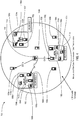
- Fig. 1 is a schematic diagram illustrating a system 100 for interference coordination consistent with embodiments disclosed herein.
- eNB 110 with coverage area 102 uses an LTE-U protocol to communicate with UEs 106a, 106b, 106c, 106d, 106e, 106f, 106g, 106h, 106i, 106j and 106k.
- WLAN access points (APs) 112a, 112b and 112c can be placed in buildings 114a, 114b and 114c.
- WLAN APs 112a, 112b and 112c can provide network connectivity to WLAN stations (STAs) 104a, 104b and 104c.
- STAs WLAN stations
- WLAN APs 112a, 112b and 112c also provide network connectivity to one or more of UEs 106a, 106b, 106c, 106d, 106e, 106f, 106g, 106h, 106i, 106j and 106k.
- eNB 110 communicates with UEs 106a, 106b, 106c, 106d, 106e, 106f, 106g, 106h, 106i, 106j and 106k inside and outside buildings 114a, 114b and 114c.
- UEs 106a, 106e, 106i and 106k are located outside buildings.
- UEs 106g and 106f are within building 108a, which includes WLAN service by AP 112a.
- UEs 106b, 106c and 106d are within building 108b, which includes WLAN service by AP 112b.
- UEs 106i and 106j are within building 108c, which includes WLAN service by AP 112c.
- eNB 110 can send control information over licensed bands (e.g., universal mobile telecommunications system frequency bands (UTMS), etc.) while sending data over unlicensed bands (e.g., LTE-U). In some embodiments, eNB 110 can send both control information and data over unlicensed bands.
- licensed bands e.g., universal mobile telecommunications system frequency bands (UTMS), etc.
- unlicensed bands e.g., LTE-U
- eNB 110 can send both control information and data over unlicensed bands.
- Figs. 2-4 show an example of how the system 100 of Fig. 1 can be used to coordinate transmissions over a cellular protocol (e.g., 3GPP LTE) with a WLAN protocol (e.g., IEEE 802.11 protocols, Wi-Fi, etc.).
- Fig. 2 shows eNB 110 sending a message to selected UEs 106a, 106d, 106g and 106i that indicate selected UEs 106a, 106d, 106g and 106i to broadcast a reservation message (e.g., CTS message) to local WLAN devices.
- UEs 106a, 106d, 106g and 106i in response to the message from eNB 110, sense the medium (e.g., frequency bands) for WLAN traffic.
- the medium e.g., frequency bands
- UEs 106a, 106d, 106g and 106i transmit a reservation message using a WLAN protocol (e.g., CTS message).
- Fig. 3 shows UEs 106a, 106d, 106g and 106i transmitting a success or failure message to eNB 110 that reports whether UEs 106a, 106d, 106g and 106i were able to transmit the reservation message.
- UEs 106a, 106d and 106i were successful.
- UE 106g was not successful.
- Fig. 4 shows eNB 110 sending data to UEs 106a, 106d and 106i that were successfully able to reserve the medium. eNB can buffer messages that were unable to be sent for transmission at a later time.
- Fig. 2 is a schematic diagram illustrating system 100 of Fig. 1 with eNB 110 requesting UEs 106a, 106d, 106g and 106i to reserve spectrum consistent with embodiments disclosed herein.
- eNB 110 sends a message to selected UEs 106a, 106d, 106g and 106i that indicate selected UEs 106a, 106d, 106g and 106i to broadcast a reservation message (e.g., CTS message) to local WLAN devices.
- a reservation message e.g., CTS message
- each round of the LTE transmission over the unlicensed spectrum is initiated by eNB 110.
- eNB 110 determines a subset of UEs 106a, 106d, 106g and 106i from the set of UEs 106a, 106b, 106c, 106d, 106e, 106f, 106g, 106h, 106i, 106j and 106k that should be serviced.
- eNB 110 starts by transmitting a message to the associated UEs 106a, 106d, 106g and 106i, including but not limited to the information about the subset of candidate UEs 106a, 106d, 106g and 106i that eNB 110 wants to serve, the length of time that it wants to reserve from the WLAN STAs 104a, 104b and 104c, and the frequency band that it will use.
- UEs 106a, 106d, 106g and 106i in response to the message from eNB 110, sense the medium (e.g., frequency bands) for WLAN traffic. If the medium is clear, the UEs 106a, 106d, 106g and 106i transmit a reservation message using a WLAN protocol (e.g., CTS message).
- a WLAN protocol e.g., CTS message
- such a message can be sent to UEs 106a, 106d, 106g and 106i using broadcast channel or dedicated control channel (over licensed or unlicensed spectrum).
- eNB 110 determines the set of candidate UEs 106a, 106d, 106g and 106i, it may take into account the downlink queue backlog waiting for transmission to each of UEs 106a, 106d, 106g and 106i and the location information of UEs 106a, 106d, 106g and 106i.
- the transmission of the broadcast message by eNB 110 to the candidate subset of UEs 106a, 106d, 106g and 106i is illustrated in Fig. 2 , which is denoted as CTS TX Command.
- Fig. 3 is a schematic diagram illustrating system 100 of Fig. 1 with UEs reporting results of spectrum reservation consistent with embodiments disclosed herein.
- UEs 106a, 106d, 106g and 106i attempt to send a reservation message
- UEs 106a, 106d, 106g and 106i transmit a success or failure message to eNB 110 that reports whether UEs 106a, 106d, 106g and 106i were able to transmit the reservation message.
- UEs 106a, 106d and 106i were successful.
- UE 106g was not successful.
- APs 112b and 112c are silenced during times reserved by the reservation message.
- AP 112b was silenced by a reservation message by UE 106c.
- AP 112c was silenced by a reservation message by UE 106i.
- UEs 106a, 106d, 106g and 106i perform medium sensing on the specified spectrum if it finds its ID in the set of candidate UEs 106a, 106d, 106g and 106i in the message from eNB 110. Unselected UEs 106b, 106c, 106e, 106f, 106h, 106j and 106k that are not in the candidate set do not perform sensing and save energy from unnecessary channel probing. If one of UEs 106a, 106d, 106g and 106i in the candidate set sees the medium busy, then it does not transmit CTS.
- UEs 106a, 106d and 106i that are in the candidate set and sense the medium idle will transmit the CTS message.
- UEs 106a, 106d, 106g and 106i in the candidate set send the feedback message back to eNB 110 on the success/fail of its CTS transmission attempt. This is shown by "Success" and "Fail" arrows in Fig. 3 .
- a UE senses medium idle, there is a possibility that the CTS transmission may not be successful if there is another close-by UE transmitting CTS at the same time. This possibility can be precluded by eNB 110 when selecting the candidate UE set by taking into account the location information of other candidate UEs. Introducing random timing offsets before transmitting CTS by each UE could be another alternative. More specifically, each UE senses medium idle delays its CTS transmission for a small random amount of time to reduce the chances that more than one UE transmits CTS at the same time. By doing so, a UE observing a CTS transmission by another UE can abort its CTS transmission. Simultaneous CTS transmissions may not result in a mutual collision since control messages such as CTS are usually protected with a robust coding and transmitted at the lowest rate.
- Fig. 4 is a schematic diagram illustrating system 100 of Fig. 1 with eNB 110 sending data to UEs 106a, 106d and 106i that successfully reserved spectrum. After receipt of success and failure messages, eNB 110 determines that successful UEs 106a, 106d and 106i receive data. APs 112b and 112c are silenced during times reserved by successful reservation messages by UEs 106d and 106i (represented by a "RESERVED" overlay on top of APs 112b and 112c). eNB 110 transmits data for successful UEs 106a, 106d and 106i using LTE-U over unlicensed spectrum.
- eNB 110 Upon receiving the feedback information from UEs 106a, 106d, 106g and 106i, eNB 110 starts sending data to UEs 106a, 106d and 106i that were successful on reserving the medium (e.g., APs 112b and 112c and neighboring WLAN STAs 104a, 104b and 104c) as illustrated in Fig. 4 .
- This approach allows reservation of spectrum locally around the UEs 106a, 106d and 106i that are actually served by eNB 110, while allowing the spectrum to be used by WLAN STAs 104a that do not directly interfere with the LTE downlink transmission such as WLAN BSS 1 in Fig. 4 .
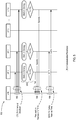
- Fig. 5 is flow diagram illustrating a process 500 for reserving unlicensed spectrum consistent with embodiments disclosed herein.
- Process 500 can be accomplished by system 100 as shown in Fig. 1 , including eNB 110; UEs 106a, 106b, 106c, 106d, 106e, 106f, 106g, 106h, 106i, 106j and 106k; WLAN APs 112a, 112b and 112c; and WLAN STAs 104a, 104b and 104c.
- eNB 110 selects UE 1, UE 2 and UE 4 for communication.
- UE 3 is not selected.
- UE 1 fails to reserve the medium.
- UE 2 and UE 4 successfully reserve the medium and receive data from eNB 110.
- eNB 110 sends a message to selected UEs (UEs that are selected to receive or send data) that request selected UEs to broadcast a reservation message to local WLAN devices.
- eNB 110 sends the message to UE 1, UE 2 and UE 4.
- UE 3 does not receive a message and can transition into a low power state during the next LTE-U transmission.
- UEs in response to the message from eNB 110, sense the medium (e.g., frequency bands) for WLAN traffic. If the medium is clear in operation 504, UEs 106a, 106d, 106g and 106i transmit a reservation message using a WLAN protocol (e.g., CTS message).
- a WLAN protocol e.g., CTS message
- UE 2 and UE 4 were successful in sensing a clear medium and transmitting a reservation message (TX CTS).
- UE 1 sensed a busy medium and did not transmit a reservation message.
- UE 1 sends a failure message to eNB 110.
- UE 2 and UE 4 send success messages to eNB 110.
- eNB 110 sends data to successful UE 2 and UE 4 that reserved the medium.
- Fig. 6 is an example of a method 600 for reserving spectrum from a UE perspective.
- Process 600 can be accomplished by system 100 as shown in Fig. 1 , including eNB 110; UEs 106a, 106b, 106c, 106d, 106e, 106f, 106g, 106h, 106i, 106j and 106k; WLAN APs 112a, 112b and 112c; and WLAN STAs 104a, 104b and 104c.
- the UE receives a request to reserve the medium (e.g., unlicensed spectrum used by WLAN).
- the UE conducts medium sensing to determine in block 606 whether the medium is busy (e.g., existing transmissions).
- the UE sends a failure report to eNB 110 in block 614. If the medium is available in block 608, the UE transmits a channel reservation using a WLAN protocol (e.g., CTS). If the channel reservation was successfully transmitted in block 608, the UE sends a success report to eNB 110 in block 612. In some embodiments, block 608 can be omitted and a success report 612 can be sent before, after or during block 610. In this embodiment, if the medium is idle, the UE can assume that a channel reservation is successfully sent. After block 612, eNB 110 can send data using LTE-U to UE.
- a WLAN protocol e.g., CTS
- a control channel can be used over a licensed band (e.g., LTE), while data can be sent over an unlicensed band (e.g., LTE-U). This can allow for simultaneous transmission and/or receipt of messages.
- LTE licensed band
- LTE-U unlicensed band
- Fig. 7 is an example of a method 700 for reserving spectrum from a tower perspective consistent with embodiments disclosed herein.
- Process 700 can be accomplished by system 100 as shown in Fig. 1 , including eNB 110; UEs 106a, 106b, 106c, 106d, 106e, 106f, 106g, 106h, 106i, 106j and 106k; WLAN APs 112a, 112b and 112c; and WLAN STAs 104a, 104b and 104c.
- eNB 110 determines which mobile devices (e.g., UEs) will receive communication from eNB 110.
- eNB 110 sends a request to selected mobile devices to reserve the medium (e.g., send a CTS message).
- eNB 110 receives success messages and/or failure messages from the selected mobile devices indicating success or failure of reserving the medium.
- eNB 110 selects messages (e.g., data) that match mobile devices that sent success messages.
- eNB 110 sends selected messages to mobile devices that successfully reserved the medium.
- Fig. 8 is an example of an LTE stack that can be enhanced to reserve spectrum consistent with embodiments disclosed herein.
- Various embodiments described herein can also be used to expand, update, use and/or provide new functionality to existing wireless systems (e.g., RATs, RANs, UTRAN, EUTRAN, etc.).
- Fig. 8 an example of an enhanced LTE protocol stack 800 for a UE is shown.
- the protocol stack 800 can be enhanced with new messages and measurements for use in connecting with small cells.
- the stack describes protocol layers in an enhanced LTE protocol stack 800. These layers can provide abstraction from a lower layer (represented as a layer closer to the bottom of the page).
- a physical layer (L1) 814 includes systems that translate physical signals into logical data for use by the higher layers. L1 can also provide measurement and configuration services to the radio resource control (RRC) layer 806.
- the medium access control (MAC) layer 812 includes systems that perform transport as logical mapping and/or scheduling. MAC layer 812 includes systems that can provide format selection and measurements about the network to RRC layer 806.
- the radio link control (RLC) layer 810 includes systems that provide segmentation, concatenation and reassembly, and can operate in different modes depending on a radio bearer.
- the packet data convergence protocol (PDCP) layer 808 includes systems that can provide services for higher-level protocols including cryptographic functions, header compression/decompression, sequence numbering and/or duplicate removal.
- User traffic can be sent through PDCP layer 808 to the internet protocol (IP) layer 804, which is then routed to applications and systems of the UE for use.
- Control traffic can be sent to RRC layer 806.
- RRC layer 806 can provide management and control functions of the UE.
- RRC layer 806 functionality can include processing of broadcast information, paging, connection management with an eNB 110, integrity protection of RRC messages, radio bearer control, mobility functions, UE measurement and reporting, quality of service management, etc.
- the non access stratum (NAS) layer 802 includes systems that can provide mobility management, call control, session management and/or identity management.
- method 600 as described in conjunction with Fig. 6 can be implemented in L2, such as in RRC layer 806.
- RRC layer 806 can perform operations 602 to 612.
- a UE can perform medium sensing using energy detection (ED) or carrier sense (CS). Thresholds of ED and/or CS can be altered to facilitate medium sensing when WLAN and LAA coexist.
- ED energy detection
- CS carrier sense
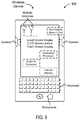
- Fig. 9 is an example illustration of a mobile device, such as a UE, a mobile station (MS), a mobile wireless device, a mobile communication device, a tablet, a handset, or another type of mobile wireless device.
- the mobile device can include one or more antennas configured to communicate with a transmission station, such as a base station (BS), an eNB, a base band unit (BBU), a remote radio head (RRH), a remote radio equipment (RRE), a relay station (RS), a radio equipment (RE), or another type of wireless wide area network (WWAN) access point.
- the mobile device can be configured to communicate using at least one wireless communication standard including 3GPP LTE, WiMAX, HSPA, Bluetooth, and Wi-Fi.
- the mobile device can communicate using separate antennas for each wireless communication standard or shared antennas for multiple wireless communication standards.
- the mobile device can communicate in a WLAN, a wireless personal area network (WPAN), and/or a WWAN.
- WLAN wireless personal area network
- WPAN
- Fig. 9 also provides an illustration of a microphone and one or more speakers that can be used for audio input and output from the mobile device.
- the display screen can be a liquid crystal display (LCD) screen or other type of display screen, such as an organic light emitting diode (OLED) display.
- the display screen can be configured as a touch screen.
- the touch screen can use capacitive, resistive, or another type of touch screen technology.
- An application processor and a graphics processor can be coupled to internal memory to provide processing and display capabilities.
- a non-volatile memory port can also be used to provide data input/output options to a user.
- the non-volatile memory port can also be used to expand the memory capabilities of the mobile device.
- a keyboard can be integrated with the mobile device or wirelessly connected to the mobile device to provide additional user input.
- a virtual keyboard can also be provided using the touch screen.
- Embodiments and implementations of the systems and methods described herein may include various operations, which may be embodied in machine-executable instructions to be executed by a computer system.
- a computer system may include one or more general-purpose or special-purpose computers (or other electronic devices).
- the computer system may include hardware components that include specific logic for performing the operations or may include a combination of hardware, software, and/or firmware.
- Suitable networks for configuration and/or use as described herein include one or more local area networks, wide area networks, metropolitan area networks, and/or internet or IP networks, such as the World Wide Web, a private internet, a secure internet, a value-added network, a virtual private network, an extranet, an intranet, or even stand-alone machines which communicate with other machines by physical transport of media.
- a suitable network may be formed from parts or entireties of two or more other networks, including networks using disparate hardware and network communication technologies.
- One suitable network includes a server and one or more clients; other suitable networks may contain other combinations of servers, clients, and/or peer-to-peer nodes, and a given computer system may function both as a client and as a server.
- Each network includes at least two computers or computer systems, such as the server and/or clients.
- a computer system may include a workstation, laptop computer, disconnectable mobile computer, server, mainframe, cluster, so-called “network computer” or "thin client,” tablet, smart phone, personal digital assistant or other hand-held computing device, "smart” consumer electronics device or appliance, medical device, or a combination thereof.
- Suitable networks may include communications or networking software, such as the software available from Novell®, Microsoft®, and other vendors, and may operate using TCP/IP, SPX, IPX, and other protocols over twisted pair, coaxial, or optical fiber cables, telephone lines, radio waves, satellites, microwave relays, modulated AC power lines, physical media transfer, and/or other data transmission "wires" known to those of skill in the art.
- the network may encompass smaller networks and/or be connectable to other networks through a gateway or similar mechanism.
- Various techniques, or certain aspects or portions thereof, may take the form of program code (i.e., instructions) embodied in tangible media, such as floppy diskettes, CD-ROMs, hard drives, magnetic or optical cards, solid-state memory devices, a nontransitory computer-readable storage medium, or any other machine-readable storage medium wherein, when the program code is loaded into and executed by a machine, such as a computer, the machine becomes an apparatus for practicing the various techniques.
- the computing device may include a processor, a storage medium readable by the processor (including volatile and nonvolatile memory and/or storage elements), at least one input device, and at least one output device.
- the volatile and nonvolatile memory and/or storage elements may be a RAM, an EPROM, a flash drive, an optical drive, a magnetic hard drive, or other medium for storing electronic data.
- One or more programs that may implement or utilize the various techniques described herein may use an application programming interface (API), reusable controls, and the like. Such programs may be implemented in a high-level procedural or an object-oriented programming language to communicate with a computer system. However, the program(s) may be implemented in assembly or machine language, if desired. In any case, the language may be a compiled or interpreted language, and combined with hardware implementations.
- API application programming interface
- Each computer system includes one or more processors and/or memory; computer systems may also include various input devices and/or output devices.
- the processor may include a general-purpose device, such as an Intel®, AMD®, or other "off-the-shelf" microprocessor.
- the processor may include a special-purpose processing device, such as ASIC, SoC, SiP, FPGA, PAL, PLA, FPLA, PLD, or other customized or programmable device.
- the memory may include static RAM, dynamic RAM, flash memory, one or more flip-flops, ROM, CD-ROM, DVD, disk, tape, or magnetic, optical, or other computer storage medium.
- the input device(s) may include a keyboard, mouse, touch screen, light pen, tablet, microphone, sensor, or other hardware with accompanying firmware and/or software.
- the output device(s) may include a monitor or other display, printer, speech or text synthesizer, switch, signal line, or other hardware with accompanying firmware and/or software.
- a component may be implemented as a hardware circuit comprising custom very large scale integration (VLSI) circuits or gate arrays, or off-the-shelf semiconductors such as logic chips, transistors, or other discrete components.
- VLSI very large scale integration
- a component may also be implemented in programmable hardware devices such as field programmable gate arrays, programmable array logic, programmable logic devices, or the like.
- Components may also be implemented in software for execution by various types of processors.
- An identified component of executable code may, for instance, comprise one or more physical or logical blocks of computer instructions, which may, for instance, be organized as an object, a procedure, or a function. Nevertheless, the executables of an identified component need not be physically located together, but may comprise disparate instructions stored in different locations that, when joined logically together, comprise the component and achieve the stated purpose for the component.
- a component of executable code may be a single instruction, or many instructions, and may even be distributed over several different code segments, among different programs, and across several memory devices.
- operational data may be identified and illustrated herein within components, and may be embodied in any suitable form and organized within any suitable type of data structure. The operational data may be collected as a single data set, or may be distributed over different locations including over different storage devices, and may exist, at least partially, merely as electronic signals on a system or network.
- the components may be passive or active, including agents operable to perform desired functions.
- a software module or component may include any type of computer instruction or computer-executable code located within a memory device.
- a software module may, for instance, include one or more physical or logical blocks of computer instructions, which may be organized as a routine, program, object, component, data structure, etc., that perform one or more tasks or implement particular data types. It is appreciated that a software module may be implemented in hardware and/or firmware instead of or in addition to software.
- One or more of the functional modules described herein may be separated into sub-modules and/or combined into a single or smaller number of modules.
- a particular software module may include disparate instructions stored in different locations of a memory device, different memory devices, or different computers, which together implement the described functionality of the module.
- a module may include a single instruction or many instructions, and may be distributed over several different code segments, among different programs, and across several memory devices.
- Some embodiments may be practiced in a distributed computing environment where tasks are performed by a remote processing device linked through a communications network.
- software modules may be located in local and/or remote memory storage devices.
- data being tied or rendered together in a database record may be resident in the same memory device, or across several memory devices, and may be linked together in fields of a record in a database across a network.
Landscapes
- Engineering & Computer Science (AREA)
- Signal Processing (AREA)
- Computer Networks & Wireless Communication (AREA)
- Mobile Radio Communication Systems (AREA)
Claims (15)
- Entwickelter Knoten B, eNB, (110) zum gemeinsamen Verwenden eines nicht lizenzierten Spektrums, der Folgendes umfasst:eine erste drahtlose Schnittstelle zum Kommunizieren mit zellularen Vorrichtungen, UE, (106a-106k) über einen Steuerkanal;eine zweite drahtlose Schnittstelle zum Kommunizieren mit zellularen Vorrichtungen, UE, (106a-106k) über einen Kommunikationskanal im nicht lizenzierten Spektrum;einen Prozessor, der konfiguriert ist zumWählen (702) eines Kandidatensatzes (106a, 106d, 106g, 106i) zellularer Vorrichtungen, UE, aus den zellularen Vorrichtungen, UE, die durch den eNB bedient werden, um einen Satz von Nachrichten über den Kommunikationskanal zu empfangen;Senden (502, 704) einer Anforderung unter Verwendung des Steuerkanals zum Kandidatensatz zellularer Vorrichtungen, UE, eine Sendebereitschaftsnachricht, CTS-Nachricht, unter Verwendung eines Protokolls eines drahtlosen lokalen Netzes, WLAN-Protokoll, zu übertragen;Empfangen (506, 706) eines Berichts über den Steuerkanal von einer ersten Untermenge des Kandidatensatzes zellularer Vorrichtungen, UE, der ein erfolgreiches Übertragen der CTS-Nachricht anzeigt;Empfangen (506, 706) eines Berichts über den Steuerkanal von einer zweiten Untermenge des Kandidatensatzes zellularer Vorrichtungen, der ein gescheitertes Übertragen der CTS-Nachricht anzeigt, wobei die zweite Untermenge nicht mit der ersten Untermenge des Kandidatensatzes zellularer Vorrichtungen überlappt, undSenden (508, 710) unter Verwendung eines zellularen Protokolls über den Kommunikationskanal einer Untermenge des Satzes von Nachrichten, die an die erste Untermenge zellularer Vorrichtungen, UE, (106a-106k) gerichtet ist.
- eNB (110) nach Anspruch 1, wobei der Steuerkanal über ein lizenziertes Spektrum bereitgestellt wird.
- eNB (110) nach Anspruch 1 oder 2, wobei der Steuerkanal über Frequenzbänder des universellen Mobiltelekommunikationssystems, UMTS, oder der Langzeitentwicklung, LTE, bereitgestellt wird.
- eNB (110) nach Anspruch 1, wobei der Steuerkanal über das nicht lizenziertes Spektrum bereitgestellt wird.
- eNB (110) nach Anspruch 4, wobei der Steuerkanal über das nicht lizenzierte LTE-Bänder LTE-U bereitgestellt wird.
- eNB (110) nach einem vorhergehenden Anspruch, wobei die Wahl (702) das Wählen des UE-Kandidatensatzes (106a-106k) mindestens teilweise durch Berücksichtigen der Ortsinformationen weiterer Kandidaten-UE enthält.
- eNB (110) nach einem vorhergehenden Anspruch, wobei die Wahl (702) mindestens teilweise ein Berücksichtigen des Downlink-Warteschlangenstaus, der auf ein Senden zu jedem der gewählten UE wartet, enthält.
- eNB (110) nach einem vorhergehenden Anspruch, wobei der Prozessor ferner konfiguriert ist, mindestens teilweise auf der Grundlage einer Nähe der ersten zellularen Vorrichtung zu der zweiten zellularen Vorrichtung zu bestimmen, dass ein erfolgreicher Bericht, der von einer ersten zellularen Vorrichtung, UE, aus dem Satz zellularer Vorrichtungen empfangen wurde, außerdem für eine zweite zellulare Vorrichtung, UE, aus dem Satz zellularer Vorrichtungen gilt.
- eNB nach Anspruch 8, wobei der Prozessor ferner konfiguriert ist, die zweite zellulare Vorrichtung zur Untermenge des Satzes zellularer Einrichtungen, die ein erfolgreiches Übertragen der CTS-Nachricht anzeigen, hinzuzufügen.
- Anwendergerät, UE, (106a-106k) zum Betreiben in einem gemeinsam verwendeten, nicht lizenzierten Spektrum, das Folgendes umfasst:eine Netzsteuereinheit, die konfiguriert ist zumEmpfangen (602) einer Anforderung von einem entwickelten Knoten B, eNB, (110) gemäß einem der Ansprüche 1-9 unter Verwendung eines Steuerkanals, um das nicht lizenzierte Medium zu reservieren;dann, wenn das UE (106a-106k) feststellt, dass seine Identität, ID, sich in der Anforderung befindet:Durchführen einer Mediumerfassung, um zu bestimmen, ob das Medium in Verwendung ist; undwenn das Medium nicht in Verwendung ist:Übertragen einer Mediumreservierungsnachricht unter Verwendung eines WLAN-Protokolls, die anzeigt, dass das Medium in Verwendung ist, wobei die Mediumreservierungsnachricht eine Sendebereitschaftsnachricht, CTS-Nachricht, ist; undSenden einer Erfolgsnachricht über den Steuerkanal, die eine erfolgreiche Reservierung des Mediums anzeigt, wobei die Erfolgsnachricht ein Bericht ist, der ein erfolgreiches Übertragen der CTS-Nachricht anzeigt, undwenn das Medium in Verwendung ist, Übertragen einer Nachricht über den Steuerkanal, der einen Fehler, das Medium zu reservieren, anzeigt.
- UE (106a-106k) nach Anspruch 10, wobei die Netzsteuereinheit ferner konfiguriert ist, dann, wenn das Medium in Verwendung ist, zu bestimmen, dass eine zweite Mediumreservierungsnachricht durch ein zweites UE in der Nähe des UE gesendet wurde und die Erfolgsnachricht, die die erfolgreiche Reservierung des Mediums für das UE anzeigt, zu senden.
- Verfahren zum Reservieren eines gemeinsam verwendeten Kommunikationskanals, das Folgendes umfasst:Empfangen durch ein Anwendergerät, UE, (106a-106k) über einen Steuerkanal einer Anforderung, eine Reservierungsnachricht eines ersten Protokolls über ein drahtloses Band von Frequenzen, die zwischen dem ersten Protokoll und einem zweiten Protokoll gemeinsam verwendet werden, zu übertragen;dadurch gekennzeichnet, dassdann, wenn das UE (106a-106k) feststellt, dass seine Identität, ID, sich in der Anforderung befindet:Reservieren des drahtlosen Bands von Frequenzen von der Verwendung durch das erste Protokoll;Senden eines Berichts der erfolgreichen Reservierung über den Steuerkanal, der eine erfolgreiche Reservierungsübertragung anzeigt; undKommunizieren unter Verwendung des zweiten Protokolls eines Satzes von Daten im drahtlosen Band von Frequenzen, wobei der Satz von Daten eine Untermenge eines Satzes von Nachrichten, die an eine Untermenge eines Satzes zellularer Vorrichtungen gerichtet sind und ein erfolgreiches Übertragen der Reservierungsnachricht anzeigen, umfasst.
- Verfahren nach Anspruch 12, das ferner Folgendes umfasst:Empfangen der Anforderung über ein zweites drahtloses Band von Frequenzen, die mit dem ersten Protokoll und dem zweiten Protokoll nicht gemeinsam verwendet werden, und/oderBestimmen, dass der Bericht der erfolgreichen Reservierung mehrere mobile Endgeräte repräsentiert, mindestens teilweise auf der Grundlage von Ortsinformationen der mehreren mobilen Endgeräte, wobei das Kommunizieren ein Übertragen unter Verwendung einer Duplexverbindung oder ein Empfangen unter Verwendung einer ausschließlichen Downlink-Verbindung umfasst.
- Verfahren nach einem der Ansprüche 12-13, wobei das erste Protokoll ein mit dem Partnerschaftsprojekt der dritten Generation, 3GPP, nicht kompatibles Protokoll ist.
- Verfahren nach einem der Ansprüche 12-14, wobei das zweite Protokoll ein mit dem Partnerschaftsprojekt der dritten Generation kompatibles Protokoll ist.
Applications Claiming Priority (3)
| Application Number | Priority Date | Filing Date | Title |
|---|---|---|---|
| US201461933856P | 2014-01-30 | 2014-01-30 | |
| US14/498,679 US9774436B2 (en) | 2014-01-30 | 2014-09-26 | Systems, methods and devices for selective interference coordination in a cellular protocol |
| PCT/US2015/013473 WO2015116791A1 (en) | 2014-01-30 | 2015-01-29 | Systems, methods and devices for selective interference coordination in a cellular protocol |
Publications (3)
| Publication Number | Publication Date |
|---|---|
| EP3100509A1 EP3100509A1 (de) | 2016-12-07 |
| EP3100509A4 EP3100509A4 (de) | 2017-09-06 |
| EP3100509B1 true EP3100509B1 (de) | 2020-01-08 |
Family
ID=53680119
Family Applications (1)
| Application Number | Title | Priority Date | Filing Date |
|---|---|---|---|
| EP15743527.2A Active EP3100509B1 (de) | 2014-01-30 | 2015-01-29 | Systeme, verfahren und vorrichtungen zur selektiven interferenzkoordination in einem mobilfunkprotokoll |
Country Status (5)
| Country | Link |
|---|---|
| US (1) | US9774436B2 (de) |
| EP (1) | EP3100509B1 (de) |
| CN (1) | CN105850179B (de) |
| HK (1) | HK1225896A1 (de) |
| WO (1) | WO2015116791A1 (de) |
Families Citing this family (23)
| Publication number | Priority date | Publication date | Assignee | Title |
|---|---|---|---|---|
| US9794821B2 (en) | 2014-04-28 | 2017-10-17 | Intel IP Corporation | Channel reservation for operation in an unlicensed spectrum |
| US10701729B2 (en) * | 2014-06-03 | 2020-06-30 | Qualcomm Incorporated | Protected CET transmission and reception |
| US20160049966A1 (en) * | 2014-08-15 | 2016-02-18 | Aviacomm Inc. | Rfic architecture for multi-stream remote radio head application |
| CN105517180B (zh) | 2014-09-24 | 2019-11-22 | 阿尔卡特朗讯 | 一种用于缓解隐藏节点干扰的方法及其装置 |
| US9698945B2 (en) * | 2014-09-30 | 2017-07-04 | Avago Technologies General Ip (Singapore) Pte. Ltd. | Long-term evolution unlicensed (LTE-U) and wireless local area network (WLAN) coexistence mechanism |
| CN105992345A (zh) * | 2015-01-27 | 2016-10-05 | 中兴通讯股份有限公司 | 非授权载波资源的使用方法及装置 |
| CN106341828B (zh) * | 2015-07-10 | 2020-04-03 | 华为技术有限公司 | 一种信道测量方法及sta |
| US9763267B2 (en) * | 2015-08-04 | 2017-09-12 | Qualcomm Incorporated | Techniques for using collision avoidance signaling for co-existence with unlicensed networks |
| US9713170B2 (en) | 2015-08-04 | 2017-07-18 | Qualcomm Incorporated | Techniques for using traffic monitoring for co-existence with unlicensed networks |
| US10237745B2 (en) | 2015-09-29 | 2019-03-19 | Huawei Technologies Co., Ltd. | Methods for synchronous access of unlicensed medium by grouping small cells in licensed assisted access (LAA) networks |
| CN105430677A (zh) * | 2015-11-10 | 2016-03-23 | 深圳市金立通信设备有限公司 | 一种授权频谱辅助接入方法,网络设备及终端设备 |
| US10009912B2 (en) * | 2015-11-20 | 2018-06-26 | Qualcomm Incorporated | Scheduling and token bucket for communication co-existence |
| US10524278B2 (en) | 2015-11-20 | 2019-12-31 | Qualcomm Incorporated | Scheduling and token bucket for communication co-existence |
| CN106888482B (zh) * | 2015-12-15 | 2020-04-07 | 展讯通信(上海)有限公司 | 终端、lte-u基站及其通信的方法 |
| KR102474525B1 (ko) | 2016-03-11 | 2022-12-06 | 삼성전자 주식회사 | 이동통신 시스템에서 단말의 제어 정보 전송 방법 및 장치 |
| CN109417732B (zh) * | 2016-05-11 | 2023-07-25 | 瑞典爱立信有限公司 | Pal保护区域的验证 |
| US10517021B2 (en) | 2016-06-30 | 2019-12-24 | Evolve Cellular Inc. | Long term evolution-primary WiFi (LTE-PW) |
| US10206140B2 (en) | 2016-11-02 | 2019-02-12 | Motorola Mobility Llc | Method and apparatus for operating a device on a licensed spectrum and an unlicensed spectrum |
| US10499427B2 (en) * | 2016-12-16 | 2019-12-03 | Qualcomm Incorporated | Band selection via coordinated clear channel assessment and switching signaling |
| US11032781B2 (en) * | 2017-01-06 | 2021-06-08 | Apple Inc. | Inter-node interference avoidance |
| US11601820B2 (en) | 2017-01-27 | 2023-03-07 | Qualcomm Incorporated | Broadcast control channel for shared spectrum |
| US11116009B2 (en) | 2017-08-03 | 2021-09-07 | Qualcomm Incorporated | Synchronous clear to send signaling |
| US11595823B2 (en) * | 2018-07-25 | 2023-02-28 | Qualcomm Incorporated | Medium reservation using energy detection and receiver assisted clear channel assessment |
Family Cites Families (15)
| Publication number | Priority date | Publication date | Assignee | Title |
|---|---|---|---|---|
| US6577613B1 (en) * | 1999-03-02 | 2003-06-10 | Verizon Corporate Services Group Inc. | Method and apparatus for asynchronous reservation-oriented multiple access for wireless networks |
| CN1951068B (zh) * | 2004-05-07 | 2012-12-05 | 皇家飞利浦电子股份有限公司 | 一种在无线电通信网中的媒体分发预留方法 |
| KR100964842B1 (ko) * | 2005-08-25 | 2010-06-24 | 삼성전자주식회사 | 무선 이동 통신 시스템에서 핸드오버를 위한 시스템 및방법 |
| US8102822B2 (en) * | 2008-07-14 | 2012-01-24 | Samsung Electronics Co., Ltd. | System and method for random access scheme in a wireless ad-hoc network |
| KR101443213B1 (ko) * | 2008-10-10 | 2014-09-24 | 삼성전자주식회사 | 동적으로 할당되는 공용제어채널 정보를 이용한 인지 무선 통신 방법 |
| US8179873B2 (en) * | 2008-10-14 | 2012-05-15 | Motorola Solutions, Inc. | Method to quite consecutive narrow band channels |
| US8521087B2 (en) | 2009-07-15 | 2013-08-27 | Lg Electronics Inc. | System and method for cognitive radio transmission |
| WO2011043016A1 (ja) * | 2009-10-08 | 2011-04-14 | 日本電気株式会社 | コンテンツ配信システム |
| US8730905B2 (en) * | 2010-11-04 | 2014-05-20 | Nokia Corporation | Transmission resource reservation scheme |
| CN103828265A (zh) | 2011-08-07 | 2014-05-28 | Lg电子株式会社 | 基于频率选择传输发射和接收帧的方法和装置 |
| RU2565247C1 (ru) * | 2011-08-15 | 2015-10-20 | Телефонактиеболагет Л М Эрикссон (Пабл) | Способ и компоновка для обработки запроса планирования |
| WO2013077600A1 (ko) | 2011-11-21 | 2013-05-30 | 엘지전자 주식회사 | 무선랜 시스템에서 프레임 송수신 방법 및 이를 지원하는 장치 |
| US9100108B2 (en) * | 2011-12-15 | 2015-08-04 | Broadcom Corporation | Time domain coexistence of RF signals |
| US9565593B2 (en) * | 2013-05-20 | 2017-02-07 | Qualcomm Incorporated | Techniques for selecting subframe type or for interleaving signals for wireless communications over unlicensed spectrum |
| US9801115B2 (en) * | 2013-09-04 | 2017-10-24 | Qualcomm Incorporated | Robust inter-radio access technology operations in unlicensed spectrum |
-
2014
- 2014-09-26 US US14/498,679 patent/US9774436B2/en not_active Expired - Fee Related
-
2015
- 2015-01-29 HK HK16114105.5A patent/HK1225896A1/zh unknown
- 2015-01-29 WO PCT/US2015/013473 patent/WO2015116791A1/en not_active Ceased
- 2015-01-29 CN CN201580003285.7A patent/CN105850179B/zh not_active Expired - Fee Related
- 2015-01-29 EP EP15743527.2A patent/EP3100509B1/de active Active
Non-Patent Citations (1)
| Title |
|---|
| None * |
Also Published As
| Publication number | Publication date |
|---|---|
| EP3100509A4 (de) | 2017-09-06 |
| US20150215100A1 (en) | 2015-07-30 |
| HK1225896A1 (zh) | 2017-09-15 |
| CN105850179B (zh) | 2019-12-13 |
| EP3100509A1 (de) | 2016-12-07 |
| WO2015116791A1 (en) | 2015-08-06 |
| US9774436B2 (en) | 2017-09-26 |
| CN105850179A (zh) | 2016-08-10 |
Similar Documents
| Publication | Publication Date | Title |
|---|---|---|
| EP3100509B1 (de) | Systeme, verfahren und vorrichtungen zur selektiven interferenzkoordination in einem mobilfunkprotokoll | |
| US10645746B2 (en) | Mechanisms for establishing user plane connectivity for non-3GPP access | |
| CN111108806B (zh) | 新无线电中的连接模式移动性 | |
| CN103139911B (zh) | 实现载波聚合的方法、基站和用户设备 | |
| JP6474891B2 (ja) | サービス固有のエアインターフェース選択 | |
| CN105981466B (zh) | 用于适机联网的系统、方法和设备 | |
| CN107079275B (zh) | 用于无线通信的方法和装备 | |
| US10104705B2 (en) | Apparatus, system and method of communicating between a cellular manager and a user equipment (UE) via a WLAN access device | |
| US10136330B2 (en) | Staggered channel changing for cells of spectrum sharing networks | |
| KR101972680B1 (ko) | 비면허 주파수 대역에서의 캐리어의 선택적 활성화 및 비활성화 기법 | |
| JP6677331B2 (ja) | 端末装置 | |
| US20130022023A1 (en) | Optimized carrier aggregation for handover | |
| EP3269162B1 (de) | Verfahren für backhaul-operationen in millimeterwellennetzwerken | |
| US20150124776A1 (en) | Data transmission method and apparatus in network linked with heterogeneous system | |
| EP3216134A1 (de) | Strahlformungsverfahren einer millimeterwellenlängen-basisstation und effiziente übertragungsstrategie für benutzergerät | |
| CN107079300B (zh) | 使用频谱资源进行通信的方法和通信设备 | |
| JP2022528347A (ja) | アップリンク伝送方法、アップリンクスケジューリング方法、装置及び通信システム | |
| US12381828B2 (en) | Downlink data stall optimization by addressing an out-of-order packet sequence | |
| CN119032589A (zh) | 路径切换和多路径场景期间的网络协调 | |
| US20170367025A1 (en) | Method for cell switching in unlicensed band and apparatus using same |
Legal Events
| Date | Code | Title | Description |
|---|---|---|---|
| PUAI | Public reference made under article 153(3) epc to a published international application that has entered the european phase |
Free format text: ORIGINAL CODE: 0009012 |
|
| STAA | Information on the status of an ep patent application or granted ep patent |
Free format text: STATUS: REQUEST FOR EXAMINATION WAS MADE |
|
| 17P | Request for examination filed |
Effective date: 20160610 |
|
| AK | Designated contracting states |
Kind code of ref document: A1 Designated state(s): AL AT BE BG CH CY CZ DE DK EE ES FI FR GB GR HR HU IE IS IT LI LT LU LV MC MK MT NL NO PL PT RO RS SE SI SK SM TR |
|
| AX | Request for extension of the european patent |
Extension state: BA ME |
|
| DAX | Request for extension of the european patent (deleted) | ||
| A4 | Supplementary search report drawn up and despatched |
Effective date: 20170803 |
|
| RIC1 | Information provided on ipc code assigned before grant |
Ipc: H04L 5/00 20060101AFI20170728BHEP Ipc: H04W 84/12 20090101ALN20170728BHEP Ipc: H04W 74/08 20090101ALI20170728BHEP Ipc: H04W 28/26 20090101ALI20170728BHEP Ipc: H04W 88/10 20090101ALI20170728BHEP |
|
| STAA | Information on the status of an ep patent application or granted ep patent |
Free format text: STATUS: EXAMINATION IS IN PROGRESS |
|
| 17Q | First examination report despatched |
Effective date: 20180827 |
|
| REG | Reference to a national code |
Ref country code: DE Ref legal event code: R079 Ref document number: 602015045160 Country of ref document: DE Free format text: PREVIOUS MAIN CLASS: H04W0028260000 Ipc: H04L0005000000 |
|
| GRAP | Despatch of communication of intention to grant a patent |
Free format text: ORIGINAL CODE: EPIDOSNIGR1 |
|
| STAA | Information on the status of an ep patent application or granted ep patent |
Free format text: STATUS: GRANT OF PATENT IS INTENDED |
|
| RIC1 | Information provided on ipc code assigned before grant |
Ipc: H04W 84/12 20090101ALN20190806BHEP Ipc: H04L 5/00 20060101AFI20190806BHEP Ipc: H04W 28/26 20090101ALI20190806BHEP Ipc: H04W 74/08 20090101ALI20190806BHEP Ipc: H04W 52/00 20090101ALI20190806BHEP Ipc: H04W 88/10 20090101ALI20190806BHEP |
|
| INTG | Intention to grant announced |
Effective date: 20190826 |
|
| GRAS | Grant fee paid |
Free format text: ORIGINAL CODE: EPIDOSNIGR3 |
|
| GRAA | (expected) grant |
Free format text: ORIGINAL CODE: 0009210 |
|
| STAA | Information on the status of an ep patent application or granted ep patent |
Free format text: STATUS: THE PATENT HAS BEEN GRANTED |
|
| AK | Designated contracting states |
Kind code of ref document: B1 Designated state(s): AL AT BE BG CH CY CZ DE DK EE ES FI FR GB GR HR HU IE IS IT LI LT LU LV MC MK MT NL NO PL PT RO RS SE SI SK SM TR |
|
| REG | Reference to a national code |
Ref country code: GB Ref legal event code: FG4D |
|
| REG | Reference to a national code |
Ref country code: CH Ref legal event code: EP |
|
| REG | Reference to a national code |
Ref country code: DE Ref legal event code: R096 Ref document number: 602015045160 Country of ref document: DE |
|
| REG | Reference to a national code |
Ref country code: IE Ref legal event code: FG4D |
|
| REG | Reference to a national code |
Ref country code: AT Ref legal event code: REF Ref document number: 1224012 Country of ref document: AT Kind code of ref document: T Effective date: 20200215 |
|
| REG | Reference to a national code |
Ref country code: NL Ref legal event code: MP Effective date: 20200108 |
|
| REG | Reference to a national code |
Ref country code: LT Ref legal event code: MG4D |
|
| PG25 | Lapsed in a contracting state [announced via postgrant information from national office to epo] |
Ref country code: LT Free format text: LAPSE BECAUSE OF FAILURE TO SUBMIT A TRANSLATION OF THE DESCRIPTION OR TO PAY THE FEE WITHIN THE PRESCRIBED TIME-LIMIT Effective date: 20200108 Ref country code: RS Free format text: LAPSE BECAUSE OF FAILURE TO SUBMIT A TRANSLATION OF THE DESCRIPTION OR TO PAY THE FEE WITHIN THE PRESCRIBED TIME-LIMIT Effective date: 20200108 Ref country code: PT Free format text: LAPSE BECAUSE OF FAILURE TO SUBMIT A TRANSLATION OF THE DESCRIPTION OR TO PAY THE FEE WITHIN THE PRESCRIBED TIME-LIMIT Effective date: 20200531 Ref country code: NO Free format text: LAPSE BECAUSE OF FAILURE TO SUBMIT A TRANSLATION OF THE DESCRIPTION OR TO PAY THE FEE WITHIN THE PRESCRIBED TIME-LIMIT Effective date: 20200408 Ref country code: FI Free format text: LAPSE BECAUSE OF FAILURE TO SUBMIT A TRANSLATION OF THE DESCRIPTION OR TO PAY THE FEE WITHIN THE PRESCRIBED TIME-LIMIT Effective date: 20200108 Ref country code: NL Free format text: LAPSE BECAUSE OF FAILURE TO SUBMIT A TRANSLATION OF THE DESCRIPTION OR TO PAY THE FEE WITHIN THE PRESCRIBED TIME-LIMIT Effective date: 20200108 |
|
| PGFP | Annual fee paid to national office [announced via postgrant information from national office to epo] |
Ref country code: NL Payment date: 20200401 Year of fee payment: 6 |
|
| REG | Reference to a national code |
Ref country code: DE Ref legal event code: R082 Ref document number: 602015045160 Country of ref document: DE Representative=s name: BARDEHLE PAGENBERG PARTNERSCHAFT MBB PATENTANW, DE Ref country code: DE Ref legal event code: R081 Ref document number: 602015045160 Country of ref document: DE Owner name: APPLE INC., CUPERTINO, US Free format text: FORMER OWNER: INTEL IP CORPORATION, SANTA CLARA, CALIF., US Ref country code: DE Ref legal event code: R081 Ref document number: 602015045160 Country of ref document: DE Owner name: APPLE INC., CUPERTINO, US Free format text: FORMER OWNER: INTEL IP CORPORATION, SANTA CLARA, CA, US |
|
| PG25 | Lapsed in a contracting state [announced via postgrant information from national office to epo] |
Ref country code: SE Free format text: LAPSE BECAUSE OF FAILURE TO SUBMIT A TRANSLATION OF THE DESCRIPTION OR TO PAY THE FEE WITHIN THE PRESCRIBED TIME-LIMIT Effective date: 20200108 Ref country code: LV Free format text: LAPSE BECAUSE OF FAILURE TO SUBMIT A TRANSLATION OF THE DESCRIPTION OR TO PAY THE FEE WITHIN THE PRESCRIBED TIME-LIMIT Effective date: 20200108 Ref country code: HR Free format text: LAPSE BECAUSE OF FAILURE TO SUBMIT A TRANSLATION OF THE DESCRIPTION OR TO PAY THE FEE WITHIN THE PRESCRIBED TIME-LIMIT Effective date: 20200108 Ref country code: BG Free format text: LAPSE BECAUSE OF FAILURE TO SUBMIT A TRANSLATION OF THE DESCRIPTION OR TO PAY THE FEE WITHIN THE PRESCRIBED TIME-LIMIT Effective date: 20200408 Ref country code: IS Free format text: LAPSE BECAUSE OF FAILURE TO SUBMIT A TRANSLATION OF THE DESCRIPTION OR TO PAY THE FEE WITHIN THE PRESCRIBED TIME-LIMIT Effective date: 20200508 Ref country code: GR Free format text: LAPSE BECAUSE OF FAILURE TO SUBMIT A TRANSLATION OF THE DESCRIPTION OR TO PAY THE FEE WITHIN THE PRESCRIBED TIME-LIMIT Effective date: 20200409 |
|
| REG | Reference to a national code |
Ref country code: CH Ref legal event code: PL |
|
| REG | Reference to a national code |
Ref country code: DE Ref legal event code: R097 Ref document number: 602015045160 Country of ref document: DE |
|
| REG | Reference to a national code |
Ref country code: BE Ref legal event code: MM Effective date: 20200131 |
|
| PG25 | Lapsed in a contracting state [announced via postgrant information from national office to epo] |
Ref country code: CZ Free format text: LAPSE BECAUSE OF FAILURE TO SUBMIT A TRANSLATION OF THE DESCRIPTION OR TO PAY THE FEE WITHIN THE PRESCRIBED TIME-LIMIT Effective date: 20200108 Ref country code: SK Free format text: LAPSE BECAUSE OF FAILURE TO SUBMIT A TRANSLATION OF THE DESCRIPTION OR TO PAY THE FEE WITHIN THE PRESCRIBED TIME-LIMIT Effective date: 20200108 Ref country code: LU Free format text: LAPSE BECAUSE OF NON-PAYMENT OF DUE FEES Effective date: 20200129 Ref country code: RO Free format text: LAPSE BECAUSE OF FAILURE TO SUBMIT A TRANSLATION OF THE DESCRIPTION OR TO PAY THE FEE WITHIN THE PRESCRIBED TIME-LIMIT Effective date: 20200108 Ref country code: MC Free format text: LAPSE BECAUSE OF FAILURE TO SUBMIT A TRANSLATION OF THE DESCRIPTION OR TO PAY THE FEE WITHIN THE PRESCRIBED TIME-LIMIT Effective date: 20200108 Ref country code: DK Free format text: LAPSE BECAUSE OF FAILURE TO SUBMIT A TRANSLATION OF THE DESCRIPTION OR TO PAY THE FEE WITHIN THE PRESCRIBED TIME-LIMIT Effective date: 20200108 Ref country code: ES Free format text: LAPSE BECAUSE OF FAILURE TO SUBMIT A TRANSLATION OF THE DESCRIPTION OR TO PAY THE FEE WITHIN THE PRESCRIBED TIME-LIMIT Effective date: 20200108 Ref country code: SM Free format text: LAPSE BECAUSE OF FAILURE TO SUBMIT A TRANSLATION OF THE DESCRIPTION OR TO PAY THE FEE WITHIN THE PRESCRIBED TIME-LIMIT Effective date: 20200108 Ref country code: EE Free format text: LAPSE BECAUSE OF FAILURE TO SUBMIT A TRANSLATION OF THE DESCRIPTION OR TO PAY THE FEE WITHIN THE PRESCRIBED TIME-LIMIT Effective date: 20200108 |
|
| PLBE | No opposition filed within time limit |
Free format text: ORIGINAL CODE: 0009261 |
|
| STAA | Information on the status of an ep patent application or granted ep patent |
Free format text: STATUS: NO OPPOSITION FILED WITHIN TIME LIMIT |
|
| REG | Reference to a national code |
Ref country code: AT Ref legal event code: MK05 Ref document number: 1224012 Country of ref document: AT Kind code of ref document: T Effective date: 20200108 |
|
| PG25 | Lapsed in a contracting state [announced via postgrant information from national office to epo] |
Ref country code: LI Free format text: LAPSE BECAUSE OF NON-PAYMENT OF DUE FEES Effective date: 20200131 Ref country code: CH Free format text: LAPSE BECAUSE OF NON-PAYMENT OF DUE FEES Effective date: 20200131 Ref country code: BE Free format text: LAPSE BECAUSE OF NON-PAYMENT OF DUE FEES Effective date: 20200131 |
|
| 26N | No opposition filed |
Effective date: 20201009 |
|
| PG25 | Lapsed in a contracting state [announced via postgrant information from national office to epo] |
Ref country code: IE Free format text: LAPSE BECAUSE OF NON-PAYMENT OF DUE FEES Effective date: 20200129 Ref country code: AT Free format text: LAPSE BECAUSE OF FAILURE TO SUBMIT A TRANSLATION OF THE DESCRIPTION OR TO PAY THE FEE WITHIN THE PRESCRIBED TIME-LIMIT Effective date: 20200108 Ref country code: IT Free format text: LAPSE BECAUSE OF FAILURE TO SUBMIT A TRANSLATION OF THE DESCRIPTION OR TO PAY THE FEE WITHIN THE PRESCRIBED TIME-LIMIT Effective date: 20200108 |
|
| PGFP | Annual fee paid to national office [announced via postgrant information from national office to epo] |
Ref country code: FR Payment date: 20201210 Year of fee payment: 7 |
|
| PG25 | Lapsed in a contracting state [announced via postgrant information from national office to epo] |
Ref country code: PL Free format text: LAPSE BECAUSE OF FAILURE TO SUBMIT A TRANSLATION OF THE DESCRIPTION OR TO PAY THE FEE WITHIN THE PRESCRIBED TIME-LIMIT Effective date: 20200108 Ref country code: SI Free format text: LAPSE BECAUSE OF FAILURE TO SUBMIT A TRANSLATION OF THE DESCRIPTION OR TO PAY THE FEE WITHIN THE PRESCRIBED TIME-LIMIT Effective date: 20200108 |
|
| PGFP | Annual fee paid to national office [announced via postgrant information from national office to epo] |
Ref country code: GB Payment date: 20210120 Year of fee payment: 7 Ref country code: DE Payment date: 20210119 Year of fee payment: 7 |
|
| PG25 | Lapsed in a contracting state [announced via postgrant information from national office to epo] |
Ref country code: TR Free format text: LAPSE BECAUSE OF FAILURE TO SUBMIT A TRANSLATION OF THE DESCRIPTION OR TO PAY THE FEE WITHIN THE PRESCRIBED TIME-LIMIT Effective date: 20200108 Ref country code: MT Free format text: LAPSE BECAUSE OF FAILURE TO SUBMIT A TRANSLATION OF THE DESCRIPTION OR TO PAY THE FEE WITHIN THE PRESCRIBED TIME-LIMIT Effective date: 20200108 Ref country code: CY Free format text: LAPSE BECAUSE OF FAILURE TO SUBMIT A TRANSLATION OF THE DESCRIPTION OR TO PAY THE FEE WITHIN THE PRESCRIBED TIME-LIMIT Effective date: 20200108 |
|
| PG25 | Lapsed in a contracting state [announced via postgrant information from national office to epo] |
Ref country code: MK Free format text: LAPSE BECAUSE OF FAILURE TO SUBMIT A TRANSLATION OF THE DESCRIPTION OR TO PAY THE FEE WITHIN THE PRESCRIBED TIME-LIMIT Effective date: 20200108 Ref country code: AL Free format text: LAPSE BECAUSE OF FAILURE TO SUBMIT A TRANSLATION OF THE DESCRIPTION OR TO PAY THE FEE WITHIN THE PRESCRIBED TIME-LIMIT Effective date: 20200108 |
|
| REG | Reference to a national code |
Ref country code: DE Ref legal event code: R119 Ref document number: 602015045160 Country of ref document: DE |
|
| GBPC | Gb: european patent ceased through non-payment of renewal fee |
Effective date: 20220129 |
|
| PG25 | Lapsed in a contracting state [announced via postgrant information from national office to epo] |
Ref country code: GB Free format text: LAPSE BECAUSE OF NON-PAYMENT OF DUE FEES Effective date: 20220129 Ref country code: DE Free format text: LAPSE BECAUSE OF NON-PAYMENT OF DUE FEES Effective date: 20220802 |
|
| PG25 | Lapsed in a contracting state [announced via postgrant information from national office to epo] |
Ref country code: FR Free format text: LAPSE BECAUSE OF NON-PAYMENT OF DUE FEES Effective date: 20220131 |
|
| REG | Reference to a national code |
Ref country code: GB Ref legal event code: 732E Free format text: REGISTERED BETWEEN 20240704 AND 20240710 |