EP3100679A1 - Hautpenetrierende vorrichtung - Google Patents
Hautpenetrierende vorrichtung Download PDFInfo
- Publication number
- EP3100679A1 EP3100679A1 EP16176969.0A EP16176969A EP3100679A1 EP 3100679 A1 EP3100679 A1 EP 3100679A1 EP 16176969 A EP16176969 A EP 16176969A EP 3100679 A1 EP3100679 A1 EP 3100679A1
- Authority
- EP
- European Patent Office
- Prior art keywords
- lancet
- release
- holder
- lancing device
- trigger
- Prior art date
- Legal status (The legal status is an assumption and is not a legal conclusion. Google has not performed a legal analysis and makes no representation as to the accuracy of the status listed.)
- Withdrawn
Links
- 230000035515 penetration Effects 0.000 title description 19
- 230000009471 action Effects 0.000 description 13
- 210000003813 thumb Anatomy 0.000 description 9
- 238000003780 insertion Methods 0.000 description 7
- 230000037431 insertion Effects 0.000 description 7
- 230000000903 blocking effect Effects 0.000 description 3
- 239000008280 blood Substances 0.000 description 3
- 210000004369 blood Anatomy 0.000 description 3
- 210000003811 finger Anatomy 0.000 description 3
- 230000000670 limiting effect Effects 0.000 description 3
- 230000007246 mechanism Effects 0.000 description 3
- 238000000465 moulding Methods 0.000 description 3
- 230000008901 benefit Effects 0.000 description 2
- 230000008602 contraction Effects 0.000 description 2
- 238000010304 firing Methods 0.000 description 2
- 238000002347 injection Methods 0.000 description 2
- 239000007924 injection Substances 0.000 description 2
- 238000004519 manufacturing process Methods 0.000 description 2
- 230000004048 modification Effects 0.000 description 2
- 238000012986 modification Methods 0.000 description 2
- 239000012858 resilient material Substances 0.000 description 2
- 230000000452 restraining effect Effects 0.000 description 2
- WQZGKKKJIJFFOK-GASJEMHNSA-N Glucose Natural products OC[C@H]1OC(O)[C@H](O)[C@@H](O)[C@@H]1O WQZGKKKJIJFFOK-GASJEMHNSA-N 0.000 description 1
- 208000012266 Needlestick injury Diseases 0.000 description 1
- 230000004913 activation Effects 0.000 description 1
- 238000005452 bending Methods 0.000 description 1
- 230000015572 biosynthetic process Effects 0.000 description 1
- 230000006835 compression Effects 0.000 description 1
- 238000007906 compression Methods 0.000 description 1
- 238000010276 construction Methods 0.000 description 1
- 238000011109 contamination Methods 0.000 description 1
- 230000000694 effects Effects 0.000 description 1
- 239000008103 glucose Substances 0.000 description 1
- 210000005036 nerve Anatomy 0.000 description 1
- 230000009467 reduction Effects 0.000 description 1
- 230000002829 reductive effect Effects 0.000 description 1
- 230000000717 retained effect Effects 0.000 description 1
- 230000002441 reversible effect Effects 0.000 description 1
Images





Classifications
-
- A—HUMAN NECESSITIES
- A61—MEDICAL OR VETERINARY SCIENCE; HYGIENE
- A61B—DIAGNOSIS; SURGERY; IDENTIFICATION
- A61B5/00—Measuring for diagnostic purposes; Identification of persons
- A61B5/15—Devices for taking samples of blood
- A61B5/151—Devices specially adapted for taking samples of capillary blood, e.g. by lancets, needles or blades
- A61B5/15186—Devices loaded with a single lancet, i.e. a single lancet with or without a casing is loaded into a reusable drive device and then discarded after use; drive devices reloadable for multiple use
- A61B5/15188—Constructional features of reusable driving devices
- A61B5/1519—Constructional features of reusable driving devices comprising driving means, e.g. a spring, for propelling the piercing unit
-
- A—HUMAN NECESSITIES
- A61—MEDICAL OR VETERINARY SCIENCE; HYGIENE
- A61B—DIAGNOSIS; SURGERY; IDENTIFICATION
- A61B5/00—Measuring for diagnostic purposes; Identification of persons
- A61B5/14—Devices for taking samples of blood ; Measuring characteristics of blood in vivo, e.g. gas concentration within the blood, pH-value of blood
- A61B5/1405—Devices for taking blood samples
- A61B5/1411—Devices for taking blood samples by percutaneous method, e.g. by lancet
-
- A—HUMAN NECESSITIES
- A61—MEDICAL OR VETERINARY SCIENCE; HYGIENE
- A61B—DIAGNOSIS; SURGERY; IDENTIFICATION
- A61B5/00—Measuring for diagnostic purposes; Identification of persons
- A61B5/15—Devices for taking samples of blood
- A61B5/150007—Details
- A61B5/150015—Source of blood
- A61B5/150022—Source of blood for capillary blood or interstitial fluid
-
- A—HUMAN NECESSITIES
- A61—MEDICAL OR VETERINARY SCIENCE; HYGIENE
- A61B—DIAGNOSIS; SURGERY; IDENTIFICATION
- A61B5/00—Measuring for diagnostic purposes; Identification of persons
- A61B5/15—Devices for taking samples of blood
- A61B5/150007—Details
- A61B5/150053—Details for enhanced collection of blood or interstitial fluid at the sample site, e.g. by applying compression, heat, vibration, ultrasound, suction or vacuum to tissue; for reduction of pain or discomfort; Skin piercing elements, e.g. blades, needles, lancets or canulas, with adjustable piercing speed
- A61B5/150106—Means for reducing pain or discomfort applied before puncturing; desensitising the skin at the location where body is to be pierced
- A61B5/150114—Means for reducing pain or discomfort applied before puncturing; desensitising the skin at the location where body is to be pierced by tissue compression, e.g. with specially designed surface of device contacting the skin area to be pierced
-
- A—HUMAN NECESSITIES
- A61—MEDICAL OR VETERINARY SCIENCE; HYGIENE
- A61B—DIAGNOSIS; SURGERY; IDENTIFICATION
- A61B5/00—Measuring for diagnostic purposes; Identification of persons
- A61B5/15—Devices for taking samples of blood
- A61B5/150007—Details
- A61B5/150175—Adjustment of penetration depth
- A61B5/150183—Depth adjustment mechanism using end caps mounted at the distal end of the sampling device, i.e. the end-caps are adjustably positioned relative to the piercing device housing for example by rotating or screwing
-
- A—HUMAN NECESSITIES
- A61—MEDICAL OR VETERINARY SCIENCE; HYGIENE
- A61B—DIAGNOSIS; SURGERY; IDENTIFICATION
- A61B5/00—Measuring for diagnostic purposes; Identification of persons
- A61B5/15—Devices for taking samples of blood
- A61B5/150007—Details
- A61B5/150374—Details of piercing elements or protective means for preventing accidental injuries by such piercing elements
- A61B5/150381—Design of piercing elements
- A61B5/150412—Pointed piercing elements, e.g. needles, lancets for piercing the skin
-
- A—HUMAN NECESSITIES
- A61—MEDICAL OR VETERINARY SCIENCE; HYGIENE
- A61B—DIAGNOSIS; SURGERY; IDENTIFICATION
- A61B5/00—Measuring for diagnostic purposes; Identification of persons
- A61B5/15—Devices for taking samples of blood
- A61B5/150007—Details
- A61B5/150374—Details of piercing elements or protective means for preventing accidental injuries by such piercing elements
- A61B5/150381—Design of piercing elements
- A61B5/150503—Single-ended needles
-
- A—HUMAN NECESSITIES
- A61—MEDICAL OR VETERINARY SCIENCE; HYGIENE
- A61B—DIAGNOSIS; SURGERY; IDENTIFICATION
- A61B5/00—Measuring for diagnostic purposes; Identification of persons
- A61B5/15—Devices for taking samples of blood
- A61B5/150007—Details
- A61B5/150374—Details of piercing elements or protective means for preventing accidental injuries by such piercing elements
- A61B5/150534—Design of protective means for piercing elements for preventing accidental needle sticks, e.g. shields, caps, protectors, axially extensible sleeves, pivotable protective sleeves
- A61B5/15058—Joining techniques used for protective means
- A61B5/150595—Joining techniques used for protective means by snap-lock (i.e. based on axial displacement)
-
- A—HUMAN NECESSITIES
- A61—MEDICAL OR VETERINARY SCIENCE; HYGIENE
- A61B—DIAGNOSIS; SURGERY; IDENTIFICATION
- A61B5/00—Measuring for diagnostic purposes; Identification of persons
- A61B5/15—Devices for taking samples of blood
- A61B5/150007—Details
- A61B5/150801—Means for facilitating use, e.g. by people with impaired vision; means for indicating when used correctly or incorrectly; means for alarming
- A61B5/150809—Means for facilitating use, e.g. by people with impaired vision; means for indicating when used correctly or incorrectly; means for alarming by audible feedback
-
- A—HUMAN NECESSITIES
- A61—MEDICAL OR VETERINARY SCIENCE; HYGIENE
- A61B—DIAGNOSIS; SURGERY; IDENTIFICATION
- A61B5/00—Measuring for diagnostic purposes; Identification of persons
- A61B5/15—Devices for taking samples of blood
- A61B5/150007—Details
- A61B5/150801—Means for facilitating use, e.g. by people with impaired vision; means for indicating when used correctly or incorrectly; means for alarming
- A61B5/150824—Means for facilitating use, e.g. by people with impaired vision; means for indicating when used correctly or incorrectly; means for alarming by visual feedback
-
- A—HUMAN NECESSITIES
- A61—MEDICAL OR VETERINARY SCIENCE; HYGIENE
- A61B—DIAGNOSIS; SURGERY; IDENTIFICATION
- A61B5/00—Measuring for diagnostic purposes; Identification of persons
- A61B5/15—Devices for taking samples of blood
- A61B5/151—Devices specially adapted for taking samples of capillary blood, e.g. by lancets, needles or blades
- A61B5/15101—Details
- A61B5/15103—Piercing procedure
- A61B5/15107—Piercing being assisted by a triggering mechanism
- A61B5/15113—Manually triggered, i.e. the triggering requires a deliberate action by the user such as pressing a drive button
-
- A—HUMAN NECESSITIES
- A61—MEDICAL OR VETERINARY SCIENCE; HYGIENE
- A61B—DIAGNOSIS; SURGERY; IDENTIFICATION
- A61B5/00—Measuring for diagnostic purposes; Identification of persons
- A61B5/15—Devices for taking samples of blood
- A61B5/151—Devices specially adapted for taking samples of capillary blood, e.g. by lancets, needles or blades
- A61B5/15101—Details
- A61B5/15115—Driving means for propelling the piercing element to pierce the skin, e.g. comprising mechanisms based on shape memory alloys, magnetism, solenoids, piezoelectric effect, biased elements, resilient elements, vacuum or compressed fluids
- A61B5/15117—Driving means for propelling the piercing element to pierce the skin, e.g. comprising mechanisms based on shape memory alloys, magnetism, solenoids, piezoelectric effect, biased elements, resilient elements, vacuum or compressed fluids comprising biased elements, resilient elements or a spring, e.g. a helical spring, leaf spring, or elastic strap
-
- A—HUMAN NECESSITIES
- A61—MEDICAL OR VETERINARY SCIENCE; HYGIENE
- A61B—DIAGNOSIS; SURGERY; IDENTIFICATION
- A61B5/00—Measuring for diagnostic purposes; Identification of persons
- A61B5/15—Devices for taking samples of blood
- A61B5/151—Devices specially adapted for taking samples of capillary blood, e.g. by lancets, needles or blades
- A61B5/15186—Devices loaded with a single lancet, i.e. a single lancet with or without a casing is loaded into a reusable drive device and then discarded after use; drive devices reloadable for multiple use
- A61B5/15188—Constructional features of reusable driving devices
- A61B5/15192—Constructional features of reusable driving devices comprising driving means, e.g. a spring, for retracting the lancet unit into the driving device housing
- A61B5/15194—Constructional features of reusable driving devices comprising driving means, e.g. a spring, for retracting the lancet unit into the driving device housing fully automatically retracted, i.e. the retraction does not require a deliberate action by the user, e.g. by terminating the contact with the patient's skin
Definitions
- This invention relates to skin penetration devices and in particular, but not exclusively, to lancing devices. As will be evident, certain features disclosed herein may be used in applications other than lancing devices, for example in injection devices.
- many lancing devices are designed to be used with a disposable lancet, with the lancet device itself being reused many times.
- a fresh lancet Prior to a lancing operation, a fresh lancet is typically loaded into a lancet holder in the device which is then cocked and fired. After use, the spent lancet, now contaminated with blood, must be removed for disposal.
- the connection between the lancet holder and lancet needs to be sufficient to retain the lancet securely during operation. It is common for this to be a push fit with a mild form of detent action. In order to release such a lancet it is common to provide a push rod arrangement, which pushes the lancet clear of the holder to eject it.
- this invention provides a lancing device having:
- Moving the release element in a direction generally parallel to the lancing direction may allow a longer stroke of movement and therefore less force, than those in which a wedge is inserted transversely.
- said socket is defined by a generally cylindrical wall of resilient material having a slot therein to allow resilient expansion and/or contraction.
- the cylindrical wall may be provided with radially outwardly extending abutments spaced one to either side of said slot, with said release element having respective cam surfaces cooperating with said abutment whereby movement of the release element in a direction generally parallel to the lancing direction causes movement of the socket between its lancet retaining condition and its expanded condition.
- Disposing the lancet release element for longitudinal movement means that the release action of the release element does not project or encroach into the interior of the socket. This means that there is greater design flexibility in designing the release action in terms of axial extent of movement of the release element, and the proportion of the stroke of movement over which expansion of the socket is effected, and the mechanical advantage and/or activation pressure required.
- the wall of the socket is shaped, and the abutments are angularly disposed to provide an 'overlap' so that, to expand the socket the abutments are squeezed towards each other to expand the socket, although arrangements in which the abutments are squeezed apart to expand the socket are possible.
- the wall of the socket has a slot comprising forward and rearward angularly offset generally longitudinal extending portions, to provide a wrapping or overlap effect. The overlap may ensure that the lancet in use is held more securely against lateral movement during loading and unloading.
- said lancet release element is additionally movable to cock the lancet holder. Not only is this technically advantageous as it may allow a reduction in component design and a simpler mechanism, but it also provides intuitive operation.
- this invention provides a lancing device having:
- said housing or a component associated therewith, includes a lancet holder restraining element movable between a position in which it blocks forward movement of said lancet holder, and a free position in which forward movement of the lancet holder is not blocked thereby.
- Said lancet release element may include a control surface which, as said lancet release element is moved to release the lancet engages said locking element to move it to its blocking position.
- the lancing device includes a trigger arrangement operable to latch and release said lancet holder for movement under the influence of a drive spring
- said lancet holder restricting element is conveniently part of said trigger arrangement.
- a common design of many lancing devices is to provide a housing which has a forward nose portion that is removable to allow loading and unloading of the lancet, with the nose portion providing a skin contact surface with a small aperture through which the tip of the lancet projects when fired.
- the nose portion provides a skin contact surface with a small aperture through which the tip of the lancet projects when fired.
- the nose portion may inadvertently eject the lancet leaving it loose in the lancet housing with the risk that it moves again to project its tip through the housing, thereby leading to contamination; alternatively the unconstrained lancet may drop out of the housing the next time it is opened, before the user is ready to dispose of it.
- this invention provides a lancing device having:
- the presence of the forward nose portion effectively blocks movement of the lancet release element to its release position as it is not possible to force the nose portion off the device by pressure applied to the lancet release element.
- the device may be designed so that if an attempt is made to force the lancet release element to its release position with the nose portion still in place, the nose portion is ejected. Ejection of the nose portion may be an intended action prior to lancet ejection, or it may be flagged to the user as a misuse.
- said lancet release element is movable longitudinally and includes an elongate extension adapted to cooperate with said forward nose portion to prevent movement.
- this invention provides a skin penetration device including:
- said relatively fixed portion and said skin contacting portion include respective detent elements to provide a detent action at spaced angular positions.
- a stop surface is associated with said cam surface to limit relative rotation of said relatively movable member. Said interrupted cam surface may follow a generally helical path with respect to the axis, the cam surface including alternate opposite facing cam face elements together defining said cam track for said cam follower.
- cam surface elements are of lesser circumferential extent than said cam follower.
- At least one of the cam surface and said cam follower are resiliently deformable to allow said cam follower to be introduced into said cam track by the application of an axial load in a push fit operation.
- the cam follower is conveniently provided on said depth adjusting portion with said cam track being provided on said relatively fixed portion.
- a lancing device having:
- said trigger element projects from the surface of said housing when in the armed condition and the lancet release element comprises an externally accessible manually operable control element, and the trigger element in its armed position lies in the projected path of the control element.
- forward movement of the lancet holder may be limited in various ways.
- the lancet holder may have an abutment surface at or towards its rear end which moves into abutment with an abutment surface on the housing or a component relatively fixed thereto to define the forwardmost position of the lancet holder.
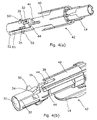
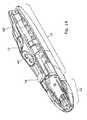
- the lancing device of this embodiment comprises a main housing 10 to the forward end of which is releasably attached a depth adjuster assembly 12.
- a depth adjuster assembly 12 Projecting from the upper surface of the main housing 10 is an externally accessible thumb pad 14 of a slider assembly, the main part lying within the housing.
- the thumb pad 14 is slideable in the reverse direction (away from the depth adjuster assembly) to prime or cock the device prior to use, and further movable forwardly, after use, to release a spent lancet from the front of the housing when the depth adjuster assembly has been removed.
- the device is fired by pressing a firing button 16 which rises proud of the housing when the device is cocked.
- the main housing 10 is made up of a rear body portion 18 and a front body portion 20 which snap together. Disposed within and acting against a rear inner surface of the rear body portion 18 is a main drive spring 22, the forward end of which is received in a cylindrical recess in the rear part of a lancet holder 24.
- the lancet holder 24 is provided near its forward end with an integral resilient trigger latch finger 26 (visible on an in enlarged scale in Figures 3 and 8 ).
- an L-shaped slot extends down one side of the cylinder and circumferentially so as to provide staggered forward and rearward wall flaps that can be flexed or partially unwrapped to expand the effective internal diameter of the socket 30.
- two cammed abutments 34, 36 project radially from the external wall of the socket, one, 34, being disposed on the forward wall flap and the other, 36, disposed on the smaller, rearward wall flap.
- These abutments 34, 36 are offset with respect to each other, both angularly and longitudinally as shown. They cooperate with a guide slot 38 in a longitudinal projection 40 of a slider assembly 42 of which the thumb pad 14 is an integral part.
- the walls of the projection 40 defining the control slot 38 are also longitudinally staggered, and each include a chamfered gathering surface 44.
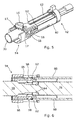
- the slider assembly 42 is constrained for linear sliding movement forward and rearward from the position shown in Figures 1 and 3 against the influence of forward and a rearward bias spring 46, 48 respectively. Shifting the slider assembly forward engages the abutments 34 and 36 simultaneously to cause them to be urged into alignment to pass into the control slot 38. Doing this 'unwraps' the wall portions of the socket partially to expand it to allow a lancet to be loaded or unloaded with minimal insertion or withdrawal force respectively.
- the socket 30 also has external projecting spring seats 50 which seat one end of a compression rebound spring 52, the other end of which is seated in an internal annular shoulder in the front body portion 20.
- a trigger moulding 54 Surrounding the forward end of the lancet holder 24 and located in the front body portion 20 against longitudinal movement is a trigger moulding 54 which resiliently carries the firing button 16 through two live hinges 17.
- the trigger moulding has two flexible lock out arms 56 on the outer surfaces of which are two ramp profiles 58.
- the lock out arms 56 are designed to cooperate with respective diametrically opposed slider arms 60, having chamfered leading edges 62.
- the slider arms 60 are an integral part of the slider assembly 42.
- the lancet holder 24 has a reduced width section behind the lancet receiving socket 30, defining two forward facing lock out shoulders 64. Sliding the slider assembly 42 forward from the position shown in Figure 6 causes the slider arms 60 to engage the ramp profiles 58 on the lock out arms 56 to urge them inwardly to the position shown in Figure 7 , where they block forward movement of the lancet holder 24.
- the slider assembly 42 includes in its base a prong or blade element 65 that projects forwardly one side of the projection 40, and which extends beyond the trigger moulding 54 to terminate just rearwardly of the front face of the front body portion 20, when the slider assembly 42 is in its rest position.
- the blade 65 is designed so that the slider assembly 42 cannot be moved forward from its rest position to release a lancet unless the depth adjuster assembly 12 has been removed.
- the depth adjuster 12 is made up of a relatively fixed rear portion 66 that releasably connects to the front end of the front body portion by a snap fit or the like, in a single angular orientation, and which as noted blocks forward movement of the blade 65 when it is attached.
- Inside the rear portion 66 are interrupted, forward facing cam surfaces 61, 63 respectively, that define a helical cam track that functions as a thread.
- An aperture 68 in the rear portion allows indicia 69 on the front depth adjuster portion 70 to be viewed.
- the wall section adjacent said aperture is locally thickened to provide clockwise and anti-clockwise stops 71, 72 to restrict rotation of the front portion 70.
- the cam surfaces 61, 63 alternate and do not overlap in the axial sense and so this means that the rear portion 62 can be moulded which can be opened and closed axially without requiring athreaded mould piece that has to be threaded out of the mould.
- the rear portion 62 also includes an inner cylindrical sleeve 74 which generally surrounds the socket 30 of the lancet holder.
- a detent pip 76 On the outer cylindrical wall of the sleeve is a detent pip 76 with two slots 78 formed to allow resilient flexing of the detent pip.
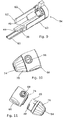
- the depth adjuster portion 70 comprises a frustoconical form element terminating in a transverse wall 80 with a lancet aperture 82 surrounded by equispaced projections 84, designed to provide a nerve distracting or confusion function.
- the remainder of the front depth adjuster part is internally splined 86 to cooperate with the detent pip 76 on the rear portion to provide a click or detent action as the depth adjuster is rotated.
- On the rear edge of the front portion 70 is formed a cam follower part 88 which is chamfered as seen in Figures 11 and 13 , to allow it to snap past one or more of the cam surfaces 61, 63 on the rear portion 64.
- the front and rear portions 66, 70 of the depth adjuster assembly 12 can be assembled simply by pushing one axially into the other, and no rotation is required.
- the snap action is designed to be sufficiently robust that the two parts cannot readily be separated once assembled.
- the front depth adjuster part can be rotated through approximately 270° with the rotation progressively adjusting the relative axial position thereby to vary the effective penetration depth of the lancing operation.
- the depth adjuster assembly 12 In operation of the device, having set the depth adjuster assembly 12 to give the required penetration, the depth adjuster assembly is removed from the front end of the device and the slider assembly 42 moved forward by thumb pressure on the thumb pad 14 to release a spent lancet (if present) by expanding the socket 30 of the lancet holder due to the action of the abutments 34, 36 being gathered into the slot 38 of the projections 40. Whilst held in the expanded position, a fresh lancet may be located in the lancet holder without requiring any significant axial force. Having inserted the lancet, the slider is allowed to return to its rest position and returning the socket to its non-expanded form, thereby gripping the lancet.
- the depth adjuster assembly 12 is then re-applied to the front of the device and the device cocked by sliding the slider rearwardly.
- the slider assembly engages the lancet holder and pushes it back against the force of the drive spring 22 until the resilient finger 26 snaps rearwardly past the abutment 28 on the housing to latch and in so doing, pushes the trigger button 16 proud.
- the user will then offer the device up to the penetration site and fire the lancet by pressing button 16.
- the thumb pad 14 may be extended forwardly so that, in its rest position, its forward edge lies just to the rear of the aperture in which the trigger button 16 sits.
- the forward and rearward bias springs 46 and 48 that bias the slider assembly may be replaced by integrally moulded spring portions 46 1 , 48 1 , thereby further reducing the component count.
- forward travel of the lancet holder 24 is limited by a forward facing abutment surface on the lancet holder moving into abutment with a rearward facing abutment surface on the housing or a component associated therewith.
- forward travel of the lancet holder 24 is limited by a forward facing abutment surface 90 on a formation 92 at the rear end of the lancet holder 24 engaging a rearward facing shoulder 94 protruding inwardly from the housing wall.
Landscapes
- Health & Medical Sciences (AREA)
- Life Sciences & Earth Sciences (AREA)
- Heart & Thoracic Surgery (AREA)
- Surgery (AREA)
- Biophysics (AREA)
- Pathology (AREA)
- Engineering & Computer Science (AREA)
- Biomedical Technology (AREA)
- Hematology (AREA)
- Medical Informatics (AREA)
- Molecular Biology (AREA)
- Physics & Mathematics (AREA)
- Animal Behavior & Ethology (AREA)
- General Health & Medical Sciences (AREA)
- Public Health (AREA)
- Veterinary Medicine (AREA)
- Dermatology (AREA)
- Pain & Pain Management (AREA)
- Measurement Of The Respiration, Hearing Ability, Form, And Blood Characteristics Of Living Organisms (AREA)
Applications Claiming Priority (4)
| Application Number | Priority Date | Filing Date | Title |
|---|---|---|---|
| US201161473251P | 2011-04-08 | 2011-04-08 | |
| GB1105950.8A GB2489740A (en) | 2011-04-08 | 2011-04-08 | Means for securely retaining a lancet in a lancing device |
| EP15154913.6A EP2907449B1 (de) | 2011-04-08 | 2012-04-04 | Hautpenetrierende Vorrichtung |
| EP12720263.8A EP2677933B1 (de) | 2011-04-08 | 2012-04-04 | Hautpenetrationsvorrichtung |
Related Parent Applications (3)
| Application Number | Title | Priority Date | Filing Date |
|---|---|---|---|
| EP12720263.8A Division EP2677933B1 (de) | 2011-04-08 | 2012-04-04 | Hautpenetrationsvorrichtung |
| EP15154913.6A Division-Into EP2907449B1 (de) | 2011-04-08 | 2012-04-04 | Hautpenetrierende Vorrichtung |
| EP15154913.6A Division EP2907449B1 (de) | 2011-04-08 | 2012-04-04 | Hautpenetrierende Vorrichtung |
Publications (1)
| Publication Number | Publication Date |
|---|---|
| EP3100679A1 true EP3100679A1 (de) | 2016-12-07 |
Family
ID=44072147
Family Applications (5)
| Application Number | Title | Priority Date | Filing Date |
|---|---|---|---|
| EP16176969.0A Withdrawn EP3100679A1 (de) | 2011-04-08 | 2012-04-04 | Hautpenetrierende vorrichtung |
| EP15159027.0A Active EP2910188B1 (de) | 2011-04-08 | 2012-04-04 | Hautpenetrierende vorrichtung |
| EP12720263.8A Active EP2677933B1 (de) | 2011-04-08 | 2012-04-04 | Hautpenetrationsvorrichtung |
| EP15154913.6A Active EP2907449B1 (de) | 2011-04-08 | 2012-04-04 | Hautpenetrierende Vorrichtung |
| EP13185802.9A Active EP2682056B1 (de) | 2011-04-08 | 2012-04-04 | Hautpenetrierende Vorrichtung |
Family Applications After (4)
| Application Number | Title | Priority Date | Filing Date |
|---|---|---|---|
| EP15159027.0A Active EP2910188B1 (de) | 2011-04-08 | 2012-04-04 | Hautpenetrierende vorrichtung |
| EP12720263.8A Active EP2677933B1 (de) | 2011-04-08 | 2012-04-04 | Hautpenetrationsvorrichtung |
| EP15154913.6A Active EP2907449B1 (de) | 2011-04-08 | 2012-04-04 | Hautpenetrierende Vorrichtung |
| EP13185802.9A Active EP2682056B1 (de) | 2011-04-08 | 2012-04-04 | Hautpenetrierende Vorrichtung |
Country Status (10)
| Country | Link |
|---|---|
| US (1) | US9603563B2 (de) |
| EP (5) | EP3100679A1 (de) |
| JP (2) | JP6148224B2 (de) |
| CN (2) | CN105105765B (de) |
| BR (1) | BR112013025795A2 (de) |
| GB (1) | GB2489740A (de) |
| IN (1) | IN2014DN01836A (de) |
| MX (1) | MX338788B (de) |
| PL (4) | PL2677933T3 (de) |
| WO (1) | WO2012137001A1 (de) |
Families Citing this family (11)
| Publication number | Priority date | Publication date | Assignee | Title |
|---|---|---|---|---|
| US20140214065A1 (en) * | 2013-01-29 | 2014-07-31 | Yong Pil Kim | Blood lancet device |
| TW201513832A (zh) * | 2013-10-11 | 2015-04-16 | Ysp Co Ltd | 採血裝置及其採血針與採血筆 |
| USD758566S1 (en) * | 2014-03-17 | 2016-06-07 | Erik Chen | Blood sampling pen |
| USD774641S1 (en) * | 2015-11-11 | 2016-12-20 | Merck Sharp & Dohme Corp. | Auto injector |
| US20180015224A1 (en) | 2016-07-13 | 2018-01-18 | California Institute Of Technology | Dampers and Methods for Performing Measurements in an Autoinjector |
| KR102090541B1 (ko) * | 2017-09-29 | 2020-05-27 | 최임철 | 가압-작동식 일회용 무통 채혈기 |
| CN108982604A (zh) * | 2018-08-04 | 2018-12-11 | 北京怡成生物电子技术股份有限公司 | 一种动态连续测定体液中分析物的便携式监测系统 |
| CN110464363A (zh) * | 2019-07-25 | 2019-11-19 | 淮安市天达医疗器械有限公司 | 降低穿刺痛感的采血笔 |
| ES2955458T3 (es) * | 2020-10-29 | 2023-12-01 | Homedicus Gmbh | Mecanismo accionador de operación manual |
| CN115475324B (zh) * | 2021-06-16 | 2025-09-16 | 苏州悦肤达医疗科技有限公司 | 一种助针器及医用装置 |
| USD1118903S1 (en) * | 2024-10-30 | 2026-03-17 | Halozyme, Inc. | Injection device |
Citations (8)
| Publication number | Priority date | Publication date | Assignee | Title |
|---|---|---|---|---|
| WO1998006331A2 (en) * | 1996-08-13 | 1998-02-19 | Owen Mumford Limited | Improvements relating to skin prickers |
| EP1074219A2 (de) * | 1999-08-03 | 2001-02-07 | Becton Dickinson and Company | Lanzette |
| WO2001028423A2 (en) * | 1999-10-19 | 2001-04-26 | Therasense Inc. | Lancing device and method of sample collection |
| US20060247670A1 (en) * | 2005-05-02 | 2006-11-02 | Levaughn Richard W | Lancing device with automatic lancet release |
| WO2009022131A2 (en) * | 2007-08-14 | 2009-02-19 | Owen Mumford Limited | Lancing devices |
| WO2009022136A1 (en) * | 2007-08-14 | 2009-02-19 | Owen Mumford Limited | Lancing devices |
| WO2009022144A1 (en) * | 2007-08-14 | 2009-02-19 | Owen Mumford Limited | Lancing devices |
| WO2009136171A2 (en) * | 2008-05-09 | 2009-11-12 | Lifescan Scotland Limited | Prime and fire lancing device with non- contacting bias drive and method |
Family Cites Families (62)
| Publication number | Priority date | Publication date | Assignee | Title |
|---|---|---|---|---|
| US4976724A (en) | 1989-08-25 | 1990-12-11 | Lifescan, Inc. | Lancet ejector mechanism |
| CA2123400A1 (en) | 1991-11-12 | 1993-05-27 | Urs A. Ramel | Lancet device |
| US5282822A (en) | 1993-01-19 | 1994-02-01 | Sherwood Medical Company | Lancet ejector for lancet injector |
| US5464418A (en) | 1993-12-09 | 1995-11-07 | Schraga; Steven | Reusable lancet device |
| AUPN689695A0 (en) | 1995-12-01 | 1995-12-21 | Brakey, Dale Robert | Blood letting device |
| US5613978A (en) * | 1996-06-04 | 1997-03-25 | Palco Laboratories | Adjustable tip for lancet device |
| US5916230A (en) * | 1997-06-16 | 1999-06-29 | Bayer Corporation | Blood sampling device with adjustable end cap |
| US6949111B2 (en) | 1998-02-13 | 2005-09-27 | Steven Schraga | Lancet device |
| US6346114B1 (en) | 1998-06-11 | 2002-02-12 | Stat Medical Devices, Inc. | Adjustable length member such as a cap of a lancet device for adjusting penetration depth |
| US6022366A (en) | 1998-06-11 | 2000-02-08 | Stat Medical Devices Inc. | Lancet having adjustable penetration depth |
| US6197040B1 (en) * | 1999-02-23 | 2001-03-06 | Lifescan, Inc. | Lancing device having a releasable connector |
| US6322575B1 (en) | 2000-01-05 | 2001-11-27 | Steven Schraga | Lancet depth adjustment assembly |
| DE10053974A1 (de) | 2000-10-31 | 2002-05-29 | Roche Diagnostics Gmbh | System zur Blutentnahme |
| US6958072B2 (en) | 2000-11-10 | 2005-10-25 | Steven Schraga | Single use lancet device |
| CN1313052C (zh) | 2001-01-12 | 2007-05-02 | 爱科来株式会社 | 穿刺装置 |
| GB0103977D0 (en) | 2001-02-17 | 2001-04-04 | Owen Mumford Ltd | Improvements relating to skin prickers |
| JP4182431B2 (ja) | 2001-07-11 | 2008-11-19 | アークレイ株式会社 | 穿刺装置 |
| DE20114658U1 (de) | 2001-09-05 | 2001-11-15 | WILDEN Engineering- und Vertriebsgesellschaft mbH, 92536 Pfreimd | Lanzette für die Blutentnahme |
| US6645219B2 (en) | 2001-09-07 | 2003-11-11 | Amira Medical | Rotatable penetration depth adjusting arrangement |
| US20030100913A1 (en) | 2001-10-09 | 2003-05-29 | Guoping Shi | Depth adjustable cap of lancing device |
| US20040098010A1 (en) * | 2001-10-22 | 2004-05-20 | Glenn Davison | Confuser crown skin pricker |
| JP4257943B2 (ja) | 2002-07-29 | 2009-04-30 | アークレイ株式会社 | 穿刺用ユニット、および穿刺用部材の取り外し具 |
| US6852119B1 (en) | 2002-09-09 | 2005-02-08 | Ramzi F. Abulhaj | Adjustable disposable lancet and method |
| US8187295B2 (en) | 2003-04-16 | 2012-05-29 | Arkray, Inc. | Puncture device |
| JP4761701B2 (ja) * | 2003-05-21 | 2011-08-31 | アークレイ株式会社 | 穿刺深さを調整可能な穿刺装置 |
| US7905898B2 (en) | 2003-08-15 | 2011-03-15 | Stat Medical Devices, Inc. | Adjustable lancet device and method |
| US20050085840A1 (en) | 2003-10-15 | 2005-04-21 | Surgilance Pte Ltd | Lancet assembly |
| EP1708610A1 (de) | 2004-01-12 | 2006-10-11 | Minnesota Scientific, Inc. | Vorrichtung zum halten von ansonsten in der hand gehaltenen retraktoren |
| US20050159768A1 (en) | 2004-01-15 | 2005-07-21 | Home Diagnostics, Inc. | Lancing device |
| CN101309642A (zh) | 2004-03-15 | 2008-11-19 | 香港澳维有限公司 | 采血装置及其使用方法 |
| US7670352B1 (en) | 2004-03-24 | 2010-03-02 | Caribbean Medical Brokers, Inc. | Adjustable tip with integrated detent for blood lancet system |
| US7955347B2 (en) | 2004-06-25 | 2011-06-07 | Facet Technologies, Llc | Low cost safety lancet |
| GB2421439B (en) | 2004-12-21 | 2009-07-29 | Owen Mumford Ltd | Skin pricking apparatus |
| ATE473683T1 (de) * | 2005-03-04 | 2010-07-15 | Bayer Healthcare Llc | Lanzettenauslösungsmechanismus |
| DE602006015295D1 (de) * | 2005-04-04 | 2010-08-19 | Facet Technologies Llc | Lanzettenvorrichtung mit schmalem profil |
| US20070083222A1 (en) | 2005-06-16 | 2007-04-12 | Stat Medical Devices, Inc. | Lancet device, removal system for lancet device, and method |
| EP1992285A4 (de) | 2006-03-08 | 2011-12-28 | Arkray Inc | Lanzettenvorrichtung |
| JP5021619B2 (ja) | 2006-03-10 | 2012-09-12 | アークレイ株式会社 | ランセットデバイス |
| WO2007130830A2 (en) | 2006-04-25 | 2007-11-15 | Facet Technologies, Llc | Lancing device with independent drive core |
| WO2007129757A1 (ja) | 2006-05-10 | 2007-11-15 | Panasonic Corporation | 穿刺器具および穿刺針カートリッジ |
| US7909842B2 (en) | 2006-06-15 | 2011-03-22 | Abbott Diabetes Care Inc. | Lancing devices having depth adjustment assembly |
| JP4997247B2 (ja) | 2006-09-29 | 2012-08-08 | テルモ株式会社 | 使い捨てカートリッジ |
| US8043318B2 (en) | 2007-02-08 | 2011-10-25 | Stat Medical Devices, Inc. | Push-button lance device and method |
| WO2008111936A1 (en) | 2007-03-12 | 2008-09-18 | Bayer Healthcare Llc | Lancet-eject mechanism |
| KR100820523B1 (ko) | 2007-03-14 | 2008-04-08 | 홍관호 | 채혈기 |
| US8469986B2 (en) | 2007-03-30 | 2013-06-25 | Stat Medical Devices, Inc. | Lancet device with combined trigger and cocking mechanism and method |
| WO2008157610A1 (en) | 2007-06-19 | 2008-12-24 | Stat Medical Devices, Inc. | Lancet device with depth adjustment and lancet removal system and method |
| JPWO2009035084A1 (ja) | 2007-09-12 | 2010-12-24 | 泉株式会社 | ランセットアッセンブリ |
| EP2050393B1 (de) | 2007-10-19 | 2011-04-13 | Bionime Corporation | Stechvorrichtung |
| EP2221000B1 (de) | 2007-11-27 | 2012-09-19 | ARKRAY, Inc. | Punktionsvorrichtung |
| CN201104887Y (zh) * | 2007-12-05 | 2008-08-27 | 成都瑞琦科技实业有限责任公司 | 新型静脉采血针 |
| US8454533B2 (en) | 2008-05-09 | 2013-06-04 | Lifescan Scotland Limited | Lancing devices and methods |
| US8932314B2 (en) | 2008-05-09 | 2015-01-13 | Lifescan Scotland Limited | Prime and fire lancing device with contacting bias drive and method |
| WO2009148431A1 (en) | 2008-06-05 | 2009-12-10 | Bayer Healthcare Llc | Lancing device |
| US8123772B2 (en) | 2008-08-14 | 2012-02-28 | Abbott Diabetes Care Inc. | Cap for lancing device with adjustable mode of operation |
| US20100049233A1 (en) | 2008-08-25 | 2010-02-25 | Abbott Diabetes Care Inc. | Lancet having integrated drive mechanism |
| EP2174591B1 (de) | 2008-10-09 | 2019-01-16 | Roche Diabetes Care GmbH | Stechgerät |
| US8568434B2 (en) | 2008-10-14 | 2013-10-29 | Bionime Corporation | Lancing device |
| US20110295153A1 (en) | 2008-12-04 | 2011-12-01 | Lai Siew Kong | Lancing device |
| WO2010080584A1 (en) | 2008-12-18 | 2010-07-15 | Facet Technologies, Llc | Lancing device and lancet |
| CN101444428B (zh) | 2008-12-30 | 2010-04-07 | 苏州施莱医疗器械有限公司 | 安全便捷式一次性自动采血针 |
| US8317812B2 (en) * | 2009-07-29 | 2012-11-27 | Wah Leong Lum | Lancet device with lance retraction |
-
2011
- 2011-04-08 GB GB1105950.8A patent/GB2489740A/en not_active Withdrawn
-
2012
- 2012-04-04 CN CN201510557882.6A patent/CN105105765B/zh active Active
- 2012-04-04 EP EP16176969.0A patent/EP3100679A1/de not_active Withdrawn
- 2012-04-04 PL PL12720263T patent/PL2677933T3/pl unknown
- 2012-04-04 BR BR112013025795A patent/BR112013025795A2/pt not_active IP Right Cessation
- 2012-04-04 EP EP15159027.0A patent/EP2910188B1/de active Active
- 2012-04-04 PL PL13185802T patent/PL2682056T3/pl unknown
- 2012-04-04 JP JP2014503214A patent/JP6148224B2/ja active Active
- 2012-04-04 IN IN1836DEN2014 patent/IN2014DN01836A/en unknown
- 2012-04-04 CN CN201280015833.4A patent/CN103458787B/zh active Active
- 2012-04-04 EP EP12720263.8A patent/EP2677933B1/de active Active
- 2012-04-04 WO PCT/GB2012/050761 patent/WO2012137001A1/en not_active Ceased
- 2012-04-04 US US14/110,526 patent/US9603563B2/en active Active
- 2012-04-04 MX MX2013011649A patent/MX338788B/es active IP Right Grant
- 2012-04-04 EP EP15154913.6A patent/EP2907449B1/de active Active
- 2012-04-04 EP EP13185802.9A patent/EP2682056B1/de active Active
- 2012-04-04 PL PL15159027.0T patent/PL2910188T3/pl unknown
- 2012-04-04 PL PL15154913T patent/PL2907449T3/pl unknown
-
2017
- 2017-02-16 JP JP2017026684A patent/JP2017113588A/ja active Pending
Patent Citations (8)
| Publication number | Priority date | Publication date | Assignee | Title |
|---|---|---|---|---|
| WO1998006331A2 (en) * | 1996-08-13 | 1998-02-19 | Owen Mumford Limited | Improvements relating to skin prickers |
| EP1074219A2 (de) * | 1999-08-03 | 2001-02-07 | Becton Dickinson and Company | Lanzette |
| WO2001028423A2 (en) * | 1999-10-19 | 2001-04-26 | Therasense Inc. | Lancing device and method of sample collection |
| US20060247670A1 (en) * | 2005-05-02 | 2006-11-02 | Levaughn Richard W | Lancing device with automatic lancet release |
| WO2009022131A2 (en) * | 2007-08-14 | 2009-02-19 | Owen Mumford Limited | Lancing devices |
| WO2009022136A1 (en) * | 2007-08-14 | 2009-02-19 | Owen Mumford Limited | Lancing devices |
| WO2009022144A1 (en) * | 2007-08-14 | 2009-02-19 | Owen Mumford Limited | Lancing devices |
| WO2009136171A2 (en) * | 2008-05-09 | 2009-11-12 | Lifescan Scotland Limited | Prime and fire lancing device with non- contacting bias drive and method |
Also Published As
| Publication number | Publication date |
|---|---|
| GB2489740A (en) | 2012-10-10 |
| EP2910188A1 (de) | 2015-08-26 |
| PL2907449T3 (pl) | 2017-05-31 |
| PL2677933T3 (pl) | 2015-11-30 |
| GB201105950D0 (en) | 2011-05-18 |
| US9603563B2 (en) | 2017-03-28 |
| MX2013011649A (es) | 2013-11-01 |
| IN2014DN01836A (de) | 2015-05-15 |
| PL2682056T3 (pl) | 2015-08-31 |
| CN105105765B (zh) | 2018-04-24 |
| CN105105765A (zh) | 2015-12-02 |
| PL2910188T3 (pl) | 2016-11-30 |
| EP2907449B1 (de) | 2016-11-30 |
| JP2017113588A (ja) | 2017-06-29 |
| EP2907449A3 (de) | 2015-11-18 |
| EP2907449A2 (de) | 2015-08-19 |
| EP2682056B1 (de) | 2015-01-14 |
| JP6148224B2 (ja) | 2017-06-14 |
| US20140121691A1 (en) | 2014-05-01 |
| JP2014512908A (ja) | 2014-05-29 |
| BR112013025795A2 (pt) | 2016-12-27 |
| EP2910188B1 (de) | 2016-06-01 |
| WO2012137001A1 (en) | 2012-10-11 |
| MX338788B (es) | 2016-05-02 |
| CN103458787B (zh) | 2015-09-09 |
| EP2677933B1 (de) | 2015-06-10 |
| EP2677933A1 (de) | 2014-01-01 |
| EP2682056A1 (de) | 2014-01-08 |
| CN103458787A (zh) | 2013-12-18 |
Similar Documents
| Publication | Publication Date | Title |
|---|---|---|
| EP2910188B1 (de) | Hautpenetrierende vorrichtung | |
| EP2185073B1 (de) | Stechvorrichtungen | |
| EP3030287B1 (de) | Triebwerk | |
| JP4847316B2 (ja) | 注射器用の針の保護装置及び注射器と針の保護装置とを備えた注射器具 | |
| JP5074397B2 (ja) | 針のカバーアセンブリ及び針先アセンブリと共に使用する把持リング | |
| EP2653745B1 (de) | Lanzettenstechvorrichtung | |
| JP5977757B2 (ja) | 発射位置に向かうトリガ部品の移動に対する抵抗力を提供する接触面を有する自動注入装置 | |
| JP2009506816A5 (de) | ||
| EP3541452B1 (de) | Medikamentenabgabevorrichtung geeignet für langzeitlagerung | |
| WO2023198566A1 (en) | Autoinjector for automatic injection of a product into an injection site | |
| WO2011084103A1 (en) | A lancet | |
| EP4299090A1 (de) | Autoinjektor mit rueckfedernden ausgleichsmitteln zwischen kolben und behaelter | |
| US20130317533A1 (en) | Lancet device | |
| EP3852630B1 (de) | Verbesserter aktivierungs- und rückzugsmechanismus für lanzetten |
Legal Events
| Date | Code | Title | Description |
|---|---|---|---|
| PUAI | Public reference made under article 153(3) epc to a published international application that has entered the european phase |
Free format text: ORIGINAL CODE: 0009012 |
|
| STAA | Information on the status of an ep patent application or granted ep patent |
Free format text: STATUS: THE APPLICATION HAS BEEN PUBLISHED |
|
| AC | Divisional application: reference to earlier application |
Ref document number: 2907449 Country of ref document: EP Kind code of ref document: P Ref document number: 2677933 Country of ref document: EP Kind code of ref document: P |
|
| AK | Designated contracting states |
Kind code of ref document: A1 Designated state(s): AL AT BE BG CH CY CZ DE DK EE ES FI FR GB GR HR HU IE IS IT LI LT LU LV MC MK MT NL NO PL PT RO RS SE SI SK SM TR |
|
| STAA | Information on the status of an ep patent application or granted ep patent |
Free format text: STATUS: REQUEST FOR EXAMINATION WAS MADE |
|
| 17P | Request for examination filed |
Effective date: 20170607 |
|
| RBV | Designated contracting states (corrected) |
Designated state(s): AL AT BE BG CH CY CZ DE DK EE ES FI FR GB GR HR HU IE IS IT LI LT LU LV MC MK MT NL NO PL PT RO RS SE SI SK SM TR |
|
| STAA | Information on the status of an ep patent application or granted ep patent |
Free format text: STATUS: THE APPLICATION HAS BEEN WITHDRAWN |
|
| 18W | Application withdrawn |
Effective date: 20180202 |