EP3101049B1 - Polyimide et film utilisant ce polyimide - Google Patents
Polyimide et film utilisant ce polyimide Download PDFInfo
- Publication number
- EP3101049B1 EP3101049B1 EP15740323.9A EP15740323A EP3101049B1 EP 3101049 B1 EP3101049 B1 EP 3101049B1 EP 15740323 A EP15740323 A EP 15740323A EP 3101049 B1 EP3101049 B1 EP 3101049B1
- Authority
- EP
- European Patent Office
- Prior art keywords
- dianhydride
- polyimide
- diamine
- bis
- tetracarboxylic dianhydride
- Prior art date
- Legal status (The legal status is an assumption and is not a legal conclusion. Google has not performed a legal analysis and makes no representation as to the accuracy of the status listed.)
- Active
Links
Images

Classifications
-
- C—CHEMISTRY; METALLURGY
- C08—ORGANIC MACROMOLECULAR COMPOUNDS; THEIR PREPARATION OR CHEMICAL WORKING-UP; COMPOSITIONS BASED THEREON
- C08G—MACROMOLECULAR COMPOUNDS OBTAINED OTHERWISE THAN BY REACTIONS ONLY INVOLVING UNSATURATED CARBON-TO-CARBON BONDS
- C08G73/00—Macromolecular compounds obtained by reactions forming a linkage containing nitrogen with or without oxygen or carbon in the main chain of the macromolecule, not provided for in groups C08G12/00 - C08G71/00
- C08G73/06—Polycondensates having nitrogen-containing heterocyclic rings in the main chain of the macromolecule
- C08G73/10—Polyimides; Polyester-imides; Polyamide-imides; Polyamide acids or similar polyimide precursors
-
- C—CHEMISTRY; METALLURGY
- C08—ORGANIC MACROMOLECULAR COMPOUNDS; THEIR PREPARATION OR CHEMICAL WORKING-UP; COMPOSITIONS BASED THEREON
- C08G—MACROMOLECULAR COMPOUNDS OBTAINED OTHERWISE THAN BY REACTIONS ONLY INVOLVING UNSATURATED CARBON-TO-CARBON BONDS
- C08G73/00—Macromolecular compounds obtained by reactions forming a linkage containing nitrogen with or without oxygen or carbon in the main chain of the macromolecule, not provided for in groups C08G12/00 - C08G71/00
- C08G73/06—Polycondensates having nitrogen-containing heterocyclic rings in the main chain of the macromolecule
- C08G73/10—Polyimides; Polyester-imides; Polyamide-imides; Polyamide acids or similar polyimide precursors
- C08G73/1067—Wholly aromatic polyimides, i.e. having both tetracarboxylic and diamino moieties aromatically bound
-
- C—CHEMISTRY; METALLURGY
- C08—ORGANIC MACROMOLECULAR COMPOUNDS; THEIR PREPARATION OR CHEMICAL WORKING-UP; COMPOSITIONS BASED THEREON
- C08G—MACROMOLECULAR COMPOUNDS OBTAINED OTHERWISE THAN BY REACTIONS ONLY INVOLVING UNSATURATED CARBON-TO-CARBON BONDS
- C08G73/00—Macromolecular compounds obtained by reactions forming a linkage containing nitrogen with or without oxygen or carbon in the main chain of the macromolecule, not provided for in groups C08G12/00 - C08G71/00
- C08G73/06—Polycondensates having nitrogen-containing heterocyclic rings in the main chain of the macromolecule
- C08G73/0622—Polycondensates containing six-membered rings, not condensed with other rings, with nitrogen atoms as the only ring hetero atoms
- C08G73/0633—Polycondensates containing six-membered rings, not condensed with other rings, with nitrogen atoms as the only ring hetero atoms with only two nitrogen atoms in the ring
-
- C—CHEMISTRY; METALLURGY
- C08—ORGANIC MACROMOLECULAR COMPOUNDS; THEIR PREPARATION OR CHEMICAL WORKING-UP; COMPOSITIONS BASED THEREON
- C08G—MACROMOLECULAR COMPOUNDS OBTAINED OTHERWISE THAN BY REACTIONS ONLY INVOLVING UNSATURATED CARBON-TO-CARBON BONDS
- C08G73/00—Macromolecular compounds obtained by reactions forming a linkage containing nitrogen with or without oxygen or carbon in the main chain of the macromolecule, not provided for in groups C08G12/00 - C08G71/00
- C08G73/06—Polycondensates having nitrogen-containing heterocyclic rings in the main chain of the macromolecule
- C08G73/10—Polyimides; Polyester-imides; Polyamide-imides; Polyamide acids or similar polyimide precursors
- C08G73/1042—Copolyimides derived from at least two different tetracarboxylic compounds or two different diamino compounds
-
- C—CHEMISTRY; METALLURGY
- C08—ORGANIC MACROMOLECULAR COMPOUNDS; THEIR PREPARATION OR CHEMICAL WORKING-UP; COMPOSITIONS BASED THEREON
- C08G—MACROMOLECULAR COMPOUNDS OBTAINED OTHERWISE THAN BY REACTIONS ONLY INVOLVING UNSATURATED CARBON-TO-CARBON BONDS
- C08G73/00—Macromolecular compounds obtained by reactions forming a linkage containing nitrogen with or without oxygen or carbon in the main chain of the macromolecule, not provided for in groups C08G12/00 - C08G71/00
- C08G73/06—Polycondensates having nitrogen-containing heterocyclic rings in the main chain of the macromolecule
- C08G73/10—Polyimides; Polyester-imides; Polyamide-imides; Polyamide acids or similar polyimide precursors
- C08G73/1075—Partially aromatic polyimides
-
- C—CHEMISTRY; METALLURGY
- C08—ORGANIC MACROMOLECULAR COMPOUNDS; THEIR PREPARATION OR CHEMICAL WORKING-UP; COMPOSITIONS BASED THEREON
- C08G—MACROMOLECULAR COMPOUNDS OBTAINED OTHERWISE THAN BY REACTIONS ONLY INVOLVING UNSATURATED CARBON-TO-CARBON BONDS
- C08G73/00—Macromolecular compounds obtained by reactions forming a linkage containing nitrogen with or without oxygen or carbon in the main chain of the macromolecule, not provided for in groups C08G12/00 - C08G71/00
- C08G73/06—Polycondensates having nitrogen-containing heterocyclic rings in the main chain of the macromolecule
- C08G73/10—Polyimides; Polyester-imides; Polyamide-imides; Polyamide acids or similar polyimide precursors
- C08G73/1075—Partially aromatic polyimides
- C08G73/1078—Partially aromatic polyimides wholly aromatic in the diamino moiety
-
- C—CHEMISTRY; METALLURGY
- C08—ORGANIC MACROMOLECULAR COMPOUNDS; THEIR PREPARATION OR CHEMICAL WORKING-UP; COMPOSITIONS BASED THEREON
- C08G—MACROMOLECULAR COMPOUNDS OBTAINED OTHERWISE THAN BY REACTIONS ONLY INVOLVING UNSATURATED CARBON-TO-CARBON BONDS
- C08G73/00—Macromolecular compounds obtained by reactions forming a linkage containing nitrogen with or without oxygen or carbon in the main chain of the macromolecule, not provided for in groups C08G12/00 - C08G71/00
- C08G73/06—Polycondensates having nitrogen-containing heterocyclic rings in the main chain of the macromolecule
- C08G73/10—Polyimides; Polyester-imides; Polyamide-imides; Polyamide acids or similar polyimide precursors
- C08G73/1085—Polyimides with diamino moieties or tetracarboxylic segments containing heterocyclic moieties
-
- C—CHEMISTRY; METALLURGY
- C08—ORGANIC MACROMOLECULAR COMPOUNDS; THEIR PREPARATION OR CHEMICAL WORKING-UP; COMPOSITIONS BASED THEREON
- C08J—WORKING-UP; GENERAL PROCESSES OF COMPOUNDING; AFTER-TREATMENT NOT COVERED BY SUBCLASSES C08B, C08C, C08F, C08G or C08H
- C08J5/00—Manufacture of articles or shaped materials containing macromolecular substances
- C08J5/18—Manufacture of films or sheets
-
- C—CHEMISTRY; METALLURGY
- C08—ORGANIC MACROMOLECULAR COMPOUNDS; THEIR PREPARATION OR CHEMICAL WORKING-UP; COMPOSITIONS BASED THEREON
- C08L—COMPOSITIONS OF MACROMOLECULAR COMPOUNDS
- C08L79/00—Compositions of macromolecular compounds obtained by reactions forming in the main chain of the macromolecule a linkage containing nitrogen with or without oxygen or carbon only, not provided for in groups C08L61/00 - C08L77/00
- C08L79/04—Polycondensates having nitrogen-containing heterocyclic rings in the main chain; Polyhydrazides; Polyamide acids or similar polyimide precursors
-
- C—CHEMISTRY; METALLURGY
- C08—ORGANIC MACROMOLECULAR COMPOUNDS; THEIR PREPARATION OR CHEMICAL WORKING-UP; COMPOSITIONS BASED THEREON
- C08L—COMPOSITIONS OF MACROMOLECULAR COMPOUNDS
- C08L79/00—Compositions of macromolecular compounds obtained by reactions forming in the main chain of the macromolecule a linkage containing nitrogen with or without oxygen or carbon only, not provided for in groups C08L61/00 - C08L77/00
- C08L79/04—Polycondensates having nitrogen-containing heterocyclic rings in the main chain; Polyhydrazides; Polyamide acids or similar polyimide precursors
- C08L79/08—Polyimides; Polyester-imides; Polyamide-imides; Polyamide acids or similar polyimide precursors
-
- C—CHEMISTRY; METALLURGY
- C09—DYES; PAINTS; POLISHES; NATURAL RESINS; ADHESIVES; COMPOSITIONS NOT OTHERWISE PROVIDED FOR; APPLICATIONS OF MATERIALS NOT OTHERWISE PROVIDED FOR
- C09D—COATING COMPOSITIONS, e.g. PAINTS, VARNISHES OR LACQUERS; FILLING PASTES; CHEMICAL PAINT OR INK REMOVERS; INKS; CORRECTING FLUIDS; WOODSTAINS; PASTES OR SOLIDS FOR COLOURING OR PRINTING; USE OF MATERIALS THEREFOR
- C09D179/00—Coating compositions based on macromolecular compounds obtained by reactions forming in the main chain of the macromolecule a linkage containing nitrogen, with or without oxygen, or carbon only, not provided for in groups C09D161/00 - C09D177/00
- C09D179/04—Polycondensates having nitrogen-containing heterocyclic rings in the main chain; Polyhydrazides; Polyamide acids or similar polyimide precursors
- C09D179/08—Polyimides; Polyester-imides; Polyamide-imides; Polyamide acids or similar polyimide precursors
-
- C—CHEMISTRY; METALLURGY
- C08—ORGANIC MACROMOLECULAR COMPOUNDS; THEIR PREPARATION OR CHEMICAL WORKING-UP; COMPOSITIONS BASED THEREON
- C08J—WORKING-UP; GENERAL PROCESSES OF COMPOUNDING; AFTER-TREATMENT NOT COVERED BY SUBCLASSES C08B, C08C, C08F, C08G or C08H
- C08J2379/00—Characterised by the use of macromolecular compounds obtained by reactions forming in the main chain of the macromolecule a linkage containing nitrogen with or without oxygen, or carbon only, not provided for in groups C08J2361/00 - C08J2377/00
- C08J2379/04—Polycondensates having nitrogen-containing heterocyclic rings in the main chain; Polyhydrazides; Polyamide acids or similar polyimide precursors
- C08J2379/08—Polyimides; Polyester-imides; Polyamide-imides; Polyamide acids or similar polyimide precursors
-
- C—CHEMISTRY; METALLURGY
- C08—ORGANIC MACROMOLECULAR COMPOUNDS; THEIR PREPARATION OR CHEMICAL WORKING-UP; COMPOSITIONS BASED THEREON
- C08L—COMPOSITIONS OF MACROMOLECULAR COMPOUNDS
- C08L2201/00—Properties
- C08L2201/10—Transparent films; Clear coatings; Transparent materials
Definitions
- the present invention relates to a polyimide and a film using the same and, more particularly, to a polyimide, which exhibits high thermal stability, a low dielectric constant, and high light transmittance while retaining the superior properties of polyimide, and to a polyimide film including the same.
- a polyimide has high mechanical strength, heat resistance, insulating properties, and solvent resistance, and thus is widely utilized as electronic materials, such as protective materials or insulating materials for liquid crystal displays, semiconductors, color filters, etc. Furthermore, the application thereof to optical communication materials such as optical waveguide materials or substrates for mobile phones is expected.
- a wholly aromatic polyimide resulting from polycondensation of an aromatic tetracarboxylic dianhydride and an aromatic diamine, which are conventionally useful, shows a dark amber color, and becomes problematic in applications requiring high transparency. Also, since a wholly aromatic polyimide has a high dielectric constant, the use thereof as an electronic material requiring transparency and a low dielectric constant is limited.
- CPDA 1,2,3,4-cyclopentatetracarboxylic dianhydride
- organic EL organic electroluminescent
- the polyimide thus obtained has a low degree of polymerization and has to be improved in heat resistance, and furthermore, the optical properties required thereof are not satisfactory.
- the present invention is intended to provide a polyimide, which may exhibit high thermal stability, a low dielectric constant, and high light transmittance while retaining the superior properties of polyimide, and a polyimide film including the same.
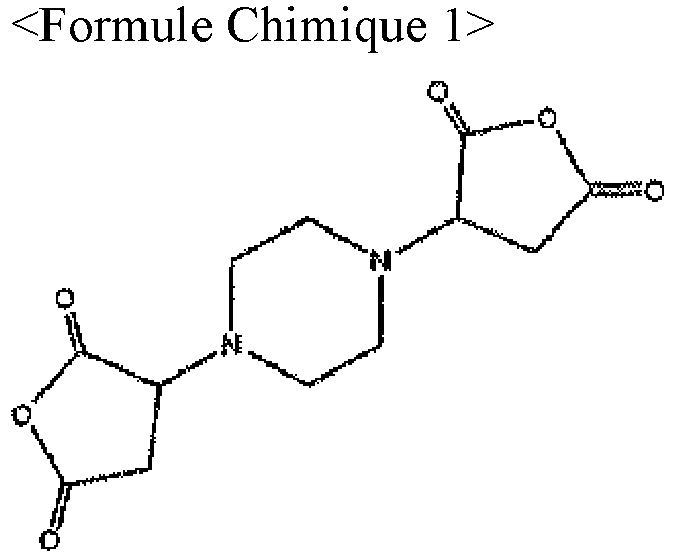
- An embodiment of the present invention provides a polyimide, obtained by polymerizing a diamine and an acid dianhydride to give polyamic acid that is then imidized, wherein the acid dianhydride includes a compound represented by Chemical Formula 1 below.
- the diamine may be at least one selected from the group consisting of an aromatic diamine selected from the group consisting of p-phenylenediamine, m-phenylenediamine, 2,5-diaminotoluene, 2,6-diaminotoluene, 1,3-bis(4,4'-aminophenoxy)benzene, 4,4'-diamino-1,5-phenoxypentane, 4,4'-diaminobiphenyl, 3,3'-dimethyl-4,4'-diaminobiphenyl, 3,3'-dimethoxy-4,4'-diaminobiphenyl, 4,4'-diaminodiphenylether, 4,4'-diaminodiphenylmethane, 2,2'-diaminodiphenylpropane, bis(3,5-diethyl-4-aminophenyl)methane, diaminodipheny
- the diamine may be at least one selected from the group consisting of 1,6-hexamethylene diamine (16DAH), 1,12-diaminododecane (112DAD), 4,4'-diaminodicyclohexylmethane (MCA), and 4,4'-methylenebis(2-methylcyclohexylamine) (MMCA).
- DAA 1,6-hexamethylene diamine
- MCA 4,4'-diaminodicyclohexylmethane
- MMCA 4,4'-methylenebis(2-methylcyclohexylamine)
- the acid dianhydride may further include at least one selected from the group consisting of 2,2-bis(3,4-dicarboxyphenyl)hexafluoropropane dianhydride (6FDA), 4-(2,5-dioxotetrahydrofuran-3-yl)-1,2,3,4-tetrahydronaphthalene-1,2-dicarboxylic dianhydride (TDA), pyromellitic dianhydride (1,2,4,5-benzene tetracarboxylic dianhydride, PMDA), benzophenone tetracarboxylic dianhydride (BTDA), biphenyl tetracarboxylic dianhydride (BPDA), oxydiphthalic dianhydride (ODPA), biscarboxyphenyl dimethyl silane dianhydride (SiDA), bisdicarboxyphenoxy diphenyl sulfide dianhydride (BDSDA), sulfonyl di
- 6FDA 2,2-bis(
- Another embodiment of the present invention provides a polyimide film including the above polyimide.
- the polyimide film may have a transmittance of 80% or more at 550 nm for a film thickness of 10 to 100 ⁇ m, and a dielectric constant of 3.3 or less at 1 GHz.
- a polyimide can exhibit a low dielectric constant while retaining the superior properties thereof, and can thus be used as electronic materials such as protective materials or insulating materials for liquid crystal displays or semiconductors, as well as optical communication materials such as optical waveguide materials, and a polyimide film including the same can be provided.
- FIG. 1 is an FTIR spectrum graph of the polyimide films of Examples 1 to 4.
- the present invention pertains to a polyimide obtained by polymerizing a diamine and an acid dianhydride to give polyamic acid that is then imidized, wherein the acid dianhydride includes a compound represented by Chemical Formula 1 below, and to a polyimide film including the above polyimide.
- an aliphatic polyimide is receiving attention as an interlayer insulating material and optoelectronics because it has high solubility in an organic solvent, high transparency and a low dielectric constant due to low intramolecular density, polarity and intermolecular or intramolecular charge mobility thereof, compared to an aromatic polyimide.
- nitrogen-containing piperazine-disuccinic anhydride (an acid dianhydride represented by Chemical Formula 1) was used as the acid dianhydride.
- the acid dianhydride represented by Chemical Formula 1 according to the present invention contains at least one nitrogen atom in the molecule thereof, whereby the interactions of intramolecular or intermolecular chains may occur due to the lone electron pair of the nitrogen atom, ultimately greatly increasing the solubility and electrical properties of polyimide while retaining the superior inherent properties of polyimide.
- the acid dianhydride may be prepared via a very simple organic synthesis process, such as Michael addition and hydrolysis.
- the method of preparing the acid dianhydride according to the present invention includes reacting a compound represented by Chemical Formula 2 below with piperazine to give a compound represented by Chemical Formula 3 below, and hydrolyzing the compound represented by Chemical Formula 3 in the presence of a base catalyst to give a compound represented by Chemical Formula 4 below, which is then added with a dehydrating agent, yielding an acid dianhydride represented by Chemical Formula 1 below.
- the compound represented by Chemical Formula 3 is produced by the Michael addition of the compound (dimethyl fumarate) represented by Chemical Formula 2 and piperazine.
- the compound (dimethyl fumarate) represented by Chemical Formula 2 acts as a Michael acceptor and piperazine acts as a Michael donor.
- the Michael addition is preferably carried out at 20 to 140°C for 4 to 16 hr in order to attain the desired reaction efficiency.
- the compound represented by Chemical Formula 2 and piperazine are used at a molar ratio of 1:0.45 to 1:0.55, whereby the compound represented by Chemical Formula 3 is preferably prepared in a desired yield.
- the compound represented by Chemical Formula 2 may be produced via a variety of known methods, and is preferably obtained by adding fumaric acid to methanol, followed by refluxing in the presence of an acid catalyst such as sulfuric acid and neutralization using a neutralizing agent such as sodium carbonate.
- the reaction substrate itself is preferably used as a solvent, but another reaction solvent may be used.
- the reaction solvent is not particularly limited, so long as it does not impede the reaction, and examples thereof may include 1,4-dioxane, toluene, NMP (N-Methyl-2-pyrrolidone), DMAc (dimethylacetamide) and the like.
- the compound represented by Chemical Formula 3 is hydrolyzed in the presence of a base catalyst, thus producing the compound represented by Chemical Formula 4.
- a base catalyst thus producing the compound represented by Chemical Formula 4.
- the base catalyst used for the hydrolysis may be at least one selected from the group consisting of potassium hydroxide, sodium hydroxide, barium hydroxide, calcium hydroxide, aluminum hydroxide, and magnesium hydroxide, and preferably useful is potassium hydroxide or sodium hydroxide in terms of price and ease of handling.
- the amount of the base catalyst falls in the range of 5 to 10 mol relative to 1 mol of the compound represented by Chemical Formula 3. Given the above range, the hydrolysis efficiency and the amount of hydrochloric acid that is precipitated due to the use of an appropriate amount of base catalyst become suitable, thus ensuring favorable reaction efficiency and productivity.
- the aliphatic acid dianhydride represented by Chemical Formula 1 is prepared by adding the compound represented by Chemical Formula 4 with a dehydrating agent and carrying out a dehydration ring-closure reaction.
- the dehydration ring-closure reaction is carried out at 40 to 100°C for 4 to 28 hr to prevent evaporation of the catalyst and the solvent so as to increase the yield and to induce a sufficient reaction for an appropriate reaction time so as to achieve high yield.
- the dehydrating agent may be at least one selected from the group consisting of acetic anhydride, and tertiary amines such as pyridine, isoquinoline, and triethylamine, the use of acetic anhydride and/or pyridine being preferable in terms of efficiency.
- the amount of the dehydrating agent falls in the range of 2 mol or more, and preferably 2 to 10 mol, relative to 1 mol of the compound represented by Chemical Formula 4. Given the above range, the reaction may be sufficiently induced, thus increasing the yield and achieving a favorable cost effect.
- the acid dianhydride represented by Chemical Formula 1 according to the present invention is subjected to polycondensation with a diamine to give polyamic acid, which is then subjected to a dehydration ring-closure reaction using heat or a catalyst, thus yielding a polyimide.
- the equivalent ratio of the diamine to the acid dianhydride is preferably 1:1.
- the diamine is not particularly limited, and any diamine used for conventional polyimide synthesis may be used. Specific examples thereof may include an aromatic diamine, such as p-phenylenediamine, m-phenylenediamine, 2,5-diaminotoluene, 2,6-diaminotoluene, 1,3-bis(4,4'-aminophenoxy)benzene, 4,4'-diamino-1,5-phenoxypentane, 4,4'-diaminobiphenyl, 3,3'-dimethyl-4,4'-diaminobiphenyl, 3,3'-dimethoxy-4,4'-diaminobiphenyl, 4,4'-diaminodiphenylether, 4,4'-diaminodiphenylmethane, 2,2'-diaminodiphenylpropane, bis(3,5-diethyl-4-aminophenyl)methane, diaminodiphen
- the diamine of the present invention may be at least one selected from the group consisting of 1,6-hexamethylene diamine (which may also be referred to as 1,6-diaminohexane, 16DAH), 1,12-diaminododecane (112DAD), 4,4'-diaminodicyclohexylmethane (which may also be referred to as 4,4'-methylene bis(cyclohexylamine), MCA), and 4,4'-methylene bis(2-methyl cyclohexylamine) (MMCA).
- 1,6-hexamethylene diamine which may also be referred to as 1,6-diaminohexane, 16DAH
- 1,12DAD 1,12-diaminododecane
- 4,4'-diaminodicyclohexylmethane which may also be referred to as 4,4'-methylene bis(cyclohexylamine), MCA
- MMCA 4,4'-m
- the present invention may further include, in addition to the acid dianhydride represented by Chemical Formula 1, at least one acid dianhydride within a range that does not deteriorate the properties of polyimide, selected from the group consisting of 2,2-bis(3,4-dicarboxyphenyl)hexafluoropropane dianhydride (6FDA), 4-(2,5-dioxotetrahydrofuran-3-yl)-1,2,3,4-tetrahydronaphthalene-1,2-dicarboxylic dianhydride (TDA), pyromellitic dianhydride (1,2,4,5-benzene tetracarboxylic dianhydride, PMDA), benzophenone tetracarboxylic dianhydride (BTDA), biphenyl tetracarboxylic dianhydride (BPDA), oxydiphthalic dianhydride (ODPA), biscarboxyphenyl dimethyl silane dianhydride (SiDA), bisdicarboxyphenoxy di
- the present invention may include a fluorinated acid dianhydride capable of increasing a free volume, such as 2,2-bis(3,4-dicarboxyphenyl)hexafluoropropane dianhydride (6FDA), and an aliphatic or cycloaliphatic acid dianhydride capable of decreasing intramolecular polarization anisotropy, such as 4-(2,5-dioxotetrahydrofuran-3-yl)-1,2,3,4-tetrahydronaphthalene-1,2-dicarboxylic dianhydride (TDA), cyclobutane tetracarboxylic dianhydride (CBDA), cyclopentane tetracarboxylic dianhydride (CPDA), bicyclo[2.2.2]-7-octene-2,3,5,6-tetracarboxylic dianhydride (BTA), cyclohexane te
- the amount of the acid dianhydride that is additionally contained is 80 mol% or less, and preferably 10 to 50 mol% based on the total molar amount of the acid dianhydride, whereby an increase in heat resistance within a range that does not deteriorate the optical properties or dielectric constant can be expected.
- the method of obtaining polyamic acid is not particularly limited, so long as the acid dianhydride represented by Chemical Formula 1 and the diamine are reacted and polymerized via known preparation methods, and the method of mixing the acid dianhydride represented by Chemical Formula 1 with the diamine in the organic solvent and allowing the mixture to react is simply applied.
- organic solvent may include m-cresol, N-methyl-2-pyrrolidone (NMP), N,N-dimethylformamide (DMF), N,N-dimethylacetamide (DMAc), N-methylcaprolactame, dimethylsulfoxide (DMSO), tetramethyl urea, pyridine, dimethylsulfone, hexamethylphosphoramide, and ⁇ -butyrolactone.
- NMP N-methyl-2-pyrrolidone
- DMF N,N-dimethylformamide
- DMAc N,N-dimethylacetamide
- N-methylcaprolactame N-methylcaprolactame
- DMSO dimethylsulfoxide
- tetramethyl urea pyridine
- dimethylsulfone hexamethylphosphoramide
- ⁇ -butyrolactone tetramethyl urea
- pyridine dimethylsulfone
- hexamethylphosphoramide hexamethyl
- the reaction temperature for solution polymerization is - 20 to 150°C, and preferably -5 to 100°C.
- the molecular weight of polyamic acid may be controlled by changing the molar ratio of the acid dianhydride represented by Chemical Formula 1 and the diamine in the reaction, and as the above molar ratio approaches 1, the molecular weight of the resulting polyamic acid becomes large, as in typical polycondensation.
- the dehydration ring-closure reaction of polyamic acid to obtain polyimide from polyamic acid is not particularly limited.
- ring-closure using heating or a chemical ring-closure process using a known dehydration ring-closure catalyst may be applied.
- the process using heating may stepwisely increase the temperature from 80°C to 300°C.
- a chemical ring-closure process may be performed using an organic base such as pyridine or triethylamine in the presence of acetic anhydride. This processing temperature may fall in the range of -20 to 200°C.
- the polymerization solution of polyamic acid may be used without change, or may be diluted.
- polyamic acid may be recovered from the polymerization solution of polyamic acid, and may then be dissolved in an appropriate organic solvent before use.
- the organic solvent may be exemplified by the aforementioned solvent used for the polymerization of polyamic acid.
- the solution including the polyimide thus obtained may be used without change, or may be used in a manner in which a polymer may be precipitated using a solvent such as methanol or ethanol and then separated in powder form, or the resulting powder may be additionally dissolved in an appropriate solvent before use.
- the solvent for additional dissolution is not particularly limited, so long as it may dissolve the obtained polymer, and examples thereof may include m-cresol, 2-pyrrolidone, NMP, N-ethyl-2-pyrrolidone, N-vinyl-2-pyrrolidone, DMAc, DMF (dimethylformamide), and ⁇ -butyrolactone.
- the polyimide film of the present invention may be obtained in a manner in which the polyamic acid is cast on a support and then subjected to dehydration ring-closure as mentioned above.
- the conversion rate (dehydration ring-closure rate) of polyamic acid into polyimide is defined as the imidization rate.
- the imidization rate of the polyimide according to the present invention is not limited to 100%, and may be any value selected from 1 to 100%, as necessary.
- the polyimide film which is formed through dehydration ring-closure, may be heat treated once more so as to remove heat hysteresis and residual stress from the film, thus ensuring high thermal stability to result in a high coefficient of thermal expansion.
- the film after heat treatment has a residual volatile content of 5% or less, and preferably 3% or less.
- the thickness of the polyimide film thus manufactured is not particularly limited, but is preferably 10 to 250 ⁇ m, and more preferably 10 to 100 ⁇ m.
- the polyamic acid obtained by reacting the diamine and the acid dianhydride is imidized to give a polyimide and a polyimide film
- the polyimide film thus obtained may exhibit high solubility in an organic solvent such as N-methyl-2-pyrrolidone (NMP), dimethylacetamide (DMAc), dimethyl phthalate (DMP), or dimethylsulfoxide (DMSO), a transmittance of 80% or more at 550 nm for a film thickness of 10 to 100 ⁇ m, and a dielectric constant of 3.3 or less at 1 GHz.
- NMP N-methyl-2-pyrrolidone
- DMAc dimethylacetamide
- DMP dimethyl phthalate
- DMSO dimethylsulfoxide
- the polyimide film according to the present invention has a low dielectric constant and is colorless and transparent, and is thus useful for an electronic material such as a protective material or an insulating material in liquid crystal displays or semiconductors, an optical communication material such as an optical waveguide material, etc.
- the melting point (Mp) (Buchi, M-560) of the compound represented by Chemical Formula 2 was measured to be 102°C, which is the same as the melting point of the compound prepared by the method reported by Carr G. et al.
- the washed precipitate was dried in a vacuum oven for 24 hr and recrystallized from 2000 ml of a mixture of water and methanol at a ratio of 1:1, thus obtaining 8.7 g of the compound represented by Chemical Formula 4 (yield 92%).
- the obtained compound represented by Chemical Formula 4 was not dissolved in a typical organic solvent or in water; rather, to make an NMR sample, the compound represented by Chemical Formula 4 was mixed with heavy water (D 2 O), in which solid potassium hydroxide was dissolved, and was then used for NMR analysis.
- the compound represented by Chemical Formula 4 was measured for melting point (Buchi, M-560), and analyzed using NMR ( 1 H and 13 C) (JEOL, JNM-LA400) and IR (AVATAR, 360 FT-IR). Melting point: 218-219°C (H 2 O+MeOH) 1 H NMR (400 MHz, D 2 O/KOH): ⁇ 2.46-2.54 (bd, 4H, Het-CH 2 CH 2 ), 2.56-3.40 (bm, 6H, ⁇ -CH 2 , Het-CH 2 CH 2 ), 3.44-3.54 (bm, 2H, ⁇ -CH 2 ), 4.80 (dd, 2H, overlapped signals, ⁇ -CH); 13 C NMR (100 MHz, D 2 O/KOH) : ⁇ 178.8 (COOH), 67.7 ( ⁇ -CH), 49.1 (Het-CH 2 CH 2 ), 37.4 ( ⁇ -CH 2 ) ; Anal.
- the filtration product was washed with 200 ml of acetic anhydride and 200 ml of purified diethylether, dried in a vacuum oven at 40°C, and recrystallized from 100 ml of acetic anhydride, thus obtaining 2.9 g of the compound represented by Chemical Formula 1 (yield 60%).
- a portion of the polycondensed solution containing polyamic acid was cast on a glass plate, and the glass plate was heated in a vacuum at 80°C for 3 hr, 200°C for 1 hr and 250°C for 1 hr, thus obtaining a polyimide film.
- the glass plate was immersed in hot water, and the film was removed from the glass plate, thereby manufacturing a polyimide film 15 ⁇ m thick.
- the polyimide film thus obtained was observed to have 1771 to 1775 cm -1 absorption bands, which are inherent of imide, via FTIR (AVATAR 360 FT-IR) ( FIG. 1 ). This is deemed to be due to the asymmetric stretching vibration of a carbonyl group, and 1691 to 1697 cm -1 absorption bands are deemed to be due to the symmetric stretching vibration of a carbonyl group, and the non-conjugated structure of the imide carbonyl group due to the absence of an aromatic ring can be confirmed to cause the absorption shift in the aliphatic polyimide.
- a portion of the polycondensed solution containing polyamic acid was cast on a glass plate, and the glass plate was heated in a vacuum at 80°C for 3 hr, 200°C for 1 hr and 250°C for 1 hr, thus obtaining a polyimide film.
- the glass plate was immersed in hot water, and the film was removed from the glass plate, thereby manufacturing a polyimide film 15 ⁇ m thick.
- a polyimide film (thickness 15 ⁇ m) was manufactured in the same manner as in Example 1, with the exception that pyromellitic dianhydride (PMDA) was used as the acid dianhydride.
- PMDA pyromellitic dianhydride
- a polyimide film (thickness 15 ⁇ m) was manufactured in the same manner as in Example 1, with the exception that pyromellitic dianhydride (PMDA) was used as the acid dianhydride, 4,4'-oxydianiline (ODA) was used as the diamine, and N,N-dimethyl acetamide was used as the solvent.
- PMDA pyromellitic dianhydride
- ODA 4,4'-oxydianiline
- N,N-dimethyl acetamide was used as the solvent.
- the polyimide films of Examples and Comparative Examples were measured for molecular weight, optical properties, electrical properties, and thermal properties through the following methods. The results are shown in Table 3 below.
- the weight average molecular weight (Mw) and the number average molecular weight (Mn) were measured in terms of polystyrene by gel permeation chromatography (GPC) (Waters: Waters707).
- the polymer to be measured was dissolved to a concentration of 4000 ppm in tetrahydrofuran, and 100 ⁇ l thereof was placed in a GPC apparatus.
- the mobile phase for GPC was tetrahydrofuran, the flow rate thereof was set to 1.0 ml/min, and analysis was performed at 35°C.
- Four Waters HR-05, 1, 2, and 4E columns were connected in series. RI and PAD detectors were used at 35°C.
- the polydispersity index (PDI) was determined by dividing the measured weight average molecular weight (Mw) by the number average molecular weight (Mn) .
- Transmittance was measured at 550 nm using a UV spectrophotometer (Konita Minolta, CM-3700d).
- the dielectric constant was measured using an E4980A precision LCR meter made by Agilent, and the upper plate was subjected to gold sputtering using a 2-probe process. Further, a frequency was 1 Mhz and A was 2 mm ⁇ 2 mm, and the film thickness was different at respective points, and thus the thickness of each point was measured through alpha-step. For the lower plate, the capacitance of the intermediate film was measured using an ITO coating surface. The measured value and the capacitance were substituted into Equation 1 below, thus determining the dielectric constant.
- K C ⁇ d / A ⁇ ⁇ 0
- Equation 1 K is the dielectric constant, C is the capacitance, d is the film thickness, A is the area (2 ⁇ 2 mm) of a sample (film), and ⁇ 0 is the dielectric constant (8.85 ⁇ 10 -12 Fm -1 ) in a vacuum.
- the second run was performed from 50 to 300°C at a heating rate of 10 °C/min using a DSC7 made by Perkin Elmer, and the second value was determined to be the glass transition temperature (Tg).
- Tg glass transition temperature
- the films resulting from adding the acid dianhydride (first acid dianhydride) of Preparation Example 1 with the acid dianhydride (second acid dianhydride) at a predetermined molar ratio maintained the transmittance and the dielectric constant equal to those of Examples 1 and 4 and increased the glass transition temperature by a significant amount.
Landscapes
- Chemical & Material Sciences (AREA)
- Chemical Kinetics & Catalysis (AREA)
- Organic Chemistry (AREA)
- Health & Medical Sciences (AREA)
- Medicinal Chemistry (AREA)
- Polymers & Plastics (AREA)
- Engineering & Computer Science (AREA)
- Manufacturing & Machinery (AREA)
- Materials Engineering (AREA)
- Life Sciences & Earth Sciences (AREA)
- Wood Science & Technology (AREA)
- Macromolecular Compounds Obtained By Forming Nitrogen-Containing Linkages In General (AREA)
- Manufacture Of Macromolecular Shaped Articles (AREA)
Claims (6)
- Polyimide, obtenu par polymérisation d'une diamine et d'un dianhydrure d'acide pour donner un acide polyamique qui est ensuite imidé, le dianhydrure d'acide comportant un composé représenté par la Formule Chimique 1 ci-dessous.
- Polyimide selon la revendication 1, la diamine étant au moins une choisie dans le groupe constitué d'une diamine aromatique choisie dans le groupe constitué de : p-phénylènediamine, m-phénylènediamine, 2,5-diaminotoluène, 2,6-diaminotoluène, 1,3-bis(4,4'-aminophénoxy)benzène, 4,4'-diamino-1,5-phénoxypentane, 4,4'-diaminobiphényl, 3,3'-diméthyl-4,4'-diaminobiphényl, 3,3'-diméthoxy-4,4'-diaminobiphényl, 4,4'-diaminodiphényléther, 4,4'-diaminodiphénylméthane, 2,2'-diaminodiphénylpropane, bis(3,5-diéthy1-4-aminophényl)méthane, diaminodiphénylsulfone,diaminobenzophénone, diaminonaphthalène, 1,4-bis(4-aminophénoxy)benzène, 1,4-bis(4-aminophényl)benzène, 9,10-bis(4-aminophényl)anthracène, 1,3-bis(4-aminophénoxy)benzène, 4,4'-bis(4-aminophénoxy)diphénylsulfone, 2,2-bis[4-(4-aminophénoxy)phényl]propane, 2,2'-trifluorométhyl-4,4'-diaminobiphényl, et des mélanges de ceux-ci ; une diamine alicyclique choisie dans le groupe constitué de 1,4-diaminocyclohexane, 1,4-cyclohexanebis(méthylamine), 4,4'-diaminodicyclohexylméthane (MCA), 4,4'-méthylènebis (2-méthylcyclohexylamine) (MMCA), et des mélanges de ceux-ci ; et une diamine aliphatique choisie dans le groupe constitué d'éthylène diamine (EN), de 1,3-diaminopropane (13DAP), de tétraméthylène diamine, de 1,6-hexaméthylène diamine (16DAH), de 1,12-diaminododécane (112DAD), et des mélanges de ceux-ci.
- Polyimide selon la revendication 1, la diamine étant au moins une choisie dans le groupe constitué de diamine 1,6-hexaméthylène (16DAH), 1,12-diaminododécane (112DAD), 4,4'-diaminodicyclohexylméthane (MCA), et 4,4'-méthylènebis(2-méthylcyclohexylamine) (MMCA).
- Polyimide selon la revendication 1, le dianhydrure d'acide comportant en outre au moins un élément choisi dans le groupe constitué de : 2,2-bis(3,4-dicarboxyphényl) hexafluoropropane dianhydride (6FDA), dianhydride 4-(2,5-dioxotétrahydrofuran-3-yl)-1,2,3,4-tétrahydronaphtalène-1,2-dicarboxylique (TDA), dianhydride pyromellitique (dianhydride 1,2,4,5-benzène tétracarboxylique, PMDA), dianhydride benzophénone tétracarboxylique (BTDA), dianhydride biphényl tétracarboxylique (BPDA), dianhydride oxydiphtalique (ODPA), dianhydride de biscarboxyphényl diméthylsilane (SiDA), dianhydride de bisdicarboxyphénoxy diphénylsulfide (BDSDA), anhydride de sulfonyle diphthalique (SO2DPA), dianhydride cyclobutane tétracarboxylique (CBDA), anhydride isopropylidenediphenoxy bisphthalique (6HBDA), dianhydride bicyclo[2.2.2]-7-octène-2,3,5,6-tétracarboxylique (BTA), dianhydride cyclopentane tétracarboxylique (CPDA), dianhydride cyclohexane tétracarboxylique (CHDA) et dianhydride bicyclohexane tétracarboxylique (HBPDA).
- Film de polyimide comprenant le polyimide selon l'une quelconque des revendications 1 à 4.
- Film de polyimide selon la revendication 5, dans lequel le film de polyimide présente un facteur de transmission mesuré à 550 nm à l'aide d'un spectrophotomètre UV de 80 % ou plus pour une épaisseur de film de 10 à 100 µm, et une constante diélectrique de 3,3 ou moins mesurée à l'aide d'un RLC mètre de précision E4980A utilisant un procédé dans lequel la plaque supérieure est soumise à une pulvérisation d'or à l'aide d'un processus à 2 sondes, une fréquence est de 1 Mhz et A est de 2 mm x 2 mm, et l'épaisseur du film est différente en des points respectifs, et ainsi l'épaisseur de chaque point est mesurée par l'étape alpha ;
pour la plaque inférieure, la capacité du film intermédiaire est mesurée à l'aide d'une surface de revêtement ITO ;
la valeur mesurée et la capacité sont substituées dans l'équation 1 ci-dessous, déterminant ainsi la constante diélectrique ;
Applications Claiming Priority (3)
| Application Number | Priority Date | Filing Date | Title |
|---|---|---|---|
| KR20140009483 | 2014-01-27 | ||
| KR1020140058606A KR101574016B1 (ko) | 2014-01-27 | 2014-05-15 | 폴리이미드 및 이를 이용한 필름 |
| PCT/KR2015/000812 WO2015111982A1 (fr) | 2014-01-27 | 2015-01-26 | Polyimide et film utilisant ce polyimide |
Publications (3)
| Publication Number | Publication Date |
|---|---|
| EP3101049A1 EP3101049A1 (fr) | 2016-12-07 |
| EP3101049A4 EP3101049A4 (fr) | 2017-09-13 |
| EP3101049B1 true EP3101049B1 (fr) | 2020-11-11 |
Family
ID=53886237
Family Applications (1)
| Application Number | Title | Priority Date | Filing Date |
|---|---|---|---|
| EP15740323.9A Active EP3101049B1 (fr) | 2014-01-27 | 2015-01-26 | Polyimide et film utilisant ce polyimide |
Country Status (6)
| Country | Link |
|---|---|
| US (1) | US9657140B2 (fr) |
| EP (1) | EP3101049B1 (fr) |
| JP (2) | JP6625993B2 (fr) |
| KR (1) | KR101574016B1 (fr) |
| CN (1) | CN105940039B (fr) |
| ES (1) | ES2835954T3 (fr) |
Families Citing this family (11)
| Publication number | Priority date | Publication date | Assignee | Title |
|---|---|---|---|---|
| JP6492509B2 (ja) * | 2014-07-28 | 2019-04-03 | Jsr株式会社 | 液晶配向剤、液晶配向膜、液晶表示素子及び液晶表示素子の製造方法 |
| CN109517171B (zh) * | 2017-09-19 | 2021-06-01 | 臻鼎科技股份有限公司 | 低介电聚酰亚胺用树脂组合物、聚酰亚胺、聚酰亚胺膜及覆铜板 |
| CN107757015B (zh) * | 2017-10-16 | 2019-10-01 | 吉林大学 | 一种表面硅氧化聚酰亚胺-co-硅氧烷薄膜及其制备方法 |
| CN109438702A (zh) * | 2018-09-29 | 2019-03-08 | 苏州市新广益电子有限公司 | 一种用于fpc行业的tpi薄膜及其制备和加工方法 |
| CN109912615A (zh) * | 2019-03-20 | 2019-06-21 | 浙江福斯特新材料研究院有限公司 | 苯并脂环族二酐及低介电常数聚酰亚胺前体薄膜 |
| US20220179310A1 (en) * | 2019-04-02 | 2022-06-09 | Nippon Kayaku Kabushiki Kaisha | Bismaleimide compound, photosensitive resin composition using same, cured product thereof, and semiconductor element |
| CN112778521B (zh) * | 2020-11-03 | 2021-09-28 | 深圳市道尔顿电子材料有限公司 | 液晶取向剂及其制备方法、液晶取向膜及其制备方法、液晶盒 |
| CN115159959B (zh) * | 2022-07-12 | 2023-09-19 | 南京中蓝智能科技有限公司 | 一种高导热远红外纳米陶瓷-石墨烯复合材料及其制备方法 |
| CN115850215B (zh) * | 2022-11-16 | 2024-08-09 | 广州华星光电半导体显示技术有限公司 | 含氮二酐化合物、聚酰亚胺、液晶取向膜及液晶显示面板 |
| KR20250158396A (ko) * | 2024-04-30 | 2025-11-06 | 한국전기연구원 | 저온 열처리성 이미드계 고분자 전착코팅층 제조방법 및 이에 따라 제조된 이미드계 고분자 전착코팅층 |
| CN118791737B (zh) * | 2024-06-28 | 2025-08-01 | 常州大学 | 一种蒽基荧光聚合物及其制备方法与应用 |
Family Cites Families (5)
| Publication number | Priority date | Publication date | Assignee | Title |
|---|---|---|---|---|
| KR101167483B1 (ko) * | 2006-12-15 | 2012-07-27 | 코오롱인더스트리 주식회사 | 무색투명한 폴리이미드 수지와 이를 이용한 액정 배향막 및필름 |
| JP5359029B2 (ja) | 2007-06-06 | 2013-12-04 | Jnc株式会社 | 酸二無水物、液晶配向膜および液晶表示素子 |
| JP4985609B2 (ja) | 2007-12-26 | 2012-07-25 | Jnc株式会社 | 液晶配向剤、液晶配向膜及び液晶表示素子 |
| JP5522385B2 (ja) | 2010-03-04 | 2014-06-18 | Jnc株式会社 | 液晶表示素子、その液晶表示素子を作製する工程で用いられる液晶配向剤、およびその液晶配向剤を用いて形成される液晶配向膜 |
| KR101548044B1 (ko) * | 2013-05-16 | 2015-08-27 | 코오롱인더스트리 주식회사 | 신규 산 이무수물, 이의 제조방법 및 이로부터 제조된 폴리이미드 |
-
2014
- 2014-05-15 KR KR1020140058606A patent/KR101574016B1/ko active Active
-
2015
- 2015-01-26 EP EP15740323.9A patent/EP3101049B1/fr active Active
- 2015-01-26 ES ES15740323T patent/ES2835954T3/es active Active
- 2015-01-26 US US15/114,093 patent/US9657140B2/en active Active
- 2015-01-26 CN CN201580006169.0A patent/CN105940039B/zh active Active
- 2015-01-26 JP JP2016548697A patent/JP6625993B2/ja active Active
-
2019
- 2019-06-20 JP JP2019114476A patent/JP6796163B2/ja active Active
Non-Patent Citations (1)
| Title |
|---|
| None * |
Also Published As
| Publication number | Publication date |
|---|---|
| JP6796163B2 (ja) | 2020-12-02 |
| EP3101049A1 (fr) | 2016-12-07 |
| CN105940039B (zh) | 2018-02-16 |
| JP2019194336A (ja) | 2019-11-07 |
| KR101574016B1 (ko) | 2015-12-02 |
| US20160369054A1 (en) | 2016-12-22 |
| CN105940039A (zh) | 2016-09-14 |
| JP2017504701A (ja) | 2017-02-09 |
| US9657140B2 (en) | 2017-05-23 |
| JP6625993B2 (ja) | 2019-12-25 |
| ES2835954T3 (es) | 2021-06-23 |
| EP3101049A4 (fr) | 2017-09-13 |
| KR20150089895A (ko) | 2015-08-05 |
Similar Documents
| Publication | Publication Date | Title |
|---|---|---|
| EP3101049B1 (fr) | Polyimide et film utilisant ce polyimide | |
| KR101615431B1 (ko) | 폴리이미드 및 이를 이용한 필름 | |
| KR20150056779A (ko) | 폴리이미드 및 그의 성형체 | |
| JP7134584B2 (ja) | フルオレン骨格を有するポリイミド | |
| KR20110010009A (ko) | 폴리이미드 제조 방법, 이에 의해 제조된 폴리이미드 및 상기 폴리이미드로 제조된 필름 | |
| KR20180009651A (ko) | 폴리아믹산, 폴리이미드 수지, 폴리이미드 필름 및 이를 포함하는 영상표시 소자 | |
| JP7582967B2 (ja) | 電子デバイスで使用するためのポリマー | |
| KR20180061248A (ko) | 신규한 테트라카르복실산 이무수물, 그 테트라카르복실산 이무수물로부터 유도되는 폴리이미드, 및 그 폴리이미드로 이루어지는 성형체 | |
| TWI401279B (zh) | Polyamic acid, polyimide and a method for producing the same | |
| TW201341376A (zh) | 雙(羥基醯胺)型酸二酐、其製造方法及聚醯亞胺 | |
| JP2018087260A (ja) | フルオレン骨格を有するポリイミド | |
| JP7812238B2 (ja) | 低熱膨張特性および溶液加工性を併せ持つ透明耐熱プラスチック基板材料 | |
| JP6515921B2 (ja) | 酸二無水物およびその利用 | |
| KR102908414B1 (ko) | 신규한 디아민 화합물 및 이로부터 형성된 폴리이미드 중합체 | |
| JP6196731B2 (ja) | 新規酸二無水物、この製造方法、及びこれから製造されたポリイミド | |
| WO2015111982A1 (fr) | Polyimide et film utilisant ce polyimide | |
| Behniafar et al. | Novel ortho‐linked fluorinated poly (ether‐imide) s based on 2, 2′‐substituted 1, 1′‐binaphthyl units | |
| WO2022210274A1 (fr) | Dianhydride tétracarboxylique, composé carbonyle, composé contenant un groupe anhydride d'acide, procédés de production de ceux-ci, polyimide et résine précurseur de polyimide | |
| KR20010063331A (ko) | 폴리이미드 수지 및 그의 제조방법 | |
| WO2013069646A1 (fr) | Dianhydride d'acide d'ester de 4,4'-sulfonyl diphényle, son procédé de fabrication et polyimide |
Legal Events
| Date | Code | Title | Description |
|---|---|---|---|
| PUAI | Public reference made under article 153(3) epc to a published international application that has entered the european phase |
Free format text: ORIGINAL CODE: 0009012 |
|
| STAA | Information on the status of an ep patent application or granted ep patent |
Free format text: STATUS: REQUEST FOR EXAMINATION WAS MADE |
|
| 17P | Request for examination filed |
Effective date: 20160720 |
|
| AK | Designated contracting states |
Kind code of ref document: A1 Designated state(s): AL AT BE BG CH CY CZ DE DK EE ES FI FR GB GR HR HU IE IS IT LI LT LU LV MC MK MT NL NO PL PT RO RS SE SI SK SM TR |
|
| AX | Request for extension of the european patent |
Extension state: BA ME |
|
| DAX | Request for extension of the european patent (deleted) | ||
| A4 | Supplementary search report drawn up and despatched |
Effective date: 20170814 |
|
| RIC1 | Information provided on ipc code assigned before grant |
Ipc: C08G 73/10 20060101AFI20170808BHEP Ipc: C08J 5/18 20060101ALI20170808BHEP Ipc: C08G 73/06 20060101ALI20170808BHEP Ipc: C09D 179/08 20060101ALI20170808BHEP Ipc: C08L 79/08 20060101ALI20170808BHEP Ipc: C08L 79/04 20060101ALI20170808BHEP |
|
| STAA | Information on the status of an ep patent application or granted ep patent |
Free format text: STATUS: EXAMINATION IS IN PROGRESS |
|
| 17Q | First examination report despatched |
Effective date: 20180424 |
|
| RAP1 | Party data changed (applicant data changed or rights of an application transferred) |
Owner name: KOLON INDUSTRIES, INC. |
|
| GRAP | Despatch of communication of intention to grant a patent |
Free format text: ORIGINAL CODE: EPIDOSNIGR1 |
|
| STAA | Information on the status of an ep patent application or granted ep patent |
Free format text: STATUS: GRANT OF PATENT IS INTENDED |
|
| INTG | Intention to grant announced |
Effective date: 20200619 |
|
| GRAS | Grant fee paid |
Free format text: ORIGINAL CODE: EPIDOSNIGR3 |
|
| GRAA | (expected) grant |
Free format text: ORIGINAL CODE: 0009210 |
|
| STAA | Information on the status of an ep patent application or granted ep patent |
Free format text: STATUS: THE PATENT HAS BEEN GRANTED |
|
| AK | Designated contracting states |
Kind code of ref document: B1 Designated state(s): AL AT BE BG CH CY CZ DE DK EE ES FI FR GB GR HR HU IE IS IT LI LT LU LV MC MK MT NL NO PL PT RO RS SE SI SK SM TR |
|
| REG | Reference to a national code |
Ref country code: GB Ref legal event code: FG4D |
|
| REG | Reference to a national code |
Ref country code: CH Ref legal event code: EP |
|
| REG | Reference to a national code |
Ref country code: AT Ref legal event code: REF Ref document number: 1333415 Country of ref document: AT Kind code of ref document: T Effective date: 20201115 |
|
| REG | Reference to a national code |
Ref country code: FI Ref legal event code: FGE |
|
| REG | Reference to a national code |
Ref country code: DE Ref legal event code: R096 Ref document number: 602015061855 Country of ref document: DE |
|
| REG | Reference to a national code |
Ref country code: IE Ref legal event code: FG4D |
|
| REG | Reference to a national code |
Ref country code: NL Ref legal event code: MP Effective date: 20201111 |
|
| REG | Reference to a national code |
Ref country code: AT Ref legal event code: MK05 Ref document number: 1333415 Country of ref document: AT Kind code of ref document: T Effective date: 20201111 |
|
| PG25 | Lapsed in a contracting state [announced via postgrant information from national office to epo] |
Ref country code: GR Free format text: LAPSE BECAUSE OF FAILURE TO SUBMIT A TRANSLATION OF THE DESCRIPTION OR TO PAY THE FEE WITHIN THE PRESCRIBED TIME-LIMIT Effective date: 20210212 Ref country code: PT Free format text: LAPSE BECAUSE OF FAILURE TO SUBMIT A TRANSLATION OF THE DESCRIPTION OR TO PAY THE FEE WITHIN THE PRESCRIBED TIME-LIMIT Effective date: 20210311 Ref country code: RS Free format text: LAPSE BECAUSE OF FAILURE TO SUBMIT A TRANSLATION OF THE DESCRIPTION OR TO PAY THE FEE WITHIN THE PRESCRIBED TIME-LIMIT Effective date: 20201111 Ref country code: NO Free format text: LAPSE BECAUSE OF FAILURE TO SUBMIT A TRANSLATION OF THE DESCRIPTION OR TO PAY THE FEE WITHIN THE PRESCRIBED TIME-LIMIT Effective date: 20210211 |
|
| PG25 | Lapsed in a contracting state [announced via postgrant information from national office to epo] |
Ref country code: LV Free format text: LAPSE BECAUSE OF FAILURE TO SUBMIT A TRANSLATION OF THE DESCRIPTION OR TO PAY THE FEE WITHIN THE PRESCRIBED TIME-LIMIT Effective date: 20201111 Ref country code: IS Free format text: LAPSE BECAUSE OF FAILURE TO SUBMIT A TRANSLATION OF THE DESCRIPTION OR TO PAY THE FEE WITHIN THE PRESCRIBED TIME-LIMIT Effective date: 20210311 Ref country code: SE Free format text: LAPSE BECAUSE OF FAILURE TO SUBMIT A TRANSLATION OF THE DESCRIPTION OR TO PAY THE FEE WITHIN THE PRESCRIBED TIME-LIMIT Effective date: 20201111 Ref country code: PL Free format text: LAPSE BECAUSE OF FAILURE TO SUBMIT A TRANSLATION OF THE DESCRIPTION OR TO PAY THE FEE WITHIN THE PRESCRIBED TIME-LIMIT Effective date: 20201111 Ref country code: AT Free format text: LAPSE BECAUSE OF FAILURE TO SUBMIT A TRANSLATION OF THE DESCRIPTION OR TO PAY THE FEE WITHIN THE PRESCRIBED TIME-LIMIT Effective date: 20201111 Ref country code: BG Free format text: LAPSE BECAUSE OF FAILURE TO SUBMIT A TRANSLATION OF THE DESCRIPTION OR TO PAY THE FEE WITHIN THE PRESCRIBED TIME-LIMIT Effective date: 20210211 |
|
| REG | Reference to a national code |
Ref country code: LT Ref legal event code: MG9D |
|
| REG | Reference to a national code |
Ref country code: ES Ref legal event code: FG2A Ref document number: 2835954 Country of ref document: ES Kind code of ref document: T3 Effective date: 20210623 |
|
| PG25 | Lapsed in a contracting state [announced via postgrant information from national office to epo] |
Ref country code: HR Free format text: LAPSE BECAUSE OF FAILURE TO SUBMIT A TRANSLATION OF THE DESCRIPTION OR TO PAY THE FEE WITHIN THE PRESCRIBED TIME-LIMIT Effective date: 20201111 |
|
| PG25 | Lapsed in a contracting state [announced via postgrant information from national office to epo] |
Ref country code: CZ Free format text: LAPSE BECAUSE OF FAILURE TO SUBMIT A TRANSLATION OF THE DESCRIPTION OR TO PAY THE FEE WITHIN THE PRESCRIBED TIME-LIMIT Effective date: 20201111 Ref country code: EE Free format text: LAPSE BECAUSE OF FAILURE TO SUBMIT A TRANSLATION OF THE DESCRIPTION OR TO PAY THE FEE WITHIN THE PRESCRIBED TIME-LIMIT Effective date: 20201111 Ref country code: SM Free format text: LAPSE BECAUSE OF FAILURE TO SUBMIT A TRANSLATION OF THE DESCRIPTION OR TO PAY THE FEE WITHIN THE PRESCRIBED TIME-LIMIT Effective date: 20201111 Ref country code: RO Free format text: LAPSE BECAUSE OF FAILURE TO SUBMIT A TRANSLATION OF THE DESCRIPTION OR TO PAY THE FEE WITHIN THE PRESCRIBED TIME-LIMIT Effective date: 20201111 Ref country code: SK Free format text: LAPSE BECAUSE OF FAILURE TO SUBMIT A TRANSLATION OF THE DESCRIPTION OR TO PAY THE FEE WITHIN THE PRESCRIBED TIME-LIMIT Effective date: 20201111 Ref country code: LT Free format text: LAPSE BECAUSE OF FAILURE TO SUBMIT A TRANSLATION OF THE DESCRIPTION OR TO PAY THE FEE WITHIN THE PRESCRIBED TIME-LIMIT Effective date: 20201111 |
|
| REG | Reference to a national code |
Ref country code: DE Ref legal event code: R097 Ref document number: 602015061855 Country of ref document: DE |
|
| PG25 | Lapsed in a contracting state [announced via postgrant information from national office to epo] |
Ref country code: DK Free format text: LAPSE BECAUSE OF FAILURE TO SUBMIT A TRANSLATION OF THE DESCRIPTION OR TO PAY THE FEE WITHIN THE PRESCRIBED TIME-LIMIT Effective date: 20201111 Ref country code: MC Free format text: LAPSE BECAUSE OF FAILURE TO SUBMIT A TRANSLATION OF THE DESCRIPTION OR TO PAY THE FEE WITHIN THE PRESCRIBED TIME-LIMIT Effective date: 20201111 |
|
| REG | Reference to a national code |
Ref country code: CH Ref legal event code: PL |
|
| PLBE | No opposition filed within time limit |
Free format text: ORIGINAL CODE: 0009261 |
|
| STAA | Information on the status of an ep patent application or granted ep patent |
Free format text: STATUS: NO OPPOSITION FILED WITHIN TIME LIMIT |
|
| PG25 | Lapsed in a contracting state [announced via postgrant information from national office to epo] |
Ref country code: LU Free format text: LAPSE BECAUSE OF NON-PAYMENT OF DUE FEES Effective date: 20210126 |
|
| REG | Reference to a national code |
Ref country code: BE Ref legal event code: MM Effective date: 20210131 |
|
| 26N | No opposition filed |
Effective date: 20210812 |
|
| PG25 | Lapsed in a contracting state [announced via postgrant information from national office to epo] |
Ref country code: NL Free format text: LAPSE BECAUSE OF FAILURE TO SUBMIT A TRANSLATION OF THE DESCRIPTION OR TO PAY THE FEE WITHIN THE PRESCRIBED TIME-LIMIT Effective date: 20201111 Ref country code: AL Free format text: LAPSE BECAUSE OF FAILURE TO SUBMIT A TRANSLATION OF THE DESCRIPTION OR TO PAY THE FEE WITHIN THE PRESCRIBED TIME-LIMIT Effective date: 20201111 |
|
| PG25 | Lapsed in a contracting state [announced via postgrant information from national office to epo] |
Ref country code: LI Free format text: LAPSE BECAUSE OF NON-PAYMENT OF DUE FEES Effective date: 20210131 Ref country code: SI Free format text: LAPSE BECAUSE OF FAILURE TO SUBMIT A TRANSLATION OF THE DESCRIPTION OR TO PAY THE FEE WITHIN THE PRESCRIBED TIME-LIMIT Effective date: 20201111 Ref country code: CH Free format text: LAPSE BECAUSE OF NON-PAYMENT OF DUE FEES Effective date: 20210131 |
|
| PG25 | Lapsed in a contracting state [announced via postgrant information from national office to epo] |
Ref country code: IE Free format text: LAPSE BECAUSE OF NON-PAYMENT OF DUE FEES Effective date: 20210126 |
|
| PG25 | Lapsed in a contracting state [announced via postgrant information from national office to epo] |
Ref country code: IS Free format text: LAPSE BECAUSE OF FAILURE TO SUBMIT A TRANSLATION OF THE DESCRIPTION OR TO PAY THE FEE WITHIN THE PRESCRIBED TIME-LIMIT Effective date: 20210311 |
|
| PG25 | Lapsed in a contracting state [announced via postgrant information from national office to epo] |
Ref country code: BE Free format text: LAPSE BECAUSE OF NON-PAYMENT OF DUE FEES Effective date: 20210131 |
|
| PG25 | Lapsed in a contracting state [announced via postgrant information from national office to epo] |
Ref country code: HU Free format text: LAPSE BECAUSE OF FAILURE TO SUBMIT A TRANSLATION OF THE DESCRIPTION OR TO PAY THE FEE WITHIN THE PRESCRIBED TIME-LIMIT; INVALID AB INITIO Effective date: 20150126 |
|
| PG25 | Lapsed in a contracting state [announced via postgrant information from national office to epo] |
Ref country code: CY Free format text: LAPSE BECAUSE OF FAILURE TO SUBMIT A TRANSLATION OF THE DESCRIPTION OR TO PAY THE FEE WITHIN THE PRESCRIBED TIME-LIMIT Effective date: 20201111 |
|
| PG25 | Lapsed in a contracting state [announced via postgrant information from national office to epo] |
Ref country code: MK Free format text: LAPSE BECAUSE OF FAILURE TO SUBMIT A TRANSLATION OF THE DESCRIPTION OR TO PAY THE FEE WITHIN THE PRESCRIBED TIME-LIMIT Effective date: 20201111 |
|
| PG25 | Lapsed in a contracting state [announced via postgrant information from national office to epo] |
Ref country code: TR Free format text: LAPSE BECAUSE OF FAILURE TO SUBMIT A TRANSLATION OF THE DESCRIPTION OR TO PAY THE FEE WITHIN THE PRESCRIBED TIME-LIMIT Effective date: 20201111 |
|
| PG25 | Lapsed in a contracting state [announced via postgrant information from national office to epo] |
Ref country code: MT Free format text: LAPSE BECAUSE OF FAILURE TO SUBMIT A TRANSLATION OF THE DESCRIPTION OR TO PAY THE FEE WITHIN THE PRESCRIBED TIME-LIMIT Effective date: 20201111 |
|
| PGFP | Annual fee paid to national office [announced via postgrant information from national office to epo] |
Ref country code: FI Payment date: 20241205 Year of fee payment: 11 |
|
| PGFP | Annual fee paid to national office [announced via postgrant information from national office to epo] |
Ref country code: GB Payment date: 20241205 Year of fee payment: 11 |
|
| PGFP | Annual fee paid to national office [announced via postgrant information from national office to epo] |
Ref country code: FR Payment date: 20241206 Year of fee payment: 11 |
|
| PGFP | Annual fee paid to national office [announced via postgrant information from national office to epo] |
Ref country code: DE Payment date: 20241205 Year of fee payment: 11 |
|
| PGFP | Annual fee paid to national office [announced via postgrant information from national office to epo] |
Ref country code: ES Payment date: 20250207 Year of fee payment: 11 |
|
| PGFP | Annual fee paid to national office [announced via postgrant information from national office to epo] |
Ref country code: IT Payment date: 20241206 Year of fee payment: 11 |