EP3101149A1 - Hochfeste aluminiumlegierungsprodukte der 7xxx-serie und verfahren zur herstellung solcher produkte - Google Patents
Hochfeste aluminiumlegierungsprodukte der 7xxx-serie und verfahren zur herstellung solcher produkte Download PDFInfo
- Publication number
- EP3101149A1 EP3101149A1 EP16172536.1A EP16172536A EP3101149A1 EP 3101149 A1 EP3101149 A1 EP 3101149A1 EP 16172536 A EP16172536 A EP 16172536A EP 3101149 A1 EP3101149 A1 EP 3101149A1
- Authority
- EP
- European Patent Office
- Prior art keywords
- aluminum alloy
- alloy
- alloy product
- thick plate
- weight percentage
- Prior art date
- Legal status (The legal status is an assumption and is not a legal conclusion. Google has not performed a legal analysis and makes no representation as to the accuracy of the status listed.)
- Withdrawn
Links
- 229910000838 Al alloy Inorganic materials 0.000 title claims abstract description 49
- 238000000034 method Methods 0.000 title claims description 12
- 229910045601 alloy Inorganic materials 0.000 claims abstract description 88
- 239000000956 alloy Substances 0.000 claims abstract description 88
- 229910052802 copper Inorganic materials 0.000 claims abstract description 19
- 229910052749 magnesium Inorganic materials 0.000 claims abstract description 19
- 229910052725 zinc Inorganic materials 0.000 claims abstract description 16
- 238000001125 extrusion Methods 0.000 claims abstract description 10
- 238000005242 forging Methods 0.000 claims abstract description 10
- 229910052726 zirconium Inorganic materials 0.000 claims abstract description 6
- 230000032683 aging Effects 0.000 claims description 14
- 238000010791 quenching Methods 0.000 claims description 12
- 230000000171 quenching effect Effects 0.000 claims description 8
- XLYOFNOQVPJJNP-UHFFFAOYSA-N water Substances O XLYOFNOQVPJJNP-UHFFFAOYSA-N 0.000 claims description 8
- 239000012535 impurity Substances 0.000 claims description 7
- 238000004519 manufacturing process Methods 0.000 claims description 7
- 238000005098 hot rolling Methods 0.000 claims description 6
- 229910052742 iron Inorganic materials 0.000 claims description 6
- 229910052710 silicon Inorganic materials 0.000 claims description 6
- 229910052804 chromium Inorganic materials 0.000 claims description 5
- 229910052735 hafnium Inorganic materials 0.000 claims description 4
- 229910052748 manganese Inorganic materials 0.000 claims description 4
- 238000005096 rolling process Methods 0.000 claims description 4
- 229910052719 titanium Inorganic materials 0.000 claims description 4
- 238000005266 casting Methods 0.000 claims description 3
- 230000007797 corrosion Effects 0.000 abstract description 17
- 238000005260 corrosion Methods 0.000 abstract description 17
- 239000010949 copper Substances 0.000 description 50
- 229910052782 aluminium Inorganic materials 0.000 description 10
- XAGFODPZIPBFFR-UHFFFAOYSA-N aluminium Chemical compound [Al] XAGFODPZIPBFFR-UHFFFAOYSA-N 0.000 description 9
- 239000002245 particle Substances 0.000 description 8
- 239000000243 solution Substances 0.000 description 8
- 230000035882 stress Effects 0.000 description 6
- 239000000203 mixture Substances 0.000 description 5
- 238000012360 testing method Methods 0.000 description 5
- 230000007423 decrease Effects 0.000 description 4
- 238000010438 heat treatment Methods 0.000 description 4
- 238000001556 precipitation Methods 0.000 description 4
- 239000000126 substance Substances 0.000 description 4
- 229910017708 MgZn2 Inorganic materials 0.000 description 3
- 238000003483 aging Methods 0.000 description 3
- 238000005275 alloying Methods 0.000 description 3
- 230000000694 effects Effects 0.000 description 3
- 238000004299 exfoliation Methods 0.000 description 3
- 239000000463 material Substances 0.000 description 3
- 238000012545 processing Methods 0.000 description 3
- FAPWRFPIFSIZLT-UHFFFAOYSA-M Sodium chloride Chemical compound [Na+].[Cl-] FAPWRFPIFSIZLT-UHFFFAOYSA-M 0.000 description 2
- 230000006399 behavior Effects 0.000 description 2
- 238000005336 cracking Methods 0.000 description 2
- 238000013461 design Methods 0.000 description 2
- 239000000446 fuel Substances 0.000 description 2
- 238000000265 homogenisation Methods 0.000 description 2
- 238000010297 mechanical methods and process Methods 0.000 description 2
- 230000005226 mechanical processes and functions Effects 0.000 description 2
- 238000005272 metallurgy Methods 0.000 description 2
- 238000004881 precipitation hardening Methods 0.000 description 2
- 238000005204 segregation Methods 0.000 description 2
- 239000006104 solid solution Substances 0.000 description 2
- 238000007711 solidification Methods 0.000 description 2
- 230000008023 solidification Effects 0.000 description 2
- 229910018137 Al-Zn Inorganic materials 0.000 description 1
- 229910018573 Al—Zn Inorganic materials 0.000 description 1
- 239000002970 Calcium lactobionate Substances 0.000 description 1
- RYGMFSIKBFXOCR-UHFFFAOYSA-N Copper Chemical compound [Cu] RYGMFSIKBFXOCR-UHFFFAOYSA-N 0.000 description 1
- UFHFLCQGNIYNRP-UHFFFAOYSA-N Hydrogen Chemical compound [H][H] UFHFLCQGNIYNRP-UHFFFAOYSA-N 0.000 description 1
- 230000009286 beneficial effect Effects 0.000 description 1
- 230000015556 catabolic process Effects 0.000 description 1
- 239000011362 coarse particle Substances 0.000 description 1
- 239000000470 constituent Substances 0.000 description 1
- 238000001816 cooling Methods 0.000 description 1
- 229910052739 hydrogen Inorganic materials 0.000 description 1
- 239000001257 hydrogen Substances 0.000 description 1
- 238000007654 immersion Methods 0.000 description 1
- 238000012994 industrial processing Methods 0.000 description 1
- 239000011159 matrix material Substances 0.000 description 1
- 238000012986 modification Methods 0.000 description 1
- 230000004048 modification Effects 0.000 description 1
- 229910052759 nickel Inorganic materials 0.000 description 1
- 230000000704 physical effect Effects 0.000 description 1
- 230000035945 sensitivity Effects 0.000 description 1
- 238000010583 slow cooling Methods 0.000 description 1
- 239000011780 sodium chloride Substances 0.000 description 1
- 238000007669 thermal treatment Methods 0.000 description 1
- 238000011282 treatment Methods 0.000 description 1
- 239000013585 weight reducing agent Substances 0.000 description 1
Images



Classifications
-
- C—CHEMISTRY; METALLURGY
- C22—METALLURGY; FERROUS OR NON-FERROUS ALLOYS; TREATMENT OF ALLOYS OR NON-FERROUS METALS
- C22C—ALLOYS
- C22C21/00—Alloys based on aluminium
- C22C21/12—Alloys based on aluminium with copper as the next major constituent
-
- C—CHEMISTRY; METALLURGY
- C22—METALLURGY; FERROUS OR NON-FERROUS ALLOYS; TREATMENT OF ALLOYS OR NON-FERROUS METALS
- C22C—ALLOYS
- C22C21/00—Alloys based on aluminium
- C22C21/10—Alloys based on aluminium with zinc as the next major constituent
-
- C—CHEMISTRY; METALLURGY
- C22—METALLURGY; FERROUS OR NON-FERROUS ALLOYS; TREATMENT OF ALLOYS OR NON-FERROUS METALS
- C22F—CHANGING THE PHYSICAL STRUCTURE OF NON-FERROUS METALS AND NON-FERROUS ALLOYS
- C22F1/00—Changing the physical structure of non-ferrous metals or alloys by heat treatment or by hot or cold working
- C22F1/002—Changing the physical structure of non-ferrous metals or alloys by heat treatment or by hot or cold working by rapid cooling or quenching; cooling agents used therefor
-
- C—CHEMISTRY; METALLURGY
- C22—METALLURGY; FERROUS OR NON-FERROUS ALLOYS; TREATMENT OF ALLOYS OR NON-FERROUS METALS
- C22F—CHANGING THE PHYSICAL STRUCTURE OF NON-FERROUS METALS AND NON-FERROUS ALLOYS
- C22F1/00—Changing the physical structure of non-ferrous metals or alloys by heat treatment or by hot or cold working
- C22F1/04—Changing the physical structure of non-ferrous metals or alloys by heat treatment or by hot or cold working of aluminium or alloys based thereon
- C22F1/053—Changing the physical structure of non-ferrous metals or alloys by heat treatment or by hot or cold working of aluminium or alloys based thereon of alloys with zinc as the next major constituent
-
- C—CHEMISTRY; METALLURGY
- C22—METALLURGY; FERROUS OR NON-FERROUS ALLOYS; TREATMENT OF ALLOYS OR NON-FERROUS METALS
- C22C—ALLOYS
- C22C21/00—Alloys based on aluminium
Definitions
- This present invention generally relates to high strength 7xxx aluminum alloy products and methods for making such products.
- High strength 7xxx (Al-Zn) aluminum alloy products are extensively used in aerospace structure application, in which the material strength, fracture toughness, fatigue resistance, and corrosion resistance are required simultaneously.
- thick plate high strength 7xxx aluminum alloys are being pursued assertively by airframe manufacturers and aluminum material manufacturers. This is especially critical for large size commercial aircraft in which a significant amount of large parts are fabricated through monolithic fabrication processing for cost reduction. A thick plate is required for such large monolithic components.
- the combination of high strength and high thickness imposes an extreme metallurgical challenge to produce such thick plate, high strength, aluminum products for the aluminum manufacturing industry.
- the chemical composition of an aluminum alloy product has a phenomenal influence on the final production properties.
- the high levels of Zn, Mg and Cu are usually added in order to achieve high strength and corrosion resistance.
- compositions with too high Zn and Mg content generally negatively affect stress corrosion cracking (SCC) resistance and fracture toughness performance.
- concentrations of Cu that are too high also significantly increase the risk of high level of undesirable coarse Al 2 MgCu particles and macro-segregation from plate surface to center.
- large Al 2 CuMg particles can form during solidification. Such large particles normally can be dissolved during subsequent homogenization and solution heat treatment. If the Cu content is too high, however, this could promote extreme high levels of Al 2 CuMg particles, which cannot be dissolved during subsequent thermal treatments. Those undissolved Al 2 CuMg particles significantly reduce the strength and damage tolerance performance.
- Thick plate high strength 7xxx aluminum alloy products comprise Zn from 8.0 to 8.4 wt.%, Mg from 1.5 to 2.0 wt.% and Cu from 1.1 to 1.5 wt.%, 4.0 to 5.3 of Zn/Mg weight percentage ratio, 0.14 to 0.19 of Cu/Zn weight percentage ratio, and 10.7 to 11.6 wt.% of Cu+Mg+Zn, one or more elements selected from the group consisting of up to 0.2% Zr, up to 0.2% Sc, up to 0.2% Hf, and the balance A1, and impurities.
- the thick plate high strength 7xxx aluminum alloy product is produced using precisely controlled thermal mechanical processes.
- an aluminum alloy having a high Zn chemistry associated with precise Mg and Cu content, Zn/Mg and Cu/Zn weight percentage ratios along with deliberately controlled thermal mechanical processing, is capable of producing 3 to 10" gauge thick products with high strength, better damage tolerance, and corrosion properties never achieved before.
- the high strength 7xxx thick plate aluminum product offers a promising opportunity for significant fuel efficiency and cost reduction advantage for commercial airplanes, especially large size commercial aircraft.
- An example of such application of the present invention is the integral design wing box, which requires thick cross section 7xxx aluminum alloy products.
- Material strength is a key design factor for weight reduction. Also, important are Short Transverse (ST) tensile ductility, damage tolerance, corrosion resistance performance, such as exfoliation and stress corrosion resistance, and fatigue crack growth resistance.
- ST Short Transverse
- the thick plate high strength 7xxx aluminum alloy product comprises 8.0 to 8.4 wt.% Zn, 1.5 to 2.0 wt.% Mg, 1.1 to 1.5 wt.% Cu, 4.0 to 5.3 of Zn/Mg weight percentage ratio, 0.14 to 0.19 of Cu/Zn weight percentage ratio, and 10.7 to 11.6 wt.% of Cu+Mg+Zn, one or more elements selected from the group consisting of up to 0.2 wt.% Zr, up to 0.2 wt.% Sc, and up to 0.2 wt.% Hf, and the balance A1, and impurities.
- the upper or lower limits for the ranges provided above are understood to include all of the numbers provided within the range. It is understood that within the range of 8.0 to 8.4 wt.% Zn, the upper or lower limit for the amount ofZn may be selected from 8.0, 8.1, 8.2, 8.3 and 8.4 wt.% Zn. It is understood that within the range of 1.5 to 2.0 wt.% Mg, the upper or lower limit for the amount of Mg may be selected from 1.5, 1.6, 1.7, 1.8, 1.9 and 2.0 wt.% Mg. It is understood that within the range of 1.1 to 1.5 wt.% Cu, the upper or lower limit for the amount of Cu may be selected from 1.1, 1.2, 1.3, 1.4 and 1.5 wt.% Cu.
- the upper or lower limit for the Zn/Mg weight percentage ratio may be selected from 4.0, 4.1, 4.2, 4.3, 4.4, 4.5, 4.6, 4.7, 4.8, 4.9, 5.0, 5.1, 5.2 and 5.3 Zn/Mg weight percentage ratio. It is understood that within the range of 0.14 and 0.19 Cu/Zn weight percentage ratio, the upper or lower limit for the Cu/Zn weight percentage ratio may be selected from 0.14, 0.15, 0.16, 0.17, 0.18 and 0.19 Cu/Zn weight percentage ratio.
- the upper or lower limit for the amount of Cu+Mg+Zn may be selected from 10.7, 10.8, 10.9, 11.0, 11.1, 11.2, 11.3, 11.4, 11.5 and 11.6 wt.% Cu+Mg+Zn.
- the unique chemistry range along with the ratios of Zn/Mg and Cu/Zn in accordance with the present invention gives the distinctive thermodynamic and kinetic behaviors of precipitations during quenching and aging heat treatment.
- Zn and Mg are generally added to produce metastable and/or stable MgZn 2 ( ⁇ ' and/or ⁇ Phase) and its variant phases, which are the predominant precipitation hardening phases.
- the actual chemical compositions of age hardening phases are far more complicated than 1:2 atomic ratio of Mg/Zn.
- the Zn/Mg weight percentage ratio in the range of 4.0 to 5.3 surprisingly gives the optimized physical metallurgy suitable for thick plate high strength and fracture toughness properties.
- Copper is generally added in order to improve SCC resistance performance.
- Cu can significantly increase the breakdown potentials, resulting in better corrosion resistance performance.
- Cu can substitute with Zn in MgZn 2 type phase to form Mg(ZnCuAl) 2 phases in grain boundary and/or matrix. Therefore, the level of Cu should be carefully considered for different Zn and Mg levels as well as the plate thickness which affects the precipitation during quenching.
- the Cu/Zn ratio in the range of 0.14 to 0.19 surprisingly gives the optimized physical metallurgy suitable for thick plate high strength and fracture toughness properties.
- the thick plate high strength 7xxx aluminum alloy product includes ⁇ 0.12 wt.% Si, preferably ⁇ 0.05 wt.% Si. In one embodiment, the thick plate high strength 7xxx aluminum alloy product includes ⁇ 0.15 wt.% Fe, preferably ⁇ 0.08 wt.% Fe. In one embodiment, the thick plate high strength 7xxx aluminum alloy product includes ⁇ 0.2 wt.% Mn. In one embodiment, the thick plate high strength 7xxx aluminum alloy product includes ⁇ 0.04 wt.% Cr, preferably no Cr is added to the alloy other than that provided as an impurity. In one embodiment, the thick plate high strength 7xxx aluminum alloy product includes ⁇ 0.06 wt.% Ti.
- the thick plate high strength 7xxx aluminum alloy product of the present invention may also include low level of "impurities” that are not included intentionally.
- the “impurities” means any other elements except above described Al, Zn, Mg, Cu, Zr, Sc, Hf, Si, Fe, Mn, Cr and Ti.
- the thick plate high strength 7xxx aluminum alloy products are suitable for use in making aerospace structural components like large commercial airplane wing components.
- the alloy has a thickness of 3 - 10 inch, preferably 4 - 10 inch, more preferably 4 - 8 inch for producing plates, extrusion, and forging products.
- the aluminum alloy product also provides necessary damage tolerance performance as well as corrosion resistance performance required for aerospace application.
- the present invention has various advantageous mechanical and physical properties.
- the term "high strength” means the minimum Long-Transverse (LT) yield strength at quarter-thickness (th/4) is (74 - 0.56 * plate thickness in inch) ksi, and the minimum LT ultimate strength at th/4 is (78 - 0.36 * plate thickness in inch) ksi.
- the thick plate high strength 7xxx aluminum alloy product has fracture toughness values of a minimum 27 ksi-in 1/2 at th/4.
- the ST tensile ductility is at least (7 - 0.5 * plate thickness in inch)%.
- improved exfoliation such as better than or equal to EA EXCO rating per ASTM G34 at th/10 and th/2, may be observed.
- improved stress corrosion resistance such as at least 20 days at 25 ksi and preferably at least 20 days at 30 ksi per ASTM G47 in a T7651 temper, may be observed.
- the thick plate high strength 7xxx aluminum alloy product is produced using a precise chemistry range along with precisely controlled thermal mechanical processes. In one embodiment, this thick plate high strength 7xxx aluminum alloy product is used in aerospace applications.
- the thick plate high strength 7xxx aluminum alloy product may be used to produce plates, extrusions, and forging products.
- the thick plate high strength 7xxx aluminum alloy product is used to produce a wrought product that is a rolled thick plate including any of the chemistries provided in the above-mentioned embodiments.
- the rolled thick plate may be manufactured using known process conditions such as homogenization, hot-rolling, solution heat treatments and ageing treatments.
- ingots of the thick plate high strength 7xxx aluminum alloy product may be cast, homogenized, hot rolled, solution heat treated, cold water quenched, optionally stretched, and aged to desired temper.
- the thick plate high strength 7xxx aluminum alloy is a plate subjected to a final T7651 and T7451 tempers in the thickness range from 3 inch to 10 inch.
- the ingots may be homogenized at temperatures from 454 to 491 °C (849 to 916°F).
- the hot rolling start temperature may be from 385 to 450 °C (725 to 842°F).
- the exit temperature may be in a similar range as the start temperature.
- the plates may be solution heat treated at temperature range from 454 to 491 °C (849 to 916°F).
- the plates are cold water quenched to room temperature and may be stretched at about 1.5 to 3%.
- the quenched plate may be subjecting to any known aging practices known by those of skill in the art including, but not limited to, two-step aging practices that produce a final T7651 or T7451 temper.
- the first stage temperature may be in the range of 100 to 140 °C (212 to 284 °F) for 4 to 24 hours and the second stage temperature may be in the range of 135 to 200 °C (275 to 392 °F) for 5 to 20 hours.
- Table 1 compares the present invention alloy chemistry with other aluminum alloy products currently available based on the most recent "Aluminum Association: 2014 Yellow/Tan Sheets” and "Aluminum Standard and Data 2013" for more than 4" thick plates with T7651 temper. It should be mentioned that although there are more commercial alloys available for lower than 4" thickness plates and T7451 temper, only very few alloys are available for thicker than 4" plates with high strength T7651 temper.
- the invention alloy has distinguished chemistry with other alloys. AA7140 and AA7081 have much lower Zn than present invention alloy, and AA7085 has lower Zn than invention alloy.
- the Zn is very critical for high strength property.
- the Cu/Zn weight percentage ratios of AA7065 and AA7140 alloy are much higher than that of current invention alloy.
- the high Cu/Zn weight percentage ratio can significantly reduce the strength potential since the Cu may consume more Mg during solidification to form undesirable Al 2 CuMg particles.
- FIG. 1 shows a graph comparing the Cu and Zn levels between those 32 chemistries and present invention range. It clearly demonstrates the uniqueness of the current invention alloy. Although a very broad chemistry range was explored in US Patent 6,972,110 , the chemistry range of the present invention alloy was not studied in US Patent 6,972,110 .
- Alloy A, B, D to F, and I to L are invention alloys.
- Alloy C is not an invention alloy since the Mg is too high and Zn/Mg weight percentage ratio is too low compared with the invention alloy.
- Alloy G is not an invention alloy since the Cu is too high, Zn is too low, Zn/Mg weight percentage ratio is too low, Cu/Zn weight percentage ratio is too high, and Cu+Mg+Zn is too low.
- Alloy H is not an invention alloy since the Mg is too high and Zn/Mg weight percentage ratio is too low.
- Alloy M is not an invention alloy since the Cu is too high, Zn is too low, Zn/Mg weight percentage ratio is too low, Cu/Zn weight percentage ratio is too high, and Cu+Mg+Zn is too low.
- Alloy N is not an invention alloy since the Zn is too high.
- Alloy O is not an invention alloy since the Cu is too high, Zn is too high, and Cu+Zn+Mg is too high.
- Alloy P is not an invention alloy since the Zn is too high, Zn/Mg weight percentage ratio is too high, and Cu+Mg+Zn is too high.
- Ingots were homogenized, hot rolled, solution heat treated, quenched, stretched and aged to final T7651 temper plates in the thickness range from 4 inch to 7.5 inch.
- the ingots were homogenized at a temperature from 465 to 485 °C (869 to 905°F).
- the hot rolling start temperature is from 400 to 440 °C (752 to 824°F).
- the exit rolling temperature is in the similar range as start temperature. The rolling reduction of each pass was deliberately controlled to achieve target temperature during hot rolling process.
- the plates were solution heat treated at temperature range from 470 to 485 °C (878 to 905°F), cold water quenched to room temperature and stretched at about 1.5 to 3%.
- a two-step aging practice was used to produce final T7651 temper.
- the first stage temperature is in the range of 110 to 130 °C (230 to 266 °F) for 4 to 12 hours and the second stage temperature is in the range of 145 to 160 °C (293 to 320 °F) for 8 to 20 hours.
- Tables 3 give tensile and fracture toughness properties.
- the 0.2% offset yield strength (TYS) along transverse direction (LT) was measured at quarter thickness (T/4) under ASTM B557 specification.
- the plane strain fracture toughness (K 1c ) in T-L orientations at quarter thickness (T/4) was measured under ASTM E399 using CT specimens.
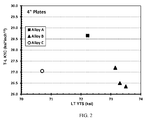
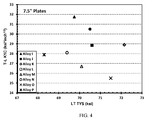
- Table 3 Tensile and fracture toughness properties of final T7651 temper plates Sample ID Patent Alloy Plate Thickness in LT TYS @T/4 ksi LT UTS @T/4 ksi LT Elongation @T/4 % K1c T-L @T/4 ksi-in 1/2 Alloy A Yes 4 72.2 77.8 10.4 28.65 Alloy B Yes 4 73.2 77.6 11.0 27.2 Alloy C No 4 70.7 78.0 11.0 27.1 Alloy D Yes 6 73.0 78.0 6.9 27.9 Alloy E yes 6 71.5 77.1 7.1 30.4 Alloy F Yes 6 71.0 76.3 7.5 28.7 Alloy G No 6 69.1 76.2 8.3 26.1 Alloy H No 6 69.9 77.7 7.9 24.8 Alloy I Yes 7.5 69.8 75.4 5.8 31.8 Alloy J Yes 7.5 70.5 76.1 5.8 30.5 Alloy K Yes 7.5 72.2 78.0 4.1 28.9 Allo
- FIG. 2 is a graph showing a comparison of the strength and fracture toughness of invention alloys (Alloy A and B) and non-invention alloy (Alloy C) 4" thickness plates.
- the invention Alloy A and Alloy B have much better performance of strength and fracture toughness than Alloy C, which has too high Mg and too low Zn/Mg ratio than invention alloys.
- the results demonstrate that the invention alloys has surprisingly much better performance than non-invention alloy. It also demonstrates that the small chemistry deviation from invention alloy can severely decreases final production properties.
- FIG. 3 is a graph showing the strength and fracture toughness of invention alloys (D, E, and F) and non-invention alloys (G and H) 6" thickness plates. Both Alloy G and H have lower fracture toughness with similar or lower strength than Alloy D to F invention alloys. Alloy G is not an invention alloy since the Cu is too high, Zn is too low, and Zn/Mg weight percentage ratio is too low, Cu/Zn weight percentage ratio is too high, and Cu+Mg+Zn is too low. Alloy H is not an invention alloy since the Mg is too high and Zn/Mg weight percentage ratio is too low. The results demonstrate that the invention alloys surprisingly have much better performance than non-invention alloy. It also confirms that even small chemistry deviation from invention alloy can severely decreases final production properties.
- FIG. 4 is a graph showing the strength and fracture toughness of invention alloys (I to L) and non-invention alloys (M to P) 7.5" thickness plates. All non-invention alloys have lower combination of strength and fracture toughness compared with invention alloys. As shown in Table 2, Alloy M is not an invention alloy since the Cu is too high, Zn is too low, Zn/Mg weight percentage ratio is too low, Cu/Zn weight percentage ratio is too high, and Cu+Mg+Zn is too low. Alloy N is not an invention alloy since the Zn is too high. Alloy O is not an invention alloy since the Cu is too high, Zn is too high, and Cu+Zn+Mg is too high.
- Alloy P is not an invention alloy since the Zn is too high, Zn/Mg weight percentage ratio is too high, and Cu+Mg+Zn is too high.
- the results confirm that the invention alloys surprisingly has much better performance than non-invention alloys. It once again demonstrates that even small chemistry deviation from invention alloy can severely decreases final production properties.
- FIG. 5 is a graph showing the fracture toughness as function of total Cu+Mg+Zn amount. It can been seen that the invention alloy range of 10.7 to 11.6% of total Cu+Mg+Zn gives the best performance. It is very critical to control total Cu+Mg+Zn in an optimized range in order to achieve both higher strength and better fracture toughness especially for thick plate product.
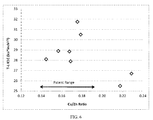
- FIG. 6 is a graph showing the fracture toughness as function of total Cu/Zn weight percentage ratio. It can be seen that the range provided by the invention alloy Cu/Zn weight percentage ratio range of 0.14 to 0.19 gives better performance than other range. The beneficial impact of Cu on corrosion resistance performance is also strongly affected by Zn level. In addition, Cu contents that are too high also significantly increase the risk of undesirable coarse Al 2 MgCu particles and macro-segregation from plate surface to center. Therefore, the ratio of Cu/Zn is very critical for high strength, high damage tolerance, and corrosion resistance performance required by aerospace application.
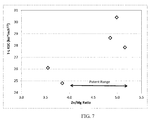
- Figure 7 gives the fracture toughness as function of Zn/Mg weight percentage ratio. It can be seen that the invention alloy Zn/Mg weight percentage ratio range of 4.0 to 5.3 gives the better performance than other range. The Zn/Mg ratio strongly affects the metastable and/or stable MgZn 2 ( ⁇ ' and/or ⁇ Phase) and its variant phases at different aging stages.
- Stress corrosion resistance is critical for aerospace application.
- the standard stress corrosion cracking resistance testing was performed in accordance with the requirements of ASTM G47 which is alternate immersion in a 3.5% NaCl solution under constant deflection. Three specimens were tested per sample. All specimens survived 30 days testing without failing under 30 ksi stress level in ST direction. Meanwhile, the exfoliation corrosion resistance was tested according to ASTM G34. The specimen size was 51 mm (2") in the LT direction and 102 mm (4") in the L direction. Testing was performed at thickness positions of surface (T/10) and plate center (T/2). All samples were rated as pitting based on ASTM G34.
Landscapes
- Chemical & Material Sciences (AREA)
- Engineering & Computer Science (AREA)
- Materials Engineering (AREA)
- Mechanical Engineering (AREA)
- Metallurgy (AREA)
- Organic Chemistry (AREA)
- Physics & Mathematics (AREA)
- Thermal Sciences (AREA)
- Crystallography & Structural Chemistry (AREA)
- Metal Rolling (AREA)
- Conductive Materials (AREA)
Applications Claiming Priority (1)
| Application Number | Priority Date | Filing Date | Title |
|---|---|---|---|
| US14/727,341 US20160348224A1 (en) | 2015-06-01 | 2015-06-01 | High Strength 7xxx Series Aluminum Alloy Products and Methods of Making Such Products |
Publications (1)
| Publication Number | Publication Date |
|---|---|
| EP3101149A1 true EP3101149A1 (de) | 2016-12-07 |
Family
ID=56097021
Family Applications (1)
| Application Number | Title | Priority Date | Filing Date |
|---|---|---|---|
| EP16172536.1A Withdrawn EP3101149A1 (de) | 2015-06-01 | 2016-06-01 | Hochfeste aluminiumlegierungsprodukte der 7xxx-serie und verfahren zur herstellung solcher produkte |
Country Status (5)
| Country | Link |
|---|---|
| US (1) | US20160348224A1 (de) |
| EP (1) | EP3101149A1 (de) |
| CN (1) | CN106191576A (de) |
| BR (1) | BR102016012355A2 (de) |
| CA (1) | CA2928685A1 (de) |
Cited By (1)
| Publication number | Priority date | Publication date | Assignee | Title |
|---|---|---|---|---|
| WO2019238509A1 (en) * | 2018-06-12 | 2019-12-19 | Aleris Rolled Products Germany Gmbh | Method of manufacturing a 7xxx-series aluminium alloy plate product having improved fatigue failure resistance |
Families Citing this family (6)
| Publication number | Priority date | Publication date | Assignee | Title |
|---|---|---|---|---|
| CN107245616A (zh) * | 2017-05-31 | 2017-10-13 | 佛山科学技术学院 | 一种600MPa级低淬火敏感性超高强铝合金及其制备方法 |
| WO2020007437A1 (de) | 2018-07-02 | 2020-01-09 | Otto Fuchs - Kommanditgesellschaft | Aluminiumlegierung sowie überaltertes aluminiumlegierungsprodukt aus einer solchen legierung |
| WO2020097169A1 (en) * | 2018-11-07 | 2020-05-14 | Arconic Inc. | 2xxx aluminum lithium alloys |
| CN110564994A (zh) * | 2019-10-14 | 2019-12-13 | 北京理工大学 | 一种低成本高强韧铝锂合金 |
| CN114457266A (zh) * | 2021-12-27 | 2022-05-10 | 有研金属复材技术有限公司 | 超高强韧铸造铝合金及其成型方法 |
| CN115976380A (zh) * | 2022-12-28 | 2023-04-18 | 山东泰和能源股份有限公司 | 一种7系铝合金及其生产工艺和应用 |
Citations (6)
| Publication number | Priority date | Publication date | Assignee | Title |
|---|---|---|---|---|
| US6027582A (en) * | 1996-01-25 | 2000-02-22 | Pechiney Rhenalu | Thick alZnMgCu alloy products with improved properties |
| US20020121319A1 (en) * | 2000-12-21 | 2002-09-05 | Chakrabarti Dhruba J. | Aluminum alloy products having improved property combinations and method for artificially aging same |
| US6790407B2 (en) | 2000-08-01 | 2004-09-14 | Federalnoe Gosudarstvennoe Unitarnoe Predpriyatie “Vserossiisky auchno-Issledovatelsky Institut Aviatsionnykh Materialov” | High-strength alloy based on aluminium and a product made of said alloy |
| US20050189044A1 (en) * | 2003-04-10 | 2005-09-01 | Rinze Benedictus | Al-Zn-Mg-Cu alloy with improved damage tolerance-strength combination properties |
| US20110297278A1 (en) * | 2010-01-29 | 2011-12-08 | General Research Institute For Nonferrous Metals | Aluminum alloy products for manufacturing structural components and method of producing the same |
| EP2662467A1 (de) * | 2012-04-22 | 2013-11-13 | Kaiser Aluminum Fabricated Products, LLC | Ultradicke. hochfeste Aluminiumlegierungsprodukte der 7xxx-Serie und Verfahren zur Herstellung solcher Produkte |
Family Cites Families (2)
| Publication number | Priority date | Publication date | Assignee | Title |
|---|---|---|---|---|
| BRPI0409267B1 (pt) * | 2003-04-10 | 2017-04-25 | Corus Aluminium Walzprodukte Gmbh | produto de liga de alumínio com alta resistência mecânica e tenacidade à fratura e uma boa resistência à corrosão, componente estrutural de liga de alumínio e chapa de molde |
| WO2008005852A2 (en) * | 2006-06-30 | 2008-01-10 | Alcan Rolled Products-Ravenswood, Llc, | High strength, heat treatable al-zn-mg aluminium alloy |
-
2015
- 2015-06-01 US US14/727,341 patent/US20160348224A1/en not_active Abandoned
-
2016
- 2016-05-03 CA CA2928685A patent/CA2928685A1/en not_active Abandoned
- 2016-05-31 CN CN201610375224.XA patent/CN106191576A/zh active Pending
- 2016-05-31 BR BR102016012355A patent/BR102016012355A2/pt not_active Application Discontinuation
- 2016-06-01 EP EP16172536.1A patent/EP3101149A1/de not_active Withdrawn
Patent Citations (7)
| Publication number | Priority date | Publication date | Assignee | Title |
|---|---|---|---|---|
| US6027582A (en) * | 1996-01-25 | 2000-02-22 | Pechiney Rhenalu | Thick alZnMgCu alloy products with improved properties |
| US6790407B2 (en) | 2000-08-01 | 2004-09-14 | Federalnoe Gosudarstvennoe Unitarnoe Predpriyatie “Vserossiisky auchno-Issledovatelsky Institut Aviatsionnykh Materialov” | High-strength alloy based on aluminium and a product made of said alloy |
| US20020121319A1 (en) * | 2000-12-21 | 2002-09-05 | Chakrabarti Dhruba J. | Aluminum alloy products having improved property combinations and method for artificially aging same |
| US6972110B2 (en) | 2000-12-21 | 2005-12-06 | Alcoa Inc. | Aluminum alloy products having improved property combinations and method for artificially aging same |
| US20050189044A1 (en) * | 2003-04-10 | 2005-09-01 | Rinze Benedictus | Al-Zn-Mg-Cu alloy with improved damage tolerance-strength combination properties |
| US20110297278A1 (en) * | 2010-01-29 | 2011-12-08 | General Research Institute For Nonferrous Metals | Aluminum alloy products for manufacturing structural components and method of producing the same |
| EP2662467A1 (de) * | 2012-04-22 | 2013-11-13 | Kaiser Aluminum Fabricated Products, LLC | Ultradicke. hochfeste Aluminiumlegierungsprodukte der 7xxx-Serie und Verfahren zur Herstellung solcher Produkte |
Non-Patent Citations (3)
| Title |
|---|
| "International Alloy Designations and Chemical Composition Limits for Wrought Aluminum and Wrought Aluminum Alloys With Support for On-line Access From: Aluminum Extruders Council Aluminium Federation of South Africa Australian Aluminium Council Ltd. European Aluminium Association Japan Aluminium Ass", 1 February 2009 (2009-02-01), XP055136121, Retrieved from the Internet <URL:http://www.aluminum.org/sites/default/files/Teal_Sheets.pdf> [retrieved on 20140822] * |
| LIU S ET AL: "Investigation of quench sensitivity of high strength Al-Zn-Mg-Cu alloys by time-temperature-properties diagrams", MATERIALS AND DESIGN, LONDON, GB, vol. 31, no. 6, 1 June 2010 (2010-06-01), pages 3116 - 3120, XP026920238, ISSN: 0261-3069, [retrieved on 20100223], DOI: 10.1016/J.MATDES.2009.12.038 * |
| PH LEQUEU ET AL: "Aluminum alloy development for the Airbus A380--Part 2", ADVANCED MATERIALS & PROCESSES., vol. 165, no. 7, 1 July 2007 (2007-07-01), US, pages 41, XP055305259, ISSN: 0882-7958 * |
Cited By (3)
| Publication number | Priority date | Publication date | Assignee | Title |
|---|---|---|---|---|
| WO2019238509A1 (en) * | 2018-06-12 | 2019-12-19 | Aleris Rolled Products Germany Gmbh | Method of manufacturing a 7xxx-series aluminium alloy plate product having improved fatigue failure resistance |
| JP2021526591A (ja) * | 2018-06-12 | 2021-10-07 | アレリス、ロールド、プロダクツ、ジャーマニー、ゲゼルシャフト、ミット、ベシュレンクテル、ハフツングAleris Rolled Products Germany Gmbh | 耐疲労破壊性を向上させた7xxxシリーズアルミ合金プレート製品の製造方法 |
| RU2757280C1 (ru) * | 2018-06-12 | 2021-10-12 | Алерис Роллд Продактс Джермани Гмбх | Способ изготовления пластинчатого изделия из алюминиевого сплава серии 7xxx, имеющего улучшенное сопротивление усталостному разрушению |
Also Published As
| Publication number | Publication date |
|---|---|
| CN106191576A (zh) | 2016-12-07 |
| BR102016012355A2 (pt) | 2016-12-06 |
| CA2928685A1 (en) | 2016-12-01 |
| US20160348224A1 (en) | 2016-12-01 |
Similar Documents
| Publication | Publication Date | Title |
|---|---|---|
| EP3101149A1 (de) | Hochfeste aluminiumlegierungsprodukte der 7xxx-serie und verfahren zur herstellung solcher produkte | |
| US11981986B2 (en) | 7XXX-series aluminium alloy product | |
| US11879166B2 (en) | 7XXX-series aluminium alloy product | |
| CN102066596B (zh) | 具有降低的淬火敏感性的Al-Zn-Mg合金产品 | |
| EP3012338B1 (de) | Hochfeste und kostengünstige aluminium-lithium-legierungen mit hoher verformbarkeit | |
| EP2049696B1 (de) | Wärmebehandlungsfähige aluminiumlegierung vom typ al-mg-zn mit hoher festigkeit | |
| EP2662467A1 (de) | Ultradicke. hochfeste Aluminiumlegierungsprodukte der 7xxx-Serie und Verfahren zur Herstellung solcher Produkte | |
| EP3521467B1 (de) | Kostengünstige, im wesentlichen ag-freie und zn-freie aluminium-lithium-plattenlegierung mit niedriger dichte für die luft- und raumfahrtanwendung | |
| CN101855376A (zh) | 适于航空应用的Al-Cu-Li合金产品 | |
| CN112262223B (zh) | 制造耐疲劳失效性改善的7xxx系列铝合金板产品的方法 | |
| EP3495520B1 (de) | Kostengünstige, im wesentlichen zr-freie aluminium-lithium-legierung für dünnblech mit hoher formbarkeit | |
| CN108291281A (zh) | 具有改善的机械强度和韧性的铝铜锂合金 | |
| EP4001446A1 (de) | Hochfeste und bruchzähe 7xxx-legierungsprodukte für die luft- und raumfahrt | |
| JP2023549190A (ja) | 2xxx系アルミニウム合金製品の製造方法 | |
| CN117881809A (zh) | 生产2xxx铝合金的方法 | |
| EP3877562B1 (de) | 2xxx-aluminium-lithium-legierungen | |
| EP4155426A1 (de) | Dispersoide 7xxx-legierungsprodukte mit verbesserten umweltunterstützten riss- und ermüdungsrisswachstumsabweichungswiderständen | |
| US20190368009A1 (en) | High Strength, Better Fatigue Crack Deviation Performance, and High Anisotropic Ductility 7xxx Aluminum Alloy Products and Methods of Making Such Products | |
| RU2778466C1 (ru) | Изделие из алюминиевого сплава серии 7xxx |
Legal Events
| Date | Code | Title | Description |
|---|---|---|---|
| PUAI | Public reference made under article 153(3) epc to a published international application that has entered the european phase |
Free format text: ORIGINAL CODE: 0009012 |
|
| STAA | Information on the status of an ep patent application or granted ep patent |
Free format text: STATUS: THE APPLICATION HAS BEEN PUBLISHED |
|
| AK | Designated contracting states |
Kind code of ref document: A1 Designated state(s): AL AT BE BG CH CY CZ DE DK EE ES FI FR GB GR HR HU IE IS IT LI LT LU LV MC MK MT NL NO PL PT RO RS SE SI SK SM TR |
|
| AX | Request for extension of the european patent |
Extension state: BA ME |
|
| STAA | Information on the status of an ep patent application or granted ep patent |
Free format text: STATUS: THE APPLICATION IS DEEMED TO BE WITHDRAWN |
|
| 18D | Application deemed to be withdrawn |
Effective date: 20170608 |