EP3101662A1 - Protonenleiter - Google Patents
Protonenleiter Download PDFInfo
- Publication number
- EP3101662A1 EP3101662A1 EP14752544.8A EP14752544A EP3101662A1 EP 3101662 A1 EP3101662 A1 EP 3101662A1 EP 14752544 A EP14752544 A EP 14752544A EP 3101662 A1 EP3101662 A1 EP 3101662A1
- Authority
- EP
- European Patent Office
- Prior art keywords
- proton
- proton conductor
- compositional formula
- charge
- perovskite
- Prior art date
- Legal status (The legal status is an assumption and is not a legal conclusion. Google has not performed a legal analysis and makes no representation as to the accuracy of the status listed.)
- Withdrawn
Links
Images
Classifications
-
- H—ELECTRICITY
- H01—ELECTRIC ELEMENTS
- H01B—CABLES; CONDUCTORS; INSULATORS; SELECTION OF MATERIALS FOR THEIR CONDUCTIVE, INSULATING OR DIELECTRIC PROPERTIES
- H01B1/00—Conductors or conductive bodies characterised by the conductive materials; Selection of materials as conductors
- H01B1/02—Conductors or conductive bodies characterised by the conductive materials; Selection of materials as conductors mainly consisting of metals or alloys
-
- C—CHEMISTRY; METALLURGY
- C01—INORGANIC CHEMISTRY
- C01G—COMPOUNDS CONTAINING METALS NOT COVERED BY SUBCLASSES C01D OR C01F
- C01G25/00—Compounds of zirconium
-
- C—CHEMISTRY; METALLURGY
- C01—INORGANIC CHEMISTRY
- C01G—COMPOUNDS CONTAINING METALS NOT COVERED BY SUBCLASSES C01D OR C01F
- C01G25/00—Compounds of zirconium
- C01G25/006—Compounds containing zirconium, with or without oxygen or hydrogen, and containing two or more other elements
-
- H—ELECTRICITY
- H01—ELECTRIC ELEMENTS
- H01B—CABLES; CONDUCTORS; INSULATORS; SELECTION OF MATERIALS FOR THEIR CONDUCTIVE, INSULATING OR DIELECTRIC PROPERTIES
- H01B1/00—Conductors or conductive bodies characterised by the conductive materials; Selection of materials as conductors
-
- H—ELECTRICITY
- H01—ELECTRIC ELEMENTS
- H01B—CABLES; CONDUCTORS; INSULATORS; SELECTION OF MATERIALS FOR THEIR CONDUCTIVE, INSULATING OR DIELECTRIC PROPERTIES
- H01B1/00—Conductors or conductive bodies characterised by the conductive materials; Selection of materials as conductors
- H01B1/06—Conductors or conductive bodies characterised by the conductive materials; Selection of materials as conductors mainly consisting of other non-metallic substances
- H01B1/08—Conductors or conductive bodies characterised by the conductive materials; Selection of materials as conductors mainly consisting of other non-metallic substances oxides
-
- H—ELECTRICITY
- H01—ELECTRIC ELEMENTS
- H01M—PROCESSES OR MEANS, e.g. BATTERIES, FOR THE DIRECT CONVERSION OF CHEMICAL ENERGY INTO ELECTRICAL ENERGY
- H01M8/00—Fuel cells; Manufacture thereof
- H01M8/10—Fuel cells with solid electrolytes
- H01M8/12—Fuel cells with solid electrolytes operating at high temperature, e.g. with stabilised ZrO2 electrolyte
- H01M8/124—Fuel cells with solid electrolytes operating at high temperature, e.g. with stabilised ZrO2 electrolyte characterised by the process of manufacturing or by the material of the electrolyte
-
- C—CHEMISTRY; METALLURGY
- C01—INORGANIC CHEMISTRY
- C01P—INDEXING SCHEME RELATING TO STRUCTURAL AND PHYSICAL ASPECTS OF SOLID INORGANIC COMPOUNDS
- C01P2002/00—Crystal-structural characteristics
- C01P2002/30—Three-dimensional structures
- C01P2002/34—Three-dimensional structures perovskite-type (ABO3)
-
- C—CHEMISTRY; METALLURGY
- C01—INORGANIC CHEMISTRY
- C01P—INDEXING SCHEME RELATING TO STRUCTURAL AND PHYSICAL ASPECTS OF SOLID INORGANIC COMPOUNDS
- C01P2006/00—Physical properties of inorganic compounds
- C01P2006/40—Electric properties
-
- Y—GENERAL TAGGING OF NEW TECHNOLOGICAL DEVELOPMENTS; GENERAL TAGGING OF CROSS-SECTIONAL TECHNOLOGIES SPANNING OVER SEVERAL SECTIONS OF THE IPC; TECHNICAL SUBJECTS COVERED BY FORMER USPC CROSS-REFERENCE ART COLLECTIONS [XRACs] AND DIGESTS
- Y02—TECHNOLOGIES OR APPLICATIONS FOR MITIGATION OR ADAPTATION AGAINST CLIMATE CHANGE
- Y02E—REDUCTION OF GREENHOUSE GAS [GHG] EMISSIONS, RELATED TO ENERGY GENERATION, TRANSMISSION OR DISTRIBUTION
- Y02E60/00—Enabling technologies; Technologies with a potential or indirect contribution to GHG emissions mitigation
- Y02E60/30—Hydrogen technology
- Y02E60/50—Fuel cells
-
- Y—GENERAL TAGGING OF NEW TECHNOLOGICAL DEVELOPMENTS; GENERAL TAGGING OF CROSS-SECTIONAL TECHNOLOGIES SPANNING OVER SEVERAL SECTIONS OF THE IPC; TECHNICAL SUBJECTS COVERED BY FORMER USPC CROSS-REFERENCE ART COLLECTIONS [XRACs] AND DIGESTS
- Y02—TECHNOLOGIES OR APPLICATIONS FOR MITIGATION OR ADAPTATION AGAINST CLIMATE CHANGE
- Y02P—CLIMATE CHANGE MITIGATION TECHNOLOGIES IN THE PRODUCTION OR PROCESSING OF GOODS
- Y02P70/00—Climate change mitigation technologies in the production process for final industrial or consumer products
- Y02P70/50—Manufacturing or production processes characterised by the final manufactured product
Definitions
- the present disclosure relates to a proton conductor. Moreover, the present disclosure relates to various devices having a proton conductor.
- A is an alkaline-earth metal
- B is a tetravalent group 4 transition metal element, or Ce, which is a tetravalent lanthanoid element
- B' is a trivalent group 3 or group 13 element
- O is oxygen
- x is a mole fraction of the B' element with which the B element is substituted, satisfying 0 ⁇ x ⁇ 1.0.
- ⁇ is a value representing oxygen deficiencies or oxygen excesses.
- Non-Patent Document 1 discloses oxides of a perovskite structure.
- the oxides of Non-Patent Document 1 have the compositional formula BaZr 1-x Y x O 3- ⁇ or the compositional formula BaCe 1-x Y x O 3- ⁇ .
- A is barium (Ba); B is Zr or Ce; and B' is Y.
- Patent Document 1 discloses a proton conducting film of a perovskite structure.
- the proton conducting film of Patent Document 1 has the chemical formula AL 1-x M x O 3- ⁇ .
- A is an alkaline-earth metal.
- L is one or more kinds of elements selected from cerium, titanium, zirconium, and hafnium.
- M is one or more kinds of elements selected from neodymium, gallium, aluminum, yttrium, indium, ytterbium, scandium, gadolinium, samarium, and praseodymium.
- X is the mole fraction of an M element with which the L element is substituted, where ⁇ is an atomic ratio of oxygen deficiencies.
- Patent Document 1 Japanese Laid-Open Patent Publication No. 2008-23404
- the present disclosure provides a perovskite-type proton conductor which has high proton conductivity even in a temperature region of not less than 100°C and not more than 500°C.
- a proton conductor according to the present disclosure is a proton conductor having a perovskite-type crystal structure expressed by the compositional formula A a B 1-x B' x O 3- ⁇ , where A is at least one selected from among group 2 elements; B is a group 4 element or Ce; B' is a group 3 element, a group 13 element, or a lanthanoid element; 0.5 ⁇ a ⁇ 1.0, 0.0 ⁇ x ⁇ 0.5, and 0.0 ⁇ ⁇ ⁇ 3; and charge of the compositional formula is deviated from electrical neutrality in a range of -0.13 or more but less than +0.14.
- a perovskite-type proton conductor having high proton conductivity can be provided.
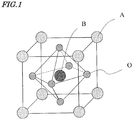
- the generic perovskite structure is composed of elements A, B, and O, and expressed by the compositional formula ABO 3 .
- A is an element which may become a divalent cation
- B is an element which may become a tetravalent cation
- O oxygen.
- the unit lattice of a crystal having a perovskite structure typically has a near cubic shape.
- ions of element A are located on the eight vertices of the unit lattice.
- ions of oxygen O are located at the centers of the six faces of the unit lattice.
- an ion of element B is located near the center of the unit lattice.
- the positions occupied by elements A, B, and O may be called the A site, the B site, and the O site, respectively.
- the above structure is the basic structure of a perovskite crystal, in which some of elements A, B, and O may be deficient, excessive, or substituted by other elements.
- a crystal in which element B' other than element B is located at the B site is a perovskite crystal which is expressed by the compositional formula AB (1-x) B' x O 3 .
- x is a mole fraction (ratio of the number of atoms) of B', which may be referred to as the substitution ratio.
- substitution ratio ratio of the number of atoms
- the perovskite crystal is not limited to "cubic", but broadly encompasses any crystal which has undergone a phase transition into the less-symmetric "rhombic" or "tetragonal".
- the proton conductor In order for the proton conductor to maintain a high proton conductivity of 10 -2 S/cm (Siemens/centimeter) or more even in the temperature region of not less than 100°C and not more than 500°C, it is desirable to ensure that the activation energy of proton conductivity is 0.1 eV or less, thereby suppressing any decrease in proton conductivity that is caused by decreasing temperature.
- the inventors have tried to create a situation where protons can move more easily than via conventional hopping by increasing the solid solution amount (amount of substitution) of the trivalent element B' so as to increase the concentration or density of proton carriers.
- the upper limit of the mole fraction of the B' element is about 0.2, which presents an upper limit to the amount of oxygen deficiencies.
- the inventors have found that similar effects to increasing the mole fraction of the B' element can be obtained by decreasing the mole fraction of the A element. This allows, as described earlier, more oxygen-deficient sites than conventionally to be provided in the proton conductor. It was also found that the concentration or density of proton carriers can be enhanced, furthermore, by introducing water molecules at the positions of oxygen deficiencies, or introducing protons near oxygens so that the charge of the compositional formula of the perovskite structure is deviated from electrical neutrality. As a result of this, a perovskite-type proton conductor having high proton conductivity was obtained.
- One implementation of the present invention is as follows, in outline.
- An proton conductor is a proton conductor having a perovskite-type crystal structure expressed by the compositional formula A a B 1-x B' x O 3- ⁇ , where A is at least one selected from among group 2 elements; B is at least one selected from among group 4 elements and Ce; B' is a group 3 element, a group 13 element, or a lanthanoid element; 0.5 ⁇ a ⁇ 1.0, 0.0 ⁇ x ⁇ 0.5, and 0.0 ⁇ ⁇ ⁇ 3; and charge of the compositional formula is deviated from electrical neutrality in a range of -0.13 or more but less than +0.14.
- A may be at least one selected from the group consisting of Ba, Sr, and Ca; B may be at least one selected from the group consisting of Zr, Ce, and Ti; and B' may be one selected from the group consisting of Yb, Y, Nd, and In.
- the proton conductor of the present disclosure has a perovskite-type crystal structure expressed by the compositional formula A a B 1-x B' x O 3- ⁇ .
- A is at least one selected from among alkaline-earth metals.
- B is at least one selected from among group 4 transition metals and Ce.
- B' is a group 3 or group 13 element.
- a , x and is satisfy 0.5 ⁇ a ⁇ 1.0, 0.0 ⁇ x ⁇ 0.5, and 0.0 ⁇ ⁇ ⁇ 3.
- the charge of the above compositional formula is deviated from electrical neutrality in a range of -0.13 or more but less than +0.14.
- the mole fractions a and x, and amount of oxygen deficiencies ⁇ are determined so that the compositional formula A a B 1-x B' x O 3- ⁇ is not electrically neutral.
- the crystal composition of the proton conductor itself is electrically neutral; it is considered that, in a manner of compensating the charge of the perovskite-type crystal structure expressed by the compositional formula A a B 1-x B' x O 3- ⁇ , the perovskite-type crystal structure may have protons introduced therein, or an electrical excess of oxygen.
- the crystal composition of the proton conductor includes the proton conductor as well as protons, oxygen, or the like that compensate the charge of the perovskite-type crystal structure.
- the protons, oxygen, or the like that compensate the charge of the perovskite-type crystal structure are located in accordance with the composition, charge condition, etc., of the proton conductor, these protons or oxygen not having been intentionally introduced. Therefore, the proton conductivity of the proton conductor is considered to mainly depend on the composition and charge condition of the proton conductor.
- the A element examples are group 2 elements (alkaline-earth metals).
- the A element being a group 2 element stabilizes the perovskite-type structure.
- Specific examples of the A element are at least one selected from the group consisting of barium (Ba), strontium (Sr), calcium (Ca), and magnesium (Mg).
- those proton conductors whose A element is at least one selected from the group consisting of calcium (Ca), barium (Ba), and strontium (Sr) are desirable because they have high proton conductivity.
- the A element may at least contain barium (Ba) and additionally contain at least one selected from the group consisting of strontium (Sr), calcium (Ca), and magnesium (Mg).
- the A element is Ba y A' 1- y(0 ⁇ 1).
- the A element is a group 2 element whose valence is divalent, similar effects to increasing the mole fraction of the B' element amount can be obtained by decreasing the amount of the A element, thus making oxygen deficiencies likely to occur. This causes a deviation from electrical neutrality, making it easier for proton carriers to be introduced; thus, an effect of enhancing the proton carrier concentration is obtained.
- Examples of the B element are at least one selected from group 4 elements and cerium (Ce). Specific examples of the B element are at least one selected from the group consisting of zirconium (Zr), cerium (Ce), titanium (Ti), and hafnium (Hf).
- Zr zirconium
- Ce cerium
- Ti titanium
- Hf hafnium
- the B' element examples are group 3 elements, group 13 elements, and trivalent lanthanoid elements.
- the B' element has an ion radius greater than 0.5 ⁇ and smaller than 1.02 ⁇ . This allows to keep the perovskite-type structure stable. Thus, while maintaining the crystal structure, oxygen deficiencies are likely to occur, thus permitting stable existence even if the charge of the above compositional formula A a B 1-x B' x O 3- ⁇ is deviated from electrical neutrality.
- B' element examples include ytterbium (Yb), neodymium (Nd), yttrium (Y), and indium (In).
- Yb ytterbium
- Nd neodymium
- Y yttrium
- In indium
- Those proton conductors whose B' element is ytterbium (Yb), neodymium (Nd), yttrium (Y), or indium (In) are more desirable because their perovskite structure is stable and they also have high proton conductivity.
- the value a which represents the mole fraction of the A element, is in the range of 0.5 ⁇ a ⁇ 1.0.
- the mole fraction a is 0.5 or less, it is possible to synthesize an oxide having a perovskite structure, but it is difficult to control the charge of the above compositional formula from electrical neutrality, this being not preferable.
- the oxide When the mole fraction a is greater than 1.0, the oxide will have a phase not exhibiting proton conductivity, thus resulting in a greatly reduced proton conductivity.
- the x value which represents the mole fraction of the B' element, is in the range of 0.0 ⁇ x ⁇ 0.5.
- the mole fraction x being greater than 0 will cause oxygen deficiencies in the perovskite structure, so that carriers of proton conduction will be introduced into the proton conductor.
- the mole fraction x is greater than 0.5, it is possible to synthesize an oxide having a perovskite structure, but a phase not exhibiting proton conductivity will also be produced. This will greatly reduce the proton conductivity of the entire oxide.
- A is a divalent element
- B is a tetravalent element
- B' is a trivalent element
- oxygen is a divalent element. Therefore, the charge of the above compositional formula is determined by the mole fractions a and x and the amount of oxygen deficiencies ⁇ .
- electrical neutrality it is considered that a sum of the amount of A deficiencies, i.e., the a value, and a half amount of the amount of B' substitution defines the amount of oxygen deficiencies.
- the charge of the above compositional formula is deviated from electrical neutrality in a range of -0.13 or more but less than +0.14.
- the mole fractions a and x , and amount of oxygen deficiencies ⁇ are determined so that the compositional formula A a B 1-x B' x O 3- ⁇ is not electrically neutral.
- the charge of the above compositional formula is deviated from electrical neutrality in a range of more than 0 but less than 0.14.
- the mole fraction x of B' is such that 0.0 ⁇ x ⁇ 0.5, the charge of the above compositional formula is deviated from electrical neutrality in a range of -0.13 or more but less than 0.
- a single-crystalline or polycrystalline perovskite structural body composed of a single phase which is substantially uniform (homogeneous) in composition and crystal structure is realized.
- being “composed of a single phase which is substantially uniform in composition and crystal structure” means that the proton conductor does not contain any heterophase that has a composition outside the ranges of the present invention.
- embodiments of the proton conductor of the present disclosure may contain minute amounts of unavoidable impurities.
- compounds or elements of sintering aids or the like may be partially contained. Otherwise, in the course of the production process, impurities may be added unintentionally, or intentionally for certain effects. What is important is that the respective elements of A, B, B', and O are within the ranges defined by the present disclosure, these constituting a perovskite crystal structure. Therefore, impurities which might stray in during production may be contained.
- compositional formula of the proton conductor of the present embodiment and a charge deviation from electrical neutrality when it is expressed by the above compositional formula, can be measured by using an electron probe microanalyzer (EPMA), for example.
- EPMA electron probe microanalyzer
- quantitative measurements of elements of the proton conductor as represented by the above compositional formula are taken, and the charge of the above compositional formula is calculated from the valences and mole fractions of the component elements.
- a spectroscope of an energy dispersion type is not preferable because it is prone to large errors in quantitative evaluation of light elements such as oxygen.
- a quantitative analysis by using inductively coupled plasma spectroscopy (ICP) may be able to measure metallic elements composing the material, but not able to quantify the oxygen element; thus, it is not suitable for measuring electrical neutrality deviations.
- JXA-8900R manufactured by JEOL Ltd.
- a wavelength dispersion type detector WDS
- the characteristic X ray is measured through quantitative measurement, by using a characteristic X ray that has been detected with a control sample having a known composition, and using an analyzing crystal.
- the component element ratio of the proton conductor is analyzed, and a product of the valence and the component element fraction of each component element is calculated.
- the chemical compositional formula can be expressed as Ba a Zr b Y c O d .
- the charge of the compositional formula i.e., deviation from electrical neutrality, can be calculated to be ((2 ⁇ a)+(4 ⁇ b)+(3 ⁇ c)-(2 ⁇ d)) ⁇ (b+c).
- the ion conductor to be analyzed has a flat surface because, if there were significant rises and falls, characteristic X rays occurring from within the sample upon electron beam irradiation would not be correctly detected, thus making quantitative measurement difficult.
- proton conductors have poor electrical conductivity, carbon or the like may be thinly vapor-deposited on the surface to prevent charging with an incident electron beam.
- the incidence condition of the electron beam for observation so long as a sufficient signal intensity is obtained at the WDS, and as the sample is not be degraded via burning or the like caused by incidence of the electron beam.
- the measuring points it is preferable to conduct measurement at five or more points and adopt an average value thereof. Among the five or more measuring points, any measurement value which is clearly distant from the other measurement values is preferably not adopted as a value for average value calculation.
- the proton conductor of the present embodiment can be implemented in various forms.
- a film formation method such as a sputtering technique, a plasma laser deposition technique (PLD technique), or a chemical vapor deposition technique (CVD technique).
- Adjustment of the composition is achieved by commonly-used techniques used in such film formation methods.
- the target composition may be adjusted to control the composition of the proton conductor that is produced.
- the amount of source gas to be introduced into the reaction chamber may be adjusted to control the composition of the proton conductor that is produced.
- a proton conductor in bulk state it can be synthesized by a solid phase reaction technique, a hydrothermal synthesis method, or the like.
- the molar ratio between the component elements under the aforementioned production methods may be controlled, or a heat treatment in a reducing atmosphere may follow synthesis to achieve control.
- Proton conductors are also referred to as called proton conducting solid electrolytes.
- a proton conductor does not need to be a continuous film or in bulk form, so long as it functions to conduct protons.
- the surface of the base substrate on which the proton conductor is supported does not need to be flat.
- the gas which is the source material that supplies protons to the proton conductor of the present embodiment and the gas that reacts with the protons having been conducted through the proton conductor or the hydrogen which is the reduced form of protons, it is preferable that there is no leakage between the flow paths of these two gases.
- a thin film of the perovskite-type proton conductor of the present embodiment may be formed on a base substrate which is composed of magnesium oxide (MgO), strontium titanate (SrTiO 3 ), silicon (Si), or the like, this base substrate having a smooth plane. Thereafter, a part or a whole of the base substrate may be removed by using etching or the like, thus partially exposing the surface of the proton conductor through the base substrate for supplying gases.
- etching or the like There is no particular limitation as to the material and shape of the base substrate.
- the crystal structure of the proton conductor may be single-crystalline or polycrystalline, as described above.
- a proton conductor having single-crystalline structure which is epitaxially grown on a substrate is more preferable because it will have a higher proton conductivity.
- the proton conductor can acquire a single-crystalline structure through control of the film-formation conditions such as the surface orientation of the substrate, temperature, pressure, and the atmosphere, there is no particular limitation as to the conditions for obtaining a single-crystalline structure and the crystal growth direction or orientation direction of the single-crystalline structure.
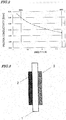
- FIG. 3 shows an exemplary device including the proton conductor.
- the device shown in FIG. 3 includes a proton conductor 1, an anode electrode 2, and a cathode electrode 3.
- Examples of known devices are fuel cells, hydrogen sensors, water vapor electrolytic devices, and hydrogenation devices.
- a base substrate (10 mm ⁇ 10 mm, thickness 0.5 mm) was set on a substrate holder within a vacuum chamber, the substrate holder having a heating mechanism, and the inside of the vacuum chamber was evacuated to a degree of vacuum of about 10 -3 Pa.
- the material of the base substrate was single-crystalline magnesium oxide (MgO).
- the base substrate After evacuating the inside of the vacuum chamber, the base substrate was heated at 650°C to 750°C. An oxygen gas (flow rate: 2 sccm) and an argon gas (flow rate: 8 sccm) were introduced, and the pressure inside the vacuum chamber was adjusted to about IPa.
- An oxygen gas flow rate: 2 sccm
- an argon gas flow rate: 8 sccm
- a proton conductor was formed into a film by a sputtering technique.
- the resultant proton conductor had a thickness of 500 nm, and a size of 10 mm ⁇ 10 mm.
- compositional formula and the charge of the compositional formula of the proton conductor produced were measured by the aforementioned EMPA.
- the A element was barium (Ba) and the a value was 0.904 assuming that the B element of zirconium was 1.
- the oxygen amount (3- ⁇ ) was 2.876, and the charge of the compositional formula was deviated from electrical neutrality by 0.057 toward the positive side.
- An electrode was formed by using silver paste on the proton conductor.
- an argon (Ar) gas in which 5% hydrogen (H 2 ) was mixed under a temperature-range condition from 100°C to 600°C, proton conductivity was measured by using an impedance method. Temperature dependence of proton conductivity is shown in FIG. 2 .
- the proton conductivity at 100°C was 0.12 S/cm
- the proton conductivity at 500°C was 0.25 S/cm.
- the activation energy of proton conductivity was determined to be 0.041 eV.
- the proton conductor had a perovskite-type crystal structure.
- the A element was barium (Ba); the a value was 0.975; the B element was zirconium (Zr) and cerium (Ce), their respective values being 0.495 and 0.412.
- the B' element was neodymium (Nd), with an x value of 0.93.
- the oxygen amount (3- ⁇ ) was 2.975, and it was found that, given the tetravalence of Ce, the charge of the compositional formula was deviated from electrical neutrality by 0.099 toward the negative side.
- the proton conductivity at 100°C was 0.33 S/cm, and the proton conductivity at 500°C was 0.48 S/cm.
- the activation energy of proton conductivity was determined to be 0.022 eV.
- the proton conductor had a perovskite-type crystal structure and was polycrystalline.
- the A element was barium (Ba); the a value was 0.539; the B element was zirconium (Zr); and the B' element was yttrium (Y), with an x value of 0.48 (Zr:0.52, Y:0.48).
- the oxygen amount was 2.363, and it was found that, given the tetravalence of Ce, the charge of the compositional formula was deviated from electrical neutrality by 0.129 toward the negative side.
- the proton conductivity at 100°C was 0.39 S/cm, and the proton conductivity at 500°C was 0.71 S/cm.
- the activation energy of proton conductivity was determined to be 0.035 eV.
- the proton conductor had a perovskite-type crystal structure.
- the A element was barium (Ba); the a value was 0.522; the B element was zirconium (Zr) and titanium (Ti), with zirconium being 0.682 and titanium being 0.098.
- the oxygen amount was 2.474, and it was found that the charge of the compositional formula was deviated from electrical neutrality by 0.124 toward the negative side.
- the B' element was indium (In), with an x value of 0.22.
- the proton conductivity at 100°C was 0.34 S/cm, and the proton conductivity at 500°C was 0.67 S/cm.
- the activation energy of proton conductivity was determined to be 0.037 eV.
- the proton conductor had a perovskite-type crystal structure.
- the A element was barium (Ba); the a value was 0.966; the B element was zirconium (Zr); and the B' element was yttrium (Y), with an x value of 0.197.
- the oxygen amount was 2.932, and it was found that the charge of the compositional formula was deviated from electrical neutrality by 0.128 toward the negative side.
- the proton conductivity at 100°C was 0.37 S/cm, and the proton conductivity at 500°C was 0.78 S/cm.
- the activation energy of proton conductivity was determined to be 0.039 eV.
- Table 1 shows the structure, mole fractions, and proton conductivity of the resultant film of proton conductor.
- the proton conductor had a perovskite-type crystal structure.
- the A element was strontium (Sr), with an a value of 0.98.
- the oxygen amount was 2.969, and it was found that the charge of the compositional formula was deviated from electrical neutrality by 0.022 toward the positive side.
- the proton conductivity at 100°C was 0.10 S/cm
- the proton conductivity at 500°C was 0.21 S/cm.
- the activation energy of proton conductivity was determined to be 0.055 eV.
- the proton conductor had a perovskite-type crystal structure.
- the A element was strontium (Sr), with an a value of 0.965.
- the B element was zirconium (Zr); and the B' element was ytterbium (Yb), with an x value of 0.05.
- the oxygen amount was 2.955, and it was found that the charge of the compositional formula was deviated from electrical neutrality by 0.03 toward the negative side.
- the proton conductivity at 100°C was 0.10 S/cm, and the proton conductivity at 500°C was 0.22 S/cm.
- the activation energy of proton conductivity was determined to be 0.055 eV.
- the proton conductor had a perovskite-type crystal structure.
- the A element was strontium (Sr), with an a value of 0.736.
- the B element was zirconium (Zr) and cerium (Ce), with zirconium being 0.423 and cerium being 0.307.
- the B' element was yttrium (Y), with an x value of 0.27.
- the oxygen amount was 2.616, and it was found that the charge of the compositional formula was deviated from electrical neutrality by 0.03 toward the negative side.
- the proton conductivity at 100°C was 0.13 S/cm
- the proton conductivity at 500°C was 0.25 S/cm.
- the activation energy of proton conductivity was determined to be 0.042 eV.
- the proton conductor had a perovskite-type crystal structure.
- the A element was strontium (Sr), with an a value of 0.686.
- the B element was zirconium (Zr); and the B' element was indium (In), with an x value of 0.351.
- the oxygen amount was 2.542, and it was found that the charge of the compositional formula was deviated from electrical neutrality by 0.062 toward the negative side.
- the proton conductivity at 100°C was 0.13 S/cm, and the proton conductivity at 500°C was 0.24 S/cm.
- the activation energy of proton conductivity was determined to be 0.041 eV.
- the proton conductor had a perovskite-type crystal structure.
- the A element was strontium (Sr), with an a value of 0.563.
- the B element was zirconium (Zr); and the B' element was yttrium (Y), with an x value of 0.474.
- the oxygen amount was 2.358, and it was found that the charge of the compositional formula was deviated from electrical neutrality by 0.063 toward the negative side.
- the proton conductivity at 100°C was 0.18 S/cm, and the proton conductivity at 500°C was 0.30 S/cm.
- the activation energy of proton conductivity was determined to be 0.025 eV.
- Table 1 shows the structure, mole fractions, and proton conductivity of the resultant film of proton conductor.
- the proton conductor had a perovskite-type crystal structure.
- the A element was calcium (Ca), with an a value of 0.987.
- the oxygen amount was 2.972, and it was found that the charge of the compositional formula was deviated from electrical neutrality by 0.03 toward the positive side.
- the proton conductivity at 100°C was 0.02 S/cm, and the proton conductivity at 500°C was 0.18 S/cm.
- the activation energy of proton conductivity was determined to be 0.055 eV.
- Table 1 shows the structure, mole fractions, and proton conductivity of the resultant film of proton conductor.
- the proton conductor had a perovskite-type crystal structure.
- the A element was calcium (Ca), with an a value of 0.95.
- the B element was zirconium (Zr); and the B' element was yttrium (Y), with an x value of 0.099.
- the oxygen amount was 2.926, and it was found that the charge of the compositional formula was deviated from electrical neutrality by 0.05 toward the negative side.
- the proton conductivity at 100°C was 0.030 S/cm, and the proton conductivity at 500°C was 0.21 S/cm.
- the activation energy of proton conductivity was determined to be 0.055 eV.
- Table 1 shows the structure, mole fractions, and proton conductivity of the resultant film of proton conductor.
- the proton conductor had a perovskite-type crystal structure.
- the A element was barium (Ba) and strontium (Sr), with the Ba fraction being 0.39 and the Sr fraction being 0.43, with an a value of 0.92.
- the B element was zirconium (Zr); and the B' element was yttrium (Y), with an x value of 0.192.
- the oxygen amount was 2.876, and it was found that the charge of the compositional formula was deviated from electrical neutrality by 0.103 toward the negative side.
- the proton conductivity at 100°C was 0.290 S/cm
- the proton conductivity at 500°C was 0.41 S/cm.
- the activation energy of proton conductivity was determined to be 0.021 eV.
- the proton conductor had a perovskite-type crystal structure.
- the A element was barium (Ba), with an a value of 0.603.
- the B element was zirconium (Zr); and the B' element was yttrium (Y), with an x value of 0.315.
- the oxygen amount was 2.445, and it was found that the charge of the compositional formula was electrically neutral.
- the proton conductivity at 100°C was 3.3 ⁇ 10 -6 S/cm
- the proton conductivity at 500°C was 8.4 ⁇ 10 -3 S/cm.
- the activation energy of proton conductivity was determined to be 0.454 eV.
- the proton conductor had a perovskite-type crystal structure.
- the A element was barium (Ba), with an a value of 0.635.
- the B element was zirconium (Zr); and the B' element was yttrium (Y), with an x value of 0.318.
- the oxygen amount was 2.55, and it was found that the charge of the compositional formula was deviated from electrical neutrality by 0.148 toward the negative side.
- the proton conductivity at 100°C was 6.6 ⁇ 10 -6 S/cm, and the proton conductivity at 500°C was 9.5 ⁇ 10 -3 S/cm.
- the activation energy of proton conductivity was determined to be 0.419 eV.
- the proton conductor had a perovskite-type crystal structure.
- the A element was barium (Ba), with an a value of 1.00.
- the B element was zirconium (Zr); and the B' element was yttrium (Y), with an x value of 0.101.
- the oxygen amount was 3.051, and it was found that the charge of the compositional formula was deviated from electrical neutrality by 0.202 toward the negative side.
- the proton conductivity at 100°C was 4.2 ⁇ 10 -6 S/cm, and the proton conductivity at 500°C was 8.5 ⁇ 10 -3 S/cm.
- the activation energy of proton conductivity was determined to be 0.436 eV.
- Example 1 Ba 0.904 Zr - 0 2.876 0.056 0.12 0.25 0.041
- Example 2 Ba 0.975 Zr Nd 0.099 2.975 -0.099 0.33 0.48 0.022
- Example 3 Ba 0.539 Zr ⁇ Ce Y 0.48 2.363 -0.128 0.39 0.71 0.035
- Example 5 Ba 0.966 Zr Y 0.197 2.932 -0.128 0.37 0.78 0.039
- Example 6 Sr 0.980 Zr - 0 2.969 0.022 0.10 0.21 0.055
- Example 7 Sr 0.965 Zr
- the A element is such that the mole fractions a and x when assuming a sum of B and B' to be 1 satisfy 0.5 ⁇ a ⁇ 1.0 and 0.0 ⁇ x ⁇ 0.5.
- the charge of the compositional formula of the elements composing the perovskite structure is deviated from electrical neutrality. Specifically, the charge deviation is within the range from - 0.128 to 0.057, and is non-zero.
- the charge of the compositional formula is deviated from electrical neutrality in a range of more than 0 but 0.057 or less toward the positive side.
- the charge of the compositional formula is deviated from electrical neutrality in a range of -0.129 or more but less than 0 toward the negative side.
- the proton conductors of Examples 1 to 13 have proton conductivities which are four or more digits higher than those of the proton conductors of Comparative Examples 1 to 3. Also at 500°C, the proton conductors of Examples 1 to 13 have proton conductivities which are ten or more times higher. In other words, in a temperature region of not less than 100°C and not more than 500°C, the proton conductors of Examples 1 to 13 have high proton conductivities of 10 -2 S/cm or more.
- the proton conductors of Examples 1 to 13 have higher proton conductivities especially at a low temperature of about 100°C than those of the proton conductors of Comparative Examples. Therefore, Examples 1 to 13 have activation energies of proton conductivity which are about one digit smaller than the activation energies of Comparative Examples, being lower than 0.1 eV. On the other hand, the proton conductors of Comparative Examples 1 to 3 have activation energies higher than 0.4 eV. This presumably indicates that, even at temperatures of 100°C or less, the proton conductors of Examples 1 to 13 have higher proton conductivity than conventionally, without allowing their proton conductivity to drastically decrease.
- the proton conductor of the present embodiment has higher proton conductivity than conventionally because the mole fractions a and x and the charge of its compositional formula are within the aforementioned ranges. It was found that a remarkable improvement in proton conductivity over the conventional level is observed in a temperature range from about 100°C to about 500°C.
- a proton conductor according to the present disclosure is used in devices related to hydrogen energy, e.g., fuel cells, hydrogen sensors, water vapor electrolytic devices, and hydrogenation devices, in a structure where it is interposed between an anode electrode and a cathode electrode, and so on.
- devices related to hydrogen energy e.g., fuel cells, hydrogen sensors, water vapor electrolytic devices, and hydrogenation devices, in a structure where it is interposed between an anode electrode and a cathode electrode, and so on.
Landscapes
- Chemical & Material Sciences (AREA)
- Organic Chemistry (AREA)
- Inorganic Chemistry (AREA)
- Engineering & Computer Science (AREA)
- Manufacturing & Machinery (AREA)
- Sustainable Development (AREA)
- Life Sciences & Earth Sciences (AREA)
- Sustainable Energy (AREA)
- Chemical Kinetics & Catalysis (AREA)
- Electrochemistry (AREA)
- General Chemical & Material Sciences (AREA)
- Fuel Cell (AREA)
- Conductive Materials (AREA)
- Inorganic Compounds Of Heavy Metals (AREA)
- Compositions Of Oxide Ceramics (AREA)
Applications Claiming Priority (1)
| Application Number | Priority Date | Filing Date | Title |
|---|---|---|---|
| PCT/JP2014/000515 WO2015114684A1 (ja) | 2014-01-31 | 2014-01-31 | プロトン伝導体 |
Publications (2)
| Publication Number | Publication Date |
|---|---|
| EP3101662A1 true EP3101662A1 (de) | 2016-12-07 |
| EP3101662A4 EP3101662A4 (de) | 2017-03-01 |
Family
ID=53755402
Family Applications (1)
| Application Number | Title | Priority Date | Filing Date |
|---|---|---|---|
| EP14752544.8A Withdrawn EP3101662A4 (de) | 2014-01-31 | 2014-01-31 | Protonenleiter |
Country Status (5)
| Country | Link |
|---|---|
| US (2) | US9514855B2 (de) |
| EP (1) | EP3101662A4 (de) |
| JP (1) | JP5828099B1 (de) |
| CN (1) | CN104968632B (de) |
| WO (1) | WO2015114684A1 (de) |
Cited By (1)
| Publication number | Priority date | Publication date | Assignee | Title |
|---|---|---|---|---|
| EP3279987A4 (de) * | 2015-03-30 | 2018-04-11 | Sumitomo Electric Industries, Ltd. | Protonenleiter, brennstoffzellenfestelektrolytschicht, zellenstruktur und brennstoffzelle damit |
Families Citing this family (13)
| Publication number | Priority date | Publication date | Assignee | Title |
|---|---|---|---|---|
| CN104969302B (zh) * | 2013-07-16 | 2017-08-01 | 松下知识产权经营株式会社 | 质子传导体 |
| WO2015114684A1 (ja) | 2014-01-31 | 2015-08-06 | パナソニックIpマネジメント株式会社 | プロトン伝導体 |
| JP6253016B2 (ja) * | 2014-02-07 | 2017-12-27 | パナソニックIpマネジメント株式会社 | 燃料電池 |
| US9896771B2 (en) | 2014-02-07 | 2018-02-20 | Panasonic Intellectual Property Management Co., Ltd. | Dehydrogenation device |
| JP6610917B2 (ja) * | 2014-02-07 | 2019-11-27 | パナソニックIpマネジメント株式会社 | 水蒸気電解水素化装置 |
| US20160003767A1 (en) * | 2014-07-01 | 2016-01-07 | Panasonic Intellectual Property Management Co., Ltd. | Proton-conducting oxide |
| JPWO2017104806A1 (ja) * | 2015-12-18 | 2018-10-11 | 住友電気工業株式会社 | プロトン伝導体、セル構造体およびこれらの製造方法、燃料電池ならびに水電解装置 |
| JP6706817B2 (ja) * | 2016-05-23 | 2020-06-10 | パナソニックIpマネジメント株式会社 | 電界制御電極および電気二重層デバイス |
| US11545690B2 (en) | 2017-11-29 | 2023-01-03 | Kyoto University | Proton conductor, proton-conducting cell structure, water vapor electrolysis cell, and method for producing hydrogen electrode-solid electrolyte layer complex |
| CN111313068B (zh) * | 2018-12-11 | 2021-05-11 | 有研工程技术研究院有限公司 | 一种弥散质子导电陶瓷电解质薄膜及其制备方法 |
| WO2021256221A1 (ja) * | 2020-06-18 | 2021-12-23 | 住友電気工業株式会社 | プロトン伝導型セル構造体、プロトン伝導体、電気化学デバイス、及びプロトン伝導体の製造方法 |
| WO2022191111A1 (ja) * | 2021-03-12 | 2022-09-15 | 国立大学法人北海道大学 | 水素透過材料 |
| JP7603930B2 (ja) * | 2021-03-12 | 2024-12-23 | 日産自動車株式会社 | 水素吸蔵材料 |
Family Cites Families (19)
| Publication number | Priority date | Publication date | Assignee | Title |
|---|---|---|---|---|
| EP0867952B8 (de) * | 1997-03-27 | 2003-05-28 | Seiko Epson Corporation | Verfahren zur Herstellung eines piezoelektrischen Elements |
| JP4608047B2 (ja) | 1999-02-17 | 2011-01-05 | パナソニック株式会社 | 混合イオン伝導体およびこれを用いたデバイス |
| CA2298850A1 (en) | 1999-02-17 | 2000-08-17 | Matsushita Electric Industrial Co., Ltd. | Mixed ionic conductor and device using the same |
| US20060162767A1 (en) * | 2002-08-16 | 2006-07-27 | Angelo Mascarenhas | Multi-junction, monolithic solar cell with active silicon substrate |
| JP4583810B2 (ja) * | 2004-05-28 | 2010-11-17 | 東京窯業株式会社 | プロトン伝導性セラミックスおよびその製造方法 |
| JP2007200690A (ja) * | 2006-01-26 | 2007-08-09 | Sumitomo Electric Ind Ltd | 多層構造を有するプロトン伝導体およびそれを用いた構造体 |
| JP2007257937A (ja) * | 2006-03-22 | 2007-10-04 | Sumitomo Electric Ind Ltd | 酸化物イオン伝導率を抑えた多層構造のプロトン伝導体およびそれを用いた構造体 |
| JP2008021466A (ja) * | 2006-07-11 | 2008-01-31 | Sumitomo Electric Ind Ltd | 水素透過構造体、水素デバイス、及び燃料電池 |
| JP2008023404A (ja) | 2006-07-18 | 2008-02-07 | Sumitomo Electric Ind Ltd | 水素透過構造体及び燃料電池 |
| JP2008130514A (ja) | 2006-11-24 | 2008-06-05 | Toyota Motor Corp | 電解質膜の成膜方法および燃料電池の製造方法 |
| JP2008243627A (ja) * | 2007-03-27 | 2008-10-09 | Toyota Motor Corp | プロトン伝導体、電気化学セル、およびプロトン伝導体の製造方法 |
| FR2916653B1 (fr) * | 2007-06-01 | 2011-05-06 | Areva Np | Procede d'optimisation de la conductivite ionique d'une membrane conductrice ionique. |
| JP2009231075A (ja) * | 2008-03-24 | 2009-10-08 | Toyota Central R&D Labs Inc | ペロブスカイト型複合酸化物薄膜 |
| US7580596B1 (en) * | 2008-08-12 | 2009-08-25 | International Business Machines Corporation | Non-volatile programmable optical element with absorption coefficient modulation |
| JP5419090B2 (ja) * | 2009-06-25 | 2014-02-19 | 一般財団法人電力中央研究所 | 固体電解質膜−水素透過性金属膜からなる複合膜構造体及び燃料電池並びにそれらの製造方法 |
| JP5720001B1 (ja) | 2013-05-07 | 2015-05-20 | パナソニックIpマネジメント株式会社 | プロトン伝導体およびプロトン伝導デバイス |
| CN104969302B (zh) * | 2013-07-16 | 2017-08-01 | 松下知识产权经营株式会社 | 质子传导体 |
| JP5914846B2 (ja) | 2013-10-08 | 2016-05-11 | パナソニックIpマネジメント株式会社 | 酸化物膜およびプロトン伝導デバイス |
| WO2015114684A1 (ja) | 2014-01-31 | 2015-08-06 | パナソニックIpマネジメント株式会社 | プロトン伝導体 |
-
2014
- 2014-01-31 WO PCT/JP2014/000515 patent/WO2015114684A1/ja not_active Ceased
- 2014-01-31 JP JP2014519326A patent/JP5828099B1/ja not_active Expired - Fee Related
- 2014-01-31 CN CN201480000787.XA patent/CN104968632B/zh not_active Expired - Fee Related
- 2014-01-31 EP EP14752544.8A patent/EP3101662A4/de not_active Withdrawn
- 2014-08-26 US US14/469,165 patent/US9514855B2/en not_active Expired - Fee Related
-
2016
- 2016-11-02 US US15/341,686 patent/US10147513B2/en active Active
Cited By (1)
| Publication number | Priority date | Publication date | Assignee | Title |
|---|---|---|---|---|
| EP3279987A4 (de) * | 2015-03-30 | 2018-04-11 | Sumitomo Electric Industries, Ltd. | Protonenleiter, brennstoffzellenfestelektrolytschicht, zellenstruktur und brennstoffzelle damit |
Also Published As
| Publication number | Publication date |
|---|---|
| JP5828099B1 (ja) | 2015-12-02 |
| US20170076832A1 (en) | 2017-03-16 |
| CN104968632B (zh) | 2019-05-17 |
| US20150221407A1 (en) | 2015-08-06 |
| US9514855B2 (en) | 2016-12-06 |
| WO2015114684A1 (ja) | 2015-08-06 |
| JPWO2015114684A1 (ja) | 2017-03-23 |
| CN104968632A (zh) | 2015-10-07 |
| EP3101662A4 (de) | 2017-03-01 |
| US10147513B2 (en) | 2018-12-04 |
Similar Documents
| Publication | Publication Date | Title |
|---|---|---|
| US10147513B2 (en) | Proton conductor | |
| EP3023995B1 (de) | Protonenleiter | |
| Tarasova et al. | Protonic transport in the new phases BaLaIn0. 9M0. 1O4. 05 (M= Ti, Zr) with Ruddlesden-Popper structure | |
| US9896771B2 (en) | Dehydrogenation device | |
| JP2009231075A (ja) | ペロブスカイト型複合酸化物薄膜 | |
| KR20150051069A (ko) | 투명 전도성 박막 | |
| Huang et al. | Effect of Ni on electrical properties of Ba (Zr, Ce, Y) O3-δ as electrolyte for protonic ceramic fuel cells | |
| Scherrer et al. | Crystallization and microstructure of yttria‐stabilized‐zirconia thin films deposited by spray pyrolysis | |
| JP6292382B2 (ja) | 水蒸気電解装置 | |
| Stämmler et al. | Phase constitution, Sr distribution and morphology of self-assembled La-Sr-Co-O composite films prepared by PLD | |
| Kim et al. | Li loss during the growth of (Li, La) TiO3 thin films by pulsed laser deposition | |
| Wallis et al. | Combined magnetron sputtering and laser annealing process for the fabrication of proton conducting thin films | |
| JP2016026987A (ja) | プロトン伝導性酸化物 | |
| Kim et al. | Cathodic and defect properties of BaxSr1− xTi1− yFeyO3− y/2+ δ mixed conducting oxides | |
| JP6292383B2 (ja) | 脱水素化装置 | |
| JP2015147993A (ja) | 水素ポンプ | |
| JP6253016B2 (ja) | 燃料電池 | |
| JP6269130B2 (ja) | 燃料電池 | |
| Ma et al. | Effect of sintering temperature on microstructure and electrical properties of Na0. 5Bi0. 47Sr0. 02TiO3-δ ceramics | |
| JP6284008B2 (ja) | 水素化装置 | |
| Colomer et al. | Effect of sintering time on structural, microstructural and chemical composition of Ni-doped lanthanum gallate perovskites | |
| Magnone et al. | Electrochemical impedance spectroscopy analysis of Pr0. 8Sr0. 2Co0. 5Fe0. 5O3− δ as cathode material for intermediate temperature solid oxide fuel cells | |
| JP6610917B2 (ja) | 水蒸気電解水素化装置 | |
| Karpov et al. | Dielectric characteristics of" black" non-stabilized zirconium dioxide ZrO 2-x nanopowder synthesized via vacuum-arc deposition | |
| Coppola et al. | Room Temperature RF Sputtering of Mixed Ionic and Electronic Conductor Nd2Ni0. 8Cu0. 2O4+ d films |
Legal Events
| Date | Code | Title | Description |
|---|---|---|---|
| PUAI | Public reference made under article 153(3) epc to a published international application that has entered the european phase |
Free format text: ORIGINAL CODE: 0009012 |
|
| STAA | Information on the status of an ep patent application or granted ep patent |
Free format text: STATUS: REQUEST FOR EXAMINATION WAS MADE |
|
| 17P | Request for examination filed |
Effective date: 20160704 |
|
| AK | Designated contracting states |
Kind code of ref document: A1 Designated state(s): AL AT BE BG CH CY CZ DE DK EE ES FI FR GB GR HR HU IE IS IT LI LT LU LV MC MK MT NL NO PL PT RO RS SE SI SK SM TR |
|
| AX | Request for extension of the european patent |
Extension state: BA ME |
|
| A4 | Supplementary search report drawn up and despatched |
Effective date: 20170130 |
|
| RIC1 | Information provided on ipc code assigned before grant |
Ipc: H01M 8/00 20160101ALI20170124BHEP Ipc: H01M 8/02 20160101ALI20170124BHEP Ipc: C01G 25/00 20060101ALI20170124BHEP Ipc: H01B 1/06 20060101ALI20170124BHEP Ipc: H01B 1/08 20060101AFI20170124BHEP |
|
| DAX | Request for extension of the european patent (deleted) | ||
| STAA | Information on the status of an ep patent application or granted ep patent |
Free format text: STATUS: EXAMINATION IS IN PROGRESS |
|
| 17Q | First examination report despatched |
Effective date: 20180328 |
|
| GRAP | Despatch of communication of intention to grant a patent |
Free format text: ORIGINAL CODE: EPIDOSNIGR1 |
|
| STAA | Information on the status of an ep patent application or granted ep patent |
Free format text: STATUS: GRANT OF PATENT IS INTENDED |
|
| INTG | Intention to grant announced |
Effective date: 20230915 |
|
| STAA | Information on the status of an ep patent application or granted ep patent |
Free format text: STATUS: THE APPLICATION IS DEEMED TO BE WITHDRAWN |
|
| 18D | Application deemed to be withdrawn |
Effective date: 20240126 |