EP3103352A1 - Säurestabile getränke mit bixin - Google Patents
Säurestabile getränke mit bixin Download PDFInfo
- Publication number
- EP3103352A1 EP3103352A1 EP15171900.2A EP15171900A EP3103352A1 EP 3103352 A1 EP3103352 A1 EP 3103352A1 EP 15171900 A EP15171900 A EP 15171900A EP 3103352 A1 EP3103352 A1 EP 3103352A1
- Authority
- EP
- European Patent Office
- Prior art keywords
- bixin
- range
- beverage
- matrix
- color
- Prior art date
- Legal status (The legal status is an assumption and is not a legal conclusion. Google has not performed a legal analysis and makes no representation as to the accuracy of the status listed.)
- Ceased
Links
Images

Classifications
-
- A—HUMAN NECESSITIES
- A23—FOODS OR FOODSTUFFS; TREATMENT THEREOF, NOT COVERED BY OTHER CLASSES
- A23L—FOODS, FOODSTUFFS OR NON-ALCOHOLIC BEVERAGES, NOT OTHERWISE PROVIDED FOR; PREPARATION OR TREATMENT THEREOF
- A23L2/00—Non-alcoholic beverages; Dry compositions or concentrates therefor; Preparation or treatment thereof
- A23L2/52—Adding ingredients
- A23L2/58—Colouring agents
-
- A—HUMAN NECESSITIES
- A23—FOODS OR FOODSTUFFS; TREATMENT THEREOF, NOT COVERED BY OTHER CLASSES
- A23L—FOODS, FOODSTUFFS OR NON-ALCOHOLIC BEVERAGES, NOT OTHERWISE PROVIDED FOR; PREPARATION OR TREATMENT THEREOF
- A23L5/00—Preparation or treatment of foods or foodstuffs, in general; Food or foodstuffs obtained thereby; Materials therefor
- A23L5/40—Colouring or decolouring of foods
- A23L5/42—Addition of dyes or pigments, e.g. in combination with optical brighteners
- A23L5/43—Addition of dyes or pigments, e.g. in combination with optical brighteners using naturally occurring organic dyes or pigments, their artificial duplicates or their derivatives
- A23L5/44—Addition of dyes or pigments, e.g. in combination with optical brighteners using naturally occurring organic dyes or pigments, their artificial duplicates or their derivatives using carotenoids or xanthophylls
-
- A—HUMAN NECESSITIES
- A23—FOODS OR FOODSTUFFS; TREATMENT THEREOF, NOT COVERED BY OTHER CLASSES
- A23P—SHAPING OR WORKING OF FOODSTUFFS, NOT FULLY COVERED BY A SINGLE OTHER SUBCLASS
- A23P10/00—Shaping or working of foodstuffs characterised by the products
- A23P10/30—Encapsulation of particles, e.g. foodstuff additives
-
- A—HUMAN NECESSITIES
- A23—FOODS OR FOODSTUFFS; TREATMENT THEREOF, NOT COVERED BY OTHER CLASSES
- A23V—INDEXING SCHEME RELATING TO FOODS, FOODSTUFFS OR NON-ALCOHOLIC BEVERAGES AND LACTIC OR PROPIONIC ACID BACTERIA USED IN FOODSTUFFS OR FOOD PREPARATION
- A23V2002/00—Food compositions, function of food ingredients or processes for food or foodstuffs
-
- A—HUMAN NECESSITIES
- A23—FOODS OR FOODSTUFFS; TREATMENT THEREOF, NOT COVERED BY OTHER CLASSES
- A23V—INDEXING SCHEME RELATING TO FOODS, FOODSTUFFS OR NON-ALCOHOLIC BEVERAGES AND LACTIC OR PROPIONIC ACID BACTERIA USED IN FOODSTUFFS OR FOOD PREPARATION
- A23V2250/00—Food ingredients
- A23V2250/20—Natural extracts
- A23V2250/21—Plant extracts
- A23V2250/211—Carotene, carotenoids
Definitions
- annatto is widely used as a colorant for dairy, cheese, frozen food, snacks, cereals, savory and oil based products.
- Polysorbate free norbixin forms are not physically stable at neutral to acid pH and, at alkaline pH provide a bright yellow color.
- microencapsulated bixin forms such as the CapColor range of Chr. Hansen. The latter, however, only show low color strength.
- annatto based formulations in the preferred embodiment of the current invention are forms of the natural bixin fraction of annatto.
- They impart a natural orange to red-orange and, at the same time, show very high coloration efficiency and physical stability over a wide pH range. They do not contain low molecular weight emuslifiers such as polysorbates and the like and are based on modified food starch.
- these forms give a blend a neutral taste and can be added even at high concentrations without negative impact on the taste profile of the final consumer product. Due to that they can also be used to replace paprika based colors which are often associated with a characteristic off-taste.
- the bixin formulations in the preferred embodiment of the current invention are fully plant based, vegetarian products that offer a lot of advantages in that respect vs. animal based non-kosher carmine/cochineal based forms that are also used to give orange-reddish shades in beverages. They may also be used in place of nature-identical carotenoids such as apocarotenal or canthaxanthin of which both are also associated to orange-reddish color shades as well.
- the present invention is directed to a beverage comprising a bixin form wherein the beverage is physically stable at a pH in the range of from 2 to 5, preferably in the range of from 2.5 to 4, even more preferably in the range of from 2.8 to 3.6.
- the beverage is also color stable. Further advantages are that (almost) no ringing and (almost) no precipitation/sedimentation of the bixin in the beverage occurs.
- the present invention is further directed to the bixin form itself as well as to its manufacturing process and to the use of such forms for coloring beverages.
- a challenge in replacing artificial colorants with natural colorants in beverages has been in obtaining the stability of color characteristics provided by artificial colorants and to match the color of the product the consumer is already used to. Thus, it is important that a consistent visual quality of the product is guaranteed.
- Bixin can be used to impart a yellow-orange to red-orange color shade to beverages.
- Beverages usually have a pH in the range of from 2 to 5.
- the color provided by bixin is stable in this pH range meaning that for the first time a stable bixin form has been provided by the present invention which allows a stability over this broad range of pH.
- the bixin form according to the present invention shows high color strength and color saturation. It provides upon re-dispersion in water an E1 /1 value of at least 400, preferably an E1 /1 value in the range of from 500 to 1800.
- bixin has been described as unstable compared to its derivative norbixin, which can be obtained from bixin by demethylation (see e.g. GB 1,049,539 : page 2, left column, line 40-43) or via a different extraction route of annatto seeds using alkaline pH conditions which causes the deesterification of the naturally occuring bixin.
- a change in color in a consumer's end-product is, however, irritating for the consumer since it is linked in the personal subjective perception as a sign of bad quality.
- a further challenge is that bixin - in contrast to norbixin - is not water-soluble as such.
- Bixin is especially valuable since it is considered as “natural colorant” according to the NATCOL classification of food colorants. Norbixin, however, is considered only as "nature derived colorant” according to the NATCOL classification of food colorants.
- bixin forms of the present invention impart strong and bright yellow-orange to red-orange color shades.
- the present invention is directed to beverages comprising a bixin form, wherein the bixin is microencapsulated, and whereby preferably the average particle size of the inner phase measured by Photon Correlation
- Spectroscopy (Beckman Coulter N4 Plus Submicron Particle Sizer) is in the range of from 100 to 400 nm.
- the color shade h is preferably in the range of from 45 to 70 at the CIELAB Color scale.
- the color value C* is preferably in the range of from 20 to 110 at the CIELAB Color scale.
- Beverages comprising a bixin form, wherein the bixin is microencapsulated, and whereby preferably the average particle size of the inner phase when measured in water by Photon Correlation Spectroscopy (Beckman Coulter N4 Plus Submicron Particle Sizer) is in the range of from 100 to 300 nm, show a yellow-orange color shade.
- the color shade h of such beverage is preferably in the range of from 60 to 70 at the CIELAB Color scale and preferably the color value C* is preferably in the range of from 40 to 110 at the CIELAB Color scale.
- Beverages comprising a bixin form, wherein the bixin is microencapsulated, and whereby preferably the average particle size of the inner phase when measured in water by Photon Correlation Spectroscopy (Beckman Coulter N4 Plus Submicron Particle Sizer) is in the range of from 200 to 400 nm, show a red-orange color shade.
- the color shade h of such beverage is preferably in the range of from 45 to 60 at the CIELAB Color scale and preferably the color value C* is preferably in the range of from 20 to 70 at the CIELAB Color scale.
- cis-Bixin (compound of formula below; 9- cis -6,6'-diapo- ⁇ , ⁇ -carotenedioic acid, 6-methyl ester; 6-methyl hydrogen (9'Z)-6,6'-diapocarotene-6,6'-dioate) can be obtained from a natural source, by fermentation or by chemical synthesis.
- a natural source might be the seeds of Bixa orellana L.
- Such Annatto Seed Extract is commercially available as "cake” and contains at least 50 weight-%, preferably at least 70 weight-%, more preferably at least 85 weight-% of bixin.
- Chemical syntheses of bixin or its pre-cursors and derivatives are e.g. described in GB 768,172 , GB 756,896 , GB 751,573 and GB 744,890 .
- bixin used herein encompasses the (all-E)-isomer as well as mono-, oligo- or poly-(Z)-isomers.
- a preferred isomer mixture consists especially essentially of cis-bixin.
- the amount of bixin in the beverage is in the range of from 1 ppm to 50 ppm, more preferably it is in the range of from 2 ppm to 30 ppm, most preferably it is in the range of from 5 ppm to 25 ppm, based on the total weight of the beverage.
- the bixin form may be liquid (an emulsion or a dispersion) or solid (a powder). Its manufacturing process is described in more detail below.
- Bosin form or “bixin formulation” means that the bixin is encapsulated, especially microencapsulated, i.e. embedded, in a matrix of a hydrocolloid which protects it against degradation and oxidation.
- the bixin form When the bixin form is an emulsion, its water content is preferably in the range of from 45 to 65 weight-%. When the bixin form is a powder, its water content is preferably in the range of from 3 to 7 weight-%.
- the powder may be manufactured by drying the emulsion by any method known to the person skilled in the art, e.g. by spray-drying, spray-drying in combination with fluidised bed granulation or by a powder-catch technique, whereby the sprayed emulsion droplets are caught in a bed of an absorbent, such as starch (especially corn starch), and subsequently dried.
- an absorbent such as starch (especially corn starch)
- its amount in the bixin form is preferably in the range of from 10 to 40 weight-%, more preferably in the range of from 25 to 35 weight-%, based on the total weight of the bixin form.
- the amount of the bixin in the bixin form is usually in the range of from 1 to 20 weight-%, preferably in the range of from 2.5 to 15 weight-%, more preferably in the range of from 5 to 10 weight-%, based on the total weight of the bixin form.
- the color value a* is preferably in the range of from 15 to 25, and the color value b* is preferably in the range of from 10 to 50.
- the color is then yellow-orange to orange to red-orange.
- the average particle size of the inner phase of the bixin form measured by Photon Correlation Spectroscopy is preferably in the range of from 100 to 400 nm.
- the resulting color is yellow-orange.
- the bixin form is dissolved in water, so that the amount of bixin is 5 ppm, the resulting colored water has a color value a* in the range of from 20 to 25, and preferably the color value b* is preferably in the range of from 25 to 50.
- the color is red-orange.
- the bixin form is dissolved in water, so that the amount of bixin is 5 ppm, the resulting colored water has preferably a color value a* in the range of from 15 to 25.
- the color value b* of such bixin form is preferably in the range of from 10 to 20.
- the bixin is preferably encapsulated, especially microencapsulated, i.e. embedded, in a matrix of at least one modified food starch.
- modified food starch esp. OSA starch
- mixtures thereof are described in more detail below.
- the amount of the modified food starch in the form is usually in the range of from 35 to 55 weight-%, preferably in the range of from 40 to 50 weight-%, more preferably of around 45 weight-%, based on the total weight of the form.
- water- and/or fat-soluble antioxidants may be present, preferably in an amount of from 0.5 to 5 weight-% in total, based on the total amount of the bixin form.
- water-soluble antioxidants is sodium ascorbate.
- sodium ascorbate When sodium ascorbate is used, its amount is preferably chosen in such a way so that its final amount in the bixin form is in the range of from 0 to 2 weight-%, based on the total weight of the bixin form.
- a preferred example of such fat-soluble antioxidants is dl-alpha-tocopherol.
- dl-alpha-tocopherol When dl-alpha-tocopherol is used, its amount is preferably chosen in such a way so that its final amount in the bixin form is in the range of from 0 to 3 weight-% (preferably 0 to 2 weight-%), based on the total weight of the bixin form.
- natural (R,R,R)-alpha-tocopherol may also be used.
- the matrix further comprises at least one saccharide.
- the saccharides are disclosed in more detail below.
- the amount of the saccharide is preferably in the range of from 0.1 to 10 weight-%, more preferably in the range of from 2 to 8 weight-%, even more preferably in the range of from 3 to 7 weight-%, most preferably of around 5 weight-%, based on the total weight of the bixin form.
- middle-chain triglycerides as e.g. commercially available as "Bergabest 60/40" (a mixture of 60% octanoic acid and 40% decanoic acid) (commercially available from Berg + Schmidt, Hamburg, Germany).
- the term "middle-chain triglycerides” encompasses saturated C 6-12 fatty acids and their mixtures such as fractionated coconut oil.
- middle-chain triglycerides When middle-chain triglycerides are present, their amount is preferably in the range of from 0.1 to 10 weight-%, more preferably in the range of from 2 to 8 weight-%, even more preferably in the range of from 3 to 7 weight-%, most preferably of around 5 weight-%, based on the total weight of the bixin form.
- the amounts of all ingredients of the bixin form sum up to 100 weight-%.
- Such not-being-present compounds are preferably the following ones:
- a saccharide encompasses one saccharide or more.
- saccharide in the context of the present invention encompasses mono-, di-, oligo- and polysaccharides, as well as any mixtures thereof.
- Preferred monosaccharides are glucose and fructose, as well as any mixture thereof.
- glucose in the context of the present invention does not only mean the pure substance, but also a glucose syrup with a DE ⁇ 90. This also applies for the other monosaccharides.
- Dextrose equivalent denotes the degree of hydrolysis and is a measure of the amount of reducing sugar calculated as D-glucose based on dry weight; the scale is based on native starch having a DE close to 0 and glucose having a DE of 100.
- An example of an oligosaccharide is maltodextrin.
- An example of a polysaccharide is dextrin.
- invert sugar glucose + fructose + saccharose
- saccharides are glucose (e.g. "dextrose monohydrate 0.5%”), maltodextrin (e.g. "maltodextrin DE 2023 2%”) and sucrose.
- glucose such as "dextrose monohydrate 0.5%"
- its amount is preferably chosen in such a way so that its final amount in the bixin form is in the range of from 0 to 1 weight-%, based on the total weight of the bixin form.
- maltodextrin such as "maltodextrin DE 2023 2%"
- its amount is preferably chosen in such a way so that its final amount in the bixin form is in the range of from 0 to 3 weight-%, based on the total weight of the bixin form.
- sucrose When sucrose is present in the matrix, its amount is preferably chosen in such a way so that its final amount in the bixin form is in the range of from 0 to 4 weight-%, based on the total weight of the bixin form.
- a modified food starch is a food starch that has been chemically modified by known methods to have a chemical structure which provides it with a hydrophilic and a lipophilic portion.
- the modified food starch has a long hydrocarbon chain as part of its structure (preferably C5-C18).
- At least one modified food starch is preferably used to make a liquid formulation of this invention, but it is possible to use a mixture of two or more different modified food starches in one liquid formulation.
- modified food starches are hydrophilic and therefore do not have emulsifying capacities.
- modified food starches are made from starches substituted by known chemical methods with hydrophobic moieties.
- starch may be treated with cyclic dicarboxylic acid anhydrides such as succinic anhydrides, substituted with a hydrocarbon chain (see O. B. Wurzburg (editor), "Modified Starches: Properties and Uses, CRC Press, Inc. Boca Raton, Florida, 1986, and subsequent editions ).
- a particularly preferred modified food starch of this invention has the following formula (I) wherein St is a starch, R is an alkylene radical and R' is a hydrophobic group.
- R is a lower alkylene radical such as dimethylene or trimethylene.
- R' may be an alkyl or alkenyl group, preferably having 5 to 18 carbon atoms.
- a preferred compound of formula (I) is an "OSA-starch” (starch sodium octenyl succinate).
- the degree of substitution i.e. the number of esterified hydroxyl groups to the number of free non-esterified hydroxyl groups usually varies in a range of from 0.1% to 10%, preferably in a range of from 0.5% to 4%, more preferably in a range of from 3% to 4%.
- OSA-starch denotes any starch (from any natural source such as corn, waxy maize, waxy corn, wheat, tapioca and potato or synthesized) that was treated with octenyl succinic anhydride (OSA).
- the degree of substitution i.e. the number of hydroxyl groups esterified with OSA to the number of free non-esterified hydroxyl groups usually varies in a range of from 0.1% to 10%, preferably in a range of from 0.5% to 4%, more preferably in a range of from 3% to 4%.
- OSA-starches are also known under the expression "modified food starch".
- OSA-starches encompasses also such starches that are commercially available e.g. from National Starch under the tradenames HiCap 100, Capsul (octenylbutanedioate amylodextrin), Capsul HS, Purity Gum 2000, Clear Gum Co03, UNI-PURE, HYLON VII; from National Starch and Roquette Fromme, respectively; from CereStar under the tradename C*EmCap or from Tate & Lyle.
- a commercially available modified food starch such as e.g. HiCap 100 (from National Starch) and ClearGum Co03 (from Roquette Frées) is used.
- the present invention is also directed to a process for the manufacture of a bixin form as described above comprising the following steps:
- the bixin form obtained is a bixin emulsion.
- the bixin form obtained is a bixin powder.
- the amounts of the bixin, the fat-soluble antioxidant and the oil and/or MCT are chosen so that the final amounts of these compounds in the resulting form after having performed all steps is as described above.
- oil in the context of the present invention encompasses glycerol and any triglyceride such as vegetable oils or fats like corn oil, sunflower oil, soybean oil, safflower oil, rapeseed oil, peanut oil, palm oil, palm kernel oil, cotton seed oil, olive oil or coconut oil.
- oils can be from any origin. They can be natural, modified or synthetic. If the oils are natural they can be plant or animal oils.
- PUFAs polyunsaturated fatty acids
- the amount of the solvent and the dissolution temperature are chosen so as to dissolve the bixin, the fat-soluble antioxidant, if present, and the MCT, if present, completely.
- the temperature to which the suspension is heated up is in the range of from 100 to 120°C. After having obtained the solution it is usually kept at the temperature it was before heated up to or at a slightly higher temperature (+ 5 Kelvin).
- this step is performed at a temperature in the range of from 50 to 70°C, more preferably at a temperature in the range of from 64°C to 67°C.
- the temperature is lower if a saccharide is present compared to the temperature that is used when no saccharide is present.
- this step is performed at a mixing temperature in the range of from 60 to 90°C, more preferably at a mixing temperature in the range of from 65 to 80°C, to obtain an emulsion.
- the emulsification can be achieved by using a rotor-stator device or a high pressure homogenizer or both. Other devices known to the person skilled in the art may also be used.
- the organic solvent may e.g. be removed by using a thin film evaporator cascade (preferred). Other methods known to the person skilled in the art are also applicable.
- the resulting emulsions after having performed steps a) to d) can be used as such. They can, however, also be dried by any method known to the person skilled in the art, e.g. by spray-drying, spray-drying in combination with fluidised bed granulation or by a powder-catch technique, whereby the sprayed emulsion droplets are caught in a bed of an absorbent, such as starch (e.g corn starch), and subsequently dried.
- an absorbent such as starch (e.g corn starch)
- the bixin form according to the present invention is used in beverages, especially in soft drinks, which generally have a pH in the range of from 2 to 5, preferably a pH in the range of from 2.5 to 4, more preferably a pH in the range of from 2.8 to 3.6.
- beverages especially in soft drinks, which generally have a pH in the range of from 2 to 5, preferably a pH in the range of from 2.5 to 4, more preferably a pH in the range of from 2.8 to 3.6.
- Color-stable in the context of the present invention means that the color difference DE* between the initial color and the color after a storage time of 3 months should be lower than 10 (DE* ⁇ 10).
- DE* is the distance in a metric color scale (CIE) of two measuring points (colors) where delta is a Greek letter often used to denote difference, and "E” stands for "Empfindung” (German for “sensation”).
- CIE metric color scale
- E stands for "Empfindung” (German for "sensation”
- a DE* ⁇ 10 means that the color difference is acceptable and at DE* ⁇ 3 cannot be seen by naked eyes, i.e. without the use of an apparatus such as a colorimeter.
- Beverages wherein the liquid formulations of the present invention can be used as a colorant or a functional ingredient can be carbonated beverages e.g., flavoured seltzer waters, soft drinks or mineral drinks, as well as non-carbonated beverages e.g. flavoured waters, fruit juices, fruit punches and concentrated forms of these beverages. They may be based on natural fruit or vegetable juices or on artificial flavours. Also included are alcoholic beverages. Besides, sugar containing beverages diet beverages with non-caloric and artificial sweeteners are also included. Especially preferred are soft drinks, preferably with a pH in the range of from 2 to 5, preferably with a pH in the range of from 2.5 to 4, more preferably with a pH in the range of 2.8 to 3.6.
- carbonated beverages e.g., flavoured seltzer waters, soft drinks or mineral drinks
- non-carbonated beverages e.g. flavoured waters, fruit juices, fruit punches and concentrated forms of these beverages. They may be based on natural fruit or vegetable juice
- the final concentration of the bixin, which is added via the bixin form of the present invention to beverages may be from 1 to 50 ppm, particularly from 2 to 30 ppm, more preferably from 5 to 25 ppm, based on the total weight of the beverage and depending on the particular beverage to be colored or fortified and the intended grade of coloration or fortification.
- a bixin form of this invention can be used according to methods per se known for the application of emulsions, dispersions, suspensions or powders.
- the present invention is also directed to the use of a bixin form, wherein the bixin is microencapsulated, and whereby preferably the average particle size of the inner phase of the bixin form measured by Photon Correlation Spectroscopy (Beckman Coulter N4 Plus Submicron Particle Sizer) is in the range of from 100 to 400 nm, for coloring beverages.
- the bixin in the bixin form is preferably microencapsulated in a matrix of modified food starch, wherein the matrix optionally further comprises a saccharide.
- a further embodiment of the present invention is a method for coloring a beverage, wherein a bixin form, wherein the bixin is microencapsulated, and whereby preferably the average particle size of the inner phase of the bixin form measured by Photon Correlation Spectroscopy (Beckman Coulter N4 Plus Submicron Particle Sizer) is in the range of from 100 to 400 nm, is added to the beverage to provide a yellow-orange to red-orange color to the beverage.
- Photon Correlation Spectroscopy Beckman Coulter N4 Plus Submicron Particle Sizer
- the bixin used was the commercially available AlcabixP (from AICA-Color, Peru).
- Bixin, the fat-soluble antioxidant and the middle-chain triglycerides (MCTs) are dispersed in an organic solvent as mentioned above.
- the resulting suspension is then heated up to a temperature as given in Table 1 to dissolve the whole amount of bixin.
- the resulting solution is then held at the temperature as given in Table 1 in a holding vessel.
- the emulsification process consists of two steps and is carried out under pressure. Both phases are continuously fed to a rotor stator device where the solution is emulsified into the matrix phase.
- the rotation speed is 5000 rpm (revolutions per minute) and the mixing temperature is as given in Table 1.
- the next step entails a second micronisation step and consists of a sapphire orifice.
- the orifice diameter is as given in Table 1 and the applied pressure drop over the orifice is as given in Table 1 at the temperature as given in Table 1.
- the organic solvent is removed from the emulsion by using a thin film evaporator cascade. After that the solvent-free emulsion is sprayed into a fluidized corn starch bed where the particles are dried.
- the results of the examples are summarized below.
- the average particle size of the inner phase was measured by Photon Correlation Spectroscopy (Beckman Coulter N4 Plus Submicron Particle Sizer).
- (Amax-A650)" means the value you get when you substract the Adsorption value measured at 650 nm ("A650") wavelength from the value ("Amax") that was measured at the maximum Adsorption in the UV-Spectrophotometer.
- "*" means "multiplied with”.
- "dilution factor” the factor by which the solution has been diluted.
- weight of sample the amount/weight of the formulation that was used in [g]
- content of product form in % "the amount of bixin in the powder in %” (detected via UV spectrophotometer) which is in the range of from 4.5 to 9.7% in the following examples.
- turbidity adds to the "juicy" appearance of a fruit juice when added to it and is in this application advantageous.
- the powders according to examples 1-7 have been applied in soft drinks with a concentration of the bixin of 6 ppm. The objective of these trials was to evaluate the performance of these samples for their application in beverages.
- the powders have to provide a good color stability, good chemical stability and a good performance of appearance (no or less ringing, absence of or only few particles on the surface and (almost) no sedimentation).
- the soft drinks were prepared as follows:
- the soft drinks were then filled in glass bottles and the bottles sealed with a metallic cap. Some of these bottles were pasteurized and some not.
- a tunnel pasteurizer from Miele was used for pasteurization with a holding temperature of 80°C for 1 minute at a core of the bottle.
- Color measurements for the application in food are performed with a colorimeter (Hunter Lab Ultra Scan Pro) which can other than a spectrophotometer express color values according to the psychophysical perception of color by human eye.
- Color measurements are carried out after CIE guidelines (Commission International d'Eclairage). Values can be expressed either as planar coordinates L*a*b* with L* being the measuring value for lightness, with a*being the value on the red-green-axis and with b* being the value on the yellow-blue-axis.
- hue tan b / a - 1
- DE* should be lower than 10 (DE* ⁇ 10); this means that the color difference is acceptable and at DE* ⁇ 3 cannot be seen by naked eyes, i.e. without the use of an apparatus such as a colorimeter.
- Suspended solids are responsible for the turbid appearance of beverages containing juice. This turbid appearance can be evaluated by turbidity measurements. Turbidity depends on the light-scattering properties of such particles: their size, their shape and their refractive index.
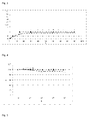
- turbidity measurements were conducted using a Turbidimeter (Hach 2100N IS®, USA) and turbidity values were given in NTU (nephelometric turbidity units). Neophelometer measures the light scattered by a sample in 90° from the incident light path (s. Fig. 1 ).
- Fig. 1 illustrates the principle of the nephelometric turbidity measurement Instrument settings: Light source: 860 ⁇ 10 nm LED
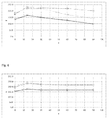
- Fig. 2 shows the color difference (DE*) in non-pasteurized soft drinks during a storage time of up to 3 months.
- x-axis Storage time in days;
- y-axis Color difference (DE*) (dimensionless);
- ⁇ soft drink containing a powder according to example 4;
- x soft drink containing a powder according to example 6;
- • soft drink containing a powder according to example 7.
- Fig. 3 shows the color difference (DE*) in pasteurized soft drinks during a storage time of up to 3 months.
- x-axis Storage time in days;
- ⁇ soft drink containing a powder according to example 4;
- x soft drink containing a powder according to example 6;
- • soft drink containing a powder according to example 7.
- Fig. 4 shows the chemical stability (% recovery) in pasteurized soft drinks during a storage time of up to 3 months.
- x-axis Storage time in days;
- y-axis Chemical stability (% recovery) "CS"(dimensionless);
- ⁇ soft drink containing a powder according to example 4;
- x soft drink containing a powder according to example 6;
- • soft drink containing a powder according to example 7.
- Tab. 2 shows the results obtained for the appearance evaluation of a non-pasteurized soft drink.
- Tab. 3 shows the results obtained for the appearance evaluation of a pasteurized soft drink.
- CapColor A-8-WSS-145 from Christian Hansen, Denmark, was further analyzed. It is a dark reddish brown liquid or gel, produced by extraction of annatto pigments from the seeds of the annatto tree ( Bixa Orellana L.). The pigments are dispersed in an aqueous solution of vegetable hydrocolloid (Gum Arabic). CapColor A-8-WSS-145 comprises 7.5 to 8.5% of bixin as major coloring principle.
- the E1/1 corrected in water is only 226 (430 nm) and therefore, much lower than the E1/1 of the bixin forms according to the present invention.
- Example 1 2 3 4 5 6 7 Amount of bixin [g] 62 60 60 62 48 56 54 Fat-soluble Antioxidant D D D D D D D Amount of fat-soluble antioxidant [g] 9 8 9 9 2.6 3 4.3 Amount of MCT [g] 28 - 27 4.5 12.8 15 21.4 Modified food starch H H H H/Q C/P C/P Amount of modified food starch [g] 218 231 211 218 189/11.3 113/110 127/56.3 Saccharide and amount 21 g of maltodextrin (DE2023) - 21 g of maltodextrin (DE2023) - 5.3 g of dextrose monohydrate + 24.7 g of maltodextrin (DE2023) 4 g of dextrose monohydrate + 8 g of maltodextrin (DE2023) 32.8 g of sucrose + 23.4 g of maltodextrin (DE2023) Water-soluble antioxidant none none none none S S none Amount of water-soluble antioxidant [
Landscapes
- Life Sciences & Earth Sciences (AREA)
- Chemical & Material Sciences (AREA)
- Engineering & Computer Science (AREA)
- Food Science & Technology (AREA)
- Polymers & Plastics (AREA)
- Health & Medical Sciences (AREA)
- Nutrition Science (AREA)
- Coloring Foods And Improving Nutritive Qualities (AREA)
- Non-Alcoholic Beverages (AREA)
- Medicinal Preparation (AREA)
- Pharmaceuticals Containing Other Organic And Inorganic Compounds (AREA)
Priority Applications (9)
| Application Number | Priority Date | Filing Date | Title |
|---|---|---|---|
| EP15171900.2A EP3103352A1 (de) | 2015-06-12 | 2015-06-12 | Säurestabile getränke mit bixin |
| PE2017002699A PE20180738A1 (es) | 2015-06-12 | 2016-06-10 | Bebidas estables acidas que comprenden bixina |
| JP2017562985A JP2018516576A (ja) | 2015-06-12 | 2016-06-10 | ビキシンを含む酸に安定な飲料 |
| KR1020187000798A KR20180018679A (ko) | 2015-06-12 | 2016-06-10 | 빅신을 포함하는 산 안정성 음료 |
| CN201680033255.5A CN107708436A (zh) | 2015-06-12 | 2016-06-10 | 包含胭脂树素的酸稳定饮料 |
| EP16730309.8A EP3307084A1 (de) | 2015-06-12 | 2016-06-10 | Säurestabile getränke mit bixin |
| PCT/EP2016/063247 WO2016198567A1 (en) | 2015-06-12 | 2016-06-10 | Acid stable beverages comprising bixin |
| US15/580,914 US20180310595A1 (en) | 2015-06-12 | 2016-06-10 | Acid stable beverages comprising bixin |
| TW105118382A TW201703644A (zh) | 2015-06-12 | 2016-06-13 | 包含胭脂木酯的酸穩定飲品 |
Applications Claiming Priority (1)
| Application Number | Priority Date | Filing Date | Title |
|---|---|---|---|
| EP15171900.2A EP3103352A1 (de) | 2015-06-12 | 2015-06-12 | Säurestabile getränke mit bixin |
Publications (1)
| Publication Number | Publication Date |
|---|---|
| EP3103352A1 true EP3103352A1 (de) | 2016-12-14 |
Family
ID=53397915
Family Applications (2)
| Application Number | Title | Priority Date | Filing Date |
|---|---|---|---|
| EP15171900.2A Ceased EP3103352A1 (de) | 2015-06-12 | 2015-06-12 | Säurestabile getränke mit bixin |
| EP16730309.8A Withdrawn EP3307084A1 (de) | 2015-06-12 | 2016-06-10 | Säurestabile getränke mit bixin |
Family Applications After (1)
| Application Number | Title | Priority Date | Filing Date |
|---|---|---|---|
| EP16730309.8A Withdrawn EP3307084A1 (de) | 2015-06-12 | 2016-06-10 | Säurestabile getränke mit bixin |
Country Status (8)
| Country | Link |
|---|---|
| US (1) | US20180310595A1 (de) |
| EP (2) | EP3103352A1 (de) |
| JP (1) | JP2018516576A (de) |
| KR (1) | KR20180018679A (de) |
| CN (1) | CN107708436A (de) |
| PE (1) | PE20180738A1 (de) |
| TW (1) | TW201703644A (de) |
| WO (1) | WO2016198567A1 (de) |
Families Citing this family (6)
| Publication number | Priority date | Publication date | Assignee | Title |
|---|---|---|---|---|
| EP3435786B1 (de) * | 2016-04-01 | 2020-07-01 | DSM IP Assets B.V. | Getränke mit stabilem granulat aus gemahlenem lutein |
| CN108522920A (zh) * | 2018-04-11 | 2018-09-14 | 吉林大学 | 一种含有林蛙抗氧化肽微胶囊的功能性饮料及其制备方法 |
| US11191289B2 (en) | 2018-04-30 | 2021-12-07 | Kraft Foods Group Brands Llc | Spoonable smoothie and methods of production thereof |
| CN112155146B (zh) * | 2020-09-16 | 2022-11-22 | 上海交通大学 | 一种能使胭脂树素在水相中稳定存在的方法 |
| CN113943765B (zh) * | 2021-10-29 | 2024-04-30 | 上海交通大学 | 一种使得胭脂树橙在酸性水相中稳定的改性方法 |
| CN114163836B (zh) * | 2021-11-22 | 2023-07-28 | 河南中大恒源生物科技股份有限公司 | 一种耐酸性胭脂树橙及其制备方法与应用 |
Citations (12)
| Publication number | Priority date | Publication date | Assignee | Title |
|---|---|---|---|---|
| GB744890A (en) | 1952-12-31 | 1956-02-15 | Roche Products Ltd | A novel unsaturated dialdehyde and the manufacture thereof |
| GB751573A (en) | 1953-08-14 | 1956-06-27 | Roche Products Ltd | A polyene dialdehyde and process for the manufacture thereof |
| GB756896A (en) | 1953-07-10 | 1956-09-12 | Roche Products Ltd | Polyene dialdehydes and process for the manufacture thereof |
| GB768172A (en) | 1953-12-08 | 1957-02-13 | Hoffmann La Roche | Dialkoxy derivatives of bis-acetals of an unsaturated dial and their preparation and conversion into a trienic dial |
| GB1049539A (en) | 1964-10-26 | 1966-11-30 | Kalamazoo Spice Extract Co | Vegetable base food colouring for oleomargarine and other edible oils |
| US6500473B1 (en) * | 1999-05-21 | 2002-12-31 | Chr. Hansen A/S | Coloring substance composition and a method of manufacturing same |
| US20030148099A1 (en) * | 2002-02-01 | 2003-08-07 | Defreitas Zoraida | Microcapsules having high carotenoid content |
| WO2008110225A1 (en) | 2007-03-15 | 2008-09-18 | Dsm Ip Assets B.V. | Carotenoid compositions containing modified gum acacia |
| WO2011039336A1 (en) | 2009-10-02 | 2011-04-07 | Dsm Ip Assets B.V. | Novel plant gum-modified food starch conjugate as emulsifying agent for fat soluble ingredients |
| WO2012059286A1 (en) * | 2010-11-03 | 2012-05-10 | Dsm Ip Assets B.V. | Carotenoid compositions containing octenyl succinate anhydride-modified gum acacia |
| EP2687103A1 (de) * | 2012-07-20 | 2014-01-22 | Basf Se | Wässrige transparente Öl-in-Wasser-Emulsion mit emulgiertem Carotenoid |
| WO2014191556A1 (en) * | 2013-05-30 | 2014-12-04 | Chr. Hansen A/S | Method for coloring powders for preparing foods |
Family Cites Families (10)
| Publication number | Priority date | Publication date | Assignee | Title |
|---|---|---|---|---|
| US3110598A (en) * | 1959-09-08 | 1963-11-12 | Hoffmann La Roche | Process of making a carotenoid preparation |
| US4699664A (en) * | 1985-05-01 | 1987-10-13 | Nestec S.A. | Stabilized natural pigment complexes |
| DK0876109T3 (da) * | 1996-01-22 | 2003-10-20 | Chr Hansen As | Flydende farvegivende middel |
| US7105176B2 (en) * | 2000-11-29 | 2006-09-12 | Basf Aktiengesellschaft | Production of solid preparations of water-soluble, sparingly water-soluble or water-insoluble active compounds |
| EP1903887A1 (de) * | 2005-07-20 | 2008-04-02 | DSMIP Assets B.V. | Neue stabilisierte cartinoidzusammensetzungen |
| PL1964479T3 (pl) * | 2007-02-14 | 2013-09-30 | Dsm Ip Assets Bv | Sposób wytwarzania proszku zawierającego karotenoidy |
| EP2011835A1 (de) * | 2007-07-06 | 2009-01-07 | Chr. Hansen A/S | Färbemittelzusammensetzung mit Stärkederivaten als Hydrokolloid |
| CN101873804A (zh) * | 2007-11-29 | 2010-10-27 | 巴斯夫欧洲公司 | 用于饮料着色的粉状类胡萝卜素制剂 |
| CN103188918B (zh) * | 2011-12-30 | 2016-06-01 | 英业达股份有限公司 | 电子装置 |
| EP2644041A1 (de) * | 2012-03-30 | 2013-10-02 | DSM IP Assets B.V. | Klarflüssige Karotidformulierungen und klares Getränk damit |
-
2015
- 2015-06-12 EP EP15171900.2A patent/EP3103352A1/de not_active Ceased
-
2016
- 2016-06-10 KR KR1020187000798A patent/KR20180018679A/ko not_active Withdrawn
- 2016-06-10 PE PE2017002699A patent/PE20180738A1/es unknown
- 2016-06-10 CN CN201680033255.5A patent/CN107708436A/zh active Pending
- 2016-06-10 WO PCT/EP2016/063247 patent/WO2016198567A1/en not_active Ceased
- 2016-06-10 US US15/580,914 patent/US20180310595A1/en not_active Abandoned
- 2016-06-10 JP JP2017562985A patent/JP2018516576A/ja active Pending
- 2016-06-10 EP EP16730309.8A patent/EP3307084A1/de not_active Withdrawn
- 2016-06-13 TW TW105118382A patent/TW201703644A/zh unknown
Patent Citations (12)
| Publication number | Priority date | Publication date | Assignee | Title |
|---|---|---|---|---|
| GB744890A (en) | 1952-12-31 | 1956-02-15 | Roche Products Ltd | A novel unsaturated dialdehyde and the manufacture thereof |
| GB756896A (en) | 1953-07-10 | 1956-09-12 | Roche Products Ltd | Polyene dialdehydes and process for the manufacture thereof |
| GB751573A (en) | 1953-08-14 | 1956-06-27 | Roche Products Ltd | A polyene dialdehyde and process for the manufacture thereof |
| GB768172A (en) | 1953-12-08 | 1957-02-13 | Hoffmann La Roche | Dialkoxy derivatives of bis-acetals of an unsaturated dial and their preparation and conversion into a trienic dial |
| GB1049539A (en) | 1964-10-26 | 1966-11-30 | Kalamazoo Spice Extract Co | Vegetable base food colouring for oleomargarine and other edible oils |
| US6500473B1 (en) * | 1999-05-21 | 2002-12-31 | Chr. Hansen A/S | Coloring substance composition and a method of manufacturing same |
| US20030148099A1 (en) * | 2002-02-01 | 2003-08-07 | Defreitas Zoraida | Microcapsules having high carotenoid content |
| WO2008110225A1 (en) | 2007-03-15 | 2008-09-18 | Dsm Ip Assets B.V. | Carotenoid compositions containing modified gum acacia |
| WO2011039336A1 (en) | 2009-10-02 | 2011-04-07 | Dsm Ip Assets B.V. | Novel plant gum-modified food starch conjugate as emulsifying agent for fat soluble ingredients |
| WO2012059286A1 (en) * | 2010-11-03 | 2012-05-10 | Dsm Ip Assets B.V. | Carotenoid compositions containing octenyl succinate anhydride-modified gum acacia |
| EP2687103A1 (de) * | 2012-07-20 | 2014-01-22 | Basf Se | Wässrige transparente Öl-in-Wasser-Emulsion mit emulgiertem Carotenoid |
| WO2014191556A1 (en) * | 2013-05-30 | 2014-12-04 | Chr. Hansen A/S | Method for coloring powders for preparing foods |
Non-Patent Citations (1)
| Title |
|---|
| "Modified Starches: Properties and Uses", 1986, CRC PRESS, INC. |
Also Published As
| Publication number | Publication date |
|---|---|
| TW201703644A (zh) | 2017-02-01 |
| US20180310595A1 (en) | 2018-11-01 |
| WO2016198567A1 (en) | 2016-12-15 |
| EP3307084A1 (de) | 2018-04-18 |
| KR20180018679A (ko) | 2018-02-21 |
| JP2018516576A (ja) | 2018-06-28 |
| PE20180738A1 (es) | 2018-04-27 |
| CN107708436A (zh) | 2018-02-16 |
Similar Documents
| Publication | Publication Date | Title |
|---|---|---|
| US20240090536A1 (en) | Clear liquid carotenoid formulations and clear beverages containing them | |
| KR101313976B1 (ko) | 베타-카로틴을 함유하는 조성물 | |
| US20180310595A1 (en) | Acid stable beverages comprising bixin | |
| US20160227827A1 (en) | Red colorant for beverages, food and pharmaceutical compositions | |
| US20160219909A1 (en) | Stable red formulations for the coloration of beverages and food | |
| US20250386841A1 (en) | Beverages comprising stable granules of milled lutein | |
| WO2019069992A1 (ja) | 天然由来の水溶性色素又はその含有物の消泡及び/又は抑泡方法 | |
| CN101378668B (zh) | 含β-胡萝卜素的组合物 | |
| US20160219920A1 (en) | Clear liquid formulations and clear beverages containing them | |
| EP3203861B1 (de) | Farbstabile getränk enthaltend 8'-apo-beta-carotin-8'-al und verfahren zu seiner herstellung | |
| WO2015044222A1 (en) | Stable formulations for coloring beverages and food products |
Legal Events
| Date | Code | Title | Description |
|---|---|---|---|
| PUAI | Public reference made under article 153(3) epc to a published international application that has entered the european phase |
Free format text: ORIGINAL CODE: 0009012 |
|
| STAA | Information on the status of an ep patent application or granted ep patent |
Free format text: STATUS: THE APPLICATION HAS BEEN PUBLISHED |
|
| AK | Designated contracting states |
Kind code of ref document: A1 Designated state(s): AL AT BE BG CH CY CZ DE DK EE ES FI FR GB GR HR HU IE IS IT LI LT LU LV MC MK MT NL NO PL PT RO RS SE SI SK SM TR |
|
| AX | Request for extension of the european patent |
Extension state: BA ME |
|
| STAA | Information on the status of an ep patent application or granted ep patent |
Free format text: STATUS: THE APPLICATION HAS BEEN REFUSED |
|
| 18R | Application refused |
Effective date: 20170102 |