EP3103768A1 - Reduziertes graphenoxid, seine derivate, herstellungsverfahren und tinte davon - Google Patents
Reduziertes graphenoxid, seine derivate, herstellungsverfahren und tinte davon Download PDFInfo
- Publication number
- EP3103768A1 EP3103768A1 EP15275150.9A EP15275150A EP3103768A1 EP 3103768 A1 EP3103768 A1 EP 3103768A1 EP 15275150 A EP15275150 A EP 15275150A EP 3103768 A1 EP3103768 A1 EP 3103768A1
- Authority
- EP
- European Patent Office
- Prior art keywords
- graphene oxide
- cyanide
- oxide derivative
- derivative
- reduced graphene
- Prior art date
- Legal status (The legal status is an assumption and is not a legal conclusion. Google has not performed a legal analysis and makes no representation as to the accuracy of the status listed.)
- Withdrawn
Links
- OKTJSMMVPCPJKN-UHFFFAOYSA-N Carbon Chemical compound [C] OKTJSMMVPCPJKN-UHFFFAOYSA-N 0.000 title claims abstract description 107
- 229910021389 graphene Inorganic materials 0.000 title claims abstract description 103
- 238000002360 preparation method Methods 0.000 title abstract description 4
- 238000000034 method Methods 0.000 claims abstract description 65
- 230000008569 process Effects 0.000 claims abstract description 47
- 150000001875 compounds Chemical class 0.000 claims description 30
- -1 C1-12 alkyl cyanide Chemical compound 0.000 claims description 27
- CIWBSHSKHKDKBQ-JLAZNSOCSA-N Ascorbic acid Chemical compound OC[C@H](O)[C@H]1OC(=O)C(O)=C1O CIWBSHSKHKDKBQ-JLAZNSOCSA-N 0.000 claims description 22
- 239000003638 chemical reducing agent Substances 0.000 claims description 14
- 125000003118 aryl group Chemical group 0.000 claims description 11
- 229960005070 ascorbic acid Drugs 0.000 claims description 11
- 235000010323 ascorbic acid Nutrition 0.000 claims description 9
- 239000011668 ascorbic acid Substances 0.000 claims description 9
- KRKNYBCHXYNGOX-UHFFFAOYSA-N citric acid Chemical compound OC(=O)CC(O)(C(O)=O)CC(O)=O KRKNYBCHXYNGOX-UHFFFAOYSA-N 0.000 claims description 9
- 125000001424 substituent group Chemical group 0.000 claims description 9
- 125000000753 cycloalkyl group Chemical group 0.000 claims description 8
- 229920000642 polymer Polymers 0.000 claims description 7
- 125000001072 heteroaryl group Chemical group 0.000 claims description 6
- 150000003839 salts Chemical class 0.000 claims description 6
- 239000012453 solvate Substances 0.000 claims description 6
- 239000002253 acid Substances 0.000 claims description 5
- 125000005843 halogen group Chemical group 0.000 claims description 5
- 125000000592 heterocycloalkyl group Chemical group 0.000 claims description 5
- 238000005580 one pot reaction Methods 0.000 claims description 5
- 125000004400 (C1-C12) alkyl group Chemical group 0.000 claims description 4
- 125000004178 (C1-C4) alkyl group Chemical group 0.000 claims description 4
- XFXPMWWXUTWYJX-UHFFFAOYSA-N Cyanide Chemical compound N#[C-] XFXPMWWXUTWYJX-UHFFFAOYSA-N 0.000 claims description 4
- 125000003342 alkenyl group Chemical group 0.000 claims description 4
- 125000000304 alkynyl group Chemical group 0.000 claims description 4
- 125000004404 heteroalkyl group Chemical group 0.000 claims description 4
- 125000005241 heteroarylamino group Chemical group 0.000 claims description 4
- 238000004519 manufacturing process Methods 0.000 claims description 4
- 150000004982 aromatic amines Chemical class 0.000 claims description 3
- 229910052739 hydrogen Inorganic materials 0.000 claims description 3
- 239000001257 hydrogen Substances 0.000 claims description 3
- 125000004169 (C1-C6) alkyl group Chemical group 0.000 claims description 2
- UFHFLCQGNIYNRP-UHFFFAOYSA-N Hydrogen Chemical compound [H][H] UFHFLCQGNIYNRP-UHFFFAOYSA-N 0.000 claims description 2
- BLRPTPMANUNPDV-UHFFFAOYSA-N Silane Chemical compound [SiH4] BLRPTPMANUNPDV-UHFFFAOYSA-N 0.000 claims description 2
- ZADPBFCGQRWHPN-UHFFFAOYSA-N boronic acid Chemical compound OBO ZADPBFCGQRWHPN-UHFFFAOYSA-N 0.000 claims description 2
- 150000002894 organic compounds Chemical group 0.000 claims description 2
- 229910000077 silane Inorganic materials 0.000 claims description 2
- VNWKTOKETHGBQD-UHFFFAOYSA-N methane Chemical compound C VNWKTOKETHGBQD-UHFFFAOYSA-N 0.000 abstract description 3
- 239000000203 mixture Substances 0.000 description 14
- ZMXDDKWLCZADIW-UHFFFAOYSA-N N,N-Dimethylformamide Chemical compound CN(C)C=O ZMXDDKWLCZADIW-UHFFFAOYSA-N 0.000 description 12
- 239000000306 component Substances 0.000 description 11
- 238000006243 chemical reaction Methods 0.000 description 10
- 239000000976 ink Substances 0.000 description 9
- VEXZGXHMUGYJMC-UHFFFAOYSA-N Hydrochloric acid Chemical compound Cl VEXZGXHMUGYJMC-UHFFFAOYSA-N 0.000 description 8
- 230000015654 memory Effects 0.000 description 8
- 238000012545 processing Methods 0.000 description 8
- 239000004615 ingredient Substances 0.000 description 7
- 238000006722 reduction reaction Methods 0.000 description 7
- 125000004432 carbon atom Chemical group C* 0.000 description 6
- 230000006870 function Effects 0.000 description 6
- 125000005842 heteroatom Chemical group 0.000 description 6
- 230000009467 reduction Effects 0.000 description 6
- 239000002904 solvent Substances 0.000 description 6
- 125000002619 bicyclic group Chemical group 0.000 description 5
- 125000004122 cyclic group Chemical group 0.000 description 5
- 229910052760 oxygen Inorganic materials 0.000 description 5
- 239000011541 reaction mixture Substances 0.000 description 5
- SECXISVLQFMRJM-UHFFFAOYSA-N N-Methylpyrrolidone Chemical compound CN1CCCC1=O SECXISVLQFMRJM-UHFFFAOYSA-N 0.000 description 4
- 125000004429 atom Chemical group 0.000 description 4
- 238000004590 computer program Methods 0.000 description 4
- 238000009472 formulation Methods 0.000 description 4
- 125000002887 hydroxy group Chemical group [H]O* 0.000 description 4
- 125000002950 monocyclic group Chemical group 0.000 description 4
- 239000004094 surface-active agent Substances 0.000 description 4
- LYCAIKOWRPUZTN-UHFFFAOYSA-N Ethylene glycol Chemical compound OCCO LYCAIKOWRPUZTN-UHFFFAOYSA-N 0.000 description 3
- KRHYYFGTRYWZRS-UHFFFAOYSA-N Fluorane Chemical compound F KRHYYFGTRYWZRS-UHFFFAOYSA-N 0.000 description 3
- OKKJLVBELUTLKV-UHFFFAOYSA-N Methanol Chemical compound OC OKKJLVBELUTLKV-UHFFFAOYSA-N 0.000 description 3
- NBIIXXVUZAFLBC-UHFFFAOYSA-N Phosphoric acid Chemical compound OP(O)(O)=O NBIIXXVUZAFLBC-UHFFFAOYSA-N 0.000 description 3
- YXFVVABEGXRONW-UHFFFAOYSA-N Toluene Chemical compound CC1=CC=CC=C1 YXFVVABEGXRONW-UHFFFAOYSA-N 0.000 description 3
- 125000000217 alkyl group Chemical group 0.000 description 3
- 239000007864 aqueous solution Substances 0.000 description 3
- 229910052799 carbon Inorganic materials 0.000 description 3
- IJGRMHOSHXDMSA-UHFFFAOYSA-O diazynium Chemical group [NH+]#N IJGRMHOSHXDMSA-UHFFFAOYSA-O 0.000 description 3
- 239000006185 dispersion Substances 0.000 description 3
- 229910002804 graphite Inorganic materials 0.000 description 3
- 239000010439 graphite Substances 0.000 description 3
- 229920000570 polyether Polymers 0.000 description 3
- 229910052717 sulfur Inorganic materials 0.000 description 3
- XLYOFNOQVPJJNP-UHFFFAOYSA-N water Substances O XLYOFNOQVPJJNP-UHFFFAOYSA-N 0.000 description 3
- BMYNFMYTOJXKLE-UHFFFAOYSA-N 3-azaniumyl-2-hydroxypropanoate Chemical compound NCC(O)C(O)=O BMYNFMYTOJXKLE-UHFFFAOYSA-N 0.000 description 2
- CSCPPACGZOOCGX-UHFFFAOYSA-N Acetone Chemical compound CC(C)=O CSCPPACGZOOCGX-UHFFFAOYSA-N 0.000 description 2
- 125000000041 C6-C10 aryl group Chemical group 0.000 description 2
- HEDRZPFGACZZDS-UHFFFAOYSA-N Chloroform Chemical compound ClC(Cl)Cl HEDRZPFGACZZDS-UHFFFAOYSA-N 0.000 description 2
- LFQSCWFLJHTTHZ-UHFFFAOYSA-N Ethanol Chemical compound CCO LFQSCWFLJHTTHZ-UHFFFAOYSA-N 0.000 description 2
- 238000005033 Fourier transform infrared spectroscopy Methods 0.000 description 2
- KFZMGEQAYNKOFK-UHFFFAOYSA-N Isopropanol Chemical compound CC(C)O KFZMGEQAYNKOFK-UHFFFAOYSA-N 0.000 description 2
- 239000002211 L-ascorbic acid Substances 0.000 description 2
- 235000000069 L-ascorbic acid Nutrition 0.000 description 2
- AFVFQIVMOAPDHO-UHFFFAOYSA-N Methanesulfonic acid Chemical compound CS(O)(=O)=O AFVFQIVMOAPDHO-UHFFFAOYSA-N 0.000 description 2
- GRYLNZFGIOXLOG-UHFFFAOYSA-N Nitric acid Chemical compound O[N+]([O-])=O GRYLNZFGIOXLOG-UHFFFAOYSA-N 0.000 description 2
- 238000003482 Pinner synthesis reaction Methods 0.000 description 2
- 239000002202 Polyethylene glycol Substances 0.000 description 2
- 239000004721 Polyphenylene oxide Substances 0.000 description 2
- KYQCOXFCLRTKLS-UHFFFAOYSA-N Pyrazine Chemical compound C1=CN=CC=N1 KYQCOXFCLRTKLS-UHFFFAOYSA-N 0.000 description 2
- JUJWROOIHBZHMG-UHFFFAOYSA-N Pyridine Chemical compound C1=CC=NC=C1 JUJWROOIHBZHMG-UHFFFAOYSA-N 0.000 description 2
- BQCADISMDOOEFD-UHFFFAOYSA-N Silver Chemical compound [Ag] BQCADISMDOOEFD-UHFFFAOYSA-N 0.000 description 2
- QAOWNCQODCNURD-UHFFFAOYSA-N Sulfuric acid Chemical compound OS(O)(=O)=O QAOWNCQODCNURD-UHFFFAOYSA-N 0.000 description 2
- 239000000654 additive Substances 0.000 description 2
- QVGXLLKOCUKJST-UHFFFAOYSA-N atomic oxygen Chemical compound [O] QVGXLLKOCUKJST-UHFFFAOYSA-N 0.000 description 2
- 125000002843 carboxylic acid group Chemical group 0.000 description 2
- 238000012512 characterization method Methods 0.000 description 2
- 230000007547 defect Effects 0.000 description 2
- 239000008367 deionised water Substances 0.000 description 2
- 150000002118 epoxides Chemical class 0.000 description 2
- 125000000524 functional group Chemical group 0.000 description 2
- 238000002955 isolation Methods 0.000 description 2
- 239000000463 material Substances 0.000 description 2
- 229910017604 nitric acid Inorganic materials 0.000 description 2
- 150000002825 nitriles Chemical class 0.000 description 2
- 150000007524 organic acids Chemical class 0.000 description 2
- 239000003960 organic solvent Substances 0.000 description 2
- 239000001301 oxygen Substances 0.000 description 2
- 229920002239 polyacrylonitrile Polymers 0.000 description 2
- 229920001223 polyethylene glycol Polymers 0.000 description 2
- 229920001451 polypropylene glycol Polymers 0.000 description 2
- 238000011946 reduction process Methods 0.000 description 2
- 229920006395 saturated elastomer Polymers 0.000 description 2
- 229910052709 silver Inorganic materials 0.000 description 2
- 239000004332 silver Substances 0.000 description 2
- 239000007787 solid Substances 0.000 description 2
- 238000003756 stirring Methods 0.000 description 2
- 239000000126 substance Substances 0.000 description 2
- JOXIMZWYDAKGHI-UHFFFAOYSA-N toluene-4-sulfonic acid Chemical compound CC1=CC=C(S(O)(=O)=O)C=C1 JOXIMZWYDAKGHI-UHFFFAOYSA-N 0.000 description 2
- 238000010626 work up procedure Methods 0.000 description 2
- MGRVRXRGTBOSHW-UHFFFAOYSA-N (aminomethyl)phosphonic acid Chemical compound NCP(O)(O)=O MGRVRXRGTBOSHW-UHFFFAOYSA-N 0.000 description 1
- 241001082241 Lythrum hyssopifolia Species 0.000 description 1
- IOVCWXUNBOPUCH-UHFFFAOYSA-N Nitrous acid Chemical compound ON=O IOVCWXUNBOPUCH-UHFFFAOYSA-N 0.000 description 1
- PCNDJXKNXGMECE-UHFFFAOYSA-N Phenazine Natural products C1=CC=CC2=NC3=CC=CC=C3N=C21 PCNDJXKNXGMECE-UHFFFAOYSA-N 0.000 description 1
- 239000004698 Polyethylene Substances 0.000 description 1
- 239000004743 Polypropylene Substances 0.000 description 1
- CZPWVGJYEJSRLH-UHFFFAOYSA-N Pyrimidine Chemical compound C1=CN=CN=C1 CZPWVGJYEJSRLH-UHFFFAOYSA-N 0.000 description 1
- DTQVDTLACAAQTR-UHFFFAOYSA-N Trifluoroacetic acid Chemical compound OC(=O)C(F)(F)F DTQVDTLACAAQTR-UHFFFAOYSA-N 0.000 description 1
- 150000001242 acetic acid derivatives Chemical class 0.000 description 1
- 229910000147 aluminium phosphate Inorganic materials 0.000 description 1
- 150000001412 amines Chemical class 0.000 description 1
- 125000003277 amino group Chemical group 0.000 description 1
- 239000003125 aqueous solvent Substances 0.000 description 1
- 125000006580 bicyclic heterocycloalkyl group Chemical group 0.000 description 1
- 230000015572 biosynthetic process Effects 0.000 description 1
- KGBXLFKZBHKPEV-UHFFFAOYSA-N boric acid Chemical compound OB(O)O KGBXLFKZBHKPEV-UHFFFAOYSA-N 0.000 description 1
- 125000005620 boronic acid group Chemical group 0.000 description 1
- 125000001246 bromo group Chemical group Br* 0.000 description 1
- 150000001721 carbon Chemical group 0.000 description 1
- 238000005266 casting Methods 0.000 description 1
- 230000008859 change Effects 0.000 description 1
- 238000012993 chemical processing Methods 0.000 description 1
- 238000005229 chemical vapour deposition Methods 0.000 description 1
- 125000001309 chloro group Chemical group Cl* 0.000 description 1
- 150000008422 chlorobenzenes Chemical class 0.000 description 1
- 239000000084 colloidal system Substances 0.000 description 1
- 239000002131 composite material Substances 0.000 description 1
- 239000000470 constituent Substances 0.000 description 1
- 125000000392 cycloalkenyl group Chemical group 0.000 description 1
- 238000000151 deposition Methods 0.000 description 1
- 230000008021 deposition Effects 0.000 description 1
- 230000001627 detrimental effect Effects 0.000 description 1
- 239000012954 diazonium Substances 0.000 description 1
- 238000003618 dip coating Methods 0.000 description 1
- 238000009826 distribution Methods 0.000 description 1
- 238000007336 electrophilic substitution reaction Methods 0.000 description 1
- 238000004299 exfoliation Methods 0.000 description 1
- 239000000706 filtrate Substances 0.000 description 1
- 238000001914 filtration Methods 0.000 description 1
- 239000012467 final product Substances 0.000 description 1
- 125000001153 fluoro group Chemical group F* 0.000 description 1
- 239000011521 glass Substances 0.000 description 1
- 229940093915 gynecological organic acid Drugs 0.000 description 1
- 150000004820 halides Chemical class 0.000 description 1
- 229910052736 halogen Inorganic materials 0.000 description 1
- 150000002367 halogens Chemical class 0.000 description 1
- 125000004366 heterocycloalkenyl group Chemical group 0.000 description 1
- 125000004435 hydrogen atom Chemical group [H]* 0.000 description 1
- 239000012535 impurity Substances 0.000 description 1
- 238000011065 in-situ storage Methods 0.000 description 1
- 125000002346 iodo group Chemical group I* 0.000 description 1
- 238000005259 measurement Methods 0.000 description 1
- 229940098779 methanesulfonic acid Drugs 0.000 description 1
- 150000007522 mineralic acids Chemical class 0.000 description 1
- 238000002156 mixing Methods 0.000 description 1
- QPJSUIGXIBEQAC-UHFFFAOYSA-N n-(2,4-dichloro-5-propan-2-yloxyphenyl)acetamide Chemical compound CC(C)OC1=CC(NC(C)=O)=C(Cl)C=C1Cl QPJSUIGXIBEQAC-UHFFFAOYSA-N 0.000 description 1
- 125000001624 naphthyl group Chemical group 0.000 description 1
- 230000003287 optical effect Effects 0.000 description 1
- 235000005985 organic acids Nutrition 0.000 description 1
- VLTRZXGMWDSKGL-UHFFFAOYSA-N perchloric acid Chemical compound OCl(=O)(=O)=O VLTRZXGMWDSKGL-UHFFFAOYSA-N 0.000 description 1
- 125000001997 phenyl group Chemical group [H]C1=C([H])C([H])=C(*)C([H])=C1[H] 0.000 description 1
- 239000003495 polar organic solvent Substances 0.000 description 1
- 239000005014 poly(hydroxyalkanoate) Substances 0.000 description 1
- 229920003229 poly(methyl methacrylate) Polymers 0.000 description 1
- 229920000058 polyacrylate Polymers 0.000 description 1
- 229920000728 polyester Polymers 0.000 description 1
- 229920000573 polyethylene Polymers 0.000 description 1
- 229920000139 polyethylene terephthalate Polymers 0.000 description 1
- 229920000903 polyhydroxyalkanoate Polymers 0.000 description 1
- 239000004926 polymethyl methacrylate Substances 0.000 description 1
- 229920000098 polyolefin Polymers 0.000 description 1
- 229920001155 polypropylene Polymers 0.000 description 1
- 229920000915 polyvinyl chloride Polymers 0.000 description 1
- 239000004800 polyvinyl chloride Substances 0.000 description 1
- 239000000047 product Substances 0.000 description 1
- PBMFSQRYOILNGV-UHFFFAOYSA-N pyridazine Chemical compound C1=CC=NN=C1 PBMFSQRYOILNGV-UHFFFAOYSA-N 0.000 description 1
- UMJSCPRVCHMLSP-UHFFFAOYSA-N pyridine Natural products COC1=CC=CN=C1 UMJSCPRVCHMLSP-UHFFFAOYSA-N 0.000 description 1
- GPHQHTOMRSGBNZ-UHFFFAOYSA-N pyridine-4-carbonitrile Chemical compound N#CC1=CC=NC=C1 GPHQHTOMRSGBNZ-UHFFFAOYSA-N 0.000 description 1
- 239000002994 raw material Substances 0.000 description 1
- 239000000243 solution Substances 0.000 description 1
- 238000004528 spin coating Methods 0.000 description 1
- 238000005507 spraying Methods 0.000 description 1
- 239000000758 substrate Substances 0.000 description 1
- 239000001117 sulphuric acid Substances 0.000 description 1
- 235000011149 sulphuric acid Nutrition 0.000 description 1
- YNJBWRMUSHSURL-UHFFFAOYSA-N trichloroacetic acid Chemical compound OC(=O)C(Cl)(Cl)Cl YNJBWRMUSHSURL-UHFFFAOYSA-N 0.000 description 1
- ITMCEJHCFYSIIV-UHFFFAOYSA-N triflic acid Chemical compound OS(=O)(=O)C(F)(F)F ITMCEJHCFYSIIV-UHFFFAOYSA-N 0.000 description 1
- 238000003828 vacuum filtration Methods 0.000 description 1
Images
Classifications
-
- C—CHEMISTRY; METALLURGY
- C09—DYES; PAINTS; POLISHES; NATURAL RESINS; ADHESIVES; COMPOSITIONS NOT OTHERWISE PROVIDED FOR; APPLICATIONS OF MATERIALS NOT OTHERWISE PROVIDED FOR
- C09D—COATING COMPOSITIONS, e.g. PAINTS, VARNISHES OR LACQUERS; FILLING PASTES; CHEMICAL PAINT OR INK REMOVERS; INKS; CORRECTING FLUIDS; WOODSTAINS; PASTES OR SOLIDS FOR COLOURING OR PRINTING; USE OF MATERIALS THEREFOR
- C09D11/00—Inks
- C09D11/52—Electrically conductive inks
-
- C—CHEMISTRY; METALLURGY
- C01—INORGANIC CHEMISTRY
- C01B—NON-METALLIC ELEMENTS; COMPOUNDS THEREOF; METALLOIDS OR COMPOUNDS THEREOF NOT COVERED BY SUBCLASS C01C
- C01B32/00—Carbon; Compounds thereof
- C01B32/20—Graphite
- C01B32/21—After-treatment
- C01B32/23—Oxidation
-
- B—PERFORMING OPERATIONS; TRANSPORTING
- B82—NANOTECHNOLOGY
- B82Y—SPECIFIC USES OR APPLICATIONS OF NANOSTRUCTURES; MEASUREMENT OR ANALYSIS OF NANOSTRUCTURES; MANUFACTURE OR TREATMENT OF NANOSTRUCTURES
- B82Y30/00—Nanotechnology for materials or surface science, e.g. nanocomposites
-
- B—PERFORMING OPERATIONS; TRANSPORTING
- B82—NANOTECHNOLOGY
- B82Y—SPECIFIC USES OR APPLICATIONS OF NANOSTRUCTURES; MEASUREMENT OR ANALYSIS OF NANOSTRUCTURES; MANUFACTURE OR TREATMENT OF NANOSTRUCTURES
- B82Y40/00—Manufacture or treatment of nanostructures
Definitions
- the present disclosure relates to the field of reduced graphene oxide, reduced graphene oxide derivatives and associated apparatus.
- the disclosure concerns a process for the preparation of reduced graphene oxide or a reduced graphene oxide derivative and associated apparatus.
- Graphene has attracted great interest for its excellent mechanical, electrical, thermal and optical properties. It is typically produced by micro-mechanical exfoliation of highly ordered pyrolytic graphite, epitaxial growth, chemical vapour deposition, and by the reduction of graphene oxide.
- Graphene oxide has two important characteristics: (1) it is typically produced using inexpensive graphite as the raw material by cost-effective methods in a high yield; and (2) it is typically highly hydrophilic and can form stable aqueous colloids that facilitates the assembly of macroscopic structures. Both of these characteristics are important to large scale uses of graphene.
- rGO Reduction of GO
- rGO contains defects created by the reduction process. These defects can be highly detrimental to the electrical conductivity of rGO. Also the removal of oxygen containing groups during the reduction process typically renders the obtained rGO not easily dispersible. This is a disadvantage when rGO is used in printable inks, and a surfactant is often required to aid the dispersibility of rGO. The presence of a surfactant often affects the properties of the printed material, thus it is desirable to be able to provide a printable ink comprising rGO that does not require the addition of a surfactant.
- One or more aspects/embodiments of the present disclosure may or may not address one or more of these issues.
- the present invention provides a process for preparing a reduced graphene oxide or a reduced graphene oxide derivative, which process comprises reducing graphene oxide, or a graphene oxide derivative, with a reducing agent, wherein the process is conducted at a pH of less than about 4.
- the process further comprises the step of forming the graphene oxide derivative prior to reduction by reacting graphene oxide with a functionalising compound.
- the present invention also provides a process for preparing a reduced graphene oxide derivative comprising the steps of:
- the graphene oxide, or graphene oxide derivative is typically present at a concentration of from about 0.1 to about 50 mg/mL, or from about 1 to about 30 mg/mL, or from about 5 to about 20 mg/mL, such as from about 10 to about 15 mg/mL.
- the ratio of graphene oxide, or graphene oxide derivative to reducing gent is typically from about 20:1 to about 1:10, or from about 10:1 to about 1:2, or from about 5:1 to about 1:1.
- the reducing agent is typically an organic compound, such as an organic acid.
- the reducing agent is ascorbic acid, or a salt, solvate or derivative thereof.
- the reducing agent is citric acid, or a salt, solvate or derivative thereof.
- the process is conducted at a pH of less than about 1 using ascorbic acid as the reducing agent. In a preferred aspect of the invention, the process is conducted at a pH of about 0 using ascorbic acid or citric acid as the reducing agent.
- graphene oxide we mean any oxidised form of graphene; for example, graphene oxide that has been prepared by oxidising and exfoliating graphite.
- graphene oxide encompasses graphene oxide that may comprise impurities remaining from the process used to prepare the graphene oxide and/or the processes described herein.
- the graphene oxide may also comprise solvent and/or suspended or dissolved compounds present during the preparation of the graphene oxide.
- graphene oxide derivative we mean any form of graphene oxide wherein at least 10%, such as at least 40% or at least 60% of the oxygen containing groups of the graphene oxide have been covalently functionalised, for example, through reaction of hydroxyl groups present on GO and nitrile or amine containing functionalising compounds such as through the Pinner reaction.
- the functionalising compound is a compound that may covalently react with the hydroxyl groups present on the GO.
- the functionalising compound is a compound that may covalently react with epoxide or carboxylic acid groups present on the GO or with the aromatic basal plane of GO.
- the functionalising compound is a compound of formula I, R-X (I) wherein R represents C 1-12 alkyl, C 2-12 alkenyl, C 2-12 alkynyl, heteroalkyl, heteroalkenyl, heteroalkynyl, cycloalkyl, heterocycloalkyl, aryl, heteroaryl, each of which is substituted or un-substituted;
- R a and R b independently represent hydrogen or a C 1-6 alkyl group.
- the compound of formula I is a polymer containing one or more X substituents, wherein X is as defined above.
- Polymers that may be mentioned in this respect include polyesters (e.g. polyhydroxyalkanoates or polyethylene terephthalates), polyethers (e.g. polyethylene glycol (PEG) or polypropylene glycol (PPG)), polyolefins (e.g. polyethylene or polypropylene) and other polymers (e.g. poly(vinyl chloride) or an acrylate polymer (such as poly(methyl methacrylate) and polyacrylonitrile)).
- Each polymer may, as indicated above, contain one or more X substituents covalently bonded to the polymer (e.g. a polyether which contains one or more additional nitrile substituents bonded to each polyether molecule), or the one or more X substituents may be part of the repeating polymer structure (e.g. polyacrylonitrile).
- R groups in compounds of formula I include halogen atoms and C 1-4 alkyl groups.
- X is -N(R a )R b b (preferably wherein at least one of R a and R b is hydrogen).
- the compound of formula I may be first converted into a different chemical form (e.g. by converting the X component into a different functional group in situ ) before it is reacted with the GO.
- the compound of formula I is an aryl amine or heteroaryl amine
- the amine group may be converted into a diazonium group (e.g. to facilitate an electrophilic substitution reaction) prior to reaction with the GO.
- the diazonium group may be formed by any method known to the person skilled in the art (e.g. using nitrous acid in the presence of a strong acid).
- the compound of formula I may be reacted with the hydroxyl groups present on the GO by any means known to the skilled person.
- the functionalising compound is selected from the group consisting of substituted or un-substituted C 1-12 alkyl cyanide, heteroalkyl cyanide, cycloalkyl cyanide, heterocycloalkyl cyanide, C 2-12 alkenyl cyanide, heteroalkenyl cyanide, C 2-12 alkynyl cyanide, heteroalkynyl cyanide, aryl cyanide, heteroaryl cyanide, a C 1-12 alkyl amine, C 2-12 alkenyl amine, an aryl amine and a heteroaryl amine.
- Optional substituents that may be mentioned in this respect include halogen atoms and C 1-4 alkyl groups.
- the functionalising compound is an optionally substituted heteroaryl amine, or preferably an optionally substituted heteroaryl cyanide.
- the functionalising compound is a compound of formula I in which X represents -CN.
- C 1-q alkyl groups (where q is the upper limit of the range) defined herein may be straight-chain or, when there is a sufficient number of carbon atoms, be branched-chain.
- C 2-q alkenyl groups and C 2-q alkynyl groups may be straight-chain or, when there is a sufficient number of carbon atoms, be branched-chain.
- Cycloalkyl groups that may be mentioned may be monocyclic or bicyclic alkyl groups, which cycloalkyl groups may further be bridged (so forming, for example, fused ring systems such as three fused cycloalkyl groups).
- Such cycloalkyl groups may be saturated or unsaturated containing one or more double or triple bonds (forming for example a cycloalkenyl or cycloalkynyl group). Substituents may be attached at any point on the cycloalkyl group. Further, where there is a sufficient number (i.e. a minimum of four) such cycloalkyl groups may also be part cyclic.
- a heteroalkyl group is an alkyl group in which at least one (e.g. one) of the carbon atoms in the backbone has been replaced with a heteroatom (preferably selected from N, O and S). At least one carbon atom remains in the backbone in addition to the one or more heteroatoms.
- Such heteroalkyl groups may be straight-chain or, when there is a sufficient number of atoms, be branched-chain.
- Heteroalkenyl and heteroalkynyl groups are corresponding variants of alkenyl groups and alkynyl groups, i.e. variants in which at least one (e.g. one) of the carbon atoms in the backbone has been replaced with a heteroatom (preferably selected from N, O and S), but at least two adjacent carbon atoms remain thus affording the required unsaturation.
- Heterocycloalkyl groups that may be mentioned include non-aromatic monocyclic and bicyclic heterocycloalkyl groups in which at least one (e.g. one to four) of the atoms in the ring system is other than carbon (i.e. a heteroatom), and in which the total number of atoms in the ring system is from five to ten. Such heterocycloalkyl groups may also be bridged. Further, such heterocycloalkyl groups may be saturated or unsaturated containing one or more double and/or triple bonds, forming for example a heterocycloalkenyl (where q is the upper limit of the range) or a heterocycloalkynyl group.
- Aryl groups that may be mentioned include C 6-10 aryl groups. Such groups may be monocyclic or bicyclic and have from 6 to 10 ring carbon atoms, in which at least one ring is aromatic.
- C 6-10 aryl groups include phenyl, naphthyl and the like, such as 1,2,3,4-tetrahydronaphthyl. The point of attachment of aryl groups may be via any atom of the ring system. However, when aryl groups are bicyclic, they are linked to the rest of the molecule via an aromatic ring.
- heteroaryl when used herein refers to an aromatic group containing one or more heteroatom(s) (e.g. one to four heteroatoms) preferably selected from N, O and S.
- Heteroaryl groups include those which have from 5 to 10 members and may be monocyclic or bicyclic, provided that at least one of the rings is aromatic (so forming, for example, a mono- or bicyclic heteroaromatic group).
- heteroaryl groups are bicyclic or tricyclic, they are linked to the rest of the molecule via an aromatic ring.
- Heteroaryl groups that may be mentioned include pyrimidine, pyrazine, pyridazine and, preferably, pyridine.
- halo when used herein, include fluoro, chloro, bromo and iodo.
- forming the graphene oxide derivative is performed in the presence of a strong acid.
- suitable inorganic acids include, but are not limited to, hydrochloric acid (HCl), nitric acid (HNO 3 ), phosphoric acid (H 3 PO 4 ), sulphuric acid (H 2 SO 4 ), boric acid (H 3 BO 3 ), hydrofluoric acid (HF), hydrobromic acid (HBr), and perchloric acid (HClO 4 ).
- suitable organic acids include, but are not limited to, halogenated acetic acid (e.g. trifluoracetic acid or trichloroacetic acid), methane sulfonic acid, trifluoromethane sulfonic acid, p-toluenesulfonic acid and aminomethylphosphonic acid.
- the contact time between the graphene oxide, the functionalising compound and strong acid for forming the graphene oxide derivative will typically be from about 0.5 seconds to about 24 hours, e.g. from about 10 minutes to about 2 hours, such as about 1 hour.
- the contact time between the graphene oxide derivative mixture, obtained by contacting the graphene oxide, the functionalising compound and strong acid, and the reducing agent will typically be from about 0.5 seconds to about 24 hours, e.g. from about 1 second to about 10 minutes, such as 5 minutes.
- the contact time may vary depending on whether the contacting is being done on a laboratory scale or on a larger industrial scale and would be able to adjust the contacting times accordingly.
- the method of the disclosure may be carried out at atmospheric, sub- or super-atmospheric pressure, preferably atmospheric pressure.
- the method of the present disclosure may be conducted at any temperature. Typically, the method of the disclosure is typically conducted at about room temperature (i.e. about 25°C). However, it is to be understood that the method may be conducted at higher or lower temperatures, such as from about -40°C to about 200°C, for example from about 0°C to about 100°C or from about 20°C to about 60°C.
- the functionalising reactions described herein are preferably conducted at about room temperature.
- the reduction reactions may, however, be conducted at a different temperature (e.g. at from about 40°C to about 70°C (e.g. about 60°C)). It would be appreciated by the skilled person that the reaction temperature may depend on the type of reaction being performed and the functional groups present and would modify the temperature ranges accordingly.
- the components of the process are typically mixed together to facilitate the reaction process.
- Effective mixing techniques include, but are not limited to, shaking and/or stirring.
- a chemical reactor may be equipped with a stirring unit to enable the solutions to be mixed on a large scale.
- the process of forming the graphene oxide derivative and reducing the graphene oxide derivative is conducted in a "one-pot" procedure.
- one-pot we mean that the graphene oxide derivative is not isolated from the reaction before being reduced.
- One-pot procedures may be advantageous because, if the Pinner reaction is used for the functionalisation, for example, there is no need to isolate the graphene oxide derivatives or change the pH of the crude reaction mixture before introducing the ascorbic acid or other reducing agent.
- the pH is typically less than about 4, such as less than about 2, or less than about 1.
- the pH may be from about 0 to about 3, or from about 0 to about 2, or from about 0 to about 1.
- the process of the invention is conducted in the presence of an aqueous solvent system.
- the process of the invention may be conducted in the presence of water.
- the additional solvent is a polar organic solvent, such as methanol or ethanol.
- composition or formulation or component being described must contain the listed ingredient(s) but may optionally contain one or more additional ingredients.
- the term consisting essentially of or consists essentially of we mean that the composition or formulation or component being described must contain the listed ingredient(s) and may also contain other small (for example up to 5% by weight, or up to 1% by weight or up to 0.1% by weight) ingredients, provided that any additional ingredients do not affect the essential properties of the composition, formulation or component.
- consisting of or consists of we mean that the composition, formulation or component being described must contain the listed ingredient(s) only with no detectable amounts of other ingredients.
- the present invention also provides a reduced graphene oxide or reduced graphene oxide derivative obtainable by the process of the invention described herein.
- the reduced graphene oxide or reduced graphene oxide derivative prepared by the process of the invention may be dispersed into organic solvents without the need for any additional surfactants or other additives.
- solvents in which the reduced graphene oxide or reduced graphene oxide derivative may be dispersed include, but are not limited to, dimethylformamide (DMF), water, N-methyl-2-pyrrolidone (NMP), chloroform, toluene, chlorobenzenes, or ethylene glycol. Mixtures of solvents might be used too for the dispersion reduced graphene oxide or reduced graphene oxide derivatives.
- the reduced graphene oxide or reduced graphene oxide derivative may be used in an ink, such as a printable ink, formulated with or without other suitable additives, for the deposition on a suitable substrate, either flexible or rigid, by using any technique including, but not limited to, gravure, roll-to-roll, screen, inkjet and flexographic printing, drop casting, filtration, spin coating, dip coating and spraying.
- the present invention also provides an ink comprising the reduced graphene oxide or reduced graphene oxide derivative product of the process of the invention.
- an electronic component including a graphene oxide composite obtained from the method disclosed herein is provided.
- an apparatus for processing an aqueous solution comprising graphene oxide as defined previously wherein the apparatus is configured to perform any of the methods described herein.
- a computer recordable medium comprising a computer programme code stored thereon, the computer recordable medium and computer programme code being configured to, when run on at least one processor of a processing apparatus, cause the processing apparatus to provide for performing any of the methods described herein.
- any mentioned apparatus/device and/or other features of particular mentioned apparatus/device may be provided by apparatus arranged such that they become configured to carry out the desired operations only when enabled, e.g. switched on, or the like. In such cases, they may not necessarily have the appropriate software loaded into the active memory in the non-enabled (e.g. switched off state) and only load the appropriate software in the enabled (e.g. on state).
- the apparatus may comprise hardware circuitry and/or firmware.
- the apparatus may comprise software loaded onto memory.
- Such software/computer programs may be recorded on the same memory/processor/functional units and/or on one or more memories/processors/functional units.
- a particular mentioned apparatus/device may be pre-programmed with the appropriate software to carry out desired operations, and wherein the appropriate software can be enabled for use by a user downloading a "key", for example, to unlock/enable the software and its associated functionality.
- Advantages associated with such embodiments can include a reduced requirement to download data when further functionality is required for a device, and this can be useful in examples where a device is perceived to have sufficient capacity to store such pre-programmed software for functionality that may not be enabled by a user.
- any mentioned apparatus/circuitry/elements/processor may have other functions in addition to the mentioned functions, and that these functions may be performed by the same apparatus/circuitry/elements/processor.
- One or more disclosed aspects may encompass the electronic distribution of associated computer programs and computer programs (which may be source/transport encoded) recorded on an appropriate carrier (e.g. memory, signal).
- any "processing apparatus" described herein can comprise a collection of one or more individual processors/processing elements that may or may not be located on the same circuit board, or the same region/position of a circuit board or even the same device. In some embodiments one or more of any mentioned processors may be distributed over a plurality of devices. The same or different processor/processing elements may perform one or more functions described herein.
- processors and memory may comprise a computer processor, Application Specific Integrated Circuit (ASIC), field-programmable gate array (FPGA), and/or other hardware components that have been programmed in such a way to carry out the inventive function.
- ASIC Application Specific Integrated Circuit
- FPGA field-programmable gate array
- the present disclosure includes one or more corresponding aspects, example embodiments or features in isolation or in various combinations whether or not specifically stated (including claimed) in that combination or in isolation.
- Corresponding means for performing one or more of the discussed functions are also within the present disclosure.
- L-ascorbic acid (2g) was added to the other half of the reaction mixture, the one which was not subjected to work-up, and the reaction was stirred vigorously at 60°C for 5 hours at pH around 0. After 5 hours the crude reaction mixture was filtered whilst still hot through a glass frit filter using vacuum filtration. The resulting solid was then washed with copious amounts of deionised water until the pH of the filtrate was 7. The solid was then washed with acetone and isopropanol. The final product (0.170g) was then dried under vacuum.
- the reduced graphene oxide derivative prepared in Example 1 was dispersed in DMF (1 mg/mL) to provide a reduced graphene oxide derivative ink.
- the ink was drop cast onto different geometries of printed silver electrodes in order to ascertain the electrical resistance.
- a reduced graphene oxide ink prepared by dispersing in DMF (1 mg/mL) reduced graphene oxide powder obtained by reducing a graphene oxide dispersion with L-ascorbic acid at pH around 4, was also drop cast and its electrical resistance tested.
- the graphene oxide was reduced using the same reduction method as used in the process of the invention except for the use of a higher pH. This higher pH affords a material which is less conductive (Table 1) and dispersible than the one obtained when the graphene oxide derivative of the graphene oxide are reduced at pH lower than 4.
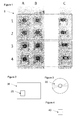
- FIG. 1 shows the test electrode layouts 1 designated by A, B and C, as well as test number as explained below.
- Electrode arrangement A comprises two columns of interdigitated electrodes with 400 micrometer gaps.
- Electrode arrangement B comprises two columns of interdigitated electrodes with 300 micrometer gaps.
- Electrode arrangement C comprises column electrodes with a 5mm gap.
- the sheet resistance of the reduced graphene oxide derivative, reduced at very low pH, around 0, can be estimated to be ca. 400 Ohm per square.
- the reduced graphene oxide obtained at pH around 4, displays a sheet resistance approximately 3 orders of magnitude higher.
- Figure 2 shows an apparatus 20 for processing an aqueous solution using the methods described herein, the apparatus 20 includes a processor and memory, shown together as 21, for controlling a chemical processing apparatus.
- Figure 3 shows a computer readable medium comprising a CD-ROM with computer program code thereon for execution on said processor and memory 21.
- Figure 4 shows an electrical component, such as a sensor 40, including the reduced graphene oxide obtained by the methods described herein.
Landscapes
- Chemical & Material Sciences (AREA)
- Organic Chemistry (AREA)
- Life Sciences & Earth Sciences (AREA)
- Engineering & Computer Science (AREA)
- Materials Engineering (AREA)
- Wood Science & Technology (AREA)
- General Life Sciences & Earth Sciences (AREA)
- Geology (AREA)
- Inorganic Chemistry (AREA)
- Carbon And Carbon Compounds (AREA)
Priority Applications (1)
| Application Number | Priority Date | Filing Date | Title |
|---|---|---|---|
| EP15275150.9A EP3103768A1 (de) | 2015-06-09 | 2015-06-09 | Reduziertes graphenoxid, seine derivate, herstellungsverfahren und tinte davon |
Applications Claiming Priority (1)
| Application Number | Priority Date | Filing Date | Title |
|---|---|---|---|
| EP15275150.9A EP3103768A1 (de) | 2015-06-09 | 2015-06-09 | Reduziertes graphenoxid, seine derivate, herstellungsverfahren und tinte davon |
Publications (1)
| Publication Number | Publication Date |
|---|---|
| EP3103768A1 true EP3103768A1 (de) | 2016-12-14 |
Family
ID=53373370
Family Applications (1)
| Application Number | Title | Priority Date | Filing Date |
|---|---|---|---|
| EP15275150.9A Withdrawn EP3103768A1 (de) | 2015-06-09 | 2015-06-09 | Reduziertes graphenoxid, seine derivate, herstellungsverfahren und tinte davon |
Country Status (1)
| Country | Link |
|---|---|
| EP (1) | EP3103768A1 (de) |
Cited By (2)
| Publication number | Priority date | Publication date | Assignee | Title |
|---|---|---|---|---|
| CN109183123A (zh) * | 2018-07-16 | 2019-01-11 | 西安理工大学 | 石墨烯/氧化石墨烯电解液中钛及钛合金阳极氧化方法 |
| US10840505B2 (en) | 2015-09-18 | 2020-11-17 | Nokia Technologies Oy | Apparatus and method of providing an apparatus for use as a power source |
Citations (6)
| Publication number | Priority date | Publication date | Assignee | Title |
|---|---|---|---|---|
| WO2013040636A1 (en) * | 2011-09-19 | 2013-03-28 | University Of Wollongong | Reduced graphene oxide and method of producing same |
| EP2653445A1 (de) * | 2012-04-19 | 2013-10-23 | Instytut Technologii Materialów Elektronicznych | Verfahren zur chemischen Graphenoxidreduktion |
| US20140079932A1 (en) * | 2012-09-04 | 2014-03-20 | The Trustees Of Princeton University | Nano-graphene and nano-graphene oxide |
| US20140370262A1 (en) * | 2012-01-30 | 2014-12-18 | Industry-Academic Cooperation Foundation Yonsei University | Three-dimensional graphene structure, and preparation method thereof |
| CN103050704B (zh) * | 2012-12-28 | 2015-04-01 | 清华大学深圳研究生院 | 一种多孔导电添加剂及其制备方法、锂离子电池 |
| US20150111449A1 (en) * | 2013-10-21 | 2015-04-23 | The Penn State Research Foundation | Method for preparing graphene oxide films and fibers |
-
2015
- 2015-06-09 EP EP15275150.9A patent/EP3103768A1/de not_active Withdrawn
Patent Citations (6)
| Publication number | Priority date | Publication date | Assignee | Title |
|---|---|---|---|---|
| WO2013040636A1 (en) * | 2011-09-19 | 2013-03-28 | University Of Wollongong | Reduced graphene oxide and method of producing same |
| US20140370262A1 (en) * | 2012-01-30 | 2014-12-18 | Industry-Academic Cooperation Foundation Yonsei University | Three-dimensional graphene structure, and preparation method thereof |
| EP2653445A1 (de) * | 2012-04-19 | 2013-10-23 | Instytut Technologii Materialów Elektronicznych | Verfahren zur chemischen Graphenoxidreduktion |
| US20140079932A1 (en) * | 2012-09-04 | 2014-03-20 | The Trustees Of Princeton University | Nano-graphene and nano-graphene oxide |
| CN103050704B (zh) * | 2012-12-28 | 2015-04-01 | 清华大学深圳研究生院 | 一种多孔导电添加剂及其制备方法、锂离子电池 |
| US20150111449A1 (en) * | 2013-10-21 | 2015-04-23 | The Penn State Research Foundation | Method for preparing graphene oxide films and fibers |
Non-Patent Citations (3)
| Title |
|---|
| PONCHAMI SHARMA ET AL: "Kinetics and Adsorption Behavior of the Methyl Blue at the Graphene Oxide/Reduced Graphene Oxide Nanosheet-Water Interface: A Comparative Study", JOURNAL OF CHEMICAL AND ENGINEERING DATA., vol. 58, no. 12, 12 December 2013 (2013-12-12), US, pages 3477 - 3488, XP055401394, ISSN: 0021-9568, DOI: 10.1021/je400743r * |
| SIRA SRINIVES ET AL: "A Development of Graphene Based Chemiresistive Sensor: Demonstrations on pH Sensing, and Cell Detection", ADVANCED MATERIALS RESEARCH, vol. 1103, 1 May 2015 (2015-05-01), pages 137 - 143, XP055401397, DOI: 10.4028/www.scientific.net/AMR.1103.137 * |
| VINEET DUA ET AL: "All-Organic Vapor Sensor Using Inkjet-Printed Reduced Graphene Oxide", ANGEWANDTE CHEMIE INTERNATIONAL EDITION, vol. 49, no. 12, 15 March 2010 (2010-03-15), pages 2154 - 2157, XP055167034, ISSN: 1433-7851, DOI: 10.1002/anie.200905089 * |
Cited By (3)
| Publication number | Priority date | Publication date | Assignee | Title |
|---|---|---|---|---|
| US10840505B2 (en) | 2015-09-18 | 2020-11-17 | Nokia Technologies Oy | Apparatus and method of providing an apparatus for use as a power source |
| CN109183123A (zh) * | 2018-07-16 | 2019-01-11 | 西安理工大学 | 石墨烯/氧化石墨烯电解液中钛及钛合金阳极氧化方法 |
| CN109183123B (zh) * | 2018-07-16 | 2020-07-24 | 西安理工大学 | 石墨烯/氧化石墨烯电解液中钛及钛合金阳极氧化方法 |
Similar Documents
| Publication | Publication Date | Title |
|---|---|---|
| Grunenberg et al. | Amine-linked covalent organic frameworks as a platform for postsynthetic structure interconversion and pore-wall modification | |
| Moghaddam et al. | Gold immobilized onto poly (ionic liquid) functionalized magnetic nanoparticles: a robust magnetically recoverable catalyst for the synthesis of propargylamine in water | |
| Pawsey et al. | Self-assembly of carboxyalkylphosphonic acids on metal oxide powders | |
| KR101760321B1 (ko) | 이온성 액체를 이용한 도핑된 환원된 그래핀 옥사이드의 제조방법 및 이에 의해 제조되는 도핑된 환원된 그래핀 옥사이드 | |
| Davidowski et al. | Solid-state NMR characterization of mixed phosphonic acid ligand binding and organization on silica nanoparticles | |
| WO2013182588A1 (en) | A metallic nanoparticle dispersion | |
| CN107533879B (zh) | 表面覆铜填充物、其制备方法及导电性组合物 | |
| CN108495820A (zh) | 包含贵金属和相应的金属簇合物的多金属氧酸盐 | |
| EP3103768A1 (de) | Reduziertes graphenoxid, seine derivate, herstellungsverfahren und tinte davon | |
| Natour et al. | Functionalized Magnetic Mesoporous Silica Nanoparticle‐Supported Palladium Catalysts for Carbonylative Sonogashira Coupling Reactions of Aryl Iodides | |
| EP3153470A1 (de) | Verfahren zur herstellung von oberflächenmodifizierten siliciumdioxidnanopartikeln sowie oberflächenmodifizierte siliciumdioxidnanopartikel | |
| CN110446550A (zh) | 包含贵金属和后过渡金属的多金属氧酸盐及其金属簇 | |
| JPWO2020085403A1 (ja) | 結晶、結晶の製造方法、及びシラノール化合物を自己組織化させる方法 | |
| AU2020220236B2 (en) | Graphene complexes and compositions thereof | |
| Carrillo et al. | Enzymatically synthesized polyaniline film deposition studied by simultaneous open circuit potential and electrochemical quartz crystal microbalance measurements | |
| EP2861782A2 (de) | Verfahren zur herstellung indiumoxid-haltiger schichten | |
| Stoica et al. | Application of the cobaltabisdicarbollide anion to the development of ion selective PVC membrane electrodes for tuberculosis drug analysis | |
| JP6813857B2 (ja) | シロキサン化合物及びシロキサン化合物の製造方法 | |
| JP5533172B2 (ja) | 導電性樹脂組成物の製造方法 | |
| Dhanjai et al. | Amperometric response characteristics of rabeprazole at N-doped CNTs-chitosan nanosensor in solubilized system | |
| CN114667613A (zh) | 包括含硅酮聚合物和离子液体的参比电极 | |
| CN121752524A (zh) | 晶体、晶体的制造方法、以及使硅烷醇化合物自组装的方法 | |
| EP3009397A1 (de) | Verfahren zur extraktion von graphenoxid aus einer lösung | |
| CN109942416A (zh) | 一种芳香酰氯的制备方法 | |
| JP6384207B2 (ja) | 銀含有組成物及び銀要素形成基材 |
Legal Events
| Date | Code | Title | Description |
|---|---|---|---|
| PUAI | Public reference made under article 153(3) epc to a published international application that has entered the european phase |
Free format text: ORIGINAL CODE: 0009012 |
|
| STAA | Information on the status of an ep patent application or granted ep patent |
Free format text: STATUS: THE APPLICATION HAS BEEN PUBLISHED |
|
| AK | Designated contracting states |
Kind code of ref document: A1 Designated state(s): AL AT BE BG CH CY CZ DE DK EE ES FI FR GB GR HR HU IE IS IT LI LT LU LV MC MK MT NL NO PL PT RO RS SE SI SK SM TR |
|
| AX | Request for extension of the european patent |
Extension state: BA ME |
|
| STAA | Information on the status of an ep patent application or granted ep patent |
Free format text: STATUS: REQUEST FOR EXAMINATION WAS MADE |
|
| 17P | Request for examination filed |
Effective date: 20170526 |
|
| RBV | Designated contracting states (corrected) |
Designated state(s): AL AT BE BG CH CY CZ DE DK EE ES FI FR GB GR HR HU IE IS IT LI LT LU LV MC MK MT NL NO PL PT RO RS SE SI SK SM TR |
|
| STAA | Information on the status of an ep patent application or granted ep patent |
Free format text: STATUS: EXAMINATION IS IN PROGRESS |
|
| 17Q | First examination report despatched |
Effective date: 20170831 |
|
| RAP1 | Party data changed (applicant data changed or rights of an application transferred) |
Owner name: PROVENANCE ASSET GROUP LLC |
|
| STAA | Information on the status of an ep patent application or granted ep patent |
Free format text: STATUS: THE APPLICATION IS DEEMED TO BE WITHDRAWN |
|
| 18D | Application deemed to be withdrawn |
Effective date: 20190808 |