EP3104971B1 - Matériau à base de tio2 absorbant dans le visible et procédé por sa frabrication - Google Patents
Matériau à base de tio2 absorbant dans le visible et procédé por sa frabrication Download PDFInfo
- Publication number
- EP3104971B1 EP3104971B1 EP15706864.4A EP15706864A EP3104971B1 EP 3104971 B1 EP3104971 B1 EP 3104971B1 EP 15706864 A EP15706864 A EP 15706864A EP 3104971 B1 EP3104971 B1 EP 3104971B1
- Authority
- EP
- European Patent Office
- Prior art keywords
- tio
- macropores
- titanium alkoxide
- diameter
- elementary
- Prior art date
- Legal status (The legal status is an assumption and is not a legal conclusion. Google has not performed a legal analysis and makes no representation as to the accuracy of the status listed.)
- Active
Links
Images



Classifications
-
- B—PERFORMING OPERATIONS; TRANSPORTING
- B01—PHYSICAL OR CHEMICAL PROCESSES OR APPARATUS IN GENERAL
- B01J—CHEMICAL OR PHYSICAL PROCESSES, e.g. CATALYSIS OR COLLOID CHEMISTRY; THEIR RELEVANT APPARATUS
- B01J21/00—Catalysts comprising the elements, oxides, or hydroxides of magnesium, boron, aluminium, carbon, silicon, titanium, zirconium, or hafnium
- B01J21/06—Silicon, titanium, zirconium or hafnium; Oxides or hydroxides thereof
- B01J21/063—Titanium; Oxides or hydroxides thereof
-
- A—HUMAN NECESSITIES
- A61—MEDICAL OR VETERINARY SCIENCE; HYGIENE
- A61L—METHODS OR APPARATUS FOR STERILISING MATERIALS OR OBJECTS IN GENERAL; DISINFECTION, STERILISATION OR DEODORISATION OF AIR; CHEMICAL ASPECTS OF BANDAGES, DRESSINGS, ABSORBENT PADS OR SURGICAL ARTICLES; MATERIALS FOR BANDAGES, DRESSINGS, ABSORBENT PADS OR SURGICAL ARTICLES
- A61L9/00—Disinfection, sterilisation or deodorisation of air
- A61L9/16—Disinfection, sterilisation or deodorisation of air using physical phenomena
- A61L9/18—Radiation
-
- B—PERFORMING OPERATIONS; TRANSPORTING
- B01—PHYSICAL OR CHEMICAL PROCESSES OR APPARATUS IN GENERAL
- B01D—SEPARATION
- B01D53/00—Separation of gases or vapours; Recovering vapours of volatile solvents from gases; Chemical or biological purification of waste gases, e.g. engine exhaust gases, smoke, fumes, flue gases, aerosols
- B01D53/007—Separation of gases or vapours; Recovering vapours of volatile solvents from gases; Chemical or biological purification of waste gases, e.g. engine exhaust gases, smoke, fumes, flue gases, aerosols by irradiation
-
- B—PERFORMING OPERATIONS; TRANSPORTING
- B01—PHYSICAL OR CHEMICAL PROCESSES OR APPARATUS IN GENERAL
- B01J—CHEMICAL OR PHYSICAL PROCESSES, e.g. CATALYSIS OR COLLOID CHEMISTRY; THEIR RELEVANT APPARATUS
- B01J21/00—Catalysts comprising the elements, oxides, or hydroxides of magnesium, boron, aluminium, carbon, silicon, titanium, zirconium, or hafnium
- B01J21/18—Carbon
-
- B—PERFORMING OPERATIONS; TRANSPORTING
- B01—PHYSICAL OR CHEMICAL PROCESSES OR APPARATUS IN GENERAL
- B01J—CHEMICAL OR PHYSICAL PROCESSES, e.g. CATALYSIS OR COLLOID CHEMISTRY; THEIR RELEVANT APPARATUS
- B01J27/00—Catalysts comprising the elements or compounds of halogens, sulfur, selenium, tellurium, phosphorus or nitrogen; Catalysts comprising carbon compounds
- B01J27/24—Nitrogen compounds
-
- B—PERFORMING OPERATIONS; TRANSPORTING
- B01—PHYSICAL OR CHEMICAL PROCESSES OR APPARATUS IN GENERAL
- B01J—CHEMICAL OR PHYSICAL PROCESSES, e.g. CATALYSIS OR COLLOID CHEMISTRY; THEIR RELEVANT APPARATUS
- B01J35/00—Catalysts, in general, characterised by their form or physical properties
- B01J35/30—Catalysts, in general, characterised by their form or physical properties characterised by their physical properties
- B01J35/39—Photocatalytic properties
-
- B—PERFORMING OPERATIONS; TRANSPORTING
- B01—PHYSICAL OR CHEMICAL PROCESSES OR APPARATUS IN GENERAL
- B01J—CHEMICAL OR PHYSICAL PROCESSES, e.g. CATALYSIS OR COLLOID CHEMISTRY; THEIR RELEVANT APPARATUS
- B01J35/00—Catalysts, in general, characterised by their form or physical properties
- B01J35/50—Catalysts, in general, characterised by their form or physical properties characterised by their shape or configuration
- B01J35/56—Foraminous structures having flow-through passages or channels, e.g. grids or three-dimensional [3D] monoliths
-
- B—PERFORMING OPERATIONS; TRANSPORTING
- B01—PHYSICAL OR CHEMICAL PROCESSES OR APPARATUS IN GENERAL
- B01J—CHEMICAL OR PHYSICAL PROCESSES, e.g. CATALYSIS OR COLLOID CHEMISTRY; THEIR RELEVANT APPARATUS
- B01J35/00—Catalysts, in general, characterised by their form or physical properties
- B01J35/50—Catalysts, in general, characterised by their form or physical properties characterised by their shape or configuration
- B01J35/58—Fabrics or filaments
-
- B—PERFORMING OPERATIONS; TRANSPORTING
- B01—PHYSICAL OR CHEMICAL PROCESSES OR APPARATUS IN GENERAL
- B01J—CHEMICAL OR PHYSICAL PROCESSES, e.g. CATALYSIS OR COLLOID CHEMISTRY; THEIR RELEVANT APPARATUS
- B01J37/00—Processes, in general, for preparing catalysts; Processes, in general, for activation of catalysts
- B01J37/02—Impregnation, coating or precipitation
- B01J37/03—Precipitation; Co-precipitation
- B01J37/031—Precipitation
- B01J37/033—Using Hydrolysis
-
- B—PERFORMING OPERATIONS; TRANSPORTING
- B01—PHYSICAL OR CHEMICAL PROCESSES OR APPARATUS IN GENERAL
- B01J—CHEMICAL OR PHYSICAL PROCESSES, e.g. CATALYSIS OR COLLOID CHEMISTRY; THEIR RELEVANT APPARATUS
- B01J37/00—Processes, in general, for preparing catalysts; Processes, in general, for activation of catalysts
- B01J37/02—Impregnation, coating or precipitation
- B01J37/03—Precipitation; Co-precipitation
- B01J37/036—Precipitation; Co-precipitation to form a gel or a cogel
-
- B—PERFORMING OPERATIONS; TRANSPORTING
- B01—PHYSICAL OR CHEMICAL PROCESSES OR APPARATUS IN GENERAL
- B01J—CHEMICAL OR PHYSICAL PROCESSES, e.g. CATALYSIS OR COLLOID CHEMISTRY; THEIR RELEVANT APPARATUS
- B01J37/00—Processes, in general, for preparing catalysts; Processes, in general, for activation of catalysts
- B01J37/04—Mixing
-
- B—PERFORMING OPERATIONS; TRANSPORTING
- B01—PHYSICAL OR CHEMICAL PROCESSES OR APPARATUS IN GENERAL
- B01J—CHEMICAL OR PHYSICAL PROCESSES, e.g. CATALYSIS OR COLLOID CHEMISTRY; THEIR RELEVANT APPARATUS
- B01J37/00—Processes, in general, for preparing catalysts; Processes, in general, for activation of catalysts
- B01J37/06—Washing
-
- B—PERFORMING OPERATIONS; TRANSPORTING
- B01—PHYSICAL OR CHEMICAL PROCESSES OR APPARATUS IN GENERAL
- B01J—CHEMICAL OR PHYSICAL PROCESSES, e.g. CATALYSIS OR COLLOID CHEMISTRY; THEIR RELEVANT APPARATUS
- B01J37/00—Processes, in general, for preparing catalysts; Processes, in general, for activation of catalysts
- B01J37/08—Heat treatment
-
- C—CHEMISTRY; METALLURGY
- C01—INORGANIC CHEMISTRY
- C01B—NON-METALLIC ELEMENTS; COMPOUNDS THEREOF; METALLOIDS OR COMPOUNDS THEREOF NOT COVERED BY SUBCLASS C01C
- C01B13/00—Oxygen; Ozone; Oxides or hydroxides in general
- C01B13/02—Preparation of oxygen
- C01B13/0203—Preparation of oxygen from inorganic compounds
- C01B13/0207—Water
-
- C—CHEMISTRY; METALLURGY
- C01—INORGANIC CHEMISTRY
- C01B—NON-METALLIC ELEMENTS; COMPOUNDS THEREOF; METALLOIDS OR COMPOUNDS THEREOF NOT COVERED BY SUBCLASS C01C
- C01B3/00—Hydrogen; Gaseous mixtures containing hydrogen; Separation of hydrogen from mixtures containing it; Purification of hydrogen; Reversible storage of hydrogen
- C01B3/02—Production of hydrogen; Production of gaseous mixtures containing hydrogen
- C01B3/04—Production of hydrogen; Production of gaseous mixtures containing hydrogen by decomposition of inorganic compounds
- C01B3/042—Decomposition of water
-
- C—CHEMISTRY; METALLURGY
- C02—TREATMENT OF WATER, WASTE WATER, SEWAGE, OR SLUDGE
- C02F—TREATMENT OF WATER, WASTE WATER, SEWAGE, OR SLUDGE
- C02F1/00—Treatment of water, waste water, or sewage
- C02F1/30—Treatment of water, waste water, or sewage by irradiation
- C02F1/32—Treatment of water, waste water, or sewage by irradiation with ultraviolet light
-
- C—CHEMISTRY; METALLURGY
- C02—TREATMENT OF WATER, WASTE WATER, SEWAGE, OR SLUDGE
- C02F—TREATMENT OF WATER, WASTE WATER, SEWAGE, OR SLUDGE
- C02F1/00—Treatment of water, waste water, or sewage
- C02F1/72—Treatment of water, waste water, or sewage by oxidation
- C02F1/725—Treatment of water, waste water, or sewage by oxidation by catalytic oxidation
-
- B—PERFORMING OPERATIONS; TRANSPORTING
- B01—PHYSICAL OR CHEMICAL PROCESSES OR APPARATUS IN GENERAL
- B01D—SEPARATION
- B01D2255/00—Catalysts
- B01D2255/20—Metals or compounds thereof
- B01D2255/207—Transition metals
- B01D2255/20707—Titanium
-
- B—PERFORMING OPERATIONS; TRANSPORTING
- B01—PHYSICAL OR CHEMICAL PROCESSES OR APPARATUS IN GENERAL
- B01D—SEPARATION
- B01D2255/00—Catalysts
- B01D2255/80—Type of catalytic reaction
- B01D2255/802—Photocatalytic
-
- B—PERFORMING OPERATIONS; TRANSPORTING
- B01—PHYSICAL OR CHEMICAL PROCESSES OR APPARATUS IN GENERAL
- B01D—SEPARATION
- B01D2258/00—Sources of waste gases
- B01D2258/06—Polluted air
-
- B—PERFORMING OPERATIONS; TRANSPORTING
- B01—PHYSICAL OR CHEMICAL PROCESSES OR APPARATUS IN GENERAL
- B01D—SEPARATION
- B01D2259/00—Type of treatment
- B01D2259/80—Employing electric, magnetic, electromagnetic or wave energy, or particle radiation
- B01D2259/802—Visible light
-
- B—PERFORMING OPERATIONS; TRANSPORTING
- B01—PHYSICAL OR CHEMICAL PROCESSES OR APPARATUS IN GENERAL
- B01J—CHEMICAL OR PHYSICAL PROCESSES, e.g. CATALYSIS OR COLLOID CHEMISTRY; THEIR RELEVANT APPARATUS
- B01J2235/00—Indexing scheme associated with group B01J35/00, related to the analysis techniques used to determine the catalysts form or properties
-
- B—PERFORMING OPERATIONS; TRANSPORTING
- B01—PHYSICAL OR CHEMICAL PROCESSES OR APPARATUS IN GENERAL
- B01J—CHEMICAL OR PHYSICAL PROCESSES, e.g. CATALYSIS OR COLLOID CHEMISTRY; THEIR RELEVANT APPARATUS
- B01J2235/00—Indexing scheme associated with group B01J35/00, related to the analysis techniques used to determine the catalysts form or properties
- B01J2235/15—X-ray diffraction
-
- B—PERFORMING OPERATIONS; TRANSPORTING
- B01—PHYSICAL OR CHEMICAL PROCESSES OR APPARATUS IN GENERAL
- B01J—CHEMICAL OR PHYSICAL PROCESSES, e.g. CATALYSIS OR COLLOID CHEMISTRY; THEIR RELEVANT APPARATUS
- B01J27/00—Catalysts comprising the elements or compounds of halogens, sulfur, selenium, tellurium, phosphorus or nitrogen; Catalysts comprising carbon compounds
- B01J27/20—Carbon compounds
-
- B—PERFORMING OPERATIONS; TRANSPORTING
- B01—PHYSICAL OR CHEMICAL PROCESSES OR APPARATUS IN GENERAL
- B01J—CHEMICAL OR PHYSICAL PROCESSES, e.g. CATALYSIS OR COLLOID CHEMISTRY; THEIR RELEVANT APPARATUS
- B01J35/00—Catalysts, in general, characterised by their form or physical properties
- B01J35/40—Catalysts, in general, characterised by their form or physical properties characterised by dimensions, e.g. grain size
-
- B—PERFORMING OPERATIONS; TRANSPORTING
- B01—PHYSICAL OR CHEMICAL PROCESSES OR APPARATUS IN GENERAL
- B01J—CHEMICAL OR PHYSICAL PROCESSES, e.g. CATALYSIS OR COLLOID CHEMISTRY; THEIR RELEVANT APPARATUS
- B01J35/00—Catalysts, in general, characterised by their form or physical properties
- B01J35/50—Catalysts, in general, characterised by their form or physical properties characterised by their shape or configuration
-
- B—PERFORMING OPERATIONS; TRANSPORTING
- B01—PHYSICAL OR CHEMICAL PROCESSES OR APPARATUS IN GENERAL
- B01J—CHEMICAL OR PHYSICAL PROCESSES, e.g. CATALYSIS OR COLLOID CHEMISTRY; THEIR RELEVANT APPARATUS
- B01J35/00—Catalysts, in general, characterised by their form or physical properties
- B01J35/60—Catalysts, in general, characterised by their form or physical properties characterised by their surface properties or porosity
- B01J35/63—Pore volume
-
- B—PERFORMING OPERATIONS; TRANSPORTING
- B01—PHYSICAL OR CHEMICAL PROCESSES OR APPARATUS IN GENERAL
- B01J—CHEMICAL OR PHYSICAL PROCESSES, e.g. CATALYSIS OR COLLOID CHEMISTRY; THEIR RELEVANT APPARATUS
- B01J35/00—Catalysts, in general, characterised by their form or physical properties
- B01J35/60—Catalysts, in general, characterised by their form or physical properties characterised by their surface properties or porosity
- B01J35/64—Pore diameter
- B01J35/647—2-50 nm
-
- B—PERFORMING OPERATIONS; TRANSPORTING
- B01—PHYSICAL OR CHEMICAL PROCESSES OR APPARATUS IN GENERAL
- B01J—CHEMICAL OR PHYSICAL PROCESSES, e.g. CATALYSIS OR COLLOID CHEMISTRY; THEIR RELEVANT APPARATUS
- B01J35/00—Catalysts, in general, characterised by their form or physical properties
- B01J35/60—Catalysts, in general, characterised by their form or physical properties characterised by their surface properties or porosity
- B01J35/64—Pore diameter
- B01J35/657—Pore diameter larger than 1000 nm
-
- C—CHEMISTRY; METALLURGY
- C02—TREATMENT OF WATER, WASTE WATER, SEWAGE, OR SLUDGE
- C02F—TREATMENT OF WATER, WASTE WATER, SEWAGE, OR SLUDGE
- C02F2305/00—Use of specific compounds during water treatment
- C02F2305/10—Photocatalysts
-
- Y—GENERAL TAGGING OF NEW TECHNOLOGICAL DEVELOPMENTS; GENERAL TAGGING OF CROSS-SECTIONAL TECHNOLOGIES SPANNING OVER SEVERAL SECTIONS OF THE IPC; TECHNICAL SUBJECTS COVERED BY FORMER USPC CROSS-REFERENCE ART COLLECTIONS [XRACs] AND DIGESTS
- Y02—TECHNOLOGIES OR APPLICATIONS FOR MITIGATION OR ADAPTATION AGAINST CLIMATE CHANGE
- Y02E—REDUCTION OF GREENHOUSE GAS [GHG] EMISSIONS, RELATED TO ENERGY GENERATION, TRANSMISSION OR DISTRIBUTION
- Y02E60/00—Enabling technologies; Technologies with a potential or indirect contribution to GHG emissions mitigation
- Y02E60/30—Hydrogen technology
- Y02E60/36—Hydrogen production from non-carbon containing sources, e.g. by water electrolysis
-
- Y—GENERAL TAGGING OF NEW TECHNOLOGICAL DEVELOPMENTS; GENERAL TAGGING OF CROSS-SECTIONAL TECHNOLOGIES SPANNING OVER SEVERAL SECTIONS OF THE IPC; TECHNICAL SUBJECTS COVERED BY FORMER USPC CROSS-REFERENCE ART COLLECTIONS [XRACs] AND DIGESTS
- Y02—TECHNOLOGIES OR APPLICATIONS FOR MITIGATION OR ADAPTATION AGAINST CLIMATE CHANGE
- Y02W—CLIMATE CHANGE MITIGATION TECHNOLOGIES RELATED TO WASTEWATER TREATMENT OR WASTE MANAGEMENT
- Y02W10/00—Technologies for wastewater treatment
- Y02W10/30—Wastewater or sewage treatment systems using renewable energies
- Y02W10/37—Wastewater or sewage treatment systems using renewable energies using solar energy
Definitions
- the technical field in which the invention is particularly situated is that of materials that can be used as photocatalysts activated by radiation in the visible spectrum, and more particularly that of materials based on titanium oxide (TiO 2 ) that can be used as photocatalysts. activated by radiation in the visible spectrum, in particular for the degradation of pollutants in air and in water or the cracking of water, and their manufacturing processes.
- materials that can be used as photocatalysts activated by radiation in the visible spectrum and more particularly that of materials based on titanium oxide (TiO 2 ) that can be used as photocatalysts. activated by radiation in the visible spectrum, in particular for the degradation of pollutants in air and in water or the cracking of water, and their manufacturing processes.
- TiO 2 photocatalysts among the best results obtained are catalysts comprising TiO 2 nanotubes which are grown on titanium foils. These photocatalysts are activated by radiation exclusively in the visible spectrum.
- TiO 2 Degussa P25 is a photocatalyst based on TiO 2 reference. This photocatalyst proves to be effective under UV radiation. However, its ability to absorb light is not satisfactory.
- noble metal particles such as platinum, palladium, gold and silver, have been added.
- the absorption of these materials is intense in the UV, especially at 300 nm, but is zero at 400 nm and extremely low between 500 nm and 600 nm.
- Harzardous Materials, 179 (2010), pp. 49-56. ) describe the synthesis of TiO 2 materials for the degradation of herbicides in water. These materials also include silver, iron or nitrogen.
- the material based on TiO 2 and silver is synthesized from polyoxyethylene lauryl ether (POL), AgNO 3 and Ti (OiPr) 4 and is in the form of nanoparticles with a diameter of between 15 and 25 ⁇ m. nm. Absorption in visible light is not given for this material.
- the material based on TiO 2 and Fe is synthesized from FeCl 3 (iron trichloride III) and TiCl 4 (titanium tetrachloride).
- the document CN102744059 describes a process for the synthesis of a mesoporous photocatalyst of TiO 2 and silver for the depollution of lake water, seawater, sewage and industrial wastewater.
- the document CN10245167 discloses a nitrogen-doped TiO 2 material, the nitrogen content being from 0.03 to 0.05 at% and the titania as anatase.
- the material has macropores of 200 to 300 ⁇ m, mesopores of 2 to 4 nm, micropores of 1 to 2 nm and a porosity of 80 to 90%.
- An objective here is therefore in particular to provide a method for the manufacture of a material that overcomes the disadvantages of the prior art presented above.
- Such a method has the significant advantage of allowing the manufacture of a TiO 2 material having an absorbance in the visible spectrum so that the absorption of light at 500 nm is greater than 50% of the absorption of light at 400 nm.
- the titanium alkoxide is preferably Ti (OiPr) 4 .
- the molar ratio of titanium alkoxide: acid is preferably between 1: 1 and 1: 0.5.
- the acid can be HCl.
- the phase separator is advantageously poly (ethylene oxide) (PEO), preferably at a number average molar mass (Mn) greater than or equal to 10,000.
- PEO poly (ethylene oxide)
- the molar ratio of titanium alkoxide: source of N can be between 1: 1 and 1: 0.75.
- the source of N is preferably N-methylformamide (NFA).
- the material having open mesopores and macropores, the mesopores having a diameter of between 2 nm and 10 nm, the macropores having a diameter of between 2 ⁇ m and 10 ⁇ m, the mesoporous volume being greater than 0.1 cm 3 / g and the macroporous volume being greater than 0.3 cm 3 / g, the TiO 2 material comprising at least 60% preferably at least 70% by weight of TiO 2 in the form of anatase and elemental carbon and / or elemental nitrogen, the elemental carbon and / or the elemental nitrogen being each in an amount less than or equal to about 2% by weight, the percentages being calculated based on the total weight of the material, and having an absorbance in the visible spectrum; and whose light absorption at 500 nm is greater than 50%, preferably greater than 60%, of the absorption of light at 400 nm.
- Such a material has the advantage of being activatable thanks to the contribution of solar energy.
- the provision of a source of artificial UV radiation is no longer necessary; exposure to solar radiation is sufficient.
- the activation of this material is therefore economical and has few environmental disadvantages.
- the TiO 2 of this material may be present in the form of a monolith, in particular a monolithic film.
- the depollution in the air or in the water is carried out with as sole energy supply or at least principal solar energy.
- TiO 2 material having a mesoporosity and / or a macroporosity and comprising at least 60%, preferably at least 70%, by weight of TiO 2 in the form of anatase and elemental carbon (C) and / or elemental nitrogen (N) in the form of a trace, the percentages being calculated with respect to the total weight of the material.
- the amount of elemental C and N is determined by chemical analysis according to the method described below in the "Methods" section.
- Prior mixing of the titanium alkoxide with an acid means that these two compounds are brought into contact with one another before mixing with other compounds used for the process.
- Pre-mixing can be carried out in an ice bath at about 0 ° C with stirring.
- the stirring of the mixture is advantageously progressive: the titanium alkoxide is first placed at 0 ° C. with slow stirring, in particular to ensure that the magnet bar does not become blocked in titanium alkoxide.
- the stirring speed is then increased to a value of between about 300 rpm and about 400 rpm, preferably between about 300 rpm and about 350 rpm. Beyond 400 rpm, there is a risk that the bar magnet will hang in the mixture.
- Titanium alkoxide denotes a compound of general formula Ti (OR 1 ) (OR 2 ) (OR 3 ) (OR 4 ) in which each of R 1 to R 4 denotes, independently of the others, a branched carbon chain comprising between 3 and 8 carbon atoms, preferably between 3 and 5 carbon atoms.
- Branched carbon chains comprising between 3 and 5 carbon atoms are chosen from the group consisting of: -CH (CH 3 ) 2 (isopropyl); - CH (CH 3 ) -CH 2 -CH 3 ( sec- butyl); -CH 2 -CH (CH 3 ) 2 (isobutyl); -CH (CH 3 ) 3 ( tert- butyl); -CH (CH 3 ) -CH 2 -CH 2 -CH 3 (1-methylbutyl); -CH (CH 3 ) -CH (CH 3 ) 2 (1,2-dimethylpropyl); -CH 2 -CH (CH 3 ) -CH 2 -CH 3 (2-methylbutyl); -CH 2 -C (CH 3 ) 3 (2,2-dimethylpropyl); - (CH 2 ) 2 -CH (CH 3 ) 2 (3-methylbutyl); -CH (CH 2 -CH 3 ) 2 (1-ethylpropyl); and
- R 1 to R 4 denote the same carbon chain comprising between 3 and 5 carbon atoms.
- the titanium alkoxide may be selected from the group consisting of: Ti (OiPr) 4 (tetra (isopropoxide) titanium); Ti (O sec -Bu) 4 (tetra ( sec- butoxide) titanium); Ti (OiBu) 4 (titanium tetra (isobutoxide)); Ti (O tert -Bu) 4 (tetra ( tert- butoxide) titanium); Ti (OCH (CH 3 ) -CH 2 -CH 2 -CH 3 ) 4 (titanium tetra (1-methylbutanolate)); Ti (OCH (CH 3 ) -CH (CH 3 ) 2 ) 4 (titanium tetra (1,2-methylpropanolate)); Ti (OCH 2 -CH (CH 3 ) -CH 2 -CH 3 ) 4 (titanium tetra (2-methylbut
- the branched carbon chain is the radical iPr (isopropyl: -CH (CH 3 ) 2 ).
- the titanium alkoxide preferably has the formula: Ti (OiPr) 4 .
- Acid refers to a proton donor compound.
- the molar ratio of titanium alkoxide: acid is advantageously between 1: 1 and 1: 0.5.
- the acid may be selected from the group consisting of: HCl (hydrochloric acid), HNO 3 (nitric acid), H 2 SO 4 (sulfuric acid) and CH 3 COOH (acetic acid).
- the acid is HCl.
- the titanium alkoxide is Ti (OiPr) 4
- the molar ratio Ti (OiPr) 4 : HCl is advantageously between 1: 1 and 1: 0.5.
- the phase separator designates an interposing compound, as the TiO 2 is formed, between the latter and the water, which makes it possible to obtain a macroporous structure after its elimination.
- the separator is a PEO polymer or a copolymer comprising at least one PEO block (polyethylene oxide).
- PEO polymers PEOs with a number average mass of about 10,000 and about 20,000 are preferred.
- diblock copolymers there may be mentioned PEOnPPOm (copolymer comprising a first block with n ethylene oxide units and a second block with m propylene oxide units).
- PeOnPPOmPEOn copolymer comprising a first block with n ethylene oxide units, a second block with m propylene oxide units and a third block with n ethylene oxide units.
- the titanium alkoxide: phase separator: water ratio determines the homogeneity of the macropores within the TiO 2 material .
- the molar ratio of titanium alkoxide: EO (monomer units EO in the separator) is between 1: 0.6 and 1: 0.2.
- the molar ratio of titanium alkoxide: H 2 O is between 1: 3 and 1:15.
- the molar ratio Ti (OiPr) 4 : EO is preferably between 1: 0.6 and 1: 0.2.
- the molar ratio Ti (OiPr) 4 : H 2 O is preferably between 1: 3 and 1:15.
- the N (nitrogen) source is a compound capable of releasing at least one N atom.
- the molar ratio of titanium alkoxide: source of N is between 1: 1 and 1: 0.75.
- the source of N is preferably urea, NH4NO3 (ammonium nitrate) or NFA (N-methylformamide).
- the source of N is NFA.
- the titanium alkoxide is Ti (OiPr) 4
- the molar ratio Ti (OiPr) 4 : NFA is between 1: 1 and 1: 0.75.
- an alcohol may be added together with the phase separator, the water and the N source.
- this alcohol is EtOH (ethanol).
- the molar ratio Ti (OiPr) 4 : EtOH is advantageously between 1: 1.5 and 1: 1.
- the gelling of TiO 2 is obtained, for example, after exposure at a temperature of between about 20 ° C. and about 80 ° C., preferably between about 30 ° C. and about 60 ° C., more preferably at about 40 ° C. complete freezing of TiO 2 .
- the TiO 2 gel is left to cure at a temperature of from about 40 ° C to about 80 ° C, preferably from about 50 ° C to about 70 ° C, more preferably to about 60 ° C.
- the TiO 2 gel is matured for between about 10 hours and about 40 hours, preferably between 15 hours and about 30 hours, more preferably about 24 hours.
- the calcination of the dried TiO 2 gel is advantageously carried out between 250 ° C. and 600 ° C., preferably between 300 ° C. and 500 ° C., more preferably still between 325 ° C. and 375 ° C., for a duration of between 2 hours. and 12 h, preferably between 4 h and 6 h, more preferably between 4 h 30 and 5 h 30.
- the calcination of the TiO 2 gel is carried out at about 350 ° C for about 5 hours, with a rise at a temperature of 0.5 ° C / min.
- the solid After calcination, the solid is cooled to room temperature.
- a second calcination can be carried out after cooling under the same conditions as the first calcination.
- a TiO 2 material is described below. This material can be obtained from the process described above.
- This material has a mesoporosity and / or a macroporosity and comprises at least 60%, preferably at least 70%, by weight of TiO 2 in the form of anatase and elemental carbon and elemental nitrogen in the form of a trace, the percentages being calculated based on the total weight of the material. It has an absorbance in the visible spectrum and, in particular, the absorption of light at 500 nm is greater than 50%, preferably greater than 60%, of light absorption at 400 nm.
- visible spectrum also called “optical spectrum” refers to the part of the electromagnetic spectrum that is visible to the human eye and commonly between about 400 nm and about 800 nm. It corresponds to what is also called “light” which refers to all the electromagnetic waves visible by the human eye.
- visible spectrum also called “optical spectrum” or “light” are taken throughout this disclosure as synonyms. The use of one term or another in this statement will therefore be understood as a mere variation of wording and not as determining any distinction.
- the trace amount of elemental C and / or elemental N is determined by chemical analysis according to the method described below.
- Elemental C and elemental N are present in trace form, that is to say that the amount of each is less than or equal to about 2%, preferably less than or equal to about 1.5%, more preferably less than about 1%, by weight based on the total weight of the material.
- the total amount of N and C is preferably less than 2.5%.
- TiO 2 is in the form of objects having at least micrometric dimensions, that is to say that at least two of the dimensions of these objects are equal to or greater than 1 micron.
- this TiO 2 is easier to handle with respect to the TiO 2 nanoparticles of the prior art and can be easily separated from solutions in which it has been added, for example by sedimentation.
- the TiO 2 is present in powder form.
- the powder can be compacted into tablets to form even larger objects.
- the monoliths composing the material may have the shape of sticks, hollow cylinders, plates, etc. In particular, when they have the shape of hollow cylinders or plates, they may be present alone or attached to a support.
- the material preferably has open macropores and mesopores.
- the mesoporous volume of the material is greater than about 0.1 cm 3 / g, preferably greater than about 0.2 cm 3 / g, more preferably still greater than about 0.23 cm 3 / g. It has mesopores of diameter between about 2 nm and about 10 nm, preferably between about 3 nm and about 8 nm, more preferably between about 4 nm and about 5 nm.
- the macroporous volume of the material is greater than about 0.3 cm 3 / g, preferably greater than about 0.5 cm 3 / g, more preferably still greater than about 0.7 cm 3 / g.
- the macroporosity of the material makes it possible to pass a fluid therethrough by exerting a pressure differential of small value, that is to say less than about 10 bar, preferably less than about 7 bar, more preferably still between about 1 bar and about 5 bar in order to be able to use this material for continuous catalytic treatments.
- the material is metal-free which makes the synthesis simpler because there is no need to add any metal additives, thus eliminating the need for metal reduction prior to use. Thus, the material is more economical.
- the material can be used as a photocatalyst for the degradation of pollutants in air or water under radiation in the visible spectrum.
- H 2 hydrogen
- the diffuse reflection spectra (DRUV) of the solid samples are measured with a PerkinElmer Lambda-35 spectrophotometer equipped with an integrating sphere (Labsphere) using BaSO 4 as reference.
- the DRUV spectra are then converted into Kubelka-Munk units (F (R)) to obtain the absorption spectra.
- a reactor (quartz or glass) of 50 ml, 20 ml of aqueous solution of orange dye G is placed therein.
- the solution is acidified with HCl to a pH below 5.
- the orange dye G is introduced into the reactor in an amount sufficient to reach the concentration of 80 mg / L. 150 mg of the analyzed material are introduced into the reactor (except for the control sample).
- the reactor is then placed under a Ne (neon) lamp to illuminate the material under visible light for 1 hr 30. Some of the materials may be arranged in the dark for the same time for comparison.
- Ne Ne
- the supernatant is analyzed by UV-visible spectrometry in a 1 cm long vessel (optical path) with a Perkin-Elmer Lambda-40 spectrophotometer (double beam), with reference to an aqueous solution of HCl.
- the results are analyzed in a wavelength range between 250 and 700 nm.
- a 50 mL aqueous solution having a concentration of 10 -4 mol / L of orange acid dye 7 (also known as orange dye II: obtained from Sigma Aldrich under the name AO7 sodium salt, BioXtra, Dye content> 85% , 10-4M) is prepared and acidified to pH 3.
- orange acid dye 7 also known as orange dye II: obtained from Sigma Aldrich under the name AO7 sodium salt, BioXtra, Dye content> 85% , 10-4M
- the supernatant is analyzed by UV-visible spectrometry in a 1 cm long vessel (optical path) with a Shimadzu UV-2450 spectrophotometer, with reference to an aqueous solution of HCl.
- the results are analyzed at a wavelength of 484 nm corresponding to the absorption maximum of the orange dye II.
- Table 1 shows the quantities of the products, expressed in molar ratios relative to the amount of titanium alkoxide. "X” then means x moles per 1 mole of titanium alkoxide. Table 1 Example 1 Example 2 Example 3 Example 4 Ti (OiPr) 4 1 1 1 1 1 PEO 0.57 0.56 0.56 0.57 H 2 O 10,05 7.58 7.66 6.90 HCl 0.65 0.89 0.91 0.64 NFA 0.933 0.905 0.906 0.933 EtOH 0 0 0 1.23
- Ti (OiPr) 4 is premixed with HCl for its acidification in a reactor.
- the mixture is mixed while the reactor is immersed in an ice bath for 4 min.
- the reactor is then sealed and exposed to 40 ° C for freezing. After complete freezing, the TiO 2 gel obtained is left at 60 ° C. for maturation for 24 hours.
- the TiO 2 gel is then washed with iPrOH (isopropanol) and dried by evaporation at 40 ° C for one week.
- the dried TiO 2 gel is pretreated in an oven at 40 ° C. and after calcining at 350 ° C. for 5 hours.
- Example 5 A fifth example corresponding to Example 2 but having undergone a second calcination under the same conditions as the first calcination was tested.
- the figure 2 shows the XRD measurements for Examples 1 to 4 relative to a reference anatase which is TiO 2 (anatase, Aldrich) (sold under the reference 248576, -325 mesh, purity> 99%, by Sigma-Aldrich). It is therefore observed that the material obtained is indeed anatase for these examples.
- a reference anatase which is TiO 2 (anatase, Aldrich) (sold under the reference 248576, -325 mesh, purity> 99%, by Sigma-Aldrich). It is therefore observed that the material obtained is indeed anatase for these examples.
- Examples 1, 2 and 5 give materials in the form of monoliths and powder, Example 3 gives a material in powder form and Example 4 in the form of monoliths.
- the absorbance F (R) (Kubelka-Munk) of Examples 1 to 5 is measured between 200 nm and 700 nm and is represented on the figure 3 . There are curves represented on the figure 3 that the materials of Examples 1 to 5 absorb in wavelengths greater than 400 nm unlike anatase-Aldrich material.
- the ratios (A 500nm / A 400nm ) between the absorbance at 500 nm and at 400 nm of the materials of Examples 1 to 5 are given in Table 2 below. Table 2 Example 1 Example 2 Example 3 Example 4 Example 5 At 500nm / A 400nm 51.5% 91.3% 119% 56.7% 120%
- the orange dye degradation test G was performed for three of the materials.
- Example 4 the test was carried out under a lamp and in the dark, which makes it possible to conclude that the degradation of the orange dye G is due to the presence of the material.
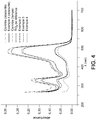
- the figure 4 shows the absorbance of the solution after exposure to light for 1 h 30.
- Table 3 shows the ratios (A / A ref ) between the absorbance at 500 nm of the solutions having contained the materials of Examples 2 to 4 and the absorbance at 500 nm of the control sample (i.e. without photocatalyst) exposed to light.
- Table 3 TiO 2 (anatase, Aldrich) Example 2
- Example 3 Example 4 A / A ref 0.98 0.34 0.28 0.34
- the orange dye degradation test II was carried out for the material of example 3 and TiO 2 Degussa P25 (respectively Figures 5 and 6 ) under two different lighting conditions: under solar radiation and in the dark. The evolution of the solution containing the material was followed for about 8 hours (see figure 5 ).
Landscapes
- Chemical & Material Sciences (AREA)
- Organic Chemistry (AREA)
- Engineering & Computer Science (AREA)
- Chemical Kinetics & Catalysis (AREA)
- Materials Engineering (AREA)
- Health & Medical Sciences (AREA)
- Life Sciences & Earth Sciences (AREA)
- General Health & Medical Sciences (AREA)
- Hydrology & Water Resources (AREA)
- Inorganic Chemistry (AREA)
- Water Supply & Treatment (AREA)
- Environmental & Geological Engineering (AREA)
- Toxicology (AREA)
- Combustion & Propulsion (AREA)
- Epidemiology (AREA)
- Dispersion Chemistry (AREA)
- Veterinary Medicine (AREA)
- Public Health (AREA)
- Animal Behavior & Ethology (AREA)
- General Chemical & Material Sciences (AREA)
- Oil, Petroleum & Natural Gas (AREA)
- Analytical Chemistry (AREA)
- Physics & Mathematics (AREA)
- Thermal Sciences (AREA)
- Catalysts (AREA)
Description
- Le domaine technique dans lequel se situe particulièrement l'invention est celui des matériaux utilisables en tant que photocatalyseurs activés par rayonnement dans le spectre visible, et plus particulièrement celui des matériaux à base d'oxyde de titane (TiO2) utilisables en tant que photocatalyseurs activés par rayonnement dans le spectre visible, notamment pour la dégradation de polluants dans l'air et dans l'eau ou le craquage de l'eau, et leurs procédés de fabrication.
- L'état de la technique montre actuellement que l'obtention d'un taux de conversion (c'est-à-dire le rapport entre la quantité de réactif transformé et la quantité totale de réactif présent dans un volume donné et à un temps donné) élevé nécessite le développement de matériaux nanostructurés fonctionnant comme catalyseur avec une composition bien définie et contrôlée ainsi qu'une forme spécifique.
- En ce qui concerne les photocatalyseurs à base de TiO2, parmi les meilleurs résultats obtenus on peut citer des catalyseurs comprenant des nanotubes de TiO2 que l'on fait croître sur des feuilles en titane. Ces photocatalyseurs sont activés par rayonnement exclusivement dans le spectre visible.
- Bien que ces photocatalyseurs soient très efficaces en phase gazeuse, leur utilisation en phase liquide ne peut être envisagée à cause de l'instabilité des nanotubes déposés sur les feuilles.
- D'autres photocatalyseurs à base de TiO2 ont été étudiés. Notamment, le TiO2 Degussa P25 fait figure de photocatalyseur à base de TiO2 de référence. Ce photocatalyseur s'avère être efficace sous rayonnement UV. Cependant, sa capacité à absorber la lumière n'est pas satisfaisant.
- Afin d'améliorer la capacité des photocatalyseurs à base de TiO2 à absorber la lumière, des particules de métaux nobles, tels que le platine, le palladium, l'or et l'argent, ont été ajoutées.
- Le document « Influence de la longueur d'onde d'excitation (UV ou lumière visible) sur l'activité photocatalytique de l'oxyde de titane comprenant des nanoparticules d'or pour la génération d'hydrogène ou d'oxygène à partir d'eau » (titre original en anglais : « Influence of Excitation Wavelength (UV or Visible Light) on the Photocatalytic Activity of Titania Containing Gold Nanoparticles for the Generation of Hydrogen or Oxygen from Water », G.C. Silva et al., J. Am. Chem. Soc., 2011, 113, pp 595-602) et « Photocatalyseur plasmonique pour l'évolution de l'hydrogène dans le craquage catalytique de l'eau » (titre original en anglais : « Plasmonic Photocatalyst for H2 Evolution in Photocatalytic Water Splitting », J.J. Chen et al., J. Phys. Chem. C, 2011, pages 115-210) décrivent des procédés pour la synthèse de photocatalyseurs mésoporeux à base de TiO2 et d'or pour le craquage de l'eau. Ces matériaux sont nanométriques et sont constitués de particules de TiO2 « P25 » de 20 nm à 30 nm de diamètre avec des particules d'or de 2 nm à 4 nm de diamètre.
- L'absorption de ces matériaux est intense dans l'UV, notamment à 300 nm, mais est nulle à 400 nm et extrêmement faible entre 500 nm et 600 nm.
- Le document « Amélioration de l'activité photocatalytique par déposition de métal : caractéristation et efficacité photonique de Pt, Au et Pd déposé sur un catalyseur à base de TiO2 » (titre original en anglais : « Enhancement of photocatalytic activity by metal deposition: characterisation and photonic efficiency of Pt, Au and Pd depositied on TiO2 catalyst », S. Sakthivel et al., Water Research, 2004, 38, pages 3001-3008) décrit un procédé pour la synthèse d'un photocatalyseur à base de TiO2 présentant du platine, de l'or ou du palladium déposé en surface pour la dégradation de colorants organiques, notamment l'acide green 16 sous rayonnement UV. Ce matériau présente une absorption à 500 nm supérieure à celle à 400 nm.
- Les articles « Préparation et caractérisation des photocatalyseurs à base de titane mésoporeux, comprenant de l'argent de taille nanométrique pour la dégradation d'herbicide » (titre original en anglais : « Préparation and characterisation of nano-silver/mesoporous titania photocatalysts for herbicide degradation », M.M. Mohamed et al., Microporous and Mesoporous Materials, 142 (2011), pages 130 à 138) et « Dégradation photocatalytique d'herbicides sélectionnés dans des suspensions aqueux de TiO2 dopé sous rayonnement visible » (titre original en anglais : « Photocatalytic degradation of selected herbicides in aqueous suspensions of doped titania under visible light irradiation », D. V. Sojic et al., J. Harzardous Materials, 179 (2010), pages 49 à 56) décrivent la synthèse de matériaux à base de TiO2 pour la dégradation d'herbicides dans l'eau. Ces matériaux comprennent par ailleurs également de l'argent, du fer ou de l'azote. Le matériau à base de TiO2 et d'argent est synthétisé à partir d'éther de polyoxyéthylène lauryle (POL), d'AgNO3 et de Ti(OiPr)4 et se présente sous forme de nanoparticules de diamètre compris entre 15 et 25 nm. L'absorption à la lumière visible n'est pas donnée pour ce matériau. Le matériau à base de TiO2 et de Fe est synthétisé à partir de FeCl3 (trichlorure de fer III) et de TiCl4 (tétrachlorure de titane). Il se présente sous la forme de nanoparticules de diamètre compris entre 5 et 7 nm. La réflectance de ce matériau est quasiment de 100% à 500 nm correspondant à une absorbance F(R) (Kubelka-Munk) de 0. Le matériau à base de TiO2 et d'azote est synthétisé à partir de Ti(OH)4 (tétrahydroxyde de titane) et d'urée. Il se présente sous la forme de nanoparticules de diamètre compris entre 6 et 8 nm et sa réflectance à 400 nm est proche de 40% correspondant à une absorbance F(R) (Kubelka-Munk) de 0.44 alors que celle à 500 nm est proche de 90% correspondant à une absorbance F(R) (Kubelka-Munk) de 0,005, soit une absorption de la lumière à 500 nm de 1 % de l'absorption de la lumière à 400 nm.
- L'article « Dégradation photocatalytique de lindane sous lumière UV et visible utilisant du TiO2 dopé au N » (titre original en anglais : « Photocatalytic degradation of lindane under UV and visible light using N-doped TiO2 », J. Senthilnathan et al., Chem. Eng. J., 161 (2010), pages 83 à 92) décrit la synthèse d'un matériau à base de TiO2 dopé à l'azote pour la dégradation d'un pesticide. Ce matériau est obtenu à partir Ti(OiPr)4 dans EtOH et N(CH3CH2)3 (triéthylamine) en milieu acide. Il se présente sous forme de nanoparticules de taille comprise entre 29 et 71 nm.
- Le document
CN102744059 décrit un procédé pour la synthèse d'un photocatalyseur mésoporeux en TiO2 et en argent pour la dépollution de l'eau de lac, de mer, des égouts et des eaux usées industrielles. - Le document
CN10245167 décrit un matériau à base de TiO2 dopé à l'azote, la teneur de l'azote étant de 0,03 à 0,05 at% et l'oxyde de titane sous forme d'anatase. Le matériau présente des macropores de 200 à 300 µm, des mésopores de 2 à 4 nm, des micropores de 1 à 2 nm et une porosité de 80 à 90 %. - Ainsi, certains de ces photocatalyseurs nécessitent l'utilisation de nanoparticules de métaux nobles et sont par conséquent plus onéreux.
- Par ailleurs, la plupart de ces photocatalyseurs peuvent être difficiles à synthétiser. En outre, ils sont sujets au mûrissement d'Ostwald, phénomène dans lequel les nanoparticules s'agrègent les unes aux autres ce qui provoque leur désactivation progressive, par conséquent, les nanoparticules sont peu stables thermiquement. Par ailleurs, les nanoparticules à base de TiO2 en suspension dans une solution sont difficiles à séparer de cette solution.
- Ainsi, un matériau à base de TiO2 présentant une absorbance dans le spectre visible, dont la fabrication est peu onéreuse et dont la manipulation est aisée constitue toujours un besoin qui n'est à ce jour pas encore satisfait.
- Un objectif est donc ici notamment de proposer un procédé permettant la fabrication d'un matériau qui pallie les inconvénients de l'art antérieur présenté ci-dessus.
- Pour cela, un procédé de production d'un matériau à base de TiO2 est proposé. Ce procédé comprend :
- le mélange préalable d'un alcoxyde de titane avec un acide ;
- l'ajout d'eau, d'un séparateur de phase et d'une source de N au mélange d'alcoxyde de titane et d'acide pour obtenir un gel de TiO2 ;
- le lavage du gel de TiO2 avec de l'isopropanol (iPrOH) ;
- le séchage et la calcination du gel de TiO2 afin de produire le matériau à base de TiO2 exempt de métaux et présentant des mésopores et macropores ouvertes, les mésopores présentant un diamètre compris entre 2 nm et 10 nm, les macropores présentant un diamètre compris entre 2 µm et 10 µm, le volume mésoporeux étant supérieur à 0,1 cm3/g et le volume macroporeux étant supérieur à 0,3 cm3/g, le matériau à base de TiO2 comprenant au moins 60 %, de préférence au moins 70 %, en poids de TiO2 sous forme d'anatase et du carbone élémentaire et/ou de l'azote élémentaire, le carbone élémentaire et/ou l'azote élémentaire étant chacun en une quantité inférieure ou égale à environ 2 % en poids, les pourcentages étant calculés par rapport au poids total du matériau.
- Un tel procédé a pour avantage non négligeable de permettre la fabrication d'un matériau à base de TiO2 présentant une absorbance dans le spectre visible de sorte que l'absorption de la lumière à 500 nm soit supérieure à 50 % de l'absorption de la lumière à 400 nm.
- L'alcoxyde de titane est de préférence Ti(OiPr)4.
- Le ratio molaire alcoxyde de titane:acide est de préférence compris entre 1:1 et 1:0,5.
- L'acide peut être du HCl.
- Le séparateur de phase est avantageusement du poly(oxyde d'éthylène) (PEO), de préférence à une masse molaire moyenne en nombre (Mn) supérieure ou égale à 10 000.
- Le ratio molaire alcoxyde de titane:source de N peut être compris entre 1:1 et 1:0,75.
- La source de N est de préférence du N-méthyleformamide (NFA).
- Il est également proposé un matériau à base de TiO2 et exempt de métaux ainsi que des additifs autres que C et N, le matériau présentant des mésopores et macropores ouvertes, les mésopores présentant un diamètre compris entre 2 nm et 10 nm, les macropores présentant un diamètre compris entre 2 µm et 10 µm, le volume mésoporeux étant supérieur à 0,1 cm3/g et le volume macroporeux étant supérieur à 0,3 cm3/g, le matériau à base de TiO2 comprenant au moins 60 %, de préférence au moins 70 %, en poids de TiO2 sous forme d'anatase et du carbone élémentaire et/ou de l'azote élémentaire, le carbone élémentaire et/ou l'azote élémentaire étant chacun en une quantité inférieure ou égale à environ 2 % en poids, les pourcentages étant calculés par rapport au poids total du matériau, et présentant une absorbance dans le spectre visible ; et dont l'absorption de la lumière à 500 nm est supérieure à 50 %, de préférence supérieure à 60 %, de l'absorption de la lumière à 400 nm.
- Un tel matériau a pour avantage d'être activable grâce à l'apport d'énergie solaire. Ainsi, l'apport d'une source de rayonnement UV artificiel n'est plus nécessaire ; une exposition aux rayonnements solaires suffit. L'activation de ce matériau est donc économique et présente peu d'inconvénients environnementaux.
- Le TiO2 de ce matériau peut être présent sous forme d'un monolithe, en particulier d'un film monolithique.
- Il peut être en particulier obtenu par le procédé ci-dessus.
- Il est aussi proposé l'utilisation du matériau décrit ci-dessus en tant que photocatalyseur pour la dégradation de polluants dans l'air ou dans l'eau sous rayonnement dans le spectre visible. Une autre utilisation d'un tel matériau en tant que photocatalyseur est le craquage de l'eau en H2 et O2.
- Ainsi, la dépollution dans l'air ou dans l'eau est effectuée avec comme apport énergétique unique ou au moins principale l'énergie solaire. Le même avantage existe pour le craquage de l'eau en H2 et O2.
- D'autres objectifs, caractéristiques et avantages ressortiront de la description donnée ci-après à titre illustratif et non limitatif, en référence aux dessins parmi lesquels :
- la
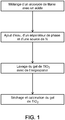
figure 1 est un diagramme illustrant les étapes du procédé pour la production d'un matériau à base de TiO2 selon l'invention ; - la
figure 2 est un graphe montrant les mesures DRX pour les matériaux des exemples 1 à 4, ainsi que pour le TiO2 de référence (anatase, Aldrich) en unité arbitraire en fonction de l'angle 2θ pour des valeurs de celui-ci comprises entre 5° et 70° ; - la
figure 3 est un graphe montrant l'absorbance des matériaux des exemples 1 à 5 et celle du TiO2 de référence (anatase), en unité Kubelka-Munk en fonction de la longueur d'onde pour des valeurs de celle-ci comprises entre 200 nm et 700 nm ; - la
figure 4 est un graphe montrant l'absorbance de solutions contenant un colorant orange G dans lesquelles les matériaux des exemples 2 à 4 et du TiO2 de référence (anatase, Aldrich) ont été ajoutés, après exposition à la lumière pendant 1h30, en fonction de la longueur d'onde pour des valeurs de celle-ci comprises entre 250 nm et 700 nm ; - la
figure 5 est un graphe représentant l'absorbance des solutions contenant un colorant orange II dans lesquelles le matériau de l'exemple 3 a été ajouté, après exposition au rayonnement du soleil et dans l'obscurité, en fonction du temps entre 0 et 500 min; et - la
figure 6 est un graphe représentant l'absorbance des solutions contenant un colorant orange II dans lesquelles du TiO2 Degussa P25 a été ajouté, après exposition au rayonnement du soleil et dans l'obscurité, en fonction du temps entre 0 et 500 min. - En référence à la
figure 1 est décrit ci-après un procédé pour la fabrication d'un matériau à base de TiO2 présentant une mésoporosité et/ou une macroporosité et comprenant au moins 60 %, de préférence au moins 70 %, en poids de TiO2 sous forme d'anatase et du carbone élémentaire (C) et/ou de l'azote élémentaire (N) sous forme de trace, les pourcentages étant calculés par rapport au poids total du matériau. - La quantité de C et N élémentaires est déterminée par analyse chimique selon la méthode décrite ci-dessous dans la partie « Méthodes ».
- L'anatase désigne dans l'ensemble du présent exposé un oxyde de titane (TiO2) tétragonal, à groupe d'espace I41/amd, ayant pour paramètre de maille : a = 3,7852 Å (angström) ; c = 9,5139 Å, et de densité théorique 3,893. Ces chiffres peuvent légèrement varier de ± 0,05 Å (pour a et c) et de ± 0,1 (pour la densité).
- Le procédé comprend :
- le mélange préalable d'un alcoxyde de titane avec un acide ;
- l'ajout d'eau, d'un séparateur de phase et d'une source de N au mélange préalable pour obtenir un gel de TiO2 ;
- le lavage du gel de TiO2 avec de l'isopropanol (iPrOH) ;
- le séchage et la calcination du gel de TiO2 afin de produire le matériau à base de TiO2 exempt de métaux et présentant des mésopores et macropores ouvertes, les mésopores présentant un diamètre compris entre 2 nm et 10 nm, les macropores présentant un diamètre compris entre 2 µm et 10 µm, le volume mésoporeux étant supérieur à 0,1 cm3/g et le volume macroporeux étant supérieur à 0,3 cm3/g, le matériau à base de TiO2 comprenant au moins 60 %, de préférence au moins 70 %, en poids de TiO2 sous forme d'anatase et du carbone élémentaire et/ou de l'azote élémentaire, le carbone élémentaire et/ou l'azote élémentaire étant chacun en une quantité inférieure ou égale à environ 2 % en poids, les pourcentages étant calculés par rapport au poids total du matériau.
- Le mélange préalable de l'alcoxyde de titane avec un acide signifie que ces deux composés sont mis en présence l'un de l'autre avant de les mélanger avec d'autres composés utilisés pour le procédé.
- Le mélange préalable peut être réalisé dans un bain de glace à environ 0°C et sous agitation. L'agitation du mélange est avantageusement progressive : l'alcoxyde de titane est tout d'abord placé à 0°C sous agitation lente, notamment pour s'assurer que le barreau aimanté ne se bloque pas dans l'alcoxyde de titane. Au fur et à mesure que l'acide est ajouté à l'alcoxyde de titane, le mélange devient fumant et moins visqueux, la vitesse d'agitation est alors augmentée jusqu'à une valeur comprise entre environ 300 tr/min et environ 400 tr/min, de préférence entre environ 300 tr/min et environ 350 tr/min. Au-delà de 400 tr/min, il y a un risque pour que le barreau aimanté se bloque dans le mélange.
- L'alcoxyde de titane désigne un composé de formule générale Ti(OR1)(OR2)(OR3)(OR4) où chacun des R1 à R4 désigne, indépendamment des autres, une chaine carbonée ramifiée comprenant entre 3 et 8 atomes de carbone, de préférence entre 3 et 5 atomes de carbone.
- Les chaînes carbonées ramifiées comprenant entre 3 et 5 atomes de carbones sont choisies parmi le groupe constitué de : -CH(CH3)2 (isopropyle) ; - CH(CH3)-CH2-CH3 (sec-butyle) ;-CH2-CH(CH3)2 (isobutyle) ;-CH(CH3)3 (tert-butyle) ; -CH(CH3)-CH2-CH2-CH3 (1-méthylbutyle); -CH(CH3)-CH(CH3)2 (1,2-diméthylpropyle) ; -CH2-CH(CH3)-CH2-CH3 (2-méthylbutyle) ; -CH2-C(CH3)3 (2,2-diméthylpropyle) ; -(CH2)2-CH(CH3)2 (3-méthylbutyle) ; -CH(CH2-CH3)2 (1-éthylpropyle) ; et -C(CH3)2-CH2-CH3 (1,1-diméthylpropyle).
- Avantageusement, R1 à R4 désignent la même chaine carbonée comprenant entre 3 et 5 atomes de carbone. Ainsi, l'alcoxyde de titane peut être choisi parmi le groupe constitué de : Ti(OiPr)4 (tétra(isopropoxyde) de titane) ; Ti(Osec-Bu)4 (tétra(sec-butoxide) de titane) ; Ti(OiBu)4(tétra(isobutoxyde) de titane) ; Ti(Otert-Bu)4(tétra(tert-butoxide) de titane) ; Ti(OCH(CH3)-CH2-CH2-CH3)4 (tétra(1-méthylbutanolate) de titane) ; Ti(OCH(CH3)-CH(CH3)2)4 (tétra(1,2-méthylpropanolate) de titane) ; Ti(OCH2-CH(CH3)-CH2-CH3)4 (tétra(2-méthylbutanolate) de titane) ; Ti(OCH2-C(CH3)3)4 (tétra(2-diméthylpropanolate) de titane) ; Ti(O(CH2)2-CH(CH3)2)4 (tétra(3-méthylbutanolate) de titane) ; Ti(OCH(CH2-CH3)2)4 (tétra(1-éthylpropanolate) de titane) ; et Ti(OC(CH3)2-CH2-CH3)4 (tétra(1-diméthylpropanolate) de titane).
- De préférence, la chaine carbonée ramifiée est le radical iPr (isopropyle : -CH(CH3)2). Ainsi, l'alcoxyde de titane présente de préférence la formule : Ti(OiPr)4.
- L'acide désigne un composé donneur de proton. Le ratio molaire alcoxyde de titane:acide est avantageusement compris entre 1:1 et 1:0,5. L'acide peut être choisi parmi le groupe constitué de : HCl (acide chlorhydrique), HNO3 (acide nitrique), H2SO4 (acide sulfurique) et CH3COOH (acide acétique).
- De préférence, l'acide est HCl. Dans ce dernier cas, et si l'alcoxyde de titane est le Ti(OiPr)4, le ratio molaire Ti(OiPr)4:HCl est avantageusement compris entre 1:1 et 1:0,5.
- Le séparateur de phase désigne un composé s'intercalant, à mesure que le TiO2 se forme, entre ce dernier et l'eau, ce qui permet d'obtenir une structure macroporeuse après son élimination. De manière générale, le séparateur est un polymère PEO ou un copolymère comprenant au moins un bloc PEO (poly(oxyde d'éthylène)). Parmi les polymères PEO, les PEO de masse moyenne en nombre d'environ 10 000 et d'environ 20 000 sont préférés. Parmi les copolymères dibloc, on peut citer PEOnPPOm (copolymère comprenant un premier bloc avec n unités d'oxyde d'éthylène et un second bloc avec m unités d'oxyde de propylène). Parmi les copolymères tribloc, on peut citer PeOnPPOmPEOn (copolymère comprenant un premier bloc avec n unités d'oxyde d'éthylène, un deuxième bloc avec m unités d'oxyde de propylène et un troisième bloc avec n unités d'oxyde d'éthylène).
- Le ratio alcoxyde de titane:séparateur de phase:eau détermine l'homogénéité des macropores au sein du matériau à base de TiO2. Avantageusement, le ratio molaire alcoxyde de titane:EO (unités monomère EO dans le séparateur) est compris entre 1:0,6 et 1:0,2. Le ratio molaire alcoxyde de titane: H2O est compris entre 1:3 et 1:15.
- Dans le cas où l'alcoxyde de titane est le Ti(OiPr)4, le ratio molaire Ti(OiPr)4:EO est de préférence compris entre 1:0,6 et 1:0,2. Le ratio molaire Ti(OiPr)4:H2O est de préférence compris entre 1:3 et 1:15.
- La source de N (azote) est un composé susceptible de libérer au moins un atome de N. Avantageusement, le ratio molaire alcoxyde de titane:source de N est compris entre 1:1 et 1:0,75.
- La source de N est de préférence l'urée, NH4NO3 (nitrate d'ammonium) ou NFA (N-méthylformamide). De préférence, la source de N est NFA. Dans ce dernier cas, et si l'alcoxyde de titane est le Ti(OiPr)4, le ratio molaire Ti(OiPr)4:NFA est compris entre 1:1 et 1:0,75.
- Dans une mise en oeuvre particulière, un alcool peut être ajouté en même temps que le séparateur de phase, l'eau et la source de N. De préférence, cet alcool est du EtOH (éthanol). Dans ce cas, le ratio molaire Ti(OiPr)4:EtOH est avantageusement compris entre 1:1,5 et 1:1.
- La gélation du TiO2 est obtenue par exemple après exposition à une température comprise entre environ 20°C et environ 80°C, de préférence entre environ 30°C et environ 60°C, de préférence encore à environ 40°C, jusqu'à gélation complète du TiO2.
- Après gélation complète, le gel de TiO2 est laissé pour maturation à une température comprise entre environ 40°C et environ 80°C, de préférence entre environ 50°C et environ 70°C, de préférence encore à environ 60°C. Le gel de TiO2 est maturé pendant une durée comprise entre environ 10 h et environ 40 h, de préférence entre 15 h et environ 30 h, encore de préférence environ 24 h.
- La calcination du gel de TiO2 séché est avantageusement effectuée entre 250°C et 600°C, de préférence entre 300°C et 500°C, plus préférentiellement encore entre 325°C et 375°C, pendant une durée comprise entre 2 h et 12 h, de préférence entre 4 h et 6 h, plus préférentiellement encore entre 4 h 30 et 5 h 30. Par exemple, la calcination du gel de TiO2 est réalisée à environ 350°C pendant environ 5 heures, avec une montée en température à 0.5°C/min.
- Après la calcination, le solide est refroidit à température ambiante.
- De manière alternative, une deuxième calcination peut être effectuée après le refroidissement dans les mêmes conditions que la première calcination.
- Un matériau à base de TiO2 est décrit ci-après. Ce matériau peut être obtenu à partir du procédé décrit ci-dessus.
- Ce matériau présente une mésoporosité et/ou une macroporosité et comprend au moins 60 %, de préférence au moins 70 %, en poids de TiO2 sous forme d'anatase et du carbone élémentaire et de l'azote élémentaire sous forme de trace, les pourcentages étant calculés par rapport au poids total du matériau. Il présente une absorbance dans le spectre visible et, en particulier, l'absorption de la lumière à 500 nm est supérieure à 50 %, de préférence supérieure à 60 %, de l'absorption de la lumière à 400 nm.
- Le « spectre visible », également appelé « spectre optique », désigne la partie du spectre électromagnétique qui est visible pour l'oeil humain et communément compris entre environ 400 nm et environ 800 nm. Il correspond à ce qu'on appelle aussi « lumière » qui désigne l'ensemble des ondes électromagnétiques visibles par l'oeil humain. Les termes de « spectre visible », « spectre optique » ou « lumière » sont pris dans l'ensemble du présent exposé comme étant des synonymes. L'utilisation d'un terme ou d'un autre dans le présent exposé sera donc comprise comme une simple variation de formulation verbale et non comme déterminant une quelconque distinction.
- La quantité de trace de C élémentaire et/ou de N élémentaire est déterminée par analyse chimique selon la méthode décrite ci-dessous.
- Le C élémentaire et le N élémentaire sont présents sous forme de trace, c'est-à-dire que la quantité de chacun est inférieure ou égale à environ 2 %, de préférence inférieure ou égale à environ 1,5 %, encore de préférence inférieure à égale à environ 1 %, en poids par rapport au poids total du matériau. Avantageusement, la quantité totale de N et de C est de préférence inférieure à 2,5 %.
- Le TiO2 est sous la forme d'objets présentant des dimensions au moins micrométrique, c'est-à-dire qu'au moins deux des dimensions de ces objets sont égales ou supérieures à 1 µm. Ainsi, ce TiO2 est plus facile à manipuler par rapport aux nanoparticules de TiO2 de l'art antérieur et peut être aisément séparé de solutions dans lesquelles il a été ajouté, par exemple par sédimentation.
- Lorsqu'aucune des dimensions des objets n'est supérieure ou égale à 5 mm, le TiO2 est présent sous forme de poudre. La poudre peut être compactée en comprimés pour former des objets encore plus grands.
- Lorsque ces objets présentent au moins une dimension supérieure ou égale à 5 mm, on parlera alors de monolithes. Le matériau sous forme de monolithes, notamment quand les trois dimensions sont supérieures à 3 mm, de préférence au moins une dimension supérieure à 1 cm, est encore plus facile à manipuler.
- Les monolithes composant le matériau peuvent avoir une forme de bâtons, de cylindres creux, de plaques, etc. En particulier, lorsqu'ils ont une forme de cylindres creux ou de plaques, ils peuvent être présents seuls ou fixés à un support.
- Qu'il soit sous forme de poudre ou de monolithes, le matériau présente de préférence des macropores et mésopores ouverts. Le volume mésoporeux du matériau est supérieur à environ 0,1 cm3/g, de préférence supérieur à environ 0,2 cm3/g, plus préférentiellement encore supérieur à environ 0,23 cm3/g. Il présente des mésopores de diamètre compris entre environ 2 nm et environ 10 nm, de préférence entre environ 3 nm et environ 8 nm, plus préférentiellement encore entre environ 4 nm et environ 5 nm.
- Le volume macroporeux du matériau est supérieur à environ 0,3 cm3/g, de préférence supérieur à environ 0,5 cm3/g, plus préférentiellement encore supérieur à environ 0,7 cm3/g. Il présente des macropores de diamètre compris entre 2 µm et 10 µm, de préférence entre 3 µm et 8 µm, plus préférentiellement encore entre 4 µm et 5 µm.
- De manière générale, la macroporosité du matériau permet de faire passer un fluide à travers celui-ci en exerçant un différentiel de pressions de faible valeur, c'est-à-dire inférieur à environ 10 bars, de préférence inférieur à environ 7 bars, plus préférentiellement encore entre environ 1 bar et environ 5 bars afin de pouvoir utiliser ce matériau pour des traitements catalytiques en continu.
- Par ailleurs, ces caractéristiques de macroporosité et de mésoporosité permettent d'éviter une perte de charge lorsqu'un différentiel de pressions est appliqué.
- Le matériau est exempt de métaux ce qui rend la synthèse plus simple car il n'y a besoin d'ajouter aucun additif métallique, supprimant ainsi la nécessité de prévoir la réduction de métaux avant leur utilisation. Ainsi, le matériau est plus économique.
- Le matériau peut être utilisé en tant que photocatalyseur pour la dégradation de polluants dans l'air ou dans l'eau sous rayonnement dans le spectre visible.
- Il peut encore être utilisé en tant que photocatalyseur pour le craquage de l'eau en H2 (hydrogène) sous rayonnement dans le spectre visible.
- La mesure DRX des matériaux est réalisée avec un appareil Bruker D8 Advance en utilisant la raie Kα du cuivre avec λ = 1,5405 Å, 2 theta de 4° à 70°, par pas de 0.02°.
- Les spectres de réflexion diffuse (DRUV) des échantillons solides sont mesurés avec un spectrophotomètre PerkinElmer Lambda-35 équipé d'une sphère intégrante (Labsphère) en utilisant comme référence BaSO4. Les spectres DRUV sont ensuite convertis en unités Kubelka-Munk (F(R)) pour obtenir les spectres d'absorption.
- Les analyse des éléments (N,C,H) ont été réalisées par combustion sur un appareil Fisons EA1108.
- Dans un réacteur (en quartz ou en verre) de 50 mL, 20 mL de solution aqueuse de colorant orange G y est placé. La solution est acidifiée avec HCl jusqu'un pH inférieur à 5. Le colorant orange G est introduit dans le réacteur dans une quantité suffisante pour atteindre la concentration de 80 mg/L. 150 mg du matériau analysé sont introduits dans le réacteur (sauf pour l'échantillon de contrôle).
- Le réacteur est ensuite placé sous une lampe au Ne (néon) afin d'éclairer le matériau sous lumière visible pendant 1 h 30. Certains des matériaux peuvent être disposés dans l'obscurité pendant le même temps pour comparaison.
- Le surnageant est analysé par spectrométrie UV-visible dans une cuve de 1 cm de longueur (chemin optique) avec un spectrophotomètre Perkin-Elmer Lambda-40 (double faisceau), avec comme référence une solution aqueuse de HCl. Les résultats sont analysés dans une gamme de longueur d'onde comprise entre 250 et 700 nm.
- Une solution aqueuse de 50 mL présentant une concentration de 10-4 mol/L de colorant acide orange 7 (aussi connu sous le nom de colorant orange II : obtenu chez Sigma Aldrich sous la dénomination AO7 sodium salt, BioXtra, Dye content > 85 %, 10-4M) est préparée et acidifiée à pH 3.
- 12,5 mg de matériau sont placés dans la solution aqueuse et le tout est exposé au rayonnement solaire ou conservé dans l'obscurité sous agitation. Des prélèvements réguliers de 4 mL de la solution sont effectués et centrifugés à 5 000 tr/min pendant 10 min.
- Le surnageant est analysé par spectrométrie UV-visible dans une cuve de 1 cm de longueur (chemin optique) avec un spectrophotomètre Shimadzu UV-2450, avec comme référence une solution aqueuse de HCl. Les résultats sont analysés à une longueur d'onde de 484 nm correspondant au maximum d'absorption du colorant orange II.
- Le tableau 1 ci-dessous présente les quantités des produits, exprimées en ratios molaires par rapport à la quantité d'alcoxyde de titane. « x » signifie alors x moles pour 1 mole d'alcoxyde de titane.
Tableau 1 Exemple 1 Exemple 2 Exemple 3 Exemple 4 Ti(OiPr)4 1 1 1 1 PEO 0,57 0,56 0,56 0,57 H2O 10,05 7,58 7,66 6,90 HCl 0,65 0,89 0,91 0,64 NFA 0,933 0,905 0,906 0,933 EtOH 0 0 0 1,23 - Le Ti(OiPr)4 est au préalable mélangé à du HCl pour son acidification dans un réacteur. L'eau, le PEO (Mn = 10 000 sauf pour l'exemple 3 où Mn = 20 000), le NFA (N-méthylformamide) et éventuellement l'EtOH (éthanol) sont disposés sur glace avant d'être ajoutés au mélange. L'ensemble est mélangé alors que le réacteur est plongé dans un bain de glace pendant 4 min. Le réacteur est ensuite fermé hermétiquement et exposé à 40°C pour la gélation. Après gélation complète, le gel de TiO2 obtenu est laissé à 60°C pour maturation pendant 24 heures. Le gel de TiO2 est ensuite lavé avec de l'iPrOH (isopropanol) et séché par évaporation à 40°C pendant une semaine. Le gel de TiO2 séché est prétraité en étuve à 40°C et après calciné à 350°C pendant 5 heures.
- Un cinquième exemple correspondant à l'exemple 2 mais ayant subi une deuxième calcination dans les mêmes conditions que la première calcination a été testé.
- La
figure 2 montre les mesures DRX pour les exemples 1 à 4 par rapport à un anatase de référence qui est le TiO2 (anatase, Aldrich) (vendu sous la référence 248576, -325 mesh, pureté > 99 %, par Sigma-Aldrich). On observe donc que le matériau obtenu est bien de l'anatase pour ces exemples. - Les exemples 1, 2 et 5 donnent des matériaux sous forme de monolithes et de poudre, l'exemple 3 donne un matériau sous forme de poudre et l'exemple 4 sous forme de monolithes.
- L'absorbance F(R) (Kubelka-Munk) des exemples 1 à 5 est mesurée entre 200 nm et 700 nm et est représentée sur la
figure 3 . On constate des courbes représentées sur lafigure 3 que les matériaux des exemples 1 à 5 absorbent dans les longueurs d'onde supérieures à 400 nm contrairement au matériau anatase-Aldrich. Les ratios (A500nm/A400nm) entre l'absorbance à 500 nm et à 400 nm des matériaux des exemples 1 à 5 sont donnés dans le tableau 2 suivant.Tableau 2 Exemple 1 Exemple 2 Exemple 3 Exemple 4 Exemple 5 A500nm/A400nm 51,5 % 91,3% 119 % 56,7 % 120% - Le test de dégradation du colorant orange G a été réalisé pour trois des matériaux. Pour l'exemple 4, le test a été réalisé sous lampe et dans l'obscurité, ce qui permet de conclure que la dégradation du colorant orange G est bien due à la présente du matériau.
- La
figure 4 montre l'absorbance de la solution après exposition à la lumière pendant 1 h 30. Le tableau 3 présente les ratios (A/Aref) entre l'absorbance à 500 nm des solutions ayant contenu les matériaux des exemples 2 à 4 et l'absorbance à 500 nm de l'échantillon de contrôle (c'est-à-dire sans photocatalyseur) exposé à la lumière.Tableau 3 TiO2 (anatase, Aldrich) Exemple 2 Exemple 3 Exemple 4 A/Aref 0,98 0,34 0,28 0,34 - Ainsi, on observe que les matériaux des exemples 2 à 4 ont bien permis la dégradation du colorant orange G alors que TiO2 (anatase, Aldrich) ne le permet pas.
- Le test de dégradation du colorant orange II a été réalisé pour le matériau de l'exemple 3 et le TiO2 Degussa P25 (respectivement
figures 5 et 6 ) sous deux conditions d'éclairage différentes : sous rayonnement solaire et dans l'obscurité. L'évolution de la solution contenant le matériau a été suivie pendant environ 8 heures (voirfigure 5 ). - On peut constater à partir du graphe de la
figure 5 que la solution ayant contenu le matériau de l'exemple 3 est complètement transparente après exposition à la lumière du soleil de 250 min contrairement à la solution ayant contenu le même matériau après disposition dans l'obscurité. - Par ailleurs, on remarque à partir de la
figure 6 que bien que la solution ayant contenu le TiO2 Degussa P25 devient complètement transparente à la fin du test soit après une exposition à la lumière du soleil supérieure à 500 min, ce résultat est obtenu plus tardivement que pour le matériau de l'exemple 3.
Claims (12)
- Procédé de production d'un matériau à base de TiO2 exempt de métaux ainsi que d'additifs autres que C et N, le procédé comprenant :- le mélange préalable d'un alcoxyde de titane avec un acide ;- l'ajout d'eau, d'un séparateur de phase et d'une source de N au mélange d'alcoxyde de titane et d'acide pour obtenir un gel de TiO2 ;- le lavage du gel de TiO2 avec de l'isopropanol (iPrOH) ;- le séchage et la calcination du gel de TiO2 afin de produire le matériau à base de TiO2 exempt de métaux et présentant des mésopores et macropores ouvertes, les mésopores présentant un diamètre compris entre 2 nm et 10 nm, les macropores présentant un diamètre compris entre 2 µm et 10 µm, le volume mésoporeux étant supérieur à 0,1 cm3/g et le volume macroporeux étant supérieur à 0,3 cm3/g, le matériau à base de TiO2 comprenant au moins 60 %, de préférence au moins 70 %, en poids de TiO2 sous forme d'anatase et du carbone élémentaire et/ou de l'azote élémentaire, le carbone élémentaire et/ou l'azote élémentaire étant chacun en une quantité inférieure ou égale à environ 2 % en poids, les pourcentages étant calculés par rapport au poids total du matériau.
- Procédé selon la revendication 1, dans lequel l'alcoxyde de titane est Ti(OiPr)4.
- Procédé selon la revendication 1 ou la revendication 2, dans lequel le ratio molaire alcoxyde de titane:acide est compris entre 1:1 et 1:0,5.
- Procédé selon l'une des revendications 1 à 3, dans lequel l'acide est du HCl.
- Procédé selon l'une des revendications 1 à 4, dans lequel le séparateur de phase est du poly(oxyde d'éthylène) (PEO), de préférence à une masse molaire moyenne en nombre (Mn) supérieure ou égale à 10 000.
- Procédé selon l'une des revendications 1 à 5, dans lequel le ratio molaire alcoxyde de titane:source de N est compris entre 1:1 et 1:0,75.
- Procédé selon l'une des revendications 1 à 6, dans lequel la source de N est du N-méthyleformamide (NFA).
- Matériau à base de TiO2 et exempt de métaux ainsi que des additifs autres que C et N, le matériau présentant des mésopores et macropores ouvertes, les mésopores présentant un diamètre compris entre 2 nm et 10 nm, les macropores présentant un diamètre compris entre 2 µm et 10 µm, le volume mésoporeux étant supérieur à 0,1 cm3/g et le volume macroporeux étant supérieur à 0,3 cm3/g, le matériau à base de TiO2 comprenant au moins 60 %, de préférence au moins 70 %, en poids de TiO2 sous forme d'anatase et du carbone élémentaire et/ou de l'azote élémentaire, le carbone élémentaire et/ou l'azote élémentaire étant chacun en une quantité inférieure ou égale à environ 2 % en poids, les pourcentages étant calculés par rapport au poids total du matériau,
et présentant une absorbance dans le spectre visible ; et
dont l'absorption de la lumière à 500 nm est supérieure à 50 %, de préférence supérieure à 60 %, de l'absorption de la lumière à 400 nm. - Matériau selon la revendication 8, dans lequel le TiO2 est présent sous forme d'un monolithe.
- Matériau selon la revendication 9, dans lequel le TiO2 est présent sous forme d'un film monolithique.
- Utilisation du matériau selon l'une des revendications 8 à 10 en tant que photocatalyseur pour la dégradation de polluants dans l'air ou dans l'eau sous rayonnement dans le spectre visible.
- Utilisation du matériau selon l'une des revendications 8 à 10 en tant que photocatalyseur pour le craquage de l'eau en H2 sous rayonnement dans le spectre visible.
Applications Claiming Priority (2)
| Application Number | Priority Date | Filing Date | Title |
|---|---|---|---|
| FR1400194A FR3016813B1 (fr) | 2014-01-27 | 2014-01-27 | Materiau a base de ti02 absorbant dans le visible et procede pour sa fabrication |
| PCT/FR2015/050187 WO2015110772A1 (fr) | 2014-01-27 | 2015-01-27 | Matériau à base de tio2 absorbant dans le visible et procédé pour sa fabrication |
Publications (2)
| Publication Number | Publication Date |
|---|---|
| EP3104971A1 EP3104971A1 (fr) | 2016-12-21 |
| EP3104971B1 true EP3104971B1 (fr) | 2019-08-28 |
Family
ID=50543206
Family Applications (1)
| Application Number | Title | Priority Date | Filing Date |
|---|---|---|---|
| EP15706864.4A Active EP3104971B1 (fr) | 2014-01-27 | 2015-01-27 | Matériau à base de tio2 absorbant dans le visible et procédé por sa frabrication |
Country Status (9)
| Country | Link |
|---|---|
| US (1) | US9908100B2 (fr) |
| EP (1) | EP3104971B1 (fr) |
| CN (1) | CN106170338A (fr) |
| AP (1) | AP2016009339A0 (fr) |
| AU (1) | AU2015208975B2 (fr) |
| BR (1) | BR112016017245B1 (fr) |
| EA (1) | EA031939B1 (fr) |
| FR (1) | FR3016813B1 (fr) |
| WO (1) | WO2015110772A1 (fr) |
Families Citing this family (5)
| Publication number | Priority date | Publication date | Assignee | Title |
|---|---|---|---|---|
| FR3065651B1 (fr) | 2017-04-28 | 2020-05-29 | IFP Energies Nouvelles | Procede de preparation d'un monolithe a porosite multimodale |
| FR3065649B1 (fr) | 2017-04-28 | 2020-05-29 | IFP Energies Nouvelles | Monolithe poreux contenant du tio2 et son procede de preparation |
| FR3065650B1 (fr) * | 2017-04-28 | 2019-06-28 | IFP Energies Nouvelles | Procede de reduction photocatalytique du dioxyde de carbone mettant en œuvre un photocatalyseur sous forme de monolithe poreux |
| CN109569592B (zh) * | 2018-12-27 | 2022-02-01 | 东北大学 | 一种用于污染海水淡化的复合材料及其制备方法 |
| CN113842926B (zh) * | 2020-06-28 | 2024-01-26 | 中国石油化工股份有限公司 | 一种多相湿式氧化催化剂及其制备方法和应用 |
Family Cites Families (9)
| Publication number | Priority date | Publication date | Assignee | Title |
|---|---|---|---|---|
| GB0804365D0 (en) * | 2008-03-10 | 2008-04-16 | Dublin Inst Of Technology | Synthesis of nanoporous semi-conducting oxides |
| CN101318128A (zh) * | 2008-07-23 | 2008-12-10 | 天津大学 | 锐钛矿结构的高光催化活性纳米TiO2的制备方法 |
| CN101721985A (zh) * | 2008-10-10 | 2010-06-09 | 北京化工大学 | 具有可见光催化活性的硫氮共掺杂二氧化钛的制备方法 |
| CN101462068A (zh) * | 2009-01-14 | 2009-06-24 | 南开大学 | 铁和氮共掺杂的介孔氧化钛光催化材料及其制备方法 |
| US9018122B2 (en) * | 2009-03-12 | 2015-04-28 | The Regents Of The University Of California | Nanostructures having crystalline and amorphous phases |
| US20120165184A1 (en) * | 2009-06-22 | 2012-06-28 | Nanyang Technological University | Doped catalytic carbonaceous composite materials and uses thereof |
| CN102451671A (zh) * | 2010-10-29 | 2012-05-16 | 中国科学院金属研究所 | 复相块状大孔二氧化钛材料及其制备方法 |
| CN102744059B (zh) | 2012-07-16 | 2014-03-12 | 黑龙江大学 | 一种有序介孔二氧化钛/银光催化剂的制备方法 |
| CN103086426B (zh) * | 2013-01-14 | 2015-03-18 | 浙江大学 | 二氧化钛气凝胶的制备方法 |
-
2014
- 2014-01-27 FR FR1400194A patent/FR3016813B1/fr not_active Expired - Fee Related
-
2015
- 2015-01-27 EA EA201691495A patent/EA031939B1/ru not_active IP Right Cessation
- 2015-01-27 AP AP2016009339A patent/AP2016009339A0/en unknown
- 2015-01-27 AU AU2015208975A patent/AU2015208975B2/en not_active Ceased
- 2015-01-27 US US15/114,757 patent/US9908100B2/en not_active Expired - Fee Related
- 2015-01-27 WO PCT/FR2015/050187 patent/WO2015110772A1/fr not_active Ceased
- 2015-01-27 EP EP15706864.4A patent/EP3104971B1/fr active Active
- 2015-01-27 CN CN201580007738.3A patent/CN106170338A/zh active Pending
- 2015-01-27 BR BR112016017245-0A patent/BR112016017245B1/pt not_active IP Right Cessation
Non-Patent Citations (1)
| Title |
|---|
| None * |
Also Published As
| Publication number | Publication date |
|---|---|
| AU2015208975A1 (en) | 2016-08-18 |
| EP3104971A1 (fr) | 2016-12-21 |
| EA031939B1 (ru) | 2019-03-29 |
| US9908100B2 (en) | 2018-03-06 |
| FR3016813A1 (fr) | 2015-07-31 |
| EA201691495A1 (ru) | 2017-01-30 |
| CN106170338A (zh) | 2016-11-30 |
| AU2015208975B2 (en) | 2019-01-03 |
| BR112016017245B1 (pt) | 2020-12-01 |
| FR3016813B1 (fr) | 2017-11-24 |
| US20160339413A1 (en) | 2016-11-24 |
| WO2015110772A1 (fr) | 2015-07-30 |
| BR112016017245A2 (pt) | 2017-08-08 |
| AP2016009339A0 (en) | 2016-07-31 |
Similar Documents
| Publication | Publication Date | Title |
|---|---|---|
| Temerov et al. | Silver-decorated TiO2 inverse opal structure for visible light-induced photocatalytic degradation of organic pollutants and hydrogen evolution | |
| EP3104971B1 (fr) | Matériau à base de tio2 absorbant dans le visible et procédé por sa frabrication | |
| Wei et al. | Size-controlled gold nanoparticles on octahedral anatase particles as efficient plasmonic photocatalyst | |
| Shi et al. | Uniform gold-nanoparticle-decorated {001}-faceted anatase TiO2 nanosheets for enhanced solar-light photocatalytic reactions | |
| Kubát et al. | Interaction of porphyrins with a dendrimer template: self-aggregation controlled by pH | |
| FR2924362A1 (fr) | Reacteur chimique avec superstructure nanometrique | |
| Cure et al. | Controlled growth and grafting of high-density Au nanoparticles on zinc oxide thin films by photo-deposition | |
| Pagano et al. | Enhanced solar-driven applications of ZnO@ Ag patchy nanoparticles | |
| Spitaleri et al. | Fast and efficient sun light photocatalytic activity of Au_ZnO core–shell nanoparticles prepared by a one-pot synthesis | |
| Saravanakkumar et al. | Synthesis of NiO doped ZnO/MWCNT Nanocomposite and its charecterization for photocatalytic & antimicrobial applications | |
| EP3180810B1 (fr) | Procédé de synthèse de nanocomposites à base de tio2 et de nanostructures carbonées | |
| Gupta et al. | Study of TiO2 material: A photocatalyst for contrary pollutants | |
| Ali et al. | Effective removal of organic compounds using a novel cellulose acetate coated by PA/g-CN/Ag nanocomposite membranes | |
| Hyam | Au nanoparticles decorated titanium dioxide nanotube arrays with enhanced photocatalytic dye degradation under ultraviolet and sunlight irradiation | |
| Stępnik et al. | Preparation and photocatalytic activity of TiO 2 photonic crystals modified by bimetallic Ag–Pt nanostructures | |
| In et al. | A comparative study of two techniques for determining photocatalytic activity of nitrogen doped TiO2 nanotubes under visible light irradiation: Photocatalytic reduction of dye and photocatalytic oxidation of organic molecules | |
| Baruah et al. | Polymer-capped gold nanoparticles and ZnO nanorods form binary photocatalyst on cotton fabrics: Catalytic breakdown of dye | |
| Liu et al. | Carbon–TiO 2 hybrid dots in different configurations–optical properties, redox characteristics, and mechanistic implications | |
| WO2021219957A1 (fr) | Nanomatériau hybride multicouches à base d'un semi-conducteur, procédé de préparation et applications pour la photo-catalyse | |
| EP3328543B1 (fr) | Dioxyde de titane macro et mésoporeux cristallin et procédé d'obtention | |
| Verma et al. | How Interplay between UV and Visible Activation Dictates Charge Transfer in Nanoengineered Gold Nanoparticle Interfaces at Rutile TiO2 Polymorphism: Photocatalysis with Contrasting Results | |
| Tasiu et al. | Effect of Biosynthesized Silver Nanoparticles on The Optical, Structural, and Morphological Properties of TiO2 Nanocrystals | |
| Flores-Castañeda et al. | pH and aging influence on the phase and morphology of laser produced bismuth nanomaterials in aqueous solutions | |
| FR3039081A1 (fr) | Nouveaux materiaux photocatalytiques | |
| Khlaief et al. | Sustainable synthesis and photocatalytic performance of Au@ CuO core–shell nanoparticles for efficient degradation of methylene blue in water |
Legal Events
| Date | Code | Title | Description |
|---|---|---|---|
| STAA | Information on the status of an ep patent application or granted ep patent |
Free format text: STATUS: THE INTERNATIONAL PUBLICATION HAS BEEN MADE |
|
| PUAI | Public reference made under article 153(3) epc to a published international application that has entered the european phase |
Free format text: ORIGINAL CODE: 0009012 |
|
| STAA | Information on the status of an ep patent application or granted ep patent |
Free format text: STATUS: REQUEST FOR EXAMINATION WAS MADE |
|
| 17P | Request for examination filed |
Effective date: 20160826 |
|
| AK | Designated contracting states |
Kind code of ref document: A1 Designated state(s): AL AT BE BG CH CY CZ DE DK EE ES FI FR GB GR HR HU IE IS IT LI LT LU LV MC MK MT NL NO PL PT RO RS SE SI SK SM TR |
|
| AX | Request for extension of the european patent |
Extension state: BA ME |
|
| DAX | Request for extension of the european patent (deleted) | ||
| STAA | Information on the status of an ep patent application or granted ep patent |
Free format text: STATUS: EXAMINATION IS IN PROGRESS |
|
| 17Q | First examination report despatched |
Effective date: 20180309 |
|
| GRAP | Despatch of communication of intention to grant a patent |
Free format text: ORIGINAL CODE: EPIDOSNIGR1 |
|
| STAA | Information on the status of an ep patent application or granted ep patent |
Free format text: STATUS: GRANT OF PATENT IS INTENDED |
|
| INTG | Intention to grant announced |
Effective date: 20190319 |
|
| GRAS | Grant fee paid |
Free format text: ORIGINAL CODE: EPIDOSNIGR3 |
|
| GRAA | (expected) grant |
Free format text: ORIGINAL CODE: 0009210 |
|
| STAA | Information on the status of an ep patent application or granted ep patent |
Free format text: STATUS: THE PATENT HAS BEEN GRANTED |
|
| AK | Designated contracting states |
Kind code of ref document: B1 Designated state(s): AL AT BE BG CH CY CZ DE DK EE ES FI FR GB GR HR HU IE IS IT LI LT LU LV MC MK MT NL NO PL PT RO RS SE SI SK SM TR |
|
| REG | Reference to a national code |
Ref country code: GB Ref legal event code: FG4D Free format text: NOT ENGLISH |
|
| REG | Reference to a national code |
Ref country code: CH Ref legal event code: EP |
|
| REG | Reference to a national code |
Ref country code: AT Ref legal event code: REF Ref document number: 1171701 Country of ref document: AT Kind code of ref document: T Effective date: 20190915 |
|
| REG | Reference to a national code |
Ref country code: IE Ref legal event code: FG4D Free format text: LANGUAGE OF EP DOCUMENT: FRENCH |
|
| REG | Reference to a national code |
Ref country code: DE Ref legal event code: R096 Ref document number: 602015036649 Country of ref document: DE |
|
| REG | Reference to a national code |
Ref country code: NL Ref legal event code: MP Effective date: 20190828 |
|
| REG | Reference to a national code |
Ref country code: LT Ref legal event code: MG4D |
|
| PG25 | Lapsed in a contracting state [announced via postgrant information from national office to epo] |
Ref country code: SE Free format text: LAPSE BECAUSE OF FAILURE TO SUBMIT A TRANSLATION OF THE DESCRIPTION OR TO PAY THE FEE WITHIN THE PRESCRIBED TIME-LIMIT Effective date: 20190828 Ref country code: BG Free format text: LAPSE BECAUSE OF FAILURE TO SUBMIT A TRANSLATION OF THE DESCRIPTION OR TO PAY THE FEE WITHIN THE PRESCRIBED TIME-LIMIT Effective date: 20191128 Ref country code: HR Free format text: LAPSE BECAUSE OF FAILURE TO SUBMIT A TRANSLATION OF THE DESCRIPTION OR TO PAY THE FEE WITHIN THE PRESCRIBED TIME-LIMIT Effective date: 20190828 Ref country code: NL Free format text: LAPSE BECAUSE OF FAILURE TO SUBMIT A TRANSLATION OF THE DESCRIPTION OR TO PAY THE FEE WITHIN THE PRESCRIBED TIME-LIMIT Effective date: 20190828 Ref country code: NO Free format text: LAPSE BECAUSE OF FAILURE TO SUBMIT A TRANSLATION OF THE DESCRIPTION OR TO PAY THE FEE WITHIN THE PRESCRIBED TIME-LIMIT Effective date: 20191128 Ref country code: PT Free format text: LAPSE BECAUSE OF FAILURE TO SUBMIT A TRANSLATION OF THE DESCRIPTION OR TO PAY THE FEE WITHIN THE PRESCRIBED TIME-LIMIT Effective date: 20191230 Ref country code: FI Free format text: LAPSE BECAUSE OF FAILURE TO SUBMIT A TRANSLATION OF THE DESCRIPTION OR TO PAY THE FEE WITHIN THE PRESCRIBED TIME-LIMIT Effective date: 20190828 Ref country code: LT Free format text: LAPSE BECAUSE OF FAILURE TO SUBMIT A TRANSLATION OF THE DESCRIPTION OR TO PAY THE FEE WITHIN THE PRESCRIBED TIME-LIMIT Effective date: 20190828 |
|
| PG25 | Lapsed in a contracting state [announced via postgrant information from national office to epo] |
Ref country code: IS Free format text: LAPSE BECAUSE OF FAILURE TO SUBMIT A TRANSLATION OF THE DESCRIPTION OR TO PAY THE FEE WITHIN THE PRESCRIBED TIME-LIMIT Effective date: 20191228 Ref country code: RS Free format text: LAPSE BECAUSE OF FAILURE TO SUBMIT A TRANSLATION OF THE DESCRIPTION OR TO PAY THE FEE WITHIN THE PRESCRIBED TIME-LIMIT Effective date: 20190828 Ref country code: GR Free format text: LAPSE BECAUSE OF FAILURE TO SUBMIT A TRANSLATION OF THE DESCRIPTION OR TO PAY THE FEE WITHIN THE PRESCRIBED TIME-LIMIT Effective date: 20191129 Ref country code: LV Free format text: LAPSE BECAUSE OF FAILURE TO SUBMIT A TRANSLATION OF THE DESCRIPTION OR TO PAY THE FEE WITHIN THE PRESCRIBED TIME-LIMIT Effective date: 20190828 Ref country code: AL Free format text: LAPSE BECAUSE OF FAILURE TO SUBMIT A TRANSLATION OF THE DESCRIPTION OR TO PAY THE FEE WITHIN THE PRESCRIBED TIME-LIMIT Effective date: 20190828 Ref country code: ES Free format text: LAPSE BECAUSE OF FAILURE TO SUBMIT A TRANSLATION OF THE DESCRIPTION OR TO PAY THE FEE WITHIN THE PRESCRIBED TIME-LIMIT Effective date: 20190828 |
|
| REG | Reference to a national code |
Ref country code: AT Ref legal event code: MK05 Ref document number: 1171701 Country of ref document: AT Kind code of ref document: T Effective date: 20190828 |
|
| PG25 | Lapsed in a contracting state [announced via postgrant information from national office to epo] |
Ref country code: TR Free format text: LAPSE BECAUSE OF FAILURE TO SUBMIT A TRANSLATION OF THE DESCRIPTION OR TO PAY THE FEE WITHIN THE PRESCRIBED TIME-LIMIT Effective date: 20190828 |
|
| PG25 | Lapsed in a contracting state [announced via postgrant information from national office to epo] |
Ref country code: PL Free format text: LAPSE BECAUSE OF FAILURE TO SUBMIT A TRANSLATION OF THE DESCRIPTION OR TO PAY THE FEE WITHIN THE PRESCRIBED TIME-LIMIT Effective date: 20190828 Ref country code: RO Free format text: LAPSE BECAUSE OF FAILURE TO SUBMIT A TRANSLATION OF THE DESCRIPTION OR TO PAY THE FEE WITHIN THE PRESCRIBED TIME-LIMIT Effective date: 20190828 Ref country code: DK Free format text: LAPSE BECAUSE OF FAILURE TO SUBMIT A TRANSLATION OF THE DESCRIPTION OR TO PAY THE FEE WITHIN THE PRESCRIBED TIME-LIMIT Effective date: 20190828 Ref country code: AT Free format text: LAPSE BECAUSE OF FAILURE TO SUBMIT A TRANSLATION OF THE DESCRIPTION OR TO PAY THE FEE WITHIN THE PRESCRIBED TIME-LIMIT Effective date: 20190828 Ref country code: IT Free format text: LAPSE BECAUSE OF FAILURE TO SUBMIT A TRANSLATION OF THE DESCRIPTION OR TO PAY THE FEE WITHIN THE PRESCRIBED TIME-LIMIT Effective date: 20190828 Ref country code: EE Free format text: LAPSE BECAUSE OF FAILURE TO SUBMIT A TRANSLATION OF THE DESCRIPTION OR TO PAY THE FEE WITHIN THE PRESCRIBED TIME-LIMIT Effective date: 20190828 |
|
| PG25 | Lapsed in a contracting state [announced via postgrant information from national office to epo] |
Ref country code: IS Free format text: LAPSE BECAUSE OF FAILURE TO SUBMIT A TRANSLATION OF THE DESCRIPTION OR TO PAY THE FEE WITHIN THE PRESCRIBED TIME-LIMIT Effective date: 20200224 Ref country code: SM Free format text: LAPSE BECAUSE OF FAILURE TO SUBMIT A TRANSLATION OF THE DESCRIPTION OR TO PAY THE FEE WITHIN THE PRESCRIBED TIME-LIMIT Effective date: 20190828 Ref country code: CZ Free format text: LAPSE BECAUSE OF FAILURE TO SUBMIT A TRANSLATION OF THE DESCRIPTION OR TO PAY THE FEE WITHIN THE PRESCRIBED TIME-LIMIT Effective date: 20190828 Ref country code: SK Free format text: LAPSE BECAUSE OF FAILURE TO SUBMIT A TRANSLATION OF THE DESCRIPTION OR TO PAY THE FEE WITHIN THE PRESCRIBED TIME-LIMIT Effective date: 20190828 |
|
| REG | Reference to a national code |
Ref country code: DE Ref legal event code: R097 Ref document number: 602015036649 Country of ref document: DE |
|
| PLBE | No opposition filed within time limit |
Free format text: ORIGINAL CODE: 0009261 |
|
| STAA | Information on the status of an ep patent application or granted ep patent |
Free format text: STATUS: NO OPPOSITION FILED WITHIN TIME LIMIT |
|
| PG2D | Information on lapse in contracting state deleted |
Ref country code: IS |
|
| 26N | No opposition filed |
Effective date: 20200603 |
|
| PG25 | Lapsed in a contracting state [announced via postgrant information from national office to epo] |
Ref country code: MC Free format text: LAPSE BECAUSE OF FAILURE TO SUBMIT A TRANSLATION OF THE DESCRIPTION OR TO PAY THE FEE WITHIN THE PRESCRIBED TIME-LIMIT Effective date: 20190828 Ref country code: SI Free format text: LAPSE BECAUSE OF FAILURE TO SUBMIT A TRANSLATION OF THE DESCRIPTION OR TO PAY THE FEE WITHIN THE PRESCRIBED TIME-LIMIT Effective date: 20190828 |
|
| REG | Reference to a national code |
Ref country code: CH Ref legal event code: PL |
|
| PG25 | Lapsed in a contracting state [announced via postgrant information from national office to epo] |
Ref country code: LU Free format text: LAPSE BECAUSE OF NON-PAYMENT OF DUE FEES Effective date: 20200127 |
|
| PG25 | Lapsed in a contracting state [announced via postgrant information from national office to epo] |
Ref country code: CH Free format text: LAPSE BECAUSE OF NON-PAYMENT OF DUE FEES Effective date: 20200131 Ref country code: LI Free format text: LAPSE BECAUSE OF NON-PAYMENT OF DUE FEES Effective date: 20200131 |
|
| PG25 | Lapsed in a contracting state [announced via postgrant information from national office to epo] |
Ref country code: IE Free format text: LAPSE BECAUSE OF NON-PAYMENT OF DUE FEES Effective date: 20200127 |
|
| PG25 | Lapsed in a contracting state [announced via postgrant information from national office to epo] |
Ref country code: MT Free format text: LAPSE BECAUSE OF FAILURE TO SUBMIT A TRANSLATION OF THE DESCRIPTION OR TO PAY THE FEE WITHIN THE PRESCRIBED TIME-LIMIT Effective date: 20190828 Ref country code: CY Free format text: LAPSE BECAUSE OF FAILURE TO SUBMIT A TRANSLATION OF THE DESCRIPTION OR TO PAY THE FEE WITHIN THE PRESCRIBED TIME-LIMIT Effective date: 20190828 |
|
| PG25 | Lapsed in a contracting state [announced via postgrant information from national office to epo] |
Ref country code: MK Free format text: LAPSE BECAUSE OF FAILURE TO SUBMIT A TRANSLATION OF THE DESCRIPTION OR TO PAY THE FEE WITHIN THE PRESCRIBED TIME-LIMIT Effective date: 20190828 |
|
| PGFP | Annual fee paid to national office [announced via postgrant information from national office to epo] |
Ref country code: FR Payment date: 20230124 Year of fee payment: 9 |
|
| PGFP | Annual fee paid to national office [announced via postgrant information from national office to epo] |
Ref country code: GB Payment date: 20230119 Year of fee payment: 9 Ref country code: DE Payment date: 20230123 Year of fee payment: 9 Ref country code: BE Payment date: 20230119 Year of fee payment: 9 |
|
| REG | Reference to a national code |
Ref country code: DE Ref legal event code: R119 Ref document number: 602015036649 Country of ref document: DE |
|
| GBPC | Gb: european patent ceased through non-payment of renewal fee |
Effective date: 20240127 |
|
| PG25 | Lapsed in a contracting state [announced via postgrant information from national office to epo] |
Ref country code: DE Free format text: LAPSE BECAUSE OF NON-PAYMENT OF DUE FEES Effective date: 20240801 |
|
| PG25 | Lapsed in a contracting state [announced via postgrant information from national office to epo] |
Ref country code: GB Free format text: LAPSE BECAUSE OF NON-PAYMENT OF DUE FEES Effective date: 20240127 |
|
| PG25 | Lapsed in a contracting state [announced via postgrant information from national office to epo] |
Ref country code: BE Free format text: LAPSE BECAUSE OF NON-PAYMENT OF DUE FEES Effective date: 20240131 |
|
| PG25 | Lapsed in a contracting state [announced via postgrant information from national office to epo] |
Ref country code: FR Free format text: LAPSE BECAUSE OF NON-PAYMENT OF DUE FEES Effective date: 20240131 |
|
| PG25 | Lapsed in a contracting state [announced via postgrant information from national office to epo] |
Ref country code: GB Free format text: LAPSE BECAUSE OF NON-PAYMENT OF DUE FEES Effective date: 20240127 Ref country code: FR Free format text: LAPSE BECAUSE OF NON-PAYMENT OF DUE FEES Effective date: 20240131 Ref country code: DE Free format text: LAPSE BECAUSE OF NON-PAYMENT OF DUE FEES Effective date: 20240801 Ref country code: BE Free format text: LAPSE BECAUSE OF NON-PAYMENT OF DUE FEES Effective date: 20240131 |
|
| REG | Reference to a national code |
Ref country code: BE Ref legal event code: MM Effective date: 20240131 |