EP3105219B9 - Cyclopropylamine als lsd1-hemmer - Google Patents
Cyclopropylamine als lsd1-hemmer Download PDFInfo
- Publication number
- EP3105219B9 EP3105219B9 EP15707004.6A EP15707004A EP3105219B9 EP 3105219 B9 EP3105219 B9 EP 3105219B9 EP 15707004 A EP15707004 A EP 15707004A EP 3105219 B9 EP3105219 B9 EP 3105219B9
- Authority
- EP
- European Patent Office
- Prior art keywords
- alkyl
- methyl
- independently selected
- aryl
- cycloalkyl
- Prior art date
- Legal status (The legal status is an assumption and is not a legal conclusion. Google has not performed a legal analysis and makes no representation as to the accuracy of the status listed.)
- Active
Links
- 0 C*(*)C(*)(*)*(C)C(CC1)(CCN1N)C(C)(C)C(C)(*)*(C)NC(C1)C1C1C/C=C/CCC(C)(C)CC1 Chemical compound C*(*)C(*)(*)*(C)C(CC1)(CCN1N)C(C)(C)C(C)(*)*(C)NC(C1)C1C1C/C=C/CCC(C)(C)CC1 0.000 description 3
- HZYSCTDAYPLHRQ-UHFFFAOYSA-N CC(C)(C)OC(N(CC1)CCC1(CN)C=O)=O Chemical compound CC(C)(C)OC(N(CC1)CCC1(CN)C=O)=O HZYSCTDAYPLHRQ-UHFFFAOYSA-N 0.000 description 1
- ZLBZJYJWNMJTAF-UHFFFAOYSA-N CC(C)(C)OC(N1CCC(CC#N)(CNC(C2)C2c2ccccc2)CC1)=O Chemical compound CC(C)(C)OC(N1CCC(CC#N)(CNC(C2)C2c2ccccc2)CC1)=O ZLBZJYJWNMJTAF-UHFFFAOYSA-N 0.000 description 1
- BWDNLOAINFFRHX-UHFFFAOYSA-N CC(C)(C)OC(N1CCC(CNC(C2)C2C=C)(COC)CC1)=O Chemical compound CC(C)(C)OC(N1CCC(CNC(C2)C2C=C)(COC)CC1)=O BWDNLOAINFFRHX-UHFFFAOYSA-N 0.000 description 1
- KIEQQRPOGUDXFC-UHFFFAOYSA-N CC(C)(C)OC(N1CCC(COCc2ccccc2)(COc2ccccc2)CC1)=O Chemical compound CC(C)(C)OC(N1CCC(COCc2ccccc2)(COc2ccccc2)CC1)=O KIEQQRPOGUDXFC-UHFFFAOYSA-N 0.000 description 1
- ZLPOXJGFUSLDSQ-XMMISQBUSA-N COC(CCN1CCC(Cc2cccc(Br)c2)(CN([C@H](C2)C2c2ccccc2)C(C(F)(F)F)=O)CC1)=O Chemical compound COC(CCN1CCC(Cc2cccc(Br)c2)(CN([C@H](C2)C2c2ccccc2)C(C(F)(F)F)=O)CC1)=O ZLPOXJGFUSLDSQ-XMMISQBUSA-N 0.000 description 1
- VJQBXGGQYHYFHI-OEMAIJDKSA-N COCC1(CN([C@H](C2)C2c2ccccc2)C(C(F)(F)F)=O)CCNCC1 Chemical compound COCC1(CN([C@H](C2)C2c2ccccc2)C(C(F)(F)F)=O)CCNCC1 VJQBXGGQYHYFHI-OEMAIJDKSA-N 0.000 description 1
- LPVFRGIPWURJJM-GHVLARLOSA-N C[C@H](C(N1CCC(Cc(cc2)ccc2F)(CN[C@H](C2)C2c2ccccc2)CC1)=O)N Chemical compound C[C@H](C(N1CCC(Cc(cc2)ccc2F)(CN[C@H](C2)C2c2ccccc2)CC1)=O)N LPVFRGIPWURJJM-GHVLARLOSA-N 0.000 description 1
Classifications
-
- A—HUMAN NECESSITIES
- A61—MEDICAL OR VETERINARY SCIENCE; HYGIENE
- A61K—PREPARATIONS FOR MEDICAL, DENTAL OR TOILETRY PURPOSES
- A61K31/00—Medicinal preparations containing organic active ingredients
- A61K31/33—Heterocyclic compounds
- A61K31/395—Heterocyclic compounds having nitrogen as a ring hetero atom, e.g. guanethidine or rifamycins
- A61K31/435—Heterocyclic compounds having nitrogen as a ring hetero atom, e.g. guanethidine or rifamycins having six-membered rings with one nitrogen as the only ring hetero atom
- A61K31/44—Non condensed pyridines; Hydrogenated derivatives thereof
- A61K31/445—Non condensed piperidines, e.g. piperocaine
-
- A—HUMAN NECESSITIES
- A61—MEDICAL OR VETERINARY SCIENCE; HYGIENE
- A61K—PREPARATIONS FOR MEDICAL, DENTAL OR TOILETRY PURPOSES
- A61K31/00—Medicinal preparations containing organic active ingredients
- A61K31/33—Heterocyclic compounds
- A61K31/395—Heterocyclic compounds having nitrogen as a ring hetero atom, e.g. guanethidine or rifamycins
- A61K31/435—Heterocyclic compounds having nitrogen as a ring hetero atom, e.g. guanethidine or rifamycins having six-membered rings with one nitrogen as the only ring hetero atom
- A61K31/44—Non condensed pyridines; Hydrogenated derivatives thereof
- A61K31/445—Non condensed piperidines, e.g. piperocaine
- A61K31/4465—Non condensed piperidines, e.g. piperocaine only substituted in position 4
-
- A—HUMAN NECESSITIES
- A61—MEDICAL OR VETERINARY SCIENCE; HYGIENE
- A61K—PREPARATIONS FOR MEDICAL, DENTAL OR TOILETRY PURPOSES
- A61K31/00—Medicinal preparations containing organic active ingredients
- A61K31/33—Heterocyclic compounds
- A61K31/395—Heterocyclic compounds having nitrogen as a ring hetero atom, e.g. guanethidine or rifamycins
- A61K31/435—Heterocyclic compounds having nitrogen as a ring hetero atom, e.g. guanethidine or rifamycins having six-membered rings with one nitrogen as the only ring hetero atom
- A61K31/44—Non condensed pyridines; Hydrogenated derivatives thereof
- A61K31/445—Non condensed piperidines, e.g. piperocaine
- A61K31/4523—Non condensed piperidines, e.g. piperocaine containing further heterocyclic ring systems
- A61K31/4525—Non condensed piperidines, e.g. piperocaine containing further heterocyclic ring systems containing a five-membered ring with oxygen as a ring hetero atom
-
- A—HUMAN NECESSITIES
- A61—MEDICAL OR VETERINARY SCIENCE; HYGIENE
- A61K—PREPARATIONS FOR MEDICAL, DENTAL OR TOILETRY PURPOSES
- A61K31/00—Medicinal preparations containing organic active ingredients
- A61K31/33—Heterocyclic compounds
- A61K31/395—Heterocyclic compounds having nitrogen as a ring hetero atom, e.g. guanethidine or rifamycins
- A61K31/435—Heterocyclic compounds having nitrogen as a ring hetero atom, e.g. guanethidine or rifamycins having six-membered rings with one nitrogen as the only ring hetero atom
- A61K31/44—Non condensed pyridines; Hydrogenated derivatives thereof
- A61K31/445—Non condensed piperidines, e.g. piperocaine
- A61K31/4523—Non condensed piperidines, e.g. piperocaine containing further heterocyclic ring systems
- A61K31/453—Non condensed piperidines, e.g. piperocaine containing further heterocyclic ring systems containing a six-membered ring with oxygen as a ring hetero atom
-
- A—HUMAN NECESSITIES
- A61—MEDICAL OR VETERINARY SCIENCE; HYGIENE
- A61K—PREPARATIONS FOR MEDICAL, DENTAL OR TOILETRY PURPOSES
- A61K31/00—Medicinal preparations containing organic active ingredients
- A61K31/33—Heterocyclic compounds
- A61K31/395—Heterocyclic compounds having nitrogen as a ring hetero atom, e.g. guanethidine or rifamycins
- A61K31/435—Heterocyclic compounds having nitrogen as a ring hetero atom, e.g. guanethidine or rifamycins having six-membered rings with one nitrogen as the only ring hetero atom
- A61K31/44—Non condensed pyridines; Hydrogenated derivatives thereof
- A61K31/445—Non condensed piperidines, e.g. piperocaine
- A61K31/4523—Non condensed piperidines, e.g. piperocaine containing further heterocyclic ring systems
- A61K31/454—Non condensed piperidines, e.g. piperocaine containing further heterocyclic ring systems containing a five-membered ring with nitrogen as a ring hetero atom, e.g. pimozide, domperidone
-
- A—HUMAN NECESSITIES
- A61—MEDICAL OR VETERINARY SCIENCE; HYGIENE
- A61K—PREPARATIONS FOR MEDICAL, DENTAL OR TOILETRY PURPOSES
- A61K31/00—Medicinal preparations containing organic active ingredients
- A61K31/33—Heterocyclic compounds
- A61K31/395—Heterocyclic compounds having nitrogen as a ring hetero atom, e.g. guanethidine or rifamycins
- A61K31/435—Heterocyclic compounds having nitrogen as a ring hetero atom, e.g. guanethidine or rifamycins having six-membered rings with one nitrogen as the only ring hetero atom
- A61K31/44—Non condensed pyridines; Hydrogenated derivatives thereof
- A61K31/445—Non condensed piperidines, e.g. piperocaine
- A61K31/4523—Non condensed piperidines, e.g. piperocaine containing further heterocyclic ring systems
- A61K31/4545—Non condensed piperidines, e.g. piperocaine containing further heterocyclic ring systems containing a six-membered ring with nitrogen as a ring hetero atom, e.g. pipamperone, anabasine
-
- A—HUMAN NECESSITIES
- A61—MEDICAL OR VETERINARY SCIENCE; HYGIENE
- A61K—PREPARATIONS FOR MEDICAL, DENTAL OR TOILETRY PURPOSES
- A61K31/00—Medicinal preparations containing organic active ingredients
- A61K31/33—Heterocyclic compounds
- A61K31/395—Heterocyclic compounds having nitrogen as a ring hetero atom, e.g. guanethidine or rifamycins
- A61K31/495—Heterocyclic compounds having nitrogen as a ring hetero atom, e.g. guanethidine or rifamycins having six-membered rings with two or more nitrogen atoms as the only ring heteroatoms, e.g. piperazine or tetrazines
- A61K31/505—Pyrimidines; Hydrogenated pyrimidines, e.g. trimethoprim
- A61K31/506—Pyrimidines; Hydrogenated pyrimidines, e.g. trimethoprim not condensed and containing further heterocyclic rings
-
- A—HUMAN NECESSITIES
- A61—MEDICAL OR VETERINARY SCIENCE; HYGIENE
- A61K—PREPARATIONS FOR MEDICAL, DENTAL OR TOILETRY PURPOSES
- A61K31/00—Medicinal preparations containing organic active ingredients
- A61K31/33—Heterocyclic compounds
- A61K31/395—Heterocyclic compounds having nitrogen as a ring hetero atom, e.g. guanethidine or rifamycins
- A61K31/535—Heterocyclic compounds having nitrogen as a ring hetero atom, e.g. guanethidine or rifamycins having six-membered rings with at least one nitrogen and one oxygen as the ring hetero atoms, e.g. 1,2-oxazines
- A61K31/5375—1,4-Oxazines, e.g. morpholine
- A61K31/5377—1,4-Oxazines, e.g. morpholine not condensed and containing further heterocyclic rings, e.g. timolol
-
- A—HUMAN NECESSITIES
- A61—MEDICAL OR VETERINARY SCIENCE; HYGIENE
- A61P—SPECIFIC THERAPEUTIC ACTIVITY OF CHEMICAL COMPOUNDS OR MEDICINAL PREPARATIONS
- A61P31/00—Antiinfectives, i.e. antibiotics, antiseptics, chemotherapeutics
- A61P31/12—Antivirals
-
- A—HUMAN NECESSITIES
- A61—MEDICAL OR VETERINARY SCIENCE; HYGIENE
- A61P—SPECIFIC THERAPEUTIC ACTIVITY OF CHEMICAL COMPOUNDS OR MEDICINAL PREPARATIONS
- A61P35/00—Antineoplastic agents
-
- C—CHEMISTRY; METALLURGY
- C07—ORGANIC CHEMISTRY
- C07D—HETEROCYCLIC COMPOUNDS
- C07D211/00—Heterocyclic compounds containing hydrogenated pyridine rings, not condensed with other rings
- C07D211/04—Heterocyclic compounds containing hydrogenated pyridine rings, not condensed with other rings with only hydrogen or carbon atoms directly attached to the ring nitrogen atom
- C07D211/06—Heterocyclic compounds containing hydrogenated pyridine rings, not condensed with other rings with only hydrogen or carbon atoms directly attached to the ring nitrogen atom having no double bonds between ring members or between ring members and non-ring members
- C07D211/08—Heterocyclic compounds containing hydrogenated pyridine rings, not condensed with other rings with only hydrogen or carbon atoms directly attached to the ring nitrogen atom having no double bonds between ring members or between ring members and non-ring members with hydrocarbon or substituted hydrocarbon radicals directly attached to ring carbon atoms
- C07D211/10—Heterocyclic compounds containing hydrogenated pyridine rings, not condensed with other rings with only hydrogen or carbon atoms directly attached to the ring nitrogen atom having no double bonds between ring members or between ring members and non-ring members with hydrocarbon or substituted hydrocarbon radicals directly attached to ring carbon atoms with radicals containing only carbon and hydrogen atoms attached to ring carbon atoms
- C07D211/14—Heterocyclic compounds containing hydrogenated pyridine rings, not condensed with other rings with only hydrogen or carbon atoms directly attached to the ring nitrogen atom having no double bonds between ring members or between ring members and non-ring members with hydrocarbon or substituted hydrocarbon radicals directly attached to ring carbon atoms with radicals containing only carbon and hydrogen atoms attached to ring carbon atoms with hydrocarbon or substituted hydrocarbon radicals attached to the ring nitrogen atom
-
- C—CHEMISTRY; METALLURGY
- C07—ORGANIC CHEMISTRY
- C07D—HETEROCYCLIC COMPOUNDS
- C07D211/00—Heterocyclic compounds containing hydrogenated pyridine rings, not condensed with other rings
- C07D211/04—Heterocyclic compounds containing hydrogenated pyridine rings, not condensed with other rings with only hydrogen or carbon atoms directly attached to the ring nitrogen atom
- C07D211/06—Heterocyclic compounds containing hydrogenated pyridine rings, not condensed with other rings with only hydrogen or carbon atoms directly attached to the ring nitrogen atom having no double bonds between ring members or between ring members and non-ring members
- C07D211/08—Heterocyclic compounds containing hydrogenated pyridine rings, not condensed with other rings with only hydrogen or carbon atoms directly attached to the ring nitrogen atom having no double bonds between ring members or between ring members and non-ring members with hydrocarbon or substituted hydrocarbon radicals directly attached to ring carbon atoms
- C07D211/18—Heterocyclic compounds containing hydrogenated pyridine rings, not condensed with other rings with only hydrogen or carbon atoms directly attached to the ring nitrogen atom having no double bonds between ring members or between ring members and non-ring members with hydrocarbon or substituted hydrocarbon radicals directly attached to ring carbon atoms with substituted hydrocarbon radicals attached to ring carbon atoms
- C07D211/26—Heterocyclic compounds containing hydrogenated pyridine rings, not condensed with other rings with only hydrogen or carbon atoms directly attached to the ring nitrogen atom having no double bonds between ring members or between ring members and non-ring members with hydrocarbon or substituted hydrocarbon radicals directly attached to ring carbon atoms with substituted hydrocarbon radicals attached to ring carbon atoms with hydrocarbon radicals, substituted by nitrogen atoms
-
- C—CHEMISTRY; METALLURGY
- C07—ORGANIC CHEMISTRY
- C07D—HETEROCYCLIC COMPOUNDS
- C07D211/00—Heterocyclic compounds containing hydrogenated pyridine rings, not condensed with other rings
- C07D211/04—Heterocyclic compounds containing hydrogenated pyridine rings, not condensed with other rings with only hydrogen or carbon atoms directly attached to the ring nitrogen atom
- C07D211/06—Heterocyclic compounds containing hydrogenated pyridine rings, not condensed with other rings with only hydrogen or carbon atoms directly attached to the ring nitrogen atom having no double bonds between ring members or between ring members and non-ring members
- C07D211/08—Heterocyclic compounds containing hydrogenated pyridine rings, not condensed with other rings with only hydrogen or carbon atoms directly attached to the ring nitrogen atom having no double bonds between ring members or between ring members and non-ring members with hydrocarbon or substituted hydrocarbon radicals directly attached to ring carbon atoms
- C07D211/18—Heterocyclic compounds containing hydrogenated pyridine rings, not condensed with other rings with only hydrogen or carbon atoms directly attached to the ring nitrogen atom having no double bonds between ring members or between ring members and non-ring members with hydrocarbon or substituted hydrocarbon radicals directly attached to ring carbon atoms with substituted hydrocarbon radicals attached to ring carbon atoms
- C07D211/34—Heterocyclic compounds containing hydrogenated pyridine rings, not condensed with other rings with only hydrogen or carbon atoms directly attached to the ring nitrogen atom having no double bonds between ring members or between ring members and non-ring members with hydrocarbon or substituted hydrocarbon radicals directly attached to ring carbon atoms with substituted hydrocarbon radicals attached to ring carbon atoms with hydrocarbon radicals, substituted by carbon atoms having three bonds to hetero atoms with at the most one bond to halogen, e.g. ester or nitrile radicals
-
- C—CHEMISTRY; METALLURGY
- C07—ORGANIC CHEMISTRY
- C07D—HETEROCYCLIC COMPOUNDS
- C07D211/00—Heterocyclic compounds containing hydrogenated pyridine rings, not condensed with other rings
- C07D211/92—Heterocyclic compounds containing hydrogenated pyridine rings, not condensed with other rings with a hetero atom directly attached to the ring nitrogen atom
- C07D211/96—Sulfur atom
-
- C—CHEMISTRY; METALLURGY
- C07—ORGANIC CHEMISTRY
- C07D—HETEROCYCLIC COMPOUNDS
- C07D401/00—Heterocyclic compounds containing two or more hetero rings, having nitrogen atoms as the only ring hetero atoms, at least one ring being a six-membered ring with only one nitrogen atom
- C07D401/02—Heterocyclic compounds containing two or more hetero rings, having nitrogen atoms as the only ring hetero atoms, at least one ring being a six-membered ring with only one nitrogen atom containing two hetero rings
- C07D401/06—Heterocyclic compounds containing two or more hetero rings, having nitrogen atoms as the only ring hetero atoms, at least one ring being a six-membered ring with only one nitrogen atom containing two hetero rings linked by a carbon chain containing only aliphatic carbon atoms
-
- C—CHEMISTRY; METALLURGY
- C07—ORGANIC CHEMISTRY
- C07D—HETEROCYCLIC COMPOUNDS
- C07D401/00—Heterocyclic compounds containing two or more hetero rings, having nitrogen atoms as the only ring hetero atoms, at least one ring being a six-membered ring with only one nitrogen atom
- C07D401/02—Heterocyclic compounds containing two or more hetero rings, having nitrogen atoms as the only ring hetero atoms, at least one ring being a six-membered ring with only one nitrogen atom containing two hetero rings
- C07D401/10—Heterocyclic compounds containing two or more hetero rings, having nitrogen atoms as the only ring hetero atoms, at least one ring being a six-membered ring with only one nitrogen atom containing two hetero rings linked by a carbon chain containing aromatic rings
-
- C—CHEMISTRY; METALLURGY
- C07—ORGANIC CHEMISTRY
- C07D—HETEROCYCLIC COMPOUNDS
- C07D401/00—Heterocyclic compounds containing two or more hetero rings, having nitrogen atoms as the only ring hetero atoms, at least one ring being a six-membered ring with only one nitrogen atom
- C07D401/02—Heterocyclic compounds containing two or more hetero rings, having nitrogen atoms as the only ring hetero atoms, at least one ring being a six-membered ring with only one nitrogen atom containing two hetero rings
- C07D401/12—Heterocyclic compounds containing two or more hetero rings, having nitrogen atoms as the only ring hetero atoms, at least one ring being a six-membered ring with only one nitrogen atom containing two hetero rings linked by a chain containing hetero atoms as chain links
-
- C—CHEMISTRY; METALLURGY
- C07—ORGANIC CHEMISTRY
- C07D—HETEROCYCLIC COMPOUNDS
- C07D405/00—Heterocyclic compounds containing both one or more hetero rings having oxygen atoms as the only ring hetero atoms, and one or more rings having nitrogen as the only ring hetero atom
- C07D405/02—Heterocyclic compounds containing both one or more hetero rings having oxygen atoms as the only ring hetero atoms, and one or more rings having nitrogen as the only ring hetero atom containing two hetero rings
- C07D405/04—Heterocyclic compounds containing both one or more hetero rings having oxygen atoms as the only ring hetero atoms, and one or more rings having nitrogen as the only ring hetero atom containing two hetero rings directly linked by a ring-member-to-ring-member bond
-
- C—CHEMISTRY; METALLURGY
- C07—ORGANIC CHEMISTRY
- C07D—HETEROCYCLIC COMPOUNDS
- C07D405/00—Heterocyclic compounds containing both one or more hetero rings having oxygen atoms as the only ring hetero atoms, and one or more rings having nitrogen as the only ring hetero atom
- C07D405/02—Heterocyclic compounds containing both one or more hetero rings having oxygen atoms as the only ring hetero atoms, and one or more rings having nitrogen as the only ring hetero atom containing two hetero rings
- C07D405/12—Heterocyclic compounds containing both one or more hetero rings having oxygen atoms as the only ring hetero atoms, and one or more rings having nitrogen as the only ring hetero atom containing two hetero rings linked by a chain containing hetero atoms as chain links
-
- C—CHEMISTRY; METALLURGY
- C07—ORGANIC CHEMISTRY
- C07D—HETEROCYCLIC COMPOUNDS
- C07D413/00—Heterocyclic compounds containing two or more hetero rings, at least one ring having nitrogen and oxygen atoms as the only ring hetero atoms
- C07D413/02—Heterocyclic compounds containing two or more hetero rings, at least one ring having nitrogen and oxygen atoms as the only ring hetero atoms containing two hetero rings
- C07D413/06—Heterocyclic compounds containing two or more hetero rings, at least one ring having nitrogen and oxygen atoms as the only ring hetero atoms containing two hetero rings linked by a carbon chain containing only aliphatic carbon atoms
Definitions
- the present invention relates to enzyme inhibitors, which selectively modulate demethylase, and uses therefor.
- Particular embodiments contemplate compounds and disease indications amenable to treatement by modulation of lysine specific demethylase-1 (LSD1).
- Epigenetic modifications can impact genetic variation but, when dysregulated, can also contribute to the development of various diseases ( Portela, A. and M. Esteller, Epigenetic modifications and human disease. Nat Biotechnol, 2010. 28(10): p. 1057-68 ; Lund, A.H. and M. van Lohuizen, Epigenetics and cancer. Genes Dev, 2004. 18(19): p. 2315-35 ). Recently, in depth cancer genomics studies have discovered many epigenetic regulatory genes are often mutated or their own expression is abnormal in a variety of cancers ( Dawson, M.A. and T. Kouzarides, Cancer epigenetics: from mechanism to therapy. Cell, 2012. 150(1): p. 12-27 ; Waldmann, T. and R.
- LSD1 lysine specific demethylase-1
- the N-terminal SWIRM which functions in nucleosome targeting
- the tower domain which is involved in protein-protein interaction, such as transcriptional co-repressor, co-repressor of RE1-silencing transcription factor (CoREST), and lastly the C terminal catalytic domain whose sequence and structure share homology with the flavin adenine dinucleotide (FAD)-dependent monoamine oxidases (i.e., MAO-A and MAO-B)
- FAD flavin adenine dinucleotide
- MAO-A and MAO-B flavin adenine dinucleotide
- LSD1 also shares a fair degree of homology with another lysine specific demethylase (LSD2) ( Karytinos, A., et al., A novel mammalian flavin-dependent histone demethylase. J Biol Chem, 2009. 284(26): p. 17775-82 ). Although the biochemical mechanism of action is conserved in two isoforms, the substrate specificities are thought to be distinct with relatively small overlap.
- LSD2 lysine specific demethylase
- LSD1 and LSD2 are dependent on the redox process of FAD and the requirement of a protonated nitrogen in the methylated lysine is thought to limit the activity of LSD1/2 to mono- and di-methylated at the position of 4 or 9 of histone 3 (H3K4 or H3K9).
- H3K4 or H3K9 histone 3
- These mechanisms make LSD1/2 distinct from other histone demethylase families (i.e. Jumonji domain containing family) that can demethylate mono-, di-, and tri-methylated lysines through alpha-ketoglutarate dependent reactions ( Kooistra, S.M. and K. Helin, Molecular mechanisms and potential functions of histone demethylases. Nat Rev Mol Cell Biol, 2012. 13(5): p.
- Methylated histone marks on K3K4 and H3K9 are generally coupled with transcriptional activation and repression, respectively.
- corepressor complexes e.g., CoREST
- LSD1 has been reported to demethylate H3K4 and repress transcription
- LSD1 in nuclear hormone receptor complex (e.g., androgen receptor)
- Metzger, E., et al. LSD1 demethylates repressive histone marks to promote androgen-receptor-dependent transcription. Nature, 2005. 437(7057): p.
- LSD1 may demethylate non-histone proteins. These include p53 ( Huang, J., et al., p53 is regulated by the lysine demethylase LSD1. Nature, 2007. 449(7158): p.
- E2F Kontaki, H. and I. Talianidis, Lysine methylation regulates E2F1-induced cell death. Mol Cell, 2010. 39(1): p. 152-60
- STAT3 Yang, J., et al., Reversible methylation of promoter-bound STAT3 by histone-modifying enzymes. Proc Natl Acad Sci USA, 2010. 107(50): p. 21499-504
- Tat Sakane, N., et al., Activation of HIV transcription by the viral Tat protein requires a demethylation step mediated by lysine-specific demethylase 1 (LSD1/KDM1). PLoS Pathog, 2011. 7(8): p.
- MYPT1 myosin phosphatase target subunit 1
- LSD1 also associates with other epigenetic regulators, such as DNA methyltransferase 1 (DNMT1) ( Wang, J., et al., The lysine demethylase LSD1 (KDM1) is required for maintenance of global DNA methylation. Nat Genet, 2009. 41(1): p. 125-9 ) and histone deacetylases (HDACs) complexes ( Hakimi, M.A., et al., A core-BRAF35 complex containing histone deacetylase mediates repression of neuronal-specific genes. Proc Natl Acad Sci U S A, 2002. 99(11): p.
- DNMT1 DNA methyltransferase 1
- HDACs histone deacetylases
- LSD1 has been reported to contribute to a variety of biological processes, including cell proliferation, epithelial-mesenchymal transition (EMT), and stem cell biology (both embryonic stem cells and cancer stem cells) or self-renewal and cellular transformation of somatic cells ( Chen, Y., et al., Lysine-specific histone demethylase 1 (LSD1): A potential molecular target for tumor therapy. Crit Rev Eukaryot Gene Expr, 2012. 22(1): p. 53-9 ; Sun, G., et al., Histone demethylase LSD1 regulates neural stem cell proliferation. Mol Cell Biol, 2010. 30(8): p. 1997-2005 ; Adamo, A., M.J. Barrero, and J.C.
- cancer stem cells or cancer initiating cells have some pluripotent stem cell properties that contribute the heterogeneity of cancer cells. This feature may render cancer cells more resistant to conventional therapies, such as chemotherapy or radiotherapy, and then develop recurrence after treatment ( Clevers, H., The cancer stem cell: premises, promises and challenges. Nat Med, 2011. 17(3): p.
- LSD1 was reported to maintain an undifferentiated tumor initiating or cancer stem cell phenotype in a spectrum of cancers ( Zhang, X., et al., Pluripotent Stem Cell Protein Sox2 Confers Sensitivity to LSD1 Inhibition in Cancer Cells. Cell Rep, 2013. 5(2): p. 445-57 ; Wang, J., et al., Novel histone demethylase LSD1 inhibitors selectively target cancer cells with pluripotent stem cell properties. Cancer Res, 2011. 71(23): p. 7238-49 ).
- AMLs Acute myeloid leukemias
- LSC leukemia stem cell
- LSD1 Overexpression of LSD1 is frequently observed in many types of cancers, including bladder cancer, NSCLC, breast carcinomas, ovary cancer, glioma, colorectal cancer, sarcoma including chondrosarcoma, Ewing's sarcoma, osteosarcoma, and rhabdomyosarcoma, neuroblastoma, prostate cancer, esophageal squamous cell carcinoma, and papillary thyroid carcinoma.
- studies found over-expression of LSD1 was significantly associated with clinically aggressive cancers, for example, recurrent prostate cancer, NSCLC, glioma, breast, colon cancer, ovary cancer, esophageal squamous cell carcinoma, and neuroblastoma.
- LSD1 Lysine-specific demethylase 1
- CD86 expression is a marker of maturation of dendritic cells (DCs) which are involved in antitumor immune response.
- DCs dendritic cells
- CD86 functions as a co-stimulatory factor to activate T cell proliferation ( Greaves, P. and J.G. Gribben, The role ofB7family molecules in hematologic malignancy. Blood, 2013. 121(5): p. 734-44 ; Chen, L. and D.B. Flies, Molecular mechanisms of T cell co-stimulation and co-inhibition. Nat Rev Immunol, 2013. 13(4): p. 227-42 ).
- LSD1 activity has also been associated with viral pathogenesis.
- LSD1 activity appears to be linked with viral replications and expressions of viral genes.
- LSD1 functions as a co-activator to induce gene expression from the viral immediate early genes of various type of herpes virus including herpes simplex virus (HSV), varicella zoster virus (VZV), and ⁇ -herpesvirus human cytomegalovirus ( Liang, Y., et al., Targeting the JMJD2 histone demethylases to epigenetically control herpesvirus infection and reactivation from latency. Sci Transl Med, 2013. 5(167): p.
- HSV herpes simplex virus
- VZV varicella zoster virus
- ⁇ -herpesvirus human cytomegalovirus Liang, Y., et al., Targeting the JMJD2 histone demethylases to epigenetically control herpesvirus infection and reactivation from latency. Sci Transl
- LSD1 histone demethylase LSD1 blocks alpha-herpesvirus lytic replication and reactivation from latency. Nat Med, 2009. 15(11): p. 1312-7 ).
- a LSD1 inhibitor showed antiviral activity by blocking viral replication and altering virus associated gene expression.
- fetal globin gene would be potentially therapeutically beneficial for the disease of ⁇ -globinopathies, including ⁇ -thalassemia and sickle cell disease where the production of normal ⁇ -globin, a component of adult hemoglobin, is impaired ( Sankaran, V.G. and S.H. Orkin, The switch from fetal to adult hemoglobin. Cold Spring Harb Perspect Med, 2013. 3(1): p. a011643 ; Bauer, D.E., S.C. Kamran, and S.H. Orkin, Reawakening fetal hemoglobin: prospects for new therapies for the beta-globin disorders. Blood, 2012. 120(15): p. 2945-53 ).
- LSD1 inhibition may potentiate other clinically used therapies, such as hydroxyurea or azacitidine. These agents may act, at least in part, by increasing ⁇ -globin gene expression through different mechanisms.
- LSD1 contributes to tumor development by altering epigenetic marks on histones and non-histone proteins. Accumulating data have validated that either genetic depletion or pharmacological intervention of LSD1 normalizes altered gene expressions, thereby inducing differentiation programs into mature cell types, decreasing cell proliferation, and promoting apoptosis in cancer cells. Therefore, LSD1 inhibitors alone or in combination with established therapeutic drugs would be effective to treat the diseases associated with LSD1 activity.
- WO 2010/043721 A1 describes some phenylcyclopropylamine acetamide derivatives and suggests the use of the derivatives to inhibit LSD1 for treating diseases.
- WO 2012/013727 A1 describes some cyclopropylamine compounds and suggests their use in the treatment of a disease associated with LSD1.
- the present invention is directed to, inter alia, a compound of Formula I: or a pharmaceutically acceptable salt thereof, wherein constituent variables are defined herein.
- the present invention is further directed to a pharmaceutical composition
- a pharmaceutical composition comprising a compound of Formula I and at least one pharmaceutically acceptable carrier.
- the present invention is further directed to an in vitro method of inhibiting LSD1 comprising contacting the LSD1 with a compound of Formula I.
- the present invention is further directed a compound for use in a method of treating an LSD1-mediated disease in a patient comprising administering to the patient a therapeutically effective amount of a compound of Formula I.
- LSD1 inhibitors such as a compound of Formula I: or a pharmaceutically acceptable salt thereof, wherein:
- the compound of the invention is a compound of Formula I: or a pharmaceutically acceptable salt thereof, wherein:
- ring B is monocyclic 4-7 membered heterocycloalkyl comprising carbon and 1, 2, or 3 heteroatoms selected from N, O, and S.
- ring B is a 4-10 membered heterocycloalkyl comprising carbon and 1, 2, or 3 heteroatoms selected from N, O, and S wherein said ring B comprises at least one ring-forming N atom.
- ring B is a 4-7 membered heterocycloalkyl comprising carbon and 1, 2, or 3 heteroatoms selected from N, O, and S wherein said ring B comprises at least one ring-forming N atom.
- ring B is a 6-membered heterocycloalkyl ring comprising carbon and 1 or 2 heteroatoms selected from N, O, and S wherein said ring B comprises at least one ring-forming N atom.
- ring A is C 6-10 aryl or 5-10 membered heteroaryl having carbon and 1, 2, 3 or 4 heteroatoms selected from N, O, and S.
- ring B is 4-10 membered heterocycloalkyl having carbon and 1, 2, or 3 heteroatoms selected from N, O, and S.
- the compound of the invention is a compound of Formula II: or a pharmaceutically acceptable salt thereof, wherein:
- the compounds of the invention include a compound of Formula II: or a pharmaceutically acceptable salt thereof, wherein:
- the compound of the invention is a compound of Formula IIIa: or a pharmaceutically acceptable salt thereof, wherein:
- the compounds of the invention include a compound of Formula IIIa: or a pharmaceutically acceptable salt thereof, wherein:
- q is 0.
- q is 1.
- s is 1.
- ring A is phenyl
- n 0.
- both R 5 and R 6 are H.
- both R 3 and R 4 are H.
- R Z is CN, OR a , or Cy 1 .
- R Z is CN
- R Z is OR a .
- R Z is OR a and R a is selected from C 1-6 alkyl, C 6-10 aryl, C 3-10 cycloalkyl, 5-10 membered heteroaryl, C 6-10 aryl-C 1-4 alkyl-, and C 3-10 cycloalkyl-C 1-4 alkyl-, each of which is optionally substituted with halo or CN.
- R Z is methoxy
- R Z is ethoxy
- R Z is phenoxy substituted by 1 or 2 substituents independently selected from halo and CN.
- R Z is (C 6-10 aryl-C 1-4 alkyl)-O-.
- R Z is (pyridinyl)-O- or (pyrimidinyl)-O-, of which is substituted by 1 or 2 substituents independently selected from halo.
- R Z is (C 3-10 cycloalkyl-C 1-4 alkyl)-O-.
- R Z is (C 3-10 cycloalkyl)-O-.
- R Z is Cy 1 .
- R Z is phenyl substituted by 1 or 2 substituents independently selected from Cy 2 , halo, CN, C 1-6 alkoxy, -C(O)NR c3 R d3 , -C(O)OR a3 , (4-10 membered heterocycloalkyl)-O-, and C 1-4 cyanoalkyl.
- R Z is phenyl substituted by 1 or 2 substituents independently selected from Cy 2 , halo, and C 1-4 cyanoalkyl.
- R Z is phenyl substituted by 1 or 2 halo.
- R Z is pyridinyl substituted by 1 or 2 substituents independently selected from halo and C 1-6 alkoxy.
- R Z is 2-fluorophenyl, 3-fluorophenyl, 4-fluorophenyl, 2,3-difluorophenyl, 3,4-difluorophenyl, 4-(cyanomethyl)phenyl, 3-carboxyphenyl, 3-[(3S)-tetrahydrofuran-3-yloxy]phenyl, 3-(tetrahydropyran-4-yloxy)phenyl, 2-fluorophenoxy, 3-fluorophenoxy, 4-fluorophenoxy, benzyloxy, 4-cyanophenyl, 4-cyano-2-fluorophenyl, 3-cyanophenyl, 2-cyanophenoxy, (5-fluoropyridin-2-yl)oxy, (5-fluoropyrimidin-2-yl)oxy, 3-cyanophenoxy, 6-methoxypyridin-3-yl, 5-fluoropyridin-2-yl, ethoxy, cyclobutylmethoxy, cyclohe
- R Z is 2-fluorophenyl, 3-fluorophenyl, 4-fluorophenyl, 2,3-difluorophenyl, 3,4-difluorophenyl, 4-(cyanomethyl)phenyl,
- R N is H.
- R N is R B .
- each R B is independently selected from C 1-6 alkyl, C(O)R b2 , C(O)NR c2 R d2 , C(O)OR a2 , and S(O) 2 R b2 , wherein R a2 , R b2 , R c2 , and R d2 are each selected from H and C 1-4 alkyl.
- R B is a group of formula:
- p is 0.
- p is 1.
- each R a , R b , R c , and R d is independently selected from H, C 1-6 alkyl, C 1-4 haloalkyl, C 6-10 aryl, C 3-10 cycloalkyl, 5-10 membered heteroaryl, 4-10 membered heterocycloalkyl, C 6-10 aryl-C 1-4 alkyl-, C 3-10 cycloalkyl-C 1-4 alkyl-, (5-10 membered heteroaryl)-C 1-4 alkyl-, and (4-10 membered heterocycloalkyl)-C 1-4 alkyl-, wherein said C 1-6 alkyl, C 6-10 aryl, C 3-10 cycloalkyl, 5-10 membered heteroaryl, 4-10 membered heterocycloalkyl, C 6-10 aryl-C 1-4 alkyl-, C 3-10 cycloalkyl-C 1-4 alkyl-, (5-10 membered heteroaryl)-C 1-4 alkyl-, where
- each R a1 , R b1 , R c1 , and R d1 is independently selected from H, C 1-6 alkyl, C 1-4 haloalkyl, C 6-10 aryl, C 3-10 cycloalkyl, 5-10 membered heteroaryl, 4-10 membered heterocycloalkyl, C 6-10 aryl-C 1-4 alkyl-, C 3-10 cycloalkyl-C 1-4 alkyl-, (5-10 membered heteroaryl)-C 1-4 alkyl-, and (4-10 membered heterocycloalkyl)-C 1-4 alkyl-, wherein said C 1-6 alkyl, C 6-10 aryl, C 3-10 cycloalkyl, 5-10 membered heteroaryl, 4-10 membered heterocycloalkyl, C 6-10 aryl-C 1-4 alkyl-, C 3-10 cycloalkyl-C 1-4 alkyl-, (5-10 membered heteroaryl)-C
- each R a3 , R b3 , R c3 , and R d3 is independently selected from H, C 1-6 alkyl, C 1-4 haloalkyl, C 6-10 aryl, C 3-10 cycloalkyl, 5-10 membered heteroaryl, 4-10 membered heterocycloalkyl, C 6-10 aryl-C 1-4 alkyl-, C 3-10 cycloalkyl-C 1-4 alkyl-, (5-10 membered heteroaryl)-C 1-4 alkyl-, and (4-10 membered heterocycloalkyl)-C 1-4 alkyl-, wherein said C 1-6 alkyl, C 6-10 aryl, C 3-10 cycloalkyl, 5-10 membered heteroaryl, 4-10 membered heterocycloalkyl, C 6-10 aryl-C 1-4 alkyl-, C 3-10 cycloalkyl-C 1-4 alkyl-, (5-10 membered heteroaryl)-C
- each R a , R b , R c , and R d is independently selected from H and C 1-6 alkyl.
- each R a1 , R b1 , R c1 , and R d1 is independently selected from H and C 1-6 alkyl.
- each R a3 , R b3 , R c3 , and R d3 is independently selected from H and C 1-6 alkyl.
- each R a2 , R b2 , R c2 , and R d2 is independently selected from H, C 1-6 alkyl, and Cy, wherein said C 1-6 alkyl is optionally substituted with 1, 2, or 3 substituents independently selected from Cy, OH, CN, amino, halo, C 1-4 alkyl, C 1-4 alkoxy, C 1-4 alkylthio, C 1-4 alkylamino, di(C 1-4 alkyl)amino, C 1-4 haloalkyl, and C 1-4 haloalkoxy.
- each R a2 , R b2 , R c2 , and R d2 is independently selected from H and C 1-6 alkyl.
- the compound has a trans configuration with respect to the disubstituted cyclopropyl group depicted in Formula I (or any of Formulas II and IIIa).
- a floating bond crossing a ring moiety in any structure or formula depicted herein is intended to show, unless otherwise indicated, that the bond can connect to any ring-forming atom of the ring moiety.
- ring A in Formula I is a naphthyl group
- an R 1 substituent if present, can be substituted on either of the two rings forming the naphthyl group.
- the phrase "optionally substituted” means unsubstituted or substituted.
- substituted means that a hydrogen atom is removed and replaced by a substituent. It is to be understood that substitution at a given atom is limited by valency.
- C i-j indicates a range which includes the endpoints, wherein i and j are integers and indicate the number of carbons. Examples include C 1-4 , C 1-6 , and the like.
- z-membered typically describes the number of ring-forming atoms in a moiety where the number of ring-forming atoms is z.
- piperidinyl is an example of a 6-membered heterocycloalkyl ring
- pyrazolyl is an example of a 5-membered heteroaryl ring
- pyridyl is an example of a 6-membered heteroaryl ring
- 1, 2, 3, 4-tetrahydro-naphthalene is an example of a 10-membered cycloalkyl group.
- carbon refers to one or more carbon atoms.
- C i-j alkyl refers to a saturated hydrocarbon group that may be straight-chain or branched, having i to j carbons.
- the alkyl group contains from 1 to 6 carbon atoms or from 1 to 4 carbon atoms, or from 1 to 3 carbon atoms.
- alkyl moieties include, but are not limited to, chemical groups such as methyl, ethyl, n -propyl, isopropyl, n-butyl, s-butyl, and t-butyl.
- C i-j alkoxy refers to a group of formula -O-alkyl, wherein the alkyl group has i to j carbons.
- Example alkoxy groups include methoxy, ethoxy, and propoxy ( e.g ., n-propoxy and isopropoxy).
- the alkyl group has 1 to 3 carbon atoms.
- C i-j alkenyl refers to an unsaturated hydrocarbon group having one or more double carbon-carbon bonds and having i to j carbons.
- the alkenyl moiety contains 2 to 6 or 2 to 4 carbon atoms.
- Example alkenyl groups include, but are not limited to, ethenyl, n -propenyl, isopropenyl, n -butenyl, sec -butenyl, and the like.
- C i-j alkynyl refers to an unsaturated hydrocarbon group having one or more triple carbon-carbon bonds and having i to j carbons.
- Example alkynyl groups include, but are not limited to, ethynyl, propyn-1-yl, propyn-2-yl, and the like.
- the alkynyl moiety contains 2 to 6 or 2 to 4 carbon atoms.
- C i-j alkylamino employed alone or in combination with other terms, refers to a group of formula -NH(alkyl), wherein the alkyl group has i to j carbon atoms. In some embodiments, the alkyl group has 1 to 6 or 1 to 4 carbon atoms. Exemplary alkylamino groups include methylamino, ethylamino, and the like.
- di-C i-j -alkylamino refers to a group of formula -N(alkyl) 2 , wherein each of the two alkyl groups has, independently, i to j carbon atoms. In some embodiments, each alkyl group independently has 1 to 6 or 1 to 4 carbon atoms. In some embodiments, the dialkylamino group is -N(C 1-4 alkyl) 2 such as, for example, dimethylamino or diethylamino.
- C i-j alkylthio employed alone or in combination with other terms, refers to a group of formula -S-alkyl, wherein the alkyl group has i to j carbon atoms. In some embodiments, the alkyl group has 1 to 6 or 1 to 4 carbon atoms. In some embodiments, the alkylthio group is C 1-4 alkylthio such as, for example, methylthio or ethylthio.
- amino employed alone or in combination with other terms, refers to a group of formula -NH 2 .
- aryl refers to a monocyclic or polycyclic (e.g ., having 2 fused rings) aromatic hydrocarbon, such as, but not limited to, phenyl, 1-naphthyl, 2-naphthyl, and the like. In some embodiments, aryl is C 6-10 aryl. In some embodiments, the aryl group is a naphthalene ring or phenyl ring. In some embodiments, the aryl group is phenyl.
- carbonyl employed alone or in combination with other terms, refers to a -C(O)- group.
- C i-j cyanoalkyl employed alone or in combination with other terms, refers to an alkyl group substituted by a CN group.
- C i-j cycloalkyl refers to a non-aromatic cyclic hydrocarbon moiety having i to j ring-forming carbon atoms, which may optionally contain one or more alkenylene groups as part of the ring structure.
- Cycloalkyl groups can include mono- or polycyclic ( e.g ., having 2, 3 or 4 fused rings) ring systems.
- cycloalkyl Also included in the definition of cycloalkyl are moieties that have one or more aromatic rings fused ( i.e., having a bond in common with) to the cycloalkyl ring, for example, benzo derivatives of cyclopentane, cyclopentene, cyclohexane, and the like.
- One or more ring-forming carbon atoms of a cycloalkyl group can be oxidized to form carbonyl linkages.
- cycloalkyl is C 3-10 cycloalkyl, C 3-7 cycloalkyl, or C 5-6 cycloalkyl.
- Exemplary cycloalkyl groups include cyclopropyl, cyclobutyl, cyclopentyl, cyclohexyl, cycloheptyl, cyclopentenyl, cyclohexenyl, cyclohexadienyl, cycloheptatrienyl, norbornyl, norpinyl, norcarnyl, and the like.
- Further exemplary cycloalkyl groups include cyclopropyl, cyclobutyl, cyclopentyl, and cyclohexyl.
- C i-j haloalkoxy refers to a group of formula -O-haloalkyl having i to j carbon atoms.
- An example haloalkoxy group is OCF 3 .
- An additional example haloalkoxy group is OCHF 2 .
- the haloalkoxy group is fluorinated only.
- the alkyl group has 1 to 6 or 1 to 4 carbon atoms.
- the haloalkoxy group is C 1-4 haloalkoxy.
- halo refers to a halogen atom selected from F, Cl, I or Br. In some embodiments, "halo" refers to a halogen atom selected from F, Cl, or Br. In some embodiments, the halo substituent is F.
- C i-j haloalkyl refers to an alkyl group having from one halogen atom to 2s+1 halogen atoms which may be the same or different, where "s" is the number of carbon atoms in the alkyl group, wherein the alkyl group has i to j carbon atoms.
- the haloalkyl group is fluorinated only.
- the haloalkyl group is fluoromethyl, difluoromethyl, or trifluoromethyl.
- the haloalkyl group is trifluoromethyl.
- the alkyl group has 1 to 6 or 1 to 4 carbon atoms.
- heteroaryl refers to a monocyclic or polycyclic ( e.g ., having 2, 3 or 4 fused rings) aromatic heterocylic moiety, having one or more heteroatom ring members selected from nitrogen, sulfur and oxygen.
- the heteroaryl group has 1, 2, 3, or 4 heteroatom ring members.
- the heteroaryl group has 1, 2, or 3 heteroatom ring members.
- the heteroaryl group has 1 or 2 heteroatom ring members.
- the heteroaryl group has 1 heteroatom ring member.
- the heteroaryl group is 5- to 10-membered or 5- to 6-membered.
- the heteroaryl group is 5-membered.
- the heteroaryl group is 6-membered.
- heteroaryl groups include, but are not limited to, pyridinyl, pyrimidinyl, pyrazinyl, pyridazinyl, pyrrolyl, pyrazolyl, azolyl, oxazolyl, isoxazolyl, thiazolyl, isothiazolyl, imidazolyl, furanyl, thiophenyl, triazolyl, tetrazolyl, thiadiazolyl, quinolinyl, isoquinolinyl, indolyl, benzothiophenyl, benzofuranyl, benzisoxazolyl, imidazo[1, 2-b]thiazolyl, purinyl, triazinyl, and the like.
- a 5-membered heteroaryl is a heteroaryl group having five ring-forming atoms comprising wherein one or more of the ring-forming atoms are independently selected from N, O, and S.
- the 5-membered heteroaryl group has 1, 2, or 3 heteroatom ring members.
- the 5-membered heteroaryl group has 1 or 2 heteroatom ring members.
- the 5-membered heteroaryl group has 1 heteroatom ring member.
- Example ring-forming members include CH, N, NH, O, and S.
- Example five-membered ring heteroaryls are thienyl, furyl, pyrrolyl, imidazolyl, thiazolyl, oxazolyl, pyrazolyl, isothiazolyl, isoxazolyl, 1, 2, 3-triazolyl, tetrazolyl, 1, 2, 3-thiadiazolyl, 1, 2, 3-oxadiazolyl, 1, 2, 4-triazolyl, 1, 2, 4-thiadiazolyl, 1, 2, 4-oxadiazolyl, 1, 3, 4-triazolyl, 1, 3, 4-thiadiazolyl, and 1, 3, 4-oxadiazolyl.
- a 6-membered heteroaryl is a heteroaryl group having six ring-forming atoms wherein one or more of the ring-forming atoms is N. In some embodiments, the 6-membered heteroaryl group has 1, 2, or 3 heteroatom ring members. In some embodiments, the 6-membered heteroaryl group has 1 or 2 heteroatom ring members. In some embodiments, the 6-membered heteroaryl group has 1 heteroatom ring member.
- Example ring-forming members include CH and N.
- Example six-membered ring heteroaryls are pyridyl, pyrazinyl, pyrimidinyl, triazinyl, and pyridazinyl.
- heterocycloalkyl refers to non-aromatic heterocyclic ring system, which may optionally contain one or more unsaturations as part of the ring structure, and which has at least one heteroatom ring member independently selected from nitrogen, sulfur and oxygen.
- the heterocycloalkyl group has 1, 2, 3, or 4 heteroatom ring members.
- the heterocycloalkyl group has 1, 2, or 3 heteroatom ring members.
- the heterocycloalkyl group has 1 or 2 heteroatom ring members.
- the heterocycloalkyl group has 1 heteroatom ring member.
- heterocycloalkyl group contains more than one heteroatom in the ring
- the heteroatoms may be the same or different.
- Example ring-forming members include CH, CH 2 , C(O), N, NH, O, S, S(O), and S(O) 2 .
- Heterocycloalkyl groups can include mono- or polycyclic ( e.g ., having 2, 3 or 4 fused rings) ring systems, including spiro systems. Also included in the definition of heterocycloalkyl are moieties that have one or more aromatic rings fused ( i.e., having a bond in common with) to the non-aromatic ring, for example, 1, 2, 3, 4-tetrahydro-quinoline, dihydrobenzofuran and the like.
- heterocycloalkyl is 5- to 10-membered, 4- to 10-membered, 4- to 7-membered, 5-membered, or 6-membered.
- heterocycloalkyl groups include 1, 2, 3, 4-tetrahydroquinolinyl, dihydrobenzofuranyl, azetidinyl, azepanyl, pyrrolidinyl, piperidinyl, piperazinyl, morpholinyl, thiomorpholinyl, and pyranyl.
- the compounds described herein can be asymmetric ( e.g., having one or more stereocenters). All stereoisomers, such as enantiomers and diastereoisomers, are intended unless otherwise indicated.
- the compounds of the invention can be any of the possible stereoisomers.
- the stereochemistry of the chiral center can be (R) or (S).
- the stereochemistry of the chiral centers can each be independently (R) or (S) so the configuration of the chiral centers can be (R) and (R), (R) and (S); (S) and (R), or (S) and (S).
- each of the three chiral centers can each be independently (R) or (S) so the configuration of the chiral centers can be (R), (R) and (R); (R), (R) and (S); (R), (S) and (R); (R), (S) and (S); (S), (R) and (R); (S), (R) and (S); (S), (S) and (R); or (S), (S) and (S).
- An example method includes fractional recrystallization using a chiral resolving acid which is an optically active, salt-forming organic acid.
- Suitable resolving agents for fractional recrystallization methods are, for example, optically active acids, such as the D and L forms of tartaric acid, diacetyltartaric acid, dibenzoyltartaric acid, mandelic acid, malic acid, lactic acid or the various optically active camphorsulfonic acids such as ⁇ -camphorsulfonic acid.
- resolving agents suitable for fractional crystallization methods include stereoisomerically pure forms of ⁇ -methylbenzylamine (e.g., S and R forms, or diastereoisomerically pure forms), 2-phenylglycinol, norephedrine, ephedrine, N-methylephedrine, cyclohexylethylamine, 1, 2-diaminocyclohexane, and the like.
- Resolution of racemic mixtures can also be carried out by elution on a column packed with an optically active resolving agent (e.g., dinitrobenzoylphenylglycine).
- an optically active resolving agent e.g., dinitrobenzoylphenylglycine
- Suitable elution solvent composition can be determined by one skilled in the art.
- Tautomeric forms result from the swapping of a single bond with an adjacent double bond together with the concomitant migration of a proton.
- Tautomeric forms include prototropic tautomers which are isomeric protonation states having the same empirical formula and total charge.
- Example prototropic tautomers include ketone - enol pairs, amide - imidic acid pairs, lactam - lactim pairs, amide - imidic acid pairs, enamine - imine pairs, and annular forms where a proton can occupy two or more positions of a heterocyclic system, for example, 1H- and 3H-imidazole, 1H-, 2H- and 4H- 1, 2, 4-triazole, 1H- and 2H- isoindole, and 1H- and 2H-pyrazole.
- Tautomeric forms can be in equilibrium or sterically locked into one form by appropriate substitution.
- Compounds of the invention can also include all isotopes of atoms occurring in the intermediates or final compounds.
- Isotopes include those atoms having the same atomic number but different mass numbers.
- compound as used herein is meant to include all stereoisomers, geometric isomers, tautomers, and isotopes of the structures depicted.
- Compounds herein identified by name or structure as one particular tautomeric form are intended to include other tautomeric forms unless otherwise specified (e.g., in the case of purine rings, unless otherwise indicated, when the compound name or structure has the 9H tautomer, it is understood that the 7H tautomer is also encompassed).
- All compounds, and pharmaceutically acceptable salts thereof, can be found together with other substances such as water and solvents (e.g., hydrates and solvates) or can be isolated.
- the compounds of the invention, or salts thereof are substantially isolated.
- substantially isolated is meant that the compound is at least partially or substantially separated from the environment in which it was formed or detected.
- Partial separation can include, for example, a composition enriched in a compound of the invention.
- Substantial separation can include compositions containing at least about 50%, at least about 60%, at least about 70%, at least about 80%, at least about 90%, at least about 95%, at least about 97%, or at least about 99% by weight of the compounds of the invention, or salt thereof. Methods for isolating compounds and their salts are routine in the art.
- phrases "pharmaceutically acceptable” is employed herein to refer to those compounds, materials, compositions, and/or dosage forms which are, within the scope of sound medical judgment, suitable for use in contact with the tissues of human beings and animals without excessive toxicity, irritation, allergic response, or other problem or complication, commensurate with a reasonable benefit/risk ratio.
- ambient temperature and “room temperature,” as used herein, are understood in the art, and refer generally to a temperature, e.g., a reaction temperature, that is about the temperature of the room in which the reaction is carried out, for example, a temperature from about 20 °C to about 30 °C.
- the present invention also includes pharmaceutically acceptable salts of the compounds described herein.
- pharmaceutically acceptable salts refers to derivatives of the disclosed compounds wherein the parent compound is modified by converting an existing acid or base moiety to its salt form.
- examples of pharmaceutically acceptable salts include, but are not limited to, mineral or organic acid salts of basic residues such as amines; alkali or organic salts of acidic residues such as carboxylic acids; and the like.
- the pharmaceutically acceptable salts of the present invention include the conventional non-toxic salts of the parent compound formed, for example, from non-toxic inorganic or organic acids.
- the pharmaceutically acceptable salts of the present invention can be synthesized from the parent compound which contains a basic or acidic moiety by conventional chemical methods.
- such salts can be prepared by reacting the free acid or base forms of these compounds with a stoichiometric amount of the appropriate base or acid in water or in an organic solvent, or in a mixture of the two; generally, non-aqueous media like ether, ethyl acetate, alcohols ( e.g., methanol, ethanol, iso-propanol, or butanol) or acetonitrile (MeCN) are preferred.
- non-aqueous media like ether, ethyl acetate, alcohols (e.g., methanol, ethanol, iso-propanol, or butanol) or acetonitrile (MeCN) are preferred.
- suitable salts are found in Remington's Pharmaceutical Sciences, 17th Ed., (Mack Publishing Company, Easton, 1985), p. 1418 , Berge et al., J. Pharm. Sci., 1977, 66(1), 1-19 , and in Stahl et al
- the reactions for preparing compounds of the invention can be carried out in suitable solvents which can be readily selected by one of skill in the art of organic synthesis.
- suitable solvents can be substantially non-reactive with the starting materials (reactants), the intermediates, or products at the temperatures at which the reactions are carried out, e.g., temperatures which can range from the solvent's freezing temperature to the solvent's boiling temperature.
- a given reaction can be carried out in one solvent or a mixture of more than one solvent.
- suitable solvents for a particular reaction step can be selected by the skilled artisan.
- Preparation of compounds of the invention can involve the protection and deprotection of various chemical groups.
- the need for protection and deprotection, and the selection of appropriate protecting groups, can be readily determined by one skilled in the art.
- the chemistry of protecting groups can be found, for example, in P. G. M. Wuts and T. W. Greene, Protective Groups in Organic Synthesis, 4th Ed., Wiley & Sons, Inc., New York (2006 ), which is incorporated herein by reference in its entirety.
- Protecting groups in the synthetic schemes are typically represented by "PG.”
- Reactions can be monitored according to any suitable method known in the art.
- product formation can be monitored by spectroscopic means, such as nuclear magnetic resonance spectroscopy (e.g. , 1 H or 13 C), infrared spectroscopy, spectrophotometry (e.g., UV-visible), mass spectrometry, or by chromatographic methods such as high performance liquid chromatography (HPLC), liquid chromatography-mass spectroscopy (LCMS), or thin layer chromatography (TLC).
- HPLC high performance liquid chromatography
- LCMS liquid chromatography-mass spectroscopy
- TLC thin layer chromatography
- Compounds can be purified by those skilled in the art by a variety of methods, including high performance liquid chromatography (HPLC) (" Preparative LC-MS Purification: Improved Compound Specific Method Optimization" Karl F. Blom, Brian Glass, Richard Sparks, Andrew P. Combs J. Combi. Chem. 2004, 6(6), 874-883 , which is incorporated
- cyclopropylamine derivative of formula 1 can react with an aldehyde of formula 2 under reductive amination conditions well known in the art of organic synthesis to give the corresponding products of formula 3.
- the reductive amination reaction can be performed in a suitable solvent such as DCM or THF using a reducing agent such as, but not limited to, sodium triacetoxyborohydride, optionally in the presence of an acid such as acetic acid.
- a suitable solvent such as DCM or THF
- a reducing agent such as, but not limited to, sodium triacetoxyborohydride
- Protected functional groups in compound 1 or 2 can be deprotected as necessary to obtain the final product of formula 3. Suitable deprotection conditions can be found in the literature or detailed in the specific examples described below.
- the starting materials of formula 1 or 2 are either commercially available or prepared as described herein or in the literature.
- Cyclopropylamine derivatives of formula 1 can be prepared using methods outlined in Scheme 4, starting from the acrylate derivatives of formula 12 (R is alkyl such as Et) which are either commercially available or prepared using methods disclosed in the literature or detailed herein. Cyclopropanation of compound 12 under standard conditions such as Corey-Chaykovsky reaction can give the cyclopropyl derivatives of formula 13. The ester can be saponified under basic conditions to give acids of formula 14, which can be subjected to Curtius rearrangement conditions followed by deprotection with acid such as TFA to give cyclopropylamine derivatives of formula 1.
- Compounds of the invention are LSD1 inhibitors and, thus, are useful in treating diseases and disorders associated with activity of LSD1.
- any of the compounds of the invention including any of the embodiments thereof, may be used.
- the compounds of the invention are selective for LSD1 over LSD2, meaning that the compounds bind to or inhibit LSD1 with greater affinity or potency, compared to LSD2.
- selectivity can be at least about 5-fold, at least about 10-fold, at least about 20-fold, at least about 50-fold, at least about 100-fold, at least about 200-fold, at least about 500-fold or at least about 1000-fold.
- LSD1-mediated disease or “LSD1-mediated disorder” refers to any disease or condition in which LSD1 plays a role, or where the disease or condition is associated with expression or activity of LSD1.
- the compounds of the invention can therefore be used to treat or lessen the severity of diseases and conditions where LSD1 is known to play a role.
- Diseases and conditions treatable using the compounds of the invention include generally cancers, inflammation, autoimmune diseases, viral induced pathogenesis, beta-globinopathies, and other diseases linked to LSD1 activity.
- Cancers treatable using compounds according to the present invention include, for example, hematological cancers, sarcomas, lung cancers, gastrointestinal cancers, genitourinary tract cancers, liver cancers, bone cancers, nervous system cancers, gynecological cancers, and skin cancers.
- Example hematological cancers include, for example, lymphomas and leukemias such as acute lymphoblastic leukemia (ALL), acute myelogenous leukemia (AML), acute promyelocytic leukemia (APL), chronic lymphocytic leukemia (CLL), chronic myelogenous leukemia (CML), diffuse large B-cell lymphoma (DLBCL), mantle cell lymphoma, Non-Hodgkin lymphoma (including relapsed or refractory NHL and recurrent follicular), Hodgkin lymphoma, myeloproliferative diseases (e.g., primary myelofibrosis (PMF), polycythemia vera (PV), essential thrombocytosis (ET)), myelodysplasia syndrome (MDS), and multiple myeloma.
- ALL acute lymphoblastic leukemia
- AML acute myelogenous leukemia
- APL acute promyelocytic
- Example sarcomas include, for example, chondrosarcoma, Ewing's sarcoma, osteosarcoma, rhabdomyosarcoma, angiosarcoma, fibrosarcoma, liposarcoma, myxoma, rhabdomyoma, fibroma, lipoma, harmatoma, and teratoma.
- Example lung cancers include, for example, non-small cell lung cancer (NSCLC), bronchogenic carcinoma (squamous cell, undifferentiated small cell, undifferentiated large cell, adenocarcinoma), alveolar (bronchiolar) carcinoma, bronchial adenoma, chondromatous hamartoma, and mesothelioma.
- NSCLC non-small cell lung cancer
- bronchogenic carcinoma squamous cell, undifferentiated small cell, undifferentiated large cell
- adenocarcinoma alveolar (bronchiolar) carcinoma
- bronchial adenoma chondromatous hamartoma
- mesothelioma mesothelioma
- Example gastrointestinal cancers include, for example, cancers of the esophagus (squamous cell carcinoma, adenocarcinoma, leiomyosarcoma, lymphoma), stomach (carcinoma, lymphoma, leiomyosarcoma), pancreas (ductal adenocarcinoma, insulinoma, glucagonoma, gastrinoma, carcinoid tumors, vipoma), small bowel (adenocarcinoma, lymphoma, carcinoid tumors, Kaposi's sarcoma, leiomyoma, hemangioma, lipoma, neurofibroma, fibroma), large bowel (adenocarcinoma, tubular adenoma, villous adenoma, hamartoma, leiomyoma), and colorectal cancer.
- Example genitourinary tract cancers include, for example, cancers of the kidney (adenocarcinoma, Wilm's tumor [nephroblastoma]), bladder and urethra (squamous cell carcinoma, transitional cell carcinoma, adenocarcinoma), prostate (adenocarcinoma, sarcoma), and testis (seminoma, teratoma, embryonal carcinoma, teratocarcinoma, choriocarcinoma, sarcoma, interstitial cell carcinoma, fibroma, fibroadenoma, adenomatoid tumors, lipoma).
- kidney adenocarcinoma, Wilm's tumor [nephroblastoma]
- bladder and urethra squamous cell carcinoma, transitional cell carcinoma, adenocarcinoma
- prostate adenocarcinoma, sarcoma
- testis seminoma, teratoma,
- Example liver cancers include, for example, hepatoma (hepatocellular carcinoma), cholangiocarcinoma, hepatoblastoma, angiosarcoma, hepatocellular adenoma, and hemangioma.
- hepatoma hepatocellular carcinoma
- cholangiocarcinoma hepatoblastoma
- angiosarcoma hepatocellular adenoma
- hemangioma hemangioma
- Example bone cancers include, for example, osteogenic sarcoma (osteosarcoma), fibrosarcoma, malignant fibrous histiocytoma, chondrosarcoma, Ewing's sarcoma, malignant lymphoma (reticulum cell sarcoma), multiple myeloma, malignant giant cell tumor chordoma, osteochronfroma (osteocartilaginous exostoses), benign chondroma, chondroblastoma, chondromyxofibroma, osteoid osteoma, and giant cell tumors
- osteogenic sarcoma osteosarcoma
- fibrosarcoma malignant fibrous histiocytoma
- chondrosarcoma chondrosarcoma
- Ewing's sarcoma malignant lymphoma
- multiple myeloma malignant giant cell tumor chordoma
- osteochronfroma osteocartil
- Example nervous system cancers include, for example, cancers of the skull (osteoma, hemangioma, granuloma, xanthoma, osteitis deformans), meninges (meningioma, meningiosarcoma, gliomatosis), brain (astrocytoma, meduoblastoma, glioma, ependymoma, germinoma (pinealoma), glioblastoma multiform, oligodendroglioma, schwannoma, retinoblastoma, congenital tumors), and spinal cord (neurofibroma, meningioma, glioma, sarcoma), as well as neuroblastoma and Lhermitte-Duclos disease.
- skull osteoma, hemangioma, granuloma, xanthoma, osteitis deformans
- Example gynecological cancers include, for example, cancers of the uterus (endometrial carcinoma), cervix (cervical carcinoma, pre -tumor cervical dysplasia), ovaries (ovarian carcinoma (serous cystadenocarcinoma, mucinous cystadenocarcinoma, unclassified carcinoma), granulosa-thecal cell tumors, Sertoli-Leydig cell tumors, dysgerminoma, malignant teratoma), vulva (squamous cell carcinoma, intraepithelial carcinoma, adenocarcinoma, fibrosarcoma, melanoma), vagina (clear cell carcinoma, squamous cell carcinoma, botryoid sarcoma (embryonal rhabdomyosarcoma), and fallopian tubes (carcinoma).
- endometrial carcinoma endometrial carcinoma
- cervix cervical carcinoma, pre -tumor cervical dysplasia
- Example skin cancers include, for example, melanoma, basal cell carcinoma, squamous cell carcinoma, Kaposi's sarcoma, moles dysplastic nevi, lipoma, angioma, dermatofibroma, and keloids.
- the compounds of the invention can further be used to treat cancer types where LSD1 may be overexpressed including, for example, breast, prostate, head and neck, laryngeal, oral, and thyroid cancers (e.g., papillary thyroid carcinoma).
- cancer types where LSD1 may be overexpressed including, for example, breast, prostate, head and neck, laryngeal, oral, and thyroid cancers (e.g., papillary thyroid carcinoma).
- the compounds of the invention can further be used to treat genetic disorders such as Cowden syndrome and Bannayan-Zonana syndrome.
- the compounds of the invention can further be used to treat viral diseases such as herpes simplex virus (HSV), varicella zoster virus (VZV), human cytomegalovirus, hepatitis B virus (HBV), and adenovirus.
- viral diseases such as herpes simplex virus (HSV), varicella zoster virus (VZV), human cytomegalovirus, hepatitis B virus (HBV), and adenovirus.
- the compounds of the invention can further be used to treat beta-globinopathies including, for example, beta-thalassemia and sickle cell anemia.
- contacting refers to the bringing together of indicated moieties in an in vitro system or an in vivo system.
- "contacting" a LSD1 protein with a compound of the invention includes the administration of a compound of the present invention to an individual or patient, such as a human, having a LSD 1 protein, as well as, for example, introducing a compound of the invention into a sample containing a cellular or purified preparation containing the LSD1 protein.
- the phrase "therapeutically effective amount” refers to the amount of active compound or pharmaceutical agent that elicits the biological or medicinal response that is being sought in a tissue, system, animal, individual or human by a researcher, veterinarian, medical doctor or other clinician.
- treating refers to inhibiting the disease; for example, inhibiting a disease, condition or disorder in an individual who is experiencing or displaying the pathology or symptomatology of the disease, condition or disorder ( i.e. ,, arresting further development of the pathology and/or symptomatology) or ameliorating the disease; for example, ameliorating a disease, condition or disorder in an individual who is experiencing or displaying the pathology or symptomatology of the disease, condition or disorder ( i.e. ,, reversing the pathology and/or symptomatology) such as decreasing the severity of disease.
- preventing refers to preventing the disease; for example, preventing a disease, condition or disorder in an individual who may be predisposed to the disease, condition or disorder but does not yet experience or display the pathology or symptomatology of the disease.
- the compounds of the invention can be used in combination treatments where the compound of the invention is administered in conjunction with other treatments such as the administration of one or more additional therapeutic agents.
- the additional therapeutic agents are typically those which are normally used to treat the particular condition to be treated.
- the additional therapeutic agents can include, e.g., chemotherapeutics, anti-inflammatory agents, steroids, immunosuppressants, as well as Bcr-Abl, Flt-3, RAF, FAK, JAK, PIM, PI3K inhibitors for treatment of LSD 1-mediated diseases, disorders or conditions.
- the one or more additional pharmaceutical agents can be administered to a patient simultaneously or sequentially.
- the compounds of the invention can be used in combination with a therapeutic agent that targets an epigenetic regulator.
- epigenetic regulators include the histone lysine methyltransferases, histone arginine methyl transferases, histone demethylases, histone deacetylases, histone acetylases, and DNA methyltransferases.
- Histone deacetylase inhibitors include, e.g., vorinostat.
- the compounds of the invention can be used in combination with chemotherapeutic agents, or other anti-proliferative agents.
- the compounds of the invention can also be used in combination with medical therapy such as surgery or radiotherapy, e.g., gamma-radiation, neutron beam radiotherapy, electron beam radiotherapy, proton therapy, brachytherapy, and systemic radioactive isotopes.
- chemotherapeutic agents include any of: abarelix, aldesleukin, alemtuzumab, alitretinoin, allopurinol, altretamine, anastrozole, arsenic trioxide, asparaginase, azacitidine, bendamustine, bevacizumab, bexarotene, bleomycin, bortezombi, bortezomib, busulfan intravenous, busulfan oral, calusterone, capecitabine, carboplatin, carmustine, cetuximab, chlorambucil, cisplatin, cladribine, clofarabine, cyclophosphamide, cytarabine, dacarbazine, dactinomycin, dalteparin sodium, dasatinib, daunorubicin, decitabine, denileukin, denileukin diftitox, dexrazoxan
- the compounds of the invention can be used in combination with ruxolitinib.
- the compounds of the invention can be used in combination with targeted therapies, including JAK kinase inhibitors (Ruxolitinib, JAK1-selective), Pim kinase inhibitors, PI3 kinase inhibitors including PI3K-delta selective and broad spectrum PI3K inhibitors, MEK inhibitors, Cyclin Dependent kinase inhibitors, b-RAF inhibitors, mTOR inhibitors, Proteasome inhibitors (Bortezomib, Carfilzomib), HDAC-inhibitors (Panobinostat, Vorinostat), DNA methyl transferase inhibitors, dexamethasone, bromo and extra terminal family members inhibitors and indoleamine 2,3-dioxygenase inhibitors .
- JAK kinase inhibitors Rosolitinib, JAK1-selective
- Pim kinase inhibitors including PI3K-delta selective and broad spectrum PI3
- the compound of the invention can be administered in combination with a corticosteroid such as triamcinolone, dexamethasone, fluocinolone, cortisone, prednisolone, or flumetholone.
- a corticosteroid such as triamcinolone, dexamethasone, fluocinolone, cortisone, prednisolone, or flumetholone.
- the compound of the invention can be administered in combination with an immune suppressant such as fluocinolone acetonide (Retisert®), rimexolone (AL-2178, Vexol, Alcon), or cyclosporine (Restasis®).
- an immune suppressant such as fluocinolone acetonide (Retisert®), rimexolone (AL-2178, Vexol, Alcon), or cyclosporine (Restasis®).
- the compound of the invention can be administered in combination with one or more additional agents selected from DehydrexTM (Holles Labs), Civamide (Opko), sodium hyaluronate (Vismed, Lantibio/TRB Chemedia), cyclosporine (ST-603, Sirion Therapeutics), ARG101(T) (testosterone, Argentis), AGR1012(P) (Argentis), ecabet sodium (Senju-Ista), gefarnate (Santen), 15-(s)-hydroxyeicosatetraenoic acid (15(S)-HETE), cevilemine, doxycycline (ALTY-0501, Alacrity), minocycline, iDestrinTM (NP50301, Nascent Pharmaceuticals), cyclosporine A (Nova22007, Novagali), oxytetracycline (Duramycin, MOLI1901, Lantibio), CF101 (2S, 3S, 4R, 5R)-3,
- the compound of the invention can be administered in combination with one or more agents selected from an antibiotic, antiviral, antifungal, anesthetic, anti-inflammatory agents including steroidal and non-steroidal antiinflammatories, and anti-allergic agents.
- suitable medicaments include aminoglycosides such as amikacin, gentamycin, tobramycin, streptomycin, netilmycin, and kanamycin; fluoroquinolones such as ciprofloxacin, norfloxacin, ofloxacin, trovafloxacin, lomefloxacin, levofloxacin, and enoxacin; naphthyridine; sulfonamides; polymyxin; chloramphenicol; neomycin; paramomycin; colistimethate; bacitracin; vancomycin; tetracyclines; rifampin and its derivatives ("rifampins"); cycloserine; beta-lactams; cephalosporins; amphotericins; fluconazole; flucytosine; natamycin; miconazole; ketoconazole; corticosteroids; diclofenac; flurbiprofen; ketorola
- agents one or more of which a provided compound may also be combined with include: a treatment for Alzheimer's Disease such as donepezil and rivastigmine; a treatment for Parkinson's Disease such as L-DOPA/carbidopa, entacapone, ropinirole, pramipexole, bromocriptine, pergolide, trihexyphenidyl, and amantadine; an agent for treating multiple sclerosis (MS) such as beta interferon (e.g., Avonex® and Rebif®), glatiramer acetate, and mitoxantrone; a treatment for asthma such as albuterol and montelukast; an agent for treating schizophrenia such as zyprexa, risperdal, seroquel, and haloperidol; an anti-inflammatory agent such as a corticosteroid, such as dexamethasone or prednisone, a TNF blocker, IL-1 RA, azathi
- Biological drugs such as antibodies and cytokines, used as anticancer angents, can be combined with the compounds of the invention.
- drugs modulating microenvironment or immune responses can be combined with the compounds of the invention. Examples of such drugs are anti-Her2 antibodies, anti-CD20 antibodies, anti-CTLA1, anti-PD-1, anti-PDL1, and other immunotherapeutic drugs.
- the compounds of the invention can be administered in the form of pharmaceutical compositions.
- These compositions can be prepared in a manner well known in the pharmaceutical art, and can be administered by a variety of routes, depending upon whether local or systemic treatment is desired and upon the area to be treated. Administration may be topical (including transdermal, epidermal, ophthalmic and to mucous membranes including intranasal, vaginal and rectal delivery), pulmonary ( e.g., by inhalation or insufflation of powders or aerosols, including by nebulizer; intratracheal or intranasal), oral or parenteral.
- topical including transdermal, epidermal, ophthalmic and to mucous membranes including intranasal, vaginal and rectal delivery
- pulmonary e.g., by inhalation or insufflation of powders or aerosols, including by nebulizer; intratracheal or intranasal
- oral or parenteral e.g., by in
- Parenteral administration includes intravenous, intraarterial, subcutaneous, intraperitoneal intramuscular or injection or infusion; or intracranial, e.g., intrathecal or intraventricular, administration.
- Parenteral administration can be in the form of a single bolus dose, or may be, for example, by a continuous perfusion pump.
- Pharmaceutical compositions and formulations for topical administration may include transdermal patches, ointments, lotions, creams, gels, drops, suppositories, sprays, liquids and powders. Conventional pharmaceutical carriers, aqueous, powder or oily bases, thickeners and the like may be necessary or desirable.
- compositions which contain, as the active ingredient, the compound of the invention or a pharmaceutically acceptable salt thereof, in combination with one or more pharmaceutically acceptable carriers (excipients).
- the composition is suitable for topical administration.
- the active ingredient is typically mixed with an excipient, diluted by an excipient or enclosed within such a carrier in the form of, for example, a capsule, sachet, paper, or other container.
- the excipient serves as a diluent, it can be a solid, semi-solid, or liquid material, which acts as a vehicle, carrier or medium for the active ingredient.
- compositions can be in the form of tablets, pills, powders, lozenges, sachets, cachets, elixirs, suspensions, emulsions, solutions, syrups, aerosols (as a solid or in a liquid medium), ointments containing, for example, up to 10% by weight of the active compound, soft and hard gelatin capsules, suppositories, sterile injectable solutions, and sterile packaged powders.
- the active compound can be milled to provide the appropriate particle size prior to combining with the other ingredients. If the active compound is substantially insoluble, it can be milled to a particle size of less than 200 mesh. If the active compound is substantially water soluble, the particle size can be adjusted by milling to provide a substantially uniform distribution in the formulation, e.g., about 40 mesh.
- the compounds of the invention may be milled using known milling procedures such as wet milling to obtain a particle size appropriate for tablet formation and for other formulation types.
- Finely divided (nanoparticulate) preparations of the compounds of the invention can be prepared by processes known in the art, e.g., see International App. No. WO 2002/000196 .
- excipients include lactose, dextrose, sucrose, sorbitol, mannitol, starches, gum acacia, calcium phosphate, alginates, tragacanth, gelatin, calcium silicate, microcrystalline cellulose, polyvinylpyrrolidone, cellulose, water, syrup, and methyl cellulose.
- the formulations can additionally include: lubricating agents such as talc, magnesium stearate, and mineral oil; wetting agents; emulsifying and suspending agents; preserving agents such as methyl- and propylhydroxy-benzoates; sweetening agents; and flavoring agents.
- the compositions of the invention can be formulated so as to provide quick, sustained or delayed release of the active ingredient after administration to the patient by employing procedures known in the art.
- compositions can be formulated in a unit dosage form, each dosage containing from about 5 to about 1,000 mg (1 g), more usually about 100 mg to about 500 mg, of the active ingredient.
- unit dosage forms refers to physically discrete units suitable as unitary dosages for human subjects and other mammals, each unit containing a predetermined quantity of active material calculated to produce the desired therapeutic effect, in association with a suitable pharmaceutical excipient.
- the active compound may be effective over a wide dosage range and is generally administered in a pharmaceutically effective amount. It will be understood, however, that the amount of the compound actually administered will usually be determined by a physician, according to the relevant circumstances, including the condition to be treated, the chosen route of administration, the actual compound administered, the age, weight, and response of the individual patient, the severity of the patient's symptoms, and the like.
- the principal active ingredient is mixed with a pharmaceutical excipient to form a solid preformulation composition containing a homogeneous mixture of a compound of the present invention.
- a solid preformulation composition containing a homogeneous mixture of a compound of the present invention.
- the active ingredient is typically dispersed evenly throughout the composition so that the composition can be readily subdivided into equally effective unit dosage forms such as tablets, pills and capsules.
- This solid preformulation is then subdivided into unit dosage forms of the type described above containing from, for example, about 0.1 to about 1000 mg of the active ingredient of the present invention.
- the tablets or pills of the present invention can be coated or otherwise compounded to provide a dosage form affording the advantage of prolonged action.
- the tablet or pill can comprise an inner dosage and an outer dosage component, the latter being in the form of an envelope over the former.
- the two components can be separated by an enteric layer which serves to resist disintegration in the stomach and permit the inner component to pass intact into the duodenum or to be delayed in release.
- enteric layers or coatings such materials including a number of polymeric acids and mixtures of polymeric acids with such materials as shellac, cetyl alcohol, and cellulose acetate.
- liquid forms in which the compounds and compositions of the present invention can be incorporated for administration orally or by injection include aqueous solutions, suitably flavored syrups, aqueous or oil suspensions, and flavored emulsions with edible oils such as cottonseed oil, sesame oil, coconut oil, or peanut oil, as well as elixirs and similar pharmaceutical vehicles.
- compositions for inhalation or insufflation include solutions and suspensions in pharmaceutically acceptable, aqueous or organic solvents, or mixtures thereof, and powders.
- the liquid or solid compositions may contain suitable pharmaceutically acceptable excipients as described supra.
- the compositions are administered by the oral or nasal respiratory route for local or systemic effect.
- Compositions can be nebulized by use of inert gases. Nebulized solutions may be breathed directly from the nebulizing device or the nebulizing device can be attached to a face masks tent, or intermittent positive pressure breathing machine. Solution, suspension, or powder compositions can be administered orally or nasally from devices which deliver the formulation in an appropriate manner.
- Topical formulations can contain one or more conventional carriers.
- ointments can contain water and one or more hydrophobic carriers selected from, for example, liquid paraffin, polyoxyethylene alkyl ether, propylene glycol, white vaseline, and the like.
- Carrier compositions of creams can be based on water in combination with glycerol and one or more other components, e.g., glycerinemonostearate, PEG-glycerinemonostearate and cetylstearyl alcohol.
- Gels can be formulated using isopropyl alcohol and water, suitably in combination with other components such as, for example, glycerol, hydroxyethyl cellulose, and the like.
- topical formulations contain at least about 0.1, at least about 0.25, at least about 0.5, at least about 1, at least about 2, or at least about 5 wt % of the compound of the invention.
- the topical formulations can be suitably packaged in tubes of, for example, 100 g which are optionally associated with instructions for the treatment of the select indication, e.g., psoriasis or other skin condition.
- compositions can be administered to a patient already suffering from a disease in an amount sufficient to cure or at least partially arrest the symptoms of the disease and its complications. Effective doses will depend on the disease condition being treated as well as by the judgment of the attending clinician depending upon factors such as the severity of the disease, the age, weight and general condition of the patient, and the like.
- compositions administered to a patient can be in the form of pharmaceutical compositions described above. These compositions can be sterilized by conventional sterilization techniques, or may be sterile filtered. Aqueous solutions can be packaged for use as is, or lyophilized, the lyophilized preparation being combined with a sterile aqueous carrier prior to administration.
- the pH of the compound preparations typically will be between 3 and 11, more preferably from 5 to 9 and most preferably from 7 to 8. It will be understood that use of certain of the foregoing excipients, carriers, or stabilizers will result in the formation of pharmaceutical salts.
- the therapeutic dosage of a compound of the present invention can vary according to, for example, the particular use for which the treatment is made, the manner of administration of the compound, the health and condition of the patient, and the judgment of the prescribing physician.
- the proportion or concentration of a compound of the invention in a pharmaceutical composition can vary depending upon a number of factors including dosage, chemical characteristics (e.g., hydrophobicity), and the route of administration.
- the compounds of the invention can be provided in an aqueous physiological buffer solution containing about 0.1 to about 10% w/v of the compound for parenteral administration. Some typical dose ranges are from about 1 ⁇ g/kg to about 1 g/kg of body weight per day.
- the dose range is from about 0.01 mg/kg to about 100 mg/kg of body weight per day.
- the dosage is likely to depend on such variables as the type and extent of progression of the disease or disorder, the overall health status of the particular patient, the relative biological efficacy of the compound selected, formulation of the excipient, and its route of administration. Effective doses can be extrapolated from dose-response curves derived from in vitro or animal model test systems.
- compositions of the invention can further include one or more additional pharmaceutical agents such as a chemotherapeutic, steroid, anti-inflammatory compound, or immunosuppressant, examples of which are listed hereinabove.
- additional pharmaceutical agents such as a chemotherapeutic, steroid, anti-inflammatory compound, or immunosuppressant, examples of which are listed hereinabove.
- the compounds of the invention can be provided with or used in combination with a companion diagnostic.
- a companion diagnostic refers to a diagnostic device useful for determining the safe and effective use of a therapeutic agent.
- a companion diagnostic may be used to customize dosage of a therapeutic agent for a given subject, identify appropriate subpopulations for treatment, or identify populations who should not receive a particular treatment because of an increased risk of a serious side effect.
- the companion diagnostic is used to monitor treatment response in a patient. In some embodiments, the companion diagnostic is used to identify a subject that is likely to benefit from a given compound or therapeutic agent. In some embodiments, the companion diagnostic is used to identify a subject having an increased risk of adverse side effects from administration of a therapeutic agent, compared to a reference standard. In some embodiments, the companion diagnostic is an in vitro diagnostic or imaging tool selected from the list of FDA cleared or approved companion diagnostic devices. In some embodiments, the companion diagnostic is selected from the list of tests that have been cleared or approved by the Center for Devices and Radiological Health.
- Another aspect of the present invention relates to labeled compounds of the invention (radio-labeled, fluorescent-labeled, etc.) that would be useful not only in imaging techniques but also in assays, both in vitro and in vivo, for localizing and quantitating LSD1 in tissue samples, including human, and for identifying LSD1 ligands by inhibition binding of a labeled compound.
- the present invention includes LSD1 assays that contain such labeled compounds.
- the present invention further includes isotopically-labeled compounds of the invention.
- An "isotopically” or “radio-labeled” compound is a compound of the invention where one or more atoms are replaced or substituted by an atom having an atomic mass or mass number different from the atomic mass or mass number typically found in nature ( i.e., naturally occurring).
- Suitable radionuclides that may be incorporated in compounds of the present invention include but are not limited to 3 H (also written as T for tritium), 11 C, 13 C, 14 C, 13 N, 15 N, 15 O, 17 O, 18 O, 18 F, 35 S, 36 Cl, 82 Br, 75 Br, 76 Br, 77 Br, 123 I, 124 I, 125 I and 131 I.
- the radionuclide that is incorporated in the instant radio-labeled compounds will depend on the specific application of that radio-labeled compound.
- a “radio-labeled " or “labeled compound” is a compound that has incorporated at least one radionuclide.
- the radionuclide is selected from the group consisting of 3 H, 14 C, 125 I, 35 S and 82 Br.
- the compound incorporates 1, 2, or 3 deuterium atoms.
- the present invention can further include synthetic methods for incorporating radio-isotopes into compounds of the invention. Synthetic methods for incorporating radio-isotopes into organic compounds are well known in the art, and an ordinary skill in the art will readily recognize the methods applicable for the compounds of invention.
- a labeled compound of the invention can be used in a screening assay to identify/evaluate compounds.
- a newly synthesized or identified compound i.e., test compound
- a test compound which is labeled can be evaluated for its ability to bind LSD1 by monitoring its concentration variation when contacting with LSD1, through tracking of the labeling.
- a test compound (labeled) can be evaluated for its ability to reduce binding of another compound which is known to bind to LSD1 (i.e., standard compound). Accordingly, the ability of a test compound to compete with the standard compound for binding to LSD1 directly correlates to its binding affinity.
- the standard compound is labeled and test compounds are unlabeled. Accordingly, the concentration of the labeled standard compound is monitored in order to evaluate the competition between the standard compound and the test compound, and the relative binding affinity of the test compound is thus ascertained.
- Typical preparative reverse-phase high performance liquid chromatography (RP-HPLC) column conditions are as follows:
- Step 5 tert-Butyl 4-(cyanomethyl)-4- ⁇ [(trans-2-phenylcyclopropyl)amino]methyl ⁇ piperidine-1-carboxylate
- Step 6 tert-Butyl 4-(cyanomethyl)-4- ⁇ [(trans-2-phenylcyclopropyl)(trifluoroacetyl)amino]methyl ⁇ piperidine-1-carboxylate
- Step 7 N- ⁇ [4-(Cyanomethyl)piperidin-4-yl]methyl ⁇ -2,2,2-trifluoro-N-(trans-2-phenylcyclopropyl)acetamide
- Step 8 (1-Acetyl-4- ⁇ [(trans-2-phenylcyclopropyl)amino]methyl ⁇ piperidin-4-yl)acetonitrile
- Step 1 1-tert-butyl 4-methyl 4-(4-fluorobenzyl)piperidine-1,4-dicarboxylate
- reaction mixture was slowly warmed to -40 °C and stirred for 1 h. The mixture was then cooled to -78 °C and ⁇ -bromo-4-fluorotoluene ( Aldrich, cat # 209538: 4.9 mL, 40. mmol) was added. The reaction mixture was stirred at -78 °C for 1 h then quenched with saturated NH 4 Cl, warmed to room temperature, and diluted with ethyl ether. The diluted mixture was washed with water, brine, dried over Na 2 SO 4 , filtered, and concentrated.
- Step 2 tert-butyl 4-(4-fluorobenzyl)-4-(hydroxymethyl)piperidine-1-carboxylate
- Step 3 tert-butyl 4-(4-fluorobenzyl)-4-formylpiperidine-1-carboxylate
- Step 4 tert-butyl 4-(4-fluorobenzyl)-4-( ⁇ [(1R,2S)-2-phenylcyclopropyl]amino ⁇ methyl)piperidine-1-carboxylate
- Step 5 tert-butyl 4-(4-fluorobenzyl)-4- ⁇ [(1R,2S)-2-phenylcyclopropyl-(trifluoroacetyl)amino]-methyl ⁇ piperidine-1-carboxylate
- Trifluoroacetic anhydride (2.08 mL, 14.7 mmol) was added to a solution of tert-butyl 4-(4-fluorobenzyl)-4-( ⁇ [(1R,2S)-2-phenylcyclopropyl]amino ⁇ methyl)piperidine-1-carboxylate (4.3 g, 9.8 mmol) and N,N-diisopropylethylamine (4.3 mL, 24 mmol) in methylene chloride (40 mL) at 0 °C. The resulting mixture was stirred at 0 °C for 1 h then diluted with ether and washed with 1 N HCl, water, and brine.
- Step 6 2,2,2-trifluoro-N- ⁇ [4-(4-fluorobenzyl)piperidin-4-yl]methyl ⁇ -N-[(1R,2S)-2-phenylcyclopropyl]acetamide
- Step 7 3-[4-(4-fluorobenzyl)-4-( ⁇ [(1R,2S)-2-phenylcyclopropyl]amino ⁇ methyl)piperidin-1-yl]propanoic acid
- Triethylamine (270 ⁇ L, 1.9 mmol) was added to a mixture of 2,2,2-trifluoro-N- ⁇ [4-(4-fluorobenzyl)piperidin-4-yl]methyl ⁇ -N-[(1R,2S)-2-phenylcyclopropyl]acetamide (280.0 mg, 0.6445 mmol) and methyl acrylate (1 mL, 10 mmol) in acetonitrile (2 mL). The resulting mixture was stirred at room temperature for 3 h then concentrated. The residue was dissolved in THF (1.0 mL) then 1 N NaOH aqueous solution (4.0 mL) was added and stirred at room temperature for overnight.
- Triethylamine (22 ⁇ L, 0.16 mmol) was added to a mixture of 2,2,2-trifluoro-N- ⁇ [4-(4-fluorobenzyl)piperidin-4-yl]methyl ⁇ -N-[(1R,2S)-2-phenylcyclopropyl]acetamide ( Example 8, Step 6 : 23.4 mg, 0.0540 mmol) and tert-butyl bromoacetate (0.2 mL, 1 mmol) in acetonitrile (0.2 mL). The resulting mixture was stirred at room temperature for 3 h then diluted with DCM and filtered.
- Triethylamine (23 ⁇ L, 0.16 mmol) was added to a solution of (2S)-2-[(tert-butoxycarbonyl)amino]propanoic acid (Aldrich, cat#15380: 7.78 mg, 0.0411 mmol), 2,2,2-trifluoro-N- ⁇ [4-(4-fluorobenzyl)piperidin-4-yl]methyl ⁇ -N-[(1R,2S)-2-phenylcyclopropyl]acetamide ( Example 8, Step 6 : 14 mg, 0.033 mmol) and benzotriazol-1-yloxytris(dimethylamino)phosphonium hexafluorophosphate (27 mg, 0.062 mmol) in N,N-dimethylformamide (0.6 mL).
- This compound was prepared using procedures analogous to those described for Example 8 with ⁇ -bromo-3-fluorotoluene ( Aldrich, cat # 7504 ) replacing ⁇ -bromo-4-fluorotoluene.
- Step 2 tert-butyl 4-(hydroxymethyl)-4-(methoxymethyl)piperidine-1-carboxylate
- Step 4 tert-butyl 4-(methoxymethyl)-4-( ⁇ [(1R,2S)-2-phenylcyclopropyl]amino ⁇ methyl-)piperidine-1-carboxylate
- Step 1 tert-butyl 4-(methoxymethyl)-4- ⁇ [[(1R,2S)-2-phenylcyclopropyl]-(trifluoroacetyl)amino]methyl ⁇ piperidine-1-carboxylate
- Trifluoroacetic anhydride (0.96 mL, 6.8 mmol) was added to a solution of tert-butyl 4-(methoxymethyl)-4-( ⁇ [(1R,2S)-2-phenylcyclopropyl]amino ⁇ methyl)piperidine-1-carboxylate ( Example 21, Step 4 : 1.7 g, 4.5 mmol) and N,N-diisopropylethylamine (1.6 mL, 9.1 mmol) in methylene chloride (25 mL) at 0 °C.
- Step 3 3-[4-(methoxymethyl)-4-( ⁇ [(1R,2S)-2-phenylcyclopropyl]amino ⁇ methyl)piperidin-1-yl]propanoic acid
- Triethylamine (290 ⁇ L, 2.1 mmol) was added to a mixture of 2,2,2-trifluoro-N- ⁇ [4-(methoxymethyl)piperidin-4-yl]methyl ⁇ -N-[(1R,2S)-2-phenylcyclopropyl]acetamide (260 mg, 0.70 mmol) and methyl acrylate (0.6 mL, 7 mmol) in acetonitrile (3 mL). The reaction mixture was stirred at room temperature for 3 h then concentrated. The residue was dissolved in THF (1.0 mL) then 1 N NaOH (1.0 mL) was added.
- Step 1 1-tert-butyl 4-methyl 4-[4-(cyanomethyl)benzyl]piperidine-1,4-dicarboxylate
- Step 2 tert-butyl 4-[4-(cyanomethyl)benzyl]-4-(hydroxymethyl)piperidine-1-carboxylate
- Step 3 tert-butyl 4-[4-(cyanomethyl)benzyl]-4-formylpiperidine-1-carboxylate
- Step 4 tert-butyl 4-[4-(cyanomethyl)benzyl]-4-( ⁇ [(1R,2S)-2-phenylcyclopropyl]amino ⁇ methyl)-piperidine-1-carboxylate
- Step 5 tert-butyl 4-[4-(cyanomethyl)benzyl]-4- ⁇ [[(1R,2S)-2-phenylcyclopropyl]-(trifluoroacetyl)amino]methyl ⁇ piperidine-1-carboxylate
- Step 6 N-( ⁇ 4-[4-(cyanomethyl)benzyl]piperidin-4-yl ⁇ methyl)-2,2,2-trifluoro-N-[(1R,2S)-2-phenylcyclopropyl]acetamide hydrochloride
- Step 7 3-[4-[4-(cyanomethyl)benzyl]-4-( ⁇ [(1R,2S)-2-phenylcyclopropyl]amino ⁇ methyl)piperidin-1-yl]propanoic acid
- Step 1 N- ⁇ [4-(3-bromobenzyl)piperidin-4-yl]methyl ⁇ -2,2,2-trifluoro-N-[(1R,2S)-2-phenylcyclopropyl]acetamide hydrochloride
- Step 2 methyl 3-(4-(3-bromobenzyl)-4- ⁇ [[(1R,2S)-2-phenylcyclopropyl](trifluoroacetyl)amino]methyl ⁇ piperidin-1-yl)propanoate
- Step 3 methyl 3-(4-[3-(1-methyl-1H-pyrazol-4-yl)benzyl]-4- ⁇ [[(1R,2S)-2-phenylcyclopropyl](trifluoroacetyl)amino]methyl ⁇ piperidin-1-yl)propanoate
- Step 4 3-[4-[3-(1-methyl-1H-pyrazol-4-yl)benzyl]-4-( ⁇ [(1R,2S)-2-phenylcyclopropyl]amino ⁇ methyl)piperidin-1-yl]propanoic acid
- Step 1 tert-butyl 4-(3-bromobenzyl)-4- ⁇ [[(1R,2S)-2-phenylcyclopropyl](trifluoroacetyl)amino]methyl ⁇ piperidine-1-carboxylate
- Step 2 tert-butyl 4-[3-(methoxycarbonyl)benzyl]-4- ⁇ [[(1R,2S)-2-phenylcyclopropyl](trifluoroacetyl)amino]methyl ⁇ piperidine-1-carboxylate
- Step 3 methyl 3-[(4- ⁇ [[(1R,2S)-2-phenylcyclopropyl](trifluoroacetyl)amino]methyl ⁇ piperidin-4-yl)methyl]benzoate
- Step 4 methyl 3-[(1-methyl-4- ⁇ [[(1R,2S)-2-phenylcyclopropyl](trifluoroacetyl)amino]methyl ⁇ piperidin-4-yl)methyl]benzoate
- Acetic acid (10 ⁇ L, 0.19 mmol) was added to a solution of methyl 3-[(4- ⁇ [[(1R,2S)-2-phenylcyclopropyl](trifluoroacetyl)amino]methyl ⁇ piperidin-4-yl)methyl]benzoate hydrochloride (48 mg, 0.094 mmol) and formaldehyde(13.3 M in water, 70. ⁇ L, 0.94 mmol) in tetrahydrofuran (2 mL). Then sodium triacetoxyborohydride (40 mg, 0.19 mmol) was added to the reaction mixture. The resulting reaction mixture was stirred at room temperature for 1 h, then diluted with DCM and washed with water.
- Step 5 3- ⁇ [1-methyl-4-( ⁇ [(1R,2S)-2-phenylcyclopropyl]amino ⁇ methyl)piperidin-4-yl]methyl ⁇ benzoic acid
- Step 1 tert-butyl 4-[3-(benzyloxy)benzyl]-4-formylpiperidine-1-carboxylate
- Step 2 tert-butyl 4-formyl-4-(3-hydroxybenzyl)piperidine-1-carboxylate
- Step 4 methyl 3-(4-(3-hydroxybenzyl)-4- ⁇ [[(1R,2S)-2-phenylcyclopropyl](trifluoroacetyl)amino]methyl ⁇ piperidin-1-yl)propanoate
- Step 5 methyl 3-(4- ⁇ [[(1R,2S)-2-phenylcyclopropyl](trifluoroacetyl)amino]methyl ⁇ -4- ⁇ 3-[(3R)-tetrahydrofuran-3-yloxy]benzyl ⁇ piperidin-1-yl)propanoate
- Triphenylphosphine (18 mg, 0.069 mmol) was added to a solution of methyl 3-(4-(3-hydroxybenzyl)-4- ⁇ [[(1R,2S)-2-phenylcyclopropyl](trifluoroacetyl)amino]methyl ⁇ piperidin-1-yl)propanoate (12. mg, 0.023 mmol) and (3S)-tetrahydrofuran-3-ol ( Aldrich, cat#296686 : 5.5 ⁇ L, 0.069 mmol) in THF (1 mL).
- Step 6 3-(4-( ⁇ [(1R,2S)-2-phenylcyclopropyl]amino ⁇ methyl)-4- ⁇ 3-[(3R)-tetrahydrofuran-3-yloxy]benzyl ⁇ piperidin-1-yl)propanoic acid
- Step 1 1-tert-butyl 4-methyl 4-[(benzyloxy)methyl]piperidine-1,4-dicarboxylate
- Step 4 tert-butyl 4-[(2-fluorophenoxy)methyl]-4-(hydroxymethyl)piperidine-1-carboxylate
- Step 5 2,2,2-trifluoro-N-( ⁇ 4-[(2-fluorophenoxy)methyl]piperidin-4-yl ⁇ methyl)-N-[(1R,2S)-2-phenylcyclopropyl]acetamide
- Step 6 3-[4-[(2-fluorophenoxy)methyl]-4-( ⁇ [(1R,2S)-2-phenylcyclopropyl]amino ⁇ methyl)piperidin-1-yl]propanoic acid
- This compound was prepared according to the procedures of Example 25 with 4-(bromomethyl)-3-fluorobenzonitrile ( AstaTech, cat # 54500 ) replacing [4-(chloromethyl)phenyl]acetonitrile in Step 1.
- Step 2 1-tert-butyl 4-methyl 4-( ⁇ [(1R,2S)-2-phenylcyclopropyl]amino ⁇ methyl)piperidine-1,4-dicarboxylate
- Step 3 1-tert-butyl 4-methyl 4-( ⁇ [(allyloxy)carbonyl][(1R,2S)-2-phenylcyclopropyl]amino ⁇ methyl)piperidine-1,4-dicarboxylate
- Step 4 tert-butyl 4-( ⁇ [(allyloxy)carbonyl][(1R,2S)-2-phenylcyclopropyl]amino ⁇ methyl)-4-(hydroxymethyl)piperidine-1-carboxylate
- Lithium tetrahydroaluminate (1 M in THF, 4.5 mL, 4.5 mmol) was added to a solution of 1-tert-butyl 4-methyl 4-( ⁇ [(allyloxy)carbonyl][(1R,2S)-2-phenylcyclopropyl]amino ⁇ methyl)piperidine-1,4-dicarboxylate (2.13 g, 4.51 mmol) in tetrahydrofuran (40 mL) at -78 °C. The reaction mixture was warmed to -20 °C and stirred at that temperature for 0.5 h. The mixture was quenched with NaHCO 3 (aq.), and extracted with ethyl acetate.
- Step 5 tert-butyl 4-( ⁇ [(allyloxy)carbonyl][(1R,2S)-2-phenylcyclopropyl]amino ⁇ methyl)-4- ⁇ [(5-fluoropyridin-2-yl)oxy]methyl ⁇ piperidine-1-carboxylate
- Step 6 allyl [(4- ⁇ [(5-fluoropyridin-2-yl)oxy]methyl ⁇ piperidin-4-yl)methyl][(1R,2S)-2-phenylcyclopropyl]carbamate
- Step 7 methyl 3-(4-( ⁇ [(allyloxy)carbonyl][(1R,2S)-2-phenylcyclopropyl]amino ⁇ methyl)-4- ⁇ [(5-fluoropyridin-2-yl)oxy]methyl ⁇ piperidin-1-yl)propanoate
- Step 8 methyl 3-[4- ⁇ [(5-fluoropyridin-2-yl)oxy]methyl ⁇ -4-( ⁇ [(1R,2S)-2-phenylcyclopropyl]amino ⁇ methyl)piperidin-1-yl]propanoate
- Step 9 3-[4- ⁇ [(5-fluoropyridin-2-yl)oxy]methyl ⁇ -4-( ⁇ [(1R,2S)-2-phenylcyclopropyl]amino ⁇ methyl)piperidin-1-yl]propanoic acid
- Morpholine-4-carbonyl chloride (Aldrich, cat#348295 : 24 ⁇ L, 0.20 mmol) was added to a solution of 2,2,2-trifluoro-N- ⁇ [4-(methoxymethyl)piperidin-4-yl]methyl ⁇ -N-[(1R,2S)-2-phenylcyclopropyl]acetamide ( Example 22, Step 2 : 25.0 mg, 0.0675 mmol) and N,N-diisopropylethylamine (0.035 mL, 0.20 mmol) in methylene chloride (0.5 mL). The resulting reaction mixture was stirred at room temperature for 3 h then concentrated under reduced pressure.
- Step 1 tert-butyl 4-[(6-chloropyridin-3-yl)methyl]-4-( ⁇ [(1R,2S)-2-phenylcyclopropyl]amino ⁇ methyl)piperidine-1-carboxylate
- Step 2 tert-butyl 4-( ⁇ [(allyloxy)carbonyl][(1R,2S)-2-phenylcyclopropyl]amino ⁇ methyl)-4-[(6-chloropyridin-3-yl)methyl]piperidine-1-carboxylate
- Step 3 allyl ( ⁇ 4-[(6-methoxypyridin-3-yl)methyl]piperidin-4-yl ⁇ methyl)[(1R,2S)-2-phenylcyclopropyl]carbamate
- Step 4 3-[4-[(6-methoxypyridin-3-yl)methyl]-4-( ⁇ [(1R,2S)-2-phenylcyclopropyl]amino ⁇ methyl)piperidin-1-yl]propanoic acid
- Triethylamine (29 ⁇ L, 0.21 mmol) was added to a solution of allyl ( ⁇ 4-[(6-methoxypyridin-3-yl)methyl]piperidin-4-yl ⁇ methyl)[(1R,2S)-2-phenylcyclopropyl]carbamate (30 mg, 0.069 mmol) and methyl acrylate (0.1 mL, 1 mmol) in acetonitrile (0.2 mL). The resulting mixture was stirred at room temperature for 3 h then concentrated under reduced pressure.
- Step 1 tert-butyl 4-[(benzyloxy)methyl]-4-(hydroxymethyl)piperidine-1-carboxylate
- Lithium tetrahydroaluminate (1 M in THF, 28 mL, 28 mmol) was added to a solution of 1-tert-butyl 4-methyl 4-[(benzyloxy)methyl]piperidine-1,4-dicarboxylate ( Example 37, Step 1: 10.0 g, 27.5 mmol) in tetrahydrofuran (200 mL) at -78 °C.
- the reaction mixture was warmed to -20 °C and stirred for 0.5 h.
- the reaction mixture was quenched with NaHCO 3 (aq.), and extracted with ethyl acetate.
- the combined organic layers were washed with brine, dried over Na 2 SO 4 , filtered and concentrated under reduced pressure.
- Step 2 tert-butyl 4-[(benzyloxy)methyl]-4-[(cyclobutylmethoxy)methyl]piperidine-1-carboxylate
- Step 3 tert-butyl 4-[(cyclobutylmethoxy)methyl]-4-(hydroxymethyl)piperidine-1-carboxylate
- Step 4 tert-butyl 4-[(cyclobutylmethoxy)methyl]-4-formylpiperidine-1-carboxylate
- Step 5 tert-butyl 4-[(cyclobutylmethoxy)methyl]-4-( ⁇ [(1R,2S)-2-phenylcyclopropyl]amino ⁇ methyl)piperidine-1-carboxylate
- Step 6 allyl ( ⁇ 4-[(cyclobutylmethoxy)methyl]piperidin-4-yl ⁇ methyl)[(1R,2S)-2-phenylcyclopropyl]carbamate
- Step 7 3-[4-[(cyclobutylmethoxy)methyl]-4-( ⁇ [(1R,2S)-2-phenylcyclopropyl]amino ⁇ -methyl)piperidin-1-yl]propanoic acid
- Triethylamine (21 ⁇ L, 0.15 mmol) was added to a mixture of allyl ( ⁇ 4-[(cyclobutylmethoxy)methyl]piperidin-4-yl ⁇ methyl)[(1R,2S)-2-phenylcyclopropyl]carbamate (20 mg, 0.049 mmol) and methyl acrylate (0.09 mL, 1 mmol) in acetonitrile (0.2 mL), and the reaction mixture was stirred at room temperature for 3 h, then quenched with water and extracted with EtOAc. The combined extracts were washed with water and brine. The organic layer was dried over Na 2 SO 4 , filtered and concentrated in vacuo.
- Step 1 tert-butyl 4-[(benzyloxy)methyl]-4-(phenoxymethyl)piperidine-1-carboxylate
- Step 2 tert-butyl 4-[(cyclohexyloxy)methyl]-4-(hydroxymethyl)piperidine-1-carboxylate
- Step 3 3-[4-[(cyclohexyloxy)methyl]-4-( ⁇ [(1R,2S)-2-phenylcyclopropyl]amino ⁇ methyl)piperidin-1-yl]propanoic acid
- This compound was prepared according to the procedures of Example 52, Steps 4-7, starting from tert-butyl 4-[(cyclohexyloxy)methyl]-4-(hydroxymethyl)piperidine-1-carboxylate instead of tert-butyl 4-[(cyclobutylmethoxy)methyl]-4-(hydroxymethyl)piperidine-1-carboxylate.
- Step 2 3-[4-[(5-fluoropyridin-2-yl)methyl]-4-( ⁇ [(1R,2S)-2-phenylcyclopropyl]amino ⁇ methyl)piperidin-1-yl]propanoic acid
- Step 1 tert-butyl 4-(3-cyanobenzyl)-4- ⁇ [[(1R,2S)-2-phenylcyclopropyl](trifluoroacetyl)amino]methyl ⁇ piperidine-1-carboxylate
- Step 2 N- ⁇ [4-(3-cyanobenzyl)piperidin-4-yl]methyl ⁇ -2,2,2-trifluoro-N-[(1R,2S)-2-phenylcyclopropyl]acetamide
- Step 3 3- ⁇ [1-[(dimethylamino)acetyl]-4-( ⁇ [(1R,2S)-2-phenylcyclopropyl]amino ⁇ methyl)piperidin-4-yl]methyl ⁇ benzonitrile
- N,N,N',N'-Tetramethyl-O-(7-azabenzotriazol-1-yl)uronium hexafluorophosphate (19.7 mg, 0.0518 mmol) was added to a solution of N- ⁇ [4-(3-cyanobenzyl)piperidin-4-yl]methyl ⁇ -2,2,2-trifluoro-N-[(1R,2S)-2-phenylcyclopropyl]acetamide hydrochloride (16 mg, 0.035 mmol) and (dimethylamino)acetic acid (4.6 mg, 0.045 mmol) in DMF (0.3 mL), followed by N,N-diisopropylethylamine (15 ⁇ L, 0.086 mmol).
- Triethylamine (31 ⁇ L, 0.22 mmol) was added to a solution of morpholin-4-ylacetic acid ( Chem-Impex, cat#23291 : 13 mg, 0.088 mmol), 2,2,2-trifluoro-N- ⁇ [4-(methoxymethyl)piperidin-4-yl]methyl ⁇ -N-[(1R,2S)-2-phenylcyclopropyl]acetamide (Example 22, Step 2 : 16 mg, 0.044 mmol) and (benzotriazol-1-yloxy)tripyrrolidinophosphonium hexafluorophosphate (46 mg, 0.088 mmol) in N,N-dimethylformamide (0.8 mL, 10 mmol) at room temperature.
- morpholin-4-ylacetic acid Chem-Impex, cat#23291 : 13 mg, 0.088 mmol
Landscapes
- Chemical & Material Sciences (AREA)
- Organic Chemistry (AREA)
- Health & Medical Sciences (AREA)
- Life Sciences & Earth Sciences (AREA)
- Pharmacology & Pharmacy (AREA)
- Animal Behavior & Ethology (AREA)
- General Health & Medical Sciences (AREA)
- Public Health (AREA)
- Veterinary Medicine (AREA)
- Medicinal Chemistry (AREA)
- Epidemiology (AREA)
- General Chemical & Material Sciences (AREA)
- Chemical Kinetics & Catalysis (AREA)
- Nuclear Medicine, Radiotherapy & Molecular Imaging (AREA)
- Virology (AREA)
- Communicable Diseases (AREA)
- Oncology (AREA)
- Pharmaceuticals Containing Other Organic And Inorganic Compounds (AREA)
- Organic Low-Molecular-Weight Compounds And Preparation Thereof (AREA)
- Acyclic And Carbocyclic Compounds In Medicinal Compositions (AREA)
Claims (25)
- Verbindung der Formel I:
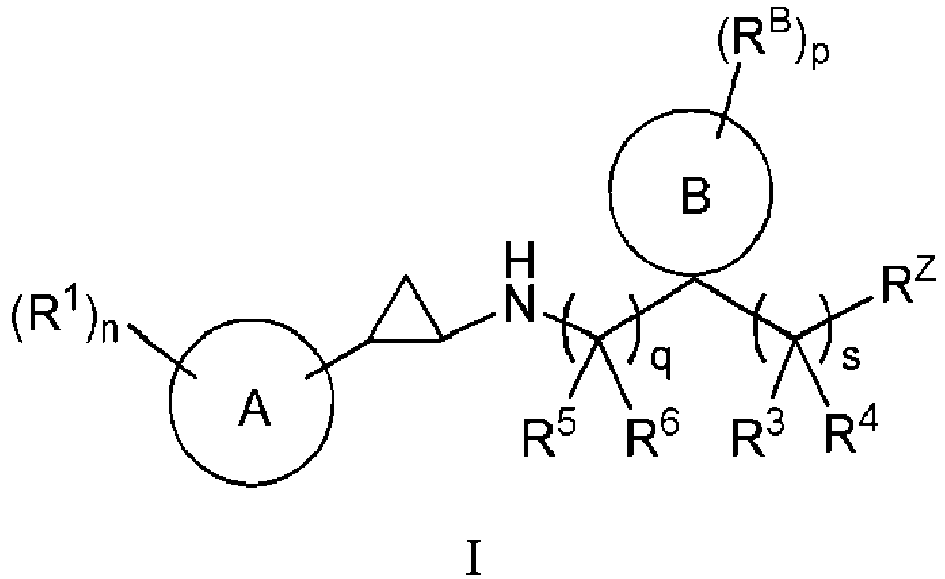 Ring A für C6-10-Aryl oder 5- bis 10-gliedriges Heteroaryl, welches Kohlenstoff und 1, 2, 3 oder 4 aus N, O und S ausgewählte Heteroatome umfasst, steht,Ring B für 4- bis 10-gliedriges Heterocycloalkyl, welches Kohlenstoff und 1, 2 oder 3 aus N, O und S ausgewählte Heteroatome umfasst, steht,RZ für Cy1, CN, C(O)ORa, C(O)NRcRd, ORa, SRa, C(O)Rb, OC(O)Rb, OC(O)NRcRd, NRcRd, NRcC (O)Rb, NRcC(O)ORa, NRcC(O)NRcRd, NRcS(O)2Rb, S(O)Rb, S(O)NRcRd, S(O)2Rb oder S(O)2NRcRd steht,R1 jeweils unabhängig aus Halogen, C1-6-Alkyl, C2-6-Alkenyl, C2-6-Alkinyl, C1-6-Halogenalkyl, C6-10-Aryl, C3-10-Cycloalkyl, 5- bis 10-gliedrigem Heteroaryl, 4- bis 10-gliedrigem Heterocycloalkyl, C6-10-Aryl-C1-4-alkyl-, C3-10-Cycloalkyl-C1-4-alkyl-, (5- bis 10-gliedriges Heteroaryl)-C1-4-alkyl-, (4- bis 10-gliedriges Heterocycloalkyl) -C1-4-alkyl, CN, NO2, ORa1, SRa1, C(O)Rb1, C(O)NRc1Rd1, C(O)ORa1, OC(O)Rb1, OC(O)NRc1Rd1, NRc1Rd1, NRc1C(O)Rb1, NRc1C(O)ORa1, NRc1C(O)NRc1Rd1, C(=NRe1)Rb1, C(=NRe1)NRc1Rd1, NRc1C(=NRe1)NRc1Rd1, NRc1S(O)Rb1, NRc1S(O)2Rb1, NRc1S(O)2NRc1Rd1, S(O)Rb1, S(O)NRc1Rd1, S(O)2Rb1 und S(O)2NRc1Rd1 ausgewählt ist, wobei C1-6-Alkyl, C2-6-Alkenyl, C2-6-Alkinyl, C6-10-Aryl, C3-10-Cycloalkyl, 5- bis 10-gliedriges Heteroaryl, 4- bis 10-gliedriges Heterocycloalkyl, C6-10-Aryl-C1-4-alkyl-, C3-10-Cycloalkyl-C1-4-alkyl-, (5- bis 10-gliedriges Heteroaryl) -C1-4-alkyl- und (4- bis 10-gliedriges Heterocycloalkyl)-C1-4-alkyl- jeweils gegebenenfalls durch 1, 2, 3 oder 4 unabhängig voneinander aus Halogen, C1-4-Alkyl, C1-4-Halogenalkyl, C1-4-Cyanoalkyl, CN, NO2,ORa1, SRa1, C(O)Rb1, C(O)NRc1Rd1, C(O)ORa1, OC(O)Rb1, OC(O)NRc1Rd1, C(=NRe1)NRc1Rd1, NRc1C(=NRe1)NRc1Rd1, NRc1Rd1, NRc1C(O)Rb1, NRc1C(O)ORa1, NRc1C(O)NRc1Rd1, NRc1S(O)Rb1, NRc1S(O)2Rb1, NRc1S(O)2NRc1Rd1, S(O)Rb1, S(O)NRc1Rd1, S(O)2Rb1 und S(O)2NRc1Rd1 ausgewählte Substituenten substituiert sind,RB jeweils unabhängig aus Cy, Halogen, C1-6-Alkyl, CN, ORa2, C(O)Rb2, C(O)NRc2Rd2, C(O)ORa2, NRc2Rd2, S(O)Rb2, S(O)NRc2Rd2, S(O)2Rb2 und S(O)2NRc2Rd2 ausgewählt ist, wobei C1-6-Alkyl gegebenenfalls durch 1, 2 oder 3 unabhängig voneinander aus Cy, Halogen, CN, ORa2, SRa2, C(O)Rb2, C(O)NRc2Rd2, C(O)ORa2, OC(O)Rb2, OC(O)NRc2Rd2, C(=NRe2) NRc2Rd2, NRc2C(=NRe2) NRc2Rd2, NRc2Rd2, NRc2C(O)Rb2, NRc2C(O)ORa2, NRc2C(O)NRc2Rd2, NRc2S(O)Rb2, NRc2S(O)2Rb2, NRc2S(O)2NRc2Rd2, S(O)Rb2, S(O)NRc2Rd2, S(O)2Rb2 und S(O)2NRc2Rd2 ausgewählte Substituenten substituiert ist,wobei RB an einem beliebigen ringbildenden Atom des Rings B mit Ausnahme des ringbildenden Atoms von Ring B, an das RZ gebunden ist, substituiert ist,R3 und R4 jeweils unabhängig voneinander aus H, Halogen, CN, C1-4-Alkyl, C1-4-Halogenalkyl, C1-4-Cyanoalkyl und - (C1-4-Alkyl)-ORa4 ausgewählt sind,R5 und R6 jeweils unabhängig voneinander aus H, Halogen, CN, C1-4-Alkyl, C1-4-Halogenalkyl, C1-4-Cyanoalkyl und - (C1-4-Alkyl)-ORa4 ausgewählt sind,Cy jeweils unabhängig aus C6-10-Aryl, C3-10-Cycloalkyl, 5- bis 10-gliedrigem Heteroaryl und 4- bis 10-gliedrigem Heterocycloalkyl ausgewählt ist,Cy1 für C6-10-Aryl, C3-10-Cycloalkyl, 5- bis 10-gliedriges Heteroaryl oder 4- bis 10-gliedriges Heterocycloalkyl steht, die jeweils durch 1, 2, 3 oder 4 unabhängig voneinander aus Cy2, Halogen, C1-4-Alkyl, C1-4-Halogenalkyl, C1-4-Cyanoalkyl, CN, NO2, ORa3, SRa3, C(O)Rb3, C(O)NRc3Rd3, C(O)ORa3, OC(O)Rb3, OC(O)NRc3Rd3, C(=NRe3) NRc3Rd3 , NRc3C(=NRe3) NRc3Rd3, NRc3Rd3, NRc3C(O)Rb3, NRc3C(O)ORa3, NRc3C(O)NRc3Rd3, NRc3S(O)Rb3, NRc3S(O)2Rb3, NRc3S(O)2NRc3Rd3, S(O)Rb3, S(O)NRc3Rd3, S(O)2Rb3 und S(O)2NRc3Rd3 ausgewählte Substituenten substituiert sind,Cy2 für C6-10-Aryl, C3-10-Cycloalkyl, 5- bis 10-gliedriges Heteroaryl oder 4- bis 10-gliedriges Heterocycloalkyl steht, die jeweils gegebenenfalls durch 1, 2, 3 oder 4 unabhängig voneinander aus Halogen, C1-4-Alkyl, C1-4-Halogenalkyl, C1-4-Cyanoalkyl, CN, NO2, ORa3, SRa3, C(O)Rb3, C(O)NRc3Rd3, C(O)ORa3, OC(O)Rb3, OC(O)NRc3Rd3, C(=NRe3) NRc3Rd3, NRc3C(=NRe3) NRc3Rd3, NRc3Rd3, NRc3C(O)Rb3, NRc3C(O)ORa3, NRc3C(O)NRc3Rd3, NRc3S(O)Rb3, NRc3S(O)2Rb3, NRc3S(O)2NRc3Rd3, S(O)Rb3, S(O)NRc3Rd3, S(O)2Rb3 und S(O)2NRc3Rd3 ausgewählte Substituenten substituiert sind,Ra, Rb, Rc und Rd jeweils unabhängig voneinander aus H, C1-6-Alkyl, C1-4-Halogenalkyl, C2-6-Alkenyl, C2-6-Alkinyl, C6-10-Aryl, C3-10-Cycloalkyl, 5- bis 10-gliedrigem Heteroaryl, 4- bis 10-gliedrigem Heterocycloalkyl, C6-10-Aryl-C1-4-alkyl-, C3-10-Cycloalkyl-C1-4-alkyl-, (5- bis 10-gliedriges Heteroaryl) -C1-4-alkyl- und (4- bis 10-gliedriges Heterocycloalkyl) -C1-4-alkyl- ausgewählt sind, wobei C1-6-Alkyl, C2-6-Alkenyl, C2-6-Alkinyl, C6-10-Aryl, C3-10-Cycloalkyl, 5- bis 10-gliedriges Heteroaryl, 4-bis 10-gliedriges Heterocycloalkyl, C6-10-Aryl-C1-4-alkyl-, C3-10-Cycloalkyl-C1-4-alkyl-, (5- bis 10-gliedriges Heteroaryl)-C1-4-alkyl- und (4- bis 10-gliedriges Heterocycloalkyl)-C1-4-alkyl- gegebenenfalls durch 1, 2, 3, 4 oder 5 unabhängig voneinander aus C1-4-Alkyl, C1-4-Halogenalkyl, C1-4-Cyanoalkyl, Halogen, CN, ORa4, SRa4, C(O)Rb4, C(O)NRc4Rd4, C(O)ORa4, OC(O)Rb4, OC(O)NRc4Rd4, NRc4Rd4, NRc4C(O)Rb4, NRc4C(O)NRc4Rd4, NRc4C(O)ORa4, C(=NRe4)NRc4Rd4, NRc4C(=NRe4) NRc4Rd4, S(O)Rb4, S(O)NRc4Rd4, S(O)2Rb4, NRc4S(O)2Rb4, NRc4S(O)2NRc4Rd4 und S(O)2NRc4Rd4 ausgewählte Substituenten substituiert sind,oder ein beliebiges Rc und ein beliebiges Rd zusammen mit dem N-Atom, an das sie gebunden sind, eine 4-, 5-, 6- oder 7-gliedrige Heterocycloalkylgruppe bilden, die gegebenenfalls durch 1, 2 oder 3 unabhängig voneinander aus C1-6-Alkyl, C3-7-Cycloalkyl, 4- bis 7-gliedrigem Heterocycloalkyl, C6-10-Aryl, 5- oder 6-gliedrigem Heteroaryl, C1-6-Halogenalkyl, Halogen, CN, ORa4, SRa4, C(O)Rb4, C(O)NRc4Rd4, C(O)ORa4, OC(O)Rb4, OC(O)NRc4Rd4, NRc4Rd4, NRc4C(O)Rb4, NRc4C(O)NRc4Rd4, NRc4C(O)ORa4, C(=NRe4)NRc4Rd4, NRc4C(=NRe4)NRc4Rd4, S(O)Rb4, S(O)NRc4Rd4, S(O)2Rb4, NRc4S(O)2Rb4, NRc4S(O)2NRc4Rd4 und S(O)2NRc4Rd4 ausgewählte Substituenten substituiert ist, wobei C1-6-Alkyl, C3-7-Cycloalkyl, 4- bis 7-gliedriges Heterocycloalkyl, C6-10-Aryl und 5- oder 6-gliedriges Heteroaryl gegebenenfalls durch 1, 2 oder 3 unabhängig voneinander aus Halogen, C1-4-Alkyl, C1-4-Halogenalkyl, C1-4-Cyanoalkyl, CN, ORa4, SRa4, C(O)Rb4, C(O)NRc4Rd4, C(O)ORa4, OC(O)Rb4, OC(O)NRc4Rd4, NRc4Rd4, NRc4C(O)Rb4, NRc4C(O)NRc4Rd4, NRc4C(O)ORa4, C(=NRe4)NRc4Rd4, NRc4C(=NRe4) NRc4Rd4, S(O)Rb4, S(O)NRc4Rd4, S(O)2Rb4, NRc4S(O)2Rb4, NRc4S(O)2NRc4Rd4 und S(O)2NRc4Rd4 ausgewählte Substituenten substituiert sind,Ra1, Rb1, Rc1 und Rd1 jeweils unabhängig voneinander aus H, C1-6-Alkyl, C1-4-Halogenalkyl, C2-6-Alkenyl, C2-6-Alkinyl, C6-10-Aryl, C3-10-Cycloalkyl, 5- bis 10-gliedrigem Heteroaryl, 4- bis 10-gliedrigem Heterocycloalkyl, C6-10-Aryl-C1-4-alkyl-, C3-10-Cycloalkyl-C1-4-alkyl-, (5- bis 10-gliedriges Heteroaryl)-C1-4-alkyl- und (4- bis 10-gliedriges Heterocycloalkyl) -C1-4-alkyl- ausgewählt sind, wobei C1-6-Alkyl, C2-6-Alkenyl, C2-6-Alkinyl, C6-10-Aryl, C3-10-Cycloalkyl, 5- bis 10-gliedriges Heteroaryl, 4-bis 10-gliedriges Heterocycloalkyl, C6-10-Aryl-C1-4-alkyl-, C3-10-Cycloalkyl-C1-4-alkyl-, (5- bis 10-gliedriges Heteroaryl)-C1-4-alkyl- und (4- bis 10-gliedriges Heterocycloalkyl)-C1-4-alkyl- gegebenenfalls durch 1, 2, 3, 4 oder 5 unabhängig voneinander aus C1-4-Alkyl, C1-4-Halogenalkyl, C1-4-Cyanoalkyl, Halogen, CN, ORa4, SRa4, C(O)Rb4, C(O)NRc4Rd4, C(O)ORa4, OC(O)Rb4, OC(O)NRc4Rd4, NRc4Rd4, NRc4C(O)Rb4, NRc4C(O)NRc4Rd4, NRc4C(O)ORa4, C(=NRe4)NRc4Rd4, NRc4C(=NRe4) NRc4Rd4, S(O)Rb4, S(O)NRc4Rd4, S(O)2Rb4, NRc4S(O)2Rb4, NRc4S(O)2NRc4Rd4 und S(O)2NRc4Rd4 ausgewählte Substituenten substituiert sind,oder ein beliebiges Rc1 und ein beliebiges Rd1 zusammen mit dem N-Atom, an das sie gebunden sind, eine 4-, 5-, 6- oder 7-gliedrige Heterocycloalkylgruppe bilden, die gegebenenfalls durch 1, 2 oder 3 unabhängig voneinander aus C1-6-Alkyl, C3-7-Cycloalkyl, 4- bis 7-gliedrigem Heterocycloalkyl, C6-10-Aryl, 5- oder 6-gliedrigem Heteroaryl, C1-6-Halogenalkyl, Halogen, CN, ORa4, SRa4, C(O)Rb4, C(O)NRc4Rd4, C(O)ORa4, OC(O)Rb4, OC(O)NRc4Rd4, NRc4Rd4, NRc4C(O)Rb4, NRc4C(O)NRc4Rd4, NRc4C(O)ORa4, C(=NRe4)NRc4Rd4, NRc4C(=NRe4)NRc4Rd4, S(O)Rb4, S(O)NRc4Rd4, S(O)2Rb4, NRc4S(O)2Rb4, NRc4S(O)2NRc4Rd4 und S(O)2NRc4Rd4 ausgewählte Substituenten substituiert ist, wobei C1-6-Alkyl, C3-7-Cycloalkyl, 4- bis 7-gliedriges Heterocycloalkyl, C6-10-Aryl und 5- oder 6-gliedriges Heteroaryl gegebenenfalls durch 1, 2 oder 3 unabhängig voneinander aus Halogen, C1-4-Alkyl, C1-4-Halogenalkyl, C1-4-Cyanoalkyl, CN, ORa4, SRa4, C(O)Rb4, C(O)NRc4Rd4, C(O)ORa4, OC(O)Rb4, OC(O)NRc4Rd4, NRc4Rd4, NRc4C(O)Rb4, NRc4C(O)NRc4Rd4, NRc4C(O)ORa4, C(=NRe4) NRc4Rd4, NRc4C(=NRe4) NRc4Rd4, S(O)Rb4, S(O)NRc4Rd4, S(O)2Rb4, NRc4S(O)2Rb4, NRc4S(O)2NRc4Rd4 und S(O)2NRc4Rd4 ausgewählte Substituenten substituiert sind,Ra2, Rb2, Rc2 und Rd2 jeweils unabhängig voneinander aus H, C1-6-Alkyl und Cy ausgewählt sind, wobei C1-6-Alkyl gegebenenfalls durch 1, 2, 3, 4 oder 5 unabhängig voneinander aus Cy, Halogen, CN, ORa4, SRa4, C(O)Rb4, C(O)NRc4Rd4, C(O)ORa4, OC(O)Rb4, OC(O)NRc4Rd4, NRc4Rd4, NRc4C(O)Rb4, NRc4C(O)NRc4Rd4, NRc4C(O)ORa4, C(=NRe4) NRc4Rd4, NRc4C(=NRe4) NRc4Rd4, S(O)Rb4, S(O)NRc4Rd4, S(O)2Rb4, NRc4S(O)2Rb4, NRc4S(O)2NRc4Rd4 und S(O)2NRc4Rd4 ausgewählte Substituenten substituiert ist,oder ein beliebiges Rc2 und ein beliebiges Rd2 zusammen mit dem N-Atom, an das sie gebunden sind, eine 4-, 5-, 6- oder 7-gliedrige Heterocycloalkylgruppe bilden,Ra3, Rb3, Rc3 und Rd3 jeweils unabhängig voneinander aus H, C1-6-Alkyl, C1-4-Halogenalkyl, C2-6-Alkenyl, C2-6-Alkinyl, C6-10-Aryl, C3-10-Cycloalkyl, 5- bis 10-gliedrigem Heteroaryl, 4- bis 10-gliedrigem Heterocycloalkyl, C6-10-Aryl-C1-4-alkyl-, C3-10-Cycloalkyl-C1-4-alkyl-, (5- bis 10-gliedriges Heteroaryl) -C1-4-alkyl- und (4- bis 10-gliedriges Heterocycloalkyl) -C1-4-alkyl- ausgewählt sind, wobei C1-6-Alkyl, C2-6-Alkenyl, C2-6-Alkinyl, C6-10-Aryl, C3-10-Cycloalkyl, 5- bis 10-gliedriges Heteroaryl, 4-bis 10-gliedriges Heterocycloalkyl, C6-10-Aryl-C1-4-alkyl-, C3-10-Cycloalkyl-C1-4-alkyl-, (5- bis 10-gliedriges Heteroaryl)-C1-4-alkyl- und (4- bis 10-gliedriges Heterocycloalkyl)-C1-4-alkyl- gegebenenfalls durch 1, 2, 3, 4 oder 5 unabhängig voneinander aus C1-4-Alkyl, C1-4-Halogenalkyl, C1-4-Cyanoalkyl, Halogen, CN, ORa4, SRa4, C(O)Rb4, C(O)NRc4Rd4, C(O)ORa4, OC(O)Rb4, OC(O)NRc4Rd4, NRc4Rd4, NRc4C(O)Rb4, NRc4C(O)NRc4Rd4, NRc4C(O)ORa4, C (=NRe4)NRc4Rd4, NRc4C(=NRe4)NRc4Rd4, S(O)Rb4, S(O)NRc4Rd4, S(O)2Rb4, NRc4S(O)2Rb4, NRc4S(O)2NRc4Rd4 und S(O)2NRc4Rd4 ausgewählte Substituenten substituiert sind,oder ein beliebiges Rc3 und ein beliebiges Rd3 zusammen mit dem N-Atom, an das sie gebunden sind, eine 4-, 5-, 6- oder 7-gliedrige Heterocycloalkylgruppe bilden, die gegebenenfalls durch 1, 2 oder 3 unabhängig voneinander aus C1-6-Alkyl, C3-7-Cycloalkyl, 4- bis 7-gliedrigem Heterocycloalkyl, C6-10-Aryl, 5- oder 6-gliedrigem Heteroaryl, C1-6-Halogenalkyl, Halogen, CN, ORa4, SRa4, C(O)Rb4, C(O)NRc4Rd4, C(O)ORa4, OC(O)Rb4, OC(O)NRc4Rd4, NRc4Rd4, NRc4C(O)Rb4, NRc4C(O)NRc4Rd4, NRc4C(O)ORa4, C(=NRe4)NRc4Rd4, NRc4C(=NRe4)NRc4Rd4, S(O)Rb4, S(O)NRc4Rd4, S(O)2Rb4, NRc4S(O)2Rb4, NRc4S(O)2NRc4Rd4 und S(O)2NRc4Rd4 ausgewählte Substituenten substituiert ist, wobei C1-6-Alkyl, C3-7-Cycloalkyl, 4- bis 7-gliedriges Heterocycloalkyl, C6-10-Aryl und 5- oder 6-gliedriges Heteroaryl gegebenenfalls durch 1, 2 oder 3 unabhängig voneinander aus Halogen, C1-4-Alkyl, C1-4-Halogenalkyl, C1-4-Cyanoalkyl, CN, ORa4, SRa4, C(O)Rb4, C(O)NRc4Rd4, C(O)ORa4, OC(O)Rb4, OC(O)NRc4Rd4, NRc4Rd4, NRc4C(O)Rb4, NRc4C(O)NRc4Rd4, NRc4C(O)ORa4, C(=NRe4)NRc4Rd4, NRc4C(=NRe4)NRc4Rd4, S(O)Rb4, S(O)NRc4Rd4, S(O)2Rb4, NRc4S(O)2Rb4, NRc4S(O)2NRc4Rd4 und S(O)2NRc4Rd4 ausgewählte Substituenten substituiert sind,Ra4, Rb4, Rc4 und Rd4 jeweils unabhängig voneinander aus H, C1-4-Alkyl, C1-4-Halogenalkyl, C2-4-Alkenyl und C2-4-Alkinyl ausgewählt sind, wobei C1-4-Alkyl, C2-4-Alkenyl und C2-4-Alkinyl gegebenenfalls durch 1, 2 oder 3 unabhängig voneinander aus OH, CN, Amino, Halogen, C1-4-Alkyl, C1-4-Alkoxy, C1-4-Alkylthio, C1-4-Alkylamino, Di(C1-4-alkyl)amino, C1-4-Halogenalkyl und C1-4-Halogenalkoxy ausgewählte Substituenten substituiert sind,Re1, Re2, Re3 und Re4 jeweils unabhängig voneinander aus H, C1-4-Alkyl und CN ausgewählt sind,n für 0, 1, 2 oder 3 steht,p für 0, 1, 2 oder 3 steht,q für 0, 1 oder 2 steht unds für 1, 2, 3 oder 4 steht.
 - Verbindung der Formel I:
 Ring A für C6-10-Aryl oder 5- bis 10-gliedriges Heteroaryl, welches Kohlenstoff und 1, 2, 3 oder 4 aus N, O und S ausgewählte Heteroatome umfasst, steht,Ring B für 4- bis 10-gliedriges Heterocycloalkyl, welches Kohlenstoff und 1, 2 oder 3 aus N, O und S ausgewählte Heteroatome umfasst, steht,RZ für Cy1, CN, C(O)ORa, C(O)NRcRd, ORa, SRa, C(O)Rb, OC(O)Rb, OC(O)NRcRd, NRcRd, NRcC(O)Rb, NRcC(O)ORa, NRcC(O)NRcRd, NRcS(O)2Rb, S(O)Rb, S(O)NRcRd, S(O)2Rb oder S(O)2NRcRd steht,R1 jeweils unabhängig aus Halogen, C1-6-Alkyl, C2-6-Alkenyl, C2-6-Alkinyl, C1-6-Halogenalkyl, C6-10-Aryl, C3-10-Cycloalkyl, 5- bis 10-gliedrigem Heteroaryl, 4- bis 10-gliedrigem Heterocycloalkyl, C6-10-Aryl-C1-4-alkyl-, C3-10-Cycloalkyl-C1-4-alkyl-, (5- bis 10-gliedriges Heteroaryl)-C1-4-alkyl-, (4- bis 10-gliedriges Heterocycloalkyl)-C1-4-alkyl, CN, NO2, ORa1, SRa1, C(O)Rb1, C(O)NRc1Rd1, C(O)ORa1, OC(O)Rb1, OC(O)NRc1Rd1, NRc1Rd1, NRc1C(O)Rb1, NRc1C(O)ORa1, NRc1C(O)NRc1Rd1, C(=NRe1)Rb1, C(=NRe1)NRc1Rd1, NRc1C(=NRe1)NRc1Rd1, NRc1S(O)Rb1, NRc1S(O)2Rb1, NRc1S(O)2NRc1Rd1, S(O)Rb1, S(O)NRc1Rd1, S(O)2Rb1 und S(O)2NRc1Rd1 ausgewählt ist, wobei C1-6-Alkyl, C2-6-Alkenyl, C2-6-Alkinyl, C6-10-Aryl, C3-10-Cycloalkyl, 5- bis 10-gliedriges Heteroaryl, 4- bis 10-gliedriges Heterocycloalkyl, C6-10-Aryl-C1-4-alkyl-, C3-10-Cycloalkyl-C1-4-alkyl-, (5- bis 10-gliedriges Heteroaryl) -C1-4-alkyl- und (4- bis 10-gliedriges Heterocycloalkyl)-C1-4-alkyl- jeweils gegebenenfalls durch 1, 2, 3 oder 4 unabhängig voneinander aus Halogen, C1-4-Alkyl, C1-4-Halogenalkyl, C1-4-Cyanoalkyl, CN, NO2, ORa1, SRa1, C(O)Rb1, C(O)NRc1Rd1, C(O)ORa1, OC(O)Rb1, OC(O)NRc1Rd1, C(=NRe1)NRc1Rd1, NRc1C(=NRe1)NRc1Rd1, NRc1Rd1, NRc1C(O)Rb1, NRc1C(O)ORa1, NRc1C(O)NRc1Rd1, NRc1S(O)Rb1, NRc1S(O)2Rb1, NRc1S(O)2NRc1Rd1, S(O)Rb1, S(O)NRc1Rd1, S(O)2Rb1 und S(O)2NRc1Rd1 ausgewählte Substituenten substituiert sind,RB jeweils unabhängig aus Cy, Halogen, C1-6-Alkyl, CN, ORa2, C(O)Rb2, C(O)NRc2Rd2, C(O)ORa2, NRc2Rd2, S(O)Rb2, S(O)NRc2Rd2, S(O)2Rb2 und S(O)2NRc2Rd2 ausgewählt ist, wobei C1-6-Alkyl gegebenenfalls durch 1, 2 oder 3 unabhängig voneinander aus Cy, Halogen, CN, ORa2, SRa2, C(O)Rb2, C(O)NRc2Rd2, C(O)ORa2, OC(O)Rb2, OC(O)NRc2Rd2, C(=NRe2)NRc2Rd2, NRc2C(=NRe2)NRc2Rd2, NRc2Rd2, NRc2C(O)Rb2, NRc2C(O)ORa2, NRc2C(O)NRc2Rd2, NRc2S(O)Rb2, NRc2S(O)2Rb2, NRc2S(O)2NRc2Rd2, S(O)Rb2, S(O)NRc2Rd2, S(O)2Rb2 und S(O)2NRc2Rd2 ausgewählte Substituenten substituiert ist,wobei RB an einem beliebigen ringbildenden Atom des Rings B mit Ausnahme des ringbildenden Atoms von Ring B, an das RZ gebunden ist, substituiert ist,R3 und R4 jeweils unabhängig voneinander aus H, Halogen, CN, C1-4-Alkyl, C1-4-Halogenalkyl, C1-4-Cyanoalkyl und -(C1-4-Alkyl)-ORa4 ausgewählt sind,R5 und R6 jeweils unabhängig voneinander aus H, Halogen, CN, C1-4-Alkyl, C1-4-Halogenalkyl, C1-4-Cyanoalkyl und -(C1-4-Alkyl)-ORa4 ausgewählt sind,
Cy jeweils unabhängig aus C6-10-Aryl, C3-10-Cycloalkyl, 5- bis 10-gliedrigem Heteroaryl und 4- bis 10-gliedrigem Heterocycloalkyl ausgewählt ist,Cy1 für C6-10-Aryl, C3-10-Cycloalkyl, 5- bis 10-gliedriges Heteroaryl oder 4- bis 10-gliedriges Heterocycloalkyl steht, die jeweils durch 1, 2, 3 oder 4 unabhängig voneinander aus Halogen, C1-4-Alkyl, C1-4-Halogenalkyl, C1-4-Cyanoalkyl, CN, NO2, ORa3, SRa3, C(O)Rb3, C(O)NRc3Rd3, C(O)ORa3, OC(O)Rb3, OC(O)NRc3Rd3, C(=NRe3)NRc3Rd3, NRc3C(=NRe3)NRc3Rd3, NRc3Rd3, NRc3C(O)Rb3, NRc3C(O)ORa3, NRc3C(O)NRc3Rd3, NRc3S(O)Rb3, NRc3S(O)2Rb3, NRc3S (O)2NRc3Rd3, S(O)Rb3, S(O)NRc3Rd3, S(O)2Rb3 und S(O)2NRc3Rd3 ausgewählte Substituenten substituiert sind,Ra, Rb, Rc und Rd jeweils unabhängig voneinander aus H, C1-6-Alkyl, C1-4-Halogenalkyl, C2-6-Alkenyl, C2-6-Alkinyl, C6-10-Aryl, C3-10-Cycloalkyl, 5- bis 10-gliedrigem Heteroaryl, 4- bis 10-gliedrigem Heterocycloalkyl, C6-10-Aryl-C1-4-alkyl-, C3-10-Cycloalkyl-C1-4-alkyl-, (5- bis 10-gliedriges Heteroaryl) -C1-4-alkyl- und (4- bis 10-gliedriges Heterocycloalkyl) -C1-4-alkyl- ausgewählt sind, wobei C1-6-Alkyl, C2-6-Alkenyl, C2-6-Alkinyl, C6-10-Aryl, C3-10-Cycloalkyl, 5- bis 10-gliedriges Heteroaryl, 4-bis 10-gliedriges Heterocycloalkyl, C6-10-Aryl-C1-4-alkyl-, C3-10-Cycloalkyl-C1-4-alkyl-, (5- bis 10-gliedriges Heteroaryl)-C1-4-alkyl- und (4- bis 10-gliedriges Heterocycloalkyl)-C1-4-alkyl- gegebenenfalls durch 1, 2, 3, 4 oder 5 unabhängig voneinander aus C1-4-Alkyl, C1-4-Halogenalkyl, C1-4-Cyanoalkyl, Halogen, CN, ORa4, SRa4, C(O)Rb4, C(O)NRc4Rd4, C(O)ORa4, OC(O)Rb4, OC(O)NRc4Rd4, NRc4Rd4, NRc4C(O)Rb4, NRc4C(O)NRc4Rd4, NRc4C(O)ORa4, C(=NRe4)NRc4Rd4, NRc4C(=NRe4)NRc4Rd4, S(O)Rb4, S(O)NRc4Rd4, S(O)2Rb4, NRc4S(O)2Rb4, NRc4S(O)2NRc4Rd4 und S(O)2NRc4Rd4 ausgewählte Substituenten substituiert sind,oder ein beliebiges Rc und ein beliebiges Rd zusammen mit dem N-Atom, an das sie gebunden sind, eine 4-, 5-, 6- oder 7-gliedrige Heterocycloalkylgruppe bilden, die gegebenenfalls durch 1, 2 oder 3 unabhängig voneinander aus C1-6-Alkyl, C3-7-Cycloalkyl, 4- bis 7-gliedrigem Heterocycloalkyl, C6-10-Aryl, 5- oder 6-gliedrigem Heteroaryl, C1-6-Halogenalkyl, Halogen, CN, ORa4, SRa4, C(O)Rb4, C(O)NRc4Rd4, C(O)ORa4, OC(O)Rb4, OC(O)NRc4Rd4, NRc4Rd4, NRc4C(O)Rb4, NRc4C(O)NRc4Rd4, NRc4C(O)ORa4, C(=NRe4)NRc4Rd4, NRc4C(=NRe4)NRc4Rd4, S(O)Rb4, S(O)NRc4Rd4, S(O)2Rb4, NRc4S(O)2Rb4, NRc4S(O)2NRc4Rd4 und S(O)2NRc4Rd4 ausgewählte Substituenten substituiert ist, wobei C1-6-Alkyl, C3-7-Cycloalkyl, 4- bis 7-gliedriges Heterocycloalkyl, C6-10-Aryl und 5- oder 6-gliedriges Heteroaryl gegebenenfalls durch 1, 2 oder 3 unabhängig voneinander aus Halogen, C1-4-Alkyl, C1-4-Halogenalkyl, C1-4-Cyanoalkyl, CN, ORa4, SRa4, C(O)Rb4, C(O)NRc4Rd4, C(O)ORa4, OC(O)Rb4, OC(O)NRc4Rd4, NRc4Rd4, NRc4C(O)Rb4, NRc4C(O)NRc4Rd4, NRc4C(O)ORa4, C(=NRe4)NRc4Rd4, NRc4C(=NRe4)NRc4Rd4, S(O)Rb4, S(O)NRc4Rd4, S(O)2Rb4, NRc4S(O)2Rb4, NRc4S(O)2NRc4Rd4 und S(O)2NRc4Rd4 ausgewählte Substituenten substituiert sind,Ra1, Rb1, Rc1 und Rd1 jeweils unabhängig voneinander aus H, C1-6-Alkyl, C1-4-Halogenalkyl, C2-6-Alkenyl, C2-6-Alkinyl, C6-10-Aryl, C3-10-Cycloalkyl, 5- bis 10-gliedrigem Heteroaryl, 4- bis 10-gliedrigem Heterocycloalkyl, C6-10-Aryl-C1-4-alkyl-, C3-10-Cycloalkyl-C1-4-alkyl-, (5- bis 10-gliedriges Heteroaryl)-C1-4-alkyl- und (4- bis 10-gliedriges Heterocycloalkyl) -C1-4-alkyl- ausgewählt sind, wobei C1-6-Alkyl, C2-6-Alkenyl, C2-6-Alkinyl, C6-10-Aryl, C3-10-Cycloalkyl, 5- bis 10-gliedriges Heteroaryl, 4-bis 10-gliedriges Heterocycloalkyl, C6-10-Aryl-C1-4-alkyl-, C3-10-Cycloalkyl-C1-4-alkyl-, (5- bis 10-gliedriges Heteroaryl)-C1-4-alkyl- und (4- bis 10-gliedriges Heterocycloalkyl)-C1-4-alkyl- gegebenenfalls durch 1, 2, 3, 4 oder 5 unabhängig voneinander aus C1-4-Alkyl, C1-4-Halogenalkyl, C1-4-Cyanoalkyl, Halogen, CN, ORa4, SRa4, C(O)Rb4, C(O)NRc4Rd4, C(O)ORa4, OC(O)Rb4, OC(O)NRc4Rd4, NRc4Rd4, NRc4C(O)Rb4, NRc4C(O)NRc4Rd4, NRc4C(O)ORa4, C(=NRe4)NRc4Rd4, NRc4C(=NRe4)NRc4Rd4, S(O)Rb4, S(O)NRc4Rd4, S(O)2Rb4, NRc4S(O)2Rb4, NRc4S(O)2NRc4Rd4 und S(O)2NRc4Rd4 ausgewählte Substituenten substituiert sind,oder ein beliebiges Rc1 und ein beliebiges Rd1 zusammen mit dem N-Atom, an das sie gebunden sind, eine 4-, 5-, 6- oder 7-gliedrige Heterocycloalkylgruppe bilden, die gegebenenfalls durch 1, 2 oder 3 unabhängig voneinander aus C1-6-Alkyl, C3-7-Cycloalkyl, 4- bis 7-gliedrigem Heterocycloalkyl, C6-10-Aryl, 5- oder 6-gliedrigem Heteroaryl, C1-6-Halogenalkyl, Halogen, CN, ORa4, SRa4, C(O)Rb4, C(O)NRc4Rd4, C(O)ORa4, OC(O)Rb4, OC(O)NRc4Rd4, NRc4Rd4, NRc4C(O)Rb4, NRc4C(O)NRc4Rd4, NRc4C(O)ORa4, C(=NRe4)NRc4Rd4, NRc4C(=NRe4)NRc4Rd4, S(O)Rb4, S(O)NRc4Rd4, S(O)2Rb4, NRc4S(O)2Rb4, NRc4S(O)2NRc4Rd4 und S(O)2NRc4Rd4 ausgewählte Substituenten substituiert ist, wobei C1-6-Alkyl, C3-7-Cycloalkyl, 4- bis 7-gliedriges Heterocycloalkyl, C6-10-Aryl und 5- oder 6-gliedriges Heteroaryl gegebenenfalls durch 1, 2 oder 3 unabhängig voneinander aus Halogen, C1-4-Alkyl, C1-4-Halogenalkyl, C1-4-Cyanoalkyl, CN, ORa4, SRa4, C(O)Rb4, C(O)NRc4Rd4, C(O)ORa4, OC(O)Rb4, OC(O)NRc4Rd4, NRc4Rd4, NRc4C(O)Rb4, NRc4C(O)NRc4Rd4, NRc4C(O)ORa4, C(=NRe4)NRc4Rd4, NRc4C(=NRe4)NRc4Rd4, S(O)Rb4, S(O)NRc4Rd4, S(O)2Rb4, NRc4S(O)2Rb4, NRc4S(O)2NRc4Rd4 und S(O)2NRc4Rd4 ausgewählte Substituenten substituiert sind,Ra2, Rb2, Rc2 und Rd2 jeweils unabhängig voneinander aus H, C1-6-Alkyl und Cy ausgewählt sind, wobei C1-6-Alkyl gegebenenfalls durch 1, 2, 3, 4 oder 5 unabhängig voneinander aus Cy, Halogen, CN, ORa4, SRa4, C(O)Rb4, C(O)NRc4Rd4, C(O)ORa4, OC(O)Rb4, OC(O)NRc4Rd4, NRc4Rd4, NRc4C(O)Rb4, NRc4C(O)NRc4Rd4, NRc4C(O)ORa4, C(=NRe4)NRc4Rd4, NRc4C(=NRe4)NRc4Rd4, S(O)Rb4, S(O)NRc4Rd4, S(O)2Rb4, NRc4S(O)2Rb4, NRc4S(O)2NRc4Rd4 und S(O)2NRc4Rd4 ausgewählte Substituenten substituiert ist,oder ein beliebiges Rc2 und ein beliebiges Rd2 zusammen mit dem N-Atom, an das sie gebunden sind, eine 4-, 5-, 6- oder 7-gliedrige Heterocycloalkylgruppe bilden,Ra3, Rb3, Rc3 und Rd3 jeweils unabhängig voneinander aus H, C1-6-Alkyl, C1-4-Halogenalkyl, C2-6-Alkenyl, C2-6-Alkinyl, C6-10-Aryl, C3-10-Cycloalkyl, 5- bis 10-gliedrigem Heteroaryl, 4- bis 10-gliedrigem Heterocycloalkyl, C6-10-Aryl-C1-4-alkyl-, C3-10-Cycloalkyl-C1-4-alkyl-, (5- bis 10-gliedriges Heteroaryl) -C1-4-alkyl- und (4- bis 10-gliedriges Heterocycloalkyl) -C1-4-alkyl- ausgewählt sind, wobei C1-6-Alkyl, C2-6-Alkenyl, C2-6-Alkinyl, C6-10-Aryl, C3-10-Cycloalkyl, 5- bis 10-gliedriges Heteroaryl, 4-bis 10-gliedriges Heterocycloalkyl, C6-10-Aryl-C1-4-alkyl-, C3-10-Cycloalkyl-C1-4-alkyl-, (5- bis 10-gliedriges Heteroaryl)-C1-4-alkyl- und (4- bis 10-gliedriges Heterocycloalkyl)-C1-4-alkyl- gegebenenfalls durch 1, 2, 3, 4 oder 5 unabhängig voneinander aus C1-4-Alkyl, C1-4-Halogenalkyl, C1-4-Cyanoalkyl, Halogen, CN, ORa4, SRa4, C(O)Rb4, C(O)NRc4Rd4, C(O)ORa4, OC(O)Rb4, OC(O)NRc4Rd4, NRc4Rd4, NRc4C(O)Rb4, NRc4C(O)NRc4Rd4, NRc4C(O)ORa4, C(=NRe4)NRc4Rd4, NRc4C(=NRe4)NRc4Rd4, S(O)Rb4, S(O)NRc4Rd4, S(O)2Rb4, NRc4S(O)2Rb4, NRc4S(O)2NRc4Rd4 und S(O)2NRc4Rd4 ausgewählte Substituenten substituiert sind,oder ein beliebiges Rc3 und ein beliebiges Rd3 zusammen mit dem N-Atom, an das sie gebunden sind, eine 4-, 5-, 6- oder 7-gliedrige Heterocycloalkylgruppe bilden, die gegebenenfalls durch 1, 2 oder 3 unabhängig voneinander aus C1-6-Alkyl, C3-7-Cycloalkyl, 4- bis 7-gliedrigem Heterocycloalkyl, C6-10-Aryl, 5- oder 6-gliedrigem Heteroaryl, C1-6-Halogenalkyl, Halogen, CN, ORa4, SRa4, C(O)Rb4, C(O)NRc4Rd4, C(O)ORa4, OC(O)Rb4, OC(O)NRc4Rd4, NRc4Rd4, NRc4C(O)Rb4, NRc4C(O)NRc4Rd4, NRc4C(O)ORa4, C(=NRe4)NRc4Rd4, NRc4C(=NRe4)NRc4Rd4, S(O)Rb4, S(O)NRc4Rd4, S(O)2Rb4, NRc4S(O)2Rb4, NRc4S(O)2NRc4Rd4 und S(O)2NRc4Rd4 ausgewählte Substituenten substituiert ist, wobei C1-6-Alkyl, C3-7-Cycloalkyl, 4- bis 7-gliedriges Heterocycloalkyl, C6-10-Aryl und 5- oder 6-gliedriges Heteroaryl gegebenenfalls durch 1, 2 oder 3 unabhängig voneinander aus Halogen, C1-4-Alkyl, C1-4-Halogenalkyl, C1-4-Cyanoalkyl, CN, ORa4, SRa4, C(O)Rb4, C(O)NRc4Rd4, C(O)ORa4, OC(O)Rb4, OC(O)NRc4Rd4, NRc4Rd4, NRc4C(O)Rb4, NRc4C(O)NRc4Rd4, NRc4C(O)ORa4, C(=NRe4)NRc4Rd4, NRc4C(=NRe4)NRc4Rd4, S(O)Rb4, S(O)NRc4Rd4, S(O)2Rb4, NRc4S(O)2Rb4, NRc4S(O)2NRc4Rd4 und S(O)2NRc4Rd4 ausgewählte Substituenten substituiert sind,Ra4, Rb4, Rc4 und Rd4 jeweils unabhängig voneinander aus H, C1-4-Alkyl, C1-4-Halogenalkyl, C2-4-Alkenyl und C2-4-Alkinyl ausgewählt sind, wobei C1-4-Alkyl, C2-4-Alkenyl und C2-4-Alkinyl gegebenenfalls durch 1, 2 oder 3 unabhängig voneinander aus OH, CN, Amino, Halogen, C1-4-Alkyl, C1-4-Alkoxy, (C1-4-Alkylthio, C1-4-Alkylamino, Di(C1-4-alkyl)amino, C1-4-Halogenalkyl und C1-4-Halogenalkoxy ausgewählte Substituenten substituiert sind,Re1, Re2, Re3 und Re4 jeweils unabhängig voneinander aus H, C1-4-Alkyl und CN ausgewählt sind,n für 0, 1, 2 oder 3 steht,p für 0, 1, 2 oder 3 steht,q für 0, 1 oder 2 steht unds für 1, 2, 3 oder 4 steht. - Verbindung nach Anspruch 1 oder 2 oder pharmazeutisch unbedenkliches Salz davon, wobei Ring B für monocyclisches 4- bis 7-gliedriges Heterocycloalkyl steht, welches Kohlenstoff und 1, 2 oder 3 aus N, O und S ausgewählte Heteroatome umfasst.
- Verbindung nach Anspruch 1 oder 2 mit der Formel II:
 X für -CH2- oder -CH2-CH2- steht,Y für -CH2- oder -CH2-CH2- steht,RN für H oder RB steht,RZ für Cy1, CN, C(O)ORa, C(O)NRcRd, ORa, SRa, C(O)Rb, OC(O)Rb, OC(O)NRcRd, NRcRd, NRcC(O)Rb, NRcC(O)ORa, NRcC(O)NRcRd, NRcS(O)2Rb, S(O)Rb, S(O)NRcRd, S(O)2Rb oder S(O)2NRcRd steht undCy1 für C6-10-Aryl, C3-10-Cycloalkyl, 5- bis 10-gliedriges Heteroaryl oder 4- bis 10-gliedriges Heterocycloalkyl steht, die jeweils durch 1, 2, 3 oder 4 unabhängig voneinander aus Halogen, C1-4-Alkyl, C1-4-Halogenalkyl, C1-4-Cyanoalkyl, CN, NO2, ORa3, SRa3, C(O)Rb3, C(O)NRc3Rd3, C(O)ORa3, OC(O)Rb3, OC(O)NRc3Rd3, C(=NRe3)NRc3Rd3, NRc3C(=NRe3)NRc3Rd3, NRc3Rd3, NRc3C(O)Rb3, NRc3C(O)ORa3, NRc3C(O)NRc3Rd3, NRc3S(O)Rb3, NRc3S(O)2Rb3, NRc3S(O)2NRc3Rd3, S(O)Rb3, S(O)NRc3Rd3, S(O)2Rb3 und S(O)2NRc3Rd3 ausgewählte Substituenten substituiert sind.
 - Verbindung nach Anspruch 1 oder 2 mit der Formel IIIa :
 RN für H oder RB steht,RZ für Cy1, CN, C(O)ORa, C(O)NRcRd, ORa, SRa, C(O)Rb, OC(O)Rb, OC(O)NRcRd, NRcRd, NRcC(O)Rb, NRcC(O)ORa, NRcC(O)NRcRd, NRcS(O)2Rb, S(O)Rb, S(O)NRcRd, S(O)2Rb oder S(O)2NRcRd steht undCy1 für C6-10-Aryl, C3-10-Cycloalkyl, 5- bis 10-gliedriges Heteroaryl oder 4- bis 10-gliedriges Heterocycloalkyl steht, die jeweils durch 1, 2, 3 oder 4 unabhängig voneinander aus Halogen, C1-4-Alkyl, C1-4-Halogenalkyl, C1-4-Cyanoalkyl, CN, NO2, ORa3, SRa3, C(O)Rb3, C(O)NRc3Rd3, C(O)ORa3, OC(O)Rb3, OC(O)NRc3Rd3, C(=NRe3)NRc3Rd3, NRc3C(=NRe3)NRc3Rd3, NRc3Rd3, NRc3C(O)Rb3, NRc3C(O)ORa3, NRc3C(O)NRc3Rd3, NRc3S(O)Rb3, NRc3S(O)2Rb3, NRc3S(O)2NRc3Rd3, S(O)Rb3, S(O)NRc3Rd3, S(O)2Rb3 und S(O)2NRc3Rd3 ausgewählte Substituenten substituiert sind.
 - Verbindung nach einem der Ansprüche 1 bis 5 oder pharmazeutisch unbedenkliches Salz davon, wobei:(a) q für 0 steht oder(b) q für 1 steht.
- Verbindung nach einem der Ansprüche 1 bis 6 oder ein pharmazeutisch unbedenkliches Salz davon, wobei s für 1 steht.
- Verbindung nach einem der Ansprüche 1 bis 7 oder ein pharmazeutisch unbedenkliches Salz davon, wobei Ring A für Phenyl steht.
- Verbindung nach einem der Ansprüche 1 bis 8 oder ein pharmazeutisch unbedenkliches Salz davon, wobei n für 0 steht.
- Verbindung nach einem der Ansprüche 1 bis 9 oder ein pharmazeutisch unbedenkliches Salz davon, wobei sowohl R5 als auch R6 für H stehen.
- Verbindung nach einem der Ansprüche 1 bis 10 oder ein pharmazeutisch unbedenkliches Salz davon, wobei sowohl R3 als auch R4 für H stehen.
- Verbindung nach einem der Ansprüche 1 bis 11 oder ein pharmazeutisch unbedenkliches Salz davon, wobei:(a) RZ für CN, ORa oder Cy1 steht oder(b) RZ für CN steht oder(c) RZ für ORa steht oder(d) RZ für ORa steht und Ra aus C1-6-Alkyl, C6-10-Aryl, C3-10-Cycloalkyl, 5- bis 10-gliedrigem Heteroaryl, C6-10-Aryl-C1-4-alkyl- und C3-10-Cycloalkyl-C1-4-alkyl- ausgewählt ist, die jeweils gegebenenfalls durch Halogen oder CN substituiert sind, oder(e) RZ für Methoxy steht oder(f) RZ für Ethoxy steht oder(g) RZ für durch 1 oder 2 unabhängig voneinander aus Halogen und CN ausgewählte Substituenten substituiertes Phenoxy steht oder(h) RZ für (C6-10-Aryl-C1-4-alkyl)-O- steht oder(i) RZ für (Pyridinyl)-O- oder (Pyrimidinyl)-O-, substituiert durch 1 oder 2 unabhängig voneinander aus Halogen ausgewählte Substituenten, steht oder(j) RZ für (C3-10-Cycloalkyl-C1-4-alkyl)-O- steht oder(k) RZ für (C3-10-Cycloalkyl)-O- steht oder(l) RZ für Cy1 steht oder(m) RZ für durch 1 oder 2 Halogene substituiertes Phenyl steht oder(n) RZ für durch 1 oder 2 unabhängig voneinander aus Halogen und C1-6-Alkoxy ausgewählte Substituenten substituiertes Pyridinyl steht.
- Verbindung nach einem der Ansprüche 1 und 3 bis 11 oder pharmazeutisch unbedenkliches Salz davon, wobei:(a) RZ für durch 1 oder 2 unabhängig voneinander aus Cy2, Halogen, CN, C1-6-Alkoxy, -C(O)NRc3Rd3, -C(O)ORa3, (4- bis 10-gliedriges Heterocycloalkyl)-O- und C1-4-Cyanoalkyl ausgewählte Substituenten substituiertes Phenyl steht oder(b) RZ für durch 1 oder 2 unabhängig voneinander aus Cy2, Halogen und C1-4-Cyanoalkyl ausgewählte Substituenten substituiertes Phenyl steht oder(c) RZ für 2-Fluorphenyl, 3-Fluorphenyl, 4-Fluorphenyl, 2,3-Difluorphenyl, 3,4-Difluorphenyl, 4-(Cyanomethyl)phenyl, 3-Carboxyphenyl, 3-[(3S)-Tetrahydrofuran-3-yloxy]phenyl, 3-(Tetrahydropyran-4-yloxy)phenyl, 2-Fluorphenoxy, 3-Fluorphenoxy, 4-Fluorphenoxy, Benzyloxy, 4-Cyanophenyl, 4-Cyano-2-fluorphenyl, 3-Cyanophenyl, 2-Cyanophenoxy, (5-Fluorpyridin-2-yl)oxy, (5-Fluor-pyrimidin-2-yl)oxy, 3-Cyanophenoxy, 6-Methoxy-pyridin-3-yl, 5-Fluorpyridin-2-yl, Ethoxy, Cyclobutylmethoxy, Cyclohexyloxy, 4-Methoxyphenyl, 3-(Aminocarbonyl)phenyl, 3-Methoxyphenyl, 3-Ethoxyphenyl,
 (d) RZ für 2-Fluorphenyl, 3-Fluorphenyl, 4-Fluorphenyl, 2,3-Difluorphenyl, 3,4-Difluorphenyl, 4-(Cyanomethyl)phenyl,
- Verbindung nach einem der Ansprüche 4 bis 13 oder pharmazeutisch unbedenkliches Salz davon, wobei RN für H steht.
- Verbindung nach einem der Ansprüche 4 bis 13 oder pharmazeutisch unbedenkliches Salz davon, wobei RN für RB steht.
- Verbindung nach einem der Ansprüche 1 bis 13 und 15 oder pharmazeutisch unbedenkliches Salz davon, wobei:(a) RB jeweils unabhängig aus C1-6-Alkyl, 4- bis 10-gliedrigem Heterocycloalkyl, C(O)Rb2, C(O)NRc2Rd2, C(O)ORa2 und S(O)2Rb2 ausgewählt ist, wobei C1-6-Alkyl gegebenenfalls durch 1, 2 oder 3 unabhängig voneinander aus Cy, Halogen, CN, ORa2, SRa2, C(O)Rb2, C(O)NRc2Rd2, C(O)ORa2, OC(O)Rb2, OC(O)NRc2Rd2, C(=NRe2)NRc2Rd2, NRc2C(=NRe2)NRc2Rd2, NRc2Rd2, NRc2C(O)Rb2, NRc2C(O)ORa2, NRc2C(O)NRc2Rd2, NRc2S(O)Rb2, NRc2S(O)2Rb2, NRc2S(O)2NRc2Rd2, S(O)Rb2, S(O)NRd2Rd2, S(O)2Rb2 und S(O)2NRc1Rd2 ausgewählte Substituenten substituiert ist oder(b) RB jeweils unabhängig aus C1-6-Alkyl, C(O)Rb2, C(O)NRc2Rd2, C(O)ORa2 und S(O)2Rb2 ausgewählt ist, wobei C1-6-Alkyl gegebenenfalls durch 1, 2 oder 3 unabhängig voneinander aus Cy, Halogen, CN, ORa2, SRa2, C(O)Rb2, C(O)NRc2Rd2, C(O)ORa2, OC(O)Rb2, OC(O)NRc2Rd2, C(=NRe2)NRc2Rd2, NRc2C(=NRe2)NRc2Rd2, NRc2Rd2, NRc2C(O)Rb2, NRc2C(O)ORa2, NRc2C(O)NRc2Rd2, NRc2S(O)Rb2, NRc2S(O)2Rb2, NRc2S(O)2NRc2Rd2, S(O)Rb2, S(O)NRc2Rd2, S(O)2Rb2 und S(O)2NRc1Rd2 ausgewählte Substituenten substituiert ist, oder(c) RB für eine Gruppe der Formel:

- Verbindung nach einem der Ansprüche 1 bis 16 oder pharmazeutisch unbedenkliches Salz davon, wobei:(a) p für 0 steht oder(b) p für 1 steht.
- Verbindung nach einem der Ansprüche 1 bis 16 oder pharmazeutisch unbedenkliches Salz davon mit einer trans-Konfiguration bezogen auf die in Formel I gezeigte disubstituierte Cyclopropylgruppe.
- Verbindung nach Anspruch 1:(a) ausgewählt aus:(1-Acetyl-4-{[(trans-2-phenylcyclopropyl)amino]-methyl}piperidin-4-yl)acetonitril,4-(Cyanomethyl)-4-{[(trans-2-phenylcyclopropyl)-amino]methyl}piperidin-1-carbonsäuremethylester,4-(Cyanomethyl)-N,N-dimethyl-4-{[(trans-2-phenyl-cyclopropyl)amino]methyl}piperidin-1-carbonsäureamid,(1-(Methylsulfonyl)-4-{[(trans-2-phenylcyclo-propyl)amino]methyl}piperidin-4-yl) acetonitril,(1-Methyl-4-{[(trans-2-phenylcyclopropyl)amino]-methyl}piperidin-4-yl)acetonitril,(4-{[(trans-2-Phenylcyclopropyl)amino]methyl}-piperidin-4-yl)acetonitril und[4-{[(trans-2-Phenylcyclopropyl)amino]methyl}-1-(pyridin-3-ylmethyl)piperidin-4-yl]acetonitril,oder ein pharmazeutisch unbedenkliches Salz einer der oben erwähnten Verbindungen, oder(b) ausgewählt aus:3-[4-(4-Fluorbenzyl)-4-({[(1R,2S)-2-phenylcyclo-propyl]amino}methyl)piperidin-1-yl]propansäure,3-[4-(4-Fluorbenzyl)-4-({[(1R,2S)-2-phenylcyclo-propyl]amino}methyl)piperidin-1-yl]-N-methyl-propanamid,3-[4-(4-Fluorbenzyl)-4-({[(1R,2S)-2-phenylcyclo-propyl]amino}methyl)piperidin-1-yl]-N,N-dimethyl-propanamid,(1R,2S)-N-{[4-(4-Fluorbenzyl)piperidin-4-yl]-methyl}-2-phenylcyclopropanamin,(1S,2R)-N-{[4-(4-Fluorbenzyl)piperidin-4-yl]-methyl}-2-phenylcyclopropanamin,[4-(4-Fluorbenzyl)-4-({[(1R,2S)-2-phenylcyclo-propyl]amino}methyl)piperidin-1-yl]essigsäure,(1R,2S)-N-{[1-[(2S)-2-Aminopropanoyl]-4-(4-fluorbenzyl)piperidin-4-yl]methyl}-2-phenylcyclo-propanamin,(1R,2S)-N-{[1-[(2R)-2-Aminopropanoyl]-4-(4-fluorbenzyl)piperidin-4-yl]methyl}-2-phenylcyclo-propanamin,3-[4-(2-Fluorbenzyl)-4-({[(1R,2S)-2-phenylcyclo-propyl]amino}methyl)piperidin-1-yl]propansäure,3-[4-(3-Fluorbenzyl)-4-({[(1R,2S)-2-phenylcyclo-propyl]amino}methyl)piperidin-1-yl]propansäure,3-[4-(2,4-Difluorbenzyl)-4-({[(1R,2S)-2-phenyl-cyclopropyl]amino}methyl)piperidin-1-yl]-propansäure,3-[4-(2,3-Difluorbenzyl)-4-({[(1R,2S)-2-phenyl-cyclopropyl]amino}methyl)piperidin-1-yl]-propansäure,3-[4-(3,4-Difluorbenzyl)-4-({[(1R,2S)-2-phenyl-cyclopropyl]amino}methyl)piperidin-1-yl]-propansäure,(1R,2S)-N-{ [4-(Methoxymethyl)piperidin-4-yl]-methyl}-2-phenylcyclopropanamin,3-[4-(Methoxymethyl)-4-({[(1R,2S)-2-phenylcyclo-propyl]amino}methyl)piperidin-1-yl]propansäure,3-[4-(Methoxymethyl)-4-({[(1R,2S)-2-phenylcyclo-propyl]amino}methyl)piperidin-1-yl]-N,N-dimethyl-propanamid,3-[4-(Methoxymethyl)-4-({[(1R,2S)-2-phenylcyclo-propyl]amino}methyl)piperidin-1-yl]-N-methyl-propanamid,3-[4-[4-(Cyanomethyl)benzyl]-4-({[(1R,2S)-2-phenylcyclopropyl]amino}methyl)piperidin-1-yl]-propansäure,3-[4-[4-(1-Cyanocyclopropyl)benzyl]-4-({[(1R,2S)-2-phenylcyclopropyl]amino}methyl)piperidin-1-yl]-propansäure,3-[4-[3-(1-Methyl-1H-pyrazol-4-yl)benzyl]-4-({[(1R,2S)-2-phenylcyclopropyl]amino}methyl)-piperidin-1-yl]propansäure,oder ein pharmazeutisch unbedenkliches Salz einer der oben erwähnten Verbindungen, oder(c) ausgewählt aus:(1R,2S)-N-{ [4-(Methoxymethyl)-1-(morpholin-4-ylacetyl)piperidin-4-yl]methyl}-2-phenylcyclo-propanamin,(1R,2S)-N-{[4-(Methoxymethyl)-1-(morpholin-4-yl-carbonyl)piperidin-4-yl]methyl}-2-phenylcyclo-propanamin,3-(4-({[(1R,2S)-2-Phenylcyclopropyl]amino}methyl)-4-{3-[(3R)-tetrahydrofuran-3-yloxy]benzyl}-piperidin-1-yl)propansäure,3-[4-(3-Ethoxybenzyl)-4-({[(1R,2S)-2-phenylcyclo-propyl]amino}methyl)piperidin-1-yl]propansäure,3-[4-(3-Methoxybenzyl)-4-({[(1R,2S)-2-phenylcyclo-propyl]amino}methyl)piperidin-1-yl]propansäure,3-[4-(4-Cyano-2-fluorbenzyl)-4-({[(1R,2S)-2-phenylcyclopropyl]amino}methyl)piperidin-1-yl]-propansäure,3-[4-(4-Cyanobenzyl)-4-({[(1R,2S)-2-phenylcyclo-propyl]amino}methyl)piperidin-1-yl]propansäure,3-[4-(4-Methoxybenzyl)-4-({[(1R,2S)-2-phenylcyclo-propyl]amino}methyl)piperidin-1-yl]propansäure,3-[4-(Ethoxymethyl)-4-({[(1R,2S)-2-phenylcyclo-propyl]amino}methyl)piperidin-1-yl]propansäure,3-[4-(Methoxymethyl)-4-({[(1R,2S)-2-phenylcyclo-propyl]amino}methyl)piperidin-1-yl]-2,2-dimethyl-propansäure,3-[4-[(2-Cyanophenoxy)methyl]-4-({[(1R,2S)-2-phenylcyclopropyl]amino}methyl)piperidin-1-yl]-propansäure,3-[4-[(2-Fluorphenoxy)methyl]-4-({[(1R,2S)-2-phenylcyclopropyl]amino}methyl)piperidin-1-yl]-propansäure,3-[4-[(3-Cyanophenoxy)methyl]-4-({[(1R,2S)-2-phenylcyclopropyl]amino}methyl)piperidin-1-yl]-propansäure,3-[4-[(3-Fluorphenoxy)methyl]-4-({[(1R,2S)-2-phenylcyclopropyl]amino}methyl)piperidin-1-yl]-propansäure,3-[4-[(4-Cyanophenoxy)methyl]-4-({[(1R,2S)-2-phenylcyclopropyl]amino}methyl)piperidin-1-yl]-propansäure,3-[4-[(4-Fluorphenoxy)methyl]-4-({[(1R,2S)-2-phenylcyclopropyl]amino}methyl)piperidin-1-yl]-propansäure,3-[4-[(5-Fluorpyridin-2-yl)methyl]-4-({[(1R,2S)-2-phenylcyclopropyl]amino}methyl)piperidin-1-yl]-propansäure,3-[4-[(6-Methoxypyridin-3-yl)methyl]-4-({[(1R,2S)-2-phenylcyclopropyl]amino}methyl)piperidin-1-yl]propansäure,3-[4-[(Benzyloxy)methyl]-4-({[(1R,2S)-2-phenyl-cyclopropyl]amino}methyl)piperidin-1-yl]propansäure,3-[4-[(Cyclobutylmethoxy)methyl]-4-({[(1R,2S)-2-phenylcyclopropyl]amino}methyl)piperidin-1-yl]-propansäure,3-[4-[(Cyclohexyloxy)methyl]-4-({[(1R,2S)-2-phenylcyclopropyl]amino}methyl)piperidin-1-yl]-propansäure,3-[4-{[(5-Fluorpyridin-2-yl)oxy]methyl}-4-({[(1R,2S)-2-phenylcyclopropyl]amino}methyl)-piperidin-1-yl]propansäure,3-[4-{[(5-Fluorpyrimidin-2-yl)oxy]methyl}-4-({[(1R,2S)-2-phenylcyclopropyl]amino}methyl)-piperidin-1-yl]propansäure,3-{[1-(2-Cyanoethyl)-4-({[(1R,2S)-2-phenyl-cyclopropyl]amino}methyl)piperidin-4-yl]methyl}-benzoesäure,3-{[1-(Cyclopropylmethyl)-4-({[(1R,2S)-2-phenyl-cyclopropyl]amino}methyl)piperidin-4-yl]methyl}-benzoesäure,3-{[1-[(Dimethylamino)acetyl]-4-({[(1R,2S)-2-phenylcyclopropyl]amino}methyl)piperidin-4-yl]methyl}benzamid,3-{[1-[(Dimethylamino)acetyl]-4-({[(1R,2S)-2-phenylcyclopropyl]amino}methyl)piperidin-4-yl]methyl}benzonitril,3-{[1-Ethyl-4-({[(1R,2S)-2-phenylcyclopropyl]-amino}methyl)piperidin-4-yl]methyl}benzoesäure,3-{[1-Isopropyl-4-({[(1R,2S)-2-phenylcyclopropyl]-amino}methyl)piperidin-4-yl]methyl}benzoesäure,3-{[1-Methyl-4-({[(1R,2S)-2-phenylcyclopropyl]-amino}methyl)piperidin-4-yl]methyl}benzoesäure,3-{[4-({[(1R,2S)-2-Phenylcyclopropyl]amino}-methyl)-1-(pyridin-2-ylmethyl)piperidin-4-yl]-methyl}benzoesäure,3-{[4-({[(1R,2S)-2-Phenylcyclopropyl]amino}-methyl)-1-(pyridin-3-ylmethyl)piperidin-4-yl]-methyl}benzoesäure,3-{[4-({[(1R,2S)-2-Phenylcyclopropyl]amino}-methyl)-1-(tetrahydro-2H-pyran-4-yl)piperidin-4-yl]methyl}benzoesäure und3-{4-({[(1R,2S)-2-Phenylcyclopropyl]amino}methyl)-4-[3-(tetrahydro-2H-pyran-4-yloxy)benzyl]-piperidin-1-yl}propansäure,oder ein pharmazeutisch unbedenkliches Salz einer der oben erwähnten Verbindungen.
- Pharmazeutische Zusammensetzung, umfassend eine Verbindung nach einem der Ansprüche 1 bis 19 oder ein pharmazeutisch unbedenkliches Salz davon und mindestens einen pharmazeutisch unbedenklichen Träger.
- Verfahren zum Inhibieren von LSD1 in vitro, bei dem man entweder (i) eine Verbindung nach einem der Ansprüche 1 bis 19 oder ein pharmazeutisch unbedenkliches Salz davon oder (ii) eine pharmazeutische Zusammensetzung nach Anspruch 20 mit dem LSD1 in Kontakt bringt.
- Verbindung nach einem der Ansprüche 1 bis 19 oder pharmazeutisch unbedenkliches Salz davon zur Verwendung bei der Behandlung einer Krankheit, wobei es sich bei der Krankheit um Krebs handelt.
- Verbindung zur Verwendung nach Anspruch 22, wobei es sich bei der Krebserkrankung um:(a) eine hämatologische Krebserkrankung oder(b) eine hämatologische Krebserkrankung ausgewählt aus akuter lymphatischer Leukämie (ALL), akuter myeloischer Leukämie (AML), akuter promyeloischer Leukämie (APL), chronischer lymphatischer Leukämie (CLL), chronischer myeloischer Leukämie (CML), diffusem großzelligem B-Zell-Lymphom (DLBCL), Mantelzelllymphom, Nicht-Hodgkin-Lymphom, Hodgkin-Lymphom, primärer Myelofibrose (PMF), Polycythemia vera (PV), essentieller Thrombocytose (ET), myelodysplastischem Syndrom (MDS) und multiplem Myelom oder(c) ein Sarkom, Lungenkrebs, gastrointestinalen Krebs, Krebs des Urogenitaltrakts, Leberkrebs, Knochenkrebs, Krebs des Nervensystems, gynäkologischen Krebs oder Hautkrebs handelt.
- Pharmazeutische Zusammensetzung nach Anspruch 20 zur Verwendung bei der Behandlung einer Krankheit, wobei es sich bei der Krankheit um:(a) Krebs oder(b) eine Viruskrankheit oder eine Betaglobinopathiehandelt.
- Verbindung nach einem der Ansprüche 1 bis 19 oder pharmazeutisch unbedenkliches Salz davon zur Verwendung bei der Behandlung einer Krankheit, wobei es sich bei der Krankheit um eine Viruskrankheit oder eine Betaglobinopathie handelt.
Priority Applications (1)
| Application Number | Priority Date | Filing Date | Title |
|---|---|---|---|
| EP18160157.6A EP3392244A1 (de) | 2014-02-13 | 2015-02-12 | Cyclopropylamine als lsd1-inhibitoren |
Applications Claiming Priority (3)
| Application Number | Priority Date | Filing Date | Title |
|---|---|---|---|
| US201461939520P | 2014-02-13 | 2014-02-13 | |
| US201462061280P | 2014-10-08 | 2014-10-08 | |
| PCT/US2015/015600 WO2015123408A1 (en) | 2014-02-13 | 2015-02-12 | Cyclopropylamines as lsd1 inhibitors |
Related Child Applications (2)
| Application Number | Title | Priority Date | Filing Date |
|---|---|---|---|
| EP18160157.6A Division EP3392244A1 (de) | 2014-02-13 | 2015-02-12 | Cyclopropylamine als lsd1-inhibitoren |
| EP18160157.6A Division-Into EP3392244A1 (de) | 2014-02-13 | 2015-02-12 | Cyclopropylamine als lsd1-inhibitoren |
Publications (3)
| Publication Number | Publication Date |
|---|---|
| EP3105219A1 EP3105219A1 (de) | 2016-12-21 |
| EP3105219B1 EP3105219B1 (de) | 2018-04-11 |
| EP3105219B9 true EP3105219B9 (de) | 2018-10-03 |
Family
ID=52595460
Family Applications (2)
| Application Number | Title | Priority Date | Filing Date |
|---|---|---|---|
| EP18160157.6A Withdrawn EP3392244A1 (de) | 2014-02-13 | 2015-02-12 | Cyclopropylamine als lsd1-inhibitoren |
| EP15707004.6A Active EP3105219B9 (de) | 2014-02-13 | 2015-02-12 | Cyclopropylamine als lsd1-hemmer |
Family Applications Before (1)
| Application Number | Title | Priority Date | Filing Date |
|---|---|---|---|
| EP18160157.6A Withdrawn EP3392244A1 (de) | 2014-02-13 | 2015-02-12 | Cyclopropylamine als lsd1-inhibitoren |
Country Status (5)
| Country | Link |
|---|---|
| US (2) | US9493442B2 (de) |
| EP (2) | EP3392244A1 (de) |
| ES (1) | ES2672797T3 (de) |
| TW (1) | TW201613860A (de) |
| WO (1) | WO2015123408A1 (de) |
Families Citing this family (43)
| Publication number | Priority date | Publication date | Assignee | Title |
|---|---|---|---|---|
| US9527835B2 (en) | 2014-02-13 | 2016-12-27 | Incyte Corporation | Cyclopropylamines as LSD1 inhibitors |
| NZ723203A (en) | 2014-02-13 | 2020-08-28 | Incyte Corp | Cyclopropylamines as lsd1 inhibitors |
| EP3392244A1 (de) | 2014-02-13 | 2018-10-24 | Incyte Corporation | Cyclopropylamine als lsd1-inhibitoren |
| KR102421235B1 (ko) | 2014-02-13 | 2022-07-15 | 인사이트 코포레이션 | Lsd1 저해제로서 사이클로프로필아민 |
| WO2016007731A1 (en) | 2014-07-10 | 2016-01-14 | Incyte Corporation | Imidazopyridines and imidazopyrazines as lsd1 inhibitors |
| WO2016007722A1 (en) | 2014-07-10 | 2016-01-14 | Incyte Corporation | Triazolopyridines and triazolopyrazines as lsd1 inhibitors |
| US9695180B2 (en) | 2014-07-10 | 2017-07-04 | Incyte Corporation | Substituted imidazo[1,2-a]pyrazines as LSD1 inhibitors |
| US9758523B2 (en) | 2014-07-10 | 2017-09-12 | Incyte Corporation | Triazolopyridines and triazolopyrazines as LSD1 inhibitors |
| UA122688C2 (uk) | 2015-04-03 | 2020-12-28 | Інсайт Корпорейшн | Гетероциклічні сполуки як інгібітори lsd1 |
| AU2016275702A1 (en) | 2015-06-12 | 2017-12-21 | Oryzon Genomics, S.A. | Biomarkers associated with LSD1 inhibitors and uses thereof |
| WO2017013061A1 (en) | 2015-07-17 | 2017-01-26 | Oryzon Genomics, S.A. | Biomarkers associated with lsd1 inhibitors and uses thereof |
| JP7427363B2 (ja) | 2015-08-12 | 2024-02-05 | インサイト・ホールディングス・コーポレイション | Lsd1阻害剤の塩 |
| US10059668B2 (en) | 2015-11-05 | 2018-08-28 | Mirati Therapeutics, Inc. | LSD1 inhibitors |
| SG11201805645QA (en) | 2015-12-29 | 2018-07-30 | Mirati Therapeutics Inc | Lsd1 inhibitors |
| BR112018013074A2 (en) | 2015-12-30 | 2018-12-11 | Novartis Ag | immune effector cell therapies with enhanced efficacy |
| ES3057783T3 (en) | 2016-03-15 | 2026-03-04 | Oryzon Genomics Sa | Combinations of lsd1 inhibitors for use in the treatment of neoplastic diseases |
| WO2017158136A1 (en) | 2016-03-16 | 2017-09-21 | Oryzon Genomics, S.A. | Methods to determine kdm1a target engagement and chemoprobes useful therefor |
| CN107200706A (zh) * | 2016-03-16 | 2017-09-26 | 中国科学院上海药物研究所 | 一类氟取代的环丙胺类化合物及其制备方法、药物组合物和用途 |
| US10166221B2 (en) | 2016-04-22 | 2019-01-01 | Incyte Corporation | Formulations of an LSD1 inhibitor |
| CN107459476B (zh) | 2016-06-03 | 2022-06-24 | 中国科学院上海药物研究所 | 反吲哚啉环丙胺类化合物及其制备方法、药物组合物和用途 |
| CN107513068A (zh) * | 2016-06-16 | 2017-12-26 | 中国科学院上海药物研究所 | 一种具有fgfr抑制活性的新型化合物及其制备和应用 |
| WO2018083189A1 (en) | 2016-11-03 | 2018-05-11 | Oryzon Genomics, S.A. | Biomarkers for determining responsiveness to lsd1 inhibitors |
| WO2018083138A1 (en) | 2016-11-03 | 2018-05-11 | Oryzon Genomics, S.A. | Pharmacodynamic biomarkers for personalized cancer care using epigenetic modifying agents |
| JP7217712B2 (ja) * | 2017-01-24 | 2023-02-03 | シーエスピーシー ジョォンチィ ファーマシューティカル テクノロジー (シージアジョァン)カンパニー,リミテッド | Lsd1阻害剤、その製造方法及び応用 |
| AU2018269947B2 (en) | 2017-05-15 | 2021-10-14 | The Regents Of The University Of Michigan | Pyrrolo(2,3-c)pyridines and related analogs as LSD-1 inhibitors |
| KR20180134675A (ko) * | 2017-06-09 | 2018-12-19 | 한미약품 주식회사 | 시클로프로필아민 유도체 화합물 및 이의 용도 |
| SI3661510T1 (sl) | 2017-08-03 | 2025-03-31 | Oryzon Genomics, S.A. | Postopki zdravljenja vedenjskih sprememb |
| WO2019068326A1 (en) | 2017-10-05 | 2019-04-11 | Université D'aix-Marseille | INHIBITORS OF LSD1 FOR THE TREATMENT AND PREVENTION OF CARDIOMYOPATHIES |
| WO2019083971A1 (en) | 2017-10-23 | 2019-05-02 | Children's Medical Center Corporation | METHODS OF TREATING CANCER USING LSD1 INHIBITORS IN COMBINATION WITH IMMUNOTHERAPY |
| US11944614B2 (en) | 2018-05-15 | 2024-04-02 | Regents Of The University Of Michigan | Imidazo[4,5-c]pyridine compounds as LSD-1 inhibitors |
| WO2020047198A1 (en) | 2018-08-31 | 2020-03-05 | Incyte Corporation | Salts of an lsd1 inhibitor and processes for preparing the same |
| EP3894392A4 (de) * | 2018-12-11 | 2022-08-24 | Duke University | Zusammensetzungen und verfahren zur behandlung von krebs |
| US20220151999A1 (en) | 2019-03-20 | 2022-05-19 | Oryzon Genomics, S.A. | Methods of treating attention deficit hyperactivity disorder using kdm1a inhibitors such as the compound vafidemstat |
| US20220151998A1 (en) | 2019-03-20 | 2022-05-19 | Oryzon Genomics, S.A. | Methods of treating borderline personality disorder |
| JP2022546908A (ja) | 2019-07-05 | 2022-11-10 | オリゾン・ゲノミクス・ソシエダッド・アノニマ | Kdm1a阻害剤を使用した小細胞肺がんの個別化された処置のためのバイオマーカーおよび方法 |
| WO2021058024A1 (zh) * | 2019-09-29 | 2021-04-01 | 南京明德新药研发有限公司 | Lsd1抑制剂 |
| EP3964204A1 (de) | 2020-09-08 | 2022-03-09 | Université d'Aix-Marseille | Verbindungen zur verwendung bei der behandlung und vorbeugung von gewebefibrose |
| CA3231846A1 (en) | 2021-04-08 | 2022-10-13 | Tamara Maes | Combinations of lsd1 inhibitors for treating myeloid cancers |
| EP4419093A1 (de) | 2021-10-20 | 2024-08-28 | Queen Mary University of London | Sequenzielle behandlungen und biomarker zur umkehrung der resistenz gegen kinasehemmer |
| GB202115017D0 (en) | 2021-10-20 | 2021-12-01 | Univ London Queen Mary | Sequential treatments and biomarkers to reverse resistance to kinase inhibitors |
| CN119497613A (zh) | 2022-05-09 | 2025-02-21 | 奥莱松基因组股份有限公司 | 使用lsd1抑制剂治疗nf1-突变肿瘤的方法 |
| EP4522136A1 (de) | 2022-05-09 | 2025-03-19 | Oryzon Genomics, S.A. | Verfahren zur behandlung maligner peripherer nervenhüllentumore (mpnst) mit lsd1-inhibitoren |
| WO2024110649A1 (en) | 2022-11-24 | 2024-05-30 | Oryzon Genomics, S.A. | Combinations of lsd1 inhibitors and menin inhibitors for treating cancer |
Family Cites Families (245)
| Publication number | Priority date | Publication date | Assignee | Title |
|---|---|---|---|---|
| US4625040A (en) | 1984-09-24 | 1986-11-25 | Pennwalt Corporation | N-(phenyl) or N-(phenylcyclopropyl)-2,5-dihydro-2-oxo-4[(substituted phenyl)amino]-3-furancarboxamide derivatives |
| US4614810A (en) | 1984-09-24 | 1986-09-30 | Pennwalt Corporation | 4,5-dihydro-4-oxo-2-[(2-trans-phenylcyclopropyl)amino]-3-furancarboxylic acids and derivatives thereof |
| FR2607813B1 (fr) | 1986-12-05 | 1989-03-31 | Montpellier I Universite | Alkylamino-8 imidazo (1,2-a) pyrazines et derives, leur preparation et leur application en therapeutique |
| AU622330B2 (en) | 1989-06-23 | 1992-04-02 | Takeda Chemical Industries Ltd. | Condensed heterocyclic compounds having a nitrogen atom in the bridgehead for use as fungicides |
| IL96432A0 (en) | 1989-11-30 | 1991-08-16 | Schering Ag | Pesticidal compositions containing pyridine derivatives and novel pyridine derivatives |
| FR2662163A1 (fr) | 1990-05-16 | 1991-11-22 | Lipha | Nouvelles 8-amino-1,2,4-triazolo(4,3-a) pyrazines, procedes de preparation et medicaments les contenant. |
| ES2130269T3 (es) | 1992-06-17 | 1999-07-01 | Upjohn Co | Oximas sustituidas con piridina, pirrolidina y azepina utiles como agentes contra la aterosclerosis y antihipercolesterolemicos. |
| DE4327027A1 (de) | 1993-02-15 | 1994-08-18 | Bayer Ag | Imidazoazine |
| FR2711993B1 (fr) | 1993-11-05 | 1995-12-01 | Rhone Poulenc Rorer Sa | Médicaments contenant des dérivés de 7H-imidazol[1,2-a]pyrazine-8-one, les nouveaux composés et leur préparation. |
| AU9651198A (en) | 1997-11-11 | 1999-05-31 | Ono Pharmaceutical Co. Ltd. | Fused pyrazine compounds |
| JP2000319277A (ja) | 1999-05-11 | 2000-11-21 | Ono Pharmaceut Co Ltd | 縮合ピラジン化合物およびその化合物を有効成分とする薬剤 |
| JP2000319278A (ja) | 1999-05-11 | 2000-11-21 | Ono Pharmaceut Co Ltd | 縮合ピラジン化合物およびその化合物を有効成分とする薬剤 |
| JP4032566B2 (ja) | 1999-06-21 | 2008-01-16 | 東レ株式会社 | 発光素子 |
| JP4041624B2 (ja) | 1999-07-21 | 2008-01-30 | 三井化学株式会社 | 有機電界発光素子 |
| JP2001057292A (ja) | 1999-08-20 | 2001-02-27 | Toray Ind Inc | 発光素子 |
| DE19948434A1 (de) | 1999-10-08 | 2001-06-07 | Gruenenthal Gmbh | Substanzbibliothek enthaltend bicyclische Imidazo-5-amine und/oder bicyclische Imidazo-3-amine |
| JP4409680B2 (ja) | 1999-10-18 | 2010-02-03 | 株式会社ヤクルト本社 | 三環性縮合イミダゾール誘導体 |
| AU2001252609A1 (en) | 2000-04-27 | 2001-11-12 | Imperial Cancer Research Technology Ltd. | Imidazopyridine derivatives |
| US6403588B1 (en) | 2000-04-27 | 2002-06-11 | Yamanouchi Pharmaceutical Co., Ltd. | Imidazopyridine derivatives |
| KR100786927B1 (ko) | 2000-06-28 | 2007-12-17 | 스미스클라인비이참피이엘시이 | 습식 분쇄방법 |
| US6589952B2 (en) | 2000-07-14 | 2003-07-08 | Bristol-Myers Squibb Pharma Company | Imidazo[1,2-a]pyrazines for the treatment of neurological disorders |
| DE10050663A1 (de) | 2000-10-13 | 2002-04-18 | Gruenenthal Gmbh | Verwendung von substituierten Imidazo[1,2-a]pyridin-, -pyrimidin- und pyrazin-3-yl-amin-Derivaten zur Herstellung von Medikamenten zur NOS-Inhibierung |
| AU2001295992A1 (en) | 2000-10-24 | 2002-05-06 | Sankyo Company Limited | Imidazopyridine derivatives |
| JP2002205992A (ja) | 2000-11-08 | 2002-07-23 | Takeda Chem Ind Ltd | 二環式トリアゾロン誘導体およびそれを含有する除草剤 |
| EP1343785A2 (de) | 2000-12-13 | 2003-09-17 | Basf Aktiengesellschaft | Verwendung von substituierten imidazoazinen, neue imidazoazine, verfahren zu deren herstellung, sowie sie enthaltende mittel |
| EP1217000A1 (de) | 2000-12-23 | 2002-06-26 | Aventis Pharma Deutschland GmbH | Faktor Xa und Faktor VIIa Inhibitoren |
| TWI312347B (en) | 2001-02-08 | 2009-07-21 | Eisai R&D Man Co Ltd | Bicyclic nitrogen-containing condensed ring compounds |
| EP1377549A1 (de) | 2001-03-12 | 2004-01-07 | Millennium Pharmaceuticals, Inc. | Funktionalisierte heterocyclen als modulatoren der chemokinrezeptor-funktion und deren anwendung |
| AR035543A1 (es) | 2001-06-26 | 2004-06-16 | Japan Tobacco Inc | Agente terapeutico para la hepatitis c que comprende un compuesto de anillo condensado, compuesto de anillo condensado, composicion farmaceutica que lo comprende, compuestos de benzimidazol, tiazol y bifenilo utiles como intermediarios para producir dichos compuestos, uso del compuesto de anillo con |
| IL159811A0 (en) | 2001-07-13 | 2004-06-20 | Neurogen Corp | Heteroaryl substituted fused bicyclic heteroaryl compounds as gabaa receptor ligands |
| US6921762B2 (en) | 2001-11-16 | 2005-07-26 | Amgen Inc. | Substituted indolizine-like compounds and methods of use |
| JP2005519915A (ja) | 2002-01-18 | 2005-07-07 | セレテック・リミテッド・ライアビリティ・カンパニー | Edg受容体に関連する症状の処置方法 |
| US20050113283A1 (en) | 2002-01-18 | 2005-05-26 | David Solow-Cordero | Methods of treating conditions associated with an EDG-4 receptor |
| WO2004017950A2 (en) | 2002-08-22 | 2004-03-04 | Piramed Limited | Phosphadidylinositol 3,5-biphosphate inhibitors as anti-viral agents |
| UA80296C2 (en) | 2002-09-06 | 2007-09-10 | Biogen Inc | Imidazolopyridines and methods of making and using the same |
| AU2003297431A1 (en) | 2002-12-20 | 2004-07-22 | Pharmacia Corporation | Mitogen activated protein kinase-activated protein kinase-2 inhibiting compounds |
| US7160885B2 (en) | 2003-02-10 | 2007-01-09 | Cgi Pharmaceuticals, Inc. | Certain 6, 8-(heteroaryl or aryl) disubstituted imidazo[1,2-a]pyrazines as modulators of Hsp90 complex activity |
| US7186832B2 (en) | 2003-02-20 | 2007-03-06 | Sugen Inc. | Use of 8-amino-aryl-substituted imidazopyrazines as kinase inhibitors |
| US7157460B2 (en) | 2003-02-20 | 2007-01-02 | Sugen Inc. | Use of 8-amino-aryl-substituted imidazopyrazines as kinase inhibitors |
| GB0303910D0 (en) | 2003-02-20 | 2003-03-26 | Merck Sharp & Dohme | Therapeutic agents |
| WO2004080966A1 (ja) | 2003-03-14 | 2004-09-23 | Ono Pharmaceutical Co., Ltd. | 含窒素複素環誘導体およびそれらを有効成分とする薬剤 |
| WO2004089416A2 (en) | 2003-04-11 | 2004-10-21 | Novo Nordisk A/S | Combination of an 11beta-hydroxysteroid dehydrogenase type 1 inhibitor and an antihypertensive agent |
| JP2006522747A (ja) | 2003-04-11 | 2006-10-05 | ノボ ノルディスク アクティーゼルスカブ | 縮合1,2,4−トリアゾールの薬学的使用 |
| WO2004096131A2 (en) | 2003-04-24 | 2004-11-11 | Merck & Co., Inc. | Inhibitors of akt activity |
| SE0301653D0 (sv) | 2003-06-05 | 2003-06-05 | Astrazeneca Ab | Novel compounds |
| TWI335328B (en) | 2003-07-14 | 2011-01-01 | Arena Pharm Inc | Fused-aryl and heteroaryl derivatives as modulators of metabolism and the prophylaxis and treatment of disorders related hereto |
| US7538120B2 (en) | 2003-09-03 | 2009-05-26 | Array Biopharma Inc. | Method of treating inflammatory diseases |
| US7705052B2 (en) | 2003-09-12 | 2010-04-27 | Merck Serono Sa | Sulfonamide derivatives for the treatment of diabetes |
| JP2005089352A (ja) | 2003-09-16 | 2005-04-07 | Kissei Pharmaceut Co Ltd | 新規なイミダゾ[1,5−a]ピラジン誘導体、それを含有する医薬組成物およびそれらの用途 |
| EP1678180B1 (de) | 2003-10-10 | 2007-08-08 | Pfizer Products Incorporated | Substituierte 2h-[1,2,4]triazolo[4,3-a]pyrazine als gsk-3-inhibitoren |
| US7419978B2 (en) | 2003-10-22 | 2008-09-02 | Bristol-Myers Squibb Company | Phenyl-aniline substituted bicyclic compounds useful as kinase inhibitors |
| CA2543707A1 (en) | 2003-10-31 | 2005-05-19 | Takeda Pharmaceutical Company Limited | Nitrogen-containing fused heterocyclic compounds |
| WO2005063241A1 (ja) | 2003-12-26 | 2005-07-14 | Ono Pharmaceutical Co., Ltd. | ミトコンドリアベンゾジアゼピン受容体介在性疾患の予防および/または治療剤 |
| WO2005077948A1 (ja) | 2004-02-16 | 2005-08-25 | Daiichi Pharmaceutical Co., Ltd. | 抗真菌作用複素環化合物 |
| US7306631B2 (en) | 2004-03-30 | 2007-12-11 | The Procter & Gamble Company | Keratin dyeing compounds, keratin dyeing compositions containing them, and use thereof |
| TW200612918A (en) | 2004-07-29 | 2006-05-01 | Threshold Pharmaceuticals Inc | Lonidamine analogs |
| US20090215817A1 (en) | 2004-08-18 | 2009-08-27 | Pfizer Inc | Novel Triazolopyridine Compounds for the Treatment of Inflammation |
| MX2007004179A (es) | 2004-10-07 | 2007-06-07 | Warner Lambert Co | Derivados de triazolpiridina como agentes antibacterianos. |
| KR20070086595A (ko) | 2004-11-22 | 2007-08-27 | 쓰레솔드 파마슈티컬스, 인코포레이티드 | 튜불린 결합 항암제 및 이의 전구약물 |
| ATE443063T1 (de) | 2004-12-01 | 2009-10-15 | Merck Serono Sa | Ä1,2,4ütriazoloä4,3-aüpyridin-derivative zur behandlung hyperproliferativer erkrankungen |
| WO2006073938A2 (en) | 2004-12-30 | 2006-07-13 | East Carolina University | Method for the synthesis of 3-substituted indolizine and benzoindolizine compounds |
| US7456289B2 (en) | 2004-12-31 | 2008-11-25 | National Health Research Institutes | Anti-tumor compounds |
| NZ556627A (en) | 2005-02-22 | 2010-09-30 | Pfizer | Oxyindole derivatives as 5HT4 receptor agonists |
| AR053712A1 (es) | 2005-04-18 | 2007-05-16 | Neurogen Corp | Heteroarilos sustituidos, antagonistas de cb1 (receptor 1 canabinoide) |
| US7572807B2 (en) | 2005-06-09 | 2009-08-11 | Bristol-Myers Squibb Company | Heteroaryl 11-beta-hydroxysteroid dehydrogenase type I inhibitors |
| US7579360B2 (en) | 2005-06-09 | 2009-08-25 | Bristol-Myers Squibb Company | Triazolopyridine 11-beta hydroxysteroid dehydrogenase type I inhibitors |
| ATE480239T1 (de) | 2005-06-09 | 2010-09-15 | Oncalis Ag | Angiogeneseinhibitoren |
| TW200726765A (en) | 2005-06-17 | 2007-07-16 | Bristol Myers Squibb Co | Triazolopyridine cannabinoid receptor 1 antagonists |
| US7452892B2 (en) | 2005-06-17 | 2008-11-18 | Bristol-Myers Squibb Company | Triazolopyrimidine cannabinoid receptor 1 antagonists |
| US7632837B2 (en) | 2005-06-17 | 2009-12-15 | Bristol-Myers Squibb Company | Bicyclic heterocycles as cannabinoid-1 receptor modulators |
| WO2007028051A2 (en) | 2005-09-02 | 2007-03-08 | Abbott Laboratories | Novel imidazo based heterocycles |
| CA2628455A1 (en) | 2005-11-10 | 2007-05-24 | Merck Sharp & Dohme Corp. | Imidazopyrazines as protein kinase inhibitors |
| WO2007074491A1 (en) | 2005-12-28 | 2007-07-05 | Universita Degli Studi Di Siena | HETEROTRICYCLIC AMIDE DERIVATIVES AS NEUROKININ-l (NKl) RECEPTOR LIGANDS |
| PE20070978A1 (es) | 2006-02-14 | 2007-11-15 | Novartis Ag | COMPUESTOS HETEROCICLICOS COMO INHIBIDORES DE FOSFATIDILINOSITOL 3-QUINASAS (PI3Ks) |
| MX2008012617A (es) | 2006-03-31 | 2008-10-10 | Novartis Ag | Compuestos organicos. |
| CA2654202A1 (en) | 2006-06-06 | 2007-12-21 | Schering Corporation | Imidazopyrazines as protein kinase inhibitors |
| US20090175852A1 (en) | 2006-06-06 | 2009-07-09 | Schering Corporation | Imidazopyrazines as protein kinase inhibitors |
| CN101351454A (zh) | 2006-06-22 | 2009-01-21 | 马林克罗特公司 | 吡嗪衍生物及其在肾脏监测中的用途 |
| CA2655857C (en) | 2006-06-22 | 2014-12-02 | Mallinckrodt Inc. | Pyrazine derivatives with extended conjugation and uses thereof |
| EP2032560B1 (de) | 2006-06-29 | 2013-05-01 | Merck Sharp & Dohme Corp. | Substituierte bizyklische und trizyklische thrombin-rezeptor-antagonisten |
| WO2008005423A1 (en) | 2006-07-03 | 2008-01-10 | Cambrex Charles City, Inc. | Improved method of making sufentanil |
| WO2008005908A2 (en) | 2006-07-07 | 2008-01-10 | Forest Laboratories Holdings Limited | Pyridoimidazole derivatives |
| PE20080403A1 (es) | 2006-07-14 | 2008-04-25 | Amgen Inc | Derivados heterociclicos fusionados y metodos de uso |
| US8198448B2 (en) | 2006-07-14 | 2012-06-12 | Amgen Inc. | Fused heterocyclic derivatives and methods of use |
| US8217177B2 (en) | 2006-07-14 | 2012-07-10 | Amgen Inc. | Fused heterocyclic derivatives and methods of use |
| CA2658764A1 (en) | 2006-07-20 | 2008-01-24 | Mehmet Kahraman | Benzothiophene inhibitors of rho kinase |
| US7563797B2 (en) | 2006-08-28 | 2009-07-21 | Forest Laboratories Holding Limited | Substituted imidazo(1,2-A)pyrimidines and imidazo(1,2-A) pyridines as cannabinoid receptor ligands |
| DE102006041292A1 (de) | 2006-09-01 | 2008-03-06 | Henkel Kgaa | Wasserstoffperoxid-Aktivierung mit N-Heterocyclen |
| WO2008037607A1 (de) | 2006-09-25 | 2008-04-03 | Basf Se | Carbonylgruppen-enthaltende heterocyclische verbindungen und deren verwendung zur bekämpfung von phytopathogenen pilzen |
| ATE542818T1 (de) | 2006-10-11 | 2012-02-15 | Amgen Inc | Imidazo- und triazolopyridinverbindungen und verfahren zu deren anwendung |
| WO2008056176A1 (en) | 2006-11-10 | 2008-05-15 | Scottish Biomedical Limited | Pyrazolopyrimidines as phosphodiesterase inhibitors |
| ES2560435T3 (es) | 2006-11-22 | 2016-02-19 | Incyte Holdings Corporation | Imidazotriazinas e imidazopirimidinas como inhibidores de la quinasa |
| ATE495743T1 (de) | 2006-12-01 | 2011-02-15 | Galapagos Nv | Triazolopyridinverbindungen zur behandlung von degenerations- und entzündungskrankheiten |
| DE102007012645A1 (de) | 2007-03-16 | 2008-09-18 | Bayer Healthcare Ag | Substituierte Imidazo- und Triazolopyrimidine |
| EP1972628A1 (de) | 2007-03-21 | 2008-09-24 | Schwarz Pharma Ag | Indolizine und aza-analoge Derivate davon als CNS-aktive Verbindungen |
| JP2010523725A (ja) | 2007-04-16 | 2010-07-15 | レオ ファーマ アクティーゼルスカブ | 皮膚疾患処置用ホスホジエステラーゼ阻害剤としてのトリアゾロピリジン |
| WO2008130951A1 (en) | 2007-04-17 | 2008-10-30 | Bristol-Myers Squibb Company | Fused heterocyclic 11-beta-hydroxysteroid dehydrogenase type i inhibitors |
| PT2155747E (pt) | 2007-05-10 | 2012-12-19 | Ge Healthcare Ltd | Imidazol(1,2-a)piridinas e compostos relacionados com actividade nos receptores de canabinóides cb2 |
| KR101520311B1 (ko) | 2007-05-21 | 2015-05-14 | 도레이 카부시키가이샤 | 특정 유기산을 함유하는 경구 제제, 및 경구 제제의 용출성과 화학적 안정성의 개선 방법 |
| US8648069B2 (en) | 2007-06-08 | 2014-02-11 | Abbvie Inc. | 5-substituted indazoles as kinase inhibitors |
| BRPI0811065A2 (pt) | 2007-06-08 | 2014-12-02 | Abbott Lab | Indazóis 5-heteroaril substituídos como inibidores de quinase |
| AR066958A1 (es) | 2007-06-14 | 2009-09-23 | Schering Corp | Imidazopirazinas como inhibidores de proteina quinasa |
| CL2008001839A1 (es) | 2007-06-21 | 2009-01-16 | Incyte Holdings Corp | Compuestos derivados de 2,7-diazaespirociclos, inhibidores de 11-beta hidroxil esteroide deshidrogenasa tipo 1; composicion farmaceutica que comprende a dichos compuestos; utiles para tratar la obesidad, diabetes, intolerancia a la glucosa, diabetes tipo ii, entre otras enfermedades. |
| EP2178868A1 (de) | 2007-07-18 | 2010-04-28 | Novartis Ag | Bicyclische heteroarylverbindungen und ihre verwendung als kinaseinhibitoren |
| RU2010106878A (ru) | 2007-07-31 | 2011-09-10 | Шеринг Корпорейшн (US) | Комбинация антимитотического агента и ингибитора аврора киназы как средство для лечения рака |
| WO2009017954A1 (en) | 2007-08-01 | 2009-02-05 | Phenomix Corporation | Inhibitors of jak2 kinase |
| US20120121540A1 (en) | 2007-08-10 | 2012-05-17 | Franz Ulrich Schmitz | Certain Nitrogen Containing Bicyclic Chemical Entities For Treating Viral Infections |
| FR2920091A1 (fr) | 2007-08-24 | 2009-02-27 | Oreal | Composition tinctoriale comprenant une base d'oxydation aminopyrazolopyridine, un coupleur et un polyol particulier. |
| FR2920090A1 (fr) | 2007-08-24 | 2009-02-27 | Oreal | Composition tinctoriale comprenant une base d'oxydation aminopyrazolopyridine particuliere, un coupleur et un tensioactif particulier. |
| US8119658B2 (en) | 2007-10-01 | 2012-02-21 | Bristol-Myers Squibb Company | Triazolopyridine 11-beta hydroxysteroid dehydrogenase type I inhibitors |
| GB0719803D0 (en) | 2007-10-10 | 2007-11-21 | Cancer Rec Tech Ltd | Therapeutic compounds and their use |
| BRPI0818533B8 (pt) | 2007-10-11 | 2021-05-25 | Astrazeneca Ab | composto, composição farmacêutica, uso de um composto, e, processo para a preparação de um composto |
| PT2465492E (pt) | 2007-10-12 | 2015-10-15 | Novartis Ag | Composições que compreendem moduladores de receptores de esfingosina-1-fosfato (s1p) |
| CA2704125A1 (en) | 2007-12-19 | 2009-07-09 | Genentech, Inc. | 8-anilinoimidazopyridines and their use as anti-cancer and/or anti-inflammatory agents |
| PE20091268A1 (es) | 2007-12-19 | 2009-09-19 | Amgen Inc | Derivados heterociclicos como inhibidores de pi3 quinasa |
| TWI444382B (zh) | 2008-03-11 | 2014-07-11 | Incyte Corp | 作為jak抑制劑之氮雜環丁烷及環丁烷衍生物 |
| EP2265603B1 (de) | 2008-03-13 | 2014-05-07 | The General Hospital Corporation | Inhibitoren des bmp-signalpfades |
| EP2277881A4 (de) | 2008-04-18 | 2011-09-07 | Shionogi & Co | Heterocyclische verbindung mit inhibierender wirkung auf p13k |
| US8349210B2 (en) | 2008-06-27 | 2013-01-08 | Transitions Optical, Inc. | Mesogenic stabilizers |
| WO2010010184A1 (en) | 2008-07-25 | 2010-01-28 | Galapagos Nv | [1, 2, 4] triazolo [1, 5-a] pyridines as jak inhibitors |
| WO2010010189A1 (en) | 2008-07-25 | 2010-01-28 | Galapagos Nv | Novel compounds useful for the treatment of degenerative and inflammatory diseases |
| WO2010010187A1 (en) | 2008-07-25 | 2010-01-28 | Galapagos Nv | Novel compounds useful for the treatment of degenerative and inflammatory diseases |
| WO2010010188A1 (en) | 2008-07-25 | 2010-01-28 | Galapagos Nv | Novel compounds useful for the treatment of degenerative and inflammatory diseases. |
| UY32049A (es) | 2008-08-14 | 2010-03-26 | Takeda Pharmaceutical | Inhibidores de cmet |
| JP2010070503A (ja) | 2008-09-19 | 2010-04-02 | Daiichi Sankyo Co Ltd | 抗真菌作用2−アミノトリアゾロピリジン誘導体 |
| WO2010033906A2 (en) | 2008-09-19 | 2010-03-25 | President And Fellows Of Harvard College | Efficient induction of pluripotent stem cells using small molecule compounds |
| JP5731978B2 (ja) | 2008-09-26 | 2015-06-10 | インテリカイン, エルエルシー | 複素環キナーゼ阻害剤 |
| WO2010043721A1 (en) * | 2008-10-17 | 2010-04-22 | Oryzon Genomics, S.A. | Oxidase inhibitors and their use |
| WO2010048149A2 (en) | 2008-10-20 | 2010-04-29 | Kalypsys, Inc. | Heterocyclic modulators of gpr119 for treatment of disease |
| DK2376490T3 (da) | 2008-12-04 | 2013-04-15 | Proximagen Ltd | Imidazopyridinforbindelser |
| US8450321B2 (en) | 2008-12-08 | 2013-05-28 | Gilead Connecticut, Inc. | 6-(1H-indazol-6-yl)-N-[4-(morpholin-4-yl)phenyl]imidazo-[1,2-A]pyrazin-8-amine, or a pharmaceutically acceptable salt thereof, as a SYK inhibitor |
| US8993808B2 (en) | 2009-01-21 | 2015-03-31 | Oryzon Genomics, S.A. | Phenylcyclopropylamine derivatives and their medical use |
| EP2393813B1 (de) | 2009-02-04 | 2013-07-31 | Vitae Pharmaceuticals, Inc. | Zur Behandlung von durch erhöhten Cortisonspiegel bedingten Krankheiten geeignete cyclische Inhibitoren von 11 ß-Hydroxysteroiddehydrogenase 1 |
| WO2010104306A2 (ko) | 2009-03-07 | 2010-09-16 | 주식회사 메디젠텍 | 세포핵에서 세포질로의 gsk3의 이동을 억제하는 화합물을 함유하는 세포핵에서 세포질로의 gsk3 이동에 의해 발생되는 질환의 치료 또는 예방용 약학적 조성물 |
| US8481732B2 (en) | 2009-03-20 | 2013-07-09 | Incyte Corporation | Substituted heterocyclic compounds |
| PT2415771E (pt) | 2009-03-31 | 2013-10-03 | Kissei Pharmaceutical | Derivado de indolizina e sua utilização para fins médicos |
| NZ596185A (en) | 2009-04-16 | 2013-01-25 | Ct Nac Investigaciones Oncologicas Cnio | Imidazopyrazines for use as kinase inhibitors |
| TWI461426B (zh) | 2009-05-27 | 2014-11-21 | Merck Sharp & Dohme | (二氫)咪唑並異〔5,1-a〕喹啉類 |
| KR20120035183A (ko) | 2009-06-10 | 2012-04-13 | 선오비온 파마슈티컬스 인코포레이티드 | 히스타민 h3 역 작용제 및 길항제, 및 이의 사용 방법 |
| CA2937222C (en) | 2009-06-25 | 2019-06-04 | Alkermes Pharma Ireland Limited | Prodrugs of nh-acidic compounds |
| MY162604A (en) | 2009-08-17 | 2017-06-30 | Intellikine Llc | Heterocyclic compounds and uses thereof |
| US9708255B2 (en) | 2009-08-18 | 2017-07-18 | Robert A. Casero | (bis)urea and (bis)thiourea compounds as epigenic modulators of lysine-specific demethylase 1 and methods of treating disorders |
| EP2473495A1 (de) | 2009-09-18 | 2012-07-11 | Almac Discovery Limited | Pharmazeutische verbindungen |
| US8859555B2 (en) | 2009-09-25 | 2014-10-14 | Oryzon Genomics S.A. | Lysine Specific Demethylase-1 inhibitors and their use |
| EP2486002B1 (de) | 2009-10-09 | 2019-03-27 | Oryzon Genomics, S.A. | Substituierte heteroaryl- und arylcyclopropylaminacetamide und ihre verwendung |
| WO2011050245A1 (en) | 2009-10-23 | 2011-04-28 | Yangbo Feng | Bicyclic heteroaryls as kinase inhibitors |
| US8541404B2 (en) | 2009-11-09 | 2013-09-24 | Elexopharm Gmbh | Inhibitors of the human aldosterone synthase CYP11B2 |
| WO2011089400A1 (en) | 2010-01-22 | 2011-07-28 | Centro Nacional De Investigaciones Oncológicas (Cnio) | Inhibitors of pi3 kinase |
| WO2011097607A1 (en) | 2010-02-08 | 2011-08-11 | Southern Research Institute | Anti-viral treatment and assay to screen for anti-viral agent |
| US9616058B2 (en) | 2010-02-24 | 2017-04-11 | Oryzon Genomics, S.A. | Potent selective LSD1 inhibitors and dual LSD1/MAO-B inhibitors for antiviral use |
| WO2011106573A2 (en) | 2010-02-24 | 2011-09-01 | Oryzon Genomics, S.A. | Lysine demethylase inhibitors for diseases and disorders associated with hepadnaviridae |
| TW201200518A (en) | 2010-03-10 | 2012-01-01 | Kalypsys Inc | Heterocyclic inhibitors of histamine receptors for the treatment of disease |
| ES2572387T3 (es) | 2010-03-18 | 2016-05-31 | Pasteur Institut Korea | Compuestos anti-infecciosos |
| ES2551407T3 (es) | 2010-03-18 | 2015-11-18 | Bayer Intellectual Property Gmbh | Imidazopirazinas |
| EP2552920B1 (de) | 2010-04-02 | 2017-03-15 | Ogeda Sa | Neue selektiven nk-3-rezeptor antagonisten verbindungen, pharmazeutische zusammensetzung und verfahren zur verwendung in nk-3- rezeptoren vermittelte störungen |
| MX2012012111A (es) | 2010-04-19 | 2013-05-30 | Oryzon Genomics Sa | Inhibidores de demetilasa-1 especifica de lisina y su uso. |
| AU2011244478B2 (en) | 2010-04-20 | 2014-07-17 | Fondazione IEO-CCM | Tranylcypromine derivatives as inhibitors of histone demethylase LSD1 and/or LSD2 |
| NZ603876A (en) | 2010-05-13 | 2015-02-27 | Amgen Inc | Nitrogen heterocyclic compounds useful as pde10 inhibitors |
| WO2011141713A1 (en) | 2010-05-13 | 2011-11-17 | Centro Nacional De Investigaciones Oncologicas (Cnio) | New bicyclic compounds as pi3-k and mtor inhibitors |
| CN102295642B (zh) | 2010-06-25 | 2016-04-06 | 中国人民解放军军事医学科学院毒物药物研究所 | 2-芳基咪唑并[1,2-a]吡啶-3-乙酰胺衍生物、其制备方法及用途 |
| WO2012003392A1 (en) | 2010-07-02 | 2012-01-05 | Gilead Sciences, Inc. | Fused heterocyclic compounds as ion channel modulators |
| JP5830094B2 (ja) | 2010-07-12 | 2015-12-09 | バイエル・インテレクチュアル・プロパティ・ゲゼルシャフト・ミット・ベシュレンクテル・ハフツングBayer Intellectual Property GmbH | 置換イミダゾ[1,2−a]ピリミジンおよび−ピリジン |
| WO2012009475A1 (en) | 2010-07-14 | 2012-01-19 | Oregon Health & Science University | Methods of treating cancer with inhibition of lysine-specific demethylase 1 |
| WO2012013727A1 (en) * | 2010-07-29 | 2012-02-02 | Oryzon Genomics S.A. | Cyclopropylamine derivatives useful as lsd1 inhibitors |
| SI2598482T1 (sl) | 2010-07-29 | 2018-09-28 | Oryzon Genomics, S.A. | Inhibitorji demetilaze lsd1 na osnovi arilciklopropilamina in njihova medicinska uporaba |
| WO2012016133A2 (en) | 2010-07-29 | 2012-02-02 | President And Fellows Of Harvard College | Ros1 kinase inhibitors for the treatment of glioblastoma and other p53-deficient cancers |
| US9527805B2 (en) | 2010-09-10 | 2016-12-27 | Robert A. Casero | Small molecules as epigenetic modulators of lysine-specific demethylase 1 and methods of treating disorders |
| EP2623505B1 (de) | 2010-09-29 | 2015-07-29 | Kissei Pharmaceutical Co., Ltd. | (aza)indolizinderivate als inhibitoren der xanthinoxidase |
| US20130303545A1 (en) | 2010-09-30 | 2013-11-14 | Tamara Maes | Cyclopropylamine derivatives useful as lsd1 inhibitors |
| WO2012047852A2 (en) | 2010-10-07 | 2012-04-12 | The J. David Gladstone Institutes | Compositions and methods for modulating immunodeficiency virus transcription |
| ES2525441T3 (es) | 2010-10-18 | 2014-12-23 | E.I. Du Pont De Nemours And Company | Sulfonamidas nematocidas |
| EP2444084A1 (de) | 2010-10-21 | 2012-04-25 | Centro Nacional de Investigaciones Oncológicas (CNIO) | Verwendung von PI3K Inhibitoren zur Behandlung der Fettleibigkeit |
| WO2012052745A1 (en) | 2010-10-21 | 2012-04-26 | Centro Nacional De Investigaciones Oncológicas (Cnio) | Combinations of pi3k inhibitors with a second anti -tumor agent |
| WO2012071469A2 (en) | 2010-11-23 | 2012-05-31 | Nevada Cancer Institute | Histone demethylase inhibitors and uses thereof for treatment o f cancer |
| WO2012072713A2 (en) | 2010-11-30 | 2012-06-07 | Oryzon Genomics, S.A. | Lysine demethylase inhibitors for diseases and disorders associated with flaviviridae |
| US20140031547A1 (en) | 2010-12-14 | 2014-01-30 | Electrophoretics Limited | CASEIN KINASE 1delta (CK 1delta) INHIBITORS AND THEIR USE IN THE TREATMENT OF NEURODE-GENERATIVE DISEASES SUCH AS TAUOPATHIES |
| CA2821819A1 (en) | 2010-12-17 | 2012-06-21 | Marcus Koppitz | 6-substituted imidazopyrazines for use as mps-1 and tkk inhibitors in the treatment of hyperproliferative disorders |
| EP2651944B1 (de) | 2010-12-17 | 2015-09-23 | Bayer Intellectual Property GmbH | Substituierte 6-imidazopyrazines zur verwendung als mps-1 und tkk-inhibitoren zur behandlung von hyperproliferativen erkrankungen |
| ES2544609T3 (es) | 2010-12-17 | 2015-09-02 | Bayer Intellectual Property Gmbh | Imidazopirazinas 2-sustituidas para uso como inhibidores de Mps-1 y TTK en el tratamiento de trastornos hiper-proliferativos |
| UY33805A (es) | 2010-12-17 | 2012-07-31 | Boehringer Ingelheim Int | ?Derivados de dihidrobenzofuranil-piperidinilo, aza-dihidrobenzofuranilpiperidinilo y diaza-dihidrobenzofuranil-piperidinilo, composiciones farmacéuticas que los contienen y usos de los mismos?. |
| CN103429591A (zh) | 2010-12-17 | 2013-12-04 | 拜耳知识产权有限责任公司 | 在治疗过度增殖性病症中用作mps-1和tkk抑制剂的6-取代的咪唑并吡嗪 |
| EP2655334B1 (de) | 2010-12-22 | 2018-10-03 | Eutropics Pharmaceuticals, Inc. | Zusammensetzungen und verfahren zur behandlung von erkrankungen |
| TWI617559B (zh) | 2010-12-22 | 2018-03-11 | 江蘇恆瑞醫藥股份有限公司 | 2-芳基咪唑并[1,2-b]嗒.2-苯基咪唑并[1,2-a]吡啶,和2-苯基咪唑并[1,2-a]吡衍生物 |
| EP2665726A4 (de) | 2011-01-21 | 2014-09-03 | Gen Hospital Corp | Zusammensetzungen und verfahren zur behandlung kardiovaskulärer erkrankungen |
| WO2012107499A1 (en) | 2011-02-08 | 2012-08-16 | Oryzon Genomics S.A. | Lysine demethylase inhibitors for myeloproliferative or lymphoproliferative diseases or disorders |
| WO2012107498A1 (en) | 2011-02-08 | 2012-08-16 | Oryzon Genomics S.A. | Lysine demethylase inhibitors for myeloproliferative disorders |
| EP2678016B1 (de) | 2011-02-23 | 2016-08-10 | Intellikine, LLC | Heterocyclische verbindungen und ihre verwendung |
| WO2012129562A2 (en) | 2011-03-24 | 2012-09-27 | The Scripps Research Institute | Compounds and methods for inducing chondrogenesis |
| CA2831143C (en) * | 2011-03-25 | 2019-05-21 | Glaxosmithkline Intellectual Property Development Limited | Cyclopropylamines as lsd1 inhibitors |
| WO2012147890A1 (ja) | 2011-04-27 | 2012-11-01 | 持田製薬株式会社 | 新規アゾール誘導体 |
| US20140296255A1 (en) | 2011-05-19 | 2014-10-02 | Oryzong Genomics, S.A. | Lysine demethylase inhibitors for thrombosis and cardiovascular diseases |
| EP2741741A2 (de) | 2011-05-19 | 2014-06-18 | Oryzon Genomics, S.A. | Lysindemethylaseinhibitoren zur entzündungserkrankungen oder -zustände |
| EP2524918A1 (de) | 2011-05-19 | 2012-11-21 | Centro Nacional de Investigaciones Oncológicas (CNIO) | Imidazopyrazinderivate als Kinase Inhibitoren |
| MY165963A (en) | 2011-06-20 | 2018-05-18 | Incyte Holdings Corp | Azetidinyl phenyl, pyridyl or pyrazinyl carboxamide derivatives as jak inhibitors |
| TW201311149A (zh) | 2011-06-24 | 2013-03-16 | Ishihara Sangyo Kaisha | 有害生物防治劑 |
| EP2548877A1 (de) | 2011-07-19 | 2013-01-23 | MSD Oss B.V. | 4-(5-Gliedrige kondensierte Pyridinyl)benzamide als BTK-Inhibitoren |
| UA114406C2 (uk) | 2011-08-09 | 2017-06-12 | Такеда Фармасьютікал Компані Лімітед | Похідні циклопропанаміну як інгібітори lsd1 |
| SG2014009609A (en) | 2011-08-15 | 2014-05-29 | Univ Utah Res Found | Substituted (e)-n'-(1-phenylethylidene) benzohydrazide analogs as histone demethylase inhiitors |
| WO2013033688A1 (en) | 2011-09-01 | 2013-03-07 | The Brigham And Women's Hospital, Inc. | Treatment of cancer |
| EP2751089B1 (de) | 2011-09-02 | 2018-11-14 | Promega Corporation | Verbindungen und verfahren zum testen des redoxzustandes metabolisch aktiver zellen und verfahren zur messung von nad(p)/nad (p)h |
| CN106905324B (zh) | 2011-10-10 | 2018-09-25 | H.隆德贝克有限公司 | 具有咪唑并吡嗪酮骨架的pde9抑制剂 |
| CN107266345B (zh) | 2011-10-20 | 2021-08-17 | 奥瑞泽恩基因组学股份有限公司 | 作为lsd1抑制剂的(杂)芳基环丙胺化合物 |
| RS58475B1 (sr) | 2011-10-20 | 2019-04-30 | Oryzon Genomics Sa | Jedinjenja (hetero)aril ciklopropilamina kao lsd1 inhibitori |
| ITMI20111971A1 (it) | 2011-10-28 | 2013-04-29 | Mesogenics Srl | Inibitori dell'enzima lsd-1 per l'induzione del differenziamento osteogenico |
| WO2013074390A1 (en) | 2011-11-14 | 2013-05-23 | Merck Sharp & Dohme Corp. | Triazolopyridinone pde10 inhibitors |
| EP2787990A4 (de) | 2011-12-05 | 2015-09-02 | Univ Brandeis | Behandlung von amyloidose durch verbindungen zur regulierung der retromerstabilisierung |
| JP6049768B2 (ja) | 2012-03-07 | 2016-12-21 | メルク パテント ゲゼルシャフト ミット ベシュレンクテル ハフツングMerck Patent Gesellschaft mit beschraenkter Haftung | トリアゾロピラジン誘導体 |
| GB201205669D0 (en) | 2012-03-30 | 2012-05-16 | Agency Science Tech & Res | Bicyclic heterocyclic derivatives as mnk2 and mnk2 modulators and uses thereof |
| CN103373996A (zh) | 2012-04-20 | 2013-10-30 | 山东亨利医药科技有限责任公司 | 作为crth2受体拮抗剂的二并环衍生物 |
| JP6273274B2 (ja) | 2012-06-28 | 2018-01-31 | ノバルティス アーゲー | 補体経路モジュレーターおよびその使用 |
| GB201212513D0 (en) | 2012-07-13 | 2012-08-29 | Ucb Pharma Sa | Therapeutic agents |
| US9751885B2 (en) | 2012-10-12 | 2017-09-05 | Takeda Pharmaceutical Company Limited | Cyclopropanamine compound and use thereof |
| EP2919770A4 (de) | 2012-11-14 | 2017-03-08 | The Board of Regents of The University of Texas System | Hemmung einer hif-2 heterodimerisierung mit hif1 (arnt) |
| EP2927212A4 (de) | 2012-11-28 | 2016-06-08 | Univ Kyoto | Lsd1-selektiver hemmer mit lysinstruktur |
| US9144555B2 (en) | 2012-11-30 | 2015-09-29 | Darlene E. McCord | Hydroxytyrosol and oleuropein compositions for induction of DNA damage, cell death and LSD1 inhibition |
| EP2740474A1 (de) | 2012-12-05 | 2014-06-11 | Instituto Europeo di Oncologia S.r.l. | Cyclopropylaminderivate als Hemmer von Histon-Demethylase-KDM1A |
| CN103054869A (zh) | 2013-01-18 | 2013-04-24 | 郑州大学 | 含三唑基的氨基二硫代甲酸酯化合物在制备以lsd1为靶标药物中的应用 |
| CN103933036B (zh) | 2013-01-23 | 2017-10-13 | 中国人民解放军军事医学科学院毒物药物研究所 | 2‑芳基咪唑并[1,2‑α]吡啶‑3‑乙酰胺衍生物在制备防治PTSD的药物中的用途 |
| EP2956441A4 (de) | 2013-02-18 | 2016-11-02 | Scripps Research Inst | Modulatoren der vasopressin-rezeptoren mit therapeutischem potenzial |
| WO2014164867A1 (en) | 2013-03-11 | 2014-10-09 | Imago Biosciences | Kdm1a inhibitors for the treatment of disease |
| EP2971007A4 (de) | 2013-03-13 | 2017-03-22 | Australian Nuclear Science And Technology Organisation | Transgene nichtmenschliche organismen mit nichtfunktionellen tspo-genen |
| US20140343118A1 (en) | 2013-03-14 | 2014-11-20 | Duke University | Methods of treatment using arylcyclopropylamine compounds |
| US9918983B2 (en) | 2013-05-30 | 2018-03-20 | The Board Of Regents Of The Nevada System Of Higher Education On Behalf Of The University Of Nevada, Las Vegas | Suicidal LSD1 inhibitors targeting SOX2-expressing cancer cells |
| KR102288648B1 (ko) | 2013-06-19 | 2021-08-12 | 유니버시티 오브 유타 리서치 파운데이션 | 히스톤 데메틸라제 억제제로서의 치환된 (e)-n′-(1-페닐에틸리덴)벤조하이드라지드 동족체 |
| US9186391B2 (en) | 2013-08-29 | 2015-11-17 | Musc Foundation For Research Development | Cyclic peptide inhibitors of lysine-specific demethylase 1 |
| WO2015031564A2 (en) | 2013-08-30 | 2015-03-05 | University Of Utah | Substituted-1h-benzo[d]imidazole series compounds as lysine-specfic demethylase 1 (lsd1) inhibitors |
| KR101568724B1 (ko) | 2013-11-13 | 2015-11-12 | 서울대학교산학협력단 | 신규한 화합물, 이의 생산 방법, 및 히스톤 디메틸라제 저해제로서 이의 용도 |
| PL3080100T3 (pl) | 2013-12-11 | 2023-03-06 | Celgene Quanticel Research, Inc. | Inhibitory lizyno-specyficznej demetylazy-1 |
| NZ723203A (en) | 2014-02-13 | 2020-08-28 | Incyte Corp | Cyclopropylamines as lsd1 inhibitors |
| EP3392244A1 (de) | 2014-02-13 | 2018-10-24 | Incyte Corporation | Cyclopropylamine als lsd1-inhibitoren |
| KR102421235B1 (ko) | 2014-02-13 | 2022-07-15 | 인사이트 코포레이션 | Lsd1 저해제로서 사이클로프로필아민 |
| US9527835B2 (en) | 2014-02-13 | 2016-12-27 | Incyte Corporation | Cyclopropylamines as LSD1 inhibitors |
| CN103893163B (zh) | 2014-03-28 | 2016-02-03 | 中国药科大学 | 2-([1,1′-联苯]-4-基)2-氧代乙基4-((3-氯-4-甲基苯基)氨基)-4-氧代丁酸酯在制备lsd1抑制剂药物中的应用 |
| SG11201608340UA (en) | 2014-04-11 | 2016-11-29 | Takeda Pharmaceuticals Co | Cyclopropanamine compound and use thereof |
| CN103961340B (zh) | 2014-04-30 | 2019-06-25 | 南通中国科学院海洋研究所海洋科学与技术研究发展中心 | 一类lsd1抑制剂及其应用 |
| AU2015265820C1 (en) | 2014-05-30 | 2020-01-16 | Ieo - Istituto Europeo Di Oncologia S.R.L. | Cyclopropylamine compounds as histone demethylase inhibitors |
| CN104119280B (zh) | 2014-06-27 | 2016-03-16 | 郑州大学 | 含氨基类脲与端炔结构单元的嘧啶衍生物、制备方法及应用 |
| WO2016007722A1 (en) | 2014-07-10 | 2016-01-14 | Incyte Corporation | Triazolopyridines and triazolopyrazines as lsd1 inhibitors |
| US9695180B2 (en) | 2014-07-10 | 2017-07-04 | Incyte Corporation | Substituted imidazo[1,2-a]pyrazines as LSD1 inhibitors |
| US9758523B2 (en) | 2014-07-10 | 2017-09-12 | Incyte Corporation | Triazolopyridines and triazolopyrazines as LSD1 inhibitors |
| WO2016007731A1 (en) | 2014-07-10 | 2016-01-14 | Incyte Corporation | Imidazopyridines and imidazopyrazines as lsd1 inhibitors |
| UA122688C2 (uk) | 2015-04-03 | 2020-12-28 | Інсайт Корпорейшн | Гетероциклічні сполуки як інгібітори lsd1 |
| JP7427363B2 (ja) | 2015-08-12 | 2024-02-05 | インサイト・ホールディングス・コーポレイション | Lsd1阻害剤の塩 |
| WO2017130933A1 (ja) | 2016-01-25 | 2017-08-03 | 国立大学法人熊本大学 | 神経変性疾患治療剤 |
| US10166221B2 (en) | 2016-04-22 | 2019-01-01 | Incyte Corporation | Formulations of an LSD1 inhibitor |
-
2015
- 2015-02-12 EP EP18160157.6A patent/EP3392244A1/de not_active Withdrawn
- 2015-02-12 WO PCT/US2015/015600 patent/WO2015123408A1/en not_active Ceased
- 2015-02-12 EP EP15707004.6A patent/EP3105219B9/de active Active
- 2015-02-12 TW TW104104826A patent/TW201613860A/zh unknown
- 2015-02-12 US US14/620,950 patent/US9493442B2/en active Active
- 2015-02-12 ES ES15707004.6T patent/ES2672797T3/es active Active
-
2016
- 2016-10-05 US US15/285,792 patent/US10300051B2/en active Active
Also Published As
| Publication number | Publication date |
|---|---|
| EP3392244A1 (de) | 2018-10-24 |
| WO2015123408A1 (en) | 2015-08-20 |
| US20150225379A1 (en) | 2015-08-13 |
| TW201613860A (en) | 2016-04-16 |
| ES2672797T3 (es) | 2018-06-18 |
| EP3105219A1 (de) | 2016-12-21 |
| EP3105219B1 (de) | 2018-04-11 |
| US10300051B2 (en) | 2019-05-28 |
| US20170112816A1 (en) | 2017-04-27 |
| US9493442B2 (en) | 2016-11-15 |
Similar Documents
| Publication | Publication Date | Title |
|---|---|---|
| EP3105219B1 (de) | Cyclopropylamine als lsd1-hemmer | |
| US11247992B2 (en) | Cyclopropylamines as LSD1 inhibitors | |
| US10513493B2 (en) | Cyclopropylamines as LSD1 inhibitors | |
| US10676457B2 (en) | Cyclopropylamines as LSD1 inhibitors | |
| HK1231061A1 (en) | Cyclopropylamines as lsd1 inhibitors | |
| HK1231061B (en) | Cyclopropylamines as lsd1 inhibitors | |
| HK40026840A (en) | Cyclopropylamines as lsd1 inhibitors | |
| HK40026839B (en) | Cyclopropylamines for use as lsd1 inhibitors | |
| HK40026839A (en) | Cyclopropylamines for use as lsd1 inhibitors | |
| HK1231062B (en) | Cyclopropylamines as lsd1 inhibitors | |
| HK1231062A1 (en) | Cyclopropylamines as lsd1 inhibitors | |
| HK1231063B (en) | Cyclopropylamines as lsd1 inhibitors | |
| HK1231063A1 (en) | Cyclopropylamines as lsd1 inhibitors | |
| EA039196B1 (ru) | Циклопропиламины в качестве ингибиторов lsd1 |
Legal Events
| Date | Code | Title | Description |
|---|---|---|---|
| PUAI | Public reference made under article 153(3) epc to a published international application that has entered the european phase |
Free format text: ORIGINAL CODE: 0009012 |
|
| STAA | Information on the status of an ep patent application or granted ep patent |
Free format text: STATUS: REQUEST FOR EXAMINATION WAS MADE |
|
| 17P | Request for examination filed |
Effective date: 20160908 |
|
| AK | Designated contracting states |
Kind code of ref document: A1 Designated state(s): AL AT BE BG CH CY CZ DE DK EE ES FI FR GB GR HR HU IE IS IT LI LT LU LV MC MK MT NL NO PL PT RO RS SE SI SK SM TR |
|
| AX | Request for extension of the european patent |
Extension state: BA ME |
|
| RIN1 | Information on inventor provided before grant (corrected) |
Inventor name: YAO, WENQING Inventor name: ZHANG, FENGLEI Inventor name: SHEN, BO Inventor name: WANG, XIAOZHAO Inventor name: QIAN, DING-QUAN Inventor name: COURTER, JOEL, R. Inventor name: HE, CHUNHONG Inventor name: WU, LIANGXING |
|
| GRAP | Despatch of communication of intention to grant a patent |
Free format text: ORIGINAL CODE: EPIDOSNIGR1 |
|
| STAA | Information on the status of an ep patent application or granted ep patent |
Free format text: STATUS: GRANT OF PATENT IS INTENDED |
|
| INTG | Intention to grant announced |
Effective date: 20171013 |
|
| REG | Reference to a national code |
Ref country code: HK Ref legal event code: DE Ref document number: 1231061 Country of ref document: HK |
|
| GRAS | Grant fee paid |
Free format text: ORIGINAL CODE: EPIDOSNIGR3 |
|
| GRAA | (expected) grant |
Free format text: ORIGINAL CODE: 0009210 |
|
| STAA | Information on the status of an ep patent application or granted ep patent |
Free format text: STATUS: THE PATENT HAS BEEN GRANTED |
|
| AK | Designated contracting states |
Kind code of ref document: B1 Designated state(s): AL AT BE BG CH CY CZ DE DK EE ES FI FR GB GR HR HU IE IS IT LI LT LU LV MC MK MT NL NO PL PT RO RS SE SI SK SM TR |
|
| AX | Request for extension of the european patent |
Extension state: BA ME |
|
| REG | Reference to a national code |
Ref country code: GB Ref legal event code: FG4D |
|
| REG | Reference to a national code |
Ref country code: CH Ref legal event code: EP |
|
| REG | Reference to a national code |
Ref country code: AT Ref legal event code: REF Ref document number: 987890 Country of ref document: AT Kind code of ref document: T Effective date: 20180415 |
|
| REG | Reference to a national code |
Ref country code: IE Ref legal event code: FG4D |
|
| REG | Reference to a national code |
Ref country code: DE Ref legal event code: R096 Ref document number: 602015009845 Country of ref document: DE |
|
| REG | Reference to a national code |
Ref country code: ES Ref legal event code: FG2A Ref document number: 2672797 Country of ref document: ES Kind code of ref document: T3 Effective date: 20180618 |
|
| REG | Reference to a national code |
Ref country code: NL Ref legal event code: MP Effective date: 20180411 |
|
| REG | Reference to a national code |
Ref country code: LT Ref legal event code: MG4D |
|
| REG | Reference to a national code |
Ref country code: CH Ref legal event code: PK Free format text: BERICHTIGUNG B9 |
|
| PG25 | Lapsed in a contracting state [announced via postgrant information from national office to epo] |
Ref country code: NL Free format text: LAPSE BECAUSE OF FAILURE TO SUBMIT A TRANSLATION OF THE DESCRIPTION OR TO PAY THE FEE WITHIN THE PRESCRIBED TIME-LIMIT Effective date: 20180411 |
|
| PG25 | Lapsed in a contracting state [announced via postgrant information from national office to epo] |
Ref country code: LT Free format text: LAPSE BECAUSE OF FAILURE TO SUBMIT A TRANSLATION OF THE DESCRIPTION OR TO PAY THE FEE WITHIN THE PRESCRIBED TIME-LIMIT Effective date: 20180411 Ref country code: PL Free format text: LAPSE BECAUSE OF FAILURE TO SUBMIT A TRANSLATION OF THE DESCRIPTION OR TO PAY THE FEE WITHIN THE PRESCRIBED TIME-LIMIT Effective date: 20180411 Ref country code: NO Free format text: LAPSE BECAUSE OF FAILURE TO SUBMIT A TRANSLATION OF THE DESCRIPTION OR TO PAY THE FEE WITHIN THE PRESCRIBED TIME-LIMIT Effective date: 20180711 Ref country code: SE Free format text: LAPSE BECAUSE OF FAILURE TO SUBMIT A TRANSLATION OF THE DESCRIPTION OR TO PAY THE FEE WITHIN THE PRESCRIBED TIME-LIMIT Effective date: 20180411 Ref country code: PT Free format text: LAPSE BECAUSE OF FAILURE TO SUBMIT A TRANSLATION OF THE DESCRIPTION OR TO PAY THE FEE WITHIN THE PRESCRIBED TIME-LIMIT Effective date: 20180813 Ref country code: AL Free format text: LAPSE BECAUSE OF FAILURE TO SUBMIT A TRANSLATION OF THE DESCRIPTION OR TO PAY THE FEE WITHIN THE PRESCRIBED TIME-LIMIT Effective date: 20180411 Ref country code: FI Free format text: LAPSE BECAUSE OF FAILURE TO SUBMIT A TRANSLATION OF THE DESCRIPTION OR TO PAY THE FEE WITHIN THE PRESCRIBED TIME-LIMIT Effective date: 20180411 Ref country code: BG Free format text: LAPSE BECAUSE OF FAILURE TO SUBMIT A TRANSLATION OF THE DESCRIPTION OR TO PAY THE FEE WITHIN THE PRESCRIBED TIME-LIMIT Effective date: 20180711 |
|
| PG25 | Lapsed in a contracting state [announced via postgrant information from national office to epo] |
Ref country code: RS Free format text: LAPSE BECAUSE OF FAILURE TO SUBMIT A TRANSLATION OF THE DESCRIPTION OR TO PAY THE FEE WITHIN THE PRESCRIBED TIME-LIMIT Effective date: 20180411 Ref country code: GR Free format text: LAPSE BECAUSE OF FAILURE TO SUBMIT A TRANSLATION OF THE DESCRIPTION OR TO PAY THE FEE WITHIN THE PRESCRIBED TIME-LIMIT Effective date: 20180712 Ref country code: LV Free format text: LAPSE BECAUSE OF FAILURE TO SUBMIT A TRANSLATION OF THE DESCRIPTION OR TO PAY THE FEE WITHIN THE PRESCRIBED TIME-LIMIT Effective date: 20180411 Ref country code: HR Free format text: LAPSE BECAUSE OF FAILURE TO SUBMIT A TRANSLATION OF THE DESCRIPTION OR TO PAY THE FEE WITHIN THE PRESCRIBED TIME-LIMIT Effective date: 20180411 |
|
| REG | Reference to a national code |
Ref country code: AT Ref legal event code: MK05 Ref document number: 987890 Country of ref document: AT Kind code of ref document: T Effective date: 20180411 |
|
| REG | Reference to a national code |
Ref country code: DE Ref legal event code: R097 Ref document number: 602015009845 Country of ref document: DE |
|
| PG25 | Lapsed in a contracting state [announced via postgrant information from national office to epo] |
Ref country code: DK Free format text: LAPSE BECAUSE OF FAILURE TO SUBMIT A TRANSLATION OF THE DESCRIPTION OR TO PAY THE FEE WITHIN THE PRESCRIBED TIME-LIMIT Effective date: 20180411 Ref country code: AT Free format text: LAPSE BECAUSE OF FAILURE TO SUBMIT A TRANSLATION OF THE DESCRIPTION OR TO PAY THE FEE WITHIN THE PRESCRIBED TIME-LIMIT Effective date: 20180411 Ref country code: EE Free format text: LAPSE BECAUSE OF FAILURE TO SUBMIT A TRANSLATION OF THE DESCRIPTION OR TO PAY THE FEE WITHIN THE PRESCRIBED TIME-LIMIT Effective date: 20180411 Ref country code: RO Free format text: LAPSE BECAUSE OF FAILURE TO SUBMIT A TRANSLATION OF THE DESCRIPTION OR TO PAY THE FEE WITHIN THE PRESCRIBED TIME-LIMIT Effective date: 20180411 Ref country code: SK Free format text: LAPSE BECAUSE OF FAILURE TO SUBMIT A TRANSLATION OF THE DESCRIPTION OR TO PAY THE FEE WITHIN THE PRESCRIBED TIME-LIMIT Effective date: 20180411 Ref country code: CZ Free format text: LAPSE BECAUSE OF FAILURE TO SUBMIT A TRANSLATION OF THE DESCRIPTION OR TO PAY THE FEE WITHIN THE PRESCRIBED TIME-LIMIT Effective date: 20180411 |
|
| PLBE | No opposition filed within time limit |
Free format text: ORIGINAL CODE: 0009261 |
|
| STAA | Information on the status of an ep patent application or granted ep patent |
Free format text: STATUS: NO OPPOSITION FILED WITHIN TIME LIMIT |
|
| PG25 | Lapsed in a contracting state [announced via postgrant information from national office to epo] |
Ref country code: SM Free format text: LAPSE BECAUSE OF FAILURE TO SUBMIT A TRANSLATION OF THE DESCRIPTION OR TO PAY THE FEE WITHIN THE PRESCRIBED TIME-LIMIT Effective date: 20180411 |
|
| 26N | No opposition filed |
Effective date: 20190114 |
|
| PG25 | Lapsed in a contracting state [announced via postgrant information from national office to epo] |
Ref country code: SI Free format text: LAPSE BECAUSE OF FAILURE TO SUBMIT A TRANSLATION OF THE DESCRIPTION OR TO PAY THE FEE WITHIN THE PRESCRIBED TIME-LIMIT Effective date: 20180411 |
|
| REG | Reference to a national code |
Ref country code: CH Ref legal event code: PL |
|
| PG25 | Lapsed in a contracting state [announced via postgrant information from national office to epo] |
Ref country code: LU Free format text: LAPSE BECAUSE OF NON-PAYMENT OF DUE FEES Effective date: 20190212 Ref country code: MC Free format text: LAPSE BECAUSE OF FAILURE TO SUBMIT A TRANSLATION OF THE DESCRIPTION OR TO PAY THE FEE WITHIN THE PRESCRIBED TIME-LIMIT Effective date: 20180411 |
|
| REG | Reference to a national code |
Ref country code: BE Ref legal event code: MM Effective date: 20190228 |
|
| PG25 | Lapsed in a contracting state [announced via postgrant information from national office to epo] |
Ref country code: LI Free format text: LAPSE BECAUSE OF NON-PAYMENT OF DUE FEES Effective date: 20190228 Ref country code: CH Free format text: LAPSE BECAUSE OF NON-PAYMENT OF DUE FEES Effective date: 20190228 |
|
| PG25 | Lapsed in a contracting state [announced via postgrant information from national office to epo] |
Ref country code: BE Free format text: LAPSE BECAUSE OF NON-PAYMENT OF DUE FEES Effective date: 20190228 |
|
| PG25 | Lapsed in a contracting state [announced via postgrant information from national office to epo] |
Ref country code: TR Free format text: LAPSE BECAUSE OF FAILURE TO SUBMIT A TRANSLATION OF THE DESCRIPTION OR TO PAY THE FEE WITHIN THE PRESCRIBED TIME-LIMIT Effective date: 20180411 |
|
| PG25 | Lapsed in a contracting state [announced via postgrant information from national office to epo] |
Ref country code: MT Free format text: LAPSE BECAUSE OF NON-PAYMENT OF DUE FEES Effective date: 20190212 |
|
| PG25 | Lapsed in a contracting state [announced via postgrant information from national office to epo] |
Ref country code: CY Free format text: LAPSE BECAUSE OF FAILURE TO SUBMIT A TRANSLATION OF THE DESCRIPTION OR TO PAY THE FEE WITHIN THE PRESCRIBED TIME-LIMIT Effective date: 20180411 |
|
| PG25 | Lapsed in a contracting state [announced via postgrant information from national office to epo] |
Ref country code: IS Free format text: LAPSE BECAUSE OF FAILURE TO SUBMIT A TRANSLATION OF THE DESCRIPTION OR TO PAY THE FEE WITHIN THE PRESCRIBED TIME-LIMIT Effective date: 20180811 |
|
| PG25 | Lapsed in a contracting state [announced via postgrant information from national office to epo] |
Ref country code: HU Free format text: LAPSE BECAUSE OF FAILURE TO SUBMIT A TRANSLATION OF THE DESCRIPTION OR TO PAY THE FEE WITHIN THE PRESCRIBED TIME-LIMIT; INVALID AB INITIO Effective date: 20150212 |
|
| PG25 | Lapsed in a contracting state [announced via postgrant information from national office to epo] |
Ref country code: MK Free format text: LAPSE BECAUSE OF FAILURE TO SUBMIT A TRANSLATION OF THE DESCRIPTION OR TO PAY THE FEE WITHIN THE PRESCRIBED TIME-LIMIT Effective date: 20180411 |
|
| REG | Reference to a national code |
Ref country code: GB Ref legal event code: 732E Free format text: REGISTERED BETWEEN 20220616 AND 20220622 |
|
| REG | Reference to a national code |
Ref country code: DE Ref legal event code: R081 Ref document number: 602015009845 Country of ref document: DE Owner name: INCYTE HOLDINGS CORPORATION, WILMINGTON, US Free format text: FORMER OWNER: INCYTE CORP., WILMINGTON, DEL., US |
|
| P01 | Opt-out of the competence of the unified patent court (upc) registered |
Effective date: 20230524 |
|
| PGFP | Annual fee paid to national office [announced via postgrant information from national office to epo] |
Ref country code: ES Payment date: 20240307 Year of fee payment: 10 Ref country code: IE Payment date: 20240124 Year of fee payment: 10 |
|
| PGFP | Annual fee paid to national office [announced via postgrant information from national office to epo] |
Ref country code: DE Payment date: 20240124 Year of fee payment: 10 Ref country code: GB Payment date: 20240118 Year of fee payment: 10 |
|
| PGFP | Annual fee paid to national office [announced via postgrant information from national office to epo] |
Ref country code: IT Payment date: 20240126 Year of fee payment: 10 Ref country code: FR Payment date: 20240123 Year of fee payment: 10 |
|
| REG | Reference to a national code |
Ref country code: ES Ref legal event code: PC2A Owner name: INCYTE HOLDINGS CORPORATION Effective date: 20241014 |
|
| REG | Reference to a national code |
Ref country code: DE Ref legal event code: R119 Ref document number: 602015009845 Country of ref document: DE |
|
| GBPC | Gb: european patent ceased through non-payment of renewal fee |
Effective date: 20250212 |
|
| PG25 | Lapsed in a contracting state [announced via postgrant information from national office to epo] |
Ref country code: DE Free format text: LAPSE BECAUSE OF NON-PAYMENT OF DUE FEES Effective date: 20250902 |
|
| PG25 | Lapsed in a contracting state [announced via postgrant information from national office to epo] |
Ref country code: GB Free format text: LAPSE BECAUSE OF NON-PAYMENT OF DUE FEES Effective date: 20250212 |
|
| PG25 | Lapsed in a contracting state [announced via postgrant information from national office to epo] |
Ref country code: IT Free format text: LAPSE BECAUSE OF NON-PAYMENT OF DUE FEES Effective date: 20250212 Ref country code: FR Free format text: LAPSE BECAUSE OF NON-PAYMENT OF DUE FEES Effective date: 20250228 |
|
| PG25 | Lapsed in a contracting state [announced via postgrant information from national office to epo] |
Ref country code: IE Free format text: LAPSE BECAUSE OF NON-PAYMENT OF DUE FEES Effective date: 20250212 |
|
| REG | Reference to a national code |
Ref country code: ES Ref legal event code: FD2A Effective date: 20260330 |
|
| PG25 | Lapsed in a contracting state [announced via postgrant information from national office to epo] |
Ref country code: ES Free format text: LAPSE BECAUSE OF NON-PAYMENT OF DUE FEES Effective date: 20250213 |