EP3105239B1 - Procédé de réduction de la teneur en chlore dans des organobisphosphites - Google Patents
Procédé de réduction de la teneur en chlore dans des organobisphosphites Download PDFInfo
- Publication number
- EP3105239B1 EP3105239B1 EP15700650.3A EP15700650A EP3105239B1 EP 3105239 B1 EP3105239 B1 EP 3105239B1 EP 15700650 A EP15700650 A EP 15700650A EP 3105239 B1 EP3105239 B1 EP 3105239B1
- Authority
- EP
- European Patent Office
- Prior art keywords
- acetonitrile
- toluene
- solution
- solvent
- dmab
- Prior art date
- Legal status (The legal status is an assumption and is not a legal conclusion. Google has not performed a legal analysis and makes no representation as to the accuracy of the status listed.)
- Active
Links
- 0 *c(c(*)c1*)c(*)c(*)c1OCC(Oc(c(*)c(*)c(*)c1*)c1-c1c(*)c(*)c(*)c(*)c1O*1Oc(c(*)c(*)c(*)c2*)c2-c2c(*)c(*)c(*)c(*)c2O1)=COc1c(*)c(*)c(*)c(*)c1* Chemical compound *c(c(*)c1*)c(*)c(*)c1OCC(Oc(c(*)c(*)c(*)c1*)c1-c1c(*)c(*)c(*)c(*)c1O*1Oc(c(*)c(*)c(*)c2*)c2-c2c(*)c(*)c(*)c(*)c2O1)=COc1c(*)c(*)c(*)c(*)c1* 0.000 description 5
Classifications
-
- C—CHEMISTRY; METALLURGY
- C07—ORGANIC CHEMISTRY
- C07F—ACYCLIC, CARBOCYCLIC OR HETEROCYCLIC COMPOUNDS CONTAINING ELEMENTS OTHER THAN CARBON, HYDROGEN, HALOGEN, OXYGEN, NITROGEN, SULFUR, SELENIUM OR TELLURIUM
- C07F9/00—Compounds containing elements of Groups 5 or 15 of the Periodic Table
- C07F9/02—Phosphorus compounds
- C07F9/547—Heterocyclic compounds, e.g. containing phosphorus as a ring hetero atom
- C07F9/6564—Heterocyclic compounds, e.g. containing phosphorus as a ring hetero atom having phosphorus atoms, with or without nitrogen, oxygen, sulfur, selenium or tellurium atoms, as ring hetero atoms
- C07F9/6571—Heterocyclic compounds, e.g. containing phosphorus as a ring hetero atom having phosphorus atoms, with or without nitrogen, oxygen, sulfur, selenium or tellurium atoms, as ring hetero atoms having phosphorus and oxygen atoms as the only ring hetero atoms
- C07F9/6574—Esters of oxyacids of phosphorus
- C07F9/65746—Esters of oxyacids of phosphorus the molecule containing more than one cyclic phosphorus atom
Definitions
- the invention relates to a universally applicable method for reducing the chlorine content of Organobisphosphiten.
- Organophosphorus compounds have gained considerable industrial importance because of their broad scope. They are used directly as plasticizers, flame retardants, UV stabilizers or as antioxidants. In addition, they are important intermediates in the production of fungicides, herbicides, insecticides and pharmaceuticals.
- Organobisphosphite or Bisphospite for short. In hydroformylation, these play a prominent role (see R. Franke, D. Selent, A. Börner: Applied Hydroformylation. Chem. Rev., 2012, DOI: 10.1021 / cr3001803 ).
- organobisphosphite manufacturing and purification process that provides the corresponding low chloride ligands.
- This method should be applicable to as many Organobisphosphite as the problem of chlorine in each ligand plays an elementary role before it can be used in a large-scale plant.
- the chloride content can be determined analytically simple; for example, by aqueous titration. More far-reaching is the determination of the total chlorine content, which also includes otherwise bound chlorine in addition to the chlorides. A reference to the total chlorine content is also pertinent to the extent that it can not be ruled out that otherwise bound chlorine can damage the reactor. When determining the limit values for total chlorine, however, the proportion of chloride remains decisive.
- a suitable method for determining the total chlorine content is the Wickbold combustion with sample preparation according to DIN 51408 and measurement by ion chromatography according to DIN EN ISO 10304.
- the font EP 0 285 136 claims a process for the purification of tertiary organophosphites of pentavalent organophosphorus compounds which are formed as by-products of the synthesis or also as degradation or hydrolysis products of the tertiary organophosphites.
- the process provides for treatment of the dissolved contaminated organophosphite with water at elevated temperature in the presence of a Lewis base.
- the Lewis bases used are inorganic salts (carbonates, hydroxides, oxides), tertiary amines and polymers which carry amine groups.
- a disadvantage of the claimed method is the treatment with water.
- the font DE 10 2004 049 339 describes a method for purifying phosphorus-containing chelating ligands by extraction using a polar extractant.
- the crude ligand was extracted six times with a polar solvent and then has a content of amine base, amine hydrochloride or mixtures thereof of less than 100 ppm. In this type of purification, however, enormous amounts of solvent are necessary, which is in need of improvement from an economic and ecological point of view.
- Out CN 101684130 A is the purification of phosphite ligands by the addition of deionized water and the subsequent extraction known.
- the organic solvent is removed by distillation in a subsequent step and the crude product recrystallized again.
- a product with a residual chlorine content of 0.01% by weight of chlorine could be obtained.
- an extraction and a subsequent recrystallization are necessary. This means that a large amount of solvent has to be used and yield losses are lost as a result of the various purification steps and the possibly absent hydrolytic stability of the organophosphites as part of the desired product.
- WO2013098368 relates to a process for purifying organic diphosphite compounds. It was an object of the present invention to develop a purification process for organobisphosphites, in which the chlorine content is reduced, without this process having the disadvantages described above.
- the object was to clean up with the method Organobisphosphite having a chlorine content of 1,500 ppm to 100,000 ppm in Organobisphosphit to a chlorine content of less than 350 ppm in Organobisphosphite.
- the chlorine content should to less than 300 ppm in the organobisphosphite, and more preferably to less than 200 ppm in the organobisphosphite.
- the specified chlorine contents are total chlorine contents.
- the contaminated organobisphosphite usually has at least one of the enumerated chlorides.
- the purification process should dispense with the use of water due to the hydrolysis of the Organobisphosphite.
- the organobisphosphite dissolves better in the first solvent than in the second solvent, it follows that the first solvent can not be identical to the second solvent.
- (C 1 -C 12 ) -alkyl and O- (C 1 -C 12 ) -alkyl can each be unsubstituted or substituted by one or more identical or different radicals selected from (C 3 -C 12 ) -cycloalkyl, (C 3 -C 12 ) -heterocycloalkyl, (C 6 -C 20 ) -aryl, fluorine, chlorine, cyano, formyl, acyl or alkoxycarbonyl.
- (C 3 -C 12 ) -cycloalkyl and (C 3 -C 12 ) -heterocycloalkyl may each be unsubstituted or substituted by one or more identical or different radicals selected from (C 1 -C 12 ) -alkyl, (C 1 -C 12 ) -alkoxy, (C 3 -C 12 ) -cycloalkyl, (C 3 -C 12 ) -heterocycloalkyl, (C 6 -C 20 ) -aryl, fluorine, chlorine, cyano, formyl, acyl or alkoxycarbonyl.
- (C 6 -C 20 ) -Aryl may each be unsubstituted or substituted by one or more identical or different radicals selected from (C 1 -C 12 ) -alkyl, (C 1 -C 12 ) -alkoxy, (C 3 -C 12 ) -cycloalkyl, (C 3 -C 12 ) -heterocycloalkyl, (C 6 -C 20 ) -aryl, fluorine, chlorine, cyano, formyl, acyl or alkoxycarbonyl.
- - (C 1 -C 12 ) -alkyl comprises straight-chain and branched alkyl groups. Preferably, these are unsubstituted straight-chain or branched - (C 1 -C 8 ) -alkyl and most preferably - (C 1 -C 6 ) -alkyl groups.
- Examples of - (C 1 -C 12 ) -alkyl groups are, in particular, methyl, ethyl, propyl, isopropyl, n-butyl, isobutyl, sec-butyl, tert-butyl, n-pentyl, 2-pentyl, 2- Methylbutyl, 3-methylbutyl, 1,2-dimethylpropyl, 1,1-dimethylpropyl, 2,2-dimethylpropyl, 1-ethylpropyl, n-hexyl, 2-hexyl, 2-methylpentyl, 3 Methylpentyl, 4-methylpentyl, 1,1-dimethylbutyl, 1,2-dimethylbutyl, 2,2-dimethylbutyl, 1,3-dimethylbutyl, 2,3-dimethylbutyl, 3,3-dimethylbutyl, 1,1,2-trimethylpropyl, 1,2,2-trimethylpropyl, 1-ethy
- Substituted - (C 1 -C 12 ) -alkyl groups and substituted - (C 1 -C 12 ) -alkoxy groups may, depending on their chain length, have one or more substituents.
- the substituents are preferably independently selected from - (C 3 -C 12 ) -cycloalkyl, - (C 3 -C 12 ) -heterocycloalkyl, - (C 6 -C 20 ) -aryl, fluorine, chlorine, cyano, formyl, acyl or alkoxycarbonyl.
- the term - (C 3 -C 12 ) -cycloalkyl encompasses mono-, bi- or tricyclic hydrocarbon radicals having 3 to 12, in particular 5 to 12, carbon atoms. These include cyclopropyl, cyclobutyl, cyclopentyl, cyclohexyl, cycloheptyl, cyclooctyl, cyclododecyl, cyclopentadecyl, norbonyl or adamantyl.
- - (C 3 -C 12 ) -heterocycloalkyl groups for the purposes of the present invention comprises non-aromatic, saturated or partially unsaturated cycloaliphatic groups having 3 to 12, in particular 5 to 12, carbon atoms.
- the - (C 3 -C 12 ) -heterocycloalkyl groups preferably have 3 to 8, more preferably 5 or 6, ring atoms.
- the ring carbon atoms are replaced by heteroatoms or heteroatom-containing groups.
- - (C 3 -C 12 ) -heterocycloalkyl groups include tetrahydrothiophenyl, tetrahydrofuryl, tetrahydropyranyl and dioxanyl.
- Substituted - (C 3 -C 12 ) -cycloalkyl groups and substituted - (C 3 -C 12 ) -heterocycloalkyl groups may, depending on their ring size, have one or more (eg 1, 2, 3, 4 or 5) further substituents.
- substituents are preferably independently selected from - (C 1 -C 12 ) -alkyl, - (C 1 -C 12 ) -alkoxy, - (C 3 -C 12 ) -cycloalkyl, - (C 3 -C 12 ) - Heterocycloalkyl, - (C 6 -C 20 ) -aryl, fluorine, chlorine, cyano, formyl, acyl or alkoxycarbonyl.
- Substituted - (C 3 -C 12 ) -cycloalkyl groups preferably carry one or more - (C 1 -C 6 ) -alkyl groups.
- Substituted - (C 3 -C 12 ) -heterocycloalkyl groups preferably carry one or more - (C 1 -C 6 ) -alkyl groups.
- - (C 6 -C 20 ) -aryl comprises in the context of the present invention mono- or polycyclic aromatic hydrocarbon radicals. These have 6 to 20 ring atoms, particularly preferably 6 to 14 ring atoms, in particular 6 to 10 ring atoms, on.
- Aryl is preferably - (C 6 -C 10 ) -aryl.
- Aryl is especially phenyl, naphthyl, indenyl, fluorenyl, anthracenyl, phenanthrenyl, naphthacenyl, chrysenyl, pyrenyl, coronenyl.
- aryl is phenyl, naphthyl and antracenyl.
- Substituted - (C 6 -C 20 ) -aryl groups may, depending on the ring size, have one or more (eg 1, 2, 3, 4 or 5) substituents. These substituents are preferably independently selected from - (C 1 -C 12 ) -alkyl, - (C 1 -C 12 ) -alkoxy, - (C 3 -C 12 ) -cycloalkyl, - (C 3 -C 12 ) - Heterocycloalkyl, - (C 6 -C 20 ) -aryl, fluorine, chlorine, cyano, formyl, acyl or alkoxycarbonyl.
- substituents are preferably independently selected from - (C 1 -C 12 ) -alkyl, - (C 1 -C 12 ) -alkoxy, - (C 3 -C 12 ) -cycloalkyl, - (C 3 -C 12 ) - Hetero
- Substituted - (C 6 -C 20 ) -aryl groups are preferably substituted - (C 6 -C 10 ) -aryl groups, in particular substituted phenyl or substituted naphthyl or substituted anthracenyl.
- Substituted - (C 6 -C 20 ) -aryl groups preferably carry one or more, for example 1, 2, 3, 4 or 5 substituents selected from - (C 1 -C 12 ) -alkyl groups, - (C 1 -C 12 ) - alkoxy groups.
- the first solvent is selected from: ethyl acetate, anisole, ortho-xylene, toluene, acetone, methanol, ethanol, propanol, isopropanol, acetonitrile.
- the first solvent is selected from: ethyl acetate, anisole, ortho-xylene, toluene.
- the first solvent is selected from: ortho-xylene, toluene.
- the second solvent is preferably selected from: ethyl acetate, acetone, methanol, ethanol, propanol, isopropanol, acetonitrile, C 5 -C 10 -alkanes.
- the second solvent is acetonitrile.
- C5-C10 alkanes are especially pentane, hexane, n-heptane, octane, nonane and decane.
- n-heptane is preferred.
- the first base is selected from: triethylamine, dimethylaminobutane (DMAB), pentylamine, hexylamine, dibutylamine, N- methyl-2-pyrrolidone (NMP), triethanolamine, sodium methoxide, sodium ethoxide, pyridine, dimethylaminopyridine (DMAP).
- DMAB dimethylaminobutane
- NMP N- methyl-2-pyrrolidone
- DMAP dimethylaminopyridine
- the first base is selected from: triethylamine, dimethylaminobutane (DMAB), sodium methoxide, sodium ethoxide, pyridine, dimethylaminopyridine (DMAP).
- DMAB dimethylaminobutane
- DMAP dimethylaminopyridine
- the first base is dimethylaminobutane (DMAB).
- the second base is selected from: triethylamine, dimethylaminobutane (DMAB), pentylamine, hexylamine, dibutylamine, N- methyl-2-pyrrolidone (NMP), triethanolamine, sodium methoxide, sodium ethoxide, pyridine, dimethylaminopyridine (DMAP).
- DMAB dimethylaminobutane
- NMP N- methyl-2-pyrrolidone
- DMAP dimethylaminopyridine
- the second base is selected from: triethylamine, dimethylaminobutane (DMAB) sodium methoxide, sodium ethoxide, pyridine, dimethylaminopyridine (DMAP).
- DMAB dimethylaminobutane
- DMAP dimethylaminopyridine
- the second base is dimethylaminobutane (DMAB).
- the second solution comprises a third solvent which is not identical to the second solvent.
- the third solvent may be identical to the first solvent.
- the third solvent is identical to the first solvent.
- the second solution comprises a third solvent, which is not identical to the second solvent, and the third solvent is selected from: aromatics, alcohols, acetone, ethyl acetate, acetonitrile, ether.
- the organobisphosphite is completely dissolved in the first solution.
- the introduction takes place in method step b) by means of dropping.
- the introduction takes place in method step b) by means of metering.
- the first base and the second base are not the same base.
- the first and the second base are the same base.
- the organobisphophite is dissolved in the first solvent, preferably with heating, insoluble constituents are filtered off (by a so-called clarification filtration, if appropriate also with the addition of a filter aid), preferably at a temperature of up to 130.degree. removed and the organobisphosphite is then metered warm in the second solvent, so that the organobisphosphite precipitates or crystallized.
- filtration aid As a filtration aid both mineral filtration aids such as silica or organic filtration aids such as cellulose or activated carbon can be used. It is also possible to mix different filtration aids.
- the organobisphosphite has a chlorine content of from 1500 ppm to 100,000 ppm during the introduction in process step b).
- the organobisphosphite When introduced into process step b), the organobisphosphite preferably has a chlorine content of 5,000 ppm to 100,000 ppm.
- the specified chlorine contents are total chlorine contents.
- the total chlorine content is determined according to Wickbold: Sample preparation according to DIN 51408 and measurement by ion chromatography according to DIN EN ISO 10304.
- the second solution is heated to a temperature in the range of -20 ° C to 120 ° C before, in step b), the first solution is introduced into the second solution.
- the temperature of the solvent should be chosen so that it does not boil. The temperature therefore depends on the choice of solvent.
- the second solution is heated to a temperature in the range of -10 ° C to 80 ° C before, in step b), the first solution is introduced into the second solution.
- an organobisphosphite of one of the general formulas I, II or VI the definition of which corresponds to the remainder of the abovementioned definition.
- an organobisphosphite of one of the general formulas I, II or VI Purified, with R 1 , R 2 , R 3 , R 4 , R 5 , R 6 , R 7 , R 8 are each independently selected from: -H, - (C 1 -C 12 ) -alkyl, -O- (C 1 -C 12 ) alkyl, -O- (C 6 -C 26 ) aryl, - (C 6 -C 20 ) aryl.
- the process according to the invention particularly preferably serves for the purification of bisphosphites of one of the structural formulas (Ia), (Ib), (Ic), (IIa) and (VIa):
- the claimed process may also be preceded by process steps, such as, for example, the synthesis of the ligands. These process steps then take place before process step a).
- Stages i) and ii) can be carried out with the addition of a base.
- the fourth solvent from process step ii) corresponds to the second solvent.
- the organobisphosphite can be isolated. This is typically done by filtering and, optionally, drying the filtered organobisphosphite.
- the use of the product obtained by this process in a hydroformylation reaction is also disclosed.
- the product acts here as a ligand in a catalyst complex, which is composed of the ligand and at least one metal-central atom. This catalyst complex is used to catalyze a Hydroformylation reaction used.
- the total chlorine content stated in connection with this invention is determined according to Wickbold: sample preparation according to DIN 51408 and measurement by ion chromatography according to DIN EN ISO 10304.
- the target product (1) will in the future u.a. referred to as Rohligand or raw material.
Landscapes
- Chemical & Material Sciences (AREA)
- Organic Chemistry (AREA)
- Health & Medical Sciences (AREA)
- Life Sciences & Earth Sciences (AREA)
- Biochemistry (AREA)
- General Health & Medical Sciences (AREA)
- Molecular Biology (AREA)
- Organic Low-Molecular-Weight Compounds And Preparation Thereof (AREA)
Claims (14)
- Procédé de réduction de la teneur en chlore dans un organobisphosphite d'une des formules générales I, II, III, IV, V ou VI :


 R1, R2, R3, R4, R5, R6, R7, R8, R9 sont chacun choisis indépendamment les uns des autres parmi : -H, alkyle en (C1-C12), -O-alkyle en (C1-C12), -O-aryle en (C6-C20), aryle en (C6-C20), halogène, -COO-alkyle en (C1-C12), -CONH-alkyle en (C1-C12), -aryle en (C6-C20) -CON [alkyle en (C1-C12)]2, -CO-alkyle en (C1-C12), -CO-aryle en (C6-C20), - COOH, -OH, -SO3H ; -SO3Na, -NO2, -CN, -NH2, -N[alkyle en (C1-C12)]2 ;et les quatre paires de radicaux suivantes ne représentent pas toutes les quatre simultanément le même radical en paire :R1 et R5, R2 et R6, R3 et R7, R4 et R8 ;comprenant les étapes de procédé suivantes :a) la dissolution partielle ou totale de l'organobisphosphite dans une première solution,b) l'introduction de la première solution dans une deuxième solution, l'organobisphoshite purifié étant ainsi précipité,la première solution comprenant un premier solvant et une première base,et la deuxième solution comprenant un deuxième solvant et une deuxième base,
etle premier solvant étant choisi parmi:les composés aromatiques, les alcools, l'acétone, l'acétate d'éthyle, l'acétonitrile, les éthers,le deuxième solvant étant choisi parmi :les composés aromatiques, les alcanes en C5-C10, les alcools, l'acétone, l'acétate d'éthyle, l'acétonitrile, les éthers,la première base étant choisie parmi :les bases aminées, les alcoolates, la pyridine, les dérivés de pyridine, la N-méthyl-2-pyrrolidone, la triéthanolamine,la deuxième base étant choisie parmi :les bases aminées, les alcoolates, la pyridine, les dérivés de pyridine, la N-méthyl-2-pyrrolidone, la triéthanolamine,et l'organobisphosphite se dissolvant mieux dans le premier solvant que dans le deuxième solvant. - Procédé selon la revendication 1, dans lequel le premier solvant est choisi parmi : l'acétate d'éthyle, l'anisole, l'ortho-xylène, le toluène, l'acétone, le méthanol, l'éthanol, le propanol, l'iso-propanol, l'acétonitrile.
- Procédé selon l'une quelconque des revendications 1 ou 2, dans lequel le deuxième solvant est choisi parmi : l'acétate d'éthyle, l'anisole, l'ortho-xylène, le toluène, l'acétone, le méthanol, l'éthanol, le propanol, l'iso-propanol, l'acétonitrile, le tétrahydrofurane, l'éther diéthylique, le glycol, les alcanes en C5-C10.
- Procédé selon l'une quelconque des revendications 1 à 3, dans lequel la première base est choisie parmi : la triéthylamine, le diméthylaminobutane, la pentylamine, l'hexylamine, la dibutylamine, la N-méthyl-2-pyrrolidone, la triéthanolamine, le méthanolate de sodium, l'éthanolate de sodium, la pyridine, la diméthylaminopyridine.
- Procédé selon l'une quelconque des revendications 1 à 4, dans lequel la deuxième base est choisie parmi : la triéthylamine, le diméthylaminobutane, la pentylamine, l'hexylamine, la dibutylamine, la N-méthyl-2-pyrrolidone, la triéthanolamine, le méthanolate de sodium, l'éthanolate de sodium, la pyridine, la diméthylaminopyridine.
- Procédé selon l'une quelconque des revendications 1 à 5, dans lequel la deuxième solution comprend un troisième solvant, qui n'est pas identique au deuxième solvant.
- Procédé selon la revendication 6, dans lequel le troisième solvant est choisi parmi : les composés aromatiques, les alcools, l'acétone, l'acétate d'éthyle, l'acétonitrile, les éthers.
- Procédé selon l'une quelconque des revendications 1 à 7, dans lequel l'organobisphosphite est entièrement dissous dans la première solution à l'étape de procédé a) .
- Procédé selon l'une quelconque des revendications 1 à 8, dans lequel la première base et la deuxième base ne sont pas la même base.
- Procédé selon l'une quelconque des revendications 1 à 9, dans lequel l'organobisphosphite présente lors de l'introduction à l'étape de procédé b) une teneur en chlore de 1 500 ppm à 100 000 ppm.
- Procédé selon l'une quelconque des revendications 1 à 10, dans lequel la deuxième solution est portée à une température dans la plage allant de -20 °C à 120 °C avant que la première solution ne soit introduite dans la deuxième solution à l'étape de procédé b).
- Procédé selon l'une quelconque des revendications 1 à 11, dans lequel l'organobisphosphite présente une des formules générales I, II, IV ou VI :

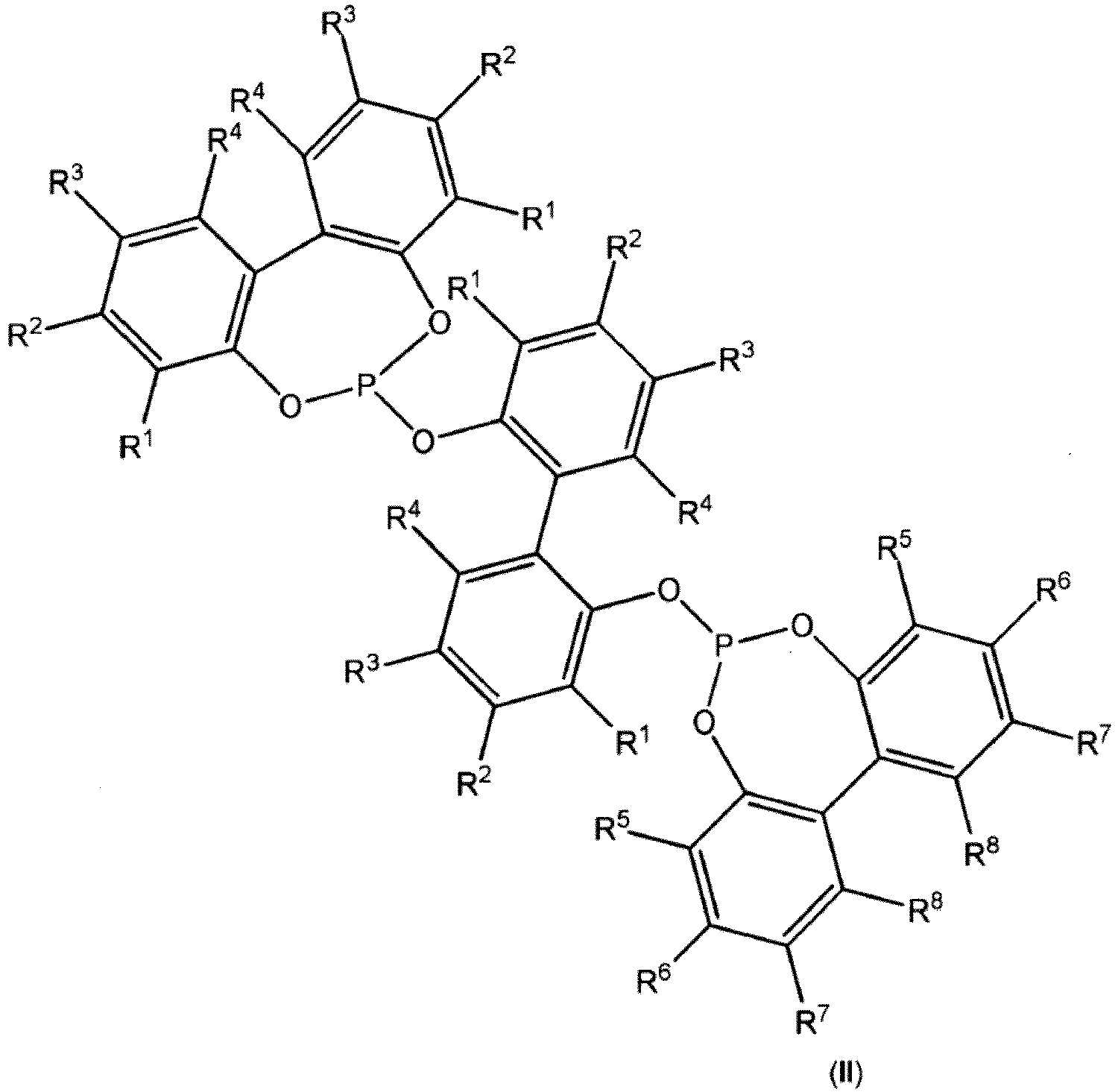


- Procédé selon l'une quelconque des revendications 1 à 11, dans lequel l'organobisphosphite présente une des formules générales I, II ou VI :


- Procédé selon l'une quelconque des revendications 1 à 11, dans lequel l'organobisphosphite présente une des formules générales I, II ou VI :


Applications Claiming Priority (2)
| Application Number | Priority Date | Filing Date | Title |
|---|---|---|---|
| DE102014202500.1A DE102014202500A1 (de) | 2014-02-12 | 2014-02-12 | Verfahren zur Reduzierung des Chlorgehalts von Organobisphosphiten |
| PCT/EP2015/050385 WO2015121007A1 (fr) | 2014-02-12 | 2015-01-12 | Procédé de réduction de la teneur en chlore dans des organobisphosphites |
Publications (2)
| Publication Number | Publication Date |
|---|---|
| EP3105239A1 EP3105239A1 (fr) | 2016-12-21 |
| EP3105239B1 true EP3105239B1 (fr) | 2018-03-14 |
Family
ID=52391926
Family Applications (1)
| Application Number | Title | Priority Date | Filing Date |
|---|---|---|---|
| EP15700650.3A Active EP3105239B1 (fr) | 2014-02-12 | 2015-01-12 | Procédé de réduction de la teneur en chlore dans des organobisphosphites |
Country Status (8)
| Country | Link |
|---|---|
| US (1) | US9650401B2 (fr) |
| EP (1) | EP3105239B1 (fr) |
| CN (1) | CN106536533B (fr) |
| AR (1) | AR099395A1 (fr) |
| DE (1) | DE102014202500A1 (fr) |
| ES (1) | ES2673118T3 (fr) |
| WO (1) | WO2015121007A1 (fr) |
| ZA (1) | ZA201606196B (fr) |
Families Citing this family (9)
| Publication number | Priority date | Publication date | Assignee | Title |
|---|---|---|---|---|
| DE102014201756A1 (de) | 2014-01-31 | 2015-08-06 | Evonik Degussa Gmbh | Reinigung chlorverschmutzter Organophosphorverbindungen |
| DE102014202500A1 (de) | 2014-02-12 | 2015-08-13 | Evonik Degussa Gmbh | Verfahren zur Reduzierung des Chlorgehalts von Organobisphosphiten |
| EP3147291A1 (fr) * | 2015-09-28 | 2017-03-29 | Evonik Degussa GmbH | Procede de reduction de la teneur en chlore d'organo tetraphosphites |
| TWI709568B (zh) * | 2015-09-30 | 2020-11-11 | 美商陶氏科技投資公司 | 用於製造有機磷化合物的方法 |
| EP3165529B1 (fr) * | 2015-11-09 | 2018-09-05 | Evonik Degussa GmbH | Procédé de réduction de la teneur en chlore dans des bis-phosphites avec des unités de 2,4 dimethylphenyl |
| EP3176174A1 (fr) * | 2015-12-03 | 2017-06-07 | Evonik Degussa GmbH | Procédé de réduction de la teneur en chlore d'organo tétraphosphites |
| EP3318570B1 (fr) | 2016-11-08 | 2019-08-07 | Evonik Degussa GmbH | Acide phosphoreux-p,p'-[5,5',6,6'-tétraméthyl-3,3'-bis(1-éthyléthyl)[1,1'-biphényl]-2,2'-diyl] p,p,p',p'-tétrakis (2,4-diméthylphényl)-ester dans l'hydroformylation |
| US11124531B2 (en) | 2017-06-19 | 2021-09-21 | Dow Technology Investments Llc | Processes for purifying ligands |
| EP4180439A1 (fr) * | 2021-11-15 | 2023-05-17 | Evonik Operations GmbH | Procédé de réduction de la teneur en chlore des organobisphosphites par fritte de gaz de protection |
Family Cites Families (12)
| Publication number | Priority date | Publication date | Assignee | Title |
|---|---|---|---|---|
| US4835299A (en) * | 1987-03-31 | 1989-05-30 | Union Carbide Corporation | Process for purifying tertiary organophosphites |
| TW500727B (en) * | 1999-11-02 | 2002-09-01 | Ciba Sc Holding Ag | Process for the preparation of low chloride stabilisers |
| DE102004049339A1 (de) | 2004-10-08 | 2006-04-13 | Basf Ag | Verfahren zur Reinigung von phosphorhaltigen Chelat-Liganden |
| WO2007109005A2 (fr) * | 2006-03-17 | 2007-09-27 | Invista Technologies S.A R.L. | Procédé pour purifier des triorganophosphites grâce au traitement à l'aide d'un adjuvant basique |
| DE102006058682A1 (de) * | 2006-12-13 | 2008-06-19 | Evonik Oxeno Gmbh | Bisphosphitliganden für die übergangsmetallkatalysierte Hydroformylierung |
| CN101684130B (zh) | 2008-09-25 | 2013-05-01 | 上海焦化有限公司 | 一种亚磷酸酯的制备方法 |
| DE102011002640B4 (de) | 2011-01-13 | 2021-10-07 | Evonik Operations Gmbh | Verfahren zur Aufreinigung von Biphephos |
| US9108988B2 (en) * | 2011-12-30 | 2015-08-18 | Basf Se | Method of purifying organic diphosphite compounds |
| WO2013098368A1 (fr) * | 2011-12-30 | 2013-07-04 | Basf Se | Procédé d'épuration de composés diphosphite organiques |
| DE102014201756A1 (de) | 2014-01-31 | 2015-08-06 | Evonik Degussa Gmbh | Reinigung chlorverschmutzter Organophosphorverbindungen |
| DE102014202500A1 (de) | 2014-02-12 | 2015-08-13 | Evonik Degussa Gmbh | Verfahren zur Reduzierung des Chlorgehalts von Organobisphosphiten |
| EP3145940B1 (fr) | 2014-05-20 | 2018-12-12 | Evonik Degussa GmbH | Procédé de réduction de la teneur en chlore d'organomonophosphites au moyen de deux solutions |
-
2014
- 2014-02-12 DE DE102014202500.1A patent/DE102014202500A1/de not_active Withdrawn
-
2015
- 2015-01-12 EP EP15700650.3A patent/EP3105239B1/fr active Active
- 2015-01-12 CN CN201580019416.0A patent/CN106536533B/zh active Active
- 2015-01-12 US US15/117,894 patent/US9650401B2/en active Active
- 2015-01-12 ES ES15700650.3T patent/ES2673118T3/es active Active
- 2015-01-12 WO PCT/EP2015/050385 patent/WO2015121007A1/fr not_active Ceased
- 2015-02-10 AR ARP150100378A patent/AR099395A1/es unknown
-
2016
- 2016-09-07 ZA ZA2016/06196A patent/ZA201606196B/en unknown
Also Published As
| Publication number | Publication date |
|---|---|
| DE102014202500A1 (de) | 2015-08-13 |
| ZA201606196B (en) | 2017-11-29 |
| WO2015121007A1 (fr) | 2015-08-20 |
| US9650401B2 (en) | 2017-05-16 |
| ES2673118T3 (es) | 2018-06-19 |
| AR099395A1 (es) | 2016-07-20 |
| EP3105239A1 (fr) | 2016-12-21 |
| US20170057985A1 (en) | 2017-03-02 |
| CN106536533B (zh) | 2019-04-23 |
| CN106536533A (zh) | 2017-03-22 |
Similar Documents
| Publication | Publication Date | Title |
|---|---|---|
| EP3105239B1 (fr) | Procédé de réduction de la teneur en chlore dans des organobisphosphites | |
| EP3145940B1 (fr) | Procédé de réduction de la teneur en chlore d'organomonophosphites au moyen de deux solutions | |
| DE3886577T2 (de) | Verfahren zur Reinigung von tertiären Organophosphiten. | |
| WO2013098368A1 (fr) | Procédé d'épuration de composés diphosphite organiques | |
| EP3176174A1 (fr) | Procédé de réduction de la teneur en chlore d'organo tétraphosphites | |
| EP2907819B1 (fr) | Procédé de fabrication de 6,6'-((3,3'-di-tert-butyl-5,5'-diméthoxy-[1,1'-biphényl]-2,2'-diyl)bis(oxy))bis(2,4,8,10-tétraméthyldibenzo[d,f][1,3,2]dioxaphosphépine | |
| EP0435071B1 (fr) | Procédé de préparation de phosphites organiques stables à l'hydrolyse | |
| EP3147291A1 (fr) | Procede de reduction de la teneur en chlore d'organo tetraphosphites | |
| EP2476685B1 (fr) | Procédé de fabrication de phosphates d'alkyle | |
| DE10130134A1 (de) | Verfahren zur Herstellung von alpha-Aminophosphonsäuren | |
| DE2165101A1 (de) | Verfahren zum Herstellen von Phosphorsäureestern von Fettsäuremono- oder diglyceriden | |
| EP2476686B1 (fr) | Procédé de fabrication de phosphates d'alkyle | |
| DE10130135A1 (de) | Verfahren zur Herstellung von N-Phosphonomethylglycin | |
| EP3165529B1 (fr) | Procédé de réduction de la teneur en chlore dans des bis-phosphites avec des unités de 2,4 dimethylphenyl | |
| EP4180439A1 (fr) | Procédé de réduction de la teneur en chlore des organobisphosphites par fritte de gaz de protection | |
| DE2511932A1 (de) | Verfahren zur herstellung von hydroxyalkylphosphinoxiden | |
| DD234426A1 (de) | Verfahren zur herstellung von chlorsulfanphosphorsaeure-o,o-dialkylestern | |
| WO2013098371A1 (fr) | Procédé de production de 6-chlorodibenzo[d,f] [1,3,2]-dioxaphosphépine | |
| EP3178828A1 (fr) | Heterocycliques de phosphite de seleniat et leur procedes de fabrication |
Legal Events
| Date | Code | Title | Description |
|---|---|---|---|
| PUAI | Public reference made under article 153(3) epc to a published international application that has entered the european phase |
Free format text: ORIGINAL CODE: 0009012 |
|
| STAA | Information on the status of an ep patent application or granted ep patent |
Free format text: STATUS: REQUEST FOR EXAMINATION WAS MADE |
|
| 17P | Request for examination filed |
Effective date: 20160803 |
|
| AK | Designated contracting states |
Kind code of ref document: A1 Designated state(s): AL AT BE BG CH CY CZ DE DK EE ES FI FR GB GR HR HU IE IS IT LI LT LU LV MC MK MT NL NO PL PT RO RS SE SI SK SM TR |
|
| AX | Request for extension of the european patent |
Extension state: BA ME |
|
| DAX | Request for extension of the european patent (deleted) | ||
| GRAP | Despatch of communication of intention to grant a patent |
Free format text: ORIGINAL CODE: EPIDOSNIGR1 |
|
| STAA | Information on the status of an ep patent application or granted ep patent |
Free format text: STATUS: GRANT OF PATENT IS INTENDED |
|
| INTG | Intention to grant announced |
Effective date: 20170906 |
|
| GRAS | Grant fee paid |
Free format text: ORIGINAL CODE: EPIDOSNIGR3 |
|
| GRAA | (expected) grant |
Free format text: ORIGINAL CODE: 0009210 |
|
| STAA | Information on the status of an ep patent application or granted ep patent |
Free format text: STATUS: THE PATENT HAS BEEN GRANTED |
|
| AK | Designated contracting states |
Kind code of ref document: B1 Designated state(s): AL AT BE BG CH CY CZ DE DK EE ES FI FR GB GR HR HU IE IS IT LI LT LU LV MC MK MT NL NO PL PT RO RS SE SI SK SM TR |
|
| REG | Reference to a national code |
Ref country code: GB Ref legal event code: FG4D Free format text: NOT ENGLISH |
|
| REG | Reference to a national code |
Ref country code: CH Ref legal event code: EP Ref country code: AT Ref legal event code: REF Ref document number: 978770 Country of ref document: AT Kind code of ref document: T Effective date: 20180315 |
|
| REG | Reference to a national code |
Ref country code: IE Ref legal event code: FG4D Free format text: LANGUAGE OF EP DOCUMENT: GERMAN |
|
| REG | Reference to a national code |
Ref country code: DE Ref legal event code: R096 Ref document number: 502015003398 Country of ref document: DE |
|
| REG | Reference to a national code |
Ref country code: ES Ref legal event code: FG2A Ref document number: 2673118 Country of ref document: ES Kind code of ref document: T3 Effective date: 20180619 |
|
| REG | Reference to a national code |
Ref country code: NL Ref legal event code: FP |
|
| REG | Reference to a national code |
Ref country code: SE Ref legal event code: TRGR |
|
| REG | Reference to a national code |
Ref country code: LT Ref legal event code: MG4D |
|
| PG25 | Lapsed in a contracting state [announced via postgrant information from national office to epo] |
Ref country code: NO Free format text: LAPSE BECAUSE OF FAILURE TO SUBMIT A TRANSLATION OF THE DESCRIPTION OR TO PAY THE FEE WITHIN THE PRESCRIBED TIME-LIMIT Effective date: 20180614 Ref country code: LT Free format text: LAPSE BECAUSE OF FAILURE TO SUBMIT A TRANSLATION OF THE DESCRIPTION OR TO PAY THE FEE WITHIN THE PRESCRIBED TIME-LIMIT Effective date: 20180314 Ref country code: HR Free format text: LAPSE BECAUSE OF FAILURE TO SUBMIT A TRANSLATION OF THE DESCRIPTION OR TO PAY THE FEE WITHIN THE PRESCRIBED TIME-LIMIT Effective date: 20180314 Ref country code: CY Free format text: LAPSE BECAUSE OF FAILURE TO SUBMIT A TRANSLATION OF THE DESCRIPTION OR TO PAY THE FEE WITHIN THE PRESCRIBED TIME-LIMIT Effective date: 20180314 Ref country code: FI Free format text: LAPSE BECAUSE OF FAILURE TO SUBMIT A TRANSLATION OF THE DESCRIPTION OR TO PAY THE FEE WITHIN THE PRESCRIBED TIME-LIMIT Effective date: 20180314 |
|
| PG25 | Lapsed in a contracting state [announced via postgrant information from national office to epo] |
Ref country code: GR Free format text: LAPSE BECAUSE OF FAILURE TO SUBMIT A TRANSLATION OF THE DESCRIPTION OR TO PAY THE FEE WITHIN THE PRESCRIBED TIME-LIMIT Effective date: 20180615 Ref country code: LV Free format text: LAPSE BECAUSE OF FAILURE TO SUBMIT A TRANSLATION OF THE DESCRIPTION OR TO PAY THE FEE WITHIN THE PRESCRIBED TIME-LIMIT Effective date: 20180314 Ref country code: RS Free format text: LAPSE BECAUSE OF FAILURE TO SUBMIT A TRANSLATION OF THE DESCRIPTION OR TO PAY THE FEE WITHIN THE PRESCRIBED TIME-LIMIT Effective date: 20180314 Ref country code: BG Free format text: LAPSE BECAUSE OF FAILURE TO SUBMIT A TRANSLATION OF THE DESCRIPTION OR TO PAY THE FEE WITHIN THE PRESCRIBED TIME-LIMIT Effective date: 20180614 |
|
| PG25 | Lapsed in a contracting state [announced via postgrant information from national office to epo] |
Ref country code: MT Free format text: LAPSE BECAUSE OF FAILURE TO SUBMIT A TRANSLATION OF THE DESCRIPTION OR TO PAY THE FEE WITHIN THE PRESCRIBED TIME-LIMIT Effective date: 20180314 |
|
| PG25 | Lapsed in a contracting state [announced via postgrant information from national office to epo] |
Ref country code: EE Free format text: LAPSE BECAUSE OF FAILURE TO SUBMIT A TRANSLATION OF THE DESCRIPTION OR TO PAY THE FEE WITHIN THE PRESCRIBED TIME-LIMIT Effective date: 20180314 Ref country code: PL Free format text: LAPSE BECAUSE OF FAILURE TO SUBMIT A TRANSLATION OF THE DESCRIPTION OR TO PAY THE FEE WITHIN THE PRESCRIBED TIME-LIMIT Effective date: 20180314 Ref country code: AL Free format text: LAPSE BECAUSE OF FAILURE TO SUBMIT A TRANSLATION OF THE DESCRIPTION OR TO PAY THE FEE WITHIN THE PRESCRIBED TIME-LIMIT Effective date: 20180314 Ref country code: RO Free format text: LAPSE BECAUSE OF FAILURE TO SUBMIT A TRANSLATION OF THE DESCRIPTION OR TO PAY THE FEE WITHIN THE PRESCRIBED TIME-LIMIT Effective date: 20180314 |
|
| PG25 | Lapsed in a contracting state [announced via postgrant information from national office to epo] |
Ref country code: CZ Free format text: LAPSE BECAUSE OF FAILURE TO SUBMIT A TRANSLATION OF THE DESCRIPTION OR TO PAY THE FEE WITHIN THE PRESCRIBED TIME-LIMIT Effective date: 20180314 Ref country code: SM Free format text: LAPSE BECAUSE OF FAILURE TO SUBMIT A TRANSLATION OF THE DESCRIPTION OR TO PAY THE FEE WITHIN THE PRESCRIBED TIME-LIMIT Effective date: 20180314 Ref country code: SK Free format text: LAPSE BECAUSE OF FAILURE TO SUBMIT A TRANSLATION OF THE DESCRIPTION OR TO PAY THE FEE WITHIN THE PRESCRIBED TIME-LIMIT Effective date: 20180314 |
|
| REG | Reference to a national code |
Ref country code: DE Ref legal event code: R097 Ref document number: 502015003398 Country of ref document: DE |
|
| PG25 | Lapsed in a contracting state [announced via postgrant information from national office to epo] |
Ref country code: PT Free format text: LAPSE BECAUSE OF FAILURE TO SUBMIT A TRANSLATION OF THE DESCRIPTION OR TO PAY THE FEE WITHIN THE PRESCRIBED TIME-LIMIT Effective date: 20180716 |
|
| PLBE | No opposition filed within time limit |
Free format text: ORIGINAL CODE: 0009261 |
|
| STAA | Information on the status of an ep patent application or granted ep patent |
Free format text: STATUS: NO OPPOSITION FILED WITHIN TIME LIMIT |
|
| PG25 | Lapsed in a contracting state [announced via postgrant information from national office to epo] |
Ref country code: DK Free format text: LAPSE BECAUSE OF FAILURE TO SUBMIT A TRANSLATION OF THE DESCRIPTION OR TO PAY THE FEE WITHIN THE PRESCRIBED TIME-LIMIT Effective date: 20180314 |
|
| 26N | No opposition filed |
Effective date: 20181217 |
|
| PG25 | Lapsed in a contracting state [announced via postgrant information from national office to epo] |
Ref country code: IT Free format text: LAPSE BECAUSE OF FAILURE TO SUBMIT A TRANSLATION OF THE DESCRIPTION OR TO PAY THE FEE WITHIN THE PRESCRIBED TIME-LIMIT Effective date: 20180314 Ref country code: SI Free format text: LAPSE BECAUSE OF FAILURE TO SUBMIT A TRANSLATION OF THE DESCRIPTION OR TO PAY THE FEE WITHIN THE PRESCRIBED TIME-LIMIT Effective date: 20180314 |
|
| PG25 | Lapsed in a contracting state [announced via postgrant information from national office to epo] |
Ref country code: MC Free format text: LAPSE BECAUSE OF FAILURE TO SUBMIT A TRANSLATION OF THE DESCRIPTION OR TO PAY THE FEE WITHIN THE PRESCRIBED TIME-LIMIT Effective date: 20180314 |
|
| PG25 | Lapsed in a contracting state [announced via postgrant information from national office to epo] |
Ref country code: LU Free format text: LAPSE BECAUSE OF NON-PAYMENT OF DUE FEES Effective date: 20190112 |
|
| REG | Reference to a national code |
Ref country code: IE Ref legal event code: MM4A |
|
| REG | Reference to a national code |
Ref country code: DE Ref legal event code: R081 Ref document number: 502015003398 Country of ref document: DE Owner name: EVONIK OXENO GMBH & CO. KG, DE Free format text: FORMER OWNER: EVONIK DEGUSSA GMBH, 45128 ESSEN, DE Ref country code: DE Ref legal event code: R081 Ref document number: 502015003398 Country of ref document: DE Owner name: EVONIK OPERATIONS GMBH, DE Free format text: FORMER OWNER: EVONIK DEGUSSA GMBH, 45128 ESSEN, DE |
|
| PG25 | Lapsed in a contracting state [announced via postgrant information from national office to epo] |
Ref country code: IE Free format text: LAPSE BECAUSE OF NON-PAYMENT OF DUE FEES Effective date: 20190112 |
|
| PG25 | Lapsed in a contracting state [announced via postgrant information from national office to epo] |
Ref country code: TR Free format text: LAPSE BECAUSE OF FAILURE TO SUBMIT A TRANSLATION OF THE DESCRIPTION OR TO PAY THE FEE WITHIN THE PRESCRIBED TIME-LIMIT Effective date: 20180314 |
|
| REG | Reference to a national code |
Ref country code: CH Ref legal event code: PFA Owner name: EVONIK OPERATIONS GMBH, DE Free format text: FORMER OWNER: EVONIK DEGUSSA GMBH, DE |
|
| REG | Reference to a national code |
Ref country code: ES Ref legal event code: PC2A Owner name: EVONIK OPERATIONS GMBH Effective date: 20200624 |
|
| REG | Reference to a national code |
Ref country code: BE Ref legal event code: HC Owner name: EVONIK OPERATIONS GMBH; DE Free format text: DETAILS ASSIGNMENT: CHANGE OF OWNER(S), CHANGEMENT DE NOM DU PROPRIETAIRE; FORMER OWNER NAME: EVONIK DEGUSSA GMBH Effective date: 20200403 |
|
| REG | Reference to a national code |
Ref country code: NL Ref legal event code: HC Owner name: EVONIK OPERATIONS GMBH; DE Free format text: DETAILS ASSIGNMENT: CHANGE OF OWNER(S), CHANGE OF OWNER(S) NAME Effective date: 20200928 |
|
| REG | Reference to a national code |
Ref country code: AT Ref legal event code: MM01 Ref document number: 978770 Country of ref document: AT Kind code of ref document: T Effective date: 20200112 |
|
| PG25 | Lapsed in a contracting state [announced via postgrant information from national office to epo] |
Ref country code: AT Free format text: LAPSE BECAUSE OF NON-PAYMENT OF DUE FEES Effective date: 20200112 |
|
| PG25 | Lapsed in a contracting state [announced via postgrant information from national office to epo] |
Ref country code: IS Free format text: LAPSE BECAUSE OF FAILURE TO SUBMIT A TRANSLATION OF THE DESCRIPTION OR TO PAY THE FEE WITHIN THE PRESCRIBED TIME-LIMIT Effective date: 20180714 |
|
| PG25 | Lapsed in a contracting state [announced via postgrant information from national office to epo] |
Ref country code: HU Free format text: LAPSE BECAUSE OF FAILURE TO SUBMIT A TRANSLATION OF THE DESCRIPTION OR TO PAY THE FEE WITHIN THE PRESCRIBED TIME-LIMIT; INVALID AB INITIO Effective date: 20150112 |
|
| PG25 | Lapsed in a contracting state [announced via postgrant information from national office to epo] |
Ref country code: MK Free format text: LAPSE BECAUSE OF FAILURE TO SUBMIT A TRANSLATION OF THE DESCRIPTION OR TO PAY THE FEE WITHIN THE PRESCRIBED TIME-LIMIT Effective date: 20180314 |
|
| P01 | Opt-out of the competence of the unified patent court (upc) registered |
Effective date: 20230526 |
|
| REG | Reference to a national code |
Ref country code: DE Ref legal event code: R081 Ref document number: 502015003398 Country of ref document: DE Owner name: EVONIK OXENO GMBH & CO. KG, DE Free format text: FORMER OWNER: EVONIK OPERATIONS GMBH, 45128 ESSEN, DE |
|
| REG | Reference to a national code |
Ref country code: GB Ref legal event code: 732E Free format text: REGISTERED BETWEEN 20231026 AND 20231101 |
|
| REG | Reference to a national code |
Ref country code: NL Ref legal event code: PD Owner name: EVONIK OXENO GMBH & CO. KG; DE Free format text: DETAILS ASSIGNMENT: CHANGE OF OWNER(S), ASSIGNMENT; FORMER OWNER NAME: EVONIK OPERATIONS GMBH Effective date: 20231218 |
|
| REG | Reference to a national code |
Ref country code: BE Ref legal event code: PD Owner name: EVONIK OXENO GMBH & CO. KG; DE Free format text: DETAILS ASSIGNMENT: CHANGE OF OWNER(S), ASSIGNMENT; FORMER OWNER NAME: EVONIK OPERATIONS GMBH Effective date: 20231129 |
|
| REG | Reference to a national code |
Ref country code: ES Ref legal event code: PC2A Owner name: EVONIK OXENO GMBH & CO. KG Effective date: 20240702 |
|
| REG | Reference to a national code |
Ref country code: CH Ref legal event code: U11 Free format text: ST27 STATUS EVENT CODE: U-0-0-U10-U11 (AS PROVIDED BY THE NATIONAL OFFICE) Effective date: 20260201 |
|
| PGFP | Annual fee paid to national office [announced via postgrant information from national office to epo] |
Ref country code: NL Payment date: 20260121 Year of fee payment: 12 |
|
| PGFP | Annual fee paid to national office [announced via postgrant information from national office to epo] |
Ref country code: SE Payment date: 20260121 Year of fee payment: 12 |
|
| PGFP | Annual fee paid to national office [announced via postgrant information from national office to epo] |
Ref country code: GB Payment date: 20260123 Year of fee payment: 12 |
|
| PGFP | Annual fee paid to national office [announced via postgrant information from national office to epo] |
Ref country code: ES Payment date: 20260227 Year of fee payment: 12 |
|
| PGFP | Annual fee paid to national office [announced via postgrant information from national office to epo] |
Ref country code: DE Payment date: 20260121 Year of fee payment: 12 |
|
| PGFP | Annual fee paid to national office [announced via postgrant information from national office to epo] |
Ref country code: BE Payment date: 20260121 Year of fee payment: 12 |
|
| PGFP | Annual fee paid to national office [announced via postgrant information from national office to epo] |
Ref country code: FR Payment date: 20260123 Year of fee payment: 12 |
|
| PGFP | Annual fee paid to national office [announced via postgrant information from national office to epo] |
Ref country code: CH Payment date: 20260201 Year of fee payment: 12 |