EP3105703B1 - Procédé et système de sécurisation de relations de bases de données contre un accès non autorisé - Google Patents
Procédé et système de sécurisation de relations de bases de données contre un accès non autorisé Download PDFInfo
- Publication number
- EP3105703B1 EP3105703B1 EP15704525.3A EP15704525A EP3105703B1 EP 3105703 B1 EP3105703 B1 EP 3105703B1 EP 15704525 A EP15704525 A EP 15704525A EP 3105703 B1 EP3105703 B1 EP 3105703B1
- Authority
- EP
- European Patent Office
- Prior art keywords
- relation
- data set
- mapping
- stored
- foreign key
- Prior art date
- Legal status (The legal status is an assumption and is not a legal conclusion. Google has not performed a legal analysis and makes no representation as to the accuracy of the status listed.)
- Active
Links
Images



Classifications
-
- G—PHYSICS
- G06—COMPUTING OR CALCULATING; COUNTING
- G06F—ELECTRIC DIGITAL DATA PROCESSING
- G06F21/00—Security arrangements for protecting computers, components thereof, programs or data against unauthorised activity
- G06F21/60—Protecting data
- G06F21/602—Providing cryptographic facilities or services
-
- G—PHYSICS
- G06—COMPUTING OR CALCULATING; COUNTING
- G06F—ELECTRIC DIGITAL DATA PROCESSING
- G06F16/00—Information retrieval; Database structures therefor; File system structures therefor
- G06F16/20—Information retrieval; Database structures therefor; File system structures therefor of structured data, e.g. relational data
- G06F16/22—Indexing; Data structures therefor; Storage structures
- G06F16/2228—Indexing structures
- G06F16/2272—Management thereof
-
- G—PHYSICS
- G06—COMPUTING OR CALCULATING; COUNTING
- G06F—ELECTRIC DIGITAL DATA PROCESSING
- G06F21/00—Security arrangements for protecting computers, components thereof, programs or data against unauthorised activity
- G06F21/60—Protecting data
- G06F21/62—Protecting access to data via a platform, e.g. using keys or access control rules
- G06F21/6218—Protecting access to data via a platform, e.g. using keys or access control rules to a system of files or objects, e.g. local or distributed file system or database
- G06F21/6227—Protecting access to data via a platform, e.g. using keys or access control rules to a system of files or objects, e.g. local or distributed file system or database where protection concerns the structure of data, e.g. records, types, queries
-
- G—PHYSICS
- G06—COMPUTING OR CALCULATING; COUNTING
- G06F—ELECTRIC DIGITAL DATA PROCESSING
- G06F21/00—Security arrangements for protecting computers, components thereof, programs or data against unauthorised activity
- G06F21/60—Protecting data
- G06F21/62—Protecting access to data via a platform, e.g. using keys or access control rules
- G06F21/6218—Protecting access to data via a platform, e.g. using keys or access control rules to a system of files or objects, e.g. local or distributed file system or database
- G06F21/6245—Protecting personal data, e.g. for financial or medical purposes
- G06F21/6254—Protecting personal data, e.g. for financial or medical purposes by anonymising data, e.g. decorrelating personal data from the owner's identification
Definitions
- the invention relates to a method for securing values of foreign key attributes of a data record against unauthorized access and a method for producing and / or restoring such foreign key attributes in a volatile data memory from a database.
- the invention further relates to a system that is adapted to secure values of foreign key attributes of a data record against unauthorized access and to restore values of foreign key attributes in a volatile data memory.
- the database operator can not only read the data records of individual relations (database tables), but also read and evaluate the links that may exist between two or more relations, so that the database operator can also draw conclusions from these links, for example about a User behavior.
- personal user data can be stored in a first relation and the master data for an electronic mailbox can be stored in a second relation.
- Information can be stored in a first relation (as a foreign key to the second relation) which indicates which mailbox of the second relation the respective user has access to.
- the values of the foreign keys are stored in the database together with the data record to which the values belong, i.e. the values of the foreign keys and the values of the non-key attributes form, together with a primary key, a single data record, which is stored in a relation or database table.
- the operator of the database can derive from this the information that these two users are in contact and possibly exchange information via this mailbox.
- This additional information is also called metadata.
- Encrypting the database alone cannot therefore prevent the operator of the database from accessing this or similar meta information which results from the relationships between two or more relationships in the database.
- the object of the present invention is therefore to provide methods and systems with which it can be effectively and efficiently prevented that on the one hand unauthorized persons and on the other hand the operators of databases can access meta information which result from the relationships between two or more database relationships.
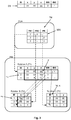
- Fig. 1 shows a data structure with which values of foreign key attributes of a data record DS can be secured against unauthorized access.
- the data record here comprises a primary key (column ID), three attributes that are not primary or foreign key attributes (columns x, y and z), a foreign key attribute (column IDB) with which a data record is referenced in relation B, and one Another foreign key attribute (IDC column) with which a data record in relation C is referenced.
- the system in which this data record and the references of this data record to relations B and C are stored for access by an application not shown here comprises a volatile data memory CUA and a non-volatile data memory or permanent data memory PM.
- the volatile data storage CUA is part of a secured and sealed infrastructure, which ensures that no unauthorized access to the volatile data storage CUA is possible.
- the secured and sealed infrastructure can include a number of redundant and distributed computer resources, each of which contains a number of so-called Trusted Platform Modules (TPM), circuit breakers to interrupt the power supply to all computer resources, electromechanical locks, a number of sensors with which access to the computer resources can be monitored.
- TPM Trusted Platform Modules
- a mapping relation TM is stored in the volatile data memory CUA, wherein the mapping relation TM can be a database table of a database stored in the volatile data memory CUA.
- This database can be, for example, an in-memory database that stores its data in the volatile data memory CUA.
- the data stored in the volatile data memory CUA can be replicated in a further volatile data memory, not shown here, wherein this further volatile data memory can be part of a further secured and sealed infrastructure.
- Cryptographic keys can also be stored in the volatile data memory CUA, which can be provided for encrypting or decrypting the data record DS.
- the mapping relation TM is stored exclusively in the volatile data memory CUA, so that the mapping relation TM is completely deleted after an interruption in the power supply. If the cryptographic keys are also stored in the volatile data memory CUA, they are also completely deleted after a power interruption. Deleting the mapping relation TM may be necessary, for example, if someone gains unauthorized or unauthorized access or access to a computer resource that is part of the sealed infrastructure.
- the computer resources of the sealed infrastructure are connected to a concerned sealing control device which monitors the electromechanical components. If the sealing monitoring device detects unauthorized access to a computer resource, it can interrupt the power supply to the compromised computer resource and to the volatile data memory CUA. In order to It is guaranteed that no data of the mapping relation TM can be produced from a compromised computer resource and from the volatile data memory CUA and that access to the cryptographic keys stored in the volatile data memory CUA is prevented.
- the sealing monitoring device can also be adapted to detect unauthorized access to the sealed infrastructure via a data network. In this case too, the compromised computer resources and the volatile data memory CUA are disconnected from the power supply.
- the computer resources of the sealed infrastructure and the volatile data storage in the sealed infrastructure are also interrupted by the power supply when maintenance work has to be carried out on or in the sealed infrastructure. This ensures that the operator of the sealed infrastructure or the operator of the database in which the mapping relation TM is stored also has no access to the mapping relation TM.
- an application for example a software application, which has to access the data stored in the mapping relation TM, is executed exclusively in the sealed infrastructure. In the case of appropriately certified applications, this can also ensure that the applications cannot pass on any of the data stored in the mapping relation TM without authorization.
- the user data or master data of the data record DS are stored in the permanent or non-volatile data memory PM, and a database management system can be provided for storing this data.
- a database management system can be provided for storing this data.
- the foreign key attributes are stored exclusively in the mapping relation TM in the volatile memory CUA.
- the example of a data structure shown for securing values of foreign key attributes of a data record against unauthorized access has a database provided in the non-volatile or permanent memory PM with three relations (relation A, relation B and relation C).
- a relation is colloquially referred to as a table or database table.
- the data record DS is stored in relation A.
- the references or links between relations B and C and relation A are so-called 1: n links, the method according to the invention or the data structures required for this also also for 1: 1 links or n: m links. Shortcuts is applicable.
- mapping data record MDS is stored in the mapping relation TM.
- the mapping relation TM points in the in Fig. 1 shown example six attributes or six columns.
- a first relation identifier is stored in a column RK1, this relation identifier indicating the relation to which the mapping data record MDS belongs.
- the value A indicates, for example, that the mapping data record MDS belongs to relation A.
- a first column identifier SK1 is stored, which indicates which foreign key attribute of the first relation specified in the first relation identifier RK1 is stored in the mapping data record MDS.
- the value of the foreign key referenced by the first column identifier SK1 is stored in a further column SK in the relation referenced by the first relation identifier RK1.
- the value of the primary key attribute of the data record DS stored in relation A is stored in a further column PK.
- the attributes RK1, SK1, SK and PK can therefore be used to identify a value of a specific foreign key attribute of a specific data record in a specific relation.
- mapping relation TM By providing the first relation identifier RK1 and the first column identifier SK1 in the mapping relation TM, values of foreign key attributes of different relations and values of different foreign key attributes of a relation can be stored in a single mapping relation TM. Because the mapping relation TM is stored in the non-volatile memory CUA, for example as a database table of an in-memory database, the access time can on a specific mapping data record MDS, especially if suitable index structures are provided, even with a very large number of mapping data records.
- the data record in relation A which is referenced by the first mapping data record MDS in the mapping relation TM, is indicated by the dashed arrow running from the mapping relation TM to relation A.
- the data record in relation B referenced by the foreign key attribute in the first mapping data record MDS is represented by the dashed arrow running from the foreign key attribute to relation B.
- Fig. 1 Application which is implemented in the sealed infrastructure and which wants to access the first data record in relation A and wants to resolve the foreign keys of the foreign key attributes IDB and IDC, for example by a so-called join of an SQL query, determines the values the foreign key attributes of the first data record of relation A in the mapping relation TM, in that the application determines the mapping data records MDS assigned to these foreign key attributes in the mapping relation TM.
- the example shown would be determined for the first data record of relation A for the foreign key attribute IDB the first mapping data record in the mapping relation TM and for the foreign key attribute IDC the fourth mapping data record in the relation TM.
- mapping data records determined in this way, the values of the foreign key attributes IDB and IDC of the first data record in relation A are available to the application, so that the application can create a corresponding join of an SQL query.
- the foreign key attributes or the values of the foreign key attributes IDB and IDC are also stored in relation A in the non-volatile data memory PM.
- the storage of the values of the foreign key attributes in the relations in the non-volatile data memory PM is provided only in order to be able to restore the mapping relation TM in the volatile data memory CUA if necessary, for example if the power supply to the volatile data memory CUA has been interrupted. Restoring the mapping relation TM in the volatile data memory CUA is referred to in FIG Fig. 4 described in more detail.
- the values of the foreign key attributes are cryptographically encrypted, wherein only cryptographic keys of the owner of the respective data records are used for encrypting the foreign key attributes. This ensures that the operator of the database cannot decrypt the encrypted attributes of a data record.
- other attributes that are not foreign key attributes or key attributes can also be cryptographically encrypted with an encryption key of the respective owner of the data record.
- the cryptographically encrypted attributes are identified by a bold frame, whereby not only attributes of relation A, which contains foreign key attributes, are encrypted, but also attributes of relations B and C.
- the values of the primary keys PK of the respective data records in the relations are not encrypted according to the invention, because no information can be derived from these values anyway. This also ensures that the values of the primary key attributes do not first have to be decrypted in order to generate a join of an SQL query, which brings with it a considerable speed advantage.
- Fig. 2 shows an alternative data structure for securing values of foreign key attributes of a data record against unauthorized access.
- Relations A, B and C are identical to that in Fig. 1 Example shown of a data structure according to the invention, ie these three relations have the same attributes and the same attribute values as in Fig. 1 ,
- FIG. 2 The data structure according to the invention shown differs from that in FIG Fig. 1 shown data structure in the structure of the mapping relation TM in the volatile data memory CUA. Another difference is that the in Fig. 2 shown example of a data structure according to the invention for each relation in the non-volatile data memory PM, which has foreign key attributes, in each case a mapping relation TM is provided in the volatile data memory CUA. If, for example, three relations have foreign key attributes in the non-volatile data memory PM, three mapping relations are likewise provided in the volatile data memory CUA. Because in that Fig. 2 Example shown in the non-volatile data memory PM has only the relation A foreign key attributes (IDB and IDC), only one mapping relation TM is provided in the volatile data memory CUA.
- IDB and IDC foreign key attributes
- mapping relation TM has three attributes or columns.
- a first column identifier SK1 is stored in a first column, which specifies the foreign key attribute to which the respective mapping data record MDS in the mapping relation TM relates.
- the first mapping data record MDS in the mapping relation TM relates to the foreign key attribute IDB in relation A.
- mapping relation TM is provided in the volatile memory CUA for each relation with foreign key attributes and because it is known which mapping -Relation in the volatile data memory CUA to which relation in the non-volatile data memory PM is assigned, an attribute that indicates this assignment can be dispensed with in the mapping relations.
- the value of the foreign key attribute specified in the first column identifier SK1 is stored in a further column of the mapping relation TM.
- the value of the primary key attribute PK of relation A is stored in a third column, so that exactly one data record in relation A is assigned to each mapping data record MDS in the mapping relation TM.
- a mapping data record MDS can be stored in the mapping relation TM for each value of the foreign key attributes of relation A.
- the values of the foreign key attribute IDB are stored in the first three mapping data records and the value of the foreign key attribute IDC is stored in the fourth data record.
- Fig. 3 shows a further alternative of a data structure for securing values of foreign key attributes of a data record against unauthorized access.
- the relationships A, B and C stored in the non-volatile data memory PM are identical in structure and content to those in FIGS Fig. 1 and Fig. 2 relations A, B and C shown
- a mapping relation TM is provided in the volatile data memory CUA in the volatile data memory CUA for each relation in the non-volatile data memory PM which has foreign key attributes.
- the example shown in the in Fig. 3 The example of a data structure shown shows the values of all foreign key attributes of a data record in relation A stored in a single mapping data record MDS in the mapping relation TM. Because all the attribute values of the foreign key attributes of the data records in relation A are stored in a single mapping data record MDS, the in Fig. 3 Mapping relation TM shown can be dispensed with the first column identifier SK1.
- the primary key PK is used to assign the mapping data record MDS to a data record in relation A.
- the mapping relation TM stores the values of the foreign key attributes IDB and IDC for the respective data record of relation A identified by the foreign key PK.
- the number of columns for storing values for foreign key attributes in the mapping relation TM accordingly varies depending on the number of the relation assigned to the respective mapping relation in the non-volatile data memory.
- FIG. 4 the method according to the invention for establishing and / or restoring a mapping relation TM in the volatile data memory CUA is explained in more detail with reference to a data record stored in relation A.
- mapping relations TM stored in the volatile data store CUA can be replicated in a redundant volatile data store, wherein the redundant volatile data store can be provided either in the same sealed infrastructure or in another sealed infrastructure.
- mapping relationships can be transferred from the redundant volatile data memory to the volatile data memory CUA are copied.
- all volatile data memories are disconnected from the power supply, it is necessary to restore the mapping relationships in the volatile data memory and, if appropriate, in the redundant volatile data memories from the relationships stored in the permanent data memory PM.
- FIG. 4 A relation A is shown in the non-volatile data memory PM, which has a data record for which a corresponding mapping data record is to be restored in the mapping relation TM.
- the data record in relation A has a primary key ID, two foreign key attributes IDB and IDC and three attributes x, y and z, which are not foreign key attributes and not key attributes.
- the foreign key attributes and the non-key attributes have been encrypted with a cryptographic key of the owner of the data record. According to the invention, however, it is only necessary that the values of the foreign key attributes are cryptographically encrypted with the key of the owner of the data record.
- a first step S1 the data record of relation A is copied into the volatile data memory CUA of the sealed infrastructure. This is necessary because the data record, but in any case the values of the foreign key attributes of the data record, must be decrypted to establish or restore the mapping relation, the data record being decrypted in the secured and sealed infrastructure. This ensures that the values of the foreign key attributes are only available in unencrypted form in the volatile data store CUA of the sealed infrastructure. If the sealed infrastructure or the volatile data memory CUA were compromised during a restoration process of the mapping relation TM, the unencrypted values of the foreign key attributes would also be deleted immediately.
- step S2 the data record copied into the volatile data memory CUA is decrypted, the cryptographic key (decryption key) assigned to the owner of the data record being used for decrypting the data record. It is important here that the cryptographic key assigned to the owner of the data record for decrypting the data record is stored exclusively in the sealed infrastructure or in the volatile data memory CUA.
- the cryptographic key for decrypting the record can only be used by the owner of the cryptographic key (because of the owner of the cryptographic key, for example, to use a password for the use of the key), the data record in the volatile data memory CUA can only be decrypted if the owner of the data record is logged on to the system.
- the operator of the sealed infrastructure or the operator of the database stored in the non-volatile data memory PM can therefore not establish the mapping relations in the volatile data memory CUA without the help of the owner of the data records stored in the respective relations, because neither the operator of the sealed infrastructure nor the operator of the database can use the necessary cryptographic keys of the owner of the data records.
- mapping relations in the volatile data memory CUA can only be restored successively by restoring the mapping datasets in the mapping relations for those data records in the database that correspond to a user who is logged in or who is authenticated to the system or Are assigned to users.
- step S2 the data record is available in unencrypted form in the volatile memory CUA.
- step S3 those values are extracted from the decrypted data record that are required for generating a corresponding mapping data record in the mapping relation TM.
- these are the values of the primary key ID and the values of the foreign key attributes IDB and IDC.
- the additional attribute values required for this must also be determined in step S3.
- Fig. 4 Data structure shown necessary that the first column identifier SK1 is also determined in step S3 in order to include a corresponding mapping data record in the Fig. 2 to be able to insert the mapping relation shown.
- mapping relation TM After the attribute values required for the mapping data record to be inserted into the mapping relation have been determined, the attributes or the mapping data record MDS thus formed are inserted into the mapping relation TM in step S4. All the data that is no longer required, for example the decrypted data record, can then be deleted in the volatile data memory CUA.
- Steps S1 to S4 are repeated for each data record in all relations that have foreign key attributes.
- mapping data record Before copying the data record into the volatile data memory CUA in step S1 or before decrypting the data record copied into the volatile data memory in step S2, it can be checked whether a mapping data record already exists in the corresponding mapping relation TM for this data record is. If there is no corresponding mapping record, the recovery process continues. Otherwise, the recovery process can be canceled.
- mapping relations present in the volatile data memory CUA After all mapping relations have been restored in the volatile data memory CUA, it can be advantageous to copy the mapping relations present in the volatile data memory CUA into one or more redundant volatile data memories.
- Steps S1 to S4 are also carried out when a new data record is added in a relation in the non-volatile data memory PM.
- a mapping data record must also be created in the corresponding mapping relation so that the values of the foreign key attributes of the new data record are also secured against unauthorized access.
- step S4 instead of an insert operation, an update operation is carried out, with which an existing mapping data record is replaced by the mapping data record generated in step S3. It is preferably provided that such an update of mapping data records is only carried out if a value of a foreign key attribute has also changed in a data record. In contrast, if only one value of a non-key attribute changes, the mapping relations are not updated.
- the present invention thus makes it possible to effectively and efficiently secure values of foreign key attributes of data records which can be stored in a database from unauthorized access by storing the values of the foreign key attributes of the data records exclusively in a volatile data memory, this volatile data memory being a component thereof a secure and sealed infrastructure.
- an application must access the volatile data storage in the sealed infrastructure, whereby the application is also executed in the sealed infrastructure, so that it can be ensured that this application does not provide any information about the values of the foreign key attributes to the outside can.
- the values of the foreign key attributes are additionally stored in the data records only for the restoration of the mapping relationships stored in the volatile memory, the mapping relationships only having to be established from the data records if, in addition to the volatile data memory, all redundant volatile data memories have also been deleted ,
- the values of the foreign key attributes are encrypted with a cryptographic key that belongs to or is assigned to the owner of the data record. This means that the operator of the database cannot access the values of the foreign key attributes in the data records.
Landscapes
- Engineering & Computer Science (AREA)
- Theoretical Computer Science (AREA)
- Health & Medical Sciences (AREA)
- Bioethics (AREA)
- General Health & Medical Sciences (AREA)
- Physics & Mathematics (AREA)
- Software Systems (AREA)
- General Engineering & Computer Science (AREA)
- General Physics & Mathematics (AREA)
- Databases & Information Systems (AREA)
- Computer Security & Cryptography (AREA)
- Computer Hardware Design (AREA)
- Medical Informatics (AREA)
- Data Mining & Analysis (AREA)
- Storage Device Security (AREA)
- Information Retrieval, Db Structures And Fs Structures Therefor (AREA)
Claims (15)
- Procédé de sécurisation de valeurs d'attributs d'un jeu de données (DS) stockable dans une première relation (T1) d'une base de données contre un accès non autorisé, dans lequel une valeur d'un attribut de clé primaire (PK) du jeu de données renvoie à une clé (PK) de la première relation (T1) et une valeur d'un attribut de clé étrangère (FK) du jeu de données renvoie à une clé (PK, K) d'une seconde relation (T2, T3), et dans lequel- la valeur d'un attribut de clé étrangère (FK) et la valeur d'un attribut de clé primaire (PK) du jeu de données (DS) sont stockées dans une relation de mappage (TM), la valeur de l'attribut de clé étrangère (FK) et la valeur de l'attribut de clé primaire (PK) du jeu de données (DS) formant un jeu de données de mappage (MDS) dans la relation de mappage (TM),- les valeurs d'un certain nombre d'attributs (F), autres que les attributs de clés étrangères du jeu de données, sont stockées dans la première relation (T1), la première relation (T1) étant stockée dans une mémoire de données non volatile (PM), et- la relation de mappage (TM) étant stockée uniquement dans une mémoire de données volatile (CUA), de sorte que la relation de mappage (TM) soit complètement supprimée après une interruption de l'alimentation électrique.
- Procédé selon la revendication précédente, dans lequel l'attribut de clé primaire (PK) du jeu de données (DS) est formé à partir d'un certain nombre d'attributs de clés du jeu de données (DS).
- Procédé selon l'une des revendications précédentes, dans lequel, dans le cas d'une pluralité de premières relations (T1) dans lesquelles des jeux de données (DS) comprenant des valeurs d'attributs de clés étrangères peuvent être stockés, les éléments suivants sont en outre stockés dans la relation de mappage (TM) avec chaque jeu de données de mappage (MDS) :- un premier identificateur de relation (RK1) comprenant des informations sur la première relation (T1) de la pluralité de premières relations à laquelle le jeu de données de mappage (MDS) respectif est associé, et- un premier identificateur de colonne (SK1) comprenant des informations sur l'attribut de clé étrangère (FK) du jeu de données (DS) auquel la valeur de l'attribut de clé étrangère stockée dans le jeu de données de mappage (MDS) respectif est associée.
- Procédé selon l'une des revendications 1 à 2, dans lequel, dans le cas d'une pluralité de premières relations (T1) dans lesquelles des jeux de données (DS) comprenant des valeurs d'attributs de clés étrangères peuvent être stockés, une relation de mappage (TM) est générée pour chacune des premières relations (T1) dans la mémoire de données volatile (CUA), relation de mappage dans laquelle les valeurs des attributs de clés étrangères (FK) des jeux de données (DS) respectifs sont stockées, dans lequel, outre la valeur de l'attribut de clé étrangère (FK), la valeur d'un attribut de clé primaire (PK) du jeu de données (DS) respectif est stockée.
- Procédé selon la revendication précédente, dans lequel, dans la relation de mappage (TM) avec chaque jeu de données de mappage (MDS), un premier identificateur de colonne (SK1) est en outre stocké, lequel identificateur de colonne comprend des informations sur l'attribut de clé étrangère (FK) du jeu de données (DS) auquel la valeur de l'attribut de clé étrangère stockée dans le jeu de données de mappage (MDS) respectif est associée.
- Procédé selon l'une des revendications précédentes 3 à 5, dans lequel, les éléments suivants sont en outre stockés dans la relation de mappage (TM) avec chaque jeu de données de mappage (MDS) :- un second identificateur de relation (RK2) comprenant des informations sur la seconde relation (T2) de la pluralité de secondes relations qui est référencée par la valeur de l'attribut de clé étrangère du jeu de données de mappage (MDS), et- un second identificateur de colonne (SK2) comprenant des informations sur la clé (K) de la valeur de l'attribut de clé étrangère du jeu de données de mappage (MDS) qui est référencée dans la seconde relation (T2).
- Procédé selon l'une des revendications précédentes, dans lequel la valeur de l'attribut de clé étrangère (FK) du jeu de données (DS) est en outre stockée dans la première relation (T1), dans lequel la valeur de l'attribut de clé étrangère (FK) du jeu de données (DS) stockée dans la première relation (T1) est codée par cryptographie, de préférence avec une clé cryptographique associée au détenteur du jeu de données.
- Procédé selon la revendication précédente, dans lequel, outre la valeur de l'attribut de clé étrangère (FK), une valeur d'au moins un autre attribut (F), autre qu'un attribut de clé étrangère du jeu de données (DS), est codée par cryptographie.
- Procédé selon la revendication précédente, dans lequel, lors de la génération d'un nouveau jeu de données (DS), au moins les valeurs des attributs de clés étrangères (FK) du nouveau jeu de données (DS) et les valeurs des attributs de clés primaires (PK) du nouveau jeu de données (DS) sont stockées dans les relations de mappage (TM), et au moins les valeurs des attributs de clés étrangères (FK) contenues dans la première relation (T1) sont codées par cryptographie.
- Procédé selon la revendication précédente, dans lequel les relations de mappage (TM) sont en outre stockées dans une mémoire de données volatile redondante (CUA2).
- Procédé d'établissement et/ou de rétablissement d'une relation de mappage (TM) dans une mémoire de données volatile (CUA), dans lequel, dans la relation de mappage, les valeurs d'attributs de clés étrangères (FK) d'un jeu de données stocké dans une première relation (T1) d'une base de données, peuvent être stockées, dans lequel au moins les valeurs des attributs de clés étrangères (FK) contenues dans la première relation (T1) sont codées par cryptographie et sont de préférence être décodées uniquement avec une clé cryptographique du détenteur du jeu de données, dans lequel,- lorsque le détenteur du jeu de données accède au jeu de données, les valeurs des attributs de clés étrangères (FK) codées sont décodées avec la clé cryptographique du détenteur du jeu de données,- les valeurs décodées des attributs de clés étrangères (FK) sont stockées dans un jeu de données de mappage (MDS) de la relation de mappage (TM), et- outre les valeurs des attributs de clés étrangères (FK) contenues dans le jeu de données de mappage (MDS), la valeur d'un attribut de clé primaire (PK) du jeu de données est stockée, et- la relation de mappage étant stockée uniquement dans une mémoire de données volatile, de sorte que, après une interruption de l'alimentation électrique, la relation de mappage soit complètement supprimée.
- Procédé selon la revendication précédente, dans lequel, avant le décodage des attributs de clés étrangères (FK) codés, on vérifie si, pour la valeur de l'attribut de clé primaire (PK) du jeu de données, un jeu de données de mappage (MDS) dans la relation de mappage (TM) est précédemment stocké.
- Procédé selon l'une des deux revendications précédentes, dans lequel les éléments suivants sont en outre stockés dans le jeu de données de mappage (MDS) :- un premier identificateur de colonne (SK1) comprenant des informations sur l'attribut de clé étrangère (FK) du jeu de données auquel la valeur de l'attribut de clé étrangère stockée dans le jeu de données de mappage (MDS) est associée, et- de préférence en outre :- un premier identificateur de relation (RK1) comprenant des informations sur la première relation (T1) de la pluralité de premières relations qui est associée au jeu de données de mappage (MDS), et/ou- un second identificateur de relation (RK2) comprenant des informations sur la seconde relation (T2) de la pluralité de secondes relations qui est référencée par la valeur de l'attribut de clé étrangère du jeu de données de mappage (MDS), et/ou- un second identificateur de colonne (SK2) comprenant des informations sur la clé (K) de la valeur de l'attribut de clé étrangère du jeu de données de mappage (MDS) qui est référencée dans la seconde relation (T2).
- Procédé selon l'une des revendications précédentes, dans lequel les relations de mappage (TM) sont stockées dans une infrastructure sécurisée et verrouillée et/ou les valeurs des attributs de clés étrangères (FK) codés sont décodées dans une infrastructure sécurisée et verrouillée, dans lequel les clés cryptographiques nécessaires à cet effet sont stockées uniquement dans l'infrastructure sécurisée et verrouillée.
- Procédé selon la revendication précédente, dans lequel une application est exécutée afin d'accéder aux données des relations de mappage (TM) dans l'infrastructure sécurisée et verrouillée.
Applications Claiming Priority (2)
| Application Number | Priority Date | Filing Date | Title |
|---|---|---|---|
| DE102014101710.2A DE102014101710A1 (de) | 2014-02-12 | 2014-02-12 | Verfahren und System zum Sichern von Datenbankrelationen vor unberechtigtem Zugriff |
| PCT/EP2015/052959 WO2015121346A1 (fr) | 2014-02-12 | 2015-02-12 | Procédé et système de sécurisation de relations de bases de données contre un accès non autorisé |
Publications (2)
| Publication Number | Publication Date |
|---|---|
| EP3105703A1 EP3105703A1 (fr) | 2016-12-21 |
| EP3105703B1 true EP3105703B1 (fr) | 2020-01-01 |
Family
ID=52472317
Family Applications (1)
| Application Number | Title | Priority Date | Filing Date |
|---|---|---|---|
| EP15704525.3A Active EP3105703B1 (fr) | 2014-02-12 | 2015-02-12 | Procédé et système de sécurisation de relations de bases de données contre un accès non autorisé |
Country Status (5)
| Country | Link |
|---|---|
| US (1) | US10380354B2 (fr) |
| EP (1) | EP3105703B1 (fr) |
| CN (1) | CN106233298B (fr) |
| DE (1) | DE102014101710A1 (fr) |
| WO (1) | WO2015121346A1 (fr) |
Families Citing this family (1)
| Publication number | Priority date | Publication date | Assignee | Title |
|---|---|---|---|---|
| DE102015114544A1 (de) | 2015-08-31 | 2017-03-02 | Uniscon Universal Identity Control Gmbh | Verfahren zum sicheren und effizienten Zugriff auf Verbindungsdaten |
Family Cites Families (8)
| Publication number | Priority date | Publication date | Assignee | Title |
|---|---|---|---|---|
| DE19925910B4 (de) * | 1999-06-07 | 2005-04-28 | Siemens Ag | Verfahren zum Be- oder Verarbeiten von Daten |
| US8131674B2 (en) * | 2004-06-25 | 2012-03-06 | Apple Inc. | Methods and systems for managing data |
| DE102006012311A1 (de) * | 2006-03-17 | 2007-09-20 | Deutsche Telekom Ag | Verfahren und Vorrichtung zur Pseudonymisierung von digitalen Daten |
| CN100437590C (zh) * | 2007-06-08 | 2008-11-26 | 北京大学 | 预取对象的方法 |
| JP5740573B2 (ja) * | 2010-05-13 | 2015-06-24 | パナソニックIpマネジメント株式会社 | 情報処理装置および情報処理方法 |
| CN101901269B (zh) * | 2010-08-04 | 2012-05-23 | 国电南瑞科技股份有限公司 | 实时库外键引用显示方法 |
| CN103139604B (zh) * | 2013-01-14 | 2016-03-16 | 中国科学院声学研究所 | 一种基于缓存模型的ipqam频点分配与回收方法 |
| CN103309958B (zh) * | 2013-05-28 | 2016-06-29 | 中国人民大学 | Gpu和cpu混合架构下的olap星型连接查询优化方法 |
-
2014
- 2014-02-12 DE DE102014101710.2A patent/DE102014101710A1/de active Pending
-
2015
- 2015-02-12 WO PCT/EP2015/052959 patent/WO2015121346A1/fr not_active Ceased
- 2015-02-12 CN CN201580008397.1A patent/CN106233298B/zh active Active
- 2015-02-12 EP EP15704525.3A patent/EP3105703B1/fr active Active
-
2016
- 2016-08-12 US US15/235,398 patent/US10380354B2/en active Active
Non-Patent Citations (1)
| Title |
|---|
| None * |
Also Published As
| Publication number | Publication date |
|---|---|
| CN106233298A (zh) | 2016-12-14 |
| DE102014101710A1 (de) | 2015-08-13 |
| US20160350540A1 (en) | 2016-12-01 |
| EP3105703A1 (fr) | 2016-12-21 |
| WO2015121346A1 (fr) | 2015-08-20 |
| US10380354B2 (en) | 2019-08-13 |
| CN106233298B (zh) | 2020-10-30 |
Similar Documents
| Publication | Publication Date | Title |
|---|---|---|
| DE69634880T2 (de) | Verfahren und gerät zum kontrollierten zugriff zu verschlüsselten datenakten in einem computersystem | |
| DE69123680T2 (de) | Verfahren und Vorrichtung zum Schutz von Mehrfachrechner-Softwarekopien gegen unberechtigte Benutzung | |
| EP3452941B1 (fr) | Procédé de documentation électronique d'informations de licence | |
| EP2772856B1 (fr) | Procédé de réalisation de tâches sur un système informatique de production et système de traitement de données | |
| DE10025626A1 (de) | Verschlüsseln von abzuspeichernden Daten in einem IV-System | |
| EP3747151B1 (fr) | Procédé pour la génération d'arborescences sans métadonnées | |
| DE112014000584T5 (de) | Erreichen von Speichereffizienz bei durchgängiger Verschlüsselung unter Verwendung von nachgelagerten (Downstream-)Decryptern | |
| EP3619638B1 (fr) | Procédé de sécurisation de l'accès aux données | |
| DE102012218576B4 (de) | Verschlüsseln von Daten und Charakterisierungsdaten, die den gültigen Inhalt einer Spalte beschreiben | |
| DE102006012311A1 (de) | Verfahren und Vorrichtung zur Pseudonymisierung von digitalen Daten | |
| DE102021106261A1 (de) | Verfahren zur Autorisierung eines ersten Teilnehmers in einem Kommunikationsnetz, Verarbeitungseinrichtung, Kraftfahrzeug und Infrastruktureinrichtung | |
| EP3105703B1 (fr) | Procédé et système de sécurisation de relations de bases de données contre un accès non autorisé | |
| DE112012000780B4 (de) | Verarbeiten von Berechtigungsprüfungsdaten | |
| EP3345366B1 (fr) | Procédé d'accès sûr et efficace à des données de connexion | |
| DE102014213454A1 (de) | Verfahren und System zur Erkennung einer Manipulation von Datensätzen | |
| DE102013019487A1 (de) | Verfahren, Vorrichtungen und System zur Online-Datensicherung | |
| EP1715404A1 (fr) | Système pour le stockage et la récupération d'informations confidentielles | |
| EP3156932A1 (fr) | Procede et systeme de protection de donnees electroniques confidentielles | |
| WO2018130426A1 (fr) | Anonymisation d'une chaîne de blocs | |
| DE102017209565A1 (de) | Numerische Steuerung mit integrierter Nutzerverwaltung | |
| DE112017000530T5 (de) | Konsistentes Speichern von Daten in einem verstreuten Speichernetzwerk | |
| WO2017063803A1 (fr) | Procédé et système de protection de données électroniques confidentielles | |
| DE102012110507A1 (de) | Verfahren zum geschützten Wiederherstellen von Daten, Computerprogrammprodukt sowie Computersystem | |
| DE102017103519A1 (de) | Verfahren zum gesicherten Zugriff auf Daten | |
| EP3821558B1 (fr) | Procédé pour établir un système de référencement hiérarchique sécurisé |
Legal Events
| Date | Code | Title | Description |
|---|---|---|---|
| STAA | Information on the status of an ep patent application or granted ep patent |
Free format text: STATUS: THE INTERNATIONAL PUBLICATION HAS BEEN MADE |
|
| PUAI | Public reference made under article 153(3) epc to a published international application that has entered the european phase |
Free format text: ORIGINAL CODE: 0009012 |
|
| STAA | Information on the status of an ep patent application or granted ep patent |
Free format text: STATUS: REQUEST FOR EXAMINATION WAS MADE |
|
| 17P | Request for examination filed |
Effective date: 20160912 |
|
| AK | Designated contracting states |
Kind code of ref document: A1 Designated state(s): AL AT BE BG CH CY CZ DE DK EE ES FI FR GB GR HR HU IE IS IT LI LT LU LV MC MK MT NL NO PL PT RO RS SE SI SK SM TR |
|
| AX | Request for extension of the european patent |
Extension state: BA ME |
|
| DAX | Request for extension of the european patent (deleted) | ||
| GRAP | Despatch of communication of intention to grant a patent |
Free format text: ORIGINAL CODE: EPIDOSNIGR1 |
|
| STAA | Information on the status of an ep patent application or granted ep patent |
Free format text: STATUS: GRANT OF PATENT IS INTENDED |
|
| RIC1 | Information provided on ipc code assigned before grant |
Ipc: G06F 16/22 20190101ALI20190711BHEP Ipc: G06F 21/60 20130101ALI20190711BHEP Ipc: G06F 21/62 20130101AFI20190711BHEP |
|
| INTG | Intention to grant announced |
Effective date: 20190729 |
|
| GRAS | Grant fee paid |
Free format text: ORIGINAL CODE: EPIDOSNIGR3 |
|
| GRAA | (expected) grant |
Free format text: ORIGINAL CODE: 0009210 |
|
| STAA | Information on the status of an ep patent application or granted ep patent |
Free format text: STATUS: THE PATENT HAS BEEN GRANTED |
|
| AK | Designated contracting states |
Kind code of ref document: B1 Designated state(s): AL AT BE BG CH CY CZ DE DK EE ES FI FR GB GR HR HU IE IS IT LI LT LU LV MC MK MT NL NO PL PT RO RS SE SI SK SM TR |
|
| RAP1 | Party data changed (applicant data changed or rights of an application transferred) |
Owner name: UNISCON UNIVERSAL IDENTITY CONTROL GMBH |
|
| REG | Reference to a national code |
Ref country code: GB Ref legal event code: FG4D Free format text: NOT ENGLISH |
|
| REG | Reference to a national code |
Ref country code: CH Ref legal event code: EP Ref country code: AT Ref legal event code: REF Ref document number: 1220716 Country of ref document: AT Kind code of ref document: T Effective date: 20200115 |
|
| REG | Reference to a national code |
Ref country code: DE Ref legal event code: R096 Ref document number: 502015011384 Country of ref document: DE |
|
| REG | Reference to a national code |
Ref country code: IE Ref legal event code: FG4D Free format text: LANGUAGE OF EP DOCUMENT: GERMAN |
|
| REG | Reference to a national code |
Ref country code: NL Ref legal event code: MP Effective date: 20200101 |
|
| REG | Reference to a national code |
Ref country code: LT Ref legal event code: MG4D |
|
| PG25 | Lapsed in a contracting state [announced via postgrant information from national office to epo] |
Ref country code: NL Free format text: LAPSE BECAUSE OF FAILURE TO SUBMIT A TRANSLATION OF THE DESCRIPTION OR TO PAY THE FEE WITHIN THE PRESCRIBED TIME-LIMIT Effective date: 20200101 Ref country code: RS Free format text: LAPSE BECAUSE OF FAILURE TO SUBMIT A TRANSLATION OF THE DESCRIPTION OR TO PAY THE FEE WITHIN THE PRESCRIBED TIME-LIMIT Effective date: 20200101 Ref country code: LT Free format text: LAPSE BECAUSE OF FAILURE TO SUBMIT A TRANSLATION OF THE DESCRIPTION OR TO PAY THE FEE WITHIN THE PRESCRIBED TIME-LIMIT Effective date: 20200101 Ref country code: CZ Free format text: LAPSE BECAUSE OF FAILURE TO SUBMIT A TRANSLATION OF THE DESCRIPTION OR TO PAY THE FEE WITHIN THE PRESCRIBED TIME-LIMIT Effective date: 20200101 Ref country code: PT Free format text: LAPSE BECAUSE OF FAILURE TO SUBMIT A TRANSLATION OF THE DESCRIPTION OR TO PAY THE FEE WITHIN THE PRESCRIBED TIME-LIMIT Effective date: 20200527 Ref country code: FI Free format text: LAPSE BECAUSE OF FAILURE TO SUBMIT A TRANSLATION OF THE DESCRIPTION OR TO PAY THE FEE WITHIN THE PRESCRIBED TIME-LIMIT Effective date: 20200101 Ref country code: NO Free format text: LAPSE BECAUSE OF FAILURE TO SUBMIT A TRANSLATION OF THE DESCRIPTION OR TO PAY THE FEE WITHIN THE PRESCRIBED TIME-LIMIT Effective date: 20200401 |
|
| PG25 | Lapsed in a contracting state [announced via postgrant information from national office to epo] |
Ref country code: LV Free format text: LAPSE BECAUSE OF FAILURE TO SUBMIT A TRANSLATION OF THE DESCRIPTION OR TO PAY THE FEE WITHIN THE PRESCRIBED TIME-LIMIT Effective date: 20200101 Ref country code: SE Free format text: LAPSE BECAUSE OF FAILURE TO SUBMIT A TRANSLATION OF THE DESCRIPTION OR TO PAY THE FEE WITHIN THE PRESCRIBED TIME-LIMIT Effective date: 20200101 Ref country code: IS Free format text: LAPSE BECAUSE OF FAILURE TO SUBMIT A TRANSLATION OF THE DESCRIPTION OR TO PAY THE FEE WITHIN THE PRESCRIBED TIME-LIMIT Effective date: 20200501 Ref country code: BG Free format text: LAPSE BECAUSE OF FAILURE TO SUBMIT A TRANSLATION OF THE DESCRIPTION OR TO PAY THE FEE WITHIN THE PRESCRIBED TIME-LIMIT Effective date: 20200401 Ref country code: HR Free format text: LAPSE BECAUSE OF FAILURE TO SUBMIT A TRANSLATION OF THE DESCRIPTION OR TO PAY THE FEE WITHIN THE PRESCRIBED TIME-LIMIT Effective date: 20200101 Ref country code: GR Free format text: LAPSE BECAUSE OF FAILURE TO SUBMIT A TRANSLATION OF THE DESCRIPTION OR TO PAY THE FEE WITHIN THE PRESCRIBED TIME-LIMIT Effective date: 20200402 |
|
| REG | Reference to a national code |
Ref country code: DE Ref legal event code: R097 Ref document number: 502015011384 Country of ref document: DE |
|
| PG25 | Lapsed in a contracting state [announced via postgrant information from national office to epo] |
Ref country code: SK Free format text: LAPSE BECAUSE OF FAILURE TO SUBMIT A TRANSLATION OF THE DESCRIPTION OR TO PAY THE FEE WITHIN THE PRESCRIBED TIME-LIMIT Effective date: 20200101 Ref country code: RO Free format text: LAPSE BECAUSE OF FAILURE TO SUBMIT A TRANSLATION OF THE DESCRIPTION OR TO PAY THE FEE WITHIN THE PRESCRIBED TIME-LIMIT Effective date: 20200101 Ref country code: EE Free format text: LAPSE BECAUSE OF FAILURE TO SUBMIT A TRANSLATION OF THE DESCRIPTION OR TO PAY THE FEE WITHIN THE PRESCRIBED TIME-LIMIT Effective date: 20200101 Ref country code: SM Free format text: LAPSE BECAUSE OF FAILURE TO SUBMIT A TRANSLATION OF THE DESCRIPTION OR TO PAY THE FEE WITHIN THE PRESCRIBED TIME-LIMIT Effective date: 20200101 Ref country code: DK Free format text: LAPSE BECAUSE OF FAILURE TO SUBMIT A TRANSLATION OF THE DESCRIPTION OR TO PAY THE FEE WITHIN THE PRESCRIBED TIME-LIMIT Effective date: 20200101 Ref country code: ES Free format text: LAPSE BECAUSE OF FAILURE TO SUBMIT A TRANSLATION OF THE DESCRIPTION OR TO PAY THE FEE WITHIN THE PRESCRIBED TIME-LIMIT Effective date: 20200101 |
|
| PLBE | No opposition filed within time limit |
Free format text: ORIGINAL CODE: 0009261 |
|
| STAA | Information on the status of an ep patent application or granted ep patent |
Free format text: STATUS: NO OPPOSITION FILED WITHIN TIME LIMIT |
|
| 26N | No opposition filed |
Effective date: 20201002 |
|
| PG25 | Lapsed in a contracting state [announced via postgrant information from national office to epo] |
Ref country code: IT Free format text: LAPSE BECAUSE OF FAILURE TO SUBMIT A TRANSLATION OF THE DESCRIPTION OR TO PAY THE FEE WITHIN THE PRESCRIBED TIME-LIMIT Effective date: 20200101 |
|
| PG25 | Lapsed in a contracting state [announced via postgrant information from national office to epo] |
Ref country code: SI Free format text: LAPSE BECAUSE OF FAILURE TO SUBMIT A TRANSLATION OF THE DESCRIPTION OR TO PAY THE FEE WITHIN THE PRESCRIBED TIME-LIMIT Effective date: 20200101 Ref country code: PL Free format text: LAPSE BECAUSE OF FAILURE TO SUBMIT A TRANSLATION OF THE DESCRIPTION OR TO PAY THE FEE WITHIN THE PRESCRIBED TIME-LIMIT Effective date: 20200101 |
|
| PG25 | Lapsed in a contracting state [announced via postgrant information from national office to epo] |
Ref country code: TR Free format text: LAPSE BECAUSE OF FAILURE TO SUBMIT A TRANSLATION OF THE DESCRIPTION OR TO PAY THE FEE WITHIN THE PRESCRIBED TIME-LIMIT Effective date: 20200101 Ref country code: MT Free format text: LAPSE BECAUSE OF FAILURE TO SUBMIT A TRANSLATION OF THE DESCRIPTION OR TO PAY THE FEE WITHIN THE PRESCRIBED TIME-LIMIT Effective date: 20200101 Ref country code: CY Free format text: LAPSE BECAUSE OF FAILURE TO SUBMIT A TRANSLATION OF THE DESCRIPTION OR TO PAY THE FEE WITHIN THE PRESCRIBED TIME-LIMIT Effective date: 20200101 |
|
| PG25 | Lapsed in a contracting state [announced via postgrant information from national office to epo] |
Ref country code: MK Free format text: LAPSE BECAUSE OF FAILURE TO SUBMIT A TRANSLATION OF THE DESCRIPTION OR TO PAY THE FEE WITHIN THE PRESCRIBED TIME-LIMIT Effective date: 20200101 Ref country code: AL Free format text: LAPSE BECAUSE OF FAILURE TO SUBMIT A TRANSLATION OF THE DESCRIPTION OR TO PAY THE FEE WITHIN THE PRESCRIBED TIME-LIMIT Effective date: 20200101 |
|
| PGFP | Annual fee paid to national office [announced via postgrant information from national office to epo] |
Ref country code: LU Payment date: 20250218 Year of fee payment: 11 |
|
| PGFP | Annual fee paid to national office [announced via postgrant information from national office to epo] |
Ref country code: MC Payment date: 20250225 Year of fee payment: 11 |
|
| PGFP | Annual fee paid to national office [announced via postgrant information from national office to epo] |
Ref country code: DE Payment date: 20250218 Year of fee payment: 11 |
|
| PGFP | Annual fee paid to national office [announced via postgrant information from national office to epo] |
Ref country code: IE Payment date: 20250218 Year of fee payment: 11 |
|
| PGFP | Annual fee paid to national office [announced via postgrant information from national office to epo] |
Ref country code: CH Payment date: 20250301 Year of fee payment: 11 Ref country code: AT Payment date: 20250217 Year of fee payment: 11 Ref country code: BE Payment date: 20250218 Year of fee payment: 11 |
|
| PGFP | Annual fee paid to national office [announced via postgrant information from national office to epo] |
Ref country code: FR Payment date: 20250219 Year of fee payment: 11 |
|
| PGFP | Annual fee paid to national office [announced via postgrant information from national office to epo] |
Ref country code: GB Payment date: 20250220 Year of fee payment: 11 |
|
| REG | Reference to a national code |
Ref country code: DE Ref legal event code: R081 Ref document number: 502015011384 Country of ref document: DE Owner name: IDGARD GMBH, DE Free format text: FORMER OWNER: UNISCON UNIVERSAL IDENTITY CONTROL GMBH, 80992 MUENCHEN, DE |
|
| REG | Reference to a national code |
Ref country code: LU Ref legal event code: PD Owner name: IDGARD GMBH; DE Free format text: FORMER OWNER: UNISCON UNIVERSAL IDENTITY CONTROL GMBH Effective date: 20250811 |
|
| REG | Reference to a national code |
Ref country code: GB Ref legal event code: 732E Free format text: REGISTERED BETWEEN 20250814 AND 20250820 |
|
| REG | Reference to a national code |
Ref country code: DE Ref legal event code: R082 Ref document number: 502015011384 Country of ref document: DE Representative=s name: 2SPL PATENTANWAELTE PARTG MBB SCHULER SCHACHT , DE |
|
| REG | Reference to a national code |
Ref country code: AT Ref legal event code: PC Ref document number: 1220716 Country of ref document: AT Kind code of ref document: T Owner name: IDGARD GMBH, DE Effective date: 20260107 |