EP3107079B1 - Détecteur, procédé de détection, système de détection, programme - Google Patents
Détecteur, procédé de détection, système de détection, programme Download PDFInfo
- Publication number
- EP3107079B1 EP3107079B1 EP15749182.0A EP15749182A EP3107079B1 EP 3107079 B1 EP3107079 B1 EP 3107079B1 EP 15749182 A EP15749182 A EP 15749182A EP 3107079 B1 EP3107079 B1 EP 3107079B1
- Authority
- EP
- European Patent Office
- Prior art keywords
- concentration
- smoke
- condition
- fire
- determiner
- Prior art date
- Legal status (The legal status is an assumption and is not a legal conclusion. Google has not performed a legal analysis and makes no representation as to the accuracy of the status listed.)
- Active
Links
Images




Classifications
-
- G—PHYSICS
- G08—SIGNALLING
- G08B—SIGNALLING SYSTEMS, e.g. PERSONAL CALLING SYSTEMS; ORDER TELEGRAPHS; ALARM SYSTEMS
- G08B17/00—Fire alarms; Alarms responsive to explosion
- G08B17/10—Actuation by presence of smoke or gases, e.g. automatic alarm devices for analysing flowing fluid materials by the use of optical means
- G08B17/117—Actuation by presence of smoke or gases, e.g. automatic alarm devices for analysing flowing fluid materials by the use of optical means by using a detection device for specific gases, e.g. combustion products, produced by the fire
Definitions
- the present invention generally relates to detectors, detection methods, detection systems, and programs, and particularly relates to a detector for sensing a desired component in air, a detection method performed by the detector, a detection system including the detector, and a program used in the detector.
- Document 1 JP 4066761 B2 discloses a fire detector which outputs a fire warning signal warning about the possibility of a fire, based on a monitored concentration of smoke. Document 1 also discloses techniques of determining whether a fire has occurred, by use of a temperature difference in addition to an amount of smoke.
- JP 2006-277138 A discloses techniques of monitoring concentrations of smoke and carbon monoxide and determining that a fire has occurred when a rate of change in an amount of smoke or a rate of change in an amount of carbon monoxide exceeds a threshold value.
- Document 1 discloses learning of threshold values for the information on smoke and the temperature difference in order to improve reliability of fire detection. Therefore, it may take a relatively long the time to start actual operation.
- Document 2 discloses that fire warning is given when a concentration of smoke or carbon monoxide exceeds a threshold value or when the rate of change in the amount of carbon monoxide. In other words, it may be determined that a fire has occurred, when only the concentration of smoke exceeds the threshold value. This may lead to false notification if there is steam or the like.
- US 2014/015678 A1 describes a hazard safety device comprising: an electronic processor; at least one smoke sensor communicatively coupled to the processor, wherein the at least one smoke sensor is configured to produce a smoke sensor signal; a temperature sensor communicatively coupled to the processor, wherein the temperature sensor is configured to produce a temperature sensor signal; wherein the processor is configured to increase a smoke sensor signal threshold from a first smoke sensor signal threshold value to a second smoke sensor signal threshold value in response to a combination of parameter values comprising a smoke sensor signal value of at least the first smoke sensor signal threshold value, a rate of change of the smoke sensor signal below a smoke sensor rate of change threshold, and a rate of change of the temperature sensor signal below a temperature sensor rate of change threshold.
- An objective of the present invention would be to propose a detector capable of suppressing false notification without learning threshold values.
- Other objectives of the present invention would be to propose a detection method performed by the detector, a detection system including the detector, and a program used in the detector.
- the invention is defined by the appended claims.
- the detector of one aspect in accordance with the present invention includes: a first sensor configured to measure a concentration of smoke in air; a second sensor configured to measure a concentration of carbon monoxide in air; a processing device configured to determine whether a predetermined condition is satisfied with regard to the concentration of smoke measured by the first sensor and the concentration of carbon monoxide measured by the second sensor; and a notifying device configured to output a notification signal when the predetermined condition is satisfied.
- the processing device is configured to select either a first condition or a second condition as the predetermined condition based on a result of determination of whether a switching condition for the concentration of smoke is satisfied, the first condition being for either the concentration of smoke or the concentration of carbon monoxide, and the second condition being for both the concentration of smoke and the concentration of carbon monoxide.
- the detection method of one aspect in accordance with the present invention includes: obtaining, from a sensing device, a concentration of smoke in air and a concentration of carbon monoxide in air; determining, by a processing device, whether a predetermined condition is satisfied with regard to the obtained concentration of smoke and concentration of carbon monoxide; outputting, from a notifying device, a notification signal when the predetermined condition is satisfied.
- the method further includes selecting, by the processing device, either a first condition or a second condition as the predetermined condition based on a result of determination of whether a switching condition for the concentration of smoke is satisfied, the first condition being for either the concentration of smoke or the concentration of carbon monoxide, and the second condition being for both the concentration of smoke and the concentration of carbon monoxide.
- the detection system of one aspect in accordance with the present invention includes: the above detector; and a notifier configured to give notice according to the notification signal outputted from the notifying device.
- the program of one aspect in accordance with the present invention is for allowing one or more computers to function as the processing device and the notifying device of the above detector.
- a detector 10 which is described later, includes a first sensor 111, a second sensor 112, a processing device 12, and a notifying device 13.
- the first sensor 111 is configured to measure a concentration Cs of smoke in air.
- the second sensor 112 is configured to measure a concentration Cc of carbon monoxide in air.
- the processing device 12 is configured to determine whether a predetermined condition is satisfied with regard to the concentration Cs of smoke measured by the first sensor 111 and the concentration Cc of carbon monoxide measured by the second sensor 112.
- the notifying device 13 is configured to output a notification signal when the predetermined condition is satisfied.
- the processing device 12 is configured to select either a first condition or a second condition as the predetermined condition based on a result of determination of whether a switching condition for the concentration Cs of smoke is satisfied.
- the first condition is determined for either the concentration Cs of smoke or the concentration Cc of carbon monoxide.
- the second condition is determined for both the concentration Cs of smoke and the concentration Cc of carbon monoxide.
- the switching condition is that an amount ⁇ Cs of change in the concentration Cs of smoke within a predetermined reference time period equal to or larger than a first determination value Vs2 and the processing device 12 is configured to determine whether the switching condition is satisfied.
- the processing device 12 includes a preliminary determiner 1200, a first determiner 1201, and a second determiner 1202.
- the preliminary determiner 1200 is configured to determine whether the switching condition is satisfied.
- the first determiner 1201 is configured to determine, without considering the concentration Cc of carbon monoxide, whether the first condition including a condition that the concentration Cs of smoke is equal to or higher than a second determination value Vs1 is satisfied.
- the second determiner 1202 is configured to determine whether the second condition is satisfied.
- the second condition includes a condition that the concentration Cs of smoke is equal to or higher than the second determination value Vs1 in addition to a condition that an amount ⁇ Cc of change in the concentration Cc of carbon monoxide within a predetermined reference time period is equal to or larger than a third determination value Vc2.
- the preliminary determiner 1200 is configured to, when determining that the amount ⁇ Cs of change relating to smoke is smaller than the first determination value Vs2, select the first determiner 1201 and select the first condition as the predetermined condition.
- the preliminary determiner 1200 is configured to, when determining that the amount ⁇ Cs of change relating to smoke is equal to or larger than the first determination value Vs2, select the second determiner 1202 and select the second condition as the predetermined condition.
- the processing device 12 may be configured to cyclically repeat, by the preliminary determiner 1200, a selection process of selecting according to the switching condition.
- This selection process is a process of selecting the first determiner 1201 when the amount ⁇ Cs of change relating to smoke is determined to be smaller than the first determination value Vs2 and selecting the second determiner 1202 when the amount ⁇ Cs of change relating to smoke is determined to be equal to or larger than the first determination value Vs2.
- the preliminary determiner 1200 is configured to, when a state where the amount ⁇ Cs of change relating to smoke is equal to or larger than the first determination value Vs2 continues for a first determination time period Td1, start a mode of selecting the second determiner 1202 irrespective of the result of determination of whether the switching condition is satisfied.
- the preliminary determiner 1200 is configured to instruct the second determiner 1202 to determine whether a condition including a condition that the concentration Cs of smoke is equal to or higher than the second determination value Vs1 in addition to a condition that the amount ⁇ Cc of change relating to carbon monoxide is equal to or larger than the third determination value Vc2 is satisfied.
- the preliminary determiner 1200 is configured to, when a state where the concentration Cs of smoke is smaller than a predetermined threshold value Vs0 continues for a second determination time period Td2, start a mode of selecting either the first determiner 1201 or the second determiner 1202 based on the result of determination of whether the switching condition is satisfied.
- the second determination time period Td2 is set to a time period longer than the first determination time period Td1.
- the detector 10 may further include a third sensor 113 configured to measure a temperature.
- the processing device 12 is configured to determine whether the predetermined condition is satisfied with regard to the temperature measured by the third sensor 113.
- a detection method described below includes: obtaining, from a sensing device 11, a concentration Cs of smoke in air and a concentration Cc of carbon monoxide in air; and determining, by a processing device 12, whether a predetermined condition is satisfied with regard to the obtained concentration Cs of smoke and concentration Cc of carbon monoxide. Additionally, the detection method includes outputting, from a notifying device 13, a notification signal when a result of determination by the processing device 12 indicates that the predetermined condition is satisfied.
- the predetermined condition judged by the processing device 12 is selected from a first condition and a second condition based on a result of determination of whether a switching condition for the concentration of smoke is satisfied.
- the first condition is determined for either the concentration Cs of smoke or the concentration Cc of carbon monoxide.
- the second condition is determined for both the concentration Cs of smoke and the concentration Cc of carbon monoxide.
- the switching condition is that an amount of change in the concentration Cs of smoke within a predetermined reference time period is equal to or larger than a first determination value.
- the first condition includes a condition that the concentration Cs of smoke is equal to or higher than a second determination value Vs1 is satisfied, but does not include a condition for the concentration Cc of carbon monoxide.
- the second condition includes a condition that the concentration Cs of smoke is equal to or higher than the second determination value Vs1 in addition to a condition that an amount ⁇ Cc of change in the concentration of carbon monoxide within a predetermined reference time period is equal to or larger than a third determination value Vc2.
- the processing device 12 selects the first condition when the amount ⁇ Cs of change relating to smoke is smaller than the first determination value Vs2.
- the processing device 12 selects the second condition when the amount ⁇ Cs of change relating to smoke is equal to or larger than the first determination value Vs2.
- the detector 10 is exemplified by a fire detector for sensing a fire.
- the described fire detector includes a housing (not shown) attached in use to a ceiling of a space to be monitored.
- This fire detector is of a smoke and heat complex type that determines whether a fire has occurred, by use of three types of information which are a concentration of carbon monoxide (hereinafter referred to as "CO"), a concentration of smoke, and a temperature.
- CO carbon monoxide
- the fire detector is configured to determine whether a fire has occurred, based on monitored CO and smoke which are components in the desired space, and additionally a monitored temperature.
- the techniques of the present embodiment may apply to a detector monitoring only a concentration of CO, in addition to a detector monitoring two types of components which are CO and smoke. Additionally, the fire detector may be configured to detect a fire based on a result of monitoring of ultraviolet rays.
- the detector 10 of the present embodiment includes a sensing device 11, the processing device 12, and the notifying device 13.
- the sensing device 11 includes the first sensor 111 configured to measure a concentration of smoke, the second sensor 112 configured to measure a concentration of CO, and the third sensor 113 configured to measure a temperature.
- the processing device 12 is configured to perform process described below to determine whether a fire has occurred.
- This detector 10 is used in combination with a notifier 20 to give a detection system.
- the detection system includes the detector 10 described below, and the notifier 20 configured to give notice according to the notification signal outputted from the notifying device 13.
- the processing device 12 determines that a fire has occurred
- the notifying device 13 outputs the notification signal to the notifier 20.
- the notifier 20 may include at least one of a device for audio notification such as a buzzer and a voice synthesis device and a device for visual notification such as one or more light emitting diodes and a liquid crystal display.
- the processing device 12 determines that a fire has occurred, the notifying device 13 notifies one or more persons of occurrence of a fire by way of the notifier 20.
- the housing of the fire detector includes inside a space for receiving smoke.
- the first sensor 111 is of a photoelectric type that includes a light emitting device for emitting light to the space, and a light receiving device for receiving light from the space.
- the first sensor 111 is configured to measure the concentration of smoke by use of scattering of light caused by smoke.
- the first sensor 111 is configured to output a value corresponding to a rate of decrease in light, as the concentration of smoke.
- the first sensor 111 may be not limited to having a configuration using scattering of light caused by smoke, but may have a configuration using a property of smoke not transmitting light. Additionally, the first sensor 111 may not be limited to be of the photoelectric type but may be of an ionization type.
- the electrochemical sensor may include a detection electrode containing catalyst, a counter electrode facing the detection electrode, an ion conductor between the detection electrode and the counter electrode. This sensor is configured so that a reaction of water vapor and CO in air with the catalyst in the detection electrode causes movement of charges between the detection electrode and the counter electrode.
- This type of sensor has relatively low sensitivity and accuracy. Therefore, there may be a problem that this type of sensor has difficulty in ensuring detection accuracy when the concentration of CO is relatively low.
- this type of sensor when this type of sensor is used, it may be difficult to evaluate the concentration of CO by its absolute value in a range of low concentrations of CO.
- such sensors may be relatively expensive and large and thus using such sensors is difficult actually.
- the detector 10 described below can detect CO from a space if the space has a lower concentration of CO.
- the third sensor 113 is configured to measure a temperature higher than about 50°C.
- the third sensor 113 may include a thermistor, for example.
- the processing device 12 includes an obtainer 121 configured to obtain information measured by the sensing device 11.
- the obtainer 121 serves an interface to the sensing device 11.
- the obtainer 121 converts analog values respectively obtained from the first sensor 111, the second sensor 112, and the third sensor 113 into corresponding digital values.
- the digital value corresponding to the first sensor 111 is referred to as a concentration of smoke
- the digital value corresponding to the second sensor 112 is referred to as a concentration of CO
- the digital value corresponding to the third sensor 113 is referred to as a temperature value.
- the processing device 12 includes a main hardware component including a device equipped with one or more processors operating according to a program.
- This type of device may include an MC (microcontroller) integrated with one or more memories, or a set of a device equipped with one or more processors and external one or more memories.
- Such a device may also function as the notifying device 13. Therefore, the program allows a computer to function as the processing device 12 and the notifying device 13.
- the program is supposed to be preliminarily stored in a ROM (read only memory).
- the program may be stored in the ROM by use of an assisting device such as a computer connected to the ROM.
- the program provided to the assisting device may be supplied through telecommunication lines such as the Internet, or by use of a computer-readable recording medium.
- the processing device 12 further includes a determining device 120 configured to determine whether a fire has occurred, by use of the concentration of CO, the concentration of smoke, and the temperature value.
- the processing device 12 further includes a clock 122, a storage device 123, and a counter 124.
- the determining device 120 includes the preliminary determiner 1200, the first determiner 1201, and the second determiner 1202 (see FIG. 1 ).
- the clock 122 measures the unit time Tu, and the processing device 12 decides a timing of obtaining information from the sensing device 11 based on the unit time Tu.
- the unit time Tu may be set to one second, for example.
- the storage device 123 stores therein the information obtained by the obtainer 121 from the sensing device 11, if necessary. Functions of the counter 124 are described later.
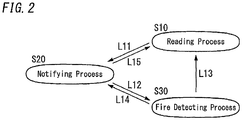
- the determining device 120 provided to the processing device 12 performs processes including a reading process S10, a notifying process S20, and a fire determining process S30, as shown in FIG. 2 .
- the reading process S10 is a process of obtaining, by the processing device 12, information from the sensing device 11 by way of the obtainer 121.
- the notifying process S20 is a process of giving notice of occurrence of a fire by way of the notifying device 13.
- the fire determining process S30 is a process of determining whether a fire has occurred, by use of information obtained from the sensing device 11 in the reading process S10.
- the fire determining process S30 is performed by the preliminary determiner 1200, the first determiner 1201, and the second determiner 1202 of the determining device 120 (see FIG. 1 ).
- Time necessary for one cycle of this sequence may fall within a range of time slightly longer than the unit time Tu.
- a time period for one cycle of the sequence of the reading process S10, the notifying process S20, and the fire determining process S30 may contain time periods for various processes, in addition to a time period for waiting the unit time Tu. However, the time periods for the various processes are sufficiently shorter than the time period for waiting.
- the time period for one cycle of the sequence of the reading process S10, the notifying process S20, and the fire determining process S30 may fall within a range of time periods similar to the unit time Tu.
- the determining device 120 obtains the temperature value ⁇ from the third sensor 113 through the obtainer 121 (S11), and obtains the concentration Cs of smoke from the first sensor 111 through the obtainer 121 (S12).
- the determining device 120 may obtain which one of the temperature value ⁇ and the concentration Cs of smoke before obtaining the other.
- the obtained concentration Cs of smoke is compared with a threshold value Vs0 (e.g., 1 [%/m]) for determining whether smoke exists (S13).
- Vs0 e.g., 1 [%/m]
- the concentration Cs of smoke is represented by a rate of decrease in light per one meter, and a unit thereof is [%/m].
- the obtainer 121 obtains the concentration Cc of CO from the second sensor 112 (S15).
- the concentration Cs of smoke is lower than the threshold value Vs0 ( S13: no) and when a count value n has reached a predetermined value Mc ( S14: yes)
- the obtainer 121 obtains the concentration Cc of CO from the second sensor 112 (S15).
- the determining device 120 resets the count value n to 1 (S16).
- the determining device 120 adds 1 to the count value n ( S17 ).
- the obtainer 121 obtains the concentration Cc of CO at any of the following timings.
- the obtainer 121 obtains the concentration Cc of CO irrespective of the count value n.
- the obtainer 121 obtains the concentration Cc of CO at a timing when the count value n reaches the predetermined value Mc.
- the concentration Cc of CO is obtained immediately when smoke is detected, and the concentration Cc of CO is obtained at a relatively long time interval while smoke is not detected.
- the time interval at which the obtainer 121 obtains the concentration of CO while smoke is not detected is Mc times longer than a time interval in a case where smoke is detected, and Mc is set in a range of around 3 to 10.
- the concentration Cs of smoke is obtained, and the concentration Cc of CO is obtained if necessary, and then the reading process S10 ends.
- processing proceeds to the notifying process S20.
- the determining device 120 determines whether a fire has already been determined to have occurred in the fire determining process S30 (S21).
- a fire flag F1 is set to "1" when there is determined to be a probability that a fire has occurred, and the fire flag F1 is set to "0" when a fire is determined to have not occurred.
- step S21 When the fire flag F1 is not “1" at step S21 ( S21: no), processing proceeds to the fire determining process S30. In contrast, when the fire flag F1 is "1" at step S21 ( S21: yes), there would be a high probability that a fire has occurred, and thus the determining device 120 compares the concentration Cs of smoke obtained at step S12 with the (second) determination value Vs1 (S22).
- the determination value Vs1 is set to a value (e.g., 3.5 [%/m]) larger than the threshold value Vs0 .
- the fire flag F1 is reset to "0" (S23) and additionally a count value Ic is also reset to 0 (S24).
- the count value Ic is used for counting how many times determination described below has been done for the concentration Cc of CO in the fire determining process S30.
- step S21 when the fire flag F1 is "1" at step S21 and there has been determined a probability that a fire has occurred, but when the concentration Cs of smoke does not meet a condition of a fire at subsequent step S22, the determining device 120 determines that a fire has not been occurred. After step S24, processing proceeds to the fire determining process S30, and it is determined whether a fire has occurred.
- the condition required for giving notice of a fire through the notifying device 13 also includes a condition that the fire flag F1 is not "0" after the fire determining process S30 ( S25: no). Therefore, the determining device 120 gives notice of a fire through the notifying device 13 when any of the following conditions is satisfied (S26).
- the determining device 120 instructs the notifier 20 to give notice of a fire (S26).
- the determining device 120 returns to the reading process S10 after a lapse of the unit time Tu (S27).
- the unit time Tu may be set to 1 second, for example.
- the time interval for obtaining the concentration Cc of CO at step S15 is around Mc seconds in a time period when the state where the concentration Cs of smoke is lower than the threshold value Vs0 continues.
- processing returns to the reading process S10 after a lapse of the unit time Tu (S27) even when notice of a fire is given at step S26. Therefore, after giving notice of a fire at step S26, the determining device 120 returns to the reading process S10 while continuing giving notice of a fire. In summary, notice of a fire is continued once notice of a fire is given.
- the notifying process S20 may include a process of ending giving notice of a fire when notice of a fire is falsely given.
- the fire determining process S30 may be done. In this fire determining process S30, giving notice may be ended when the fire flag F1 becomes "0".
- the fire determining process S30 mainly includes three different processes.
- a preliminary process S31 determines whether there is a probability that a fire has occurred, based on only the temperature value ⁇ obtained from the third sensor 113.
- a first process S32 determines whether there is a probability that a fire has occurred, based on only the concentration Cs of smoke.
- a second process S33 determines whether there is a probability that a fire has occurred, based on the concentration Cs of smoke and the concentration Cc of CO.
- the preliminary process S31 is performed by the preliminary determiner 1200, and the first process S32 is performed by the first determiner 1201, and the second process S33 is performed by the second determiner 1202.
- the fire determining process S30 includes the preliminary process S31 using the temperature value ⁇ only, the first process S32 using the concentration Cs of smoke only, and the second process S33 using a combination of the concentration Cc of CO and the concentration Cs of smoke.
- the second process S33 also includes a process of determining that a fire has not occurred when any of the concentration Cc of CO, the concentration Cs of smoke, and the temperature value ⁇ does not satisfy a corresponding condition.
- the second process S33 includes a process of determining, when any of the concentration Cc of CO, the concentration Cs of smoke, and the temperature value ⁇ does not satisfy a corresponding condition, whether to assign task of determining whether a fire has occurred, to the following fire determining process S30.
- FIG. 5 shows "confirmed” which means that it is confirmed that a fire has occurred, and “unconfirmed” which means that that it cannot be confirmed that a fire has occurred though there is a possibility that a fire has occurred.
- the amount ⁇ of change is equal to a difference (an absolute value of a difference) between the two temperature values ⁇ obtained at points of time between which an interval is equal to the reference time period T1 , that is, points of time of start and end of the reference time period T1 .
- step S311 may employ the temperature gradient as an alternative to the amount ⁇ of change within the reference time period T1.
- the determination value Vt1 for the temperature value ⁇ may be set to around 60 [°C] and the reference time period T1 may be set to be in a range of around 1 to 3 minutes.
- the determination value Vt1 is set to a temperature value which is not observed unless a fire has occurred.
- the reference time period T1 is set based on a length of time in which rise in temperature is observed while a fire occurs.
- the processing device 12 includes the storage device 123, and the storage device 123 includes a storage region for storing the temperature value ⁇ each time the obtainer 121 obtains the temperature value ⁇ from the third sensor 113.
- the storage region for storing the temperature value ⁇ functions equivalent to a shift register, and the amount ⁇ of change is calculated as a difference between foremost data (earliest data) and rearmost data (latest data) of a series of data obtained by the reference time period T1 .
- step S311 when at least one of conditions of ⁇ ⁇ Vt1 and ⁇ ⁇ Vt2 is satisfied, a fire is determined to have occurred, and thus the fire flag F1 is set to "1" (S34).
- step S311 when any of the conditions of ⁇ > Vt1 and ⁇ ⁇ Vt2 is not satisfied, that is, when ⁇ is smaller than Vt1 and ⁇ is smaller than Vt2, it is determined whether a temporary determination flag F2 is "1" (S312).
- the reference time period T1 for calculating the amount ⁇ of change is set to be relatively long, and this can facilitate distinguishing the amount ⁇ of change in a time period when the temperature value ⁇ sharply rises accompanied with occurrence of a fire from the amount ⁇ of change in a time period when change in the temperature value ⁇ is relatively small. Consequently, it is possible to easily determine whether an interested time period is the time period when the temperature value ⁇ sharply rises accompanied with occurrence of a fire, or the time period when change in the temperature value ⁇ is relatively small.
- the detector 10 further includes the third sensor 113 configured to measure the temperature, and the processing device 12 is configured to determine whether the predetermined condition is satisfied with regard to the temperature measured by the third sensor 113.
- the detector 10 can determine whether a fire has occurred, based on the temperature in addition to the concentration Cs of smoke and/or the concentration Cc of CO, and this may lead to improvement of accuracy.
- the temporary determination flag F2 is set to "1" when whether a fire has occurred is unconfirmed and such determination is assigned to the following fire determining process S30. In other words, the temporary determination flag F2 is set to "1" when it cannot be confirmed that a fire has occurred but a probability that a fire has occurred cannot be denied. In contrast, when it can be confirmed that a fire has not occurred, the preliminary determiner 1200 sets the temporary determination flag F2 to "0".
- the preliminary determiner 1200 compares an amount ⁇ Cs of change in the concentration Cs of smoke within a predetermined reference time period T2 with a (first) determination value Vs2 (S313).
- Cs(t) represents the concentration of smoke at the time t
- ACs(t) represents the amount of change in the concentration Cs of smoke at the time t in a similar manner to the amount ⁇ of change in the temperature value ⁇
- the amount ⁇ Cs of change is equal to a difference (an absolute value of a difference) between the two concentrations Cs of smoke obtained at points of time between which an interval is equal to the reference time period T2, that is, points of time of start and end of the reference time period T2. Accordingly, dividing the amount ⁇ Cs of change by the reference time period T2 gives a concentration gradient relating to smoke. Additionally, provided that the reference time period T2 is set to appropriate unit time (e.g., 60 seconds), the amount ⁇ Cs of change is equivalent to the concentration gradient relating to smoke. Therefore, at step S312 the concentration gradient may be used as an alternative to the amount ⁇ Cs of change within the reference time period T2.
- the reference time period T2 may be set to be in a range of around 30 seconds to 2 minutes. In other words, the reference time period T2 is set to a time period sufficiently longer than the time interval at which the obtainer 121 obtains the concentration Cs of smoke in the reading process S10. However, the amount ⁇ Cs of change is updated every fire determining process S30.
- FIG. 9 shows a relationship among the concentration Cs of smoke, the reference time period T2, and the amount ⁇ Cs of change.
- This figure also shows a concentration gradient ⁇ 2 of the concentration Cs of smoke.
- the reference time period T2 is set to be relatively long, and thus it is possible to find out a tendency of change in the concentration Cs of smoke even if the concentration Cs of smoke changes with time.
- the concentration Cs of smoke obtained by the obtainer 121 is stored in the storage device 123 like a case of calculating the amount ⁇ of change in the temperature value ⁇ .
- the storage device 123 includes a storage region for storing the concentration Cs each time the obtainer 121 obtains the concentration Cs from the first sensor 111.
- the storage region for storing the concentration Cs functions equivalent to a shift register, and the amount ⁇ Cs of change is calculated as a difference between foremost data (earliest data) and rearmost data (latest data) of a series of data obtained by the reference time period T2.
- step S312 when the temporary determination flag F2 is "1", it is not confirmed whether a fire has occurred. Thus, it is necessary to confirm whether a fire has occurred in a subsequent process. Accordingly, when a state where the concentration Cs of smoke is lower than the threshold value Vs0 continues for the second determination time period Td2 ( S314: yes), the temporary determination flag F2 is set to "0" (S315) to confirm that a fire has not occurred.
- the preliminary determiner 1200 sets the temporary determination flag F2 to"0" ( S315).
- the determination time period Td2 is set to a time period sufficiently longer than a cycle (e.g., around 1 seconds) at which the determining device 120 obtains the concentration Cs of smoke from the first sensor 111, and may be set to 60 seconds, for example. If the reading process S10, the notifying process S20, and the fire determining process S30 are repeated at a cycle of about 1 second, the determination time period Td2 is equivalent to time taken for the fire determining process S30 to be performed sixty times.
- the threshold value Vs0 is a lower limit value for determining that smoke has occurred, and thus is smaller than the determination value Vs1 for determining that fire has occurred (e.g., Vs0 ⁇ 0.3 ⁇ Vs1 ).
- step S314 when the state where the concentration Cs of smoke is lower than the threshold value Vs0 does not continue for the determination time period Td2 ( S314: no), processing proceeds to the second process S33.
- processing proceeds to the second process S33.
- step S313 when the amount ⁇ Cs of change in the concentration Cs of smoke is smaller than the determination value Vs2 (or the concentration gradient ⁇ 2 relating to smoke is relatively low), processing proceeds to the first process S32. Further, at step S313, when the amount ⁇ Cs of change is equal to or larger than the determination value Vs2 (or the concentration gradient ⁇ 2 relating to smoke is relatively high), process proceeds to the second process S33.
- the condition [ ⁇ Cs ⁇ Vs2 ] at step S313 in the preliminary process S31 serves as a switching condition for determining which of the first process S32 and the second process S33 is selected.
- the switching condition is that the amount ⁇ Cs of change in the concentration Cs of smoke within the predetermined reference time period is equal to or larger than the first determination value Vs2, and the preliminary determiner 1200 determines whether the switching condition is satisfied.
- the preliminary determiner 1200 performs determination based on the switching condition relating to whether the amount ⁇ Cs of change in the concentration Cs of smoke within the predetermined reference time period is smaller than the first determination value Vs2.
- the first process S32 and the second process S33 use a count value as described later.
- the processing device 12 includes the counter 124 configured to provide the count value.
- This counter 124 can increment and decrement the count value, and the minimum value of the count value is 0.
- the count value of the counter 124 is reset to 0.
- the counter 124 is configured to provide the count value representing a continuous time period in which detection of smoke continues and the count value representing a continuous time period in which detection of CO continues.
- the first determiner 1201 configured to perform the first process S32 illustrated in FIG. 7 determines whether a fire has occurred, based on the concentration Cs of smoke only, as described above.
- the first determiner 1201 employs a prerequisite that the temporary determination flag F2 is "0" ( S312: no, or S315 ) and the amount ⁇ Cs of change in the concentration Cs of smoke is smaller than the determination value Vs2 ( ⁇ Cs ⁇ Vs2) ( S313: no).
- This prerequisite means that a fire has not occurred and change in the concentration Cs of smoke in the determination time period Td2 has not been detected. In other words, satisfying the prerequisite of the first process S32 indicates that there is a high probability that a fire has not occurred.
- the condition for the first determiner 1201 to determine that a fire has occurred is that a state where the concentration Cs of smoke is high continues for a relatively long time period (e.g., around 10 seconds).
- the continuous time period in which detection of smoke continues is not limited to a time period in which the state where the concentration Cs of smoke obtained by the obtainer 121 is high is continuous.
- the counter 124 provides the count value representing the continuous time period.
- the first determiner 1201 compares the concentration Cs of smoke obtained by the reading process S10 with the determination value Vs1 (S321). When the concentration Cs of smoke is equal to or higher than the determination value Vs1 ( S321: yes), the counter 124 increments the count value Is corresponding to smoke by one (S322). In contrast, when the concentration Cs of smoke is lower than the determination value Vs1 (S321: no), the count value Is is decremented by two (S323). The count value Is is used for estimation of the continuous time period.
- the count value Is is compared with a reference value Ns (S324).
- the first determiner 1201 determines that the state where the concentration Cs of smoke is equal to or higher than the determination value Vs1 has continued, and sets the fire flag F1 to "1" (S34).
- the determining device 120 starts the notifying process S20.
- the continuous time period is time taken for the count value Is to reach the reference value Ns.
- the concentration Cs of smoke is allowed to be lower than the determination value Vs1 before the continuous time period reaches the reference value Ns.
- the concentration Cs of smoke varies with time and therefore the concentration Cs of smoke is likely to be lower than the determination value Vs1 temporary after the concentration Cs of smoke has been equal to or higher than the determination value Vs1 due to a fire.
- monitoring of the concentration Cs of smoke is continued. Therefore, as long as the concentration Cs of smoke continuously corresponds to a case where a fire has occurred continues, a fire is determined to have occurred. Consequently, failure in notification can be suppressed.
- the concentration Cs of smoke becomes equal to or higher than the determination value Vs1 temporary due to smoking, cooking, or the like.
- the count value Is does not reach the reference value Ns. Therefore, as long as the reference value Ns is set appropriately, false notification can be suppressed.
- the concentration Cs of smoke is lower than the determination value Vs1 , the count value Is is decremented by two (S323). When the concentration Cs of smoke is low, time taken for the count value Is to reach the reference value Ns increases. Therefore, effects of suppressing false notification can be expected.
- the second determiner 1202 configured to perform the second process S33 uses the concentration Cc of CO in addition to the concentration Cs of smoke in order to determine whether a fire has occurred.
- One of the prerequisites is that the temporary determination flag F2 is "0" ( S312: no) and the amount ⁇ Cs of change in the concentration Cs of smoke is equal to or larger than the determination value Vs2 ( ⁇ Cs ⁇ Vs2) ( S313: yes).
- both of the prerequisites include a condition for the concentration Cs of smoke.
- step S313 or step S314 the second determiner 1202 configured to perform the second process S33 illustrated in FIG. 8 compares the amount ⁇ Cc of change in the concentration Cc within a predetermined reference time period T3 with the (third) determination value Vc2 (S331).
- the reference time period T3 is set to be in a range of about 30 seconds to 2 minutes like the reference time period T2.
- the amount ⁇ Cc of change is updated every fire determining process S30.
- the concentration Cc of CO is not equal to the concentration Cc obtained by the obtainer 121 in the reading process S10, but is equal to a moving average of the concentration Cc.
- the number of concentrations Cc for calculating the moving average may be in a range of about 5 to 15, preferably.
- the concentration Cc of CO does not correspond to an actual value obtained by the obtainer 121, but corresponds to an average of the predetermined number of concentrations Cc obtained within a predetermined time period prior to time of calculating the concentration Cc.
- the concentrations Cc of CO are supposed to be obtained by the obtainer 121 at a series of time points C1, C2, ising, Cm.
- the moving average calculated based on twelve concentrations is used as the concentration Cc of CO, the moving averages of the concentration Cc are ( C1 + C2 + ... + C12)/12, (C2 + C3 + ... + C13)/12, (C3 + C4 + ... + C14)/12, ....
- the concentration Cc of CO is given by the moving average, and it is thus possible to detect at high accuracy change in the concentration Cc of CO even if the second sensor 112 for measuring the concentration of CO is an electrochemical sensor with relatively low measurement accuracy.
- the concentration gradient of CO falls within at least a range of about 1 to 5 ppm/min.
- the concentration gradient can be calculated from adjacent concentrations Cc included in a time series of data on the concentration Cc of CO obtained every reading process S10.
- such a concentration gradient cannot give sufficient accuracy to an extent available for detection of a fire.
- the amount ⁇ Cc of change in the concentration Cc is calculated by use of the moving average method, and it is determined whether a fire has occurred, based on the calculated amount ⁇ Cc of change. Therefore, it is easy to detect change in the concentration Cc of CO at high accuracy.
- the counter 124 increments the count value Ic associated with CO by one (S332), and subsequently the concentration Cs of smoke is compared with the determination value Vs1 (S334).
- ACc(t) represents the concentration of CO at the time t and ACc(t) represents the amount of change in the concentration Cc of CO at the time t in a similar manner to the amount ⁇ Cs of change in the concentration Cs of smoke
- the amount ⁇ Cc of change is equal to a difference (an absolute value of a difference) between the two concentrations Cc of CO obtained at points of time between which an interval is equal to the reference time period T3, that is, points of time of start and end of the reference time period T3.
- the reference time period T3 may be equal to or different from the reference time period T2.
- the concentration gradient may be used as an alternative to the amount ⁇ Cc of change within the reference time period T3.
- the reference time period T3 is set to be almost equal to the reference time period T2.
- the reference time period T3 may be preferably equal to the reference time period T2.
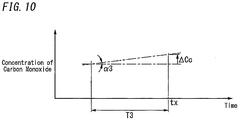
- FIG. 10 shows a relationship among the concentration Cc of CO, the reference time period T3, and the amount ⁇ Cc of change. This figure also shows a concentration gradient ⁇ 3 of the concentration Cc of CO. As shown in the figure, even if the accuracy of the concentration Cc within the reference time period T3 is insufficient, it is possible to detect change in the concentration Cc of CO when the reference time period T3 is set appropriately and there is a relatively large change in the concentration Cc of CO.
- Step S334 to S336 are the same as steps S321 to S323 in the first process S32. After the count value Is is decremented by two at step S336, the determining device 120 starts the notifying process S20.
- the second determiner 1202 compares the count value Ic associated with CO with a reference value Nc (S337). When the count value Ic is equal to or larger than the reference value Nc ( S337: yes), the count value Is associated with smoke is also compared with the reference value Ns (S338). When the count value Is is equal to or larger than the reference value Ns ( S338: yes), the second determiner 1202 sets the fire flag F1 to "1" (S34). When the count value Ic is smaller than the reference value Nc ( S337: no) or when the count value Is is smaller than the reference value Ns ( S338: no), the determining device 120 starts the notifying process S20.
- step S33 when the amount ⁇ Cc of change in the concentration Cc of CO is smaller than the determination value Vc2 at step S331 ( S331: no), the counter 124 decrements the count value Ic associated with CO by two (S333). Further, after step S333, it is determined whether the state where the amount ⁇ Cs of change in the concentration Cs of smoke is equal to or larger than the determination value Vs2 continues for a (first) determination time period Td1 (S339).
- the temporary determination flag F2 is set to "1" (S340).
- the determining device 120 starts the notifying process S20 again.
- the determination time period Td1 is set in order to identify the continuous time period of a state where the concentration Cs of smoke increases sharply. When smoke is caused by a fire, a situation where the concentration Cs of smoke increases sharply continues for more than about 10 seconds. Hence, the determination time period Td1 is set to around 10 seconds. In other words, the (second) determination time period Td2 used by the preliminary determiner 1200 is set to a time period longer than the (first) determination time period Td1 used by the second determiner 1202.
- the preliminary process S31 determines whether a fire has occurred, based on the temperature value ⁇ , and additionally defines the prerequisites for the first process S32 and the second process S33.
- the preliminary determiner 1200 compares the amount ⁇ Cs of change in the concentration Cc of smoke with the first determination value Vs2 at step S313.
- the preliminary determiner 1200 selects the first determiner 1201 when a relation of ⁇ C s ⁇ Vs2 is satisfied, and selects the second determiner 1202 when a relation of ⁇ Cs ⁇ Vs2 is satisfied.
- the first determiner 1201 performs determination with regard to the concentration Cs of smoke without taking into account the concentration Cs of carbon monoxide.
- the second determiner 1202 performs determination with regard to the concentration Cs of smoke in addition to the amount ⁇ Cc of change in the concentration Cc of carbon monoxide.
- the detector 10 selects, as the condition for subsequent determination, either a first condition for either the concentration Cs of smoke or the concentration Cc of carbon monoxide, or a second condition for both the concentration Cs of smoke and the concentration Cc of carbon monoxide, based on a result of determination of the switching condition. Accordingly, when there is difficulty in performing the determination by use of the concentration Cs of smoke only, the detector 10 can additionally use the concentration Cc of carbon monoxide for the determination. Consequently, it is possible to suppress false notification without learning threshold values.
- the processing device 12 sets the temporary determination flag F2 to "1" when the state where the amount ⁇ Cs of change in the concentration Cs of smoke is equal to or larger than the (first) determination value Vs2 continues for the first determination time period T d1 in the second process S33.
- the preliminary determiner 1200 terminates the process of comparing the amount ⁇ Cs of change in the concentration Cs of smoke with the first determination value Vs2. Consequently, the second determiner 1202 continues the second process S33.
- the preliminary determiner 1200 proceeds to a mode of selecting the second determiner 1202 irrespective of the result of determination of whether the switching condition is satisfied.
- the processing device 12 proceeds to a mode in which the preliminary determiner 1200 selects the second determiner 1202 irrespective of whether the switching condition is satisfied. In short, the processing device 12 proceeds to a mode of the temporary flag F2 being "1".
- the preliminary determiner 1200 proceeds to a mode of selecting either the first determiner 1201 or the second determiner 1202 based on the result of determination of whether the switching condition is satisfied.
- the processing device 12 proceeds to a mode in which the preliminary determiner 1200 selects either the first determiner 1201 or the second determiner 1202 based on the result of determination of whether the switching condition is satisfied. In short, the processing device 12 proceeds to a mode of the temporary flag F2 being "0".
- the preliminary process illustrated in FIG. 6 is defined so that, when the temporary flag F2 is "1", the preliminary determiner 1200 does not determine whether the switching condition ( ⁇ Cs ⁇ Vs2) is satisfied. However, the preliminary determiner 1200 may determine whether the switching condition is satisfied. Note that, even in a case where the preliminary determiner 1200 determines whether the switching condition is satisfied, the preliminary determiner 1200 still selects the second determiner 1202 irrespective of whether the switching condition is satisfied, as long as the temporary flag F2 is "1". This operation obviously indicates that the temporary flag F2 functions to inform the preliminary determiner 1200 of a result of determination that the condition judged by the second determiner 1202 (the relation of ⁇ Cs ⁇ Vs2 continues for the determination time period Td1) is satisfied.
- the second determiner 1202 determines whether a condition is satisfied, this condition including a condition that the concentration Cs of smoke is equal to or higher than the (second) determination value Vs1 in addition to a condition that the amount ⁇ Cc of change in the concentration Cc of carbon monoxide is equal to or larger than the (third) determination value Vc2. Note that, when the state where the concentration Cs of smoke is lower than the threshold value Vs0 continues for the (second) determination time period Td2, the preliminary determiner 1200 returns to the mode of selecting either the first determiner 1201 or the second determiner 1202 according to the switching condition. In the example of operation illustrated in FIG. 6 , at step S313, the preliminary determiner 1200 returns to a mode in which the process of comparing the amount ⁇ Cs of change in the concentration Cs of smoke with the (first) determination value Vs2 is performed.
- the threshold value Vs0 is determined based on the determination value Vs1 for the concentration Cs of smoke and the determination value Vs2 for the amount ⁇ Cs of change in the concentration Cs of smoke so as to satisfy a relation of Vs0 ⁇ Vs1 - Vs2. This is because of suppressing the concentration Cs of smoke from being equal to or higher than the determination value Vs1 immediately after the preliminary determiner 1200 switches the temporary determination flag F2 from "1" to "0" and thereby returns to the process passing through step S313.
- Vs0 + Vs2 is equal to or larger than the determination value Vs1 even if the amount ⁇ Cs of change is smaller than the determination value Vs2 at step S313.
- the concentration Cs of smoke is equal to or higher than the determination value Vs1 , and thereby the count value Is associated with smoke is incremented by one.
- the threshold value Vs0 is equal to or smaller than Vs1 - Vs2, and therefore Vs0 + Vs2 is smaller than the determination value Vs1 at step S313. Hence, increment of the count value Is associated with smoke can be suppressed.
- a state of a fire may vary according to various causes such as types of substances burning in a fire and environments of places where a fire has occurred.
- the state of a fire is categorized into about ten types.
- the concentration Cs of smoke and the concentration Cc of CO increase sharply in a short time, and in the other of the cases the concentration Cs of smoke and the concentration Cc of CO increase gradually in a relatively long time.
- the concentrations Cs and Cc may increase to relatively high values, or increase to only relatively low values, or be saturated, or increase and then decrease, depending on the state of a fire.
- time from occurrence of a fire to start of increase in the concentrations Cs and Cc may vary depending on the state of a fire.
- the concentration Cs of smoke and the concentration Cc of CO may start to increase at different timings.
- timings of start of increase in the concentration Cs of smoke and the concentration Cc of CO appear to have similar tendencies.
- fire detectors need to detect a fire within about 10 minutes from occurrence of the fire. As mentioned in the above, fire detectors need to determine, within about 10 minutes, whether a fire has occurred, with regard to various states of fires.
- the first process S32 in the fire determining process S30 allows detection of occurrence of a fire in a state where the concentration Cs of smoke continuously and gradually increases. Further, a fire in a state where the concentration Cs of smoke increases sharply can be detected by the second process S33.
- the second process S33 it is determined, referring to an increasing tendency of the first process S32, whether a fire causing a sharp increase in the concentration Cs of smoke has occurred. If the concentration Cc of CO is relatively low, a fire can be determined to have occurred provided that the amount ⁇ Cc of change in the concentration Cc of CO is equal to or larger than the determination value Vc2.
- the second process S33 allows judgement of a fire while repeating the fire determining process S30 multiple times.
- the condition for determining that a fire has occurred includes a condition that the state where the concentration Cs of smoke is equal to or higher than the determination value Vs1 continues.
- a fire determined to have occurred by the second process S33 may be in a state where the state where the concentration Cs of smoke is relatively high continues and the concentration Cs of smoke increases sharply and the state where the concentration Cc of CO increases also continues.
- the second process S33 does not determine that a fire has occurred, when the state where the concentration Cs of smoke sharply increases can continue for only a short time and the amount ⁇ Cc of change in the concentration Cc of CO is relatively small. Such a situation may be supposed to occur due to white smoke caused by dry ice, steam, or the like. Thus, the second process S33 can distinguish smoke caused by a fire from white smoke caused by dry ice or steam.
- the temporary determination flag F2 is set to "1 and confirmation of the result of determination is appointed to the subsequent fire determining process S30.
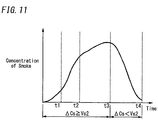
- FIG. 11 shows an example of change in the measurement value (the concentration Cs) in a case where the first sensor 111 measures steam generated by an electric pot (so-called "electric kettle") with no heat retention function.
- time from start of increase in the concentration Cs of smoke to the time t4 is about 6 minutes.
- the maximum of the concentration Cs is about 15 %/m.
- the concentration Cs of smoke is supposed to be equal to or higher than the threshold value Vs0 during an almost entire time period to the time t4.
- the temperature value ⁇ does not satisfy the condition for determining that a fire has occurred.
- processing proceeds to step S312 from step S311.
- the concentration Cs increases.
- the concentration Cs decreases.
- the time t1 represents a point of time at which the condition (the relation of ⁇ Cs ⁇ Vs2 continues for the determination time period Td1) of step S339 in the fire determining process S30 is satisfied, and at this point of time the temporary determination flag F2 becomes "1".
- the time t2 subsequent to the time t1 represents a point of time at which the condition (the relation of Cs ⁇ Vs0 continues for the determination time period Td2) of step S314 is satisfied. Accordingly, the time t1 corresponds to a point of time at which the determination time period Td1 elapses after the concentration Cs of smoke is equal to or higher than the threshold value Vs0 . The time t2 corresponds to a point of time at which the determination time period Td2 elapses thereafter.
- step S13 in the reading process S10 when the condition (Cs ⁇ Vs0 ) of step S13 in the reading process S10 is satisfied and subsequently the condition ( ⁇ Cs ⁇ Vs2) of step 313 in the fire determining process S30, processing proceeds to the second process S33.
- the condition (the relation of ⁇ Cs ⁇ Vs2 continues for the determination time period Td1 ) of step S339 is not satisfied and therefore processing passes through steps S312 and S313 and thereby the second process S33 is selected.
- step S339 the condition (the relation of ⁇ Cs ⁇ Vs2 continues for the determination time period Td1) of step S339 is not satisfied.
- the temporary determination flag F2 is kept to be "1”.
- the second process S33 is still selected even after the time t3.
- the fire determining process S30 mainly selects the second process S33.
- the temporary determination flag F2 becomes "1"
- a state where steam is temporary determined to have occurred continues.
- step S313 is not selected until the concentration Cs of smoke becomes lower than the threshold value Vs0 . Therefore, always the second process S33 is selected.
- the state where the temporary determination flag F2 is "1” and then the second process S33 is selected is maintained until the concentration Cs of smoke decreases. Hence, occurrence of false notification can be suppressed.
- the determination at step S313 is performed always. In this case, even if the concentration Cs of smoke starts to decrease at the time t3, the condition ( ⁇ Cs ⁇ Vs2) of step S313 is no longer satisfied and thus processing proceeds to the first process S32 and accordingly the condition (Cs ⁇ Vs1 ) of step S321 is satisfied. As a result, the count value Is associated with smoke is incremented every fire determining process, and finally the fire flag F1 becomes "1".
- the notifying process S20 gives notice of a fire through the notifying device 13 (S26), and this may lead to false notification. According to the configuration of the present embodiment, the aforementioned scheme can suppress such false notification.
- FIG. 12 shows an example in which the concentration Cs of smoke varies periodically.
- a state where the concentration Cs of smoke becomes temporarily high appears periodically.
- the concentration Cs of smoke illustrated in the figure varies so as to show a bell-shape at a cycle Tp.
- the concentration Cs of smoke has its local maximum at the cycle Tp, and a difference ACp between local maximum values becomes relatively small.
- the local maximum values of the concentration Cs of smoke are equal to or larger than the determination value Vs1 and the cycle Tp and the determination time period Td2 satisfy a relation of Tp ⁇ Td2.
- the cycle Tp is supposed to be almost equal to the reference time periods T2 and T3.
- step S314 in the fire determining process S30 When the concentration Cs of smoke varies as shown in FIG. 12 , there is a high probability that smoke is not caused by a fire. According to the present embodiment, when the concentration Cs of smoke varies as shown in FIG. 12 , the condition (the state in which Cs ⁇ Vs0 continues for the determination time period Td2 ) of step S314 in the fire determining process S30 is not satisfied, and thus processing proceeds to the second process S33. When CO is not detected, processing passes through step S339 but the condition (the state in which ⁇ Cs ⁇ Vs2 continues for the determination time period Td1) of step S339 is not satisfied and accordingly each of the fire flag F1 and the temporary determination flag F2 is kept to be "0".
- processing may pass through step S334 but the concentration Cs of smoke varies periodically. Hence, the concentration Cs of smoke does not continuously satisfy the condition (Cs ⁇ Vs1 ) of step S334. Accordingly each of the fire flag F1 and the temporary determination flag F2 is kept to be "0".
- the second sensor 112 for measuring the concentration of CO is an electrochemical sensor, and uses a moving average of the concentration Cc of CO to calculate the amount ⁇ Cc of change in the concentration Cc of CO.
- the second sensor 112 has relatively high measurement accuracy, it is allowed to use a configuration of using the amount ⁇ Cc of change directly calculated from the concentration Cc measured by the second sensor 112 instead of the moving average of the concentration Cc of CO.
- the reference time period T2 is set to be equal to the time interval at which the obtainer 121 obtains the concentration Cs of smoke from the first sensor 111
- the reference time period T3 is set to be equal to the time interval at which the obtainer 121 obtains the concentration Cc of smoke from the second sensor 112.
- these time periods may be extended appropriately.
- the aforementioned configuration example may preferably perform an additional reset process in case false notification occurs.
- the notifier 20 operates according to the notification signal outputted from the notifying device 13 and the sensing device 11, the processing device 12, the notifying device 13, and the notifier 20 are accommodated in a common housing.
- the notifier 20 may be accommodated in a separate housing and the notifying device 13 may output the notification signal to the notifier 20 through telecommunications.
- the notifier 20 may be replaced with a receiver for monitoring occurrence of a fire, and the receiver may be connected to multiple fire detectors so that the multiple fire detectors output their own notification signals to the receiver.
- a receiver has functions of managing the multiple fire detectors intensively and monitoring whether a fire has occurred for each of individual places where the multiple fire detectors are installed.
Landscapes
- Chemical & Material Sciences (AREA)
- Analytical Chemistry (AREA)
- Business, Economics & Management (AREA)
- Emergency Management (AREA)
- Physics & Mathematics (AREA)
- General Physics & Mathematics (AREA)
- Fire-Detection Mechanisms (AREA)
- Fire Alarms (AREA)
Claims (10)
- Détecteur (10) comprenant :un premier capteur (111) configuré pour mesurer une concentration (Cs) en fumée dans l'air ;un second capteur (112) configuré pour mesurer une concentration (Cc) en monoxyde de carbone dans l'air ;un dispositif de traitement (12) configuré pour déterminer si une condition prédéterminée est satisfaite par rapport à la concentration (Cs) en fumée mesurée par le premier capteur (111) et à la concentration (Cc) en monoxyde de carbone mesurée par le second capteur (112) ; etun dispositif de notification (13) configuré pour délivrer un signal de notification lorsque la condition prédéterminée est satisfaite,dans lequel :le dispositif de traitement (12) est configuré pour sélectionner une première condition ou une seconde condition en guise de condition prédéterminée sur la base d'un résultat de détermination du fait qu'une condition de déclenchement pour la concentration (Cs) en fumée soit satisfaite, la première condition étant soit pour la concentration (Cs) en fumée, soit pour la concentration (Cc) en monoxyde de carbone, et la seconde condition étant pour la concentration (Cs) en fumée et la concentration (Cc) en monoxyde de carbone ;la condition de déclenchement est qu'une quantité de changement (ΔCs) de la concentration (Cs) en fumée pendant une période de temps de référence prédéterminée est égale ou supérieure à une première valeur de détermination (Vs2) ; etle dispositif de traitement (12) est configuré pour déterminer si la condition de déclenchement est satisfaite.
- Détecteur (10) selon la revendication 1, dans lequel :le dispositif de traitement (12) comprendun déterminateur préliminaire (1200) configuré pour déterminer si la condition de déclenchement est satisfaite,un premier déterminateur (1201) configuré pour déterminer, sans tenir compte de la concentration (Cc) en monoxyde de carbone, si la première condition comprenant une condition selon laquelle la concentration (Cs) en fumée est égale ou supérieure à une seconde valeur de détermination (Vs1) est satisfaite ou non, etun second déterminateur (1202) configuré pour déterminer si la seconde condition est satisfaite, la seconde condition comprenant une condition selon laquelle la concentration (Cs) en fumée est égale ou supérieure à la seconde valeur de détermination (Vs1) en plus d'une condition selon laquelle une quantité de changement (ΔCS) de concentration (Cc) en monoxyde de carbone pendant une période de temps de référence prédéterminée est égale ou supérieure à une troisième valeur de détermination (Vc2) ; etle déterminateur préliminaire (1200) est configuré pour,lorsqu'il est déterminé que la quantité de changement (ΔCs) relative à la fumée est inférieure à la première valeur de détermination (Vs2), sélectionner le premier déterminateur (1201) et sélectionner la première condition en guise de condition prédéterminée, etlorsqu'il est déterminé que la quantité de changement (ΔCs) relative à la fumée est égale ou supérieure à la première valeur de détermination (Vs2), sélectionner le second déterminateur (1202) et sélectionner la seconde condition en guise de condition prédéterminée.
- Détecteur (10) selon la revendication 2, dans lequel :le dispositif de traitement (12) est configuré pour répéter cycliquement, par le déterminateur préliminaire (1200), un processus de sélection du premier déterminateur (1201) lorsque la quantité de changement (ΔCs) relative à la fumée est déterminée comme étant inférieure à la première valeur de détermination (Vs2), et de sélection du second déterminateur (1202) lorsque la quantité de changement (ΔCs) relative à la fumée est déterminée comme étant égale ou supérieure à la première valeur de détermination (Vs2) ; etle déterminateur préliminaire (1200) est configuré pour, lorsqu'un état dans lequel la quantité de changement (ΔCs) relative à la fumée est égale ou supérieure à la première valeur de détermination (Vs2) pendant une première période de temps de détermination (Td1), passer à un mode de sélection du second déterminateur (1202) quel que soit le résultat de la détermination du fait que la condition de déclenchement soit satisfaite ou non, et pour demander au second déterminateur (1202) de déterminer si une condition comprenant une condition selon laquelle la concentration (Cs) en fumée est égale ou supérieure à la seconde valeur de détermination (Vs1) en plus d'une condition selon laquelle la quantité de changement (ΔCs) relative au monoxyde de carbone est égale ou supérieure à la troisième valeur de détermination (Vc2) est satisfaite.
- Détecteur (10) selon la revendication 3, dans lequel le déterminateur préliminaire (1200) est configuré pour, lorsqu'un état dans lequel la concentration (Cs) en fumée est inférieure à une valeur de seuil prédéterminée (Vs0) pendant une seconde période de temps de détermination (Td2), passer à un mode de sélection du premier déterminateur (1201) ou du second déterminateur (1202) sur la base du résultat de détermination du fait que la condition de déclenchement soit satisfaite ou non.
- Détecteur (10) selon la revendication 4, dans lequel la seconde période de temps de détermination (Td2) est définie comme une période de temps plus longue que la première période de temps de détermination (Td1).
- Détecteur (10) selon l'une quelconque des revendications 1 à 5, comprenant en outre un troisième capteur (113) configuré pour mesurer une température,
dans lequel le dispositif de traitement (12) est configuré pour déterminer si la condition prédéterminée est satisfaite par rapport à la température mesurée par le troisième capteur (113). - Procédé de détection comprenant :l'obtention, de la part d'un dispositif de détection, d'une concentration (Cs) en fumée dans l'air et d'une concentration (Cc) en monoxyde de carbone dans l'air ;la détermination, par un dispositif de traitement (12), du fait qu'une condition prédéterminée soit satisfaite par rapport à la concentration (Cs) en fumée et à la concentration (Cc) en monoxyde de carbone obtenues ;la délivrance, par un dispositif de notification (13), d'un signal de notification lorsque la condition prédéterminée est satisfaite,dans lequelle procédé comprend en outre la sélection, par le dispositif de traitement (12), d'une première condition ou d'une seconde condition en guise de condition prédéterminée sur la base d'un résultat de détermination du fait qu'une condition de déclenchement pour la concentration (Cs) en fumée soit satisfaite ou non, la première condition étant pour la concentration (Cs) en fumée ou la concentration (Cc) en monoxyde de carbone, et la seconde condition étant pour la concentration (Cs) en fumée et la concentration (Cc) en monoxyde de carbone ; etla condition de déclenchement est qu'une quantité de changement (ΔCs) de la concentration (Cs) en fumée pendant une période de temps de référence prédéterminée est égale ou supérieure à un première valeur de détermination (Vs2).
- Procédé de détection selon la revendication 7, dans lequel :la première condition comprend une condition selon laquelle la concentration (Cs) en fumée est égale ou supérieure à une seconde valeur de détermination (Vs1), mais ne comprend pas de condition pour la concentration (Cs) en monoxyde de carbone ;la seconde condition comprend une condition selon laquelle la concentration (Cs) en fumée est égale ou supérieure à la seconde valeur de détermination (Vs1) en plus d'une condition selon laquelle une quantité de changement (ΔCs) de la concentration (Cc) en monoxyde de carbone pendant une période de temps de référence prédéterminée est égale ou supérieure à une troisième valeur de détermination (Vc2) ;le dispositif de traitement (12) sélectionne la première condition lorsque la quantité de changement (ΔCs) relative à la fumée est inférieure à la première valeur de détermination (Vs2) ; etle dispositif de traitement (12) sélectionne la seconde condition lorsque la quantité de changement (ΔCs) relative à la fumée est égale ou supérieure à la première valeur de détermination (Vs2).
- Système de détection comprenant :le détecteur (10) selon l'une quelconque des revendications 1 à 6 ; etun notificateur configuré pour délivrer une notification selon le signal de notification délivré par le dispositif de notification (13).
- Programme destiné à permettre à un ou plusieurs ordinateur(s) de fonctionner comme le détecteur (10) selon l'une quelconque des revendications 1 à 6.
Applications Claiming Priority (2)
| Application Number | Priority Date | Filing Date | Title |
|---|---|---|---|
| JP2014025095A JP6372775B2 (ja) | 2014-02-13 | 2014-02-13 | 感知器、感知方法、感知システム、プログラム |
| PCT/JP2015/000307 WO2015122126A1 (fr) | 2014-02-13 | 2015-01-23 | Détecteur, procédé de détection, système de détection et programme |
Publications (3)
| Publication Number | Publication Date |
|---|---|
| EP3107079A1 EP3107079A1 (fr) | 2016-12-21 |
| EP3107079A4 EP3107079A4 (fr) | 2017-03-01 |
| EP3107079B1 true EP3107079B1 (fr) | 2020-04-29 |
Family
ID=53799879
Family Applications (1)
| Application Number | Title | Priority Date | Filing Date |
|---|---|---|---|
| EP15749182.0A Active EP3107079B1 (fr) | 2014-02-13 | 2015-01-23 | Détecteur, procédé de détection, système de détection, programme |
Country Status (3)
| Country | Link |
|---|---|
| EP (1) | EP3107079B1 (fr) |
| JP (1) | JP6372775B2 (fr) |
| WO (1) | WO2015122126A1 (fr) |
Families Citing this family (5)
| Publication number | Priority date | Publication date | Assignee | Title |
|---|---|---|---|---|
| WO2019189125A1 (fr) * | 2018-03-28 | 2019-10-03 | ホーチキ株式会社 | Dispositif de détection d'incendie |
| JP6788165B2 (ja) * | 2019-02-27 | 2020-11-25 | ホーチキ株式会社 | 火災検知器及び火災検知方法 |
| EP3951733A4 (fr) * | 2019-03-29 | 2023-01-25 | Hochiki Corporation | Équipement d'alarme incendie |
| JP7404042B2 (ja) * | 2019-11-22 | 2023-12-25 | 能美防災株式会社 | 火災感知器及び火災感知システム |
| CN113744486A (zh) * | 2021-08-09 | 2021-12-03 | 苏州热工研究院有限公司 | 一种感烟探测方法 |
Family Cites Families (11)
| Publication number | Priority date | Publication date | Assignee | Title |
|---|---|---|---|---|
| AU1755597A (en) * | 1996-01-29 | 1997-08-20 | Engelhard Sensor Technologies, Inc. | Method for dynamically adjusting fire detection criteria |
| US5945924A (en) * | 1996-01-29 | 1999-08-31 | Marman; Douglas H. | Fire and smoke detection and control system |
| US7623028B2 (en) * | 2004-05-27 | 2009-11-24 | Lawrence Kates | System and method for high-sensitivity sensor |
| JP4795702B2 (ja) * | 2005-02-25 | 2011-10-19 | 株式会社竹中工務店 | 酸素濃度可変空間における火災検出システム |
| JP2006277138A (ja) * | 2005-03-28 | 2006-10-12 | Tokyo Gas Co Ltd | 火災警報器又は火災検知装置 |
| JP4810309B2 (ja) * | 2006-05-23 | 2011-11-09 | 新コスモス電機株式会社 | 複合型火災警報器 |
| JP4958661B2 (ja) * | 2007-07-06 | 2012-06-20 | 矢崎総業株式会社 | 火災・非火災判別装置および火災・非火災判別方法並びに火災警報器 |
| JP2009015709A (ja) * | 2007-07-06 | 2009-01-22 | Yazaki Corp | 火災・非火災判別装置および火災・非火災判別方法並びに火災警報器 |
| JP5134295B2 (ja) * | 2007-07-06 | 2013-01-30 | 矢崎エナジーシステム株式会社 | 火災・非火災判別装置および火災・非火災判別方法並びに火災警報器 |
| JP5514094B2 (ja) * | 2010-12-24 | 2014-06-04 | ホーチキ株式会社 | 火災検知システム |
| US9330550B2 (en) * | 2012-07-13 | 2016-05-03 | Walter Kidde Portable Equipment, Inc. | Low nuisance fast response hazard alarm |
-
2014
- 2014-02-13 JP JP2014025095A patent/JP6372775B2/ja active Active
-
2015
- 2015-01-23 WO PCT/JP2015/000307 patent/WO2015122126A1/fr not_active Ceased
- 2015-01-23 EP EP15749182.0A patent/EP3107079B1/fr active Active
Non-Patent Citations (1)
| Title |
|---|
| None * |
Also Published As
| Publication number | Publication date |
|---|---|
| EP3107079A1 (fr) | 2016-12-21 |
| JP6372775B2 (ja) | 2018-08-15 |
| EP3107079A4 (fr) | 2017-03-01 |
| WO2015122126A1 (fr) | 2015-08-20 |
| JP2015153058A (ja) | 2015-08-24 |
Similar Documents
| Publication | Publication Date | Title |
|---|---|---|
| JP6631927B2 (ja) | 感知器、感知方法、感知システム、プログラム | |
| EP3107079B1 (fr) | Détecteur, procédé de détection, système de détection, programme | |
| JP6788165B2 (ja) | 火災検知器及び火災検知方法 | |
| Baek et al. | A wavelet-based real-time fire detection algorithm with multi-modeling framework | |
| DK159346B (da) | Fremgangsmaade og anlaeg til foroegelse af reaktionsfoelsomheden og sikkerheden mod forstyrrelser i et fare-, navnlig et brandalarmeringsanlaeg | |
| US20160253886A1 (en) | Ambient light sensor in a hazard detector and a method of using the same | |
| JP4718844B2 (ja) | 火災警報器 | |
| JP5877659B2 (ja) | 煙感知器 | |
| JP5291634B2 (ja) | 火災判定装置 | |
| EP2879105B1 (fr) | Panneau de commande pour un système de détection d'incendie | |
| JPH09161169A (ja) | 火災警報装置 | |
| JP5548415B2 (ja) | 火災警報器 | |
| KR102801401B1 (ko) | 주변 환경 맞춤형 화재 감지 방법 및 시스템 | |
| JP5453030B2 (ja) | 火災警報器 | |
| JP3015704B2 (ja) | 煙感知器の補正方法 | |
| JP7174535B2 (ja) | 火災受信機 | |
| JP3692672B2 (ja) | 火災感知器及びそのシステム | |
| JP5717508B2 (ja) | 火災検知器 | |
| JP2005250986A (ja) | 火災感知器 | |
| KR100891722B1 (ko) | 화재 및 연소감지용 불꽃감지기 | |
| JP2004240565A (ja) | 熱煙複合感知器、火災報知器、及び火災警報システム | |
| JP2021056907A (ja) | 煙感知器および煙感知システム | |
| JP2007280326A (ja) | 火災警報器 | |
| JP7280812B2 (ja) | 火災検知システム | |
| JPH0224797A (ja) | 差動式火災警報装置 |
Legal Events
| Date | Code | Title | Description |
|---|---|---|---|
| PUAI | Public reference made under article 153(3) epc to a published international application that has entered the european phase |
Free format text: ORIGINAL CODE: 0009012 |
|
| STAA | Information on the status of an ep patent application or granted ep patent |
Free format text: STATUS: REQUEST FOR EXAMINATION WAS MADE |
|
| 17P | Request for examination filed |
Effective date: 20160808 |
|
| AK | Designated contracting states |
Kind code of ref document: A1 Designated state(s): AL AT BE BG CH CY CZ DE DK EE ES FI FR GB GR HR HU IE IS IT LI LT LU LV MC MK MT NL NO PL PT RO RS SE SI SK SM TR |
|
| AX | Request for extension of the european patent |
Extension state: BA ME |
|
| A4 | Supplementary search report drawn up and despatched |
Effective date: 20170126 |
|
| RIC1 | Information provided on ipc code assigned before grant |
Ipc: G08B 17/06 20060101AFI20170120BHEP Ipc: G08B 17/107 20060101ALI20170120BHEP Ipc: G08B 17/117 20060101ALI20170120BHEP |
|
| DAX | Request for extension of the european patent (deleted) | ||
| GRAP | Despatch of communication of intention to grant a patent |
Free format text: ORIGINAL CODE: EPIDOSNIGR1 |
|
| STAA | Information on the status of an ep patent application or granted ep patent |
Free format text: STATUS: GRANT OF PATENT IS INTENDED |
|
| INTG | Intention to grant announced |
Effective date: 20191114 |
|
| GRAS | Grant fee paid |
Free format text: ORIGINAL CODE: EPIDOSNIGR3 |
|
| GRAA | (expected) grant |
Free format text: ORIGINAL CODE: 0009210 |
|
| STAA | Information on the status of an ep patent application or granted ep patent |
Free format text: STATUS: THE PATENT HAS BEEN GRANTED |
|
| AK | Designated contracting states |
Kind code of ref document: B1 Designated state(s): AL AT BE BG CH CY CZ DE DK EE ES FI FR GB GR HR HU IE IS IT LI LT LU LV MC MK MT NL NO PL PT RO RS SE SI SK SM TR |
|
| REG | Reference to a national code |
Ref country code: GB Ref legal event code: FG4D |
|
| REG | Reference to a national code |
Ref country code: CH Ref legal event code: EP |
|
| REG | Reference to a national code |
Ref country code: AT Ref legal event code: REF Ref document number: 1264474 Country of ref document: AT Kind code of ref document: T Effective date: 20200515 |
|
| REG | Reference to a national code |
Ref country code: DE Ref legal event code: R096 Ref document number: 602015051649 Country of ref document: DE |
|
| REG | Reference to a national code |
Ref country code: IE Ref legal event code: FG4D |
|
| REG | Reference to a national code |
Ref country code: NL Ref legal event code: MP Effective date: 20200429 |
|
| REG | Reference to a national code |
Ref country code: LT Ref legal event code: MG4D |
|
| PG25 | Lapsed in a contracting state [announced via postgrant information from national office to epo] |
Ref country code: LT Free format text: LAPSE BECAUSE OF FAILURE TO SUBMIT A TRANSLATION OF THE DESCRIPTION OR TO PAY THE FEE WITHIN THE PRESCRIBED TIME-LIMIT Effective date: 20200429 Ref country code: NO Free format text: LAPSE BECAUSE OF FAILURE TO SUBMIT A TRANSLATION OF THE DESCRIPTION OR TO PAY THE FEE WITHIN THE PRESCRIBED TIME-LIMIT Effective date: 20200729 Ref country code: FI Free format text: LAPSE BECAUSE OF FAILURE TO SUBMIT A TRANSLATION OF THE DESCRIPTION OR TO PAY THE FEE WITHIN THE PRESCRIBED TIME-LIMIT Effective date: 20200429 Ref country code: IS Free format text: LAPSE BECAUSE OF FAILURE TO SUBMIT A TRANSLATION OF THE DESCRIPTION OR TO PAY THE FEE WITHIN THE PRESCRIBED TIME-LIMIT Effective date: 20200829 Ref country code: SE Free format text: LAPSE BECAUSE OF FAILURE TO SUBMIT A TRANSLATION OF THE DESCRIPTION OR TO PAY THE FEE WITHIN THE PRESCRIBED TIME-LIMIT Effective date: 20200429 Ref country code: PT Free format text: LAPSE BECAUSE OF FAILURE TO SUBMIT A TRANSLATION OF THE DESCRIPTION OR TO PAY THE FEE WITHIN THE PRESCRIBED TIME-LIMIT Effective date: 20200831 Ref country code: GR Free format text: LAPSE BECAUSE OF FAILURE TO SUBMIT A TRANSLATION OF THE DESCRIPTION OR TO PAY THE FEE WITHIN THE PRESCRIBED TIME-LIMIT Effective date: 20200730 |
|
| REG | Reference to a national code |
Ref country code: AT Ref legal event code: MK05 Ref document number: 1264474 Country of ref document: AT Kind code of ref document: T Effective date: 20200429 |
|
| PG25 | Lapsed in a contracting state [announced via postgrant information from national office to epo] |
Ref country code: LV Free format text: LAPSE BECAUSE OF FAILURE TO SUBMIT A TRANSLATION OF THE DESCRIPTION OR TO PAY THE FEE WITHIN THE PRESCRIBED TIME-LIMIT Effective date: 20200429 Ref country code: HR Free format text: LAPSE BECAUSE OF FAILURE TO SUBMIT A TRANSLATION OF THE DESCRIPTION OR TO PAY THE FEE WITHIN THE PRESCRIBED TIME-LIMIT Effective date: 20200429 Ref country code: RS Free format text: LAPSE BECAUSE OF FAILURE TO SUBMIT A TRANSLATION OF THE DESCRIPTION OR TO PAY THE FEE WITHIN THE PRESCRIBED TIME-LIMIT Effective date: 20200429 Ref country code: BG Free format text: LAPSE BECAUSE OF FAILURE TO SUBMIT A TRANSLATION OF THE DESCRIPTION OR TO PAY THE FEE WITHIN THE PRESCRIBED TIME-LIMIT Effective date: 20200729 |
|
| PG25 | Lapsed in a contracting state [announced via postgrant information from national office to epo] |
Ref country code: NL Free format text: LAPSE BECAUSE OF FAILURE TO SUBMIT A TRANSLATION OF THE DESCRIPTION OR TO PAY THE FEE WITHIN THE PRESCRIBED TIME-LIMIT Effective date: 20200429 Ref country code: AL Free format text: LAPSE BECAUSE OF FAILURE TO SUBMIT A TRANSLATION OF THE DESCRIPTION OR TO PAY THE FEE WITHIN THE PRESCRIBED TIME-LIMIT Effective date: 20200429 |
|
| PG25 | Lapsed in a contracting state [announced via postgrant information from national office to epo] |
Ref country code: ES Free format text: LAPSE BECAUSE OF FAILURE TO SUBMIT A TRANSLATION OF THE DESCRIPTION OR TO PAY THE FEE WITHIN THE PRESCRIBED TIME-LIMIT Effective date: 20200429 Ref country code: CZ Free format text: LAPSE BECAUSE OF FAILURE TO SUBMIT A TRANSLATION OF THE DESCRIPTION OR TO PAY THE FEE WITHIN THE PRESCRIBED TIME-LIMIT Effective date: 20200429 Ref country code: RO Free format text: LAPSE BECAUSE OF FAILURE TO SUBMIT A TRANSLATION OF THE DESCRIPTION OR TO PAY THE FEE WITHIN THE PRESCRIBED TIME-LIMIT Effective date: 20200429 Ref country code: DK Free format text: LAPSE BECAUSE OF FAILURE TO SUBMIT A TRANSLATION OF THE DESCRIPTION OR TO PAY THE FEE WITHIN THE PRESCRIBED TIME-LIMIT Effective date: 20200429 Ref country code: AT Free format text: LAPSE BECAUSE OF FAILURE TO SUBMIT A TRANSLATION OF THE DESCRIPTION OR TO PAY THE FEE WITHIN THE PRESCRIBED TIME-LIMIT Effective date: 20200429 Ref country code: IT Free format text: LAPSE BECAUSE OF FAILURE TO SUBMIT A TRANSLATION OF THE DESCRIPTION OR TO PAY THE FEE WITHIN THE PRESCRIBED TIME-LIMIT Effective date: 20200429 Ref country code: EE Free format text: LAPSE BECAUSE OF FAILURE TO SUBMIT A TRANSLATION OF THE DESCRIPTION OR TO PAY THE FEE WITHIN THE PRESCRIBED TIME-LIMIT Effective date: 20200429 Ref country code: SM Free format text: LAPSE BECAUSE OF FAILURE TO SUBMIT A TRANSLATION OF THE DESCRIPTION OR TO PAY THE FEE WITHIN THE PRESCRIBED TIME-LIMIT Effective date: 20200429 |
|
| REG | Reference to a national code |
Ref country code: DE Ref legal event code: R097 Ref document number: 602015051649 Country of ref document: DE |
|
| PG25 | Lapsed in a contracting state [announced via postgrant information from national office to epo] |
Ref country code: SK Free format text: LAPSE BECAUSE OF FAILURE TO SUBMIT A TRANSLATION OF THE DESCRIPTION OR TO PAY THE FEE WITHIN THE PRESCRIBED TIME-LIMIT Effective date: 20200429 Ref country code: PL Free format text: LAPSE BECAUSE OF FAILURE TO SUBMIT A TRANSLATION OF THE DESCRIPTION OR TO PAY THE FEE WITHIN THE PRESCRIBED TIME-LIMIT Effective date: 20200429 |
|
| PLBE | No opposition filed within time limit |
Free format text: ORIGINAL CODE: 0009261 |
|
| STAA | Information on the status of an ep patent application or granted ep patent |
Free format text: STATUS: NO OPPOSITION FILED WITHIN TIME LIMIT |
|
| 26N | No opposition filed |
Effective date: 20210201 |
|
| PG25 | Lapsed in a contracting state [announced via postgrant information from national office to epo] |
Ref country code: SI Free format text: LAPSE BECAUSE OF FAILURE TO SUBMIT A TRANSLATION OF THE DESCRIPTION OR TO PAY THE FEE WITHIN THE PRESCRIBED TIME-LIMIT Effective date: 20200429 |
|
| PG25 | Lapsed in a contracting state [announced via postgrant information from national office to epo] |
Ref country code: MC Free format text: LAPSE BECAUSE OF FAILURE TO SUBMIT A TRANSLATION OF THE DESCRIPTION OR TO PAY THE FEE WITHIN THE PRESCRIBED TIME-LIMIT Effective date: 20200429 |
|
| REG | Reference to a national code |
Ref country code: CH Ref legal event code: PL |
|
| GBPC | Gb: european patent ceased through non-payment of renewal fee |
Effective date: 20210123 |
|
| PG25 | Lapsed in a contracting state [announced via postgrant information from national office to epo] |
Ref country code: LU Free format text: LAPSE BECAUSE OF NON-PAYMENT OF DUE FEES Effective date: 20210123 |
|
| REG | Reference to a national code |
Ref country code: BE Ref legal event code: MM Effective date: 20210131 |
|
| PG25 | Lapsed in a contracting state [announced via postgrant information from national office to epo] |
Ref country code: FR Free format text: LAPSE BECAUSE OF NON-PAYMENT OF DUE FEES Effective date: 20210131 |
|
| PG25 | Lapsed in a contracting state [announced via postgrant information from national office to epo] |
Ref country code: LI Free format text: LAPSE BECAUSE OF NON-PAYMENT OF DUE FEES Effective date: 20210131 Ref country code: GB Free format text: LAPSE BECAUSE OF NON-PAYMENT OF DUE FEES Effective date: 20210123 Ref country code: CH Free format text: LAPSE BECAUSE OF NON-PAYMENT OF DUE FEES Effective date: 20210131 |
|
| PG25 | Lapsed in a contracting state [announced via postgrant information from national office to epo] |
Ref country code: IE Free format text: LAPSE BECAUSE OF NON-PAYMENT OF DUE FEES Effective date: 20210123 |
|
| PG25 | Lapsed in a contracting state [announced via postgrant information from national office to epo] |
Ref country code: BE Free format text: LAPSE BECAUSE OF NON-PAYMENT OF DUE FEES Effective date: 20210131 |
|
| PG25 | Lapsed in a contracting state [announced via postgrant information from national office to epo] |
Ref country code: HU Free format text: LAPSE BECAUSE OF FAILURE TO SUBMIT A TRANSLATION OF THE DESCRIPTION OR TO PAY THE FEE WITHIN THE PRESCRIBED TIME-LIMIT; INVALID AB INITIO Effective date: 20150123 |
|
| PG25 | Lapsed in a contracting state [announced via postgrant information from national office to epo] |
Ref country code: CY Free format text: LAPSE BECAUSE OF FAILURE TO SUBMIT A TRANSLATION OF THE DESCRIPTION OR TO PAY THE FEE WITHIN THE PRESCRIBED TIME-LIMIT Effective date: 20200429 |
|
| PG25 | Lapsed in a contracting state [announced via postgrant information from national office to epo] |
Ref country code: MK Free format text: LAPSE BECAUSE OF FAILURE TO SUBMIT A TRANSLATION OF THE DESCRIPTION OR TO PAY THE FEE WITHIN THE PRESCRIBED TIME-LIMIT Effective date: 20200429 |
|
| PG25 | Lapsed in a contracting state [announced via postgrant information from national office to epo] |
Ref country code: MT Free format text: LAPSE BECAUSE OF FAILURE TO SUBMIT A TRANSLATION OF THE DESCRIPTION OR TO PAY THE FEE WITHIN THE PRESCRIBED TIME-LIMIT Effective date: 20200429 |
|
| PG25 | Lapsed in a contracting state [announced via postgrant information from national office to epo] |
Ref country code: TR Free format text: LAPSE BECAUSE OF FAILURE TO SUBMIT A TRANSLATION OF THE DESCRIPTION OR TO PAY THE FEE WITHIN THE PRESCRIBED TIME-LIMIT Effective date: 20200429 |
|
| PGFP | Annual fee paid to national office [announced via postgrant information from national office to epo] |
Ref country code: DE Payment date: 20260121 Year of fee payment: 12 |