EP3108471B1 - Band zum bedrucken mit schutzfolie oder schützender beschichtung - Google Patents
Band zum bedrucken mit schutzfolie oder schützender beschichtung Download PDFInfo
- Publication number
- EP3108471B1 EP3108471B1 EP15706407.2A EP15706407A EP3108471B1 EP 3108471 B1 EP3108471 B1 EP 3108471B1 EP 15706407 A EP15706407 A EP 15706407A EP 3108471 B1 EP3108471 B1 EP 3108471B1
- Authority
- EP
- European Patent Office
- Prior art keywords
- strip
- adhesive
- sheet
- film
- free
- Prior art date
- Legal status (The legal status is an assumption and is not a legal conclusion. Google has not performed a legal analysis and makes no representation as to the accuracy of the status listed.)
- Active
Links
Images



Classifications
-
- B—PERFORMING OPERATIONS; TRANSPORTING
- B41—PRINTING; LINING MACHINES; TYPEWRITERS; STAMPS
- B41J—TYPEWRITERS; SELECTIVE PRINTING MECHANISMS, i.e. MECHANISMS PRINTING OTHERWISE THAN FROM A FORME; CORRECTION OF TYPOGRAPHICAL ERRORS
- B41J11/00—Devices or arrangements of selective printing mechanisms, e.g. ink-jet printers or thermal printers, for supporting or handling copy material in sheet or web form
- B41J11/36—Blanking or long feeds; Feeding to a particular line, e.g. by rotation of platen or feed roller
- B41J11/42—Controlling printing material conveyance for accurate alignment of the printing material with the printhead; Print registering
- B41J11/46—Controlling printing material conveyance for accurate alignment of the printing material with the printhead; Print registering by marks or formations on the paper being fed
-
- B—PERFORMING OPERATIONS; TRANSPORTING
- B41—PRINTING; LINING MACHINES; TYPEWRITERS; STAMPS
- B41J—TYPEWRITERS; SELECTIVE PRINTING MECHANISMS, i.e. MECHANISMS PRINTING OTHERWISE THAN FROM A FORME; CORRECTION OF TYPOGRAPHICAL ERRORS
- B41J3/00—Typewriters or selective printing or marking mechanisms characterised by the purpose for which they are constructed
- B41J3/407—Typewriters or selective printing or marking mechanisms characterised by the purpose for which they are constructed for marking on special material
- B41J3/4075—Tape printers; Label printers
-
- B—PERFORMING OPERATIONS; TRANSPORTING
- B41—PRINTING; LINING MACHINES; TYPEWRITERS; STAMPS
- B41J—TYPEWRITERS; SELECTIVE PRINTING MECHANISMS, i.e. MECHANISMS PRINTING OTHERWISE THAN FROM A FORME; CORRECTION OF TYPOGRAPHICAL ERRORS
- B41J11/00—Devices or arrangements of selective printing mechanisms, e.g. ink-jet printers or thermal printers, for supporting or handling copy material in sheet or web form
- B41J11/66—Applications of cutting devices
Definitions
- the present invention relates to a tape or sheet for printing by means of a printer, the tape or sheet being printable on one flat side and having an adhesive or adhesive layer on its other flat side, which areas are adhesive-free or adhesive-free and adhesive or adhesive Has areas that are spaced apart at least in the longitudinal direction of the tape or sheet.
- WO 2012/167806 A1 known tape on its flat side facing away from the printable flat side has an adhesive or adhesive layer which has adhesive-free or adhesive-free areas and adhesive or adhesive areas which are at least in the longitudinal direction of the tape from one another are spaced.
- the printer has a sensor device by means of which the adhesive-free or adhesive-free areas can be detected, so that the tape feed device can always position the tape for cutting in such a way that the cutting knife only cuts the tape in the adhesive-free or adhesive-free area and it this advantageously prevents the cutting unit from sticking together.
- WO 2012/167806 A1 Known tape is that the printable flat side must be coated with a non-stick or anti-adhesive layer, for example in the form of a silicone layer, so that the tape can be rolled up.
- printable tapes which have an adhesive layer which is arranged on the printable side, the tapes having an additional peelable film by means of which the adhesive layer is covered, so that the tape can be rolled up.
- the object of the present invention is to provide a printable tape with an adhesive layer and a film covering and peeling it off, in which the non-adhesive areas are easily recognizable.
- the film is characterized, inter alia, in that the adhesive or adhesive layer is covered by a peelable film, a peelable or dissolvable coating.
- the film is also cut when the tape is cut or cut. Both the ribbon remaining in the printer and the printed cut-off tape section is further protected by the film and undesired sticking or adhering is advantageously prevented. If the printed and cut tape area is to be glued to a surface or an object, the film or the coating can be pulled off or removed from the tape, as a result of which the adhesive or adhesive layer is exposed and gluing or adhering is possible.
- the tape according to the invention can be cut through the adhesive-free or adhesive-free areas, so that the cutting edges of the printer do not stick together. As a result, the printer has to be serviced and cleaned much less frequently, which greatly reduces the TCO.
- the tape or sheet according to the invention for producing stamps. Due to the lack of silicone coating on the printable side, the stamp produced from the tape or sheet according to the invention can be canceled by means of a stamp, which would not be possible with a silicone coating, since the stamp ink can be wiped off the silicone coating.
- the tape or sheet according to the invention can in principle be made of any printable material, in particular paper, such as Thermal paper or thermal transfer paper, or cardboard.
- the tape or sheet can also have a carrier film, one flat side of which has the adhesive or adhesive layer with the adhesive-free or adhesive-free areas, which in turn is covered with the peelable film or coating.
- the carrier film itself can also have a multilayer structure. It only has to be ensured that the printable page also with e.g. Stamp ink or fountain pen inks or other printing or staining is writable.
- the long sides of the tape are not straight, but have serrations like conventional stamps.
- the edge regions of the long sides can likewise have no adhesive layer or adhesive layer, so that when the tape is rolled up, as already in FIG WO2012 / 167806 A1 described, no adhesive escapes from the side or the tape roll does not stick to the side.
- the tape or sheet according to the invention additionally has continuous adhesive-free or adhesive-free strips extending in the longitudinal direction of the tape or sheet, so that the tape or sheet can also be cut through in the longitudinal direction.
- the tape or sheet can advantageously be perforated in the area of the adhesive-free or adhesive-free areas and strips, so that it can be torn apart into smaller parts by hand or by machine.
- the perforation can of course also be produced by means of the printer, the perforation device of the printer being controllable and thus the perforation being able to be produced as required and at different locations on the band or sheet.
- coherent stamps or labels can be printed by means of the tape or sheet according to the invention, which can only be easily separated by hand and at the intended location or locations if required.
- the tape can be rolled up on a roll.
- the length of the printable area in the longitudinal direction of the tape can advantageously be freely determined. All that is required is a cutting device or a tear-off device in order to separate the printed tape from the tape that has not yet been printed.
- the tape is advantageously cut only where there is no adhesive or adhesive layer.
- the adhesive or adhesive layer is covered by at least two foil tapes which extend in the tape longitudinal direction and which are arranged next to one another in the tape longitudinal direction. It is preferable if the tape has only two film tapes that either adjoin one another or overlap slightly. By using at least two, advantageously exactly two, foil tapes, these can easily be detached from the printed tape, for example by bending the tape from the adhesive / adhesive layer.
- the Figure 1 shows a plan view of the underside of the coated with adhesive WO 2012/167806 A1 known tape 1, the adhesive being applied in strip form by means of transverse strips 2 to the tape.
- Adhesive-free transverse strips 3 are located between the adhesive strips 2, in the areas of which the strip can be severed by means of a cutting device of a printer.
- the dashed line S indicates the possible placement of a cutting device.
- the tape is transported in the longitudinal direction L by means of a transport device.
- the transport device serves to position the belt 1 over the cutting device S.
- the belt has an end face 7 and long sides 6.
- To the right of the tape is an enlarged detail of the tape with its adhesive strips 2.
- the adhesive-free strips 3 are arranged between the adhesive strips 2, the adhesive strips 2 having a width 4 and the adhesive-free regions having a width 5.
- the widths 4, 5 can be chosen arbitrarily. In principle, however, it makes sense that the width 5 is chosen to be as small as possible so that the tape 1 adheres as well as possible.
- the width 5 depends crucially on the dimensioning of the cutting device. This means that it must be ensured that the width 5 is chosen so large that no adhesive or adhesive material contaminates the cutting edges of the cutting device during the cutting process.
- the width 4 of the adhesive strips 2 should also be made as small as possible so that the tape can be cut at points as close as possible to one another. This ensures that the tape is used in the best possible way can be.
- the adhesive strips 2 have a greater width 4 than the non-adhesive areas 5.
- FIG 2 is a second possible education from WO 2012/167806 A1 known tape 1 shown, in which the width of an adhesive strip 2 is equal to the width of the non-adhesive areas.
- the edge regions 8 of the tape 1 are designed to be adhesive-free, so that it is ensured that no adhesive escapes from the lateral areas of the wound tape 1.
- the edge areas 8 should be made as narrow as possible so that the edge 6 of the glued receipt or label cannot stand out.
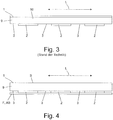
- the Figure 3 shows a cross section through the WO 2012/167806 A1 Known tape 1.
- the tape 1 has a backing layer 9, which on its one side, which is in particular the printing side, has a silicone layer 10, so that this side does not stick to the rolled-up tape 1 with the adhesive strips 2 of the tape 1.
- the adhesive strips 2 are arranged at a distance from one another in the longitudinal direction 2 and form the non-adhesive areas 3 between them.
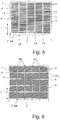
- the Figure 5 shows a further possible embodiment of the tape 1 according to the invention which, in addition to the adhesive-free areas 3 running transversely to the longitudinal direction L of the tape 1, also has adhesive-free strip-shaped areas LS extending in the longitudinal direction.
- the printed tape can be made out by means of a WO 2012/167806 A1 known cutting device of a printer can be cut.
- the printed tape can also be cut by hand using scissors.
- perforations extending in the longitudinal direction L are incorporated in the region of the adhesive-free strip-shaped regions LS or can be incorporated by means of a printer.
- FIG. 6 A further possible embodiment of a band 1 according to the invention is shown which has perforation regions PFL which extend in the longitudinal direction L and which are spaced apart from one another.
- perforation areas PF Q which extend transversely to the longitudinal direction L are present at regular intervals from one another.
- the perforation areas PF L , PF Q can be covered by the adhesive 2 or adhesive.
- the tape 1 it is also possible for the tape 1 to be adhesive-free or adhesive-free in the area of the perforation areas PF L , PF Q.
- the perforation areas PF L , PF Q can either be prefabricated or, if required, can be worked into the belt at any or predetermined locations by the printer.
- the Figure 7 shows a plan view of the side coated with adhesive of a printable tape 1 according to the invention with laterally arranged markings M.
- the markings M are in the area of the one adhesive-free area 8 along the long side 6 for recognizing the adhesive-free or adhesive-free areas 2 and / or with Adhesive or adhesive coated areas 2 applied or incorporated. Of course, the markings can also be arranged on both sides in both adhesive-free areas 8.
- the markings M can be printed symbols, in particular in the form of lines, rectangles or dots, and are formed by punched-outs in the form of holes.
- the markings M are arranged in the longitudinal direction L of the strip 1 at, in particular, regular intervals from one another.
- the printer recognizes the markings M through the in particular transparent and peelable film F or the coating AB and, based on the knowledge of the positioning of the markings relative to the areas 2, 3, the tape 1 or the sheet 1 'relative to the Print head and / or to the cutting unit and / or to the perforation device position so that printing, cutting and / or perforating is done in the right places.
- the markings M may be applied or incorporated on the removable film F. It is also possible that the markings M e.g. are made of magnetic material so that a Hall sensor can be used as the sensor.
- the Figure 8 shows a cross-sectional view through a tape 1 according to the invention, which has a printable layer 9, on the side facing away from the printable side 1, the adhesive or adhesive layer 2 is arranged.
- the adhesive or adhesive layer 2 is covered by the film F, so that the tape 1 cannot inadvertently adhere or stick to an object with its adhesive or adhesive layer 2. So that the film F can be removed more easily from the adhesive or adhesive layer 2 of the tape 1, the film F extends at least with its one long side F sl and / or F sr over the long side 9s of the printable layer 9.
- the adhesive or adhesive layer of the tape 1 as in the Figures 9a to 9c shown, be covered by means of two foil strips F 1 and F 2 .
- the two film strips F 1 and F 2 can adjoin each other with their mutually facing longitudinal sides F 1s and F 2s or, as in FIGS Figures 9a to 9c shown to be spaced apart by a gap Sp.
- the width of the gap Sp extending in the longitudinal direction L can be chosen to be as small as desired. For example, it is possible first to apply or apply a single film, which extends over the entire width of the printable layer, to the adhesive or adhesive layer 2, in order to then subsequently use a knife or another separating device to film the film in the longitudinal direction L of the tape 1 to share.
- the tape can be bent by applying bending or kinking forces BK, whereby at least one long side F 1s of a film tape F 1 extends from the underside 2u of the adhesive or adhesive layer 2 at least in some areas dissolves so that this film can be easily removed from the printable layer 9 or its adhesive layer 2.
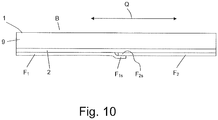
- the Figure 10 shows a cross-sectional view through an alternative embodiment in which the two foil bands F 1 and F 2 with their longitudinal sides F 1s and F 2s overlap, wherein the longitudinal side F 2s of the film strip F 2 adhered to the adhesive or adhesive layer 2 and is liable and the long side F 1s of the film strip F 1 rests on the long side F 2s and overlaps it without adhering to or sticking to it.
- the long side F 1s of the film strip F 1 can be easily gripped, as a result of which the film strip F 1 is easy to pull off.
- the film strip F 2 can then by bending or bending, as in Figure 9c is shown, are detached from the adhesive or adhesive layer 2.
- the printable layer 9 extends continuously in the longitudinal direction L of the tape 1 or sheet 1 ', so that the tape 1 or sheet 1' can be printed continuously over its entire length.
- the printable layer 9 can, of course, be constructed in multiple layers and also have a carrier film on which the adhesive or adhesive layer 2 is arranged on the side 1 to be printed.
Landscapes
- Adhesive Tapes (AREA)
Description
- Die vorliegende Erfindung betrifft ein Band oder Blatt zum Bedrucken mittels eines Druckers, wobei das Band bzw. Blatt an seiner einen flachen Seite bedruckbar ist und an seiner anderen flachen Seite eine Klebe- oder Haftschicht aufweist, welche kleberfreie oder haftstofffreie Bereiche und klebende bzw. haftende Bereiche aufweist, die zumindest in Längserstreckungsrichtung des Bandes bzw. Blattes voneinander beabstandet sind.
- Ein entsprechendes Band ist aus
WO 2012/167806 A1 bekannt. Bei Druckern, die Bänder bedrucken, welche eine Haft- oder Klebeschicht aufweisen, besteht stets das Problem, dass die Schneidmesser durch das Haftmittel bzw. den Kleber verschmutzen und ihre Funktion verlieren bzw. das Band nur noch schlecht oder nicht mehr sauber durchtrennt wird. Eine Reinigung der Schneidvorrichtung ist in der Regel nicht möglich, so dass die Schneidvorrichtung als Modul ausgetauscht werden muss. Es hat sich gezeigt, dass beim Verwenden derartige Drucker im Logistikbereich pro Jahr beim Durschneiden von Papier mit durchgehender und somit nicht unterbrochener Klebeschicht, die Drucker aufgrund der Verunreinigung durch die Klebstoffreste eine hohe Ausfallrate aufweisen. Die Geräte und speziell die Schneideinrichtungen müssen bei Verwendung von Papier ohne unterbrochene Klebeschicht regelmäßig gereinigt und gewartet werden, da die Schneideinrichtungen laufend durch die Kleberschicht schneiden müssen, wobei speziell die Schneiden verkleben. Aus diesem Grund weist das ausWO 2012/167806 A1 bekannte Band an seiner der bedruckbaren flachen Seite abgewandten flachen Seite eine Klebe- oder Haftschicht auf, welche kleberfreie oder haftstofffreie Bereiche und klebende bzw. haftende Bereiche aufweist, die zumindest in Längserstreckungsrichtung des Bandes voneinander beabstandet sind. Der Drucker weist eine Sensoreinrichtung auf, mittels derer die kleberfreien bzw. haftstofffreien Bereiche detektierbar sind, so dass die Bandvorschubeinrichtung das Band zum Abschneiden stets derart relativ zum Schneidwerk positionieren kann, dass die Schneidmesser das Band stets nur im kleberfreien bzw. haftstofffreien Bereich schneidet und es hierdurch vorteilhaft nicht zu einem Verkleben des Schneidwerkes kommt. - Nachteilig bei dem aus
WO 2012/167806 A1 bekannten Band ist, dass die bedruckbare flache Seite mit einer Antihaft- bzw. Antiklebeschicht, z.B. in Form einer Silikonschicht, beschichtet sein muss, damit das Band aufrollbar ist. - Ferner sind bedruckbare Bänder bekannt, welche eine Klebeschicht aufweisen, welche an der bedruckbaren Seite angeordnet sind, wobei die Bänder eine zusätzliche abziehbare Folie aufweisen, mittels derer die Klebeschicht abgedeckt ist, so dass sich das Band aufrollen lässt.
- Aus
US 4,460,634 ,US 6,461,727 undDE 3403364 A1 sind Aufkleber vorbekannt, welche eine bedruckbare Papierschicht aufweisen, die an ihrer Rückseite eine Klebstoffschicht haben, welche Bereiche aufweist, die nicht mit Klebstoff benetzt sind. Die Klebstoffschicht sowie die Bereiche ohne Klebstoff sind mit einer abziehbaren Folie bedeckt. - Aus
DE 3403364 A1 ist ein Verfahren und Vorrichtung zur Herstellung von bandförmigen Haftetikettenmaterial sowie Selbstklebeetiketten bekannt. Auch diese Haftetiketten sind ähnlich zu denen ausUS 64 61 727 B1 bekannten Aufkleber aufgebaut. - Aufgabe der vorliegenden Erfindung ist es, ein bedruckbares Band mit einer Klebeschicht und einer diese bedeckenden und abziehbaren Folie bereitzustellen, bei dem die nicht klebenden Bereiche leicht erkennbar sind.
- Diese Aufgabe wird mit einer Folie mit den Merkmalen des Anspruchs 1 gelöst.
- Die Folie zeichnet sich u.a. dadurch aus, dass die Klebe- bzw. Haftschicht mittels einer abziehbaren Folie, einer abziehbaren oder auflösbaren Beschichtung abgedeckt ist. Die Folie wird dabei beim Abschneiden bzw. Durchtrennen des Bandes mit durchtrennt. Sowohl das im Drucker verbleibende Band als auch der bedruckte abgeschnittene Bandabschnitt wird durch die Folie weiterhin geschützt und ein unerwünschtes Ankleben bzw. Anhaften wird vorteilhaft verhindert. Sofern der bedruckte und abgeschnittene Bandbereich auf einer Fläche oder einem Gegenstand aufgeklebt werden soll, kann die Folie bzw. die Beschichtung vom Band abgezogen bzw. entfernt werden, wodurch die Klebe- bzw. Haftschicht freiliegt und ein Aufkleben bzw. Anhaften möglich ist.
- Da die klebenden bzw. haftenden Bereiche zumindest in Längserstreckungsrichtung des Bandes oder Blattes durch die kleberfreien bzw. haftstofffreien Bereiche voneinander beabstandet sind, kann vorteilhaft, wie auch bei dem aus
WO2012/167806 A1 bekannten Band, das erfindungsgemäße Band durch die kleberfreien bzw. haftstofffreien Bereiche geschnitten werden, so dass die Schneiden des Druckers nicht verkleben. Hierdurch muss der Drucker wesentlich seltener gewartet und gereinigt werden, was die TCO stark senkt. - Hierdurch ist es z.B. vorteilhaft möglich, das erfindungsgemäße Band bzw. Blatt zum Herstellen von Briefmarken zu verwenden. Aufgrund der fehlenden Silikonbeschichtung auf der bedruckbaren Seite kann die aus dem erfindungsgemäßen Band bzw. Blatt hergestellte Briefmarke mittels eines Stempels entwertet werden, was bei einer Silikonbeschichtung nicht möglich wäre, da die Stempeltinte von der Silikonbeschichtung abwischbar ist.
- Das erfindungsgemäße Band bzw. Blatt kann Prinzip bedingt aus einem beliebigen bedruckbaren Material, insbesondere Papier, wie z.B. Thermopapier oder Thermotransferpapier, oder Karton sein. Auch kann das Band bzw. Blatt eine Trägerfolie aufweisen, deren eine flache Seite die Klebe- bzw. Haftschicht mit den kleberfreien bzw. haftstofffreien Bereichen aufweist, welche wiederum mit der abziehbaren Folie oder Beschichtung bedeckt ist. Die Trägerfolie selbst kann auch mehrschichtig aufgebaut sein. Es muss lediglich sichergestellt sein, dass die bedruckbare Seite auch mit z.B. Stempeltinte oder Füllertinten oder sonstigen Druck- oder Malfarben beschreibbar ist.
- In einer weiteren Ausgestaltung sind die Längsseiten des Bandes nicht gerade, sondern weisen Zacken wie herkömmliche Briefmarken auf. Die Randbereiche der Längsseiten können dabei ebenfalls keine Kleberschicht oder Haftmittelschicht aufweisen, so dass beim aufgerollten Band, wie bereits in
WO2012/167806 A1 beschrieben, kein Klebstoff seitlich austritt bzw. die Bandrolle seitlich nicht klebt. - In einer weiteren Ausgestaltung weist das erfindungsgemäße Band bzw. Blatt zusätzlich sich in Längserstreckungsrichtung des Bandes bzw. Blattes erstreckende durchgehende kleberfreie bzw. haftstofffreie Streifen auf, so dass das Band bzw. Blatt auch in Längserstreckungsrichtung durchschneidbar ist. Vorteilhaft kann das Band bzw. Blatt im Bereich der kleberfreien bzw. haftstofffreien Bereiche und Streifen perforiert sein, so dass es per Hand oder maschinell in kleinere Teile auseinanderreißbar ist. Die Perforation kann selbstverständlich auch mittels des Druckers erzeugt werden, wobei die Perforationseinrichtung des Druckers steuerbar ist und damit die Perforation bedarfsweise und an verschiedenen Stellen des Bandes bzw. Blattes herstellbar ist.
- Durch das erfindungsgemäße Vorsehen von Perforationen können mittels des erfindungsgemäßen Bandes bzw. Blattes zusammenhängende Briefmarken oder Labels gedruckt werden, die erst bei Bedarf leicht händisch und an der vorgesehenen Stelle bzw. Stellen voneinander getrennt werden können.
- Wie bereits erläutert, kann das Band auf einer Rolle aufgerollt sein. Es ist jedoch auch möglich, dass das Band zu einem Stapel in Form eines Liporellos zusammengefaltet ist.
- Dadurch, dass sich die bedruckbare Schicht durchgehend über die gesamte Länge des Bandes in Bandlängsrichtung erstreckt, kann vorteilhaft die Länge des bedruckbaren Bereichs in Bandlängsrichtung frei bestimmt werden. Es ist lediglich eine Schneideinrichtung oder eine Abreißeinrichtung notwendig, um das bedruckte Band von dem noch nicht bedruckten Band zu trennen. Vorteilhaft wird das Band nur dort durchtrennt, wo sich keine Klebe- bzw. Haftschicht befindet.
- Es ist von Vorteil, wenn die Klebe- bzw. Haftschicht mittels mindestens zwei sich in Bandlängsrichtung erstreckenden Folienbändern bedeckt ist, welche in Bandlängsrichtung nebeneinander angeordnet sind. Dabei ist zu bevorzugen, wenn das Band lediglich zwei Folienbänder aufweist, die entweder aneinandergrenzen oder sich leicht überlappen. Durch die Verwendung von mindestens zwei, vorteilhaft genau zwei, Folienbändern, können diese leicht vom bedruckten Band z.B. mittels Verbiegen des Bandes von der Haft-/Klebeschicht abgelöst werden.
- Nachfolgend wird das erfindungsgemäße Band anhand von Zeichnungen näher erläutert.
- Es zeigen:
- Fig. 1:
- Draufsicht auf die bereichsweise mit Klebstoff beschichtete Seite einer aus
WO 2012/167806 A1 bekannten ersten Ausführungsform eines bedruckbaren Bandes; - Fig. 2:
- Draufsicht auf die bereichsweise mit Klebstoff beschichtete Seite einer aus
WO 2012/167806 A1 bekannten zweiten Ausführungsform eines bedruckbaren Bandes; - Fig. 3:
- Querschnittsdarstellung eines aus
WO 2012/167806 A1 bekannten Bandes; - Fig. 4:
- Querschnittsdarstellung eines erfindungsgemäßen Bandes;
- Fig. 5:
- Draufsicht auf die bereichsweise mit Klebstoff beschichtete Seite eines erfindungsgemäßen bedruckbaren Bandes mit sich in Längserstreckung erstreckenden kleberlosen Bereichen, mit transparenter abziehbarer Folie;
- Fig. 6:
- Draufsicht auf die bereichsweise mit Klebstoff beschichtete Seite eines erfindungsgemäßen bedruckbaren Bandes mit Längsund Querperforationen zum insbesondere händischen Trennen des bedruckten Bandes;
- Fig. 7:
- Draufsicht auf die bereichsweise mit Klebstoff beschichtete Seite eines erfindungsgemäßen bedruckbaren Bandes mit seitlich angeordneten Markierungen;
- Fig. 8:
- Querschnittsdarstellung eines Bandes mit seitlich überstehender Folie;
- Fig. 9a:
- Draufsicht auf die Unterseite bzw. Folienseite des Bandes mit parallel zur Längserstreckungsrichtung geteilter Folie;
- Fig. 9b:
- Querschnittsdarstellung durch das Band gemäß
Figur 9a ; - Fig. 9b:
- Querschnittsdarstellung durch das gebogene Band gemäß
Figur 9a und 9b ; - Fig. 10:
- Querschnittsdarstellung durch eine alternative Ausführungsform mit sich bereichsweise überlappenden Folienbändern.
- Die
Figur 1 zeigt eine Draufsicht auf die mit Kleber beschichtete Unterseite des ausWO 2012/167806 A1 bekannten Bandes 1, wobei der Kleber in Streifenform mittels Querstreifen 2 auf das Band aufgetragen ist. Zwischen den Kleberstreifen 2 befinden sich kleberfreien Querstreifen 3, in deren Bereichen mittels einer Schneidvorrichtung eines Druckers das Band durchtrennbar ist. Die gestrichelte Linie S zeigt die mögliche Platzierung einer Schneidvorrichtung an. Das Band wird in Längsrichtung L mittels einer Transportvorrichtung transportiert. Die Transportvorrichtung dient dabei zur Positionierung des Bandes 1 über der Schneidvorrichtung S. Das Band weist eine Stirnseite 7 sowie Längsseiten 6 auf. Rechts vom Band ist eine Ausschnittsvergrößerung des Bandes mit seinen Klebestreifen 2 dargestellt. Zwischen den Klebestreifen 2 sind die klebefreien Streifen 3 angeordnet, wobei die Klebestreifen 2 eine Breite 4 und die klebefreien Bereiche eine Breite 5 aufweisen. Prinzipiell sind die Breiten 4, 5 beliebig zu wählen. Prinzip bedingt ist es jedoch sinnvoll, dass die Breite 5 möglichst klein gewählt wird, sodass eine möglichst gute Haftung des Bandes 1 gegeben ist. Die Breite 5 hängt dabei maßgeblich von der Dimensionierung der Schneidvorrichtung ab. Das heißt, es muss sichergestellt werden, dass die Breite 5 so groß gewählt wird, dass beim Schneidvorgang kein Klebstoff oder Haftmaterial die Schneiden der Schneidvorrichtung verschmutzt. Die Breite 4 der Klebestreifen 2 sollte ebenfalls möglichst klein ausgebildet sein, damit an möglichst eng zueinander liegenden Stellen das Band geschnitten werden kann. Hierdurch wird erreicht, dass das Band bestmöglich ausgenutzt werden kann. Die Klebestreifen 2 weisen bei der Ausführungsform gemäß Figur 1 eine größere Breite 4 auf, als die klebefreien Bereiche 5. - In
Figur 2 ist eine zweite mögliche Ausbildung des ausWO 2012/167806 A1 bekannten Bandes 1 dargestellt, bei der die Breite eines Klebestreifens 2 gleich ist mit der Breite der klebefreien Bereiche. Zusätzlich sind die Randbereiche 8 des Bandes 1 klebstofffrei ausgebildet, sodass sichergestellt ist, dass an den seitlichen Bereichen des aufgewickelten Bandes 1 kein Kleber austritt. Die Randbereiche 8 sollten dabei so schmal wie möglich ausgebildet sein, damit der Rand 6 des aufgeklebten Bons bzw. Etiketts sich nicht abheben kann. - Die
Figur 3 zeigt einen Querschnitt durch das ausWO 2012/167806 A1 bekannte Band 1. Das Band 1 weist eine Trägerschicht 9 auf, die an ihrer einen Seite, welche insbesondere die Druckseite ist, eine Silikonschicht 10 auf, damit diese Seite nicht bei dem aufgerollten Band 1 mit den Klebestreifen 2 des Bandes 1 kleben bleibt. An der Unterseite des Bandes 1 sind die Klebestreifen 2 in Längserstreckungsrichtung 2 im Abstand zueinander angeordnet und bilden zwischen sich die klebefreien Bereiche 3. - Im Gegensatz zum aus
WO2012/167806 bekannten Band 1 weist das inFigur 4 im Querschnitt dargestellte erfindungsgemäße Band 1 als Ersatz für die Silikonschicht 10 eine abziehbare Folie F auf. Alternativ zur abziehbaren Folie F kann auch eine entfernbare bzw. abziehbare oder auflösbare Beschichtung AB vorgesehen werden. - Die
Figur 5 zeigt eine weitere mögliche Ausführungsform des erfindungsgemäßen Bandes 1, welches zusätzlich zu den quer zur Längserstreckungsrichtung L des Bandes 1 verlaufenden kleberlosen Bereichen 3 noch sich in Längserstreckungsrichtung erstreckende kleberlose streifenförmige Bereiche LS aufweist. Im Bereich der kleberlosen streifenförmigen Bereiche LS kann das bedruckte Band mittels einer ausWO 2012/167806 A1 bekannten Schneidvorrichtung eines Druckers geschnitten werden. Es ist jedoch selbstverständlich auch möglich, dass das bedruckte Band auch händisch mittels einer Schere zerschnitten werden kann. Auch ist es möglich, dass im Bereich der kleberlosen streifenförmigen Bereiche LS sich in Längserstreckungsrichtung L erstreckende Perforationen eingearbeitet sind oder mittels eines Druckers einarbeitbar sind. - In
Figur 6 ist eine weitere mögliche Ausführungsform eines erfindungsgemäßen Bandes 1 dargestellt, welches sich in Längserstreckungsrichtung L erstreckende Perforationsbereiche PFL aufweist, welche zueinander beabstandet sind. Zusätzlich sind in regelmäßigen Abständen zueinander sich quer zur Längserstreckungsrichtung L erstreckende Perforationsbereiche PFQ vorhanden. Die Perforationsbereiche PFL, PFQ können vom Kleber 2 bzw. Haftmittel bedeckt sein. Es ist jedoch auch möglich, dass das Band 1 im Bereich der Perforationsbereiche PFL, PFQ kleberfrei bzw. haftmittelfrei ist. Die Perforationsbereiche PFL, PFQ können entweder vorgefertigt sein, oder aber vom Drucker in das Band an beliebigen oder fest vorgegebenen Stellen bedarfsweise eingearbeitet werden. - Mit dem in
Figur 6 dargestellten Band 1 ist es somit möglich, Wertmarken oder ähnliches auszudrucken, diese entweder händisch oder automatisch abzutrennen oder zu vereinzeln. Durch die auf der Kleberschicht 2 aufgebrachte abziehbare Folie F bzw. der Beschichtung AB ist es möglich, die hergestellten Wertmarken problemlos zu transportieren, ohne dass der Kleber 2 bzw. das Haftmittel ungewollt an Gegenständen oder z.B. im Portemonnaie festklebt. - Die
Figur 7 zeigt eine Draufsicht auf die bereichsweise mit Klebstoff beschichtete Seite eines erfindungsgemäßen bedruckbaren Bandes 1 mit seitlich angeordneten Markierungen M. Die Markierungen M sind im Bereich des einen kleberfreien Bereichs 8 entlang der Längsseite 6 zur Erkennung der kleberfreien bzw. haftstofffreien Bereiche 2 und/oder der mit Klebstoff bzw. Haftmittel beschichteten Bereiche 2 aufgebracht oder eingearbeitet. Selbstverständlich können die Markierungen auch beidseitig in beiden kleberfreien Bereichen 8 angeordnet werden. Die Markierungen M können aufgedruckte Symbole, insbesondere in Form von Strichen, Rechtecken oder Punkten sein und sind durch Ausstanzungen in Form von Löchern gebildet. Die Markierungen M sind dabei in Längserstreckungsrichtung L des Bandes 1 in, insbesondere regelmäßigen, Abständen zueinander angeordnet. Der Drucker erkennt mit seinem Sensor die Markierungen M durch die insbesondere transparente und abziehbare Folie F bzw. die Beschichtung AB hindurch und kann anhand der Kenntnis der Positionierung der Markierungen relativ zu den Bereichen 2, 3 das Band 1 bzw. das Blatt 1' relativ zum Druckkopf und/oder zum Schneidwerk und/oder zur Perforationseinrichtung positionieren, damit der Druck, das Schneiden und/oder das Perforieren an den richtigen Stellen erfolgt. - Selbstverständlich ist es ebenso möglich, dass die Markierungen M auf der abziehbaren Folie F angebracht oder eingearbeitet sind. Es ist auch möglich, dass die Markierungen M z.B. aus magnetischem Material sind, so dass als Sensor ein Hallsensor verwendet werden kann.
- Die
Figur 8 zeigt eine Querschnittsdarstellung durch ein erfindungsgemäßes Band 1, welches eine bedruckbare Schicht 9 aufweist, an deren der bedruckbaren Seite 1 abgewandten Seite die Klebe- bzw. Haftschicht 2 angeordnet ist. Die Klebe- bzw. Haftschicht 2 ist von der Folie F abgedeckt, so dass das Band 1 nicht ungewollt an einem Gegenstand mit seiner Klebe- bzw. Haftschicht 2 anhaften bzw. kleben kann. Damit die Folie F leichter von der Klebe- bzw. Haftschicht 2 des Bandes 1 abgezogen werden kann, erstreckt sich die Folie F zumindest mit ihrer einen Längsseite Fsl und/oder Fsr über die Längsseite 9s der bedruckbaren Schicht 9. - Alternativ zur in
Figur 8 dargestellten Ausführungsform kann die Haft- bzw. Klebeschicht des Bandes 1, wie in denFiguren 9a bis 9c dargestellt, mittels zweier Folienbändern F1 und F2 bedeckt sein. Dabei können die beiden Folienbänder F1 und F2 mit ihren zueinander zugewandten Längsseiten F1s und F2s aneinandergrenzen oder, wie in denFiguren 9a bis 9c dargestellt, durch einen Spalt Sp zueinander beabstandet sein. Die Breite des sich in Längserstreckungsrichtung L erstreckenden Spaltes Sp kann beliebig klein gewählt werden. Es ist z.B. möglich, zunächst eine einzige sich über die gesamte Breite der bedruckbaren Schicht erstreckende Folie auf die Haft- bzw. Klebeschicht 2 an- bzw. aufzubringen, um dann anschließend mittels eines Messers oder einer anderen Trenneinrichtung die Folie in Längserstreckungsrichtung L des Bandes 1 zu teilen. Selbstverständlich ist es möglich, auch mehr als zwei parallel zueinander angeordnete Folienbänder vorzusehen. Wie inFigur 9c dargestellt, kann durch Aufbringen von Biege- bzw. Knickkräften BK das Band gebogen werden, wodurch sich mindestens eine Längsseite F1s eines Folienbandes F1 von der Unterseite 2u der Klebe- bzw. Haftschicht 2 zumindest bereichsweise löst, damit sich diese Folie leicht von der bedruckbaren Schicht 9 bzw. deren Haft- bzw. Klebeschicht 2 abziehen lässt. - Die
Figur 10 zeigt eine Querschnittsdarstellung durch eine alternative Ausführungsform, bei der sich die beiden Folienbänder F1 und F2 mit ihren Längsseiten F1s und F2s überlappen, wobei die Längsseite F2s des Folienbandes F2 an der Klebe- bzw. Haftschicht 2 klebt bzw. haftet und die Längsseite F1s des Folienbandes F1 auf der Längsseite F2s aufliegt und diese überlappt, ohne dabei an dieser zu haften oder zu kleben. Die Längsseite F1s des Folienbandes F1 kann leicht gegriffen werden, wodurch das Folienband F1 leicht abzuziehen ist. Das Folienband F2 kann anschließend durch Knicken bzw. Biegen, wie es inFigur 9c dargestellt ist, von der Haft- bzw. Klebeschicht 2 abgelöst werden. - Wie bereits ausgeführt, erstreckt sich die bedruckbare Schicht 9 in Längserstreckungsrichtung L des Bandes 1 bzw. Blattes 1' durchgehend, so dass das Band 1 bzw. Blatt 1' über seine gesamte Länge kontinuierlich bedruckbar ist. Gleiches gilt für die Folie F bzw. die in den
Figuren 8 bis 10 dargestellten Folienbänder F1 und F2. - Die bedruckbare Schicht 9 kann selbstverständlich mehrlagig ausgebildet sein und auch eine Trägerfolie aufweisen, an der an der zu bedruckenden Seite 1 die Haft- bzw. Klebeschicht 2 angeordnet ist.
Claims (11)
- Band (1) oder Blatt (1') zum Bedrucken mittels eines Druckers, wobei das Band (1) oder Blatt (1') eine erste bedruckbare Schicht (9) aufweist, und an seiner der bedruckbaren Seite (B) abgewandten flachen Seite eine Klebe- oder Haftschicht (2) aufweist, welche sowohl kleberfreie bzw. haftstofffreie Bereiche (3) als auch klebende bzw. haftende Bereiche (2) aufweist, wobei die klebenden bzw. haftenden Bereiche (2) zumindest in Längserstreckungsrichtung (L) des Bandes (1) oder Blattes (1') durch die kleberfreien bzw. haftstofffreien Bereiche (3) voneinander beabstandet sind, wobei die Klebe- bzw. Haftschicht (2) mittels einer abziehbaren Folie (F) oder einer abziehbaren oder auflösbaren Beschichtung (AB) abgedeckt ist, und dass auf dem Band (1) bzw. Blatt (1') Markierungen (M), insbesondere im Bereich (8) der Längsseiten (6), zur Erkennung der kleberfreien bzw. haftstofffreien Bereiche (2) und/oder der mit Klebstoff bzw. Haftmittel beschichteten Bereiche (2) aufgebracht oder eingearbeitet sind, und dass die Markierungen (M) aufgedruckte Symbole, insbesondere in Form von Strichen, Rechtecken oder Punkten sind oder die Markierungen (M) durch Ausstanzungen erzeugt sind, wobei die, insbesondere aus einem magnetischen Material bestehenden, Markierungen (M) in Längserstreckungsrichtung (L) des Bandes (1) bzw. des Blattes (1') in, insbesondere regelmäßigen, Abständen zueinander angeordnet sind, wobei die Markierungen (M) auf der abziehbaren Folie (F) bzw. der Beschichtung (AB) angeordnet bzw. eingearbeitet sind.
- Band (1) bzw. Blatt (1') nach Anspruch 1, dadurch gekennzeichnet, dass die freie Oberfläche (Ff, ABf) der abziehbaren Folie (F) bzw. der Beschichtung (AB) nicht selbstklebend oder haftend ist.
- Band (1) bzw. Blatt (1') nach Anspruch 1 oder 2, dadurch gekennzeichnet, dass das Band bzw. das Blatt zusätzlich zu den quer erstreckenden kleberfreien bzw. haftstofffreien Bereichen (3) auch sich in Längsrichtung (L) erstreckende durchgehende kleberfreie bzw. haftstofffreie streifenförmige Bereiche (LS) aufweist.
- Band (1) bzw. Blatt (1') nach einem der vorhergehenden Ansprüche, dadurch gekennzeichnet, dass die abziehbare Folie (F) transparent und/oder die auflösbare Beschichtung (AB) mittels Speichel auflösbar ist ist.
- Band (1) bzw. Blatt (1') nach einem der vorhergehenden Ansprüche, dadurch gekennzeichnet, dass die Längsseiten (6) des Bandes (1) bzw. Blattes (1') Zacken (Z) aufweist.
- Band (1) bzw. Blatt (1') nach einem der vorhergehenden Ansprüche, dadurch gekennzeichnet, dass das Band (1) bzw. das Blatt (1') Quer- und/oder Längsperforationen (PFL, PFQ) aufweist, wobei insbesondere die Perforationen (PFL, PFQ) im Bereich der kleberfreien bzw. haftstofffreien Bereiche (3, LS) angeordnet sind.
- Band (1) bzw. Blatt (1') nach einem der vorhergehenden Ansprüche, dadurch gekennzeichnet, dass die bedruckbare Schicht (9) in Längserstreckungsrichtung (L) des Bandes (1) bzw. Blattes (1') durchgehend ausgebildet ist, derart, dass das Band (1) bzw. Blatt (1') über seine gesamte Länge kontinuierlich bedruckbar ist.
- Band (1) bzw. Blatt (1') nach einem der vorhergehenden Ansprüche, dadurch gekennzeichnet, dass die Folie (F, F1, F2) in Längserstreckungsrichtung (L) des Bandes (1) bzw. Blattes (1') durchgehend ausgebildet ist bzw. sich über die gesamte Länge des Bandes (1) bzw. Blattes (1') erstreckt und/oder die Folie (F) breiter ist als die bedruckbare Schicht (9), und dass die Folie (F) sich zumindest mit einer ihrer Längsseiten (Fsl, Fsr) über mindestens eine Längsseite (9s) der bedruckbaren Schicht (9) hinaus erstreckt.
- Band (1) bzw. Blatt (1') nach einem der vorhergehenden Ansprüche, dadurch gekennzeichnet, dass die Folie (F) in Längserstreckungsrichtung (L) des Bandes (1) bzw. Blattes (1') längsgeteilt ist und somit durch mindestens zwei sich in Längserstreckungsrichtung (L) erstreckenden Folienbändern (F1, F2) gebildet ist
- Band (1) bzw. Blatt (1') nach Anspruch 9, dadurch gekennzeichnet, dass die zwei Folienbänder (F1, F2) mit ihren Längsseiten aneinandergrenzen oder durch einen Spalt (Sp) voneinander beabstandet sind.
- Band (1) bzw. Blatt (1') nach Anspruch 9, dadurch gekennzeichnet, dass sich die Längsseiten (F1s, F2s) der beiden Folienbänder (F1, F2) bereichsweise überlappen, wobei die Längsseite (F2s) des einen Folienbandes (F2) an der Klebe- bzw. Haftschicht (2) klebt bzw. haftet und die Längsseite (F1s) des anderen Folienbandes (F1) auf der Längsseite (F2s) aufliegt ohne an dieser zu haften oder kleben.
Priority Applications (1)
| Application Number | Priority Date | Filing Date | Title |
|---|---|---|---|
| PL15706407T PL3108471T3 (pl) | 2014-02-17 | 2015-02-17 | Taśma do zadrukowania z folią ochronną lub powłoką chroniącą |
Applications Claiming Priority (2)
| Application Number | Priority Date | Filing Date | Title |
|---|---|---|---|
| DE102014101954.7A DE102014101954A1 (de) | 2014-02-17 | 2014-02-17 | Band zum Bedrucken mit Schutzfolie oder schützender Beschichtung |
| PCT/EP2015/053299 WO2015121495A1 (de) | 2014-02-17 | 2015-02-17 | Band zum bedrucken mit schutzfolie oder schützender beschichtung |
Publications (2)
| Publication Number | Publication Date |
|---|---|
| EP3108471A1 EP3108471A1 (de) | 2016-12-28 |
| EP3108471B1 true EP3108471B1 (de) | 2020-04-08 |
Family
ID=52589352
Family Applications (1)
| Application Number | Title | Priority Date | Filing Date |
|---|---|---|---|
| EP15706407.2A Active EP3108471B1 (de) | 2014-02-17 | 2015-02-17 | Band zum bedrucken mit schutzfolie oder schützender beschichtung |
Country Status (5)
| Country | Link |
|---|---|
| EP (1) | EP3108471B1 (de) |
| DE (1) | DE102014101954A1 (de) |
| ES (1) | ES2793899T3 (de) |
| PL (1) | PL3108471T3 (de) |
| WO (1) | WO2015121495A1 (de) |
Citations (4)
| Publication number | Priority date | Publication date | Assignee | Title |
|---|---|---|---|---|
| JPS61130067A (ja) * | 1984-11-28 | 1986-06-17 | Mitsubishi Electric Corp | 熱転写カラ−プリンタ |
| US6325480B1 (en) * | 1998-07-28 | 2001-12-04 | Eastman Kodak Company | Ink jet printer and method capable of forming a plurality of registration marks on a receiver and sensing the marks formed thereby |
| US20050078137A1 (en) * | 2003-10-10 | 2005-04-14 | Femando Juan | Multi-color printer |
| US20060013634A1 (en) * | 2002-06-25 | 2006-01-19 | Brother Kogoyo Kabushiki Kaiska | Tape printing device and tape cassette |
Family Cites Families (9)
| Publication number | Priority date | Publication date | Assignee | Title |
|---|---|---|---|---|
| US4460634A (en) * | 1979-12-29 | 1984-07-17 | Masaaki Hasegawa | Adhesive sheet and method for manufacturing the same |
| DE3403364A1 (de) * | 1984-02-01 | 1985-08-01 | schäfer-etiketten GmbH & Co, 7441 Wolfschlugen | Verfahren und vorrichtung zur herstellung von bandfoermigem haftetikettenmaterial sowie selbstklebeetikett |
| US6270871B1 (en) * | 1996-09-27 | 2001-08-07 | Avery Dennison Corporation | Overlaminated pressure-sensitive adhesive construction |
| ATE260507T1 (de) * | 1998-11-06 | 2004-03-15 | Jackstaedt Gmbh | Etikett zur fleischbeklebung |
| US8163365B2 (en) * | 2005-03-24 | 2012-04-24 | Nastar Inc. | Repositionable labels using dot patterned adhesive |
| DE102007039263A1 (de) * | 2007-08-20 | 2009-02-26 | Sattler Ag | Selbstklebendes Printmedium |
| DE102009046625A1 (de) * | 2009-11-11 | 2011-05-12 | Tesa Se | Etikett mit Effektpigmenten |
| EP2718214A1 (de) | 2011-06-10 | 2014-04-16 | BIXOLON Europe GmbH | Drucker zum bedrucken eines einseitig mit klebstoff beschichteten bandes |
| DE102011122100A1 (de) * | 2011-12-22 | 2013-06-27 | Bixolon Europe Gmbh | Rollen für einen Drucker sowie ein mit diesen Rollen ausgestatteter Drucker |
-
2014
- 2014-02-17 DE DE102014101954.7A patent/DE102014101954A1/de not_active Ceased
-
2015
- 2015-02-17 ES ES15706407T patent/ES2793899T3/es active Active
- 2015-02-17 EP EP15706407.2A patent/EP3108471B1/de active Active
- 2015-02-17 PL PL15706407T patent/PL3108471T3/pl unknown
- 2015-02-17 WO PCT/EP2015/053299 patent/WO2015121495A1/de not_active Ceased
Patent Citations (4)
| Publication number | Priority date | Publication date | Assignee | Title |
|---|---|---|---|---|
| JPS61130067A (ja) * | 1984-11-28 | 1986-06-17 | Mitsubishi Electric Corp | 熱転写カラ−プリンタ |
| US6325480B1 (en) * | 1998-07-28 | 2001-12-04 | Eastman Kodak Company | Ink jet printer and method capable of forming a plurality of registration marks on a receiver and sensing the marks formed thereby |
| US20060013634A1 (en) * | 2002-06-25 | 2006-01-19 | Brother Kogoyo Kabushiki Kaiska | Tape printing device and tape cassette |
| US20050078137A1 (en) * | 2003-10-10 | 2005-04-14 | Femando Juan | Multi-color printer |
Also Published As
| Publication number | Publication date |
|---|---|
| WO2015121495A1 (de) | 2015-08-20 |
| ES2793899T3 (es) | 2020-11-17 |
| PL3108471T3 (pl) | 2020-11-02 |
| EP3108471A1 (de) | 2016-12-28 |
| DE102014101954A1 (de) | 2015-09-03 |
Similar Documents
| Publication | Publication Date | Title |
|---|---|---|
| DE69933734T2 (de) | Etikettenbogen | |
| EP0688006B1 (de) | Blattförmiger Verbund sowie Vorrichtung und Verfahren zum Herstellen eines solchen Verbundes | |
| EP0175719B1 (de) | Verfahren zur herstellung von blättern oder bogen mit heraustrennbarer selbstklebeetikette | |
| EP0946936B1 (de) | Etikett zum etikettieren von vorzugsweise zylindrischen behältnissen und behältnis mit einem solchen etikett | |
| DE4134231A1 (de) | Gepaeckstreifenanhaenger fuer einzelbeschriftung | |
| DE2615710A1 (de) | Etikettenstreifenaufbau | |
| DE2427521A1 (de) | Gepaeckanhaenger mit kontrollabschnitt | |
| DE60116139T2 (de) | Mehrschichtiges etikett sowie verfahren und vorrichtung zu dessen herstellung | |
| EP1394600B1 (de) | Mehrlagiges Etikett | |
| DE69928295T2 (de) | Klebeschilder und produktionsmethode dafür | |
| DE3110592C2 (de) | ||
| DE1029967B (de) | Verfahren zur Herstellung von nach Abzug einer Schutzschicht anklebbaren Metallplatten | |
| EP3108471B1 (de) | Band zum bedrucken mit schutzfolie oder schützender beschichtung | |
| DE3403364A1 (de) | Verfahren und vorrichtung zur herstellung von bandfoermigem haftetikettenmaterial sowie selbstklebeetikett | |
| EP0537662B1 (de) | Gepäckstreifenanhänger in Endlos- oder Rollenform für maschinelle Beschriftung | |
| EP4124449B1 (de) | Etikett, etikettenband und verfahren zum herstellen von etiketten | |
| DE102021124182A1 (de) | Folie zur Applikation auf druckbeaufschlagten Körpern und Verfahren zu deren Herstellung | |
| DE1786150C3 (de) | Geschichtetes bahnförmiges Material zur Bildung von selbstklebenden Etiketten und Verfahren zu seiner Herstellung | |
| WO2017042229A1 (de) | Anordnung für ein etikett und verfahren zum herstellen eines etiketts sowie verfahren zur verarbeitung eines etiketts | |
| EP0917123A2 (de) | Laminierbarer Markierer und Verfahren zu seiner Herstellung | |
| EP0989085B1 (de) | Etikettenstreifen | |
| DE102019008047A1 (de) | Selbstklebeetikettenrolle | |
| DE10329416B4 (de) | Set zur Herstellung laminatgeschützter, selbstklebender Etiketten sowie Vorrichtung zum Laminieren von beschrifteten oder beschriftbaren Bögen mit Schutzfolie | |
| DE3403363A1 (de) | Verfahren und vorrichtung zur herstellung von bandfoermigem haftetikettenmaterial sowie selbstklebeetikett | |
| DE20216483U1 (de) | Selbstklebebonrolle |
Legal Events
| Date | Code | Title | Description |
|---|---|---|---|
| PUAI | Public reference made under article 153(3) epc to a published international application that has entered the european phase |
Free format text: ORIGINAL CODE: 0009012 |
|
| STAA | Information on the status of an ep patent application or granted ep patent |
Free format text: STATUS: REQUEST FOR EXAMINATION WAS MADE |
|
| 17P | Request for examination filed |
Effective date: 20160831 |
|
| AK | Designated contracting states |
Kind code of ref document: A1 Designated state(s): AL AT BE BG CH CY CZ DE DK EE ES FI FR GB GR HR HU IE IS IT LI LT LU LV MC MK MT NL NO PL PT RO RS SE SI SK SM TR |
|
| AX | Request for extension of the european patent |
Extension state: BA ME |
|
| DAX | Request for extension of the european patent (deleted) | ||
| STAA | Information on the status of an ep patent application or granted ep patent |
Free format text: STATUS: EXAMINATION IS IN PROGRESS |
|
| 17Q | First examination report despatched |
Effective date: 20180102 |
|
| RIC1 | Information provided on ipc code assigned before grant |
Ipc: B41J 11/66 20060101ALN20190612BHEP Ipc: B41J 3/407 20060101ALI20190612BHEP Ipc: B41J 11/46 20060101AFI20190612BHEP |
|
| REG | Reference to a national code |
Ref country code: DE Ref legal event code: R079 Ref document number: 502015012218 Country of ref document: DE Free format text: PREVIOUS MAIN CLASS: G09F0003100000 Ipc: B41J0011460000 |
|
| GRAP | Despatch of communication of intention to grant a patent |
Free format text: ORIGINAL CODE: EPIDOSNIGR1 |
|
| STAA | Information on the status of an ep patent application or granted ep patent |
Free format text: STATUS: GRANT OF PATENT IS INTENDED |
|
| RIC1 | Information provided on ipc code assigned before grant |
Ipc: B41J 3/407 20060101ALI20191002BHEP Ipc: B41J 11/46 20060101AFI20191002BHEP Ipc: B41J 11/66 20060101ALN20191002BHEP |
|
| RIC1 | Information provided on ipc code assigned before grant |
Ipc: B41J 3/407 20060101ALI20191008BHEP Ipc: B41J 11/46 20060101AFI20191008BHEP Ipc: B41J 11/66 20060101ALN20191008BHEP |
|
| INTG | Intention to grant announced |
Effective date: 20191021 |
|
| GRAS | Grant fee paid |
Free format text: ORIGINAL CODE: EPIDOSNIGR3 |
|
| GRAA | (expected) grant |
Free format text: ORIGINAL CODE: 0009210 |
|
| STAA | Information on the status of an ep patent application or granted ep patent |
Free format text: STATUS: THE PATENT HAS BEEN GRANTED |
|
| AK | Designated contracting states |
Kind code of ref document: B1 Designated state(s): AL AT BE BG CH CY CZ DE DK EE ES FI FR GB GR HR HU IE IS IT LI LT LU LV MC MK MT NL NO PL PT RO RS SE SI SK SM TR |
|
| REG | Reference to a national code |
Ref country code: AT Ref legal event code: REF Ref document number: 1253855 Country of ref document: AT Kind code of ref document: T Effective date: 20200415 Ref country code: CH Ref legal event code: EP |
|
| REG | Reference to a national code |
Ref country code: DE Ref legal event code: R096 Ref document number: 502015012218 Country of ref document: DE |
|
| REG | Reference to a national code |
Ref country code: IE Ref legal event code: FG4D Free format text: LANGUAGE OF EP DOCUMENT: GERMAN |
|
| REG | Reference to a national code |
Ref country code: SE Ref legal event code: TRGR |
|
| REG | Reference to a national code |
Ref country code: NL Ref legal event code: FP |
|
| REG | Reference to a national code |
Ref country code: LT Ref legal event code: MG4D |
|
| PG25 | Lapsed in a contracting state [announced via postgrant information from national office to epo] |
Ref country code: IS Free format text: LAPSE BECAUSE OF FAILURE TO SUBMIT A TRANSLATION OF THE DESCRIPTION OR TO PAY THE FEE WITHIN THE PRESCRIBED TIME-LIMIT Effective date: 20200808 Ref country code: GR Free format text: LAPSE BECAUSE OF FAILURE TO SUBMIT A TRANSLATION OF THE DESCRIPTION OR TO PAY THE FEE WITHIN THE PRESCRIBED TIME-LIMIT Effective date: 20200709 Ref country code: NO Free format text: LAPSE BECAUSE OF FAILURE TO SUBMIT A TRANSLATION OF THE DESCRIPTION OR TO PAY THE FEE WITHIN THE PRESCRIBED TIME-LIMIT Effective date: 20200708 Ref country code: PT Free format text: LAPSE BECAUSE OF FAILURE TO SUBMIT A TRANSLATION OF THE DESCRIPTION OR TO PAY THE FEE WITHIN THE PRESCRIBED TIME-LIMIT Effective date: 20200817 Ref country code: FI Free format text: LAPSE BECAUSE OF FAILURE TO SUBMIT A TRANSLATION OF THE DESCRIPTION OR TO PAY THE FEE WITHIN THE PRESCRIBED TIME-LIMIT Effective date: 20200408 Ref country code: LT Free format text: LAPSE BECAUSE OF FAILURE TO SUBMIT A TRANSLATION OF THE DESCRIPTION OR TO PAY THE FEE WITHIN THE PRESCRIBED TIME-LIMIT Effective date: 20200408 |
|
| REG | Reference to a national code |
Ref country code: ES Ref legal event code: FG2A Ref document number: 2793899 Country of ref document: ES Kind code of ref document: T3 Effective date: 20201117 |
|
| PG25 | Lapsed in a contracting state [announced via postgrant information from national office to epo] |
Ref country code: BG Free format text: LAPSE BECAUSE OF FAILURE TO SUBMIT A TRANSLATION OF THE DESCRIPTION OR TO PAY THE FEE WITHIN THE PRESCRIBED TIME-LIMIT Effective date: 20200708 Ref country code: HR Free format text: LAPSE BECAUSE OF FAILURE TO SUBMIT A TRANSLATION OF THE DESCRIPTION OR TO PAY THE FEE WITHIN THE PRESCRIBED TIME-LIMIT Effective date: 20200408 Ref country code: LV Free format text: LAPSE BECAUSE OF FAILURE TO SUBMIT A TRANSLATION OF THE DESCRIPTION OR TO PAY THE FEE WITHIN THE PRESCRIBED TIME-LIMIT Effective date: 20200408 Ref country code: RS Free format text: LAPSE BECAUSE OF FAILURE TO SUBMIT A TRANSLATION OF THE DESCRIPTION OR TO PAY THE FEE WITHIN THE PRESCRIBED TIME-LIMIT Effective date: 20200408 |
|
| PG25 | Lapsed in a contracting state [announced via postgrant information from national office to epo] |
Ref country code: AL Free format text: LAPSE BECAUSE OF FAILURE TO SUBMIT A TRANSLATION OF THE DESCRIPTION OR TO PAY THE FEE WITHIN THE PRESCRIBED TIME-LIMIT Effective date: 20200408 |
|
| REG | Reference to a national code |
Ref country code: DE Ref legal event code: R097 Ref document number: 502015012218 Country of ref document: DE |
|
| PG25 | Lapsed in a contracting state [announced via postgrant information from national office to epo] |
Ref country code: RO Free format text: LAPSE BECAUSE OF FAILURE TO SUBMIT A TRANSLATION OF THE DESCRIPTION OR TO PAY THE FEE WITHIN THE PRESCRIBED TIME-LIMIT Effective date: 20200408 Ref country code: DK Free format text: LAPSE BECAUSE OF FAILURE TO SUBMIT A TRANSLATION OF THE DESCRIPTION OR TO PAY THE FEE WITHIN THE PRESCRIBED TIME-LIMIT Effective date: 20200408 Ref country code: SM Free format text: LAPSE BECAUSE OF FAILURE TO SUBMIT A TRANSLATION OF THE DESCRIPTION OR TO PAY THE FEE WITHIN THE PRESCRIBED TIME-LIMIT Effective date: 20200408 Ref country code: EE Free format text: LAPSE BECAUSE OF FAILURE TO SUBMIT A TRANSLATION OF THE DESCRIPTION OR TO PAY THE FEE WITHIN THE PRESCRIBED TIME-LIMIT Effective date: 20200408 Ref country code: CZ Free format text: LAPSE BECAUSE OF FAILURE TO SUBMIT A TRANSLATION OF THE DESCRIPTION OR TO PAY THE FEE WITHIN THE PRESCRIBED TIME-LIMIT Effective date: 20200408 |
|
| PLBE | No opposition filed within time limit |
Free format text: ORIGINAL CODE: 0009261 |
|
| STAA | Information on the status of an ep patent application or granted ep patent |
Free format text: STATUS: NO OPPOSITION FILED WITHIN TIME LIMIT |
|
| PG25 | Lapsed in a contracting state [announced via postgrant information from national office to epo] |
Ref country code: SK Free format text: LAPSE BECAUSE OF FAILURE TO SUBMIT A TRANSLATION OF THE DESCRIPTION OR TO PAY THE FEE WITHIN THE PRESCRIBED TIME-LIMIT Effective date: 20200408 |
|
| 26N | No opposition filed |
Effective date: 20210112 |
|
| PG25 | Lapsed in a contracting state [announced via postgrant information from national office to epo] |
Ref country code: SI Free format text: LAPSE BECAUSE OF FAILURE TO SUBMIT A TRANSLATION OF THE DESCRIPTION OR TO PAY THE FEE WITHIN THE PRESCRIBED TIME-LIMIT Effective date: 20200408 |
|
| REG | Reference to a national code |
Ref country code: DE Ref legal event code: R081 Ref document number: 502015012218 Country of ref document: DE Owner name: BIXOLON CO., LTD., SEONGNAM-SI, KR Free format text: FORMER OWNER: BIXOLON EUROPE GMBH, 40472 DUESSELDORF, DE |
|
| PG25 | Lapsed in a contracting state [announced via postgrant information from national office to epo] |
Ref country code: MC Free format text: LAPSE BECAUSE OF FAILURE TO SUBMIT A TRANSLATION OF THE DESCRIPTION OR TO PAY THE FEE WITHIN THE PRESCRIBED TIME-LIMIT Effective date: 20200408 |
|
| REG | Reference to a national code |
Ref country code: ES Ref legal event code: PC2A Owner name: BIXOLON CO., LTD. Effective date: 20211001 |
|
| REG | Reference to a national code |
Ref country code: GB Ref legal event code: 732E Free format text: REGISTERED BETWEEN 20210916 AND 20210922 |
|
| REG | Reference to a national code |
Ref country code: BE Ref legal event code: PD Owner name: BIXOLON CO., LTD.; KR Free format text: DETAILS ASSIGNMENT: CHANGE OF OWNER(S), ASSIGNMENT; FORMER OWNER NAME: BIXOLON EUROPE GMBH Effective date: 20210922 |
|
| PG25 | Lapsed in a contracting state [announced via postgrant information from national office to epo] |
Ref country code: LU Free format text: LAPSE BECAUSE OF NON-PAYMENT OF DUE FEES Effective date: 20210217 |
|
| REG | Reference to a national code |
Ref country code: NL Ref legal event code: PD Owner name: BIXOLON CO., LTD.; KR Free format text: DETAILS ASSIGNMENT: CHANGE OF OWNER(S), ASSIGNMENT; FORMER OWNER NAME: BIXOLON EUROPE GMBH Effective date: 20211116 |
|
| PG25 | Lapsed in a contracting state [announced via postgrant information from national office to epo] |
Ref country code: IE Free format text: LAPSE BECAUSE OF NON-PAYMENT OF DUE FEES Effective date: 20210217 |
|
| REG | Reference to a national code |
Ref country code: BE Ref legal event code: PD Owner name: BIXOLON CO., LTD.; KR Free format text: DETAILS ASSIGNMENT: CHANGE OF OWNER(S), ASSIGNMENT; FORMER OWNER NAME: BIXOLON EUROPE GMBH Effective date: 20210922 |
|
| REG | Reference to a national code |
Ref country code: AT Ref legal event code: PC Ref document number: 1253855 Country of ref document: AT Kind code of ref document: T Owner name: BIXOLON CO., LTD., KR Effective date: 20220126 |
|
| PG25 | Lapsed in a contracting state [announced via postgrant information from national office to epo] |
Ref country code: HU Free format text: LAPSE BECAUSE OF FAILURE TO SUBMIT A TRANSLATION OF THE DESCRIPTION OR TO PAY THE FEE WITHIN THE PRESCRIBED TIME-LIMIT; INVALID AB INITIO Effective date: 20150217 |
|
| PG25 | Lapsed in a contracting state [announced via postgrant information from national office to epo] |
Ref country code: CY Free format text: LAPSE BECAUSE OF FAILURE TO SUBMIT A TRANSLATION OF THE DESCRIPTION OR TO PAY THE FEE WITHIN THE PRESCRIBED TIME-LIMIT Effective date: 20200408 |
|
| PG25 | Lapsed in a contracting state [announced via postgrant information from national office to epo] |
Ref country code: MK Free format text: LAPSE BECAUSE OF FAILURE TO SUBMIT A TRANSLATION OF THE DESCRIPTION OR TO PAY THE FEE WITHIN THE PRESCRIBED TIME-LIMIT Effective date: 20200408 |
|
| PGFP | Annual fee paid to national office [announced via postgrant information from national office to epo] |
Ref country code: TR Payment date: 20240208 Year of fee payment: 10 |
|
| PG25 | Lapsed in a contracting state [announced via postgrant information from national office to epo] |
Ref country code: MT Free format text: LAPSE BECAUSE OF FAILURE TO SUBMIT A TRANSLATION OF THE DESCRIPTION OR TO PAY THE FEE WITHIN THE PRESCRIBED TIME-LIMIT Effective date: 20200408 |
|
| REG | Reference to a national code |
Ref country code: CH Ref legal event code: U11 Free format text: ST27 STATUS EVENT CODE: U-0-0-U10-U11 (AS PROVIDED BY THE NATIONAL OFFICE) Effective date: 20260301 |
|
| PGFP | Annual fee paid to national office [announced via postgrant information from national office to epo] |
Ref country code: NL Payment date: 20260223 Year of fee payment: 12 |
|
| PGFP | Annual fee paid to national office [announced via postgrant information from national office to epo] |
Ref country code: SE Payment date: 20260225 Year of fee payment: 12 |
|
| PGFP | Annual fee paid to national office [announced via postgrant information from national office to epo] |
Ref country code: GB Payment date: 20260219 Year of fee payment: 12 |
|
| PGFP | Annual fee paid to national office [announced via postgrant information from national office to epo] |
Ref country code: ES Payment date: 20260325 Year of fee payment: 12 |
|
| PGFP | Annual fee paid to national office [announced via postgrant information from national office to epo] |
Ref country code: DE Payment date: 20260223 Year of fee payment: 12 |
|
| PGFP | Annual fee paid to national office [announced via postgrant information from national office to epo] |
Ref country code: AT Payment date: 20260223 Year of fee payment: 12 |
|
| PGFP | Annual fee paid to national office [announced via postgrant information from national office to epo] |
Ref country code: BE Payment date: 20260223 Year of fee payment: 12 Ref country code: IT Payment date: 20260227 Year of fee payment: 12 |
|
| PGFP | Annual fee paid to national office [announced via postgrant information from national office to epo] |
Ref country code: FR Payment date: 20260223 Year of fee payment: 12 |
|
| PGFP | Annual fee paid to national office [announced via postgrant information from national office to epo] |
Ref country code: CH Payment date: 20260301 Year of fee payment: 12 |
|
| PGFP | Annual fee paid to national office [announced via postgrant information from national office to epo] |
Ref country code: PL Payment date: 20260203 Year of fee payment: 12 |