EP3110868B1 - Aus erneuerbaren ressourcen hergestellte, härtbare wässrige polyurethandispersionen - Google Patents
Aus erneuerbaren ressourcen hergestellte, härtbare wässrige polyurethandispersionen Download PDFInfo
- Publication number
- EP3110868B1 EP3110868B1 EP15706041.9A EP15706041A EP3110868B1 EP 3110868 B1 EP3110868 B1 EP 3110868B1 EP 15706041 A EP15706041 A EP 15706041A EP 3110868 B1 EP3110868 B1 EP 3110868B1
- Authority
- EP
- European Patent Office
- Prior art keywords
- polyol
- acid
- curable
- meth
- polyurethane
- Prior art date
- Legal status (The legal status is an assumption and is not a legal conclusion. Google has not performed a legal analysis and makes no representation as to the accuracy of the status listed.)
- Active
Links
Images
Classifications
-
- C—CHEMISTRY; METALLURGY
- C08—ORGANIC MACROMOLECULAR COMPOUNDS; THEIR PREPARATION OR CHEMICAL WORKING-UP; COMPOSITIONS BASED THEREON
- C08G—MACROMOLECULAR COMPOUNDS OBTAINED OTHERWISE THAN BY REACTIONS ONLY INVOLVING UNSATURATED CARBON-TO-CARBON BONDS
- C08G18/00—Polymeric products of isocyanates or isothiocyanates
- C08G18/06—Polymeric products of isocyanates or isothiocyanates with compounds having active hydrogen
- C08G18/28—Polymeric products of isocyanates or isothiocyanates with compounds having active hydrogen characterised by the compounds used containing active hydrogen
- C08G18/40—High-molecular-weight compounds
- C08G18/4009—Two or more macromolecular compounds not provided for in one single group of groups C08G18/42 - C08G18/64
- C08G18/4018—Mixtures of compounds of group C08G18/42 with compounds of group C08G18/48
-
- C—CHEMISTRY; METALLURGY
- C08—ORGANIC MACROMOLECULAR COMPOUNDS; THEIR PREPARATION OR CHEMICAL WORKING-UP; COMPOSITIONS BASED THEREON
- C08G—MACROMOLECULAR COMPOUNDS OBTAINED OTHERWISE THAN BY REACTIONS ONLY INVOLVING UNSATURATED CARBON-TO-CARBON BONDS
- C08G18/00—Polymeric products of isocyanates or isothiocyanates
- C08G18/06—Polymeric products of isocyanates or isothiocyanates with compounds having active hydrogen
- C08G18/08—Processes
- C08G18/0804—Manufacture of polymers containing ionic or ionogenic groups
- C08G18/0819—Manufacture of polymers containing ionic or ionogenic groups containing anionic or anionogenic groups
- C08G18/0823—Manufacture of polymers containing ionic or ionogenic groups containing anionic or anionogenic groups containing carboxylate salt groups or groups forming them
-
- C—CHEMISTRY; METALLURGY
- C08—ORGANIC MACROMOLECULAR COMPOUNDS; THEIR PREPARATION OR CHEMICAL WORKING-UP; COMPOSITIONS BASED THEREON
- C08G—MACROMOLECULAR COMPOUNDS OBTAINED OTHERWISE THAN BY REACTIONS ONLY INVOLVING UNSATURATED CARBON-TO-CARBON BONDS
- C08G18/00—Polymeric products of isocyanates or isothiocyanates
- C08G18/06—Polymeric products of isocyanates or isothiocyanates with compounds having active hydrogen
- C08G18/08—Processes
- C08G18/0838—Manufacture of polymers in the presence of non-reactive compounds
- C08G18/0842—Manufacture of polymers in the presence of non-reactive compounds in the presence of liquid diluents
- C08G18/0861—Manufacture of polymers in the presence of non-reactive compounds in the presence of liquid diluents in the presence of a dispersing phase for the polymers or a phase dispersed in the polymers
- C08G18/0866—Manufacture of polymers in the presence of non-reactive compounds in the presence of liquid diluents in the presence of a dispersing phase for the polymers or a phase dispersed in the polymers the dispersing or dispersed phase being an aqueous medium
-
- C—CHEMISTRY; METALLURGY
- C08—ORGANIC MACROMOLECULAR COMPOUNDS; THEIR PREPARATION OR CHEMICAL WORKING-UP; COMPOSITIONS BASED THEREON
- C08G—MACROMOLECULAR COMPOUNDS OBTAINED OTHERWISE THAN BY REACTIONS ONLY INVOLVING UNSATURATED CARBON-TO-CARBON BONDS
- C08G18/00—Polymeric products of isocyanates or isothiocyanates
- C08G18/06—Polymeric products of isocyanates or isothiocyanates with compounds having active hydrogen
- C08G18/28—Polymeric products of isocyanates or isothiocyanates with compounds having active hydrogen characterised by the compounds used containing active hydrogen
- C08G18/30—Low-molecular-weight compounds
- C08G18/34—Carboxylic acids; Esters thereof with monohydroxyl compounds
- C08G18/348—Hydroxycarboxylic acids
-
- C—CHEMISTRY; METALLURGY
- C08—ORGANIC MACROMOLECULAR COMPOUNDS; THEIR PREPARATION OR CHEMICAL WORKING-UP; COMPOSITIONS BASED THEREON
- C08G—MACROMOLECULAR COMPOUNDS OBTAINED OTHERWISE THAN BY REACTIONS ONLY INVOLVING UNSATURATED CARBON-TO-CARBON BONDS
- C08G18/00—Polymeric products of isocyanates or isothiocyanates
- C08G18/06—Polymeric products of isocyanates or isothiocyanates with compounds having active hydrogen
- C08G18/28—Polymeric products of isocyanates or isothiocyanates with compounds having active hydrogen characterised by the compounds used containing active hydrogen
- C08G18/40—High-molecular-weight compounds
- C08G18/42—Polycondensates having carboxylic or carbonic ester groups in the main chain
- C08G18/4205—Polycondensates having carboxylic or carbonic ester groups in the main chain containing cyclic groups
- C08G18/423—Polycondensates having carboxylic or carbonic ester groups in the main chain containing cyclic groups containing cycloaliphatic groups
-
- C—CHEMISTRY; METALLURGY
- C08—ORGANIC MACROMOLECULAR COMPOUNDS; THEIR PREPARATION OR CHEMICAL WORKING-UP; COMPOSITIONS BASED THEREON
- C08G—MACROMOLECULAR COMPOUNDS OBTAINED OTHERWISE THAN BY REACTIONS ONLY INVOLVING UNSATURATED CARBON-TO-CARBON BONDS
- C08G18/00—Polymeric products of isocyanates or isothiocyanates
- C08G18/06—Polymeric products of isocyanates or isothiocyanates with compounds having active hydrogen
- C08G18/28—Polymeric products of isocyanates or isothiocyanates with compounds having active hydrogen characterised by the compounds used containing active hydrogen
- C08G18/40—High-molecular-weight compounds
- C08G18/42—Polycondensates having carboxylic or carbonic ester groups in the main chain
- C08G18/4266—Polycondensates having carboxylic or carbonic ester groups in the main chain prepared from hydroxycarboxylic acids and/or lactones
- C08G18/428—Lactides
-
- C—CHEMISTRY; METALLURGY
- C08—ORGANIC MACROMOLECULAR COMPOUNDS; THEIR PREPARATION OR CHEMICAL WORKING-UP; COMPOSITIONS BASED THEREON
- C08G—MACROMOLECULAR COMPOUNDS OBTAINED OTHERWISE THAN BY REACTIONS ONLY INVOLVING UNSATURATED CARBON-TO-CARBON BONDS
- C08G18/00—Polymeric products of isocyanates or isothiocyanates
- C08G18/06—Polymeric products of isocyanates or isothiocyanates with compounds having active hydrogen
- C08G18/28—Polymeric products of isocyanates or isothiocyanates with compounds having active hydrogen characterised by the compounds used containing active hydrogen
- C08G18/40—High-molecular-weight compounds
- C08G18/48—Polyethers
- C08G18/4825—Polyethers containing two hydroxy groups
-
- C—CHEMISTRY; METALLURGY
- C08—ORGANIC MACROMOLECULAR COMPOUNDS; THEIR PREPARATION OR CHEMICAL WORKING-UP; COMPOSITIONS BASED THEREON
- C08G—MACROMOLECULAR COMPOUNDS OBTAINED OTHERWISE THAN BY REACTIONS ONLY INVOLVING UNSATURATED CARBON-TO-CARBON BONDS
- C08G18/00—Polymeric products of isocyanates or isothiocyanates
- C08G18/06—Polymeric products of isocyanates or isothiocyanates with compounds having active hydrogen
- C08G18/28—Polymeric products of isocyanates or isothiocyanates with compounds having active hydrogen characterised by the compounds used containing active hydrogen
- C08G18/65—Low-molecular-weight compounds having active hydrogen with high-molecular-weight compounds having active hydrogen
- C08G18/66—Compounds of groups C08G18/42, C08G18/48, or C08G18/52
- C08G18/6633—Compounds of group C08G18/42
- C08G18/6637—Compounds of group C08G18/42 with compounds of group C08G18/32 or polyamines of C08G18/38
-
- C—CHEMISTRY; METALLURGY
- C08—ORGANIC MACROMOLECULAR COMPOUNDS; THEIR PREPARATION OR CHEMICAL WORKING-UP; COMPOSITIONS BASED THEREON
- C08G—MACROMOLECULAR COMPOUNDS OBTAINED OTHERWISE THAN BY REACTIONS ONLY INVOLVING UNSATURATED CARBON-TO-CARBON BONDS
- C08G18/00—Polymeric products of isocyanates or isothiocyanates
- C08G18/06—Polymeric products of isocyanates or isothiocyanates with compounds having active hydrogen
- C08G18/28—Polymeric products of isocyanates or isothiocyanates with compounds having active hydrogen characterised by the compounds used containing active hydrogen
- C08G18/65—Low-molecular-weight compounds having active hydrogen with high-molecular-weight compounds having active hydrogen
- C08G18/66—Compounds of groups C08G18/42, C08G18/48, or C08G18/52
- C08G18/6633—Compounds of group C08G18/42
- C08G18/6659—Compounds of group C08G18/42 with compounds of group C08G18/34
-
- C—CHEMISTRY; METALLURGY
- C08—ORGANIC MACROMOLECULAR COMPOUNDS; THEIR PREPARATION OR CHEMICAL WORKING-UP; COMPOSITIONS BASED THEREON
- C08G—MACROMOLECULAR COMPOUNDS OBTAINED OTHERWISE THAN BY REACTIONS ONLY INVOLVING UNSATURATED CARBON-TO-CARBON BONDS
- C08G18/00—Polymeric products of isocyanates or isothiocyanates
- C08G18/06—Polymeric products of isocyanates or isothiocyanates with compounds having active hydrogen
- C08G18/28—Polymeric products of isocyanates or isothiocyanates with compounds having active hydrogen characterised by the compounds used containing active hydrogen
- C08G18/67—Unsaturated compounds having active hydrogen
- C08G18/671—Unsaturated compounds having only one group containing active hydrogen
- C08G18/672—Esters of acrylic or alkyl acrylic acid having only one group containing active hydrogen
- C08G18/673—Esters of acrylic or alkyl acrylic acid having only one group containing active hydrogen containing two or more acrylate or alkylacrylate ester groups
-
- C—CHEMISTRY; METALLURGY
- C08—ORGANIC MACROMOLECULAR COMPOUNDS; THEIR PREPARATION OR CHEMICAL WORKING-UP; COMPOSITIONS BASED THEREON
- C08G—MACROMOLECULAR COMPOUNDS OBTAINED OTHERWISE THAN BY REACTIONS ONLY INVOLVING UNSATURATED CARBON-TO-CARBON BONDS
- C08G18/00—Polymeric products of isocyanates or isothiocyanates
- C08G18/06—Polymeric products of isocyanates or isothiocyanates with compounds having active hydrogen
- C08G18/70—Polymeric products of isocyanates or isothiocyanates with compounds having active hydrogen characterised by the isocyanates or isothiocyanates used
- C08G18/703—Isocyanates or isothiocyanates transformed in a latent form by physical means
- C08G18/705—Dispersions of isocyanates or isothiocyanates in a liquid medium
- C08G18/706—Dispersions of isocyanates or isothiocyanates in a liquid medium the liquid medium being water
-
- C—CHEMISTRY; METALLURGY
- C08—ORGANIC MACROMOLECULAR COMPOUNDS; THEIR PREPARATION OR CHEMICAL WORKING-UP; COMPOSITIONS BASED THEREON
- C08G—MACROMOLECULAR COMPOUNDS OBTAINED OTHERWISE THAN BY REACTIONS ONLY INVOLVING UNSATURATED CARBON-TO-CARBON BONDS
- C08G18/00—Polymeric products of isocyanates or isothiocyanates
- C08G18/06—Polymeric products of isocyanates or isothiocyanates with compounds having active hydrogen
- C08G18/70—Polymeric products of isocyanates or isothiocyanates with compounds having active hydrogen characterised by the isocyanates or isothiocyanates used
- C08G18/72—Polyisocyanates or polyisothiocyanates
- C08G18/74—Polyisocyanates or polyisothiocyanates cyclic
- C08G18/75—Polyisocyanates or polyisothiocyanates cyclic cycloaliphatic
- C08G18/751—Polyisocyanates or polyisothiocyanates cyclic cycloaliphatic containing only one cycloaliphatic ring
- C08G18/752—Polyisocyanates or polyisothiocyanates cyclic cycloaliphatic containing only one cycloaliphatic ring containing at least one isocyanate or isothiocyanate group linked to the cycloaliphatic ring by means of an aliphatic group
- C08G18/753—Polyisocyanates or polyisothiocyanates cyclic cycloaliphatic containing only one cycloaliphatic ring containing at least one isocyanate or isothiocyanate group linked to the cycloaliphatic ring by means of an aliphatic group containing one isocyanate or isothiocyanate group linked to the cycloaliphatic ring by means of an aliphatic group having a primary carbon atom next to the isocyanate or isothiocyanate group
- C08G18/755—Polyisocyanates or polyisothiocyanates cyclic cycloaliphatic containing only one cycloaliphatic ring containing at least one isocyanate or isothiocyanate group linked to the cycloaliphatic ring by means of an aliphatic group containing one isocyanate or isothiocyanate group linked to the cycloaliphatic ring by means of an aliphatic group having a primary carbon atom next to the isocyanate or isothiocyanate group and at least one isocyanate or isothiocyanate group linked to a secondary carbon atom of the cycloaliphatic ring, e.g. isophorone diisocyanate
-
- C—CHEMISTRY; METALLURGY
- C08—ORGANIC MACROMOLECULAR COMPOUNDS; THEIR PREPARATION OR CHEMICAL WORKING-UP; COMPOSITIONS BASED THEREON
- C08G—MACROMOLECULAR COMPOUNDS OBTAINED OTHERWISE THAN BY REACTIONS ONLY INVOLVING UNSATURATED CARBON-TO-CARBON BONDS
- C08G18/00—Polymeric products of isocyanates or isothiocyanates
- C08G18/06—Polymeric products of isocyanates or isothiocyanates with compounds having active hydrogen
- C08G18/70—Polymeric products of isocyanates or isothiocyanates with compounds having active hydrogen characterised by the isocyanates or isothiocyanates used
- C08G18/81—Unsaturated isocyanates or isothiocyanates
- C08G18/8141—Unsaturated isocyanates or isothiocyanates masked
- C08G18/815—Polyisocyanates or polyisothiocyanates masked with unsaturated compounds having active hydrogen
- C08G18/8158—Polyisocyanates or polyisothiocyanates masked with unsaturated compounds having active hydrogen with unsaturated compounds having only one group containing active hydrogen
- C08G18/8175—Polyisocyanates or polyisothiocyanates masked with unsaturated compounds having active hydrogen with unsaturated compounds having only one group containing active hydrogen with esters of acrylic or alkylacrylic acid having only one group containing active hydrogen
-
- C—CHEMISTRY; METALLURGY
- C09—DYES; PAINTS; POLISHES; NATURAL RESINS; ADHESIVES; COMPOSITIONS NOT OTHERWISE PROVIDED FOR; APPLICATIONS OF MATERIALS NOT OTHERWISE PROVIDED FOR
- C09D—COATING COMPOSITIONS, e.g. PAINTS, VARNISHES OR LACQUERS; FILLING PASTES; CHEMICAL PAINT OR INK REMOVERS; INKS; CORRECTING FLUIDS; WOODSTAINS; PASTES OR SOLIDS FOR COLOURING OR PRINTING; USE OF MATERIALS THEREFOR
- C09D175/00—Coating compositions based on polyureas or polyurethanes; Coating compositions based on derivatives of such polymers
- C09D175/04—Polyurethanes
- C09D175/12—Polyurethanes from compounds containing nitrogen and active hydrogen, the nitrogen atom not being part of an isocyanate group
Definitions
- the present invention relates to curable polyurethane aqueous dispersions made from renewable resources. More specifically, the present invention relates to curable polyurethane aqueous dispersions made from 1,4:3,6-dianhydrohexitol-based polyols.
- Polyurethane dispersions find many uses in industry. For example, polyurethane dispersions may be used to coat wood, plastic, metal, glass, fibers, textiles, leather, stone, concrete ceramic or composite and other substrates to provide protection against mechanical, chemical and/or environmental effects. Polyurethane dispersions may also be used for adhesives, sealants, inks and other applications, including cosmetic applications.
- Polyurethane dispersions are typically produced by first forming a polyurethane pre-polymer, which comprises terminal groups, such as isocyanate (NCO) groups, which can undergo subsequent chain extension reactions.
- the polyurethane pre-polymer or simply pre-polymer is generally formed by reacting an excess of an isocyanate with a polyol to form the isocyanate-terminated pre-polymer.
- the polyol typically provides flexibility and elasticity to the polyurethane. Attempts have been made to use renewable resources, such as, for example vegetable oils, but such attempts have resulted in soft polyurethanes that lack the mechanical hardness and chemical resistance desired in many applications.
- Xia et al. (“Soybean Oil-Isosorbide-Based Waterborne Polyurethane-Urea Dispersions", ChemSusChem 2011, 4, 386-391 ) disclose a conventional polyurethane dispersion made from a soybean oil derivative and isosorbide. The isosorbide is used as a monomeric chain extender and not as part of the polyol. The polyurethane dispersion disclosed by Xia et al. is not UV curable.
- WO 2011/047369 discloses a polyurethane dispersion made using an epoxidized or partially epoxidized triglyceride, such as epoxidized soy oil.
- U.S. Patent No. 8,106,148 discloses polyester polyols that incorporate isosorbide for use in powder coatings.
- the polyester polyols include non-renewable ingredients such as phthalates to achieve the desired properties.
- U.S. Patent No. 8,106,148 does not disclose UV curable compositions.
- WO 2011/098272 discloses polyurethane dispersions based on renewable diisocyanates, including isosorbide-based diisocyanates. WO 2011/098272 does not disclose UV curable polyurethane dispersions.
- U.S. Patent Application Publication No. 2005/0143549 discloses polyurethanes formed from polyester polyols.
- the polyester polymers are formed from a dimer fatty acid and/or a dimer fatty acid diol and may additionally be formed from a 1,4:3,6-dianhydrohexitol, such as isosorbide.
- the polyurethane is used as a hot melt adhesive.
- the present invention relates to curable polyurethane aqueous dispersions and methods of producing such polyurethane aqueous dispersions.
- One aspect of the present invention relates to a method of producing a curable polyurethane aqueous dispersion comprising :
- the present invention does also cover an aqueous dispersion of a polyurethane pre-polymer which can be obtained at the end of said step ii) of said method as defined above.
- curable polyurethane wherein said curable polyurethane is formed by the reaction of a) at least one polyol component comprising a1) a non-ionic polyol, a2) at least one polyol bearing at least one ionic or potentially ionic group comprising an acid group or salt thereof and a3) at least one ethylenically unsaturated monoalcohol and/or polyol, with b) at least one polyisocyanate, wherein the number of isocyanate (NCO) groups of the at least one polyisocyanate is in excess with respect to the number of hydroxyl (OH) groups of the at least one polyol component a), wherein a1), a2) and a3) in said at least one polyol component a) are as defined previously, wherein said acid group of polyol a2) being either in the acid form or in the at least partly neutralized form and preferably in the neutralized form (completely neutralized form) and said
- the present invention also relates to curable aqueous compositions comprising as a curable binder at least one aqueous polyurethane dispersion as defined above according to the present invention.
- the present invention also relates to the use of the aqueous polyurethane dispersions of the present invention in coatings, in particular paints, varnishes, inks or in adhesives, sealants and surface modifiers, as well as cured polyurethane resulting from (or made from) the aqueous polyurethane dispersions described herein.
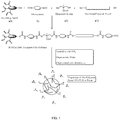
- Figure 1 is a schematic of a synthesis process for forming a UV-curable polyurethane dispersion using a bio-based polyol.
- One aspect of the present disclosure relates to a curable polyurethane aqueous dispersion formed by reacting at least one polyol component with at least one polyisocyanate, wherein the at least one polyol component comprises carbon atoms from renewable resources, also defined as a bio-polyol or biosourced polyol.
- a bio-polyol preferably has a content by weight of 14 C such that the 14 C/ 12 C ratio is greater than 0.1 ⁇ 10 -12 .
- carbon atoms from renewable resources refers to carbon atoms that are derived, sourced from, or made from naturally renewable resources, such as, for example, bio-mass or plant-based sources.
- a polyurethane pre-polymer may be formed by reacting at least one polyol component a) with at least one polyisocyanate b), wherein the number of isocyanate (NCO) groups of the at least one polyisocyanate is in excess with respect to the number of hydroxyl (OH) groups of the at least one polyol component and wherein the at least one polyol component a) comprises carbon atoms from renewable resources (or is a bio-polyol as defined above).
- NCO isocyanate
- OH hydroxyl
- pre-polymer refers to an ethylenically unsaturated compound that comprises one or more isocyanate terminal groups.
- the pre-polymer may be reacted with other monomers, oligomers or compounds containing functional groups (i.e., isocyanate-reactive groups) capable of reacting with the pre-polymer, e.g., in a chain extension reaction.
- the polyol component a) comprises a1) a non-ionic polyol, a2) at least one polyol bearing at least one ionic group from acids and a3) at least one ethylenically unsaturated monoalcohol or polyol.
- the first subject of the invention relates to a curable polyurethane aqueous dispersion, wherein said curable polyurethane is formed by :
- the non-ionic polyol a1) is formed by reacting a 1,4:3,6-dianhydrohexitol in a condensation polymerization reaction with other renewable diols or diacids or higher functional carboxylic acids or by using a 1,4:3,6-dianhydrohexitol as an initiator for ring opening polymerization of lactide.
- the 1,4:3,6- dianhydrohexitol may be selected from the group consisting of isosorbide, isomannide and isoidide and in particular the said 1,4:3,6-dianhydrohexitol is isosorbide.
- the non-ionic polyol is formed by reacting a 1,4:3,6-dianhydrohexitol in a polycondensation polymerization reaction with at least one diacid or higher functional carboxylic acid and optionally at least one other diol and/or polyol.
- diol and/or polyol as in present invention means diol and/or higher functional polyol, the latter meaning with a functionality of at least 3. Said diol is different from 1,4:3,6 dianhydrohexitol.
- the phrase "higher functional carboxylic acid” refers to a carboxylic acid having an acid functionality of at least 3.
- said diol and/or polyol is of renewable origin and so it is a bio-polyol. More preferably, the said diacid or higher functional carboxylic acid is also of renewable origin.
- the non-ionic polyol may be formed by a condensation polymerization reaction with a 1,4:3,6-dianhydrohexitol and at least one other diol or polyol and at least one diacid or higher functional carboxylic acid.
- diols examples include, but are not limited to, 1,2-ethanediol, 1,2-propanediol, 1,3-propanediol, 1,4-butanediol, 1,5-pentanediol, 1,6-hexanediol, 1,10-decanediol, 1,12-dodecanediol, 1,3-butanediol, 2,2-dimethyl-1,3-propanediol, 2-methyl-1,3-propanediol, diethylene glycol, triethylene glycol, dipropylene glycol, tripropylene glycol, 1,4- and 1,6-dimethylolcylcohexane, C 36 -dimer diol, hydroxypivaloyl hydroxy pivalate and ethoxylated and/or propoxylated derivatives of the above.
- Suitable tri- and higher hydroxyl functional components include : glycerol, trimethylolpropane, trimethylolethane, pentaerythritol, di-glycerol, di-trimethyolpropane, di-pentaerytritol, sorbitol and ethoxylated and/or propoxylated derivatives of the above.
- the non-ionic polyol a1) is formed by reacting a 1,4:3,6-dianhydrohexitol with at least one diacid or higher functional carboxylic acids.
- the diacid or higher functional carboxylic acid is selected from malonic acid, succinic acid, maleic acid, fumaric acid, itaconic acid, glutaric acid, citric acid, adipic acid, pimelic acid, sebacic acid, dodecanedioic acid, phthalic acid, isophthalic acid, terephthalic acid, naphthalene dicarboxylic acid, C 36 -dimer fatty acids, C 54 -trimer fatty acids (triacids), trimellitic acid, pyromellitic acid and the anhydride derivatives of the above.
- the non-ionic polyol a1) is formed using a 1,4:3,6-dianhydrohexitol as a hydroxyl functional initiator molecule in a ring opening polymerization of lactide.
- Lactide is a cyclic diester of lactic acid.
- Other monomers capable of undergoing ring opening polymerization, such as lactones, can also be used to make copolymeric polyols.
- the at least one non-ionic polyol a1) comprises or is a polyol formed by reacting a 1,4:3,6-dianhydrohexitol with a hydroxyl functional monocarboxylic acid or by reacting a 1,4:3,6-dianhydrohexitol, in particular as an initiator molecule in a ring opening polymerization with a lactone, preferably with caprolactone.
- lactones include ⁇ , ⁇ -dimethyl- ⁇ -propiolactone, ⁇ -butyrolactone and ⁇ -caprolactone and ⁇ -caprolactone is a preferred lactone.
- the amount of 1,4:3,6-dianhydrohexitol in the polyol component may be used to control the glass transition temperature (Tg) and hardness of the resulting polyurethane.
- the said polyol a), in particular polyol a1) may contain from about 10 wt% to about 75 wt% of 1,4:3,6-dianhydrohexitol.
- Properties of the polyurethane may also be controlled by use of one or more other polyols not containing 1,4:3,6-dianhydrohexitol in combination with the 1,4:3,6-dianhydrohexitol-containing polyol.
- non-ionic polyol a1) may be a polyester polyol and comprise (or may be derived from) renewable versions of polyacids and polyols such as unsaturated fatty acids, C 36 and C 54 dimer and trimer products and furan derivatives such as 2,5-furandicarboxylic acid.
- polyacids and polyols such as unsaturated fatty acids, C 36 and C 54 dimer and trimer products and furan derivatives such as 2,5-furandicarboxylic acid.
- the at least one polyol component a) also comprises a2) at least one polyol bearing at least one ionic or potentially ionic group, in particular comprising an acid group or salt thereof.
- the acid group may be selected from a carboxy group (-CO 2 H), a sulfonic group (-SO 3 H), sulfonyl group (-SO 2 H), a phosphoryl group (-PO 3 H 2 ) and a phosphonyl group (-PO 2 H).
- the acid group of the at least one polyol a2) is selected from a carboxy group, a sulfonic group or a sulfonyl group and is preferably a carboxyl group.
- acid group-containing polyols a2) include, but are not limited to, 2-carboxy 1,3-propane diol, 2-sulfo 1,3-propane diol, 2-methyl-2-carboxy hexane diol, 3-methyl-3-carboxy hexane diol. 4-methyl-4-carboxy hexane diol. 2-ethyl-2-carboxy 1,3-propane diol.
- 2-ethyl-2-carboxy butane diol dimethylolpropionic acid, dimethylolbutanoic acid, 2-sulfo-1,4-butanediol, 2,5-dimethyl-3-sulfo-2,5-hexanediol, 2-aminoethanesulfonic acid, N-(1,1-dimethyl-2-hydroxyethyl)-3-amino-2-hydroxypropanesulfonic acid, 2-aminoethylaminoethanesulfonic acid and salts of the above.
- the at least one polyol component further comprises a3) at least one ethylenically unsaturated a3.1) monoalcohol and/or a3.2) polyol.
- said monoalcohol a3.1) or polyol a3.2) may bear from 1 to 5, preferably from 2 to 5 ethylenically unsaturated groups, more preferably (meth)acrylate groups per molecule.
- the OH functionality of said polyol a3.2) may vary from 2 to 5 and preferably said ethylenically unsaturated polyol a3.2) is an ethylenically unsaturated diol.
- the monoalcohols as defined according to a3.1) do introduce terminal ethylenic unsaturations, while diols introduce lateral unsaturations and higher functional polyols create branched structures with unsaturation in both the polyurethane main chain backbone (lateral or side unsaturation) and in grafted branches (lateral unsaturation but on grafted polyurethane branches).
- said polyol component a3) is a mixture of monoalcohols a3.1) and of polyols a3.2).
- the at least one ethylenically unsaturated monoalcohol or polyol comprises a monool or diol.
- the ethylenically unsaturated monoalcohol a3.1) and/or polyol a3.2) are selected from the group consisting of polyester (meth)acrylates, epoxy (meth)acrylates, polyether (meth)acrylates, polyurethane (meth)acrylates and other hydroxyl group-containing (meth)acrylates.
- hydroxyl-containing (meth)acrylates we may cite without limitation as monools : an hydroxy alkyl (meth)acrylate with alkyl being in C 2 to C 4 which may be alkoxylated or a multifunctional (meth)acrylate having a free hydroxyl, like trimethylol propane di(meth)acrylate which may be alkoxylated, ditrimethylol propane tri(meth)acrylate which may be alkoxylated, pentaerythritol penta(meth)acrylate which may be alkoxylated.
- hydroxyl-containing polyol (meth)acrylates suitable for a3.2 we may cite : trimethylol mono(meth)acrylate (diol), ditrimethylol di(meth)acrylate (diol), ditrimethylol (meth)acrylate (triol), pentaerythritol di(meth)acrylate (diol), pentaerythritol mono(meth)acrylate (triol), dipentaerythritol tetra(meth)acrylate (diol), dipentaerythritol di (meth)acrylate (tetrol), dipentaerythritol tri-(meth)acrylate (triol), all of the above being potentially alkoxylated.
- Alkoxylated units may be ethoxy and/or propoxy and/or tetramethylenoxy with at least one alkoxy unit by OH, preferably from 1 to 10 and more preferably from 1 to 6 alk
- the at least one polyol a) component comprises carbon atoms from renewable resources.
- the renewably resourced carbon atoms may be provided by the non-ionic polyol a1), the acid group-containing polyol a2) and/or the ethylenically unsaturated monoalcohol or polyol a3).
- the renewably resourced carbon atoms may be provided by the non-ionic polyol a1) and/or the ethylenically unsaturated monoalcohol or polyol a3).
- the non-ionic polyol a1) comprises renewably resourced carbon atoms.
- the 14 C/ 12 C ratio is kept constant metabolically as the carbon is continually exchanged with the environment.
- the proportion of 14 C is substantially constant in the atmosphere, it is the same in the organism, as long as it is living, since it absorbs the 14 C like it absorbs the 12 C.
- the mean 14 C/ 12 C ratio is equal to 1.2 ⁇ 10 -12 .
- 12 C is stable, that is to say that the number of 12 C atoms in a given sample is constant over time.
- 14 C for its part is radioactive and each gram of carbon of a living being, comprises sufficient 14 C isotope to give 13.6 disintegrations per minute.
- the half-life (or period) T 1/2 related to the disintegration constant of 14 C, is 5730 years. Due to this period of time, the 14 C content is regarded as constant in practice from the extraction of the naturally renewable starting materials to the manufacture of the final product.
- the at least one polyol component a) of the present disclosure has a content by weight of 14 C such that the 14 C/ 12 C ratio is greater than 0.1 ⁇ 10 -12 .
- the at least one polyol component a) has a content by weight of 14 C such that the 14 C/ 12 C ratio is greater than and preferably greater than 0.2 ⁇ 10 -12 , greater than 0.4 ⁇ 10 -12 , greater than 0.6 ⁇ 10 -12 , greater than 0.8 ⁇ 10 -12 or greater than 1.0 ⁇ 10 -12 .
- Examples of epoxy (meth)acrylates as alcoholic component a3) defined above include the reaction products of acrylic or methacrylic acid or mixtures thereof with glycidyl ethers or esters.
- the glycidyl ethers or esters can have aliphatic, cycloaliphatic or aromatic structures and contain from two up to about six epoxy functional groups. Di-epoxy functional materials are preferred.
- Glycidyl ethers can be prepared from a hydroxyl functional precursor and an epoxy compound such as epichlorohydrin. Many of the hydroxyl functional components listed in the section above are suitable for preparation of aliphatic glycidyl ethers.
- precursors for aliphatic glycidyl ethers include : 1,4-butanediol, 2,2-dimethyl-1,3-propanediol, 1,6-hexanediol, 1,4- and 1,6-dimethylolcylcohexane, poly(ethylene glycol), poly(propylene glycol), poly(tetramethylene glycol), trimethylolpropane, pentaerythritol, glycerol and sorbitol.
- precursors for aromatic glycidyl ethers include : bisphenol A, bisphenol F and resorcinol.
- Suitable epoxy (meth)acrylates can also include the reaction products of acrylic or methacrylic acid or mixtures thereof with epoxidized deriviatives of natural oils and their component fatty acids such as soybean, linseed, castor, rapeseed, safflower, olive, tall and others which will be known to those skilled in the art.
- suitable polyether (meth)acrylates include the esters of acrylic or methacrylic acid or mixtures thereof with polyether polyols.
- Suitable polyether polyols can be linear or branched substances containing ether bonds and terminal hydroxyl groups.
- Polyether polyols can be prepared by ring opening polymerization of cyclic ethers such as tetrahydrofuran or alkylene oxides with an initiator molecule. Suitable initiator molecules include water, alcohols (including polyols) and amines.
- suitable amines include : ethylene diamine, 4,4'-diaminodiphenylmethane, diethylene triamine and hydroxyl amines such as ethanol amine and diethanol amine.
- suitable alkylene oxides include : ethylene oxide, propylene oxide, butylene oxides, epichlorohydrin and glycidol.
- the polyether (meth)acrylates can be used individually or in combination.
- polyurethane (meth)acrylates examples include the polyaddition products of the di- or polyisocyanates described below with isocyanate-reactive ethylenically unsaturated components as described in the sections above as polyester-, epoxy- or polyether (meth)acrylates or immediately below as monomeric hydroxyl containing (meth)acrylates.
- Examples of monomeric hydroxyl containing (meth)acrylates are acrylic, methacrylic or mixed esters with simple diols, triols, tetrols or polyols where the esterification process is carried out such that residual hydroxyl groups remain in the final product.
- Examples include (meth)acrylate esters of : 1,2-ethanediol, 1,2-propanediol, 1,3-propanediol, 1,4-butanediol, 1,5-pentanediol, 1,6-hexanediol, 1,10-decanediol, 1,12-dodecanediol, 1,3-butanediol, 2,2-dimethyl-1,3-propanediol, 2-methyl-1,3-propanediol, diethylene glycol, triethylene glycol, dipropylene glycol, tripropylene glycol, 1,4- and 1,6-dimethylolcylcohexane, glycerol, trimethylolpropane, trimethylolethane, pentaerythritol, di-glycerol, di-trimethylolpropane, di-pentaerytritol and sorbitol.
- the polyisocyanate b) comprises at least two isocyanate functional groups.
- the polyisocyanate b) may comprise a diisocyanate having two isocyanate functional groups, such as, an aliphatic diisocyanate (e.g., isophorone diisocyanate).
- the polyisocyanate may comprise a plurality of isocyanate groups, such as three or four or more isocyanate groups.
- Non-limiting examples of compounds that may comprise the polyisocyanate include, di- or polyisocyanates such as aliphatic, aromatic and cycloaliphatic structures with at least two isocyanate functional groups per molecule.
- suitable polyisocyanate b) components include : isophorone diisocyanate, hexamethylene diisocyanate, 2,3,3-trimethyl hexamethylene diisocyanate, 4,4'-dicylcohexylmethane diisocyanate, 1,5-naphthalene diisocyanate, 2,4- or 2,6-toluene diisocyanate and their isomeric mixtures, 4,4'-diphenylmethane diisocyanate, and their respective dimeric or trimeric derivatives and mixtures thereof.
- the said polyisocyanates may also be modified by allophanate groups.
- Polyisocyanates formed by creation of isocyanurate (especially in diisocyanate trimers) or biuret structures (especially in diisocyanate dimers) are also suitable as are mixtures of isocyanates.
- Polyisocyanate b) with a functionality of 3 may be an isocyanurate triisocyanate, bearing a triisocyanurate ring, which may provide high thermal stability performance.
- Polyisocyanates based on renewable resources such as those described, for example at page 2, line 12 to page 6, line 10 in WO 2011/098272 , may also be used in accordance with the present disclosure.
- a pre-polymer may be formed by reacting the polyol component a) with the polyisocyanate b) described above.
- the number of isocyanate (NCO) groups of the at least one polyisocyanate b) is in excess with respect to the reacting number of hydroxyl (OH) groups of the at least one polyol component a).
- the acid group of polyol a2) can be neutralized to the salt form before or during dispersion by addition of a base.
- Suitable bases include inorganic hydroxides or carbonates and amines and combinations.
- the acid group of polyol a2) is neutralized with a tertiary amine.
- the polyols of the present invention may also be used to form polyurethane dispersions in accordance with the methods disclosed in provisional U.S. Patent Application No. 61/907,434 titled “Solvent-free aqueous polyurethane dispersions and methods of producing solvent-free aqueous polyurethane dispersions", filed on November 22, 2013 and provisional U.S. Patent Application No. 61/986,165 titled “Solvent-free aqueous polyurethane dispersions and methods of producing solvent-free aqueous polyurethane dispersions”.
- the polyurethane dispersion may also be formed using additional components.
- the at least one polyol a) and the at least one polyisocyanate b) may be reacted in the presence of a curable or reactive diluent, which means an ethylenically unsaturated diluent which is able to co-react during the cure with said ethylenically unsaturated polyurethane.
- a curable or reactive diluent which means an ethylenically unsaturated diluent which is able to co-react during the cure with said ethylenically unsaturated polyurethane.
- the curable or reactive diluent is at least one ethylenically unsaturated monomer or oligomer, preferably monomer, which is compatible (non demixing) with said curable polyurethane.
- the curable diluent may comprise materials with two or more ethylenically unsaturated groups, such as, for example, (meth)acrylate groups.
- the curable diluents which can be monomeric or oligomeric, can be used individually or in combination. In particular, these reactive diluents should not bear isocyanate-reactive groups, such as hydroxyls or amines.
- Suitable monomeric examples include the (meth)acrylate esters of 1,2-ethanediol, 1,2-propanediol, 1,3-propanediol, 1,4-butanediol, 1,3-butanediol, 1,5-pentanediol, 1,6-hexanediol, 1,10-decanediol, 1,12-dodecanediol, 1,3-butanediol, 2,2-dimethyl-1,3-propanediol, 2-methyl-1,3-propanediol, diethylene glycol, triethylene glycol, tetraethylene glycol, dipropylene glycol, tripropylene glycol, 1,4- and 1,6-dimethylolcylcohexane, glycerol, trimethylolpropane, trimethylolethane, pentaerythritol, di-glycerol, di-trimethylo
- the polyurethane polymer aqueous dispersion of the invention further comprises a curable ethylenically unsaturated monomer acting as a curable diluent and which diluent is present in the reaction of step i) as defined above, related with the pre-polymer formation.
- said diluent is used as a reaction diluent in step i) and as a reactive diluent during the cure of the curable polyurethane polymer.
- Oligomeric curable diluents include the polyester-, polyether- or urethane (meth)acrylates as described above, except that when used as a reactive diluent the hydroxyl group is fully (meth)acrylated. Many such products are available from Sartomer as "CN" products.
- the chain extension further increases the molecular weight of the polyurethane pre-polymer and/or vary or adjust the properties of the final said curable polyurethane.
- the chain extender c) may be selected to alter/adjust the hardness, weatherability, flexibility or adhesiveness.
- the chain extenders c) may be selected from polyols and polyamines, such as, for example, diols and diamines. In at least one preferred embodiment, the chain extender c) is selected from polyamines and more preferably from diamines.
- the chain extender may comprise two or more functional groups reactive with the isocyanate terminal groups of the polyurethane pre-polymer.
- the chain extender comprises two isocyanate-reactive functional groups and functions to extend the polyurethane.
- the chain extender may comprise three or more functional groups and functions to both extend the polyurethane chain and increase the branching of the chains but without any crosslinking.
- a mixture of chain extenders comprising two functional groups and three or more functional groups may be used. In case the global number average functionality (over components a + b + chain extender) is higher than 2, then branching occurs.
- the curable polyurethane of the present invention may have a linear or branched chain structure without any crosslinked structure present in the said curable polyurethane polymer either before or after its aqueous dispersion and chain extension.
- the global average functionality is higher than 2, those skilled in the art know how to prevent any crosslinking reaction.
- the addition of one reactant to the other is made progressively and the proportions of the reactants (ratio of NCO groups to NCO-reactive groups) and the conversion of these groups is so controlled in order to fulfill the Macosko-Miller relationship as disclosed in Macromolecules, vol. 9, pp 199-221 (1976 ).
- the reaction mixture for forming the polyurethane dispersion or pre-polymer may also comprise a catalyst and/or other additives, such as, for example, inhibitors, fillers, stabilizers photoinitiators, pigments, etc. External surfactants are not necessary and could be used only optionally.
- the polyurethane polymer aqueous dispersion is a radiation curable or a peroxide curable aqueous polyurethane dispersion.
- the polyurethane dispersion may be cured by exposure to actinic radiation.
- the polyurethane dispersion is cured by exposure to ultraviolet light.
- a second subject of the present invention relates to a method of producing the said curable polyurethane aqueous dispersion as defined above according to the present invention which method comprises the following steps :
- Another subject covered by the present invention is the polyurethane pre-polymer aqueous dispersion as obtainable by the method as defined just above, the method comprising the steps i) and ii) as defined just above and said pre-polymer being obtained at the end of said step ii), before the step iii) of chain extending.
- the present invention does also cover a curable aqueous composition, which comprises as a curable binder at least one aqueous polyurethane dispersion as defined here-above according to the present invention or as obtained by the method of producing defined here-above according to the invention.
- the said curable composition is selected from curable coatings in particular paints, varnishes, inks compositions or from adhesives, sealants or cosmetics compositions.
- Another subject of the invention relates to the use of the aqueous polyurethane polymer dispersion of the invention in coatings in particular in paints, varnishes and inks or in adhesives, in sealants and in cosmetics.
- the invention covers the finished product which is a cured polyurethane, which results from the cure of an aqueous polyurethane dispersion as defined according to the present invention, more particularly the said cured polyurethane being used as a coating, preferably as a paint, a varnish and an ink or being used as an adhesive, as a sealant or as a cosmetic.
- the polyurethane polymer aqueous dispersions of the present disclosure may be used in coatings, in particular to coat objects, such as for example, wood, metal, plastic, ceramic, composite objects, glass, fibers, textiles, leather, stone, concrete and other materials.
- objects such as for example, wood, metal, plastic, ceramic, composite objects, glass, fibers, textiles, leather, stone, concrete and other materials.
- the object may be coated with the polyurethane dispersion, which is subsequently cured, after film formation.
- the polyurethane polymer aqueous dispersions of the present disclosure may be used to form coatings, in particular paints, varnishes, inks, that provide protection against mechanical, chemical and/or environmental effects.
- the polyurethane dispersions may be used as adhesives, sealants, surface modifiers, surface coatings and cosmetics.
- the polyurethane polymer aqueous dispersions of the present disclosure may be used as a curable binder to form a radiation curable or peroxide curable aqueous composition.
- polyurethane dispersions of the present disclosure may also be used for adhesives, sealants, inks and other applications, such as providing surface texture or haptic effects.
- the polyurethane coatings formed from polyurethane dispersions of the present disclosure may be used to provide scratch, abrasion and wear resistance ; UV protection; corrosion resistance ; surface appearance, such as a glossy or flat appearance ; chemical and stain resistance ; hydrolytic resistance ; flame retardancy ; anti-microbial activity ; electrical conduction or insulation ; barrier or permeability to gasses ; adhesion ; haptic effects such as soft touch ; easy cleaning and anti-fingerprint.
- the properties of the resultant polyurethane coatings may be controlled by varying the amounts of the components present within the polyurethane dispersions described above.
- a polyester polyol was made using the following procedure : 1,3-propanediol (177 g), isosorbide (681 g), succinic acid (551 g), which were all derived from renewable sources, along with toluene (388 g) and 70% methanesulfonic acid in water (17 g) were charged to a reaction vessel with fitted with a side arm for collection of evolved water. The mixture was heated to 112°C for 21 hours at which time production of water had substantially ceased. After removal of the toluene by vacuum distillation, the final polyester product was a viscous liquid with hydroxyl number of 200 mg KOH/g.
- a polyester polyol was prepared from isosorbide (98 g) and d,l-lactide (240 g) by heating to 120°C for several hours in the presence of stannous octoate catalyst.
- the final polyester product was a viscous liquid with hydroxyl number of 211 mg KOH/g.
- UV-PUD UV-curable Polvurethane Dispersion
- OH value 163 mg KOH/g, 206 g
- the polyester polyol of Example 1 388 g
- dimethylolpropionic acid 113 g
- MeHQ 4.8 g
- UV-PUD UV-curable Polvurethane Dispersion
- UV-PUD UV-curable Polvurethane Dispersion
- the polyester polyol of Example 1 210 g
- UV-PUD UV-curable Polvurethane Dispersion
- a reaction vessel suitable for polyurethane preparation was charged with dimethylolpropionic acid (85 g), MeHQ (2.8 g), dibutyltin dilaurate (1.9 g), ethoxylated trimethylolpropane triacrylate (Sartomer SR454, 1204 g) and isophorone diisocyanate (572 g) and the mixture was heated to 70°C until the %NCO content by titration dropped to about 7.9%.
- UV-PUD UV-curable Polvurethane Dispersion
- a reaction vessel suitable for polyurethane preparation was charged with dimethylolpropionic acid (115 g), MeHQ (4.9 g), dibutyltin dilaurate (3.3 g), ethoxylated trimethylolpropane triacrylate (Sartomer SR454, 1633 g) and isophorone diisocyanate (888 g) and the mixture was heated to 70°C until the %NCO content by titration dropped to about 8.9%.
- Example 8 Curing and Testing of Example UV-PUDs
- the UV-PUDs were incorporated into a simple formulation consisting of 63.5% UV-PUD (after adjusting to 35% solids) plus 1% associative thickener, 0.5% leveling agent and 5% IRGACURE® 500 photoinitiator based on solids.
- Drawdowns were made at 152.4 ⁇ (6 mils) wet film thickness on Leneta charts, glass plates or aluminum panels depending on the tests being run.
- results drying was done for 30 minutes at 25°C and 30 minutes at 60°C (tests done after drying 10 minutes at 25°C and 10 minutes at 60°C showed similar results to those below).
- the dried films were cured with 410 mJ/cm 2 UVA energy by running at 15.24 m/min (50 fpm : feet per min) through an Inpro UV cure unit with two Hg lamps.
Landscapes
- Chemical & Material Sciences (AREA)
- Organic Chemistry (AREA)
- Health & Medical Sciences (AREA)
- Chemical Kinetics & Catalysis (AREA)
- Medicinal Chemistry (AREA)
- Polymers & Plastics (AREA)
- Dispersion Chemistry (AREA)
- Engineering & Computer Science (AREA)
- Manufacturing & Machinery (AREA)
- Life Sciences & Earth Sciences (AREA)
- Materials Engineering (AREA)
- Wood Science & Technology (AREA)
- Polyurethanes Or Polyureas (AREA)
Claims (19)
- Wässrige Dispersion eines härtbaren Polyurethanpolymers, wobei das härtbare Polyurethan gebildet wird durchi) die Umsetzung von a) mindestens einer Polyolkomponente, die a1) ein nichtionisches Polyol, a2) mindestens ein Polyol mit mindestens einer ionischen oder potentiell ionischen Gruppe, die eine Säuregruppe oder ein Salz davon umfasst, und a3) mindestens einen ethylenisch ungesättigten Monoalkohol und/oder ein ethylenisch ungesättigtes Polyol umfasst, mit b) mindestens einem Polyisocyanat, wobei die Zahl von Isocyanat(NCO)-Gruppen des mindestens einen Polyisocyanats im Überschuss in Bezug auf die Zahl von Hydroxyl(OH)-Gruppen der mindestens einen Polyolkomponente a) vorliegt,
wobei die mindestens eine Polyolkomponente a) in dem nichtionischen Polyol a1) Kohlenstoffatome aus erneuerbaren Quellen umfasst, wobei sich das Polyol a1) von einem 1,4:3,6-Dianhydrohexitol ableitet, wobei die Säuregruppe von Polyol a2) entweder in der Säureform oder in der mindestens teilweise neutralisierten Form, vorzugsweise in der neutralisierten Form, vorliegt und wobei es sich bei dem mindestens einen ethylenisch ungesättigten Monoalkohol und/oder Polyol a3) um einen isocyanatreaktiven ethylenisch ungesättigten Monoalkohol oder ein isocyanatreaktives ethylenisch ungesättigtes Polyol aus der Gruppe bestehend aus Polyester(meth)acrylaten, Epoxy(meth)-acrylaten, Polyether(meth)acrylaten, Polyurethan (meth)acrylaten und anderen hydroxylgruppenhaltigen (Meth)acrylaten handelt, und die Umsetzung durchii) eine Verlängerungsreaktion mit einem isocyanatreaktiven Kettenverlängerungsmittel in einem zweiten Schritt fortgesetzt wird. - Wässrige Polyurethandispersion nach Anspruch 1, wobei das mindestens eine nichtionische Polyol a1) ein durch Umsetzung eines 1,4:3,6-Dianhydrohexitols in einer Polykondensationspolymerisationsreaktion mit mindestens einer Disäure oder einer höherfunktionellen Carbonsäure und gegebenenfalls mindestens einem anderen Diol oder Polyol gebildetes Polyol umfasst oder ist.
- Wässrige Polyurethandispersion nach Anspruch 1, wobei das mindestens eine nichtionische Polyol a1) ein durch Umsetzung eines 1,4:3,6-Dianhydrohexitols in einer Polykondensationspolymerisationsreaktion mit mindestens einem anderen Diol oder Polyol und mindestens einer Disäure oder einer höherfunktionellen Carbonsäure gebildetes Polyol umfasst oder ist.
- Wässrige Polyurethandispersion nach Anspruch 2 oder 3, wobei das Diol aus der Gruppe bestehend aus 1,2-Ethandiol, 1,2-Propandiol, 1,3-Propandiol, 1,4-Butandiol, 1,5-Pentandiol, 1,6-Hexandiol, 1,10-Decandiol, 1,12-Dodecandiol, 1,3-Butandiol, 2,2-Dimethyl-1,3-propandiol, 2-Methyl-1,3-propandiol, Diethylenglykol, Triethylenglykol, Dipropylenglykol, Tripropylenglykol, 1,4- und 1,6-Dimethylolcylcohexan, C36-Dimerdiol, Hydroxypivaloylhydroxylpivalat und ethoxylierten und/oder propoxylierten Derivaten davon ausgewählt ist und wobei das Polyol aus der Gruppe bestehend aus Glycerin, Trimethylolpropan, Trimethylolethan, Pentaerythritol, Diglycerin, Ditrimethylolpropan, Dipentaerythritol, Sorbitol und ethoxylierten und/oder propoxylierten Derivaten davon ausgewählt ist.
- Wässrige Polyurethandispersion nach einem der Ansprüche 2 bis 4, wobei die mindestens eine Disäure oder höherfunktionelle Carbonsäure aus der Gruppe bestehend aus Malonsäure, Bernsteinsäure, Maleinsäure, Fumarsäure, Itaconsäure, Glutarsäure, Citronensäure, Adipinsäure, Pimelinsäure, Sebacinsäure, Dodecandisäure, Phthalsäure, Isophthalsäure, Terephthalsäure, Naphthalindicarbonsäure, C36-Dimerfettsäuren, C54-Trimerfettsäuren, Trimellitsäure, Pyromellitsäure und Anhydridderivaten davon ausgewählt ist.
- Wässrige Polyurethandispersion nach Anspruch 1, wobei das mindestens eine nichtionische Polyol a1) ein durch Umsetzung eines 1,4:3,6-Dianhydrohexitols mit einer hydroxylfunktionellen Monocarbonsäure oder durch Umsetzung eines 1,4:3,6-Dianhydrohexitols mit einem Lacton, vorzugsweise Caprolacton, gebildetes Polyol umfasst oder ist.
- Wässrige Polyurethandispersion nach Anspruch 1, wobei das nichtionische Polyol a1) durch Verwendung eines 1,4:3,6-Dianhydrohexitols als hydroxylfunktionelles Initiatormolekül in einer Ring-öffnungspolymerisation eines Lactids gebildet wird.
- Wässrige Polyurethandispersion nach einem der Ansprüche 1 bis 7, wobei das 1,4:3,6-Dianhydrohexitol aus der Gruppe bestehend aus Isosorbid, Isomannid und Isoidid ausgewählt ist.
- Wässrige Polyurethandispersion nach Anspruch 8, wobei es sich bei dem 1,4:3,6-Dianhydrohexitol um Isosorbid handelt.
- Wässrige Polyurethandispersion nach einem der Ansprüche 1 bis 9, wobei sie ferner ein härtbares ethylenisch ungesättigtes Monomer umfasst, das als härtbares Verdünnungsmittel fungiert und bei der Umsetzung von Schritt i) gemäß Anspruch 1 zugegen ist.
- Wässrige Polyurethandispersion nach einem der Ansprüche 1 bis 10, bei der es sich um eine strahlungshärtbare oder peroxidhärtbare wässrige Polyurethandispersion handelt.
- Härtbare wässrige Polyurethandispersion nach einem der Ansprüche 1 bis 11, wobei die mindestens eine Polyolkomponente a), insbesondere Polyol a1), einen solchen Gewichtsgehalt an 14C aufweist, dass das 14C/12C-Verhältnis größer als 0,1×10⁻¹² ist.
- Verfahren zur Herstellung einer wässrigen Dispersion eines härtbaren Polyurethans gemäß einem der Ansprüche 1 bis 12, wobei es folgende Schritte umfasst:i) Umsetzen von mindestens einer Polyolkomponente a), die a1) ein nichtionisches Polyol, a2) mindestens ein Polyol mit mindestens einer ionischen oder potentiell ionischen Gruppe, die eine Säuregruppe oder ein Salz davon umfasst, und a3) mindestens einen ethylenisch ungesättigten Monoalkohol und/oder ein ethylenisch ungesättigtes Polyol umfasst, mit b) mindestens einem Polyisocyanat, wobei die Zahl von Isocyanat(NCO)-Gruppen des mindestens einen Polyisocyanats im Überschuss in Bezug auf die Zahl von Hydroxyl(OH)-Gruppen der mindestens einen Polyolkomponente a) vorliegt, wobei die mindestens eine Polyolkomponente a) in dem nichtionischen Polyol a1) Kohlenstoffatome aus erneuerbaren Quellen umfasst, wobei sich das Polyol a1) von einem 1,4:3,6-Dianhydrohexitol ableitet, und/oder es sich bei dem mindestens einen ethylenisch ungesättigten Monoalkohol und/oder Polyol a3) um einen isocyanatreaktiven ethylenisch ungesättigten Monoalkohol oder ein isocyanatreaktives ethylenisch ungesättigtes Polyol aus der Gruppe bestehend aus Polyester(meth)acrylaten, Epoxy(meth)-acrylaten, Polyether(meth)acrylaten, Polyurethan(meth)acrylaten und anderen hydroxylgruppenhaltigen (Meth)acrylaten handelt,ii) mindestens teilweises, vorzugsweise vollständiges Neutralisieren der Säuregruppen des Polyols a2) mit einem Neutralisationsmittel und Rühren zum Erhalt einer wässrigen Polyurethanprepolymerdispersion; undiii) Kettenverlängern des Prepolymers aus Schritt ii) durch Umsetzung mit einem isocyanatreaktiven Kettenverlängerungsmittel.
- Wässrige Polyurethanprepolymerdispersion, die durch ein Verfahren gemäß Anspruch 13 erhältlich ist, wobei das die Schritte i) und ii) umfasst, wie am Ende von Schritt ii) vor dem Schritt iii) des Kettenverlängerns erhalten.
- Härtbare wässrige Zusammensetzung, wobei sie als härtbares Bindemittel mindestens eine wässrige Polyurethandispersion gemäß einem der Ansprüche 1 bis 12 oder eine wie durch ein Verfahren gemäß Anspruch 13 erhaltene wässrige Polyurethandispersion umfasst.
- Härtbare Zusammensetzung nach Anspruch 15, wobei sie aus härtbaren Beschichtungen, insbesondere Anstrichmitteln, Klarlacken, Tintenzusammensetzungen, oder aus Klebstoffen, Dichtstoffen oder Kosmetikzusammensetzungen ausgewählt ist.
- Verwendung der wässrigen Polyurethanpolymerdispersion gemäß einem der Ansprüche 1 bis 12 oder der wie durch ein Verfahren gemäß Anspruch 13 erhaltenen wässrigen Polyurethanpolymerdispersion, wobei sie zur Verwendung in Beschichtungen, insbesondere Anstrichmitteln, Klarlacken, Tinten, oder in Klebstoffen, in Dichtstoffen oder in Kosmetika ist.
- Gehärtetes Polyurethan, wobei es aus der Härtung einer wässrigen Polyurethandispersion gemäß einem der Ansprüche 1 bis 12 oder einer wie durch ein Verfahren gemäß Anspruch 13 erhaltenen wässrigen Polyurethandispersion resultiert.
- Gehärtetes Polyurethan nach Anspruch 18, wobei es als Beschichtung, vorzugsweise als Anstrichmittel, Klarlack und Tinte, oder als Klebstoff, als Dichtstoff oder als Kosmetikum verwendet wird.
Priority Applications (1)
| Application Number | Priority Date | Filing Date | Title |
|---|---|---|---|
| PL15706041T PL3110868T3 (pl) | 2014-02-28 | 2015-02-25 | Utwardzalne wodne dyspersje poliuretanowe wykonane z zasobów odnawialnych |
Applications Claiming Priority (3)
| Application Number | Priority Date | Filing Date | Title |
|---|---|---|---|
| US201461946016P | 2014-02-28 | 2014-02-28 | |
| US201461986170P | 2014-04-30 | 2014-04-30 | |
| PCT/EP2015/053924 WO2015128373A1 (en) | 2014-02-28 | 2015-02-25 | Curable aqueous polyurethane dispersions made from renewable resources |
Publications (2)
| Publication Number | Publication Date |
|---|---|
| EP3110868A1 EP3110868A1 (de) | 2017-01-04 |
| EP3110868B1 true EP3110868B1 (de) | 2019-11-13 |
Family
ID=52574172
Family Applications (1)
| Application Number | Title | Priority Date | Filing Date |
|---|---|---|---|
| EP15706041.9A Active EP3110868B1 (de) | 2014-02-28 | 2015-02-25 | Aus erneuerbaren ressourcen hergestellte, härtbare wässrige polyurethandispersionen |
Country Status (7)
| Country | Link |
|---|---|
| US (1) | US20160362515A1 (de) |
| EP (1) | EP3110868B1 (de) |
| CN (1) | CN106068293B (de) |
| ES (1) | ES2773655T3 (de) |
| PL (1) | PL3110868T3 (de) |
| TW (1) | TWI565730B (de) |
| WO (1) | WO2015128373A1 (de) |
Cited By (1)
| Publication number | Priority date | Publication date | Assignee | Title |
|---|---|---|---|---|
| US20220228027A1 (en) * | 2019-06-18 | 2022-07-21 | Allnex Belgium S.A. | Biobased urethane (meth)acrylate for use in cladding |
Families Citing this family (16)
| Publication number | Priority date | Publication date | Assignee | Title |
|---|---|---|---|---|
| ES2804349T3 (es) * | 2014-04-30 | 2021-02-05 | Arkema France | Dispersiones acuosas de poliuretano curables elaboradas a partir de recursos renovables |
| CN105885004A (zh) * | 2016-06-22 | 2016-08-24 | 江南大学 | 一种生物基光固化聚氨酯及其制备的光刻胶 |
| WO2018058016A1 (en) * | 2016-09-25 | 2018-03-29 | Myriant Corporation | Biorenewable high performance polyester polyols |
| US10573772B2 (en) * | 2017-05-22 | 2020-02-25 | Swift Engineering, Inc. | Composite vehicle skin co-cured with solar-cell array |
| EP3700975B1 (de) * | 2017-10-25 | 2023-12-06 | Sun Chemical Corporation | Aktinisch härtbare klebstoffzusammensetzung mit verbesserten eigenschaften |
| CN107857869B (zh) * | 2017-11-27 | 2018-08-28 | 上海金狮化工有限公司 | 水性聚氨酯及其制备方法和应用 |
| EP3636321A1 (de) * | 2018-10-10 | 2020-04-15 | Covestro Deutschland AG | Zumindest teilweise aus erneuerbaren quellen stammende polyurethanharnstoffdispersionen sowie deren herstellung und verwendung |
| WO2020122954A1 (en) * | 2018-12-14 | 2020-06-18 | Hewlett-Packard Development Company, L.P. | Textile printing |
| JP7459626B2 (ja) * | 2020-04-02 | 2024-04-02 | artience株式会社 | 水性グラビアまたはフレキソインキ、およびその利用 |
| TWI893133B (zh) * | 2020-06-23 | 2025-08-11 | 日商Dic股份有限公司 | 胺基甲酸酯樹脂組成物、皮膜、及合成皮革 |
| CN112480350B (zh) * | 2020-11-06 | 2022-04-05 | 中国科学院化学研究所 | 亲水性聚氨酯及其制备方法、生物打印复合材料和应用 |
| EP4015548A1 (de) * | 2020-12-18 | 2022-06-22 | Allnex Belgium, S.A. | Wässrige bio-basierte energiehärtbare polyurethanzusammensetzung |
| KR102442189B1 (ko) * | 2021-02-17 | 2022-09-13 | 주식회사 삼양사 | 내유성 및 접착성이 향상된 금속용 코팅 조성물 및 그 제조 방법, 및 이 조성물로 코팅된 금속 물품 |
| CN114517035B (zh) * | 2021-12-29 | 2023-04-14 | 广东大自然家居科技研究有限公司 | 水性植物基清面漆及其制备方法、木器 |
| US11530332B1 (en) * | 2022-07-12 | 2022-12-20 | Evoco Limited | Biobased aqueous polyurethane dispersions |
| US12612730B2 (en) | 2022-12-29 | 2026-04-28 | Industrial Technology Research Institute | Biobased water repellent auxiliary and method of manufacturing the same |
Family Cites Families (8)
| Publication number | Priority date | Publication date | Assignee | Title |
|---|---|---|---|---|
| DE19722862C1 (de) * | 1997-05-31 | 1999-01-14 | Basf Coatings Ag | Wäßriger Lack und dessen Verwendung zur Herstellung einer zweischichtigen Lackierung |
| US6140422A (en) * | 1998-04-23 | 2000-10-31 | E.I. Dupont De Nemours And Company | Polyesters including isosorbide as a comonomer blended with other thermoplastic polymers |
| GB0207345D0 (en) * | 2002-03-28 | 2002-05-08 | Unichema Chemie Bv | Polyurethane |
| JP5025483B2 (ja) * | 2004-10-26 | 2012-09-12 | ルブリゾル アドバンスド マテリアルズ, インコーポレイテッド | オイル変性ウレタン重合体の水媒介分散体 |
| US20070149704A1 (en) * | 2005-06-17 | 2007-06-28 | Reichhold, Inc. | Radiation curable polyurethane dispersions |
| EP1845143A1 (de) * | 2006-04-14 | 2007-10-17 | Cytec Surface Specialties, S.A. | Wässrige strahlenhärtbare Polyurethanzusammensetzungen |
| DE102010009896A1 (de) * | 2010-03-02 | 2011-09-08 | Bayer Materialscience Ag | Wässrige Polyurethandispersionen |
| EP2644634A1 (de) * | 2012-03-30 | 2013-10-02 | Cytec Surface Specialties, S.A. | Strahlungshärtbare (Meth)acrylatverbindungen |
-
2015
- 2015-02-25 US US15/121,454 patent/US20160362515A1/en not_active Abandoned
- 2015-02-25 PL PL15706041T patent/PL3110868T3/pl unknown
- 2015-02-25 WO PCT/EP2015/053924 patent/WO2015128373A1/en not_active Ceased
- 2015-02-25 EP EP15706041.9A patent/EP3110868B1/de active Active
- 2015-02-25 CN CN201580011153.9A patent/CN106068293B/zh active Active
- 2015-02-25 ES ES15706041T patent/ES2773655T3/es active Active
- 2015-02-26 TW TW104106297A patent/TWI565730B/zh active
Non-Patent Citations (1)
| Title |
|---|
| None * |
Cited By (2)
| Publication number | Priority date | Publication date | Assignee | Title |
|---|---|---|---|---|
| US20220228027A1 (en) * | 2019-06-18 | 2022-07-21 | Allnex Belgium S.A. | Biobased urethane (meth)acrylate for use in cladding |
| US12305069B2 (en) * | 2019-06-18 | 2025-05-20 | Allnex Belgium S.A. | Biobased urethane (meth)acrylate for use in cladding |
Also Published As
| Publication number | Publication date |
|---|---|
| TW201546117A (zh) | 2015-12-16 |
| ES2773655T3 (es) | 2020-07-14 |
| CN106068293B (zh) | 2021-08-10 |
| EP3110868A1 (de) | 2017-01-04 |
| WO2015128373A1 (en) | 2015-09-03 |
| TWI565730B (zh) | 2017-01-11 |
| CN106068293A (zh) | 2016-11-02 |
| PL3110868T3 (pl) | 2020-05-18 |
| US20160362515A1 (en) | 2016-12-15 |
Similar Documents
| Publication | Publication Date | Title |
|---|---|---|
| EP3110868B1 (de) | Aus erneuerbaren ressourcen hergestellte, härtbare wässrige polyurethandispersionen | |
| EP3137530B1 (de) | Aus erneuerbaren ressourcen hergestellte härtbare wässrige polyurethandispersionen | |
| US10329449B2 (en) | Solvent-free aqueous polyurethane dispersions and methods of producing solvent-free aqueous polyurethane dispersions | |
| KR101831447B1 (ko) | 수성 라디에이션 경화성 폴리우레탄 조성물 | |
| EP2658890B1 (de) | Strahlungshärtbare zusammensetzungen | |
| EP3580249B1 (de) | Wässrige beschichtungszusammensetzung | |
| EP3137563B1 (de) | Nagellackzusammensetzung auf basis von lösungsmittelfreien wässrigen polyurethandispersionen | |
| CN1813012A (zh) | 可水稀释聚氨酯分散体 | |
| US9475959B2 (en) | Radiation curable compositions |
Legal Events
| Date | Code | Title | Description |
|---|---|---|---|
| PUAI | Public reference made under article 153(3) epc to a published international application that has entered the european phase |
Free format text: ORIGINAL CODE: 0009012 |
|
| STAA | Information on the status of an ep patent application or granted ep patent |
Free format text: STATUS: REQUEST FOR EXAMINATION WAS MADE |
|
| 17P | Request for examination filed |
Effective date: 20160809 |
|
| AK | Designated contracting states |
Kind code of ref document: A1 Designated state(s): AL AT BE BG CH CY CZ DE DK EE ES FI FR GB GR HR HU IE IS IT LI LT LU LV MC MK MT NL NO PL PT RO RS SE SI SK SM TR |
|
| AX | Request for extension of the european patent |
Extension state: BA ME |
|
| RIN1 | Information on inventor provided before grant (corrected) |
Inventor name: KLANG, JEFFREY Inventor name: VAPPALA, INDU Inventor name: LU, JIN Inventor name: HE, YUHONG |
|
| DAX | Request for extension of the european patent (deleted) | ||
| GRAP | Despatch of communication of intention to grant a patent |
Free format text: ORIGINAL CODE: EPIDOSNIGR1 |
|
| STAA | Information on the status of an ep patent application or granted ep patent |
Free format text: STATUS: GRANT OF PATENT IS INTENDED |
|
| INTG | Intention to grant announced |
Effective date: 20190603 |
|
| GRAS | Grant fee paid |
Free format text: ORIGINAL CODE: EPIDOSNIGR3 |
|
| GRAJ | Information related to disapproval of communication of intention to grant by the applicant or resumption of examination proceedings by the epo deleted |
Free format text: ORIGINAL CODE: EPIDOSDIGR1 |
|
| GRAL | Information related to payment of fee for publishing/printing deleted |
Free format text: ORIGINAL CODE: EPIDOSDIGR3 |
|
| STAA | Information on the status of an ep patent application or granted ep patent |
Free format text: STATUS: REQUEST FOR EXAMINATION WAS MADE |
|
| GRAR | Information related to intention to grant a patent recorded |
Free format text: ORIGINAL CODE: EPIDOSNIGR71 |
|
| STAA | Information on the status of an ep patent application or granted ep patent |
Free format text: STATUS: GRANT OF PATENT IS INTENDED |
|
| GRAA | (expected) grant |
Free format text: ORIGINAL CODE: 0009210 |
|
| STAA | Information on the status of an ep patent application or granted ep patent |
Free format text: STATUS: THE PATENT HAS BEEN GRANTED |
|
| INTC | Intention to grant announced (deleted) | ||
| AK | Designated contracting states |
Kind code of ref document: B1 Designated state(s): AL AT BE BG CH CY CZ DE DK EE ES FI FR GB GR HR HU IE IS IT LI LT LU LV MC MK MT NL NO PL PT RO RS SE SI SK SM TR |
|
| INTG | Intention to grant announced |
Effective date: 20191004 |
|
| REG | Reference to a national code |
Ref country code: CH Ref legal event code: EP Ref country code: AT Ref legal event code: REF Ref document number: 1201580 Country of ref document: AT Kind code of ref document: T Effective date: 20191115 |
|
| REG | Reference to a national code |
Ref country code: DE Ref legal event code: R096 Ref document number: 602015041569 Country of ref document: DE |
|
| REG | Reference to a national code |
Ref country code: IE Ref legal event code: FG4D |
|
| REG | Reference to a national code |
Ref country code: NL Ref legal event code: FP |
|
| REG | Reference to a national code |
Ref country code: LT Ref legal event code: MG4D |
|
| PG25 | Lapsed in a contracting state [announced via postgrant information from national office to epo] |
Ref country code: GR Free format text: LAPSE BECAUSE OF FAILURE TO SUBMIT A TRANSLATION OF THE DESCRIPTION OR TO PAY THE FEE WITHIN THE PRESCRIBED TIME-LIMIT Effective date: 20200214 Ref country code: BG Free format text: LAPSE BECAUSE OF FAILURE TO SUBMIT A TRANSLATION OF THE DESCRIPTION OR TO PAY THE FEE WITHIN THE PRESCRIBED TIME-LIMIT Effective date: 20200213 Ref country code: FI Free format text: LAPSE BECAUSE OF FAILURE TO SUBMIT A TRANSLATION OF THE DESCRIPTION OR TO PAY THE FEE WITHIN THE PRESCRIBED TIME-LIMIT Effective date: 20191113 Ref country code: LT Free format text: LAPSE BECAUSE OF FAILURE TO SUBMIT A TRANSLATION OF THE DESCRIPTION OR TO PAY THE FEE WITHIN THE PRESCRIBED TIME-LIMIT Effective date: 20191113 Ref country code: SE Free format text: LAPSE BECAUSE OF FAILURE TO SUBMIT A TRANSLATION OF THE DESCRIPTION OR TO PAY THE FEE WITHIN THE PRESCRIBED TIME-LIMIT Effective date: 20191113 Ref country code: NO Free format text: LAPSE BECAUSE OF FAILURE TO SUBMIT A TRANSLATION OF THE DESCRIPTION OR TO PAY THE FEE WITHIN THE PRESCRIBED TIME-LIMIT Effective date: 20200213 Ref country code: PT Free format text: LAPSE BECAUSE OF FAILURE TO SUBMIT A TRANSLATION OF THE DESCRIPTION OR TO PAY THE FEE WITHIN THE PRESCRIBED TIME-LIMIT Effective date: 20200313 |
|
| PG25 | Lapsed in a contracting state [announced via postgrant information from national office to epo] |
Ref country code: IS Free format text: LAPSE BECAUSE OF FAILURE TO SUBMIT A TRANSLATION OF THE DESCRIPTION OR TO PAY THE FEE WITHIN THE PRESCRIBED TIME-LIMIT Effective date: 20200313 Ref country code: RS Free format text: LAPSE BECAUSE OF FAILURE TO SUBMIT A TRANSLATION OF THE DESCRIPTION OR TO PAY THE FEE WITHIN THE PRESCRIBED TIME-LIMIT Effective date: 20191113 Ref country code: HR Free format text: LAPSE BECAUSE OF FAILURE TO SUBMIT A TRANSLATION OF THE DESCRIPTION OR TO PAY THE FEE WITHIN THE PRESCRIBED TIME-LIMIT Effective date: 20191113 |
|
| PG25 | Lapsed in a contracting state [announced via postgrant information from national office to epo] |
Ref country code: AL Free format text: LAPSE BECAUSE OF FAILURE TO SUBMIT A TRANSLATION OF THE DESCRIPTION OR TO PAY THE FEE WITHIN THE PRESCRIBED TIME-LIMIT Effective date: 20191113 |
|
| REG | Reference to a national code |
Ref country code: ES Ref legal event code: FG2A Ref document number: 2773655 Country of ref document: ES Kind code of ref document: T3 Effective date: 20200714 |
|
| PG25 | Lapsed in a contracting state [announced via postgrant information from national office to epo] |
Ref country code: CZ Free format text: LAPSE BECAUSE OF FAILURE TO SUBMIT A TRANSLATION OF THE DESCRIPTION OR TO PAY THE FEE WITHIN THE PRESCRIBED TIME-LIMIT Effective date: 20191113 Ref country code: DK Free format text: LAPSE BECAUSE OF FAILURE TO SUBMIT A TRANSLATION OF THE DESCRIPTION OR TO PAY THE FEE WITHIN THE PRESCRIBED TIME-LIMIT Effective date: 20191113 Ref country code: EE Free format text: LAPSE BECAUSE OF FAILURE TO SUBMIT A TRANSLATION OF THE DESCRIPTION OR TO PAY THE FEE WITHIN THE PRESCRIBED TIME-LIMIT Effective date: 20191113 Ref country code: RO Free format text: LAPSE BECAUSE OF FAILURE TO SUBMIT A TRANSLATION OF THE DESCRIPTION OR TO PAY THE FEE WITHIN THE PRESCRIBED TIME-LIMIT Effective date: 20191113 |
|
| REG | Reference to a national code |
Ref country code: DE Ref legal event code: R097 Ref document number: 602015041569 Country of ref document: DE |
|
| REG | Reference to a national code |
Ref country code: AT Ref legal event code: MK05 Ref document number: 1201580 Country of ref document: AT Kind code of ref document: T Effective date: 20191113 |
|
| PG25 | Lapsed in a contracting state [announced via postgrant information from national office to epo] |
Ref country code: SM Free format text: LAPSE BECAUSE OF FAILURE TO SUBMIT A TRANSLATION OF THE DESCRIPTION OR TO PAY THE FEE WITHIN THE PRESCRIBED TIME-LIMIT Effective date: 20191113 Ref country code: SK Free format text: LAPSE BECAUSE OF FAILURE TO SUBMIT A TRANSLATION OF THE DESCRIPTION OR TO PAY THE FEE WITHIN THE PRESCRIBED TIME-LIMIT Effective date: 20191113 |
|
| PLBE | No opposition filed within time limit |
Free format text: ORIGINAL CODE: 0009261 |
|
| STAA | Information on the status of an ep patent application or granted ep patent |
Free format text: STATUS: NO OPPOSITION FILED WITHIN TIME LIMIT |
|
| REG | Reference to a national code |
Ref country code: CH Ref legal event code: PL |
|
| 26N | No opposition filed |
Effective date: 20200814 |
|
| PG25 | Lapsed in a contracting state [announced via postgrant information from national office to epo] |
Ref country code: LU Free format text: LAPSE BECAUSE OF NON-PAYMENT OF DUE FEES Effective date: 20200225 Ref country code: MC Free format text: LAPSE BECAUSE OF FAILURE TO SUBMIT A TRANSLATION OF THE DESCRIPTION OR TO PAY THE FEE WITHIN THE PRESCRIBED TIME-LIMIT Effective date: 20191113 |
|
| PG25 | Lapsed in a contracting state [announced via postgrant information from national office to epo] |
Ref country code: LI Free format text: LAPSE BECAUSE OF NON-PAYMENT OF DUE FEES Effective date: 20200229 Ref country code: AT Free format text: LAPSE BECAUSE OF FAILURE TO SUBMIT A TRANSLATION OF THE DESCRIPTION OR TO PAY THE FEE WITHIN THE PRESCRIBED TIME-LIMIT Effective date: 20191113 Ref country code: CH Free format text: LAPSE BECAUSE OF NON-PAYMENT OF DUE FEES Effective date: 20200229 Ref country code: SI Free format text: LAPSE BECAUSE OF FAILURE TO SUBMIT A TRANSLATION OF THE DESCRIPTION OR TO PAY THE FEE WITHIN THE PRESCRIBED TIME-LIMIT Effective date: 20191113 |
|
| PG25 | Lapsed in a contracting state [announced via postgrant information from national office to epo] |
Ref country code: IE Free format text: LAPSE BECAUSE OF NON-PAYMENT OF DUE FEES Effective date: 20200225 |
|
| PG25 | Lapsed in a contracting state [announced via postgrant information from national office to epo] |
Ref country code: TR Free format text: LAPSE BECAUSE OF FAILURE TO SUBMIT A TRANSLATION OF THE DESCRIPTION OR TO PAY THE FEE WITHIN THE PRESCRIBED TIME-LIMIT Effective date: 20191113 Ref country code: MT Free format text: LAPSE BECAUSE OF FAILURE TO SUBMIT A TRANSLATION OF THE DESCRIPTION OR TO PAY THE FEE WITHIN THE PRESCRIBED TIME-LIMIT Effective date: 20191113 Ref country code: CY Free format text: LAPSE BECAUSE OF FAILURE TO SUBMIT A TRANSLATION OF THE DESCRIPTION OR TO PAY THE FEE WITHIN THE PRESCRIBED TIME-LIMIT Effective date: 20191113 |
|
| PG25 | Lapsed in a contracting state [announced via postgrant information from national office to epo] |
Ref country code: MK Free format text: LAPSE BECAUSE OF FAILURE TO SUBMIT A TRANSLATION OF THE DESCRIPTION OR TO PAY THE FEE WITHIN THE PRESCRIBED TIME-LIMIT Effective date: 20191113 |
|
| P01 | Opt-out of the competence of the unified patent court (upc) registered |
Effective date: 20230526 |
|
| PGFP | Annual fee paid to national office [announced via postgrant information from national office to epo] |
Ref country code: LV Payment date: 20250103 Year of fee payment: 11 |
|
| PGFP | Annual fee paid to national office [announced via postgrant information from national office to epo] |
Ref country code: PL Payment date: 20250114 Year of fee payment: 11 |
|
| PGFP | Annual fee paid to national office [announced via postgrant information from national office to epo] |
Ref country code: FR Payment date: 20251231 Year of fee payment: 12 |
|
| REG | Reference to a national code |
Ref country code: BE Ref legal event code: PD Owner name: ARKEMA FRANCE; FR Free format text: DETAILS ASSIGNMENT: CHANGE OF OWNER(S), OTHER; FORMER OWNER NAME: ARKEMA FRANCE Effective date: 20250919 |
|
| PGFP | Annual fee paid to national office [announced via postgrant information from national office to epo] |
Ref country code: NL Payment date: 20260106 Year of fee payment: 12 |
|
| PGFP | Annual fee paid to national office [announced via postgrant information from national office to epo] |
Ref country code: GB Payment date: 20260106 Year of fee payment: 12 |
|
| PGFP | Annual fee paid to national office [announced via postgrant information from national office to epo] |
Ref country code: ES Payment date: 20260305 Year of fee payment: 12 |
|
| PGFP | Annual fee paid to national office [announced via postgrant information from national office to epo] |
Ref country code: DE Payment date: 20260102 Year of fee payment: 12 |
|
| PGFP | Annual fee paid to national office [announced via postgrant information from national office to epo] |
Ref country code: BE Payment date: 20260105 Year of fee payment: 12 Ref country code: IT Payment date: 20260122 Year of fee payment: 12 |