EP3110929B1 - Composition lubrifiante à base de nanoparticules métalliques - Google Patents
Composition lubrifiante à base de nanoparticules métalliques Download PDFInfo
- Publication number
- EP3110929B1 EP3110929B1 EP15706812.3A EP15706812A EP3110929B1 EP 3110929 B1 EP3110929 B1 EP 3110929B1 EP 15706812 A EP15706812 A EP 15706812A EP 3110929 B1 EP3110929 B1 EP 3110929B1
- Authority
- EP
- European Patent Office
- Prior art keywords
- lubricant composition
- group
- composition according
- compound
- dithiophosphate
- Prior art date
- Legal status (The legal status is an assumption and is not a legal conclusion. Google has not performed a legal analysis and makes no representation as to the accuracy of the status listed.)
- Active
Links
Classifications
-
- C—CHEMISTRY; METALLURGY
- C10—PETROLEUM, GAS OR COKE INDUSTRIES; TECHNICAL GASES CONTAINING CARBON MONOXIDE; FUELS; LUBRICANTS; PEAT
- C10M—LUBRICATING COMPOSITIONS; USE OF CHEMICAL SUBSTANCES EITHER ALONE OR AS LUBRICATING INGREDIENTS IN A LUBRICATING COMPOSITION
- C10M141/00—Lubricating compositions characterised by the additive being a mixture of two or more compounds covered by more than one of the main groups C10M125/00 - C10M139/00, each of these compounds being essential
- C10M141/12—Lubricating compositions characterised by the additive being a mixture of two or more compounds covered by more than one of the main groups C10M125/00 - C10M139/00, each of these compounds being essential at least one of them being an organic compound containing atoms of elements not provided for in groups C10M141/02 - C10M141/10
-
- C—CHEMISTRY; METALLURGY
- C10—PETROLEUM, GAS OR COKE INDUSTRIES; TECHNICAL GASES CONTAINING CARBON MONOXIDE; FUELS; LUBRICANTS; PEAT
- C10M—LUBRICATING COMPOSITIONS; USE OF CHEMICAL SUBSTANCES EITHER ALONE OR AS LUBRICATING INGREDIENTS IN A LUBRICATING COMPOSITION
- C10M171/00—Lubricating compositions characterised by purely physical criteria, e.g. containing as base-material, thickener or additive, ingredients which are characterised exclusively by their numerically specified physical properties, i.e. containing ingredients which are physically well-defined but for which the chemical nature is either unspecified or only very vaguely indicated
- C10M171/06—Particles of special shape or size
-
- C—CHEMISTRY; METALLURGY
- C10—PETROLEUM, GAS OR COKE INDUSTRIES; TECHNICAL GASES CONTAINING CARBON MONOXIDE; FUELS; LUBRICANTS; PEAT
- C10M—LUBRICATING COMPOSITIONS; USE OF CHEMICAL SUBSTANCES EITHER ALONE OR AS LUBRICATING INGREDIENTS IN A LUBRICATING COMPOSITION
- C10M2201/00—Inorganic compounds or elements as ingredients in lubricant compositions
- C10M2201/06—Metal compounds
- C10M2201/065—Sulfides; Selenides; Tellurides
-
- C—CHEMISTRY; METALLURGY
- C10—PETROLEUM, GAS OR COKE INDUSTRIES; TECHNICAL GASES CONTAINING CARBON MONOXIDE; FUELS; LUBRICANTS; PEAT
- C10M—LUBRICATING COMPOSITIONS; USE OF CHEMICAL SUBSTANCES EITHER ALONE OR AS LUBRICATING INGREDIENTS IN A LUBRICATING COMPOSITION
- C10M2201/00—Inorganic compounds or elements as ingredients in lubricant compositions
- C10M2201/06—Metal compounds
- C10M2201/065—Sulfides; Selenides; Tellurides
- C10M2201/066—Molybdenum sulfide
-
- C—CHEMISTRY; METALLURGY
- C10—PETROLEUM, GAS OR COKE INDUSTRIES; TECHNICAL GASES CONTAINING CARBON MONOXIDE; FUELS; LUBRICANTS; PEAT
- C10M—LUBRICATING COMPOSITIONS; USE OF CHEMICAL SUBSTANCES EITHER ALONE OR AS LUBRICATING INGREDIENTS IN A LUBRICATING COMPOSITION
- C10M2203/00—Organic non-macromolecular hydrocarbon compounds and hydrocarbon fractions as ingredients in lubricant compositions
- C10M2203/02—Well-defined aliphatic compounds
- C10M2203/024—Well-defined aliphatic compounds unsaturated
-
- C—CHEMISTRY; METALLURGY
- C10—PETROLEUM, GAS OR COKE INDUSTRIES; TECHNICAL GASES CONTAINING CARBON MONOXIDE; FUELS; LUBRICANTS; PEAT
- C10M—LUBRICATING COMPOSITIONS; USE OF CHEMICAL SUBSTANCES EITHER ALONE OR AS LUBRICATING INGREDIENTS IN A LUBRICATING COMPOSITION
- C10M2205/00—Organic macromolecular hydrocarbon compounds or fractions, whether or not modified by oxidation as ingredients in lubricant compositions
- C10M2205/02—Organic macromolecular hydrocarbon compounds or fractions, whether or not modified by oxidation as ingredients in lubricant compositions containing acyclic monomers
- C10M2205/028—Organic macromolecular hydrocarbon compounds or fractions, whether or not modified by oxidation as ingredients in lubricant compositions containing acyclic monomers containing aliphatic monomers having more than four carbon atoms
- C10M2205/0285—Organic macromolecular hydrocarbon compounds or fractions, whether or not modified by oxidation as ingredients in lubricant compositions containing acyclic monomers containing aliphatic monomers having more than four carbon atoms used as base material
-
- C—CHEMISTRY; METALLURGY
- C10—PETROLEUM, GAS OR COKE INDUSTRIES; TECHNICAL GASES CONTAINING CARBON MONOXIDE; FUELS; LUBRICANTS; PEAT
- C10M—LUBRICATING COMPOSITIONS; USE OF CHEMICAL SUBSTANCES EITHER ALONE OR AS LUBRICATING INGREDIENTS IN A LUBRICATING COMPOSITION
- C10M2223/00—Organic non-macromolecular compounds containing phosphorus as ingredients in lubricant compositions
- C10M2223/02—Organic non-macromolecular compounds containing phosphorus as ingredients in lubricant compositions having no phosphorus-to-carbon bonds
- C10M2223/04—Phosphate esters
- C10M2223/043—Ammonium or amine salts thereof
-
- C—CHEMISTRY; METALLURGY
- C10—PETROLEUM, GAS OR COKE INDUSTRIES; TECHNICAL GASES CONTAINING CARBON MONOXIDE; FUELS; LUBRICANTS; PEAT
- C10M—LUBRICATING COMPOSITIONS; USE OF CHEMICAL SUBSTANCES EITHER ALONE OR AS LUBRICATING INGREDIENTS IN A LUBRICATING COMPOSITION
- C10M2223/00—Organic non-macromolecular compounds containing phosphorus as ingredients in lubricant compositions
- C10M2223/02—Organic non-macromolecular compounds containing phosphorus as ingredients in lubricant compositions having no phosphorus-to-carbon bonds
- C10M2223/04—Phosphate esters
- C10M2223/045—Metal containing thio derivatives
-
- C—CHEMISTRY; METALLURGY
- C10—PETROLEUM, GAS OR COKE INDUSTRIES; TECHNICAL GASES CONTAINING CARBON MONOXIDE; FUELS; LUBRICANTS; PEAT
- C10M—LUBRICATING COMPOSITIONS; USE OF CHEMICAL SUBSTANCES EITHER ALONE OR AS LUBRICATING INGREDIENTS IN A LUBRICATING COMPOSITION
- C10M2223/00—Organic non-macromolecular compounds containing phosphorus as ingredients in lubricant compositions
- C10M2223/02—Organic non-macromolecular compounds containing phosphorus as ingredients in lubricant compositions having no phosphorus-to-carbon bonds
- C10M2223/04—Phosphate esters
- C10M2223/047—Thioderivatives not containing metallic elements
-
- C—CHEMISTRY; METALLURGY
- C10—PETROLEUM, GAS OR COKE INDUSTRIES; TECHNICAL GASES CONTAINING CARBON MONOXIDE; FUELS; LUBRICANTS; PEAT
- C10N—INDEXING SCHEME ASSOCIATED WITH SUBCLASS C10M RELATING TO LUBRICATING COMPOSITIONS
- C10N2020/00—Specified physical or chemical properties or characteristics, i.e. function, of component of lubricating compositions
- C10N2020/01—Physico-chemical properties
- C10N2020/055—Particles related characteristics
- C10N2020/06—Particles of special shape or size
-
- C—CHEMISTRY; METALLURGY
- C10—PETROLEUM, GAS OR COKE INDUSTRIES; TECHNICAL GASES CONTAINING CARBON MONOXIDE; FUELS; LUBRICANTS; PEAT
- C10N—INDEXING SCHEME ASSOCIATED WITH SUBCLASS C10M RELATING TO LUBRICATING COMPOSITIONS
- C10N2030/00—Specified physical or chemical properties which is improved by the additive characterising the lubricating composition, e.g. multifunctional additives
- C10N2030/02—Pour-point; Viscosity index
-
- C—CHEMISTRY; METALLURGY
- C10—PETROLEUM, GAS OR COKE INDUSTRIES; TECHNICAL GASES CONTAINING CARBON MONOXIDE; FUELS; LUBRICANTS; PEAT
- C10N—INDEXING SCHEME ASSOCIATED WITH SUBCLASS C10M RELATING TO LUBRICATING COMPOSITIONS
- C10N2030/00—Specified physical or chemical properties which is improved by the additive characterising the lubricating composition, e.g. multifunctional additives
- C10N2030/06—Oiliness; Film-strength; Anti-wear; Resistance to extreme pressure
-
- C—CHEMISTRY; METALLURGY
- C10—PETROLEUM, GAS OR COKE INDUSTRIES; TECHNICAL GASES CONTAINING CARBON MONOXIDE; FUELS; LUBRICANTS; PEAT
- C10N—INDEXING SCHEME ASSOCIATED WITH SUBCLASS C10M RELATING TO LUBRICATING COMPOSITIONS
- C10N2030/00—Specified physical or chemical properties which is improved by the additive characterising the lubricating composition, e.g. multifunctional additives
- C10N2030/10—Inhibition of oxidation, e.g. anti-oxidants
-
- C—CHEMISTRY; METALLURGY
- C10—PETROLEUM, GAS OR COKE INDUSTRIES; TECHNICAL GASES CONTAINING CARBON MONOXIDE; FUELS; LUBRICANTS; PEAT
- C10N—INDEXING SCHEME ASSOCIATED WITH SUBCLASS C10M RELATING TO LUBRICATING COMPOSITIONS
- C10N2030/00—Specified physical or chemical properties which is improved by the additive characterising the lubricating composition, e.g. multifunctional additives
- C10N2030/12—Inhibition of corrosion, e.g. anti-rust agents or anti-corrosives
-
- C—CHEMISTRY; METALLURGY
- C10—PETROLEUM, GAS OR COKE INDUSTRIES; TECHNICAL GASES CONTAINING CARBON MONOXIDE; FUELS; LUBRICANTS; PEAT
- C10N—INDEXING SCHEME ASSOCIATED WITH SUBCLASS C10M RELATING TO LUBRICATING COMPOSITIONS
- C10N2030/00—Specified physical or chemical properties which is improved by the additive characterising the lubricating composition, e.g. multifunctional additives
- C10N2030/54—Fuel economy
-
- C—CHEMISTRY; METALLURGY
- C10—PETROLEUM, GAS OR COKE INDUSTRIES; TECHNICAL GASES CONTAINING CARBON MONOXIDE; FUELS; LUBRICANTS; PEAT
- C10N—INDEXING SCHEME ASSOCIATED WITH SUBCLASS C10M RELATING TO LUBRICATING COMPOSITIONS
- C10N2040/00—Specified use or application for which the lubricating composition is intended
- C10N2040/04—Oil-bath; Gear-boxes; Automatic transmissions; Traction drives
-
- C—CHEMISTRY; METALLURGY
- C10—PETROLEUM, GAS OR COKE INDUSTRIES; TECHNICAL GASES CONTAINING CARBON MONOXIDE; FUELS; LUBRICANTS; PEAT
- C10N—INDEXING SCHEME ASSOCIATED WITH SUBCLASS C10M RELATING TO LUBRICATING COMPOSITIONS
- C10N2040/00—Specified use or application for which the lubricating composition is intended
- C10N2040/04—Oil-bath; Gear-boxes; Automatic transmissions; Traction drives
- C10N2040/044—Oil-bath; Gear-boxes; Automatic transmissions; Traction drives for manual transmissions
-
- C—CHEMISTRY; METALLURGY
- C10—PETROLEUM, GAS OR COKE INDUSTRIES; TECHNICAL GASES CONTAINING CARBON MONOXIDE; FUELS; LUBRICANTS; PEAT
- C10N—INDEXING SCHEME ASSOCIATED WITH SUBCLASS C10M RELATING TO LUBRICATING COMPOSITIONS
- C10N2050/00—Form in which the lubricant is applied to the material being lubricated
- C10N2050/015—Dispersions of solid lubricants
Definitions
- the present invention is applicable to the field of lubricants, and more particularly to the field of lubricants for motor vehicles.
- the invention relates to a lubricating composition comprising metallic nanoparticles. More particularly, the invention relates to a lubricating composition comprising an anti-wear additive and metallic nanoparticles.
- the lubricating composition according to the invention simultaneously exhibits good stability as well as good friction properties which last over time.
- additive concentrate type composition comprising an anti-wear additive and metallic nanoparticles.
- the level of friction can be adjusted by adding friction modifiers to these gear oils.
- the improvement in the energy performance of the lubricating compositions can be obtained in particular by mixing friction modifiers in the base oils.
- organometallic compounds comprising molybdenum are commonly used. In order to obtain good friction reduction properties, a sufficient quantity of molybdenum must be present within the lubricating composition.
- these compounds have the drawback of inducing the formation of sediments when the lubricating composition has too high a content of molybdenum element.
- the poor solubility of these compounds modifies or even deteriorates the properties of the lubricating composition, in particular its viscosity.
- a composition that is too viscous or not viscous enough is detrimental to the movement of moving parts, to the correct starting of an engine, to the protection of an engine when it has reached its operating temperature, and therefore ultimately causes in particular an increase in fuel consumption.
- these compounds contribute to an increase in the ash content, reducing their potential for use in a lubricating composition, in particular in Europe.
- compositions comprising organomolybdenum-type friction modifier compounds with organophosphorus and/or organosulfur and/or organophosphorus anti-wear and extreme pressure compounds, in particular to improve the anti-wear properties of these oils. engines or transmissions.
- the document CN 101691517 describes an engine oil comprising nanoparticles of tungsten disulphide, making it possible to improve engine life and reduce fuel consumption.
- the content of tungsten disulphide nanoparticles ranges from 15 to 34%, which can lead to risks of instability of the oil over time.
- FR 2 910 911 discloses a lubricant composition
- a lubricant composition comprising a base oil and metal-containing nanoparticles, the particles having an average diameter of 1 to 10 nm.
- a lubricating composition in particular for motor vehicles, which is not a grease while exhibiting good properties for reducing friction and retaining satisfactory anti-flaking properties.
- One objective of the present invention is to provide a lubricating composition which overcomes all or part of the aforementioned drawbacks.
- Another objective of the invention is to provide a lubricating composition which is stable and easy to implement.
- Another object of the present invention is to provide a method of lubrication which makes it possible in particular to reduce friction on the surface of mechanical parts, and more particularly of an engine or a transmission member of motor vehicles.
- the metallic nanoparticles have an average size, determined using images obtained by transmission electron micrography or by high-resolution transmission electron microscopy, of 50 to 200 nm and are concentric polyhedra with a multilayer or sheet structure.
- an anti-wear compound comprising a dithiophosphate group in a lubricating composition comprising at least one base oil and metallic nanoparticles as defined above makes it possible to confer on said composition very good friction reducing properties.
- an anti-wear compound comprising a dithiophosphate group and metallic nanoparticles as defined above in a lubricating composition makes it possible to maintain this reduction in friction over time.
- this maintenance over time of the effectiveness of friction reduction could be explained by the protection against the oxidation of the metallic nanoparticles by the anti-wear compound comprising a dithiophosphate group, thus extending the action of metallic nanoparticles on the surface of a mechanical part, and more particularly of a transmission member or motor vehicle engine.
- the present invention makes it possible to formulate stable lubricating compositions comprising a reduced content of metallic nanoparticles and yet exhibiting remarkable friction reduction properties.
- the lubricating compositions according to the invention have remarkable friction reduction properties which last over time.
- the lubricating compositions according to the invention have good oil stability and a viscosity which does not vary or varies very little.
- the lubricating compositions according to the invention have satisfactory anti-flaking properties.
- the lubricating compositions according to the invention have a reduced risk of oxidation.
- the lubricating compositions according to the invention have remarkable fuel saving properties
- the lubricating composition consists essentially of at least one base oil, at least one anti-wear compound comprising a dithiophosphate group and at least metallic nanoparticles as defined above in a content by weight ranging from 0 0.01 to 2% relative to the total weight of the lubricating composition.
- the application also describes an engine oil comprising a lubricating composition as defined above.
- the application also describes a transmission oil comprising a lubricating composition as defined above.
- the invention also relates to the use of a lubricating composition as defined above for lubricating a mechanical part, preferably a transmission member or a vehicle engine, advantageously motor vehicles.
- the invention also relates to the use of a lubricating composition as defined above for reducing friction on the surface of a mechanical part, preferably a transmission member or a vehicle engine, advantageously motor vehicles.
- the invention also relates to the use of a lubricating composition as defined above for reducing the fuel consumption of vehicles, in particular motor vehicles.
- the application also describes a process for lubricating a mechanical part, preferably a transmission member or a vehicle engine, advantageously motor vehicles, said process comprising at least one step of bringing the mechanical part into contact with a lubricating composition as defined above.
- the application also describes a method for reducing friction on the surface of a mechanical part, preferably of a transmission member or of a vehicle engine, advantageously of motor vehicles, comprising at least bringing the mechanical part into contact with a lubricating composition as defined above.
- the application also describes a method for reducing the fuel consumption of a vehicle, in particular of a motor vehicle, comprising at least one step of bringing a mechanical part of the engine of the vehicle into contact with a lubricating composition as defined above.
- the invention also relates to the use of an anti-wear compound comprising a dithiophosphate group to reduce the oxidation of a lubricating composition
- composition of the concentrate type of additives comprising at least at least one compound comprising a dithiophosphate group and tungsten disulphide nanoparticles.
- the lubricating composition according to the invention comprises metallic nanoparticles in a content by weight ranging from 0.01 to 2% relative to the total weight of the lubricating composition.
- metallic nanoparticles in particular metallic particles, generally solid, whose average size is less than or equal to 600 nm.
- the metallic nanoparticles consist of at least 80% by mass of at least one metal, or else of at least 80% by mass of at least one metal alloy or else of at least 80% by mass of at least one metal chalcogenide, in particular of transition metal, with respect to the total mass of the nanoparticle.
- the metallic nanoparticles consist of at least 90% by mass of at least one metal, or else of at least 90% by mass of at least one metal alloy or else of at least 90% by mass of at least one metal chalcogenide, in particular of transition metal, with respect to the total mass of the nanoparticle.
- the metallic nanoparticles consist of at least 99% by mass of at least one metal, or else of at least 99% by mass of at least one metal alloy or else of at least 99% by mass of at least one metal chalcogenide, in particular of transition metal, with respect to the total mass of the nanoparticle, the remaining 1% being constituted by impurities.
- the metal of which the metallic nanoparticle is made can be chosen from the group formed by tungsten, molybdenum, zirconium, hafnium, platinum, rhenium, titanium, tantalum and niobium, preferably molybdenum or tungsten, advantageously tungsten.
- M is chosen from the group formed by tungsten, molybdenum, zirconium, hafnium, platinum, rhenium, titanium, tantalum and niobium.
- M is selected from the group consisting of molybdenum and tungsten.
- M is tungsten
- X is chosen from the group formed by oxygen, sulfur, selenium and tellurium.
- X is chosen from sulfur or tellurium.
- X is sulfur
- the metallic nanoparticles according to the invention are chosen from the group formed by MoS2, MoSe 2 , MoTe 2 , WS 2 , WSe 2 , ZrS 2 , ZrSe 2 , HfS 2 , HfSe 2 , PtS 2 , ReS 2 , ReSe 2 , TiS 3 , ZrS 3 , ZrSe 3 , HfS 3 , HfSe 3 , TiS 2 , TaS 2 , TaSe 2 , NbS 2 , NbSe 2 and NbTe 2 .
- the metallic nanoparticles according to the invention are chosen from the group formed by WS 2 , WSe 2 , MoS 2 and MoSe 2 , preferentially WS 2 and MoS 2 , preferentially WS 2 .
- the nanoparticles according to the invention have a fullerene-type structure.
- fullerene designates a closed convex polyhedron nanostructure, composed of carbon atoms.
- Fullerenes are similar to graphite, consisting of sheets of bonded hexagonal rings, but they contain pentagonal, and sometimes heptagonal, rings that prevent the structure from being flat.
- fullerene-like structures are not limited to carbonaceous materials, but is likely to occur in all nanoparticles of materials in the form of sheets, especially for nanoparticles comprising chalcogens and metals of transition.
- These structures are analogous to that of carbon fullerenes and are called inorganic fullerenes or fullerene-like structures (in English terms “Inorganic Fullerene like materials”, also referred to as “IF”).
- Fullerene-like structures are described in particular by Tenne, R., Margulis, L., Genut M. Hodes, G. Nature 1992, 360, 444 .
- the document EP 0580 019 describes in particular these structures and their method of synthesis.
- the metallic nanoparticles are closed structures, of the spherical type, more or less perfect depending on the synthesis methods used.
- the nanoparticles according to the invention are concentric polyhedrons with a multilayer or sheet structure. We speak of an "onion” or “nested polyhedron” structure.
- the metallic nanoparticles are multilayer metallic nanoparticles comprising from 2 to 500 layers, preferably from 20 to 200 layers, advantageously from 20 to 100 layers.
- the average size of the metallic nanoparticles according to the invention ranges from 50 to 200 nm.
- the size of the metallic nanoparticles according to the invention can be determined using images obtained by transmission electron micrography or by electron microscopy. high resolution transmission.
- the average particle size can be determined from the measurement of the size of at least 50 solid particles visualized on transmission electron micrographs.
- the median value of the measured size distribution histogram of the solid particles is the average size of the solid particles used in the lubricating composition according to the invention.
- the content by weight of metallic nanoparticles ranges from 0.05 to 2%, preferably from 0.1 to 1%, advantageously from 0.1 to 0.5% relative to the total weight of the lubricating composition.
- NanoLub Gear Oil Concentrate marketed by the company Nanomaterials, which is in the form of a dispersion of multilayer nanoparticles of tungsten disulphide in a mineral or PAO type oil ( Poly Alfa Olefin).
- the lubricating composition according to the invention comprises at least one anti-wear compound comprising a dithiophosphate group.
- the anti-wear compound comprising a dithiophosphate group is called “dithiophosphate” in the rest of the present description.
- the dithiophosphate can be chosen from ammonium dithiophosphates, amine dithiophosphates, ester dithiophosphates and metal dithiophosphates, taken alone or as a mixture.
- the dithiophosphate is chosen from the ammonium dithiophosphates of formula (I): in which R1 and R2 represent, independently of each other, an optionally substituted hydrocarbon group comprising from 1 to 30 carbon atoms.
- R1 and R2 independently of each other represent a hydrocarbon group, optionally substituted, comprising from 2 to 24 carbon atoms, more preferentially from 3 to 18 carbon atoms, advantageously from 5 to 12 carbon atoms.
- R1 and R2 independently represent an unsubstituted hydrocarbon group, said hydrocarbon group possibly being an alkyl, alkenyl, alkynyl, phenyl or benzyl group.
- R1 and R2 independently represent a linear or branched alkyl hydrocarbon group, more preferably a linear alkyl hydrocarbon group.
- R1 and R2 independently represent a hydrocarbon group optionally substituted by at least one oxygen, nitrogen, sulfur and/or phosphorus atom, preferably by at least one oxygen atom.
- ammonium dithiophosphate mention may be made of ammonium dimethyl dithiophosphates, ammonium diethyl dithiophosphates and ammonium dibutyl dithiophosphates.
- R3 and R4 independently of each other represent a hydrocarbon group, optionally substituted, comprising from 2 to 24 carbon atoms, more preferentially from 3 to 18 carbon atoms, advantageously from 5 to 12 carbon atoms.
- R3 and R4 independently represent an unsubstituted hydrocarbon group, said hydrocarbon group possibly being an alkyl, alkenyl, alkynyl, phenyl or benzyl group.
- R3 and R4 independently represent a linear or branched alkyl hydrocarbon group, more preferably a linear alkyl hydrocarbon group.
- R3 and R4 independently represent a hydrocarbon group optionally substituted by at least one oxygen, nitrogen, sulfur and/or phosphorus atom, preferably by at least one oxygen atom.
- R5, R6 and R7 independently represent a hydrocarbon group comprising from 2 to 24 carbon atoms, more preferably from 3 to 18 carbon atoms, advantageously from 5 to 12 carbon atoms.
- R8 and R9 independently represent an optionally substituted hydrocarbon group comprising from 2 to 24 carbon atoms, more preferentially from 3 to 18 carbon atoms, advantageously from 5 to 12 carbon atoms.
- R8 and R9 independently represent an unsubstituted hydrocarbon group, said hydrocarbon group possibly being an alkyl, alkenyl, alkynyl, phenyl or benzyl group.
- R8 and R9 independently represent a linear or branched alkyl hydrocarbon group, more preferably a linear alkyl hydrocarbon group.
- R8 and R9 independently represent a hydrocarbon group optionally substituted by at least one oxygen, nitrogen, sulfur and/or phosphorus atom, preferably by at least one oxygen atom.
- R8 and R9 represent, independently of each other, a hydrocarbon group comprising from 2 to 6 carbon atoms.
- R10 and R11 independently represent a hydrocarbon group comprising from 2 to 6 carbon atoms.
- the metal is selected from the group consisting of zinc, aluminum, copper, iron, mercury, silver, cadmium, tin, lead, antimony, bismuth, thallium, chromium, molybdenum, cobalt, nickel, tungsten, sodium, calcium, magnesium, manganese and arsenic.
- Preferred metals are zinc, molybdenum, antimony, preferably zinc and molybdenum.
- the metal is zinc.
- Metal dithiophosphates are neutral as exemplified in formula (IV) or basic when a stoichiometric excess of metal is present.
- R12 and R13 independently represent an optionally substituted hydrocarbon group comprising from 2 to 24 carbon atoms, more preferentially from 3 to 18 carbon atoms, advantageously from 5 to 12 carbon atoms.
- R12 and R13 independently represent an unsubstituted hydrocarbon group, said hydrocarbon group possibly being an alkyl, alkenyl, alkynyl, phenyl or benzyl group.
- R12 and R13 independently represent a linear or branched alkyl hydrocarbon group, more preferably a linear alkyl hydrocarbon group.
- R12 and R13 independently represent a hydrocarbon group optionally substituted by at least one oxygen, nitrogen, sulfur and/or phosphorus atom, preferably by at least one oxygen atom.
- the dithiophosphate according to the invention is a zinc dithiophosphate of formula (IV-a) or of formula (IV-b): wherein R12 and R13 are as defined above.
- metal dithiophosphate As metal dithiophosphate according to the invention, one can quote for example Additin ® RC 3038, Additin ® RC 3045, Additin ® RC 3048, Additin ® RC 3058, Additin° RC 3080, Additin° RC 3180, Additin° RC 3212, Additin° RC 3580, Kikulube° Z112, Lubrizol ® 1371, Lubrizol ® 1375, Lubrizol ® 1395, Lubrizol ® 5179, Oloa ® 260, Oloa® 267.
- the content by weight of anti-wear compound comprising a dithiophosphate group ranges from 0.1 to 5%, relative to the total weight of the lubricating composition.
- the content by weight of compound comprising a dithiophosphate group ranges from 0.2 to 4%, more preferably from 0.5 to 2%, advantageously from 0.5 to 1.5% per relative to the total weight of the lubricating composition.
- the lubricating compositions according to the invention can contain any type of mineral, synthetic or natural, animal or vegetable lubricating base oil suitable for their use.
- the base oil(s) used in the lubricating compositions according to the present invention may be oils of mineral or synthetic origin of groups I to V according to the classes defined in the API classification (or their equivalents according to the ATIEL classification) as summarized below, singly or in combination.
- Table I Content Saturates content Sulfur content Viscosity index (VI) Group I Mineral Oils ⁇ 90% > 0.03% 80 ⁇ IV ⁇ 120 Group II Hydrocracked oils ⁇ 90% ⁇ 0.03% 80 ⁇ IV ⁇ 120 Group III Hydrocracked or hydroisomerized oils ⁇ 90% ⁇ 0.03% ⁇ 120 Group IV Polyalphaolefins (PAO) Group V Esters and other bases not included in bases groups I to IV
- the mineral base oils according to the invention include all types of bases obtained by atmospheric and vacuum distillation of crude oil, followed by refining operations such as solvent extraction, deasphalting, solvent dewaxing, hydrotreating, hydrocracking and hydroisomerization, hydrofinishing.
- the base oils of the lubricating compositions according to the invention can also be synthetic oils, such as certain esters of carboxylic acids and alcohols, or polyalphaolefins.
- the polyalphaolefins used as base oils are for example obtained from monomers having from 4 to 32 carbon atoms (for example octene, decene), and a viscosity at 100° C. of between 1.5 and 15 cSt measured according to the ASTM D445 standard. Their weight-average molecular weight is typically between 250 and 3000 measured according to standard ASTM D5296. Blends of synthetic and mineral oils can also be used.
- a lubricating base for producing the lubricating compositions according to the invention there is no limitation as to the use of such and such a lubricating base for producing the lubricating compositions according to the invention, except that they must have properties, in particular viscosity, viscosity index, sulphur, resistance to oxidation, suitable for use in a gearbox, in particular in a motor vehicle gearbox, in particular in a manual gearbox.
- the lubricating bases represent at least 70% by mass, relative to the total mass of the lubricating composition, Typically, they represent between 75 and 99.9% by mass, relative to the total mass of the lubricating compositions according to the invention.
- the lubricating composition according to the invention has a kinematic viscosity at 100° C. measured according to the ASTM D445 standard ranging from 4 to 50 cSt.
- the kinematic viscosity at 100° C. measured according to the ASTM D445 standard of the composition according to the invention ranges from 4 to 45 cSt, preferably from 4 to 30 cSt.
- the lubricating compositions comprise at least one Group IV base.
- the lubricating compositions have a viscosity index (VI) greater than 95 (ASTM 2270 standard).
- the lubricating compositions according to the invention may also contain any type of additive suitable for their use in the formulations of oils for transmissions, for example one or more additives chosen from polymers, antioxidants, anti-corrosion additives, modifiers different frictions of the metallic nanoparticles according to the invention and the dispersants, present at the usual levels required for the application.
- the additive is chosen from dispersants having a weight-average molecular mass greater than or equal to 2000 Daltons.
- the weight-average molecular mass of the dispersant is evaluated according to the ASTM D5296 standard.
- dispersant within the meaning of the present invention, is meant more particularly any compound which improves the maintenance in suspension of the metallic nanoparticles.
- the dispersant can be chosen from compounds comprising at least one succinimide group, polyolefins, olefin copolymers (OCP), copolymers comprising at least one styrene unit, polyacrylates or their derivatives. .
- derivatives any compound comprising at least one group or one polymeric chain as defined above.
- the dispersant according to the invention is chosen from compounds comprising at least one succinimide group.
- the dispersant is chosen from compounds comprising at least one substituted succinimide group or compounds comprising at least two substituted succinimide groups, the succinimide groups being linked at their top bearing a d atom. nitrogen by a polyamine group.
- substituted succinimide group within the meaning of the present invention, is meant a succinimide group of which at least one of the carbon vertices is substituted by a hydrocarbon group comprising from 8 to 400 carbon atoms.
- the dispersant is chosen from polyisobutylene succinimide-polyamine
- the dispersant according to the invention has a weight-average molecular mass ranging from 2000 to 15000 Daltons, preferably ranging from 2500 to 10000 Daltons, advantageously from 3000 to 7000 Daltons.
- the dispersant has a number molecular mass greater than or equal to 1000 Daltons, preferably ranging from 1000 to 5000 Daltons, more preferably from 1800 to 3500 Daltons, advantageously from 1800 to 3000 Daltons.
- the number molecular weight of the dispersant is evaluated according to the ASTM D5296 standard.
- the content by weight of dispersant having a weight average molecular mass greater than or equal to 2000 Daltons ranges from 0.1 to 10%, preferably from 0.1 to 5%, advantageously from 0.1 to 3% relative to the total weight of the lubricating composition.
- the polymers can be chosen from the group of shear-stable polymers, preferably from the group consisting of copolymers of ethylene and alpha-olefin, polyacrylates such as polymethacrylates, olefin copolymers (OCP), Ethylene Propylene Diene Monomers (EPDM), polybutenes, copolymers of styrene and olefin, hydrogenated or not, or copolymers of styrene and acrylate.
- polyacrylates such as polymethacrylates, olefin copolymers (OCP), Ethylene Propylene Diene Monomers (EPDM), polybutenes, copolymers of styrene and olefin, hydrogenated or not, or copolymers of styrene and acrylate.
- the antioxidants can be chosen from amino antioxidants, preferably diphenylamines, in particular dialkylphenylamines, such as octadiphenylamines, phenyl-alpha-naphthyl amines, phenolic antioxidants (dibutylhydroxytoluene BHT and derivatives) or sulfur antioxidants (sulphurized phenates) .
- amino antioxidants preferably diphenylamines, in particular dialkylphenylamines, such as octadiphenylamines, phenyl-alpha-naphthyl amines, phenolic antioxidants (dibutylhydroxytoluene BHT and derivatives) or sulfur antioxidants (sulphurized phenates) .
- the friction modifiers can be compounds providing metallic elements different from the metallic nanoparticles according to the invention or else an ashless compound.
- compounds providing metallic elements mention may be made of complexes of transition metals such as Mo, Sb, Sn, Fe, Cu, Zn, the ligands of which may be hydrocarbon compounds containing oxygen, nitrogen, sulfur or phosphorus, such as dithiocarbamates or molybdenum dithiophosphates.
- the ashless friction modifiers are of organic origin and can be chosen from monoesters of fatty acids and polyols, alkoxylated amines, fatty alkoxylated amines, amine phosphates, fatty alcohols, fatty epoxides, borate fatty epoxides, fatty amines or fatty acid glycerol esters.
- fat or “fat(s)” is meant within the meaning of the present invention a hydrocarbon group comprising from 8 to 24 carbon atoms.
- the anti-corrosion additives can be chosen from phenolic derivatives, in particular ethoxylated phenolic derivatives substituted by alkyl groups in the ortho position.
- the corrosion inhibitors may be derivatives of dimercaptothiadiazole.
- the lubricating composition is not an emulsion.
- the lubricating composition is anhydrous.
- the application also describes an engine oil comprising a lubricating composition according to the invention.
- the application also describes a transmission oil comprising a lubricating composition according to the invention.
- the lubricating composition according to the invention can lubricate at least one mechanical part or one mechanical component, in particular bearings, gears, universal joints, transmissions, the piston/segment/liner system, the camshafts, the clutch , manual or automatic gearboxes, axles, rocker arms, crankcases, etc.
- the lubricating composition according to the invention can lubricate a mechanical part or a metal component of the transmissions, of the clutch, of the axles, of manual or automatic, preferably manual, gearboxes.
- the invention also relates to the use of a lubricating composition as defined above for lubricating a mechanical part, preferably a transmission member or a vehicle engine, advantageously vehicles automobiles.
- the invention also relates to the use of a lubricating composition as defined above for reducing friction on the surface of a mechanical part, preferably a transmission member or a vehicle engine, advantageously of motor vehicles.
- a subject of the invention is also the use of a lubricating composition as defined above for reducing the fuel consumption of vehicles, in particular motor vehicles.
- a subject of the invention is also the use of a lubricating composition as defined above for reducing the spalling of a mechanical part, preferably of a transmission member or of a vehicle engine, advantageously of vehicles automobiles.
- the application also describes a process for lubricating a mechanical part, preferably a transmission member or a vehicle engine, advantageously motor vehicles, said process comprising at least one step of bringing the mechanical part into contact with a lubricating composition as defined above.
- the application also describes a method for reducing friction on the surface of a mechanical part, preferably of a transmission member or of a vehicle engine, advantageously of motor vehicles, comprising at least bringing the mechanical part into contact with a lubricating composition as defined above.
- the application also describes a method for reducing the fuel consumption of a vehicle, in particular of a motor vehicle comprising at least one step of in contact with a mechanical part of the vehicle engine with a lubricating composition as defined above.
- the application also describes a method for reducing the spalling of a mechanical part, preferably of a transmission member or of a vehicle engine, advantageously of motor vehicles, comprising at least bringing the mechanical part into contact with a lubricating composition as defined above.
- the application also describes a composition of the concentrate type of additives comprising at least one anti-wear compound comprising a dithiophosphate group and tungsten disulphide nanoparticles.
- composition of the concentrate type of additives can be added at least one base oil to obtain a lubricating composition according to the invention.
- the invention also relates to the use of an anti-wear compound comprising a dithiophosphate group to reduce the oxidation of a lubricating composition
- Lubricating compositions No. 1 to No. 4 are described in Table II; the percentages indicated are percentages by mass.
- Table II Lubricant composition #1 #2 #3 #4 base oil 100 99 99 98 Compound comprising a dithiophosphate group 1 1 Tungsten Disulfide Nanoparticles (NanoLub Gear Oil Concentrate) 1 1
- Test 1 evaluation of the friction properties of lubricating compositions
- Table III shows the average coefficient of friction of lubricating compositions No. 1 to No. 4; the average coefficient of friction representing the average of the values of the coefficient of friction obtained after 4 tests.
- Table III Composition #1 #2 #3 #4 Coefficient of friction 0.100 0.110 0.075 0.060
- the lubricating composition according to the invention No. 4 has improved friction properties, compared to a lubricating composition comprising a compound comprising a dithiophosphate group according to the invention but does not not comprising metallic nanoparticles (composition No. 2) and relative to a composition comprising metallic nanoparticles according to the invention but not comprising a compound comprising a dithiophosphate group (composition No. 3).
- lubricating composition No. 4 exhibits satisfactory stability.
Landscapes
- Chemical & Material Sciences (AREA)
- Chemical Kinetics & Catalysis (AREA)
- General Chemical & Material Sciences (AREA)
- Oil, Petroleum & Natural Gas (AREA)
- Organic Chemistry (AREA)
- Lubricants (AREA)
Description
- La présente invention est applicable au domaine des lubrifiants, et plus particulièrement au domaine des lubrifiants pour véhicules automobiles. L'invention concerne une composition lubrifiante comprenant des nanoparticules métalliques. Plus particulièrement, l'invention concerne une composition lubrifiante comprenant un additif anti-usure et des nanoparticules métalliques. La composition lubrifiante selon l'invention présente simultanément une bonne stabilité ainsi que de bonnes propriétés de frottements et qui perdurent dans le temps.
- Décrit est également un procédé de lubrification d'une pièce mécanique mettant en œuvre cette composition lubrifiante.
- Décrite est également une composition type concentré d'additifs comprenant un additif anti-usure et des nanoparticules métalliques.
- Les organes de transmissions des véhicules automobiles fonctionnent sous forte charge et vitesses élevées. Les huiles pour ces organes de transmissions doivent donc être particulièrement performantes dans la protection des pièces contre l'usure, et notamment présenter de bonnes propriétés de réduction des frottements à la surface des organes. Ainsi, si le niveau de frottements n'est pas adapté à la géométrie des pièces, il se produit une usure sur l'ensemble cône anneau.
- Le niveau de frottement peut être ajusté par l'ajout de modificateurs de frottement dans ces huiles pour boîtes de vitesses.
- Par ailleurs, la généralisation de l'automobile à l'échelle planétaire depuis la fin du siècle dernier pose des problèmes quant au réchauffement climatique, à la pollution, à la sécurité et à l'utilisation des ressources naturelles, en particulier à l'épuisement des réserves de pétrole.
- Suite à l'établissement du protocole de Kyoto, de nouvelles normes protégeant l'environnement imposent à la filière de l'automobile de construire des véhicules dont les émissions polluantes et les consommations de carburant sont réduites. Il en résulte que les moteurs de ces véhicules sont soumis à des contraintes techniques de plus en plus sévères : ils tournent notamment plus vite, à des températures de plus en plus élevées et doivent consommer de moins en moins de carburant.
- La nature des lubrifiants moteurs pour automobiles a une influence sur l'émission de polluants et sur la consommation de carburant. Des lubrifiants moteurs pour automobiles dits économiseurs d'énergie ou « fuel-eco » (en terminologie anglo-saxonne), ont été développés pour satisfaire ces nouveaux besoins.
- L'amélioration des performances énergétiques des compositions lubrifiantes peut être obtenue notamment en mélangeant dans des huiles de base des modificateurs de frottement.
- Parmi les modificateurs de frottement, les composés organométalliques comprenant du molybdène sont couramment utilisés. Afin d'obtenir de bonnes propriétés de réduction des frottements, une quantité suffisante de molybdène doit être présente au sein de la composition lubrifiante.
- Cependant, ces composés présentent l'inconvénient d'induire la formation de sédiments lorsque la composition lubrifiante présente une trop forte teneur en élément molybdène. La mauvaise solubilité de ces composés modifie voire détériore les propriétés de la composition lubrifiante, notamment sa viscosité. Or, une composition trop ou pas assez visqueuse nuit au mouvement des pièces mobiles, au bon démarrage d'un moteur, à la protection d'un moteur lorsqu'il a atteint sa température de service, et donc in fine provoque notamment une augmentation de consommation de carburant.
- De plus, ces composés contribuent à augmenter le taux de cendre, réduisant leur potentiel d'utilisation dans une composition lubrifiante, notamment en Europe.
- Il est également connu de formuler des compositions lubrifiantes comprenant des composés modificateurs de frottement de type organomolybdène avec des composés anti-usure et extrême pression organophosphorés et/ou organosoufrés, et/ou organophosphosoufrés, en particulier pour améliorer les propriétés anti-usure de ces huiles moteurs ou transmissions.
- D'autres composés pour réduire les frottements ont été décrits comme pouvant présenter un intérêt dans la lubrification de pièces mécaniques, notamment des pièces d'un moteur.
- Le document
CN 101691517 décrit une huile moteur comprenant des nanoparticules de bisulfure de tungstène, permettant d'améliorer la durée de vie du moteur et réduire la consommation de carburant. Toutefois, la teneur en nanoparticules de bisulfure de tungstène va de 15 à 34%, ce qui peut entraîner des risques d'instabilité de l'huile dans le temps. -
FR 2 910 911 - I. Z. Jenei et al., Tribology Letters, 51, 461-468 (2013) étudie l'impact de différents additifs sur les propriétés d'une composition lubrifiante comprenant des nanoparticules de disulfure tungstène ayant une structure de type fullerènes.
- Par ailleurs, la combinaison de nanoparticules et de composés anti-usure dans des compositions de graisse a été décrite, par exemple dans le document
WO 2007/085643 . Toutefois, ce document décrit uniquement des compositions de graisse et ne décrit aucun lubrifiant moteur ou transmission. - Il serait donc souhaitable de disposer d'une composition lubrifiante, notamment pour véhicules automobiles, qui ne soit pas une graisse et qui soit à la fois stable tout en ayant de bonnes propriétés de réduction des frottements.
- Il serait également souhaitable de disposer d'une composition lubrifiante, notamment pour véhicules automobiles, qui ne soit pas une graisse et dont les performances perdurent dans le temps.
- Il serait également souhaitable de disposer d'une composition lubrifiante, notamment pour véhicules automobiles, qui ne soit pas une graisse tout en présentant de bonnes propriétés de réduction des frottements et en conservant des propriétés anti-écaillage satisfaisantes.
- Un objectif de la présente invention est de fournir une composition lubrifiante palliant tout ou en partie les inconvénients précités.
- Un autre objectif de l'invention est de fournir une composition lubrifiante stable et facile à mettre en œuvre.
- Un autre objectif de la présente invention est de fournir un procédé de lubrification permettant notamment de réduire les frottements à la surface de pièces mécaniques, et plus particulièrement d'un moteur ou d'un organe de transmission de véhicules 30 automobiles.
- L'invention a ainsi pour objet une composition lubrifiante de viscosité cinématique à 100°C mesurée selon la norme ASTM D445 allant de 4 à 50 cSt et comprenant au moins 70% en poids d'au moins une huile de base, de 0,1 à 5% en poids d'au moins un composé anti-usure comprenant un groupement dithiophosphate et des nanoparticules métalliques solides ayant une structure de type fullerène représentées par la formule MXn dans laquelle M représente un métal de transition, X un chalcogène, avec n=2 ou n=3 en fonction de l'état d'oxydation du métal de transition en une teneur en poids allant de 0,01 à 2% par rapport au poids total de la composition lubrifiante. Les nanoparticules métalliques présentent une taille moyenne, déterminée à l'aide d'images obtenues par micrographie électronique à transmission ou par microscopie électronique à transmission à haute résolution, de 50 à 200 nm et sont des polyèdres concentriques avec une structure multicouche ou en feuillets.
- De manière surprenante, la demanderesse a constaté que la présence d'un composé anti-usure comprenant un groupement dithiophosphate dans une composition lubrifiante comprenant au moins une huile de base et des nanoparticules métalliques telle que définies ci-dessus permet de conférer à ladite composition de très bonnes propriétés de réduction des frottements.
- De plus, la demanderesse a constaté que l'association d'un composé anti-usure comprenant un groupement dithiophosphate et de nanoparticules métalliques telle que définies ci-dessus dans une composition lubrifiante permet de maintenir dans le temps cette réduction des frottements.
- Sans être lié par une théorie en particulier, ce maintien dans le temps de l'efficacité de réduction des frottements pourrait s'expliquer par la protection contre l'oxydation des nanoparticules métalliques par le composé anti-usure comprenant un groupement dithiophosphate, prolongeant ainsi l'action des nanoparticules métalliques à la surface d'une pièce mécanique, et plus particulièrement d'un organe de transmission ou d'un moteur de véhicules automobiles.
- Ainsi, la présente invention permet de formuler des compositions lubrifiantes stables comprenant une teneur réduite en nanoparticules métalliques et présentant toutefois des propriétés de réduction des frottements remarquables.
- Avantageusement, les compositions lubrifiantes selon l'invention présentent des propriétés de réduction des frottements remarquables et qui perdurent dans le temps. Avantageusement, les compositions lubrifiantes selon l'invention présentent une bonne stabilité au ainsi qu'une viscosité ne variant pas ou très peu.
- Avantageusement, les compositions lubrifiantes selon l'invention présentent des propriétés anti-écaillages satisfaisantes.
- Avantageusement, les compositions lubrifiantes selon l'invention présentent un risque d'oxydation réduit.
- Avantageusement, les compositions lubrifiantes selon l'invention présentent des propriétés d'économies de carburant remarquables
- Dans un mode de réalisation, la composition lubrifiante consiste essentiellement en au moins une huile de base, au moins un composé anti-usure comprenant un groupement dithiophosphate et au moins des nanoparticules métalliques telles que définies ci-dessus en une teneur en poids allant de 0,01 à 2% par rapport au poids total de la composition lubrifiante.
- La demande décrit également une huile moteur comprenant une composition lubrifiante telle que définie ci-dessus.
- La demande décrit également une huile transmission comprenant une composition lubrifiante telle que définie ci-dessus.
- L'invention concerne également l'utilisation d'une composition lubrifiante telle que définie ci-dessus pour la lubrification d'une pièce mécanique, préférentiellement d'un organe de transmission ou d'un moteur de véhicules, avantageusement de véhicules automobiles.
- L'invention concerne également l'utilisation d'une composition lubrifiante telle que définie ci-dessus pour la réduction des frottements à la surface d'une pièce mécanique, préférentiellement d'un organe de transmission ou d'un moteur de véhicules, avantageusement de véhicules automobiles.
- L'invention concerne également l'utilisation d'une composition lubrifiante telle que définie ci-dessus pour réduire la consommation de carburant de véhicules, en particulier de véhicules automobiles.
- La demande décrit également un procédé de lubrification d'une pièce mécanique, préférentiellement d'un organe de transmission ou d'un moteur de véhicules, avantageusement de véhicules automobiles, ledit procédé comprenant au moins une étape de mise en contact de la pièce mécanique avec une composition lubrifiante telle que définie ci-dessus.
- La demande décrit également un procédé de réduction des frottements à la surface d'une pièce mécanique, préférentiellement d'un organe de transmission ou d'un moteur de véhicules, avantageusement de véhicules automobiles, comprenant au moins la mise en contact de la pièce mécanique avec une composition lubrifiante telle que définie ci-dessus.
- La demande décrit également un procédé pour réduire la consommation de carburant d'un véhicule, en particulier d'un véhicule automobile, comprenant au moins une étape de mise en contact d'une pièce mécanique du moteur du véhicule avec une composition lubrifiante telle que définie ci-dessus.
- L'invention concerne également l'utilisation d'un composé anti-usure comprenant un groupement dithiophosphate pour diminuer l'oxydation d'une composition lubrifiante comprenant au moins une huile de base et des nanoparticules métalliques solides ayant une structure de type fullerène représentées par la formule MXn dans laquelle M représente un métal de transition, X un chalcogène, avec n=2 ou n=3 en fonction de l'état d'oxydation du métal de transition, les nanoparticules métalliques présentant une taille moyenne, déterminée à l'aide d'images obtenues par micrographie électronique à transmission ou par microscopie électronique à transmission à haute résolution, de 50 à 200 nm et étant des polyèdres concentriques avec une structure multicouche ou en feuillets.
- La demande décrit également une composition de type concentré d'additifs comprenant au moins au moins un composé comprenant un groupement dithiophosphate et des nanoparticules de bisulfure de tungstène.
- Les pourcentages indiqués ci-dessous correspondent à des pourcentages en masse de matière active.
- La composition lubrifiante selon l'invention comprend des nanoparticules métalliques en une teneur en poids allant de 0,01 à 2% par rapport au poids total de la composition lubrifiante.
- Par nanoparticules métalliques, on entend notamment des particules métalliques, généralement solides, dont la taille moyenne est inférieure ou égale à 600 nm.
- Avantageusement, les nanoparticules métalliques sont constituées d'au moins 80% en masse par au moins un métal, ou bien d'au moins 80% en masse d'au moins un alliage métallique ou bien d'au moins 80% en masse d'au moins un chalcogénure de métal, notamment de métal de transition, par rapport à la masse totale de la nanoparticule. Avantageusement, les nanoparticules métalliques sont constituées d'au moins 90% en masse par au moins un métal, ou bien d'au moins 90% en masse d'au moins un alliage métallique ou bien d'au moins 90% en masse d'au moins un chalcogénure de métal, notamment de métal de transition, par rapport à la masse totale de la nanoparticule.
- Avantageusement, les nanoparticules métalliques sont constituées d'au moins 99% en masse par au moins un métal, ou bien d'au moins 99% en masse d'au moins un alliage métallique ou bien d'au moins 99% en masse d'au moins un chalcogénure de métal, notamment de métal de transition, par rapport à la masse totale de la nanoparticule, les 1% restants étant constitués d'impuretés.
- Avantageusement, le métal dont est constitué la nanoparticule métallique peut être choisi parmi le groupe formé par le tungstène, le molybdène, le zirconium, l'hafnium, le platine, le rhénium, le titane, le tantale et le niobium, de préférence le molybdène ou le tungstène, avantageusement le tungstène.
- Les nanoparticules métalliques utilisées dans les compositions selon l'invention sont des nanoparticules métalliques solides ayant une structure de type fullerène (en terme anglo-saxon fullerene-like) et sont représentées par la formule MXn dans laquelle M représente un métal de transition, X un chalcogène, avec n=2 ou n=3 en fonction de l'état d'oxydation du métal de transition M.
- De manière préférée, M est choisi dans le groupe formé par le tungstène, le molybdène, le zirconium, l'hafnium, le platine, le rhénium, le titane, le tantale et le niobium.
- De manière plus préféré, M est choisi parmi le groupe formé par le molybdène et le 5 tungstène.
- De manière encore plus préférée, M est le tungstène.
- De manière préférée, X est choisi dans le groupe formé par l'oxygène, le soufre, le sélénium et le tellure.
- De manière préférée, X est choisi parmi le soufre ou le tellure.
- De manière encore plus préféré, X est le soufre.
- Avantageusement, les nanoparticules métalliques selon l'invention sont choisies dans le groupe formé par MoS2, MoSe2, MoTe2, WS2, WSe2, ZrS2, ZrSe2, HfS2, HfSe2, PtS2, ReS2, ReSe2, TiS3, ZrS3, ZrSe3, HfS3, HfSe3, TiS2, TaS2, TaSe2, NbS2, NbSe2 et NbTe2.
- De manière préférée, les nanoparticules métalliques selon l'invention sont choisies dans le groupe formé par WS2, WSe2, MoS2 et MoSe2, préférentiellement WS2 et MoS2, préférentiellement WS2.
- Les nanoparticules selon l'invention présentent une structure de type fullèrene.
- Initialement, le terme fullerène désigne une nanostructure de polyèdre convexe fermé, composée d'atomes de carbone. Les fullerènes sont similaires au graphite, composé de feuilles d'anneaux hexagonaux liées, mais ils contiennent des anneaux pentagonaux, et parfois heptagonaux, qui empêchent la structure d'être plate.
- Des études sur les structures de type fullerène ont montré que cette structure n'était pas limitée aux matériaux carbonés, mais était susceptible de se produire dans toutes les nanoparticules de matériaux sous forme de feuillets, notamment pour les nanoparticules comprenant des chalcogènes et des métaux de transition. Ces structures sont analogues à celle des fullerènes de carbone et sont nommées fullerènes inorganiques ou structure de type fullerène (en terme anglo-saxon « Inorganic Fullerene like materials », encore désignés par « IF »). Les structures de type fullerène sont décrites notamment par Tenne, R., Margulis, L., Genut M. Hodes, G. Nature 1992, 360, 444. Le document
EP 0580 019 décrit notamment ces structures et leur procédé de synthèse. - Dans un mode de réalisation préféré de l'invention, les nanoparticules métalliques sont des structures fermées, de type sphérique, plus ou moins parfaites selon les procédés de synthèse utilisés. Les nanoparticules selon l'invention sont des polyèdres concentriques avec une structure multicouche ou en feuillets. On parle de structure en « oignons » ou de « polyèdre emboité ».
- Dans un mode de réalisation de l'invention, les nanoparticules métalliques sont des nanoparticules métalliques multicouches comprenant de 2 à 500 couches, de préférence de 20 à 200 couches, avantageusement de 20 à 100 couches.
- La taille moyenne des nanoparticules métalliques selon l'invention va de 50 à 200 nm. La taille des nanoparticules métalliques selon l'invention peut être déterminée à l'aide d'images obtenues par micrographie électronique à transmission ou par microscopie électronique à transmission à haute résolution. On peut déterminer la taille moyenne des particules à partir de la mesure de la taille d'au moins 50 particules solides visualisées sur des clichés de microscopie électronique à transmission. La valeur médiane de l'histogramme de distribution des tailles mesurée des particules solides est la taille moyenne des particules solides utilisées dans la composition lubrifiante selon l'invention.
- De manière avantageuse, la teneur en poids de nanoparticules métalliques va de 0,05 à 2%, de préférence de 0,1 à 1%, avantageusement de 0,1 à 0,5% par rapport au poids total de la composition lubrifiante.
- Comme exemple de nanoparticules métalliques selon l'invention, on peut citer le produit NanoLub Gear Oil Concentrate commercialisé par la société Nanomaterials, se présentant sous la forme d'une dispersion de nanoparticules multicouches de bisulfure de tungstène dans une huile minérale ou de type PAO (Poly Alfa Oléfine).
- La composition lubrifiante selon l'invention comprend au moins un composé anti-usure comprenant un groupement dithiophosphate.
- Par soucis de simplification de la description, le composé anti-usure comprenant un groupement dithiophosphate est appelé « dithiophosphate » dans la suite de la présente description.
- Le dithiophosphate, sans être limitatif, peut être choisi parmi les dithiophosphates d'ammonium, les dithiophosphates d'amine, les dithiophosphates d'ester et les dithiophosphates métalliques, pris seuls ou en mélange.
- Dans un mode de réalisation de l'invention, le dithiophosphate est choisi parmi les dithiophosphates d'ammonium de formule (I) :

- Dans un mode de réalisation préféré de l'invention, R1 et R2 représentent indépendamment l'un de l'autre un groupe hydrocarboné, éventuellement substitué, comprenant de 2 à 24 atomes de carbone, plus préférentiellement de 3 à 18 atomes de carbone, avantageusement de 5 à 12 atomes de carbone.
- Dans un autre mode de réalisation préféré de l'invention, R1 et R2 représentent indépendamment l'un de l'autre un groupe hydrocarboné, non substitué, ledit groupe hydrocarboné pouvant être un groupe alkyle, alkényle, alkynyle, phényle ou benzyle.
- Dans un autre mode de réalisation préféré de l'invention, R1 et R2 représentent indépendamment l'un de l'autre un groupe hydrocarboné alkyle linéaire ou ramifié, plus préférentiellement un groupe hydrocarboné alkyle linéaire.
- Dans un autre mode de réalisation préféré de l'invention, R1 et R2 représentent indépendamment l'un de l'autre un groupe hydrocarboné éventuellement substitué par au moins un atome d'oxygène, d'azote, de soufre et/ou de phosphore, de préférence par au moins un atome d'oxygène.
- Comme exemples de dithiophosphate d'ammonium, on peut citer les diméthyl dithiophosphates d'ammonium, les diéthyl dithiophosphates d'ammonium et les dibutyl dithiophosphates d'ammonium.
- Dans un autre mode de réalisation de l'invention, le dithiophosphate est choisi parmi les dithiophosphates d'amine de formule générale (II):

- R3 et R4 représentent indépendamment l'un de l'autre un groupe hydrocarboné, éventuellement substitué, comprenant de 1 à 30 atomes de carbone,
- R5, R6 et R7 représentent indépendamment l'un de l'autre un atome d'hydrogène ou un groupement hydrocarboné de 1 à 30 atomes de carbone, étant entendu qu'au moins un des groupes R5, R6 et R7 ne représente pas un atome d'hydrogène.
- Dans un mode de réalisation préféré de l'invention, R3 et R4 représentent indépendamment l'un de l'autre un groupe hydrocarboné, éventuellement substitué, comprenant de 2 à 24 atomes de carbone, plus préférentiellement de 3 à 18 atomes de carbone, avantageusement de 5 à 12 atomes de carbone.
- Dans un autre mode de réalisation préféré de l'invention, R3 et R4 représentent indépendamment l'un de l'autre un groupe hydrocarboné, non substitué, ledit groupe hydrocarboné pouvant être un groupe alkyle, alkényle, alkynyle, phényle ou benzyle.
- Dans un autre mode de réalisation préféré de l'invention, R3 et R4 représentent indépendamment l'un de l'autre un groupe hydrocarboné alkyle linéaire ou ramifié, plus préférentiellement un groupe hydrocarboné alkyle linéaire.
- Dans un autre mode de réalisation préféré de l'invention, R3 et R4 représentent indépendamment l'un de l'autre un groupe hydrocarboné éventuellement substitué par au moins un atome d'oxygène, d'azote, de soufre et/ou de phosphore, de préférence par au moins un atome d'oxygène.
- Dans un autre mode de réalisation préféré de l'invention, R5, R6 et R7 représentent indépendamment l'un de l'autre un groupement hydrocarboné comprenant de 2 à 24 atomes de carbone, plus préférentiellement de 3 à 18 atomes de carbone, avantageusement de 5 à 12 atomes de carbone.
- Dans un autre mode de réalisation de l'invention, le dithiophosphate est choisi parmi les dithiophosphates d'ester de formule générale (III) :
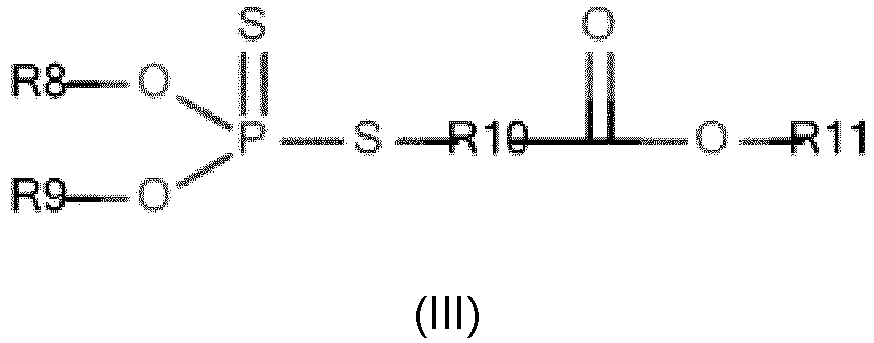
- R8 et R9 représentent indépendamment l'un de l'autre un groupe hydrocarboné, éventuellement substitué, comprenant de 1 à 30 atomes de carbone,
- R10 et R11 représentent indépendamment l'un de l'autre un groupe hydrocarboné comprenant de 1 à 18 atomes de carbone.
- Dans un mode de réalisation préféré de l'invention, R8 et R9 représentent indépendamment l'un de l'autre un groupe hydrocarboné, éventuellement substitué, comprenant de 2 à 24 atomes de carbone, plus préférentiellement de 3 à 18 atomes de carbone, avantageusement de 5 à 12 atomes de carbone.
- Dans un autre mode de réalisation préféré de l'invention, R8 et R9 représentent indépendamment l'un de l'autre un groupe hydrocarboné, non substitué, ledit groupe hydrocarboné pouvant être un groupe alkyle, alkényle, alkynyle, phényle ou benzyle.
- Dans un autre mode de réalisation préféré de l'invention, R8 et R9 représentent indépendamment l'un de l'autre un groupe hydrocarboné alkyle linéaire ou ramifié, plus préférentiellement un groupe hydrocarboné alkyle linéaire.
- Dans un autre mode de réalisation préféré de l'invention, R8 et R9 représentent indépendamment l'un de l'autre un groupe hydrocarboné éventuellement substitué par au moins un atome d'oxygène, d'azote, de soufre et/ou de phosphore, de préférence par au moins un atome d'oxygène.
- Dans un autre mode de réalisation préféré de l'invention, R8 et R9 représentent 20 indépendamment l'un de l'autre, un groupe hydrocarboné comprenant de 2 à 6 atomes de carbone.
- Dans un autre mode de réalisation préféré de l'invention, R10 et R11 représentent indépendamment l'un de l'autre un groupe hydrocarboné comprenant de 2 à 6 atomes de carbone.
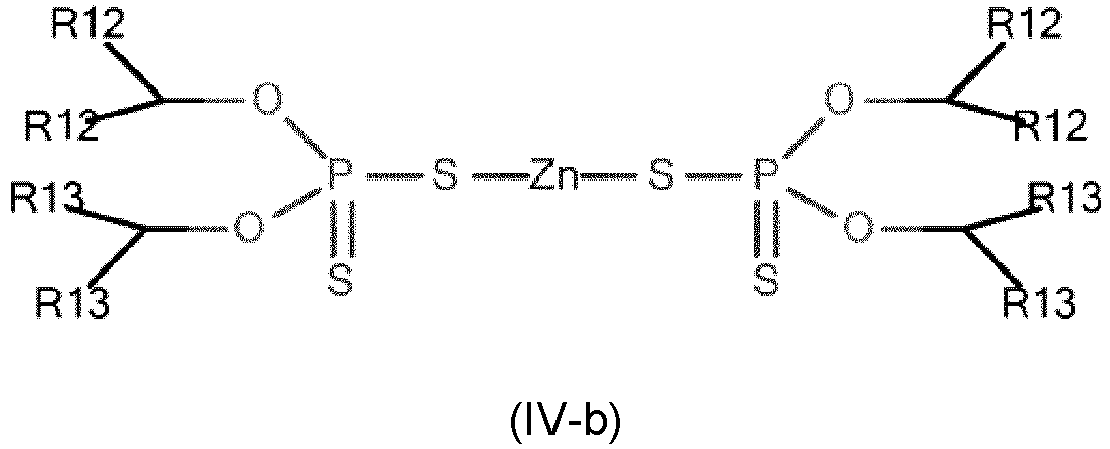
- Dans un autre mode de réalisation, le dithiophosphate est choisi parmi les dithiophosphates métalliques de formule générale (IV) :

- R12 représente un groupe alkyle linéaire ou ramifié, substitué ou non substitué comprenant de 1 à 30 atomes de carbone ;
- R13 représente un groupe alkyle linéaire ou ramifié, substitué ou non substitué comprenant de 1 à 30 atomes de carbone ;
- M représente un cation métallique, de préférence un cation Zn2+ ;
- n représente la valence du cation métallique.
- Dans un mode de réalisation préféré de l'invention, le métal est choisi dans le groupe constitué par le zinc, l'aluminium, le cuivre, le fer, le mercure, l'argent, le cadmium, l'étain, le plomb, l'antimoine, le bismuth, le thallium, le chrome, le molybdène, le cobalt, le nickel, le tungstène, le sodium, le calcium, le magnésium, le manganèse et l'arsenic. Les métaux préférés sont le zinc, le molybdène, l'antimoine, de préférence le zinc et le molybdène.
- Dans un mode de réalisation préféré de l'invention, le métal est le zinc.
- Des mélanges de métaux peuvent être utilisés. Les dithiophosphates métalliques 20 sont neutres comme exemplifiés dans la formule (IV) ou basiques quand un excès stœchiométrique de métal est présent.
- Dans un mode de réalisation préféré de l'invention, R12 et R13 représentent indépendamment l'un de l'autre un groupe hydrocarboné, éventuellement substitué, comprenant de 2 à 24 atomes de carbone, plus préférentiellement de 3 à 18 atomes de carbone, avantageusement de 5 à 12 atomes de carbone.
- Dans un autre mode de réalisation préféré de l'invention, R12 et R13 représentent indépendamment l'un de l'autre un groupe hydrocarboné, non substitué, ledit groupe hydrocarboné pouvant être un groupe alkyle, alkényle, alkynyle, phényle ou benzyle. Dans un autre mode de réalisation préféré de l'invention, R12 et R13 représentent indépendamment l'un de l'autre un groupe hydrocarboné alkyle linéaire ou ramifié, plus préférentiellement un groupe hydrocarboné alkyle linéaire.
- Dans un autre mode de réalisation préféré de l'invention, R12 et R13 représentent indépendamment l'un de l'autre un groupe hydrocarboné éventuellement substitué par au moins un atome d'oxygène, d'azote, de soufre et/ou de phosphore, de préférence par au moins un atome d'oxygène.
- De manière avantageuse, le dithiophosphate selon l'invention est un dithiophosphate de zinc de formule (IV-a) ou de formule (IV-b) :

- En tant que dithiophosphate métallique selon l'invention, on peut citer par exemple l'Additin® RC 3038, l'Additin® RC 3045, l'Additin® RC 3048, l'Additin® RC 3058, l'Additin° RC 3080, l'Additin° RC 3180, l'Additin° RC 3212, l'Additin° RC 3580, le Kikulube° Z112, le Lubrizol® 1371, le Lubrizol® 1375, le Lubrizol® 1395, le Lubrizol® 5179, l'Oloa® 260, l'Oloa® 267.
- La teneur en poids de composé anti-usure comprenant un groupement dithiophosphate va de 0,1 à 5%, par rapport au poids total de la composition lubrifiante.
- Dans un mode de réalisation de l'invention, la teneur en poids de composé comprenant un groupement dithiophosphate va de 0,2 à 4%, plus préférentiellement de 0,5 à 2%, avantageusement de 0,5 à 1,5% par rapport au poids total de la composition lubrifiante.
- Les compositions lubrifiantes selon l'invention peuvent contenir tout type d'huile de base lubrifiante minérale, synthétique ou naturelle, animale ou végétale adaptée(s) à leur utilisation.
- La ou les huiles de base utilisées dans les compositions lubrifiantes selon la présente invention peuvent être des huiles d'origine minérales ou synthétiques des groupes I à V selon les classes définies dans la classification API (ou leurs équivalents selon la classification ATIEL) telle que résumée ci-dessous, seules ou en mélange.
Tableau I Teneur Teneur en saturés Teneur en soufre Indice de viscosité (VI) Groupe I Huiles Minérales < 90 % > 0.03 % 80 ≤ VI < 120 Groupe II Huiles hydrocraquées ≥ 90% ≤ 0.03% 80≤ VI <120 Groupe III Huiles hydrocraquées ou hydro-isomérisées ≥ 90% ≤ 0.03% ≥ 120 Groupe IV Polyalphaoléfines (PAO) Groupe V Esters et autres bases non incluses dans bases groupes I à IV - Les huiles de base minérales selon l'invention incluent tous type de bases obtenues par distillation atmosphérique et sous vide du pétrole brut, suivies d'opérations de raffinage tels qu'extraction au solvant, désasphaltage, déparaffinage au solvant, hydrotraitement, hydrocraquage et hydroisomérisation, hydrofinition.
- Les huiles de bases des compositions lubrifiantes selon l'invention peuvent également être des huiles synthétiques, tels certains esters d'acides carboxyliques et d'alcools, ou des polyalphaoléfines. Les polyalphaoléfines utilisées comme huiles de base, sont par exemple obtenues à partir de monomères ayant de 4 à 32 atomes de carbone (par exemple octène, decène), et une viscosité à 100°C comprise entre 1,5 et 15 cSt mesurée selon la norme ASTM D445. Leur masse moléculaire moyenne en poids est typiquement comprise entre 250 et 3000 mesurée selon la norme ASTM D5296. Des mélanges d'huiles synthétiques et minérales peuvent également être employés.
- Il n'existe aucune limitation quant à l'emploi de telle ou telle base lubrifiante pour réaliser les compositions lubrifiantes selon l'invention, si ce n'est qu'elles doivent avoir des propriétés, notamment de viscosité, indice de viscosité, teneur en soufre, résistance à l'oxydation, adaptées à une utilisation dans une boite de vitesses, en particulier dans une boite de vitesses de véhicules automobile, en particulier dans une boite de vitesses manuelle.
- Dans l'invention, les bases lubrifiantes représentent au moins 70% en masse, par rapport à la masse totale de la composition lubrifiante, Typiquement, elles représentent entre 75 et 99,9% en masse, par rapport à la masse totale des compositions lubrifiantes selon l'invention.
- La composition lubrifiante selon l'invention a une viscosité cinématique à 100°C mesurée selon la norme ASTM D445 allant de 4 à 50 cSt.
- Dans un mode de réalisation, la viscosité cinématique à 100°C mesurée selon la norme ASTM D445 de la composition selon l'invention va de 4 à 45 cSt, de préférence de 4 à 30 cSt.
- Dans un mode de réalisation préféré de l'invention, les compositions lubrifiantes comprennent au moins une base de groupe IV.
- Dans un autre mode de réalisation préféré de l'invention, les compositions lubrifiantes ont un indice de viscosité (VI) supérieur à 95 (norme ASTM 2270).
- Les compositions lubrifiantes selon l'invention peuvent également contenir tout type d'additif adapté pour leur utilisation dans les formulations d'huiles pour transmissions, par exemple un ou plusieurs additifs choisis parmi les polymères, les antioxydants, les additifs anti-corrosion, les modificateurs de frottements différents des nanoparticules métalliques selon l'invention et les dispersants, présents aux teneurs usuelles requises pour l'application. Dans un mode de réalisation de l'invention, l'additif est choisi parmi les dispersants 10 ayant une masse moléculaire moyenne en poids supérieure ou égale à 2000 Daltons.
- Selon l'invention, la masse moléculaire moyenne en poids du dispersant est évaluée selon la norme ASTM D5296.
- Par dispersant au sens de la présente invention, on entend plus particulièrement tout composé qui améliore le maintien en suspension des nanoparticules métalliques.
- Dans un mode de réalisation de l'invention, le dispersant peut être choisi parmi les composés comprenant au moins un groupement succinimide, les polyoléfines, les 20 copolymères oléfines (OCP), les copolymères comprenant au moins un motif styrène, les polyacrylates ou leurs dérivés.
- Par dérivés, on entend tout composé comprenant au moins un groupement ou une chaîne polymérique tels que définis ci-dessus.
- De manière avantageuse, le dispersant selon l'invention est choisi parmi les composés comprenant au moins un groupement succinimide.
- Dans un mode de réalisation préféré de l'invention, le dispersant est choisi parmi les composés comprenant au moins un groupement succinimide substitué ou les composés comprenant au moins deux groupements succinimide substitués, les groupements succinimides étant reliés au niveau de leur sommet portant un atome d'azote par un groupement polyamine.
- Par groupement succinimide substitué au sens de la présente invention, on entend un groupement succinimide dont au moins un des sommets carboné est substitué par un groupement hydrocarboné comprenant de 8 à 400 atomes de carbone.
- Dans un mode de réalisation préféré de l'invention, le dispersant est choisi parmi les polyisobutylène succinimide-polyamine
- De manière avantageuse, le dispersant selon l'invention a une masse moléculaire moyenne en poids allant de 2000 à 15000 Daltons, de préférence allant de 2500 à 10000 Daltons, avantageusement de 3000 à 7000 Daltons.
- De manière également avantageuse, le dispersant a une masse moléculaire en nombre supérieure ou égale à 1000 Daltons, de préférence allant de 1000 à 5000 Daltons, plus préférentiellement de 1800 à 3500 Daltons, avantageusement de 1800 à 3000 Daltons. Selon l'invention, la masse moléculaire en nombre du dispersant est évaluée selon la norme ASTM D5296.
- Dans un mode de réalisation préféré de l'invention, la teneur en poids de dispersant ayant une masse moléculaire moyenne en poids supérieure ou égale à 2000 Daltons 20 va de 0,1 à 10%, de préférence de 0,1 à 5%, avantageusement de 0,1 à 3% par rapport au poids total de la composition lubrifiante.
- Les polymères peuvent être choisis dans le groupe des polymères stables au cisaillement, de préférence dans le groupe constitué par les copolymères d'éthylène et d'alpha-oléfine, les polyacrylates tels que les polyméthacrylates, les oléfines copolymères (OCP), les Ethylène Propylène Diène Monomères (EPDM), les polybutènes, les copolymères de styrène et d'oléfine, hydrogénés ou non ou les copolymères de styrène et d'acrylate.
- Les antioxydants peuvent être choisis parmi les antioxydants aminés, de préférence les diphénylamines, en particulier des dialkylphénylamines, telles que les octadiphénylamines, les phényl-alpha-naphtyl aminés, les antioxydants phénoliques (dibutylhydroxytoluène BHT et dérivés) ou des antioxydants soufrés (phénates sulfurisés).
- Les modificateurs de frottement peuvent être des composés apportant des éléments métalliques différents des nanoparticules métalliques selon l'invention ou bien un composé sans cendres. Parmi les composés apportant des éléments métalliques, on peut citer les complexes de métaux de transition tels que Mo, Sb, Sn, Fe, Cu, Zn, dont les ligands peuvent être des composés hydrocarbonés contenant des atomes d'oxygène, azote, soufre ou phosphore, tels que les dithiocarbamates ou dithiophosphates de molybdène. Les modificateurs de frottement sans cendres sont d'origine organique et peuvent être choisis parmi les monoesters d'acides gras et de polyols, les amines alcoxylées, les amines alcoxylées grasses, les phosphates d'amine, les alcools gras, les époxydes gras, les époxydes gras de borate, les amines grasses ou les esters de glycérol d'acide gras. Par « gras » ou « grasse(s) » on entend au sens de la présente invention un groupement hydrocarboné comprenant de 8 à 24 atomes de carbone.
- Les additifs anti-corrosion peuvent être choisis parmi les dérivés phénoliques, en particulier des dérivés phénoliques éthoxylés et substitués par des groupements alkyles en position ortho. Les inhibiteurs de corrosion pourront être des dérivés du dimercaptothiadiazole.
- Dans un mode de réalisation de l'invention, la composition lubrifiante comprend :
- de 75 à 99,89% d'au moins une huile de base,
- de 0,01 à 2% de nanoparticules métalliques telles que définies ci-dessus,
- de 0,1 à 5% d'au moins un composé anti-usure comprenant un groupement dithiophosphate.
- Dans un autre mode de réalisation de l'invention, la composition lubrifiante consiste essentiellement en :
- 75 à 99,89% d'au moins une huile de base,
- 0,01 à 2% de nanoparticules métalliques telles que définies ci-dessus,
- 0,1 à 5% d'au moins un composé anti-usure comprenant un groupement dithiophosphate.
- L'ensemble des caractéristiques et préférences présentées pour l'huile de base, les nanoparticules métalliques et le composé anti-usure comprenant un groupement dithiophosphate s'applique également aux compositions lubrifiantes ci-dessus.
- Dans un mode de réalisation de l'invention, la composition lubrifiante n'est pas une émulsion.
- Dans un autre mode de réalisation de l'invention, la composition lubrifiante est anhydre.
- La demande décrit également une huile moteur comprenant une composition lubrifiante selon l'invention.
- La demande décrit également une huile transmission comprenant une composition lubrifiante selon l'invention.
- L'ensemble des caractéristiques et préférences présentées pour la composition lubrifiante s'applique également à l'huile moteur ou à l'huile transmission.
- La composition lubrifiante selon l'invention peut lubrifier au moins une pièce mécanique ou un organe mécanique, notamment des roulements, des engrenages, des joints de cardan, des transmissions, le système pistons/segments/chemises, les arbres à came, l'embrayage, les boîtes de vitesses manuelles ou automatiques, les ponts, les culbuteurs, les carters etc.
- Dans un mode de réalisation préféré, la composition lubrifiante selon l'invention peut lubrifier une pièce mécanique ou un organe métallique des transmissions, de l'embrayage, des ponts, des boîtes de vitesses manuelles ou automatiques, de préférence manuelles.
- Ainsi, l'invention a également pour objet l'utilisation d'une composition lubrifiante telle que définie ci-dessus pour la lubrification d'une pièce mécanique, préférentiellement d'un organe de transmission ou d'un moteur de véhicules, avantageusement de véhicules automobiles.
- L'invention a également pour l'utilisation d'une composition lubrifiante telle que définie ci-dessus pour la réduction des frottements à la surface d'une pièce mécanique, préférentiellement d'un organe de transmission ou d'un moteur de véhicules, avantageusement de véhicules automobiles.
- L'invention a également pour objet l'utilisation d'une composition lubrifiante telle que définie ci-dessus pour réduire la consommation de carburant de véhicules, en particulier de véhicules automobiles.
- L'invention a également pour objet l'utilisation d'une composition lubrifiante telle que définie ci-dessus pour réduire l'écaillage d'une pièce mécanique, préférentiellement d'un organe de transmission ou d'un moteur de véhicules, avantageusement de véhicules automobiles.
- L'ensemble des caractéristiques et préférences présentées pour la composition lubrifiante s'applique également aux utilisations ci-dessus.
- La demande décrit également un procédé de lubrification d'une pièce mécanique, préférentiellement d'un organe de transmission ou d'un moteur de véhicules, avantageusement de véhicules automobiles, ledit procédé comprenant au moins une étape de mise en contact de la pièce mécanique avec une composition lubrifiante telle que définie ci-dessus.
- La demande décrit également un procédé de réduction des frottements à la surface d'une pièce mécanique, préférentiellement d'un organe de transmission ou d'un moteur de véhicules, avantageusement de véhicules automobiles, comprenant au moins la mise en contact de la pièce mécanique avec une composition lubrifiante telle que définie ci-dessus.
- La demande décrit également un procédé pour réduire la consommation de carburant d'un véhicule, en particulier d'un véhicule automobile comprenant au moins une étape de mise en contact d'une pièce mécanique du moteur du véhicule avec une composition lubrifiante telle que définie ci-dessus.
- La demande décrit également un procédé de réduction de l'écaillage d'une pièce mécanique préférentiellement d'un organe de transmission ou d'un moteur de véhicules, avantageusement de véhicules automobiles, comprenant au moins la mise en contact de la pièce mécanique avec une composition lubrifiante telle que définie ci-dessus.
- L'ensemble des caractéristiques et préférences présentées pour la composition lubrifiante s'applique également aux procédés ci-dessus.
- La demande décrit également une composition de type concentré d'additifs comprenant au moins un composé anti-usure comprenant un groupement dithiophosphate et des nanoparticules de bisulfure de tungstène.
- L'ensemble des caractéristiques et préférences présentées pour les nanoparticules de bisulfure de tungstène et le composé anti-usure comprenant un groupement dithiophosphate s'applique également à la composition de type concentré d'additifs ci-dessus.
- Dans un mode de réalisation de l'invention, à la composition de type concentré d'additifs peut être ajoutée au moins une huile base pour obtenir une composition lubrifiante selon l'invention.
- L'ensemble des caractéristiques et préférences présentées pour l'huile de base s'applique également au mode de réalisation ci-dessus.
- L'invention a également pour objet l'utilisation d'un composé anti-usure comprenant un groupement dithiophosphate pour diminuer l'oxydation d'une composition lubrifiante comprenant au moins une huile de base et des nanoparticules métalliques solides ayant une structure de type fullerène représentées par la formule MXn dans laquelle M représente un métal de transition, X un chalcogène, avec n=2 ou n=3 en fonction de l'état d'oxydation du métal de transition, dans laquelle les nanoparticules métalliques présentent une taille moyenne, déterminée à l'aide d'images obtenues par micrographie électronique à transmission ou par microscopie électronique à transmission à haute résolution, de 50 à 200 nm et sont des polyèdres concentriques avec une structure multicouche ou en feuillets L'ensemble des caractéristiques et préférences présentées pour l'huile de base, les nanoparticules métalliques et le composé anti-usure comprenant un groupement dithiophosphate s'applique également à l'utilisation ci-dessus
- Les différents objets de la présente invention et leurs mises en œuvre seront mieux compris à la lecture des exemples qui suivent. Ces exemples sont donnés à titre indicatif, sans caractère limitatif.
- On a préparé les compositions lubrifiantes N°1 à N°4 à partir des composés suivants :
- une huile de base de type PAO (Poly Alpha Oléfine) de grade 6 (viscosité à 100°C aux environs de 6 cSt mesuré selon la norme ASTM D445),
- un mélange de nanoparticules de bisulfure de tungstène à 20% en matière active dans une huile (NanoLub Gear Oil Concentrate commercialisé par la société Nanomaterials),
- un composé comprenant un groupement dithiophosphate : dithiophosphate de zinc (Lz 1371 commercialisé par la société Lubrizol).
- Les compositions lubrifiantes N°1 à N°4 sont décrites dans le tableau II ; les pourcentages indiqués sont des pourcentages massiques.
Tableau II Composition lubrifiante N°1 N°2 N°3 N°4 Huile de base 100 99 99 98 Composé comprenant un groupement dithiophosphate 1 1 Nanoparticules de bisulfure de tungstène (NanoLub Gear Oil Concentrate) 1 1 - Il s'agit dévaluer les propriétés de frottement des compositions lubrifiantes N°1 à N°4 par la mesure du coefficient de frottement.
- Le coefficient de frottement est évalué à l'aide d'un tribomètre linéaire pion/plan dans les conditions suivantes :
- nature de l'acier : AISI 52100 (dureté = 800 HV),
- rugosité du plan : 35 nm,
- température : 100°C,
- pression calculée de contact : 1,12 GPa,
- vitesse de glissement : 3 mm/s
- taux d'humidité : 35-45R (atmosphère ambiante),
- durée du test : 8h.
- Le tableau III présente le coefficient de frottement moyen des compositions lubrifiantes N°1 à N°4 ; le coefficient de frottement moyen représentant la moyenne des valeurs du coefficient de frottement obtenu après 4 tests.
Tableau III Composition N°1 N°2 N°3 N°4 Coefficient de frottement 0,100 0,110 0,075 0,060 - Ces résultats montrent que la composition lubrifiante selon l'invention N°4 présente des propriétés de frottement améliorées, par rapport à une composition lubrifiante comprenant un composé comprenant un groupement dithiophosphate selon l'invention mais ne comprenant pas de nanoparticules métalliques (composition N°2) et par rapport à une composition comprenant des nanoparticules métalliques selon l'invention mais ne comprenant pas de composé comprenant un groupement dithiophosphate (composition N°3).
- Ces résultats montrent ainsi une synergie d'activité de la combinaison entre un composé comprenant un groupement dithiophosphate et des nanoparticules métalliques dans une composition lubrifiante pour réduire significativement le coefficient de frottement, notamment pour des contacts acier/acier.
- Ces résultats montrent également que l'efficacité de réduction des frottements est maintenue dans le temps par l'utilisation d'une composition lubrifiante selon l'invention.
- Par ailleurs, la composition lubrifiante N°4 présente une stabilité satisfaisante.
Claims (13)
- Composition lubrifiante de viscosité cinématique à 100°C mesurée selon la norme ASTM D445 allant de 4 à 50 cSt et comprenant par rapport au poids total de la composition lubrifiante au moins 70% en poids d'au moins une huile de base, de 0,1 à 5% en poids d'au moins un composé anti-usure comprenant un groupement dithiophosphate et de 0.01 à 2% en poids de nanoparticules métalliques solides ayant une structure de type fullerène représentées par la formule MXn dans laquelle M représente un métal de transition, X un chalcogène, avec n=2 ou n=3 en fonction de l'état d'oxydation du métal de transition, les nanoparticules métalliques présentant une taille moyenne, déterminée à l'aide d'images obtenues par micrographie électronique à transmission ou par microscopie électronique à transmission à haute résolution, de 50 à 200 nm et étant des polyèdres concentriques avec une structure multicouche ou en feuillets .
- Composition lubrifiante selon la revendication 1 dans laquelle M est choisi parmi le groupe formé par le tungstène, le molybdène, le zirconium, l'hafnium, le platine, le rhénium, le titane, le tantale et le niobium,.
- Composition lubrifiante selon la revendication 1 ou 2 dans laquelle les nanoparticules métalliques sont choisies dans le groupe formé par MoS2, MoSe2, MoTe2, WS2, WSe2, ZrS2, ZrSe2, HfS2, HfSe2, PtS2, ReS2, ReSe2, TiS3, ZrS3, ZrSe3, HfS3, HfSe3, TiS2, TaS2, TaSe2, NbS2, NbSe2 et NbTe2.
- Composition lubrifiante selon l'une quelconque des revendications précédentes dans laquelle la teneur en poids de nanoparticules métalliques va de 0,05 à 2%, par rapport au poids total de la composition lubrifiante.
- Composition lubrifiante selon l'une quelconque des revendications précédentes dans laquelle le composé comprenant un groupement dithiophosphate est choisi dans le groupe constitué par les dithiophosphates d'ammonium, les dithiophosphates d'amine, les dithiophosphates d'ester et les dithiophosphates métalliques, pris seuls ou en mélange.
- Composition selon l'une quelconque des revendications précédentes dans laquelle le composé comprenant un groupement dithiophosphate est un composé de formule (IV)
 • R12 représente un groupe alkyle linéaire ou ramifié, substitué ou non substitué comprenant de 1 à 30 atomes de carbone ;• R13 représente un groupe alkyle linéaire ou ramifié, substitué ou non substitué comprenant de 1 à 30 atomes de carbone ;• M représente un cation métallique;• n représente la valence du cation métallique.
 - Composition lubrifiante selon l'une quelconque des revendications précédentes dans laquelle le composé comprenant un groupement dithiophosphate est un composé de formule (IV-a) ou de formule (IV-b) :

 • R12 représente un groupe alkyle linéaire ou ramifié, substitué ou non substitué comprenant de 1 à 30 atomes de carbone ;• R13 représente un groupe alkyle linéaire ou ramifié, substitué ou non substitué comprenant de 1 à 30 atomes de carbone.
 - Composition lubrifiante selon l'une quelconque des revendications précédentes dans laquelle la teneur en poids de composé comprenant un groupement dithiophosphate va de 0,2 à 4%, par rapport au poids total de la composition lubrifiante.
- Composition lubrifiante selon l'une quelconque des revendications précédentes comprenant en outre un additif choisi parmi les polymères stables au cisaillement, les antioxydants, les additifs anti-corrosion, les modificateurs de frottements différents des nanoparticules métalliques et les dispersants.
- Utilisation d'une composition lubrifiante selon l'une quelconque des revendications 1 à 9 pour la lubrification d'une pièce mécanique.
- Utilisation d'une composition lubrifiante selon la revendication précédente pour la lubrification d'une pièce mécanique de véhicules automobiles.
- Utilisation d'une composition lubrifiante selon l'une quelconque des revendications 1 à 9 pour réduire la consommation de carburant de véhicules.
- Utilisation d'un composé anti-usure comprenant un groupement dithiophosphate pour diminuer l'oxydation d'une composition lubrifiante comprenant au moins une huile de base et des nanoparticules métalliques solides ayant une structure de type fullerène représentées par la formule MXn dans laquelle M représente un métal de transition, X un chalcogène, avec n=2 ou n=3 en fonction de l'état d'oxydation du métal de transition, les nanoparticules métalliques présentant une taille moyenne, déterminée à l'aide d'images obtenues par micrographie électronique à transmission ou par microscopie électronique à transmission à haute résolution, de 50 à 200 nm et étant des polyèdres concentriques avec une structure multicouche ou en feuillets.
Applications Claiming Priority (2)
| Application Number | Priority Date | Filing Date | Title |
|---|---|---|---|
| FR1451648A FR3018079B1 (fr) | 2014-02-28 | 2014-02-28 | Composition lubrifiante a base de nanoparticules metalliques |
| PCT/EP2015/054099 WO2015128444A1 (fr) | 2014-02-28 | 2015-02-26 | Composition lubrifiante à base de nanoparticules métalliques |
Publications (2)
| Publication Number | Publication Date |
|---|---|
| EP3110929A1 EP3110929A1 (fr) | 2017-01-04 |
| EP3110929B1 true EP3110929B1 (fr) | 2022-03-30 |
Family
ID=50639756
Family Applications (1)
| Application Number | Title | Priority Date | Filing Date |
|---|---|---|---|
| EP15706812.3A Active EP3110929B1 (fr) | 2014-02-28 | 2015-02-26 | Composition lubrifiante à base de nanoparticules métalliques |
Country Status (7)
| Country | Link |
|---|---|
| US (1) | US11015141B2 (fr) |
| EP (1) | EP3110929B1 (fr) |
| JP (1) | JP2017506694A (fr) |
| KR (1) | KR102308393B1 (fr) |
| CN (1) | CN106103670A (fr) |
| FR (1) | FR3018079B1 (fr) |
| WO (1) | WO2015128444A1 (fr) |
Families Citing this family (13)
| Publication number | Priority date | Publication date | Assignee | Title |
|---|---|---|---|---|
| WO2015172846A1 (fr) * | 2014-05-16 | 2015-11-19 | Ab Nanol Technologies Oy | Composition d'additif pour lubrifiants |
| CA3010512A1 (fr) * | 2016-01-05 | 2017-07-13 | Nanotech Industrial Solutions, Inc. | Dispersion de nanoparticules a base d'eau |
| US11015140B2 (en) * | 2017-03-31 | 2021-05-25 | Uchicago Argonne, Llc | Catalytically active lubricants |
| KR102587269B1 (ko) * | 2018-01-23 | 2023-10-11 | 에보닉 오퍼레이션스 게엠베하 | 중합체성-무기 나노입자 조성물, 이의 제조 방법 및 윤활제 첨가제로서의 이들의 용도 |
| KR101973490B1 (ko) * | 2018-02-08 | 2019-09-02 | 이승우 | 윤활유 첨가제 조성물, 이의 제조방법 및 이를 포함하는 윤활유 |
| KR102089942B1 (ko) * | 2019-05-09 | 2020-03-18 | (주)에코시즌 | 트랜스미션오일 조성물 |
| JP7434953B2 (ja) * | 2019-06-13 | 2024-02-21 | 株式会社ジェイテクト | グリース組成物および転がり軸受 |
| EP3839022A1 (fr) * | 2019-12-20 | 2021-06-23 | Total Marketing Services | Composition lubrifiante pour améliorer l'économie de carburant et réduire les frottements |
| CN111979016A (zh) * | 2020-08-03 | 2020-11-24 | 容嘉和 | 一种引擎机油添加剂 |
| JP7601682B2 (ja) * | 2021-03-31 | 2024-12-17 | 株式会社ハイレックスコーポレーション | コントロールケーブル用グリース組成物およびコントロールケーブル |
| JP7706998B2 (ja) * | 2021-09-07 | 2025-07-14 | 三菱重工業株式会社 | 被膜形成方法及び潤滑油組成物 |
| KR20240122456A (ko) | 2021-12-14 | 2024-08-12 | 칸토 덴카 코교 가부시키가이샤 | 윤활제용 첨가제 |
| CN119752505B (zh) * | 2024-11-25 | 2025-10-28 | 中国科学院兰州化学物理研究所 | 一种银基固体润滑材料及其制备方法和应用 |
Citations (1)
| Publication number | Priority date | Publication date | Assignee | Title |
|---|---|---|---|---|
| FR2910911A1 (fr) * | 2007-01-03 | 2008-07-04 | Afton Chemical Corp | Additifs en nanoparticules, formulations de lubrifiants les contenant, procede les utilisant pour reduire le frottement |
Family Cites Families (39)
| Publication number | Priority date | Publication date | Assignee | Title |
|---|---|---|---|---|
| US4904401A (en) * | 1988-06-13 | 1990-02-27 | The Lubrizol Corporation | Lubricating oil compositions |
| DE69325055T2 (de) | 1992-07-08 | 2000-03-09 | Yeda Research And Development Co., Ltd. | Orientierte polykristalline dünne Filme aus Übergangsmetallchalcogeniden |
| ATE435268T1 (de) | 2002-07-30 | 2009-07-15 | Chevron Oronite Sa | Hydratisiertes alkalimetallborat und hexagonales bornitrid enthaltende additivzusammensetzung für getriebeöle |
| ATE420940T1 (de) | 2002-10-01 | 2009-01-15 | Lubrizol Corp | Herstellung von schmiermitteln aus metallhydroxid enthaltenden entwässerten emulsionen |
| FR2848668B1 (fr) | 2002-12-16 | 2005-03-18 | Totalfinaelf France | Procede et dispositif pour la determination en continu de la degradation des systemes de post-traitement des gaz d'echappement de moteur thermique |
| EP1535987B1 (fr) | 2003-11-28 | 2013-01-09 | Chevron Oronite SAS | Composition additive pour huile de transmission contenant du nitrure de bore hexagonal et un améliorant de l'indice de viscosité |
| FR2864240B1 (fr) | 2003-12-23 | 2006-03-17 | Total France | Procede et dispositif de suivi de la dilution de l'huile lubrifiante par le carburant dans un moteur a combustion interne |
| FR2867564B1 (fr) | 2004-03-11 | 2006-06-23 | Total France | Procede et dispositif de mesure en temps reel de la consommation d'huile du systeme de separation d'huile moteur |
| CA2623017A1 (fr) | 2005-09-20 | 2007-03-29 | The Lubrizol Corporation | Procede de lubrification d'un moteur a combustion interne |
| CA2634079A1 (fr) | 2005-12-20 | 2007-10-25 | The Lubrizol Corporation | Procede de preparation d'un detergent neutre ou surbasique |
| JP4886304B2 (ja) | 2006-01-27 | 2012-02-29 | 昭和シェル石油株式会社 | グリース組成物 |
| EP1916291B1 (fr) | 2006-10-24 | 2018-01-24 | Total Marketing Services | Utilisation d'un fluide lubrifiant multifonctionnel |
| US20080234149A1 (en) * | 2007-01-12 | 2008-09-25 | Malshe Ajay P | Nanoparticulate based lubricants |
| US20080182927A1 (en) | 2007-01-31 | 2008-07-31 | Air Products And Chemicals, Inc. | Polyisobutenyl containing dispersions and uses thereof |
| JP2009063154A (ja) | 2007-09-10 | 2009-03-26 | Nsk Ltd | 転動装置 |
| FR2924439B1 (fr) | 2007-12-03 | 2010-10-22 | Total France | Composition lubrifiante pour moteur quatre temps a bas taux de cendres |
| FR2932813B1 (fr) | 2008-06-18 | 2010-09-03 | Total France | Lubrifiant cylindre pour moteur marin deux temps |
| FR2942627B1 (fr) | 2009-02-27 | 2011-05-06 | Total Raffinage Marketing | Composition de graisse |
| FR2945754A1 (fr) | 2009-05-20 | 2010-11-26 | Total Raffinage Marketing | Nouveaux additifs pour huiles transmission |
| FR2949786B1 (fr) * | 2009-09-10 | 2013-07-05 | Total Raffinage Marketing | Composition de graisse. |
| CN101691517B (zh) * | 2009-09-29 | 2012-12-19 | 中南大学 | 一种车用机油添加剂及机油 |
| PL218093B1 (pl) | 2009-12-30 | 2014-10-31 | Inst Obróbki Plastycznej | Sposób wytwarzania smarów nanokompozytowych grafenopodobnych i zespół do wytwarzania smarów nanokompozytowych grafenopodobnych |
| FR2961823B1 (fr) | 2010-06-25 | 2013-06-14 | Total Raffinage Marketing | Compositions lubrifiantes pour transmissions automobiles |
| FR2965274A1 (fr) | 2010-09-28 | 2012-03-30 | Total Raffinage Marketing | Composition lubrifiante |
| FR2968011B1 (fr) | 2010-11-26 | 2014-02-21 | Total Raffinage Marketing | Composition lubrifiante pour moteur |
| FR2968670B1 (fr) | 2010-12-13 | 2013-01-04 | Total Raffinage Marketing | Composition de graisse |
| FR2968669B1 (fr) | 2010-12-13 | 2014-02-28 | Total Raffinage Marketing | Composition de graisse |
| FR2980799B1 (fr) | 2011-09-29 | 2013-10-04 | Total Raffinage Marketing | Composition lubrifiante pour moteur marin |
| PL2766417T3 (pl) | 2011-10-13 | 2018-01-31 | Total Res & Technology Feluy | Nanokompozyt |
| DK2766427T3 (en) | 2011-10-13 | 2017-09-18 | Total Res & Technology Feluy | NANO COMPOSITE |
| FR2984348B1 (fr) * | 2011-12-16 | 2015-02-27 | Total Raffinage Marketing | Compositions lubrifiantes pour transmissions |
| FR2986801B1 (fr) | 2012-02-15 | 2014-09-05 | Total Raffinage Marketing | Compositions lubrifiantes pour transmissions |
| FR2990213B1 (fr) | 2012-05-04 | 2015-04-24 | Total Raffinage Marketing | Composition lubrifiante pour moteur |
| FR2998303B1 (fr) | 2012-11-16 | 2015-04-10 | Total Raffinage Marketing | Composition lubrifiante |
| US20140162915A1 (en) * | 2012-12-11 | 2014-06-12 | N1 Technologies Inc | Enhanced Lubricant Formulation |
| FR3002235B1 (fr) | 2013-02-19 | 2015-02-27 | Total Raffinage Marketing | Composition lubrifiante a base de composes amines |
| FR3004723B1 (fr) | 2013-04-19 | 2016-04-15 | Total Raffinage Marketing | Composition lubrifiante a base de nanoparticules metalliques |
| FR3005474B1 (fr) | 2013-05-07 | 2016-09-09 | Total Raffinage Marketing | Lubrifiant pour moteur marin |
| FR3009309B1 (fr) | 2013-08-02 | 2016-10-07 | Total Marketing Services | Compositions lubrifiantes pour transmissions |
-
2014
- 2014-02-28 FR FR1451648A patent/FR3018079B1/fr not_active Expired - Fee Related
-
2015
- 2015-02-26 KR KR1020167025416A patent/KR102308393B1/ko not_active Expired - Fee Related
- 2015-02-26 WO PCT/EP2015/054099 patent/WO2015128444A1/fr not_active Ceased
- 2015-02-26 EP EP15706812.3A patent/EP3110929B1/fr active Active
- 2015-02-26 JP JP2016554406A patent/JP2017506694A/ja active Pending
- 2015-02-26 US US15/121,987 patent/US11015141B2/en not_active Expired - Fee Related
- 2015-02-26 CN CN201580010884.1A patent/CN106103670A/zh active Pending
Patent Citations (1)
| Publication number | Priority date | Publication date | Assignee | Title |
|---|---|---|---|---|
| FR2910911A1 (fr) * | 2007-01-03 | 2008-07-04 | Afton Chemical Corp | Additifs en nanoparticules, formulations de lubrifiants les contenant, procede les utilisant pour reduire le frottement |
Non-Patent Citations (1)
| Title |
|---|
| JENEI ISTVAN ZOLTAN ET AL: "Correlation Studies ofWS2Fullerene-Like Nanoparticles Enhanced Tribofilms: A Scanning Electron Microscopy Analysis", TRIBOLOGY LETTERS, BALTZER SCIENCE PUBLISHIERS, NL, vol. 51, no. 3, 11 July 2013 (2013-07-11), pages 461 - 468, XP035350080, ISSN: 1023-8883, [retrieved on 20130711], DOI: 10.1007/S11249-013-0184-0 * |
Also Published As
| Publication number | Publication date |
|---|---|
| JP2017506694A (ja) | 2017-03-09 |
| FR3018079B1 (fr) | 2017-06-23 |
| US20170073612A1 (en) | 2017-03-16 |
| FR3018079A1 (fr) | 2015-09-04 |
| CN106103670A (zh) | 2016-11-09 |
| WO2015128444A1 (fr) | 2015-09-03 |
| US11015141B2 (en) | 2021-05-25 |
| EP3110929A1 (fr) | 2017-01-04 |
| KR102308393B1 (ko) | 2021-10-06 |
| KR20160127034A (ko) | 2016-11-02 |
Similar Documents
| Publication | Publication Date | Title |
|---|---|---|
| EP3110929B1 (fr) | Composition lubrifiante à base de nanoparticules métalliques | |
| EP2986693B1 (fr) | Composition lubrifiante a base de nanoparticules metalliques | |
| EP2652099B1 (fr) | Composition de graisse | |
| CA2771772C (fr) | Composition de graisse | |
| EP2652100B1 (fr) | Composition de graisse | |
| WO2010097778A1 (fr) | Composition de graisse | |
| EP3027719A1 (fr) | Compositions lubrifiantes pour transmissions | |
| EP3274432A1 (fr) | Composition lubrifiante | |
| EP2958980A1 (fr) | Composition lubrifiante a base de composes amines | |
| EP2935542A1 (fr) | Composition lubrifiante a base d'ether de polyglycerol | |
| FR3065008A1 (fr) | Procede de lubrification de pieces mecaniques | |
| WO2020201126A1 (fr) | Utilisation d'une composition lubrifiante pour transmission | |
| EP3529341B1 (fr) | Composition lubrifiante | |
| WO2025051917A1 (fr) | Graisses lubrifiantes ameliorees et nouveaux additifs fonctionnels soufres | |
| WO2020152137A1 (fr) | Complexe dinucléaire de molybdène et son utilisation dans des compositions lubrifiantes |
Legal Events
| Date | Code | Title | Description |
|---|---|---|---|
| STAA | Information on the status of an ep patent application or granted ep patent |
Free format text: STATUS: THE INTERNATIONAL PUBLICATION HAS BEEN MADE |
|
| PUAI | Public reference made under article 153(3) epc to a published international application that has entered the european phase |
Free format text: ORIGINAL CODE: 0009012 |
|
| STAA | Information on the status of an ep patent application or granted ep patent |
Free format text: STATUS: REQUEST FOR EXAMINATION WAS MADE |
|
| 17P | Request for examination filed |
Effective date: 20160906 |
|
| AK | Designated contracting states |
Kind code of ref document: A1 Designated state(s): AL AT BE BG CH CY CZ DE DK EE ES FI FR GB GR HR HU IE IS IT LI LT LU LV MC MK MT NL NO PL PT RO RS SE SI SK SM TR |
|
| AX | Request for extension of the european patent |
Extension state: BA ME |
|
| RIN1 | Information on inventor provided before grant (corrected) |
Inventor name: THIEBAUT, BENOIT Inventor name: DASSENOY, FABRICE Inventor name: USSA, PAULA |
|
| DAX | Request for extension of the european patent (deleted) | ||
| STAA | Information on the status of an ep patent application or granted ep patent |
Free format text: STATUS: EXAMINATION IS IN PROGRESS |
|
| 17Q | First examination report despatched |
Effective date: 20200214 |
|
| REG | Reference to a national code |
Ref country code: DE Ref legal event code: R079 Ref document number: 602015077841 Country of ref document: DE Free format text: PREVIOUS MAIN CLASS: C10M0141100000 Ipc: C10M0171060000 |
|
| RIC1 | Information provided on ipc code assigned before grant |
Ipc: C10N 50/00 20060101ALI20210901BHEP Ipc: C10N 40/04 20060101ALI20210901BHEP Ipc: C10N 30/00 20060101ALI20210901BHEP Ipc: C10N 30/10 20060101ALI20210901BHEP Ipc: C10N 30/06 20060101ALI20210901BHEP Ipc: C10N 30/02 20060101ALI20210901BHEP Ipc: C10N 20/06 20060101ALI20210901BHEP Ipc: C10M 141/12 20060101ALI20210901BHEP Ipc: C10M 171/06 20060101AFI20210901BHEP |
|
| GRAP | Despatch of communication of intention to grant a patent |
Free format text: ORIGINAL CODE: EPIDOSNIGR1 |
|
| STAA | Information on the status of an ep patent application or granted ep patent |
Free format text: STATUS: GRANT OF PATENT IS INTENDED |
|
| INTG | Intention to grant announced |
Effective date: 20211018 |
|
| GRAS | Grant fee paid |
Free format text: ORIGINAL CODE: EPIDOSNIGR3 |
|
| GRAA | (expected) grant |
Free format text: ORIGINAL CODE: 0009210 |
|
| STAA | Information on the status of an ep patent application or granted ep patent |
Free format text: STATUS: THE PATENT HAS BEEN GRANTED |
|
| AK | Designated contracting states |
Kind code of ref document: B1 Designated state(s): AL AT BE BG CH CY CZ DE DK EE ES FI FR GB GR HR HU IE IS IT LI LT LU LV MC MK MT NL NO PL PT RO RS SE SI SK SM TR |
|
| REG | Reference to a national code |
Ref country code: GB Ref legal event code: FG4D Free format text: NOT ENGLISH |
|
| REG | Reference to a national code |
Ref country code: CH Ref legal event code: EP |
|
| REG | Reference to a national code |
Ref country code: DE Ref legal event code: R096 Ref document number: 602015077841 Country of ref document: DE |
|
| REG | Reference to a national code |
Ref country code: AT Ref legal event code: REF Ref document number: 1479202 Country of ref document: AT Kind code of ref document: T Effective date: 20220415 |
|
| REG | Reference to a national code |
Ref country code: IE Ref legal event code: FG4D Free format text: LANGUAGE OF EP DOCUMENT: FRENCH |
|
| RAP2 | Party data changed (patent owner data changed or rights of a patent transferred) |
Owner name: TOTALENERGIES ONETECH |
|
| REG | Reference to a national code |
Ref country code: LT Ref legal event code: MG9D |
|
| PG25 | Lapsed in a contracting state [announced via postgrant information from national office to epo] |
Ref country code: SE Free format text: LAPSE BECAUSE OF FAILURE TO SUBMIT A TRANSLATION OF THE DESCRIPTION OR TO PAY THE FEE WITHIN THE PRESCRIBED TIME-LIMIT Effective date: 20220330 Ref country code: RS Free format text: LAPSE BECAUSE OF FAILURE TO SUBMIT A TRANSLATION OF THE DESCRIPTION OR TO PAY THE FEE WITHIN THE PRESCRIBED TIME-LIMIT Effective date: 20220330 Ref country code: NO Free format text: LAPSE BECAUSE OF FAILURE TO SUBMIT A TRANSLATION OF THE DESCRIPTION OR TO PAY THE FEE WITHIN THE PRESCRIBED TIME-LIMIT Effective date: 20220630 Ref country code: LT Free format text: LAPSE BECAUSE OF FAILURE TO SUBMIT A TRANSLATION OF THE DESCRIPTION OR TO PAY THE FEE WITHIN THE PRESCRIBED TIME-LIMIT Effective date: 20220330 Ref country code: HR Free format text: LAPSE BECAUSE OF FAILURE TO SUBMIT A TRANSLATION OF THE DESCRIPTION OR TO PAY THE FEE WITHIN THE PRESCRIBED TIME-LIMIT Effective date: 20220330 Ref country code: BG Free format text: LAPSE BECAUSE OF FAILURE TO SUBMIT A TRANSLATION OF THE DESCRIPTION OR TO PAY THE FEE WITHIN THE PRESCRIBED TIME-LIMIT Effective date: 20220630 |
|
| REG | Reference to a national code |
Ref country code: NL Ref legal event code: MP Effective date: 20220330 |
|
| REG | Reference to a national code |
Ref country code: AT Ref legal event code: MK05 Ref document number: 1479202 Country of ref document: AT Kind code of ref document: T Effective date: 20220330 |
|
| PG25 | Lapsed in a contracting state [announced via postgrant information from national office to epo] |
Ref country code: LV Free format text: LAPSE BECAUSE OF FAILURE TO SUBMIT A TRANSLATION OF THE DESCRIPTION OR TO PAY THE FEE WITHIN THE PRESCRIBED TIME-LIMIT Effective date: 20220330 Ref country code: GR Free format text: LAPSE BECAUSE OF FAILURE TO SUBMIT A TRANSLATION OF THE DESCRIPTION OR TO PAY THE FEE WITHIN THE PRESCRIBED TIME-LIMIT Effective date: 20220701 Ref country code: FI Free format text: LAPSE BECAUSE OF FAILURE TO SUBMIT A TRANSLATION OF THE DESCRIPTION OR TO PAY THE FEE WITHIN THE PRESCRIBED TIME-LIMIT Effective date: 20220330 |
|
| PG25 | Lapsed in a contracting state [announced via postgrant information from national office to epo] |
Ref country code: NL Free format text: LAPSE BECAUSE OF FAILURE TO SUBMIT A TRANSLATION OF THE DESCRIPTION OR TO PAY THE FEE WITHIN THE PRESCRIBED TIME-LIMIT Effective date: 20220330 |
|
| PG25 | Lapsed in a contracting state [announced via postgrant information from national office to epo] |
Ref country code: SM Free format text: LAPSE BECAUSE OF FAILURE TO SUBMIT A TRANSLATION OF THE DESCRIPTION OR TO PAY THE FEE WITHIN THE PRESCRIBED TIME-LIMIT Effective date: 20220330 Ref country code: SK Free format text: LAPSE BECAUSE OF FAILURE TO SUBMIT A TRANSLATION OF THE DESCRIPTION OR TO PAY THE FEE WITHIN THE PRESCRIBED TIME-LIMIT Effective date: 20220330 Ref country code: RO Free format text: LAPSE BECAUSE OF FAILURE TO SUBMIT A TRANSLATION OF THE DESCRIPTION OR TO PAY THE FEE WITHIN THE PRESCRIBED TIME-LIMIT Effective date: 20220330 Ref country code: PT Free format text: LAPSE BECAUSE OF FAILURE TO SUBMIT A TRANSLATION OF THE DESCRIPTION OR TO PAY THE FEE WITHIN THE PRESCRIBED TIME-LIMIT Effective date: 20220801 Ref country code: ES Free format text: LAPSE BECAUSE OF FAILURE TO SUBMIT A TRANSLATION OF THE DESCRIPTION OR TO PAY THE FEE WITHIN THE PRESCRIBED TIME-LIMIT Effective date: 20220330 Ref country code: EE Free format text: LAPSE BECAUSE OF FAILURE TO SUBMIT A TRANSLATION OF THE DESCRIPTION OR TO PAY THE FEE WITHIN THE PRESCRIBED TIME-LIMIT Effective date: 20220330 Ref country code: CZ Free format text: LAPSE BECAUSE OF FAILURE TO SUBMIT A TRANSLATION OF THE DESCRIPTION OR TO PAY THE FEE WITHIN THE PRESCRIBED TIME-LIMIT Effective date: 20220330 Ref country code: AT Free format text: LAPSE BECAUSE OF FAILURE TO SUBMIT A TRANSLATION OF THE DESCRIPTION OR TO PAY THE FEE WITHIN THE PRESCRIBED TIME-LIMIT Effective date: 20220330 |
|
| PG25 | Lapsed in a contracting state [announced via postgrant information from national office to epo] |
Ref country code: PL Free format text: LAPSE BECAUSE OF FAILURE TO SUBMIT A TRANSLATION OF THE DESCRIPTION OR TO PAY THE FEE WITHIN THE PRESCRIBED TIME-LIMIT Effective date: 20220330 Ref country code: IS Free format text: LAPSE BECAUSE OF FAILURE TO SUBMIT A TRANSLATION OF THE DESCRIPTION OR TO PAY THE FEE WITHIN THE PRESCRIBED TIME-LIMIT Effective date: 20220730 Ref country code: AL Free format text: LAPSE BECAUSE OF FAILURE TO SUBMIT A TRANSLATION OF THE DESCRIPTION OR TO PAY THE FEE WITHIN THE PRESCRIBED TIME-LIMIT Effective date: 20220330 |
|
| REG | Reference to a national code |
Ref country code: DE Ref legal event code: R097 Ref document number: 602015077841 Country of ref document: DE |
|
| PG25 | Lapsed in a contracting state [announced via postgrant information from national office to epo] |
Ref country code: DK Free format text: LAPSE BECAUSE OF FAILURE TO SUBMIT A TRANSLATION OF THE DESCRIPTION OR TO PAY THE FEE WITHIN THE PRESCRIBED TIME-LIMIT Effective date: 20220330 |
|
| PLBE | No opposition filed within time limit |
Free format text: ORIGINAL CODE: 0009261 |
|
| STAA | Information on the status of an ep patent application or granted ep patent |
Free format text: STATUS: NO OPPOSITION FILED WITHIN TIME LIMIT |
|
| 26N | No opposition filed |
Effective date: 20230103 |
|
| PGFP | Annual fee paid to national office [announced via postgrant information from national office to epo] |
Ref country code: FR Payment date: 20230221 Year of fee payment: 9 |
|
| PG25 | Lapsed in a contracting state [announced via postgrant information from national office to epo] |
Ref country code: SI Free format text: LAPSE BECAUSE OF FAILURE TO SUBMIT A TRANSLATION OF THE DESCRIPTION OR TO PAY THE FEE WITHIN THE PRESCRIBED TIME-LIMIT Effective date: 20220330 |
|
| PGFP | Annual fee paid to national office [announced via postgrant information from national office to epo] |
Ref country code: GB Payment date: 20230221 Year of fee payment: 9 Ref country code: DE Payment date: 20230216 Year of fee payment: 9 |
|
| PG25 | Lapsed in a contracting state [announced via postgrant information from national office to epo] |
Ref country code: IT Free format text: LAPSE BECAUSE OF FAILURE TO SUBMIT A TRANSLATION OF THE DESCRIPTION OR TO PAY THE FEE WITHIN THE PRESCRIBED TIME-LIMIT Effective date: 20220330 |
|
| PG25 | Lapsed in a contracting state [announced via postgrant information from national office to epo] |
Ref country code: MC Free format text: LAPSE BECAUSE OF FAILURE TO SUBMIT A TRANSLATION OF THE DESCRIPTION OR TO PAY THE FEE WITHIN THE PRESCRIBED TIME-LIMIT Effective date: 20220330 |
|
| REG | Reference to a national code |
Ref country code: CH Ref legal event code: PL |
|
| REG | Reference to a national code |
Ref country code: BE Ref legal event code: MM Effective date: 20230228 |
|
| PG25 | Lapsed in a contracting state [announced via postgrant information from national office to epo] |
Ref country code: LU Free format text: LAPSE BECAUSE OF NON-PAYMENT OF DUE FEES Effective date: 20230226 Ref country code: LI Free format text: LAPSE BECAUSE OF NON-PAYMENT OF DUE FEES Effective date: 20230228 Ref country code: CH Free format text: LAPSE BECAUSE OF NON-PAYMENT OF DUE FEES Effective date: 20230228 |
|
| REG | Reference to a national code |
Ref country code: IE Ref legal event code: MM4A |
|
| PG25 | Lapsed in a contracting state [announced via postgrant information from national office to epo] |
Ref country code: IE Free format text: LAPSE BECAUSE OF NON-PAYMENT OF DUE FEES Effective date: 20230226 |
|
| PG25 | Lapsed in a contracting state [announced via postgrant information from national office to epo] |
Ref country code: BE Free format text: LAPSE BECAUSE OF NON-PAYMENT OF DUE FEES Effective date: 20230228 |
|
| REG | Reference to a national code |
Ref country code: DE Ref legal event code: R119 Ref document number: 602015077841 Country of ref document: DE |
|
| GBPC | Gb: european patent ceased through non-payment of renewal fee |
Effective date: 20240226 |
|
| PG25 | Lapsed in a contracting state [announced via postgrant information from national office to epo] |
Ref country code: DE Free format text: LAPSE BECAUSE OF NON-PAYMENT OF DUE FEES Effective date: 20240903 |
|
| PG25 | Lapsed in a contracting state [announced via postgrant information from national office to epo] |
Ref country code: GB Free format text: LAPSE BECAUSE OF NON-PAYMENT OF DUE FEES Effective date: 20240226 |
|
| PG25 | Lapsed in a contracting state [announced via postgrant information from national office to epo] |
Ref country code: FR Free format text: LAPSE BECAUSE OF NON-PAYMENT OF DUE FEES Effective date: 20240229 |
|
| PG25 | Lapsed in a contracting state [announced via postgrant information from national office to epo] |
Ref country code: GB Free format text: LAPSE BECAUSE OF NON-PAYMENT OF DUE FEES Effective date: 20240226 Ref country code: FR Free format text: LAPSE BECAUSE OF NON-PAYMENT OF DUE FEES Effective date: 20240229 Ref country code: DE Free format text: LAPSE BECAUSE OF NON-PAYMENT OF DUE FEES Effective date: 20240903 |
|
| PG25 | Lapsed in a contracting state [announced via postgrant information from national office to epo] |
Ref country code: CY Free format text: LAPSE BECAUSE OF FAILURE TO SUBMIT A TRANSLATION OF THE DESCRIPTION OR TO PAY THE FEE WITHIN THE PRESCRIBED TIME-LIMIT; INVALID AB INITIO Effective date: 20150226 |
|
| PG25 | Lapsed in a contracting state [announced via postgrant information from national office to epo] |
Ref country code: HU Free format text: LAPSE BECAUSE OF FAILURE TO SUBMIT A TRANSLATION OF THE DESCRIPTION OR TO PAY THE FEE WITHIN THE PRESCRIBED TIME-LIMIT; INVALID AB INITIO Effective date: 20150226 |
|
| PG25 | Lapsed in a contracting state [announced via postgrant information from national office to epo] |
Ref country code: TR Free format text: LAPSE BECAUSE OF FAILURE TO SUBMIT A TRANSLATION OF THE DESCRIPTION OR TO PAY THE FEE WITHIN THE PRESCRIBED TIME-LIMIT Effective date: 20220330 |