EP3112502B1 - Méthode pour le placage de fils ou de bandes métalliques et produit obtenu par ladite méthode - Google Patents
Méthode pour le placage de fils ou de bandes métalliques et produit obtenu par ladite méthode Download PDFInfo
- Publication number
- EP3112502B1 EP3112502B1 EP16176105.1A EP16176105A EP3112502B1 EP 3112502 B1 EP3112502 B1 EP 3112502B1 EP 16176105 A EP16176105 A EP 16176105A EP 3112502 B1 EP3112502 B1 EP 3112502B1
- Authority
- EP
- European Patent Office
- Prior art keywords
- plating
- chromium
- electrolytic
- nickel
- metallic product
- Prior art date
- Legal status (The legal status is an assumption and is not a legal conclusion. Google has not performed a legal analysis and makes no representation as to the accuracy of the status listed.)
- Not-in-force
Links
- 238000007747 plating Methods 0.000 title claims description 75
- 238000000034 method Methods 0.000 title claims description 45
- PXHVJJICTQNCMI-UHFFFAOYSA-N Nickel Chemical compound [Ni] PXHVJJICTQNCMI-UHFFFAOYSA-N 0.000 claims description 59
- 229910052759 nickel Inorganic materials 0.000 claims description 28
- 239000011651 chromium Substances 0.000 claims description 26
- VYZAMTAEIAYCRO-UHFFFAOYSA-N Chromium Chemical compound [Cr] VYZAMTAEIAYCRO-UHFFFAOYSA-N 0.000 claims description 25
- 229910052804 chromium Inorganic materials 0.000 claims description 24
- 238000011282 treatment Methods 0.000 claims description 20
- 238000005406 washing Methods 0.000 claims description 8
- 238000009713 electroplating Methods 0.000 claims description 5
- 230000000087 stabilizing effect Effects 0.000 claims description 4
- 238000005238 degreasing Methods 0.000 claims description 2
- 238000001035 drying Methods 0.000 claims description 2
- 238000006386 neutralization reaction Methods 0.000 claims description 2
- 238000005554 pickling Methods 0.000 claims description 2
- 150000003467 sulfuric acid derivatives Chemical class 0.000 claims description 2
- 150000001805 chlorine compounds Chemical class 0.000 claims 1
- 230000008569 process Effects 0.000 description 20
- 239000010410 layer Substances 0.000 description 11
- 238000000576 coating method Methods 0.000 description 10
- 229910052751 metal Inorganic materials 0.000 description 9
- 239000011248 coating agent Substances 0.000 description 8
- 239000002184 metal Substances 0.000 description 8
- 238000004519 manufacturing process Methods 0.000 description 7
- 238000012545 processing Methods 0.000 description 7
- 239000000463 material Substances 0.000 description 5
- 239000000243 solution Substances 0.000 description 4
- JOPOVCBBYLSVDA-UHFFFAOYSA-N chromium(6+) Chemical compound [Cr+6] JOPOVCBBYLSVDA-UHFFFAOYSA-N 0.000 description 3
- 238000000151 deposition Methods 0.000 description 3
- 229910000831 Steel Inorganic materials 0.000 description 2
- 230000007797 corrosion Effects 0.000 description 2
- 238000005260 corrosion Methods 0.000 description 2
- 230000003247 decreasing effect Effects 0.000 description 2
- 230000007547 defect Effects 0.000 description 2
- 230000008021 deposition Effects 0.000 description 2
- 230000008030 elimination Effects 0.000 description 2
- 238000003379 elimination reaction Methods 0.000 description 2
- 238000002360 preparation method Methods 0.000 description 2
- 239000011253 protective coating Substances 0.000 description 2
- 239000010959 steel Substances 0.000 description 2
- 239000000758 substrate Substances 0.000 description 2
- 230000009466 transformation Effects 0.000 description 2
- 229910000838 Al alloy Inorganic materials 0.000 description 1
- OKTJSMMVPCPJKN-UHFFFAOYSA-N Carbon Chemical compound [C] OKTJSMMVPCPJKN-UHFFFAOYSA-N 0.000 description 1
- RYGMFSIKBFXOCR-UHFFFAOYSA-N Copper Chemical compound [Cu] RYGMFSIKBFXOCR-UHFFFAOYSA-N 0.000 description 1
- 206010012442 Dermatitis contact Diseases 0.000 description 1
- CWYNVVGOOAEACU-UHFFFAOYSA-N Fe2+ Chemical compound [Fe+2] CWYNVVGOOAEACU-UHFFFAOYSA-N 0.000 description 1
- 206010020751 Hypersensitivity Diseases 0.000 description 1
- ATJFFYVFTNAWJD-UHFFFAOYSA-N Tin Chemical compound [Sn] ATJFFYVFTNAWJD-UHFFFAOYSA-N 0.000 description 1
- 238000010521 absorption reaction Methods 0.000 description 1
- 230000002009 allergenic effect Effects 0.000 description 1
- 208000002029 allergic contact dermatitis Diseases 0.000 description 1
- 208000026935 allergic disease Diseases 0.000 description 1
- 230000007815 allergy Effects 0.000 description 1
- 229910045601 alloy Inorganic materials 0.000 description 1
- 239000000956 alloy Substances 0.000 description 1
- 229910052782 aluminium Inorganic materials 0.000 description 1
- XAGFODPZIPBFFR-UHFFFAOYSA-N aluminium Chemical compound [Al] XAGFODPZIPBFFR-UHFFFAOYSA-N 0.000 description 1
- 150000001450 anions Chemical class 0.000 description 1
- 238000013459 approach Methods 0.000 description 1
- 239000007864 aqueous solution Substances 0.000 description 1
- 238000005452 bending Methods 0.000 description 1
- 239000011230 binding agent Substances 0.000 description 1
- 230000015572 biosynthetic process Effects 0.000 description 1
- 239000003183 carcinogenic agent Substances 0.000 description 1
- 150000001768 cations Chemical class 0.000 description 1
- 150000003841 chloride salts Chemical class 0.000 description 1
- 238000004140 cleaning Methods 0.000 description 1
- 238000010924 continuous production Methods 0.000 description 1
- 229910052802 copper Inorganic materials 0.000 description 1
- 239000010949 copper Substances 0.000 description 1
- 230000000694 effects Effects 0.000 description 1
- 229910002804 graphite Inorganic materials 0.000 description 1
- 239000010439 graphite Substances 0.000 description 1
- 230000006872 improvement Effects 0.000 description 1
- 238000009776 industrial production Methods 0.000 description 1
- 230000000622 irritating effect Effects 0.000 description 1
- 230000007246 mechanism Effects 0.000 description 1
- 239000007769 metal material Substances 0.000 description 1
- 150000002739 metals Chemical class 0.000 description 1
- 238000012986 modification Methods 0.000 description 1
- 230000004048 modification Effects 0.000 description 1
- 230000001575 pathological effect Effects 0.000 description 1
- 239000011148 porous material Substances 0.000 description 1
- 230000000750 progressive effect Effects 0.000 description 1
- 230000002035 prolonged effect Effects 0.000 description 1
- 230000001681 protective effect Effects 0.000 description 1
- 238000012827 research and development Methods 0.000 description 1
- 150000003839 salts Chemical class 0.000 description 1
- 230000003068 static effect Effects 0.000 description 1
- 238000006467 substitution reaction Methods 0.000 description 1
- 239000002344 surface layer Substances 0.000 description 1
- 238000012360 testing method Methods 0.000 description 1
- 239000011135 tin Substances 0.000 description 1
- 229910052718 tin Inorganic materials 0.000 description 1
- 238000012546 transfer Methods 0.000 description 1
Images
Classifications
-
- C—CHEMISTRY; METALLURGY
- C25—ELECTROLYTIC OR ELECTROPHORETIC PROCESSES; APPARATUS THEREFOR
- C25D—PROCESSES FOR THE ELECTROLYTIC OR ELECTROPHORETIC PRODUCTION OF COATINGS; ELECTROFORMING; APPARATUS THEREFOR
- C25D7/00—Electroplating characterised by the article coated
- C25D7/06—Wires; Strips; Foils
- C25D7/0607—Wires
-
- C—CHEMISTRY; METALLURGY
- C25—ELECTROLYTIC OR ELECTROPHORETIC PROCESSES; APPARATUS THEREFOR
- C25D—PROCESSES FOR THE ELECTROLYTIC OR ELECTROPHORETIC PRODUCTION OF COATINGS; ELECTROFORMING; APPARATUS THEREFOR
- C25D5/00—Electroplating characterised by the process; Pretreatment or after-treatment of workpieces
- C25D5/10—Electroplating with more than one layer of the same or of different metals
- C25D5/12—Electroplating with more than one layer of the same or of different metals at least one layer being of nickel or chromium
- C25D5/14—Electroplating with more than one layer of the same or of different metals at least one layer being of nickel or chromium two or more layers being of nickel or chromium, e.g. duplex or triplex layers
-
- C—CHEMISTRY; METALLURGY
- C25—ELECTROLYTIC OR ELECTROPHORETIC PROCESSES; APPARATUS THEREFOR
- C25D—PROCESSES FOR THE ELECTROLYTIC OR ELECTROPHORETIC PRODUCTION OF COATINGS; ELECTROFORMING; APPARATUS THEREFOR
- C25D7/00—Electroplating characterised by the article coated
- C25D7/06—Wires; Strips; Foils
- C25D7/0614—Strips or foils
-
- C—CHEMISTRY; METALLURGY
- C25—ELECTROLYTIC OR ELECTROPHORETIC PROCESSES; APPARATUS THEREFOR
- C25D—PROCESSES FOR THE ELECTROLYTIC OR ELECTROPHORETIC PRODUCTION OF COATINGS; ELECTROFORMING; APPARATUS THEREFOR
- C25D3/00—Electroplating: Baths therefor
- C25D3/02—Electroplating: Baths therefor from solutions
- C25D3/04—Electroplating: Baths therefor from solutions of chromium
- C25D3/06—Electroplating: Baths therefor from solutions of chromium from solutions of trivalent chromium
Definitions
- the present invention refers to a method for obtaining a laminated and/or drawn metallic product of wire or tape type, in coils or reels, which is plated by electroplating with layers of nickel and chromium.
- the product obtained through the method hereof is, moreover, characterized by a low release of nickel.
- the invention finds its application in the industrial production of objects having a high aesthetic quality, obtained from the processing of wire or metallic tape.
- the nickel-plating process is used both as coating and as primer base for subsequent treatments, as it is enduring, ductile, fast clinging and also of attractive appearance, a characteristic that makes nickel-plating preferable over zinc-coating, being the latter less appealing in appearance.
- the chromium-plating process makes it possible to obtain an especially hard surface layer of bright glossy white color, which is thus greatly appreciated in products or accessories requiring such characteristics of aesthetic finish.
- the prior art galvanic treatments require the use of a tank, usually containing an aqueous solution of the metal salt to be deposited, in which are immersed two electrodes, a cathode and an anode respectively, both connected to an electrical circuit.
- the cathode consists of the object to be plated, while the anode can consist of the metal that must be deposited, or it can be another inert metal or graphite.
- the known treatments differ principally on the basis of the type and form of the pieces being processed, as they can be pieces that can be processed entirely in a bath in which they remain for a certain time or pieces that are processed only partially or at different times.
- the conventional treatments, for pieces that are processed entire and simultaneously, include processing the whole piece through a static permanence of the same pieces in the different stations or tanks of the production process.
- the phases that follow the cleaning and preparation of the piece and that make it possible to achieve the plating consist, therefore, of immersing the piece in the respective bath, so that an electric current can be applied that is functional to the type of plating metal, which progressively builds up on the piece being plated.
- the single pieces such as for example car or motorcycle items, in fact remain substantially motionless inside the same tank until the completion of the galvanic process, while in the case of wires or tapes the treatment is applied in a continuous mode, depending on the tanks being crossed and on the time during which each portion remains immersed in the respective tank while moving through it.
- GB 938192 Manson and others
- a galvanic multilayer plating for metallic wire, bars or tape achieved in continuous cycle, in which the product being processed is given a helical shape and placed in rotation, so that it can pass through a bath of a first plating metal, and subsequently undergoes cold processing and is finally subjected to a further bath, in a second plating metal, to obtain a desired thickness.
- an improved surface that is resistant and free of pores or flaws is achieved, in which the metals used in the two plating cycles can be the same or different, for example nickel, tin, copper, aluminum, steel or alloys.
- the nickel-plating treatment itself has recently received particular attention from doctors, manufacturers and Congress, due to the proven high allergenic and irritating properties of nickel, which is thus classified as a harmful, polluting and also carcinogenic substance.
- European Directive 94/27/CE has also introduced the ban on the sale of products designed to come in direct and prolonged contact with the skin of the wearer if they release a quantity of nickel (Ni) higher than a minimum established value, measured according to a specific measuring protocol.
- nickel-free This characteristic is conventionally referred to as “nickel-free”, even though it does not necessarily imply the total absence of nickel in the component but only in the external coating, as is specifically the case foreseen in the present invention. Alternatively, it is possible to define such products as being “low nickel release products”.
- the metallic articles used in the paper-transformation field may be prudentially likened to the products of the related field of costume jewelry, for the purposes of verifying the release of nickel according to norms.
- a possible improvement may essentially result, at the technological level, from two solutions: the elimination and the substitution of the nickel or, alternatively, from a further protective coating applied on the nickel.
- the first solution that is, the elimination and replacement of the nickel with other processes, used in the clothing field, for example in belt buckles, or also in costume jewelry, involves resorting to treatments that deposit substitute materials having an overall higher cost or being more intricate to make, which prevents their use in the paper-transformation field, where moderate costs and high volumes of production are required.
- chromium plating is a more complex galvanic process to manage compared to nickel-plating, due to the process parameters and conditions required to achieve a satisfactory result, which makes it very problematic in the case of continuous processing of wires or tapes, so that it is not yet applied in known methods.
- methods are known in which, after having performed nickel-plating in a continuous process and at a substantially constant speed, chromium plating is performed in a so-called "batch" or discontinuous process.
- a problem found at the experimental level and not solved in the prior art is due to the quality of the surface finish, which proved to be strongly influenced by the vibrations, although very slight, suffered by one or more wires inside the relative electrolytic chromium-plating tank, tested with a bath of hexavalent chromium.
- the main objective of the present invention is to overcome the shortcomings of the prior art by providing a method for metallic wire or tape that makes it possible to obtain in a continuous cycle a product coated with a nickel-plating layer and with a chromium-plating layer, with a finish that at least minimizes the so-called "scorchings".
- one purpose of the present invention is to devise a method of galvanic treatment that is suitable for plating wires or metallic tapes in a continuous mode while avoiding finishing flaws.
- a further objective of the present invention consists of providing a method of galvanic treatment, used in a continuous mode at a constant speed, that makes it possible to obtain a wire or a tape coated with nickel and chromium, by treating in a continuous mode a whole wire or tape wound in coils or reels.
- a not secondary purpose is to realize a product for the paper transformation field that makes it possible to obtain a wire or tape coated with nickel and chromium and having a low nickel release.
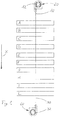
- a decoiler 20 holds a coil 12, from which is unwound a wire 10 that, in a continuous treatment line, runs through the following stations at a substantially constant speed and in series:
- the wire 10 after having undergone the above treatments, is a treated wire 30 that is wound in a second coil 32 housed in a coiler 40 that also turns at a substantially constant speed.
- the set of phases preceding the electrolytic nickel-plating E is referred to as the preparation phase, for example comprising phases A, B, C and D.
- the intervals relating to the permanence times are, as described, obtained by adjusting the substantially constant wire feeding speed comprised between 10 and 100 meters a minute.
- the tape is unwound from a reel housed in a relative decoiler, in order to be treated and turned into a treated tape that is rewound in a second reel housed in a relative rewinder, in a continuous-cycle mode and at a substantially constant speed.
- the treated wire 30 or the treated tape is thus obtained from a drawn and/or rolled metallic product in reels and coils, obtained from a base material of ferrous type, that is nickel-plated and also coated in a continuous cycle, at a substantially constant speed, with a superficial metallic layer without nickel so as to substantially limit the release of nickel from the substrate.
- the portion of wire or tape that is temporarily immersed in the electrolytic plating tank if subjected to vibration or false contacts, as previously described, incurs process shortcomings that lead to undesirable surface flaws, called “scorchings", as they appear more opaque than the typical finish of the chromium-plating operation.
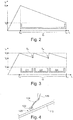
- the inventors were able to understand the problems at the basis of the formation of "scorchings", identified, as shown in figure 2 , in the trend of the voltage, indicated with V, applied to the wire or tape being processed in relation to the length of the chromium-plating tank.
- the chromium-plating tank is schematically illustrated in figure 2 , with a length included between a first length L1 and a second length L2.
- the voltage was in fact seen as being substantially decreasing, starting from an optimal value V1, representative of the difference of potential between the wire or tape to be treated and the anode, at the entrance of the chromium-plating tank, decreasing to a low value V2, representative of the difference of potential at the exit from the same chromium-plating tank according to the first configuration.
- such restoring elements are placed in contact with the wire or tape in motion, when the latter is outside the chromium-plating bath, thus avoiding depositing chromium on the same restoring element.
- Two or more chromium-plating tanks are used, so that the total sum of the lengths of the two or more chromium-plating tanks is equal to the length of one chromium-plating tank according to the first configuration.
- the schematic length from the first length L1 to the second length L2 of the chromium-plating station G is preferably subdivided into three operating lengths: of a first tank G1, a second tank G2 and a third tank G3, respectively.
- each point of actuation singled out for example at the third length L3 and at the fourth length L4, is placed, in contact with one portion of processed product 110 on which to operate, a sliding contact 120, to which is applied a predetermined voltage, so as to restore the difference of potential toward the value V1.
- the sliding contact 120 includes a sliding element 122 that comes into direct contact with a portion of the processed product 110.
- the sliding element 122 is coupled to the free end of a boom 124 that is connected, at the opposite end, to an arm 126, itself connected to the frame of the machine or to another suitable support.
- the chromium-plating bath is provided with trivalent chromium, which experimentally has made it possible to obtain better and less polluting results compared to a bath of hexavalent chromium.
- the trivalent chromium bath is based on chlorides or sulfates.
- the valuable and innovative result achieved thanks to the present invention has therefore allowed the mass-produced nickel-plating and chromium-plating treatment of wires or tapes, in a continuous cycle and at a substantially constant speed. It is thus possible to achieve the continuous processing, without interruptions, of a whole coil 12 of wire 10 or respective reel of tape, guaranteeing an optimal surface finish and avoiding "scorchings".
- This solution is applicable, in particular, to the metallic wire or tapes that are subsequently processed by plastic deformation in order to obtain the finished product such as finds application, by way of example but without limits, in the paper-transformation field for the ring and lever mechanisms used in loose-leaf binders.
- the invention therefore provides an innovative multilayer plating that consists of a first coating of nickel-plating type, as a substrate, to which is added an extremely thin second surface coating of the chromium-plating type; said surface coating has both protective purposes, being in contact with the skin of the final user, and aesthetic purposes, being superficial and visible.
- the proposed innovative treatment is one with a low release of nickel responding to European Directive 94/27/CE and can be implemented at the industrial level starting from a conventional continuous-treatment line of the mono-wire or mono-tape type, or also of the multi-wire or multi-tape type; the invention also makes it possible to subsequently implement, without defectiveness, the ensuing processes that are typical of the conventional articles found in the paper-transformation field, and still more.
- the coatings are considered to be of technical and functional type when the thickness exceeds an average value of about 6 or 8 ⁇ m, as for example in conventional nickel-platings and in chrome platings intended to increase the hardness and resistance to wear, while they are considered as being of decorative type when the thickness is smaller than this value.
- the limitation in the release of nickel and the other purposes are achieved with a layer of nickel of 1 to 5 ⁇ m in thickness, additionally coated with an extremely thin layer of chromium, with a thickness of 0.01 to 1 ⁇ m.
- the chromium layer although it is extremely thin, achieves the purpose of substantially limiting the transfer of nickel, increasing at the same time the resistance to corrosion of the processed wire or tape.
Landscapes
- Chemical & Material Sciences (AREA)
- Engineering & Computer Science (AREA)
- Chemical Kinetics & Catalysis (AREA)
- Electrochemistry (AREA)
- Materials Engineering (AREA)
- Metallurgy (AREA)
- Organic Chemistry (AREA)
- Electroplating Methods And Accessories (AREA)
Claims (9)
- Procédé de plaquage d'un produit métallique (10) ayant une dimension dominante, du type fil ou ruban, comprenant un cycle de traitement de type électrolytique en cycle continu de façon à obtenir progressivement un produit métallique (30) avec un plaquage multicouche à faible dégagement de nickel, ledit procédé comprenant les étapes suivantes:- étape préparatoire (A, B, C, D) ;- étape de nickelage électrolytique (E) ;ledit procédé comprenant en outre une étape de chromage électrolytique (G) suivant l'étape de nickelage électrolytique (E),
ledit produit métallique (10) passant toutes les étapes de manière continue et à vitesse sensiblement constante, dans lequel la dite étape de chromage électrolytique (G) comprend au moins deux bains galvaniques (G1, G2, G3) chacun pourvu d'une anode, caractérisé en ce que ladite étape de chromage électrolytique (G) comprend des moyens de stabilisation (120, 122, 124, 126) interposés entre les au moins deux bains galvaniques (G1, G2 ,G3), lesdits moyens de stabilisation (120, 122, 124, 126) étant adaptés pour maintenir la différence de potentiel électrique entre ledit produit métallique et ladite anode entre une valeur optimale (V1) et une valeur seuil (V3) pendant l'étape de chromage électrolytique (G), dans lequel lesdits moyens de stabilisation (120, 122, 124, 126) comprennent un élément coulissant (122) adapté à aller en contact direct avec le produit métallique en cours de traitement. - Procédé de plaquage selon la revendication 1, dans lequel la vitesse de traversée des étapes est comprise entre 10 et 100 mètres par minute.
- Procédé de plaquage selon l'une des revendications précédentes, dans lequel ladite étape de chromage électrolytique (G) comprend le passage du produit métallique à travers au moins un bain de chrome trivalent.
- Procédé de plaquage selon la revendication 3, dans lequel ledit au moins un bain de chrome trivalent est à base de chlorures ou de sulfates, ou des deux.
- Procédé de plaquage selon l'une des revendications précédentes, dans lequel lesdits au moins deux bains galvaniques (G1, G2, G3) permettent de séparer le passage du produit métallique sur une longueur totale (L1, L2, L3, L4) qui est égale à une longueur (L1, L2) qui permet la permanence de chaque portion de produit métallique (10) pour une durée comprise entre 1 et 30 secondes ou qui permet d'obtenir un chromage ayant une épaisseur comprise entre 0,01 et 1 micron.
- Procédé de plaquage selon la revendication 1, dans lequel ledit élément coulissant (122) est inclu dans un contact glissant (120) adapté à contacter une portion dudit produit métallique (30), une tension prédéterminée étant appliquée audit élément coulissant (120) de manière à ramener la différence de potentiel vers ladite valeur optimale (V1).
- procédé de plaquage selon la revendication 6, dans lequel ledit élément coulissant (122) est couplé à une extrémité libre d'un balai (124) connecté, à l'extrémité opposée, à un bras (126) connecté à un support adéquat.
- Procédé de plaquage selon l'une des revendications précédentes, comprenant les étapes de:A) Dégraissage électrolytique, avec une température comprise entre 30°C et 80°C et une durée de permanence comprise entre 1 et 60 secondes;B) lavage à contre-courant;C) décapage électrolytique, avec des températures comprises entre 20°C et 60°C et un temps de permanence compris entre 1 et 60 secondes;D) lavage à contre-courant;E) nickelage électrolytique, avec une température comprise entre 30°C et 70°C et un temps de permanence compris entre 10 et 500 secondes, de manière à assurer un dépôt continu de nickel (Ni) d'une épaisseur comprise entre 1 et 5 microns;F) lavage à contre-courant;G) chromage électrolytique, avec un temps de permanence compris entre 1 et 30 secondes, de manière à assurer un dépôt continu de chrome (Cr) d'une épaisseur comprise entre 0,01 et 1 micron;H) lavage à contre-courant;I) neutralisationJ) séchage, à une température comprise entre 60°C et 90°C et une durée de permanence comprise entre 3 et 30 secondes.
- Utilisation d'un produit métallique (30) obtenu par un procédé selon la revendication 1 pour l'industrie papetière.
Applications Claiming Priority (1)
| Application Number | Priority Date | Filing Date | Title |
|---|---|---|---|
| ITUB20151869 | 2015-06-30 |
Publications (2)
| Publication Number | Publication Date |
|---|---|
| EP3112502A1 EP3112502A1 (fr) | 2017-01-04 |
| EP3112502B1 true EP3112502B1 (fr) | 2018-08-01 |
Family
ID=54288930
Family Applications (1)
| Application Number | Title | Priority Date | Filing Date |
|---|---|---|---|
| EP16176105.1A Not-in-force EP3112502B1 (fr) | 2015-06-30 | 2016-06-24 | Méthode pour le placage de fils ou de bandes métalliques et produit obtenu par ladite méthode |
Country Status (1)
| Country | Link |
|---|---|
| EP (1) | EP3112502B1 (fr) |
Families Citing this family (3)
| Publication number | Priority date | Publication date | Assignee | Title |
|---|---|---|---|---|
| DE102018132075A1 (de) * | 2018-12-13 | 2020-06-18 | thysenkrupp AG | Verfahren zur Herstellung eines mit einer Beschichtung aus Chrom und Chromoxid beschichteten Metallbands auf Basis einer Elektrolytlösung mit einer dreiwertigen Chromverbindung |
| DE102018132074A1 (de) | 2018-12-13 | 2020-06-18 | thysenkrupp AG | Verfahren zur Herstellung eines mit einer Beschichtung aus Chrom und Chromoxid beschichteten Metallbands auf Basis einer Elektrolytlösung mit einer dreiwertigen Chromverbindung |
| CN110306220B (zh) * | 2019-07-23 | 2020-11-27 | 淮阴工学院 | 接插件电镀工艺 |
Citations (1)
| Publication number | Priority date | Publication date | Assignee | Title |
|---|---|---|---|---|
| WO2016044720A1 (fr) * | 2014-09-18 | 2016-03-24 | Modumetal, Inc. | Procédé et appareil d'application en continu de revêtements métalliques nanostratifiés |
Family Cites Families (8)
| Publication number | Priority date | Publication date | Assignee | Title |
|---|---|---|---|---|
| GB938192A (en) | 1961-03-13 | 1963-10-02 | Kenmore Foreign Corp | Wire and rod plating process and product thereof |
| DE1496930A1 (de) * | 1964-01-11 | 1969-12-18 | Res Holland Nv | Verfahren zum Aufbringen von korrosionsbestaendigen und verschleissbestaendigen Schichten |
| US3902974A (en) * | 1971-11-12 | 1975-09-02 | Olivetti & Co Spa | Process for metallizing type heads of plastics materials for printing devices |
| US4764260A (en) * | 1987-04-15 | 1988-08-16 | Gay Ronald N | Process for electroplating nickel over stainless steel |
| IT1303889B1 (it) * | 1998-12-01 | 2001-03-01 | Giovanna Angelini | Procedimento ed apparecchiatura per la cromatura in continuo di barree relativa struttura di anodo |
| CN101768768B (zh) | 2008-12-26 | 2012-01-25 | 比亚迪股份有限公司 | 一种铝合金无氰无镍电镀方法及其电镀产品 |
| WO2010147013A1 (fr) * | 2009-06-19 | 2010-12-23 | Jx日鉱日石金属株式会社 | Feuille de cuivre et procédé de fabrication de cette dernière |
| PH12013500788A1 (en) * | 2011-08-31 | 2013-06-03 | Jx Nippon Mining & Metals Corp | Carrier-attached copper foil |
-
2016
- 2016-06-24 EP EP16176105.1A patent/EP3112502B1/fr not_active Not-in-force
Patent Citations (1)
| Publication number | Priority date | Publication date | Assignee | Title |
|---|---|---|---|---|
| WO2016044720A1 (fr) * | 2014-09-18 | 2016-03-24 | Modumetal, Inc. | Procédé et appareil d'application en continu de revêtements métalliques nanostratifiés |
Also Published As
| Publication number | Publication date |
|---|---|
| EP3112502A1 (fr) | 2017-01-04 |
Similar Documents
| Publication | Publication Date | Title |
|---|---|---|
| TWI464052B (zh) | 用於裝飾性物件之含貴金屬的層序 | |
| JP5490144B2 (ja) | ファスナー構成部品及びスライドファスナー | |
| EP3112502B1 (fr) | Méthode pour le placage de fils ou de bandes métalliques et produit obtenu par ladite méthode | |
| KR101821659B1 (ko) | 표면처리금속판 및 그 표면처리금속판을 이용한 성형품의 제조방법 | |
| US4247374A (en) | Method of forming blanks for coins | |
| US4279968A (en) | Coins and similarly disc-shaped articles | |
| CA2013639C (fr) | Flan electroplaque pour monnaie, medaillon et jeton | |
| JP2521387B2 (ja) | 有色バネ鋼成形品の製造方法 | |
| JP2014095097A (ja) | 3価クロムめっき成形品の製造方法および3価クロムめっき成形品 | |
| KR20200118079A (ko) | 금속 용융 도금 코팅의 개선된 접착을 갖는 강 스트립을 제조하는 방법 | |
| CN107105833B (zh) | 具有淡金色的金属制紧固构件和具有其的紧固件 | |
| JPH03281788A (ja) | Zn―Al合金めっき鋼線の製造方法 | |
| US9592533B2 (en) | Process for tin coating a metallic substrate, process for hardening a tin layer and wire having a tin coating | |
| JP3017910B2 (ja) | ばね製品の製造方法 | |
| CA1105210A (fr) | Pieces de monnaie et autres articles de meme forme | |
| US20210222749A1 (en) | Upholstery Spring, Method For Producing An Upholstery Spring, Mattress, And Upholstered Furniture | |
| CN102899695B (zh) | 无镍合金镀层的电镀方法 | |
| JP6532550B2 (ja) | 第2の金属から作製されたシース層を有する、第1の金属から作製されたワイヤを製造する方法 | |
| CN111885940A (zh) | 银首饰和银首饰的制造方法 | |
| EP2554716B1 (fr) | Méthode de fabrication d'objets métalliques | |
| GB1558803A (en) | Coins and similarly discshaped articles | |
| JPH0711486A (ja) | 有色バネ鋼成形品及びその製造方法 | |
| US1664750A (en) | Process for the production of galvanic metal coatings | |
| JPH0297696A (ja) | Ni‐Ti基合金材及びその製造方法 | |
| KR101106011B1 (ko) | 내식층을 가지는 페라이트계 스테인리스 강선 |
Legal Events
| Date | Code | Title | Description |
|---|---|---|---|
| PUAI | Public reference made under article 153(3) epc to a published international application that has entered the european phase |
Free format text: ORIGINAL CODE: 0009012 |
|
| STAA | Information on the status of an ep patent application or granted ep patent |
Free format text: STATUS: THE APPLICATION HAS BEEN PUBLISHED |
|
| AK | Designated contracting states |
Kind code of ref document: A1 Designated state(s): AL AT BE BG CH CY CZ DE DK EE ES FI FR GB GR HR HU IE IS IT LI LT LU LV MC MK MT NL NO PL PT RO RS SE SI SK SM TR |
|
| AX | Request for extension of the european patent |
Extension state: BA ME |
|
| STAA | Information on the status of an ep patent application or granted ep patent |
Free format text: STATUS: REQUEST FOR EXAMINATION WAS MADE |
|
| 17P | Request for examination filed |
Effective date: 20170607 |
|
| RBV | Designated contracting states (corrected) |
Designated state(s): AL AT BE BG CH CY CZ DE DK EE ES FI FR GB GR HR HU IE IS IT LI LT LU LV MC MK MT NL NO PL PT RO RS SE SI SK SM TR |
|
| STAA | Information on the status of an ep patent application or granted ep patent |
Free format text: STATUS: EXAMINATION IS IN PROGRESS |
|
| 17Q | First examination report despatched |
Effective date: 20171006 |
|
| GRAP | Despatch of communication of intention to grant a patent |
Free format text: ORIGINAL CODE: EPIDOSNIGR1 |
|
| STAA | Information on the status of an ep patent application or granted ep patent |
Free format text: STATUS: GRANT OF PATENT IS INTENDED |
|
| RIC1 | Information provided on ipc code assigned before grant |
Ipc: C25D 3/06 20060101ALN20180130BHEP Ipc: C25D 7/06 20060101ALI20180130BHEP Ipc: C25D 3/12 20060101ALN20180130BHEP Ipc: C25D 5/14 20060101AFI20180130BHEP |
|
| INTG | Intention to grant announced |
Effective date: 20180301 |
|
| GRAS | Grant fee paid |
Free format text: ORIGINAL CODE: EPIDOSNIGR3 |
|
| GRAA | (expected) grant |
Free format text: ORIGINAL CODE: 0009210 |
|
| STAA | Information on the status of an ep patent application or granted ep patent |
Free format text: STATUS: THE PATENT HAS BEEN GRANTED |
|
| AK | Designated contracting states |
Kind code of ref document: B1 Designated state(s): AL AT BE BG CH CY CZ DE DK EE ES FI FR GB GR HR HU IE IS IT LI LT LU LV MC MK MT NL NO PL PT RO RS SE SI SK SM TR |
|
| REG | Reference to a national code |
Ref country code: GB Ref legal event code: FG4D |
|
| REG | Reference to a national code |
Ref country code: CH Ref legal event code: EP Ref country code: AT Ref legal event code: REF Ref document number: 1024422 Country of ref document: AT Kind code of ref document: T Effective date: 20180815 |
|
| REG | Reference to a national code |
Ref country code: IE Ref legal event code: FG4D |
|
| REG | Reference to a national code |
Ref country code: DE Ref legal event code: R096 Ref document number: 602016004454 Country of ref document: DE |
|
| REG | Reference to a national code |
Ref country code: NL Ref legal event code: FP |
|
| REG | Reference to a national code |
Ref country code: LT Ref legal event code: MG4D |
|
| REG | Reference to a national code |
Ref country code: AT Ref legal event code: MK05 Ref document number: 1024422 Country of ref document: AT Kind code of ref document: T Effective date: 20180801 |
|
| PG25 | Lapsed in a contracting state [announced via postgrant information from national office to epo] |
Ref country code: GR Free format text: LAPSE BECAUSE OF FAILURE TO SUBMIT A TRANSLATION OF THE DESCRIPTION OR TO PAY THE FEE WITHIN THE PRESCRIBED TIME-LIMIT Effective date: 20181102 Ref country code: NO Free format text: LAPSE BECAUSE OF FAILURE TO SUBMIT A TRANSLATION OF THE DESCRIPTION OR TO PAY THE FEE WITHIN THE PRESCRIBED TIME-LIMIT Effective date: 20181101 Ref country code: SE Free format text: LAPSE BECAUSE OF FAILURE TO SUBMIT A TRANSLATION OF THE DESCRIPTION OR TO PAY THE FEE WITHIN THE PRESCRIBED TIME-LIMIT Effective date: 20180801 Ref country code: FI Free format text: LAPSE BECAUSE OF FAILURE TO SUBMIT A TRANSLATION OF THE DESCRIPTION OR TO PAY THE FEE WITHIN THE PRESCRIBED TIME-LIMIT Effective date: 20180801 Ref country code: PL Free format text: LAPSE BECAUSE OF FAILURE TO SUBMIT A TRANSLATION OF THE DESCRIPTION OR TO PAY THE FEE WITHIN THE PRESCRIBED TIME-LIMIT Effective date: 20180801 Ref country code: IS Free format text: LAPSE BECAUSE OF FAILURE TO SUBMIT A TRANSLATION OF THE DESCRIPTION OR TO PAY THE FEE WITHIN THE PRESCRIBED TIME-LIMIT Effective date: 20181201 Ref country code: RS Free format text: LAPSE BECAUSE OF FAILURE TO SUBMIT A TRANSLATION OF THE DESCRIPTION OR TO PAY THE FEE WITHIN THE PRESCRIBED TIME-LIMIT Effective date: 20180801 Ref country code: AT Free format text: LAPSE BECAUSE OF FAILURE TO SUBMIT A TRANSLATION OF THE DESCRIPTION OR TO PAY THE FEE WITHIN THE PRESCRIBED TIME-LIMIT Effective date: 20180801 Ref country code: BG Free format text: LAPSE BECAUSE OF FAILURE TO SUBMIT A TRANSLATION OF THE DESCRIPTION OR TO PAY THE FEE WITHIN THE PRESCRIBED TIME-LIMIT Effective date: 20181101 Ref country code: LT Free format text: LAPSE BECAUSE OF FAILURE TO SUBMIT A TRANSLATION OF THE DESCRIPTION OR TO PAY THE FEE WITHIN THE PRESCRIBED TIME-LIMIT Effective date: 20180801 |
|
| PG25 | Lapsed in a contracting state [announced via postgrant information from national office to epo] |
Ref country code: AL Free format text: LAPSE BECAUSE OF FAILURE TO SUBMIT A TRANSLATION OF THE DESCRIPTION OR TO PAY THE FEE WITHIN THE PRESCRIBED TIME-LIMIT Effective date: 20180801 Ref country code: LV Free format text: LAPSE BECAUSE OF FAILURE TO SUBMIT A TRANSLATION OF THE DESCRIPTION OR TO PAY THE FEE WITHIN THE PRESCRIBED TIME-LIMIT Effective date: 20180801 Ref country code: HR Free format text: LAPSE BECAUSE OF FAILURE TO SUBMIT A TRANSLATION OF THE DESCRIPTION OR TO PAY THE FEE WITHIN THE PRESCRIBED TIME-LIMIT Effective date: 20180801 |
|
| PG25 | Lapsed in a contracting state [announced via postgrant information from national office to epo] |
Ref country code: ES Free format text: LAPSE BECAUSE OF FAILURE TO SUBMIT A TRANSLATION OF THE DESCRIPTION OR TO PAY THE FEE WITHIN THE PRESCRIBED TIME-LIMIT Effective date: 20180801 Ref country code: RO Free format text: LAPSE BECAUSE OF FAILURE TO SUBMIT A TRANSLATION OF THE DESCRIPTION OR TO PAY THE FEE WITHIN THE PRESCRIBED TIME-LIMIT Effective date: 20180801 Ref country code: IT Free format text: LAPSE BECAUSE OF FAILURE TO SUBMIT A TRANSLATION OF THE DESCRIPTION OR TO PAY THE FEE WITHIN THE PRESCRIBED TIME-LIMIT Effective date: 20180801 Ref country code: CZ Free format text: LAPSE BECAUSE OF FAILURE TO SUBMIT A TRANSLATION OF THE DESCRIPTION OR TO PAY THE FEE WITHIN THE PRESCRIBED TIME-LIMIT Effective date: 20180801 Ref country code: EE Free format text: LAPSE BECAUSE OF FAILURE TO SUBMIT A TRANSLATION OF THE DESCRIPTION OR TO PAY THE FEE WITHIN THE PRESCRIBED TIME-LIMIT Effective date: 20180801 |
|
| REG | Reference to a national code |
Ref country code: DE Ref legal event code: R097 Ref document number: 602016004454 Country of ref document: DE |
|
| PG25 | Lapsed in a contracting state [announced via postgrant information from national office to epo] |
Ref country code: SM Free format text: LAPSE BECAUSE OF FAILURE TO SUBMIT A TRANSLATION OF THE DESCRIPTION OR TO PAY THE FEE WITHIN THE PRESCRIBED TIME-LIMIT Effective date: 20180801 Ref country code: SK Free format text: LAPSE BECAUSE OF FAILURE TO SUBMIT A TRANSLATION OF THE DESCRIPTION OR TO PAY THE FEE WITHIN THE PRESCRIBED TIME-LIMIT Effective date: 20180801 Ref country code: DK Free format text: LAPSE BECAUSE OF FAILURE TO SUBMIT A TRANSLATION OF THE DESCRIPTION OR TO PAY THE FEE WITHIN THE PRESCRIBED TIME-LIMIT Effective date: 20180801 |
|
| PLBE | No opposition filed within time limit |
Free format text: ORIGINAL CODE: 0009261 |
|
| STAA | Information on the status of an ep patent application or granted ep patent |
Free format text: STATUS: NO OPPOSITION FILED WITHIN TIME LIMIT |
|
| 26N | No opposition filed |
Effective date: 20190503 |
|
| PGFP | Annual fee paid to national office [announced via postgrant information from national office to epo] |
Ref country code: NL Payment date: 20190619 Year of fee payment: 4 Ref country code: DE Payment date: 20190619 Year of fee payment: 4 |
|
| PG25 | Lapsed in a contracting state [announced via postgrant information from national office to epo] |
Ref country code: SI Free format text: LAPSE BECAUSE OF FAILURE TO SUBMIT A TRANSLATION OF THE DESCRIPTION OR TO PAY THE FEE WITHIN THE PRESCRIBED TIME-LIMIT Effective date: 20180801 |
|
| PG25 | Lapsed in a contracting state [announced via postgrant information from national office to epo] |
Ref country code: MC Free format text: LAPSE BECAUSE OF FAILURE TO SUBMIT A TRANSLATION OF THE DESCRIPTION OR TO PAY THE FEE WITHIN THE PRESCRIBED TIME-LIMIT Effective date: 20180801 |
|
| REG | Reference to a national code |
Ref country code: CH Ref legal event code: PL |
|
| REG | Reference to a national code |
Ref country code: BE Ref legal event code: MM Effective date: 20190630 |
|
| PG25 | Lapsed in a contracting state [announced via postgrant information from national office to epo] |
Ref country code: TR Free format text: LAPSE BECAUSE OF FAILURE TO SUBMIT A TRANSLATION OF THE DESCRIPTION OR TO PAY THE FEE WITHIN THE PRESCRIBED TIME-LIMIT Effective date: 20180801 |
|
| PG25 | Lapsed in a contracting state [announced via postgrant information from national office to epo] |
Ref country code: IE Free format text: LAPSE BECAUSE OF NON-PAYMENT OF DUE FEES Effective date: 20190624 |
|
| PG25 | Lapsed in a contracting state [announced via postgrant information from national office to epo] |
Ref country code: BE Free format text: LAPSE BECAUSE OF NON-PAYMENT OF DUE FEES Effective date: 20190630 Ref country code: CH Free format text: LAPSE BECAUSE OF NON-PAYMENT OF DUE FEES Effective date: 20190630 Ref country code: LI Free format text: LAPSE BECAUSE OF NON-PAYMENT OF DUE FEES Effective date: 20190630 Ref country code: LU Free format text: LAPSE BECAUSE OF NON-PAYMENT OF DUE FEES Effective date: 20190624 |
|
| PG25 | Lapsed in a contracting state [announced via postgrant information from national office to epo] |
Ref country code: FR Free format text: LAPSE BECAUSE OF NON-PAYMENT OF DUE FEES Effective date: 20190630 Ref country code: PT Free format text: LAPSE BECAUSE OF FAILURE TO SUBMIT A TRANSLATION OF THE DESCRIPTION OR TO PAY THE FEE WITHIN THE PRESCRIBED TIME-LIMIT Effective date: 20181201 |
|
| REG | Reference to a national code |
Ref country code: DE Ref legal event code: R119 Ref document number: 602016004454 Country of ref document: DE |
|
| REG | Reference to a national code |
Ref country code: NL Ref legal event code: MM Effective date: 20200701 |
|
| GBPC | Gb: european patent ceased through non-payment of renewal fee |
Effective date: 20200624 |
|
| PG25 | Lapsed in a contracting state [announced via postgrant information from national office to epo] |
Ref country code: GB Free format text: LAPSE BECAUSE OF NON-PAYMENT OF DUE FEES Effective date: 20200624 Ref country code: NL Free format text: LAPSE BECAUSE OF NON-PAYMENT OF DUE FEES Effective date: 20200701 |
|
| PG25 | Lapsed in a contracting state [announced via postgrant information from national office to epo] |
Ref country code: DE Free format text: LAPSE BECAUSE OF NON-PAYMENT OF DUE FEES Effective date: 20210101 Ref country code: CY Free format text: LAPSE BECAUSE OF FAILURE TO SUBMIT A TRANSLATION OF THE DESCRIPTION OR TO PAY THE FEE WITHIN THE PRESCRIBED TIME-LIMIT Effective date: 20180801 |
|
| PG25 | Lapsed in a contracting state [announced via postgrant information from national office to epo] |
Ref country code: HU Free format text: LAPSE BECAUSE OF FAILURE TO SUBMIT A TRANSLATION OF THE DESCRIPTION OR TO PAY THE FEE WITHIN THE PRESCRIBED TIME-LIMIT; INVALID AB INITIO Effective date: 20160624 Ref country code: MT Free format text: LAPSE BECAUSE OF FAILURE TO SUBMIT A TRANSLATION OF THE DESCRIPTION OR TO PAY THE FEE WITHIN THE PRESCRIBED TIME-LIMIT Effective date: 20180801 |
|
| PG25 | Lapsed in a contracting state [announced via postgrant information from national office to epo] |
Ref country code: MK Free format text: LAPSE BECAUSE OF FAILURE TO SUBMIT A TRANSLATION OF THE DESCRIPTION OR TO PAY THE FEE WITHIN THE PRESCRIBED TIME-LIMIT Effective date: 20180801 |