EP3114973A1 - Dispositif de rôtisserie à broche multizone pour griller et rôtir de la viande - Google Patents
Dispositif de rôtisserie à broche multizone pour griller et rôtir de la viande Download PDFInfo
- Publication number
- EP3114973A1 EP3114973A1 EP16178451.7A EP16178451A EP3114973A1 EP 3114973 A1 EP3114973 A1 EP 3114973A1 EP 16178451 A EP16178451 A EP 16178451A EP 3114973 A1 EP3114973 A1 EP 3114973A1
- Authority
- EP
- European Patent Office
- Prior art keywords
- rotisserie
- spit
- heat
- meat
- heat source
- Prior art date
- Legal status (The legal status is an assumption and is not a legal conclusion. Google has not performed a legal analysis and makes no representation as to the accuracy of the status listed.)
- Withdrawn
Links
- 235000013372 meat Nutrition 0.000 title claims abstract description 106
- 238000010438 heat treatment Methods 0.000 claims abstract description 37
- 230000008878 coupling Effects 0.000 claims description 34
- 238000010168 coupling process Methods 0.000 claims description 34
- 238000005859 coupling reaction Methods 0.000 claims description 34
- 239000003610 charcoal Substances 0.000 claims description 12
- 238000004891 communication Methods 0.000 claims description 9
- 229910052736 halogen Inorganic materials 0.000 claims description 7
- 150000002367 halogens Chemical class 0.000 claims description 7
- 230000007246 mechanism Effects 0.000 claims description 6
- 239000000919 ceramic Substances 0.000 claims description 4
- 239000012530 fluid Substances 0.000 claims description 4
- 229910001220 stainless steel Inorganic materials 0.000 claims description 4
- 239000010935 stainless steel Substances 0.000 claims description 4
- 239000005341 toughened glass Substances 0.000 claims description 4
- 230000000087 stabilizing effect Effects 0.000 claims description 3
- 230000008901 benefit Effects 0.000 description 5
- 238000000034 method Methods 0.000 description 5
- 235000013305 food Nutrition 0.000 description 4
- 235000011389 fruit/vegetable juice Nutrition 0.000 description 4
- 241000287828 Gallus gallus Species 0.000 description 3
- 239000000796 flavoring agent Substances 0.000 description 3
- 235000019634 flavors Nutrition 0.000 description 3
- 230000008569 process Effects 0.000 description 3
- 235000013330 chicken meat Nutrition 0.000 description 2
- 239000003245 coal Substances 0.000 description 2
- 238000013461 design Methods 0.000 description 2
- 238000003780 insertion Methods 0.000 description 2
- 230000037431 insertion Effects 0.000 description 2
- 239000007788 liquid Substances 0.000 description 2
- 230000005855 radiation Effects 0.000 description 2
- 238000009423 ventilation Methods 0.000 description 2
- 238000013022 venting Methods 0.000 description 2
- 241000283690 Bos taurus Species 0.000 description 1
- 241001149900 Fusconaia subrotunda Species 0.000 description 1
- 235000019687 Lamb Nutrition 0.000 description 1
- 241001465754 Metazoa Species 0.000 description 1
- 241000286209 Phasianidae Species 0.000 description 1
- 241000282887 Suidae Species 0.000 description 1
- 235000015278 beef Nutrition 0.000 description 1
- 230000015572 biosynthetic process Effects 0.000 description 1
- 239000011449 brick Substances 0.000 description 1
- 238000010411 cooking Methods 0.000 description 1
- 230000000694 effects Effects 0.000 description 1
- 239000003925 fat Substances 0.000 description 1
- 239000002184 metal Substances 0.000 description 1
- 238000012986 modification Methods 0.000 description 1
- 230000004048 modification Effects 0.000 description 1
- 238000012544 monitoring process Methods 0.000 description 1
- 235000015277 pork Nutrition 0.000 description 1
- 230000009467 reduction Effects 0.000 description 1
- 235000013311 vegetables Nutrition 0.000 description 1
- 238000005303 weighing Methods 0.000 description 1
Images




Classifications
-
- A—HUMAN NECESSITIES
- A47—FURNITURE; DOMESTIC ARTICLES OR APPLIANCES; COFFEE MILLS; SPICE MILLS; SUCTION CLEANERS IN GENERAL
- A47J—KITCHEN EQUIPMENT; COFFEE MILLS; SPICE MILLS; APPARATUS FOR MAKING BEVERAGES
- A47J37/00—Baking; Roasting; Grilling; Frying
- A47J37/04—Roasting apparatus with movably-mounted food supports or with movable heating implements; Spits
- A47J37/041—Roasting apparatus with movably-mounted food supports or with movable heating implements; Spits with food supports rotating about a horizontal axis
-
- A—HUMAN NECESSITIES
- A47—FURNITURE; DOMESTIC ARTICLES OR APPLIANCES; COFFEE MILLS; SPICE MILLS; SUCTION CLEANERS IN GENERAL
- A47J—KITCHEN EQUIPMENT; COFFEE MILLS; SPICE MILLS; APPARATUS FOR MAKING BEVERAGES
- A47J37/00—Baking; Roasting; Grilling; Frying
- A47J37/04—Roasting apparatus with movably-mounted food supports or with movable heating implements; Spits
- A47J37/049—Details of the food supports not specially adapted to one of the preceding types of food supports
-
- A—HUMAN NECESSITIES
- A47—FURNITURE; DOMESTIC ARTICLES OR APPLIANCES; COFFEE MILLS; SPICE MILLS; SUCTION CLEANERS IN GENERAL
- A47J—KITCHEN EQUIPMENT; COFFEE MILLS; SPICE MILLS; APPARATUS FOR MAKING BEVERAGES
- A47J37/00—Baking; Roasting; Grilling; Frying
- A47J37/06—Roasters; Grills; Sandwich grills
- A47J37/07—Roasting devices for outdoor use; Barbecues
- A47J37/0704—Roasting devices for outdoor use; Barbecues with horizontal fire box
-
- A—HUMAN NECESSITIES
- A47—FURNITURE; DOMESTIC ARTICLES OR APPLIANCES; COFFEE MILLS; SPICE MILLS; SUCTION CLEANERS IN GENERAL
- A47J—KITCHEN EQUIPMENT; COFFEE MILLS; SPICE MILLS; APPARATUS FOR MAKING BEVERAGES
- A47J37/00—Baking; Roasting; Grilling; Frying
- A47J37/06—Roasters; Grills; Sandwich grills
- A47J37/07—Roasting devices for outdoor use; Barbecues
- A47J37/0745—Roasting devices for outdoor use; Barbecues with motor-driven food supports
-
- A—HUMAN NECESSITIES
- A47—FURNITURE; DOMESTIC ARTICLES OR APPLIANCES; COFFEE MILLS; SPICE MILLS; SUCTION CLEANERS IN GENERAL
- A47J—KITCHEN EQUIPMENT; COFFEE MILLS; SPICE MILLS; APPARATUS FOR MAKING BEVERAGES
- A47J37/00—Baking; Roasting; Grilling; Frying
- A47J37/06—Roasters; Grills; Sandwich grills
- A47J37/07—Roasting devices for outdoor use; Barbecues
- A47J37/0786—Accessories
Definitions
- the present invention pertains to meat grilling and roasting devices.
- the present invention pertains to devices that comprise a plurality of zones for meat grilling and roasting meat that are separate from each other, and most particularly to horizontal instead of vertical spit-roasting of shawarma.
- Rotisserie is a style of roasting where meat is skewered on a spit, which is a long solid rod usually made of stainless steel and used to hold food while it is being cooked over a fire in a fireplace or over a campfire, or roasted in an oven.
- Large joints of meat or entire animals, such as pigs or turkeys are usually cooked with this method, where the rotation cooks the meat evenly in its own juices and allows easy access for continuous self-basting.
- Mechanical and electrical turnspits (“roasting jacks”) were invented to turn the spit around its axis over a heat source such as coals or open fire or within a heated oven.
- Horizontal rotisserie is when the spit and meat skewered on it are mounted horizontally over a heat source. This method is usually used for cooking whole chickens or roasts of various meats including beef and pork.
- the design may include a single spit mounted over an open broiler or grill, a single spit mounted within an otherwise-conventional oven, or many spits mounted within a large industrial oven. The latter are commonly used to mass-produce roasted meats for sale to consumers. Skewering skill is required to roast meat with this style of rotisserie to keep the meat to be cooked balanced without weighing heavily on the drive mechanism or causing it to fail.
- the speed of rotation is important especially when roasting over coals or open fire, since then the dripping of juices off the roasted meat cannot be salvaged after falling into the heat source. Therefore, rotation should be slowed down after the crust is starting to form to prevent dripping of juices off of the roasted meat.
- Vertical Rotisserie is the other common style of in which the heat is applied directly from the side or convected up from below. This feature is useful for shawarma, which is a mixed mass of meat made of different types, for example, cattle, lamb, veal, turkey and chicken, and that is typically shaved off a bit at a time. In this style of rotisserie, balance of the load is less important than with a horizontal rotisserie.
- the device of the present invention comprises different zones for grilling and roasting meat independent from each other.
- the device of the present invention provides control over applied heat sources and roasting process of meat.
- the present invention provides a rotisserie for roasting meat cuts or meat mass, particularly shawarma, where the rotisserie comprises a spit that is configured for translational movement between and into heating zones in the rotisserie.
- spit can be brought closer or farther from heat sources in these heating zones and more efficiently control the roasting and grilling of meat mounted on the spit rod.
- the rotisserie comprises a horizontal surface and horizontal spit placed above that surface and fixed to vertical supports on its sides.
- the translational movement of the spit is enabled with serrated rails at the sides of the horizontal surface and handles connected to the vertical supports.
- the handles are configured to lock the supports in grooves in the serrated rail groove-tooth coupling and lock the spit in place when they are in position parallel to the horizontal surface.
- the handles are turned 90°outwards, the supports are released and the spit can be moved forward and backward into and between any of the heating zones of the rotisserie.
- a meat mass mounted on the spit is held and continuously condensed between disks couplings on both sides.
- Each of the disks couplings themselves are pressed against the meat mass between them with a coupling of spring and stopper, where the spring is locked between central insertion in the smaller of the disks couplings and the stopper.
- the disks couplings with larger and smaller disk in each coupling are used to keep the meat mass between the couplings continuously condensed during reduction in its size as more and more meat portions are cut off of it.
- the larger disks are released from the couplings and the meat mass is condensed between the smaller disks that remain inserted on the spit rod.
- the meat mass particularly shawarma
- shawarma As the meat mass, particularly shawarma, is roasted with time and reduced in size, fatty portions of it are exposed which makes it less condensed and stable as required. Therefore, the smaller disk is pressed against it by the spring and stopper couplings and keeps it intact.
- the tension of the spring may be adjusted as well according to the pressure to be applied on the disks, by releasing it from the stopper and fastening it again in a new position.
- the number of heating zones may vary in the rotisserie.
- the heating zone is located on the rear side, front side or top of said rotisserie.
- the heating zone on the rear side comprises heat source on a plane below the horizontal surface and spit
- the heating zone on the front side comprises heat source on the horizontal surface below the spit
- the heating zone on the top comprises heat source above the spit.
- each zone comprising the same or different heat source.
- One heating zone is located at the rear side of the rotisserie as a tray with a surface lower than the horizontal surface of the rotisserie.
- the tray may contain different types of heat generators. Particular non-limiting examples of heat generators are charcoal bed, gas burners and electric heaters.
- the number of heat generators of each type and the number of types in each heating zone may also vary depending on the desired heat intensity and heating requirements.
- the tray may contain also a layer/bed of basalt stones, which is efficient in absorbing and radiating heat released by a heat generator. Such bed of basalt stones may be combined with any heat generator, particularly those listed above.
- a second heating zone may be a griddle at the front side of the rotisserie on the plane of the horizontal surface.
- the griddle may be used to provide further roasting to meat portions cut off from a meat mass or meat cuts mounted on the spit and also as working plate for collecting and preparing a serving for diners.
- the heat generator of the griddle may be one or more electric heaters located beneath it.
- the griddle may be divided in two or more sections, where the temperature of each section is independently controlled by separate electric heater(s). This provides the advantage of roasting different types of meat and food in general at different temperatures on a single surface of a griddle.
- a third heat zone may be provided with a top heat source comprising housing with heat generators located within and energy feeding channel connected to the heat generators.
- heat generators may be of any type, in particular electric heaters, halogen lamps and gas burners, with electric wirings or gas feeding tubes connected to them, as the case may be.
- the heat intensity from the top heat source can be controlled by mode switch that can turn on and off any number of heat generators in the housing. Accordingly, the top heat source provides further heating to meat mass or meat cuts mounted on the spit from above and may shorten the time of roasting and/or provide additional flavor and crust to the meat.
- Such top heat source may be fixed in its elevated position by mechanically connecting its sides to vertical supports. It may also be configured to move axis up and down along a vertical. Such movement is made with locking means that lock it in any position between its upper and lower points and handles moved horizontally between 0° and 90° relative to the housing and accordingly lock and release the top heat source.
- the top heat source may also be either fixed in its position parallel to the spit. Alternatively, it may be adjusted at any angle between 0° and 90° relative to the spit. Such rotation may be enabled with rotating and locking mechanism and provide the advantages of radiating heat to the meat on the spit at a particular angle, and further control on the roasting.
- the rotisserie of the present invention comprises every possible heat zone for roasting meat either mounted on the spit, particularly the heat zones detailed above and further described and illustrated with reference to the accompanying drawings.
- the spit may then be moved between the heat zones and control the roasting of the meat and provide additional flavors and/or crust as desired.
- the heat zones may also be used independently for directly grilling or roasting meat or any type of food over the heat sources in these heat zones.
- a charcoal bed in the rear side of the rotisserie may be used to roast meat chunks mounted on skewers placed above the charcoal bed.
- the griddle in the front may be used to directly roast meat or vegetables added to a serving.
- Thermostats at the front panel are used to control the temperature in the heat zones independently of each other, and ventilation apparatus is used with vent outlets at the rear panel to release excessive heat away from the rotisserie. Further control on the roasting of and meat mass or meat cuts mounted on the spit is provided with a pedal pressed by an operator to control the rotational movement of the spit. This enables slowing down or speeding up the roasting of the meat, particularly for preventing excessive roasting when portions of meat are not cut off of it, and also provides even roasting.
- Heat sensors are in thermal communication with the different heating zones, monitoring temperature and providing better supervision to the operator of the rotisserie.
- Electric socket at the front panel of the rotisserie is used to plug electric knife for easy and convenient cutting of meat portions off of meat mass or meat cuts on the spit.
- the spit is divided in two parts rotatable 90° independently of each other between open and closed positions above the main surface of the rotisserie and at its sides. This may be effected with gearwheel mechanism and handles connected to each part of the spit that enable moving it between the two positions.
- the advantage of such configuration is the further control on the roasting process, allowing the separate and simultaneous roasting of different types of meat cuts or meat mass that require different conditions of heat and time.
- the rotisserie of the present invention comprises at least one heat source located in its back, front or top sections and a movable spit that may be horizontally displaced above or under these heat sources.
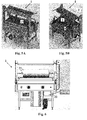
- Figs. 5A and 5B display front and back perspective views of a particular example of a multi-zone rotisserie ( 1 ) of the present invention with a coal tray located in the back ( 13 ), griddle located at the front ( 4 ) and gas or heat radiator located at the top ( 3 ).
- the spit ( 2 ) is movable to and away from each one of these heat sources and provides control on the roasting of meat placed on it.
- Fig. 6 is a front view of the rotisserie ( 1 ) illustrating shawarma mass ( 21 ) mounted on the spit and grilled below heat radiator and above front griddle and back tray.
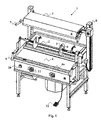
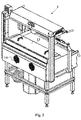
- Figs. 1-4 are schematic illustrations of different views of the particular example of rotisserie ( 1 ) shown in Figs. 5A and 5B .
- the spit ( 2 ) is located above the main platform of the rotisserie ( 1 ) that comprises the griddle ( 4 ) at the front and covered coal tray ( 13 ) at the back.
- Top heat source ( 3 ) may comprise any heat generator for roasting meat. Possible particular examples of heat generator for the top heat source ( 3 ) are halogen lamps, conduction coils and reflectors, heat radiators and open fire such as gas burners. Basalt bricks are accommodated at the housing of the top heat source to absorb the heat generated by any heat source located within and radiate it more efficiently on the meat on the spit ( 2 ).
- All types of heat generators for the top heat source ( 3 ) may extend along the entire length of housing of the heat source ( 3 ) and distribute heat evenly along its entire length.
- the top heat source ( 3 ) may be divided into two zones, each zone radiating or producing heat separately and independently from the other zone. Such division provides better control on the heat and roasting of meat on the spit ( 2 ). It may also benefit in selective heating of different parts of the meat on the spit ( 2 ).
- a heat mode switch ( 19 ) for determining the level of heat radiating from the top heat source ( 3 ) is in communication with the heat generators for selectively turning them on and off. Accordingly, the time and level of roasting the meat on the spit ( 2 ) below are further controlled by a user.
- the heat generators in the top heat source ( 3 ) may be shielded with tempered glass or ceramic board or remain exposed depending on the heating, grilling and/or searing desired effect on the meat on the spit ( 2 ).
- Top heat source ( 3 ) may be fixed and stabilized in place with supports ( 8 ) at its sides holding it in horizontal position above the spit ( 2 ).
- the top heat source ( 3 ) may comprise adjustable axes at its sides and complementing locking mechanism that enable to position it at an angle anywhere between 0° and 90° relative to the spit ( 2 ).
- the particular example of rotisserie ( 1 ) in Figs. 1-4 shows handles ( 7 ) attached to the top heat source ( 3 ) and supports ( 8 ) on it sides for lowering it relative to the spit ( 2 ) and allowing the meat mounted on the spit ( 2 ) to absorb a higher amount of heat.
- the handles ( 7 ) keep the top heat source ( 3 ) in locked position when aligned in parallel relative to it and release it when rotated 90° horizontally outwards.
- Supports ( 8 ) comprise telescopic arrangement of tubes on both sides of the top heat source ( 3 ) so that applying force on the handles ( 7 ) in their released position enables moving the top heat source ( 3 ) vertically down towards the spit ( 2 ) and up to its initial position.
- the griddle ( 4 ) is a metal plate with heat source below and serves as a surface for additional roasting of meat portions that are cut off of the meat parts or mass mounted on the spit ( 2 ) and collected on the griddle ( 4 ).
- the griddle ( 4 ) is slightly inclined towards the edge of the rotisserie ( 1 ) to allow the flow of extra fluids that has not evaporated by the heat of the griddle ( 4 ) out to a trough ( 4a ).
- a single heat generator may be used to evenly heat the surface of the griddle ( 4 ) from beneath.
- independently operated and controlled two heat generators or more may be installed under the griddle ( 4 ). This actually forms separate heating areas on the griddle ( 4 ) enabling roasting different types of food at different temperatures on the same griddle.
- Efficiency is also improved by controlling the number of operating heat generators and using only part of the area of the griddle ( 4 ).
- the rear heat source ( 13 ) provides another option of roasting meat with a charcoal bed in a tray.
- the charcoal bed is however optional to other heat generators that may be used for the rear heat source ( 13 ) such as gas burners.
- basalt stones may be placed in the tray of the heat source ( 13 ) over a heat generator and provide efficient and economic heat radiation for roasting meat mounted on the spit ( 2 ).
- the rear heat source ( 13 ) may be used to participate in roasting meat mounted on the spit ( 2 ) and/or meat held on skewers that are placed directly over the heat generator.
- the spit ( 2 ) is rotated around its axis for even roasting of the meat mass or cut mounted on it and is also movable horizontally relative to the front and back zones of the rotisserie ( 1 ). Such translational movement enables controlling the roasting of meat on the spit ( 2 ) by bringing it closer to or farther from the heat sources ( 3, 4, 13 ) in addition to controlling the heat level of the heat generators.
- the horizontally movable spit ( 2 ) may be brought above the rear heat source in the tray in the back or the front griddle ( 3 ) of the rotisserie ( 1 ) and absorb direct heat and particular flavors.
- Vertical supports ( 10 ) lock the spit ( 2 ) on its two sides and stabilize its horizontal position with weights.
- the translational movement of the spit ( 2 ) is done by moving the supports ( 10 ) horizontally along a dented rail.
- Rotational handles ( 9 ) are connected to the supports ( 10 ) and lock it in position when in parallel position relative to the sides of the rotisserie ( 1 ). When turned 90° outwards, the handles ( 9 ) release the supports ( 10 ) from the dent in the rail and allow advancing it forward or backward by applying physical force on them.
- Gearwheels within box ( 18 ) are used to move the supports ( 10 ) along the dented rails.
- Rotation of the spit ( 2 ) around its axis is controlled by pedal ( 12 ) pressed by a user that operates the rotisserie ( 1 ).
- the control on the speed of rotation of the spit ( 2 ) allows the user to control the roasting of the meat mass or cuts ( 21 ), preventing excessive crust on its outer surface and keeping its juices.
- buttons ( 11 ) are used to control the temperature of the heat generators in the different heat sources and power socket ( 28 ) is used to plug electric knife for cutting parts of the meat mass ( 21 ).
- venting outlet ( 14 ) are used to air-cool the rotisserie ( 1 ) that generates very large amount of heat during operation.
- heat sensor ( 23 ) is located on the rear panel of the rotisserie (1) in proximity to the venting outlets ( 14 ).
- a second heat sensor ( 29 ) see Fig.
- Heat sensor ( 29 ) monitors the temperature at the top heat source and enables the user to reduce or elevate the heat radiating from above and keep the meat mass ( 21 ) below properly roasted without too much loss of liquids or excessive formation of outer crust.
- the meat mass is secured with two pairs of disks ( 5 , 6 ) mounted on the spit ( 2 ) one pair on each side.
- Groove ( 20 ) in the larger disk ( 5 ), seen better in Fig. 4 is sufficiently wide to accommodate the spit ( 2 ) when inserted into it.
- the small disk ( 6 ) may also comprise a groove with sufficient width to accommodate the spit ( 2 ).
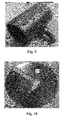
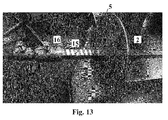
- the two disks are mounted on the spit ( 2 ) with their grooves positioned opposite each other. They are then fastened to each other with pin-hole couplings, see Figs. 10-13 , and lock together on the spit ( 2 ).
- the smaller disk ( 6 ) comprises a central hole ( 25 ) with dimensions sufficient to insert the spit ( 2 ) through.
- the smaller disk (6) is then locked to the larger disk (5) with pin-hole couplings ( 27, 26 ) as seen in Figs. 10-11 .
- the diameter of the meat mass ( 21 ), particularly shawarma, is not larger than the diameter of the larger disk ( 5 ), and the couplings of the two disks ( 5, 6 ) confines the meat mass ( 21 ), along a selected part of the spit ( 2 ) and keeps it condensed state.
- Spring ( 15 ) and stopper ( 16 ) coupling is used on each side of the spit ( 2 ) to maintain the coupled disks ( 5, 6 ) in fixed position and press them against the meat mass ( 21 ) at the center of the spit ( 2 ).
- the spring is inserted into stopper ( 16 ) on one end and hole ( 25 ) of the smaller disk ( 6 ) on the opposite end. It is adjusted and stretched according to the desired pressure to be applied on the meat mass ( 21 ) between the two pairs of disks ( 5, 6 ).
- screw ( 24 ) locks its position within stopper ( 16 ) and secures the pairs of disks ( 5, 6 ) and meat mass ( 21 ) in place.
- the pressure applied to the meat mass ( 21 ) is necessary, since it loses mass, liquids and fats during roasting and cutting pieces of meat off of it. This creates gaps and voids within the meat mass ( 21 ) and, therefore, requires further condensing to keep it stable on the spit ( 2 ).
Landscapes
- Engineering & Computer Science (AREA)
- Food Science & Technology (AREA)
- Baking, Grill, Roasting (AREA)
Applications Claiming Priority (1)
| Application Number | Priority Date | Filing Date | Title |
|---|---|---|---|
| US201562190271P | 2015-07-09 | 2015-07-09 |
Publications (1)
| Publication Number | Publication Date |
|---|---|
| EP3114973A1 true EP3114973A1 (fr) | 2017-01-11 |
Family
ID=56411417
Family Applications (1)
| Application Number | Title | Priority Date | Filing Date |
|---|---|---|---|
| EP16178451.7A Withdrawn EP3114973A1 (fr) | 2015-07-09 | 2016-07-07 | Dispositif de rôtisserie à broche multizone pour griller et rôtir de la viande |
Country Status (3)
| Country | Link |
|---|---|
| US (1) | US20170007071A1 (fr) |
| EP (1) | EP3114973A1 (fr) |
| IL (1) | IL246635A0 (fr) |
Cited By (1)
| Publication number | Priority date | Publication date | Assignee | Title |
|---|---|---|---|---|
| IL299629B1 (en) * | 2023-01-01 | 2023-12-01 | Kitchen Line Ori LTD | cymbal |
Families Citing this family (5)
| Publication number | Priority date | Publication date | Assignee | Title |
|---|---|---|---|---|
| KR200487096Y1 (ko) * | 2018-06-01 | 2018-08-02 | 김천구 | 회전식 고기구이기 |
| US11272808B2 (en) * | 2019-01-07 | 2022-03-15 | Titan Rotisseries LLC | Modular oven with extendable rotisserie |
| USD968869S1 (en) | 2021-02-12 | 2022-11-08 | Walmart Apollo, Llc | Rotisserie grill |
| CA3167520A1 (fr) * | 2021-07-15 | 2023-01-15 | Onward Multi-Corp Inc. | Thermometre de rotisserie |
| US12543889B2 (en) * | 2021-08-04 | 2026-02-10 | Weber-Stephen Products Llc | Transversely-loadable rotisserie baskets for grills |
Citations (2)
| Publication number | Priority date | Publication date | Assignee | Title |
|---|---|---|---|---|
| DE102008027973A1 (de) * | 2008-06-12 | 2009-12-17 | Kirdar & Alibaba Lizenz GbR (vertretungsberechtigter Gesellschafter Herr Sükrü Alibaba, Graf-Konrad-Str. 25, 80809 München) | Grillvorrichtung |
| US20120080025A1 (en) * | 2009-03-30 | 2012-04-05 | Kwang-Ho Choi | Rotary barbecue device |
-
2016
- 2016-07-06 IL IL246635A patent/IL246635A0/en unknown
- 2016-07-07 EP EP16178451.7A patent/EP3114973A1/fr not_active Withdrawn
- 2016-07-07 US US15/204,563 patent/US20170007071A1/en not_active Abandoned
Patent Citations (2)
| Publication number | Priority date | Publication date | Assignee | Title |
|---|---|---|---|---|
| DE102008027973A1 (de) * | 2008-06-12 | 2009-12-17 | Kirdar & Alibaba Lizenz GbR (vertretungsberechtigter Gesellschafter Herr Sükrü Alibaba, Graf-Konrad-Str. 25, 80809 München) | Grillvorrichtung |
| US20120080025A1 (en) * | 2009-03-30 | 2012-04-05 | Kwang-Ho Choi | Rotary barbecue device |
Cited By (2)
| Publication number | Priority date | Publication date | Assignee | Title |
|---|---|---|---|---|
| IL299629B1 (en) * | 2023-01-01 | 2023-12-01 | Kitchen Line Ori LTD | cymbal |
| IL299629B2 (en) * | 2023-01-01 | 2024-04-01 | Kitchen Line Ori LTD | A grill device |
Also Published As
| Publication number | Publication date |
|---|---|
| US20170007071A1 (en) | 2017-01-12 |
| IL246635A0 (en) | 2016-12-29 |
Similar Documents
| Publication | Publication Date | Title |
|---|---|---|
| EP3114973A1 (fr) | Dispositif de rôtisserie à broche multizone pour griller et rôtir de la viande | |
| EP3373783B1 (fr) | Plaques de fumage et de chauffage de gril de barbecue, et procédé | |
| US3943837A (en) | Dual purpose barbecue grill and rotisserie | |
| US5536518A (en) | Convertible grill/rotisserie barbecue | |
| US6187359B1 (en) | Method and apparatus for baking foods in a barbeque grill | |
| US3693534A (en) | Cooking device | |
| US20200029731A1 (en) | Multi-function cooking oven having horizontally and vertically oriented cooking elements and multi-position horizontal and vertical rotation devices | |
| KR101401017B1 (ko) | 구이판의 높이가 조절되는 가열 조리기 | |
| US2893307A (en) | Portable electric cooking device | |
| US3173357A (en) | Broiler | |
| US2689517A (en) | Combination broiler and toaster | |
| KR101628621B1 (ko) | 장작을 이용한 구이 장치 | |
| CN105832174A (zh) | 烹饪装置 | |
| US3121424A (en) | Outdoor cooking apparatus | |
| KR101607990B1 (ko) | 측면직화구이장치 | |
| US8887627B1 (en) | Barbecue apparatus | |
| US20170164784A1 (en) | Rotisserie Grilling System | |
| EP3334317B1 (fr) | Gril à haute température | |
| US20110067581A1 (en) | Griddle top having grooves for fat drainage | |
| US3327616A (en) | Barbecue oven | |
| EP2416685B1 (fr) | Dispositif de cuisson extérieur à combustible solide | |
| US3087418A (en) | Broiler | |
| WO2014116190A1 (fr) | Machine de cuisson au gril à rotation et évacuation automatiques | |
| KR101618604B1 (ko) | 바베큐 장치 | |
| KR20120000415U (ko) | 석쇠 및 이를 이용한 수직형 구이기 |
Legal Events
| Date | Code | Title | Description |
|---|---|---|---|
| PUAI | Public reference made under article 153(3) epc to a published international application that has entered the european phase |
Free format text: ORIGINAL CODE: 0009012 |
|
| AK | Designated contracting states |
Kind code of ref document: A1 Designated state(s): AL AT BE BG CH CY CZ DE DK EE ES FI FR GB GR HR HU IE IS IT LI LT LU LV MC MK MT NL NO PL PT RO RS SE SI SK SM TR |
|
| AX | Request for extension of the european patent |
Extension state: BA ME |
|
| STAA | Information on the status of an ep patent application or granted ep patent |
Free format text: STATUS: THE APPLICATION IS DEEMED TO BE WITHDRAWN |
|
| 18D | Application deemed to be withdrawn |
Effective date: 20170712 |