EP3116977B1 - Appareil de traitement de substance d'origine végétale servant à produire de la biomasse à utiliser dans la production d'électricité et d'énergie thermale provenant de sources renouvelables ainsi que procédé associé - Google Patents
Appareil de traitement de substance d'origine végétale servant à produire de la biomasse à utiliser dans la production d'électricité et d'énergie thermale provenant de sources renouvelables ainsi que procédé associé Download PDFInfo
- Publication number
- EP3116977B1 EP3116977B1 EP15721315.8A EP15721315A EP3116977B1 EP 3116977 B1 EP3116977 B1 EP 3116977B1 EP 15721315 A EP15721315 A EP 15721315A EP 3116977 B1 EP3116977 B1 EP 3116977B1
- Authority
- EP
- European Patent Office
- Prior art keywords
- substance
- substances
- containment unit
- vegetable
- biomass
- Prior art date
- Legal status (The legal status is an assumption and is not a legal conclusion. Google has not performed a legal analysis and makes no representation as to the accuracy of the status listed.)
- Active
Links
Images


Classifications
-
- C—CHEMISTRY; METALLURGY
- C10—PETROLEUM, GAS OR COKE INDUSTRIES; TECHNICAL GASES CONTAINING CARBON MONOXIDE; FUELS; LUBRICANTS; PEAT
- C10L—FUELS NOT OTHERWISE PROVIDED FOR; NATURAL GAS; SYNTHETIC NATURAL GAS OBTAINED BY PROCESSES NOT COVERED BY SUBCLASSES C10G OR C10K; LIQUIFIED PETROLEUM GAS; USE OF ADDITIVES TO FUELS OR FIRES; FIRE-LIGHTERS
- C10L5/00—Solid fuels
- C10L5/40—Solid fuels essentially based on materials of non-mineral origin
- C10L5/44—Solid fuels essentially based on materials of non-mineral origin on vegetable substances
-
- B—PERFORMING OPERATIONS; TRANSPORTING
- B01—PHYSICAL OR CHEMICAL PROCESSES OR APPARATUS IN GENERAL
- B01J—CHEMICAL OR PHYSICAL PROCESSES, e.g. CATALYSIS OR COLLOID CHEMISTRY; THEIR RELEVANT APPARATUS
- B01J8/00—Chemical or physical processes in general, conducted in the presence of fluids and solid particles; Apparatus for such processes
- B01J8/08—Chemical or physical processes in general, conducted in the presence of fluids and solid particles; Apparatus for such processes with moving particles
- B01J8/10—Chemical or physical processes in general, conducted in the presence of fluids and solid particles; Apparatus for such processes with moving particles moved by stirrers or by rotary drums or rotary receptacles or endless belts
-
- C—CHEMISTRY; METALLURGY
- C10—PETROLEUM, GAS OR COKE INDUSTRIES; TECHNICAL GASES CONTAINING CARBON MONOXIDE; FUELS; LUBRICANTS; PEAT
- C10L—FUELS NOT OTHERWISE PROVIDED FOR; NATURAL GAS; SYNTHETIC NATURAL GAS OBTAINED BY PROCESSES NOT COVERED BY SUBCLASSES C10G OR C10K; LIQUIFIED PETROLEUM GAS; USE OF ADDITIVES TO FUELS OR FIRES; FIRE-LIGHTERS
- C10L2290/00—Fuel preparation or upgrading, processes or apparatus therefore, comprising specific process steps or apparatus units
- C10L2290/08—Drying or removing water
-
- Y—GENERAL TAGGING OF NEW TECHNOLOGICAL DEVELOPMENTS; GENERAL TAGGING OF CROSS-SECTIONAL TECHNOLOGIES SPANNING OVER SEVERAL SECTIONS OF THE IPC; TECHNICAL SUBJECTS COVERED BY FORMER USPC CROSS-REFERENCE ART COLLECTIONS [XRACs] AND DIGESTS
- Y02—TECHNOLOGIES OR APPLICATIONS FOR MITIGATION OR ADAPTATION AGAINST CLIMATE CHANGE
- Y02E—REDUCTION OF GREENHOUSE GAS [GHG] EMISSIONS, RELATED TO ENERGY GENERATION, TRANSMISSION OR DISTRIBUTION
- Y02E50/00—Technologies for the production of fuel of non-fossil origin
- Y02E50/10—Biofuels, e.g. bio-diesel
-
- Y—GENERAL TAGGING OF NEW TECHNOLOGICAL DEVELOPMENTS; GENERAL TAGGING OF CROSS-SECTIONAL TECHNOLOGIES SPANNING OVER SEVERAL SECTIONS OF THE IPC; TECHNICAL SUBJECTS COVERED BY FORMER USPC CROSS-REFERENCE ART COLLECTIONS [XRACs] AND DIGESTS
- Y02—TECHNOLOGIES OR APPLICATIONS FOR MITIGATION OR ADAPTATION AGAINST CLIMATE CHANGE
- Y02E—REDUCTION OF GREENHOUSE GAS [GHG] EMISSIONS, RELATED TO ENERGY GENERATION, TRANSMISSION OR DISTRIBUTION
- Y02E50/00—Technologies for the production of fuel of non-fossil origin
- Y02E50/30—Fuel from waste, e.g. synthetic alcohol or diesel
Definitions
- the present invention relates to a treating apparatus for vegetable substances, for the production of biomass to be used for producing electric and thermal energy from renewable sources, as well as to a method thereof.
- the present invention relates to processes aimed at the transformation of vegetable substances and/or substances of biologic origin from agricultural and/or horticultural rejects and by-products, from the transformation and packaging of vegetable products in the agricultural and food industry, from residues of food to be marketed and distributed, from remains of food transformed for human and animal feeding, into biomass to be used for generating electric and thermal energy from renewable sources.
- the present invention is compatible with the transformation of products, by-products, rejects and residues of vegetable substances derived from sylviculture and from the related industries, including fishing, aquaculture and marine algae, and from mowing and pruning of public and private greenery, into biomass to be used for generating electric and thermal energy from renewable sources.
- the present invention is also compatible with the transformation of the vegetable fraction and/or biologic by-products from industrial and municipal wastes, for transforming said wastes into biomass to be used for generating electric and thermal energy from renewable sources.
- the present invention is compatible with the use of all vegetable substances and/or substances of biologic origin that can be found in nature, and/or with rejects or by-products from industrial and municipal wastes containing mainly water, and converts said substances into biomass to be used for producing electric and thermal energy from renewable sources.
- Electric energy plays a key role, due to supply difficulties and to the impelling need for fulfilling increasing requirements by using quotas of renewable sources as replacements for conventional ones produced by means of fossil fuels, which will eventually become exhausted.
- the worldwide-approved strategy aims at reducing CO2 emissions, increasing the use of renewable energy, and improving the energetic efficiency of the new technologies and their applications.
- the Kyoto treaty commits the 55 signing countries to reduce the quantity of emissions of greenhouse effect gases (climate changing gases, which warm the earth climate) compared to their emission levels in 1990 (baseline).
- the signing countries must create a national system for monitoring the emissions and absorptions of greenhouse effect gases, to be updated on a yearly basis, and must define measures for emission reduction.
- the objective is to reduce the emission of carbon dioxide (CO2), which is considered to be the main cause of the greenhouse effect, and which is primarily produced by the use of fossil fuels in energetic, industrial and transportation activities.
- CO2 carbon dioxide
- the European Council of 23-24th October 2014 approved the new objectives of the "20-20-20" climate-energy package, which by 2030 aims at reducing greenhouse gas emissions by 40%, increasing renewable sources in the final energy consumption by 27%, and attaining a 30% final energy efficiency improvement.
- the path will begin for the adoption of the European legislative tools necessary for achieving such goals.
- the agreement envisages new forms of governance that will ensure better synergy among the member states and improved harmonization of the target measures.
- waste contains also cooked food residues and food remains, wherein the latter may also be of animal origin.
- the above-mentioned vegetable substances are used for energy production as "wet" fractions of organic waste that, in addition to other substances like animal manure, organic refuse such as serum and wastewaters, butchering refuse and depuration sludge, are used in anaerobic digestion processes, wherein the organic substance is degraded by organisms in the absence of oxygen, in order to generate combustible biogas to be used for producing electric and thermal energy and Compost for agricultural use.
- Biogas plants are complex and require big reactors; in addition, the efficiency of the biogas combustion cycle in the combustion engines employed for this purpose is low.
- waste treatment plays a key role because of the limits of the technologies employed, the costs of the current disposal processes, and the impossibility of landfill disposal.
- the most effective remedy is recycling.
- the waste can be considered as a "secondary raw material" which, after being subjected to appropriate treatments, can be used as a raw material for further production processes of the same or different nature.
- the 2008/98/EC Directive fortifies the goals of the previous regulation by introducing basic definitions of waste, recovery and disposal, specifying the management cycle hierarchy, and establishing an approach that takes into account the entire life cycle of products and materials. Great attention is paid to reducing the environmental impacts connected to waste production and management, thus attributing additional economical value to the waste.
- the 2008/98/EC Directive defines as «bio-waste»: biodegradable garden and park waste, food and kitchen waste from households, restaurants, caterers and retail premises and comparable waste from food processing plants.
- the 2008/98/EC Directive expressly states that: " It is important, in accordance with the waste hierarchy, and for the purpose of reduction of greenhouse gas emissions originating from waste disposal on landfills, to facilitate the separate collection and proper treatment of bio-waste in order to produce environmentally safe compost and other bio-waste based materials without risk to the environment ".
- the recovery operations listed in Annex II of the same 2008/98/EC Directive include under the R1 code: " Use principally as a fuel or other means to generate energy ".
- Document US2009025278 AA relates to a method and a device for producing fuel from biomass, wherein the biomass derives from biological wastes or exsiccated products resulting from wet and/or dry fermentation, and/or silage products, and/or other dry or moist biological wastes.
- the biomass is comminuted prior to exsiccation.
- Document US2009025278 AA proposes that the biomass be exsiccated by condensation drying at ambient temperature or at a higher temperature, e.g. by supplying hot air or another heated gas.
- Document US2009025278 AA envisages the possibility of using the residual heat coming from biomass composting or fermentation methods, from silage processes, and from cogeneration power plants.
- Document US2009025278 AA also envisages the use of a microwave heater in order to further exsiccate the biomass.
- Document EP1413826 A1 relates to a process and an apparatus for microwave treatment of solid residues from thermal degradation of a charge containing organic matter.
- the process according to EP1413826 A1 involves thermal degrading of a load, by pyrolysis, to form a carbonaceous solid residue and a gas; the formed solid residue and the gas phase are separated; the solid residue is treated by a microwave radiation in the presence of an oxidizing agent, e.g. air or oxygen; the microwave treatment is carried out on a solid residue under hot conditions.
- an oxidizing agent e.g. air or oxygen
- FR2982273A1 relates to a system for drying and torrefying a biomass of ligneous origin; in this system, the biomass is exsiccated by means of a gas flow heated to temperatures between 100° and 300°C and then re-mixed.
- the system known from FR2982273A1 needs to abate biomass humidity by means of heat coming from heated and insufflated gas; the blades that stir the biomass, however, subtract heat from it, thus making the process not very efficient.
- Document DE3731595A1 relates to a device for drying organic material, re-mixed by a stirrer in a chamber where hot gases circulate. Also according to DE3731595A1 , biomass exsiccation is only due to interaction with the gas, which must therefore be sufficiently heated, resulting in high energy consumption.
- US20130055622 discloses a process for making a fuel product.
- the present invention aims at providing a treating apparatus for vegetable substances and/or substances of biologic origin, for the conversion of said substances into biomass, which overcomes some of the problems suffered by the prior art.
- ORC Organic Rankine Cycle
- the apparatus comprises a pre-treatment unit that prepares the vegetable substances and/or substances of biologic origin for the process, which is equipped with mechanical pressing and/or grinding means that remove beforehand part of the water content thereof and divides them into fragments having a shape and a size suitable for the process that follows; a treatment unit adapted to contain said vegetable substance fragments to be treated, equipped with motion means adapted to put in motion the vegetable substances inside the containment unit, in order to eliminate an additional water content percentage.
- Said treatment unit is also equipped with means for insufflating hot air into the containment unit, in order to exsiccate the vegetable substances.
- the treatment is applicable to substances of biologic origin coming from rejects and by-products of agricultural and/or horticultural productions, from the transformation and packaging of vegetable products in the agricultural and food industry, from residues of food to be marketed and distributed, from remains of food transformed for human and animal feeding, from the transformation of products, by-products, rejects and residues of vegetable substances derived from sylviculture and from the related industries, including fishing, aquaculture and marine algae, and from mowing and pruning of public and private greenery, for converting said substances into biomass to be used as fuel for producing electric and thermal energy from renewable sources.
- the process of the invention has been made compatible with the conversion of the fraction of vegetable origin and/or by-products of biologic origin from industrial and municipal wastes into biomass to be used as fuel for generating electric and thermal energy from renewable sources.
- the motion means used in the present treatment comprise rotation means, such as bushings, bearings, shafts or the like, adapted to allow the containment unit to rotate about at least one axis, and motor means, such as an electric and/or hybrid motor, adapted to put the containment unit in rotary motion in order to move and stir the vegetable substances to be converted into biomass. This improves the exsiccation of said substances.
- the containment unit has a substantially cylinder-like or truncated-cone-like shape, and the axis of rotation substantially coincides with the cylinder axis.
- the containment unit comprises at least one wall with a plurality of holes and/or apertures, so sized as to hold inside the biomass being moved, while at the same time allowing the hot air to flow into said containment unit to exsiccate the biomass contained therein.
- Such holes hold the biomass inside the containment unit while letting out the water separated from the biomass, thus improving the exsiccation of the latter.
- Said treating unit may preferably be equipped with a system for irradiating microwaves onto the vegetable substances being moved therein, which causes thermal agitation of the structure of the vegetable substances, thereby optimizing the exsiccation process.
- the treating apparatus comprises a pneumatic circuit for conveying hot air up to the exsiccation means; the exsiccation means comprise means for distributing hot air inside the containment unit, and the pneumatic circuit is configured for connecting to a heat exchanger that heats the air by using heated water produced by the said process for producing electric energy and thermal energy, fed by the treatment of the invention.
- the treating system proves to be particularly effective when associated with high-efficiency electric and thermal energy production plants, or plants based on the Organic Rankine Cycle (ORC).
- ORC Organic Rankine Cycle
- the present invention relates also to a treating method of vegetable substances for the production of biomass to be used for generating electric and thermal energy from renewable sources, which preferably incorporates at least all aspects described herein in regard to the treating apparatus according to the present invention, and further aspects pertaining to other apparatuses associable or associated with the same, within a process chain comprising multiple treatment steps.
- the treating method comprises the steps of: collecting vegetable substances and/or substances of biologic origin into a pre-treatment unit and subjecting them beforehand to pressing in order to eliminate part of their water content, and/or grinding them into fragments for feeding the next cycle.
- This pre-treatment is preferably carried out by mechanical passage through a holed matrix; conveying the substance fragments into a containment unit for subjecting them to the treatment; the treatment consists of putting in motion the substance fragments inside the containment unit, preferably by exerting a centrifugal action that will move away the residual water contained in the substance.
- the simultaneous insufflation of hot air into the containment unit promotes the exsiccation of the residual water.
- the vegetable substance fragments once centrifuged and exsiccated by the hot air flow, are further treated with microwaves that raise the temperature of the fragments and crystallize them, for a faster and more effective conversion of said fragments into biomass to be used for generating electric and thermal energy from renewable sources.
- the vegetable substance is put in motion and stirred by rotation of the containment unit, as already mentioned with reference to the treating apparatus.
- the treating method envisages to subject the obtained biomass to a subsequent combustion for producing electric and thermal energy; it is preferably envisaged to recover part of the heat resulting from cogeneration for heating the air to be used for exsiccating the vegetable substance fragments into biomass.
- the excess heat resulting from said exsiccation may preferably be used for other purposes.
- the present invention allows efficiently selling the residual renewable energy contained in vegetable substances coming from wastes of human and animal cycles, by transforming them into biomass to be used for producing electric and thermal energy from renewable sources by means of cogeneration processes.
- the present invention allows to more effectively valorize the residual energy contained in vegetable substances available as rejects or by-products of human, animal and industrial cycles, before they undergo further transformations or contamination by other substances.
- the present invention is also compatible with the transformation of the fraction of vegetable origin and/or by-products of biologic origin from industrial and municipal wastes, for transforming said wastes into biomass to be used for generating electric and thermal energy from renewable sources.
- Figure 1 exemplifies an embodiment of the treating method for vegetable substances and/or substances of biologic origin for producing biomass according to the present invention.
- Vegetable substances and/or substances of biologic origin and/or the biologic fraction of industrial and municipal wastes refer to all "substances coming from rejects and by-products of agricultural and/or horticultural productions, from the transformation and packaging of vegetable products in the agricultural and food industry, from residues of food to be marketed and distributed, from remains of food transformed for human and animal feeding, from the transformation of products, by-products, rejects and residues of vegetable substances derived from sylviculture and from the related industries, including fishing, aquaculture and marine algae, from mowing and pruning of public and private greenery, in addition to the fraction of vegetable origin and/or by-products of biologic origin coming from industrial and municipal wastes".
- Biomass from renewable sources refers to the product obtained from the conversion of the above-mentioned vegetable substances and/or substances of biologic origin.
- a substance 101 preferably consisting of the above-defined vegetable substances and/or substances of biologic origin, in addition to other similar substances, resulting from a collection and storage step.
- the present invention preferably valorizes said substances also when they come from separate collection systems of current waste management cycles.
- the substance 101 is prevalently made up of vegetable matter, containing water in a variable weight percentage, and a variously structured fibrous and pulpy matrix.
- the present invention aims at abating the water content of the vegetable substance 101, thus converting it into biomass of vegetable origin.
- the vegetable substance 101 is subjected to a pre-treatment step consisting of: abating a first part of its water content; reducing the substance to homogeneous dimensions useful for subjecting it to the next treatment.
- the vegetable substance 101 is thus put in motion, preferably by gravity or by means of a conveyor belt, towards a pre-treatment unit 102, which subjects it to a mechanical pressing and grinding process.
- the pre-treatment unit 102 comprises at least one screw 103 connected to a container, in which the screw 103 rotates. Said screw 103 transports the mass of organic waste, pushing it against a matrix 104, which at the same time performs the operations of pressing out the water contained in the vegetable substances and grinding said substances to the size of fragments compatible with the subsequent treatments.
- the holed matrix 104 has circular or rectangular holes.
- the pre-treatment unit 102 does the following: grinds the substance to dimensions determined by the holes of the matrix 104; eliminates a first part of the water contained in the vegetables. The pre-treatment unit 102 then outputs part of the water previously contained in the vegetables, which can be drained into the common wastewater disposal network 105, since it contains no harmful substances.
- the material is ground and brought to dimensions suitable for the subsequent treatments by using minimal energy, and at the same time a first quantity of water contained in the organic substance is removed by the pressing action exerted on it.
- the vegetable substance may require an additional centrifugal separating action or, as an alternative, a short period of "ground” storage for promoting separation in motion.
- the vegetable substance thus pre-treated is then subjected to the treatment that will reduce the residual moisture content to the target percentage.
- the raw material which is essentially of vegetable origin, is put in motion, subjected to an exsiccation process, and then expelled.
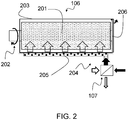
- Figure 2 illustrates in greater detail a preferred and advantageous first embodiment of the treatment unit 106, i.e. the treating apparatus for vegetable substances and/or substances of biologic origin 106.
- the treating apparatus 106 comprises a containment unit 201 adapted to contain the vegetable substance and/or a similar substance, to be treated for converting it into biomass.
- the containment unit 201 preferably comprises a side wall comprising a plurality of holes. The dimensions of the holes are such as to hold inside the vegetable substance, i.e. smaller than the average size of the fragments, thus preventing them from coming out.
- the containment unit 201 comprises a cylinder, preferably a metallic one, with perforated walls.
- the containment unit 201 is further adapted to be put in motion by the motion means 202.
- a motor preferably an electric and/or hybrid one, coupled to a mechanical transmission, is adapted to rotate the cylinder about its axis, supported by suitable rotational supports, such as shafts and bearings.
- suitable rotational supports such as shafts and bearings.
- the containment unit can put in motion and stir the biomass contained therein.
- the vegetable mass fragments adhere to the walls of the rotating cylinder 201 through the effect of the centrifugal action; the diameters of the holes are smaller than the average size of the fragments, thus preventing them from coming out.
- the treating apparatus 106 further comprises an outer casing 203 that defines a chamber in which the containment unit 201 is arranged.
- the treating apparatus further comprises exsiccation means adapted to insufflate hot air into the casing 203, in order to exsiccate the vegetable substance.
- the motion means stir it inside the containment unit 201.
- the exsiccation means comprise a pneumatic circuit 204, adapted to convey hot air, and distribution means 205 comprising a plurality of air outlets, adapted to distribute the hot air inside the containment unit 201 through the holes thereof, as shown by the clear arrows in Figure 2 .
- the pneumatic circuit 204 is configured for connecting to a heat exchanger 107, which will be described more in detail below, for heating the air to be used for exsiccating the vegetable substance.
- the vegetable matter previously obtained is subjected to a process that abates the quantity of residual moisture to the desired percentage.
- the treating apparatus 106 performs three distinct actions:
- the heat exchanger 107 is preferably supplied with heated water produced by the cogeneration process for the production of electric and thermal energy, obtained from the same vegetable substance converted into biomass by means of the present method, through which air is heated.
- the hot exsiccation air is thus preferably produced from the conversion of the heat generated by the cogeneration cycle, and/or by the Organic Rankine Cycle of the waste-to-energy plant 111, which will be described below.
- An Organic Rankine Cycle (ORC) in fact, generates approx. 80% of thermal energy and approx. 20% of electric energy.
- the ORC thermal output consists of, among other things, hot water, typically having a temperature of approx. 90°C, which is then conveyed towards the exchanger 107; inside the latter, the hot water flows in radiant elements, exchanging its heat with an air flow lapping said elements and transforming it into hot air to be used for the above-described exsiccation.
- the process is thus optimized from the energetic viewpoint, in that it exploits the excess heat produced by the cogeneration cycle for exsiccating the vegetable substances, resulting in an additional efficiency advantage.
- a base 206 of the cylinder (or truncated cone) is opened, and the mass is dragged out, preferably by the air flow or by the action exerted by mechanical means.
- the dry mass is then conveyed, preferably by a conveyor roller (not shown) to the other treatment steps, which will be described again with reference to Figure 1 .
- FIG 3 illustrates in more detail a treatment unit 106, i.e. the treating apparatus for vegetable substances designated 106b in Figure 3 to distinguish it from the embodiment 106 previously described with reference to Figure 2 .
- the treating apparatus 106b comprises a containment unit 301 adapted to contain the vegetable substance and/or a similar substance to be treated.
- the containment unit 301 includes, inside of it, a conveyor belt 302 for moving the vegetable substance or the like to be treated.
- the conveyor belt 302 is put in motion by motion means 303.
- a motor preferably an electric and/or hybrid one, and a mechanical transmission are adapted to rotate the cylinder 303 about its axis, supported by suitable rotational supports, such as shafts and bearings. In this manner, the conveyor belt 302 can put the supported biomass in motion.
- the conveyor belt 302 comprises a "mesh" structure, i.e. a holed matrix adapted to support the material being transported by the roller, while at the same time allowing the passage of air, as will become apparent below.
- the dimensions of the holes of the matrix or "mesh” of the belt 302 are smaller than the average size of the fragments, thus preventing them from falling.
- the treating apparatus 106b further comprises exsiccation means adapted to insufflate hot air into the containment means 301, in order to exsiccate the vegetable substance.
- the conveyor belt 302 moves the vegetable substance through the containment unit 301.
- the exsiccation means comprise a pneumatic circuit 304, adapted to convey hot air, and distribution means 305 comprising a plurality of air outlets, adapted to direct the hot air onto the vegetable substance being transported by the conveyor belt 302, the air flowing through the holes thereof, as shown by the clear arrows in Figure 3 .
- the pneumatic circuit 304 is configured for connecting to a heat exchanger, such as the heat exchanger 107.
- the vegetable matter previously obtained is subjected to a process that abates the quantity of residual moisture to the desired percentage.
- treating apparatus 106b is therefore adapted to perform three distinct actions:
- a microwave treating apparatus 108 which will be described more in detail below, also with reference to the microwave unit 108, is advantageously associated with the treating apparatus 106b, possibly integrated into the apparatus 106b itself and preferably parallel to the path of the conveyor belt 302.
- the dry mass is then conveyed, preferably by an additional conveyor roller (not shown) to the other treatment steps, which will be described again with reference to Figure 1 .
- vents and/or valves can be employed for supplying and exhausting hot air in the treating apparatuses 106 and 106b.
- exsiccation process described so far is preferably complemented with a treatment for crystallizing the fragments of organic material through the use of microwaves in the microwave unit 108.
- the microwave unit 108 allows further treatment of the vegetable substance by thermal agitation of the residual water molecules, thereby making the substance anhydrous.
- the increased temperature of the fragments subjected to microwaves promotes their subsequent combustion.
- the vegetable substance is made anhydrous, reducing the residual water content to moisture levels compatible with its conversion into biomass to be used in high-efficiency cogeneration cycles, such as, preferably, the Organic Rankine Cycle (ORC).
- ORC Organic Rankine Cycle
- microwaves are electromagnetic waves with a frequency of approx. 2.45 GHz; they cause an increase in the rotational energy of the water molecules prevalently contained in vegetable substances, which behave as "electric dipoles".
- the energy of the microwaves causes an increase in the rotational energy at the dipoles of the water molecules, which produces a «shaking» effect on the molecules.
- This intermolecular «friction» generates heat that propagates outwards from within the material.
- the microwave unit 108 in the microwave unit 108 the percentage of residual moisture contained in the vegetable substances can be abated.
- the microwave treatment is carried out simultaneously with the transportation on the conveyor belt 302 in the treating apparatus 106b.
- the microwave unit 108 and the apparatus 106b are joined into a single machinery, as shown.
- the material thus treated is fed to the loading unit 109; the vegetable mass converted into anhydrous biomass arrives at the loading mouth of the combustion boiler 110 (or another similar machinery), preferably by means of a mechanism fitted with a screw or a conveyor belt.
- the terminal part of the conveyor roller preferably of the vibrating type, feeds the treated material to the intake mouth of the combustion boiler 110 of the high-efficiency cogeneration system, preferably based on an Organic Rankine Cycle, whether directly or through a screw for extraction from a collection heap.
- the boiler 110 heats the oil, preferably a diathermal one, which then yields its heat to the silicone-based fluid fed to the ORC cycle.
- the ORC unit 111 uses the heat produced by the combustion of the vegetable substances 101 converted into biomass in the boiler 110 and carried by the silicone-based fluid in order to produce electric and thermal energy from renewable sources.
- the obtained biomass can be used in modern cogeneration plants and/or, even more advantageously, in high-efficiency cogeneration plants.
- the heat obtained from burnt biomass causes evaporation of a fluid with high molecular weight that expands on the rotor of a turbine, which in turn drives an associated electric generator.
- the fluid is condensed prior to being reused in the cycle.
- These cogeneration plants based on the "Organic Rankine Cycle", wherein biomass is subjected to combustion, are more reliable and efficient that biodegradation, anaerobic digestion and gasification processes. They produce electric and thermal energy from renewable sources.
- the generated heat is partly used for exsiccating the biomass in accordance with the principle of the invention; the remaining part can be further valorized.
- the power rating is of the order of 1 electric MW or higher, and allows its use also in the proximity of urban areas without any significant impact on the environment.
- waste classification wherein wastes are considered as substances to be used for energy production
- the goals of the principal Community Directives about waste classification can be enhanced by the need for diversifying the wet fraction in a more effective manner, in order to be able to more efficiently valorize the fraction of vegetable origin available therein.
- the process of the invention has been made compatible with plants suitably sized for widespread installation, by envisaging collection centres accessible to the users and by assigning the latter, or the entrusted subject along the supply chain, a percentage of the economical value of the resource as an incentive or discount on the disposal tax.
- a more effective separation of the vegetable fraction will be attained, resulting in increased collection.
- the new utilization will have positive effects on the entire cycle, thus strengthening the measures for waste management and reduction, environmental protection and public health.
- rejects and by-products of vegetable substances and/or substances of biologic origin coming from industrial and municipal wastes are also converted, according to the present invention, into biomass to be used for producing electric and thermal energy from renewable sources, resulting in evident social, environmental and productive advantages.
- the increased biomass production resulting from the use of the invention will contribute to reduce the use of biomass, in particular of biomass derived from wood chips obtained by felling portions of woods or from dedicated intensive cultivations, leading to obvious environmental benefits.
Landscapes
- Chemical & Material Sciences (AREA)
- Organic Chemistry (AREA)
- Oil, Petroleum & Natural Gas (AREA)
- Chemical Kinetics & Catalysis (AREA)
- Processing Of Solid Wastes (AREA)
Claims (9)
- Appareil de traitement pour substances végétales et/ou substances d'origine biologique et/ou substances issues de la fraction biologique des déchets industriels et ménagers, pour la conversion desdites substances en biomasse à utiliser pour produire de l'énergie électrique et thermique à partir de sources renouvelables, comprenant : une unité de confinement (201, 301) adaptée pour contenir ladite substance à traiter, des moyens de dessiccation (205, 305) adaptés pour insuffler de l'air chaud dans ladite unité de confinement (201) afin de dessécher ladite substance, et des moyens de mouvement (202, 302) adaptés pour mettre en mouvement ladite substance à l'intérieur de ladite unité de confinement (201, 301) pendant ladite dessiccation, une unité de prétraitement (102) comprenant des moyens de pressage et/ou de broyage mécaniques ;
caractérisé en ce que :ladite unité de prétraitement (102) est configurée pour éliminer une partie de la teneur en eau de ladite substance avant que ladite substance soit insérée dans ladite unité de confinement (201, 301),également caractérisé en ce que :ladite unité de confinement (201)a une forme sensiblement de type cylindre ou de type tronconique, et dans lequel lesdits moyens de mouvement (202) comprennent des moyens de rotation adaptés pour permettre à ladite unité de confinement (201) de tourner autour d'au moins un axe de rotation coïncidant sensiblement avec l'axe dudit cylindre, et des moyens de moteur adaptés pour faire tourner ladite unité de confinement (201) afin de déplacer et d'agiter ladite substance, en exerçant une action centrifuge qui éloigne une eau résiduelle contenue dans la substance,
etladite unité de confinement (201) comprend au moins une paroi comprenant une pluralité de trous, lesdits trous étant également dimensionnés de manière à permettre de maintenir à l'intérieur de ladite substance mise en mouvement pendant ladite rotation, lesdits trous étant en outre configurés pour permettre audit air chaud, insufflé par lesdits moyens de dessiccation, d'entrer dans ladite unité de confinement (201) à travers lesdits trous. - Appareil selon la revendication 1, dans lequel ladite unité de prétraitement (102) comprend une matrice à trou (104) configurée pour être traversée par ladite substance pendant ledit pressage et/ou ledit broyage.
- Appareil selon la revendication 2, dans lequel ladite unité de prétraitement (102) comprend en outre une vis (103) configurée pour faire tourner et dans le même temps, pousser ladite substance à travers ladite matrice à trou (104).
- Appareil selon l'une quelconque des revendications 1 à 3, comprenant en outre une unité de micro-ondes (108) configurée pour traiter plus avant ladite substance par irradiation de micro-ondes, faisant ainsi monter la température de ladite substance afin de la rendre anhydre.
- Appareil selon l'une quelconque des revendications 1 à 4, comprenant en outre un circuit pneumatique (204, 304) adapté pour acheminer ledit air chaud jusqu'auxdits moyens de dessiccation (205, 305), dans lequel lesdits moyens de dessiccation (205, 305) comprennent des moyens de répartition permettant de répartir ledit air chaud au sein de ladite unité de confinement (201, 301), ledit circuit pneumatique (204, 304) étant configuré pour se raccorder à un échangeur de chaleur (107) qui peut être alimenté en eau chauffée produit par un processus de production d'énergie électrique ou thermique à partir de ladite substance traitée, ledit échangeur (107) étant adapté pour chauffer ledit air.
- Procédé de traitement de substances végétales et/ou de substances d'origine biologique et/ou de substances issues de la fraction biologique des déchets industriels et ménagers, pour la conversion desdites substances en biomasse à utiliser pour produire de l'énergie électrique et thermique à partir de sources renouvelables, comprenant les étapes de : collecte d'une substance à traiter dans une unité de confinement (201, 301) ; dessiccation (205, 305) de ladite substance par insufflation d'air chaud dans ladite unité de confinement (201, 301) ; mise en mouvement (202, 302) de ladite substance à l'intérieur de ladite unité de confinement (201, 301) pendant ladite dessiccation ; prétraitement (102) de ladite substance par pressage et/ou broyage, afin d'éliminer une partie de la teneur en eau de ladite substance avant que ladite substance soit collectée dans ladite unité de confinement (201, 301), dans lequel
ladite unité de confinement (201) a une forme sensiblement de type cylindre ou de type tronconique,
ladite substance est mise en mouvement et agitée par la rotation (202) de ladite unité de confinement (201) en exerçant une action centrifuge qui éloigne une eau résiduelle contenue dans la substance, et dans lequel
ladite substance est maintenue à l'intérieur de ladite unité de confinement (201) par une pluralité de trous dans au moins une paroi de celle-ci, à mesure que ledit air chaud est soufflé dans ladite unité de confinement (201) à travers ladite pluralité de trous et insufflé par lesdits moyens de dessiccation. - Procédé de traitement selon la revendication 6, dans lequel ledit pressage et/ou broyage (102) est réalisé par passage mécanique à travers une matrice à trou (104), de préférence par une action de poussée exercée par une vis rotative (103).
- Procédé de traitement selon la revendication 6 ou 7, comprenant en outre l'étape de : traitement plus avant de ladite substance avec des micro-ondes (108), faisant ainsi monter la température de la substance afin de la rendre anhydre.
- Procédé de traitement selon l'une quelconque des revendications 6 à 8, comprenant en outre les étapes de : soumission de ladite substance à une combustion ultérieure (110) pour produire de l'énergie électrique et/ou thermique (111) ; récupération d'une partie de la chaleur résultant de ladite production d'énergie électrique et/ou thermique (111) pour chauffer ledit air (107), ledit air étant chauffé dans un échangeur de chaleur (107) raccordé à un circuit pneumatique (204, 304) .
Applications Claiming Priority (2)
| Application Number | Priority Date | Filing Date | Title |
|---|---|---|---|
| ITMI20140401 | 2014-03-13 | ||
| PCT/IB2015/051841 WO2015136490A1 (fr) | 2014-03-13 | 2015-03-13 | Appareil de traitement de substance d'origine végétale servant à produire de la biomasse à utiliser dans la production d'électricité et d'énergie thermale provenant de sources renouvelables ainsi que procédés associés |
Publications (2)
| Publication Number | Publication Date |
|---|---|
| EP3116977A1 EP3116977A1 (fr) | 2017-01-18 |
| EP3116977B1 true EP3116977B1 (fr) | 2019-01-09 |
Family
ID=50733167
Family Applications (1)
| Application Number | Title | Priority Date | Filing Date |
|---|---|---|---|
| EP15721315.8A Active EP3116977B1 (fr) | 2014-03-13 | 2015-03-13 | Appareil de traitement de substance d'origine végétale servant à produire de la biomasse à utiliser dans la production d'électricité et d'énergie thermale provenant de sources renouvelables ainsi que procédé associé |
Country Status (3)
| Country | Link |
|---|---|
| EP (1) | EP3116977B1 (fr) |
| ES (1) | ES2719714T3 (fr) |
| WO (1) | WO2015136490A1 (fr) |
Families Citing this family (1)
| Publication number | Priority date | Publication date | Assignee | Title |
|---|---|---|---|---|
| CN115508174B (zh) * | 2022-08-18 | 2023-07-14 | 同济大学 | 热空气强制对流的有机固废新型热预处理方法及装备 |
Family Cites Families (11)
| Publication number | Priority date | Publication date | Assignee | Title |
|---|---|---|---|---|
| US4482046A (en) * | 1982-04-15 | 1984-11-13 | General Kinematics Corporation | Flexible trough vibratory conveyor |
| DE3731595A1 (de) | 1987-06-25 | 1989-04-06 | Berlin Consult Gmbh | Verfahren zur thermischen behandlung von schuettguetern und einrichtungen zur ausuebung des verfahrens |
| EP1413826A1 (fr) | 2002-10-22 | 2004-04-28 | Institut Francais Du Petrole | Procédé et installation de traitement par micro-ondes de résidus solides issus de la dégradation thermique d'une charge comprenant de la matière organique |
| DE102005004634B4 (de) | 2005-02-01 | 2011-03-03 | Hans Werner | Herstellung von Biomassebrennstoff |
| US7695747B2 (en) * | 2007-09-17 | 2010-04-13 | Russell Meier | Method of producing dried distillers grain agglomerated particles |
| CN101918520A (zh) * | 2007-10-08 | 2010-12-15 | 煤炭技术公司 | 用于将固体燃料块状化的方法和系统 |
| CZ19731U1 (cs) * | 2009-04-22 | 2009-06-15 | Tuma@Stanislav | Zarízení pro výrobu elektrické energie a tepla z biomasy |
| GB201001544D0 (en) * | 2010-02-01 | 2010-03-17 | Solsys Ltd | Pellets and process therefor |
| US9447354B2 (en) * | 2011-09-01 | 2016-09-20 | Akbev Llc | Spent grain fuel product and process |
| PT105874A (pt) * | 2011-09-02 | 2013-03-04 | Iberfer Equipamentos E Construcoes Tecn S A | Processo de conversão de energia térmica da biomassa em energia eléctrica e instalação de produção de energia eléctrica para a realização do referido processo |
| FR2982273B1 (fr) | 2011-11-09 | 2014-03-14 | Commissariat Energie Atomique | Reacteur de sechage et de torrefaction de biomasse, de preference ligno-cellulosique |
-
2015
- 2015-03-13 ES ES15721315T patent/ES2719714T3/es active Active
- 2015-03-13 EP EP15721315.8A patent/EP3116977B1/fr active Active
- 2015-03-13 WO PCT/IB2015/051841 patent/WO2015136490A1/fr not_active Ceased
Non-Patent Citations (1)
| Title |
|---|
| None * |
Also Published As
| Publication number | Publication date |
|---|---|
| EP3116977A1 (fr) | 2017-01-18 |
| ES2719714T3 (es) | 2019-07-12 |
| WO2015136490A1 (fr) | 2015-09-17 |
Similar Documents
| Publication | Publication Date | Title |
|---|---|---|
| CA2571021C (fr) | Procede et systeme pour le sechage et le traitement thermique de materiaux | |
| US7685737B2 (en) | Process and system for drying and heat treating materials | |
| CN104830397B (zh) | 一种复合型高温环保生物质燃料及其制备方法 | |
| KR101487938B1 (ko) | 축산분뇨를 이용한 고형연료화장치 | |
| CN102430560A (zh) | 一种城市生活垃圾综合处理工艺 | |
| JP2009113023A (ja) | 生ゴミやし尿の瞬間的消滅装置 | |
| JP5506545B2 (ja) | 畜糞尿のリサイクルプラント、畜糞尿のリサイクルシステム、畜糞尿のリサイクル方法 | |
| KR101533053B1 (ko) | 가연성 폐기물을 이용한 srf 제조방법 | |
| CN107597797A (zh) | 高湿基中药渣能源化即时综合处置利用系统及方法 | |
| EP3116977B1 (fr) | Appareil de traitement de substance d'origine végétale servant à produire de la biomasse à utiliser dans la production d'électricité et d'énergie thermale provenant de sources renouvelables ainsi que procédé associé | |
| CN105823056B (zh) | 一种生活垃圾用烘干炉及烘干方法 | |
| CN208815001U (zh) | 一种资源循环利用的废弃物处理系统 | |
| Babu et al. | An eco friendly solution to the food waste disposal | |
| KR101874062B1 (ko) | 음식물류 폐기물을 이용한 퇴비 및 그의 제조방법 | |
| KR20050007250A (ko) | 음식물쓰레기의 사료화 방법 | |
| Zabaniotou et al. | Thermal Processing of animal and agricultural wastes with environmental safety |
Legal Events
| Date | Code | Title | Description |
|---|---|---|---|
| STAA | Information on the status of an ep patent application or granted ep patent |
Free format text: STATUS: THE INTERNATIONAL PUBLICATION HAS BEEN MADE |
|
| PUAI | Public reference made under article 153(3) epc to a published international application that has entered the european phase |
Free format text: ORIGINAL CODE: 0009012 |
|
| STAA | Information on the status of an ep patent application or granted ep patent |
Free format text: STATUS: REQUEST FOR EXAMINATION WAS MADE |
|
| 17P | Request for examination filed |
Effective date: 20161013 |
|
| AK | Designated contracting states |
Kind code of ref document: A1 Designated state(s): AL AT BE BG CH CY CZ DE DK EE ES FI FR GB GR HR HU IE IS IT LI LT LU LV MC MK MT NL NO PL PT RO RS SE SI SK SM TR |
|
| AX | Request for extension of the european patent |
Extension state: BA ME |
|
| DAV | Request for validation of the european patent (deleted) | ||
| DAX | Request for extension of the european patent (deleted) | ||
| STAA | Information on the status of an ep patent application or granted ep patent |
Free format text: STATUS: EXAMINATION IS IN PROGRESS |
|
| 17Q | First examination report despatched |
Effective date: 20180116 |
|
| GRAP | Despatch of communication of intention to grant a patent |
Free format text: ORIGINAL CODE: EPIDOSNIGR1 |
|
| STAA | Information on the status of an ep patent application or granted ep patent |
Free format text: STATUS: GRANT OF PATENT IS INTENDED |
|
| INTG | Intention to grant announced |
Effective date: 20180917 |
|
| GRAS | Grant fee paid |
Free format text: ORIGINAL CODE: EPIDOSNIGR3 |
|
| GRAA | (expected) grant |
Free format text: ORIGINAL CODE: 0009210 |
|
| STAA | Information on the status of an ep patent application or granted ep patent |
Free format text: STATUS: THE PATENT HAS BEEN GRANTED |
|
| AK | Designated contracting states |
Kind code of ref document: B1 Designated state(s): AL AT BE BG CH CY CZ DE DK EE ES FI FR GB GR HR HU IE IS IT LI LT LU LV MC MK MT NL NO PL PT RO RS SE SI SK SM TR |
|
| REG | Reference to a national code |
Ref country code: GB Ref legal event code: FG4D |
|
| REG | Reference to a national code |
Ref country code: CH Ref legal event code: EP Ref country code: AT Ref legal event code: REF Ref document number: 1087276 Country of ref document: AT Kind code of ref document: T Effective date: 20190115 |
|
| REG | Reference to a national code |
Ref country code: IE Ref legal event code: FG4D |
|
| REG | Reference to a national code |
Ref country code: DE Ref legal event code: R096 Ref document number: 602015023180 Country of ref document: DE |
|
| REG | Reference to a national code |
Ref country code: NL Ref legal event code: MP Effective date: 20190109 |
|
| REG | Reference to a national code |
Ref country code: LT Ref legal event code: MG4D |
|
| PG25 | Lapsed in a contracting state [announced via postgrant information from national office to epo] |
Ref country code: NL Free format text: LAPSE BECAUSE OF FAILURE TO SUBMIT A TRANSLATION OF THE DESCRIPTION OR TO PAY THE FEE WITHIN THE PRESCRIBED TIME-LIMIT Effective date: 20190109 |
|
| REG | Reference to a national code |
Ref country code: CH Ref legal event code: NV Representative=s name: VALIPAT S.A. C/O BOVARD SA NEUCHATEL, CH |
|
| REG | Reference to a national code |
Ref country code: ES Ref legal event code: FG2A Ref document number: 2719714 Country of ref document: ES Kind code of ref document: T3 Effective date: 20190712 |
|
| REG | Reference to a national code |
Ref country code: AT Ref legal event code: MK05 Ref document number: 1087276 Country of ref document: AT Kind code of ref document: T Effective date: 20190109 |
|
| PG25 | Lapsed in a contracting state [announced via postgrant information from national office to epo] |
Ref country code: NO Free format text: LAPSE BECAUSE OF FAILURE TO SUBMIT A TRANSLATION OF THE DESCRIPTION OR TO PAY THE FEE WITHIN THE PRESCRIBED TIME-LIMIT Effective date: 20190409 Ref country code: LT Free format text: LAPSE BECAUSE OF FAILURE TO SUBMIT A TRANSLATION OF THE DESCRIPTION OR TO PAY THE FEE WITHIN THE PRESCRIBED TIME-LIMIT Effective date: 20190109 Ref country code: FI Free format text: LAPSE BECAUSE OF FAILURE TO SUBMIT A TRANSLATION OF THE DESCRIPTION OR TO PAY THE FEE WITHIN THE PRESCRIBED TIME-LIMIT Effective date: 20190109 Ref country code: PT Free format text: LAPSE BECAUSE OF FAILURE TO SUBMIT A TRANSLATION OF THE DESCRIPTION OR TO PAY THE FEE WITHIN THE PRESCRIBED TIME-LIMIT Effective date: 20190509 Ref country code: SE Free format text: LAPSE BECAUSE OF FAILURE TO SUBMIT A TRANSLATION OF THE DESCRIPTION OR TO PAY THE FEE WITHIN THE PRESCRIBED TIME-LIMIT Effective date: 20190109 Ref country code: PL Free format text: LAPSE BECAUSE OF FAILURE TO SUBMIT A TRANSLATION OF THE DESCRIPTION OR TO PAY THE FEE WITHIN THE PRESCRIBED TIME-LIMIT Effective date: 20190109 |
|
| PG25 | Lapsed in a contracting state [announced via postgrant information from national office to epo] |
Ref country code: HR Free format text: LAPSE BECAUSE OF FAILURE TO SUBMIT A TRANSLATION OF THE DESCRIPTION OR TO PAY THE FEE WITHIN THE PRESCRIBED TIME-LIMIT Effective date: 20190109 Ref country code: IS Free format text: LAPSE BECAUSE OF FAILURE TO SUBMIT A TRANSLATION OF THE DESCRIPTION OR TO PAY THE FEE WITHIN THE PRESCRIBED TIME-LIMIT Effective date: 20190509 Ref country code: LV Free format text: LAPSE BECAUSE OF FAILURE TO SUBMIT A TRANSLATION OF THE DESCRIPTION OR TO PAY THE FEE WITHIN THE PRESCRIBED TIME-LIMIT Effective date: 20190109 Ref country code: BG Free format text: LAPSE BECAUSE OF FAILURE TO SUBMIT A TRANSLATION OF THE DESCRIPTION OR TO PAY THE FEE WITHIN THE PRESCRIBED TIME-LIMIT Effective date: 20190409 Ref country code: RS Free format text: LAPSE BECAUSE OF FAILURE TO SUBMIT A TRANSLATION OF THE DESCRIPTION OR TO PAY THE FEE WITHIN THE PRESCRIBED TIME-LIMIT Effective date: 20190109 Ref country code: GR Free format text: LAPSE BECAUSE OF FAILURE TO SUBMIT A TRANSLATION OF THE DESCRIPTION OR TO PAY THE FEE WITHIN THE PRESCRIBED TIME-LIMIT Effective date: 20190410 |
|
| REG | Reference to a national code |
Ref country code: DE Ref legal event code: R097 Ref document number: 602015023180 Country of ref document: DE |
|
| PG25 | Lapsed in a contracting state [announced via postgrant information from national office to epo] |
Ref country code: DK Free format text: LAPSE BECAUSE OF FAILURE TO SUBMIT A TRANSLATION OF THE DESCRIPTION OR TO PAY THE FEE WITHIN THE PRESCRIBED TIME-LIMIT Effective date: 20190109 Ref country code: MC Free format text: LAPSE BECAUSE OF FAILURE TO SUBMIT A TRANSLATION OF THE DESCRIPTION OR TO PAY THE FEE WITHIN THE PRESCRIBED TIME-LIMIT Effective date: 20190109 Ref country code: EE Free format text: LAPSE BECAUSE OF FAILURE TO SUBMIT A TRANSLATION OF THE DESCRIPTION OR TO PAY THE FEE WITHIN THE PRESCRIBED TIME-LIMIT Effective date: 20190109 Ref country code: AT Free format text: LAPSE BECAUSE OF FAILURE TO SUBMIT A TRANSLATION OF THE DESCRIPTION OR TO PAY THE FEE WITHIN THE PRESCRIBED TIME-LIMIT Effective date: 20190109 Ref country code: CZ Free format text: LAPSE BECAUSE OF FAILURE TO SUBMIT A TRANSLATION OF THE DESCRIPTION OR TO PAY THE FEE WITHIN THE PRESCRIBED TIME-LIMIT Effective date: 20190109 Ref country code: RO Free format text: LAPSE BECAUSE OF FAILURE TO SUBMIT A TRANSLATION OF THE DESCRIPTION OR TO PAY THE FEE WITHIN THE PRESCRIBED TIME-LIMIT Effective date: 20190109 Ref country code: SK Free format text: LAPSE BECAUSE OF FAILURE TO SUBMIT A TRANSLATION OF THE DESCRIPTION OR TO PAY THE FEE WITHIN THE PRESCRIBED TIME-LIMIT Effective date: 20190109 Ref country code: AL Free format text: LAPSE BECAUSE OF FAILURE TO SUBMIT A TRANSLATION OF THE DESCRIPTION OR TO PAY THE FEE WITHIN THE PRESCRIBED TIME-LIMIT Effective date: 20190109 |
|
| PLBE | No opposition filed within time limit |
Free format text: ORIGINAL CODE: 0009261 |
|
| STAA | Information on the status of an ep patent application or granted ep patent |
Free format text: STATUS: NO OPPOSITION FILED WITHIN TIME LIMIT |
|
| PG25 | Lapsed in a contracting state [announced via postgrant information from national office to epo] |
Ref country code: SM Free format text: LAPSE BECAUSE OF FAILURE TO SUBMIT A TRANSLATION OF THE DESCRIPTION OR TO PAY THE FEE WITHIN THE PRESCRIBED TIME-LIMIT Effective date: 20190109 Ref country code: LU Free format text: LAPSE BECAUSE OF NON-PAYMENT OF DUE FEES Effective date: 20190313 |
|
| REG | Reference to a national code |
Ref country code: BE Ref legal event code: MM Effective date: 20190331 |
|
| 26N | No opposition filed |
Effective date: 20191010 |
|
| PG25 | Lapsed in a contracting state [announced via postgrant information from national office to epo] |
Ref country code: IE Free format text: LAPSE BECAUSE OF NON-PAYMENT OF DUE FEES Effective date: 20190313 |
|
| PG25 | Lapsed in a contracting state [announced via postgrant information from national office to epo] |
Ref country code: FR Free format text: LAPSE BECAUSE OF NON-PAYMENT OF DUE FEES Effective date: 20190331 Ref country code: SI Free format text: LAPSE BECAUSE OF FAILURE TO SUBMIT A TRANSLATION OF THE DESCRIPTION OR TO PAY THE FEE WITHIN THE PRESCRIBED TIME-LIMIT Effective date: 20190109 Ref country code: BE Free format text: LAPSE BECAUSE OF NON-PAYMENT OF DUE FEES Effective date: 20190331 |
|
| PG25 | Lapsed in a contracting state [announced via postgrant information from national office to epo] |
Ref country code: TR Free format text: LAPSE BECAUSE OF FAILURE TO SUBMIT A TRANSLATION OF THE DESCRIPTION OR TO PAY THE FEE WITHIN THE PRESCRIBED TIME-LIMIT Effective date: 20190109 |
|
| PGFP | Annual fee paid to national office [announced via postgrant information from national office to epo] |
Ref country code: DE Payment date: 20200326 Year of fee payment: 6 |
|
| PG25 | Lapsed in a contracting state [announced via postgrant information from national office to epo] |
Ref country code: MT Free format text: LAPSE BECAUSE OF NON-PAYMENT OF DUE FEES Effective date: 20190313 |
|
| PGFP | Annual fee paid to national office [announced via postgrant information from national office to epo] |
Ref country code: IT Payment date: 20210323 Year of fee payment: 7 |
|
| PG25 | Lapsed in a contracting state [announced via postgrant information from national office to epo] |
Ref country code: CY Free format text: LAPSE BECAUSE OF FAILURE TO SUBMIT A TRANSLATION OF THE DESCRIPTION OR TO PAY THE FEE WITHIN THE PRESCRIBED TIME-LIMIT Effective date: 20190109 |
|
| PG25 | Lapsed in a contracting state [announced via postgrant information from national office to epo] |
Ref country code: HU Free format text: LAPSE BECAUSE OF FAILURE TO SUBMIT A TRANSLATION OF THE DESCRIPTION OR TO PAY THE FEE WITHIN THE PRESCRIBED TIME-LIMIT; INVALID AB INITIO Effective date: 20150313 |
|
| REG | Reference to a national code |
Ref country code: DE Ref legal event code: R119 Ref document number: 602015023180 Country of ref document: DE |
|
| PG25 | Lapsed in a contracting state [announced via postgrant information from national office to epo] |
Ref country code: DE Free format text: LAPSE BECAUSE OF NON-PAYMENT OF DUE FEES Effective date: 20211001 |
|
| REG | Reference to a national code |
Ref country code: DE Ref legal event code: R073 Ref document number: 602015023180 Country of ref document: DE |
|
| PG25 | Lapsed in a contracting state [announced via postgrant information from national office to epo] |
Ref country code: MK Free format text: LAPSE BECAUSE OF FAILURE TO SUBMIT A TRANSLATION OF THE DESCRIPTION OR TO PAY THE FEE WITHIN THE PRESCRIBED TIME-LIMIT Effective date: 20190109 |
|
| REG | Reference to a national code |
Ref country code: DE Ref legal event code: R124 Ref document number: 602015023180 Country of ref document: DE |
|
| PG25 | Lapsed in a contracting state [announced via postgrant information from national office to epo] |
Ref country code: IT Free format text: LAPSE BECAUSE OF NON-PAYMENT OF DUE FEES Effective date: 20220313 |
|
| PGFP | Annual fee paid to national office [announced via postgrant information from national office to epo] |
Ref country code: GB Payment date: 20250428 Year of fee payment: 11 Ref country code: ES Payment date: 20250428 Year of fee payment: 11 |
|
| PGFP | Annual fee paid to national office [announced via postgrant information from national office to epo] |
Ref country code: CH Payment date: 20250627 Year of fee payment: 11 |