EP3119057A1 - Dispositif de conversion de paquets et procédé permettant le groupage par trajets multiples à base de paquets - Google Patents
Dispositif de conversion de paquets et procédé permettant le groupage par trajets multiples à base de paquets Download PDFInfo
- Publication number
- EP3119057A1 EP3119057A1 EP16179710.5A EP16179710A EP3119057A1 EP 3119057 A1 EP3119057 A1 EP 3119057A1 EP 16179710 A EP16179710 A EP 16179710A EP 3119057 A1 EP3119057 A1 EP 3119057A1
- Authority
- EP
- European Patent Office
- Prior art keywords
- packet
- interface
- multipath
- packet conversion
- conversion device
- Prior art date
- Legal status (The legal status is an assumption and is not a legal conclusion. Google has not performed a legal analysis and makes no representation as to the accuracy of the status listed.)
- Withdrawn
Links
- 238000006243 chemical reaction Methods 0.000 title claims abstract description 79
- 238000000034 method Methods 0.000 title claims abstract description 15
- 238000004891 communication Methods 0.000 claims abstract description 27
- 230000005540 biological transmission Effects 0.000 claims description 17
- 230000008901 benefit Effects 0.000 abstract description 22
- 238000005516 engineering process Methods 0.000 description 5
- 108700019492 MBD protocol Proteins 0.000 description 3
- 230000002457 bidirectional effect Effects 0.000 description 3
- 230000002411 adverse Effects 0.000 description 2
- 238000005538 encapsulation Methods 0.000 description 2
- 230000007774 longterm Effects 0.000 description 2
- 238000012163 sequencing technique Methods 0.000 description 2
- 230000001960 triggered effect Effects 0.000 description 2
- 230000004931 aggregating effect Effects 0.000 description 1
- 230000001413 cellular effect Effects 0.000 description 1
- 230000008859 change Effects 0.000 description 1
- 230000000694 effects Effects 0.000 description 1
- 239000012634 fragment Substances 0.000 description 1
- 230000006872 improvement Effects 0.000 description 1
- 238000012986 modification Methods 0.000 description 1
- 230000004048 modification Effects 0.000 description 1
- 230000008569 process Effects 0.000 description 1
Images

Classifications
-
- H—ELECTRICITY
- H04—ELECTRIC COMMUNICATION TECHNIQUE
- H04L—TRANSMISSION OF DIGITAL INFORMATION, e.g. TELEGRAPHIC COMMUNICATION
- H04L12/00—Data switching networks
- H04L12/28—Data switching networks characterised by path configuration, e.g. LAN [Local Area Networks] or WAN [Wide Area Networks]
- H04L12/46—Interconnection of networks
- H04L12/4633—Interconnection of networks using encapsulation techniques, e.g. tunneling
-
- H—ELECTRICITY
- H04—ELECTRIC COMMUNICATION TECHNIQUE
- H04L—TRANSMISSION OF DIGITAL INFORMATION, e.g. TELEGRAPHIC COMMUNICATION
- H04L69/00—Network arrangements, protocols or services independent of the application payload and not provided for in the other groups of this subclass
- H04L69/14—Multichannel or multilink protocols
-
- H—ELECTRICITY
- H04—ELECTRIC COMMUNICATION TECHNIQUE
- H04L—TRANSMISSION OF DIGITAL INFORMATION, e.g. TELEGRAPHIC COMMUNICATION
- H04L69/00—Network arrangements, protocols or services independent of the application payload and not provided for in the other groups of this subclass
- H04L69/16—Implementation or adaptation of Internet protocol [IP], of transmission control protocol [TCP] or of user datagram protocol [UDP]
-
- H—ELECTRICITY
- H04—ELECTRIC COMMUNICATION TECHNIQUE
- H04L—TRANSMISSION OF DIGITAL INFORMATION, e.g. TELEGRAPHIC COMMUNICATION
- H04L69/00—Network arrangements, protocols or services independent of the application payload and not provided for in the other groups of this subclass
- H04L69/22—Parsing or analysis of headers
-
- Y—GENERAL TAGGING OF NEW TECHNOLOGICAL DEVELOPMENTS; GENERAL TAGGING OF CROSS-SECTIONAL TECHNOLOGIES SPANNING OVER SEVERAL SECTIONS OF THE IPC; TECHNICAL SUBJECTS COVERED BY FORMER USPC CROSS-REFERENCE ART COLLECTIONS [XRACs] AND DIGESTS
- Y02—TECHNOLOGIES OR APPLICATIONS FOR MITIGATION OR ADAPTATION AGAINST CLIMATE CHANGE
- Y02D—CLIMATE CHANGE MITIGATION TECHNOLOGIES IN INFORMATION AND COMMUNICATION TECHNOLOGIES [ICT], I.E. INFORMATION AND COMMUNICATION TECHNOLOGIES AIMING AT THE REDUCTION OF THEIR OWN ENERGY USE
- Y02D30/00—Reducing energy consumption in communication networks
- Y02D30/50—Reducing energy consumption in communication networks in wire-line communication networks, e.g. low power modes or reduced link rate
Definitions
- the present invention is directed towards an adapted packet conversion device implementation for a packet-based multipath bundling protocol (MBP) to realize a hybrid access (HA) efficiently.
- MBP packet-based multipath bundling protocol
- HA hybrid access
- a packet converter implementation which enables packet-based multipath bundling with low technical effort.
- the present invention is directed towards a device, a method, a packet converter, a proxy server, a telecommunication system and a computer-readable medium for allowing packet-based multipath bundling in a communication network.
- MBP does not imply in this context a specific protocol or algorithm; possible are any network protocols, e.g. TCP/IP.
- TCP/IP communication which is restricted (because of binding connection to a 2 tuple (layer2/3 OSI) or a 5 tuple (layer4 OSI)) to a single path per connection although multiple data communication paths often exist between peers.
- the simultaneous use of these multiple paths for a TCP/IP session improves resource usage within the communication network and improves the user experience through higher throughput and improved resilience to network failure.
- An TCP/IP connection provides a bidirectional bitpipe between two communicating hosts.
- MBP enables the hosts to use different paths, i.e. subflows, with different IP addresses to exchange packets belonging to the MBP connection.
- each MBP sub flow is arranged like a regular TCP/IP flow whose fragments/packages/segments carry special bundling informations, at least a sequence identifier.
- MBP manages the creation, removal, and utilization of these sub flows to send data over the communication network.
- the known MBPs might not be available on every computing client in the network for several reasons.
- the aforementioned advantages such as improved resource usage within the communication network, improvement of the user experience through higher throughput and improved resilience to network failure are not available for any entity in the network.
- the adaption of existing clients requires further efforts and may not be possible due to restrictions such as adverse right management and may furthermore be prone to errors.
- the present invention refers to a packet conversion device for allowing packet-based multipath bundling in a communication network.
- the packet conversion device comprises a single path interface being arranged for data packet transmission over one network link and a multipath interface being arranged for data packet transmission over at least two network links.
- a packet conversion module is provided being arranged to convert a data packet being received over one of the single path interface or the multipath interface to the respectively other interface for its further transmission.
- Multipath bundling describes a technology enabling endpoints of a given network connection to use multiple paths in parallel to exchange data packets. Such techniques enable the exchange of segments using different source-destination address pairs, resulting in the capability of using multiple paths through the underlying, potentially heterogeneous, communication network, in a significant number of scenarios.
- a packet conversion is accomplished as incoming data packets are transformed from the incoming data packet protocol towards the outgoing data packet protocol.
- the receiving unit - may it be the single path interface or the multipath interface - receives data packets, which are separated according to an aspect of the present invention into payload and overhead such as routing information.
- One option to provide such a packet conversion is to maintain the payload portion of the data and create a new connection link, rewriting routing information, add required bundling informations and forwards the payload data packet and omits at least a part of the routing information, which is no longer of use.
- payload data is separated from routing information of the incoming interface and coupled with routing information of the outgoing interface.
- a further option is to encapsulate the whole incoming data in a MBP tunnel, which is split by the MBP over several subflows/different paths, send them and decapsulate it on receiver side. The information is thereby restored in their original condition and can be delivered.
- the suggested data packet conversion device can be arranged such that the incoming interface is a single path interface and the outgoing interface is the multipath interface. Hence, there is one incoming channel and several outgoing channels between which the packets are switched or converted.
- the device may also be arranged the other way round with one incoming multipath interface and one outgoing single path interface.
- the multipath interface is operated according to an MBP.
- MBP multipath interface
- the single path interface is operated according to a regular network protocol.
- a regular network protocol can be any network protocol, e.g. TCP/IP, UDP, DCCP, SCTP, QUIC or the like.
- TCP/IP Transmission Control Protocol/Internet Protocol
- UDP User Datagram Protocol
- DCCP DCCP
- SCTP SCTP
- QUIC QUIC
- the person skilled in the art also knows different other OSI-layer 4 protocols which are suitable for the single path interface.
- the packet conversion module is configured to convert at least one data packet received over the single path interface to at least one data packet to be transmitted over the multipath interface by rewriting and/or introducing header information of the at least one data packet received over the single path interface. It is understood by the skilled person that the conversion of at least one data packet is bidirectional. In other words, preferably the conversion module is configured to convert at least one data packet received over the multipath interface to at least one data packet to be transmitted over the single path interface by rewriting and/or introducing header information of the at least one data packet received over the multipath interface.
- the packet conversion module is configured to convert the at least one data received over the single path interface to at least one data packet to be transmitted over the multipath interface by not changing the payload.
- the conversion of the at least one data packet is bidirectional. Therefore, preferably the packet conversion module is configured to convert the at least one data received over the multipath interface to at least one data packets to be transmitted over the single path interface by not changing the payload.
- the packet conversion module is configured to trigger the multipath bundling protocol by stripping the payload of at least one data packet received over the single path interface and transmitting the at least one data packet over multipath interface through a newly opened path of the network.
- the packet conversion module is configured to transmit at least one converted data packet to an endpoint via a tunnel, wherein the tunnel protocol is the same as the multipath bundling protocol.
- the tunnel protocol is the same as the multipath bundling protocol.
- the tunnel itself is split over several paths by MBP.
- the converter device encapsulates non MBP traffic into the tunnel, which terminates at the receiver MBP endpoint. Thereby the routing problem is inherently solved. Incoming encapsulated tunnel traffic at the converter device is extracted and forwarded to the original destination.
- the single path interface avoids packet-based multipath bundling.
- This provides the advantage that the present invention also enhances existing architectures and enables multipath transmission over a converter from end devices to further end devices which at least in part do not support multipath transmission themselves. Furthermore computing steps are taken away from the end devices themselves and are handled in a scalable converter device.
- the packet conversion module is formed by a network protocol. This provides the advantage that the packet conversion module can be formed according to several options including the implementation of a respective protocol, a software module or hardware devices.
- the packet conversion module is arranged to transmit data packets between at least one end device supporting multipath bundling and at least one further end device not supporting multipath bundling.
- the packet conversion module is arranged to modify/add/delete at least one network protocol specific header.
- This provides the advantage that headers, header information, header bytes, routing information, packets, overhead data, data not contributing to the underlying payload can be selectively sorted out. Hence, it is possible to implement a new connection for outgoing data without carrying on incoming overhead data.
- a new socket or communication link can be established without data processing of a previous data connection.
- each of the network links are formed by at least one of a group of networks links, the group comprising: a wireless network link, a wired network link, a satellite network link, a mobile radio access link, an internet link and an aggregated network link.
- This provides the advantage that the underlying can be heterogeneous regarding a variety of supported network technologies including wireless or wired communication links.
- existing network links can combine a variety of end devices.
- the packet conversion device forwards data packets from one interface to the other interface on byte level. This provides the advantage that further processes steps are left out and an efficient forwarding of data packets can be established.
- the packet conversion device is arranged to perform data packet sequence number handling. This provides the advantage that incoming data packets can be separated in payload and overhead and the incoming data packets holding payload as numbered packets can be forwarded and reassembled at their destination address.
- the communication network is a HA network. This provides the advantage that the bundling of at least two physical channels to one logical channel and summing up the bandwidths can be accomplished in the suggested context for enabling packet-based multipath bundling.
- the packet conversion module is configured to transmit at least one converted data packet to an endpoint via a tunnel, wherein the tunnel protocol is the same as the multipath bundling protocol.
- the tunnel is split over several paths by the multipath bundling protocol.
- the packet conversion module is configured to transmit a plurality of data packets to an endpoint via a plurality of tunnels.
- the packet conversion module is configured to transmit a plurality of data packets to an endpoint via a plurality of paths, wherein each path is tunneled.
- the packet conversion device in particular the packet conversion module, comprises a scheduler unit configured to schedule a plurality of data packets to be transmitted over the multipath interface to the respective tunnel of the plurality of tunnels.
- the object is also achieved with a method for operating a packet conversion device for allowing packet-based multipath bundling in a communication network.
- the method comprises the steps of operating a single path interface being arranged for data packet transmission over one network link as well as operating a multipath interface being arranged for data packet transmission over at least two network links and operating a packet conversion module being arranged to convert a data packet being received over one of the single path interface or the multipath interface to the respectively other interface for its further transmission.
- the suggested packet conversion module is arranged to convert a data packet being received over one of the single path interface or the multipath interface to the respectively other interface for its further transmission. This may imply, according to an aspect of the present invention, a possible symmetric arrangement of two involved packet conversion modules.
- a communication system comprising two packet conversion devices exchanging data packets by providing conversion functionality.
- end devices In case end devices are not able to support multipath communication they can communicate indirectly over two intermediate packet conversion devices.
- the intermediate packet conversion devices then communicate with the end devices in single path mode and directly communicate with each other in a multipath mode.
- Such a communication mode is in conformance with the scenario depicted in Figure 5 .
- the end devices hence do not support multipath communication and are not required to be adapted to multipath technology. They may be left unchanged and communicate with the intermediate converter devices according to the devices' capabilities.
- the packet conversion device or the packet conversion devices may be arranged as separate instances or may be as well integrated as a part of an already running proxy server.
- proxy servers or network devices can be enhanced towards the features of the present invention. It is also of advantage to reuse a existing single path interface and/ or an existing multipath interface and adapt them accordingly and couple them with a data packet conversion module as currently suggested.
- proxy server comprising a packet conversion device according to the aspects as set forth above.
- the object is also achieved with a telecommunication system comprising at least one packet conversion device according to the aspects as set forth above.
- the object is also achieved with a computer-readable medium containing program instructions for causing a computer to perform the method according to the aspects as set forth above.
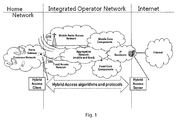
- Figure 1 shows a reference topology for hybrid access, HA, in an underlying heterogeneous network as a possible application scenario of an aspect of the present invention.
- the heterogeneous network comprises different end devices, which are connected over a variety of communication links being joint together for forming a network.
- the network comprises mobile telephone links, for instance provided through LTE devices, along with fixed network links such as the commonly known internet with wired communication links.
- the present invention is furthermore directed towards any communicating end device, which does not only refer to the data consuming end user but also refers to intermediate network components being involved in data routing and transmission.
- HA combines at least two different network links with the same or different network technology, for example it combines the access over the fixed network with the access over the cellular network.
- Figure 1 shows a typical scenario for HA but can also be implemented as an over the top (OTT) solution.
- the HA client has at least two access interfaces, one for example for Digital Subscriber Line (DSL) access and another one for example for access to the Long Term Evolution (LTE) network.
- DSL Digital Subscriber Line
- LTE Long Term Evolution
- the considerations on the HA algorithms are focused on a distributed client-server solution with client functionality in the residential gateway and server functionality (HA Server) in a data center at the network of the operator or in the public Internet.
- An available MBP protocol such as MPTCP can be applied for HA.
- MPTCP is a new proposed standard for a transport layer protocol as an extension to the regular TCP.
- MPTCP enhances network performance, especially if the available throughput on one interface is relatively lower than the application's demand and there is the possibility to use multiple (n) interfaces to maximize the overall output, see Figure 2 .
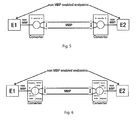
- Figure 2 shows a general architecture for an MBP, where two entities E1 and E2 communicate straight forward over the same protocol. So far no problems arise as both entities share communication capabilities over a common protocol. An incompatibility arises in a scenario where at least one of the communication partners does not support multipath communication.
- the main question that remains to answer at this point is what happens to clients that do not have installed such an MBP for reasons of availability, preference, or any other. That is, how could for example a regular TCP client, who is located behind an MPTCP enabled network, benefit from this aggregating capability.
- Another open question in the art addresses the bundling behavior, which has to be controlled for instance by a Software Defined Network (SDN) in terms of transport scheduling.
- SDN Software Defined Network
- Figure 3 shows an architecture for non MBP enabled endpoints according to an aspect of the present invention.
- Figure 4 shows the case that one of the endpoints is MBP capable.
- MBP does not imply a specific protocol or algorithm; possible protocols can be IP-GRE, ML-PPP, SCTP, MPTCP or other.
- a challenge for the HA scenario is typically when packet-based MBP support is missing within user terminals and Internet servers. To connect them end-to-end and to allow controlled traffic distribution, a conversion function in between is necessary. Moreover, the conversion shall not have any adverse effect on throughput and latency.
- the invention can be applied to any packet-based transport layer protocol (layer 4) or packet-based network layer protocol (layer 3).
- Figure 5 shows a preferred embodiment of a converter device according the present invention.
- the converter device directly converts non MBP traffic into MBP by rewriting and/or introducing header information.
- the converter device directly converts non MBP traffic into MBP traffic by sequencing the header information.
- sequencing means that packets are consecutively numbered and at the receiver side assembled in the correct order.
- the IP address can be manipulated - also known as addressing - and therefore it can be assured that the data flow is guided through the converter device.
- the converter device leaves the payload additionally untouched.
- the converter device keeps track of sessions and flows between one converter connected to one communicating entity E1 and another converter connected to another communicating entity E2.
- one of the major advantages of said converter is that there is no need to change the communicating entities E1 and E2. Rather, an adaption of already present middle boxes may be performed for implementing the subject-matter of the present invention.
- One challenge in this scenario is to transport the converted data to the receiver MBP endpoint. This can be done by attaching/editing routing information or set middle boxes accordingly. This applies in particular to a distributed or dynamic environment with several network segments in between where some communication in advance is necessary or helpful.
- Figure 6 shows a converter device as shown in Fig. 5 , further providing a solution for triggering the MBP.
- the converter device terminates incoming connections in a transparent way, as deputy of the original destination.
- the payload is stripped and put in a newly opened connection in direction to the destination.
- the MBP is automatically triggered when available for the new connection.
- the MBP between both converter devices are automatically triggered when available for the new connection.
- the routing challenge to redirect traffic through the converter device stays the same as described before.
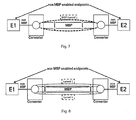
- Figure 7 shows a converter device according to another embodiment of the present invention which can comprise the same features solving the same problems as the converter device shown in any of the preceding embodiments, particularly in the embodiments as shown in Figures 5 and 6 .
- the converter device according as shown in Figure 7 solves the routing problem by using a tunnel solution between the MBP endpoints.
- the tunnel protocol is the same as the MBP protocol. In other words, the tunnel itself is split over several paths by MBP.
- the converter device encapsulates non MBP traffic into the tunnel, which terminates at the receiver MBP endpoint. Thereby the routing problem is inherently solved. Incoming encapsulated tunnel traffic at the converter device is extracted and forwarded to the original destination.
- Figure 8 shows a converter device combining bundling logic and converter functionality.
- the converter is working like in Figure 7 and encapsulates non MBP traffic into a tunnel.
- the packet conversion module transmits the data packets to an endpoint via a plurality of tunnels.
- the packet conversion module transmits a plurality of data packets to an endpoint via a plurality of tunnels whereas in Figure 7 , one tunnel is spanned over the plurality of paths and the tunnel protocol is the same as the MBP protocol.
- the packet conversion module transmits a plurality of data packets to an endpoint via a plurality of paths, wherein each path is tunneled.
- packet conversion module comprises a scheduler unit which schedules a plurality of data packets to be transmitted over the multipath interface to the respective tunnel of the plurality of tunnels.
- which tunnel is used for transferring is decided by a built-in scheduler unit.
- the scheduler can be fed by tunnel connection information.
- the present invention is directed towards a device, a method, a bundling converter server, a telecommunication system and a computer-readable medium for allowing packet-based multipath bundling in a communication network, which enriches the known art.
Landscapes
- Engineering & Computer Science (AREA)
- Computer Networks & Wireless Communication (AREA)
- Signal Processing (AREA)
- Computer Security & Cryptography (AREA)
- Data Exchanges In Wide-Area Networks (AREA)
- Communication Control (AREA)
Applications Claiming Priority (1)
| Application Number | Priority Date | Filing Date | Title |
|---|---|---|---|
| EP15177150 | 2015-07-16 |
Publications (1)
| Publication Number | Publication Date |
|---|---|
| EP3119057A1 true EP3119057A1 (fr) | 2017-01-18 |
Family
ID=53719664
Family Applications (1)
| Application Number | Title | Priority Date | Filing Date |
|---|---|---|---|
| EP16179710.5A Withdrawn EP3119057A1 (fr) | 2015-07-16 | 2016-07-15 | Dispositif de conversion de paquets et procédé permettant le groupage par trajets multiples à base de paquets |
Country Status (1)
| Country | Link |
|---|---|
| EP (1) | EP3119057A1 (fr) |
Cited By (8)
| Publication number | Priority date | Publication date | Assignee | Title |
|---|---|---|---|---|
| EP3522479A1 (fr) * | 2018-02-06 | 2019-08-07 | Deutsche Telekom AG | Techniques de transmission multivoie efficace |
| EP3544363A1 (fr) * | 2018-03-19 | 2019-09-25 | Deutsche Telekom AG | Techniques de groupage par trajets multiples et détermination des connexions wi-fi pour le groupage par trajets multiples |
| EP3678332A4 (fr) * | 2017-09-30 | 2020-10-28 | Huawei Technologies Co., Ltd. | Procédé, appareil et support d'informations pour déterminer une qualité de service |
| CN112422421A (zh) * | 2020-11-23 | 2021-02-26 | 北京交通大学 | 一种异构网络的多路径数据包传输方法 |
| CN112586086A (zh) * | 2018-08-22 | 2021-03-30 | 特萨雷斯股份有限公司 | 多路径接入网 |
| CN112968843A (zh) * | 2021-02-03 | 2021-06-15 | 长春理工大学 | 基于sdn的多路径传输控制系统及方法 |
| EP4246937A1 (fr) | 2022-03-15 | 2023-09-20 | Deutsche Telekom AG | Proxy mp-dccp pour permettre la transmission par trajets multiples de paquets de données dccp entre un émetteur et un récepteur |
| CN117897943A (zh) * | 2021-08-31 | 2024-04-16 | 德国电信股份有限公司 | 用于通过灵活选择网络协议来提供通用多径系统的技术 |
Citations (4)
| Publication number | Priority date | Publication date | Assignee | Title |
|---|---|---|---|---|
| US20120093150A1 (en) * | 2010-10-15 | 2012-04-19 | Telefonaktiebolaget L M Ericsson | Multipath transmission control protocol proxy |
| EP2538637A2 (fr) * | 2011-06-22 | 2012-12-26 | Telefonaktiebolaget L M Ericsson (publ) | Service de proxy à protocole de contrôle de transmission par trajets multiples |
| US20130195004A1 (en) * | 2012-01-31 | 2013-08-01 | Karl Georg Hampel | Method and apparatus for multipath protocol packet relay |
| EP2624509A2 (fr) * | 2010-04-06 | 2013-08-07 | Qualcomm Incorporated | Agrégation de bande passante coopérative à l'aide de transport par trajets multiples |
-
2016
- 2016-07-15 EP EP16179710.5A patent/EP3119057A1/fr not_active Withdrawn
Patent Citations (4)
| Publication number | Priority date | Publication date | Assignee | Title |
|---|---|---|---|---|
| EP2624509A2 (fr) * | 2010-04-06 | 2013-08-07 | Qualcomm Incorporated | Agrégation de bande passante coopérative à l'aide de transport par trajets multiples |
| US20120093150A1 (en) * | 2010-10-15 | 2012-04-19 | Telefonaktiebolaget L M Ericsson | Multipath transmission control protocol proxy |
| EP2538637A2 (fr) * | 2011-06-22 | 2012-12-26 | Telefonaktiebolaget L M Ericsson (publ) | Service de proxy à protocole de contrôle de transmission par trajets multiples |
| US20130195004A1 (en) * | 2012-01-31 | 2013-08-01 | Karl Georg Hampel | Method and apparatus for multipath protocol packet relay |
Non-Patent Citations (2)
| Title |
|---|
| "Satellite Earth Stations and Systems (SES); Multi-link TCP routing for hybrid FSS satellite/terrestrial network architecture [Release #] [ ];ETSI TR 1xx xxx", ETSI DRAFT; ETSI TR 1XX XXX, EUROPEAN TELECOMMUNICATIONS STANDARDS INSTITUTE (ETSI), 650, ROUTE DES LUCIOLES ; F-06921 SOPHIA-ANTIPOLIS ; FRANCE, vol. SES, no. V<m.t.e>, 13 May 2015 (2015-05-13), pages 1 - 17, XP014245226 * |
| COSTIN RAICIU ET AL: "Good Cop, Bad Cop: Forcing Middleboxes to Cooperate", 27 January 2015 (2015-01-27), XP055311132, Retrieved from the Internet <URL:https://www.iab.org/wp-content/IAB-uploads/2014/12/semi2015_raiciu.pdf> [retrieved on 20161017] * |
Cited By (20)
| Publication number | Priority date | Publication date | Assignee | Title |
|---|---|---|---|---|
| EP3678332A4 (fr) * | 2017-09-30 | 2020-10-28 | Huawei Technologies Co., Ltd. | Procédé, appareil et support d'informations pour déterminer une qualité de service |
| US11405489B2 (en) | 2017-09-30 | 2022-08-02 | Huawei Technologies Co., Ltd. | Method and apparatus for determining quality of service, and storage medium |
| CN111699666B (zh) * | 2018-02-06 | 2022-01-28 | 德国电信股份有限公司 | 用于高效多径传输的技术 |
| EP3522479A1 (fr) * | 2018-02-06 | 2019-08-07 | Deutsche Telekom AG | Techniques de transmission multivoie efficace |
| CN111699666A (zh) * | 2018-02-06 | 2020-09-22 | 德国电信股份有限公司 | 用于高效多径传输的技术 |
| WO2019154763A1 (fr) * | 2018-02-06 | 2019-08-15 | Deutsche Telekom Ag | Techniques de transmission par trajets multiples efficace |
| US11159423B2 (en) | 2018-02-06 | 2021-10-26 | Deutsche Telekom Ag | Techniques for efficient multipath transmission |
| EP3544363A1 (fr) * | 2018-03-19 | 2019-09-25 | Deutsche Telekom AG | Techniques de groupage par trajets multiples et détermination des connexions wi-fi pour le groupage par trajets multiples |
| US11700657B2 (en) | 2018-03-19 | 2023-07-11 | Deutsche Telekom Ag | Techniques for multipath bundling and determining Wi-Fi connections for multipath bundling |
| WO2019179801A1 (fr) * | 2018-03-19 | 2019-09-26 | Deutsche Telekom Ag | Techniques de regroupement de trajets multiples et de détermination de connexions wi-fi pour un regroupement de trajets multiples |
| CN112586086A (zh) * | 2018-08-22 | 2021-03-30 | 特萨雷斯股份有限公司 | 多路径接入网 |
| CN112422421A (zh) * | 2020-11-23 | 2021-02-26 | 北京交通大学 | 一种异构网络的多路径数据包传输方法 |
| CN112968843A (zh) * | 2021-02-03 | 2021-06-15 | 长春理工大学 | 基于sdn的多路径传输控制系统及方法 |
| CN112968843B (zh) * | 2021-02-03 | 2023-02-28 | 长春理工大学 | 基于sdn的多路径传输控制系统及方法 |
| CN117897943A (zh) * | 2021-08-31 | 2024-04-16 | 德国电信股份有限公司 | 用于通过灵活选择网络协议来提供通用多径系统的技术 |
| US20240275870A1 (en) * | 2021-08-31 | 2024-08-15 | Deutsche Telekom Ag | Techniques for providing a generic multipath system by a flexible selection of network protocols |
| US12212640B2 (en) * | 2021-08-31 | 2025-01-28 | Deutsche Telekom Ag | Techniques for providing a generic multipath system by a flexible selection of network protocols |
| EP4246937A1 (fr) | 2022-03-15 | 2023-09-20 | Deutsche Telekom AG | Proxy mp-dccp pour permettre la transmission par trajets multiples de paquets de données dccp entre un émetteur et un récepteur |
| WO2023174865A1 (fr) | 2022-03-15 | 2023-09-21 | Deutsche Telekom Ag | Mandataire mp-dccp pour permettre une transmission par trajets multiples de paquets de données dccp entre un expéditeur et un récepteur |
| US12526226B2 (en) | 2022-03-15 | 2026-01-13 | Deutsche Telekom Ag | MP-DCCP proxy to enable multipath transmission of DCCP data packets between a sender and a receiver |
Similar Documents
| Publication | Publication Date | Title |
|---|---|---|
| EP3119057A1 (fr) | Dispositif de conversion de paquets et procédé permettant le groupage par trajets multiples à base de paquets | |
| EP3522479B1 (fr) | Techniques de transmission multivoie efficace | |
| US11343192B2 (en) | Packet processing method, and device | |
| CN105765919B (zh) | 用于传输和接收包的方法和系统 | |
| EP3820088B1 (fr) | Procédé et dispositif de réseau pour communication par trajets multiples | |
| CN105814941B (zh) | 用于多连接通信的一体化子层 | |
| CN102812748B (zh) | 移动宽带分组交换流量优化 | |
| KR102442083B1 (ko) | Tcp 터널들 및 고유 tcp 정보를 기초로 하는 번들링 시나리오에서 패킷들의 스케줄링을 위한 방법 및 시스템 | |
| CN109120540B (zh) | 传输报文的方法、代理服务器和计算机可读存储介质 | |
| US11240858B2 (en) | Traffic steering for stateless packets over multipath networks | |
| CN114128228A (zh) | 通过SRv6头传输MTNC-ID以实现5G传输 | |
| CN114710975A (zh) | 多域间传输多传输网络上下文标识 | |
| CN111788812A (zh) | 用于分组数据转换的技术 | |
| EP3125472A1 (fr) | Système de télécommunication, procédé et support lisible par ordinateur pour commander la manière dont une transmission de paquets d'un flux de données est réalisée | |
| CA2997246A1 (fr) | Solution de transport de donnees hybrides, en particulier destinee a des liens satellites | |
| CN112585910B (zh) | 在广域网中建立安全、低延迟、优化路径的方法和装置 | |
| CN119999173A (zh) | 高性能通信链路和操作方法 | |
| JP4189965B2 (ja) | 通信ノード | |
| US11082255B1 (en) | Method and an apparatus for establishing secure, low latency, optimized paths in a wide area network | |
| US20250175544A1 (en) | Encapsulated internet protocol transport data packets communicated in cable networks | |
| HK40014808A (en) | Methods and systems for transmitting and receiving packets | |
| HK40060989B (en) | A method and an apparatus for establishing secure, low latency, optimized paths in a wide area network | |
| HK40060989A (en) | A method and an apparatus for establishing secure, low latency, optimized paths in a wide area network |
Legal Events
| Date | Code | Title | Description |
|---|---|---|---|
| PUAI | Public reference made under article 153(3) epc to a published international application that has entered the european phase |
Free format text: ORIGINAL CODE: 0009012 |
|
| AK | Designated contracting states |
Kind code of ref document: A1 Designated state(s): AL AT BE BG CH CY CZ DE DK EE ES FI FR GB GR HR HU IE IS IT LI LT LU LV MC MK MT NL NO PL PT RO RS SE SI SK SM TR |
|
| AX | Request for extension of the european patent |
Extension state: BA ME |
|
| 17P | Request for examination filed |
Effective date: 20170718 |
|
| RBV | Designated contracting states (corrected) |
Designated state(s): AL AT BE BG CH CY CZ DE DK EE ES FI FR GB GR HR HU IE IS IT LI LT LU LV MC MK MT NL NO PL PT RO RS SE SI SK SM TR |
|
| 17Q | First examination report despatched |
Effective date: 20170828 |
|
| STAA | Information on the status of an ep patent application or granted ep patent |
Free format text: STATUS: THE APPLICATION IS DEEMED TO BE WITHDRAWN |
|
| 18D | Application deemed to be withdrawn |
Effective date: 20181030 |