EP3120695A1 - Orge résistant aux herbicides - Google Patents
Orge résistant aux herbicides Download PDFInfo
- Publication number
- EP3120695A1 EP3120695A1 EP16185759.4A EP16185759A EP3120695A1 EP 3120695 A1 EP3120695 A1 EP 3120695A1 EP 16185759 A EP16185759 A EP 16185759A EP 3120695 A1 EP3120695 A1 EP 3120695A1
- Authority
- EP
- European Patent Office
- Prior art keywords
- barley
- imidazolinone
- plant
- ncimb
- crop
- Prior art date
- Legal status (The legal status is an assumption and is not a legal conclusion. Google has not performed a legal analysis and makes no representation as to the accuracy of the status listed.)
- Withdrawn
Links
- 239000004009 herbicide Substances 0.000 title claims abstract description 68
- 235000007340 Hordeum vulgare Nutrition 0.000 title claims abstract description 42
- 230000002363 herbicidal effect Effects 0.000 title claims description 41
- 240000005979 Hordeum vulgare Species 0.000 title description 69
- 241000196324 Embryophyta Species 0.000 claims abstract description 66
- CAAMSDWKXXPUJR-UHFFFAOYSA-N 3,5-dihydro-4H-imidazol-4-one Chemical compound O=C1CNC=N1 CAAMSDWKXXPUJR-UHFFFAOYSA-N 0.000 claims abstract description 52
- 238000000034 method Methods 0.000 claims abstract description 23
- 241000209219 Hordeum Species 0.000 claims abstract description 17
- 230000012010 growth Effects 0.000 claims abstract description 15
- CLQMBPJKHLGMQK-UHFFFAOYSA-N 2-(4-isopropyl-4-methyl-5-oxo-4,5-dihydro-1H-imidazol-2-yl)nicotinic acid Chemical compound N1C(=O)C(C(C)C)(C)N=C1C1=NC=CC=C1C(O)=O CLQMBPJKHLGMQK-UHFFFAOYSA-N 0.000 claims description 23
- NUPJIGQFXCQJBK-UHFFFAOYSA-N 2-(4-isopropyl-4-methyl-5-oxo-4,5-dihydro-1H-imidazol-2-yl)-5-(methoxymethyl)nicotinic acid Chemical compound OC(=O)C1=CC(COC)=CN=C1C1=NC(C)(C(C)C)C(=O)N1 NUPJIGQFXCQJBK-UHFFFAOYSA-N 0.000 claims description 17
- 239000005566 Imazamox Substances 0.000 claims description 17
- 238000004519 manufacturing process Methods 0.000 claims description 13
- PVSGXWMWNRGTKE-UHFFFAOYSA-N 5-methyl-2-[4-methyl-5-oxo-4-(propan-2-yl)-4,5-dihydro-1H-imidazol-2-yl]pyridine-3-carboxylic acid Chemical compound N1C(=O)C(C(C)C)(C)N=C1C1=NC=C(C)C=C1C(O)=O PVSGXWMWNRGTKE-UHFFFAOYSA-N 0.000 claims description 9
- 238000009331 sowing Methods 0.000 claims description 4
- 230000002401 inhibitory effect Effects 0.000 abstract description 7
- 150000007523 nucleic acids Chemical class 0.000 abstract description 6
- 108091028043 Nucleic acid sequence Proteins 0.000 abstract description 5
- 108020004707 nucleic acids Proteins 0.000 abstract description 2
- 102000039446 nucleic acids Human genes 0.000 abstract description 2
- 108090000623 proteins and genes Proteins 0.000 description 21
- 230000035772 mutation Effects 0.000 description 11
- 238000011156 evaluation Methods 0.000 description 10
- 235000013339 cereals Nutrition 0.000 description 8
- 108020004414 DNA Proteins 0.000 description 6
- MTCFGRXMJLQNBG-UHFFFAOYSA-N Serine Natural products OCC(N)C(O)=O MTCFGRXMJLQNBG-UHFFFAOYSA-N 0.000 description 5
- 235000001014 amino acid Nutrition 0.000 description 5
- 229940024606 amino acid Drugs 0.000 description 5
- 150000001413 amino acids Chemical class 0.000 description 5
- 238000002703 mutagenesis Methods 0.000 description 5
- 231100000350 mutagenesis Toxicity 0.000 description 5
- 108010000700 Acetolactate synthase Proteins 0.000 description 4
- DCXYFEDJOCDNAF-UHFFFAOYSA-N Asparagine Natural products OC(=O)C(N)CC(N)=O DCXYFEDJOCDNAF-UHFFFAOYSA-N 0.000 description 4
- DCXYFEDJOCDNAF-REOHCLBHSA-N L-asparagine Chemical compound OC(=O)[C@@H](N)CC(N)=O DCXYFEDJOCDNAF-REOHCLBHSA-N 0.000 description 4
- 229960001230 asparagine Drugs 0.000 description 4
- 235000009582 asparagine Nutrition 0.000 description 4
- 238000002474 experimental method Methods 0.000 description 4
- 238000004890 malting Methods 0.000 description 4
- 230000010076 replication Effects 0.000 description 4
- 238000012163 sequencing technique Methods 0.000 description 4
- 241000894007 species Species 0.000 description 4
- 238000011282 treatment Methods 0.000 description 4
- PLUBXMRUUVWRLT-UHFFFAOYSA-N Ethyl methanesulfonate Chemical compound CCOS(C)(=O)=O PLUBXMRUUVWRLT-UHFFFAOYSA-N 0.000 description 3
- GXCLVBGFBYZDAG-UHFFFAOYSA-N N-[2-(1H-indol-3-yl)ethyl]-N-methylprop-2-en-1-amine Chemical compound CN(CCC1=CNC2=C1C=CC=C2)CC=C GXCLVBGFBYZDAG-UHFFFAOYSA-N 0.000 description 3
- 230000004075 alteration Effects 0.000 description 3
- 230000008859 change Effects 0.000 description 3
- 238000013461 design Methods 0.000 description 3
- 102000054766 genetic haplotypes Human genes 0.000 description 3
- 230000000877 morphologic effect Effects 0.000 description 3
- 235000018102 proteins Nutrition 0.000 description 3
- 102000004169 proteins and genes Human genes 0.000 description 3
- 239000000523 sample Substances 0.000 description 3
- 240000002791 Brassica napus Species 0.000 description 2
- 235000011293 Brassica napus Nutrition 0.000 description 2
- 241000209202 Bromus secalinus Species 0.000 description 2
- 108090000790 Enzymes Proteins 0.000 description 2
- 102000004190 Enzymes Human genes 0.000 description 2
- XVOKUMIPKHGGTN-UHFFFAOYSA-N Imazethapyr Chemical compound OC(=O)C1=CC(CC)=CN=C1C1=NC(C)(C(C)C)C(=O)N1 XVOKUMIPKHGGTN-UHFFFAOYSA-N 0.000 description 2
- 241001465754 Metazoa Species 0.000 description 2
- 230000003321 amplification Effects 0.000 description 2
- 230000001364 causal effect Effects 0.000 description 2
- 238000006243 chemical reaction Methods 0.000 description 2
- 239000002131 composite material Substances 0.000 description 2
- 235000013305 food Nutrition 0.000 description 2
- 231100000053 low toxicity Toxicity 0.000 description 2
- 230000000869 mutational effect Effects 0.000 description 2
- 238000007857 nested PCR Methods 0.000 description 2
- 238000003199 nucleic acid amplification method Methods 0.000 description 2
- 239000002773 nucleotide Substances 0.000 description 2
- 125000003729 nucleotide group Chemical group 0.000 description 2
- 238000002864 sequence alignment Methods 0.000 description 2
- 239000002689 soil Substances 0.000 description 2
- 239000000126 substance Substances 0.000 description 2
- YROXIXLRRCOBKF-UHFFFAOYSA-N sulfonylurea Chemical compound OC(=N)N=S(=O)=O YROXIXLRRCOBKF-UHFFFAOYSA-N 0.000 description 2
- 208000024891 symptom Diseases 0.000 description 2
- 230000007704 transition Effects 0.000 description 2
- 230000000007 visual effect Effects 0.000 description 2
- CABMTIJINOIHOD-UHFFFAOYSA-N 2-[4-methyl-5-oxo-4-(propan-2-yl)-4,5-dihydro-1H-imidazol-2-yl]quinoline-3-carboxylic acid Chemical compound N1C(=O)C(C(C)C)(C)N=C1C1=NC2=CC=CC=C2C=C1C(O)=O CABMTIJINOIHOD-UHFFFAOYSA-N 0.000 description 1
- FWMNVWWHGCHHJJ-SKKKGAJSSA-N 4-amino-1-[(2r)-6-amino-2-[[(2r)-2-[[(2r)-2-[[(2r)-2-amino-3-phenylpropanoyl]amino]-3-phenylpropanoyl]amino]-4-methylpentanoyl]amino]hexanoyl]piperidine-4-carboxylic acid Chemical compound C([C@H](C(=O)N[C@H](CC(C)C)C(=O)N[C@H](CCCCN)C(=O)N1CCC(N)(CC1)C(O)=O)NC(=O)[C@H](N)CC=1C=CC=CC=1)C1=CC=CC=C1 FWMNVWWHGCHHJJ-SKKKGAJSSA-N 0.000 description 1
- 108700028369 Alleles Proteins 0.000 description 1
- 108020004705 Codon Proteins 0.000 description 1
- 238000001712 DNA sequencing Methods 0.000 description 1
- 241000282412 Homo Species 0.000 description 1
- 239000005981 Imazaquin Substances 0.000 description 1
- 244000061176 Nicotiana tabacum Species 0.000 description 1
- 235000002637 Nicotiana tabacum Nutrition 0.000 description 1
- 240000007594 Oryza sativa Species 0.000 description 1
- 235000007164 Oryza sativa Nutrition 0.000 description 1
- 238000012408 PCR amplification Methods 0.000 description 1
- 241000036195 Temora Species 0.000 description 1
- 241000209140 Triticum Species 0.000 description 1
- 235000021307 Triticum Nutrition 0.000 description 1
- 244000098338 Triticum aestivum Species 0.000 description 1
- 240000008042 Zea mays Species 0.000 description 1
- 235000007244 Zea mays Nutrition 0.000 description 1
- 238000010521 absorption reaction Methods 0.000 description 1
- 230000009471 action Effects 0.000 description 1
- 230000002411 adverse Effects 0.000 description 1
- 239000011543 agarose gel Substances 0.000 description 1
- 238000013459 approach Methods 0.000 description 1
- 230000008901 benefit Effects 0.000 description 1
- 239000002551 biofuel Substances 0.000 description 1
- 230000015572 biosynthetic process Effects 0.000 description 1
- 238000009395 breeding Methods 0.000 description 1
- 230000001488 breeding effect Effects 0.000 description 1
- 210000004027 cell Anatomy 0.000 description 1
- 238000004891 communication Methods 0.000 description 1
- 238000010835 comparative analysis Methods 0.000 description 1
- 150000001875 compounds Chemical class 0.000 description 1
- 244000038559 crop plants Species 0.000 description 1
- 230000002939 deleterious effect Effects 0.000 description 1
- 238000011161 development Methods 0.000 description 1
- 230000003628 erosive effect Effects 0.000 description 1
- 230000002068 genetic effect Effects 0.000 description 1
- 230000007614 genetic variation Effects 0.000 description 1
- MTNDZQHUAFNZQY-UHFFFAOYSA-N imidazoline Chemical compound C1CN=CN1 MTNDZQHUAFNZQY-UHFFFAOYSA-N 0.000 description 1
- 230000000670 limiting effect Effects 0.000 description 1
- 239000000463 material Substances 0.000 description 1
- 230000007246 mechanism Effects 0.000 description 1
- 230000002503 metabolic effect Effects 0.000 description 1
- 235000015097 nutrients Nutrition 0.000 description 1
- 210000000056 organ Anatomy 0.000 description 1
- 230000035479 physiological effects, processes and functions Effects 0.000 description 1
- 238000004161 plant tissue culture Methods 0.000 description 1
- 108091033319 polynucleotide Proteins 0.000 description 1
- 102000040430 polynucleotide Human genes 0.000 description 1
- 239000002157 polynucleotide Substances 0.000 description 1
- 230000008569 process Effects 0.000 description 1
- 230000009467 reduction Effects 0.000 description 1
- 230000002829 reductive effect Effects 0.000 description 1
- 239000013074 reference sample Substances 0.000 description 1
- 230000000717 retained effect Effects 0.000 description 1
- 230000002441 reversible effect Effects 0.000 description 1
- 150000003839 salts Chemical class 0.000 description 1
- 238000012216 screening Methods 0.000 description 1
- -1 serine amino acid Chemical class 0.000 description 1
- 150000003355 serines Chemical class 0.000 description 1
- 238000001228 spectrum Methods 0.000 description 1
- 238000010561 standard procedure Methods 0.000 description 1
- 238000003786 synthesis reaction Methods 0.000 description 1
- 238000012360 testing method Methods 0.000 description 1
- 210000001519 tissue Anatomy 0.000 description 1
- 230000005945 translocation Effects 0.000 description 1
- 230000009105 vegetative growth Effects 0.000 description 1
- XLYOFNOQVPJJNP-UHFFFAOYSA-N water Substances O XLYOFNOQVPJJNP-UHFFFAOYSA-N 0.000 description 1
Images


Classifications
-
- A—HUMAN NECESSITIES
- A01—AGRICULTURE; FORESTRY; ANIMAL HUSBANDRY; HUNTING; TRAPPING; FISHING
- A01G—HORTICULTURE; CULTIVATION OF VEGETABLES, FLOWERS, RICE, FRUIT, VINES, HOPS OR SEAWEED; FORESTRY; WATERING
- A01G22/00—Cultivation of specific crops or plants not otherwise provided for
-
- A—HUMAN NECESSITIES
- A01—AGRICULTURE; FORESTRY; ANIMAL HUSBANDRY; HUNTING; TRAPPING; FISHING
- A01H—NEW PLANTS OR NON-TRANSGENIC PROCESSES FOR OBTAINING THEM; PLANT REPRODUCTION BY TISSUE CULTURE TECHNIQUES
- A01H1/00—Processes for modifying genotypes ; Plants characterised by associated natural traits
- A01H1/06—Processes for producing mutations, e.g. treatment with chemicals or with radiation
-
- A—HUMAN NECESSITIES
- A01—AGRICULTURE; FORESTRY; ANIMAL HUSBANDRY; HUNTING; TRAPPING; FISHING
- A01H—NEW PLANTS OR NON-TRANSGENIC PROCESSES FOR OBTAINING THEM; PLANT REPRODUCTION BY TISSUE CULTURE TECHNIQUES
- A01H5/00—Angiosperms, i.e. flowering plants, characterised by their plant parts; Angiosperms characterised otherwise than by their botanic taxonomy
- A01H5/10—Seeds
-
- A—HUMAN NECESSITIES
- A01—AGRICULTURE; FORESTRY; ANIMAL HUSBANDRY; HUNTING; TRAPPING; FISHING
- A01H—NEW PLANTS OR NON-TRANSGENIC PROCESSES FOR OBTAINING THEM; PLANT REPRODUCTION BY TISSUE CULTURE TECHNIQUES
- A01H6/00—Angiosperms, i.e. flowering plants, characterised by their botanic taxonomy
- A01H6/46—Gramineae or Poaceae, e.g. ryegrass, rice, wheat or maize
- A01H6/4624—Hordeum vulgarus [barley]
-
- A—HUMAN NECESSITIES
- A01—AGRICULTURE; FORESTRY; ANIMAL HUSBANDRY; HUNTING; TRAPPING; FISHING
- A01N—PRESERVATION OF BODIES OF HUMANS OR ANIMALS OR PLANTS OR PARTS THEREOF; BIOCIDES, e.g. AS DISINFECTANTS, AS PESTICIDES OR AS HERBICIDES; PEST REPELLANTS OR ATTRACTANTS; PLANT GROWTH REGULATORS
- A01N43/00—Biocides, pest repellants or attractants, or plant growth regulators containing heterocyclic compounds
- A01N43/48—Biocides, pest repellants or attractants, or plant growth regulators containing heterocyclic compounds having rings with two nitrogen atoms as the only ring hetero atoms
- A01N43/50—1,3-Diazoles; Hydrogenated 1,3-diazoles
Definitions
- the present invention relates to grain plants having herbicide resistance or tolerance. More specifically the present invention relates to herbicide resistant barley plants.
- Herbicides play an important role in modem agriculture by maximising grain production, pasture production, quality and profitability. Herbicides allow undesirable plants to be killed or suppressed and thereby reduce competition with desirable plants such as crop plants for nutrients, water and the like.
- Imidazolinone and sulphonylurea herbicides inhibit the growth and development of susceptible plants, including a wide range of weeds, by inhibiting the plant enzyme Acetohydroxy acid synthase (AHAS), also known as acetolactate synthase (ALS). AHAS synthesises branch chain amino acids, a key function in plants. Importantly, imidazolinone and sulphonylurea herbicides also have relatively low toxicity to animals, including humans.
- AHAS Acetohydroxy acid synthase
- ALS acetolactate synthase
- Imidazolinones include the following compounds imazethapyr, imazaquin, imazapyr, imazapic, imazamox and the like.
- imidazolinone herbicides include ON DUTY® (imazapic + imazapyr) INTERVIX® (imazamox + imazapyr) SPINNAKER® (imazethapyr), RAPTOR® (imazamox) and FLAME® (imazapic).
- Barley Hordeum vulgare is an important grain crop internationally because it is used in malt production, brewing and for human and animal feed. It has the advantage of being more salt tolerant than wheat and can be grown successfully on poorer quality land and/or in drier environments.
- Weed control is a major issue in barley production.
- Good chemical weed control is desirable to maximise production of the crop and limit the need for mechanical cultivation and resultant damage to soil structure and erosion.
- this herbicide can be applied post emergence to growing barley crops, however, imidazolinones cannot be applied post emergence because barley is susceptible to this class of herbicides. Further, the crop cannot even be sown into soil containing imidazolinones because of its susceptibility to this herbicide.
- the invention provides a non-naturally occurring barley plant which has increased resistance to herbicides compared with the wild type barley.
- the invention also provides a seed of the non-naturally occurring barley plant.
- the invention provides a method of inhibiting weed growth in the vicinity of a barley plant comprising growing a barley plant with increased resistance to a herbicide compared to a wild type barley plant and applying under suitable conditions imidazolinone to said barley plant with increased resistance and its vicinity sufficient to inhibit weed growth.
- the invention also relates to a method of growing a barley crop comprising sowing the seeds of the invention and cultivating the seeds and resultant plants under suitable conditions to produce a crop.
- the invention provides a non-naturally occurring barley plant which has increased resistance to herbicides compared to wild type barley, particularly resistance to imidazolinone herbicides. Progeny of the barley plants and descendants having the increased herbicide resistance trait or characteristic are also included in the invention. The invention also includes hybrids of the barley plants of the invention.
- non-naturally occurring refers to a plant which does not occur in nature and is the result of human intervention.
- the plants are produced by mutagenesis, more preferably chemically induced mutagenesis.
- barley plant refers to the species Hordeum vulgare in its total genetic variation and its many varieties such as Buloke and Hindmarsh, and to related species within the Hordeum genus.
- the invention further provides a seed of the non-naturally occurring barley plant which has increased resistance to herbicides, particularly imidazolinone herbicides.
- the increased herbicide resistance developed by the present inventors results from changes to the physiology and/or biochemistry of the plant and thus interferes with the normal action of the herbicide. This may involve altered absorption and/or translocation of the herbicide or altered ability of metabolic enzymes to bind the herbicide.
- the invention extends to the altered elements in the plant that confer herbicide resistance including altered gene(s) and/or protein(s) including enzymes, which genes and proteins are altered compared to their counterparts in herbicide sensitive barley plants.
- said altered genes and/or proteins are in isolated or substantially purified form.
- the plants and seeds of the invention include plants and seeds that are mutations, recombinant variants and genetically engineered derivatives or derivatives derived by other means such as conventional breeding, which retain the altered elements described above.
- the invention also extends to plant parts other than seeds of the herbicide resistant barley, including plant cells, plant tissues and plant organs whether produced by plant tissue culture or otherwise.
- the seeds of the invention are VBHT 0802, VBHT 0803, VBHT 0805, VBHT 0806, VBHT 0807, VBHT 0809 or VBHT0810 as described herein or are plants derived from these seeds.
- the invention also provides seeds or plants which are mutants, derivatives and variants thereof having increased imidazolinone resistance compared to wild type barley plants.
- the invention also provides a method of inhibiting weed growth in the vicinity of a barley plant comprising growing a barley plant with increased resistance to a herbicide compared to a wild type barley plant and applying under suitable conditions imidazolinone to said barley plant and vicinity sufficient to inhibit weed growth.
- the invention also relates to a method of inhibiting weed growth in a barley crop said method comprising growing a herbicide resistant barley crop and applying a imidazolinone herbicide to said crop under suitable conditions to inhibit weed growth.
- the imidazolinone may be used as a combination of imazamox and imazapyr at a rate of 12.375 g per hectare and 5.625 g per hectare respectively; 24.75 and 11.25 g per hectare respectively; 41.25 and 18.75 g per hectare respectively or 49.5 and 22.5 g per hectare respectively.
- the imidazolinone may be used as a combination of imazapic and imazapyr at a rate of 26.25 and 8.75 g per hectare respectively or 42 and 14 g per hectare respectively.
- the invention also relates to a method of growing a barley crop comprising sowing the seed of the invention and cultivating the seed and resultant plant under suitable conditions to produce a crop.
- the herbicide resistant barley used for the crop is produced by mutagenesis, more preferably chemical mutagenesis.
- the herbicide resistant crop is, or is derived from, NCIMB 41547, NCIMB 41548, NCIMB 41549, NCIMB 41550 or NCIMB 41551 or has the herbicide resistant characteristics thereof.
- Mutated barley seed from Example 1 was sown in a plot of 0.5ha at Horsham, Victoria, Australia in 2006. Management was consistent with those recommended for barley in the region. At maturity the plot was harvested by an experimental plot harvester. 300g samples were taken from each full seed bin and bulked together to form a representative smaller composite (150kg) and remaining seed was bulked together as a composite sample (600kg).
- Example 4 Preliminary evaluation of M2 selections for resistance to Imidazolinone herbicides.
- BULOKE-EMS05*06HI001 The ten plants with the largest dry matter and seed yield from Example 3 were identified and designated BULOKE-EMS05*06HI001, BULOKE-EMS05*06HI002, BULOKE-EMS05*06HI003, BULOKE-EMS05*06HI004, BULOKE-EMS05*06HI005, BULOKE-EMS05*06HI006, BULOKE-EMS05*06HI007, BULOKE-EMS05*06HI008, BULOKE-EMS05*06HI009, BULOKE-EMS05*06HI010.
- Example 4 Seed from single plants selected in the glasshouse (Example 4) were sown in 5m paired rows at Horsham, Victoria, Australia, in 2007 and sprayed with 0.75L/ha of Intervix ® (a.i. Imazamox 33grams/kg + Imazapyr 15 grams/kg) post emergence and rows that were visually unaffected by the herbicide were harvested for further evaluation (data not presented). Homozygous imidazolinone_resistant lines VBHT0803 and VBHT0806 were identified and submitted to NCIMB.
- the imidazolinone resistance of the mutated lines VBHT 0802, VBHT0805, VBHT0806, and VBHT0810 were compared to the wild type lines Buloke and Hindmarsh in experiments at Horsham, Victoria, Australia in 2007 and 2008 and Marinna, NSW, Australia in 2008. At Horsham the experiments were sown in a split plot design with 2 replications in 2007 and 3 replications in 2008, and at Marinna a factorial design was used with 3 replications. At Horsham genotypes (Selections) were allocated as subplots and herbicide treatment as mainplots Herbicide treatments were:
- VBHT 0802, VBHT0805, VBHT0806 or VBHT0810 are all derived from Buloke that was treated with EMS and clearly exhibit improved resistance to Intervix ® at rates from 0.375L/ha(a.i. 12.375g imazamox + 5.625g imazapyr) to 1.5L/ha (a.i. 49.5g imazamox + 22.5g imazapyr) compared to the wild type parent Buloke and the cultivar Hindmarsh.
- VBHT0805 and VBHT0802 had the highest yields across all sites and averaged 4% higher than Buloke indicating that the mutation process had not cause deleterious mutations that significantly affect grain yield in Australia.
- VBHT0806 was 4% lower yielding than Buloke.
- VBHT0802, VBHT0803, VBHT0805, VBHT0806, VBHT0807, VBHT0809 and VBHT0810 were compared with the wild type Buloke.
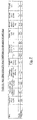
- Table 7 describes the distinctive morphological and DNA characteristics identified.
- VBHT0803 differs from Buloke in having purple awns and is shorter than Buloke but not a dwarf.
- VBHT0809 has purple awns and is a dwarf plant with a prostrate vegetative growth habit.
- VBHT0805, VBHT0807 and VBHT0810 have identical haplotypes suggestive of being derivatives of a single mutational event.
- VBHT0802, VBHT0803, VBHT0806 and VBHT0809 all have unique haplotypes that is likely to be due to the heterogeneity within the original Buloke sample used for the mutagenesis and indicates that each represents a unique mutational event for resistance to imidazolinone herbicides.
- the haplotypes of VBHT0805, VBHT0807 and VBHT0810 differed from the Buloke reference sample (VB0105*12) at 41 of 1424 single polynucleotide polymorphism (SNP) loci.
- Example 8 DNA sequencing of the AHAS gene of imidazolinone resistant mutant barley lines.
- Mutant lines of barley ( Hordeum vulgare L. ) screened for resistance to the herbicide imidazolinone and identified as containing resistance determinants as per the previous examples were tested to confirm and characterise the mutant lines, the suspected mutant alleles of the acetohydroxyacid synthase (AHAS) gene, and resequenced to identify DNA base changes.
- the DNA sequences were collated and compared to wild type sequences and known mutations.
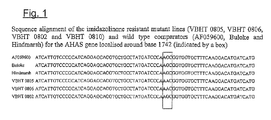
- the plant material consisted of the wild type genotypes, Buloke along with 4 mutant lines derived from Buloke numbered VBHT0802 (NCIMB 41547), VBHT0805 (NCIMB 41549), VBHT0806 (NCIMB 41550) and VBHT0810 (not deposited).
- a collection of publicly available reference sequences of the AHAS gene was assembled from Genbank. The sequences were obtained from a range of monocotyledonous species, (including barley) and were used for PCR primer design to conserved regions of the gene to ensure optimal primer performance. A total of 20 primers were designed in forward and reverse orientation to enable maximal coverage of the available gene sequence and provide multiple options for primer pairing to mitigate the possibility of poor primer performance.
- PCR amplification using standard conditions was tested on all supplied DNA templates. Amplification performance was low, with all possible primer combinations and resulted in the production of multiple products as resolved on an agarose gel. Nested PCR was employed to reduce amplification product complexity and to increase reaction specificity. Using the nested PCR strategy a region of the AHAS gene was uniquely amplified and was subjected to direct sequencing using BigDye 3.1 resolved on an Abi 3730xl. The sequences were then aligned using Sequencher v3.7 and assessed for polymorphism.
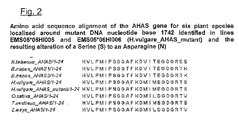
- Mutant lines VBHT0805 (NCIMB 41549) and VBHT0806 (NCIMB 41550) are likely to express herbicide resistance due to alteration of coordinate 1742 changing from a G to an A, which alters the amino acid from a serine to an asparagine.
- This mutation is referred to as SER653.
- the imidazolinone herbicide resistance shown in the barley of the present invention is surprisingly high compared to levels found in other species. This was unexpected and while not wishing to be bound by theory it may be possibly due to the high copy number of the AHAS gene in barley.
- VBHT0802 has a different genetic control for resistance than VBHT0805 and VBHT0806 and does not have the mutation SER653.
- Example 9 Further sequencing of VBHT0802, VBHT0803, VBHT0805, VBHT0806, VBHT0807, VBHT0809 and VBHT0810.
- Example 8 Further work is being carried out using standard sequencing techniques similar to those of Example 8 to characterise the AHAS gene and other possibly relevant genes involved in conferring imidazolinone resistance in VBHT0802 (NCIMB 41547), VBHT0803 (NCIMB 41548), VBHT0805 (NCIMB 41549), VBHT0806 (NCIMB 41550), VBHT0807 (Not deposited), VBHT0809 (NCIMB 41551) and VBHT0810 (Not deposited).
- Example 10 Suitability for malt production.
Landscapes
- Life Sciences & Earth Sciences (AREA)
- Health & Medical Sciences (AREA)
- Environmental Sciences (AREA)
- Botany (AREA)
- Developmental Biology & Embryology (AREA)
- Physiology (AREA)
- Genetics & Genomics (AREA)
- General Health & Medical Sciences (AREA)
- Molecular Biology (AREA)
- Natural Medicines & Medicinal Plants (AREA)
- Zoology (AREA)
- Wood Science & Technology (AREA)
- Dentistry (AREA)
- Engineering & Computer Science (AREA)
- Plant Pathology (AREA)
- Pest Control & Pesticides (AREA)
- Agronomy & Crop Science (AREA)
- Breeding Of Plants And Reproduction By Means Of Culturing (AREA)
- Agricultural Chemicals And Associated Chemicals (AREA)
Applications Claiming Priority (2)
| Application Number | Priority Date | Filing Date | Title |
|---|---|---|---|
| AU2008902205A AU2008902205A0 (en) | 2008-05-06 | Herbicide resistant barley | |
| EP09741583.0A EP2288254B1 (fr) | 2008-05-06 | 2009-05-06 | Orge résistant aux insecticides |
Related Parent Applications (2)
| Application Number | Title | Priority Date | Filing Date |
|---|---|---|---|
| EP09741583.0A Division-Into EP2288254B1 (fr) | 2008-05-06 | 2009-05-06 | Orge résistant aux insecticides |
| EP09741583.0A Division EP2288254B1 (fr) | 2008-05-06 | 2009-05-06 | Orge résistant aux insecticides |
Publications (1)
| Publication Number | Publication Date |
|---|---|
| EP3120695A1 true EP3120695A1 (fr) | 2017-01-25 |
Family
ID=41264332
Family Applications (2)
| Application Number | Title | Priority Date | Filing Date |
|---|---|---|---|
| EP09741583.0A Active EP2288254B1 (fr) | 2008-05-06 | 2009-05-06 | Orge résistant aux insecticides |
| EP16185759.4A Withdrawn EP3120695A1 (fr) | 2008-05-06 | 2009-05-06 | Orge résistant aux herbicides |
Family Applications Before (1)
| Application Number | Title | Priority Date | Filing Date |
|---|---|---|---|
| EP09741583.0A Active EP2288254B1 (fr) | 2008-05-06 | 2009-05-06 | Orge résistant aux insecticides |
Country Status (7)
| Country | Link |
|---|---|
| US (2) | US8889951B2 (fr) |
| EP (2) | EP2288254B1 (fr) |
| CN (2) | CN102202494B (fr) |
| AU (1) | AU2009243917B2 (fr) |
| BR (1) | BRPI0908317B1 (fr) |
| CA (1) | CA2723105C (fr) |
| WO (1) | WO2009135254A1 (fr) |
Families Citing this family (1)
| Publication number | Priority date | Publication date | Assignee | Title |
|---|---|---|---|---|
| AU2010204310B2 (en) * | 2009-01-07 | 2014-07-24 | Basf Se | Pesticidal mixtures |
Citations (2)
| Publication number | Priority date | Publication date | Assignee | Title |
|---|---|---|---|---|
| WO2006007373A2 (fr) * | 2004-06-16 | 2006-01-19 | Basf Plant Science Gmbh | Polynucleotides codant des proteines ahasl matures aux fins de creation de vegetaux tolerants a l'imidazolinone |
| WO2009046334A1 (fr) * | 2007-10-05 | 2009-04-09 | Cibus Llc | Gènes d'acétohydroxyacide synthase mutés chez brassica |
Family Cites Families (10)
| Publication number | Priority date | Publication date | Assignee | Title |
|---|---|---|---|---|
| US6936467B2 (en) * | 2000-03-27 | 2005-08-30 | University Of Delaware | Targeted chromosomal genomic alterations with modified single stranded oligonucleotides |
| CN1502226A (zh) * | 2002-11-20 | 2004-06-09 | 中国人民解放军军需大学 | 耐盐碱短芒大麦品种的育种方法 |
| WO2005103271A1 (fr) | 2004-04-20 | 2005-11-03 | Temasek Life Sciences Laboratory Limited | Procede de transformation et regeneration hautement efficaces de cultures vegetales en suspension |
| CN101031646B (zh) * | 2004-07-30 | 2013-09-25 | 巴斯夫农业化学产品公司 | 抗除草剂的向日葵植物、编码抗除草剂的乙酰羟酸合酶大亚基蛋白的多核苷酸和使用方法 |
| WO2006094048A2 (fr) * | 2005-03-01 | 2006-09-08 | Id-Confirm, Inc. | Systemes et procedes d'authentification biometrique |
| EP3581024A1 (fr) * | 2005-03-02 | 2019-12-18 | Instituto Nacional de Tecnologia Agropecuaria | Plantes de riz résistantes aux herbicides, polynucléotides codant pour la résistance aux herbicides, protéines à grandes sous-unités d'acétohydroxyacide synthase et procédés d'utilisation |
| CN101287836B (zh) * | 2005-07-01 | 2013-02-20 | 巴斯福股份公司 | 抗除草剂的向日葵植物、编码抗除草剂的乙酰羟酸合酶大亚基蛋白的多核苷酸和使用方法 |
| MEP3508A (xx) * | 2005-08-24 | 2010-02-10 | Pioneer Hi Bred Int | Kompozicije koje obezbjeđuju otpornost na više hibricida i njihov postupak upotrebe |
| US20070118920A1 (en) * | 2005-11-09 | 2007-05-24 | Basf Agrochemical Products B.V. | Herbicide-resistant sunflower plants, polynucleotides encoding herbicide-resistant acetohydroxyacid synthase large subunit proteins, and methods of use |
| CA2682349C (fr) * | 2007-04-04 | 2017-08-22 | Basf Plant Science Gmbh | Mutants ahas |
-
2009
- 2009-05-06 AU AU2009243917A patent/AU2009243917B2/en active Active
- 2009-05-06 BR BRPI0908317-0A patent/BRPI0908317B1/pt active IP Right Grant
- 2009-05-06 WO PCT/AU2009/000558 patent/WO2009135254A1/fr not_active Ceased
- 2009-05-06 CN CN200980126400.4A patent/CN102202494B/zh active Active
- 2009-05-06 US US12/991,172 patent/US8889951B2/en active Active
- 2009-05-06 EP EP09741583.0A patent/EP2288254B1/fr active Active
- 2009-05-06 EP EP16185759.4A patent/EP3120695A1/fr not_active Withdrawn
- 2009-05-06 CN CN201510575739.XA patent/CN105284628A/zh active Pending
- 2009-05-06 CA CA2723105A patent/CA2723105C/fr active Active
-
2014
- 2014-11-13 US US14/540,478 patent/US20150075070A1/en not_active Abandoned
Patent Citations (2)
| Publication number | Priority date | Publication date | Assignee | Title |
|---|---|---|---|---|
| WO2006007373A2 (fr) * | 2004-06-16 | 2006-01-19 | Basf Plant Science Gmbh | Polynucleotides codant des proteines ahasl matures aux fins de creation de vegetaux tolerants a l'imidazolinone |
| WO2009046334A1 (fr) * | 2007-10-05 | 2009-04-09 | Cibus Llc | Gènes d'acétohydroxyacide synthase mutés chez brassica |
Non-Patent Citations (6)
| Title |
|---|
| JANDER G.; BAERSON S.; HUDAK J.; GONZALEZ K.; GRUYS K.; LAST R.: "Ethylmethanesulfonate Saturation Mutagenesis in Arabidopsis to Determine Frequency of Herbicide Resistance", PLANT PHYSIOLOGY, vol. 131, 2003, pages 139 - 16 |
| LEE HYEJIN ET AL: "Single nucleotide mutation in the barley acetohydroxy acid synthase (AHAS) gene confers resistance to imidazolinone herbicides", PROCEEDINGS OF THE NATIONAL ACADEMY OF SCIENCES OF THE UNITED STATES OF AMERICA, vol. 108, no. 21, May 2011 (2011-05-01), pages 8909 - 8913, XP002661373, ISSN: 0027-8424 * |
| LI D ET AL: "A mutation at the Ala122 position of acetohydroxyacid synthase (AHAS) located on chromosome 6D of wheat: improved resistance to imidazolinone and a faster assay for marker assisted selection", MOLECULAR BREEDING, KLUWER ACADEMIC PUBLISHERS, DO, vol. 22, no. 2, 21 March 2008 (2008-03-21), pages 217 - 225, XP019611822, ISSN: 1572-9788 * |
| RODRÃ ÂGUEZ-SUÃ Â REZ C ET AL: "Selection and molecular characterization of imidazolinone resistant mutation-derived lines of Tritordeum HT621", MOLECULAR BREEDING, KLUWER ACADEMIC PUBLISHERS, DO, vol. 23, no. 4, 20 January 2009 (2009-01-20), pages 565 - 572, XP019684623, ISSN: 1572-9788 * |
| SATHASIVAN K.; HAUGHN G.; MURAI N.: "Nucleotide sequence of a mutant acetolactate synthase gone from an imidazolinone-resistant Arabidopsis thaliana var. Columbia", NUCLEIC ACIDS RESEARCH, vol. 18, 1990, pages 2188, XP001094049 |
| SIYUAN TAN ET AL: "Imidazolinone-tolerant crops: history, current status and future", PEST MANAGEMENT SCIENCE, WILEY & SONS, BOGNOR REGIS; GB, vol. 61, no. 3, 1 March 2005 (2005-03-01), pages 246 - 257, XP008154146, ISSN: 1526-498X, [retrieved on 20041231], DOI: 10.1002/PS.993 * |
Also Published As
| Publication number | Publication date |
|---|---|
| EP2288254B1 (fr) | 2016-11-30 |
| EP2288254A1 (fr) | 2011-03-02 |
| BRPI0908317A2 (pt) | 2015-08-18 |
| CA2723105C (fr) | 2016-06-28 |
| CN102202494B (zh) | 2015-10-14 |
| US8889951B2 (en) | 2014-11-18 |
| US20150075070A1 (en) | 2015-03-19 |
| CA2723105A1 (fr) | 2009-11-12 |
| WO2009135254A1 (fr) | 2009-11-12 |
| EP2288254A4 (fr) | 2011-11-30 |
| BRPI0908317B1 (pt) | 2020-10-20 |
| BRPI0908317A8 (pt) | 2019-08-27 |
| CN105284628A (zh) | 2016-02-03 |
| AU2009243917B2 (en) | 2014-08-14 |
| CN102202494A (zh) | 2011-09-28 |
| AU2009243917A1 (en) | 2009-11-12 |
| US20110126327A1 (en) | 2011-05-26 |
Similar Documents
| Publication | Publication Date | Title |
|---|---|---|
| AU2019204538B2 (en) | Methods and compositions for combinations of mutations associated with herbicide resistance/tolerance in rice | |
| US20150173318A1 (en) | Novel genetic factor capable of increasing yield in maize and method thereof | |
| WO2023074911A1 (fr) | Épinard possédant un nouveau gène de résistance au mildiou | |
| US11317574B2 (en) | Angular leaf spot (Pseudomonas) resistance in cucumber | |
| US20160319298A1 (en) | Rice resistant to hppd and accase inhibiting herbicides | |
| EP3264885A1 (fr) | Marqueurs d'un rendement élevé chez le maïs | |
| EP2288254B1 (fr) | Orge résistant aux insecticides | |
| JP7752444B2 (ja) | 深根性が向上した植物 | |
| CN117615647B (zh) | 具有新型霜霉病抗性基因的菠菜植物 | |
| AU2014262183B2 (en) | Herbicide resistant barley (2) | |
| CN112159863A (zh) | 一种培育具有细长籽粒的水稻直立穗品种的方法 | |
| Saharan et al. | Development of resistance cultivars’ techniques | |
| US20250212743A1 (en) | Lettuce plants having resistance to downy mildew | |
| JP7808811B2 (ja) | 向上した線虫耐性を有する植物 | |
| Hoque et al. | QTL mapping for tuberous stem formation of kohlrabi (Brassica oleracea var. gongylodes L.) | |
| WO2025058082A1 (fr) | Plante de tournesol | |
| Wei¹t et al. | endurance to biotic and abiotic stresses | |
| WO2024095258A1 (fr) | Qtl de tomate épistatiques pour augmenter le rendement | |
| CN118389463A (zh) | 具有抗乙酰乳酸合成酶抑制剂类除草剂的als突变蛋白及其应用 | |
| Richards et al. | Association study for traits related to growth in alfalfa | |
| CN120302879A (zh) | 产生无籽果实的甜瓜植物 |
Legal Events
| Date | Code | Title | Description |
|---|---|---|---|
| PUAI | Public reference made under article 153(3) epc to a published international application that has entered the european phase |
Free format text: ORIGINAL CODE: 0009012 |
|
| AC | Divisional application: reference to earlier application |
Ref document number: 2288254 Country of ref document: EP Kind code of ref document: P |
|
| AK | Designated contracting states |
Kind code of ref document: A1 Designated state(s): AT BE BG CH CY CZ DE DK EE ES FI FR GB GR HR HU IE IS IT LI LT LU LV MC MK MT NL NO PL PT RO SE SI SK TR |
|
| RIN1 | Information on inventor provided before grant (corrected) |
Inventor name: PITTOCK, CHRISTOPHER Inventor name: MOODY, DAVID Inventor name: MATERNE, MICHAEL |
|
| 17P | Request for examination filed |
Effective date: 20170720 |
|
| RBV | Designated contracting states (corrected) |
Designated state(s): AT BE BG CH CY CZ DE DK EE ES FI FR GB GR HR HU IE IS IT LI LT LU LV MC MK MT NL NO PL PT RO SE SI SK TR |
|
| 17Q | First examination report despatched |
Effective date: 20180205 |
|
| STAA | Information on the status of an ep patent application or granted ep patent |
Free format text: STATUS: THE APPLICATION IS DEEMED TO BE WITHDRAWN |
|
| 18D | Application deemed to be withdrawn |
Effective date: 20180616 |