EP3120792A1 - Kathetersystem zur kryoablation - Google Patents
Kathetersystem zur kryoablation Download PDFInfo
- Publication number
- EP3120792A1 EP3120792A1 EP15177832.1A EP15177832A EP3120792A1 EP 3120792 A1 EP3120792 A1 EP 3120792A1 EP 15177832 A EP15177832 A EP 15177832A EP 3120792 A1 EP3120792 A1 EP 3120792A1
- Authority
- EP
- European Patent Office
- Prior art keywords
- catheter
- cryogenic
- distal end
- mapping
- mapping catheter
- Prior art date
- Legal status (The legal status is an assumption and is not a legal conclusion. Google has not performed a legal analysis and makes no representation as to the accuracy of the status listed.)
- Withdrawn
Links
- 238000002679 ablation Methods 0.000 title claims abstract description 49
- 238000013507 mapping Methods 0.000 claims abstract description 76
- 206010003658 Atrial Fibrillation Diseases 0.000 claims abstract description 17
- 239000012809 cooling fluid Substances 0.000 claims abstract description 5
- 239000012530 fluid Substances 0.000 claims description 8
- 238000002347 injection Methods 0.000 claims description 7
- 239000007924 injection Substances 0.000 claims description 7
- 238000003780 insertion Methods 0.000 claims description 5
- 230000037431 insertion Effects 0.000 claims description 5
- 238000000605 extraction Methods 0.000 claims description 4
- 238000011298 ablation treatment Methods 0.000 claims description 3
- 235000014443 Pyrus communis Nutrition 0.000 claims description 2
- 210000003492 pulmonary vein Anatomy 0.000 description 16
- 210000005246 left atrium Anatomy 0.000 description 10
- 239000012528 membrane Substances 0.000 description 7
- 230000002085 persistent effect Effects 0.000 description 6
- 239000000243 solution Substances 0.000 description 6
- 238000011282 treatment Methods 0.000 description 6
- 210000002837 heart atrium Anatomy 0.000 description 5
- 238000000034 method Methods 0.000 description 4
- 238000013459 approach Methods 0.000 description 3
- 230000017531 blood circulation Effects 0.000 description 3
- 230000006378 damage Effects 0.000 description 3
- 230000000694 effects Effects 0.000 description 3
- 230000003902 lesion Effects 0.000 description 3
- 230000001314 paroxysmal effect Effects 0.000 description 3
- 230000001225 therapeutic effect Effects 0.000 description 3
- FAPWRFPIFSIZLT-UHFFFAOYSA-M Sodium chloride Chemical compound [Na+].[Cl-] FAPWRFPIFSIZLT-UHFFFAOYSA-M 0.000 description 2
- 238000004026 adhesive bonding Methods 0.000 description 2
- 210000004204 blood vessel Anatomy 0.000 description 2
- 239000006185 dispersion Substances 0.000 description 2
- 238000001990 intravenous administration Methods 0.000 description 2
- 230000002045 lasting effect Effects 0.000 description 2
- 210000005245 right atrium Anatomy 0.000 description 2
- 238000003466 welding Methods 0.000 description 2
- 208000005189 Embolism Diseases 0.000 description 1
- 208000007536 Thrombosis Diseases 0.000 description 1
- 230000002159 abnormal effect Effects 0.000 description 1
- 230000004913 activation Effects 0.000 description 1
- 230000001746 atrial effect Effects 0.000 description 1
- 230000015572 biosynthetic process Effects 0.000 description 1
- 230000000903 blocking effect Effects 0.000 description 1
- 239000008280 blood Substances 0.000 description 1
- 210000004369 blood Anatomy 0.000 description 1
- 230000001112 coagulating effect Effects 0.000 description 1
- 238000012790 confirmation Methods 0.000 description 1
- 238000001816 cooling Methods 0.000 description 1
- 210000003191 femoral vein Anatomy 0.000 description 1
- 238000007710 freezing Methods 0.000 description 1
- 230000008014 freezing Effects 0.000 description 1
- 230000001788 irregular Effects 0.000 description 1
- 238000002955 isolation Methods 0.000 description 1
- 239000010410 layer Substances 0.000 description 1
- 239000000463 material Substances 0.000 description 1
- 230000017074 necrotic cell death Effects 0.000 description 1
- 230000003204 osmotic effect Effects 0.000 description 1
- 230000002688 persistence Effects 0.000 description 1
- 238000007674 radiofrequency ablation Methods 0.000 description 1
- 230000000306 recurrent effect Effects 0.000 description 1
- 230000000717 retained effect Effects 0.000 description 1
- 231100000241 scar Toxicity 0.000 description 1
- 239000002356 single layer Substances 0.000 description 1
- 230000000087 stabilizing effect Effects 0.000 description 1
- 230000002792 vascular Effects 0.000 description 1
Images





Classifications
-
- A—HUMAN NECESSITIES
- A61—MEDICAL OR VETERINARY SCIENCE; HYGIENE
- A61B—DIAGNOSIS; SURGERY; IDENTIFICATION
- A61B18/00—Surgical instruments, devices or methods for transferring non-mechanical forms of energy to or from the body
- A61B18/02—Surgical instruments, devices or methods for transferring non-mechanical forms of energy to or from the body by cooling, e.g. cryogenic techniques
-
- A—HUMAN NECESSITIES
- A61—MEDICAL OR VETERINARY SCIENCE; HYGIENE
- A61B—DIAGNOSIS; SURGERY; IDENTIFICATION
- A61B17/00—Surgical instruments, devices or methods
- A61B2017/00017—Electrical control of surgical instruments
- A61B2017/00022—Sensing or detecting at the treatment site
- A61B2017/00039—Electric or electromagnetic phenomena other than conductivity, e.g. capacity, inductivity, Hall effect
- A61B2017/00044—Sensing electrocardiography, i.e. ECG
- A61B2017/00048—Spectral analysis
- A61B2017/00053—Mapping
-
- A—HUMAN NECESSITIES
- A61—MEDICAL OR VETERINARY SCIENCE; HYGIENE
- A61B—DIAGNOSIS; SURGERY; IDENTIFICATION
- A61B18/00—Surgical instruments, devices or methods for transferring non-mechanical forms of energy to or from the body
- A61B2018/00053—Mechanical features of the instrument of device
- A61B2018/00214—Expandable means emitting energy, e.g. by elements carried thereon
- A61B2018/0022—Balloons
- A61B2018/00232—Balloons having an irregular shape
-
- A—HUMAN NECESSITIES
- A61—MEDICAL OR VETERINARY SCIENCE; HYGIENE
- A61B—DIAGNOSIS; SURGERY; IDENTIFICATION
- A61B18/00—Surgical instruments, devices or methods for transferring non-mechanical forms of energy to or from the body
- A61B2018/00315—Surgical instruments, devices or methods for transferring non-mechanical forms of energy to or from the body for treatment of particular body parts
- A61B2018/00345—Vascular system
- A61B2018/00351—Heart
-
- A—HUMAN NECESSITIES
- A61—MEDICAL OR VETERINARY SCIENCE; HYGIENE
- A61B—DIAGNOSIS; SURGERY; IDENTIFICATION
- A61B18/00—Surgical instruments, devices or methods for transferring non-mechanical forms of energy to or from the body
- A61B2018/00315—Surgical instruments, devices or methods for transferring non-mechanical forms of energy to or from the body for treatment of particular body parts
- A61B2018/00345—Vascular system
- A61B2018/00351—Heart
- A61B2018/00375—Ostium, e.g. ostium of pulmonary vein or artery
-
- A—HUMAN NECESSITIES
- A61—MEDICAL OR VETERINARY SCIENCE; HYGIENE
- A61B—DIAGNOSIS; SURGERY; IDENTIFICATION
- A61B18/00—Surgical instruments, devices or methods for transferring non-mechanical forms of energy to or from the body
- A61B2018/00636—Sensing and controlling the application of energy
- A61B2018/00773—Sensed parameters
- A61B2018/00839—Bioelectrical parameters, e.g. ECG, EEG
-
- A—HUMAN NECESSITIES
- A61—MEDICAL OR VETERINARY SCIENCE; HYGIENE
- A61B—DIAGNOSIS; SURGERY; IDENTIFICATION
- A61B18/00—Surgical instruments, devices or methods for transferring non-mechanical forms of energy to or from the body
- A61B18/02—Surgical instruments, devices or methods for transferring non-mechanical forms of energy to or from the body by cooling, e.g. cryogenic techniques
- A61B2018/0212—Surgical instruments, devices or methods for transferring non-mechanical forms of energy to or from the body by cooling, e.g. cryogenic techniques using an instrument inserted into a body lumen, e.g. catheter
-
- A—HUMAN NECESSITIES
- A61—MEDICAL OR VETERINARY SCIENCE; HYGIENE
- A61B—DIAGNOSIS; SURGERY; IDENTIFICATION
- A61B18/00—Surgical instruments, devices or methods for transferring non-mechanical forms of energy to or from the body
- A61B18/02—Surgical instruments, devices or methods for transferring non-mechanical forms of energy to or from the body by cooling, e.g. cryogenic techniques
- A61B2018/0231—Characteristics of handpieces or probes
- A61B2018/0262—Characteristics of handpieces or probes using a circulating cryogenic fluid
Definitions
- the present invention refers to devices for cryogenic ablation and relates in particular to a balloon catheter particularly intended to be used for treating atrial fibrillation.
- Atrial fibrillation is the most common cause of irregular heartbeat, with a prevalence of 1-2% of the general population, which progressively increases with age up to almost 10%.
- atrial fibrillation is defined as paroxysmal (recurrent episodes that terminate spontaneously within seven days), persistent (lasting more than seven days) or long-standing (lasting more than one year).
- the critical point in the majority of atrial fibrillation cases is the left atrium of the heart.
- the therapeutic approach for treating atrial fibrillation varies according to the clinical form.
- the therapeutic objective is to insulate electrically the four pulmonary veins of the left atrium.
- the therapeutic approach is much debated. Some authors argue that isolation of the pulmonary veins is sufficient for persistent forms while other authors consider it necessary to create additional lesions within the left atrium.
- additional lesions on the left atrium wall are necessary to create lines for blocking activation of the electric front and/or to remove areas of abnormal conduction of electrical impulses (fragmented electrical potentials).
- Atrial fibrillation is carried out with a transvenous percutaneous approach, minimally invasive for the patient.
- the most widely used treatment method for treating atrial fibrillation involves the use of radiofrequency intravenous catheters. These catheters allow tissue ablation to be performed in all clinical types of atrial fibrillation.
- these catheters have severe disadvantages in that the radiofrequency causes destruction of the architecture of the biological tissue, causing a coagulative necrosis of the tissues, which can result in thrombus formation and the risk of embolic events.
- the damage which is caused to the tissue there is a risk of perforation of the wall subjected to the treatment.
- cryogenic ablation This treatment method carries out direct freezing of the tissue.
- the osmotic damage to the cells resulting from the cooling of the interstitium creates an electrically inert scar that keeps the tissue architecture intact and, therefore, reduces the risk of thrombi and perforation.
- cryogenic ablation for treating atrial fibrillation are based on the use of cryogenic balloon catheters.
- catheters for cryoablation are described in the documents US-A-2009/0182319 , US-A-2010/0211056 , and US-A-2013/0197497 .
- the catheters described in these documents comprise a grip, a hollow catheter body that extends from the grip, a mapping catheter lumen, which extends within the catheter body, a tube for injecting cooling fluid that extends between the mapping catheter lumen and the catheter body, and a cryogenic balloon having a first end fixed to a distal end of the catheter body and a second end fixed to a distal end of the mapping catheter lumen.
- the distal end of the mapping catheter lumen has a rounded tip, which serves to facilitate cannulation of the pulmonary veins and the subsequent positioning of the cryogenic balloon at the level of the ostium of the pulmonary vein.
- the document US-A-2013/197497 also describes a mapping catheter extending within the mapping catheter lumen and having a loop portion located outside the mapping catheter lumen, which allows recording of the electrical potentials of the walls to guide the catheter and to verify the effect of the ablation.
- the catheters described in these documents enable the effective implementation of cryogenic ablation of the ostium of the pulmonary veins.
- the catheters described in these documents are unsuitable for performing cryogenic ablation of the atrium walls.
- the tip of the mapping catheter lumen impedes the positioning of the cryogenic balloon against a flat surface, such as the left atrium wall.
- the contact surface between the side wall of the cryogenic balloon and the atrium wall would be very limited.
- the flow of surrounding blood would disperse the cryogenic effect into the bloodstream rather than on the tissue to be treated. Therefore, these known catheters can be used for treating paroxysmal atrial fibrillation, but are unsuitable for treating persistent and long-standing atrial fibrillation, which requires ablation of portions of the left atrium wall.
- the document US-A-2011/0184400 describes a catheter devoid of a central mapping catheter lumen and carrying a cryogenic balloon at its distal end.
- a solution of this type allows cryogenic ablation treatments on flat tissues and would therefore be potentially useful for treating persistent and long-standing forms of atrial fibrillation.
- the lack of the central mapping catheter lumen or of an internal guide for stabilizing the shape of the cryogenic balloon impedes adhesion of the cryogenic balloon to a circular ostium.
- the lack of a slot or a guide that facilitates cannulation of a blood vessel prevents the use of this device for treating the ostium of the pulmonary veins.
- this solution does not allow the use of a mapping catheter and does not allow the recording of electric potentials of the atrial wall, which is a procedure required to guide the ablation.
- the document WO2006/009589 describes a cryoablation catheter having a cylindrical sleeve-shaped balloon with a flat front wall.
- the solution described in this document was developed for cryoablation of the pulmonary veins.
- the shape of the balloon may also allow cryoablation on a flat surface.
- This system is composed of two parallel catheters, an inner one, which terminates with a cryogenic tip and an outer one composed of the annular balloon filled with a saline solution, which is indirectly cooled by the inner catheter.
- a double system with an interface consisting of a balloon filled with a saline solution which separates the cryogenic source from the target tissue of the ablation, results in a significant dispersion of the energy and a strong limitation of the heat exchange and the efficiency of the ablation.
- the cylindrical shape of the balloon does not allow positioning at the ostium of vessels of different diameters (the pulmonary veins can have widely varying diameters) nor the ability to completely occlude the incoming flow from the blood vessel.
- this system does not include an inner lumen for introducing a mapping catheter able to record electrical potentials within a pulmonary vein or fragmented electrical potentials on the free wall of the left atrium. For these reasons, a catheter of the type described in this document would not be suitable for use in clinical practice.
- the object of the present invention is to provide a catheter for cryogenic ablation which solves the problems of the prior art.
- the object of the invention is to provide a catheter capable of performing cryoablation both at the ostium of the pulmonary veins and on the flat walls of the atrium outside the pulmonary veins, and that has the possibility of inserting a mapping catheter inside it for guiding the ablation.
- this object is achieved by a catheter having the characteristics forming the subject of claim 1.
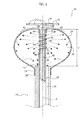
- numeral 10 indicates a catheter for cryogenic ablation, in particular for treating atrial fibrillation.
- the catheter 10 comprises a grip 12 and a catheter body 14.
- the catheter body 14 is a hollow and flexible tubular element, which extends along its longitudinal axis A from a proximal end 16, connected to the grip 12, to a distal end 18.
- the grip 12 is of the type known per se in the field of intravenous catheters for cryoablation.
- the grip 12 comprises a port 20 for communicating with the inside of the catheter body 14.
- the grip 12 comprises a fluid connector 22 for connecting the catheter 10 to a source of cryogenic fluid.
- the grip 12 may also include a knob 26 for controlling the catheter body 14 according to modalities known per se.
- the constructive details of the grip 12 are not described in detail since they fall outside the scope of this invention.
- the catheter 10 comprises a mapping catheter lumen 28, which extends within the catheter body 14.
- the mapping catheter lumen 28 has an outer diameter less than the inner diameter of the catheter body 14, so that an annular cavity 30 is defined between the catheter body 14 and the mapping catheter lumen 28.
- the mapping catheter lumen 28 consist of a flexible tube and is movable, relative to the catheter body 14, in the direction of the longitudinal axis A.
- the mapping catheter lumen 28 has a distal end 32, which extends beyond the distal end 18 of the catheter body 14.
- the catheter 10 comprises a cryogenic balloon 34 having a first end 36 fixed to the distal end 32 of the mapping catheter lumen 28 and a second end 38 fixed to the distal end 18 of the catheter body 14.
- the cryogenic balloon 34 defines a cryogenic chamber 40 that surrounds the portion of the mapping catheter lumen 28 outside the catheter body 14.
- the cryogenic balloon 34 has a flexible wall, which is preferably formed by an inner membrane and an outer membrane superposed on each other.
- the outer membrane constitutes a safety layer that prevents dispersions of cryogenic gas in case of leakage of the inner membrane.
- the wall of the cryogenic balloon 34 is represented as if it were formed of a single layer, solely for reasons of simplicity of representation.
- the catheter 10 comprises a tube for injecting cooling fluid 42, which extends into the annular cavity 30 defined between the mapping catheter lumen 28 and the catheter body 14.
- the tube for injecting cooling fluid 42 is parallel to the mapping catheter lumen 28 and has an injection zone 44 helically wound around the mapping catheter lumen 28 at the distal end 32 of the mapping catheter lumen 28.
- the injection zone 44 is provided with injection holes 46 through which the cryogenic fluid is injected into the cryogenic chamber 40.
- the cryogenic fluid injected through the injection holes 46 expands in the cryogenic chamber 40 and cools the cryogenic balloon 34.
- the cryogenic fluid keeps the cryogenic balloon 34 inflated and comes out of the cryogenic chamber 40 through the annular cavity 30.
- the catheter 10 comprises a mapping catheter 48, which extends within the mapping catheter lumen 28.
- the mapping catheter 48 is movable within the mapping catheter lumen 28 between an extracted position illustrated in Figure 2 and a retracted position illustrated in Figure 3 .
- the mapping catheter 48 has an end loop portion 50 perpendicular to the longitudinal axis A of the catheter body 14, and located on the outside of the mapping catheter lumen 28.
- the end loop portion 50 assumes a straight shape and is pulled inside the mapping catheter lumen 28.
- the loop portion 50 of the mapping catheter 48 has an elastic memory whereby it assumes the loop shape when it is outside the mapping catheter lumen 28, while in the retracted position, it is retained in an extended position by the inner wall of the mapping catheter lumen 28.
- the end loop portion 50 is provided with electrodes 52 suitable for detecting electrical characteristics of the tissues.
- the mapping catheter 48 is able to carry out a mapping of the tissues to be treated and to provide information that confirms the cryogenic ablation treatment has taken place. A more detailed description of the structure and operation of the mapping catheter 48 is contained in the document US-A-2013/0197497 .
- the catheter 10 may be equipped with a temperature sensor (not illustrated) located at the distal end of the mapping catheter lumen 28 within the cryogenic balloon 34.
- the distal end 32 of the mapping catheter lumen 28 has an open and tip-free front surface 56.
- the distal end 32 of the mapping catheter lumen 28 is therefore devoid of a rounded tip that is present in the solutions according to the prior art for guiding the insertion of the catheter.
- the first end 36 of the cryogenic balloon 34 is folded back towards the inside of the cryogenic chamber 40 and is fixed directly in contact with the outer surface of the distal end 32 of the mapping catheter lumen 28.
- the fixing between the first end 36 of the cryogenic balloon 34 and the distal end 32 of the mapping catheter lumen 28 can be carried out by gluing or by welding.
- the fixing of the first end 36 occurs on the outer surface of the cryogenic balloon 34 which, by effect of the folding-back, faces the outer side surface of the distal end 32 of the mapping catheter lumen 28.
- the second end 38 of the cryogenic balloon 34 is fixed on the outer surface of the catheter body 14. In this case as well, fixing can be carried out by means of gluing or welding.
- the fixing of the second end 38 occurs on the inner surface of the cryogenic balloon 34 which is facing and in contact with the outer side surface of the catheter body 14.
- the wall of the cryogenic balloon 34 is formed by an outer membrane and an inner membrane
- the outer surface of the outer membrane is fixed to the distal end 32 of the mapping catheter lumen 28.
- the mapping catheter lumen 28 is axially movable relative to the catheter body 14 between an insertion/extraction position illustrated in Figure 4 and an ablation position illustrated in Figures 2 and 3 .
- the distance L between the front ends of the mapping catheter lumen 28 and the catheter body 14 is greater than the corresponding distance L' in the ablation position.
- the cryogenic balloon 34 In the insertion/extraction position illustrated in Figure 4 , the cryogenic balloon 34 is deflated and is stretched out in an elongated shape. In the ablation position illustrated in Figures 2 and 3 , the cryogenic balloon 34 is inflated by the cryogenic fluid injected into the cryogenic cavity 40. In the inflated position, the cryogenic balloon 34 has essentially a truncated ball shape, as shown in the figures, or a truncated-conical or "pear" shape, with the narrowest portion at the distal end 18 of the catheter body 14.
- the cryogenic balloon 34 In the inflated position, the cryogenic balloon 34 has a front ablation area 58, which extends beyond the front surface 56 of the mapping catheter lumen 28.
- the front ablation area 58 is tangential to a plane perpendicular to the longitudinal axis A of the catheter body 14.
- the outer surface of the cryogenic balloon 34 has a circumferential ablation area 60, which surrounds the front ablation area 58.
- the circumferential ablation area 60 has a radius of curvature less than the radius of curvature of the front ablation area 58.
- the end loop portion 50 of the mapping catheter 48 can be in the extracted position both with the cryogenic balloon 34 inflated ( Figure 2 ) and with the cryogenic balloon 34 stretched out ( Figure 4 ). With the cryogenic balloon 34 inflated, the end loop portion 50 of the mapping catheter 48 is facing the front ablation area 58.
- the front ablation area 58 of the cryogenic balloon 34 forms a rounded toroidal tip around the distal end 32 of the mapping catheter lumen 28, with a front end that protrudes beyond the front surface 56 of the distal end 32 of the mapping catheter lumen 28.
- the front ablation area 58 stretches and assumes an essentially flat position, which is useful for the cryogenic ablation of front portions of the tissues, such as the inner wall of the atrium.
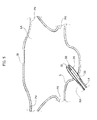
- FIGs 5-8 schematically illustrate the use of catheters according to the present invention for treating atrial fibrillation.
- the catheter according to the present invention with the cryogenic balloon 34 stretched out, is inserted through the femoral vein until reaching the right atrium RA of the heart of the patient. Then, the catheter is inserted through a hole of the septum S that separates the right atrium RA from the left atrium LA.
- the front ablation area 58 has a rounded shape with a very small curvature radius.
- the cryogenic balloon 34 is inflated by injecting the cryogenic fluid into the cryogenic cavity 40.
- the loop portion 50 of the mapping catheter 48 is carried into the extracted position to carry out the mapping of the tissues to be treated.
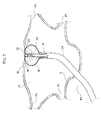
- FIG. 7 shows the step in which the cryogenic ablation of one wall W of the left atrium is carried out.
- the loop portion 50 of the mapping catheter 28 and the front ablation area 56 of the cryogenic balloon 34 is frontally placed alongside the wall portion W to be treated.
- a particularly relevant characteristic of the solution according to the present invention is that the front ablation area 56 establishes an extended contact with the wall W to be treated and blocks the blood flow to the area of tissue to be treated. In this way, the cryogenic energy does not become dispersed by the blood flow.
- the cryogenic balloon 34 can also be used for the cryogenic ablation of the ostium of the pulmonary veins PV.
- the cryogenic ablation is made by the circumferential ablation area 60 of the cryogenic balloon 34.
- the circumferential ablation area 60 can be adapted to various diameters of the ostia of the pulmonary veins.
- the circumferential ablation portion 60 blocks the blood flow coming from the pulmonary veins during the cryogenic ablation.
- the end loop portion 50 of the mapping catheter 48 can be kept in the extracted position in order to identify the pulmonary vein PV and to obtain confirmation of the fact that the treatment has occurred in the correct way.
- the same catheter can be used both to carry out ablation of the ostium of a pulmonary vein and to implement linear lesions on the free wall of the atrium. Therefore, the solution according to the present invention is particularly appreciated by cardiologists who wish to carry out treatment -by cryoablation- for paroxysmal, persistent or long-standing atrial fibrillation, minimizing the use of material and optimizing procedural times and vascular accesses.
Landscapes
- Health & Medical Sciences (AREA)
- Surgery (AREA)
- Life Sciences & Earth Sciences (AREA)
- Nuclear Medicine, Radiotherapy & Molecular Imaging (AREA)
- Biomedical Technology (AREA)
- Engineering & Computer Science (AREA)
- Otolaryngology (AREA)
- Heart & Thoracic Surgery (AREA)
- Medical Informatics (AREA)
- Molecular Biology (AREA)
- Animal Behavior & Ethology (AREA)
- General Health & Medical Sciences (AREA)
- Public Health (AREA)
- Veterinary Medicine (AREA)
- Surgical Instruments (AREA)
Priority Applications (1)
| Application Number | Priority Date | Filing Date | Title |
|---|---|---|---|
| EP15177832.1A EP3120792A1 (de) | 2015-07-22 | 2015-07-22 | Kathetersystem zur kryoablation |
Applications Claiming Priority (1)
| Application Number | Priority Date | Filing Date | Title |
|---|---|---|---|
| EP15177832.1A EP3120792A1 (de) | 2015-07-22 | 2015-07-22 | Kathetersystem zur kryoablation |
Publications (1)
| Publication Number | Publication Date |
|---|---|
| EP3120792A1 true EP3120792A1 (de) | 2017-01-25 |
Family
ID=53785454
Family Applications (1)
| Application Number | Title | Priority Date | Filing Date |
|---|---|---|---|
| EP15177832.1A Withdrawn EP3120792A1 (de) | 2015-07-22 | 2015-07-22 | Kathetersystem zur kryoablation |
Country Status (1)
| Country | Link |
|---|---|
| EP (1) | EP3120792A1 (de) |
Cited By (12)
| Publication number | Priority date | Publication date | Assignee | Title |
|---|---|---|---|---|
| WO2019084439A1 (en) * | 2017-10-27 | 2019-05-02 | St. Jude Medical, Cardiology Division, Inc. | APPARATUS AND SYSTEM FOR CRYO-THERAPY BALLOON |
| CN109717945A (zh) * | 2019-02-20 | 2019-05-07 | 上海安钛克医疗科技有限公司 | 一种消融球囊形态控制装置 |
| WO2019108987A1 (en) * | 2017-11-30 | 2019-06-06 | Cryterion Medical, Inc. | Compensation assembly for fluid injection line of intravascular catheter system |
| CN110191688A (zh) * | 2016-10-26 | 2019-08-30 | 波士顿科学医学有限公司 | 狭窄预防和消融递送系统 |
| WO2019196943A1 (zh) * | 2018-04-13 | 2019-10-17 | 山前(珠海)医疗科技有限公司 | 低温消融导管、低温消融操作装置及低温消融设备 |
| EP3744275A4 (de) * | 2018-01-22 | 2021-10-27 | Synaptic Medical (Beijing) Co. Ltd. | Ringförmiger abbildungskatheter |
| EP3758600A4 (de) * | 2018-02-28 | 2021-12-01 | Medtronic Cryocath LP | Vorrichtung und verfahren zur gezielten bronchialen denervierung durch kryoablation |
| US11666370B2 (en) | 2020-07-27 | 2023-06-06 | Medtronic, Inc. | Apparatus and method for targeted temporary bronchial nerve modulation by cryo-ablation for prevention and treatment of acute respiratory distress syndromes |
| CN116747013A (zh) * | 2023-06-30 | 2023-09-15 | 苏州海宇新辰医疗科技有限公司 | 一种双层消融球囊导管 |
| US11771486B2 (en) | 2017-01-17 | 2023-10-03 | Corfigo, Inc. | Device for ablation of tissue surfaces and related systems and methods |
| US11890044B2 (en) | 2016-12-09 | 2024-02-06 | St. Jude Medical, Cardiology Division, Inc. | Pulmonary vein isolation balloon catheter |
| US12369962B2 (en) | 2021-02-17 | 2025-07-29 | Medtronic Cryocath Lp. | Method and apparatus for determining bronchial denervation |
Citations (10)
| Publication number | Priority date | Publication date | Assignee | Title |
|---|---|---|---|---|
| US5571088A (en) * | 1993-07-01 | 1996-11-05 | Boston Scientific Corporation | Ablation catheters |
| WO2006009589A2 (en) | 2002-12-11 | 2006-01-26 | Cryocor, Inc. | Catheter system for performing a single step cryoablation |
| US20090182319A1 (en) | 1999-08-23 | 2009-07-16 | Cryocath Technologies Inc. | Endovascular cryotreatment catheter |
| US20100211056A1 (en) | 2005-05-13 | 2010-08-19 | Medtronic Cryocath Lp | Compliant balloon catheter |
| US20110184400A1 (en) | 2010-01-28 | 2011-07-28 | Medtronic Cryocath Lp | Triple balloon catheter |
| WO2011143468A2 (en) * | 2010-05-12 | 2011-11-17 | Shifamed, Llc | Low profile electrode assembly |
| US20130066312A1 (en) * | 2011-09-14 | 2013-03-14 | Raj Subramaniam | Ablation device with multiple ablation modes |
| US20130197499A1 (en) * | 2012-01-27 | 2013-08-01 | Medtronic Cryocath Lp | Balloon design to enhance cooling uniformity |
| US20130197497A1 (en) | 2012-01-27 | 2013-08-01 | Medtronic Cryocath Lp | Balloon catheter |
| US20150018809A1 (en) * | 2013-07-15 | 2015-01-15 | Medtronic Cryocath Lp | Heated electrodes for continued visualization of pulmonary vein potentials |
-
2015
- 2015-07-22 EP EP15177832.1A patent/EP3120792A1/de not_active Withdrawn
Patent Citations (10)
| Publication number | Priority date | Publication date | Assignee | Title |
|---|---|---|---|---|
| US5571088A (en) * | 1993-07-01 | 1996-11-05 | Boston Scientific Corporation | Ablation catheters |
| US20090182319A1 (en) | 1999-08-23 | 2009-07-16 | Cryocath Technologies Inc. | Endovascular cryotreatment catheter |
| WO2006009589A2 (en) | 2002-12-11 | 2006-01-26 | Cryocor, Inc. | Catheter system for performing a single step cryoablation |
| US20100211056A1 (en) | 2005-05-13 | 2010-08-19 | Medtronic Cryocath Lp | Compliant balloon catheter |
| US20110184400A1 (en) | 2010-01-28 | 2011-07-28 | Medtronic Cryocath Lp | Triple balloon catheter |
| WO2011143468A2 (en) * | 2010-05-12 | 2011-11-17 | Shifamed, Llc | Low profile electrode assembly |
| US20130066312A1 (en) * | 2011-09-14 | 2013-03-14 | Raj Subramaniam | Ablation device with multiple ablation modes |
| US20130197499A1 (en) * | 2012-01-27 | 2013-08-01 | Medtronic Cryocath Lp | Balloon design to enhance cooling uniformity |
| US20130197497A1 (en) | 2012-01-27 | 2013-08-01 | Medtronic Cryocath Lp | Balloon catheter |
| US20150018809A1 (en) * | 2013-07-15 | 2015-01-15 | Medtronic Cryocath Lp | Heated electrodes for continued visualization of pulmonary vein potentials |
Cited By (20)
| Publication number | Priority date | Publication date | Assignee | Title |
|---|---|---|---|---|
| CN110191688A (zh) * | 2016-10-26 | 2019-08-30 | 波士顿科学医学有限公司 | 狭窄预防和消融递送系统 |
| US11890044B2 (en) | 2016-12-09 | 2024-02-06 | St. Jude Medical, Cardiology Division, Inc. | Pulmonary vein isolation balloon catheter |
| US11771486B2 (en) | 2017-01-17 | 2023-10-03 | Corfigo, Inc. | Device for ablation of tissue surfaces and related systems and methods |
| WO2019084439A1 (en) * | 2017-10-27 | 2019-05-02 | St. Jude Medical, Cardiology Division, Inc. | APPARATUS AND SYSTEM FOR CRYO-THERAPY BALLOON |
| US12144532B2 (en) | 2017-10-27 | 2024-11-19 | St. Jude Medical, Cardiology Division, Inc. | Apparatus and system for cryo-therapy balloon |
| US11419657B2 (en) | 2017-11-30 | 2022-08-23 | Boston Scientific Scimed, Inc. | Compensation assembly for fluid injection line of intravascular catheter system |
| EP3716874A1 (de) * | 2017-11-30 | 2020-10-07 | Boston Scientific Scimed, Inc. | Kompensationsanordnung für eine flüssigkeitsinjektionsleitung eines intravaskulären kathetersystems |
| WO2019108987A1 (en) * | 2017-11-30 | 2019-06-06 | Cryterion Medical, Inc. | Compensation assembly for fluid injection line of intravascular catheter system |
| EP3744275A4 (de) * | 2018-01-22 | 2021-10-27 | Synaptic Medical (Beijing) Co. Ltd. | Ringförmiger abbildungskatheter |
| US11872057B2 (en) | 2018-01-22 | 2024-01-16 | Synaptic Medical (Beijing) Co. Ltd. | Annular mapping catheter |
| EP3758600A4 (de) * | 2018-02-28 | 2021-12-01 | Medtronic Cryocath LP | Vorrichtung und verfahren zur gezielten bronchialen denervierung durch kryoablation |
| US11344356B2 (en) | 2018-02-28 | 2022-05-31 | Medtronic Cryocath Lp | Apparatus and method for targeted bronchial denervation by cryo-ablation |
| US12262933B2 (en) | 2018-02-28 | 2025-04-01 | Medtronic Cryocath Lp | Apparatus and method for targeted bronchial denervation by cryo-ablation |
| US11925403B2 (en) | 2018-04-13 | 2024-03-12 | Piedmont Medsystems (Zhuhai) Co., Ltd. | Cryoablation catheter, cryoablation operating apparatus and cryoablation equipment |
| WO2019196943A1 (zh) * | 2018-04-13 | 2019-10-17 | 山前(珠海)医疗科技有限公司 | 低温消融导管、低温消融操作装置及低温消融设备 |
| CN109717945B (zh) * | 2019-02-20 | 2024-05-10 | 上海安钛克医疗科技有限公司 | 一种消融球囊形态控制装置 |
| CN109717945A (zh) * | 2019-02-20 | 2019-05-07 | 上海安钛克医疗科技有限公司 | 一种消融球囊形态控制装置 |
| US11666370B2 (en) | 2020-07-27 | 2023-06-06 | Medtronic, Inc. | Apparatus and method for targeted temporary bronchial nerve modulation by cryo-ablation for prevention and treatment of acute respiratory distress syndromes |
| US12369962B2 (en) | 2021-02-17 | 2025-07-29 | Medtronic Cryocath Lp. | Method and apparatus for determining bronchial denervation |
| CN116747013A (zh) * | 2023-06-30 | 2023-09-15 | 苏州海宇新辰医疗科技有限公司 | 一种双层消融球囊导管 |
Similar Documents
| Publication | Publication Date | Title |
|---|---|---|
| EP3120792A1 (de) | Kathetersystem zur kryoablation | |
| US6755822B2 (en) | Device and method for the creation of a circumferential cryogenic lesion in a pulmonary vein | |
| US10543033B2 (en) | Systems and methods for cryoablation of a tissue | |
| CA2787982C (en) | Triple balloon catheter | |
| US6605055B1 (en) | Balloon catheter with irrigation sheath | |
| US8821485B2 (en) | Employing a secondary sheath with an ablation catheter | |
| EP4275739B1 (de) | Rf-ablationskatheter zur behandlung von hypertropher kardiomyopathie | |
| PT1177008E (pt) | Sistema de posicionamento de cateter | |
| CN106102816A (zh) | 具有流体注射元件的球囊导管 | |
| JPH11216189A (ja) | レールカテーテルアブレーションおよびマッピングシステム | |
| EP1746950A2 (de) | Vorrichtung und verfahren zur positionierung einer katheterspitze zur erzeugung einer kryogenen läsion | |
| JP2005532832A (ja) | 不整脈の治療に電離放射線を用いる方法および装置 | |
| JP2011206569A (ja) | カテーテル、線状切断を行うための装置および組織切断方法 | |
| JP6905595B2 (ja) | 血管隔離アブレーション・デバイス | |
| US20230200894A1 (en) | Couplers, strain relief hubs, and nose pieces for an ablation catheter assembly and methods of using the same | |
| KR102406831B1 (ko) | 비후성 심근증 시술용 rf 전극절제 카테터 | |
| US20260007462A1 (en) | Rf ablation device having ring electrodes for creating channels in tissue | |
| US20240225691A1 (en) | Catheter assembly lock |
Legal Events
| Date | Code | Title | Description |
|---|---|---|---|
| PUAI | Public reference made under article 153(3) epc to a published international application that has entered the european phase |
Free format text: ORIGINAL CODE: 0009012 |
|
| AK | Designated contracting states |
Kind code of ref document: A1 Designated state(s): AL AT BE BG CH CY CZ DE DK EE ES FI FR GB GR HR HU IE IS IT LI LT LU LV MC MK MT NL NO PL PT RO RS SE SI SK SM TR |
|
| AX | Request for extension of the european patent |
Extension state: BA ME |
|
| STAA | Information on the status of an ep patent application or granted ep patent |
Free format text: STATUS: THE APPLICATION IS DEEMED TO BE WITHDRAWN |
|
| 18D | Application deemed to be withdrawn |
Effective date: 20170726 |