EP3120899A1 - Procede et systeme d'entretien d'au moins un vetement de protection - Google Patents
Procede et systeme d'entretien d'au moins un vetement de protection Download PDFInfo
- Publication number
- EP3120899A1 EP3120899A1 EP16171975.2A EP16171975A EP3120899A1 EP 3120899 A1 EP3120899 A1 EP 3120899A1 EP 16171975 A EP16171975 A EP 16171975A EP 3120899 A1 EP3120899 A1 EP 3120899A1
- Authority
- EP
- European Patent Office
- Prior art keywords
- care
- protective suit
- adapter
- suit
- care adapter
- Prior art date
- Legal status (The legal status is an assumption and is not a legal conclusion. Google has not performed a legal analysis and makes no representation as to the accuracy of the status listed.)
- Granted
Links
- 0 CCC(**N1C(CC2=CC2CC(C)*C)C1)=C Chemical compound CCC(**N1C(CC2=CC2CC(C)*C)C1)=C 0.000 description 2
Images


Classifications
-
- D—TEXTILES; PAPER
- D06—TREATMENT OF TEXTILES OR THE LIKE; LAUNDERING; FLEXIBLE MATERIALS NOT OTHERWISE PROVIDED FOR
- D06F—LAUNDERING, DRYING, IRONING, PRESSING OR FOLDING TEXTILE ARTICLES
- D06F59/00—Supports adapted to retain the shape of particular articles being dried, e.g. incorporating heating means
- D06F59/02—Supports adapted to retain the shape of particular articles being dried, e.g. incorporating heating means for garments
-
- A—HUMAN NECESSITIES
- A61—MEDICAL OR VETERINARY SCIENCE; HYGIENE
- A61L—METHODS OR APPARATUS FOR STERILISING MATERIALS OR OBJECTS IN GENERAL; DISINFECTION, STERILISATION OR DEODORISATION OF AIR; CHEMICAL ASPECTS OF BANDAGES, DRESSINGS, ABSORBENT PADS OR SURGICAL ARTICLES; MATERIALS FOR BANDAGES, DRESSINGS, ABSORBENT PADS OR SURGICAL ARTICLES
- A61L2/00—Disinfection or sterilisation of materials or objects, in general; Accessories therefor
- A61L2/16—Disinfection or sterilisation of materials or objects, in general; Accessories therefor using chemical substances
- A61L2/18—Liquid substances
-
- B—PERFORMING OPERATIONS; TRANSPORTING
- B08—CLEANING
- B08B—CLEANING IN GENERAL; PREVENTION OF FOULING IN GENERAL
- B08B13/00—Accessories or details of general applicability for machines or apparatus for cleaning
-
- B—PERFORMING OPERATIONS; TRANSPORTING
- B08—CLEANING
- B08B—CLEANING IN GENERAL; PREVENTION OF FOULING IN GENERAL
- B08B9/00—Cleaning hollow articles by methods or apparatus specially adapted thereto
-
- F—MECHANICAL ENGINEERING; LIGHTING; HEATING; WEAPONS; BLASTING
- F26—DRYING
- F26B—DRYING SOLID MATERIALS OR OBJECTS BY REMOVING LIQUID THEREFROM
- F26B21/00—Arrangements for supplying or controlling air or other gases for drying solid materials or objects
- F26B21/006—Arrangements for supplying or controlling air or other gases for drying solid materials or objects with the air or gases passing through hollow spaces or cores within the materials or objects to be dried, e.g. tubes, pipes or bottles
- F26B21/008—Arrangements for supplying or controlling air or other gases for drying solid materials or objects with the air or gases passing through hollow spaces or cores within the materials or objects to be dried, e.g. tubes, pipes or bottles the objects being flexible, e.g. inflatable tubes or sausage casings
-
- G—PHYSICS
- G01—MEASURING; TESTING
- G01M—TESTING STATIC OR DYNAMIC BALANCE OF MACHINES OR STRUCTURES; TESTING OF STRUCTURES OR APPARATUS, NOT OTHERWISE PROVIDED FOR
- G01M3/00—Investigating fluid-tightness of structures
- G01M3/02—Investigating fluid-tightness of structures by using fluid or vacuum
- G01M3/027—Details with respect to the testing of elastic elements, e.g. gloves, condoms
-
- G—PHYSICS
- G01—MEASURING; TESTING
- G01M—TESTING STATIC OR DYNAMIC BALANCE OF MACHINES OR STRUCTURES; TESTING OF STRUCTURES OR APPARATUS, NOT OTHERWISE PROVIDED FOR
- G01M3/00—Investigating fluid-tightness of structures
- G01M3/02—Investigating fluid-tightness of structures by using fluid or vacuum
- G01M3/26—Investigating fluid-tightness of structures by using fluid or vacuum by measuring rate of loss or gain of fluid, e.g. by pressure-responsive devices, by flow detectors
-
- A—HUMAN NECESSITIES
- A61—MEDICAL OR VETERINARY SCIENCE; HYGIENE
- A61L—METHODS OR APPARATUS FOR STERILISING MATERIALS OR OBJECTS IN GENERAL; DISINFECTION, STERILISATION OR DEODORISATION OF AIR; CHEMICAL ASPECTS OF BANDAGES, DRESSINGS, ABSORBENT PADS OR SURGICAL ARTICLES; MATERIALS FOR BANDAGES, DRESSINGS, ABSORBENT PADS OR SURGICAL ARTICLES
- A61L2103/00—Materials or objects being the target of disinfection or sterilisation
- A61L2103/50—Textiles, e.g. bedwear or towels
-
- A—HUMAN NECESSITIES
- A61—MEDICAL OR VETERINARY SCIENCE; HYGIENE
- A61L—METHODS OR APPARATUS FOR STERILISING MATERIALS OR OBJECTS IN GENERAL; DISINFECTION, STERILISATION OR DEODORISATION OF AIR; CHEMICAL ASPECTS OF BANDAGES, DRESSINGS, ABSORBENT PADS OR SURGICAL ARTICLES; MATERIALS FOR BANDAGES, DRESSINGS, ABSORBENT PADS OR SURGICAL ARTICLES
- A61L2202/00—Aspects relating to methods or apparatus for disinfecting or sterilising materials or objects
- A61L2202/10—Apparatus features
- A61L2202/17—Combination with washing or cleaning means
-
- A—HUMAN NECESSITIES
- A62—LIFE-SAVING; FIRE-FIGHTING
- A62B—DEVICES, APPARATUS OR METHODS FOR LIFE-SAVING
- A62B17/00—Protective clothing affording protection against heat or harmful chemical agents or for use at high altitudes
- A62B17/006—Protective clothing affording protection against heat or harmful chemical agents or for use at high altitudes against contamination from chemicals, toxic or hostile environments; ABC suits
-
- B—PERFORMING OPERATIONS; TRANSPORTING
- B08—CLEANING
- B08B—CLEANING IN GENERAL; PREVENTION OF FOULING IN GENERAL
- B08B2209/00—Details of machines or methods for cleaning hollow articles
- B08B2209/08—Details of machines or methods for cleaning containers, e.g. tanks
- B08B2209/085—Cleaning flexible bags
Definitions
- Types 1 and 2 chemical protection suits distinguish between limited use (disposable) suits and reusable liners. According to current regulations for the personal protective equipment of the fire brigade, only chemical protective suits type 1a-ET and 1b-ET are approved for use (ET: Emergency Team). The present invention is preferably concerned with reusable chemical protective suits of types 1a-ET and 1b-ET.
- Reusable chemical protective suits must be maintained.
- the care includes regular cleaning, disinfection and drying of the chemical protection suit from the inside and outside, a visual inspection for damage as well as a tightness test of the suit and the exhalation device (exhaust device and exhalation valve opening (s)).
- the greasing of the zipper forming the access port for a user and the application of an antifog solution to the lens also belong to the regular care of the suits.
- the listed care work should be performed after each use or exercise using the CSA.
- the tightness and exhalation valve check is, if the suit was not used, at manufacturer-specific intervals every six months up to three years at the latest.
- Plants contaminated, contaminated or contaminated chemical protective suits are already decontaminated at the place of use (removal of dangerous contamination) and airtight in special containers (eg barrels or contamination bags) packed and labeled (use, location, type of contamination). Heavily contaminated suits that have been contaminated with toxic and non-water-soluble substances must be discarded and disposed of properly.
- Exercises can use exercise suits or (discarded) use suits. In this case, however, a contamination with hazardous substances must be excluded in order to carry out the care without further precautionary measures.
- Chemical protective clothing must be cleaned in accordance with the manufacturer's instructions or the service regulations.
- a manual cleaning is known in which the chemical protective suit initially with the aid of soft sponges or brushes and a mild mild detergent in the closed state from the outside of all Pages is cleaned. After the suit has been rinsed with clear water, the interior is cleaned. Also known is a cleaning in industrial washing machines.
- some CSA care systems allow the simultaneous cleaning of several chemical protective suits. If such a cleaning of several chemical protective suits takes place in an industrial washing machine, a cleaning program corresponding to the manufacturer's instructions must be selected.
- the industrial washing machine is similar to a household washing machine, but is considerably larger dimensions. In a wash, however, it only allows the cleaning and disinfection of a chemical protection suit. By using additional accessories respirators can also be cleaned and disinfected.
- the protective suits are rinsed and disinfected in the next step.
- the choice of the disinfectant to be used can be found in the manufacturer's instructions.
- the disinfectant can be applied inside and outside with the help of a spray lance.
- disinfection can be carried out with the aid of a disinfectant washing detergent.
- the drying of the CSA can, depending on the manufacturer and type, be carried out in the air, in the drying oven or with the aid of a drying plant at temperatures of up to 50 ° C (manufacturer instructions to be observed). It is important to ensure that the CSA are not exposed to direct sun or heat radiation. This should avoid damage to the material.
- the leak test and the exhalation valve test are followed.
- Checking the gas-tightness of a chemical protection suit is to be performed according to BGG / GUV-G 9102 after each use, exercise or at least once a year.
- the test method determines the tightness of the chemical protection suit from the inside to the outside, although the risk of leakage in the practical application is usually from outside to inside. However, it is regularly the case that the tightness from the inside to the outside equals the tightness from the outside to the inside.
- the tightness test is carried out via a test opening specified by the manufacturer (exhaust air device, exhalation valve or test connection) and must be carried out in accordance with DIN-EN 464 or according to the manufacturer's instructions.
- the multi-function rack includes a plurality of lances or the like, which are to be inserted, inter alia, in the leg and arm openings of the chemical protective suit. They include media outlets for the care, for example for a cleaning agent.
- the media-carrying units such as pumps, blowers, heating systems and program control are housed. From the decentralized control unit, the different media, such as cleaning and disinfecting solutions and drying air, via hose connections by the zipper partially opened for this purpose in the mounted on the multifunction rack chemical protective suit.
- the chemical protection suit is located upside down on the multifunction rack and the media introduced via the partially opened zipper into the suit is discharged via the partially opened zipper once it has been distributed in the suit, whereby air escapes automatically via the zipper and liquid media are pumped out. In this way it is possible to clean several chemical protective suits from the inside, too disinfect and dry. In addition, must be done from the outside, a manual cleaning and disinfection of the suits.
- Closed care systems use the same procedure for the inner care process of the chemical protection suit as explained above for the open care system. Closed care systems, however, have a splash-proof care cabin, in which additionally positioned outside nozzles are cleaned, disinfected and dried on the outside of the chemical protection suit.
- the known care systems thus enable a partially automated cleaning, disinfection, rinsing and drying of the chemical protective suits.
- the known care systems also require considerable manual effort.
- the threading of the chemical protective suits to be cleaned on the multifunctional frame is time-consuming and physically demanding.
- an automated leak test is not possible because the required pressure build-up inside the chemical protection suit in the required for cleaning, partially open state of the zipper can not be done. Therefore, in the known care systems after performing the care a manual tightness test by the equipment manager is required.
- the corresponding internal pressure test procedure is regulated by DIN EN 464. This results in considerable time-consuming additional work for the maintenance engineer.
- the manual pressure test is physically exhausting.
- the object of the invention is therefore to provide a method and a system for the care of at least one protective suit with which the care of protective suits can take place more quickly and less expensively.
- At least one care adapter with at least one opening of the suit is releasably and sealingly connected.
- the media feed into the interior of the suit, in particular the supply of a cleaning and disinfecting fluid and a drying gas, and the removal of the media from the inside of the suit via the at least one sealing and releasably connected to the at least one opening of the suit nursing adapter.
- the protective suit can thus be closed during the care, in particular during the introduction and removal of the cleaning and disinfecting fluid and the introduction and removal of the drying gas.
- a zipper of the suit forming an access door for a person in the suit may be closed since the media supply and removal is via the at least one nip adapter sealingly connected to at least one opening of the suit.
- the care media can thus be distributed completely automatically in the protective suit.
- On multi-function racks, especially in the leg and arm openings leading Rulezu Equipmentslanzen, can thus be dispensed with according to the invention. This eliminates the costly mounting the protective suit on such a multifunctional frame.
- at least one care adapter tight access into the interior of the otherwise closed protective suit is also a leak test of the suit over the at least one care adapter allows.
- a suitable valve control ensures that successively introduced different media into the interior of the suit and can be removed from the inside of the protective suit, without loosening or changing the care adapter or at least one tube connecting the at least one care adapter with the corresponding media supply is required. All care operations can thus be carried out on the at least one opening of the suit detachably and tightly connected before the care at least one care adapter and connected to this supply and discharge hoses. Both the time and the physical effort for a Trainingwart be massively reduced compared to conventional care systems.
- valve control ensures with a suitable sensor that the temperature and the internal pressure of the protective suit each remain within a predetermined range.
- the protective suit can also be hung in the invention at the foot areas, so that the head portion of the suit hangs down.
- the cleaning and disinfecting fluid or the drying gas and optionally further care media are removed via a discharge device via the at least one care adapter.
- condensate may form inside the suit, which may accumulate in the usually lower head portion of the suit, for example condensate from a cleaning fluid, a disinfectant solution, etc. This condensate may be created by placing an additional suction device inside the head portion of the suit be sucked off.
- the suction device can also be connected to the at least one care adapter so that the extracted condensate is discharged via the at least one care adapter.
- the drying gas may be, for example, drying air, in particular hot air.
- a heater fan may be provided, which generates a volume flow, which is passed through the at least one care adapter in the interior of the suit and there distributed as well as the previously introduced cleaning and disinfecting fluid jostätig.
- the term fluid encompasses all flowable substances, regardless of their state of aggregation.
- the term fluid includes gaseous or liquid substances or substances which have both gaseous and liquid components, such as a vapor.
- the system according to the invention or the method according to the invention may contain an integrated water softening for water used in the context of care. Also, integrated water treatment or reuse of the water used for the care can be provided.
- the control device of the system according to the invention can automatically detect and record measurement data generated in the course of the care, so that the care data uniquely assigned to the respective protective suit can also subsequently be present and retrieved.
- At least the method steps b) and c) can be carried out automatically by a control device, in particular fully automatically.
- the time and manual effort for the care is thereby further reduced.
- a maintenance engineer only needs to connect the at least one care adapter to the at least one opening or, after the care, release it from the at least one opening. All other maintenance operations, except for the visual inspection and the valve check as well as the zipper treatment, can be carried out automatically by the control device.
- a compressed gas for leak testing of the suit is directed into the interior of the suit up to the protective suit a predetermined pressure level prevails that prevailing in the protective suit pressure level over a predetermined period of time, and then the discharged into the interior of the suit pressurized gas is discharged through the at least one care adapter from the suit.
- the compressed gas may be compressed air, for example.
- a warning message may continue to be issued, provided that the pressure level in the predetermined period falls below a defined limit.
- the warning message may include logging.
- a leaking protective suit can then be repaired and rechecked, whether in the manner according to the invention or otherwise, for example manually.
- the method step b1) can also be carried out automatically, in particular fully automatically, by the control device.
- the tightness test of the protective suit can be adjusted by suitable control of the compressed gas, first, a stabilizing pressure and maintained for a predetermined period. Subsequently, the higher test pressure can be adjusted by suitable adjustment of the supplied compressed gas and the protective suit closed by activation of the valve control. For a given period of time, the pressure measuring device in this closed state measures any pressure drop inside the protective suit. If this pressure drop exceeds a limit, the suit will not meet the tightness requirements and a warning message may be issued. The Test result can be automatically registered by the controller and documented for later review. For the output of the warning message, a corresponding evaluation of the test result. It is also possible that the tightness tester is integrated in the control device of the system according to the invention.
- the at least one opening of the protective suit may be at least one valve opening, in particular at least one supply air valve opening and / or at least one exhaust air valve opening, of the protective suit.
- Chemical protective suits usually have one or more exhaust valve openings and in part via a Zu Kunststoffventilötechnisch, wherein the inhaled by the user of the suit over the supply air (valve) opening supplied and the exhaled air via the exhaust air valve opening (s) is discharged. Exhaust valve opening (s) are required so that exhaled air does not create overpressure in the suit.
- the at least one care adapter in particular a plurality of care adapters, can also be connected without removal of the valve diaphragms arranged in the supply air or exhaust air valve openings. It is according to the invention but also possible that the valve diaphragms are first removed and the at least one care adapter is then connected to the Zu Kunststoff- and / or exhaust air valve opening.
- the at least one opening is a specially provided for the purpose of care care opening of the suit. Accordingly, of course, a plurality of such care openings can be provided, which can be connected according to the invention with multiple care adapters. It is also conceivable that the at least one opening of the protective suit is a visor or mask opening, which during operation of the protective suit with a corresponding visor or a mask is closed. In this case, instead of the visor or the mask, a sealing plate can be placed in the opening, which then has one or more suitable connection openings for the one or more care adapters.
- the cleaning and disinfecting fluid may be a tempered cleaning and disinfecting vapor.
- the cleaning and disinfecting steam is brought by a tempering device, possibly in conjunction with a temperature sensor, to a predetermined temperature for cleaning.
- a steam cleaning method is used instead of a conventional sputtering technique.
- the cleaning and disinfecting steam distributes itself particularly evenly and in the sense of thermal gravity automatically in the protective suit, even without the use of a multifunctional frame.
- the suit is inflated dimensionally stable by supplying the cleaning and disinfecting vapor and / or by supplying an additional compressed gas, for example compressed air, in the otherwise closed state.
- the cleaning and disinfecting steam may according to a preferred embodiment be water vapor.
- a correspondingly heated steam can also be dispensed in a particularly simple manner to an additional, for example, chemical disinfectant for disinfecting the interior of the suit.
- the cleaning and disinfecting steam can thus be formed by pure water vapor, in addition to a cleaning effect simultaneously causes the required disinfection.
- located in the interior essentially due to the user of the protective suit germs are already killed by a sufficiently high temperature of the water vapor.
- This can be dispensed in a further simplifying manner, a subsequent flushing, which is normally required to remove a chemical disinfectant from the inside of the suit again.
- the at least one care adapter can furthermore be connected to a suction line, which is connected via a coupling mechanism to a suction device arranged inside the head part of the protective suit , So that the condensate can be sucked out of the suit.
- foam cleaning and disinfection according to the invention is also possible according to the invention.
- a cleaning and disinfecting disinfectant foam is introduced into the interior of the suit as a cleaning and disinfecting fluid, distributed there and then discharged completely again.
- the cleaning and disinfecting fluid for example a water vapor
- the cleaning and disinfecting fluid may have a separate, For example, be mixed chemical disinfectant.
- a flushing fluid such as water vapor
- the flushing fluid is passed through the at least one care adapter in the interior of the suit and removed from the suit.
- a metering device may be provided with a metering pump. The line for the cleaning and disinfecting fluid is then supplied via a bypass, the required amount of disinfectant.
- the protective suit can be set at least during the introduction and the discharge of the cleaning and disinfecting fluid by introducing a pressurized gas under an expansion pressure ensuring the dimensional stability of the suit. This can also take place during further process steps, in particular during an optionally occurring rinsing and / or during the drying.
- the compressed gas can also be supplied and removed via the at least one care adapter.
- the suit for care by means of compressed gas, in particular compressed air, set under a suitable for the suit expansion pressure. This ensures the homogeneous distribution of the care media introduced into the suit and the attainment of all areas of the suit by the care media.
- the suit material expands to its full volume and especially in a steam cleaning, the accumulating condensate can converge unhindered in the head part of the suit.
- the supply of the compressed gas can be effected via a compressor via the same line as the supply of cleaning and disinfecting fluid, in particular a water vapor.
- the protective suit is closed during the care according to the invention.
- this applies to an access opening for a person in the suit forming zipper of the suit.
- the first and second openings may be, for example, valve openings of the protective suit, for example supply air and exhaust valve openings. But it can also be other openings.
- the introduction of the compressed gas can be effected via the first care adapter or the second care adapter, and the discharge of the compressed gas can take place via the second care adapter or the first care adapter.
- the introduction of flushing fluid for flushing the protective suit can be done via the first or the second care adapter and the removal of the flushing fluid can be done via the second or the first care adapter.
- the care adapters according to the invention ensure a sealing and at the same time releasable connection between the external atmosphere and the atmosphere inside the protective suit.
- the supply and the discharge of the respective media each done via different care adapters.
- the supply and removal via the same care adapter takes place.
- a suitable valve control is provided according to the invention in order to be able to supply and remove different media in succession without having to release the care adapters or the supply and discharge hoses connected to the care adapters. If feeding and discharging takes place via the same care adapter, tube-in-tube systems can be used.
- the care of the suit can be done in a lockable care cabin, the detachable and sealing connection of the at least one care adapter with the at least one opening outside of the care cubicle done and the suit can be automatically moved into the care cubicle.
- the process in the care cabin can be done fully automatically in particular.
- the well-maintained protective suit can also be automatically moved out of the care cabin by the control device after the care, in particular fully automatically.
- the care cabin is particularly splash-proof. Dripping water can escape.
- the tight connection of the at least one care adapter with the at least one opening prior to the care and the release of the at least one care adapter from the at least one opening after the care can be done manually by a device attendant outside the nursing cabin.
- the nursing cabin can be closed (fully) automatically or manually before or at the end of care. In the closed nursing cabin, cleaning, disinfection and drying of the outside of the respective protective suit can continue to take place automatically, in particular automatically.
- the care cabin also allows automatic black and white separation, ie a safe separation between uncleaned and cleaned protective suits.
- the feeding device for feeding the protective suits to be cared for in the care cubicle (and, if necessary, for retracting the well-maintained protective suits from the nursing cabin) may comprise rails on which transport carriages are displaceably guided, wherein the protective suits or attached to the transport carriage, for example, can be hung with their footboards. In this way, the protective suits can be moved into the care cubicle and out of it.
- the telescopic rails can then be retracted or retracted for retracting and retracting the protective suits in or out of the care cubicle.
- the control of the transport carriage or the telescopic rails is carried out automatically by the feed device according to the invention, for example, controlled by the control device.
- a further embodiment it can be provided that several protective suits can be maintained simultaneously with the method according to the invention or the system according to the invention.
- One or more care adapters according to the invention are then provided correspondingly for each of the protective suits, which are each connected to one or more openings, for example valve openings, such as supply air and / or exhaust valve opening (s), of the protective suits.
- a common cleaning and disinfecting fluid supply a common Trocknungsgaszu slaughterfish, a common D thoroughlysprüf sexual (each with a pressure measuring device per protective suit), a common metering device, a common flushing device and / or a common shape stability printing device are provided for all protective suits.
- a common control device can be provided for the simultaneous care of all protective suits.
- individual or all of the aforementioned devices are provided several times, in particular once per protective suit.
- an automated cleaning, disinfecting and drying can be combined with an automated and DIN and manufacturer-specific leak test.
- the time and physical effort for an operator is significantly reduced. This applies in particular to the omission of a multifunctional frame for interior care due to the inventive use of care adapters, which are connected directly to possibly existing openings of the protective suit.
- a steam cleaning the use of additional cleaning agents or disinfectants can be dispensed with under certain conditions. This also reduces water consumption.
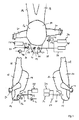
- the reference numeral 10 generally shows a chemical protective suit, wherein the chemical protective suit in FIG. 2 merely illustrated by an ellipse.
- the chemical protective suit is shown in the figures in the suspended state at the foot portions 12, so that a head portion 14 of the chemical protective suit hangs down.
- the Chemical protective suit 10 also has a body portion 16 and leg portions 18 and arm and hand portions 20. It is the chemical protective suit, for example, a suit of the type 1a-ET or 1b-ET.
- a first care adapter 24 is releasably sealingly connected and with a second of the exhaust valve openings 22, a second care adapter 26 is detachably and sealingly connected.
- a first hose 28 is connected to the first care adapter 24 and a second hose 30 is connected to the second care adapter 26.
- the care adapters 24, 26 are connected to different media feeds and Ruleab entryen.
- a steam generator of a cleaning and disinfecting fluid supply device At reference numeral 34 is shown a steam generator of a cleaning and disinfecting fluid supply device.
- a pneumatic compressor is shown, which belongs to a leak tester of the system according to the invention.
- a heater blower of a Trocknungsgaszulite is shown and at reference numeral 40 is a pump.
- a metering pump is shown, which belongs to a metering device of the system according to the invention.
- the metering pump 42 communicates with a reservoir 44 for disinfectant in combination.
- a pressure sensor and at reference numeral 48 a temperature sensor of the system according to the invention is shown. In particular in FIG.
- the steam generator 34, the air compressor 36, the heater fan 38 and the pump 40 each have a with a Valve of the valve control 32 line provided with the hoses 28 and 30 are connected.
- a first discharge line 50 and a second discharge line 52 are provided, which are likewise connected in each case via a line provided with a valve of the valve control 32 to the first hose 28 or the second hose 30.
- the valve controller 32 for illustrative purposes only in FIG. 2 is shown.
- a suction device 56 is arranged in the interior of the head part 14, which is connected to the second care adapter 26 via a suction line 58 for sucking condensate accumulating in the head part 14 as part of the care.
- a zipper of the chemical protective suit 10 forming an access opening is opened. This is closed after the installation of the mentioned components. Subsequently, the chemical protective suit 10 can be moved as explained, for example, in a care cabin of the system.
- the chemical protection suit 10 is pressurized by means of the air compressor 36 to an expansion or compression set pressure.
- the pressure compressor 36 is also part of a dimensionally stable pressure device according to the invention. The dimensional stability pressure is sufficient so that the chemical protective suit 10 expands to its full or almost full volume.
- the valve associated with the steam generator 34 is opened and by the steam generator 34 is heated to a predetermined temperature steam as cleaning and disinfecting fluid via the first care adapter 24 into the interior of the chemical protection suit 10 where it distributes itself among other things evenly due to the dimensional stability pressure .
- the control device controls via the pressure sensor 46 and the temperature sensor 48 temperature and pressure inside the chemical protection suit 10 and regulates if necessary to achieve a respective setpoint after. Insofar as the water vapor in the suit to be maintained may have a temperature sufficient to kill germs, the supply of a separate disinfectant is not required. Otherwise, the water vapor can be added via the metering pump 42 from the reservoir 44, for example, a chemical disinfectant.
- the leak test starts.
- the chemical protective suit 10 is initially set by the compressed air compressor 36 below a stabilizing pressure and the stabilizing pressure is maintained during a predetermined time interval.
- the chemical protective suit 10 is set by the compressed air compressor 36 under the higher test pressure and the line system is closed by closing the valves.
- the pressure sensor 46 monitors the pressure drop for a predetermined period of time. The measurement results can be documented and logged by the control device, for example. If the pressure drop remains above a limit value, the leak test is terminated by opening, for example, the valve associated with the discharge line 52, so that the pressure in the chemical protective suit 10 drops, for example to the dimensional stability pressure.
- control device can output a warning signal and also log this measurement result.
- the chemical protection suit is no longer to be used or repaired and re-examined before use.
- the drying process can begin. But it is also possible that the drying takes place before the leak test.
- warm air is brought into the interior of the chemical protection suit 10 by the heating fan 38 by opening the associated valve, wherein the warm air absorbs the residual moisture in the chemical protective suit 10 and this dissipates via a return opening of the first care adapter 24 and the discharge line 50. After a predetermined period of time, the drying process is ended.
- the chemical protective suit 10 When using a care cabin, the chemical protective suit 10 is then moved out of this, in turn, for example, automatically controlled by the controller.
- the zipper of the chemical protective suit 10 can now be opened by a device attendant and the device attendant can remove the drainage device 56 and the suction line 58 from the interior of the head part 14 and detach the care adapters 24, 26 from the exhaust valve openings 22.
- the chemical protective suit 10 can now be removed for further use.
Landscapes
- Engineering & Computer Science (AREA)
- Health & Medical Sciences (AREA)
- Mechanical Engineering (AREA)
- Physics & Mathematics (AREA)
- General Physics & Mathematics (AREA)
- General Health & Medical Sciences (AREA)
- Veterinary Medicine (AREA)
- Public Health (AREA)
- General Chemical & Material Sciences (AREA)
- Chemical & Material Sciences (AREA)
- Epidemiology (AREA)
- Life Sciences & Earth Sciences (AREA)
- Animal Behavior & Ethology (AREA)
- Chemical Kinetics & Catalysis (AREA)
- General Engineering & Computer Science (AREA)
- Textile Engineering (AREA)
- Apparatus For Disinfection Or Sterilisation (AREA)
- Professional, Industrial, Or Sporting Protective Garments (AREA)
- Toxicology (AREA)
- Business, Economics & Management (AREA)
- Emergency Management (AREA)
Applications Claiming Priority (1)
| Application Number | Priority Date | Filing Date | Title |
|---|---|---|---|
| DE102015108857.6A DE102015108857A1 (de) | 2015-06-03 | 2015-06-03 | Verfahren und System zur Pflege mindestens eines Schutzanzugs |
Publications (3)
| Publication Number | Publication Date |
|---|---|
| EP3120899A1 true EP3120899A1 (fr) | 2017-01-25 |
| EP3120899B1 EP3120899B1 (fr) | 2023-07-12 |
| EP3120899C0 EP3120899C0 (fr) | 2023-07-12 |
Family
ID=56344967
Family Applications (1)
| Application Number | Title | Priority Date | Filing Date |
|---|---|---|---|
| EP16171975.2A Active EP3120899B1 (fr) | 2015-06-03 | 2016-05-30 | Procede et systeme d'entretien d'au moins un vetement de protection |
Country Status (3)
| Country | Link |
|---|---|
| US (1) | US10294606B2 (fr) |
| EP (1) | EP3120899B1 (fr) |
| DE (1) | DE102015108857A1 (fr) |
Cited By (1)
| Publication number | Priority date | Publication date | Assignee | Title |
|---|---|---|---|---|
| DE102018204763A1 (de) * | 2018-03-28 | 2019-10-02 | Meiko Maschinenbau Gmbh & Co. Kg | Verfahren und Vorrichtung zur Reinigung mindestens eines Atemgeräts |
Families Citing this family (6)
| Publication number | Priority date | Publication date | Assignee | Title |
|---|---|---|---|---|
| CN110387729A (zh) * | 2018-04-15 | 2019-10-29 | 金华职业技术学院 | 一种衣服烘干辅助装置 |
| DE102019212775A1 (de) | 2019-08-26 | 2021-03-04 | Meiko Maschinenbau Gmbh & Co. Kg | Reinigungskorb zur Reinigung von Atemgerät |
| US12116717B2 (en) * | 2020-06-23 | 2024-10-15 | Claudio LANA | Wetsuit storage and drying apparatus |
| CN111588871A (zh) * | 2020-07-02 | 2020-08-28 | 异起(上海)智能科技有限公司 | 一种消毒装置和方法 |
| DE102020208546A1 (de) | 2020-07-08 | 2022-01-13 | Meiko Maschinenbau Gmbh & Co. Kg | Reinigungskorb zur Reinigung von Atemgerät |
| SE546289C2 (en) * | 2021-04-28 | 2024-09-24 | Rescue Intellitech Ab | A system and a method for cleaning firefighting equipment |
Citations (3)
| Publication number | Priority date | Publication date | Assignee | Title |
|---|---|---|---|---|
| WO1993009418A1 (fr) * | 1991-11-09 | 1993-05-13 | W.L. Gore & Associates (Uk) Limited | Essai d'etancheite |
| DE29822172U1 (de) * | 1998-12-11 | 1999-02-11 | Odenwaldwerke Rittersbach GmbH Fahrzeugbau und Katastrophenschutzsysteme, 74834 Elztal | Kabinensystem zum Behandeln von Schutzanzügen für Katastrophenfälle |
| US20010049883A1 (en) * | 2000-06-12 | 2001-12-13 | Ryden Michael V. | Dry suit dryer |
Family Cites Families (2)
| Publication number | Priority date | Publication date | Assignee | Title |
|---|---|---|---|---|
| WO2007003191A1 (fr) * | 2005-06-30 | 2007-01-11 | Viking Life Saving Equipment A/S | Procede et systeme de detection d’une fuite dans un objet |
| DE102008004711A1 (de) * | 2007-01-16 | 2008-07-17 | Mario Lehmann | Niederflur-Bahnwagen und ein Verfahren dazu |
-
2015
- 2015-06-03 DE DE102015108857.6A patent/DE102015108857A1/de not_active Ceased
-
2016
- 2016-05-30 EP EP16171975.2A patent/EP3120899B1/fr active Active
- 2016-06-03 US US15/172,394 patent/US10294606B2/en active Active
Patent Citations (3)
| Publication number | Priority date | Publication date | Assignee | Title |
|---|---|---|---|---|
| WO1993009418A1 (fr) * | 1991-11-09 | 1993-05-13 | W.L. Gore & Associates (Uk) Limited | Essai d'etancheite |
| DE29822172U1 (de) * | 1998-12-11 | 1999-02-11 | Odenwaldwerke Rittersbach GmbH Fahrzeugbau und Katastrophenschutzsysteme, 74834 Elztal | Kabinensystem zum Behandeln von Schutzanzügen für Katastrophenfälle |
| US20010049883A1 (en) * | 2000-06-12 | 2001-12-13 | Ryden Michael V. | Dry suit dryer |
Cited By (2)
| Publication number | Priority date | Publication date | Assignee | Title |
|---|---|---|---|---|
| DE102018204763A1 (de) * | 2018-03-28 | 2019-10-02 | Meiko Maschinenbau Gmbh & Co. Kg | Verfahren und Vorrichtung zur Reinigung mindestens eines Atemgeräts |
| US11691188B2 (en) | 2018-03-28 | 2023-07-04 | Meiko Maschinenbau Gmbh & Co. Kg | Method and devices for cleaning at least one breathing apparatus |
Also Published As
| Publication number | Publication date |
|---|---|
| US20160355973A1 (en) | 2016-12-08 |
| EP3120899B1 (fr) | 2023-07-12 |
| DE102015108857A1 (de) | 2016-12-08 |
| US10294606B2 (en) | 2019-05-21 |
| EP3120899C0 (fr) | 2023-07-12 |
Similar Documents
| Publication | Publication Date | Title |
|---|---|---|
| EP3120899B1 (fr) | Procede et systeme d'entretien d'au moins un vetement de protection | |
| DE102012220646B3 (de) | 3Halterungs-Sortiment und Reinigungsgerät zur Reinigung von Atemgeräten | |
| EP2571632B1 (fr) | Dispositif pour nettoyer des appareils de respiration | |
| EP0638297B1 (fr) | Procédé et dispositif pour le traitement hygiénique d'instruments médicaux, notamment dentaires | |
| EP0638298B1 (fr) | Cassette pour emmagasiner des instruments médicaux, notamment dentaires | |
| EP4021656B1 (fr) | Panier de nettoyage pour nettoyer un appareil respiratoire | |
| WO2019185809A1 (fr) | Procédé et dispositif pour le nettoyage d'au moins un appareil respiratoire | |
| EP0345713B1 (fr) | Appareil de nettoyage et de désinfection pour instruments médicaux, en particulier tubulures d'anesthésie, cathéters et endoscopes | |
| EP0638296B1 (fr) | Procédé et dispositif pour le nettoyage intensif d'articles médicaux, notamment dentaires | |
| DE102014008171B4 (de) | Verfahren und Vorrichtung zur Reinigung, Desinfektion und Sterilisation von Gegenständen | |
| DE69735470T2 (de) | System zur Gasrückgewinnung | |
| EP0890337A2 (fr) | Dispositif destiné au nettoyage, à la stérilisation, au transport et au magasinage d'instruments médicaux, en particulier des endoscopes | |
| DE60219211T2 (de) | Sterilisator | |
| DE69735468T2 (de) | Anordnung zur Anpassung eines Systems zur Erzeugung und Wiedergewinnung von Gasen an einem bestimmten Volumen | |
| EP3706925A1 (fr) | Unité de nettoyage mobile pour le nettoyage d'appareils respiratoires | |
| WO2022008581A1 (fr) | Panier de nettoyage pour nettoyer un appareil respiratoire | |
| EP3936242B1 (fr) | Procédé et système de nettoyage permettant de nettoyer un respirateur | |
| DE102014015909B4 (de) | Wartungsvorrichtung und Verfahren zum Warten eines Kreislaufatemgerätes | |
| EP0738545A1 (fr) | Méthode et dispositif pour nettoyer et désinfecter des récipients medicaux | |
| DE10203234A1 (de) | Dekontaminierbare Sicherheitswerkbank | |
| DE102014019774A1 (de) | Verfahren und Vorrichtung zur Reinigung, Desinfektion und Sterilisation von Gegenständen | |
| DE102020210272A1 (de) | Reinigungsvorrichtung und Verfahren zur Reinigung von Reinigungsgut | |
| DE102018125382A1 (de) | Korb für ein Reinigungsgerät und Verfahren zum Druckbeaufschlagen von Reinigungsgut | |
| DE202014106195U1 (de) | Berührungsloser Sterilisierungskatheter | |
| DE102014119262B4 (de) | Berührungsloser Sterilisierungskatheter |
Legal Events
| Date | Code | Title | Description |
|---|---|---|---|
| PUAI | Public reference made under article 153(3) epc to a published international application that has entered the european phase |
Free format text: ORIGINAL CODE: 0009012 |
|
| STAA | Information on the status of an ep patent application or granted ep patent |
Free format text: STATUS: THE APPLICATION HAS BEEN PUBLISHED |
|
| AK | Designated contracting states |
Kind code of ref document: A1 Designated state(s): AL AT BE BG CH CY CZ DE DK EE ES FI FR GB GR HR HU IE IS IT LI LT LU LV MC MK MT NL NO PL PT RO RS SE SI SK SM TR |
|
| AX | Request for extension of the european patent |
Extension state: BA ME |
|
| STAA | Information on the status of an ep patent application or granted ep patent |
Free format text: STATUS: REQUEST FOR EXAMINATION WAS MADE |
|
| 17P | Request for examination filed |
Effective date: 20170725 |
|
| RBV | Designated contracting states (corrected) |
Designated state(s): AL AT BE BG CH CY CZ DE DK EE ES FI FR GB GR HR HU IE IS IT LI LT LU LV MC MK MT NL NO PL PT RO RS SE SI SK SM TR |
|
| STAA | Information on the status of an ep patent application or granted ep patent |
Free format text: STATUS: EXAMINATION IS IN PROGRESS |
|
| 17Q | First examination report despatched |
Effective date: 20191213 |
|
| GRAP | Despatch of communication of intention to grant a patent |
Free format text: ORIGINAL CODE: EPIDOSNIGR1 |
|
| STAA | Information on the status of an ep patent application or granted ep patent |
Free format text: STATUS: GRANT OF PATENT IS INTENDED |
|
| RIC1 | Information provided on ipc code assigned before grant |
Ipc: F26B 25/06 19680901ALN20230111BHEP Ipc: G01M 3/02 19680901ALI20230111BHEP Ipc: F26B 25/00 19680901ALI20230111BHEP Ipc: F26B 21/00 19680901ALI20230111BHEP Ipc: B08B 11/02 19680901ALI20230111BHEP Ipc: B08B 9/00 19680901ALI20230111BHEP Ipc: B08B 3/04 19680901ALI20230111BHEP Ipc: A62B 99/00 20090101AFI20230111BHEP |
|
| INTG | Intention to grant announced |
Effective date: 20230203 |
|
| GRAS | Grant fee paid |
Free format text: ORIGINAL CODE: EPIDOSNIGR3 |
|
| GRAA | (expected) grant |
Free format text: ORIGINAL CODE: 0009210 |
|
| STAA | Information on the status of an ep patent application or granted ep patent |
Free format text: STATUS: THE PATENT HAS BEEN GRANTED |
|
| AK | Designated contracting states |
Kind code of ref document: B1 Designated state(s): AL AT BE BG CH CY CZ DE DK EE ES FI FR GB GR HR HU IE IS IT LI LT LU LV MC MK MT NL NO PL PT RO RS SE SI SK SM TR |
|
| REG | Reference to a national code |
Ref country code: CH Ref legal event code: EP |
|
| REG | Reference to a national code |
Ref country code: DE Ref legal event code: R096 Ref document number: 502016015933 Country of ref document: DE |
|
| REG | Reference to a national code |
Ref country code: IE Ref legal event code: FG4D Free format text: LANGUAGE OF EP DOCUMENT: GERMAN |
|
| U01 | Request for unitary effect filed |
Effective date: 20230717 |
|
| U07 | Unitary effect registered |
Designated state(s): AT BE BG DE DK EE FI FR IT LT LU LV MT NL PT SE SI Effective date: 20230724 |
|
| REG | Reference to a national code |
Ref country code: LT Ref legal event code: MG9D |
|
| PG25 | Lapsed in a contracting state [announced via postgrant information from national office to epo] |
Ref country code: GR Free format text: LAPSE BECAUSE OF FAILURE TO SUBMIT A TRANSLATION OF THE DESCRIPTION OR TO PAY THE FEE WITHIN THE PRESCRIBED TIME-LIMIT Effective date: 20231013 |
|
| PG25 | Lapsed in a contracting state [announced via postgrant information from national office to epo] |
Ref country code: ES Free format text: LAPSE BECAUSE OF FAILURE TO SUBMIT A TRANSLATION OF THE DESCRIPTION OR TO PAY THE FEE WITHIN THE PRESCRIBED TIME-LIMIT Effective date: 20230712 |
|
| PG25 | Lapsed in a contracting state [announced via postgrant information from national office to epo] |
Ref country code: IS Free format text: LAPSE BECAUSE OF FAILURE TO SUBMIT A TRANSLATION OF THE DESCRIPTION OR TO PAY THE FEE WITHIN THE PRESCRIBED TIME-LIMIT Effective date: 20231112 |
|
| PG25 | Lapsed in a contracting state [announced via postgrant information from national office to epo] |
Ref country code: RS Free format text: LAPSE BECAUSE OF FAILURE TO SUBMIT A TRANSLATION OF THE DESCRIPTION OR TO PAY THE FEE WITHIN THE PRESCRIBED TIME-LIMIT Effective date: 20230712 Ref country code: NO Free format text: LAPSE BECAUSE OF FAILURE TO SUBMIT A TRANSLATION OF THE DESCRIPTION OR TO PAY THE FEE WITHIN THE PRESCRIBED TIME-LIMIT Effective date: 20231012 Ref country code: IS Free format text: LAPSE BECAUSE OF FAILURE TO SUBMIT A TRANSLATION OF THE DESCRIPTION OR TO PAY THE FEE WITHIN THE PRESCRIBED TIME-LIMIT Effective date: 20231112 Ref country code: HR Free format text: LAPSE BECAUSE OF FAILURE TO SUBMIT A TRANSLATION OF THE DESCRIPTION OR TO PAY THE FEE WITHIN THE PRESCRIBED TIME-LIMIT Effective date: 20230712 Ref country code: GR Free format text: LAPSE BECAUSE OF FAILURE TO SUBMIT A TRANSLATION OF THE DESCRIPTION OR TO PAY THE FEE WITHIN THE PRESCRIBED TIME-LIMIT Effective date: 20231013 Ref country code: ES Free format text: LAPSE BECAUSE OF FAILURE TO SUBMIT A TRANSLATION OF THE DESCRIPTION OR TO PAY THE FEE WITHIN THE PRESCRIBED TIME-LIMIT Effective date: 20230712 |
|
| PG25 | Lapsed in a contracting state [announced via postgrant information from national office to epo] |
Ref country code: PL Free format text: LAPSE BECAUSE OF FAILURE TO SUBMIT A TRANSLATION OF THE DESCRIPTION OR TO PAY THE FEE WITHIN THE PRESCRIBED TIME-LIMIT Effective date: 20230712 |
|
| REG | Reference to a national code |
Ref country code: DE Ref legal event code: R097 Ref document number: 502016015933 Country of ref document: DE |
|
| PG25 | Lapsed in a contracting state [announced via postgrant information from national office to epo] |
Ref country code: SM Free format text: LAPSE BECAUSE OF FAILURE TO SUBMIT A TRANSLATION OF THE DESCRIPTION OR TO PAY THE FEE WITHIN THE PRESCRIBED TIME-LIMIT Effective date: 20230712 Ref country code: RO Free format text: LAPSE BECAUSE OF FAILURE TO SUBMIT A TRANSLATION OF THE DESCRIPTION OR TO PAY THE FEE WITHIN THE PRESCRIBED TIME-LIMIT Effective date: 20230712 Ref country code: CZ Free format text: LAPSE BECAUSE OF FAILURE TO SUBMIT A TRANSLATION OF THE DESCRIPTION OR TO PAY THE FEE WITHIN THE PRESCRIBED TIME-LIMIT Effective date: 20230712 Ref country code: SK Free format text: LAPSE BECAUSE OF FAILURE TO SUBMIT A TRANSLATION OF THE DESCRIPTION OR TO PAY THE FEE WITHIN THE PRESCRIBED TIME-LIMIT Effective date: 20230712 |
|
| PLBE | No opposition filed within time limit |
Free format text: ORIGINAL CODE: 0009261 |
|
| STAA | Information on the status of an ep patent application or granted ep patent |
Free format text: STATUS: NO OPPOSITION FILED WITHIN TIME LIMIT |
|
| 26N | No opposition filed |
Effective date: 20240415 |
|
| U20 | Renewal fee for the european patent with unitary effect paid |
Year of fee payment: 9 Effective date: 20240516 |
|
| REG | Reference to a national code |
Ref country code: CH Ref legal event code: PL |
|
| PG25 | Lapsed in a contracting state [announced via postgrant information from national office to epo] |
Ref country code: MC Free format text: LAPSE BECAUSE OF FAILURE TO SUBMIT A TRANSLATION OF THE DESCRIPTION OR TO PAY THE FEE WITHIN THE PRESCRIBED TIME-LIMIT Effective date: 20230712 |
|
| GBPC | Gb: european patent ceased through non-payment of renewal fee |
Effective date: 20240530 |
|
| PG25 | Lapsed in a contracting state [announced via postgrant information from national office to epo] |
Ref country code: MC Free format text: LAPSE BECAUSE OF FAILURE TO SUBMIT A TRANSLATION OF THE DESCRIPTION OR TO PAY THE FEE WITHIN THE PRESCRIBED TIME-LIMIT Effective date: 20230712 Ref country code: CH Free format text: LAPSE BECAUSE OF NON-PAYMENT OF DUE FEES Effective date: 20240531 |
|
| PG25 | Lapsed in a contracting state [announced via postgrant information from national office to epo] |
Ref country code: IE Free format text: LAPSE BECAUSE OF NON-PAYMENT OF DUE FEES Effective date: 20240530 |
|
| PG25 | Lapsed in a contracting state [announced via postgrant information from national office to epo] |
Ref country code: GB Free format text: LAPSE BECAUSE OF NON-PAYMENT OF DUE FEES Effective date: 20240530 |
|
| U20 | Renewal fee for the european patent with unitary effect paid |
Year of fee payment: 10 Effective date: 20250514 |
|
| PG25 | Lapsed in a contracting state [announced via postgrant information from national office to epo] |
Ref country code: CY Free format text: LAPSE BECAUSE OF FAILURE TO SUBMIT A TRANSLATION OF THE DESCRIPTION OR TO PAY THE FEE WITHIN THE PRESCRIBED TIME-LIMIT; INVALID AB INITIO Effective date: 20160530 |
|
| PG25 | Lapsed in a contracting state [announced via postgrant information from national office to epo] |
Ref country code: HU Free format text: LAPSE BECAUSE OF FAILURE TO SUBMIT A TRANSLATION OF THE DESCRIPTION OR TO PAY THE FEE WITHIN THE PRESCRIBED TIME-LIMIT; INVALID AB INITIO Effective date: 20160530 |