EP3121004A1 - Plancher composite en polypropylène écologique léger et son procédé de préparation - Google Patents
Plancher composite en polypropylène écologique léger et son procédé de préparation Download PDFInfo
- Publication number
- EP3121004A1 EP3121004A1 EP16172179.0A EP16172179A EP3121004A1 EP 3121004 A1 EP3121004 A1 EP 3121004A1 EP 16172179 A EP16172179 A EP 16172179A EP 3121004 A1 EP3121004 A1 EP 3121004A1
- Authority
- EP
- European Patent Office
- Prior art keywords
- weight
- layer
- polypropylene
- substrate layer
- melt index
- Prior art date
- Legal status (The legal status is an assumption and is not a legal conclusion. Google has not performed a legal analysis and makes no representation as to the accuracy of the status listed.)
- Granted
Links
Images
Classifications
-
- E—FIXED CONSTRUCTIONS
- E04—BUILDING
- E04F—FINISHING WORK ON BUILDINGS, e.g. STAIRS, FLOORS
- E04F15/00—Flooring
- E04F15/02—Flooring or floor layers composed of a number of similar elements
- E04F15/10—Flooring or floor layers composed of a number of similar elements of other materials, e.g. fibrous or chipped materials, organic plastics, magnesite tiles, hardboard, or with a top layer of other materials
- E04F15/107—Flooring or floor layers composed of a number of similar elements of other materials, e.g. fibrous or chipped materials, organic plastics, magnesite tiles, hardboard, or with a top layer of other materials composed of several layers, e.g. sandwich panels
-
- B—PERFORMING OPERATIONS; TRANSPORTING
- B29—WORKING OF PLASTICS; WORKING OF SUBSTANCES IN A PLASTIC STATE IN GENERAL
- B29B—PREPARATION OR PRETREATMENT OF THE MATERIAL TO BE SHAPED; MAKING GRANULES OR PREFORMS; RECOVERY OF PLASTICS OR OTHER CONSTITUENTS OF WASTE MATERIAL CONTAINING PLASTICS
- B29B11/00—Making preforms
- B29B11/06—Making preforms by moulding the material
- B29B11/12—Compression moulding
-
- B—PERFORMING OPERATIONS; TRANSPORTING
- B29—WORKING OF PLASTICS; WORKING OF SUBSTANCES IN A PLASTIC STATE IN GENERAL
- B29B—PREPARATION OR PRETREATMENT OF THE MATERIAL TO BE SHAPED; MAKING GRANULES OR PREFORMS; RECOVERY OF PLASTICS OR OTHER CONSTITUENTS OF WASTE MATERIAL CONTAINING PLASTICS
- B29B13/00—Conditioning or physical treatment of the material to be shaped
- B29B13/04—Conditioning or physical treatment of the material to be shaped by cooling
-
- B—PERFORMING OPERATIONS; TRANSPORTING
- B29—WORKING OF PLASTICS; WORKING OF SUBSTANCES IN A PLASTIC STATE IN GENERAL
- B29B—PREPARATION OR PRETREATMENT OF THE MATERIAL TO BE SHAPED; MAKING GRANULES OR PREFORMS; RECOVERY OF PLASTICS OR OTHER CONSTITUENTS OF WASTE MATERIAL CONTAINING PLASTICS
- B29B7/00—Mixing; Kneading
- B29B7/30—Mixing; Kneading continuous, with mechanical mixing or kneading devices
- B29B7/34—Mixing; Kneading continuous, with mechanical mixing or kneading devices with movable mixing or kneading devices
- B29B7/38—Mixing; Kneading continuous, with mechanical mixing or kneading devices with movable mixing or kneading devices rotary
- B29B7/46—Mixing; Kneading continuous, with mechanical mixing or kneading devices with movable mixing or kneading devices rotary with more than one shaft
- B29B7/48—Mixing; Kneading continuous, with mechanical mixing or kneading devices with movable mixing or kneading devices rotary with more than one shaft with intermeshing devices, e.g. screws
-
- B—PERFORMING OPERATIONS; TRANSPORTING
- B29—WORKING OF PLASTICS; WORKING OF SUBSTANCES IN A PLASTIC STATE IN GENERAL
- B29C—SHAPING OR JOINING OF PLASTICS; SHAPING OF MATERIAL IN A PLASTIC STATE, NOT OTHERWISE PROVIDED FOR; AFTER-TREATMENT OF THE SHAPED PRODUCTS, e.g. REPAIRING
- B29C59/00—Surface shaping of articles, e.g. embossing; Apparatus therefor
- B29C59/02—Surface shaping of articles, e.g. embossing; Apparatus therefor by mechanical means, e.g. pressing
-
- B—PERFORMING OPERATIONS; TRANSPORTING
- B29—WORKING OF PLASTICS; WORKING OF SUBSTANCES IN A PLASTIC STATE IN GENERAL
- B29C—SHAPING OR JOINING OF PLASTICS; SHAPING OF MATERIAL IN A PLASTIC STATE, NOT OTHERWISE PROVIDED FOR; AFTER-TREATMENT OF THE SHAPED PRODUCTS, e.g. REPAIRING
- B29C65/00—Joining or sealing of preformed parts, e.g. welding of plastics materials; Apparatus therefor
- B29C65/02—Joining or sealing of preformed parts, e.g. welding of plastics materials; Apparatus therefor by heating, with or without pressure
- B29C65/18—Joining or sealing of preformed parts, e.g. welding of plastics materials; Apparatus therefor by heating, with or without pressure using heated tools
- B29C65/20—Joining or sealing of preformed parts, e.g. welding of plastics materials; Apparatus therefor by heating, with or without pressure using heated tools with direct contact, e.g. using "mirror"
-
- B—PERFORMING OPERATIONS; TRANSPORTING
- B29—WORKING OF PLASTICS; WORKING OF SUBSTANCES IN A PLASTIC STATE IN GENERAL
- B29C—SHAPING OR JOINING OF PLASTICS; SHAPING OF MATERIAL IN A PLASTIC STATE, NOT OTHERWISE PROVIDED FOR; AFTER-TREATMENT OF THE SHAPED PRODUCTS, e.g. REPAIRING
- B29C65/00—Joining or sealing of preformed parts, e.g. welding of plastics materials; Apparatus therefor
- B29C65/48—Joining or sealing of preformed parts, e.g. welding of plastics materials; Apparatus therefor using adhesives, i.e. using supplementary joining material; solvent bonding
- B29C65/4805—Joining or sealing of preformed parts, e.g. welding of plastics materials; Apparatus therefor using adhesives, i.e. using supplementary joining material; solvent bonding characterised by the type of adhesives
- B29C65/481—Non-reactive adhesives, e.g. physically hardening adhesives
- B29C65/4815—Hot melt adhesives, e.g. thermoplastic adhesives
-
- B—PERFORMING OPERATIONS; TRANSPORTING
- B29—WORKING OF PLASTICS; WORKING OF SUBSTANCES IN A PLASTIC STATE IN GENERAL
- B29C—SHAPING OR JOINING OF PLASTICS; SHAPING OF MATERIAL IN A PLASTIC STATE, NOT OTHERWISE PROVIDED FOR; AFTER-TREATMENT OF THE SHAPED PRODUCTS, e.g. REPAIRING
- B29C66/00—General aspects of processes or apparatus for joining preformed parts
- B29C66/40—General aspects of joining substantially flat articles, e.g. plates, sheets or web-like materials; Making flat seams in tubular or hollow articles; Joining single elements to substantially flat surfaces
- B29C66/41—Joining substantially flat articles ; Making flat seams in tubular or hollow articles
- B29C66/45—Joining of substantially the whole surface of the articles
-
- B—PERFORMING OPERATIONS; TRANSPORTING
- B32—LAYERED PRODUCTS
- B32B—LAYERED PRODUCTS, i.e. PRODUCTS BUILT-UP OF STRATA OF FLAT OR NON-FLAT, e.g. CELLULAR OR HONEYCOMB, FORM
- B32B27/00—Layered products comprising a layer of synthetic resin
- B32B27/06—Layered products comprising a layer of synthetic resin as the main or only constituent of a layer, which is next to another layer of the same or of a different material
- B32B27/08—Layered products comprising a layer of synthetic resin as the main or only constituent of a layer, which is next to another layer of the same or of a different material of synthetic resin
-
- B—PERFORMING OPERATIONS; TRANSPORTING
- B32—LAYERED PRODUCTS
- B32B—LAYERED PRODUCTS, i.e. PRODUCTS BUILT-UP OF STRATA OF FLAT OR NON-FLAT, e.g. CELLULAR OR HONEYCOMB, FORM
- B32B27/00—Layered products comprising a layer of synthetic resin
- B32B27/18—Layered products comprising a layer of synthetic resin characterised by the use of special additives
-
- B—PERFORMING OPERATIONS; TRANSPORTING
- B32—LAYERED PRODUCTS
- B32B—LAYERED PRODUCTS, i.e. PRODUCTS BUILT-UP OF STRATA OF FLAT OR NON-FLAT, e.g. CELLULAR OR HONEYCOMB, FORM
- B32B27/00—Layered products comprising a layer of synthetic resin
- B32B27/18—Layered products comprising a layer of synthetic resin characterised by the use of special additives
- B32B27/20—Layered products comprising a layer of synthetic resin characterised by the use of special additives using fillers, pigments, thixotroping agents
-
- B—PERFORMING OPERATIONS; TRANSPORTING
- B32—LAYERED PRODUCTS
- B32B—LAYERED PRODUCTS, i.e. PRODUCTS BUILT-UP OF STRATA OF FLAT OR NON-FLAT, e.g. CELLULAR OR HONEYCOMB, FORM
- B32B27/00—Layered products comprising a layer of synthetic resin
- B32B27/32—Layered products comprising a layer of synthetic resin comprising polyolefins
-
- B—PERFORMING OPERATIONS; TRANSPORTING
- B32—LAYERED PRODUCTS
- B32B—LAYERED PRODUCTS, i.e. PRODUCTS BUILT-UP OF STRATA OF FLAT OR NON-FLAT, e.g. CELLULAR OR HONEYCOMB, FORM
- B32B5/00—Layered products characterised by the non- homogeneity or physical structure, i.e. comprising a fibrous, filamentary, particulate or foam layer; Layered products characterised by having a layer differing constitutionally or physically in different parts
- B32B5/02—Layered products characterised by the non- homogeneity or physical structure, i.e. comprising a fibrous, filamentary, particulate or foam layer; Layered products characterised by having a layer differing constitutionally or physically in different parts characterised by structural features of a fibrous or filamentary layer
-
- C—CHEMISTRY; METALLURGY
- C08—ORGANIC MACROMOLECULAR COMPOUNDS; THEIR PREPARATION OR CHEMICAL WORKING-UP; COMPOSITIONS BASED THEREON
- C08K—Use of inorganic or non-macromolecular organic substances as compounding ingredients
- C08K13/00—Use of mixtures of ingredients not covered by one single of the preceding main groups, each of these compounds being essential
- C08K13/02—Organic and inorganic ingredients
-
- C—CHEMISTRY; METALLURGY
- C08—ORGANIC MACROMOLECULAR COMPOUNDS; THEIR PREPARATION OR CHEMICAL WORKING-UP; COMPOSITIONS BASED THEREON
- C08K—Use of inorganic or non-macromolecular organic substances as compounding ingredients
- C08K3/00—Use of inorganic substances as compounding ingredients
- C08K3/18—Oxygen-containing compounds, e.g. metal carbonyls
- C08K3/24—Acids; Salts thereof
- C08K3/26—Carbonates; Bicarbonates
-
- C—CHEMISTRY; METALLURGY
- C08—ORGANIC MACROMOLECULAR COMPOUNDS; THEIR PREPARATION OR CHEMICAL WORKING-UP; COMPOSITIONS BASED THEREON
- C08K—Use of inorganic or non-macromolecular organic substances as compounding ingredients
- C08K5/00—Use of organic ingredients
- C08K5/04—Oxygen-containing compounds
- C08K5/09—Carboxylic acids; Metal salts thereof; Anhydrides thereof
- C08K5/098—Metal salts of carboxylic acids
-
- C—CHEMISTRY; METALLURGY
- C08—ORGANIC MACROMOLECULAR COMPOUNDS; THEIR PREPARATION OR CHEMICAL WORKING-UP; COMPOSITIONS BASED THEREON
- C08K—Use of inorganic or non-macromolecular organic substances as compounding ingredients
- C08K5/00—Use of organic ingredients
- C08K5/04—Oxygen-containing compounds
- C08K5/13—Phenols; Phenolates
-
- C—CHEMISTRY; METALLURGY
- C08—ORGANIC MACROMOLECULAR COMPOUNDS; THEIR PREPARATION OR CHEMICAL WORKING-UP; COMPOSITIONS BASED THEREON
- C08L—COMPOSITIONS OF MACROMOLECULAR COMPOUNDS
- C08L23/00—Compositions of homopolymers or copolymers of unsaturated aliphatic hydrocarbons having only one carbon-to-carbon double bond; Compositions of derivatives of such polymers
- C08L23/02—Compositions of homopolymers or copolymers of unsaturated aliphatic hydrocarbons having only one carbon-to-carbon double bond; Compositions of derivatives of such polymers not modified by chemical after-treatment
- C08L23/04—Homopolymers or copolymers of ethene
- C08L23/06—Polyethylene
-
- C—CHEMISTRY; METALLURGY
- C08—ORGANIC MACROMOLECULAR COMPOUNDS; THEIR PREPARATION OR CHEMICAL WORKING-UP; COMPOSITIONS BASED THEREON
- C08L—COMPOSITIONS OF MACROMOLECULAR COMPOUNDS
- C08L23/00—Compositions of homopolymers or copolymers of unsaturated aliphatic hydrocarbons having only one carbon-to-carbon double bond; Compositions of derivatives of such polymers
- C08L23/02—Compositions of homopolymers or copolymers of unsaturated aliphatic hydrocarbons having only one carbon-to-carbon double bond; Compositions of derivatives of such polymers not modified by chemical after-treatment
- C08L23/10—Homopolymers or copolymers of propene
- C08L23/12—Polypropene
-
- C—CHEMISTRY; METALLURGY
- C09—DYES; PAINTS; POLISHES; NATURAL RESINS; ADHESIVES; COMPOSITIONS NOT OTHERWISE PROVIDED FOR; APPLICATIONS OF MATERIALS NOT OTHERWISE PROVIDED FOR
- C09D—COATING COMPOSITIONS, e.g. PAINTS, VARNISHES OR LACQUERS; FILLING PASTES; CHEMICAL PAINT OR INK REMOVERS; INKS; CORRECTING FLUIDS; WOODSTAINS; PASTES OR SOLIDS FOR COLOURING OR PRINTING; USE OF MATERIALS THEREFOR
- C09D11/00—Inks
- C09D11/02—Printing inks
- C09D11/10—Printing inks based on artificial resins
- C09D11/106—Printing inks based on artificial resins containing macromolecular compounds obtained by reactions only involving carbon-to-carbon unsaturated bonds
- C09D11/108—Hydrocarbon resins
-
- C—CHEMISTRY; METALLURGY
- C09—DYES; PAINTS; POLISHES; NATURAL RESINS; ADHESIVES; COMPOSITIONS NOT OTHERWISE PROVIDED FOR; APPLICATIONS OF MATERIALS NOT OTHERWISE PROVIDED FOR
- C09D—COATING COMPOSITIONS, e.g. PAINTS, VARNISHES OR LACQUERS; FILLING PASTES; CHEMICAL PAINT OR INK REMOVERS; INKS; CORRECTING FLUIDS; WOODSTAINS; PASTES OR SOLIDS FOR COLOURING OR PRINTING; USE OF MATERIALS THEREFOR
- C09D121/00—Coating compositions based on unspecified rubbers
- C09D121/02—Latex
-
- C—CHEMISTRY; METALLURGY
- C09—DYES; PAINTS; POLISHES; NATURAL RESINS; ADHESIVES; COMPOSITIONS NOT OTHERWISE PROVIDED FOR; APPLICATIONS OF MATERIALS NOT OTHERWISE PROVIDED FOR
- C09D—COATING COMPOSITIONS, e.g. PAINTS, VARNISHES OR LACQUERS; FILLING PASTES; CHEMICAL PAINT OR INK REMOVERS; INKS; CORRECTING FLUIDS; WOODSTAINS; PASTES OR SOLIDS FOR COLOURING OR PRINTING; USE OF MATERIALS THEREFOR
- C09D123/00—Coating compositions based on homopolymers or copolymers of unsaturated aliphatic hydrocarbons having only one carbon-to-carbon double bond; Coating compositions based on derivatives of such polymers
- C09D123/02—Coating compositions based on homopolymers or copolymers of unsaturated aliphatic hydrocarbons having only one carbon-to-carbon double bond; Coating compositions based on derivatives of such polymers not modified by chemical after-treatment
- C09D123/10—Homopolymers or copolymers of propene
- C09D123/12—Polypropene
-
- C—CHEMISTRY; METALLURGY
- C09—DYES; PAINTS; POLISHES; NATURAL RESINS; ADHESIVES; COMPOSITIONS NOT OTHERWISE PROVIDED FOR; APPLICATIONS OF MATERIALS NOT OTHERWISE PROVIDED FOR
- C09D—COATING COMPOSITIONS, e.g. PAINTS, VARNISHES OR LACQUERS; FILLING PASTES; CHEMICAL PAINT OR INK REMOVERS; INKS; CORRECTING FLUIDS; WOODSTAINS; PASTES OR SOLIDS FOR COLOURING OR PRINTING; USE OF MATERIALS THEREFOR
- C09D175/00—Coating compositions based on polyureas or polyurethanes; Coating compositions based on derivatives of such polymers
- C09D175/04—Polyurethanes
- C09D175/14—Polyurethanes having carbon-to-carbon unsaturated bonds
-
- C—CHEMISTRY; METALLURGY
- C09—DYES; PAINTS; POLISHES; NATURAL RESINS; ADHESIVES; COMPOSITIONS NOT OTHERWISE PROVIDED FOR; APPLICATIONS OF MATERIALS NOT OTHERWISE PROVIDED FOR
- C09D—COATING COMPOSITIONS, e.g. PAINTS, VARNISHES OR LACQUERS; FILLING PASTES; CHEMICAL PAINT OR INK REMOVERS; INKS; CORRECTING FLUIDS; WOODSTAINS; PASTES OR SOLIDS FOR COLOURING OR PRINTING; USE OF MATERIALS THEREFOR
- C09D7/00—Features of coating compositions, not provided for in group C09D5/00; Processes for incorporating ingredients in coating compositions
- C09D7/40—Additives
- C09D7/60—Additives non-macromolecular
- C09D7/63—Additives non-macromolecular organic
-
- C—CHEMISTRY; METALLURGY
- C09—DYES; PAINTS; POLISHES; NATURAL RESINS; ADHESIVES; COMPOSITIONS NOT OTHERWISE PROVIDED FOR; APPLICATIONS OF MATERIALS NOT OTHERWISE PROVIDED FOR
- C09D—COATING COMPOSITIONS, e.g. PAINTS, VARNISHES OR LACQUERS; FILLING PASTES; CHEMICAL PAINT OR INK REMOVERS; INKS; CORRECTING FLUIDS; WOODSTAINS; PASTES OR SOLIDS FOR COLOURING OR PRINTING; USE OF MATERIALS THEREFOR
- C09D7/00—Features of coating compositions, not provided for in group C09D5/00; Processes for incorporating ingredients in coating compositions
- C09D7/40—Additives
- C09D7/65—Additives macromolecular
-
- C—CHEMISTRY; METALLURGY
- C09—DYES; PAINTS; POLISHES; NATURAL RESINS; ADHESIVES; COMPOSITIONS NOT OTHERWISE PROVIDED FOR; APPLICATIONS OF MATERIALS NOT OTHERWISE PROVIDED FOR
- C09J—ADHESIVES; NON-MECHANICAL ASPECTS OF ADHESIVE PROCESSES IN GENERAL; ADHESIVE PROCESSES NOT PROVIDED FOR ELSEWHERE; USE OF MATERIALS AS ADHESIVES
- C09J11/00—Features of adhesives not provided for in group C09J9/00, e.g. additives
- C09J11/08—Macromolecular additives
-
- C—CHEMISTRY; METALLURGY
- C09—DYES; PAINTS; POLISHES; NATURAL RESINS; ADHESIVES; COMPOSITIONS NOT OTHERWISE PROVIDED FOR; APPLICATIONS OF MATERIALS NOT OTHERWISE PROVIDED FOR
- C09J—ADHESIVES; NON-MECHANICAL ASPECTS OF ADHESIVE PROCESSES IN GENERAL; ADHESIVE PROCESSES NOT PROVIDED FOR ELSEWHERE; USE OF MATERIALS AS ADHESIVES
- C09J123/00—Adhesives based on homopolymers or copolymers of unsaturated aliphatic hydrocarbons having only one carbon-to-carbon double bond; Adhesives based on derivatives of such polymers
- C09J123/02—Adhesives based on homopolymers or copolymers of unsaturated aliphatic hydrocarbons having only one carbon-to-carbon double bond; Adhesives based on derivatives of such polymers not modified by chemical after-treatment
- C09J123/04—Homopolymers or copolymers of ethene
- C09J123/08—Copolymers of ethene
- C09J123/0846—Copolymers of ethene with unsaturated hydrocarbons containing other atoms than carbon or hydrogen atoms
- C09J123/0853—Vinylacetate
-
- C—CHEMISTRY; METALLURGY
- C09—DYES; PAINTS; POLISHES; NATURAL RESINS; ADHESIVES; COMPOSITIONS NOT OTHERWISE PROVIDED FOR; APPLICATIONS OF MATERIALS NOT OTHERWISE PROVIDED FOR
- C09J—ADHESIVES; NON-MECHANICAL ASPECTS OF ADHESIVE PROCESSES IN GENERAL; ADHESIVE PROCESSES NOT PROVIDED FOR ELSEWHERE; USE OF MATERIALS AS ADHESIVES
- C09J193/00—Adhesives based on natural resins; Adhesives based on derivatives thereof
- C09J193/04—Rosin
-
- B—PERFORMING OPERATIONS; TRANSPORTING
- B29—WORKING OF PLASTICS; WORKING OF SUBSTANCES IN A PLASTIC STATE IN GENERAL
- B29K—INDEXING SCHEME ASSOCIATED WITH SUBCLASSES B29B, B29C OR B29D, RELATING TO MOULDING MATERIALS OR TO MATERIALS FOR MOULDS, REINFORCEMENTS, FILLERS OR PREFORMED PARTS, e.g. INSERTS
- B29K2023/00—Use of polyalkenes or derivatives thereof as moulding material
- B29K2023/04—Polymers of ethylene
- B29K2023/06—PE, i.e. polyethylene
-
- B—PERFORMING OPERATIONS; TRANSPORTING
- B29—WORKING OF PLASTICS; WORKING OF SUBSTANCES IN A PLASTIC STATE IN GENERAL
- B29K—INDEXING SCHEME ASSOCIATED WITH SUBCLASSES B29B, B29C OR B29D, RELATING TO MOULDING MATERIALS OR TO MATERIALS FOR MOULDS, REINFORCEMENTS, FILLERS OR PREFORMED PARTS, e.g. INSERTS
- B29K2023/00—Use of polyalkenes or derivatives thereof as moulding material
- B29K2023/10—Polymers of propylene
- B29K2023/12—PP, i.e. polypropylene
-
- B—PERFORMING OPERATIONS; TRANSPORTING
- B29—WORKING OF PLASTICS; WORKING OF SUBSTANCES IN A PLASTIC STATE IN GENERAL
- B29K—INDEXING SCHEME ASSOCIATED WITH SUBCLASSES B29B, B29C OR B29D, RELATING TO MOULDING MATERIALS OR TO MATERIALS FOR MOULDS, REINFORCEMENTS, FILLERS OR PREFORMED PARTS, e.g. INSERTS
- B29K2075/00—Use of PU, i.e. polyureas or polyurethanes or derivatives thereof, as moulding material
-
- B—PERFORMING OPERATIONS; TRANSPORTING
- B29—WORKING OF PLASTICS; WORKING OF SUBSTANCES IN A PLASTIC STATE IN GENERAL
- B29K—INDEXING SCHEME ASSOCIATED WITH SUBCLASSES B29B, B29C OR B29D, RELATING TO MOULDING MATERIALS OR TO MATERIALS FOR MOULDS, REINFORCEMENTS, FILLERS OR PREFORMED PARTS, e.g. INSERTS
- B29K2995/00—Properties of moulding materials, reinforcements, fillers, preformed parts or moulds
- B29K2995/0018—Properties of moulding materials, reinforcements, fillers, preformed parts or moulds having particular optical properties, e.g. fluorescent or phosphorescent
- B29K2995/0026—Transparent
-
- B—PERFORMING OPERATIONS; TRANSPORTING
- B29—WORKING OF PLASTICS; WORKING OF SUBSTANCES IN A PLASTIC STATE IN GENERAL
- B29K—INDEXING SCHEME ASSOCIATED WITH SUBCLASSES B29B, B29C OR B29D, RELATING TO MOULDING MATERIALS OR TO MATERIALS FOR MOULDS, REINFORCEMENTS, FILLERS OR PREFORMED PARTS, e.g. INSERTS
- B29K2995/00—Properties of moulding materials, reinforcements, fillers, preformed parts or moulds
- B29K2995/0037—Other properties
- B29K2995/0087—Wear resistance
-
- B—PERFORMING OPERATIONS; TRANSPORTING
- B29—WORKING OF PLASTICS; WORKING OF SUBSTANCES IN A PLASTIC STATE IN GENERAL
- B29L—INDEXING SCHEME ASSOCIATED WITH SUBCLASS B29C, RELATING TO PARTICULAR ARTICLES
- B29L2031/00—Other particular articles
- B29L2031/10—Building elements, e.g. bricks, blocks, tiles, panels, posts, beams
-
- B—PERFORMING OPERATIONS; TRANSPORTING
- B32—LAYERED PRODUCTS
- B32B—LAYERED PRODUCTS, i.e. PRODUCTS BUILT-UP OF STRATA OF FLAT OR NON-FLAT, e.g. CELLULAR OR HONEYCOMB, FORM
- B32B2260/00—Layered product comprising an impregnated, embedded, or bonded layer wherein the layer comprises an impregnation, embedding, or binder material
- B32B2260/02—Composition of the impregnated, bonded or embedded layer
- B32B2260/021—Fibrous or filamentary layer
-
- B—PERFORMING OPERATIONS; TRANSPORTING
- B32—LAYERED PRODUCTS
- B32B—LAYERED PRODUCTS, i.e. PRODUCTS BUILT-UP OF STRATA OF FLAT OR NON-FLAT, e.g. CELLULAR OR HONEYCOMB, FORM
- B32B2260/00—Layered product comprising an impregnated, embedded, or bonded layer wherein the layer comprises an impregnation, embedding, or binder material
- B32B2260/04—Impregnation, embedding, or binder material
- B32B2260/046—Synthetic resin
-
- B—PERFORMING OPERATIONS; TRANSPORTING
- B32—LAYERED PRODUCTS
- B32B—LAYERED PRODUCTS, i.e. PRODUCTS BUILT-UP OF STRATA OF FLAT OR NON-FLAT, e.g. CELLULAR OR HONEYCOMB, FORM
- B32B2262/00—Composition or structural features of fibres which form a fibrous or filamentary layer or are present as additives
- B32B2262/02—Synthetic macromolecular fibres
- B32B2262/0276—Polyester fibres
- B32B2262/0284—Polyethylene terephthalate [PET] or polybutylene terephthalate [PBT]
-
- B—PERFORMING OPERATIONS; TRANSPORTING
- B32—LAYERED PRODUCTS
- B32B—LAYERED PRODUCTS, i.e. PRODUCTS BUILT-UP OF STRATA OF FLAT OR NON-FLAT, e.g. CELLULAR OR HONEYCOMB, FORM
- B32B2307/00—Properties of the layers or laminate
- B32B2307/10—Properties of the layers or laminate having particular acoustical properties
- B32B2307/102—Insulating
-
- B—PERFORMING OPERATIONS; TRANSPORTING
- B32—LAYERED PRODUCTS
- B32B—LAYERED PRODUCTS, i.e. PRODUCTS BUILT-UP OF STRATA OF FLAT OR NON-FLAT, e.g. CELLULAR OR HONEYCOMB, FORM
- B32B2307/00—Properties of the layers or laminate
- B32B2307/30—Properties of the layers or laminate having particular thermal properties
- B32B2307/306—Resistant to heat
- B32B2307/3065—Flame resistant or retardant, fire resistant or retardant
-
- B—PERFORMING OPERATIONS; TRANSPORTING
- B32—LAYERED PRODUCTS
- B32B—LAYERED PRODUCTS, i.e. PRODUCTS BUILT-UP OF STRATA OF FLAT OR NON-FLAT, e.g. CELLULAR OR HONEYCOMB, FORM
- B32B2307/00—Properties of the layers or laminate
- B32B2307/50—Properties of the layers or laminate having particular mechanical properties
- B32B2307/554—Wear resistance
-
- B—PERFORMING OPERATIONS; TRANSPORTING
- B32—LAYERED PRODUCTS
- B32B—LAYERED PRODUCTS, i.e. PRODUCTS BUILT-UP OF STRATA OF FLAT OR NON-FLAT, e.g. CELLULAR OR HONEYCOMB, FORM
- B32B2323/00—Polyalkenes
- B32B2323/10—Polypropylene
-
- B—PERFORMING OPERATIONS; TRANSPORTING
- B32—LAYERED PRODUCTS
- B32B—LAYERED PRODUCTS, i.e. PRODUCTS BUILT-UP OF STRATA OF FLAT OR NON-FLAT, e.g. CELLULAR OR HONEYCOMB, FORM
- B32B2419/00—Buildings or parts thereof
- B32B2419/04—Tiles for floors or walls
-
- B—PERFORMING OPERATIONS; TRANSPORTING
- B32—LAYERED PRODUCTS
- B32B—LAYERED PRODUCTS, i.e. PRODUCTS BUILT-UP OF STRATA OF FLAT OR NON-FLAT, e.g. CELLULAR OR HONEYCOMB, FORM
- B32B2471/00—Floor coverings
-
- B—PERFORMING OPERATIONS; TRANSPORTING
- B32—LAYERED PRODUCTS
- B32B—LAYERED PRODUCTS, i.e. PRODUCTS BUILT-UP OF STRATA OF FLAT OR NON-FLAT, e.g. CELLULAR OR HONEYCOMB, FORM
- B32B27/00—Layered products comprising a layer of synthetic resin
- B32B27/06—Layered products comprising a layer of synthetic resin as the main or only constituent of a layer, which is next to another layer of the same or of a different material
-
- C—CHEMISTRY; METALLURGY
- C08—ORGANIC MACROMOLECULAR COMPOUNDS; THEIR PREPARATION OR CHEMICAL WORKING-UP; COMPOSITIONS BASED THEREON
- C08F—MACROMOLECULAR COMPOUNDS OBTAINED BY REACTIONS ONLY INVOLVING CARBON-TO-CARBON UNSATURATED BONDS
- C08F2500/00—Characteristics or properties of obtained polyolefins; Use thereof
- C08F2500/12—Melt flow index or melt flow ratio
-
- C—CHEMISTRY; METALLURGY
- C08—ORGANIC MACROMOLECULAR COMPOUNDS; THEIR PREPARATION OR CHEMICAL WORKING-UP; COMPOSITIONS BASED THEREON
- C08K—Use of inorganic or non-macromolecular organic substances as compounding ingredients
- C08K3/00—Use of inorganic substances as compounding ingredients
- C08K3/18—Oxygen-containing compounds, e.g. metal carbonyls
- C08K3/24—Acids; Salts thereof
- C08K3/26—Carbonates; Bicarbonates
- C08K2003/265—Calcium, strontium or barium carbonate
-
- C—CHEMISTRY; METALLURGY
- C08—ORGANIC MACROMOLECULAR COMPOUNDS; THEIR PREPARATION OR CHEMICAL WORKING-UP; COMPOSITIONS BASED THEREON
- C08L—COMPOSITIONS OF MACROMOLECULAR COMPOUNDS
- C08L2205/00—Polymer mixtures characterised by other features
- C08L2205/02—Polymer mixtures characterised by other features containing two or more polymers of the same C08L -group
- C08L2205/025—Polymer mixtures characterised by other features containing two or more polymers of the same C08L -group containing two or more polymers of the same hierarchy C08L, and differing only in parameters such as density, comonomer content, molecular weight, structure
-
- C—CHEMISTRY; METALLURGY
- C08—ORGANIC MACROMOLECULAR COMPOUNDS; THEIR PREPARATION OR CHEMICAL WORKING-UP; COMPOSITIONS BASED THEREON
- C08L—COMPOSITIONS OF MACROMOLECULAR COMPOUNDS
- C08L2205/00—Polymer mixtures characterised by other features
- C08L2205/03—Polymer mixtures characterised by other features containing three or more polymers in a blend
-
- C—CHEMISTRY; METALLURGY
- C08—ORGANIC MACROMOLECULAR COMPOUNDS; THEIR PREPARATION OR CHEMICAL WORKING-UP; COMPOSITIONS BASED THEREON
- C08L—COMPOSITIONS OF MACROMOLECULAR COMPOUNDS
- C08L2205/00—Polymer mixtures characterised by other features
- C08L2205/03—Polymer mixtures characterised by other features containing three or more polymers in a blend
- C08L2205/035—Polymer mixtures characterised by other features containing three or more polymers in a blend containing four or more polymers in a blend
-
- C—CHEMISTRY; METALLURGY
- C08—ORGANIC MACROMOLECULAR COMPOUNDS; THEIR PREPARATION OR CHEMICAL WORKING-UP; COMPOSITIONS BASED THEREON
- C08L—COMPOSITIONS OF MACROMOLECULAR COMPOUNDS
- C08L2207/00—Properties characterising the ingredient of the composition
- C08L2207/04—Thermoplastic elastomer
Definitions
- the present invention relates to a composite floor.
- the present invention relates to a polypropylene-based composite floor, and its preparation process.
- PVC-based floors are mostly based on polyvinyl chloride (PVC).
- PVC-based floors may release toxic gases such as hydrogen chloride, carbon monoxide, and dioxin upon decomposition or combustion, and they usually contain phthalate plasticizers, which may produce reproductive toxicity when separated out.
- PVC-based floors have poor dimensional stability.
- CN102277945A discloses a non-PVC-based composite floor containing polyethylene, ethylene-propylene rubber and/or ethylene-butyl acrylate copolymer as the substrate layer, which solved the environmental problem and plasticizer separating-out problem of a PVC-based floor.
- the structure of the composite floor comprises, from top to bottom, a wear-resistant layer, a connective layer, a decorative layer, optionally another connective layer, a primary substrate layer, and a secondary substrate layer.
- this patent application document does not disclose how to solve the following problems that may be present in this kind of non-PVC composite floors:
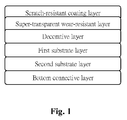
- An object of the present invention is to provide a lightweight environment-friendly composite floor, which adopts light density polypropylene material to replace traditional PVC material as a substrate material, and comprises, from top to bottom, a scrach-resistant layer, a wear-resistant layer, a decorative layer, a first substrate layer, a second substrate layer, a bottom connective layer and, optionally, a back adhesive layer.
- the wear-resistant layer has a super transparency, and there is excellent compactness between each layer and its neighboring layer without using additional connective layer, and the compactness between the composite floor and the ground is also excellent.
- the composite floor also has good dimensional stability, high mechanical strength, good resistance to shrinkage and warpage, and good flame retardance.
- the upper surface of the super-transparent wear-resistant layer, which is facing the scratch-resistant coating layer, has been subjected to a surface-polarizing treatment.
- the upper surface of the ultra-transparent wear-resistant layer has been subjected to a surface-polarizing treatment by using the following treatment agent A and treatment agent B:
- the super-transparent wear-resistant layer has a raw material formulation comprising: based on the weight of the total formulation,
- the decorative layer is an ink-printed silicon-based environment-friendly composite paper, wherein the environment-friendly composite paper has a raw material formulation comprising: based on the weight of the total formulation,
- the first substrate layer has a raw material formulation comprising, based on the weight of the total formulation,
- the second substrate layer has a raw material formulation comprising: based on the weight of the total formulation,
- the bottom connective layer has a raw material formulation comprising: based on the weight of the total formulation,
- the bottom surface of the bottom connective layer is subjected to a surface-polarizing treatment.
- the bottom surface of the bottom connective layer is subjected to a surface-polarizing treatment by using the following treatment agent A and treatment agent B:
- the present invention also provides a process for preparing the above-mentioned lightweight environment-friendly polypropylene composite floor, comprising the following steps:
- the upper surface of the super-transparent wear-resistant layer is subjected to a surface polarizing treatment before applying the scratch-resistant coating layer onto it.
- the upper surface of the super-transparent wear-resistant layer is subjected to a surface-polarizing treatment by using the following treatment agent A and treatment agent B:
- the bottom surface having embossed pattern thereon of the bottom connective layer is subjected to a surface-polarizing process.
- the bottom surface having embossed pattern thereon of the bottom connective layer is subjected to a surface-polarizing process by using the following treatment agent A and treatment agent B:
- the decorative layer is formed onto the upper surface of the first substrate layer or the bottom surface of the super-transparent wear-resistant layer by a thermal transfer process with following process parameters: Hardness of the substrate surface 60°-90° Preheated surface hot air knife 50-60 °C Traction speed 2-4m / min Transfer temperature 300-370°C Transfer pressure 0.4-0.5 Mpa Transfer thickness 12-26 ⁇ m.
- each of the first substrate layer and the second substrate layer is prepared by the following steps: mixing raw materials for the substrate layer in a mixer with a stirring speed of 5000-8000rpm, internal milling the mixture in an internal mill at a temperature of 100-190 °C, further open milling the mixture in a roller mill at a temperature of 120-190 °C, transferring the thoroughly mixed and milled raw materials into a calenderer and calendering them at a temperature of 150-180 °C, and then cooling the calendered sheet to obtain a substrate layer.
- the super-transparent wear-resistant layer is prepared by the following steps: mixing and extruding raw materials of the super-transparent wear-resistant layer in a planetary twin-screw extruder at a plasticizing temperature of 170-220 °C; calendering the extruded materials in a calenderer at a temperature of 150-185 °C, and finally cooling the calendered sheet with cooling wheels at a temperature of 50-60 °C and a line speed of 40-100 m/min.
- the composite floor of the present invention has the following advantages: the super-transparent wear-resistant layer is prepared by a rapidly cooling process and thus has an excellent transparency; the specific formulations of the first substrate layer and the second substrate layer endow the composite floor with excellent dimensional stability, mechanical properties, processing properties, and flame retardance; the surface-polarizing treatment to the super-transparent wear-resistant layer before applying the scratch-resistant layer improves the compactness between the scratch-resistant layer and the super-transparent wear-resistant layer, and endows the composite floor with good scratch resistance; the surface-polarizing treatment to the bottom connective layer improves the compactness between the composite floor and the adhesive applied on the ground; the thermal transfer process of the decorative layer or using an ink-printed environment-friendly composite paper as the decorative layer ensure good compactness between the decorative layer and the super-transparent wear-resistant layer, and between the decorative layer and the first substrate layer without using an additional connective layer; the simple internal milling and open milling processes for preparing the substrate layers and the direct hot press lamination process of the laminated floor body improve the productivity and product
- Figure 1 schematically shows a layer-structure of an embodiment of the composite floor of the present invention.
- polypropylene generally refers to a polypropylene homopolymer, but also includes polypropylene copolymers usually referred to as "PP" in industrial practice, e.g., ethylene and propylene copolymer, butylene and propylene copolymer, and copolymers of propylene and other ⁇ -olefins, or polypropylene blends.
- polypropylene floor is used to denote a composite floor with substrate layer comprising one or more polypropylene homopolymers and/or one or more polypropylene copolymers and/or one or more polypropylene blends.
- the polypropylene homopolymer usually has a molecular weight in a range of 200,000 to 600,000.
- the polypropylene copolymer may be a random copolymer, a block copolymer or a grafted copolymer, wherein the comonomer other than propylene may be selected from the group consisting of ethylene, butene, maleic anhydride, and the like.
- the polypropylene blend comprises, besides polypropylene, one or more other polymers selected from polyethylene, polystyrene, poly(meth)acrylates, polyurethanes, ethylene-propylene rubber, and the like.
- polypropylene-based refers to a material or formulation comprising, as an important component or a main component, one or more polypropylene homopolymers and/or one or more polypropylene copolymers and/or one or more blends of polypropylene with one or more other polymers.
- polyurethane-based refers to a material or formulation comprising, as an important component or a main component, one or more polyurethane homopolymers and/or one or more polyurethane copolymers and/or one or more blends of polyurethane with one or more other polymers
- upper surface refers to the surface of a component layer of the composite floor, which is farther away from the ground
- bottom surface refers to the surface of a component layer of the composite floor, which is towards the ground.
- MI melt index
- MFR melt flow rate
- surface-polarizing treatment refers to a surface treatment for processing a non-polar polypropylene-based surface with a surface treatment agent to increase properties such as polarity and surface tension of the surface.
- the present invention provides a composite floor comprising, from top to bottom:
- the present invention also provides a process for preparing the above-mentioned lightweight environment-friendly polypropylene composite floor, comprising the following steps:
- substrate layer here refers to the first substrate layer and the second substrate layer, respectively.
- the first substrate layer and the second substrate layer of the composite floor of the present invention each adopts a blend of two polypropylenes having different melt indexes and a polyethylene as the basic polymer materials.
- polypropylene has the lowest density, which is in a range of 0.9-0.91g/cm 3 , and is about 60% of the density of PVC. Accordingly a composite floor using polypropylene as a substrate layer is much lighter than a composite floor using PVC as a substrate layer. Moreover, polypropylene does not release toxic gases. Therefore, polypropylene is an ideal material for preparing a lightweight and environment-friendly composite floor.
- the raw materials for the substrate layer of the composite floor of the present invention comprise a polypropylene blend, which comprises a first polypropylene having a melt index (MI) of 0.1-0.9g/10min, preferably 0.2-0.6g/10min, and a second polypropylene having a melt index (MI) of 5-30g/10min, preferably 6-15g/10min.
- MI melt index
- the amount of the first polypropylene is preferably 0.5 to 10% by weight, more preferably 1.5 to 6% by weight; and the amount of the second polypropylene is preferably 0.5 to 10% by weight, more preferably 1.5 to 6% by weight.
- the raw materials for the substrate layer of the composite floor of the present invention further comprise a polyethylene having a melt index (MI) of 2-20g/10min.
- the polyethylene and the polypropylene blend form a blended melt during processing.
- the blended melt of the polypropylenes and polyethylene can be considered as a suspension system consisting of the two types of polymers, wherein the polypropylenes are the continuous phase, and the polyethylene is the dispersed phase.
- the amount of the polyethylene is preferably 1 to 10% by weight, more preferably 2-9% by weight.
- Table 1 shows the influence of different Rm ranges on the mechanical properties of the resulting substrate layers.
- Table 1 Rm (MIppx Wt% PP )/(MIpe ⁇ Wt%pe) Roughness (elongation rate), % ISO-527-2
- Tensile yield strength MPa ISO-178 Rm ⁇ 0.5 450-520 ⁇ 22 0.2 ⁇ Rm ⁇ 1 300-500 25-30
- Rm 1 250-300 28-32 10>Rm>1 150-250 30-35
- the relative amounts of the polypropylenes and the polyethylene in the first substrate layer and the second substrate layer are adjusted so that the Rm value of the first substrate layer satisfies 1 ⁇ Rm ⁇ 10, and the Rm value of the second substrate layer satisfies 0.2 ⁇ Rm ⁇ 1.
- the raw materials for the substrate layer of the composite floor of the present invention further comprise long glass fibers having a length of 0.4mm-0.8mm.
- polypropylene material has a tensile strength between 20-30 Mpa, a bending strength between 25-50 Mpa, and a bending modulus between 800-1500 Mpa.
- the long glass fibers in the substrate layer are preferably in an amount of 1 to 10% by weight, more preferably 1 to 5% by weight.
- Table 2 shows a comparison between mechanical properties of a polypropylene resin added with long glass fibers and a control polypropylene resin without adding long glass fibers.
- Table 2 Test Standard Control polypropylene Polypropylene containing 5phr 0.6mm glass fibers Polypropylene containing 10phr 0.6mm glass fibers Polypropylene containing 20phr 0.6mm glass fibers Tensile strength (Mpa) ISO-527-2 25 35 70 90 Bending strength (Mpa) ISO-178 30 40 90 120 Bending modulus (Mpa) ISO-178 850 1200 3000 4500 Dimensional stability EN 434 2.5% 1.0% 0.60% 0.35% Heat resistance (°C) GB-1710-79 100 110 135 150
- the raw materials for the substrate layer of the composite floor of the present invention further comprise an ethylene-octene copolymer (POE) and wollastonite powder.
- Ethylene-octene copolymer (POE) is an ideal impact-resistance modifier for polypropylene.
- POE ethylene-octene copolymer
- the present invention adopts a blend of POE and wollastonite powder having an aspect ratio of preferably 5.0 to 10.0, more preferably 5.0-7.0, with the ratio of wollastonite to POE in a range of 1:1 to 10:1, preferably 1:2 to 1:4, particularly preferably 1:3.
- the contact area between the wollastonite particles and the polypropylene substrate materials is increased, which absorbs more impact energy and thus further modifies the toughness and strength of the polypropylene materials.
- the ethylene-octene copolymer is present in the substrate layer in an amount of preferably 0.5-2% by weight, more preferably 0.8-1.5% by weight.
- the wollastonite powder is present in the substrate layer in an amount of preferably 2-8% by weight, more preferably 3-5 % by weight.
- the raw materials for the substrate layer of the composite floor of the present invention further comprise calcium carbonate powder.
- the addition of calcium carbonate powder having a particle size of 500-2000 mesh, more preferably 1000-1500 mesh, and a whiteness of 90 or more, more preferably 95 or more, can increase the dimensional stability of the composite floor, and reduce the production cost.
- the amount of the calcium carbonate powder in the substrate layer is preferably 60-85% by weight, more preferably 75-85% by weight.
- the raw materials for the substrate layer of the composite floor of the present invention further comprise a flame retardant.
- Preferred flame retardant can be selected from intumescent flame retardants (IFR).
- IFR is a type of flame retardants containing C, N, and P as core components and mainly consists of three parts: (1) a carbon source (carbon-forming agent), which is a kind of carbon-rich multi-functional substances, such as starch, pentaerythritol and diacetal thereof; (2) an acid source (dehydrating agent), which may be an inorganic acid or a salt that can generate acid in situ upon heating, such as phosphoric acid or ammonium polyphosphate, etc.; and (3) a gas source (environmental blowing agent).
- a carbon source carbon-forming agent
- an acid source dehydrating agent
- a gas source environment blowing agent
- the flame retardant mechanism of IFR is that, when heated, the carbon-forming agent undergoes a dehydration reaction under the action of the acid source, and forms a fluffy carbon layer having closed-cell structure under the action of the gas produced by the decomposition of the blowing agent.
- the carbon layer can reduce energy transfer between the heat source and the burning polymers, and prevent gas diffusion, such that the combustion of the polymers can be terminated due to insufficient supply of fuel and oxygen.
- the flame retardant property of the composite floor of the present invention satisfies the level of Bf1-S1.
- the content of the flame retardant in the substrate layer is preferably 1-8% by weight, more preferably 1-6% by weight.
- the formulation of raw materials for the substrate layer comprises:
- each of the first substrate layer and the second substrate layer of the composite floor of the present invention is prepared by a process comprising steps of mixing, internal milling, open milling, calendering and cooling.
- the raw materials for the substrate layer is mixed in a mixer with a stir speed preferably of 4000-10000rpm, more preferably of 5000-8000rpm, and then the mixture is internal milled in an internal mill at a temperature preferably of 100-190°C, followed by an open milling in a roller mill at a temperature preferably of 120-190°C; the internal milling and open milling can be carried out repeatedly and then the thoroughly mixed and milled materials are calendered, for example, using a reverse L-shape four-roll calenderer, to prepare a sheet of substrate layer at a temperature , for example, of 150-180°C, and finally the calendered sheet is cooled with a set of cooling wheels, preferably by a multi-stage cooling process.
- Table 3 shows the process conditions for preparing a substrate layer in a preferred embodiment of the present invention,: Table 3 Mixer Internal mill Open mill A Open mill B Calenderer Cooling wheels Stir speed Temp. °C Time Temp. °C Temp. °C Temp. of upper roll °C Temp. of middle roll °C Temp. of lower roll °C Temp. of the first stage °C Temp. of the second stage °C 5000-8000RPM 100-190 5-15 min 120-190 120-190 170-180 160-170 150-160 60-80 40-60
- Polypropylene is a crystalline polymer having a softening point very close to its melting point, resulting in a narrow window of processing temperature. Due to the low melt strength and insufficient strain hardening effect, it is often unable to prepare a substrate layer from polypropylene efficiently and rapidly through internal milling and open milling.
- a polypropylene based substrate layer can be prepared through conventional internal milling and open milling processes with a production line speed of up to 30-40m/min, which dramatically improves the productivity and production efficiency, and can save energy and reduce costs.
- the raw material formulation for the super-transparent wear-resistant layer comprises: based on the weight of the total formulation, 85-98% by weight, preferably 95-98% by weight of a polypropylene having a molecular weight of 100,000 to 300,000, preferably 150,000 250,000; 1-12% by weight, preferably 1-3% by weight of a polypropylene-maleic anhydride grafted copolymer having a molecular weight of 20,000-50,000, preferably 25,000-40,000, wherein the grafting rate of the maleic anhydride is 1-10%, preferably 1-3%; 0.2 to 0.8% by weight, preferably 0.3 to 0.6% by weight of a nucleating agent; 0.1-0.5% by weight, preferably 0.2 to 0.4% by weight of an antioxidant; 0.2 to 0.8% by weight, preferably 0.3 to 0.6% by weight of an ultraviolet absorber; and 0.2 to 0.5% by weight of a light stabilizer.
- the nucleating agent may be any nucleating agent generally used in polypropylene plastics, such as di(p-methylbenzylidene) sorbitol.
- the antioxidant may be any antioxidant generally used in polypropylene plastics, such as 3-tert-butyl-4-hydroxy anisole.
- the ultraviolet light absorber can be any UV absorber commonly used for polypropylene plastics, for example 2- (2-hydroxy-5-methylphenyl) benzotriazole ( CAS NO. 2440-22-4 ).
- the light stabilizer may be any light stabilizer generally used in polypropylene plastics, such as a polymer obtained from succinic acid and 4-hydroxy-2,2,6,6-tetramethyl-1-piperidinol ( CAS NO. 70198-29-7 ).
- the formulation for the super-transparent wear-resistant layer of the present invention comprises a nucleating agent, which accelerates crystallization, and renders the crystal particles finer, so that the crystal diameter is smaller than the wavelength of visible light and thus cannot scatter visible light, which effectively increases transparency.
- the super-transparent wear-resistant layer is prepared through the following steps: adding raw materials of polypropylene, polypropylene-maleic anhydride grafted copolymer, and nucleating agent for forming the super-transparent wear-resistant layer into a planetary twin-screw extruder, kneading and extruding the raw materials, feeding the extruded mixture into a calenderer and rapidly cooling the calendered sheet with a set of cooling wheels to obtain a super-transparent wear-resistant layer, which has a haze of less than 11%, preferably 8-11%, and a light transmittance of greater than 90%, preferably 90-95%.
- the plasticizing temperature of the planetary twin-screw extruder is 170-220°C
- the temperature of the calenderer is 150-185°C
- the cooling temperature of the cooling wheels is 50-60°C
- the line speed at the cooling wheels is 40-100m/min.
- the raw materials for forming the super-transparent wear-resistant layer are sufficiently mixed and kneaded by using a planetary twin-screw extruder, the obtained blended melt is fed into a calenderer to form a calendered sheet and then the calendered sheet is rapidly cooled through a set of cooling wheels so that the melt rapidly passes through its crystallization zone, reducing the degree of crystallinity, and the crystalline polymorph can be controlled in the form of quasi hexagonal body. Since quasi hexagonal crystal form has best transparency among the possible five types of crystalline polymorphs of polypropylene, a super-transparent effect is achieved.
- Table 4 shows a comparison of transparency between a super-transparent wear-resistant layer of the present invention and a conventional polypropylene wear-resistant layer. Table 4 Haze(%) Light transmittance (%) Conventional PP wear-resistant layer Thickness 0.5mm 56 40 super-transparent wear-resistant layer of the present invention Thickness 0.5mm 8 90
- the ink formulation used for the decorative layer there is no particular limitation on the ink formulation used for the decorative layer, and any ink formulation commonly used for decorative layer of floor can be used, for example the following ink formulations:
- Black ink Formulation 30 parts of A-2175 resin solution (37%); 8 parts of carbon black, 1.5 parts of Westlands, and 0.5 part of Qinglian; 5 parts of emulsified oil; 10 parts of J624; 15 parts of J631; 1 part of aqueous wax; 8 parts of ethylene glycol monobutyl ether; 0.5 part of antifoaming agent; and 24 parts of deionized water.
- Red Ink formulation 30 parts of A-2175 resin solution (37%); 6 parts of Big Pink, and 2 parts of Li Saul Red; 5 parts of emulsified oil; 10 parts of J624; 15 parts of J631; 1 part of aqueous wax; 8 parts of ethylene glycol monobutyl ether; 0.5 part of antifoaming agent; and 24 parts of deionized water.
- Dark green ink formulation 30 parts of A-2175 resin solution (37%); 5 parts of phthalocyanine green and 3 parts of Hydrazine yellow; 5 parts of emulsified oil; 10 parts of J624; 15 parts of J631; 1 part of aqueous wax; 8 parts of ethylene glycol monobutyl ether; 0.5 part of antifoaming agent; and 22.5 parts of deionized water.
- Sky blue ink formulation 30 parts of A-2175 resin solution (37%); 6.5 parts of phthalocyanine blue BGS and 1.5 parts of titanium dioxide; 5 parts of emulsified oil; 10 parts of J624; 15 parts of J631; 1 part of aqueous wax; 8 parts of ethylene glycol monobutyl ether; 0.5 part of antifoaming agent; and 22.5 parts of deionized water.
- the decorative layer is prepared by printing an environment-friendly nano composite paper with an ink formulation.
- the raw materials for the environment-friendly nano composite paper comprise: 10-30% by weight of silicon-based nano powder, such as SiC, Si 3 N 4 or Si/C/N powder, with a particle size of 10 to 100 nanometers; 1-5% by weight of a dispersing agent, such as PMMA-NH 4 (1M NH 4 PF 6 liquid electrolyte + PMMA); 20-25% by weight of a polyethylene having a molecular weight of 100,000-300,000, preferably about 200,000; 10 to 20% by weight of a polypropylene having a molecular weight of 200,000-400,000, preferably about 300,000; 40-50% by weight of one or more inorganic mineral powder fillers selected from the group consisting of, for example, calcium carbonate, calcium sulfate, kaolin, mica, zinc oxide, dolomite powder, silica powder, talc, diatomaceous earth, and mixtures thereof
- one status is that the particles form aggregates, where primary particles grow into secondary particles, which adhere to each other forming aggregates; the other status is that the powder particles repel each other and can move freely during the processing of the substrate material and form a stable dispersed phase.
- a dispersant such as PMMA- NH 4 (NH 4 PF 6 liquid electrolyte + PMMA) is used to disperse the silicon-based nano powder. Since PMMA-NH 4 is a strong polyelectrolyte, the surface charges of the silicon-based nano powder are increased, so that electrostatic repulsion is occurred among the nanoparticles, and the repulsion energy (V T ) is increased to 30-40mv, and accordingly an effectively stable dispersion of the silicon-based nano powder is achieved.
- PMMA-NH 4 NH 4 PF 6 liquid electrolyte + PMMA
- the strength and toughness of the composite paper are increased, and with the decrease of the crystal size of the material, the breaking strength increases faster than the yield strength, which increases the plasticity of the composite paper, and solves the problem that compactness between a conventional decorative layer and a non-polar polypropylene substrate layer is poor.
- the decorative layer is prepared by way of thermal transfer.
- Known methods for preparing a decorative layer for a plastic floor comprise electroplating, spray painting, surface coating, printing and laminating, etc.
- these methods cannot be applied well on a polypropylene-based floor, because polypropylene is a non-polar material, and the affinity between the ink of the decorative layer and the surface of the polypropylene-based substrate layer is poor, resulting in poor compactness of the floor.
- the present invention adopts a thermal transfer process, which endows the decorative layer with good compactness and heat-resistance. After the thermal transfer, the ink layer and the substrate layer are molten together, resulting in good compactness, and the process is simple and does not cause pollution.
- the decorative layer prepared by the thermal transfer process of the present invention has excellent performance.
- Various performance test results of the decorative layer are given below:
- Wear-resistance rubbing the tested surface with a cotton cloth under a load of 150g back and force 100 times. The tested surface was not wore or peeled off.
- Adhesion adopting a One hundred Lattices Test: scratching out 25 square lattices of 1mm x 1mm on the tested surface, sticking the lattices with 3M adhesive tape for 5 minuts, and then tearing off the adhesive tape. The tested surface in the lattices was not peeled off.
- Moisture resistance putting the tested sample in air at 40 ⁇ 2 °C with a humidity of 95% for 168 hours. There was no damage or peeling off.
- Heat resistance putting the tested sample in an oven at 60 ⁇ 2 °C for 168 hours. There was no damage or delamination.
- Weather resistance exposing the tested sample to ultraviolet irradiation (300W / 2h). ⁇ E ⁇ 2.5.
- the bottom connective layer is a layer based on a polypropylene wear-resistant material and is subjected to an embossing process.
- the formulation of the polypropylene wear-resistant material for the bottom connective layer is similar to the formulation for the super-transparent wear-resistant layer as mentioned above, except that the nucleating agent used for the preparation of the ultra-transparent is not necessary to be used in the bottom connective layer since there is no special requirement for the transparency of the bottom connective layer.
- the bottom connection layer may be prepared from a formulation comprising a polypropylene, a polypropylene-maleic anhydride grafted copolymer, and conventional additives through an extrusion process.
- the formulation for the bottom connective layer comprises: based on the weight of the total formulation, 85-98% by weight, preferably 95-98% by weight of a polypropylene having a molecular weight of 100,000 to 300,000, preferably 150,000 to 250,000; 1-12% by weight, preferably 1-3% by weight of a polypropylene-maleic anhydride grafted copolymer having a molecular weight of 20,000-50,000, preferably 25,000-40,000, wherein the grafting ratio of the maleic anhydride is of 1-10% , preferably 1-3%; 0.1-0.5% by weight of an antioxidant, 0.2-0.5% by weight of an ultraviolet light absorber, and 0.2-0.5% by weight of a light stabilizer.
- the embossing process for the bottom connective layer can be any conventional hot embossing method, e.g., a hot press molding process using oil pressure. Through the embossing process, a rough surface with embossed pattern thereon is formed at the bottom surface of the bottom connective layer.
- the layers produced above are laminated together by a hot press lamination process to form a laminated floor body in an order of, from top to bottom, the super-transparent wear-resistant layer, the decorative layer, the first substrate layer, the second substrate layer, and the bottom connective layer.
- the embossing process for the bottom connective layer is carried out simultaneously with the hot press lamination process.
- the hot press lamination process which can by any conventional hot press lamination process.
- a scratch-resistant coating layer can be applied on the upper surface of the supper-transparent wear-resistant layer.
- a coating for forming the scratch-resistant layer is a polyurethane-based coating comprising: 40-50% by weight of a polyurethane oligomer having a molecular weight of 4000-6000 or a low molecular weight polyurethane-acrylate copolymer, 25-35% by weight of an acrylic monomer, 5-10% by weight of a chlorinated polypropylene having a molecular weight of 150,000 to 20,000, 10-12% by weight of a matting agent, and 4-6 % by weight of a photopolymerization initiator.
- the upper surface of the supper-transparent wear-resistant layer is subjected to a surface polarizing treatment.
- the upper surface of the supper-transparent wear-resistant layer is subjected to a surface polarizing treatment, in order to introduce polar groups such as -CHO and -CO- into the surface molecules of the polypropylene to improve the surface polarity, which can effectively reduce the contact angle between the polypropylene surface and the coating, and thus the coating can spread out well on the polypropylene surface, forming an efficient scratch-resistant layer.
- a surface polarizing treatment in order to introduce polar groups such as -CHO and -CO- into the surface molecules of the polypropylene to improve the surface polarity, which can effectively reduce the contact angle between the polypropylene surface and the coating, and thus the coating can spread out well on the polypropylene surface, forming an efficient scratch-resistant layer.
- the upper surface of the ultra-transparent wear-resistant layer which is facing the scratch-resistant coating layer, is subjected to a surface-polarizing treatment by using the following treatment agent A and treatment agent B:
- the surface of the ultra-transparent wear-resistant layer is further subjected to a corona treatment.
- Table 6 shows comparison data of a treated polypropylene surface and an untreated polypropylene surface: Table 6 Surface status Contact angle( ⁇ ) Control (untreated) - 83°-85° 50°C Treatment agent A 3 min Small pores with diameter of 0.1-0.18 ⁇ m, and depth of 0.1 ⁇ m 49°-54° 50°C Treatment agent A, 3 min + Treatment agent B, 1 min Small pores with diameter of 0.2-0.35 ⁇ m, and depth of 0.15 ⁇ m 34°-44° 50°C Treatment agent A, 3min + Treatment agent B, 1min + Corona treatment Small pores with diameter of 0.3-0.5 ⁇ m, and depth of 0.15 ⁇ m 28°-35°
- the polypropylene-based bottom surface of the bottom connective layer is subjected to a surface polarizing treatment.
- the surface polarizing treatment can be carried out right after the embossing step for the bottom connective layer, or can be carried out after the formation of the above-mentioned laminated floor body.
- the bottom surface of the bottom connective layer is preferably treated with the following treatment agent A and treatment agent B:
- Treatment agent A comprises: Turpentine (40ml/L) 10-40% by weight Ethyl acetate 10-40% by weight Surfactant 10-20% by weight Emulsifier 2-10% by weight.
- Treatment agent B comprises: KMnO 4 0.5-1% by weight deionized water 99-99.5% by weight
- the bottom surface of the bottom connective layer is subjected to an embossing process, as well as a surface polarizing treatment, which greatly improves the surface tension of the bottom surface of the composite floor and solves the problem of poor adhesion between a conventional non-polar floor material and an adhesive applied on the ground.
- Table 7 illustrates surface tension data of different bottom connective layers: Table 7 Surface tension (tested by a dyne pen) Control (untreated bottom connective layer) 31 (dyn/cm) Bottom connective layer with embossed rough surface 34 (dyn/cm) Bottom connective layer with embossed rough surface and further treated with treatment agent A and treatment agent B 40 (dyn/cm)
- the composite floor of the present invention may comprise a back adhesive layer, which is formed by applying a hot melt adhesive on the bottom surface of the bottom connective layer.
- the hot melt adhesive can be any conventional hot melt adhesive usually used for composite floor.
- a back adhesive layer is formed on the bottom surface of the bottom connective layer by applying Taiwan Fu Hong 903 High polar hot melt adhesive via a coating machine.
- Formulation for the super-transparent wear-resistant layer comprising (based on the weight of the total formulation): Polypropylene (2401, Yanshan Petrochemical Corporation, molecular weight is about 250,000) 96.7% Polypropylene-maleic anhydride copolymer (KT-1, Qingdao Lvwei Chemical, molecular weight is about 50,000) 2% Nucleating agent (di(p-methylbenzylene) sorbitol, DMBS) 0.4% Antioxidant (BHA 3-tert-butyl-4-hydroxy anisole) UV absorbers (2-(2-hydroxy-5-methylphenyl) benzotriazole) 0.2% CAS NO. 2440-22-4 0.4% Light Stabilizer (622, a polymer of succinic acid with 4-hydroxy-2,2,6,6-tetramethyl-1 piperidinol) CAS NO. 70198-29-7 0.3%
- the obtained super-transparent wear-resistant layer has a haze of 8% and a light transmittance of 95%.
- Formulation for the bottom connective layer comprising (based on the weight of the total formulation): Polypropylene (2401, Yanshan Petrochemical Corporation, molecular weight is about 250,000) 96.7% Polypropylene-maleic anhydride copolymer (KT-1, Qingdao Lvwei Chemical, molecular weight is about 50,000) 2% Antioxidant (BHA 3-tert-butyl-4-hydroxy anisole) 0.2% UV absorber (2- (2-hydroxy-5-methylphenyl) benzotriazole) CAS NO. 2440-22-4 0.4% Light Stabilizer (622, polymer of succinate with 4-hydroxy-2,2,6,6-tetramethyl-1-piperidinol) CAS NO. 70198-29-7 0.3%
- the bottom surface of the obtained bottom connective layer was further subjected to an embossing process using an oil hot press molding method to form a rough surface having embossed pattern thereon.
- the layers produced above were laminated together by a hot press lamination process to form a laminated floor body in an order of, from top to bottom, the super-transparent wear-resistant layer, the decorative layer, the first substrate layer, the second substrate layer, and the bottom connective layer.
- the hot press lamination process was performed by an oil hot press lamination machine, which is consisted of multiple laminating plates and a multi-column hydraulic press, wherein each laminating plate can be controllably heated, pressed and cooled with hot oil or vapor. Specific process parameters are given in Table 12 below: Table 12 Hot press lamination 1. Temperature: 160 °C Shall ensure a stable vapor 2.
- the upper surface of the super-transparent wear-resistant layer was subjected to a surface polarizing treatment with the following treatment agents: Formulation of treatment agent A (based on the weight of the total formulation): Turpentine (40ml / L) 35% Ethyl acetate 35% Surfactant 25% Emulsifier 5%; Formulation of treatment agent B (based on the weight of the total formulation): KMnO 4 0.5% Deionized water 99.5%
- the upper surface of the super-transparent wear-resistant layer was treated with treatment agent A at 50 °C for 3 minutes, and then was treated with treatment agent B for 1 minute and dried followed by a corona treatment.
- a polyurethane-based coating was applied to the treated surface of the super-transparent wear-resistant layer to form a scratch-resistant coating layer.
- Formulation of the polyurethane-based coating comprising (based on the weight of the total formulation): Chlorinated polypropylene (CAS 68442-33-1) 10% Polyurethane acrylate oligomer (XUF-6006W, Nippon Kayaku) 40% Acrylic monomer (CAS 79-10-7, BAMM company) 35% Photopolymerization initiator 5% silica matting agent 10%
- the bottom surface of the bottom connective layer was subjected to a surface polarizing treatment with the following treatment agents:
- Formulation of treatment agent A comprising (based on the weight of the total formulation): Turpentine (40ml / L) 40% Ethyl acetate 40% Surfactant 15% Emulsifier 5%
- Formulation of treatment agent B comprising (based on the weight of the total formulation): KMnO 4 1% Deionized water 99%
- the bottom surface of the bottom connective layer was treated with treatment agent A at 50 °C for 5 minutes, and then was treated with treatment agent B for 3 minutes, and then dried.
- the lock performance of the composite floor of the present invention is excellent.
- a known non-PVC floor since its substrate layer is hard and brittle, it is difficult to apply a locking technology on a non-PVC floor to obtain a lock tension value of greater than 200kg/m (EU customer standard).
- the composite floor of the present invention overcomes the defect of the prior art and achieves a lock tension value of about 250 kg/m, and thus a polypropylene lock floor was successfully prepared.
Landscapes
- Chemical & Material Sciences (AREA)
- Engineering & Computer Science (AREA)
- Organic Chemistry (AREA)
- Chemical Kinetics & Catalysis (AREA)
- Polymers & Plastics (AREA)
- Health & Medical Sciences (AREA)
- Medicinal Chemistry (AREA)
- Mechanical Engineering (AREA)
- Architecture (AREA)
- Life Sciences & Earth Sciences (AREA)
- Materials Engineering (AREA)
- Wood Science & Technology (AREA)
- Structural Engineering (AREA)
- Civil Engineering (AREA)
- Laminated Bodies (AREA)
- Floor Finish (AREA)
- Compositions Of Macromolecular Compounds (AREA)
Applications Claiming Priority (1)
| Application Number | Priority Date | Filing Date | Title |
|---|---|---|---|
| PCT/CN2015/085055 WO2017015789A1 (fr) | 2015-07-24 | 2015-07-24 | Lame de parquet composite de polypropylène légère écologique et son procédé de fabrication |
Publications (2)
| Publication Number | Publication Date |
|---|---|
| EP3121004A1 true EP3121004A1 (fr) | 2017-01-25 |
| EP3121004B1 EP3121004B1 (fr) | 2018-07-18 |
Family
ID=56119312
Family Applications (1)
| Application Number | Title | Priority Date | Filing Date |
|---|---|---|---|
| EP16172179.0A Active EP3121004B1 (fr) | 2015-07-24 | 2016-05-31 | Plancher composite en polypropylène écologique léger et son procédé de préparation |
Country Status (5)
| Country | Link |
|---|---|
| US (1) | US9739067B2 (fr) |
| EP (1) | EP3121004B1 (fr) |
| CN (2) | CN108026730B (fr) |
| DK (1) | DK3121004T3 (fr) |
| WO (2) | WO2017015789A1 (fr) |
Cited By (5)
| Publication number | Priority date | Publication date | Assignee | Title |
|---|---|---|---|---|
| CN109337203A (zh) * | 2018-10-08 | 2019-02-15 | 湖南铭弘体育产业股份有限公司 | 一种基于高阻燃陶土复合材料的环保运动地板 |
| CN111456374A (zh) * | 2020-04-10 | 2020-07-28 | 江苏贝尔装饰材料有限公司 | 一种环保型聚丙烯地板及其制造方法 |
| CN111469516A (zh) * | 2020-04-15 | 2020-07-31 | 合肥晨乐塑胶有限公司 | 一种冰箱压缩机内仓板及其加工工艺 |
| CN112321989A (zh) * | 2020-11-24 | 2021-02-05 | 华东理工大学 | 纤维增强酚醛树脂复合材料的制备方法及纤维增强酚醛树脂复合材料 |
| WO2022023349A1 (fr) * | 2020-07-27 | 2022-02-03 | Ibotac GmbH & Co. KG | Panneaux plats et leur procédé de production |
Families Citing this family (55)
| Publication number | Priority date | Publication date | Assignee | Title |
|---|---|---|---|---|
| US11745475B2 (en) | 2016-08-19 | 2023-09-05 | Wilsonart Llc | Surfacing materials and method of manufacture |
| US10933608B2 (en) | 2016-08-19 | 2021-03-02 | Wilsonart Llc | Surfacing materials and method of manufacture |
| US11077639B2 (en) | 2016-08-19 | 2021-08-03 | Wilsonart Llc | Surfacing materials and method of manufacture |
| US11504955B2 (en) | 2016-08-19 | 2022-11-22 | Wilsonart Llc | Decorative laminate with matte finish and method of manufacture |
| JP7163905B2 (ja) * | 2017-02-28 | 2022-11-01 | 大日本印刷株式会社 | 化粧シート及び化粧板 |
| TWI640426B (zh) * | 2017-03-29 | 2018-11-11 | 光仁塑膠工業有限公司 | 非聚氯乙烯表面覆蓋物 |
| US11420428B2 (en) | 2017-07-25 | 2022-08-23 | Lowe's Companies, Inc. | Composite polymeric film wear layer for hard surfaces |
| US11020948B2 (en) | 2017-09-28 | 2021-06-01 | Wilsonart Llc | High pressure decorative laminate having a top layer of energy cured acrylated urethane polymer |
| CN108329601A (zh) * | 2018-02-08 | 2018-07-27 | 佛山市稳格家居用品有限公司 | 一种pp地砖材料及其制备方法 |
| CN108527985B (zh) * | 2018-02-08 | 2020-12-01 | 广东远华新材料实业有限公司 | 一种pp片状地砖及其制备方法 |
| CN110216951A (zh) * | 2018-03-01 | 2019-09-10 | 无锡市博宇塑机有限公司 | 可生物分解的塑料地板 |
| CN108454186A (zh) * | 2018-03-13 | 2018-08-28 | 昆山市聚光装饰材料有限公司 | 家具用复合型板材 |
| CN108467530A (zh) * | 2018-03-20 | 2018-08-31 | 福建师范大学福清分校 | 一种用于无甲醛环保木地板的薄膜及其制备方法 |
| CN108440837A (zh) * | 2018-03-20 | 2018-08-24 | 福建师范大学福清分校 | 一种用于无甲醛刚性环保木地板的薄膜及其制备方法 |
| CN109025165A (zh) * | 2018-07-17 | 2018-12-18 | 惠州伟康新型建材有限公司 | 一种聚烯烃材质的环保地板及其制造方法 |
| CN109181390B (zh) * | 2018-09-05 | 2019-10-25 | 中国科学院长春应用化学研究所 | 一种隔热防火涂层及其制备工艺 |
| NL2021887B1 (en) | 2018-10-26 | 2020-05-13 | I4F Licensing Nv | Multi-purpose tile system, tile covering, and tile |
| BE1026995B1 (nl) * | 2018-11-09 | 2020-08-27 | Unilin Bvba | Bekleed paneel en werkwijze voor het vervaardigen van beklede panelen |
| CN209468954U (zh) * | 2018-11-13 | 2019-10-08 | 黄海东 | 一种框架磁吸式地板 |
| US10975562B2 (en) | 2018-11-13 | 2021-04-13 | Katerra Inc. | Smart corner and wall frame system |
| CN110573341B (zh) | 2018-12-18 | 2021-05-25 | 郑素梅 | 一种防水耐磨复合地板及生产方法 |
| CN109797934A (zh) | 2018-12-29 | 2019-05-24 | 上海劲嘉建材科技有限公司 | 防滑地砖 |
| CN109677041A (zh) * | 2018-12-31 | 2019-04-26 | 郑州翎羽新材料有限公司 | 一种耐磨pvc复合地板 |
| CN111719812A (zh) * | 2019-03-18 | 2020-09-29 | 上海劲嘉建材科技有限公司 | 块状装饰材料 |
| CN109986858A (zh) * | 2019-04-04 | 2019-07-09 | 江苏贝尔装饰材料有限公司 | 环保型聚丙烯地板 |
| CN110202903A (zh) * | 2019-06-26 | 2019-09-06 | 常州市天润木业有限公司 | 一种自修复高压装饰板及其制备方法 |
| CN110341281A (zh) * | 2019-07-10 | 2019-10-18 | 常州市天润木业有限公司 | 一种共聚双重固化装饰板及其制备工艺 |
| CN110577688A (zh) * | 2019-08-01 | 2019-12-17 | 安徽万安环境科技股份有限公司 | 一种无碱长玻纤型pe管增强专用料 |
| CN110628148A (zh) * | 2019-09-27 | 2019-12-31 | 安徽可尔海思塑业有限公司 | 一种新型pvc复合地板及其生产方法 |
| GB201916036D0 (en) * | 2019-11-04 | 2019-12-18 | Altro Ltd | Improvements in or relating to organic material |
| CN110774625B (zh) * | 2019-11-06 | 2021-06-04 | 邦弗特新材料股份有限公司 | 含有超耐磨、易清洁的pvc预涂装膜的复合材料的制备方法 |
| US10853795B1 (en) | 2019-12-24 | 2020-12-01 | Capital One Services, Llc | Secure authentication based on identity data stored in a contactless card |
| CN111849189A (zh) * | 2020-06-22 | 2020-10-30 | 安徽滁州德威新材料有限公司 | 一种防水卷材颗粒及其制备方法和应用 |
| JP7604793B2 (ja) * | 2020-06-24 | 2024-12-24 | Toppanホールディングス株式会社 | 床用化粧シート |
| CN111823662B (zh) * | 2020-07-23 | 2021-08-06 | 惠州伟康新型建材有限公司 | 一种多层结构的聚丙烯地板 |
| CN112172372B (zh) * | 2020-09-29 | 2021-07-02 | 中星中大印刷(深圳)有限公司 | 一种无塑涂层复膜工艺以及无塑涂层复膜纸 |
| CN112277427B (zh) * | 2020-10-23 | 2022-05-24 | 浙江海利得地板有限公司 | 一种无卤环保耐磨弹性地板及其制备方法 |
| CN112940635A (zh) * | 2021-01-27 | 2021-06-11 | 大正新型材料(肇庆)有限公司 | 一种地板表面饰面用聚丙烯装饰膜 |
| CN113103789B (zh) * | 2021-04-07 | 2022-10-28 | 杭州戴森新材料有限公司 | 一种pvc地板彩膜印刷工艺 |
| CN112961615A (zh) * | 2021-04-20 | 2021-06-15 | 大正新型材料(肇庆)有限公司 | 一种环保阻燃型聚丙烯装饰膜 |
| CN113291414B (zh) * | 2021-05-12 | 2022-06-21 | 福建思嘉新材料科技有限公司 | 一种环保阻燃型船舶石塑地板的分切装置 |
| CN115873523B (zh) * | 2021-09-26 | 2024-08-20 | 大正新型材料(肇庆)有限公司 | 一种带有胶膜层的聚丙烯装饰膜及其制备方法和应用 |
| CN114311905A (zh) * | 2021-12-30 | 2022-04-12 | 帝高力装饰材料(江苏)有限公司 | 一种环保型非pvc地板的制备方法 |
| TWI805220B (zh) * | 2022-02-10 | 2023-06-11 | 林正雄 | 石塑地板及其製備方法 |
| CN114835975B (zh) * | 2022-03-25 | 2023-07-11 | 成都金发科技新材料有限公司 | 一种低翘曲玻纤增强聚丙烯复合材料及其制备方法和应用 |
| CN116041850A (zh) * | 2022-12-29 | 2023-05-02 | 常州市贝美家居科技有限公司 | 发泡聚丙烯地板及其制备方法 |
| CN116333617B (zh) * | 2023-04-03 | 2026-02-13 | 大正新型材料(肇庆)有限公司 | 一种地板表面饰面用聚丙烯装饰膜及其制备方法 |
| EP4538040A4 (fr) * | 2023-09-01 | 2025-12-03 | Changzhou Bemate Home Tech Co Ltd | Plancher en polypropylène semi-dur et son procédé de préparation |
| CN117124680A (zh) * | 2023-09-01 | 2023-11-28 | 常州市贝美家居科技有限公司 | 一种半硬质聚丙烯地板及其制备方法 |
| CN117301667A (zh) * | 2023-09-13 | 2023-12-29 | 福建思嘉环保材料科技有限公司 | 一种高性能聚丙烯石塑地板及制备方法 |
| CN117261389B (zh) * | 2023-09-28 | 2024-04-19 | 南通中奥车用新材料有限公司 | 一种具备高阻燃性的复合高分子纳米合成材料及其制备方法 |
| WO2025111737A1 (fr) * | 2023-11-27 | 2025-06-05 | 明和科技(唐山)股份有限公司 | Lame de parquet auto-adhésive insonorisée facile à démonter et réutilisable, sa préparation et son procédé d'utilisation |
| CN117964968A (zh) * | 2023-12-18 | 2024-05-03 | 中广核俊尔(浙江)新材料有限公司 | 一种轻质低介电常数连续纤维增强聚丙烯预浸带材料及其制备方法 |
| CN119041651A (zh) * | 2024-09-29 | 2024-11-29 | 埃克森美孚(惠州)化工有限公司 | 聚合物地板及其生产方法 |
| CN119081479B (zh) * | 2024-11-06 | 2025-02-07 | 甘肃衍河石油管道涂层有限公司 | 一种石墨烯陶瓷内衬重防腐涂料及制备方法 |
Citations (1)
| Publication number | Priority date | Publication date | Assignee | Title |
|---|---|---|---|---|
| US20110268933A1 (en) * | 2010-04-30 | 2011-11-03 | Kris Edward Hahn | Non-vinyl resilient flooring product and methods of making same |
Family Cites Families (33)
| Publication number | Priority date | Publication date | Assignee | Title |
|---|---|---|---|---|
| US3607473A (en) * | 1968-03-04 | 1971-09-21 | Macdermid Inc | Compositions for and method of pretreating plastic surfaces to improve adhesion of coating materials |
| SE9503197L (sv) * | 1995-09-15 | 1996-07-22 | Tarkett Ab | Halogenfritt golvmaterial |
| EP0927288B1 (fr) * | 1996-09-04 | 2002-03-13 | The Dow Chemical Company | Revetement pour plancher, mur ou plafond |
| JP2001220886A (ja) * | 2000-02-09 | 2001-08-17 | Dainippon Printing Co Ltd | 床材用シート及びそれを用いた床材 |
| TWI251606B (en) * | 2000-10-26 | 2006-03-21 | Ind Tech Res Inst | Polymer nanocomposites and the process of preparing the same |
| TWI273115B (en) * | 2000-12-12 | 2007-02-11 | Ciba Sc Holding Ag | Improved weatherability of flame retardant polyolefin |
| EP1426180A1 (fr) * | 2002-12-02 | 2004-06-09 | Tarkett Sommer S.A. | Produits multicouches, procédé pour leur fabrication et utilisation des dits produits multicouches |
| US20050170100A1 (en) * | 2004-02-04 | 2005-08-04 | Weine Ramsey Sally J. | Process for applying an opaque, corrosion resistant, 100% solids, UV curable finish to parts for underhood use in motor vehicles |
| JP2005290734A (ja) * | 2004-03-31 | 2005-10-20 | Dainippon Printing Co Ltd | 床材用化粧シート |
| JP4511896B2 (ja) * | 2004-08-25 | 2010-07-28 | タキロン株式会社 | 床材 |
| JP4658749B2 (ja) * | 2004-09-28 | 2011-03-23 | 大日本印刷株式会社 | 耐衝撃性及び耐スクラッチ性に優れた床材用化粧シート |
| KR101264450B1 (ko) * | 2005-01-21 | 2013-05-15 | 더 보잉 컴파니 | 변형제를 이용한 활성화 방법 |
| US7833611B2 (en) * | 2007-02-23 | 2010-11-16 | Mannington Mills, Inc. | Olefin based compositions and floor coverings containing the same |
| CN100497870C (zh) * | 2007-04-20 | 2009-06-10 | 吴潭波 | 实木硬质聚氯乙烯合成地板 |
| CN101096440B (zh) * | 2007-05-22 | 2010-06-09 | 深圳职业技术学院 | 一种sebs热塑性弹性体地板及其制造方法 |
| DE102008005565A1 (de) * | 2008-01-22 | 2009-07-23 | Tesa Ag | Folie aus Polypropylen, Verwendung derselben sowie Verfahren zur Herstellung der Folie |
| RU2010134488A (ru) * | 2008-02-18 | 2012-03-27 | ЮПМ-Кюммене Вуд Ой (FI) | Древесная плита с покрытием |
| EP2253467A4 (fr) * | 2008-03-12 | 2013-01-16 | Dainippon Printing Co Ltd | Feuille décorative pour pièce à travailler en trois dimensions |
| EP2340165A1 (fr) * | 2008-09-23 | 2011-07-06 | Borealis AG | Structure en polyoléfine |
| BRPI0923420A2 (pt) * | 2008-12-22 | 2018-10-16 | Basf Se | uso, ou método de uso, ou processo de uso de um agente de redução de fricção em combinação com um polímero enxertado , em adição a uma amida de acido graxo. |
| CN101693797B (zh) * | 2009-10-19 | 2014-08-20 | 湖南工业大学 | 一种环保型水性聚氨酯油墨及其制备方法 |
| US10259204B2 (en) * | 2010-04-30 | 2019-04-16 | Columbia Insurance Company | Resilient flooring product and methods of making same |
| US9562363B2 (en) * | 2010-10-26 | 2017-02-07 | Shanghai Jinka Flooring Technology Co., Ltd. | Self bonding floor tile |
| CN102020808B (zh) * | 2010-12-15 | 2012-06-13 | 广州合成材料研究院有限公司 | 一种户外用聚丙烯运动地板专用料 |
| JP5928037B2 (ja) * | 2011-06-29 | 2016-06-01 | 大日本印刷株式会社 | 化粧シート及び化粧材 |
| CN202248760U (zh) * | 2011-09-13 | 2012-05-30 | 嘉丰木业(苏州)有限公司 | 一种木地板 |
| CN103987777B (zh) * | 2011-10-13 | 2017-03-01 | 道达尔研究技术弗吕公司 | 纳米复合材料 |
| CN103074990A (zh) * | 2011-10-25 | 2013-05-01 | 泰州市华丽塑料有限公司 | 复合塑料地板及其制作方法 |
| US8987368B2 (en) * | 2011-11-09 | 2015-03-24 | Basf Se | Polymers based on grafted polyolefins |
| CN103146094B (zh) * | 2011-12-07 | 2016-08-03 | 滁州格美特科技有限公司 | 一种改性塑料及其制备方法和用途 |
| CN104710654A (zh) * | 2013-12-13 | 2015-06-17 | 于顺傈 | 一种耐冲击地板的橡胶材料 |
| CN104074337A (zh) * | 2014-06-06 | 2014-10-01 | 江苏普奥新型装饰材料有限公司 | 一种铝塑复合地板及其制造方法 |
| CN104497841B (zh) * | 2014-12-15 | 2016-08-24 | 中国钢研科技集团有限公司 | 一种镀锌钢板表面水性无铬润滑处理剂及其使用方法 |
-
2015
- 2015-07-24 CN CN201580081754.7A patent/CN108026730B/zh active Active
- 2015-07-24 WO PCT/CN2015/085055 patent/WO2017015789A1/fr not_active Ceased
-
2016
- 2016-01-25 CN CN201610047850.6A patent/CN106368413B/zh active Active
- 2016-01-25 WO PCT/CN2016/072020 patent/WO2017016206A1/fr not_active Ceased
- 2016-05-31 DK DK16172179.0T patent/DK3121004T3/en active
- 2016-05-31 EP EP16172179.0A patent/EP3121004B1/fr active Active
- 2016-05-31 US US15/169,458 patent/US9739067B2/en active Active
Patent Citations (2)
| Publication number | Priority date | Publication date | Assignee | Title |
|---|---|---|---|---|
| US20110268933A1 (en) * | 2010-04-30 | 2011-11-03 | Kris Edward Hahn | Non-vinyl resilient flooring product and methods of making same |
| CN102277945A (zh) | 2010-04-30 | 2011-12-14 | 肖氏工业集团公司 | 非乙烯基弹性地板产品及其制造方法 |
Cited By (5)
| Publication number | Priority date | Publication date | Assignee | Title |
|---|---|---|---|---|
| CN109337203A (zh) * | 2018-10-08 | 2019-02-15 | 湖南铭弘体育产业股份有限公司 | 一种基于高阻燃陶土复合材料的环保运动地板 |
| CN111456374A (zh) * | 2020-04-10 | 2020-07-28 | 江苏贝尔装饰材料有限公司 | 一种环保型聚丙烯地板及其制造方法 |
| CN111469516A (zh) * | 2020-04-15 | 2020-07-31 | 合肥晨乐塑胶有限公司 | 一种冰箱压缩机内仓板及其加工工艺 |
| WO2022023349A1 (fr) * | 2020-07-27 | 2022-02-03 | Ibotac GmbH & Co. KG | Panneaux plats et leur procédé de production |
| CN112321989A (zh) * | 2020-11-24 | 2021-02-05 | 华东理工大学 | 纤维增强酚醛树脂复合材料的制备方法及纤维增强酚醛树脂复合材料 |
Also Published As
| Publication number | Publication date |
|---|---|
| US20170022388A1 (en) | 2017-01-26 |
| CN106368413A (zh) | 2017-02-01 |
| US9739067B2 (en) | 2017-08-22 |
| CN106368413B (zh) | 2019-02-12 |
| DK3121004T3 (en) | 2018-10-29 |
| WO2017016206A1 (fr) | 2017-02-02 |
| CN108026730B (zh) | 2019-11-22 |
| EP3121004B1 (fr) | 2018-07-18 |
| WO2017015789A1 (fr) | 2017-02-02 |
| CN108026730A (zh) | 2018-05-11 |
Similar Documents
| Publication | Publication Date | Title |
|---|---|---|
| EP3121004B1 (fr) | Plancher composite en polypropylène écologique léger et son procédé de préparation | |
| US6649104B2 (en) | Acrylic resin film and laminated film comprising the same | |
| EP0703071B1 (fr) | Film ou feuille composite en plastique | |
| US20010053454A1 (en) | Laminated film and structure comprising same | |
| JP3287255B2 (ja) | アクリルフィルムおよびそれを用いた成形体 | |
| US6040042A (en) | Composite plastics film or sheet | |
| CN100575071C (zh) | 具有耐天候表面层的多层片材 | |
| JP5141467B2 (ja) | 化粧シート | |
| CN109422944B (zh) | 聚烯烃组合物和聚烯烃母粒与聚烯烃膜以及表面装饰复合材料及其制备方法 | |
| DE10229458B4 (de) | Laminat, Struktur bestehend aus dem Laminat und Verfahren zur Herstellung der Struktur | |
| JP4803441B2 (ja) | 化粧シート | |
| JP5023494B2 (ja) | 化粧シート | |
| JP2019155687A (ja) | 化粧シートおよび化粧部材 | |
| EP4385732A1 (fr) | Feuille d'impression et procédé de fabrication de feuille d'impression | |
| JP2010058350A (ja) | 化粧シート | |
| JP2968773B2 (ja) | 高光沢度と印刷速乾性を有する二軸延伸ポリプロピレン合成紙の製造方法 | |
| WO2017057739A1 (fr) | Élément composite pour impression offset, et feuille adhésive, carte postale, et film fenêtre dans lesquels ledit matériau composite est utilisé | |
| JP2008265250A (ja) | 化粧シート | |
| DE112023004396T5 (de) | Mehrschicht-verbundfolie und mehrschichtstruktur, welche diese umfasst | |
| JP4830906B2 (ja) | 化粧シート | |
| JP4281403B2 (ja) | 化粧シート | |
| JP2019111666A (ja) | 加飾成形体およびその製造方法 | |
| WO2014103935A1 (fr) | Film à base de polyoléfine pour une feuille décorative | |
| JP2010158798A (ja) | 化粧シート | |
| JP2010214917A (ja) | 化粧シートおよびその製造方法 |
Legal Events
| Date | Code | Title | Description |
|---|---|---|---|
| STAA | Information on the status of an ep patent application or granted ep patent |
Free format text: STATUS: EXAMINATION IS IN PROGRESS |
|
| PUAI | Public reference made under article 153(3) epc to a published international application that has entered the european phase |
Free format text: ORIGINAL CODE: 0009012 |
|
| 17P | Request for examination filed |
Effective date: 20160531 |
|
| AK | Designated contracting states |
Kind code of ref document: A1 Designated state(s): AL AT BE BG CH CY CZ DE DK EE ES FI FR GB GR HR HU IE IS IT LI LT LU LV MC MK MT NL NO PL PT RO RS SE SI SK SM TR |
|
| AX | Request for extension of the european patent |
Extension state: BA ME |
|
| RAP1 | Party data changed (applicant data changed or rights of an application transferred) |
Owner name: MING HE (LUTAI) TECHNOLOGY CO., LTD. |
|
| GRAP | Despatch of communication of intention to grant a patent |
Free format text: ORIGINAL CODE: EPIDOSNIGR1 |
|
| STAA | Information on the status of an ep patent application or granted ep patent |
Free format text: STATUS: GRANT OF PATENT IS INTENDED |
|
| INTG | Intention to grant announced |
Effective date: 20180117 |
|
| GRAS | Grant fee paid |
Free format text: ORIGINAL CODE: EPIDOSNIGR3 |
|
| GRAA | (expected) grant |
Free format text: ORIGINAL CODE: 0009210 |
|
| STAA | Information on the status of an ep patent application or granted ep patent |
Free format text: STATUS: THE PATENT HAS BEEN GRANTED |
|
| AK | Designated contracting states |
Kind code of ref document: B1 Designated state(s): AL AT BE BG CH CY CZ DE DK EE ES FI FR GB GR HR HU IE IS IT LI LT LU LV MC MK MT NL NO PL PT RO RS SE SI SK SM TR |
|
| REG | Reference to a national code |
Ref country code: GB Ref legal event code: FG4D |
|
| REG | Reference to a national code |
Ref country code: CH Ref legal event code: EP |
|
| REG | Reference to a national code |
Ref country code: IE Ref legal event code: FG4D |
|
| REG | Reference to a national code |
Ref country code: AT Ref legal event code: REF Ref document number: 1018916 Country of ref document: AT Kind code of ref document: T Effective date: 20180815 |
|
| REG | Reference to a national code |
Ref country code: DE Ref legal event code: R096 Ref document number: 602016004086 Country of ref document: DE |
|
| REG | Reference to a national code |
Ref country code: NL Ref legal event code: FP |
|
| REG | Reference to a national code |
Ref country code: DK Ref legal event code: T3 Effective date: 20181016 |
|
| REG | Reference to a national code |
Ref country code: SE Ref legal event code: TRGR |
|
| REG | Reference to a national code |
Ref country code: LT Ref legal event code: MG4D Ref country code: NO Ref legal event code: T2 Effective date: 20180718 |
|
| REG | Reference to a national code |
Ref country code: AT Ref legal event code: MK05 Ref document number: 1018916 Country of ref document: AT Kind code of ref document: T Effective date: 20180718 |
|
| PG25 | Lapsed in a contracting state [announced via postgrant information from national office to epo] |
Ref country code: AT Free format text: LAPSE BECAUSE OF FAILURE TO SUBMIT A TRANSLATION OF THE DESCRIPTION OR TO PAY THE FEE WITHIN THE PRESCRIBED TIME-LIMIT Effective date: 20180718 Ref country code: RS Free format text: LAPSE BECAUSE OF FAILURE TO SUBMIT A TRANSLATION OF THE DESCRIPTION OR TO PAY THE FEE WITHIN THE PRESCRIBED TIME-LIMIT Effective date: 20180718 Ref country code: IS Free format text: LAPSE BECAUSE OF FAILURE TO SUBMIT A TRANSLATION OF THE DESCRIPTION OR TO PAY THE FEE WITHIN THE PRESCRIBED TIME-LIMIT Effective date: 20181118 Ref country code: GR Free format text: LAPSE BECAUSE OF FAILURE TO SUBMIT A TRANSLATION OF THE DESCRIPTION OR TO PAY THE FEE WITHIN THE PRESCRIBED TIME-LIMIT Effective date: 20181019 Ref country code: PL Free format text: LAPSE BECAUSE OF FAILURE TO SUBMIT A TRANSLATION OF THE DESCRIPTION OR TO PAY THE FEE WITHIN THE PRESCRIBED TIME-LIMIT Effective date: 20180718 Ref country code: LT Free format text: LAPSE BECAUSE OF FAILURE TO SUBMIT A TRANSLATION OF THE DESCRIPTION OR TO PAY THE FEE WITHIN THE PRESCRIBED TIME-LIMIT Effective date: 20180718 Ref country code: BG Free format text: LAPSE BECAUSE OF FAILURE TO SUBMIT A TRANSLATION OF THE DESCRIPTION OR TO PAY THE FEE WITHIN THE PRESCRIBED TIME-LIMIT Effective date: 20181018 |
|
| PG25 | Lapsed in a contracting state [announced via postgrant information from national office to epo] |
Ref country code: LV Free format text: LAPSE BECAUSE OF FAILURE TO SUBMIT A TRANSLATION OF THE DESCRIPTION OR TO PAY THE FEE WITHIN THE PRESCRIBED TIME-LIMIT Effective date: 20180718 Ref country code: AL Free format text: LAPSE BECAUSE OF FAILURE TO SUBMIT A TRANSLATION OF THE DESCRIPTION OR TO PAY THE FEE WITHIN THE PRESCRIBED TIME-LIMIT Effective date: 20180718 Ref country code: HR Free format text: LAPSE BECAUSE OF FAILURE TO SUBMIT A TRANSLATION OF THE DESCRIPTION OR TO PAY THE FEE WITHIN THE PRESCRIBED TIME-LIMIT Effective date: 20180718 |
|
| REG | Reference to a national code |
Ref country code: DE Ref legal event code: R097 Ref document number: 602016004086 Country of ref document: DE |
|
| PG25 | Lapsed in a contracting state [announced via postgrant information from national office to epo] |
Ref country code: IT Free format text: LAPSE BECAUSE OF FAILURE TO SUBMIT A TRANSLATION OF THE DESCRIPTION OR TO PAY THE FEE WITHIN THE PRESCRIBED TIME-LIMIT Effective date: 20180718 Ref country code: EE Free format text: LAPSE BECAUSE OF FAILURE TO SUBMIT A TRANSLATION OF THE DESCRIPTION OR TO PAY THE FEE WITHIN THE PRESCRIBED TIME-LIMIT Effective date: 20180718 Ref country code: ES Free format text: LAPSE BECAUSE OF FAILURE TO SUBMIT A TRANSLATION OF THE DESCRIPTION OR TO PAY THE FEE WITHIN THE PRESCRIBED TIME-LIMIT Effective date: 20180718 Ref country code: RO Free format text: LAPSE BECAUSE OF FAILURE TO SUBMIT A TRANSLATION OF THE DESCRIPTION OR TO PAY THE FEE WITHIN THE PRESCRIBED TIME-LIMIT Effective date: 20180718 Ref country code: CZ Free format text: LAPSE BECAUSE OF FAILURE TO SUBMIT A TRANSLATION OF THE DESCRIPTION OR TO PAY THE FEE WITHIN THE PRESCRIBED TIME-LIMIT Effective date: 20180718 |
|
| PLBE | No opposition filed within time limit |
Free format text: ORIGINAL CODE: 0009261 |
|
| STAA | Information on the status of an ep patent application or granted ep patent |
Free format text: STATUS: NO OPPOSITION FILED WITHIN TIME LIMIT |
|
| PG25 | Lapsed in a contracting state [announced via postgrant information from national office to epo] |
Ref country code: SM Free format text: LAPSE BECAUSE OF FAILURE TO SUBMIT A TRANSLATION OF THE DESCRIPTION OR TO PAY THE FEE WITHIN THE PRESCRIBED TIME-LIMIT Effective date: 20180718 Ref country code: SK Free format text: LAPSE BECAUSE OF FAILURE TO SUBMIT A TRANSLATION OF THE DESCRIPTION OR TO PAY THE FEE WITHIN THE PRESCRIBED TIME-LIMIT Effective date: 20180718 |
|
| 26N | No opposition filed |
Effective date: 20190423 |
|
| PG25 | Lapsed in a contracting state [announced via postgrant information from national office to epo] |
Ref country code: SI Free format text: LAPSE BECAUSE OF FAILURE TO SUBMIT A TRANSLATION OF THE DESCRIPTION OR TO PAY THE FEE WITHIN THE PRESCRIBED TIME-LIMIT Effective date: 20180718 |
|
| PG25 | Lapsed in a contracting state [announced via postgrant information from national office to epo] |
Ref country code: MC Free format text: LAPSE BECAUSE OF FAILURE TO SUBMIT A TRANSLATION OF THE DESCRIPTION OR TO PAY THE FEE WITHIN THE PRESCRIBED TIME-LIMIT Effective date: 20180718 |
|
| PG25 | Lapsed in a contracting state [announced via postgrant information from national office to epo] |
Ref country code: TR Free format text: LAPSE BECAUSE OF FAILURE TO SUBMIT A TRANSLATION OF THE DESCRIPTION OR TO PAY THE FEE WITHIN THE PRESCRIBED TIME-LIMIT Effective date: 20180718 |
|
| PG25 | Lapsed in a contracting state [announced via postgrant information from national office to epo] |
Ref country code: IE Free format text: LAPSE BECAUSE OF NON-PAYMENT OF DUE FEES Effective date: 20190531 |
|
| PG25 | Lapsed in a contracting state [announced via postgrant information from national office to epo] |
Ref country code: PT Free format text: LAPSE BECAUSE OF FAILURE TO SUBMIT A TRANSLATION OF THE DESCRIPTION OR TO PAY THE FEE WITHIN THE PRESCRIBED TIME-LIMIT Effective date: 20181118 |
|
| PG25 | Lapsed in a contracting state [announced via postgrant information from national office to epo] |
Ref country code: CY Free format text: LAPSE BECAUSE OF FAILURE TO SUBMIT A TRANSLATION OF THE DESCRIPTION OR TO PAY THE FEE WITHIN THE PRESCRIBED TIME-LIMIT Effective date: 20180718 |
|
| PG25 | Lapsed in a contracting state [announced via postgrant information from national office to epo] |
Ref country code: HU Free format text: LAPSE BECAUSE OF FAILURE TO SUBMIT A TRANSLATION OF THE DESCRIPTION OR TO PAY THE FEE WITHIN THE PRESCRIBED TIME-LIMIT; INVALID AB INITIO Effective date: 20160531 Ref country code: MT Free format text: LAPSE BECAUSE OF FAILURE TO SUBMIT A TRANSLATION OF THE DESCRIPTION OR TO PAY THE FEE WITHIN THE PRESCRIBED TIME-LIMIT Effective date: 20180718 |
|
| PG25 | Lapsed in a contracting state [announced via postgrant information from national office to epo] |
Ref country code: MK Free format text: LAPSE BECAUSE OF FAILURE TO SUBMIT A TRANSLATION OF THE DESCRIPTION OR TO PAY THE FEE WITHIN THE PRESCRIBED TIME-LIMIT Effective date: 20180718 |
|
| P01 | Opt-out of the competence of the unified patent court (upc) registered |
Effective date: 20230502 |
|
| PGFP | Annual fee paid to national office [announced via postgrant information from national office to epo] |
Ref country code: NL Payment date: 20250508 Year of fee payment: 10 |
|
| PGFP | Annual fee paid to national office [announced via postgrant information from national office to epo] |
Ref country code: FI Payment date: 20250520 Year of fee payment: 10 |
|
| PGFP | Annual fee paid to national office [announced via postgrant information from national office to epo] |
Ref country code: DE Payment date: 20250519 Year of fee payment: 10 |
|
| PGFP | Annual fee paid to national office [announced via postgrant information from national office to epo] |
Ref country code: GB Payment date: 20250508 Year of fee payment: 10 Ref country code: DK Payment date: 20250507 Year of fee payment: 10 |
|
| PGFP | Annual fee paid to national office [announced via postgrant information from national office to epo] |
Ref country code: NO Payment date: 20250507 Year of fee payment: 10 |
|
| PGFP | Annual fee paid to national office [announced via postgrant information from national office to epo] |
Ref country code: LU Payment date: 20250520 Year of fee payment: 10 Ref country code: BE Payment date: 20250520 Year of fee payment: 10 |
|
| PGFP | Annual fee paid to national office [announced via postgrant information from national office to epo] |
Ref country code: FR Payment date: 20250508 Year of fee payment: 10 |
|
| PGFP | Annual fee paid to national office [announced via postgrant information from national office to epo] |
Ref country code: CH Payment date: 20250601 Year of fee payment: 10 |
|
| PGFP | Annual fee paid to national office [announced via postgrant information from national office to epo] |
Ref country code: SE Payment date: 20250506 Year of fee payment: 10 |