EP3121995B1 - Procédé et dispositif pour maintenir des éléments de multidiffusion dans un réseau définie par logiciell (software defined network) - Google Patents
Procédé et dispositif pour maintenir des éléments de multidiffusion dans un réseau définie par logiciell (software defined network) Download PDFInfo
- Publication number
- EP3121995B1 EP3121995B1 EP15785811.9A EP15785811A EP3121995B1 EP 3121995 B1 EP3121995 B1 EP 3121995B1 EP 15785811 A EP15785811 A EP 15785811A EP 3121995 B1 EP3121995 B1 EP 3121995B1
- Authority
- EP
- European Patent Office
- Prior art keywords
- multicast group
- query
- count value
- multicast
- group member
- Prior art date
- Legal status (The legal status is an assumption and is not a legal conclusion. Google has not performed a legal analysis and makes no representation as to the accuracy of the status listed.)
- Active
Links
Images


Classifications
-
- H—ELECTRICITY
- H04—ELECTRIC COMMUNICATION TECHNIQUE
- H04L—TRANSMISSION OF DIGITAL INFORMATION, e.g. TELEGRAPHIC COMMUNICATION
- H04L12/00—Data switching networks
- H04L12/02—Details
- H04L12/16—Arrangements for providing special services to substations
- H04L12/18—Arrangements for providing special services to substations for broadcast or conference, e.g. multicast
- H04L12/185—Arrangements for providing special services to substations for broadcast or conference, e.g. multicast with management of multicast group membership
-
- H—ELECTRICITY
- H04—ELECTRIC COMMUNICATION TECHNIQUE
- H04L—TRANSMISSION OF DIGITAL INFORMATION, e.g. TELEGRAPHIC COMMUNICATION
- H04L12/00—Data switching networks
- H04L12/02—Details
- H04L12/16—Arrangements for providing special services to substations
- H04L12/18—Arrangements for providing special services to substations for broadcast or conference, e.g. multicast
-
- H—ELECTRICITY
- H04—ELECTRIC COMMUNICATION TECHNIQUE
- H04L—TRANSMISSION OF DIGITAL INFORMATION, e.g. TELEGRAPHIC COMMUNICATION
- H04L41/00—Arrangements for maintenance, administration or management of data switching networks, e.g. of packet switching networks
- H04L41/08—Configuration management of networks or network elements
- H04L41/0803—Configuration setting
- H04L41/0813—Configuration setting characterised by the conditions triggering a change of settings
- H04L41/0816—Configuration setting characterised by the conditions triggering a change of settings the condition being an adaptation, e.g. in response to network events
-
- H—ELECTRICITY
- H04—ELECTRIC COMMUNICATION TECHNIQUE
- H04L—TRANSMISSION OF DIGITAL INFORMATION, e.g. TELEGRAPHIC COMMUNICATION
- H04L41/00—Arrangements for maintenance, administration or management of data switching networks, e.g. of packet switching networks
- H04L41/08—Configuration management of networks or network elements
- H04L41/0895—Configuration of virtualised networks or elements, e.g. virtualised network function or OpenFlow elements
-
- H—ELECTRICITY
- H04—ELECTRIC COMMUNICATION TECHNIQUE
- H04L—TRANSMISSION OF DIGITAL INFORMATION, e.g. TELEGRAPHIC COMMUNICATION
- H04L41/00—Arrangements for maintenance, administration or management of data switching networks, e.g. of packet switching networks
- H04L41/12—Discovery or management of network topologies
- H04L41/122—Discovery or management of network topologies of virtualised topologies, e.g. software-defined networks [SDN] or network function virtualisation [NFV]
-
- H—ELECTRICITY
- H04—ELECTRIC COMMUNICATION TECHNIQUE
- H04L—TRANSMISSION OF DIGITAL INFORMATION, e.g. TELEGRAPHIC COMMUNICATION
- H04L47/00—Traffic control in data switching networks
- H04L47/10—Flow control; Congestion control
- H04L47/24—Traffic characterised by specific attributes, e.g. priority or QoS
- H04L47/2483—Traffic characterised by specific attributes, e.g. priority or QoS involving identification of individual flows
-
- H—ELECTRICITY
- H04—ELECTRIC COMMUNICATION TECHNIQUE
- H04L—TRANSMISSION OF DIGITAL INFORMATION, e.g. TELEGRAPHIC COMMUNICATION
- H04L49/00—Packet switching elements
- H04L49/20—Support for services
- H04L49/201—Multicast operation; Broadcast operation
-
- H—ELECTRICITY
- H04—ELECTRIC COMMUNICATION TECHNIQUE
- H04L—TRANSMISSION OF DIGITAL INFORMATION, e.g. TELEGRAPHIC COMMUNICATION
- H04L61/00—Network arrangements, protocols or services for addressing or naming
- H04L61/50—Address allocation
- H04L61/5069—Address allocation for group communication, multicast communication or broadcast communication
-
- H—ELECTRICITY
- H04—ELECTRIC COMMUNICATION TECHNIQUE
- H04L—TRANSMISSION OF DIGITAL INFORMATION, e.g. TELEGRAPHIC COMMUNICATION
- H04L67/00—Network arrangements or protocols for supporting network services or applications
- H04L67/01—Protocols
- H04L67/10—Protocols in which an application is distributed across nodes in the network
- H04L67/104—Peer-to-peer [P2P] networks
- H04L67/1044—Group management mechanisms
-
- H—ELECTRICITY
- H04—ELECTRIC COMMUNICATION TECHNIQUE
- H04L—TRANSMISSION OF DIGITAL INFORMATION, e.g. TELEGRAPHIC COMMUNICATION
- H04L41/00—Arrangements for maintenance, administration or management of data switching networks, e.g. of packet switching networks
- H04L41/40—Arrangements for maintenance, administration or management of data switching networks, e.g. of packet switching networks using virtualisation of network functions or resources, e.g. SDN or NFV entities
-
- H—ELECTRICITY
- H04—ELECTRIC COMMUNICATION TECHNIQUE
- H04L—TRANSMISSION OF DIGITAL INFORMATION, e.g. TELEGRAPHIC COMMUNICATION
- H04L41/00—Arrangements for maintenance, administration or management of data switching networks, e.g. of packet switching networks
- H04L41/50—Network service management, e.g. ensuring proper service fulfilment according to agreements
- H04L41/5041—Network service management, e.g. ensuring proper service fulfilment according to agreements characterised by the time relationship between creation and deployment of a service
- H04L41/5051—Service on demand, e.g. definition and deployment of services in real time
Definitions
- the present invention relates to the Internet field, and in particular, to a method and a device for maintaining a multicast group member.
- An SDN (Software Defined Network, software defined networking) network includes a controller, a switch, and a host. Multiple hosts may all join one multicast group, and one host may join multiple multicast groups at the same time. A host joining a multicast group may be referred to as a multicast group member.
- the switch is responsible for forwarding data streams between the controller and multicast group members, and the controller maintains a multicast group member that joins and leaves the multicast group, to control forwarding paths of data streams.
- IGMP/MLD-based explicit membership tracking function for multicast routers For example, "IGMP/MLD-based explicit membership tracking function for multicast routers", draft-ietf-pim-explicit-tracking-09.txt, Internet engineering task force, IETF, standard working draft, Internet society, refers to IGMP/MLD based explicit membership function for multicast routers.
- a process of maintaining a multicast group member is: The controller sends a general query message to the switch, and the switch receives the general query message, and sends the general query message to a multicast group member included in the multicast group.
- the multicast group member When receiving the general query message, the multicast group member generates a query response message for each multicast group that the multicast group member joins, and sends the generated query response message to the switch, and the switch sends the query response message to the controller.
- the controller processes the query response message, to determine whether the multicast group member changes, so as to maintain the multicast group member in the multicast group.
- the controller periodically sends a general query message to each multicast group member included in a multicast group, and when the multicast group includes a relatively large quantity of multicast group members, the controller periodically receives a relatively large quantity of query response messages. Therefore, load of the controller is increased, and processing efficiency of the controller is reduced.
- embodiments of the present invention provide methods and devices for maintaining multicast group members as claimed in the appended independent claims. Further aspects of the invention are provided in the appended dependent claims
- the controller when a controller maintains a multicast group member included in the multicast group, the controller sends a query message to a switch, so that the switch sends the query message to each multicast group member included in the multicast group.
- the switch queries, according to a multicast group address carried by the first query response and a port number that corresponds to the multicast group member, for a corresponding flow entry in a flow table maintained by the switch. If the corresponding flow entry is found, the switch discards the first query response, omitting sending the query response to the controller.
- the controller does not need to periodically process a relatively large quantity of query responses, which reduces load of the controller.
- the controller acquires, from the switch, a count value, corresponding to the multicast group address, of current period query responses in a current period, and determines, according to the count value of current period query responses and a count value of previous period query responses, whether the multicast group member included in the multicast group changes. In this way, when the multicast group member does not change, determining may be quickly performed by directly using the count value of current period query responses and the count value of previous period query responses, thereby improving efficiency of maintaining the multicast group member. When the multicast group member changes, determining is then performed according to the first query response sent by the multicast group member, and the controller needs to process only query responses in the current period, which also reduces load of the controller.
- FIG. 1 is an architectural diagram of a system for maintaining a multicast group member according to an embodiment of the present invention.
- the system for maintaining a multicast group member includes a controller, a switch, and a host. Multiple hosts may be connected to one switch, the multiple hosts may all join one multicast group, one host may join multiple multicast groups at the same time, and a host joining a multicast group may be referred to as a multicast group member.
- the controller may send a query message to the switch, and the switch sends the query message to a multicast group member included in a multicast group.
- the switch receives a first query response sent by the multicast group member included in the multicast group, and encapsulates the first query response, to obtain a second query response.
- the controller determines, according to the second query response, whether the multicast group member included in the multicast group changes, to maintain the multicast group member included in the multicast group.
- a flow table is maintained in the switch, and the flow table includes at least a correspondence between a multicast group address and a port number and a correspondence between a multicast group address and a query response count value.
- the switch does not send the second query response to the controller, and increases a query response count value corresponding to the multicast group address, to obtain a count value of current period query responses.
- the controller determines, according to the count value of current period query responses and a count value of previous period query responses, whether the multicast group member included in the multicast group changes.
- FIG. 2 is a flowchart of a method for maintaining a multicast group member according to an embodiment of the present invention. Referring to FIG. 2 , the method includes:
- the acquiring a count value of current period query responses received by the switch in a current period includes:
- the multicast group member included in the multicast group includes:
- the maintaining, according to the difference and the preset query response count value increment, the multicast group member included in the multicast group includes:
- the acquiring a port number corresponding to the multicast group member that abnormally leaves includes:
- the method further includes:
- the controller when a controller maintains a multicast group member included in the multicast group, the controller sends a query message to a switch, so that the switch sends the query message to each multicast group member included in the multicast group.
- the switch queries, according to a multicast group address carried by the first query response and a port number that corresponds to the multicast group member, for a corresponding flow entry in a flow table maintained by the switch. If the corresponding flow entry is found, the switch discards the first query response, omitting sending the query response to the controller.
- the controller does not need to periodically process a relatively large quantity of query responses, which reduces load of the controller.
- the controller acquires, from the switch, a count value, corresponding to the multicast group address, of current period query responses in a current period, and determines, according to the count value of current period query responses and a count value of previous period query responses, whether the multicast group member included in the multicast group changes. In this way, when the multicast group member does not change, determining may be quickly performed by directly using the count value of current period query responses and the count value of previous period query responses, thereby improving efficiency of maintaining the multicast group member. When the multicast group member changes, determining is then performed according to the first query response sent by the multicast group member; and the controller needs to process only query responses in the current period, which also reduces load of the controller.
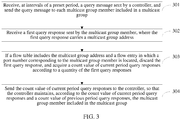
- FIG. 3 is a flowchart of a method for maintaining a multicast group member according to an embodiment of the present invention. Referring to FIG. 3 , the method includes:
- the sending the count value of current period query responses to the controller includes:
- the method further includes:
- the method before the receiving a first query response sent by the multicast group member, the method further includes:
- the method further includes:
- the controller when a controller maintains a multicast group member included in the multicast group, the controller sends a query message to a switch, so that the switch sends the query message to each multicast group member included in the multicast group.
- the switch queries, according to a multicast group address carried by the first query response and a port number that corresponds to the multicast group member, for a corresponding flow entry in a flow table maintained by the switch. If the corresponding flow entry is found, the switch discards the first query response, omitting sending the query response to the controller.
- the controller does not need to periodically process a relatively large quantity of query responses, which reduces load of the controller.
- the controller acquires, from the switch, a count value, corresponding to the multicast group address, of current period query responses in a current period, and determines, according to the count value of current period query responses and a count value of previous period query responses, whether the multicast group member included in the multicast group changes. In this way, when the multicast group member does not change, determining may be quickly performed by directly using the count value of current period query responses and the count value of previous period query responses, thereby improving efficiency of maintaining the multicast group member. When the multicast group member changes, determining is then performed according to the first query response sent by the multicast group member; and the controller needs to process only query responses in the current period, which also reduces load of the controller.
- FIG. 4 is a flowchart of a method for maintaining a multicast group member according to an embodiment of the present invention.
- the method includes: Step 401: A multicast group member sends a first multicast join message to a switch, where the first multicast join message carries a multicast group address.
- the host When a host joins the multicast group, the host may be referred to as a multicast group member.
- the multicast group member sends the first multicast join message to the switch, where the first multicast join message may be sent in a form of a multicast join data packet, or certainly, the first multicast join message may be sent in another form, which is not specifically limited in the present invention.
- the multicast group includes a multicast source and a multicast receiver.
- the multicast receiver is a multicast group member
- the multicast source is connected to the controller, so that the controller forwards a data stream sent by the multicast source
- the multicast group address is an address of the multicast source. Because the multicast source is not involved in the present invention, the multicast source is not shown in this embodiment of the present invention.
- Step 402 The switch receives the first multicast join message, encapsulates the first multicast join message, to obtain a second multicast join message, and sends the second multicast join message to a controller, where the second multicast join message carries the multicast group address and a port number.
- the switch receives the first multicast join message, and acquires a port number corresponding to the multicast group member.
- the first multicast join message is encapsulated, to obtain the second multicast join message, where the second multicast join message carries the multicast group address and the acquired port number.
- the switch sends the second multicast join message to the controller.
- the switch may encapsulate the multicast join data packet according to an OpenFlow network protocol, where the OpenFlow network protocol is a protocol for implementing an SDN.
- the switch When the first multicast join message is sent in a form of a multicast join data packet, to enable the controller to identify the multicast join data packet, the switch further needs to encapsulate the multicast join data packet according to the OpenFlow network protocol, and sends an encapsulated multicast join data packet to the controller.
- the port number corresponding to the multicast group member is a port number of a port by using which the multicast group member is connected to the switch.
- Step 403 The controller receives the second multicast join message, creates a flow entry for the multicast group member according to the multicast group address and the port number that are carried by the second multicast join message, and sends the flow entry to the switch.
- At least one flow entry may form a flow table, and each flow entry is a forwarding rule.
- the controller creates a corresponding flow entry for the multicast group member, so that when receiving a first query response sent by the multicast group member, the switch queries for the flow entry corresponding to the multicast group member, to determine a forwarding rule of the first query response.
- the switch may maintain one flow table, or two flow tables.
- the two flow tables are a first flow table and a second flow table.
- the first flow table includes at least one first flow entry, and the first flow entry includes at least a multicast group address, a port number, and a to-be-performed operation, where the port number is a number of a port by using which the multicast group member is connected to the switch, and the to-be-performed operation is an operation needing to be performed on the first query response sent by the multicast group member.
- the second flow table includes at least one second flow entry, and the second flow entry includes at least a multicast group address, a query response count value, and a to-be-performed operation. The flow entry that is created by the controller for the multicast group member according to the multicast group address and the port number that are carried by the second multicast join message is the first flow entry.
- the multicast group address may be an IP (Internet Protocol, Internet Protocol) address, or may be a MAC (Media Access Control, Media Access Control) address.
- IP Internet Protocol
- MAC Media Access Control
- a description is provided by using an example in which the multicast group address is an IP address.
- the multicast group address carried by the second multicast join message is 225.1.1.1, and the port number is 5.
- the flow entry created by the controller for the multicast group member according to the multicast group address 225.1.1.1 and the port number 5 may be the first flow entry shown in Table 1 below.
- the first flow entry not only includes the multicast group address 225.1.1.1 and the port number 5, but also includes a to-be-performed operation.
- the to-be-performed operation is turning to the second flow table.
- Table 1 Multicast group address Port number To-be-performed operation 225.1.1.1 5 Turn to a second flow table
- the first flow entry includes the multicast group address, the port number, and the to-be-performed operation.
- the first flow entry may further include other information.
- Step 404 The switch receives the flow entry, and stores the flow entry in a corresponding flow table.
- the flow entry received by the switch is the first flow entry, and when the switch receives the first flow entry, the switch stores the flow entry in the first flow table.
- a first flow table is shown in Table 2 below, where the flow table includes multiple first flow entries, and the received first flow entry corresponding to the multicast group member may be stored in the first flow table shown in Table 2 below.
- Table 2 Multicast group address Port number To-be-performed operation 225.1.1.1 3 Turn to a second flow table 225.1.0.6 5 Turn to a second flow table 225.1.1.1 5 Turn to a second flow table
- the multicast group member joins the multicast group according to steps 401 to 404.
- the controller creates a corresponding flow entry for the multicast group member.
- the switch may maintain the flow entry corresponding to the multicast group member, and perform, according to the flow entry corresponding to the multicast group member, a corresponding operation on the first query response sent by the multicast group member. Maintaining, by the controller, the multicast group member included in the multicast group may be implemented according to steps 405 to 412 below.
- Step 405 The controller sends a query message to the switch at intervals of a preset period.
- the controller maintains, at intervals of the preset period, the multicast group member included in the multicast group, and the controller maintains, according to the first query response sent by the multicast group member included in the multicast group, the multicast group member included in the multicast group. Therefore, the controller needs to send the query message to the switch at intervals of the preset period.
- controller may be connected to at least one switch, and each switch may further be connected to at least one multicast group member, to send the query message to each multicast group member connected to the switch, the controller may add a destination address to the query message, where the destination address is a reserved address.
- the reserved address is a special address, and the reserved address is not allocated by a network side. Therefore, when receiving the query message carrying the reserved address, the switch may be instructed to send the query message to a multicast group member connected to each port included by the switch.
- the query message may be sent in a form of a query data packet, or may be sent in another form, which is not specifically limited in the present invention.
- Step 406 The switch receives the query message, and sends the query message to each multicast group member included in a multicast group.
- the switch determines that the destination address carried by the query message is the reserved address. Regardless of whether any multicast group member is connected to the port of the switch, the query message is sent to each port of the switch, so that the switch delivers the query message.
- the switch When the query message is sent in a form of a query data packet, to enable the multicast group member to identify the query data packet, the switch further needs to encapsulate the query data packet according to the OpenFlow network protocol, and sends an encapsulated query data packet to the multicast group member.
- Step 407 When receiving the query message, the multicast group member included in the multicast group sends a first query response to the switch, where the first query response carries a multicast group address.
- the multicast group member included in the multicast group when the multicast group member included in the multicast group receives the query message, the multicast group member included in the multicast group generates a corresponding first query response according to the query message, and sends the first query response to the switch, where the first query response carries the multicast group address.
- the multicast group includes at least one multicast group member. Therefore, the switch may also receive at least one first query response.
- Step 408 If a stored flow table includes the multicast group address and a flow entry corresponding to a port number that corresponds to the multicast group member, discard the first query response, and increase a corresponding query response count value.
- the switch when the switch receives the query response, the switch acquires a port number corresponding to the multicast group member, and compares the multicast group member and the acquired port number that are carried by the first query response with a multicast group address and a port number that are in each first flow entry included in the stored first flow table; if the stored first flow table includes a first flow entry that corresponds to the multicast group address and the port number, the switch acquires, from the first flow table, a to-be-performed operation corresponding to both the multicast group address and the port number, and turns to query the second flow table according to the to-be-performed operation.
- a corresponding to-be-performed operation found from the second flow table according to the multicast group address is a discarding operation, the first query response is discarded.
- a corresponding query response count value is found, according to the multicast group address, from the second flow entry included in the second flow table, and the found query response count value is increased.
- Each multicast group member is separately connected to a port of the switch. Therefore, when the switch receives the first query response, the switch may acquire a number of a port by using which the multicast group member is connected to the switch, and determine the acquired port number as a port number corresponding to the multicast group member.
- the first query response when the stored first flow table includes the first flow entry corresponding to the multicast group address and the port number, the first query response may be directly discarded, or the first query response may be temporarily stored, for subsequent use. That is, the to-be-performed operation corresponding to the multicast group address in the second flow table may be a temporary storage operation.
- a specific operation of increasing the found query response count value may be: increasing the found query response count value by 1.
- the stored first flow table includes the first flow entry corresponding to the multicast group address and the port number, it is determined that the multicast group member already joins the multicast group. To reduce load of the controller, the first query response is not sent to the controller, but the query response count value corresponding to the multicast group address in the switch is increased.
- the second flow entry includes the multicast group address, the query response count value, and the to-be-performed operation.
- the second flow entry may further include other information.
- the multicast group address is 225.1.1.1
- the port number is 5
- the switch compares the multicast group address 225.1.1.1 and the port number 5 with the multicast group address and the port number that are included in each first flow entry in Table 2 above, determines that the multicast group address 225.1.1.1 and the port number 5 exist in the first flow table shown in Table 2 above, and acquires that a to-be-performed operation corresponding to both the multicast group address 225.1.1.1 and the port number 5 is turning to the second flow table.
- a corresponding to-be-performed operation acquired, according to the multicast group address 225.1.1.1, from the second flow table shown in Table 3 below is a discarding operation. In this case, the first query response is discarded.
- Table 3 Multicast group address Query response count value To-be-performed operation 225.1.0.6 5 Discard 225.1.1.1 5 Discard 225.1.1.2 4 Discard
- a corresponding query response count value 5 is found from Table 2 above according to the multicast group address 225.1.1.1, and the found query response count value 5 is increased by 1, to obtain a query response count value 6.
- Table 3 above becomes Table 4 below.
- Table 4 Multicast group address Query response count value To-be-performed operation 225.1.0.6 5 Discard 225.1.1.1 6 Discard 225.1.1.2 4 Discard
- the switch may receive at least one first query response, for each first query response, the switch may perform the method in step 408.
- Step 409 When the controller acquires a count value of current period query responses received by the switch in a current period, the controller sends a flow entry query message to the switch, where the flow entry query message carries a target flow table identifier and a target flow entry identifier.
- the controller After the controller sends the query message to the multicast group member by using the switch, it takes a period of time for each multicast group member to receive the query message and send the first query response corresponding to the query message to the switch, and it also takes a period of time for the switch to process the first query response. Therefore, after sending the query message to the switch, the controller starts timing. When timing duration reaches a preset period of time, the controller sends the flow entry query message to the switch, to maintain the multicast group member included in the multicast group.
- the preset period of time is set by the controller in advance, and in the preset period of time, the multicast group member included in the multicast group may complete sending the first query response to the switch, and the switch may also complete processing the first query response.
- the target flow table identifier is used to uniquely identify the flow table, and the target flow table identifier may be a name of the flow table, may be a sequence number that is set by the controller for the flow table, or the like.
- the target flow entry identifier is used to uniquely identify the flow entry, and the target flow entry identifier may be a sequence number of the flow entry, may be a position of the flow entry in the flow table, may be a multicast group address included in the flow entry, or the like. A unique corresponding flow entry can be found from the flow table according to the target flow table identifier and the target flow entry identifier.
- Step 410 The switch receives the flow entry query message, and acquires a corresponding query response count value from the stored flow table according to the target flow table identifier and the target flow entry identifier.
- the flow entry query message has a particular format
- the controller may generate the flow entry query message according to the format of the flow entry query message.
- the target flow table identifier indicates that a flow table that needs to be queried is the second flow table, and the target flow entry identifier is the multicast group address 225.1.1.1 included in the flow entry; the switch receives the flow entry query message, and acquires the corresponding query response count value 6 from the flow table shown in Table 4 above according to the multicast group address 225.1.1.1.
- Step 411 The switch uses the acquired query response count value as the count value of current period query responses, and sends the count value of current period query responses to the controller.
- the acquired query response count value is a result obtained after the first query response sent by each multicast group member included in the multicast group is processed.
- the acquired query response count value may be used as the count value of current period query responses and sent to the controller.
- Step 412 The controller receives the count value of current period query responses, and maintains, according to the count value of current period query responses and a count value of previous period query responses, the multicast group member included in the multicast group.
- this step may be implemented by using the following steps (1) to (4), which include:
- the controller acquires the corresponding preset query response count value increment from a stored correspondence between a multicast group address and a preset query response count value increment according to the multicast group address, and determines the acquired preset query response count value increment as the preset query response count value increment corresponding to the multicast group.
- the preset query response count value increment is an actual quantity of multicast group members included in the multicast group in a previous period. When the multicast group members included in the multicast group change in the previous period, the preset query response count value increment also changes.
- the controller may set the preset query response count value increment to 0.
- the count value of previous period query responses is subtracted from the count value of current period query responses, to obtain the difference.
- the switch increases a query response count value corresponding to the multicast group. Therefore, the query response count value is increased as a quantity of periods increases, that is, the count value of current period query responses is greater than or equal to the count value of previous period query responses. Therefore, the difference between the count value of current period query responses and the count value of previous period query responses needs to be calculated, the preset query response count value increment corresponding to the multicast group needs to be acquired, and whether the multicast group member included in the multicast group changes is determined according to the difference and the preset query response count value increment.
- the difference is compared with the preset query response count value increment, and if the difference is less than the preset query response count value increment, it is determined that there exists a multicast group member abnormally leaving the multicast group; a port number corresponding to the multicast group member that abnormally leaves is acquired, and the acquired port number is deleted from a multicast path.
- the controller may further send the query message to the multicast group member according to the acquired port number by using the switch. If the multicast group member has not returned the first query response, it is determined that the multicast group member is a multicast group member that abnormally leaves, and the acquired port number is deleted from the multicast path, to stop forwarding a multicast data stream to the multicast group member.
- a specific operation of acquiring a port number corresponding to the multicast group member that abnormally leaves may be: sending, by the controller, a deletion message to the switch, where the deletion message carries a multicast group address, so that the switch deletes the flow entry corresponding to the multicast group address; after the switch deletes the flow entry corresponding to the multicast group address, sending, by the controller, the query message to the switch, where the query message carries a multicast group address of the multicast group, so that the switch sends the query message to each multicast group member included in the multicast group; when receiving the query message, sending, by the multicast group member included in the multicast group, a first query response to the switch; receiving, by the switch, at least one first query response, separately encapsulating the received at least one first query response, to obtain at least one second query response, and reporting the at least one second query response to the controller; receiving, by the controller, the at least one second query response reported by the switch, where the at least one second query response each carries the multicast group address
- the corresponding port number that is acquired by the controller from the stored correspondence between a multicast group address and a port number according to the multicast group address is at least one port number.
- a specific operation of comparing, by the controller, the acquired port number with the port number carried by the at least one second query response, to determine the port number corresponding to the multicast group member that abnormally leaves may be: comparing the acquired port number with the port number carried by the at least one second query response, and selecting, from the acquired port number, a port number except the port number carried by the at least one second query response; and determining the selected port number as the port number corresponding to the multicast group member that abnormally leaves.
- the controller deletes the acquired port number from the multicast path, and stops sending multicast data to the port when multicast data is sent subsequently, that is, stops sending multicast data to the multicast group member that abnormally leaves.
- the difference is equal to the preset query response count value increment, it is determined that the multicast group member included in the multicast group does not change, no processing is performed, and the operations are ended.
- a specific operation process may be: sending, by the multicast group member, a first multicast leave message to the switch, where the first multicast leave message carries a multicast group address; receiving, by the switch, the first multicast leave message, and encapsulating the first multicast leave message, to obtain a second multicast leave message, where the second multicast leave message carries the multicast group address and a port number; deleting, by the switch, a corresponding flow entry from a flow table according to the multicast group address and the port number; and reporting, by the switch, the second multicast leave message to the controller, so that the controller deletes the port number from the multicast path.
- a controller when a multicast group member joins the multicast group, a controller creates a corresponding flow entry for the multicast group member, and a switch maintains the flow entry.
- the controller When the controller maintains the multicast group member included in the multicast group, the controller sends a query message to the switch, so that the switch sends the query message to each multicast group member included in the multicast group.
- the switch When receiving a first query response sent by the multicast group member, the switch queries, according to a multicast group address carried by the first query response and a port number that corresponds to the multicast group member, for a corresponding flow entry in a flow table maintained by the switch.
- the switch discards the first query response, omitting sending the query response to the controller.
- the controller does not need to periodically process a relatively large quantity of query responses, which reduces load of the controller.
- the controller may acquire, from the switch, a count value, corresponding to the multicast group address, of current period query responses in a current period, and determines, according to the count value of current period query responses and a count value of previous period query responses, whether the multicast group member included in the multicast group changes. In this way, when the multicast group member does not change, determining may be quickly performed by directly using the count value of current period query responses and the count value of previous period query responses, thereby improving efficiency of maintaining the multicast group member. When the multicast group member changes, determining is then performed according to the first query response sent by the multicast group member; and the controller needs to process only query responses in the current period, which also reduces load of the controller.
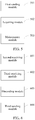
- FIG. 5 is a schematic structural diagram of a device for maintaining a multicast group member according to an embodiment of the present invention.
- the device includes:
- the acquiring module 502 includes:
- the maintenance module 503 includes:
- the maintenance unit includes:
- deletion subunit is specifically configured to:
- the device further includes:
- the controller when a controller maintains a multicast group member included in the multicast group, the controller sends a query message to a switch, so that the switch sends the query message to each multicast group member included in the multicast group.
- the switch queries, according to a multicast group address carried by the first query response and a port number that corresponds to the multicast group member, for a corresponding flow entry in a flow table maintained by the switch. If the corresponding flow entry is found, the switch discards the first query response, omitting sending the query response to the controller.
- the controller does not need to periodically process a relatively large quantity of query responses, which reduces load of the controller.
- the controller acquires, from the switch, a count value, corresponding to the multicast group address, of current period query responses in a current period, and determines, according to the count value of current period query responses and a count value of previous period query responses, whether the multicast group member included in the multicast group changes. In this way, when the multicast group member does not change, determining may be quickly performed by directly using the count value of current period query responses and the count value of previous period query responses, thereby improving efficiency of maintaining the multicast group member. When the multicast group member changes, determining is then performed according to the first query response sent by the multicast group member; and the controller needs to process only query responses in the current period, which also reduces load of the controller.
- FIG. 6 is a schematic structural diagram of a device for maintaining a multicast group member according to an embodiment of the present invention.
- the apparatus includes:
- the third sending module 604 includes:
- the device further includes:
- the device further includes:
- the device further includes:
- the controller when a controller maintains a multicast group member included in the multicast group, the controller sends a query message to a switch, so that the switch sends the query message to each multicast group member included in the multicast group.
- the switch queries, according to a multicast group address carried by the first query response and a port number that corresponds to the multicast group member, for a corresponding flow entry in a flow table maintained by the switch. If the corresponding flow entry is found, the switch discards the first query response, omitting sending the query response to the controller.
- the controller does not need to periodically process a relatively large quantity of query responses, which reduces load of the controller.
- the controller acquires, from the switch, a count value, corresponding to the multicast group address, of current period query responses in a current period, and determines, according to the count value of current period query responses and a count value of previous period query responses, whether the multicast group member included in the multicast group changes. In this way, when the multicast group member does not change, determining may be quickly performed by directly using the count value of current period query responses and the count value of previous period query responses, thereby improving efficiency of maintaining the multicast group member. When the multicast group member changes, determining is then performed according to the first query response sent by the multicast group member; and the controller needs to process only query responses in the current period, which also reduces load of the controller.
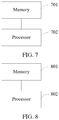
- FIG. 7 is a schematic structural diagram of a device for maintaining a multicast group member according to an embodiment of the present invention.
- the device includes a memory 701 and a processor 702, configured to perform the following method for maintaining a multicast group member, where the method includes:
- the acquiring a count value of current period query responses received by the switch in a current period includes:
- the multicast group member included in the multicast group includes:
- the maintaining, according to the difference and the preset query response count value increment, the multicast group member included in the multicast group includes:
- the acquiring a port number corresponding to the multicast group member that abnormally leaves includes:
- the method further includes:
- the controller when a controller maintains a multicast group member included in the multicast group, the controller sends a query message to a switch, so that the switch sends the query message to each multicast group member included in the multicast group.
- the switch queries, according to a multicast group address carried by the first query response and a port number that corresponds to the multicast group member, for a corresponding flow entry in a flow table maintained by the switch. If the corresponding flow entry is found, the switch discards the first query response, omitting sending the query response to the controller.
- the controller does not need to periodically process a relatively large quantity of query responses, which reduces load of the controller.
- the controller acquires, from the switch, a count value, corresponding to the multicast group address, of current period query responses in a current period, and determines, according to the count value of current period query responses and a count value of previous period query responses, whether the multicast group member included in the multicast group changes. In this way, when the multicast group member does not change, determining may be quickly performed by directly using the count value of current period query responses and the count value of previous period query responses, thereby improving efficiency of maintaining the multicast group member. When the multicast group member changes, determining is then performed according to the first query response sent by the multicast group member, and the controller needs to process only query responses in the current period, which also reduces load of the controller.
- FIG. 8 is a schematic structural diagram of a device for maintaining a multicast group member according to an embodiment of the present invention.
- the device includes a memory 801 and a processor 802, configured to perform the following method for maintaining a multicast group member, where the method includes:
- the sending the count value of current period query responses to the controller includes:
- the method further includes:
- the method before the receiving a first query response sent by the multicast group member, the method further includes:
- the method further includes:
- the controller when a controller maintains a multicast group member included in the multicast group, the controller sends a query message to a switch, so that the switch sends the query message to each multicast group member included in the multicast group.
- the switch queries, according to a multicast group address carried by the first query response and a port number that corresponds to the multicast group member, for a corresponding flow entry in a flow table maintained by the switch. If the corresponding flow entry is found, the switch discards the first query response, omitting sending the query response to the controller.
- the controller does not need to periodically process a relatively large quantity of query responses, which reduces load of the controller.
- the controller acquires, from the switch, a count value, corresponding to the multicast group address, of current period query responses in a current period, and determines, according to the count value of current period query responses and a count value of previous period query responses, whether the multicast group member included in the multicast group changes. In this way, when the multicast group member does not change, determining may be quickly performed by directly using the count value of current period query responses and the count value of previous period query responses, thereby improving efficiency of maintaining the multicast group member. When the multicast group member changes, determining is then performed according to the first query response sent by the multicast group member, and the controller needs to process only query responses in the current period, which also reduces load of the controller.
- the device which is provided in the foregoing embodiments, for maintaining a multicast group member maintains a multicast group member
- division of the foregoing function modules is merely used as an example for description.
- the foregoing functions can be allocated to different function modules and completed according to a requirement, that is, an inner structure of the device is divided into different function modules to complete all or some of the functions described above.
- the device, which is provided in the foregoing embodiments, for maintaining a multicast group member and embodiments of the method for maintaining a multicast group member belong to a same concept. For a specific implementation process, specifically refer to the method embodiments, and details are not described herein again.
- the program may be stored in a computer-readable storage medium.
- the storage medium may include: a read-only memory, a magnetic disk, or an optical disc.
Landscapes
- Engineering & Computer Science (AREA)
- Computer Networks & Wireless Communication (AREA)
- Signal Processing (AREA)
- Physics & Mathematics (AREA)
- Computing Systems (AREA)
- Mathematical Physics (AREA)
- Theoretical Computer Science (AREA)
- Data Exchanges In Wide-Area Networks (AREA)
- Small-Scale Networks (AREA)
Claims (12)
- Procédé destiné à maintenir des membres d'un groupe de multidiffusion exécuté par un contrôleur de réseau défini par logiciel, SDN, le procédé comprenant les étapes suivantes :envoyer un message de requête à un commutateur SDN suivant des intervalles d'une période prédéfinie (S201);recevoir une valeur de comptage des réponses aux requêtes de la période en cours d'une période en cours depuis le commutateur SDN (S202) ; etmaintenir, en fonction de la valeur de comptage des réponses aux requêtes de la période en cours et d'une valeur de comptage des réponses aux requêtes de la période précédente, les membres d'un groupe de multidiffusion compris dans le groupe de multidiffusion (S203),où le maintien, en fonction de la valeur de comptage des réponses aux requêtes de la période en cours et de la valeur de comptage des réponses aux requêtes de la période précédente, des membres d'un groupe de multidiffusion compris dans le groupe de multidiffusion comprend les étapes suivantes :acquérir un incrément de la valeur de comptage des réponses aux requêtes prédéfini correspondant au groupe de multidiffusion à partir d'une correspondance stockée entre une adresse de groupe de multidiffusion et l'incrément de la valeur de comptage des réponses aux requêtes prédéfini, où l'incrément de la valeur de comptage des réponses aux requêtes prédéfini est une quantité réelle de membres de groupe de multidiffusion inclus dans le groupe de multidiffusion au cours de la période précédente ;calculer une différence entre la valeur de comptage des réponses aux requêtes de la période en cours et la valeur de comptage des réponses aux requêtes de la période précédente ; etmaintenir, en fonction d'une comparaison de la différence avec l'incrément de la valeur de comptage des réponses aux requêtes prédéfini, les membres du groupe de multidiffusion compris dans le groupe de multidiffusion.
- Procédé selon la revendication 1, dans lequel l'acquisition de la valeur de comptage des réponses aux requêtes de la période en cours auprès du commutateur SDN comprend les étapes suivantes :envoyer un message de requête d'entrée de flux au commutateur SDN, où le message de requête d'entrée de flux achemine un identifiant de table de flux cible et un identifiant d'entrée de flux cible ; etrecevoir la valeur de comptage des réponses aux requêtes envoyée par le commutateur SDN, et déterminer la valeur de comptage des réponses aux requêtes reçue comme étant la valeur de comptage des réponses aux requêtes de la période en cours.
- Procédé selon la revendication 1 ou la revendication 2, dans lequel le maintien, en fonction de la comparaison de la différence avec l'incrément de la valeur de comptage des réponses aux requêtes prédéfini, des membres du groupe de multidiffusion compris dans le groupe de multidiffusion comprend les étapes suivantes :si la différence est inférieure à l'incrément de la valeur de comptage des réponses aux requêtes prédéfini, déterminer qu'il existe un membre du groupe de multidiffusion qui quitte anormalement le groupe de multidiffusion ; etacquérir un numéro de port correspondant au membre du groupe de multidiffusion qui quitte anormalement le groupe, et supprimer le numéro de port acquis d'un chemin de multidiffusion.
- Procédé selon la revendication 3, dans lequel l'acquisition du numéro de port correspondant au membre du groupe de multidiffusion qui quitte anormalement le groupe comprend les étapes suivantes :envoyer un message de suppression au commutateur SDN, où le message de suppression achemine une adresse de groupe de multidiffusion ;envoyer le message de requête au commutateur SDN, où le message de requête achemine une adresse de groupe de multidiffusion du groupe de multidiffusion ;recevoir au moins une deuxième réponse de requête rapportée par le commutateur SDN, où chacune de l'au moins une deuxième réponse de requête encapsule au moins une première réponse de requête envoyée conformément au message de requête par le membre du groupe de multidiffusion compris dans le groupe de multidiffusion, et l'au moins une deuxième réponse de requête achemine chacune une adresse de groupe de multidiffusion et un numéro de port ;acquérir un numéro de port correspondant à partir d'une correspondance stockée entre une adresse de groupe de multidiffusion et un numéro de port en fonction de l'adresse de groupe de multidiffusion ; etcomparer le numéro de port acquis au numéro de port acheminé par l'au moins une deuxième réponse de requête, pour déterminer le numéro de port correspondant au membre du groupe de multidiffusion qui quitte anormalement le groupe.
- Procédé selon l'une quelconque des revendications 1 à 4, dans lequel le procédé comprend en outre les étapes suivantes :recevoir un premier message conjoint de multidiffusion envoyé par le membre du groupe de multidiffusion, où le premier message conjoint de multidiffusion achemine une adresse de groupe de multidiffusion ;créer une entrée de flux pour le membre du groupe de multidiffusion conformément à l'adresse du groupe de multidiffusion et à un numéro de port qui correspond au membre du groupe de multidiffusion ; etenvoyer l'entrée de flux au commutateur SDN.
- Procédé destiné à maintenir des membres d'un groupe de multidiffusion exécuté par un contrôleur de réseau défini par logiciel SDN, le procédé comprenant les étapes suivantes :recevoir, suivant des intervalles d'une période prédéfinie, un message de requête envoyé par un contrôleur SDN, et envoyer le message de requête à chaque membre de groupe de multidiffusion compris dans un groupe de multidiffusion (S301);recevoir une première réponse de requête envoyée par un membre de groupe de multidiffusion, où la première réponse de requête achemine une adresse de groupe de multidiffusion, où, à chaque fois qu'une première réponse de requête envoyée par un membre de groupe de multidiffusion est reçue, le commutateur augmente une valeur de comptage des réponses aux requêtes correspondant au groupe de multidiffusion, de manière à ce qu'une valeur de comptage des réponses aux requêtes de la période en cours soit supérieure ou égale à une valeur de comptage des réponses aux requêtes de la période précédente (S302) ;si une table de flux stockée comprend l'adresse du groupe de multidiffusion et une entrée de flux dans laquelle se trouve un numéro de port correspondant au membre du groupe de multidiffusion, écarter la première réponse de requête, et acquérir la valeur de comptage des réponses aux requêtes de la période en cours conformément à une quantité des premières réponses aux requêtes (S303) ; etenvoyer la valeur de comptage des réponses aux requêtes de la période en cours au contrôleur SDN (S304).
- Procédé selon la revendication 6, dans lequel l'envoi de la valeur de comptage des réponses aux requêtes de la période en cours au contrôleur SDN comprend les étapes suivantes :recevoir un message de requête d'entrée de flux envoyé par le contrôleur SDN, où le message de requête d'entrée de flux achemine un identifiant de table de flux cible et un identifiant d'entrée de flux cible ;acquérir une valeur de comptage des réponses aux requêtes correspondante à partir de la table de flux stockée en fonction de l'identifiant de table de flux cible et de l'identifiant d'entrée de flux cible ; etutiliser la valeur de comptage des réponses aux requêtes acquise comme valeur de comptage des réponses aux requêtes de la période en cours et envoyer la valeur de comptage des réponses aux requêtes de la période en cours au contrôleur SDN.
- Procédé selon la revendication 6 ou la revendication 7, comprenant en outre, après l'envoi de la valeur de comptage des réponses aux requêtes de la période en cours au contrôleur SDN, les étapes suivantes :lorsque le contrôleur SDN détermine qu'il existe un membre du groupe de multidiffusion qui quitte anormalement le groupe de multidiffusion, recevoir un message de suppression envoyé par le contrôleur SDN, où le message de suppression achemine une adresse du groupe de multidiffusion, et supprimer une entrée de flux correspondante de la table de flux conformément à l'adresse du groupe de multidiffusion ;lorsque le message de requête envoyé par le contrôleur SDN est reçu, envoyer le message de requête à chaque membre du groupe de multidiffusion compris dans le groupe de multidiffusion, où le message de requête achemine une adresse de groupe de multidiffusion du groupe de multidiffusion ;recevoir au moins une première réponse de requête envoyée par le membre du groupe de multidiffusion compris dans le groupe de multidiffusion, où l'au moins une première réponse de requête achemine chacune une adresse de groupe de multidiffusion ;encapsuler séparément l'au moins une première réponse de requête, pour obtenir au moins une deuxième réponse de requête, où l'au moins une deuxième réponse de requête achemine chacune l'adresse de groupe de multidiffusion et un numéro de port qui correspond au membre du groupe de multidiffusion ; etenvoyer l'au moins une deuxième réponse de requête au contrôleur SDN.
- Procédé selon l'une quelconque des revendications 6 à 8, comprenant en outre, avant la réception de la première réponse de requête envoyée par le membre de groupe de multidiffusion, les étapes suivantes :recevoir un premier message conjoint de multidiffusion envoyé par le membre de groupe de multidiffusion, où le premier message conjoint de multidiffusion achemine une adresse de groupe de multidiffusion ;encapsuler le premier message conjoint de multidiffusion pour obtenir un deuxième message conjoint de multidiffusion, où le deuxième message conjoint de multidiffusion achemine l'adresse de groupe de multidiffusion et un numéro de port ;envoyer le deuxième message conjoint de multidiffusion au contrôleur SDN ; etrecevoir l'entrée de flux envoyée par le contrôleur SDN et stocker l'entrée de flux dans la table de flux.
- Procédé selon l'une quelconque des revendications 6 à 9, dans lequel le procédé comprend en outre les étapes suivantes :recevoir un premier message de départ de la multidiffusion envoyé par un membre du groupe de multidiffusion, où le premier message de départ de la multidiffusion achemine une adresse de groupe de multidiffusion ;supprimer une entrée de flux correspondante de la table de flux en fonction de l'adresse de groupe de multidiffusion et d'un numéro de port correspondant au membre de groupe de multidiffusion ;encapsuler le premier message de départ de la multidiffusion pour obtenir un deuxième message de départ de la multidiffusion, où le deuxième message de départ de la multidiffusion achemine l'adresse du groupe de multidiffusion et le numéro de port ; etenvoyer le deuxième message de sortie de la multidiffusion au contrôleur SDN.
- Contrôleur de réseau défini par logiciel, SDN, configuré pour exécuter toutes les étapes de l'un quelconque des procédés des revendications 1 à 5.
- Commutateur de réseau défini par logiciel, SDN, configuré pour exécuter toutes les étapes de l'un quelconque des procédés des revendications 6 à 10.
Applications Claiming Priority (2)
| Application Number | Priority Date | Filing Date | Title |
|---|---|---|---|
| CN201410175802.6A CN105099721B (zh) | 2014-04-28 | 2014-04-28 | 维护组播成员的方法及设备 |
| PCT/CN2015/070044 WO2015165281A1 (fr) | 2014-04-28 | 2015-01-04 | Procédé et dispositif pour maintenir des éléments de multidiffusion |
Publications (3)
| Publication Number | Publication Date |
|---|---|
| EP3121995A1 EP3121995A1 (fr) | 2017-01-25 |
| EP3121995A4 EP3121995A4 (fr) | 2017-04-19 |
| EP3121995B1 true EP3121995B1 (fr) | 2018-06-20 |
Family
ID=54358139
Family Applications (1)
| Application Number | Title | Priority Date | Filing Date |
|---|---|---|---|
| EP15785811.9A Active EP3121995B1 (fr) | 2014-04-28 | 2015-01-04 | Procédé et dispositif pour maintenir des éléments de multidiffusion dans un réseau définie par logiciell (software defined network) |
Country Status (6)
| Country | Link |
|---|---|
| US (1) | US9998293B2 (fr) |
| EP (1) | EP3121995B1 (fr) |
| JP (1) | JP6241637B2 (fr) |
| KR (1) | KR101880379B1 (fr) |
| CN (1) | CN105099721B (fr) |
| WO (1) | WO2015165281A1 (fr) |
Families Citing this family (6)
| Publication number | Priority date | Publication date | Assignee | Title |
|---|---|---|---|---|
| US10511548B2 (en) * | 2017-06-22 | 2019-12-17 | Nicira, Inc. | Multicast packet handling based on control information in software-defined networking (SDN) environment |
| DE102019110884A1 (de) * | 2019-04-26 | 2020-10-29 | Beckhoff Automation Gmbh | Verfahren zur Änderung einer Steuerungssoftware eines Automatisierungssystems |
| US11876790B2 (en) * | 2020-01-21 | 2024-01-16 | The Boeing Company | Authenticating computing devices based on a dynamic port punching sequence |
| CN111600800B (zh) * | 2020-04-01 | 2022-06-28 | 武汉迈威通信股份有限公司 | 一种跨网段拓扑发现的方法及设备 |
| CN112448826B (zh) * | 2020-11-13 | 2022-04-15 | 恒生电子股份有限公司 | 组播消息的通信方法、装置、可读介质及电子设备 |
| CN117411738B (zh) * | 2023-12-15 | 2024-03-08 | 格创通信(浙江)有限公司 | 组播复制方法、装置、电子设备和存储介质 |
Family Cites Families (29)
| Publication number | Priority date | Publication date | Assignee | Title |
|---|---|---|---|---|
| US6223286B1 (en) * | 1996-03-18 | 2001-04-24 | Kabushiki Kaisha Toshiba | Multicast message transmission device and message receiving protocol device for realizing fair message delivery time for multicast message |
| JP3906679B2 (ja) * | 2001-12-05 | 2007-04-18 | 日本電気株式会社 | 移動通信方法及びシステム並びにプログラム |
| JP4504167B2 (ja) * | 2004-11-24 | 2010-07-14 | 株式会社日立製作所 | マルチキャスト課金制御システム及びブロードバンドアクセスサーバ |
| JP4215736B2 (ja) * | 2005-04-04 | 2009-01-28 | Necアクセステクニカ株式会社 | ブロードバンドルータによるマルチキャスト転送方法及び方式 |
| US20070248088A1 (en) * | 2006-04-21 | 2007-10-25 | Lim Seau S | Method and apparatus for transmitting a multicast message |
| CN104837070A (zh) * | 2006-06-09 | 2015-08-12 | 华为技术有限公司 | 组播业务处理方法、系统及接入设备 |
| CN101163260B (zh) * | 2006-10-14 | 2011-04-13 | 华为技术有限公司 | 一种控制承载变化的系统、装置和方法 |
| JP2008160718A (ja) * | 2006-12-26 | 2008-07-10 | Mitsubishi Electric Corp | Ponシステム |
| CN100518119C (zh) * | 2007-06-25 | 2009-07-22 | 中兴通讯股份有限公司 | 基于网际分组管理协议第三版的以太网组播实现方法 |
| JP4918900B2 (ja) * | 2007-09-13 | 2012-04-18 | 日本電気株式会社 | 無線マルチホップネットワーク、ノード、マルチキャスト経路制御方法及びプログラム |
| CN101409704B (zh) * | 2007-10-09 | 2013-06-05 | 华为技术有限公司 | 组播成员管理协议的处理方法及装置 |
| CN101414919B (zh) * | 2007-10-19 | 2012-11-28 | 上海贝尔阿尔卡特股份有限公司 | 上行组播业务的控制方法及装置 |
| CN101442711A (zh) | 2007-11-20 | 2009-05-27 | 中兴通讯股份有限公司 | 用户设备反馈多媒体广播多播业务信息的方法 |
| CN101184044A (zh) * | 2007-12-05 | 2008-05-21 | 中兴通讯股份有限公司 | 一种组播监听发现协议的报文处理方法 |
| EP2134029A1 (fr) * | 2008-06-09 | 2009-12-16 | THOMSON Licensing | Dispositif de réseau et procédé pour obtenir l'état multidiffusion d'un terminal |
| CN101388788B (zh) * | 2008-10-29 | 2011-03-30 | 杭州华三通信技术有限公司 | 二层组播管理方法、系统及二层交换机 |
| US20120160944A1 (en) * | 2009-04-24 | 2012-06-28 | Aaron Dodd | Method for the production of commercial nanoparticle and micro particle powders |
| US20130304915A1 (en) * | 2011-01-17 | 2013-11-14 | Nec Corporation | Network system, controller, switch and traffic monitoring method |
| EP2685675A4 (fr) * | 2011-03-09 | 2014-12-10 | Nec Corp | Système informatique, serveur, dispositif de commande d'openflow et procédé de communication |
| CN102170364B (zh) | 2011-05-26 | 2014-12-31 | 华为技术有限公司 | 一种宽带远程接入服务器组播通信方法及装置 |
| JP5488642B2 (ja) * | 2011-05-31 | 2014-05-14 | 株式会社バッファロー | 可搬型ネットワーク接続装置及びその設定方法、並びに、コンピュータプログラム及び記録媒体 |
| US8964563B2 (en) | 2011-07-08 | 2015-02-24 | Telefonaktiebolaget L M Ericsson (Publ) | Controller driven OAM for OpenFlow |
| US8638788B2 (en) | 2011-11-22 | 2014-01-28 | Telefonaktiebolaget L M Ericsson (Publ) | Replication management for remote multicast replication network |
| US10225094B2 (en) * | 2012-05-29 | 2019-03-05 | Futurewei Technologies, Inc. | SDN facilitated multicast in data center |
| EP2896190A4 (fr) * | 2012-09-11 | 2016-08-17 | Hewlett Packard Entpr Dev Lp | Découverte d'appartenances aux groupes multidiffusion ip dans des réseaux sdn |
| US20150282157A1 (en) * | 2012-10-04 | 2015-10-01 | Lg Electronics Inc. | Method and device for updating system information in wireless lan system |
| US8953618B2 (en) * | 2012-10-10 | 2015-02-10 | Telefonaktiebolaget L M Ericsson (Publ) | IP multicast service leave process for MPLS-based virtual private cloud networking |
| CN103248724A (zh) * | 2013-04-19 | 2013-08-14 | 中国(南京)未来网络产业创新中心 | 一种基于sdn控制器的dhcp广播处理方法 |
| CN103346969A (zh) * | 2013-07-05 | 2013-10-09 | 中国科学院计算机网络信息中心 | 基于OpenFlow实现动态组播生成树路径调整的方法 |
-
2014
- 2014-04-28 CN CN201410175802.6A patent/CN105099721B/zh active Active
-
2015
- 2015-01-04 WO PCT/CN2015/070044 patent/WO2015165281A1/fr not_active Ceased
- 2015-01-04 EP EP15785811.9A patent/EP3121995B1/fr active Active
- 2015-01-04 JP JP2016562204A patent/JP6241637B2/ja active Active
- 2015-01-04 KR KR1020167031035A patent/KR101880379B1/ko active Active
-
2016
- 2016-10-27 US US15/335,620 patent/US9998293B2/en active Active
Non-Patent Citations (1)
| Title |
|---|
| None * |
Also Published As
| Publication number | Publication date |
|---|---|
| KR20160145647A (ko) | 2016-12-20 |
| CN105099721A (zh) | 2015-11-25 |
| EP3121995A4 (fr) | 2017-04-19 |
| KR101880379B1 (ko) | 2018-07-19 |
| JP2017517182A (ja) | 2017-06-22 |
| US20170048076A1 (en) | 2017-02-16 |
| EP3121995A1 (fr) | 2017-01-25 |
| CN105099721B (zh) | 2018-12-07 |
| WO2015165281A1 (fr) | 2015-11-05 |
| US9998293B2 (en) | 2018-06-12 |
| JP6241637B2 (ja) | 2017-12-06 |
Similar Documents
| Publication | Publication Date | Title |
|---|---|---|
| EP3121995B1 (fr) | Procédé et dispositif pour maintenir des éléments de multidiffusion dans un réseau définie par logiciell (software defined network) | |
| US10659342B2 (en) | Flow entry configuration method, apparatus, and system | |
| CN104283785B (zh) | 一种快速处理流表的方法和装置 | |
| US20160330167A1 (en) | Arp Implementation Method, Switch Device, and Control Device | |
| US10652142B2 (en) | SDN-based ARP implementation method and apparatus | |
| US9432280B2 (en) | Network device configured to generate empty route for limiting number of withdrawal messages | |
| US10116554B2 (en) | Data flow processing method and apparatus | |
| US9998364B2 (en) | Method for processing packet and forwarder | |
| EP3130106A1 (fr) | Dispositif de réseau comportant des éléments de routage de service et de client configurés pour prendre en charge des extranets de multidiffusion de source quelconque | |
| EP3026862B1 (fr) | Procédé de détection d'une boucle de routage | |
| WO2016192402A1 (fr) | Procédé et appareil de réglage d'unité de transmission maximale de tunnel ipv6 | |
| EP2728795B1 (fr) | Procédé de traitement, dispositif et système de contrôle de diffusion de paquets | |
| WO2016184028A1 (fr) | Procédé et appareil de commande de transfert de message de multidiffusion pour dispositif de commutation | |
| US20140348164A1 (en) | Maintaining a multicast forwarding table and a pim router | |
| WO2017082773A1 (fr) | Procédé de transmission groupée de paquets vie des réseaux configurables par logiciel | |
| US20140146659A1 (en) | Rendezvous point convergence method and apparatus | |
| CN103067280B (zh) | 报文处理方法和装置 | |
| WO2014199924A1 (fr) | Dispositif de commande, système de communication, et procédé et programme de commande d'un dispositif relais |
Legal Events
| Date | Code | Title | Description |
|---|---|---|---|
| STAA | Information on the status of an ep patent application or granted ep patent |
Free format text: STATUS: THE INTERNATIONAL PUBLICATION HAS BEEN MADE |
|
| PUAI | Public reference made under article 153(3) epc to a published international application that has entered the european phase |
Free format text: ORIGINAL CODE: 0009012 |
|
| STAA | Information on the status of an ep patent application or granted ep patent |
Free format text: STATUS: REQUEST FOR EXAMINATION WAS MADE |
|
| 17P | Request for examination filed |
Effective date: 20161019 |
|
| AK | Designated contracting states |
Kind code of ref document: A1 Designated state(s): AL AT BE BG CH CY CZ DE DK EE ES FI FR GB GR HR HU IE IS IT LI LT LU LV MC MK MT NL NO PL PT RO RS SE SI SK SM TR |
|
| AX | Request for extension of the european patent |
Extension state: BA ME |
|
| A4 | Supplementary search report drawn up and despatched |
Effective date: 20170322 |
|
| RIC1 | Information provided on ipc code assigned before grant |
Ipc: H04L 12/18 20060101AFI20170316BHEP Ipc: H04L 12/24 20060101ALI20170316BHEP |
|
| DAX | Request for extension of the european patent (deleted) | ||
| RIC1 | Information provided on ipc code assigned before grant |
Ipc: H04L 12/931 20130101ALI20170925BHEP Ipc: H04L 12/24 20060101ALI20170925BHEP Ipc: H04L 12/18 20060101AFI20170925BHEP Ipc: H04L 29/12 20060101ALI20170925BHEP Ipc: H04L 12/851 20130101ALI20170925BHEP |
|
| STAA | Information on the status of an ep patent application or granted ep patent |
Free format text: STATUS: EXAMINATION IS IN PROGRESS |
|
| 17Q | First examination report despatched |
Effective date: 20171110 |
|
| GRAP | Despatch of communication of intention to grant a patent |
Free format text: ORIGINAL CODE: EPIDOSNIGR1 |
|
| STAA | Information on the status of an ep patent application or granted ep patent |
Free format text: STATUS: GRANT OF PATENT IS INTENDED |
|
| INTG | Intention to grant announced |
Effective date: 20180109 |
|
| GRAS | Grant fee paid |
Free format text: ORIGINAL CODE: EPIDOSNIGR3 |
|
| GRAA | (expected) grant |
Free format text: ORIGINAL CODE: 0009210 |
|
| STAA | Information on the status of an ep patent application or granted ep patent |
Free format text: STATUS: THE PATENT HAS BEEN GRANTED |
|
| AK | Designated contracting states |
Kind code of ref document: B1 Designated state(s): AL AT BE BG CH CY CZ DE DK EE ES FI FR GB GR HR HU IE IS IT LI LT LU LV MC MK MT NL NO PL PT RO RS SE SI SK SM TR |
|
| REG | Reference to a national code |
Ref country code: GB Ref legal event code: FG4D |
|
| REG | Reference to a national code |
Ref country code: IE Ref legal event code: FG4D |
|
| REG | Reference to a national code |
Ref country code: AT Ref legal event code: REF Ref document number: 1011328 Country of ref document: AT Kind code of ref document: T Effective date: 20180715 |
|
| REG | Reference to a national code |
Ref country code: DE Ref legal event code: R096 Ref document number: 602015012599 Country of ref document: DE |
|
| REG | Reference to a national code |
Ref country code: NL Ref legal event code: MP Effective date: 20180620 |
|
| PG25 | Lapsed in a contracting state [announced via postgrant information from national office to epo] |
Ref country code: NO Free format text: LAPSE BECAUSE OF FAILURE TO SUBMIT A TRANSLATION OF THE DESCRIPTION OR TO PAY THE FEE WITHIN THE PRESCRIBED TIME-LIMIT Effective date: 20180920 Ref country code: BG Free format text: LAPSE BECAUSE OF FAILURE TO SUBMIT A TRANSLATION OF THE DESCRIPTION OR TO PAY THE FEE WITHIN THE PRESCRIBED TIME-LIMIT Effective date: 20180920 Ref country code: FI Free format text: LAPSE BECAUSE OF FAILURE TO SUBMIT A TRANSLATION OF THE DESCRIPTION OR TO PAY THE FEE WITHIN THE PRESCRIBED TIME-LIMIT Effective date: 20180620 Ref country code: SE Free format text: LAPSE BECAUSE OF FAILURE TO SUBMIT A TRANSLATION OF THE DESCRIPTION OR TO PAY THE FEE WITHIN THE PRESCRIBED TIME-LIMIT Effective date: 20180620 Ref country code: LT Free format text: LAPSE BECAUSE OF FAILURE TO SUBMIT A TRANSLATION OF THE DESCRIPTION OR TO PAY THE FEE WITHIN THE PRESCRIBED TIME-LIMIT Effective date: 20180620 |
|
| REG | Reference to a national code |
Ref country code: LT Ref legal event code: MG4D |
|
| PG25 | Lapsed in a contracting state [announced via postgrant information from national office to epo] |
Ref country code: HR Free format text: LAPSE BECAUSE OF FAILURE TO SUBMIT A TRANSLATION OF THE DESCRIPTION OR TO PAY THE FEE WITHIN THE PRESCRIBED TIME-LIMIT Effective date: 20180620 Ref country code: LV Free format text: LAPSE BECAUSE OF FAILURE TO SUBMIT A TRANSLATION OF THE DESCRIPTION OR TO PAY THE FEE WITHIN THE PRESCRIBED TIME-LIMIT Effective date: 20180620 Ref country code: GR Free format text: LAPSE BECAUSE OF FAILURE TO SUBMIT A TRANSLATION OF THE DESCRIPTION OR TO PAY THE FEE WITHIN THE PRESCRIBED TIME-LIMIT Effective date: 20180921 Ref country code: RS Free format text: LAPSE BECAUSE OF FAILURE TO SUBMIT A TRANSLATION OF THE DESCRIPTION OR TO PAY THE FEE WITHIN THE PRESCRIBED TIME-LIMIT Effective date: 20180620 |
|
| REG | Reference to a national code |
Ref country code: AT Ref legal event code: MK05 Ref document number: 1011328 Country of ref document: AT Kind code of ref document: T Effective date: 20180620 |
|
| PG25 | Lapsed in a contracting state [announced via postgrant information from national office to epo] |
Ref country code: NL Free format text: LAPSE BECAUSE OF FAILURE TO SUBMIT A TRANSLATION OF THE DESCRIPTION OR TO PAY THE FEE WITHIN THE PRESCRIBED TIME-LIMIT Effective date: 20180620 |
|
| PG25 | Lapsed in a contracting state [announced via postgrant information from national office to epo] |
Ref country code: IS Free format text: LAPSE BECAUSE OF FAILURE TO SUBMIT A TRANSLATION OF THE DESCRIPTION OR TO PAY THE FEE WITHIN THE PRESCRIBED TIME-LIMIT Effective date: 20181020 Ref country code: EE Free format text: LAPSE BECAUSE OF FAILURE TO SUBMIT A TRANSLATION OF THE DESCRIPTION OR TO PAY THE FEE WITHIN THE PRESCRIBED TIME-LIMIT Effective date: 20180620 Ref country code: AT Free format text: LAPSE BECAUSE OF FAILURE TO SUBMIT A TRANSLATION OF THE DESCRIPTION OR TO PAY THE FEE WITHIN THE PRESCRIBED TIME-LIMIT Effective date: 20180620 Ref country code: CZ Free format text: LAPSE BECAUSE OF FAILURE TO SUBMIT A TRANSLATION OF THE DESCRIPTION OR TO PAY THE FEE WITHIN THE PRESCRIBED TIME-LIMIT Effective date: 20180620 Ref country code: RO Free format text: LAPSE BECAUSE OF FAILURE TO SUBMIT A TRANSLATION OF THE DESCRIPTION OR TO PAY THE FEE WITHIN THE PRESCRIBED TIME-LIMIT Effective date: 20180620 Ref country code: PL Free format text: LAPSE BECAUSE OF FAILURE TO SUBMIT A TRANSLATION OF THE DESCRIPTION OR TO PAY THE FEE WITHIN THE PRESCRIBED TIME-LIMIT Effective date: 20180620 Ref country code: SK Free format text: LAPSE BECAUSE OF FAILURE TO SUBMIT A TRANSLATION OF THE DESCRIPTION OR TO PAY THE FEE WITHIN THE PRESCRIBED TIME-LIMIT Effective date: 20180620 |
|
| PG25 | Lapsed in a contracting state [announced via postgrant information from national office to epo] |
Ref country code: SM Free format text: LAPSE BECAUSE OF FAILURE TO SUBMIT A TRANSLATION OF THE DESCRIPTION OR TO PAY THE FEE WITHIN THE PRESCRIBED TIME-LIMIT Effective date: 20180620 Ref country code: IT Free format text: LAPSE BECAUSE OF FAILURE TO SUBMIT A TRANSLATION OF THE DESCRIPTION OR TO PAY THE FEE WITHIN THE PRESCRIBED TIME-LIMIT Effective date: 20180620 Ref country code: ES Free format text: LAPSE BECAUSE OF FAILURE TO SUBMIT A TRANSLATION OF THE DESCRIPTION OR TO PAY THE FEE WITHIN THE PRESCRIBED TIME-LIMIT Effective date: 20180620 |
|
| REG | Reference to a national code |
Ref country code: DE Ref legal event code: R097 Ref document number: 602015012599 Country of ref document: DE |
|
| PLBE | No opposition filed within time limit |
Free format text: ORIGINAL CODE: 0009261 |
|
| STAA | Information on the status of an ep patent application or granted ep patent |
Free format text: STATUS: NO OPPOSITION FILED WITHIN TIME LIMIT |
|
| 26N | No opposition filed |
Effective date: 20190321 |
|
| PG25 | Lapsed in a contracting state [announced via postgrant information from national office to epo] |
Ref country code: DK Free format text: LAPSE BECAUSE OF FAILURE TO SUBMIT A TRANSLATION OF THE DESCRIPTION OR TO PAY THE FEE WITHIN THE PRESCRIBED TIME-LIMIT Effective date: 20180620 |
|
| PG25 | Lapsed in a contracting state [announced via postgrant information from national office to epo] |
Ref country code: MC Free format text: LAPSE BECAUSE OF FAILURE TO SUBMIT A TRANSLATION OF THE DESCRIPTION OR TO PAY THE FEE WITHIN THE PRESCRIBED TIME-LIMIT Effective date: 20180620 Ref country code: SI Free format text: LAPSE BECAUSE OF FAILURE TO SUBMIT A TRANSLATION OF THE DESCRIPTION OR TO PAY THE FEE WITHIN THE PRESCRIBED TIME-LIMIT Effective date: 20180620 |
|
| REG | Reference to a national code |
Ref country code: CH Ref legal event code: PL |
|
| PG25 | Lapsed in a contracting state [announced via postgrant information from national office to epo] |
Ref country code: LU Free format text: LAPSE BECAUSE OF NON-PAYMENT OF DUE FEES Effective date: 20190104 |
|
| REG | Reference to a national code |
Ref country code: BE Ref legal event code: MM Effective date: 20190131 |
|
| REG | Reference to a national code |
Ref country code: IE Ref legal event code: MM4A |
|
| PG25 | Lapsed in a contracting state [announced via postgrant information from national office to epo] |
Ref country code: AL Free format text: LAPSE BECAUSE OF FAILURE TO SUBMIT A TRANSLATION OF THE DESCRIPTION OR TO PAY THE FEE WITHIN THE PRESCRIBED TIME-LIMIT Effective date: 20180620 Ref country code: BE Free format text: LAPSE BECAUSE OF NON-PAYMENT OF DUE FEES Effective date: 20190131 |
|
| PG25 | Lapsed in a contracting state [announced via postgrant information from national office to epo] |
Ref country code: LI Free format text: LAPSE BECAUSE OF NON-PAYMENT OF DUE FEES Effective date: 20190131 Ref country code: CH Free format text: LAPSE BECAUSE OF NON-PAYMENT OF DUE FEES Effective date: 20190131 |
|
| PG25 | Lapsed in a contracting state [announced via postgrant information from national office to epo] |
Ref country code: IE Free format text: LAPSE BECAUSE OF NON-PAYMENT OF DUE FEES Effective date: 20190104 |
|
| PG25 | Lapsed in a contracting state [announced via postgrant information from national office to epo] |
Ref country code: TR Free format text: LAPSE BECAUSE OF FAILURE TO SUBMIT A TRANSLATION OF THE DESCRIPTION OR TO PAY THE FEE WITHIN THE PRESCRIBED TIME-LIMIT Effective date: 20180620 |
|
| PG25 | Lapsed in a contracting state [announced via postgrant information from national office to epo] |
Ref country code: PT Free format text: LAPSE BECAUSE OF FAILURE TO SUBMIT A TRANSLATION OF THE DESCRIPTION OR TO PAY THE FEE WITHIN THE PRESCRIBED TIME-LIMIT Effective date: 20181022 Ref country code: MT Free format text: LAPSE BECAUSE OF NON-PAYMENT OF DUE FEES Effective date: 20190104 |
|
| PG25 | Lapsed in a contracting state [announced via postgrant information from national office to epo] |
Ref country code: CY Free format text: LAPSE BECAUSE OF FAILURE TO SUBMIT A TRANSLATION OF THE DESCRIPTION OR TO PAY THE FEE WITHIN THE PRESCRIBED TIME-LIMIT Effective date: 20180620 |
|
| PG25 | Lapsed in a contracting state [announced via postgrant information from national office to epo] |
Ref country code: HU Free format text: LAPSE BECAUSE OF FAILURE TO SUBMIT A TRANSLATION OF THE DESCRIPTION OR TO PAY THE FEE WITHIN THE PRESCRIBED TIME-LIMIT; INVALID AB INITIO Effective date: 20150104 |
|
| PG25 | Lapsed in a contracting state [announced via postgrant information from national office to epo] |
Ref country code: MK Free format text: LAPSE BECAUSE OF FAILURE TO SUBMIT A TRANSLATION OF THE DESCRIPTION OR TO PAY THE FEE WITHIN THE PRESCRIBED TIME-LIMIT Effective date: 20180620 |
|
| PGFP | Annual fee paid to national office [announced via postgrant information from national office to epo] |
Ref country code: GB Payment date: 20251204 Year of fee payment: 12 |
|
| PGFP | Annual fee paid to national office [announced via postgrant information from national office to epo] |
Ref country code: FR Payment date: 20251208 Year of fee payment: 12 |
|
| PGFP | Annual fee paid to national office [announced via postgrant information from national office to epo] |
Ref country code: DE Payment date: 20251203 Year of fee payment: 12 |