EP3122814B1 - Tri automatique de matériaux polymère à l'aide de l'auto-fluorescence du polymère ainsi que de la fluorescence du composé de marquage - Google Patents
Tri automatique de matériaux polymère à l'aide de l'auto-fluorescence du polymère ainsi que de la fluorescence du composé de marquage Download PDFInfo
- Publication number
- EP3122814B1 EP3122814B1 EP15728745.9A EP15728745A EP3122814B1 EP 3122814 B1 EP3122814 B1 EP 3122814B1 EP 15728745 A EP15728745 A EP 15728745A EP 3122814 B1 EP3122814 B1 EP 3122814B1
- Authority
- EP
- European Patent Office
- Prior art keywords
- fluorescence
- atoms
- residues
- groups
- replaced
- Prior art date
- Legal status (The legal status is an assumption and is not a legal conclusion. Google has not performed a legal analysis and makes no representation as to the accuracy of the status listed.)
- Active
Links
Images


Classifications
-
- B—PERFORMING OPERATIONS; TRANSPORTING
- B29—WORKING OF PLASTICS; WORKING OF SUBSTANCES IN A PLASTIC STATE IN GENERAL
- B29B—PREPARATION OR PRETREATMENT OF THE MATERIAL TO BE SHAPED; MAKING GRANULES OR PREFORMS; RECOVERY OF PLASTICS OR OTHER CONSTITUENTS OF WASTE MATERIAL CONTAINING PLASTICS
- B29B17/00—Recovery of plastics or other constituents of waste material containing plastics
- B29B17/02—Separating plastics from other materials
-
- G—PHYSICS
- G01—MEASURING; TESTING
- G01N—INVESTIGATING OR ANALYSING MATERIALS BY DETERMINING THEIR CHEMICAL OR PHYSICAL PROPERTIES
- G01N31/00—Investigating or analysing non-biological materials by the use of the chemical methods specified in the subgroup; Apparatus specially adapted for such methods
- G01N31/22—Investigating or analysing non-biological materials by the use of the chemical methods specified in the subgroup; Apparatus specially adapted for such methods using chemical indicators
-
- C—CHEMISTRY; METALLURGY
- C09—DYES; PAINTS; POLISHES; NATURAL RESINS; ADHESIVES; COMPOSITIONS NOT OTHERWISE PROVIDED FOR; APPLICATIONS OF MATERIALS NOT OTHERWISE PROVIDED FOR
- C09B—ORGANIC DYES OR CLOSELY-RELATED COMPOUNDS FOR PRODUCING DYES, e.g. PIGMENTS; MORDANTS; LAKES
- C09B3/00—Dyes with an anthracene nucleus condensed with one or more carbocyclic rings
- C09B3/14—Perylene derivatives
-
- B—PERFORMING OPERATIONS; TRANSPORTING
- B07—SEPARATING SOLIDS FROM SOLIDS; SORTING
- B07C—POSTAL SORTING; SORTING INDIVIDUAL ARTICLES, OR BULK MATERIAL FIT TO BE SORTED PIECE-MEAL, e.g. BY PICKING
- B07C5/00—Sorting according to a characteristic or feature of the articles or material being sorted, e.g. by control effected by devices which detect or measure such characteristic or feature; Sorting by manually actuated devices, e.g. switches
-
- B—PERFORMING OPERATIONS; TRANSPORTING
- B07—SEPARATING SOLIDS FROM SOLIDS; SORTING
- B07C—POSTAL SORTING; SORTING INDIVIDUAL ARTICLES, OR BULK MATERIAL FIT TO BE SORTED PIECE-MEAL, e.g. BY PICKING
- B07C5/00—Sorting according to a characteristic or feature of the articles or material being sorted, e.g. by control effected by devices which detect or measure such characteristic or feature; Sorting by manually actuated devices, e.g. switches
- B07C5/34—Sorting according to other particular properties
- B07C5/342—Sorting according to other particular properties according to optical properties, e.g. colour
-
- C—CHEMISTRY; METALLURGY
- C08—ORGANIC MACROMOLECULAR COMPOUNDS; THEIR PREPARATION OR CHEMICAL WORKING-UP; COMPOSITIONS BASED THEREON
- C08J—WORKING-UP; GENERAL PROCESSES OF COMPOUNDING; AFTER-TREATMENT NOT COVERED BY SUBCLASSES C08B, C08C, C08F, C08G or C08H
- C08J11/00—Recovery or working-up of waste materials
- C08J11/04—Recovery or working-up of waste materials of polymers
- C08J11/06—Recovery or working-up of waste materials of polymers without chemical reactions
-
- C—CHEMISTRY; METALLURGY
- C08—ORGANIC MACROMOLECULAR COMPOUNDS; THEIR PREPARATION OR CHEMICAL WORKING-UP; COMPOSITIONS BASED THEREON
- C08K—Use of inorganic or non-macromolecular organic substances as compounding ingredients
- C08K5/00—Use of organic ingredients
- C08K5/16—Nitrogen-containing compounds
- C08K5/34—Heterocyclic compounds having nitrogen in the ring
- C08K5/3412—Heterocyclic compounds having nitrogen in the ring having one nitrogen atom in the ring
- C08K5/3432—Six-membered rings
- C08K5/3437—Six-membered rings condensed with carbocyclic rings
-
- C—CHEMISTRY; METALLURGY
- C09—DYES; PAINTS; POLISHES; NATURAL RESINS; ADHESIVES; COMPOSITIONS NOT OTHERWISE PROVIDED FOR; APPLICATIONS OF MATERIALS NOT OTHERWISE PROVIDED FOR
- C09B—ORGANIC DYES OR CLOSELY-RELATED COMPOUNDS FOR PRODUCING DYES, e.g. PIGMENTS; MORDANTS; LAKES
- C09B5/00—Dyes with an anthracene nucleus condensed with one or more heterocyclic rings with or without carbocyclic rings
- C09B5/62—Cyclic imides or amidines of peri-dicarboxylic acids of the anthracene, benzanthrene, or perylene series
-
- C—CHEMISTRY; METALLURGY
- C09—DYES; PAINTS; POLISHES; NATURAL RESINS; ADHESIVES; COMPOSITIONS NOT OTHERWISE PROVIDED FOR; APPLICATIONS OF MATERIALS NOT OTHERWISE PROVIDED FOR
- C09K—MATERIALS FOR MISCELLANEOUS APPLICATIONS, NOT PROVIDED FOR ELSEWHERE
- C09K11/00—Luminescent materials, e.g. electroluminescent or chemiluminescent
- C09K11/06—Luminescent materials, e.g. electroluminescent or chemiluminescent containing organic luminescent materials
-
- G—PHYSICS
- G01—MEASURING; TESTING
- G01N—INVESTIGATING OR ANALYSING MATERIALS BY DETERMINING THEIR CHEMICAL OR PHYSICAL PROPERTIES
- G01N21/00—Investigating or analysing materials by the use of optical means, i.e. using sub-millimetre waves, infrared, visible or ultraviolet light
- G01N21/62—Systems in which the material investigated is excited whereby it emits light or causes a change in wavelength of the incident light
- G01N21/63—Systems in which the material investigated is excited whereby it emits light or causes a change in wavelength of the incident light optically excited
- G01N21/64—Fluorescence; Phosphorescence
- G01N21/6408—Fluorescence; Phosphorescence with measurement of decay time, time resolved fluorescence
-
- B—PERFORMING OPERATIONS; TRANSPORTING
- B29—WORKING OF PLASTICS; WORKING OF SUBSTANCES IN A PLASTIC STATE IN GENERAL
- B29B—PREPARATION OR PRETREATMENT OF THE MATERIAL TO BE SHAPED; MAKING GRANULES OR PREFORMS; RECOVERY OF PLASTICS OR OTHER CONSTITUENTS OF WASTE MATERIAL CONTAINING PLASTICS
- B29B17/00—Recovery of plastics or other constituents of waste material containing plastics
- B29B17/02—Separating plastics from other materials
- B29B2017/0203—Separating plastics from plastics
-
- B—PERFORMING OPERATIONS; TRANSPORTING
- B29—WORKING OF PLASTICS; WORKING OF SUBSTANCES IN A PLASTIC STATE IN GENERAL
- B29B—PREPARATION OR PRETREATMENT OF THE MATERIAL TO BE SHAPED; MAKING GRANULES OR PREFORMS; RECOVERY OF PLASTICS OR OTHER CONSTITUENTS OF WASTE MATERIAL CONTAINING PLASTICS
- B29B17/00—Recovery of plastics or other constituents of waste material containing plastics
- B29B17/02—Separating plastics from other materials
- B29B2017/0213—Specific separating techniques
- B29B2017/0279—Optical identification, e.g. cameras or spectroscopy
-
- C—CHEMISTRY; METALLURGY
- C08—ORGANIC MACROMOLECULAR COMPOUNDS; THEIR PREPARATION OR CHEMICAL WORKING-UP; COMPOSITIONS BASED THEREON
- C08J—WORKING-UP; GENERAL PROCESSES OF COMPOUNDING; AFTER-TREATMENT NOT COVERED BY SUBCLASSES C08B, C08C, C08F, C08G or C08H
- C08J2400/00—Characterised by the use of unspecified polymers
- C08J2400/22—Thermoplastic resins
-
- C—CHEMISTRY; METALLURGY
- C08—ORGANIC MACROMOLECULAR COMPOUNDS; THEIR PREPARATION OR CHEMICAL WORKING-UP; COMPOSITIONS BASED THEREON
- C08J—WORKING-UP; GENERAL PROCESSES OF COMPOUNDING; AFTER-TREATMENT NOT COVERED BY SUBCLASSES C08B, C08C, C08F, C08G or C08H
- C08J2400/00—Characterised by the use of unspecified polymers
- C08J2400/30—Polymeric waste or recycled polymer
-
- C—CHEMISTRY; METALLURGY
- C09—DYES; PAINTS; POLISHES; NATURAL RESINS; ADHESIVES; COMPOSITIONS NOT OTHERWISE PROVIDED FOR; APPLICATIONS OF MATERIALS NOT OTHERWISE PROVIDED FOR
- C09K—MATERIALS FOR MISCELLANEOUS APPLICATIONS, NOT PROVIDED FOR ELSEWHERE
- C09K2211/00—Chemical nature of organic luminescent or tenebrescent compounds
- C09K2211/10—Non-macromolecular compounds
- C09K2211/1003—Carbocyclic compounds
- C09K2211/1011—Condensed systems
-
- C—CHEMISTRY; METALLURGY
- C09—DYES; PAINTS; POLISHES; NATURAL RESINS; ADHESIVES; COMPOSITIONS NOT OTHERWISE PROVIDED FOR; APPLICATIONS OF MATERIALS NOT OTHERWISE PROVIDED FOR
- C09K—MATERIALS FOR MISCELLANEOUS APPLICATIONS, NOT PROVIDED FOR ELSEWHERE
- C09K2211/00—Chemical nature of organic luminescent or tenebrescent compounds
- C09K2211/10—Non-macromolecular compounds
- C09K2211/1018—Heterocyclic compounds
- C09K2211/1025—Heterocyclic compounds characterised by ligands
- C09K2211/1029—Heterocyclic compounds characterised by ligands containing one nitrogen atom as the heteroatom
-
- G—PHYSICS
- G01—MEASURING; TESTING
- G01N—INVESTIGATING OR ANALYSING MATERIALS BY DETERMINING THEIR CHEMICAL OR PHYSICAL PROPERTIES
- G01N21/00—Investigating or analysing materials by the use of optical means, i.e. using sub-millimetre waves, infrared, visible or ultraviolet light
- G01N21/62—Systems in which the material investigated is excited whereby it emits light or causes a change in wavelength of the incident light
- G01N21/63—Systems in which the material investigated is excited whereby it emits light or causes a change in wavelength of the incident light optically excited
- G01N21/64—Fluorescence; Phosphorescence
- G01N21/6428—Measuring fluorescence of fluorescent products of reactions or of fluorochrome labelled reactive substances, e.g. measuring quenching effects, using measuring "optrodes"
- G01N2021/6439—Measuring fluorescence of fluorescent products of reactions or of fluorochrome labelled reactive substances, e.g. measuring quenching effects, using measuring "optrodes" with indicators, stains, dyes, tags, labels, marks
-
- Y—GENERAL TAGGING OF NEW TECHNOLOGICAL DEVELOPMENTS; GENERAL TAGGING OF CROSS-SECTIONAL TECHNOLOGIES SPANNING OVER SEVERAL SECTIONS OF THE IPC; TECHNICAL SUBJECTS COVERED BY FORMER USPC CROSS-REFERENCE ART COLLECTIONS [XRACs] AND DIGESTS
- Y02—TECHNOLOGIES OR APPLICATIONS FOR MITIGATION OR ADAPTATION AGAINST CLIMATE CHANGE
- Y02W—CLIMATE CHANGE MITIGATION TECHNOLOGIES RELATED TO WASTEWATER TREATMENT OR WASTE MANAGEMENT
- Y02W30/00—Technologies for solid waste management
- Y02W30/50—Reuse, recycling or recovery technologies
- Y02W30/62—Plastics recycling; Rubber recycling
Definitions
- Organic polymer materials represent technical mass products, the recycling of which is becoming increasingly interesting and important.
- the uncontrolled disposal of such materials has led to increasing environmental problems (“P1astic Planet”).
- the recycling of polymer materials is a valuable source of organic raw materials.
- the overwhelming majority of the macromolecular materials used technically are thermoplastics, which can basically be reused by melting and re-shaping, but this requires a high degree of purity due to the incompatibility of polymer materials with one another, because even 5% foreign material can significantly worsen the properties. Used materials fall However, only in very few cases are they sorted, at best as waste in production processes; the collected material is usually more or less mixed and has to be sorted, especially before processing into high-quality products.
- Sorting is also interesting in the case of other types of recycling, because then the corresponding processes can be precisely tailored to the respective materials. Sorting for recycling requires a fast, efficient and inexpensive detection method. Detection methods are known which are based on the different density or the electrostatic properties [1] of macromolecular substances; such methods are fundamentally complex and prone to failure.
- DE 42 31 477 A1 shows a process for the optical sorting of plastics by means of laser spectroscopy.
- a fluorescent dye is used to mark the plastic added.
- the type of plastic is determined based on fluorescence wavelengths and derivative curves.
- the task was to develop an optical detection system to identify unmarked polymer materials by type.
- the optical excitation in the UVA is expediently carried out with any light sources, preferably in the range of 365 ⁇ m, here are the mercury vapor line at 365 nm or the hydrogen Balmer lines at 397, 389 and 384 ⁇ m, but also overtones from neodymium YAG lasers , for example at 355 ⁇ m, of interest, or also the light emissions of various semiconductor lasers (e.g. based on gallium nitride), which are available in wavelength ranges up to 405 nm, for example, and are very suitable as pulsed light sources.
- any light sources preferably in the range of 365 ⁇ m, here are the mercury vapor line at 365 nm or the hydrogen Balmer lines at 397, 389 and 384 ⁇ m, but also overtones from neodymium YAG lasers , for example at 355 ⁇ m, of interest, or also the light emissions of various semiconductor lasers (e.g. based on gallium nitride),
- the integration over a defined period of time expediently a measurement before the first half-life and a measurement after the first half-life, is of particular advantage because it significantly improves the signal-to-noise ratio (the fluorescent light of the sample becomes used more efficiently).
- the usual fluorescence decay times of around 5 ns this requires two measurement processes at intervals of one to two nanoseconds with integration times of around one to two nanoseconds. Measurements with such a time resolution do not pose a problem electronically, but the measuring process can be further simplified by optically stimulating the plastic sample not just once, but periodically.
- the optical excitation has subsided to such an extent that a renewed excitation can take place undisturbed; one goes with an unfavorable case 10 ns fluorescence decay time, this is reached after about 70 ns.
- the plastic sample can therefore be optically stimulated periodically with a pulse sequence of 70 ns, i.e. with a repetition frequency of about 15 MHz.
- the two measurements for determining the fluorescence decay times then do not even need to be carried out within a decay time, but can be carried out with a time shift for two consecutive pulses, and the requirements for the electronic components for the evaluation are thereby reduced even further. Table 2.
- the measurement within a fluorescence decay process is more efficient in that the detection of the two required integrated signals is time-shifted with periodic excitation and triggered by the excitation pulse;
- a separation can take place, for example, with two phase-sensitive detectors (PSD) operating in parallel, via which the intensities are measured, integrating the decay curve over two different time ranges.
- PSD phase-sensitive detectors
- it is not even necessary to determine the absolute decay time because device-specific raw data can also be used here, as long as they are sufficiently reproducible; All of the devices used showed excellent reproducibility of the measured values, even as raw data (e.g. not corrected by deconvolution). Very small standard deviations s of 0.02 to 0.07 ns are found, which prove a clear discrimination between the various samples; see Table 2.
- the unproblematic use of raw data also simplifies the process considerably.
- a recycling flake is a maximum of 10 mm in size in unfavorable cases and you leave 20 mm space between two flakes to be on the safe side, then a pulse sequence of 15 MHz and a feed speed of 500 m / s would be available (for technological reasons, you should clearly stay below the speed of sound) more than 200 excitation pulses per flake are available. If this is averaged, the signal-to-noise ratio can be improved considerably and the detection reliability can be increased even further. With a mass of 25 mg for a recycling flake (the value was determined by averaging flakes from commercially available technical recycling material), a sorting line can then sort 1.5 tons of material per hour. This is to be regarded as a realistic technological continuous sorting performance that can be managed by the detection method described. In many cases, however, such high sorting capacities are not required; With smaller sorting capacities, the requirements for electronics and mechanics are considerably lower.
- the method described here uses the intrinsic fluorescence of the materials.
- the polymer materials can also be doped with fluorescent markers; at doping concentrations below 0.02 ppm, the markers are invisible to the human eye. Minimal lightfastness is required for the markers; If plastics are shredded before detection, this problem is not very serious because of the creation of fresh fracture surfaces.
- Perylene derivatives and other peri- arylenes such as, for example, 1 to 3 , can be used as typical lightfast fluorescent dyes; for the UV / Vis absorption and fluorescence spectra in chloroform solution see Figure 6 .
- the markers fluoresce in easily distinguishable spectral ranges, several markers can be present at the same time and can be detected independently of one another.
- the batches can also be coded in binary form, for example in that a marker is present, or another or both, etc; With n markers you get 2 n -1 coding possibilities (if undoped material is not taken into account).
- the markers are differentiated according to the fluorescence wavelengths.
- the markers also differ in their fluorescence decay times, which are used for each marker-polymer combination is characteristic; please refer Figures 7 to 15 . So you can either sort according to wavelengths or according to fluorescence decay times.
- undoped material can also be doped with fluorescent dyes afterwards, for example by diffusing in from the liquid phase or via the gas phase, or also via melting processes; This can be used to significantly increase the sorting security of old materials, for example through redundancy.
- the process described here was primarily developed for the recycling of plastics, but it can also be used in general for a variety of marking purposes, e.g. by replacing barcode or QR code markings; optically readable markings are usually required for the latter, while fluorescence decay times can also be determined for any light-scattering objects.
- the marking can also be applied in a concealed or partially concealed manner and can therefore also be used, for example, as a marking against product piracy. In the case of plastic bottles, by inserting the markers into the plastic, special security for their identification can be obtained, because neither a label nor a label is required, which can be lost.
Landscapes
- Chemical & Material Sciences (AREA)
- Health & Medical Sciences (AREA)
- Organic Chemistry (AREA)
- Engineering & Computer Science (AREA)
- Life Sciences & Earth Sciences (AREA)
- Immunology (AREA)
- Biochemistry (AREA)
- Pathology (AREA)
- General Physics & Mathematics (AREA)
- General Health & Medical Sciences (AREA)
- Physics & Mathematics (AREA)
- Analytical Chemistry (AREA)
- Chemical Kinetics & Catalysis (AREA)
- Medicinal Chemistry (AREA)
- Polymers & Plastics (AREA)
- Mechanical Engineering (AREA)
- Environmental & Geological Engineering (AREA)
- Nuclear Medicine, Radiotherapy & Molecular Imaging (AREA)
- Sustainable Development (AREA)
- Molecular Biology (AREA)
- Biophysics (AREA)
- Materials Engineering (AREA)
- Investigating, Analyzing Materials By Fluorescence Or Luminescence (AREA)
- Separation, Recovery Or Treatment Of Waste Materials Containing Plastics (AREA)
Claims (12)
- Utilisation des durées de décroissance de fluorescence de la fluorescence propre (auto-fluorescence) de polymères pour leur détection, de préférence pour leur détection pour le tri selon leur type pour le recyclage.
- Utilisation de bisimides de pérylène d'acide tétracarboxylique de formule générale 4

par fluorescence de substances macromoléculaires pour leur identification univoque à l'aide de la durée de décroissance de la fluorescence, dans lequel les résidus R1 à R18 peuvent être identiques ou différents entre eux et représentent, indépendamment entre eux, de l'hydrogène ou des résidus alkyles linéaires avec au moins un et au maximum 37 atomes C, dans lesquels une à 10 unités CH2 peuvent être remplacées indépendamment les unes des autres respectivement par des groupes carbonyles, des atomes d'oxygène, des atomes de soufre, des atomes de sélénium, des atomes de tellure, des groupes CH=CH cis ou trans, dans laquelle une unité CH peut également être remplacée par un atome d'azote, des groupes C≡C acétyléniques, des résidus phényles 1,2, 1,3 ou 1,4-substitués, des résidus de pyridine 2,3, 2,4, 2,5, 2,6, 3,4 ou 3,5-disubstitués, des résidus de thiophène 2,3, 2,4, 2,5 ou 3,4-disubstitués, des résidus de naphthaline 1,2, 1,3, 1,4, 1,5, 1,6, 1,7, 1,8, 2,3, 2,6 ou 2,7-disubstitués, dans lesquels un ou deux groupes CH peuvent être remplacés par des atomes d'azote, des résidus d'anthracène 1,2, 1,3, 1,4, 1,5, 1,6, 1,7, 1,8, 1,9, 1,10, 2,3, 2,6, 2,7, 2,9, 2,10 ou 9,10-disubstitués, dans lesquels un ou deux groupes CH peuvent être remplacés par des atomes d'azote, jusqu'à 12 différents atomes d'hydrogène des groupes CH2 peuvent être remplacés respectivement, indépendamment entre eux, également au niveau d'atomes C identiques, par les halogènes fluor, chlore, brome ou iode ou le groupe cyano ou une chaîne alkyle linéiare avec jusqu'à 18 atomes C, dans laquelle une à 6 unités CH2 peuvent être remplacées, indépendamment entre elles, par des groupes carbonyles, des atomes d'oxygène, des atomes de soufre, des atomes de sélénium, des atomes de tellure, des groupes CH=CH cis ou trans, dans lesquels une unité CH peut également être remplacée par un atome d'azote, des groupes C≡C acétyléniques, des résidus phényles 1,2, 1,3 ou 1,4-substitués, des résidus de pyridine 2,3, 2,4, 2,5, 2,6, 3,4 ou 3,5-disubstitués, des résidus de thiophène 2,3, 2,4, 2,5 ou 3,4-disubstitués, des résidus de naphthaline 1,2, 1,3, 1,4, 1,5, 1,6, 1,7, 1,8, 2,3, 2,6 ou 2,7-disubstitués, dans lesquels un ou deux groupes CH peuvent être remplacés par des atomes d'azote, des résidus d'anthracène 1,2, 1,3, 1,4, 1,5, 1,6, 1,7, 1,8, 1,9, 1,10, 2,3, 2,6, 2,7, 2,9, 2,10 ou 9,10-disubstitués, dans lesquels un ou deux groupes CH peuvent être remplacés par des atomes d'azote, jusqu'à 12 différents atomes d'hydrogène des groupes CH2 peuvent être remplacés respectivement, indépendamment entre eux, également au niveau d'atomes C identiques, par les halogènes fluor, chlore, brome ou iode ou le groupe cyano ou une chaîne alkyle linéiare avec jusqu'à 18 atomes C, dans laquelle une à 6 unités CH2 peuvent être remplacées, indépendamment entre elles, par des groupes carbonyles, des atomes d'oxygène, des atomes de soufre, des atomes de sélénium, des atomes de tellure, des groupes CH=CH cis ou trans, dans lesquels une unité CH peut également être remplacée par un atome d'azote, des groupes C=C acétyléniques, des résidus phényles 1,2, 1,3 ou 1,4-substitués, des résidus de pyridine 2,3, 2,4, 2,5, 2,6, 3,4 ou 3,5-disubstitués, des résidus de thiophène 2,3, 2,4, 2,5 ou 3,4-disubstitués, des résidus de naphthaline 1,2, 1,3, 1,4, 1,5, 1,6, 1,7, 1,8, 2,3, 2,6 ou 2,7-disubstitués, dans lesquels un ou deux atomes de carbone peuvent être remplacés par des atomes d'azote, des résidus d'anthracène 1,2, 1,3, 1,4, 1,5, 1,6, 1,7, 1,8, 1,9, 1,10, 2,3, 2,6, 2,7, 2,9, 2,10 ou 9,10-disubstitués, dans lesquels un ou deux atomes de carbone peuvent être remplacés par des atomes d'azote, jusqu'à 12 différents atomes d'hydrogène des groupes CH2 des résidus alkyles peuvent être remplacés respectivement, indépendamment entre eux, également au niveau d'atomes C identiques, par les halogènes fluor, chlore, brome ou iode ou le groupe cyano ou une chaîne alkyle linéiare avec jusqu'à 18 atomes C, dans lesquels une à 6 unités CH2 peuvent être remplacées, indépendamment entre elles, par des groupes carbonyles, des atomes d'oxygène, des atomes de soufre, des atomes de sélénium, des atomes de tellure, des groupes CH=CH cis ou trans, dans laquelle une unité CH peut également être remplacée par un atome d'azote, des groupes C=C acétyléniques, des résidus phényles 1,2, 1,3 ou 1,4-substitués, des résidus de pyridine 2,3, 2,4, 2,5, 2,6, 3,4 ou 3,5-disubstitués, des résidus de thiophène 2,3, 2,4, 2,5 ou 3,4-disubstitués, des résidus de naphthaline 1,2, 1,3, 1,4, 1,5, 1,6, 1,7, 1,8, 2,3, 2,6 ou 2,7-disubstitués, dans lesquels un ou deux atomes de carbone peuvent être remplacés par des atomes d'azote, des résidus d'anthracène 1,2, 1,3, 1,4, 1,5, 1,6, 1,7, 1,8, 1,9, 1,10, 2,3, 2,6, 2,7, 2,9, 2,10 ou 9,10-disubstitués, dans lesquels un ou deux atomes de carbone peuvent être remplacés par des atomes d'azote, au lieu de porter des substituants, les valences libres des groupes méthine respectivement des atomes C quaternaires peuvent être combinées par paires, de façon à obtenir des anneaux comme des anneaux de cyclohexane, les résidus R1 à R9 peuvent en outre représenter, indépendamment entre eux, les atomes halogènes F, Cl, Br ou I. - Utilisation de bismides de terrylène d'acide tétracarboxylique de formule générale 5

- Utilisation de dérivés de pérylène d'acide tétracarboxylique de formule générale 6
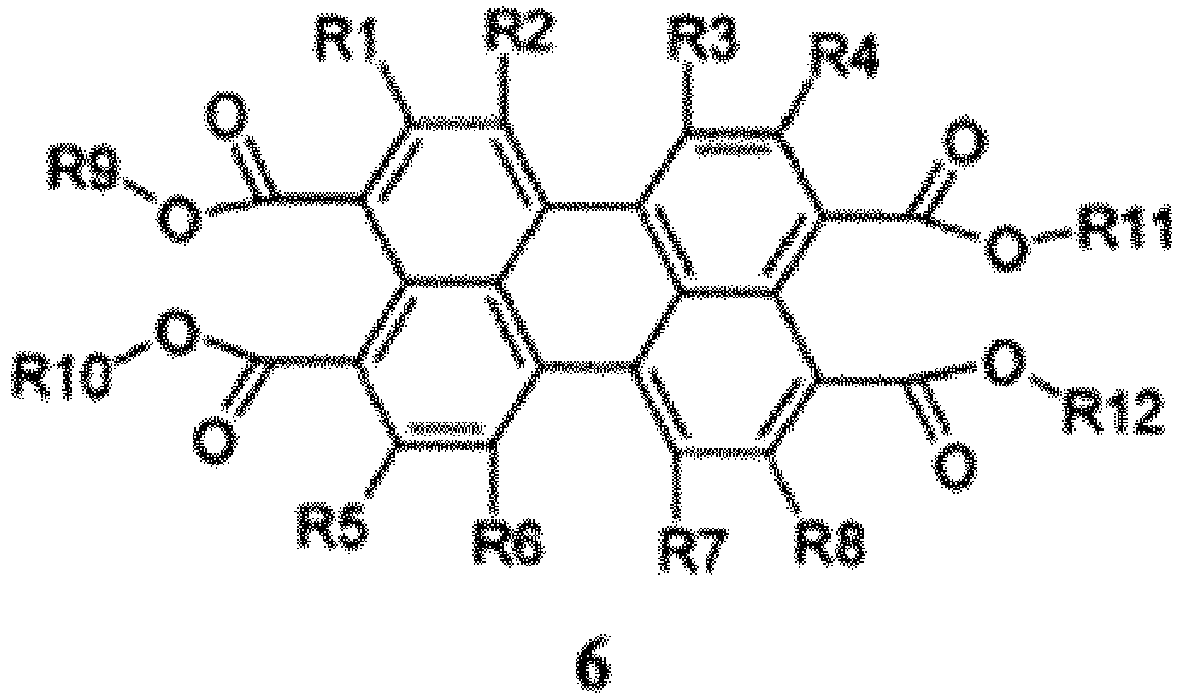
- Utilisation selon l'une des revendications 2 à 4, caractérisée en ce que les dérivés de pérylène sont introduits en faible concentration dans des matériaux polymères et sont détectés par l'intermédiaire de leur durée de décroissance de fluorescence ; les concentrations préférées sont entre 1 ppb et 100 ppm, de préférence les concentrations sont entre 1 et 100 ppb.
- Utilisation selon l'une des revendications 1 à 4, caractérisée en ce que, pour l'excitation de la fluorescence, des sources de lumière pulsées sont utilisées ; les sources de lumière préférées sont des sources à semi-conducteurs comme des diodes laser et des diodes électroluminescentes, de préférence contenant du nitrure de gallium, ou bien également des lampes à décharge de gaz.
- Utilisation selon l'une des revendications 1 à 4, caractérisée en ce que la détection a lieu à l'aide de détecteurs sensibles à la phase.
- Utilisation de la durée de décroissance de la fluorescence selon la revendication 1 pour la détection de matériaux polymères, caractérisée en ce que, pour l'excitation de la fluorescence, des sources de lumière pulsées périodiquement sont utilisées et le signal de fluorescence est cumulé et moyenné.
- Utilisation de la durée de décroissance de la fluorescence selon l'une des revendications 2 à 4 pour le codage de matériaux polymères, caractérisée en ce que, pour l'excitation de la fluorescence, des sources de lumière pulsées périodiquement sont utilisées et le signal de fluorescence est cumulé et moyenné.
- Utilisation de la durée de décroissance de la fluorescence selon la revendication 1 pour la détection des matériaux polymères pour la séparation en fonction du type à des fins de recyclage ; les matériaux polymères préférés sont des thermoplastiques, et parmi ceux-ci, sont particulièrement préférés le polyoxyméthylène (POM), le polystyrène (PS), le polyamide (PA), le polyéthylène téréphtalate (PET), le polycarbonate (PC), le polyéthylène (PE), le polypropylène (PP), le polychlorure de vinyle (PVC), le polyéther cétone (PEK) ou également les aramides, le kapton, le polysulfone.
- Utilisation de la durée de décroissance de la fluorescence selon l'une des revendications 2 à 4 pour le codage de matériaux polymères pour la séparation en fonction du type à des fins de recyclage ; les matériaux polymères préférés sont des thermoplastiques, et parmi ceux-ci, sont particulièrement préférés le polyoxyméthylène (POM), le polystyrène (PS), le polyamide (PA), le polyéthylène téréphtalate (PET), le polycarbonate (PC), le polyéthylène (PE), le polypropylène (PP), le polychlorure de vinyle (PVC), le polyéther cétone (PEK) ou également les aramides, le kapton, le polysulfone.
- Utilisation de la durée de décroissance de la fluorescence selon l'une des revendications 2 à 4 pour le codage de matériaux polymères pour la reconnaissance d'objets, pour leur identification univoque, également pour le marquage contre le piratage de matériaux.
Applications Claiming Priority (2)
| Application Number | Priority Date | Filing Date | Title |
|---|---|---|---|
| DE102014004529.3A DE102014004529A1 (de) | 2014-03-27 | 2014-03-27 | Die automatische Sortierung von Polymermaterialien anhand der Fluoreszenzabklingzeit der Eigenfluoreszenz und der Fluoreszenz von Markierungsstoffen |
| PCT/DE2015/000102 WO2015144114A1 (fr) | 2014-03-27 | 2015-03-04 | Tri automatique de matières polymères à l'aide du temps d'extinction de la fluorescence propre du polymère et de la fluorescence de substances de marquage |
Publications (2)
| Publication Number | Publication Date |
|---|---|
| EP3122814A1 EP3122814A1 (fr) | 2017-02-01 |
| EP3122814B1 true EP3122814B1 (fr) | 2021-12-22 |
Family
ID=53396117
Family Applications (1)
| Application Number | Title | Priority Date | Filing Date |
|---|---|---|---|
| EP15728745.9A Active EP3122814B1 (fr) | 2014-03-27 | 2015-03-04 | Tri automatique de matériaux polymère à l'aide de l'auto-fluorescence du polymère ainsi que de la fluorescence du composé de marquage |
Country Status (6)
| Country | Link |
|---|---|
| US (1) | US11326057B2 (fr) |
| EP (1) | EP3122814B1 (fr) |
| CN (2) | CN109374823A (fr) |
| CA (2) | CA3010934C (fr) |
| DE (2) | DE102014004529A1 (fr) |
| WO (1) | WO2015144114A1 (fr) |
Cited By (1)
| Publication number | Priority date | Publication date | Assignee | Title |
|---|---|---|---|---|
| US12123832B2 (en) * | 2016-08-04 | 2024-10-22 | Gunther Krieg | Apparatus for identifying substances |
Families Citing this family (13)
| Publication number | Priority date | Publication date | Assignee | Title |
|---|---|---|---|---|
| US9708463B2 (en) | 2015-01-14 | 2017-07-18 | International Business Machines Corporation | Recyclate verification |
| DE102015001523A1 (de) | 2015-02-06 | 2016-08-11 | Unisensor Sensorsysteme Gmbh | Die automatische Sortierung von Polyethylen anhand der Fluoreszenzabklingzeit der Eigenfluoreszenz |
| DE102015001522A1 (de) | 2015-02-06 | 2016-08-25 | Unisensor Sensorsysteme Gmbh | Die automatische Sortierung von Kunststoffen anhand von bi-exponentiellen Fluoreszenzabklingzeiten der Eigenfluoreszenz |
| DE102015001955A1 (de) | 2015-02-13 | 2016-09-01 | Heinz Langhals | Die automatische Erkennung von Kunststoffen anhand einer Gaußanalyse ihrer Autofluoreszenz für ihre maschinelle Sortierung für Recycling-Zwecke |
| DE102016214496A1 (de) * | 2016-08-04 | 2018-02-08 | Gunther Krieg | Vorrichtung zur Identifikation von Stoffen |
| DE102016214792A1 (de) * | 2016-08-09 | 2018-02-15 | Gunther Krieg | Vorrichtung und Verfahren zur Identifikation von Stoffen eines Materials mittels Spektroskopie |
| PL421008A1 (pl) * | 2017-03-27 | 2018-10-08 | Ergis Spółka Akcyjna | Materiał powłokowy do znakowania tworzyw sztucznych, sposób znakowania tworzyw sztucznych, sposób identyfikacji znakowanych tworzyw sztucznych oraz ich zastosowanie do sortowania odpadów z tworzyw sztucznych |
| US20190286882A1 (en) * | 2018-03-18 | 2019-09-19 | Jaroslav Hook | Method, apparatus and product for item identification and search on a scene using fluorescence |
| WO2020084376A1 (fr) * | 2018-10-26 | 2020-04-30 | Alma Mater Studiorum - Università di Bologna | Nanostructures en silicium en tant que marqueurs luminescents pour le recyclage du plastique |
| JP7338281B2 (ja) * | 2019-07-12 | 2023-09-05 | コニカミノルタ株式会社 | 樹脂製部品を含む製品及びそのリサイクル方法 |
| CA3158026A1 (fr) * | 2019-10-15 | 2021-04-22 | Security Matters Ltd. | Gestion de produits recyclables et leurs materiaux sources |
| GB2592691B (en) * | 2020-03-06 | 2022-03-02 | Tailorlux Gmbh | Method and system for analysing materials |
| NL2026870B1 (en) * | 2020-11-11 | 2022-06-30 | Enigma Sinapi B V | Method of separating plastics |
Family Cites Families (20)
| Publication number | Priority date | Publication date | Assignee | Title |
|---|---|---|---|---|
| ZA757668B (en) * | 1975-12-08 | 1977-07-27 | De Beers Cons Mines Ltd | Separation of materials |
| US4259574A (en) * | 1979-11-06 | 1981-03-31 | International Business Machines Corporation | Microanalysis by pulse laser emission spectroscopy |
| DE4102767A1 (de) * | 1991-01-31 | 1992-08-06 | Metallgesellschaft Ag | Verfahren zur qualitativen analyse von kunststoffteilchen |
| DE4210970C2 (de) * | 1992-04-02 | 1996-10-17 | Markus Dipl Chem Sauer | Verfahren zur simultanen optischen qualitativen und quantitativen Erfassung von verschiedenen mit Fluorochromen oder Fluorogenen markierten Molekülen eines Gemisches mittels Laserspektroskopie |
| DE4213323A1 (de) * | 1992-04-23 | 1993-10-28 | Bayer Ag | Verbessertes Verfahren zur Kennzeichnung von Kunststoffen |
| US5314072A (en) * | 1992-09-02 | 1994-05-24 | Rutgers, The State University | Sorting plastic bottles for recycling |
| DE4231477A1 (de) | 1992-09-19 | 1994-03-24 | Han Kyung Tae | Verfahren zur optischen Sortierung von Kunststoffen mittels zeitaufgelöster Laserspektroskopie |
| DE4300169A1 (de) * | 1993-01-07 | 1994-07-14 | Alfill Getraenketechnik | Verfahren und Vorrichtung zum Prüfen von Flaschen |
| US20050095715A1 (en) | 2003-10-31 | 2005-05-05 | General Electric Company | Tagging Material for Polymers, Methods, and Articles Made Thereby |
| US7169615B2 (en) | 2003-11-26 | 2007-01-30 | General Electric Company | Method of authenticating polymers, authenticatable polymers, methods of making authenticatable polymers and authenticatable articles, and articles made there from |
| DE102004024754B3 (de) | 2004-05-12 | 2006-04-20 | Leibniz-Institut Für Polymerforschung Dresden E.V. | Verfahren zur elektrostatischen Trennung von Kunststoffgemischen |
| DE102007055765B4 (de) | 2007-12-11 | 2010-04-29 | Leibniz-Institut Für Polymerforschung Dresden E.V. | Verfahren zur elektrostatischen Trennung von Kunststoffgemischen |
| US20100149531A1 (en) * | 2008-12-13 | 2010-06-17 | Allegro Asia Technology (Hk) Ltd. | Apparatus and method for object authentication using taggant material |
| DE102009041507A1 (de) * | 2009-09-14 | 2011-03-31 | Technische Universität München | Optisches Tiefpassfilter und Verfahren zum Optischen Filtern |
| CN103619988B (zh) * | 2011-06-24 | 2016-01-13 | Lg化学株式会社 | 聚合物荧光材料 |
| DE102012012772A1 (de) | 2012-06-22 | 2013-12-24 | Ludwig-Maximilians-Universität München | Markierung von Polymermaterialien mit Fluoreszenzfarbstoffen für deren eindeutige automatische Sortierung |
| CN102838982B (zh) * | 2012-07-04 | 2014-12-24 | 中国科学院过程工程研究所 | 一种具有广谱和持久自发荧光的聚合物微球及其制备方法 |
| DE102012014982A1 (de) | 2012-07-26 | 2014-02-13 | Ludwig-Maximilians-Universität München | Markierung von Polymermaterialien mit Nano-Fluoreszenzpartikeln für deren eindeutige automatische Sortierung |
| CN103115907B (zh) * | 2013-01-29 | 2015-03-18 | 华中科技大学 | 一种判定微管相关蛋白1轻链3蛋白斑点类型的方法 |
| WO2016124197A2 (fr) * | 2015-02-06 | 2016-08-11 | Unisensor Sensorsysteme Gmbh | Procédé et dispositif permettant l'identification de matières plastiques et/ou de leurs additifs |
-
2014
- 2014-03-27 DE DE102014004529.3A patent/DE102014004529A1/de not_active Withdrawn
-
2015
- 2015-03-04 CA CA3010934A patent/CA3010934C/fr active Active
- 2015-03-04 CN CN201811351965.XA patent/CN109374823A/zh active Pending
- 2015-03-04 WO PCT/DE2015/000102 patent/WO2015144114A1/fr not_active Ceased
- 2015-03-04 US US15/129,408 patent/US11326057B2/en active Active
- 2015-03-04 CN CN201580027588.2A patent/CN106537140B/zh active Active
- 2015-03-04 CA CA2943830A patent/CA2943830C/fr active Active
- 2015-03-04 EP EP15728745.9A patent/EP3122814B1/fr active Active
- 2015-03-04 DE DE112015001471.3T patent/DE112015001471B4/de active Active
Cited By (1)
| Publication number | Priority date | Publication date | Assignee | Title |
|---|---|---|---|---|
| US12123832B2 (en) * | 2016-08-04 | 2024-10-22 | Gunther Krieg | Apparatus for identifying substances |
Also Published As
| Publication number | Publication date |
|---|---|
| CN106537140B (zh) | 2024-07-02 |
| US11326057B2 (en) | 2022-05-10 |
| CA2943830C (fr) | 2019-04-23 |
| CN109374823A (zh) | 2019-02-22 |
| CA3010934C (fr) | 2022-06-21 |
| CN106537140A (zh) | 2017-03-22 |
| EP3122814A1 (fr) | 2017-02-01 |
| WO2015144114A1 (fr) | 2015-10-01 |
| CA2943830A1 (fr) | 2015-10-01 |
| DE102014004529A1 (de) | 2015-10-15 |
| DE112015001471A5 (de) | 2016-12-15 |
| US20170210901A1 (en) | 2017-07-27 |
| CA3010934A1 (fr) | 2015-10-01 |
| DE112015001471B4 (de) | 2021-08-26 |
| WO2015144114A4 (fr) | 2015-11-19 |
Similar Documents
| Publication | Publication Date | Title |
|---|---|---|
| EP3122814B1 (fr) | Tri automatique de matériaux polymère à l'aide de l'auto-fluorescence du polymère ainsi que de la fluorescence du composé de marquage | |
| DE102012012772A1 (de) | Markierung von Polymermaterialien mit Fluoreszenzfarbstoffen für deren eindeutige automatische Sortierung | |
| EP2828053B1 (fr) | Procédé permettant de trier un mélange de matières | |
| EP0476416A2 (fr) | Méthode pour masquer des matières plastiques | |
| Bellei et al. | Multianalytical study of historical luminescent lithopone for the detection of impurities and trace metal ions | |
| EP3494383A1 (fr) | Dispositif d'identification de substances | |
| DE102011007546A1 (de) | Messvorrichtung für eine Messung einer Singulettsauerstoff-Lumineszenz | |
| DE102019127894A1 (de) | Produktkennzeichnungssystem und verfahren zur kennzeichnung eines produkts | |
| DE4231477A1 (de) | Verfahren zur optischen Sortierung von Kunststoffen mittels zeitaufgelöster Laserspektroskopie | |
| DE102015001522A1 (de) | Die automatische Sortierung von Kunststoffen anhand von bi-exponentiellen Fluoreszenzabklingzeiten der Eigenfluoreszenz | |
| DE10252628A1 (de) | Verfahren zur Codierung von Informationen sowie Vorrichtung und Verfahren zur Auswertung der codierten Information | |
| EP3616171B2 (fr) | Procédé d'identification de la marchandise en consignation | |
| Krejsa et al. | NMR analysis of UV-and heat-aged nylon-6, 6 | |
| DE102012014982A1 (de) | Markierung von Polymermaterialien mit Nano-Fluoreszenzpartikeln für deren eindeutige automatische Sortierung | |
| DE102015001523A1 (de) | Die automatische Sortierung von Polyethylen anhand der Fluoreszenzabklingzeit der Eigenfluoreszenz | |
| DE102015001524A1 (de) | Die automatische Sortierung von Silikonen anhand der Fluoreszenzabklingzeit der Eigenfluoreszenz | |
| DE102015001525A1 (de) | Die automatische Sortierung von Polyethylenterephthalat aus unterschiedlichen Quellen anhand der Fluoreszenzabklingzeit der Eigenfluoreszenz | |
| HK40004422A (en) | Automatic sorting of polymer materials on the basis of the fluorescence decay time of the intrinsic fluorescence of the polymer and of the fluorescence of marking agents | |
| EP1050843A2 (fr) | Balayeur pour marque luminescente | |
| EP4139662A1 (fr) | Procédé et système de production d'une matière plastique | |
| DE102016214792A1 (de) | Vorrichtung und Verfahren zur Identifikation von Stoffen eines Materials mittels Spektroskopie | |
| Genheimer | The Photophysics of Small Organic Molecules for Novel Light Emitting Devices | |
| DE102005020816A1 (de) | Kennzeichnung von flammgeschützten Kunststoffbauteilen und Recyclingverfahren für flammgeschützte Kunststoffbauteile | |
| EP3497679A1 (fr) | Procédé et dispositif d'identification d'au moins un élément de sécurité d'au moins une caractéristique de sécurité d'un produit de sécurité | |
| van Hulst et al. | Single Molecule Pump-Probe Detection on Coupled Quantum Systems |
Legal Events
| Date | Code | Title | Description |
|---|---|---|---|
| STAA | Information on the status of an ep patent application or granted ep patent |
Free format text: STATUS: THE INTERNATIONAL PUBLICATION HAS BEEN MADE |
|
| PUAI | Public reference made under article 153(3) epc to a published international application that has entered the european phase |
Free format text: ORIGINAL CODE: 0009012 |
|
| STAA | Information on the status of an ep patent application or granted ep patent |
Free format text: STATUS: REQUEST FOR EXAMINATION WAS MADE |
|
| 17P | Request for examination filed |
Effective date: 20161027 |
|
| AK | Designated contracting states |
Kind code of ref document: A1 Designated state(s): AL AT BE BG CH CY CZ DE DK EE ES FI FR GB GR HR HU IE IS IT LI LT LU LV MC MK MT NL NO PL PT RO RS SE SI SK SM TR |
|
| AX | Request for extension of the european patent |
Extension state: BA ME |
|
| DAV | Request for validation of the european patent (deleted) | ||
| DAX | Request for extension of the european patent (deleted) | ||
| STAA | Information on the status of an ep patent application or granted ep patent |
Free format text: STATUS: EXAMINATION IS IN PROGRESS |
|
| 17Q | First examination report despatched |
Effective date: 20180628 |
|
| REG | Reference to a national code |
Ref country code: DE Ref legal event code: R079 Ref document number: 502015015514 Country of ref document: DE Free format text: PREVIOUS MAIN CLASS: C08K0005343700 Ipc: B07C0005342000 |
|
| RIC1 | Information provided on ipc code assigned before grant |
Ipc: B07C 5/342 20060101AFI20210329BHEP Ipc: G01N 21/64 20060101ALI20210329BHEP Ipc: C08K 5/3437 20060101ALI20210329BHEP Ipc: C09B 5/62 20060101ALI20210329BHEP Ipc: G01N 31/22 20060101ALI20210329BHEP Ipc: B29B 17/02 20060101ALI20210329BHEP |
|
| GRAP | Despatch of communication of intention to grant a patent |
Free format text: ORIGINAL CODE: EPIDOSNIGR1 |
|
| STAA | Information on the status of an ep patent application or granted ep patent |
Free format text: STATUS: GRANT OF PATENT IS INTENDED |
|
| INTG | Intention to grant announced |
Effective date: 20210802 |
|
| GRAS | Grant fee paid |
Free format text: ORIGINAL CODE: EPIDOSNIGR3 |
|
| GRAA | (expected) grant |
Free format text: ORIGINAL CODE: 0009210 |
|
| STAA | Information on the status of an ep patent application or granted ep patent |
Free format text: STATUS: THE PATENT HAS BEEN GRANTED |
|
| AK | Designated contracting states |
Kind code of ref document: B1 Designated state(s): AL AT BE BG CH CY CZ DE DK EE ES FI FR GB GR HR HU IE IS IT LI LT LU LV MC MK MT NL NO PL PT RO RS SE SI SK SM TR |
|
| REG | Reference to a national code |
Ref country code: GB Ref legal event code: FG4D Free format text: NOT ENGLISH |
|
| REG | Reference to a national code |
Ref country code: CH Ref legal event code: EP |
|
| REG | Reference to a national code |
Ref country code: DE Ref legal event code: R096 Ref document number: 502015015514 Country of ref document: DE |
|
| REG | Reference to a national code |
Ref country code: AT Ref legal event code: REF Ref document number: 1456739 Country of ref document: AT Kind code of ref document: T Effective date: 20220115 |
|
| REG | Reference to a national code |
Ref country code: IE Ref legal event code: FG4D Free format text: LANGUAGE OF EP DOCUMENT: GERMAN |
|
| REG | Reference to a national code |
Ref country code: LT Ref legal event code: MG9D |
|
| PG25 | Lapsed in a contracting state [announced via postgrant information from national office to epo] |
Ref country code: RS Free format text: LAPSE BECAUSE OF FAILURE TO SUBMIT A TRANSLATION OF THE DESCRIPTION OR TO PAY THE FEE WITHIN THE PRESCRIBED TIME-LIMIT Effective date: 20211222 Ref country code: LT Free format text: LAPSE BECAUSE OF FAILURE TO SUBMIT A TRANSLATION OF THE DESCRIPTION OR TO PAY THE FEE WITHIN THE PRESCRIBED TIME-LIMIT Effective date: 20211222 Ref country code: FI Free format text: LAPSE BECAUSE OF FAILURE TO SUBMIT A TRANSLATION OF THE DESCRIPTION OR TO PAY THE FEE WITHIN THE PRESCRIBED TIME-LIMIT Effective date: 20211222 Ref country code: BG Free format text: LAPSE BECAUSE OF FAILURE TO SUBMIT A TRANSLATION OF THE DESCRIPTION OR TO PAY THE FEE WITHIN THE PRESCRIBED TIME-LIMIT Effective date: 20220322 |
|
| REG | Reference to a national code |
Ref country code: NL Ref legal event code: MP Effective date: 20211222 |
|
| PG25 | Lapsed in a contracting state [announced via postgrant information from national office to epo] |
Ref country code: SE Free format text: LAPSE BECAUSE OF FAILURE TO SUBMIT A TRANSLATION OF THE DESCRIPTION OR TO PAY THE FEE WITHIN THE PRESCRIBED TIME-LIMIT Effective date: 20211222 Ref country code: NO Free format text: LAPSE BECAUSE OF FAILURE TO SUBMIT A TRANSLATION OF THE DESCRIPTION OR TO PAY THE FEE WITHIN THE PRESCRIBED TIME-LIMIT Effective date: 20220322 Ref country code: LV Free format text: LAPSE BECAUSE OF FAILURE TO SUBMIT A TRANSLATION OF THE DESCRIPTION OR TO PAY THE FEE WITHIN THE PRESCRIBED TIME-LIMIT Effective date: 20211222 Ref country code: HR Free format text: LAPSE BECAUSE OF FAILURE TO SUBMIT A TRANSLATION OF THE DESCRIPTION OR TO PAY THE FEE WITHIN THE PRESCRIBED TIME-LIMIT Effective date: 20211222 Ref country code: GR Free format text: LAPSE BECAUSE OF FAILURE TO SUBMIT A TRANSLATION OF THE DESCRIPTION OR TO PAY THE FEE WITHIN THE PRESCRIBED TIME-LIMIT Effective date: 20220323 |
|
| PG25 | Lapsed in a contracting state [announced via postgrant information from national office to epo] |
Ref country code: NL Free format text: LAPSE BECAUSE OF FAILURE TO SUBMIT A TRANSLATION OF THE DESCRIPTION OR TO PAY THE FEE WITHIN THE PRESCRIBED TIME-LIMIT Effective date: 20211222 |
|
| PG25 | Lapsed in a contracting state [announced via postgrant information from national office to epo] |
Ref country code: SM Free format text: LAPSE BECAUSE OF FAILURE TO SUBMIT A TRANSLATION OF THE DESCRIPTION OR TO PAY THE FEE WITHIN THE PRESCRIBED TIME-LIMIT Effective date: 20211222 Ref country code: SK Free format text: LAPSE BECAUSE OF FAILURE TO SUBMIT A TRANSLATION OF THE DESCRIPTION OR TO PAY THE FEE WITHIN THE PRESCRIBED TIME-LIMIT Effective date: 20211222 Ref country code: RO Free format text: LAPSE BECAUSE OF FAILURE TO SUBMIT A TRANSLATION OF THE DESCRIPTION OR TO PAY THE FEE WITHIN THE PRESCRIBED TIME-LIMIT Effective date: 20211222 Ref country code: PT Free format text: LAPSE BECAUSE OF FAILURE TO SUBMIT A TRANSLATION OF THE DESCRIPTION OR TO PAY THE FEE WITHIN THE PRESCRIBED TIME-LIMIT Effective date: 20220422 Ref country code: ES Free format text: LAPSE BECAUSE OF FAILURE TO SUBMIT A TRANSLATION OF THE DESCRIPTION OR TO PAY THE FEE WITHIN THE PRESCRIBED TIME-LIMIT Effective date: 20211222 Ref country code: EE Free format text: LAPSE BECAUSE OF FAILURE TO SUBMIT A TRANSLATION OF THE DESCRIPTION OR TO PAY THE FEE WITHIN THE PRESCRIBED TIME-LIMIT Effective date: 20211222 Ref country code: CZ Free format text: LAPSE BECAUSE OF FAILURE TO SUBMIT A TRANSLATION OF THE DESCRIPTION OR TO PAY THE FEE WITHIN THE PRESCRIBED TIME-LIMIT Effective date: 20211222 |
|
| PG25 | Lapsed in a contracting state [announced via postgrant information from national office to epo] |
Ref country code: PL Free format text: LAPSE BECAUSE OF FAILURE TO SUBMIT A TRANSLATION OF THE DESCRIPTION OR TO PAY THE FEE WITHIN THE PRESCRIBED TIME-LIMIT Effective date: 20211222 |
|
| REG | Reference to a national code |
Ref country code: DE Ref legal event code: R097 Ref document number: 502015015514 Country of ref document: DE |
|
| PG25 | Lapsed in a contracting state [announced via postgrant information from national office to epo] |
Ref country code: IS Free format text: LAPSE BECAUSE OF FAILURE TO SUBMIT A TRANSLATION OF THE DESCRIPTION OR TO PAY THE FEE WITHIN THE PRESCRIBED TIME-LIMIT Effective date: 20220422 |
|
| PLBE | No opposition filed within time limit |
Free format text: ORIGINAL CODE: 0009261 |
|
| STAA | Information on the status of an ep patent application or granted ep patent |
Free format text: STATUS: NO OPPOSITION FILED WITHIN TIME LIMIT |
|
| PG25 | Lapsed in a contracting state [announced via postgrant information from national office to epo] |
Ref country code: MC Free format text: LAPSE BECAUSE OF FAILURE TO SUBMIT A TRANSLATION OF THE DESCRIPTION OR TO PAY THE FEE WITHIN THE PRESCRIBED TIME-LIMIT Effective date: 20211222 Ref country code: DK Free format text: LAPSE BECAUSE OF FAILURE TO SUBMIT A TRANSLATION OF THE DESCRIPTION OR TO PAY THE FEE WITHIN THE PRESCRIBED TIME-LIMIT Effective date: 20211222 Ref country code: AL Free format text: LAPSE BECAUSE OF FAILURE TO SUBMIT A TRANSLATION OF THE DESCRIPTION OR TO PAY THE FEE WITHIN THE PRESCRIBED TIME-LIMIT Effective date: 20211222 |
|
| REG | Reference to a national code |
Ref country code: CH Ref legal event code: PL |
|
| GBPC | Gb: european patent ceased through non-payment of renewal fee |
Effective date: 20220322 |
|
| 26N | No opposition filed |
Effective date: 20220923 |
|
| REG | Reference to a national code |
Ref country code: BE Ref legal event code: MM Effective date: 20220331 |
|
| PG25 | Lapsed in a contracting state [announced via postgrant information from national office to epo] |
Ref country code: LU Free format text: LAPSE BECAUSE OF NON-PAYMENT OF DUE FEES Effective date: 20220304 Ref country code: LI Free format text: LAPSE BECAUSE OF NON-PAYMENT OF DUE FEES Effective date: 20220331 Ref country code: IE Free format text: LAPSE BECAUSE OF NON-PAYMENT OF DUE FEES Effective date: 20220304 Ref country code: GB Free format text: LAPSE BECAUSE OF NON-PAYMENT OF DUE FEES Effective date: 20220322 Ref country code: CH Free format text: LAPSE BECAUSE OF NON-PAYMENT OF DUE FEES Effective date: 20220331 |
|
| PG25 | Lapsed in a contracting state [announced via postgrant information from national office to epo] |
Ref country code: SI Free format text: LAPSE BECAUSE OF FAILURE TO SUBMIT A TRANSLATION OF THE DESCRIPTION OR TO PAY THE FEE WITHIN THE PRESCRIBED TIME-LIMIT Effective date: 20211222 Ref country code: BE Free format text: LAPSE BECAUSE OF NON-PAYMENT OF DUE FEES Effective date: 20220331 |
|
| REG | Reference to a national code |
Ref country code: AT Ref legal event code: MM01 Ref document number: 1456739 Country of ref document: AT Kind code of ref document: T Effective date: 20220304 |
|
| PG25 | Lapsed in a contracting state [announced via postgrant information from national office to epo] |
Ref country code: IT Free format text: LAPSE BECAUSE OF FAILURE TO SUBMIT A TRANSLATION OF THE DESCRIPTION OR TO PAY THE FEE WITHIN THE PRESCRIBED TIME-LIMIT Effective date: 20211222 |
|
| PG25 | Lapsed in a contracting state [announced via postgrant information from national office to epo] |
Ref country code: AT Free format text: LAPSE BECAUSE OF NON-PAYMENT OF DUE FEES Effective date: 20220304 |
|
| PG25 | Lapsed in a contracting state [announced via postgrant information from national office to epo] |
Ref country code: HU Free format text: LAPSE BECAUSE OF FAILURE TO SUBMIT A TRANSLATION OF THE DESCRIPTION OR TO PAY THE FEE WITHIN THE PRESCRIBED TIME-LIMIT; INVALID AB INITIO Effective date: 20150304 |
|
| PG25 | Lapsed in a contracting state [announced via postgrant information from national office to epo] |
Ref country code: MK Free format text: LAPSE BECAUSE OF FAILURE TO SUBMIT A TRANSLATION OF THE DESCRIPTION OR TO PAY THE FEE WITHIN THE PRESCRIBED TIME-LIMIT Effective date: 20211222 Ref country code: CY Free format text: LAPSE BECAUSE OF FAILURE TO SUBMIT A TRANSLATION OF THE DESCRIPTION OR TO PAY THE FEE WITHIN THE PRESCRIBED TIME-LIMIT Effective date: 20211222 |
|
| PG25 | Lapsed in a contracting state [announced via postgrant information from national office to epo] |
Ref country code: TR Free format text: LAPSE BECAUSE OF FAILURE TO SUBMIT A TRANSLATION OF THE DESCRIPTION OR TO PAY THE FEE WITHIN THE PRESCRIBED TIME-LIMIT Effective date: 20211222 |
|
| PG25 | Lapsed in a contracting state [announced via postgrant information from national office to epo] |
Ref country code: MT Free format text: LAPSE BECAUSE OF FAILURE TO SUBMIT A TRANSLATION OF THE DESCRIPTION OR TO PAY THE FEE WITHIN THE PRESCRIBED TIME-LIMIT Effective date: 20211222 |
|
| PGFP | Annual fee paid to national office [announced via postgrant information from national office to epo] |
Ref country code: DE Payment date: 20260313 Year of fee payment: 12 |
|
| PGFP | Annual fee paid to national office [announced via postgrant information from national office to epo] |
Ref country code: FR Payment date: 20260310 Year of fee payment: 12 |