EP3122835B1 - Schleifteilchenagglomerat - Google Patents
Schleifteilchenagglomerat Download PDFInfo
- Publication number
- EP3122835B1 EP3122835B1 EP15715956.7A EP15715956A EP3122835B1 EP 3122835 B1 EP3122835 B1 EP 3122835B1 EP 15715956 A EP15715956 A EP 15715956A EP 3122835 B1 EP3122835 B1 EP 3122835B1
- Authority
- EP
- European Patent Office
- Prior art keywords
- abrasive
- particles
- abrasive particles
- agglomerate
- grinding
- Prior art date
- Legal status (The legal status is an assumption and is not a legal conclusion. Google has not performed a legal analysis and makes no representation as to the accuracy of the status listed.)
- Active
Links
Images


Classifications
-
- C—CHEMISTRY; METALLURGY
- C09—DYES; PAINTS; POLISHES; NATURAL RESINS; ADHESIVES; COMPOSITIONS NOT OTHERWISE PROVIDED FOR; APPLICATIONS OF MATERIALS NOT OTHERWISE PROVIDED FOR
- C09K—MATERIALS FOR MISCELLANEOUS APPLICATIONS, NOT PROVIDED FOR ELSEWHERE
- C09K3/00—Materials not provided for elsewhere
- C09K3/14—Anti-slip materials; Abrasives
- C09K3/1409—Abrasive particles per se
-
- B—PERFORMING OPERATIONS; TRANSPORTING
- B24—GRINDING; POLISHING
- B24D—TOOLS FOR GRINDING, BUFFING OR SHARPENING
- B24D3/00—Physical features of abrasive bodies, or sheets, e.g. abrasive surfaces of special nature; Abrasive bodies or sheets characterised by their constituents
- B24D3/02—Physical features of abrasive bodies, or sheets, e.g. abrasive surfaces of special nature; Abrasive bodies or sheets characterised by their constituents the constituent being used as bonding agent
- B24D3/04—Physical features of abrasive bodies, or sheets, e.g. abrasive surfaces of special nature; Abrasive bodies or sheets characterised by their constituents the constituent being used as bonding agent and being essentially inorganic
- B24D3/14—Physical features of abrasive bodies, or sheets, e.g. abrasive surfaces of special nature; Abrasive bodies or sheets characterised by their constituents the constituent being used as bonding agent and being essentially inorganic ceramic, i.e. vitrified bondings
-
- B—PERFORMING OPERATIONS; TRANSPORTING
- B24—GRINDING; POLISHING
- B24D—TOOLS FOR GRINDING, BUFFING OR SHARPENING
- B24D3/00—Physical features of abrasive bodies, or sheets, e.g. abrasive surfaces of special nature; Abrasive bodies or sheets characterised by their constituents
- B24D3/02—Physical features of abrasive bodies, or sheets, e.g. abrasive surfaces of special nature; Abrasive bodies or sheets characterised by their constituents the constituent being used as bonding agent
- B24D3/20—Physical features of abrasive bodies, or sheets, e.g. abrasive surfaces of special nature; Abrasive bodies or sheets characterised by their constituents the constituent being used as bonding agent and being essentially organic
- B24D3/28—Resins or natural or synthetic macromolecular compounds
-
- C—CHEMISTRY; METALLURGY
- C03—GLASS; MINERAL OR SLAG WOOL
- C03B—MANUFACTURE, SHAPING, OR SUPPLEMENTARY PROCESSES
- C03B19/00—Other methods of shaping glass
- C03B19/06—Other methods of shaping glass by sintering, e.g. by cold isostatic pressing of powders and subsequent sintering, by hot pressing of powders, by sintering slurries or dispersions not undergoing a liquid phase reaction
-
- C—CHEMISTRY; METALLURGY
- C04—CEMENTS; CONCRETE; ARTIFICIAL STONE; CERAMICS; REFRACTORIES
- C04B—LIME, MAGNESIA; SLAG; CEMENTS; COMPOSITIONS THEREOF, e.g. MORTARS, CONCRETE OR LIKE BUILDING MATERIALS; ARTIFICIAL STONE; CERAMICS; REFRACTORIES; TREATMENT OF NATURAL STONE
- C04B35/00—Shaped ceramic products characterised by their composition; Ceramics compositions; Processing powders of inorganic compounds preparatory to the manufacturing of ceramic products
- C04B35/622—Forming processes; Processing powders of inorganic compounds preparatory to the manufacturing of ceramic products
- C04B35/653—Processes involving a melting step
-
- C—CHEMISTRY; METALLURGY
- C09—DYES; PAINTS; POLISHES; NATURAL RESINS; ADHESIVES; COMPOSITIONS NOT OTHERWISE PROVIDED FOR; APPLICATIONS OF MATERIALS NOT OTHERWISE PROVIDED FOR
- C09J—ADHESIVES; NON-MECHANICAL ASPECTS OF ADHESIVE PROCESSES IN GENERAL; ADHESIVE PROCESSES NOT PROVIDED FOR ELSEWHERE; USE OF MATERIALS AS ADHESIVES
- C09J1/00—Adhesives based on inorganic constituents
-
- C—CHEMISTRY; METALLURGY
- C09—DYES; PAINTS; POLISHES; NATURAL RESINS; ADHESIVES; COMPOSITIONS NOT OTHERWISE PROVIDED FOR; APPLICATIONS OF MATERIALS NOT OTHERWISE PROVIDED FOR
- C09J—ADHESIVES; NON-MECHANICAL ASPECTS OF ADHESIVE PROCESSES IN GENERAL; ADHESIVE PROCESSES NOT PROVIDED FOR ELSEWHERE; USE OF MATERIALS AS ADHESIVES
- C09J5/00—Adhesive processes in general; Adhesive processes not provided for elsewhere, e.g. relating to primers
- C09J5/06—Adhesive processes in general; Adhesive processes not provided for elsewhere, e.g. relating to primers involving heating of the applied adhesive
-
- C—CHEMISTRY; METALLURGY
- C09—DYES; PAINTS; POLISHES; NATURAL RESINS; ADHESIVES; COMPOSITIONS NOT OTHERWISE PROVIDED FOR; APPLICATIONS OF MATERIALS NOT OTHERWISE PROVIDED FOR
- C09K—MATERIALS FOR MISCELLANEOUS APPLICATIONS, NOT PROVIDED FOR ELSEWHERE
- C09K3/00—Materials not provided for elsewhere
- C09K3/14—Anti-slip materials; Abrasives
- C09K3/1436—Composite particles, e.g. coated particles
Definitions
- the invention relates to an agglomerate of at least two largely rod-shaped abrasive particles.
- the present invention also relates to a method for producing such an agglomerate and a grinding tool.
- Agglomerates of abrasive grains have been known for a long time and are used in many variations in bonded abrasives, such as grinding wheels.
- abrasive grain agglomerates The advantage of in the EP2318468 described abrasive grain agglomerates is that finely divided abrasive grains can be used as primary particles, from which an agglomerate grain is then formed, which shows a more favorable wear behavior in the grinding process compared to an individual grain of comparable size. While an individual grit of comparable size becomes blunt or destroyed in the machining process, when using abrasive grit agglomerates according to '468, individual grit repeatedly break out of the composite, so that new grinding edges are formed again and again. So shows an abrasive using abrasive grain agglomerates according to EP2318468 a better grinding pattern and a longer service life.
- the raw material is ground by means of wet grinding to an average particle size of less than 5 microns, particularly preferably less than 0.5 microns.
- the dispersion obtained is dried by spray drying, resulting in agglomerated green bodies. These agglomerates have a diameter between five microns and 500 microns.
- the agglomerate green bodies obtained in this way are then sintered, as a result of which the desired abrasive grain agglomerates can be obtained without the use of binders.
- the grain agglomerates described are particularly suitable for fine grinding operations due to the microscopic primary grains.
- the U.S. 3,048,482 von Hurst shows pyramid-shaped abrasive particles composed of individual abrasive grains and held together by an organic binder. These abrasive grain agglomerates are embedded in recesses in a flexible matrix and fixed there with a thermoplastic binder.
- Elongated or rod-shaped abrasive grains are, for example, from U.S. 3,387,957 known to Howard. Howard describes therein the preparation of microcrystalline abrasive grains from bauxite having an aspect ratio of length to diameter greater than 1 and up to 5. The reference also shows the use of these grains in grinding wheels wherein the elongated bauxite grains are embedded in an organic bond.
- Such rod-shaped or stretched abrasive grains can be produced, for example, by extrusion and subsequent sintering of abrasives and are commercially available.
- Extended abrasive grains made of corundum are available under the product name CERPASS TGE ® from SAINT-GOBAIN Grains and Powders, which have a length of about 500 micrometers with the so-called grit size of 36.
- Typical physical properties of this product are a hardness of 21.60 GPa (according to Vickers diamond), a density of 3.91 g/cm 3 (helium pycnometry) and a crystallite size of 0.17 ⁇ m (measured from scanning electron micrographs).
- the EP 2 324 957 describes the manufacture and use of filamentous sol-gel alumina abrasive grain.
- Abrasive grain agglomerates according to the prior art are structures composed of microscopic abrasive grains without a preferred orientation of the individual abrasive grains in relation to one another.
- the object of the invention is to specify improved abrasive grain agglomerates and a grinding tool with an abrasive body using the abrasive grain agglomerates according to the invention and a method for producing the abrasive grain agglomerates according to the invention and an abrasive body.
- a further aspect of the invention is the improvement of the spatial distribution or orientation of elongated or rod-shaped abrasive particles in an abrasive grain agglomerate.
- the improved abrasive grain agglomerate consists of at least two largely rod-shaped abrasive particles, the at least two largely rod-shaped abrasive particles being connected to one another via a glass bond, and the longitudinal axes of the at least two rod-shaped abrasive particles pointing in different spatial directions.
- abrasive particles are understood to mean an abrasive body which either consists of one abrasive grain or is composed of a plurality of abrasive grains.
- Abrasive means the abrasive material from which an abrasive grain is made.
- rod-shaped also means deviations from the ideal geometry of a cylinder.
- the rod-shaped grinding particles can be curved and/or have a nose or a thickening at their ends.
- the at least two rod-shaped abrasive particles are connected to one another via a glass bond.
- the bond is preferably at the center of the rod shaped abrasive particles.
- the fact that the longitudinal axes of the rod-shaped abrasive particles point in different spatial directions results in an external shape reminiscent of a tank trap or a hedgehog.
- This form of abrasive grain agglomerates has proven to be particularly favorable with regard to the grinding properties, because fresh cutting edges are repeatedly offered as wear occurs, which are formed by the cross-sections of the rod-shaped abrasive particles pointing in different spatial directions.
- an abrasive grain agglomerate according to the invention consists of a multiplicity of rod-shaped abrasive particles, for example four to twelve abrasive particles. It is advantageous if the orientation of the rod-shaped grinding particles is distributed as uniformly as possible in all spatial directions.
- the abrasive particles of abrasive grains consisting of abrasive, are largely free of binder.
- This embodiment describes the case in which one of the rod-shaped abrasive particles is formed by rod-shaped abrasive grain. As described above, such abrasive particles can be produced by extrusion and subsequent sintering of abrasive.
- the rod-shaped abrasive particles consist of an abrasive and a binder.
- the abrasive particles are not formed by an abrasive grain, but consist of several primary abrasive grains of abrasive, which are connected to one another via a suitable bond. All known abrasive materials such as corundum, cubic boron nitride, silicon carbide and diamond can be used as abrasives.
- the primary grains which have dimensions less than or equal to the grinding particle to be obtained, are mixed with a binder, this mixture is shaped, preferably extruded, and then cured in a suitable manner.
- the example is not limited to the abrasive particles consisting of an abrasive alone and binder. Mixtures of different abrasives can also be implemented in one abrasive particle. It can also be provided that some of the abrasive grains are made up of one abrasive or a mixture of abrasives, and other abrasive grains of the agglomerate consist of another abrasive or another mixture of abrasives.
- part of the abrasive particles consists of abrasive grains consisting of abrasive and largely free of binder, and that the other part of the abrasive particles consists of an abrasive and a binder.
- the agglomerate here consists of a mixture of abrasive particles, each formed by a rod-shaped abrasive grain alone, and other abrasive particles, which are formed from several primary abrasive grains of abrasive and suitable bond.
- the abrasive particles have an aspect ratio of length to diameter of at least 2:1. Due to the pronounced stretching of the grinding particles, particularly favorable grinding properties are achieved. This can be explained by the fact that the cut surfaces of rod-shaped particles are largely circular or elliptical and this cross-sectional shape is retained for a longer period of time with appropriate stretching of the particle during wear, with fresh cut edges being formed again and again in the course of wear. This can be explained using an example: imagine a stretched abrasive particle whose longitudinal axis runs radially in relation to the abrasive tool, i.e. the vector of the peripheral speed of the abrasive tool is normal to the longitudinal axis of the abrasive particle. In the case of an approximately cylindrical shape of the grinding particle, a circular cutting surface is formed which remains when the grinding particle wears away until the rod-shaped grinding particle has been consumed.
- agglomerates of this preferred type are characterized by particularly aggressive grinding behavior and are particularly suitable for grinding operations with a high number of contacts, such as internal cylindrical grinding or surface grinding.
- the length of the abrasive particles is at least 100 micrometers, particularly preferably around 250 to 800 micrometers.
- abrasive particles that differ significantly in their size from the abrasive grain commonly used, has proven to be particularly advantageous.
- the abrasive particles are abrasive grains made of abrasive and largely free of binder. If, for example, abrasive particles made of microcrystalline corundum with an average length of approx. 500 micrometers and a diameter of approx. 230 micrometers are used, particularly favorable properties can be observed. Due to the shell-like (conchoidal) fracture of the microcrystalline corundum, these abrasive particles have good self-sharpening properties. The dimensions result in a high absolute strength of the abrasive particles.
- the agglomerates described above are connected via a binder to form a grinding wheel.
- a grinding tool for example a grinding wheel, can be produced from the grinding body.
- the bond of the grinding body is a synthetic resin bond.
- the bond of the grinding body is a vitrified bond.
- the agglomerate is such that the bulk density of the agglomerates is about 50-99% of the bulk density of the starting abrasive particles.
- the proportion of glass particles in the mixture of grinding particles and glass particles is between 2 and 25 percent by weight.
- the spatial orientation of the rod-shaped grinding particles can be influenced particularly favorably.
- the longitudinal axes of the rod-shaped grinding particles point in different spatial directions.
- the diameter of the glass particles is in the range from 50 to 1000, preferably between 150 and 250 micrometers.
- rod-shaped abrasive particles with a diameter of approx. 100 micrometers (CERPASS TGE ® 120 grit) were mixed with glass beads with a fraction of 150-250 micrometers.
- the weight ratio of grain to spheres was 100:5.
- the agglomerates produced by the process have a particularly uniform distribution of the orientation of the grains in all spatial directions, in other words, an agglomerate is formed with as few grains as possible parallel to one another.
- figure 1 shows a schematic of an abrasive grain agglomerate 1 made up of a plurality of rod-shaped abrasive particles 2 .
- the individual abrasive particles 2 are connected to one another via a glass bond 3 .
- the vitreous bond 3 is formed in the form of necks between the rod-shaped abrasive particles 2 .
- figure 2 shows individual stretched abrasive particles 2.
- figure 4 schematically illustrates the manufacturing process for obtaining abrasive grain agglomerates 1.
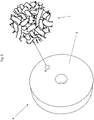
- figure 5 shows a grinding tool 4, in this case designed as a grinding wheel, which consists of a bonded abrasive body 5 using the agglomerates 1 according to the invention.
- the grinding tool or the grinding body can also have any other shape.
- the enlarged section A illustrates that 5 agglomerates 1 are embedded in the bond of the abrasive body.
Landscapes
- Chemical & Material Sciences (AREA)
- Engineering & Computer Science (AREA)
- Organic Chemistry (AREA)
- Materials Engineering (AREA)
- Inorganic Chemistry (AREA)
- Manufacturing & Machinery (AREA)
- Ceramic Engineering (AREA)
- Mechanical Engineering (AREA)
- Composite Materials (AREA)
- Structural Engineering (AREA)
- Dispersion Chemistry (AREA)
- Polishing Bodies And Polishing Tools (AREA)
Priority Applications (2)
| Application Number | Priority Date | Filing Date | Title |
|---|---|---|---|
| EP21216300.0A EP3992263A1 (de) | 2014-03-25 | 2015-03-09 | Schleifteilchenagglomerat |
| SI201531855T SI3122835T1 (sl) | 2014-03-25 | 2015-03-09 | Aglomerat brusilnih delcev |
Applications Claiming Priority (2)
| Application Number | Priority Date | Filing Date | Title |
|---|---|---|---|
| ATA212/2014A AT515587B1 (de) | 2014-03-25 | 2014-03-25 | Schleifteilchenagglomerat |
| PCT/AT2015/000034 WO2015143461A1 (de) | 2014-03-25 | 2015-03-09 | Schleifteilchenagglomerat |
Related Child Applications (2)
| Application Number | Title | Priority Date | Filing Date |
|---|---|---|---|
| EP21216300.0A Division-Into EP3992263A1 (de) | 2014-03-25 | 2015-03-09 | Schleifteilchenagglomerat |
| EP21216300.0A Division EP3992263A1 (de) | 2014-03-25 | 2015-03-09 | Schleifteilchenagglomerat |
Publications (2)
| Publication Number | Publication Date |
|---|---|
| EP3122835A1 EP3122835A1 (de) | 2017-02-01 |
| EP3122835B1 true EP3122835B1 (de) | 2022-04-27 |
Family
ID=52828930
Family Applications (2)
| Application Number | Title | Priority Date | Filing Date |
|---|---|---|---|
| EP15715956.7A Active EP3122835B1 (de) | 2014-03-25 | 2015-03-09 | Schleifteilchenagglomerat |
| EP21216300.0A Pending EP3992263A1 (de) | 2014-03-25 | 2015-03-09 | Schleifteilchenagglomerat |
Family Applications After (1)
| Application Number | Title | Priority Date | Filing Date |
|---|---|---|---|
| EP21216300.0A Pending EP3992263A1 (de) | 2014-03-25 | 2015-03-09 | Schleifteilchenagglomerat |
Country Status (8)
| Country | Link |
|---|---|
| EP (2) | EP3122835B1 (da) |
| AT (1) | AT515587B1 (da) |
| DK (1) | DK3122835T3 (da) |
| ES (1) | ES2921802T3 (da) |
| HU (1) | HUE059335T2 (da) |
| PL (1) | PL3122835T3 (da) |
| SI (1) | SI3122835T1 (da) |
| WO (1) | WO2015143461A1 (da) |
Families Citing this family (20)
| Publication number | Priority date | Publication date | Assignee | Title |
|---|---|---|---|---|
| EP2802436B1 (en) | 2012-01-10 | 2019-09-25 | Saint-Gobain Ceramics & Plastics, Inc. | Abrasive particles having complex shapes |
| EP2852473B1 (en) | 2012-05-23 | 2020-12-23 | Saint-Gobain Ceramics & Plastics Inc. | Shaped abrasive particles and methods of forming same |
| PL2978566T3 (pl) | 2013-03-29 | 2024-07-15 | Saint-Gobain Abrasives, Inc. | Cząstki ścierne o określonych kształtach i sposoby formowania takich cząstek |
| KR101889698B1 (ko) | 2013-09-30 | 2018-08-21 | 생-고뱅 세라믹스 앤드 플라스틱스, 인코포레이티드 | 형상화 연마입자 및 이의 형성 방법 |
| MX380754B (es) | 2013-12-31 | 2025-03-12 | Saint Gobain Abrasives Inc | Artículo abrasivo que incluye partículas abrasivas perfiladas. |
| US9771507B2 (en) | 2014-01-31 | 2017-09-26 | Saint-Gobain Ceramics & Plastics, Inc. | Shaped abrasive particle including dopant material and method of forming same |
| EP4306610A3 (en) | 2014-04-14 | 2024-04-03 | Saint-Gobain Ceramics and Plastics, Inc. | Abrasive article including shaped abrasive particles |
| US9914864B2 (en) | 2014-12-23 | 2018-03-13 | Saint-Gobain Ceramics & Plastics, Inc. | Shaped abrasive particles and method of forming same |
| CN116967949A (zh) | 2015-03-31 | 2023-10-31 | 圣戈班磨料磨具有限公司 | 固定磨料制品和其形成方法 |
| TWI634200B (zh) | 2015-03-31 | 2018-09-01 | 聖高拜磨料有限公司 | 固定磨料物品及其形成方法 |
| WO2016201104A1 (en) | 2015-06-11 | 2016-12-15 | Saint-Gobain Ceramics & Plastics, Inc. | Abrasive article including shaped abrasive particles |
| WO2017197006A1 (en) | 2016-05-10 | 2017-11-16 | Saint-Gobain Ceramics & Plastics, Inc. | Abrasive particles and methods of forming same |
| KR102313436B1 (ko) | 2016-05-10 | 2021-10-19 | 생-고뱅 세라믹스 앤드 플라스틱스, 인코포레이티드 | 연마 입자들 및 그 형성 방법 |
| US10563105B2 (en) | 2017-01-31 | 2020-02-18 | Saint-Gobain Ceramics & Plastics, Inc. | Abrasive article including shaped abrasive particles |
| CN114867582B (zh) | 2019-12-27 | 2024-10-18 | 圣戈本陶瓷及塑料股份有限公司 | 磨料制品及其形成方法 |
| EP4081370A4 (en) | 2019-12-27 | 2024-04-24 | Saint-Gobain Ceramics & Plastics Inc. | ABRASIVE ARTICLES AND THEIR FORMATION PROCESSES |
| KR102877276B1 (ko) | 2019-12-27 | 2025-10-28 | 세인트-고바인 세라믹스 앤드 플라스틱스, 인크. | 연마 물품 및 이의 형성 방법 |
| EP4457055A4 (en) | 2021-12-30 | 2025-12-24 | Saint Gobain Abrasives Inc | ABRASIVE ARTICLES AND THEIR FORMATION PROCESSES |
| CA3241421A1 (en) | 2021-12-30 | 2023-07-06 | Anthony MARTONE | Abrasive articles and methods of forming same |
| EP4457054A4 (en) | 2021-12-30 | 2026-01-14 | Saint Gobain Abrasives Inc | ABRASIVE ARTICLES AND THEIR FORMATION PROCESSES |
Family Cites Families (15)
| Publication number | Priority date | Publication date | Assignee | Title |
|---|---|---|---|---|
| US3048482A (en) | 1958-10-22 | 1962-08-07 | Rexall Drug Co | Abrasive articles and methods of making the same |
| US3387957A (en) | 1966-04-04 | 1968-06-11 | Carborundum Co | Microcrystalline sintered bauxite abrasive grain |
| US5738696A (en) * | 1996-07-26 | 1998-04-14 | Norton Company | Method for making high permeability grinding wheels |
| DE20122729U1 (de) * | 2000-10-06 | 2007-06-06 | 3M Innovative Properties Co., St. Paul | Keramische Aggregatteilchen |
| AU2002213054A1 (en) * | 2000-10-06 | 2002-04-15 | 3M Innovative Properties Company | Ceramic aggregate particles |
| AU2002211509A1 (en) * | 2000-10-16 | 2002-04-29 | 3M Innovative Properties Company | Method of making abrasive agglomerate particles and abrasive articles therefrom |
| US6551366B1 (en) * | 2000-11-10 | 2003-04-22 | 3M Innovative Properties Company | Spray drying methods of making agglomerate abrasive grains and abrasive articles |
| US6679758B2 (en) * | 2002-04-11 | 2004-01-20 | Saint-Gobain Abrasives Technology Company | Porous abrasive articles with agglomerated abrasives |
| US7090565B2 (en) * | 2002-04-11 | 2006-08-15 | Saint-Gobain Abrasives Technology Company | Method of centerless grinding |
| US6797023B2 (en) * | 2002-05-14 | 2004-09-28 | Saint-Gobain Abrasives Technology Company | Coated abrasives |
| US7722691B2 (en) | 2005-09-30 | 2010-05-25 | Saint-Gobain Abrasives, Inc. | Abrasive tools having a permeable structure |
| DE102008035515B3 (de) | 2008-07-30 | 2009-12-31 | Center For Abrasives And Refractories Research & Development C.A.R.R.D. Gmbh | Gesinterte Schleifkornagglomerate |
| PT2174751E (pt) * | 2008-10-10 | 2014-08-06 | Ct For Abrasives & Refractories Res & Dev Carrd Gmbh | Aglomerados de grãos abrasivos, processo para a sua preparação, bem como a sua utilização para a preparação de agentes abrasivos |
| WO2013003814A2 (en) * | 2011-06-30 | 2013-01-03 | Saint-Gobain Ceramics & Plastics, Inc. | An abrasive aggregate including silicon carbide and a method of making same |
| WO2013003811A2 (en) * | 2011-06-30 | 2013-01-03 | Saint-Gobain Ceramics & Plastics, Inc. | An abrasive segment comprising abrasive aggregates including silicon carbide particles |
-
2014
- 2014-03-25 AT ATA212/2014A patent/AT515587B1/de active
-
2015
- 2015-03-09 SI SI201531855T patent/SI3122835T1/sl unknown
- 2015-03-09 PL PL15715956.7T patent/PL3122835T3/pl unknown
- 2015-03-09 ES ES15715956T patent/ES2921802T3/es active Active
- 2015-03-09 HU HUE15715956A patent/HUE059335T2/hu unknown
- 2015-03-09 EP EP15715956.7A patent/EP3122835B1/de active Active
- 2015-03-09 WO PCT/AT2015/000034 patent/WO2015143461A1/de not_active Ceased
- 2015-03-09 EP EP21216300.0A patent/EP3992263A1/de active Pending
- 2015-03-09 DK DK15715956.7T patent/DK3122835T3/da active
Also Published As
| Publication number | Publication date |
|---|---|
| SI3122835T1 (sl) | 2022-08-31 |
| PL3122835T3 (pl) | 2022-08-22 |
| HUE059335T2 (hu) | 2022-11-28 |
| EP3992263A1 (de) | 2022-05-04 |
| ES2921802T3 (es) | 2022-08-31 |
| EP3122835A1 (de) | 2017-02-01 |
| DK3122835T3 (da) | 2022-08-01 |
| AT515587B1 (de) | 2017-05-15 |
| AT515587A1 (de) | 2015-10-15 |
| WO2015143461A1 (de) | 2015-10-01 |
Similar Documents
| Publication | Publication Date | Title |
|---|---|---|
| EP3122835B1 (de) | Schleifteilchenagglomerat | |
| EP3645653B1 (de) | Geformtes keramisches schleifkorn | |
| EP2941354B1 (de) | Schleifpartikel und schleifmittel mit hoher schleifleistung | |
| DE69515180T2 (de) | Schlufprodukt | |
| EP3083869B1 (de) | Verfahren zur herstellung von schleifkörpern | |
| DE202014101739U1 (de) | Schleifkorn mit Knoten und Fortsätzen | |
| DE102018212732A1 (de) | Geformtes keramisches Schleifkorn, Verfahren zur Herstellung eines geformten keramischen Schleifkorns und Schleifartikel | |
| EP2938691B1 (de) | Schleifkorn mit höchstens drei flächen und einer ecke | |
| EP2692813A1 (de) | Schleifkorn mit Erhebungen verschiedener Höhen | |
| EP2692820A1 (de) | Schleifkorn mit Basiskörper, Erhebung und Öffnung | |
| DE102013212644A1 (de) | Verfahren zur Herstellung eines Schleifmittels | |
| EP2692816A1 (de) | Schleifkorn mit einander durchdringenden flächigen Körpern | |
| DE102012023688A1 (de) | Geometrisch bestimmtes Schleifkorn, Verfahren zur Herstellung derartiger Schleifkörner und deren Verwendung in einer Schleifscheibe oder in einem Schleifmittel auf Unterlage | |
| DD297994A5 (de) | Schleifmittelprodukte | |
| DE202014101741U1 (de) | Teilweise beschichtetes Schleifkorn | |
| EP2692819A1 (de) | Schleifkorn mit Basisfläche und Erhebungen | |
| EP2692821A1 (de) | Schleifkorn mit Basiskörper und Aufsatzkörper | |
| EP0826758B1 (de) | Verbundschneidkörper enthaltend Diamantpartikel und Verfahren zu deren Herstellung | |
| EP3704073B1 (de) | Verfahren zum herstellen eines baustoffgranulats auf basis von mineralkörnern | |
| DE19805889C2 (de) | Sinterkörper auf der Basis von Korund mit einer geschlossenen Zellstruktur, dessen Herstellung und Verwendung | |
| AT506893B1 (de) | Zweifärbiges keramikformteil | |
| DE102013111006B4 (de) | Polykristalline poröse Al2O3-Körper auf Basis von geschmolzenem Aluminiumoxid mit erhöhter Zähigkeit | |
| DE102010006250A1 (de) | Schleifkörper und Verfahren zur Herstellung hiervon | |
| EP3360944A2 (de) | Schleifmittel | |
| AT360363B (de) | Harzgebundene schleifkoerper mit synthetischen rd-diamantteilchen |
Legal Events
| Date | Code | Title | Description |
|---|---|---|---|
| STAA | Information on the status of an ep patent application or granted ep patent |
Free format text: STATUS: THE INTERNATIONAL PUBLICATION HAS BEEN MADE |
|
| PUAI | Public reference made under article 153(3) epc to a published international application that has entered the european phase |
Free format text: ORIGINAL CODE: 0009012 |
|
| STAA | Information on the status of an ep patent application or granted ep patent |
Free format text: STATUS: REQUEST FOR EXAMINATION WAS MADE |
|
| 17P | Request for examination filed |
Effective date: 20161017 |
|
| AK | Designated contracting states |
Kind code of ref document: A1 Designated state(s): AL AT BE BG CH CY CZ DE DK EE ES FI FR GB GR HR HU IE IS IT LI LT LU LV MC MK MT NL NO PL PT RO RS SE SI SK SM TR |
|
| AX | Request for extension of the european patent |
Extension state: BA ME |
|
| DAV | Request for validation of the european patent (deleted) | ||
| DAX | Request for extension of the european patent (deleted) | ||
| STAA | Information on the status of an ep patent application or granted ep patent |
Free format text: STATUS: EXAMINATION IS IN PROGRESS |
|
| 17Q | First examination report despatched |
Effective date: 20191212 |
|
| GRAP | Despatch of communication of intention to grant a patent |
Free format text: ORIGINAL CODE: EPIDOSNIGR1 |
|
| STAA | Information on the status of an ep patent application or granted ep patent |
Free format text: STATUS: GRANT OF PATENT IS INTENDED |
|
| INTG | Intention to grant announced |
Effective date: 20211115 |
|
| GRAS | Grant fee paid |
Free format text: ORIGINAL CODE: EPIDOSNIGR3 |
|
| GRAA | (expected) grant |
Free format text: ORIGINAL CODE: 0009210 |
|
| STAA | Information on the status of an ep patent application or granted ep patent |
Free format text: STATUS: THE PATENT HAS BEEN GRANTED |
|
| RIN1 | Information on inventor provided before grant (corrected) |
Inventor name: HIRSCHMANN, MARTIN |
|
| AK | Designated contracting states |
Kind code of ref document: B1 Designated state(s): AL AT BE BG CH CY CZ DE DK EE ES FI FR GB GR HR HU IE IS IT LI LT LU LV MC MK MT NL NO PL PT RO RS SE SI SK SM TR |
|
| REG | Reference to a national code |
Ref country code: GB Ref legal event code: FG4D Free format text: NOT ENGLISH |
|
| REG | Reference to a national code |
Ref country code: CH Ref legal event code: EP |
|
| REG | Reference to a national code |
Ref country code: DE Ref legal event code: R096 Ref document number: 502015015801 Country of ref document: DE |
|
| REG | Reference to a national code |
Ref country code: AT Ref legal event code: REF Ref document number: 1486944 Country of ref document: AT Kind code of ref document: T Effective date: 20220515 |
|
| REG | Reference to a national code |
Ref country code: IE Ref legal event code: FG4D Free format text: LANGUAGE OF EP DOCUMENT: GERMAN |
|
| REG | Reference to a national code |
Ref country code: FI Ref legal event code: FGE |
|
| REG | Reference to a national code |
Ref country code: DK Ref legal event code: T3 Effective date: 20220726 |
|
| REG | Reference to a national code |
Ref country code: NL Ref legal event code: FP |
|
| REG | Reference to a national code |
Ref country code: SE Ref legal event code: TRGR |
|
| REG | Reference to a national code |
Ref country code: LT Ref legal event code: MG9D |
|
| REG | Reference to a national code |
Ref country code: ES Ref legal event code: FG2A Ref document number: 2921802 Country of ref document: ES Kind code of ref document: T3 Effective date: 20220831 |
|
| PG25 | Lapsed in a contracting state [announced via postgrant information from national office to epo] |
Ref country code: PT Free format text: LAPSE BECAUSE OF FAILURE TO SUBMIT A TRANSLATION OF THE DESCRIPTION OR TO PAY THE FEE WITHIN THE PRESCRIBED TIME-LIMIT Effective date: 20220829 Ref country code: NO Free format text: LAPSE BECAUSE OF FAILURE TO SUBMIT A TRANSLATION OF THE DESCRIPTION OR TO PAY THE FEE WITHIN THE PRESCRIBED TIME-LIMIT Effective date: 20220727 Ref country code: LT Free format text: LAPSE BECAUSE OF FAILURE TO SUBMIT A TRANSLATION OF THE DESCRIPTION OR TO PAY THE FEE WITHIN THE PRESCRIBED TIME-LIMIT Effective date: 20220427 Ref country code: HR Free format text: LAPSE BECAUSE OF FAILURE TO SUBMIT A TRANSLATION OF THE DESCRIPTION OR TO PAY THE FEE WITHIN THE PRESCRIBED TIME-LIMIT Effective date: 20220427 Ref country code: GR Free format text: LAPSE BECAUSE OF FAILURE TO SUBMIT A TRANSLATION OF THE DESCRIPTION OR TO PAY THE FEE WITHIN THE PRESCRIBED TIME-LIMIT Effective date: 20220728 Ref country code: BG Free format text: LAPSE BECAUSE OF FAILURE TO SUBMIT A TRANSLATION OF THE DESCRIPTION OR TO PAY THE FEE WITHIN THE PRESCRIBED TIME-LIMIT Effective date: 20220727 |
|
| REG | Reference to a national code |
Ref country code: HU Ref legal event code: AG4A Ref document number: E059335 Country of ref document: HU |
|
| PG25 | Lapsed in a contracting state [announced via postgrant information from national office to epo] |
Ref country code: RS Free format text: LAPSE BECAUSE OF FAILURE TO SUBMIT A TRANSLATION OF THE DESCRIPTION OR TO PAY THE FEE WITHIN THE PRESCRIBED TIME-LIMIT Effective date: 20220427 Ref country code: LV Free format text: LAPSE BECAUSE OF FAILURE TO SUBMIT A TRANSLATION OF THE DESCRIPTION OR TO PAY THE FEE WITHIN THE PRESCRIBED TIME-LIMIT Effective date: 20220427 Ref country code: IS Free format text: LAPSE BECAUSE OF FAILURE TO SUBMIT A TRANSLATION OF THE DESCRIPTION OR TO PAY THE FEE WITHIN THE PRESCRIBED TIME-LIMIT Effective date: 20220827 |
|
| REG | Reference to a national code |
Ref country code: DE Ref legal event code: R097 Ref document number: 502015015801 Country of ref document: DE |
|
| PG25 | Lapsed in a contracting state [announced via postgrant information from national office to epo] |
Ref country code: SM Free format text: LAPSE BECAUSE OF FAILURE TO SUBMIT A TRANSLATION OF THE DESCRIPTION OR TO PAY THE FEE WITHIN THE PRESCRIBED TIME-LIMIT Effective date: 20220427 Ref country code: RO Free format text: LAPSE BECAUSE OF FAILURE TO SUBMIT A TRANSLATION OF THE DESCRIPTION OR TO PAY THE FEE WITHIN THE PRESCRIBED TIME-LIMIT Effective date: 20220427 Ref country code: EE Free format text: LAPSE BECAUSE OF FAILURE TO SUBMIT A TRANSLATION OF THE DESCRIPTION OR TO PAY THE FEE WITHIN THE PRESCRIBED TIME-LIMIT Effective date: 20220427 |
|
| PLBE | No opposition filed within time limit |
Free format text: ORIGINAL CODE: 0009261 |
|
| STAA | Information on the status of an ep patent application or granted ep patent |
Free format text: STATUS: NO OPPOSITION FILED WITHIN TIME LIMIT |
|
| PG25 | Lapsed in a contracting state [announced via postgrant information from national office to epo] |
Ref country code: AL Free format text: LAPSE BECAUSE OF FAILURE TO SUBMIT A TRANSLATION OF THE DESCRIPTION OR TO PAY THE FEE WITHIN THE PRESCRIBED TIME-LIMIT Effective date: 20220427 |
|
| 26N | No opposition filed |
Effective date: 20230130 |
|
| PG25 | Lapsed in a contracting state [announced via postgrant information from national office to epo] |
Ref country code: MC Free format text: LAPSE BECAUSE OF FAILURE TO SUBMIT A TRANSLATION OF THE DESCRIPTION OR TO PAY THE FEE WITHIN THE PRESCRIBED TIME-LIMIT Effective date: 20220427 |
|
| PG25 | Lapsed in a contracting state [announced via postgrant information from national office to epo] |
Ref country code: LU Free format text: LAPSE BECAUSE OF NON-PAYMENT OF DUE FEES Effective date: 20230309 |
|
| REG | Reference to a national code |
Ref country code: IE Ref legal event code: MM4A |
|
| PG25 | Lapsed in a contracting state [announced via postgrant information from national office to epo] |
Ref country code: IE Free format text: LAPSE BECAUSE OF NON-PAYMENT OF DUE FEES Effective date: 20230309 |
|
| PG25 | Lapsed in a contracting state [announced via postgrant information from national office to epo] |
Ref country code: BG Free format text: LAPSE BECAUSE OF FAILURE TO SUBMIT A TRANSLATION OF THE DESCRIPTION OR TO PAY THE FEE WITHIN THE PRESCRIBED TIME-LIMIT Effective date: 20220427 |
|
| PG25 | Lapsed in a contracting state [announced via postgrant information from national office to epo] |
Ref country code: BG Free format text: LAPSE BECAUSE OF FAILURE TO SUBMIT A TRANSLATION OF THE DESCRIPTION OR TO PAY THE FEE WITHIN THE PRESCRIBED TIME-LIMIT Effective date: 20220427 |
|
| PGFP | Annual fee paid to national office [announced via postgrant information from national office to epo] |
Ref country code: SI Payment date: 20250221 Year of fee payment: 11 |
|
| PGFP | Annual fee paid to national office [announced via postgrant information from national office to epo] |
Ref country code: ES Payment date: 20250402 Year of fee payment: 11 |
|
| PGFP | Annual fee paid to national office [announced via postgrant information from national office to epo] |
Ref country code: CH Payment date: 20250401 Year of fee payment: 11 |
|
| PG25 | Lapsed in a contracting state [announced via postgrant information from national office to epo] |
Ref country code: CY Free format text: LAPSE BECAUSE OF FAILURE TO SUBMIT A TRANSLATION OF THE DESCRIPTION OR TO PAY THE FEE WITHIN THE PRESCRIBED TIME-LIMIT; INVALID AB INITIO Effective date: 20150309 |
|
| REG | Reference to a national code |
Ref country code: CH Ref legal event code: U11 Free format text: ST27 STATUS EVENT CODE: U-0-0-U10-U11 (AS PROVIDED BY THE NATIONAL OFFICE) Effective date: 20260401 |
|
| PGFP | Annual fee paid to national office [announced via postgrant information from national office to epo] |
Ref country code: SE Payment date: 20260323 Year of fee payment: 12 |
|
| PGFP | Annual fee paid to national office [announced via postgrant information from national office to epo] |
Ref country code: GB Payment date: 20260304 Year of fee payment: 12 |
|
| PGFP | Annual fee paid to national office [announced via postgrant information from national office to epo] |
Ref country code: DE Payment date: 20260320 Year of fee payment: 12 Ref country code: DK Payment date: 20260323 Year of fee payment: 12 |
|
| PGFP | Annual fee paid to national office [announced via postgrant information from national office to epo] |
Ref country code: AT Payment date: 20260325 Year of fee payment: 12 |
|
| PGFP | Annual fee paid to national office [announced via postgrant information from national office to epo] |
Ref country code: BE Payment date: 20260323 Year of fee payment: 12 Ref country code: FI Payment date: 20260323 Year of fee payment: 12 Ref country code: IT Payment date: 20260320 Year of fee payment: 12 |
|
| PGFP | Annual fee paid to national office [announced via postgrant information from national office to epo] |
Ref country code: HU Payment date: 20260303 Year of fee payment: 12 Ref country code: NL Payment date: 20260323 Year of fee payment: 12 |
|
| PGFP | Annual fee paid to national office [announced via postgrant information from national office to epo] |
Ref country code: FR Payment date: 20260323 Year of fee payment: 12 |
|
| PGFP | Annual fee paid to national office [announced via postgrant information from national office to epo] |
Ref country code: TR Payment date: 20260226 Year of fee payment: 12 |
|
| PGFP | Annual fee paid to national office [announced via postgrant information from national office to epo] |
Ref country code: CZ Payment date: 20260302 Year of fee payment: 12 |
|
| PGFP | Annual fee paid to national office [announced via postgrant information from national office to epo] |
Ref country code: PL Payment date: 20260226 Year of fee payment: 12 |
|
| PGFP | Annual fee paid to national office [announced via postgrant information from national office to epo] |
Ref country code: SK Payment date: 20260227 Year of fee payment: 12 |