EP3124562B1 - Tintenstrahltextildruckpenetrationsmittel und tintenstrahlaufzeichnungsvorrichtung - Google Patents
Tintenstrahltextildruckpenetrationsmittel und tintenstrahlaufzeichnungsvorrichtung Download PDFInfo
- Publication number
- EP3124562B1 EP3124562B1 EP16181254.0A EP16181254A EP3124562B1 EP 3124562 B1 EP3124562 B1 EP 3124562B1 EP 16181254 A EP16181254 A EP 16181254A EP 3124562 B1 EP3124562 B1 EP 3124562B1
- Authority
- EP
- European Patent Office
- Prior art keywords
- acid
- ink jet
- penetrant
- naphthalene
- textile printing
- Prior art date
- Legal status (The legal status is an assumption and is not a legal conclusion. Google has not performed a legal analysis and makes no representation as to the accuracy of the status listed.)
- Active
Links
Classifications
-
- C—CHEMISTRY; METALLURGY
- C09—DYES; PAINTS; POLISHES; NATURAL RESINS; ADHESIVES; COMPOSITIONS NOT OTHERWISE PROVIDED FOR; APPLICATIONS OF MATERIALS NOT OTHERWISE PROVIDED FOR
- C09D—COATING COMPOSITIONS, e.g. PAINTS, VARNISHES OR LACQUERS; FILLING PASTES; CHEMICAL PAINT OR INK REMOVERS; INKS; CORRECTING FLUIDS; WOODSTAINS; PASTES OR SOLIDS FOR COLOURING OR PRINTING; USE OF MATERIALS THEREFOR
- C09D11/00—Inks
- C09D11/02—Printing inks
- C09D11/03—Printing inks characterised by features other than the chemical nature of the binder
- C09D11/033—Printing inks characterised by features other than the chemical nature of the binder characterised by the solvent
-
- C—CHEMISTRY; METALLURGY
- C09—DYES; PAINTS; POLISHES; NATURAL RESINS; ADHESIVES; COMPOSITIONS NOT OTHERWISE PROVIDED FOR; APPLICATIONS OF MATERIALS NOT OTHERWISE PROVIDED FOR
- C09D—COATING COMPOSITIONS, e.g. PAINTS, VARNISHES OR LACQUERS; FILLING PASTES; CHEMICAL PAINT OR INK REMOVERS; INKS; CORRECTING FLUIDS; WOODSTAINS; PASTES OR SOLIDS FOR COLOURING OR PRINTING; USE OF MATERIALS THEREFOR
- C09D11/00—Inks
- C09D11/30—Inkjet printing inks
- C09D11/38—Inkjet printing inks characterised by non-macromolecular additives other than solvents, pigments or dyes
-
- B—PERFORMING OPERATIONS; TRANSPORTING
- B41—PRINTING; LINING MACHINES; TYPEWRITERS; STAMPS
- B41J—TYPEWRITERS; SELECTIVE PRINTING MECHANISMS, i.e. MECHANISMS PRINTING OTHERWISE THAN FROM A FORME; CORRECTION OF TYPOGRAPHICAL ERRORS
- B41J2/00—Typewriters or selective printing mechanisms characterised by the printing or marking process for which they are designed
- B41J2/005—Typewriters or selective printing mechanisms characterised by the printing or marking process for which they are designed characterised by bringing liquid or particles selectively into contact with a printing material
- B41J2/01—Ink jet
-
- B—PERFORMING OPERATIONS; TRANSPORTING
- B41—PRINTING; LINING MACHINES; TYPEWRITERS; STAMPS
- B41J—TYPEWRITERS; SELECTIVE PRINTING MECHANISMS, i.e. MECHANISMS PRINTING OTHERWISE THAN FROM A FORME; CORRECTION OF TYPOGRAPHICAL ERRORS
- B41J3/00—Typewriters or selective printing or marking mechanisms characterised by the purpose for which they are constructed
- B41J3/407—Typewriters or selective printing or marking mechanisms characterised by the purpose for which they are constructed for marking on special material
- B41J3/4078—Printing on textile
-
- C—CHEMISTRY; METALLURGY
- C09—DYES; PAINTS; POLISHES; NATURAL RESINS; ADHESIVES; COMPOSITIONS NOT OTHERWISE PROVIDED FOR; APPLICATIONS OF MATERIALS NOT OTHERWISE PROVIDED FOR
- C09D—COATING COMPOSITIONS, e.g. PAINTS, VARNISHES OR LACQUERS; FILLING PASTES; CHEMICAL PAINT OR INK REMOVERS; INKS; CORRECTING FLUIDS; WOODSTAINS; PASTES OR SOLIDS FOR COLOURING OR PRINTING; USE OF MATERIALS THEREFOR
- C09D11/00—Inks
- C09D11/30—Inkjet printing inks
- C09D11/36—Inkjet printing inks based on non-aqueous solvents
-
- C—CHEMISTRY; METALLURGY
- C09—DYES; PAINTS; POLISHES; NATURAL RESINS; ADHESIVES; COMPOSITIONS NOT OTHERWISE PROVIDED FOR; APPLICATIONS OF MATERIALS NOT OTHERWISE PROVIDED FOR
- C09D—COATING COMPOSITIONS, e.g. PAINTS, VARNISHES OR LACQUERS; FILLING PASTES; CHEMICAL PAINT OR INK REMOVERS; INKS; CORRECTING FLUIDS; WOODSTAINS; PASTES OR SOLIDS FOR COLOURING OR PRINTING; USE OF MATERIALS THEREFOR
- C09D11/00—Inks
- C09D11/54—Inks based on two liquids, one liquid being the ink, the other liquid being a reaction solution, a fixer or a treatment solution for the ink
-
- D—TEXTILES; PAPER
- D06—TREATMENT OF TEXTILES OR THE LIKE; LAUNDERING; FLEXIBLE MATERIALS NOT OTHERWISE PROVIDED FOR
- D06P—DYEING OR PRINTING TEXTILES; DYEING LEATHER, FURS OR SOLID MACROMOLECULAR SUBSTANCES IN ANY FORM
- D06P1/00—General processes of dyeing or printing textiles, or general processes of dyeing leather, furs, or solid macromolecular substances in any form, classified according to the dyes, pigments, or auxiliary substances employed
- D06P1/44—General processes of dyeing or printing textiles, or general processes of dyeing leather, furs, or solid macromolecular substances in any form, classified according to the dyes, pigments, or auxiliary substances employed using insoluble pigments or auxiliary substances, e.g. binders
- D06P1/46—General processes of dyeing or printing textiles, or general processes of dyeing leather, furs, or solid macromolecular substances in any form, classified according to the dyes, pigments, or auxiliary substances employed using insoluble pigments or auxiliary substances, e.g. binders using compositions containing natural macromolecular substances or derivatives thereof
- D06P1/48—Derivatives of carbohydrates
- D06P1/50—Derivatives of cellulose
-
- D—TEXTILES; PAPER
- D06—TREATMENT OF TEXTILES OR THE LIKE; LAUNDERING; FLEXIBLE MATERIALS NOT OTHERWISE PROVIDED FOR
- D06P—DYEING OR PRINTING TEXTILES; DYEING LEATHER, FURS OR SOLID MACROMOLECULAR SUBSTANCES IN ANY FORM
- D06P1/00—General processes of dyeing or printing textiles, or general processes of dyeing leather, furs, or solid macromolecular substances in any form, classified according to the dyes, pigments, or auxiliary substances employed
- D06P1/44—General processes of dyeing or printing textiles, or general processes of dyeing leather, furs, or solid macromolecular substances in any form, classified according to the dyes, pigments, or auxiliary substances employed using insoluble pigments or auxiliary substances, e.g. binders
- D06P1/52—General processes of dyeing or printing textiles, or general processes of dyeing leather, furs, or solid macromolecular substances in any form, classified according to the dyes, pigments, or auxiliary substances employed using insoluble pigments or auxiliary substances, e.g. binders using compositions containing synthetic macromolecular substances
- D06P1/5207—Macromolecular compounds obtained by reactions involving only carbon-to-carbon unsaturated bonds
- D06P1/5214—Polymers of unsaturated compounds containing no COOH groups or functional derivatives thereof
- D06P1/5228—Polyalkenyl alcohols, e.g. PVA
-
- D—TEXTILES; PAPER
- D06—TREATMENT OF TEXTILES OR THE LIKE; LAUNDERING; FLEXIBLE MATERIALS NOT OTHERWISE PROVIDED FOR
- D06P—DYEING OR PRINTING TEXTILES; DYEING LEATHER, FURS OR SOLID MACROMOLECULAR SUBSTANCES IN ANY FORM
- D06P1/00—General processes of dyeing or printing textiles, or general processes of dyeing leather, furs, or solid macromolecular substances in any form, classified according to the dyes, pigments, or auxiliary substances employed
- D06P1/44—General processes of dyeing or printing textiles, or general processes of dyeing leather, furs, or solid macromolecular substances in any form, classified according to the dyes, pigments, or auxiliary substances employed using insoluble pigments or auxiliary substances, e.g. binders
- D06P1/52—General processes of dyeing or printing textiles, or general processes of dyeing leather, furs, or solid macromolecular substances in any form, classified according to the dyes, pigments, or auxiliary substances employed using insoluble pigments or auxiliary substances, e.g. binders using compositions containing synthetic macromolecular substances
- D06P1/5207—Macromolecular compounds obtained by reactions involving only carbon-to-carbon unsaturated bonds
- D06P1/525—Polymers of unsaturated carboxylic acids or functional derivatives thereof
- D06P1/5257—(Meth)acrylic acid
-
- D—TEXTILES; PAPER
- D06—TREATMENT OF TEXTILES OR THE LIKE; LAUNDERING; FLEXIBLE MATERIALS NOT OTHERWISE PROVIDED FOR
- D06P—DYEING OR PRINTING TEXTILES; DYEING LEATHER, FURS OR SOLID MACROMOLECULAR SUBSTANCES IN ANY FORM
- D06P1/00—General processes of dyeing or printing textiles, or general processes of dyeing leather, furs, or solid macromolecular substances in any form, classified according to the dyes, pigments, or auxiliary substances employed
- D06P1/44—General processes of dyeing or printing textiles, or general processes of dyeing leather, furs, or solid macromolecular substances in any form, classified according to the dyes, pigments, or auxiliary substances employed using insoluble pigments or auxiliary substances, e.g. binders
- D06P1/60—General processes of dyeing or printing textiles, or general processes of dyeing leather, furs, or solid macromolecular substances in any form, classified according to the dyes, pigments, or auxiliary substances employed using insoluble pigments or auxiliary substances, e.g. binders using compositions containing polyethers
- D06P1/613—Polyethers without nitrogen
-
- D—TEXTILES; PAPER
- D06—TREATMENT OF TEXTILES OR THE LIKE; LAUNDERING; FLEXIBLE MATERIALS NOT OTHERWISE PROVIDED FOR
- D06P—DYEING OR PRINTING TEXTILES; DYEING LEATHER, FURS OR SOLID MACROMOLECULAR SUBSTANCES IN ANY FORM
- D06P1/00—General processes of dyeing or printing textiles, or general processes of dyeing leather, furs, or solid macromolecular substances in any form, classified according to the dyes, pigments, or auxiliary substances employed
- D06P1/44—General processes of dyeing or printing textiles, or general processes of dyeing leather, furs, or solid macromolecular substances in any form, classified according to the dyes, pigments, or auxiliary substances employed using insoluble pigments or auxiliary substances, e.g. binders
- D06P1/62—General processes of dyeing or printing textiles, or general processes of dyeing leather, furs, or solid macromolecular substances in any form, classified according to the dyes, pigments, or auxiliary substances employed using insoluble pigments or auxiliary substances, e.g. binders using compositions containing low-molecular-weight organic compounds with sulfate, sulfonate, sulfenic or sulfinic groups
- D06P1/621—Compounds without nitrogen
- D06P1/622—Sulfonic acids or their salts
- D06P1/625—Aromatic
-
- D—TEXTILES; PAPER
- D06—TREATMENT OF TEXTILES OR THE LIKE; LAUNDERING; FLEXIBLE MATERIALS NOT OTHERWISE PROVIDED FOR
- D06P—DYEING OR PRINTING TEXTILES; DYEING LEATHER, FURS OR SOLID MACROMOLECULAR SUBSTANCES IN ANY FORM
- D06P1/00—General processes of dyeing or printing textiles, or general processes of dyeing leather, furs, or solid macromolecular substances in any form, classified according to the dyes, pigments, or auxiliary substances employed
- D06P1/44—General processes of dyeing or printing textiles, or general processes of dyeing leather, furs, or solid macromolecular substances in any form, classified according to the dyes, pigments, or auxiliary substances employed using insoluble pigments or auxiliary substances, e.g. binders
- D06P1/64—General processes of dyeing or printing textiles, or general processes of dyeing leather, furs, or solid macromolecular substances in any form, classified according to the dyes, pigments, or auxiliary substances employed using insoluble pigments or auxiliary substances, e.g. binders using compositions containing low-molecular-weight organic compounds without sulfate or sulfonate groups
- D06P1/642—Compounds containing nitrogen
- D06P1/645—Aliphatic, araliphatic or cycloaliphatic compounds containing amino groups
-
- D—TEXTILES; PAPER
- D06—TREATMENT OF TEXTILES OR THE LIKE; LAUNDERING; FLEXIBLE MATERIALS NOT OTHERWISE PROVIDED FOR
- D06P—DYEING OR PRINTING TEXTILES; DYEING LEATHER, FURS OR SOLID MACROMOLECULAR SUBSTANCES IN ANY FORM
- D06P1/00—General processes of dyeing or printing textiles, or general processes of dyeing leather, furs, or solid macromolecular substances in any form, classified according to the dyes, pigments, or auxiliary substances employed
- D06P1/44—General processes of dyeing or printing textiles, or general processes of dyeing leather, furs, or solid macromolecular substances in any form, classified according to the dyes, pigments, or auxiliary substances employed using insoluble pigments or auxiliary substances, e.g. binders
- D06P1/64—General processes of dyeing or printing textiles, or general processes of dyeing leather, furs, or solid macromolecular substances in any form, classified according to the dyes, pigments, or auxiliary substances employed using insoluble pigments or auxiliary substances, e.g. binders using compositions containing low-molecular-weight organic compounds without sulfate or sulfonate groups
- D06P1/642—Compounds containing nitrogen
- D06P1/647—Nitrogen-containing carboxylic acids or their salts
-
- D—TEXTILES; PAPER
- D06—TREATMENT OF TEXTILES OR THE LIKE; LAUNDERING; FLEXIBLE MATERIALS NOT OTHERWISE PROVIDED FOR
- D06P—DYEING OR PRINTING TEXTILES; DYEING LEATHER, FURS OR SOLID MACROMOLECULAR SUBSTANCES IN ANY FORM
- D06P1/00—General processes of dyeing or printing textiles, or general processes of dyeing leather, furs, or solid macromolecular substances in any form, classified according to the dyes, pigments, or auxiliary substances employed
- D06P1/44—General processes of dyeing or printing textiles, or general processes of dyeing leather, furs, or solid macromolecular substances in any form, classified according to the dyes, pigments, or auxiliary substances employed using insoluble pigments or auxiliary substances, e.g. binders
- D06P1/667—Organo-phosphorus compounds
-
- D—TEXTILES; PAPER
- D06—TREATMENT OF TEXTILES OR THE LIKE; LAUNDERING; FLEXIBLE MATERIALS NOT OTHERWISE PROVIDED FOR
- D06P—DYEING OR PRINTING TEXTILES; DYEING LEATHER, FURS OR SOLID MACROMOLECULAR SUBSTANCES IN ANY FORM
- D06P1/00—General processes of dyeing or printing textiles, or general processes of dyeing leather, furs, or solid macromolecular substances in any form, classified according to the dyes, pigments, or auxiliary substances employed
- D06P1/44—General processes of dyeing or printing textiles, or general processes of dyeing leather, furs, or solid macromolecular substances in any form, classified according to the dyes, pigments, or auxiliary substances employed using insoluble pigments or auxiliary substances, e.g. binders
- D06P1/673—Inorganic compounds
- D06P1/67333—Salts or hydroxides
- D06P1/6735—Salts or hydroxides of alkaline or alkaline-earth metals with anions different from those provided for in D06P1/67341
-
- D—TEXTILES; PAPER
- D06—TREATMENT OF TEXTILES OR THE LIKE; LAUNDERING; FLEXIBLE MATERIALS NOT OTHERWISE PROVIDED FOR
- D06P—DYEING OR PRINTING TEXTILES; DYEING LEATHER, FURS OR SOLID MACROMOLECULAR SUBSTANCES IN ANY FORM
- D06P5/00—Other features in dyeing or printing textiles, or dyeing leather, furs, or solid macromolecular substances in any form
- D06P5/20—Physical treatments affecting dyeing, e.g. ultrasonic or electric
- D06P5/2066—Thermic treatments of textile materials
- D06P5/2072—Thermic treatments of textile materials before dyeing
-
- D—TEXTILES; PAPER
- D06—TREATMENT OF TEXTILES OR THE LIKE; LAUNDERING; FLEXIBLE MATERIALS NOT OTHERWISE PROVIDED FOR
- D06P—DYEING OR PRINTING TEXTILES; DYEING LEATHER, FURS OR SOLID MACROMOLECULAR SUBSTANCES IN ANY FORM
- D06P5/00—Other features in dyeing or printing textiles, or dyeing leather, furs, or solid macromolecular substances in any form
- D06P5/20—Physical treatments affecting dyeing, e.g. ultrasonic or electric
- D06P5/2066—Thermic treatments of textile materials
- D06P5/2077—Thermic treatments of textile materials after dyeing
-
- D—TEXTILES; PAPER
- D06—TREATMENT OF TEXTILES OR THE LIKE; LAUNDERING; FLEXIBLE MATERIALS NOT OTHERWISE PROVIDED FOR
- D06P—DYEING OR PRINTING TEXTILES; DYEING LEATHER, FURS OR SOLID MACROMOLECULAR SUBSTANCES IN ANY FORM
- D06P5/00—Other features in dyeing or printing textiles, or dyeing leather, furs, or solid macromolecular substances in any form
- D06P5/30—Ink jet printing
Definitions
- the present invention relates to an ink textile jet printing penetrant and an ink jet recording apparatus.
- ink jet recording methods it is possible to record images with high precision using a comparatively simple apparatus and the ink jet recording methods have been rapidly developed in various fields. Within these methods, various studies have been carried out regarding obtaining recorded matter with high quality in a more stable manner.
- JP-A-2011-174007 discloses an ink cartridge which is able to obtain high reliability and high printing quality in a stable manner for long periods not only in an initial state where ink is filled in or is in contact with an ink storing chamber or an ink flow channel of the ink cartridge, but also in cases where there is a change in temperature or where time passes. Furthermore, for the ink cartridge disclosed in JP-A-2011-174007 , the resin material options are widened and the use of an inexpensive reflection type ink detection sensor is possible.
- JP-A-2011-174007 discloses an ink cartridge having an ink storing chamber, which stores ink for ink jet recording, and being mounted on an ink jet recording apparatus so as to be able to be freely attached and detached in which the resin material which forms the ink storing chamber contains a crystallization nucleating agent and the ink for ink jet recording has a conductivity of 3 mS/cm.
- the ink cartridge or ink flow channel described in JP-A-2011-174007 is able to comparatively stably hold ink in a state where the ink is in contact with the inner walls thereof; however, it is difficult to form all of the constituent members of the inner walls with which the ink is contact in the ink cartridge or the like of a specific material. This is because the material of each of the constituent members of the ink cartridge or the like is also selected according to an object other than the storage property of ink (an object of satisfying characteristics such as hardness, shape, sealing properties, and gas barrier properties).
- US 2012/0327156 discloses an inkjet textile printing method including ejecting first and second penetrant liquid and first and second textile printing coloured liquid onto a textile.
- the first and second penetrants facilitate penetration of the first and second textile printing coloured liquids respectively into the textile.
- a penetrant liquid may comprise an organic solvent, a surfactant and a chelating agent.
- JP 2012-153754 discloses an inkjet ink set comprising a functional ink containing a rust-preventive agent and recording ink comprising a dye or pigment.
- the functional ink contains a water-soluble organic solvent, EDTA and sodium benzoate.
- An advantage of some aspects of the invention is to provide an ink jet textile printing penetrant which is excellent in discharge stability in a case of being used for an ink jet apparatus.
- an ink jet textile printing penetrant which includes a water-soluble organic solvent, a surfactant, and a compound which has a predetermined structure at specific amounts or more has excellent discharge stability, thereby completing the invention.
- the present embodiment is an example for illustrating the invention and is not meant to limit the invention to the content below. It is possible to appropriately modify the invention within the scope of the invention as defined by the appended claims.
- ink jet printing refers to recording (printing) ink on a cloth which is one type of target recording medium using an ink jet method, and is one type of ink jet recording.
- Recorded matter refers to a target recording medium having an image formed on it by ink being recorded thereon.
- Print matter is included in the recorded matter described above and refers to a cloth which is one type of target recording medium having an image formed on it by ink being recorded thereon.
- the ink jet textile printing penetrant of the present embodiment (also simply referred to below as a "penetrant") includes a water-soluble organic solvent, a surfactant, a chelating agent and an aromatic compound.
- An ink jet textile printing penetrant 1 which will be described below is an example which includes a chelating agent and an ink jet textile printing penetrant 2 is an example which includes an aromatic compound; however, both a chelating agent and an aromatic compound are included in the claimed invention.
- an "ink jet textile printing penetrant” or a “penetrant” refer to an ink jet textile printing penetrant or a penetrant in a case where the ink jet textile printing penetrant 1 and the ink jet textile printing penetrant 2 are not differentiated.
- a “penetrant” refers to a penetrant which is able to control the permeability of ink on the cloth described above into the cloth.
- the ink jet textile printing penetrant 1 of the present example (also simply referred to below as a "penetrant 1") is not part of the claimed invention and includes a water-soluble organic solvent, a surfactant, and a chelating agent.
- an ink jet textile printing penetrant preferably includes the chelating agent described above at 0.001 mass% to 0.1 mass% with respect to the total amount (100 mass%) of the ink jet textile printing penetrant.
- the ink jet textile printing penetrant 2 of the present example (also simply referred to below as a "penetrant 2") is not part of the claimed invention and includes a water-soluble organic solvent, a surfactant, and an aromatic compound.
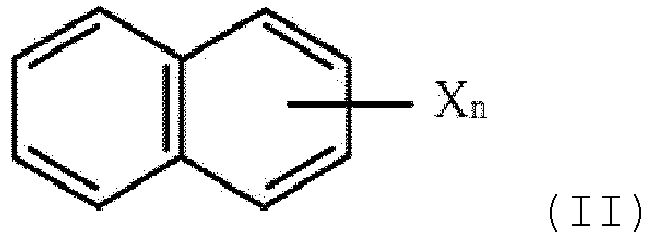
- the penetrant 2 preferably includes one type or two or more types of the aromatic compound described above (also referred to below as a "specific aromatic compound") selected from the group consisting of a compound which is represented by Formula (I) below, a compound which is represented by Formula (II) below, and derivatives of these compounds.
- the penetrant 2 more preferably includes the water-soluble organic solvent described above at 10 mass% or more with respect to the total amount (100 mass%) of the penetrant 2.
- the ink jet textile printing penetrant of the present embodiment is used as a penetrant for ink jet printing.
- ink jet textile printing penetrant When forming an image by attaching ink to a cloth by an ink jet method, by attaching the ink jet textile printing penetrant thereto at a landing position of the ink, there is an effect in which the ink favorably permeates to the rear surface of the cloth and it is possible to realize printed matter which exhibits favorable colors not only on the front surface but also on the rear surface.
- additives components which are included or may be included in the ink jet textile printing penetrant described above.
- the penetrant 2 of the present example preferably includes one type or two or more types of the aromatic compound selected from the group consisting of a compound which is represented by Formula (I) below, a compound which is represented by Formula (II) below, and derivatives of these compounds. Such a compound is also referred to below as a "specific aromatic compound”.
- X's each independently represent SO 3 R, COOR, or OPO(OR) 2
- R's each independently represent H, Li, Na, or K.
- X preferably represents SO 3 R from the point of view of more easily dissolving a specific aromatic compound in water.
- m is an integer of 1 or 2.
- X's each independently represent SO 3 R, COOR, or OPO(OR) 2
- R's each independently represent H, Li, Na, or K.
- X preferably represents SO 3 R from the point of view of more easily dissolving a specific aromatic compound in water.
- n is an integer of 1 to 3.
- the penetrant 2 By including a specific aromatic compound in the penetrant 2, as in the claimed invention, in a case of being used for an ink jet apparatus, that is, in a case where the penetrant 2 is discharged by an ink jet method, the penetrant 2 exhibits excellent discharge stability and clogging recovery and does not easily generate filter clogging.
- the causes are assumed to be as follows (however, the causes are not limited thereto).
- compounds for example, dyes which are used for printing
- which improve the conductivity of the penetrant tend to decrease the transparency and therefore are not contained in the penetrant.
- the penetrant when using a penetrant with low conductivity, the penetrant easily becomes insoluble or is precipitated in a case where impurities (for example, a releasing agent or lubricant) elute from an inner wall or the like of a cartridge with which the penetrant is in contact to the penetrant and, due to this, the discharge stability and clogging recovery are lost.
- impurities for example, a releasing agent or lubricant
- the conductivity of the penetrant 2 is improved by including a specific aromatic compound in the penetrant 2 of the present example, it is difficult for the impurities described above to elute to the penetrant 2 and, even when eluted, insolubilization, precipitation, and the like are suppressed.
- the penetrant 2 of the present example is able to obtain excellent discharge stability and clogging recovery and does not easily generate filter clogging.
- the penetrant includes an acene-based compound or a phene-based aromatic compound such as anthracene and phenanthrene instead of the specific aromatic compound, it is difficult to use the penetrant as an ink jet textile printing penetrant since the penetrant is colored due to the light absorption region of the acene-based compound or the phene-based aromatic compound.
- the specific aromatic compound of the present example is not particularly limited as long as the specific aromatic compound is a compound which has a benzene ring or a naphthalene ring which has a specific substituent group; however, examples thereof include a sulfonic acid aromatic compound, a carboxylic acid aromatic compound, and a phosphoric acid aromatic compound.
- the sulfonic acid aromatic compound is not particularly limited; however, examples thereof include benzene sulfonic acids such as benzene sulfonic acid, 4-amino-benzene sulfonic acid, and 4-hydroxy-benzene sulfonic acid, and derivatives thereof; benzene disulfonic acids such as benzene-1,3-disulfonic acid; naphthalene sulfonic acids such as naphthalene-l-sulfonic acid, naphthalene-2-sulfonic acid, 8-amino-naphthalene-2-sulfonic acid, and 8-hydroxynaphthalene-l-sulfonic acid, and derivatives thereof; naphthalene disulfonic acids such as naphthalene-1,5-disulfonic acid, naphthalene-2,6-disulfonic acid, naphthalene-2,7-disulfonic acid, 7-hydroxy
- examples of derivatives of each of the sulfonic acids described above include compounds where a hydrogen atom which bonds with a benzene ring or a naphthalene ring is substituted with an amino group or a hydroxyl group.
- naphthalene sulfonic acids, naphthalene disulfonic acids, naphthalene trisulfonic acids, and derivatives thereof are preferable, and naphthalene disulfonic acids and derivatives thereof are more preferable.
- the carboxylic acid aromatic compound is not particularly limited; however, examples thereof include benzoic acid, phthalic acid, isophthalic acid, terephthalic acid, trimesic acid, 1-naphthoic acid, 2-naphthoic acid, 6-amino-2-naphthoic acid, and naphthalene-2,6-dicarboxylic acid.
- the phosphoric acid aromatic compound is not particularly limited; however, examples thereof include 1-naphthyl phosphoric acid and 2-naphthyl phosphoric acid.
- the specific aromatic compound is preferably benzene sulfonic acid, 8-amino naphthalene-2-sulfonic acid, naphthalene-1,5-disulfonic acid, benzoic acid, 2-naphthoic acid, 6-amino-2-naphthoic acid, and salts thereof.
- the specific aromatic compound may be used as one type individually or may be used in a combination of two or more types.
- the content of the specific aromatic compound is preferably 0.01 mass% to 50 mass% with respect to the total amount (100 mass%) of the penetrant 2, more preferably 0.1 mass% to 20 mass%, and even more preferably 0.2 mass% to 10 mass%.
- the content is within the ranges described above, there is a tendency for the discharge stability and clogging recovery of the penetrant 2 to be more favorable and the generation of filter clogging to be further suppressed.
- the light absorbance of the penetrant 2 in the maximum absorption wavelength in a visible light region is preferably less than 0.05 from the point of view of not coloring the penetrant 2, more preferably less than 0.03, and even more preferably less than 0.01.
- the light absorbance being less than 0.05 further suppresses coloring of the penetrant 2.
- the lower limit of the light absorbance is not particularly limited and may be the detection limit or less or may be, for example, 0.001. It is possible to measure the light absorbance by the method which is described in the Examples which will be described below.
- the penetrant 1 of the present example includes a chelating agent.
- the penetrant 1 preferably includes the chelating agent at 0.001 mass% to 0.1 mass% with respect to the total amount (100 mass%) of the penetrant 1.
- the chelating agent results in the penetrant 1 exhibiting excellent discharge stability and clogging recovery and not easily generating filter clogging.
- the reason is assumed to be that, by including the chelating agent, in a case where the conductivity of the penetrant 1 is increased and impurities formed of heavy metal salt are eluted, the chelating agent in the penetrant 1 effectively takes in the impurities such that the discharge stability and clogging recovery are exhibited and filter clogging is not easily generated (however, the reason is not limited thereto).
- the penetrant 2 of the present example preferably further includes a chelating agent.
- a chelating agent in a case where the conductivity of the penetrant is increased and impurities formed of heavy metal salt are eluted, including the chelating agent so as to effectively take in the impurities results in a tendency for the discharge stability and clogging recovery to be superior and filter clogging to be less easily generated.
- the chelating agent has a coordinating group which is able to have a coordinating bond with a cation in a form where the cation is interposed in the center.
- the chelating agent is not particularly limited and examples thereof include compounds which have a coordinating group, resins, salts thereof, and hydrates thereof.
- the coordinating atom which forms the coordinating group is not particularly limited; however, examples thereof include an N atom, an S atom, and an O atom.
- the specific chelating agent is not particularly limited; however, examples thereof include ethylene diamine tetraacetate, N-(2-hydroxyethyl) ethylenediamine triacetate, ethylenediamine succinate, iminodisulfonyl sulfosuccinate, dicarboxymethyl glutamate, bis(2-aminoethyl) ethylene glycol tetraacetic acid, bis(2-aminophenyl) ethylene glycol tetraacetic acid, bis(2-hydroxyethyl) glycine, 1,2-diaminocyclohexane tetraacetic acid, diethylenetriaminepentaacetic acid, iminodiacetic acid, N-(2-hydroxyethyl) iminodiacetic acid, nitrilotriacetic acid, nitrilotriacetic methylphosphoric acid, triethylenetetraamine hexaacetic acid, and compounds of tetrakis (2-pyridylmethyl
- the chelating agent may be, for example, a resin where a phenol resin, a styrene resin, an acryl resin, or an epoxy resin has a coordinating group.
- the chelating agent may be a salt of a compound or resin described above and cations such as Na, K, Al, Ba, Bi, Ca, Ce (III), Co (II), Cr, Cu (II), Dy, Eu, Fe (III), Ga, Ge, Hf, In, La, Mg, Mn (II), Mn (III), Mo, Nd, Ni, Pb, Pd (II), Pt (II), Rh, Ru, Sb (III), Sm, Sn (II), Sr, Ti, Th, W(VI), Y, Zn (II), Zr, NH 4 + , UO 2 2+ , and VO 2 + .
- cations such as Na, K, Al, Ba, Bi, Ca, Ce (III), Co (II), Cr, Cu (II), Dy, Eu, Fe (III), Ga, Ge, Hf, In, La, Mg, Mn (II), Mn (III), Mo, Nd, Ni, Pb, Pd (II), Pt
- the chelating agent may be a hydrate of the above-described compounds, resins, and salts thereof.
- examples of the hydrate include a hydrate of 1,2-diamonocyclohexane tetraacetate and bis(2-amino phenyl) ethylene glycol tetraacetate.
- the chelating agent is preferably ethylene diamine tetraacetate, ethylenediamine succinate, iminodisulfonyl sulfosuccinate, dicarboxymethyl glutamate, nitrilotriacetate, or salts thereof, and more preferably one type or two or more types which are selected from the group consisting of disodium ethylenediaminetetraacetate, diammonium ethylenediamine tetraacetate, trisodium ethylenediamine succinate, tetrasodium iminodisulfonyl sulfosuccinate, tetrasodium dicarboxymethyl glutamate, and disodium nitrilotriacetate.
- the chelating agent may be used as one type individually or may be used in a combination of two or more types.
- the content of the chelating agent is preferably 0.001 mass% to 0.1 mass% with respect to the total amount (100 mass%) of the penetrant 1, more preferably 0.003 mass% to 0.05 mass%, and even more preferably 0.005 mass% to 0.03 mass%.
- the discharge stability and clogging recovery of the penetrant are favorable and the generation of filter clogging is suppressed.
- the content of the chelating agent is preferably 0.001 mass% to 0.1 mass% with respect to the total amount (100 mass%) of the penetrant 2, more preferably 0.003 mass% to 0.05 mass%, and even more preferably 0.005 mass% to 0.03 mass%.
- the content is within the ranges described above, there is a tendency for the discharge stability and clogging recovery of the penetrant to be more favorable and the generation of filter clogging to be further suppressed.
- the penetrant of the present embodiment includes a surfactant.
- the surfactant is not particularly limited; however, one or more types selected from the group consisting of acetylene glycol-based surfactants, acetylene alcohol-based surfactants, and polysiloxane-based surfactants are preferable. Including the surfactant in the penetrant results in a tendency for the permeability of the ink composition which is attached to a cloth to be more favorable and printing at a faster speed is possible. In addition, the discharge stability and clogging recovery of the penetrant are more favorable and the generation of filter clogging is further suppressed.
- the acetylene glycol-based surfactant and the acetylene alcohol-based surfactant described above are not particularly limited; however, one or more types selected from the group consisting of 2,4,7,9-tetramethyl-5-decyne-4,7-diol and alkylene oxide adducts of 2,4,7,9-tetramethyl-5-decyne-4,7-diol, and 2,4-dimethyl-5-decyne-4-ol and alkylene oxide adducts of 2,4-dimethyl-5-decyne-4-ol are preferable.
- Olefin 104 series the E series such as Olefin E1010, Olefin PD002W002, Surfynol 465, Surfynol 61 (product names, produced by Nissin Chemical Industry Co., Ltd.), PELEX SS-H (product name, produced by Kao Chemicals Corp.) and the like.
- the polysiloxane-based surfactant described above is not particularly limited; however, examples of commercially available products thereof include BYK-347 and BYK-348 (product names produced by BYK Japan KK)
- the surfactants may be used as one type individually or may be used in a combination of two or more types.
- the content of the surfactant is preferably 0.1 mass% to 5.0 mass% with respect to the total amount (100 mass%) of the penetrant, more preferably 0.2 mass% to 3.0 mass%, and even more preferably 0.3 mass% to 2.0 mass%.
- the content is within the ranges described above, there is a tendency for the discharge stability and clogging recovery of the penetrant to be more favorable and generation of filter clogging is further suppressed.
- the penetrant of the present embodiment is water-soluble and includes a water-soluble organic solvent and may include an aqueous solvent other than the water-soluble organic solvent.
- examples of the aqueous solvent include water.
- the water-soluble organic solvents are not particularly limited; however, examples thereof include polyhydric alcohols such as ethylene glycol, diethylene glycol, triethylene glycol, polyethylene glycol, polypropylene glycol, propylene glycol, butylene glycol, 1,2-hexanediol, 1,2,6-hexanetriol, thioglycol, hexylene glycol, glycerin, trimethylol ethane, and trimethylol propane; alkyl ethers of polyhydric alcohols such as ethylene glycol monoethyl ether, ethylene glycol monobutyl ether, diethylene glycol monomethyl ether, diethylene glycol monoethyl ether, diethylene glycol monobutyl ether, diethylene glycol monoisobutyl ether, diethylene glycol monohexyl ether, triethylene glycol monomethyl ether, triethylene glycol monoethyl ether, triethylene glycol monobutyl ether, hexaethylene glycol
- the water-soluble organic solvent may be used as one type individually or may be used in a combination of two or more types.
- the content of the water-soluble organic solvent is preferably 10 mass% or more with respect to the total amount (100 mass%) of the penetrant 1, more preferably 10 mass% to 80 mass%, and even more preferably 30 mass% to 60 mass%.
- the content is 10 mass% or more, there is a tendency for the discharge stability and clogging recovery of the penetrant 1 to be more favorable and the generation of filter clogging to be further suppressed.
- the content of the water-soluble organic solvent is preferably 10 mass% or more with respect to the total amount (100 mass%) of the penetrant 2, more preferably 10 mass% to 80 mass%, and even more preferably 30 mass% to 60 mass%.
- the content is 10 mass% or more, there is a tendency for the discharge stability and clogging recovery of the penetrant 2 to be favorable and the generation of filter clogging to be suppressed.
- the water is not particularly limited and it is possible to use pure water or ultra-pure water such as ion-exchanged water, ultrafiltration water, reverse osmosis water, and distilled water.
- the content of the water is not particularly limited and may be appropriately determined as necessary and it is sufficient if the water is included as a residual portion of other components which are included in the penetrant.
- the content of the water may be 70 mass% to 95 mass% with respect to the total amount (100 mass%) of the ink jet textile printing penetrant.
- the ink jet textile printing penetrant described above may further include thermochromic coloring materials, resin emulsions, and additives of water (referred to below as "other additives") other than the above.
- the other additives are not limited to the following; however, examples thereof include a cationic substance which has an aggregating effect in the same manner as a chelating agent, a sizing agent, a pH adjusting agent such as isopropanol amine and triethanol amine, a reduction inhibitor, a metal ion sealing agent, a moisturizer, a penetrating agent, and a defoaming agent.
- the ink jet printing method of the present example includes forming an image on a cloth by ink jet printing which uses the ink jet textile printing penetrant described above and an ink composition known in the art.
- the ink jet printing method described above has a recording step of attaching an ink composition which includes a dye on the surface of a cloth by an ink jet method and a penetrant attaching step of attaching the penetrant of the present example on the front surface or the rear surface of the cloth described above before, after, or at the same time as the recording step.
- the cloth which is used for the ink jet printing method described above is not limited to the following; however, examples thereof include natural fibers or synthesized fibers such as silk, cotton, wool, nylon, polyester, and rayon.
- the cloth may be formed of one type of fiber or may be formed by mixing two or more types of fibers. In particular, by using a cloth formed by blending fibers with different permeability among these, the effect of the penetrant of the present example is easily obtained.
- the cloth may take any form where the fibers described above are textiles, knitted, non-woven fabric, and the like.
- the ink composition is loaded into an ink jet apparatus for use.
- the ink jet apparatus is not particularly limited; however, examples thereof include a drop-on-demand type ink jet apparatus.
- These drop-on-demand type ink jet apparatuses include an apparatus which adopts an ink jet printing method which uses a piezoelectric element which is installed in a head, an apparatus which adopts an ink jet printing method which uses thermal energy from a heater such as heat-resistant element which is installed in a head, and the like, and the apparatus may adopt any ink jet printing method. Detailed description will be given below of each of the steps which are included in the ink jet printing method.
- pretreatment is preferably carried out on the cloth using a pretreatment agent beforehand in the same manner as for general ink jet printing methods.
- the pretreatment of the cloth is performed using a means for attaching the pretreatment agent to the cloth by immersing the cloth in the pretreatment agent, by coating or spraying the pretreatment agent on the cloth, or the like, and then drying the cloth.
- the pretreatment agent of the cloth is not particularly limited; however, examples thereof include a pretreatment solution which is an aqueous solution containing a sizing agent such as a water-soluble polymer compound at 0.01 mass% to 20 mass% with respect to the total amount (100 mass%) of the pretreatment agent and an alkali generating agent at 1.0 mass% to 5.0 mass%.
- a pretreatment solution which is an aqueous solution containing a sizing agent such as a water-soluble polymer compound at 0.01 mass% to 20 mass% with respect to the total amount (100 mass%) of the pretreatment agent and an alkali generating agent at 1.0 mass% to 5.0 mass%.
- the sizing agent described above is not particularly limited; however, examples thereof include starch substances such as corn, and wheat; cellulose-based materials such as carboxymethyl cellulose, and hydroxyethyl cellulose; polysaccharides such as alginate sodium, gum arabic, locust bean gum, gum tragacanth, guar gum, and tamarind seed; proteins such as gelatin and casein; tannins; natural water-soluble polymers such as lignin, synthetic water-soluble polymer compounds such as polyvinyl alcohol-based compounds, polyethylene oxide-based compounds, acrylic acid-based compounds, and maleic anhydride-based compounds.
- the alkali generating agent described above is not particularly limited; however, examples thereof include sodium hydrogen carbonate and sodium carbonate.
- the pretreatment agent can also contain various additives such as moisturizing agents such as urea and thiourea, pH adjusting agents, reduction inhibitors, penetrating agents, sequestering agents, and antifoaming agents.
- the cloth to which the pretreatment agent is attached is dried, for example, by heating the cloth.
- the heating temperature at that time is preferably 100°C or more, more preferably 110°C to 200°C, and even more preferably 120°C to 180°C. In addition, the heating time is preferably within 2 minutes.
- the heating temperature is 100°C or more, there is a tendency for the fixing property of the penetrant to be favorable.
- the heating temperature is 200°C or less, there is a tendency for it to be possible to effectively prevent deterioration of the cloth and deterioration of the penetrant components such as polymers.
- the drying means is not limited to the following; however, examples thereof include drying using a hot pressing machine, an oven, or the like.
- the recording step of the present example is, for example, for attaching an ink composition to a cloth after the pretreatment step described above.
- an image is formed by discharging and attaching the ink composition described above onto a surface (an image forming region) of the dried cloth.
- the discharge conditions may be appropriately determined according to the physical properties of the discharged ink composition.
- the ink composition it is possible to use ink compositions known in the art which are used for ink jet printing.
- the penetrant attaching step of the present example is a step for attaching the penetrant of the present example to the front surface or rear surface of a cloth before, after, or at the same time as the recording step.
- the means for attaching the penetrant of the present example is an ink jet method.
- the penetrant attaching step may be performed before, after, or at the same time as the recording step, or may be performed at a combination thereof.
- the recording step is preferably performed before the penetrant which is attached to the cloth is dried.
- the penetrant attaching step after the recording step it is possible to perform the penetrant attaching step before or after the ink composition which is attached to the cloth is dried, and the penetrant attaching step is preferably performed before the ink composition which is attached to the cloth is dried.
- the penetrant may be attached to the front surface of the cloth, may be attached to the rear surface, or may be attached to both the front surface and the rear surface.
- the ink jet printing method of the present example may further have a heating step of heating a cloth after the recording step and the penetrant attaching step. Having a heating step makes it possible to more favorably dye the fibers which form the cloth with the dye.
- the heating method is not particularly limited; however, examples thereof include a high temperature steaming method (an HT method), a high pressure steaming method (an HP method), and a thermosol method.
- a pressure treatment may or may not be carried out on the ink composition attaching surface on the cloth.
- a heating method in which a pressure treatment is not carried out on the ink composition attaching surface on the cloth include drying in an oven (a method in which pressing is not carried out such as a conveyor oven or a batch oven). Having the heating step further improves the productivity of producing the recorded matter.
- the heating method in which a pressure treatment is also carried out on the ink composition attaching surface on the cloth is not particularly limited; however, examples thereof include heat pressing and wet-on-dry methods. "Pressure" refers to applying pressure to a target recording medium through contact with an individual body.
- the temperature during the heating treatment is preferably 80°C to 150°C and more preferably 90°C to 110°C.
- the temperature being within the ranges described above during the heating treatment results in a tendency for it to be possible to more favorably dye the fibers which form the cloth with the dye.
- the ink jet printing method of the present example may further have a cleaning step for cleaning the cloth after the heating step. It is possible to effectively remove dye which is not dyed in the fibers through the cleaning step. It is possible to perform the cleaning step, for example, using water, and a soaping treatment may be performed as necessary.
- the soaping treatment method is not particularly limited; however, examples thereof include a method of washing off so-called non-fixed dye using a heated soap liquid or the like.
- the ink jet recording apparatus of the present embodiment is provided with the ink jet textile printing penetrant (penetrant) described above.
- the ink jet recording apparatus which is provided with a penetrant is not particularly limited as long as the ink jet recording apparatus is an ink jet recording apparatus which is provided with a penetrant so as to be able to perform the ink jet printing method described above using the penetrant and examples thereof include an ink jet recording apparatus which has a cartridge and a recording head where a penetrant is filled in the cartridge and it is possible to discharge the penetrant from the recording head.
- the main materials of the ink jet textile printing penetrant used in the Examples and Comparative Examples below are as follows.
- Spectrophotometer manufactured by Hitachi Ltd., product name "U-3300”
- Light measurement method double beam direct ratio optical measurement method
- Spectrometer Seya-Namioka type spectrometer
- Light source iodine tungsten lamp (measurement wavelength ⁇ : 800 nm to 340 nm)
- Deuterium discharge tube (measurement wavelength ⁇ : 340 nm to 300 nm)
- Measurement mode light absorbance (Abs.)
- Slit width 2 nm
- Cell quartz Reference: water
- Ink and a penetrant in ink cartridges which were positioned at both ends of a recording head of an ink jet apparatus (product name "SP-30160", manufactured by Seiko Epson Corp.) in a main scanning direction were exchanged. That is a penetrant was substituted for the ink in the cartridges at either end of the recording head. Subsequently, the ink jet apparatus was operated at a temperature of 35°C and it was confirmed that the penetrant was properly discharged from the nozzles of the recording head. Furthermore, the discharging of the penetrant from the nozzles of the recording head was continued and evaluation was carried out according to the evaluation criteria below. In the confirmation of the discharging property, discharge was carried out onto a hard plastic film (a back-light film designated for super fine use, manufactured by Seiko Epson Corp.) and whether or not a liquid was attached on the film surface was confirmed.
- a hard plastic film a back-light film designated for super fine use, manufactured by Seiko Epson Corp.
- Ink and a penetrant in ink cartridges which were positioned at both ends of a recording head of an ink jet apparatus (product name "SP-30160", manufactured by Seiko Epson Corp.) in a main scanning direction were exchanged. Subsequently, the operation of the ink jet apparatus was started under a temperature of 35°C and it was confirmed that the penetrant was properly discharged from nozzles of the recording head. After that, the operation was stopped, the apparatus was left at a temperature of 40°C for one month, and evaluation was carried out according to the evaluation criteria below. Regarding the cleaning below, a cleaning operation which was provided in the ink jet apparatus was performed.
- Flow channel members 50 rib tops and a 1 m flow channel tube) of an ink cartridge which is used for an ink jet apparatus (product name "SP-30160", manufactured by Seiko Epson Corp.) were immersed in 300 mL of a penetrant at 70°C for 6 days.
- the penetrant after immersion was passed through a stainless steel filter (passing particle diameter: approximately 5 ⁇ m) of a twill mat weave mesh No. 2300 and the clogging rate (the area ratio) of the holes was evaluated.
Landscapes
- Engineering & Computer Science (AREA)
- Textile Engineering (AREA)
- Chemical & Material Sciences (AREA)
- Life Sciences & Earth Sciences (AREA)
- Chemical Kinetics & Catalysis (AREA)
- Materials Engineering (AREA)
- Wood Science & Technology (AREA)
- Organic Chemistry (AREA)
- Health & Medical Sciences (AREA)
- Molecular Biology (AREA)
- Inorganic Chemistry (AREA)
- General Chemical & Material Sciences (AREA)
- Ink Jet Recording Methods And Recording Media Thereof (AREA)
- Inks, Pencil-Leads, Or Crayons (AREA)
- Coloring (AREA)
- Ink Jet (AREA)
Claims (8)
- Tintenstrahltextildruckpenetrationsmittel, umfassend:ein wasserlösliches organisches Lösemittel;ein Tensid;einen Chelatbildner; undeine aromatische Verbindung,wobei der Chelatbildner eine Art oder zwei oder mehr Arten ist, ausgewählt aus der Gruppe bestehend aus Dinatriumethylendiamintetraacetat, Diammoniumethylendiamintetraacetat, Trinatriumethylendiaminsuccinat, Tetranatriumiminodisulfosuccinat, Tetranatriumdicarboxymethylglutamat und Dinatriumnitrilotriacetat; undder Chelatbildner in einem Bereich von 0,001 Masse% bis 0,1 Masse% in Bezug auf eine Gesamtmenge des Tintenstrahltextildruckpenetrationsmittels vorhanden ist; undwobei die aromatische Verbindung eine Art oder zwei oder mehr Arten ist, ausgewählt aus der Gruppe bestehend aus einer Verbindung, die durch folgende Formel (I) dargestellt ist, und einer Verbindung, die eine Verbindung darstellt, die durch folgende Formel (II) dargestellt ist:

- Tintenstrahltextildruckpenetrationsmittel nach Anspruch 1, wobei die aromatische Verbindung ausgewählt ist aus:Benzolsulfonsäure, 4-Aminobezolsulfonsäure und 4-Hydroxy-benzolsulfonsäure;Benzol-1,3-disulfonsäure;Naphathalin-1-sulfonsäure, Naphathalin-2-sulfonsäure, 8-Amino-naphathalin-2-sulfonsäure und 8-Hydroxy-naphathalin-1-sulfonsäure;Naphathalin-1,5-disulfonsäure, Naphathalin-2,6-disulfonsäure, Naphathalin-2,7-disulfonsäure, 7-Hydroxynaphathalin-1,3-disulfonsäure und 4-Amino-5-hydroxynaphathalin-2,7-disulfonsäure;Naphathalin-1,3,5-trisulfonsäure, Naphathalin-1,3,6-trisulfonsäure und 7-Aminonaphathalin-1,3,6-trisulfonsäure;Benzoesäure, Phthalsäure, Isophthalsäure, Terephthalsäure, 1-Naphthoesäure, 2-Naphthoesäure, 6-Amino-2-naphthoesäure, und Napththalin-2,6-dicarbonsäure;1-Naphthylphosphosäure und 2-Naphthylphosphosäure; undKombinationen davon.
- Tintenstrahltextildruckpenetrationsmittel nach Anspruch 2, wobei die aromatische Verbindung ausgewählt ist aus:
Benzolsulfonsäure, 8-Aminonaphthalin-2-sulfonsäure, Naphthalin-1,5-disulfonsäure, Benzoesäure, 2-Naphthoesäure, 6-Amino-2-naphthoesäure und Salzen davon; und Kombinationen davon. - Tintenstrahltextildruckpenetrationsmittel nach einem der Ansprüche 1 bis 3, wobei die aromatische Verbindung in einem Bereich von 0,01 Masse% bis 50,0 Masse% in Bezug auf eine Gesamtmenge des Tintenstrahltextildruckpenetrationsmittels ist.
- Tintenstrahltextildruckpenetrationsmittel nach einem der vorstehenden Ansprüche,
wobei Lichtextinktion in einer maximalen Absorptionswellenlänge in einem Bereich sichtbaren Lichts weniger als 0,05 ist, wie unter Verwendung eines Spektrofotometers, hergestellt von Hitachi Ltd. Produktname "U-3300" und unter Verwendung eines optischen Doppelstrahl-, Direktverhältnismessungsverfahrens gemessen. - Tintenstrahltextildruckpenetrationsmittel nach einem der vorstehenden Ansprüche,
wobei das wasserlösliche organische Lösemittel in einem Bereich von 10 Masse% oder mehr in Bezug auf eine Gesamtmenge des Tintenstrahltextildruckpenetrationsmittels ist. - Tintenstrahltextildruckpenetrationsmittel nach einem der vorstehenden Ansprüche,
wobei der Gehalt des Tensids 0,1 Masse% bis 5,0 Masse% in Bezug auf die Gesamtmenge des Penetrationsmittels ist. - Tintenstrahlaufzeichnungsvorrichtung, umfassend:
das Tintenstrahltextildruckpenetrationsmittel nach einem der vorstehenden Ansprüche.
Applications Claiming Priority (1)
| Application Number | Priority Date | Filing Date | Title |
|---|---|---|---|
| JP2015148867A JP6610926B2 (ja) | 2015-07-28 | 2015-07-28 | インクジェット捺染用浸透液、及びインクジェット記録装置 |
Publications (3)
| Publication Number | Publication Date |
|---|---|
| EP3124562A2 EP3124562A2 (de) | 2017-02-01 |
| EP3124562A3 EP3124562A3 (de) | 2017-03-29 |
| EP3124562B1 true EP3124562B1 (de) | 2021-03-03 |
Family
ID=56561223
Family Applications (1)
| Application Number | Title | Priority Date | Filing Date |
|---|---|---|---|
| EP16181254.0A Active EP3124562B1 (de) | 2015-07-28 | 2016-07-26 | Tintenstrahltextildruckpenetrationsmittel und tintenstrahlaufzeichnungsvorrichtung |
Country Status (3)
| Country | Link |
|---|---|
| US (1) | US10385223B2 (de) |
| EP (1) | EP3124562B1 (de) |
| JP (1) | JP6610926B2 (de) |
Families Citing this family (3)
| Publication number | Priority date | Publication date | Assignee | Title |
|---|---|---|---|---|
| CN112739545B (zh) * | 2018-09-28 | 2022-09-13 | 富士胶片株式会社 | 喷墨记录方法 |
| JP7532961B2 (ja) * | 2020-07-08 | 2024-08-14 | コニカミノルタ株式会社 | インクジェット捺染用インクセット及びインクジェット捺染方法 |
| JP7676840B2 (ja) * | 2021-03-15 | 2025-05-15 | 株式会社リコー | インクジェット記録用プレコート液 |
Citations (1)
| Publication number | Priority date | Publication date | Assignee | Title |
|---|---|---|---|---|
| JP2012153754A (ja) * | 2011-01-24 | 2012-08-16 | Konica Minolta Ij Technologies Inc | 捺染用インクジェットインクセット及びインクジェット捺染方法 |
Family Cites Families (27)
| Publication number | Priority date | Publication date | Assignee | Title |
|---|---|---|---|---|
| JP3582448B2 (ja) * | 1999-03-12 | 2004-10-27 | セイコーエプソン株式会社 | インクジェット捺染用インク組成物 |
| EP1035248A3 (de) | 1999-03-12 | 2006-03-01 | Seiko Epson Corporation | Tintenzusammensetzung für Tintenstrahldruckverfahren von Textilien |
| US6447592B1 (en) | 1999-03-12 | 2002-09-10 | Seiko Epson Corporation | Ink composition for ink jet textile printing |
| JP3915375B2 (ja) | 2000-06-30 | 2007-05-16 | コニカミノルタホールディングス株式会社 | インクジェット捺染方法 |
| JP3903938B2 (ja) * | 2002-04-23 | 2007-04-11 | セイコーエプソン株式会社 | インク組成物、それを用いたインクジェット記録方法および記録物 |
| JP4411833B2 (ja) | 2002-10-24 | 2010-02-10 | セイコーエプソン株式会社 | インクジェット捺染用前処理剤 |
| JP4533612B2 (ja) * | 2003-09-30 | 2010-09-01 | セイコーエプソン株式会社 | インク組成物、それを用いたインクジェット記録方法および記録物 |
| JP4581364B2 (ja) * | 2003-09-30 | 2010-11-17 | セイコーエプソン株式会社 | インク組成物、インクジェット記録方法及び記録物 |
| JP4186775B2 (ja) * | 2003-09-30 | 2008-11-26 | セイコーエプソン株式会社 | インクセット |
| US7276111B2 (en) * | 2004-02-09 | 2007-10-02 | Seiko Epson Corporation | Ink composition, inkjet recording method and recorded matter |
| WO2005116150A1 (ja) * | 2004-05-28 | 2005-12-08 | Seiko Epson Corporation | インク組成物、それを用いたインクジェット記録方法および記録物 |
| US7279034B2 (en) * | 2005-03-11 | 2007-10-09 | Seiko Epson Corporation | Ink composition, ink cartridge, inkjet recording method, and recorded matter |
| JP2007238798A (ja) | 2006-03-09 | 2007-09-20 | Konica Minolta Ij Technologies Inc | インクジェット捺染用インク |
| JP5092264B2 (ja) | 2006-04-05 | 2012-12-05 | ブラザー工業株式会社 | インクカートリッジ及びインクジェット記録装置 |
| JP4631793B2 (ja) * | 2006-05-12 | 2011-02-16 | セイコーエプソン株式会社 | マゼンタインク組成物、インクセット、インクカートリッジ、インクジェット記録方法及び記録物 |
| EP2261418A1 (de) | 2009-05-25 | 2010-12-15 | Vistaprint Technologies Limited | Vorbehandlungsflüssigkeit für Flüssigkeiten absorbierende Drucksubstrate |
| JP2011174007A (ja) | 2010-02-25 | 2011-09-08 | Fujifilm Corp | インクジェット捺染用インク、インクジェット捺染方法及び捺染物 |
| CN102558948B (zh) * | 2010-12-10 | 2016-02-10 | 精工爱普生株式会社 | 油墨组合物、使用其的喷墨记录方法以及记录物 |
| EP2463345B1 (de) * | 2010-12-10 | 2017-01-18 | Seiko Epson Corporation | Tintenzusammensetzung, Aufzeichnungsverfahren damit und aufgezeichnetes Material |
| JP2012167394A (ja) * | 2011-02-14 | 2012-09-06 | Konica Minolta Ij Technologies Inc | インクジェット捺染用前処理インク、インクジェット捺染用前処理インクの製造方法、及びインクジェット捺染方法 |
| WO2012130492A1 (en) | 2011-03-25 | 2012-10-04 | Unilever Plc | Dye polymer |
| JP5691842B2 (ja) | 2011-05-27 | 2015-04-01 | セイコーエプソン株式会社 | インク組成物、記録方法および記録物 |
| JP5857469B2 (ja) * | 2011-06-23 | 2016-02-10 | セイコーエプソン株式会社 | インクジェット捺染方法、インクジェット捺染装置 |
| JP2013136649A (ja) | 2011-12-28 | 2013-07-11 | Canon Inc | インクジェット用ゴム組成物 |
| JP2013146925A (ja) | 2012-01-19 | 2013-08-01 | Seiko Epson Corp | インクジェット記録方法、インクジェット記録装置、記録物 |
| JP2013221141A (ja) * | 2012-04-19 | 2013-10-28 | Seiko Epson Corp | インクジェット捺染用インクセット及び捺染方法 |
| JP6825803B2 (ja) | 2015-02-05 | 2021-02-03 | セイコーエプソン株式会社 | インクジェット捺染用浸透液 |
-
2015
- 2015-07-28 JP JP2015148867A patent/JP6610926B2/ja active Active
-
2016
- 2016-07-18 US US15/212,519 patent/US10385223B2/en active Active
- 2016-07-26 EP EP16181254.0A patent/EP3124562B1/de active Active
Patent Citations (1)
| Publication number | Priority date | Publication date | Assignee | Title |
|---|---|---|---|---|
| JP2012153754A (ja) * | 2011-01-24 | 2012-08-16 | Konica Minolta Ij Technologies Inc | 捺染用インクジェットインクセット及びインクジェット捺染方法 |
Also Published As
| Publication number | Publication date |
|---|---|
| US20170029636A1 (en) | 2017-02-02 |
| JP6610926B2 (ja) | 2019-11-27 |
| EP3124562A2 (de) | 2017-02-01 |
| JP2017031229A (ja) | 2017-02-09 |
| US10385223B2 (en) | 2019-08-20 |
| EP3124562A3 (de) | 2017-03-29 |
Similar Documents
| Publication | Publication Date | Title |
|---|---|---|
| CN102260435B (zh) | 喷墨印染用油墨组合物及喷墨印染方法 | |
| EP3225663B1 (de) | Färbezusammensetzung zum färben, färbezusammensetzung zum drucken, druckverfahren, tintenstrahldrucktinte, und gefärbtes gewebe | |
| JP6198340B2 (ja) | 水系インクセット及び繊維の捺染方法 | |
| US10385223B2 (en) | Ink jet textile printing penetrant and ink jet recording apparatus | |
| BR112019020096A2 (pt) | tinta preta inovadora | |
| JP2001517209A (ja) | 化合物及びそれらの使用 | |
| JP6401289B2 (ja) | ビスアゾ染料類及びそれらの混合物 | |
| JP2012001721A (ja) | 青色、赤色及び黄色染料化合物並びにそれらからなる黒色インク組成物 | |
| US20090211488A1 (en) | Inc composition | |
| TW201443165A (zh) | 著色組成物、印刷方法、布帛、板材及四氮雜卟啉系化合物 | |
| TWI471386B (zh) | 纖維反應性偶氮染料及其製備方法與用途 | |
| TW201336936A (zh) | 化合物、織物印刷用著色組成物、織物印刷方法以及織品 | |
| US20020121221A1 (en) | Monoazo dyes and their preparation and use | |
| EP1789499B1 (de) | Farbstoffmischungen von faserreaktiven azofarbstoffen, ihre herstellung und ihre verwendung | |
| JP2014185201A (ja) | インクジェット捺染に用いるインク及びそれを用いた繊維の捺染方法 | |
| JP6984154B2 (ja) | インクセット及び記録方法 | |
| JP2009126989A (ja) | インクジェット用インク | |
| JPWO2012060343A1 (ja) | アゾ染料インク組成物及びそれを用いるインクジェット捺染用インクセット | |
| US7060105B2 (en) | Copper complex monazo dyes and their preparation and use | |
| JP2015078300A (ja) | インクジェット捺染用インク及び繊維の捺染方法 | |
| EP3221406B1 (de) | Schwarze trisazofarbstoffe, deren herstellung und verwendung | |
| US11499063B2 (en) | Ink jet textile printing ink composition and recording method | |
| US7214259B2 (en) | Inks containing water-soluble perylene dyes and their use in ink-jet printing | |
| JP6262142B2 (ja) | インクジェット捺染用インクセット及びそれを用いた繊維の捺染方法 | |
| JP2014156559A (ja) | インクジェット捺染用インク及びそれを用いた繊維の捺染方法 |
Legal Events
| Date | Code | Title | Description |
|---|---|---|---|
| PUAI | Public reference made under article 153(3) epc to a published international application that has entered the european phase |
Free format text: ORIGINAL CODE: 0009012 |
|
| STAA | Information on the status of an ep patent application or granted ep patent |
Free format text: STATUS: THE APPLICATION HAS BEEN PUBLISHED |
|
| AK | Designated contracting states |
Kind code of ref document: A2 Designated state(s): AL AT BE BG CH CY CZ DE DK EE ES FI FR GB GR HR HU IE IS IT LI LT LU LV MC MK MT NL NO PL PT RO RS SE SI SK SM TR |
|
| AX | Request for extension of the european patent |
Extension state: BA ME |
|
| PUAL | Search report despatched |
Free format text: ORIGINAL CODE: 0009013 |
|
| AK | Designated contracting states |
Kind code of ref document: A3 Designated state(s): AL AT BE BG CH CY CZ DE DK EE ES FI FR GB GR HR HU IE IS IT LI LT LU LV MC MK MT NL NO PL PT RO RS SE SI SK SM TR |
|
| AX | Request for extension of the european patent |
Extension state: BA ME |
|
| RIC1 | Information provided on ipc code assigned before grant |
Ipc: C09D 11/38 20140101AFI20170222BHEP Ipc: C09D 11/54 20140101ALI20170222BHEP Ipc: D06P 5/30 20060101ALI20170222BHEP |
|
| STAA | Information on the status of an ep patent application or granted ep patent |
Free format text: STATUS: REQUEST FOR EXAMINATION WAS MADE |
|
| 17P | Request for examination filed |
Effective date: 20170929 |
|
| RBV | Designated contracting states (corrected) |
Designated state(s): AL AT BE BG CH CY CZ DE DK EE ES FI FR GB GR HR HU IE IS IT LI LT LU LV MC MK MT NL NO PL PT RO RS SE SI SK SM TR |
|
| STAA | Information on the status of an ep patent application or granted ep patent |
Free format text: STATUS: EXAMINATION IS IN PROGRESS |
|
| 17Q | First examination report despatched |
Effective date: 20180216 |
|
| GRAP | Despatch of communication of intention to grant a patent |
Free format text: ORIGINAL CODE: EPIDOSNIGR1 |
|
| STAA | Information on the status of an ep patent application or granted ep patent |
Free format text: STATUS: GRANT OF PATENT IS INTENDED |
|
| INTG | Intention to grant announced |
Effective date: 20200929 |
|
| GRAS | Grant fee paid |
Free format text: ORIGINAL CODE: EPIDOSNIGR3 |
|
| GRAA | (expected) grant |
Free format text: ORIGINAL CODE: 0009210 |
|
| STAA | Information on the status of an ep patent application or granted ep patent |
Free format text: STATUS: THE PATENT HAS BEEN GRANTED |
|
| AK | Designated contracting states |
Kind code of ref document: B1 Designated state(s): AL AT BE BG CH CY CZ DE DK EE ES FI FR GB GR HR HU IE IS IT LI LT LU LV MC MK MT NL NO PL PT RO RS SE SI SK SM TR |
|
| REG | Reference to a national code |
Ref country code: GB Ref legal event code: FG4D |
|
| REG | Reference to a national code |
Ref country code: AT Ref legal event code: REF Ref document number: 1367182 Country of ref document: AT Kind code of ref document: T Effective date: 20210315 Ref country code: CH Ref legal event code: EP |
|
| REG | Reference to a national code |
Ref country code: DE Ref legal event code: R096 Ref document number: 602016053457 Country of ref document: DE |
|
| REG | Reference to a national code |
Ref country code: IE Ref legal event code: FG4D |
|
| REG | Reference to a national code |
Ref country code: LT Ref legal event code: MG9D |
|
| PG25 | Lapsed in a contracting state [announced via postgrant information from national office to epo] |
Ref country code: BG Free format text: LAPSE BECAUSE OF FAILURE TO SUBMIT A TRANSLATION OF THE DESCRIPTION OR TO PAY THE FEE WITHIN THE PRESCRIBED TIME-LIMIT Effective date: 20210603 Ref country code: FI Free format text: LAPSE BECAUSE OF FAILURE TO SUBMIT A TRANSLATION OF THE DESCRIPTION OR TO PAY THE FEE WITHIN THE PRESCRIBED TIME-LIMIT Effective date: 20210303 Ref country code: GR Free format text: LAPSE BECAUSE OF FAILURE TO SUBMIT A TRANSLATION OF THE DESCRIPTION OR TO PAY THE FEE WITHIN THE PRESCRIBED TIME-LIMIT Effective date: 20210604 Ref country code: HR Free format text: LAPSE BECAUSE OF FAILURE TO SUBMIT A TRANSLATION OF THE DESCRIPTION OR TO PAY THE FEE WITHIN THE PRESCRIBED TIME-LIMIT Effective date: 20210303 Ref country code: LT Free format text: LAPSE BECAUSE OF FAILURE TO SUBMIT A TRANSLATION OF THE DESCRIPTION OR TO PAY THE FEE WITHIN THE PRESCRIBED TIME-LIMIT Effective date: 20210303 Ref country code: NO Free format text: LAPSE BECAUSE OF FAILURE TO SUBMIT A TRANSLATION OF THE DESCRIPTION OR TO PAY THE FEE WITHIN THE PRESCRIBED TIME-LIMIT Effective date: 20210603 |
|
| REG | Reference to a national code |
Ref country code: NL Ref legal event code: MP Effective date: 20210303 |
|
| REG | Reference to a national code |
Ref country code: AT Ref legal event code: MK05 Ref document number: 1367182 Country of ref document: AT Kind code of ref document: T Effective date: 20210303 |
|
| PG25 | Lapsed in a contracting state [announced via postgrant information from national office to epo] |
Ref country code: SE Free format text: LAPSE BECAUSE OF FAILURE TO SUBMIT A TRANSLATION OF THE DESCRIPTION OR TO PAY THE FEE WITHIN THE PRESCRIBED TIME-LIMIT Effective date: 20210303 Ref country code: LV Free format text: LAPSE BECAUSE OF FAILURE TO SUBMIT A TRANSLATION OF THE DESCRIPTION OR TO PAY THE FEE WITHIN THE PRESCRIBED TIME-LIMIT Effective date: 20210303 Ref country code: PL Free format text: LAPSE BECAUSE OF FAILURE TO SUBMIT A TRANSLATION OF THE DESCRIPTION OR TO PAY THE FEE WITHIN THE PRESCRIBED TIME-LIMIT Effective date: 20210303 Ref country code: RS Free format text: LAPSE BECAUSE OF FAILURE TO SUBMIT A TRANSLATION OF THE DESCRIPTION OR TO PAY THE FEE WITHIN THE PRESCRIBED TIME-LIMIT Effective date: 20210303 |
|
| PG25 | Lapsed in a contracting state [announced via postgrant information from national office to epo] |
Ref country code: NL Free format text: LAPSE BECAUSE OF FAILURE TO SUBMIT A TRANSLATION OF THE DESCRIPTION OR TO PAY THE FEE WITHIN THE PRESCRIBED TIME-LIMIT Effective date: 20210303 |
|
| PG25 | Lapsed in a contracting state [announced via postgrant information from national office to epo] |
Ref country code: EE Free format text: LAPSE BECAUSE OF FAILURE TO SUBMIT A TRANSLATION OF THE DESCRIPTION OR TO PAY THE FEE WITHIN THE PRESCRIBED TIME-LIMIT Effective date: 20210303 Ref country code: CZ Free format text: LAPSE BECAUSE OF FAILURE TO SUBMIT A TRANSLATION OF THE DESCRIPTION OR TO PAY THE FEE WITHIN THE PRESCRIBED TIME-LIMIT Effective date: 20210303 Ref country code: AT Free format text: LAPSE BECAUSE OF FAILURE TO SUBMIT A TRANSLATION OF THE DESCRIPTION OR TO PAY THE FEE WITHIN THE PRESCRIBED TIME-LIMIT Effective date: 20210303 Ref country code: SM Free format text: LAPSE BECAUSE OF FAILURE TO SUBMIT A TRANSLATION OF THE DESCRIPTION OR TO PAY THE FEE WITHIN THE PRESCRIBED TIME-LIMIT Effective date: 20210303 |
|
| PG25 | Lapsed in a contracting state [announced via postgrant information from national office to epo] |
Ref country code: PT Free format text: LAPSE BECAUSE OF FAILURE TO SUBMIT A TRANSLATION OF THE DESCRIPTION OR TO PAY THE FEE WITHIN THE PRESCRIBED TIME-LIMIT Effective date: 20210705 Ref country code: ES Free format text: LAPSE BECAUSE OF FAILURE TO SUBMIT A TRANSLATION OF THE DESCRIPTION OR TO PAY THE FEE WITHIN THE PRESCRIBED TIME-LIMIT Effective date: 20210303 Ref country code: SK Free format text: LAPSE BECAUSE OF FAILURE TO SUBMIT A TRANSLATION OF THE DESCRIPTION OR TO PAY THE FEE WITHIN THE PRESCRIBED TIME-LIMIT Effective date: 20210303 Ref country code: RO Free format text: LAPSE BECAUSE OF FAILURE TO SUBMIT A TRANSLATION OF THE DESCRIPTION OR TO PAY THE FEE WITHIN THE PRESCRIBED TIME-LIMIT Effective date: 20210303 Ref country code: IS Free format text: LAPSE BECAUSE OF FAILURE TO SUBMIT A TRANSLATION OF THE DESCRIPTION OR TO PAY THE FEE WITHIN THE PRESCRIBED TIME-LIMIT Effective date: 20210703 |
|
| REG | Reference to a national code |
Ref country code: DE Ref legal event code: R097 Ref document number: 602016053457 Country of ref document: DE |
|
| PLBE | No opposition filed within time limit |
Free format text: ORIGINAL CODE: 0009261 |
|
| STAA | Information on the status of an ep patent application or granted ep patent |
Free format text: STATUS: NO OPPOSITION FILED WITHIN TIME LIMIT |
|
| PG25 | Lapsed in a contracting state [announced via postgrant information from national office to epo] |
Ref country code: AL Free format text: LAPSE BECAUSE OF FAILURE TO SUBMIT A TRANSLATION OF THE DESCRIPTION OR TO PAY THE FEE WITHIN THE PRESCRIBED TIME-LIMIT Effective date: 20210303 Ref country code: DK Free format text: LAPSE BECAUSE OF FAILURE TO SUBMIT A TRANSLATION OF THE DESCRIPTION OR TO PAY THE FEE WITHIN THE PRESCRIBED TIME-LIMIT Effective date: 20210303 |
|
| 26N | No opposition filed |
Effective date: 20211206 |
|
| PG25 | Lapsed in a contracting state [announced via postgrant information from national office to epo] |
Ref country code: SI Free format text: LAPSE BECAUSE OF FAILURE TO SUBMIT A TRANSLATION OF THE DESCRIPTION OR TO PAY THE FEE WITHIN THE PRESCRIBED TIME-LIMIT Effective date: 20210303 |
|
| REG | Reference to a national code |
Ref country code: CH Ref legal event code: PL |
|
| PG25 | Lapsed in a contracting state [announced via postgrant information from national office to epo] |
Ref country code: MC Free format text: LAPSE BECAUSE OF FAILURE TO SUBMIT A TRANSLATION OF THE DESCRIPTION OR TO PAY THE FEE WITHIN THE PRESCRIBED TIME-LIMIT Effective date: 20210303 |
|
| REG | Reference to a national code |
Ref country code: BE Ref legal event code: MM Effective date: 20210731 |
|
| PG25 | Lapsed in a contracting state [announced via postgrant information from national office to epo] |
Ref country code: LI Free format text: LAPSE BECAUSE OF NON-PAYMENT OF DUE FEES Effective date: 20210731 Ref country code: CH Free format text: LAPSE BECAUSE OF NON-PAYMENT OF DUE FEES Effective date: 20210731 |
|
| PG25 | Lapsed in a contracting state [announced via postgrant information from national office to epo] |
Ref country code: IS Free format text: LAPSE BECAUSE OF FAILURE TO SUBMIT A TRANSLATION OF THE DESCRIPTION OR TO PAY THE FEE WITHIN THE PRESCRIBED TIME-LIMIT Effective date: 20210703 Ref country code: LU Free format text: LAPSE BECAUSE OF NON-PAYMENT OF DUE FEES Effective date: 20210726 Ref country code: FR Free format text: LAPSE BECAUSE OF NON-PAYMENT OF DUE FEES Effective date: 20210731 |
|
| PG25 | Lapsed in a contracting state [announced via postgrant information from national office to epo] |
Ref country code: IE Free format text: LAPSE BECAUSE OF NON-PAYMENT OF DUE FEES Effective date: 20210726 Ref country code: BE Free format text: LAPSE BECAUSE OF NON-PAYMENT OF DUE FEES Effective date: 20210731 |
|
| PG25 | Lapsed in a contracting state [announced via postgrant information from national office to epo] |
Ref country code: HU Free format text: LAPSE BECAUSE OF FAILURE TO SUBMIT A TRANSLATION OF THE DESCRIPTION OR TO PAY THE FEE WITHIN THE PRESCRIBED TIME-LIMIT; INVALID AB INITIO Effective date: 20160726 |
|
| PG25 | Lapsed in a contracting state [announced via postgrant information from national office to epo] |
Ref country code: CY Free format text: LAPSE BECAUSE OF FAILURE TO SUBMIT A TRANSLATION OF THE DESCRIPTION OR TO PAY THE FEE WITHIN THE PRESCRIBED TIME-LIMIT Effective date: 20210303 |
|
| PG25 | Lapsed in a contracting state [announced via postgrant information from national office to epo] |
Ref country code: MK Free format text: LAPSE BECAUSE OF FAILURE TO SUBMIT A TRANSLATION OF THE DESCRIPTION OR TO PAY THE FEE WITHIN THE PRESCRIBED TIME-LIMIT Effective date: 20210303 |
|
| PG25 | Lapsed in a contracting state [announced via postgrant information from national office to epo] |
Ref country code: TR Free format text: LAPSE BECAUSE OF FAILURE TO SUBMIT A TRANSLATION OF THE DESCRIPTION OR TO PAY THE FEE WITHIN THE PRESCRIBED TIME-LIMIT Effective date: 20210303 |
|
| PG25 | Lapsed in a contracting state [announced via postgrant information from national office to epo] |
Ref country code: MT Free format text: LAPSE BECAUSE OF FAILURE TO SUBMIT A TRANSLATION OF THE DESCRIPTION OR TO PAY THE FEE WITHIN THE PRESCRIBED TIME-LIMIT Effective date: 20210303 |
|
| PGFP | Annual fee paid to national office [announced via postgrant information from national office to epo] |
Ref country code: DE Payment date: 20250604 Year of fee payment: 10 |
|
| PGFP | Annual fee paid to national office [announced via postgrant information from national office to epo] |
Ref country code: GB Payment date: 20260608 Year of fee payment: 11 |
|
| PGFP | Annual fee paid to national office [announced via postgrant information from national office to epo] |
Ref country code: IT Payment date: 20260622 Year of fee payment: 11 |