EP3125486A1 - Papr reduzierung eines einzelträger sendesignal - Google Patents
Papr reduzierung eines einzelträger sendesignal Download PDFInfo
- Publication number
- EP3125486A1 EP3125486A1 EP16180683.1A EP16180683A EP3125486A1 EP 3125486 A1 EP3125486 A1 EP 3125486A1 EP 16180683 A EP16180683 A EP 16180683A EP 3125486 A1 EP3125486 A1 EP 3125486A1
- Authority
- EP
- European Patent Office
- Prior art keywords
- symbols
- carrier signal
- signal
- symbol
- clipped
- Prior art date
- Legal status (The legal status is an assumption and is not a legal conclusion. Google has not performed a legal analysis and makes no representation as to the accuracy of the status listed.)
- Granted
Links
Images



Classifications
-
- H—ELECTRICITY
- H04—ELECTRIC COMMUNICATION TECHNIQUE
- H04L—TRANSMISSION OF DIGITAL INFORMATION, e.g. TELEGRAPHIC COMMUNICATION
- H04L27/00—Modulated-carrier systems
- H04L27/26—Systems using multi-frequency codes
- H04L27/2601—Multicarrier modulation systems
- H04L27/2614—Peak power aspects
- H04L27/2623—Reduction thereof by clipping
-
- H—ELECTRICITY
- H04—ELECTRIC COMMUNICATION TECHNIQUE
- H04L—TRANSMISSION OF DIGITAL INFORMATION, e.g. TELEGRAPHIC COMMUNICATION
- H04L27/00—Modulated-carrier systems
- H04L27/32—Carrier systems characterised by combinations of two or more of the types covered by groups H04L27/02, H04L27/10, H04L27/18 or H04L27/26
- H04L27/34—Amplitude- and phase-modulated carrier systems, e.g. quadrature-amplitude modulated carrier systems
- H04L27/3405—Modifications of the signal space to increase the efficiency of transmission, e.g. reduction of the bit error rate, bandwidth, or average power
- H04L27/3411—Modifications of the signal space to increase the efficiency of transmission, e.g. reduction of the bit error rate, bandwidth, or average power reducing the peak to average power ratio or the mean power of the constellation; Arrangements for increasing the shape gain of a signal set
Definitions
- the present invention is in the field of the reduction of the peak factor of the emissions carried out according to a single-carrier waveform.
- the invention is particularly applicable to broadcast radio equipment used for transmission of the upstream 4G LTE standard (acronym for Long Term Evolution).
- the dynamics of a signal can be characterized by its peak factor, commonly known as PAPR (Peak to Average Power Ratio), which is the ratio of the peak power of this signal to its average power.
- PAPR Peak to Average Power Ratio
- the operating point of the power amplifier is called OBO (acronym for Output BackOff), and corresponds to the difference between the saturation power of the power amplifier and the average power, at the output of the amplifier. power.
- OBO anom for Output BackOff
- This operating point is related to the PAPR of the signal to be transmitted. Indeed, the peak power of the power amplifier being fixed, the average power, and therefore the efficiency of the amplifier, is even lower than the PAPR is high.
- the use of an operating point that is too high results in the amplification of part of the signal in the non-linear area of the power amplifier (compression and saturation zones), which degrades the spectrum of the transmitted signal.
- predistortion solutions for example digital
- These predistortion solutions are all the more efficient and stable that the PAPR of the signal to be transmitted is reduced.
- Waveforms based on single-carrier modulations generally include a shaping filter, most often a Nyquist filter.
- the constellation used, as well as the shaping filter, allow to adjust both the spectral size and the peak factor of the modulation.
- Mono-carrier modulations therefore generally include shaping filters with bandwidths of the order of 0.2 to 0.3.
- the resulting signal has a peak factor of the order of 1 to 3dB, generally not requiring the implementation of a method of reducing the peak factor.
- waveforms such as for example the SC-FDMA waveform (acronym for Single Carrier - Frequency Division Multiple Access), used in the context of the channel rising of the LTE standard, implement modulated modulation as a multi-carrier modulation, and further comprising a pre-coding of the data by a DFT matrix (acronym for Discret Fourier Transform, or discrete Fourier transform).
- the power density of the resulting signal is that of a modulated single-carrier signal whose excess band factor is zero.
- SC-FDMA signals are of the class of non-constant envelope signals, and generally have a PAPR of about 7 to 8 dB, much higher than that of conventional single-carrier modulations. This value varies mainly according to the type of constellation chosen for the modulation of the data, for example the QPSK constellation (acronym for Quadrature Phase Shift Keying) or the 16QAM constellation (Quadrature Amplitude Modulation). or quadrature amplitude modulation).
- the problem posed then consists in limiting the peak factor of the signal before its amplification, in order to maximize the output of the power amplifier, without degrading the emitted spectrum, while limiting the impact on the bit error rate of the signal. .
- the amplifier can be used at a low operating point, and thus work in the linearity zone.
- a power amplifier consumes a lot of energy and dissipates a lot of heat, which is a problem especially when the radio equipment is portable equipment (as is most of the time for the LTE uplink ).
- a second technique is to clip, or compress, the signal to be transmitted.
- the PAPR of the transmitted signal thus decreases in proportion to the level of clipping chosen.
- the spectrum of the signal to be transmitted can be strongly degraded, and therefore no longer enter the emission spectral mask.
- the performance of the link qualified for example by its bit error rate, can be greatly degraded.
- a third technique is to clip the signal and then filter it.
- the filter used is generally a complex filter, because the number of coefficients of the impulse response is important. Clipping decreases the PAPR of the transmitted signal, and the filter ensures that the signal enters a predetermined spectral mask. However, the filtering raises the level of PAPR, so it is necessary to find a compromise between decreasing the PAPR and respecting the emission mask. Overall, the performance of the link can be severely degraded.
- a fourth technique is to increase the excess band of the shaping filter for the signal to be transmitted.
- the band of the signal to be transmitted increases, which is not compatible with compliance with a spectral emission mask.
- the LTE standard describes emission masks that do not allow the use of this technique.
- a fifth technique such as for example the technique known as SLM (acronym for Selective Mapping), is known to apply to multi-carrier signals, but could be adapted for single-carrier modulations.
- This technique consists of generating several versions of the same symbol, and transmitting the version with the lowest PAPR. In this case, it is then necessary to transmit additional information to the receiver so that it can properly decode the transmitted information.
- This type of technique involves a decrease in the transmission rate.
- the quality of the transmission is correlated to the fact that the additional information has been correctly received, or that it is known by the receiver.
- ACE Active Constellation Extension
- the invention proposes to respond to the problem posed, by introducing in the transmission equipment a return chain performing the clipping, filtering and demodulation of the signal to be transmitted, then comparing the resulting symbols with the initial symbols. This comparison makes it possible to generate modified symbols in order to obtain a single-carrier signal answering the problem.
- said fifth step of determining a modified symbol block comprises limiting the position of each of the clipped symbols to an area around the position of the corresponding initial symbol.
- the third step of clipping the single-carrier signal is performed according to a so-called deep clipping technique, in order to reduce the process convergence time to a target PAPR.
- the second, third, fourth and fifth steps are performed iteratively.
- the symbol block used during the second step of the iteration n is then the modified symbol block calculated during the fifth step of the iteration n-1, and this as of the second iteration.
- the number of iterations performed is fixed.
- the number of iterations performed depends on the PAPR of the single-carrier signal generated during the third step, and a maximum number of iterations.
- the fourth step of generating clipped symbols comprises filtering said clipped single-carrier signal.
- the invention also relates to a device for reducing the peak factor in a equipment for transmitting a single-carrier signal, characterized in that it implements a programmable logic component configured to execute a method according to a reduction method. of the peak factor as described above.
- the invention also relates to a radio equipment configured to transmit a single-carrier signal, characterized in that it comprises a device for reducing the peak factor as described above.
- the invention applies to all equipment for transmitting a modulated single-carrier signal.
- This includes in particular the signals for which the data is modulated according to a multi-carrier modulation after having been precoded in order to make the power distribution of the signal close to that of a single-carrier signal.
- This is the case in particular of the SC-FDMA signals used by the 4G LTE uplink, but also other waveforms, for example the FBMC waveform (acronym for Filter Bank Multicarrier). -codée.
- the figure 1 presents a block diagram of an embodiment of a device according to the invention when it is implemented in a radio equipment for transmitting an SC-FDMA signal.
- the symbols to be transmitted are grouped into blocks of M initial symbols 101. These symbols are the symbols to be transmitted, for which the various signal processing algorithms, for example interleaving or channel coding, have already been applied. They were also mapped to a PSK or QAM constellation. These symbols are read in parallel by means of a serial / parallel converter 102, and then coded by a pre-coding matrix 103 producing a DFT on M points.
- the pre-coded symbols are then modulated into OFDM.
- This transformation comprises in particular the allocation 111 of the different pre-coded symbols on the N sub-carriers allocated to the transmission of the signal, with N ⁇ M.
- Subcarriers not allocated to the signal are used to transmit signaling, or are completed with zeros.
- An N-point inverse Fourier transform is applied to all the subcarriers, the result of the transform being converted into series by a parallel / serial converter 113.
- the modulated signal 108 thus constructed corresponds to an SC-FDMA symbol.
- a cyclic prefix is added to this SC-FDMA symbol, which is then passed to the chain radio, in charge of the transposition of the signal on carrier frequency, its amplification and its emission.
- the invention is preferably located upstream of the insertion of the cyclic prefix, but could also be downstream without causing it harm. It consists of transmitting (107) the signal thus modulated not directly to the radio channel in charge of the transmission, but to make it go through a return chain whose role is to clip, filter and demodulate it. and to do the inverse operation of the pre-coding, to determine new symbols to be transmitted, then to make these symbols travel through the transmission channel before transmitting them to the radio channel. It therefore comprises a clipping device 120 of the modulated signal. This clipping consists of saturating the amplitude of the signal at a potentially parameterizable threshold.
- the clipped signal is then demodulated 130.
- This demodulation is identical in every respect to that of a standard receiver intended to receive such an SC-FDMA signal. It comprises the serial / parallel conversion 131 of the received symbols, an N-point Fourier transform 132, and the de-allocation 133 of the useful subcarriers.
- the M symbols received on the useful subcarriers then address a decoder 104 producing an inverse DFT on M points.
- the output of the decoder corresponds to a block of M clipped symbols 105. Considering only M carriers among the N allocated to the signal amounts to performing filtering of the clipped signal in the frequency domain.
- Clipped symbols are symbols which, if they were modulated and then transmitted, would generate a single-carrier signal whose PAPR is less than the signal generated from the initial symbols. However, the performance of such a signal (measured for example in bit error rate) would be degraded.
- the invention also comprises a symbol modification module 106.
- This module takes as input the initial symbol block and the clipped symbol block, and uses them to calculate a block of symbols modified according to a modulation constraint. This modification, described in more detail later, aims to detect the symbols that have been most affected by the clipping operation, and therefore having a significant impact on the reduction of performance of the waveform.
- the symbol modification module will bring them back to an operating zone that will guarantee a compromise between performance degradation and reduced PAPR.
- the modified symbols can then in turn be processed by the transmission chain, the resulting single-carrier signal being transmitted (107) to the radio channel for transmission.
- the signal to be transmitted is modulated from the modified symbols, its spectrum is in all respects in accordance with the spectrum of the SC-FDMA signal produced from the initial symbols. It does not have any degradation related to clipping.
- the invention applies identically regardless of the constellation on which are mapped the input symbols 101, and at all points of the constellation. It applies in particular to constellations used by the SC-FDMA, such as QPSK or 16QAM, which allows to vary the position of all symbols.
- the sub-carrier de-allocation 133 for selecting among the N sub-carriers M symbols transmitted to the decoder 104 acts as a frequency filter, intended to attenuate the effects of clipping 120 on the spectrum of the signal.
- the symbol modification module is positioned upstream of the serial / parallel conversion 102.
- the invention also applies in a totally identical manner when the signal to be transmitted is other than an SC-FDMA signal, since it is a single-carrier signal using a pre-coded multi-carrier modulation. so as to make its power distribution close to that of a single-carrier signal.
- the transmission chain then comprises, in addition, a first bank of multi-carrier filters positioned before the pre-coding module 103, and a second bank of filters intended to filter the signal at the output of the Fourier transform 112.
- the reception chain further comprises a first bank of filters upstream of the Fourier transform 132 and a second bank of filters after the Fourier transform of the decoder 104.
- the invention is therefore positioned in a radio station, at the interface between the signal processing in charge of generating the baseband signal, and the transmission radio channel, in charge of frequency translation, amplification. and signal transmission.
- it is located in the digital part of the radio, upstream of a digital / analogue converter, the different processes being implemented on programmable logic components, but can also be implemented in the analog part of the station, or halfway through path between the two, performing for example the clipping using diodes.
- the elements constituting the chain of back are the usual elements of a receiver designed to receive the upstream or downstream of the standard 4G LTE.
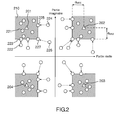
- the figure 2 presents the principle of modifying the symbols to be transmitted according to a modulation constraint realized by the symbol modification module 106.
- This module takes as input a block of initial symbols, and a block of clipped symbols.
- the module compares the initial symbols positioned in accordance with the constellation used, with the filtered and demodulated clipped symbols, with respect to the modulation constraint.
- the modulation constraint consists, for example, in modifying the clipped symbols so as to limit their influence on the performances of the waveform.
- the treated symbols may for example be those that most diminish the Euclidean distance between the symbols, and / or those that change their point on the constellation when making a decision.
- the triangles 201, 202, 203 and 204 represent the initial symbols in the case where they are mapped to a QPSK constellation.
- the shaded area 210 represents a constraint zone around the position of the symbol 201, in which the symbols to be emitted must be located so that the performance impairments of the waveform related to the reduction of the PAPR are limited.
- the size of this area is therefore the result of a compromise between decreasing the PAPR of the transmitted signal, and degradation of the performance of the link.
- d max a maximum Euclidean distance with respect to the initial symbol, along the real axis and the imaginary axis. It can also be an absolute Euclidean distance, in which case its shape is that of a circle whose center is on the point corresponding to the initial symbol, where to take any other form.
- the circles represent the clipped symbols. By clipping, they move away from their original position.
- the round 221 represents a received clipped symbol, corresponding to the initially transmitted symbol 201. This clipped symbol is located in the constrained, the symbol modification module will not change this symbol.
- the round 222 represents another received clipped symbol, corresponding to the initially transmitted symbol 201. It is outside the constraint zone, however, its Euclidean distance with respect to the symbol 201 along the real axis is less than the maximum allowed distance. Only the imaginary part of the symbol will be modified so that it is equal to the maximum distance d max . The resulting modified symbol is symbol 223.
- the round 224 represents another received clipped symbol, corresponding to the initially transmitted symbol 201. It is outside the constraint zone, however, its Euclidean distance from the symbol 201 along the imaginary axis is less than the maximum allowed distance. Only the real part of the symbol will be modified so that it is equal to the maximum distance d max . The resulting modified symbol is the symbol 225.
- the round 226 represents another received clipped symbol, corresponding to the symbol initially transmitted 201. It is outside the constraint zone, its Euclidean distance with respect to the symbol 201 being greater than the maximum allowed distance along the real axis and the axis. imaginary. The symbol will therefore be modified so that its real part and its imaginary part are equal to the maximum distance d max . The resulting modified symbol is symbol 227.
- the invention thus makes it possible to target the symbols most affected by the clipping operation, and to bring them back into a zone guaranteeing a certain level of performance.
- the setting of d max the maximum permissible Euclidean distance, is therefore the result of a compromise between performance degradation and decrease of the PAPR.
- the Figures 3a and 3b are examples illustrating the result of a modification of the symbols to be emitted when they are respectively modulated in QPSK and in 16QAM.
- the reference 301 designates the position of the initial symbols (for a symbol value only).
- the black dots, referenced 302 denote the clipped and demodulated symbols, while the gray dots, referenced 303, represent the modified symbols.
- the modified symbols are all located in a constraint zone around the initial symbols, thus guaranteeing a slight degradation of the performances of the waveform.
- the clipping of the modulated signal 120 is done according to a so-called "deep clipping" technique.
- Deep clipping is the process of decreasing the output power for any signal exceeding a threshold. Deep clipping therefore compresses the peak signal to a lower value than the desired PAPR. Its role is to reduce the inevitable rise of peaks that occur during the filtering stage. Thus, its use makes it possible to reduce the number of iterations necessary to reach a given target PAPR.
- the figure 4 describes the deep clipping mechanism, comparing it to traditional clipping.
- the curve 401 represents the evolution over time of the power of the useful signal to be transmitted. This power is compared with a threshold, the clipping mechanism having the role of limiting the signal strength to this threshold.
- Curve 411 represents the power of the signal after a traditional clipping step 410.
- the signal whose power exceeds the threshold has been modified so that the power of the clipped signal is now limited to the value of the threshold.
- Curve 412 represents the power of the signal, after a step 430 of filtering of the clipped signal by the conventional clipping method.
- the filtering causes a rise in the peaks of the power of the clipped and filtered signal to values greater than the threshold.
- Curve 421 represents the power of the signal after a step 420 of deep clipping.
- the signal whose power exceeds the threshold has been modified, so that the power of the clipped signal is less than the threshold value of a level inversely proportional to the power level of exceeding the initial signal.
- the curve 422 represents the power of the signal, after a step 430 of filtering of the signal clipped by the method of deep clipping.
- the observed peaks of signal strength are much lower than those observed when using the traditional clipping method.
- the figure 5 is an example of the result achieved by implementing the invention, on the spectrum of an emitted SC-FDMA signal.
- the spectrum 510 corresponds to the spectrum of the signal modulated from the initial symbols.
- the spectrum 520 represents the spectrum of the signal 510 after clipping. We observe a significant rise in the side lobes of the spectrum.
- the spectrum 530 represents the spectrum of the signal modulated from the modified symbols calculated by the symbol modification module. It is observed that the signal 510 has gone up again, the spectrum of the signal 530 coinciding with the spectrum of the signal 510, while having a lower PAPR.
- the figure 6 is an example of performance achieved by the implementation of the invention, on a SC-FDMA signal.
- the clipping of the signal causes a sharp degradation of the performance of the waveform, which is characterized by the appearance of a performance floor for a bit error rate of about 2.10 -3 .
- the signal 630 generated according to the invention has slightly lower performance compared to the performance of the initial signal, but does not show a performance level, while having a better PAPR than the PAPR of the initial signal.
- the invention therefore makes it possible to effectively limit the PAPR of the SC-FDMA signals by virtue of the treatments carried out, without modifying the spectrum of the signal to be transmitted, while controlling the impact on the quality of the link.
- These properties come from the fact that the invention only acts on the position of the points of the constellation to be transmitted, and that the position of the points of the constellation to be transmitted is controlled by the symbol modification module.
- the implementation complexity of the proposed solution is limited, since it largely uses existing blocks for the demodulation of the downlink signals. In addition, it does not require the transmission of additional information to the receiver to enable the decoding of the transmitted signals.
- the invention also relates to a method for reducing the PAPR intended to be implemented in a device for transmitting a single-carrier signal.
- the figure 7 is a diagram showing the different steps of an embodiment of this method.
- the method comprises a first step 701 for grouping the symbols to be transmitted in blocks.
- the size of these blocks is related to the size of the pre-coding matrix 103.
- this transmission comprises the pre-coding of the symbols by a DFT matrix, as well as the allocation of the symbols on the N sub-carriers, an inverse Fourier transform, and a parallel / serial conversion of the output of the inverse Fourier transform.
- the method comprises a third step 703 of clipping the single-carrier signal generated during the second step.
- This clipping can be done conventionally, by setting a maximum threshold value on the signal strength, or by using an advantageous deep clipping technique.
- the method includes a fourth step 704 generating clipped symbols from the clipped single-carrier signal generated in the fourth step. This step is the reverse step of the second step of the process.
- the method finally comprises a fifth step 705 for generating modified symbols, using the block of symbols determined during the first step of the method, and the blocks of clipped symbols generated during the fourth step. This step is performed as described for the figure 2 .
- the generated modified symbols are then modulated in a sixth step 706, similar to the second step, and then transmitted to the radio channel.
- steps two through five are reiterated (707). Indeed, the rising ridges involved during the stage of filtering / demodulation are inevitable.
- the use of an iterative process repeating the clipping, filtering / demodulation and modulation constraint steps converges to the target PAPR.
- the modified symbols are used by the second step of generating a single-carrier signal in place of the initial symbols, the clipped symbols generated at the end of the fourth step being always compared to the initial symbols.
- the number of iterations of the method according to the invention may be fixed, or may depend on a measurement of the peak factor of the signal generated during the second step, the number of iterations being increased in order to avoid infinite loops.
- the invention relates to radio equipment implementing the device according to the invention.
- the figure 8 is an example of radio equipment embodying an embodiment of the invention.
- radio equipment 801 is configured to transmit data according to a single-carrier signal.
- This equipment comprises a device 802 in charge of the realization of signal processing algorithms, such as data organization, channel coding, interleaving, and the generation of symbols according to a chosen constellation, etc. It also comprises a radio channel 804 in charge, in particular, of the digital / analog conversion of the signal, of its transposition on a carrier frequency, of its amplification, and of its transmission, by using the antenna 805.
- the radio equipment also comprises a device 803 according to an embodiment of the invention, whose role is to shape the signal by modulating it, while limiting the peak factor of the signal thus generated.
- the device 803 implementing the method may, without limitation, be executed by programmable logic component, such as a processor, a DSP (Digital Signal Processor) or a microcontroller for example, executing a program comprising a sequence of instructions or scripts, or by a dedicated computing machine (for example a set logical gates such as an FPGA or an ASIC), or any other hardware module.
- programmable logic component such as a processor, a DSP (Digital Signal Processor) or a microcontroller for example, executing a program comprising a sequence of instructions or scripts, or by a dedicated computing machine (for example a set logical gates such as an FPGA or an ASIC), or any other hardware module.
- programmable logic component such as a processor, a DSP (Digital Signal Processor) or a microcontroller for example, executing a program comprising a sequence of instructions or scripts, or by a dedicated computing machine (for example a set logical gates such as an FPGA or an ASIC), or any other hardware module
Landscapes
- Engineering & Computer Science (AREA)
- Computer Networks & Wireless Communication (AREA)
- Signal Processing (AREA)
- Digital Transmission Methods That Use Modulated Carrier Waves (AREA)
Applications Claiming Priority (1)
| Application Number | Priority Date | Filing Date | Title |
|---|---|---|---|
| FR1501596A FR3039730B1 (fr) | 2015-07-27 | 2015-07-27 | Reduction du facteur de crete d'une voie d'emission d'un signal mono-porteuse. |
Publications (2)
| Publication Number | Publication Date |
|---|---|
| EP3125486A1 true EP3125486A1 (de) | 2017-02-01 |
| EP3125486B1 EP3125486B1 (de) | 2023-10-18 |
Family
ID=54937129
Family Applications (1)
| Application Number | Title | Priority Date | Filing Date |
|---|---|---|---|
| EP16180683.1A Active EP3125486B1 (de) | 2015-07-27 | 2016-07-22 | Papr reduzierung eines einzelträger sendesignal |
Country Status (2)
| Country | Link |
|---|---|
| EP (1) | EP3125486B1 (de) |
| FR (1) | FR3039730B1 (de) |
Cited By (3)
| Publication number | Priority date | Publication date | Assignee | Title |
|---|---|---|---|---|
| CN112152957A (zh) * | 2020-09-28 | 2020-12-29 | 福建江夏学院 | 基于深度限幅联合星座扩展的ofdm峰均比抑制方法及抑制器 |
| CN115516826A (zh) * | 2020-05-08 | 2022-12-23 | 高通股份有限公司 | 峰均功率比降低 |
| WO2025124058A1 (zh) * | 2023-12-13 | 2025-06-19 | 华为技术有限公司 | 信号调制方法及相关装置 |
Citations (1)
| Publication number | Priority date | Publication date | Assignee | Title |
|---|---|---|---|---|
| US6128350A (en) * | 1999-08-24 | 2000-10-03 | Usa Digital Radio, Inc. | Method and apparatus for reducing peak to average power ratio in digital broadcasting systems |
Family Cites Families (1)
| Publication number | Priority date | Publication date | Assignee | Title |
|---|---|---|---|---|
| EP1990964A1 (de) * | 2007-05-10 | 2008-11-12 | Thomson Licensing | Verfahren zur Verringerung des Verhältnisses von Spitzenleistung zu Durchschnittsleistung eines Mehrträgersignals |
-
2015
- 2015-07-27 FR FR1501596A patent/FR3039730B1/fr not_active Expired - Fee Related
-
2016
- 2016-07-22 EP EP16180683.1A patent/EP3125486B1/de active Active
Patent Citations (1)
| Publication number | Priority date | Publication date | Assignee | Title |
|---|---|---|---|---|
| US6128350A (en) * | 1999-08-24 | 2000-10-03 | Usa Digital Radio, Inc. | Method and apparatus for reducing peak to average power ratio in digital broadcasting systems |
Non-Patent Citations (3)
| Title |
|---|
| JONES D L: "Peak power reduction in OFDM and DMT via active channel modification", SIGNALS, SYSTEMS, AND COMPUTERS, 1999. CONFERENCE RECORD OF THE THIRTY -THIRD ASILOMAR CONFERENCE ON OCT. 24-27, 1999, PISCATAWAY, NJ, USA,IEEE, US, 24 October 1999 (1999-10-24), pages 1076, XP032142028, ISBN: 978-0-7803-5700-6, DOI: 10.1109/ACSSC.1999.831875 * |
| KOLLAR; VARGA; CZIMER: "Clipping Based Iterative PAPR Reduction Techniques for FBMC", 17TH INTERNATIONAL OFDM WORKSHOP 2012; PROCEEDINS OF, 29 August 2012 (2012-08-29) - 30 August 2012 (2012-08-30), Essen , Germany, pages 1 - 7, XP002757900 * |
| ZHEN HE: "A Novel PAPR Reduction Scheme in FBMC-OQAM Systems Based on Extend Candidate Transmit Sequences", JOURNAL OF INFORMATION AND COMPUTATIONAL SCIENCE, vol. 12, no. 3, 10 February 2015 (2015-02-10), CN, pages 915 - 925, XP055274062, ISSN: 1548-7741, DOI: 10.12733/jics20105369 * |
Cited By (3)
| Publication number | Priority date | Publication date | Assignee | Title |
|---|---|---|---|---|
| CN115516826A (zh) * | 2020-05-08 | 2022-12-23 | 高通股份有限公司 | 峰均功率比降低 |
| CN112152957A (zh) * | 2020-09-28 | 2020-12-29 | 福建江夏学院 | 基于深度限幅联合星座扩展的ofdm峰均比抑制方法及抑制器 |
| WO2025124058A1 (zh) * | 2023-12-13 | 2025-06-19 | 华为技术有限公司 | 信号调制方法及相关装置 |
Also Published As
| Publication number | Publication date |
|---|---|
| FR3039730A1 (fr) | 2017-02-03 |
| FR3039730B1 (fr) | 2017-07-21 |
| EP3125486B1 (de) | 2023-10-18 |
Similar Documents
| Publication | Publication Date | Title |
|---|---|---|
| EP0950306B1 (de) | Verfahren und vorrichtung zum formen des beschneidungsrauschens einer mehrträgermodulation | |
| EP2428012B1 (de) | Verringerung des Verhältnisses von Spitzen-zu-Durchschnittsleistung in einem Mehrträgersignal | |
| FR2928233A1 (fr) | Procedes de transmission et de reception d'un signal multiporteuse comprenant un intervalle de garde, produits programme d'ordinateur, dispositifs d'emission et de reception, et signal correspondants | |
| EP3281375B1 (de) | Verfahren zur reduzierung des peak-faktors einer mehrkanaligen emission durch intelligente und adaptive begrenzung/filterung | |
| FR3003107A1 (fr) | Procede de transmission d'un signal multiporteuse, dispositif de transmission et programme d'ordinateur correspondants | |
| WO2016207555A1 (fr) | Procédé de transmission multi flux avec sélection de la modulation multi porteuse en fonction du type de communication associé | |
| EP4208989A1 (de) | Telekommunikationsverfahren mit polarer konstellation mit phasenverschiebung zur papr-reduktion und entsprechende vorrichtungen | |
| EP3125486B1 (de) | Papr reduzierung eines einzelträger sendesignal | |
| EP1969792B1 (de) | Verfahren und vorrichtung zur dynamischen verwürfelung | |
| EP3292668B1 (de) | Reduktion von spitzen-zu-durchschnittsleistung in einem mehrträgersignal | |
| CN114978837B (zh) | 一种滤波器组多载波系统信号传输方法、装置及存储介质 | |
| EP3780529A1 (de) | Vorrichtung und verfahren für die signalisierung von kommunikationen über ein fragmentiertes spektrum | |
| FR2826208A1 (fr) | Systeme et procede de transmission d'un signal audio ou phonie | |
| WO2022101577A1 (fr) | Procede de telecommunication avec codage binaire a symboles a repetition et dispositifs correspondants | |
| EP2219333B1 (de) | Mehrträgersignalübertragungsverfahren und -vorrichtung zur PAPR-Reduzierung sowie zugehöriges Programm | |
| WO2020020490A2 (fr) | Modem radio micro-ondes multi-canaux base sur une modulation multi-porteuses | |
| WO2014128176A2 (fr) | Procedes et dispositifs de transmission et de reception d'un signal multiporteuse reduisant le rapport puissance crête à puissance moyenne, programme et signal correspondants | |
| FR2913835A1 (fr) | Traitement d'un signal de communication, avant amplification en modulation multi-porteuses | |
| Daoud et al. | OFDM systems performance enhancement | |
| WO2006114513A1 (fr) | Procede de transmission d'un signal module avec une forte dynamique d'amplitude, emetteur et recepteur correspondant | |
| Zhuang et al. | Design and implementation of multicarrier modulation systems based on cosine-modulated filter banks | |
| FR2932341A1 (fr) | Procede et dispositif de transmission d'un signal multiporteuse reduisant le rapport puissance crete a puissance moyenne, procede et dispositif de reception, programme et signal correspondants | |
| Louveaux | Rostom Zakaria Conception d’émetteur et récepteur pour l’élimination des interférences intrinsèques dans les systèmes multiporteuses à base de bancs de filtres et à antennes multiples. | |
| FR3042366A1 (fr) | Procede d'egalisation d'un signal mono-porteuse dans le domaine frequentiel |
Legal Events
| Date | Code | Title | Description |
|---|---|---|---|
| PUAI | Public reference made under article 153(3) epc to a published international application that has entered the european phase |
Free format text: ORIGINAL CODE: 0009012 |
|
| STAA | Information on the status of an ep patent application or granted ep patent |
Free format text: STATUS: THE APPLICATION HAS BEEN PUBLISHED |
|
| AK | Designated contracting states |
Kind code of ref document: A1 Designated state(s): AL AT BE BG CH CY CZ DE DK EE ES FI FR GB GR HR HU IE IS IT LI LT LU LV MC MK MT NL NO PL PT RO RS SE SI SK SM TR |
|
| AX | Request for extension of the european patent |
Extension state: BA ME |
|
| STAA | Information on the status of an ep patent application or granted ep patent |
Free format text: STATUS: REQUEST FOR EXAMINATION WAS MADE |
|
| 17P | Request for examination filed |
Effective date: 20170720 |
|
| RBV | Designated contracting states (corrected) |
Designated state(s): AL AT BE BG CH CY CZ DE DK EE ES FI FR GB GR HR HU IE IS IT LI LT LU LV MC MK MT NL NO PL PT RO RS SE SI SK SM TR |
|
| STAA | Information on the status of an ep patent application or granted ep patent |
Free format text: STATUS: EXAMINATION IS IN PROGRESS |
|
| 17Q | First examination report despatched |
Effective date: 20190221 |
|
| GRAP | Despatch of communication of intention to grant a patent |
Free format text: ORIGINAL CODE: EPIDOSNIGR1 |
|
| STAA | Information on the status of an ep patent application or granted ep patent |
Free format text: STATUS: GRANT OF PATENT IS INTENDED |
|
| INTG | Intention to grant announced |
Effective date: 20230515 |
|
| P01 | Opt-out of the competence of the unified patent court (upc) registered |
Effective date: 20230517 |
|
| GRAS | Grant fee paid |
Free format text: ORIGINAL CODE: EPIDOSNIGR3 |
|
| GRAA | (expected) grant |
Free format text: ORIGINAL CODE: 0009210 |
|
| STAA | Information on the status of an ep patent application or granted ep patent |
Free format text: STATUS: THE PATENT HAS BEEN GRANTED |
|
| AK | Designated contracting states |
Kind code of ref document: B1 Designated state(s): AL AT BE BG CH CY CZ DE DK EE ES FI FR GB GR HR HU IE IS IT LI LT LU LV MC MK MT NL NO PL PT RO RS SE SI SK SM TR |
|
| REG | Reference to a national code |
Ref country code: GB Ref legal event code: FG4D Free format text: NOT ENGLISH |
|
| REG | Reference to a national code |
Ref country code: CH Ref legal event code: EP |
|
| REG | Reference to a national code |
Ref country code: DE Ref legal event code: R096 Ref document number: 602016083487 Country of ref document: DE |
|
| REG | Reference to a national code |
Ref country code: IE Ref legal event code: FG4D Free format text: LANGUAGE OF EP DOCUMENT: FRENCH |
|
| REG | Reference to a national code |
Ref country code: LT Ref legal event code: MG9D |
|
| REG | Reference to a national code |
Ref country code: NL Ref legal event code: MP Effective date: 20231018 |
|
| REG | Reference to a national code |
Ref country code: AT Ref legal event code: MK05 Ref document number: 1623479 Country of ref document: AT Kind code of ref document: T Effective date: 20231018 |
|
| PG25 | Lapsed in a contracting state [announced via postgrant information from national office to epo] |
Ref country code: NL Free format text: LAPSE BECAUSE OF FAILURE TO SUBMIT A TRANSLATION OF THE DESCRIPTION OR TO PAY THE FEE WITHIN THE PRESCRIBED TIME-LIMIT Effective date: 20231018 |
|
| PG25 | Lapsed in a contracting state [announced via postgrant information from national office to epo] |
Ref country code: GR Free format text: LAPSE BECAUSE OF FAILURE TO SUBMIT A TRANSLATION OF THE DESCRIPTION OR TO PAY THE FEE WITHIN THE PRESCRIBED TIME-LIMIT Effective date: 20240119 |
|
| PG25 | Lapsed in a contracting state [announced via postgrant information from national office to epo] |
Ref country code: IS Free format text: LAPSE BECAUSE OF FAILURE TO SUBMIT A TRANSLATION OF THE DESCRIPTION OR TO PAY THE FEE WITHIN THE PRESCRIBED TIME-LIMIT Effective date: 20240218 |
|
| PG25 | Lapsed in a contracting state [announced via postgrant information from national office to epo] |
Ref country code: LT Free format text: LAPSE BECAUSE OF FAILURE TO SUBMIT A TRANSLATION OF THE DESCRIPTION OR TO PAY THE FEE WITHIN THE PRESCRIBED TIME-LIMIT Effective date: 20231018 |
|
| PG25 | Lapsed in a contracting state [announced via postgrant information from national office to epo] |
Ref country code: AT Free format text: LAPSE BECAUSE OF FAILURE TO SUBMIT A TRANSLATION OF THE DESCRIPTION OR TO PAY THE FEE WITHIN THE PRESCRIBED TIME-LIMIT Effective date: 20231018 |
|
| PG25 | Lapsed in a contracting state [announced via postgrant information from national office to epo] |
Ref country code: ES Free format text: LAPSE BECAUSE OF FAILURE TO SUBMIT A TRANSLATION OF THE DESCRIPTION OR TO PAY THE FEE WITHIN THE PRESCRIBED TIME-LIMIT Effective date: 20231018 |
|
| PG25 | Lapsed in a contracting state [announced via postgrant information from national office to epo] |
Ref country code: LT Free format text: LAPSE BECAUSE OF FAILURE TO SUBMIT A TRANSLATION OF THE DESCRIPTION OR TO PAY THE FEE WITHIN THE PRESCRIBED TIME-LIMIT Effective date: 20231018 Ref country code: IS Free format text: LAPSE BECAUSE OF FAILURE TO SUBMIT A TRANSLATION OF THE DESCRIPTION OR TO PAY THE FEE WITHIN THE PRESCRIBED TIME-LIMIT Effective date: 20240218 Ref country code: GR Free format text: LAPSE BECAUSE OF FAILURE TO SUBMIT A TRANSLATION OF THE DESCRIPTION OR TO PAY THE FEE WITHIN THE PRESCRIBED TIME-LIMIT Effective date: 20240119 Ref country code: ES Free format text: LAPSE BECAUSE OF FAILURE TO SUBMIT A TRANSLATION OF THE DESCRIPTION OR TO PAY THE FEE WITHIN THE PRESCRIBED TIME-LIMIT Effective date: 20231018 Ref country code: BG Free format text: LAPSE BECAUSE OF FAILURE TO SUBMIT A TRANSLATION OF THE DESCRIPTION OR TO PAY THE FEE WITHIN THE PRESCRIBED TIME-LIMIT Effective date: 20240118 Ref country code: AT Free format text: LAPSE BECAUSE OF FAILURE TO SUBMIT A TRANSLATION OF THE DESCRIPTION OR TO PAY THE FEE WITHIN THE PRESCRIBED TIME-LIMIT Effective date: 20231018 Ref country code: PT Free format text: LAPSE BECAUSE OF FAILURE TO SUBMIT A TRANSLATION OF THE DESCRIPTION OR TO PAY THE FEE WITHIN THE PRESCRIBED TIME-LIMIT Effective date: 20240219 |
|
| PG25 | Lapsed in a contracting state [announced via postgrant information from national office to epo] |
Ref country code: SE Free format text: LAPSE BECAUSE OF FAILURE TO SUBMIT A TRANSLATION OF THE DESCRIPTION OR TO PAY THE FEE WITHIN THE PRESCRIBED TIME-LIMIT Effective date: 20231018 Ref country code: RS Free format text: LAPSE BECAUSE OF FAILURE TO SUBMIT A TRANSLATION OF THE DESCRIPTION OR TO PAY THE FEE WITHIN THE PRESCRIBED TIME-LIMIT Effective date: 20231018 Ref country code: PL Free format text: LAPSE BECAUSE OF FAILURE TO SUBMIT A TRANSLATION OF THE DESCRIPTION OR TO PAY THE FEE WITHIN THE PRESCRIBED TIME-LIMIT Effective date: 20231018 Ref country code: NO Free format text: LAPSE BECAUSE OF FAILURE TO SUBMIT A TRANSLATION OF THE DESCRIPTION OR TO PAY THE FEE WITHIN THE PRESCRIBED TIME-LIMIT Effective date: 20240118 Ref country code: LV Free format text: LAPSE BECAUSE OF FAILURE TO SUBMIT A TRANSLATION OF THE DESCRIPTION OR TO PAY THE FEE WITHIN THE PRESCRIBED TIME-LIMIT Effective date: 20231018 Ref country code: HR Free format text: LAPSE BECAUSE OF FAILURE TO SUBMIT A TRANSLATION OF THE DESCRIPTION OR TO PAY THE FEE WITHIN THE PRESCRIBED TIME-LIMIT Effective date: 20231018 |
|
| PG25 | Lapsed in a contracting state [announced via postgrant information from national office to epo] |
Ref country code: DK Free format text: LAPSE BECAUSE OF FAILURE TO SUBMIT A TRANSLATION OF THE DESCRIPTION OR TO PAY THE FEE WITHIN THE PRESCRIBED TIME-LIMIT Effective date: 20231018 |
|
| REG | Reference to a national code |
Ref country code: DE Ref legal event code: R097 Ref document number: 602016083487 Country of ref document: DE |
|
| PG25 | Lapsed in a contracting state [announced via postgrant information from national office to epo] |
Ref country code: CZ Free format text: LAPSE BECAUSE OF FAILURE TO SUBMIT A TRANSLATION OF THE DESCRIPTION OR TO PAY THE FEE WITHIN THE PRESCRIBED TIME-LIMIT Effective date: 20231018 |
|
| PG25 | Lapsed in a contracting state [announced via postgrant information from national office to epo] |
Ref country code: SK Free format text: LAPSE BECAUSE OF FAILURE TO SUBMIT A TRANSLATION OF THE DESCRIPTION OR TO PAY THE FEE WITHIN THE PRESCRIBED TIME-LIMIT Effective date: 20231018 |
|
| PG25 | Lapsed in a contracting state [announced via postgrant information from national office to epo] |
Ref country code: SM Free format text: LAPSE BECAUSE OF FAILURE TO SUBMIT A TRANSLATION OF THE DESCRIPTION OR TO PAY THE FEE WITHIN THE PRESCRIBED TIME-LIMIT Effective date: 20231018 Ref country code: SK Free format text: LAPSE BECAUSE OF FAILURE TO SUBMIT A TRANSLATION OF THE DESCRIPTION OR TO PAY THE FEE WITHIN THE PRESCRIBED TIME-LIMIT Effective date: 20231018 Ref country code: RO Free format text: LAPSE BECAUSE OF FAILURE TO SUBMIT A TRANSLATION OF THE DESCRIPTION OR TO PAY THE FEE WITHIN THE PRESCRIBED TIME-LIMIT Effective date: 20231018 Ref country code: IT Free format text: LAPSE BECAUSE OF FAILURE TO SUBMIT A TRANSLATION OF THE DESCRIPTION OR TO PAY THE FEE WITHIN THE PRESCRIBED TIME-LIMIT Effective date: 20231018 Ref country code: EE Free format text: LAPSE BECAUSE OF FAILURE TO SUBMIT A TRANSLATION OF THE DESCRIPTION OR TO PAY THE FEE WITHIN THE PRESCRIBED TIME-LIMIT Effective date: 20231018 Ref country code: DK Free format text: LAPSE BECAUSE OF FAILURE TO SUBMIT A TRANSLATION OF THE DESCRIPTION OR TO PAY THE FEE WITHIN THE PRESCRIBED TIME-LIMIT Effective date: 20231018 Ref country code: CZ Free format text: LAPSE BECAUSE OF FAILURE TO SUBMIT A TRANSLATION OF THE DESCRIPTION OR TO PAY THE FEE WITHIN THE PRESCRIBED TIME-LIMIT Effective date: 20231018 |
|
| PLBE | No opposition filed within time limit |
Free format text: ORIGINAL CODE: 0009261 |
|
| STAA | Information on the status of an ep patent application or granted ep patent |
Free format text: STATUS: NO OPPOSITION FILED WITHIN TIME LIMIT |
|
| 26N | No opposition filed |
Effective date: 20240719 |
|
| PG25 | Lapsed in a contracting state [announced via postgrant information from national office to epo] |
Ref country code: SI Free format text: LAPSE BECAUSE OF FAILURE TO SUBMIT A TRANSLATION OF THE DESCRIPTION OR TO PAY THE FEE WITHIN THE PRESCRIBED TIME-LIMIT Effective date: 20231018 |
|
| PG25 | Lapsed in a contracting state [announced via postgrant information from national office to epo] |
Ref country code: SI Free format text: LAPSE BECAUSE OF FAILURE TO SUBMIT A TRANSLATION OF THE DESCRIPTION OR TO PAY THE FEE WITHIN THE PRESCRIBED TIME-LIMIT Effective date: 20231018 |
|
| REG | Reference to a national code |
Ref country code: DE Ref legal event code: R119 Ref document number: 602016083487 Country of ref document: DE |
|
| PG25 | Lapsed in a contracting state [announced via postgrant information from national office to epo] |
Ref country code: MC Free format text: LAPSE BECAUSE OF FAILURE TO SUBMIT A TRANSLATION OF THE DESCRIPTION OR TO PAY THE FEE WITHIN THE PRESCRIBED TIME-LIMIT Effective date: 20231018 |
|
| REG | Reference to a national code |
Ref country code: CH Ref legal event code: PL |
|
| PG25 | Lapsed in a contracting state [announced via postgrant information from national office to epo] |
Ref country code: LU Free format text: LAPSE BECAUSE OF NON-PAYMENT OF DUE FEES Effective date: 20240722 |
|
| GBPC | Gb: european patent ceased through non-payment of renewal fee |
Effective date: 20240722 |
|
| PG25 | Lapsed in a contracting state [announced via postgrant information from national office to epo] |
Ref country code: LU Free format text: LAPSE BECAUSE OF NON-PAYMENT OF DUE FEES Effective date: 20240722 |
|
| PG25 | Lapsed in a contracting state [announced via postgrant information from national office to epo] |
Ref country code: DE Free format text: LAPSE BECAUSE OF NON-PAYMENT OF DUE FEES Effective date: 20250201 |
|
| PG25 | Lapsed in a contracting state [announced via postgrant information from national office to epo] |
Ref country code: CH Free format text: LAPSE BECAUSE OF NON-PAYMENT OF DUE FEES Effective date: 20240731 Ref country code: BE Free format text: LAPSE BECAUSE OF NON-PAYMENT OF DUE FEES Effective date: 20240731 |
|
| PG25 | Lapsed in a contracting state [announced via postgrant information from national office to epo] |
Ref country code: GB Free format text: LAPSE BECAUSE OF NON-PAYMENT OF DUE FEES Effective date: 20240722 |
|
| REG | Reference to a national code |
Ref country code: BE Ref legal event code: MM Effective date: 20240731 |
|
| PGFP | Annual fee paid to national office [announced via postgrant information from national office to epo] |
Ref country code: FR Payment date: 20250623 Year of fee payment: 10 |
|
| PG25 | Lapsed in a contracting state [announced via postgrant information from national office to epo] |
Ref country code: IE Free format text: LAPSE BECAUSE OF NON-PAYMENT OF DUE FEES Effective date: 20240722 |
|
| PG25 | Lapsed in a contracting state [announced via postgrant information from national office to epo] |
Ref country code: FI Free format text: LAPSE BECAUSE OF FAILURE TO SUBMIT A TRANSLATION OF THE DESCRIPTION OR TO PAY THE FEE WITHIN THE PRESCRIBED TIME-LIMIT Effective date: 20231019 |
|
| PG25 | Lapsed in a contracting state [announced via postgrant information from national office to epo] |
Ref country code: CY Free format text: LAPSE BECAUSE OF FAILURE TO SUBMIT A TRANSLATION OF THE DESCRIPTION OR TO PAY THE FEE WITHIN THE PRESCRIBED TIME-LIMIT; INVALID AB INITIO Effective date: 20160722 |
|
| PG25 | Lapsed in a contracting state [announced via postgrant information from national office to epo] |
Ref country code: HU Free format text: LAPSE BECAUSE OF FAILURE TO SUBMIT A TRANSLATION OF THE DESCRIPTION OR TO PAY THE FEE WITHIN THE PRESCRIBED TIME-LIMIT; INVALID AB INITIO Effective date: 20160722 |