EP3126463B1 - Bande adhésive - Google Patents
Bande adhésive Download PDFInfo
- Publication number
- EP3126463B1 EP3126463B1 EP14812168.4A EP14812168A EP3126463B1 EP 3126463 B1 EP3126463 B1 EP 3126463B1 EP 14812168 A EP14812168 A EP 14812168A EP 3126463 B1 EP3126463 B1 EP 3126463B1
- Authority
- EP
- European Patent Office
- Prior art keywords
- film
- adhesive
- adhesive tape
- carrier
- use according
- Prior art date
- Legal status (The legal status is an assumption and is not a legal conclusion. Google has not performed a legal analysis and makes no representation as to the accuracy of the status listed.)
- Not-in-force
Links
- 239000002390 adhesive tape Substances 0.000 title claims description 88
- 239000000853 adhesive Substances 0.000 claims description 64
- 230000001070 adhesive effect Effects 0.000 claims description 51
- -1 polypropylene Polymers 0.000 claims description 24
- 229920003052 natural elastomer Polymers 0.000 claims description 21
- 229920001194 natural rubber Polymers 0.000 claims description 21
- 244000043261 Hevea brasiliensis Species 0.000 claims description 18
- 239000000203 mixture Substances 0.000 claims description 17
- 229920005989 resin Polymers 0.000 claims description 16
- 239000011347 resin Substances 0.000 claims description 16
- 239000004698 Polyethylene Substances 0.000 claims description 13
- 239000004743 Polypropylene Substances 0.000 claims description 11
- 229920000728 polyester Polymers 0.000 claims description 11
- 229920003051 synthetic elastomer Polymers 0.000 claims description 11
- 238000012545 processing Methods 0.000 claims description 10
- 239000005061 synthetic rubber Substances 0.000 claims description 10
- 229920000573 polyethylene Polymers 0.000 claims description 9
- 239000004744 fabric Substances 0.000 claims description 7
- 238000005304 joining Methods 0.000 claims description 7
- 229920001155 polypropylene Polymers 0.000 claims description 7
- KXDHJXZQYSOELW-UHFFFAOYSA-M Carbamate Chemical compound NC([O-])=O KXDHJXZQYSOELW-UHFFFAOYSA-M 0.000 claims description 6
- 239000000975 dye Substances 0.000 claims description 6
- 239000000945 filler Substances 0.000 claims description 4
- 239000004014 plasticizer Substances 0.000 claims description 4
- 230000032683 aging Effects 0.000 claims description 3
- 150000002148 esters Chemical class 0.000 claims description 3
- RSWGJHLUYNHPMX-UHFFFAOYSA-N Abietic-Saeure Natural products C12CCC(C(C)C)=CC2=CCC2C1(C)CCCC2(C)C(O)=O RSWGJHLUYNHPMX-UHFFFAOYSA-N 0.000 claims description 2
- 239000013032 Hydrocarbon resin Substances 0.000 claims description 2
- KHPCPRHQVVSZAH-HUOMCSJISA-N Rosin Natural products O(C/C=C/c1ccccc1)[C@H]1[C@H](O)[C@@H](O)[C@@H](O)[C@@H](CO)O1 KHPCPRHQVVSZAH-HUOMCSJISA-N 0.000 claims description 2
- 239000002318 adhesion promoter Substances 0.000 claims description 2
- 229920006270 hydrocarbon resin Polymers 0.000 claims description 2
- 239000003112 inhibitor Substances 0.000 claims description 2
- 238000002156 mixing Methods 0.000 claims description 2
- 239000012779 reinforcing material Substances 0.000 claims description 2
- KHPCPRHQVVSZAH-UHFFFAOYSA-N trans-cinnamyl beta-D-glucopyranoside Natural products OC1C(O)C(O)C(CO)OC1OCC=CC1=CC=CC=C1 KHPCPRHQVVSZAH-UHFFFAOYSA-N 0.000 claims description 2
- 230000003287 optical effect Effects 0.000 claims 1
- 239000003381 stabilizer Substances 0.000 claims 1
- 229920000139 polyethylene terephthalate Polymers 0.000 description 18
- 239000005020 polyethylene terephthalate Substances 0.000 description 18
- 229920001971 elastomer Polymers 0.000 description 15
- 229920000642 polymer Polymers 0.000 description 13
- 239000004820 Pressure-sensitive adhesive Substances 0.000 description 12
- 239000000463 material Substances 0.000 description 12
- 239000000049 pigment Substances 0.000 description 12
- 229920001296 polysiloxane Polymers 0.000 description 10
- 238000000034 method Methods 0.000 description 9
- 239000005060 rubber Substances 0.000 description 8
- 230000015572 biosynthetic process Effects 0.000 description 7
- 239000000806 elastomer Substances 0.000 description 7
- 238000004519 manufacturing process Methods 0.000 description 7
- WSFSSNUMVMOOMR-UHFFFAOYSA-N Formaldehyde Chemical compound O=C WSFSSNUMVMOOMR-UHFFFAOYSA-N 0.000 description 6
- GWEVSGVZZGPLCZ-UHFFFAOYSA-N Titan oxide Chemical compound O=[Ti]=O GWEVSGVZZGPLCZ-UHFFFAOYSA-N 0.000 description 6
- XLOMVQKBTHCTTD-UHFFFAOYSA-N Zinc monoxide Chemical compound [Zn]=O XLOMVQKBTHCTTD-UHFFFAOYSA-N 0.000 description 6
- 238000000576 coating method Methods 0.000 description 6
- 229920001577 copolymer Polymers 0.000 description 6
- 229920001568 phenolic resin Polymers 0.000 description 6
- NIXOWILDQLNWCW-UHFFFAOYSA-N 2-Propenoic acid Natural products OC(=O)C=C NIXOWILDQLNWCW-UHFFFAOYSA-N 0.000 description 5
- VSKJLJHPAFKHBX-UHFFFAOYSA-N 2-methylbuta-1,3-diene;styrene Chemical compound CC(=C)C=C.C=CC1=CC=CC=C1.C=CC1=CC=CC=C1 VSKJLJHPAFKHBX-UHFFFAOYSA-N 0.000 description 5
- 239000000969 carrier Substances 0.000 description 5
- 239000003795 chemical substances by application Substances 0.000 description 5
- 150000001875 compounds Chemical class 0.000 description 5
- 239000000178 monomer Substances 0.000 description 5
- 239000005011 phenolic resin Substances 0.000 description 5
- VTYYLEPIZMXCLO-UHFFFAOYSA-L Calcium carbonate Chemical compound [Ca+2].[O-]C([O-])=O VTYYLEPIZMXCLO-UHFFFAOYSA-L 0.000 description 4
- VYPSYNLAJGMNEJ-UHFFFAOYSA-N Silicium dioxide Chemical compound O=[Si]=O VYPSYNLAJGMNEJ-UHFFFAOYSA-N 0.000 description 4
- PPBRXRYQALVLMV-UHFFFAOYSA-N Styrene Chemical compound C=CC1=CC=CC=C1 PPBRXRYQALVLMV-UHFFFAOYSA-N 0.000 description 4
- 239000000654 additive Substances 0.000 description 4
- 239000011248 coating agent Substances 0.000 description 4
- 238000004132 cross linking Methods 0.000 description 4
- 239000007788 liquid Substances 0.000 description 4
- 238000005259 measurement Methods 0.000 description 4
- 239000004814 polyurethane Substances 0.000 description 4
- 230000003068 static effect Effects 0.000 description 4
- 239000000126 substance Substances 0.000 description 4
- 150000003505 terpenes Chemical class 0.000 description 4
- 235000007586 terpenes Nutrition 0.000 description 4
- 238000012360 testing method Methods 0.000 description 4
- 239000004753 textile Substances 0.000 description 4
- 239000004971 Cross linker Substances 0.000 description 3
- VGGSQFUCUMXWEO-UHFFFAOYSA-N Ethene Chemical compound C=C VGGSQFUCUMXWEO-UHFFFAOYSA-N 0.000 description 3
- PEDCQBHIVMGVHV-UHFFFAOYSA-N Glycerine Chemical compound OCC(O)CO PEDCQBHIVMGVHV-UHFFFAOYSA-N 0.000 description 3
- 229910000831 Steel Inorganic materials 0.000 description 3
- PYKYMHQGRFAEBM-UHFFFAOYSA-N anthraquinone Natural products CCC(=O)c1c(O)c2C(=O)C3C(C=CC=C3O)C(=O)c2cc1CC(=O)OC PYKYMHQGRFAEBM-UHFFFAOYSA-N 0.000 description 3
- 150000004056 anthraquinones Chemical class 0.000 description 3
- 230000003712 anti-aging effect Effects 0.000 description 3
- 239000003963 antioxidant agent Substances 0.000 description 3
- 229920006378 biaxially oriented polypropylene Polymers 0.000 description 3
- 239000011127 biaxially oriented polypropylene Substances 0.000 description 3
- FACXGONDLDSNOE-UHFFFAOYSA-N buta-1,3-diene;styrene Chemical compound C=CC=C.C=CC1=CC=CC=C1.C=CC1=CC=CC=C1 FACXGONDLDSNOE-UHFFFAOYSA-N 0.000 description 3
- 229920005549 butyl rubber Polymers 0.000 description 3
- 239000006229 carbon black Substances 0.000 description 3
- 239000006185 dispersion Substances 0.000 description 3
- 238000005516 engineering process Methods 0.000 description 3
- 239000005038 ethylene vinyl acetate Substances 0.000 description 3
- 239000000835 fiber Substances 0.000 description 3
- 239000002657 fibrous material Substances 0.000 description 3
- 239000011888 foil Substances 0.000 description 3
- 239000012948 isocyanate Substances 0.000 description 3
- 150000002513 isocyanates Chemical class 0.000 description 3
- 239000004611 light stabiliser Substances 0.000 description 3
- 229920001200 poly(ethylene-vinyl acetate) Polymers 0.000 description 3
- 229920002635 polyurethane Polymers 0.000 description 3
- 238000002360 preparation method Methods 0.000 description 3
- QQONPFPTGQHPMA-UHFFFAOYSA-N propylene Natural products CC=C QQONPFPTGQHPMA-UHFFFAOYSA-N 0.000 description 3
- 239000002994 raw material Substances 0.000 description 3
- 239000010959 steel Substances 0.000 description 3
- 229920003048 styrene butadiene rubber Polymers 0.000 description 3
- 229920000468 styrene butadiene styrene block copolymer Polymers 0.000 description 3
- 239000004408 titanium dioxide Substances 0.000 description 3
- 238000004804 winding Methods 0.000 description 3
- 239000011787 zinc oxide Substances 0.000 description 3
- WTARULDDTDQWMU-RKDXNWHRSA-N (+)-β-pinene Chemical compound C1[C@H]2C(C)(C)[C@@H]1CCC2=C WTARULDDTDQWMU-RKDXNWHRSA-N 0.000 description 2
- WTARULDDTDQWMU-IUCAKERBSA-N (-)-Nopinene Natural products C1[C@@H]2C(C)(C)[C@H]1CCC2=C WTARULDDTDQWMU-IUCAKERBSA-N 0.000 description 2
- VXNZUUAINFGPBY-UHFFFAOYSA-N 1-Butene Chemical compound CCC=C VXNZUUAINFGPBY-UHFFFAOYSA-N 0.000 description 2
- BTLXPCBPYBNQNR-UHFFFAOYSA-N 1-hydroxyanthraquinone Chemical compound O=C1C2=CC=CC=C2C(=O)C2=C1C=CC=C2O BTLXPCBPYBNQNR-UHFFFAOYSA-N 0.000 description 2
- GRWFGVWFFZKLTI-IUCAKERBSA-N 1S,5S-(-)-alpha-Pinene Natural products CC1=CC[C@@H]2C(C)(C)[C@H]1C2 GRWFGVWFFZKLTI-IUCAKERBSA-N 0.000 description 2
- SMZOUWXMTYCWNB-UHFFFAOYSA-N 2-(2-methoxy-5-methylphenyl)ethanamine Chemical compound COC1=CC=C(C)C=C1CCN SMZOUWXMTYCWNB-UHFFFAOYSA-N 0.000 description 2
- KXGFMDJXCMQABM-UHFFFAOYSA-N 2-methoxy-6-methylphenol Chemical compound [CH]OC1=CC=CC([CH])=C1O KXGFMDJXCMQABM-UHFFFAOYSA-N 0.000 description 2
- NIXOWILDQLNWCW-UHFFFAOYSA-M Acrylate Chemical compound [O-]C(=O)C=C NIXOWILDQLNWCW-UHFFFAOYSA-M 0.000 description 2
- 229920002799 BoPET Polymers 0.000 description 2
- KAKZBPTYRLMSJV-UHFFFAOYSA-N Butadiene Chemical compound C=CC=C KAKZBPTYRLMSJV-UHFFFAOYSA-N 0.000 description 2
- 239000005977 Ethylene Substances 0.000 description 2
- VQTUBCCKSQIDNK-UHFFFAOYSA-N Isobutene Chemical compound CC(C)=C VQTUBCCKSQIDNK-UHFFFAOYSA-N 0.000 description 2
- 241001492626 Lobelia dortmanna Species 0.000 description 2
- 229920000877 Melamine resin Polymers 0.000 description 2
- WTARULDDTDQWMU-UHFFFAOYSA-N Pseudopinene Natural products C1C2C(C)(C)C1CCC2=C WTARULDDTDQWMU-UHFFFAOYSA-N 0.000 description 2
- 239000002174 Styrene-butadiene Substances 0.000 description 2
- NINIDFKCEFEMDL-UHFFFAOYSA-N Sulfur Chemical compound [S] NINIDFKCEFEMDL-UHFFFAOYSA-N 0.000 description 2
- FMRLDPWIRHBCCC-UHFFFAOYSA-L Zinc carbonate Chemical compound [Zn+2].[O-]C([O-])=O FMRLDPWIRHBCCC-UHFFFAOYSA-L 0.000 description 2
- 239000006096 absorbing agent Substances 0.000 description 2
- 239000004840 adhesive resin Substances 0.000 description 2
- 229920006223 adhesive resin Polymers 0.000 description 2
- WNLRTRBMVRJNCN-UHFFFAOYSA-N adipic acid Chemical compound OC(=O)CCCCC(O)=O WNLRTRBMVRJNCN-UHFFFAOYSA-N 0.000 description 2
- 125000000217 alkyl group Chemical group 0.000 description 2
- XCPQUQHBVVXMRQ-UHFFFAOYSA-N alpha-Fenchene Natural products C1CC2C(=C)CC1C2(C)C XCPQUQHBVVXMRQ-UHFFFAOYSA-N 0.000 description 2
- 238000004873 anchoring Methods 0.000 description 2
- 125000003118 aryl group Chemical group 0.000 description 2
- 229930006722 beta-pinene Natural products 0.000 description 2
- 229920001400 block copolymer Polymers 0.000 description 2
- IAQRGUVFOMOMEM-UHFFFAOYSA-N butene Natural products CC=CC IAQRGUVFOMOMEM-UHFFFAOYSA-N 0.000 description 2
- 229910000019 calcium carbonate Inorganic materials 0.000 description 2
- 239000012876 carrier material Substances 0.000 description 2
- 239000003431 cross linking reagent Substances 0.000 description 2
- 125000004122 cyclic group Chemical group 0.000 description 2
- 238000001125 extrusion Methods 0.000 description 2
- LCWMKIHBLJLORW-UHFFFAOYSA-N gamma-carene Natural products C1CC(=C)CC2C(C)(C)C21 LCWMKIHBLJLORW-UHFFFAOYSA-N 0.000 description 2
- 239000004922 lacquer Substances 0.000 description 2
- 238000010030 laminating Methods 0.000 description 2
- JDSHMPZPIAZGSV-UHFFFAOYSA-N melamine Chemical compound NC1=NC(N)=NC(N)=N1 JDSHMPZPIAZGSV-UHFFFAOYSA-N 0.000 description 2
- 239000000155 melt Substances 0.000 description 2
- 229910052751 metal Inorganic materials 0.000 description 2
- 239000002184 metal Substances 0.000 description 2
- 239000004745 nonwoven fabric Substances 0.000 description 2
- 239000010893 paper waste Substances 0.000 description 2
- KIOWHOMJXAQSMW-UHFFFAOYSA-N phenol;4,6,6-trimethylbicyclo[3.1.1]hept-3-ene Chemical compound OC1=CC=CC=C1.CC1=CCC2C(C)(C)C1C2 KIOWHOMJXAQSMW-UHFFFAOYSA-N 0.000 description 2
- XNGIFLGASWRNHJ-UHFFFAOYSA-N phthalic acid Chemical compound OC(=O)C1=CC=CC=C1C(O)=O XNGIFLGASWRNHJ-UHFFFAOYSA-N 0.000 description 2
- 229920002857 polybutadiene Polymers 0.000 description 2
- 238000007639 printing Methods 0.000 description 2
- 150000004760 silicates Chemical class 0.000 description 2
- 239000000377 silicon dioxide Substances 0.000 description 2
- 239000007787 solid Substances 0.000 description 2
- 239000002904 solvent Substances 0.000 description 2
- 238000003860 storage Methods 0.000 description 2
- 230000035882 stress Effects 0.000 description 2
- 239000011593 sulfur Substances 0.000 description 2
- 229910052717 sulfur Inorganic materials 0.000 description 2
- ARCGXLSVLAOJQL-UHFFFAOYSA-N trimellitic acid Chemical compound OC(=O)C1=CC=C(C(O)=O)C(C(O)=O)=C1 ARCGXLSVLAOJQL-UHFFFAOYSA-N 0.000 description 2
- 239000011667 zinc carbonate Substances 0.000 description 2
- 235000004416 zinc carbonate Nutrition 0.000 description 2
- 229910000010 zinc carbonate Inorganic materials 0.000 description 2
- KHUFHLFHOQVFGB-UHFFFAOYSA-N 1-aminoanthracene-9,10-dione Chemical compound O=C1C2=CC=CC=C2C(=O)C2=C1C=CC=C2N KHUFHLFHOQVFGB-UHFFFAOYSA-N 0.000 description 1
- KPAPHODVWOVUJL-UHFFFAOYSA-N 1-benzofuran;1h-indene Chemical compound C1=CC=C2CC=CC2=C1.C1=CC=C2OC=CC2=C1 KPAPHODVWOVUJL-UHFFFAOYSA-N 0.000 description 1
- LIKMAJRDDDTEIG-UHFFFAOYSA-N 1-hexene Chemical compound CCCCC=C LIKMAJRDDDTEIG-UHFFFAOYSA-N 0.000 description 1
- KWKAKUADMBZCLK-UHFFFAOYSA-N 1-octene Chemical compound CCCCCCC=C KWKAKUADMBZCLK-UHFFFAOYSA-N 0.000 description 1
- BJELTSYBAHKXRW-UHFFFAOYSA-N 2,4,6-triallyloxy-1,3,5-triazine Chemical compound C=CCOC1=NC(OCC=C)=NC(OCC=C)=N1 BJELTSYBAHKXRW-UHFFFAOYSA-N 0.000 description 1
- 150000003923 2,5-pyrrolediones Chemical class 0.000 description 1
- WPDXBPLOZLLWMN-UHFFFAOYSA-N 2-(2-amino-2-oxoethyl)-2-sulfoicosanoic acid Chemical class CCCCCCCCCCCCCCCCCCC(S(O)(=O)=O)(C(O)=O)CC(N)=O WPDXBPLOZLLWMN-UHFFFAOYSA-N 0.000 description 1
- BLDFSDCBQJUWFG-UHFFFAOYSA-N 2-(methylamino)-1,2-diphenylethanol Chemical compound C=1C=CC=CC=1C(NC)C(O)C1=CC=CC=C1 BLDFSDCBQJUWFG-UHFFFAOYSA-N 0.000 description 1
- FHBMSKSWXOLFJJ-UHFFFAOYSA-N 2-octadecyl-2-sulfobutanedioic acid Chemical group CCCCCCCCCCCCCCCCCCC(S(O)(=O)=O)(C(O)=O)CC(O)=O FHBMSKSWXOLFJJ-UHFFFAOYSA-N 0.000 description 1
- 125000003903 2-propenyl group Chemical group [H]C([*])([H])C([H])=C([H])[H] 0.000 description 1
- 229920002943 EPDM rubber Polymers 0.000 description 1
- PXGOKWXKJXAPGV-UHFFFAOYSA-N Fluorine Chemical compound FF PXGOKWXKJXAPGV-UHFFFAOYSA-N 0.000 description 1
- 229910001335 Galvanized steel Inorganic materials 0.000 description 1
- 239000004166 Lanolin Substances 0.000 description 1
- CERQOIWHTDAKMF-UHFFFAOYSA-N Methacrylic acid Chemical compound CC(=C)C(O)=O CERQOIWHTDAKMF-UHFFFAOYSA-N 0.000 description 1
- VVQNEPGJFQJSBK-UHFFFAOYSA-N Methyl methacrylate Chemical compound COC(=O)C(C)=C VVQNEPGJFQJSBK-UHFFFAOYSA-N 0.000 description 1
- 229920002873 Polyethylenimine Polymers 0.000 description 1
- 229920002367 Polyisobutene Polymers 0.000 description 1
- 229920011250 Polypropylene Block Copolymer Polymers 0.000 description 1
- XTXRWKRVRITETP-UHFFFAOYSA-N Vinyl acetate Chemical compound CC(=O)OC=C XTXRWKRVRITETP-UHFFFAOYSA-N 0.000 description 1
- 229910000004 White lead Inorganic materials 0.000 description 1
- 239000002253 acid Substances 0.000 description 1
- FZEYVTFCMJSGMP-UHFFFAOYSA-N acridone Chemical class C1=CC=C2C(=O)C3=CC=CC=C3NC2=C1 FZEYVTFCMJSGMP-UHFFFAOYSA-N 0.000 description 1
- 239000012190 activator Substances 0.000 description 1
- 230000000996 additive effect Effects 0.000 description 1
- 235000011037 adipic acid Nutrition 0.000 description 1
- 239000001361 adipic acid Substances 0.000 description 1
- 125000001931 aliphatic group Chemical group 0.000 description 1
- 150000001336 alkenes Chemical class 0.000 description 1
- XYLMUPLGERFSHI-UHFFFAOYSA-N alpha-Methylstyrene Chemical compound CC(=C)C1=CC=CC=C1 XYLMUPLGERFSHI-UHFFFAOYSA-N 0.000 description 1
- MVNCAPSFBDBCGF-UHFFFAOYSA-N alpha-pinene Natural products CC1=CCC23C1CC2C3(C)C MVNCAPSFBDBCGF-UHFFFAOYSA-N 0.000 description 1
- 150000001412 amines Chemical class 0.000 description 1
- 239000001000 anthraquinone dye Substances 0.000 description 1
- 230000000181 anti-adherent effect Effects 0.000 description 1
- 239000000987 azo dye Substances 0.000 description 1
- 229920005601 base polymer Polymers 0.000 description 1
- DQXBYHZEEUGOBF-UHFFFAOYSA-N but-3-enoic acid;ethene Chemical compound C=C.OC(=O)CC=C DQXBYHZEEUGOBF-UHFFFAOYSA-N 0.000 description 1
- CQEYYJKEWSMYFG-UHFFFAOYSA-N butyl acrylate Chemical compound CCCCOC(=O)C=C CQEYYJKEWSMYFG-UHFFFAOYSA-N 0.000 description 1
- QXJJQWWVWRCVQT-UHFFFAOYSA-K calcium;sodium;phosphate Chemical compound [Na+].[Ca+2].[O-]P([O-])([O-])=O QXJJQWWVWRCVQT-UHFFFAOYSA-K 0.000 description 1
- 238000003490 calendering Methods 0.000 description 1
- 235000013877 carbamide Nutrition 0.000 description 1
- 125000000609 carbazolyl group Chemical class C1(=CC=CC=2C3=CC=CC=C3NC12)* 0.000 description 1
- 229910052799 carbon Inorganic materials 0.000 description 1
- 238000010382 chemical cross-linking Methods 0.000 description 1
- 150000001844 chromium Chemical class 0.000 description 1
- 238000009833 condensation Methods 0.000 description 1
- 230000005494 condensation Effects 0.000 description 1
- 239000000470 constituent Substances 0.000 description 1
- 238000010276 construction Methods 0.000 description 1
- 239000013078 crystal Substances 0.000 description 1
- WCMHCPWEQCWRSR-UHFFFAOYSA-J dicopper;hydroxide;phosphate Chemical compound [OH-].[Cu+2].[Cu+2].[O-]P([O-])([O-])=O WCMHCPWEQCWRSR-UHFFFAOYSA-J 0.000 description 1
- 150000001993 dienes Chemical class 0.000 description 1
- 235000014113 dietary fatty acids Nutrition 0.000 description 1
- 125000005442 diisocyanate group Chemical group 0.000 description 1
- 230000000694 effects Effects 0.000 description 1
- 238000010894 electron beam technology Methods 0.000 description 1
- 239000003822 epoxy resin Substances 0.000 description 1
- 230000005284 excitation Effects 0.000 description 1
- 239000000194 fatty acid Substances 0.000 description 1
- 229930195729 fatty acid Natural products 0.000 description 1
- 150000004665 fatty acids Chemical class 0.000 description 1
- 230000002349 favourable effect Effects 0.000 description 1
- 239000011737 fluorine Substances 0.000 description 1
- 229910052731 fluorine Inorganic materials 0.000 description 1
- 239000008397 galvanized steel Substances 0.000 description 1
- 239000003292 glue Substances 0.000 description 1
- 150000002334 glycols Chemical class 0.000 description 1
- 229920005555 halobutyl Polymers 0.000 description 1
- LNEPOXFFQSENCJ-UHFFFAOYSA-N haloperidol Chemical compound C1CC(O)(C=2C=CC(Cl)=CC=2)CCN1CCCC(=O)C1=CC=C(F)C=C1 LNEPOXFFQSENCJ-UHFFFAOYSA-N 0.000 description 1
- 125000000623 heterocyclic group Chemical group 0.000 description 1
- 229920001903 high density polyethylene Polymers 0.000 description 1
- 239000004700 high-density polyethylene Substances 0.000 description 1
- 229920001519 homopolymer Polymers 0.000 description 1
- 239000012943 hotmelt Substances 0.000 description 1
- 238000005984 hydrogenation reaction Methods 0.000 description 1
- 235000019388 lanolin Nutrition 0.000 description 1
- RYZCLUQMCYZBJQ-UHFFFAOYSA-H lead(2+);dicarbonate;dihydroxide Chemical compound [OH-].[OH-].[Pb+2].[Pb+2].[Pb+2].[O-]C([O-])=O.[O-]C([O-])=O RYZCLUQMCYZBJQ-UHFFFAOYSA-H 0.000 description 1
- 239000004571 lime Substances 0.000 description 1
- 229920000092 linear low density polyethylene Polymers 0.000 description 1
- 239000004707 linear low-density polyethylene Substances 0.000 description 1
- 229920001684 low density polyethylene Polymers 0.000 description 1
- 239000004702 low-density polyethylene Substances 0.000 description 1
- 229920001179 medium density polyethylene Polymers 0.000 description 1
- 239000004701 medium-density polyethylene Substances 0.000 description 1
- 239000010445 mica Substances 0.000 description 1
- 229910052618 mica group Inorganic materials 0.000 description 1
- 239000002480 mineral oil Substances 0.000 description 1
- 150000002825 nitriles Chemical class 0.000 description 1
- IULGYNXPKZHCIA-UHFFFAOYSA-N octadecyl carbamate Chemical class CCCCCCCCCCCCCCCCCCOC(N)=O IULGYNXPKZHCIA-UHFFFAOYSA-N 0.000 description 1
- JRZJOMJEPLMPRA-UHFFFAOYSA-N olefin Natural products CCCCCCCC=C JRZJOMJEPLMPRA-UHFFFAOYSA-N 0.000 description 1
- 238000004806 packaging method and process Methods 0.000 description 1
- WXZMFSXDPGVJKK-UHFFFAOYSA-N pentaerythritol Chemical compound OCC(CO)(CO)CO WXZMFSXDPGVJKK-UHFFFAOYSA-N 0.000 description 1
- ISWSIDIOOBJBQZ-UHFFFAOYSA-N phenol group Chemical group C1(=CC=CC=C1)O ISWSIDIOOBJBQZ-UHFFFAOYSA-N 0.000 description 1
- 150000002989 phenols Chemical class 0.000 description 1
- AQSJGOWTSHOLKH-UHFFFAOYSA-N phosphite(3-) Chemical class [O-]P([O-])[O-] AQSJGOWTSHOLKH-UHFFFAOYSA-N 0.000 description 1
- 238000009832 plasma treatment Methods 0.000 description 1
- 239000002985 plastic film Substances 0.000 description 1
- 229920006255 plastic film Polymers 0.000 description 1
- 229920000162 poly(ureaurethane) Polymers 0.000 description 1
- 229920000058 polyacrylate Polymers 0.000 description 1
- 229920000647 polyepoxide Polymers 0.000 description 1
- 229920006267 polyester film Polymers 0.000 description 1
- 229920001195 polyisoprene Polymers 0.000 description 1
- 229920005606 polypropylene copolymer Polymers 0.000 description 1
- 229920005629 polypropylene homopolymer Polymers 0.000 description 1
- 229920005630 polypropylene random copolymer Polymers 0.000 description 1
- 229920002742 polystyrene-block-poly(ethylene/propylene) -block-polystyrene Polymers 0.000 description 1
- 229920001289 polyvinyl ether Polymers 0.000 description 1
- 239000000843 powder Substances 0.000 description 1
- 238000003672 processing method Methods 0.000 description 1
- 125000004805 propylene group Chemical group [H]C([H])([H])C([H])([*:1])C([H])([H])[*:2] 0.000 description 1
- GRWFGVWFFZKLTI-UHFFFAOYSA-N rac-alpha-Pinene Natural products CC1=CCC2C(C)(C)C1C2 GRWFGVWFFZKLTI-UHFFFAOYSA-N 0.000 description 1
- 230000005855 radiation Effects 0.000 description 1
- 238000007789 sealing Methods 0.000 description 1
- 238000000926 separation method Methods 0.000 description 1
- 229920001935 styrene-ethylene-butadiene-styrene Polymers 0.000 description 1
- 238000006467 substitution reaction Methods 0.000 description 1
- 239000000758 substrate Substances 0.000 description 1
- 239000004094 surface-active agent Substances 0.000 description 1
- 238000010998 test method Methods 0.000 description 1
- 229920002725 thermoplastic elastomer Polymers 0.000 description 1
- 150000003557 thiazoles Chemical class 0.000 description 1
- 150000003568 thioethers Chemical class 0.000 description 1
- 150000003577 thiophenes Chemical class 0.000 description 1
- 238000012546 transfer Methods 0.000 description 1
- 229920002554 vinyl polymer Polymers 0.000 description 1
- 239000001993 wax Substances 0.000 description 1
- 235000019352 zinc silicate Nutrition 0.000 description 1
- MXODCLTZTIFYDV-UHFFFAOYSA-L zinc;1,4a-dimethyl-7-propan-2-yl-2,3,4,4b,5,6,10,10a-octahydrophenanthrene-1-carboxylate Chemical compound [Zn+2].C12CCC(C(C)C)=CC2=CCC2C1(C)CCCC2(C)C([O-])=O.C12CCC(C(C)C)=CC2=CCC2C1(C)CCCC2(C)C([O-])=O MXODCLTZTIFYDV-UHFFFAOYSA-L 0.000 description 1
Images

Classifications
-
- C—CHEMISTRY; METALLURGY
- C09—DYES; PAINTS; POLISHES; NATURAL RESINS; ADHESIVES; COMPOSITIONS NOT OTHERWISE PROVIDED FOR; APPLICATIONS OF MATERIALS NOT OTHERWISE PROVIDED FOR
- C09J—ADHESIVES; NON-MECHANICAL ASPECTS OF ADHESIVE PROCESSES IN GENERAL; ADHESIVE PROCESSES NOT PROVIDED FOR ELSEWHERE; USE OF MATERIALS AS ADHESIVES
- C09J133/00—Adhesives based on homopolymers or copolymers of compounds having one or more unsaturated aliphatic radicals, each having only one carbon-to-carbon double bond, and at least one being terminated by only one carboxyl radical, or of salts, anhydrides, esters, amides, imides, or nitriles thereof; Adhesives based on derivatives of such polymers
- C09J133/02—Homopolymers or copolymers of acids; Metal or ammonium salts thereof
-
- C—CHEMISTRY; METALLURGY
- C09—DYES; PAINTS; POLISHES; NATURAL RESINS; ADHESIVES; COMPOSITIONS NOT OTHERWISE PROVIDED FOR; APPLICATIONS OF MATERIALS NOT OTHERWISE PROVIDED FOR
- C09J—ADHESIVES; NON-MECHANICAL ASPECTS OF ADHESIVE PROCESSES IN GENERAL; ADHESIVE PROCESSES NOT PROVIDED FOR ELSEWHERE; USE OF MATERIALS AS ADHESIVES
- C09J7/00—Adhesives in the form of films or foils
- C09J7/30—Adhesives in the form of films or foils characterised by the adhesive composition
- C09J7/38—Pressure-sensitive adhesives [PSA]
- C09J7/381—Pressure-sensitive adhesives [PSA] based on macromolecular compounds obtained by reactions involving only carbon-to-carbon unsaturated bonds
- C09J7/383—Natural or synthetic rubber
-
- B—PERFORMING OPERATIONS; TRANSPORTING
- B65—CONVEYING; PACKING; STORING; HANDLING THIN OR FILAMENTARY MATERIAL
- B65H—HANDLING THIN OR FILAMENTARY MATERIAL, e.g. SHEETS, WEBS, CABLES
- B65H19/00—Changing the web roll
- B65H19/10—Changing the web roll in unwinding mechanisms or in connection with unwinding operations
- B65H19/18—Attaching, e.g. pasting, the replacement web to the expiring web
- B65H19/1842—Attaching, e.g. pasting, the replacement web to the expiring web standing splicing, i.e. the expiring web being stationary during splicing contact
-
- C—CHEMISTRY; METALLURGY
- C09—DYES; PAINTS; POLISHES; NATURAL RESINS; ADHESIVES; COMPOSITIONS NOT OTHERWISE PROVIDED FOR; APPLICATIONS OF MATERIALS NOT OTHERWISE PROVIDED FOR
- C09J—ADHESIVES; NON-MECHANICAL ASPECTS OF ADHESIVE PROCESSES IN GENERAL; ADHESIVE PROCESSES NOT PROVIDED FOR ELSEWHERE; USE OF MATERIALS AS ADHESIVES
- C09J107/00—Adhesives based on natural rubber
-
- C—CHEMISTRY; METALLURGY
- C09—DYES; PAINTS; POLISHES; NATURAL RESINS; ADHESIVES; COMPOSITIONS NOT OTHERWISE PROVIDED FOR; APPLICATIONS OF MATERIALS NOT OTHERWISE PROVIDED FOR
- C09J—ADHESIVES; NON-MECHANICAL ASPECTS OF ADHESIVE PROCESSES IN GENERAL; ADHESIVE PROCESSES NOT PROVIDED FOR ELSEWHERE; USE OF MATERIALS AS ADHESIVES
- C09J109/00—Adhesives based on homopolymers or copolymers of conjugated diene hydrocarbons
- C09J109/06—Copolymers with styrene
-
- C—CHEMISTRY; METALLURGY
- C09—DYES; PAINTS; POLISHES; NATURAL RESINS; ADHESIVES; COMPOSITIONS NOT OTHERWISE PROVIDED FOR; APPLICATIONS OF MATERIALS NOT OTHERWISE PROVIDED FOR
- C09J—ADHESIVES; NON-MECHANICAL ASPECTS OF ADHESIVE PROCESSES IN GENERAL; ADHESIVE PROCESSES NOT PROVIDED FOR ELSEWHERE; USE OF MATERIALS AS ADHESIVES
- C09J121/00—Adhesives based on unspecified rubbers
-
- C—CHEMISTRY; METALLURGY
- C09—DYES; PAINTS; POLISHES; NATURAL RESINS; ADHESIVES; COMPOSITIONS NOT OTHERWISE PROVIDED FOR; APPLICATIONS OF MATERIALS NOT OTHERWISE PROVIDED FOR
- C09J—ADHESIVES; NON-MECHANICAL ASPECTS OF ADHESIVE PROCESSES IN GENERAL; ADHESIVE PROCESSES NOT PROVIDED FOR ELSEWHERE; USE OF MATERIALS AS ADHESIVES
- C09J5/00—Adhesive processes in general; Adhesive processes not provided for elsewhere, e.g. relating to primers
-
- C—CHEMISTRY; METALLURGY
- C09—DYES; PAINTS; POLISHES; NATURAL RESINS; ADHESIVES; COMPOSITIONS NOT OTHERWISE PROVIDED FOR; APPLICATIONS OF MATERIALS NOT OTHERWISE PROVIDED FOR
- C09J—ADHESIVES; NON-MECHANICAL ASPECTS OF ADHESIVE PROCESSES IN GENERAL; ADHESIVE PROCESSES NOT PROVIDED FOR ELSEWHERE; USE OF MATERIALS AS ADHESIVES
- C09J7/00—Adhesives in the form of films or foils
- C09J7/20—Adhesives in the form of films or foils characterised by their carriers
- C09J7/201—Adhesives in the form of films or foils characterised by their carriers characterised by the release coating composition on the carrier layer
-
- C—CHEMISTRY; METALLURGY
- C09—DYES; PAINTS; POLISHES; NATURAL RESINS; ADHESIVES; COMPOSITIONS NOT OTHERWISE PROVIDED FOR; APPLICATIONS OF MATERIALS NOT OTHERWISE PROVIDED FOR
- C09J—ADHESIVES; NON-MECHANICAL ASPECTS OF ADHESIVE PROCESSES IN GENERAL; ADHESIVE PROCESSES NOT PROVIDED FOR ELSEWHERE; USE OF MATERIALS AS ADHESIVES
- C09J7/00—Adhesives in the form of films or foils
- C09J7/20—Adhesives in the form of films or foils characterised by their carriers
- C09J7/22—Plastics; Metallised plastics
-
- C—CHEMISTRY; METALLURGY
- C09—DYES; PAINTS; POLISHES; NATURAL RESINS; ADHESIVES; COMPOSITIONS NOT OTHERWISE PROVIDED FOR; APPLICATIONS OF MATERIALS NOT OTHERWISE PROVIDED FOR
- C09J—ADHESIVES; NON-MECHANICAL ASPECTS OF ADHESIVE PROCESSES IN GENERAL; ADHESIVE PROCESSES NOT PROVIDED FOR ELSEWHERE; USE OF MATERIALS AS ADHESIVES
- C09J7/00—Adhesives in the form of films or foils
- C09J7/20—Adhesives in the form of films or foils characterised by their carriers
- C09J7/22—Plastics; Metallised plastics
- C09J7/24—Plastics; Metallised plastics based on macromolecular compounds obtained by reactions involving only carbon-to-carbon unsaturated bonds
- C09J7/241—Polyolefin, e.g.rubber
- C09J7/243—Ethylene or propylene polymers
-
- C—CHEMISTRY; METALLURGY
- C09—DYES; PAINTS; POLISHES; NATURAL RESINS; ADHESIVES; COMPOSITIONS NOT OTHERWISE PROVIDED FOR; APPLICATIONS OF MATERIALS NOT OTHERWISE PROVIDED FOR
- C09J—ADHESIVES; NON-MECHANICAL ASPECTS OF ADHESIVE PROCESSES IN GENERAL; ADHESIVE PROCESSES NOT PROVIDED FOR ELSEWHERE; USE OF MATERIALS AS ADHESIVES
- C09J7/00—Adhesives in the form of films or foils
- C09J7/20—Adhesives in the form of films or foils characterised by their carriers
- C09J7/22—Plastics; Metallised plastics
- C09J7/25—Plastics; Metallised plastics based on macromolecular compounds obtained otherwise than by reactions involving only carbon-to-carbon unsaturated bonds
- C09J7/255—Polyesters
-
- C—CHEMISTRY; METALLURGY
- C09—DYES; PAINTS; POLISHES; NATURAL RESINS; ADHESIVES; COMPOSITIONS NOT OTHERWISE PROVIDED FOR; APPLICATIONS OF MATERIALS NOT OTHERWISE PROVIDED FOR
- C09J—ADHESIVES; NON-MECHANICAL ASPECTS OF ADHESIVE PROCESSES IN GENERAL; ADHESIVE PROCESSES NOT PROVIDED FOR ELSEWHERE; USE OF MATERIALS AS ADHESIVES
- C09J7/00—Adhesives in the form of films or foils
- C09J7/30—Adhesives in the form of films or foils characterised by the adhesive composition
- C09J7/38—Pressure-sensitive adhesives [PSA]
-
- C—CHEMISTRY; METALLURGY
- C09—DYES; PAINTS; POLISHES; NATURAL RESINS; ADHESIVES; COMPOSITIONS NOT OTHERWISE PROVIDED FOR; APPLICATIONS OF MATERIALS NOT OTHERWISE PROVIDED FOR
- C09J—ADHESIVES; NON-MECHANICAL ASPECTS OF ADHESIVE PROCESSES IN GENERAL; ADHESIVE PROCESSES NOT PROVIDED FOR ELSEWHERE; USE OF MATERIALS AS ADHESIVES
- C09J7/00—Adhesives in the form of films or foils
- C09J7/40—Adhesives in the form of films or foils characterised by release liners
- C09J7/401—Adhesives in the form of films or foils characterised by release liners characterised by the release coating composition
-
- B—PERFORMING OPERATIONS; TRANSPORTING
- B65—CONVEYING; PACKING; STORING; HANDLING THIN OR FILAMENTARY MATERIAL
- B65H—HANDLING THIN OR FILAMENTARY MATERIAL, e.g. SHEETS, WEBS, CABLES
- B65H19/00—Changing the web roll
- B65H19/10—Changing the web roll in unwinding mechanisms or in connection with unwinding operations
- B65H19/102—Preparing the leading end of the replacement web before splicing operation; Adhesive arrangements on leading end of replacement web; Tabs and adhesive tapes for splicing
-
- C—CHEMISTRY; METALLURGY
- C09—DYES; PAINTS; POLISHES; NATURAL RESINS; ADHESIVES; COMPOSITIONS NOT OTHERWISE PROVIDED FOR; APPLICATIONS OF MATERIALS NOT OTHERWISE PROVIDED FOR
- C09J—ADHESIVES; NON-MECHANICAL ASPECTS OF ADHESIVE PROCESSES IN GENERAL; ADHESIVE PROCESSES NOT PROVIDED FOR ELSEWHERE; USE OF MATERIALS AS ADHESIVES
- C09J2203/00—Applications of adhesives in processes or use of adhesives in the form of films or foils
- C09J2203/342—Applications of adhesives in processes or use of adhesives in the form of films or foils for flying splice applications
-
- C—CHEMISTRY; METALLURGY
- C09—DYES; PAINTS; POLISHES; NATURAL RESINS; ADHESIVES; COMPOSITIONS NOT OTHERWISE PROVIDED FOR; APPLICATIONS OF MATERIALS NOT OTHERWISE PROVIDED FOR
- C09J—ADHESIVES; NON-MECHANICAL ASPECTS OF ADHESIVE PROCESSES IN GENERAL; ADHESIVE PROCESSES NOT PROVIDED FOR ELSEWHERE; USE OF MATERIALS AS ADHESIVES
- C09J2301/00—Additional features of adhesives in the form of films or foils
- C09J2301/40—Additional features of adhesives in the form of films or foils characterized by the presence of essential components
- C09J2301/414—Additional features of adhesives in the form of films or foils characterized by the presence of essential components presence of a copolymer
-
- C—CHEMISTRY; METALLURGY
- C09—DYES; PAINTS; POLISHES; NATURAL RESINS; ADHESIVES; COMPOSITIONS NOT OTHERWISE PROVIDED FOR; APPLICATIONS OF MATERIALS NOT OTHERWISE PROVIDED FOR
- C09J—ADHESIVES; NON-MECHANICAL ASPECTS OF ADHESIVE PROCESSES IN GENERAL; ADHESIVE PROCESSES NOT PROVIDED FOR ELSEWHERE; USE OF MATERIALS AS ADHESIVES
- C09J2407/00—Presence of natural rubber
-
- C—CHEMISTRY; METALLURGY
- C09—DYES; PAINTS; POLISHES; NATURAL RESINS; ADHESIVES; COMPOSITIONS NOT OTHERWISE PROVIDED FOR; APPLICATIONS OF MATERIALS NOT OTHERWISE PROVIDED FOR
- C09J—ADHESIVES; NON-MECHANICAL ASPECTS OF ADHESIVE PROCESSES IN GENERAL; ADHESIVE PROCESSES NOT PROVIDED FOR ELSEWHERE; USE OF MATERIALS AS ADHESIVES
- C09J2409/00—Presence of diene rubber
-
- C—CHEMISTRY; METALLURGY
- C09—DYES; PAINTS; POLISHES; NATURAL RESINS; ADHESIVES; COMPOSITIONS NOT OTHERWISE PROVIDED FOR; APPLICATIONS OF MATERIALS NOT OTHERWISE PROVIDED FOR
- C09J—ADHESIVES; NON-MECHANICAL ASPECTS OF ADHESIVE PROCESSES IN GENERAL; ADHESIVE PROCESSES NOT PROVIDED FOR ELSEWHERE; USE OF MATERIALS AS ADHESIVES
- C09J2421/00—Presence of unspecified rubber
-
- C—CHEMISTRY; METALLURGY
- C09—DYES; PAINTS; POLISHES; NATURAL RESINS; ADHESIVES; COMPOSITIONS NOT OTHERWISE PROVIDED FOR; APPLICATIONS OF MATERIALS NOT OTHERWISE PROVIDED FOR
- C09J—ADHESIVES; NON-MECHANICAL ASPECTS OF ADHESIVE PROCESSES IN GENERAL; ADHESIVE PROCESSES NOT PROVIDED FOR ELSEWHERE; USE OF MATERIALS AS ADHESIVES
- C09J2423/00—Presence of polyolefin
- C09J2423/006—Presence of polyolefin in the substrate
-
- C—CHEMISTRY; METALLURGY
- C09—DYES; PAINTS; POLISHES; NATURAL RESINS; ADHESIVES; COMPOSITIONS NOT OTHERWISE PROVIDED FOR; APPLICATIONS OF MATERIALS NOT OTHERWISE PROVIDED FOR
- C09J—ADHESIVES; NON-MECHANICAL ASPECTS OF ADHESIVE PROCESSES IN GENERAL; ADHESIVE PROCESSES NOT PROVIDED FOR ELSEWHERE; USE OF MATERIALS AS ADHESIVES
- C09J2433/00—Presence of (meth)acrylic polymer
-
- C—CHEMISTRY; METALLURGY
- C09—DYES; PAINTS; POLISHES; NATURAL RESINS; ADHESIVES; COMPOSITIONS NOT OTHERWISE PROVIDED FOR; APPLICATIONS OF MATERIALS NOT OTHERWISE PROVIDED FOR
- C09J—ADHESIVES; NON-MECHANICAL ASPECTS OF ADHESIVE PROCESSES IN GENERAL; ADHESIVE PROCESSES NOT PROVIDED FOR ELSEWHERE; USE OF MATERIALS AS ADHESIVES
- C09J2467/00—Presence of polyester
- C09J2467/006—Presence of polyester in the substrate
-
- C—CHEMISTRY; METALLURGY
- C09—DYES; PAINTS; POLISHES; NATURAL RESINS; ADHESIVES; COMPOSITIONS NOT OTHERWISE PROVIDED FOR; APPLICATIONS OF MATERIALS NOT OTHERWISE PROVIDED FOR
- C09J—ADHESIVES; NON-MECHANICAL ASPECTS OF ADHESIVE PROCESSES IN GENERAL; ADHESIVE PROCESSES NOT PROVIDED FOR ELSEWHERE; USE OF MATERIALS AS ADHESIVES
- C09J2475/00—Presence of polyurethane
- C09J2475/005—Presence of polyurethane in the release coating
-
- Y—GENERAL TAGGING OF NEW TECHNOLOGICAL DEVELOPMENTS; GENERAL TAGGING OF CROSS-SECTIONAL TECHNOLOGIES SPANNING OVER SEVERAL SECTIONS OF THE IPC; TECHNICAL SUBJECTS COVERED BY FORMER USPC CROSS-REFERENCE ART COLLECTIONS [XRACs] AND DIGESTS
- Y10—TECHNICAL SUBJECTS COVERED BY FORMER USPC
- Y10T—TECHNICAL SUBJECTS COVERED BY FORMER US CLASSIFICATION
- Y10T428/00—Stock material or miscellaneous articles
- Y10T428/26—Web or sheet containing structurally defined element or component, the element or component having a specified physical dimension
- Y10T428/266—Web or sheet containing structurally defined element or component, the element or component having a specified physical dimension of base or substrate
-
- Y—GENERAL TAGGING OF NEW TECHNOLOGICAL DEVELOPMENTS; GENERAL TAGGING OF CROSS-SECTIONAL TECHNOLOGIES SPANNING OVER SEVERAL SECTIONS OF THE IPC; TECHNICAL SUBJECTS COVERED BY FORMER USPC CROSS-REFERENCE ART COLLECTIONS [XRACs] AND DIGESTS
- Y10—TECHNICAL SUBJECTS COVERED BY FORMER USPC
- Y10T—TECHNICAL SUBJECTS COVERED BY FORMER US CLASSIFICATION
- Y10T428/00—Stock material or miscellaneous articles
- Y10T428/28—Web or sheet containing structurally defined element or component and having an adhesive outermost layer
- Y10T428/2839—Web or sheet containing structurally defined element or component and having an adhesive outermost layer with release or antistick coating
Definitions
- the invention relates to the use of an adhesive tape for joining two webs.
- Adhesive tapes are used inter alia to make a connection between two flat web-wound materials wound into rolls in a static roll change.
- connection between old and new paper web remains in the paper web thus composed and is delivered to an end customer.
- joining them is referred to as splicing.
- double-sided adhesive tapes so-called Fixe, or one-sided adhesive tapes are known.
- paper carriers are used as well as water-soluble self-adhesive compositions which are coated on the carrier on one or both sides.
- the adhesive tape When using a double-sided adhesive tape to make a bond, the adhesive tape is adhered to the outer ply of the sheet material substantially in the longitudinal direction of a full roll of the sheet material. Subsequently, on the radially outward-facing side of the adhesive tape, the release paper or cover paper is peeled off from the other self-adhesive and the end of the web of the empty roll, such as the paper web of the empty spool, is glued to the self-adhesive composition. Any protruding paper remnants can be cut or torn off.
- One-sided adhesive tapes are glued in half under the end of the uppermost layer of a roll in such a way that essentially half of the self-adhesive composition, seen in the width of the adhesive tape, is available for bonding to the other tail.
- the single-sided adhesive tapes are provided with a centrally slit release or cover paper, so that the bonds can be carried out successively, wherein only a portion of the release paper is removed in each case.
- the connection with single-sided adhesive tapes is used in particular for adhesions that remain longer in a paper roll. Due to their small thickness, they do not cause pressure points during further processing of the paper web and the elastic self-adhesive composition is not laterally squeezed out by the further processing.
- the adhesive tapes used are characterized by shear-resistant, usually water-soluble adhesives, otherwise there is a risk of failure at high tensile stresses or squeeze the tapes during wrapping into rolls and the longer storage and thus stick to the next paper layers, which then in further processing
- shear-resistant, usually water-soluble adhesives otherwise there is a risk of failure at high tensile stresses or squeeze the tapes during wrapping into rolls and the longer storage and thus stick to the next paper layers, which then in further processing
- water-soluble self-adhesive compositions and paper carriers they do not disturb the reuse of the paper waste in the paper machine.
- one-sided adhesive tapes are known, which are provided on their back, the self-adhesive, which is coated on the carrier opposite, are provided with a fissile system.
- the fissile system which is in the Substantially also comprises a double-sided adhesive tape, adhered to the second outer layer of the sheet material on the roll so as to fix the outer layer which is adhered in half to the exposed self-adhesive composition of the adhesive tape on the roll.
- the fissile system preferably the Carrier this double-sided adhesive tape, split, the outer layer unwound from the roll and fed to the machine wherein the self-adhesive on the second outer layer is covered by the cleavable system in a non-adhesive manner.
- adhesive tapes are used for joining webs, such as a first film web and a second film web, in order to obtain a correspondingly longer overall length ("run length").
- the film web is then preferably rolled up on a roll without interruptions in the desired run length.
- splicing in which commercial self-adhesive tapes are manually applied to glue two film webs together.
- the splicing with adhesive tape is inexpensive, can follow each other with a relatively high registration accuracy of the film webs, and the splice (the joint or seam) has high strengths, in particular tensile strength in the direction of the film web.
- the tensile strength in the direction of the film web is crucial, since during the processing of film webs, for example in printing machines, laminating machines, laminating machines, hot stamping machines, the forces occurring, in particular for rapid transport of the film web, occur in the running direction.
- foil splices are required in the production of adhesive tapes.
- the film webs to be coated with the adhesive become, by splicing, an endless web which can be coated quickly and without interruption.
- the ends of the webs to be joined may abut one another more or less directly, so that the joining of the two web ends to be joined takes place by means of an adhesive tape applied in such a way that it overlaps both edges.
- This splice is known as a so-called bruised splice.
- the web ends may also overlap so that the adhesive tape is applied parallel to the end edge of the overlying web so that the adhesive tape is adhered to both the tail of the overlying web and at the same time on a portion of the underlying web; the overlapping edge is then under the tape.
- This splice is called overlapping splice.
- single- or double-sided adhesive tapes are used for the roll end bonding in the paper-making or -processing industry.
- the adhesive tapes used are usually also characterized by shear-resistant, usually water-soluble adhesives, on the one hand eliminate the risk of failure of Rollenendverklebung at high tensile stresses, which exist within a paper roll, but on the other hand because of their water-soluble self-adhesive and paper carriers in the reuse of paper waste in Do not disturb the paper machine.
- Roll end bonding takes place several times in the paper processing industry, for example after papermaking at the paper machine, after rewinding before the coater, after coating on the coater, after calendering, after slitting, before shipping.
- a disadvantage of adhesive tapes is to be considered that due to the high tensile forces in the web-shaped material in the spliced web after the preparation of the compound can lead to a pulling apart of the two web ends of the adhesive bond in the longitudinal direction of the web material. This is due to the pulled gap between the two ends of the self-adhesive and, for example, when winding on a new role with the overlying web stick in an undesirable manner. It is much more serious if the splice breaks, because in particular the carrier in the adhesive tape is not sufficiently stable in order to be able to absorb the transverse forces (forces in the transverse direction of the adhesive tape carrier) that occur due to the high tensile forces.
- the carrier in the adhesive tape must be dimensioned so that these forces can be absorbed as possible without stretching the wearer.
- the end of a steel sheet wrap develops a strong tendency to stand out from the roll so that the sealing tape must be capable of absorbing very high shear forces so as not to break.
- the object of the invention is to use an adhesive tape which has all the mechanical properties required in order to be able to be used, in particular, as a splicing adhesive tape or for end tabbing, in that the adhesive tape and here in particular the backing can be absorbed by transverse forces acting on the adhesive tape, and at the same time meets the increasing demands for environmentally friendly production.
- oriented film carriers are used for the adhesive tape.
- Orientation which is equivalent to stretching the primary film formed primarily in the production process in one or more preferred directions, can be used to influence the mechanical properties in a targeted manner.
- So-called biaxially oriented films can be stretched either sequentially, wherein the primary film after formation by extrusion with a slot die is first stretched in the machine direction by being passed over a sequence of rollers, wherein the transport speed of the film is greater than the speed at the exit from the extrusion nozzle. Subsequently, the film is stretched in a drafting device in the transverse direction.
- the stretching of the film in two directions can also be carried out in one step (compare, for example US 4,675,582 A and US 5,072,493 A ). It is also known to draw BOPP support in the blown film process.
- the principle of the orientation lies in the alignment of the polymer molecule chains and the crystal structures formed therefrom as well as in the orientation of the amorphous regions in certain preferred directions and the associated increase in strength. Due to the principle, but also the strength in the direction in which is not oriented, reduced.
- the film consists of biaxially oriented polypropylene or biaxially oriented polyester such as polyethylene terephthalate.
- the stretch ratio in the stretching of the film (in particular in the case of films of PE and PP) in the longitudinal direction (machine direction) is preferably 1: 5 to 1: 9, particularly preferably 1: 6 to 1: 7.5, very particularly preferably 1: 6 to 1 : 6.5.
- the stretching ratio in the stretching of the film (also in particular for films of PE and PP) in the transverse direction is preferably 1: 5 to 1:10, particularly preferably 1: 6 to 1: 7.
- stretching in the longitudinal direction and transverse direction is the same for PE and PP films.
- the stretch ratio in the stretching of the film (in particular in the case of films made of PET) in the longitudinal direction (machine direction) is preferably 1: 3.5 to 1: 6, particularly preferably 1: 4 to 1: 5.
- the stretch ratio in the stretching of the film (also in particular in the case of films made of PET) in the transverse direction is preferably 1: 3.5 to 1: 6, particularly preferably 1: 4 to 1: 5. Further preferably, the stretching in the longitudinal direction and transverse direction is the same for PET films.
- a stretch ratio of 1: 6 indicates that a section of 6 m length of the stretched film is formed from a section of the film of, for example, 1 m in length.
- the draw ratio is also referred to as the quotient of the line speed before drawing and the line speed after drawing.
- the numbers used below refer to the stretching.
- the film may consist of blends of polyethylene and propylene. According to a further advantageous embodiment of the invention, the film at least partially contains copolymers of propylene (in the case of polyethylene as the main monomer) or copolymers of the polyethylene (in the case of polypropylene as the main monomer).
- the film is made of pure polyester.
- pure polypropylene or polyethylene is preferable, but copolymers of ethylene and polar monomers such as styrene, vinyl acetate, methyl methacrylate, butyl acrylate or acrylic acid are also included. It may be a homopolymer such as HDPE, LDPE, MDPE or a copolymer of ethylene with another olefin such as propene, butene, hexene or octene (for example LLDPE, VLLDE). Also suitable are polypropylenes (for example polypropylene homopolymers, polypropylene random copolymers or polypropylene block copolymers).
- the (preferably by weight) proportion of the copolymer is always smaller than the (preferably by weight) proportion of the main monomer.
- the backing may be further reinforced by the addition of fibrous materials, particularly individual MD or filament fabrics or plies.
- fibrous materials particularly individual MD or filament fabrics or plies.
- the fibrous reinforcing materials such as, for example, filaments or filament webs or webs can thus be applied directly to the carrier (be it from film or be it a textile carrier), introduced into the carrier or introduced into the adhesive.
- the films have an elongation at break in the transverse direction between 20% and 160%, in a particularly advantageous embodiment between 30% and 120%, more preferably between 60% and 100%.
- the elongation at break in the transverse direction is determined accordingly in the transverse direction of the film.
- the films have a thickness between 15 .mu.m and 150 .mu.m, in a particularly advantageous embodiment between 30 .mu.m and 100 .mu.m, more preferably 35 .mu.m and 75 .mu.m. More preferably, the films simultaneously have an elongation at break and a thickness which are within the specified limits. The values given for the elongation at break and the thickness apply in particular to biaxially stretched films.
- the elongation at break of the products is generally determined by the mechanics of the fiber materials and of the filament geometries. typically, Such products have elongations in the longitudinal direction of 3% to 25%, with 5% to 8% being particularly preferred.
- nonwoven is at least Textile fabrics according to EN 29092 (1988) and stitchbonded nonwovens and similar systems are to be understood. These are not preferred according to the invention.
- the carrier consists of exactly one film layer (in addition to the auxiliary layers to be described, such as primer or release).
- the carrier may have one or two or more film layers.
- Each of these films can also consist of other polymers or blends of two or more polymers.
- the film is opaque.
- the carrier may be colored.
- the carrier is colored by the use of dyes and / or pigments. If, in the following, only dyes or pigments are mentioned, then it is obvious to a person skilled in the art that both are meant.
- Suitable color pigments are, in particular, those which are finely distributed, for example general purpose, fluorescent and luminescent pigments.
- Examples are carbon black, titanium dioxide, calcium carbonate, zinc carbonate, zinc oxide, silicates or silica, and also mica, especially copper hydroxide phosphate or else iriodin, a pearlescent pigment based on basic lead carbonate.
- the additive may be a thermochromic dye.
- the pigment can be based on anthraquinone.
- Anthraquinone dyes are an extensive group of very lightfast dyes of various constitution which are derived from anthraquinone by substitution or by condensation of other ring systems (for example acridones, carbazoles, thiazoles, thiophene derivatives, azines, fused ring systems and the like). These include aminoanthraquinone pigments and hydroxyanthraquinone pigments as well as heterocyclic and polycarbocyclic anthraquinone pigments.
- These dyes are the carrier, preferably the carrier film-forming base polymers in particular of the order of a few parts per thousand (from 3 parts per thousand) to a maximum of 10 wt .-%, preferably in amounts of 1 to 10 wt .-%, in particular from 2 to 4 wt .-% based on the total weight of the carrier layer, mixed.
- the films described can be used directly, usually a fluorine, a plasma treatment corona or flame pretreatment of later to be coated with the adhesive side to anchor the adhesive better on the support.
- a further improvement of the adhesion equivalent to the anchoring of the adhesive on the carrier and thus avoiding the transfer of adhesive to the back of the carrier during unwinding of the rolls (or as an alternative treatment) can be achieved by the use of primers (also called adhesion promoter).
- primers also called adhesion promoter
- the known dispersion and solvent systems can be used, for example based on isoprene- or butadiene-containing rubbers and / or cyclo rubbers.
- Isocyanates or epoxy resins as additives improve the adhesion and in part also increase the shear strength of the pressure-sensitive adhesive. Preference is given to isocyanate-crosslinked primers. With these, on the one hand, the surface energy can be adjusted in a targeted manner and, on the other hand, for example, when using isocyanate-containing primers, a chemical attachment of the adhesive component to the carrier can be pursued.
- the usual surface application weight of the primer is between 0.01 and 10 g / m 2 , preferably between 0.01 and 3 g / m 2 , more preferably between 0.05 and 0.2 g / m 2 .
- the adhesive applied to the carrier material is a pressure-sensitive adhesive, that is to say an adhesive which, even under relatively weak pressure, permits a permanent connection with almost all adhesive reasons and can be detached again from the primer after use essentially without residue.
- a PSA is permanently tacky at room temperature, so it has a sufficiently low viscosity and high tack, so that it wets the surface of the respective Klebegrunds already at low pressure. The adhesiveness of the adhesive is based on its adhesive properties and the removability on their cohesive properties.
- an adhesive which consists of the group of natural rubbers or of any blend of natural rubbers and synthetic rubbers, wherein the proportion of the synthetic rubber in the blend according to a preferred variant is smaller than the proportion of natural rubber.
- the natural rubber or natural rubbers can in principle from all available qualities such as crepe, RSS, ADS, TSR or CV types, depending on the required level of purity and viscosity, and the synthetic rubber or the Synthetic rubbers from the group of the statistically copolymerized styrene-butadiene rubbers (SBR), the butadiene rubbers (BR), the synthetic polyisoprenes (IR), the butyl rubbers (IIR), the halogenated butyl rubbers (XIIR), the acrylate rubbers (ACM), the ethylene-vinyl acetate copolymer (EVA) and the polyurethanes and / or their blends are selected.
- SBR statistically copolymerized styrene-butadiene rubbers
- BR butadiene rubbers
- IR synthetic polyisoprenes
- IIR butyl rubbers
- XIIR halogenated butyl rubbers
- ACM acrylate rubbers
- EVA
- the polymer of the adhesive consists of natural rubber, more preferably even in addition to natural rubber, no further polymer is present in the pressure-sensitive adhesive.
- the pressure-sensitive adhesive is a composition of natural rubber, one or more adhesive resin (s) and optionally anti-aging agent (s).
- the proportion of the natural rubber or of the blend of natural rubbers and synthetic rubbers in the elastomers is preferably 100% by weight, preferably at least 80% by weight, more preferably at least 50% by weight. More preferably, in the case of the described elastomer mixtures, the proportion of the synthetic rubber is smaller than that of the natural rubber. Further, it is preferable to add to the rubbers, for the purpose of improving the processability, thermoplastic elastomers having a weight proportion of 10 to 50% by weight, based on the total elastomer content.
- Suitable elastomers for blending are also, for example, EPDM or EPM rubber, polyisobutylene, butyl rubber, ethylene-vinyl acetate, hydrogenated block copolymers of dienes (for example by hydrogenation of SBR, cSBR, BAN, NBR, SBS, SIS or IR, such polymers for example known as SEPS and SEBS) or acrylate copolymers such as ACM.
- Crosslinking can take place thermally or by irradiation with UV light or electron beams.
- thermally induced chemical crosslinking all known thermally activatable chemical crosslinkers such as accelerated sulfur or sulfur donor systems, isocyanate systems, reactive melamine, formaldehyde and (optionally halogenated) phenol-formaldehyde resins or reactive phenolic resin or diisocyanate crosslinking systems with the corresponding activators, epoxidized polyester and acrylate resins and combinations thereof.
- the crosslinkers are preferably activated at temperatures above 50 ° C, in particular at temperatures of 100 ° C to 160 ° C, most preferably at temperatures of 110 ° C to 140 ° C.
- the thermal excitation of the crosslinker can also be effected by IR radiation or high-energy alternating fields.
- the self-adhesive composition used can be blended with tackifiers (resins) and / or one or more additives such as plasticizers, fillers, pigments, UV absorbers, light stabilizers, aging inhibitors, crosslinking agents, crosslinking promoters or elastomers.
- tackifiers resins
- additives such as plasticizers, fillers, pigments, UV absorbers, light stabilizers, aging inhibitors, crosslinking agents, crosslinking promoters or elastomers.
- Tackifiers are, for example, in particular hydrogenated and nonhydrogenated hydrocarbon resins (for example from unsaturated C 5 or C 7 monomers), terpene phenolic resins, terpene resins from raw materials such as ⁇ - or ⁇ -pinene and / or ⁇ -lime, aromatic resins such as coumarone-indene Resins or resins of styrene or ⁇ -methylstyrene such as rosin and its derivatives such as disproportionated, dimerized or esterified resins, wherein glycols, glycerol or pentaerythritol can be used. Particularly suitable are age-stable resins without olefinic double bond such as hydrogenated resins.
- suitable fillers and pigments are fibers, carbon black, zinc oxide, titanium dioxide, micro-solid spheres, solid or hollow glass spheres, silica, silicates, carbon black, titanium dioxide, calcium carbonate and / or zinc carbonate.
- Suitable anti-aging agents for the adhesives are primary antioxidants such as hindered phenols, secondary antioxidants such as phosphites or thiosynergists (Thioether) and / or light stabilizers such as UV absorbers or hindered amines.
- Suitable plasticizers are, for example, aliphatic, cycloaliphatic and aromatic mineral oils, di- or poly-esters of phthalic acid, trimellitic acid or adipic acid, liquid rubbers (for example nitrile or polyisoprene rubbers), liquid polymers of butene and / or isobutene, acrylic esters, polyvinyl ethers, liquid and soft resins based on the raw materials to adhesive resins, wool wax and other waxes or liquid silicones.
- liquid rubbers for example nitrile or polyisoprene rubbers
- liquid polymers of butene and / or isobutene acrylic esters
- polyvinyl ethers polyvinyl ethers
- liquid and soft resins based on the raw materials to adhesive resins, wool wax and other waxes or liquid silicones.
- Crosslinking agents are, for example, phenolic resins or halogenated phenolic resins, melamine and formaldehyde resins.
- Suitable crosslinking promoters are, for example, maleimides, allyl esters, such as triallyl cyanurate, polyfunctional esters of acrylic and methacrylic acid.
- the enumerated substances are in turn not mandatory, the adhesive also works without these added individually or in any combination, ie without resins and / or residual additives.
- the coating thickness with adhesive is preferably in the range from 5 to 250 g / m 2 , in particular from 15 to 100 g / m 2 , more preferably in the range from 15 to 60 g / m 2 .
- the preparation and processing of the PSAs can be carried out from solution, dispersion and from the melt.
- Preferred production and processing methods are carried out from solution or dispersion.
- the pressure-sensitive adhesives prepared in this way can then be applied to the carrier by the generally known methods.
- these can be application methods via a nozzle or a calender.
- coatings with doctor blades, knives or nozzles are known, to name just a few.
- a backside lacquer can be applied to favorably influence the unwinding properties of the adhesive tape wound on the Archimedean spiral.
- This backside lacquer can do this with silicone or Fluorosilicone compounds as well as with Polyvinylstearylcarbamat, Polyethyleniminstearylcarbamid or fluoroorganic compounds as abhesive (anti-adhesive) substances to be equipped.
- Preferred is a carbamate based system.
- Suitable release agents include surfactant release systems based on long chain alkyl groups such as stearylsulfosuccinates or stearylsulfosuccinamates, but also polymers which may be selected from the group consisting of polyvinyl stearyl carbamates, polyethyleneimine stearyl carbamides, chromium complexes of C 14 to C 28 fatty acids and stearyl copolymers such as for example in DE 28 45 541 A are described. Also suitable are release agents based on acrylic polymers with perfluorinated alkyl groups, silicones or fluorosilicone compounds, for example based on poly (dimethyl-siloxanes). Most preferably, the release layer comprises a silicone-based polymer.
- silicone-based release polymers include polyurethane- and / or polyurea-modified silicones, preferably organopolysiloxane / polyurea / polyurethane block copolymers, more preferably those as in Example 19 of EP 1 336 683 B1 very particularly preferably anionically stabilized polyurethane- and urea-modified silicones having a silicone weight fraction of 70% and an acid number of 30 mg KOH / g.
- the use of polyurethane and / or urea-modified silicones causes the effect that the products according to the invention have an optimized separation behavior with optimized aging resistance and universal writability.
- the release layer comprises 10 to 20% by weight, particularly preferably 13 to 18% by weight, of the release-active constituent.
- adheresive tape encompasses all flat structures such as two-dimensionally extended sections, extended-length and limited-width strips, strip sections and the like, and ultimately also diecuts or labels.
- the adhesive tape can be rolled up on itself in the form of a roll, that is to say in the form of an Archimedean spiral, and also produced with adhesive materials such as siliconized paper or siliconized film.
- a release material is preferably a non-fluffing material such as a plastic film or a well-glued, long-fiber paper.
- the adhesive tapes have in particular run lengths of 1000 to 30,000 m. The width of the rolls is usually 10, 15, 19, 25 and 30 cm.
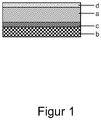
- the product consists of a film (a) and an adhesive (b).
- a primer (c) for improving the adhesion between the adhesive and the backing and a reverse side release (d).
- the carrier (a) consists of a polyester film having a thickness of 50 microns.
- the adhesive (b) contains a mixture of natural rubber and of various resins and may optionally also contain plasticizers, fillers and anti-aging agents.
- Particularly preferred embodiments show an adhesive tape with a film carrier having a thickness between 30 and 55 .mu.m, preferably 36 and 50 .mu.m of polyester such as polyethylene terephthalate, on which a natural rubber adhesive (that is, at least 50%) of the natural rubber to the elastomers forming the adhesive is applied , Further preferably, a carbamate release is applied to the open carrier side opposite the adhesive.
- a film carrier having a thickness between 30 and 55 .mu.m, preferably 36 and 50 .mu.m of polyester such as polyethylene terephthalate, on which a natural rubber adhesive (that is, at least 50%) of the natural rubber to the elastomers forming the adhesive is applied , Further preferably, a carbamate release is applied to the open carrier side opposite the adhesive.
- the invention describes the use of an adhesive tape which is used to form a splice between two webs, in particular between two film webs.
- it is also suitable as an adhesive tape for closing windings made of paper or metal webs.
- the splicing is preferably carried out by the adhesive tape half glued over the end of the uppermost layer of a roll that substantially half of the (self) adhesive, seen in the width of the adhesive tape, for bonding with the other railway end is available.
- the adhesive tape is glued according to a preferred variant so that the adhesive tape rests on equal parts on the two web ends.
- the adhesive tape is excellently able to absorb and counteract the transverse / shear forces acting on the adhesive tape without the wearer stretching.
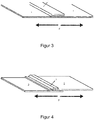
- the adhesive tape 1 is shown in the formation of a butted splice to produce an endless sheet of film.
- two film web ends 2, 3, which abut directly against one another, are connected by means of the adhesive tape 1 such that the adhesive tape overlaps both edges of the film web ends 2, 3.
- the film web ends 2, 3 continue left to left or right "endless", until the next splice is required to connect the local film web ends with the next film web.
- the tensile forces F shown in the transverse direction, which act on the splice.
- the adhesive tape 1, and here in particular the carrier must be dimensioned so that these tensile forces can be absorbed and transmitted without the adhesive tape 1 failing adhesively and without the wearer being torn.
- the adhesive tape 1 is shown in the formation of an overlapping splice.
- the film web ends 2, 3 overlap so that the adhesive tape 1 is applied parallel to the end edge of the upper web 2 so that the adhesive tape 1 is glued both on the tail of the upper web 2 and at the same time on a Section on the underlying web 3.
- the overlapping edge is located under the adhesive tape 1.
- the adhesive tape 1 must be designed such that it can absorb the tensile forces F which act in the transverse direction of the adhesive tape, without causing a failure.
- FIG. 1 In the FIG. 1 is shown in cross section (cross-section) the adhesive tape, which consists of a film carrier 10, on one side of a layer of a self-adhesive coating 12 is applied.
- Dercolyte S 115 is a ⁇ -pinene-based terpene resin.
- Dertophene T 110 is a terpene phenolic resin.
- Erkazit 165 is a zinc resinate.
- the adhesive tape has the following properties:
- the adhesive tape adheres well to films of all kinds such as PE, PP, PET (high bond strength).
- the adhesive of the adhesive tape is shear strength enough to provide a splice of second film tabs which are overlapped with the adhesive tape adhered to the overlap such that the machine direction of the adhesive tape is parallel to the overlap for periods greater than 3 days, preferably more than 7 days to fix. Then the test is stopped without a failure.
- the adhesive tape withstands the temperature range from - 20 ° C to + 50 ° C (heat resistance) under transport conditions.
- the tape has a very high tensile strength so that it can withstand the forces involved in the formation of a splice. The tape does not stretch too much.
- template adhesive Measure order [g / sqm] Carrier / thickness [ ⁇ m] Time to failure [h A SIS 100 PET 36 ⁇ m 6 B SIS 100 PET 50 ⁇ m 5 B Acrylic 50 PET 50 ⁇ m 11 C Acrylic 50 PET 36 ⁇ m 15 D Acrylic 30 PET 36 ⁇ m 10 e NRA 30 PET 36 ⁇ m > 72 F NRB 30 PET 36 ⁇ m > 72 G NRB 30 PET 50 ⁇ m > 72 H NRB 50 PET 50 ⁇ m > 72
- the "time to failure" has been determined by the method of measuring transverse shear strength.
- Adhesive tapes A to D show a satisfactory behavior.
- the shear strength is sufficient to withstand the tension of forming a splice for at least several hours.
- Extremely excellent work the patterns E to H (the latter is the pattern shown in Example 1).
- the measurements are (unless otherwise stated) at a test climate of 23 ⁇ 1 ° C and 50 ⁇ 5% rel. Humidity carried out.
- the determination of the bond strength was carried out as follows.
- As a defined primer galvanized steel sheet with a thickness of 2 mm (supplied by Rocholl GmbH) was used.
- the glued surface element to be examined was cut to a width of 20 mm and a length of about 25 cm, provided with a handling section and immediately thereafter pressed five times with a steel roller of 4 kg at a feed rate of 10 m / min on the selected primer.
- the glued surface element was removed at an angle of 180 ° from the primer with a tensile tester (Zwick) and measured the force required for this at room temperature. The measured value (in N / cm) was the average of three individual measurements.
- the thickness is measured according to DIN 53370.
- the tensile elongation behavior is tested in the machine direction (MD, direction of travel) unless otherwise specified.
- the tensile strength is in MP and the elongation at break in% expressed; both values are measured according to DIN 53455-7-5.
- the test results, in particular the elongation at break (elongation at break), must be statistically verified by a sufficient number of measurements.
- the 1% or 10% elongation is determined according to DIN 53455-7-5 in the longitudinal direction.
- a 3 cm wide strip from the corresponding foil is wrapped around two cylinders and as in FIG. 2 Pictured connected with a tape, so that a loop is formed.
- the ends of the film are arranged in abutment so that the bond area on each side of the joint is 3 cm x 15 cm.
- the construct is hung on a steel rod and loaded over the lower cylinder with a weight of 20 kg. It is the time to open the loop, so measured the complete failure of the tape.
Landscapes
- Chemical & Material Sciences (AREA)
- Organic Chemistry (AREA)
- Chemical Kinetics & Catalysis (AREA)
- Adhesive Tapes (AREA)
- Adhesives Or Adhesive Processes (AREA)
Claims (9)
- Utilisation d'une bande adhésive pour la liaison de deux bandes (épissage), notamment pour la liaison de deux bandes en forme de film, comprenant un support en un film, sur lequel un matériau adhésif à base de caoutchouc naturel ou de synthèse est appliqué d'un côté,
le film étant un film orienté biaxialement en polypropylène, polyéthylène ou polyester tel que le PET, et une couche anti-adhérente, notamment à base de carbamate, étant présente sur le côté du support non revêtu avec le matériau adhésif. - Utilisation selon la revendication 1, caractérisée en ce que le rapport d'étirage lors de l'étirage du film (notamment en cas de films en PE et PP) dans la direction longitudinale est de 1:5 à 1:9, de préférence de 1:6 à 1:7,5, de manière particulièrement préférée de 1:6 à 1:6,5 et/ou
le rapport d'étirage lors de l'étirage du film (notamment en cas de films en PE et PP) dans la direction transversale est de 1:5 à 1:10, de manière particulièrement préférée de 1:6 à 1:7. - Utilisation selon la revendication 1, caractérisée en ce que le rapport d'étirage lors de l'étirage du film (notamment en cas de films en PET) dans la direction longitudinale (sens machine) est de 1:3,5 à 1:6, de préférence de 1:4 à 1:5, et/ou
le rapport d'étirage lors de l'étirage du film (également notamment en cas de films en PET) dans la direction transversale est de 3,5 à 1:6, de préférence de 1:4 à 1:5, et/ou
le rapport d'étirage lors de l'étirage du film (notamment en cas de films en PET) dans la direction longitudinale et dans la direction transversale est identique. - Utilisation selon au moins l'une quelconque des revendications 1 à 3, caractérisée en ce que la bande adhésive comprend des matériaux de renforcement fibreux tels que par exemple des filaments ou un tissu ou une nappe de filaments, qui sont appliqués directement sur le film, introduits dans le film ou introduits dans le matériau adhésif.
- Utilisation selon au moins l'une quelconque des revendications précédentes, caractérisée en ce que la bande adhésif comprend un support en film d'une épaisseur comprise entre 30 et 55 µm, de préférence entre 36 et 50 µm.
- Utilisation selon au moins l'une quelconque des revendications précédentes, caractérisée en ce qu'un promoteur d'adhésion est appliqué entre le support et la couche de matériau adhésif.
- Utilisation selon au moins l'une quelconque des revendications précédentes, caractérisée en ce que le matériau adhésif est choisi dans le groupe constitué par les caoutchoucs naturels ou les mélanges de caoutchoucs naturels et de caoutchoucs de synthèse.
- Utilisation selon au moins l'une quelconque des revendications précédentes, caractérisée en ce que le matériau adhésif contient des résines adhésives, de préférence à base de résines hydrocarbonées hydrogénées, partiellement hydrogénées ou non hydrogénées, de terpène-phénols et d'esters de colophane.
- Utilisation selon au moins l'une quelconque des revendications précédentes, caractérisée en ce que le matériau adhésif contient au moins un agent protecteur anti-UV et/ou d'autres composants de mélange, notamment des plastifiants, des agents antivieillissement, des adjuvants d'usinage, des charges, des colorants, des azurants optiques, des stabilisateurs, des résines renforçantes à séquences terminales.
Applications Claiming Priority (2)
| Application Number | Priority Date | Filing Date | Title |
|---|---|---|---|
| DE102014206349.3A DE102014206349A1 (de) | 2014-04-02 | 2014-04-02 | Klebeband |
| PCT/EP2014/076679 WO2015149889A1 (fr) | 2014-04-02 | 2014-12-05 | Bande adhésive |
Publications (2)
| Publication Number | Publication Date |
|---|---|
| EP3126463A1 EP3126463A1 (fr) | 2017-02-08 |
| EP3126463B1 true EP3126463B1 (fr) | 2018-05-16 |
Family
ID=52101299
Family Applications (1)
| Application Number | Title | Priority Date | Filing Date |
|---|---|---|---|
| EP14812168.4A Not-in-force EP3126463B1 (fr) | 2014-04-02 | 2014-12-05 | Bande adhésive |
Country Status (6)
| Country | Link |
|---|---|
| US (2) | US20150284599A1 (fr) |
| EP (1) | EP3126463B1 (fr) |
| CA (1) | CA2873563A1 (fr) |
| DE (1) | DE102014206349A1 (fr) |
| MX (1) | MX2015000977A (fr) |
| WO (1) | WO2015149889A1 (fr) |
Families Citing this family (18)
| Publication number | Priority date | Publication date | Assignee | Title |
|---|---|---|---|---|
| DE102008021247A1 (de) * | 2008-04-28 | 2009-10-29 | Tesa Se | Klebeband für den Rollenwechsel von Flachbahnmaterialien |
| US10792896B2 (en) * | 2014-07-14 | 2020-10-06 | Bell Helicopter Textron Inc. | Method for limiting interlaminar fatigue in composite laminate and a component incorporating the same |
| WO2017070434A1 (fr) * | 2015-10-21 | 2017-04-27 | Intertape Polymer Corp. | Ruban pour conduits comprenant un système adhésif multi-couche |
| DE102015222282A1 (de) * | 2015-11-12 | 2017-05-18 | Tesa Se | Klebeband und seine Verwendung |
| CN107201198B (zh) * | 2017-06-27 | 2018-08-17 | 阜南县力韦包装材料有限公司 | 一种粘结性能好耐热型透明胶 |
| US20190031923A1 (en) | 2017-07-26 | 2019-01-31 | 3M Innovative Properties Company | Backing for adhesive tape with thermal resistance |
| US9909035B1 (en) * | 2017-09-29 | 2018-03-06 | Mayapple Baby Llc | Mountable articles, dual-adhesive-adhesive tape and mounting methods using them |
| DE102017124540A1 (de) * | 2017-10-20 | 2017-12-07 | Martin Gebuhr | Lichtquellenabdeckelement |
| DE102017221759B3 (de) * | 2017-12-04 | 2018-11-15 | Tesa Se | Verwendung eines Klebebands zur gelenkigen Verbindung von Plattenelementen |
| EP3766153A4 (fr) | 2018-03-15 | 2021-12-15 | Corning Research & Development Corporation | Épissure de parcours extérieur |
| CN111171748A (zh) * | 2020-01-08 | 2020-05-19 | 天津市四方圆包装制品有限公司 | 一种高强度胶带的制备方法及高强度胶带 |
| US11569006B1 (en) | 2021-08-20 | 2023-01-31 | Tesa Se | Cover for a cable harness with different color layers |
| CN114262576B (zh) * | 2021-12-31 | 2023-04-04 | 太仓金煜电子材料有限公司 | 一种漫反射型激光扫描标贴胶带及其制备方法和应用 |
| IT202200009716A1 (it) * | 2022-05-11 | 2023-11-11 | Magri Maurizio | Composizioni per la produzione industriale di nastri adesivi in poliestere noisy e low noisy per imballi su supporto bopet con pet riciclato |
| CN115097671B (zh) * | 2022-07-11 | 2024-09-10 | 恒玮电子材料(昆山)有限公司 | 一种拼接式口字胶及口字胶制备方法 |
| WO2024044809A1 (fr) * | 2022-08-29 | 2024-03-07 | Peter Coles | Bande conçue pour être utilisée avec un pare-brise de véhicule automobile |
| DE102023134469A1 (de) * | 2023-12-08 | 2025-06-12 | Tesa Se | Klebeband für den fliegenden Rollenwechsel von Flachbahn-Material |
| EP4632028A1 (fr) | 2024-04-08 | 2025-10-15 | Tesa Se | Ruban adhésif |
Family Cites Families (35)
| Publication number | Priority date | Publication date | Assignee | Title |
|---|---|---|---|---|
| US2750315A (en) * | 1949-04-29 | 1956-06-12 | Permacel Tape Corp | Pressure-sensitive adhesive strapping tape |
| DE1504523A1 (de) * | 1959-04-01 | 1969-05-08 | Minnesota Mining & Mfg | Zweiachsig orientierter Polypropylenfilm |
| US3787531A (en) | 1969-04-04 | 1974-01-22 | Minnesota Mining & Mfg | Pressure-sensitive adhesives comprising a block copolymer and a tackifier |
| DE2339892C3 (de) * | 1972-09-08 | 1981-03-12 | Toray Industries, Inc., Tokyo | Mit den Fingern zerreißbarer Klebstreifen |
| US4011358A (en) * | 1974-07-23 | 1977-03-08 | Minnesota Mining And Manufacturing Company | Article having a coextruded polyester support film |
| GB1579872A (en) * | 1977-03-08 | 1980-11-26 | Ucb Sa | Cylindrical container body for packaging pressurised and nonpressurised materials |
| DE2828673A1 (de) * | 1978-06-30 | 1980-01-03 | Beiersdorf Ag | Streckbarer, einvulkanisierbarer klebefilm |
| DE2845541C3 (de) | 1978-10-19 | 1981-04-02 | Beiersdorf Ag, 2000 Hamburg | Verfahren zur Herstellung von klebstoffabweisenden Beschichtungen auf flächigem, blatt- oder bahnförmigen Material |
| US4325087A (en) * | 1980-02-29 | 1982-04-13 | Minnesota Mining And Manufacturing Company | Magnetic marker for locating a splice within magnetic tape |
| US4413080A (en) * | 1982-06-21 | 1983-11-01 | Minnesota Mining And Manufacturing Co. | Water-dispersible pressure-sensitive adhesive and tape made therewith |
| JPS6042804A (ja) * | 1983-08-18 | 1985-03-07 | Hitachi Maxell Ltd | 磁気記録媒体及び磁気記録媒体用磁性粉末 |
| US4599260A (en) * | 1985-01-23 | 1986-07-08 | Minnesota Mining And Manufacturing Company | Directly printable tape with novel release coating |
| US4675582A (en) | 1985-12-24 | 1987-06-23 | E. I. Du Pont De Nemours And Company | System useful for controlling multiple synchronous secondaries of a linear motor along an elongated path |
| DE3624921A1 (de) * | 1986-07-23 | 1988-01-28 | Beiersdorf Ag | Klebeband |
| US5072493A (en) | 1988-06-22 | 1991-12-17 | E. I. Du Pont De Nemours And Company | Apparatus for drawing plastic film in a tenter frame |
| DE4034134A1 (de) * | 1990-10-26 | 1992-04-30 | Hoechst Ag | Beidseitig siegelbare, biaxial orientierte polyolefin-mehrschichtfolie mit erhoehtem schrumpf |
| US5145718A (en) * | 1991-03-26 | 1992-09-08 | Minnesota Mining And Manufacturing Company | Processs for producing pressure-sensitive adhesive tape |
| US5595804A (en) * | 1994-08-22 | 1997-01-21 | Minnesota Mining And Manufacturing Company | Splice means, a method of splicing an abrasive article with same and the spliced abrasive article formed thereby |
| WO1997029625A1 (fr) * | 1996-02-20 | 1997-08-21 | American Tape Company | Systeme adhesif a trois couches pour courroie de fixation renforcee |
| DE19824071A1 (de) * | 1998-05-29 | 1999-12-02 | Beiersdorf Ag | Verfahren zur Herstellung von Haftklebemassen aus Naturkautschuklatex und damit hergestellte Klebebänder und Etiketten |
| US6797375B1 (en) * | 1998-11-12 | 2004-09-28 | 3M Innovative Properties Company | Oriented polypropylene films for adhesive tape |
| DE19955610A1 (de) * | 1999-11-19 | 2001-06-21 | Beiersdorf Ag | Klebeband |
| DE10036705A1 (de) * | 2000-07-27 | 2002-03-28 | Tesa Ag | Klebeband insbesondere zu Verpackungszwecken |
| DE10116438A1 (de) * | 2001-04-02 | 2002-10-10 | Tesa Ag | Selbstklebefolie zum Schutz von Fahrzeuglacken |
| DE10132534A1 (de) | 2001-07-09 | 2003-01-30 | Tesa Ag | Biaxial verstreckte Klebebänder und Verfahren zu deren Herstellung |
| DE10137620A1 (de) * | 2001-08-03 | 2003-09-11 | Tesa Ag | Klebeband insbesondere zu Verpackungszwecken |
| DE10206123A1 (de) | 2002-02-14 | 2003-09-04 | Wacker Chemie Gmbh | Organopolysiloxan/Polyharnstoff/Polyurethan-Blockcopolymer aufweisende textile Gebilde |
| US6919405B2 (en) * | 2002-12-31 | 2005-07-19 | 3M Innovative Properties Company | Release compositions and articles made therefrom |
| US6921729B2 (en) * | 2002-12-31 | 2005-07-26 | 3M Innovative Properties Company | Adhesive tape |
| US20080113140A1 (en) * | 2006-11-09 | 2008-05-15 | Scapa North America | Idler roller adhesive tape |
| US7816023B2 (en) * | 2007-12-21 | 2010-10-19 | Imation Corp. | Magnetic recording tape having large particles in magnetic recording layer |
| JP5551088B2 (ja) * | 2008-01-22 | 2014-07-16 | テーザ・ソシエタス・ヨーロピア | 特に接着テープ用の支持フィルムおよびその使用 |
| WO2009133175A1 (fr) * | 2008-04-30 | 2009-11-05 | Tesa Se | Bande adhésive |
| DE102011009510A1 (de) * | 2011-01-26 | 2012-07-26 | Tesa Se | Klebeband, das insbesondere zur Transportsicherung eingesetzt werden kann |
| US20190218423A1 (en) * | 2015-12-14 | 2019-07-18 | 3M Innovative Properties Company | Polylactic acid polymer based film comprising an adhesive layer |
-
2014
- 2014-04-02 DE DE102014206349.3A patent/DE102014206349A1/de not_active Withdrawn
- 2014-12-05 WO PCT/EP2014/076679 patent/WO2015149889A1/fr not_active Ceased
- 2014-12-05 CA CA2873563A patent/CA2873563A1/fr not_active Abandoned
- 2014-12-05 EP EP14812168.4A patent/EP3126463B1/fr not_active Not-in-force
-
2015
- 2015-01-21 MX MX2015000977A patent/MX2015000977A/es unknown
- 2015-03-31 US US14/673,975 patent/US20150284599A1/en not_active Abandoned
-
2016
- 2016-10-11 US US15/290,388 patent/US10738225B2/en not_active Expired - Fee Related
Non-Patent Citations (1)
| Title |
|---|
| None * |
Also Published As
| Publication number | Publication date |
|---|---|
| US20150284599A1 (en) | 2015-10-08 |
| MX2015000977A (es) | 2015-12-04 |
| CA2873563A1 (fr) | 2015-10-02 |
| US20170029666A1 (en) | 2017-02-02 |
| DE102014206349A1 (de) | 2015-10-08 |
| US10738225B2 (en) | 2020-08-11 |
| WO2015149889A1 (fr) | 2015-10-08 |
| EP3126463A1 (fr) | 2017-02-08 |
Similar Documents
| Publication | Publication Date | Title |
|---|---|---|
| EP3126463B1 (fr) | Bande adhésive | |
| EP2274390B1 (fr) | Bande adhésive | |
| EP2888329B1 (fr) | Ruban adhésif de cerclage | |
| DE102008026672A1 (de) | Klebstoff aus Polypropylenharz | |
| DE102011089331A1 (de) | Klebebandsystem zur Bildung eines Aufreißstreifens | |
| DE102016212483A1 (de) | Gewebeklebeband | |
| DE102015217376A1 (de) | Haftklebstoff auf Basis EPDM | |
| EP3105297A1 (fr) | Ruban adhesif | |
| EP1311645B1 (fr) | Bande adhesive, notamment pour emballage | |
| EP2313468A1 (fr) | Bande adhésive de cerclage | |
| US20120171916A1 (en) | High tensile strength adhesive tape | |
| WO2018154103A1 (fr) | Ruban adhésif | |
| DE102017221759B3 (de) | Verwendung eines Klebebands zur gelenkigen Verbindung von Plattenelementen | |
| DE102017203068A1 (de) | Klebeband | |
| EP3173452B1 (fr) | Bande adhésive et son utilisation | |
| EP2089488A1 (fr) | Matériau support notamment pour un ruban adhésif à support textile, ce support textile étant revêtu par extrusion d'un film plastique | |
| DE102019211874B4 (de) | Klebeband zum Umwickeln von Kabeln und Verwendung | |
| DE102008026670A1 (de) | Klebstoff aus isotaktischem 1-Butenharz | |
| EP1404773A1 (fr) | Ruban adhesif destin en particulier l'emballage | |
| DE10223631A1 (de) | Handeinreißbares Klebeband mit einer weiterreißbaren Folie als Trägermaterial | |
| DE102008036933A1 (de) | Verfahren zur Herstellung von stark klebrigen Haftklebebändern für das Bauwesen | |
| WO2008110481A1 (fr) | Matière auto-adhésive à base d'une dispersion copolymère - butadiène/méthylméthacrylate, à base aqueuse réticulée par dihydrazide | |
| DE102020208549A1 (de) | Verfahren zur Herstellung von Klebebandtellerrollen | |
| DE202017003329U1 (de) | Klebeband und Folie | |
| DE202017003330U1 (de) | Klebeband und Folie |
Legal Events
| Date | Code | Title | Description |
|---|---|---|---|
| STAA | Information on the status of an ep patent application or granted ep patent |
Free format text: STATUS: THE INTERNATIONAL PUBLICATION HAS BEEN MADE |
|
| PUAI | Public reference made under article 153(3) epc to a published international application that has entered the european phase |
Free format text: ORIGINAL CODE: 0009012 |
|
| STAA | Information on the status of an ep patent application or granted ep patent |
Free format text: STATUS: REQUEST FOR EXAMINATION WAS MADE |
|
| 17P | Request for examination filed |
Effective date: 20161102 |
|
| AK | Designated contracting states |
Kind code of ref document: A1 Designated state(s): AL AT BE BG CH CY CZ DE DK EE ES FI FR GB GR HR HU IE IS IT LI LT LU LV MC MK MT NL NO PL PT RO RS SE SI SK SM TR |
|
| AX | Request for extension of the european patent |
Extension state: BA ME |
|
| DAX | Request for extension of the european patent (deleted) | ||
| GRAP | Despatch of communication of intention to grant a patent |
Free format text: ORIGINAL CODE: EPIDOSNIGR1 |
|
| STAA | Information on the status of an ep patent application or granted ep patent |
Free format text: STATUS: GRANT OF PATENT IS INTENDED |
|
| INTG | Intention to grant announced |
Effective date: 20171204 |
|
| GRAS | Grant fee paid |
Free format text: ORIGINAL CODE: EPIDOSNIGR3 |
|
| GRAA | (expected) grant |
Free format text: ORIGINAL CODE: 0009210 |
|
| STAA | Information on the status of an ep patent application or granted ep patent |
Free format text: STATUS: THE PATENT HAS BEEN GRANTED |
|
| AK | Designated contracting states |
Kind code of ref document: B1 Designated state(s): AL AT BE BG CH CY CZ DE DK EE ES FI FR GB GR HR HU IE IS IT LI LT LU LV MC MK MT NL NO PL PT RO RS SE SI SK SM TR |
|
| REG | Reference to a national code |
Ref country code: GB Ref legal event code: FG4D Free format text: NOT ENGLISH |
|
| REG | Reference to a national code |
Ref country code: CH Ref legal event code: EP |
|
| REG | Reference to a national code |
Ref country code: IE Ref legal event code: FG4D Free format text: LANGUAGE OF EP DOCUMENT: GERMAN |
|
| REG | Reference to a national code |
Ref country code: DE Ref legal event code: R096 Ref document number: 502014008307 Country of ref document: DE |
|
| REG | Reference to a national code |
Ref country code: AT Ref legal event code: REF Ref document number: 999542 Country of ref document: AT Kind code of ref document: T Effective date: 20180615 |
|
| REG | Reference to a national code |
Ref country code: NL Ref legal event code: FP |
|
| REG | Reference to a national code |
Ref country code: LT Ref legal event code: MG4D |
|
| PG25 | Lapsed in a contracting state [announced via postgrant information from national office to epo] |
Ref country code: ES Free format text: LAPSE BECAUSE OF FAILURE TO SUBMIT A TRANSLATION OF THE DESCRIPTION OR TO PAY THE FEE WITHIN THE PRESCRIBED TIME-LIMIT Effective date: 20180516 Ref country code: SE Free format text: LAPSE BECAUSE OF FAILURE TO SUBMIT A TRANSLATION OF THE DESCRIPTION OR TO PAY THE FEE WITHIN THE PRESCRIBED TIME-LIMIT Effective date: 20180516 Ref country code: BG Free format text: LAPSE BECAUSE OF FAILURE TO SUBMIT A TRANSLATION OF THE DESCRIPTION OR TO PAY THE FEE WITHIN THE PRESCRIBED TIME-LIMIT Effective date: 20180816 Ref country code: FI Free format text: LAPSE BECAUSE OF FAILURE TO SUBMIT A TRANSLATION OF THE DESCRIPTION OR TO PAY THE FEE WITHIN THE PRESCRIBED TIME-LIMIT Effective date: 20180516 Ref country code: NO Free format text: LAPSE BECAUSE OF FAILURE TO SUBMIT A TRANSLATION OF THE DESCRIPTION OR TO PAY THE FEE WITHIN THE PRESCRIBED TIME-LIMIT Effective date: 20180816 Ref country code: LT Free format text: LAPSE BECAUSE OF FAILURE TO SUBMIT A TRANSLATION OF THE DESCRIPTION OR TO PAY THE FEE WITHIN THE PRESCRIBED TIME-LIMIT Effective date: 20180516 |
|
| PG25 | Lapsed in a contracting state [announced via postgrant information from national office to epo] |
Ref country code: GR Free format text: LAPSE BECAUSE OF FAILURE TO SUBMIT A TRANSLATION OF THE DESCRIPTION OR TO PAY THE FEE WITHIN THE PRESCRIBED TIME-LIMIT Effective date: 20180817 Ref country code: HR Free format text: LAPSE BECAUSE OF FAILURE TO SUBMIT A TRANSLATION OF THE DESCRIPTION OR TO PAY THE FEE WITHIN THE PRESCRIBED TIME-LIMIT Effective date: 20180516 Ref country code: LV Free format text: LAPSE BECAUSE OF FAILURE TO SUBMIT A TRANSLATION OF THE DESCRIPTION OR TO PAY THE FEE WITHIN THE PRESCRIBED TIME-LIMIT Effective date: 20180516 Ref country code: RS Free format text: LAPSE BECAUSE OF FAILURE TO SUBMIT A TRANSLATION OF THE DESCRIPTION OR TO PAY THE FEE WITHIN THE PRESCRIBED TIME-LIMIT Effective date: 20180516 |
|
| PG25 | Lapsed in a contracting state [announced via postgrant information from national office to epo] |
Ref country code: RO Free format text: LAPSE BECAUSE OF FAILURE TO SUBMIT A TRANSLATION OF THE DESCRIPTION OR TO PAY THE FEE WITHIN THE PRESCRIBED TIME-LIMIT Effective date: 20180516 Ref country code: CZ Free format text: LAPSE BECAUSE OF FAILURE TO SUBMIT A TRANSLATION OF THE DESCRIPTION OR TO PAY THE FEE WITHIN THE PRESCRIBED TIME-LIMIT Effective date: 20180516 Ref country code: PL Free format text: LAPSE BECAUSE OF FAILURE TO SUBMIT A TRANSLATION OF THE DESCRIPTION OR TO PAY THE FEE WITHIN THE PRESCRIBED TIME-LIMIT Effective date: 20180516 Ref country code: DK Free format text: LAPSE BECAUSE OF FAILURE TO SUBMIT A TRANSLATION OF THE DESCRIPTION OR TO PAY THE FEE WITHIN THE PRESCRIBED TIME-LIMIT Effective date: 20180516 Ref country code: EE Free format text: LAPSE BECAUSE OF FAILURE TO SUBMIT A TRANSLATION OF THE DESCRIPTION OR TO PAY THE FEE WITHIN THE PRESCRIBED TIME-LIMIT Effective date: 20180516 Ref country code: SK Free format text: LAPSE BECAUSE OF FAILURE TO SUBMIT A TRANSLATION OF THE DESCRIPTION OR TO PAY THE FEE WITHIN THE PRESCRIBED TIME-LIMIT Effective date: 20180516 |
|
| REG | Reference to a national code |
Ref country code: CH Ref legal event code: PK Free format text: BERICHTIGUNGEN |
|
| RIC2 | Information provided on ipc code assigned after grant |
Ipc: C09J 7/02 20060101AFI20151012BHEP |
|
| REG | Reference to a national code |
Ref country code: DE Ref legal event code: R097 Ref document number: 502014008307 Country of ref document: DE |
|
| PG25 | Lapsed in a contracting state [announced via postgrant information from national office to epo] |
Ref country code: SM Free format text: LAPSE BECAUSE OF FAILURE TO SUBMIT A TRANSLATION OF THE DESCRIPTION OR TO PAY THE FEE WITHIN THE PRESCRIBED TIME-LIMIT Effective date: 20180516 |
|
| PLBE | No opposition filed within time limit |
Free format text: ORIGINAL CODE: 0009261 |
|
| STAA | Information on the status of an ep patent application or granted ep patent |
Free format text: STATUS: NO OPPOSITION FILED WITHIN TIME LIMIT |
|
| 26N | No opposition filed |
Effective date: 20190219 |
|
| PG25 | Lapsed in a contracting state [announced via postgrant information from national office to epo] |
Ref country code: SI Free format text: LAPSE BECAUSE OF FAILURE TO SUBMIT A TRANSLATION OF THE DESCRIPTION OR TO PAY THE FEE WITHIN THE PRESCRIBED TIME-LIMIT Effective date: 20180516 |
|
| REG | Reference to a national code |
Ref country code: CH Ref legal event code: PL |
|
| PG25 | Lapsed in a contracting state [announced via postgrant information from national office to epo] |
Ref country code: LU Free format text: LAPSE BECAUSE OF NON-PAYMENT OF DUE FEES Effective date: 20181205 Ref country code: MC Free format text: LAPSE BECAUSE OF FAILURE TO SUBMIT A TRANSLATION OF THE DESCRIPTION OR TO PAY THE FEE WITHIN THE PRESCRIBED TIME-LIMIT Effective date: 20180516 |
|
| REG | Reference to a national code |
Ref country code: IE Ref legal event code: MM4A |
|
| REG | Reference to a national code |
Ref country code: BE Ref legal event code: MM Effective date: 20181231 |
|
| PG25 | Lapsed in a contracting state [announced via postgrant information from national office to epo] |
Ref country code: IE Free format text: LAPSE BECAUSE OF NON-PAYMENT OF DUE FEES Effective date: 20181205 Ref country code: IT Free format text: LAPSE BECAUSE OF NON-PAYMENT OF DUE FEES Effective date: 20181205 |
|
| PG25 | Lapsed in a contracting state [announced via postgrant information from national office to epo] |
Ref country code: AL Free format text: LAPSE BECAUSE OF FAILURE TO SUBMIT A TRANSLATION OF THE DESCRIPTION OR TO PAY THE FEE WITHIN THE PRESCRIBED TIME-LIMIT Effective date: 20180516 Ref country code: BE Free format text: LAPSE BECAUSE OF NON-PAYMENT OF DUE FEES Effective date: 20181231 |
|
| PG25 | Lapsed in a contracting state [announced via postgrant information from national office to epo] |
Ref country code: CH Free format text: LAPSE BECAUSE OF NON-PAYMENT OF DUE FEES Effective date: 20181231 Ref country code: LI Free format text: LAPSE BECAUSE OF NON-PAYMENT OF DUE FEES Effective date: 20181231 |
|
| PG25 | Lapsed in a contracting state [announced via postgrant information from national office to epo] |
Ref country code: MT Free format text: LAPSE BECAUSE OF FAILURE TO SUBMIT A TRANSLATION OF THE DESCRIPTION OR TO PAY THE FEE WITHIN THE PRESCRIBED TIME-LIMIT Effective date: 20180516 |
|
| PG25 | Lapsed in a contracting state [announced via postgrant information from national office to epo] |
Ref country code: TR Free format text: LAPSE BECAUSE OF FAILURE TO SUBMIT A TRANSLATION OF THE DESCRIPTION OR TO PAY THE FEE WITHIN THE PRESCRIBED TIME-LIMIT Effective date: 20180516 |
|
| PG25 | Lapsed in a contracting state [announced via postgrant information from national office to epo] |
Ref country code: PT Free format text: LAPSE BECAUSE OF FAILURE TO SUBMIT A TRANSLATION OF THE DESCRIPTION OR TO PAY THE FEE WITHIN THE PRESCRIBED TIME-LIMIT Effective date: 20180516 |
|
| PG25 | Lapsed in a contracting state [announced via postgrant information from national office to epo] |
Ref country code: MK Free format text: LAPSE BECAUSE OF NON-PAYMENT OF DUE FEES Effective date: 20180516 Ref country code: CY Free format text: LAPSE BECAUSE OF FAILURE TO SUBMIT A TRANSLATION OF THE DESCRIPTION OR TO PAY THE FEE WITHIN THE PRESCRIBED TIME-LIMIT Effective date: 20180516 Ref country code: HU Free format text: LAPSE BECAUSE OF FAILURE TO SUBMIT A TRANSLATION OF THE DESCRIPTION OR TO PAY THE FEE WITHIN THE PRESCRIBED TIME-LIMIT; INVALID AB INITIO Effective date: 20141205 |
|
| PG25 | Lapsed in a contracting state [announced via postgrant information from national office to epo] |
Ref country code: IS Free format text: LAPSE BECAUSE OF FAILURE TO SUBMIT A TRANSLATION OF THE DESCRIPTION OR TO PAY THE FEE WITHIN THE PRESCRIBED TIME-LIMIT Effective date: 20180916 |
|
| REG | Reference to a national code |
Ref country code: AT Ref legal event code: MM01 Ref document number: 999542 Country of ref document: AT Kind code of ref document: T Effective date: 20191205 |
|
| PG25 | Lapsed in a contracting state [announced via postgrant information from national office to epo] |
Ref country code: AT Free format text: LAPSE BECAUSE OF NON-PAYMENT OF DUE FEES Effective date: 20191205 |
|
| PGFP | Annual fee paid to national office [announced via postgrant information from national office to epo] |
Ref country code: NL Payment date: 20221222 Year of fee payment: 9 Ref country code: GB Payment date: 20221223 Year of fee payment: 9 Ref country code: FR Payment date: 20221222 Year of fee payment: 9 Ref country code: DE Payment date: 20220620 Year of fee payment: 9 |
|
| REG | Reference to a national code |
Ref country code: DE Ref legal event code: R119 Ref document number: 502014008307 Country of ref document: DE |
|
| REG | Reference to a national code |
Ref country code: NL Ref legal event code: MM Effective date: 20240101 |
|
| GBPC | Gb: european patent ceased through non-payment of renewal fee |
Effective date: 20231205 |
|
| PG25 | Lapsed in a contracting state [announced via postgrant information from national office to epo] |
Ref country code: NL Free format text: LAPSE BECAUSE OF NON-PAYMENT OF DUE FEES Effective date: 20240101 |
|
| PG25 | Lapsed in a contracting state [announced via postgrant information from national office to epo] |
Ref country code: NL Free format text: LAPSE BECAUSE OF NON-PAYMENT OF DUE FEES Effective date: 20240101 |
|
| PG25 | Lapsed in a contracting state [announced via postgrant information from national office to epo] |
Ref country code: DE Free format text: LAPSE BECAUSE OF NON-PAYMENT OF DUE FEES Effective date: 20240702 |
|
| PG25 | Lapsed in a contracting state [announced via postgrant information from national office to epo] |
Ref country code: GB Free format text: LAPSE BECAUSE OF NON-PAYMENT OF DUE FEES Effective date: 20231205 |
|
| PG25 | Lapsed in a contracting state [announced via postgrant information from national office to epo] |
Ref country code: FR Free format text: LAPSE BECAUSE OF NON-PAYMENT OF DUE FEES Effective date: 20231231 |
|
| PG25 | Lapsed in a contracting state [announced via postgrant information from national office to epo] |
Ref country code: GB Free format text: LAPSE BECAUSE OF NON-PAYMENT OF DUE FEES Effective date: 20231205 Ref country code: FR Free format text: LAPSE BECAUSE OF NON-PAYMENT OF DUE FEES Effective date: 20231231 Ref country code: DE Free format text: LAPSE BECAUSE OF NON-PAYMENT OF DUE FEES Effective date: 20240702 |