EP3127273B1 - Puce cryptographique et procédés associés - Google Patents
Puce cryptographique et procédés associés Download PDFInfo
- Publication number
- EP3127273B1 EP3127273B1 EP14714990.0A EP14714990A EP3127273B1 EP 3127273 B1 EP3127273 B1 EP 3127273B1 EP 14714990 A EP14714990 A EP 14714990A EP 3127273 B1 EP3127273 B1 EP 3127273B1
- Authority
- EP
- European Patent Office
- Prior art keywords
- rule
- chip
- cryptographic
- module
- key
- Prior art date
- Legal status (The legal status is an assumption and is not a legal conclusion. Google has not performed a legal analysis and makes no representation as to the accuracy of the status listed.)
- Active
Links
Images


Classifications
-
- H—ELECTRICITY
- H04—ELECTRIC COMMUNICATION TECHNIQUE
- H04L—TRANSMISSION OF DIGITAL INFORMATION, e.g. TELEGRAPHIC COMMUNICATION
- H04L9/00—Cryptographic mechanisms or cryptographic arrangements for secret or secure communications; Network security protocols
- H04L9/08—Key distribution or management, e.g. generation, sharing or updating, of cryptographic keys or passwords
- H04L9/0894—Escrow, recovery or storing of secret information, e.g. secret key escrow or cryptographic key storage
- H04L9/0897—Escrow, recovery or storing of secret information, e.g. secret key escrow or cryptographic key storage involving additional devices, e.g. trusted platform module [TPM], smartcard or USB
-
- G—PHYSICS
- G06—COMPUTING OR CALCULATING; COUNTING
- G06F—ELECTRIC DIGITAL DATA PROCESSING
- G06F21/00—Security arrangements for protecting computers, components thereof, programs or data against unauthorised activity
- G06F21/60—Protecting data
- G06F21/602—Providing cryptographic facilities or services
-
- H—ELECTRICITY
- H04—ELECTRIC COMMUNICATION TECHNIQUE
- H04L—TRANSMISSION OF DIGITAL INFORMATION, e.g. TELEGRAPHIC COMMUNICATION
- H04L9/00—Cryptographic mechanisms or cryptographic arrangements for secret or secure communications; Network security protocols
- H04L9/08—Key distribution or management, e.g. generation, sharing or updating, of cryptographic keys or passwords
- H04L9/088—Usage controlling of secret information, e.g. techniques for restricting cryptographic keys to pre-authorized uses, different access levels, validity of crypto-period, different key- or password length, or different strong and weak cryptographic algorithms
-
- H—ELECTRICITY
- H04—ELECTRIC COMMUNICATION TECHNIQUE
- H04L—TRANSMISSION OF DIGITAL INFORMATION, e.g. TELEGRAPHIC COMMUNICATION
- H04L9/00—Cryptographic mechanisms or cryptographic arrangements for secret or secure communications; Network security protocols
- H04L9/14—Cryptographic mechanisms or cryptographic arrangements for secret or secure communications; Network security protocols using a plurality of keys or algorithms
-
- H—ELECTRICITY
- H04—ELECTRIC COMMUNICATION TECHNIQUE
- H04L—TRANSMISSION OF DIGITAL INFORMATION, e.g. TELEGRAPHIC COMMUNICATION
- H04L9/00—Cryptographic mechanisms or cryptographic arrangements for secret or secure communications; Network security protocols
- H04L9/30—Public key, i.e. encryption algorithm being computationally infeasible to invert or user's encryption keys not requiring secrecy
- H04L9/3006—Public key, i.e. encryption algorithm being computationally infeasible to invert or user's encryption keys not requiring secrecy underlying computational problems or public-key parameters
- H04L9/302—Public key, i.e. encryption algorithm being computationally infeasible to invert or user's encryption keys not requiring secrecy underlying computational problems or public-key parameters involving the integer factorization problem, e.g. RSA or quadratic sieve [QS] schemes
-
- H—ELECTRICITY
- H04—ELECTRIC COMMUNICATION TECHNIQUE
- H04L—TRANSMISSION OF DIGITAL INFORMATION, e.g. TELEGRAPHIC COMMUNICATION
- H04L9/00—Cryptographic mechanisms or cryptographic arrangements for secret or secure communications; Network security protocols
- H04L9/30—Public key, i.e. encryption algorithm being computationally infeasible to invert or user's encryption keys not requiring secrecy
- H04L9/3066—Public key, i.e. encryption algorithm being computationally infeasible to invert or user's encryption keys not requiring secrecy involving algebraic varieties, e.g. elliptic or hyper-elliptic curves
-
- H—ELECTRICITY
- H04—ELECTRIC COMMUNICATION TECHNIQUE
- H04L—TRANSMISSION OF DIGITAL INFORMATION, e.g. TELEGRAPHIC COMMUNICATION
- H04L9/00—Cryptographic mechanisms or cryptographic arrangements for secret or secure communications; Network security protocols
- H04L9/32—Cryptographic mechanisms or cryptographic arrangements for secret or secure communications; Network security protocols including means for verifying the identity or authority of a user of the system or for message authentication, e.g. authorization, entity authentication, data integrity or data verification, non-repudiation, key authentication or verification of credentials
- H04L9/3247—Cryptographic mechanisms or cryptographic arrangements for secret or secure communications; Network security protocols including means for verifying the identity or authority of a user of the system or for message authentication, e.g. authorization, entity authentication, data integrity or data verification, non-repudiation, key authentication or verification of credentials involving digital signatures
- H04L9/3249—Cryptographic mechanisms or cryptographic arrangements for secret or secure communications; Network security protocols including means for verifying the identity or authority of a user of the system or for message authentication, e.g. authorization, entity authentication, data integrity or data verification, non-repudiation, key authentication or verification of credentials involving digital signatures using RSA or related signature schemes, e.g. Rabin scheme
-
- H—ELECTRICITY
- H04—ELECTRIC COMMUNICATION TECHNIQUE
- H04L—TRANSMISSION OF DIGITAL INFORMATION, e.g. TELEGRAPHIC COMMUNICATION
- H04L2209/00—Additional information or applications relating to cryptographic mechanisms or cryptographic arrangements for secret or secure communication H04L9/00
- H04L2209/12—Details relating to cryptographic hardware or logic circuitry
Definitions
- the present invention relates to a cryptographic chip and related methods.
- the present invention relates to a chip for performing cryptographic operations, a chip-implemented method of performing a cryptographic operation, and a method of loading a new rule into a rule storage module of a chip.
- the broadcast delivery of digital content often uses scrambling of the broadcast stream to protect the content against unauthorised viewing.
- the key to scramble and descramble the broadcast stream is called a Control Word (CW).
- a Conditional Access (CA) or Digital Rights Management (DRM) system implements the selective distribution of the CWs to authorised receivers only.
- CA Conditional Access
- DRM Digital Rights Management
- a common attack uses the fact that a CW is a shared key that unlocks content on all receivers. An adversary can break part of the key delivery infrastructure to obtain CWs and can re-distribute these keys to unauthorised receivers. This CW sharing attack is prevented by securing the delivery of a CW to a descrambling and decoding chip set.
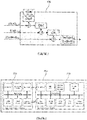
- FIG. 1 A typical receiver diagram is illustrated schematically in Figure 1 .
- the exemplary chip set 100 of Figure 1 uses symmetric cryptographic algorithms, but it is also possible to use public-key cryptography for securely delivering CWs to a descrambling and decoding chip set.
- the chip manufacturer personalizes the descrambling and decoding chip set 100 with a pseudo-random value for the Chip Set Unique Key (CSUK) and assigns a value to the Chip Set Serial Number (CSSN).
- the CSUK is the most valuable asset of a chip set since this is the key from which all other keys are derived.
- the manufacturer supplies a list of (CSSN, CSUK) pairs to a CA/DRM supplier, enabling the loading of a value of the Chip Set Load Key (CSLK) into a particular chip set.
- the CSLK is supplied to the chip set 100 in encrypted form, and may only be decrypted using the CSUK of the chip set 100.
- the CSLK is used to securely load a CW into the chip set 100, as depicted in Figure 1 .
- the CW is supplied to the chip set 100 in encrypted form, and may only be decrypted using the CSLK of the chip set 100. Subsequently, the CW may be used to decrypt encrypted content supplied to the chip set 100.
- FIG. 1 is a schematic diagram of some typical components in such a SoC 200.
- FIG. 2 schematically illustrates the architecture of a SoC 200 including a secured processor module 210 and an application processor module 220.
- the secured processor module 210 includes secured memory modules, such as key registers, SRAM, ROM and one-time programmable (OTP) memory.
- the secured processor module 210 also includes cryptographic components such as Data Encryption Standard (DES) and Advanced Encryption Standard (AES) modules.
- the secured processor module 210 also includes a random number generator, a private CPU and custom hardware modules. There is also a serial link for communicating with a serial link of the application processor module 220.
- the application processor module 220 includes a main CPU, functional modules and memory modules (e.g. ROM and SRAM).
- the application processor module 220 also includes a content decryption module to directly receive CWs from the key registers of the secured processor module 210.
- the private CPU in the secured processor module 210 is initialised with firmware to (a) receive an encrypted input message from the application processor module 220 via a serial link, (b) retrieve the keys indicated in the input message from the key registers, (c) set up the AES/DES module to process the encrypted parts of the input message, (d) retrieve the result, and (e) to send a content decryption key (i.e. a CW) to the content decryption module of the application processor module 220.
- the keys are stored and used entirely within the secured processor module 210. There is no component in the application processor module 220 that can directly access the internal data within the secured processor module 210.
- the resulting CW is transmitted using a dedicated data path to the content decryption module that cannot be read or modified by the main CPU of the application processor module 220.
- the manufacturer can implement most proprietary security functions using dedicated firmware in the application processor module 220 and/or the secured processor module 210. However, for some very specific proprietary security functions, an implementation using custom hardware may be necessary; hence the custom hardware modules in the secured processor module 210. During the manufacturing process the custom hardware modules can be enabled selectively, as described in PCT/EP2012/004267 filed on 10 October 2012 .
- a device in US 2010/0189262 A1 , includes a key store memory that stores one or more cryptographic keys.
- a rule set memory stores a set of rules for accessing the cryptographic keys.
- a key store arbitration module grants access to the cryptographic keys in accordance with the set of rules.
- the device can be used in conjunction with a key ladder.
- the device can include a one-time programmable memory and a load module that transfers the cryptographic keys from the one one-time programmable memory to the key store memory and the set of rules to the rule set memory.
- a validation module can validate the cryptographic keys and the set of rules stored in the key store and rule set memories, based on a signature defined by a signature rule.
- the main goal of a proprietary key loading module is to secure the implementation against reverse engineering attacks.
- One way to achieve this is by preventing the private CPU in the secured processor module from accessing data in the key registers of the secured processor module.
- the threat models for known secured processor modules do not consider attacks that modify the firmware of the secured processor modules. Such attacks may exploit errors in any of the components in the secured processor module (e.g. private CPU, SRAM, or ROM) or they may aim to modify the functionality of some of the secured processor module components. With such types of attacks, the keys in the secured processor module may become observable via the public interface. Thus, there is a need for a secured processor module which is less vulnerable to such attacks.
- the present invention seeks to provide a cryptographic chip and associated methods which provide various advantages over those of the prior art.
- the chip and associated methods of the present invention aim to shield sensitive symmetric block-cipher operations from the direct access by a General Purpose Processor (GPP) on the chip.
- GPP General Purpose Processor
- the present invention aids in removing the risks by disallowing the GPP to access clear-keys, and by simplifying the interface for cryptographic operations by clustering them according to rules.
- the present invention uses a mixture of software and hardware shielding keys and cryptographic operations.
- This mixture aims to close the aforementioned vulnerability gap by using rule-based access-control and separation-of-concerns when handling keys and cryptographic operations.
- a chip for performing cryptographic operations comprises a key storage module, a rule storage module, an interface module and a cryptographic module.
- the key storage module is configured to store one or more cryptographic keys.
- the rule storage module is configured is to store one or more rules, each rule comprising respective rule data, the rule data identifying a respective predetermined cryptographic operation associated with the rule and further identifying at least one of the one or more cryptographic keys to be used in the respective predetermined cryptographic operation.
- the interface module is configured to receive a rule execution request, wherein the rule execution request comprises a rule identifier to identify a specific rule of the one or more rules to be executed.
- the cryptographic module is configured to execute the specific rule so as to perform the respective predetermined cryptographic operation in response to the rule execution request.
- the chip is configured such that the cryptographic keys and the cryptographic module may only be used by executing rules from the one or more rules in response to associated rule execution requests received by the interface module.
- a set top box comprising the chip of the first aspect.
- a chip-implemented method of performing a cryptographic operation comprises a key storage module and a rule storage module.
- the key storage module is configured to store one or more cryptographic keys.
- the rule storage module is configured to store one or more rules, each rule comprising respective rule data, the rule data identifying a respective predetermined cryptographic operation associated with the rule and further identifying at least one of the one or more cryptographic keys to be used in the respective predetermined cryptographic operation.
- the method comprises: (i) receiving a rule execution request, wherein the rule execution request comprises a rule identifier to identify a specific rule of the one or more rules to be executed; and (ii) using a cryptographic module to execute the specific rule so as to perform the respective predetermined cryptographic operation in response to the rule execution request.
- the chip is configured such that the cryptographic keys and the cryptographic module may only be used by executing rules from the one or more rules in response to associated rule execution requests.
- FIG. 3 shows a chip 300 for performing cryptographic operations in accordance with one embodiment of the invention.
- the chip comprises an interface module 310, a key storage module 320, a rule storage module 330 and a cryptographic module 340.
- the key storage module 320 is configured to store one or more cryptographic keys K 1 , K 2 , ...K n .
- the rule storage module 330 is configured to store one or more rules R 1 ,R 2 , ...R n .
- the labels R 1 ,R 2 , ...R n in Figure 3 may be considered to be "rule identifiers" (or “rule tags") used to identify each rule.
- Each rule R i comprises respective rule data that identifies a respective predetermined cryptographic operation X Ri associated with the rule and further identifies at least one key K Ri of the one or more cryptographic keys to be used in the respective predetermined cryptographic operation X Ri .
- the interface module 310 is configured to receive a rule execution request 350 which includes a rule identifier R j to identify a specific rule of the one or more rules to be executed.
- the cryptographic module 340 is configured to execute the specific rule R j so as to perform the respective predetermined cryptographic operation X Rj in response to the rule execution request 350.
- the chip is configured such that the cryptographic keys K and the cryptographic module 340 may only be used by executing rules from the one or more rules R in response to associated rule execution requests 350 received by the interface module 310.
- the interface module 310 effectively controls operations involving the key storage module 320, the rule storage module 330 and the cryptographic module 340.
- the interface module 310 provides indirect access to the key storage module 320, the rule storage module 330 and the cryptographic module 340 on the basis of rule execution requests 350 received by the interface module 310.
- the interface module 310 blocks direct external access (e.g. by a main CPU or GPP) to the key storage module 320, the rule storage module 330 and the cryptographic module 340.
- the cryptographic module 340 is not directly coupled to a general purpose bus (not shown) of the chip 300, but may only be accessed via the interface module 310.
- neither keys K in the key storage module 320 nor rules R in the rule storage module 330 are directly accessible through physical memory-addresses. Instead, the rules are addressed by the rule identifiers R i , and the keys are addressed by key identifiers (or "key tags") K i . Notably, since the key identifiers are used to identify the various keys, each key identifier is unique. Similarly, each rule identifier is unique. Since a rule execution request 350 includes a rule identifier to identify the rule to be executed, and since each rule is associated with both a respective predetermined cryptographic operation and at least one respective key, this places limitations on how the cryptographic module may be used, i.e. the chip 300 enforces regular (i.e.
- the architecture of the chip 300 defines specific ways in which the cryptographic module 340 is allowed to be used. Each rule defines a prescribed or allowed operation of the cryptographic module 340 and cryptographic keys. In other words, there are "positive constraints” stating what is allowed: the cryptographic module 340 may only be used as specified in the rules R stored in the rule storage module 300. This is in contrast to alternative implementations which might define ways in which the chip 300 or cryptographic module 340 is not allowed to be used (i.e. the use of "negative constraints” stating what is not allowed). The use of positive constraints makes the chip 300 much harder to attack since negative constraints may have unforeseen loopholes, whereas positive constraints explicitly define exactly what is allowed.
- the interface module 310, the key storage module 320, the rule storage module 330 and the cryptographic module 340 are all typically included in a secured module 370 of the chip 300, such as a secured processor module similar to secured processor module 210 of SoC 200.
- Other circuitry 380 may optionally be included on the chip 300, such that the chip 300 may be configured to perform other functionality in addition to the functionality provided by the secured module 370.
- the secured module 370 may be controlled (i.e. interfaced) from this other functionality of the other circuitry 380.
- the other circuitry 380 may include an application processor module similar to the application processor module 320 of SoC 200.
- rule execution requests 350 may originate from the other circuitry 380, or may originate externally from the chip, as shown in Figure 3 .
- the key storage module 320 and the rule storage module 330 may be distinct from one another. Alternatively, at least part of the key storage module 320 and at least part of the rule storage module 330 may form part of the same memory.
- the cryptographic module 340 is operatively coupled to the interface module 310 so as to be able to respond as necessary to rule execution requests 350 received by the interface module 310.
- the cryptographic module 340 is also operatively coupled to the key storage module 320 and the rule storage module 330 so as enable the cryptographic module 340 to select the appropriate cryptographic operation(s) X and the appropriate cryptographic key(s) K for use. Such operative couplings may be direct or indirect.
- the cryptographic module 340 is capable of performing at least one cryptographic operation X.
- a cryptographic operation generally involves transforming input data into output data by means of the cryptographic operation and a key.
- the cryptographic operation may involve one or more of encryption, decryption, cryptographic hashing, digital signature generation, digital signature verification, Message Authentication Code (MAC) generation, MAC verification, etc., where such cryptographic operations are well known to those skilled in the art.
- the cryptographic module 340 may encrypt or decrypt the input data using one or more of the stored cryptographic keys K, thereby providing encrypted or decrypted output data.
- the cryptographic module 340 is capable of performing a number of different cryptographic operations X.
- the cryptographic module 340 may only be capable of performing a single cryptographic operation X.
- the key storage module 320 is configured to store one or more cryptographic keys K 1 ,K 2 , ...K n .
- the key storage module 320 is a key memory module or key cache.
- the key storage module 320 preferably comprises first and second key storage submodules 321 and 322, as shown in Figure 3A .
- the first key storage submodule 321 is programmable, such that it may be used to store at least one further key of the one or more cryptographic keys.
- the first key storage submodule 321 is a writable memory component and may include, for example, one or more latches or one or more writable registers.
- the "writable" property of the first key storage submodule 321 means that the first key storage submodule 321 is a volatile memory component.
- the second key storage submodule 322 includes one or more pre-programmed keys of the one or more cryptographic keys.
- the second key storage submodule 322 may include a pre-programmed or hardwired memory component.
- the second key storage submodule 322 may include a memory component which loads keys automatically from OTP memory automatically after Power-On Reset (PoR) of the chip 300.
- PoR Power-On Reset
- the second key storage submodule 322 is used to store those keys requiring a high level of security relative to the keys stored in the first key storage submodule 321.
- the second key storage submodule 322 would be used to store the CSUK of the chip 300.
- the key storage module 320 may be implemented by means of one or more registers.
- a register provides a small amount of storage available as part of a CPU or other digital processor. Registers are normally at the top of the memory hierarchy, and provide the fastest way to access data. If the second key storage submodule 322 is implemented by means of one or more registers, then these registers may be seen as "constant value registers" since the high-security keys of the second key storage submodule 322 are hardwired or automatically filled with the OTP secrets after PoR.
- the first key storage submodule 321 may include one or more writable registers.
- the keys K may be stored in an encrypted format in the key storage module 320.
- encrypted keys may be decrypted using the cryptographic module 340 as and when they are required for particular cryptographic operations X.
- clear keys may be stored in the key storage module 320.
- the chip 300 is configured to load a new key K new into the first key storage submodule 321 by executing a key-derivation rule R KD of the one or more rules R.
- the key-derivation rule R KD is arranged to provide the new key K new as output data from the respective predetermined cryptographic operation X RKD .
- the key-derivation rule R KD is arranged to store the output data (i.e. the new key K new ) in the first key storage module 321.
- the rule data for the key-derivation rule R KD should also provide a respective key identifier K new for the new key.
- the key storage module 320 has an array data structure, where each element of the array relates to a respective key.
- each element of the array includes the respective key identifier and key value.
- Each element of the array may further include a respective security flag for the key (e.g. low security for programmable keys in the first key storage submodule 321, and high security for pre-programed keys in the second key storage submodule 322).
- each security flag bit is hardwired to provide additional security.
- Each element of the array may further include a respective initialisation flag for the key (i.e. initialised or not initialised). Hardwired keys in the second key storage submodule 322 are always initialised.
- keys in the second key storage submodule 322 may be initialised at boot time of the chip 300 (i.e. after PoR of the chip 300). Keys in the first key storage submodule 321 may or may not be initialised. A key K new in the first key storage submodule 321 may be initialised following execution of the associated key-derivation rule R KD . In other words, execution of a key-derivation rule R KD defines and saves a new key K new to the first key storage submodule 321, and this new key K new becomes initialised following execution of that key-derivation rule R KD .
- the rule storage module 330 is configured to store one or more rules R 1 ,R 2 , ...R n .
- the rule storage module 330 is a file or memory module for storing rules R, thereby defining allowed usage of the various keys K stored in the key storage module 320.
- the rule storage module 330 preferably comprises first and second rule storage submodules 331 and 332, as shown in Figure 3B .
- the first rule storage submodule 331 is programmable, such that it may be used to store at least one further rule of the one or more rules.
- the first rule storage submodule 331 is a writable memory component and may include, for example, one or more latches or one or more writable registers.
- the "writable" property of the first rule storage submodule 331 means that the first rule storage submodule 331 is a volatile memory component.
- the second rule storage submodule 332 includes one or more pre-programmed rules of the one or more rules.
- the second rule storage submodule 332 is a pre-programmed or hardwired memory component.
- the second rule storage submodule 332 may be a memory component which loads rule automatically from OTP memory automatically after Power-On Reset (PoR) of the chip 300.
- PoR Power-On Reset
- the second rule storage submodule 332 is used to store those rules requiring a high level of security relative to the rules stored in the first rule storage submodule 331.
- the second rule storage submodule 332 would be used to store rules which use the CSUK.
- the rule storage module 330 has an array data structure, where each element of the array is a respective rule.
- the number of rules R in the rule storage module 330 is limited by the size of the array. In general it is independent of the number of keys K, since multiple rules R can coexist for a single key K.
- each rule R i comprises respective rule data which identifies a respective predetermined cryptographic operation X Ri associated with the rule and further identifies at least one of the one or more cryptographic keys K Ri to be used in the respective predetermined cryptographic operation.
- the rule data for each rule R i may include at least one of the following:
- the rule data for each rule R i does not include information concerning key values or memory contents.
- Hardwired rules in the second rule storage submodule 332 are always initialised.
- Other rules in the second rule storage submodule 322 e.g. rules which load automatically from OTP memory automatically after PoR
- Rules in the first rule storage submodule 331 may or may not be initialised. Further detail regarding initialisation of rules is given below.
- the interface module 310 is further configured to assess whether the rule execution request 350 is allowable.
- the cryptographic module 340 is configured to execute the specific rule R j so as to perform the respective predetermined cryptographic operation only in response to the rule execution request 350 having been assessed as allowable by the interface module 310.
- the chip 300 may be configured to execute a security incident procedure in response to the rule execution request 350 having been assessed as not allowable by the interface module 310.
- the interface module 310 may also be configured to receive a rule loading request 360.
- the rule loading request 360 comprises a new rule identifier R new to identify a new rule to be loaded.
- the rule loading request 360 further comprises new rule data defining the new rule.
- the new rule data identifies a specific cryptographic operation X new associated with the new rule and further identifies at least one key K new of the one or more cryptographic keys K to be used in the specific cryptographic operation X new .
- the chip 300 is configured to load the new rule R new into the first rule storage submodule 331 such that the new rule R new becomes one of the one or more rules R.
- the new rule R new is initialised in the first rule storage submodule 331.
- this embodiment provides a mechanism for loading new rules into the writable portion of the rule storage module 330.
- the interface module 310 is further configured to assess whether the rule loading request 360 is allowable.
- the chip 300 is configured to load the new rule R new into the first rule storage submodule 331 only in response to the rule loading request 360 having been assessed as allowable by the interface module 310.
- the chip 300 may be configured to execute a security incident procedure in response to the rule loading request 360 having been assessed as not allowable by the interface module 310.
- the method 400 comprises, at step S410, receiving a rule execution request 350, wherein the rule execution request 350 comprises a rule identifier R j to identify a specific rule of the one or more rules to be executed.
- the cryptographic module 340 is used to execute the specific rule R j so as to perform the respective predetermined cryptographic operation X Rj in response to the rule execution request 350.
- the chip 300 is configured such that the cryptographic keys K and the cryptographic module 340 may only be used by executing rules from the one or more rules R in response to associated rule execution requests 350.
- Step S415 An advantageous implementation of the method 400 is shown in Figure 4B .
- the method 400 after receiving a rule execution request in step S410, there is an additional step S415 of assessing whether the rule execution request 350 is allowable. If the rule execution request 350 is assessed as allowable, the method 400 returns to step S420 and the cryptographic module is used to execute the specific rule R j so as to perform the respective predetermined cryptographic operation X Rj .
- a security incident procedure is executed at step S425.
- Step S425 is optional but advantageous, in that it increases security.
- the execution of a rule in step S420 is an atomic operation; that is to say that the execution of the rule will either succeed or fail.
- the rule execution may not be split up into separate operations such as: "key load”, “load input”, “execute”, and “store output”, because these would make the execution non-atomic.
- the loading of a rule in step S530 is an atomic operation.
- step S415 various checks may be carried out. For example, it may be checked whether the rule to be executed is initialised. Only initialised rules may be executed. Therefore, if the rule execution request 350 relates to a non-initialised rule, then the rule execution request 350 is deemed not allowable and the method 400 proceeds to execute the security incident procedure in step S425.
- the various data locations specified in the rule data may be checked to ensure that they are allowable. In particular, it is desirable to check the input data location, the output data location, and the cryptographic key location. For example, a key identifier which specifies a non-initialised key would not be allowable.
- rule execution request 350 relates to disallowed data locations (either individually or when they are combined), then the rule execution request 350 is deemed not allowable and the method 400 proceeds to execute the security incident procedure in step S425.
- An example of allowed and disallowed data location combinations is given in Table 1 below where HS stands for "high security” and LS stands for "low security”. Additional/alternative checks may be performed as desired.
- the method 500 comprises, at step S510, receiving a rule loading request 360.
- the rule loading request 360 comprises a new rule identifier R new to identify the new rule to be loaded, and further comprises new rule data defining the new rule.
- the new rule data identifies a specific cryptographic operation X Rnew associated with the new rule and further identifies at least one key K Rnew of the one or more cryptographic keys to be used in the specific cryptographic operation X Rnew .
- the method 500 assesses whether the rule loading request 360 is allowable.
- the new rule R new is loaded into the first rule storage submodule 331 (i.e. the programmable portion) of the rule storage module 330 such that the new rule R new becomes one of the one or more rules R.
- the method 500 further comprises, in response to the rule loading request having been assessed as not allowable, executing a security incident procedure at step S540.
- step S520 various checks may be carried out. For example, it may be checked whether the new rule is to be loaded into the first rule storage module 331 (i.e. the programmable portion) or the second rule storage module 332 (i.e. the pre-programmed portion). New rules are only allowed to be loaded into the first rule storage module 331 for security reasons. Therefore, if the rule loading request 360 relates to a new rule to be loaded into the second rule storage module 332, then the rule loading request 360 is deemed not allowable and the method 500 proceeds to execute the security incident procedure in step S540. This may occur where the new rule identifier R new relates to a rule in the second rule storage module 332.
- the new rule is to be loaded is already initialised. If the rule loading request 360 relates to a rule which is already initialised, then the rule loading request 360 is deemed not allowable and the method 500 proceeds to execute the security incident procedure in step S540. This may occur where the new rule identifier R new relates to a rule in the first rule storage module 331 that has already been initialised. It may alternatively/additionally be checked whether the new rule includes any fields (e.g. source, destination, key identifier) having a high level of security. New rules to be loaded into the first rule storage module 331 implicitly have a lower level of security than pre-programmed rules in the second rule storage module 332.
- fields e.g. source, destination, key identifier
- the new rule data specifies use of a high security key from the second key storage submodule 322 (e.g. the CSUK of the chip 300), then the rule loading request 360 is deemed not allowable and the method 500 proceeds to execute the security incident procedure in step S540.
- the second key storage submodule 322 e.g. the CSUK of the chip 300
- the usage of the secured module 370 of the chip 300 is restricted to requests 350 to execute specific rules or requests 360 to load new rules. No other usage of the secured module 370 is allowed.
- access to the cryptographic module 340 is only by means of a rule execution request 350 submitted via the interface module 310.
- the chip 300 therefore enforces regular, predetermined, rule-based, normal, expected usage of the cryptographic module 340. If the chip 300 detects an irregular, unknown, abnormal, unexpected usage request, a security incident procedure is executed.
- the security incident procedure is stored in non-volatile memory (e.g. ROM).
- the security incident procedure may be configured to clear the first key storage submodule 321 and the first rule storage submodule 331 (i.e. the writable portions of the key storage module 320 and the rule storage module 330) by means of hardware lines designated for this purpose.
- the security incident procedure may be able to purge the contents of first key storage submodule 321 and the first rule storage submodule by means of setting a bit in a special purpose register, where setting of this bit is hardwired to clear the volatile memories.
- This implementation is advantageous in that it uses a hardware implementation in preference to a software loop.
- the security incident procedure may be configured to require a cold reset of the chip 300 to enable the secured module 370 of the chip 300 to become operational once again.
- the cryptographic module 340 is an AES module.
- the interface module 310 comprises a command register 311 and a status register 312, as shown in Figure 3C .
- the command register 311 is writable from outside the secured module 370 of the chip 300, whereas the status register 312 is only readable from outside the secured module 370 of the chip 300.
- the command register 311 is used for two purposes, namely for loading a new rule into the first rule storage submodule 331, and for executing any existing rule from the rule storage module 330.
- the command register 311 consists of three fields: rule identifier, rule action and rule payload.
- Rule identifier, or rule tag, e.g. R 34 ) identifies the rule.
- Rule action enumerates the action; this is either loading or executing the relevant rule.
- the rule payload is linked to the rule action. If the rule action is "loading a new rule”, then the rule payload bit encodes the new rule. If the rule action is "executing a rule”, then the rule payload bit encodes the number of AES blocks of the associated input data.
- the status register 312 has two main fields: a status field and a report field.
- the status field may enumerate one of four possible states after a rule has been submitted.
- the report field may provide details regarding the enumerated state in more detail.
- the first possible state for the status field is "idle”, indicating that the command register 311 can be immediately used. Following previous use of the command register 311, the "idle” state further indicates that the previous issued command has been successfully completed.
- the second possible state for the status field is "busy”, indicating that one must wait for "idle” before using the command register 311.
- the third possible state for the status field is "unused", indicating a hardware implementation problem, and further indicating instigation of a "panic” mode, (e.g. following use of a security incident procedure).
- the fourth possible state for the status field is "error", indicating that the previous issued command generated an error, and resulted in use of a security incident procedure. Again, a "panic" mode may be instigated in this case.
- the first operation in the pseudo-sequence is necessary in order to handle re-entrant code.
- the second operation in the pseudo-sequence is the standard operation.
- the third operation in the pseudo-sequence serves as the conditional synchronization over the second operation completion.
- a preferred structure of the array of the rule storage module 330 includes the following fields: source, key identifier, destination, chaining mode, encrypt/decrypt, key length, and mulit-block.
- the source field may specify a particular special purpose register from a selection of allowable special purpose registers.
- One or more of the allowable special purpose registers may be accessible from outside the secured module 370 of the chip 300.
- One or more of the allowable special purpose registers may not be accessible from outside the secured module 370 of the chip 300.
- the key identifier field is self-explanatory and specifies the key identifier(s) of the cryptographic key(s) to be used in the respective predetermined cryptographic operation.
- the key identifier field may specify a special purpose register accessible from outside the secured module 370 of the chip 300 so that a user-specified key may be used in the respective predetermined cryptographic operation.
- the destination field may specify a particular key identifier (if the rule is a key-derivation rule), or a particular special purpose register, or a descrambler.
- the chaining mode field specifies a particular AES chaining mode (e.g. ECB, CBC, PBCB, etc.).
- the encrypt/decrypt field specifies whether the AES module is to be used for encryption or decryption.
- the key length field specifies the AES key length (i.e. 128 bits, or 192 bits, or 256 bits).
- the multiblock field specifies whether the rule applies to multiple AES blocks or not. Other fields may also be included as required. Whether or not a rule has been initialised is implicit from the data stored in each element of the array.
- embodiments of the invention may be implemented using a variety of different information processing systems.
- the figures and the discussion thereof provide an exemplary computing system and methods, these are presented merely to provide a useful reference in discussing various aspects of the invention.
- Embodiments of the invention may be carried out on any suitable data processing device, such as a personal computer, laptop, personal digital assistant, mobile telephone, set top box, television, server computer, etc.
- any suitable data processing device such as a personal computer, laptop, personal digital assistant, mobile telephone, set top box, television, server computer, etc.
- the description of the systems and methods has been simplified for purposes of discussion, and they are just one of many different types of system and method that may be used for embodiments of the invention.
- the boundaries between logic blocks are merely illustrative and that alternative embodiments may merge logic blocks or elements, or may impose an alternate decomposition of functionality upon various logic blocks or elements.
- the above-mentioned functionality may be implemented as one or more corresponding modules as hardware and/or software.
- the above-mentioned functionality may be implemented as one or more software components for execution by a processor of the system.
- the above-mentioned functionality may be implemented as hardware, such as on one or more field-programmable-gate-arrays (FPGAs), and/or one or more application-specific-integrated-circuits (ASICs), and/or one or more digital-signal-processors (DSPs), and/or other hardware arrangements.
- FPGAs field-programmable-gate-arrays
- ASICs application-specific-integrated-circuits
- DSPs digital-signal-processors
- the computer program may have one or more program instructions, or program code, which, when executed by a computer carries out an embodiment of the invention.
- program as used herein, may be a sequence of instructions designed for execution on a computer system, and may include a subroutine, a function, a procedure, a module, an object method, an object implementation, an executable application, an applet, a servlet, source code, object code, a shared library, a dynamic linked library, and/or other sequences of instructions designed for execution on a computer system.
- the storage medium may be a magnetic disc (such as a hard drive or a floppy disc), an optical disc (such as a CD-ROM, a DVD-ROM or a BluRay disc), or a memory (such as a ROM, a RAM, EEPROM, EPROM, Flash memory or a portable/removable memory device), etc.
- the transmission medium may be a communications signal, a data broadcast, a communications link between two or more computers, etc.
Landscapes
- Engineering & Computer Science (AREA)
- Computer Security & Cryptography (AREA)
- Computer Networks & Wireless Communication (AREA)
- Signal Processing (AREA)
- Theoretical Computer Science (AREA)
- Computing Systems (AREA)
- Physics & Mathematics (AREA)
- General Physics & Mathematics (AREA)
- Pure & Applied Mathematics (AREA)
- Mathematical Physics (AREA)
- Mathematical Optimization (AREA)
- Mathematical Analysis (AREA)
- Algebra (AREA)
- Health & Medical Sciences (AREA)
- Bioethics (AREA)
- General Health & Medical Sciences (AREA)
- Computer Hardware Design (AREA)
- Software Systems (AREA)
- General Engineering & Computer Science (AREA)
- Storage Device Security (AREA)
Claims (17)
- Puce (300) pour effectuer des opérations cryptographiques, la puce comprenant :un module de stockage de clés (320) configuré pour stocker une ou plusieurs clé(s) cryptographique(s) (K1, K2, ..., Kn) ;un module de stockage de règles (330) configuré pour stocker une ou plusieurs règle(s) (R1, R2, ..., Rn), chaque règle (Ri) comprenant des données de règle respectives, les données de règle identifiant une opération cryptographique prédéterminée respective (XRi) associée à la règle et identifiant en outre au moins une (KRi) de la ou des plusieurs clé(s) cryptographique(s) à utiliser dans l'opération cryptographique prédéterminée respective ;un module d'interface (310) configuré pour recevoir (S410) une demande d'exécution de règle (350), où la demande d'exécution de règle comprend un identifiant de règle (Rj) pour identifier une règle spécifique de la ou des plusieurs règle(s) à exécuter ; etun module cryptographique (340) configuré pour exécuter (S420) la règle spécifique afin d'effectuer l'opération cryptographique prédéterminée respective en réponse à la demande d'exécution de règle ;dans laquelle la puce est configurée de sorte que les clés cryptographiques et le module cryptographique ne peuvent être utilisés qu'en exécutant des règles parmi la ou les plusieurs règle(s) en réponse à des demandes d'exécution de règles associées reçues par le module d'interface.
- Puce de la revendication 1, dans laquelle le module d'interface est en outre configuré pour évaluer (S415) si la demande d'exécution de règle est admissible, et dans laquelle le module cryptographique est configuré pour exécuter (S420) la règle spécifique afin d'effectuer l'opération cryptographique prédéterminée respective en réponse au fait que la demande d'exécution de règle a été évaluée comme étant admissible par le module d'interface.
- Puce de la revendication 2, dans laquelle la puce est configurée pour exécuter (S425) une procédure d'incident de sécurité en réponse au fait que la demande d'exécution de règle a été évaluée comme n'étant pas admissible par le module d'interface.
- Puce de l'une des revendications précédentes, dans laquelle le module de stockage de clés comprend un premier sous-module de stockage de clés, le premier sous-module de stockage de clés (321) étant programmable pour stocker au moins une clé supplémentaire de la ou des plusieurs clé(s) cryptographique(s).
- Puce de l'une des revendications précédentes, dans laquelle le module de stockage de clés comprend un deuxième sous-module de stockage de clés (322) comportant une ou plusieurs clé(s) préprogrammée(s) de la ou des plusieurs clé(s) cryptographique(s).
- Puce de l'une des revendications précédentes, dans laquelle le module de stockage de règles comprend un premier sous-module de stockage de règles, le premier sous-module de stockage de règles (331) étant programmable pour stocker au moins une règle supplémentaire de la ou des plusieurs règle(s).
- Puce de la revendication 6, dans laquelle la puce est configurée pour charger une nouvelle clé (Knew) dans le premier sous-module de stockage de clés en exécutant une règle de dérivation de clé de la ou des plusieurs règle(s), où la règle de dérivation de clé est agencée pour fournir ladite nouvelle clé comme données de sortie de l'opération cryptographique prédéterminée respective, et où la règle de dérivation de clé est agencée pour stocker lesdites données de sortie dans le premier module de stockage de clés.
- Puce de la revendication 6 ou 7 :dans laquelle le module d'interface est en outre configuré pour recevoir (S510) une demande de chargement de règle (360), la demande de chargement de règle comprenant un nouvel identifiant de règle (Rnew) pour identifier une nouvelle règle à charger et comprenant en outre de nouvelles données de règle définissant la nouvelle règle, les nouvelles données de règle identifiant une opération cryptographique spécifique (XRnew) associée à la nouvelle règle et identifiant en outre au moins l'une de la ou des plusieurs clé(s) cryptographique (s) (KRnew) à utiliser dans l'opération cryptographique spécifique ; etdans laquelle, en réponse à la demande de chargement de règle, la puce est configurée pour charger (S530) la nouvelle règle dans le premier sous-module de stockage de règles de sorte que la nouvelle règle devienne l'une de la ou des plusieurs règle(s).
- Puce de la revendication 8, dans laquelle le module d'interface est en outre configuré pour évaluer (S520) si la demande de chargement de règle est admissible, et dans laquelle la puce est configurée pour charger (S530) la nouvelle règle dans le premier sous-module de stockage de règles en réponse au fait que la demande de chargement de règle a été évaluée comme étant admissible par le module d'interface.
- Puce de la revendication 9, dans laquelle la puce est configurée pour exécuter (S540) une procédure d'incident de sécurité en réponse au fait que la demande de chargement de règle a été évaluée comme n'étant pas admissible par le module d'interface.
- Puce de l'une des revendications précédentes, dans laquelle le module de stockage de règles comprend un deuxième sous-module de stockage de règles (332) comportant une ou plusieurs règle(s) préprogrammée(s) de la ou des plusieurs règle(s).
- Puce de l'une des revendications précédentes, dans laquelle l'un et/ou l'autre du module de stockage de clés et du module de stockage de règles est/sont implémenté(s) au moyen d'un ou de plusieurs registre(s).
- Puce de l'une des revendications précédentes, dans laquelle les données de règle pour chaque règle comprennent au moins l'une des données suivantes :a) des données identifiant un emplacement de données d'entrée sur lequel l'opération cryptographique prédéterminée respective doit être effectuée ;b) des données identifiant un emplacement pour stocker des données de sortie de l'opération cryptographique prédéterminée respective ;c) des données identifiant un algorithme cryptographique particulier à utiliser dans l'opération cryptographique prédéterminée respective ;d) des données identifiant un mode de fonctionnement de l'algorithme cryptographique particulier à utiliser dans l'opération cryptographique prédéterminée respective ; ete) des données indiquant si l'opération cryptographique prédéterminée respective doit être utilisée pour le cryptage ou le décryptage des données d'entrée.
- Boîtier décodeur comprenant la puce de l'une des revendications précédentes.
- Procédé mis en œuvre par une puce (400) pour effectuer une opération cryptographique, la puce (300) comprenant un module de stockage de clés (320) configuré pour stocker une ou plusieurs clé(s) cryptographique(s) (K1, K2, ..., Kn), la puce comprenant en outre un module de stockage de règles (330) configuré pour stocker une ou plusieurs règle(s) (R1, R2, ..., Rn), chaque règle (Ri) comprenant des données de règle respectives, les données de règle identifiant une opération cryptographique prédéterminée respective (XRi) associée à la règle et identifiant en outre au moins une (KRi) de la ou des plusieurs clé(s) cryptographique(s) à utiliser dans l'opération cryptographique prédéterminée respective, le procédé comprenant les étapes consistant à :(i) recevoir (S410) par un module d'interface de la puce une demande d'exécution de règle (350), où la demande d'exécution de règle comprend un identifiant de règle (Rj) pour identifier une règle spécifique de la ou des plusieurs règle(s) à exécuter ; et(ii) utiliser (S420) un module cryptographique de la puce pour exécuter la règle spécifique afin d'effectuer l'opération cryptographique prédéterminée respective en réponse à la demande d'exécution de règle ;dans lequel la puce est configurée de sorte que les clés cryptographiques et le module cryptographique ne peuvent être utilisés qu'en exécutant des règles parmi la ou les plusieurs règle(s) en réponse à des demandes d'exécution de règles associées reçues par le module d'interface.
- Procédé mis en œuvre par une puce de la revendication 15, dans lequel l'étape (ii) comprend l'évaluation (S415) consistant à savoir si la demande d'exécution de règle est admissible et, en réponse au fait que la demande d'exécution de règle a été évaluée comme étant admissible, l'utilisation (S420) du module cryptographique pour exécuter la règle spécifique afin d'effectuer l'opération cryptographique prédéterminée respective.
- Procédé mis en œuvre par une puce de la revendication 16, comprenant en outre l'étape consistant à :
(iii) exécuter (S425), en réponse au fait que la demande d'exécution de règle a été évaluée comme n'étant pas admissible, une procédure d'incident de sécurité.
Priority Applications (1)
| Application Number | Priority Date | Filing Date | Title |
|---|---|---|---|
| EP20196877.3A EP3771138B1 (fr) | 2014-03-31 | 2014-03-31 | Puce cryptographique et procédés associés |
Applications Claiming Priority (1)
| Application Number | Priority Date | Filing Date | Title |
|---|---|---|---|
| PCT/EP2014/056445 WO2015149836A1 (fr) | 2014-03-31 | 2014-03-31 | Puce cryptographique et procédés associés |
Related Child Applications (1)
| Application Number | Title | Priority Date | Filing Date |
|---|---|---|---|
| EP20196877.3A Division EP3771138B1 (fr) | 2014-03-31 | 2014-03-31 | Puce cryptographique et procédés associés |
Publications (2)
| Publication Number | Publication Date |
|---|---|
| EP3127273A1 EP3127273A1 (fr) | 2017-02-08 |
| EP3127273B1 true EP3127273B1 (fr) | 2020-10-14 |
Family
ID=50434190
Family Applications (2)
| Application Number | Title | Priority Date | Filing Date |
|---|---|---|---|
| EP14714990.0A Active EP3127273B1 (fr) | 2014-03-31 | 2014-03-31 | Puce cryptographique et procédés associés |
| EP20196877.3A Active EP3771138B1 (fr) | 2014-03-31 | 2014-03-31 | Puce cryptographique et procédés associés |
Family Applications After (1)
| Application Number | Title | Priority Date | Filing Date |
|---|---|---|---|
| EP20196877.3A Active EP3771138B1 (fr) | 2014-03-31 | 2014-03-31 | Puce cryptographique et procédés associés |
Country Status (4)
| Country | Link |
|---|---|
| US (1) | US10237065B2 (fr) |
| EP (2) | EP3127273B1 (fr) |
| CN (1) | CN106471766B (fr) |
| WO (1) | WO2015149836A1 (fr) |
Families Citing this family (12)
| Publication number | Priority date | Publication date | Assignee | Title |
|---|---|---|---|---|
| KR102648180B1 (ko) * | 2016-07-19 | 2024-03-18 | 에스케이하이닉스 주식회사 | 메모리 시스템 및 그 동작 방법 |
| DE102016215520A1 (de) * | 2016-08-18 | 2018-02-22 | Siemens Aktiengesellschaft | Verfahren und Anordnung zur gesicherten elektronischen Datenkommunikation |
| DE102018208066A1 (de) * | 2018-05-23 | 2019-11-28 | Robert Bosch Gmbh | Datenverarbeitungseinrichtung und Betriebsverfahren hierfür |
| CN110677250B (zh) | 2018-07-02 | 2022-09-02 | 阿里巴巴集团控股有限公司 | 密钥和证书分发方法、身份信息处理方法、设备、介质 |
| CN110795742B (zh) | 2018-08-02 | 2023-05-02 | 阿里巴巴集团控股有限公司 | 高速密码运算的度量处理方法、装置、存储介质及处理器 |
| CN110795774B (zh) | 2018-08-02 | 2023-04-11 | 阿里巴巴集团控股有限公司 | 基于可信高速加密卡的度量方法、设备和系统 |
| CN110874478B (zh) | 2018-08-29 | 2023-05-02 | 阿里巴巴集团控股有限公司 | 密钥处理方法及装置、存储介质和处理器 |
| EP3622665B1 (fr) | 2019-03-29 | 2021-07-28 | Advanced New Technologies Co., Ltd. | Puce cryptographique avec vérification d'identité |
| AU2019204711B2 (en) | 2019-03-29 | 2020-07-02 | Advanced New Technologies Co., Ltd. | Securely performing cryptographic operations |
| KR20200116010A (ko) | 2019-03-29 | 2020-10-08 | 알리바바 그룹 홀딩 리미티드 | 아이덴티티 정보에 기초한 암호 키 관리 |
| CN114553439B (zh) | 2019-03-29 | 2023-06-30 | 创新先进技术有限公司 | 基于身份信息的加密密钥管理 |
| EP3930254B1 (fr) * | 2020-06-23 | 2023-12-20 | Nxp B.V. | Procédé de réglage d'autorisations de clés cryptographiques, programme informatique et système de traitement cryptographique |
Family Cites Families (35)
| Publication number | Priority date | Publication date | Assignee | Title |
|---|---|---|---|---|
| US6751735B1 (en) * | 1998-03-23 | 2004-06-15 | Novell, Inc. | Apparatus for control of cryptography implementations in third party applications |
| US6757824B1 (en) * | 1999-12-10 | 2004-06-29 | Microsoft Corporation | Client-side boot domains and boot rules |
| US7107462B2 (en) * | 2000-06-16 | 2006-09-12 | Irdeto Access B.V. | Method and system to store and distribute encryption keys |
| GB0413034D0 (en) * | 2004-06-10 | 2004-07-14 | Scient Generics Ltd | Secure workflow engine |
| JP4326443B2 (ja) * | 2004-10-08 | 2009-09-09 | フェリカネットワークス株式会社 | 情報処理装置および情報処理方法、並びにプログラム |
| US7913289B2 (en) * | 2005-05-23 | 2011-03-22 | Broadcom Corporation | Method and apparatus for security policy and enforcing mechanism for a set-top box security processor |
| US8131995B2 (en) * | 2006-01-24 | 2012-03-06 | Vixs Systems, Inc. | Processing feature revocation and reinvocation |
| US7925023B2 (en) * | 2006-03-03 | 2011-04-12 | Oracle International Corporation | Method and apparatus for managing cryptographic keys |
| US20100077230A1 (en) * | 2006-12-15 | 2010-03-25 | Michael Chambers | Protecting a programmable memory against unauthorized modification |
| CN101382963A (zh) * | 2008-03-22 | 2009-03-11 | 中国工程物理研究院电子工程研究所 | 一种密码位置组合授权验证方法及其专用芯片 |
| US9432184B2 (en) * | 2008-09-05 | 2016-08-30 | Vixs Systems Inc. | Provisioning of secure storage for both static and dynamic rules for cryptographic key information |
| US8811497B2 (en) * | 2009-06-24 | 2014-08-19 | Vixs Systems, Inc | Processing system with register arbitration and methods for use therewith |
| US8594333B2 (en) * | 2008-09-05 | 2013-11-26 | Vixs Systems, Inc | Secure key access with one-time programmable memory and applications thereof |
| US9501429B2 (en) * | 2008-09-05 | 2016-11-22 | Vixs Systems Inc. | Dynamic key and rule storage protection |
| US8194858B2 (en) * | 2009-02-19 | 2012-06-05 | Physical Optics Corporation | Chaotic cipher system and method for secure communication |
| US8284945B2 (en) * | 2009-06-02 | 2012-10-09 | Hewlett-Packard Development Company, L.P. | Automatic change of symmetrical encryption key |
| WO2010146139A1 (fr) * | 2009-06-19 | 2010-12-23 | Irdeto B.V. | Système cryptographique structurel avec clé configurable utilisant une modification de données intermédiaire |
| EP2362573A1 (fr) | 2010-02-19 | 2011-08-31 | Irdeto B.V. | Dispositif et procédé pour établir une clé de confiance sécurisée |
| US8675875B2 (en) * | 2010-05-18 | 2014-03-18 | International Business Machines Corporation | Optimizing use of hardware security modules |
| US8995660B2 (en) * | 2010-07-23 | 2015-03-31 | Nippon Telegraph And Telephone Corporation | Cryptographic system, cryptographic communication method, encryption apparatus, key generation apparatus, decryption apparatus, content server, program, and storage medium |
| JP5573489B2 (ja) * | 2010-08-23 | 2014-08-20 | ソニー株式会社 | 情報処理装置、および情報処理方法、並びにプログラム |
| US8942373B2 (en) * | 2010-11-29 | 2015-01-27 | Beijing Z & W Technology Consulting Co., Ltd. | Data encryption and decryption method and apparatus |
| EP2461534A1 (fr) | 2010-12-01 | 2012-06-06 | Irdeto B.V. | Protection de mot de contrôle |
| US9058497B2 (en) * | 2010-12-23 | 2015-06-16 | Microsoft Technology Licensing, Llc | Cryptographic key management |
| US9026805B2 (en) * | 2010-12-30 | 2015-05-05 | Microsoft Technology Licensing, Llc | Key management using trusted platform modules |
| US8891772B2 (en) * | 2011-06-17 | 2014-11-18 | Microsoft Corporation | Cloud key escrow system |
| US9465755B2 (en) * | 2011-07-18 | 2016-10-11 | Hewlett Packard Enterprise Development Lp | Security parameter zeroization |
| US8806602B2 (en) * | 2011-08-15 | 2014-08-12 | Bank Of America Corporation | Apparatus and method for performing end-to-end encryption |
| WO2013060390A1 (fr) | 2011-10-28 | 2013-05-02 | Irdeto B.V. | Traitement de flux de contenus |
| CN104221023B (zh) | 2012-02-17 | 2017-11-03 | 爱迪德技术有限公司 | 用于数字权利管理的方法、装置和系统 |
| CN102932141B (zh) * | 2012-09-27 | 2016-01-06 | 汉柏科技有限公司 | 多加解密芯片并行处理报文加解密的保序方法及系统 |
| EP2779525A1 (fr) * | 2013-03-15 | 2014-09-17 | Thomson Licensing | Dispositifs et procédés de chiffrement sans codage pour chiffrement sur courbes elliptiques |
| WO2014184894A1 (fr) * | 2013-05-15 | 2014-11-20 | 三菱電機株式会社 | Système de chiffrement, procédé de chiffrement et programme de chiffrement |
| US9774448B2 (en) * | 2013-10-30 | 2017-09-26 | Duo Security, Inc. | System and methods for opportunistic cryptographic key management on an electronic device |
| US9577823B2 (en) * | 2014-03-21 | 2017-02-21 | Venafi, Inc. | Rule-based validity of cryptographic key material |
-
2014
- 2014-03-31 EP EP14714990.0A patent/EP3127273B1/fr active Active
- 2014-03-31 CN CN201480079423.5A patent/CN106471766B/zh active Active
- 2014-03-31 EP EP20196877.3A patent/EP3771138B1/fr active Active
- 2014-03-31 WO PCT/EP2014/056445 patent/WO2015149836A1/fr not_active Ceased
- 2014-03-31 US US15/300,508 patent/US10237065B2/en active Active
Non-Patent Citations (1)
| Title |
|---|
| None * |
Also Published As
| Publication number | Publication date |
|---|---|
| US20170118018A1 (en) | 2017-04-27 |
| EP3771138B1 (fr) | 2021-09-22 |
| WO2015149836A1 (fr) | 2015-10-08 |
| CN106471766A (zh) | 2017-03-01 |
| EP3771138A1 (fr) | 2021-01-27 |
| US10237065B2 (en) | 2019-03-19 |
| CN106471766B (zh) | 2019-08-06 |
| EP3127273A1 (fr) | 2017-02-08 |
Similar Documents
| Publication | Publication Date | Title |
|---|---|---|
| EP3127273B1 (fr) | Puce cryptographique et procédés associés | |
| US9602282B2 (en) | Secure software and hardware association technique | |
| US9954826B2 (en) | Scalable and secure key management for cryptographic data processing | |
| US20200125756A1 (en) | Implementing access control by system-on-chip | |
| US8281115B2 (en) | Security method using self-generated encryption key, and security apparatus using the same | |
| US10318765B2 (en) | Protecting critical data structures in an embedded hypervisor system | |
| US20130254906A1 (en) | Hardware and Software Association and Authentication | |
| US20070150756A1 (en) | Secure system-on-chip | |
| US20070162964A1 (en) | Embedded system insuring security and integrity, and method of increasing security thereof | |
| US10248579B2 (en) | Method, apparatus, and instructions for safely storing secrets in system memory | |
| US20130275769A1 (en) | Method, device, and system for protecting and securely delivering media content | |
| US9935768B2 (en) | Processors including key management circuits and methods of operating key management circuits | |
| US11520859B2 (en) | Display of protected content using trusted execution environment | |
| WO2022052665A1 (fr) | Terminal sans fil et procédé d'authentification d'accès à une interface pour terminal sans fil en mode uboot | |
| US7975141B2 (en) | Method of sharing bus key and apparatus therefor | |
| US11727153B2 (en) | Multi-master security circuit | |
| EP2362574A1 (fr) | Vérification de la correspondance de clés dans des systèmes à carte intelligente | |
| US12566838B2 (en) | Scalable key table | |
| US12423410B2 (en) | Data processing system with secure memory sharing | |
| US20250080345A1 (en) | Key management method and related device |
Legal Events
| Date | Code | Title | Description |
|---|---|---|---|
| STAA | Information on the status of an ep patent application or granted ep patent |
Free format text: STATUS: THE INTERNATIONAL PUBLICATION HAS BEEN MADE |
|
| PUAI | Public reference made under article 153(3) epc to a published international application that has entered the european phase |
Free format text: ORIGINAL CODE: 0009012 |
|
| STAA | Information on the status of an ep patent application or granted ep patent |
Free format text: STATUS: REQUEST FOR EXAMINATION WAS MADE |
|
| 17P | Request for examination filed |
Effective date: 20160930 |
|
| AK | Designated contracting states |
Kind code of ref document: A1 Designated state(s): AL AT BE BG CH CY CZ DE DK EE ES FI FR GB GR HR HU IE IS IT LI LT LU LV MC MK MT NL NO PL PT RO RS SE SI SK SM TR |
|
| AX | Request for extension of the european patent |
Extension state: BA ME |
|
| DAX | Request for extension of the european patent (deleted) | ||
| STAA | Information on the status of an ep patent application or granted ep patent |
Free format text: STATUS: EXAMINATION IS IN PROGRESS |
|
| 17Q | First examination report despatched |
Effective date: 20190917 |
|
| GRAP | Despatch of communication of intention to grant a patent |
Free format text: ORIGINAL CODE: EPIDOSNIGR1 |
|
| STAA | Information on the status of an ep patent application or granted ep patent |
Free format text: STATUS: GRANT OF PATENT IS INTENDED |
|
| INTG | Intention to grant announced |
Effective date: 20200508 |
|
| GRAS | Grant fee paid |
Free format text: ORIGINAL CODE: EPIDOSNIGR3 |
|
| GRAA | (expected) grant |
Free format text: ORIGINAL CODE: 0009210 |
|
| STAA | Information on the status of an ep patent application or granted ep patent |
Free format text: STATUS: THE PATENT HAS BEEN GRANTED |
|
| AK | Designated contracting states |
Kind code of ref document: B1 Designated state(s): AL AT BE BG CH CY CZ DE DK EE ES FI FR GB GR HR HU IE IS IT LI LT LU LV MC MK MT NL NO PL PT RO RS SE SI SK SM TR |
|
| REG | Reference to a national code |
Ref country code: GB Ref legal event code: FG4D |
|
| REG | Reference to a national code |
Ref country code: AT Ref legal event code: REF Ref document number: 1324621 Country of ref document: AT Kind code of ref document: T Effective date: 20201015 Ref country code: CH Ref legal event code: EP |
|
| REG | Reference to a national code |
Ref country code: DE Ref legal event code: R096 Ref document number: 602014071196 Country of ref document: DE |
|
| REG | Reference to a national code |
Ref country code: IE Ref legal event code: FG4D |
|
| REG | Reference to a national code |
Ref country code: AT Ref legal event code: MK05 Ref document number: 1324621 Country of ref document: AT Kind code of ref document: T Effective date: 20201014 |
|
| PG25 | Lapsed in a contracting state [announced via postgrant information from national office to epo] |
Ref country code: FI Free format text: LAPSE BECAUSE OF FAILURE TO SUBMIT A TRANSLATION OF THE DESCRIPTION OR TO PAY THE FEE WITHIN THE PRESCRIBED TIME-LIMIT Effective date: 20201014 Ref country code: RS Free format text: LAPSE BECAUSE OF FAILURE TO SUBMIT A TRANSLATION OF THE DESCRIPTION OR TO PAY THE FEE WITHIN THE PRESCRIBED TIME-LIMIT Effective date: 20201014 Ref country code: PT Free format text: LAPSE BECAUSE OF FAILURE TO SUBMIT A TRANSLATION OF THE DESCRIPTION OR TO PAY THE FEE WITHIN THE PRESCRIBED TIME-LIMIT Effective date: 20210215 Ref country code: NO Free format text: LAPSE BECAUSE OF FAILURE TO SUBMIT A TRANSLATION OF THE DESCRIPTION OR TO PAY THE FEE WITHIN THE PRESCRIBED TIME-LIMIT Effective date: 20210114 Ref country code: GR Free format text: LAPSE BECAUSE OF FAILURE TO SUBMIT A TRANSLATION OF THE DESCRIPTION OR TO PAY THE FEE WITHIN THE PRESCRIBED TIME-LIMIT Effective date: 20210115 |
|
| REG | Reference to a national code |
Ref country code: LT Ref legal event code: MG4D |
|
| PG25 | Lapsed in a contracting state [announced via postgrant information from national office to epo] |
Ref country code: ES Free format text: LAPSE BECAUSE OF FAILURE TO SUBMIT A TRANSLATION OF THE DESCRIPTION OR TO PAY THE FEE WITHIN THE PRESCRIBED TIME-LIMIT Effective date: 20201014 Ref country code: AT Free format text: LAPSE BECAUSE OF FAILURE TO SUBMIT A TRANSLATION OF THE DESCRIPTION OR TO PAY THE FEE WITHIN THE PRESCRIBED TIME-LIMIT Effective date: 20201014 Ref country code: BG Free format text: LAPSE BECAUSE OF FAILURE TO SUBMIT A TRANSLATION OF THE DESCRIPTION OR TO PAY THE FEE WITHIN THE PRESCRIBED TIME-LIMIT Effective date: 20210114 Ref country code: SE Free format text: LAPSE BECAUSE OF FAILURE TO SUBMIT A TRANSLATION OF THE DESCRIPTION OR TO PAY THE FEE WITHIN THE PRESCRIBED TIME-LIMIT Effective date: 20201014 Ref country code: IS Free format text: LAPSE BECAUSE OF FAILURE TO SUBMIT A TRANSLATION OF THE DESCRIPTION OR TO PAY THE FEE WITHIN THE PRESCRIBED TIME-LIMIT Effective date: 20210214 Ref country code: PL Free format text: LAPSE BECAUSE OF FAILURE TO SUBMIT A TRANSLATION OF THE DESCRIPTION OR TO PAY THE FEE WITHIN THE PRESCRIBED TIME-LIMIT Effective date: 20201014 Ref country code: LV Free format text: LAPSE BECAUSE OF FAILURE TO SUBMIT A TRANSLATION OF THE DESCRIPTION OR TO PAY THE FEE WITHIN THE PRESCRIBED TIME-LIMIT Effective date: 20201014 |
|
| PG25 | Lapsed in a contracting state [announced via postgrant information from national office to epo] |
Ref country code: HR Free format text: LAPSE BECAUSE OF FAILURE TO SUBMIT A TRANSLATION OF THE DESCRIPTION OR TO PAY THE FEE WITHIN THE PRESCRIBED TIME-LIMIT Effective date: 20201014 |
|
| REG | Reference to a national code |
Ref country code: DE Ref legal event code: R097 Ref document number: 602014071196 Country of ref document: DE |
|
| PG25 | Lapsed in a contracting state [announced via postgrant information from national office to epo] |
Ref country code: LT Free format text: LAPSE BECAUSE OF FAILURE TO SUBMIT A TRANSLATION OF THE DESCRIPTION OR TO PAY THE FEE WITHIN THE PRESCRIBED TIME-LIMIT Effective date: 20201014 Ref country code: SK Free format text: LAPSE BECAUSE OF FAILURE TO SUBMIT A TRANSLATION OF THE DESCRIPTION OR TO PAY THE FEE WITHIN THE PRESCRIBED TIME-LIMIT Effective date: 20201014 Ref country code: RO Free format text: LAPSE BECAUSE OF FAILURE TO SUBMIT A TRANSLATION OF THE DESCRIPTION OR TO PAY THE FEE WITHIN THE PRESCRIBED TIME-LIMIT Effective date: 20201014 Ref country code: EE Free format text: LAPSE BECAUSE OF FAILURE TO SUBMIT A TRANSLATION OF THE DESCRIPTION OR TO PAY THE FEE WITHIN THE PRESCRIBED TIME-LIMIT Effective date: 20201014 Ref country code: CZ Free format text: LAPSE BECAUSE OF FAILURE TO SUBMIT A TRANSLATION OF THE DESCRIPTION OR TO PAY THE FEE WITHIN THE PRESCRIBED TIME-LIMIT Effective date: 20201014 Ref country code: SM Free format text: LAPSE BECAUSE OF FAILURE TO SUBMIT A TRANSLATION OF THE DESCRIPTION OR TO PAY THE FEE WITHIN THE PRESCRIBED TIME-LIMIT Effective date: 20201014 |
|
| PLBE | No opposition filed within time limit |
Free format text: ORIGINAL CODE: 0009261 |
|
| STAA | Information on the status of an ep patent application or granted ep patent |
Free format text: STATUS: NO OPPOSITION FILED WITHIN TIME LIMIT |
|
| PG25 | Lapsed in a contracting state [announced via postgrant information from national office to epo] |
Ref country code: DK Free format text: LAPSE BECAUSE OF FAILURE TO SUBMIT A TRANSLATION OF THE DESCRIPTION OR TO PAY THE FEE WITHIN THE PRESCRIBED TIME-LIMIT Effective date: 20201014 |
|
| 26N | No opposition filed |
Effective date: 20210715 |
|
| REG | Reference to a national code |
Ref country code: NL Ref legal event code: FP |
|
| PG25 | Lapsed in a contracting state [announced via postgrant information from national office to epo] |
Ref country code: IT Free format text: LAPSE BECAUSE OF FAILURE TO SUBMIT A TRANSLATION OF THE DESCRIPTION OR TO PAY THE FEE WITHIN THE PRESCRIBED TIME-LIMIT Effective date: 20201014 Ref country code: AL Free format text: LAPSE BECAUSE OF FAILURE TO SUBMIT A TRANSLATION OF THE DESCRIPTION OR TO PAY THE FEE WITHIN THE PRESCRIBED TIME-LIMIT Effective date: 20201014 Ref country code: MC Free format text: LAPSE BECAUSE OF FAILURE TO SUBMIT A TRANSLATION OF THE DESCRIPTION OR TO PAY THE FEE WITHIN THE PRESCRIBED TIME-LIMIT Effective date: 20201014 |
|
| REG | Reference to a national code |
Ref country code: CH Ref legal event code: PL |
|
| GBPC | Gb: european patent ceased through non-payment of renewal fee |
Effective date: 20210331 |
|
| PG25 | Lapsed in a contracting state [announced via postgrant information from national office to epo] |
Ref country code: SI Free format text: LAPSE BECAUSE OF FAILURE TO SUBMIT A TRANSLATION OF THE DESCRIPTION OR TO PAY THE FEE WITHIN THE PRESCRIBED TIME-LIMIT Effective date: 20201014 |
|
| REG | Reference to a national code |
Ref country code: BE Ref legal event code: MM Effective date: 20210331 |
|
| PG25 | Lapsed in a contracting state [announced via postgrant information from national office to epo] |
Ref country code: IE Free format text: LAPSE BECAUSE OF NON-PAYMENT OF DUE FEES Effective date: 20210331 Ref country code: GB Free format text: LAPSE BECAUSE OF NON-PAYMENT OF DUE FEES Effective date: 20210331 Ref country code: FR Free format text: LAPSE BECAUSE OF NON-PAYMENT OF DUE FEES Effective date: 20210331 Ref country code: CH Free format text: LAPSE BECAUSE OF NON-PAYMENT OF DUE FEES Effective date: 20210331 Ref country code: LI Free format text: LAPSE BECAUSE OF NON-PAYMENT OF DUE FEES Effective date: 20210331 Ref country code: LU Free format text: LAPSE BECAUSE OF NON-PAYMENT OF DUE FEES Effective date: 20210331 |
|
| PG25 | Lapsed in a contracting state [announced via postgrant information from national office to epo] |
Ref country code: IS Free format text: LAPSE BECAUSE OF FAILURE TO SUBMIT A TRANSLATION OF THE DESCRIPTION OR TO PAY THE FEE WITHIN THE PRESCRIBED TIME-LIMIT Effective date: 20210214 |
|
| PG25 | Lapsed in a contracting state [announced via postgrant information from national office to epo] |
Ref country code: BE Free format text: LAPSE BECAUSE OF NON-PAYMENT OF DUE FEES Effective date: 20210331 |
|
| PG25 | Lapsed in a contracting state [announced via postgrant information from national office to epo] |
Ref country code: HU Free format text: LAPSE BECAUSE OF FAILURE TO SUBMIT A TRANSLATION OF THE DESCRIPTION OR TO PAY THE FEE WITHIN THE PRESCRIBED TIME-LIMIT; INVALID AB INITIO Effective date: 20140331 |
|
| PG25 | Lapsed in a contracting state [announced via postgrant information from national office to epo] |
Ref country code: CY Free format text: LAPSE BECAUSE OF FAILURE TO SUBMIT A TRANSLATION OF THE DESCRIPTION OR TO PAY THE FEE WITHIN THE PRESCRIBED TIME-LIMIT Effective date: 20201014 |
|
| PG25 | Lapsed in a contracting state [announced via postgrant information from national office to epo] |
Ref country code: MK Free format text: LAPSE BECAUSE OF FAILURE TO SUBMIT A TRANSLATION OF THE DESCRIPTION OR TO PAY THE FEE WITHIN THE PRESCRIBED TIME-LIMIT Effective date: 20201014 |
|
| PG25 | Lapsed in a contracting state [announced via postgrant information from national office to epo] |
Ref country code: MT Free format text: LAPSE BECAUSE OF FAILURE TO SUBMIT A TRANSLATION OF THE DESCRIPTION OR TO PAY THE FEE WITHIN THE PRESCRIBED TIME-LIMIT Effective date: 20201014 |
|
| PG25 | Lapsed in a contracting state [announced via postgrant information from national office to epo] |
Ref country code: TR Free format text: LAPSE BECAUSE OF FAILURE TO SUBMIT A TRANSLATION OF THE DESCRIPTION OR TO PAY THE FEE WITHIN THE PRESCRIBED TIME-LIMIT Effective date: 20201014 |
|
| PGFP | Annual fee paid to national office [announced via postgrant information from national office to epo] |
Ref country code: DE Payment date: 20260320 Year of fee payment: 13 |
|
| PGFP | Annual fee paid to national office [announced via postgrant information from national office to epo] |
Ref country code: NL Payment date: 20260323 Year of fee payment: 13 |