EP3127444A1 - Faux cils - Google Patents
Faux cils Download PDFInfo
- Publication number
- EP3127444A1 EP3127444A1 EP15774246.1A EP15774246A EP3127444A1 EP 3127444 A1 EP3127444 A1 EP 3127444A1 EP 15774246 A EP15774246 A EP 15774246A EP 3127444 A1 EP3127444 A1 EP 3127444A1
- Authority
- EP
- European Patent Office
- Prior art keywords
- eyelash
- folded
- materials
- axial thread
- thread
- Prior art date
- Legal status (The legal status is an assumption and is not a legal conclusion. Google has not performed a legal analysis and makes no representation as to the accuracy of the status listed.)
- Granted
Links
Images


Classifications
-
- A—HUMAN NECESSITIES
- A41—WEARING APPAREL
- A41G—ARTIFICIAL FLOWERS; WIGS; MASKS; FEATHERS
- A41G5/00—Hair pieces, inserts, rolls, pads, or the like; Toupées
- A41G5/02—Artificial eyelashes; Artificial eyebrows
-
- D—TEXTILES; PAPER
- D10—INDEXING SCHEME ASSOCIATED WITH SUBLASSES OF SECTION D, RELATING TO TEXTILES
- D10B—INDEXING SCHEME ASSOCIATED WITH SUBLASSES OF SECTION D, RELATING TO TEXTILES
- D10B2201/00—Cellulose-based fibres, e.g. vegetable fibres
-
- D—TEXTILES; PAPER
- D10—INDEXING SCHEME ASSOCIATED WITH SUBLASSES OF SECTION D, RELATING TO TEXTILES
- D10B—INDEXING SCHEME ASSOCIATED WITH SUBLASSES OF SECTION D, RELATING TO TEXTILES
- D10B2321/00—Fibres made from polymers obtained by reactions only involving carbon-to-carbon unsaturated bonds
- D10B2321/02—Fibres made from polymers obtained by reactions only involving carbon-to-carbon unsaturated bonds polyolefins
-
- D—TEXTILES; PAPER
- D10—INDEXING SCHEME ASSOCIATED WITH SUBLASSES OF SECTION D, RELATING TO TEXTILES
- D10B—INDEXING SCHEME ASSOCIATED WITH SUBLASSES OF SECTION D, RELATING TO TEXTILES
- D10B2321/00—Fibres made from polymers obtained by reactions only involving carbon-to-carbon unsaturated bonds
- D10B2321/04—Fibres made from polymers obtained by reactions only involving carbon-to-carbon unsaturated bonds polymers of halogenated hydrocarbons
- D10B2321/041—Fibres made from polymers obtained by reactions only involving carbon-to-carbon unsaturated bonds polymers of halogenated hydrocarbons polyvinyl chloride or polyvinylidene chloride
-
- D—TEXTILES; PAPER
- D10—INDEXING SCHEME ASSOCIATED WITH SUBLASSES OF SECTION D, RELATING TO TEXTILES
- D10B—INDEXING SCHEME ASSOCIATED WITH SUBLASSES OF SECTION D, RELATING TO TEXTILES
- D10B2331/00—Fibres made from polymers obtained otherwise than by reactions only involving carbon-to-carbon unsaturated bonds, e.g. polycondensation products
- D10B2331/04—Fibres made from polymers obtained otherwise than by reactions only involving carbon-to-carbon unsaturated bonds, e.g. polycondensation products polyesters, e.g. polyethylene terephthalate [PET]
-
- D—TEXTILES; PAPER
- D10—INDEXING SCHEME ASSOCIATED WITH SUBLASSES OF SECTION D, RELATING TO TEXTILES
- D10B—INDEXING SCHEME ASSOCIATED WITH SUBLASSES OF SECTION D, RELATING TO TEXTILES
- D10B2401/00—Physical properties
- D10B2401/04—Heat-responsive characteristics
- D10B2401/041—Heat-responsive characteristics thermoplastic; thermosetting
-
- D—TEXTILES; PAPER
- D10—INDEXING SCHEME ASSOCIATED WITH SUBLASSES OF SECTION D, RELATING TO TEXTILES
- D10B—INDEXING SCHEME ASSOCIATED WITH SUBLASSES OF SECTION D, RELATING TO TEXTILES
- D10B2401/00—Physical properties
- D10B2401/13—Physical properties anti-allergenic or anti-bacterial
-
- D—TEXTILES; PAPER
- D10—INDEXING SCHEME ASSOCIATED WITH SUBLASSES OF SECTION D, RELATING TO TEXTILES
- D10B—INDEXING SCHEME ASSOCIATED WITH SUBLASSES OF SECTION D, RELATING TO TEXTILES
- D10B2503/00—Domestic or personal
Definitions
- the present invention relates to a false eyelashes.
- False eyelashes are traditionally manufactured by hand, with many long-fiber hair materials such as human hairs bound around an axial thread. Under a common binding method, as shown in FIG. 5 , a long-fiber hair material is folded into two and the folded part is wrapped once around a core filament, after which both ends of the long fiber are guided through the loop formed at the folded part, and this way many hair materials are bound and their bound parts are fixed using adhesive, while their tips are cut, to manufacture a false eyelashes (Patent Literature 1).
- the false eyelashes manufactured by the aforementioned method require expert skills to manually and evenly place very thin eyelash materials relative to the axial thread, and because placing them evenly is difficult, the eyelash materials cannot be bound evenly relative to the axial thread, resulting in an unattractive appearance characterized by sparse areas and dense areas, in which case the eyelashes do not look natural. Also, the inability to fix the eyelash materials evenly relative to the axial thread causes the so-called ear part to deform and consequently the eyelashes cannot be worn comfortably on the eyelid.
- Patent Literature 1 Japanese Examined Patent Laid-open No. Sho 53-19265
- False eyelashes are worn to make the eyes look larger and prettier, so desired eyelashes are those that are not only comfortable to wear, but that are also dimensionally stable and look natural with the eyelash materials placed evenly without creating sparse areas and dense areas.
- the inventor of the present invention studied in earnest with an object of providing false eyelashes which have excellent dimensional stability, superior comfort when worn on the eyelid, and a natural look.
- the present invention was developed to achieve the aforementioned object and has the following constitutions:
- false eyelashes having excellent dimensional stability, superior comfort when worn on the eyelid, and a natural look, can be provided.
- the eyelash material is a material constituting the hair part of the false eyelashes corresponding to an eyelash
- the axial thread is a filament to which multiple eyelash materials are fixed sequentially in a manner lining up in the length direction of the axial thread so that the eyelash materials extend vertically relative to the length direction of the axial thread and are placed in rows horizontally.
- the top eyelash material is an eyelash material fixed in a manner positioned above the axial thread when the axial thread is placed horizontally
- the bottom eyelash material is an eyelash fixed in a manner positioned below or on the opposite side, so that one of the top eyelash material and bottom eyelash material is positioned above and the other is positioned below.
- top and bottom eyelash materials are fixed on the opposite sides of the axial thread on the flat faces including the length direction of the axial thread.
- the top eyelash material can be positioned below and the bottom eyelash material can be positioned above.
- the eyelash materials are placed vertically relative to the length direction of the axial thread.
- vertical does not have to mean exactly vertical; instead, it means an angle that allows the eyelash materials, when the false eyelash is used, to orient in the direction of real eyelashes.
- the folded-back part of the top or bottom false eyelash refers, at a location where one eyelash material is fixed to the axial thread, to the folded-back part formed by folding the eyelash material.
- the folded-back part adjacent to the axial thread refers to a condition after the folded-back part has been placed in contact with the axial thread, but before the ear part is formed, where the folded-back part is placed in contact with the axial thread to the extent that the folded-back part becomes one with the axial thread. If the folded-back part is not placed adjacent to the axial thread, it means the folded-back part is positioned away from the axial thread and therefore fixing it later relative to the axial thread becomes difficult.
- the knit structure refers to a structure where the loops forming the folded-back parts of the adjacent eyelash materials are fixed together as if knitted, or specifically by guiding one loop through the other loop, etc., and/or a structure where each loop is woven with another filament called the "lock thread.”
- the lock thread is a filament to join and connect the folded-back parts of the adjacent eyelash materials.
- the ear part is where the folded-back parts of multiple eyelash materials are fixed to the axial thread.
- the axial thread and eyelash material can be fixed by means of thermal bonding.
- Thermal bonding is a means for heating and melting into one the axial thread and the top/bottom eyelash material and/or the axial thread and the folded-back part of the top/bottom eyelash material, as well as the lock thread if necessary, where these materials can be melted completely to the extent that no traces of knitting remain, or they can be melted partially just to allow for fixing, or specifcally to heat and melt them into one, leaving the knit structure behind.
- the traces of eyelash materials around the axial thread can be eliminated by heating and melting or they can be left behind.
- top and bottom eyelash materials and lock thread can also be formed using materials that melt at this heating temperature.
- the axial thread, top and bottom eyelash materials, and lock thread can be strongly fixed together, and if they are melted partially to the extent that they can be fixed, the surface irregularities due to knitting can be left on the surface of the ear part, which makes it easy to attach the false eyelash to the surface of the eyelid skin using adhesive.
- the axial thread is made of thermosetting material or other non-thermoplastic material at least partially
- the axial thread and eyelash material can be fixed using a different means such as bonding with adhesive, etc., in place of the aforementioned thermal bonding means.
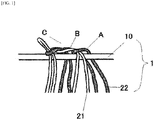
- FIG. 1 shows a condition where the top eyelash material 21 and bottom eyelash material 22 have been intentionally loosened relative to the axial thread 10 for the purpose of clearly illustrating the relationships of these members.
- the first embodiment of the false eyelashes pertaining to the present invention is, as shown in FIG. 1 , false eyelashes 1 comprising top eyelash materials 21, bottom eyelash materials 22, and an axial thread 10 on which the top eyelash materials 21 and bottom eyelash materials 22 are placed, where the top eyelash materials 21 and bottom eyelash materials 22 consist of top eyelash materials 21 each having a folded-back part A and bottom eyelash materials 22 each having a folded-back part B, with the top eyelash materials 21 and bottom eyelash materials 22 placed alternately and adjacent to each other in a manner sandwiching the axial thread 10 from top and bottom. And, adjacent pairs of the folded-back part A and the folded-back part B each are fixed to the axial thread 10 by forming a knit structure, to form an ear part C.
- the ear part C is where the false eyelashes 1 proposed by the present invention contacts the eyelid when worn.
- the axial thread 10 is a fiber made of thermoplastic resin, for example, the top eyelash materials 21 and bottom eyelash materials 22 contacting the axial thread 10 become fixed to the axial thread 10 by means of thermal bonding.
- the entire axial thread can be made of any thermoplastic resin that melts due to the heat used for thermal bonding, or it can also have a sheath made of such thermoplastic resin and a core made of thermosetting resin or any thermoplastic resin that does not melt due to the heat used for thennal bonding.
- the axial thread 10 can be constituted by one fiber or multiple fibers bundled together (multi-filaments) or multiple fibers stranded together.
- the axial thread 10 has a sheath-core structure comprising a sheath and a core, a sheath made of any thermoplastic resin mentioned above, and a core made of any thermoplastic resin having sufficiently high softening temperature or known thermosetting resin, can be adopted.
- the thickness (diameter) of the axial thread 10 is preferably 50 ⁇ m to 300 ⁇ m, or more preferably 70 ⁇ m to 200 ⁇ m. If its thickness is within the aforementioned range, the axial thread 10 can easily be attached to the eyelid when worn. It should be noted that the thickness of the axial thread 10 is not limited to the aforementioned range.
- the axial thread has a circular cross-section, but its cross-section can be oval.
- any one of various types can be selected as deemed appropriate so long as it has touch, texture, feel, and other properties similar to those of human eyelashes.
- the fiber constituting the top eyelash material 21 and bottom eyelash material 22 can be one fiber or multiple fibers bundled together (multi-filaments) or multiple fibers stranded together.
- the thickness (diameter) of the top eyelash material 21 and bottom eyelash material 22 is preferably 40 ⁇ m to 150 ⁇ m, or more preferably 60 ⁇ m to 100 ⁇ m. If their thickness is within the aforementioned range, the top eyelash material 21 and bottom eyelash material 22 present touch, texture, feel, and other properties similar to those of human eyelashes. It should be noted that the thickness of the top eyelash material 21 and bottom eyelash materials 22 is not limited to the aforementioned range. Preferably the top eyelash material 21 and bottom eyelash material 22 have a circular cross-section, but their cross-section can be oval. If they have an oval cross-section, the top eyelash material 21 and bottom eyelash material 22 can be curled easily.
- top eyelash material 21 and bottom eyelash material 22 can be black in color, or they can have brown, red or any other color.
- an antibacterial agent is blended into or applied onto at least one of the axial thread 10, top eyelash material 21 and bottom eyelash material 22.
- an antibacterial agent any organic antibacterial agent or inorganic antibacterial agent can be used as deemed appropriate.
- the antibacterial agent can be applied onto the fiber surface of at least one of the axial thread 10, top eyelash material 21 and bottom eyelash material 22, or the antibacterial agent can be blended into any of the materials constituting the foregoing. The result is that bacterial growth and odor generation can be prevented at the surface of the false eyelashes.
- Any known organic antibacterial agent can be used, but examples include paraoxy benzoate, paraoxy benzoate ester, benzoic acid, sodium benzoate, benzalkonium chloride, benzethonium chloride, chlorhexidine gluconate, or the like.
- any known inorganic antibacterial agent can be used, but examples include silver antibacterial agents, such as silver zeolite, silver glass, silver zirconium phosphate, or the like.
- the application amount or blending amount of antibacterial agent can be adjusted as deemed appropriate to the extent that antibacterial action can be demonstrated.
- various types of materials can be combined and the materials are not limited to specific combinations. Also, various types of materials can be used, like those mentioned above, for the false eyelashes explained in other embodiments besides this first embodiment.
- a core-sheath polyester fiber of outside fusion type was adopted for the axial thread, a regular polyester fiber (150 deniers, 48 filaments) thread was adopted for the warp, and a polyester fiber made of a mixture of polytrimethylene terephtalate resin (PTT resin) and polybutylene terephthalate resin (PBT resin) was adopted for the weft.
- the weft is the thread which becomes the false eyelashes.
- the warp is the thread which is woven with the weft and then removed from the weft during the manufacturing process of the false eyelashes, thus not remaining in the false eyelashes as a product.
- a thread colored in red, blue, etc., not black, brown or other natural color used for false eyelashes can be adopted for the weft, and by changing the driving pitch of the weft or the type of weft depending on the false eyelashes, various types of false eyelashes can be manufactured, and even within the same unit of false eyelashes, the driving pitch of the weft or the type of weft can be changed depending on the location.
- the false eyelashes 1 representing the first embodiment has top eyelash materials 21 and bottom eyelash materials 22, as well as an axial thread 10 on which the top eyelash materials 21 and bottom eyelash materials 22 are placed.
- top eyelash materials 21 and bottom eyelash materials 22 consist of top eyelash materials 21 each having a folded-back part A and bottom eyelash materials 22 each having a folded-back part B.
- top eyelash materials 21 each having a folded-back part A and bottom eyelash materials 22 each having a folded-back part B are placed alternately and adjacent to each other in a manner sandwiching the axial thread 10.
- the folded-back parts A, B are all positioned close to the axial thread and literally lying next to one another.
- top eyelash materials 21 and bottom eyelash materials 22 are such that the top eyelash materials 21 are placed above the axial thread 10, and the bottom eyelash materials 22 are placed below the axial thread 10. At this time, the top eyelash materials 21 and bottom eyelash materials 22 are not placed in a manner overlapping vertically; instead, they are placed in such a way that they come to the top side and bottom side alternately at specified intervals in the length direction of the axial thread 10.
- top eyelash materials 21 and bottom eyelash materials 22 are also placed in a manner extending to one end of the axial thread 10.
- the folded-back parts A, B of the knit structure are fixed to the axial thread 10 by thermal bonding to form an ear part C. Also, the top eyelash materials 21 and bottom eyelash materials 22 are fixed in a manner contacting the axial thread 10.
- This ear part C is where the false eyelashes 1, as formed, is worn on the eyelid.
- the top eyelash materials 21 and bottom eyelash materials 22 are placed roughly evenly so that the false eyelashes 1, as formed, have a natural look. Furthermore, because the folded-back parts A, B of the knit structure are joined to the axial thread 10 and also because the top eyelash materials 21 and bottom eyelash materials 22 are fixed in a manner contacting the axial thread 10, excellent dimensional stability is achieved.
- fixing means include bonding using adhesive, etc., thermal bonding using heat, and the like, so any means appropriate for the materials used for the axial thread and eyelash materials can be selected and used.
- adhesive etc.
- preferably an adhesive that does not make the bonded areas hard is used. If these areas become too hard, wearing the false eyelashes on the eyelid may become difficult.
- a fiber, etc., having a core-sheath structure and made of thermoplastic resin can be used for the axial thread 10. In this case, the location that becomes the sheath is exposed to high temperature and melted, and the top eyelash materials 21 and bottom eyelash materials 22 contacting the sheath are fixed.
- a fiber, etc., having a core-sheath structure and made of a material other than thermoplastic resin can be used.
- the top eyelash materials 21 and bottom eyelash materials 22 contacting the sheath are fixed with adhesive, etc.
- these fibers having a core-sheath structure include, for instance, polyester core-sheath fiber, polyamide core-sheath fiber, and fiber constituted by a long fiber covered with a fusing strand.
- the temperature needed to fix the eyelash materials using the fiber used, which has a core-sheath structure and is made of thermoplastic resin, can be adjusted as deemed appropriate. Use of a fiber having such structure prevents the fixed parts from becoming too hard and makes it easy to wear the false eyelashes 1.
- fibers having a core-sheath structure are only examples and fibers that can be used are not limited to the foregoing, and any material other than thermoplastic resin can be adopted, as mentioned above.
- the false eyelashes 1 representing the first embodiment can have a size equivalent to any false eyelashes normally used.
- the length of the part (ear structure) attached to the eyelid is 20 mm to 40 mm, while the lengths of the top eyelash material 21 and bottom eyelash material 22 are 3 mm to 30 mm.
- the top eyelash materials 21 and bottom eyelash materials 22 can be placed roughly evenly so that the false eyelashes 1, as formed, have a natural look. Additionally, because the folded-back parts A, B of the knit structure are fixed to the axial thread 10 and also because the top eyelash materials 21 and bottom eyelash materials 22 are fixed in a manner contacting the axial thread 10, excellent dimensional stability is achieved. Furthermore, use of a thermal bonding fiber to fix the eyelash materials creates a comfortable feeling when the false eyelashes are worn on the eyelid.
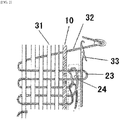
- the false eyelashes pertaining to the present invention can be made using a weaving machine having an axial thread 10 at least on both ends (only one end is shown in FIG. 2 ), multiple warps 31 and wefts 32 between the two axial threads, and needle 33, by folding back the wefts 32 at least over one axial thread 10.
- the folded-back ends of the wefts 32 form loops and the loops are placed in a manner sandwiching the axial thread 10 alternately from top and bottom, where the weft 32 to be folded back next is hooked by the needle 33 that has been guided through the last formed loop and the weft 32 to be folded back next is pulled out from the loop with the needle 33, and similar operations are repeated to form knit structures.
- manufacturing steps are performed in the following sequence: a step to connect the axial thread 10 and the knit structures, while fixing the axial thread 10 and the wefts 32 contacting the axial thread 10 by fusion, to form a weaving having an ear part; a step to cut the wefts 32 of the weaving along the lengthwise direction of the warps 31; a step to remove the warps 31 other than the fixed axial thread 10; and a step to cut the wefts 32 to an appropriate length to form false eyelashes.
- the ends of the warps not on the axial thread 10 side are also forming loops.
- the loops at these ends must be cut and the warps 31 must be removed.
- one more axial thread 10 can be prepared and the above steps can be performed between two axial threads 10, thereby improving the production efficiency of false eyelashes.
- the step to weave the warps 31 and wefts 32 and then remove the warps 31 to keep the wefts 32 only, and the step to cut the loops of the wefts 32 not on the axial thread 10 side, are required; however, either of these two steps can be performed first.
- the step to remove the warps is performed after the step to cut the loops, in order to facilitate the step to cut the loops and step to adjust the eyelash length.
- the warps 31 are expected to be removed from the wefts 32, so the warps 31 can be made of a material that makes this removal easy.
- a material has a sheet shape, filament shape, string shape, or plain weave shape, and its material can be paper, coated paper, fiber, resin, etc.
- the warps can be made slippery by applying lubricant or coating film on their surface.
- the ear part is where the manufactured false eyelashes contact the eyelid when worn.
- the wefts 32 become the eyelash materials of the manufactured false eyelashes.
- one monofilament or two or more monofilaments can be used.
- the axial thread 10 is joined with the knit structures being the loops of the wefts 32 contacting the axial thread 10, to form a narrow weaving with an ear part.
- any of the various methods mentioned above can be used.
- the wefts can be fixed in a manner arranged at even intervals, and the dimensional stability improves.
- the ear part thus formed is where the manufactured false eyelashes contact the eyelid when worn.
- the false eyelashes obtained by this manufacturing method offer good dimensional stability, so consequently it has a natural look and is easy to wear on the eyelid.
- the wefts of the narrow weaving are cut along the lengthwise direction of the warps.
- any means can be used as deemed appropriate.
- methods such as cutting with a blade, cutting with a laser, etc.
- any location can be selected by adjusting the distance from the ear part as deemed appropriate.
- One example is to cut at 20 mm or so away from the ear part.
- the length of the eyelash materials can be adjusted.
- the wefts are cut to an appropriate length as the cut wefts will be polished and receive other processing.
- the warps in the narrow weaving are removed from the cut location. Since the warps are not fixed, they can be removed easily. Finally, the ear part and the wefts leading from the ear part remain. It should be noted that the wefts do not come apart when cut, because the wefts are fixed to the axial thread. As explained earlier, the ear part is where the false eyelashes are worn on the eyelid, while the wefts leading from the ear part become the eyelash materials of the false eyelashes.
- the ear part is cut to an appropriate length to obtain false eyelashes of an appropriate length.
- any of the cutting means mentioned above can be used. It should be noted that the axial thread and wefts constituting the ear part do not come apart when the ear part is cut, because they are fixed.
- a core-sheath polyester fiber of outside fusion type was adopted for the axial thread
- a regular polyester fiber (150 deniers, 48 filaments) thread was adopted for the warp
- a polyester fiber made of a mixture of polytrimethylene terephthalate resin (PTT resin) and polybutylene terephthalate resin (PBT resin) was adopted for the weft
- a polyester fiber was adopted for the lock thread.
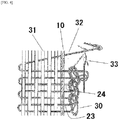
- FIG. 3 The second embodiment pertaining to the present invention is explained using FIG. 3 .
- the second embodiment pertaining to the present invention is the same as the first embodiment in the basic constitution and materials, but differs in the structure of the ear part; accordingly, this area of difference is explained.
- the second embodiment is characterized in that knit structures are formed by a lock thread that fixes adjacently placed folded-back parts together.
- the constitution is such that a lock thread 30 is guided through and connects the loops 23 of the wefts being the folded-back parts of the top eyelash materials as well as the loops 24 of the wefts being the folded-back parts of the bottom eyelash materials, where the lock thread 30 forms continuous loops and these loops in turn form knit structures that become parts of the ear part.
- Such constitution can be achieved using a needle weaving machine.
- the lock thread 30 is advanced so that the first loop of the lock thread 30 is guided through the loop 23 of the weft being the folded-back part of the top eyelash material shown at the bottom of FIG. 3 .
- the lock thread 30 is passed on the outside of the loop 23 of the weft being the folded-back part of this top eyelash material and guided from above into the loop of the lock thread 30 already formed, after which the lock thread 30 is passed from below the loop 24 of the weft being the folded-back part of the bottom eyelash material right next to it and passed again, as if to form a second loop of the lock thread 30, below the loop 24 of the weft being the folded-back part of the bottom eyelash material and above the first loop of the lock thread 30, thereby completing the second loop of the lock thread 30.
- lock thread 30 is guided from above the second loop of the lock thread 30, after which the lock thread 30 is passed from below the loop 23 of the weft being the folded-back part of the next top eyelash material, to form a third loop of the lock thread 30.
- lock thread 30 is passed below the loop 23 of the weft being the folded-back part of the top eyelash material and then returned from above the second loop of the lock thread 30, to complete the third loop of the lock thread 30.
- top and bottom eyelash materials do not form knit structures together and therefore no force is applied directly which tries to bend the top and bottom eyelash materials relative to the axial thread.
- the top and bottom eyelash materials can be extended in a planned direction relative to the axial thread.
- the aforementioned placement and fixing achieves constant intervals between the eyelash materials and improves the dimensional stability, and the eyelash materials look natural because there are no longer sparse areas and dense areas between them. Also, the eyelash materials, being connected by the lock thread, are fixed more strongly, which prevents the eyelash materials from falling out easily and creates a natural look.
- a core-sheath polyester fiber of outside fusion type was adopted for the axial thread
- a regular polyester fiber (150 deniers, 48 filaments) thread was adopted for the warp
- a polyester fiber made of a mixture of polytrimethylene terephthalate resin (PTT resin) and polybutylene terephthalate resin (PBT resin) was adopted for the weft
- a polyester fiber was adopted for the lock thread.
- the third embodiment pertaining to the present invention is the same as the first embodiment and second embodiment in the basic constitution and materials, but differs in the structure of the ear part; accordingly, this area of difference is explained.
- the third embodiment is characterized in that knit structures are formed by adjacently placed folded-back parts themselves, and a lock thread that fixes the folded-back parts.
- the folded-back parts of the top eyelash materials and the folded-back parts of the bottom eyelash materials which are placed adjacent to each other, form knit structures, while the lock thread fixing the folded-back parts also forms knit structures, to constitute an ear part.
- false eyelashes are manufactured by: a step wherein the wefts are folded back at least over one axial thread, where the folded-back ends of the wefts form loops and the loops are placed in a manner sandwiching the axial thread alternately from top and bottom, and the weft to be folded back next and the lock thread are hooked by the needle that has been guided through the last formed U-shaped loop and the weft to be folded back next and the lock thread are pulled out from the loop with the needle, and similar operations are repeated to form knit structures; a step to fix the axial thread with the wefts contacting the axial thread and the knit structures to form a narrow weaving having an ear part; a step to cut the wefts of the narrow weaving along the lengthwise direction; a step to remove the warps other than the fixed axial thread; and a step to cut the
- Folded-back parts are joined together in such a way that, into the loop 23 of the weft being the folded-back part of one top eyelash material above the axial thread, the loop 24 of the weft being the folded-back part of the next bottom eyelash material is inserted, and then into the loop 24 of the weft being the folded-back part of this bottom eyelash material, the loop 23 of the weft being the folded-back part of the next top eyelash material is inserted, and these operations are performed one by one to form the joints. Furthermore, the loops are connected together by the lock thread. This way, the ends of the eyelash materials contacting the axial thread are connected further by the lock thread guided through the knit structures. By forming the ear part with the knit structures this way, the eyelash materials can be connected more strongly together.
- the eyelash materials maintain almost even intervals and their dimensional stability improves. Also, the eyelash materials look natural because there are no longer sparse areas and dense areas between them. In addition, the eyelash materials, being connected by the lock thread, are fixed more strongly, which prevents the eyelash materials from falling out easily and creates a natural look.
- a silk thread was adopted for the axial thread, a regular polyester fiber (150 deniers, 48 filaments) thread was adopted for the warp, a polyester fiber made of a mixture of polytrimethylene terephthalate resin (PTT resin) and polybutylene terephthalate resin (PBT resin) was adopted for the weft, and a polyester fiber was adopted for the lock thread, if used, although use of the lock thread is not required.
- PTT resin polytrimethylene terephthalate resin
- PBT resin polybutylene terephthalate resin
- the fourth embodiment pertaining to the present invention is the same as the first embodiment in the weaving structure, but differs in that the fiber used as the axial thread is a silk thread and not thermoplastic resin.
- the axial thread and wefts were fixed not by means of fusion, but by means of bonding using adhesive prepared separately.
- the false eyelashes pertaining to the present invention use knit structures to achieve constant intervals between the eyelash materials, and because the ear part formed by these structures, false eyelashes can be provided which have excellent dimensional stability as false eyelashes, superior comfort when worn on the eyelid, and a natural look.
Landscapes
- Engineering & Computer Science (AREA)
- Textile Engineering (AREA)
- Knitting Of Fabric (AREA)
- Cosmetics (AREA)
- Details Of Garments (AREA)
- Materials For Medical Uses (AREA)
- Woven Fabrics (AREA)
Applications Claiming Priority (2)
| Application Number | Priority Date | Filing Date | Title |
|---|---|---|---|
| JP2014075815 | 2014-04-01 | ||
| PCT/JP2015/060201 WO2015152270A1 (fr) | 2014-04-01 | 2015-03-31 | Faux cils |
Publications (3)
| Publication Number | Publication Date |
|---|---|
| EP3127444A1 true EP3127444A1 (fr) | 2017-02-08 |
| EP3127444A4 EP3127444A4 (fr) | 2017-09-27 |
| EP3127444B1 EP3127444B1 (fr) | 2018-10-10 |
Family
ID=54240589
Family Applications (1)
| Application Number | Title | Priority Date | Filing Date |
|---|---|---|---|
| EP15774246.1A Not-in-force EP3127444B1 (fr) | 2014-04-01 | 2015-03-31 | Faux cils |
Country Status (7)
| Country | Link |
|---|---|
| US (1) | US10791782B2 (fr) |
| EP (1) | EP3127444B1 (fr) |
| JP (1) | JP6618149B2 (fr) |
| KR (1) | KR20160143710A (fr) |
| CN (1) | CN106413451B (fr) |
| TW (1) | TWI638611B (fr) |
| WO (1) | WO2015152270A1 (fr) |
Cited By (2)
| Publication number | Priority date | Publication date | Assignee | Title |
|---|---|---|---|---|
| WO2021153293A1 (fr) * | 2020-01-29 | 2021-08-05 | L'oreal | Faux cils et leur procédé de fabrication |
| FR3107816A1 (fr) * | 2020-03-05 | 2021-09-10 | L'oreal | Faux cils et procédé de fabrication de ceux-ci |
Families Citing this family (21)
| Publication number | Priority date | Publication date | Assignee | Title |
|---|---|---|---|---|
| CN117837838A (zh) | 2016-07-28 | 2024-04-09 | 莱施菲公司 | 人造睫毛嫁接物 |
| KR102709427B1 (ko) | 2016-12-20 | 2024-09-25 | 래쉬파이 인코포레이티드 | 인공 속눈썹 연장부에 사용하는 어플리케이터 및 케이스 |
| JP1687380S (fr) | 2018-10-19 | 2021-06-07 | ||
| KR102761588B1 (ko) | 2018-10-19 | 2025-02-03 | 래쉬파이 인코포레이티드 | 속눈썹 연장물 보관 케이스 및 그의 사용 및 제조 방법 |
| USD863679S1 (en) | 2018-10-19 | 2019-10-15 | Lashify, Inc. | False eyelash applicator |
| US20210195976A1 (en) | 2019-01-14 | 2021-07-01 | Lashify, Inc. | Socks, applicators for lash extensions, and methods of manufacture and use thereof |
| JP2020114952A (ja) * | 2019-01-17 | 2020-07-30 | スケールエナジー株式会社 | つけまつげ及び人工まつげ |
| CN111557515A (zh) | 2019-10-03 | 2020-08-21 | 莱施菲公司 | 人造睫毛装置、睫毛延长方法及睫毛延长装置 |
| FR3102915B1 (fr) * | 2019-11-12 | 2021-11-26 | Oreal | Frange de cils artificiels et procédé de fabrication |
| FR3102914B1 (fr) * | 2019-11-12 | 2021-11-26 | Oreal | Frange de cils artificiels et procédé de fabrication |
| FR3102916B1 (fr) * | 2019-11-12 | 2022-04-08 | Oreal | Frange de cils artificiels et procédé de fabrication |
| KR102152681B1 (ko) * | 2019-12-23 | 2020-09-07 | 최석 | 붙임머리 및 그 제조방법 |
| JP7516056B2 (ja) * | 2020-01-29 | 2024-07-16 | ロレアル | つけまつげおよびそれを製造するための方法 |
| CN113229556A (zh) * | 2021-04-21 | 2021-08-10 | 李科修 | 一种ptt假睫毛的制造方法及应用 |
| CN113558323A (zh) * | 2021-08-27 | 2021-10-29 | 朱莉洁 | 一种防水假睫毛及其制作方法 |
| USD980521S1 (en) | 2022-07-20 | 2023-03-07 | Lashify, Inc. | Artificial lash extension separating comb |
| USD984050S1 (en) | 2022-07-20 | 2023-04-18 | Lashify, Inc. | Combined curler and applicator for natural lashes and artificial lash extensions |
| USD995914S1 (en) | 2022-07-20 | 2023-08-15 | Lashify, Inc. | Combined tweezer and applicator for artificial lash extensions |
| CN115868702B (zh) * | 2022-08-11 | 2025-05-30 | 苏州煜智创科自动化装备有限公司 | 一种线品自动编制设备 |
| CN116349969A (zh) * | 2023-03-27 | 2023-06-30 | 青岛佳合永润美容科技有限公司 | 一种假睫毛、假睫毛加热装置及假睫毛加工方法 |
| USD1072354S1 (en) | 2024-01-08 | 2025-04-22 | Lashify, Inc. | Rounded tweezer and applicator for artificial lash extensions |
Family Cites Families (11)
| Publication number | Priority date | Publication date | Assignee | Title |
|---|---|---|---|---|
| US3454015A (en) * | 1968-08-06 | 1969-07-08 | Benjamin Udes | Method of making false eyelashes |
| JPS5319265B2 (fr) * | 1973-08-29 | 1978-06-20 | ||
| JPS5319265A (en) | 1976-08-03 | 1978-02-22 | Masateru Kanbara | Low voltage instantaneous kettle |
| JPS5860004A (ja) * | 1981-10-06 | 1983-04-09 | 中島ナイロン工業株式会社 | 人造睫毛及びその製造方法 |
| US6308716B1 (en) | 2000-08-07 | 2001-10-30 | Yongho Han | Core for an adhesive device for attaching a false eyelash |
| JP4883551B2 (ja) * | 2004-12-28 | 2012-02-22 | 株式会社アデランス | かつら及びその製造方法 |
| CN103118565B (zh) * | 2010-07-30 | 2015-11-25 | 株式会社黛怡茜 | 假眼睫毛包装体 |
| US8967158B2 (en) * | 2010-09-03 | 2015-03-03 | Matsukaze Co., Ltd. | Artificial eyelash and method for attaching the same |
| KR101045497B1 (ko) * | 2010-09-16 | 2011-06-30 | 주식회사 에이지 | 인조 속눈썹 및 그 제조장치 |
| TW201313154A (zh) | 2011-09-28 | 2013-04-01 | Guo Xuan Technology Corp | 假睫毛結構 |
| CN103251159B (zh) * | 2012-02-17 | 2015-01-28 | 郑铭元 | 假睫毛及其制造方法 |
-
2015
- 2015-03-31 JP JP2016511949A patent/JP6618149B2/ja active Active
- 2015-03-31 CN CN201580018033.1A patent/CN106413451B/zh not_active Expired - Fee Related
- 2015-03-31 WO PCT/JP2015/060201 patent/WO2015152270A1/fr not_active Ceased
- 2015-03-31 EP EP15774246.1A patent/EP3127444B1/fr not_active Not-in-force
- 2015-03-31 US US15/301,342 patent/US10791782B2/en active Active
- 2015-03-31 KR KR1020167030263A patent/KR20160143710A/ko not_active Ceased
- 2015-04-01 TW TW104110661A patent/TWI638611B/zh active
Cited By (2)
| Publication number | Priority date | Publication date | Assignee | Title |
|---|---|---|---|---|
| WO2021153293A1 (fr) * | 2020-01-29 | 2021-08-05 | L'oreal | Faux cils et leur procédé de fabrication |
| FR3107816A1 (fr) * | 2020-03-05 | 2021-09-10 | L'oreal | Faux cils et procédé de fabrication de ceux-ci |
Also Published As
| Publication number | Publication date |
|---|---|
| CN106413451A (zh) | 2017-02-15 |
| KR20160143710A (ko) | 2016-12-14 |
| EP3127444B1 (fr) | 2018-10-10 |
| JP6618149B2 (ja) | 2019-12-11 |
| TWI638611B (zh) | 2018-10-21 |
| WO2015152270A1 (fr) | 2015-10-08 |
| EP3127444A4 (fr) | 2017-09-27 |
| CN106413451B (zh) | 2019-09-10 |
| US10791782B2 (en) | 2020-10-06 |
| JPWO2015152270A1 (ja) | 2017-04-13 |
| US20170127743A1 (en) | 2017-05-11 |
| TW201542114A (zh) | 2015-11-16 |
Similar Documents
| Publication | Publication Date | Title |
|---|---|---|
| EP3127444B1 (fr) | Faux cils | |
| US7694696B2 (en) | 3D fabric and preparing thereof | |
| ES2275975T3 (es) | Material tejido que comprende urdimbre y trama tipo cinta y una ayuda para producir el mismo. | |
| AU2010200437B2 (en) | 3-D fabric and preparing thereof | |
| CA1107487A (fr) | Tissu a surface de fourrure, et methode de fabrication connexe | |
| JPS6335868A (ja) | 低融点バインダストランドを有するラツプ糸、およびこれから形成されたパイル布ならびにこれに付随する方法 | |
| AU2009237048A1 (en) | Cleaning sheet and process for producing the same | |
| CN87108393A (zh) | 编织带 | |
| JPH06158408A (ja) | キャップがない単筋ウェプトかつら及びその製造方法 | |
| US20210040698A1 (en) | Nylon Artificial Grass | |
| CN114727678A (zh) | 一排人造睫毛的制造方法 | |
| KR20020012138A (ko) | 강화 스레드 제조 방법 | |
| JP2021188144A (ja) | 土木用合成繊維製ネット材及びその製造方法 | |
| US5466497A (en) | Fur fabric and method of production | |
| JPH0693526A (ja) | ダブルモール糸 | |
| JP7318126B2 (ja) | 人工まつげの列および製造方法 | |
| JP7212206B2 (ja) | 人工まつげの列および製造方法 | |
| KR102956101B1 (ko) | 천연 실크원사를 사용한 인조 속눈썹 제조용 실크직물 및 그 제조방법 | |
| CN213681085U (zh) | 一种耐用型服装面料 | |
| CA2098352E (fr) | Vetement de fourrure et procede de fabrication connexe | |
| JP2022166370A (ja) | ポリエチレンテレフタレート系面ファスナー | |
| JPS6278231A (ja) | かざり糸の製造方法 | |
| JP2004081647A (ja) | 歯ブラシ |
Legal Events
| Date | Code | Title | Description |
|---|---|---|---|
| STAA | Information on the status of an ep patent application or granted ep patent |
Free format text: STATUS: THE INTERNATIONAL PUBLICATION HAS BEEN MADE |
|
| PUAI | Public reference made under article 153(3) epc to a published international application that has entered the european phase |
Free format text: ORIGINAL CODE: 0009012 |
|
| STAA | Information on the status of an ep patent application or granted ep patent |
Free format text: STATUS: REQUEST FOR EXAMINATION WAS MADE |
|
| 17P | Request for examination filed |
Effective date: 20161028 |
|
| AK | Designated contracting states |
Kind code of ref document: A1 Designated state(s): AL AT BE BG CH CY CZ DE DK EE ES FI FR GB GR HR HU IE IS IT LI LT LU LV MC MK MT NL NO PL PT RO RS SE SI SK SM TR |
|
| AX | Request for extension of the european patent |
Extension state: BA ME |
|
| DAV | Request for validation of the european patent (deleted) | ||
| DAX | Request for extension of the european patent (deleted) | ||
| A4 | Supplementary search report drawn up and despatched |
Effective date: 20170829 |
|
| RIC1 | Information provided on ipc code assigned before grant |
Ipc: A41G 5/02 20060101AFI20170823BHEP |
|
| GRAP | Despatch of communication of intention to grant a patent |
Free format text: ORIGINAL CODE: EPIDOSNIGR1 |
|
| STAA | Information on the status of an ep patent application or granted ep patent |
Free format text: STATUS: GRANT OF PATENT IS INTENDED |
|
| INTG | Intention to grant announced |
Effective date: 20180425 |
|
| GRAS | Grant fee paid |
Free format text: ORIGINAL CODE: EPIDOSNIGR3 |
|
| GRAA | (expected) grant |
Free format text: ORIGINAL CODE: 0009210 |
|
| STAA | Information on the status of an ep patent application or granted ep patent |
Free format text: STATUS: THE PATENT HAS BEEN GRANTED |
|
| AK | Designated contracting states |
Kind code of ref document: B1 Designated state(s): AL AT BE BG CH CY CZ DE DK EE ES FI FR GB GR HR HU IE IS IT LI LT LU LV MC MK MT NL NO PL PT RO RS SE SI SK SM TR |
|
| REG | Reference to a national code |
Ref country code: GB Ref legal event code: FG4D |
|
| REG | Reference to a national code |
Ref country code: CH Ref legal event code: EP Ref country code: AT Ref legal event code: REF Ref document number: 1050203 Country of ref document: AT Kind code of ref document: T Effective date: 20181015 |
|
| REG | Reference to a national code |
Ref country code: IE Ref legal event code: FG4D |
|
| REG | Reference to a national code |
Ref country code: DE Ref legal event code: R096 Ref document number: 602015017975 Country of ref document: DE |
|
| REG | Reference to a national code |
Ref country code: NL Ref legal event code: MP Effective date: 20181010 |
|
| REG | Reference to a national code |
Ref country code: LT Ref legal event code: MG4D |
|
| REG | Reference to a national code |
Ref country code: AT Ref legal event code: MK05 Ref document number: 1050203 Country of ref document: AT Kind code of ref document: T Effective date: 20181010 |
|
| PG25 | Lapsed in a contracting state [announced via postgrant information from national office to epo] |
Ref country code: NL Free format text: LAPSE BECAUSE OF FAILURE TO SUBMIT A TRANSLATION OF THE DESCRIPTION OR TO PAY THE FEE WITHIN THE PRESCRIBED TIME-LIMIT Effective date: 20181010 |
|
| PG25 | Lapsed in a contracting state [announced via postgrant information from national office to epo] |
Ref country code: LV Free format text: LAPSE BECAUSE OF FAILURE TO SUBMIT A TRANSLATION OF THE DESCRIPTION OR TO PAY THE FEE WITHIN THE PRESCRIBED TIME-LIMIT Effective date: 20181010 Ref country code: ES Free format text: LAPSE BECAUSE OF FAILURE TO SUBMIT A TRANSLATION OF THE DESCRIPTION OR TO PAY THE FEE WITHIN THE PRESCRIBED TIME-LIMIT Effective date: 20181010 Ref country code: NO Free format text: LAPSE BECAUSE OF FAILURE TO SUBMIT A TRANSLATION OF THE DESCRIPTION OR TO PAY THE FEE WITHIN THE PRESCRIBED TIME-LIMIT Effective date: 20190110 Ref country code: AT Free format text: LAPSE BECAUSE OF FAILURE TO SUBMIT A TRANSLATION OF THE DESCRIPTION OR TO PAY THE FEE WITHIN THE PRESCRIBED TIME-LIMIT Effective date: 20181010 Ref country code: FI Free format text: LAPSE BECAUSE OF FAILURE TO SUBMIT A TRANSLATION OF THE DESCRIPTION OR TO PAY THE FEE WITHIN THE PRESCRIBED TIME-LIMIT Effective date: 20181010 Ref country code: IS Free format text: LAPSE BECAUSE OF FAILURE TO SUBMIT A TRANSLATION OF THE DESCRIPTION OR TO PAY THE FEE WITHIN THE PRESCRIBED TIME-LIMIT Effective date: 20190210 Ref country code: LT Free format text: LAPSE BECAUSE OF FAILURE TO SUBMIT A TRANSLATION OF THE DESCRIPTION OR TO PAY THE FEE WITHIN THE PRESCRIBED TIME-LIMIT Effective date: 20181010 Ref country code: BG Free format text: LAPSE BECAUSE OF FAILURE TO SUBMIT A TRANSLATION OF THE DESCRIPTION OR TO PAY THE FEE WITHIN THE PRESCRIBED TIME-LIMIT Effective date: 20190110 Ref country code: PL Free format text: LAPSE BECAUSE OF FAILURE TO SUBMIT A TRANSLATION OF THE DESCRIPTION OR TO PAY THE FEE WITHIN THE PRESCRIBED TIME-LIMIT Effective date: 20181010 Ref country code: HR Free format text: LAPSE BECAUSE OF FAILURE TO SUBMIT A TRANSLATION OF THE DESCRIPTION OR TO PAY THE FEE WITHIN THE PRESCRIBED TIME-LIMIT Effective date: 20181010 |
|
| PG25 | Lapsed in a contracting state [announced via postgrant information from national office to epo] |
Ref country code: GR Free format text: LAPSE BECAUSE OF FAILURE TO SUBMIT A TRANSLATION OF THE DESCRIPTION OR TO PAY THE FEE WITHIN THE PRESCRIBED TIME-LIMIT Effective date: 20190111 Ref country code: RS Free format text: LAPSE BECAUSE OF FAILURE TO SUBMIT A TRANSLATION OF THE DESCRIPTION OR TO PAY THE FEE WITHIN THE PRESCRIBED TIME-LIMIT Effective date: 20181010 Ref country code: SE Free format text: LAPSE BECAUSE OF FAILURE TO SUBMIT A TRANSLATION OF THE DESCRIPTION OR TO PAY THE FEE WITHIN THE PRESCRIBED TIME-LIMIT Effective date: 20181010 Ref country code: PT Free format text: LAPSE BECAUSE OF FAILURE TO SUBMIT A TRANSLATION OF THE DESCRIPTION OR TO PAY THE FEE WITHIN THE PRESCRIBED TIME-LIMIT Effective date: 20190210 Ref country code: AL Free format text: LAPSE BECAUSE OF FAILURE TO SUBMIT A TRANSLATION OF THE DESCRIPTION OR TO PAY THE FEE WITHIN THE PRESCRIBED TIME-LIMIT Effective date: 20181010 |
|
| REG | Reference to a national code |
Ref country code: DE Ref legal event code: R097 Ref document number: 602015017975 Country of ref document: DE |
|
| PG25 | Lapsed in a contracting state [announced via postgrant information from national office to epo] |
Ref country code: DK Free format text: LAPSE BECAUSE OF FAILURE TO SUBMIT A TRANSLATION OF THE DESCRIPTION OR TO PAY THE FEE WITHIN THE PRESCRIBED TIME-LIMIT Effective date: 20181010 Ref country code: CZ Free format text: LAPSE BECAUSE OF FAILURE TO SUBMIT A TRANSLATION OF THE DESCRIPTION OR TO PAY THE FEE WITHIN THE PRESCRIBED TIME-LIMIT Effective date: 20181010 |
|
| PLBE | No opposition filed within time limit |
Free format text: ORIGINAL CODE: 0009261 |
|
| STAA | Information on the status of an ep patent application or granted ep patent |
Free format text: STATUS: NO OPPOSITION FILED WITHIN TIME LIMIT |
|
| PG25 | Lapsed in a contracting state [announced via postgrant information from national office to epo] |
Ref country code: RO Free format text: LAPSE BECAUSE OF FAILURE TO SUBMIT A TRANSLATION OF THE DESCRIPTION OR TO PAY THE FEE WITHIN THE PRESCRIBED TIME-LIMIT Effective date: 20181010 Ref country code: EE Free format text: LAPSE BECAUSE OF FAILURE TO SUBMIT A TRANSLATION OF THE DESCRIPTION OR TO PAY THE FEE WITHIN THE PRESCRIBED TIME-LIMIT Effective date: 20181010 Ref country code: SM Free format text: LAPSE BECAUSE OF FAILURE TO SUBMIT A TRANSLATION OF THE DESCRIPTION OR TO PAY THE FEE WITHIN THE PRESCRIBED TIME-LIMIT Effective date: 20181010 Ref country code: SK Free format text: LAPSE BECAUSE OF FAILURE TO SUBMIT A TRANSLATION OF THE DESCRIPTION OR TO PAY THE FEE WITHIN THE PRESCRIBED TIME-LIMIT Effective date: 20181010 |
|
| 26N | No opposition filed |
Effective date: 20190711 |
|
| PG25 | Lapsed in a contracting state [announced via postgrant information from national office to epo] |
Ref country code: MC Free format text: LAPSE BECAUSE OF FAILURE TO SUBMIT A TRANSLATION OF THE DESCRIPTION OR TO PAY THE FEE WITHIN THE PRESCRIBED TIME-LIMIT Effective date: 20181010 Ref country code: SI Free format text: LAPSE BECAUSE OF FAILURE TO SUBMIT A TRANSLATION OF THE DESCRIPTION OR TO PAY THE FEE WITHIN THE PRESCRIBED TIME-LIMIT Effective date: 20181010 |
|
| REG | Reference to a national code |
Ref country code: CH Ref legal event code: PL |
|
| PG25 | Lapsed in a contracting state [announced via postgrant information from national office to epo] |
Ref country code: LU Free format text: LAPSE BECAUSE OF NON-PAYMENT OF DUE FEES Effective date: 20190331 |
|
| REG | Reference to a national code |
Ref country code: BE Ref legal event code: MM Effective date: 20190331 |
|
| PG25 | Lapsed in a contracting state [announced via postgrant information from national office to epo] |
Ref country code: IE Free format text: LAPSE BECAUSE OF NON-PAYMENT OF DUE FEES Effective date: 20190331 Ref country code: LI Free format text: LAPSE BECAUSE OF NON-PAYMENT OF DUE FEES Effective date: 20190331 Ref country code: CH Free format text: LAPSE BECAUSE OF NON-PAYMENT OF DUE FEES Effective date: 20190331 |
|
| PG25 | Lapsed in a contracting state [announced via postgrant information from national office to epo] |
Ref country code: BE Free format text: LAPSE BECAUSE OF NON-PAYMENT OF DUE FEES Effective date: 20190331 |
|
| PG25 | Lapsed in a contracting state [announced via postgrant information from national office to epo] |
Ref country code: TR Free format text: LAPSE BECAUSE OF FAILURE TO SUBMIT A TRANSLATION OF THE DESCRIPTION OR TO PAY THE FEE WITHIN THE PRESCRIBED TIME-LIMIT Effective date: 20181010 |
|
| PG25 | Lapsed in a contracting state [announced via postgrant information from national office to epo] |
Ref country code: MT Free format text: LAPSE BECAUSE OF NON-PAYMENT OF DUE FEES Effective date: 20190331 |
|
| PG25 | Lapsed in a contracting state [announced via postgrant information from national office to epo] |
Ref country code: CY Free format text: LAPSE BECAUSE OF FAILURE TO SUBMIT A TRANSLATION OF THE DESCRIPTION OR TO PAY THE FEE WITHIN THE PRESCRIBED TIME-LIMIT Effective date: 20181010 |
|
| PG25 | Lapsed in a contracting state [announced via postgrant information from national office to epo] |
Ref country code: HU Free format text: LAPSE BECAUSE OF FAILURE TO SUBMIT A TRANSLATION OF THE DESCRIPTION OR TO PAY THE FEE WITHIN THE PRESCRIBED TIME-LIMIT; INVALID AB INITIO Effective date: 20150331 |
|
| PG25 | Lapsed in a contracting state [announced via postgrant information from national office to epo] |
Ref country code: MK Free format text: LAPSE BECAUSE OF FAILURE TO SUBMIT A TRANSLATION OF THE DESCRIPTION OR TO PAY THE FEE WITHIN THE PRESCRIBED TIME-LIMIT Effective date: 20181010 |
|
| PGFP | Annual fee paid to national office [announced via postgrant information from national office to epo] |
Ref country code: DE Payment date: 20240206 Year of fee payment: 10 Ref country code: GB Payment date: 20240208 Year of fee payment: 10 |
|
| PGFP | Annual fee paid to national office [announced via postgrant information from national office to epo] |
Ref country code: IT Payment date: 20240212 Year of fee payment: 10 Ref country code: FR Payment date: 20240213 Year of fee payment: 10 |
|
| REG | Reference to a national code |
Ref country code: DE Ref legal event code: R119 Ref document number: 602015017975 Country of ref document: DE |
|
| GBPC | Gb: european patent ceased through non-payment of renewal fee |
Effective date: 20250331 |
|
| PG25 | Lapsed in a contracting state [announced via postgrant information from national office to epo] |
Ref country code: DE Free format text: LAPSE BECAUSE OF NON-PAYMENT OF DUE FEES Effective date: 20251001 |
|
| PG25 | Lapsed in a contracting state [announced via postgrant information from national office to epo] |
Ref country code: GB Free format text: LAPSE BECAUSE OF NON-PAYMENT OF DUE FEES Effective date: 20250331 |
|
| PG25 | Lapsed in a contracting state [announced via postgrant information from national office to epo] |
Ref country code: FR Free format text: LAPSE BECAUSE OF NON-PAYMENT OF DUE FEES Effective date: 20250331 Ref country code: IT Free format text: LAPSE BECAUSE OF NON-PAYMENT OF DUE FEES Effective date: 20250331 |