EP3127635A1 - Fabrication additive de couches de peau profondes - Google Patents
Fabrication additive de couches de peau profondes Download PDFInfo
- Publication number
- EP3127635A1 EP3127635A1 EP15180029.9A EP15180029A EP3127635A1 EP 3127635 A1 EP3127635 A1 EP 3127635A1 EP 15180029 A EP15180029 A EP 15180029A EP 3127635 A1 EP3127635 A1 EP 3127635A1
- Authority
- EP
- European Patent Office
- Prior art keywords
- overhang
- region
- layer
- skin
- core
- Prior art date
- Legal status (The legal status is an assumption and is not a legal conclusion. Google has not performed a legal analysis and makes no representation as to the accuracy of the status listed.)
- Ceased
Links
Images

Classifications
-
- B—PERFORMING OPERATIONS; TRANSPORTING
- B22—CASTING; POWDER METALLURGY
- B22F—WORKING METALLIC POWDER; MANUFACTURE OF ARTICLES FROM METALLIC POWDER; MAKING METALLIC POWDER; APPARATUS OR DEVICES SPECIALLY ADAPTED FOR METALLIC POWDER
- B22F10/00—Additive manufacturing of workpieces or articles from metallic powder
-
- B—PERFORMING OPERATIONS; TRANSPORTING
- B22—CASTING; POWDER METALLURGY
- B22F—WORKING METALLIC POWDER; MANUFACTURE OF ARTICLES FROM METALLIC POWDER; MAKING METALLIC POWDER; APPARATUS OR DEVICES SPECIALLY ADAPTED FOR METALLIC POWDER
- B22F10/00—Additive manufacturing of workpieces or articles from metallic powder
- B22F10/30—Process control
- B22F10/36—Process control of energy beam parameters
-
- B—PERFORMING OPERATIONS; TRANSPORTING
- B22—CASTING; POWDER METALLURGY
- B22F—WORKING METALLIC POWDER; MANUFACTURE OF ARTICLES FROM METALLIC POWDER; MAKING METALLIC POWDER; APPARATUS OR DEVICES SPECIALLY ADAPTED FOR METALLIC POWDER
- B22F10/00—Additive manufacturing of workpieces or articles from metallic powder
- B22F10/30—Process control
- B22F10/38—Process control to achieve specific product aspects, e.g. surface smoothness, density, porosity or hollow structures
- B22F10/385—Overhang structures
-
- B—PERFORMING OPERATIONS; TRANSPORTING
- B28—WORKING CEMENT, CLAY, OR STONE
- B28B—SHAPING CLAY OR OTHER CERAMIC COMPOSITIONS; SHAPING SLAG; SHAPING MIXTURES CONTAINING CEMENTITIOUS MATERIAL, e.g. PLASTER
- B28B1/00—Producing shaped prefabricated articles from the material
- B28B1/001—Rapid manufacturing of 3D objects by additive depositing, agglomerating or laminating of material
-
- B—PERFORMING OPERATIONS; TRANSPORTING
- B33—ADDITIVE MANUFACTURING TECHNOLOGY
- B33Y—ADDITIVE MANUFACTURING, i.e. MANUFACTURING OF THREE-DIMENSIONAL [3D] OBJECTS BY ADDITIVE DEPOSITION, ADDITIVE AGGLOMERATION OR ADDITIVE LAYERING, e.g. BY 3D PRINTING, STEREOLITHOGRAPHY OR SELECTIVE LASER SINTERING
- B33Y10/00—Processes of additive manufacturing
-
- B—PERFORMING OPERATIONS; TRANSPORTING
- B33—ADDITIVE MANUFACTURING TECHNOLOGY
- B33Y—ADDITIVE MANUFACTURING, i.e. MANUFACTURING OF THREE-DIMENSIONAL [3D] OBJECTS BY ADDITIVE DEPOSITION, ADDITIVE AGGLOMERATION OR ADDITIVE LAYERING, e.g. BY 3D PRINTING, STEREOLITHOGRAPHY OR SELECTIVE LASER SINTERING
- B33Y30/00—Apparatus for additive manufacturing; Details thereof or accessories therefor
-
- B—PERFORMING OPERATIONS; TRANSPORTING
- B33—ADDITIVE MANUFACTURING TECHNOLOGY
- B33Y—ADDITIVE MANUFACTURING, i.e. MANUFACTURING OF THREE-DIMENSIONAL [3D] OBJECTS BY ADDITIVE DEPOSITION, ADDITIVE AGGLOMERATION OR ADDITIVE LAYERING, e.g. BY 3D PRINTING, STEREOLITHOGRAPHY OR SELECTIVE LASER SINTERING
- B33Y50/00—Data acquisition or data processing for additive manufacturing
- B33Y50/02—Data acquisition or data processing for additive manufacturing for controlling or regulating additive manufacturing processes
-
- B—PERFORMING OPERATIONS; TRANSPORTING
- B22—CASTING; POWDER METALLURGY
- B22F—WORKING METALLIC POWDER; MANUFACTURE OF ARTICLES FROM METALLIC POWDER; MAKING METALLIC POWDER; APPARATUS OR DEVICES SPECIALLY ADAPTED FOR METALLIC POWDER
- B22F10/00—Additive manufacturing of workpieces or articles from metallic powder
- B22F10/20—Direct sintering or melting
- B22F10/28—Powder bed fusion, e.g. selective laser melting [SLM] or electron beam melting [EBM]
-
- B—PERFORMING OPERATIONS; TRANSPORTING
- B22—CASTING; POWDER METALLURGY
- B22F—WORKING METALLIC POWDER; MANUFACTURE OF ARTICLES FROM METALLIC POWDER; MAKING METALLIC POWDER; APPARATUS OR DEVICES SPECIALLY ADAPTED FOR METALLIC POWDER
- B22F12/00—Apparatus or devices specially adapted for additive manufacturing; Auxiliary means for additive manufacturing; Combinations of additive manufacturing apparatus or devices with other processing apparatus or devices
- B22F12/40—Radiation means
- B22F12/44—Radiation means characterised by the configuration of the radiation means
-
- Y—GENERAL TAGGING OF NEW TECHNOLOGICAL DEVELOPMENTS; GENERAL TAGGING OF CROSS-SECTIONAL TECHNOLOGIES SPANNING OVER SEVERAL SECTIONS OF THE IPC; TECHNICAL SUBJECTS COVERED BY FORMER USPC CROSS-REFERENCE ART COLLECTIONS [XRACs] AND DIGESTS
- Y02—TECHNOLOGIES OR APPLICATIONS FOR MITIGATION OR ADAPTATION AGAINST CLIMATE CHANGE
- Y02P—CLIMATE CHANGE MITIGATION TECHNOLOGIES IN THE PRODUCTION OR PROCESSING OF GOODS
- Y02P10/00—Technologies related to metal processing
- Y02P10/25—Process efficiency
Definitions
- the present disclosure relates generally to additive manufacturing and more particularly to controlling additive manufacturing of down-skin layers.
- a powdered material such as a metal or ceramic powder is irradiated with electromagnetic radiation such as laser light.
- electromagnetic radiation such as laser light.
- thin layers of powder are provided within the chamber on a build platform to form the three-dimensional object in a stepwise production layer by layer, i.e. in a layer providing direction.
- An exemplary device for additive manufacturing is disclosed in EP 2 732 890 A2 .
- the radiated region may laterally shift such that layers may form - in the layer providing direction - an overhang e.g. in a sequence of layers, herein referred to as overhang layers.
- An overhang layer comprises a core region for forming a core portion and a down-skin region for forming an overhang portion of the three-dimensional object.
- a core region generally extends in the layer providing direction on top of an irradiated region of a layer being generated directly before. Down-skin regions extend on top of a previously non-irradiated regions of the directly preceding layer, respectively.
- overhang layers and their shape are influenced by the missing support of the preceding layer in the overhang region. Accordingly, additive manufacturing of overhang regions may result in respective overhang portions of the three-dimensional object that may not fulfill the desired specifications such as shape precision, stability, and structure in general.
- the present disclosure is directed, at least in part, to improving or overcoming one or more aspects of prior systems, and in particular to provide an efficient approach for forming down-skin layers.
- Some of the objects may be achieved by a method for radiation based additive manufacturing of a three-dimensional object as recited in claim 1, a method for generating an irradiation instruction map for additive manufacturing of a three-dimensional object as recited in claim 10. Furthermore, some of the objects may be addressed by a three-dimensional object as recited in claim 1, a digital 3D printable item as recited in claim 13, a computer-readable program product as recited in claim 14, and a device for additive manufacturing of three-dimensional objects as recited in claim 15. Further aspects and developments are given in the dependent claims.
- the present disclosure discloses a method for radiation based additive manufacturing of a three-dimensional object from powdered material, wherein a plurality of layers of the powdered material are provided in a layer providing direction and are irradiated layer by layer, and the plurality of layers comprises an overhang layer with a core region and a down-skin region for forming a core portion and an overhang portion of the manufactured three-dimensional object, respectively, the core region extending in the layer providing direction on top of an irradiated region of a directly preceding layer and the down-skin region extending on top of a previously non-irradiated region of the directly preceding layer.
- the method comprises generating the directly preceding layer of the overhang layer, and generating the overhang layer by providing a core energy density into the core region at least up to a preset distance from a transition to the down-skin region, and providing a slope depending overhang energy density into down-skin micro-regions of the down-skin region, wherein the slope depending overhang energy density differs from the core energy density by a down-skin reduction that depends on an extent of the respective down-skin micro-region beyond the respective core region of the directly preceding layer.
- a method for generating an irradiation instruction map for additive manufacturing of a three-dimensional object from powdered material comprising an overhang portion comprises determining a core region and a down-skin layer region of an object layer data corresponding to the three-dimensional object, the down-skin layer region comprising at least one down-skin micro-region, determining an extent of the down-skin micro-region beyond the respective core region of a directly preceding layer, associating a core energy density to the core region, and associating a slope depending overhang energy density to the down-skin micro-region that differs from the core energy density by a down-skin reduction that depends on the extent determined for the respective down-skin micro-region.
- a three-dimensional object formed from powdered material comprises a core portion having a core material structure with a core density, in particular a core density in the range of completely processed such as melted/sintered powdered material, and an overhang portion comprising, at an overhang side, a down-skin material structure, wherein the down-skin material structure forms a surface of the three-dimensional object at the overhang side and has a second density at the overhang side that is reduced with respect to the core density and changes with the slope of the overhang side.
- a digital 3D printable item for being processed by a 3D manufacturing device comprises a data set representing a 3D structure of a three-dimensional object to be formed from powdered material layer by layer by the 3D manufacturing device in a layer providing direction, and energy density parameters associated with the data set and the specific layer providing direction for setting an irradiated energy density of the 3D manufacturing device.
- the energy density parameters comprise for data points of the data set that are associated with a core region of an overhang layer, core energy density parameters, and for data points of the data set that are associated with a down-skin region of the overhang layer, slope depending overhang energy density parameters, wherein the slope depending overhang energy density parameters correspond to a to be provided energy density that is reduced by a down-skin reduction in comparison to a core energy to be provided at data points having at least a preset distance from a transition from the core region to the down-skin region, wherein the down-skin reduction depends on an extent of a respective down-skin micro-region beyond a respective core region of a directly preceding layer.
- a computer-readable program product having computer readable instructions stored thereon that, responsive to execution by a control unit of a 3D manufacturing device, cause the 3D manufacturing device to perform the method as disclosed herein, and wherein the computer-readable program product has in particular stored thereon a digital 3D printable item as disclosed herein.
- a device for additive manufacturing of a three-dimensional object from powdered material comprises an irradiation system such as a laser system including a laser source and a laser scanning optic, an object forming chamber with a powder handling system, and a control unit.
- the control unit is configured to control the device to perform the method as disclosed herein and in particular to perform the additive manufacturing based on a digital 3D printable item as disclosed herein.
- the disclosure is based in part on the realization that providing an overhang portion of a three-dimensional object with a specifically modified material structure at the initial down-skin regions may allow strengthening and stabilizing of the manufacturing process.
- adapting the manufacturing process in dependence of the underlying slope associated with the down-skin surface of the overhang portion may result in an improved structure.
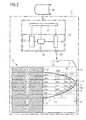
- a 3D object specifically a portion thereof, for being generated by layer based additive manufacturing is described in connection with Fig. 1 .
- a respective additive manufacturing device is described in connection with Fig. 2 .
- exemplary energy density distributions within an overhang region for additive manufacturing are described.
- Figs. 5 to 8 the identification of approximated slope parameters associated with down-skin micro-regions is explained.
- Fig. 9 is an exemplary flow chart describing additive manufacturing based on the herein disclosed concepts and Fig. 10 illustrates a resulting three-dimensional object and its specific density structure.
- a three-dimensional object 1 comprises a core portion 3 and an overhang portion 5.
- a layer structure with six layers is schematically indicated.
- the Z-direction represents the layer providing direction.
- the layers extend within a layer plane, e.g. X-Y-plane.
- a thickness T of the layers is assumed to be identical for the plurality of layers that are schematically indicated for three-dimensional object 1. In general, the thicknesses may vary (see also Fig. 3 ).
- the layer structure comprises, from the bottom, three layers, the last of the three being referenced in Fig. 1 explicitly as N-1.
- Each of those three layers consists exemplarily only of a core region 9, wherein herein a core region of a layer is understood as being built on top of a previously irradiated region.
- core portion 3 those core regions 9 lay essentially one on top of the other, thereby providing a constant boundary condition for the irradiation and formation of three-dimensional object 1.
- a set of two overhang layers N, N+1 are indicated on top of layer N-1.
- a dashed line indicates a transition 7 from a region of that layer being built on top of a previously irradiated region, i.e. a respective core region 9 of that layer, and a region built on top of a region that was previously not irradiated, herein those regions are referred to as down-skin regions 11.
- that portion of a core region that extends next to transition 7 is referred to as a transition region 13.
- transition region 13 extends on top of and up to the boarder of an underlying irradiated region.
- layer N+2 On top of overhang layer N+1, another layer N+2 with only a respective pure core region forms the top side of three-dimensional object 1, i.e. layer N+2 extends only above the previously radiated region of layer N+1.
- the core of the object may be melted with maximum laser power.
- core region 9 is irradiated with an energy density that allows for a complete and solid melting of the underlying powdered material resulting in a, for the powdered material typical, material density of the respective core portion.
- down-skin regions 11 are characterized by a specific structural feature that depends on the reduced energy introduced into the powder.
- the down-skin regions 11, which are not supported by some previously irradiated region may be subject to processing effects that act onto the irradiated and at least partly melted powdered material. Those effects may, for a non-adapted irradiation, result in a structural undesired shape of the overhang surface side that is the bottom side of overhang portion 5 when looked at in the direction of the layer providing direction.
- the change in the provided energy density may depend, in particular, on the extent that a respective down-skin region 11 extends beyond an associated core region 9 of a preceding underlying layer.
- Fig. 1 the extent 15 of layer N is schematically indicated by a double arrow.
- down-skin region 11 of layer N extends about twice as far beyond core region 9 (transition 7) of layer N-1 than down-skin region 11 of layer N+1 extends beyond transition 7 of layer N, delimiting the supporting irradiated region of layer N.
- object layer data such as an extended CAD representation, of three-dimensional object 1.
- a device 21 for additive manufacturing of a three-dimensional object, such as three-dimensional object 1 of Fig. 1 , from powdered material is schematically shown.
- Device 21 includes a radiation source 23 for providing a light beam 25 to interact with a powdered material 27 provided layer by layer within a powder bed 31.
- Radiation source 23 comprises, for example, a laser system 33 with a pump laser 35, a resonator 37, and a scanning optic 39.
- the respective components of laser system 33 as well as the providing of layers of powder may be controlled by a control unit 41.
- the controller may be configured to, for example, adjust the scanning speed or the (e.g. laser) power until the desired energy density is accumulated within an irradiated region.
- control unit may be a single microprocessor or plural microprocessors that may include means for controlling, among others, an operation of radiation source 35 or scanning optic 39 as well the powder distribution and lowering of the position of the already generated portion of the three-dimensional object.
- Control unit may include known components required to run an irradiation application such as, for example, a memory, a storage device, and a processor such as a central processing unit or any other means known in the art for controlling device 21 for additive manufacturing.
- Control unit 41 may analyze and compare received and stored data, and, based on instructions and data stored in memory or input by a user, determine what type of action is required. For example, control unit 41 may compare received values with target values stored in memory, and based on the results of the comparison, the controller may transmit signals to one or more components to alter the deposited energy density.
- Control unit 41 may include any memory device known in the art for storing data relating to operation of device 21 for additive manufacturing and its components.
- the data may be stored in the form of one or more maps such as CAD files or adapted CAD files.
- An example is the digital 3D printable item disclosed herein that describes and/or relates 3D data (for example 3D data points) to specific operation and/or irradiation parameters.
- Each of the maps and data items may be in the form of tables, graphs, and/or equations, and include a compilation of data.
- Control unit 41 may reference those maps and items and control the operation of one component in response to the desired operation of another component. For example, control unit 41 may provide a specific scan pattern 43 of beam 25 over a top layer of powder 27, thereby irradiating the powdered material to form a desired solid object.
- control unit 41 controls the performing of the scanning process based on a digital 3D printable item 45.
- a digital printable item is an item for being processed by a 3D manufacturing device such as device 21. It may be stored locally or decentrally on one or more storage devices. It includes the basis definition of the shape of the three-dimensional object 1, e.g. by a data set representing a 3D structure of three-dimensional object 1, as well as information on the to be processed layer structure. Such information may comprise a layer thickness, an extension and position of core regions, transition regions, and down-skin regions.
- digital 3D printable item 45 includes energy density parameters associated with the data set/data points and the specific layer structure and, in particular the specific layer providing direction.
- Energy density parameters are configured for enabling the setting of an irradiated energy density during operation of 3D manufacturing device 21.
- Energy density parameters comprise core energy density parameters for those data points of the data set that are associated with core region 9 of, in particular, an overhang layer.
- Energy density parameters further comprise overhang energy density parameters for those data points of the data set that are associated with down-skin regions 11 of overhang layers.
- digital 3D printable item represents, for example, an extended CAD data set.
- overhang energy density parameters for a specific data point of a down-skin region depend on extent 15 of an associated respective down-skin micro-region (see also Figs. 5 to 8 ).
- overhang energy density parameters depend on a slope value that can be associated with the respective down-skin micro-region as will be described herein.
- digital 3D printable item 45 represents, for example, a (3D) laser irradiation map for a laser based 3D additive manufacturing device such as device 21.
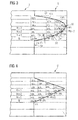
- Fig. 2 shows schematically a manufactured three-dimensional object 1A.
- a layer sequence with a modified layer thickness is indicated as the layer thickness varied during manufacturing of overhang portion 5, for example, in line with known adaptive slicing techniques.
- a left side of object 1A shown in Fig. 2 represents core portion 3.
- core portion 3 has been manufactured, for example, with energy densities that result in an essentially complete melting of powdered material 27.
- core portion 3 includes all layers and extends laterally up to an outer side surface 51 of object 1A. Outer side surface 51 is indicated schematically as delimiting layers N-1, N-2, and N+7 with respect to the right side of the drawings (e.g. in X-direction).
- core portion 3 has been manufactured with a, for example, maximum core portion energy density, herein referred to as 100%, that is irradiated constantly within core portion 3.
- An assumed extension of outer side surface 51 into intermediate layers N to N+6 is illustrated by a dashed line delimiting the shaded left side of object 1A.
- the dashed line splits those intermediate layers in sections that completely relate to core portion 3 and to sections that relate to overhang portion 5.
- overhang portion 5 includes - in the Z-direction - a bottom side 53 and a top side 55. Any one of the intermediate layers may extend along (at least partly along) those sides or may end into those sides and, thus, may have sections without a layer being on top or below of it (such as down-skin regions 11).
- down-skin regions 11 are indicated for layers N, N+1, N+2, and N+3. Accordingly, those layers comprise sections that are irradiated but are not on top (in Z-direction) of a previously irradiated region.
- transitions 7 for those layers are again indicated by dashed lines. At the core portion side of transition 7, the core region of the respective layer is given, as that core region is on top of a previously irradiated region.
- core regions may extend beyond outer surface side 51.
- energy density values are indicated in Fig. 2 as percentage values with respect to the core energy density.
- those down-skin regions which extend over a larger extent in lateral direction, are associated with lower energy density irradiation, i.e. are based on a larger down-skin reduction with respect to the core energy density.
- down-skin regions 11 of layer N and of layer N+1 is irradiated with 20% of the core energy density
- down-skin region 11 of layer N+2 is irradiated with 30% of the core energy density
- down-skin region 11 of layer N+3 is irradiated with 50% of the core energy density.
- the energy density increases from down-skin region 11 towards core portion 3 in a specific manner.
- layer N+1 comprises a section of an energy density of 40% of the core energy density as well as a section of 20% of the core energy density.
- the energy density provided to the various layers may increase in Z-direction until, at top surface 55 of overhang portion 5, the maximum core energy density may be provided. Accordingly, overhang portion 5 is generated with a varying energy density in Z-direction resulting in a specific structure due to, for example, a partially incomplete melting of powder 27 at bottom side 53.
- core portion 3 may comprise completely melted/sintered material, while overhang portion 5, when looked at from bottom side 53, i.e. in Z-direction, comprises only partly melted/sintered material, and overhang portion 5, when looked at from top side 55, i.e. against Z-direction, comprises again completely melted/sintered material.
- Fig. 3 illustrates for a 3D shape, similar to Fig. 2 , a modified energy density distribution in the range between core portion 3 and overhang portion 5. Specifically, it is shown that, with respect to inner side 51, the sequence of overhang layers N, N+1, N+2, N+3 were manufactured with reduced energy densities also at the left (i.e. at the core portion side) of inner side 51. Thereby, a structural bridge (with a similar structure than that at down-skin regions 11) may extend into core portion 3.
- FIG. 3 indicates - for each of overhang layers N, N+1, N+2, N+3 - lateral extents 15 of associated down-skin micro-regions as will be discussed below.
- a down-skin micro-region 69 is a portion of down-skin region 11 that will be treated within the slope analysis as a single unit and extends, for example over a range of 0.5 mm to 10 mm, depending on the desired process quality in the down skin areas; that, in turn, means that the number of rays 62 (see fig. 5 ) used to subdivide the down skin regions 11 may depend on the desired extent of the micro-regions and on the overall size of the part.
- bottom side 53 and top side 55 are schematically indicated.
- the slope which is based on the lateral extent of the down-skin micro-region beyond the irradiated region as well as the layer thickness, increases from the left to the right, i.e. from inner side 51 towards a furthest overhang position 56.
- the slope may be defined, for example, by a plane approximating the down-skin micro-region as described in connection with Figs. 5 to 8 .
- respective normal vectors n N , n N+2 of planes approximating the down-skin micro-regions for layers N and N+2 are indicated in Fig. 3 .
- the angle of the normal vectors with respect to the Z-direction increases with increasing slope i.e. from layer N to layer N+2.
- the percentage values of the core energy density are provided for illustration purposes only. They may depend on the type of radiation and the type of powder - and in general the type of 3D manufacturing process - and thus, they may be selected, for example, such that for the down-skin region an increased stiffness is provided that avoids or at least reduces a respective deformation during the manufacturing process.
- an overhang portion 5' is illustrated having a constant slope, e.g. a constant extent 15 for a constant layer thickness. Accordingly, the slope depending overhang energy density provided for the down-skin regions is illustrated to be 20% of the maximum core energy density for each overhang layer N, N+1, N+2, N+3.
- various overhang portions 5' may be provided with different slopes, wherein different slopes result in different slope depending overhang energy densities used for manufacturing in those portions. Accordingly, the control unit of the respective additive manufacturing device will associate varying energy densities for overhang regions with varying slope parameters.
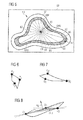
- Fig. 5 illustrates an exemplary approach for determining a down-skin region and for dividing the same into down-skin micro-regions. Based on such an identification of down-skin micro-regions, respective slope values may be derived and associated with respective down-skin micro-regions based on a 3D data set representing a three-dimensional object. The slope values then affect the selected energy density.
- a three-dimensional object 1B is delimited by a global part silhouette 57 that is smaller in size than a respective wall 59 of powder bed 31.
- Fig. 5 identifies a centroid 61.
- Centroid 61 may be a global part centroid that refers to the complete part to be produced or a local centroid for, e.g. a respective portion of a layer delimited by closed boundary of global part silhouette 57.
- a previous layer contour 63 and a current layer contour 65 represent the boundaries of the respective layers.
- respective down-skin areas 67 are formed.
- down-skin micro-regions 69P, 69Q, 69U are illustrated.
- three points are identified for approximating a tangential plane.
- the first point P1, Q1, U1 is selected, for example, as a center point of the respective section of previous layer contour 63.
- the second two points P2, P3 - Q2, Q3 - U2, U3 are selected, for example, to be the intersections of the radial rays originating from centroid 61 when crossing current layer contour 65.
- a respective approximation plane 71U is indicated in Fig. 8 for down-skin micro-region 69U together with a respective normal vector n U .
- the slope angle may be given by the angle from the normal of the approximated plane to the layer providing direction Z.
- the slope angle of that plane with respect to the layer plane may be selected to determine the adaptation of the energy density. In other words, the down-skin reduction of the energy density with respect to the core energy density may increase with decreasing slope.
- the down-skin area may be obtained by subtracting the region of a directly preceding layer from the current layer.
- the resulting region is herein referred to as the down-skin region.
- That region is divided into small zones referred to herein as down-skin micro-regions.
- the division into those down-skin micro-regions may be performed step-wise by, for example, ray tracing originating from a centroid of the object.
- the centroid may be, for example, the center of the bounding box of the whole object or of the respective layer.
- the down-skin micro-regions are then assigned with different energy density values for manufacturing, e.g.
- the approximated tangent plane for each of the down-skin micro-regions may be calculated using three points, one coming from the contour generated by the immediately preceded layer, and two points coming from the contour generated by the current layer.
- the slope may be determined, for example, based on the maximum extent in, e.g., radial direction from the centroid in combination with the layer thickness.
- Alternative approximations of the slope parameter of respective down-skin micro-regions will be apparent to the skilled person.
- the adaptation of the energy densities may be performed step-wise. In some embodiments, the adaptation of the energy densities may be performed continuously. For example, the adaptation may follow the change of the slope for a respectively performed scanning pattern.
- the energy density is one of the parameters defining the 3D manufacturing process.
- the energy density is, in particular, proportional to the power provided by the laser beam to the powder bed and is inverse proportional to the product of the scanning speed and essentially the diameter of the beam 25. Accordingly, the energy density may be adapted by modifying the power provided by the radiation source, the extent of beam 25, the scanning speed of the beam, the distance between scanning lines and/or the strategy used for the hatching, as well as a combination of some or all of those parameters.
- the respective energy densities are properties of, for example, the type of radiation and the type of the powder used for the 3D manufacturing process.
- a reduced energy density can create a melted volume with more porosity.
- using properly calibrated low energy may avoid a deep penetration of the laser, so it is possible to obtain a surface that may be better with respect to the original shape, with less roughness, as well as that may avoid irregular lumps of fused powder which could compromise the subsequent layers.
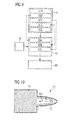
- Fig. 9 illustrates a flow chart of a three-dimensional processing based on the herein disclosed concepts.
- the concepts use the adaptation of irradiation for the generative manufacturing of objects in, in particular, laser based 3D additive manufacturing devices.
- the manufacturing is divided in a planning phase 81, a configuration phase 83, and a manufacturing phase 85.
- the geometry and structure of the to be manufactured object is defined. For example, a 3D data set of the object may be provided (step 81A). Based on a selected layer providing direction (Z-direction), core regions may be identified (step 81B) as well as down-skin regions (step 81C). In some embodiments, the identification of transition regions (step 81D) and the determination of the extent into the object's core portion may also take place.
- down-skin micro-regions may be defined and respective slope parameters may be associated with the defined down-skin micro-regions (step 81E).
- the result of planning phase 81 may be essentially a portion of a digital 3D-printable item as discussed above.
- energy densities are defined for the core regions (step 83A), the down-skin micro-regions (step 83B), and - in some embodiments - the transition regions (step 83C).
- the energy densities require respective power values for the radiation source, beam diameters e.g. for the scanning optics, scanning velocities, scanning path overlaps, etc.
- a scanning procedure will be defined, e.g. in form of a digital 3D-printable item.
- 3D-manufacturing device is operated in line with the defined scanning procedure, thereby generating a three-dimensional object.
- Fig. 10 schematically illustrates the density distribution of the created material structure in view of the herein disclosed concepts. Specifically, within a main core portion 3, an essentially constant core portion density of the material structure exists. This is indicated in Fig. 10 as a region of high core density 91.
- the down-skin material structure at an overhang side has a density that is decreased with respect to the core portion density but increases in direction from the overhang side to the top side. This is indicated in Fig. 10 as a region of low density 93 at down-skin regions as well as arrow 95A that indicates the increase of densities.
- the density of the material structure within the overhang may increase towards the main core portion at least for those layers being overhang layers as indicated by arrow 95B.
- the increase of the density of the material structure up to the maximum core density will extend into the main core portion as discussed above.
- a structural analysis of a three-dimensional object generated by the herein disclosed concepts may show a less dense (e.g. due to partly melted powder corns) density at least in the down-skin regions of the overhang portion together with an increase of the density of the structure towards the top side of the overhang portion as well as towards the main core portion for the overhang layers.
- a maximum density may be provided at the top side while in light of the increasing density feature, a zone of reduced densities may be formed within the layers of the overhang portion on top of the overhang layers (see Fig. 2 ).
- the laser power provided to and absorbed by the powder is reduced in at least one layer of an overhang. This may be achieved, for example, by an increased scanning speed or a reduced laser power. Thereby, the powder may only be partly melted but not completely melted. Thereafter, the applied laser power is increased for the thereafter-following layers successively on top of those reduced overhang layer sections.
- the applied energy density close to the contour of the three-dimensional object in the overhang region may be largely reduced at least in the first overhang layer within the down-skin region.
- adaptive slicing is known in the art, to manufacture an object that essentially extends in vertical direction by using thicker powder layers, while a curvature of an object is closely followed by a reduced thickness of layers. The latter allows to reduce the deviation from an actual contour from a desired contour.
- the herein disclosed concepts divide down-skin areas in small zones, called "down-skin micro-regions" ( Fig. 5 ).
- the division may be done step-wise by means of rays starting from a centroid of the part.
- the down-skin micro-regions may be assigned to different power level thresholds, based on the angle that the tangent plane forms with the ground plane. In the following (upper) layers, the zones on top of these micro-regions will be irradiated with growing laser power, to reach the 100% of the set point.
- the tangent plane in the down-skin micro-regions may be calculated using three points: one coming from the contour generated by the previous layer, two coming from the contour generated by the current layer ( Fig. 5 ).
- the disclosed concepts offer an automatic way of solving a problem that otherwise may involve a lot of manual trial-and-error sessions.
- selective laser sintering or selective laser melting machines such as the "mysint100" manufactured by TRUMPF SISMA und TRUMPF.
- the manufacturing of metal or ceramic based elements in line with the herein disclosed concepts may find applications in various technical fields such as in medical, dental, aerospace, and automobile applications.
Landscapes
- Engineering & Computer Science (AREA)
- Chemical & Material Sciences (AREA)
- Manufacturing & Machinery (AREA)
- Materials Engineering (AREA)
- Automation & Control Theory (AREA)
- Ceramic Engineering (AREA)
- Mechanical Engineering (AREA)
Priority Applications (2)
| Application Number | Priority Date | Filing Date | Title |
|---|---|---|---|
| EP15180029.9A EP3127635A1 (fr) | 2015-08-06 | 2015-08-06 | Fabrication additive de couches de peau profondes |
| CN201610624746.9A CN106424723A (zh) | 2015-08-06 | 2016-08-02 | 下表皮层的增材制造 |
Applications Claiming Priority (1)
| Application Number | Priority Date | Filing Date | Title |
|---|---|---|---|
| EP15180029.9A EP3127635A1 (fr) | 2015-08-06 | 2015-08-06 | Fabrication additive de couches de peau profondes |
Publications (1)
| Publication Number | Publication Date |
|---|---|
| EP3127635A1 true EP3127635A1 (fr) | 2017-02-08 |
Family
ID=53783152
Family Applications (1)
| Application Number | Title | Priority Date | Filing Date |
|---|---|---|---|
| EP15180029.9A Ceased EP3127635A1 (fr) | 2015-08-06 | 2015-08-06 | Fabrication additive de couches de peau profondes |
Country Status (2)
| Country | Link |
|---|---|
| EP (1) | EP3127635A1 (fr) |
| CN (1) | CN106424723A (fr) |
Cited By (50)
| Publication number | Priority date | Publication date | Assignee | Title |
|---|---|---|---|---|
| US20180126649A1 (en) | 2016-11-07 | 2018-05-10 | Velo3D, Inc. | Gas flow in three-dimensional printing |
| WO2018160807A1 (fr) * | 2017-03-02 | 2018-09-07 | Velo3D, Inc. | Impression tridimensionnelle d'objets tridimensionnels |
| WO2018197506A1 (fr) * | 2017-04-28 | 2018-11-01 | Eos Gmbh Electro Optical Systems | Augmentation de la qualité de surface |
| US10144176B1 (en) | 2018-01-15 | 2018-12-04 | Velo3D, Inc. | Three-dimensional printing systems and methods of their use |
| EP3412381A1 (fr) * | 2017-06-05 | 2018-12-12 | United Technologies Corporation | Bibliothèque de formes prédéfinies pour des processus de fabrication additive |
| US10183330B2 (en) | 2015-12-10 | 2019-01-22 | Vel03D, Inc. | Skillful three-dimensional printing |
| US10195693B2 (en) | 2014-06-20 | 2019-02-05 | Vel03D, Inc. | Apparatuses, systems and methods for three-dimensional printing |
| WO2019030127A1 (fr) * | 2017-08-07 | 2019-02-14 | Eos Gmbh Electro Optical Systems | Procédé optimisé de segmentation |
| US10252336B2 (en) | 2016-06-29 | 2019-04-09 | Velo3D, Inc. | Three-dimensional printing and three-dimensional printers |
| US10252335B2 (en) | 2016-02-18 | 2019-04-09 | Vel03D, Inc. | Accurate three-dimensional printing |
| US10272525B1 (en) | 2017-12-27 | 2019-04-30 | Velo3D, Inc. | Three-dimensional printing systems and methods of their use |
| DE102017126624A1 (de) | 2017-11-13 | 2019-05-16 | Trumpf Laser- Und Systemtechnik Gmbh | Schichtselektive belichtung im überhangbereich bei der generativen fertigung |
| US10357957B2 (en) | 2015-11-06 | 2019-07-23 | Velo3D, Inc. | Adept three-dimensional printing |
| WO2019183420A1 (fr) * | 2018-03-23 | 2019-09-26 | Lawrence Livermore National Security, Llc | Carte de puissance pour fabrication additive visant à atténuer une structure en surplomb |
| WO2019195062A1 (fr) * | 2018-04-06 | 2019-10-10 | Velo3D, Inc. | Impression tridimensionnelle d'objets tridimensionnels |
| US10449696B2 (en) | 2017-03-28 | 2019-10-22 | Velo3D, Inc. | Material manipulation in three-dimensional printing |
| CN110605391A (zh) * | 2019-09-09 | 2019-12-24 | 江西宝航新材料有限公司 | 一种壶形薄壁件的3d打印增材制造方法 |
| US10611092B2 (en) | 2017-01-05 | 2020-04-07 | Velo3D, Inc. | Optics in three-dimensional printing |
| CN111770829A (zh) * | 2018-02-19 | 2020-10-13 | 新加坡科技研究局 | 增材制造的方法和系统 |
| EP3756858A1 (fr) * | 2019-06-28 | 2020-12-30 | LayerWise NV | Système d'impression tridimensionnelle avec des propriétés de surface améliorées |
| EP3581367B1 (fr) | 2018-06-07 | 2021-05-05 | CL Schutzrechtsverwaltungs GmbH | Procédé de fabrication additive d'au moins un objet tridimensionnel |
| DE112018001597B4 (de) * | 2017-08-01 | 2021-06-02 | Sigma Labs, Inc. | Systeme und Verfahren zum Messen abgestrahlter thermischer Energie während der Ausführung einer additiven Fertigung |
| CN113059187A (zh) * | 2021-06-02 | 2021-07-02 | 西安赛隆金属材料有限责任公司 | 一种具有悬垂结构零件的3d打印方法 |
| CN113275601A (zh) * | 2021-05-20 | 2021-08-20 | 王祥宇 | 一种变层厚扫描的切片方法 |
| WO2021198598A1 (fr) * | 2020-04-03 | 2021-10-07 | Safran Aircraft Engines | Procédé de fabrication additive d'une paroi pour turbomachine, comprenant au moins un orifice de refroidissement |
| FR3108869A1 (fr) * | 2020-04-03 | 2021-10-08 | Safran Aircraft Engines | Procédé de fabrication additive d’une paroi pour turbomachine, comprenant au moins un orifice de refroidissement |
| US20220032535A1 (en) * | 2018-10-01 | 2022-02-03 | Signify Holding B.V. | Method for printing objects with inclination angles less than 45° with respect to building plate |
| US11260456B2 (en) | 2018-02-21 | 2022-03-01 | Sigma Labs, Inc. | Photodetector array for additive manufacturing operations |
| US11260454B2 (en) | 2017-11-07 | 2022-03-01 | Sigma Labs, Inc. | Correction of non-imaging thermal measurement devices |
| CN115052699A (zh) * | 2020-02-06 | 2022-09-13 | 西门子能源全球有限两合公司 | 用于在增材制造中制造支撑结构的方法 |
| JP7150121B1 (ja) | 2021-10-25 | 2022-10-07 | 株式会社ソディック | 造形プログラムの作成方法、積層造形方法および積層造形装置 |
| US11517984B2 (en) | 2017-11-07 | 2022-12-06 | Sigma Labs, Inc. | Methods and systems for quality inference and control for additive manufacturing processes |
| WO2023067199A1 (fr) * | 2021-10-22 | 2023-04-27 | SLM Solutions Group AG | Technique de définition d'une pluralité de vecteurs d'irradiation |
| WO2023078762A1 (fr) * | 2021-11-05 | 2023-05-11 | Trumpf Laser- Und Systemtechnik Gmbh | Procédé, dispositif de planification et produit-programme informatique de planification d'une exposition localement sélective d'une zone de travail au rayonnement d'un faisceau d'énergie, et procédé, dispositif de production et produit-programme informatique pour la fabrication additive de composants à partir d'un matériau en poudre |
| US11691343B2 (en) | 2016-06-29 | 2023-07-04 | Velo3D, Inc. | Three-dimensional printing and three-dimensional printers |
| JP2023105840A (ja) * | 2022-01-20 | 2023-08-01 | 株式会社ジェイテクト | 金属積層造形装置 |
| DE102022201696A1 (de) | 2022-02-18 | 2023-08-24 | Siemens Energy Global GmbH & Co. KG | Additive Herstellung einer dünnen angeschrägten Bauteilstruktur |
| DE102022111416A1 (de) | 2022-05-09 | 2023-11-09 | Trumpf Laser- Und Systemtechnik Gmbh | Verfahren zum Betreiben einer Anlage zur additiven Fertigung von dreidimensionalen Bauteilen |
| EP4360779A1 (fr) * | 2022-10-25 | 2024-05-01 | RTX Corporation | Bride forgée de palier hybride |
| WO2024091552A1 (fr) * | 2022-10-25 | 2024-05-02 | Rtx Corporation | Bride forgée de palier hybride |
| US11999110B2 (en) | 2019-07-26 | 2024-06-04 | Velo3D, Inc. | Quality assurance in formation of three-dimensional objects |
| EP4385647A1 (fr) * | 2022-12-13 | 2024-06-19 | The Boeing Company | Procédés de fabrication additive d'un composant manufacturé, systèmes de fabrication additive qui utilisent les procédés |
| JP2024099573A (ja) * | 2017-04-28 | 2024-07-25 | ダイバージェント テクノロジーズ, インコーポレイテッド | 付加製造のための複数材料および印刷パラメータ |
| US12070907B2 (en) | 2016-09-30 | 2024-08-27 | Velo3D | Three-dimensional objects and their formation |
| EP4245438A4 (fr) * | 2020-11-11 | 2024-10-16 | AECC Shanghai Commercial Aircraft Engine Manufacturing Co., Ltd. | Pièce formée dotée d'une surface inclinée et son procédé de formation |
| EP4512547A1 (fr) * | 2023-08-24 | 2025-02-26 | Renishaw PLC | Appareil et procédés de fusion de lit de poudre |
| EP4512548A1 (fr) * | 2023-08-24 | 2025-02-26 | Renishaw PLC | Appareil et procédés de fusion de lit de poudre |
| US12343933B2 (en) | 2022-08-25 | 2025-07-01 | The Boeing Company | Methods of additively manufacturing a manufactured component and systems that perform the methods |
| US12485621B2 (en) | 2022-08-25 | 2025-12-02 | The Boeing Company | Methods of additively manufacturing a manufactured component and systems that perform the methods |
| WO2026062376A1 (fr) * | 2024-09-17 | 2026-03-26 | Renishaw Plc | Procédés de fusion sur lit de poudre et appareil associé |
Families Citing this family (8)
| Publication number | Priority date | Publication date | Assignee | Title |
|---|---|---|---|---|
| CN107552788B (zh) * | 2017-09-11 | 2020-02-25 | 北京航信增材科技有限公司 | 用于激光选区熔化金属增材制造的假烧结方法 |
| CN108161007B (zh) * | 2017-12-29 | 2020-08-11 | 广州瑞通激光科技有限公司 | 一种slm成型悬垂结构的金属零件优化方法 |
| CN108380873B (zh) * | 2018-02-12 | 2019-01-29 | 成都优材科技有限公司 | 激光选区熔化扫描方法 |
| CN110605392B (zh) * | 2019-09-24 | 2020-06-30 | 浙江大学 | 一种交替进行外壁堆焊和内部填充的金属实体打印方法 |
| CN113510240B (zh) * | 2020-04-09 | 2023-07-07 | 中国航发商用航空发动机有限责任公司 | 管件的增材制造方法 |
| JP7306330B2 (ja) * | 2020-06-04 | 2023-07-11 | トヨタ自動車株式会社 | 積層造形方法及び積層造形装置 |
| CN112059185B (zh) | 2020-11-11 | 2021-01-15 | 中国航发上海商用航空发动机制造有限责任公司 | 带悬臂结构的成形件及其成形方法 |
| EP4326466A1 (fr) * | 2021-04-19 | 2024-02-28 | Nikon SLM Solutions AG | Procédé de commande d'un système d'irradiation, système d'irradiation, produit programme d'ordinateur et appareil pour produire une pièce tridimensionnelle |
Citations (5)
| Publication number | Priority date | Publication date | Assignee | Title |
|---|---|---|---|---|
| WO2005107981A2 (fr) * | 2004-05-04 | 2005-11-17 | Optomec Design Company | Angle plus grand et dépôt de matériels en surplomb |
| US20070035069A1 (en) * | 2005-06-13 | 2007-02-15 | Wust Frank P | Method for the manufacture of a three-dimensional molding |
| US20070175875A1 (en) * | 2004-02-25 | 2007-08-02 | Ingo Uckelmann | Method and device use to produce a set of control data for producing products by free-form sintering and/or melting, in addition to a device for the production thereof |
| US20110180971A1 (en) * | 2008-07-08 | 2011-07-28 | Bego Medical Gmbh | Method for the Production of Heavily Inclined Surfaces in Layers |
| US20140332507A1 (en) * | 2011-11-29 | 2014-11-13 | Matthias Fockele | Process for producing a shaped body by layerwise buildup from material powder |
Family Cites Families (4)
| Publication number | Priority date | Publication date | Assignee | Title |
|---|---|---|---|---|
| US6682688B1 (en) * | 2000-06-16 | 2004-01-27 | Matsushita Electric Works, Ltd. | Method of manufacturing a three-dimensional object |
| US7172724B2 (en) * | 2002-03-26 | 2007-02-06 | Matsushita Electric Works, Ltd. | Method of making sintered object |
| DE112011101779T5 (de) * | 2010-05-25 | 2013-03-14 | Panasonic Corporation | Metallpulver zum selektiven Lasersintern, Verfahren zur Herstellung eines dreidimensionalen Formgegenstands unter Verwendung desselben und davon erhaltener dreidimensionaler Formgegenstand |
| CN103231055B (zh) * | 2013-05-13 | 2014-10-22 | 柳岸敏 | 一种差异化激光3d打印金属件的方法 |
-
2015
- 2015-08-06 EP EP15180029.9A patent/EP3127635A1/fr not_active Ceased
-
2016
- 2016-08-02 CN CN201610624746.9A patent/CN106424723A/zh active Pending
Patent Citations (6)
| Publication number | Priority date | Publication date | Assignee | Title |
|---|---|---|---|---|
| US20070175875A1 (en) * | 2004-02-25 | 2007-08-02 | Ingo Uckelmann | Method and device use to produce a set of control data for producing products by free-form sintering and/or melting, in addition to a device for the production thereof |
| EP1720676B1 (fr) | 2004-02-25 | 2009-01-07 | BEGO Medical GmbH | Procede et dispositif pour generer des enregistrements de commande pour produire des articles par frittage ou coulee sans matrice, ainsi que dispositif pour cette production |
| WO2005107981A2 (fr) * | 2004-05-04 | 2005-11-17 | Optomec Design Company | Angle plus grand et dépôt de matériels en surplomb |
| US20070035069A1 (en) * | 2005-06-13 | 2007-02-15 | Wust Frank P | Method for the manufacture of a three-dimensional molding |
| US20110180971A1 (en) * | 2008-07-08 | 2011-07-28 | Bego Medical Gmbh | Method for the Production of Heavily Inclined Surfaces in Layers |
| US20140332507A1 (en) * | 2011-11-29 | 2014-11-13 | Matthias Fockele | Process for producing a shaped body by layerwise buildup from material powder |
Non-Patent Citations (1)
| Title |
|---|
| "Light Metal Alloys Applications", 11 June 2014, ISBN: 978-953-51-1588-5, article CHAPTER I: "Additive Manufacturing of Al Alloys and Aluminium Matrix Composites (AMCs)", XP055410804, DOI: 10.5772/58534 * |
Cited By (91)
| Publication number | Priority date | Publication date | Assignee | Title |
|---|---|---|---|---|
| US10507549B2 (en) | 2014-06-20 | 2019-12-17 | Velo3D, Inc. | Apparatuses, systems and methods for three-dimensional printing |
| US10493564B2 (en) | 2014-06-20 | 2019-12-03 | Velo3D, Inc. | Apparatuses, systems and methods for three-dimensional printing |
| US10195693B2 (en) | 2014-06-20 | 2019-02-05 | Vel03D, Inc. | Apparatuses, systems and methods for three-dimensional printing |
| US10357957B2 (en) | 2015-11-06 | 2019-07-23 | Velo3D, Inc. | Adept three-dimensional printing |
| US10688722B2 (en) | 2015-12-10 | 2020-06-23 | Velo3D, Inc. | Skillful three-dimensional printing |
| US10183330B2 (en) | 2015-12-10 | 2019-01-22 | Vel03D, Inc. | Skillful three-dimensional printing |
| US10207454B2 (en) | 2015-12-10 | 2019-02-19 | Velo3D, Inc. | Systems for three-dimensional printing |
| US10286603B2 (en) | 2015-12-10 | 2019-05-14 | Velo3D, Inc. | Skillful three-dimensional printing |
| US10252335B2 (en) | 2016-02-18 | 2019-04-09 | Vel03D, Inc. | Accurate three-dimensional printing |
| US10434573B2 (en) | 2016-02-18 | 2019-10-08 | Velo3D, Inc. | Accurate three-dimensional printing |
| US10252336B2 (en) | 2016-06-29 | 2019-04-09 | Velo3D, Inc. | Three-dimensional printing and three-dimensional printers |
| US11691343B2 (en) | 2016-06-29 | 2023-07-04 | Velo3D, Inc. | Three-dimensional printing and three-dimensional printers |
| US10286452B2 (en) | 2016-06-29 | 2019-05-14 | Velo3D, Inc. | Three-dimensional printing and three-dimensional printers |
| US10259044B2 (en) | 2016-06-29 | 2019-04-16 | Velo3D, Inc. | Three-dimensional printing and three-dimensional printers |
| US12070907B2 (en) | 2016-09-30 | 2024-08-27 | Velo3D | Three-dimensional objects and their formation |
| US10661341B2 (en) | 2016-11-07 | 2020-05-26 | Velo3D, Inc. | Gas flow in three-dimensional printing |
| US20180126649A1 (en) | 2016-11-07 | 2018-05-10 | Velo3D, Inc. | Gas flow in three-dimensional printing |
| US10611092B2 (en) | 2017-01-05 | 2020-04-07 | Velo3D, Inc. | Optics in three-dimensional printing |
| US10315252B2 (en) | 2017-03-02 | 2019-06-11 | Velo3D, Inc. | Three-dimensional printing of three-dimensional objects |
| US10357829B2 (en) | 2017-03-02 | 2019-07-23 | Velo3D, Inc. | Three-dimensional printing of three-dimensional objects |
| US10369629B2 (en) | 2017-03-02 | 2019-08-06 | Veo3D, Inc. | Three-dimensional printing of three-dimensional objects |
| US10888925B2 (en) | 2017-03-02 | 2021-01-12 | Velo3D, Inc. | Three-dimensional printing of three-dimensional objects |
| WO2018160807A1 (fr) * | 2017-03-02 | 2018-09-07 | Velo3D, Inc. | Impression tridimensionnelle d'objets tridimensionnels |
| US10442003B2 (en) | 2017-03-02 | 2019-10-15 | Velo3D, Inc. | Three-dimensional printing of three-dimensional objects |
| US10449696B2 (en) | 2017-03-28 | 2019-10-22 | Velo3D, Inc. | Material manipulation in three-dimensional printing |
| US11822310B2 (en) | 2017-04-28 | 2023-11-21 | Eos Gmbh Electro Optical Systems | Increase in surface quality |
| WO2018197506A1 (fr) * | 2017-04-28 | 2018-11-01 | Eos Gmbh Electro Optical Systems | Augmentation de la qualité de surface |
| JP2024099573A (ja) * | 2017-04-28 | 2024-07-25 | ダイバージェント テクノロジーズ, インコーポレイテッド | 付加製造のための複数材料および印刷パラメータ |
| EP3412381A1 (fr) * | 2017-06-05 | 2018-12-12 | United Technologies Corporation | Bibliothèque de formes prédéfinies pour des processus de fabrication additive |
| DE112018001597B4 (de) * | 2017-08-01 | 2021-06-02 | Sigma Labs, Inc. | Systeme und Verfahren zum Messen abgestrahlter thermischer Energie während der Ausführung einer additiven Fertigung |
| US11390035B2 (en) | 2017-08-01 | 2022-07-19 | Sigma Labs, Inc. | Systems and methods for measuring radiated thermal energy during an additive manufacturing operation |
| US11938560B2 (en) | 2017-08-01 | 2024-03-26 | Divergent Technologies, Inc. | Systems and methods for measuring radiated thermal energy during an additive manufacturing operation |
| DE112018007925B4 (de) * | 2017-08-01 | 2026-07-16 | Divergent Technologies, Inc. | Systeme und Verfahren zum Messen abgestrahlter thermischer Energie während der Ausführung einer additiven Fertigung |
| US11850661B2 (en) | 2017-08-07 | 2023-12-26 | Eos Gmbh Electro Optical Systems | Method of segmenting object to be manufactured by energy input parameter and passing energy beam across segments |
| WO2019030127A1 (fr) * | 2017-08-07 | 2019-02-14 | Eos Gmbh Electro Optical Systems | Procédé optimisé de segmentation |
| US11517984B2 (en) | 2017-11-07 | 2022-12-06 | Sigma Labs, Inc. | Methods and systems for quality inference and control for additive manufacturing processes |
| US11260454B2 (en) | 2017-11-07 | 2022-03-01 | Sigma Labs, Inc. | Correction of non-imaging thermal measurement devices |
| US12151316B2 (en) | 2017-11-07 | 2024-11-26 | Divergent Technologies, Inc. | Methods and systems for quality inference and control for additive manufacturing processes |
| DE102017126624A1 (de) | 2017-11-13 | 2019-05-16 | Trumpf Laser- Und Systemtechnik Gmbh | Schichtselektive belichtung im überhangbereich bei der generativen fertigung |
| WO2019091621A1 (fr) | 2017-11-13 | 2019-05-16 | Trumpf Laser- Und Systemtechnik Gmbh | Éclairage sélectif par couche dans la zone en surplomb lors de la fabrication additive |
| US11458573B2 (en) | 2017-11-13 | 2022-10-04 | Trumpf Laser- Und Systemtechnik Gmbh | Layer selective exposure in the overhang region in generative manufacturing |
| WO2020048646A1 (fr) | 2017-11-13 | 2020-03-12 | Trumpf Laser- Und Systemtechnik Gmbh | Alternance entre des stratégies d'irradiation spécifiques à une zone au cours de la fabrication additive |
| US10272525B1 (en) | 2017-12-27 | 2019-04-30 | Velo3D, Inc. | Three-dimensional printing systems and methods of their use |
| US10144176B1 (en) | 2018-01-15 | 2018-12-04 | Velo3D, Inc. | Three-dimensional printing systems and methods of their use |
| CN111770829A (zh) * | 2018-02-19 | 2020-10-13 | 新加坡科技研究局 | 增材制造的方法和系统 |
| CN111770829B (zh) * | 2018-02-19 | 2022-12-27 | 新加坡科技研究局 | 增材制造的方法和系统 |
| US12337523B2 (en) | 2018-02-21 | 2025-06-24 | Divergent Technologies, Inc. | Sensor deconfliction in multilaser additive manufacturing systems |
| US11260456B2 (en) | 2018-02-21 | 2022-03-01 | Sigma Labs, Inc. | Photodetector array for additive manufacturing operations |
| US11433480B2 (en) | 2018-03-23 | 2022-09-06 | Lawrence Livermore National Security, Llc | Additive manufacturing power map to mitigate overhang structure |
| WO2019183420A1 (fr) * | 2018-03-23 | 2019-09-26 | Lawrence Livermore National Security, Llc | Carte de puissance pour fabrication additive visant à atténuer une structure en surplomb |
| WO2019195062A1 (fr) * | 2018-04-06 | 2019-10-10 | Velo3D, Inc. | Impression tridimensionnelle d'objets tridimensionnels |
| EP3578343B1 (fr) | 2018-06-07 | 2021-05-19 | CL Schutzrechtsverwaltungs GmbH | Procédé de fabrication additive d'au moins un objet tridimensionnel |
| EP3581367B1 (fr) | 2018-06-07 | 2021-05-05 | CL Schutzrechtsverwaltungs GmbH | Procédé de fabrication additive d'au moins un objet tridimensionnel |
| US20220032535A1 (en) * | 2018-10-01 | 2022-02-03 | Signify Holding B.V. | Method for printing objects with inclination angles less than 45° with respect to building plate |
| US12162208B2 (en) * | 2018-10-01 | 2024-12-10 | Signify Holding, B.V. | Method for printing objects with inclination angles less than 45° with respect to building plate |
| EP3756858A1 (fr) * | 2019-06-28 | 2020-12-30 | LayerWise NV | Système d'impression tridimensionnelle avec des propriétés de surface améliorées |
| EP3756860A1 (fr) | 2019-06-28 | 2020-12-30 | LayerWise N.V. | Système d'impression tridimensionnelle avec des propriétés de surface améliorées |
| US11731348B2 (en) | 2019-06-28 | 2023-08-22 | Layerwise Nv | Three dimensional printing system with improved surface properties |
| US11999110B2 (en) | 2019-07-26 | 2024-06-04 | Velo3D, Inc. | Quality assurance in formation of three-dimensional objects |
| CN110605391A (zh) * | 2019-09-09 | 2019-12-24 | 江西宝航新材料有限公司 | 一种壶形薄壁件的3d打印增材制造方法 |
| CN110605391B (zh) * | 2019-09-09 | 2021-08-27 | 江西宝航新材料有限公司 | 一种壶形薄壁件的3d打印增材制造方法 |
| CN115052699B (zh) * | 2020-02-06 | 2024-03-08 | 西门子能源全球有限两合公司 | 用于在增材制造中制造支撑结构的方法 |
| CN115052699A (zh) * | 2020-02-06 | 2022-09-13 | 西门子能源全球有限两合公司 | 用于在增材制造中制造支撑结构的方法 |
| US12611717B2 (en) | 2020-02-06 | 2026-04-28 | Siemens Energy Global GmbH & Co. KG | Method for producing a support structure in additive manufacturing |
| US12564882B2 (en) * | 2020-04-03 | 2026-03-03 | Safran Aircraft Engines | Method for additive manufacturing of a wall for a turbine engine, comprising at least one cooling aperture |
| US20240009733A1 (en) * | 2020-04-03 | 2024-01-11 | Safran Aircraft Engines | Method for additive manufacturing of a wall for a turbine engine, comprising at least one cooling aperture |
| WO2021198598A1 (fr) * | 2020-04-03 | 2021-10-07 | Safran Aircraft Engines | Procédé de fabrication additive d'une paroi pour turbomachine, comprenant au moins un orifice de refroidissement |
| FR3108869A1 (fr) * | 2020-04-03 | 2021-10-08 | Safran Aircraft Engines | Procédé de fabrication additive d’une paroi pour turbomachine, comprenant au moins un orifice de refroidissement |
| CN115697589A (zh) * | 2020-04-03 | 2023-02-03 | 赛峰飞机发动机公司 | 用于涡轮发动机的包括至少一个冷却孔的壁的增材制造方法 |
| EP4245438A4 (fr) * | 2020-11-11 | 2024-10-16 | AECC Shanghai Commercial Aircraft Engine Manufacturing Co., Ltd. | Pièce formée dotée d'une surface inclinée et son procédé de formation |
| CN113275601A (zh) * | 2021-05-20 | 2021-08-20 | 王祥宇 | 一种变层厚扫描的切片方法 |
| CN113059187A (zh) * | 2021-06-02 | 2021-07-02 | 西安赛隆金属材料有限责任公司 | 一种具有悬垂结构零件的3d打印方法 |
| WO2023067199A1 (fr) * | 2021-10-22 | 2023-04-27 | SLM Solutions Group AG | Technique de définition d'une pluralité de vecteurs d'irradiation |
| US12337386B2 (en) | 2021-10-25 | 2025-06-24 | Sodick Co., Ltd. | Method for preparing additive manufacturing program, method for additive manufacturing, and additive manufacturing apparatus |
| JP7150121B1 (ja) | 2021-10-25 | 2022-10-07 | 株式会社ソディック | 造形プログラムの作成方法、積層造形方法および積層造形装置 |
| JP2023063778A (ja) * | 2021-10-25 | 2023-05-10 | 株式会社ソディック | 造形プログラムの作成方法、積層造形方法および積層造形装置 |
| WO2023078762A1 (fr) * | 2021-11-05 | 2023-05-11 | Trumpf Laser- Und Systemtechnik Gmbh | Procédé, dispositif de planification et produit-programme informatique de planification d'une exposition localement sélective d'une zone de travail au rayonnement d'un faisceau d'énergie, et procédé, dispositif de production et produit-programme informatique pour la fabrication additive de composants à partir d'un matériau en poudre |
| JP2023105840A (ja) * | 2022-01-20 | 2023-08-01 | 株式会社ジェイテクト | 金属積層造形装置 |
| US20250144880A1 (en) * | 2022-02-18 | 2025-05-08 | Siemens Energy Global GmbH & Co. KG | Additive manufacturing of a thin, angled component structure |
| DE102022201696A1 (de) | 2022-02-18 | 2023-08-24 | Siemens Energy Global GmbH & Co. KG | Additive Herstellung einer dünnen angeschrägten Bauteilstruktur |
| DE102022111416A1 (de) | 2022-05-09 | 2023-11-09 | Trumpf Laser- Und Systemtechnik Gmbh | Verfahren zum Betreiben einer Anlage zur additiven Fertigung von dreidimensionalen Bauteilen |
| US12485621B2 (en) | 2022-08-25 | 2025-12-02 | The Boeing Company | Methods of additively manufacturing a manufactured component and systems that perform the methods |
| US12343933B2 (en) | 2022-08-25 | 2025-07-01 | The Boeing Company | Methods of additively manufacturing a manufactured component and systems that perform the methods |
| EP4360779A1 (fr) * | 2022-10-25 | 2024-05-01 | RTX Corporation | Bride forgée de palier hybride |
| WO2024091552A1 (fr) * | 2022-10-25 | 2024-05-02 | Rtx Corporation | Bride forgée de palier hybride |
| EP4385647A1 (fr) * | 2022-12-13 | 2024-06-19 | The Boeing Company | Procédés de fabrication additive d'un composant manufacturé, systèmes de fabrication additive qui utilisent les procédés |
| WO2025040920A1 (fr) * | 2023-08-24 | 2025-02-27 | Renishaw Plc | Appareil et procédés de fusion sur lit de poudre |
| WO2025040921A1 (fr) * | 2023-08-24 | 2025-02-27 | Renishaw Plc | Appareil et procédés de fusion sur lit de poudre |
| EP4512548A1 (fr) * | 2023-08-24 | 2025-02-26 | Renishaw PLC | Appareil et procédés de fusion de lit de poudre |
| EP4512547A1 (fr) * | 2023-08-24 | 2025-02-26 | Renishaw PLC | Appareil et procédés de fusion de lit de poudre |
| WO2026062376A1 (fr) * | 2024-09-17 | 2026-03-26 | Renishaw Plc | Procédés de fusion sur lit de poudre et appareil associé |
Also Published As
| Publication number | Publication date |
|---|---|
| CN106424723A (zh) | 2017-02-22 |
Similar Documents
| Publication | Publication Date | Title |
|---|---|---|
| US11458573B2 (en) | Layer selective exposure in the overhang region in generative manufacturing | |
| CN106424723A (zh) | 下表皮层的增材制造 | |
| EP3626385B1 (fr) | Dispositif de commande de condition de stratification | |
| US6823230B1 (en) | Tool path planning process for component by layered manufacture | |
| US11850661B2 (en) | Method of segmenting object to be manufactured by energy input parameter and passing energy beam across segments | |
| CN100515618C (zh) | 制造三维产品的装置及方法 | |
| US11537111B2 (en) | Methods and apparatus for 2-D and 3-D scanning path visualization | |
| JP6359643B2 (ja) | 表面下の孔隙を除去する方法 | |
| RU2553796C2 (ru) | Способ изготовления трехмерного тела | |
| US11981082B2 (en) | Device and method for the generative production of a three-dimensional object | |
| JP6257796B2 (ja) | 工具経路の生成方法および工作機械 | |
| JP6898459B2 (ja) | 加工物形成のための照射システムを制御する方法及び装置 | |
| CN110462535B (zh) | 三维物体制造方法和设备及其控制单元、提供控制数据的方法和存储介质 | |
| US20190054567A1 (en) | Additive manufacturing systems, additive manufactured components including portions having distinct porosities, and methods of forming same | |
| CN105431791A (zh) | 用于制造三维物体的方法 | |
| US10695867B2 (en) | Controlling microstructure of selected range of layers of object during additive manufacture | |
| CN120243976B (zh) | 用于在粉末床增材制造中调控多模式整形光束的方法和设备 | |
| US20180250743A1 (en) | Triangle hatch pattern for additive manufacturing | |
| CN110545940B (zh) | 制造工件的方法、建立校正参数的方法和存储介质 | |
| US10668534B2 (en) | Leg elimination strategy for hatch pattern | |
| Yang et al. | An investigation of thin feature generation in direct metal laser sintering systems | |
| Huang et al. | Novel diagonal scanning strategy for the laser powder bed fusion process | |
| WO2025219027A1 (fr) | Procédé et dispositif de planification pour la planification d'une exposition localement sélective d'une zone de travail, programme d'ordinateur, procédé et dispositif de fabrication pour la fabrication additive d'un objet à partir d'un matériau en poudre | |
| US20190118261A1 (en) | Datum structure for additively manufactured object removal from build platform | |
| US12005498B2 (en) | Additive manufacturing systems and methods including build characteristic contribution profiles |
Legal Events
| Date | Code | Title | Description |
|---|---|---|---|
| PUAI | Public reference made under article 153(3) epc to a published international application that has entered the european phase |
Free format text: ORIGINAL CODE: 0009012 |
|
| 17P | Request for examination filed |
Effective date: 20160517 |
|
| AK | Designated contracting states |
Kind code of ref document: A1 Designated state(s): AL AT BE BG CH CY CZ DE DK EE ES FI FR GB GR HR HU IE IS IT LI LT LU LV MC MK MT NL NO PL PT RO RS SE SI SK SM TR |
|
| AX | Request for extension of the european patent |
Extension state: BA ME |
|
| 18R | Application refused |
Effective date: 20180411 |