EP3127712B1 - Pneumatique - Google Patents
Pneumatique Download PDFInfo
- Publication number
- EP3127712B1 EP3127712B1 EP16181560.0A EP16181560A EP3127712B1 EP 3127712 B1 EP3127712 B1 EP 3127712B1 EP 16181560 A EP16181560 A EP 16181560A EP 3127712 B1 EP3127712 B1 EP 3127712B1
- Authority
- EP
- European Patent Office
- Prior art keywords
- pneumatic tire
- group
- phr
- phenol resin
- integer
- Prior art date
- Legal status (The legal status is an assumption and is not a legal conclusion. Google has not performed a legal analysis and makes no representation as to the accuracy of the status listed.)
- Active
Links
Classifications
-
- B—PERFORMING OPERATIONS; TRANSPORTING
- B60—VEHICLES IN GENERAL
- B60C—VEHICLE TYRES; TYRE INFLATION; TYRE CHANGING; CONNECTING VALVES TO INFLATABLE ELASTIC BODIES IN GENERAL; DEVICES OR ARRANGEMENTS RELATED TO TYRES
- B60C1/00—Tyres characterised by the chemical composition or the physical arrangement or mixture of the composition
- B60C1/0016—Compositions of the tread
-
- C—CHEMISTRY; METALLURGY
- C08—ORGANIC MACROMOLECULAR COMPOUNDS; THEIR PREPARATION OR CHEMICAL WORKING-UP; COMPOSITIONS BASED THEREON
- C08L—COMPOSITIONS OF MACROMOLECULAR COMPOUNDS
- C08L15/00—Compositions of rubber derivatives
-
- B—PERFORMING OPERATIONS; TRANSPORTING
- B60—VEHICLES IN GENERAL
- B60C—VEHICLE TYRES; TYRE INFLATION; TYRE CHANGING; CONNECTING VALVES TO INFLATABLE ELASTIC BODIES IN GENERAL; DEVICES OR ARRANGEMENTS RELATED TO TYRES
- B60C1/00—Tyres characterised by the chemical composition or the physical arrangement or mixture of the composition
-
- C—CHEMISTRY; METALLURGY
- C08—ORGANIC MACROMOLECULAR COMPOUNDS; THEIR PREPARATION OR CHEMICAL WORKING-UP; COMPOSITIONS BASED THEREON
- C08K—Use of inorganic or non-macromolecular organic substances as compounding ingredients
- C08K3/00—Use of inorganic substances as compounding ingredients
- C08K3/34—Silicon-containing compounds
- C08K3/36—Silica
-
- C—CHEMISTRY; METALLURGY
- C08—ORGANIC MACROMOLECULAR COMPOUNDS; THEIR PREPARATION OR CHEMICAL WORKING-UP; COMPOSITIONS BASED THEREON
- C08L—COMPOSITIONS OF MACROMOLECULAR COMPOUNDS
- C08L61/00—Compositions of condensation polymers of aldehydes or ketones; Compositions of derivatives of such polymers
- C08L61/04—Condensation polymers of aldehydes or ketones with phenols only
-
- C—CHEMISTRY; METALLURGY
- C08—ORGANIC MACROMOLECULAR COMPOUNDS; THEIR PREPARATION OR CHEMICAL WORKING-UP; COMPOSITIONS BASED THEREON
- C08L—COMPOSITIONS OF MACROMOLECULAR COMPOUNDS
- C08L9/00—Compositions of homopolymers or copolymers of conjugated diene hydrocarbons
-
- C—CHEMISTRY; METALLURGY
- C08—ORGANIC MACROMOLECULAR COMPOUNDS; THEIR PREPARATION OR CHEMICAL WORKING-UP; COMPOSITIONS BASED THEREON
- C08L—COMPOSITIONS OF MACROMOLECULAR COMPOUNDS
- C08L9/00—Compositions of homopolymers or copolymers of conjugated diene hydrocarbons
- C08L9/06—Copolymers with styrene
-
- C—CHEMISTRY; METALLURGY
- C08—ORGANIC MACROMOLECULAR COMPOUNDS; THEIR PREPARATION OR CHEMICAL WORKING-UP; COMPOSITIONS BASED THEREON
- C08L—COMPOSITIONS OF MACROMOLECULAR COMPOUNDS
- C08L2205/00—Polymer mixtures characterised by other features
- C08L2205/02—Polymer mixtures characterised by other features containing two or more polymers of the same C08L -group
-
- C—CHEMISTRY; METALLURGY
- C08—ORGANIC MACROMOLECULAR COMPOUNDS; THEIR PREPARATION OR CHEMICAL WORKING-UP; COMPOSITIONS BASED THEREON
- C08L—COMPOSITIONS OF MACROMOLECULAR COMPOUNDS
- C08L2205/00—Polymer mixtures characterised by other features
- C08L2205/03—Polymer mixtures characterised by other features containing three or more polymers in a blend
-
- C—CHEMISTRY; METALLURGY
- C08—ORGANIC MACROMOLECULAR COMPOUNDS; THEIR PREPARATION OR CHEMICAL WORKING-UP; COMPOSITIONS BASED THEREON
- C08L—COMPOSITIONS OF MACROMOLECULAR COMPOUNDS
- C08L2205/00—Polymer mixtures characterised by other features
- C08L2205/06—Polymer mixtures characterised by other features having improved processability or containing aids for moulding methods
-
- Y—GENERAL TAGGING OF NEW TECHNOLOGICAL DEVELOPMENTS; GENERAL TAGGING OF CROSS-SECTIONAL TECHNOLOGIES SPANNING OVER SEVERAL SECTIONS OF THE IPC; TECHNICAL SUBJECTS COVERED BY FORMER USPC CROSS-REFERENCE ART COLLECTIONS [XRACs] AND DIGESTS
- Y02—TECHNOLOGIES OR APPLICATIONS FOR MITIGATION OR ADAPTATION AGAINST CLIMATE CHANGE
- Y02T—CLIMATE CHANGE MITIGATION TECHNOLOGIES RELATED TO TRANSPORTATION
- Y02T10/00—Road transport of goods or passengers
- Y02T10/80—Technologies aiming to reduce greenhouse gasses emissions common to all road transportation technologies
- Y02T10/86—Optimisation of rolling resistance, e.g. weight reduction
Definitions
- EP-A-3 031 620 and EP-A-3 031 621 which have been both published only after the priority date of this application, each disclose a pneumatic tire having a tread comprising a rubber composition comprising a solution polymerized styrene-butadiene rubber, a polybutadiene and from 30 to 80 phr of a combination of an oil and a resin having a Tg of least 30°C.
- US-A-2012/0208919 describes a tire comprising a rubber composition comprising polybutadiene rubber, a functionalized solution polymerized styrene-butadiene rubber, silica and carbon black.
- the invention relates to a tire in accordance with claim 1.
- a pneumatic tire having a tread comprising a vulcanized or vulcanizable rubber composition comprising, based on 100 parts by weight of elastomer (phr),
- a pneumatic tire having a tread comprising a vulcanizable or vulcanized rubber composition comprising, based on 100 parts by weight of elastomer (phr),
- the rubber composition includes from 50 to 90 phr of a styrene-butadiene rubber having a glass transition temperature (Tg) ranging from -65 °C to -55 °C.
- Tg glass transition temperature
- the styrene-butadiene rubber may functionalized with an alkoxysilane group and at least one of a primary amine group and thiol group.
- the styrene-butadiene rubber is obtained by copolymerizing styrene and butadiene, and characterized in that the styrene-butadiene rubber has a primary amino group and/or thiol group and an alkoxysilyl group which are bonded to the polymer chain.
- the alkoxysilyl group is an ethoxysilyl group.
- the primary amino group and/or thiol group may be bonded to any of a polymerization initiating terminal, a polymerization terminating terminal, a main chain of the styrene-butadiene rubber and a side chain, as long as it is bonded to the styrene-butadiene rubber chain.
- the primary amino group and/or thiol group is preferably introduced to the polymerization initiating terminal or the polymerization terminating terminal, in that the disappearance of energy at a polymer terminal is inhibited to improve hysteresis loss characteristics.
- the content of the alkoxysilyl group bonded to the polymer chain of the (co)polymer rubber is preferably from 0.5 to 200 mmol/kg of styrene-butadiene rubber.
- the content is more preferably from 1 to 100 mmol/kg of styrene-butadiene rubber, and particularly preferably from 2 to 50 mmol/kg of styrene-butadiene rubber.
- the alkoxysilyl group may be bonded to any of the polymerization initiating terminal, the polymerization terminating terminal, the main chain of the (co)polymer and the side chain, as long as it is bonded to the (co)polymer chain.
- the alkoxysilyl group is preferably introduced to the polymerization initiating terminal or the polymerization terminating terminal, in that the disappearance of energy is inhibited from the (co)polymer terminal to be able to improve hysteresis loss characteristics.
- the styrene-butadiene rubber can be produced by polymerizing styrene and butadiene in a hydrocarbon solvent by anionic polymerization using an organic alkali metal and/or an organic alkali earth metal as an initiator, adding a terminating agent compound having a primary amino group protected with a protective group and/or a thiol group protected with a protecting group and an alkoxysilyl group to react it with a living polymer chain terminal at the time when the polymerization has substantially completed, and then conducting deblocking, for example, by hydrolysis or other appropriate procedure.
- the styrene-butadiene rubber is produced as disclosed in US-B-7,342,070 .
- the styrene-butadiene rubber is produced as disclosed in WO-A-2007/047943 .
- the styrene-butadiene rubber is of the formula (I) or (II) wherein P is a (co)polymer chain of a conjugated diolefin or a conjugated diolefin and an aromatic vinyl compound, R 1 is an alkylene group having 1 to 12 carbon atoms, R 2 and R 3 are each independently an alkyl group having 1 to 20 carbon atoms, an allyl group or an aryl group, n is an integer of 1 or 2, m is an integer of 1 or 2, and k is an integer of 1 or 2, with the proviso that n+m+k is an integer of 3 or 4, wherein P, R 1 , R 2 and R 3 have the same definitions as give for the above-mentioned formula I, j is an integer of 1 to 3, and h is an integer of 1 to 3, with the provision that j+h is an integer of 2 to 4.
- the terminating agent compound having a protected primary amino group and an alkoxysilyl group may be any of various compounds as are known in the art.
- the compound having a protected primary amino group and an alkoxysilyl group may include, for example, N,N-bis(trimethylsilyl)aminopropylmethyldimethoxysilane, 1-trimethylsilyl-2,2-dimethoxy-1-aza-2-silacyclopentane, N,N-bis(trimethylsilyl)aminopropyltrimethoxysilane, N,N-bis(trimethylsilyl)aminopropyltriethoxysilane, N,N-bis(trimethylsilyl)aminopropylmethyldiethoxysilane, N,N-bis(trimethylsilyl)aminoethyltrimethoxysilane, N,N-bis(trimethylsilyl)-aminoethyltriethoxysilne, N,N-bis(
- the compound having a protected primary amino group and an alkoxysilyl group may be any compound of formula III RN-(CH 2 ) X Si(OR ' ) 3 , III wherein R in combination with the nitrogen (N) atom is a protected amine group which upon appropriate post-treatment yields a primary amine, R' represents a group having 1 to 18 carbon atoms selected from an alkyl, a cycloalkyl, an allyl, or an aryl; and X is an integer from 1 to 20. In one embodiment, at least one R' group is an ethyl radical.
- a primary amine By appropriate post-treatment to yield a primary amine, it is meant that subsequent to reaction of the living polymer with the compound having a protected primary amino group and an alkoxysilyl group, the protecting groups are removed.
- the protecting groups are removed.
- hydrolysis is used to remove the trialkylsilyl groups and leave the primary amine.
- the rubber composition includes from 50 to 90 phr of styrene-butadiene rubber functionalized with an alkoxysilane group and a primary amine group or thiol group.
- Suitable styrene-butadiene rubbers functionalized with an alkoxysilane group and a primary amine group are available commercially, such as HPR 340 from Japan Synthetic Rubber (JSR).
- a silane-sulfide modifier represented by the formula VII (R 4 O) x R 4 y Si-R 5 -S-SiR 4 3 VII wherein Si is silicon; S is sulfur; O
- R 5 is a (C 1 -C 16 ) alkyl.
- each R 4 group is the same or different, and each is independently a C 1 -C 5 alkyl, and R 5 is C 1 -C 5 alkyl.
- the solution polymerized styrene-butadiene rubber has a glass transition temperature in a range from -65 °C to -55 °C.
- a reference to glass transition temperature, or Tg, of an elastomer or elastomer composition represents the glass transition temperature(s) of the respective elastomer or elastomer composition in its uncured state or possibly a cured state in a case of an elastomer composition.
- the glass transition temperature is determined as a peak midpoint by a differential scanning calorimeter (DSC) at a temperature rate of increase of 10oC per minute, according to ASTM D7426 or equivalent.
- DSC differential scanning calorimeter
- Suitable styrene-butadiene rubbers functionalized with an alkoxysilane group and a thiol group are available commercially, such as Sprintan SLR 3402 from Styron.
- Another component of the rubber composition is from 50 to 10 phr of polybutadiene having a cis 1,4 content greater than 95 percent and a Tg ranging from -80 to -110 °C.
- Suitable polybutadiene rubbers may be prepared, for example, by organic solution polymerization of 1,3-butadiene.
- the BR may be conveniently characterized, for example, by having at least a 90 percent cis 1,4-content and a glass transition temperature Tg in a range of from -95oC to -105oC.
- Suitable polybutadiene rubbers are available commercially, such as Budene ® 1229 from Goodyear and the like, having a Tg of -108 °C and cis 1,4, content of 96%.
- the rubber composition includes a combination of processing oil and a terpene phenol resin in an amount ranging from 30 to 80 phr. In one embodiment, the rubber composition includes a combination of processing oil and resin in an amount ranging from 30 to 50 phr. In one embodiment, the rubber composition includes a combination of processing oil and resin in an amount ranging from 50 to 80 phr.
- the rubber composition includes from 5 to 35 phr of processing oil, and 15 to 45 phr of resin. In one embodiment, the rubber composition includes from 5 to 20 phr of processing oil, and 45 to 70 phr of resin.
- the weight ratio of resin to oil is greater than 1. In one embodiment, the weight ratio of resin to oil is greater than 3. In one embodiment, the weight ratio of resin to oil is greater than 6.
- the rubber composition includes a processing oil.
- Processing oil may be included in the rubber composition as extending oil typically used to extend elastomers. Processing oil may also be included in the rubber composition by addition of the oil directly during rubber compounding.
- the processing oil used may include both extending oil present in the elastomers, and process oil added during compounding.
- Suitable process oils include various oils as are known in the art, including aromatic, paraffinic, naphthenic, and low PCA oils, such as MES, TDAE, and heavy naphthenic oils, and vegetable oils such as sunflower, soybean, and safflower oils.
- the rubber composition includes a low PCA oil.
- Suitable low PCA oils include but are not limited to mild extraction solvates (MES), treated distillate aromatic extracts (TDAE), and heavy naphthenic oils as are known in the art; see for example US-A-5,504,135 ; US-B-6,103,808 ; US-B-6,399,697 ; US-B-6,410,816 ; US-B-6,248,929 ; US-B-6,146,520 ; U.S.
- MES mild extraction solvates
- TDAE treated distillate aromatic extracts
- suitable low PCA oils include those having a glass transition temperature Tg in a range of from -40oC to -80oC.
- MES oils generally have a Tg in a range of from -57oC to -63oC.
- TDAE oils generally have a Tg in a range of from -44oC to -50oC.
- Heavy naphthenic oils generally have a Tg in a range of from -42oC to -48oC.
- the measurement of the Tg of the TDAE oils and other oils is DSC according to ASTM E1356, or equivalent.
- Suitable low PCA oils include those having a polycyclic aromatic content of less than 3 percent by weight as determined by the IP346 method. Procedures for the IP346 method may be found in Standard Methods for Analysis & Testing of Petroleum and Related Products and British Standard 2000 Parts, 2003, 62nd edition, published by the Institute of Petroleum, United Kingdom .
- the low PCA oil is an MES, TDAE or heavy naphthenic type having characteristics as identified in the following table.
- MES TDAE Heavy Naphthenic Aromatics % (2140) 11 - 17 25-30 11 - 17 Spec.
- the low PCA oil may be an MES type that is a complex combination of hydrocarbons predominantly comprising saturated hydrocarbons in the range of C 20 to C 50 obtained by (1) solvent extraction of heavy petroleum distillate; or (2) treating of heavy petroleum distillate with hydrogen in the presence of a catalyst; followed by solvent dewaxing.
- MES type is a complex combination of hydrocarbons predominantly comprising saturated hydrocarbons in the range of C 20 to C 50 obtained by (1) solvent extraction of heavy petroleum distillate; or (2) treating of heavy petroleum distillate with hydrogen in the presence of a catalyst; followed by solvent dewaxing.
- the low PCA oil contains not more than 1 mg/kg of benzo(a)pyrene, and not more than 10 mg/kg total of the following polycyclic aromatic hydrocarbons: benzo(a)pyrene, benzo(e)pyrene, benzo(a)anthracene, benzo(b)fluoranthene, benzo(j)fluoranthene, benzo(k)fluoranthene, dibenzo(a,h)anthracene, and chrysene.
- Suitable TDAE oils are available as Tudalen SX500 from Klaus Dahleke KG, VivaTec 400 and VivaTec 500 from H&R Group, and Enerthene 1849 from BP, and Extensoil 1996 from Repsol.
- the oils may be available as the oil alone or along with an elastomer in the form of an extended elastomer.
- Suitable vegetable oils include, for example, soybean oil, sunflower oil and canola oil which are in the form of esters containing a certain degree of unsaturation.
- the rubber composition includes a terpene phenol resin having a Tg greater than 100 °C.
- the terpene phenol is generally described as the reaction product of a phenol and a terpene.
- the terpene monomer as the raw material of the terpene phenol resin is not particularly limited. It is preferable that the terpene monomer is a monoterpene hydrocarbon such as ⁇ -pinene and limonene. From the standpoint of the excellent balance between the loss property and the rigidity, raw monomers comprising ⁇ -pinene are more preferable, and ⁇ -pinene is most preferable.
- resins of various grades are available as commercial products such as "YS POLYSTER” and “MIGHTYACE G” manufactured by YASUHARA CHEMICAL Co., Ltd.
- the glass transition temperature Tg of the terpene phenol resin is considered herein to be greater than 100 °C, depending somewhat upon an intended use of the prepared tire and the nature of the polymer blend for the tire tread.
- the measurement of the Tg for resins is DSC according to ASTM D6604 or equivalent.
- the terpene phenol resin has a Tg ranging from 100 to 130 °C. In one embodiment, the terpene phenol resin has a Tg ranging from 105 to 125 °C. In one embodiment, the terpene phenol resin has a Tg ranging from 110 to 120°C.
- the terpene phenol resin has a softening point according to ASTM No. E-28 greater than 150oC.
- the terpene phenol resin has a softening point ranging from 150 to 180oC. In one embodiment, the terpene phenol resin has a softening point ranging from 155 to 175oC. In one embodiment, the terpene phenol resin has a softening point ranging from 160 to 170oC.
- rubber or elastomer containing olefinic unsaturation is intended to include both natural rubber and its various raw and reclaim forms as well as various synthetic rubbers.
- the terms “rubber” and “elastomer” may be used interchangeably, unless otherwise prescribed.
- the terms “rubber composition,” “compounded rubber” and “rubber compound” are used interchangeably to refer to rubber which has been blended or mixed with various ingredients and materials.
- the vulcanizable rubber composition may include from 50 to 160 phr of silica.
- the commonly employed siliceous pigments which may be used in the rubber compound include conventional pyrogenic and precipitated siliceous pigments (silica), although precipitated silicas are preferred.
- the conventional siliceous pigments preferably employed in this invention are precipitated silicas such as, for example, those obtained by the acidification of a soluble silicate, e.g., sodium silicate.
- Such conventional silicas might be characterized, for example, by having a BET surface area, as measured using nitrogen gas, preferably in the range of 40 to 600, and more usually in a range of 50 to 300 square meters per gram.
- the BET method of measuring surface area is described in the Journal of the American Chemical Society, Volume 60, Page 304 (1930 ).
- the conventional silica may also be typically characterized by having a dibutylphthalate (DBP) absorption value in a range of 100 to 400, and more usually 150 to 300.
- DBP dibutylphthalate
- the conventional silica might be expected to have an average ultimate particle size, for example, in the range of 0.01 to 0.05 micron as determined by the electron microscope, although the silica particles may be even smaller, or possibly larger, in size.
- silicas such as, only for example herein, and without limitation, silicas commercially available from PPG Industries under the Hi-Sil trademark with designations 210, 243 and 315; silicas available from Rhodia, with, for example, designations of Z1165MP and Z165GR; and silicas available from Degussa AG with, for example, designations VN2 and VN3.
- the vulcanizable rubber composition may include from 5 to 50 phr of carbon black.
- carbon blacks can be used as a conventional filler.
- Representative examples of such carbon blacks include N110, N121, N134, N220, N231, N234, N242, N293, N299, S315, N326, N330, M332, N339, N343, N347, N351, N358, N375, N539, N550, N582, N630, N642, N650, N683, N754, N762, N765, N774, N787, N907, N908, N990 and N991.
- These carbon blacks have iodine absorptions ranging from 9 to 145 g/kg and DBP number ranging from 34 to 150 cm 3 /100 g.
- the vulcanizable rubber composition may include both silica and carbon black in a combined concentration of from 50 to 160 phr, in any weight ratio of silica to carbon black.
- the vulcanizable rubber composition includes both silica and carbon black in approximately the same weight amounts, i.e., a weight ratio of about 1.
- fillers may be used in the rubber composition including, but not limited to, particulate fillers including ultra high molecular weight polyethylene (UHMWPE), particulate polymer gels such as those disclosed in US-B-6,242,534 ; US-B-6,207,757 ; US-B-6,133,364 ; US-B-6,372,857 ; US-A-5,395,891 ; or US-B-6,127,488 , and plasticized starch composite filler such as that disclosed in US-A-5,672,639 .
- UHMWPE ultra high molecular weight polyethylene
- particulate polymer gels such as those disclosed in US-B-6,242,534 ; US-B-6,207,757 ; US-B-6,133,364 ; US-B-6,372,857 ; US-A-5,395,891 ; or US-B-6,127,488
- plasticized starch composite filler such as that disclosed in US-A-5,672,6
- the rubber composition for use in the tire component may additionally contain a conventional sulfur containing organosilicon compound.
- suitable sulfur containing organosilicon compounds are of the formula: Z - Alk - S n - Alk - Z VIII
- the preferred sulfur containing organosilicon compounds are the 3,3 ' -bis(trimethoxy or triethoxy silylpropyl) sulfides.
- the most preferred compounds are 3,3'-bis(triethoxysilylpropyl) disulfide and 3,3 ' -bis(triethoxysilylpropyl) tetrasulfide. Therefore, as to formula VIII, preferably Z is where R 7 is an alkoxy of 2 to 4 carbon atoms, with 2 carbon atoms being particularly preferred; alk is a divalent hydrocarbon of 2 to 4 carbon atoms with 3 carbon atoms being particularly preferred; and n is an integer of from 2 to 5 with 2 and 4 being particularly preferred.
- suitable sulfur containing organosilicon compounds include compounds disclosed in US-B-6,608,125 .
- suitable sulfur containing organosilicon compounds include compounds disclosed in US-A-2006/0041063 .
- the sulfur containing organosilicon compounds include the reaction product of hydrocarbon based diol (e.g., 2-methyl-1,3-propanediol) with S-[3-(triethoxysilyl)propyl] thiooctanoate.
- the sulfur containing organosilicon compound is NXT-Z TM from Momentive Performance Materials.
- suitable sulfur containing organosilicon compounds include those disclosed in US-A-2003/0130535 .
- the sulfur containing organosilicon compound is Si-363 from Degussa.
- the amount of the sulfur containing organosilicon compound of formula I in a rubber composition will vary depending on the level of other additives that are used. Generally speaking, the amount of the compound of formula I will range from 0.5 to 20 phr. Preferably, the amount will range from 1 to 10 phr.
- the rubber composition would be compounded by methods generally known in the rubber compounding art, such as mixing the various sulfur-vulcanizable constituent rubbers with various commonly used additive materials such as, for example, sulfur donors, curing aids, such as activators and retarders and processing additives, fillers, pigments, fatty acid, zinc oxide, waxes, antioxidants and antiozonants and peptizing agents.
- additives such as, for example, sulfur donors, curing aids, such as activators and retarders and processing additives, fillers, pigments, fatty acid, zinc oxide, waxes, antioxidants and antiozonants and peptizing agents.
- the additives mentioned above are selected and commonly used in conventional amounts.
- sulfur donors include elemental sulfur (free sulfur), an amine disulfide, polymeric polysulfide and sulfur olefin adducts.
- the sulfur-vulcanizing agent is elemental sulfur.
- the sulfur-vulcanizing agent may be used in an amount ranging from 0.5 to 8 phr, with a range of from 1 to 6 phr being preferred.
- Typical amounts of antioxidants comprise 1 to 5 phr.
- Representative antioxidants may be, for example, diphenyl-p-phenylenediamine and others, such as, for example, those disclosed in The Vanderbilt Rubber Handbook (1978), pages 344 through 346 .
- Typical amounts of antiozonants comprise 1 to 5 phr.
- Typical amounts of fatty acids, if used, which can include stearic acid comprise 0.5 to 5 phr.
- Typical amounts of zinc oxide comprise 1 to 5 phr.
- Typical amounts of waxes comprise 1 to 5 phr. Often microcrystalline waxes are used.
- Typical amounts of peptizers comprise 0.1 to 1 phr. Typical peptizers may be, for example, pentachlorothiophenol and dibenzamidodiphenyl disulfide.
- Accelerators are used to control the time and/or temperature required for vulcanization and to improve the properties of the vulcanizate.
- a single accelerator system may be used, i.e., primary accelerator.
- the primary accelerator(s) may be used in total amounts ranging from about 0.5 to about 4, preferably about 0.8 to about 2.0, phr.
- combinations of a primary and a secondary accelerator might be used with the secondary accelerator being used in smaller amounts, such as from about 0.05 to about 3 phr, in order to activate and to improve the properties of the vulcanizate.
- Combinations of these accelerators might be expected to produce a synergistic effect on the final properties and are somewhat better than those produced by use of either accelerator alone.
- delayed action accelerators may be used which are not affected by normal processing temperatures but produce a satisfactory cure at ordinary vulcanization temperatures.
- Vulcanization retarders might also be used.
- Suitable types of accelerators that may be used in the present invention are amines, disulfides, guanidines, thioureas, thiazoles, thiurams, sulfenamides, dithiocarbamates and xanthates.
- the primary accelerator is a sulfenamide.
- the secondary accelerator is preferably a guanidine, dithiocarbamate or thiuram compound.
- the mixing of the rubber composition can be accomplished by methods known to those having skill in the rubber mixing art.
- the ingredients are typically mixed in at least two stages, namely, at least one non-productive stage followed by a productive mix stage.
- the final curatives including sulfur-vulcanizing agents are typically mixed in the final stage which is conventionally called the "productive" mix stage in which the mixing typically occurs at a temperature, or ultimate temperature, lower than the mix temperature(s) than the preceding non-productive mix stage(s).
- the rubber composition may be subjected to a thermomechanical mixing step.
- the thermomechanical mixing step generally comprises a mechanical working in a mixer or extruder for a period of time suitable in order to produce a rubber temperature between 140°C and 190°C.
- the appropriate duration of the thermomechanical working varies as a function of the operating conditions, and the volume and nature of the components.
- the thermomechanical working may be from 1 to 20 minutes.
- the rubber composition is preferably incorporated in a tread of a tire.
- the pneumatic tire of the present invention may be a race tire, passenger tire, aircraft tire, agricultural, earthmover, off-the-road or truck tire.
- the tire is a passenger or truck tire.
- the tire may also be a radial or bias, with a radial being preferred.
- Vulcanization of the pneumatic tire of the present invention is generally carried out at conventional temperatures ranging from 100°C to 200°C.
- the vulcanization is conducted at temperatures ranging from 110°C to 180°C.
- Any of the usual vulcanization processes may be used such as heating in a press or mold, heating with superheated steam or hot air.
- Such tires can be built, shaped, molded and cured by various methods which are known and will be readily apparent to those having skill in such art.
- This example illustrates the advantage of a rubber composition according to the invention.
- Rubber compounds were mixed according to the formulations shown in Table 1, with amounts given in phr. The compounds were cured and tested for physical properties as shown in Table 2.
- Table 2 provides evidence on the beneficial combination of a low Tg polymer matrix with a plasticizer mixture comprised of a high level of high Tg traction resin.
- Compound physical properties of the inventive Sample 2 and Sample 3 outperform Control Sample 1 which is formed using a lower Tg traction resin.
- Sample 2 is formed by replacing a relatively low Tg traction resin with a relatively high Tg traction resin at equal loading level in the rubber formulation as in Sample 1.
- Sample 2 shows improved wet and wear performance with no loss in rolling resistance.
- Sample 3 is formed by replacing 30 phr of a relatively low Tg traction resin by 20 phr of a relatively high Tg traction resin and increasing the loading level of oil from 20 to 30 phr.
- Sample 3 shows improved rolling resistance with no loss in wet or wear performance.
Landscapes
- Chemical & Material Sciences (AREA)
- Health & Medical Sciences (AREA)
- Chemical Kinetics & Catalysis (AREA)
- Medicinal Chemistry (AREA)
- Polymers & Plastics (AREA)
- Organic Chemistry (AREA)
- Engineering & Computer Science (AREA)
- Mechanical Engineering (AREA)
- Compositions Of Macromolecular Compounds (AREA)
- Tires In General (AREA)
Claims (15)
- Bandage pneumatique possédant une bande de roulement comprenant une composition de caoutchouc qui comprend, en se basant sur 100 parties en poids d'élastomère (phr),(A) de 50 à 90 phr d'un caoutchouc de styrène-butadiène qui a été polymérisé en solution qui possède une température de transition vitreuse (Tg), telle qu'on la mesure en conformité avec la norme ASTM D7426, qui se situe dans une plage allant de -65 °C à -55 °C ;(B) de 50 à 10 phr d'un polybutadiène dont la teneur en unités 1,4 cis est supérieure à 95 % et qui possède une Tg, telle qu'on la mesure en conformité avec la norme ASTM D7426, qui se situe dans une plage allant de -80 °C à -110 °C ; et(C) de 30 à 80 phr d'une combinaison d'une huile et d'une résine terpène phénolique, la résine terpène phénolique possédant une Tg, telle qu'on la mesure en conformité avec la norme ASTM D6604, qui est supérieure à 100 °C.
- Bandage pneumatique selon la revendication 1, dans lequel caoutchouc de styrène-butadiène qui a été polymérisé en solution est fonctionnalisé avec un groupe alcoxysilane et au moins un groupe fonctionnel qui est choisi parmi le groupe constitué par des amines primaires et des thiols.
- Bandage pneumatique selon la revendication 1 ou 2, dans lequel la résine terpène phénolique possède une Tg, telle qu'on la mesure en conformité avec la norme ASTM D6604, qui se situe dans une plage allant de 100 °C à 130 °C ou de 105 °C à 125 °C.
- Bandage pneumatique selon la revendication 3, dans lequel la résine terpène phénolique possède une Tg, telle qu'on la mesure en conformité avec la norme ASTM D6604, qui se situe dans une plage allant de 110 °C à 120°C.
- Bandage pneumatique selon au moins une des revendications précédentes, dans lequel la résine terpène phénolique possède une température de point de ramollissement, telle qu'on la mesure en conformité avec la norme ASTM E28, qui est supérieure à 150 °C.
- Bandage pneumatique selon au moins une des revendications précédentes, dans lequel la résine terpène phénolique possède une température de point de ramollissement, telle qu'on la mesure en conformité avec la norme ASTM E28, qui se situe dans une plage allant de 150 à 180 °C ou de 155 à 175 °C.
- Bandage pneumatique selon au moins une des revendications précédentes, dans lequel la résine terpène phénolique possède une température de point de ramollissement, telle qu'on la mesure en conformité avec la norme ASTM E28, qui se situe dans une plage allant de 160 à 170 °C.
- Bandage pneumatique selon au moins une des revendications précédentes, dans lequel la composition de caoutchouc comprend de 5 à 35 phr de l'huile et de 15 à 45 phr de la résine terpène phénolique.
- Bandage pneumatique selon au moins une des revendications 1 à 7, dans lequel la composition de caoutchouc comprend de 5 à 20 phr de l'huile et de 45 à 70 phr de la résine terpène phénolique.
- Bandage pneumatique selon au moins une des revendications précédentes, dans lequel la composition de caoutchouc comprend en outre de 50 à 160 phr de silice.
- Bandage pneumatique selon au moins une des revendications précédentes, dans lequel l'huile est choisie parmi le groupe constitué par des huiles aromatiques, des huiles paraffiniques, des huiles naphténiques, des huiles MES, des huiles TDAE, des huiles naphténiques lourdes et des huiles végétales.
- Bandage pneumatique selon au moins une des revendications précédentes, dans lequel la résine terpène phénolique est le produit réactionnel d'un phénol et d'un alpha-pinène.
- Bandage pneumatique selon au moins une des revendications précédentes, dans laquelle le caoutchouc de styrène-butadiène qui a été polymérisé en solution est fonctionnalisé avec un groupe alcoxysilane et un groupe d'amine primaire, et est représenté par la formule (1) ou (2) :
 dans laquelle P représente une chaîne (co)polymère d'une dioléfine conjuguée ou d'une dioléfine conjuguée et d'un composé vinylaromatique, R1 représente un groupe alkylène qui contient de 1 à 12 atomes de carbone, R2 et R3 représentent, chacun de manière indépendante, un groupe alkyle qui contient de 1 à 20 atomes de carbone, un groupe allyle ou un groupe aryle, n représente un entier égal à 1 ou 2, m représente un entier égal à 1 ou 2, et k représente un entier égal à 1 ou 2, avec cette réserve que m + n + k représente un entier égal à 3 ou 4 ;
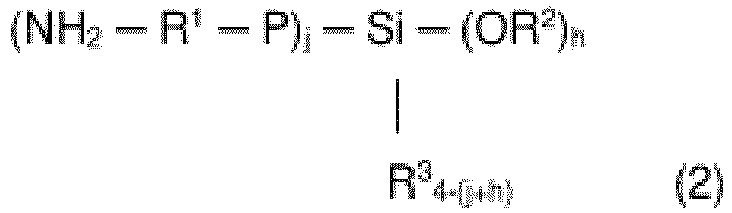 dans laquelle P, R1, R2 et R3 ont les mêmes définitions que celles fournies pour la formule (1) qui a été mentionnée ci-dessus, j représente un entier égal à 1 à 3, et h représente un entier égal à 1 à 3, avec cette réserve que j + h représente un entier égal à 2 à 4.
 - Bandage pneumatique selon au moins une des revendications précédentes 1 à 12, dans laquelle le caoutchouc de styrène-butadiène qui a été polymérisé en solution est fonctionnalisé avec un groupe alcoxysilane et un groupe d'amine primaire, et comprend le produit réactionnel d'une chaîne polymère vivante et d'un agent de terminaison, qui répond à la formule :
RN-(CH2)x-Si-(OR)3 I
dans laquelle R, en combinaison avec l'atome d'azote (N), représente un groupe d'amine protégé qui, après un traitement ultérieur approprié, permet d'obtenir une amine primaire, R' représente un groupe qui contient de 1 à 18 atomes de carbone, choisi parmi un groupe alkyle, un groupe cycloalkyle, un groupe allyle ou un groupe aryle ; et X représente un entier allant de 1 à 20. - Bandage pneumatique selon au moins une des revendications précédentes, dans laquelle le caoutchouc de styrène-butadiène qui a été polymérisé en solution est fonctionnalisé avec un groupe alcoxysilane et un groupe thiol, et comprend le produit réactionnel d'un polymère anionique vivant et d'un modificateur silane-sulfure répondant à la formule :
(R4O)xR4 ySi-R5-S-SiR4 3
dans laquelle Si représente un atome de silicium ; S représente un atome de soufre ; O représente un atome d'oxygène ; x représente un entier qui est choisi parmi 1, 2 et 3 ; y représente un entier qui est choisi parmi 0, 1 et 2 ; x + y = 3 ; R4 est identique ou différent et un groupe alkyle en C1-C16 ; et R5 représente un groupe aryle et un groupe alkylaryle ou un groupe alkyle en C1-C16.
Applications Claiming Priority (1)
| Application Number | Priority Date | Filing Date | Title |
|---|---|---|---|
| US14/818,774 US20170037225A1 (en) | 2015-08-05 | 2015-08-05 | Pneumatic tire |
Publications (2)
| Publication Number | Publication Date |
|---|---|
| EP3127712A1 EP3127712A1 (fr) | 2017-02-08 |
| EP3127712B1 true EP3127712B1 (fr) | 2023-07-26 |
Family
ID=56555248
Family Applications (1)
| Application Number | Title | Priority Date | Filing Date |
|---|---|---|---|
| EP16181560.0A Active EP3127712B1 (fr) | 2015-08-05 | 2016-07-27 | Pneumatique |
Country Status (8)
| Country | Link |
|---|---|
| US (1) | US20170037225A1 (fr) |
| EP (1) | EP3127712B1 (fr) |
| JP (1) | JP7039163B2 (fr) |
| KR (1) | KR102577555B1 (fr) |
| CN (1) | CN106432848B (fr) |
| CA (1) | CA2936849A1 (fr) |
| FI (1) | FI3127712T3 (fr) |
| RU (1) | RU2639464C1 (fr) |
Families Citing this family (33)
| Publication number | Priority date | Publication date | Assignee | Title |
|---|---|---|---|---|
| US20170232795A1 (en) * | 2016-02-15 | 2017-08-17 | The Goodyear Tire & Rubber Company | Tire with tread for low temperature performance and wet traction |
| KR101878260B1 (ko) * | 2016-09-22 | 2018-07-13 | 금호타이어 주식회사 | 타이어 트레드용 고무 조성물 |
| ES2966674T3 (es) | 2017-04-03 | 2024-04-23 | Continental Reifen Deutschland Gmbh | Resinas modificadas y usos de las mismas |
| US20180282588A1 (en) | 2017-04-03 | 2018-10-04 | Eastman Chemical Company | Modified resins and uses thereof |
| PL3606992T3 (pl) | 2017-04-03 | 2024-02-19 | Synthomer Adhesive Technologies Llc | Żywice modyfikowane i ich zastosowania |
| EP3606991B1 (fr) | 2017-04-03 | 2025-02-19 | Synthomer Adhesive Technologies LLC | Résines modifiées et utilisations de celles-ci |
| EP3728451B1 (fr) * | 2017-12-19 | 2022-02-02 | Compagnie Generale Des Etablissements Michelin | Bande de roulement de pneumatique dont le système de réticulation est à base de peroxyde organique |
| EP3781625A4 (fr) * | 2018-05-04 | 2022-01-05 | Bridgestone Americas Tire Operations, LLC | Composition de caoutchouc pour bande de roulement de pneumatique |
| JP2021523261A (ja) | 2018-05-04 | 2021-09-02 | ブリヂストン アメリカズ タイヤ オペレーションズ、 エルエルシー | タイヤトレッドゴム組成物 |
| JP2021523264A (ja) | 2018-05-04 | 2021-09-02 | ブリヂストン アメリカズ タイヤ オペレーションズ、 エルエルシー | タイヤトレッドゴム組成物 |
| WO2019213185A1 (fr) | 2018-05-04 | 2019-11-07 | Bridgestone Americas Tire Operations, Llc | Composition de caoutchouc pour bande de roulement de pneumatique |
| JP6910321B2 (ja) * | 2018-05-09 | 2021-07-28 | Jfeケミカル株式会社 | 変性フェノール樹脂の製造方法および変性フェノール樹脂 |
| US20200070579A1 (en) * | 2018-09-04 | 2020-03-05 | The Goodyear Tire & Rubber Company | Pneumatic tire |
| US20200094623A1 (en) * | 2018-09-21 | 2020-03-26 | The Goodyear Tire & Rubber Company | Tire with tread |
| KR102131424B1 (ko) * | 2018-10-29 | 2020-07-08 | 한국타이어앤테크놀로지 주식회사 | 타이어 트레드용 고무 조성물 및 이를 이용하여 제조한 타이어 |
| CN109749167A (zh) * | 2019-01-30 | 2019-05-14 | 青岛福诺化工科技有限公司 | 一种轮胎胎面胶及其制备方法 |
| US10947368B2 (en) | 2019-03-04 | 2021-03-16 | The Goodyear Tire & Rubber Company | Pneumatic tire |
| JP2022534568A (ja) | 2019-05-29 | 2022-08-02 | ブリヂストン アメリカズ タイヤ オペレーションズ、 エルエルシー | タイヤトレッドゴム組成物及びその関連方法 |
| JP7445681B2 (ja) | 2019-05-29 | 2024-03-07 | ブリヂストン アメリカズ タイヤ オペレーションズ、 エルエルシー | タイヤトレッドゴム組成物及び関連方法 |
| US12365787B2 (en) | 2019-05-29 | 2025-07-22 | Bridgestone Americas Tire Operations, Llc | Tire tread rubber composition and related methods |
| EP3769973A1 (fr) * | 2019-07-25 | 2021-01-27 | The Goodyear Tire & Rubber Company | Composition de caoutchouc et pneumatique comprenant une bande de roulement |
| US11214667B2 (en) * | 2019-07-29 | 2022-01-04 | The Goodyear Tire & Rubber Company | Pneumatic tire |
| US11441021B2 (en) | 2019-07-29 | 2022-09-13 | The Goodyear Tire & Rubber Company | Pneumatic tire |
| KR102212887B1 (ko) * | 2019-09-25 | 2021-02-08 | 금호타이어 주식회사 | 스노우 제동력이 유지되면서 젖은 노면에서의 제동력이 향상된 타이어용 트레드 고무 조성물 |
| KR102267702B1 (ko) * | 2019-12-10 | 2021-06-23 | 한국타이어앤테크놀로지 주식회사 | 타이어 트레드용 고무 조성물 및 이를 이용하여 제조한 타이어 |
| US11440350B2 (en) | 2020-05-13 | 2022-09-13 | The Goodyear Tire & Rubber Company | Pneumatic tire |
| EP4056644B1 (fr) * | 2021-03-09 | 2026-04-29 | The Goodyear Tire & Rubber Company | Composition de caoutchouc et pneumatique |
| EP4056640B1 (fr) | 2021-03-09 | 2026-04-29 | The Goodyear Tire & Rubber Company | Composition de caoutchouc et pneumatique |
| US12187895B2 (en) | 2021-08-26 | 2025-01-07 | The Goodyear Tire & Rubber Company | Rubber composition and a tire |
| JP2023149903A (ja) * | 2022-03-31 | 2023-10-16 | 住友ゴム工業株式会社 | トレッド用ゴム組成物及びタイヤ |
| JP2023157713A (ja) * | 2022-04-15 | 2023-10-26 | Toyo Tire株式会社 | タイヤトレッド用ゴム組成物及びタイヤ |
| US12263705B2 (en) | 2022-09-09 | 2025-04-01 | The Goodyear Tire & Rubber Company | Tire |
| EP4438324A1 (fr) * | 2023-03-31 | 2024-10-02 | Bridgestone Europe NV/SA | Composition de caoutchouc pour pneumatique et pneumatique produit à partir de celle-ci |
Family Cites Families (48)
| Publication number | Priority date | Publication date | Assignee | Title |
|---|---|---|---|---|
| JPS57187331A (en) * | 1981-05-15 | 1982-11-18 | Toyo Tire & Rubber Co Ltd | Rubber composition for type |
| GB2252978A (en) | 1991-02-21 | 1992-08-26 | Exxon Research Engineering Co | Rubber processing oil |
| DE4220563A1 (de) | 1992-06-24 | 1994-01-13 | Bayer Ag | Kautschukmischungen enthaltend Polybutadien-Gel |
| US5672639A (en) | 1996-03-12 | 1997-09-30 | The Goodyear Tire & Rubber Company | Starch composite reinforced rubber composition and tire with at least one component thereof |
| ES2122917B1 (es) | 1996-10-31 | 1999-07-01 | Repsol Petroleo Sa | Proceso para la obtencion de aceites aromaticos con un contenido en compuestos aromaticos policiclicos inferior al 3% utiles como extenso res de cauchos. |
| ES2224215T3 (es) | 1996-10-31 | 2005-03-01 | Repsol Petroleo S.A. | Proceso para la obtencion de aceites aromaticos con un contenido en compuestos aromaticos policiclicos inferior al 3% utiles como aceites de proceso. |
| DE19701488A1 (de) | 1997-01-17 | 1998-07-23 | Bayer Ag | SBR-Kautschukgele enthaltende Kautschukmischungen |
| US6146520A (en) | 1997-04-02 | 2000-11-14 | Mobil Oil Corporation | Selective re-extraction of lube extracts to reduce mutagenicity index |
| WO1997035462A2 (fr) | 1997-06-27 | 1997-10-02 | Bridgestone Corporation | Amelioration apportee a une huile a forte teneur en composes aromatiques, composition de caoutchouc et caoutchouc synthetique etendu a l'huile, prepares au moyen de ladite huile |
| EP1679315A1 (fr) | 1997-08-21 | 2006-07-12 | General Electric Company | Agents de couplage à base de mercaptosilanes bloqués, utiles dans des caoutchoucs à charge |
| US6248929B1 (en) | 1998-01-22 | 2001-06-19 | Japan Energy Corporation | Rubber process oil and production process thereof |
| JP4037515B2 (ja) | 1998-04-17 | 2008-01-23 | 出光興産株式会社 | プロセスオイル及びその製造方法 |
| DE19834804A1 (de) | 1998-08-01 | 2000-02-03 | Continental Ag | Kautschukmischung |
| DE19834802A1 (de) | 1998-08-01 | 2000-02-03 | Continental Ag | Kautschukmischung |
| DE19834803A1 (de) | 1998-08-01 | 2000-02-03 | Continental Ag | Kautschukmischung |
| US6399697B1 (en) | 1999-02-26 | 2002-06-04 | Idemitsu Kosan Co., Ltd. | Process oil, process for producing the same and rubber composition |
| US6670416B1 (en) * | 1999-08-18 | 2003-12-30 | The Goodyear Tire & Rubber Company | Tread rubber for high traction tires |
| DE19942620A1 (de) | 1999-09-07 | 2001-03-08 | Bayer Ag | Mikrogelhaltige Kautschukmischungen mit verkappten bifunktionellen Mercaptanen und hieraus hergestellte Vulkanisate |
| DE10025625A1 (de) | 2000-05-24 | 2001-11-29 | Bayer Ag | Kautschukmischungen zur Herstellung von hochverstärkten und dämpfungsarmen Vulkanisaten |
| PT1179560E (pt) | 2000-07-24 | 2003-08-29 | Continental Ag | Composicao de borracha |
| JP3473842B2 (ja) | 2000-09-25 | 2003-12-08 | 三共油化工業株式会社 | ゴム用可塑剤 |
| ES2254847T3 (es) | 2001-08-06 | 2006-06-16 | Degussa Ag | Compuestos de organosilicio. |
| ATE427969T1 (de) | 2001-09-27 | 2009-04-15 | Jsr Corp | (co)polymerkautschuk auf basis von konjugiertem diolefin, verfahren zur herstellung von (co)polymerkautschuk, kautschukzusammensetzung, verbundwerkstoff und reifen |
| US7019084B2 (en) * | 2002-12-11 | 2006-03-28 | The Goodyear Tire & Rubber Company | Tire with rubber composition |
| US7928258B2 (en) | 2004-08-20 | 2011-04-19 | Momentive Performance Materials Inc. | Cyclic diol-derived blocked mercaptofunctional silane compositions |
| US7441572B2 (en) * | 2004-09-17 | 2008-10-28 | The Goodyear Tire & Rubber Company | Pneumatic tire having a tread containing immiscible rubber blend and silica |
| PL1963110T3 (pl) | 2005-10-19 | 2010-01-29 | Trinseo Europe Gmbh | Elastomeryczne polimery modyfikowane silano-sulfidowymi końcami łańcucha |
| US7259205B1 (en) * | 2006-09-21 | 2007-08-21 | The Goodyear Tire & Rubber Company | Pneumatic tire |
| US8318861B2 (en) * | 2007-01-11 | 2012-11-27 | Bridgestone Corporation | Rubber composition and tire using the same |
| JP5265114B2 (ja) * | 2007-01-11 | 2013-08-14 | 株式会社ブリヂストン | ゴム組成物及びそれを用いた空気入りタイヤ |
| BRPI1000118A2 (pt) * | 2009-01-29 | 2011-03-29 | Goodyear Tire & Rubber | pneumático |
| US20100186869A1 (en) * | 2009-01-29 | 2010-07-29 | Paul Harry Sandstrom | Pneumatic tire |
| JP5617225B2 (ja) * | 2009-11-25 | 2014-11-05 | 横浜ゴム株式会社 | タイヤトレッド用ゴム組成物およびそれを用いた空気入りタイヤ |
| JP5362606B2 (ja) * | 2010-02-08 | 2013-12-11 | 東洋ゴム工業株式会社 | タイヤトレッド用ゴム組成物及び空気入りタイヤ |
| EP2987808A3 (fr) * | 2010-06-08 | 2016-03-30 | JSR Corporation | Caoutchouc de diène conjugué modifié, son procédé de production et composition de caoutchouc |
| EP2412731B1 (fr) * | 2010-07-28 | 2013-08-28 | The Goodyear Tire & Rubber Company | Composition de caoutchouc, procédé de fabrication correspondant et pneu utilisant cette composition de caoutchouc |
| US8592515B2 (en) * | 2010-07-28 | 2013-11-26 | The Goodyear Tire & Rubber Company | Tire with rubber component |
| US8312905B2 (en) * | 2010-09-24 | 2012-11-20 | The Goodyear Tire & Rubber Company | Pneumatic tire |
| US20120208919A1 (en) * | 2011-02-15 | 2012-08-16 | Carlo Kanz | Pneumatic tire |
| SG11201402767YA (en) * | 2011-12-01 | 2014-09-26 | Jsr Corp | Rubber composition, rubber elastomer, tire and block copolymer |
| JP6450062B2 (ja) * | 2011-12-22 | 2019-01-09 | ザ・グッドイヤー・タイヤ・アンド・ラバー・カンパニー | 官能化ポリブタジエン及び官能化スチレン/ブタジエンエラストマーを含有するゴム部品を有するタイヤ |
| JP2014094530A (ja) * | 2012-11-12 | 2014-05-22 | Toyo Tire & Rubber Co Ltd | ゴム組成物の混練設備および混練方法 |
| JP6220635B2 (ja) * | 2013-10-31 | 2017-10-25 | 住友ゴム工業株式会社 | タイヤ用ゴム組成物およびそれを用いた空気入りタイヤ |
| JP6240472B2 (ja) * | 2013-11-01 | 2017-11-29 | 住友ゴム工業株式会社 | タイヤ吸音部材用ゴム組成物 |
| WO2015104955A1 (fr) * | 2014-01-07 | 2015-07-16 | 住友ゴム工業株式会社 | Pneumatique |
| US9757987B2 (en) * | 2014-12-09 | 2017-09-12 | The Goodyear Tire & Rubber Company | Pneumatic tire |
| US9764594B2 (en) * | 2014-12-09 | 2017-09-19 | The Goodyear Tire & Rubber Company | Pneumatic tire |
| FR3037590B1 (fr) * | 2015-06-18 | 2017-06-02 | Michelin & Cie | Composition de caoutchouc comprenant un copolymere de styrene et de butadiene de faible temperature de transition vitreuse, et un fort taux de charge et de plastifiant |
-
2015
- 2015-08-05 US US14/818,774 patent/US20170037225A1/en not_active Abandoned
-
2016
- 2016-07-22 CA CA2936849A patent/CA2936849A1/fr not_active Abandoned
- 2016-07-27 FI FIEP16181560.0T patent/FI3127712T3/fi active
- 2016-07-27 EP EP16181560.0A patent/EP3127712B1/fr active Active
- 2016-08-01 RU RU2016131481A patent/RU2639464C1/ru active
- 2016-08-04 KR KR1020160099538A patent/KR102577555B1/ko active Active
- 2016-08-05 CN CN201610635537.4A patent/CN106432848B/zh not_active Expired - Fee Related
- 2016-08-05 JP JP2016154133A patent/JP7039163B2/ja active Active
Also Published As
| Publication number | Publication date |
|---|---|
| JP2017031409A (ja) | 2017-02-09 |
| CA2936849A1 (fr) | 2017-02-05 |
| RU2639464C1 (ru) | 2017-12-22 |
| EP3127712A1 (fr) | 2017-02-08 |
| KR102577555B1 (ko) | 2023-09-11 |
| KR20170017795A (ko) | 2017-02-15 |
| US20170037225A1 (en) | 2017-02-09 |
| FI3127712T3 (fi) | 2023-09-12 |
| CN106432848A (zh) | 2017-02-22 |
| JP7039163B2 (ja) | 2022-03-22 |
| CN106432848B (zh) | 2018-09-11 |
Similar Documents
| Publication | Publication Date | Title |
|---|---|---|
| EP3620307B1 (fr) | Composition de caoutchouc et pneumatique | |
| EP3170680B1 (fr) | Pneumatique | |
| EP3031621B1 (fr) | Pneumatique | |
| EP3159181B1 (fr) | Composition de caoutchouc et pneumatique | |
| CN106432848B (zh) | 充气轮胎 | |
| EP3335904B1 (fr) | Pneumatique | |
| EP3251872B1 (fr) | Composition de caoutchouc et pneumatique | |
| EP3181373B1 (fr) | Composition de caoutchouc et pneumatique | |
| EP2213687B1 (fr) | Composition de caoutchouc et pneu | |
| EP3705311B1 (fr) | Composition de caoutchouc et pneumatique | |
| EP3450494B1 (fr) | Pneu pneumatique | |
| EP3913018B1 (fr) | Composition de caoutchouc et pneumatique | |
| EP1637353A1 (fr) | Pneu avec bande de roulement contenant une mélange de caoutchouc non-miscible et silice | |
| EP3031620A1 (fr) | Pneumatique | |
| EP3450465A1 (fr) | Composition de cautschouc et pneu pneumatique | |
| EP3450490B1 (fr) | Composition du caoutchouc et pneu pneumatique | |
| EP3910018B1 (fr) | Composition de caoutchouc et pneumatique | |
| US20110120606A1 (en) | Pneumatic tire with tread | |
| EP4101657B1 (fr) | Composition de caoutchouc et pneumatique |
Legal Events
| Date | Code | Title | Description |
|---|---|---|---|
| PUAI | Public reference made under article 153(3) epc to a published international application that has entered the european phase |
Free format text: ORIGINAL CODE: 0009012 |
|
| STAA | Information on the status of an ep patent application or granted ep patent |
Free format text: STATUS: THE APPLICATION HAS BEEN PUBLISHED |
|
| AK | Designated contracting states |
Kind code of ref document: A1 Designated state(s): AL AT BE BG CH CY CZ DE DK EE ES FI FR GB GR HR HU IE IS IT LI LT LU LV MC MK MT NL NO PL PT RO RS SE SI SK SM TR |
|
| AX | Request for extension of the european patent |
Extension state: BA ME |
|
| STAA | Information on the status of an ep patent application or granted ep patent |
Free format text: STATUS: REQUEST FOR EXAMINATION WAS MADE |
|
| 17P | Request for examination filed |
Effective date: 20170808 |
|
| RBV | Designated contracting states (corrected) |
Designated state(s): AL AT BE BG CH CY CZ DE DK EE ES FI FR GB GR HR HU IE IS IT LI LT LU LV MC MK MT NL NO PL PT RO RS SE SI SK SM TR |
|
| STAA | Information on the status of an ep patent application or granted ep patent |
Free format text: STATUS: EXAMINATION IS IN PROGRESS |
|
| 17Q | First examination report despatched |
Effective date: 20210615 |
|
| RAP3 | Party data changed (applicant data changed or rights of an application transferred) |
Owner name: THE GOODYEAR TIRE & RUBBER COMPANY |
|
| GRAP | Despatch of communication of intention to grant a patent |
Free format text: ORIGINAL CODE: EPIDOSNIGR1 |
|
| STAA | Information on the status of an ep patent application or granted ep patent |
Free format text: STATUS: GRANT OF PATENT IS INTENDED |
|
| RIC1 | Information provided on ipc code assigned before grant |
Ipc: C08L 15/00 20060101ALI20230216BHEP Ipc: B60C 1/00 20060101AFI20230216BHEP |
|
| INTG | Intention to grant announced |
Effective date: 20230309 |
|
| GRAS | Grant fee paid |
Free format text: ORIGINAL CODE: EPIDOSNIGR3 |
|
| GRAA | (expected) grant |
Free format text: ORIGINAL CODE: 0009210 |
|
| STAA | Information on the status of an ep patent application or granted ep patent |
Free format text: STATUS: THE PATENT HAS BEEN GRANTED |
|
| AK | Designated contracting states |
Kind code of ref document: B1 Designated state(s): AL AT BE BG CH CY CZ DE DK EE ES FI FR GB GR HR HU IE IS IT LI LT LU LV MC MK MT NL NO PL PT RO RS SE SI SK SM TR |
|
| REG | Reference to a national code |
Ref country code: GB Ref legal event code: FG4D |
|
| REG | Reference to a national code |
Ref country code: CH Ref legal event code: EP |
|
| REG | Reference to a national code |
Ref country code: IE Ref legal event code: FG4D |
|
| REG | Reference to a national code |
Ref country code: DE Ref legal event code: R096 Ref document number: 602016081304 Country of ref document: DE |
|
| REG | Reference to a national code |
Ref country code: FI Ref legal event code: FGE |
|
| PGFP | Annual fee paid to national office [announced via postgrant information from national office to epo] |
Ref country code: GB Payment date: 20230803 Year of fee payment: 8 Ref country code: CH Payment date: 20230819 Year of fee payment: 8 |
|
| REG | Reference to a national code |
Ref country code: LT Ref legal event code: MG9D |
|
| REG | Reference to a national code |
Ref country code: NL Ref legal event code: MP Effective date: 20230726 |
|
| REG | Reference to a national code |
Ref country code: AT Ref legal event code: MK05 Ref document number: 1591564 Country of ref document: AT Kind code of ref document: T Effective date: 20230726 |
|
| PG25 | Lapsed in a contracting state [announced via postgrant information from national office to epo] |
Ref country code: NL Free format text: LAPSE BECAUSE OF FAILURE TO SUBMIT A TRANSLATION OF THE DESCRIPTION OR TO PAY THE FEE WITHIN THE PRESCRIBED TIME-LIMIT Effective date: 20230726 |
|
| PG25 | Lapsed in a contracting state [announced via postgrant information from national office to epo] |
Ref country code: GR Free format text: LAPSE BECAUSE OF FAILURE TO SUBMIT A TRANSLATION OF THE DESCRIPTION OR TO PAY THE FEE WITHIN THE PRESCRIBED TIME-LIMIT Effective date: 20231027 |
|
| PG25 | Lapsed in a contracting state [announced via postgrant information from national office to epo] |
Ref country code: IS Free format text: LAPSE BECAUSE OF FAILURE TO SUBMIT A TRANSLATION OF THE DESCRIPTION OR TO PAY THE FEE WITHIN THE PRESCRIBED TIME-LIMIT Effective date: 20231126 |
|
| PG25 | Lapsed in a contracting state [announced via postgrant information from national office to epo] |
Ref country code: SE Free format text: LAPSE BECAUSE OF FAILURE TO SUBMIT A TRANSLATION OF THE DESCRIPTION OR TO PAY THE FEE WITHIN THE PRESCRIBED TIME-LIMIT Effective date: 20230726 Ref country code: RS Free format text: LAPSE BECAUSE OF FAILURE TO SUBMIT A TRANSLATION OF THE DESCRIPTION OR TO PAY THE FEE WITHIN THE PRESCRIBED TIME-LIMIT Effective date: 20230726 Ref country code: PT Free format text: LAPSE BECAUSE OF FAILURE TO SUBMIT A TRANSLATION OF THE DESCRIPTION OR TO PAY THE FEE WITHIN THE PRESCRIBED TIME-LIMIT Effective date: 20231127 Ref country code: NO Free format text: LAPSE BECAUSE OF FAILURE TO SUBMIT A TRANSLATION OF THE DESCRIPTION OR TO PAY THE FEE WITHIN THE PRESCRIBED TIME-LIMIT Effective date: 20231026 Ref country code: LV Free format text: LAPSE BECAUSE OF FAILURE TO SUBMIT A TRANSLATION OF THE DESCRIPTION OR TO PAY THE FEE WITHIN THE PRESCRIBED TIME-LIMIT Effective date: 20230726 Ref country code: LT Free format text: LAPSE BECAUSE OF FAILURE TO SUBMIT A TRANSLATION OF THE DESCRIPTION OR TO PAY THE FEE WITHIN THE PRESCRIBED TIME-LIMIT Effective date: 20230726 Ref country code: IS Free format text: LAPSE BECAUSE OF FAILURE TO SUBMIT A TRANSLATION OF THE DESCRIPTION OR TO PAY THE FEE WITHIN THE PRESCRIBED TIME-LIMIT Effective date: 20231126 Ref country code: HR Free format text: LAPSE BECAUSE OF FAILURE TO SUBMIT A TRANSLATION OF THE DESCRIPTION OR TO PAY THE FEE WITHIN THE PRESCRIBED TIME-LIMIT Effective date: 20230726 Ref country code: GR Free format text: LAPSE BECAUSE OF FAILURE TO SUBMIT A TRANSLATION OF THE DESCRIPTION OR TO PAY THE FEE WITHIN THE PRESCRIBED TIME-LIMIT Effective date: 20231027 Ref country code: AT Free format text: LAPSE BECAUSE OF FAILURE TO SUBMIT A TRANSLATION OF THE DESCRIPTION OR TO PAY THE FEE WITHIN THE PRESCRIBED TIME-LIMIT Effective date: 20230726 |
|
| PG25 | Lapsed in a contracting state [announced via postgrant information from national office to epo] |
Ref country code: PL Free format text: LAPSE BECAUSE OF FAILURE TO SUBMIT A TRANSLATION OF THE DESCRIPTION OR TO PAY THE FEE WITHIN THE PRESCRIBED TIME-LIMIT Effective date: 20230726 |
|
| REG | Reference to a national code |
Ref country code: BE Ref legal event code: MM Effective date: 20230731 |
|
| PG25 | Lapsed in a contracting state [announced via postgrant information from national office to epo] |
Ref country code: LU Free format text: LAPSE BECAUSE OF NON-PAYMENT OF DUE FEES Effective date: 20230727 |
|
| PG25 | Lapsed in a contracting state [announced via postgrant information from national office to epo] |
Ref country code: LU Free format text: LAPSE BECAUSE OF NON-PAYMENT OF DUE FEES Effective date: 20230727 |
|
| REG | Reference to a national code |
Ref country code: IE Ref legal event code: MM4A |
|
| PG25 | Lapsed in a contracting state [announced via postgrant information from national office to epo] |
Ref country code: ES Free format text: LAPSE BECAUSE OF FAILURE TO SUBMIT A TRANSLATION OF THE DESCRIPTION OR TO PAY THE FEE WITHIN THE PRESCRIBED TIME-LIMIT Effective date: 20230726 |
|
| REG | Reference to a national code |
Ref country code: DE Ref legal event code: R097 Ref document number: 602016081304 Country of ref document: DE |
|
| PG25 | Lapsed in a contracting state [announced via postgrant information from national office to epo] |
Ref country code: SM Free format text: LAPSE BECAUSE OF FAILURE TO SUBMIT A TRANSLATION OF THE DESCRIPTION OR TO PAY THE FEE WITHIN THE PRESCRIBED TIME-LIMIT Effective date: 20230726 Ref country code: RO Free format text: LAPSE BECAUSE OF FAILURE TO SUBMIT A TRANSLATION OF THE DESCRIPTION OR TO PAY THE FEE WITHIN THE PRESCRIBED TIME-LIMIT Effective date: 20230726 Ref country code: ES Free format text: LAPSE BECAUSE OF FAILURE TO SUBMIT A TRANSLATION OF THE DESCRIPTION OR TO PAY THE FEE WITHIN THE PRESCRIBED TIME-LIMIT Effective date: 20230726 Ref country code: EE Free format text: LAPSE BECAUSE OF FAILURE TO SUBMIT A TRANSLATION OF THE DESCRIPTION OR TO PAY THE FEE WITHIN THE PRESCRIBED TIME-LIMIT Effective date: 20230726 Ref country code: DK Free format text: LAPSE BECAUSE OF FAILURE TO SUBMIT A TRANSLATION OF THE DESCRIPTION OR TO PAY THE FEE WITHIN THE PRESCRIBED TIME-LIMIT Effective date: 20230726 Ref country code: CZ Free format text: LAPSE BECAUSE OF FAILURE TO SUBMIT A TRANSLATION OF THE DESCRIPTION OR TO PAY THE FEE WITHIN THE PRESCRIBED TIME-LIMIT Effective date: 20230726 Ref country code: SK Free format text: LAPSE BECAUSE OF FAILURE TO SUBMIT A TRANSLATION OF THE DESCRIPTION OR TO PAY THE FEE WITHIN THE PRESCRIBED TIME-LIMIT Effective date: 20230726 Ref country code: MC Free format text: LAPSE BECAUSE OF FAILURE TO SUBMIT A TRANSLATION OF THE DESCRIPTION OR TO PAY THE FEE WITHIN THE PRESCRIBED TIME-LIMIT Effective date: 20230726 |
|
| PG25 | Lapsed in a contracting state [announced via postgrant information from national office to epo] |
Ref country code: BE Free format text: LAPSE BECAUSE OF NON-PAYMENT OF DUE FEES Effective date: 20230731 |
|
| PLBE | No opposition filed within time limit |
Free format text: ORIGINAL CODE: 0009261 |
|
| STAA | Information on the status of an ep patent application or granted ep patent |
Free format text: STATUS: NO OPPOSITION FILED WITHIN TIME LIMIT |
|
| 26N | No opposition filed |
Effective date: 20240429 |
|
| PG25 | Lapsed in a contracting state [announced via postgrant information from national office to epo] |
Ref country code: IE Free format text: LAPSE BECAUSE OF NON-PAYMENT OF DUE FEES Effective date: 20230727 |
|
| PG25 | Lapsed in a contracting state [announced via postgrant information from national office to epo] |
Ref country code: IE Free format text: LAPSE BECAUSE OF NON-PAYMENT OF DUE FEES Effective date: 20230727 Ref country code: SI Free format text: LAPSE BECAUSE OF FAILURE TO SUBMIT A TRANSLATION OF THE DESCRIPTION OR TO PAY THE FEE WITHIN THE PRESCRIBED TIME-LIMIT Effective date: 20230726 |
|
| PG25 | Lapsed in a contracting state [announced via postgrant information from national office to epo] |
Ref country code: BG Free format text: LAPSE BECAUSE OF FAILURE TO SUBMIT A TRANSLATION OF THE DESCRIPTION OR TO PAY THE FEE WITHIN THE PRESCRIBED TIME-LIMIT Effective date: 20230726 |
|
| PG25 | Lapsed in a contracting state [announced via postgrant information from national office to epo] |
Ref country code: BG Free format text: LAPSE BECAUSE OF FAILURE TO SUBMIT A TRANSLATION OF THE DESCRIPTION OR TO PAY THE FEE WITHIN THE PRESCRIBED TIME-LIMIT Effective date: 20230726 |
|
| REG | Reference to a national code |
Ref country code: CH Ref legal event code: PL |
|
| GBPC | Gb: european patent ceased through non-payment of renewal fee |
Effective date: 20240727 |
|
| PG25 | Lapsed in a contracting state [announced via postgrant information from national office to epo] |
Ref country code: CH Free format text: LAPSE BECAUSE OF NON-PAYMENT OF DUE FEES Effective date: 20240731 |
|
| PG25 | Lapsed in a contracting state [announced via postgrant information from national office to epo] |
Ref country code: GB Free format text: LAPSE BECAUSE OF NON-PAYMENT OF DUE FEES Effective date: 20240727 |
|
| PGFP | Annual fee paid to national office [announced via postgrant information from national office to epo] |
Ref country code: FI Payment date: 20250620 Year of fee payment: 10 |
|
| PGFP | Annual fee paid to national office [announced via postgrant information from national office to epo] |
Ref country code: FR Payment date: 20250620 Year of fee payment: 10 |
|
| PG25 | Lapsed in a contracting state [announced via postgrant information from national office to epo] |
Ref country code: CY Free format text: LAPSE BECAUSE OF FAILURE TO SUBMIT A TRANSLATION OF THE DESCRIPTION OR TO PAY THE FEE WITHIN THE PRESCRIBED TIME-LIMIT; INVALID AB INITIO Effective date: 20160727 |
|
| PG25 | Lapsed in a contracting state [announced via postgrant information from national office to epo] |
Ref country code: HU Free format text: LAPSE BECAUSE OF FAILURE TO SUBMIT A TRANSLATION OF THE DESCRIPTION OR TO PAY THE FEE WITHIN THE PRESCRIBED TIME-LIMIT; INVALID AB INITIO Effective date: 20160727 |
|
| PGFP | Annual fee paid to national office [announced via postgrant information from national office to epo] |
Ref country code: DE Payment date: 20250620 Year of fee payment: 10 |
|
| PGFP | Annual fee paid to national office [announced via postgrant information from national office to epo] |
Ref country code: IT Payment date: 20250619 Year of fee payment: 10 |
|
| PG25 | Lapsed in a contracting state [announced via postgrant information from national office to epo] |
Ref country code: TR Free format text: LAPSE BECAUSE OF FAILURE TO SUBMIT A TRANSLATION OF THE DESCRIPTION OR TO PAY THE FEE WITHIN THE PRESCRIBED TIME-LIMIT Effective date: 20230726 |