EP3128100B1 - Verfahren zur steuerung eines motorisierten sonnenschutzsystems - Google Patents
Verfahren zur steuerung eines motorisierten sonnenschutzsystems Download PDFInfo
- Publication number
- EP3128100B1 EP3128100B1 EP16182407.3A EP16182407A EP3128100B1 EP 3128100 B1 EP3128100 B1 EP 3128100B1 EP 16182407 A EP16182407 A EP 16182407A EP 3128100 B1 EP3128100 B1 EP 3128100B1
- Authority
- EP
- European Patent Office
- Prior art keywords
- fabric
- blind
- deployment
- motor
- during
- Prior art date
- Legal status (The legal status is an assumption and is not a legal conclusion. Google has not performed a legal analysis and makes no representation as to the accuracy of the status listed.)
- Active
Links
Images

Classifications
-
- E—FIXED CONSTRUCTIONS
- E04—BUILDING
- E04F—FINISHING WORK ON BUILDINGS, e.g. STAIRS, FLOORS
- E04F10/00—Sunshades, e.g. Florentine blinds or jalousies; Outside screens; Awnings or baldachins
- E04F10/02—Sunshades, e.g. Florentine blinds or jalousies; Outside screens; Awnings or baldachins of flexible canopy materials, e.g. canvas ; Baldachins
- E04F10/06—Sunshades, e.g. Florentine blinds or jalousies; Outside screens; Awnings or baldachins of flexible canopy materials, e.g. canvas ; Baldachins comprising a roller-blind with means for holding the end away from a building
- E04F10/0644—Sunshades, e.g. Florentine blinds or jalousies; Outside screens; Awnings or baldachins of flexible canopy materials, e.g. canvas ; Baldachins comprising a roller-blind with means for holding the end away from a building with mechanisms for unrolling or balancing the blind
- E04F10/0648—Sunshades, e.g. Florentine blinds or jalousies; Outside screens; Awnings or baldachins of flexible canopy materials, e.g. canvas ; Baldachins comprising a roller-blind with means for holding the end away from a building with mechanisms for unrolling or balancing the blind acting on the roller tube
-
- E—FIXED CONSTRUCTIONS
- E04—BUILDING
- E04F—FINISHING WORK ON BUILDINGS, e.g. STAIRS, FLOORS
- E04F10/00—Sunshades, e.g. Florentine blinds or jalousies; Outside screens; Awnings or baldachins
- E04F10/02—Sunshades, e.g. Florentine blinds or jalousies; Outside screens; Awnings or baldachins of flexible canopy materials, e.g. canvas ; Baldachins
- E04F10/06—Sunshades, e.g. Florentine blinds or jalousies; Outside screens; Awnings or baldachins of flexible canopy materials, e.g. canvas ; Baldachins comprising a roller-blind with means for holding the end away from a building
- E04F10/0611—Sunshades, e.g. Florentine blinds or jalousies; Outside screens; Awnings or baldachins of flexible canopy materials, e.g. canvas ; Baldachins comprising a roller-blind with means for holding the end away from a building with articulated arms supporting the movable end of the blind for deployment of the blind
- E04F10/0618—Sunshades, e.g. Florentine blinds or jalousies; Outside screens; Awnings or baldachins of flexible canopy materials, e.g. canvas ; Baldachins comprising a roller-blind with means for holding the end away from a building with articulated arms supporting the movable end of the blind for deployment of the blind whereby the pivot axis of the articulation is perpendicular to the roller
-
- E—FIXED CONSTRUCTIONS
- E04—BUILDING
- E04F—FINISHING WORK ON BUILDINGS, e.g. STAIRS, FLOORS
- E04F10/00—Sunshades, e.g. Florentine blinds or jalousies; Outside screens; Awnings or baldachins
- E04F10/02—Sunshades, e.g. Florentine blinds or jalousies; Outside screens; Awnings or baldachins of flexible canopy materials, e.g. canvas ; Baldachins
- E04F10/06—Sunshades, e.g. Florentine blinds or jalousies; Outside screens; Awnings or baldachins of flexible canopy materials, e.g. canvas ; Baldachins comprising a roller-blind with means for holding the end away from a building
- E04F10/0644—Sunshades, e.g. Florentine blinds or jalousies; Outside screens; Awnings or baldachins of flexible canopy materials, e.g. canvas ; Baldachins comprising a roller-blind with means for holding the end away from a building with mechanisms for unrolling or balancing the blind
- E04F10/0659—Control systems therefor
-
- E—FIXED CONSTRUCTIONS
- E06—DOORS, WINDOWS, SHUTTERS, OR ROLLER BLINDS IN GENERAL; LADDERS
- E06B—FIXED OR MOVABLE CLOSURES FOR OPENINGS IN BUILDINGS, VEHICLES, FENCES OR LIKE ENCLOSURES IN GENERAL, e.g. DOORS, WINDOWS, BLINDS, GATES
- E06B9/00—Screening or protective devices for wall or similar openings, with or without operating or securing mechanisms; Closures of similar construction
- E06B9/56—Operating, guiding or securing devices or arrangements for roll-type closures; Spring drums; Tape drums; Counterweighting arrangements therefor
- E06B9/80—Safety measures against dropping or unauthorised opening; Braking or immobilising devices; Devices for limiting unrolling
- E06B9/82—Safety measures against dropping or unauthorised opening; Braking or immobilising devices; Devices for limiting unrolling automatic
- E06B9/88—Safety measures against dropping or unauthorised opening; Braking or immobilising devices; Devices for limiting unrolling automatic for limiting unrolling
Definitions
- the present invention relates to the field of motorized mobile screens, in particular sun protection, of the blind type and in particular awning awning, or equivalent, intended to equip windows of a building.
- It relates more particularly to a method for controlling a motorized blind installation, the installation comprising a frame supporting a winding tube capable of being rotated by an actuator comprising a tubular motor allowing a blind fabric to be wound or unwound around the tube by a first end, the awning fabric being fixed by a second end to a load bar arranged substantially parallel to the winding tube and mounted movable relative to the frame between end positions respectively wound and unwound the fabric by means of foldable arms, the method comprising, during the unwinding of the fabric, a step of controlling the actuator capable of bringing the fabric into a stretched unwound end position.
- the motor drives the winding tube in rotation and the guide arms gradually unfold to an arm locking position, corresponding to the unrolled end position of the fabric, in which it is stretched .
- the tubular actuator driving the winding tube in rotation in order to place the blind in end positions respectively unwound or wound is associated with an end device for stopping the actuator when the blind is fully unwound or rolled up.
- a device generally includes a device for counting the winding turns of the fabric around the winding tube in order to determine the end-of-travel positions.
- the counting device associated with the actuator makes it possible to know at any time the current position of the load bar and, during an adjustment phase, the two end positions wound and unwound are memorized. To do this, the user operates the blind by small steps in both directions of rotation until reaching the ideal end position. desired and stores them. During the following operating cycles, the actuator is commanded to stop automatically at the end positions thus memorized.
- Motorized awning installation control devices are already known, making it possible to securely place the awning in a stretched fabric position at the end of the unwinding stroke.
- the document FR 2 899 923 publicizes a method of controlling a blind installation based on a detection of the drop in tension of the fabric when the unfoldable arms for guiding the fabric are in a fully unfolded position, followed by a slight movement of winding of the fabric on the tube in response to the detection of this drop in tension of the fabric, this winding step being automatically stopped before a perceptible fold of the arms. Triggering the winding step as soon as the fabric tension drops thus automatically re-tensioning the fabric, without the need for counting devices to control the stopping of the deployment of the fabric.
- this control mode of the blind to bring the fabric into a taut unwound end-of-travel position is relatively complex to implement, since it requires a slight folding movement of the blind to tighten the fabric.
- the document FR 2 816 465 discloses a method for controlling a blind based on the determination of a maximum value of torque exerted on the motor at the end of the unwinding stroke of the blind, this value corresponding to a unwinding threshold value for which the blind occupies a taut unwound end position, then we detect the torque exerted on the engine during deployment and, if the unwinding threshold value is exceeded, the running engine is stopped and it is controlled in winding until the detected torque value again exceeds the value of threshold of progress.
- This control mode therefore also involves a folding movement of the fabric after the engine has stopped to ensure that the blind occupies a taut unwound position at the end of the unwound stroke.
- the document EP 2,186,989 promotes an electronic motor control for an electric drive of shutters, blinds and draperies, with reducer, carried out with a stroke limitation and obstacle detection of the curtain by counting the revolutions of the motor and measuring their period.
- an object of the invention is to provide a method for controlling a motorized awning installation making it possible to place, in a simple and reproducible manner, the fabric in a stretched position at the end of the unwinding race.
- the adjustment phase is repeated periodically.
- the adjustment phase excluding the step of continuously folding the awning to the rolled end position, is repeated periodically or at each operating cycle.
- the monitoring of the speed of rotation of the motor or of the motor torque consists in continuously measuring the speed of rotation of the motor or the motor torque and in evaluating a speed of variation of the speed of rotation of the motor or motor torque, the automatic stopping of the deployment of the blind in response to the detection of the increase in the speed of rotation of the motor or of the motor torque being triggered when said speed of variation increases in a given time interval.
- the invention also relates to a motorized blind installation comprising a frame supporting a winding tube capable of being rotated by an actuator comprising a tubular drive motor allowing a blind fabric to be wound or unwound around the tube by a first end, the awning fabric being fixed by a second end to a load bar arranged substantially parallel to the winding tube and mounted movable relative to the chassis between end positions respectively wound and unwound from the fabric by by means of foldable arms, said installation being characterized in that it comprises a speed or torque sensor intended to measure the speed of rotation of the motor or the motor torque and a control unit suitable for controlling the actuator and for implement the control method according to the invention.
- a motorized blind installation 1 is an installation of the "awning awning" type, typically used as sun protection for terraces.
- a winding tube 3 on which is intended to come to wind a canvas 4 by one of its ends.
- the other end of the fabric 4 is fixed to a load bar 5, retained on the frame 2 by at least two foldable arms 6, 7 making it possible to guide the load bar 5 and ensuring the tension of the fabric 4, during the operations of unwinding and winding of the canvas.
- the arms 6, 7 are fixed on the one hand, to the chassis and, on the other hand, to the load bar and have at least one articulated elbow allowing them to bend or unfold to accompany a movement of withdrawal or deployment of the canvas.
- the arms are provided, generally at the elbow with a spring (not shown) biased during the winding of the fabric.
- An actuator comprising a tubular motor 8 is mounted inside the winding tube 3.
- This actuator is capable of driving the tube 3 in rotation in a first direction and, alternately, in a second opposite direction, so as to allow to wind or unwind the fabric 4.
- the actuator also comprises a speed sensor capable of measuring the speed of rotation of the motor.
- a speed sensor capable of measuring the speed of rotation of the motor.
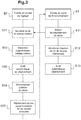
- control unit capable of executing the control method which will be described with reference to the figure 3 .
- This control unit typically consists of a programmable computer associated with an information recording medium containing instructions for the execution of the method.
- the tubular motor 8 drives the tube 3 in rotation so as to unwind the fabric 4.
- the arms 6, 7 then unfold progressively to their maximum length corresponding to an arm locking position, in which the arms are braced, allowing good tensioning of the fabric.
- this position also corresponds to the unrolled end position, that is to say the fully extended position, also known as the "low end position”.
- the Figure 2 illustrates the variation of the motor speed measured by the sensor, as a function of time, at different phases of the deployment of the awning.
- This phase of deployment referenced V2 on the figure 2 where the engine speed is accelerating is caused by the kinematics of the arms during deployment. Indeed, at the end of deployment, when the fabric reaches its fully deployed position, for a short period of time, the force exerted by the arms just before reaching their locking position is much greater, which leads to an increase significant of the engine speed. Then, when the arms reach their locking position, there is a third phase referenced V3 at the figure 2 , in which the motor is no longer driven, so that it slows down by slightly unwinding the relaxed fabric, which results in a speed of rotation of the motor measured in deceleration, insofar as the fabric no longer exerts stress on the winding tube and therefore on the actuator. Thus, the fabric remains stretched to the locking position of the arms and it is then relaxed if the motor continues to drive the tube in rotation.
- the position in which an increase in the speed of rotation of the motor is detected, consecutive to an unfolding movement of the arms at the end of deployment preceding the arrival of the arms in their locked position corresponds to the ideal stretched end position.
- the determination of this taut unwound end position (low end position) is therefore based on the detection of the acceleration of the motor rotation speed during the deployment of the blind. Automatic engine stop and therefore blocking of the winding tube is controlled as soon as the increase in the engine speed is detected, so that the installation is stopped preventing the actuator from continuing the unwinding of the fabric, which therefore advantageously remains taut in its low end-of-travel position.
- the determination of the taut unwound end position is carried out during an adjustment phase E0 of the installation.
- This adjustment phase is activated for example by the installer during a first adjustment phase, by means of the transmission of an appropriate command to the actuator, for example from a wired or wireless control point.
- the entry in the adjustment phase is activated, the following steps are implemented. Switching to the adjustment phase triggers a step E01 of deployment of the blind from the rolled end position (upper end position) in which the motor speed is continuously measured by the sensor during deployment.
- the arms arrive at the end of opening but are not blocked, that is to say that they have not yet reached their locking position.
- the actuator control unit detects an increase in the engine speed measured by the sensor. To do this, the control unit evaluates the speed of variation of the motor rotation speed during deployment, and detects when the speed of variation increases in a given, relatively short time interval.
- the control unit in a step E03, immediately controls the stopping of the motor, the blind then being considered to be, in accordance with l invention, in a position corresponding to the ideal position of the stretched limit switch.
- the control unit memorizes the position of the blind when the deployment stops, for example via the position provided by the counting device, the position thus memorized corresponding to the end position stretched running race which will be used during the following operating cycles.
- step E05 the control unit triggers the continuous folding of the blind (without stopping) until the rolled end position.
- step E05 the control unit triggers the continuous folding of the blind (without stopping) until the rolled end position.
- step E1 when switching to a normal operating cycle of the blind (step E1), the control unit, in a step E11 controls the deployment of the blind, then, in a step E12, when the latter reaches the position memorized previously. in the adjustment phase, the control unit, in a step E13, controls the automatic stopping of the deployment in this memorized position, corresponding to the taut unwound end position.
- the fabric When using the awning, the fabric may stretch slightly, which can have the effect of creating a relaxed canvas effect in the end position. race run.
- the control unit is then provided to provide automatic readjustment of the end position run periodically or at each operating cycle by again performing steps E01 to E04 of the adjustment phase, in a manner transparent to the user.
- the phase of adjustment can be carried out again, but then excluding step E05 of continuous folding of the blind to the rolled end position.
- the blind must be deployed, detect the end of travel position unwound according to the principles described in steps E01 and E02, automatically stop the motor at this position and memorize this new position to replace the previous one.
- the blind should not then automatically fold back according to step E05 of the adjustment phase, because this is not, in this case, the user's wish.
Landscapes
- Engineering & Computer Science (AREA)
- Architecture (AREA)
- Civil Engineering (AREA)
- Structural Engineering (AREA)
- Building Awnings And Sunshades (AREA)
- Operating, Guiding And Securing Of Roll- Type Closing Members (AREA)
- Moulding By Coating Moulds (AREA)
- Controlling Rewinding, Feeding, Winding, Or Abnormalities Of Webs (AREA)
Claims (5)
- Verfahren zum Steuern einer Installation einer motorisierten Markise (1), wobei die Installation ein Gestell (2) umfasst, das ein Aufwickelrohr (3) abstützt, das durch einen Aktuator mit einen Rohrantriebsmotor (8) rotatorisch angetrieben werden kann, der ermöglicht, dass ein Markisentuch (4) durch ein erstes Ende um das Rohr aufgewickelt oder abgewickelt wird, wobei das Markisentuch (4) durch ein zweites Ende an einer Tragestange (5) befestigt ist, die im Wesentlichen parallel zum Aufwickelrohr (3) angeordnet ist und in Bezug auf das Gestell (2) zwischen einer aufgewickelten bzw. abgewickelten Endlageposition des Tuchs durch ausklappbare Arme (6, 7) beweglich montiert ist, wobei das Verfahren bei der Entfaltung des Tuchs einen Schritt zum Steuern des Aktuators umfasst, der das Tuch in eine gespannte abgewickelte Endlageposition bringen kann, wobei das Verfahren dadurch gekennzeichnet ist, dass es eine Regelungsphase (E0) umfasst, die umfasst:- bei der Entfaltung des Tuchs einen Schritt (E01) zum Überwachen der Drehzahl des Motors oder des Motordrehmoments,- einen Schritt (E02) zur Detektion einer Erhöhung der Drehzahl des Motors oder des Motordrehmoments, der auf eine Ausklappbewegung der Arme am Ende der Entfaltung vor der Ankunft der Arme in einer Verriegelungsposition der Arme folgt, wobei der Stopp der Entfaltung automatisch (E03) in Reaktion auf die Detektion der Erhöhung der Drehzahl des Motors oder des Motordrehmoments ausgelöst wird;- einen Schritt (E04) zum Speichern der Position der Markise beim Stopp der Entfaltung, wobei die gespeicherte Position der gespannten abgewickelten Endlageposition entspricht;- einen Schritt (E05) zum kontinuierlichen Einziehen der Markise bis zur aufgewickelten Endlageposition;
wobei das Verfahren in einem folgenden Betriebszyklus umfasst:- bei der Entfaltung des Tuchs einen Schritt (E13) zum automatischen Stoppen der Entfaltung in der in der Regelungsphase gespeicherten Position. - Verfahren nach Anspruch 1, dadurch gekennzeichnet, dass die Regelungsphase (E0) periodisch wiederholt wird.
- Verfahren nach Anspruch 1 oder 2, dadurch gekennzeichnet, dass die Regelungsphase (E0) ausschließlich des Schritts (E05) des kontinuierlichen Einziehens der Markise bis zur aufgewickelten Endlageposition periodisch oder in jedem Betriebszyklus wiederholt wird.
- Verfahren nach einem der vorangehenden Ansprüche, dadurch gekennzeichnet, dass in der Regelungsphase die Überwachung der Drehzahl des Motors oder des Motordrehmoments darin besteht, kontinuierlich die Drehzahl des Motors oder das Motordrehmoment zu messen und eine Veränderungsgeschwindigkeit der Drehzahl des Motors oder des Motordrehmoments zu bewerten, wobei der automatische Stopp der Entfaltung der Markise in Reaktion auf die Detektion der Erhöhung der Drehzahl des Motors oder des Motordrehmoments ausgelöst wird, wenn die Veränderungsgeschwindigkeit in einem gegebenen Zeitintervall zunimmt.
- Installation einer motorisierten Markise (1) mit einem Gestell (2), das ein Aufwickelrohr (3) abstützt, das durch einen Aktuator mit einem Rohrantriebsmotor (8) rotatorisch angetrieben werden kann, der ermöglicht, dass ein Markisentuch (4) durch ein erstes Ende um das Rohr aufgewickelt oder abgewickelt wird, wobei das Markisentuch durch ein zweites Ende an einer Tragestange (5) befestigt ist, die im Wesentlichen parallel zum Aufwickelrohr angeordnet ist und in Bezug auf das Gestell zwischen einer aufgewickelten bzw. abgewickelten Endlageposition des Tuchs durch ausklappbare Arme (6, 7) beweglich montiert ist, wobei die Installation dadurch gekennzeichnet ist, dass sie einen Drehzahl- oder Drehmomentsensor, der die Drehzahl des Motors oder das Motordrehmoment messen soll, und eine Steuereinheit, die dazu beschaffen ist, den Aktuator zu steuern und das Steuerverfahren nach einem der vorangehenden Ansprüche auszuführen, umfasst.
Applications Claiming Priority (1)
| Application Number | Priority Date | Filing Date | Title |
|---|---|---|---|
| FR1557548A FR3039846B1 (fr) | 2015-08-05 | 2015-08-05 | Procede de commande d'une installation de store motorisee |
Publications (2)
| Publication Number | Publication Date |
|---|---|
| EP3128100A1 EP3128100A1 (de) | 2017-02-08 |
| EP3128100B1 true EP3128100B1 (de) | 2020-06-24 |
Family
ID=54608731
Family Applications (1)
| Application Number | Title | Priority Date | Filing Date |
|---|---|---|---|
| EP16182407.3A Active EP3128100B1 (de) | 2015-08-05 | 2016-08-02 | Verfahren zur steuerung eines motorisierten sonnenschutzsystems |
Country Status (2)
| Country | Link |
|---|---|
| EP (1) | EP3128100B1 (de) |
| FR (1) | FR3039846B1 (de) |
Families Citing this family (1)
| Publication number | Priority date | Publication date | Assignee | Title |
|---|---|---|---|---|
| CN109006060A (zh) * | 2018-10-10 | 2018-12-18 | 云南涵乾农业科技有限公司 | 一种滴灌施肥智能控制光伏大棚 |
Family Cites Families (4)
| Publication number | Priority date | Publication date | Assignee | Title |
|---|---|---|---|---|
| ES2214518T5 (es) * | 1995-10-28 | 2011-04-13 | Elero Gmbh | Procedimiento para el accionamiento de marquesinas o similares accionadas con motor eléctrico. |
| FR2816465A1 (fr) * | 2000-11-06 | 2002-05-10 | Fial | Dispositif pour arreter un moteur d'entrainement d'un tube d'enroulement d'un store, en fonction d'une mesure du couple exerce sur ledit moteur |
| FR2899923B1 (fr) * | 2006-04-14 | 2009-02-06 | Somfy Sas | Procede de commande et installation de store commandee par ce procede |
| EP2186989A3 (de) * | 2008-11-18 | 2014-12-10 | Gerhard Geiger GmbH & Co. | Motorsteuerung |
-
2015
- 2015-08-05 FR FR1557548A patent/FR3039846B1/fr active Active
-
2016
- 2016-08-02 EP EP16182407.3A patent/EP3128100B1/de active Active
Non-Patent Citations (1)
| Title |
|---|
| None * |
Also Published As
| Publication number | Publication date |
|---|---|
| FR3039846B1 (fr) | 2025-10-31 |
| FR3039846A1 (fr) | 2017-02-10 |
| EP3128100A1 (de) | 2017-02-08 |
Similar Documents
| Publication | Publication Date | Title |
|---|---|---|
| EP2075401B1 (de) | Method of adjusting a motorised solar protection installation not comprising an end-stop. | |
| EP1845217B1 (de) | Verfahren zur Steuerung und Installation einer durch dieses Verfahren gesteuerten Jalousie | |
| EP3433446B1 (de) | Verfahren zur konfigurierung und steuerung des betriebs einer motorisierten antriebsvorrichtung für eine heimautomatisierungseinheit sowie zugehörige einheit und motorisierte antriebsvorrichtung | |
| EP3292262B1 (de) | Verfahren zur konfigurierung und steuerung des betriebs einer motorisierten antriebsvorrichtung für eine heimautomatisierungseinheit sowie zugehörige einheit und motorisierte antriebsvorrichtung | |
| EP3172394A1 (de) | Verfahren zur betriebssteuerung einer motorisch angetriebenen vorrichtung zum antrieb einer automatisierten schliess- oder sonnenschutzvorrichtung und zugehörige vorrichtung | |
| FR2780748A1 (fr) | Store motorise avec automatisme de securite | |
| EP1650625A1 (de) | Motorgetriebener Schirm und Verfahren zur seiner Betätigung | |
| EP3128100B1 (de) | Verfahren zur steuerung eines motorisierten sonnenschutzsystems | |
| EP3470616B1 (de) | Verfahren zur automatischen regulierung einer mit einem blockiersystem ausgestatteten rollladenanlage | |
| EP4367357B1 (de) | Verfahren zur einstellung einer motorbetriebenen rolloanlage und motorbetriebene rolloanlage zur durchführung dieses verfahrens | |
| EP2808479B1 (de) | Verfahren und Vorrichtung zur Betätigung eines mobilen Verschluss-, Verdunkelungs-, Sonnenschutz- oder Leinwandelements | |
| WO2016177737A1 (fr) | Procédé de configuration d'un dispositif d'entraînement motorisé d'une installation domotique, dispositif d'entraînement motorisé et installation associés | |
| EP3470617B1 (de) | Automatisiertes steuerverfahren einer rollladenanlage und rollladenanlage | |
| EP1649126B1 (de) | Verfahren zum steuern von einem durch ein motor angetriebenen vorhang und vorrichtung zum durchführen des verfahrens | |
| FR3072410B1 (fr) | Procede de reglage automatise d'une installation de volet roulant munie d'un mecanisme de blocage | |
| FR2898994A1 (fr) | Procede de commande d'un volet roulant evitant l'application d'un effort trop important sur un obstacle | |
| EP2166192B1 (de) | Verfahren zum Antreiben einer Vorrichtung zum Schließen und Öffnen eines Öffnungselements | |
| FR3019851A1 (fr) | Brise-soleil a lames orientables a blocage automatique en deploiement | |
| FR3048996A1 (fr) | Procede de commande d'un dispositif d'entrainement de store a lamelles exterieur | |
| WO2007119145A2 (fr) | Procede d'initialisation d'un volet roulant motorise | |
| BE336324A (de) | ||
| FR3035234A1 (fr) | Procede de commande en fonctionnement d'une installation domotique de fermeture ou de protection solaire et installation domotique associee |
Legal Events
| Date | Code | Title | Description |
|---|---|---|---|
| PUAI | Public reference made under article 153(3) epc to a published international application that has entered the european phase |
Free format text: ORIGINAL CODE: 0009012 |
|
| STAA | Information on the status of an ep patent application or granted ep patent |
Free format text: STATUS: THE APPLICATION HAS BEEN PUBLISHED |
|
| AK | Designated contracting states |
Kind code of ref document: A1 Designated state(s): AL AT BE BG CH CY CZ DE DK EE ES FI FR GB GR HR HU IE IS IT LI LT LU LV MC MK MT NL NO PL PT RO RS SE SI SK SM TR |
|
| AX | Request for extension of the european patent |
Extension state: BA ME |
|
| STAA | Information on the status of an ep patent application or granted ep patent |
Free format text: STATUS: REQUEST FOR EXAMINATION WAS MADE |
|
| 17P | Request for examination filed |
Effective date: 20170808 |
|
| RBV | Designated contracting states (corrected) |
Designated state(s): AL AT BE BG CH CY CZ DE DK EE ES FI FR GB GR HR HU IE IS IT LI LT LU LV MC MK MT NL NO PL PT RO RS SE SI SK SM TR |
|
| GRAP | Despatch of communication of intention to grant a patent |
Free format text: ORIGINAL CODE: EPIDOSNIGR1 |
|
| STAA | Information on the status of an ep patent application or granted ep patent |
Free format text: STATUS: GRANT OF PATENT IS INTENDED |
|
| INTG | Intention to grant announced |
Effective date: 20200120 |
|
| GRAS | Grant fee paid |
Free format text: ORIGINAL CODE: EPIDOSNIGR3 |
|
| GRAA | (expected) grant |
Free format text: ORIGINAL CODE: 0009210 |
|
| STAA | Information on the status of an ep patent application or granted ep patent |
Free format text: STATUS: THE PATENT HAS BEEN GRANTED |
|
| AK | Designated contracting states |
Kind code of ref document: B1 Designated state(s): AL AT BE BG CH CY CZ DE DK EE ES FI FR GB GR HR HU IE IS IT LI LT LU LV MC MK MT NL NO PL PT RO RS SE SI SK SM TR |
|
| REG | Reference to a national code |
Ref country code: GB Ref legal event code: FG4D Free format text: NOT ENGLISH |
|
| REG | Reference to a national code |
Ref country code: CH Ref legal event code: EP |
|
| REG | Reference to a national code |
Ref country code: DE Ref legal event code: R096 Ref document number: 602016038592 Country of ref document: DE |
|
| REG | Reference to a national code |
Ref country code: AT Ref legal event code: REF Ref document number: 1284039 Country of ref document: AT Kind code of ref document: T Effective date: 20200715 |
|
| REG | Reference to a national code |
Ref country code: IE Ref legal event code: FG4D Free format text: LANGUAGE OF EP DOCUMENT: FRENCH |
|
| PG25 | Lapsed in a contracting state [announced via postgrant information from national office to epo] |
Ref country code: SE Free format text: LAPSE BECAUSE OF FAILURE TO SUBMIT A TRANSLATION OF THE DESCRIPTION OR TO PAY THE FEE WITHIN THE PRESCRIBED TIME-LIMIT Effective date: 20200624 Ref country code: NO Free format text: LAPSE BECAUSE OF FAILURE TO SUBMIT A TRANSLATION OF THE DESCRIPTION OR TO PAY THE FEE WITHIN THE PRESCRIBED TIME-LIMIT Effective date: 20200924 Ref country code: LT Free format text: LAPSE BECAUSE OF FAILURE TO SUBMIT A TRANSLATION OF THE DESCRIPTION OR TO PAY THE FEE WITHIN THE PRESCRIBED TIME-LIMIT Effective date: 20200624 Ref country code: GR Free format text: LAPSE BECAUSE OF FAILURE TO SUBMIT A TRANSLATION OF THE DESCRIPTION OR TO PAY THE FEE WITHIN THE PRESCRIBED TIME-LIMIT Effective date: 20200925 Ref country code: FI Free format text: LAPSE BECAUSE OF FAILURE TO SUBMIT A TRANSLATION OF THE DESCRIPTION OR TO PAY THE FEE WITHIN THE PRESCRIBED TIME-LIMIT Effective date: 20200624 |
|
| REG | Reference to a national code |
Ref country code: LT Ref legal event code: MG4D |
|
| PG25 | Lapsed in a contracting state [announced via postgrant information from national office to epo] |
Ref country code: BG Free format text: LAPSE BECAUSE OF FAILURE TO SUBMIT A TRANSLATION OF THE DESCRIPTION OR TO PAY THE FEE WITHIN THE PRESCRIBED TIME-LIMIT Effective date: 20200924 Ref country code: LV Free format text: LAPSE BECAUSE OF FAILURE TO SUBMIT A TRANSLATION OF THE DESCRIPTION OR TO PAY THE FEE WITHIN THE PRESCRIBED TIME-LIMIT Effective date: 20200624 Ref country code: HR Free format text: LAPSE BECAUSE OF FAILURE TO SUBMIT A TRANSLATION OF THE DESCRIPTION OR TO PAY THE FEE WITHIN THE PRESCRIBED TIME-LIMIT Effective date: 20200624 Ref country code: RS Free format text: LAPSE BECAUSE OF FAILURE TO SUBMIT A TRANSLATION OF THE DESCRIPTION OR TO PAY THE FEE WITHIN THE PRESCRIBED TIME-LIMIT Effective date: 20200624 |
|
| REG | Reference to a national code |
Ref country code: NL Ref legal event code: MP Effective date: 20200624 |
|
| REG | Reference to a national code |
Ref country code: AT Ref legal event code: MK05 Ref document number: 1284039 Country of ref document: AT Kind code of ref document: T Effective date: 20200624 |
|
| PG25 | Lapsed in a contracting state [announced via postgrant information from national office to epo] |
Ref country code: NL Free format text: LAPSE BECAUSE OF FAILURE TO SUBMIT A TRANSLATION OF THE DESCRIPTION OR TO PAY THE FEE WITHIN THE PRESCRIBED TIME-LIMIT Effective date: 20200624 Ref country code: AL Free format text: LAPSE BECAUSE OF FAILURE TO SUBMIT A TRANSLATION OF THE DESCRIPTION OR TO PAY THE FEE WITHIN THE PRESCRIBED TIME-LIMIT Effective date: 20200624 |
|
| PG25 | Lapsed in a contracting state [announced via postgrant information from national office to epo] |
Ref country code: SM Free format text: LAPSE BECAUSE OF FAILURE TO SUBMIT A TRANSLATION OF THE DESCRIPTION OR TO PAY THE FEE WITHIN THE PRESCRIBED TIME-LIMIT Effective date: 20200624 Ref country code: EE Free format text: LAPSE BECAUSE OF FAILURE TO SUBMIT A TRANSLATION OF THE DESCRIPTION OR TO PAY THE FEE WITHIN THE PRESCRIBED TIME-LIMIT Effective date: 20200624 Ref country code: IT Free format text: LAPSE BECAUSE OF FAILURE TO SUBMIT A TRANSLATION OF THE DESCRIPTION OR TO PAY THE FEE WITHIN THE PRESCRIBED TIME-LIMIT Effective date: 20200624 Ref country code: PT Free format text: LAPSE BECAUSE OF FAILURE TO SUBMIT A TRANSLATION OF THE DESCRIPTION OR TO PAY THE FEE WITHIN THE PRESCRIBED TIME-LIMIT Effective date: 20201026 Ref country code: RO Free format text: LAPSE BECAUSE OF FAILURE TO SUBMIT A TRANSLATION OF THE DESCRIPTION OR TO PAY THE FEE WITHIN THE PRESCRIBED TIME-LIMIT Effective date: 20200624 Ref country code: AT Free format text: LAPSE BECAUSE OF FAILURE TO SUBMIT A TRANSLATION OF THE DESCRIPTION OR TO PAY THE FEE WITHIN THE PRESCRIBED TIME-LIMIT Effective date: 20200624 Ref country code: ES Free format text: LAPSE BECAUSE OF FAILURE TO SUBMIT A TRANSLATION OF THE DESCRIPTION OR TO PAY THE FEE WITHIN THE PRESCRIBED TIME-LIMIT Effective date: 20200624 Ref country code: CZ Free format text: LAPSE BECAUSE OF FAILURE TO SUBMIT A TRANSLATION OF THE DESCRIPTION OR TO PAY THE FEE WITHIN THE PRESCRIBED TIME-LIMIT Effective date: 20200624 |
|
| PG25 | Lapsed in a contracting state [announced via postgrant information from national office to epo] |
Ref country code: PL Free format text: LAPSE BECAUSE OF FAILURE TO SUBMIT A TRANSLATION OF THE DESCRIPTION OR TO PAY THE FEE WITHIN THE PRESCRIBED TIME-LIMIT Effective date: 20200624 Ref country code: SK Free format text: LAPSE BECAUSE OF FAILURE TO SUBMIT A TRANSLATION OF THE DESCRIPTION OR TO PAY THE FEE WITHIN THE PRESCRIBED TIME-LIMIT Effective date: 20200624 Ref country code: IS Free format text: LAPSE BECAUSE OF FAILURE TO SUBMIT A TRANSLATION OF THE DESCRIPTION OR TO PAY THE FEE WITHIN THE PRESCRIBED TIME-LIMIT Effective date: 20201024 |
|
| REG | Reference to a national code |
Ref country code: DE Ref legal event code: R119 Ref document number: 602016038592 Country of ref document: DE |
|
| PG25 | Lapsed in a contracting state [announced via postgrant information from national office to epo] |
Ref country code: MC Free format text: LAPSE BECAUSE OF FAILURE TO SUBMIT A TRANSLATION OF THE DESCRIPTION OR TO PAY THE FEE WITHIN THE PRESCRIBED TIME-LIMIT Effective date: 20200624 |
|
| REG | Reference to a national code |
Ref country code: CH Ref legal event code: PL |
|
| PG25 | Lapsed in a contracting state [announced via postgrant information from national office to epo] |
Ref country code: CH Free format text: LAPSE BECAUSE OF NON-PAYMENT OF DUE FEES Effective date: 20200831 Ref country code: DK Free format text: LAPSE BECAUSE OF FAILURE TO SUBMIT A TRANSLATION OF THE DESCRIPTION OR TO PAY THE FEE WITHIN THE PRESCRIBED TIME-LIMIT Effective date: 20200624 Ref country code: LI Free format text: LAPSE BECAUSE OF NON-PAYMENT OF DUE FEES Effective date: 20200831 Ref country code: LU Free format text: LAPSE BECAUSE OF NON-PAYMENT OF DUE FEES Effective date: 20200802 |
|
| PLBE | No opposition filed within time limit |
Free format text: ORIGINAL CODE: 0009261 |
|
| STAA | Information on the status of an ep patent application or granted ep patent |
Free format text: STATUS: NO OPPOSITION FILED WITHIN TIME LIMIT |
|
| GBPC | Gb: european patent ceased through non-payment of renewal fee |
Effective date: 20200924 |
|
| REG | Reference to a national code |
Ref country code: BE Ref legal event code: MM Effective date: 20200831 |
|
| 26N | No opposition filed |
Effective date: 20210325 |
|
| PG25 | Lapsed in a contracting state [announced via postgrant information from national office to epo] |
Ref country code: DE Free format text: LAPSE BECAUSE OF NON-PAYMENT OF DUE FEES Effective date: 20210302 |
|
| PG25 | Lapsed in a contracting state [announced via postgrant information from national office to epo] |
Ref country code: SI Free format text: LAPSE BECAUSE OF FAILURE TO SUBMIT A TRANSLATION OF THE DESCRIPTION OR TO PAY THE FEE WITHIN THE PRESCRIBED TIME-LIMIT Effective date: 20200624 Ref country code: IE Free format text: LAPSE BECAUSE OF NON-PAYMENT OF DUE FEES Effective date: 20200802 Ref country code: GB Free format text: LAPSE BECAUSE OF NON-PAYMENT OF DUE FEES Effective date: 20200924 Ref country code: BE Free format text: LAPSE BECAUSE OF NON-PAYMENT OF DUE FEES Effective date: 20200831 |
|
| PG25 | Lapsed in a contracting state [announced via postgrant information from national office to epo] |
Ref country code: TR Free format text: LAPSE BECAUSE OF FAILURE TO SUBMIT A TRANSLATION OF THE DESCRIPTION OR TO PAY THE FEE WITHIN THE PRESCRIBED TIME-LIMIT Effective date: 20200624 Ref country code: MT Free format text: LAPSE BECAUSE OF FAILURE TO SUBMIT A TRANSLATION OF THE DESCRIPTION OR TO PAY THE FEE WITHIN THE PRESCRIBED TIME-LIMIT Effective date: 20200624 Ref country code: CY Free format text: LAPSE BECAUSE OF FAILURE TO SUBMIT A TRANSLATION OF THE DESCRIPTION OR TO PAY THE FEE WITHIN THE PRESCRIBED TIME-LIMIT Effective date: 20200624 |
|
| PG25 | Lapsed in a contracting state [announced via postgrant information from national office to epo] |
Ref country code: MK Free format text: LAPSE BECAUSE OF FAILURE TO SUBMIT A TRANSLATION OF THE DESCRIPTION OR TO PAY THE FEE WITHIN THE PRESCRIBED TIME-LIMIT Effective date: 20200624 |
|
| PGFP | Annual fee paid to national office [announced via postgrant information from national office to epo] |
Ref country code: FR Payment date: 20250729 Year of fee payment: 10 |