EP3128155B1 - Ensemble turbo-propulseur ayant une sortie combinée des gaz de refroidissement et d'échappement - Google Patents
Ensemble turbo-propulseur ayant une sortie combinée des gaz de refroidissement et d'échappement Download PDFInfo
- Publication number
- EP3128155B1 EP3128155B1 EP16183252.2A EP16183252A EP3128155B1 EP 3128155 B1 EP3128155 B1 EP 3128155B1 EP 16183252 A EP16183252 A EP 16183252A EP 3128155 B1 EP3128155 B1 EP 3128155B1
- Authority
- EP
- European Patent Office
- Prior art keywords
- air duct
- exhaust
- air
- duct
- flow
- Prior art date
- Legal status (The legal status is an assumption and is not a legal conclusion. Google has not performed a legal analysis and makes no representation as to the accuracy of the status listed.)
- Active
Links
Images



Classifications
-
- F—MECHANICAL ENGINEERING; LIGHTING; HEATING; WEAPONS; BLASTING
- F02—COMBUSTION ENGINES; HOT-GAS OR COMBUSTION-PRODUCT ENGINE PLANTS
- F02K—JET-PROPULSION PLANTS
- F02K1/00—Plants characterised by the form or arrangement of the jet pipe or nozzle; Jet pipes or nozzles peculiar thereto
- F02K1/38—Introducing air inside the jet
- F02K1/386—Introducing air inside the jet mixing devices in the jet pipe, e.g. for mixing primary and secondary flow
-
- B—PERFORMING OPERATIONS; TRANSPORTING
- B64—AIRCRAFT; AVIATION; COSMONAUTICS
- B64D—EQUIPMENT FOR FITTING IN OR TO AIRCRAFT; FLIGHT SUITS; PARACHUTES; ARRANGEMENT OR MOUNTING OF POWER PLANTS OR PROPULSION TRANSMISSIONS IN AIRCRAFT
- B64D27/00—Arrangement or mounting of power plants in aircraft; Aircraft characterised by the type or position of power plants
- B64D27/02—Aircraft characterised by the type or position of power plants
-
- B—PERFORMING OPERATIONS; TRANSPORTING
- B64—AIRCRAFT; AVIATION; COSMONAUTICS
- B64D—EQUIPMENT FOR FITTING IN OR TO AIRCRAFT; FLIGHT SUITS; PARACHUTES; ARRANGEMENT OR MOUNTING OF POWER PLANTS OR PROPULSION TRANSMISSIONS IN AIRCRAFT
- B64D27/00—Arrangement or mounting of power plants in aircraft; Aircraft characterised by the type or position of power plants
- B64D27/02—Aircraft characterised by the type or position of power plants
- B64D27/04—Aircraft characterised by the type or position of power plants of piston type
- B64D27/08—Aircraft characterised by the type or position of power plants of piston type within, or attached to, fuselages
-
- B—PERFORMING OPERATIONS; TRANSPORTING
- B64—AIRCRAFT; AVIATION; COSMONAUTICS
- B64D—EQUIPMENT FOR FITTING IN OR TO AIRCRAFT; FLIGHT SUITS; PARACHUTES; ARRANGEMENT OR MOUNTING OF POWER PLANTS OR PROPULSION TRANSMISSIONS IN AIRCRAFT
- B64D27/00—Arrangement or mounting of power plants in aircraft; Aircraft characterised by the type or position of power plants
- B64D27/02—Aircraft characterised by the type or position of power plants
- B64D27/10—Aircraft characterised by the type or position of power plants of gas-turbine type
-
- B—PERFORMING OPERATIONS; TRANSPORTING
- B64—AIRCRAFT; AVIATION; COSMONAUTICS
- B64D—EQUIPMENT FOR FITTING IN OR TO AIRCRAFT; FLIGHT SUITS; PARACHUTES; ARRANGEMENT OR MOUNTING OF POWER PLANTS OR PROPULSION TRANSMISSIONS IN AIRCRAFT
- B64D33/00—Arrangement in aircraft of power plant parts or auxiliaries not otherwise provided for
- B64D33/04—Arrangement in aircraft of power plant parts or auxiliaries not otherwise provided for of exhaust outlets or jet pipes
-
- B—PERFORMING OPERATIONS; TRANSPORTING
- B64—AIRCRAFT; AVIATION; COSMONAUTICS
- B64D—EQUIPMENT FOR FITTING IN OR TO AIRCRAFT; FLIGHT SUITS; PARACHUTES; ARRANGEMENT OR MOUNTING OF POWER PLANTS OR PROPULSION TRANSMISSIONS IN AIRCRAFT
- B64D33/00—Arrangement in aircraft of power plant parts or auxiliaries not otherwise provided for
- B64D33/08—Arrangement in aircraft of power plant parts or auxiliaries not otherwise provided for of power plant cooling systems
- B64D33/10—Radiator arrangement
-
- F—MECHANICAL ENGINEERING; LIGHTING; HEATING; WEAPONS; BLASTING
- F01—MACHINES OR ENGINES IN GENERAL; ENGINE PLANTS IN GENERAL; STEAM ENGINES
- F01N—GAS-FLOW SILENCERS OR EXHAUST APPARATUS FOR MACHINES OR ENGINES IN GENERAL; GAS-FLOW SILENCERS OR EXHAUST APPARATUS FOR INTERNAL-COMBUSTION ENGINES
- F01N13/00—Exhaust or silencing apparatus characterised by constructional features
- F01N13/08—Other arrangements or adaptations of exhaust conduits
- F01N13/082—Other arrangements or adaptations of exhaust conduits of tailpipe, e.g. with means for mixing air with exhaust for exhaust cooling, dilution or evacuation
-
- F—MECHANICAL ENGINEERING; LIGHTING; HEATING; WEAPONS; BLASTING
- F01—MACHINES OR ENGINES IN GENERAL; ENGINE PLANTS IN GENERAL; STEAM ENGINES
- F01N—GAS-FLOW SILENCERS OR EXHAUST APPARATUS FOR MACHINES OR ENGINES IN GENERAL; GAS-FLOW SILENCERS OR EXHAUST APPARATUS FOR INTERNAL-COMBUSTION ENGINES
- F01N3/00—Exhaust or silencing apparatus having means for purifying, rendering innocuous, or otherwise treating exhaust
- F01N3/02—Exhaust or silencing apparatus having means for purifying, rendering innocuous, or otherwise treating exhaust for cooling, or for removing solid constituents of, exhaust
- F01N3/05—Exhaust or silencing apparatus having means for purifying, rendering innocuous, or otherwise treating exhaust for cooling, or for removing solid constituents of, exhaust by means of air, e.g. by mixing exhaust with air
- F01N3/055—Exhaust or silencing apparatus having means for purifying, rendering innocuous, or otherwise treating exhaust for cooling, or for removing solid constituents of, exhaust by means of air, e.g. by mixing exhaust with air without contact between air and exhaust gases
-
- F—MECHANICAL ENGINEERING; LIGHTING; HEATING; WEAPONS; BLASTING
- F02—COMBUSTION ENGINES; HOT-GAS OR COMBUSTION-PRODUCT ENGINE PLANTS
- F02B—INTERNAL-COMBUSTION PISTON ENGINES; COMBUSTION ENGINES IN GENERAL
- F02B53/00—Internal-combustion aspects of rotary-piston or oscillating-piston engines
- F02B53/14—Adaptations of engines for driving, or engine combinations with, other devices
-
- F—MECHANICAL ENGINEERING; LIGHTING; HEATING; WEAPONS; BLASTING
- F02—COMBUSTION ENGINES; HOT-GAS OR COMBUSTION-PRODUCT ENGINE PLANTS
- F02B—INTERNAL-COMBUSTION PISTON ENGINES; COMBUSTION ENGINES IN GENERAL
- F02B61/00—Adaptations of engines for driving vehicles or for driving propellers; Combinations of engines with gearing
- F02B61/04—Adaptations of engines for driving vehicles or for driving propellers; Combinations of engines with gearing for driving propellers
-
- F—MECHANICAL ENGINEERING; LIGHTING; HEATING; WEAPONS; BLASTING
- F02—COMBUSTION ENGINES; HOT-GAS OR COMBUSTION-PRODUCT ENGINE PLANTS
- F02C—GAS-TURBINE PLANTS; AIR INTAKES FOR JET-PROPULSION PLANTS; CONTROLLING FUEL SUPPLY IN AIR-BREATHING JET-PROPULSION PLANTS
- F02C5/00—Gas-turbine plants characterised by the working fluid being generated by intermittent combustion
-
- F—MECHANICAL ENGINEERING; LIGHTING; HEATING; WEAPONS; BLASTING
- F02—COMBUSTION ENGINES; HOT-GAS OR COMBUSTION-PRODUCT ENGINE PLANTS
- F02C—GAS-TURBINE PLANTS; AIR INTAKES FOR JET-PROPULSION PLANTS; CONTROLLING FUEL SUPPLY IN AIR-BREATHING JET-PROPULSION PLANTS
- F02C6/00—Plural gas-turbine plants; Combinations of gas-turbine plants with other apparatus; Adaptations of gas-turbine plants for special use
- F02C6/20—Adaptations of gas-turbine plants for driving vehicles
- F02C6/206—Adaptations of gas-turbine plants for driving vehicles the vehicles being airscrew driven
-
- F—MECHANICAL ENGINEERING; LIGHTING; HEATING; WEAPONS; BLASTING
- F02—COMBUSTION ENGINES; HOT-GAS OR COMBUSTION-PRODUCT ENGINE PLANTS
- F02C—GAS-TURBINE PLANTS; AIR INTAKES FOR JET-PROPULSION PLANTS; CONTROLLING FUEL SUPPLY IN AIR-BREATHING JET-PROPULSION PLANTS
- F02C7/00—Features, components parts, details or accessories, not provided for in, or of interest apart form groups F02C1/00 - F02C6/00; Air intakes for jet-propulsion plants
- F02C7/12—Cooling of plants
- F02C7/16—Cooling of plants characterised by cooling medium
- F02C7/18—Cooling of plants characterised by cooling medium the medium being gaseous, e.g. air
-
- F—MECHANICAL ENGINEERING; LIGHTING; HEATING; WEAPONS; BLASTING
- F01—MACHINES OR ENGINES IN GENERAL; ENGINE PLANTS IN GENERAL; STEAM ENGINES
- F01N—GAS-FLOW SILENCERS OR EXHAUST APPARATUS FOR MACHINES OR ENGINES IN GENERAL; GAS-FLOW SILENCERS OR EXHAUST APPARATUS FOR INTERNAL-COMBUSTION ENGINES
- F01N2260/00—Exhaust treating devices having provisions not otherwise provided for
- F01N2260/02—Exhaust treating devices having provisions not otherwise provided for for cooling the device
- F01N2260/022—Exhaust treating devices having provisions not otherwise provided for for cooling the device using air
-
- F—MECHANICAL ENGINEERING; LIGHTING; HEATING; WEAPONS; BLASTING
- F01—MACHINES OR ENGINES IN GENERAL; ENGINE PLANTS IN GENERAL; STEAM ENGINES
- F01N—GAS-FLOW SILENCERS OR EXHAUST APPARATUS FOR MACHINES OR ENGINES IN GENERAL; GAS-FLOW SILENCERS OR EXHAUST APPARATUS FOR INTERNAL-COMBUSTION ENGINES
- F01N2270/00—Mixing air with exhaust gases
- F01N2270/02—Mixing air with exhaust gases for cooling exhaust gases or the apparatus
-
- F—MECHANICAL ENGINEERING; LIGHTING; HEATING; WEAPONS; BLASTING
- F02—COMBUSTION ENGINES; HOT-GAS OR COMBUSTION-PRODUCT ENGINE PLANTS
- F02B—INTERNAL-COMBUSTION PISTON ENGINES; COMBUSTION ENGINES IN GENERAL
- F02B53/00—Internal-combustion aspects of rotary-piston or oscillating-piston engines
- F02B2053/005—Wankel engines
-
- F—MECHANICAL ENGINEERING; LIGHTING; HEATING; WEAPONS; BLASTING
- F05—INDEXING SCHEMES RELATING TO ENGINES OR PUMPS IN VARIOUS SUBCLASSES OF CLASSES F01-F04
- F05D—INDEXING SCHEME FOR ASPECTS RELATING TO NON-POSITIVE-DISPLACEMENT MACHINES OR ENGINES, GAS-TURBINES OR JET-PROPULSION PLANTS
- F05D2260/00—Function
- F05D2260/20—Heat transfer, e.g. cooling
- F05D2260/213—Heat transfer, e.g. cooling by the provision of a heat exchanger within the cooling circuit
-
- Y—GENERAL TAGGING OF NEW TECHNOLOGICAL DEVELOPMENTS; GENERAL TAGGING OF CROSS-SECTIONAL TECHNOLOGIES SPANNING OVER SEVERAL SECTIONS OF THE IPC; TECHNICAL SUBJECTS COVERED BY FORMER USPC CROSS-REFERENCE ART COLLECTIONS [XRACs] AND DIGESTS
- Y02—TECHNOLOGIES OR APPLICATIONS FOR MITIGATION OR ADAPTATION AGAINST CLIMATE CHANGE
- Y02T—CLIMATE CHANGE MITIGATION TECHNOLOGIES RELATED TO TRANSPORTATION
- Y02T50/00—Aeronautics or air transport
- Y02T50/60—Efficient propulsion technologies, e.g. for aircraft
Definitions
- the application relates generally to compound engine assemblies and, more particularly, to such assemblies configured as turboprop engines.
- Turboprop engine typically have an engine exhaust which is directed to the environment of the aircraft, typically through an exhaust duct and stub to mix it with ambient air. Such an exhaust stub usually creates drag for the engine.
- Ducts and other structure in contact with the exhaust flow must typically be made of materials able to withstand significantly high temperatures. Such materials typically represent significant costs.
- GB 622768 A discloses a prior art turboprop engine as set forth in the preamble of claim 1.
- turboprop engine assembly for an aircraft as set forth in claim 1.
- Fig. 1 illustrates a compound engine assembly 10 which is configured as a turboprop engine, in accordance with a particular embodiment.
- the compound engine assembly 10 includes a liquid cooled heavy fueled multi-rotor rotary intermittent combustion engine core 12'.
- the engine core 12' As will be detailed below, other configurations for the engine core 12' are also possible.
- the engine core 12' has an engine shaft 16 driven by the internal combustion engine(s) 12 and driving a rotatable load, which is shown here as a propeller 8. It is understood that the compound engine assembly 10 may alternately be configured to drive any other appropriate type of load, including, but not limited to, one or more generator(s), drive shaft(s), accessory(ies), rotor mast(s), compressor(s), or any other appropriate type of load or combination thereof.
- the compound engine assembly 10 further includes a compressor 20, and a turbine section 18 compounding power with the engine core 12'.
- the engine core 12' includes two or more rotary intermittent internal combustion engine(s) 12 drivingly engaged to the shaft 16.
- the engine core 12' includes a single engine.
- Each rotary engine 12 has a rotor sealingly engaged in a respective housing, with each rotary engine having a near constant volume combustion phase for high cycle efficiency.
- the intermittent internal combustion engine(s) 12 may be Wankel engine(s).
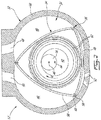
- the engine 12 comprises a housing 32 defining a rotor cavity having a profile defining two lobes, which is preferably an epitrochoid.
- a rotor 34 is received within the rotor cavity.
- the rotor defines three circumferentially-spaced apex portions 36, and a generally triangular profile with outwardly arched sides.
- the apex portions 36 are in sealing engagement with the inner surface of a peripheral wall 38 of the housing 32 to form and separate three working chambers 40 of variable volume between the rotor 34 and the housing 32.
- the peripheral wall 38 extends between two axially spaced apart end walls 54 to enclose the rotor cavity.
- the rotor 34 is engaged to an eccentric portion 42 of the output shaft 16 to perform orbital revolutions within the rotor cavity.
- the output shaft 16 performs three rotations for each orbital revolution of the rotor 34.
- the geometrical axis 44 of the rotor 34 is offset from and parallel to the axis 46 of the housing 32.
- each chamber 40 varies in volume and moves around the rotor cavity to undergo the four phases of intake, compression, expansion and exhaust.
- An intake port 48 is provided through the peripheral wall 38 for admitting compressed air into one of the working chambers 40.
- An exhaust port 50 is also provided through the peripheral wall 38 for discharge of the exhaust gases from the working chambers 40.
- Passages 52 for a spark plug, glow plug or other ignition mechanism, as well as for one or more fuel injectors of a fuel injection system are also provided through the peripheral wall 38.
- the intake port 48, the exhaust port 50 and/or the passages 52 may be provided through the end or side wall 54 of the housing.
- a subchamber (not shown) may be provided in communication with the chambers 40, for pilot or pre injection of fuel for combustion.
- the working chambers 40 are sealed by spring-loaded peripheral or apex seals 56 extending from the rotor 34 to engage the inner surface of the peripheral wall 38, spring-loaded face or gas seals 58 and end or corner seals 60 extending from the rotor 34 to engage the inner surface of the end walls 54.
- the rotor 34 also includes at least one spring-loaded oil seal ring 62 biased against the inner surface of the end wall 54 around the bearing for the rotor 34 on the shaft eccentric portion 42.
- the fuel injector(s) of the engine 12 which in a particular embodiment are common rail fuel injectors, communicate with a source of Heavy fuel (e.g. diesel, kerosene (jet fuel), equivalent biofuel), and deliver the heavy fuel into the engine 12 such that the combustion chamber is stratified with a rich fuel-air mixture near the ignition source and a leaner mixture elsewhere.
- a source of Heavy fuel e.g. diesel, kerosene (jet fuel), equivalent biofuel
- the engine core 12' is supercharged with the compressor 20 mounted in-line with the engine core 12', i.e. the compressor rotor(s) 20a rotate co-axially with the engine shaft 16.
- the compressor rotor(s) 20a are engaged on a compressor shaft 15, and the engine shaft 16 is in driving engagement with the compressor shaft 15 through a step-up gearbox 21, which may include for example a planetary gear system.
- the compressor 20 is a centrifugal compressor with a single rotor 20a.
- the compressor 20 may be single-stage device or a multiple-stage device and may include one or more rotors having radial, axial or mixed flow blades.
- the outlet of the compressor 20 is in fluid communication with the inlet of the engine core 12' (e.g. intake port 48 of each engine 12). Accordingly, air enters the compressor 20 and is compressed and circulated to the inlet of the engine core 12'.
- the compressor 20 includes variable inlet guide vanes 23 through which the air circulates before reaching the compressor rotor(s) 20a.
- the air from the compressor 20 may circulate through an intercooler to drop its temperature prior to entering the engine core 12'.
- the compressed air is mixed with fuel and combusted to provide power and a residual quantity of intermediate pressure exhaust gas.
- Mechanical power produced by the engine core 12' drives the propeller 8.
- Each engine 12 of the engine core 12' provides an exhaust flow in the form of exhaust pulses of high pressure hot gas exiting at high peak velocity.
- the outlet of the engine core 12' e.g. the exhaust port 50 of each engine 12
- the outlet of the engine core 12' is in fluid communication with the inlet of the turbine section 18, and accordingly the exhaust flow from the engine core 12' is supplied to the turbine section 18.
- the turbine section 18 includes at least one rotor engaged on a turbine shaft 19. Mechanical energy recovered by the turbine section 18 is compounded with that of the engine shaft 16 to drive the propeller 8.
- the turbine section 18 is compounded with the engine core 12' by the turbine shaft 19 being mechanically linked to, and in driving engagement with, the engine shaft 16 through a reduction gearbox 24, for example through an offset gear train with idler gear.
- the engine shaft 16 is also mechanically linked to, and in driving engagement with, the propeller 8 through the same reduction gearbox 24.
- the reduction gearbox 24 includes two gear train branches: a compounding branch 24c mechanically linking the turbine shaft 19 and the engine shaft 16 and a downstream planetary branch 24p mechanically linking the engine shaft 16 and propeller 8.
- the turbine shaft 19 and engine shaft 16 may be engaged to the propeller 8 through different gearboxes, or the turbine shaft 19 may be engaged to the engine shaft 16 separately from the engagement between the engine shaft 16 and the propeller 8.
- the turbine section 18 may include one or more turbine stages.
- the turbine section 18 includes a first stage turbine 26 receiving the exhaust from the engine core 12', and a second stage turbine 22 receiving the exhaust from the first stage turbine 26, with the turbines 26, 22 having different reaction ratios from one another.
- the degree of reaction of a turbine can be determined using the temperature-based reaction ratio (equation 1) or the pressure-based reaction ratio (equation 2), which are typically close to one another in value for a same turbine, and which characterize the turbine with respect to "pure impulse” or "pure reaction” turbines:
- Reaction T t S 3 ⁇ t S 5 t S 0 ⁇ t S 5
- Reaction P P S 3 ⁇ P S 5 P S 0 ⁇ P S 5
- t temperature and P is pressure
- s refers to a static port
- the numbers refers to the location the temperature or pressure is measured: 0 for the inlet of the turbine vane (stator), 3 for the inlet of the turbine blade (rotor) and 5 for the exit of the turbine blade (rotor); and where a pure impulse turbine would have a ratio of 0 (0%) and a pure reaction turbine would have a ratio of 1 (100%).
- the first stage turbine 26 is configured to take benefit of the kinetic energy of the pulsating flow exiting the engine(s) 12 while stabilizing the flow and the second stage turbine 22 is configured to extract energy from the remaining pressure in the flow. Accordingly, in a particular embodiment the first stage turbine 26 has a lower reaction ratio (i.e. lower value) than that of the second stage turbine 22. In a particular embodiment, the first stage turbine 26 has a reaction ratio of 0.25 or lower (temperature or pressure based) or of 0.2 or lower (temperature or pressure based), and the second stage turbine 22 a reaction ratio higher than 0.25 (temperature or pressure based) and/or is a medium reaction pressure turbine. Other values are also possible.
- the breakdown of waste heat of the engine assembly 10 is different from a traditional gas turbine engine. Less heat is evacuated through the exhaust and more heat is given up to the engine casing. Accordingly, the engine(s) 12 have a coolant system, e.g. a liquid coolant system, which in a particular embodiment is distinct from any fuel and lubricating system of the engine assembly 10; in other words, a dedicated coolant is circulated through the engine(s) 12 of the engine core 12', for example through multiple coolant passages defined in the walls of the housing 32, and this dedicated coolant is circulated separately and independently from the lubricant and the fuel of the engine assembly 10, including the lubricant of the engine core 12'.
- a coolant system e.g. a liquid coolant system, which in a particular embodiment is distinct from any fuel and lubricating system of the engine assembly 10; in other words, a dedicated coolant is circulated through the engine(s) 12 of the engine core 12', for example through multiple coolant passages defined in the walls of
- a heat exchanger 66 defining an engine core cooler includes coolant passages 66a in fluid communication with the coolant system of the engine core 12' and air passages 66b in heat exchange relationship with the coolant passages 66a.
- the engine assembly 10 also includes a cooling and lubricating system, for circulating oil or any other liquid suitable for cooling and/or lubricating various components of the engine assembly 10 (e.g. bearings, gears, etc., of the engine core 12', the compressor 20, the turbines 22, 26, the gearboxes 21, 24).
- a second heat exchanger 68 defining an engine assembly cooler includes coolant passages 68a in fluid communication with the cooling and lubricating system of the engine assembly 10 and air passages 68b in heat exchange relationship with the coolant passages 68a.
- the nacelle installation of the compound engine assembly 10 includes a nacelle inlet 14 and an air duct 70 for the engine assembly 10 and the heat exchangers 66, 68.
- the air duct 70 extends from and communicates with the inlet 14, which is located at the front of the engine assembly 10 aft of the propeller 8.
- the inlet 14 is in communication with the environment of the aircraft, and is configured and positioned so as to be able to receive ram air during flight and flow from the propeller 8, particularly when on the ground.
- the air duct 70 also has an outlet 72 in communication with the environment of the aircraft, so as to discharge the spent cooling air from the air duct 70.
- the outlet 72 is defined in a bottom surface of the engine assembly 10. Other configurations are also possible.
- the inlet 20' of the compressor 20 is in fluid communication with the air duct 70, and the heat exchangers 66, 68 are received within the air duct 70.
- the heat exchangers 66, 68 extend across the air duct 70, such that the airflow through the air duct 70 circulates through the air passages 66b, 68b of the heat exchangers 66, 68, which are in fluid communication with the air duct 70.
- two heat exchangers 66, 68 are shown, it is understood that alternately a single heat exchanger or more than two heat exchangers may be provided in the air duct 70.
- the two heat exchangers 66, 68 are shown as being placed in parallel, such that a portion of the airflow separately circulates through each heat exchanger 66, 68.
- the heat exchangers 66, 68 may be placed in the air duct 70 in series such that the same portion of the airflow circulates through one than through the other of the heat exchangers 66, 68, although such a configuration may necessitate the use of larger heat exchangers.
- the angle of the heat exchangers 66, 68 within the air duct 70 may be different from that shown.
- the angle of the heat exchangers 66, 68 with respect to the airflow within the air duct 70 is selected to obtain a desired balance between pressure losses and effectiveness of the heat exchangers 66, 68, in consideration of the available space within the air duct 70.
- a part of the outlet 72 of the air duct 70 is selectively closable by a plurality of movable cowl flaps 74.
- the cowl flaps 74 are pivotally connected to an outer wall 76 of the air duct 70 downstream of the heat exchangers 66, 68, each adjacent a respective opening, or a respective part of the opening of the outlet 72, defined through the outer wall 76.
- the flaps 74 are movable between an extended position (shown in dotted lines) where they extend away from the respective opening and a retracted position (shown in full lines) where they close the respective opening, such as to modulate the airflow through the air duct 70 and heat exchangers 66, 68.
- the cowl flaps 74 are positioned in accordance with the power demand on the engine assembly 10, such as to regulate the temperature of the oil and coolant being cooled in the heat exchangers 66, 68 while reducing or minimizing cooling drag; for example, the cowl flaps 74 are open at take-off and closed at cruise speed.
- the cowl flaps 74 may have any appropriate configuration.
- the cowl flaps 74 have a straight airfoil shape; in another embodiment, the cowl flaps 74 have a cambered airfoil shape, configured to flow the exit air horizontally to produce a more effective thrust.
- the cowl flaps 74 are configured as louvers, each connected to a rod, and an actuator slides the rod to pivot the cowl flaps 74 between the extended and retracted positions to open or close the louvers. Other configurations are also possible.
- the outlet 72 of the air duct 70 has a portion 78 remaining permanently open downstream of the cowl flaps 74.
- This portion 78 may be shaped to define a nozzle, to form an exit jet opening.
- the configuration of the nozzle is optimized to minimize the drag induced by the heat exchangers 66, 68 at the cruise speed operating conditions.
- an exhaust duct 80 extends in fluid communication with the exhaust of the engine core 12', by being connected to an exhaust of the turbine section 18.
- the exhaust duct 80 extends through a portion of the air duct 70 from a location upstream of the heat exchangers 66, 68 to a location downstream of the heat exchanger 66, 68.
- the exhaust duct 80 has an outlet 82 positioned in the air duct 70, downstream of the heat exchangers 66, 68 and upstream of the outlet 72 of the air duct 70.
- the outlet 82 of the exhaust duct 80 is spaced inwardly from a peripheral wall 70' of the air duct 70.
- the air and exhaust gases are thus discharged in the air duct 70 so that the flow of cooling air surrounds the flow of exhaust gases.
- the mass flow and/or volume of flow of exhaust gases is/are smaller than the flow of cooling air. In a particular embodiment, the mass flow of exhaust gases is 20% or less of the mass flow of cooling air.
- An open cross-sectional area of the outlet 82 of the exhaust duct 80 is smaller than an open cross-sectional area of the air duct 70 around the outlet 82 of the exhaust duct 80 (where "open cross-sectional area of the air duct 70" refers to the cross-sectional area of the air duct 70 not occupied by the exhaust duct 80).
- the ratio of the diameter of the exhaust duct 80 on the diameter of the air duct 70 around the outlet of the exhaust duct 80 is from 0.2 to 0.4, for example around 1/3.
- Other values are also possible, depending for example on the optimisation of the weight and cost of the engine assembly 10 as a whole.
- the larger and cooler cooling air flow surrounding the exhaust gas flow protects the peripheral wall 70' of the air duct 70 from the exhaust flow, which allows for the peripheral wall 70' to be made of materials having a relatively low resistance to high temperature (for example, lower than that of nickel or titanium alloys), where "resistance to high temperature” refers to the ability of a material to keep their strength, rigidity and durability when submitted to high temperatures.
- the temperature of the exhaust gases may be 800°F (427°C) or more, potentially up to 1200°F-1400°F (649°C - 760°C), while the cooling air flow temperature may be 250°F (121°C) or less; surrounding the exhaust gas flow with the cooling air flow thus provides some protection to the peripheral wall 70' from the high temperature of the exhaust flow.
- the peripheral wall 70' of the air duct 70 is made of any suitable aluminum alloy, any suitable light metal alloy, any suitable composite material including, but not limited to, carbon fiber composite materials, or any suitable type of polymer.
- the flow of exhaust gases expelled from the exhaust duct 80 has a higher velocity than the surrounding cooling air flow circulating in the air duct 70.
- the difference in velocity is selected to create an entrainment effect in the cooling air flow, so as to help circulation of the cooling air flow through the heat exchangers 66, 68, which may be particularly, although not exclusively, useful when the aircraft is stationary.
- the heat exchangers 66, 68 are disposed in parallel and spaced apart from one another in the air duct 70, and the exhaust duct 80 extends in the air duct 78 between the heat exchangers 66, 68.
- such an arrangement allow for the creation of the entrainment effect in the cooling air flow.
- a mixer e.g. daisy style mixer
- discharging of the exhaust flow in the cooling air flow allows to add energy to the discharged cooling air by increasing its average temperature; this may provide for acceleration of the expelled air via area reduction to produce useful thrust from the cooling air and/or reduce the overall cooling drag associated with the heat exchangers 66, 68.
- discharging of the exhaust flow in the cooling air flow allows for the elimination of the exhaust stub which is typically used at the exhaust flow exit.
- Such an exhaust flow usually causes additional drag, and accordingly elimination of this feature allows for a reduction of drag through having a combined exit port for all of the discharged flow.
- the air and exhaust gases of the engine assembly 10 are thus discharged by circulating the flow of cooling air used to cool the liquid coolant of the engine(s) 12 to the air duct 70, and circulating the flow of exhaust gases produced by the engine(s) 12 to the air duct 70 so that the flow of cooling air surrounds the flow of exhaust gases, with a mass flow the exhaust gases being smaller than a mass flow of the cooling air.
- the flow of exhaust gases is circulated from the engine(s) through the turbine section 18 compounded with the engine(s) before being circulated to the air duct 70.
Landscapes
- Engineering & Computer Science (AREA)
- Chemical & Material Sciences (AREA)
- Combustion & Propulsion (AREA)
- Mechanical Engineering (AREA)
- General Engineering & Computer Science (AREA)
- Aviation & Aerospace Engineering (AREA)
- Health & Medical Sciences (AREA)
- Chemical Kinetics & Catalysis (AREA)
- Toxicology (AREA)
- Supercharger (AREA)
- Structures Of Non-Positive Displacement Pumps (AREA)
- Exhaust Silencers (AREA)
Claims (14)
- Ensemble turbopropulseur (10) pour un aéronef, l'ensemble turbopropulseur (10) comprenant :un moteur à combustion interne (12) ayant un système de refroidissement par liquide, le moteur à combustion interne (12) étant en prise d'entraînement avec une hélice (8) ;un conduit d'air (70) en communication fluidique avec un environnement de l'aéronef ;un échangeur de chaleur (66) reçu à l'intérieur du conduit d'air (70), l'échangeur de chaleur (66) ayant des passages de fluide de refroidissement (66a) en communication fluidique avec le système de refroidissement par liquide et des passages d'air (66b) en relation d'échange de chaleur avec les passages de fluide de refroidissement (66a), les passages d'air (66b) étant en communication fluidique avec le conduit d'air (70) ; etun conduit d'échappement (80) en communication fluidique avec un échappement du moteur à combustion interne (12), le conduit d'échappement (80) ayant une sortie (82) positionnée à l'intérieur du conduit d'air (70) en aval de l'échangeur de chaleur (66) et en amont d'une sortie (72) du conduit d'air (70), la sortie (82) du conduit d'échappement (80) étant espacée vers l'intérieur par rapport à une paroi périphérique (70') du conduit d'air (70) de telle sorte que, lors de l'utilisation, un flux d'air de refroidissement à travers le conduit d'air (70) entoure un flux de gaz d'échappement en provenance du conduit d'échappement (80),caractérisé en ce que :
le moteur à combustion interne (12) est un moteur rotatif Wankel comprenant un rotor (34) ayant trois parties de sommet (36) montées pour des rotations excentrées dans une cavité interne définie dans un carter (32), la cavité interne ayant une forme d'épitrochoïde avec deux lobes. - Ensemble turbopropulseur (10) selon la revendication 1, dans lequel le conduit d'échappement (80) est en communication fluidique avec un échappement du moteur à combustion interne (12) à travers une section de turbine (18) comprenant au moins une turbine (26, 22) associée au moteur à combustion interne (12).
- Ensemble turbopropulseur (10) selon la revendication 2, dans lequel la section de turbine (18) comprend des premier et second étages de turbine (26, 22) ayant des rapports de réaction différents l'un de l'autre.
- Ensemble turbopropulseur (10) selon une quelconque revendication précédente, dans lequel le conduit d'échappement (80) s'étend à travers une partie du conduit d'air (70) à partir d'un emplacement en amont de l'échangeur de chaleur (66) jusqu'à un emplacement en aval de l'échangeur de chaleur (66).
- Ensemble turbopropulseur (10) selon une quelconque revendication précédente, dans lequel au moins une partie de la sortie (72) du conduit d'air (70) peut être fermée sélectivement par une pluralité de clapets mobiles.
- Ensemble turbopropulseur (10) selon une quelconque revendication précédente, dans lequel la paroi périphérique (70') du conduit d'air (70) est faite d'un matériau sélectionné dans le groupe constitué de : un alliage d'aluminium, un matériau composite, et un polymère.
- Ensemble turbopropulseur (10) selon une quelconque revendication précédente, comprenant en outre un échangeur de chaleur supplémentaire (68) reçu à l'intérieur du conduit d'air (70), l'échangeur de chaleur supplémentaire (68) ayant des passages de fluide de refroidissement supplémentaires (68a) en communication fluidique avec un système de refroidissement et de lubrification de l'ensemble turbopropulseur (10) et des passages d'air supplémentaires (68b) en relation d'échange de chaleur avec les passages de fluide de refroidissement supplémentaires (68a) et en communication fluidique avec le conduit d'air (70).
- Ensemble turbopropulseur (10) selon la revendication 7, dans lequel l'échangeur de chaleur (66) et l'échangeur de chaleur supplémentaire (68) sont disposés en parallèle dans le conduit d'air (70), et le conduit d'échappement (80) s'étend dans le conduit d'air (70) entre l'échangeur de chaleur (66) et l'échangeur de chaleur supplémentaire (68).
- Ensemble turbopropulseur (10) selon une quelconque revendication précédente, dans lequel une entrée (14) du conduit d'air (70) est positionnée à l'arrière de l'hélice (8), la sortie (72) du conduit d'air (70) est positionnée à l'arrière de l'entrée (14), et la sortie (82) du conduit d'échappement (80) est positionnée à l'intérieur du conduit d'air (70) en aval de l'hélice (8).
- Ensemble turbopropulseur (10) selon une quelconque revendication précédente, dans lequel une aire de section ouverte de la sortie (82) du conduit d'échappement (80) est plus petite qu'une aire de section ouverte du conduit d'air (70) autour de la sortie (82) du conduit d'échappement (80).
- Procédé d'évacuation d'air et de gaz d'échappement dans un ensemble turbopropulseur (10) ayant un moteur à combustion interne (12), le procédé comprenant :l'acheminement d'un flux d'air de refroidissement utilisé pour refroidir un fluide de refroidissement liquide du moteur à combustion interne (12) vers un conduit d'air (70) de l'ensemble turbopropulseur (10) et à l'extérieur de l'ensemble turbopropulseur (10) ; etl'acheminement d'un flux de gaz d'échappement produit par le moteur à combustion interne (12) vers le conduit d'air (70) de sorte que le flux d'air de refroidissement entoure le flux de gaz d'échappement, un débit massique des gaz d'échappement étant inférieur à un débit massique de l'air de refroidissement,caractérisé en ce que :
le moteur à combustion interne (12) est un moteur rotatif Wankel comprenant un rotor (34) ayant trois parties de sommet (36) montées pour des rotations excentrées dans une cavité interne définie dans un carter (32), la cavité interne ayant une forme d'épitrochoïde avec deux lobes. - Procédé selon la revendication 11, dans lequel le flux de gaz d'échappement est acheminé à partir du moteur à combustion interne (12) à travers une section de turbine (18) associée au moteur à combustion interne (12) avant d'être acheminé vers le conduit d'air (70).
- Procédé selon la revendication 11 ou 12, dans lequel le débit massique des gaz d'échappement représente 20 % ou moins du débit massique de l'air de refroidissement.
- Procédé selon la revendication 11, 12 ou 13, dans lequel le flux de gaz d'échappement a une vitesse supérieure au flux d'air de refroidissement.
Priority Applications (1)
| Application Number | Priority Date | Filing Date | Title |
|---|---|---|---|
| PL16183252T PL3128155T3 (pl) | 2015-08-07 | 2016-08-08 | Zespół silnika turbośmigłowego z połączonym wylotem silnika i układu chłodzenia |
Applications Claiming Priority (2)
| Application Number | Priority Date | Filing Date | Title |
|---|---|---|---|
| US201562202275P | 2015-08-07 | 2015-08-07 | |
| US15/227,506 US10267191B2 (en) | 2015-08-07 | 2016-08-03 | Turboprop engine assembly with combined engine and cooling exhaust |
Publications (2)
| Publication Number | Publication Date |
|---|---|
| EP3128155A1 EP3128155A1 (fr) | 2017-02-08 |
| EP3128155B1 true EP3128155B1 (fr) | 2019-02-06 |
Family
ID=56852068
Family Applications (1)
| Application Number | Title | Priority Date | Filing Date |
|---|---|---|---|
| EP16183252.2A Active EP3128155B1 (fr) | 2015-08-07 | 2016-08-08 | Ensemble turbo-propulseur ayant une sortie combinée des gaz de refroidissement et d'échappement |
Country Status (7)
| Country | Link |
|---|---|
| US (2) | US10267191B2 (fr) |
| EP (1) | EP3128155B1 (fr) |
| CN (1) | CN108138654B (fr) |
| CA (1) | CA2938105C (fr) |
| ES (1) | ES2712480T3 (fr) |
| PL (1) | PL3128155T3 (fr) |
| WO (1) | WO2017024393A1 (fr) |
Families Citing this family (25)
| Publication number | Priority date | Publication date | Assignee | Title |
|---|---|---|---|---|
| US9771165B2 (en) | 2015-06-25 | 2017-09-26 | Pratt & Whitney Canada Corp. | Compound engine assembly with direct drive of generator |
| US10240522B2 (en) | 2015-08-07 | 2019-03-26 | Pratt & Whitney Canada Corp. | Auxiliary power unit with combined cooling of generator |
| US10267191B2 (en) | 2015-08-07 | 2019-04-23 | Pratt & Whitney Canada Corp. | Turboprop engine assembly with combined engine and cooling exhaust |
| US10253726B2 (en) | 2015-08-07 | 2019-04-09 | Pratt & Whitney Canada Corp. | Engine assembly with combined engine and cooling exhaust |
| US10633104B2 (en) * | 2017-05-17 | 2020-04-28 | General Electric Company | Hybrid-electric propulsion system for an aircraft |
| US10527012B2 (en) * | 2017-06-29 | 2020-01-07 | Pratt & Whitney Canada Corp. | Engine assembly with engine and cooler compartments |
| CN109334954A (zh) * | 2018-01-22 | 2019-02-15 | 张斌 | 喷气式垂直起落无人机 |
| US10858115B2 (en) * | 2018-02-19 | 2020-12-08 | Pratt & Whitney Canada Corp. | Aircraft with wheel well between heat exchangers of engine assembly |
| US10899433B2 (en) * | 2018-07-10 | 2021-01-26 | Pratt & Whitney Canada Corp. | System and method for feathering an aircraft propeller |
| US11628942B2 (en) * | 2019-03-01 | 2023-04-18 | Pratt & Whitney Canada Corp. | Torque ripple control for an aircraft power train |
| US10875660B1 (en) * | 2019-06-05 | 2020-12-29 | Pratt & Whitney Canada Corp. | Aircraft power plant |
| KR102874401B1 (ko) * | 2020-01-10 | 2025-10-22 | 한화에어로스페이스 주식회사 | 배기 덕트 및 이를 이용하는 배기 덕트 어셈블리와 비행체 |
| US11820526B2 (en) * | 2020-02-26 | 2023-11-21 | Honda Motor Co., Ltd. | Power supply apparatus for a flying body including a combustion gas and intake air heat exchanger |
| CN111469378A (zh) * | 2020-04-23 | 2020-07-31 | 新昌县欧赛机械有限公司 | 一种高强度橡胶用双螺杆型配合设备 |
| EP3904217B1 (fr) * | 2020-04-27 | 2022-09-28 | LEONARDO S.p.A. | Aéronef capable de vol stationnaire |
| US11719248B2 (en) * | 2020-10-14 | 2023-08-08 | Pratt & Whitney Canada Corp. | Aircraft propulsion system with propeller and cooling fan |
| US11795837B2 (en) | 2021-01-26 | 2023-10-24 | General Electric Company | Embedded electric machine |
| US11867121B2 (en) | 2021-03-24 | 2024-01-09 | General Electric Company | Gas turbine engines with heat recovery systems |
| CN112977848B (zh) * | 2021-03-30 | 2021-10-12 | 上海尚实能源科技有限公司 | 一种混合动力型涡桨发动机的动力系统 |
| CN112937880B (zh) * | 2021-03-30 | 2023-03-28 | 大连理工大学 | 一种飞机辅助动力装置尾喷管 |
| CN113237663B (zh) * | 2021-04-15 | 2023-07-04 | 西安航天动力试验技术研究所 | 一种高温燃气的冷空气插入式旋流掺混装置及方法 |
| US12116898B2 (en) * | 2023-01-26 | 2024-10-15 | Pratt & Whitney Canada Corp. | Ram air driven blade tip clearance control system for turboprop engines |
| US11952962B1 (en) * | 2023-01-31 | 2024-04-09 | Pratt & Whitney Canada Corp. | Exhaust duct for gas turbine engine |
| FR3149311A1 (fr) * | 2023-05-31 | 2024-12-06 | Sas Beyond Aerospace | Gaine d'air de gestion thermique pour les systèmes aéroportés à piles à combustibles |
| CN120701440B (zh) * | 2025-07-18 | 2026-08-07 | 西安爱生技术集团有限公司 | 一种无人机用二冲程航空活塞发动机排气谐振结构及方法 |
Family Cites Families (55)
| Publication number | Priority date | Publication date | Assignee | Title |
|---|---|---|---|---|
| US2164545A (en) | 1937-11-13 | 1939-07-04 | Aviat Mfg Corp | Airplane |
| FR864010A (fr) | 1939-11-11 | 1941-04-16 | Aviation Louis Breguet Sa | Perfectionnements aux dispositifs de refroidissement des groupes motopropulseurs d'aéronefs |
| US2593541A (en) | 1947-04-03 | 1952-04-22 | Napier & Son Ltd | Cooling apparatus for use with aero or other engines |
| GB622768A (en) | 1947-04-03 | 1949-05-06 | Napier & Son Ltd | Improvements in or relating to cooling apparatus for use with aero or other engines |
| US4815282A (en) | 1987-02-24 | 1989-03-28 | Teledyne Industries, Inc. | Turbocharged compund cycle ducted fan engine system |
| BR8907238A (pt) | 1988-04-28 | 1991-03-05 | Allied Signal Inc | Aparelho aeronave de descarga conduzida pelo rotor para motores de impulsor turbopropelidourbopropelido |
| US5012646A (en) | 1988-11-28 | 1991-05-07 | Machen, Inc. | Turbine engine having combustor air precooler |
| US5284012A (en) | 1991-05-16 | 1994-02-08 | General Electric Company | Nacelle cooling and ventilation system |
| US5265408A (en) | 1992-02-13 | 1993-11-30 | Allied-Signal Inc. | Exhaust eductor cooling system |
| JPH06107295A (ja) | 1992-09-29 | 1994-04-19 | Toyota Motor Corp | 航空機駆動用内燃機関の冷却装置 |
| US5471834A (en) * | 1994-02-14 | 1995-12-05 | Kapich; Davorin | Engine driven propulsion fan with turbochargers in series |
| WO1995023919A1 (fr) | 1994-03-01 | 1995-09-08 | Auxiliary Power Dynamics, Llc | Systeme compact de fourniture d'energie auxiliaire pour moteur diesel de grande puissance |
| JP3525538B2 (ja) * | 1995-03-08 | 2004-05-10 | 株式会社デンソー | 車両用内燃機関の冷却系装置 |
| GB2301632B (en) | 1995-03-18 | 1998-06-24 | Rolls Royce Plc | Aircraft compound cycle propulsion engine |
| US5655359A (en) | 1995-05-15 | 1997-08-12 | The Boeing Company | Passive cooling device and method for cooling an auxiliary power unit on an airplane |
| DE19524731A1 (de) | 1995-07-07 | 1997-01-09 | Bmw Rolls Royce Gmbh | Turboprop-Triebwerk mit einem Luft-Ölkühler |
| US6430931B1 (en) | 1997-10-22 | 2002-08-13 | General Electric Company | Gas turbine in-line intercooler |
| AU2404000A (en) | 1999-01-04 | 2000-07-24 | Allison Advanced Development Company | Exhaust mixer and apparatus using same |
| FR2788308A1 (fr) * | 1999-01-07 | 2000-07-13 | Snecma | Dispositif de refroidissement d'un reducteur de vitesse de turbomachine |
| US6615576B2 (en) | 2001-03-29 | 2003-09-09 | Honeywell International Inc. | Tortuous path quiet exhaust eductor system |
| US6827104B2 (en) | 2001-10-24 | 2004-12-07 | Mcfarland Rory S. | Seal and valve systems and methods for use in expanders and compressors of energy conversion systems |
| US6651929B2 (en) | 2001-10-29 | 2003-11-25 | Pratt & Whitney Canada Corp. | Passive cooling system for auxiliary power unit installation |
| US6668553B1 (en) | 2002-09-13 | 2003-12-30 | Honeywell International Inc. | Ejector-based cooling system for turbochargers |
| WO2004074655A1 (fr) | 2003-02-24 | 2004-09-02 | Pratt & Whitney Canada Corp. | Moteur rotatif turbo-combine integre a faible taux de compression volumetrique |
| WO2004074654A1 (fr) | 2003-02-24 | 2004-09-02 | Pratt & Whitney Canada Corp. | Systeme de refroidissement integral de moteur rotatif |
| US7675187B2 (en) | 2003-10-06 | 2010-03-09 | Powersys, Llc | Power generation systems and methods of generating power |
| US7337605B2 (en) | 2003-10-10 | 2008-03-04 | Hamilton Sundstrand Corporation | Thermal management for aircraft auxiliary power unit compartment |
| US7089744B2 (en) | 2004-07-21 | 2006-08-15 | Steward Davis International, Inc. | Onboard supplemental power system at varying high altitudes |
| US7111462B2 (en) | 2004-07-21 | 2006-09-26 | Steward-Davis International, Inc. | Onboard supplemental power system at varying high altitudes |
| US7637099B2 (en) * | 2005-10-19 | 2009-12-29 | Gm Global Technology Operations, Inc. | Fluid entrainment apparatus |
| US7690189B2 (en) | 2007-05-09 | 2010-04-06 | United Technologies Corporation | Aircraft combination engines inlet airflow control system |
| US7851102B2 (en) | 2007-06-14 | 2010-12-14 | Gm Global Technology Operations, Inc. | Fuel cell stack compression retention system using overlapping sheets |
| US7836680B2 (en) | 2007-06-20 | 2010-11-23 | United Technologies Corporation | Aircraft combination engines thermal management system |
| US7753036B2 (en) | 2007-07-02 | 2010-07-13 | United Technologies Corporation | Compound cycle rotary engine |
| US7578369B2 (en) | 2007-09-25 | 2009-08-25 | Hamilton Sundstrand Corporation | Mixed-flow exhaust silencer assembly |
| US8480460B2 (en) | 2007-10-01 | 2013-07-09 | United Technologies Corporation | Cabin air supercharged aircraft internal combustion engine |
| US20090217643A1 (en) | 2008-02-29 | 2009-09-03 | Sokhey Jagdish S | Gas discharge device for a vehicle engine |
| US9467021B2 (en) | 2010-02-16 | 2016-10-11 | Sine Waves, Inc. | Engine and induction generator |
| US9027345B2 (en) | 2011-07-28 | 2015-05-12 | Pratt & Whitney Canada Corp. | Compound engine system with rotary engine |
| US9188052B2 (en) * | 2011-10-12 | 2015-11-17 | Toyota Jidosha Kabushiki Kaisha | Vehicle front portion structure |
| GB201202990D0 (en) | 2012-02-22 | 2012-04-04 | Rolls Royce Plc | An auxiliary power system |
| CN102673793B (zh) | 2012-06-08 | 2015-04-29 | 中国航空工业集团公司西安飞机设计研究所 | 一种飞机辅助动力装置排气引射系统 |
| US9512721B2 (en) * | 2012-07-20 | 2016-12-06 | Pratt & Whitney Canada Corp. | Compound cycle engine |
| FR2997726B1 (fr) * | 2012-11-05 | 2018-03-02 | Safran Aircraft Engines | Carter de turbomachine |
| US8978628B2 (en) | 2013-06-06 | 2015-03-17 | The Boeing Company | Engine cooling system |
| CA2855181A1 (fr) | 2013-06-25 | 2014-12-25 | Mcogen, Inc. | Systeme et methode de production d'electricite |
| US10696417B2 (en) | 2015-06-25 | 2020-06-30 | Pratt & Whitney Canada Corp. | Auxiliary power unit with excess air recovery |
| US9771165B2 (en) | 2015-06-25 | 2017-09-26 | Pratt & Whitney Canada Corp. | Compound engine assembly with direct drive of generator |
| US10590842B2 (en) | 2015-06-25 | 2020-03-17 | Pratt & Whitney Canada Corp. | Compound engine assembly with bleed air |
| US10253726B2 (en) | 2015-08-07 | 2019-04-09 | Pratt & Whitney Canada Corp. | Engine assembly with combined engine and cooling exhaust |
| US10267191B2 (en) | 2015-08-07 | 2019-04-23 | Pratt & Whitney Canada Corp. | Turboprop engine assembly with combined engine and cooling exhaust |
| US11214381B2 (en) | 2015-08-07 | 2022-01-04 | Pratt & Whitney Canada Corp. | Aircraft heating assembly with liquid cooled internal combustion engine and heating element using waste heat |
| US10240522B2 (en) | 2015-08-07 | 2019-03-26 | Pratt & Whitney Canada Corp. | Auxiliary power unit with combined cooling of generator |
| US10240521B2 (en) | 2015-08-07 | 2019-03-26 | Pratt & Whitney Canada Corp. | Auxiliary power unit with variable speed ratio |
| US10961911B2 (en) * | 2017-01-17 | 2021-03-30 | Raytheon Technologies Corporation | Injection cooled cooling air system for a gas turbine engine |
-
2016
- 2016-08-03 US US15/227,506 patent/US10267191B2/en active Active
- 2016-08-04 WO PCT/CA2016/050919 patent/WO2017024393A1/fr not_active Ceased
- 2016-08-04 CN CN201680058542.1A patent/CN108138654B/zh active Active
- 2016-08-04 CA CA2938105A patent/CA2938105C/fr active Active
- 2016-08-08 ES ES16183252T patent/ES2712480T3/es active Active
- 2016-08-08 PL PL16183252T patent/PL3128155T3/pl unknown
- 2016-08-08 EP EP16183252.2A patent/EP3128155B1/fr active Active
-
2019
- 2019-03-05 US US16/292,846 patent/US10927734B2/en active Active
Non-Patent Citations (1)
| Title |
|---|
| None * |
Also Published As
| Publication number | Publication date |
|---|---|
| US10927734B2 (en) | 2021-02-23 |
| CA2938105C (fr) | 2023-12-12 |
| US20190203620A1 (en) | 2019-07-04 |
| ES2712480T3 (es) | 2019-05-13 |
| EP3128155A1 (fr) | 2017-02-08 |
| CN108138654A (zh) | 2018-06-08 |
| CA2938105A1 (fr) | 2017-02-07 |
| PL3128155T3 (pl) | 2019-07-31 |
| WO2017024393A1 (fr) | 2017-02-16 |
| CN108138654B (zh) | 2020-06-05 |
| US10267191B2 (en) | 2019-04-23 |
| US20170037756A1 (en) | 2017-02-09 |
Similar Documents
| Publication | Publication Date | Title |
|---|---|---|
| US10927734B2 (en) | Turboprop engine assembly with combined engine and cooling exhaust | |
| US10883414B2 (en) | Engine intake assembly with selector valve | |
| US10927791B2 (en) | Engine assembly with combined engine and cooling exhaust | |
| EP3059387B1 (fr) | Ensemble moteur composé à compresseur coaxial et section de décalage de turbine | |
| EP3059419B1 (fr) | Ensemble moteur composé à débit de radiateur modulé | |
| EP3059421B1 (fr) | Ensemble moteur combiné avec admission commune |
Legal Events
| Date | Code | Title | Description |
|---|---|---|---|
| PUAI | Public reference made under article 153(3) epc to a published international application that has entered the european phase |
Free format text: ORIGINAL CODE: 0009012 |
|
| STAA | Information on the status of an ep patent application or granted ep patent |
Free format text: STATUS: THE APPLICATION HAS BEEN PUBLISHED |
|
| AK | Designated contracting states |
Kind code of ref document: A1 Designated state(s): AL AT BE BG CH CY CZ DE DK EE ES FI FR GB GR HR HU IE IS IT LI LT LU LV MC MK MT NL NO PL PT RO RS SE SI SK SM TR |
|
| AX | Request for extension of the european patent |
Extension state: BA ME |
|
| STAA | Information on the status of an ep patent application or granted ep patent |
Free format text: STATUS: REQUEST FOR EXAMINATION WAS MADE |
|
| 17P | Request for examination filed |
Effective date: 20170807 |
|
| RBV | Designated contracting states (corrected) |
Designated state(s): AL AT BE BG CH CY CZ DE DK EE ES FI FR GB GR HR HU IE IS IT LI LT LU LV MC MK MT NL NO PL PT RO RS SE SI SK SM TR |
|
| GRAP | Despatch of communication of intention to grant a patent |
Free format text: ORIGINAL CODE: EPIDOSNIGR1 |
|
| STAA | Information on the status of an ep patent application or granted ep patent |
Free format text: STATUS: GRANT OF PATENT IS INTENDED |
|
| INTG | Intention to grant announced |
Effective date: 20180806 |
|
| GRAS | Grant fee paid |
Free format text: ORIGINAL CODE: EPIDOSNIGR3 |
|
| GRAA | (expected) grant |
Free format text: ORIGINAL CODE: 0009210 |
|
| STAA | Information on the status of an ep patent application or granted ep patent |
Free format text: STATUS: THE PATENT HAS BEEN GRANTED |
|
| AK | Designated contracting states |
Kind code of ref document: B1 Designated state(s): AL AT BE BG CH CY CZ DE DK EE ES FI FR GB GR HR HU IE IS IT LI LT LU LV MC MK MT NL NO PL PT RO RS SE SI SK SM TR |
|
| REG | Reference to a national code |
Ref country code: GB Ref legal event code: FG4D |
|
| REG | Reference to a national code |
Ref country code: CH Ref legal event code: EP Ref country code: CH Ref legal event code: NV Representative=s name: VALIPAT S.A. GEVERS SA, CH Ref country code: AT Ref legal event code: REF Ref document number: 1095066 Country of ref document: AT Kind code of ref document: T Effective date: 20190215 |
|
| REG | Reference to a national code |
Ref country code: IE Ref legal event code: FG4D |
|
| REG | Reference to a national code |
Ref country code: DE Ref legal event code: R096 Ref document number: 602016009776 Country of ref document: DE |
|
| REG | Reference to a national code |
Ref country code: CH Ref legal event code: PCAR Free format text: NEW ADDRESS: RUE DES NOYERS 11, 2000 NEUCHATEL (CH) |
|
| REG | Reference to a national code |
Ref country code: ES Ref legal event code: FG2A Ref document number: 2712480 Country of ref document: ES Kind code of ref document: T3 Effective date: 20190513 |
|
| REG | Reference to a national code |
Ref country code: NL Ref legal event code: MP Effective date: 20190206 |
|
| REG | Reference to a national code |
Ref country code: LT Ref legal event code: MG4D |
|
| PG25 | Lapsed in a contracting state [announced via postgrant information from national office to epo] |
Ref country code: NO Free format text: LAPSE BECAUSE OF FAILURE TO SUBMIT A TRANSLATION OF THE DESCRIPTION OR TO PAY THE FEE WITHIN THE PRESCRIBED TIME-LIMIT Effective date: 20190506 Ref country code: FI Free format text: LAPSE BECAUSE OF FAILURE TO SUBMIT A TRANSLATION OF THE DESCRIPTION OR TO PAY THE FEE WITHIN THE PRESCRIBED TIME-LIMIT Effective date: 20190206 Ref country code: PT Free format text: LAPSE BECAUSE OF FAILURE TO SUBMIT A TRANSLATION OF THE DESCRIPTION OR TO PAY THE FEE WITHIN THE PRESCRIBED TIME-LIMIT Effective date: 20190606 Ref country code: NL Free format text: LAPSE BECAUSE OF FAILURE TO SUBMIT A TRANSLATION OF THE DESCRIPTION OR TO PAY THE FEE WITHIN THE PRESCRIBED TIME-LIMIT Effective date: 20190206 Ref country code: SE Free format text: LAPSE BECAUSE OF FAILURE TO SUBMIT A TRANSLATION OF THE DESCRIPTION OR TO PAY THE FEE WITHIN THE PRESCRIBED TIME-LIMIT Effective date: 20190206 Ref country code: LT Free format text: LAPSE BECAUSE OF FAILURE TO SUBMIT A TRANSLATION OF THE DESCRIPTION OR TO PAY THE FEE WITHIN THE PRESCRIBED TIME-LIMIT Effective date: 20190206 |
|
| PG25 | Lapsed in a contracting state [announced via postgrant information from national office to epo] |
Ref country code: LV Free format text: LAPSE BECAUSE OF FAILURE TO SUBMIT A TRANSLATION OF THE DESCRIPTION OR TO PAY THE FEE WITHIN THE PRESCRIBED TIME-LIMIT Effective date: 20190206 Ref country code: HR Free format text: LAPSE BECAUSE OF FAILURE TO SUBMIT A TRANSLATION OF THE DESCRIPTION OR TO PAY THE FEE WITHIN THE PRESCRIBED TIME-LIMIT Effective date: 20190206 Ref country code: BG Free format text: LAPSE BECAUSE OF FAILURE TO SUBMIT A TRANSLATION OF THE DESCRIPTION OR TO PAY THE FEE WITHIN THE PRESCRIBED TIME-LIMIT Effective date: 20190506 Ref country code: GR Free format text: LAPSE BECAUSE OF FAILURE TO SUBMIT A TRANSLATION OF THE DESCRIPTION OR TO PAY THE FEE WITHIN THE PRESCRIBED TIME-LIMIT Effective date: 20190507 Ref country code: IS Free format text: LAPSE BECAUSE OF FAILURE TO SUBMIT A TRANSLATION OF THE DESCRIPTION OR TO PAY THE FEE WITHIN THE PRESCRIBED TIME-LIMIT Effective date: 20190606 Ref country code: RS Free format text: LAPSE BECAUSE OF FAILURE TO SUBMIT A TRANSLATION OF THE DESCRIPTION OR TO PAY THE FEE WITHIN THE PRESCRIBED TIME-LIMIT Effective date: 20190206 |
|
| PG25 | Lapsed in a contracting state [announced via postgrant information from national office to epo] |
Ref country code: DK Free format text: LAPSE BECAUSE OF FAILURE TO SUBMIT A TRANSLATION OF THE DESCRIPTION OR TO PAY THE FEE WITHIN THE PRESCRIBED TIME-LIMIT Effective date: 20190206 Ref country code: EE Free format text: LAPSE BECAUSE OF FAILURE TO SUBMIT A TRANSLATION OF THE DESCRIPTION OR TO PAY THE FEE WITHIN THE PRESCRIBED TIME-LIMIT Effective date: 20190206 Ref country code: RO Free format text: LAPSE BECAUSE OF FAILURE TO SUBMIT A TRANSLATION OF THE DESCRIPTION OR TO PAY THE FEE WITHIN THE PRESCRIBED TIME-LIMIT Effective date: 20190206 Ref country code: SK Free format text: LAPSE BECAUSE OF FAILURE TO SUBMIT A TRANSLATION OF THE DESCRIPTION OR TO PAY THE FEE WITHIN THE PRESCRIBED TIME-LIMIT Effective date: 20190206 Ref country code: AL Free format text: LAPSE BECAUSE OF FAILURE TO SUBMIT A TRANSLATION OF THE DESCRIPTION OR TO PAY THE FEE WITHIN THE PRESCRIBED TIME-LIMIT Effective date: 20190206 |
|
| REG | Reference to a national code |
Ref country code: DE Ref legal event code: R097 Ref document number: 602016009776 Country of ref document: DE |
|
| PG25 | Lapsed in a contracting state [announced via postgrant information from national office to epo] |
Ref country code: SM Free format text: LAPSE BECAUSE OF FAILURE TO SUBMIT A TRANSLATION OF THE DESCRIPTION OR TO PAY THE FEE WITHIN THE PRESCRIBED TIME-LIMIT Effective date: 20190206 |
|
| PLBE | No opposition filed within time limit |
Free format text: ORIGINAL CODE: 0009261 |
|
| STAA | Information on the status of an ep patent application or granted ep patent |
Free format text: STATUS: NO OPPOSITION FILED WITHIN TIME LIMIT |
|
| 26N | No opposition filed |
Effective date: 20191107 |
|
| PG25 | Lapsed in a contracting state [announced via postgrant information from national office to epo] |
Ref country code: SI Free format text: LAPSE BECAUSE OF FAILURE TO SUBMIT A TRANSLATION OF THE DESCRIPTION OR TO PAY THE FEE WITHIN THE PRESCRIBED TIME-LIMIT Effective date: 20190206 |
|
| PG25 | Lapsed in a contracting state [announced via postgrant information from national office to epo] |
Ref country code: TR Free format text: LAPSE BECAUSE OF FAILURE TO SUBMIT A TRANSLATION OF THE DESCRIPTION OR TO PAY THE FEE WITHIN THE PRESCRIBED TIME-LIMIT Effective date: 20190206 |
|
| PG25 | Lapsed in a contracting state [announced via postgrant information from national office to epo] |
Ref country code: LU Free format text: LAPSE BECAUSE OF NON-PAYMENT OF DUE FEES Effective date: 20190808 Ref country code: MC Free format text: LAPSE BECAUSE OF FAILURE TO SUBMIT A TRANSLATION OF THE DESCRIPTION OR TO PAY THE FEE WITHIN THE PRESCRIBED TIME-LIMIT Effective date: 20190206 Ref country code: CZ Free format text: LAPSE BECAUSE OF NON-PAYMENT OF DUE FEES Effective date: 20190808 |
|
| REG | Reference to a national code |
Ref country code: BE Ref legal event code: MM Effective date: 20190831 |
|
| PG25 | Lapsed in a contracting state [announced via postgrant information from national office to epo] |
Ref country code: IE Free format text: LAPSE BECAUSE OF NON-PAYMENT OF DUE FEES Effective date: 20190808 |
|
| PG25 | Lapsed in a contracting state [announced via postgrant information from national office to epo] |
Ref country code: BE Free format text: LAPSE BECAUSE OF NON-PAYMENT OF DUE FEES Effective date: 20190831 |
|
| PG25 | Lapsed in a contracting state [announced via postgrant information from national office to epo] |
Ref country code: CY Free format text: LAPSE BECAUSE OF FAILURE TO SUBMIT A TRANSLATION OF THE DESCRIPTION OR TO PAY THE FEE WITHIN THE PRESCRIBED TIME-LIMIT Effective date: 20190206 |
|
| REG | Reference to a national code |
Ref country code: AT Ref legal event code: UEP Ref document number: 1095066 Country of ref document: AT Kind code of ref document: T Effective date: 20190206 |
|
| PG25 | Lapsed in a contracting state [announced via postgrant information from national office to epo] |
Ref country code: HU Free format text: LAPSE BECAUSE OF FAILURE TO SUBMIT A TRANSLATION OF THE DESCRIPTION OR TO PAY THE FEE WITHIN THE PRESCRIBED TIME-LIMIT; INVALID AB INITIO Effective date: 20160808 Ref country code: MT Free format text: LAPSE BECAUSE OF FAILURE TO SUBMIT A TRANSLATION OF THE DESCRIPTION OR TO PAY THE FEE WITHIN THE PRESCRIBED TIME-LIMIT Effective date: 20190206 |
|
| PG25 | Lapsed in a contracting state [announced via postgrant information from national office to epo] |
Ref country code: MK Free format text: LAPSE BECAUSE OF FAILURE TO SUBMIT A TRANSLATION OF THE DESCRIPTION OR TO PAY THE FEE WITHIN THE PRESCRIBED TIME-LIMIT Effective date: 20190206 |
|
| REG | Reference to a national code |
Ref country code: AT Ref legal event code: MM01 Ref document number: 1095066 Country of ref document: AT Kind code of ref document: T Effective date: 20210808 |
|
| PG25 | Lapsed in a contracting state [announced via postgrant information from national office to epo] |
Ref country code: AT Free format text: LAPSE BECAUSE OF NON-PAYMENT OF DUE FEES Effective date: 20210808 |
|
| P01 | Opt-out of the competence of the unified patent court (upc) registered |
Effective date: 20230530 |
|
| PGFP | Annual fee paid to national office [announced via postgrant information from national office to epo] |
Ref country code: ES Payment date: 20250901 Year of fee payment: 10 |
|
| PGFP | Annual fee paid to national office [announced via postgrant information from national office to epo] |
Ref country code: DE Payment date: 20250724 Year of fee payment: 10 |
|
| PGFP | Annual fee paid to national office [announced via postgrant information from national office to epo] |
Ref country code: IT Payment date: 20250723 Year of fee payment: 10 Ref country code: PL Payment date: 20250724 Year of fee payment: 10 |
|
| PGFP | Annual fee paid to national office [announced via postgrant information from national office to epo] |
Ref country code: GB Payment date: 20250724 Year of fee payment: 10 |
|
| PGFP | Annual fee paid to national office [announced via postgrant information from national office to epo] |
Ref country code: FR Payment date: 20250723 Year of fee payment: 10 |
|
| PGFP | Annual fee paid to national office [announced via postgrant information from national office to epo] |
Ref country code: CH Payment date: 20250901 Year of fee payment: 10 |