EP3128443A1 - Datenstruktur, informationsverarbeitungsvorrichtung, informationsverarbeitungsverfahren und programmaufzeichnungsmedium - Google Patents
Datenstruktur, informationsverarbeitungsvorrichtung, informationsverarbeitungsverfahren und programmaufzeichnungsmedium Download PDFInfo
- Publication number
- EP3128443A1 EP3128443A1 EP15772790.0A EP15772790A EP3128443A1 EP 3128443 A1 EP3128443 A1 EP 3128443A1 EP 15772790 A EP15772790 A EP 15772790A EP 3128443 A1 EP3128443 A1 EP 3128443A1
- Authority
- EP
- European Patent Office
- Prior art keywords
- data
- value
- succession
- bit stream
- segment
- Prior art date
- Legal status (The legal status is an assumption and is not a legal conclusion. Google has not performed a legal analysis and makes no representation as to the accuracy of the status listed.)
- Withdrawn
Links
Images




Classifications
-
- G—PHYSICS
- G06—COMPUTING OR CALCULATING; COUNTING
- G06F—ELECTRIC DIGITAL DATA PROCESSING
- G06F16/00—Information retrieval; Database structures therefor; File system structures therefor
- G06F16/20—Information retrieval; Database structures therefor; File system structures therefor of structured data, e.g. relational data
- G06F16/22—Indexing; Data structures therefor; Storage structures
- G06F16/2228—Indexing structures
- G06F16/2237—Vectors, bitmaps or matrices
-
- G—PHYSICS
- G06—COMPUTING OR CALCULATING; COUNTING
- G06F—ELECTRIC DIGITAL DATA PROCESSING
- G06F7/00—Methods or arrangements for processing data by operating upon the order or content of the data handled
-
- G—PHYSICS
- G06—COMPUTING OR CALCULATING; COUNTING
- G06F—ELECTRIC DIGITAL DATA PROCESSING
- G06F7/00—Methods or arrangements for processing data by operating upon the order or content of the data handled
- G06F7/22—Arrangements for sorting or merging computer data on continuous record carriers, e.g. tape, drum, disc
-
- H—ELECTRICITY
- H03—ELECTRONIC CIRCUITRY
- H03M—CODING; DECODING; CODE CONVERSION IN GENERAL
- H03M7/00—Conversion of a code where information is represented by a given sequence or number of digits to a code where the same, similar or subset of information is represented by a different sequence or number of digits
- H03M7/30—Compression; Expansion; Suppression of unnecessary data, e.g. redundancy reduction
-
- H—ELECTRICITY
- H03—ELECTRONIC CIRCUITRY
- H03M—CODING; DECODING; CODE CONVERSION IN GENERAL
- H03M7/00—Conversion of a code where information is represented by a given sequence or number of digits to a code where the same, similar or subset of information is represented by a different sequence or number of digits
- H03M7/30—Compression; Expansion; Suppression of unnecessary data, e.g. redundancy reduction
- H03M7/3082—Vector coding
-
- H—ELECTRICITY
- H03—ELECTRONIC CIRCUITRY
- H03M—CODING; DECODING; CODE CONVERSION IN GENERAL
- H03M7/00—Conversion of a code where information is represented by a given sequence or number of digits to a code where the same, similar or subset of information is represented by a different sequence or number of digits
- H03M7/30—Compression; Expansion; Suppression of unnecessary data, e.g. redundancy reduction
- H03M7/3084—Compression; Expansion; Suppression of unnecessary data, e.g. redundancy reduction using adaptive string matching, e.g. the Lempel-Ziv method
- H03M7/3088—Compression; Expansion; Suppression of unnecessary data, e.g. redundancy reduction using adaptive string matching, e.g. the Lempel-Ziv method employing the use of a dictionary, e.g. LZ78
-
- H—ELECTRICITY
- H03—ELECTRONIC CIRCUITRY
- H03M—CODING; DECODING; CODE CONVERSION IN GENERAL
- H03M7/00—Conversion of a code where information is represented by a given sequence or number of digits to a code where the same, similar or subset of information is represented by a different sequence or number of digits
- H03M7/30—Compression; Expansion; Suppression of unnecessary data, e.g. redundancy reduction
- H03M7/40—Conversion to or from variable length codes, e.g. Shannon-Fano code, Huffman code, Morse code
- H03M7/4006—Conversion to or from arithmetic code
-
- H—ELECTRICITY
- H03—ELECTRONIC CIRCUITRY
- H03M—CODING; DECODING; CODE CONVERSION IN GENERAL
- H03M7/00—Conversion of a code where information is represented by a given sequence or number of digits to a code where the same, similar or subset of information is represented by a different sequence or number of digits
- H03M7/30—Compression; Expansion; Suppression of unnecessary data, e.g. redundancy reduction
- H03M7/40—Conversion to or from variable length codes, e.g. Shannon-Fano code, Huffman code, Morse code
- H03M7/4031—Fixed length to variable length coding
-
- H—ELECTRICITY
- H03—ELECTRONIC CIRCUITRY
- H03M—CODING; DECODING; CODE CONVERSION IN GENERAL
- H03M7/00—Conversion of a code where information is represented by a given sequence or number of digits to a code where the same, similar or subset of information is represented by a different sequence or number of digits
- H03M7/30—Compression; Expansion; Suppression of unnecessary data, e.g. redundancy reduction
- H03M7/46—Conversion to or from run-length codes, i.e. by representing the number of consecutive digits, or groups of digits, of the same kind by a code word and a digit indicative of that kind
-
- H—ELECTRICITY
- H03—ELECTRONIC CIRCUITRY
- H03M—CODING; DECODING; CODE CONVERSION IN GENERAL
- H03M7/00—Conversion of a code where information is represented by a given sequence or number of digits to a code where the same, similar or subset of information is represented by a different sequence or number of digits
- H03M7/30—Compression; Expansion; Suppression of unnecessary data, e.g. redundancy reduction
- H03M7/70—Type of the data to be coded, other than image and sound
- H03M7/707—Structured documents, e.g. XML
Definitions
- the present invention relates to a data structure, an information processing device, an information processing method, and a program recording medium recording a program for achieving the foregoing, and in particular relates to a data structure, an information processing device, an information processing method, and a program recording medium for performing efficient calculation on a bit stream.
- the fully indexable dictionary is a data structure that supports two types of operations, which are individually referred to as rank and select, for a bit stream B of length n.
- the two types of operations are defined as follows.
- bit stream B the first element of the bit stream B is denoted by B[0] and the last element of the bit stream B is denoted by B[n-1], a partial stream composed of elements from the i-th element to j-th element on the bit stream B is denoted by B[i, j], and a partial stream that does not include the j-th element, which is the terminal thereof, is denoted by B[i, j).
- rank1(B, i) is an operation that returns the number of 1s existing in the interval of B[0, i).
- rank0(B, i) is an operation that returns the number of 0s existing in the interval of B[0, i).
- select1(B, i) is an operation that returns a position where the (i+1)th 1 appears in the bit stream B.
- select0(B, i) is an operation that returns a position where the (i+1)th 0 appears in the bit stream B.
- a fully indexable dictionary serves as a foundation for constructing a space-saving data structure referred to as a succinct data structure.
- a succinct data structure is a data structure for representing various data structures, such as a tree structure, a graph structure, and text data, in small data structures and has collected attention as a technology for dealing with large scale data.
- the size of a succinct data structure depends on the size of a fully indexable dictionary that serves as a foundation.
- sparse bit stream Such sparse bit streams include, for example, a bit stream "0000010000001000000”.
- the method is referred to as "Elias-Fano representation" or "sdarray". It is assumed that m number of 1s are included in a bit stream B. A case in which a bit stream is sparse is equivalent to a case m ⁇ n holds. In this case, a monotonically increasing array P of length m that contains positions where 1s appear is considered.
- n represents the length of a bit stream.
- the array L[i] holds sets of lower p bits of the monotonically increasing array P[i]
- the array H is a non-strictly monotonically increasing sequence.
- the array D is a positive integer sequence.
- a bit stream E that represents the array D using unary codes is also considered.
- the bit stream is expressed in bits of length 2m.
- a fully indexable dictionary for the bit stream E can be constructed.
- the fully indexable dictionary of the bit stream E can be achieved in 2m+o(m) bits.
- a fully indexable dictionary of a sparse bit stream is a combination of the uncompressed fully indexable dictionary of the array E and the bit array L.
- the array L has a length of m log(n/m) bits and the fully indexable dictionary of the array E is expressed in 2m+o(m) bits, the total size is mlog(n/m)+2m+o(m) bits. The size becomes smaller than the size of the original array B of length n bits in a case of a sparse bit stream where m ⁇ n holds.
- select1(B, i) can be calculated using Math. 1 described below.
- select 1 B i 2 p select 1 E i ⁇ i + L i
- rank1(B, i) can be calculated in the following manner. First, by counting the number of "0"s using the fully indexable dictionary of the bit stream E, t is calculated that gives a position of the smallest higher bits H[t] that is the same as the higher bits of i or that is greater than the higher bits of i. By adding the H[t] to corresponding lower bits L[t], a value of P[t] is calculated. Subsequently, t is incremented by one, and, when the largest value of P[t] that does not exceed i is obtained, a value of t giving the value of P[t] represents the number of "1"s that exist in an interval to the position i.
- a value of P[t-1] or a value of P[t+1] can be calculated without searching the array E and the array L from the beginning again when the value of P[t-1] or the value of P[t+1] is to be obtained. That is because in the array L and the array E, storage areas in which values related to P[t] are held have been already found, and thus looking up values stored in areas adjacent to the areas enables the value of P[t-1] or the value of P[t+1] to be calculated easily.
- a fully indexable dictionary of a sparse bit stream represents a monotonically increasing array P in an efficient manner.
- methods for representing the fully indexable dictionary of a sparse bit stream include a method disclosed in NPL 3.
- the fully indexable dictionary of a sparse bit stream can be represented efficiently.
- bit streams include a bit stream such as "0000111100001111".
- a sparse bit stream is a bit stream in which long successions of 0s are included, long successions of 1s are also included in this bit stream, and this bit stream differs from a sparse bit stream in this respect.
- a region of succession of 1s is referred to as "run”.
- the above-described bit stream example includes two runs.
- a fully indexable dictionary of a bit stream including successions of 1s and 0s can be efficiently represented using run-length compression.
- NPL 2 discloses a method for achieving a fully indexable dictionary by applying the run-length compression to such a bit stream including successions of 1s and 0s (see "3.1 Run-Length Encoded Wavelet Tree”).
- NPL 2 Although a succession of 1s is referred to as “1-bit run” and a succession of 0s is referred to as “0-bit run", in NPL 2, in the description, a succession of 1s is referred to as “run” as described above, unless particularly specified. In the description, a succession of 0s is referred to as "space”. Therefore, such bit streams as exemplified by "0000111100001111” can be regarded as a bit stream in which runs and spaces alternately appear. The method disclosed in NPL 2 will be described below.
- bit stream B including successions of 1s and 0s.
- B1 representing the bit stream B by two sparse bit streams B1 and Br1 is considered.
- the number of runs included in the bit stream B is assumed to be b.
- the bit stream B1 is assumed to be a sparse bit stream that a 1 appears only at the start positions of all the run.
- the bit B1 is expressed by Math. 2 below.
- B1 is expressed as B 1 .
- the bit stream Br1 is a sparse bit stream that is obtained by joining resultant bit streams from expressing the lengths of all the runs using unary codes.
- the bit stream Br1 also includes b number of 1s.
- both the bit stream B1 and the bit stream Br1 are sparse bit streams, fully indexable dictionaries may be efficiently constructed using the fully indexable dictionary of a sparse bit stream described in NPL 1.
- NPL 2 the fully indexable dictionary of a sparse bit stream disclosed in NPL 3 is supposed to be used, instead of the fully indexable dictionary of a sparse bit stream disclosed in NPL 1.
- both fully indexable dictionaries are the same in respect of achieving rank and select, and whichever fully indexable dictionary is used does not makes any difference in an operation. The following description will be made using the fully indexable dictionary of a sparse bit stream described in NPL 1.
- a bit stream B can be represented by a bit stream B1 and a bit stream Br1
- three types of operations on a bit stream B namely, rank1, rank0 and select1
- rank1, rank0 and select1 can be calculated by using the fully indexable dictionaries of the bit stream B1 and the bit stream Br1.
- the start position j of the r-th run is considered.
- rank1(B, i) which is sought is obtained by adding the number of 1s in the interval [0, j-1] and the number of 1s in the interval [j, i).
- select1(B, i) can be calculated by Math. 7 below.
- selct 1 B i select 1 B 1 , r ⁇ 1 + i + 1 ⁇ select 1 B rl ⁇ r ⁇ 1 ⁇ 1
- select1(B1, r) represents the start position of the run
- i+1-select1(Br1, r) represents what numbered 1 in the run is the (i+1)th 1 in the whole bit stream B. Adding up the values and subtracting 1 therefrom yields the position of the (i+1)th 1.
- a sought position is in the second run.
- a fully indexable dictionary may be represented by sparse bit streams.
- the size of the fully indexable dictionary of a bit stream B is now considered.
- the size of the fully indexable dictionary of a bit stream B is the sum of the size of a bit stream B1 and the size of a bit stream Br1.
- the size of the fully indexable dictionary of a sparse bit stream becomes mlog(n/m)+2m+o(m) bits, when the length of a bit stream is denoted by n and the number of included 1s is denoted by m.
- the size of the bit stream B1 is blog(n/b)+2b+o(b) bits because the bit stream has a length of n and includes b number of 1s.
- the size of the bit stream Br1 becomes blog(m/b)+2b+o(b) bits. Therefore, adding these two sizes together yields the size of the fully indexable dictionary of the bit stream B. That is, the size of the fully indexable dictionary of the bit stream B becomes b(log(n/b)+log(m/b) +4)+o(b) bits.
- select0 cannot be calculated efficiently. That is because in the method, while a bit stream holding values of rank1 required for efficient calculation of select1 is used, a bit stream holding values of rank0 required for efficient calculation of select0 is not used.
- a value of log(n/b) and a value of log(m/b) are substantially the same because both are logarithmic values, and when the substantially same value is denoted by C, the size increases from 2b(C+2)+o(b) bits to 3b(C+2)+o(b) bits, which is approximately 1.5 times increase in size. The increase becomes a non-negligible increase in size when implementing a fully indexable dictionary.
- Both select1 and select0 are used in various data structures.
- a data structure of a tree structure type that is referred to as a wavelet tree both select1 and select0 of a fully indexable dictionary are called when the tree structure is traversed upward. Therefore, in various data structures, a fully indexable dictionary that allows calculation of both select1 and select0 and has a small size is demanded.
- An example of an object of the present invention is to provide a data structure, an information processing device, an information processing method, and a program recording medium that solve the above-described problems and enable an increase in the size of a fully indexable dictionary to be suppressed while enabling a target bit stream to be subjected to two types of selection operations employing the fully indexable dictionary.
- an information processing device in one aspect of the present invention includes a storage unit for storing a data structure representing a bit stream composed of a first value and a second value, wherein the data structure includes first data specifying positions of all or some of succession segments, each of the succession segments including a succession of one or more the first values or the second values on the bit stream, second data specifying appearance count of the first value appeared on the bit stream from the beginning of the bit stream to the succession segment for each of some of the succession segments, and third data specifying appearance count of the second value appeared in the bit stream from the beginning of the bit stream to the succession segment for each of some of the succession segments.
- a data structure in one aspect of the present invention includes first data specifying positions of all or some of succession segments, each of the succession segments including a succession of one or more identical values on the bit stream, second data specifying appearance count of a first value appeared in the bit stream from the beginning of the bit stream to the succession segment for each of some of the succession segments, and third data specifying appearance count of a second value appeared on the bit stream from the beginning of the bit stream to the succession segment for each of some of the succession segments.
- an information processing method in one aspect of the present invention includes first data specifying positions of all or some of succession segments each of which includes a succession of one or more first values or second values on a bit stream formed using the first value and the second value, second data specifying appearance count of the first value appeared in the bit stream from the beginning of the bit stream to the succession segment for each of some of the succession segments, and third data specifying appearance count of a second value appeared on the bit stream from the beginning of the bit stream to the succession segment for each of some of the succession segments the method including: a step (a) of specifying a first select position using the first data, the second data and the third data when a natural number is input, the first select position being a position on the bit stream and the first values count included in an interval from the beginning to the position coinciding with the natural number at the first select position; and a step (b) of specifying a second select position using the first data, the second data and the third data when the natural number is input, the second select position being a position
- a program recording medium in one aspect of the present invention makes a computer execute a step (a) of storing, into a storage device included in the computer, a data structure including first data specifying positions, on a bit stream formed using a first value and a second value, of all or some of succession segments each of which includes a succession of one or more the first values or the second values; second data specifying, for each of some of the succession segments, appearance count of a first value appeared on the bit stream from the beginning of the bit stream to the succession segment; and third data specifying, for each of some of the succession segments, appearance count of a second value appeared on the bit stream from the beginning of the bit stream to the succession segment, a step (b) of specifying a first select position using the first data, the second data and the third data when a natural number is input, the first select position being a position on the bit stream and the first values count included in an interval from the beginning to the position coinciding with the natural number at the first select position, and
- an increase in the size of a fully indexable dictionary is suppressed while enabling two types of selection operations employing the fully indexable dictionary for a target bit stream.
- rank1(B, sa) and a value of rank0(B, sa) at the start position sa of an a-th run are denoted by rank1 and rank0 of the run, respectively.
- the method disclosed in NPL 2 corresponds to a case in which two types of values ⁇ start position, rank1> are always stored for all the runs. Therefore, in the method disclosed in NPL 2, it is possible to calculate select1 with high speed because only a bit stream of rank1 values is held. However, in the method disclosed in NPL 2, since a bit stream of rank0 values is not held, a problem is caused in that it is impossible to calculate select0 with high speed.
- NPL 2 it is also conceivable that the method described in NPL 2 is extended in such a way that all the three types of values ⁇ start position, rank1, rank0> are simply stored. In this case, however, although it becomes possible to solve the above-described problem, required data size increases to approximately 1.5 times a data size in a case in which two types of values ⁇ start position, rank1> are stored, as described in the section "Technical Problem".
- an information processing device in the exemplary embodiment of the present invention may select different two types of values and store the selected two types of values with respect to each run, instead of always storing the same two types of values as in the method disclosed in NPL 2.
- the information processing device may reduce required data size to approximately two thirds of a data size in comparison with a case where all three values ⁇ start position, rank1, rank0> are stored, and may save a storage area. As described above, the information processing device may dynamically calculate a value among three values based on the other two values.
- An advantage that the exemplary embodiment of the present invention has over the method described in NPL 2 is storing rank1 values on occasions and storing rank0 values on other occasions depending on runs, instead of storing rank1 values for all of the start positions.
- the operation as above brings the information processing device to a state in which the information processing device is sampling values of rank1 and values of rank0 at various positions in the whole bit stream.
- the information processing device may obtain an approximate positional estimate by searching the sampled values of rank1.
- the information processing device may obtain an approximate positional estimate by searching the sampled values of rank0.
- the information processing device dynamically calculates values of rank1 or values of rank0 for runs in the vicinity of the estimated position to obtain an accurate position.
- the information processing device when the information processing device calculates select1(B, i), the information processing device first specifies a run that has a value of rank1 close to i out of runs the values of rank1 of which are stored. Next, using the run as a foothold, the information processing device, for runs that are positioned in the vicinity of the run and that have no rank1 values stored, calculates values of rank1 up to the run dynamically.
- the value of rank1 of such a run can be dynamically calculated based on the other two values, that is, the start position and rank0 value of the run. In this way, the information processing device may calculate a position at which the i-th 1 actually appears, by restoring the values of rank1 of adjacent runs.
- the information processing device When the information processing device calculates select0(B, i) the information processing device conversely may specify a run that has a value of rank0 close to i out of runs the values of rank0 of which are stored and, for runs that are positioned in the vicinity of the run and that have no values of rank0 stored, dynamically calculate values of rank0.
- the information processing device may store two types of values out of the three types of values in rotation for each run. That is, a method is conceivable in which two values other than the start position are stored in the first run, two values other than rank1 are stored in the second run, two values other than rank0 are stored in the third run, and, in the fourth run, returning to the beginning, two values other than the start position are stored.
- the selection methods also include a method in which two values ⁇ start position, rank1> are stored for even-numbered runs, and two values ⁇ start position, rank0> are held for odd-numbered runs. In this case, although values of rank0 at the start positions of even-numbered runs and values of rank1 at the start positions of odd-numbered runs are not held, the information processing device may calculate these values dynamically.
- FIG. 1 is a block diagram illustrating a schematic configuration of the information processing device in the exemplary embodiment of the present invention.
- an information processing device 100 in the exemplary embodiment includes a storage unit 10 that has stored a data structure 11.
- the data structure 11 is a data structure used to represent a bit stream formed of a first value and a second value and has first data 12, second data 13 and third data 14.
- the first data are data that specify the positions of all or part of succession segments each of which includes a succession of one or more the first values or the second values in the bit stream.
- the second data are data that specify, for part of the succession segments, the number of appearances of the first value that has appeared in the bit stream from the beginning of the bit stream to the succession segment.
- the third data are data that specify, for part of the succession segments, the number of appearances of the second value that has appeared in the bit stream from the beginning of the bit stream to the succession segment.
- the first value is “1”
- the second value is “0”
- the succession segments in which the first data specifies the position are succession segments of "1"s.
- the first data are data that specify the start positions of runs (hereinafter referred to as “succession segment position data”).
- the second data are data that specify the numbers of appearances of "1” in intervals to corresponding succession segments, that is, values of rank1 (hereinafter referred to as “rank1 data”).
- the third data are data that specify the numbers of appearances of "0” in intervals to corresponding succession segments, that is, values of rank0 (hereinafter referred to as "rank0 data”).
- any one out of the three values ⁇ start position, rank1, rank0> is stored for all or part of the succession segments in the storage unit 10. Therefore, it becomes possible to perform two types of selection operations for a target bit stream. Since it is not required to store all three values for all the succession segments, an increase in the size of a fully indexable dictionary (the data structure 11) is suppressed.
- Fig. 2 is a block diagram specifically illustrating the configuration of the information processing device 100 in the exemplary embodiment of the present invention.
- the information processing device 100 in the exemplary embodiment includes a calculation unit 20, an input reception unit 30 and an output unit 40, in addition to the above-described storage unit 10 storing the data structure 11.
- the information processing device 100 is, for example, constructed by implementing a program, which will be described later, into a computer.
- the information processing device 100 may function as a portion of an operating system that composes the computer.
- the input reception unit 30 receives input from the outside and outputs the received input to the calculation unit 20.
- the output unit 40 outputs a result of calculation performed by the calculation unit 20 to the outside.
- the calculation unit 20 includes a first select calculation unit 21, a second select calculation unit 22, a first rank calculation unit 23 and a second rank calculation unit 24.
- the first select calculation unit 21 specifies, when a natural number is input, a first select position that is a position in a bit stream and at which the number of "1 (first value)" included in an interval from the beginning to the position coincides with the natural number.
- the first select calculation unit 21 specifies the first select position using the succession segment position data, the rank1 data and the rank0 data. That is, the first select calculation unit 21 executes select1(B, i) against a bit stream B.
- the second select calculation unit 22 specifies, when a natural number is input, a second select position that is a position in a bit stream and at which the number of "0 (second value)" included in an interval from the beginning to the position coincides with the natural number, using the succession segment position data, the rank1 data and the rank0 data. That is, the second select calculation unit 21 executes select0(B, i) against a bit stream B.
- the first rank calculation unit 23 specifies, when a position in a bit stream is designated, the number of appearances of "1 (first value)" that has appeared in an interval to the designated position, using the succession segment position data, the rank1 data and the rank0 data. That is, the first rank calculation unit 23 executes rank1(B, i) against a bit stream B. Further, the second rank calculation unit 24 specifies, when a position in a bit stream is designated, the number of appearances of "0 (second value)" that has appeared in an interval to the designated position, using the succession segment position data, the rank1 data and the rank0 data. That is, the second rank calculation unit 24 executes rank0(B, i) against a bit stream B.
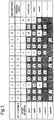
- FIG. 3 is a diagram illustrating an example of a target bit stream and various types of values that are calculated therefrom.
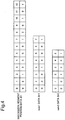
- Fig. 4 is a diagram illustrating an example of a data structure for representing the bit stream illustrated in Fig. 3 .
- a bit stream B as data is [001110011011] and has three succession segments (runs) of 1s.
- the start positions of the respective runs are 2, 7 and 10.
- start position appearance orders are stated in the fields corresponding to the start positions.
- pos1 represents a position.
- each entry in the row labeled as "rank1” indicates the number of appearances of "1" in the bit stream B from the beginning to the position of the entry, that is, a value of rank1.
- Each entry in the row labeled as “rank0” indicates the number of appearances of "0” in the bit stream B from the beginning to the position of the entry, that is, a value of rank0.
- Each entry in the row labeled as "select1" indicates an input value i, the position of which is returned as a result of select1(B i).
- Each entry in the row labeled as "select0” indicates an input value i, the position of which is returned as a result of Select0(B, i).
- the succession segment position data are data that are obtained by converting data in the row labeled as "start position” in Fig. 3 into a bit stream.
- the rank1 data are data that are obtained by converting data at start positions in the row labeled as “rank1” in Fig. 3 into a bit stream.
- the rank0 data are data that are obtained by converting data at start positions in the row labeled as "rank0” in Fig. 3 into a bit stream.
- the bit stream composing the succession segment position data is denoted by "B1”
- the bit stream composing the rank1 data is denoted by "Br1”
- the bit stream composing the rank0 data is denoted by "Br0".
- the data structure 11 is constructed so that, for each succession segment, at least two values out of three values including a start position, rank1 and rank0 are specified using the succession segment position data, the rank1 data and the rank0 data. In this case, the at least two values to be specified will vary depending on the positions (start positions) of succession segments.
- the succession segment position data in the example in Fig. 4 specify the positions of all the succession segments each of which includes a succession of one or more "1"s in the bit stream B.
- a succession segment for which the rank1 data specify the number of appearances of "1" coincides with a succession segment that appears in an even-numbered place.
- a succession segment for which the rank0 data specify the number of appearances of "0" is assumed to coincide with a succession segment that appears in an odd-numbered place.
- the data structure 11 is not limited to the example illustrated in Fig. 4 .
- the data structure may be constructed so that a value of rank1 and a value of rank0 are specified for the first succession segment, a start position and a value of rank0 are specified for the second succession segment, a start position and a value of rank1 are specified for the third succession segment, and these specifications are repeated thereafter.
- the first select calculation unit 21 and the second select calculation unit 22 calculates in the following manner. First, based on the numbers of appearances of "1" which the rank1 data specify, the first select calculation unit 21 estimates a succession segment for which the number of appearances of "1" is specified in the rank1 data and which a select1 value to be subjected to specification exists in or exists close to.
- the first select calculation unit 21 specifies the number of appearances of "1", based on the succession segment position data and the rank0 data.
- the first select calculation unit 21 specifies the select1 value using the specified number of appearances of "1".
- the second select calculation unit 22 first estimates a succession segment, out of the succession segments, for which the number of appearances of "0" is specified in the rank0 data and which a select0 value to be subjected to specification exists in or exists close to.
- the second select calculation unit 22 specifies the number of appearances of "0" based on the succession segment position data and the rank1 data.
- the second select calculation unit 22 specifies a select0 value using the specified number of appearances of a "0".
- the data structure 11 be compressed by regarding each of positions specified by the succession segment position data, the numbers of appearances of "1" specified by the rank1 data and the numbers of appearances of "0" specified by the rank0 data as a monotonically increasing sequence.
- the data structure 11 is stored in the storage unit 10 while being compressed.
- FIG. 5 is a flow diagram illustrating an operation of the information processing device in the exemplary embodiment of the present invention.
- Fig. 1 will be appropriately referenced.
- operating the information processing device 100 causes an information processing method to be performed.
- a description of an information processing method in the exemplary embodiment will be represented by the following description of an operation of the information processing device 100.
- the input reception unit 30 receives input of a natural number and input of a requested operation from the outside (step A1) and outputs the received input to the calculation unit 20.
- the calculation unit 20 determines whether or not the requested operation is select1 (step A2).
- the first select calculation unit 21 obtains the succession segment position data 11, the rank1 data 12 and the rank0 data 13 from the storage unit 10.
- the first select calculation unit 21 calculates a select1 value for the natural number received in step A1 using these data (step A3).
- step A4 determines whether or not the requested operation is select0 (step A4).
- step A4 determines whether or not the requested operation is select0
- the second select calculation unit 22 obtains the succession segment position data 11, the rank1 data 12 and the rank0 data 13 from the storage unit 10.
- the second select calculation unit 22 calculates a select0 value for the natural number received in step A1 using these data (step A6).
- step A5 determines whether or not the requested operation is rank1 (step A5).
- step A5 indicates that the requested operation is rank1
- the first rank calculation unit 23 obtains the succession segment position data 11, the rank1 data 12 and the rank0 data 13 from the storage unit 10.
- the first rank calculation unit 23 calculates a rank1 value for the natural number received in step A1 using these data (step A7).
- the second rank calculation unit 24 obtains the succession segment position data 11, the rank1 data 12, and the rank0 data 13 from the storage unit 10.
- the second rank calculation unit 24 calculates a rank0 value for the natural number received in step A1 using these data (step A8).
- step A3 As the above-described step A3, A6, A7 or A8 is executed, the output unit 40 receives a calculation result and outputs the calculation result to the outside (step A9). As described above, execution of steps A1 to A9 enables the operations of select1, select0, rank1 and rank0 to be performed using the data structure 11.
- bit stream B1 is a sparse bit stream in which 1 appears only at the start positions of runs.
- the length of the bit stream corresponds with the m number of "1" included in the bit stream B. In the bit stream, b/2 number of "1" are included.
- the length of the bit stream coincides with the number (n-m) of "0"s included in B. In the bit stream, b/2 number of "1" are included.
- the size of the data structure 11, that is, the size of the fully indexable dictionary is equal to the total of the sizes of the fully indexable dictionaries of respective three bit streams, namely the sparse bit stream B1, the bit stream Br1, and the bit stream Br0.
- the size of the fully indexable dictionary of the bit stream B1 is blog(n/b)+2b+o(b) bits.
- the bit stream Br1 has a length of m and includes b/2 number of 1s
- the size of the fully indexable dictionary of the bit stream Br1 is (b/2)log(2m/b)+2(b/2)+o(b) bits.
- the size of the fully indexable dictionary of the bit stream Br0 is (b/2)log(2(n-m)/b)+2(b/2)+o(b) bits. Therefore, these sizes add up to the total size S of the fully indexable dictionary (the data structure 11) as expressed by Math. 10 below.
- S blog n / b + b / 2 log 2 m + b + b / 2 log ( 2 n ⁇ m / b + 4 b + o b
- log(n/b), log(2m/b) and log(2(n-m)/b) are substantially the same size as one another.
- the above quantities are equal to log(n/b).
- C the size of the fully indexable dictionary in the exemplary embodiment becomes 2b(C+2)+o(b) bits. This means that, while having substantially the same size as the fully indexable dictionary disclosed in NPL 2 which only supports select1, the fully indexable dictionary in the exemplary embodiment is capable of supporting both operations select1 and select0.
- the size of the fully indexable dictionary in the exemplary embodiment becomes approximately two thirds of the size of a fully indexable dictionary disclosed in NPL 2 that is made capable of supporting both select1 and select0. That is, according to the exemplary embodiment while enabling a function of supporting both operations select1 and select0 to be provided to a fully indexable dictionary, the size of the fully indexable dictionary can be reduced to approximately two thirds of a conventional fully indexable dictionary.
- the first value is “1"
- the second value is “0”
- the succession segments which the first data specifies the position are succession segments of "1”.
- the exemplary embodiment is not limited to the example. Since 1 and 0 in a bit stream are interchangeable, by interchanging 1 and 0, the first value may be set to "0”, the second value may be set to "1”, and the succession segments in which the position are specified by the first data may be set to and succession segments of "0"s. Even this case may provide exactly the same advantageous effects as the above-described advantageous effects.
- the succession segment position data hold the start positions of succession segments.
- the forward direction and the backward direction are interchangeable in the exemplary embodiment, and the succession segment position data may hold the end positions, in place of the start positions, of succession segments. Even this case may provide the same advantageous effects.
- rank1 is held for even-numbered runs and rank0 is held for odd-numbered runs
- the relation between odd-numbered runs and even-numbered runs is changeable in an opposite manner in the exemplary embodiment, and even this case may provide the same advantageous effects.
- a program in the exemplary embodiment may be a program that causes a computer to execute steps A1 to A9 illustrated in Fig. 5 .
- Installing the program in the computer and executing the program enables the information processing device 100 and the information processing method in the exemplary embodiment to be achieved.
- a CPU Central Processing Unit
- the storage unit 10 is achieved by storing data files constituting the data structures into a storage device, such as a memory, a hard disk or the like with which the computer is provided.
- Fig. 6 is a block diagram illustrating an example of the computer that achieves the information processing device in the exemplary embodiment of the present invention.
- a computer 110 includes a CPU 111, a main memory 112, a storage device 113, an input interface 114, a display controller 115, a data reader/writer 116, and a communication interface 117. These respective components are interconnected by way of a bus 121 in a data communicable manner with one another.
- the CPU 111 executes various operations by deploying the program (code) in the exemplary embodiment which is stored in the storage device 113 on the main memory 112 and executing the deployed program in a predetermined order.
- the main memory 112 is typically a volatile storage device, such as a DRAM (Dynamic Random Access Memory).
- the program in the exemplary embodiment is provided while being stored in a computer-readable recording medium 120.
- the program in the exemplary embodiment may be a program distributed on the Internet to which the computer 110 is connected via the communication interface 117.
- the storage device 113 include a semiconductor storage device such as a flash memory, in addition to the hard disk.
- the input interface 114 mediates data transmission between the CPU 111 and an input device 118, such as a keyboard and a mouse.
- the display controller 115 is connected to a display device 119 and controls display on the display device 119.
- the data reader/writer 116 mediates data transmission between the CPU 111 and the recording medium 120 and executes reading of the program from the recording medium 120 and writing of a result of processing in the computer 110 into the recording medium 120.
- the communication interface 117 mediates data transmission between the CPU 111 and another computer.
- the recording medium 120 include a general-purpose semiconductor storage device such as a CF (Compact Flash) and an SD (Secure Digital), a magnetic storage medium such as a flexible disk, and an optical storage device such as a CD-ROM (Compact Disk Read Only Memory).
- a general-purpose semiconductor storage device such as a CF (Compact Flash) and an SD (Secure Digital)
- a magnetic storage medium such as a flexible disk
- an optical storage device such as a CD-ROM (Compact Disk Read Only Memory).
- the data structure (fully indexable dictionary) in the exemplary embodiment is usable as a fully indexable dictionary, that is, access, rank and select are operable.
- processing of calculating the start positions of the a-th run and the (a+1)th run is performed repeatedly. Assuming that a new run starts from B[n] and registering B[n] enable exception handling for a case in which the (a+1)th run does not exist to be avoided from being performed. Note that assuming such an imaginary run increases the number of runs by one. Since the increased virtual run is so small as to be negligible from an overall perspective of the array, the virtual run is excluded from calculation of the size of a fully indexable dictionary.
- the bit stream B illustrated in Fig. 3 is now considered.
- the bit stream B illustrated in Fig. 3 is a bit stream with a length of 12, and is made up of seven 1s and five 0s.
- the start positions of runs in the bit stream B are four positions, namely B[2], B[7], B[10] and B[12].
- the run starting from B[12] is, however, an virtual run that does not exist in the actual bit stream B.
- access(B, i) and rank1(B, i) are calculated by the calculation unit 20 through substantially the same operations, as will be described below.
- both access(B, i) and rank1(B, i) have a value of 0, and the calculation by the calculation unit 20 is thus finished.
- the calculation unit 20 focuses on the a-th run. A position i given as an argument is located either on the a-th run or on the space between the a-th run and the (a+1)th run. If relative positional relations between the position i and these runs are obtained, the calculation unit 20 may calculate a value of access and a value of rank1.
- the value of access(B, i) is then calculated by comparing the value of ea with the value of i, as described afore.
- the calculation unit 20 subsequently compares the value of ea with the value of i value to calculate a value of access(B, i), as described above.
- the use of the data structure 11 enables the calculation unit 20 to calculate access and rank1.
- the calculation unit 20 calculates rank1 on the bit stream B1 once, calculates select1 on the bit stream Br1 once, and calculates select1 on the bit stream Br0 once. Since rank0(B, i) is equal to "i-rank1(B, i)", rank0(B, i) can be easily calculated from a value of rank1.
- rank1 comes to have a value shown by Math. 18 below.
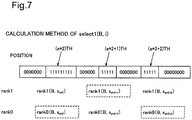
- Fig. 7 is a diagram schematically describing the calculation method of select1(B i) in the example of the present invention.
- the sought position exists in the (a*2+1)th run.
- the sought solution is given by i+c. That is because only i number of 1s and c number of 0s exist before the position that becomes the solution, the position should be given by i+c.
- the calculation unit 20 may appear to read out the same data structure 11 repeatedly at a glance. However, the calculation unit 20 only references elements adjacent to an element that has been found once, and only one search operation of the data structure 11 by the calculation unit 20 is thus required. That is, on three occasions, namely rank1 calculation for the bit stream Br1, select1 calculation for the bit stream B1, and select1 calculation for the bit stream Br0, the data structure 11 is read out.
- An a-th run among the odd-numbered runs is an (a*2-1)th run among all the runs including the odd-numbered runs and the even-numbered runs.
- three runs, namely, the (a*2-1)th run, the (a*2)th run and the (a*2+1)th run are given attention.
- the target i exists on either the space sandwiched between the (a*2-1)th run and the (a*2)th run, or the space sandwiched between the (a*2)th run and the (a*2+1)th run.
- the sought solution is i+d. That is because i number of 0s and d number of 1s exist before the sought position.
- the information processing device 100 described in the exemplary embodiment and the examples may perform all the operations, namely, access, rank1, rank0, select1 and select0 using the data structure (fully indexable dictionary). Whichever operation is performed, an objective value is obtained by performing rank or select operation several times in the fully indexable dictionary, which is constructed with three sparse bit streams. That is, a computational complexity required in the example becomes the same order as that of rank or select operation in a fully indexable dictionary that is constructed with a sparse bit stream, which enables processing of such operations with sufficiently high speed from a practical perspective.
- the present invention enable suppression of an increase in the size of a fully indexable dictionary while enabling a target bit stream to be subjected to two types of selection operations employing the fully indexable dictionary.
- the present invention is useful for a system required to perform search and, in particular, for a system that uses a wavelet tree structure.
Landscapes
- Engineering & Computer Science (AREA)
- Theoretical Computer Science (AREA)
- General Engineering & Computer Science (AREA)
- Physics & Mathematics (AREA)
- General Physics & Mathematics (AREA)
- Computer Hardware Design (AREA)
- Software Systems (AREA)
- Data Mining & Analysis (AREA)
- Databases & Information Systems (AREA)
- Compression, Expansion, Code Conversion, And Decoders (AREA)
Applications Claiming Priority (2)
| Application Number | Priority Date | Filing Date | Title |
|---|---|---|---|
| JP2014073545 | 2014-03-31 | ||
| PCT/JP2015/001568 WO2015151444A1 (ja) | 2014-03-31 | 2015-03-20 | データ構造、情報処理装置、情報処理方法、及びプログラム記録媒体 |
Publications (2)
| Publication Number | Publication Date |
|---|---|
| EP3128443A1 true EP3128443A1 (de) | 2017-02-08 |
| EP3128443A4 EP3128443A4 (de) | 2017-11-29 |
Family
ID=54239793
Family Applications (1)
| Application Number | Title | Priority Date | Filing Date |
|---|---|---|---|
| EP15772790.0A Withdrawn EP3128443A4 (de) | 2014-03-31 | 2015-03-20 | Datenstruktur, informationsverarbeitungsvorrichtung, informationsverarbeitungsverfahren und programmaufzeichnungsmedium |
Country Status (4)
| Country | Link |
|---|---|
| US (1) | US10789227B2 (de) |
| EP (1) | EP3128443A4 (de) |
| JP (1) | JP6276386B2 (de) |
| WO (1) | WO2015151444A1 (de) |
Families Citing this family (1)
| Publication number | Priority date | Publication date | Assignee | Title |
|---|---|---|---|---|
| WO2017145317A1 (ja) * | 2016-02-25 | 2017-08-31 | 楽天株式会社 | ブロック符号化装置、ブロック復号化装置、情報処理装置、プログラム、ブロック符号化方法及びブロック復号化方法 |
Family Cites Families (10)
| Publication number | Priority date | Publication date | Assignee | Title |
|---|---|---|---|---|
| US9792308B2 (en) * | 1998-12-11 | 2017-10-17 | Realtime Data, Llc | Content estimation data compression |
| US6208275B1 (en) * | 1999-06-01 | 2001-03-27 | William S. Lovell | Method and apparatus for digital concatenation |
| US6975629B2 (en) * | 2000-03-22 | 2005-12-13 | Texas Instruments Incorporated | Processing packets based on deadline intervals |
| US7784094B2 (en) * | 2005-06-30 | 2010-08-24 | Intel Corporation | Stateful packet content matching mechanisms |
| US20080040345A1 (en) * | 2006-08-07 | 2008-02-14 | International Characters, Inc. | Method and Apparatus for String Search Using Parallel Bit Streams |
| US8392174B2 (en) * | 2006-08-07 | 2013-03-05 | International Characters, Inc. | Method and apparatus for lexical analysis using parallel bit streams |
| US7961960B2 (en) * | 2006-08-24 | 2011-06-14 | Dell Products L.P. | Methods and apparatus for reducing storage size |
| US8453032B2 (en) * | 2010-04-21 | 2013-05-28 | General Electric Company | Energy and space efficient detection for data storage |
| TWI432964B (zh) * | 2011-08-15 | 2014-04-01 | Phison Electronics Corp | 金鑰傳送方法、記憶體控制器與記憶體儲存裝置 |
| EP2830225A4 (de) * | 2012-03-19 | 2015-12-30 | Fujitsu Ltd | Programm, erzeugungsverfahren für komprimierte daten, dekompressionsverfahren, informationsverarbeitungsvorrichtung und aufzeichnungsmedium |
-
2015
- 2015-03-20 US US15/127,479 patent/US10789227B2/en active Active
- 2015-03-20 EP EP15772790.0A patent/EP3128443A4/de not_active Withdrawn
- 2015-03-20 JP JP2016511364A patent/JP6276386B2/ja active Active
- 2015-03-20 WO PCT/JP2015/001568 patent/WO2015151444A1/ja not_active Ceased
Also Published As
| Publication number | Publication date |
|---|---|
| JPWO2015151444A1 (ja) | 2017-04-13 |
| JP6276386B2 (ja) | 2018-02-07 |
| WO2015151444A1 (ja) | 2015-10-08 |
| EP3128443A4 (de) | 2017-11-29 |
| US20170132262A1 (en) | 2017-05-11 |
| US10789227B2 (en) | 2020-09-29 |
Similar Documents
| Publication | Publication Date | Title |
|---|---|---|
| US10666287B2 (en) | Coding method, decoding method, coder, and decoder | |
| JPH06243009A (ja) | 全テキストインデックスを圧縮する方法 | |
| JP2008299867A (ja) | データ構造によるコンピュータ表現及びそれに関連する符号化/復号化方法 | |
| KR101498396B1 (ko) | 문자열 생성 방법, 프로그램 및 시스템 | |
| Gog et al. | Fast and lightweight LCP-array construction algorithms | |
| KR101842420B1 (ko) | 정보 처리 장치 및 데이터 관리 방법 | |
| EP3128443A1 (de) | Datenstruktur, informationsverarbeitungsvorrichtung, informationsverarbeitungsverfahren und programmaufzeichnungsmedium | |
| US7650040B2 (en) | Method, apparatus and system for data block rearrangement for LZ data compression | |
| US11031092B2 (en) | Taxonomic annotation of variable length metagenomic patterns | |
| Zia | A survey on different searching algorithms | |
| US20120319875A1 (en) | Method for storing node information of huffman tree and corresponding decoding method | |
| Crochemore et al. | Efficient algorithms for three variants of the LPF table | |
| US10037148B2 (en) | Facilitating reverse reading of sequentially stored, variable-length data | |
| JP5736589B2 (ja) | 数列データ検索装置、数列データ検索方法及びプログラム | |
| JP7074191B2 (ja) | 情報処理装置、テンソル圧縮方法、及びプログラム | |
| CN107451125B (zh) | 一种针对顺序无关项组进行快速相近语义匹配的方法 | |
| Policriti et al. | Average linear time and compressed space construction of the Burrows-Wheeler transform | |
| Hirschberg et al. | Dictionary compression on the PRAM | |
| US9350383B2 (en) | Run total encoded data processing | |
| Gog et al. | Lightweight LCP-array construction in linear time | |
| Liu et al. | Visualizing and Enforcing Order in Academic Literature Summarization | |
| Okanohara¹ et al. | A Linear-Time Burrows-Wheeler Transform | |
| JPH087752B2 (ja) | 文字列データ検索方式 | |
| KR19980025947A (ko) | 고속 알파-브이에스이엘피(rp-vselp) 음성부호화 방법 |
Legal Events
| Date | Code | Title | Description |
|---|---|---|---|
| PUAI | Public reference made under article 153(3) epc to a published international application that has entered the european phase |
Free format text: ORIGINAL CODE: 0009012 |
|
| 17P | Request for examination filed |
Effective date: 20161029 |
|
| AK | Designated contracting states |
Kind code of ref document: A1 Designated state(s): AL AT BE BG CH CY CZ DE DK EE ES FI FR GB GR HR HU IE IS IT LI LT LU LV MC MK MT NL NO PL PT RO RS SE SI SK SM TR |
|
| AX | Request for extension of the european patent |
Extension state: BA ME |
|
| DAV | Request for validation of the european patent (deleted) | ||
| DAX | Request for extension of the european patent (deleted) | ||
| A4 | Supplementary search report drawn up and despatched |
Effective date: 20171026 |
|
| RIC1 | Information provided on ipc code assigned before grant |
Ipc: G06F 5/00 20060101ALI20171020BHEP Ipc: G06F 7/22 20060101ALI20171020BHEP Ipc: H03M 7/30 20060101ALI20171020BHEP Ipc: G06F 17/30 20060101AFI20171020BHEP |
|
| GRAP | Despatch of communication of intention to grant a patent |
Free format text: ORIGINAL CODE: EPIDOSNIGR1 |
|
| RIC1 | Information provided on ipc code assigned before grant |
Ipc: H03M 7/30 20060101ALI20190227BHEP Ipc: G06F 7/22 20060101ALI20190227BHEP Ipc: G06F 5/00 20060101AFI20190227BHEP |
|
| INTG | Intention to grant announced |
Effective date: 20190322 |
|
| STAA | Information on the status of an ep patent application or granted ep patent |
Free format text: STATUS: THE APPLICATION IS DEEMED TO BE WITHDRAWN |
|
| 18D | Application deemed to be withdrawn |
Effective date: 20190802 |