EP3128452A1 - Server, netzwerksystem und verfahren zur persönlichen authentifizierung - Google Patents
Server, netzwerksystem und verfahren zur persönlichen authentifizierung Download PDFInfo
- Publication number
- EP3128452A1 EP3128452A1 EP14887847.3A EP14887847A EP3128452A1 EP 3128452 A1 EP3128452 A1 EP 3128452A1 EP 14887847 A EP14887847 A EP 14887847A EP 3128452 A1 EP3128452 A1 EP 3128452A1
- Authority
- EP
- European Patent Office
- Prior art keywords
- template
- pair
- server
- unit
- transaction
- Prior art date
- Legal status (The legal status is an assumption and is not a legal conclusion. Google has not performed a legal analysis and makes no representation as to the accuracy of the status listed.)
- Withdrawn
Links
Images






Classifications
-
- G—PHYSICS
- G06—COMPUTING OR CALCULATING; COUNTING
- G06V—IMAGE OR VIDEO RECOGNITION OR UNDERSTANDING
- G06V40/00—Recognition of biometric, human-related or animal-related patterns in image or video data
- G06V40/10—Human or animal bodies, e.g. vehicle occupants or pedestrians; Body parts, e.g. hands
-
- A—HUMAN NECESSITIES
- A61—MEDICAL OR VETERINARY SCIENCE; HYGIENE
- A61B—DIAGNOSIS; SURGERY; IDENTIFICATION
- A61B5/00—Measuring for diagnostic purposes; Identification of persons
- A61B5/117—Identification of persons
-
- A—HUMAN NECESSITIES
- A61—MEDICAL OR VETERINARY SCIENCE; HYGIENE
- A61B—DIAGNOSIS; SURGERY; IDENTIFICATION
- A61B5/00—Measuring for diagnostic purposes; Identification of persons
- A61B5/48—Other medical applications
- A61B5/4887—Locating particular structures in or on the body
- A61B5/489—Blood vessels
-
- G—PHYSICS
- G06—COMPUTING OR CALCULATING; COUNTING
- G06F—ELECTRIC DIGITAL DATA PROCESSING
- G06F16/00—Information retrieval; Database structures therefor; File system structures therefor
- G06F16/50—Information retrieval; Database structures therefor; File system structures therefor of still image data
- G06F16/51—Indexing; Data structures therefor; Storage structures
-
- G—PHYSICS
- G06—COMPUTING OR CALCULATING; COUNTING
- G06F—ELECTRIC DIGITAL DATA PROCESSING
- G06F21/00—Security arrangements for protecting computers, components thereof, programs or data against unauthorised activity
- G06F21/30—Authentication, i.e. establishing the identity or authorisation of security principals
- G06F21/31—User authentication
- G06F21/32—User authentication using biometric data, e.g. fingerprints, iris scans or voiceprints
-
- G—PHYSICS
- G06—COMPUTING OR CALCULATING; COUNTING
- G06V—IMAGE OR VIDEO RECOGNITION OR UNDERSTANDING
- G06V10/00—Arrangements for image or video recognition or understanding
- G06V10/94—Hardware or software architectures specially adapted for image or video understanding
- G06V10/95—Hardware or software architectures specially adapted for image or video understanding structured as a network, e.g. client-server architectures
-
- G—PHYSICS
- G06—COMPUTING OR CALCULATING; COUNTING
- G06V—IMAGE OR VIDEO RECOGNITION OR UNDERSTANDING
- G06V40/00—Recognition of biometric, human-related or animal-related patterns in image or video data
- G06V40/70—Multimodal biometrics, e.g. combining information from different biometric modalities
-
- G—PHYSICS
- G06—COMPUTING OR CALCULATING; COUNTING
- G06V—IMAGE OR VIDEO RECOGNITION OR UNDERSTANDING
- G06V40/00—Recognition of biometric, human-related or animal-related patterns in image or video data
- G06V40/10—Human or animal bodies, e.g. vehicle occupants or pedestrians; Body parts, e.g. hands
- G06V40/14—Vascular patterns
Definitions
- the present invention relates to a server, a network system, and a personal authentication method.
- noncontact vein authentication As one of techniques of performing personal authentication using biometric information, there has been a technique of performing personal authentication by using palm vein patterns. Moreover, as one of the techniques of performing personal authentication by using pal vein patterns, there has been "noncontact vein authentication". In this noncontact vein authentication, a vein pattern is acquired by imaging the inside of a palm while shining light on the palm.
- a first acquisition method there is one acquiring a vein pattern by applying linearly polarized light from illumination to a palm, and by extracting components that are perpendicular to the polarization direction of the illumination out of light passed through the palm.
- this first acquisition method is referred to as "linear polarization method" in some cases.
- a second acquisition method there is one acquiring a vein pattern by using unpolarized diffused light.
- this second acquisition method is referred to as "unpolarization method" in some cases.
- the unpolarization method by using diffused light, light change noise that is generated by a change in brightness due to unevenness on a skin surface of a palm can be suppressed.
- a device of the unpolarization method generally has a simple device structure compared to a device of the linear polarization method.
- Patent Literature 1 As a device that can acquire an image by the linear polarization and an image by the unpolarization method at the same time, there is one described in Patent Literature 1.
- Patent Literature 1 Japanese Patent No. 4974543
- a "template” By extracting characteristics of a vein pattern from an acquired vein pattern, a "template” is created. By collating a “registered template” that is created in advance and registered in a database and a “collation template” that is created at the time of authentication, personal authentication is performed.
- a template components of light change noise (hereinafter, simply referred to as “noise components” in some cases) that is generated by a change in brightness due to unevenness of a skin surface are included.
- the noise components included in a template differ depending on an acquisition method of a vein pattern.
- noise components included in a template created from a vein pattern that is acquired by the linear polarization method (hereinafter, referred to as "linear polarization template” in some cases) and noise components included in a template created from a vein pattern that is acquired by the unpolarization method (hereinafter, referred to as "unpolarization template” in some cases) differ from each other. Therefore, when vein patterns of the same person are acquired by the linear polarization method and by the unpolarization method at the same time, the linear polarization template and an unpolarization template are not compatible with each other. Therefore, conventionally, even when a linear polarization template has been available as a registration template, if the collation template is an unpolarization template, personal authentication cannot be performed.
- the disclosed technique has been achieved in view of the above problem, and an object thereof is to provide a server, a network system, and a personal authentication method that enable personal authentication even when noise components included in a registered template and noise components included in a collation template differ from each other.
- a server includes a database that stores template pairs for a plurality of persons, the template pairs each pairing a first template and a second template that are acquired by using a first polarization method and a second polarization method different from each other, respectively, from a same person, and a collating unit that collates a third template by the first polarization method, the third template being transmitted from a terminal device, with the template pairs for the persons, collates a fourth template by the second polarization method, the fourth template being transmitted from another server, with the template pairs for the persons, and performs personal authentication according to whether a first template pair and a second template pair are an identical template pair, the first template pair including the first template that coincides with the third template, and the second template pair including the second template that coincides with the fourth template.
- Embodiments of a server, a network system, and a personal authentication method disclosed in the present application are explained in detail below based on the drawings.
- the server, the network system, and the personal authentication method disclosed in the present application are not limited to the embodiments.
- an identical reference symbol is assigned to components having an identical function, and steps performing identical processing in each embodiment, and duplicated explanation thereof is omitted.
- FIG. 1 is a diagram depicting one example of a configuration of a network system of a first embodiment.
- a network system 1 depicted in FIG. 1 includes an intermediate server 10, a transaction server 20, and a mobile terminal 30.
- the intermediate server 10, the transaction server 20, and the mobile terminal 30 are connected through a network 40.
- FIG. 2 is a functional block diagram depicting one example of the intermediate server of the first embodiment.
- An intermediate server 10-1 depicted in FIG. 2 corresponds to the intermediate server 10 depicted in FIG. 1 .
- the intermediate server 10-1 includes a template pair DB (database) 11, a template collating unit 12, a template-pair creating unit 13, and a communication unit 14 that is connected to the network 40.
- a linear polarization template and an unpolarization template that are acquired at the same time from the same person are paired, and stored as a template pair.
- template pairs of 1000 people each constituted of a linear polarization template and an unpolarization template are stored with template IDs (identifiers) "C000" to "C999" added thereto, and each template pair can be uniquely identified by a template ID.
- the linear polarization template is referred to as "LP (linear polarization) template”
- the unpolarization template is referred to as "UP (unpolarization) template” in some cases.
- the template-pair creating unit 13 uses, for example, the technique disclosed in the specification of Japanese Patent No. 4974543 , and thereby acquires a vein pattern by the linear polarization method and a vein pattern by the unpolarization method at a time by a single time of imaging from the same person, and creates an LP template and a UP template from the vein patterns that are acquired at a time from the same person.
- the template-pair creating unit 13 pairs an LP template and a UP template that are created from multiple vein patterns acquired at a time from the same person to create a template pair of each person, and outputs the created template pair to the template pair DB 11.
- the template collating unit 12 collates a collation template that is input from the communication unit 14 and a template pair that is stored in the template pair DB 11, and outputs an authentication result to the communication unit 14.
- the communication unit 14 outputs an authentication request that is received from the mobile terminal 30 to the template collating unit 12. Moreover, the communication unit 14 outputs a collation template that is received from the transaction server 20 or the mobile terminal 30 to the template collating unit 12. Furthermore, the communication unit 14 transmits an authentication result that is input from the template collating unit 12 to the transaction server 20 or the mobile terminal 30.
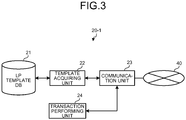
- FIG. 3 is a functional block diagram depicting one example of a transaction server of the first embodiment.
- a transaction server 20-1 depicted in FIG. 3 corresponds to the transaction server 20 depicted in FIG. 1 .
- the transaction server 20-1 includes an LP template DB (database) 21, a template acquiring unit 22, a communication unit 23 that is connected to the network 40, and a transaction performing unit 24.
- LP templates that are respectively acquired from multiple persons are stored as registration templates.
- LP templates of 1000 people are stored with template IDs "A000" to "A999" added thereto, and each LP template can be uniquely identified by a template ID.
- the template acquiring unit 22 acquires an LP template from the LP template DB 21 in response to a template transmission request that is input from the communication unit 23, and outputs it to the communication unit 23.
- the communication unit 23 transmits an LP template that is input from the template acquiring unit 22 to the intermediate server 10-1. Moreover, the communication unit 14 outputs an authentication result that is received from the intermediate server 10-1 to the transaction performing unit 24. Furthermore, the communication unit 23 receives, from the mobile terminal 30, a command (hereinafter, referred to as "transaction command" in some cases) that is communicated between the mobile terminal 30 and the transaction server 20 for a transaction performed between the mobile terminal 30 and the transaction server 20, and outputs it to the transaction performing unit 24. Moreover, the communication unit 23 transmits a transaction command that is input from the transaction performing unit 24 to the mobile terminal 30.
- a command hereinafter, referred to as "transaction command” in some cases
- the transaction performing unit 24 performs a transaction between itself and the mobile terminal 30 through the network 40 according to an authentication result input from the communication unit 23.
- the transaction performing unit 24 performs a transaction between itself and the mobile terminal 30 through the network 40 by receiving various kinds of transaction commands input from the communication unit 23, and by outputting various kinds of transaction commands to the communication unit 23.
- FIG. 4 is a functional block diagram depicting one example of a mobile terminal of the first embodiment.
- a mobile terminal 30-1 depicted in FIG. 4 corresponds to the mobile terminal 30 depicted in FIG. 1 .
- the mobile terminal 30-1 includes a communication unit 31 that is connected to the network 40, an authentication control unit 32, a template collating unit 33, a template acquiring unit 34, a template storage unit 35, and a transaction performing unit 36.
- a UP template that is registered in advance by a user of the mobile terminal 30-1 is stored as a registration template.
- a UP template of the user of the mobile terminal 30-1 is stored with a unique user ID "B432" added thereto.
- the user of the mobile terminal 30-1 is the above person "A”. That is, the user ID of the person "A” is "B432".
- the template collating unit 33 collates a UP template that is input as a collation template, and a UP template that is stored as a registration template in the template storage unit 35, and outputs an authentication result to the template acquiring unit 34.
- the UP template input to the template collating unit 33 is one acquired from a vein pattern that is imaged by the unpolarization method by an imaging unit (not depicted) included in the mobile terminal 30-1.
- a collation-template creating unit (not depicted) included in the mobile terminal 30-1 creates a UP template as a collation template from a vein pattern that is imaged by the unpolarization method, and outputs it to the template collating unit 33.
- the template acquiring unit 34 acquires a UP template from the template storage unit 35 according to an authentication result input from the template collating unit 33, and outputs it to the communication unit 31.
- the authentication control unit 32 inputs and outputs various kinds of control signals to perform personal authentication using the mobile terminal 30-1 to and from the communication unit 31, and outputs to the template collating unit 33.
- the communication unit 31 transmits a UP template input from the template acquiring unit 34 to the intermediate server 10-1. Moreover, the communication unit 31 outputs a control signal received from the intermediate server 10-1 or the transaction server 20-1 to the authentication control unit 32. Furthermore, the communication unit 31 outputs an authentication result received from the intermediate server 10-1 to the transaction performing unit 36. Moreover, the communication unit 31 receives a transaction command from the transaction server 20-1, to output to the transaction performing unit 36. Furthermore, the communication unit 31 transmits a transaction command input from the transaction performing unit 36, to the transaction server 20-1.
- the transaction performing unit 36 performs a transaction between itself and the transaction server 20-1 through the network 40 according to an authentication result input from the communication unit 31.
- the transaction performing unit 36 performs a transaction between itself and the transaction server 20-1 through the network 40 by receiving various kinds of transaction commands input from the communication unit 31, and by outputting various kinds of transaction commands to the communication unit 31.
- FIG. 5 is diagram for explaining relation between templates of the first embodiment.
- the mobile terminal 30-1 only supports the unpolarization method, while a UP template can be acquired, an LP template cannot be acquired.
- the transaction server 20-1 although an LP template is stored, a UP template is not stored.
- personal authentication from the mobile terminal 30-1 to the transaction server 20-1 cannot be performed by collating the UP template acquired in the mobile terminal 30-1 and the LP template stored in the transaction server 20-1. That is, personal authentication for the transaction server 20-1 cannot be performed directly from the mobile terminal 30-1.
- template of the both coincide with each other means that a degree of difference between the templates of the both is smaller than a threshold. The more similar the two templates are, the degree of difference takes a smaller value, and the less similar the two templates are, the degree of difference takes a larger value. When the degree of difference between the both templates is 0, the both templates completely coincide with each other. Note that the "degree of difference” may be referred to as "score value”.
- the UP template acquired in the mobile terminal 30-1 and the LP template stored in the transaction server 20-1 can be associated with each other. Therefore, in the disclosed technique, a transaction is enabled between the mobile terminal 30-1 and the transaction server 20-1 by performing personal authentication through the intermediate server 10-1 as described below.
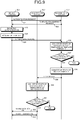
- FIG. 6 is a diagram depicting one example of a processing sequence of a network system of the first embodiment.
- the authentication control unit 32 of the mobile terminal 30-1 outputs the authentication request to the communication unit 31 according to the input operation, and the communication unit 31 transmits the authentication request to the intermediate server 10-1 (step S01).
- the communication unit 14 of the intermediate server 10-1 receives the authentication request from the mobile terminal 30-1, and outputs it to the template collating unit 12.
- the template collating unit 12 to which the authentication request is input outputs a template transmission request to the communication unit 14, and the communication unit 14 transmits the template transmission request to the mobile terminal 30-1 (step S02).
- the communication unit 31 of the mobile terminal 30-1 receives the template transmission request from the intermediate server 10-1 and outputs it to the authentication control unit 32, and the authentication control unit 32 outputs the input template transmission request to the template collating unit 33.
- the template collating unit 33 collates the UP template input as the collation template and the UP template stored as the registration template in the template storage unit 35, to perform biometric authentication (step S03).
- the template collating unit 33 outputs, when the collation template coincides with the registration template, a control signal indicating an authentication result is "OK" to the template acquiring unit 34.
- the template collating unit 33 determines that the authentication is "NG".
- the collation template coincides with the registration template means that the degree of difference between the collation template and the registration template is smaller than a threshold, and that the collation template does not coincide with the registration template means that the degree of difference between the collation template and the registration template is equal to or larger than the threshold.
- the template collating unit 33 may output the UP template input as a collation template to the template acquiring unit 34, and the template acquiring unit 34 may output the UP template input by the template collating unit 33 to the communication unit 31, thereby transmitting the UP template being the collation template to the intermediate server 10-1 by the communication unit 31.
- the template collating unit 12 collates the UP template received from the mobile terminal 30-1 with multiple UP templates stored in the template pair DB 11 (step S06).
- the template collating unit 12 calculates the degree of difference between the UP template received from the mobile terminal 30-1 and each of the UP templates stored in the template pair DB 11, and sets the smallest degree of difference as difference degree A.
- the template collating unit 12 identifies an ID of a template pair that includes the UP template having the smallest degree of difference from the UP template received from the mobile terminal 30-1, out of the UP templates stored in the template pair DB 11.
- the template collating unit 12 determines whether difference degree A is smaller than the threshold (step S07).
- difference degree A is equal to or larger than the threshold (step S07: NO)
- the authentication result is "NG (authentication failed)" and the processing is ended, and the transaction between the mobile terminal 30-1 and the transaction server 20-1 is disabled.
- difference degree A is smaller than the threshold (step S07: YES)
- the communication unit 31 of the mobile terminal 30-1 receives the template-provision permission confirmation, and outputs it to the authentication control unit 32.
- the authentication control unit 32 confirms with a user whether to permit provision of an LP template by using a display on a touch panel included in the mobile terminal 30-1 and the like.
- the authentication control unit 32 outputs a permission signal to the communication unit 31, and the communication unit 31 transmits the permission signal to the transaction server 20-1 (step S11).
- the communication unit 23 of the transaction server 20-1 receives the permission signal, and outputs it to the template acquiring unit 22.
- the template collating unit 12 collates the LP template received from the transaction server 20-1 with multiple LP templates that are stored in the template pair DB 11 (step S14).
- the template collating unit 12 calculates a degree of difference between the LP template received from the transaction server 20-1 with each of the LP templates stored in the template pair DB 11, and sets the smallest degree of difference as difference degree B.
- the template collating unit 12 identifies an ID of a template pair that includes an LP template having the smallest degree of difference from the LP template received for the transaction server 20-1, out of the LP templates stored in the template pair DB 11.
- the template collating unit 12 determines whether difference degree B is smaller than the threshold (step S15).
- difference degree B is equal to or larger than the threshold (step S15: NO)
- the authentication result is "NG (authentication failed)"
- the processing is ended, and the transaction between the mobile terminal 30-1 and the transaction server 20-1 is disabled.
- difference degree B is smaller than the threshold (step S15: YES)
- the template collating unit 12 determines whether the ID identified in the collation at step S06 and the ID identified in the collation at step S14 coincide with each other (step S16).
- the template collating unit 12 determines whether the ID of the template pair including the UP template having the smallest degree of difference from the UP template received from the mobile terminal 30-1 and the ID of the template pair including the LP template having the smallest degree of difference from the LP template received from the transaction server 20-1 coincide with each other.
- a template pair is uniquely identified by an ID
- that an ID of a first template pair and an ID of a second template pair coincide with each other means that the first template pair and the second template pair are the same template pair.
- an ID of a template pair that includes a specific UP template and an ID of a second template pair that includes a specific LP template coincide with each other means that the specific UP template and the specific LP template are included in the same template pair and are paired therein.
- step S16: NO When the IDs of the template pairs do not coincide with each other at step S16 (step S16: NO), the authentication result is "NG (authentication failed)", and the processing is ended, and the transaction between the mobile terminal 30-1 and the transaction server 20-1 is disabled.
- step S16: YES when the IDs of the template pairs coincide with each other at step S16 (step S16: YES), the template collating unit 12 determines that the authentication result is "OK (authentication succeeded)", and outputs a control signal indicating that the authentication result is "OK” to the communication unit 23.
- the communication unit 23 transmits this control signal to the transaction server 20-1 and the mobile terminal 30-1 (steps S17, S18). That difference degree B is smaller than the threshold means that both templates of a subject of collation coincide with each other.
- the communication unit 23 of the transaction server 20-1 receives the control signal indicating that the authentication result is "OK” from the intermediate server 10-1, and outputs it to the transaction performing unit 24.
- the communication unit 31 of the mobile terminal 30-1 receives the control signal indicating that the authentication result is "OK” from the intermediate server 10-1, and outputs it to the transaction performing unit 36.
- a transaction is started between the transaction performing unit 24 of the transaction server 20-1 and the transaction performing unit 36 of the mobile terminal 30-1 (step S19).
- the intermediate server 10-1 has the template pair DB 11 in which template pairs pairing a UP template and an LP template that are acquired from the same person are stored for multiple persons.
- the mobile terminal 30-1 transmits a UP template that is acquirable at the mobile terminal 30-1 to the intermediate server 10-1.
- the transaction server 20-1 transmits an LP template stored in the LP template DB 21 of the transaction server 20-1 to the intermediate server 10-1.
- the intermediate server 10-1 collates the UP template transmitted from the mobile terminal 30-1 with each of the template pairs of multiple persons while comparing the LP template transmitted from the transaction server 20-1 with each of the template pair of the multiple servers.
- the intermediate server 10-1 performs personal authentication according to whether the template pair including the UP template that coincides with the UP template transmitted from the mobile terminal 30-1 and the template pair including the LP template that coincides with the LP template transmitted from the transaction server 20-1 coincide with each other.
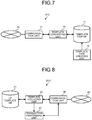
- FIG. 7 is a functional block diagram depicting one example of an intermediate server of the second embodiment.
- An intermediate server 10-2 depicted in FIG. 7 corresponds to the intermediate server 10 depicted in FIG. 1 .
- the intermediates server 10-2 includes a template converting unit 15, a communication unit 17 that is connected to the network 40, the template-pair creating unit 13, and the template pair DB 11.
- the template converting unit 15 collates a collation template that is input from the communication unit 17 and a template pair that is stored in the template pair DB 11, and converts a UP template into an LP template. Moreover, the template converting unit 15 outputs the LP template obtained after conversion to the communication unit 17.
- the communication unit 17 outputs an authentication request that is received from the mobile terminal 30 to the template converting unit 15. Furthermore, the communication unit 17 outputs a collation template that is received from the mobile terminal 30 to the template converting unit 15. Moreover, the communication unit 17 transmits an LP template that is input from the template converting unit 15 to the transaction server 20.
- FIG. 8 is a functional block diagram depicting one example of a transaction server of the second embodiment.
- a transaction server 20-2 depicted in FIG. 8 corresponds to the transaction server 20 depicted in FIG. 1 .
- the transaction server 20-2 includes a template collating unit 25, a communication unit 26 that is connected to the network 40, a transaction performing unit 27, and the LP template DB 21.
- the template collating unit 25 collates an LP template that is input from the communication unit 26 and an LP template that is stored in the LP template DB 21, and outputs an authentication result to the transaction performing unit 27 and the communication unit 26.
- the communication unit 26 transmits the authentication result input from the template collating unit 25 to the mobile terminal 30. Moreover, the communication unit 26 receives a transaction command from the mobile terminal 30, and outputs it to the transaction performing unit 27. Furthermore, the communication unit 26 transmits the transaction command input from the transaction performing unit 27 to the mobile terminal 30.
- the transaction performing unit 27 performs a transaction between itself and the mobile terminal 30 through the network 40 according to an authentication result input from the template collating unit 25.
- the transaction performing unit 27 receives various kinds of transaction commands input from the communication unit 26, and outputs various kinds of transaction commands to the communication unit 26, thereby performing a transaction between itself and the mobile terminal 30 through the network 40.
- FIG. 9 is a diagram depicting one example of a processing sequence of the network system of the second embodiment.
- the authentication control unit 32 of the mobile terminal 30-1 outputs the authentication request to the communication unit 31 according to the input operation, and the communication unit 31 transmits the authentication request to the intermediate server 10-2 (step S21).
- the communication unit 17 of the intermediate server 10-2 receives the authentication request from the mobile terminal 30-1, and outputs it to the template converting unit 15.
- the template converting unit 15 to which the authentication request is input outputs a template transmission request to the communication unit 17, and the communication unit 17 transmits the template transmission request to the mobile terminal 30-1 (step S22).
- the communication unit 31 of the mobile terminal 30-1 receives the template transmission request from the intermediate server 10-2 and outputs it to the authentication control unit 32, and the authentication control unit 32 outputs the input template transmission request to the template collating unit 33.
- the template collating unit 33 collates a UP template input as a collation template and a UP template stored as a registration template in the template storage unit 35, to perform biometric authentication (step S23).
- the template collating unit 33 outputs, when the collation template coincides with the registration template, a control signal indicating an authentication result is "OK" to the template acquiring unit 34.
- the template collating unit 33 determines that the authentication is "NG".
- the template collating unit 33 may output the UP template input as a collation template to the template acquiring unit 34, and the template acquiring unit 34 may output the UP template input by the template collating unit 33 to the communication unit 31, thereby transmitting the UP template being the collation template to the intermediate server 10-2 by the communication unit 31.
- the template converting unit 15 collates the UP template received from the mobile terminal 30-1 with multiple UP templates stored in the template pair DB 11 (step S26).
- the template converting unit 15 calculates the degree of difference between the UP template received from the mobile terminal 30-1 and each of the UP templates stored in the template pair DB 11, and sets the smallest degree of difference as difference degree A.
- the template converting unit 15 identifies an ID of a template pair that includes the UP template having the smallest degree of difference from the UP template received from the mobile terminal 30-1, out of the UP templates stored in the template pair DB 11.
- the template converting unit 15 determines whether difference degree A is smaller than a threshold (step S27).
- difference degree A is equal to or larger than the threshold (step S27: NO)
- the authentication result is "NG (authentication failed)" and the processing is ended, and the transaction between the mobile terminal 30-1 and the transaction server 10-2 is disabled.
- difference degree A is smaller than the threshold (step S27: YES)
- the template collating unit 25 collates the LP template received from the intermediate server 10-2 with each of the LP templates stored in the LP template DB 21 to calculate a degree of difference, and sets the smallest degree of difference as difference degree B (step S30).
- the template collating unit 25 determines whether difference degree B is smaller than the threshold (step S31).
- difference degree B is equal to or larger than the threshold (step S31: NO)
- the authentication result is "NG (authentication failed)”
- the processing is ended, and the transaction between the mobile terminal 30-1 and the transaction server 20-2 is disabled.
- difference degree B is smaller than the threshold (step S31: YES)
- the template collating unit 25 determines that the authentication result is "OK (authentication succeeded)"
- the communication unit 26 transmits this control signal to the mobile terminal 30-1 (step S32).
- That difference degree B is smaller than the threshold means that both templates of a subject of collation coincide with each other.
- the communication unit 31 of the mobile terminal 30-1 receives the control signal indicating that the authentication result is "OK" from the transaction server 20-2, and outputs it to the transaction performing unit 36.
- a transaction is started between the transaction performing unit 27 of the transaction server 20-2 and the transaction performing unit 36 of the mobile terminal 30-1 (step S33).
- the intermediate server 10-2 has the template pair DB 11 in which template pairs pairing a UP template and an LP template that are acquired from the same person are stored for multiple persons.
- the mobile terminal 30-1 transmits a UP template that is acquirable at the mobile terminal 30-1 to the intermediate server 10-2.
- the intermediate server 10-2 converts the UP template transmitted from the mobile terminal 30-1 into an LP template by using a template pair stored in the template pair DB 11, and transmits the LP template obtained after conversion to the transaction server 20-2.
- the transaction server 20-2 performs personal authentication by collating the LP template transmitted from the intermediate server 10-2 with each of LP templates stored in the LP template DB 21 of multiple persons.
- FIG. 10 is a diagram depicting one example of a configuration of a network system of a third embodiment.
- a network system 2 depicted in FIG. 10 includes the intermediates server 10, the transaction server 20, and fixed terminals 50, 60.
- the fixed terminal 50 is connected to the transaction server 20.
- the intermediate server 10, the transaction server 20, and the fixed terminal 60 are connected through the network 40.
- FIG. 11 is a functional block diagram depicting one example of the transaction server of the third embodiment.
- a transaction server 20-3 depicted in FIG. 11 corresponds to the transaction server 20 depicted in FIG. 10 .
- the transaction server 20-3 includes a template collating unit 28, a template acquiring unit 29, the LP template DB 21, the communication unit 23, and the transaction performing unit 24.
- an LP template that is acquired by the fixed terminal 50 is input as a collation template.
- the template collating unit 28 collates the LP template input from the fixed terminal 50 and the LP template that is stored in the LP template DB 21, and outputs an authentication result to the template acquiring unit 29.
- the template acquiring unit 29 acquires an P template from the LP template DB 21 according to an authentication result input from the template collating unit 28, and outputs it to the communication unit 23.
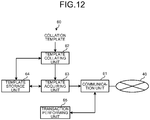
- FIG. 12 is a functional block diagram depicting one example of a fixed terminal of the third embodiment.
- the fixed terminal 60 includes a communication unit 61 that is connected to the network 40, a template collating unit 62, a template acquiring unit 63, a template storage unit 64 and a transaction performing unit 65.
- a UP template that is registered in advance by a user of the fixed terminal 60 is stored as a registration template.
- a UP template of the user of the fixed terminal 60 is stored with the unique user ID "B432" added thereto.
- the user of the fixed terminal 60 is the above person "A”. That is, the user ID of the person "A” is "B432".
- the template collating unit 62 collates a UP template that is input as a collation template and a UP template that is stored in the template storage unit 64 as a registration template, and outputs an authentication result to the template acquiring unit 63.
- the UP template input to the template collating unit 62 is one acquired from a vein pattern that is imaged by the unpolarization method by an imaging unit (not depicted) included in the fixed terminal 60 at the time of personal authentication.
- a collation-template creating unit (not depicted) included in the fixed terminal 60 creates a UP template as a collation template from a vein pattern that is imaged by the unpolarization method, and outputs it to the template collating unit 62.
- the template acquiring unit 63 acquires a UP template from the template storage unit 64 according to an authentication result input from the template collating unit 62, to output to the communication unit 61.
- the communication unit 61 transmits the UP template input from the template acquiring unit 63 to the intermediate server 10-1. Moreover, the communication unit 61 outputs a control signal received from the intermediate server 10-1 to the template acquiring unit 63. Furthermore, the communication unit 61 outputs an authentication result received from the intermediate server 10-1 to the transaction performing unit 65. Moreover, the communication unit 61 receives a transaction command from the transaction server 20-3, to output to the transaction performing unit 65. Furthermore, the communication unit 61 transmits a transaction command input from the transaction performing unit 65, to the transaction server 20-3.
- the transaction performing unit 65 performs a transaction between itself and the transaction server 20-3 through the network 40 according to an authentication result input from the communication unit 61.
- the transaction performing unit 65 performs a transaction between itself and the transaction server 20-3 through the network 40 by receiving various kinds of transaction commands input from the communication unit 61, and by outputting various kinds of transaction commands to the communication unit 61.
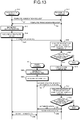
- FIG. 13 is a diagram depicting one example of a processing sequence of the network system of the third embodiment.
- the template collating unit 28 of the transaction server 20-3 outputs, when a collation template is input, a "template association request" to request association of an LP template that is stored in the LP template DB 21 and a template pair that is stored in the template pair DB 11 to the communication unit 23, and the communication unit 23 transmits the template association request to the intermediate server 10-1 (step S41).
- the communication unit 14 of the intermediate server 10-1 receives the template association request from the transaction server 20-3, and outputs it to the template collating unit 12.
- the template collating unit 12 to which the template association request is input outputs a template transmission request to the communication unit 14, and the communication unit 14 transmits the template transmission request to the transaction server 20-3 (step S42) .
- the communication unit 23 of the transaction server 20-3 receives the template transmission request from the intermediate server 10-1, and outputs it to the template collating unit 28.
- the template collating unit 28 collates the LP template that is input as a collation template with multiple templates that are stored as a registration template in the LP template DB 21, thereby performing biometric authentication (step S43).
- the template collating unit 28 outputs, when the collation template coincides with either one of the registration templates, a control signal indicating an authentication result is "OK" to the template acquiring unit 29.
- the template collating unit 28 determines that the authentication is "NG".
- the collation template coincides with either one of the registration templates means that the smallest degree of difference among degrees of difference between the collation template and the registration templates is smaller than a threshold. Moreover, that the collation template does not coincide with any of the registration templates means that any of the degrees of difference between the collation template and the registration templates is equal to or larger than the threshold.
- the template collating unit 28 may output the LP template input as a collation template to the template acquiring unit 29, and the template acquiring unit 29 may output the LP template input by the template collating unit 28 to the communication unit 23, thereby transmitting the LP template being the collation template to the intermediate server 10-1 by the communication unit 23.
- the template collating unit 12 collates the LP template received from the transaction server 20-3 with multiple LP templates stored in the template pair DB 11 (step S46).
- the template collating unit 12 calculates the degree of difference between the LP template received from the transaction server 20-3 and each of the LP templates stored in the template pair DB 11, and sets the smallest degree of difference as difference degree B.
- the template collating unit 12 identifies an ID of a template pair that includes the LP template having the smallest degree of difference from the LP template received from the transaction server 20-3, out of the LP templates stored in the template pair DB 11.
- the template collating unit 28 determines whether difference degree B is smaller than the threshold (step S47).
- difference degree B is equal to or larger than the threshold (step S47: NO)
- the authentication result is "NG (authentication failed)" and the processing is ended, and the transaction between the fixed terminal 60 and the transaction server 20-3 is disabled.
- difference degree B is smaller than the threshold (step S47: YES)
- the template collating unit 62 collates a UP template input as a collation template with a UP template that is stored as a registration template in the template storage unit 64, to perform biometric authentication (step S49).
- the template collating unit 62 outputs, when the collation template coincides with the registration template, a control signal indicating that an authentication result is "OK" to the template acquiring unit 63.
- the template collating unit 62 determines that the authentication is "NG".
- the template collating unit 62 may output the UP template input as a collation template to the template acquiring unit 63, and the template acquiring unit 63 may output the UP template input by the template collating unit 62 to the communication unit 61, thereby transmitting the UP template being the collation template to the intermediate server 10-1 by the communication unit 61.
- the template collating unit 12 determines whether difference degree A is smaller than the threshold (step S53).
- difference degree A is equal to or larger than the threshold (step S53: NO)
- the authentication result is "NG (authentication failed)”
- the processing is ended, and the transaction between the fixed terminal 60 and the transaction server 20-3 is disabled.
- difference degree A is smaller than the threshold (step S53: YES)
- the template collating unit 12 determines that the authentication is "OK (authentication succeeded)"
- the communication unit 23 transmits this control signal to the transaction server 20-3 and the fixed terminal 60 (steps S54, S55).
- the communication unit 23 of the transaction server 20-3 receives the control signal indicating that the authentication result is "OK” from the intermediate server 10-1, and outputs it to the transaction performing unit 24.
- the communication unit 61 of the fixed terminal 60 receives the control signal indicating that the authentication result is "OK” from the intermediate server 10-1, and outputs it to the transaction performing unit 65.
- a transaction is started between the transaction performing unit 24 of the transaction server 20-3 and the transaction performing unit 65 of the fixed terminal 60 (step S56).
- the intermediate server 10-1 has the template pair DB 11 in which template pairs pairing a UP template and an LP template that are acquired from the same person are stored for multiple persons.
- the transaction server 20-3 transmits an LP template stored in the LP template DB 21 of the transaction server 20-3 to the intermediate server 10-1.
- the intermediate server 10-1 associates the LP template transmitted from the transaction server 20-3 with a template pair stored in the template pair DB 11.
- the fixed terminal 60 transmits a UP template that is acquirable at the fixed terminal 60 to the intermediate server 10-1.
- the intermediate server 10-1 performs personal authentication by collating the template pair that is associated with the LP template transmitted from the transaction server 20-3 with the UP template that is transmitted from the fixed terminal 60.
- FIG. 14 is a functional block diagram depicting one example of an intermediate server of the fourth embodiment.
- An intermediate server 10-3 depicted in FIG. 14 corresponds to the intermediate server 10 depicted in FIG. 1 .
- the intermediate server 10-3 includes a template pair DB 71, a template collating unit 72, a template-pair creating unit 73, and the communication unit 14 that is connected to the network 40.
- an LP template and a UP template that are acquired at the same time from the same person are paired, and stored as a template pair. Note that, as explained below, it differs from the template pair DB 11 of the first embodiment in a point that an LP template and a UP template stored in the template pair DB 71 are formed with hash values.
- the template-pair creating unit 73 uses, for example, the technique disclosed in the specification of Japanese Patent No. 4974543 , and thereby acquires a vein pattern by the linear polarization method and a vein pattern by the unpolarization method by a single time of imaging from the same person, and creates an LP template and a UP template from the vein patterns that are acquired at a time from the same person.
- the template-pair creating unit 73 hashes characteristics that are extracted from the vein pattern acquired by the linear polarization method using a predetermined hash function, to form an LP template with a hash value obtained after hashing.
- the template-pair creating unit 73 hashes characteristics that are extracted from the vein pattern acquired by the unpolarization method using a predetermined hash function, to form a UP template with a hash value obtained after hashing.
- the LP template and the UP template are to be hash values of, for example, 2048 bits expressed with '0' and '1'.
- the template-pair creating unit 13 pairs an LP template and a UP template that are created from vein patterns acquired at a time from the same person to create a template pair of each person, and outputs the created template pair to the template pair DB 71.
- the template collating unit 72 collates a collation template that is input from the communication unit 14 and a template pair that is stored in the template pair DB 71, and outputs an authentication result to the communication unit 14.
- the template collating unit 72 differs from the template collating unit 12 of the first embodiment in a point that hash values are used in collation. Therefore, the template collating unit 72 hashes a collation template that is received from the mobile terminal 30-1 by using a predetermined hash function.
- FIG. 15 is a functional block diagram depicting one example of a transaction server of the fourth embodiment.
- a transaction server 20-4 depicted in FIG. 15 corresponds to the transaction server 20 depicted in FIG. 1 .
- the transaction server 20-4 includes an LP template DB 81, the template acquiring unit 22, the communication unit 23 that is connected to the network 40, and the transaction performing unit 24.
- the LP template DB 81 multiple LP templates that are respectively acquired from multiple persons are stored as a registration template. Note that it differs from the LP template DB 21 of the first embodiment in a point that the LP templates stored in the LP template DB 81 are formed with hash values. That is, in the transaction server 20-4, characteristics extracted from a vein pattern that is acquired by the linear polarization method are hashed by using a predetermined hash function, and an LP template is formed with a hash value obtained after hashing.
- FIG. 16 is a diagram depicting one example of a processing sequence of the network system of the fourth embodiment.
- processing other than step S61 is the same as that of the first embodiment ( FIG. 6 ).
- collation at step S06 and step S14 are performed as collation of hash values
- the LP template acquired at step S12 is formed with a hash value.
- a degree of difference between templates is one obtained by comparing bits at the same position in the templates in bit sequences of hash values that are collated between templates, and by counting the number of bits that differ in value between templates.
- the template collating unit 72 hashes the UP template received from the mobile terminal 30-1 by using a predetermined hash function (step S61).
- the template collating unit 72 collates the hash value obtained after hashing at step S61 with the UP templates stored in the template pair DB 11 (step S06).
- FIG. 17 is a functional block diagram depicting one example of an intermediate server of a fifth embodiment.
- An intermediate server 10-4 depicted in FIG. 17 corresponds to the intermediate server 10 depicted in FIG. 1 .
- the intermediate server 10-4 includes a template converting unit 74, the communication unit 17 that is connected to the network 40, the template-pair creating unit 73, and the template pair DB 71.
- the template converting unit 74 collates a collation template that is input from the communication unit 17 with a template pair that is stored in the template pair DB 71, and converts a UP template into an LP template. Furthermore, the template converting unit 74 outputs the LP template obtained after conversion to the communication unit 17. Note that the template converting unit 74 differs from the template converting unit 15 of the second embodiment in a point that collation is performed using hash values. Therefore, the template converting unit 74 hashes the collation template received from the mobile terminal 30-1 by using a predetermined hash function.
- FIG. 18 is a functional block diagram depicting one example of the transaction server of the fifth embodiment.
- a transaction server 20-5 depicted in FIG. 18 corresponds to the transaction server 20 depicted in FIG. 1 .
- the transaction server 20-5 includes the template collating unit 25, the communication unit 26 that is connected to the network 40, the transaction performing unit 27, and an LP template DB 81. That is, the transaction server 20-5 differs from the transaction server 20-2 of the second embodiment in a point that the LB template DB 81 is included in place of the LB template DB 21.
- FIG. 19 is a diagram depicting one example of a processing sequence of the network system of the fifth embodiment.
- processing other than step S71 is the same as that of the second embodiment ( FIG. 9 ).
- collation at step S26 and step S30 is performed as collation of hash values
- the LP template acquired at step S28 is formed with a hash value.
- a degree of difference between templates is one obtained by comparing bits at the same position in the templates in bit sequences of hash values that are collated between templates, and by counting the number of bits that differ in value between templates.
- the template converting unit 74 hashes the UP template received from the mobile terminal 30-1 by using a predetermined hash function (step S71).
- the template converting unit 74 collates the hash value obtained after hashing at step S71 with the UP templates stored in the template pair DB 71 (step S26).
- FIG. 20 is a functional block diagram depicting one example of a transaction server of the sixth embodiment.
- a transaction server 20-6 depicted in FIG. 20 corresponds to the transaction server 20 depicted in FIG. 10 .
- the transaction server 20-6 includes the template collating unit 28, the template acquiring unit 29, the LP template DB 81, the communication unit 23, and the transaction performing unit 24. That is, the transaction server 20-6 differs from the transaction server 20-3 of the third embodiment in a point that the LB template DB 81 is included in place of the LB template DB 21.
- FIG. 21 is a diagram depicting one example of a processing sequence of the network system of the sixth embodiment.
- processing other than step S81 is the same as that of the third embodiment ( FIG. 13 ).
- collation at step S46 and step S52 is performed as collation of hash values
- the LP template acquired at step S44 is formed with a hash value.
- a degree of difference between templates is one obtained by comparing bits at the same position in the templates in bit sequences of hash values that are collated between templates, and by counting the number of bits that differ in value between templates.
- the template collating unit 72 to which the authentication request is input hashes the UP template received from the fixed terminal 60 by using a predetermined hash function (step S81).
- a UP template and an LP template in a template pair, and a UP template and an LP template being a subject of collation are formed with hash values. That is, in the fourth to the sixth embodiments, collation of templates is performed as collation of hash values. Therefore, collation in the fourth to the sixth embodiments can be performed by bit pattern matching, and therefore, time required for collation in personal authentication can be shortened in the fourth to the sixth embodiments, compared to the first to the third embodiments.
- the template collating unit 12 determines that the authentication is "OK” when only one kind of ID is present that is identical among template pairs having a degree of difference smaller than a threshold in collation among UP templates and template pairs having a degree of difference smaller than the threshold in collation among LP templates, and determines that the authentication is "NG" when more than one kind of identical ID is present.
- the template collating unit 12 determines that the authentication is "OK” when at least one kind of ID is present that is identical among template pairs having a degree of difference smaller than a threshold in collation among UP templates and template pairs having a degree of difference smaller than the threshold in collation among LP templates, and determines that the authentication is "NG” when an identical ID is not present. In other words, unlike authentication example 1, the template collating unit 12 determines that the authentication is "OK” even when two or more kinds of identical IDs are present in authentication example 2.
Landscapes
- Engineering & Computer Science (AREA)
- Health & Medical Sciences (AREA)
- Physics & Mathematics (AREA)
- Theoretical Computer Science (AREA)
- Life Sciences & Earth Sciences (AREA)
- General Physics & Mathematics (AREA)
- Software Systems (AREA)
- Multimedia (AREA)
- Heart & Thoracic Surgery (AREA)
- Biophysics (AREA)
- Surgery (AREA)
- Animal Behavior & Ethology (AREA)
- General Health & Medical Sciences (AREA)
- Public Health (AREA)
- Veterinary Medicine (AREA)
- Medical Informatics (AREA)
- Computer Security & Cryptography (AREA)
- Molecular Biology (AREA)
- Pathology (AREA)
- Biomedical Technology (AREA)
- General Engineering & Computer Science (AREA)
- Human Computer Interaction (AREA)
- Computer Hardware Design (AREA)
- Vascular Medicine (AREA)
- Databases & Information Systems (AREA)
- Data Mining & Analysis (AREA)
- Collating Specific Patterns (AREA)
- Measurement Of The Respiration, Hearing Ability, Form, And Blood Characteristics Of Living Organisms (AREA)
Applications Claiming Priority (2)
| Application Number | Priority Date | Filing Date | Title |
|---|---|---|---|
| JP2014073539 | 2014-03-31 | ||
| PCT/JP2014/078397 WO2015151324A1 (ja) | 2014-03-31 | 2014-10-24 | サーバ、ネットワークシステム及び個人認証方法 |
Publications (2)
| Publication Number | Publication Date |
|---|---|
| EP3128452A1 true EP3128452A1 (de) | 2017-02-08 |
| EP3128452A4 EP3128452A4 (de) | 2017-11-22 |
Family
ID=54239681
Family Applications (1)
| Application Number | Title | Priority Date | Filing Date |
|---|---|---|---|
| EP14887847.3A Withdrawn EP3128452A4 (de) | 2014-03-31 | 2014-10-24 | Server, netzwerksystem und verfahren zur persönlichen authentifizierung |
Country Status (4)
| Country | Link |
|---|---|
| US (1) | US20170024625A1 (de) |
| EP (1) | EP3128452A4 (de) |
| JP (1) | JP5993107B2 (de) |
| WO (1) | WO2015151324A1 (de) |
Families Citing this family (3)
| Publication number | Priority date | Publication date | Assignee | Title |
|---|---|---|---|---|
| CN108352049A (zh) * | 2015-11-16 | 2018-07-31 | 夏普株式会社 | 摄像装置、活体认证装置及半导体激光 |
| JPWO2017115512A1 (ja) * | 2015-12-28 | 2018-09-20 | シャープ株式会社 | 撮像装置及び生体認証装置 |
| KR102758937B1 (ko) * | 2019-02-18 | 2025-01-23 | 삼성전자주식회사 | 생체 정보를 인증하기 위한 전자 장치 및 그의 동작 방법 |
Family Cites Families (8)
| Publication number | Priority date | Publication date | Assignee | Title |
|---|---|---|---|---|
| WO2004034236A2 (en) * | 2002-10-11 | 2004-04-22 | Digimarc Corporation | Systems and methods for recognition of individuals using multiple biometric searches |
| WO2006093508A2 (en) * | 2004-06-01 | 2006-09-08 | Lumidigm, Inc. | Multispectral imaging biometrics |
| CA2568797C (en) * | 2004-06-08 | 2012-08-07 | Nec Corporation | Data communication method and system |
| US20100208950A1 (en) * | 2009-02-17 | 2010-08-19 | Silvester Kelan C | Biometric identification data protection |
| AU2006336252B2 (en) * | 2005-03-17 | 2010-05-27 | Tech5 Usa, Inc. | Multimodal biometric analysis |
| US8458465B1 (en) * | 2005-11-16 | 2013-06-04 | AT&T Intellectual Property II, L. P. | Biometric authentication |
| WO2010044250A1 (ja) * | 2008-10-15 | 2010-04-22 | 日本電気株式会社 | パターン照合装置及びパターン照合方法 |
| US8406487B2 (en) * | 2009-09-16 | 2013-03-26 | General Electric Company | Method and system for contactless fingerprint detection and verification |
-
2014
- 2014-10-24 EP EP14887847.3A patent/EP3128452A4/de not_active Withdrawn
- 2014-10-24 JP JP2016511313A patent/JP5993107B2/ja active Active
- 2014-10-24 WO PCT/JP2014/078397 patent/WO2015151324A1/ja not_active Ceased
-
2016
- 2016-09-28 US US15/278,909 patent/US20170024625A1/en not_active Abandoned
Also Published As
| Publication number | Publication date |
|---|---|
| JPWO2015151324A1 (ja) | 2017-04-13 |
| EP3128452A4 (de) | 2017-11-22 |
| JP5993107B2 (ja) | 2016-09-14 |
| WO2015151324A1 (ja) | 2015-10-08 |
| US20170024625A1 (en) | 2017-01-26 |
Similar Documents
| Publication | Publication Date | Title |
|---|---|---|
| US11159868B2 (en) | Electronic device for authenticating user by using audio signal and method thereof | |
| US10664581B2 (en) | Biometric-based authentication method, apparatus and system | |
| KR102501838B1 (ko) | 심전도 신호를 이용한 인증 장치 및 방법 | |
| JP6429945B2 (ja) | 音声データを処理するための方法及び装置 | |
| EP3460698A1 (de) | Informationsverarbeitungsendgerät, verfahren und system mit dem informationsverarbeitungsendgerät | |
| US20190130411A1 (en) | Method and system for data processing | |
| JP6524899B2 (ja) | 秘匿データ照合装置、秘匿データ照合プログラムおよび秘匿データ照合方法 | |
| KR20150040323A (ko) | 생체 데이터를 이용한 다중 요소 인증 | |
| US20200014540A1 (en) | Biometric signature system and biometric signature method | |
| KR102090940B1 (ko) | 특징 정보를 추출하기 위한 방법 및 시스템 | |
| TWI728285B (zh) | 身分識別的方法、裝置、系統、伺服器及電腦可讀儲存媒體 | |
| JP2016099880A (ja) | 生体認証方法、生体認証プログラム、生体認証装置 | |
| WO2017173640A1 (zh) | 一种基于多模式生物识别信息的个人识别方法和装置 | |
| EP3128452A1 (de) | Server, netzwerksystem und verfahren zur persönlichen authentifizierung | |
| US10936705B2 (en) | Authentication method, electronic device, and computer-readable program medium | |
| CN109246066B (zh) | 身份识别方法、云服务器及身份识别系统 | |
| US20080085039A1 (en) | Fingerprint matching method and apparatus using fingerprint minutiae and fingerprint binary images | |
| CN106921500A (zh) | 一种移动设备的身份认证方法及装置 | |
| EP3376709A1 (de) | Authentifizierungssteuerungssystem, servervorrichtung, client-vorrichtung, authentifizierungssteuerungsverfahren, authentifizierungsverfahren und programm | |
| CN105827810B (zh) | 一种基于声纹识别的通信终端寻回方法及通信终端 | |
| JP2012103792A (ja) | 認証装置及び、認証システム | |
| JP6829698B2 (ja) | 認証システムおよび認証方法 | |
| JP2002366528A (ja) | 個人認証におけるセキュリティ方式 | |
| JP2009288936A (ja) | 認証システム、及び認証サーバ | |
| JP2013186510A (ja) | 複数の生体認証装置を用いた生体情報管理方法 |
Legal Events
| Date | Code | Title | Description |
|---|---|---|---|
| PUAI | Public reference made under article 153(3) epc to a published international application that has entered the european phase |
Free format text: ORIGINAL CODE: 0009012 |
|
| STAA | Information on the status of an ep patent application or granted ep patent |
Free format text: STATUS: REQUEST FOR EXAMINATION WAS MADE |
|
| 17P | Request for examination filed |
Effective date: 20160919 |
|
| AK | Designated contracting states |
Kind code of ref document: A1 Designated state(s): AL AT BE BG CH CY CZ DE DK EE ES FI FR GB GR HR HU IE IS IT LI LT LU LV MC MK MT NL NO PL PT RO RS SE SI SK SM TR |
|
| AX | Request for extension of the european patent |
Extension state: BA ME |
|
| DAX | Request for extension of the european patent (deleted) | ||
| A4 | Supplementary search report drawn up and despatched |
Effective date: 20171025 |
|
| RIC1 | Information provided on ipc code assigned before grant |
Ipc: G06K 9/00 20060101AFI20171019BHEP |
|
| STAA | Information on the status of an ep patent application or granted ep patent |
Free format text: STATUS: EXAMINATION IS IN PROGRESS |
|
| 17Q | First examination report despatched |
Effective date: 20201029 |
|
| STAA | Information on the status of an ep patent application or granted ep patent |
Free format text: STATUS: THE APPLICATION IS DEEMED TO BE WITHDRAWN |
|
| 18D | Application deemed to be withdrawn |
Effective date: 20220902 |