EP3128485A1 - Procédé et appareil d'estimation de mouvement hiérarchique au moyen de segmentation d'image en fonction de dfd - Google Patents
Procédé et appareil d'estimation de mouvement hiérarchique au moyen de segmentation d'image en fonction de dfd Download PDFInfo
- Publication number
- EP3128485A1 EP3128485A1 EP15306269.0A EP15306269A EP3128485A1 EP 3128485 A1 EP3128485 A1 EP 3128485A1 EP 15306269 A EP15306269 A EP 15306269A EP 3128485 A1 EP3128485 A1 EP 3128485A1
- Authority
- EP
- European Patent Office
- Prior art keywords
- segmentation
- motion estimation
- measurement window
- segmentation information
- pixel
- Prior art date
- Legal status (The legal status is an assumption and is not a legal conclusion. Google has not performed a legal analysis and makes no representation as to the accuracy of the status listed.)
- Withdrawn
Links
Images


Classifications
-
- H—ELECTRICITY
- H04—ELECTRIC COMMUNICATION TECHNIQUE
- H04N—PICTORIAL COMMUNICATION, e.g. TELEVISION
- H04N19/00—Methods or arrangements for coding, decoding, compressing or decompressing digital video signals
- H04N19/50—Methods or arrangements for coding, decoding, compressing or decompressing digital video signals using predictive coding
- H04N19/503—Methods or arrangements for coding, decoding, compressing or decompressing digital video signals using predictive coding involving temporal prediction
- H04N19/51—Motion estimation or motion compensation
- H04N19/53—Multi-resolution motion estimation; Hierarchical motion estimation
-
- G—PHYSICS
- G06—COMPUTING OR CALCULATING; COUNTING
- G06T—IMAGE DATA PROCESSING OR GENERATION, IN GENERAL
- G06T7/00—Image analysis
- G06T7/20—Analysis of motion
- G06T7/207—Analysis of motion for motion estimation over a hierarchy of resolutions
-
- H—ELECTRICITY
- H04—ELECTRIC COMMUNICATION TECHNIQUE
- H04N—PICTORIAL COMMUNICATION, e.g. TELEVISION
- H04N19/00—Methods or arrangements for coding, decoding, compressing or decompressing digital video signals
- H04N19/50—Methods or arrangements for coding, decoding, compressing or decompressing digital video signals using predictive coding
- H04N19/503—Methods or arrangements for coding, decoding, compressing or decompressing digital video signals using predictive coding involving temporal prediction
- H04N19/51—Motion estimation or motion compensation
- H04N19/513—Processing of motion vectors
- H04N19/521—Processing of motion vectors for estimating the reliability of the determined motion vectors or motion vector field, e.g. for smoothing the motion vector field or for correcting motion vectors
-
- H—ELECTRICITY
- H04—ELECTRIC COMMUNICATION TECHNIQUE
- H04N—PICTORIAL COMMUNICATION, e.g. TELEVISION
- H04N19/00—Methods or arrangements for coding, decoding, compressing or decompressing digital video signals
- H04N19/50—Methods or arrangements for coding, decoding, compressing or decompressing digital video signals using predictive coding
- H04N19/503—Methods or arrangements for coding, decoding, compressing or decompressing digital video signals using predictive coding involving temporal prediction
- H04N19/51—Motion estimation or motion compensation
- H04N19/57—Motion estimation characterised by a search window with variable size or shape
-
- G—PHYSICS
- G06—COMPUTING OR CALCULATING; COUNTING
- G06T—IMAGE DATA PROCESSING OR GENERATION, IN GENERAL
- G06T2207/00—Indexing scheme for image analysis or image enhancement
- G06T2207/20—Special algorithmic details
- G06T2207/20016—Hierarchical, coarse-to-fine, multiscale or multiresolution image processing; Pyramid transform
Definitions
- the invention relates to a method and to an apparatus for hierarchical motion estimation wherein a segmentation of the measurement window into different moving object regions is performed.
- Estimation of motion between frames of image sequences is used for applications such as targeted content and in digital video encoding.
- Known motion estimation methods are based on different motion models and technical approaches such as gradient methods, block matching, phase correlation, 'optical flow' methods (often gradient-based) and feature point extraction and tracking. They all have advantages and drawbacks.
- Orthogonal to and in combination with one of these approaches, hierarchical motion estimation allows a large vector search range and is typically combined with block matching, cf. [1],[2].
- a cost function is computed by evaluating the image signal of two image frames inside a measurement window.
- Motion estimation faces a number of different situations in image sequences.
- a challenging one is when motion is estimated for an image location where there are different objects moving at different speed and/or direction.
- the measurement window covers these different objects so that the motion estimator is distracted by objects other than the intended one.
- a motion vector is provided that typically applies to the centre pixel of the measurement window. It is therefore most appropriate for estimating the motion of points or pixels of interest and for tracking them. If motion shall be estimated for every pixel in an image, this method can be used in principle. However, since segmentation information is stored for the complete (subsampled) measurement window for every location a vector is estimated for, memory requirements can become huge (e.g. for the later, finer levels of the hierarchy). Moreover, no advantage is taken of multiple pixel-related segmentation information being present as a result of overlapping measurement window positions.
- a hierarchical motion estimation is performed which includes a number of hierarchy levels 17, 18, ..., 19 as shown in Fig. 1 .
- the image is prefiltered, e.g. by means of a 2D mean value filter 11, 12, 13 of a certain window size, the filtering strength being reduced from level to level, e.g. by reducing the filter window size.
- a motion estimation 17, 18, ..., 19 e.g. a block matching motion estimation
- Such block matcher receives as reference signal a corresponding image signal delayed by a frame in a frame memory 10 from a corresponding 2D mean value filter 14, 15, ..., 16.
- the image signal for the two frames compared is subsampled as allowed according to the strength of the prefilter.
- a motion vector (update) is computed in steps/stages 17, 18, ..., 19, e.g. by a log(D)-step search or a full search, thereby optimising a cost function, for example by minimising SAD (sum of absolute differences) or SQD (sum of squared differences).
- Motion estimation is done with integer-pel resolution first, followed by sub-pel refinement (thus also reducing computational complexity).
- a segmentation of the measurement window into different moving object regions is performed e.g. in steps/stages 17, 18, ..., 19.
- the segmentation information - also referred to as mask - is stored and used as an (initial) mask for motion estimation in the next level of the hierarchy, and a new segmentation information is determined at the end of that level, and so on. Because in case of motion estimation for neighbouring grid pixels the measurement windows are typically overlapping, their segmentation information is merged or combined in an appropriate manner (e.g.
- segmentation information can be stored in a dedicated frame memory thus reducing storage requirements.
- segmentation information is read from the segmentation information memory for the pixels in the (subsampled) measurement window under consideration.
- the image information in the measurement window that is considered as belonging to the same object as the centre pixel of the measurement window is included in calculating (e.g. in steps/stages 17, 18, ..., 19) the cost function of the motion estimator, in order to obtain a vector that is specific to that very object or is part of it.
- the described processing allows estimating motion and tracking specific image content or points of interest with improved reliability and accuracy in situations or image locations where different objects move at different speed and/or direction. It prevents the motion estimator from being distracted from other objects while attempting to determine a motion vector for an image location or pixel which is part of the object in focus, or for any pixel in the image in a regular grid.
- the processing provides reliable motion estimates for every pixel in an image of an image sequence, and it does so in an efficient way.
- the inventive method is adapted for hierarchical motion estimation, including:
- the inventive apparatus is adapted for hierarchical motion estimation, said apparatus including means adapted to:
- the motion estimation method described in [4] includes segmentation of the measurement window and fits well the case of estimating motion vectors for pixels of interest ('pixels-of-interest mode') since location information - which is available for every pixel in the subsampled measurement window - needs to be stored only around the pixels of interest, and their number will typically be low.
- location information obtained from motion estimation for every grid point or pixel for which a vector is estimated in a level of the hierarchy could be stored in the same way. This would require a storage space proportional to the number of grid points for which a vector is estimated, multiplied by the number of pixels in the subsampled measurement window.
- determining and storing segmentation information independently for each measurement window position can be sufficient for the first levels of the hierarchy, due to the large iGrid values.
- no benefit would be taken from the information obtained from the overlapping measurement windows.
- the first one of six levels with a measurement window of size 257x257 pixels and a grid size of 64 pixels about 75% of the pixels in the measurement window are the same as for the previous grid pixel for which a vector has been estimated. This is depicted in Fig. 2 for four horizontally following grid pixels for which a vector is estimated.
- location information obtained from motion estimation for neighbouring grid points - with their overlapping measurement windows - can be combined in order to generate an object mask or segmentation information which then can be used and refined in the next level of the hierarchy, and so on.
- This kind of processing is facilitated by considering and merging/combining the location information based on, or given by, the discrete or continuous segmentation information or probabilities obtained by DFD-based segmentation (cf. [4]).
- the memory requirement is then given by numLines* numPels.
- DFD-based segmentation can be carried out in different colour spaces, e.g. by evaluating luminance (Y) or RGB or YUV (solely or jointly). Even different masks can be determined for different colour components such as R, G and B for application examples where they do not match exactly (e.g. in case of storing the three colour components of a film on different grey films individually).
- the measurement window For combining segmentation information of neighbouring window positions in a level of the hierarchy, when a motion vector is estimated at a current pixel location, the measurement window is placed around it and mask or probability information is obtained for every pixel in the quasi-subsampled measurement window. When a motion vector is then estimated at/for the next pixel location, e.g. to the right, the measurement window is placed around this pixel and segmentation information is obtained for some more pixels at the right side of the window and for some less pixels at the left side of the window, and for many same pixels in the rest of the subsampled measurement window.
- While the measurement window is shifted over a current pixel when estimating motion for a number of pixels to its left and right (according to the width of the measurement window), segmentation information becomes available for this pixel with every new window position, as depicted by Fig. 2 .
- one fourth of the measurement window area at the right contains news pixels (compare dot-marked window with preceding cross-marked window).
- the contribution of new pixels is only one sixteenth of the window area in this case.
- All these segmentation information or probability value contributions for the current pixel are to be combined, for example by a linear combination (e.g. average) and/or a non-linear combination (e.g. median, max) and/or a logical combination, in order to form a segmentation information for this pixel, maybe while considering also its neighbourhood. Inversion of a segmentation information or probability value contribution of a pixel may be included where necessary, such as where the pixel is supposed to belong to another object than the centre pixel of the measurement window because its segmentation information value is much different from/inverse to the segmentation information value at the centre pixel.
- Fig. 3 shows an example of four subsequent grid pixels and their corresponding measurement window, now containing an object boundary, and resulting situations of object boundary location in the measurement windows.
- the segmentation information will need to be inverted before combining it with the information obtained before.
- the segmentation information of a pixel as contributed from overlapping windows of neighbouring window positions needs to be evaluated.
- the segmentation information determined for the next, continuous-line marked window position is analysed for pixels in the area of overlap. If the segmentation information is similar for the majority of pixels in this area, it will be combined with the dashed window position-related information e.g. by averaging. If, however, the segmentation information is rather opposite for the majority of pixels in this area, its values will first be inverted and then combined with dashed window position-related segmentation information values. This decision can be taken by comparing the average segmentation information value for the pixels in the overlap area against a threshold value such as 0.5 or even 0.75, and inverting the segmentation information value if that threshold value is exceeded.
- a threshold value such as 0.5 or even 0.75
- the segmentation information value of the centre pixel is compared against such a threshold. I.e., the segmentation information values in the present measurement window are inverted in case the segmentation information value of the centre pixel is more than a threshold value differing from the stored segmentation information value at this pixel position.
- segmentation information reliability is considered to be high in the first levels of the hierarchy with their large measurement windows.
- This can be considered in the combining or merging algorithm, e.g. by weighting, at a certain pixel location, the contributions from different window positions depending on the relation of the quantities of pixels in the measurement window belonging to different objects.
- This can be approximated by the absolute average segmentation information value for the pixel location, which may typically occupy a range between 0.5 (two objects of equal size) and 1 (just one object). This span might can be decreased or enlarged artificially, e.g. to 0.25...1.
- FIG. 4 An example of a small foreground object moving in front of a large background object is depicted in Fig. 4 . While for most positions of the measurement window the large background object dominates the measurement window, there are a few situations where the smaller foreground object has a major influence on the best match found and on the segmentation derived from its DFDs.
- the first measurement position e.g. in the top left of an image
- that pixel receives the segmentation information mask ( x,y, 1) .
- the second measurement window position it lies within the overlap area, it will receive the segmentation information mask ( x,y, 2) , which is to be combined with the first one for storage and for later or subsequent use.
- mask new x y 1 n SI x y + 1 mask x y k + n SI x y n SI x y + 1 mask old x y .
- adaptive weights can be used that take into account the reliability of the segmentation, e.g. based on the number of pixels in the measurement window that get a 'good' segmentation, i.e. a low mask value. In this case the sum of previous weights can be stored.
- An object label e.g. a number
- An object label is assigned in addition. This way, either (a) a complete frame of mask probability information is formed for every object, or (b) one frame containing mask probability information is formed along with a frame array containing object labels, or (c) both mask probabilities and object labels are combined into a single number or information sample representing both. Probability entries will typically be somewhat lower near supposed object boundaries.
- the final output mask of a level of the motion estimation hierarchy is used as an input mask of motion estimation in the next level of the motion estimation hierarchy: when estimating an update vector at a certain pixel location, a mask section of the size and respective position of the measurement window is extracted and used as an input mask by the block matcher.
- the output mask generated for a present measurement window position from the remaining DFDs as described above is either stored in a separate array (i.e. combined into the new mask of the complete image), or is merged in place (e.g. in a weighted fashion, for instance old vs. new or left/top vs. right/bottom, or by replacement) into the existing (input) mask, thereby refining it immediately.
- the combination or merging process described above can be carried further by considering either equal or individual weights for the different levels of the motion estimation hierarchy.
- the mask combination during the later (i.e. finer) levels is to be carried out carefully.
- different reliability, and hence weights can be assigned to the different levels l of the motion estimation hierarchy.
- a higher (i.e. coarser) level gets a higher weight than the following level - e.g.
- the major objective of using the mask is to enhance motion estimation rather than segmenting the image into semantically distinguished objects.
- Processing in modes 1 and 2 is carried out across the levels of the motion estimation hierarchy without any weighting among them, every new entry has equal weight.
- the present mask(x,y,k) may need to be inverted prior to merging. For this purpose it is compared with the stored mask information in the overlap area of the measurement window, see section I.2.1 .
- the overlap area is given by those pixels for which segmentation information has already been stored, i.e. the number of times n SI ( x,y ) for which the pixel has received segmentation information is ⁇ 1.
- This comparison can be limited to the present level of the hierarchy (by initialising n SI ( x,y ) with zero at the beginning of each level) or go across all levels (e.g. by initialising n SI ( x,y ) with zero only at the beginning of the first level).
- the simplest method is to compare the mask of the centre pixel of the measurement window at its present position with the stored information which has been obtained from at least one or two previous measurement window positions (see Fig. 2 ). If, in case of a bi-level mask, the present mask has the opposite value of the stored information, then it is inverted prior to the merging. If, in case of a continuous mask, the absolute difference between the two is larger than a preselected threshold value of e.g. 0.5 or even 0.75, then the present mask is inverted prior to merging. Otherwise the present mask is not inverted prior to merging.
- a preselected threshold value e.g. 0.5 or even 0.75
- Reliability of this kind of operation can be improved by taking into account a spatial neighbourhood of the centre pixel - up to the complete overlap area.
- a characteristic value or threshold e.g. 0.5 or even 0.75
- the mask is inverted prior to merging.
- another measure such as the average product of mask values can be evaluated, e.g. by way of correlation rather than by differences.
- the mask around the centre pixel - as extracted from the mask memory - may need to be re-inverted if it is not zero or not small, i.e. if it is greater than a threshold of e.g. 0.5 or even 0.75.
- each object has its own segmentation mask memory assigned to it.
- a motion vector is estimated for a pixel lying within such a small object
- the segmentation information of the background object and the other small object(s) can be masked off so that motion of the first isolated object is estimated. This is achieved by scanning around the centre pixel at a growing distance and comparing the mask information of that pixel with its neighbour or neighbours as seen towards the centre pixel C, as shown in Fig. 6 . At the corners of such a square-shaped scan, comparison is done with the neighbour lying next to it in a diagonal direction towards the centre pixel.
- a pixel along the scan is marked in a dedicated mask as belonging to the same object as the centre pixel if its mask information is similar to the mask of the centre pixel (i.e. if the pixel is probably belonging to the same object) AND if it has a direct neighbour also marked as belonging to that object.
- this object mask can be initialised, e.g. with zeros, for all pixels in the measurement window and a value of '1' for the centre pixel, any new pixel thus detected as belonging to the same object is marked with a value of '1', too.
- the mask thus modified will just express whether or not a pixel belongs to the same object as the centre pixel, because for that object the match shall be found in motion estimation. All other pixels will be excluded from determining the cost function and it will not matter whether they belong to just one or more other objects.
- Motion estimation performance in terms of resulting motion vectors and computational load benefits from pre-filtering and quasi-subsampling in the measurement window.
- segmentation was also tied to that concept. However, once the best match has been found for the present pixel of interest or grid pixel within one level of the hierarchy, segmentation can also be performed separately on a finer sampling grid, e.g. even on the original integer-pel sampling grid. I.e., one approach is to use the same measurement window size for performing segmentation, but to carry it out on the original sampling grid by evaluating every pixel.
- segmentation can be carried out on the non-filtered, original frames.
- segmentation can be carried out on the non-filtered, original frames.
- segmentation can use its own adapted window sizes in the levels of the hierarchy. While a small measurement window can be used in motion estimation in the last levels of the hierarchy, segmentation can use a larger window in order to increase the probability of containing more image information near object boundaries, thereby improving the segmentation.
- the segmentation information of the pixels in the quasi-subsampled measurement window can be extracted from the mask memory.
- Pre-filtering of the mask in order to match the pre-filtering of the image signals might not be necessary, or could have some drawback, because a mask level of zero should be maintained.
- a vector of a pixel on the denser new vector grid is interpolated bilinearly from the 4 or 2 neighbours of the less dense grid of the previous level of the motion estimation hierarchy. Instead, in case of four neighbours a majority decision can be taken, or the median is used.
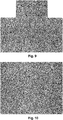
- the DFD-based segmentation leads to improved motion estimation around moving objects as shown in Fig. 9 and Fig. 10 along the levels of the hierarchy.
- the grid of pixels for which vectors are estimated gets denser and boundary areas where vectors cannot be estimated due to the window size get smaller. This holds for both cases without and with DFD-based segmentation.
- motion estimation in boundary areas is improved along the levels of the hierarchy as seen e.g. near the left image boundary in the low fence or wall in the front border of the highway.
- DFDs are reduced also around moving objects such as trucks and cars. With additional DFD-based segmentation this effect is enhanced, and also behind moving objects, e.g. the big truck in the middle of the image, the DFDs are reduced as facilitated by better vectors.
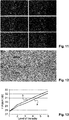
- the segmentation information obtained along the levels of the hierarchy by merging the segmentation information of neighbouring measurement window positions and of successive levels of the hierarchy is shown in Fig. 11 .
- the upper left image shows the result of merging the segmentation information of neighbouring measurement window positions in the first level of the hierarchy.
- the light grey areas mark part of smaller moving objects different from the big background object.
- mask information is obtained for pixels in the quasi-subsampling grid in the measurement window, it has a low spatial resolution in the beginning. The lighter the mask information of a pixel, the higher the probability that the pixel belongs to another object than the surrounding object (marked black).
- Section I.2.3 describes a processing of scanning around the centre pixel at a growing distance and comparing the mask information of that pixel with its neighbour(s) as seen towards the centre pixel.
- This method successfully helps distinguishing between smaller objects with different motion, like the big truck in the middle moving to the left and the smaller car before it moving to the right, as seen in the displacement vector x and y components shown in Fig. 12 , in comparison with the situation without DFD-based segmentation.
- the images shown are provided for the purpose of comparing certain methods and are not meant to be an optimum result.
- the inhomogeneous vectors in the sky area can be avoided by updating a vector only in non-homogeneous regions using threshAllowME > 0 starting with the second level of the hierarchy.
- the effect of vectors extending to the bottom right of the centre truck can be reduced by a neighbour vector comparison.
- Fig. 13 shows the luminance PSNR for a motion compensated version of the frame of the HD sequence along the six integer-pel levels of the hierarchy without and with using DFD-based segmentation - which is the average squared DFD (see Fig. 10 ) on a dB scale.
- the PSNR is significantly improved along the levels of the hierarchy, and the final improvement by DFD-based segmentation after the 6th level in this example is about 0.5dB, which is an average over the complete image, while the improvement itself is contributed by the enhanced areas in and around moving objects solely where the gain is therefore much higher.
- the invention is applicable to many applications requiring motion estimation and/or object or point tracking, such as broadcast and web streaming applications, surveillance or applications of Targeted Content.
- the described processing can be carried out by a single processor or electronic circuit, or by several processors or electronic circuits operating in parallel and/or operating on different parts of the complete processing.
- the instructions for operating the processor or the processors according to the described processing can be stored in one or more memories.
- the at least one processor is configured to carry out these instructions.
Landscapes
- Engineering & Computer Science (AREA)
- Multimedia (AREA)
- Signal Processing (AREA)
- Computer Vision & Pattern Recognition (AREA)
- Physics & Mathematics (AREA)
- General Physics & Mathematics (AREA)
- Theoretical Computer Science (AREA)
- Image Analysis (AREA)
- Compression Or Coding Systems Of Tv Signals (AREA)
Priority Applications (3)
| Application Number | Priority Date | Filing Date | Title |
|---|---|---|---|
| EP15306269.0A EP3128485A1 (fr) | 2015-08-05 | 2015-08-05 | Procédé et appareil d'estimation de mouvement hiérarchique au moyen de segmentation d'image en fonction de dfd |
| EP16182635.9A EP3131061A1 (fr) | 2015-08-05 | 2016-08-03 | Procédé et appareil d'estimation de mouvement hiérarchique au moyen de segmentation d'image en fonction de dfd |
| US15/229,374 US20170041632A1 (en) | 2015-08-05 | 2016-08-05 | Method and apparatus for hierarchical motion estimation using dfd-based image segmentation |
Applications Claiming Priority (1)
| Application Number | Priority Date | Filing Date | Title |
|---|---|---|---|
| EP15306269.0A EP3128485A1 (fr) | 2015-08-05 | 2015-08-05 | Procédé et appareil d'estimation de mouvement hiérarchique au moyen de segmentation d'image en fonction de dfd |
Publications (1)
| Publication Number | Publication Date |
|---|---|
| EP3128485A1 true EP3128485A1 (fr) | 2017-02-08 |
Family
ID=53835371
Family Applications (2)
| Application Number | Title | Priority Date | Filing Date |
|---|---|---|---|
| EP15306269.0A Withdrawn EP3128485A1 (fr) | 2015-08-05 | 2015-08-05 | Procédé et appareil d'estimation de mouvement hiérarchique au moyen de segmentation d'image en fonction de dfd |
| EP16182635.9A Withdrawn EP3131061A1 (fr) | 2015-08-05 | 2016-08-03 | Procédé et appareil d'estimation de mouvement hiérarchique au moyen de segmentation d'image en fonction de dfd |
Family Applications After (1)
| Application Number | Title | Priority Date | Filing Date |
|---|---|---|---|
| EP16182635.9A Withdrawn EP3131061A1 (fr) | 2015-08-05 | 2016-08-03 | Procédé et appareil d'estimation de mouvement hiérarchique au moyen de segmentation d'image en fonction de dfd |
Country Status (2)
| Country | Link |
|---|---|
| US (1) | US20170041632A1 (fr) |
| EP (2) | EP3128485A1 (fr) |
Cited By (4)
| Publication number | Priority date | Publication date | Assignee | Title |
|---|---|---|---|---|
| WO2019080685A1 (fr) * | 2017-10-24 | 2019-05-02 | 北京京东尚科信息技术有限公司 | Procédé et appareil de segmentation d'image vidéo, support d'informations et dispositif électronique |
| CN109741363A (zh) * | 2019-01-11 | 2019-05-10 | 湖南国科微电子股份有限公司 | 基于区块差值的运动判断方法、装置及电子设备 |
| CN111507997A (zh) * | 2020-04-22 | 2020-08-07 | 腾讯科技(深圳)有限公司 | 图像分割方法、装置、设备及计算机存储介质 |
| CN114693714A (zh) * | 2020-12-28 | 2022-07-01 | 腾讯科技(深圳)有限公司 | 图像分割方法、装置、电子设备及存储介质 |
Families Citing this family (6)
| Publication number | Priority date | Publication date | Assignee | Title |
|---|---|---|---|---|
| US11272193B2 (en) | 2017-04-24 | 2022-03-08 | Sk Telecom Co., Ltd. | Method and apparatus for estimating optical flow for motion compensation |
| KR102409430B1 (ko) * | 2017-04-24 | 2022-06-15 | 에스케이텔레콤 주식회사 | 움직임 보상을 위한 옵티컬 플로우 추정 방법 및 장치 |
| US10937169B2 (en) * | 2018-12-18 | 2021-03-02 | Qualcomm Incorporated | Motion-assisted image segmentation and object detection |
| PL4221213T3 (pl) * | 2019-01-09 | 2024-11-18 | Huawei Technologies Co., Ltd. | Koder wideo, dekoder wideo i stosowne sposoby |
| CN112802037A (zh) * | 2021-01-20 | 2021-05-14 | 北京百度网讯科技有限公司 | 人像提取方法、装置、电子设备及存储介质 |
| CN119600421B (zh) * | 2024-11-22 | 2025-11-18 | 中国热带农业科学院橡胶研究所 | 一种基于邻域分析的橡胶园建立年份校正方法 |
-
2015
- 2015-08-05 EP EP15306269.0A patent/EP3128485A1/fr not_active Withdrawn
-
2016
- 2016-08-03 EP EP16182635.9A patent/EP3131061A1/fr not_active Withdrawn
- 2016-08-05 US US15/229,374 patent/US20170041632A1/en not_active Abandoned
Non-Patent Citations (8)
| Title |
|---|
| "LECTURE NOTES IN COMPUTER SCIENCE", vol. 2849, 19 September 2003, SPRINGER BERLIN HEIDELBERG, Berlin, Heidelberg, ISSN: 0302-9743, article PARASKEVI K. TZOUVELI ET AL: "Automatic Videoconference Objects Watermarking Using Object Adapted Qualified Significant Wavelet Trees", pages: 156 - 163, XP002754816 * |
| DIEHL ET AL: "Object-oriented motion estimation and segmentation in image sequences", SIGNAL PROCESSING. IMAGE COMMUNICATION, ELSEVIER SCIENCE PUBLISHERS, AMSTERDAM, NL, vol. 3, no. 1, 1 February 1991 (1991-02-01), pages 23 - 56, XP024241769, ISSN: 0923-5965, [retrieved on 19910201], DOI: 10.1016/0923-5965(91)90028-Z * |
| K.J. YOON; I.S. KWEON: "Locally Adaptive Support-Weight Approach for Visual Correspondence Search", PROC. OF THE INTERNATIONAL CONFERENCE ON UBIQUITOUS ROBOTS AND AMBIENT INTELLIGENCE, 2004, pages 506 - 514 |
| M. BIERLING: "Displacement Estimation by Hierarchical Blockmatching", PROC. OF 3RD SPIE SYMPOSIUM ON VISUAL COMMUNICATIONS AND IMAGE PROCESSING, CAMBRIDGE, USA, vol. 1001, November 1988 (1988-11-01), pages 942 - 951 |
| MATTOCCIA STEFANO ET AL: "A fast segmentation-driven algorithm for accurate stereo correspondence", 2011 INTERNATIONAL CONFERENCE ON 3D IMAGING (IC3D), IEEE, 7 December 2011 (2011-12-07), pages 1 - 6, XP032478224, ISBN: 978-1-4799-1577-4, [retrieved on 20130821], DOI: 10.1109/IC3D.2011.6584384 * |
| R. THOMA; M. BIERLING: "Motion Compensating Interpolation Considering Covered and Uncovered Background", PROC. OF THE 1ST INTERNATIONAL WORKSHOP ON 64KBIT/S CODING OF MOVING VIDEO, HANNOVER, 18 April 1989 (1989-04-18) |
| THOMA R ET AL: "Motion compensating interpolation considering covered and uncovered background", SIGNAL PROCESSING. IMAGE COMMUNICATION, ELSEVIER SCIENCE PUBLISHERS, AMSTERDAM, NL, vol. 1, no. 2, 1 October 1989 (1989-10-01), pages 191 - 212, XP024241731, ISSN: 0923-5965, [retrieved on 19891001], DOI: 10.1016/0923-5965(89)90009-X * |
| YUE-MENG CHEN ET AL: "Frame rate up-conversion of compressed video using region segmentation and depth ordering", COMMUNICATIONS, COMPUTERS AND SIGNAL PROCESSING, 2009. PACRIM 2009. IEEE PACIFIC RIM CONFERENCE ON, IEEE, PISCATAWAY, NJ, USA, 23 August 2009 (2009-08-23), pages 431 - 436, XP031549222, ISBN: 978-1-4244-4560-8 * |
Cited By (6)
| Publication number | Priority date | Publication date | Assignee | Title |
|---|---|---|---|---|
| WO2019080685A1 (fr) * | 2017-10-24 | 2019-05-02 | 北京京东尚科信息技术有限公司 | Procédé et appareil de segmentation d'image vidéo, support d'informations et dispositif électronique |
| US11227393B2 (en) | 2017-10-24 | 2022-01-18 | Beijing Jingdong Shangke Information Technology Co., Ltd. | Video image segmentation method and apparatus, storage medium and electronic device |
| CN109741363A (zh) * | 2019-01-11 | 2019-05-10 | 湖南国科微电子股份有限公司 | 基于区块差值的运动判断方法、装置及电子设备 |
| CN109741363B (zh) * | 2019-01-11 | 2023-07-14 | 湖南国科微电子股份有限公司 | 基于区块差值的运动判断方法、装置及电子设备 |
| CN111507997A (zh) * | 2020-04-22 | 2020-08-07 | 腾讯科技(深圳)有限公司 | 图像分割方法、装置、设备及计算机存储介质 |
| CN114693714A (zh) * | 2020-12-28 | 2022-07-01 | 腾讯科技(深圳)有限公司 | 图像分割方法、装置、电子设备及存储介质 |
Also Published As
| Publication number | Publication date |
|---|---|
| US20170041632A1 (en) | 2017-02-09 |
| EP3131061A1 (fr) | 2017-02-15 |
Similar Documents
| Publication | Publication Date | Title |
|---|---|---|
| EP3128485A1 (fr) | Procédé et appareil d'estimation de mouvement hiérarchique au moyen de segmentation d'image en fonction de dfd | |
| US8582915B2 (en) | Image enhancement for challenging lighting conditions | |
| US7570309B2 (en) | Methods for adaptive noise reduction based on global motion estimation | |
| EP3054686B1 (fr) | Estimation de mouvement hiérarchique et segmentation en présence de plus d'un objet mobile dans une fenêtre de recherche | |
| EP3171595A1 (fr) | Stratégies de recherche améliorée pour estimation de mouvement hiérarchique | |
| US7406208B2 (en) | Edge enhancement process and system | |
| US6751350B2 (en) | Mosaic generation and sprite-based coding with automatic foreground and background separation | |
| EP1639829B1 (fr) | Procede d'estimation de flux optique | |
| CN109743473A (zh) | 视频图像3d降噪方法、计算机装置及计算机可读存储介质 | |
| US9202263B2 (en) | System and method for spatio video image enhancement | |
| US8243194B2 (en) | Method and apparatus for frame interpolation | |
| CN111161172B (zh) | 一种红外图像列向条纹消除方法、系统及计算机存储介质 | |
| US7570833B2 (en) | Removal of poisson false color noise in low-light images usng time-domain mean and variance measurements | |
| US20090296818A1 (en) | Method and system for creating an interpolated image | |
| He et al. | Spatio-temporal saliency-based motion vector refinement for frame rate up-conversion | |
| CN108270945B (zh) | 一种运动补偿去噪方法及装置 | |
| US20050094890A1 (en) | Method and apparatus for image detail enhancement without zigzagged edge artifact | |
| EP2107523B1 (fr) | Procédé de détection de changement de scène dans une séquence d'images vidéo | |
| US8184721B2 (en) | Recursive filtering of a video image | |
| US20080144716A1 (en) | Method For Motion Vector Determination | |
| US8350966B2 (en) | Method and system for motion compensated noise level detection and measurement | |
| Lim et al. | A region-based motion-compensated frame interpolation method using a variance-distortion curve | |
| WO2010091934A1 (fr) | Analyse de séquence vidéo pour une estimation de mouvement robuste | |
| WO2007020572A1 (fr) | Processeur d'image comprenant un detecteur artefact bloc | |
| Itoh | Similarity-based demosaicing algorithm using unified high-frequency map |
Legal Events
| Date | Code | Title | Description |
|---|---|---|---|
| PUAI | Public reference made under article 153(3) epc to a published international application that has entered the european phase |
Free format text: ORIGINAL CODE: 0009012 |
|
| AK | Designated contracting states |
Kind code of ref document: A1 Designated state(s): AL AT BE BG CH CY CZ DE DK EE ES FI FR GB GR HR HU IE IS IT LI LT LU LV MC MK MT NL NO PL PT RO RS SE SI SK SM TR |
|
| AX | Request for extension of the european patent |
Extension state: BA ME |
|
| STAA | Information on the status of an ep patent application or granted ep patent |
Free format text: STATUS: THE APPLICATION IS DEEMED TO BE WITHDRAWN |
|
| 18D | Application deemed to be withdrawn |
Effective date: 20170809 |