EP3128492A1 - Rfid-etiketten mit funktion zur deaktivierung der artikelsicherung (eas) - Google Patents
Rfid-etiketten mit funktion zur deaktivierung der artikelsicherung (eas) Download PDFInfo
- Publication number
- EP3128492A1 EP3128492A1 EP16001868.5A EP16001868A EP3128492A1 EP 3128492 A1 EP3128492 A1 EP 3128492A1 EP 16001868 A EP16001868 A EP 16001868A EP 3128492 A1 EP3128492 A1 EP 3128492A1
- Authority
- EP
- European Patent Office
- Prior art keywords
- rfid
- antenna
- state
- eas
- deactivated
- Prior art date
- Legal status (The legal status is an assumption and is not a legal conclusion. Google has not performed a legal analysis and makes no representation as to the accuracy of the status listed.)
- Withdrawn
Links
Images



Classifications
-
- G—PHYSICS
- G08—SIGNALLING
- G08B—SIGNALLING SYSTEMS, e.g. PERSONAL CALLING SYSTEMS; ORDER TELEGRAPHS; ALARM SYSTEMS
- G08B13/00—Burglar, theft or intruder alarms
- G08B13/22—Electrical actuation
- G08B13/24—Electrical actuation by interference with electromagnetic field distribution
- G08B13/2402—Electronic Article Surveillance [EAS], i.e. systems using tags for detecting removal of a tagged item from a secure area, e.g. tags for detecting shoplifting
- G08B13/2405—Electronic Article Surveillance [EAS], i.e. systems using tags for detecting removal of a tagged item from a secure area, e.g. tags for detecting shoplifting characterised by the tag technology used
- G08B13/2414—Electronic Article Surveillance [EAS], i.e. systems using tags for detecting removal of a tagged item from a secure area, e.g. tags for detecting shoplifting characterised by the tag technology used using inductive tags
-
- G—PHYSICS
- G06—COMPUTING OR CALCULATING; COUNTING
- G06K—GRAPHICAL DATA READING; PRESENTATION OF DATA; RECORD CARRIERS; HANDLING RECORD CARRIERS
- G06K19/00—Record carriers for use with machines and with at least a part designed to carry digital markings
- G06K19/06—Record carriers for use with machines and with at least a part designed to carry digital markings characterised by the kind of the digital marking, e.g. shape, nature, code
- G06K19/067—Record carriers with conductive marks, printed circuits or semiconductor circuit elements, e.g. credit or identity cards also with resonating or responding marks without active components
- G06K19/07—Record carriers with conductive marks, printed circuits or semiconductor circuit elements, e.g. credit or identity cards also with resonating or responding marks without active components with integrated circuit chips
- G06K19/077—Constructional details, e.g. mounting of circuits in the carrier
-
- G—PHYSICS
- G06—COMPUTING OR CALCULATING; COUNTING
- G06K—GRAPHICAL DATA READING; PRESENTATION OF DATA; RECORD CARRIERS; HANDLING RECORD CARRIERS
- G06K17/00—Methods or arrangements for effecting co-operative working between equipments covered by two or more of main groups G06K1/00 - G06K15/00, e.g. automatic card files incorporating conveying and reading operations
-
- G—PHYSICS
- G06—COMPUTING OR CALCULATING; COUNTING
- G06K—GRAPHICAL DATA READING; PRESENTATION OF DATA; RECORD CARRIERS; HANDLING RECORD CARRIERS
- G06K19/00—Record carriers for use with machines and with at least a part designed to carry digital markings
- G06K19/06—Record carriers for use with machines and with at least a part designed to carry digital markings characterised by the kind of the digital marking, e.g. shape, nature, code
- G06K19/067—Record carriers with conductive marks, printed circuits or semiconductor circuit elements, e.g. credit or identity cards also with resonating or responding marks without active components
- G06K19/07—Record carriers with conductive marks, printed circuits or semiconductor circuit elements, e.g. credit or identity cards also with resonating or responding marks without active components with integrated circuit chips
- G06K19/077—Constructional details, e.g. mounting of circuits in the carrier
- G06K19/07749—Constructional details, e.g. mounting of circuits in the carrier the record carrier being capable of non-contact communication, e.g. constructional details of the antenna of a non-contact smart card
-
- G—PHYSICS
- G08—SIGNALLING
- G08B—SIGNALLING SYSTEMS, e.g. PERSONAL CALLING SYSTEMS; ORDER TELEGRAPHS; ALARM SYSTEMS
- G08B13/00—Burglar, theft or intruder alarms
- G08B13/22—Electrical actuation
- G08B13/24—Electrical actuation by interference with electromagnetic field distribution
- G08B13/2402—Electronic Article Surveillance [EAS], i.e. systems using tags for detecting removal of a tagged item from a secure area, e.g. tags for detecting shoplifting
- G08B13/2405—Electronic Article Surveillance [EAS], i.e. systems using tags for detecting removal of a tagged item from a secure area, e.g. tags for detecting shoplifting characterised by the tag technology used
- G08B13/2414—Electronic Article Surveillance [EAS], i.e. systems using tags for detecting removal of a tagged item from a secure area, e.g. tags for detecting shoplifting characterised by the tag technology used using inductive tags
- G08B13/2417—Electronic Article Surveillance [EAS], i.e. systems using tags for detecting removal of a tagged item from a secure area, e.g. tags for detecting shoplifting characterised by the tag technology used using inductive tags having a radio frequency identification chip
-
- G—PHYSICS
- G08—SIGNALLING
- G08B—SIGNALLING SYSTEMS, e.g. PERSONAL CALLING SYSTEMS; ORDER TELEGRAPHS; ALARM SYSTEMS
- G08B13/00—Burglar, theft or intruder alarms
- G08B13/22—Electrical actuation
- G08B13/24—Electrical actuation by interference with electromagnetic field distribution
- G08B13/2402—Electronic Article Surveillance [EAS], i.e. systems using tags for detecting removal of a tagged item from a secure area, e.g. tags for detecting shoplifting
- G08B13/2428—Tag details
- G08B13/2448—Tag with at least dual detection means, e.g. combined inductive and ferromagnetic tags, dual frequencies within a single technology, tampering detection or signalling means on the tag
-
- H—ELECTRICITY
- H04—ELECTRIC COMMUNICATION TECHNIQUE
- H04B—TRANSMISSION
- H04B5/00—Near-field transmission systems, e.g. inductive or capacitive transmission systems
- H04B5/40—Near-field transmission systems, e.g. inductive or capacitive transmission systems characterised by components specially adapted for near-field transmission
- H04B5/48—Transceivers
Definitions
- the present invention relates to radio-frequency identification (RFID) systems, including RFID tags, readers, and activators.
- RFID radio-frequency identification
- the invention also relates to electronic article surveillance (EAS) systems, including EAS tags, alarms, activators, and deactivators.
- EAS electronic article surveillance
- the invention also relates to RFID and EAS apparatus and methodology that enables the RFID functionality of a tag to be deactivated at substantially the same time that the EAS functionality is deactivated and with the same device that deactivates the EAS functionality.
- Automatic identification is the broad term applying to a host of technologies that are used to help machines identify objects. Automatic identification is often coupled with automatic data capture. Accordingly, companies that want to identify items are able to capture information about the items and to load the information into a computer with minimal human labor.
- RFID radio frequency identification
- RFID is a generic term for technologies that use radio waves to automatically identify objects such as tagged products.
- RFID includes several conventional methods of identifying objects using RFID, the most common of which is to store a serial number (and other information if desired) that identifies the object on a microchip that is attached to an antenna.
- the chip and the antenna, together with any supporting substrate, herein are called an RFID device or an RFID tag.
- the antenna enables the chip to transmit the identification information to a reader.
- the reader converts the radio waves from the RFID device into a form that can then be utilized by a computer.
- EAS electronic article surveillance
- Conventional EAS devices or tags include a resonator that, when activated, causes an alarm to sound when the EAS tag is brought within operative proximity of detection apparatus (which is typically located at the exit of a store).
- detection apparatus which is typically located at the exit of a store.
- EAS tags are inexpensive and disposable items that are not removed from merchandise during check out (which is generally true for RFID tags as well). For these reasons, a variety of different techniques have been developed to deactivate EAS tags, typically by a clerk during check out using deactivation apparatus that needs no physical contact with the tag.
- EAS devices and deactivation systems make use of specially configured tags or labels in connection with an apparatus for positively deactivating such tags or labels.
- a first example is the EAS tag described in U.S. Patent No. 4,498,076 to Lichtblau .
- the Lichtblau tag is provided with a resonant circuit having a capacitor portion with an indentation that permits the resonant circuit to be deactivated according to methodology as described in U.S. Patent No. 4,728,938 to Kaltner , for example.
- the Lichtblau EAS tag is readily deactivated at the point of sale by subjecting the tag or label to a relatively high-powered signal which, because of the mechanical indentation, is sufficient to cause a short circuit within the tag or label for deactivation.
- Magnetomechanical tags include an active element and a bias element. When magnetized, the bias element applies a bias magnetic field to the active element which causes the active element to be mechanically resonant at a predetermined frequency upon exposure to an interrogation signal which alternates at the predetermined frequency.
- This tag requires a relatively high magnetic field level for activation and deactivation. Activation and deactivation is accomplished by exciting a coil wound around a magnetic core.
- RFID tags One of the concerns consumers have with RFID tags is privacy. More specifically, consumers may believe that their spending habits and mobility can be tracked by means of still-active RFID tags attached to their purchases. Accordingly, to increase consumer confidence in RFID technology, manufacturers are challenged to improve RFID tags so that the tags are no longer activated by far-field RF signals once tagged products are purchased or used by consumers.
- RFID devices and EAS devices serve different purposes when it comes to retail items.
- the terms "EAS device” and "RFID device” may refer to devices that are embodied in separate tags or to devices that are combined in the same tag.
- each of the systems utilizes different apparatus and methodology for activation and deactivation. Therefore, retailers may need to purchase and install separate systems for implementing and deactivating RFID and EAS functionality in their stores, which can be burdensome and expensive.
- the present invention relates to radio-frequency identification (RFID) systems, including RFID tags, readers, and activators.
- RFID radio-frequency identification
- EAS electronic article surveillance
- the invention also relates to RFID and EAS devices and a methodology that enables the RFID device to be deactivated at substantially the same time as the EAS device is deactivated, using the same apparatus that deactivates the EAS functionality.
- the RFID device and EAS device may be implemented as or comprise of separate tags or labels or may be combined in the same tag or label.
- an RFID tag may include an antenna, an RFID chip connected to the antenna for communicating with a reader, and an active element operatively disposed with respect to the antenna.
- the active element may operate in a plurality of states, including an activated state in which the antenna is enabled for communicating with a reader in a far field and a deactivated state in which the antenna is disabled from communicating with a reader in a far field.
- the active element may change from the activated state to the deactivated state when operatively subjected to an electronic article surveillance (EAS) deactivator.
- EAS electronic article surveillance
- the same piece of equipment that deactivates the EAS device may also deactivate the RFID device.
- the deactivation of the RFID tag may occur at the same time as an EAS device is deactivated; in other embodiments, there may be no EAS device present even though the RFID tag is deactivated.
- a dual function (RFID/EAS) tag includes an RFID device and an EAS device.
- the RFID device may operate in a plurality of states including an activated state in which communication with a reader is enabled and a deactivated state in which communication with a reader is disabled.
- the EAS device may operate in a plurality of states including an activated state in which activation of an alarm is enabled and a deactivated state in which activation of an alarm is disable.
- the RFID device may be deactivated when the EAS device is deactivated.
- the same piece of equipment that deactivates the EAS device also deactivates the RFID device at the same time. For example, a deactivator that subjects the EAS device to a magnetic field may also subject the RFID device to the magnetic field.
- the RFID device may include an antenna, an RFID chip connected to the antenna for communicating with a reader, and an active element operatively disposed with respect to the antenna.
- the active element which may include a conductive strip or lead, may have an activated state in which the antenna is enabled for communicating with a reader in a far field and a deactivated state in which the antenna is disabled from communicating with a reader in a far field.
- the EAS device may include a magnetic resonator and a bias magnet. When activated, the bias magnet may cause or affect the resonator to resonate and the active element to be in the activated state. Further, when deactivated, the bias magnet may cause the active element to be in the deactivated state. Accordingly, in a retail example, deactivating the EAS device at check out also deactivates the RFID device.
- the tag may include structure for providing a visual indication to a consumer that the RFID functionality of the tag has been deactivated.
- a radio-frequency identification (RFID) and an electronic article surveillance (EAS) tag 100 may include an RFID device 102 and an EAS device 104. According to a many embodiments, the tag 100 may operate in a plurality of operating states. In addition, in other embodiments, the process of deactivating the EAS functionality of the tag 100 may simultaneously deactivate the RFID functionality of the tag 100.
- RFID radio-frequency identification
- EAS electronic article surveillance
- the tag 100 may operate in an activated state in which the tag 100 is able to communicate with an RFID reader 106 as shown in FIG. 2 . More specitically, when in an activated state, the RFID device 102 of the tag 100, which is associated with an object 108, may be able to receive energy E from the reader 106 for activation and to transmit tag energy T back to the reader 106 for processing. The communication of information from the tag 100 to the reader 106 may be within a typical far-field installation, e.g., in a retail store. Accordingly, in an activated state, the combination tag 100 may function or operate at least as a typical RFID tag in the far field and in many embodiments as a typical EAS tag as well. [The term "far field” as used herein refers to a distance greater than about 15 mm from an RF-energy emitting device, such as an RFID device that emits ultra-high frequency (UHF) RF energy.]
- UHF ultra-high frequency
- the tag 100 may also operate in a deactivated state in which the tag 100 is disabled from communicating with a reader 106 as shown in FIG. 3 . More specifically, when in a deactivated state, the RFID device 102 of the tag is not able to communicate with a reader 106 in a far-field installation. Accordingly, in a deactivated state, the combination tag 100 may not function or operate at least as a typical RFID tag in the far field and in many embodiments as a typical EAS tag as well.
- the tag 100 may be taken from an inactive state in which the EAS device 104 will not trigger an EAS alarm 110 to an active state by subjecting the EAS device 104 to activation energy A from an activator 112.
- the EAS device 104 When in an active state, the EAS device 104 will activate the alarm 110 when positioned within an operative field of the alarm 110, with is indicated by energy M.
- the tag 100 may be taken from the active state to the deactivated state by subjecting the EAS device 104 to deactivation energy D from a deactivator 114 as illustrated in FIG. 5 .
- the EAS device 104 When in the deactivated state, the EAS device 104 will not activate the alarm 110 when positioned within the operative field thereof.
- the process of deactivating the EAS device 104 of the tag 100 may also simultaneously deactivate the RFID device 102, which is discuss in more detail bellow.
- the RFID device 102 of the combination tag 100 may include an antenna 116, an RF chip 118, and an active element 120.
- the RF chip may be connected to the antenna 116 and may be configured for communicating with a reader 106.
- the active element 120 may be operative disposed with respect to the antenna 116.
- the active element 120 maybe configured to affect, vary, or change one or more far-field operating parameters of the antenna 116, such as frequency or efficiency.
- the active element 120 may be configured to change states or to change the operating state of the RFID device 102. For example, when the active element 120 is in an activated state, the antenna 116 may be enabled for communicating with a reader 106 in an operative far field, as represented in FIG. 2 . In addition, when the active element 120 is in a deactivated state, the antenna is disabled from communicating with a reader 106 in an operative far field, as represented in FIG. 3 .
- the EAS device 104 may include a magnetic resonator 122 and a bias magnet 124 that may be activated and deactivated as represented in FIGS. 4 and 5 , respectively. Accordingly, when activated, the bias magnet 124 may cause the resonator 122 to resonate as shown by arrow R in FIG. 7 . When the bias magnet 124 is deactivated, the resonator 122 is unable to resonate as shown in FIG. 8 .
- the bias magnet 124 when activated, may cause the active element 120 to be in the activated state, thereby enabling the RFID device 102 to communicate with a reader 106 in the far field. In other embodiments, when deactivated, the bias magnet 124 may cause the active element 120 to be in the deactivated state, thereby disabling the RFID device 102 from communicating with a reader 106 in the far field. Accordingly, by demagnetizing the bias magnet 124, both the EAS functionality and the RFID functionality of the tag 100 is disabled or deactivated.
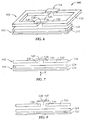
- the antenna 116 may include a loop antenna 126 with a gap 128 defined between ends 130 of the antenna 126, and the active element 120 may include a conductive strip. Accordingly, when in the activated state as shown in FIG. 7 , the conductive strip 120 may be positioned in operative proximity with the gap 128, for example, contacting the ends 130 of the loop antenna 126, thereby enabling the antenna 126 to operate at desired or functional far-field parameters. When in the deactivated state as shown in FIG. 8 , the conductive strip 120 may not be not positioned in operative proximity with the gap 128, thereby disabling the antenna 126 from operating at desired or functional far-field parameters.
- the gap 128 of the antenna 126 may be positioned between the conductive strip 120 and the bias magnet 124 such that the conductive strip may be attracted by the magnet 124 and urged toward the gap 128 when the bias magnet 124 is activated.
- the conductive strip 120 may be biased away from the gap 128, such as at the position shown in FIG. 8 , such that when the bias magnet 124 is deactivated, no magnetic force acts upon the conductive strip 120, and the conductive strip 120 may move out of operative proximity of the antenna 126, or away from, the gap 128.
- a capacitance between the ends 130 of the antenna 126 and across the gap 128 may be at an increased level, thereby enabling the antenna 126 to operate at a desired frequency or efficiency.
- the capacitance across the gap 128 may be at a reduced level, thereby disabling the antenna 126 from operating at a desired frequency or efficiency.
- the active element in the form of the conductive strip 120 may cause the antenna 126 to operate at a reduced efficiency when in the deactivated state.
- the conductive strip 120 may cause the antenna 126 to operate at a first frequency when in the activated state and at a second frequency when in the deactivated state.
- the first frequency may enable the antenna 126 to communicate with a reader 106 in a far field
- the second frequency may enable the antenna 126 to communicate with a reader 106 only in a near field (i.e., not at a far field).
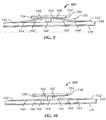
- an RFID device 102 as illustrated in FIG. 9 may include an antenna 152, an RFID chip 154, and an active element 156 connected to the antenna 152.
- the chip 154 may include a pair of conductive magnetic pads 158.
- the active element 156 may be operatively disposed with respect to the pads 158. Accordingly, in a number of embodiments the active element 156 may have an activated state in which the antenna 152 is in operative or electrical communication with the chip 154 as represented by FIG. 2 and shown in FIG. 9 . Further, the active element 156 may have a deactivated state in which antenna 152 is not in operative or electrical communication with the chip 154 as represented by FIG. 3 and as shown in FIG. 10 .
- the active element 156 may include a pair of conductive leads 160 each connected to the antenna 152 at one end thereof. Each of the leads 160 may then contact a respective one of the pads 158 at the other end thereof when in the activated state as shown in FIG. 9 . In addition, the leads 160 may also disconnect from the pads 158 when in the deactivated state as shown in FIG. 10 . In a number of embodiments, the pads 158 may be activated when magnetized as represented in FIG. 4 and deactivated when demagnetized as represented in FIG. 5 . Accordingly, in embodiments in which a tag 100 combines RFID and EAS functionality, the deactivation process of the EAS device 104 may also simultaneously deactivate the RFID device 102.
- the conductive leads 160 may be biased to be in the deactivated state as shown in FIG. 10 . Accordingly, to place the RFID device 102 in the activated state, the magnetic pads 158 may attract the free ends of the leads 160 to make contact therewith. When the pads 158 are demagnetized, then the leads 160 may disconnect from the pads 158 to return to the biased position of FIG. 10 .
- the chip 154 may be disposed in a spaced relationship with the antenna 152 such that a gap 162 is defined between the antenna 152 and the pads 158.
- a support 164 may be provided on which the chip 154 may be mounted.
- each of the conductive leads 160 may be connected to the antenna 152 at respective first ends 164 thereof. Further, each of the conductive leads 160 may then be movable in the gap 162 at respective free or second ends 166 thereof to disconnect from a respective one of the pads 158 .
- the RFID device 102 may include a dielectric support 168 with a rear ground plane 170 on which the antenna 152 may be mounted.
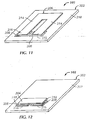
- an RFID device 102 as illustrated in FIGS. 11 and 12 may include a substrate 202, an RFID chip 204, and an antenna 206.
- the substrate 202 may include at least one aperture 208, with a pair of apertures 208 being shown in the embodiment in the drawings.
- the chip 204 may include a number of conductive magnetic pads 210 corresponding to the apertures 208, with the pads 210 being disposed at the apertures 208 on a first side 212 of the substrate 202.
- the antenna 206 may include a pair of arms 214 each with an end 216 disposed at a respect one of the apertures on a second side 218 of the substrate 202.
- the antenna 206 may include a plurality of operating states.
- the antenna 206 may include an activated state in which the ends 216 of the arms 214 are in operative or electrical communication with the pads 210 as shown in FIG. 13 , thereby rendering the RFID device 102 in an active state as represented in FIG. 2 .
- the antenna 216 may include a deactivated state in which the ends 216 of the arms 214 are not in operative or electrical communication with the pads 210 as shown in FIG. 14 , thereby rendering the RFID device 102 in a deactivated state as represented in FIG. 3 .
- the process of deactivating the EAS device 104 may also simultaneously deactivate the RFID device 102.
- the arms 214 of the antenna 206 may be biased to be separated or disconnected from the pads 210. Accordingly, when the pads 210 are magnetized,-the ends 216 of the arms 214 are drawn to the pads 210 against the bias of the arms 214 as shown in FIG. 11 . When the pads 210 are demagnetized, then the arms 214 return to the biased open or disconnected position as shown in FIG. 12 .
- the RFID device 102 may include structure for providing an indication whether the RFID device 102 is in an activated or deactivated state.
- a lens 220 maybe disposed at the apertures 208, and the end 216 of each of the arms 214 may include a colored section 222. Accordingly, when the RFID device 102 is in an activated state as shown in FIG. 16 , the colored sections 222 are separated from the lens 220, so that the lens 220 provides a first visual indicator, i.e., activated. And when the RFID device 102 is in a deactivated state as shown in FIG. 17 , the colored sections 222 are positioned adjacent to the lens 220, so that the lens 220 provides a second visual indicator, i.e., deactivated.
- the deactivation methodology of the invention applies equally to the case of an RFID device and an EAS device each embodied in a separate tag marking an object.
- the physical relationship of the tags e.g., proximity, configurations, etc.
- the single deactivation apparatus can affect the use of the single deactivation apparatus to deactivate both devices.
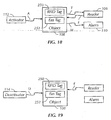
- RFID and EAS tags 250 and 252 may be associated with an object 108 .
- the RFID and EAS tags 250 and 252 may be configured analogously to or may include analogous functionality as the RFID and EAS devices 102 and 104, respectively, as described above.'
- the tags 250 and 252 may be activated individually and at separate times with either the same activator 112 or with separate activating apparatus. Alternatively, the tags 250 and 252 may be activated substantially simultaneously with the same activator 112 as shown in FIG. 18 . In other embodiments, the tags 250 and 252 may be deactivated at substantially the same time and with the same deactivating apparatus 114 as shown in FIG. 19 . For example, during a purchase of an item 108, the readability or operability of the RFID tag 250 may be disabled with the same apparatus that deactivates the EAS tag 252 and at the same time that the EAS tag 252 is deactivated.
- the RFID device 102 may be of a type shown in FIG. 20 .
- the RFID device 102 may include a magnetic coupler 254 operatively coupling together an antenna portion 256 and an interposer 258 with a transponder chip 260.
- the interposer 258 includes conductive leads or pads that are coupled to contact pads of the chip 260 for providing a larger effective electrical contact area than ICs precisely aligned for direct placement without an interposer.
- the antenna portion 256 may include an antenna 262 and an antenna portion magnetic coupling element 264 electrically coupled together.
- the electrical coupling between the antenna 262 and the antenna portion magnetic coupling element 264 may be a direct electrical (conductive) coupling or a non-direct reactive coupling, such as capacitive coupling.
- the antenna 262 may be any of a variety of suitable antennas for receiving and/or sending signals in interaction with an RFID communication device such as a reader.
- the interposer 258 may include the transponder chip 260 and an interposer magnetic coupling element 266 that is electrically coupled to the chip 260.
- the coupling between the transponder chip 260 and the interposer magnetic coupling element 266 may be a direct electrical contact or may include certain types of reactive coupling, such as capacitive coupling.
- the magnetic coupling elements 264 and 266 together constitute the magnetic coupler 254. The interaction of the magnetic coupling elements 264 and 266 allows transfer of energy between the antenna 262 and the transponder chip 260 via magnetic coupling.
- the magnetic coupler 254 may include high-permeability material placed in proximity to the magnetic coupling elements 264 and 266.
- Ferrites are an example of suitable materials for the high-permeability material 254.
- Ferrites are ceramic materials generally containing iron oxide combined with binder compounds such as nickel, manganese, zinc, or magnesium. Two major categories of binder compounds are manganese zinc (MnZn) and nickel zinc (NiZn).
- the high-permeability material 268 may be placed either between or elsewhere in proximity to the magnetic coupling elements 264 and 266.
- the high-permeability material 268. may be used to increase and/or concentrate magnetic coupling between the magnetic coupling elements 264 and 266.
- the high permeability material 268 may increase the amount of flux transferred between the magnetic coupling elements 264 and 266.
- the high-permeability material 268 may be in the form of any of a variety of layers or structures in proximity to the magnetic coupling portions or elements 264 and 266.
- the high permeability material 268 may also be used to control the readability of the RFID device 102 and thus to effect the deactivation method of the present invention.
- the high-permeability material 268 may be used to intentionally de-tune and inhibit operation of the RFID device 102, except when the high-permeability material 30 is saturated by a direct-current magnetic field, such as a field produced by a printed magnet in the device 102.
- the RFID device 102 may operate normally until exposed to a de-magnetizing field, which removes the bias of the high-permeability material 268. Thereafter, the high-permeability 268 may either de-tune the RFID device 102 or concentrate the magnetic flux away from the interposer 285, thereby also preventing reading of the RFID device 102.
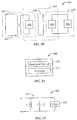
- the EAS device 104 may include a resonant circuit 270 and an antenna 272.
- the resonant circuit 270 may be schematically represented by an equivalence circuit including an inductive element L and a capacitive element C.
- the prior art includes numerous examples of resonant circuits that may be suitably utilized in EAS tags, either in parallel as shown or in series.
- the capacitive element C may function both as a capacitor and as a transmission line depending upon the frequency. For example, at low frequencies (e.g., less than 10 MHz), the capacitive element C may function as or exhibit properties of a capacitor, while at ultra-high frequency (UHF) (e.g., about 300 MHz to 3 GHz), the capacitive element C may function as or exhibit properties of a transmission line. Accordingly, the capacitive element C is in an activated state when functioning as a capacitor and a deactivated state when functioning as a transmission line.
- UHF ultra-high frequency
- the resonant circuit 270 may be configured in relation to the RFID chip 118 of the RFID device 102 so that the capacitive element C is in parallel with the chip. Accordingly, in UHF environments, the capacitive element C becomes a DC short circuit, thereby shorting and deactivating the RFID chip 118.
- the present application may also relate to a radio-frequency identification (RFID) tag comprising:
- the active element may cause the antenna to operate at a reduced efficiency when in the deactivated state.
- the active element may cause the antenna to operate at a first frequency when in the activated state and at a second frequency when in the deactivated state.
- the RFID tag could further comprise an EAS device including:
- the RFID tag could further comprise an EAS device including a resonant circuit with a capacitive element; the capacitive element being in an active state by functioning as a capacitor at low frequencies and being in an deactivated state by functioning as a transmission line when the EAS device is subjected to ultra-high frequencies; the active element to be in the activated state when the capacitive element is activated; and the active element to be in the deactivated state when the capacitive element is deactivated.
- an EAS device including a resonant circuit with a capacitive element; the capacitive element being in an active state by functioning as a capacitor at low frequencies and being in an deactivated state by functioning as a transmission line when the EAS device is subjected to ultra-high frequencies; the active element to be in the activated state when the capacitive element is activated; and the active element to be in the deactivated state when the capacitive element is deactivated.
- the present application may also relate to a radio-frequency identification (RFID) and an electronic article surveillance (EAS) tag comprising.
- RFID radio-frequency identification
- EAS electronic article surveillance
- the RFID and EAS tag active element may cause the antenna to operate at a reduced efficiency when in the deactivated state.
- the active element may cause the antenna to operate at a first frequency when in the activated state and at a second frequency when in the deactivated state.
- the antenna may include a loop antenna having a gap; and the active element may include a conductive strip such that:
- the conductive strip could reduce a capacitance across the gap in the antenna when in the deactivated state.
- the gap of the antenna could be positioned between the conductive strip and the bias magnet such that the conductive strip is urged toward the gap when the bias magnet is activated.
- the conductive strip may be biased away from the gap such that when the bias magnet is deactivated, the conductive strip moves away from the gap.
- RFID radio-frequency identification
- EAS electronic article surveillance
- RFID radio-frequency identification
- the active element may be in the activated state when the pads are magnetized and the deactivated state when the pads are demagnetized.
- the active element could include a pair of conductive leads connected to the antenna and for respectively contacting the pads when in the activated state and disconnecting from the pad when in the deactivated state.
- the conductive leads may be biased to be in the deactivated state.
- the chip could be disposed in a spaced relationship with the antenna such that a gap is defined between the antenna and the pads and wherein at least one of the conductive leads could be connected to the antenna at a first end thereof and could be movable in the gap at a second end thereof to disconnect from a respective one of the pads.
- RFID radio-frequency identification
- the chip may be disposed in a spaced relationship with the antenna such that a gap is defined between the antenna and the pads and wherein:
- RFID radio-frequency identification
- the RFID tag could comprise a lens for indicating when the antenna is in the deactivated state.
- the present application may also relate to a radio-frequency identification (RFID) and an electronic article surveillance (EAS) tag comprising:
- RFID radio-frequency identification
- EAS electronic article surveillance
- the present application may also relate to a method tor controlling the operability of a radio-frequency identification (RFID) device and an electronic article surveillance (EAS) device, the RFID device enabled for communicating with a reader when activated and disabled from communicating with a reader when deactivated, the EAS device enabled for activating an alarm with activated and disabled from activating an alarm when deactivated, the method comprising:
- the deactivating step could comprise deactivating the RFID device substantially simultaneously with the EAS device.
- the deactivating step may comprise deactivating the RFID device with the same device that deactivates the EAS device.
Landscapes
- Physics & Mathematics (AREA)
- Engineering & Computer Science (AREA)
- General Physics & Mathematics (AREA)
- Automation & Control Theory (AREA)
- Computer Security & Cryptography (AREA)
- Electromagnetism (AREA)
- Theoretical Computer Science (AREA)
- Microelectronics & Electronic Packaging (AREA)
- Computer Hardware Design (AREA)
- Computer Networks & Wireless Communication (AREA)
- Signal Processing (AREA)
- Burglar Alarm Systems (AREA)
- Near-Field Transmission Systems (AREA)
Applications Claiming Priority (3)
| Application Number | Priority Date | Filing Date | Title |
|---|---|---|---|
| US10/936,907 US7109867B2 (en) | 2004-09-09 | 2004-09-09 | RFID tags with EAS deactivation ability |
| EP10011864.5A EP2282300B1 (de) | 2004-09-09 | 2005-09-09 | RFID-Etiketten mit Funktion zur Deaktivierung der Artikelsicherung (EAS) |
| EP05794157A EP1787243B1 (de) | 2004-09-09 | 2005-09-09 | Rfid-etiketten mit eas-deaktivierungsmöglichkeit |
Related Parent Applications (2)
| Application Number | Title | Priority Date | Filing Date |
|---|---|---|---|
| EP10011864.5A Division EP2282300B1 (de) | 2004-09-09 | 2005-09-09 | RFID-Etiketten mit Funktion zur Deaktivierung der Artikelsicherung (EAS) |
| EP05794157A Division EP1787243B1 (de) | 2004-09-09 | 2005-09-09 | Rfid-etiketten mit eas-deaktivierungsmöglichkeit |
Publications (1)
| Publication Number | Publication Date |
|---|---|
| EP3128492A1 true EP3128492A1 (de) | 2017-02-08 |
Family
ID=35520785
Family Applications (3)
| Application Number | Title | Priority Date | Filing Date |
|---|---|---|---|
| EP05794157A Expired - Lifetime EP1787243B1 (de) | 2004-09-09 | 2005-09-09 | Rfid-etiketten mit eas-deaktivierungsmöglichkeit |
| EP16001868.5A Withdrawn EP3128492A1 (de) | 2004-09-09 | 2005-09-09 | Rfid-etiketten mit funktion zur deaktivierung der artikelsicherung (eas) |
| EP10011864.5A Expired - Lifetime EP2282300B1 (de) | 2004-09-09 | 2005-09-09 | RFID-Etiketten mit Funktion zur Deaktivierung der Artikelsicherung (EAS) |
Family Applications Before (1)
| Application Number | Title | Priority Date | Filing Date |
|---|---|---|---|
| EP05794157A Expired - Lifetime EP1787243B1 (de) | 2004-09-09 | 2005-09-09 | Rfid-etiketten mit eas-deaktivierungsmöglichkeit |
Family Applications After (1)
| Application Number | Title | Priority Date | Filing Date |
|---|---|---|---|
| EP10011864.5A Expired - Lifetime EP2282300B1 (de) | 2004-09-09 | 2005-09-09 | RFID-Etiketten mit Funktion zur Deaktivierung der Artikelsicherung (EAS) |
Country Status (7)
| Country | Link |
|---|---|
| US (2) | US7109867B2 (de) |
| EP (3) | EP1787243B1 (de) |
| KR (1) | KR100881461B1 (de) |
| CN (1) | CN101031933B (de) |
| AT (1) | ATE517399T1 (de) |
| ES (2) | ES2595985T3 (de) |
| WO (1) | WO2006031531A1 (de) |
Families Citing this family (123)
| Publication number | Priority date | Publication date | Assignee | Title |
|---|---|---|---|---|
| US7527198B2 (en) * | 2002-03-18 | 2009-05-05 | Datalogic Scanning, Inc. | Operation monitoring and enhanced host communications in systems employing electronic article surveillance and RFID tags |
| US7286053B1 (en) * | 2004-07-31 | 2007-10-23 | Kovio, Inc. | Electronic article surveillance (EAS) tag/device with coplanar and/or multiple coil circuits, an EAS tag/device with two or more memory bits, and methods for tuning the resonant frequency of an RLC EAS tag/device |
| US7551141B1 (en) | 2004-11-08 | 2009-06-23 | Alien Technology Corporation | RFID strap capacitively coupled and method of making same |
| US7452748B1 (en) * | 2004-11-08 | 2008-11-18 | Alien Technology Corporation | Strap assembly comprising functional block deposited therein and method of making same |
| US7804411B2 (en) * | 2004-11-15 | 2010-09-28 | Sensormatic Electronics, LLC | Combination EAS and RFID label or tag using a hybrid RFID antenna |
| WO2006055655A1 (en) * | 2004-11-15 | 2006-05-26 | Sensormatic Electronics Corporation | Combination eas and rfid label or tag with controllable read range |
| US7812729B2 (en) * | 2004-11-15 | 2010-10-12 | Sensormatic Electronics, LLC | Combination EAS and RFID label or tag with controllable read range using a hybrid RFID antenna |
| US20080204247A1 (en) * | 2004-11-23 | 2008-08-28 | Sensormatic Electronics Corporation | Integrated Eas/Rfid Device and Disabling Devices Therefor |
| US7619527B2 (en) | 2005-02-08 | 2009-11-17 | Datalogic Scanning, Inc. | Integrated data reader and electronic article surveillance (EAS) system |
| US7304574B2 (en) * | 2005-02-10 | 2007-12-04 | Sensormatic Electronics Corporation | Alarm investigation using RFID |
| US7239240B1 (en) * | 2005-02-16 | 2007-07-03 | Hoton How | Method and apparatus for implementing security protection over RFID |
| JP4734988B2 (ja) * | 2005-03-28 | 2011-07-27 | 株式会社日立製作所 | Rfid |
| EP1907991B1 (de) | 2005-06-25 | 2012-03-14 | Omni-ID Limited | Entkoppler für elektromagnetische strahlung |
| US7327261B2 (en) * | 2005-07-27 | 2008-02-05 | Zih Corp. | Visual identification tag deactivation |
| US20070031992A1 (en) * | 2005-08-05 | 2007-02-08 | Schatz Kenneth D | Apparatuses and methods facilitating functional block deposition |
| US7623040B1 (en) | 2005-11-14 | 2009-11-24 | Checkpoint Systems, Inc. | Smart blister pack |
| US7564354B2 (en) | 2005-12-29 | 2009-07-21 | International Business Machines Corporation | Monitoring device for detecting opening of packaging |
| US8077045B2 (en) * | 2006-03-30 | 2011-12-13 | Sentronik Gmbh | Merchandise securing device having a recessed closure |
| US7646304B2 (en) * | 2006-04-10 | 2010-01-12 | Checkpoint Systems, Inc. | Transfer tape strap process |
| US7497004B2 (en) | 2006-04-10 | 2009-03-03 | Checkpoint Systems, Inc. | Process for making UHF antennas for EAS and RFID tags and antennas made thereby |
| US8226003B2 (en) | 2006-04-27 | 2012-07-24 | Sirit Inc. | Adjusting parameters associated with leakage signals |
| GB0611983D0 (en) | 2006-06-16 | 2006-07-26 | Qinetiq Ltd | Electromagnetic radiation decoupler |
| US20070296582A1 (en) * | 2006-06-21 | 2007-12-27 | Broadcom Corporation, A California Corporation | Coordination of multiple integrated circuit assemblies of a device |
| EP1901213A1 (de) * | 2006-07-06 | 2008-03-19 | Intellion AG | Bestandsauswertung durch mechanische De.- bzw. Aktivierung eines Funksenders |
| US20080018424A1 (en) * | 2006-07-10 | 2008-01-24 | 3M Innovative Properties Company | Inductive sensor |
| US7948380B2 (en) * | 2006-09-06 | 2011-05-24 | 3M Innovative Properties Company | Spatially distributed remote sensor |
| KR101313475B1 (ko) * | 2006-09-18 | 2013-10-01 | 텍스틸마 악티엔게젤샤프트 | 무선인식(rfid)직물 라벨 |
| WO2008045570A2 (en) * | 2006-10-11 | 2008-04-17 | Kovio, Inc. | Multi-mode tags and methods of making and using the same |
| US20080106415A1 (en) * | 2006-11-08 | 2008-05-08 | Macsema, Inc. | Information tag |
| GB0624915D0 (en) * | 2006-12-14 | 2007-01-24 | Qinetiq Ltd | Switchable radiation decoupling |
| GB0625342D0 (en) * | 2006-12-20 | 2007-01-24 | Qinetiq Ltd | Radiation decoupling |
| US8026818B2 (en) * | 2006-12-20 | 2011-09-27 | Checkpoint Systems, Inc. | EAS and UHF combination tag |
| US20080266101A1 (en) * | 2007-04-27 | 2008-10-30 | Sensormatic Electronics Corporation | Security tag sensor and seccurity meethod for capital assets |
| US20080289753A1 (en) * | 2007-05-23 | 2008-11-27 | Bauer Richard K | Method of making composite webs of record members and record members made thereby |
| US8248212B2 (en) | 2007-05-24 | 2012-08-21 | Sirit Inc. | Pipelining processes in a RF reader |
| US7902964B2 (en) * | 2007-06-05 | 2011-03-08 | Xerox Corporation | Hybrid system option key |
| US7768407B2 (en) | 2007-06-22 | 2010-08-03 | Avery Dennison Corporation | Foldable RFID device interposer and method |
| US8235825B2 (en) * | 2007-08-14 | 2012-08-07 | John B. French | Smart card holder for automated gaming system and gaming cards |
| US8221244B2 (en) | 2007-08-14 | 2012-07-17 | John B. French | Table with sensors and smart card holder for automated gaming system and gaming cards |
| US8866616B2 (en) * | 2007-08-22 | 2014-10-21 | Tyco Fire & Security Gmbh | RFID tag having antenna with co-planar radiation pattern |
| US7880614B2 (en) * | 2007-09-26 | 2011-02-01 | Avery Dennison Corporation | RFID interposer with impedance matching |
| US20090087561A1 (en) * | 2007-09-28 | 2009-04-02 | Advanced Technology Materials, Inc. | Metal and metalloid silylamides, ketimates, tetraalkylguanidinates and dianionic guanidinates useful for cvd/ald of thin films |
| AU2008306441B2 (en) * | 2007-10-04 | 2015-07-16 | Bell-Oak Investment (Proprietary) Limited | Surveillance device |
| US9300032B2 (en) * | 2007-10-31 | 2016-03-29 | Tyco Fire & Security Gmbh | RFID antenna system and method |
| US8633821B2 (en) * | 2007-12-03 | 2014-01-21 | Avery Dennison Corporation | Dual use RFID/EAS device |
| US8847764B2 (en) | 2007-12-05 | 2014-09-30 | Avery Dennison Corporation | RFID system with distributed read structure |
| US7786868B2 (en) * | 2007-12-11 | 2010-08-31 | Avery Dennison Corporation | RFID device with multiple passive operation modes |
| US7782212B2 (en) * | 2007-12-14 | 2010-08-24 | Avery Dennison Corporation | Radio frequency sealing apparatus for a container |
| US8056814B2 (en) * | 2008-02-27 | 2011-11-15 | Tagsys Sas | Combined EAS/RFID tag |
| US8427316B2 (en) | 2008-03-20 | 2013-04-23 | 3M Innovative Properties Company | Detecting tampered with radio frequency identification tags |
| US8296943B2 (en) * | 2008-05-15 | 2012-10-30 | Kovio, Inc. | Method for making surveillance devices with multiple capacitors |
| US8446256B2 (en) | 2008-05-19 | 2013-05-21 | Sirit Technologies Inc. | Multiplexing radio frequency signals |
| US8794533B2 (en) * | 2008-08-20 | 2014-08-05 | Omni-Id Cayman Limited | One and two-part printable EM tags |
| US8169312B2 (en) | 2009-01-09 | 2012-05-01 | Sirit Inc. | Determining speeds of radio frequency tags |
| US8314702B2 (en) * | 2009-01-13 | 2012-11-20 | Mastercard International, Inc. | Methods and systems for activating a proximity information device |
| WO2010126523A1 (en) * | 2009-04-30 | 2010-11-04 | Hewlett-Packard Development Company, L.P. | Antenna control |
| CH700988A2 (de) * | 2009-05-15 | 2010-11-15 | Peter Grosse | Kennzeichnungsteil für ein Anlagenteil. |
| US8416079B2 (en) | 2009-06-02 | 2013-04-09 | 3M Innovative Properties Company | Switching radio frequency identification (RFID) tags |
| US9004360B2 (en) * | 2009-06-10 | 2015-04-14 | Infineon Technologies Ag | Contactless communication via a plurality of interfaces |
| US8350702B2 (en) * | 2009-07-01 | 2013-01-08 | Sensormatic Electronics, LLC | Combination EAS and RFID security tag having structure for orienting a hybrid antenna RFID element |
| CN101639969A (zh) * | 2009-08-28 | 2010-02-03 | 深圳市浩博高科技有限公司 | 一种使手机防丢器距离稳定功耗低的技术方案 |
| WO2011035302A1 (en) | 2009-09-21 | 2011-03-24 | Checkpoint Systems, Inc. | Retail product tracking system, method, and apparatus |
| US8508367B2 (en) | 2009-09-21 | 2013-08-13 | Checkpoint Systems, Inc. | Configurable monitoring device |
| US8264356B2 (en) * | 2009-09-25 | 2012-09-11 | Sensomatic Electronics, LLC | EAS alarming tag with RFID features |
| CN102667870B (zh) | 2009-10-02 | 2016-09-21 | 关卡系统公司 | 用于监视系统的密钥设备 |
| HUP0900694A2 (en) | 2009-11-05 | 2011-07-28 | Zoltan Vathy | Radio-frequency identification (rfid) tag in plasticpackage combined with an electronic article surveillance (eas) tag |
| FR2953619B1 (fr) | 2009-12-03 | 2012-08-03 | Uint | Activation et indication d'un champ rf sur un dispositif comprenant une puce. |
| US8289168B2 (en) * | 2009-12-18 | 2012-10-16 | Liu tai-hua | RFID anti-theft tag structure |
| EP2355064A1 (de) * | 2010-02-03 | 2011-08-10 | Nxp B.V. | Verfahren zur Deaktivierung und Aktivierung einer elektronischen Artikelsicherungsvorrichtung (EAS) und EAS-Vorrichtung |
| US8537007B2 (en) * | 2010-04-08 | 2013-09-17 | Checkpoint Systems, Inc. | Autoaccreting database for EAS-RF applications |
| US8648721B2 (en) | 2010-08-09 | 2014-02-11 | Tyco Fire & Security Gmbh | Security tag with integrated EAS and energy harvesting magnetic element |
| US8977125B2 (en) | 2010-08-11 | 2015-03-10 | Ciena Corporation | Low power optical transceiver using orthogonal polarization detection technique |
| WO2012162077A2 (en) * | 2011-05-17 | 2012-11-29 | Nsdu Research Foundation | Low-profile antenna-less rfid tags and integrated circuit wirelesstransmission apparatus |
| ES2394319B8 (es) * | 2011-06-10 | 2014-06-30 | Josep OLIVER GARCIA | Sistema de compra automática en comercios |
| US9547966B2 (en) | 2011-12-23 | 2017-01-17 | Yudigar S.L.U. | Uncoupling device and method |
| EP2624081B1 (de) | 2012-01-31 | 2018-01-10 | Nxp B.V. | Konfigurationsverfahren, Konfigurationsvorrichtung, Computerprogrammprodukt und Steuerungssystem |
| US10062025B2 (en) | 2012-03-09 | 2018-08-28 | Neology, Inc. | Switchable RFID tag |
| US9098692B2 (en) | 2012-03-15 | 2015-08-04 | Yu Yung Choi | Secure electromagnetic data storage element having a selectively determind switchable security mode |
| US20130342326A1 (en) * | 2012-06-22 | 2013-12-26 | United States Of America As Represented By The Administrator Of The National Aeronautics And Spac | Systems, apparatuses, and methods for transparent and ubiquitous sensing technology |
| USD709888S1 (en) * | 2012-07-02 | 2014-07-29 | Symbol Technologies, Inc. | Bi-optic imaging scanner module |
| US8912890B2 (en) | 2012-10-01 | 2014-12-16 | Thin Film Electronics Asa | Surveillance devices with multiple capacitors |
| US9305447B2 (en) | 2012-12-06 | 2016-04-05 | Tyco Fire & Security Gmbh | Electronic article surveillance tag deactivation |
| EP2759975B1 (de) * | 2013-01-24 | 2017-06-07 | Nxp B.V. | Etikettensystem, verkäuflicher Artikel und Verfahren zur Ermöglichung des Kaufs eines verkäuflichen Artikels |
| CN104217239A (zh) * | 2013-05-31 | 2014-12-17 | 黄胜昌 | 防伪防窃扣具 |
| KR101321874B1 (ko) * | 2013-05-31 | 2013-10-28 | 에이큐 주식회사 | Nfc 소형화 안테나 및 이를 이용한 rfid 태그 |
| US9299232B2 (en) * | 2013-12-20 | 2016-03-29 | Checkpoint Systems, Inc. | Security device with dual use transformer |
| BR102014004206A2 (pt) | 2014-02-21 | 2015-12-01 | Samsung Eletrônica Da Amazônia Ltda | método para pagamento móvel seguro e etiqueta de rf com dispositivo antifurto integrado |
| FI125570B (en) * | 2014-03-26 | 2015-11-30 | Mariella Labels Oy | An arrangement, system and method for reducing interference to radio frequencies in an electronic price tag system |
| USD730901S1 (en) | 2014-06-24 | 2015-06-02 | Hand Held Products, Inc. | In-counter barcode scanner |
| DE102014112291A1 (de) * | 2014-08-27 | 2016-03-03 | Bundesdruckerei Gmbh | Kommunikationsvorrichtung |
| US9299586B1 (en) | 2014-09-24 | 2016-03-29 | Checkpoint Systems, Inc. | Process for manufacturing a combination anti-theft and tracking tag |
| US11177561B2 (en) | 2014-09-24 | 2021-11-16 | Checkpoint Systems, Inc. | Protected RFID antenna |
| US9390603B2 (en) | 2014-09-24 | 2016-07-12 | Checkpoint Systems, Inc. | Dual EAS-RFID security tag |
| EP3029611B1 (de) * | 2014-12-02 | 2021-05-26 | Neopost Technologies | ROM-Etikett mit verbesserter Lesefähigkeit |
| US10089572B2 (en) | 2015-02-03 | 2018-10-02 | Halliburton Energy Services, Inc. | Radio frequency identification tag |
| US9978235B2 (en) * | 2015-07-02 | 2018-05-22 | Tyco Fire & Security Gmbh | Multi-technology transponder and system |
| US9929779B2 (en) * | 2015-12-01 | 2018-03-27 | Maxim Integrated Products, Inc. | Power adaptive dual mode card emulation system for NFC and RFID application |
| ES2574354B1 (es) * | 2015-12-18 | 2017-03-23 | Buy Yourself, S.L. | Sistema y procedimiento para desacoplar automáticamente un dispositivo de seguridad asociado a un producto. |
| US9928696B2 (en) * | 2015-12-30 | 2018-03-27 | Immersion Corporation | Externally-activated haptic devices and systems |
| EP3327633B1 (de) * | 2016-11-25 | 2020-01-15 | Confidex Oy | Rfid-transponder |
| CN109842429B (zh) * | 2017-11-27 | 2021-09-28 | 北京聚利科技有限公司 | 车载无线终端的通信方法及车载无线终端 |
| US10380857B1 (en) * | 2018-03-05 | 2019-08-13 | Sensormatic Electronics, LLC | Systems and methods for radio frequency identification enabled deactivation of acousto-magnetic ferrite based marker |
| EP3797407A1 (de) | 2018-05-22 | 2021-03-31 | Sensormatic Electronics, LLC | Längliches flexibles etikett |
| WO2020086849A1 (en) * | 2018-10-25 | 2020-04-30 | Sensormatic Electronics, LLC | Unified security device |
| EP3667631A1 (de) * | 2018-12-12 | 2020-06-17 | Graphene Security Limited | Auf hochfrequenter nfc basierendes produktverfolgbarkeits- und -fälschungssicherungsetikett |
| GB2580093B (en) | 2018-12-21 | 2021-08-25 | Pragmatic Printing Ltd | An RFID system with improved signal transmission characteristics |
| EP3954053B1 (de) | 2019-04-11 | 2026-07-08 | Nexite Ltd. | Tag konfiguriert für variable intervalle zwischen signalübertragungen |
| US11551537B2 (en) | 2019-04-11 | 2023-01-10 | Nexite Ltd. | Wireless dual-mode identification tag |
| EP3734513B1 (de) * | 2019-04-30 | 2023-03-08 | EM Microelectronic-Marin SA | Manipulationsdetektionsvorrichtung |
| US12223814B2 (en) | 2019-09-16 | 2025-02-11 | Sensormatic Electronics, LLC | Security tag for textiles using conductive thread |
| US11443160B2 (en) | 2019-09-18 | 2022-09-13 | Sensormatic Electronics, LLC | Systems and methods for laser tuning and attaching RFID tags to products |
| US10970613B1 (en) | 2019-09-18 | 2021-04-06 | Sensormatic Electronics, LLC | Systems and methods for providing tags adapted to be incorporated with or in items |
| US11055588B2 (en) | 2019-11-27 | 2021-07-06 | Sensormatic Electronics, LLC | Flexible water-resistant sensor tag |
| US12524640B2 (en) | 2019-11-27 | 2026-01-13 | Sensormatic Electronics, LLC | Flexible water-resistant sensor tag |
| US11048895B1 (en) * | 2020-04-22 | 2021-06-29 | The Boeing Company | Device to detect the presence of a tool |
| CN111815886B (zh) * | 2020-06-16 | 2022-02-15 | 广东齐达科技有限公司 | 安防天线装置的控制方法、装置、防盗系统及存储介质 |
| EP4275160B1 (de) | 2021-01-11 | 2025-05-07 | Nexite Ltd. | Kontaktlose und automatische operationen eines einzelhandelsgeschäfts |
| US11755877B2 (en) | 2021-01-20 | 2023-09-12 | Sensormatic Electronics, LLC | Radio frequency identification (RFID) tag with deactivatable link |
| US11755874B2 (en) | 2021-03-03 | 2023-09-12 | Sensormatic Electronics, LLC | Methods and systems for heat applied sensor tag |
| EP4113378B1 (de) * | 2021-06-28 | 2025-08-06 | Nxp B.V. | Radiofrequenzkommunikationsvorrichtung ohne temporäre verbindungsleitung und herstellungsverfahren |
| WO2023111845A1 (en) | 2021-12-13 | 2023-06-22 | Nexite Ltd. | Systems, methods, and devices for contactless and automatic operation of retail stores |
| US11869324B2 (en) | 2021-12-23 | 2024-01-09 | Sensormatic Electronics, LLC | Securing a security tag into an article |
| US12536401B2 (en) | 2022-08-31 | 2026-01-27 | Sensormatic Electronics, LLC | Security tag |
Citations (8)
| Publication number | Priority date | Publication date | Assignee | Title |
|---|---|---|---|---|
| US3765007A (en) | 1969-07-11 | 1973-10-09 | Minnesota Mining & Mfg | Method and apparatus for detecting at a distance the status and identity of objects |
| US4498076A (en) | 1982-05-10 | 1985-02-05 | Lichtblau G J | Resonant tag and deactivator for use in an electronic security system |
| US4728938A (en) | 1986-01-10 | 1988-03-01 | Checkpoint Systems, Inc. | Security tag deactivation system |
| WO2000010122A2 (en) * | 1998-08-14 | 2000-02-24 | 3M Innovative Properties Company | Radio frequency identification systems applications |
| WO2000036572A1 (en) * | 1998-09-30 | 2000-06-22 | Intermec Ip Corp. | Combination radio frequency identification transponder (rfid tag) and magnetic electronic article suveillance (eas) tag |
| US6121878A (en) * | 1998-05-01 | 2000-09-19 | Intermec Ip Corp. | System for controlling assets |
| WO2003065323A2 (en) * | 2002-02-01 | 2003-08-07 | Psc Scanning, Inc. | Combined data reader and electronic article surveillance (eas) system |
| EP1429301A1 (de) * | 1997-07-25 | 2004-06-16 | Checkpoint Systems, Inc. | Physisch deaktivierte und/oder aktivierte RF-Identifizierungsetiketten |
Family Cites Families (48)
| Publication number | Priority date | Publication date | Assignee | Title |
|---|---|---|---|---|
| US4745401A (en) * | 1985-09-09 | 1988-05-17 | Minnesota Mining And Manufacturing Company | RF reactivatable marker for electronic article surveillance system |
| US4973944A (en) * | 1989-05-19 | 1990-11-27 | Maletta Gabriel J | Electrical signal and alarm protection proximity device |
| US5081445A (en) * | 1991-03-22 | 1992-01-14 | Checkpoint Systems, Inc. | Method for tagging articles used in conjunction with an electronic article surveillance system, and tags or labels useful in connection therewith |
| US5376778A (en) * | 1992-02-26 | 1994-12-27 | Angewandte Digital Electronik Gmbh | Contact-free chip card for remote transmission |
| GB9222460D0 (en) | 1992-10-26 | 1992-12-09 | Hughes Microelectronics Europa | Radio frequency baggage tag |
| US5446447A (en) * | 1994-02-16 | 1995-08-29 | Motorola, Inc. | RF tagging system including RF tags with variable frequency resonant circuits |
| DE59509359D1 (de) * | 1994-04-15 | 2001-08-02 | Siemens Ag | Sensorsystem |
| US5517195A (en) * | 1994-09-14 | 1996-05-14 | Sensormatic Electronics Corporation | Dual frequency EAS tag with deactivation coil |
| US5939984A (en) * | 1997-12-31 | 1999-08-17 | Intermec Ip Corp. | Combination radio frequency transponder (RF Tag) and magnetic electronic article surveillance (EAS) material |
| US5574431A (en) * | 1995-08-29 | 1996-11-12 | Checkpoint Systems, Inc. | Deactivateable security tag |
| US6466131B1 (en) * | 1996-07-30 | 2002-10-15 | Micron Technology, Inc. | Radio frequency data communications device with adjustable receiver sensitivity and method |
| US6181245B1 (en) * | 1996-08-28 | 2001-01-30 | Sensormatic Electronics Corporation | Magnetomechanical electronic article surveillance marker with bias element having abrupt deactivation/magnetization characteristic |
| US5990794A (en) * | 1996-09-26 | 1999-11-23 | Sensormatic Electronics Corporation | Apparatus for data communication and deactivation of electronic article surveillance tags |
| US6208235B1 (en) * | 1997-03-24 | 2001-03-27 | Checkpoint Systems, Inc. | Apparatus for magnetically decoupling an RFID tag |
| US6204825B1 (en) * | 1997-04-10 | 2001-03-20 | Intermec Ip Corp. | Hybrid printed circuit board shield and antenna |
| US6067016A (en) * | 1997-06-02 | 2000-05-23 | Avery Dennison Corporation | EAS marker and method of manufacturing same |
| US6107920A (en) * | 1998-06-09 | 2000-08-22 | Motorola, Inc. | Radio frequency identification tag having an article integrated antenna |
| EP2259239B1 (de) * | 1998-08-14 | 2012-12-12 | 3M Innovative Properties Company | Anwendungen für Funkfrequenzinformationssysteme |
| US6424262B2 (en) * | 1998-08-14 | 2002-07-23 | 3M Innovative Properties Company | Applications for radio frequency identification systems |
| DE69938929D1 (de) * | 1998-09-11 | 2008-07-31 | Motorola Inc | Rfid-etikettenvorrichtung und verfahren |
| US6100804A (en) * | 1998-10-29 | 2000-08-08 | Intecmec Ip Corp. | Radio frequency identification system |
| US6181249B1 (en) * | 1999-01-07 | 2001-01-30 | Sensormatic Electronics Corporation | Coil driving circuit for EAS marker deactivation device |
| DE59900131D1 (de) * | 1999-01-23 | 2001-07-26 | Ident Gmbh X | RFID-Transponder mit bedruckbarer Oberfläche |
| US6891110B1 (en) * | 1999-03-24 | 2005-05-10 | Motorola, Inc. | Circuit chip connector and method of connecting a circuit chip |
| US6278413B1 (en) * | 1999-03-29 | 2001-08-21 | Intermec Ip Corporation | Antenna structure for wireless communications device, such as RFID tag |
| US6169483B1 (en) * | 1999-05-04 | 2001-01-02 | Sensormatic Electronics Corporation | Self-checkout/self-check-in RFID and electronics article surveillance system |
| US6140146A (en) * | 1999-08-03 | 2000-10-31 | Intermec Ip Corp. | Automated RFID transponder manufacturing on flexible tape substrates |
| US6281796B1 (en) * | 1999-10-29 | 2001-08-28 | Sensormatic Electronics Corporation | Point-of sale reader and electronic article surveillance tag deactivator interface |
| US6496806B1 (en) * | 1999-12-16 | 2002-12-17 | Samsys Technologies Inc. | Method and system for tracking clustered items |
| US6335685B1 (en) * | 2000-03-09 | 2002-01-01 | International Business Machines Corporation | Apparatus and method for locating containers and contents of containers using radio frequency tags |
| JP3830125B2 (ja) * | 2000-03-14 | 2006-10-04 | 株式会社東芝 | 半導体装置の製造方法及び半導体装置 |
| US6400271B1 (en) * | 2000-03-20 | 2002-06-04 | Checkpoint Systems, Inc. | Activate/deactiveable security tag with enhanced electronic protection for use with an electronic security system |
| FI113851B (fi) * | 2000-11-20 | 2004-06-30 | Rafsec Oy | Menetelmä piisirulle integroidun piirin kiinnittämiseksi älytarraan ja menetelmä piikiekon esikäsittelemiseksi |
| WO2002043044A2 (en) * | 2000-11-21 | 2002-05-30 | Avery Dennison Corporation | Display device and methods of manufacture and control |
| JP3798620B2 (ja) * | 2000-12-04 | 2006-07-19 | 富士通株式会社 | 半導体装置の製造方法 |
| US6951596B2 (en) * | 2002-01-18 | 2005-10-04 | Avery Dennison Corporation | RFID label technique |
| EP1380020A4 (de) * | 2001-03-30 | 2006-08-30 | Augmentech Inc | Patienteninkontinenz-/positionsüberwachungsvorrichtung und verfahren und verwendung dafür |
| US6606247B2 (en) * | 2001-05-31 | 2003-08-12 | Alien Technology Corporation | Multi-feature-size electronic structures |
| US6507279B2 (en) * | 2001-06-06 | 2003-01-14 | Sensormatic Electronics Corporation | Complete integrated self-checkout system and method |
| US6669089B2 (en) * | 2001-11-12 | 2003-12-30 | 3M Innovative Properties Co | Radio frequency identification systems for asset tracking |
| US6752837B2 (en) * | 2002-06-28 | 2004-06-22 | Hewlett-Packard Development Company, L.P. | Security tags with a reversible optical indicator |
| WO2004053721A1 (en) | 2002-12-10 | 2004-06-24 | Shalom Wertsberger | Deactivation of radio frequency identification tags |
| US7183917B2 (en) | 2003-05-19 | 2007-02-27 | Checkpoint Systems, Inc. | EAS/RFID identification hard tags |
| DE602004032172D1 (de) * | 2003-09-03 | 2011-05-19 | Visible Tech Knowledgy Inc | Elektronisch aktualisierbares label und display |
| US7148804B2 (en) * | 2004-11-08 | 2006-12-12 | Checkpoint Systems, Inc. | System and method for detecting EAS/RFID tags using step listen |
| US7233250B2 (en) * | 2004-12-29 | 2007-06-19 | Avery Dennison Corporation | Radio frequency identification device with visual indicator |
| US7145459B2 (en) * | 2005-01-07 | 2006-12-05 | Taiwan Semiconductor Manufacturing Co,M Ltd. | Systems and methods for manufacturing control using radio frequency identification |
| WO2008045570A2 (en) * | 2006-10-11 | 2008-04-17 | Kovio, Inc. | Multi-mode tags and methods of making and using the same |
-
2004
- 2004-09-09 US US10/936,907 patent/US7109867B2/en not_active Expired - Lifetime
-
2005
- 2005-09-09 WO PCT/US2005/031762 patent/WO2006031531A1/en not_active Ceased
- 2005-09-09 EP EP05794157A patent/EP1787243B1/de not_active Expired - Lifetime
- 2005-09-09 US US11/662,428 patent/US8072332B2/en not_active Expired - Lifetime
- 2005-09-09 KR KR1020077007937A patent/KR100881461B1/ko not_active Expired - Fee Related
- 2005-09-09 EP EP16001868.5A patent/EP3128492A1/de not_active Withdrawn
- 2005-09-09 AT AT05794157T patent/ATE517399T1/de not_active IP Right Cessation
- 2005-09-09 ES ES10011864.5T patent/ES2595985T3/es not_active Expired - Lifetime
- 2005-09-09 CN CN2005800333028A patent/CN101031933B/zh not_active Expired - Fee Related
- 2005-09-09 ES ES05794157T patent/ES2367514T3/es not_active Expired - Lifetime
- 2005-09-09 EP EP10011864.5A patent/EP2282300B1/de not_active Expired - Lifetime
Patent Citations (8)
| Publication number | Priority date | Publication date | Assignee | Title |
|---|---|---|---|---|
| US3765007A (en) | 1969-07-11 | 1973-10-09 | Minnesota Mining & Mfg | Method and apparatus for detecting at a distance the status and identity of objects |
| US4498076A (en) | 1982-05-10 | 1985-02-05 | Lichtblau G J | Resonant tag and deactivator for use in an electronic security system |
| US4728938A (en) | 1986-01-10 | 1988-03-01 | Checkpoint Systems, Inc. | Security tag deactivation system |
| EP1429301A1 (de) * | 1997-07-25 | 2004-06-16 | Checkpoint Systems, Inc. | Physisch deaktivierte und/oder aktivierte RF-Identifizierungsetiketten |
| US6121878A (en) * | 1998-05-01 | 2000-09-19 | Intermec Ip Corp. | System for controlling assets |
| WO2000010122A2 (en) * | 1998-08-14 | 2000-02-24 | 3M Innovative Properties Company | Radio frequency identification systems applications |
| WO2000036572A1 (en) * | 1998-09-30 | 2000-06-22 | Intermec Ip Corp. | Combination radio frequency identification transponder (rfid tag) and magnetic electronic article suveillance (eas) tag |
| WO2003065323A2 (en) * | 2002-02-01 | 2003-08-07 | Psc Scanning, Inc. | Combined data reader and electronic article surveillance (eas) system |
Also Published As
| Publication number | Publication date |
|---|---|
| US8072332B2 (en) | 2011-12-06 |
| EP2282300A3 (de) | 2011-03-16 |
| US20090295583A1 (en) | 2009-12-03 |
| US7109867B2 (en) | 2006-09-19 |
| CN101031933B (zh) | 2013-02-27 |
| EP1787243A1 (de) | 2007-05-23 |
| KR100881461B1 (ko) | 2009-02-06 |
| EP1787243B1 (de) | 2011-07-20 |
| ATE517399T1 (de) | 2011-08-15 |
| ES2595985T3 (es) | 2017-01-04 |
| EP2282300A2 (de) | 2011-02-09 |
| US20060049947A1 (en) | 2006-03-09 |
| KR20070088597A (ko) | 2007-08-29 |
| ES2367514T3 (es) | 2011-11-04 |
| WO2006031531A1 (en) | 2006-03-23 |
| CN101031933A (zh) | 2007-09-05 |
| EP2282300B1 (de) | 2016-08-31 |
Similar Documents
| Publication | Publication Date | Title |
|---|---|---|
| US7109867B2 (en) | RFID tags with EAS deactivation ability | |
| EP1086444B1 (de) | Identifikationsetikett mit verbesserter sicherheit | |
| JP5268891B2 (ja) | Rf盗難防止アンテナとuhf rfidトランスポンダとを組み込んだラベル | |
| CA2713210C (en) | Combination security tag using a perimeter rfid antenna surrounding an eas element and method thereof | |
| EP1110163B1 (de) | Verwendung für ein hochfrequenz-identifikationssystem | |
| US7859410B2 (en) | Universal tracking assembly | |
| CN116670734A (zh) | 具有可停用链路的射频识别(rfid)标签 | |
| CN101960667A (zh) | 组合电子物品监控/射频识别天线 | |
| CN115294713B (zh) | 对基于am铁氧体的标记器的支持rfid式去激活系统和方法 | |
| CA2676496A1 (en) | Universal tracking assembly | |
| WO2026055132A1 (en) | Security label with acousto-magnetic (am) and radio frequency identification (rfid) capabilities | |
| HK1149121A (en) | Combination electronic article surveillance/radio frequency identification antenna | |
| HK1121279A (en) | Universal tracking assembly | |
| AU2014200642A1 (en) | Combination security tag using a perimeter RFID antenna surrounding an EAS element and method thereof |
Legal Events
| Date | Code | Title | Description |
|---|---|---|---|
| PUAI | Public reference made under article 153(3) epc to a published international application that has entered the european phase |
Free format text: ORIGINAL CODE: 0009012 |
|
| AC | Divisional application: reference to earlier application |
Ref document number: 2282300 Country of ref document: EP Kind code of ref document: P Ref document number: 1787243 Country of ref document: EP Kind code of ref document: P |
|
| AK | Designated contracting states |
Kind code of ref document: A1 Designated state(s): AT BE BG CH CY CZ DE DK EE ES FI FR GB GR HU IE IS IT LI LT LU LV MC NL PL PT RO SE SI SK TR |
|
| STAA | Information on the status of an ep patent application or granted ep patent |
Free format text: STATUS: THE APPLICATION IS DEEMED TO BE WITHDRAWN |
|
| 18D | Application deemed to be withdrawn |
Effective date: 20170809 |