EP3128496B1 - Procédé et système d'identification de véhicule - Google Patents
Procédé et système d'identification de véhicule Download PDFInfo
- Publication number
- EP3128496B1 EP3128496B1 EP15875153.7A EP15875153A EP3128496B1 EP 3128496 B1 EP3128496 B1 EP 3128496B1 EP 15875153 A EP15875153 A EP 15875153A EP 3128496 B1 EP3128496 B1 EP 3128496B1
- Authority
- EP
- European Patent Office
- Prior art keywords
- vehicle
- features
- image
- ray image
- information
- Prior art date
- Legal status (The legal status is an assumption and is not a legal conclusion. Google has not performed a legal analysis and makes no representation as to the accuracy of the status listed.)
- Active
Links
Images


Classifications
-
- G—PHYSICS
- G01—MEASURING; TESTING
- G01V—GEOPHYSICS; GRAVITATIONAL MEASUREMENTS; DETECTING MASSES OR OBJECTS; TAGS
- G01V5/00—Prospecting or detecting by the use of ionising radiation, e.g. of natural or induced radioactivity
- G01V5/20—Detecting prohibited goods, e.g. weapons, explosives, hazardous substances, contraband or smuggled objects
- G01V5/22—Active interrogation, i.e. by irradiating objects or goods using external radiation sources, e.g. using gamma rays or cosmic rays
-
- G—PHYSICS
- G01—MEASURING; TESTING
- G01V—GEOPHYSICS; GRAVITATIONAL MEASUREMENTS; DETECTING MASSES OR OBJECTS; TAGS
- G01V5/00—Prospecting or detecting by the use of ionising radiation, e.g. of natural or induced radioactivity
- G01V5/20—Detecting prohibited goods, e.g. weapons, explosives, hazardous substances, contraband or smuggled objects
-
- G—PHYSICS
- G06—COMPUTING OR CALCULATING; COUNTING
- G06V—IMAGE OR VIDEO RECOGNITION OR UNDERSTANDING
- G06V10/00—Arrangements for image or video recognition or understanding
- G06V10/40—Extraction of image or video features
- G06V10/44—Local feature extraction by analysis of parts of the pattern, e.g. by detecting edges, contours, loops, corners, strokes or intersections; Connectivity analysis, e.g. of connected components
-
- G—PHYSICS
- G06—COMPUTING OR CALCULATING; COUNTING
- G06V—IMAGE OR VIDEO RECOGNITION OR UNDERSTANDING
- G06V10/00—Arrangements for image or video recognition or understanding
- G06V10/40—Extraction of image or video features
- G06V10/50—Extraction of image or video features by performing operations within image blocks; by using histograms, e.g. histogram of oriented gradients [HoG]; by summing image-intensity values; Projection analysis
-
- G—PHYSICS
- G08—SIGNALLING
- G08G—TRAFFIC CONTROL SYSTEMS
- G08G1/00—Traffic control systems for road vehicles
- G08G1/01—Detecting movement of traffic to be counted or controlled
- G08G1/017—Detecting movement of traffic to be counted or controlled identifying vehicles
-
- G—PHYSICS
- G08—SIGNALLING
- G08G—TRAFFIC CONTROL SYSTEMS
- G08G1/00—Traffic control systems for road vehicles
- G08G1/01—Detecting movement of traffic to be counted or controlled
- G08G1/052—Detecting movement of traffic to be counted or controlled with provision for determining speed or overspeed
- G08G1/054—Detecting movement of traffic to be counted or controlled with provision for determining speed or overspeed photographing overspeeding vehicles
-
- G—PHYSICS
- G08—SIGNALLING
- G08G—TRAFFIC CONTROL SYSTEMS
- G08G1/00—Traffic control systems for road vehicles
- G08G1/01—Detecting movement of traffic to be counted or controlled
- G08G1/015—Detecting movement of traffic to be counted or controlled with provision for distinguishing between two or more types of vehicles, e.g. between motor-cars and cycles
Definitions
- the present disclosure relates to the vehicle model identification technology, and in particular, to methods and systems for identifying a vehicle model by utilizing the image processing and pattern identification technology in intelligent transportation, security inspection, and the like field.
- vehicle model identification has played a crucial role. In fact, there is no clear definition on the vehicle mode identification. This is caused by its wide application and the huge differences in its implementation environments, means and purposes.
- an identification aimed to obtain unique information of a vehicle e.g., a vehicle plate number identification system
- vehicle model identification here refers to means and methods for identifying a specific model of a vehicle in a non-contact manner or passive observation.
- the vehicle model identification has different purposes, depending on different requirements. For example, traffic analysis in the intelligent transportation only needs to care about the number of vehicles and the approximate vehicle models. In an aspect such as market statistics, public security inspection, etc., vehicle brand is more important. In the security inspection field, it is more critical to identify an accurate factory model of a vehicle.
- US 2007/0229307 A1 describes an apparatus and method for detecting whether a vehicle has been altered to conceal contraband.
- the invention involves receiving a detected signature of sensors embedded in a vehicle.
- the detected signature is compared to a stored reference signature to determine whether there exists at least one difference between the stored reference signature and the detected signature.
- US 2005/267657 A1 describes a technique for vehicle classification and identification from images which successively narrows the classification of a vehicle down to vehicle make, model, and other specific characteristics. Specific visible points on the target vehicle are identified and then a wire-frame matching with pre-recorded wire-frame models of short listed vehicles is performed to produce a set of selected vehicle makes and models.
- a vehicle model may be accurately identified by acquiring a vehicle's appearance information (for example including size and contour information obtained from an infrared curtain, and pictures of the vehicle's face and chassis acquired by a CCD camera) and internal structure information (for example acquired from a transmission image).
- a vehicle's appearance information for example including size and contour information obtained from an infrared curtain, and pictures of the vehicle's face and chassis acquired by a CCD camera
- internal structure information for example acquired from a transmission image
- the present disclosure focuses on the vehicle model identification application of small passenger cars in the security inspection field. Since a vehicle in such an application may load few goods, a transmission image may play a great role. In addition, if an object to be inspected is limited to a head of a truck, solutions according to embodiments of the present application may also perform accurate identification.
- Fig. 1 is a schematic diagram illustrating a vehicle inspection system according to an embodiment of the present disclosure.
- the vehicle inspection system according to the embodiment of the present disclosure relates to the security inspection technology by utilizing X-ray radiation imaging, especially the vehicle model identification technology in the automatic detection technology for entrainments in a small vehicle, as well as performing vehicle inspection by means of the vehicle model identification technology.
- the system as illustrated in Fig. 1 includes a sensing device 110, a radiation imaging system 150, a storage device 120, an image processing unit 140, and a display device 130.
- the sensing device 110 includes one or more sensors such as a Charge-coupled Device (CCD) device, an infrared curtain, etc., for acquiring appearance information of a vehicle, such as a chassis image, vehicle size information, chassis information, etc.
- the sensing device may include a camera for capturing an image of the inspected vehicle's plate number and an identifying unit for identifying the inspected vehicle's plate number from the image.
- the sensing device 110 may include a reader for reading the inspected vehicle's ID from a RF label carried by the vehicle.
- the radiation imaging system 150 performs X-ray scanning on the inspected vehicle to obtain an X-ray image of the inspected vehicle.
- the storage device 120 stores the X-ray image and a vehicle model template database.
- the image processing unit 140 retrieves a vehicle model template corresponding to the vehicle from the vehicle model template database and determines a change region of the ray transmission image relative to the template image.
- the display device 130 presents the change region to the user.
- the sensing device 110 obtains appearance information of the vehicle, and the radiation imaging system 150 obtains a transmission image of the vehicle. Then, feature descriptions on the vehicle may be obtained by combining the appearance information with the transmission image, and then the vehicle's model may be retrieved from a database.
- a vehicle identification unit may be used to identify the corresponding small vehicle, and generate a unique identification ID such as a plate number for the small vehicle in connection with a software system.
- the unique identification ID is a unique identification, with which the small vehicle can pass the software system.
- the identification ID may be either data generated by the software system for the small vehicle or a plate number of the vehicle.
- the present software system identifies a vehicle through its plate number.
- the image processing unit 140 searches the template library to obtain a template image corresponding to the small vehicle to be inspected by combining features obtained from the appearance information with internal structure features obtained from the transmission image. Then, a change region of the obtained ray transmission image relative to the template image is determined. The display device 130 presents the change region to the user.
- an image processing unit may be used to perform feature extraction on the vehicle's transmission image, retrieve a vehicle model template from a vehicle model template database based on the features extracted by means of the feature extraction, and then determine a change region of the obtained transmission image relative to the vehicle model template.
- Fig. 2 illustrates a flow chart of the vehicle model identification method according to an embodiment of the present disclosure.
- appearance information of an inspected vehicle is acquired by the sensing device 110, and then at step S22, external features of the vehicle are be obtained based on the appearance information.
- the vehicle's size information may be obtained from an infrared curtain, and pictures of the vehicle's face and chassis may be acquired by a CCD camera. Then, external features of the vehicle may be extracted from at least a part of such information.
- a transmission image of the vehicle is acquired by the radiation imaging system 150, and then at step S24 internal features of the vehicle are obtained from the transmission image.
- a transmission image of the vehicle may be collected through the radiation imaging system 150, and then internal features of the vehicle may be obtained from the transmission image.
- descriptions on the vehicle are formed at least based on the external features and the internal features.
- the extracted features may be formed as feature vectors, or weighted summation may be performed on the extracted features to form eigenvalues, as the descriptions on the vehicle.
- a vehicle model of the vehicle is determined from a vehicle model database by utilizing the descriptions. For example, models of the vehicle have been established based sample data in the vehicle model database, i.e., models of a lot of vehicles have been established by utilizing the corresponding descriptive manners. Then, descriptions on the features of the inspected vehicle are compared with descriptions on vehicle models in the database to determine the best matched vehicle model as that of the inspected vehicle.
- Fig. 3 is a schematic diagram illustrating a vehicle model identification process.
- models of vehicles are established based on sample data.
- a model of each vehicle model may be established through a training clarifier, and then stored in a database for use in vehicle model identification.
- vehicle model identification after performing pre-processing and feature identification on data of an inspected vehicle, vehicle model identification may be performed based on the obtained features. It can be seen that data acquiring, pre-processing, vehicle model feature extraction, training identification modeling and vehicle model database building may be done during the training.
- data acquiring, pre-processing and feature extraction is the same as those during the training, and a vehicle model identification result may be obtained by using the database obtained during the training as well as an identification model.
- the vehicle model data includes data on an infrared curtain, a visible light image and a transmission image.
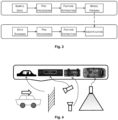
- Fig. 4 is a schematic diagram of data acquiring.
- data on an infrared curtain of a small passenger car, a visible light image of its head, a visible light image of its chassis, and a transmission image of its roof may be obtained in sequence, as illustrated.
- Information on the vehicle model will be depicted in details in these images.
- the entire data acquiring process may be triggered by an infrared curtain.
- an infrared curtain For example, when the curtain detects that there is an object passing, data collecting starts. Then, the vehicle's face, chassis and ray collection will also start.
- Data of the infrared curtain is collected in order to obtain the vehicle's side contour and the vehicle's length and height. It may be decided whether the vehicle is a small passenger car based on numerical values of the vehicle's length and height. If yes, the process may proceed with the subsequent steps. If not, no identification operation is performed. It should be appreciated that other means such as a magnetic sensor or a laser sensor and the like may be used to collect the vehicle's size information.
- a region between the vehicle's front fog lights is usually located at the intake grille panel area and is called the "vehicle face".
- vehicle face has clear appearance characteristics, and may effectively distinguish between manufacturers and may also distinguish between some series and models.
- a device for data acquisition is universal, and may be any common equipment of the current brands. Installation of various equipment should satisfy the following conditions: 1) infrared rays are projected in perpendicular to the vehicle's side in such a manner that at least the vehicle's side contour may be acquired (the side contour may at least include the vehicle's chassis); 2) an image of the vehicle's head includes at least a vehicle face, ,i.e., a vehicle logo and an intake grille parts, and an imaging between an imaging plane and a plate number plane is not greater than 45 degree; 3) in general, a chassis image is acquired by using a linear CCD camera; 4) the main perspective ray beam is perpendicular to the ground in such a manner that a top view transmission image of the vehicle is obtained so as to obtain the more complete internal structure information; and 5) a radar speed sensor is used to acquire the vehicle's speed in real time, for use in image correction.
- the data acquisition may include synchronization of various data.
- infrared rays are continuously projected.
- the collection procedure is triggered when rays encounter an obstruction.
- An absolute time of this moment is set as t0.
- a face collection device performs one shot at t0 , and starts to collect data with t0 as a reference between the chassis and rays.
- an absolution time of this moment is set as t1.
- the collection process stops and the chassis and perspective collection device stops the collection.
- Original data collected at one time may be set as O IR (infrared), O VF (vehicle face), O U (chassis) and O X (perspective), respectively. Except for O VF , other data is collected in frames. In each frame, a time of the frame relative to t0 as well as a vehicle real-time speed may be acquired.
- a vehicle chassis image may be used in vehicle model identification. However, this may have poor effect since the chassis may have obvious stain and is often equipped with a guard. In fact, information provided by the chassis can effectively distinguish between series and models and express a certain internal structure, and thus can be used as a kind of modality to improve identification precision.
- respective pre-processing process is performed on respective modality images.
- the pre-processing has two purposes: one is to normalize images, and the other one is to align the images.
- normalization means that a physical dimension represented by each pixel of each modality is unified.
- each pixel of each infrared image is 2cm*2cm
- each pixel of each vehicle face image represents 6mm*6mm
- each pixel of each chassis image identifies 1cm*1cm
- each pixel of each perspective image identifies 5mm*5mm.
- Alignment refers to that relative displacement of image contents in each modality is as small as possible. For example, for the same vehicle model, image contents should be made as consistent as possible.
- infrared data, chassis data and perspective data is all in a linear scanning manner, and is related to a vehicle speed.
- it is needed to correct an image by using a real-time vehicle speed, so as to achieve a purpose of dimension normalization.
- the obtained image may basically satisfy the dimension normalization condition.
- the pre-processing of the chassis image includes image gradient, i.e., merely maintaining edge information in the image without keeping its entire appearance.
- O IR , O U and O X may be scaled according to the corresponding timestamp and a vehicle real-time speed in such a manner that in each modality, each pixel has a unified physical dimension. Since the speed and time at each frame is known, the physical location of the current frame may be known, i.e., a location of the frame in the image can be obtained. After de-noising processing, a gradient operation is applied on the chassis image, to obtain an infrared image I IR , a chassis image I U , and a perspective image I X , respectively.
- the O VF image is subjected to geometric correction (correction parameters are acquired by the camera through manual correction before the data acquisition procedure) to obtain a parallel light projection image O' VF in a view of a vertical direction.
- Positioning the vehicle face is not involved in the present disclosure, and the related method may implement positioning through symmetry using a plate number and the like auxiliary information.
- O' VF is directly subjected to graying, a gradient map is found, a vertical projection is determined to find a symmetric axis, a moving window of 100*200 is employed to slide up and down with the symmetric axis as a center, and then a sum of absolute values of gradients in the window is found. During the sliding, there will be two maximal values, and the upper one is a desired location.
- a moving window at such a location is a normalized vehicle face image I VF .
- Fig. 5 shows a relation between processes of pre-processing and feature extraction.
- the individual categories of data contents are in the field of image and can thus be subjected to feature extraction using one single method.
- their respective features can be designed based on the characteristics of their modalities.
- the feature extraction can be performed using various appearance based human face identification algorithms, such as sub-space, multi-scale wavelet transform (e.g., Gabor features), Scale Invariant Feature Transform (SIFT), Bag of visual Word (BOW), and the like.
- the vehicle model data has its own specific characteristics.
- the features can be extracted based on the characteristics of modalities, respectively.
- features of an infrared image include the length, width and contour of a vehicle. These parameters can be easily extracted from the image.
- Major features of a vehicle face include a vehicle logo and an intake grille. These two features can be extracted separately or as a whole.
- An accurate extraction method should include: first detecting a position of the vehicle logo, extracting its SIFT feature, then removing the image at the position of the vehicle logo, and applying sub-space dimension reduction to the remaining portion for feature extraction. In order to increase the operation speed, preferably, a good effect can be obtained by applying a sub-space analysis to the entire vehicle face.
- the scheme to be used includes, but not limited to, linear schemes such as Principal Component Analyze (PCA), neural network schemes such as Auto Associative Network (ANN), probabilistic model such as Gaussian Process Latent Variable Model (GPLVM), and the like.
- PCA Principal Component Analyze
- ANN Auto Associative Network
- the chassis image has been pre-processed into a gradient image.
- Features of the gradient image include, but not limited to: 1) using the sub-space scheme in the above vehicle face feature extraction; 2) being described in form of edges after binarization; 3) using local projection features.
- the scheme 1 has poor effects on the gradient image and the scheme 2 has a low point matching speed and is thus not suitable for real time applications.
- the image is divided into a number of sub-images, e.g., into 6 non-overlapping sub-images uniformly, and the horizontal and vertical projections of each sub-image can be calculated.
- the 6*2 projections can be concatenated to form a feature vector.
- a perspective image can reflect the internal structure of the vehicle and is necessary for accurate identification. It is to be noted that the perspective image can also reflect some external feature, e.g., contour, of the vehicle. However, the present disclosure focuses on obtaining its internal features. For the perspective image, the extraction schemes for the vehicle face or chassis image can also be used. However, since the perspective image has a large size, in the present disclosure, preferably, its feature extraction is performed using a BOW model with local weights, which is characterized as follows. The perspective image is uniformly divided into a number of local regions each having its own BOW feature. These BOW features are weighted based on local importance, and concatenated or directly summed to form a perspective feature.
- the local importance is set manually or obtained by means of automatic learning and reflects a degree of importance of the local feature. For example, due to influence of clutters, the trunk of the vehicle has lower local importance than the head perspective. In general, the importance goes as head > side > body > rear.
- the respective modality features can be extracted using one single method, e.g., PCA or BOW, so as to extract all modality features. Further, all the modality images can be concatenated into one image for feature extraction as a whole.
- I IR is a binarized image.
- a connected region analysis is applied to the image to obtain a top air connected region.
- the bottom value of each column in this region is the contour value of the vehicle in that column.
- the contour C of the vehicle can be derived, which is a two-dimensional vector having a fixed length. For example, assuming that each pixel in the image is 2cm and each image has a reserved length of 5m, C is a 250-dimensional vector.
- the maximum value of C is the height H and the non-zero span of C is the length W of the vehicle. It is determined based on the height and the length whether the date should be subjected to subsequent calculation. For example, a vehicle that is too high or too long will be considered as a truck, or an object that is too low or too short will be considered as interference, which will not be calculated.
- I VF feature will be extracted using the PCA method.
- the effect of this method is to reduce the dimension of the data, improve the operation speed and avoid over-fitting. This algorithm is easy to implement and the description thereof will be omitted here.
- the extracted feature F is a one-dimensional vector. In this embodiment, a good effect can be achieved with 50 dimensions.
- I U is uniformly divided into 2*3 blocks. Without loss of generality, the size of I U is set to 200*600 and each block has a size of 100*200. For each sub-graph, accumulative horizontal and vertical projections are derived, with the numbers of projection dimensions of 100 and 200, respectively. The projections of the 6 sub-graphs are concatenated to obtain an 1800-dimensional vector, to which PCA analysis is applied to form a 100-dimensinoal chassis feature U.
- the perspective image I X is divided into a number of sub-blocks, e.g., 2*3 blocks.
- a BOW feature is obtained for each block.
- the BOW is a well-known algorithm and there are various implementations by open source codes such as opencv and vlfeat, and the description thereof will be omitted here.
- the number of dimensions for the BOW depends on the dictionary obtained by training. In order to achieve a high accuracy, the number of dimensions can be set to 1000. After that, an importance factor can be set manually for the BOW of each block. For example, two blocks for the head can be set to 3.0, two blocks for the middle can be set to 2.0, and two blocks for the rear can be set to 1.0.
- the final BOW is obtained by summing up products of the BOW features of the respective blocks with respective factors, finally resulting in a perspective feature vector X of 1000 dimensions.
- LDA Linear Discriminant Analyze
- LSVM Linear Support Vector Machine
- KNN non-linear Nearest Neighbors
- SVM Support Vector Machine
- DT Decision Tree
- Boosting can be implemented in some way.
- each modality is considered to be independent and can be recognized by means of information fusion, such as feature-level fusion and decision-level fusion policies.
- the fusion identification is achieved in a modality cascaded form. That is, the infrared feature, vehicle face feature, chassis feature and perspective feature are identified sequentially and the identification range is narrowed each time to finally achieve an accurate identification. In this way, the first three modalities can share samples in a certain range, so as to improve the identification rate. Similar to feature extraction, the identification classifiers can be constructed individually based on the characteristics of the respective modalities. In our experiment, the KNN and the Exemplar SVM (ESVM) can achieve good effects. Another advantage of them lies in incremental learning and the cost for online training is low during use of the model. Hence, they are preferable schemes.
- ESVM Exemplar SVM
- K-dimensional Tree Kd Tree
- hash coding K-dimensional Tree
- databases are created for the identification of each vehicle model, the individual modality features and the related classifiers, so as to create a correspondence for use in the identification.
- the Nearest Neighbors scheme is used for identification
- the Kd Tree fast searching algorithm is used for training.
- Kd Trees are created for the modalities, respectively and the models are saved.
- the final result of vehicle model identification can be obtained.
- existing training databases contain a large amount of vehicle model data and the set of databases can be represented as ⁇ C, F, U, X ⁇ and four different Kd trees corresponding to them.
- an unknown category of data is obtained, first its features are extracted to obtain its C, F, U, X features.
- parallel operations are adopted for fast identification. Thresholds can be set manually, or can be obtained automatically by learning. Different modalities may have different thresholds.
- Fig. 6 is a flowchart illustrating a vehicle inspection method according to an embodiment of the present disclosure. As shown in Fig. 6 , the steps S61, S62, S63, S64, S65 and S66 are the same as the steps S21, S22, S23, S24, S25 and S26 in the above Fig. 2 , respectively, and the details thereof will be omitted here.
- step S67 based on the determined vehicle model, a standard transmission image of the vehicle model is retrieved from the database.
- step S68 it is determined whether the vehicle contains something that is carried secretly by comparing the transmission image of the inspected vehicle with the standard transmission image.
- a changed region of the transmission image of the inspected vehicle relative to the standard transmission image can be determined and presented to the user. Further, the step of determining the changed region of the X-ray image relative to the template image includes: registering the X-ray image and the template image; calculating a difference between the registered X-ray image and template image. The step of presenting the changed region to the user includes highlighting the changed region in the transmission image.
- Examples of the signal carrier media comprise but not limited to: a recordable medium such as floppy disk, hard drive, compact disk (CD), digital versatile disk (DVD), digital tape, computer memory, etc.; and a transmission medium, such as digital and/or analog communication medium (for example, optical fiber, waveguide, wired communication link, wireless communication link, etc.)
- a recordable medium such as floppy disk, hard drive, compact disk (CD), digital versatile disk (DVD), digital tape, computer memory, etc.
- a transmission medium such as digital and/or analog communication medium (for example, optical fiber, waveguide, wired communication link, wireless communication link, etc.)
Landscapes
- Physics & Mathematics (AREA)
- General Physics & Mathematics (AREA)
- Engineering & Computer Science (AREA)
- Geophysics (AREA)
- Multimedia (AREA)
- Theoretical Computer Science (AREA)
- High Energy & Nuclear Physics (AREA)
- Life Sciences & Earth Sciences (AREA)
- General Life Sciences & Earth Sciences (AREA)
- Computer Vision & Pattern Recognition (AREA)
- Image Processing (AREA)
- Image Analysis (AREA)
- Traffic Control Systems (AREA)
Claims (15)
- Procédé d'identification de véhicule comprenant :l'acquisition d'informations d'apparence d'un véhicule inspecté (S21) et l'obtention de caractéristiques externes du véhicule sur la base des informations d'apparence (S22) ;l'acquisition d'une image aux rayons X du véhicule (S23) et l'obtention de caractéristiques internes du véhicule à partir de l'image aux rayons X (S24) ;la formation de descriptions sur le véhicule au moins sur la base des caractéristiques externes et des caractéristiques internes (S25) ;
etla détermination d'un modèle de véhicule du véhicule à partir d'une base de données de modèles de véhicule par utilisation des descriptions (S26) ; caractérisé en ce que les descriptions comportent des vecteurs caractéristiques formés par les caractéristiques externes et les caractéristiques internes. - Procédé selon la revendication 1, caractérisé en ce que ladite obtention de caractéristiques internes du véhicule à partir de l'image aux rayons X (S24) comprend :la division de l'image aux rayons X en une pluralité de sous-blocs d'image ;la réalisation d'une extraction de caractéristiques sur la pluralité de sous-blocs d'image ; etla réalisation d'une pondération d'importance sur des caractéristiques de chaque sous-bloc d'image pour former les caractéristiques internes du véhicule.
- Procédé selon la revendication 2, caractérisé en ce que l'avant du véhicule a une plus grande importance que le côté du véhicule.
- Procédé selon la revendication 1, caractérisé en ce que lesdites informations d'apparence incluent des informations de contour obtenues au moyen d'un capteur infrarouge et des informations de face et des informations de châssis du véhicule obtenues au moyen d'un capteur de lumière visible, et les caractéristiques externes incluent des caractéristiques de contour basées sur les informations de contour, des caractéristiques de face basées sur les informations de face et des caractéristiques de châssis basées sur les informations de châssis.
- Procédé selon la revendication 4, caractérisé en ce que le véhicule est identifié au moyen des caractéristiques de contour, des caractéristiques de face et des caractéristiques de châssis en séquence.
- Procédé selon la revendication 2, caractérisé en ce qu'une extraction de caractéristiques basées sur un modèle de sac de mots est réalisée sur la pluralité de sous-blocs d'image, et une pondération d'importance locale est réalisée sur les caractéristiques de modèle de sac de mots extraites pour former des caractéristiques de perspective au moyen d'une concaténation ou d'une sommation directe.
- Procédé selon la revendication 4, caractérisé en ce qu'une opération de gradient est appliquée sur l'image de châssis pour former une image gradient, puis des caractéristiques de projection locale de l'image gradient sont utilisées comme les caractéristiques de châssis.
- Procédé selon la revendication 7, caractérisé en ce que l'image gradient est divisée en une pluralité de sous-blocs d'image, et une projection horizontale, une projection verticale et/ou une projection inclinée des sous-blocs d'image sont respectivement calculées pour former des vecteurs caractéristiques comme les caractéristiques de châssis.
- Système d'identification de véhicule comprenant :un capteur (110) configuré pour détecter des informations d'apparence d'un véhicule inspecté ;un système d'imagerie par rayonnement (150) configuré pour réaliser un balayage de rayons sur le véhicule inspecté pour acquérir une image aux rayons X du véhicule ; etune unité de traitement d'image (140) configurée pour obtenir des caractéristiques externes du véhicule sur la base des informations d'apparence, pour obtenir des caractéristiques internes du véhicule à partir de l'image aux rayons X, pour former des descriptions sur le véhicule au moins sur la base des caractéristiques externes et des caractéristiques internes, et pour déterminer un modèle de véhicule du véhicule à partir d'une base de données de modèles de véhicule en utilisant les descriptions ; caractérisé en ce que les descriptions comportent des vecteurs caractéristiques formés par les caractéristiques externes et les caractéristiques internes.
- Système d'identification de véhicule selon la revendication 9, dans lequel l'unité de traitement d'image (140) est en outre configurée pour diviser l'image aux rayons X en une pluralité de sous-blocs d'image, réaliser une extraction de caractéristiques sur la pluralité de sous-blocs d'image, et réaliser une pondération d'importance sur les caractéristiques de chaque sous-bloc d'image pour former les caractéristiques internes du véhicule.
- Système d'identification de véhicule selon la revendication 10, dans lequel l'avant du véhicule a une plus grande importance que le côté du véhicule.
- Système d'identification de véhicule selon la revendication 9, dans lequel lesdites informations d'apparence incluent des informations de contour obtenues au moyen d'un capteur infrarouge et des informations de face et des informations de châssis du véhicule obtenues au moyen d'un capteur de lumière visible, et les caractéristiques externes incluent des caractéristiques de contour basées sur les informations de contour, des caractéristiques de face basées sur les informations de face et des caractéristiques de châssis basées sur les informations de châssis.
- Procédé d'identification de véhicule selon la revendication 1, caractérisé en ce qu'il comprend en outre :la détermination d'une image aux rayons X normale du modèle à partir d'une base de données au moyen du modèle déterminé (S67) ; etla détermination qu'il y a un entraînement ou non dans le véhicule par comparaison de l'image aux rayons X du véhicule inspecté avec l'image aux rayons X normale (S68).
- Procédé selon la revendication 13, caractérisé en ce qu'il comprend en outre :la détermination d'une région de changement de l'image aux rayons X du véhicule inspecté par rapport à l'image aux rayons X normale ; etla présentation de la région de changement à l'utilisateur.
- Procédé selon la revendication 14, caractérisé en ce que ladite détermination d'une région de changement de l'image aux rayons X du véhicule inspecté par rapport à l'image aux rayons X normale comprend :la réalisation d'un alignement sur l'image aux rayons X du véhicule inspecté et l'image aux rayons X normale ; etle calcul d'une différence entre l'image aux rayons X du véhicule inspecté et l'image aux rayons X normale.
Applications Claiming Priority (2)
| Application Number | Priority Date | Filing Date | Title |
|---|---|---|---|
| CN201410841346.4A CN105809088B (zh) | 2014-12-30 | 2014-12-30 | 车辆识别方法和系统 |
| PCT/CN2015/098439 WO2016107475A1 (fr) | 2014-12-30 | 2015-12-23 | Procédé et système d'identification de véhicule |
Publications (3)
| Publication Number | Publication Date |
|---|---|
| EP3128496A1 EP3128496A1 (fr) | 2017-02-08 |
| EP3128496A4 EP3128496A4 (fr) | 2018-01-10 |
| EP3128496B1 true EP3128496B1 (fr) | 2023-08-23 |
Family
ID=56284252
Family Applications (1)
| Application Number | Title | Priority Date | Filing Date |
|---|---|---|---|
| EP15875153.7A Active EP3128496B1 (fr) | 2014-12-30 | 2015-12-23 | Procédé et système d'identification de véhicule |
Country Status (5)
| Country | Link |
|---|---|
| US (1) | US10607483B2 (fr) |
| EP (1) | EP3128496B1 (fr) |
| CN (1) | CN105809088B (fr) |
| MY (1) | MY192514A (fr) |
| WO (1) | WO2016107475A1 (fr) |
Families Citing this family (37)
| Publication number | Priority date | Publication date | Assignee | Title |
|---|---|---|---|---|
| JP6685704B2 (ja) * | 2015-11-27 | 2020-04-22 | 株式会社東芝 | 車種判別装置および車種判別方法 |
| CN106153091A (zh) * | 2016-08-30 | 2016-11-23 | 北京华力兴科技发展有限责任公司 | 多维度车辆信息显示系统 |
| GB2556941B (en) * | 2016-11-28 | 2021-10-20 | Smiths Heimann Sas | Detection of irregularities using registration |
| CN107037493B (zh) * | 2016-12-16 | 2019-03-12 | 同方威视技术股份有限公司 | 安全检查系统和方法 |
| CN106651881B (zh) | 2016-12-28 | 2023-04-28 | 同方威视技术股份有限公司 | 车辆检查系统、车辆部位识别方法及系统 |
| CN106710230B (zh) * | 2017-01-24 | 2019-07-12 | 杨茂君 | 机动车车型分类自动识别系统及其所采用的识别方法 |
| CN106919925A (zh) * | 2017-03-07 | 2017-07-04 | 南京师范大学 | 一种基于小波熵与人工神经网络的福特汽车检测方法 |
| TWI640964B (zh) * | 2017-08-17 | 2018-11-11 | National Applied Research Laboratories | 以影像為基礎之車輛計數與分類系統 |
| CN120298994A (zh) * | 2017-11-21 | 2025-07-11 | 同方威视技术股份有限公司 | 车辆图像校正方法和装置、检查系统 |
| CN108039044B (zh) * | 2017-12-05 | 2021-06-01 | 安徽大学 | 基于多尺度卷积神经网络的车辆智能排队的系统及方法 |
| US10140553B1 (en) * | 2018-03-08 | 2018-11-27 | Capital One Services, Llc | Machine learning artificial intelligence system for identifying vehicles |
| CN109034145B (zh) * | 2018-07-06 | 2021-11-09 | 西安电子科技大学 | 基于OpenCV的银行卡号识别方法 |
| CN109145777A (zh) * | 2018-08-01 | 2019-01-04 | 北京旷视科技有限公司 | 车辆重识别方法、装置及系统 |
| CN109283593B (zh) * | 2018-11-26 | 2024-02-27 | 河北工业大学 | 车辆底盘检测系统和车辆底盘检测方法 |
| CN109614945A (zh) * | 2018-12-18 | 2019-04-12 | 杭州匹知共创科技有限公司 | 一种过滤环境干扰的车辆特征识别方法 |
| JP7261022B2 (ja) * | 2019-01-30 | 2023-04-19 | キヤノン株式会社 | 情報処理システム、端末装置及びその制御方法、プログラム、記憶媒体 |
| CN109637099A (zh) * | 2019-02-01 | 2019-04-16 | 广东工业大学 | 一种租赁式交通工具审验装置和方法 |
| CN109948610B (zh) * | 2019-03-14 | 2022-11-18 | 西南交通大学 | 一种基于深度学习的视频中车辆细粒度分类方法 |
| CN113841156B (zh) * | 2019-05-27 | 2024-06-28 | 西门子股份公司 | 基于图像识别的控制方法与装置 |
| CN110956093A (zh) * | 2019-11-08 | 2020-04-03 | 武汉东湖大数据交易中心股份有限公司 | 基于大数据的模型识别方法、装置、设备及介质 |
| CN111259960A (zh) * | 2020-01-16 | 2020-06-09 | 东华理工大学 | 基于pca与自适应哈希保留集的svm增量学习算法名称 |
| US11694546B2 (en) * | 2020-03-31 | 2023-07-04 | Uber Technologies, Inc. | Systems and methods for automatically assigning vehicle identifiers for vehicles |
| CN111666853B (zh) * | 2020-05-28 | 2023-06-02 | 平安科技(深圳)有限公司 | 实时车辆违章检测方法、装置、设备及存储介质 |
| CN117092713A (zh) * | 2020-05-28 | 2023-11-21 | 同方威视技术股份有限公司 | 建立车辆模板库的方法和系统 |
| CN113791459B (zh) * | 2020-05-29 | 2022-11-01 | 同方威视技术股份有限公司 | 安检设备调试方法、装置、安检方法和设备 |
| CN112562344A (zh) * | 2020-11-26 | 2021-03-26 | 东南大学 | 一种高速公路多车道自由流信号防干扰方法及装置 |
| CN112697066A (zh) * | 2020-12-02 | 2021-04-23 | 王刚 | 车辆部件定位方法、装置及计算机存储介质 |
| CN114648713B (zh) * | 2020-12-18 | 2024-10-29 | 抖音视界有限公司 | 视频分类方法、装置、电子设备及计算机可读存储介质 |
| CN114690260A (zh) * | 2020-12-31 | 2022-07-01 | 同方威视技术股份有限公司 | 车辆安全检查系统和安全检查方法 |
| CN114764585A (zh) * | 2020-12-31 | 2022-07-19 | 深圳爱酷智能科技有限公司 | 不同设备间生物特征模板互用的方法、装置、介质及设备 |
| KR20220130398A (ko) * | 2021-03-18 | 2022-09-27 | 현대자동차주식회사 | 차량 검사 장치 및 차량의 검사 방법 |
| CN114049580B (zh) * | 2021-08-05 | 2025-10-21 | 北京首都国际机场股份有限公司 | 一种机坪航空器定位系统 |
| JP7657171B2 (ja) * | 2022-03-16 | 2025-04-04 | 三菱電機株式会社 | 車型判別装置、車型判別方法及び車型判別プログラム |
| CN114722500B (zh) * | 2022-04-15 | 2025-07-25 | 东风柳州汽车有限公司 | 车辆外观优化方法、装置、设备及存储介质 |
| CN116503619A (zh) * | 2023-05-06 | 2023-07-28 | 上海平奥供应链管理有限公司 | 铁路货车的装载检测方法、装置、电子设备及存储介质 |
| CN116767146B (zh) * | 2023-06-30 | 2025-11-21 | 上海巴兰仕汽车检测设备股份有限公司 | 车型的智能识别系统 |
| CN117849891B (zh) * | 2023-12-20 | 2024-11-08 | 郑州工程技术学院 | 针对射线的在线检测方法及系统 |
Family Cites Families (38)
| Publication number | Priority date | Publication date | Assignee | Title |
|---|---|---|---|---|
| JPH05225490A (ja) * | 1992-02-07 | 1993-09-03 | Toshiba Corp | 車種判別装置 |
| AU1084397A (en) * | 1995-12-01 | 1997-06-19 | Southwest Research Institute | Methods and apparatus for traffic incident detection |
| JP3206414B2 (ja) * | 1996-01-10 | 2001-09-10 | トヨタ自動車株式会社 | 車種判別装置 |
| US7725348B1 (en) * | 2001-10-17 | 2010-05-25 | United Toll Systems, Inc. | Multilane vehicle information capture system |
| US6775346B2 (en) * | 2002-10-21 | 2004-08-10 | Koninklijke Philips Electronics N.V. | Conebeam computed tomography imaging |
| US7596275B1 (en) | 2004-03-01 | 2009-09-29 | Science Applications International Corporation | Methods and systems for imaging and classifying targets as empty or non-empty |
| US20050267657A1 (en) * | 2004-05-04 | 2005-12-01 | Devdhar Prashant P | Method for vehicle classification |
| SG121906A1 (en) * | 2004-10-11 | 2006-05-26 | Stratech Systems Ltd | Intelligent vehicle access control system |
| US7889931B2 (en) * | 2004-10-22 | 2011-02-15 | Gb Investments, Inc. | Systems and methods for automated vehicle image acquisition, analysis, and reporting |
| JP4268208B2 (ja) * | 2005-02-03 | 2009-05-27 | 富士通株式会社 | 車両画像データ生成プログラムおよび車両画像データ生成装置 |
| US20070009136A1 (en) * | 2005-06-30 | 2007-01-11 | Ivan Pawlenko | Digital imaging for vehicular and other security applications |
| US20070229307A1 (en) * | 2006-03-31 | 2007-10-04 | Ivan Pawlenko | Detection technology for vehicular and other security applications |
| CN100588959C (zh) * | 2006-10-10 | 2010-02-10 | 同方威视技术股份有限公司 | 基于辐射图像变动检测的小型车辆夹带物自动检测方法 |
| CN101162507B (zh) * | 2006-10-13 | 2010-05-12 | 同方威视技术股份有限公司 | 一种对移动车辆进行车型识别的方法 |
| US8478480B2 (en) * | 2006-10-27 | 2013-07-02 | International Electronic Machines Corp. | Vehicle evaluation using infrared data |
| GB2443664A (en) * | 2006-11-10 | 2008-05-14 | Autoliv Dev | An infra red object detection system de-emphasizing non relevant hot objects |
| US8605947B2 (en) * | 2008-04-24 | 2013-12-10 | GM Global Technology Operations LLC | Method for detecting a clear path of travel for a vehicle enhanced by object detection |
| EP2347238B1 (fr) * | 2008-10-22 | 2018-05-16 | International Electronic Machines Corp. | Analyse de véhicules à base d'imagerie thermique |
| US8311343B2 (en) * | 2009-02-12 | 2012-11-13 | Laser Technology, Inc. | Vehicle classification by image processing with laser range finder |
| US8243985B2 (en) * | 2010-02-05 | 2012-08-14 | Seiko Epson Corporation | Bit pattern design for visible watermarking |
| JP5505723B2 (ja) * | 2010-03-31 | 2014-05-28 | アイシン・エィ・ダブリュ株式会社 | 画像処理システム及び位置測位システム |
| US8364439B2 (en) * | 2010-07-09 | 2013-01-29 | Raytheon Company | System and method for detection of concealed cargo in a vehicle by center of mass measurement |
| CN102568214A (zh) * | 2010-12-21 | 2012-07-11 | 数伦计算机技术(上海)有限公司 | 一种探测混有无rfid车辆的车辆顺序的方法 |
| US9341687B2 (en) * | 2011-02-22 | 2016-05-17 | The Mitre Corporation | Classifying and identifying materials based on permittivity features |
| CN103518230B (zh) * | 2011-03-14 | 2017-02-22 | 加州大学评议会 | 用于车辆分类的方法和系统 |
| US8787682B2 (en) * | 2011-03-22 | 2014-07-22 | Nec Laboratories America, Inc. | Fast image classification by vocabulary tree based image retrieval |
| WO2012142456A2 (fr) * | 2011-04-15 | 2012-10-18 | American Science And Engineering, Inc. | Système de rétrodiffusion avec réseau de détecteurs de taille variable |
| CN102565872A (zh) * | 2012-03-02 | 2012-07-11 | 洛阳圣瑞机电技术有限公司 | 基于线阵ccd的汽车底盘图像采集装置 |
| US9373033B2 (en) * | 2012-03-13 | 2016-06-21 | Massachusetts Institute Of Technology | Assisted surveillance of vehicles-of-interest |
| CN202853581U (zh) * | 2012-11-05 | 2013-04-03 | 宋怀淳 | 一种提取移动车辆轮廓以识别车型的装置 |
| DE102012113009A1 (de) * | 2012-12-21 | 2014-06-26 | Jenoptik Robot Gmbh | Verfahren zum automatischen Klassifizieren von sich bewegenden Fahrzeugen |
| US9183746B2 (en) * | 2013-03-12 | 2015-11-10 | Xerox Corporation | Single camera video-based speed enforcement system with a secondary auxiliary RGB traffic camera |
| CN103324920A (zh) * | 2013-06-27 | 2013-09-25 | 华南理工大学 | 基于车辆正面图像与模板匹配的车型自动识别方法 |
| US9412031B2 (en) * | 2013-10-16 | 2016-08-09 | Xerox Corporation | Delayed vehicle identification for privacy enforcement |
| US10324223B2 (en) * | 2014-06-24 | 2019-06-18 | Mohammed Al-Hoshani | Method, an apparatus, and a system for automated inspection of motorized vehicles |
| CN203981903U (zh) * | 2014-07-04 | 2014-12-03 | 同方威视技术股份有限公司 | 基于分布式辐射源的x射线背散射通道式车辆安检系统 |
| US9710729B2 (en) * | 2014-09-04 | 2017-07-18 | Xerox Corporation | Domain adaptation for image classification with class priors |
| CN104391339B (zh) * | 2014-12-17 | 2018-02-09 | 同方威视技术股份有限公司 | 车型识别方法以及利用该方法的车辆快速检查系统 |
-
2014
- 2014-12-30 CN CN201410841346.4A patent/CN105809088B/zh active Active
-
2015
- 2015-12-23 WO PCT/CN2015/098439 patent/WO2016107475A1/fr not_active Ceased
- 2015-12-23 MY MYPI2016703610A patent/MY192514A/en unknown
- 2015-12-23 EP EP15875153.7A patent/EP3128496B1/fr active Active
- 2015-12-23 US US15/300,947 patent/US10607483B2/en active Active
Also Published As
| Publication number | Publication date |
|---|---|
| EP3128496A4 (fr) | 2018-01-10 |
| EP3128496A1 (fr) | 2017-02-08 |
| US20170294118A1 (en) | 2017-10-12 |
| CN105809088A (zh) | 2016-07-27 |
| WO2016107475A1 (fr) | 2016-07-07 |
| CN105809088B (zh) | 2019-07-19 |
| MY192514A (en) | 2022-08-24 |
| US10607483B2 (en) | 2020-03-31 |
Similar Documents
| Publication | Publication Date | Title |
|---|---|---|
| EP3128496B1 (fr) | Procédé et système d'identification de véhicule | |
| US7853072B2 (en) | System and method for detecting still objects in images | |
| Tsai et al. | Vehicle detection using normalized color and edge map | |
| Nedevschi et al. | Stereo-based pedestrian detection for collision-avoidance applications | |
| Bappy et al. | CNN based region proposals for efficient object detection | |
| US9639748B2 (en) | Method for detecting persons using 1D depths and 2D texture | |
| Ogale | A survey of techniques for human detection from video | |
| US20100054535A1 (en) | Video Object Classification | |
| CN103366154A (zh) | 可重配置的畅通路径检测系统 | |
| CN106295564A (zh) | 一种邻域高斯结构和视频特征融合的动作识别方法 | |
| Boumediene et al. | Triangular traffic signs detection based on RSLD algorithm | |
| Lee et al. | Near-infrared-based nighttime pedestrian detection using grouped part models | |
| US20130259371A1 (en) | Appearance and Context Based Object Classification in Images | |
| US11238304B2 (en) | System and method for biometric identification | |
| Ram et al. | Vehicle detection in aerial images using multiscale structure enhancement and symmetry | |
| Singh et al. | Obstacle detection techniques in outdoor environment: process, study and analysis | |
| US9064156B2 (en) | Pattern discriminating apparatus | |
| Kataoka et al. | Extended feature descriptor and vehicle motion model with tracking-by-detection for pedestrian active safety | |
| Oliveira et al. | Pedestrian detection based on LIDAR-driven sliding window and relational parts-based detection | |
| Borgmann et al. | Usage of multiple LiDAR sensors on a mobile system for the detection of persons with implicit shape models | |
| Choudhury et al. | Human detection using orientation shape histogram and coocurrence textures | |
| Del Bimbo et al. | Person detection using temporal and geometric context with a pan tilt zoom camera | |
| Ghasemi et al. | Evaluating Sector Ring Histogram of Oriented Gradients Filter in Locating Humans Within Uav Images | |
| KR102517054B1 (ko) | 원통형 컨볼루션 네트워크 연산 장치와 이를 이용한 객체 인식 및 시점 추정장치 및 방법 | |
| Shibayama et al. | On-board pedestrian detection by the motion and the cascaded classifiers |
Legal Events
| Date | Code | Title | Description |
|---|---|---|---|
| PUAI | Public reference made under article 153(3) epc to a published international application that has entered the european phase |
Free format text: ORIGINAL CODE: 0009012 |
|
| STAA | Information on the status of an ep patent application or granted ep patent |
Free format text: STATUS: REQUEST FOR EXAMINATION WAS MADE |
|
| 17P | Request for examination filed |
Effective date: 20160930 |
|
| AK | Designated contracting states |
Kind code of ref document: A1 Designated state(s): AL AT BE BG CH CY CZ DE DK EE ES FI FR GB GR HR HU IE IS IT LI LT LU LV MC MK MT NL NO PL PT RO RS SE SI SK SM TR |
|
| AX | Request for extension of the european patent |
Extension state: BA ME |
|
| A4 | Supplementary search report drawn up and despatched |
Effective date: 20171211 |
|
| RIC1 | Information provided on ipc code assigned before grant |
Ipc: G01V 5/00 20060101ALI20171205BHEP Ipc: G08G 1/017 20060101AFI20171205BHEP Ipc: G06K 9/46 20060101ALI20171205BHEP |
|
| DAV | Request for validation of the european patent (deleted) | ||
| DAX | Request for extension of the european patent (deleted) | ||
| STAA | Information on the status of an ep patent application or granted ep patent |
Free format text: STATUS: EXAMINATION IS IN PROGRESS |
|
| 17Q | First examination report despatched |
Effective date: 20210407 |
|
| RIC1 | Information provided on ipc code assigned before grant |
Ipc: G01V 5/00 20060101ALI20230120BHEP Ipc: G08G 1/017 20060101AFI20230120BHEP |
|
| GRAP | Despatch of communication of intention to grant a patent |
Free format text: ORIGINAL CODE: EPIDOSNIGR1 |
|
| STAA | Information on the status of an ep patent application or granted ep patent |
Free format text: STATUS: GRANT OF PATENT IS INTENDED |
|
| INTG | Intention to grant announced |
Effective date: 20230309 |
|
| GRAS | Grant fee paid |
Free format text: ORIGINAL CODE: EPIDOSNIGR3 |
|
| GRAA | (expected) grant |
Free format text: ORIGINAL CODE: 0009210 |
|
| STAA | Information on the status of an ep patent application or granted ep patent |
Free format text: STATUS: THE PATENT HAS BEEN GRANTED |
|
| AK | Designated contracting states |
Kind code of ref document: B1 Designated state(s): AL AT BE BG CH CY CZ DE DK EE ES FI FR GB GR HR HU IE IS IT LI LT LU LV MC MK MT NL NO PL PT RO RS SE SI SK SM TR |
|
| REG | Reference to a national code |
Ref country code: GB Ref legal event code: FG4D |
|
| REG | Reference to a national code |
Ref country code: CH Ref legal event code: EP |
|
| REG | Reference to a national code |
Ref country code: DE Ref legal event code: R096 Ref document number: 602015085325 Country of ref document: DE |
|
| REG | Reference to a national code |
Ref country code: IE Ref legal event code: FG4D |
|
| REG | Reference to a national code |
Ref country code: LT Ref legal event code: MG9D |
|
| REG | Reference to a national code |
Ref country code: NL Ref legal event code: MP Effective date: 20230823 |
|
| REG | Reference to a national code |
Ref country code: AT Ref legal event code: MK05 Ref document number: 1603537 Country of ref document: AT Kind code of ref document: T Effective date: 20230823 |
|
| P01 | Opt-out of the competence of the unified patent court (upc) registered |
Effective date: 20231208 |
|
| PG25 | Lapsed in a contracting state [announced via postgrant information from national office to epo] |
Ref country code: GR Free format text: LAPSE BECAUSE OF FAILURE TO SUBMIT A TRANSLATION OF THE DESCRIPTION OR TO PAY THE FEE WITHIN THE PRESCRIBED TIME-LIMIT Effective date: 20231124 |
|
| PG25 | Lapsed in a contracting state [announced via postgrant information from national office to epo] |
Ref country code: IS Free format text: LAPSE BECAUSE OF FAILURE TO SUBMIT A TRANSLATION OF THE DESCRIPTION OR TO PAY THE FEE WITHIN THE PRESCRIBED TIME-LIMIT Effective date: 20231223 |
|
| PG25 | Lapsed in a contracting state [announced via postgrant information from national office to epo] |
Ref country code: SE Free format text: LAPSE BECAUSE OF FAILURE TO SUBMIT A TRANSLATION OF THE DESCRIPTION OR TO PAY THE FEE WITHIN THE PRESCRIBED TIME-LIMIT Effective date: 20230823 Ref country code: RS Free format text: LAPSE BECAUSE OF FAILURE TO SUBMIT A TRANSLATION OF THE DESCRIPTION OR TO PAY THE FEE WITHIN THE PRESCRIBED TIME-LIMIT Effective date: 20230823 Ref country code: PT Free format text: LAPSE BECAUSE OF FAILURE TO SUBMIT A TRANSLATION OF THE DESCRIPTION OR TO PAY THE FEE WITHIN THE PRESCRIBED TIME-LIMIT Effective date: 20231226 Ref country code: NO Free format text: LAPSE BECAUSE OF FAILURE TO SUBMIT A TRANSLATION OF THE DESCRIPTION OR TO PAY THE FEE WITHIN THE PRESCRIBED TIME-LIMIT Effective date: 20231123 Ref country code: NL Free format text: LAPSE BECAUSE OF FAILURE TO SUBMIT A TRANSLATION OF THE DESCRIPTION OR TO PAY THE FEE WITHIN THE PRESCRIBED TIME-LIMIT Effective date: 20230823 Ref country code: LV Free format text: LAPSE BECAUSE OF FAILURE TO SUBMIT A TRANSLATION OF THE DESCRIPTION OR TO PAY THE FEE WITHIN THE PRESCRIBED TIME-LIMIT Effective date: 20230823 Ref country code: LT Free format text: LAPSE BECAUSE OF FAILURE TO SUBMIT A TRANSLATION OF THE DESCRIPTION OR TO PAY THE FEE WITHIN THE PRESCRIBED TIME-LIMIT Effective date: 20230823 Ref country code: IS Free format text: LAPSE BECAUSE OF FAILURE TO SUBMIT A TRANSLATION OF THE DESCRIPTION OR TO PAY THE FEE WITHIN THE PRESCRIBED TIME-LIMIT Effective date: 20231223 Ref country code: HR Free format text: LAPSE BECAUSE OF FAILURE TO SUBMIT A TRANSLATION OF THE DESCRIPTION OR TO PAY THE FEE WITHIN THE PRESCRIBED TIME-LIMIT Effective date: 20230823 Ref country code: GR Free format text: LAPSE BECAUSE OF FAILURE TO SUBMIT A TRANSLATION OF THE DESCRIPTION OR TO PAY THE FEE WITHIN THE PRESCRIBED TIME-LIMIT Effective date: 20231124 Ref country code: FI Free format text: LAPSE BECAUSE OF FAILURE TO SUBMIT A TRANSLATION OF THE DESCRIPTION OR TO PAY THE FEE WITHIN THE PRESCRIBED TIME-LIMIT Effective date: 20230823 Ref country code: AT Free format text: LAPSE BECAUSE OF FAILURE TO SUBMIT A TRANSLATION OF THE DESCRIPTION OR TO PAY THE FEE WITHIN THE PRESCRIBED TIME-LIMIT Effective date: 20230823 |
|
| PG25 | Lapsed in a contracting state [announced via postgrant information from national office to epo] |
Ref country code: PL Free format text: LAPSE BECAUSE OF FAILURE TO SUBMIT A TRANSLATION OF THE DESCRIPTION OR TO PAY THE FEE WITHIN THE PRESCRIBED TIME-LIMIT Effective date: 20230823 |
|
| PG25 | Lapsed in a contracting state [announced via postgrant information from national office to epo] |
Ref country code: ES Free format text: LAPSE BECAUSE OF FAILURE TO SUBMIT A TRANSLATION OF THE DESCRIPTION OR TO PAY THE FEE WITHIN THE PRESCRIBED TIME-LIMIT Effective date: 20230823 |
|
| PG25 | Lapsed in a contracting state [announced via postgrant information from national office to epo] |
Ref country code: SM Free format text: LAPSE BECAUSE OF FAILURE TO SUBMIT A TRANSLATION OF THE DESCRIPTION OR TO PAY THE FEE WITHIN THE PRESCRIBED TIME-LIMIT Effective date: 20230823 Ref country code: RO Free format text: LAPSE BECAUSE OF FAILURE TO SUBMIT A TRANSLATION OF THE DESCRIPTION OR TO PAY THE FEE WITHIN THE PRESCRIBED TIME-LIMIT Effective date: 20230823 Ref country code: ES Free format text: LAPSE BECAUSE OF FAILURE TO SUBMIT A TRANSLATION OF THE DESCRIPTION OR TO PAY THE FEE WITHIN THE PRESCRIBED TIME-LIMIT Effective date: 20230823 Ref country code: EE Free format text: LAPSE BECAUSE OF FAILURE TO SUBMIT A TRANSLATION OF THE DESCRIPTION OR TO PAY THE FEE WITHIN THE PRESCRIBED TIME-LIMIT Effective date: 20230823 Ref country code: DK Free format text: LAPSE BECAUSE OF FAILURE TO SUBMIT A TRANSLATION OF THE DESCRIPTION OR TO PAY THE FEE WITHIN THE PRESCRIBED TIME-LIMIT Effective date: 20230823 Ref country code: CZ Free format text: LAPSE BECAUSE OF FAILURE TO SUBMIT A TRANSLATION OF THE DESCRIPTION OR TO PAY THE FEE WITHIN THE PRESCRIBED TIME-LIMIT Effective date: 20230823 Ref country code: SK Free format text: LAPSE BECAUSE OF FAILURE TO SUBMIT A TRANSLATION OF THE DESCRIPTION OR TO PAY THE FEE WITHIN THE PRESCRIBED TIME-LIMIT Effective date: 20230823 |
|
| REG | Reference to a national code |
Ref country code: DE Ref legal event code: R097 Ref document number: 602015085325 Country of ref document: DE |
|
| PG25 | Lapsed in a contracting state [announced via postgrant information from national office to epo] |
Ref country code: IT Free format text: LAPSE BECAUSE OF FAILURE TO SUBMIT A TRANSLATION OF THE DESCRIPTION OR TO PAY THE FEE WITHIN THE PRESCRIBED TIME-LIMIT Effective date: 20230823 |
|
| PLBE | No opposition filed within time limit |
Free format text: ORIGINAL CODE: 0009261 |
|
| STAA | Information on the status of an ep patent application or granted ep patent |
Free format text: STATUS: NO OPPOSITION FILED WITHIN TIME LIMIT |
|
| REG | Reference to a national code |
Ref country code: DE Ref legal event code: R119 Ref document number: 602015085325 Country of ref document: DE |
|
| 26N | No opposition filed |
Effective date: 20240524 |
|
| PG25 | Lapsed in a contracting state [announced via postgrant information from national office to epo] |
Ref country code: SI Free format text: LAPSE BECAUSE OF FAILURE TO SUBMIT A TRANSLATION OF THE DESCRIPTION OR TO PAY THE FEE WITHIN THE PRESCRIBED TIME-LIMIT Effective date: 20230823 |
|
| REG | Reference to a national code |
Ref country code: CH Ref legal event code: PL |
|
| PG25 | Lapsed in a contracting state [announced via postgrant information from national office to epo] |
Ref country code: LU Free format text: LAPSE BECAUSE OF NON-PAYMENT OF DUE FEES Effective date: 20231223 |
|
| PG25 | Lapsed in a contracting state [announced via postgrant information from national office to epo] |
Ref country code: MC Free format text: LAPSE BECAUSE OF FAILURE TO SUBMIT A TRANSLATION OF THE DESCRIPTION OR TO PAY THE FEE WITHIN THE PRESCRIBED TIME-LIMIT Effective date: 20230823 |
|
| REG | Reference to a national code |
Ref country code: BE Ref legal event code: MM Effective date: 20231231 |
|
| PG25 | Lapsed in a contracting state [announced via postgrant information from national office to epo] |
Ref country code: MC Free format text: LAPSE BECAUSE OF FAILURE TO SUBMIT A TRANSLATION OF THE DESCRIPTION OR TO PAY THE FEE WITHIN THE PRESCRIBED TIME-LIMIT Effective date: 20230823 Ref country code: LU Free format text: LAPSE BECAUSE OF NON-PAYMENT OF DUE FEES Effective date: 20231223 |
|
| REG | Reference to a national code |
Ref country code: IE Ref legal event code: MM4A |
|
| PG25 | Lapsed in a contracting state [announced via postgrant information from national office to epo] |
Ref country code: DE Free format text: LAPSE BECAUSE OF NON-PAYMENT OF DUE FEES Effective date: 20240702 Ref country code: IE Free format text: LAPSE BECAUSE OF NON-PAYMENT OF DUE FEES Effective date: 20231223 |
|
| PG25 | Lapsed in a contracting state [announced via postgrant information from national office to epo] |
Ref country code: BE Free format text: LAPSE BECAUSE OF NON-PAYMENT OF DUE FEES Effective date: 20231231 |
|
| PG25 | Lapsed in a contracting state [announced via postgrant information from national office to epo] |
Ref country code: CH Free format text: LAPSE BECAUSE OF NON-PAYMENT OF DUE FEES Effective date: 20231231 |
|
| PG25 | Lapsed in a contracting state [announced via postgrant information from national office to epo] |
Ref country code: IE Free format text: LAPSE BECAUSE OF NON-PAYMENT OF DUE FEES Effective date: 20231223 Ref country code: DE Free format text: LAPSE BECAUSE OF NON-PAYMENT OF DUE FEES Effective date: 20240702 Ref country code: CH Free format text: LAPSE BECAUSE OF NON-PAYMENT OF DUE FEES Effective date: 20231231 Ref country code: BE Free format text: LAPSE BECAUSE OF NON-PAYMENT OF DUE FEES Effective date: 20231231 |
|
| PG25 | Lapsed in a contracting state [announced via postgrant information from national office to epo] |
Ref country code: BG Free format text: LAPSE BECAUSE OF FAILURE TO SUBMIT A TRANSLATION OF THE DESCRIPTION OR TO PAY THE FEE WITHIN THE PRESCRIBED TIME-LIMIT Effective date: 20230823 |
|
| PG25 | Lapsed in a contracting state [announced via postgrant information from national office to epo] |
Ref country code: BG Free format text: LAPSE BECAUSE OF FAILURE TO SUBMIT A TRANSLATION OF THE DESCRIPTION OR TO PAY THE FEE WITHIN THE PRESCRIBED TIME-LIMIT Effective date: 20230823 |
|
| PGFP | Annual fee paid to national office [announced via postgrant information from national office to epo] |
Ref country code: FR Payment date: 20241108 Year of fee payment: 10 |
|
| PG25 | Lapsed in a contracting state [announced via postgrant information from national office to epo] |
Ref country code: CY Free format text: LAPSE BECAUSE OF FAILURE TO SUBMIT A TRANSLATION OF THE DESCRIPTION OR TO PAY THE FEE WITHIN THE PRESCRIBED TIME-LIMIT; INVALID AB INITIO Effective date: 20151223 |
|
| PG25 | Lapsed in a contracting state [announced via postgrant information from national office to epo] |
Ref country code: HU Free format text: LAPSE BECAUSE OF FAILURE TO SUBMIT A TRANSLATION OF THE DESCRIPTION OR TO PAY THE FEE WITHIN THE PRESCRIBED TIME-LIMIT; INVALID AB INITIO Effective date: 20151223 |
|
| PG25 | Lapsed in a contracting state [announced via postgrant information from national office to epo] |
Ref country code: TR Free format text: LAPSE BECAUSE OF FAILURE TO SUBMIT A TRANSLATION OF THE DESCRIPTION OR TO PAY THE FEE WITHIN THE PRESCRIBED TIME-LIMIT Effective date: 20230823 |
|
| PGFP | Annual fee paid to national office [announced via postgrant information from national office to epo] |
Ref country code: GB Payment date: 20251111 Year of fee payment: 11 |