EP3128643A1 - System zur drahtlosen stromversorgung während der bewegung - Google Patents
System zur drahtlosen stromversorgung während der bewegung Download PDFInfo
- Publication number
- EP3128643A1 EP3128643A1 EP14884347.7A EP14884347A EP3128643A1 EP 3128643 A1 EP3128643 A1 EP 3128643A1 EP 14884347 A EP14884347 A EP 14884347A EP 3128643 A1 EP3128643 A1 EP 3128643A1
- Authority
- EP
- European Patent Office
- Prior art keywords
- power supply
- primary
- transformers
- primary power
- series
- Prior art date
- Legal status (The legal status is an assumption and is not a legal conclusion. Google has not performed a legal analysis and makes no representation as to the accuracy of the status listed.)
- Withdrawn
Links
Images





Classifications
-
- B—PERFORMING OPERATIONS; TRANSPORTING
- B60—VEHICLES IN GENERAL
- B60L—PROPULSION OF ELECTRICALLY-PROPELLED VEHICLES; SUPPLYING ELECTRIC POWER FOR AUXILIARY EQUIPMENT OF ELECTRICALLY-PROPELLED VEHICLES; ELECTRODYNAMIC BRAKE SYSTEMS FOR VEHICLES IN GENERAL; MAGNETIC SUSPENSION OR LEVITATION FOR VEHICLES; MONITORING OPERATING VARIABLES OF ELECTRICALLY-PROPELLED VEHICLES; ELECTRIC SAFETY DEVICES FOR ELECTRICALLY-PROPELLED VEHICLES
- B60L5/00—Current collectors for power supply lines of electrically-propelled vehicles
- B60L5/005—Current collectors for power supply lines of electrically-propelled vehicles without mechanical contact between the collector and the power supply line
-
- B—PERFORMING OPERATIONS; TRANSPORTING
- B60—VEHICLES IN GENERAL
- B60L—PROPULSION OF ELECTRICALLY-PROPELLED VEHICLES; SUPPLYING ELECTRIC POWER FOR AUXILIARY EQUIPMENT OF ELECTRICALLY-PROPELLED VEHICLES; ELECTRODYNAMIC BRAKE SYSTEMS FOR VEHICLES IN GENERAL; MAGNETIC SUSPENSION OR LEVITATION FOR VEHICLES; MONITORING OPERATING VARIABLES OF ELECTRICALLY-PROPELLED VEHICLES; ELECTRIC SAFETY DEVICES FOR ELECTRICALLY-PROPELLED VEHICLES
- B60L53/00—Methods of charging batteries, specially adapted for electric vehicles; Charging stations or on-board charging equipment therefor; Exchange of energy storage elements in electric vehicles
- B60L53/10—Methods of charging batteries, specially adapted for electric vehicles; Charging stations or on-board charging equipment therefor; Exchange of energy storage elements in electric vehicles characterised by the energy transfer between the charging station and the vehicle
- B60L53/12—Inductive energy transfer
-
- B—PERFORMING OPERATIONS; TRANSPORTING
- B60—VEHICLES IN GENERAL
- B60L—PROPULSION OF ELECTRICALLY-PROPELLED VEHICLES; SUPPLYING ELECTRIC POWER FOR AUXILIARY EQUIPMENT OF ELECTRICALLY-PROPELLED VEHICLES; ELECTRODYNAMIC BRAKE SYSTEMS FOR VEHICLES IN GENERAL; MAGNETIC SUSPENSION OR LEVITATION FOR VEHICLES; MONITORING OPERATING VARIABLES OF ELECTRICALLY-PROPELLED VEHICLES; ELECTRIC SAFETY DEVICES FOR ELECTRICALLY-PROPELLED VEHICLES
- B60L53/00—Methods of charging batteries, specially adapted for electric vehicles; Charging stations or on-board charging equipment therefor; Exchange of energy storage elements in electric vehicles
- B60L53/10—Methods of charging batteries, specially adapted for electric vehicles; Charging stations or on-board charging equipment therefor; Exchange of energy storage elements in electric vehicles characterised by the energy transfer between the charging station and the vehicle
- B60L53/12—Inductive energy transfer
- B60L53/122—Circuits or methods for driving the primary coil, e.g. supplying electric power to the coil
-
- B—PERFORMING OPERATIONS; TRANSPORTING
- B60—VEHICLES IN GENERAL
- B60L—PROPULSION OF ELECTRICALLY-PROPELLED VEHICLES; SUPPLYING ELECTRIC POWER FOR AUXILIARY EQUIPMENT OF ELECTRICALLY-PROPELLED VEHICLES; ELECTRODYNAMIC BRAKE SYSTEMS FOR VEHICLES IN GENERAL; MAGNETIC SUSPENSION OR LEVITATION FOR VEHICLES; MONITORING OPERATING VARIABLES OF ELECTRICALLY-PROPELLED VEHICLES; ELECTRIC SAFETY DEVICES FOR ELECTRICALLY-PROPELLED VEHICLES
- B60L53/00—Methods of charging batteries, specially adapted for electric vehicles; Charging stations or on-board charging equipment therefor; Exchange of energy storage elements in electric vehicles
- B60L53/20—Methods of charging batteries, specially adapted for electric vehicles; Charging stations or on-board charging equipment therefor; Exchange of energy storage elements in electric vehicles characterised by converters located in the vehicle
-
- B—PERFORMING OPERATIONS; TRANSPORTING
- B60—VEHICLES IN GENERAL
- B60M—POWER SUPPLY LINES, AND DEVICES ALONG RAILS, FOR ELECTRICALLY- PROPELLED VEHICLES
- B60M7/00—Power lines or rails specially adapted for electrically-propelled vehicles of special types, e.g. suspension tramway, ropeway, underground railway
- B60M7/003—Power lines or rails specially adapted for electrically-propelled vehicles of special types, e.g. suspension tramway, ropeway, underground railway for vehicles using stored power (e.g. charging stations)
-
- H—ELECTRICITY
- H02—GENERATION; CONVERSION OR DISTRIBUTION OF ELECTRIC POWER
- H02J—ELECTRIC POWER NETWORKS; CIRCUIT ARRANGEMENTS OR SYSTEMS FOR SUPPLYING OR DISTRIBUTING ELECTRIC POWER; SYSTEMS FOR STORING ELECTRIC ENERGY
- H02J50/00—Circuit arrangements or systems for wireless supply or distribution of electric power
- H02J50/10—Circuit arrangements or systems for wireless supply or distribution of electric power using inductive coupling
-
- H—ELECTRICITY
- H02—GENERATION; CONVERSION OR DISTRIBUTION OF ELECTRIC POWER
- H02J—ELECTRIC POWER NETWORKS; CIRCUIT ARRANGEMENTS OR SYSTEMS FOR SUPPLYING OR DISTRIBUTING ELECTRIC POWER; SYSTEMS FOR STORING ELECTRIC ENERGY
- H02J50/00—Circuit arrangements or systems for wireless supply or distribution of electric power
- H02J50/10—Circuit arrangements or systems for wireless supply or distribution of electric power using inductive coupling
- H02J50/12—Circuit arrangements or systems for wireless supply or distribution of electric power using inductive coupling of the resonant type
-
- H—ELECTRICITY
- H02—GENERATION; CONVERSION OR DISTRIBUTION OF ELECTRIC POWER
- H02J—ELECTRIC POWER NETWORKS; CIRCUIT ARRANGEMENTS OR SYSTEMS FOR SUPPLYING OR DISTRIBUTING ELECTRIC POWER; SYSTEMS FOR STORING ELECTRIC ENERGY
- H02J50/00—Circuit arrangements or systems for wireless supply or distribution of electric power
- H02J50/40—Circuit arrangements or systems for wireless supply or distribution of electric power using two or more transmitting or receiving devices
-
- B—PERFORMING OPERATIONS; TRANSPORTING
- B60—VEHICLES IN GENERAL
- B60L—PROPULSION OF ELECTRICALLY-PROPELLED VEHICLES; SUPPLYING ELECTRIC POWER FOR AUXILIARY EQUIPMENT OF ELECTRICALLY-PROPELLED VEHICLES; ELECTRODYNAMIC BRAKE SYSTEMS FOR VEHICLES IN GENERAL; MAGNETIC SUSPENSION OR LEVITATION FOR VEHICLES; MONITORING OPERATING VARIABLES OF ELECTRICALLY-PROPELLED VEHICLES; ELECTRIC SAFETY DEVICES FOR ELECTRICALLY-PROPELLED VEHICLES
- B60L2210/00—Converter types
- B60L2210/30—AC to DC converters
-
- H—ELECTRICITY
- H02—GENERATION; CONVERSION OR DISTRIBUTION OF ELECTRIC POWER
- H02J—ELECTRIC POWER NETWORKS; CIRCUIT ARRANGEMENTS OR SYSTEMS FOR SUPPLYING OR DISTRIBUTING ELECTRIC POWER; SYSTEMS FOR STORING ELECTRIC ENERGY
- H02J50/00—Circuit arrangements or systems for wireless supply or distribution of electric power
- H02J50/70—Circuit arrangements or systems for wireless supply or distribution of electric power involving the reduction of electric, magnetic or electromagnetic leakage fields
-
- H—ELECTRICITY
- H02—GENERATION; CONVERSION OR DISTRIBUTION OF ELECTRIC POWER
- H02J—ELECTRIC POWER NETWORKS; CIRCUIT ARRANGEMENTS OR SYSTEMS FOR SUPPLYING OR DISTRIBUTING ELECTRIC POWER; SYSTEMS FOR STORING ELECTRIC ENERGY
- H02J50/00—Circuit arrangements or systems for wireless supply or distribution of electric power
- H02J50/90—Circuit arrangements or systems for wireless supply or distribution of electric power involving detection or optimisation of position, e.g. alignment
-
- Y—GENERAL TAGGING OF NEW TECHNOLOGICAL DEVELOPMENTS; GENERAL TAGGING OF CROSS-SECTIONAL TECHNOLOGIES SPANNING OVER SEVERAL SECTIONS OF THE IPC; TECHNICAL SUBJECTS COVERED BY FORMER USPC CROSS-REFERENCE ART COLLECTIONS [XRACs] AND DIGESTS
- Y02—TECHNOLOGIES OR APPLICATIONS FOR MITIGATION OR ADAPTATION AGAINST CLIMATE CHANGE
- Y02T—CLIMATE CHANGE MITIGATION TECHNOLOGIES RELATED TO TRANSPORTATION
- Y02T10/00—Road transport of goods or passengers
- Y02T10/60—Other road transportation technologies with climate change mitigation effect
- Y02T10/70—Energy storage systems for electromobility, e.g. batteries
-
- Y—GENERAL TAGGING OF NEW TECHNOLOGICAL DEVELOPMENTS; GENERAL TAGGING OF CROSS-SECTIONAL TECHNOLOGIES SPANNING OVER SEVERAL SECTIONS OF THE IPC; TECHNICAL SUBJECTS COVERED BY FORMER USPC CROSS-REFERENCE ART COLLECTIONS [XRACs] AND DIGESTS
- Y02—TECHNOLOGIES OR APPLICATIONS FOR MITIGATION OR ADAPTATION AGAINST CLIMATE CHANGE
- Y02T—CLIMATE CHANGE MITIGATION TECHNOLOGIES RELATED TO TRANSPORTATION
- Y02T10/00—Road transport of goods or passengers
- Y02T10/60—Other road transportation technologies with climate change mitigation effect
- Y02T10/7072—Electromobility specific charging systems or methods for batteries, ultracapacitors, supercapacitors or double-layer capacitors
-
- Y—GENERAL TAGGING OF NEW TECHNOLOGICAL DEVELOPMENTS; GENERAL TAGGING OF CROSS-SECTIONAL TECHNOLOGIES SPANNING OVER SEVERAL SECTIONS OF THE IPC; TECHNICAL SUBJECTS COVERED BY FORMER USPC CROSS-REFERENCE ART COLLECTIONS [XRACs] AND DIGESTS
- Y02—TECHNOLOGIES OR APPLICATIONS FOR MITIGATION OR ADAPTATION AGAINST CLIMATE CHANGE
- Y02T—CLIMATE CHANGE MITIGATION TECHNOLOGIES RELATED TO TRANSPORTATION
- Y02T90/00—Enabling technologies or technologies with a potential or indirect contribution to GHG emissions mitigation
- Y02T90/10—Technologies relating to charging of electric vehicles
- Y02T90/12—Electric charging stations
-
- Y—GENERAL TAGGING OF NEW TECHNOLOGICAL DEVELOPMENTS; GENERAL TAGGING OF CROSS-SECTIONAL TECHNOLOGIES SPANNING OVER SEVERAL SECTIONS OF THE IPC; TECHNICAL SUBJECTS COVERED BY FORMER USPC CROSS-REFERENCE ART COLLECTIONS [XRACs] AND DIGESTS
- Y02—TECHNOLOGIES OR APPLICATIONS FOR MITIGATION OR ADAPTATION AGAINST CLIMATE CHANGE
- Y02T—CLIMATE CHANGE MITIGATION TECHNOLOGIES RELATED TO TRANSPORTATION
- Y02T90/00—Enabling technologies or technologies with a potential or indirect contribution to GHG emissions mitigation
- Y02T90/10—Technologies relating to charging of electric vehicles
- Y02T90/14—Plug-in electric vehicles
Definitions
- the present invention relates to a power supply system for contactless power supply to a running mobile structure.
- contactless power supply systems for charging the batteries of electric automobiles or plug-in hybrid cars have been developed.
- one of such systems includes a secondary coil (receiver coil) 102 of a contactless power supply transformer mounted on a vehicle floor and a primary coil (transmitter coil) 202 provided on the ground which oppose each other to supply power from the ground to a stopping vehicle in contactless manner, as shown in FIG. 13 .
- the following patent document 1 discloses the use of a double-sided coil formed of a plate-like ferrite core 10 around which a wire 11 is wound, as shown in FIG. 14 , aiming for raising a tolerance for misalignments or gap variations between a primary coil and a secondary coil of the charging system and downsizing the coils.
- a primary magnetic flux passes through the ferrite core 10, entering and exiting into/from magnetic poles at both ends.
- the following patent document 2 discloses a coil including a H-shaped ferrite core, as shown in FIG. 15 , which has been developed for further reducing the size and weight of the double-sided coil.
- a wire 11 is wound around the portion of the H-shaped core corresponding to a transverse bar while the parallel portions of the H-shaped core at both sides work as magnetic poles.
- the patent document 2 further discloses that the tolerance for misalignments is set to be larger along the line (x-direction) parallel to both magnetic poles than along the line (y-direction) orthogonal to the magnetic poles.
- the following patent document 3 discloses a system in which multiple power supply devices each including an AC source, a high-frequency power driver, a primary coil, a primary self-resonance coil, a power sensor, and an ECU are installed on a driving route to supply power to running vehicles having receiver coils.
- the following nonpatent literature 1 has studied the characteristics of multiple resonators represented by the equivalent circuit in FIG. 16 , which are placed following the source coil of a power supply device as shown in FIG. 17 , aiming for elongating the power supply intervals of individual power supply devices.
- Nonpatent Literature 1 Jin Wook Kim et al., "Wireless power transfer for free positioning using compact planar multiple self-resonators" 2012 IEEE MTT-S International IMWS-IWPT 2012 pp.127-130
- the nonpatent literature 1 reports that as shown in FIG. 18 , "dead zones" in which the power supply to secondary coils is interrupted still appear on the primary coils even when closely arranged with no gap as shown in FIG. 17 .
- the present invention has been made in view of such situations. It is an object of the present invention to provide a contactless power supply system of which a primary side (on the ground) can be installed by simple work and which can ensure longer power supply intervals.
- a contactless power supply system for supplying power to a running mobile structure from ground in contactless manner, the system comprises: on the ground, a plurality of primary power supply transformers installed on a driving route of the mobile structure; a high-frequency power source which supplies a high-frequency alternating current to the primary power supply transformers via a cable; and a primary series capacitor connected in series to the primary power supply transformers; on the mobile structure, a secondary power supply transformer supplied with power from the primary power supply transformers in contactless manner; a rectifier which rectifies an alternating current received by the secondary power supply transformer for charging; and a secondary resonance capacitor connected in series or in parallel between the secondary power supply transformer and the rectifier, wherein the primary power supply transformers and the secondary power supply transformer each include a double-sided coil having a core with magnetic poles at both ends and a portion between the magnetic poles around which a wire is wound, and the primary power supply transformers and the secondary power supply transformer are installed on the driving route or on the mobile structure such that a direction of
- the primary power supply transformers disposed on the driving route are made of double-sided coils having a larger misalignment tolerance and they are aligned in the direction (along the line parallel to the magnetic poles at both ends of the core) of the double-sided coils with the larger misalignment tolerance. Because of this, no interruption of the power supply from the primary power supply transformers to the secondary coil occurs even if the primary power supply transformers are arranged in a stepping stone-like form.
- the primary power supply transformers can be connected in series to the high-frequency power source.
- the primary power supply transformers connected in series are more easily wired and installed on the driving route by a simple work.
- the primary series capacitor can be connected in series only between the high-frequency power source and one of the primary power supply transformers connected to the high-frequency power source.
- the value of capacitance of the primary series capacitor is set such that the primary-side circuit forms a series resonance circuit. Meanwhile, when the secondary resonance capacitor is connected in parallel, the value of capacitance is set such that the primary-side power factor becomes equal to 1.
- the primary series capacitor can be divided and connected in series between the high-frequency power source and one of the primary power supply transformers connected to the high-frequency power source and between the neighboring primary power supply transformers, respectively.
- the value of capacitance of each divided primary series capacitor is set to n ⁇ C1 where n represents the number of the divided primary series capacitors.
- the value of capacitance of C1 is set such that the primary-side circuit forms a resonance circuit.
- the value of capacitance of C1 is set such that the primary-side power factor becomes equal to 1.
- the primary power supply transformers can be also connected in parallel to the high-frequency power source.
- the single primary series capacitor is connected between the high-frequency power source and each of the primary power supply transformers connected in parallel to the high-frequency power source.
- the value of capacitance of the primary series capacitor is set such that the primary-side circuit forms a series resonance circuit. Meanwhile, when the secondary resonance capacitor is connected in parallel, the value of capacitance is set such that the primary-side power factor becomes equal to 1.
- the core of the double-sided coil is preferably an H-shaped core.
- the use of the H-shaped core can contribute to decreasing the size and weight of the primary power supply transformers.
- the primary power supply transformers can be disposed in a stepping stone-like form, therefore, can be installed on driving routes by a simple work. Also, a less number of primary power supply transformers can ensure longer power supply intervals.
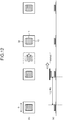
- FIG. 1 shows a contactless power supply system according to one embodiment of the present invention.
- FIG. 1(a) is a side view of primary power supply transformers 1, 2, 3, and 4 provided separately on a driving route on the ground and a secondary power supply transformer 20 mounted on a vehicle.
- the reference numeral 21 indicates the secondary power supply transformer 20 when moved.
- FIG. 1(b) is a plan view of the same.
- the primary power supply transformers 1, 2, 3, and 4 and the secondary power supply transformer 20 each include a double-sided coil having an H-shaped core around of which a wire 33 is wound around a portion between magnetic poles 31 and 32, and an aluminum shield plate 34 for shielding from a leakage of magnetic flux which occurs on the sides of the double-sided coil opposite to the faces opposing the other coil.
- the primary power supply transformers 1, 2, 3, and 4 are provided on the driving route so that the direction (x-direction in FIG. 15 ) of a line parallel to the magnetic poles 31 and 32 matches a vehicle traveling direction on the driving route.
- the secondary power supply transformer 20 is mounted on the vehicle so that the same direction matches a vehicle front-back direction.
- the primary power supply transformers are also separately provided along the driving route with a spacing which is set not to exceed a distance 3D between the centers of the magnetic poles of the neighboring primary power supply transformers where D represents the length of the magnetic poles (that is, the spacing I from the end of the magnetic pole of one primary power supply transformer to that of another primary power supply transformer is set not to exceed 2D).
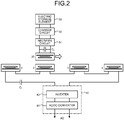
- FIG. 2 shows one example of the circuit configuration of the contactless power supply system.
- the system includes, on the ground, a high-frequency power source 40 to supply a high-frequency alternating current to the primary power supply transformers 1, 2, 3, and 4 and a primary series capacitor C1 connected in series to the primary power supply transformers 1, 2, 3, and 4.
- the primary power supply transformers 1, 2, 3, and 4 are connected in series to the high-frequency power source 40.
- the high-frequency power source 40 includes an AC/DC converter 41 to convert the alternating current for commercial power into a direct current and an inverter 42 to generate a high-frequency alternating current from the converted direct current.
- the system includes, on the vehicle, a rectifier circuit 51 to rectify the alternating current received by the secondary power supply transformer 20, a charger circuit 52 to charge an electric storage element 53 with the rectified current, and a secondary resonance capacitor C2 connected in parallel between the secondary power supply transformer 20 and the rectifier circuit 51.
- the capacitance of the secondary resonance capacitor C2 is defined by the expression (1) so as to form a parallel resonance circuit on the secondary side.
- the capacitance of the primary series capacitor C1 is defined by the expression (2) so as to set the primary-side power factor to 1.
- C 1 1 ⁇ 2 a 2 l o l 2 L 2 + l 1
- 10 exciting inductance
- 11 exciting inductance
- 12 exciting inductance.
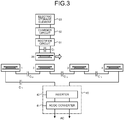
- the primary series capacitor C1 can be divided into C11, C12, C13, and C14 to connect in series between the high-frequency power source 40 and the primary power supply transformer 1, between the primary power supply transformer 1 and the primary power supply transformer 2, between the primary power supply transformer 2 and the primary power supply transformer 3, and between the primary power supply transformer 3 and the primary power supply transformer 4, respectively.
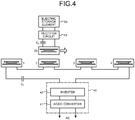
- FIG. 4 shows a circuit in which the secondary resonance capacitor C2 of the vehicle is connected in series between the secondary power supply transformer 20 and the rectifier circuit 51.
- the capacitance of the secondary resonance capacitor C2 is defined by the expression (1) so as to form a series resonance circuit on the secondary side.
- the primary series capacitor C1 is defined by the expression (3) so as to form a series resonance circuit on the primary side.
- C 1 1 ⁇ 2 L 1 where L1: primary-side self-inductance.
- the primary series capacitor C1 in FIG. 4 can be divided into C11, C12, C13, and C14 to connect in series between the high-frequency power source 40 and the primary power supply transformer 1, between the primary power supply transformer 1 and the primary power supply transformer 2, between the primary power supply transformer 2 and the primary power supply transformer 3, and between the primary power supply transformer 3 and the primary power supply transformer 4, respectively, as shown in FIG. 5 .
- the primary power supply transformers 1, 2, 3, and 4 can be connected in parallel to the high-frequency power source 40.
- the single primary series capacitor C1 is connected in series between the high-frequency power source 40 and each of the primary power supply transformers 1, 2, 3, and 4.
- the capacitance of the primary series capacitor C1 is defined by the expression (2) so as to set the primary-side power factor to 1, when the secondary resonance capacitor C2 is connected in parallel between the secondary power supply transformer 20 and the rectifier circuit 51, as shown in FIG. 6 .
- the capacitance of the primary series capacitor C1 is defined by the expression (3) so as to form a series resonance circuit on the primary side.
- FIG. 9 shows an actual apparatus used for the test.
- the primary power supply transformers and the secondary power supply transformer each include a double-sided coil having an H-shaped core around which a wire is wound, with magnetic poles in length of 300 mm and distanced by 250 mm. They are arranged in the same orientation as in FIG. 1 .
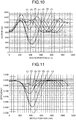
- FIG. 10 shows variations in the output of the secondary power supply transformer when the spacing between two primary power supply transformers was changed. The variations were measured under the condition that DC input is 210V, output frequency f of a high-frequency power source is 30khz, gap between the primary power supply transformers and the secondary power supply transformer is 70 mm.
- the abscissa axis indicates the moved position of the secondary power supply transformer while the vertical axis indicates the output power (W) from the secondary power supply transformer.
- the curve (1) represents a result when the distance between the ends of the magnetic poles of the two primary power supply transformers (hereinafter, referred to as transformer spacing) was set to 300 mm
- the curve (2) represents a result when the transformer spacing was set to 350 mm
- the curve (3) represents a result when the transformer spacing was set to 400 mm
- the curve (4) represents a result when the transformer spacing was set to 450 mm
- the curve (5) represents a result when the transformer spacing was set to 500 mm
- the curve (6) represents a result when the transformer spacing was set to 550 mm
- the curve (7) represents a result when the transformer spacing was set to 600 mm.
- FIG. 11 shows the power supply efficiency (ratio of input power to the primary power supply transformers and output power from the secondary power supply transformer) of FIG. 10 .
- the results of the measurement can confirm that even with the transformer spacing of 600 mm (that is, twice the length of the magnetic poles of the primary power supply transformer), the power supply to the secondary power supply transformer is feasible.
- the "transformer spacing as twice the length of the magnetic poles of the primary power supply transformer” signifies that the distance from the center of the magnetic poles of one primary power supply transformer to the centers of the magnetic poles of the neighboring primary power supply transformers is three times longer than the length of the magnetic poles.
- the contactless power supply system of the present invention can continuously supply power from the primary power supply transformers separated in a stepping stone-like form to the secondary power supply transformer unless the distance from the center of the magnetic poles of one primary power supply transformer to the centers of the magnetic poles of the neighboring primary power supply transformers exceeds 3D where D represents the size of the magnetic poles of the primary power supply transformers.
- a double-sided coil having the plate-like core 10 around which the wire 11 is wound, as shown in FIG. 12 can be used.
- the contactless power supply system according to the present invention can be installed on the driving route of a mobile structure by simple work, can supply power to a running mobile structure over a longer interval, and are widely usable to supply power to running mobile structures of various types including an electric automobile or a plug-in hybrid car.
Landscapes
- Engineering & Computer Science (AREA)
- Power Engineering (AREA)
- Mechanical Engineering (AREA)
- Transportation (AREA)
- Computer Networks & Wireless Communication (AREA)
- Current-Collector Devices For Electrically Propelled Vehicles (AREA)
- Electric Propulsion And Braking For Vehicles (AREA)
Applications Claiming Priority (1)
| Application Number | Priority Date | Filing Date | Title |
|---|---|---|---|
| PCT/JP2014/055523 WO2015132890A1 (ja) | 2014-03-04 | 2014-03-04 | 走行中非接触給電システム |
Publications (2)
| Publication Number | Publication Date |
|---|---|
| EP3128643A1 true EP3128643A1 (de) | 2017-02-08 |
| EP3128643A4 EP3128643A4 (de) | 2018-01-10 |
Family
ID=54054728
Family Applications (1)
| Application Number | Title | Priority Date | Filing Date |
|---|---|---|---|
| EP14884347.7A Withdrawn EP3128643A4 (de) | 2014-03-04 | 2014-03-04 | System zur drahtlosen stromversorgung während der bewegung |
Country Status (4)
| Country | Link |
|---|---|
| US (1) | US10065515B2 (de) |
| EP (1) | EP3128643A4 (de) |
| CN (1) | CN106061789A (de) |
| WO (1) | WO2015132890A1 (de) |
Families Citing this family (11)
| Publication number | Priority date | Publication date | Assignee | Title |
|---|---|---|---|---|
| EP3128643A4 (de) * | 2014-03-04 | 2018-01-10 | Technova Inc. | System zur drahtlosen stromversorgung während der bewegung |
| WO2016113949A1 (ja) * | 2015-01-15 | 2016-07-21 | 株式会社村田製作所 | 給電装置 |
| US10581276B2 (en) * | 2015-03-29 | 2020-03-03 | Chargedge, Inc. | Tuned resonant microcell-based array for wireless power transfer |
| CN108382220B (zh) * | 2018-01-26 | 2020-11-06 | 清华大学 | 一种电动车用行进间无线充电磁耦合器 |
| EP3678278B1 (de) * | 2019-01-02 | 2022-06-08 | ABB Schweiz AG | Ladestation mit hochfrequenzverteilungsnetzwerk |
| KR102249722B1 (ko) * | 2019-02-01 | 2021-05-11 | 한국과학기술원 | 전기차량 및 산업용 장비의 주행 중 무선충전 급전 시스템 |
| JP7243450B2 (ja) * | 2019-05-27 | 2023-03-22 | 株式会社デンソー | 走行中給電システム |
| CN111262349B (zh) * | 2019-09-04 | 2021-12-07 | 西南交通大学 | 双拾取线圈无线传能装置的磁耦合机构设计方法 |
| WO2022074974A1 (ja) * | 2020-10-06 | 2022-04-14 | 村田機械株式会社 | 非接触給電システム及び搬送システム |
| CN112977102A (zh) * | 2021-04-19 | 2021-06-18 | 国网黑龙江省电力有限公司电力科学研究院 | 一种电动汽车动态谐振式磁耦合无线充电系统 |
| KR20250096441A (ko) * | 2023-12-20 | 2025-06-27 | 서울시립대학교 산학협력단 | 중전압 시스템의 스위치 구동을 위한 무선 전원공급장치 및 이의 제작방법 |
Family Cites Families (22)
| Publication number | Priority date | Publication date | Assignee | Title |
|---|---|---|---|---|
| JPS6430403A (en) | 1987-07-24 | 1989-02-01 | Hitachi Ltd | Electric automobile charger |
| JPH0743806U (ja) | 1992-03-27 | 1995-09-19 | 一路 藤岡 | エネルギー・ベルト装置 |
| DE4236340C2 (de) | 1992-10-28 | 1994-11-10 | Daimler Benz Ag | Anordnung zur induktiven Übertragung von Energie |
| JP2002143334A (ja) * | 2001-10-31 | 2002-05-21 | Nohmi Bosai Ltd | トンネル内消火システム |
| JP4208757B2 (ja) | 2004-03-31 | 2009-01-14 | 株式会社椿本チエイン | 非接触給電システム |
| JP4885788B2 (ja) * | 2007-05-10 | 2012-02-29 | オリンパス株式会社 | 無線給電システム |
| JP4536132B2 (ja) * | 2008-05-23 | 2010-09-01 | カワサキプラントシステムズ株式会社 | 移動体用給電装置における給電制御装置 |
| JP5467569B2 (ja) * | 2009-01-21 | 2014-04-09 | 国立大学法人埼玉大学 | 非接触給電装置 |
| AU2010234396A1 (en) | 2009-04-08 | 2011-10-27 | Access Business Group International Llc | Selectable coil array |
| IN2012DN01947A (de) * | 2009-08-07 | 2015-08-21 | Auckland Uniservices Ltd | |
| JP5240786B2 (ja) | 2009-08-25 | 2013-07-17 | 国立大学法人埼玉大学 | 非接触給電装置 |
| JP2011166992A (ja) | 2010-02-12 | 2011-08-25 | Toyota Motor Corp | 給電装置 |
| KR101156034B1 (ko) | 2010-07-15 | 2012-06-18 | 한국과학기술원 | 전기 자동차를 이용하는 운송 시스템의 급집전장치 설계 방법 및 장치 |
| WO2012018269A1 (en) * | 2010-08-06 | 2012-02-09 | Auckland Uniservices Limited | Inductive power receiver apparatus |
| US8800738B2 (en) | 2010-12-28 | 2014-08-12 | Tdk Corporation | Wireless power feeder and wireless power receiver |
| JP5836598B2 (ja) | 2011-01-19 | 2015-12-24 | 株式会社テクノバ | 非接触給電用コア |
| US9312729B2 (en) * | 2011-01-19 | 2016-04-12 | Technova Inc. | Contactless power transfer apparatus |
| JP5658592B2 (ja) * | 2011-02-21 | 2015-01-28 | 国立大学法人埼玉大学 | 移動体用非接触給電装置 |
| US9502176B2 (en) * | 2012-05-21 | 2016-11-22 | Technova Inc. | Contactless power supply transfer transformer |
| JP2014017973A (ja) * | 2012-07-09 | 2014-01-30 | Panasonic Corp | 非接触給電システム |
| JP6111139B2 (ja) * | 2013-05-21 | 2017-04-05 | 株式会社テクノバ | 双方向非接触給電装置 |
| EP3128643A4 (de) * | 2014-03-04 | 2018-01-10 | Technova Inc. | System zur drahtlosen stromversorgung während der bewegung |
-
2014
- 2014-03-04 EP EP14884347.7A patent/EP3128643A4/de not_active Withdrawn
- 2014-03-04 WO PCT/JP2014/055523 patent/WO2015132890A1/ja not_active Ceased
- 2014-03-04 CN CN201480076751.XA patent/CN106061789A/zh active Pending
- 2014-03-04 US US15/123,013 patent/US10065515B2/en not_active Expired - Fee Related
Also Published As
| Publication number | Publication date |
|---|---|
| US10065515B2 (en) | 2018-09-04 |
| CN106061789A (zh) | 2016-10-26 |
| EP3128643A4 (de) | 2018-01-10 |
| WO2015132890A1 (ja) | 2015-09-11 |
| US20170158064A1 (en) | 2017-06-08 |
Similar Documents
| Publication | Publication Date | Title |
|---|---|---|
| US10065515B2 (en) | System for wirelessly supplying power during moving | |
| JP6164853B2 (ja) | 走行中非接触給電システム | |
| Miller et al. | ORNL experience and challenges facing dynamic wireless power charging of EV's | |
| US9260026B2 (en) | Vehicle to wireless power transfer coupling coil alignment sensor | |
| US8963489B2 (en) | Contactless power transfer device for moving object | |
| US9525302B2 (en) | Noncontact power feeding apparatus and noncontact power feeding method | |
| US9457676B2 (en) | Contactless power transfer apparatus | |
| US9889757B2 (en) | Mobile machine, wireless power transmission system, and wireless power transmission method | |
| JP5506327B2 (ja) | 非接触電力供給装置 | |
| JP5537981B2 (ja) | 移動体給電装置 | |
| JP5240786B2 (ja) | 非接触給電装置 | |
| US20130009462A1 (en) | Power-feed device | |
| JP2011223703A (ja) | 移動式の非接触給電装置 | |
| US10272789B2 (en) | Wireless power supply system and wireless power transmission system | |
| CN107710358B (zh) | 初级绕组结构的初级侧装置、初级侧装置的制造方法、用于感应电力传输的系统以及向车辆感应式地供电的方法 | |
| CN105848959A (zh) | 非接触电力传输系统、充电站、以及车辆 | |
| JP6541425B2 (ja) | 非接触給電システム | |
| JP2014053984A (ja) | 移動給電式の非接触給電装置 | |
| JP2016181960A (ja) | 非接触給電システム | |
| Kabalan et al. | The impact of coupling and loading conditions on the performance of SS EV dynamic wireless charging systems | |
| Momidi | Wireless Electric Vehicle Charging System (WEVCS) | |
| CN113492707A (zh) | 停车辅助系统 | |
| JP6226500B2 (ja) | 非接触給電システム | |
| KR20150057057A (ko) | 무선 충전을 위한 ac 케이블 및 ac 케이블을 이용한 무선 충전 방법 |
Legal Events
| Date | Code | Title | Description |
|---|---|---|---|
| PUAI | Public reference made under article 153(3) epc to a published international application that has entered the european phase |
Free format text: ORIGINAL CODE: 0009012 |
|
| 17P | Request for examination filed |
Effective date: 20160901 |
|
| AK | Designated contracting states |
Kind code of ref document: A1 Designated state(s): AL AT BE BG CH CY CZ DE DK EE ES FI FR GB GR HR HU IE IS IT LI LT LU LV MC MK MT NL NO PL PT RO RS SE SI SK SM TR |
|
| AX | Request for extension of the european patent |
Extension state: BA ME |
|
| DAX | Request for extension of the european patent (deleted) | ||
| A4 | Supplementary search report drawn up and despatched |
Effective date: 20171213 |
|
| RIC1 | Information provided on ipc code assigned before grant |
Ipc: B60M 7/00 20060101ALI20171207BHEP Ipc: H02J 50/00 20160101AFI20171207BHEP Ipc: B60L 11/18 20060101ALI20171207BHEP Ipc: H02J 7/00 20060101ALI20171207BHEP |
|
| 17Q | First examination report despatched |
Effective date: 20180815 |
|
| STAA | Information on the status of an ep patent application or granted ep patent |
Free format text: STATUS: THE APPLICATION IS DEEMED TO BE WITHDRAWN |
|
| 18D | Application deemed to be withdrawn |
Effective date: 20190906 |