EP3129200B1 - Procédé de fabrication d'une pièce en matériau composite multiperforée - Google Patents
Procédé de fabrication d'une pièce en matériau composite multiperforée Download PDFInfo
- Publication number
- EP3129200B1 EP3129200B1 EP15718542.2A EP15718542A EP3129200B1 EP 3129200 B1 EP3129200 B1 EP 3129200B1 EP 15718542 A EP15718542 A EP 15718542A EP 3129200 B1 EP3129200 B1 EP 3129200B1
- Authority
- EP
- European Patent Office
- Prior art keywords
- preform
- mask
- perforated
- abrasive particles
- perforations
- Prior art date
- Legal status (The legal status is an assumption and is not a legal conclusion. Google has not performed a legal analysis and makes no representation as to the accuracy of the status listed.)
- Active
Links
Images

Classifications
-
- B—PERFORMING OPERATIONS; TRANSPORTING
- B28—WORKING CEMENT, CLAY, OR STONE
- B28B—SHAPING CLAY OR OTHER CERAMIC COMPOSITIONS; SHAPING SLAG; SHAPING MIXTURES CONTAINING CEMENTITIOUS MATERIAL, e.g. PLASTER
- B28B1/00—Producing shaped prefabricated articles from the material
-
- C—CHEMISTRY; METALLURGY
- C04—CEMENTS; CONCRETE; ARTIFICIAL STONE; CERAMICS; REFRACTORIES
- C04B—LIME, MAGNESIA; SLAG; CEMENTS; COMPOSITIONS THEREOF, e.g. MORTARS, CONCRETE OR LIKE BUILDING MATERIALS; ARTIFICIAL STONE; CERAMICS; REFRACTORIES; TREATMENT OF NATURAL STONE
- C04B35/00—Shaped ceramic products characterised by their composition; Ceramics compositions; Processing powders of inorganic compounds preparatory to the manufacturing of ceramic products
- C04B35/71—Ceramic products containing macroscopic reinforcing agents
- C04B35/78—Ceramic products containing macroscopic reinforcing agents containing non-metallic materials
- C04B35/80—Fibres, filaments, whiskers, platelets, or the like
-
- C—CHEMISTRY; METALLURGY
- C04—CEMENTS; CONCRETE; ARTIFICIAL STONE; CERAMICS; REFRACTORIES
- C04B—LIME, MAGNESIA; SLAG; CEMENTS; COMPOSITIONS THEREOF, e.g. MORTARS, CONCRETE OR LIKE BUILDING MATERIALS; ARTIFICIAL STONE; CERAMICS; REFRACTORIES; TREATMENT OF NATURAL STONE
- C04B35/00—Shaped ceramic products characterised by their composition; Ceramics compositions; Processing powders of inorganic compounds preparatory to the manufacturing of ceramic products
- C04B35/515—Shaped ceramic products characterised by their composition; Ceramics compositions; Processing powders of inorganic compounds preparatory to the manufacturing of ceramic products based on non-oxide ceramics
- C04B35/56—Shaped ceramic products characterised by their composition; Ceramics compositions; Processing powders of inorganic compounds preparatory to the manufacturing of ceramic products based on non-oxide ceramics based on carbides or oxycarbides
- C04B35/565—Shaped ceramic products characterised by their composition; Ceramics compositions; Processing powders of inorganic compounds preparatory to the manufacturing of ceramic products based on non-oxide ceramics based on carbides or oxycarbides based on silicon carbide
- C04B35/571—Shaped ceramic products characterised by their composition; Ceramics compositions; Processing powders of inorganic compounds preparatory to the manufacturing of ceramic products based on non-oxide ceramics based on carbides or oxycarbides based on silicon carbide obtained from Si-containing polymer precursors or organosilicon monomers
-
- C—CHEMISTRY; METALLURGY
- C04—CEMENTS; CONCRETE; ARTIFICIAL STONE; CERAMICS; REFRACTORIES
- C04B—LIME, MAGNESIA; SLAG; CEMENTS; COMPOSITIONS THEREOF, e.g. MORTARS, CONCRETE OR LIKE BUILDING MATERIALS; ARTIFICIAL STONE; CERAMICS; REFRACTORIES; TREATMENT OF NATURAL STONE
- C04B35/00—Shaped ceramic products characterised by their composition; Ceramics compositions; Processing powders of inorganic compounds preparatory to the manufacturing of ceramic products
- C04B35/01—Shaped ceramic products characterised by their composition; Ceramics compositions; Processing powders of inorganic compounds preparatory to the manufacturing of ceramic products based on oxide ceramics
- C04B35/10—Shaped ceramic products characterised by their composition; Ceramics compositions; Processing powders of inorganic compounds preparatory to the manufacturing of ceramic products based on oxide ceramics based on aluminium oxide
-
- C—CHEMISTRY; METALLURGY
- C04—CEMENTS; CONCRETE; ARTIFICIAL STONE; CERAMICS; REFRACTORIES
- C04B—LIME, MAGNESIA; SLAG; CEMENTS; COMPOSITIONS THEREOF, e.g. MORTARS, CONCRETE OR LIKE BUILDING MATERIALS; ARTIFICIAL STONE; CERAMICS; REFRACTORIES; TREATMENT OF NATURAL STONE
- C04B35/00—Shaped ceramic products characterised by their composition; Ceramics compositions; Processing powders of inorganic compounds preparatory to the manufacturing of ceramic products
- C04B35/515—Shaped ceramic products characterised by their composition; Ceramics compositions; Processing powders of inorganic compounds preparatory to the manufacturing of ceramic products based on non-oxide ceramics
- C04B35/56—Shaped ceramic products characterised by their composition; Ceramics compositions; Processing powders of inorganic compounds preparatory to the manufacturing of ceramic products based on non-oxide ceramics based on carbides or oxycarbides
- C04B35/565—Shaped ceramic products characterised by their composition; Ceramics compositions; Processing powders of inorganic compounds preparatory to the manufacturing of ceramic products based on non-oxide ceramics based on carbides or oxycarbides based on silicon carbide
-
- C—CHEMISTRY; METALLURGY
- C04—CEMENTS; CONCRETE; ARTIFICIAL STONE; CERAMICS; REFRACTORIES
- C04B—LIME, MAGNESIA; SLAG; CEMENTS; COMPOSITIONS THEREOF, e.g. MORTARS, CONCRETE OR LIKE BUILDING MATERIALS; ARTIFICIAL STONE; CERAMICS; REFRACTORIES; TREATMENT OF NATURAL STONE
- C04B35/00—Shaped ceramic products characterised by their composition; Ceramics compositions; Processing powders of inorganic compounds preparatory to the manufacturing of ceramic products
- C04B35/622—Forming processes; Processing powders of inorganic compounds preparatory to the manufacturing of ceramic products
- C04B35/626—Preparing or treating the powders individually or as batches ; preparing or treating macroscopic reinforcing agents for ceramic products, e.g. fibres; mechanical aspects section B
- C04B35/628—Coating the powders or the macroscopic reinforcing agents
- C04B35/62844—Coating fibres
- C04B35/62857—Coating fibres with non-oxide ceramics
- C04B35/6286—Carbides
- C04B35/62863—Silicon carbide
-
- C—CHEMISTRY; METALLURGY
- C04—CEMENTS; CONCRETE; ARTIFICIAL STONE; CERAMICS; REFRACTORIES
- C04B—LIME, MAGNESIA; SLAG; CEMENTS; COMPOSITIONS THEREOF, e.g. MORTARS, CONCRETE OR LIKE BUILDING MATERIALS; ARTIFICIAL STONE; CERAMICS; REFRACTORIES; TREATMENT OF NATURAL STONE
- C04B35/00—Shaped ceramic products characterised by their composition; Ceramics compositions; Processing powders of inorganic compounds preparatory to the manufacturing of ceramic products
- C04B35/622—Forming processes; Processing powders of inorganic compounds preparatory to the manufacturing of ceramic products
- C04B35/626—Preparing or treating the powders individually or as batches ; preparing or treating macroscopic reinforcing agents for ceramic products, e.g. fibres; mechanical aspects section B
- C04B35/628—Coating the powders or the macroscopic reinforcing agents
- C04B35/62844—Coating fibres
- C04B35/62857—Coating fibres with non-oxide ceramics
- C04B35/62873—Carbon
-
- C—CHEMISTRY; METALLURGY
- C04—CEMENTS; CONCRETE; ARTIFICIAL STONE; CERAMICS; REFRACTORIES
- C04B—LIME, MAGNESIA; SLAG; CEMENTS; COMPOSITIONS THEREOF, e.g. MORTARS, CONCRETE OR LIKE BUILDING MATERIALS; ARTIFICIAL STONE; CERAMICS; REFRACTORIES; TREATMENT OF NATURAL STONE
- C04B35/00—Shaped ceramic products characterised by their composition; Ceramics compositions; Processing powders of inorganic compounds preparatory to the manufacturing of ceramic products
- C04B35/622—Forming processes; Processing powders of inorganic compounds preparatory to the manufacturing of ceramic products
- C04B35/626—Preparing or treating the powders individually or as batches ; preparing or treating macroscopic reinforcing agents for ceramic products, e.g. fibres; mechanical aspects section B
- C04B35/628—Coating the powders or the macroscopic reinforcing agents
- C04B35/62884—Coating the powders or the macroscopic reinforcing agents by gas phase techniques
-
- C—CHEMISTRY; METALLURGY
- C04—CEMENTS; CONCRETE; ARTIFICIAL STONE; CERAMICS; REFRACTORIES
- C04B—LIME, MAGNESIA; SLAG; CEMENTS; COMPOSITIONS THEREOF, e.g. MORTARS, CONCRETE OR LIKE BUILDING MATERIALS; ARTIFICIAL STONE; CERAMICS; REFRACTORIES; TREATMENT OF NATURAL STONE
- C04B38/00—Porous mortars, concrete, artificial stone or ceramic ware; Preparation thereof
- C04B38/0003—Porous mortars, concrete, artificial stone or ceramic ware; Preparation thereof containing continuous channels, e.g. of the "dead-end" type or obtained by pushing bars in the green ceramic product
-
- C—CHEMISTRY; METALLURGY
- C04—CEMENTS; CONCRETE; ARTIFICIAL STONE; CERAMICS; REFRACTORIES
- C04B—LIME, MAGNESIA; SLAG; CEMENTS; COMPOSITIONS THEREOF, e.g. MORTARS, CONCRETE OR LIKE BUILDING MATERIALS; ARTIFICIAL STONE; CERAMICS; REFRACTORIES; TREATMENT OF NATURAL STONE
- C04B41/00—After-treatment of mortars, concrete, artificial stone or ceramics; Treatment of natural stone
- C04B41/80—After-treatment of mortars, concrete, artificial stone or ceramics; Treatment of natural stone of only ceramics
- C04B41/91—After-treatment of mortars, concrete, artificial stone or ceramics; Treatment of natural stone of only ceramics involving the removal of part of the materials of the treated articles, e.g. etching
-
- C—CHEMISTRY; METALLURGY
- C08—ORGANIC MACROMOLECULAR COMPOUNDS; THEIR PREPARATION OR CHEMICAL WORKING-UP; COMPOSITIONS BASED THEREON
- C08K—Use of inorganic or non-macromolecular organic substances as compounding ingredients
- C08K7/00—Use of ingredients characterised by shape
- C08K7/02—Fibres or whiskers
- C08K7/04—Fibres or whiskers inorganic
- C08K7/08—Oxygen-containing compounds
-
- C—CHEMISTRY; METALLURGY
- C04—CEMENTS; CONCRETE; ARTIFICIAL STONE; CERAMICS; REFRACTORIES
- C04B—LIME, MAGNESIA; SLAG; CEMENTS; COMPOSITIONS THEREOF, e.g. MORTARS, CONCRETE OR LIKE BUILDING MATERIALS; ARTIFICIAL STONE; CERAMICS; REFRACTORIES; TREATMENT OF NATURAL STONE
- C04B2235/00—Aspects relating to ceramic starting mixtures or sintered ceramic products
- C04B2235/02—Composition of constituents of the starting material or of secondary phases of the final product
- C04B2235/30—Constituents and secondary phases not being of a fibrous nature
- C04B2235/38—Non-oxide ceramic constituents or additives
- C04B2235/3817—Carbides
- C04B2235/3826—Silicon carbides
-
- C—CHEMISTRY; METALLURGY
- C04—CEMENTS; CONCRETE; ARTIFICIAL STONE; CERAMICS; REFRACTORIES
- C04B—LIME, MAGNESIA; SLAG; CEMENTS; COMPOSITIONS THEREOF, e.g. MORTARS, CONCRETE OR LIKE BUILDING MATERIALS; ARTIFICIAL STONE; CERAMICS; REFRACTORIES; TREATMENT OF NATURAL STONE
- C04B2235/00—Aspects relating to ceramic starting mixtures or sintered ceramic products
- C04B2235/02—Composition of constituents of the starting material or of secondary phases of the final product
- C04B2235/30—Constituents and secondary phases not being of a fibrous nature
- C04B2235/42—Non metallic elements added as constituents or additives, e.g. sulfur, phosphor, selenium or tellurium
- C04B2235/422—Carbon
-
- C—CHEMISTRY; METALLURGY
- C04—CEMENTS; CONCRETE; ARTIFICIAL STONE; CERAMICS; REFRACTORIES
- C04B—LIME, MAGNESIA; SLAG; CEMENTS; COMPOSITIONS THEREOF, e.g. MORTARS, CONCRETE OR LIKE BUILDING MATERIALS; ARTIFICIAL STONE; CERAMICS; REFRACTORIES; TREATMENT OF NATURAL STONE
- C04B2235/00—Aspects relating to ceramic starting mixtures or sintered ceramic products
- C04B2235/02—Composition of constituents of the starting material or of secondary phases of the final product
- C04B2235/30—Constituents and secondary phases not being of a fibrous nature
- C04B2235/48—Organic compounds becoming part of a ceramic after heat treatment, e.g. carbonising phenol resins
- C04B2235/483—Si-containing organic compounds, e.g. silicone resins, (poly)silanes, (poly)siloxanes or (poly)silazanes
-
- C—CHEMISTRY; METALLURGY
- C04—CEMENTS; CONCRETE; ARTIFICIAL STONE; CERAMICS; REFRACTORIES
- C04B—LIME, MAGNESIA; SLAG; CEMENTS; COMPOSITIONS THEREOF, e.g. MORTARS, CONCRETE OR LIKE BUILDING MATERIALS; ARTIFICIAL STONE; CERAMICS; REFRACTORIES; TREATMENT OF NATURAL STONE
- C04B2235/00—Aspects relating to ceramic starting mixtures or sintered ceramic products
- C04B2235/02—Composition of constituents of the starting material or of secondary phases of the final product
- C04B2235/50—Constituents or additives of the starting mixture chosen for their shape or used because of their shape or their physical appearance
- C04B2235/52—Constituents or additives characterised by their shapes
- C04B2235/5208—Fibers
- C04B2235/5216—Inorganic
- C04B2235/522—Oxidic
-
- C—CHEMISTRY; METALLURGY
- C04—CEMENTS; CONCRETE; ARTIFICIAL STONE; CERAMICS; REFRACTORIES
- C04B—LIME, MAGNESIA; SLAG; CEMENTS; COMPOSITIONS THEREOF, e.g. MORTARS, CONCRETE OR LIKE BUILDING MATERIALS; ARTIFICIAL STONE; CERAMICS; REFRACTORIES; TREATMENT OF NATURAL STONE
- C04B2235/00—Aspects relating to ceramic starting mixtures or sintered ceramic products
- C04B2235/60—Aspects relating to the preparation, properties or mechanical treatment of green bodies or pre-forms
- C04B2235/612—Machining
-
- C—CHEMISTRY; METALLURGY
- C04—CEMENTS; CONCRETE; ARTIFICIAL STONE; CERAMICS; REFRACTORIES
- C04B—LIME, MAGNESIA; SLAG; CEMENTS; COMPOSITIONS THEREOF, e.g. MORTARS, CONCRETE OR LIKE BUILDING MATERIALS; ARTIFICIAL STONE; CERAMICS; REFRACTORIES; TREATMENT OF NATURAL STONE
- C04B2235/00—Aspects relating to ceramic starting mixtures or sintered ceramic products
- C04B2235/60—Aspects relating to the preparation, properties or mechanical treatment of green bodies or pre-forms
- C04B2235/614—Gas infiltration of green bodies or pre-forms
-
- C—CHEMISTRY; METALLURGY
- C04—CEMENTS; CONCRETE; ARTIFICIAL STONE; CERAMICS; REFRACTORIES
- C04B—LIME, MAGNESIA; SLAG; CEMENTS; COMPOSITIONS THEREOF, e.g. MORTARS, CONCRETE OR LIKE BUILDING MATERIALS; ARTIFICIAL STONE; CERAMICS; REFRACTORIES; TREATMENT OF NATURAL STONE
- C04B2235/00—Aspects relating to ceramic starting mixtures or sintered ceramic products
- C04B2235/70—Aspects relating to sintered or melt-casted ceramic products
- C04B2235/94—Products characterised by their shape
- C04B2235/945—Products containing grooves, cuts, recesses or protusions
Definitions
- the present invention relates to the manufacture of multi-perforated composite material parts, that is to say parts formed of a fiber reinforcement densified by a matrix and in which a plurality of perforations has been made.
- Multi-perforated composite material parts have particular applications, particularly in the fields of filtering and acoustics.
- composite material parts having acoustic functions it is common to perform in the latter perforations as is the case, for example, acoustic attenuation panel skins present in aircraft engines.
- the skins of the latter In order to allow penetration and attenuation of the sound waves inside such panels, the skins of the latter must have a plurality of perforations.
- CMC ceramic matrix composite
- these may be produced by impregnating a fibrous texture, intended to form the reinforcement of the part, with a ceramic precursor resin, by polymerizing the resin and by proceeding with pyrolysis of the impregnated texture to form a ceramic matrix therein.
- the perforations in a piece of CMC composite material can be made in different ways. They can be made in particular by drill drilling of the impregnated texture in the polymerized stage. However, the machining must be done without lubrication so as not to degrade the materials present in the impregnated texture (chemical incompatibility). This causes premature wear of the drill bit. In addition, the cut is not perfect and reveals fibrils at the perforations that pose problems in the subsequent manufacture of the piece.
- the perforations may also be made by laser drilling the impregnated texture in the polymerized stage. In this case cutting of the texture is clean (absence of fibrils) but causes the appearance of thermally affected zone (ZAT) in the texture.
- ZAT thermally affected zone
- the composite material parts concerned by the present invention may also be made of CMC composite material of the oxide / oxide type, that is to say by depositing within a fibrous texture formed of oxide fibers oxide particles. refractory which are then sintered to form a refractory oxide matrix in the texture.
- Patent applications FR 2852003 A1 , FR 2852004 A1 , FR 2989390 A1 , WO 02/18075 A1 and FR 2939129 A1 disclose processes for manufacturing fibrous composite materials.
- the use of the sanding technique makes it possible to accurately and economically produce multi-perforated composite material parts.
- the perforations are performed at an intermediate stage of the production of the part, that is to say after polymerization and before the ceramic resin is transformed by pyrolysis.
- the composite material of the part has a high hardness, which requires durations and / or sanding forces important.
- the risks of deterioration of the sanding mask are high, which no longer makes it possible to ensure compliance with the geometry defined for the perforations.
- the perforations are here performed at an intermediate stage of the manufacture of the composite material part, namely before the sintering of the oxide particles when the part still has a level of hardness compatible with a duration and / or sandblasting force to preserve the integrity of the sanding mask.
- these comprise, after the pyrolysis or sintering step, a step of densification of the multiperforated fibrous texture produced by chemical vapor infiltration of silicon carbide.
- This step makes it possible, in addition to finalizing the densification of the part, to form a silicon carbide coating which protects the material of the piece exposed in the perforations.
- the abrasive particles are projected onto the surface of the sanding mask with an angle of between 45 ° and 60 °. This makes it possible to increase the sandblasting efficiency and reduce its duration.
- the method of the invention relates to the manufacture of parts made of ceramic matrix composite material (CMC), that is to say parts formed of a reinforcement of refractory fibers (carbon or ceramic) densified by a matrix at least partially ceramic.
- CMC materials are C / SiC composites (carbon fiber reinforcement and silicon carbide matrix), C / C-SiC composites (carbon fiber reinforcement and matrix comprising a carbon phase, generally closer to fibers, and a silicon carbide phase), SiC / SiC composites (reinforcing fibers and silicon carbide matrix) and oxide / oxide composites (reinforcing fibers and alumina matrix).
- An interphase layer may be interposed between the reinforcing fibers and the matrix to improve the mechanical strength of the material.
- the perforation by sanding is carried out at an intermediate stage of the manufacture of a piece of CMC composite material. More specifically, when the matrix of the material CMC of the part is formed at least partially from a ceramic precursor resin, the sanding operation is carried out at the polymerized stage of the resin, that is to say before its pyrolysis to transform the precursor ceramic.
- the matrix is formed from refractory oxide particles, as is the case for a CMC composite oxide / oxide material, sanding is performed before sintering the particles to form a refractory oxide matrix.
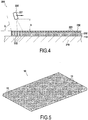
- the figure 5 represents an acoustic skin 10 of CMC composite material which comprises a plurality of perforations 11.
- the acoustic skin 10 is for example intended to be assembled with a honeycomb structure to form an acoustic attenuation panel.
- the manufacture of acoustic skin begins with the production of a fibrous texture 100 made of refractory fibers, for example carbon, ceramic or oxide fibers, represented on the figure 1 .
- fibrous structure formed of several superimposed layers of fabric, braid, knit, felt, tablecloths, cables or others, which layers are bonded together for example by sewing, by implantation of son or rigid elements or by needling.
- the fibrous texture is immersed in a bath containing a resin and usually a solvent thereof.
- Other known impregnation techniques can be used, such as passing the fibrous texture in a continuous impregnator, infusion impregnation, or impregnation by RTM ("Resin Transfer Molding").
- the organic precursor is usually in the form of a polymer, such as a resin, optionally diluted in a solvent.
- a polymer such as a resin
- liquid precursors of ceramics, in particular of SiC may be resins of polycarbosilane (PCS), polysiloxane (PSX), polytitanocarbosilane (PTCS), or polysilazane (PSZ) type.
- the polymerization of the resin is carried out which allows consolidation of the fibrous texture.
- the perforations are made by sanding, that is to say by high-speed projection of abrasive particles on the preform 110.
- a sanding mask or stencil 250 is positioned on the surface of the preform 100 as shown in FIG. figure 3 .
- the sanding mask 250 comprises a plurality of openings 251 corresponding to the perforations to be made in the preform 110.
- the mask 250 is made of a flexible material in order to resist the projected abrasive particles and to adapt to all the geometries of preforms and to particular to preforms having curved shapes.
- the mask 250 may for example be made from an elastomer having on its surface 252 intended to be in contact with the preform an adhesive to ensure its retention in position.
- the preform 110 covered with the mask 250 is placed on the support 210 of a sanding machine 200 further comprising a sanding head 220 comprising a nozzle 221 from which high speed abrasive particles are projected so as to form perforations 115 in the preform 110.
- the blast head 220 is adjustable in height to adjust the distance h between the nozzle 221 and the surface of the preform to sand (to the thickness of the blast mask near).
- the sanding head is also adjustable to adjust the angle ⁇ according to which the particles are projected onto the texture.
- Abrasive particles that can be used for the perforation of a preform corresponding to a fibrous texture impregnated with a polymerized ceramic precursor resin are, for example, silicon carbide grains having an angular shape with sharp edges and having a particle size of around 100. .mu.m.
- abrasive particles such as grains of white corundum (99.6% pure crystalline anhydrous alumina oxide) or silicon carbide with angular structure with sharp edges and having a particle size of about 100 microns can be used.
- the projection distance that is to say the distance between the outlet of the nozzle and the preform to be sanded is set according to the pressure with which the particles are projected at the outlet of the nozzle. More specifically, for a determined nozzle outlet pressure, the projection distance is adjusted so as to optimize the perforation speed while being careful not to attack the mask. For example, with a nozzle projecting abrasive particles at a pressure of 7 bar, the projection distance can be between 90 mm 150 mm.
- the projection distance corresponds to the height h when the projection angle ⁇ is 90 °.
- the projection distance is greater than the height h when the projection angle ⁇ is less than 90 °.
- ⁇ that is to say the angle at which the abrasive particles will impact the preform
- a projection angle of 90 ° it has been found that the realization of the perforations is more efficient and economical with a projection angle of between 45 ° and 60 °. Indeed, a 90 ° projection certainly has a greater impact intensity but a lower efficiency because of the large ricochés of the particles after impact which form a screen and cause collisional destruction of the incident particles.
- figure 5 corresponding to a multiperforated piece CMC composite material, namely a part formed of a refractory fiber reinforcement densified by an at least partially ceramic matrix (silicon carbide, oxide, etc.).
- the part may be subjected to a chemical vapor infiltration (CVI) of silicon carbide which further allows to finalize the densification of the preform, to form a coating ("sealcoat") of carbide of silicon that protects the parts of the room exposed in the perforations.
- CVI chemical vapor infiltration
- the part is placed in an oven in which is admitted a gaseous reaction phase.
- the pressure and the temperature in the furnace and the composition of the gas phase are chosen so as to allow the diffusion of the gas phase within the residual porosity and then on the surface of the parts to form a matrix by depositing a solid material resulting from a decomposition of a constituent of the gas phase or a reaction between several constituents.
- gaseous precursors of ceramics, especially SiC may be methyltrichlorosilane (MTS) giving SiC by decomposition of MTS (optionally in the presence of hydrogen).
- MTS methyltrichlorosilane
Landscapes
- Chemical & Material Sciences (AREA)
- Engineering & Computer Science (AREA)
- Ceramic Engineering (AREA)
- Manufacturing & Machinery (AREA)
- Organic Chemistry (AREA)
- Structural Engineering (AREA)
- Materials Engineering (AREA)
- Inorganic Chemistry (AREA)
- Chemical Kinetics & Catalysis (AREA)
- Medicinal Chemistry (AREA)
- Health & Medical Sciences (AREA)
- Polymers & Plastics (AREA)
- Mechanical Engineering (AREA)
- Ceramic Products (AREA)
- Polishing Bodies And Polishing Tools (AREA)
- Soundproofing, Sound Blocking, And Sound Damping (AREA)
- Laminated Bodies (AREA)
- Reinforced Plastic Materials (AREA)
- Composite Materials (AREA)
- Woven Fabrics (AREA)
- Inorganic Fibers (AREA)
Description
- La présente invention concerne la fabrication de pièces en matériau composite multiperforées, c'est-à-dire des pièces formées d'un renfort fibreux densifié par une matrice et dans laquelle une pluralité de perforations a été réalisée.
- Les pièces en matériau composite multiperforées trouvent des applications particulières notamment dans les domaines du filtrage et de l'acoustique. Dans le cas de pièces en matériau composite ayant des fonctions acoustiques, il est courant de réaliser dans ces dernières des perforations comme c'est le cas par exemple des peaux de panneaux d'atténuation acoustique présents dans les moteurs aéronautiques. Afin de permettre la pénétration puis l'atténuation des ondes sonores à l'intérieur de tels panneaux, les peaux de ces derniers doivent présenter une pluralité de perforations.
- Dans le cas de pièces en matériau composite à matrice céramique (CMC), celles-ci peuvent élaborées en imprégnant une texture fibreuse, destinée à former le renfort de la pièce, avec une résine précurseur de céramique, en polymérisant la résine et en procédant à une pyrolyse de la texture imprégnée afin de former une matrice céramique dans celle-ci.
- Les perforations dans une pièce en matériau composite CMC peuvent être réalisées de différentes façons. Elles peuvent être notamment réalisées par perçage au foret de la texture imprégnée au stade polymérisé. Toutefois, l'usinage doit être réalisé sans lubrification pour ne pas dégrader les matériaux présents dans la texture imprégné (incompatibilité chimique). Cela entraîne une usure prématurée du foret. En outre, la découpe n'est pas parfaite et laisse apparaître des fibrilles au niveau des perforations qui posent des problèmes dans la suite de la fabrication de la pièce.
- Les perforations peuvent être également réalisées par perçage au laser de la texture imprégnée au stade polymérisé. Dans ce cas, la découpe de la texture est propre (absence de fibrilles) mais entraîne l'apparition de zone affectées thermiquement (ZAT) dans la texture.
- Une autre solution consiste à placer la texture imprégnée de la résine sur une planche comportant des picots en surface et de procéder ensuite à la polymérisation de la résine. Cependant, un tel outillage est très coûteux et son utilisation est parfois délicate.
- Les pièces en matériau composite concernées par la présente invention peuvent être également réalisées en matériau composite CMC de type oxyde/oxyde, c'est-à-dire en déposant au sein d'une texture fibreuse formée de fibres en oxyde des particules d'oxyde réfractaire qui sont ensuite frittées de manière à former une matrice en oxyde réfractaire dans la texture.
- Les inconvénients des techniques de réalisation des perforations indiquées ci-avant se retrouvent également dans le cas de la réalisation de perforation dans une texture fibreuse contenant des particules d'oxyde réfractaires.
- Par conséquent, il existe un besoin d'une solution permettant de réaliser des perforations multiples dans une pièce en matériau composite, et ce en assurant le respect de la géométrie définie pour les perforations (absence de fibrilles) et un coût de production le plus faible possible.
- Les demandes de brevet
FR 2852003 A1 FR 2852004 A1 FR 2989390 A1 WO 02/18075 A1 FR 2939129 A1 - A cet effet, la présente invention propose un procédé de fabrication d'une pièce en matériau composite multiperforée comprenant les étapes suivantes :
- positionnement d'un masque de sablage sur une préforme comprenant une texture fibreuse imprégnée avec une résine précurseur de céramique polymérisée, ledit masque comportant une pluralité d'ouvertures correspondant aux perforations à réaliser dans la préforme,
- projection de particules abrasives à grande vitesse (sablage) sur la surface du masque de manière à perforer la préforme exposée dans les ouvertures dudit masque,
- pyrolyse de la préforme multiperforée de manière à former une matrice céramique dans la texture fibreuse multiperforée.
- Ainsi, l'utilisation de la technique de sablage permet de réaliser de façon précise et économique des pièces en matériau composite multiperforée. Toutefois, conformément à l'invention, les perforations sont réalisées à un stade intermédiaire de la fabrication de la pièce, c'est-à-dire après polymérisation et avant transformation de la résine en céramique par pyrolyse. En effet, après pyrolyse, le matériau composite de la pièce présente une grande dureté, ce qui nécessite des durées et/ou des forces de sablage importantes. Dans ce cas, les risques de détérioration du masque de sablage sont élevés, ce qui ne permet plus d'assurer le respect de la géométrie définie pour les perforations.
- L'invention concerne également un procédé de fabrication d'une pièce en matériau composite multiperforée comprenant les étapes suivantes :
- positionnement d'un masque de sablage sur une préforme comprenant une texture fibreuse contenant des particules d'oxyde réfractaire, ledit masque comportant une pluralité d'ouvertures correspondant aux perforations à réaliser dans la préforme,
- projection de particules abrasives à grande vitesse (sablage) sur la surface du masque de manière à perforer la préforme exposée dans les ouvertures dudit masque,
- frittage des particules d'oxyde réfractaire de manière à former une matrice en oxyde réfractaire dans la préforme multiperforée.
- De même que précédemment, les perforations sont ici réalisées à un stade intermédiaire de la fabrication de la pièce en matériau composite, à savoir avant le frittage des particules d'oxyde lorsque la pièce présente encore un niveau de dureté compatible avec une durée et/ou force de sablage permettant de préserver l'intégrité du masque de sablage.
- Selon un aspect particulier des procédés de l'invention, ceux-ci comprennent, après l'étape de pyrolyse ou de frittage, une étape de densification de la texture fibreuse multiperforée réalisée par infiltration chimique en phase gazeuse de carbure de silicium. Cette étape permet, en outre de finaliser la densification de la pièce, de former un revêtement de carbure de silicium qui protège le matériau de la pièce mis à nu dans les perforations.
- Selon une caractéristique de l'invention, les particules abrasives sont projetées sur la surface du masque de sablage avec un angle compris entre 45° et 60°. Cela permet d'augmenter le rendement du sablage et de réduire sa durée.
- D'autres caractéristiques et avantages de l'invention ressortiront de la description suivante de modes particuliers de réalisation de l'invention, donnés à titre d'exemples non limitatifs, en référence aux dessins annexés, sur lesquels:
- la
figure 1 est une vue schématique en perspective d'une structure fibreuse utilisée pour réaliser une pièce multiperforée conformément à un mode de réalisation de l'invention; - la
figure 2 est une vue schématique en perspective d'une préforme obtenue à partir de la structure fibreuse de lafigure 1 , - la
figure 3 est une vue schématique en perspective montrant le positionnement d'un masque de sablage sur la préforme de lafigure 2 , - la
figure 4 est une vue schématique en coupe d'une machine de sablage utilisée pour réaliser des perforations dans la préforme de lafigure 2 , - la
figure 5 est une vue en perspective d'une pièce en matériau composite à matrice céramique multiperforée conformément à un mode de réalisation de l'invention. - Le procédé de l'invention concerne la fabrication de pièces en matériau composite à matrice céramique (CMC), c'est-à-dire des pièces formées d'un renfort en fibres réfractaires (carbone ou céramique) densifié par une matrice au moins partiellement céramique. Des exemples de matériaux CMC sont les composites C/SiC (renfort en fibres de carbone et matrice en carbure de silicium), les composites C/C-SiC (renfort en fibres de carbone et matrice comprenant une phase carbone, généralement au plus près des fibres, et une phase carbure de silicium), les composites SiC/SiC (fibres de renfort et matrice en carbure de silicium) et les composites oxyde/oxyde (fibres de renfort et matrice en alumine). Une couche d'interphase peut être interposée entre les fibres de renfort et la matrice pour améliorer la tenue mécanique du matériau.
- Conformément à la présente invention, la réalisation des perforations par sablage est réalisée à un stade intermédiaire de la fabrication d'une pièce en matériau composite CMC. Plus précisément, lorsque la matrice du matériau CMC de la pièce est formée au moins partiellement à partir d'une résine précurseur de céramique, l'opération de sablage est réalisée au stade polymérisé de la résine, c'est-à-dire avant sa pyrolyse permettant de transformer le précurseur en céramique. Lorsque la matrice est formée à partir de particules d'oxyde réfractaire, comme c'est le cas pour un matériau composite CMC de type oxyde/oxyde, le sablage est réalisé avant le frittage des particules permettant de former une matrice en oxyde réfractaire.
- La
figure 5 représente un peau acoustique 10 en matériau composite CMC qui comporte une multitudes de perforations 11. La peau acoustique 10 est par exemple destinée à être assemblé avec une structure alvéolaire afin de former un panneau d'atténuation acoustique. - La fabrication de la peau acoustique débute par la réalisation d'une texture fibreuse 100 en fibres réfractaires, par exemple en fibres de carbone, céramique ou oxyde, représentée sur la
figure 1 . - La texture fibreuse utilisée peut être de diverses natures et formes telles que notamment:
- tissu bidimensionnel (2D),
- tissu tridimensionnel (3D) obtenu par tissage 3D ou multicouches tel que notamment décrit dans le document
WO 2010/061140 , - tresse,
- tricot,
- feutre,
- nappe unidirectionnelle (UD) de fils ou câbles ou nappes multidirectionnelle (nD) obtenue par superposition de plusieurs nappes UD dans des directions différentes et liaison des nappes UD entre elles par exemple par couture, par agent de liaison chimique ou par aiguilletage.
- On peut aussi utiliser une structure fibreuse formée de plusieurs couches superposées de tissu, tresse, tricot, feutre, nappes, câbles ou autres, lesquelles couches sont liées entre elles par exemple par couture, par implantation de fils ou d'éléments rigides ou par aiguilletage.
- Dans le cas de la formation d'une matrice céramique à partir d'un précurseur liquide de celle-ci, la texture fibreuse est immergée dans un bain contenant une résine et habituellement un solvant de celle-ci. D'autres techniques connues d'imprégnation peuvent être utilisées, telles que passage de la texture fibreuse dans une imprégnatrice en continu, imprégnation par infusion, ou encore imprégnation par RTM ("Resin Transfer Moulding").
- Le précurseur organique se présente habituellement sous forme d'un polymère, tel qu'une résine, éventuellement dilué dans un solvant. A titre d'exemple, des précurseurs liquides de céramique, notamment de SiC, peuvent être des résines de type polycarbosilane (PCS), polysiloxane (PSX), polytitanocarbosilane (PTCS), ou polysilazane (PSZ).
- Après imprégnation de la texture fibreuse et éventuellement égouttage de celle-ci, on procède à la polymérisation de la résine qui permet de réaliser une consolidation de la texture fibreuse.
- Dans le cas de la formation d'une matrice de type oxyde, des particules d'oxyde réfractaire sont déposées dans la structure fibreuse. Une des techniques connue d'un tel dépôt consiste à :
- placer d'un côté de la texture une barbotine contenant une poudre submicronique de particules d'oxyde réfractaire,
- établir une différence de pression pour forcer la barbotine à traverser la préforme,
- filtrer le liquide ayant traversé la préforme pour retenir la poudre de particules d'oxyde réfractaire à l'intérieur de la préforme.
- Conformément à l'invention, c'est à ce stade intermédiaire de la fabrication de la pièce, c'est-à-dire au stade d'une préforme 110 correspondant à la texture 100 après polymérisation de la résine ou après dépôt des particules d'oxyde réfractaire dans celle-ci (
figure 2 ), que les perforations vont être réalisées. - Conformément à l'invention, les perforations sont réalisées par sablage, c'est-à-dire par projection à grande vitesse de particules abrasives sur la préforme 110.
- Avant l'opération de sablage, un masque de sablage ou pochoir 250 est positionné sur la surface de la préforme 100 comme illustrée sur la
figure 3 . Le masque de sablage 250 comporte une pluralité d'ouvertures 251 correspondant au perforations à réaliser dans la préforme 110. Le masque 250 est réalisé en un matériau souple afin de résister aux particules abrasives projetées et s'adapter à toutes les géométries de préformes et en particulier à des préformes présentant des formes courbées. Le masque 250 peut être par exemple réalisé à partir d'un élastomère comportant sur sa surface 252 destinée à être en contact avec la préforme un adhésif permettant d'assurer son maintien en position. - Comme illustrée sur la
figure 4 , la préforme 110 recouverte du masque 250 est placée sur le support 210 d'une machine de sablage 200 comprenant en outre une tête de sablage 220 comportant une buse 221 à partir de laquelle sont projetée des particules abrasives à grande vitesse de manière à former des perforations 115 dans la préforme 110. La tête de sablage 220 est ajustable en hauteur afin de régler la distance h entre la buse 221 et la surface de la préforme à sabler (à épaisseur du masque de sablage près). La tête de sablage est également orientable afin de régler l'angle θ suivant lequel les particules sont projetées sur la texture. - Des particules abrasives pouvant être utilisées pour la perforation d'une préforme correspondant à une texture fibreuse imprégnée d'une résine précurseur de céramique polymérisé sont par exemples des grains de carbure de silicium présentant une forme angulaire à arêtes vives et ayant une granulométrie voisine de 100 µm. Pour la perforation d'une préforme correspondant à une texture fibreuse contenant des particules d'oxyde réfractaire, des particules abrasives telles que des grains de corindon blanc (oxyde d'alumine anhydre cristallisée pure à 99,6%) ou de carbure de silicium à structure angulaire à arêtes vives et ayant une granulométrie voisine de 100 µm peuvent être utilisées.
- La distance de projection, c'est-à-dire la distance entre la sortie de la buse et la préforme à sabler est réglée en fonction de la pression avec laquelle les particules sont projetées en sortie de la buse. Plus précisément, pour une pression de sortie de buse déterminée, on règle la distance de projection de manière à optimiser la vitesse de perforation tout en veillant à ne pas attaquer le masque. A titre d'exemple, avec une buse projetant des particules abrasives à une pression de 7 bars, la distance de projection peut être comprise entre 90 mm 150 mm. La distance de projection correspond à la hauteur h lorsque l'angle de projection θ est de 90°. La distance de projection est supérieure à la hauteur h lorsque l'angle de projection θ est inférieur à 90°.
- Concernant l'angle de projection θ, c'est-à-dire l'angle sous lequel les particules abrasives vont impacter la préforme, même si un angle de projection de 90° peut être utilisé, il a été constaté que la réalisation des perforations est plus efficace et économique avec un angle de projection compris entre 45° et 60°. En effet, une projection à 90° présente certes une intensité d'impact plus importante mais un rendement moindre en raison des ricochés importants des particules après impact qui forment un écran et provoquent la destruction par collision des particules incidentes.
- Une fois toutes les perforations réalisées, le masque de sablage est retirée et on obtient la peau acoustique 10 de la
figure 5 , correspondant à une pièce multiperforée en matériau composite CMC, à savoir une pièce formé d'un renfort en fibres réfractaires densifié par une matrice au moins partiellement céramique (carbure de silicium, oxyde, etc.). - Après l'opération de sablage, la pièce peut être soumise à une infiltration chimique en phase gazeuse (CVI) de carbure de silicium qui permet, en outre de finaliser la densification de la préforme, de former un revêtement (« sealcoat ») de carbure de silicium qui protège les parties de la pièce mises à nues dans les perforations. De façon connue, la pièce est placée dans un four dans lequel est admise une phase gazeuse réactionnelle. La pression et la température régnant dans le four et la composition de la phase gazeuse sont choisies de manière à permettre la diffusion de la phase gazeuse au sein de la porosité résiduelle puis à la surface des pièces pour y former une matrice par dépôt d'un matériau solide résultant d'une décomposition d'un constituant de la phase gazeuse ou d'une réaction entre plusieurs constituants. A titre d'exemple, des précurseurs gazeux de céramique, notamment de SiC, peut-être du méthyltrichlorosilane (MTS) donnant du SiC par décomposition du MTS (éventuellement en présence d'hydrogène).
Claims (8)
- Procédé de fabrication d'une pièce en matériau composite multiperforée (10) comprenant les étapes suivantes :- positionnement d'un masque de sablage (250) sur une préforme (110) comprenant une texture fibreuse (100) imprégnée avec une résine précurseur de céramique polymérisée, ledit masque comportant une pluralité d'ouvertures (251) correspondant aux perforations à réaliser dans la préforme (110),- projection de particules abrasives à grande vitesse sur la surface du masque (250) de manière à perforer la préforme (110) exposée dans les ouvertures dudit masque,- pyrolyse de la préforme multiperforée de manière à former une matrice céramique dans la texture fibreuse multiperforée.
- Procédé selon la revendication 1, caractérisé en ce qu'il comprend après l'étape de traitement thermique une étape de densification de la préforme multiperforée (110) réalisée par infiltration chimique en phase gazeuse de carbure de silicium.
- Procédé selon la revendication 1 ou 2, caractérisé en ce que les particules abrasives sont des grains de carbure de silicium présentant une forme angulaire à arêtes vives.
- Procédé selon l'une quelconque des revendications 1 à 3, caractérisé en ce que les particules abrasives sont projetées sur la surface du masque de sablage avec un angle compris entre 45° et 60°.
- Procédé de fabrication d'une pièce en matériau composite multiperforée (10) comprenant les étapes suivantes :- placement d'un masque de sablage (250) sur une préforme (110) comprenant une texture fibreuse (100) contenant des particules d'oxyde réfractaire, ledit masque comportant une pluralité d'ouvertures (251) correspondant aux perforations à réaliser dans la préforme (110),- projection de particules abrasives à grande vitesse sur la surface du masque (250) de manière à perforer la préforme (110) exposée dans les ouvertures dudit masque,- frittage des particules d'oxyde réfractaire de manière à former une matrice en oxyde réfractaire dans la préforme multiperforée.
- Procédé selon la revendication 5, caractérisé en ce qu'il comprend après l'étape de traitement thermique une étape de densification de la préforme multiperforée (110) réalisée par infiltration chimique en phase gazeuse de carbure de silicium.
- Procédé selon la revendication 5 ou 6, caractérisé en ce que les particules abrasives sont des grains de corindon blanc ou de carbure de silicium présentant une forme angulaire à arêtes vives.
- Procédé selon l'une quelconque des revendications 5 à 7, caractérisé en ce que les particules abrasives sont projetées sur la surface du masque de sablage avec un angle compris entre 45° et 60°.
Applications Claiming Priority (2)
| Application Number | Priority Date | Filing Date | Title |
|---|---|---|---|
| FR1453250A FR3019817B1 (fr) | 2014-04-11 | 2014-04-11 | Procede de fabrication d'une piece en materiau composite multiperforee |
| PCT/FR2015/050859 WO2015155445A1 (fr) | 2014-04-11 | 2015-04-02 | Procédé de fabrication d'une pièce en matériau composite multiperforée |
Publications (2)
| Publication Number | Publication Date |
|---|---|
| EP3129200A1 EP3129200A1 (fr) | 2017-02-15 |
| EP3129200B1 true EP3129200B1 (fr) | 2018-02-28 |
Family
ID=51417381
Family Applications (1)
| Application Number | Title | Priority Date | Filing Date |
|---|---|---|---|
| EP15718542.2A Active EP3129200B1 (fr) | 2014-04-11 | 2015-04-02 | Procédé de fabrication d'une pièce en matériau composite multiperforée |
Country Status (9)
| Country | Link |
|---|---|
| US (1) | US10301225B2 (fr) |
| EP (1) | EP3129200B1 (fr) |
| JP (1) | JP6449908B2 (fr) |
| CN (1) | CN106170466B (fr) |
| BR (1) | BR112016023569B1 (fr) |
| CA (1) | CA2944974C (fr) |
| FR (1) | FR3019817B1 (fr) |
| RU (1) | RU2686887C2 (fr) |
| WO (1) | WO2015155445A1 (fr) |
Families Citing this family (4)
| Publication number | Priority date | Publication date | Assignee | Title |
|---|---|---|---|---|
| FR3063725B1 (fr) * | 2017-03-07 | 2019-04-12 | Safran Ceramics | Procede de realisation d'une preforme fibreuse consolidee |
| FR3069210B1 (fr) * | 2017-07-24 | 2020-12-11 | Faurecia Automotive Ind | Piece d'insonorisation de vehicule automobile et procede de fabrication associe |
| FR3086286B1 (fr) * | 2018-09-20 | 2021-07-02 | Commissariat Energie Atomique | Procede de fabrication d'une piece densifiee consolidee en ceramique ou en carbone. |
| CN114455969B (zh) * | 2021-12-30 | 2023-08-11 | 西安超码科技有限公司 | 一种含有氧化铝涂层的高密度C/C-SiC复合材料坩埚 |
Family Cites Families (16)
| Publication number | Priority date | Publication date | Assignee | Title |
|---|---|---|---|---|
| RU2016775C1 (ru) * | 1992-02-19 | 1994-07-30 | Виктор Васильевич Хаблученко | Устройство для нанесения узора на узкие длинные изделия |
| JPH0987845A (ja) * | 1995-09-22 | 1997-03-31 | Sekiyu Sangyo Kasseika Center | C/c母材へのパルスcvdコーティング方法 |
| MY138532A (en) * | 2000-08-31 | 2009-06-30 | Foseco Int | Refractory articles |
| JP2003053720A (ja) * | 2001-08-10 | 2003-02-26 | Fuji Mach Mfg Co Ltd | 未焼成セラミック体処理方法 |
| FR2852004B1 (fr) * | 2003-03-04 | 2005-05-27 | Snecma Propulsion Solide | Realisation d'une preforme par renforcement d'une structure fibreuse et/ou par liaison entre elles de structures fibreuses et application a la realisation de pieces en materiau composite |
| FR2852003B1 (fr) * | 2003-03-04 | 2005-05-27 | Snecma Propulsion Solide | Procede de realisation d'une piece multiperforee en materiau composite a matrice ceramique |
| JP4367623B2 (ja) * | 2004-01-14 | 2009-11-18 | 住友電気工業株式会社 | 多孔質延伸ポリテトラフルオロエチレンシート製または多孔質延伸ポリテトラフルオロエチレンフィルム製の電気回路部品の製造方法、及び電気回路部品 |
| US7507466B2 (en) * | 2006-02-22 | 2009-03-24 | General Electric Company | Manufacture of CMC articles having small complex features |
| JP5200730B2 (ja) * | 2008-07-25 | 2013-06-05 | イビデン株式会社 | セラミック複合部材 |
| FR2936517B1 (fr) * | 2008-09-29 | 2011-07-29 | Snecma Propulsion Solide | Procede de fabrication de pieces en materiau composite thermostructural |
| FR2939129B1 (fr) * | 2008-11-28 | 2014-08-22 | Snecma Propulsion Solide | Aube de turbomachine en materiau composite et procede pour sa fabrication. |
| JP5510661B2 (ja) * | 2010-09-06 | 2014-06-04 | 三菱マテリアル株式会社 | 表面被覆炭窒化チタン基サーメット製切削インサートの製造方法 |
| JP2012196751A (ja) * | 2011-03-23 | 2012-10-18 | Mitsubishi Paper Mills Ltd | 繊維強化プラスチックの穴あけ加工方法及び繊維強化プラスチック加工品 |
| JP5800601B2 (ja) * | 2011-06-27 | 2015-10-28 | キヤノン株式会社 | 表面処理方法及び電子写真感光体の製造方法 |
| FR2989390B1 (fr) * | 2012-04-17 | 2015-07-17 | Snecma Propulsion Solide | Procede de fabrication d'une piece en materiau composite avec amelioration de la densification intra-fils |
| CN103936426B (zh) * | 2014-04-02 | 2015-04-08 | 张强 | 陶瓷相多组元复合材料预制件的制备方法 |
-
2014
- 2014-04-11 FR FR1453250A patent/FR3019817B1/fr not_active Expired - Fee Related
-
2015
- 2015-04-02 CN CN201580019168.XA patent/CN106170466B/zh not_active Expired - Fee Related
- 2015-04-02 EP EP15718542.2A patent/EP3129200B1/fr active Active
- 2015-04-02 JP JP2016561749A patent/JP6449908B2/ja not_active Expired - Fee Related
- 2015-04-02 CA CA2944974A patent/CA2944974C/fr active Active
- 2015-04-02 WO PCT/FR2015/050859 patent/WO2015155445A1/fr not_active Ceased
- 2015-04-02 US US15/303,302 patent/US10301225B2/en active Active
- 2015-04-02 RU RU2016144023A patent/RU2686887C2/ru active
- 2015-04-02 BR BR112016023569-0A patent/BR112016023569B1/pt not_active IP Right Cessation
Also Published As
| Publication number | Publication date |
|---|---|
| FR3019817B1 (fr) | 2016-05-06 |
| RU2016144023A (ru) | 2018-05-11 |
| FR3019817A1 (fr) | 2015-10-16 |
| BR112016023569A2 (pt) | 2017-08-15 |
| BR112016023569B1 (pt) | 2022-02-22 |
| CN106170466A (zh) | 2016-11-30 |
| EP3129200A1 (fr) | 2017-02-15 |
| JP2017518944A (ja) | 2017-07-13 |
| JP6449908B2 (ja) | 2019-01-09 |
| RU2686887C2 (ru) | 2019-05-06 |
| CN106170466B (zh) | 2019-10-11 |
| RU2016144023A3 (fr) | 2018-10-08 |
| WO2015155445A1 (fr) | 2015-10-15 |
| CA2944974C (fr) | 2022-05-03 |
| US10301225B2 (en) | 2019-05-28 |
| US20170036964A1 (en) | 2017-02-09 |
| CA2944974A1 (fr) | 2015-10-15 |
Similar Documents
| Publication | Publication Date | Title |
|---|---|---|
| EP2951013B1 (fr) | Procede de fabrication d'un panneau ceramique d'attenuation acoustique de forme courbee | |
| EP3551593B1 (fr) | Outillage de conformation et installation pour l'infiltration chimique en phase gazeuse de preformes fibreuses. | |
| EP2815118B1 (fr) | Cône d'echappement avec systeme d'attenuation acoustique | |
| EP3830056B1 (fr) | Procédé de fabrication d'une piece en cmc | |
| EP2154119B1 (fr) | Procédé de fabrication d'une pièce en matériau composite thermostructural et pièce ainsi obtenue | |
| EP1851180B1 (fr) | Piece en materiau composite a matrice ceramique | |
| JP7091527B2 (ja) | 多孔性ツールおよびその作製方法 | |
| EP2315734B1 (fr) | Procede de realisation d'une tuyere ou d'un divergent de tuyere en materiau composite | |
| EP3164373A1 (fr) | Piece revêtue par un revêtement de surface et procedes associes | |
| EP3052685B1 (fr) | Structure fibreuse avec regroupement des flottes | |
| FR2852004A1 (fr) | Realisation d'une preforme par renforcement d'une structure fibreuse et/ou par liaison entre elles de structures fibreuses et application a la realisation de pieces en materiau composite | |
| CA2944974C (fr) | Procede de fabrication d'une piece en materiau composite multiperforee | |
| FR2996549A1 (fr) | Procede de fabrication d'une piece aerodynamique par surmoulage d'une enveloppe ceramique sur une preforme composite | |
| FR3001409A1 (fr) | Procede de fabrication d'une structure alveolaire de forme courbee en materiau composite | |
| WO2016001343A1 (fr) | Procede de fabrication d'une piece revetue par un revetement de surface comportant un alliage | |
| EP3738768B1 (fr) | Traitement rapide de composants composites laminaires | |
| FR3156059A1 (fr) | Procédé de fabrication d’une peau acoustique composite multi-perforée sans perçage mécanique | |
| FR3085373A1 (fr) | Piece en composite avec face externe lisse et son procede de fabrication |
Legal Events
| Date | Code | Title | Description |
|---|---|---|---|
| PUAI | Public reference made under article 153(3) epc to a published international application that has entered the european phase |
Free format text: ORIGINAL CODE: 0009012 |
|
| 17P | Request for examination filed |
Effective date: 20161010 |
|
| AK | Designated contracting states |
Kind code of ref document: A1 Designated state(s): AL AT BE BG CH CY CZ DE DK EE ES FI FR GB GR HR HU IE IS IT LI LT LU LV MC MK MT NL NO PL PT RO RS SE SI SK SM TR |
|
| AX | Request for extension of the european patent |
Extension state: BA ME |
|
| DAV | Request for validation of the european patent (deleted) | ||
| DAX | Request for extension of the european patent (deleted) | ||
| GRAP | Despatch of communication of intention to grant a patent |
Free format text: ORIGINAL CODE: EPIDOSNIGR1 |
|
| INTG | Intention to grant announced |
Effective date: 20170915 |
|
| GRAS | Grant fee paid |
Free format text: ORIGINAL CODE: EPIDOSNIGR3 |
|
| GRAA | (expected) grant |
Free format text: ORIGINAL CODE: 0009210 |
|
| AK | Designated contracting states |
Kind code of ref document: B1 Designated state(s): AL AT BE BG CH CY CZ DE DK EE ES FI FR GB GR HR HU IE IS IT LI LT LU LV MC MK MT NL NO PL PT RO RS SE SI SK SM TR |
|
| REG | Reference to a national code |
Ref country code: GB Ref legal event code: FG4D Free format text: NOT ENGLISH Ref country code: CH Ref legal event code: EP |
|
| REG | Reference to a national code |
Ref country code: AT Ref legal event code: REF Ref document number: 973617 Country of ref document: AT Kind code of ref document: T Effective date: 20180315 |
|
| REG | Reference to a national code |
Ref country code: IE Ref legal event code: FG4D Free format text: LANGUAGE OF EP DOCUMENT: FRENCH |
|
| REG | Reference to a national code |
Ref country code: DE Ref legal event code: R096 Ref document number: 602015008423 Country of ref document: DE |
|
| REG | Reference to a national code |
Ref country code: FR Ref legal event code: PLFP Year of fee payment: 4 |
|
| REG | Reference to a national code |
Ref country code: SE Ref legal event code: TRGR |
|
| REG | Reference to a national code |
Ref country code: NL Ref legal event code: MP Effective date: 20180228 |
|
| REG | Reference to a national code |
Ref country code: LT Ref legal event code: MG4D |
|
| REG | Reference to a national code |
Ref country code: AT Ref legal event code: MK05 Ref document number: 973617 Country of ref document: AT Kind code of ref document: T Effective date: 20180228 |
|
| PG25 | Lapsed in a contracting state [announced via postgrant information from national office to epo] |
Ref country code: ES Free format text: LAPSE BECAUSE OF FAILURE TO SUBMIT A TRANSLATION OF THE DESCRIPTION OR TO PAY THE FEE WITHIN THE PRESCRIBED TIME-LIMIT Effective date: 20180228 Ref country code: HR Free format text: LAPSE BECAUSE OF FAILURE TO SUBMIT A TRANSLATION OF THE DESCRIPTION OR TO PAY THE FEE WITHIN THE PRESCRIBED TIME-LIMIT Effective date: 20180228 Ref country code: NO Free format text: LAPSE BECAUSE OF FAILURE TO SUBMIT A TRANSLATION OF THE DESCRIPTION OR TO PAY THE FEE WITHIN THE PRESCRIBED TIME-LIMIT Effective date: 20180528 Ref country code: FI Free format text: LAPSE BECAUSE OF FAILURE TO SUBMIT A TRANSLATION OF THE DESCRIPTION OR TO PAY THE FEE WITHIN THE PRESCRIBED TIME-LIMIT Effective date: 20180228 Ref country code: NL Free format text: LAPSE BECAUSE OF FAILURE TO SUBMIT A TRANSLATION OF THE DESCRIPTION OR TO PAY THE FEE WITHIN THE PRESCRIBED TIME-LIMIT Effective date: 20180228 Ref country code: LT Free format text: LAPSE BECAUSE OF FAILURE TO SUBMIT A TRANSLATION OF THE DESCRIPTION OR TO PAY THE FEE WITHIN THE PRESCRIBED TIME-LIMIT Effective date: 20180228 Ref country code: CY Free format text: LAPSE BECAUSE OF FAILURE TO SUBMIT A TRANSLATION OF THE DESCRIPTION OR TO PAY THE FEE WITHIN THE PRESCRIBED TIME-LIMIT Effective date: 20180228 |
|
| PG25 | Lapsed in a contracting state [announced via postgrant information from national office to epo] |
Ref country code: LV Free format text: LAPSE BECAUSE OF FAILURE TO SUBMIT A TRANSLATION OF THE DESCRIPTION OR TO PAY THE FEE WITHIN THE PRESCRIBED TIME-LIMIT Effective date: 20180228 Ref country code: GR Free format text: LAPSE BECAUSE OF FAILURE TO SUBMIT A TRANSLATION OF THE DESCRIPTION OR TO PAY THE FEE WITHIN THE PRESCRIBED TIME-LIMIT Effective date: 20180529 Ref country code: RS Free format text: LAPSE BECAUSE OF FAILURE TO SUBMIT A TRANSLATION OF THE DESCRIPTION OR TO PAY THE FEE WITHIN THE PRESCRIBED TIME-LIMIT Effective date: 20180228 Ref country code: BG Free format text: LAPSE BECAUSE OF FAILURE TO SUBMIT A TRANSLATION OF THE DESCRIPTION OR TO PAY THE FEE WITHIN THE PRESCRIBED TIME-LIMIT Effective date: 20180528 Ref country code: AT Free format text: LAPSE BECAUSE OF FAILURE TO SUBMIT A TRANSLATION OF THE DESCRIPTION OR TO PAY THE FEE WITHIN THE PRESCRIBED TIME-LIMIT Effective date: 20180228 |
|
| PG25 | Lapsed in a contracting state [announced via postgrant information from national office to epo] |
Ref country code: MT Free format text: LAPSE BECAUSE OF FAILURE TO SUBMIT A TRANSLATION OF THE DESCRIPTION OR TO PAY THE FEE WITHIN THE PRESCRIBED TIME-LIMIT Effective date: 20180228 |
|
| PG25 | Lapsed in a contracting state [announced via postgrant information from national office to epo] |
Ref country code: RO Free format text: LAPSE BECAUSE OF FAILURE TO SUBMIT A TRANSLATION OF THE DESCRIPTION OR TO PAY THE FEE WITHIN THE PRESCRIBED TIME-LIMIT Effective date: 20180228 Ref country code: AL Free format text: LAPSE BECAUSE OF FAILURE TO SUBMIT A TRANSLATION OF THE DESCRIPTION OR TO PAY THE FEE WITHIN THE PRESCRIBED TIME-LIMIT Effective date: 20180228 Ref country code: EE Free format text: LAPSE BECAUSE OF FAILURE TO SUBMIT A TRANSLATION OF THE DESCRIPTION OR TO PAY THE FEE WITHIN THE PRESCRIBED TIME-LIMIT Effective date: 20180228 Ref country code: PL Free format text: LAPSE BECAUSE OF FAILURE TO SUBMIT A TRANSLATION OF THE DESCRIPTION OR TO PAY THE FEE WITHIN THE PRESCRIBED TIME-LIMIT Effective date: 20180228 |
|
| REG | Reference to a national code |
Ref country code: DE Ref legal event code: R097 Ref document number: 602015008423 Country of ref document: DE |
|
| PG25 | Lapsed in a contracting state [announced via postgrant information from national office to epo] |
Ref country code: DK Free format text: LAPSE BECAUSE OF FAILURE TO SUBMIT A TRANSLATION OF THE DESCRIPTION OR TO PAY THE FEE WITHIN THE PRESCRIBED TIME-LIMIT Effective date: 20180228 Ref country code: MC Free format text: LAPSE BECAUSE OF FAILURE TO SUBMIT A TRANSLATION OF THE DESCRIPTION OR TO PAY THE FEE WITHIN THE PRESCRIBED TIME-LIMIT Effective date: 20180228 Ref country code: CZ Free format text: LAPSE BECAUSE OF FAILURE TO SUBMIT A TRANSLATION OF THE DESCRIPTION OR TO PAY THE FEE WITHIN THE PRESCRIBED TIME-LIMIT Effective date: 20180228 Ref country code: SK Free format text: LAPSE BECAUSE OF FAILURE TO SUBMIT A TRANSLATION OF THE DESCRIPTION OR TO PAY THE FEE WITHIN THE PRESCRIBED TIME-LIMIT Effective date: 20180228 Ref country code: SM Free format text: LAPSE BECAUSE OF FAILURE TO SUBMIT A TRANSLATION OF THE DESCRIPTION OR TO PAY THE FEE WITHIN THE PRESCRIBED TIME-LIMIT Effective date: 20180228 |
|
| REG | Reference to a national code |
Ref country code: CH Ref legal event code: PL |
|
| REG | Reference to a national code |
Ref country code: BE Ref legal event code: MM Effective date: 20180430 |
|
| PLBE | No opposition filed within time limit |
Free format text: ORIGINAL CODE: 0009261 |
|
| STAA | Information on the status of an ep patent application or granted ep patent |
Free format text: STATUS: NO OPPOSITION FILED WITHIN TIME LIMIT |
|
| REG | Reference to a national code |
Ref country code: IE Ref legal event code: MM4A |
|
| PG25 | Lapsed in a contracting state [announced via postgrant information from national office to epo] |
Ref country code: LU Free format text: LAPSE BECAUSE OF NON-PAYMENT OF DUE FEES Effective date: 20180402 |
|
| 26N | No opposition filed |
Effective date: 20181129 |
|
| PG25 | Lapsed in a contracting state [announced via postgrant information from national office to epo] |
Ref country code: CH Free format text: LAPSE BECAUSE OF NON-PAYMENT OF DUE FEES Effective date: 20180430 Ref country code: BE Free format text: LAPSE BECAUSE OF NON-PAYMENT OF DUE FEES Effective date: 20180430 Ref country code: SI Free format text: LAPSE BECAUSE OF FAILURE TO SUBMIT A TRANSLATION OF THE DESCRIPTION OR TO PAY THE FEE WITHIN THE PRESCRIBED TIME-LIMIT Effective date: 20180228 Ref country code: LI Free format text: LAPSE BECAUSE OF NON-PAYMENT OF DUE FEES Effective date: 20180430 |
|
| PG25 | Lapsed in a contracting state [announced via postgrant information from national office to epo] |
Ref country code: IE Free format text: LAPSE BECAUSE OF NON-PAYMENT OF DUE FEES Effective date: 20180402 |
|
| PG25 | Lapsed in a contracting state [announced via postgrant information from national office to epo] |
Ref country code: TR Free format text: LAPSE BECAUSE OF FAILURE TO SUBMIT A TRANSLATION OF THE DESCRIPTION OR TO PAY THE FEE WITHIN THE PRESCRIBED TIME-LIMIT Effective date: 20180228 |
|
| PG25 | Lapsed in a contracting state [announced via postgrant information from national office to epo] |
Ref country code: PT Free format text: LAPSE BECAUSE OF FAILURE TO SUBMIT A TRANSLATION OF THE DESCRIPTION OR TO PAY THE FEE WITHIN THE PRESCRIBED TIME-LIMIT Effective date: 20180228 |
|
| PG25 | Lapsed in a contracting state [announced via postgrant information from national office to epo] |
Ref country code: MK Free format text: LAPSE BECAUSE OF NON-PAYMENT OF DUE FEES Effective date: 20180228 Ref country code: HU Free format text: LAPSE BECAUSE OF FAILURE TO SUBMIT A TRANSLATION OF THE DESCRIPTION OR TO PAY THE FEE WITHIN THE PRESCRIBED TIME-LIMIT; INVALID AB INITIO Effective date: 20150402 |
|
| PG25 | Lapsed in a contracting state [announced via postgrant information from national office to epo] |
Ref country code: IS Free format text: LAPSE BECAUSE OF FAILURE TO SUBMIT A TRANSLATION OF THE DESCRIPTION OR TO PAY THE FEE WITHIN THE PRESCRIBED TIME-LIMIT Effective date: 20180628 |
|
| PGFP | Annual fee paid to national office [announced via postgrant information from national office to epo] |
Ref country code: SE Payment date: 20230327 Year of fee payment: 9 Ref country code: IT Payment date: 20230322 Year of fee payment: 9 Ref country code: GB Payment date: 20230321 Year of fee payment: 9 |
|
| PGFP | Annual fee paid to national office [announced via postgrant information from national office to epo] |
Ref country code: DE Payment date: 20230321 Year of fee payment: 9 |
|
| REG | Reference to a national code |
Ref country code: DE Ref legal event code: R119 Ref document number: 602015008423 Country of ref document: DE |
|
| REG | Reference to a national code |
Ref country code: SE Ref legal event code: EUG |
|
| GBPC | Gb: european patent ceased through non-payment of renewal fee |
Effective date: 20240402 |
|
| PG25 | Lapsed in a contracting state [announced via postgrant information from national office to epo] |
Ref country code: DE Free format text: LAPSE BECAUSE OF NON-PAYMENT OF DUE FEES Effective date: 20241105 |
|
| PG25 | Lapsed in a contracting state [announced via postgrant information from national office to epo] |
Ref country code: GB Free format text: LAPSE BECAUSE OF NON-PAYMENT OF DUE FEES Effective date: 20240402 |
|
| PG25 | Lapsed in a contracting state [announced via postgrant information from national office to epo] |
Ref country code: GB Free format text: LAPSE BECAUSE OF NON-PAYMENT OF DUE FEES Effective date: 20240402 Ref country code: DE Free format text: LAPSE BECAUSE OF NON-PAYMENT OF DUE FEES Effective date: 20241105 |
|
| PG25 | Lapsed in a contracting state [announced via postgrant information from national office to epo] |
Ref country code: IT Free format text: LAPSE BECAUSE OF NON-PAYMENT OF DUE FEES Effective date: 20240402 |
|
| PGFP | Annual fee paid to national office [announced via postgrant information from national office to epo] |
Ref country code: FR Payment date: 20250422 Year of fee payment: 11 |
|
| PG25 | Lapsed in a contracting state [announced via postgrant information from national office to epo] |
Ref country code: SE Free format text: LAPSE BECAUSE OF NON-PAYMENT OF DUE FEES Effective date: 20240403 |