EP3130132B1 - Relais-proxy für sichere konnektivität in einer gesteuerten netzwerkumgebung - Google Patents
Relais-proxy für sichere konnektivität in einer gesteuerten netzwerkumgebung Download PDFInfo
- Publication number
- EP3130132B1 EP3130132B1 EP15776848.2A EP15776848A EP3130132B1 EP 3130132 B1 EP3130132 B1 EP 3130132B1 EP 15776848 A EP15776848 A EP 15776848A EP 3130132 B1 EP3130132 B1 EP 3130132B1
- Authority
- EP
- European Patent Office
- Prior art keywords
- request
- application
- proxy
- user device
- network
- Prior art date
- Legal status (The legal status is an assumption and is not a legal conclusion. Google has not performed a legal analysis and makes no representation as to the accuracy of the status listed.)
- Active
Links
Images


Classifications
-
- H—ELECTRICITY
- H04—ELECTRIC COMMUNICATION TECHNIQUE
- H04L—TRANSMISSION OF DIGITAL INFORMATION, e.g. TELEGRAPHIC COMMUNICATION
- H04L63/00—Network architectures or network communication protocols for network security
- H04L63/02—Network architectures or network communication protocols for network security for separating internal from external traffic, e.g. firewalls
- H04L63/0281—Proxies
-
- H—ELECTRICITY
- H04—ELECTRIC COMMUNICATION TECHNIQUE
- H04L—TRANSMISSION OF DIGITAL INFORMATION, e.g. TELEGRAPHIC COMMUNICATION
- H04L63/00—Network architectures or network communication protocols for network security
- H04L63/08—Network architectures or network communication protocols for network security for authentication of entities
- H04L63/0884—Network architectures or network communication protocols for network security for authentication of entities by delegation of authentication, e.g. a proxy authenticates an entity to be authenticated on behalf of this entity vis-à-vis an authentication entity
-
- H—ELECTRICITY
- H04—ELECTRIC COMMUNICATION TECHNIQUE
- H04L—TRANSMISSION OF DIGITAL INFORMATION, e.g. TELEGRAPHIC COMMUNICATION
- H04L63/00—Network architectures or network communication protocols for network security
- H04L63/10—Network architectures or network communication protocols for network security for controlling access to devices or network resources
- H04L63/101—Access control lists [ACL]
-
- H—ELECTRICITY
- H04—ELECTRIC COMMUNICATION TECHNIQUE
- H04L—TRANSMISSION OF DIGITAL INFORMATION, e.g. TELEGRAPHIC COMMUNICATION
- H04L63/00—Network architectures or network communication protocols for network security
- H04L63/08—Network architectures or network communication protocols for network security for authentication of entities
Definitions
- the subject matter described herein relates generally to accessing content over a network, and in particular to using a relay proxy to facilitate access to networked content by multiple applications on a user device.
- HTTP Hyper Text Transfer Protocol
- a browser application executing on each computing device within the network connects to the proxy, which routes data packets to and from the browser as appropriate. As all incoming and outgoing data packets pass through the proxy, the proxy can monitor network communications and perform enforcement operations as required.
- Modern tablets and smartphones typically include multiple applications, many of which access remote resources via the Internet. This raises a number of challenges for organizations and institutions wishing to use a proxy to monitor network traffic and enforce network security policies.
- each application must be configured to communicate via the proxy. This is both time consuming to implement and problematic for enforcement.
- a network administrator cannot easily monitor whether every application of every device operating in the network is connecting to the Internet via a proxy. Thus, it is hard to detect devices that either accidentally or maliciously have applications installed that connect directly to the Internet, bypassing the proxy.
- proxies require that a device connecting to the Internet provide authentication credentials. These credentials need to be accessible to every application that requires access to the Internet. This is both a security risk, as a malicious application may share the credentials with an unauthorized third party, and inefficient, as each application must access the credentials independently. This inefficiency is further heightened in environments (e.g., schools) where multiple users use the same device. In such a scenario, the devices must track which user credentials are currently being used by each application and ensure that a given user's credentials are not made available to another user.
- United States Patent Application Publication US2009/0300739 relates to authentication for a distributed secure content management system.
- United States Patent Application Publication US2013/0339724 relates to selective encryption in a mobile device.
- United States Patent Application Publication US2012/0144050 relates to a network manager that establishes a network connection with a local area network (LAN) using a gateway device that interfaces the LAN with the Internet.
- LAN local area network
- United States Patent Application Publication US2012/0023190 relates to systems and methods for mobile network traffic coordination across multiple applications.
- United States Patent Application Publication US2011/0231479 relates to a data processing system, method, and computer readable medium for providing centralized communication services to a plurality of client applications.
- a computer system for accessing remote content stored outside of a local network from within the local network comprises a relay proxy and a plurality of applications.
- the relay proxy is configured to retrieve remote content items via a proxy server that manages network traffic entering and leaving the local network.
- the plurality of applications is communicatively connected to the relay proxy. Each application is configured to send a request for a remote content item to the relay proxy and receive the requested remote content item in response.
- a method of accessing remote content stored outside a local network from within the local network includes receiving, at a relay proxy executing on a user device, a first request and a second request.
- the first request is received from a first application executing on the user device and the second request is received from a second application executing on the user device.
- the first request identifies a first remote content item and the second request identifies a second remote content item.
- the method also includes forwarding the first and second requests to a proxy server that manages network traffic entering and leaving the local network, and receiving responses to the first and second requests.
- the response to the first request includes the first remote content item and the response to the second request includes the second remote content item.
- the method further includes forwarding the first remote content item to the first application and the second remote content item to the second application.
- FIG. 1 is a high-level block diagram illustrating a networked computing environment 100 in which a relay proxy may be used, according to one embodiment.
- the networked computing environment 100 includes a plurality of user devices 110A-N, a proxy server 130, and a plurality of resource servers 150A-N.
- the user devices 110 are connected to the proxy server 130 via a local network 120 and the proxy server is connected to the resource server 150 via an external network 140.
- the networked computing environment 100 contains different and/or additional elements.
- the functions may be distributed among the elements in a different manner than described herein.
- the local network 120 connects the user devices 110A-N to the proxy server 130.
- the local network 120 is typically a LAN or WAN maintained by an organization and may be wired, wireless, or a combination of both.
- the local network 120 connects user devices 110A-N (operated by users associated with the organization) to each other as well as the external network 140.
- the external network 140 is typically the Internet, but may be any network to which the organization wishes to monitor access or enforce a security policy.
- the local network 120 is distributed across multiple geographic locations (e.g., an enterprise's Virtual Private Network) or the external network 140 is managed by the same organization as the local network 120.
- the external network 140 might provide a connection to a resource server 150 managed by a school, which only students enrolled in a certain class are permitted to access.
- the resource servers 150A-N are computing devices such as webservers that host content that can be accessed via the external network 140 by other computing devices, such as the user devices 110A-N. Although only three resource servers 150 are shown, in practice there may be many (e.g., thousands or even millions of) resource servers accessible via the external network 140. For example, the Internet enables access to millions of resource servers 150 hosting websites, documents, and other computer-readable data.
- the user devices 110A-N are computing devices such as smartphones, tablets, laptops, and desktop PCs that are connected to the local network 120 and can be used to access the networked content hosted on the resource servers 150. Although only three user devices 110 are shown, in practice there are many (e.g., tens or hundreds of) user devices connected to the local network 120 that can access remote content via the external network 140. For example, a school may own a set of thirty tablets that students use to access online educational content. Various embodiments of a user device 110 are described in greater detail below, with reference to FIG. 2 .
- the local network 120 is connected to the external network 140 via a proxy server 130.
- the proxy server 130 monitors network traffic between the local network 120 and the external network 140 and enforces security policies as required.
- the proxy server 130 includes a firewall that blocks any network traffic that is not incoming or outgoing from a relay proxy of one of the user devices 110, as described in greater detail below with reference to FIG. 2 .
- the proxy server 130 provides a single access point to the local network 120 at which the corresponding organization can monitor traffic and enforce security policies.
- a school that provides tablets (user devices 110A-N) to students for use in the classroom can restrict access to just that remote content considered appropriate (a whitelist approach), block access to remote content considered inappropriate (a blacklist approach), or use a combination of both processes. Further, the school can monitor the incoming and outgoing network traffic from the tablets to ensure students are on-task or identify inappropriate content that is currently accessible but should be blocked.
- FIG. 2 is a high-level block diagram illustrating a user device 110, according to one embodiment.
- the user device 110 includes a plurality of applications 210, a relay proxy 220, and authentication credentials storage 230.
- the user device 110 contains different and/or additional elements.
- the functions may be distributed among the elements in a different manner than described herein.
- the authentication credentials storage 230 comprises one or more non-transitory computer-readable media and is configured to store the authentication credentials for one or more users that use the user device 110.
- Various types of authentication credentials can be used, including username and password pairs, digital passports, tokens, and the like.
- the authentication credentials are encrypted to prevent unauthorized use.
- the user is prompted to provide authentication credentials periodically (e.g., once every hour) and the authentication credentials are stored in memory until the next prompt is provided, at which point the old credentials are wiped from memory. In this way, the user's authorization credentials are protected from unauthorized access by other users of the computing device.
- the applications 210 when executed, provide functionality to a user of the user device 110. At least some of the applications 210 access remote content hosted by one or more of the resource servers 150A-N as part of the functionality they provide. For example, a web browser might attempt to access a celebrity gossip webpage hosted at a first resource server, while an educational application intended for use in high school geography class might attempt to retrieve weather data for a range of locations around the world from a second resource server 150B. In order to reduce the likelihood of students straying off-task in class, a school might wish to configure the proxy server 130 to allow the user device 110 to access the weather data but not the celebrity gossip website.
- relay proxy 220 is used herein to describe a component of the user device 110 that provides an access point to the local network 120 (and hence the remote network 140). This should not be confused with relay proxies such as those used as part of a DHCP relay that isolates the DHCP servers from clients and enables lease offers from multiple such servers to be obtained and the most desirable one selected.
- the relay proxy 220 is an application executing on a particular user device 110 that is configured to enable customization of the routing of network traffic between other applications 210 executing on the user device and a proxy server 130 that controls access to the external network 140 (e.g., the Internet).
- the relay proxy 220 can be configured to route communications from different sources differently. For example, a request to access the external network 140 received from an unknown or blocked (blacklisted) application might be ignored, or routed to a network administrator, rather than forwarded to the external network.
- the relay proxy 220 executes on the user device 110 and provides a centralized mechanism by which applications 210 connect to the proxy server 130 (via the local network 120).
- an application 210 requires access to a remote content item (e.g., a piece of content hosted on a resource server 150)
- the application sends a request identifying the content item to the relay proxy 220.
- the request is a standard HTTP request.
- the relay proxy 220 forwards the request to the proxy server 130, which in turn forwards the request to the appropriate resource server 150.
- the proxy server 130 needs only to be configured to forward requests received from the relay proxy 220, and can be configured to block any requests received directly from applications 210.
- the proxy server 130 requires that a user's authentication credentials be provided whenever a connection to a remote resource server 150 is established.
- the relay proxy 220 monitors network traffic received from applications 210 and inserts the user's authentication credentials (e.g., as stored in the authentication credentials storage 230) as required. In one embodiment, if the relay proxy 220 identifies a connection request to a resource server 150 originating from one of the applications 210, the relay proxy adds the current user's authentication credentials to the request.
- a user can just sign in to the relay proxy 220 (e.g., by providing a username and password) and all applications 210 on the user device 110 will then operate using that user's credentials.
- other methods are used to authenticate the identity of the user, including, but not limited to: fingerprint recognition, facial recognition, and digital signatures.
- FIG. 3 is a high-level block diagram illustrating an example computer 300.
- the computer 300 includes at least one processor 302 coupled to a chipset 304.
- the chipset 304 includes a memory controller hub 320 and an input/output (I/O) controller hub 322.
- a memory 306 and a graphics adapter 312 are coupled to the memory controller hub 320, and a display 318 is coupled to the graphics adapter 312.
- a storage device 308, keyboard 310, pointing device 314, and network adapter 316 are coupled to the I/O controller hub 322.
- Other embodiments of the computer 300 have different architectures.
- the storage device 308 includes one or more non-transitory computer-readable storage media such as hard drives, compact disk read-only memories (CD-ROM), DVDs, or solid-state memory devices.
- the memory 306 holds instructions and data used by the processor 302.
- the pointing device 314 is a mouse, track ball, or other type of pointing device, and is used in combination with the keyboard 310 to input data into the computer system 300.
- the graphics adapter 312 displays images and other information on the display 318.
- the network adapter 316 couples the computer system 300 to one or more computer networks, such as networks 120 and 140.
- the computer 300 is adapted to execute computer program modules for providing functionality described herein.
- module refers to computer program logic used to provide the specified functionality.
- a module can be implemented in hardware, firmware, and/or software.
- program modules are stored on the storage device 308, loaded into the memory 306, and executed by the processor 302.
- a resource server 150 might comprise multiple servers working together to provide the functionality described herein, whereas a user device 110 might be a tablet computing device.
- the computers can lack some of the components described above, such as keyboards 310, graphics adapters 312, and displays 318, depending on the specific functionality they provide within the networked computing environment 100.
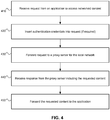
- FIG. 4 illustrates a method by which a relay proxy 220 manages network traffic between an application 210 and a remote resource server 150, according to one embodiment.
- the steps of FIG.4 are illustrated from the perspective of the relay proxy 220 performing the method. However, some or all of the steps may be performed by other entities and/or components. In addition, some embodiments may perform the steps in parallel, perform the steps in different orders, or perform different steps.
- the method begins with the relay proxy 220 receiving 410 a request to access an item of networked content (e.g., content hosted on a resource server 150) from an application 210.
- the request identifies a particular resource server 150 and includes a content identifier that uniquely identifies the requested content within the networked computing environment 100.
- the relay proxy 220 inserts 420 authentication credentials into the request if required.
- the relay proxy examines the request to determine whether authentication credentials are required. For example, if a connection is already active between the originating application 110 and the hosting resource server 150, authentication credentials might not need to be provided, depending in the configuration of the proxy server 130. If authentication credentials need to be inserted 420, the relay proxy 220 retrieves the required credentials from authentication credentials storage 230 and adds them to the request. In one embodiment, the relay proxy 220 initially sends the request without inserting 420 authentication credentials. If authentication credentials are required for the request, the proxy server 130 will reject the request and the relay proxy 220 will receive an authentication failed notification. In response, the relay proxy 220 inserts 420 the required authentication credentials and resends the request.
- the relay proxy 220 forwards 430 the request (including any required authentication credentials) to the proxy server 130 for the local network.
- the proxy server 130 As the request received by the proxy server 130 originated from the relay proxy 220, it contains the required authentication headers. Therefore, the proxy server 130 processes the request and retrieves the required content from the hosting resource server 150. In contrast, if an application 210 sends the request directly to the proxy server 130 the request will lack the required authorization headers. Thus, the proxy server identifies the request as having come from an unauthorized source, and prevents the request from leaving the local network 120.
- the relay proxy 220 receives 440 a response from the proxy server 130 that includes the requested content that was retrieved from the resource server 150.
- the relay proxy 220 then forwards 450 the requested content item to the application 210 from which the request to access the content originated.
- the requested content can then be used by the application 210 to provide functionality to the end-user.
- an educational quiz application might retrieve a set of high scores for a particular region (e.g., a school district, a country, worldwide, etc.) and present them on a display of the user device 110 in conjunction with the user's own score.
- a video player application may present video content on the display of the user device 110.
- an organization such as a school can efficiently monitor network traffic in and out of the organization's local network 120. Further, the organization can enforce network security policies such as limiting student Internet access to certain approved websites.
- local network's proxy server 130 can be configured to allow only network traffic to and from a relay proxy to cross the boundary between the local network 120 and the external network 140.
- configuration of the local network's proxy server 130 is significantly simpler than a configuration where each application 110 accesses the external network 140 directly (i.e., not via a relay proxy 220).
- the individual applications 210 need not have access to users' authentication credentials.
- the security of the local network 120 and the users is protected against a malicious or poorly designed application 210 leaking authentication credentials to an unauthorized party.
- any reference to "one embodiment” or “an embodiment” means that a particular element, feature, structure, or characteristic described in connection with the embodiment is included in at least one embodiment.
- the appearances of the phrase “in one embodiment” in various places in the specification are not necessarily all referring to the same embodiment.
- Coupled and “connected” along with their derivatives. It should be understood that these terms are not intended as synonyms for each other. For example, some embodiments may be described using the term “connected” to indicate that two or more elements are in direct physical or electrical contact with each other. In another example, some embodiments may be described using the term “coupled” to indicate that two or more elements are in direct physical or electrical contact. The term “coupled,” however, may also mean that two or more elements are not in direct contact with each other, but yet still co-operate or interact with each other. The embodiments are not limited in this context.
- the terms “comprises,” “comprising,” “includes,” “including,” “has,” “having” or any other variation thereof, are intended to cover a non-exclusive inclusion.
- a process, method, article, or apparatus that comprises a list of elements is not necessarily limited to only those elements but may include other elements not expressly listed or inherent to such process, method, article, or apparatus.
- “or” refers to an inclusive or and not to an exclusive or. For example, a condition A or B is satisfied by any one of the following: A is true (or present) and B is false (or not present), A is false (or not present) and B is true (or present), and both A and B are true (or present).
Landscapes
- Engineering & Computer Science (AREA)
- Computer Hardware Design (AREA)
- Computer Security & Cryptography (AREA)
- Computing Systems (AREA)
- General Engineering & Computer Science (AREA)
- Computer Networks & Wireless Communication (AREA)
- Signal Processing (AREA)
- Information Transfer Between Computers (AREA)
Claims (13)
- Verfahren zum Zugreifen auf entfernten Inhalt, gespeichert außerhalb eines Netzwerks, von innerhalb des Netzwerks, wobei das Verfahren umfasst:Empfangen von Anmeldeinformationen, die mit einem Benutzer assoziiert sind, an einem Relais-Proxy (220), der auf einem Benutzergerät ausgeführt wird, wobei die Anmeldeinformationen von dem Benutzer verwendet werden, um sich am Relais-Proxy anzumelden;Empfangen (410) einer ersten Anforderung von einer ersten Anwendung, die auf dem Benutzergerät ausgeführt wird, und einer zweiten Anforderung von einer zweiten Anwendung, die auf dem Benutzergerät ausgeführt wird, am Relay-Proxy, wobei die erste Anforderung ein erstes entferntes Inhaltselement und die zweite Anforderung ein zweites entferntes Inhaltselement identifiziert;Prüfen der ersten Anforderung und der zweiten Anforderung durch den Relay-Proxy, um zu ermitteln, ob die erforderlichen Authentifizierungsreferenzen vorhanden sind;Identifizieren der erforderlichen Authentifizierungsreferenzen basierend auf den Anmeldeinformationen, wobei die erste Anwendung und die zweite Anwendung keinen Zugriff auf die erforderlichen Authentifizierungsreferenzen haben;Einsetzen (420) der erforderlichen Authentifizierungsreferenzen durch den Relay-Proxy in zumindest eine der ersten Anforderung und der zweiten Anforderung in Reaktion auf das Ermitteln, dass die erforderlichen Authentifizierungsreferenzen in der entsprechenden Anforderung nicht vorhanden sind;Weiterleiten (430) der ersten Anforderung und der zweiten Anforderung durch den Relay-Proxy an einen Proxy-Server, der den in das Netzwerk ein- und ausgehenden Netzwerkverkehr verwaltet;Empfangen (440) einer ersten Reaktion auf die erste Anforderung und einer zweiten Reaktion auf die zweite Anforderung durch den Relais-Proxy, wobei die erste Reaktion das erste entfernte Inhaltselement und die zweite Reaktion das zweite entfernte Inhaltselement beinhaltet; undWeiterleiten (450) des ersten entfernten Inhaltselements an die erste Anwendung und des zweiten entfernten Inhaltselements an die zweite Anwendung durch den Relay-Proxy.
- Verfahren nach Anspruch 1, wobei der Proxy-Server konfiguriert ist, vom Relay-Proxy empfangene Inhaltsanforderungen zu verarbeiten und direkt von der ersten oder der zweiten Anwendung empfangene Inhaltsanforderungen zu blockieren.
- Verfahren nach Anspruch 1, ferner umfassend, durch den Relay-Proxy:Bereitstellen einer Aufforderung an den Benutzer, die Authentifizierungsreferenzen einzugeben; undEmpfangen der Authentifizierungsreferenzen.
- Verfahren nach Anspruch 1, ferner umfassend, durch den Relay-Proxy:Empfangen einer dritten Anforderung von einer dritten Anwendung, die auf dem Benutzergerät installiert ist, wobei die dritte Anforderung ein drittes entferntes Inhaltselement identifiziert;Blockieren der dritten Anforderung; undSenden einer Benachrichtigung an die dritte Anwendung, dass die dritte Anforderung blockiert wurde.
- Verfahren nach Anspruch 4, wobei der Relay-Proxy die dritte Anforderung blockiert, in Reaktion auf einen Ressourcenserver, der das dritte entfernte Inhaltselement hostet, das auf einer schwarzen Liste erscheint, wobei die schwarze Liste Ressourcenserver identifiziert, zu denen der Zugriff von innerhalb des Netzwerks nicht erlaubt ist.
- Verfahren nach Anspruch 4 oder Anspruch 5, wobei der Relay-Proxy die dritte Anforderung blockiert, in Reaktion darauf, dass das dritte entfernte Inhaltselement nicht in einer weißen Liste beinhaltet ist, wobei die weiße Liste Inhaltselemente identifiziert, auf die der Zugriff von innerhalb des Netzwerks erlaubt ist.
- Benutzergerät zum Zugreifen auf entfernten Inhalt, der außerhalb eines Netzwerks gespeichert ist, von innerhalb des Netzwerks, wobei das Benutzergerät umfasst:eine erste Anwendung, die auf dem Benutzergerät ausgeführt wird und konfiguriert ist, eine erste Anforderung zu senden, die ein erstes entferntes Inhaltselement identifiziert;eine zweite Anwendung, die auf dem Benutzergerät ausgeführt wird und konfiguriert ist, eine zweite Anforderung zu senden, die ein zweites entferntes Inhaltselement identifiziert;einen Relay-Proxy (220), der auf dem Benutzergerät ausgeführt wird, das konfiguriert ist, zum:Empfangen von Anmeldeinformationen, die mit einem Benutzer assoziiert sind, wobei die Anmeldeinformationen von dem Benutzer verwendet werden, um sich am Relais-Proxy anzumelden;Empfangen der ersten Anforderung von der ersten Anwendung und der zweiten Anforderung von der zweiten Anwendung;Prüfen der ersten Anforderung und der zweiten Anforderung, um zu ermitteln, ob die erforderlichen Authentifizierungsreferenzen vorhanden sind;Identifizieren der erforderlichen Authentifizierungsreferenzen basierend auf den Anmeldedaten, wobei die erste Anwendung und die zweite Anwendung keinen Zugriff auf die erforderlichen Authentifizierungsreferenzen habenEinsetzen der erforderlichen Authentifizierungsreferenzen in zumindest eine der ersten Anforderung und der zweiten Anforderung in Reaktion auf das Ermitteln, dass die erforderlichen Authentifizierungsreferenzen in der entsprechenden Anforderung nicht vorhanden sind;Weiterleiten der ersten Anforderung und der zweiten Anforderung an einen Proxy-Server, der den in das Netzwerk ein- und ausgehenden Netzwerkverkehr verwaltet;Empfangen einer ersten Reaktion auf die erste Anforderung und einer zweiten Reaktion auf die zweite Anforderung, wobei die erste Reaktion das erste entfernte Inhaltselement und die zweite Reaktion das zweite entfernte Inhaltselement beinhaltet; undWeiterleiten des ersten entfernten Inhaltselements an die erste Anwendung und des zweiten entfernten Inhaltselements an die zweite Anwendung.
- Benutzergerät nach Anspruch 7, wobei der Relay-Proxy ferner konfiguriert ist, dem Benutzer eine Aufforderung zur Eingabe der Authentifizierungsreferenzen bereitzustellen; und die Authentifizierungsreferenzen zu empfangen.
- Benutzergerät nach Anspruch 7, wobei das Benutzergerät ferner eine dritte Anwendung umfasst, die auf dem Benutzergerät installiert ist, wobei der Relais-Proxy ferner konfiguriert ist, zum:Empfangen einer dritten Anforderung von der dritten Anwendung, die auf dem Benutzergerät installiert ist;Blockieren der dritten Anforderung; undSenden einer Benachrichtigung an die dritte Anwendung, dass die dritte Anforderung blockiert wurde.
- Benutzergerät nach Anspruch 10, wobei der Relay-Proxy ferner konfiguriert ist, die dritte Anforderung zu blockieren, in Reaktion auf einen Ressourcenserver, der das dritte entfernte Inhaltselement hostet, das auf einer schwarzen Liste erscheint, wobei die schwarze Liste Ressourcenserver identifiziert, zu denen der Zugriff von innerhalb des Netzwerks nicht erlaubt ist.
- Benutzergerät nach Anspruch 10 oder Anspruch 11, wobei der Relay-Proxy die dritte Anforderung blockiert, in Reaktion darauf, dass das dritte entfernte Inhaltselement nicht in einer weißen Liste beinhaltet ist, wobei die weiße Liste Inhaltselemente identifiziert, auf die der Zugriff von innerhalb des Netzwerks erlaubt ist.
- System, umfassend:das Benutzergerät nach Anspruch 7; undeinen Proxy-Server, wobei der Proxy-Server konfiguriert ist, vom Relay-Proxy empfangene Inhaltsanforderungen zu verarbeiten und direkt von der ersten oder der zweiten Anwendung empfangene Inhaltsanforderungen zu blockieren.
- Nichtflüchtiges computerlesbares Medium, das einen ausführbaren Computerprogrammcode zum Zugreifen auf außerhalb eines Netzwerks gespeicherten entfernten Inhalt von innerhalb des Netzwerks aus speichert, wobei der Computerprogrammcode Anweisungen zum Ausführen des Verfahrens nach einem der Ansprüche 1 bis 6 umfasst.
Applications Claiming Priority (2)
| Application Number | Priority Date | Filing Date | Title |
|---|---|---|---|
| US14/247,179 US9736119B2 (en) | 2014-04-07 | 2014-04-07 | Relay proxy providing secure connectivity in a controlled network environment |
| PCT/US2015/021316 WO2015156974A1 (en) | 2014-04-07 | 2015-03-18 | Relay proxy providing secure connectivity in a controlled network environment |
Publications (3)
| Publication Number | Publication Date |
|---|---|
| EP3130132A1 EP3130132A1 (de) | 2017-02-15 |
| EP3130132A4 EP3130132A4 (de) | 2017-08-23 |
| EP3130132B1 true EP3130132B1 (de) | 2020-10-07 |
Family
ID=54210761
Family Applications (1)
| Application Number | Title | Priority Date | Filing Date |
|---|---|---|---|
| EP15776848.2A Active EP3130132B1 (de) | 2014-04-07 | 2015-03-18 | Relais-proxy für sichere konnektivität in einer gesteuerten netzwerkumgebung |
Country Status (5)
| Country | Link |
|---|---|
| US (1) | US9736119B2 (de) |
| EP (1) | EP3130132B1 (de) |
| KR (1) | KR101886946B1 (de) |
| CN (1) | CN106165371B (de) |
| WO (1) | WO2015156974A1 (de) |
Families Citing this family (15)
| Publication number | Priority date | Publication date | Assignee | Title |
|---|---|---|---|---|
| US10181122B2 (en) | 2013-10-31 | 2019-01-15 | Cellco Partnership | Mobile authentication for web payments using single sign on credentials |
| US9628482B2 (en) * | 2013-10-31 | 2017-04-18 | Cellco Partnership | Mobile based login via wireless credential transfer |
| US10135805B2 (en) | 2013-10-31 | 2018-11-20 | Cellco Partnership | Connected authentication device using mobile single sign on credentials |
| US10313264B2 (en) | 2014-05-28 | 2019-06-04 | Apple Inc. | Sharing account data between different interfaces to a service |
| US10171503B1 (en) * | 2014-07-15 | 2019-01-01 | F5 Networks, Inc. | Methods for scaling infrastructure in a mobile application environment and devices thereof |
| US10476947B1 (en) | 2015-03-02 | 2019-11-12 | F5 Networks, Inc | Methods for managing web applications and devices thereof |
| US10169553B2 (en) * | 2015-06-29 | 2019-01-01 | Airwatch, Llc | Managing grouped student devices with timed locks |
| US10601776B1 (en) | 2017-04-21 | 2020-03-24 | Palo Alto Networks, Inc. | Security platform for service provider network environments |
| US10594734B1 (en) * | 2017-04-21 | 2020-03-17 | Palo Alto Networks, Inc. | Dynamic per subscriber policy enablement for security platforms within service provider network environments |
| CN107729358A (zh) * | 2017-09-01 | 2018-02-23 | 小草数语(北京)科技有限公司 | 基于浏览器的页面访问方法和装置 |
| BR112020021747A2 (pt) | 2018-06-07 | 2021-01-26 | Hewlett-Packard Development Company, L.P. | servidores locais para gerenciar configurações de proxy em redes intermitentes |
| EP3756334B1 (de) | 2018-06-07 | 2025-08-13 | Hewlett-Packard Development Company, L.P. | Lokale server zur verwaltung der speicherung über client-vorrichtungen in einem intermittierenden netzwerk |
| CN111444278B (zh) * | 2020-04-01 | 2023-08-29 | Oppo(重庆)智能科技有限公司 | 数据同步方法、装置及中转服务器 |
| US12034860B2 (en) * | 2020-08-26 | 2024-07-09 | Micron Technology, Inc. | Memory write access control |
| US11778071B2 (en) * | 2021-01-26 | 2023-10-03 | Avago Technologies International Sales Pte. Limited | Systems and methods for converting between a lossy communication protocol and a lossless communication protocol |
Family Cites Families (18)
| Publication number | Priority date | Publication date | Assignee | Title |
|---|---|---|---|---|
| US6721288B1 (en) * | 1998-09-16 | 2004-04-13 | Openwave Systems Inc. | Wireless mobile devices having improved operation during network unavailability |
| US6606663B1 (en) * | 1998-09-29 | 2003-08-12 | Openwave Systems Inc. | Method and apparatus for caching credentials in proxy servers for wireless user agents |
| US6895425B1 (en) * | 2000-10-06 | 2005-05-17 | Microsoft Corporation | Using an expert proxy server as an agent for wireless devices |
| US7448067B2 (en) * | 2002-09-30 | 2008-11-04 | Intel Corporation | Method and apparatus for enforcing network security policies |
| US20090193338A1 (en) * | 2008-01-28 | 2009-07-30 | Trevor Fiatal | Reducing network and battery consumption during content delivery and playback |
| US8910255B2 (en) * | 2008-05-27 | 2014-12-09 | Microsoft Corporation | Authentication for distributed secure content management system |
| US8973112B2 (en) * | 2009-01-09 | 2015-03-03 | Verizon Patent And Licensing Inc. | System and method for providing a normalized security list |
| US8392972B2 (en) * | 2009-02-11 | 2013-03-05 | Sophos Plc | Protected access control method for shared computer resources |
| US20110231479A1 (en) * | 2010-03-22 | 2011-09-22 | Siemens Product Lifecycle Management Software Inc. | System and Method for Secure Multi-Client Communication Service |
| EP2599003B1 (de) * | 2010-07-26 | 2018-07-11 | Seven Networks, LLC | Koordinierung eines mobilnetzwerkverkehrs zwischen mehreren anwendungen |
| GB2495066B (en) * | 2010-07-26 | 2013-12-18 | Seven Networks Inc | Mobile application traffic optimization |
| US8806040B2 (en) * | 2010-12-06 | 2014-08-12 | Red Hat, Inc. | Accessing external network via proxy server |
| US8527582B2 (en) * | 2011-01-10 | 2013-09-03 | Bank Of America Corporation | Systems and methods for requesting and delivering network content |
| US20130091212A1 (en) | 2011-10-08 | 2013-04-11 | Broadcom Corporation | Social network device communication resource allocation |
| WO2013086455A1 (en) * | 2011-12-07 | 2013-06-13 | Seven Networks, Inc. | Flexible and dynamic integration schemas of a traffic management system with various network operators for network traffic alleviation |
| WO2013168255A1 (ja) * | 2012-05-10 | 2013-11-14 | 三菱電機株式会社 | アプリケーションプログラム実行装置 |
| US9860323B2 (en) | 2012-05-15 | 2018-01-02 | At&T Intellectual Property I, L.P. | System and apparatus for providing policy control and charging to support communications |
| US8996856B2 (en) * | 2012-06-17 | 2015-03-31 | Skycure Ltd | Selective encryption in mobile devices |
-
2014
- 2014-04-07 US US14/247,179 patent/US9736119B2/en active Active
-
2015
- 2015-03-18 CN CN201580018467.1A patent/CN106165371B/zh active Active
- 2015-03-18 KR KR1020167030744A patent/KR101886946B1/ko active Active
- 2015-03-18 EP EP15776848.2A patent/EP3130132B1/de active Active
- 2015-03-18 WO PCT/US2015/021316 patent/WO2015156974A1/en not_active Ceased
Non-Patent Citations (1)
| Title |
|---|
| None * |
Also Published As
| Publication number | Publication date |
|---|---|
| CN106165371B (zh) | 2019-06-11 |
| US9736119B2 (en) | 2017-08-15 |
| EP3130132A1 (de) | 2017-02-15 |
| WO2015156974A1 (en) | 2015-10-15 |
| US20150288661A1 (en) | 2015-10-08 |
| KR20160140917A (ko) | 2016-12-07 |
| CN106165371A (zh) | 2016-11-23 |
| KR101886946B1 (ko) | 2018-08-08 |
| EP3130132A4 (de) | 2017-08-23 |
Similar Documents
| Publication | Publication Date | Title |
|---|---|---|
| EP3130132B1 (de) | Relais-proxy für sichere konnektivität in einer gesteuerten netzwerkumgebung | |
| US12309144B2 (en) | Utilizing endpoint security posture, identification, and remote attestation for restricting private application access | |
| US20230115001A1 (en) | Localization at scale for a cloud-based security service | |
| US12015592B2 (en) | Zero trust approach to secure sensitive mobile applications and prevent distributed denial of service attacks | |
| US10986094B2 (en) | Systems and methods for cloud based unified service discovery and secure availability | |
| US20210250333A1 (en) | Private application access with browser isolation | |
| US10097577B2 (en) | Predicting and preventing an attacker's next actions in a breached network | |
| US10574698B1 (en) | Configuration and deployment of decoy content over a network | |
| Lata et al. | Cyber security techniques in cloud environment: comparative analysis of public, private and hybrid cloud | |
| US10417428B2 (en) | Methods and systems for providing and controlling cryptographic secure communications terminal providing a remote desktop accessible in secured and unsecured environments | |
| US10360402B2 (en) | Intercepting sensitive data using hashed candidates | |
| US20190089737A1 (en) | Detecting attackers who target containerized clusters | |
| US11418498B2 (en) | Single sign on proxy for regulating access to a cloud service | |
| US11438306B2 (en) | System and method of connecting a DNS secure resolution protocol | |
| CA2943561C (en) | Serving approved resources | |
| US11323454B1 (en) | Systems and methods for securing communications | |
| US10567387B1 (en) | Systems and methods for managing computing device access to local area computer networks | |
| US20240386098A1 (en) | Application server protection by maintaining cross-session inspection context | |
| US9781601B1 (en) | Systems and methods for detecting potentially illegitimate wireless access points | |
| AU2017404747A1 (en) | Triggered scanning using provided configuration information | |
| Hafeez et al. | Securing edge networks with securebox | |
| US12526254B1 (en) | Dynamic domain name security policy enforcement | |
| Darr | Plan an Azure Virtual Desktop Architecture |
Legal Events
| Date | Code | Title | Description |
|---|---|---|---|
| STAA | Information on the status of an ep patent application or granted ep patent |
Free format text: STATUS: THE INTERNATIONAL PUBLICATION HAS BEEN MADE |
|
| PUAI | Public reference made under article 153(3) epc to a published international application that has entered the european phase |
Free format text: ORIGINAL CODE: 0009012 |
|
| STAA | Information on the status of an ep patent application or granted ep patent |
Free format text: STATUS: REQUEST FOR EXAMINATION WAS MADE |
|
| 17P | Request for examination filed |
Effective date: 20161020 |
|
| AK | Designated contracting states |
Kind code of ref document: A1 Designated state(s): AL AT BE BG CH CY CZ DE DK EE ES FI FR GB GR HR HU IE IS IT LI LT LU LV MC MK MT NL NO PL PT RO RS SE SI SK SM TR |
|
| AX | Request for extension of the european patent |
Extension state: BA ME |
|
| DAV | Request for validation of the european patent (deleted) | ||
| DAX | Request for extension of the european patent (deleted) | ||
| REG | Reference to a national code |
Ref country code: DE Ref legal event code: R079 Ref document number: 602015060181 Country of ref document: DE Free format text: PREVIOUS MAIN CLASS: H04L0029080000 Ipc: H04L0029060000 |
|
| A4 | Supplementary search report drawn up and despatched |
Effective date: 20170724 |
|
| RIC1 | Information provided on ipc code assigned before grant |
Ipc: H04L 29/08 20060101ALI20170718BHEP Ipc: H04L 29/06 20060101AFI20170718BHEP |
|
| RAP1 | Party data changed (applicant data changed or rights of an application transferred) |
Owner name: GOOGLE LLC |
|
| STAA | Information on the status of an ep patent application or granted ep patent |
Free format text: STATUS: EXAMINATION IS IN PROGRESS |
|
| 17Q | First examination report despatched |
Effective date: 20191218 |
|
| GRAP | Despatch of communication of intention to grant a patent |
Free format text: ORIGINAL CODE: EPIDOSNIGR1 |
|
| STAA | Information on the status of an ep patent application or granted ep patent |
Free format text: STATUS: GRANT OF PATENT IS INTENDED |
|
| INTG | Intention to grant announced |
Effective date: 20200626 |
|
| GRAS | Grant fee paid |
Free format text: ORIGINAL CODE: EPIDOSNIGR3 |
|
| GRAA | (expected) grant |
Free format text: ORIGINAL CODE: 0009210 |
|
| STAA | Information on the status of an ep patent application or granted ep patent |
Free format text: STATUS: THE PATENT HAS BEEN GRANTED |
|
| AK | Designated contracting states |
Kind code of ref document: B1 Designated state(s): AL AT BE BG CH CY CZ DE DK EE ES FI FR GB GR HR HU IE IS IT LI LT LU LV MC MK MT NL NO PL PT RO RS SE SI SK SM TR |
|
| REG | Reference to a national code |
Ref country code: GB Ref legal event code: FG4D |
|
| REG | Reference to a national code |
Ref country code: CH Ref legal event code: EP Ref country code: AT Ref legal event code: REF Ref document number: 1322386 Country of ref document: AT Kind code of ref document: T Effective date: 20201015 |
|
| REG | Reference to a national code |
Ref country code: DE Ref legal event code: R082 Ref document number: 602015060181 Country of ref document: DE Representative=s name: VENNER SHIPLEY GERMANY LLP, DE Ref country code: DE Ref legal event code: R082 Ref document number: 602015060181 Country of ref document: DE Representative=s name: VENNER SHIPLEY LLP, DE |
|
| REG | Reference to a national code |
Ref country code: IE Ref legal event code: FG4D |
|
| REG | Reference to a national code |
Ref country code: DE Ref legal event code: R096 Ref document number: 602015060181 Country of ref document: DE |
|
| REG | Reference to a national code |
Ref country code: NL Ref legal event code: MP Effective date: 20201007 |
|
| REG | Reference to a national code |
Ref country code: AT Ref legal event code: MK05 Ref document number: 1322386 Country of ref document: AT Kind code of ref document: T Effective date: 20201007 |
|
| PG25 | Lapsed in a contracting state [announced via postgrant information from national office to epo] |
Ref country code: GR Free format text: LAPSE BECAUSE OF FAILURE TO SUBMIT A TRANSLATION OF THE DESCRIPTION OR TO PAY THE FEE WITHIN THE PRESCRIBED TIME-LIMIT Effective date: 20210108 Ref country code: NO Free format text: LAPSE BECAUSE OF FAILURE TO SUBMIT A TRANSLATION OF THE DESCRIPTION OR TO PAY THE FEE WITHIN THE PRESCRIBED TIME-LIMIT Effective date: 20210107 Ref country code: NL Free format text: LAPSE BECAUSE OF FAILURE TO SUBMIT A TRANSLATION OF THE DESCRIPTION OR TO PAY THE FEE WITHIN THE PRESCRIBED TIME-LIMIT Effective date: 20201007 Ref country code: RS Free format text: LAPSE BECAUSE OF FAILURE TO SUBMIT A TRANSLATION OF THE DESCRIPTION OR TO PAY THE FEE WITHIN THE PRESCRIBED TIME-LIMIT Effective date: 20201007 Ref country code: PT Free format text: LAPSE BECAUSE OF FAILURE TO SUBMIT A TRANSLATION OF THE DESCRIPTION OR TO PAY THE FEE WITHIN THE PRESCRIBED TIME-LIMIT Effective date: 20210208 Ref country code: FI Free format text: LAPSE BECAUSE OF FAILURE TO SUBMIT A TRANSLATION OF THE DESCRIPTION OR TO PAY THE FEE WITHIN THE PRESCRIBED TIME-LIMIT Effective date: 20201007 |
|
| REG | Reference to a national code |
Ref country code: LT Ref legal event code: MG4D |
|
| PG25 | Lapsed in a contracting state [announced via postgrant information from national office to epo] |
Ref country code: LV Free format text: LAPSE BECAUSE OF FAILURE TO SUBMIT A TRANSLATION OF THE DESCRIPTION OR TO PAY THE FEE WITHIN THE PRESCRIBED TIME-LIMIT Effective date: 20201007 Ref country code: SE Free format text: LAPSE BECAUSE OF FAILURE TO SUBMIT A TRANSLATION OF THE DESCRIPTION OR TO PAY THE FEE WITHIN THE PRESCRIBED TIME-LIMIT Effective date: 20201007 Ref country code: IS Free format text: LAPSE BECAUSE OF FAILURE TO SUBMIT A TRANSLATION OF THE DESCRIPTION OR TO PAY THE FEE WITHIN THE PRESCRIBED TIME-LIMIT Effective date: 20210207 Ref country code: PL Free format text: LAPSE BECAUSE OF FAILURE TO SUBMIT A TRANSLATION OF THE DESCRIPTION OR TO PAY THE FEE WITHIN THE PRESCRIBED TIME-LIMIT Effective date: 20201007 Ref country code: BG Free format text: LAPSE BECAUSE OF FAILURE TO SUBMIT A TRANSLATION OF THE DESCRIPTION OR TO PAY THE FEE WITHIN THE PRESCRIBED TIME-LIMIT Effective date: 20210107 Ref country code: ES Free format text: LAPSE BECAUSE OF FAILURE TO SUBMIT A TRANSLATION OF THE DESCRIPTION OR TO PAY THE FEE WITHIN THE PRESCRIBED TIME-LIMIT Effective date: 20201007 Ref country code: AT Free format text: LAPSE BECAUSE OF FAILURE TO SUBMIT A TRANSLATION OF THE DESCRIPTION OR TO PAY THE FEE WITHIN THE PRESCRIBED TIME-LIMIT Effective date: 20201007 |
|
| PG25 | Lapsed in a contracting state [announced via postgrant information from national office to epo] |
Ref country code: HR Free format text: LAPSE BECAUSE OF FAILURE TO SUBMIT A TRANSLATION OF THE DESCRIPTION OR TO PAY THE FEE WITHIN THE PRESCRIBED TIME-LIMIT Effective date: 20201007 |
|
| REG | Reference to a national code |
Ref country code: DE Ref legal event code: R097 Ref document number: 602015060181 Country of ref document: DE |
|
| PG25 | Lapsed in a contracting state [announced via postgrant information from national office to epo] |
Ref country code: LT Free format text: LAPSE BECAUSE OF FAILURE TO SUBMIT A TRANSLATION OF THE DESCRIPTION OR TO PAY THE FEE WITHIN THE PRESCRIBED TIME-LIMIT Effective date: 20201007 Ref country code: RO Free format text: LAPSE BECAUSE OF FAILURE TO SUBMIT A TRANSLATION OF THE DESCRIPTION OR TO PAY THE FEE WITHIN THE PRESCRIBED TIME-LIMIT Effective date: 20201007 Ref country code: SK Free format text: LAPSE BECAUSE OF FAILURE TO SUBMIT A TRANSLATION OF THE DESCRIPTION OR TO PAY THE FEE WITHIN THE PRESCRIBED TIME-LIMIT Effective date: 20201007 Ref country code: CZ Free format text: LAPSE BECAUSE OF FAILURE TO SUBMIT A TRANSLATION OF THE DESCRIPTION OR TO PAY THE FEE WITHIN THE PRESCRIBED TIME-LIMIT Effective date: 20201007 Ref country code: EE Free format text: LAPSE BECAUSE OF FAILURE TO SUBMIT A TRANSLATION OF THE DESCRIPTION OR TO PAY THE FEE WITHIN THE PRESCRIBED TIME-LIMIT Effective date: 20201007 Ref country code: SM Free format text: LAPSE BECAUSE OF FAILURE TO SUBMIT A TRANSLATION OF THE DESCRIPTION OR TO PAY THE FEE WITHIN THE PRESCRIBED TIME-LIMIT Effective date: 20201007 |
|
| PLBE | No opposition filed within time limit |
Free format text: ORIGINAL CODE: 0009261 |
|
| STAA | Information on the status of an ep patent application or granted ep patent |
Free format text: STATUS: NO OPPOSITION FILED WITHIN TIME LIMIT |
|
| PG25 | Lapsed in a contracting state [announced via postgrant information from national office to epo] |
Ref country code: DK Free format text: LAPSE BECAUSE OF FAILURE TO SUBMIT A TRANSLATION OF THE DESCRIPTION OR TO PAY THE FEE WITHIN THE PRESCRIBED TIME-LIMIT Effective date: 20201007 |
|
| 26N | No opposition filed |
Effective date: 20210708 |
|
| PG25 | Lapsed in a contracting state [announced via postgrant information from national office to epo] |
Ref country code: MC Free format text: LAPSE BECAUSE OF FAILURE TO SUBMIT A TRANSLATION OF THE DESCRIPTION OR TO PAY THE FEE WITHIN THE PRESCRIBED TIME-LIMIT Effective date: 20201007 Ref country code: IT Free format text: LAPSE BECAUSE OF FAILURE TO SUBMIT A TRANSLATION OF THE DESCRIPTION OR TO PAY THE FEE WITHIN THE PRESCRIBED TIME-LIMIT Effective date: 20201007 Ref country code: AL Free format text: LAPSE BECAUSE OF FAILURE TO SUBMIT A TRANSLATION OF THE DESCRIPTION OR TO PAY THE FEE WITHIN THE PRESCRIBED TIME-LIMIT Effective date: 20201007 |
|
| REG | Reference to a national code |
Ref country code: CH Ref legal event code: PL |
|
| REG | Reference to a national code |
Ref country code: DE Ref legal event code: R079 Ref document number: 602015060181 Country of ref document: DE Free format text: PREVIOUS MAIN CLASS: H04L0029060000 Ipc: H04L0065000000 |
|
| PG25 | Lapsed in a contracting state [announced via postgrant information from national office to epo] |
Ref country code: SI Free format text: LAPSE BECAUSE OF FAILURE TO SUBMIT A TRANSLATION OF THE DESCRIPTION OR TO PAY THE FEE WITHIN THE PRESCRIBED TIME-LIMIT Effective date: 20201007 |
|
| REG | Reference to a national code |
Ref country code: BE Ref legal event code: MM Effective date: 20210331 |
|
| PG25 | Lapsed in a contracting state [announced via postgrant information from national office to epo] |
Ref country code: FR Free format text: LAPSE BECAUSE OF NON-PAYMENT OF DUE FEES Effective date: 20210331 Ref country code: IE Free format text: LAPSE BECAUSE OF NON-PAYMENT OF DUE FEES Effective date: 20210318 Ref country code: CH Free format text: LAPSE BECAUSE OF NON-PAYMENT OF DUE FEES Effective date: 20210331 Ref country code: LI Free format text: LAPSE BECAUSE OF NON-PAYMENT OF DUE FEES Effective date: 20210331 Ref country code: LU Free format text: LAPSE BECAUSE OF NON-PAYMENT OF DUE FEES Effective date: 20210318 |
|
| PG25 | Lapsed in a contracting state [announced via postgrant information from national office to epo] |
Ref country code: IS Free format text: LAPSE BECAUSE OF FAILURE TO SUBMIT A TRANSLATION OF THE DESCRIPTION OR TO PAY THE FEE WITHIN THE PRESCRIBED TIME-LIMIT Effective date: 20210207 |
|
| PG25 | Lapsed in a contracting state [announced via postgrant information from national office to epo] |
Ref country code: BE Free format text: LAPSE BECAUSE OF NON-PAYMENT OF DUE FEES Effective date: 20210331 |
|
| PG25 | Lapsed in a contracting state [announced via postgrant information from national office to epo] |
Ref country code: HU Free format text: LAPSE BECAUSE OF FAILURE TO SUBMIT A TRANSLATION OF THE DESCRIPTION OR TO PAY THE FEE WITHIN THE PRESCRIBED TIME-LIMIT; INVALID AB INITIO Effective date: 20150318 |
|
| P01 | Opt-out of the competence of the unified patent court (upc) registered |
Effective date: 20230506 |
|
| PG25 | Lapsed in a contracting state [announced via postgrant information from national office to epo] |
Ref country code: CY Free format text: LAPSE BECAUSE OF FAILURE TO SUBMIT A TRANSLATION OF THE DESCRIPTION OR TO PAY THE FEE WITHIN THE PRESCRIBED TIME-LIMIT Effective date: 20201007 |
|
| PG25 | Lapsed in a contracting state [announced via postgrant information from national office to epo] |
Ref country code: MK Free format text: LAPSE BECAUSE OF FAILURE TO SUBMIT A TRANSLATION OF THE DESCRIPTION OR TO PAY THE FEE WITHIN THE PRESCRIBED TIME-LIMIT Effective date: 20201007 |
|
| PG25 | Lapsed in a contracting state [announced via postgrant information from national office to epo] |
Ref country code: MT Free format text: LAPSE BECAUSE OF FAILURE TO SUBMIT A TRANSLATION OF THE DESCRIPTION OR TO PAY THE FEE WITHIN THE PRESCRIBED TIME-LIMIT Effective date: 20201007 |
|
| PG25 | Lapsed in a contracting state [announced via postgrant information from national office to epo] |
Ref country code: TR Free format text: LAPSE BECAUSE OF FAILURE TO SUBMIT A TRANSLATION OF THE DESCRIPTION OR TO PAY THE FEE WITHIN THE PRESCRIBED TIME-LIMIT Effective date: 20201007 |
|
| PGFP | Annual fee paid to national office [announced via postgrant information from national office to epo] |
Ref country code: GB Payment date: 20260327 Year of fee payment: 12 |
|
| PGFP | Annual fee paid to national office [announced via postgrant information from national office to epo] |
Ref country code: DE Payment date: 20260327 Year of fee payment: 12 |