EP3130558A1 - Tire-bouchon à ailettes avec un ou plusieurs ustensiles secondaires - Google Patents
Tire-bouchon à ailettes avec un ou plusieurs ustensiles secondaires Download PDFInfo
- Publication number
- EP3130558A1 EP3130558A1 EP15192528.6A EP15192528A EP3130558A1 EP 3130558 A1 EP3130558 A1 EP 3130558A1 EP 15192528 A EP15192528 A EP 15192528A EP 3130558 A1 EP3130558 A1 EP 3130558A1
- Authority
- EP
- European Patent Office
- Prior art keywords
- shaft
- utensils
- bottle
- handle portion
- secondary utensils
- Prior art date
- Legal status (The legal status is an assumption and is not a legal conclusion. Google has not performed a legal analysis and makes no representation as to the accuracy of the status listed.)
- Withdrawn
Links
- 239000007799 cork Substances 0.000 claims description 47
- 238000007789 sealing Methods 0.000 claims description 6
- 239000011888 foil Substances 0.000 description 19
- 230000008901 benefit Effects 0.000 description 5
- 238000013461 design Methods 0.000 description 5
- 238000000034 method Methods 0.000 description 5
- 238000004806 packaging method and process Methods 0.000 description 4
- 239000002184 metal Substances 0.000 description 3
- 241001417935 Platycephalidae Species 0.000 description 2
- 230000009471 action Effects 0.000 description 2
- 239000000284 extract Substances 0.000 description 2
- 238000012986 modification Methods 0.000 description 2
- 230000004048 modification Effects 0.000 description 2
- 230000008569 process Effects 0.000 description 2
- 238000013138 pruning Methods 0.000 description 2
- 241000283973 Oryctolagus cuniculus Species 0.000 description 1
- 230000007812 deficiency Effects 0.000 description 1
- 238000006073 displacement reaction Methods 0.000 description 1
- 210000005069 ears Anatomy 0.000 description 1
- 231100001261 hazardous Toxicity 0.000 description 1
- 238000005259 measurement Methods 0.000 description 1
- 238000003825 pressing Methods 0.000 description 1
- 238000012552 review Methods 0.000 description 1
Images





Classifications
-
- B—PERFORMING OPERATIONS; TRANSPORTING
- B67—OPENING, CLOSING OR CLEANING BOTTLES, JARS OR SIMILAR CONTAINERS; LIQUID HANDLING
- B67B—APPLYING CLOSURE MEMBERS TO BOTTLES JARS, OR SIMILAR CONTAINERS; OPENING CLOSED CONTAINERS
- B67B7/00—Hand- or power-operated devices for opening closed containers
- B67B7/02—Hand- or power-operated devices for opening closed containers for removing stoppers
- B67B7/04—Cork-screws
- B67B7/0417—Cork-screws with supporting means for assisting the pulling action
- B67B7/0441—Cork-screws with supporting means for assisting the pulling action whereby the supporting means abut around the whole periphery of the neck of the bottle
-
- B—PERFORMING OPERATIONS; TRANSPORTING
- B67—OPENING, CLOSING OR CLEANING BOTTLES, JARS OR SIMILAR CONTAINERS; LIQUID HANDLING
- B67B—APPLYING CLOSURE MEMBERS TO BOTTLES JARS, OR SIMILAR CONTAINERS; OPENING CLOSED CONTAINERS
- B67B7/00—Hand- or power-operated devices for opening closed containers
- B67B7/02—Hand- or power-operated devices for opening closed containers for removing stoppers
- B67B7/04—Cork-screws
-
- B—PERFORMING OPERATIONS; TRANSPORTING
- B26—HAND CUTTING TOOLS; CUTTING; SEVERING
- B26B—HAND-HELD CUTTING TOOLS NOT OTHERWISE PROVIDED FOR
- B26B11/00—Hand knives combined with other implements, e.g. with corkscrew, with scissors, with writing implement
-
- B—PERFORMING OPERATIONS; TRANSPORTING
- B67—OPENING, CLOSING OR CLEANING BOTTLES, JARS OR SIMILAR CONTAINERS; LIQUID HANDLING
- B67B—APPLYING CLOSURE MEMBERS TO BOTTLES JARS, OR SIMILAR CONTAINERS; OPENING CLOSED CONTAINERS
- B67B7/00—Hand- or power-operated devices for opening closed containers
- B67B7/44—Combination tools, e.g. comprising cork-screws, can piercers, crowncap removers
-
- B—PERFORMING OPERATIONS; TRANSPORTING
- B67—OPENING, CLOSING OR CLEANING BOTTLES, JARS OR SIMILAR CONTAINERS; LIQUID HANDLING
- B67B—APPLYING CLOSURE MEMBERS TO BOTTLES JARS, OR SIMILAR CONTAINERS; OPENING CLOSED CONTAINERS
- B67B7/00—Hand- or power-operated devices for opening closed containers
- B67B7/02—Hand- or power-operated devices for opening closed containers for removing stoppers
- B67B7/04—Cork-screws
- B67B2007/0458—Means for cutting sealing capsules
Definitions
- the present disclosure relates generally to corkscrews, and more particularly, to winged corkscrews with one or more built-in utensils.
- corkscrews Various types of corkscrews exist, most of which comprise at least a metallic helix for drawing the cork from the wine bottle.
- the winged corkscrew (also known as the "butterfly" corkscrew) comprises two levers and a rack and pinion. Each of the two levers are positioned on either side of the worm and engage the worm via the rack and pinion. As the worm is twisted into the cork, the levers are raised. The user may then push down onto the levers to draw the cork from the bottle.
- corkscrew Another type of corkscrew is the traditional twist and pull corkscrew.
- the twist and pull corkscrew includes a handle and worm attached perpendicularly to the handle. The user engages the worm into the cork, twists, and pulls the cork from the wine bottle.
- this corkscrew unlike the winged corkscrew, is typically hard to use and requires a lot of strength from the user.
- a third type of corkscrew is the sommelier knife (also known as the "waiter's friend" or "wine key”).
- the sommelier knife is a corkscrew with a folding body structurally similar to a pocket knife.
- the worm is hingedly attached to the body and is protracted outwards when in use. After the user inserts the worm into cork, the user extends an arm of the corkscrew to brace against the lip of the bottle for leverage. The user then removes the cork from the bottle by repeatedly leveraging the corkscrew away from the arm.
- the sommelier knife is generally portable, this corkscrew requires more skill from the user than the winged corkscrew.
- a fourth type of corkscrew is the "rabbit ears" corkscrew or lever corkscrew.
- the lever corkscrew includes a lever and a pair of handles, which are adapted to grip the neck of the bottle. After the handles grip the bottle, the user presses the lever down to twist the screw into the cork, and then later lifts the lever to extract the cork. Unlike the winged corkscrew, however, this corkscrew is much bulkier, typically much more expensive, and does not last very long before breaking.
- a fifth type of corkscrew is the table top wine opener that also includes a lever and a pair of handles for securing the bottle and extract the cork.
- table top wine openers are generally affixed to or fastened onto the bases or counters and are generally not portable. Thus, these corkscrews are much bulkier and are typically expensive than the winged corkscrew.
- a sixth type of wine opener is the electric wine opener.
- This electric wine bottle opener generally includes a cylindrical round body, electric motor, and metallic helix coupled to the motor. The body engages with the neck of the bottle, and the electric motor is actuated to engage and remove the cork via twisting.
- the electric wine opener is very simple to use, but is generally limited due to its design. Specifically, unlike the winged corkscrew, the electric wine opener requires batteries and is very mundane when used by the user.
- a seventh type of wine opener is the "Ah-So" wine opener, which includes a twin-prong cork puller that engages and extracts a cork.
- the user pushes the prongs between the cork and the neck of the bottle and twists the cork out of the bottle.
- the design of this corkscrew is very simple.
- a major drawback of this corkscrew is that this corkscrew is much more difficult to use and requires skill and strength to pull the cork, as opposed to the winged corkscrew.
- corkscrews offer a secondary utensil to help remove the foil wrappings attached to the upper portion of the wine bottle, such as the wine key opener
- many of the corkscrews, including the winged corkscrew do not offer such a secondary utensil.
- Most wine bottles are covered and sealed with the foil wrapping, which must be removed, in order for the corkscrew to access the cork.
- consumers using a corkscrew device without a secondary utensil must retrieve and utilize a second tool to cut and remove the foil wrapper of the wine bottle. The necessity of using this second tool is often very inconvenient, as many users typically resort to searching and using a standard household knife to cut the foil wrapper off the wine bottle, which can be very hazardous.
- this corkscrew is a winged corkscrew that may also be used for other tasks such as removing broken pieces of cork stuck in the neck of the bottle and removing bows and strings when the bottle is wrapped, as in a gift.
- the present specification discloses a new and improved winged corkscrew with one or more secondary utensils.
- the new and improved winged corkscrew disclosed herein will provide the additional step(s) of safely remove a foil wrapper and/or cork from a bottle without the use of any other devices. Additional steps may also be used for other tasks such as removing broken pieces of cork stuck in the neck of the bottle and cutting bows and strings when the bottle is wrapped as a gift using a scissor of the winged corkscrew.
- One embodiment may be a winged corkscrew with one or more secondary utensils, comprising: a shaft; a body; and two levers; wherein each of the two levers comprise a pin, such that there are two pins; wherein the shaft comprises: a handle portion, one or more secondary utensils, a rack portion, and a helical portion; wherein the handle portion is positioned at an upper end of the shaft; wherein the one or more secondary utensils are hingedly disposed between the handle portion and the rack portion; wherein the rack portion is disposed between the one or more secondary utensils and the helical portion; wherein the helical portion is positioned at a bottom end of the shaft and is configured to engage with and remove a cork from a bottle; wherein the body comprises a through hole, two shoulders, and a base; wherein the through hole is positioned approximately at the upper end of the body, between the two shoulders, and above the base; wherein the shaft engages with and extends
- the one or more secondary utensils may be aligned in a substantially horizontal manner, such that a length of the one or more secondary utensils transverses longitudinally along a bottom portion of the handle portion, such that the one or more secondary utensils are substantially perpendicular to the shaft.
- the handle portion of the shaft may comprise at least one opening and at least one lip; wherein the at least one lip may be disposed along an inner edge of the at least one opening; and wherein the at least one lip may be adapted to engage with a sealing cap of a bottle, such that the handle portion functions as a bottle cap opener.
- a shape of the handle portion of the shaft may be selected from the group of shapes consisting of: a rectangular shape, a trapezoidal shape, and a circular shape.
- the one or more secondary utensils may be aligned along a lower portion the handle portion, such that the winged corkscrew may be configured to align with a top portion of a bottle.
- the one or more secondary utensils may be aligned along a lower portion the handle portion to provide compactness of the one or more secondary utensils.
- the one or more secondary utensils may include a blade.
- the one or more secondary utensils may include a double-point prick.
- the one or more secondary utensils may include a serrated blade.
- the one or more secondary utensils may include a screwdriver tip.
- the one or more secondary utensils may be selected from the group of secondary utensils consisting of: a cap lifter, a single-point prick, and a scissor tip.
- Another embodiment may be a winged corkscrew with one or more secondary utensils, comprising: a shaft; a body; and two levers; wherein each of the two levers comprise a pin, such that there are two pins; wherein the shaft comprises: a handle portion, at least one secondary utensil, a rack portion, and a helical portion; wherein the handle portion is positioned at an upper end of the shaft and comprises at least one opening; wherein the at least one secondary utensil is hingedly disposed between the handle portion and the rack portion; wherein the rack portion is disposed between the at least one secondary utensil and the helical portion; wherein the helical portion is positioned at a bottom end of the shaft and is configured to engage with and remove a cork from a bottle; wherein a proximal ends of the two levers comprise a plurality of gear teeth; wherein the body comprises: a through hole, two shoulders, and a base; wherein the through hole is
- the at least one secondary utensil may be aligned in a substantially horizontal manner, such that a length of the at least one secondary utensil may transverse longitudinally along a bottom portion of the handle portion, such that the one or more secondary utensils may be substantially perpendicular to the shaft.
- the handle portion of the shaft may comprise at least one opening and at least one lip; wherein the at least one lip may be disposed along an inner edge of the at least one opening; and wherein the at least one lip may be adapted to engage with a sealing cap of a bottle, such that the handle portion may function as a bottle cap opener.
- a shape of the handle portion of the shaft may be selected from the group of shapes consisting of: a rectangular shape, a trapezoidal shape, and a circular shape.
- the one or more secondary utensils may be aligned along a lower portion the handle portion, such that the winged corkscrew may be configured to align with a top portion of a bottle.
- the one or more secondary utensils may be aligned along a lower portion the handle portion to provide compactness of the one or more secondary utensils.
- the at least one secondary utensil may be a blade.
- the at least one secondary utensil may be selected from the group of secondary utensils consisting of: a blade, a serrated blade, a cap lifter, a single-point prick, a double-point prick, a scissor tip, and a screwdriver tip.
- Another embodiment may be a winged corkscrew with one or more secondary utensils, consisting essentially of: a shaft; a body; a first lever, comprising a first pin; and a second lever, comprising a second pin; wherein the shaft consists essentially of: a handle portion, two secondary utensils, a rack portion, and a helical portion; wherein the handle portion is positioned at an upper end of the shaft and comprises at least one opening and at least one lip; wherein the at least one lip is disposed along an inner edge of the at least one opening and is adapted to engage with a sealing cap of a bottle, such that the shaft functions as a bottle cap opener; wherein the two secondary utensils are hingedly disposed between the handle portion and the rack portion and is aligned in a substantial horizontal manner, such that a length of the two secondary utensils transverse longitudinally along a bottom portion of the handle portion; wherein the rack portion is disposed between the two secondary utens
- Another embodiment may be a method of removing a cork from the bottle.
- the method may comprise the steps of: providing a winged corkscrew with one or more secondary utensils; protracting the one or more secondary utensils from a shaft of the winged corkscrew; positioning the protracted one or more secondary utensils against a foil wrapper of a sealed bottle; cutting the foil wrapper with the one or more secondary utensils; removing the foil wrapper from the bottle; engaging a helical portion of the shaft of the winged corkscrew with a cork of the bottle; twisting the shaft until the levers of the winged corkscrew is raised; and drawing the cork from the bottle by applying pressure towards the raised levers.
- the winged corkscrew with one or more secondary utensils may comprise a single cutting utensil or blade.
- the winged corkscrew with one or more secondary utensils may comprise multiple cutting utensils. These multiple cutting utensils or blades may be connected to the handle of the combination tool by a single hinge.
- each secondary utensil attached to the multi-tool corkscrew may have a notch, which assists in unhinging the utensil.
- the secondary utensil is preferably disposed at the lower horizontal position of within the handle to help align the utensil when cutting the foil.
- the position of the secondary utensils help the user by positioning the winged corkscrew in a convenient manner when cutting and removing the foil wrapper.
- the new and improved winged corkscrew disclosed herein provides additional utensils (e.g., screwdrivers, wire strippers, scissors, reamer, screwdrivers, pins, chisels, metal files, peelers) not found in conventional corkscrews.
- the corkscrew is a winged-type corkscrew comprising at least one cutting utensil.
- the term “substantially” refers to the complete or nearly complete extent or degree of an action, characteristic, property, state, structure, item, or result.
- an object that is “substantially” located within a housing would mean that the object is either completely within a housing or nearly completely within a housing.
- the exact allowable degree of deviation from absolute completeness may in some cases depend on the specific context. However, generally speaking the nearness of completion will be so as to have the same overall result as if absolute and total completion were obtained.
- the use of “substantially” is also equally applicable when used in a negative connotation to refer to the complete or near complete lack of an action, characteristic, property, state, structure, item, or result.
- the terms “approximately” and “about” generally refer to a deviance of within 5% of the indicated number or range of numbers. In one embodiment, the term “approximately” and “about”, may refer to a deviance of between 1-10% from the indicated number or range of numbers.
- rectangular refers to a shape having a form of a rectangle or four-sided flat shape with straight sides. All the interior angles of a rectangular shape may be right angles and are approximately 90° degrees each.
- trapezoidal refers to a shape having a form of a trapezoid or any four-sided shape that has two sides that are substantially in parallel and two sides that are not parallel.
- the sum of the interior angles of a trapezoidal shape is preferably 360° degrees.
- circular refers to a shape having a form of a circle or any shape having a closed plane curve.
- a circular shape may include, without limitation, circles, ovals, and ellipses.
- blades e.g ., large blade, small blade, serrated blade, blade without points, electrician blade, picker blade, pruning blade
- can openers can openers
- bottle openers screwdrivers, wire strippers, scissors, reamers, screwdrivers (e.g. , phillips, flat heads), pins, chisels, metal files, peelers, and cutters.
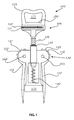
- FIG. 1 is an illustration of a front elevational view of one embodiment of the winged corkscrew with one or more secondary utensils.
- one embodiment of the winged corkscrew with one or more secondary utensils 100 may comprise: a shaft 105, two levers 110, 115, and body 120.
- the shaft 105 may comprise: a handle portion 125, secondary utensils 130, 131, rack 135, and helical portion 140.
- the handle portion 125 of the shaft 105 is preferably configured for the user to hold and control the combination tool 100.
- the handle portion 125 may comprise an opening 175 and a lip 180 located along the inner edge of the opening 175.
- the lip 180, handle 125, and opening 175 may be used to latch onto a cap or sealing cap of a bottle and may allow for the shaft 105 to function as a lever to remove the bottle cap.
- a user may move the shaft 105 upwards such that the corkscrew 100 functions as a bottle cap remover for removing a bottle cap from a bottle.
- the size of the opening 175 is preferably proportionate to the size of a standard bottle cap, such that the lip 180 in conjunction with the opening 175 and handle portion 125 may be used to engage and remove a bottle cap from a bottle.
- the shape of the handle portion 125 may comprise, without limitation: rectangular, circular, trapezoidal, square, octagonal, hexagonal, organic, and/or heptagonal.
- the secondary utensils 130, 131 may preferably be any tool that may assist the user in removing a cork from a cork stoppered bottle.
- the secondary utensils 130, 131 may be any tool such as a cutting tool which may be used for shear deformation.
- the secondary utensils 130, 131 may comprise, without limitation, blades (e.g., large blade, small blade, serrated blade, blade without points, electrician blade, picker blade, pruning blade), can openers, bottle openers, screwdrivers, wire strippers, scissors, reamer, screwdrivers (e.g., phillips, flat heads), pins, chisels, metal files, peelers, and cutters.
- blades e.g., large blade, small blade, serrated blade, blade without points, electrician blade, picker blade, pruning blade
- can openers e.g., large blade, small blade, serrated blade, blade without points, electrician blade, picker blade, pruning blade
- can openers
- the secondary utensil may be a blade for slicing or cutting foil wrapper from the bottle.
- the secondary utensil may also be a scissor for cutting the foil wrapper, plastic wrapping, and/or outside packaging of the bottle (e.g., box packaging, plastic shrinkwrap).
- the scissors for example, may be used for cutting the bow and string of the bottle when the bottle is gift-wrapped.
- Various other secondary utensils may also be used to assist the user in other situations.
- the secondary utensils 130, 131 are positioned below the handle portion 125 and lip 180 and above the rack portion 135 of the shaft 105. Additionally, as shown in the figures, the secondary utensils 130, 131 are preferably disposed in a substantial horizontal manner along the lower portion of the handle portion 125, such that the secondary utensils 130, 131 are substantially perpendicular to the shaft 105.
- This design and configuration preferably allows the user to position the winged corkscrew 100 in a convenient manner, such that the corkscrew 100 may align in a parallel manner with a wine bottle when removing the foil wrapper.
- Another benefit of having the secondary utensils 130, 131 aligned along the lower portion of the handle 125 is to provide compactness and an aesthetically pleasing look to the user. This allows the winged corkscrew 100 to hold and secure multiple secondary utensils within the winged corkscrew without significantly increasing the size of the corkscrew.
- FIG. 1 also shows that the shaft 105 may comprise a rack portion 135 formed vertically along the middle portion of the shaft 105.
- the rack portion 135 preferably comprises a plurality of grooves for engaging the gear teeth 145, 150 of the levers 110, 115, thereby providing vertical displacement of the shaft 105 upon actuation of the levers 110, 115.
- FIG. 1 also shows that the shaft 105 may comprise a helical portion 140, which is preferably positioned below the rack portion 135.
- the helical portion 140 which is also called a worm, may extend downwards, along the length of the bottom portion of the shaft 105, and may comprise a tip, which may be located at the bottom end of the shaft 105.
- the helical portion 140 preferably terminates at the tip.
- FIG. 1 also shows that the body 120 may comprise a base 170.
- the base 170 is preferably the bottom portion of the body 120 and is preferably configured to engage in a ringed manner the top portion of the bottle to be de-corked.
- the base 170 is preferably cylindrical ring shape and preferably provides hand support for the user when rotating the shaft 125.
- FIG. 1 shows that the body may comprise a through hole 136 and shoulders 137, 138.
- the through hole 136 is preferably configured to allow the shaft 105 to engage with and extrude through the through hole 136.
- the shoulders 137, 138 are preferably configured to rotatably engage with the levers 110, 115 of the multi-tool corkscrew 100.
- FIG. 1 shows that the levers 110, 115 may comprise pins 155, 160, which may be used to movably fasten the levers 110, 115 the body 120 and provide rotational movement for the levers 110, 115 and for the gear teeth 145, 150.
- the rotational movement of the levers 110, 115 around the pins 155, 160 preferably causes the gear teeth 155, 160 to engage and push in a vertical manner the rack portion 135, such that the shaft 105 moves linearly, thereby causing the shaft 105 to displace vertically up or down relative to the body 120 upon actuation of the levers 110, 115.
- the corkscrew 100 When in use, the corkscrew 100 is preferably positioned above the bottle such that the tip of the helical portion 140 of the shaft 105 may contact the cork. The user may then push and rotate the handle portion 125, which may cause the helical portion 140 of the shaft 105 to engage and penetrate into the cork. Thus, as the helical portion 140 engages with a cork in a bottle, the shaft 105 generally shifts downwards. The user then may push down onto the levers 110, 115, so that the shaft 105 moves upwards and draws the helical portion 140 and the cork from the bottle.
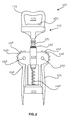
- FIG. 2 is an illustration of a rear elevational view of one embodiment of the winged corkscrew with one or more secondary utensils.
- one embodiment of the corkscrew 100 may comprise: a shaft 105, levers 110, 115, and body 120.
- the shaft 105 may comprise: a handle portion 125, rack 135, and helical portion 140.
- Each lever 110, 115 may comprise gear teeth 145, 150 and pins 155, 160, and the body 120 may comprise a base 170.
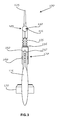
- FIG. 3 is an illustration of a right side elevational view of one embodiment of the winged corkscrew with one or more secondary utensils.
- one embodiment of the corkscrew 100 may comprise: a shaft 105, lever 115, and body 120.
- the shaft 105 may comprise: a handle portion 125, secondary utensils 130, 131, and rack 135.
- Lever 115 may comprise gear teeth 150 and pin 160.
- the body 120 may comprise the base 170.
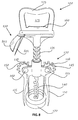
- FIG. 4 is an illustration of a left side elevational view of one embodiment of the winged corkscrew with one or more secondary utensils.
- one embodiment of the corkscrew 100 may comprise: a shaft 105, lever 110, and body 120.
- the shaft 105 may comprise: a handle portion 125, secondary utensils 130, 131, and rack 135.
- Lever 115 may comprise gear teeth 145 and pin 155.
- the body 120 may comprise the base 170.
- FIG. 5 is an illustration of a top plan view of one embodiment of the winged corkscrew with one or more secondary utensils.
- one embodiment of the corkscrew 100 may comprise: a handle portion 125, secondary utensil 130, and base 170.
- FIG. 6 is an illustration of a bottom plan view of one embodiment of the winged corkscrew with one or more secondary utensils.
- one embodiment of the corkscrew 100 may comprise: levers 110, 115, body 120, and helical portion 140.
- FIG. 7 is an illustration of a perspective view of one embodiment of the winged corkscrew with one or more secondary utensils.
- one embodiment of the utensil corkscrew 100 may comprise: a shaft 105, levers 110, 115, and body 120.
- the shaft 105 may comprise: a handle portion 125, secondary utensils 130, 131, rack 135, and helical portion 140.
- FIG. 7 also shows that each lever 110, 115 may comprise gear teeth 155, 160 and pins 155, 160, which may be used to movably fasten and secure the levers 110, 115 to the body 120.
- the body 120 may comprise a base 170.
- FIG. 8 is an illustration of a perspective view of one embodiment of the winged corkscrew with one or more secondary utensils and shows two secondary utensils hingedly protracted.
- one embodiment of the corkscrew 800 may comprise: a shaft 105, levers 110, 115, and body 120.
- the shaft 105 may comprise: a handle portion 125, secondary utensils 804, rack 135, and helical portion 140.
- FIG. 1 also shows that each lever 110, 115 may comprise gear teeth 155, 160 and pins 155, 160, which may be used to movably fasten and secure the levers 110, 115 to the body 120.
- the body 120 may comprise a base 170.
- FIG. 8 shows the secondary utensil 130 protracted and that the secondary utensils 804 may comprise two secondary utensils - a prick 801 and a blade 802, which may be referred to as a cutting tool or knife.
- FIG. 8 also shows that the opening 175 of the handle portion 125 may comprise a lip 180, which is configured to function as a bottle cap opener or bottle opener.
- FIG. 9 is an illustration of another embodiment of the handle portion of the corkscrew with one or more secondary utensils and shows the secondary utensils as a can opener with a double-point prick.
- the cork screw 900 may comprise two secondary utensils 904 - a double prick 901 and a can opener 902.
- the can opener 902 may also comprise a notch 903 to assist the user in protracting the secondary utensils 901, 902.
- FIG. 9 also shows that the opening 975 of the handle portion 925 may comprise a lip 980, which is configured to function as a bottle cap opener.
- the handle portion 925 may be various shapes, including being substantially rectangular in shape, as shown.
- FIG. 10 is an illustration of another embodiment of the handle portion of the corkscrew with one or more secondary utensils and shows the secondary utensils as a cutting tool and a serrated blade.
- the corkscrew 1000 may comprise two secondary utensils 1004 - a serrated blade 1001 and a blade 1002.
- the blade 1003 may also comprise a notch 1003 to assist the user in protracting the secondary utensils 1001, 1002.
- FIG. 10 also shows that the opening 1075 of the handle portion 1025 may comprise a lip 1080, which may be configured to function as a bottle cap opener.
- FIG. 10 also shows that the handle portion 1025 may be substantially trapezoidal in shape.
- FIG. 11 is an illustration of another embodiment of the handle portion of the corkscrew with one or more secondary utensils and shows the secondary utensils as scissors and a single-point prick.
- the secondary utensils 1104 of the corkscrew 1100 may comprise two secondary utensils 1104 - a single-point prick 1101 and a scissors 1102.
- FIG. 11 also shows that the opening 1175 of the handle portion 1125 may comprise a lip 1180, configured as a bottle cap opener.
- FIG. 11 also shows that the handle portion 1125 may be substantially circular in shape.
- a lip 1180 may be positioned within the inner edge of the opening 1175 of the handle portion 1125.
- the scissors 1102 may be used for cutting the foil wrapper, plastic wrapping, and/or outside packaging of the bottle (e.g ., box packaging, plastic shrinkwrap).
- the scissors for example, may be used for cutting the bow and string of the bottle when the bottle is gift-wrapped.
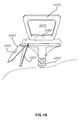
- FIG. 12 is an illustration of a perspective view of one embodiment of the winged corkscrew and shows the corkscrew with a single secondary utensil.
- Figure 12 shows that corkscrew 1200 may comprise a single secondary utensil 1204, which is shown as a curved foil cutting blade 1202.
Landscapes
- Engineering & Computer Science (AREA)
- Mechanical Engineering (AREA)
- Life Sciences & Earth Sciences (AREA)
- Forests & Forestry (AREA)
- Devices For Opening Bottles Or Cans (AREA)
Applications Claiming Priority (1)
| Application Number | Priority Date | Filing Date | Title |
|---|---|---|---|
| US14/824,800 US20170043989A1 (en) | 2015-08-12 | 2015-08-12 | Winged corkscrew with one or more secondary utensils |
Publications (1)
| Publication Number | Publication Date |
|---|---|
| EP3130558A1 true EP3130558A1 (fr) | 2017-02-15 |
Family
ID=54476744
Family Applications (1)
| Application Number | Title | Priority Date | Filing Date |
|---|---|---|---|
| EP15192528.6A Withdrawn EP3130558A1 (fr) | 2015-08-12 | 2015-11-02 | Tire-bouchon à ailettes avec un ou plusieurs ustensiles secondaires |
Country Status (6)
| Country | Link |
|---|---|
| US (1) | US20170043989A1 (fr) |
| EP (1) | EP3130558A1 (fr) |
| CN (1) | CN106430051A (fr) |
| AR (1) | AR105649A1 (fr) |
| AU (1) | AU2015234319A1 (fr) |
| CA (1) | CA2920412A1 (fr) |
Cited By (1)
| Publication number | Priority date | Publication date | Assignee | Title |
|---|---|---|---|---|
| USD1075451S1 (en) * | 2022-09-28 | 2025-05-20 | Deiss Limited | Wine bottle opener |
Families Citing this family (5)
| Publication number | Priority date | Publication date | Assignee | Title |
|---|---|---|---|---|
| JP6737119B2 (ja) * | 2016-10-11 | 2020-08-05 | マックス株式会社 | キャップおよびキャップユニット |
| USD860739S1 (en) * | 2017-09-06 | 2019-09-24 | Psp | Corkscrew |
| CN109339443A (zh) * | 2018-11-22 | 2019-02-15 | 济南城建集团有限公司 | 一种模板用固定装置 |
| FR3100031B1 (fr) * | 2019-08-21 | 2023-03-24 | Uwine | Tire-bouchon à confirmation d’ouverture d’une bouteille authentifiée |
| CN112339024B (zh) * | 2020-11-06 | 2022-05-17 | 许德祥 | 在红酒瓶塞生产过程中用于对瓶塞逐个进行打孔的装置 |
Citations (3)
| Publication number | Priority date | Publication date | Assignee | Title |
|---|---|---|---|---|
| FR647023A (fr) * | 1928-01-13 | 1928-11-19 | Tire-bouchon à leviers | |
| GB1490040A (en) * | 1976-01-09 | 1977-10-26 | Beatrice Foods Co | Mechanical cork pullers |
| EP2397437A1 (fr) * | 2010-06-17 | 2011-12-21 | AD-Fin S.p.A. | Ouvre-bouteille pour découper la capsule de la bouteille. |
Family Cites Families (5)
| Publication number | Priority date | Publication date | Assignee | Title |
|---|---|---|---|---|
| US299738A (en) * | 1884-06-03 | Charles chinnock | ||
| US115585A (en) * | 1871-06-06 | Walter dickson | ||
| US801791A (en) * | 1905-02-10 | 1905-10-10 | George J Herwig | Pocket-knife. |
| WO1988003512A1 (fr) * | 1986-11-05 | 1988-05-19 | Edoardo Turati | Dispositif et accessoire pour deboucher une bouteille de vin |
| US20080173136A1 (en) * | 2007-01-23 | 2008-07-24 | Young Dong Kim | Container lid opener |
-
2015
- 2015-08-12 US US14/824,800 patent/US20170043989A1/en not_active Abandoned
- 2015-09-30 AU AU2015234319A patent/AU2015234319A1/en not_active Abandoned
- 2015-11-02 EP EP15192528.6A patent/EP3130558A1/fr not_active Withdrawn
-
2016
- 2016-01-14 CN CN201610024337.5A patent/CN106430051A/zh active Pending
- 2016-02-09 CA CA2920412A patent/CA2920412A1/fr not_active Abandoned
- 2016-08-08 AR ARP160102433A patent/AR105649A1/es unknown
Patent Citations (3)
| Publication number | Priority date | Publication date | Assignee | Title |
|---|---|---|---|---|
| FR647023A (fr) * | 1928-01-13 | 1928-11-19 | Tire-bouchon à leviers | |
| GB1490040A (en) * | 1976-01-09 | 1977-10-26 | Beatrice Foods Co | Mechanical cork pullers |
| EP2397437A1 (fr) * | 2010-06-17 | 2011-12-21 | AD-Fin S.p.A. | Ouvre-bouteille pour découper la capsule de la bouteille. |
Cited By (1)
| Publication number | Priority date | Publication date | Assignee | Title |
|---|---|---|---|---|
| USD1075451S1 (en) * | 2022-09-28 | 2025-05-20 | Deiss Limited | Wine bottle opener |
Also Published As
| Publication number | Publication date |
|---|---|
| US20170043989A1 (en) | 2017-02-16 |
| CN106430051A (zh) | 2017-02-22 |
| CA2920412A1 (fr) | 2017-02-12 |
| AU2015234319A1 (en) | 2017-03-02 |
| AR105649A1 (es) | 2017-10-25 |
Similar Documents
| Publication | Publication Date | Title |
|---|---|---|
| EP3130558A1 (fr) | Tire-bouchon à ailettes avec un ou plusieurs ustensiles secondaires | |
| US4845844A (en) | Foil cutter | |
| CN103534193B (zh) | 侍酒服务员的开塞钻 | |
| US6289768B1 (en) | Multipurpose folding tool including corkscrew | |
| US5862720A (en) | Bottle opening tool | |
| US2886994A (en) | Combination bar tool | |
| US20130319179A1 (en) | Cork removal apparatus | |
| US2430638A (en) | Pivoted-jaw screw cap remover | |
| US20090044343A1 (en) | Multi-use hand tool | |
| US6739056B2 (en) | Nut piercer | |
| WO2014054939A1 (fr) | Dispositif d'ouverture destiné à des fermetures de récipient | |
| US9670043B2 (en) | Lever corkscrew with removable wrapper cutter | |
| CN215798387U (zh) | 多功能开瓶器 | |
| CN202045640U (zh) | 安全方便水果刀 | |
| JP4025911B2 (ja) | 残リング材切除具 | |
| CN207933009U (zh) | 一种多用途撬盖器 | |
| CN103862490A (zh) | 一种多功能剪刀 | |
| US20190039871A1 (en) | Can Opener | |
| CN201678426U (zh) | 罐头刀 | |
| CN201528980U (zh) | 水果削皮去核器 | |
| CN202448148U (zh) | 多功能刀具 | |
| TWM522225U (zh) | 多功能開罐、瓶器結構 | |
| CN208117621U (zh) | 家用多功能工具钳 | |
| RU175078U1 (ru) | Универсальный нож | |
| US1388083A (en) | Culinary implement |
Legal Events
| Date | Code | Title | Description |
|---|---|---|---|
| PUAI | Public reference made under article 153(3) epc to a published international application that has entered the european phase |
Free format text: ORIGINAL CODE: 0009012 |
|
| AK | Designated contracting states |
Kind code of ref document: A1 Designated state(s): AL AT BE BG CH CY CZ DE DK EE ES FI FR GB GR HR HU IE IS IT LI LT LU LV MC MK MT NL NO PL PT RO RS SE SI SK SM TR |
|
| AX | Request for extension of the european patent |
Extension state: BA ME |
|
| STAA | Information on the status of an ep patent application or granted ep patent |
Free format text: STATUS: THE APPLICATION IS DEEMED TO BE WITHDRAWN |
|
| 18D | Application deemed to be withdrawn |
Effective date: 20170817 |