EP3130592B1 - Analogues de composé 4h-pyrazolo[1,5- ]benzimidazole utilisés en tant qu'inhibiteurs de parp - Google Patents
Analogues de composé 4h-pyrazolo[1,5- ]benzimidazole utilisés en tant qu'inhibiteurs de parp Download PDFInfo
- Publication number
- EP3130592B1 EP3130592B1 EP15777444.9A EP15777444A EP3130592B1 EP 3130592 B1 EP3130592 B1 EP 3130592B1 EP 15777444 A EP15777444 A EP 15777444A EP 3130592 B1 EP3130592 B1 EP 3130592B1
- Authority
- EP
- European Patent Office
- Prior art keywords
- fluoro
- imidazo
- benzo
- pyrazole
- carboxamide
- Prior art date
- Legal status (The legal status is an assumption and is not a legal conclusion. Google has not performed a legal analysis and makes no representation as to the accuracy of the status listed.)
- Active
Links
- 0 COC(c1cc(F)cc2c1[n]1ncc(Br)c1[n]2*)=O Chemical compound COC(c1cc(F)cc2c1[n]1ncc(Br)c1[n]2*)=O 0.000 description 11
- MHZFZRFDKRHZIN-UHFFFAOYSA-N CC(C)(CC1)CCN1C(CC1)CCC1(F)F Chemical compound CC(C)(CC1)CCN1C(CC1)CCC1(F)F MHZFZRFDKRHZIN-UHFFFAOYSA-N 0.000 description 3
- SUYGZCDKESWZFU-UHFFFAOYSA-N CC(C)(CC1)CCN1C1CCOCC1 Chemical compound CC(C)(CC1)CCN1C1CCOCC1 SUYGZCDKESWZFU-UHFFFAOYSA-N 0.000 description 3
- XBJKYZSIXYVZDO-UHFFFAOYSA-N CC(C)(CC1)CCN1S(C)(=O)=O Chemical compound CC(C)(CC1)CCN1S(C)(=O)=O XBJKYZSIXYVZDO-UHFFFAOYSA-N 0.000 description 2
- CGZDWVZMOMDGBN-UHFFFAOYSA-N CCc1ncc[s]1 Chemical compound CCc1ncc[s]1 CGZDWVZMOMDGBN-UHFFFAOYSA-N 0.000 description 2
- JFOAVCGDQOZOAR-UHFFFAOYSA-N CC(C)(C)OC(N(CC1)CCC1(C)c1c(N)[n](-c(c(Br)cc(F)c2)c2Br)nc1O)=O Chemical compound CC(C)(C)OC(N(CC1)CCC1(C)c1c(N)[n](-c(c(Br)cc(F)c2)c2Br)nc1O)=O JFOAVCGDQOZOAR-UHFFFAOYSA-N 0.000 description 1
- JTADCHOJVJCRJA-UHFFFAOYSA-N CC(C)(C)OC(N(CC1)CCC1(C)c1c([nH]c2cc(F)cc(Br)c22)[n]2nc1OC)=O Chemical compound CC(C)(C)OC(N(CC1)CCC1(C)c1c([nH]c2cc(F)cc(Br)c22)[n]2nc1OC)=O JTADCHOJVJCRJA-UHFFFAOYSA-N 0.000 description 1
- DSWBYAIDIYZCHH-UHFFFAOYSA-N CC(C)(C)OC(N(CC1)CCC1c1c([nH]c2cc(F)cc(Br)c22)[n]2nc1)=O Chemical compound CC(C)(C)OC(N(CC1)CCC1c1c([nH]c2cc(F)cc(Br)c22)[n]2nc1)=O DSWBYAIDIYZCHH-UHFFFAOYSA-N 0.000 description 1
- WTVQUFGRAFCAIJ-UHFFFAOYSA-N CC(C)(C)OC(N(CC1)CCC1c1n[n]2c(c(C(N)=O)cc(F)c3)c3[nH]c2c1)=O Chemical compound CC(C)(C)OC(N(CC1)CCC1c1n[n]2c(c(C(N)=O)cc(F)c3)c3[nH]c2c1)=O WTVQUFGRAFCAIJ-UHFFFAOYSA-N 0.000 description 1
- JHXYATXXYLAJSU-UHFFFAOYSA-N CC(C)N(C1)CC2=CC12c1c([nH]c2cc(F)cc(C(N)=O)c22)[n]2nc1 Chemical compound CC(C)N(C1)CC2=CC12c1c([nH]c2cc(F)cc(C(N)=O)c22)[n]2nc1 JHXYATXXYLAJSU-UHFFFAOYSA-N 0.000 description 1
- KZYJNLBATDRDAC-UHFFFAOYSA-N CC(C)N(CC1)CC1(C)c1c([nH]c2cc(F)cc(C(N)=O)c22)[n]2nc1 Chemical compound CC(C)N(CC1)CC1(C)c1c([nH]c2cc(F)cc(C(N)=O)c22)[n]2nc1 KZYJNLBATDRDAC-UHFFFAOYSA-N 0.000 description 1
- MKTMZBIWWRJZKH-UHFFFAOYSA-N CC(C)N(CC1)CCC1(C)c1c([nH]c2cc(F)cc(C(N)=O)c22)[n]2nc1OC Chemical compound CC(C)N(CC1)CCC1(C)c1c([nH]c2cc(F)cc(C(N)=O)c22)[n]2nc1OC MKTMZBIWWRJZKH-UHFFFAOYSA-N 0.000 description 1
- ZEZDKIABPLVDKO-UHFFFAOYSA-N CC(C)N(CC1)CCC1(C)c1c([nH]c2cc(F)cc(C(N)=O)c22)[n]2nc1OCc1ccccc1 Chemical compound CC(C)N(CC1)CCC1(C)c1c([nH]c2cc(F)cc(C(N)=O)c22)[n]2nc1OCc1ccccc1 ZEZDKIABPLVDKO-UHFFFAOYSA-N 0.000 description 1
- ZROYNWDGSDPZDG-UHFFFAOYSA-N CC(C)N(CC1)CCC1c1c([nH]c2cc(F)cc(C(N)=O)c22)[n]2nc1 Chemical compound CC(C)N(CC1)CCC1c1c([nH]c2cc(F)cc(C(N)=O)c22)[n]2nc1 ZROYNWDGSDPZDG-UHFFFAOYSA-N 0.000 description 1
- ULBRRCANLFATTG-UHFFFAOYSA-N CC(CC1)(CCN1C1CC1)c1c([nH]c2cc(F)cc(C(N)=O)c22)[n]2nc1 Chemical compound CC(CC1)(CCN1C1CC1)c1c([nH]c2cc(F)cc(C(N)=O)c22)[n]2nc1 ULBRRCANLFATTG-UHFFFAOYSA-N 0.000 description 1
- WQNDAVGXCMQSSH-UHFFFAOYSA-N CC(CC1)CCC1(F)F Chemical compound CC(CC1)CCC1(F)F WQNDAVGXCMQSSH-UHFFFAOYSA-N 0.000 description 1
- MBAQUAYMWSLQMF-UHFFFAOYSA-N CC1(C)CCN(CC2(CC2)S(C)(=O)=O)CC1 Chemical compound CC1(C)CCN(CC2(CC2)S(C)(=O)=O)CC1 MBAQUAYMWSLQMF-UHFFFAOYSA-N 0.000 description 1
- FNLXQTYTVOMIKF-UHFFFAOYSA-N CC1(C)CCN(CCS(C)(=O)=O)CC1 Chemical compound CC1(C)CCN(CCS(C)(=O)=O)CC1 FNLXQTYTVOMIKF-UHFFFAOYSA-N 0.000 description 1
- WRLCMCZTSWSTNH-UHFFFAOYSA-N CC1(C)CCN(Cc2c(C)nc[s]2)CC1 Chemical compound CC1(C)CCN(Cc2c(C)nc[s]2)CC1 WRLCMCZTSWSTNH-UHFFFAOYSA-N 0.000 description 1
- DLFKHBKHLFKNNK-UHFFFAOYSA-N CC1(C)CCN(Cc2ncc[s]2)CC1 Chemical compound CC1(C)CCN(Cc2ncc[s]2)CC1 DLFKHBKHLFKNNK-UHFFFAOYSA-N 0.000 description 1
- GWDDLCLJFAYZPS-UHFFFAOYSA-N CC1(C)CN(CCC#N)CC1 Chemical compound CC1(C)CN(CCC#N)CC1 GWDDLCLJFAYZPS-UHFFFAOYSA-N 0.000 description 1
- BPQOTOOHOBJAKI-UHFFFAOYSA-N CC1(C)CN(CCF)CC1 Chemical compound CC1(C)CN(CCF)CC1 BPQOTOOHOBJAKI-UHFFFAOYSA-N 0.000 description 1
- SCOCNPKTLCOFBW-UHFFFAOYSA-N CC1(CCN(CC2CC2)CC1)c1c([nH]c2cc(F)cc(C(N)=O)c22)[n]2nc1C Chemical compound CC1(CCN(CC2CC2)CC1)c1c([nH]c2cc(F)cc(C(N)=O)c22)[n]2nc1C SCOCNPKTLCOFBW-UHFFFAOYSA-N 0.000 description 1
- QRETXGDHJVOCJZ-UHFFFAOYSA-N CC1(CCN(Cc2ncc[n]2C)CC1)c1c([nH]c2cc(F)cc(C(N)=O)c22)[n]2nc1 Chemical compound CC1(CCN(Cc2ncc[n]2C)CC1)c1c([nH]c2cc(F)cc(C(N)=O)c22)[n]2nc1 QRETXGDHJVOCJZ-UHFFFAOYSA-N 0.000 description 1
- QYCJQRSFDOPVGY-UHFFFAOYSA-N CC1(CCN(Cc2ncc[s]2)CC1)c1c([nH]c2cc(F)cc(C(N)=O)c22)[n]2nc1 Chemical compound CC1(CCN(Cc2ncc[s]2)CC1)c1c([nH]c2cc(F)cc(C(N)=O)c22)[n]2nc1 QYCJQRSFDOPVGY-UHFFFAOYSA-N 0.000 description 1
- BCGDFKIJCNZYJZ-UHFFFAOYSA-N CC1(CCNCC1)c1c([nH]c2cc(F)cc(C(N)=O)c22)[n]2nc1OC Chemical compound CC1(CCNCC1)c1c([nH]c2cc(F)cc(C(N)=O)c22)[n]2nc1OC BCGDFKIJCNZYJZ-UHFFFAOYSA-N 0.000 description 1
- AANWTJBZKBDMHM-UHFFFAOYSA-N CC1(CCSCC1)c1c([nH]c2cc(F)cc(Br)c22)[n]2nc1 Chemical compound CC1(CCSCC1)c1c([nH]c2cc(F)cc(Br)c22)[n]2nc1 AANWTJBZKBDMHM-UHFFFAOYSA-N 0.000 description 1
- RXFKNSAWUSNQRF-UHFFFAOYSA-N CC1(CN(C)CC1)c1c([nH]c2cc(F)cc(C(N)=O)c22)[n]2nc1 Chemical compound CC1(CN(C)CC1)c1c([nH]c2cc(F)cc(C(N)=O)c22)[n]2nc1 RXFKNSAWUSNQRF-UHFFFAOYSA-N 0.000 description 1
- ZWAWFPGLEPZERJ-UHFFFAOYSA-N CC1(CN(CC(C2)C2(F)F)CC1)c1c([nH]c2cc(F)cc(C(N)=O)c22)[n]2nc1 Chemical compound CC1(CN(CC(C2)C2(F)F)CC1)c1c([nH]c2cc(F)cc(C(N)=O)c22)[n]2nc1 ZWAWFPGLEPZERJ-UHFFFAOYSA-N 0.000 description 1
- ZOMPROAOSWOOJA-UHFFFAOYSA-N CC1(CN(CC2)CCC2(C)c2c([nH]c3cc(F)cc(C(N)=O)c33)[n]3nc2)COC1 Chemical compound CC1(CN(CC2)CCC2(C)c2c([nH]c3cc(F)cc(C(N)=O)c33)[n]3nc2)COC1 ZOMPROAOSWOOJA-UHFFFAOYSA-N 0.000 description 1
- XGIJZOZZMQWXBM-UHFFFAOYSA-N CC1(CN(CCC(F)(F)F)CC1)c1c([nH]c2cc(F)cc(C(N)=O)c22)[n]2nc1 Chemical compound CC1(CN(CCC(F)(F)F)CC1)c1c([nH]c2cc(F)cc(C(N)=O)c22)[n]2nc1 XGIJZOZZMQWXBM-UHFFFAOYSA-N 0.000 description 1
- GXCQEJABMXDVRC-UHFFFAOYSA-N CCC(C=C1)=NNC1=O Chemical compound CCC(C=C1)=NNC1=O GXCQEJABMXDVRC-UHFFFAOYSA-N 0.000 description 1
- PRMYLFHJSTWHBZ-UHFFFAOYSA-N CCC1(CCN(CC)CC1)c1c([nH]c2cc(F)cc(C(N)=O)c22)[n]2nc1 Chemical compound CCC1(CCN(CC)CC1)c1c([nH]c2cc(F)cc(C(N)=O)c22)[n]2nc1 PRMYLFHJSTWHBZ-UHFFFAOYSA-N 0.000 description 1
- HTCZKIKMCWMUFP-UHFFFAOYSA-N CCN(CCC1)C1c1c([nH]c2cc(F)cc(C(N)=O)c22)[n]2nc1 Chemical compound CCN(CCC1)C1c1c([nH]c2cc(F)cc(C(N)=O)c22)[n]2nc1 HTCZKIKMCWMUFP-UHFFFAOYSA-N 0.000 description 1
- WLQCOYYCNXROKF-UHFFFAOYSA-N CCNC(C1CC1)=O Chemical compound CCNC(C1CC1)=O WLQCOYYCNXROKF-UHFFFAOYSA-N 0.000 description 1
- XPQULTFBJPGINB-UHFFFAOYSA-N CCc1c(C)nc[s]1 Chemical compound CCc1c(C)nc[s]1 XPQULTFBJPGINB-UHFFFAOYSA-N 0.000 description 1
- UINDRJHZBAGQFD-UHFFFAOYSA-N CCc1ncc[n]1C Chemical compound CCc1ncc[n]1C UINDRJHZBAGQFD-UHFFFAOYSA-N 0.000 description 1
- IQUUNIBISXZNBV-UHFFFAOYSA-N CN(C(c1ccn[n]1-c(c(Br)cc(F)c1)c1Br)=O)OC Chemical compound CN(C(c1ccn[n]1-c(c(Br)cc(F)c1)c1Br)=O)OC IQUUNIBISXZNBV-UHFFFAOYSA-N 0.000 description 1
- UJJFHEWKNDQARH-UHFFFAOYSA-N CN(C)C(CC1)CCC1c1c([nH]c2c3c(C(N)=O)cc(F)c2)[n]3nc1 Chemical compound CN(C)C(CC1)CCC1c1c([nH]c2c3c(C(N)=O)cc(F)c2)[n]3nc1 UJJFHEWKNDQARH-UHFFFAOYSA-N 0.000 description 1
- SYRCEOOSSOCESD-UHFFFAOYSA-N CN(CC1C2)CC12c1c([nH]c2cc(F)cc(C(N)=O)c22)[n]2nc1 Chemical compound CN(CC1C2)CC12c1c([nH]c2cc(F)cc(C(N)=O)c22)[n]2nc1 SYRCEOOSSOCESD-UHFFFAOYSA-N 0.000 description 1
- LYYSVXMCRDDLCP-UHFFFAOYSA-N COC(C1(CCN(CC2CC2)CC1)c1c([nH]c2cc(F)cc(C(N)=O)c22)[n]2nc1)=O Chemical compound COC(C1(CCN(CC2CC2)CC1)c1c([nH]c2cc(F)cc(C(N)=O)c22)[n]2nc1)=O LYYSVXMCRDDLCP-UHFFFAOYSA-N 0.000 description 1
- KISWSHALCLGQQD-UHFFFAOYSA-N NC(c1c2[n]3ncc(C(C4)(C5)C4CN5C4CCC4)c3[nH]c2cc(F)c1)=O Chemical compound NC(c1c2[n]3ncc(C(C4)(C5)C4CN5C4CCC4)c3[nH]c2cc(F)c1)=O KISWSHALCLGQQD-UHFFFAOYSA-N 0.000 description 1
- FBNBFHWHZYDILI-UHFFFAOYSA-N NC(c1c2[n]3ncc(C(CC4)CCN4C4COC4)c3[nH]c2cc(F)c1)=O Chemical compound NC(c1c2[n]3ncc(C(CC4)CCN4C4COC4)c3[nH]c2cc(F)c1)=O FBNBFHWHZYDILI-UHFFFAOYSA-N 0.000 description 1
- KDIVUVMUPAOTME-UHFFFAOYSA-N NC(c1c2[n]3ncc(C4(CCNCC4)C#N)c3[nH]c2cc(F)c1)=O Chemical compound NC(c1c2[n]3ncc(C4(CCNCC4)C#N)c3[nH]c2cc(F)c1)=O KDIVUVMUPAOTME-UHFFFAOYSA-N 0.000 description 1
- JSKWIQOWIIRLJS-UHFFFAOYSA-N NC(c1c2[n]3ncc(C4(CO)CCNCC4)c3[nH]c2cc(F)c1)=O Chemical compound NC(c1c2[n]3ncc(C4(CO)CCNCC4)c3[nH]c2cc(F)c1)=O JSKWIQOWIIRLJS-UHFFFAOYSA-N 0.000 description 1
- RFZUXWGKPKIJTF-UHFFFAOYSA-N NC(c1c2[n]3ncc(C4CCN(CCF)CC4)c3[nH]c2cc(F)c1)=O Chemical compound NC(c1c2[n]3ncc(C4CCN(CCF)CC4)c3[nH]c2cc(F)c1)=O RFZUXWGKPKIJTF-UHFFFAOYSA-N 0.000 description 1
- LOKWDRYKGRCPHU-UHFFFAOYSA-N NCCN(CC1)CCC1c1c([nH]c2cc(F)cc(C(N)=O)c22)[n]2nc1 Chemical compound NCCN(CC1)CCC1c1c([nH]c2cc(F)cc(C(N)=O)c22)[n]2nc1 LOKWDRYKGRCPHU-UHFFFAOYSA-N 0.000 description 1
- FHGSQFPNJQUWFJ-UHFFFAOYSA-N O=C(C1CC1)NCI Chemical compound O=C(C1CC1)NCI FHGSQFPNJQUWFJ-UHFFFAOYSA-N 0.000 description 1
- LEWLVLJMQXLADK-UHFFFAOYSA-N OCc1ccn[n]1-c(c(Br)cc(F)c1)c1Br Chemical compound OCc1ccn[n]1-c(c(Br)cc(F)c1)c1Br LEWLVLJMQXLADK-UHFFFAOYSA-N 0.000 description 1
Classifications
-
- C—CHEMISTRY; METALLURGY
- C07—ORGANIC CHEMISTRY
- C07D—HETEROCYCLIC COMPOUNDS
- C07D487/00—Heterocyclic compounds containing nitrogen atoms as the only ring hetero atoms in the condensed system, not provided for by groups C07D451/00 - C07D477/00
- C07D487/02—Heterocyclic compounds containing nitrogen atoms as the only ring hetero atoms in the condensed system, not provided for by groups C07D451/00 - C07D477/00 in which the condensed system contains two hetero rings
- C07D487/04—Ortho-condensed systems
-
- A—HUMAN NECESSITIES
- A61—MEDICAL OR VETERINARY SCIENCE; HYGIENE
- A61K—PREPARATIONS FOR MEDICAL, DENTAL OR TOILETRY PURPOSES
- A61K31/00—Medicinal preparations containing organic active ingredients
- A61K31/33—Heterocyclic compounds
- A61K31/395—Heterocyclic compounds having nitrogen as a ring hetero atom, e.g. guanethidine or rifamycins
- A61K31/41—Heterocyclic compounds having nitrogen as a ring hetero atom, e.g. guanethidine or rifamycins having five-membered rings with two or more ring hetero atoms, at least one of which being nitrogen, e.g. tetrazole
- A61K31/415—1,2-Diazoles
- A61K31/4162—1,2-Diazoles condensed with heterocyclic ring systems
-
- A—HUMAN NECESSITIES
- A61—MEDICAL OR VETERINARY SCIENCE; HYGIENE
- A61K—PREPARATIONS FOR MEDICAL, DENTAL OR TOILETRY PURPOSES
- A61K31/00—Medicinal preparations containing organic active ingredients
- A61K31/33—Heterocyclic compounds
- A61K31/395—Heterocyclic compounds having nitrogen as a ring hetero atom, e.g. guanethidine or rifamycins
- A61K31/41—Heterocyclic compounds having nitrogen as a ring hetero atom, e.g. guanethidine or rifamycins having five-membered rings with two or more ring hetero atoms, at least one of which being nitrogen, e.g. tetrazole
- A61K31/4164—1,3-Diazoles
- A61K31/4184—1,3-Diazoles condensed with carbocyclic rings, e.g. benzimidazoles
-
- A—HUMAN NECESSITIES
- A61—MEDICAL OR VETERINARY SCIENCE; HYGIENE
- A61K—PREPARATIONS FOR MEDICAL, DENTAL OR TOILETRY PURPOSES
- A61K31/00—Medicinal preparations containing organic active ingredients
- A61K31/33—Heterocyclic compounds
- A61K31/395—Heterocyclic compounds having nitrogen as a ring hetero atom, e.g. guanethidine or rifamycins
- A61K31/41—Heterocyclic compounds having nitrogen as a ring hetero atom, e.g. guanethidine or rifamycins having five-membered rings with two or more ring hetero atoms, at least one of which being nitrogen, e.g. tetrazole
- A61K31/42—Oxazoles
- A61K31/424—Oxazoles condensed with heterocyclic ring systems, e.g. clavulanic acid
-
- A—HUMAN NECESSITIES
- A61—MEDICAL OR VETERINARY SCIENCE; HYGIENE
- A61K—PREPARATIONS FOR MEDICAL, DENTAL OR TOILETRY PURPOSES
- A61K31/00—Medicinal preparations containing organic active ingredients
- A61K31/33—Heterocyclic compounds
- A61K31/395—Heterocyclic compounds having nitrogen as a ring hetero atom, e.g. guanethidine or rifamycins
- A61K31/41—Heterocyclic compounds having nitrogen as a ring hetero atom, e.g. guanethidine or rifamycins having five-membered rings with two or more ring hetero atoms, at least one of which being nitrogen, e.g. tetrazole
- A61K31/425—Thiazoles
- A61K31/429—Thiazoles condensed with heterocyclic ring systems
-
- A—HUMAN NECESSITIES
- A61—MEDICAL OR VETERINARY SCIENCE; HYGIENE
- A61P—SPECIFIC THERAPEUTIC ACTIVITY OF CHEMICAL COMPOUNDS OR MEDICINAL PREPARATIONS
- A61P25/00—Drugs for disorders of the nervous system
-
- A—HUMAN NECESSITIES
- A61—MEDICAL OR VETERINARY SCIENCE; HYGIENE
- A61P—SPECIFIC THERAPEUTIC ACTIVITY OF CHEMICAL COMPOUNDS OR MEDICINAL PREPARATIONS
- A61P29/00—Non-central analgesic, antipyretic or antiinflammatory agents, e.g. antirheumatic agents; Non-steroidal antiinflammatory drugs [NSAID]
-
- A—HUMAN NECESSITIES
- A61—MEDICAL OR VETERINARY SCIENCE; HYGIENE
- A61P—SPECIFIC THERAPEUTIC ACTIVITY OF CHEMICAL COMPOUNDS OR MEDICINAL PREPARATIONS
- A61P3/00—Drugs for disorders of the metabolism
- A61P3/08—Drugs for disorders of the metabolism for glucose homeostasis
- A61P3/10—Drugs for disorders of the metabolism for glucose homeostasis for hyperglycaemia, e.g. antidiabetics
-
- A—HUMAN NECESSITIES
- A61—MEDICAL OR VETERINARY SCIENCE; HYGIENE
- A61P—SPECIFIC THERAPEUTIC ACTIVITY OF CHEMICAL COMPOUNDS OR MEDICINAL PREPARATIONS
- A61P35/00—Antineoplastic agents
-
- A—HUMAN NECESSITIES
- A61—MEDICAL OR VETERINARY SCIENCE; HYGIENE
- A61P—SPECIFIC THERAPEUTIC ACTIVITY OF CHEMICAL COMPOUNDS OR MEDICINAL PREPARATIONS
- A61P43/00—Drugs for specific purposes, not provided for in groups A61P1/00-A61P41/00
-
- A—HUMAN NECESSITIES
- A61—MEDICAL OR VETERINARY SCIENCE; HYGIENE
- A61P—SPECIFIC THERAPEUTIC ACTIVITY OF CHEMICAL COMPOUNDS OR MEDICINAL PREPARATIONS
- A61P9/00—Drugs for disorders of the cardiovascular system
-
- A—HUMAN NECESSITIES
- A61—MEDICAL OR VETERINARY SCIENCE; HYGIENE
- A61P—SPECIFIC THERAPEUTIC ACTIVITY OF CHEMICAL COMPOUNDS OR MEDICINAL PREPARATIONS
- A61P9/00—Drugs for disorders of the cardiovascular system
- A61P9/10—Drugs for disorders of the cardiovascular system for treating ischaemic or atherosclerotic diseases, e.g. antianginal drugs, coronary vasodilators, drugs for myocardial infarction, retinopathy, cerebrovascula insufficiency, renal arteriosclerosis
-
- C—CHEMISTRY; METALLURGY
- C07—ORGANIC CHEMISTRY
- C07D—HETEROCYCLIC COMPOUNDS
- C07D498/00—Heterocyclic compounds containing in the condensed system at least one hetero ring having nitrogen and oxygen atoms as the only ring hetero atoms
- C07D498/02—Heterocyclic compounds containing in the condensed system at least one hetero ring having nitrogen and oxygen atoms as the only ring hetero atoms in which the condensed system contains two hetero rings
- C07D498/04—Ortho-condensed systems
-
- C—CHEMISTRY; METALLURGY
- C07—ORGANIC CHEMISTRY
- C07D—HETEROCYCLIC COMPOUNDS
- C07D513/00—Heterocyclic compounds containing in the condensed system at least one hetero ring having nitrogen and sulfur atoms as the only ring hetero atoms, not provided for in groups C07D463/00, C07D477/00 or C07D499/00 - C07D507/00
- C07D513/02—Heterocyclic compounds containing in the condensed system at least one hetero ring having nitrogen and sulfur atoms as the only ring hetero atoms, not provided for in groups C07D463/00, C07D477/00 or C07D499/00 - C07D507/00 in which the condensed system contains two hetero rings
- C07D513/04—Ortho-condensed systems
-
- C—CHEMISTRY; METALLURGY
- C07—ORGANIC CHEMISTRY
- C07D—HETEROCYCLIC COMPOUNDS
- C07D519/00—Heterocyclic compounds containing more than one system of two or more relevant hetero rings condensed among themselves or condensed with a common carbocyclic ring system not provided for in groups C07D453/00 or C07D455/00
Definitions
- This invention relates to a series of analogs of 4H-Pyrazolo[1,5- ⁇ ]benzimidazole compounds as PARP inhibitors.
- this invention relates to the compounds of formula (I) or pharmaceutically acceptable salts thereof as PARP inhibitors.
- PARP is a family of enzymes that catalyzes the addition of an ADP-ribose residue to various target proteins. To date, as many as 18 isoforms have been identified and characterized. Despite the large number of enzymes in the family, PARP-1 is responsible for more than 90% of the ADP-ribosylation within cells.
- PARP-1 has long been associated with DNA repair and maintenance of genomic function. Following DNA damage, PARP-1 becomes instantly activated by binding to DNA breaks. After the structural changes, it begins to utilize NAD+ to synthesize poly(ADP) ribose as a signal for the other repairing enzymes (such as DNA ligase III, DNA polymerase beta).
- This process of PARP-1 binding and activation helps amplify the repair process in which single-strand DNA breaks (SSB) are targeted.
- SSB are generally initiated by oxidative damages that are caused by cell's own metabolic processes as well as by exogenous chemotherapeutical agents and radiation.
- BRCA1 and BRCA2 play an essential role in homologous recombination (HR). DNA breaks arising during DNA replication can only be repaired by HR.
- HR homologous recombination
- BRCA1/2 have long been characterized as tumor suppressor genes that play an indispensable role in the repair of DNA double strand breaks. BRCA1/2 mutation carriers in ovarian cancer and prostate cancer are also at an elevated risk. Therefore PARP-1 inhibitors could also be used as a standalone therapy for such types of tumors that are already deficient in certain types of DNA repair mechanism.
- PARP-1 has been an actively pursued oncology target for 30 years and Ferraris has entirely summarized the progress in this field ( J. Med. Chem. 2010, 4561 ).
- a series compounds are in clinical studies regardless as a single agent or a synergist, such as veliparib (ABT-888), niraparib (MK-4827), BMN-673, CEP-977, BGP-15, E-7016, MP-124 and IND-1022.
- heterocyclic compounds have also been disclosed as being useful in the treatment of a variety of cancers in some patents, for example, WO2014009872 (A1 ), WO2014019468 (A1 ), WO2014023390 (A2 ), WO2013182580 , WO2013164061 (A1 ), EP2656843 (A1 ).
- PARP-1 inhibition has been an actively pursued drug discovery target in wide ranges of therapeutic areas compassing stroke, cardiac ischemia, inflammation, and diabetes ( Pharmacol. Rev. 2002, 54, 375 .).
- An objective of the present invention is to provide compounds shown in formula (I) or pharmaceutically acceptable salts thereof, wherein,
- D is selected from -NH-, -N(CH 3 )-, -C(F) 2 -, -C(H) (F)- ,and-C(H) (OH)-.
- R 1-3 are separately and independently selected from the group consisting of H, F, Cl, Br, I, CN, OH, SH, NH 2 , C 1-6 alkyl, C 1-6 alkyloxyl, benzyloxyl, -CH 2 N(R 21 )(R 22 ), in which,
- R 1 and R 3 are separately and independently selected from the group consisting of H, F, Cl, Br, I, CN, OH, SH, NH 2 , C 1-3 alkyl, C 1-3 alkyloxyl, benzyloxyl, and in which R101 is selected from the group consisting of H, methyl, ethyl, n-propyl, or isopropyl.
- R 1 is selected from the group consisting of H, methyl, methyloxyl, benzyloxyl,
- R 3 is selected from the group consisting of H, F, Cl, Br, CN, and methyl.
- R 2 is selected from -CH 2 N(R 201 )(R 202 ), in which R 201 and R 202 are separately and independently selected from the group consisting of H, C 1-3 alkyl, C 1-3 alkylacyl, C 3-6 cycloalkylacyl, or C 3-6 cycloalkyl.
- R 201 and R 202 are separately and independently selected from the group consisting of H or cyclopropylacyl.
- R 2 is selected from the group consisting of and
- R 2 is selected from the group consisting of and in which R 203 , R 204 , R 217 , and R 218 are separately and independently selected from the group consisting of H, substituted or unsubstituted C 1-3 alkyl, cyclopropyl, or cyclopropylmethylene, wherein the substituent is selected from the group consisting of F, Cl, Br, I, CN, OH, NH 2 , methyl, or methyloxyl, and the number of substituents is 0, 1, 2, or 3.
- R 203 is selected from the group consisting of methyl, ethyl, n-propyl, isopropyl, -CH 2 C(CH 3 )(CH 3 )(OH), and cyclopropylalkylene.
- R 204 is selected from the group consisting of methyl, ethyl, n-propyl, and isopropyl.
- R 217-219 are separately and independently selected from the group consisting of methyl and ethyl.
- R 2 is selected from the group consisting of and
- R 2 is selected from in which R 205 and R 206 are separately and independently selected from the group consisting of H, substituted or unsubstituted C 1-3 alkyl, cyclopropyl, or cyclopropylmethylene, wherein the substituent is selected from the group consisting of F, Cl, Br, I, CN, OH, NH 2 , methyl, or methyloxyl, and the number of substituents is 0, 1, 2, or 3.
- R 205 and R 206 are separately, independently and preferably selected from the group consisting of H, methyl, ethyl, n-propyl, and isopropyl, and R 206 is also preferably selected from the group consisting of F, Cl, Br, I, CN, OH, and NH 2 .
- R 2 is selected from
- R 2 is selected from the group consisting of
- R 2 is selected from in which R 207 is selected from the group consisting of H, substituted or unsubstituted C 1-3 alkyl, cyclopropyl, cyclopropylmethylene, cyclobutyl, cyclobutylmethylene, oxacyclobutyl or oxacyclobutylalkylene, wherein the substituent is selected from the group consisting of F, Cl, Br, I, CN, OH, NH 2 , methyl, CF 3 , methyloxyl, and methylsulfonyl, and the number of substituents is 0, 1, 2, or 3.
- R 207 is selected from the group consisting of H, substituted or unsubstituted C 1-3 alkyl, cyclopropyl, cyclopropylmethylene, cyclobutyl, cyclobutylmethylene, oxacyclobutyl or oxacyclobutylalkylene, wherein the substituent is selected from the
- R 2 is selected from the group consisting of
- R 2 is selected from the group consisting of in which R 208 is selected from the group consisting of H, substituted or unsubstituted C 1-4 alkyl, wherein the substituent is selected from the group consisting of F, Cl, Br, I, CN, OH, NH 2 , methyl, CF 3 , methyloxyl, and methylsulfonyl, and the number of substituents is 0, 1, 2, or 3.
- R 208 is selected from the group consisting of H, methyl, ethyl, n-propyl, isopropyl, cyclopropylmethylene, and cyclobutyl.
- R 2 is selected from the group consisting of and
- R 2 is selected from in which R 210 is selected from the group consisting of H, F, Cl, Br, I, CN, OH, SH, NH 2 , N,N-di(C 1-3 alkyl)amino, and C 1-3 alkylamino.
- R 210 is selected from the group consisting of dimethylamino, methylamino, H, F, Cl, Br, I, CN, OH, and NH 2 .
- R 2 is selected from in which R 211-214 are selected from the group consisting of H, or substituted or unsubstituted C 1-4 alkyloxylcarbonyl, C 1-4 alkyl, 3-6 membered cycloalkyl, 3-6 membered cycloalkylmethylene, or unsaturated 5-6 membered heterocyclohydrocarbyl, wherein the substitutent includes R 215 , and R 211-213 are also selected from the group consisting of H, F, Cl, Br, I, CN, OH, and NH 2 , in which the cycloalkyl or unsaturated heterocyclohydrocarbyl has O, S or NR 216 with a number of 0, 1 or 2 wherein R 216 is selected from the group consisting of H and C 1-4 alkyl substituted by R 215 , R 215 is selected from the group consisting of F, Cl, Br, I, CN, OH, NH 2 , methyl, ethyl
- R 2 is selected from the group consisting of
- R 2 is selected from in which T 22 is selected from the group consisting of N or C(R 224 ), and R 220-224 are separately and independently selected from the group consisting of H, F, Cl, Br, I, CN, OH, SH, NH 2 , C 1-3 alkylamino-C 1-3 alkyl, and
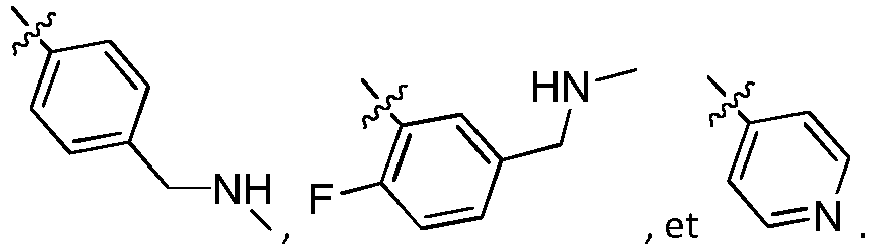
- the C 1-3 alkylamino-C 1-3 alkyl is selected from methylaminomethylene.
- R 2 is selected from the group consisting of
- the compounds or pharmaceutically acceptable salts thereof are selected from:
- C 1-10 is selected from the group consisting of C 1 , C 2 , C 3 , C 4 , C 5 , C 6 , C 7 , C 8 , C 9 , and C 10 ;
- C 3-10 is selected from the group consisting of C 3 , C 4 , C 5 , C 6 , C 7 , C 8 , C 9 , and C 10 .
- C 1-10 alkyl, C 1-10 heteroalkyl, C 3-10 cyclohydrocarbyl, C 3-10 heterocyclohydrocarbyl, C 1-10 alkyl substituted by C 3-10 cyclohydrocarbyl or C 3-10 heterocyclohydrocarbyl, or C 1-10 heteroalkyl substituted by C 3-10 cyclohydrocarbyl or C 3-10 heterocyclohydrocarbyl include, but are not limited to:
- pharmaceutically acceptable salt is meant to include a salt of a compound of the invention which is prepared by a relatively nontoxic acid or base and the compound of the invention having particular substituents.
- a base addition salt can be obtained by contacting a neutral form of such compounds with a sufficient amount of a desired base, either neat or in a suitable inert solvent.
- the pharmaceutically acceptable base addition salts include salts of sodium, potassium, calcium, ammonium, organic amine, or magnesium, or similar salts.
- an acid addition salt can be obtained by contacting a neutral form of such compounds with a sufficient amount of a desired acid, either neat or in a suitable inert solvent.
- the pharmaceutically acceptable acid addition salts include salts of inorganic acids including hydrochloric, hydrobromic, nitric, carbonic, hydrocarbonic, phosphoric, hydrophosphoric, dihydrophosphoric, sulfuric, hydrosulfuric, hydriodic, or phosphorous acids and the like; as well as salts of organic acids including acetic, propionic, isobutyric, maleic, malonic, benzoic, succinic, suberic, fumaric, lactic, mandelic, phthalic, benzenesulfonic, p-tolylsulfonic, citric, tartaric, methanesulfonic acid, or the like; and also salts of amino acids (such as arginate and the like), and salts of organic acids like glucur
- the neutral form of the compound is preferably regenerated by contacting the salt with a base or acid and then isolating the parent compound in the conventional manner.
- the parent form of the compound differs from the various salt forms thereof in certain physical properties, such as solubility in polar solvents.
- pharmaceutically acceptable salts refers to derivatives of the compounds of the invention wherein the parent compound is modified by making a salt with an acid or base.
- pharmaceutically acceptable salts include, but are not limited to, mineral or organic acid salts of basic groups such as amines; alkali or organic salts of acidic groups such as carboxylic acids; and the like.
- the pharmaceutically acceptable salts include the conventional non-toxic salts or the quaternary ammonium salts of the parent compound formed, for example, from non-toxic inorganic or organic acids.
- Such conventional non-toxic salts include, but are not limited to, those derived from inorganic and organic acids selected from 2-acetoxybenzoic, 2-hydroxyethane sulfonic, acetic, ascorbic, benzene sulfonic, benzoic, bicarbonic, carbonic, citric, edetic, ethane disulfonic, ethane sulfonic, fumaric, glucoheptonic, gluconic, glutamic, glycolic, hydrobromic, hydrochloric, hydroiodide, hydroxyl acids, hydroxynaphthoic, isethionic, lactic, lactobionic, lauryl sulfonic, maleic, malic, mandelic, methane sulfonic, nitric, oxalic, pamoic, pantothenic, phenylacetic, phosphoric, polygalacturonic, propionic, salicyclic, stearic, subacetic, succinic,
- the pharmaceutically acceptable salts of the present invention can be synthesized from the parent compound that contains a basic or acidic moiety by conventional chemical methods.
- such salts can be prepared by reacting the free acid or base forms of these compounds with a stoichiometric amount of the appropriate base or acid in water or in an organic solvent, or in a mixture of the two; generally, non-aqueous media like ether, ethyl acetate, ethanol, isopropanol, or acetonitrile or the like are preferred.
- this disclosure provides compounds which are in a prodrug form.
- Prodrugs of the compounds described herein readily undergo chemical changes under physiological conditions to provide the compounds of the invention. Additionally, prodrugs can be converted to the compounds of the invention by chemical or biochemical methods in an in vivo environment.
- Certain compounds of the invention can exist in unsolvated forms or solvated forms, including hydrated forms. In general, the solvated forms are equivalent to unsolvated forms and all are encompassed within the scope of the present invention. Certain compounds of the invention may exist in polycrystalline or amorphous forms.
- Certain compounds of the invention may possess asymmetric carbon atoms (optical centers) or double bonds; the racemates, diastereomers, geometric isomers and individual isomers are all encompassed within the scope of the present invention.
- Compounds of the invention can exist in particular geometric or stereoisomeric forms.
- the invention contemplates all such compounds, including cis - and trans- isomers, (-)- and (+)-enantiomers, ( R )- and ( S )-enantiomers, diastereomers, ( D )-isomers, ( L )-isomers, the racemic mixtures thereof, and other mixtures thereof, such as enantiomerically or diastereomerically enriched mixtures, and all these mixtures as falling within the scope of the invention.
- Additional asymmetric carbon atoms can be present in a substituent such as an alkyl group. All such isomers, as well as mixtures thereof, are intended to be included in this invention.
- Optically active ( R )- and ( S )-isomers and D and L isomers can be prepared by chiral synthons or chiral reagents, or other conventional techniques. If a particular enantiomer of a compound of the present invention is desired, it can be prepared by asymmetric synthesis, or by derivatization with a chiral auxiliary, where the resultant diastereomeric mixture is separated and the auxiliary group is cleaved to provide the pure desired enantiomers.
- diastereomeric salts can be formed with an appropriate optically active acid or base, followed by resolution of the diastereomers by fractional crystallization or chromatographic means known in the art, and subsequent recovery of the pure enantiomers.
- separation of enantiomers and diastereomers is frequently accomplished by chromatography employing chiral, stationary phases, optionally in combination with chemical derivatization (e.g., formation of carbamates from amines).
- the compounds of the invention may also contain unnatural proportions of atomic isotopes at one or more of the atoms that constitute such compounds.
- the compounds may be radiolabeled with radioactive isotopes, such as for example tritium ( 3 H), iodine-125 ( 125 I) or carbon-14 ( 14 C). All isotopic variations of the compounds of the invention, regardless of radioactivity, are intended to be encompassed within the scope of the present invention.
- pharmaceutically acceptable carrier or vehicle refers to any formulation or carrier medium that is capable of delivery of an effective amount of an active agent of the invention withouttoxic side effects on a host or patient.
- Representative carriers include water, oils, both vegetable and mineral, cream bases, lotion bases, ointment bases and the like. These bases include suspending agents, thickeners, penetration enhancers, and the like. Their formulation is well known to those in the art of cosmetics and topical pharmaceuticals. Additional information concerning carriers can be found in Remington: The Science and Practice of Pharmacy, 21st Ed., Lippincott, Williams & Wilkins (2005 ).
- excipients conventionally means carriers, diluents and/or vehicles needed in formulating effective pharmaceutical compositions.
- an “effective amount” of an active agent of the composition refers to the amount of the active agent required to provide the desired effect when used in combination with the other active agent of the composition.
- the amount that is “effective” will vary from subject to subject, depending on the age and general condition of a recipient, and also a particular active agent, and an appropriate effective amount in an individual case may be determined by one of ordinary skill in the art using routine experimentation.
- active ingredient means a chemical entity which can be effective in treating a targeted disorder, disease or condition.
- substituted means that any one or more hydrogens on a designated atom is replaced with a substituent including deuterium and a variant of hydrogen, provided that the designated atom's valency is normal, and that the substituted compound is stable.
- it means that 2 hydrogen atoms are replaced.
- Keto substituents are not present on aromatic moieties.
- optionally substituted means that the designated atom can be substituted or unsubstituted, and unless otherwise stated, the species and number of the substituents may be arbitrary provided that they can be achieved in Chemistry.
- any variable e.g., R
- its definition at each occurrence is independent.
- said group may optionally be substituted with up to two R groups and R at each occurrence has independent options.
- combinations of substituents and/or variables are permissible only if such combinations result in stable compounds.
- R', R", R"', R"" and R""' are each preferably independently hydrogen, substituted or unsubstituted heteroalkyl, substituted or unsubstituted aryl (e.g., aryl substituted with 1-3 halogens), substituted or unsubstituted alkyl, alkoxy or thioalkoxy groups, or arylalkyl groups.
- aryl e.g., aryl substituted with 1-3 halogens
- each of the R groups is independently selected as are each R', R", R"', R"" and R""' groups when more than one of these groups is present.
- R' and R" When R' and R" are attached to the same nitrogen atom, they can be combined with the nitrogen atom to form a 5-, 6-, or 7-membered ring.
- -NR'R is meant to include, but not be limited to, 1-pyrrolidinyl and 4-morpholinyl.
- alkyl is meant to include groups constituted by carbon atoms bonding to groups other than hydrogen groups, such as haloalkyl (e.g., -CF 3 and -CH 2 CF 3 ) and acyl (e.g., -C(O)CH 3 , -C(O)CF 3 , -C(O)CH 2 OCH 3 , and the like).
- haloalkyl e.g., -CF 3 and -CH 2 CF 3
- acyl e.g., -C(O)CH 3 , -C(O)CF 3 , -C(O)CH 2 OCH 3 , and the like.
- substituents of the aryl and heteroaryl groups are generically referred to as "aryl group substituents.”
- Two of the substituents on adjacent atoms of the aryl or heteroaryl ring may optionally be replaced with a substituent of the formula -T-C(O)-(CRR') q -U-, wherein T and U are independently selected from -NR-, -O-, -CRR'- or a single bond, and q is an integer from 0 to 3.
- two of the substituents on adjacent atoms of the aryl or heteroaryl ring may optionally be replaced with a substituent of the formula -A(CH 2 )rB-, wherein A and B are independently selected from - CRR'-, -O-, -NR-, -S-, -S(O)-, S(O) 2 -, -S(O) 2 NR'- or a single bond, and r is an integer from 1 to 4.
- One of the single bonds of the thus formed new ring may optionally be replaced with a double bond.
- two of the substituents on adjacent atoms of the aryl or heteroaryl ring may optionally be replaced with a substituent of the formula -A(CH 2 )rB-, where s and d are separately and independently selected from integers from 0 to 3, and X is -O-, -NR'-, -S-, -S(O)-, -S(O) 2 -, or - S(O) 2 NR'-.
- the substituents R, R', R" and R'" are separately, preferably and independently selected from hydrogen and substituted or unsubstituted (C 1 -C 6 )alkyl.
- hydrocarbyl or its hyponyms (such as alkyl, alkenyl, alkynyl and phenyl etc.) by itself or as part of another substituent, means, unless otherwise stated, a straight or branched chain, or cyclic hydrocarbon radical, or combination thereof, which may be fully saturated, mono- or polyunsaturated, and may be mono-, di-, or multi-substituted, and can include di- or multi-valent radicals, having the designated number of carbon atoms (e.g., C 1 -C 10 meaning one to ten carbons).
- Hydrocarbyl include, but are not limited to, aliphatic hydrocarbyl and aromatic hydrocarbyl, and the aliphatic hydrocarbyl include linear and cyclic ones, specifically including but not limited to, alkyl, alkenyl, and alkynyl, and the aromatic hydrocarbyl include, but are not limited to, 6-12 membered aromatic hydrocarbyl, for example, benzene, and naphthalene, etc.
- alkyl means a straight or branched chain radical, or combinations thereof, which may be fully saturated, mono- or polyunsaturated and can include di- and multivalent radicals.
- saturated hydrocarbon radicals include, but are not limited to, methyl, ethyl, n-propyl, isopropyl, n-butyl, t-butyl, isobutyl, sec-butyl, isobutyl, cyclohexyl, (cyclohexyl)methyl, cyclopropylmethyl, homologs and isomers of radicals such as n-pentyl, n-hexyl, n-heptyl, n-octyl, and the like.
- An unsaturated alkyl group is one having one or more double bonds or triple bonds.
- unsaturated alkyl groups include, but are not limited to, vinyl, 2-propenyl, butenyl, crotyl, 2-isopentenyl, 2-(butadienyl), 2,4-pentadienyl, 3-(1,4-pentadienyl), ethynyl, 1- and 3-propynyl, 3-butynyl, and the higher homologs and isomers.
- heterohydrocarbyl or its hyponymshyponyms (such as heteroalkyl, heteroalkenyl, heteroalkynyl and heteroaryl etc.) by itself or in combination with another term, means, unless otherwise stated, a stable straight or branched chain, or cyclic hydrocarbon radical, or combinations thereof, consisting of the stated number of carbon atoms and at least one heteroatom.
- heteroalkyl by itself or in combination with another term, means a stable straight or branched chain hydrocarbyl radical, or combinations thereof, consisting of the stated number of carbon atoms and at least one heteroatom.
- the heteroatoms are selected from the group consisting of B, O, N and S, wherein the nitrogen and sulfur atoms may optionally be oxidized and the nitrogen heteroatom may optionally be quaternized.
- the heteroatom(s) B, O, N and S may be placed at any internal position of the heterohydrocarbyl group (except the position at which the hydrocarbyl group is attached to the remainder of the molecule).
- Up to two heteroatoms may be consecutive, such as, for example, -CH 2 -NH-OCH 3 .
- alkoxy alkylamino and “alkylthio” (or thioalkoxy) are used in their conventional sense, and refer to those alkyl groups attached to the remainder of the molecule via an oxygen atom, an amino group, or a sulfur atom, respectively.
- cyclohydrocarbyl "heterocyclohydrocarbyl” or “cyclohydrocarbylheteroyl” or its hyponyms (such as aryl, heteroaryl, arylheteroyl,cycloalkyl, heterocycloalkyl, cycloalkylheteroyl, cycloalkenyl, heterocycloalkenyl, cycloalkenylheteroyl, cycloalkynyl, heterocycloalkynyl and cycloalkynylheteroyl, etc.) by themselves or in combination with other terms, represent, unless otherwise stated, cyclic versions of "hydrocarbyl,” “heterohydrocarbyl” or “hydrocarbylheteroyl,” respectively.
- heterohydrocarbyl or heterocyclohydrocarbyl (such as heteroalkyl and heterocycloalkyl)
- a heteroatom can occupy the position at which the heterocycle is attached to the remainder of the molecule.
- cycloalkyl include, but are not limited to, cyclopentyl, cyclohexyl, 1-cyclohexenyl, 3-cyclohexenyl, cycloheptyl, and the like.
- heterocycle moieties include 1 -(1,2,5,6-tetrahydropyridyl), 1-piperidinyl, 2-piperidinyl, 3-piperidinyl, 4-morpholinyl, 3-morpholinyl, tetrahydrofuran-2-yl, tetrahydrofuranindol-3-yl, tetrahydrothien-2-yl, tetrahydrothien-3-yl, 1-piperazinyl, and 2-piperazinyl.
- halo or "halogen,” by themselves or as part of another substituent, means, unless otherwise stated, a fluorine, chlorine, bromine, or iodine atom.
- haloalkyl are meant to include monohaloalkyl and polyhaloalkyl.
- halo(C 1 -C 4 )alkyl is mean to include, but not be limited to, trifluoromethyl, 2,2,2-trifluoroethyl, 4-chlorobutyl, 3-bromopropyl, and the like.
- aryl means, unless otherwise stated, a polyunsaturated, aromatic substituent that may be mono-, di- or poly-substituted, and can be a single ring or multiple rings (preferably from 1 to 3 rings), which are fused together or linked covalently.
- heteroaryl refers to aryl groups (or rings) that contain from one to four heteroatoms.
- the heteroatom is selected from B, N, O, and S, wherein the nitrogen and sulfur atoms are optionally oxidized, and the nitrogen atom(s) are optionally quaternized.
- a heteroaryl group can be attached to the remainder of the molecule through a heteroatom.
- Non-limiting examples of aryl and heteroaryl groups include phenyl, 1-naphthyl, 2-naphthyl, 4-biphenyl, 1-pyrrolyl, 2-pyrrolyl, 3-pyrrolyl, 3-pyrazolyl, 2-imidazolyl, 4-imidazolyl, pyrazinyl, 2-oxazolyl, 4-oxazolyl, 2-phenyl-4-oxazolyl, 5-oxazolyl, 3-isoxazolyl, 4-isoxazolyl, 5-isoxazolyl, 2-thiazolyl, 4-thiazolyl, 5-thiazolyl, 2-furyl, 3-furyl, 2-thienyl, 3-thienyl, 2-pyridyl, 3-pyridyl, 4-pyridyl, 2-pyrimidyl, 4-pyrimidyl, 5-benzothiazolyl, purinyl, 2-benzimidazolyl, 5-indolyl, 1-isoquinoly
- aryl when used in combination with other terms (e.g., aryloxy, arylthio, arylalkyl) includes both aryl and heteroaryl rings as defined above.
- arylalkyl is meant to include those radicals in which an aryl group is attached to an alkyl group (e.g., benzyl, phenethyl, pyridylmethyl and the like) including those alkyl groups in which a carbon atom (e.g., a methylene group) has been replaced by, for example, an oxygen atom, e.g., phenoxymethyl, 2-pyridyloxymethyl, 3-(1-naphthyloxy)propyl, and the like.
- Ring or cyclo means a substituted or unsubstituted cycloalkyl, substituted or unsubstituted heterocycloalkyl, substituted or unsubstituted aryl, or substituted or unsubstituted heteroaryl.
- the so-called ring includes fused ring moieties.
- the number of atoms in a ring is typically defined as the number of members of the ring.
- a "5- to 7-membered ring” means there are 5 to 7 atoms in the encircling arrangement. Unless otherwise specified, the ring optionally includes one to three heteroatoms.
- the term “5- to 7-membered ring” includes, for example phenyl, pyridinyl and piperidinyl.
- the term “ring” further includes a ring system comprising at least one ring, wherein each "ring" is independently defined as above.
- heteroatom includes atoms other than carbon (C) and hydrogen (H), including e.g., oxygen (O), nitrogen (N) sulfur (S), silicon (Si), germanium (Ge), aluminum (Al) and boron (B), etc.
- leaving group means a functional group or atom which can be displaced by another functional group or atom in a substitution reaction (such as a nucleophilic substitution reaction).
- substituent groups include triflate, chloro, bromo and iodo groups; sulfonic ester groups, such as mesylate, tosylate, brosylate, nosylate and the like; and acyloxy groups, such as acetoxy, trifluoroacetoxy and the like.
- protecting group includes but is not limited to "amino-protecting group,” “hydroxy-protecting group” or “thiol-protecting group.”
- amino-protecting group means a protecting group suitable for preventing side reactions at an amino nitrogen.
- Representative amino-protecting groups include, but are not limited to, formyl; acyl groups, for example alkanoyl groups, such as acetyl, trichloroacetyl or trifluoroacetyl; alkoxycarbonyl groups, such as tert-butoxycarbonyl (Boc); arylmethoxycarbonyl groups, such as benzyloxycarbonyl (Cbz) and 9-fluorenylmethoxycarbonyl (Fmoc); arylmethyl groups, such as benzyl (Bn), trityl (Tr), and 1,1-di-(4'-methoxyphenyl)methyl; silyl groups, such as trimethylsilyl (TMS) and tert-butyldimethylsilyl (TBS); and the like.
- alkanoyl groups such as acetyl, trichloroacetyl or trifluoroacetyl
- hydroxy-protecting group means a protecting group suitable for preventing side reactions at a hydroxy group.
- Representative hydroxy-protecting groups include, but are not limited to, alkyl groups, such as methyl, ethyl, and tert-butyl; acyl groups, for example alkanoyl groups, such as acetyl; arylmethyl groups, such as benzyl (Bn), p-methoxybenzyl (PMB), 9-fluorenylmethyl (Fm), and diphenylmethyl (benzhydryl, DPM); silyl groups, such as trimethylsilyl (TMS) and tert-butyldimethylsilyl (TBS); and the like.
- alkyl groups such as methyl, ethyl, and tert-butyl
- acyl groups for example alkanoyl groups, such as acetyl
- arylmethyl groups such as benzyl (Bn), p-methoxybenzy
- haloalkyl examples include, but are not limited to, trifluoromethyl, trichloromethyl, pentafluoroethyl, and pentachloroethyl.
- Alkoxy represents an alkyl group as defined above with the indicated number of carbon atoms attached through an oxygen bridge.
- C 1-6 alkoxy is intended to include C 1 , C 2 , C 3 , C 4 , C 5 , and C 6 alkoxy groups.
- alkoxy examples include, but are not limited to, methoxy, ethoxy, n-propoxy, i-propoxy, n-butoxy, s-butoxy, t-butoxy, n-pentoxy, and s-pentoxy.
- Cycloalkyl is intended to include saturated ring groups, such as cyclopropyl, cyclobutyl, or cyclopentyl. 3-7 cycloalkyl is intended to include C 3 , C 4 , C 5 , C 6 , and C 7 cycloalkyl groups.
- Alkenyl is intended to include hydrocarbon chains of either straight or branched configuration and one or more unsaturated carbon-carbon bonds that may occur in any stable point along the chain, such as ethenyl and propenyl.
- the term “Halo” or “halogen” refers to fluoro, chloro, bromo, and iodo.
- heterocycle or “heterocyclo” is intended to mean a stable monocyclic or bicyclic or bicyclic heterocyclic ring which may be saturated, partially unsaturated or unsaturated (aromatic), and include carbon atoms and 1, 2, 3, or 4 ring heteroatoms independently selected from the group consisting of N, O and S in which any of the above-defined heterocyclic rings may be fused to a benzene ring to form a bicyclic group.
- the nitrogen and sulfur heteroatoms may optionally be oxidized (i. e., NO and S (O) p).
- the nitrogen atom may be substituted or unsubstituted (i.e., N or NR wherein R is H or other substituents already defined herein).
- the heterocyclic ring may be attached to its pendant group at any heteroatom or carbon atom that results in a stable structure.
- the heterocyclic rings described herein may be substituted on a carbon or on a nitrogen atom if the resultant compound is stable.
- a nitrogen atom in the heterocycle may optionally be quaternized.
- aromatic heterocyclic group or “heteroaryl” is intended to mean a stable 5-, 6-, or 7-membered monocyclic or bicyclic or 7-, 8-, 9-, or 10-membered bicyclic heterocyclic aromatic ring which includes carbon atoms and 1, 2, 3, or 4 heterotams independently selected from the group consisting of N, O and S.
- the nitrogen atom may be substituted or unsubstituted (i.e., N or NR wherein R is H or other substituents already defined herein).
- the nitrogen and sulfur heteroatoms may optionally be oxidized (i.e., NO and S (O) p).
- bridged rings are also included in the definition of heterocycle.
- a bridged ring occurs when one or more atoms (i.e., C, O, N, or S) link two non-adjacent carbon or nitrogen atoms.
- Preferred bridged rings include, but are not limited to, one carbon atom, two carbon atoms, one nitrogen atom, two nitrogen atoms, and a carbon-nitrogen group. It is to be noted that a bridge always converts a monocyclic ring into a tricyclic ring. In a bridged ring, the substituents on the ring may also be present on the bridge.
- heterocycles include, but are not limited to, acridinyl, azocinyl, benzimidazolyl, benzofuranyl, benzothiofuranyl, benzothiophenyl, benzoxazolyl, benzoxazolinyl, benzthiazolyl, benztriazolyl, benztetrazolyl, benzisoxazolyl, benzisothiazolyl, benzimidazolinyl, carbazolyl, 4aH-carbazolyl, carbolinyl, chromanyl, chromenyl, cinnolinyl, decahydroquinolinyl, 2H,6H-1, 5,2-dithiazinyl, dihydrofuro [2, 3-b] tetrahydrofuran, furanyl, furazanyl, imidazolidinyl, imidazolinyl, imidazolyl, 1H-indazolyl, indolen
- the compounds of the present invention can be prepared in a number of synthetic methods known to one skilled in the art, including the specific embodiments described below, the embodiments formed by combining them with other chemical synthetic methods known in the art, and equivalents well known to those skilled in the art.
- Preferred embodiments include, but are not limited to, examples of the invention.
- aq represents aqueous
- HATU represents O -(7-azabenzotriazol-1-yl)- N,N,N',N' -tetramethyluronium hexafluorophosphate
- EDC represents N-(3-dimethylaminopropyl)- N '-ethylcarbodiimide hydrochloride
- m -CPBA represents 3-chloroperoxybenzoic acid
- CDI carbonyl diimidaole
- DCM dichloromethane
- PE petroleum ether
- DIAD diisopropyl azodicarboxylate
- DMF N,N -dimethylformamide
- DMSO dimethylsulfoxide
- EtOAc represents ethyl acetate
- EtOH represents ethanol
- MeOH represents methanol
- CBz represents benzyloxycarbonyl, a amine protecting group
- BOC represents tert -butylcarbonyl, an amine protecting group
- HOAc represents acetic acid
- NaCNBH 3 represents sodium cyanoborohydride
- r.t sodium cyanoborohydride
- TsOH 4-methylbenzenesulfonic acid
- NFSI N -fluoro- N- (phenylsulfonyl)benzenesulfonamide
- NCS N -chlorosuccinimide
- i -PrOH 2-propanol and mp represents melting point.
- Method 10-80AB_6 min included: applying a linear gradient, starting elution at 90% A (A: 0.0675% TFA in water) and ending elution at 80% B (B: 0.0625% TFA in MeCN) overall for 4.2 min and then eluting at 80% B for 1.0 min.
- the column was then re-equilibrated over 0.8 min to 90:10 with a total run time of 6 min.
- the column temperature was at 50 °C with a flow rate of 0.8 mL/min.
- the Diode Array Detector scanned from 200-400 nm.
- TLC Thin layer chromatography
- Silica gel GF254 from Sanpont-group and UV was typically used to visualize the spots. Additional visualization methods were also employed in some cases.
- the TLC plate was developed with iodine (prepared by adding approximately 1 g of I2 to 10 g silica gel and thoroughly mixing), vanillin (prepared by dissolving about 1 g vanillin in 100 mL 10% H 2 SO 4 ), ninhydrin (available commercially from Aldrich), or Magic Stain (prepared by thoroughly mixing (NH 4 ) 6 Mo 7 O 24 •4H 2 O, 5 g (NH 4 ) 2 Ce(IV)(NO 3 ) 6 , 450 mL H 2 O and 50 mL concentrated H 2 SO 4 ) to visualize the compound.
- iodine prepared by adding approximately 1 g of I2 to 10 g silica gel and thoroughly mixing
- vanillin prepared by dissolving about 1 g vanillin in 100 mL 10% H 2 SO 4
- Flash chromatography was performed using 40-63 ⁇ m (230-400 mesh) silica gel from Silicycle following analogous techniques to those disclosed in Still, W. C.; Kahn, M.; and Mitra, M. Journal of Organic Chemistry, 1978, 43, 2923-2925 .
- Typical solvents used for flash chromatography or thin layer chromatography were mixtures such as dichloromethane/methanol, ethyl acetate/methanol and hexanes/ethyl acetate.
- Preparative chromatography was performed on a Gilson-281 Prep LC 322 System using a Gilson UV/VIS-156 Detector.
- the column used was a Agella Venusil ASB Prep C18, 5 ⁇ m, 150 x 21.2 mm or Phenomenex Gemini C18, 5 ⁇ m, 150 x 30 mm or Boston Symmetrix C18, 5 ⁇ m, 150 x 30 mm or Phenomenex Synergi C18, 4 ⁇ m, 150 x 30 mm.
- Method AS-H_3_40_2.35ML Column included: Chiralpak AS-H 250 x 4.6 mm I.D., 5 ⁇ m Mobile phase: 40% methanol (0.05% DEA) in CO 2 Flow rate: 2.35 mL/min Wavelength: 220 nm.
- Method OD-H_3_40_2.35M Column included: Chiralcel OD-H 250 x 4.6 mm I.D., 5 ⁇ m Mobile phase: 40% methanol (0.05% DEA) in CO 2 Flow rate: 2.35 mL/min Wavelength: 220 nm.
- Preparative SFC analysis was performed on a Waters Thar 80 Pre-SFC System using a Gilson UV Detector.
- the column used was Chiralcel OD-H 250 x 4.6 mm I.D., 5 m or Chiralpak AD-H 250 x 4.6mm I.D., 5m.
- Narrow gradients with ethanol or methanol in CO 2 with the ethanol or methanol containing 0.05% NH 3 •H 2 O or 0.05% DEA or 0.1% MEA, were used to elute the compound at a flow rate between 40-80 mL/min and a total run time between 20-30 min.
- the PARP-1 inhibitors provided herein can be used for the treatment of wide rages of diseases comprising cancer, stroke, cardiac ischemia, inflammation, and diabetes.
- the PARP-1 inhibitors can be used as a standalone agent or in combination with other chemotherapeutical agents to enhance the effect of these standard chemotherapeutical agents.
- Cancers that can be treated by the PARP-1 inhibitors include, but are not limited to breast cancer, ovarian cancer, pancreatic cancer, prostate cancer, clone cancer, and leukemia, etc.
- This example was prepared as the method described in Example 42C.
- This example was prepared as described in Example 50M.
- This example was prepared as the method described in Examples 1A-1B.
Landscapes
- Chemical & Material Sciences (AREA)
- Organic Chemistry (AREA)
- Health & Medical Sciences (AREA)
- Veterinary Medicine (AREA)
- General Health & Medical Sciences (AREA)
- Medicinal Chemistry (AREA)
- Public Health (AREA)
- Pharmacology & Pharmacy (AREA)
- Life Sciences & Earth Sciences (AREA)
- Animal Behavior & Ethology (AREA)
- General Chemical & Material Sciences (AREA)
- Nuclear Medicine, Radiotherapy & Molecular Imaging (AREA)
- Chemical Kinetics & Catalysis (AREA)
- Engineering & Computer Science (AREA)
- Bioinformatics & Cheminformatics (AREA)
- Epidemiology (AREA)
- Diabetes (AREA)
- Cardiology (AREA)
- Heart & Thoracic Surgery (AREA)
- Biomedical Technology (AREA)
- Vascular Medicine (AREA)
- Urology & Nephrology (AREA)
- Neurosurgery (AREA)
- Neurology (AREA)
- Emergency Medicine (AREA)
- Endocrinology (AREA)
- Hematology (AREA)
- Obesity (AREA)
- Pain & Pain Management (AREA)
- Rheumatology (AREA)
- Pharmaceuticals Containing Other Organic And Inorganic Compounds (AREA)
- Nitrogen Condensed Heterocyclic Rings (AREA)
- Nitrogen And Oxygen Or Sulfur-Condensed Heterocyclic Ring Systems (AREA)
Claims (14)
- Composé de formule (1) ou l'un de ses sels pharmaceutiquement acceptables :
 D est choisi dans le groupe formé par -C(Rd1)(Rd2)-, et -N(Rd4)- ;R1-3, Rd1, et Rd2 sont choisis séparément et indépendamment dans le groupe formé par H, F, Cl, Br, I, CN, OH, SH, et NH2, ou choisis dans le groupe, formé par un C1-10 alkyl, C1-10 hétéroalkyl, C3-10 cyclohydrocarbyl, C3-10 hétérocyclohydrocarbyl, C1-10 alkyl en substitué par un C3-10 cyclohydrocarbyl ou C3-10 hétérocyclohydrocarbyl, et C1-10 hétéroalkyl substitué par un C3-10 cyclohydrocarbyl ou C3-10 hétérocyclohydrocarbyl, le cas échéant substitué par R01,R01 est choisi dans le groupe formé par F, Cl, Br, I, CN, OH, SH, NH2 et R02,R02 est choisi dans le groupe formé par un C1-10 alkyl, C1-10 alkylamino, N,N-di(C1-10 alkyl)amino, C1-10 alkyloxyl, C1-10 alkylacyl, C1-10 alkyloxylcarbonyl, C1-10 alkylsulfonyl, C1-10 alkylsulfinyl, C3-10 cycloalkyl, C3-10 cycloalkylamino, C3-10 heterocycloalkylamino, C3-10 cycloalkyloxyl, C3-10 cycloalkylacyl, C3-10 cycloalkyloxylcarbonyl, C3-10 cycloalkylsulfonyl, et C3-10 cycloalkylsulfinyl,l'hétéroatome ou le groupe éthéroatomique est choisi séparément et indépendamment dans le groupe formé par un-C(=O)N(Rd3)-, -N(Rd4)-, -C(=NRd5)-, -S(=O)2 N(Rd6)-, -S(=O) N(Rd7)-, -O-, -S-, -C(=O)O-, -C(=O)-, -C(=S)-, -S(=O) -, et/ou -S(=O)2-;Rd3-d7 sont séparément et indépendamment choisis dans le groupe formé par H et R03,R03 est choisi dans le groupe formé par un C1-10 alkyl, C1-10 alkylacyl, C1-10 alkyloxylcarbonyl, C1-10 alkylsulfonyl, C1-10 alkylsulfinyl, C3-10 cycloalkyl, C3-10 cycloalkylacyl, C3-10 cycloalkyloxylcarbonyl, C3-10 cycloalkylsulfonyl, et C3-10 cycloalkylsulfinyl ;R02, et R03 sont le cas éhéant substitués par R001 ;R001 est choisi dans le groupe formé par F, Cl, Br, I, CN, OH, N(CH3)2, NH(CH3), NH2, CF3, (NH2)CH2, (HO)CH2, CH3, CH3O, CH3C(=O), CH3O C (=O), CH3S (=O)2, et CH3S (=O); etle nombre de R01, R001, d'hétéroatomes, ou de groupes hétéroatomiques est séparément et indépendamment choisi parmi 0, 1, 2, et 3;ou le composé est choisi dans le groupe formé par les composés suivants :3-(1-(cyclopropylmethyl)piperidin-4-yl)-6-fluoro-4H-benzo[4,5]imidazo[1,2-b]pyrazole-8-carboxamide;3-(3-(cyclopropylmethylene)-3-azabicyclo[3.1.0]hexan-1-yl)-6-fluoro-4H-benzo[4,5]imidazo[1,2-b]pyrazole-8-carboxamide;6-fluoro-3-(4-(piperidin-3-yl)phenyl)-4H-benzo[4,5]imidazo[1,2-b]pyrazole-8-carboxamide;6-fluoro-3-(4-methylpiperazine-1-carbonyl)-4H-benzo[4,5]imidazo[1,2-b]pyrazole-8-carboxamide;3-(1-(cyclopropylmethyl)piperidin-4-yl)-4,4,6-trifluoro-4H-pyrazolo[1,5-a]indole-8-carboxamide;3-(1-(cyclopropylmethylene)-4-methylpiperidin-4-yl)-6-fluoro-4H-benzo[4,5]imidazo[1,2-b]pyrazole-8-carboxamide;6-fluoro-3-(4-methyl-1-(tetrahydro-2H-pyran-4-yl)piperidin-4-yl)-4H-benzo[4,5]imidazo[1,2-b]pyrazole-8-carboxamide;3-(1-((1-cyanocyclopropyl)methyl)-4-methylpiperidin-4-yl)-6-fluoro-4H-benzo[4,5]imidazo[1,2-b]pyrazole-8-carboxamide;3-(1-((1-cyanocyclobutyl)methyl)-4-methylpiperidin-4-yl)-6-fluoro-4H-benzo[4,5]imidazo [1,2-b]pyrazole-8-carboxamide;6-fluoro-3-(4-methyl-1-((tetrahydro-2H-pyran-4-yl)methyl)piperidin-4-yl)-4H-benzo[4,5]imidazo[1,2-b]pyrazole-8-carboxamide;3-(1-((1-aminocyclopropyl)methyl)-4-methylpiperidin-4-yl)-6-fluoro-4H-benzo[4,5]imidazo[1,2-b]pyrazole-8-carboxamide; et6-fluoro-3-(4-methyl-1-(oxetan-3-ylmethyl)piperidin-4-yl)-4H-benzo[4,5]imidazo[1,2-b]pyrazole-8-carboxamide;6-fluoro-3-(1-((1-hydroxycyclopropyl)methyl)-4-methylpiperidin-4-yl)-4H-benzo[4,5]imidazo[1,2-b]pyrazole-8-carboxamide;6-fluoro-3-(4-methyl-1-((3-methyloxetan-3-yl)methyl)piperidin-4-yl)-4H-benzo[4,5]imidazo[1,2-b]pyrazole-8-carboxamide;6-fluoro-3-(4-methyl-1-((1-methylsulfonyl)cyclopropyl)methyl)piperidin-4-yl)-4H-benzo[4,5]imidazo[1,2-b]pyrazole-8-carboxamide;6-fluoro-3-(4-methyl-1-(thiazol-2-ylmethyl)piperidin-4-yl)-4H-benzo[4,5]imidazo[1,2-b]pyrazole-8-carboxamide;6-fluoro-3-(4-methyl-1-(thiophen-2-ylmethyl)piperidin-4-yl)-4H-benzo[4,5]imidazo[1,2-b]pyrazole-8-carboxamide;3-(1-((1-ethylpiperidin-4-yl)methyl)-4-methylpiperidin-4-yl)-6-fluoro-4H-benzo[4,5]imidazo[1,2-b]pyrazole-8-carboxamide;6-fluoro-3-(4-methyl-1-((1-methylazetidin-3-yl)methyl)piperidin-4-yl)-4H-benzo[4,5]imidazo[1,2-b]pyrazole-8-carboxamide;ethyl2-((4-(8-carbamoyl-6-fluoro-4H-benzo[4,5]imidazo[1,2-b]pyrazol-3-yl)-4-methylpiperidin-1-yl)methyl)cyclopropanecarboxylate;3-(1-((2-(dimethylcarbamoyl)cyclopropyl)methyl)-4-methylpiperidin-4-yl)-6-fluoro-4H-benzo[4,5]imidazo[1,2-b]pyrazole-8-carboxamide;6-fluoro-3-(4-methyl-1-((4-methylthiazol-5-yl)methyl)piperidin-4-yl)-4H-benzo[4,5]imidazo[1,2-b]pyrazole-8-carboxamide;6-fluoro-3-(4-methyl-1-((1-methyl-1H-imidazol-2-yl)methyl)piperidin-4-yl)-4H-benzo[4,5]imidazo[1,2-b]pyrazole-8-carboxamide;3-(1-((1,2-dimethyl-1H-imidazol-5-yl)methyl)-4-methylpiperidin-4-yl)-6-fluoro-4H-benzo[4,5]imidazo[1,2-b]pyrazole-8-carboxamide;3-(1'-ethyl-4-methyl-[1,4'-bipiperidin]-4-yl)-6-fluoro-4H-benzo[4,5]imidazo[1,2-b]pyrazole-8-carboxamide;6-fluoro-3-(4-methyl-1-((6-oxo-1,6-dihydropyridazin-3-yl)methyl)piperidin-4-yl)-4H-benzo[4,5]imidazo[1,2-b]pyrazole-8-carboxamide;3-(1-(cyclopropylmethyl)-3-methylpyrrolidin-3-yl)-6-fluoro-4H-benzo[4,5]imidazo[1,2-b]pyrazole-8-carboxamide;6-fluoro-3-(3-methyl-1-(oxetan-3-yl)pyrrolidin-3-yl)-4H-benzo[4,5]imidazo[1,2-b]pyrazole-8-carboxamide;3-(1-((1-aminocyclopropyl)methyl)-3-methylpyrrolidin-3-yl)-6-fluoro-4H-benzo[4,5]imidazo[1,2-b] pyrazole-8-carboxamide ;3-(1-((1-cyanocyclobutyl)methyl-3-methylpyrrolidin-3-yl)-6-fluoro-4H-benzo[4,5]imidazo[1,2-b]pyrazole-8-carboxamide ;3-(1-((1-cyanocyclopropyl)methyl)-3-methylpyrrolidin-3-yl)-6-fluoro-4H-benzo[4,5]imidazo[1,2-b]pyrazole-8-carboxamide ;3-(1-(cyclopropylmethyl)-3-methylazetidin-3-yl)-6-fluoro-4H-benzo[4,5]imidazo[1,2-pyrazole-8-carboxamide ;3-(4-cyano-1-(cyclopropylmethyl)piperidin-4-yl)-6-fluoro-4H-benzo[4,5]imidazo[1,2-b]pyrazole-8-carboxamide;3-(1-(cyclopropylmethyl)-4-(hydroxymethyl)piperidin-4-yl)-6-fluoro-4H-benzo[4,5]imidazo[1,2-b]pyrazole-8-carboxamide;Methyl4-(8-carbamoyl-6-fluoro-4H-benzo[4,5]imidazo[1,2-b]pyrazol-3-yl)-1-(cyclopropylmethyl)piperidine-4-carboxylate;3-(1-(cyclopropylmethyl)-4-methylpiperidin-4-yl)-6-fluoro-2-methyl-4H-benzo[4,5]imidazo[1,2-b]pyrazole-8-carboxamide;3-(1-(cyclopropylmethyl)-3-methylpyrrolidin-3-yl)-6-fluoro-2-methyl-4H-benzo[4,5]imidazo[1,2-b]pyrazole-8-carboxamide;3-(1-(cyclopropylmethyl)-3-methylazetidin-3-yl)-6-fluoro-2-methyl-4H-benzo[4,5]imidazo[1,2-b]pyrazole-8-carboxamide; ou l'un de leurs sels pharmaceutiquement acceptable.
 - Composé conforme à la revendication 1, ou l'un de ses sels pharmaceutiquement acceptables dans lequel D est choisi parmi-NH-, -N(CH3)-, -C(F)2-, -C(H)(F)- et -C(H (OH)-.
- Composé conforme à la revendication 1 ou 2, ou l'un de ses sels pharmaceutiquement acceptables dans lequel R1-3 sont séparément et indépendamment choisis dans le groupe formé par H, F, Cl, Br, I, CN, OH, SH, NH2 un C1-6alkyl, C1-6 alkyloxyl, benzyloxyl, -CH2N(R21)(R22)-

 L et D21 sont séparément et indépendamment choisis dans le groupe formé par un -C(Rd1)(Rd2)-, -C(=O)N(Rd3)-, -N(Rd4)-, -C(=NRd5)-, -S(=O)2 N(Rd6)-, -S(=O) N(Rd7)-, -O-, -S-, -C(=O)-, -C(=O)O-, -C(=S)-, -S(=O)-, et -S(=O)2-;L peut également être une simple liaison, uniquement dans but de liaison,T21-22 sont séparément et indépendamment choisis dans le groupe formé par un C(Rt) et N,X est choisi parmi un (CH2)n le cas échéant substitué par R01 et n est choisi parmi 0, 1, 2 ou 3 et est de préférence égal à 0, 1 ou 2,Y est choisi parmi un (CH2)m, le cas échéant substitué par R01 et m est choisi parmi 0, 1, 2 ou 3 et est de préférence égal à 1, 2 ou 3,R21-23 et Rd3-d7 sont séparément et indépendamment choisis dans le groupe formé par H et un R03,R24-27, Rd1, Rd2 et Rt sont séparément et indépendamment choisis dans le groupe formé par H, F, Cl, Br, I, CN, OH, SH et NH2 ou choisis dans le groupe, formé par un C1-10 alkyl, C1-10 hétéroalkyl, C3-10 cyclohydrocarbyl, C3-10 hétérocyclohydrocarbyl, C1-10 alkyl substitué par un C3-10 cyclohydrocarbyl ou C3-10 hétérocyclohydrocarbyl et C1-10 hétéroalkyl substitué par un C3-10 cyclohydrocarbyl ou C3-10 hétérocyclohydrocarbyl, le cas échéant substitué par R01,R01 est choisi dans le groupe formé par F, Cl, Br, I, CN, OH, SH, NH2, et R02 ;R02 est choisi dans le groupe formé par un C1-10 alkyl, C1-10 alkyl amino, N,N C1-10 alkyl amino, C1-10 alkyl oxy, C1-10 alkyl acyl, C1-10 alkyloxycarbonyl, C1-10 alkyl sulfonyl, C1-10 alkyl sulfinyle, C3-10 cyclo alkyl, C3-10 cyclo alkyl amino, C3-10 hétéro cyclo alkyl amino, C3-10 cyclo alkyloxyl, C3-10 cycloalkyl acyl, C3-10 cyclo axyl carbonyle, C3-10 cyclo alkyl sulfonyl, et C3-10 cyclo alkyl sulfinyl,l'hétéroatome ou le groupe hétéroatomique est indépendamment et séparément choisi dans le groupe formé par -C(=O)N(Rd3)-, -N(Rd4)-, -C(=NRd5)-, -S(=O)2 N(Rd6)-, -S(=O) N(Rd7)-, -O-, -S-, -C(=O)O-, -C(=O)-, -C(=S)-, -S(=O)- et/ou -S(=O)2- ;Rd3-d7 sont séparément et indépendamment choisis dans le groupe formé par H et un R03,R03 est choisi dans le groupe formé par C1-10 alkyl, C1-10 alkyl acyl, C1-10 alkyloxylcarbonyl, C1-10 alkylsulfonyl, C1-10 alkylsulfinyl, C3-10 cyclo alkyl, C3-10 cyclo alkylacyl, C3-10 cyclo alkyloxylcarbonyl, C3-10 cyclo alkylsulfonyl, et C3-10 cyclo alkylsulfinyl ;R02 et R03 sont, le cas échéant substitués par R001,R001 est choisi dans le groupe formé par F, Cl, Br, I, CN, OH, N(CH3)2, NH(CH3), NH2, CF3, (NH2)CH2, (HO)CH2, CH3, CH3O, HC(=O), CH3O C (=O), CH3S (=O)2, et CH3S (=O); etle nombre de R01, R001, d'hétéroatomes ou de groupes hétéroatomiques est séparément et indépendamment choisis parmi 0, 1, 2 ou 3.
 - Composé conforme à la revendication 3, ou l'un de ses sels pharmaceutiquement acceptables dans lequel R1 et R3 sont séparément et indépendamment choisis dans le groupe formé par un H, F Cl, Br, I, CN, OH, SH, NH2, C1-3 alkyl, C1-3 alkyloxyl, benzyloxyl, et un


- Composé conforme à la revendication 3, ou l'un de ses sels pharmaceutiquement acceptables dans lequel R2 est choisi parmi un -CH2N(R201)(R202)- dans lequel R201 et R202 sont séparément et indépendamment choisis dans le groupe formé par un H, C1-3 alkyl, C1-3 alkylacyl, C3-6cycloalkylacyl, ou C3-6cycloalkyl ; de préférence R201 et R202 sont séparément et indépendamment choisis dans le groupe formé par H et un cyclopropylacyl, de façon plus préférentielle, R2 est choisi dans le groupe formé par

- Composé conforme à la revendication 3 ou l'un de ses sels pharmaceutiquement acceptables dans lequel R2 est choisi dans le groupe formé par un


- Composé conforme à la revendication 3, ou l'un de ses sels pharmaceutiquement acceptables dans lequel R2 est un

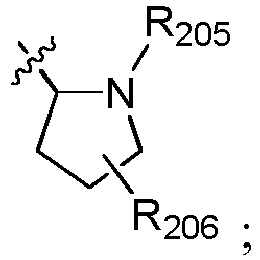

- Composé conforme à la revendication 3, ou l'un de ses sels pharmaceutiquement acceptables dans lequel R2 est un
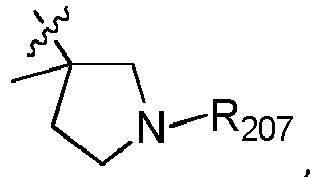




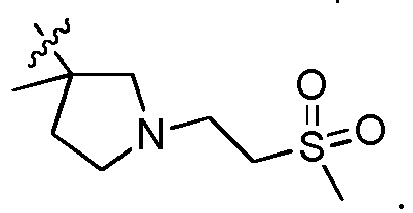
- Composé conforme à la revendication 3, ou l'un de ses sels pharmaceutiquement acceptables dans lequel R2 est choisi dans le groupe formé par un



- Composé conforme à la revendication 3, ou l'un de ses sels pharmaceutiquement acceptables dans lequel R2 est un

- composé conforme à la revendication 3, ou l'un de ses sels pharmaceutiquement acceptables dans lequel R2 est un

- Composé conforme à la revendication 3, ou l'un de ses sels pharmaceutiquement acceptables dans lequel R2 est un

le nombre de R215 est égal à 0, 1, 2 ou 3,
le cas échéant R212 et R213 sont liés pour former un groupe de liaison choisi dans le groupe formé par -CH2-, -CH2CH2-, ou -CH2CH2CH2- ;
de préférence,
R211 est choisi dans le groupe formé par un H, F, Cl, Br, I, CN, OH, NH2, méthyl, éthyl, hydroxylméthyl, et méthyloxylcarbonyl,
R212 est choisi dans le groupe formé par un H, F, Cl, Br, I, CN, OH, NH2 et méthyl,
R213 est choisi dans le groupe formé par un H, F, Cl, Br, I, CN, OH et NH2
R214 est choisi dans le groupe formé par un H, méthyl, éthyl, n propyl, isopropyl, n-butyl, isobutyl, tert-butyl, -CH2CH(OH)(CH3)2-, -CH2CH(F)(CH3)2-, -CH2CH2F-, -CH2CF3-, -CH2CH2CF3-, -CH2CH2NH2-, -CH2CH2OH-, -CH2CH2OCH3-, -CH2CH2CH2OCH3-, -CH2CH2N(CH3)2-, -S(=O)2CH3-, -CH2CH2S(=O)2CH3-,


R2 est choisi dans le groupe formé par un




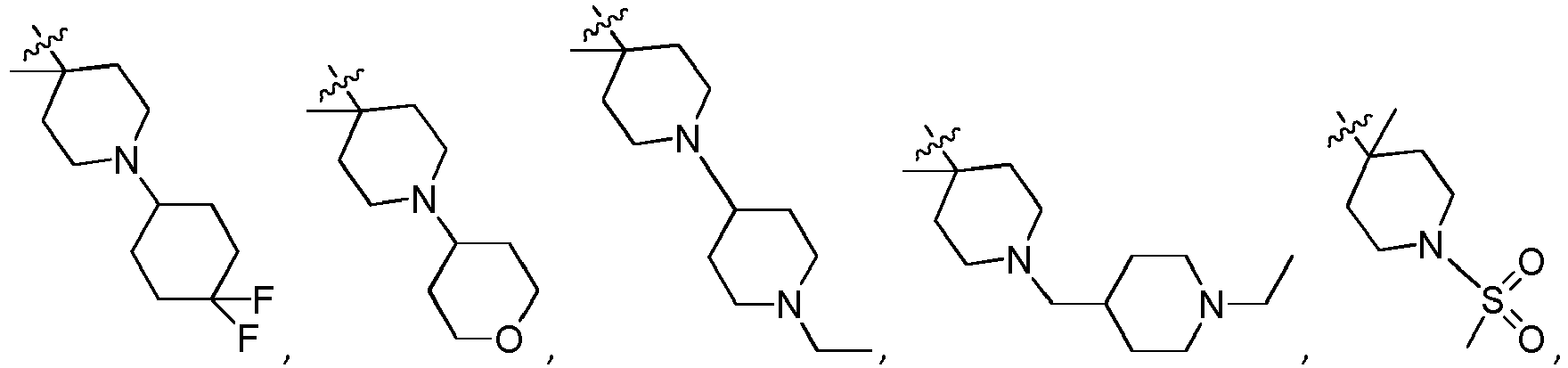


- Composé conforme à la revendication 3, ou l'un de ses sels pharmaceutiquement acceptables dans lequel R2 est un
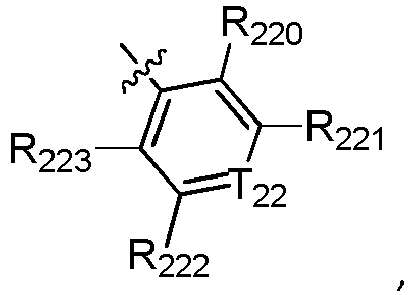

le C1-3 alkyl amino, C1-3 alkyl est un méthylaminométhylène, de façon plus préférentielle,
R2 est choisi dans le groupe formé par un
- Composé conforme à la revendication 1, ou l'un de ses sels pharmaceutiquement acceptables choisi dans le groupe formé par les composés suivants :6-fluoro-3-(piperidin-4-yl)-4H-benzo[4,5]imidazo[1,2-b]pyrazole-8-carboxamide;3-(1-ethylpiperidin-4-yl)-6-fluoro-4H-benzo[4,5]imidazo[1,2-b]pyrazole-8-carboxamide;6-fluoro-3-(1-(2-fluoroethyl)piperidin-4-yl)-4H-benzo[4,5]imidazo[1,2-b]pyrazole-8-carboxamide;3-(1-cyclopropylpiperidin-4-yl)-6-fluoro-4H-benzo[4,5]imidazo[1,2-b]pyrazole-8-carboxamide;6-fluoro-3-(1-(2-hydroxy-2-methylpropyl)piperidin-4-yl)-4H-benzo[4,5]imidazo[1,2-b]pyrazole-8-carboxamide;6-fluoro-3-(1-(2-fluoro-2-methylpropyl)piperidin-4-yl)-4H-benzo[4,5]imidazo[1,2-b]pyrazole-8-carboxamide;3-(1-(cyclopropanecarbonyl)piperidin-4-yl)-6-fluoro-4H-benzo[4,5]imidazo[1,2-b]pyrazole-8-carboxamide;6-fluoro-3-(1-methylpiperidin-4-yl)-4H-benzo[4,5]imidazo[1,2-b]pyrazole-8-carboxamide;6-fluoro-3-(1-isopropylpiperidin-4-yl)-4H-benzo[4,5]imidazo[1,2-b]pyrazole-8-carboxamide;6-fluoro-3-(1-(oxetan-3-yl)piperidin-4-yl)-4H-benzo[4,5]imidazo[1,2-b]pyrazole-8-carboxamide;6-fluoro-3-(1-propylpiperidin-4-yl)-4H-benzo[4,5]imidazo[1,2-b]pyrazole-8-carboxamide;3-(1-(2-aminoethyl)piperidin-4-yl)-6-fluoro-4H-benzo[4,5]imidazo[1,2-b]pyrazole-8-carboxamide;3-(1-(2-(dimethylamino)ethyl)piperidin-4-yl)-6-fluoro-4H-benzo[4,5]imidazo[1,2-b]pyrazole-8-carboxamide;6-fluoro-3-(1-(2-methoxyethyl)piperidin-4-yl)-4H-benzo[4,5]imidazo[1,2-b]pyrazole-8-carboxamide;6-fluoro-3-(1-(2-hydroxyethyl)piperidin-4-yl)-4H-benzo[4,5]imidazo[1,2-b]pyrazole-8-carboxamide;3-(1-ethylpiperidin-3-yl)-6-fluoro-4H-benzo[4,5]imidazo[1,2-b]pyrazole-8-carboxamide;3-(1-ethylazepan-4-yl)-6-fluoro-4H-benzo[4,5]imidazo[1,2-b]pyrazole-8-carboxamide;6-fluoro-3-(1-methylazepan-4-yl)-4H-benzo[4,5]imidazo[1,2-b]pyrazole-8-carboxamide;6-fluoro-3-(1-methylpyrrolidin-3-yl)-4H-benzo[4,5]imidazo[1,2-b]pyrazole-8-carboxamide;3-(1-ethylpyrrolidin-3-yl)-6-fluoro-4H-benzo[4,5]imidazo[1,2-b]pyrazole-8-carboxamide;6-fluoro-3-(1-isopropylpyrrolidin-3-yl)-4H-benzo[4,5]imidazo[1,2-b]pyrazole-8-carboxamide;6-fluoro-3-(pyrrolidin-2-yl)-4H-benzo[4,5]imidazo[1,2-b]pyrazole-8-carboxamide;6-fluoro-3-(1-propylpyrrolidin-2-yl)-4H-benzo[4,5]imidazo[1,2-b]pyrazole-8-carboxamide;6-fluoro-3-(1-methylpyrrolidin-2-yl)-4H-benzo[4,5]imidazo[1,2-b]pyrazole-8-carboxamide;3-(1-ethylpyrrolidin-2-yl)-6-fluoro-4H-benzo[4,5]imidazo[1,2-b]pyrazole-8-carboxamide;3-(1-ethylpiperidin-4-yl)-4H-benzo[4,5]imidazo[1,2-b]pyrazole-8-carboxamide;6-fluoro-3-(1-propylpyyolidin-2-yl)-4H-benzo[4,5]imidazo[1,2-b]pyrazole-8-carboxamide;6-fluoro-3-(3-methyl-3-azabicyclo[3.1.0]hexan-1-yl)-4H-benzo[4,5]imidazo[1,2-b]pyrazole-8-carboxamide;3-(3-ethyl-3-azabicyclo[3.1.0]hexan-1-yl)-6-fluoro-4H-benzo[4,5]imidazo[1,2-b]pyrazole-8-carboxamide;3-(3-cyclobutyl-3-azabicyclo[3.1.0]hexan-1-yl)-6-fluoro-4H-benzo[4,5]imidazo[1,2-b]pyrazole-8-carboxamide;6-fluoro-3-(3-isopropyl-3-azabicyclo[3.1.0]hexan-1-yl)-4H-benzo[4,5]imidazo[1,2-b]pyrazole-8-carboxamide3-(3-azabicyclo[3.1.0]hexan-6-yl)-6-fluoro-4H-benzo[4,5]imidazo[1,2-b]pyrazole-8-carboxamide;3-(3-ethyl-3-azabicyclo[3.1.0]hexan-6-yl)-6-fluoro-4H-benzo[4,5]imidazo[1,2-b]pyrazole-8-carboxamide;3-(8-ethyl-8-azabicyclo[3.2.1]octan-3-yl)-6-fluoro-4H-benzo[4,5]imidazo[1,2-b]pyrazole-8-carboxamide;6-fluoro-3-(4-hydroxypyrrolidin-2-yl)-4H-benzo[4,5]imidazo[1,2-b]pyrazole-8-carboxamide;3-cyano-6-fluoro-4H-benzo[4,5]imidazo[1,2-b]pyrazole-8-carboxamide;3-cyano-4H-benzo[4,5]imidazo[1,2-b]pyrazole-8-carboxamide;3-(aminomethyl)-6-fluoro-4H-benzo[4,5]imidazo[1,2-b]pyrazole-8-carboxamide;3-(cyclopropanecarboxamidomethylene)-6-fluoro-4H-benzo[4,5]imidazo[1,2-b]pyrazole-8-carboxamide;6-fluoro-3-(4-fluorophenyl)-4H-benzo[4,5]imidazo[1,2-b]pyrazole-8-carboxamide;6-fluoro-3-(2-fluoro-4-((methylamino)methylene)phenyl)-4H-benzo[4,5]imidazo[1,2-b]pyrazole-8-carboxamide;6-fluoro-3-(4-((methylamino)methyl)phenyl)-4H-benzo[4,5]imidazo[1,2-b]pyrazole-8-carboxamide;6-fluoro-3-(2-fluoro-5-((methylamino)methyl)phenyl)-4H-benzo[4,5]imidazo[1,2-b]pyrazole-8-carboxamide;6-fluoro-3-(pyridin-4-yl)-4H-benzo[4,5]imidazo[1,2-b]pyrazole-8-carboxamide;6-fluoro-3-(tetrahydro-2H-pyran-4-yl)-4H-benzo[4,5]imidazo[1,2-b]pyrazole-8-carboxamide;3-(4-(dimethylamino)cyclohexyl)-6-fluoro-4H-benzo[4,5]imidazo[1,2-b]pyrazole-8-carboxamide;3-(1-ethylpiperidin-4-yl)-6-fluoro-4-hydroxy-4H-pyrazolo[1,5-α]indole-8-carboxamide;3-(1-ethylpiperidin-4-yl)-6-fluoro-4-methyl-4H-benzo[4,5]imidazo[1,2-b]pyrazole-8-carboxamide;6-fluoro-3-(4-methylpiperidin-4-yl)-4H-benzo[4,5]imidazo[1,2-b]pyrazole-8-carboxamide;3-(1-ethyl-4-methylpiperidin-4-yl)-6-fluoro-4H-benzo[4,5]imidazo[1,2-b]pyrazole-8-carboxamide;3-(1-cyclopropyl-4-methylpiperidin-4-yl)-6-fluoro-4H-benzo[4,5]imidazo[1,2-b]pyrazole-8-carboxamide ;6-fluoro-3-(1-(2-hydroxy-2-methylpropyl)-4-methylpiperidin-4-yl)-4H-benzo[4,5]imidazo[1,2-b]pyrazole-8-carboxamide;3-(1-(4,4-difluorocyclohexyl)-4-methylpiperidin-4-yl)-6-fluoro-4H-benzo[4,5]imidazo[1,2-b]pyrazole-8-carboxamide;6-fluoro-3-(1-(2-fluoroethyl)-4-methylpiperidin-4-yl)-4H-benzo[4,5]imidazo[1,2-b]pyrazole-8-carboxamide;6-fluoro-3-(4-methyl-1-(2,2,2-trifluoroethyl)piperidin-4-yl)-4H-benzo[4,5]imidazo[1,2-b]pyrazole-8-carboxamide;6-fluoro-3-(4-methyl-1-(3,3,3-trifluoropropyl)piperidin-4-yl)-4H-benzo[4,5]imidazo[1,2-b]pyrazole-8-carboxamide;6-fluoro-3-(4-methyl-1-(2-(methylsulfonyl)ethyl)piperidin-4-yl)-4H-benzo[4,5]imidazo[1,2-b]pyrazole-8-carboxamide;6-fluoro-3-(1-(2-methoxyethyl)-4-methylpiperidin-4-yl)-4H-benzo[4,5]imidazo[1,2-b]pyrazole-8-carboxamide;6-fluoro-3-(1-(3-methoxypropyl)-4-methylpiperidin-4-yl)-4H-benzo[4,5]imidazo[1,2-b]pyrazole-8-carboxamide;6-fluoro-3-(4-methyl-1-(methylsulfonyl)piperidin-4-yl)-4H-benzo[4,5]imidazo[1,2-b]pyrazole-8-carboxamide;6-fluoro-3-(1-(3-fluorocyclobutyl)-4-methylpiperidin-4-yl)-4H-benzo[4,5]imidazo[1,2-b]pyrazole-8-carboxamide;6-fluoro-3-(1-isobutyl-4-methylpiperidin-4-yl)-4H-benzo[4,5]imidazo[1,2-b]pyrazole-8-carboxamide;3-(1-(2-cyanoethyl)-4-methylpiperidin-4-yl)-6-fluoro-4H-benzo[4,5]imidazo[1,2-b]pyrazole-8-carboxamide;6-chloro-3-(1-ethyl-4-methylpiperidin-4-yl)-4H-benzo[4,5]imidazo[1,2-b]pyrazole-8-carboxamide;3-(1-ethyl-3-methylpyrrolidin-3-yl)-6-fluoro-4H-benzo[4,5]imidazo[1,2-b]pyrazole-8-carboxamide;3-(1,3-dimethylpyrrolidin-3-yl)-6-fluoro-4H-benzo[4,5]imidazo[1,2-b]pyrazole-8-carboxamide;6-fluoro-3-(1-isopropyl-3-methylpyrrolidin-3-yl)-4H-benzo[4,5]imidazo[1,2-b]pyrazole-8-carboxamide;6-fluoro-3-(1-(2-fluoroethyl)-3-methylpyrrolidin-3-yl)-4H-benzo[4,5]imidazo[1,2-b]pyrazole-8-carboxamide;6-fluoro-3-(3-methyl-1-(2,2,2-trifluoroethyl)pyrrolidin-3-yl)-4H-benzo[4,5]imidazo[1,2-b]pyrazole-8-carboxamide;6-fluoro-3-(3-methyl-1-(2-(methylsulfonyl)ethyl)pyrrolidin-3-yl)-4H-benzo[4,5]imidazo[1,2-b]pyrazole-8-carboxamide;6-fluoro-3-(3-methyl-1-(3,3,3-trifluoropropyl)pyrrolidin-3-yl)-4H-benzo[4,5]imidazo[1,2-b]pyrazole-8-carboxamide;3-(1-(2-cyanoethyl)-3-methylpyrrolidin-3-yl)-6-fluoro-4H-benzo[4,5]imidazo[1,2-b]pyrazole-8-carboxamide;6-fluoro-3-(1-isopropyl-4-methylpiperidin-4-yl)-4H-benzo[4,5]imidazo[1,2-b]pyrazole-8-carboxamide;6-fluoro-3-(4-methyl-1,1-dioxido-2H-thiopyran-4-yl)-4H-benzo[4,5]imidazo[1,2-b]pyrazole-8-carboxamide;3-(1,4-diethylpiperidin-4-yl)-6-fluoro-4H-benzo[4,5]imidazo[1,2-b]pyrazole-8-carboxamide;3-(1-ethyl-4-methylpiperidin-4-yl)-6-fluoro-2-methyl-4H-benzo[4,5]imidazo[1,2-b]pyrazole-8-carboxamide;6-fluoro-3-(1-isobutyl-4-methylpiperidin-4-yl)-2-methyl-4H-benzo[4,5]imidazo[1,2-b]pyrazole-8-carboxamide;6-fluoro-3-(1-isopropyl-4-methylpiperidin-4-yl)-2-methyl-4H-benzo[4,5]imidazo[1,2-b]pyrazole-8-carboxamide;3-(1,4-dimethylpiperidin-4-yl)-6-fluoro-2-methyl-4H-benzo[4,5]imidazo[1,2-b]pyrazole-8-carboxamide;6-fluoro-3-(1-(2-hydroxy-2-methylpropyl)-4-methylpiperidin-4-yl)-2-methyl-4H-benzo[4,5]imidazo[1,2-b]pyrazole-8-carboxamide;3-(1-ethyl-2,4-dimethylpiperidin-4-yl)-6-fluoro-2-methyl-4H-benzo[4,5]imidazo[1,2-b]pyrazole-8-carboxamide;3-(1-ethyl-3-methylpyrrolidin-3-yl)-6-fluoro-2-methyl-4H-benzo[4,5]imidazo[1,2-b]pyrazole-8-carboxamide;6-fluoro-3-(1-isopropyl-3-methylpyrrolidin-3-yl)-2-methyl-4H-benzo[4,5]imidazo[1,2-b]pyrazole-8-carboxamide;3-(1,3-dimethylazetidin-3-yl)-6-fluoro-2-methyl-4H-benzo[4,5]imidazo[1,2-b]pyrazole-8-carboxamide;3-(1-ethyl-3-methylazetidin-3-yl)-6-fluoro-2-methyl-4H-benzo[4,5]imidazo[1,2-b]pyrazole-8-carboxamide;6-fluoro-3-(1-isopropyl-3-methylazetidin-3-yl)-2-methyl-4H-benzo[4,5]imidazo[1,2-b]pyrazole-8-carboxamide;6-fluoro-3-(1-(2-hydroxy-2-methylpropyl)-3-methylazetidin-3-yl)-2-methyl-4H-benzo[4,5]imidazo[1,2-b]pyrazole-8-carboxamide;6-fluoro-3-(1-isopropyl-4-methylpiperidin-4-yl)-2-methoxy-4H-benzo[4,5]imidazo[1,2-b]pyrazole-8-carboxamide;2-(benzyloxy)-6-fluoro-3-(1-isopropyl-4-methylpiperidin-4-yl)-4H-benzo[4,5]imidazo[1,2-b]pyrazole-8-carboxamide;6-fluoro-2-(piperidin-4-yl)-4H-benzo[4,5]imidazo[1,2-b]pyrazole-8-carboxamide;2-(1-ethylpiperidin-4-yl)-6-fluoro-4H-benzo[4,5]imidazo[1,2-b]pyrazole-8-carboxamide.
Priority Applications (1)
| Application Number | Priority Date | Filing Date | Title |
|---|---|---|---|
| PL15777444T PL3130592T3 (pl) | 2014-04-10 | 2015-03-30 | Analogi związków 4h-pirazolo[1,5-α]benzimidazolowych jako inhibitory PARP |
Applications Claiming Priority (3)
| Application Number | Priority Date | Filing Date | Title |
|---|---|---|---|
| CN201410144173.0A CN104974161B (zh) | 2014-04-10 | 2014-04-10 | 作为PARP抑制剂的4H-吡唑并[1,5-α]苯并咪唑化合物的类似物 |
| CN201510113090 | 2015-03-13 | ||
| PCT/CN2015/075363 WO2015154630A1 (fr) | 2014-04-10 | 2015-03-30 | Analogues de composé 4h-pyrazolo[1,5-α]benzimidazole utilisés en tant qu'inhibiteurs de parp |
Publications (3)
| Publication Number | Publication Date |
|---|---|
| EP3130592A1 EP3130592A1 (fr) | 2017-02-15 |
| EP3130592A4 EP3130592A4 (fr) | 2017-09-06 |
| EP3130592B1 true EP3130592B1 (fr) | 2019-08-14 |
Family
ID=54287319
Family Applications (1)
| Application Number | Title | Priority Date | Filing Date |
|---|---|---|---|
| EP15777444.9A Active EP3130592B1 (fr) | 2014-04-10 | 2015-03-30 | Analogues de composé 4h-pyrazolo[1,5- ]benzimidazole utilisés en tant qu'inhibiteurs de parp |
Country Status (22)
| Country | Link |
|---|---|
| US (1) | US9856262B2 (fr) |
| EP (1) | EP3130592B1 (fr) |
| JP (1) | JP6359175B2 (fr) |
| KR (1) | KR101921486B1 (fr) |
| CN (1) | CN106459057B (fr) |
| AU (1) | AU2015245786B2 (fr) |
| BR (1) | BR112016023397B1 (fr) |
| CA (1) | CA2944801C (fr) |
| DK (1) | DK3130592T3 (fr) |
| ES (1) | ES2754590T3 (fr) |
| HU (1) | HUE047410T2 (fr) |
| IL (1) | IL248258B (fr) |
| MX (1) | MX368496B (fr) |
| NZ (1) | NZ725165A (fr) |
| PL (1) | PL3130592T3 (fr) |
| PT (1) | PT3130592T (fr) |
| RU (1) | RU2672722C2 (fr) |
| SA (1) | SA516380051B1 (fr) |
| SG (1) | SG11201608438YA (fr) |
| TW (1) | TWI671301B (fr) |
| WO (1) | WO2015154630A1 (fr) |
| ZA (1) | ZA201607736B (fr) |
Families Citing this family (23)
| Publication number | Priority date | Publication date | Assignee | Title |
|---|---|---|---|---|
| CN104974161B (zh) * | 2014-04-10 | 2019-11-01 | 湖北生物医药产业技术研究院有限公司 | 作为PARP抑制剂的4H-吡唑并[1,5-α]苯并咪唑化合物的类似物 |
| CA3003122C (fr) | 2015-09-30 | 2023-10-03 | Medshine Discovery Inc. | Type de sel et type de cristal de compose de 4h-pyrazolo[1, 5-alpha]benzimidazole et methode de preparation et intermediaire associe |
| WO2017156350A1 (fr) | 2016-03-09 | 2017-09-14 | K-Gen, Inc. | Méthodes de traitement du cancer |
| KR102596307B1 (ko) | 2017-04-27 | 2023-10-30 | 바이엘 애니멀 헬스 게엠베하 | 새로운 비시클릭 피라졸 유도체 |
| CN115028641B (zh) * | 2022-07-19 | 2024-05-28 | 湖南大学 | 一种钴催化合成5,8-双官能团取代咪唑并[1,2-a]吡嗪类化合物的方法 |
| TW202508595A (zh) | 2023-05-04 | 2025-03-01 | 美商銳新醫藥公司 | 用於ras相關疾病或病症之組合療法 |
| US20250049810A1 (en) | 2023-08-07 | 2025-02-13 | Revolution Medicines, Inc. | Methods of treating a ras protein-related disease or disorder |
| WO2025056690A1 (fr) | 2023-09-12 | 2025-03-20 | MAX-PLANCK-Gesellschaft zur Förderung der Wissenschaften e.V. | Inhibiteurs de parp1 et de point de contrôle immunitaire pour le traitement de patients atteints d'un cancer surexprimant l'ubqln1 et/ou l'ubqln4 |
| CN116969954B (zh) * | 2023-09-21 | 2023-11-28 | 广东省农业科学院农业质量标准与监测技术研究所 | 一类含内酰胺的三环稠合杂环化合物及其应用 |
| AU2024360465A1 (en) | 2023-10-12 | 2026-04-09 | Revolution Medicines, Inc. | Macrocyclic ras inhibitors |
| CN117534677B (zh) * | 2024-01-09 | 2024-03-12 | 广东省农业科学院农业质量标准与监测技术研究所 | 一类含亚胺的三环稠合杂环化合物及其应用 |
| WO2025171296A1 (fr) | 2024-02-09 | 2025-08-14 | Revolution Medicines, Inc. | Inhibiteurs de ras |
| WO2025217307A1 (fr) | 2024-04-09 | 2025-10-16 | Revolution Medicines, Inc. | Procédés de prédiction de la réponse à un inhibiteur de ras(on) et polythérapies |
| TW202547461A (zh) | 2024-05-17 | 2025-12-16 | 美商銳新醫藥公司 | Ras抑制劑 |
| WO2025255438A1 (fr) | 2024-06-07 | 2025-12-11 | Revolution Medicines, Inc. | Procédés de traitement d'une maladie ou d'un trouble lié à la protéine ras |
| WO2025265060A1 (fr) | 2024-06-21 | 2025-12-26 | Revolution Medicines, Inc. | Compositions thérapeutiques et procédés de gestion d'effets liés au traitement |
| WO2026006747A1 (fr) | 2024-06-28 | 2026-01-02 | Revolution Medicines, Inc. | Inhibiteurs de ras |
| WO2026015796A1 (fr) | 2024-07-12 | 2026-01-15 | Revolution Medicines, Inc. | Méthodes de traitement d'une maladie ou d'un trouble lié à ras |
| WO2026015790A1 (fr) | 2024-07-12 | 2026-01-15 | Revolution Medicines, Inc. | Méthodes de traitement d'une maladie ou d'un trouble lié à ras |
| WO2026015825A1 (fr) | 2024-07-12 | 2026-01-15 | Revolution Medicines, Inc. | Utilisation d'un inhibiteur de ras pour traiter le cancer du pancréas |
| WO2026015801A1 (fr) | 2024-07-12 | 2026-01-15 | Revolution Medicines, Inc. | Méthodes de traitement d'une maladie ou d'un trouble liés à ras |
| WO2026050446A1 (fr) | 2024-08-29 | 2026-03-05 | Revolution Medicines, Inc. | Inhibiteurs de ras |
| WO2026072904A2 (fr) | 2024-09-26 | 2026-04-02 | Revolution Medicines, Inc. | Compositions et méthodes de traitement du cancer du poumon |
Family Cites Families (14)
| Publication number | Priority date | Publication date | Assignee | Title |
|---|---|---|---|---|
| US4916051A (en) * | 1987-04-07 | 1990-04-10 | Konica Corporation | Silver halide color photographic light-sensitive material |
| MY143499A (en) * | 2003-12-22 | 2011-05-31 | Sb Pharmco Inc | Crf receptor antagonist and methods relating thereto |
| WO2007076127A2 (fr) | 2005-12-22 | 2007-07-05 | Biogen Idec Ma Inc | Modulateurs du facteur de croissance transformant |
| WO2007144669A1 (fr) | 2006-06-15 | 2007-12-21 | Istituto Di Ricerche Di Biologia Molecolare P. Angeletti Spa | Pyrazolo[1,5-a]quinazolin-5(4h)-ones en tant qu'inhibiteurs de la poly(adp-ribose)polymérase (parp) |
| EP2069351B1 (fr) * | 2006-06-20 | 2015-10-28 | AbbVie Inc. | Pyrazoloquinazolines comme inhibiteurs de parp |
| GB0701273D0 (en) * | 2007-01-24 | 2007-02-28 | Angeletti P Ist Richerche Bio | New compounds |
| DK2656843T3 (en) | 2012-04-26 | 2015-04-20 | Helmut Schickaneder | Esters of bendamustine and related compounds, and medical use thereof |
| AU2013257018B2 (en) * | 2012-05-04 | 2017-02-16 | Merck Patent Gmbh | Pyrrolotriazinone derivatives |
| EP2666775A1 (fr) * | 2012-05-21 | 2013-11-27 | Domain Therapeutics | Pyrazoloquinazolinones et pyrroloquinazolinones substitués en tant que modulateurs allostériques des récepteurs métabotropiques du glutamate du groupe II |
| CN104350056A (zh) | 2012-06-07 | 2015-02-11 | 霍夫曼-拉罗奇有限公司 | 端锚聚合酶的吡咯并嘧啶酮和吡咯并吡啶酮抑制剂 |
| ES2595240T3 (es) * | 2012-07-09 | 2016-12-28 | Lupin Limited | Derivados de tetrahidroquinazolinona como inhibidores de PARP |
| CN103570725B (zh) | 2012-08-01 | 2017-03-22 | 中国科学院上海药物研究所 | 哌嗪并三唑类化合物及其制备方法和用途 |
| KR102083154B1 (ko) * | 2012-08-08 | 2020-03-02 | 메르크 파텐트 게엠베하 | (아자―)이소퀴놀리논 유도체 |
| CN104974161B (zh) | 2014-04-10 | 2019-11-01 | 湖北生物医药产业技术研究院有限公司 | 作为PARP抑制剂的4H-吡唑并[1,5-α]苯并咪唑化合物的类似物 |
-
2015
- 2015-03-30 RU RU2016144202A patent/RU2672722C2/ru active
- 2015-03-30 WO PCT/CN2015/075363 patent/WO2015154630A1/fr not_active Ceased
- 2015-03-30 ES ES15777444T patent/ES2754590T3/es active Active
- 2015-03-30 PL PL15777444T patent/PL3130592T3/pl unknown
- 2015-03-30 CN CN201580017657.1A patent/CN106459057B/zh active Active
- 2015-03-30 BR BR112016023397-2A patent/BR112016023397B1/pt active IP Right Grant
- 2015-03-30 EP EP15777444.9A patent/EP3130592B1/fr active Active
- 2015-03-30 PT PT157774449T patent/PT3130592T/pt unknown
- 2015-03-30 AU AU2015245786A patent/AU2015245786B2/en active Active
- 2015-03-30 JP JP2017504223A patent/JP6359175B2/ja active Active
- 2015-03-30 KR KR1020167031520A patent/KR101921486B1/ko active Active
- 2015-03-30 CA CA2944801A patent/CA2944801C/fr active Active
- 2015-03-30 HU HUE15777444A patent/HUE047410T2/hu unknown
- 2015-03-30 US US15/302,588 patent/US9856262B2/en active Active
- 2015-03-30 MX MX2016013265A patent/MX368496B/es active IP Right Grant
- 2015-03-30 NZ NZ725165A patent/NZ725165A/en unknown
- 2015-03-30 SG SG11201608438YA patent/SG11201608438YA/en unknown
- 2015-03-30 DK DK15777444T patent/DK3130592T3/da active
- 2015-04-08 TW TW104111236A patent/TWI671301B/zh active
-
2016
- 2016-10-09 IL IL248258A patent/IL248258B/en active IP Right Grant
- 2016-10-10 SA SA516380051A patent/SA516380051B1/ar unknown
- 2016-11-09 ZA ZA2016/07736A patent/ZA201607736B/en unknown
Non-Patent Citations (1)
| Title |
|---|
| None * |
Also Published As
Similar Documents
| Publication | Publication Date | Title |
|---|---|---|
| EP3130592B1 (fr) | Analogues de composé 4h-pyrazolo[1,5- ]benzimidazole utilisés en tant qu'inhibiteurs de parp | |
| AU2018304757B2 (en) | Aryl-phosphorus-oxygen compound as EGFR kinase inhibitor | |
| EP3868742A1 (fr) | Régulateur de dérivés hétéroaromatiques contenant de l'azote, procédé de préparation associé et utilisation correspondante | |
| EP4606803A1 (fr) | Agent de dégradation de kras g12d, son procédé de préparation et son utilisation | |
| EP3484871B1 (fr) | Inhibiteurs de la kinase 7 dépendante des cyclines (cdk7) | |
| EP4442686A1 (fr) | Inhibiteurs de kras, leur procédé de préparation et leur utilisation pharmaceutique | |
| EP3138843B1 (fr) | Dérivé d'isoquinolinesulfonyle utilisé comme inhibiteur de la rho kinase | |
| CN104974161B (zh) | 作为PARP抑制剂的4H-吡唑并[1,5-α]苯并咪唑化合物的类似物 | |
| EP2753329B1 (fr) | Dérivés de 1,5-naphtyridine comme inhibiteurs de melk | |
| BR112014010177B1 (pt) | Composto, composição farmacêutica, e, uso de um composto | |
| WO2020186220A1 (fr) | Composés en tant qu'inhibiteurs du facteur inhibiteur de la migration des macrophages | |
| EP4137484A1 (fr) | Composés tricycliques servant d'inhibiteurs d'egfr | |
| EP4373817B1 (fr) | Pyrazine-2-carboxamides substituées utilisées en tant qu'inhibiteurs de hpk1 pour le traitement du cancer | |
| EP4288426B1 (fr) | Dérivés de quinoxaline et leurs utilisations | |
| EP3299371B1 (fr) | Composés d'hydroxyle de purine et leur utilisation | |
| EP3892278B1 (fr) | Dérivé de cycloalcane-1,3-diamine | |
| EP3473628B1 (fr) | Composé dihydropyrazole azépine servant d'inhibiteur d'akt | |
| EP4592283A1 (fr) | Inhibiteurs de kinase-7 dépendante de cycline | |
| EP4667467A1 (fr) | Agents de dégradation de mllt1 et/ou mllt3 à base de protac | |
| EP4667466A1 (fr) | Agents de dégradation de mllt1 et/ou mllt3 à base de protac | |
| HK40104947A (en) | Quinoxaline derivatives and uses thereof | |
| HK40104947B (en) | Quinoxaline derivatives and uses thereof | |
| HK40053040A (en) | Cycloalkane-1,3-diamine derivative | |
| HK1229331B (zh) | 作为PARP抑制剂的4H-吡唑并[1,5-α]苯并咪唑化合物的类似物 |
Legal Events
| Date | Code | Title | Description |
|---|---|---|---|
| STAA | Information on the status of an ep patent application or granted ep patent |
Free format text: STATUS: THE INTERNATIONAL PUBLICATION HAS BEEN MADE |
|
| PUAI | Public reference made under article 153(3) epc to a published international application that has entered the european phase |
Free format text: ORIGINAL CODE: 0009012 |
|
| STAA | Information on the status of an ep patent application or granted ep patent |
Free format text: STATUS: REQUEST FOR EXAMINATION WAS MADE |
|
| 17P | Request for examination filed |
Effective date: 20161104 |
|
| AK | Designated contracting states |
Kind code of ref document: A1 Designated state(s): AL AT BE BG CH CY CZ DE DK EE ES FI FR GB GR HR HU IE IS IT LI LT LU LV MC MK MT NL NO PL PT RO RS SE SI SK SM TR |
|
| AX | Request for extension of the european patent |
Extension state: BA ME |
|
| DAV | Request for validation of the european patent (deleted) | ||
| DAX | Request for extension of the european patent (deleted) | ||
| A4 | Supplementary search report drawn up and despatched |
Effective date: 20170804 |
|
| RIC1 | Information provided on ipc code assigned before grant |
Ipc: A61P 9/10 20060101ALI20170731BHEP Ipc: C07D 487/04 20060101AFI20170731BHEP Ipc: A61P 3/10 20060101ALI20170731BHEP Ipc: A61P 29/00 20060101ALI20170731BHEP Ipc: A61P 35/00 20060101ALI20170731BHEP Ipc: A61P 25/00 20060101ALI20170731BHEP Ipc: C07D 519/00 20060101ALI20170731BHEP |
|
| STAA | Information on the status of an ep patent application or granted ep patent |
Free format text: STATUS: EXAMINATION IS IN PROGRESS |
|
| 17Q | First examination report despatched |
Effective date: 20180629 |
|
| GRAP | Despatch of communication of intention to grant a patent |
Free format text: ORIGINAL CODE: EPIDOSNIGR1 |
|
| STAA | Information on the status of an ep patent application or granted ep patent |
Free format text: STATUS: GRANT OF PATENT IS INTENDED |
|
| RAP1 | Party data changed (applicant data changed or rights of an application transferred) |
Owner name: HUMANWELL HEALTHCARE (GROUP) CO., LTD. Owner name: HUBEI BIO-PHARMACEUTICAL INDUSTRIAL TECHNOLOGICAL |
|
| INTG | Intention to grant announced |
Effective date: 20190226 |
|
| GRAS | Grant fee paid |
Free format text: ORIGINAL CODE: EPIDOSNIGR3 |
|
| GRAA | (expected) grant |
Free format text: ORIGINAL CODE: 0009210 |
|
| STAA | Information on the status of an ep patent application or granted ep patent |
Free format text: STATUS: THE PATENT HAS BEEN GRANTED |
|
| AK | Designated contracting states |
Kind code of ref document: B1 Designated state(s): AL AT BE BG CH CY CZ DE DK EE ES FI FR GB GR HR HU IE IS IT LI LT LU LV MC MK MT NL NO PL PT RO RS SE SI SK SM TR |
|
| REG | Reference to a national code |
Ref country code: GB Ref legal event code: FG4D |
|
| REG | Reference to a national code |
Ref country code: CH Ref legal event code: EP Ref country code: AT Ref legal event code: REF Ref document number: 1166875 Country of ref document: AT Kind code of ref document: T Effective date: 20190815 |
|
| REG | Reference to a national code |
Ref country code: IE Ref legal event code: FG4D |
|
| REG | Reference to a national code |
Ref country code: DE Ref legal event code: R096 Ref document number: 602015035877 Country of ref document: DE |
|
| REG | Reference to a national code |
Ref country code: DK Ref legal event code: T3 Effective date: 20191101 |
|
| REG | Reference to a national code |
Ref country code: NL Ref legal event code: FP |
|
| REG | Reference to a national code |
Ref country code: SE Ref legal event code: TRGR |
|
| REG | Reference to a national code |
Ref country code: PT Ref legal event code: SC4A Ref document number: 3130592 Country of ref document: PT Date of ref document: 20191121 Kind code of ref document: T Free format text: AVAILABILITY OF NATIONAL TRANSLATION Effective date: 20191112 |
|
| REG | Reference to a national code |
Ref country code: LT Ref legal event code: MG4D |
|
| PG25 | Lapsed in a contracting state [announced via postgrant information from national office to epo] |
Ref country code: HR Free format text: LAPSE BECAUSE OF FAILURE TO SUBMIT A TRANSLATION OF THE DESCRIPTION OR TO PAY THE FEE WITHIN THE PRESCRIBED TIME-LIMIT Effective date: 20190814 Ref country code: LT Free format text: LAPSE BECAUSE OF FAILURE TO SUBMIT A TRANSLATION OF THE DESCRIPTION OR TO PAY THE FEE WITHIN THE PRESCRIBED TIME-LIMIT Effective date: 20190814 Ref country code: NO Free format text: LAPSE BECAUSE OF FAILURE TO SUBMIT A TRANSLATION OF THE DESCRIPTION OR TO PAY THE FEE WITHIN THE PRESCRIBED TIME-LIMIT Effective date: 20191114 Ref country code: FI Free format text: LAPSE BECAUSE OF FAILURE TO SUBMIT A TRANSLATION OF THE DESCRIPTION OR TO PAY THE FEE WITHIN THE PRESCRIBED TIME-LIMIT Effective date: 20190814 Ref country code: BG Free format text: LAPSE BECAUSE OF FAILURE TO SUBMIT A TRANSLATION OF THE DESCRIPTION OR TO PAY THE FEE WITHIN THE PRESCRIBED TIME-LIMIT Effective date: 20191114 |
|
| PG25 | Lapsed in a contracting state [announced via postgrant information from national office to epo] |
Ref country code: RS Free format text: LAPSE BECAUSE OF FAILURE TO SUBMIT A TRANSLATION OF THE DESCRIPTION OR TO PAY THE FEE WITHIN THE PRESCRIBED TIME-LIMIT Effective date: 20190814 Ref country code: LV Free format text: LAPSE BECAUSE OF FAILURE TO SUBMIT A TRANSLATION OF THE DESCRIPTION OR TO PAY THE FEE WITHIN THE PRESCRIBED TIME-LIMIT Effective date: 20190814 Ref country code: GR Free format text: LAPSE BECAUSE OF FAILURE TO SUBMIT A TRANSLATION OF THE DESCRIPTION OR TO PAY THE FEE WITHIN THE PRESCRIBED TIME-LIMIT Effective date: 20191115 Ref country code: AL Free format text: LAPSE BECAUSE OF FAILURE TO SUBMIT A TRANSLATION OF THE DESCRIPTION OR TO PAY THE FEE WITHIN THE PRESCRIBED TIME-LIMIT Effective date: 20190814 Ref country code: IS Free format text: LAPSE BECAUSE OF FAILURE TO SUBMIT A TRANSLATION OF THE DESCRIPTION OR TO PAY THE FEE WITHIN THE PRESCRIBED TIME-LIMIT Effective date: 20191214 |
|
| PG25 | Lapsed in a contracting state [announced via postgrant information from national office to epo] |
Ref country code: TR Free format text: LAPSE BECAUSE OF FAILURE TO SUBMIT A TRANSLATION OF THE DESCRIPTION OR TO PAY THE FEE WITHIN THE PRESCRIBED TIME-LIMIT Effective date: 20190814 |
|
| REG | Reference to a national code |
Ref country code: ES Ref legal event code: FG2A Ref document number: 2754590 Country of ref document: ES Kind code of ref document: T3 Effective date: 20200420 |
|
| REG | Reference to a national code |
Ref country code: HU Ref legal event code: AG4A Ref document number: E047410 Country of ref document: HU |
|
| PG25 | Lapsed in a contracting state [announced via postgrant information from national office to epo] |
Ref country code: RO Free format text: LAPSE BECAUSE OF FAILURE TO SUBMIT A TRANSLATION OF THE DESCRIPTION OR TO PAY THE FEE WITHIN THE PRESCRIBED TIME-LIMIT Effective date: 20190814 Ref country code: EE Free format text: LAPSE BECAUSE OF FAILURE TO SUBMIT A TRANSLATION OF THE DESCRIPTION OR TO PAY THE FEE WITHIN THE PRESCRIBED TIME-LIMIT Effective date: 20190814 |
|
| PG25 | Lapsed in a contracting state [announced via postgrant information from national office to epo] |
Ref country code: IS Free format text: LAPSE BECAUSE OF FAILURE TO SUBMIT A TRANSLATION OF THE DESCRIPTION OR TO PAY THE FEE WITHIN THE PRESCRIBED TIME-LIMIT Effective date: 20200224 Ref country code: SM Free format text: LAPSE BECAUSE OF FAILURE TO SUBMIT A TRANSLATION OF THE DESCRIPTION OR TO PAY THE FEE WITHIN THE PRESCRIBED TIME-LIMIT Effective date: 20190814 Ref country code: CZ Free format text: LAPSE BECAUSE OF FAILURE TO SUBMIT A TRANSLATION OF THE DESCRIPTION OR TO PAY THE FEE WITHIN THE PRESCRIBED TIME-LIMIT Effective date: 20190814 Ref country code: SK Free format text: LAPSE BECAUSE OF FAILURE TO SUBMIT A TRANSLATION OF THE DESCRIPTION OR TO PAY THE FEE WITHIN THE PRESCRIBED TIME-LIMIT Effective date: 20190814 |
|
| REG | Reference to a national code |
Ref country code: DE Ref legal event code: R097 Ref document number: 602015035877 Country of ref document: DE |
|
| PLBE | No opposition filed within time limit |
Free format text: ORIGINAL CODE: 0009261 |
|
| STAA | Information on the status of an ep patent application or granted ep patent |
Free format text: STATUS: NO OPPOSITION FILED WITHIN TIME LIMIT |
|
| PG2D | Information on lapse in contracting state deleted |
Ref country code: IS |
|
| 26N | No opposition filed |
Effective date: 20200603 |
|
| PG25 | Lapsed in a contracting state [announced via postgrant information from national office to epo] |
Ref country code: SI Free format text: LAPSE BECAUSE OF FAILURE TO SUBMIT A TRANSLATION OF THE DESCRIPTION OR TO PAY THE FEE WITHIN THE PRESCRIBED TIME-LIMIT Effective date: 20190814 |
|
| PG25 | Lapsed in a contracting state [announced via postgrant information from national office to epo] |
Ref country code: MC Free format text: LAPSE BECAUSE OF FAILURE TO SUBMIT A TRANSLATION OF THE DESCRIPTION OR TO PAY THE FEE WITHIN THE PRESCRIBED TIME-LIMIT Effective date: 20190814 |
|
| PG25 | Lapsed in a contracting state [announced via postgrant information from national office to epo] |
Ref country code: LU Free format text: LAPSE BECAUSE OF NON-PAYMENT OF DUE FEES Effective date: 20200330 |
|
| REG | Reference to a national code |
Ref country code: AT Ref legal event code: UEP Ref document number: 1166875 Country of ref document: AT Kind code of ref document: T Effective date: 20190814 |
|
| PG25 | Lapsed in a contracting state [announced via postgrant information from national office to epo] |
Ref country code: MT Free format text: LAPSE BECAUSE OF FAILURE TO SUBMIT A TRANSLATION OF THE DESCRIPTION OR TO PAY THE FEE WITHIN THE PRESCRIBED TIME-LIMIT Effective date: 20190814 Ref country code: CY Free format text: LAPSE BECAUSE OF FAILURE TO SUBMIT A TRANSLATION OF THE DESCRIPTION OR TO PAY THE FEE WITHIN THE PRESCRIBED TIME-LIMIT Effective date: 20190814 |
|
| PG25 | Lapsed in a contracting state [announced via postgrant information from national office to epo] |
Ref country code: MK Free format text: LAPSE BECAUSE OF FAILURE TO SUBMIT A TRANSLATION OF THE DESCRIPTION OR TO PAY THE FEE WITHIN THE PRESCRIBED TIME-LIMIT Effective date: 20190814 |
|
| PGFP | Annual fee paid to national office [announced via postgrant information from national office to epo] |
Ref country code: SE Payment date: 20250312 Year of fee payment: 11 |
|
| PGFP | Annual fee paid to national office [announced via postgrant information from national office to epo] |
Ref country code: PT Payment date: 20250301 Year of fee payment: 11 Ref country code: DE Payment date: 20250319 Year of fee payment: 11 |
|
| PGFP | Annual fee paid to national office [announced via postgrant information from national office to epo] |
Ref country code: DK Payment date: 20250313 Year of fee payment: 11 Ref country code: NL Payment date: 20250314 Year of fee payment: 11 |
|
| PGFP | Annual fee paid to national office [announced via postgrant information from national office to epo] |
Ref country code: IE Payment date: 20250301 Year of fee payment: 11 |
|
| PGFP | Annual fee paid to national office [announced via postgrant information from national office to epo] |
Ref country code: BE Payment date: 20250320 Year of fee payment: 11 Ref country code: AT Payment date: 20250319 Year of fee payment: 11 |
|
| PGFP | Annual fee paid to national office [announced via postgrant information from national office to epo] |
Ref country code: FR Payment date: 20250314 Year of fee payment: 11 Ref country code: PL Payment date: 20250227 Year of fee payment: 11 |
|
| PGFP | Annual fee paid to national office [announced via postgrant information from national office to epo] |
Ref country code: GB Payment date: 20250314 Year of fee payment: 11 |
|
| PGFP | Annual fee paid to national office [announced via postgrant information from national office to epo] |
Ref country code: ES Payment date: 20250416 Year of fee payment: 11 |
|
| PGFP | Annual fee paid to national office [announced via postgrant information from national office to epo] |
Ref country code: HU Payment date: 20250425 Year of fee payment: 11 |
|
| PGFP | Annual fee paid to national office [announced via postgrant information from national office to epo] |
Ref country code: IT Payment date: 20250331 Year of fee payment: 11 |
|
| PGFP | Annual fee paid to national office [announced via postgrant information from national office to epo] |
Ref country code: CH Payment date: 20250401 Year of fee payment: 11 |