EP3130651B1 - Milieu liquide cristallin - Google Patents
Milieu liquide cristallin Download PDFInfo
- Publication number
- EP3130651B1 EP3130651B1 EP16002042.6A EP16002042A EP3130651B1 EP 3130651 B1 EP3130651 B1 EP 3130651B1 EP 16002042 A EP16002042 A EP 16002042A EP 3130651 B1 EP3130651 B1 EP 3130651B1
- Authority
- EP
- European Patent Office
- Prior art keywords
- compounds
- liquid
- atoms
- denotes
- formula
- Prior art date
- Legal status (The legal status is an assumption and is not a legal conclusion. Google has not performed a legal analysis and makes no representation as to the accuracy of the status listed.)
- Active
Links
- 150000001875 compounds Chemical class 0.000 claims description 224
- 239000004973 liquid crystal related substance Substances 0.000 claims description 101
- 239000000203 mixture Substances 0.000 claims description 98
- 125000004432 carbon atom Chemical group C* 0.000 claims description 84
- -1 alkoxy radical Chemical class 0.000 claims description 74
- 125000000217 alkyl group Chemical group 0.000 claims description 59
- 229910052731 fluorine Inorganic materials 0.000 claims description 52
- 125000003342 alkenyl group Chemical group 0.000 claims description 30
- 229910052801 chlorine Inorganic materials 0.000 claims description 30
- 229910052739 hydrogen Inorganic materials 0.000 claims description 22
- 239000003381 stabilizer Substances 0.000 claims description 19
- 150000003254 radicals Chemical class 0.000 claims description 18
- 125000003545 alkoxy group Chemical group 0.000 claims description 14
- 238000000034 method Methods 0.000 claims description 14
- 230000000704 physical effect Effects 0.000 claims description 13
- 229910052740 iodine Inorganic materials 0.000 claims description 11
- QUPDWYMUPZLYJZ-UHFFFAOYSA-N ethyl Chemical compound C[CH2] QUPDWYMUPZLYJZ-UHFFFAOYSA-N 0.000 claims description 9
- 239000007788 liquid Substances 0.000 claims description 9
- 125000004430 oxygen atom Chemical group O* 0.000 claims description 9
- 125000000304 alkynyl group Chemical group 0.000 claims description 8
- 125000004435 hydrogen atom Chemical group [H]* 0.000 claims description 7
- 125000006850 spacer group Chemical group 0.000 claims description 7
- 239000000654 additive Substances 0.000 claims description 6
- 125000004453 alkoxycarbonyl group Chemical group 0.000 claims description 6
- 125000005194 alkoxycarbonyloxy group Chemical group 0.000 claims description 6
- 125000004448 alkyl carbonyl group Chemical group 0.000 claims description 6
- 125000005196 alkyl carbonyloxy group Chemical group 0.000 claims description 6
- 125000003709 fluoroalkyl group Chemical group 0.000 claims description 5
- 125000004434 sulfur atom Chemical group 0.000 claims description 5
- 125000000391 vinyl group Chemical group [H]C([*])=C([H])[H] 0.000 claims description 5
- 125000001449 isopropyl group Chemical group [H]C([H])([H])C([H])(*)C([H])([H])[H] 0.000 claims description 4
- AHHWIHXENZJRFG-UHFFFAOYSA-N oxetane Chemical compound C1COC1 AHHWIHXENZJRFG-UHFFFAOYSA-N 0.000 claims description 4
- 229910052698 phosphorus Inorganic materials 0.000 claims description 4
- 229920002554 vinyl polymer Polymers 0.000 claims description 4
- 125000001140 1,4-phenylene group Chemical group [H]C1=C([H])C([*:2])=C([H])C([H])=C1[*:1] 0.000 claims description 3
- CERQOIWHTDAKMF-UHFFFAOYSA-M Methacrylate Chemical compound CC(=C)C([O-])=O CERQOIWHTDAKMF-UHFFFAOYSA-M 0.000 claims description 3
- 125000003700 epoxy group Chemical group 0.000 claims description 3
- ZYMKZMDQUPCXRP-UHFFFAOYSA-N fluoro prop-2-enoate Chemical compound FOC(=O)C=C ZYMKZMDQUPCXRP-UHFFFAOYSA-N 0.000 claims description 3
- 230000008569 process Effects 0.000 claims description 3
- NIXOWILDQLNWCW-UHFFFAOYSA-M Acrylate Chemical compound [O-]C(=O)C=C NIXOWILDQLNWCW-UHFFFAOYSA-M 0.000 claims description 2
- 239000003963 antioxidant agent Substances 0.000 claims description 2
- 125000005407 trans-1,4-cyclohexylene group Chemical group [H]C1([H])C([H])([H])[C@]([H])([*:2])C([H])([H])C([H])([H])[C@@]1([H])[*:1] 0.000 claims description 2
- 125000005843 halogen group Chemical group 0.000 claims 1
- 210000004027 cell Anatomy 0.000 description 40
- 0 CC1(C)C=C(C2(CC3)CCC3(*P)CC2)C=CC(*P)=C1 Chemical compound CC1(C)C=C(C2(CC3)CCC3(*P)CC2)C=CC(*P)=C1 0.000 description 37
- 239000000460 chlorine Substances 0.000 description 30
- 239000003999 initiator Substances 0.000 description 19
- 125000000876 trifluoromethoxy group Chemical group FC(F)(F)O* 0.000 description 19
- 125000003118 aryl group Chemical group 0.000 description 17
- 125000002496 methyl group Chemical group [H]C([H])([H])* 0.000 description 16
- 230000004044 response Effects 0.000 description 15
- 239000000758 substrate Substances 0.000 description 15
- 125000001072 heteroaryl group Chemical group 0.000 description 12
- 230000003287 optical effect Effects 0.000 description 12
- 239000000463 material Substances 0.000 description 11
- OKTJSMMVPCPJKN-UHFFFAOYSA-N Carbon Chemical compound [C] OKTJSMMVPCPJKN-UHFFFAOYSA-N 0.000 description 10
- 229910052799 carbon Inorganic materials 0.000 description 10
- 239000011159 matrix material Substances 0.000 description 10
- 239000011737 fluorine Substances 0.000 description 9
- 229910052736 halogen Inorganic materials 0.000 description 9
- 150000002367 halogens Chemical class 0.000 description 9
- 125000002023 trifluoromethyl group Chemical group FC(F)(F)* 0.000 description 9
- PXGOKWXKJXAPGV-UHFFFAOYSA-N Fluorine Chemical compound FF PXGOKWXKJXAPGV-UHFFFAOYSA-N 0.000 description 7
- 239000011203 carbon fibre reinforced carbon Substances 0.000 description 7
- 125000004786 difluoromethoxy group Chemical group [H]C(F)(F)O* 0.000 description 7
- 230000000694 effects Effects 0.000 description 7
- 125000001424 substituent group Chemical group 0.000 description 7
- 238000012360 testing method Methods 0.000 description 7
- OKKJLVBELUTLKV-UHFFFAOYSA-N Methanol Chemical compound OC OKKJLVBELUTLKV-UHFFFAOYSA-N 0.000 description 6
- 150000002430 hydrocarbons Chemical group 0.000 description 6
- 238000002156 mixing Methods 0.000 description 6
- 229910052757 nitrogen Inorganic materials 0.000 description 6
- 238000010276 construction Methods 0.000 description 5
- 229910052760 oxygen Inorganic materials 0.000 description 5
- 230000005855 radiation Effects 0.000 description 5
- 229910052717 sulfur Inorganic materials 0.000 description 5
- CSCPPACGZOOCGX-UHFFFAOYSA-N Acetone Chemical compound CC(C)=O CSCPPACGZOOCGX-UHFFFAOYSA-N 0.000 description 4
- HEDRZPFGACZZDS-UHFFFAOYSA-N Chloroform Chemical compound ClC(Cl)Cl HEDRZPFGACZZDS-UHFFFAOYSA-N 0.000 description 4
- 230000008901 benefit Effects 0.000 description 4
- 229910052794 bromium Inorganic materials 0.000 description 4
- NNBZCPXTIHJBJL-UHFFFAOYSA-N decalin Chemical compound C1CCCC2CCCCC21 NNBZCPXTIHJBJL-UHFFFAOYSA-N 0.000 description 4
- ZUOUZKKEUPVFJK-UHFFFAOYSA-N diphenyl Chemical compound C1=CC=CC=C1C1=CC=CC=C1 ZUOUZKKEUPVFJK-UHFFFAOYSA-N 0.000 description 4
- 125000001495 ethyl group Chemical group [H]C([H])([H])C([H])([H])* 0.000 description 4
- 125000005842 heteroatom Chemical group 0.000 description 4
- 125000000623 heterocyclic group Chemical group 0.000 description 4
- 238000011065 in-situ storage Methods 0.000 description 4
- 125000000956 methoxy group Chemical group [H]C([H])([H])O* 0.000 description 4
- 125000001997 phenyl group Chemical group [H]C1=C([H])C([H])=C(*)C([H])=C1[H] 0.000 description 4
- 229920000642 polymer Polymers 0.000 description 4
- 239000005361 soda-lime glass Substances 0.000 description 4
- 239000000126 substance Substances 0.000 description 4
- 230000007704 transition Effects 0.000 description 4
- 238000009281 ultraviolet germicidal irradiation Methods 0.000 description 4
- QNODIIQQMGDSEF-UHFFFAOYSA-N (1-hydroxycyclohexyl)-phenylmethanone Chemical compound C=1C=CC=CC=1C(=O)C1(O)CCCCC1 QNODIIQQMGDSEF-UHFFFAOYSA-N 0.000 description 3
- KWVGIHKZDCUPEU-UHFFFAOYSA-N 2,2-dimethoxy-2-phenylacetophenone Chemical compound C=1C=CC=CC=1C(OC)(OC)C(=O)C1=CC=CC=C1 KWVGIHKZDCUPEU-UHFFFAOYSA-N 0.000 description 3
- UHFFVFAKEGKNAQ-UHFFFAOYSA-N 2-benzyl-2-(dimethylamino)-1-(4-morpholin-4-ylphenyl)butan-1-one Chemical compound C=1C=C(N2CCOCC2)C=CC=1C(=O)C(CC)(N(C)C)CC1=CC=CC=C1 UHFFVFAKEGKNAQ-UHFFFAOYSA-N 0.000 description 3
- XMLYCEVDHLAQEL-UHFFFAOYSA-N 2-hydroxy-2-methyl-1-phenylpropan-1-one Chemical compound CC(C)(O)C(=O)C1=CC=CC=C1 XMLYCEVDHLAQEL-UHFFFAOYSA-N 0.000 description 3
- LWRBVKNFOYUCNP-UHFFFAOYSA-N 2-methyl-1-(4-methylsulfanylphenyl)-2-morpholin-4-ylpropan-1-one Chemical compound C1=CC(SC)=CC=C1C(=O)C(C)(C)N1CCOCC1 LWRBVKNFOYUCNP-UHFFFAOYSA-N 0.000 description 3
- HYNGRHCOGGZKCQ-UHFFFAOYSA-N CC(C(OCCCc(cc1)ccc1-c(cc1)cc(F)c1-c(cc1)ccc1OC(C(C)=C)=O)=O)=C Chemical compound CC(C(OCCCc(cc1)ccc1-c(cc1)cc(F)c1-c(cc1)ccc1OC(C(C)=C)=O)=O)=C HYNGRHCOGGZKCQ-UHFFFAOYSA-N 0.000 description 3
- 239000004215 Carbon black (E152) Substances 0.000 description 3
- YLQBMQCUIZJEEH-UHFFFAOYSA-N Furan Chemical compound C=1C=COC=1 YLQBMQCUIZJEEH-UHFFFAOYSA-N 0.000 description 3
- RWRDLPDLKQPQOW-UHFFFAOYSA-N Pyrrolidine Chemical compound C1CCNC1 RWRDLPDLKQPQOW-UHFFFAOYSA-N 0.000 description 3
- 239000004990 Smectic liquid crystal Substances 0.000 description 3
- 125000002723 alicyclic group Chemical group 0.000 description 3
- 230000005540 biological transmission Effects 0.000 description 3
- 238000006243 chemical reaction Methods 0.000 description 3
- 239000000470 constituent Substances 0.000 description 3
- 125000004093 cyano group Chemical group *C#N 0.000 description 3
- 238000013461 design Methods 0.000 description 3
- 239000003989 dielectric material Substances 0.000 description 3
- 239000002019 doping agent Substances 0.000 description 3
- 238000005516 engineering process Methods 0.000 description 3
- 125000001153 fluoro group Chemical group F* 0.000 description 3
- 239000011521 glass Substances 0.000 description 3
- DMEGYFMYUHOHGS-UHFFFAOYSA-N heptamethylene Natural products C1CCCCCC1 DMEGYFMYUHOHGS-UHFFFAOYSA-N 0.000 description 3
- 229930195733 hydrocarbon Natural products 0.000 description 3
- RAXXELZNTBOGNW-UHFFFAOYSA-N imidazole Natural products C1=CNC=N1 RAXXELZNTBOGNW-UHFFFAOYSA-N 0.000 description 3
- 230000008018 melting Effects 0.000 description 3
- 238000002844 melting Methods 0.000 description 3
- 125000000740 n-pentyl group Chemical group [H]C([H])([H])C([H])([H])C([H])([H])C([H])([H])C([H])([H])* 0.000 description 3
- 125000000449 nitro group Chemical group [O-][N+](*)=O 0.000 description 3
- 125000001181 organosilyl group Chemical group [SiH3]* 0.000 description 3
- 229910021420 polycrystalline silicon Inorganic materials 0.000 description 3
- 229920006395 saturated elastomer Polymers 0.000 description 3
- 229910052710 silicon Inorganic materials 0.000 description 3
- 239000002904 solvent Substances 0.000 description 3
- 230000002269 spontaneous effect Effects 0.000 description 3
- 238000003860 storage Methods 0.000 description 3
- 125000003107 substituted aryl group Chemical group 0.000 description 3
- 125000000999 tert-butyl group Chemical group [H]C([H])([H])C(*)(C([H])([H])[H])C([H])([H])[H] 0.000 description 3
- WQADWIOXOXRPLN-UHFFFAOYSA-N 1,3-dithiane Chemical compound C1CSCSC1 WQADWIOXOXRPLN-UHFFFAOYSA-N 0.000 description 2
- YBYIRNPNPLQARY-UHFFFAOYSA-N 1H-indene Chemical compound C1=CC=C2CC=CC2=C1 YBYIRNPNPLQARY-UHFFFAOYSA-N 0.000 description 2
- KDCGOANMDULRCW-UHFFFAOYSA-N 7H-purine Chemical compound N1=CNC2=NC=NC2=C1 KDCGOANMDULRCW-UHFFFAOYSA-N 0.000 description 2
- XDTMQSROBMDMFD-UHFFFAOYSA-N Cyclohexane Chemical compound C1CCCCC1 XDTMQSROBMDMFD-UHFFFAOYSA-N 0.000 description 2
- RGSFGYAAUTVSQA-UHFFFAOYSA-N Cyclopentane Chemical compound C1CCCC1 RGSFGYAAUTVSQA-UHFFFAOYSA-N 0.000 description 2
- QOSSAOTZNIDXMA-UHFFFAOYSA-N Dicylcohexylcarbodiimide Chemical compound C1CCCCC1N=C=NC1CCCCC1 QOSSAOTZNIDXMA-UHFFFAOYSA-N 0.000 description 2
- SIKJAQJRHWYJAI-UHFFFAOYSA-N Indole Chemical compound C1=CC=C2NC=CC2=C1 SIKJAQJRHWYJAI-UHFFFAOYSA-N 0.000 description 2
- 239000004988 Nematic liquid crystal Substances 0.000 description 2
- JCXJVPUVTGWSNB-UHFFFAOYSA-N Nitrogen dioxide Chemical compound O=[N]=O JCXJVPUVTGWSNB-UHFFFAOYSA-N 0.000 description 2
- PCNDJXKNXGMECE-UHFFFAOYSA-N Phenazine Natural products C1=CC=CC2=NC3=CC=CC=C3N=C21 PCNDJXKNXGMECE-UHFFFAOYSA-N 0.000 description 2
- NQRYJNQNLNOLGT-UHFFFAOYSA-N Piperidine Chemical compound C1CCNCC1 NQRYJNQNLNOLGT-UHFFFAOYSA-N 0.000 description 2
- KYQCOXFCLRTKLS-UHFFFAOYSA-N Pyrazine Chemical compound C1=CN=CC=N1 KYQCOXFCLRTKLS-UHFFFAOYSA-N 0.000 description 2
- JUJWROOIHBZHMG-UHFFFAOYSA-N Pyridine Chemical compound C1=CC=NC=C1 JUJWROOIHBZHMG-UHFFFAOYSA-N 0.000 description 2
- CZPWVGJYEJSRLH-UHFFFAOYSA-N Pyrimidine Chemical compound C1=CN=CN=C1 CZPWVGJYEJSRLH-UHFFFAOYSA-N 0.000 description 2
- KAESVJOAVNADME-UHFFFAOYSA-N Pyrrole Chemical compound C=1C=CNC=1 KAESVJOAVNADME-UHFFFAOYSA-N 0.000 description 2
- SMWDFEZZVXVKRB-UHFFFAOYSA-N Quinoline Chemical compound N1=CC=CC2=CC=CC=C21 SMWDFEZZVXVKRB-UHFFFAOYSA-N 0.000 description 2
- WYURNTSHIVDZCO-UHFFFAOYSA-N Tetrahydrofuran Chemical compound C1CCOC1 WYURNTSHIVDZCO-UHFFFAOYSA-N 0.000 description 2
- YTPLMLYBLZKORZ-UHFFFAOYSA-N Thiophene Chemical compound C=1C=CSC=1 YTPLMLYBLZKORZ-UHFFFAOYSA-N 0.000 description 2
- OCBFFGCSTGGPSQ-UHFFFAOYSA-N [CH2]CC Chemical compound [CH2]CC OCBFFGCSTGGPSQ-UHFFFAOYSA-N 0.000 description 2
- 239000002253 acid Substances 0.000 description 2
- DZBUGLKDJFMEHC-UHFFFAOYSA-N acridine Chemical compound C1=CC=CC2=CC3=CC=CC=C3N=C21 DZBUGLKDJFMEHC-UHFFFAOYSA-N 0.000 description 2
- 125000002877 alkyl aryl group Chemical group 0.000 description 2
- 125000005248 alkyl aryloxy group Chemical group 0.000 description 2
- 125000002947 alkylene group Chemical group 0.000 description 2
- MWPLVEDNUUSJAV-UHFFFAOYSA-N anthracene Chemical compound C1=CC=CC2=CC3=CC=CC=C3C=C21 MWPLVEDNUUSJAV-UHFFFAOYSA-N 0.000 description 2
- 229910052785 arsenic Inorganic materials 0.000 description 2
- 125000003710 aryl alkyl group Chemical group 0.000 description 2
- 125000002102 aryl alkyloxo group Chemical group 0.000 description 2
- 125000004104 aryloxy group Chemical group 0.000 description 2
- 125000004429 atom Chemical group 0.000 description 2
- IOJUPLGTWVMSFF-UHFFFAOYSA-N benzothiazole Chemical compound C1=CC=C2SC=NC2=C1 IOJUPLGTWVMSFF-UHFFFAOYSA-N 0.000 description 2
- 230000015572 biosynthetic process Effects 0.000 description 2
- 235000010290 biphenyl Nutrition 0.000 description 2
- 239000004305 biphenyl Substances 0.000 description 2
- 125000000484 butyl group Chemical group [H]C([*])([H])C([H])([H])C([H])([H])C([H])([H])[H] 0.000 description 2
- WDECIBYCCFPHNR-UHFFFAOYSA-N chrysene Chemical compound C1=CC=CC2=CC=C3C4=CC=CC=C4C=CC3=C21 WDECIBYCCFPHNR-UHFFFAOYSA-N 0.000 description 2
- 230000000052 comparative effect Effects 0.000 description 2
- 238000011109 contamination Methods 0.000 description 2
- HGCIXCUEYOPUTN-UHFFFAOYSA-N cyclohexene Chemical compound C1CCC=CC1 HGCIXCUEYOPUTN-UHFFFAOYSA-N 0.000 description 2
- 239000007857 degradation product Substances 0.000 description 2
- TXCDCPKCNAJMEE-UHFFFAOYSA-N dibenzofuran Chemical compound C1=CC=C2C3=CC=CC=C3OC2=C1 TXCDCPKCNAJMEE-UHFFFAOYSA-N 0.000 description 2
- IYYZUPMFVPLQIF-UHFFFAOYSA-N dibenzothiophene Chemical compound C1=CC=C2C3=CC=CC=C3SC2=C1 IYYZUPMFVPLQIF-UHFFFAOYSA-N 0.000 description 2
- 238000004821 distillation Methods 0.000 description 2
- 239000000975 dye Substances 0.000 description 2
- 230000005684 electric field Effects 0.000 description 2
- 230000002349 favourable effect Effects 0.000 description 2
- 125000002485 formyl group Chemical group [H]C(*)=O 0.000 description 2
- 125000000524 functional group Chemical group 0.000 description 2
- 229910052732 germanium Inorganic materials 0.000 description 2
- 238000010438 heat treatment Methods 0.000 description 2
- 125000003187 heptyl group Chemical group [H]C([*])([H])C([H])([H])C([H])([H])C([H])([H])C([H])([H])C([H])([H])C([H])([H])[H] 0.000 description 2
- 125000004051 hexyl group Chemical group [H]C([H])([H])C([H])([H])C([H])([H])C([H])([H])C([H])([H])C([H])([H])* 0.000 description 2
- PQNFLJBBNBOBRQ-UHFFFAOYSA-N indane Chemical compound C1=CC=C2CCCC2=C1 PQNFLJBBNBOBRQ-UHFFFAOYSA-N 0.000 description 2
- 230000003993 interaction Effects 0.000 description 2
- AWJUIBRHMBBTKR-UHFFFAOYSA-N isoquinoline Chemical compound C1=NC=CC2=CC=CC=C21 AWJUIBRHMBBTKR-UHFFFAOYSA-N 0.000 description 2
- CTAPFRYPJLPFDF-UHFFFAOYSA-N isoxazole Chemical compound C=1C=NOC=1 CTAPFRYPJLPFDF-UHFFFAOYSA-N 0.000 description 2
- 230000004048 modification Effects 0.000 description 2
- 238000012986 modification Methods 0.000 description 2
- 125000002950 monocyclic group Chemical group 0.000 description 2
- 125000004123 n-propyl group Chemical group [H]C([H])([H])C([H])([H])C([H])([H])* 0.000 description 2
- 125000001624 naphthyl group Chemical group 0.000 description 2
- 150000002825 nitriles Chemical class 0.000 description 2
- 125000000962 organic group Chemical group 0.000 description 2
- 239000003960 organic solvent Substances 0.000 description 2
- 125000001147 pentyl group Chemical group C(CCCC)* 0.000 description 2
- YNPNZTXNASCQKK-UHFFFAOYSA-N phenanthrene Chemical compound C1=CC=C2C3=CC=CC=C3C=CC2=C1 YNPNZTXNASCQKK-UHFFFAOYSA-N 0.000 description 2
- RDOWQLZANAYVLL-UHFFFAOYSA-N phenanthridine Chemical compound C1=CC=C2C3=CC=CC=C3C=NC2=C1 RDOWQLZANAYVLL-UHFFFAOYSA-N 0.000 description 2
- 125000003367 polycyclic group Chemical group 0.000 description 2
- 229920001690 polydopamine Polymers 0.000 description 2
- 125000001436 propyl group Chemical group [H]C([*])([H])C([H])([H])C([H])([H])[H] 0.000 description 2
- BBEAQIROQSPTKN-UHFFFAOYSA-N pyrene Chemical compound C1=CC=C2C=CC3=CC=CC4=CC=C1C2=C43 BBEAQIROQSPTKN-UHFFFAOYSA-N 0.000 description 2
- XSCHRSMBECNVNS-UHFFFAOYSA-N quinoxaline Chemical compound N1=CC=NC2=CC=CC=C21 XSCHRSMBECNVNS-UHFFFAOYSA-N 0.000 description 2
- 230000009467 reduction Effects 0.000 description 2
- 229910052711 selenium Inorganic materials 0.000 description 2
- 239000004065 semiconductor Substances 0.000 description 2
- 238000003786 synthesis reaction Methods 0.000 description 2
- 229910052714 tellurium Inorganic materials 0.000 description 2
- 239000010409 thin film Substances 0.000 description 2
- 125000004642 (C1-C12) alkoxy group Chemical group 0.000 description 1
- 125000004400 (C1-C12) alkyl group Chemical group 0.000 description 1
- 125000006737 (C6-C20) arylalkyl group Chemical group 0.000 description 1
- ICPSWZFVWAPUKF-UHFFFAOYSA-N 1,1'-spirobi[fluorene] Chemical compound C1=CC=C2C=C3C4(C=5C(C6=CC=CC=C6C=5)=CC=C4)C=CC=C3C2=C1 ICPSWZFVWAPUKF-UHFFFAOYSA-N 0.000 description 1
- ZFXBERJDEUDDMX-UHFFFAOYSA-N 1,2,3,5-tetrazine Chemical compound C1=NC=NN=N1 ZFXBERJDEUDDMX-UHFFFAOYSA-N 0.000 description 1
- UGUHFDPGDQDVGX-UHFFFAOYSA-N 1,2,3-thiadiazole Chemical compound C1=CSN=N1 UGUHFDPGDQDVGX-UHFFFAOYSA-N 0.000 description 1
- JYEUMXHLPRZUAT-UHFFFAOYSA-N 1,2,3-triazine Chemical compound C1=CN=NN=C1 JYEUMXHLPRZUAT-UHFFFAOYSA-N 0.000 description 1
- HTJMXYRLEDBSLT-UHFFFAOYSA-N 1,2,4,5-tetrazine Chemical compound C1=NN=CN=N1 HTJMXYRLEDBSLT-UHFFFAOYSA-N 0.000 description 1
- BBVIDBNAYOIXOE-UHFFFAOYSA-N 1,2,4-oxadiazole Chemical compound C=1N=CON=1 BBVIDBNAYOIXOE-UHFFFAOYSA-N 0.000 description 1
- YGTAZGSLCXNBQL-UHFFFAOYSA-N 1,2,4-thiadiazole Chemical compound C=1N=CSN=1 YGTAZGSLCXNBQL-UHFFFAOYSA-N 0.000 description 1
- FYADHXFMURLYQI-UHFFFAOYSA-N 1,2,4-triazine Chemical compound C1=CN=NC=N1 FYADHXFMURLYQI-UHFFFAOYSA-N 0.000 description 1
- UDGKZGLPXCRRAM-UHFFFAOYSA-N 1,2,5-thiadiazole Chemical compound C=1C=NSN=1 UDGKZGLPXCRRAM-UHFFFAOYSA-N 0.000 description 1
- UUSUFQUCLACDTA-UHFFFAOYSA-N 1,2-dihydropyrene Chemical compound C1=CC=C2C=CC3=CCCC4=CC=C1C2=C43 UUSUFQUCLACDTA-UHFFFAOYSA-N 0.000 description 1
- FKASFBLJDCHBNZ-UHFFFAOYSA-N 1,3,4-oxadiazole Chemical compound C1=NN=CO1 FKASFBLJDCHBNZ-UHFFFAOYSA-N 0.000 description 1
- MBIZXFATKUQOOA-UHFFFAOYSA-N 1,3,4-thiadiazole Chemical compound C1=NN=CS1 MBIZXFATKUQOOA-UHFFFAOYSA-N 0.000 description 1
- JIHQDMXYYFUGFV-UHFFFAOYSA-N 1,3,5-triazine Chemical compound C1=NC=NC=N1 JIHQDMXYYFUGFV-UHFFFAOYSA-N 0.000 description 1
- YJTKZCDBKVTVBY-UHFFFAOYSA-N 1,3-Diphenylbenzene Chemical group C1=CC=CC=C1C1=CC=CC(C=2C=CC=CC=2)=C1 YJTKZCDBKVTVBY-UHFFFAOYSA-N 0.000 description 1
- BCMCBBGGLRIHSE-UHFFFAOYSA-N 1,3-benzoxazole Chemical compound C1=CC=C2OC=NC2=C1 BCMCBBGGLRIHSE-UHFFFAOYSA-N 0.000 description 1
- VDFVNEFVBPFDSB-UHFFFAOYSA-N 1,3-dioxane Chemical compound C1COCOC1 VDFVNEFVBPFDSB-UHFFFAOYSA-N 0.000 description 1
- FLBAYUMRQUHISI-UHFFFAOYSA-N 1,8-naphthyridine Chemical compound N1=CC=CC2=CC=CN=C21 FLBAYUMRQUHISI-UHFFFAOYSA-N 0.000 description 1
- LUCHFKBTWHPREI-UHFFFAOYSA-N 1-(4-propylcyclohexyl)-4-[4-(4-propylcyclohexyl)phenyl]benzene Chemical compound C1CC(CCC)CCC1C1=CC=C(C=2C=CC(=CC=2)C2CCC(CCC)CC2)C=C1 LUCHFKBTWHPREI-UHFFFAOYSA-N 0.000 description 1
- WPWHSFAFEBZWBB-UHFFFAOYSA-N 1-butyl radical Chemical compound [CH2]CCC WPWHSFAFEBZWBB-UHFFFAOYSA-N 0.000 description 1
- HNEGJTWNOOWEMH-UHFFFAOYSA-N 1-fluoropropane Chemical group [CH2]CCF HNEGJTWNOOWEMH-UHFFFAOYSA-N 0.000 description 1
- AUXIEQKHXAYAHG-UHFFFAOYSA-N 1-phenylcyclohexane-1-carbonitrile Chemical class C=1C=CC=CC=1C1(C#N)CCCCC1 AUXIEQKHXAYAHG-UHFFFAOYSA-N 0.000 description 1
- WJFKNYWRSNBZNX-UHFFFAOYSA-N 10H-phenothiazine Chemical compound C1=CC=C2NC3=CC=CC=C3SC2=C1 WJFKNYWRSNBZNX-UHFFFAOYSA-N 0.000 description 1
- TZMSYXZUNZXBOL-UHFFFAOYSA-N 10H-phenoxazine Chemical compound C1=CC=C2NC3=CC=CC=C3OC2=C1 TZMSYXZUNZXBOL-UHFFFAOYSA-N 0.000 description 1
- QWENRTYMTSOGBR-UHFFFAOYSA-N 1H-1,2,3-Triazole Chemical compound C=1C=NNN=1 QWENRTYMTSOGBR-UHFFFAOYSA-N 0.000 description 1
- HYZJCKYKOHLVJF-UHFFFAOYSA-N 1H-benzimidazole Chemical compound C1=CC=C2NC=NC2=C1 HYZJCKYKOHLVJF-UHFFFAOYSA-N 0.000 description 1
- BAXOFTOLAUCFNW-UHFFFAOYSA-N 1H-indazole Chemical compound C1=CC=C2C=NNC2=C1 BAXOFTOLAUCFNW-UHFFFAOYSA-N 0.000 description 1
- USYCQABRSUEURP-UHFFFAOYSA-N 1h-benzo[f]benzimidazole Chemical compound C1=CC=C2C=C(NC=N3)C3=CC2=C1 USYCQABRSUEURP-UHFFFAOYSA-N 0.000 description 1
- 125000004206 2,2,2-trifluoroethyl group Chemical group [H]C([H])(*)C(F)(F)F 0.000 description 1
- VEPOHXYIFQMVHW-XOZOLZJESA-N 2,3-dihydroxybutanedioic acid (2S,3S)-3,4-dimethyl-2-phenylmorpholine Chemical compound OC(C(O)C(O)=O)C(O)=O.C[C@H]1[C@@H](OCCN1C)c1ccccc1 VEPOHXYIFQMVHW-XOZOLZJESA-N 0.000 description 1
- UXGVMFHEKMGWMA-UHFFFAOYSA-N 2-benzofuran Chemical compound C1=CC=CC2=COC=C21 UXGVMFHEKMGWMA-UHFFFAOYSA-N 0.000 description 1
- LYTMVABTDYMBQK-UHFFFAOYSA-N 2-benzothiophene Chemical compound C1=CC=CC2=CSC=C21 LYTMVABTDYMBQK-UHFFFAOYSA-N 0.000 description 1
- SZTBMYHIYNGYIA-UHFFFAOYSA-M 2-chloroacrylate Chemical compound [O-]C(=O)C(Cl)=C SZTBMYHIYNGYIA-UHFFFAOYSA-M 0.000 description 1
- WWQRDAMGSQVYAE-UHFFFAOYSA-N 2-ethenoxyprop-2-enoic acid Chemical compound OC(=O)C(=C)OC=C WWQRDAMGSQVYAE-UHFFFAOYSA-N 0.000 description 1
- 125000004777 2-fluoroethyl group Chemical group [H]C([H])(F)C([H])([H])* 0.000 description 1
- 125000004200 2-methoxyethyl group Chemical group [H]C([H])([H])OC([H])([H])C([H])([H])* 0.000 description 1
- 125000004493 2-methylbut-1-yl group Chemical group CC(C*)CC 0.000 description 1
- 125000003903 2-propenyl group Chemical group [H]C([*])([H])C([H])=C([H])[H] 0.000 description 1
- VHMICKWLTGFITH-UHFFFAOYSA-N 2H-isoindole Chemical compound C1=CC=CC2=CNC=C21 VHMICKWLTGFITH-UHFFFAOYSA-N 0.000 description 1
- 125000004975 3-butenyl group Chemical group C(CC=C)* 0.000 description 1
- NSPMIYGKQJPBQR-UHFFFAOYSA-N 4H-1,2,4-triazole Chemical compound C=1N=CNN=1 NSPMIYGKQJPBQR-UHFFFAOYSA-N 0.000 description 1
- 125000001054 5 membered carbocyclic group Chemical group 0.000 description 1
- 125000006043 5-hexenyl group Chemical group 0.000 description 1
- 125000004008 6 membered carbocyclic group Chemical group 0.000 description 1
- 125000001960 7 membered carbocyclic group Chemical group 0.000 description 1
- 125000003627 8 membered carbocyclic group Chemical group 0.000 description 1
- BPMFPOGUJAAYHL-UHFFFAOYSA-N 9H-Pyrido[2,3-b]indole Chemical compound C1=CC=C2C3=CC=CC=C3NC2=N1 BPMFPOGUJAAYHL-UHFFFAOYSA-N 0.000 description 1
- FMMWHPNWAFZXNH-UHFFFAOYSA-N Benz[a]pyrene Chemical compound C1=C2C3=CC=CC=C3C=C(C=C3)C2=C2C3=CC=CC2=C1 FMMWHPNWAFZXNH-UHFFFAOYSA-N 0.000 description 1
- JTBMRKKDLFZDLY-UHFFFAOYSA-N C=CC(OCCCCc(cc1cc2)ccc1c(cc1)c2cc1OC(C=C)=O)=O Chemical compound C=CC(OCCCCc(cc1cc2)ccc1c(cc1)c2cc1OC(C=C)=O)=O JTBMRKKDLFZDLY-UHFFFAOYSA-N 0.000 description 1
- PAPYPEADCWGBHS-UHFFFAOYSA-N C=CC(Oc(cc1)cc(F)c1-c(ccc(OC(C=C)=O)c1F)c1F)=O Chemical compound C=CC(Oc(cc1)cc(F)c1-c(ccc(OC(C=C)=O)c1F)c1F)=O PAPYPEADCWGBHS-UHFFFAOYSA-N 0.000 description 1
- DTWNAZOAKFVCTO-UHFFFAOYSA-N C=CC(Oc(cc1)cc(cc2)c1cc2OC(C=C)=O)=O Chemical compound C=CC(Oc(cc1)cc(cc2)c1cc2OC(C=C)=O)=O DTWNAZOAKFVCTO-UHFFFAOYSA-N 0.000 description 1
- LLGNKHHYPKSAON-UHFFFAOYSA-N C=CC(Oc(cc1)ccc1-c(cc1)ccc1-c(ccc(OC(C=C)=O)c1)c1F)=O Chemical compound C=CC(Oc(cc1)ccc1-c(cc1)ccc1-c(ccc(OC(C=C)=O)c1)c1F)=O LLGNKHHYPKSAON-UHFFFAOYSA-N 0.000 description 1
- OVCJXJDRQQBETG-UHFFFAOYSA-N C=CC(Oc(cc1)ccc1-c(cc1)ccc1OC(C=C)=O)=O Chemical compound C=CC(Oc(cc1)ccc1-c(cc1)ccc1OC(C=C)=O)=O OVCJXJDRQQBETG-UHFFFAOYSA-N 0.000 description 1
- FEHJWFASWHTYSP-UHFFFAOYSA-N C=CC(Oc(cc1)ccc1-c(ccc(-c(cc1)ccc1OC(C=C)=O)c1F)c1F)=O Chemical compound C=CC(Oc(cc1)ccc1-c(ccc(-c(cc1)ccc1OC(C=C)=O)c1F)c1F)=O FEHJWFASWHTYSP-UHFFFAOYSA-N 0.000 description 1
- CCFSZJMCBFGXFS-RAHPYCKYSA-N CC(C(OCCCCC(O[C@H](CO/C(/[C@@H]1OC(CCCCOC(C(C)=C)=O)=O)=[O]/C(CCCCOC(C(C)=C)=O)=O)C1OC(CCCCOC(C(C)=C)=O)=O)=O)=O)=C Chemical compound CC(C(OCCCCC(O[C@H](CO/C(/[C@@H]1OC(CCCCOC(C(C)=C)=O)=O)=[O]/C(CCCCOC(C(C)=C)=O)=O)C1OC(CCCCOC(C(C)=C)=O)=O)=O)=O)=C CCFSZJMCBFGXFS-RAHPYCKYSA-N 0.000 description 1
- ASRZXFQAOPHHPT-UHFFFAOYSA-N CC(C(OCCCCc(cc1)c(CCCCOC(C(C)=C)=O)c(O2)c1C=C(c(cc1)ccc1OC(C(C)=C)=O)C2=O)=O)=C Chemical compound CC(C(OCCCCc(cc1)c(CCCCOC(C(C)=C)=O)c(O2)c1C=C(c(cc1)ccc1OC(C(C)=C)=O)C2=O)=O)=C ASRZXFQAOPHHPT-UHFFFAOYSA-N 0.000 description 1
- NDRYBHMYCHQQTG-UHFFFAOYSA-N CC(C(OCCCCc(cc1CCCCOC(C(C)=C)=O)cc(C=C2c(cc3)ccc3OC(C(C)=C)=O)c1OC2=O)=O)=C Chemical compound CC(C(OCCCCc(cc1CCCCOC(C(C)=C)=O)cc(C=C2c(cc3)ccc3OC(C(C)=C)=O)c1OC2=O)=O)=C NDRYBHMYCHQQTG-UHFFFAOYSA-N 0.000 description 1
- UCTRJBBIBXESRX-UHFFFAOYSA-N CC(C(OCCCCc(cc1cc2)ccc1c(cc1)c2cc1OC(C(C)=C)=O)=O)=C Chemical compound CC(C(OCCCCc(cc1cc2)ccc1c(cc1)c2cc1OC(C(C)=C)=O)=O)=C UCTRJBBIBXESRX-UHFFFAOYSA-N 0.000 description 1
- AJXPRJUZEPJMLI-JWHDQAAXSA-N CC(C(O[C@H](COC(C1OC(C(C)=C)=O)C#COC(C(C)=C)=O)[C@H]1OC(C(C)=C)=O)=O)=C Chemical compound CC(C(O[C@H](COC(C1OC(C(C)=C)=O)C#COC(C(C)=C)=O)[C@H]1OC(C(C)=C)=O)=O)=C AJXPRJUZEPJMLI-JWHDQAAXSA-N 0.000 description 1
- RXOUBDUTSAEHPT-UHFFFAOYSA-N CC(C(Oc(c(F)c1)ccc1-c(cc1)cc(F)c1OC(C(C)=C)=O)=O)=C Chemical compound CC(C(Oc(c(F)c1)ccc1-c(cc1)cc(F)c1OC(C(C)=C)=O)=O)=C RXOUBDUTSAEHPT-UHFFFAOYSA-N 0.000 description 1
- WVXBPTBBWMARNQ-UHFFFAOYSA-N CC(C(Oc(cc1)cc(F)c1-c(cc1)cc(F)c1OC(C(C)=C)=O)=O)=C Chemical compound CC(C(Oc(cc1)cc(F)c1-c(cc1)cc(F)c1OC(C(C)=C)=O)=O)=C WVXBPTBBWMARNQ-UHFFFAOYSA-N 0.000 description 1
- MQBFTCBDGBDHEB-UHFFFAOYSA-N CC(C(Oc(cc1)cc(F)c1-c(ccc(OC(C(C)=C)=O)c1F)c1F)=O)=C Chemical compound CC(C(Oc(cc1)cc(F)c1-c(ccc(OC(C(C)=C)=O)c1F)c1F)=O)=C MQBFTCBDGBDHEB-UHFFFAOYSA-N 0.000 description 1
- ZWJMKDWSBGLFEL-UHFFFAOYSA-N CC(C(Oc(cc1)ccc1-c(cc1)cc(F)c1OC(C(C)=C)=O)=O)=C Chemical compound CC(C(Oc(cc1)ccc1-c(cc1)cc(F)c1OC(C(C)=C)=O)=O)=C ZWJMKDWSBGLFEL-UHFFFAOYSA-N 0.000 description 1
- YOIDDLQFBOHPPB-UHFFFAOYSA-N CC(C(Oc(cc1)ccc1-c(ccc(OC(C(C)=C)=O)c1)c1F)=O)=C Chemical compound CC(C(Oc(cc1)ccc1-c(ccc(OC(C(C)=C)=O)c1)c1F)=O)=C YOIDDLQFBOHPPB-UHFFFAOYSA-N 0.000 description 1
- QZBCQJFNQHQXHI-UHFFFAOYSA-N CC(C(Oc(ccc(-c(cc1F)cc(F)c1OC(C(C)=C)=O)c1F)c1F)=O)=C Chemical compound CC(C(Oc(ccc(-c(cc1F)cc(F)c1OC(C(C)=C)=O)c1F)c1F)=O)=C QZBCQJFNQHQXHI-UHFFFAOYSA-N 0.000 description 1
- QGJTYKQZXVIAQG-IZVRKBBXSA-N CC([C@@H]1C)[C@H](C)OC[C@H]1OC Chemical compound CC([C@@H]1C)[C@H](C)OC[C@H]1OC QGJTYKQZXVIAQG-IZVRKBBXSA-N 0.000 description 1
- CBFGEORXWXEHBL-UHFFFAOYSA-N CCCC(CC1)CCC1C(OCCCCOC(C(C)=C)=O)=O Chemical compound CCCC(CC1)CCC1C(OCCCCOC(C(C)=C)=O)=O CBFGEORXWXEHBL-UHFFFAOYSA-N 0.000 description 1
- SEPNGZTVWDHYBV-UHFFFAOYSA-N CCCC(CC1)CCC1C(OCCCCOC(CC)=O)=O Chemical compound CCCC(CC1)CCC1C(OCCCCOC(CC)=O)=O SEPNGZTVWDHYBV-UHFFFAOYSA-N 0.000 description 1
- PTEKZESSWHEMSC-UHFFFAOYSA-N COc(cc1)ccc1C(C(Oc1c2)=O)=Cc1ccc2OC(C=C)=O Chemical compound COc(cc1)ccc1C(C(Oc1c2)=O)=Cc1ccc2OC(C=C)=O PTEKZESSWHEMSC-UHFFFAOYSA-N 0.000 description 1
- SNRUBQQJIBEYMU-UHFFFAOYSA-N Dodecane Natural products CCCCCCCCCCCC SNRUBQQJIBEYMU-UHFFFAOYSA-N 0.000 description 1
- JNCMHMUGTWEVOZ-UHFFFAOYSA-N F[CH]F Chemical compound F[CH]F JNCMHMUGTWEVOZ-UHFFFAOYSA-N 0.000 description 1
- 229940123457 Free radical scavenger Drugs 0.000 description 1
- YHBTXTFFTYXOFV-UHFFFAOYSA-N Liquid thiophthene Chemical compound C1=CSC2=C1C=CS2 YHBTXTFFTYXOFV-UHFFFAOYSA-N 0.000 description 1
- CERQOIWHTDAKMF-UHFFFAOYSA-N Methacrylic acid Chemical compound CC(=C)C(O)=O CERQOIWHTDAKMF-UHFFFAOYSA-N 0.000 description 1
- ZCQWOFVYLHDMMC-UHFFFAOYSA-N Oxazole Chemical compound C1=COC=N1 ZCQWOFVYLHDMMC-UHFFFAOYSA-N 0.000 description 1
- 239000004642 Polyimide Substances 0.000 description 1
- WTKZEGDFNFYCGP-UHFFFAOYSA-N Pyrazole Chemical compound C=1C=NNC=1 WTKZEGDFNFYCGP-UHFFFAOYSA-N 0.000 description 1
- XUIMIQQOPSSXEZ-UHFFFAOYSA-N Silicon Chemical compound [Si] XUIMIQQOPSSXEZ-UHFFFAOYSA-N 0.000 description 1
- 241000620457 Telestes souffia Species 0.000 description 1
- XBDYBAVJXHJMNQ-UHFFFAOYSA-N Tetrahydroanthracene Natural products C1=CC=C2C=C(CCCC3)C3=CC2=C1 XBDYBAVJXHJMNQ-UHFFFAOYSA-N 0.000 description 1
- DHXVGJBLRPWPCS-UHFFFAOYSA-N Tetrahydropyran Chemical compound C1CCOCC1 DHXVGJBLRPWPCS-UHFFFAOYSA-N 0.000 description 1
- DPOPAJRDYZGTIR-UHFFFAOYSA-N Tetrazine Chemical compound C1=CN=NN=N1 DPOPAJRDYZGTIR-UHFFFAOYSA-N 0.000 description 1
- YPWFISCTZQNZAU-UHFFFAOYSA-N Thiane Chemical compound C1CCSCC1 YPWFISCTZQNZAU-UHFFFAOYSA-N 0.000 description 1
- FZWLAAWBMGSTSO-UHFFFAOYSA-N Thiazole Chemical compound C1=CSC=N1 FZWLAAWBMGSTSO-UHFFFAOYSA-N 0.000 description 1
- 239000012963 UV stabilizer Substances 0.000 description 1
- 206010047571 Visual impairment Diseases 0.000 description 1
- DGEZNRSVGBDHLK-UHFFFAOYSA-N [1,10]phenanthroline Chemical compound C1=CN=C2C3=NC=CC=C3C=CC2=C1 DGEZNRSVGBDHLK-UHFFFAOYSA-N 0.000 description 1
- 150000007513 acids Chemical class 0.000 description 1
- 150000001252 acrylic acid derivatives Chemical class 0.000 description 1
- HFBMWMNUJJDEQZ-UHFFFAOYSA-N acryloyl chloride Chemical compound ClC(=O)C=C HFBMWMNUJJDEQZ-UHFFFAOYSA-N 0.000 description 1
- 230000002411 adverse Effects 0.000 description 1
- 125000003302 alkenyloxy group Chemical group 0.000 description 1
- HSFWRNGVRCDJHI-UHFFFAOYSA-N alpha-acetylene Natural products C#C HSFWRNGVRCDJHI-UHFFFAOYSA-N 0.000 description 1
- 150000001412 amines Chemical class 0.000 description 1
- 125000003277 amino group Chemical group 0.000 description 1
- 229910021417 amorphous silicon Inorganic materials 0.000 description 1
- 125000005129 aryl carbonyl group Chemical group 0.000 description 1
- 125000005199 aryl carbonyloxy group Chemical group 0.000 description 1
- 125000005161 aryl oxy carbonyl group Chemical group 0.000 description 1
- 125000000732 arylene group Chemical group 0.000 description 1
- 125000005200 aryloxy carbonyloxy group Chemical group 0.000 description 1
- RFRXIWQYSOIBDI-UHFFFAOYSA-N benzarone Chemical compound CCC=1OC2=CC=CC=C2C=1C(=O)C1=CC=C(O)C=C1 RFRXIWQYSOIBDI-UHFFFAOYSA-N 0.000 description 1
- WMUIZUWOEIQJEH-UHFFFAOYSA-N benzo[e][1,3]benzoxazole Chemical compound C1=CC=C2C(N=CO3)=C3C=CC2=C1 WMUIZUWOEIQJEH-UHFFFAOYSA-N 0.000 description 1
- FZICDBOJOMQACG-UHFFFAOYSA-N benzo[h]isoquinoline Chemical compound C1=NC=C2C3=CC=CC=C3C=CC2=C1 FZICDBOJOMQACG-UHFFFAOYSA-N 0.000 description 1
- QRUDEWIWKLJBPS-UHFFFAOYSA-N benzotriazole Chemical compound C1=CC=C2N[N][N]C2=C1 QRUDEWIWKLJBPS-UHFFFAOYSA-N 0.000 description 1
- 239000012964 benzotriazole Substances 0.000 description 1
- ZDZHCHYQNPQSGG-UHFFFAOYSA-N binaphthyl group Chemical group C1(=CC=CC2=CC=CC=C12)C1=CC=CC2=CC=CC=C12 ZDZHCHYQNPQSGG-UHFFFAOYSA-N 0.000 description 1
- 125000004369 butenyl group Chemical group C(=CCC)* 0.000 description 1
- 125000005569 butenylene group Chemical group 0.000 description 1
- 125000000480 butynyl group Chemical group [*]C#CC([H])([H])C([H])([H])[H] 0.000 description 1
- UHYPYGJEEGLRJD-UHFFFAOYSA-N cadmium(2+);selenium(2-) Chemical compound [Se-2].[Cd+2] UHYPYGJEEGLRJD-UHFFFAOYSA-N 0.000 description 1
- 150000001721 carbon Chemical group 0.000 description 1
- 125000002915 carbonyl group Chemical group [*:2]C([*:1])=O 0.000 description 1
- 239000003153 chemical reaction reagent Substances 0.000 description 1
- 125000001309 chloro group Chemical group Cl* 0.000 description 1
- 230000003098 cholesteric effect Effects 0.000 description 1
- WCZVZNOTHYJIEI-UHFFFAOYSA-N cinnoline Chemical compound N1=NC=CC2=CC=CC=C21 WCZVZNOTHYJIEI-UHFFFAOYSA-N 0.000 description 1
- 238000004883 computer application Methods 0.000 description 1
- 238000009833 condensation Methods 0.000 description 1
- 230000005494 condensation Effects 0.000 description 1
- 229920001577 copolymer Polymers 0.000 description 1
- 239000013078 crystal Substances 0.000 description 1
- 238000002425 crystallisation Methods 0.000 description 1
- 125000006165 cyclic alkyl group Chemical group 0.000 description 1
- 125000004122 cyclic group Chemical group 0.000 description 1
- 125000000392 cycloalkenyl group Chemical group 0.000 description 1
- 125000000753 cycloalkyl group Chemical group 0.000 description 1
- 125000001162 cycloheptenyl group Chemical group C1(=CCCCCC1)* 0.000 description 1
- 125000000582 cycloheptyl group Chemical group [H]C1([H])C([H])([H])C([H])([H])C([H])([H])C([H])(*)C([H])([H])C1([H])[H] 0.000 description 1
- 125000000596 cyclohexenyl group Chemical group C1(=CCCCC1)* 0.000 description 1
- 125000000113 cyclohexyl group Chemical group [H]C1([H])C([H])([H])C([H])([H])C([H])(*)C([H])([H])C1([H])[H] 0.000 description 1
- 125000004956 cyclohexylene group Chemical group 0.000 description 1
- 125000000522 cyclooctenyl group Chemical group C1(=CCCCCCC1)* 0.000 description 1
- 125000000640 cyclooctyl group Chemical group [H]C1([H])C([H])([H])C([H])([H])C([H])([H])C([H])(*)C([H])([H])C([H])([H])C1([H])[H] 0.000 description 1
- NLUNLVTVUDIHFE-UHFFFAOYSA-N cyclooctylcyclooctane Chemical compound C1CCCCCCC1C1CCCCCCC1 NLUNLVTVUDIHFE-UHFFFAOYSA-N 0.000 description 1
- 125000002433 cyclopentenyl group Chemical group C1(=CCCC1)* 0.000 description 1
- 125000001511 cyclopentyl group Chemical group [H]C1([H])C([H])([H])C([H])([H])C([H])(*)C1([H])[H] 0.000 description 1
- 230000003247 decreasing effect Effects 0.000 description 1
- 125000002704 decyl group Chemical group [H]C([H])([H])C([H])([H])C([H])([H])C([H])([H])C([H])([H])C([H])([H])C([H])([H])C([H])([H])C([H])([H])C([H])([H])* 0.000 description 1
- 230000007547 defect Effects 0.000 description 1
- 125000001028 difluoromethyl group Chemical group [H]C(F)(F)* 0.000 description 1
- 150000002009 diols Chemical class 0.000 description 1
- HKNRNTYTYUWGLN-UHFFFAOYSA-N dithieno[3,2-a:2',3'-d]thiophene Chemical compound C1=CSC2=C1SC1=C2C=CS1 HKNRNTYTYUWGLN-UHFFFAOYSA-N 0.000 description 1
- 125000003438 dodecyl group Chemical group [H]C([H])([H])C([H])([H])C([H])([H])C([H])([H])C([H])([H])C([H])([H])C([H])([H])C([H])([H])C([H])([H])C([H])([H])C([H])([H])C([H])([H])* 0.000 description 1
- 230000005670 electromagnetic radiation Effects 0.000 description 1
- 125000006575 electron-withdrawing group Chemical group 0.000 description 1
- 230000008030 elimination Effects 0.000 description 1
- 238000003379 elimination reaction Methods 0.000 description 1
- 150000002118 epoxides Chemical class 0.000 description 1
- 230000032050 esterification Effects 0.000 description 1
- 238000005886 esterification reaction Methods 0.000 description 1
- 150000002148 esters Chemical class 0.000 description 1
- 125000005678 ethenylene group Chemical group [H]C([*:1])=C([H])[*:2] 0.000 description 1
- 238000006266 etherification reaction Methods 0.000 description 1
- 125000005745 ethoxymethyl group Chemical group [H]C([H])([H])C([H])([H])OC([H])([H])* 0.000 description 1
- 125000002534 ethynyl group Chemical group [H]C#C* 0.000 description 1
- 238000002474 experimental method Methods 0.000 description 1
- 239000010408 film Substances 0.000 description 1
- GVEPBJHOBDJJJI-UHFFFAOYSA-N fluoranthrene Natural products C1=CC(C2=CC=CC=C22)=C3C2=CC=CC3=C1 GVEPBJHOBDJJJI-UHFFFAOYSA-N 0.000 description 1
- RMBPEFMHABBEKP-UHFFFAOYSA-N fluorene Chemical compound C1=CC=C2C3=C[CH]C=CC3=CC2=C1 RMBPEFMHABBEKP-UHFFFAOYSA-N 0.000 description 1
- 125000004216 fluoromethyl group Chemical group [H]C([H])(F)* 0.000 description 1
- JKFAIQOWCVVSKC-UHFFFAOYSA-N furazan Chemical compound C=1C=NON=1 JKFAIQOWCVVSKC-UHFFFAOYSA-N 0.000 description 1
- 230000009477 glass transition Effects 0.000 description 1
- 125000005446 heptyloxy group Chemical group [H]C([H])([H])C([H])([H])C([H])([H])C([H])([H])C([H])([H])C([H])([H])C([H])([H])O* 0.000 description 1
- 125000005549 heteroarylene group Chemical group 0.000 description 1
- 125000005553 heteroaryloxy group Chemical group 0.000 description 1
- 125000006038 hexenyl group Chemical group 0.000 description 1
- 125000005980 hexynyl group Chemical group 0.000 description 1
- 125000002887 hydroxy group Chemical group [H]O* 0.000 description 1
- 150000002466 imines Chemical class 0.000 description 1
- 230000006872 improvement Effects 0.000 description 1
- PJULCNAVAGQLAT-UHFFFAOYSA-N indeno[2,1-a]fluorene Chemical compound C1=CC=C2C=C3C4=CC5=CC=CC=C5C4=CC=C3C2=C1 PJULCNAVAGQLAT-UHFFFAOYSA-N 0.000 description 1
- PZOUSPYUWWUPPK-UHFFFAOYSA-N indole Natural products CC1=CC=CC2=C1C=CN2 PZOUSPYUWWUPPK-UHFFFAOYSA-N 0.000 description 1
- RKJUIXBNRJVNHR-UHFFFAOYSA-N indolenine Natural products C1=CC=C2CC=NC2=C1 RKJUIXBNRJVNHR-UHFFFAOYSA-N 0.000 description 1
- HOBCFUWDNJPFHB-UHFFFAOYSA-N indolizine Chemical compound C1=CC=CN2C=CC=C21 HOBCFUWDNJPFHB-UHFFFAOYSA-N 0.000 description 1
- 210000004263 induced pluripotent stem cell Anatomy 0.000 description 1
- 125000000959 isobutyl group Chemical group [H]C([H])([H])C([H])(C([H])([H])[H])C([H])([H])* 0.000 description 1
- ZLTPDFXIESTBQG-UHFFFAOYSA-N isothiazole Chemical compound C=1C=NSC=1 ZLTPDFXIESTBQG-UHFFFAOYSA-N 0.000 description 1
- 230000014759 maintenance of location Effects 0.000 description 1
- 238000004519 manufacturing process Methods 0.000 description 1
- 238000005259 measurement Methods 0.000 description 1
- 150000002734 metacrylic acid derivatives Chemical class 0.000 description 1
- 239000002184 metal Substances 0.000 description 1
- 229910052751 metal Inorganic materials 0.000 description 1
- 229910001507 metal halide Inorganic materials 0.000 description 1
- 150000005309 metal halides Chemical class 0.000 description 1
- 229910044991 metal oxide Inorganic materials 0.000 description 1
- 150000004706 metal oxides Chemical class 0.000 description 1
- 125000004184 methoxymethyl group Chemical group [H]C([H])([H])OC([H])([H])* 0.000 description 1
- SNVLJLYUUXKWOJ-UHFFFAOYSA-N methylidenecarbene Chemical compound C=[C] SNVLJLYUUXKWOJ-UHFFFAOYSA-N 0.000 description 1
- 229910021421 monocrystalline silicon Inorganic materials 0.000 description 1
- 239000000178 monomer Substances 0.000 description 1
- 125000001421 myristyl group Chemical group [H]C([*])([H])C([H])([H])C([H])([H])C([H])([H])C([H])([H])C([H])([H])C([H])([H])C([H])([H])C([H])([H])C([H])([H])C([H])([H])C([H])([H])C([H])([H])C([H])([H])[H] 0.000 description 1
- 125000004108 n-butyl group Chemical group [H]C([H])([H])C([H])([H])C([H])([H])C([H])([H])* 0.000 description 1
- 125000003136 n-heptyl group Chemical group [H]C([H])([H])C([H])([H])C([H])([H])C([H])([H])C([H])([H])C([H])([H])C([H])([H])* 0.000 description 1
- 125000001280 n-hexyl group Chemical group C(CCCCC)* 0.000 description 1
- 239000002105 nanoparticle Substances 0.000 description 1
- 230000007935 neutral effect Effects 0.000 description 1
- 231100000989 no adverse effect Toxicity 0.000 description 1
- 125000001400 nonyl group Chemical group [H]C([*])([H])C([H])([H])C([H])([H])C([H])([H])C([H])([H])C([H])([H])C([H])([H])C([H])([H])C([H])([H])[H] 0.000 description 1
- NIHNNTQXNPWCJQ-UHFFFAOYSA-N o-biphenylenemethane Natural products C1=CC=C2CC3=CC=CC=C3C2=C1 NIHNNTQXNPWCJQ-UHFFFAOYSA-N 0.000 description 1
- 125000004365 octenyl group Chemical group C(=CCCCCCC)* 0.000 description 1
- 125000002347 octyl group Chemical group [H]C([*])([H])C([H])([H])C([H])([H])C([H])([H])C([H])([H])C([H])([H])C([H])([H])C([H])([H])[H] 0.000 description 1
- 125000005069 octynyl group Chemical group [H]C([H])([H])C([H])([H])C([H])([H])C([H])([H])C([H])([H])C([H])([H])C#C* 0.000 description 1
- 230000005693 optoelectronics Effects 0.000 description 1
- WCPAKWJPBJAGKN-UHFFFAOYSA-N oxadiazole Chemical compound C1=CON=N1 WCPAKWJPBJAGKN-UHFFFAOYSA-N 0.000 description 1
- SLIUAWYAILUBJU-UHFFFAOYSA-N pentacene Chemical compound C1=CC=CC2=CC3=CC4=CC5=CC=CC=C5C=C4C=C3C=C21 SLIUAWYAILUBJU-UHFFFAOYSA-N 0.000 description 1
- 125000002958 pentadecyl group Chemical group [H]C([*])([H])C([H])([H])C([H])([H])C([H])([H])C([H])([H])C([H])([H])C([H])([H])C([H])([H])C([H])([H])C([H])([H])C([H])([H])C([H])([H])C([H])([H])C([H])([H])C([H])([H])[H] 0.000 description 1
- 125000002255 pentenyl group Chemical group C(=CCCC)* 0.000 description 1
- 125000005981 pentynyl group Chemical group 0.000 description 1
- 125000005005 perfluorohexyl group Chemical group FC(F)(F)C(F)(F)C(F)(F)C(F)(F)C(F)(F)C(F)(F)* 0.000 description 1
- 125000005007 perfluorooctyl group Chemical group FC(C(C(C(C(C(C(C(F)(F)F)(F)F)(F)F)(F)F)(F)F)(F)F)(F)F)(F)* 0.000 description 1
- 125000002080 perylenyl group Chemical group C1(=CC=C2C=CC=C3C4=CC=CC5=CC=CC(C1=C23)=C45)* 0.000 description 1
- CSHWQDPOILHKBI-UHFFFAOYSA-N peryrene Natural products C1=CC(C2=CC=CC=3C2=C2C=CC=3)=C3C2=CC=CC3=C1 CSHWQDPOILHKBI-UHFFFAOYSA-N 0.000 description 1
- 229950000688 phenothiazine Drugs 0.000 description 1
- 238000006068 polycondensation reaction Methods 0.000 description 1
- 229920001721 polyimide Polymers 0.000 description 1
- 238000006116 polymerization reaction Methods 0.000 description 1
- 125000004368 propenyl group Chemical group C(=CC)* 0.000 description 1
- 125000006410 propenylene group Chemical group 0.000 description 1
- 125000002568 propynyl group Chemical group [*]C#CC([H])([H])[H] 0.000 description 1
- CPNGPNLZQNNVQM-UHFFFAOYSA-N pteridine Chemical compound N1=CN=CC2=NC=CN=C21 CPNGPNLZQNNVQM-UHFFFAOYSA-N 0.000 description 1
- PBMFSQRYOILNGV-UHFFFAOYSA-N pyridazine Chemical compound C1=CC=NN=C1 PBMFSQRYOILNGV-UHFFFAOYSA-N 0.000 description 1
- UMJSCPRVCHMLSP-UHFFFAOYSA-N pyridine Natural products COC1=CC=CN=C1 UMJSCPRVCHMLSP-UHFFFAOYSA-N 0.000 description 1
- 150000003222 pyridines Chemical class 0.000 description 1
- JWVCLYRUEFBMGU-UHFFFAOYSA-N quinazoline Chemical compound N1=CN=CC2=CC=CC=C21 JWVCLYRUEFBMGU-UHFFFAOYSA-N 0.000 description 1
- 239000002516 radical scavenger Substances 0.000 description 1
- 230000001846 repelling effect Effects 0.000 description 1
- 239000011369 resultant mixture Substances 0.000 description 1
- 238000007142 ring opening reaction Methods 0.000 description 1
- 125000002914 sec-butyl group Chemical group [H]C([H])([H])C([H])([H])C([H])(*)C([H])([H])[H] 0.000 description 1
- MABNMNVCOAICNO-UHFFFAOYSA-N selenophene Chemical compound C=1C=C[se]C=1 MABNMNVCOAICNO-UHFFFAOYSA-N 0.000 description 1
- 239000010703 silicon Substances 0.000 description 1
- VMNDCBPWBMKDBI-UHFFFAOYSA-N silinane Chemical compound C1CC[SiH2]CC1 VMNDCBPWBMKDBI-UHFFFAOYSA-N 0.000 description 1
- 150000003384 small molecules Chemical class 0.000 description 1
- 239000007787 solid Substances 0.000 description 1
- 125000003003 spiro group Chemical group 0.000 description 1
- 125000000547 substituted alkyl group Chemical group 0.000 description 1
- PXQLVRUNWNTZOS-UHFFFAOYSA-N sulfanyl Chemical class [SH] PXQLVRUNWNTZOS-UHFFFAOYSA-N 0.000 description 1
- 230000002459 sustained effect Effects 0.000 description 1
- 230000002195 synergetic effect Effects 0.000 description 1
- IFLREYGFSNHWGE-UHFFFAOYSA-N tetracene Chemical compound C1=CC=CC2=CC3=CC4=CC=CC=C4C=C3C=C21 IFLREYGFSNHWGE-UHFFFAOYSA-N 0.000 description 1
- RAOIDOHSFRTOEL-UHFFFAOYSA-N tetrahydrothiophene Chemical compound C1CCSC1 RAOIDOHSFRTOEL-UHFFFAOYSA-N 0.000 description 1
- CXWXQJXEFPUFDZ-UHFFFAOYSA-N tetralin Chemical compound C1=CC=C2CCCCC2=C1 CXWXQJXEFPUFDZ-UHFFFAOYSA-N 0.000 description 1
- 150000003536 tetrazoles Chemical class 0.000 description 1
- NMFKEMBATXKZSP-UHFFFAOYSA-N thieno[3,2-b]thiophene Chemical compound S1C=CC2=C1C=CS2.S1C=CC2=C1C=CS2 NMFKEMBATXKZSP-UHFFFAOYSA-N 0.000 description 1
- 125000004001 thioalkyl group Chemical group 0.000 description 1
- 229930192474 thiophene Natural products 0.000 description 1
- 230000009466 transformation Effects 0.000 description 1
- 125000006168 tricyclic group Chemical group 0.000 description 1
- 125000002889 tridecyl group Chemical group [H]C([*])([H])C([H])([H])C([H])([H])C([H])([H])C([H])([H])C([H])([H])C([H])([H])C([H])([H])C([H])([H])C([H])([H])C([H])([H])C([H])([H])C([H])([H])[H] 0.000 description 1
- 125000002948 undecyl group Chemical group [H]C([*])([H])C([H])([H])C([H])([H])C([H])([H])C([H])([H])C([H])([H])C([H])([H])C([H])([H])C([H])([H])C([H])([H])C([H])([H])[H] 0.000 description 1
- 235000012431 wafers Nutrition 0.000 description 1
Classifications
-
- C—CHEMISTRY; METALLURGY
- C09—DYES; PAINTS; POLISHES; NATURAL RESINS; ADHESIVES; COMPOSITIONS NOT OTHERWISE PROVIDED FOR; APPLICATIONS OF MATERIALS NOT OTHERWISE PROVIDED FOR
- C09K—MATERIALS FOR MISCELLANEOUS APPLICATIONS, NOT PROVIDED FOR ELSEWHERE
- C09K19/00—Liquid crystal materials
- C09K19/04—Liquid crystal materials characterised by the chemical structure of the liquid crystal components, e.g. by a specific unit
- C09K19/06—Non-steroidal liquid crystal compounds
- C09K19/34—Non-steroidal liquid crystal compounds containing at least one heterocyclic ring
- C09K19/3402—Non-steroidal liquid crystal compounds containing at least one heterocyclic ring having oxygen as hetero atom
-
- C—CHEMISTRY; METALLURGY
- C09—DYES; PAINTS; POLISHES; NATURAL RESINS; ADHESIVES; COMPOSITIONS NOT OTHERWISE PROVIDED FOR; APPLICATIONS OF MATERIALS NOT OTHERWISE PROVIDED FOR
- C09K—MATERIALS FOR MISCELLANEOUS APPLICATIONS, NOT PROVIDED FOR ELSEWHERE
- C09K19/00—Liquid crystal materials
- C09K19/04—Liquid crystal materials characterised by the chemical structure of the liquid crystal components, e.g. by a specific unit
-
- C—CHEMISTRY; METALLURGY
- C09—DYES; PAINTS; POLISHES; NATURAL RESINS; ADHESIVES; COMPOSITIONS NOT OTHERWISE PROVIDED FOR; APPLICATIONS OF MATERIALS NOT OTHERWISE PROVIDED FOR
- C09K—MATERIALS FOR MISCELLANEOUS APPLICATIONS, NOT PROVIDED FOR ELSEWHERE
- C09K19/00—Liquid crystal materials
- C09K19/04—Liquid crystal materials characterised by the chemical structure of the liquid crystal components, e.g. by a specific unit
- C09K19/06—Non-steroidal liquid crystal compounds
- C09K19/08—Non-steroidal liquid crystal compounds containing at least two non-condensed rings
- C09K19/10—Non-steroidal liquid crystal compounds containing at least two non-condensed rings containing at least two benzene rings
- C09K19/12—Non-steroidal liquid crystal compounds containing at least two non-condensed rings containing at least two benzene rings at least two benzene rings directly linked, e.g. biphenyls
-
- C—CHEMISTRY; METALLURGY
- C09—DYES; PAINTS; POLISHES; NATURAL RESINS; ADHESIVES; COMPOSITIONS NOT OTHERWISE PROVIDED FOR; APPLICATIONS OF MATERIALS NOT OTHERWISE PROVIDED FOR
- C09K—MATERIALS FOR MISCELLANEOUS APPLICATIONS, NOT PROVIDED FOR ELSEWHERE
- C09K19/00—Liquid crystal materials
- C09K19/04—Liquid crystal materials characterised by the chemical structure of the liquid crystal components, e.g. by a specific unit
- C09K19/06—Non-steroidal liquid crystal compounds
- C09K19/08—Non-steroidal liquid crystal compounds containing at least two non-condensed rings
- C09K19/10—Non-steroidal liquid crystal compounds containing at least two non-condensed rings containing at least two benzene rings
- C09K19/14—Non-steroidal liquid crystal compounds containing at least two non-condensed rings containing at least two benzene rings linked by a carbon chain
-
- C—CHEMISTRY; METALLURGY
- C09—DYES; PAINTS; POLISHES; NATURAL RESINS; ADHESIVES; COMPOSITIONS NOT OTHERWISE PROVIDED FOR; APPLICATIONS OF MATERIALS NOT OTHERWISE PROVIDED FOR
- C09K—MATERIALS FOR MISCELLANEOUS APPLICATIONS, NOT PROVIDED FOR ELSEWHERE
- C09K19/00—Liquid crystal materials
- C09K19/04—Liquid crystal materials characterised by the chemical structure of the liquid crystal components, e.g. by a specific unit
- C09K19/06—Non-steroidal liquid crystal compounds
- C09K19/08—Non-steroidal liquid crystal compounds containing at least two non-condensed rings
- C09K19/10—Non-steroidal liquid crystal compounds containing at least two non-condensed rings containing at least two benzene rings
- C09K19/20—Non-steroidal liquid crystal compounds containing at least two non-condensed rings containing at least two benzene rings linked by a chain containing carbon and oxygen atoms as chain links, e.g. esters or ethers
-
- C—CHEMISTRY; METALLURGY
- C09—DYES; PAINTS; POLISHES; NATURAL RESINS; ADHESIVES; COMPOSITIONS NOT OTHERWISE PROVIDED FOR; APPLICATIONS OF MATERIALS NOT OTHERWISE PROVIDED FOR
- C09K—MATERIALS FOR MISCELLANEOUS APPLICATIONS, NOT PROVIDED FOR ELSEWHERE
- C09K19/00—Liquid crystal materials
- C09K19/04—Liquid crystal materials characterised by the chemical structure of the liquid crystal components, e.g. by a specific unit
- C09K19/06—Non-steroidal liquid crystal compounds
- C09K19/34—Non-steroidal liquid crystal compounds containing at least one heterocyclic ring
-
- C—CHEMISTRY; METALLURGY
- C09—DYES; PAINTS; POLISHES; NATURAL RESINS; ADHESIVES; COMPOSITIONS NOT OTHERWISE PROVIDED FOR; APPLICATIONS OF MATERIALS NOT OTHERWISE PROVIDED FOR
- C09K—MATERIALS FOR MISCELLANEOUS APPLICATIONS, NOT PROVIDED FOR ELSEWHERE
- C09K19/00—Liquid crystal materials
- C09K19/04—Liquid crystal materials characterised by the chemical structure of the liquid crystal components, e.g. by a specific unit
- C09K19/42—Mixtures of liquid crystal compounds covered by two or more of the preceding groups C09K19/06 - C09K19/40
-
- C—CHEMISTRY; METALLURGY
- C09—DYES; PAINTS; POLISHES; NATURAL RESINS; ADHESIVES; COMPOSITIONS NOT OTHERWISE PROVIDED FOR; APPLICATIONS OF MATERIALS NOT OTHERWISE PROVIDED FOR
- C09K—MATERIALS FOR MISCELLANEOUS APPLICATIONS, NOT PROVIDED FOR ELSEWHERE
- C09K19/00—Liquid crystal materials
- C09K19/04—Liquid crystal materials characterised by the chemical structure of the liquid crystal components, e.g. by a specific unit
- C09K19/42—Mixtures of liquid crystal compounds covered by two or more of the preceding groups C09K19/06 - C09K19/40
- C09K19/44—Mixtures of liquid crystal compounds covered by two or more of the preceding groups C09K19/06 - C09K19/40 containing compounds with benzene rings directly linked
-
- C—CHEMISTRY; METALLURGY
- C09—DYES; PAINTS; POLISHES; NATURAL RESINS; ADHESIVES; COMPOSITIONS NOT OTHERWISE PROVIDED FOR; APPLICATIONS OF MATERIALS NOT OTHERWISE PROVIDED FOR
- C09K—MATERIALS FOR MISCELLANEOUS APPLICATIONS, NOT PROVIDED FOR ELSEWHERE
- C09K19/00—Liquid crystal materials
- C09K19/04—Liquid crystal materials characterised by the chemical structure of the liquid crystal components, e.g. by a specific unit
- C09K2019/0444—Liquid crystal materials characterised by the chemical structure of the liquid crystal components, e.g. by a specific unit characterized by a linking chain between rings or ring systems, a bridging chain between extensive mesogenic moieties or an end chain group
- C09K2019/0448—Liquid crystal materials characterised by the chemical structure of the liquid crystal components, e.g. by a specific unit characterized by a linking chain between rings or ring systems, a bridging chain between extensive mesogenic moieties or an end chain group the end chain group being a polymerizable end group, e.g. -Sp-P or acrylate
-
- C—CHEMISTRY; METALLURGY
- C09—DYES; PAINTS; POLISHES; NATURAL RESINS; ADHESIVES; COMPOSITIONS NOT OTHERWISE PROVIDED FOR; APPLICATIONS OF MATERIALS NOT OTHERWISE PROVIDED FOR
- C09K—MATERIALS FOR MISCELLANEOUS APPLICATIONS, NOT PROVIDED FOR ELSEWHERE
- C09K19/00—Liquid crystal materials
- C09K19/04—Liquid crystal materials characterised by the chemical structure of the liquid crystal components, e.g. by a specific unit
- C09K2019/0444—Liquid crystal materials characterised by the chemical structure of the liquid crystal components, e.g. by a specific unit characterized by a linking chain between rings or ring systems, a bridging chain between extensive mesogenic moieties or an end chain group
- C09K2019/0466—Liquid crystal materials characterised by the chemical structure of the liquid crystal components, e.g. by a specific unit characterized by a linking chain between rings or ring systems, a bridging chain between extensive mesogenic moieties or an end chain group the linking chain being a -CF2O- chain
-
- C—CHEMISTRY; METALLURGY
- C09—DYES; PAINTS; POLISHES; NATURAL RESINS; ADHESIVES; COMPOSITIONS NOT OTHERWISE PROVIDED FOR; APPLICATIONS OF MATERIALS NOT OTHERWISE PROVIDED FOR
- C09K—MATERIALS FOR MISCELLANEOUS APPLICATIONS, NOT PROVIDED FOR ELSEWHERE
- C09K19/00—Liquid crystal materials
- C09K19/04—Liquid crystal materials characterised by the chemical structure of the liquid crystal components, e.g. by a specific unit
- C09K19/06—Non-steroidal liquid crystal compounds
- C09K19/08—Non-steroidal liquid crystal compounds containing at least two non-condensed rings
- C09K19/10—Non-steroidal liquid crystal compounds containing at least two non-condensed rings containing at least two benzene rings
- C09K19/12—Non-steroidal liquid crystal compounds containing at least two non-condensed rings containing at least two benzene rings at least two benzene rings directly linked, e.g. biphenyls
- C09K2019/121—Compounds containing phenylene-1,4-diyl (-Ph-)
- C09K2019/123—Ph-Ph-Ph
-
- C—CHEMISTRY; METALLURGY
- C09—DYES; PAINTS; POLISHES; NATURAL RESINS; ADHESIVES; COMPOSITIONS NOT OTHERWISE PROVIDED FOR; APPLICATIONS OF MATERIALS NOT OTHERWISE PROVIDED FOR
- C09K—MATERIALS FOR MISCELLANEOUS APPLICATIONS, NOT PROVIDED FOR ELSEWHERE
- C09K19/00—Liquid crystal materials
- C09K19/04—Liquid crystal materials characterised by the chemical structure of the liquid crystal components, e.g. by a specific unit
- C09K19/06—Non-steroidal liquid crystal compounds
- C09K19/08—Non-steroidal liquid crystal compounds containing at least two non-condensed rings
- C09K19/10—Non-steroidal liquid crystal compounds containing at least two non-condensed rings containing at least two benzene rings
- C09K19/12—Non-steroidal liquid crystal compounds containing at least two non-condensed rings containing at least two benzene rings at least two benzene rings directly linked, e.g. biphenyls
- C09K2019/121—Compounds containing phenylene-1,4-diyl (-Ph-)
- C09K2019/124—Ph-Ph-Ph-Ph
-
- C—CHEMISTRY; METALLURGY
- C09—DYES; PAINTS; POLISHES; NATURAL RESINS; ADHESIVES; COMPOSITIONS NOT OTHERWISE PROVIDED FOR; APPLICATIONS OF MATERIALS NOT OTHERWISE PROVIDED FOR
- C09K—MATERIALS FOR MISCELLANEOUS APPLICATIONS, NOT PROVIDED FOR ELSEWHERE
- C09K19/00—Liquid crystal materials
- C09K19/04—Liquid crystal materials characterised by the chemical structure of the liquid crystal components, e.g. by a specific unit
- C09K19/06—Non-steroidal liquid crystal compounds
- C09K19/08—Non-steroidal liquid crystal compounds containing at least two non-condensed rings
- C09K19/30—Non-steroidal liquid crystal compounds containing at least two non-condensed rings containing saturated or unsaturated non-aromatic rings, e.g. cyclohexane rings
- C09K19/3001—Cyclohexane rings
- C09K19/3003—Compounds containing at least two rings in which the different rings are directly linked (covalent bond)
- C09K2019/3025—Cy-Ph-Ph-Ph
-
- C—CHEMISTRY; METALLURGY
- C09—DYES; PAINTS; POLISHES; NATURAL RESINS; ADHESIVES; COMPOSITIONS NOT OTHERWISE PROVIDED FOR; APPLICATIONS OF MATERIALS NOT OTHERWISE PROVIDED FOR
- C09K—MATERIALS FOR MISCELLANEOUS APPLICATIONS, NOT PROVIDED FOR ELSEWHERE
- C09K19/00—Liquid crystal materials
- C09K19/04—Liquid crystal materials characterised by the chemical structure of the liquid crystal components, e.g. by a specific unit
- C09K19/06—Non-steroidal liquid crystal compounds
- C09K19/34—Non-steroidal liquid crystal compounds containing at least one heterocyclic ring
- C09K19/3402—Non-steroidal liquid crystal compounds containing at least one heterocyclic ring having oxygen as hetero atom
- C09K2019/3422—Non-steroidal liquid crystal compounds containing at least one heterocyclic ring having oxygen as hetero atom the heterocyclic ring being a six-membered ring
Definitions
- the present invention relates to a liquid-crystalline medium (LC medium), to the use thereof for electro-optical purposes, and to LC displays containing this medium.
- LC medium liquid-crystalline medium
- Liquid crystals are used principally as dielectrics in display devices, since the optical properties of such substances can be modified by an applied voltage.
- Electro-optical devices based on liquid crystals are extremely well known to the person skilled in the art and can be based on various effects. Examples of such devices are cells having dynamic scattering, DAP (deformation of aligned phases) cells, guest/host cells, TN cells having a twisted nematic structure, STN (supertwisted nematic) cells, SBE (super-birefringence effect) cells and OMI (optical mode interference) cells.
- DAP deformation of aligned phases
- guest/host cells guest/host cells
- TN cells having a twisted nematic structure
- STN (supertwisted nematic) cells SBE (super-birefringence effect) cells
- OMI optical mode interference
- the commonest display devices are based on the Schadt-Helfrich effect and have a twisted nematic structure.
- IPS in-plane switching
- TN, STN, FFS (fringe field switching) and IPS cells are currently commercially interesting areas of application for the media according to the invention.
- the liquid-crystal materials must have good chemical and thermal stability and good stability to electric fields and electromagnetic radiation. Furthermore, the liquid-crystal materials should have low viscosity and produce short addressing times, low threshold voltages and high contrast in the cells.
- a suitable mesophase for example a nematic or cholesteric mesophase for the above-mentioned cells, at the usual operating temperatures, i.e. in the broadest possible range above and below room temperature.
- liquid crystals are generally used as mixtures of a plurality of components, it is important that the components are readily miscible with one another.
- Further properties, such as the electrical conductivity, the dielectric anisotropy and the optical anisotropy have to satisfy various requirements depending on the cell type and area of application. For example, materials for cells having a twisted nematic structure should have positive dielectric anisotropy and low electrical conductivity.
- Matrix liquid-crystal displays of this type are known. Examples of non-linear elements which can be used to individually switch the individual pixels are active elements (i.e. transistors).
- active matrix is then used, where a distinction can be made between two types:
- the electro-optical effect used is usually the TN effect.
- TFTs comprising compound semiconductors, such as, for example, CdSe, or TFTs based on polycrystalline or amorphous silicon. Intensive work is being carried out worldwide on the latter technology.
- the TFT matrix is applied to the inside of one glass plate of the display, while the other glass plate carries the transparent counterelectrode on its inside. Compared with the size of the pixel electrode, the TFT is very small and has virtually no adverse effect on the image.
- This technology can also be extended to fully colour-capable displays, in which a mosaic of red, green and blue filters is arranged in such a way that a filter element is opposite each switchable pixel.
- the TFT displays usually operate as TN cells with crossed polarisers in transmission and are backlit.
- MLC displays of this type are particularly suitable for TV applications (for example pocket televisions) or for high-information displays for computer applications (laptops) and in automobile or aircraft construction.
- TV applications for example pocket televisions
- high-information displays for computer applications (laptops) and in automobile or aircraft construction.
- difficulties also arise in MLC displays due to insufficiently high specific resistance of the liquid-crystal mixtures [ TOGASHI, S., SEKI-GUCHI, K., TANABE, H., YAMAMOTO, E., SORIMACHI, K., TAJIMA, E., WATANABE, H., SHIMIZU, H., Proc. Eurodisplay 84, Sept. 1984: A 210-288 Matrix LCD Controlled by Double Stage Diode Rings, pp.
- the specific resistance exhibits the smallest possible increase with increasing temperature and after heating and/or UV exposure.
- the low-temperature properties of the mixtures from the prior art are also particularly disadvantageous. It is demanded that no crystallisation and/or smectic phases occur, even at low temperatures, and the temperature dependence of the viscosity is as low as possible.
- the MLC displays from the prior art thus do not satisfy today's requirements.
- liquid-crystal displays which use backlighting, i.e. are operated transmissively and if desired transflectively
- reflective liquid-crystal displays are also particularly interesting. These reflective liquid-crystal displays use the ambient light for information display. They thus consume significantly less energy than backlit liquid-crystal displays having a corresponding size and resolution. Since the TN effect is characterised by very good contrast, reflective displays of this type can even be read well in bright ambient conditions. This is already known of simple reflective TN displays, as used, for example, in watches and pocket calculators. However, the principle can also be applied to high-quality, higher-resolution active matrix-addressed displays, such as, for example, TFT displays.
- liquid crystals of low birefringence ⁇ n
- d ⁇ ⁇ n low optical retardation
- This low optical retardation results in usually acceptably low viewing-angle dependence of the contrast (cf. DE 30 22 818 ).
- the use of liquid crystals of low birefringence is even more important than in transmissive displays since the effective layer thickness through which the light passes is approximately twice as large in reflective displays as in transmissive displays having the same layer thickness.
- LC displays for TV and video applications for example LCD TVs, monitors, PDAs, notebooks, games consoles
- a reduction in the layer thickness d ("cell gap") of the LC medium in the LC cell theoretically results in faster response times, but requires LC media having higher birefringence ⁇ n in order to ensure an adequate optical retardation (d ⁇ n).
- the LC materials of high birefringence known from the prior art generally also have high rotational viscosity at the same time, which in turn has an adverse effect on the response times. There is therefore a demand for LC media which simultaneously have fast response times, low rotational viscosities and high birefringence.
- the present invention thus has the object of providing media for MLC, TN, FFS, VA-IPS or IPS displays of this type, in particular for TN-TFT displays, which do not have the above-mentioned disadvantages, or only do so to a reduced extent, and preferably have a low threshold voltage, low rotational viscosity, fast response times and at the same time high specific resistance values, high thermal stability, high UV stability and in particular high values of the voltage holding ratio (VHR) on UV exposure and heating.
- VHR voltage holding ratio
- RMs reactive mesogens
- Displays containing the mixtures according to the present invention enable the setting of a pretilt angle and preferably at the same time have very high specific resistance values, low threshold voltages and short response times.
- the present invention relates to a liquid-crystalline medium, characterised in that it contains - a polymerisable component (A) containing one more polymerisable compound(s), preferably selected from the group of the mesogenic compounds and - a liquid crystalline component (B) containing one or more compounds of the general formula I in which
- the invention furthermore relates to the use of a medium according to the invention for electro-optical purposes.
- the invention also relates to an electro-optical liquid crystal display containing a liquid crystalline medium according to the invention which is characterised in that it is a TN, STN or TN-TFT display.
- p olymer- s tabilized (PS) LC media comprising compounds of the formula I and/or formula IA have a very good ratio of rotational viscosity ⁇ 1 and clearing point, a high value for the optical anisotropy ⁇ and high birefringence ⁇ n, as well as fast response times, a low threshold voltage, a high clearing point, high positive dielectric anisotropy and a broad nematic phase range. Furthermore, the compounds of the formula I are very readily soluble in liquid-crystalline media.
- media may compriuse one od more compounds of formula IA in which the parameters have the respective meanings given under formula I above.
- Suitable polymerisable compounds also called “reactive mesogens (RMs)", of the component (A) are known from the prior art. Many of these compounds are commercially available.
- RMs reactive mesogens
- Suitable and preferred polymerisable compounds for example, are selected from the following formulae, in which the individual radicals have the following meanings:
- L on each occurrence is preferably wherein L on each occurrence, identically or differently, has one of the meanings given above or below, and is preferably F, Cl, CN, NO 2 , CH 3 , C 2 H 5 , C(CH 3 ) 3 , CH(CH 3 ) 2 , CH 2 CH(CH 3 )C 2 H 5 , OCH 3 , OC 2 H 5 , COCH 3 , COC 2 H 5 , COOCH 3 , COOC 2 H 5 , CF 3 , OCF 3 , OCHF 2 , OC 2 F 5 or P-Sp-, very preferably F, Cl, CN, CH 3 , C 2 H 5 , OCH 3 , COCH 3 , OCF 3 or P-Sp-, more preferably F, Cl, CH 3 , OCH 3 , COCH 3 or OCF 3 , especially F or CH 3 .
- Preferred spacer groups Sp are selected from the formula Sp'-X', so that the radical "P-Sp-" conforms to the formula "P-Sp'-X'-", where
- X' is preferably -O-, -S-, -CO-, -COO-, -OCO-, -O-COO-, -CO-NR 0 -, -NR 0 -CO-, -NR 0 -CO-NR 0 - or a single bond.
- Typical spacer groups Sp' are, for example, -(CH 2 ) p1 -, -(CH 2 CH 2 O) q1 -CH 2 CH 2 -, -CH 2 CH 2 -S-CH 2 CH 2 -, -CH 2 CH 2 -NH-CH 2 CH 2 - or -(SiR 0 R 00 -O) p1 -, in which p1 is an integer from 1 to 12, q1 is an integer from 1 to 3, and R 0 and R 00 have the above-mentioned meanings.
- Particularly preferred groups -X'-Sp'- are -(CH 2 ) p1 -, -O-(CH 2 ) p1 -, -OCO-(CH 2 ) p1 -, -OCOO-(CH 2 ) p1 -.
- Particularly preferred groups Sp' are, for example, in each case straight-chain ethylene, propylene, butylene, pentylene, hexylene, heptylene, octylene, nonylene, decylene, undecylene, dodecylene, octadecylene, ethyleneoxyethylene, methyleneoxybutylene, ethylenethioethylene, ethylene-N-methyliminoethylene, 1-methylalkylene, ethenylene, propenylene and butenylene.
- mesogenic group as used herein is known to the person skilled in the art and is described in the literature, and will be understood to mean a group which, due to the anisotropy of its attracting and repelling interactions, essentially contributes to causing a liquid crystal (LC) phase in low-molecular-weight or polymeric substances.
- LC liquid crystal
- Compounds containing mesogenic groups do not necessarily have to have an LC phase themselves. It is also possible for mesogenic compounds to exhibit LC phase behaviour only after mixing with other compounds and/or after polymerisation.
- Typical mesogenic groups are, for example, rigid rod- or disc-shaped units.
- spacer group or "Sp”, as used herein, is known to the person skilled in the art and is described in the literature, see, for example, Pure Appl. Chem. 73(5), 888 (2001 ) and C. Tschierske, G. Pelzl, S. Diele, Angew. Chem. 2004, 116, 6340-6368 . Unless indicated otherwise, the terms “spacer group” or “spacer” as used herein will be understood to mean a flexible group which connects the mesogenic group and the polymerisable group(s) to one another in a polymerisable mesogenic compound.
- reactive mesogen and “RM” will be understood to mean a compound containing one mesogenic group and one or more functional groups which are suitable for polymerisation (also referred to as polymerisable group or group P).
- low-molecular-weight compound and “unpolymerisable compound” will be understood to mean compounds, usually monomeric compounds, which contain no functional group which is suitable for polymerisation under the usual conditions known to the person skilled in the art, in particular under the conditions used for the polymerisation of RMs.
- organic group will be understood to mean a carbon or hydrocarbon group.
- carbon group will be understood to mean a mono- or polyvalent organic group containing at least one carbon atom, where this either contains no further atoms (such as, for example, -C ⁇ C-) or optionally contains one or more further atoms, such as, for example, N, O, S, P, Si, Se, As, Te or Ge (for example carbonyl, etc.).
- hydrocarbon group denotes a carbon group which additionally contains one or more H atoms and optionally one or more heteroatoms, such as, for example, N, O, S, P, Si, Se, As, Te or Ge.
- halogen will be understood to mean F, Cl, Br or I.
- a carbon or hydrocarbon group can be a saturated or unsaturated group. Unsaturated groups are, for example, aryl, alkenyl or alkynyl groups.
- a carbon or hydrocarbon radical having more than 3 C atoms can be straight-chain, branched and/or cyclic and may also contain spiro links or condensed rings.
- alkyl As used herein, the terms “alkyl”, “aryl”, “heteroaryl”, will be understood to encompass polyvalent groups, like for example alkylene, arylene, heteroarylene.
- aryl will be understood to mean an aromatic carbon group or a group derived therefrom, and the term “heteroaryl” will be understood to mean an aryl as defined above, which contains one or more heteroatoms.
- Preferred carbon and hydrocarbon groups are optionally substituted alkyl, alkenyl, alkynyl, alkoxy, alkylcarbonyl, alkoxycarbonyl, alkylcarbonyloxy and alkoxycarbonyloxy having 1 to 40, preferably 1 to 25, particularly preferably 1 to 18 C atoms, optionally substituted aryl or aryloxy having 6 to 40, preferably 6 to 25 C atoms, or optionally substituted alkylaryl, arylalkyl, alkylaryloxy, arylalkyloxy, arylcarbonyl, aryloxycarbonyl, arylcarbonyloxy and aryloxycarbonyloxy having 6 to 40, preferably 6 to 25 C atoms.
- carbon and hydrocarbon groups are C 1 -C 40 alkyl, C 2 -C 40 alkenyl, C 2 -C 40 alkynyl, C 3 -C 40 allyl, C 4 -C 40 alkyldienyl, C 4 -C 40 polyenyl, C 6 -C 40 aryl, C 6 -C 40 alkylaryl, C 6 -C 40 arylalkyl, C 6 -C 40 alkylaryloxy, C 6 -C 40 arylalkyloxy, C 2 -C 40 heteroaryl, C 4 -C 40 cycloalkyl, C 4 -C 40 cycloalkenyl, etc.
- C 1 -C 22 alkyl Particular preference is given to C 1 -C 22 alkyl, C 2 -C 22 alkenyl, C 2 -C 22 alkynyl, C 3 -C 22 allyl, C 4 -C 22 alkyldienyl, C 6 -C 12 aryl, C 6 -C 20 arylalkyl and C 2 -C 20 heteroaryl.
- R x preferably denotes H, halogen, a straight-chain, branched or cyclic alkyl chain having 1 to 25 C atoms, in which, in addition, one or more non-adjacent C atoms may be replaced by -O-, -S-, -CO-, -CO-O-, -O-CO-, -O-CO-O-, and in which one or more H atoms may be replaced by fluorine, an optionally substituted aryl or aryloxy group having 6 to 40 C atoms or an optionally substituted heteroaryl or heteroaryloxy group having 5 to 40 C atoms.
- Preferred alkyl groups are, for example, methyl, ethyl, n-propyl, isopropyl, n-butyl, isobutyl, s-butyl, t-butyl, 2-methylbutyl, n-pentyl, s-pentyl, cyclopentyl, n-hexyl, cyclohexyl, 2-ethylhexyl, n-heptyl, cycloheptyl, n-octyl, cyclooctyl, n-nonyl, n-decyl, n-undecyl, n-dodecyl, dodecanyl, trifluoromethyl, perfluoro-n-butyl, 2,2,2-trifluoroethyl, perfluorooctyl, perfluorohexyl, etc.
- Preferred alkenyl groups are, for example, ethenyl, propenyl, butenyl, pentenyl, cyclopentenyl, hexenyl, cyclohexenyl, heptenyl, cycloheptenyl, octenyl, cyclooctenyl, etc.
- Preferred alkynyl groups are, for example, ethynyl, propynyl, butynyl, pentynyl, hexynyl, octynyl, etc.
- Preferred alkoxy groups are, for example, methoxy, ethoxy, 2-methoxy-ethoxy, n-propoxy, i-propoxy, n-butoxy, i-butoxy, s-butoxy, t-butoxy, 2-methylbutoxy, n-pentoxy, n-hexoxy, n-heptyloxy, n-octyloxy, n-nonyloxy, n-decyloxy, n-undecyloxy, n-dodecyloxy, etc.
- Preferred amino groups are, for example, dimethylamino, methylamino, methylphenylamino, phenylamino, etc.
- Aryl and heteroaryl groups can be monocyclic or polycyclic, i.e. they can have one ring (such as, for example, phenyl) or two or more rings, which may also be fused (such as, for example, naphthyl) or covalently linked (such as, for example, biphenyl), or contain a combination of fused and linked rings.
- Heteroaryl groups contain one or more heteroatoms, preferably selected from O, N, S and Se.
- aryl groups having 6 to 25 C atoms and mono-, bi- or tricyclic heteroaryl groups having 2 to 25 C atoms, which optionally contain fused rings and are optionally substituted.
- Preferred aryl groups are, for example, phenyl, biphenyl, terphenyl, [1,1':3',1"] terphenyl-2'-yl, naphthyl, anthracene, binaphthyl, phenanthrene, pyrene, dihydropyrene, chrysene, perylene, tetracene, pentacene, benzo-pyrene, fluorene, indene, indenofluorene, spirobifluorene, etc.
- Preferred heteroaryl groups are, for example, 5-membered rings, such as pyrrole, pyrazole, imidazole, 1,2,3-triazole, 1,2,4-triazole, tetrazole, furan, thiophene, selenophene, oxazole, isoxazole, 1,2-thiazole, 1,3-thiazole, 1,2,3-oxadiazole, 1,2,4-oxadiazole, 1,2,5-oxadiazole, 1,3,4-oxadiazole, 1,2,3-thiadiazole, 1,2,4-thiadiazole, 1,2,5-thiadiazole, 1,3,4-thiadiazole, 6-membered rings, such as pyridine, pyridazine, pyrimidine, pyrazine, 1,3,5-triazine, 1,2,4-triazine, 1,2,3-triazine, 1,2,4,5-tetrazine, 1,2,3,4-tetrazine, 1,
- the (non-aromatic) alicyclic and heterocyclic groups encompass both saturated rings, i.e. those which contain exclusively single bonds, and also partially unsaturated rings, i.e. those which may also contain multiple bonds.
- Heterocyclic rings contain one or more heteroatoms, preferably selected from Si, O, N, S and Se.
- the (non-aromatic) alicyclic and heterocyclic groups can be monocyclic, i.e. contain only one ring (such as, for example, cyclohexane), or polycyclic, i.e. contain a plurality of rings (such as, for example, decahydronaphthalene or bicyclooctane). Particular preference is given to saturated groups. Preference is furthermore given to mono-, bi- or tricyclic groups having 3 to 25 C atoms, which optionally contain fused rings and are optionally substituted.
- Preferred alicyclic and heterocyclic groups are, for example, 5-membered groups, such as cyclopentane, tetrahydrofuran, tetrahydrothiofuran, pyrrolidine, 6-membered groups, such as cyclohexane, silinane, cyclohexene, tetrahydropyran, tetrahydrothiopyran, 1,3-dioxane, 1,3-dithiane, piperidine, 7-membered groups, such as cycloheptane, and fused groups, such as tetrahydronaphthalene, decahydronaphthalene, indane, bicyclo[1.1.1]-pentane-1,3-diyl, bicyclo[2.2.2]octane-1,4-diyl, spiro[3.3]heptane-2,6-diyl, octahydro-4,7-methanoindane
- the aryl, heteroaryl, carbon and hydrocarbon radicals optionally have one or more substituents, which are preferably selected from the group comprising silyl, sulfo, sulfonyl, formyl, amine, imine, nitrile, mercapto, nitro, halogen, C 1-12 alkyl, C 6-12 aryl, C 1-12 -alkoxy, hydroxyl, or combinations of these groups.
- Preferred substituents are, for example, solubility-promoting groups, such as alkyl or alkoxy, electron-withdrawing groups, such as fluorine, nitro or nitrile, or substituents for increasing the glass transition temperature (Tg) in the polymer, in particular bulky groups, such as, for example, t-butyl or optionally substituted aryl groups.
- Substituted silyl or aryl preferably means substituted by halogen, -CN, R 0 , -OR 0 , -CO-R 0 , -CO-O-R 0 , -O-CO-R 0 or -O-CO-O-R 0 , in which R 0 has the above-mentioned meaning.
- substituents L are, for example, F, Cl, CN, NO 2 , CH 3 , C 2 H 5 , OCH 3 , OC 2 H 5 , COCH 3 , COC 2 H 5 , COOCH 3 , COOC 2 H 5 , CF 3 , OCF 3 , OCHF 2 , OC 2 F 5 , furthermore phenyl. is preferably in which L has one of the above-mentioned meanings.
- the polymerisable group P is a group which is suitable for a polymerisation reaction, such as, for example, free-radical or ionic chain polymerisation, polyaddition or polycondensation, or for a polymer-analogous reaction, for example addition or condensation onto a main polymer chain.
- a polymerisation reaction such as, for example, free-radical or ionic chain polymerisation, polyaddition or polycondensation, or for a polymer-analogous reaction, for example addition or condensation onto a main polymer chain.
- groups which are suitable for polymerisation with ring opening such as, for example, oxetane or epoxide groups.
- the LC medium is filled into a display cell comprising two plane parallel, opposing substrates, and two electrodes, where at least one substrate is transparent to light and at least one substrate has one or two electrodes.
- the polymerisable compounds of component A are polymerised or crosslinked (if one compound contains two or more polymerisable groups) by in-situ polymerisation in the LC medium between the substrates of the LC display cell, preferably while a voltage is applied to the electrodes.
- the polymerisation can be carried out in one step.
- Suitable and preferred polymerisation methods are, for example, thermal or photopolymerisation, preferably photopolymerisation, in particular UV photopolymerisation.
- One or more initiators can optionally also be added here.
- Suitable conditions for the polymerisation and suitable types and amounts of initiators are known to the person skilled in the art and are described in the literature.
- Suitable for free-radical polymerisation are, for example, the commercially available photoinitiators Irgacure651®, Irgacure184®, Irgacure907®, Irgacure369® or Darocure1173® (BASF SE). If an initiator is employed, its proportion is preferably 0.001 to 5% by weight, particularly preferably 0.001 to 1 % by weight.
- the polymerisable compounds according to the invention are also suitable for polymerisation without an initiator, which is accompanied by considerable advantages, such, for example, lower material costs and in particular less contamination of the LC medium by possible residual amounts of the initiator or degradation products thereof.
- the polymerisation can thus also be carried out without the addition of an initiator.
- the LC medium thus comprises no polymerisation initiator.
- the polymerisable component (A) or the LC medium may also comprise one or more stabilisers in order to prevent undesired spontaneous polymerisation of the RMs, for example during storage or transport.
- Suitable types and amounts of stabilisers are known to the person skilled in the art and are described in the literature. Particularly suitable are, for example, the commercially available stabilisers from the Irganox® series (Ciba AG), such as, for example, Irganox® 1076. If stabilisers are employed, their proportion, based on the total amount of RMs or the polymerisable component A, is preferably 10-500,000 ppm, particularly preferably 50-50,000 ppm.
- LC media comprising 1, 2 or 3 polymerisable compounds.
- the polymerisable component or component (A) comprises one or more polymerisable compounds containing two or more, preferably two or three, polymerisable groups (di- or multireactive).
- the LC media according to the invention for use in displays preferably contain from > 0 to ⁇ 5% by weight, particularly preferably from > 0 to ⁇ 1 % by weight, very particularly preferably from 0.01 to 0.5 % by weight, of polymerisable compounds of component (A), in particular polymerisable compounds seleted from RMs.
- the component (A) contains at least one compound selected from the group of the compounds of the formula M1 to M33, in particular the compounds of the formula M2, M3, M9, M10, M12 and M15.
- Especially preferred polymerisable compounds are given in Table E:
- the proportion of the liquid crystalline component or component B in the LC media according to the invention is preferably from 95 to ⁇ 100%, particularly preferably from 99 to ⁇ 100%.
- the mixture according to the instant invention consists of a component (A) and component (B) and optionally one or more additives and/or stabilizers.
- the polymerisable compounds of component (A) can be polymerised individually, but it is also possible to polymerise mixtures which comprise two or more polymerisable compounds, which are preferably selected from RMs. In the latter case, copolymers are formed.
- polymerisable compounds are prepared analogously to processes known to the person skilled in the art and described in standard works of organic chemistry, such as, for example, in Houben-Weyl, Methoden der organischen Chemie [Methods of Organic Chemistry], Thieme-Verlag, Stuttgart.
- the synthesis of polymerisable acrylates and methacrylates of the formula I and/or formula IA can be carried out analogously to the methods described in US 5,723,066 . Further, particularly preferred methods are given in the examples.
- the synthesis is carried out by esterification or etherification of commercially available diols of the general formula HO-A 1 -Z 1 -(A 2 -Z 2 ) m1 -A 3 -OH, in which A 1-3 , Z 1,2 and m1 have the above-mentioned meanings, such as, for example, 1-(3-hydroxyphenyl)phenyl-3-ol, using corresponding acids, acid derivatives, or halogenated compounds containing a group P, such as, for example, (meth)acryloyl chloride or (meth)-acrylic acid, in the presence of a dehydrating reagent, such as, for example, DCC (dicyclohexylcarbodiimide).
- a dehydrating reagent such as, for example, DCC (dicyclohexylcarbodiimide).
- the polymerisable compounds are polymerised or cross-linked (if a compound contains two or more polymerisable groups) by in-situ polymerisation in the LC medium between the substrates of the LC display with application of a voltage.
- Suitable and preferred polymerisation methods are, for example, thermal or photopolymerisation, preferably photopolymerisation, in particular UV photopolymerisation.
- one or more initiators may also be added here.
- Suitable conditions for the polymerisation, and suitable types and amounts of initiators, are known to the person skilled in the art and are described in the literature.
- Suitable for free-radical polymerisation are, for example, the commercially available photoinitiators Irgacure651®, Irgacure184®, Irgacure907®, Irgacure369® or Darocure1173® (BASF SE).
- the proportion in the LC mixture as a whole is preferably 0.01 to 10 % by weight, particularly preferably 0.001 to 5 % and especially preferred 0.01 to 2 % by weight.
- the polymerisation can also take place without addition of an initiator.
- the LC medium does not comprise a polymerisation initiator.
- Suitable types and amounts of stabilisers are known to the person skilled in the art and are described in the literature. Particularly suitable are, for example, the commercially available stabilisers of the Irganox® series (BASF SE), for example Irganox® 1076. If stabilisers are employed, their proportion, based on the total amount of RMs or polymerisable component (A), is preferably 10 - 5000 ppm, particularly preferably 50 - 500 ppm.
- the polymerisable compounds according to the invention are particularly suitable for polymerisation without initiator, which is associated with considerable advantages, such as, for example, lower material costs and in particular less contamination of the LC medium by possible residual amounts of the initiator or degradation products thereof.
- the LC medium according to the invention preferably contains 0.001 - 5 % by weight, particularly preferably ⁇ 2 % by weight, very particularly preferably ⁇ 1 % by weight and very most preferably ⁇ 0.5 % by weight, of polymerisable compounds, based on the LC component (B).
- the liquid-crystalline component (B) contains at least one compound of the formula I and/or IA.
- the compounds are known, for example from WO 2009/103495 .
- the compounds of the formula I and IA have a broad range of applications. Depending on the choice of substituents, they can serve as base materials of which liquid-crystalline media are predominantly composed; however, liquid-crystalline base materials from other classes of compound can also be added to the compounds of the formula I and/or formula IA in order, for example, to modify the dielectric and/or optical anisotropy of a dielectric of this type and/or to optimise its threshold voltage and/or its viscosity.
- R 0 has the meanings indicated above and preferably denotes straight-chain alkyl. Particular preference is given to the compounds of the formulae 1-2, 1-4 and IA-2, preferably in which R 0 denotes C 2 H 5 , n-C 3 H 7 , n-C4H9 or n-C 5 H 11 .
- Preferred mixtures contain at least one compound of the formula I or at least one compound of the formula I and at least one compound of the formula IA.
- the compounds of the formula I and IA are colourless and form liquid-crystalline mesophases in a temperature range which is favourably located for electro-optical use. They are stable chemically, thermally and to light.
- the compounds of the formula I and IA are prepared by methods known per se, as described in the literature (for example in the standard works, such as Houben-Weyl, Methoden der organischen Chemie [Methods of Organic Chemistry], Georg-Thieme-Verlag, Stuttgart), to be precise under reaction conditions which are known and suitable for the said reactions. Use can also be made here of variants known per se, which are not mentioned here in greater detail.
- R 0 in the formulae above and below denotes an alkyl radical and/or an alkoxy radical, this may be straight-chain or branched. It is preferably straight-chain, has 2, 3, 4, 5, 6 or 7 C atoms and accordingly preferably denotes ethyl, propyl, butyl, pentyl, hexyl, heptyl, ethoxy, propoxy, butoxy, pentoxy, hexyloxy or heptyloxy, furthermore methyl, octyl, nonyl, decyl, undecyl, dodecyl, tridecyl, tetradecyl, pentadecyl, methoxy, octyloxy, nonyloxy, decyloxy, undecyloxy, dodecyloxy, tridecyloxy or tetradecyloxy.
- R 0 denotes an alkyl or alkenyl radical which is at least monosubstituted by halogen
- this radical is preferably straight-chain, and halogen is preferably F or Cl.
- halogen is preferably F.
- the resultant radicals also include perfluorinated radicals.
- the fluorine or chlorine substituent may be in any desired position, but is preferably in the ⁇ -position.
- X 0 is preferably F, Cl or a mono- or polyfluorinated alkyl or alkoxy radical having 1, 2 or 3 C atoms or a mono- or polyfluorinated alkenyl radical having 2 or 3 C atoms.
- X 0 denotes F or OCF 3 .
- Further preferred compounds of the formula I and/or formula IA are those in which R 0 denotes straight-chain alkyl or alkoxy having 1 to 8 C atoms or straight-chain alkenyl or alkenyloxy having 2 to 7 C atoms.
- R 0 denotes straight-chain alkyl or alkoxy having 1 to 8 C atoms or straight-chain alkenyl or alkenyloxy having 2 to 7 C atoms.
- L 5 and L 6 preferably both denote H
- L 3 preferably denotes F.
- L 1 and L 2 preferably both denote F.
- R 0 is preferably straight-chain alkyl or alkenyl having up to 6 C atoms.
- R 0 and X 0 have the meanings indicated above.
- R 0 preferably denotes a straight-chain alkyl radical having 1 to 8 C atoms.
- X 0 preferably denotes F.
- Preferred compounds of the formula XIII are the compounds of the formulae in which
- media comprising one or more compounds of the formulae XIII-1 and/or XIII-3.
- Preferred media comprise one or more compounds of the formula in which alkyl and alkyl* each, independently of one another, denote a straight-chain alkyl radical having 1 to 6 C atoms.
- the compound of the formula XXVII is preferably employed in amounts of 0.5 - 30 % by weight, in particular 3 - 25 % by weight. is preferably
- alkyl or "alkyl*" in this application encompasses straight-chain and branched alkyl groups having 1-7 carbon atoms, in particular the straight-chain groups methyl, ethyl, propyl, butyl, pentyl, hexyl and heptyl. Groups having 1-6 carbon atoms are generally preferred.
- alkenyl or "alkenyl*" in this application encompasses straight-chain and branched alkenyl groups having 2-7 carbon atoms, in particular the straight-chain groups.
- Preferred alkenyl groups are C 2 -C 7 -1E-alkenyl, C 4 -C 7 -3E-alkenyl, C 5 -C 7 -4-alkenyl, C 6 -C 7 -5-alkenyl and C 7 -6-alkenyl, in particular C 2 -C 7 -1E-alkenyl, C 4 -C 7 -3E-alkenyl and C 5 -C 7 -4-alkenyl.
- alkenyl groups are vinyl, 1 E-propenyl, 1E-butenyl, 1 E-pentenyl, 1 E-hexenyl, 1 E-heptenyl, 3-butenyl, 3E-pentenyl, 3E-hexenyl, 3E-heptenyl, 4-pentenyl, 4Z-hexenyl, 4E-hexenyl, 4Z-heptenyl, 5-hexenyl, 6-heptenyl and the like. Groups having up to 5 carbon atoms are generally preferred.
- fluoroalkyl in this application encompasses straight-chain groups having at least one fluorine atom, preferably a terminal fluorine, i.e. fluoromethyl, 2-fluoroethyl, 3-fluoropropyl, 4-fluorobutyl, 5-fluoropentyl, 6-fluorohexyl and 7-fluoroheptyl. However, other positions of the fluorine are not excluded.
- R 0 and X 0 Through a suitable choice of the meanings of R 0 and X 0 , the addressing times, the threshold voltage, the steepness of the transmission characteristic lines, etc., can be modified in the desired manner.
- 1E-alkenyl radicals, 3E-alkenyl radicals, 2E-alkenyloxy radicals and the like generally result in shorter addressing times, improved nematic tendencies and a higher ratio between the elastic constants k 33 (bend) and k 11 (splay) compared with alkyl and alkoxy radicals.
- 4-Alkenyl radicals, 3-alkenyl radicals and the like generally give lower threshold voltages and lower values of k 33 /k 11 compared with alkyl and alkoxy radicals.
- the mixtures according to the invention are distinguished, in particular, by high K 1 values and thus have significantly faster response times than the mixtures from the prior art.
- the optimum mixing ratio of the compounds of the above-mentioned formulae depends substantially on the desired properties, on the choice of the components of the above-mentioned formulae and on the choice of any further components that may be present.
- the total amount of compounds of the above-mentioned formulae in the mixtures according to the invention is not crucial.
- the mixtures can therefore comprise one or more further components for the purposes of optimisation of various properties.
- the observed effect on the desired improvement in the properties of the mixture is generally greater, the higher the total concentration of compounds of the above-mentioned formulae.
- the invention also relates to electro-optical displays, such as, for example, TN, STN, FFS, IPS, VA-IPS, OCB, TN-TFT or MLC displays, having two plane-parallel outer plates, which, together with a frame, form a cell, integrated non-linear elements for switching individual pixels on the outer plates, and a nematic liquid-crystal mixture having positive dielectric anisotropy and high specific resistance located in the cell, which contain media of this type, and to the use of these media for electro-optical purposes.
- electro-optical displays such as, for example, TN, STN, FFS, IPS, VA-IPS, OCB, TN-TFT or MLC displays, having two plane-parallel outer plates, which, together with a frame, form a cell, integrated non-linear elements for switching individual pixels on the outer plates, and a nematic liquid-crystal mixture having positive dielectric anisotropy and high specific resistance located in the cell, which contain media of
- liquid-crystal mixtures according to the invention enable a significant broadening of the available parameter latitude.
- achievable combinations of clearing point, viscosity at low temperature, thermal and UV stability and high optical anisotropy are far superior to previous materials from the prior art.
- the mixtures according to the invention are particularly suitable for mobile applications and high- ⁇ n TFT applications, such as, for example, PDAs, notebooks, LCD TVs and monitors.
- liquid-crystal mixtures according to the invention while retaining the nematic phase down to -20°C and preferably down to -30°C, particularly preferably down to -40°C, and the clearing point ⁇ 70°C, preferably ⁇ 75°C, at the same time allow rotational viscosities ⁇ 1 of ⁇ 120 mPa ⁇ s, particularly preferably 100 mPa ⁇ s, to be achieved, enabling excellent MLC displays having fast response times to be achieved.
- the dielectric anisotropy ⁇ of the liquid-crystal mixtures according to the invention is preferably ⁇ +5, particularly preferably ⁇ +10.
- the mixtures are characterised by low operating voltages.
- the threshold voltage of the liquid-crystal mixtures according to the invention is preferably ⁇ 1.5 V, in particular ⁇ 1.2 V.
- the birefringence ⁇ n of the liquid-crystal mixtures according to the invention is preferably ⁇ 0.90, particularly preferably ⁇ 0.10.
- the nematic phase range of the liquid-crystal mixtures according to the invention preferably has a width of at least 90°, in particular at least 100°. This range preferably extends at least from -25°C to +70°C.
- the MLC displays according to the invention preferably operate at the first Gooch and Tarry transmission minimum [ C.H. Gooch and H.A. Tarry, Electron. Lett. 10, 2-4, 1974 ; C.H. Gooch and H.A. Tarry, Appl. Phys., Vol.
- the light stability and UV stability of the mixtures according to the invention are considerably better, i.e. they exhibit a significantly smaller decrease in the HR on exposure to light or UV. Even low concentrations of the compounds ( ⁇ 10% by weight) of the formula I in the mixtures increase the HR by 6% or more compared with mixtures from the prior art.
- the construction of the MLC display according to the invention from polarisers, electrode base plates and surface-treated electrodes corresponds to the usual design for displays of this type.
- the term usual design is broadly drawn here and also encompasses all derivatives and modifications of the MLC display, in particular including matrix display elements based on poly-Si TFTs or MIM.
- liquid-crystal mixtures which can be used in accordance with the invention are prepared in a manner conventional per se, for example by mixing one or more compounds of the formula I with one or more compounds of the formulae II-XXVII or with further liquid-crystalline compounds and/or additives.
- the desired amount of the components used in the smaller amount is dissolved in the components making up the principal constituent, advantageously at elevated temperature. It is also possible to mix solutions of the components in an organic solvent, for example in acetone, chloroform or methanol, and to remove the solvent again, for example by distillation, after thorough mixing.
- the construction of the STN and MLC displays according to the invention from polarisers, electrode base plates and surface-treated electrodes corresponds to the conventional construction for displays of this type.
- the term conventional construction is broadly drawn here and also covers all derivatives and modifications of the MLC display, in particular including matrix display elements based on poly-Si TFT or MIM and very particularly transflective and reflective displays.
- liquid-crystal mixtures which can be used in accordance with the invention are prepared in a manner conventional per se.
- the desired amount of the components used in lesser amount is dissolved in the components making up the principal constituent, preferably at elevated temperature.
- an organic solvent for example in acetone, chloroform or methanol
- remove the solvent again for example by distillation, after thorough mixing.
- the polymerisable compounds can be added individually to the liquid crystalline medium, but it is also possible to use mixtures comprising two or more polymerisable compounds.
- the polymerisable compounds are polymerised or cross-linked (if a compounds contains two or more polymerisable groups) by in-situ polymerisation in the LC medium between the substrates of the LC display with application of a voltage.
- Suitable and preferred polymerisation methods are, for example, thermal or photopolymerisation, preferably photopolymerisation, in particular UV photopolymerisation.
- one or more initiators may also be added here. Suitable conditions for the polymerisation, and suitable types and amounts or initiators, are known to the person skilled in the art and are described in the literature.
- Suitable for free-radical polymerisation are, for example, the commercially available photoinitiators Irgacure651®, Irgacure184®, Irgacure907®, Irgacure369® or Darocure1173® (Ciba Holding). If an initiator is employed, its proportion in the mixture as a whole is preferably 0.001 to 5% by weight, particularly preferably 0.001 to 1% by weight. However, the polymerisation can also take place without addition of an initiator. In a further preferred embodiment, the LC medium does not comprise a polymerisation initiator.
- Suitable types and amounts of stabilisers are known to the person skilled in the art and are described in the literature. Particularly suitable are, for example, the commercially available stabilisers of the Irganox® series (BASF SE). If stabilisers are employed, their proportion, based on the total amount of RMs or polymerisable component A, is preferably 10 - 5000 ppm, particularly preferably 50 - 500 ppm.
- the dielectrics may also comprise further additives known to the person skilled in the art and described in the literature.
- further additives known to the person skilled in the art and described in the literature.
- from 0 to 15 %, preferably from 0 to 10 %, of pleochroic dyes and/or chiral dopants, or UV stabilisers, for example those listed in Table D can be added.
- the UV stabilizer Tinuvin® 770 is especially preferred.
- the individual compounds added are employed in concentrations of from 0.01 to 6 %, preferably from 0.1 to 3 %.
- concentration data of the other constituents of the liquid-crystal mixtures i.e. the liquid-crystalline or mesogenic compounds, are given without taking into account the concentration of these additives.
- the invention thus relates to a liquid-crystal (LC) display of the PS (polymer stabilised) or PSA (polymer sustained alignment) type, containing an LC cell consisting of two substrates, where at least one substrate is transparent to light and at least one substrate has an electrode layer, and a layer of an LC medium comprising a polymerised component and a low-molecular-weight component located between the substrates, where the polymerised component is obtainable by polymerisation of one or more polymerisable compounds between the substrates of the LC cell in the LC medium with application of an electrical voltage, characterised in that at least one of the polymerisable compound.
- LC liquid-crystal
- the dielectrics may also comprise further additives known to the person skilled in the art and described in the literature, such as, for example, UV stabilisers, such as Tinuvin® from BASF SE, antioxidants, free-radical scavengers, nanoparticles, etc.
- UV stabilisers such as Tinuvin® from BASF SE
- antioxidants such as antioxidants, free-radical scavengers, nanoparticles, etc.
- 0-15 % of pleochroic dyes or chiral dopants can be added.
- Suitable stabilisers and dopants are mentioned below in Tables C and D.
- liquid-crystalline mixtures which, besides the compounds of the formula I, comprise at least one, two, three, four or more compounds from Table B.
- the LC media preferably contains 0 to 10 % by weight, in particular 1 ppm to 5 % by weight, particularly preferably 1 ppm to 1% by weight, of stabilisers.
- the LC media preferably contains one or more stabilisers selected from the group consisting of compounds from Table D.
- Table E Table E shows illustrative compounds for component (A) which can be used in the LC media in accordance with the present invention, preferably as reactive mesogenic compounds.
- the component (A) contains one or more compounds selected from the group of the compounds from Table E, in particular a compound of the formula RM-1, RM-2, RM-4, RM-33, RM-34, RM-35, RM-41, RM-43 and RM-61.
- the SR is measured as described in G. Weber et al., Liquid Crystals 5, 1381 (1989 ).
- VHR is measured as described by T. Jacob and U. Finkenzeller in "Merck Liquid Crystals - Physical Properties of Liquid Crystals", 1997 .
- threshold voltage for the present invention relates to the capacitive threshold (V 0 ), also known as the Freedericks threshold, unless explicitly indicated otherwise.
- the optical threshold may also, as generally usual, be quoted for 10% relative contrast (V 10 ).
- the process of polymerising the polymerisable compounds in the displays as described above and below is carried out at a temperature where the LC medium exhibits a liquid crystal phase, preferably a nematic phase, and most preferably is carried out at room temperature.
- the polymerisable compounds are polymerised in the display or test cell by irradiation with UVA light of defined intensity for a prespecified time, with a voltage simultaneously being applied to the display (usually 10 V to 30 V alternating current, 1 kHz).
- a metal halide lamp and an intensity of 100 mW/cm 2 is used for polymerisation. The intensity is measured using a standard UVA meter (Hoenle UV-meter high end with UVA sensor).
- the tilt angle can be determined by crystal rotation experiment (Autronic-Melchers TBA-105). A low value (i.e. a large deviation from the 90° angle) corresponds to a large tilt here.
- the VHR value can be measured as follows: 0.3% of a polymerisable monomeric compound is added to the LC host mixture, and the resultant mixture is introduced into VA-VHR test cells (not rubbed, VA-polyimide alignment layer, LC-layer thickness d ⁇ 6 ⁇ m).
- the HR value is determined after 5 min at 100°C before and after UV exposure at 1 V, 60 Hz, 64 ⁇ s pulse (measuring instrument: Autronic-Melchers VHRM-105).
- Example 1 APUQU-3-F 5.0 % Clearing point [°C]: 90.3 CBC-33 2.5 % ⁇ n [589 nm, 20°C]: 0.1062 CC-3-V 33.5 % ⁇ [1 kHz, 20°C]: +7.4 CC-3-V1 10.0 % K 3 /K 1 [20 °C]: 1.15 CCP-3OCF 3 2.5 % K ave (IPS/FFS): 12.7 CCP-V-1 13.0 % ⁇ 1 [mPa ⁇ s, 20°C]: 73 CCP-V2-1 6.0 % V 0 [V]: 1.47 CPGU-3-OT 4.0 % DPGU-4-F 3.0 % PGP-2-2V 2.0 % PGU-2-F 3.0 % PPGU-3-F 1.0 % PUQU-3-F 14.0 %
- the mixture is introduced into a respective test cell and the polymerisable compound is polymerized via UV irradiation from a high-pressure Hg lamp.
- the energy of the UV exposure is 1-40 J.
- a wide-band-pass filter (300 nm ⁇ ⁇ ⁇ 700 nm) together with soda-lime glass is applied, which reduces intensity of the UV radiation at shorter wavelengths.
- a rectangular electric voltage (0 V ⁇ 40 V pp ) is applied to the cells.
- Example 2 APUQU-2-F 6.0 % Clearing point [°C]: 79.1 APUQU-3-F 6.0 % ⁇ n [589 nm, 20°C]: 0.1046 BCH-3F.F.F 5.0 % ⁇ [1 kHz, 20°C]: +12.3 CC-3-V 44.5 % ⁇ 1 [mPa ⁇ s, 20°C]: 77 CCGU-3-F 2.5 % V 0 [V]: 1.03 CCP-3OCF 3 8.0 % CCQU-3-F 5.0 % CPGU-3-OT 2.0 % DPGU-4-F 3.0 % PGUQU-3-F 6.0 % PGUQU-4-F 6.0 % PPGU-3-F 1.0 % PUQU-2-F 5.0 %
- the mixture is introduced into a respective test cell and the polymerisable compound is polymerized via UV irradiation from a high-pressure Hg lamp.
- the energy of the UV exposure is 1-40 J.
- a wide-band-pass filter (300 nm ⁇ ⁇ ⁇ 700 nm) together with soda-lime glass is applied, which reduces intensity of the UV radiation at shorter wavelengths.
- a rectangular electric voltage (0 V ⁇ 40 V pp ) is applied to the cells.
- Example 3 APUQU-2-F 6.0 % Clearing point [°C]: 79.1 APUQU-3-F 6.0 % ⁇ n [589 nm, 20°C]: 0.1046 BCH-3F.F.F 5.0 % ⁇ [1 kHz, 20°C]: +12.3 CC-3-V 44.5 % ⁇ 1 [mPa ⁇ s, 20°C]: 77 CCGU-3-F 2.5 % V 0 [V]: 1.03 CCP-3OCF 3 8.0 % CCQU-3-F 5.0 % CPGU-3-OT 2.0 % DPGU-4-F 3.0 % PGUQU-3-F 6.0 % PGUQU-4-F 6.0 % PPGU-3-F 1.0 % PUQU-2-F 5.0 %
- the mixture is introduced into a respective test cell and the polymerisable compound is polymerized via UV irradiation from a high-pressure Hg lamp.
- the energy of the UV exposure is 1-40 J.
- a wide-band-pass filter (300 nm ⁇ ⁇ ⁇ 700 nm) together with soda-lime glass is applied, which reduces intensity of the UV radiation at shorter wavelengths.
- a rectangular electric voltage (0 V ⁇ 40 V pp ) is applied to the cells.
- Example 4 APUQU-2-F 6.0 % Clearing point [°C]: 75 APUQU-3-F 8.0 % ⁇ n [589 nm, 20°C]: 0.1222 BCH-3F.F.F 10.0 % ⁇ [1 kHz, 20°C]: +18.3 CC-3-V 33.0 % K 3 /K 1 [20 °C]: 1.13 CCP-3OCF 3 7.0 % V 0 [V]: 0.78 CPGU-3-OT 3.5 % DPGU-4-F 4.0 % PGUQU-4-F 7.0 % PGUQU-3-F 8.0 % PPGU-3-F 1.0 % PUQU-3-F 12.5 %
- the mixture is introduced into a respective test cell and the polymerisable compound is polymerized via UV irradiation from a high-pressure Hg lamp.
- the energy of the UV exposure is 1-40 J.
- a wide-band-pass filter (300 nm ⁇ ⁇ ⁇ 700 nm) together with soda-lime glass is applied, which reduces intensity of the UV radiation at shorter wavelengths.
- a rectangular electric voltage (0 V ⁇ 40 V pp ) is applied to the cells.
- Example 5 APUQU-2-F 3.5 % Clearing point [°C]: 89.7 CC-3-V 34.5 % ⁇ n [589 nm, 20°C]: 0.1073 CC-3-V1 9.0 % ⁇ [1 kHz, 20°C]: +6.5 CCP-3OCF 3 8.0 % K 3 /K 1 [20 °C]: 1.13 CCP-V-1 12.0 % ⁇ 1 [mPa ⁇ s, 20°C]: 68 CCP-V2-1 4.5 % V 0 [V]: 1.56 CPGU-3-OT 3.5 % CPGP-5-2 1.5 % DPGU-4-F 3.0 % PGP-2-2V 4.0 % PGU-2-F 4.5 % PPGU-3-F 1.0 % PUQU-3-F 11.0 %
- Example 6 APUQU-2-F 3.5 % Clearing point [°C]: 89.7 CC-3-V 34.5 % ⁇ n [589 nm, 20°C]: 0.1073 CC-3-V1 9.0 % ⁇ [1 kHz, 20°C]: +6.5 CCP-3OCF 3 8.0 % K 3 /K 1 [20 °C]: 1.13 CCP-V-1 12.0 % ⁇ 1 [mPa ⁇ s, 20°C]: 68 CCP-V2-1 4.5 % V 0 [V]: 1.56 CPGU-3-OT 3.5 % CPGP-5-2 1.5% DPGU-4-F 3.0 % PGP-2-2V 4.0 % PGU-2-F 4.5 % PPGU-3-F 1.0 % PUQU-3-F 11.0 %
- Example 7 APUQU-2-F 3.5 % Clearing point [°C]: 89.7 CC-3-V 34.5 % ⁇ n [589 nm, 20°C]: 0.1073 CC-3-V1 9.0 % ⁇ [1 kHz, 20°C]: +6.5 CCP-3OCF 3 8.0 % K 3 /K 1 [20 °C]: 1.13 CCP-V-1 12.0 % ⁇ 1 [mPa ⁇ s, 20°C]: 68 CCP-V2-1 4.5 % V 0 [V]: 1.56 CPGU-3-OT 3.5 % CPGP-5-2 1.5 % DPGU-4-F 3.0 % PGP-2-2V 4.0 % PGU-2-F 4.5 % PPGU-3-F 1.0 % PUQU-3-F 11.0 %
- Example 8 BCH-3F.F 3.5 % Clearing point [°C]: 89.2 CC-3-V 36.5 % ⁇ n [589 nm, 20°C]: 0.1073 CC-3-V1 7.0 % ⁇ [1 kHz, 20°C]: +6.4 CCP-3OCF 3 10.0 % K 3 /K 1 [20 °C]: 1.09 CCP-V-1 12.5 % ⁇ 1 [mPa ⁇ s, 20°C]: 68 CDUQU-3-F 5.5 % V 0 [V]: 1.57 CPGP-5-2 2.5 % DPGU-4-F 4.0 % PGP-2-2V 4.5 % PGU-2-F 8.5 % PPGU-3-F 1.0 % PUQU-3-F 5.0 %
- Example 9 BCH-3F.F 3.5 % Clearing point [°C]: 89.2 CC-3-V 36.5 % ⁇ n [589 nm, 20°C]: 0.1073 CC-3-V1 7.0 % ⁇ [1 kHz, 20°C]: +6.4 CCP-3OCF 3 10.0 % K 3 /K 1 [20 °C]: 1.09 CCP-V-1 12.5 % ⁇ 1 [mPa ⁇ s, 20°C]: 68 CDUQU-3-F 5.5 % V 0 [V]: 1.57 CPGP-5-2 2.5 % DPGU-4-F 4.0 % PGP-2-2V 4.5 % PGU-2-F 8.5 % PPGU-3-F 1.0 % PUQU-3-F 5.0 %
- Example 10 BCH-3F.F 3.5 % Clearing point [°C]: 89.2 CC-3-V 36.5 % ⁇ n [589 nm, 20°C]: 0.1073 CC-3-V1 7.0 % ⁇ [1 kHz, 20°C]: +6.4 CCP-3OCF 3 10.0 % K 3 /K 1 [20 °C]: 1.09 CCP-V-1 12.5 % ⁇ 1 [mPa ⁇ s, 20°C]: 68 CDUQU-3-F 5.5 % V 0 [V]: 1.57 CPGP-5-2 2.5 % e4-F 4.0 % PGP-2-2V 4.5 % PGU-2-F 8.5 % PPGU-3-F 1.0 % PUQU-3-F 5.0 %
- Comparative Example 1 APUQU-2-F 6.0 % Clearing point [°C]: 80.4 APUQU-3-F 6.0 % ⁇ n [589 nm, 20°C]: 0.1002 BCH-32 5.0 % ⁇ [1 kHz, 20°C]: +9.6 CC-3-V 32.5 % K 3 /K 1 [20 °C]: 1.16 CCP-3OCF 3 8.0 % ⁇ 1 [mPa ⁇ s, 20°C]: 58 CCP-V-1 18.0 % V 0 [V]: 1.18 CDUQU-3-F 5.0 % PP-1-2V1 2.0 % PUQU-2-F 5.0 % PUQU-3-F 12.5 %
- Example 11 APUQU-2-F 6.0 % Clearing point [°C]: 80.2 APUQU-3-F 6.0 % ⁇ n [589 nm, 20°C]: 0.0998 BCH-3F.F.F 3.5 % ⁇ [1 kHz, 20°C]: +9.4 CC-3-V 44.5 % K 3 /K 1 [20 °C]: 1.15 CCP-3OCF 3 2.5 % ⁇ 1 [mPa ⁇ s, 20°C]: 55 CCP-V-1 16.5 % V 0 [V]: 1.17 DPGU-4-F 5.5 % PGUQU-3-F 6.0 % PUQU-3-F 9.5 %
- the mixture is highly suitable for PS-FFS applications and VA-IPS applications.
- the PS-mixture of this example is especially preferred for notebook applications with negative PI alignment for FFS driving.
- Comparative Example 2 APUQU-2-F 6.0 % Clearing point [°C]: 80.1 APUQU-3-F 7.0 % ⁇ n [589 nm, 20°C]: 0.1012 BCH-32 5.0 % ⁇ [1 kHz, 20°C]: +9.5 CC-3-V 32.0 % K 3 /K 1 [20 °C]: 1.09 CCP-3OCF 3 8.0 % ⁇ 1 [mPa ⁇ s, 20°C]: 58 CCP-V-1 18.0 % V 0 [V]: 1.19 CDUQU-3-F 4.0 % PP-1-2V1 2.5 % % PUQU-2-F 5.0 % PUQU-3-F 12.5 %
- the mixture is highly suitable for PS-FFS applications and VA-IPS applications.
- the PS-mixture of this example is especially preferred for notebook applications with negative PI alignment for FFS driving.
Landscapes
- Chemical & Material Sciences (AREA)
- Crystallography & Structural Chemistry (AREA)
- Engineering & Computer Science (AREA)
- Materials Engineering (AREA)
- Organic Chemistry (AREA)
- Liquid Crystal Substances (AREA)
- Steroid Compounds (AREA)
- Liquid Crystal (AREA)
Claims (23)
- Milieu cristallin liquide, caractérisé en ce qu'il contient- un composant polymérisable (A) qui contient un ou plusieurs composé(s) polymérisable(s),- un composant cristallin liquide (B) qui contient un ou plusieurs composé(s) de la formule générale I
 R0 représente un radical alkyle ou alcoxy qui comporte de 1 à 15 atome(s) de C, où, en outre, un ou plusieurs groupe(s) CH2 dans ces radicaux peut/peuvent chacun être remplacé(s), de manière indépendante les uns des autres, par -C≡C-, -CF2O-, -CH=CH-,
 -O-, -CO-O- ou -O-CO- de telle sorte que des atomes de O ne soient pas liés directement les uns aux autres et où, en outre, un ou plusieurs atome(s) de H peut/peuvent être remplacé(s) par des atomes d'halogène,
 X0 représente F, Cl, CN, SF5, SCN, NCS, un radical alkyle halogéné, un radical alkényle halogéné, un radical alcoxy halogéné ou un radical alkényloxy halogéné qui comporte jusqu'à 6 atomes de C, etL1-6 représentent chacun, de manière indépendante les uns des autres, H ou F, etde façon additionnelle, un ou plusieurs composé(s) qui est/sont sélectionné(s) parmi le groupe des formules X, XI et XII

 Y1-4, représentent chacun, de manière indépendante les uns des autres, H ou F, etdans lesquelles R0 et X0 présentent les significations qui ont été indiquées selon la formule I, et


Abréviation Composition c/% Propriétés physiques CC-3-V 37,0% Point de clarification [°C] : 80,0 CCP-V-1 5,0% Δn [589 nm, 20°C] : 0,1287 PGU-2-F 3,0% Δε [1 kHz, 20°C] : 17,3 PGU-3-F 8,0% γ1 [mPa·s, 20°C] : 99 BCH-3F.F.F 8,0% LTS [masse -25°C] : > 1000 h APUQU-2-F 7,0% V10 [V] : 1,05 APUQU-3-F 8,0% PGUQU-3-F 4,0% PGUQU-4-F 6,0% PGUQU-5-F 6,0% DPGU-4-F 8,0% Abréviation Composition c/% Propriétés physiques CC-3-V 22,0% Point de clarification [°C] : 79,5 CCP-1F.F.F 3,0% Δn [589 nm, 20°C] : 0,1294 CCP-2F.F.F 9,0% Δε [1 kHz, 20°C] : 20,2 CCP-3F.F.F 9,0% γ1 [mPa·s, 20°C] : 129 CPU-3-OXF 12,0% LTS [masse -25°C] : > 1000 h PGU-2-F 3,0% V10 [V]: 1,05 PGU-3-F 6,0% APUQU-2-F 7,0% APUQU-3-F 7,0% PGUQU-3-F 4,0% PGUQU-4-F 5,0% PGUQU-5-F 6,0% DPGU-4-F 7,0% Abréviation Composition c/% Propriétés physiques CC-3-V 33,0% Point de clarification [°C] : 93,5 CC-3-V1 12,0% Δn [589 nm, 20°C] : 0,1086 CCP-V2-1 6,0% Δε [1 kHz, 20°C] : 13,7 CCP-30CF3 6,0% γ1 [mPa·s, 20°C] : 92 CCQU-3-F 4,0% V10 [V] : 1,09 APUQU-2-F 10,0% APUQU-3-F 10,0% PGUQU-3-F 5,0% PGUQU-4-F 8,0% DPGU-4-F 6,0% Abréviation Composition c/% Propriétés physiques CC-3-V 31,0 Point de clarification [°C] : 96,0 CC-3-V1 12,0 Δn [589 nm, 20°C] : 0,1087 CCP-V2-1 5,0 Δε [1 kHz, 20°C] : 15,2 CCGU-3-F 3,0 γ1 [mPa·s, 20°C] : 106 CCQU-3-F 11,0 V10 [V] : 1,03 APUQU-2-F 10,0 APUQU-3-F 10,0 PGUQU-3-F 5,0 PGUQU-4-F 6,0 DPGU-4-F 7,0 Abréviation Composition c/% Propriétés physiques APUQU-3-F 5,5 T(N,I) = 90,3 °C CCQU-5-F no(20°C, 589,3 nm) = 1,5919 PUQU-3-F 14,0 Δn (20°C, 589,3 nm) = 0,1062 CCP-3-OT 2,5 ε∥ (20°C, 1 kHz) = 10,5 PGU-2-F 3,0 Δε (20°C, 1 kHz) = 7,4 CPGU-3-OT 4,0 γ1 (20°C) = 73 mPa·s DPGU-4-F 3,0 k1 (20°C) = 14,3 pN CC-3-V 33,5 K3/k1(20°C) = 1,15 CC-3-V1 10,0 V10 (20°C) = 1,70 V CCP-V-1 13,0 V90 (20°C) = 2,57 V CCP-V2-1 6,0 PGP-2-2V 2,0 CPPC-3-3 9,5 - Milieu cristallin liquide selon la revendication 1, caractérisé en ce que le composant cristallin liquide (B) contient de façon additionnelle un ou plusieurs composé(s) de la formule générale IA

- Milieu cristallin liquide selon la revendication 1 ou 2, caractérisé en ce que le composant polymérisable (A) contient au moins un composé polymérisable qui est sélectionné parmi le groupe des composés des formules



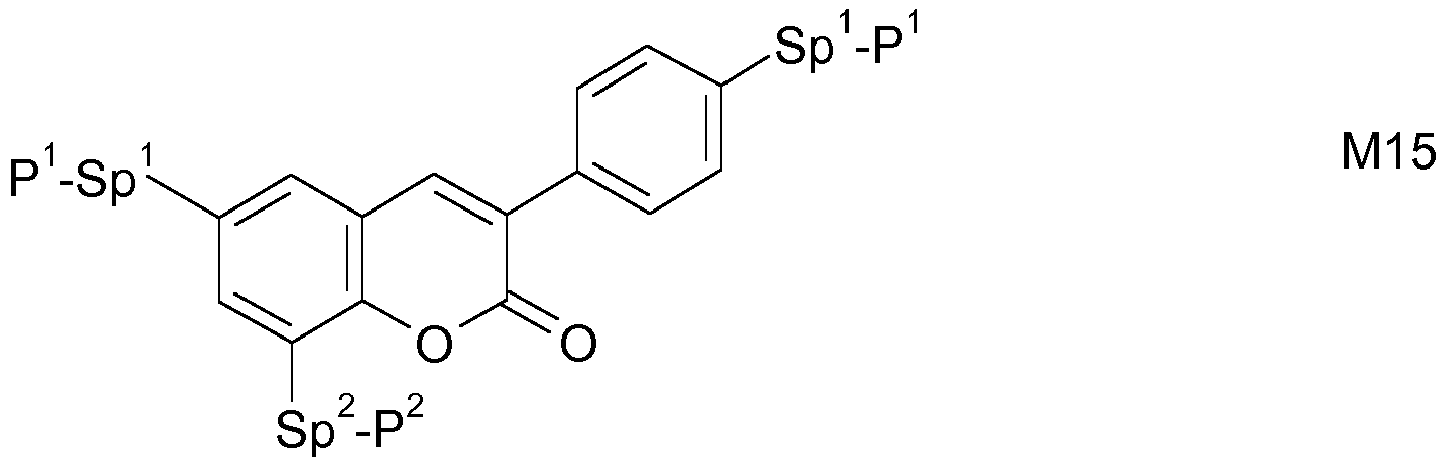





 P1 et P2 représentent chacun, de manière indépendante l'un de l'autre, un groupe polymérisable, de préférence qui présente l'une des significations qui ont été indiquées ci-avant et qui sont indiquées ci-après pour P, de façon particulièrement préférable, un groupe acrylate, méthacrylate, fluoroacrylate, oxétane, vinyle, vinyloxy ou époxyde,Sp1 et Sp2 représentent chacun, de manière indépendante l'un de l'autre, une liaison simple ou un groupe d'espaceur, de préférence qui présente l'une des significations qui ont été indiquées ci-avant et qui sont indiquées ci-après pour Sp, et de façon particulièrement préférable, ils représentent -(CH2)p1-, -(CH2)p1-O-, -(CH2)p1-CO-O- ou -(CH2)p1-O-CO-O-, où p1 est un entier de 1 à 12, et où la liaison sur le cycle adjacent dans les groupes qui ont été mentionnés en dernier est réalisée via l'atome de O, où, en outre, un ou plusieurs des radicaux P1-Sp1- et P2-Sp2- peut/peuvent représenter Raa, étant entendu qu'au moins l'un des radicaux P1-Sp1- et P2-Sp2- qui sont présents ne représente pas Raa,Raa représente H, F, Cl, CN ou alkyle en chaîne droite ou ramifié qui comporte de 1 à 25 atome(s) de C, où, en outre, un ou plusieurs groupe(s) CH2 non adjacents peut/peuvent chacun être remplacé(s), de manière indépendante les uns des autres, par -C(R0)=C(R00)-, -C≡C-, -N(R0)-, -O-, -S-, -CO-, -CO-O-, -O-CO-, -O-CO-O- de telle sorte que des atomes de O et/ou de S ne soient pas liés directement les uns aux autres, et où, en outre, un ou plusieurs atome(s) de H peut/ peuvent être remplacé(s) par F, Cl, CN ou P1-Sp1-, de façon particulièrement préférable, alkyle, alcoxy, alkényle, alkynyle, alkylcarbonyle, alcoxycarbonyle, alkylcarbonyloxy ou alcoxycarbonyloxy en chaîne droite ou ramifié, en option mono- ou polyfluoré qui comporte de 1 à 12 atome(s) de C (où les radicaux alkényle et alkynyle comportent au moins deux atomes de C et les radicaux ramifiés comportent au moins trois atomes de C),R0, R00 représentent chacun, de manière indépendante l'un de l'autre et de façon identique ou différente pour chaque occurrence, H ou alkyle qui comporte de 1 à 12 atome(s) de C,Ry et Rz représentent chacun, de manière indépendante l'un de l'autre, H, F, CH3 ou CF3,Z1 représente -O-, -CO-, -C(RyRz)- ou -CF2CF2-,Z2 et Z3 représentent chacun, de manière indépendante l'un de l'autre, -CO-O-, -O-CO-, -CH2O-, -OCH2-, -CF2O-, -OCF2- ou -(CH2)n-, où n est 2, 3 ou 4,L représente pour chaque occurrence, de manière identique ou différente, F, Cl, CN ou alkyle, alcoxy, alkényle, alkynyle, alkylcarbonyle, alcoxycarbonyle, alkylcarbonyloxy ou alcoxycarbonyloxy en chaîne droite ou ramifié, en option mono- ou polyfluoré qui comporte de 1 à 12 atome(s) de C, de préférence F,L' et L" représentent chacun, de manière indépendante l'un de l'autre, H, F ou Cl,r représente 0, 1, 2, 3 ou 4,s représente 0, 1, 2 ou 3,t représente 0, 1 ou 2,x représente 0 ou 1.
 - Milieu cristallin liquide selon une ou plusieurs des revendications 1 à 3, caractérisé en ce que le composant polymérisable (A) contient au moins un composé polymérisable qui est sélectionné parmi le groupe des formules RM-1 à RM-79








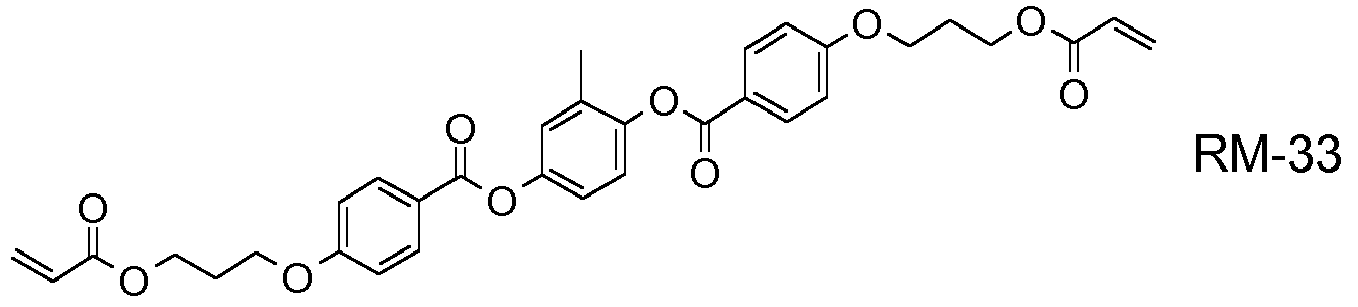


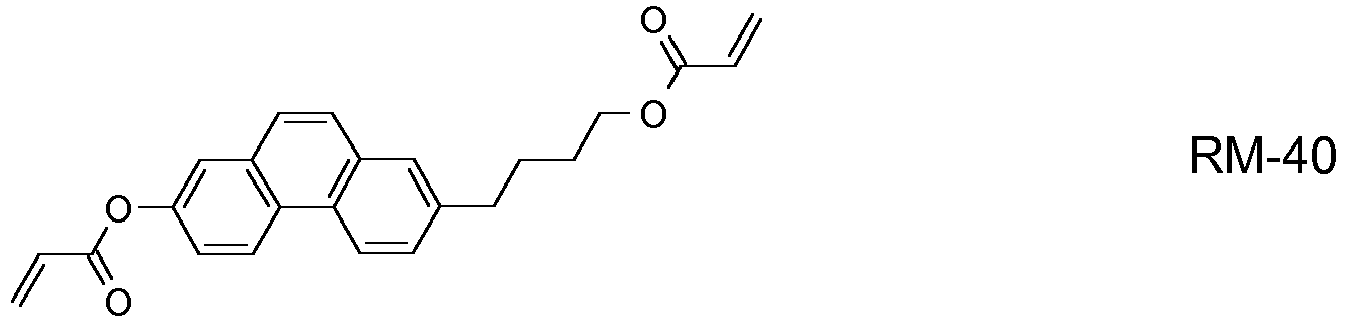





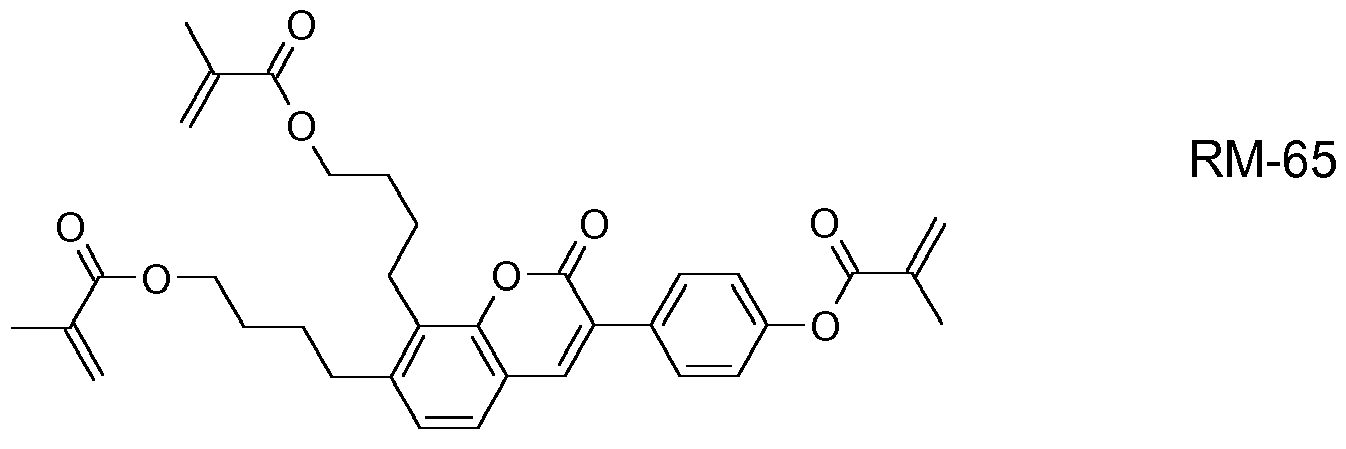





- Milieu cristallin liquide selon une ou plusieurs des revendications 1 à 4, caractérisé en ce qu'il contient au moins un composé qui est sélectionné parmi le groupe des composés des formules Xe, XIa, XIb, XIc et XId,


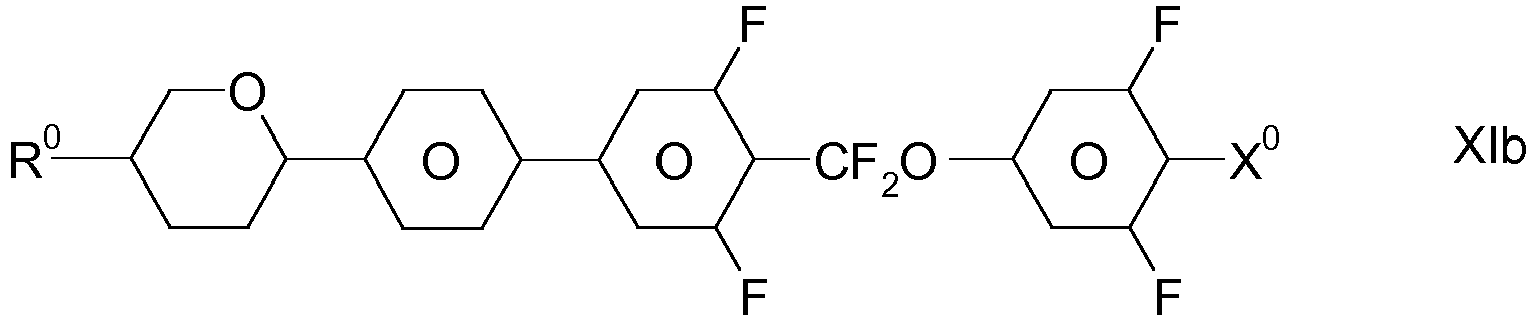

 Y1 et Y2 représentent, de manière indépendante les uns des autres, H ou F, etR0 et X0 présentent les significations qui ont été données selon la revendication 1.
 - Milieu cristallin liquide selon une ou plusieurs des revendications 1 à 5, caractérisé en ce que R0 dans la formule I et dans la formule IA représente alkyle en chaîne droite qui comporte de 1 à 6 atome(s) de carbone ou alkényle en chaîne droite qui comporte de 2 à 6 atomes de carbone.
- Milieu cristallin liquide selon une ou plusieurs des revendications 1 à 6, caractérisé en ce que le composant B contient au moins un composé de la formule I et au moins un composé de la formule IA.
- Milieu cristallin liquide selon une ou plusieurs des revendications 1 à 7, caractérisé en ce qu'il contient de façon additionnelle un ou plusieurs composé(s) des formules II et/ou III,

 A représente 1,4-phénylène ou trans-1,4-cyclohexylène,a représente 0 ou 1,R3 représente alkényle qui comporte de 2 à 9 atomes de C, etR4 présente les significations qui ont été indiquées pour R0 selon la revendication 1.
 - Milieu cristallin liquide selon une ou plusieurs des revendications 1 à 8, caractérisé en ce qu'il contient de façon additionnelle un ou plusieurs composé(s) des formules IIa à IIp et/ou IIIa et IIIb,









- Milieu cristallin liquide selon une ou plusieurs des revendications 1 à 9, caractérisé en ce qu'il contient de façon additionnelle un ou plusieurs composé(s) qui est/sont sélectionné(s) parmi les composés des formules IV à VIII,

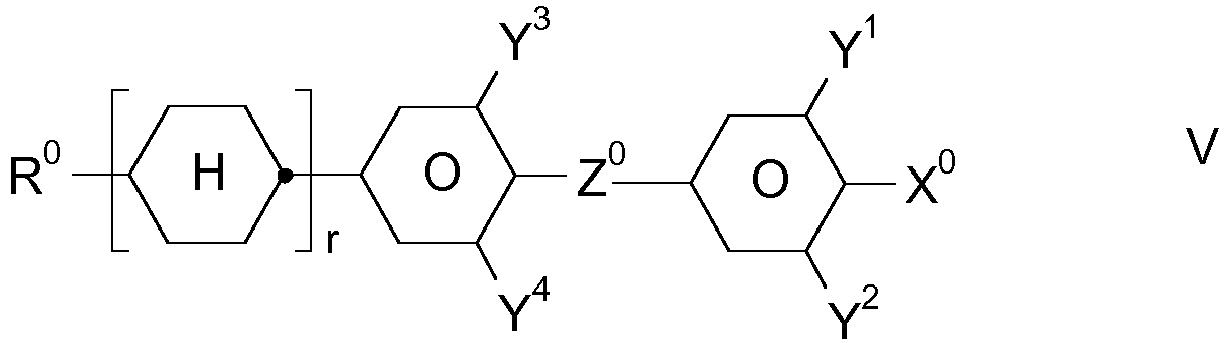


 Y1-6 représentent chacun, de manière indépendante les uns des autres, H ou F,Z0 représente -C2H4-, -(CH2)4-, -CH=CH-, -CF=CF-, -C2F4-, -CH2CF2-, -CF2CH2-, -CH2O-, -OCH2-, -COO-, -CF2O- ou -OCF2-, dans les formules V et VI également une liaison simple, etr représente 0 ou 1.
 - Milieu cristallin liquide selon une ou plusieurs des revendications 1 à 10, caractérisé en ce qu'il contient de façon additionnelle un ou plusieurs composé(s) qui est/sont sélectionné(s) parmi les composés des formules Va à Vg :


- Milieu cristallin liquide selon une ou plusieurs des revendications 1 à 11, caractérisé en ce qu'il contient un ou plusieurs composé(s) qui est/sont sélectionné(s) parmi les composés des formules VI-1a à VI-1d :
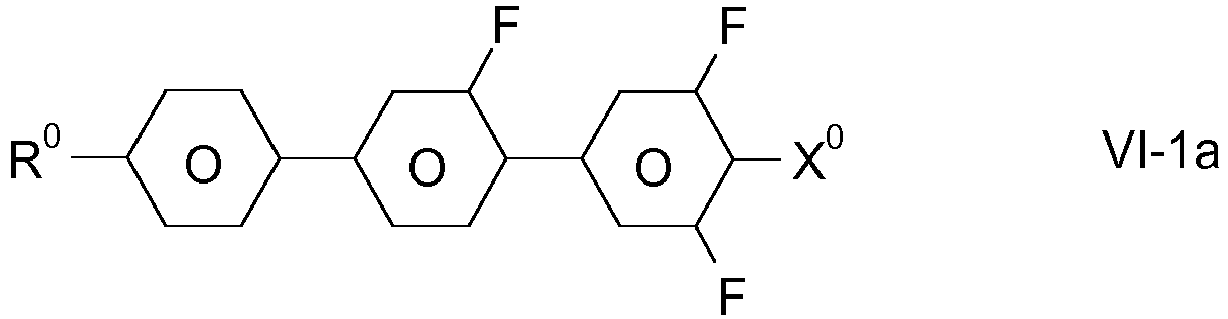


- Milieu cristallin liquide selon une ou plusieurs des revendications 1 à 11, caractérisé en ce qu'il contient un ou plusieurs composé(s) qui est/sont sélectionné(s) parmi les composés des formules VI-2a à VI-2g :


- Milieu cristallin liquide selon une ou plusieurs des revendications 1 à 13, caractérisé en ce qu'il contient de façon additionnelle un ou plusieurs composé(s) qui est/sont sélectionné(s) parmi la formule qui suit

R1 et R2 représentent chacun, de manière indépendante l'un de l'autre, n-alkyle, alcoxy, oxaalkyle, fluoroalkyle ou alkényle dont chacun comporte jusqu'à 9 atomes de C, et Y1 représente H ou F. - Milieu cristallin liquide selon une ou plusieurs des revendications 1 à 14, caractérisé en ce qu'il contient de façon additionnelle un ou plusieurs composé(s) qui est/sont sélectionné(s) parmi les formules qui suivent


- Milieu cristallin liquide selon une ou plusieurs des revendications 1 à 15, caractérisé en ce qu'il contient un ou plusieurs composé(s) de la formule XIb


- Milieu cristallin liquide selon une ou plusieurs des revendications 1 à 16, caractérisé en ce qu'il contient de 1 à 25 % en poids des composés de la formule I.
- Milieu cristallin liquide selon une ou plusieurs des revendications 1 à 17, caractérisé en ce qu'il contient de 0,01 à 10% en poids d'un composé polymérisable sur la base du mélange cristallin liquide.
- Milieu cristallin liquide selon une ou plusieurs des revendications 1 à 18, caractérisé en ce qu'il contient de façon additionnelle un ou plusieurs stabilisateur(s) UV et/ou antioxydant(s).
- Utilisation d'un milieu cristallin liquide selon une ou plusieurs des revendications 1 à 19 à des fins électro-optiques.
- Affichage à cristaux liquides électro-optique contenant un milieu cristallin liquide selon une ou plusieurs des revendications 1 à 19.
- Affichage à cristaux liquides électro-optique selon la revendication 21, caractérisé en ce qu'il s'agit d'un affichage du type PS-TN, PS-TN-TFT, PS-FFS, PS-VA-IPS- ou PS-IPS.
- Procédé pour la préparation d'un milieu cristallin liquide selon une ou plusieurs des revendications 1 à 19, caractérisé en ce qu'au moins un composé de la formule I et/ou de la formule IA et au moins un composé polymérisable sont mélangés avec au moins un autre composé cristallin liquide et en option, avec un ou plusieurs additif(s) approprié(s).
Applications Claiming Priority (2)
| Application Number | Priority Date | Filing Date | Title |
|---|---|---|---|
| EP11006531 | 2011-08-09 | ||
| EP12005324.4A EP2557140B1 (fr) | 2011-08-09 | 2012-07-20 | Milieu liquide cristallin |
Related Parent Applications (1)
| Application Number | Title | Priority Date | Filing Date |
|---|---|---|---|
| EP12005324.4A Division EP2557140B1 (fr) | 2011-08-09 | 2012-07-20 | Milieu liquide cristallin |
Publications (2)
| Publication Number | Publication Date |
|---|---|
| EP3130651A1 EP3130651A1 (fr) | 2017-02-15 |
| EP3130651B1 true EP3130651B1 (fr) | 2019-10-16 |
Family
ID=46545222
Family Applications (2)
| Application Number | Title | Priority Date | Filing Date |
|---|---|---|---|
| EP12005324.4A Not-in-force EP2557140B1 (fr) | 2011-08-09 | 2012-07-20 | Milieu liquide cristallin |
| EP16002042.6A Active EP3130651B1 (fr) | 2011-08-09 | 2012-07-20 | Milieu liquide cristallin |
Family Applications Before (1)
| Application Number | Title | Priority Date | Filing Date |
|---|---|---|---|
| EP12005324.4A Not-in-force EP2557140B1 (fr) | 2011-08-09 | 2012-07-20 | Milieu liquide cristallin |
Country Status (7)
| Country | Link |
|---|---|
| US (1) | US20130037745A1 (fr) |
| EP (2) | EP2557140B1 (fr) |
| JP (2) | JP6338814B2 (fr) |
| KR (1) | KR102070043B1 (fr) |
| CN (2) | CN106753424B (fr) |
| GB (1) | GB2493615B (fr) |
| TW (2) | TWI651399B (fr) |
Families Citing this family (29)
| Publication number | Priority date | Publication date | Assignee | Title |
|---|---|---|---|---|
| US8968598B2 (en) * | 2011-12-14 | 2015-03-03 | Jnc Corporation | Liquid crystal composition and liquid crystal display device |
| CN102660299B (zh) * | 2012-04-28 | 2015-02-04 | 深圳市华星光电技术有限公司 | 液晶介质混合物及使用其的液晶显示器 |
| WO2014051002A1 (fr) * | 2012-09-27 | 2014-04-03 | 三菱化学株式会社 | Dispositif d'affichage d'image |
| DE102012020939B4 (de) * | 2012-10-25 | 2014-12-11 | Merck Patent Gmbh | Flüssigkristallines Medium und und seine Verwendung in einer elektrooptischen Flüssigkristallanzeige |
| CN104395429A (zh) * | 2012-12-27 | 2015-03-04 | Dic株式会社 | 含有氟联苯的组合物 |
| US9441160B2 (en) | 2012-12-27 | 2016-09-13 | Dic Corporation | Fluorobiphenyl-containing composition |
| JP5459456B1 (ja) | 2013-02-20 | 2014-04-02 | Dic株式会社 | 液晶組成物、液晶表示素子及び液晶ディスプレイ |
| JP5719445B2 (ja) | 2013-03-01 | 2015-05-20 | Dic株式会社 | 液晶組成物及びこれを用いた液晶表示素子 |
| KR101531550B1 (ko) * | 2013-03-05 | 2015-07-02 | 디아이씨 가부시끼가이샤 | 액정 조성물 및 그것을 사용한 액정 표시 소자 |
| JP5459454B1 (ja) * | 2013-03-05 | 2014-04-02 | Dic株式会社 | 液晶組成物、液晶表示素子及び液晶ディスプレイ |
| CN105051157A (zh) * | 2013-03-25 | 2015-11-11 | Dic株式会社 | 液晶组合物和使用其的液晶显示元件 |
| CN104293360B (zh) * | 2013-07-16 | 2016-06-22 | 江苏和成显示科技股份有限公司 | 液晶组合物及其应用 |
| JP5477502B1 (ja) * | 2013-08-09 | 2014-04-23 | Dic株式会社 | フルオロビフェニル含有組成物 |
| WO2015037519A1 (fr) * | 2013-09-12 | 2015-03-19 | Dic株式会社 | Composition et élément d'affichage à cristaux liquides l'utilisant |
| JP5776861B1 (ja) * | 2013-10-08 | 2015-09-09 | Dic株式会社 | 組成物及びそれを使用した液晶表示素子 |
| CN104610979B (zh) * | 2013-11-05 | 2017-02-08 | 江苏和成显示科技股份有限公司 | 液晶组合物及其液晶显示器件 |
| CN103937508B (zh) * | 2014-04-28 | 2015-09-23 | 北京八亿时空液晶科技股份有限公司 | 一种阈值电压稳定的液晶组合物及其应用 |
| WO2015169425A1 (fr) * | 2014-05-09 | 2015-11-12 | Merck Patent Gmbh | Support à cristaux liquides et composants haute fréquence comprenant ce support |
| CN104293358B (zh) * | 2014-09-11 | 2016-07-06 | 北京八亿时空液晶科技股份有限公司 | 一种含1,3-二噁烷化合物的液晶组合物及其应用 |
| CN104610984B (zh) * | 2014-12-31 | 2017-01-25 | 石家庄诚志永华显示材料有限公司 | 液晶组合物 |
| KR102272215B1 (ko) | 2015-01-13 | 2021-07-02 | 삼성디스플레이 주식회사 | 액정 조성물, 이를 포함하는 액정 표시 장치 및 그 제조 방법 |
| CN104927877A (zh) * | 2015-07-13 | 2015-09-23 | 石家庄诚志永华显示材料有限公司 | 液晶组合物 |
| KR20180050646A (ko) * | 2015-09-04 | 2018-05-15 | 디아이씨 가부시끼가이샤 | 안정제 화합물, 액정 조성물 및 표시 소자 |
| CN107849458B (zh) * | 2015-09-04 | 2021-07-27 | Dic株式会社 | 液晶组合物及使用其的液晶显示元件 |
| CN109913237A (zh) * | 2017-12-12 | 2019-06-21 | 北京八亿时空液晶科技股份有限公司 | 一种高透过率液晶组合物及其应用 |
| CN109913236B (zh) * | 2017-12-12 | 2021-01-26 | 北京八亿时空液晶科技股份有限公司 | 一种含有双氧杂环化合物的高透过率液晶组合物及其应用 |
| CN109913239B (zh) * | 2017-12-12 | 2021-01-26 | 北京八亿时空液晶科技股份有限公司 | 一种正负混合液晶组合物及其应用 |
| KR102806408B1 (ko) * | 2019-12-11 | 2025-05-13 | 삼성디스플레이 주식회사 | 유기발광 디스플레이 장치 |
| CN115678571B (zh) * | 2022-10-18 | 2024-10-01 | 北京八亿时空液晶科技股份有限公司 | 一种低温快速响应液晶组合物及其应用 |
Family Cites Families (19)
| Publication number | Priority date | Publication date | Assignee | Title |
|---|---|---|---|---|
| DE3022818C2 (de) | 1980-06-19 | 1986-11-27 | Merck Patent Gmbh, 6100 Darmstadt | Flüssigkristall-Anzeigeelement |
| DE69325555D1 (de) | 1992-04-27 | 1999-08-12 | Merck Patent Gmbh | Elektrooptisches fluessigkristallsystem |
| CN101910362A (zh) * | 2008-01-14 | 2010-12-08 | 默克专利股份有限公司 | 液晶介质 |
| TWI506123B (zh) * | 2008-02-01 | 2015-11-01 | Merck Patent Gmbh | 液晶介質及液晶顯示器 |
| WO2009103495A1 (fr) | 2008-02-20 | 2009-08-27 | Merck Patent Gmbh | Fluide à cristaux liquides |
| ATE527333T1 (de) * | 2008-03-11 | 2011-10-15 | Merck Patent Gmbh | Flüssigkristallines medium und flüssigkristallanzeige |
| JP5493393B2 (ja) * | 2008-03-18 | 2014-05-14 | Jnc株式会社 | 液晶組成物および液晶表示素子 |
| EP2692826B1 (fr) * | 2008-06-27 | 2016-04-13 | Merck Patent GmbH | Milieu liquide cristallin |
| DE102010006691A1 (de) * | 2009-02-06 | 2010-10-28 | Merck Patent Gmbh | Flüssigkristallines Medium und Flüssigkristallanzeige |
| DE102010015824B4 (de) * | 2009-04-30 | 2021-12-30 | Merck Patent Gmbh | Flüssigkristallines Medium und Flüssigkristallanzeige |
| DE102010047409A1 (de) * | 2009-10-28 | 2011-05-05 | Merck Patent Gmbh | Polymerisierbare Verbindungen und ihre Verwendung in Flüssigkristallanzeigen |
| JP5544849B2 (ja) * | 2009-12-01 | 2014-07-09 | Jnc株式会社 | 液晶組成物および液晶表示素子 |
| DE102010052810A1 (de) * | 2009-12-22 | 2011-06-30 | Merck Patent GmbH, 64293 | Flüssigkristallines Medium |
| JP5633150B2 (ja) * | 2010-01-27 | 2014-12-03 | Jnc株式会社 | 液晶化合物、液晶組成物および液晶表示素子 |
| DE102010025572A1 (de) * | 2010-06-30 | 2012-01-05 | Merck Patent Gmbh | Flüssigkristallines Medium und dieses enthaltende Hochfrequenzbauteile |
| CN103261371B (zh) * | 2010-12-17 | 2015-11-25 | 默克专利股份有限公司 | 液晶介质 |
| EP2508588B1 (fr) * | 2011-04-07 | 2015-02-11 | Merck Patent GmbH | Milieu liquide cristallin et dispositif d'affichage à base de cristaux liquides |
| EP2568032B1 (fr) * | 2011-09-06 | 2014-11-26 | Merck Patent GmbH | Milieu liquide cristallin et dispositif d'affichage à base de cristaux liquides |
| DE102012020939B4 (de) * | 2012-10-25 | 2014-12-11 | Merck Patent Gmbh | Flüssigkristallines Medium und und seine Verwendung in einer elektrooptischen Flüssigkristallanzeige |
-
2012
- 2012-07-20 EP EP12005324.4A patent/EP2557140B1/fr not_active Not-in-force
- 2012-07-20 EP EP16002042.6A patent/EP3130651B1/fr active Active
- 2012-07-26 GB GB1213288.2A patent/GB2493615B/en not_active Expired - Fee Related
- 2012-08-08 TW TW101128673A patent/TWI651399B/zh active
- 2012-08-08 JP JP2012175915A patent/JP6338814B2/ja not_active Expired - Fee Related
- 2012-08-08 TW TW105139296A patent/TWI660032B/zh active
- 2012-08-08 KR KR1020120086863A patent/KR102070043B1/ko not_active Expired - Fee Related
- 2012-08-08 US US13/569,397 patent/US20130037745A1/en not_active Abandoned
- 2012-08-09 CN CN201611048013.1A patent/CN106753424B/zh active Active
- 2012-08-09 CN CN201210281661.7A patent/CN102952550B/zh active Active
-
2017
- 2017-10-04 JP JP2017193982A patent/JP2018080323A/ja active Pending
Non-Patent Citations (1)
| Title |
|---|
| None * |
Also Published As
| Publication number | Publication date |
|---|---|
| US20130037745A1 (en) | 2013-02-14 |
| CN106753424A (zh) | 2017-05-31 |
| GB2493615A (en) | 2013-02-13 |
| EP2557140A3 (fr) | 2013-07-24 |
| EP3130651A1 (fr) | 2017-02-15 |
| TW201311871A (zh) | 2013-03-16 |
| GB2493615B (en) | 2014-04-23 |
| JP2013036038A (ja) | 2013-02-21 |
| JP6338814B2 (ja) | 2018-06-06 |
| CN102952550A (zh) | 2013-03-06 |
| KR20130019350A (ko) | 2013-02-26 |
| GB201213288D0 (en) | 2012-09-05 |
| EP2557140A2 (fr) | 2013-02-13 |
| CN102952550B (zh) | 2016-12-21 |
| EP2557140B1 (fr) | 2016-09-21 |
| TW201716554A (zh) | 2017-05-16 |
| TWI651399B (zh) | 2019-02-21 |
| KR102070043B1 (ko) | 2020-01-29 |
| CN106753424B (zh) | 2022-07-26 |
| TWI660032B (zh) | 2019-05-21 |
| JP2018080323A (ja) | 2018-05-24 |
Similar Documents
| Publication | Publication Date | Title |
|---|---|---|
| EP2557140B1 (fr) | Milieu liquide cristallin | |
| EP2288672B1 (fr) | Milieu liquide cristallin | |
| KR102088166B1 (ko) | 액정 매질 | |
| EP4050084B1 (fr) | Support à cristaux liquides | |
| EP3020785B1 (fr) | Support à cristaux liquides | |
| EP4219656A1 (fr) | Milieu à cristaux liquides comprenant des composés polymérisables | |
| EP3604481B1 (fr) | Support à cristaux liquides | |
| EP4001378A1 (fr) | Support à cristaux liquides | |
| EP4357438B1 (fr) | Milieu à cristaux liquides comprenant des composés polymérisables | |
| US11920075B2 (en) | Liquid-crystal medium | |
| EP4733370A1 (fr) | Milieu à cristaux liquides |
Legal Events
| Date | Code | Title | Description |
|---|---|---|---|
| PUAI | Public reference made under article 153(3) epc to a published international application that has entered the european phase |
Free format text: ORIGINAL CODE: 0009012 |
|
| STAA | Information on the status of an ep patent application or granted ep patent |
Free format text: STATUS: REQUEST FOR EXAMINATION WAS MADE |
|
| 17P | Request for examination filed |
Effective date: 20160920 |
|
| AC | Divisional application: reference to earlier application |
Ref document number: 2557140 Country of ref document: EP Kind code of ref document: P |
|
| AK | Designated contracting states |
Kind code of ref document: A1 Designated state(s): AL AT BE BG CH CY CZ DE DK EE ES FI FR GR HR HU IE IS IT LI LT LU LV MC MK MT NL NO PL PT RO RS SE SI SK SM TR |
|
| STAA | Information on the status of an ep patent application or granted ep patent |
Free format text: STATUS: EXAMINATION IS IN PROGRESS |
|
| 17Q | First examination report despatched |
Effective date: 20171205 |
|
| GRAP | Despatch of communication of intention to grant a patent |
Free format text: ORIGINAL CODE: EPIDOSNIGR1 |
|
| STAA | Information on the status of an ep patent application or granted ep patent |
Free format text: STATUS: GRANT OF PATENT IS INTENDED |
|
| INTG | Intention to grant announced |
Effective date: 20190415 |
|
| GRAS | Grant fee paid |
Free format text: ORIGINAL CODE: EPIDOSNIGR3 |
|
| GRAJ | Information related to disapproval of communication of intention to grant by the applicant or resumption of examination proceedings by the epo deleted |
Free format text: ORIGINAL CODE: EPIDOSDIGR1 |
|
| GRAL | Information related to payment of fee for publishing/printing deleted |
Free format text: ORIGINAL CODE: EPIDOSDIGR3 |
|
| STAA | Information on the status of an ep patent application or granted ep patent |
Free format text: STATUS: EXAMINATION IS IN PROGRESS |
|
| GRAR | Information related to intention to grant a patent recorded |
Free format text: ORIGINAL CODE: EPIDOSNIGR71 |
|
| STAA | Information on the status of an ep patent application or granted ep patent |
Free format text: STATUS: GRANT OF PATENT IS INTENDED |
|
| INTC | Intention to grant announced (deleted) | ||
| GRAA | (expected) grant |
Free format text: ORIGINAL CODE: 0009210 |
|
| STAA | Information on the status of an ep patent application or granted ep patent |
Free format text: STATUS: THE PATENT HAS BEEN GRANTED |
|
| INTG | Intention to grant announced |
Effective date: 20190905 |
|
| AC | Divisional application: reference to earlier application |
Ref document number: 2557140 Country of ref document: EP Kind code of ref document: P |
|
| AK | Designated contracting states |
Kind code of ref document: B1 Designated state(s): AL AT BE BG CH CY CZ DE DK EE ES FI FR GR HR HU IE IS IT LI LT LU LV MC MK MT NL NO PL PT RO RS SE SI SK SM TR |
|
| REG | Reference to a national code |
Ref country code: DE Ref legal event code: R096 Ref document number: 602012064980 Country of ref document: DE Ref country code: CH Ref legal event code: EP |
|
| REG | Reference to a national code |
Ref country code: IE Ref legal event code: FG4D |
|
| REG | Reference to a national code |
Ref country code: AT Ref legal event code: REF Ref document number: 1191240 Country of ref document: AT Kind code of ref document: T Effective date: 20191115 |
|
| REG | Reference to a national code |
Ref country code: NL Ref legal event code: MP Effective date: 20191016 |
|
| REG | Reference to a national code |
Ref country code: LT Ref legal event code: MG4D |
|
| REG | Reference to a national code |
Ref country code: AT Ref legal event code: MK05 Ref document number: 1191240 Country of ref document: AT Kind code of ref document: T Effective date: 20191016 |
|
| PG25 | Lapsed in a contracting state [announced via postgrant information from national office to epo] |
Ref country code: NL Free format text: LAPSE BECAUSE OF FAILURE TO SUBMIT A TRANSLATION OF THE DESCRIPTION OR TO PAY THE FEE WITHIN THE PRESCRIBED TIME-LIMIT Effective date: 20191016 Ref country code: LV Free format text: LAPSE BECAUSE OF FAILURE TO SUBMIT A TRANSLATION OF THE DESCRIPTION OR TO PAY THE FEE WITHIN THE PRESCRIBED TIME-LIMIT Effective date: 20191016 Ref country code: SE Free format text: LAPSE BECAUSE OF FAILURE TO SUBMIT A TRANSLATION OF THE DESCRIPTION OR TO PAY THE FEE WITHIN THE PRESCRIBED TIME-LIMIT Effective date: 20191016 Ref country code: LT Free format text: LAPSE BECAUSE OF FAILURE TO SUBMIT A TRANSLATION OF THE DESCRIPTION OR TO PAY THE FEE WITHIN THE PRESCRIBED TIME-LIMIT Effective date: 20191016 Ref country code: GR Free format text: LAPSE BECAUSE OF FAILURE TO SUBMIT A TRANSLATION OF THE DESCRIPTION OR TO PAY THE FEE WITHIN THE PRESCRIBED TIME-LIMIT Effective date: 20200117 Ref country code: PL Free format text: LAPSE BECAUSE OF FAILURE TO SUBMIT A TRANSLATION OF THE DESCRIPTION OR TO PAY THE FEE WITHIN THE PRESCRIBED TIME-LIMIT Effective date: 20191016 Ref country code: NO Free format text: LAPSE BECAUSE OF FAILURE TO SUBMIT A TRANSLATION OF THE DESCRIPTION OR TO PAY THE FEE WITHIN THE PRESCRIBED TIME-LIMIT Effective date: 20200116 Ref country code: PT Free format text: LAPSE BECAUSE OF FAILURE TO SUBMIT A TRANSLATION OF THE DESCRIPTION OR TO PAY THE FEE WITHIN THE PRESCRIBED TIME-LIMIT Effective date: 20200217 Ref country code: FI Free format text: LAPSE BECAUSE OF FAILURE TO SUBMIT A TRANSLATION OF THE DESCRIPTION OR TO PAY THE FEE WITHIN THE PRESCRIBED TIME-LIMIT Effective date: 20191016 Ref country code: BG Free format text: LAPSE BECAUSE OF FAILURE TO SUBMIT A TRANSLATION OF THE DESCRIPTION OR TO PAY THE FEE WITHIN THE PRESCRIBED TIME-LIMIT Effective date: 20200116 Ref country code: AT Free format text: LAPSE BECAUSE OF FAILURE TO SUBMIT A TRANSLATION OF THE DESCRIPTION OR TO PAY THE FEE WITHIN THE PRESCRIBED TIME-LIMIT Effective date: 20191016 |
|
| PG25 | Lapsed in a contracting state [announced via postgrant information from national office to epo] |
Ref country code: HR Free format text: LAPSE BECAUSE OF FAILURE TO SUBMIT A TRANSLATION OF THE DESCRIPTION OR TO PAY THE FEE WITHIN THE PRESCRIBED TIME-LIMIT Effective date: 20191016 Ref country code: RS Free format text: LAPSE BECAUSE OF FAILURE TO SUBMIT A TRANSLATION OF THE DESCRIPTION OR TO PAY THE FEE WITHIN THE PRESCRIBED TIME-LIMIT Effective date: 20191016 Ref country code: IS Free format text: LAPSE BECAUSE OF FAILURE TO SUBMIT A TRANSLATION OF THE DESCRIPTION OR TO PAY THE FEE WITHIN THE PRESCRIBED TIME-LIMIT Effective date: 20200224 |
|
| PG25 | Lapsed in a contracting state [announced via postgrant information from national office to epo] |
Ref country code: AL Free format text: LAPSE BECAUSE OF FAILURE TO SUBMIT A TRANSLATION OF THE DESCRIPTION OR TO PAY THE FEE WITHIN THE PRESCRIBED TIME-LIMIT Effective date: 20191016 |
|
| REG | Reference to a national code |
Ref country code: DE Ref legal event code: R097 Ref document number: 602012064980 Country of ref document: DE |
|
| PG2D | Information on lapse in contracting state deleted |
Ref country code: IS |
|
| PG25 | Lapsed in a contracting state [announced via postgrant information from national office to epo] |
Ref country code: CZ Free format text: LAPSE BECAUSE OF FAILURE TO SUBMIT A TRANSLATION OF THE DESCRIPTION OR TO PAY THE FEE WITHIN THE PRESCRIBED TIME-LIMIT Effective date: 20191016 Ref country code: RO Free format text: LAPSE BECAUSE OF FAILURE TO SUBMIT A TRANSLATION OF THE DESCRIPTION OR TO PAY THE FEE WITHIN THE PRESCRIBED TIME-LIMIT Effective date: 20191016 Ref country code: DK Free format text: LAPSE BECAUSE OF FAILURE TO SUBMIT A TRANSLATION OF THE DESCRIPTION OR TO PAY THE FEE WITHIN THE PRESCRIBED TIME-LIMIT Effective date: 20191016 Ref country code: EE Free format text: LAPSE BECAUSE OF FAILURE TO SUBMIT A TRANSLATION OF THE DESCRIPTION OR TO PAY THE FEE WITHIN THE PRESCRIBED TIME-LIMIT Effective date: 20191016 Ref country code: ES Free format text: LAPSE BECAUSE OF FAILURE TO SUBMIT A TRANSLATION OF THE DESCRIPTION OR TO PAY THE FEE WITHIN THE PRESCRIBED TIME-LIMIT Effective date: 20191016 Ref country code: IS Free format text: LAPSE BECAUSE OF FAILURE TO SUBMIT A TRANSLATION OF THE DESCRIPTION OR TO PAY THE FEE WITHIN THE PRESCRIBED TIME-LIMIT Effective date: 20200216 |
|
| PLBE | No opposition filed within time limit |
Free format text: ORIGINAL CODE: 0009261 |
|
| STAA | Information on the status of an ep patent application or granted ep patent |
Free format text: STATUS: NO OPPOSITION FILED WITHIN TIME LIMIT |
|
| PG25 | Lapsed in a contracting state [announced via postgrant information from national office to epo] |
Ref country code: IT Free format text: LAPSE BECAUSE OF FAILURE TO SUBMIT A TRANSLATION OF THE DESCRIPTION OR TO PAY THE FEE WITHIN THE PRESCRIBED TIME-LIMIT Effective date: 20191016 Ref country code: SK Free format text: LAPSE BECAUSE OF FAILURE TO SUBMIT A TRANSLATION OF THE DESCRIPTION OR TO PAY THE FEE WITHIN THE PRESCRIBED TIME-LIMIT Effective date: 20191016 Ref country code: SM Free format text: LAPSE BECAUSE OF FAILURE TO SUBMIT A TRANSLATION OF THE DESCRIPTION OR TO PAY THE FEE WITHIN THE PRESCRIBED TIME-LIMIT Effective date: 20191016 |
|
| 26N | No opposition filed |
Effective date: 20200717 |
|
| PG25 | Lapsed in a contracting state [announced via postgrant information from national office to epo] |
Ref country code: SI Free format text: LAPSE BECAUSE OF FAILURE TO SUBMIT A TRANSLATION OF THE DESCRIPTION OR TO PAY THE FEE WITHIN THE PRESCRIBED TIME-LIMIT Effective date: 20191016 |
|
| PG25 | Lapsed in a contracting state [announced via postgrant information from national office to epo] |
Ref country code: MC Free format text: LAPSE BECAUSE OF FAILURE TO SUBMIT A TRANSLATION OF THE DESCRIPTION OR TO PAY THE FEE WITHIN THE PRESCRIBED TIME-LIMIT Effective date: 20191016 |
|
| REG | Reference to a national code |
Ref country code: CH Ref legal event code: PL |
|
| REG | Reference to a national code |
Ref country code: BE Ref legal event code: MM Effective date: 20200731 |
|
| PG25 | Lapsed in a contracting state [announced via postgrant information from national office to epo] |
Ref country code: CH Free format text: LAPSE BECAUSE OF NON-PAYMENT OF DUE FEES Effective date: 20200731 Ref country code: LU Free format text: LAPSE BECAUSE OF NON-PAYMENT OF DUE FEES Effective date: 20200720 Ref country code: LI Free format text: LAPSE BECAUSE OF NON-PAYMENT OF DUE FEES Effective date: 20200731 Ref country code: FR Free format text: LAPSE BECAUSE OF NON-PAYMENT OF DUE FEES Effective date: 20200731 |
|
| PG25 | Lapsed in a contracting state [announced via postgrant information from national office to epo] |
Ref country code: BE Free format text: LAPSE BECAUSE OF NON-PAYMENT OF DUE FEES Effective date: 20200731 |
|
| PG25 | Lapsed in a contracting state [announced via postgrant information from national office to epo] |
Ref country code: IE Free format text: LAPSE BECAUSE OF NON-PAYMENT OF DUE FEES Effective date: 20200720 |
|
| PG25 | Lapsed in a contracting state [announced via postgrant information from national office to epo] |
Ref country code: TR Free format text: LAPSE BECAUSE OF FAILURE TO SUBMIT A TRANSLATION OF THE DESCRIPTION OR TO PAY THE FEE WITHIN THE PRESCRIBED TIME-LIMIT Effective date: 20191016 Ref country code: MT Free format text: LAPSE BECAUSE OF FAILURE TO SUBMIT A TRANSLATION OF THE DESCRIPTION OR TO PAY THE FEE WITHIN THE PRESCRIBED TIME-LIMIT Effective date: 20191016 Ref country code: CY Free format text: LAPSE BECAUSE OF FAILURE TO SUBMIT A TRANSLATION OF THE DESCRIPTION OR TO PAY THE FEE WITHIN THE PRESCRIBED TIME-LIMIT Effective date: 20191016 |
|
| PG25 | Lapsed in a contracting state [announced via postgrant information from national office to epo] |
Ref country code: MK Free format text: LAPSE BECAUSE OF FAILURE TO SUBMIT A TRANSLATION OF THE DESCRIPTION OR TO PAY THE FEE WITHIN THE PRESCRIBED TIME-LIMIT Effective date: 20191016 |
|
| P01 | Opt-out of the competence of the unified patent court (upc) registered |
Effective date: 20230518 |
|
| PGFP | Annual fee paid to national office [announced via postgrant information from national office to epo] |
Ref country code: DE Payment date: 20230607 Year of fee payment: 12 |
|
| REG | Reference to a national code |
Ref country code: DE Ref legal event code: R119 Ref document number: 602012064980 Country of ref document: DE |
|
| PG25 | Lapsed in a contracting state [announced via postgrant information from national office to epo] |
Ref country code: DE Free format text: LAPSE BECAUSE OF NON-PAYMENT OF DUE FEES Effective date: 20250201 |