EP3131533B1 - Forme posologique orale de kétamine - Google Patents
Forme posologique orale de kétamine Download PDFInfo
- Publication number
- EP3131533B1 EP3131533B1 EP15715764.5A EP15715764A EP3131533B1 EP 3131533 B1 EP3131533 B1 EP 3131533B1 EP 15715764 A EP15715764 A EP 15715764A EP 3131533 B1 EP3131533 B1 EP 3131533B1
- Authority
- EP
- European Patent Office
- Prior art keywords
- ketamine
- dosage form
- oral dosage
- release
- form according
- Prior art date
- Legal status (The legal status is an assumption and is not a legal conclusion. Google has not performed a legal analysis and makes no representation as to the accuracy of the status listed.)
- Active
Links
Images

Classifications
-
- A—HUMAN NECESSITIES
- A61—MEDICAL OR VETERINARY SCIENCE; HYGIENE
- A61K—PREPARATIONS FOR MEDICAL, DENTAL OR TOILETRY PURPOSES
- A61K31/00—Medicinal preparations containing organic active ingredients
- A61K31/13—Amines
- A61K31/135—Amines having aromatic rings, e.g. ketamine, nortriptyline
-
- A—HUMAN NECESSITIES
- A61—MEDICAL OR VETERINARY SCIENCE; HYGIENE
- A61K—PREPARATIONS FOR MEDICAL, DENTAL OR TOILETRY PURPOSES
- A61K9/00—Medicinal preparations characterised by special physical form
- A61K9/0012—Galenical forms characterised by the site of application
- A61K9/0053—Mouth and digestive tract, i.e. intraoral and peroral administration
-
- A—HUMAN NECESSITIES
- A61—MEDICAL OR VETERINARY SCIENCE; HYGIENE
- A61K—PREPARATIONS FOR MEDICAL, DENTAL OR TOILETRY PURPOSES
- A61K9/00—Medicinal preparations characterised by special physical form
- A61K9/20—Pills, tablets, discs, rods
- A61K9/2004—Excipients; Inactive ingredients
- A61K9/2013—Organic compounds, e.g. phospholipids, fats
-
- A—HUMAN NECESSITIES
- A61—MEDICAL OR VETERINARY SCIENCE; HYGIENE
- A61K—PREPARATIONS FOR MEDICAL, DENTAL OR TOILETRY PURPOSES
- A61K9/00—Medicinal preparations characterised by special physical form
- A61K9/20—Pills, tablets, discs, rods
- A61K9/2072—Pills, tablets, discs, rods characterised by shape, structure or size; Tablets with holes, special break lines or identification marks; Partially coated tablets; Disintegrating flat shaped forms
- A61K9/2077—Tablets comprising drug-containing microparticles in a substantial amount of supporting matrix; Multiparticulate tablets
-
- A—HUMAN NECESSITIES
- A61—MEDICAL OR VETERINARY SCIENCE; HYGIENE
- A61K—PREPARATIONS FOR MEDICAL, DENTAL OR TOILETRY PURPOSES
- A61K9/00—Medicinal preparations characterised by special physical form
- A61K9/20—Pills, tablets, discs, rods
- A61K9/2072—Pills, tablets, discs, rods characterised by shape, structure or size; Tablets with holes, special break lines or identification marks; Partially coated tablets; Disintegrating flat shaped forms
- A61K9/2077—Tablets comprising drug-containing microparticles in a substantial amount of supporting matrix; Multiparticulate tablets
- A61K9/2081—Tablets comprising drug-containing microparticles in a substantial amount of supporting matrix; Multiparticulate tablets with microcapsules or coated microparticles according to A61K9/50
-
- A—HUMAN NECESSITIES
- A61—MEDICAL OR VETERINARY SCIENCE; HYGIENE
- A61K—PREPARATIONS FOR MEDICAL, DENTAL OR TOILETRY PURPOSES
- A61K9/00—Medicinal preparations characterised by special physical form
- A61K9/48—Preparations in capsules, e.g. of gelatin, of chocolate
- A61K9/50—Microcapsules having a gas, liquid or semi-solid filling; Solid microparticles or pellets surrounded by a distinct coating layer, e.g. coated microspheres, coated drug crystals
- A61K9/5073—Microcapsules having a gas, liquid or semi-solid filling; Solid microparticles or pellets surrounded by a distinct coating layer, e.g. coated microspheres, coated drug crystals having two or more different coatings optionally including drug-containing subcoatings
- A61K9/5078—Microcapsules having a gas, liquid or semi-solid filling; Solid microparticles or pellets surrounded by a distinct coating layer, e.g. coated microspheres, coated drug crystals having two or more different coatings optionally including drug-containing subcoatings with drug-free core
Definitions
- the present invention relates to an oral dosage form of ketamine and a method of preparing said oral dosage form.
- the dosage form can be used in the treatment of neuropathic pain, preferably once or twice a day.
- Ketamine is a drug used in human and veterinary medicine, primarily for the induction and maintenance of general anesthesia, usually in combination with a sedative. Other uses include sedation in intensive care, analgesia, and treatment of bronchospasm. Ketamine has a wide range of effects in humans, including analgesia, anesthesia, hallucinations, elevated blood pressure, and bronchodilation. Like other drugs of its class, such as tiletamine and phencyclidine (PCP), ketamine induces a state referred to as "dissociative anesthesia" and is used as a recreational drug. Ketamine hydrochloride is sold as Ketanest®, Ketaset®, and Ketalar®. Pharmacologically, ketamine is classified as an N-methyl-D-aspartate (NMDA) receptor antagonist.
- NMDA N-methyl-D-aspartate
- Ketamine can be effective in treating depression in patients with depression and bipolar disorder who have not responded to antidepressants. It produces a rapid antidepressant effect, as opposed to the several weeks taken by typical antidepressants to work.
- Ketamine can also be effective in treating neuropathic pain.
- Neuropathic pain is pain caused by damage or disease that affects the somatosensory system. It may be associated with abnormal sensations called dysesthesia, and pain produced by normally non-painful stimuli (allodynia). Neuropathic pain may have continuous and/or episodic (paroxysmal) components.
- Central neuropathic pain is found in spinal cord injury, multiple sclerosis, and some strokes. Aside from diabetes and other metabolic conditions, the common causes of painful peripheral neuropathies are herpes zoster infection, HIV-related neuropathies, nutritional deficiencies, toxins, remote manifestations of malignancies, immune mediated disorders and physical trauma to a nerve trunk. Neuropathic pain is common in cancer as a direct result of cancer on peripheral nerves (e.g., compression by a tumor), or as a side effect of chemotherapy, radiation injury or surgery.
- ketamine produces a dissociative state, characterised by a sense of detachment from one's physical body and the external world which is known as depersonalization and derealization.
- depersonalization and derealization At sufficiently high doses, users may experience what is called the "K-hole", a state of extreme dissociation with visual and auditory hallucinations.
- Dose dumping is a phenomenon that occurs, for instance, when patients do no comply with the advice to avoid the intake of alcohol concomitantly with the administration of the controlled release pharmaceutical dosage form.
- the intake of alcohol can accelerate dramatically the release of the active ingredient, thus leading to potentially very harmful consequences for the patient, in particular in case of analgesics and opioid analgesics.
- the accelerated release of the active ingredient by means of alcohol for example is often also a desired process for people aiming at a hallucinogenic experience caused by a high dose of the drug, thus leading to drug abuse.
- ketamine in treating neuroendocrine immune dysfunction or algogenic psychosyndrome.
- the ketamine can be administered orally, e.g. as a controlled release dosage form.
- WO 2008/134525 A1 is directed to deuterium labelled ketamine and pharmaceutical compositions thereof, also comprising release-controlling agents.
- DE 10 2007 009 888 A1 describes the use of S-(+)-ketamine for treating depressions. It discloses i.a. its oral administration, without specifying the composition or addressing the dose dumping problem and/or drug abuse problem.
- the inventors of the present invention have now surprisingly found that very advantageous in vivo properties can be achieved by an oral dosage form comprising ketamine, which provides a specific in vitro release of ketamine.
- one aspect of the present invention is the provision of an oral dosage form comprising ketamine or a pharmaceutically acceptable salt or solvate thereof, as defined in claim 1.
- the dosage form provides an in vitro release of ketamine of 0 to 40% after 2 hours, of 10 to 70% after 4 hours, of 30 to 85% after 6 hours and of 45 to 100% after 8 hours, when measured according to the USP Basket Method I in 0.1M HCl at 100 rpm and 37°C.
- the in vitro release of ketamine is 5 to 30%, preferably 8 to 25% after 2 hours, 20 to 60% after 4 hours, 45 to 80% after 6 hours and 60 to 99% after 8 hours, when measured according to the USP Basket Method I in 0.1M HCl at 100 rpm and 37°C.
- a second aspect of the invention is a modified release oral dosage form comprising ketamine or a pharmaceutically acceptable salt or solvate thereof, wherein the ratio of the amount of ketamine released after 1 hour of in-vitro dissolution of the dosage form at 37°C in a aqueous solution containing 20% by volume of ethanol to the amount of ketamine released after 1 hour of in-vitro dissolution of the dosage form at 37°C in an ethanol-free aqueous solution is less than 2:1, preferably less than 1.7:1, more preferably less than 1.5:1, most preferably less than 1.2:1, when measured according to the USP 1 Basket Method in 0.1M HCl at 100 rpm.
- the dosage forms of the present invention have proven advantageous to avoid the effect of so-called dose dumping. It has been found that the use of the dosage forms of the present invention is a very effective means to avoid or at least significantly reduce the risk of dose dumping upon ingestion of alcohol.
- the USP Basket Method I is carried out in 500 ml liquid for ketamine amounts of less than or equal to 10 mg and in 1000 ml liquid for ketamine amounts of more than 10 mg. If ketamine is used as free base, the amount of 10 mg refers to the weight of the free base. If ketamine is used in the form of a pharmaceutical acceptable salt or solvate, the amount of 10 mg refers to the weight of the salt or solvate.
- Ketamine as used herein is understood to comprise the compound of formula (I) having the IUPAC name 2-(2-chlorophenyl)-2-(methylamino)cyclohexan-1-one. Accordingly, ketamine comprises the R and S enantiomers as well as pharmaceutically acceptable salts or solvates thereof. In one embodiment, ketamine is (R)-ketamine or pharmaceutically acceptable salts or solvates thereof. In another embodiment, ketamine is (S)-ketamine or pharmaceutically acceptable salts or solvates thereof.
- ketamine is a racemate of (S)-ketamine and (R)-ketamine or pharmaceutically acceptable salts or solvates thereof, or any mixture of (S)-ketamine and (R)-ketamine or pharmaceutically acceptable salts or solvates thereof.
- Ketamine can preferably comprise the pharmaceutically acceptable acid addition salts thereof.
- the acids which are used to prepare the pharmaceutically acceptable acid addition salts are preferably those which form non-toxic acid addition salts, i.e.
- salts containing pharmacologically acceptable anions such as chloride, bromide, iodide, nitrate, sulfate, bisulfate, phosphate, acid phosphate, acetate, lactate, citrate, (D,L)- and L-tartrate, (D,L)- and L-malate, bitartrate, succinate, maleate, fumarate, gluconate, saccharate and benzoate.
- a preferred salt is the hydrochloride of ketamine.
- Ketamine as used herein can also comprise its metabolites.
- the metabolite is norketamine or dehydronorketamine, preferably norketamine.
- Norketamine has the IUPAC name 2-amino-2-(2-chlorophenyl)cyclohexan-1-one of formula (II) and is obtained from ketamine through N-demethylation.
- Norketamine can be provided as (R)-norketamine or pharmaceutically acceptable salts or solvates thereof, or (S)-norketamine or pharmaceutically acceptable salts or solvates thereof, racemate of (S)-norketamine and (R)-norketamine or pharmaceutically acceptable salts or solvates thereof, or any mixture of (S)-norketamine and (R)-norketamine or pharmaceutically acceptable salts or solvates thereof.
- Dehydronorketamine has the IUPAC name 6-amino-6-(2-chlorophenyl)cyclohex-2-en-1-one of formula (III)
- Dehydronorketamine can be provided as (R)-dehydronorketamine or pharmaceutically acceptable salts or solvates thereof, or (S)-dehydronorketamine or pharmaceutically acceptable salts or solvates thereof, racemate of (S)-dehydronorketamine and (R)-dehydronorketamine or pharmaceutically acceptable salts or solvates thereof, or any mixture of (S)-dehydronorketamine and (R)-dehydronorketamine or pharmaceutically acceptable salts or solvates thereof.
- Norketamine and dehydronorketamine can preferably comprise the pharmaceutically acceptable acid addition salts thereof.
- the acids which are used to prepare the pharmaceutically acceptable acid addition salts are preferably those which form non-toxic acid addition salts, i.e.
- salts containing pharmacologically acceptable anions such as chloride, bromide, iodide, nitrate, sulfate, bisulfate, phosphate, acid phosphate, acetate, lactate, citrate, (D,L)- and L-tartrate, (D,L)- and L-malate, bitartrate, succinate, maleate, fumarate, gluconate, saccharate and benzoate.
- a preferred salt is the hydrochloride salt.
- first aspect and the second aspect of the invention are not mutually exclusive, i.e. embodiments of the first aspect can at the same time comprise the features of the first aspect and vice versa.
- the oral dosage form of the present invention is a modified release dosage form, which is a controlled release dosage form.
- modified release refers to a dosage form in which the rate or place of release of the active ingredient is different from that of an immediate release dosage form when administered by the same route.
- Modified release dosage forms can include delayed-, extended-, prolonged-, sustained-, pulsatile-, controlled-, accelerated- and fast-, targeted-, programmed-release, and gastric retention dosage forms.
- modified release dosage forms can be prepared using a variety of modified release devices including, but not limited to, matrix controlled release devices, osmotic controlled release devices, multiparticulate controlled release devices, ion-exchange resins, enteric coatings, multilayered coatings, microspheres, liposomes, and combinations thereof.
- modified release devices including, but not limited to, matrix controlled release devices, osmotic controlled release devices, multiparticulate controlled release devices, ion-exchange resins, enteric coatings, multilayered coatings, microspheres, liposomes, and combinations thereof.
- the oral dosage form is a matrix controlled release dosage form.
- the matrix controlled release dosage form comprises a matrix system, which preferably is swellable, non-swellable, erodible or non-erodible, and preferably comprises polymers, including synthetic polymers, and naturally occurring polymers and derivatives, such as polysaccharides and proteins.
- the dosage form comprises a non-erodible matrix system. Ketamine can be dissolved or dispersed in an inert matrix and is released primarily by diffusion through the inert matrix once administered.
- Preferred materials for forming a matrix comprise chitin, chitosan, dextran, and pullulan, gum agar, gum arabic, gum karaya, locust bean gum, gum tragacanth, carrageenans, gum ghatti, guar gum, xanthan gum, and scleroglucan, starches, such as dextrin and maltodextrin, hydrophilic colloids, such as pectin, phosphatides, such as lecithin, alginates, propylene glycol alginate, gelatin, collagen, and cellulosics, such as ethyl cellulose (EC), methylethyl cellulose (MEC), carboxymethyl cellulose (CMC), carboxymethyl ethylcellulose (CMEC), hydroxyethyl cellulose (HEC), hydroxypropyl cellulose (HPC), cellulose acetate (CA), cellulose propionate (CP), cellulose butyrate (CB), cellulose a
- Additional materials for forming a matrix device comprise plastics, such as polyethylene, polypropylene, polyisoprene, polyisobutylene, polybutadiene, polymethylmethacrylate, polybutylmethacrylate, chlorinated polyethylene, polyvinylchloride, methyl acrylate-methyl methacrylate copolymers, ethylene-vinylacetate copolymers, ethylene/propylene copolymers, ethylene/ethyl acrylate copolymers, vinylchloride copolymers with vinyl acetate, vinylidene chloride, ethylene and propylene, ionomer polyethylene terephthalate, butyl rubber epichlorohydrin rubbers, ethylene/vinyl alcohol copolymer, ethylene/vinyl acetate/vinyl alcohol terpolymer, and ethylene/vinyloxyethanol copolymer, polyvinyl chloride, plasticized nylon, plasticized polyethyleneterephthalate, natural rubber, silicone rubbers,
- the matrix forming material is preferably present in the dosage form of the invention in a concentration of between 10 and 95 wt.-%, more preferably 20 to 75 %, in particular 25 to 65 %, based on the total weight of the dosage form.
- the dosage form comprising a matrix system may further comprise excipients such as lubricants, fillers, glidants, binders, stabilizers. Regarding preferred embodiments of said excipients it is referred to explanations given below.
- the dosage form comprises 10 and 95 wt.-%, more preferably 20 to 75 %, in particular 30 to 65 % matrix forming material, 0 to 90 wt.-%, preferably 5 to 70 wt.%, more preferably 10 to 50 wt.%, in particular 15 to 30 wt.-% fillers, optionally 0 to 25 wt.-%, preferably 1 to 20 wt.%, more preferably 5 to 15 % binders, 0 to 5 wt.-%, preferably 0.1 to 4 wt.%, more preferably 0.5 to 3 % glidants, 0 to 5 wt.-%, preferably 0.1 to 3 wt.%, more preferably 0.3 to 2 % lubricants based on the total weight of the dosage form.
- the matrix controlled release dosage form can be prepared by direct-compression, wet-granulation or dry-granulation.
- Direct compression is a preferred embodiment.
- the compression step it is referred to the illustrations given below.
- the dosage form of the invention can be present in form of an osmotic controlled release device, including one-chamber system (elementary osmotic pump), two-chamber system (push-pull systems), asymmetric membrane technology (AMT), and extruding core system (ECS).
- Osmotic controlled release devices should comprise cores, for example tablets, comprising ketamine, which are enveloped by a semipermeable membrane which preferably has at least one orifice. The water-permeable membrane is impermeable to the components of the core but permits water to enter the system from outside by osmosis.
- the total active ingredient release and the release rate can substantially be controlled via the thickness and porosity of the semipermeable membrane, the composition of the core and the number and size of the orifice(s).
- the core of the osmotic device optionally includes an osmotic agent which preferably creates a driving force for transport of water from the environment of use into the core of the device.
- the core consists of two layers, one active ingredient layer and one osmosis layer.
- the active ingredient layer preferably comprises 1 to 70% ketamine, 30 to 95% of one or more osmopolymers.
- the osmosis layer preferably comprises 30 to 90% of one or more osmopolymers, 10 to 60% of an osmogen, where the difference from 100% in the individual layers is formed in each case independently of one another by one or more additional ingredients in the form of pharmaceutically usual excipients.
- the osmogens and osmopolymers used in the core of the osmotic two-chamber system may be as described in the following paragraphs.
- the osmotic agents are water-swellable polymers, which are also referred to as “osmopolymers” and “hydrogels,” including hydrophilic vinyl and acrylic polymers, polysaccharides such as calcium alginate, polyethylene oxide (PEO), polyethylene glycol (PEG), polypropylene glycol (PPG), poly(2-hydroxyethyl methacrylate), poly(acrylic) acid, poly(methacrylic) acid, polyvinylpyrrolidone (PVP), crosslinked PVP, polyvinyl alcohol (PVA), PVA/PVP copolymers, PVA/PVP copolymers with hydrophobic monomers such as methyl methacrylate and vinyl acetate, hydrophilic polyurethanes containing large PEO blocks, sodium croscarmellose, carrageenan, hydroxyethyl cellulose (HEC), hydroxypropyl cellulose (HPC), hydroxypropyl methyl cellulose (HPMC), carboxymethyl cellulose (
- the osmotic agents are osmogens which are capable of imbibing water to affect an osmotic pressure gradient across the barrier of the surrounding coating.
- Preferred osmogens comprise water-soluble salts of inorganic or organic acids or nonionic organic substances with a high solubility in water, such as for example carbohydrates, especially sugars, sugar alcohols or amino acids.
- the osmogens are selected from inorganic salts such as chlorides, sulphates, carbonates and bicarbonates of alkali metals or alkaline earth metals, such as lithium, sodium, potassium, magnesium, calcium, and phosphates, hydrogen phosphates or dihydrogen phosphates, acetates, succinates, benzoates, citrates or ascorbates thereof.
- inorganic salts such as chlorides, sulphates, carbonates and bicarbonates of alkali metals or alkaline earth metals, such as lithium, sodium, potassium, magnesium, calcium, and phosphates, hydrogen phosphates or dihydrogen phosphates, acetates, succinates, benzoates, citrates or ascorbates thereof.
- pentoses such as arabinose, ribose or xylose, hexoses such as glucose, fructose, galactose or mannose, disaccharides such as sucrose, maltose or lactos
- the water-soluble amino acids include glycine, leucine, alanine or methionine.
- Sodium chloride is particularly preferably used according to the invention.
- the osmogens are preferably present in an amount of 10 to 30% based on the total mass of the core ingredients.
- a combination of osmogens and osmopolymers is used in the osmotic controlled release device.
- the core further comprises pharmaceutically acceptable excipients comprising buffer substances such as sodium bicarbonate, binders such as hydroxypropylcellulose, hydroxypropylmethylcellulose and/or polyvinylpyrrolidone, lubricants such as magnesium stearate, wetting agents such as sodiumlauryl sulphate and/or flow regulators such as colloidal silicon dioxide.
- buffer substances such as sodium bicarbonate, binders such as hydroxypropylcellulose, hydroxypropylmethylcellulose and/or polyvinylpyrrolidone, lubricants such as magnesium stearate, wetting agents such as sodiumlauryl sulphate and/or flow regulators such as colloidal silicon dioxide.
- Materials for forming the semipermeable membrane of the osmotic controlled release device include various grades of acrylics, vinyls, ethers, polyamides, polyesters, and cellulosic derivatives that are water-permeable and water-insoluble at physiologically relevant pHs, or are susceptible to being rendered water-insoluble by chemical alteration, such as crosslinking.
- the material for forming the semipermeable membrane comprises plasticized, unplasticized, and reinforced cellulose acetate (CA), cellulose diacetate, cellulose triacetate, CA propionate, cellulose nitrate, cellulose acetate butyrate (CAB), CA ethyl carbamate, CA phthalate, CA methyl carbamate, CA succinate, cellulose acetate trimellitate (CAT), CA dimethylaminoacetate, CA ethyl carbonate, CA chloroacetate, CA ethyl oxalate, CA methyl sulfonate, CA butyl sulfonate, CA p-toluene sulfonate, agar acetate, amylose triacetate, beta glucan acetate, beta glucan triacetate, acetaldehyde dimethyl acetate, triacetate of locust bean gum, hydroxlated ethylene-vinylacetate, EC, PEG, PPG, PEG
- the semipermeable membrane may also be a hydrophobic microporous membrane which is permeable to water vapor, as disclosed in U.S. Pat. No. 5,798,119 .
- Hydrophobic polymers for forming hydrophobic but water-permeable membranes comprise polyalkenes, polyethylene, polypropylene, polytetrafluoroethylene, polyacrylic acid derivatives, polyethers, polysulfones, polyethersulfones, polystyrenes, polyvinyl halides, polyvinylidene fluoride, polyvinyl esters and ethers, natural and synthetic waxes.
- the delivery port(s) on the semipermeable membrane are formed post-coating by mechanical or laser drilling.
- delivery port(s) are formed in situ by erosion of a plug of water-soluble material or by rupture of a thinner portion of the membrane over an indentation in the core.
- delivery ports are formed during the coating process, as in the case of asymmetric membrane coatings.
- the osmotic controlled release dosage form can be prepared according to conventional methods and techniques known to those skilled in the art (see Santus and Baker, J Controlled Release 1995, 35, 1-21 ; Verma et al., Drug Development and Industrial Pharmacy 2000, 26, 695-708 ; Verma et al., J Controlled Release 2002, 79, 7-27 ).
- the dosage form disclosed herein can be an AMT controlled release dosage form, which comprises an asymmetric osmotic membrane that coats a core comprising ketamine and other pharmaceutically acceptable excipients or carriers.
- AMT controlled release dosage forms can be prepared according to conventional methods and techniques known to those skilled in the art, including direct compression, dry granulation, wet granulation, and a dip-coating method.
- the dosage form disclosed herein is formulated as ECS controlled release dosage form, which comprises an osmotic membrane that coats a core comprising ketamine, hydroxylethyl cellulose, and other pharmaceutically acceptable excipients or carriers.
- the oral dosage form is a multi particulate dosage form and comprises a multitude of pellets which contain a core comprising ketamine or a pharmaceutically acceptable salt or solvate thereof.
- the pellets contain a core comprising ketamine and a release control layer coated upon the core.
- the release control layer is (physically) separated from the ketamine containing core.
- the ketamine containing core may be a core which contains ketamine and excipients. In those embodiments, the excipients preferably do not substantially retard or delay the release of the ketamine.
- the core comprises a layer of ketamine on an inert core.
- the inert core (also referred to as seed core or neutral bead) may be granules or beads, preferably spherical, and further preferably made from sugar or cellulose or other suitable materials.
- spherical inert cores based on saccharose such as those commercially available under the trade name Suglets® or those based on cellulose, such as those commercially available under the trade name Celphere® or Cellets® may be mentioned. Saccharose-based inert cores are particularly preferred.
- Inert cores may preferably have a particle size in the range of 100 to 500 ⁇ m and more preferably in the range of 200 to 400 ⁇ m, with the particle size range indicating the size range for 90% of the particles as determined by sieve analysis.
- ketamine is provided by coating a ketamine-containing layer directly onto the inert cores.
- the ketamine-containing layer preferably does not delay release of ketamine, i.e. is an immediate-release layer.
- each pellet contains a core comprising ketamine and a release control layer coated upon the core.
- pellets containing ketamine cores and a release control layer coated upon the cores can be mixed to other pellets.
- the core does not comprise a neutral bead as described above, but a bead comprising ketamine and optionally at least one pharmaceutically acceptable excipient.
- the ketamine containing bead can be formed by dry granulation, wet granulation, spray granulation or extrusion.
- a suitable ketamine-containing core comprises 10 to 50 wt.%, preferably 15 to 40 wt.%, more preferably 20 to 30 wt.% inert core (neutral bead), 20 to 90 wt.%, preferably 35 to 80 wt.%, more preferably 50 to 70 wt.% ketamine, in particular ketamine hydrochloride, 0.1 to 20 wt.%, preferably 1 to 15 wt.%, more preferably 3 to 10 wt.% binder, and optionally 0 to 20 wt.% , preferably 1 to 15 wt.%, more preferably 3 to 10 wt.% glidant, based on the total weight of the ketamine containing core.
- Binders generally serve to enhance the integrity and stability of tablets. In addition, they may improve the suitability of pharmaceutical compositions for granulation. Binders are commonly also used for the preparation of films, such as active agent containing layers, around an inert core. Exemplary binders include synthetic polymers, such as polyvinyl pyrrolidone (PVP), vinyl pyrrolidone-vinyl acetate-copolymer, modified celluloses, such as hydroxy alkyl celluloses and mixtures thereof. A binder is typically used in an amount of 0 to 25% by weight, preferably 0.1 to 15% by weight and in further embodiments 1 to 10% by weight of the controlled release oral dosage form.
- PVP polyvinyl pyrrolidone
- a binder is typically used in an amount of 0 to 25% by weight, preferably 0.1 to 15% by weight and in further embodiments 1 to 10% by weight of the controlled release oral dosage form.
- HPMC hypromellose
- PVP is used as binder in the ketamine-containing core, more preferably HPMC.
- said HPMC has a methoxy content of 20% to 40%, more preferably 25% to 35%.
- said HPMC has a hydroxypropoxy content of about 5% to 15%, more preferably 7% to 12%.
- a 2% by weight (aqueous) solution of said HPMC has a viscosity of 0.5 to 100 mPa•s, preferably 1 to 50 mPa•s, more preferably 2 to 10 mPa•s, measured at 20°C, preferably by means of a Brookfield-Synchro-Lectric LVF viscosimeter.
- the PVP has an average molecular weight of 1,000 to 2,500,000, preferably 5,000 to 2,000,000, more preferably 10,000 to 1,500,000.
- glidants such as disperse silica, such as Aerosil®, or talc can be used.
- talc is used as glidant in the ketamine-containing core.
- the ketamine-containing core does not comprise a glidant.
- the release control layer may be disposed in direct vicinity, i.e. in immediate contact with and surrounding the ketamine containing core, which is preferred.
- an intermediate layer may be disposed between the ketamine containing core and the release control layer. This intermediate layer may further control the release of ketamine from the core. However, it is preferred that, if present, the intermediate layer does not substantially influence the release from the core.
- the release control layer comprises a release control substance for controlling the release of ketamine from the pellets.
- the release control substance is a water insoluble polymer, preferably an alkyl cellulose. More preferably, the alkyl cellulose is ethyl cellulose.
- the release control substance is a polymer
- said polymer has a weight average molecular weight of 5,000 to 500,0000 g/mol, preferably of 50,000 to 900,000 g/mol, more preferably of 100,000 to 400,000 g/mol, for instance of 140,000 to 300,000 g/mol.
- the weight average molecular weight is preferably determined by gel permeation chromatography.
- the release control substance, and in particular the polymer preferably has a solubility in water of less than 20 mg/l, preferably less than 15 mg/l, preferably between 0.001 to 10.0 mg/l.
- the solubility in water is preferably determined in accordance with European Regulation RL67-548 EWG, Annex V, Chapter A6 (German version referred to and referenced herein).
- the polymer has a glass transition temperature of 20 to 220°C, for instance 60 to 150°C or 90 to 140°C.
- the glass transition temperature is preferably measured by means of differential scanning calorimetry DSC, preferably using a Mettler Toledo instrument and a preferably applying a heating/cooling rate of 10°C per minute.
- the release-control substance is ethylcellulose having an ethoxyl content of about 30 to 70%, more preferred of about 40 to 60%.
- a 2% by weight (aqueous) solution of ethylcellulose has a viscosity of 5 to 500 mPa•s, preferably 10 to 100 mPa•s, measured at 25°C, preferably by means of a Brookfield-Synchro-Lectric LVF viscosimeter.
- the release control substance is contained in an amount of 0.1 to 80% by weight of the total weight of the pellets in the dosage form, more preferably in amounts of 0.5 to 60% by weight, 10 to 50% by weight, 15 to 40% by weight, of the total weight of the pellets in the dosage form.
- Control of the release rate can be adapted by appropriate selection of the control release substance or mixture of such substances, its/their amount, coating thickness, inclusion of further excipients, such as pore formers and/or plasticizers or others.
- one or more additional excipients may be used, in particular in a release control layer.
- a preferred excipient for use with the release control substance, in particular a polymeric release control substance, is a plasticizer and/or a pore builder and/or glidants.
- a plasticizer is a substance that typically lowers the glass transition temperature of the polymer it is used in admixture with by at least 2°C, preferably at least 5°C, for instance between 5 and 30°C, as compared to the polymer alone.
- the plasticizer is triethyl citrate or propylene glycol.
- a pore former usually is a substance having a water-solubility which is higher than the water solubility of the release-control substance.
- the pore former has a solubility in water of more than 20 mg/l, preferably 50 mg/l to 5000 mg/l, more preferably 100 to 1000 mg/l.
- the solubility in water is preferably determined as described above.
- hydroxypropyl cellulose (HPC) is used as pore former.
- the release control layer comprises 20 to 95 wt.%, preferably 40 to 80 wt.%, more preferably 50 to 70 wt.% release control substance, preferably as described above, 0.1 to 30 wt.%, preferably 1 to 25 wt.%, more preferably 5 to 20 wt.% pore builder, preferably as described above, 0.1 to 30 wt.%, preferably 1 to 25 wt.%, more preferably 5 to 20 wt.% plasticizer, preferably as described above, and optionally 0 to 40 wt.% , preferably 3 to 30 wt.%, more preferably 5 to 20 wt.% glidant, preferably as described above, based on the total weight of the release control layer.
- the release control layer may be a single layer or a plurality of layers. For ease of fabrication, embodiments with a single release control layer are preferred.
- the pellets are contained in an external phase of at least one pharmaceutically acceptable excipient.
- the controlled release oral dosage form is preferably a tablet.
- the oral dosage form according to the present invention does not contain any ketamine in immediate-release form, i.e. does not contain ketamine, the release of which is not controlled by the release-control substance(s).
- a tablet comprising the plurality of controlled release ketamine pellets does not comprise any further ketamine in the external phase or as top-coating on the tablet.
- the pellets are mixed to a so-called “external phase" in order to be compressed into tablets.
- the external phase should ensure the stability of the pellets during the compression and is usually composed of one or more pharmaceutically acceptable excipients, such as fillers, binders, disintegrants, glidants and lubricants.
- Fillers are normally used to dilute a pharmaceutical composition and provide bulk.
- preferred fillers include lactose, starch, calcium phosphate, calcium carbonate, saccharose, sugar alcohols such as mannitol, sorbitol, xylitol, and celluloses and derivatives. Microcrystalline cellulose is particularly preferred.
- a filler mixture comprising sodium carboxymethyl cellulose and microcrystalline cellulose, preferably in a weight ratio of 5:1 to 1:5, more preferably 3:1 to 1:3 is used.
- a filler or mixture of fillers may be used in an amount of 0 to 80% by weight, preferably 1 to 70% by weight, based on the total weight of the controlled release oral dosage form, preferably the tablet.
- Binders generally serve to enhance the integrity and stability of tablets. In addition, they may improve the suitability of pharmaceutical compositions for granulation. Binders are commonly also used for the preparation of films, such as active agent containing layers, around an inert core. Exemplary binders include synthetic polymers, such as polyvinyl pyrrolidone, vinyl pyrrolidone-vinyl acetate-copolymer, modified celluloses, such as hydroxy alkyl celluloses and mixtures thereof. A binder is typically used in an amount of 0 to 30% by weight, preferably 0.1 to 15% by weight and in further embodiments 1 to 10% by weight of the controlled release oral dosage form. Preferably hypromellose (HPMC) is used as binder.
- HPMC hypromellose
- a disintegrant enhances the disintegration of a dosage form, in particular a tablet, after its immersion in water or gastric juices.
- Suitable disintegrants include carrageenan, starchs, croscarmellose, crospovidone and mixtures thereof. Disintegrants may be used in amounts of 0 to 25% by weight, preferably 1 to 20% by weight and in further embodiments 3 to 15% by weight of the controlled release oral dosage form, preferably the tablet.
- the oral dosage forms may further include a glidant, such as disperse silica, such as Aerosil®, or talc.
- a glidant such as disperse silica, such as Aerosil®, or talc.
- a glidant (or mixture thereof) may be comprised in an amount of 0 to 5% by weight, for instance 0.1 to 4% by weight of the controlled release oral dosage form, preferably the tablet.
- the oral controlled release dosage form may further comprise a lubricant, in particular in tablets prepared by compression.
- Suitable lubricants include stearic acid, magnesium stearate, adipic acid and sodium stearyl fumarate (Pruv®).
- the amount of pellets in the controlled release oral dosage form ranges from 1% to 100% by weight, based on the total weight of the controlled release dosage form.
- the pellets are comprised in an amount of 20% to 90% by weight, more preferably 25% to 80% by weight, based on the total weight of the controlled release dosage form.
- the external phase (without coated cores) comprises 85 to 99.9%, preferably 90 to 98% by weight filler, 0 to 5%, preferably 0.1 to 1.0% by weight lubricant and 0.1 to 10%, preferably 1.0 to 5% by weight glidant, based on the total weight of the external phase.
- the oral dosage form according to the present invention can comprise an external film for improved ease of swallowing, for protection, for colouring, for taste-masking or other purposes.
- this external film does not influence the release of ketamine to any significant extent.
- the external film may comprise the usual excipients known in this art for this purpose.
- a combination of hypromellose, talc, a colouring agent, such as titanium dioxide, and/or a polymer, such as polyethylene glycol is a preferred embodiment herein.
- ready to use products like Opadry® based on hypromellose or polyvinyl alcohol are used for the film coating.
- any amount of an ingredient expressed as weight percent herein refers to the controlled release oral dosage form without this optional external film.
- the external film is free of ketamine in any form.
- the oral dosage form according to the present invention has the advantage that it may be divided into two or more units without impairing the controlled release of ketamine.
- the controlled release oral dosage form, and in particular the tablet may therefore comprise means facilitating its division into two or more units, such as a break-line, each of said units providing controlled release of ketamine.
- the dosage form according to the present invention therefore provides for the possibility to adjust the dosage, for instance halve the dosage by breaking the tablet in two.
- the ketamine salt is ketamine hydrochloride.
- the dosage form may contain ketamine in amounts of 5 to 400 mg, preferably 5 to 200 mg. If ketamine is used as free base, the amount of 5 to 400 mg refers to the weight of the free base. If ketamine is used in the form of a pharmaceutical acceptable salt, the amount of 5 to 400 mg refers to the weight of the salt.
- the dosage form of the present invention comprises 10 mg ketamine, 20 mg ketamine, 40 mg ketamine, 80 mg ketamine, 100 mg ketamine, 120 mg ketamine, 140 mg ketamine, 160 mg ketamine, 180 mg ketamine, 200 mg ketamine, 220 mg ketamine, 240 mg ketamine, 260 mg ketamine, 280 mg ketamine, 300 mg ketamine, 320 mg ketamine, 340 mg ketamine, 360 mg ketamine, 380 mg ketamine, more preferably 10 mg ketamine hydrochloride, 20 mg ketamine hydrochloride, 40 mg ketamine hydrochloride, 80 mg ketamine hydrochloride, 100 mg ketamine hydrochloride, 120 mg ketamine hydrochloride, 140 mg ketamine hydrochloride, 160 mg ketamine hydrochloride, 180 mg ketamine hydrochloride, 200 mg ketamine hydrochloride, 220 mg ketamine hydrochloride, 240 mg ketamine hydroch
- the dosage form of the present invention comprises:
- the tablets of the present invention preferably have a tablet height of 2 to 8 mm, more preferably 3 to 5 mm, and a length of 3 to 22 mm, preferably 5 to 17 mm.
- the tablets have a hardness of 40 to 300 N, more preferably of 50 to 200 N.
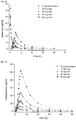
- the administration of a single oral dosage form leads in-vivo to a C max of ketamine of 1 to 150 ng/ml, preferably 2 to 120 ng/ml, more preferably 3 to 100 ng/ml, still more preferably 4 to 70 ng/ml, further more preferably 5 to 40 ng/ml, and to a AUC 0- ⁇ of 5 to 1000 h ⁇ ng/ml, preferably 10 to 750 h ⁇ ng/ml, more preferably 50 to 600 h ⁇ ng/ml, still more preferably 100 to 400 h ⁇ ng/ml.
- the administration of a single oral dosage form leads in-vivo to a C max of norketamine of 5 to 750 ng/ml, preferably 10 to 600 ng/ml, more preferably 15 to 500 ng/ml, still more preferably 20 to 400 ng/ml, further more preferably 25 to 300 ng/ml, and to a AUC 0- ⁇ of 100 to 8000 h ⁇ ng/ml, preferably 150 to 6000 h ⁇ ng/ml, more preferably 500 to 4000 h ⁇ ng/ml.
- a C max of norketamine of 5 to 750 ng/ml, preferably 10 to 600 ng/ml, more preferably 15 to 500 ng/ml, still more preferably 20 to 400 ng/ml, further more preferably 25 to 300 ng/ml, and to a AUC 0- ⁇ of 100 to 8000 h ⁇ ng/ml, preferably 150 to 6000 h ⁇ ng/ml, more preferably 500 to 4000 h ⁇ ng/ml
- C max means the peak concentration of ketamine in the plasma, e.g. determined as described below.
- AUC 0- ⁇ describes ketamine bioavailability and is measured by calculating the area under curve (AUC) of the plasma drug concentration time profile from time zero extrapolated to infinity.
- T max of ketamine is 3 to 9 h, preferably 3 to 8 h, more preferably 4 to 7 h, most preferably 5 to 7 h.
- T max of norketamine is 3 to 9 h, preferably 3 to 8 h, more preferably 4 to 7 h, most preferably 5 to 7 h.
- T max means the time from administration to reach C max .
- the oral dosage form has a F abs of 5 to 25 %, preferably 7 to 20%, more preferably 9 to 18 %.
- F abs is the absolute bioavailability. Absolute bioavailability compares the bioavailability of the active drug in systemic circulation following non-intravenous administration (i.e., after oral administration in the present case), with the bioavailability of the same drug following intravenous administration. It is the fraction of the drug absorbed through non-intravenous administration compared with the corresponding intravenous administration of the same drug.
- the absolute bioavailability is the dose-corrected area under curve (AUC) non-intravenous (oral) divided by AUC intravenous.
- AUC area under curve
- the controlled release oral dosage forms according to the present invention are for use in the treatment of neuropathic pain.
- neuropathic pain is found in spinal cord injury, multiple sclerosis, and some strokes.
- the common causes of painful peripheral neuropathies are herpes zoster infection, HIV-related neuropathies, nutritional deficiencies, toxins, remote manifestations of malignancies, immune mediated disorders and physical trauma to a nerve trunk.
- Neuropathic pain is common in cancer as a direct result of cancer on peripheral nerves (e.g., compression by a tumor), or as a side effect of chemotherapy, radiation injury or surgery.
- the oral dosage form of the present invention is preferably for use in the treatment of patients suffering from spinal cord injury, multiple sclerosis, cancer, immune mediated disorders, metabolic conditions such as diabetes, herpes zoster infection, HIV-related neuropathies, nutritional deficiencies.
- the oral dosage form of the present invention is administered once or twice daily, preferably twice daily.
- the present invention provides a method for preparing an oral dosage form, preferably as described above, comprising:
- Step a) may further include dissolving or suspending ketamine or a salt thereof in a suitable solvent or solvent mixture, optionally together with a binder, such as a hydroxyalkyl cellulose, such as hydroxy propylmethyl cellulose.
- a binder such as a hydroxyalkyl cellulose, such as hydroxy propylmethyl cellulose.
- the solvent is preferably water, an alcohol, such as ethanol, or mixtures thereof.
- the inert cores are sugar spheres.
- ketamine hydrochloride is used.
- the coating step a) is a coating step in a fluid bed processor wherein preferably a solution or suspension (in particular solution) of ketamine hydrochloride and one or more excipients, such as hypromellose, is sprayed onto the inert cores.
- the coating solution or suspension usually comprises respectively consists of water and/or an alcohol.
- the process temperature is between 30 and 60°C.
- step b) involves coating by spraying a coating solution containing the release control substance onto the coated inert cores from step a).
- the spraying step is preferably performed in a fluid bed processor.
- the fluid bed processor is preferably suitable for coating powders, particles, inert spheres, beads and tablets, and/or simultaneous drying.
- the process temperature is between 30 and 60°C.
- the solvent of the coating solution or suspension from step b) predominantly contains alcohol, i.e. the solvent used for dissolving the release controlling agent and optional further excipients contains preferably 60% or more by weight, more preferably 70% or more by weight of alcohol.
- alcohol i.e. the solvent used for dissolving the release controlling agent and optional further excipients contains preferably 60% or more by weight, more preferably 70% or more by weight of alcohol.
- a mixture of ethanol and water is particularly preferred.
- ethylcellulose is used as the release controlling agent.
- Additional excipients may include hydroxypropyl cellulose, talc, triethyl citrate and other pharmaceutically suitable excipients.
- the pellets preferably have a weight average particle diameter (d 50 ) of 50 to 1000 ⁇ m, in preferred embodiments 100 to 800 ⁇ m, in further embodiments 150 to 600 ⁇ m, as measured by sieve analysis, such as by means of a Retsch Siebmaschine AS 300 control.
- the thickness of the release control layer is preferably in a range of 0.1 to 200 ⁇ m, preferably 0.5 to 100 ⁇ m.
- Tablets with a combination of several of the above features have been found to be particularly advantageous: they provide good clinical efficacy, not least due to providing an advantageous dissolution profile without the need to include an immediate release portion of ketamine. They can be broken or divided without affecting the release of drug from the tablet. Dose dumping phenomena do not occur.
- Example 1 (for reference): Preparation of matrix controlled release tablets containing 20 mg ketamine hydrochloride
- Ketamine HCl 20.00 mg Hydrogenated castor oil 92.74 mg Microcrystalline cellulose 35.00 mg Aerosil 200 1.50 mg Magnesium stearate 0.76 mg Total tablet 150.00 mg
- Ketamine HCl, hydrogenated castor oil, microcrystalline cellulose and Aerosil 200 are sieved through a 600 ⁇ m sieve and mixed for 10 minutes.
- Magnesium stearate is added to the mixture and further mixed for 2 minutes. Tablets with the composition outlined in the table above are pressed on a rotary machine with oblong punches.
- a spraying solution is prepared from the following ingredients: Hypromellose 3.00 kg Ketamine hydrochloride 20.00 kg Sugar spheres 8.00 kg Ethanol 96% q.s. Water, purified q.s.
- a spraying suspension is prepared by successively dissolving hypromellose and ketamine hydrochloride in a mixture of purified water and ethanol.
- Sugar spheres sacharose, particle size range (90%) 200 to 400 ⁇ m
- the spraying suspension is then sprayed onto the sugar spheres in the fluid-bed processor, thus preparing a plurality of sugar spheres having a layer of ketamine coated thereupon.
- the coated sugar spheres are then sieved to remove agglomerates (vibration sieve or equivalent).
- a coating suspension is prepared from the following ingredients: Ethylcellulose 14.54 kg Hydroxypropyl cellulose 4.00 kg Triethyl citrate 3.27 kg Talc 1.45 kg Ethanol 96% q.s Water, purified q.s
- Hydroxypropyl cellulose is dissolved in water. Ethylcellulose and ethanol are then added to the solution. Finally, triethyl citrate and talc are added and the solution is continuously stirred.
- the coated sugar spheres from Step 1 are filled into a fluid-bed processor and preheated.
- the coated solution prepared as indicated above is sprayed onto the coated sugar spheres.
- the resulting dry blend is then compressed to tablets.
- a tablet coating suspension is made from the following ingredients: Opadry® II White 1.20 kg Water, purified q.s 31.6 kg tablets are film coated with the tablet coating suspension.
- the dissolution profiles of the 20 mg tablets are in accordance with the present invention, as apparent from Figure 1 .
- the dissolution profiles were measured using the USP 1 Basket Method at 37°C, 1000 ml 100 rpm in 0.1M HCl and HCl/EtOH 80:20.
- the modified release tablets have been produced in analogy to Example 2.
- the area under the concentrations-time curve (AUC0-t) was calculated with the measured data points from the time of administration until the last quantifiable concentration by the trapezoidal formula.
- the AUC was assessed up to the last sampling time above the limit of quantification and is extrapolated to infinity to obtain the AUC 0- ⁇ values.
- T 1/2 Apparent Terminal half-life
Landscapes
- Health & Medical Sciences (AREA)
- Life Sciences & Earth Sciences (AREA)
- Public Health (AREA)
- Veterinary Medicine (AREA)
- Epidemiology (AREA)
- Medicinal Chemistry (AREA)
- Animal Behavior & Ethology (AREA)
- General Health & Medical Sciences (AREA)
- Chemical & Material Sciences (AREA)
- Pharmacology & Pharmacy (AREA)
- Engineering & Computer Science (AREA)
- Bioinformatics & Cheminformatics (AREA)
- Biophysics (AREA)
- Molecular Biology (AREA)
- Nutrition Science (AREA)
- Physiology (AREA)
- Medicinal Preparation (AREA)
- Acyclic And Carbocyclic Compounds In Medicinal Compositions (AREA)
Claims (14)
- Forme posologique orale comprenant de la kétamine ou un sel ou solvate pharmaceutiquement acceptable de celle-ci, la forme posologique orale fournissant un taux de libération in vitro de la kétamine de 0 à 40% après 2 heures, de 10 à 70% après 4 heures, de 30 à 85% après 6 heures et de 45 à 100% après 8 heures, mesuré selon USP Basket Method I dans 0,1M HCl à 37°C et 100 tr/min,
la forme posologique orale étant une forme posologique multiparticulaire à libération contrôlée, la forme posologique orale comprenant des granulés contenant un noyau comprenant de la kétamine ou un sel ou solvate pharmaceutiquement acceptable de celle-ci et
une couche de contrôle de libération comprenant une substance de contrôle de libération qui est enduite sur le noyau, la substance de contrôle de libération étant un polymère insoluble dans l'eau et les granulés étant contenus dans une phase externe d'au moins un excipient pharmaceutiquement acceptable. - Forme posologique orale selon la revendication 1, le noyau comprenant une couche comprenant de la kétamine qui est enduite sur un noyau inerte.
- Forme posologique orale selon la revendication 1 ou 2, la substance de contrôle de libération étant de l'alkylcellulose et de préférence de l'éthylcellulose.
- Forme posologique orale selon l'une quelconque des revendications 1 à 3, la phase externe comprenant de la carboxyméthylcellulose, en option sous la forme d'un sel, en tant qu'excipient pharmaceutiquement acceptable.
- Forme posologique orale selon l'une quelconque des revendications précédentes qui est un comprimé.
- Forme posologique orale selon l'une quelconque des revendications précédentes, le sel de kétamine étant l'hydrochlorure de kétamine et la quantité comprise dans la forme posologique orale étant dans la plage de 5 à 400 mg d'hydrochlorure de kétamine.
- Forme posologique orale selon l'une quelconque des revendications précédentes, la forme posologique étant administrée une ou deux fois par jour.
- Forme posologique orale selon l'une quelconque des revendications précédentes, qui est un comprimé multiparticulaire, le comprimé comprenanti) des noyaux contenant de la kétamine et comprenant
1 à 30% en poids de billes inertes,
1 à 40% en poids de kétamine, en particulier d'hydrochlorure de kétamine,
0,01 to 10% en poids de liant,
0 à 10% en poids d'agent glisseurii) une couche de contrôle de libération, enduite sur chaque noyau contenant de la kétamine, comprenant
1 à 40% en poids de substance de contrôle de libération,
0,01 à 10% en poids de générateur de pores,
0,01 à 10% en poids de plastifiant,
0 à 15% en poids d'agent glisseur
etiii) une phase externe comprenanttous les % en poids étant sur la base du poids total du comprimé.
20 à 85% en poids de charge,
0 à 3% en poids de lubrifiant,
0 à 5% en poids d'agent glisseur, - Forme posologique orale selon l'une quelconque des revendications précédentes, l'administration d'une seule forme posologique orale menant in vivo à un Cmax de kétamine de 1 à 150 ng/ml et à ASC0-∞ de 5 à 1000 h·ng/ml.
- Forme posologique orale selon l'une quelconque des revendications précédentes, le Tmax de kétamine étant 3 à 9h.
- Forme posologique orale selon l'une quelconque des revendications précédentes ayant une biodisponibilité Fabs de 5 à 25%.
- Forme posologique orale selon l'une quelconque des revendications précédentes pour utilisation dans le traitement de douleur neuropathique.
- Forme posologique orale selon l'une quelconque des revendications précédentes pour utilisation dans le traitement de patients souffrant de lésion médullaire, de sclérose en plaques, de cancer, de troubles à médiation immunitaire, de trouble métabolique telle que le diabète, d'infection à herpès zona, de neuropathies liées au VIH, de carences nutritionnelles.
- Procédé de production d'une forme posologique orale selon l'une quelconque des revendications précédentes, comprenant :a) l'enduction de noyaux inertes d'une couche comprenant de la kétamine ou un sel ou solvent pharmaceutiquement acceptable de celle-ci,b) l'enduction des noyaux inertes enduits d'une couche de contrôle de libération comprenant la substance de contrôle de libération, formant ainsi des granulés,c) le mixage des granulés avec au moins un excipient pharmaceutiquement acceptable,d) la formation d'un comprimé à partir du mélange comprenant les granulés et l'au moins un excipient pharmaceutiquement acceptable.
Priority Applications (6)
| Application Number | Priority Date | Filing Date | Title |
|---|---|---|---|
| PL15715764T PL3131533T3 (pl) | 2014-04-17 | 2015-04-16 | Doustna postać dawkowania ketaminy |
| EP17186636.1A EP3287124B1 (fr) | 2014-04-17 | 2015-04-16 | Forme posologique orale de kétamine |
| EP22208637.3A EP4180030A1 (fr) | 2014-04-17 | 2015-04-16 | Forme posologique orale de kétamine |
| DK17186622.1T DK3272338T3 (da) | 2014-04-17 | 2015-04-16 | Oral doseringsform for ketamin |
| PL17186622T PL3272338T3 (pl) | 2014-04-17 | 2015-04-16 | Doustna postać dawkowania ketaminy |
| EP17186622.1A EP3272338B1 (fr) | 2014-04-17 | 2015-04-16 | Forme posologique orale de kétamine |
Applications Claiming Priority (2)
| Application Number | Priority Date | Filing Date | Title |
|---|---|---|---|
| EP14165057 | 2014-04-17 | ||
| PCT/EP2015/058318 WO2015158854A1 (fr) | 2014-04-17 | 2015-04-16 | Forme galénique orale de la kétamine |
Related Child Applications (5)
| Application Number | Title | Priority Date | Filing Date |
|---|---|---|---|
| EP17186622.1A Division EP3272338B1 (fr) | 2014-04-17 | 2015-04-16 | Forme posologique orale de kétamine |
| EP17186622.1A Division-Into EP3272338B1 (fr) | 2014-04-17 | 2015-04-16 | Forme posologique orale de kétamine |
| EP17186636.1A Division-Into EP3287124B1 (fr) | 2014-04-17 | 2015-04-16 | Forme posologique orale de kétamine |
| EP17186636.1A Division EP3287124B1 (fr) | 2014-04-17 | 2015-04-16 | Forme posologique orale de kétamine |
| EP22208637.3A Division EP4180030A1 (fr) | 2014-04-17 | 2015-04-16 | Forme posologique orale de kétamine |
Publications (2)
| Publication Number | Publication Date |
|---|---|
| EP3131533A1 EP3131533A1 (fr) | 2017-02-22 |
| EP3131533B1 true EP3131533B1 (fr) | 2019-06-05 |
Family
ID=50486823
Family Applications (4)
| Application Number | Title | Priority Date | Filing Date |
|---|---|---|---|
| EP22208637.3A Pending EP4180030A1 (fr) | 2014-04-17 | 2015-04-16 | Forme posologique orale de kétamine |
| EP17186636.1A Active EP3287124B1 (fr) | 2014-04-17 | 2015-04-16 | Forme posologique orale de kétamine |
| EP15715764.5A Active EP3131533B1 (fr) | 2014-04-17 | 2015-04-16 | Forme posologique orale de kétamine |
| EP17186622.1A Active EP3272338B1 (fr) | 2014-04-17 | 2015-04-16 | Forme posologique orale de kétamine |
Family Applications Before (2)
| Application Number | Title | Priority Date | Filing Date |
|---|---|---|---|
| EP22208637.3A Pending EP4180030A1 (fr) | 2014-04-17 | 2015-04-16 | Forme posologique orale de kétamine |
| EP17186636.1A Active EP3287124B1 (fr) | 2014-04-17 | 2015-04-16 | Forme posologique orale de kétamine |
Family Applications After (1)
| Application Number | Title | Priority Date | Filing Date |
|---|---|---|---|
| EP17186622.1A Active EP3272338B1 (fr) | 2014-04-17 | 2015-04-16 | Forme posologique orale de kétamine |
Country Status (8)
| Country | Link |
|---|---|
| US (3) | US10335379B2 (fr) |
| EP (4) | EP4180030A1 (fr) |
| DK (2) | DK3131533T3 (fr) |
| ES (3) | ES2829279T3 (fr) |
| FI (1) | FI3287124T3 (fr) |
| HU (3) | HUE060851T2 (fr) |
| PL (3) | PL3287124T3 (fr) |
| WO (1) | WO2015158854A1 (fr) |
Cited By (1)
| Publication number | Priority date | Publication date | Assignee | Title |
|---|---|---|---|---|
| CN112263572A (zh) * | 2020-11-17 | 2021-01-26 | 厦门大学附属翔安医院 | 右旋氯胺酮在制备治疗脱髓鞘疾病药物中的应用 |
Families Citing this family (28)
| Publication number | Priority date | Publication date | Assignee | Title |
|---|---|---|---|---|
| US20140274981A1 (en) | 2013-03-15 | 2014-09-18 | Janssen Pharmaceutica Nv | Pharmaceutical composition of s-ketamine hydrochloride |
| US20150118300A1 (en) | 2013-10-31 | 2015-04-30 | Cima Labs Inc. | Immediate Release Abuse-Deterrent Granulated Dosage Forms |
| PL3287124T3 (pl) | 2014-04-17 | 2023-02-20 | Ketabon Gmbh | Doustna postać dawkowania ketaminy |
| AU2015318123A1 (en) | 2014-09-15 | 2017-03-30 | Janssen Pharmaceutica Nv | Val66Met (SNP rs6265) genotype specific dosing regimens and methods for the treatment of depression |
| EP3442940A1 (fr) | 2016-04-11 | 2019-02-20 | Clexio Biosciences Ltd. | Dérivés de kétamine deutérés |
| AU2017351437B2 (en) * | 2016-10-27 | 2022-01-27 | National University Corporation Chiba University | Application of (S)-norketamine and salt thereof as pharmaceutical |
| WO2018234568A2 (fr) * | 2017-06-23 | 2018-12-27 | Develco Pharma Schweiz Ag | Hydroxynorkétamine destinée à être utilisée dans le traitement de la dépression |
| US20200009081A1 (en) | 2017-09-13 | 2020-01-09 | Janssen Pharmaceutica N.V. | Delivery Of Esketamine For The Treatment Of Depression |
| CN111630026A (zh) | 2017-10-10 | 2020-09-04 | 道格拉斯制药有限公司 | 缓释药物制剂和治疗方法 |
| US10869838B2 (en) | 2017-10-10 | 2020-12-22 | Douglas Pharmaceuticals, Ltd. | Extended release pharmaceutical formulation |
| US11471415B2 (en) | 2017-10-10 | 2022-10-18 | Douglas Pharmaceuticals, Ltd. | Extended release pharmaceutical formulation and methods of treatment |
| US10441544B2 (en) | 2017-10-10 | 2019-10-15 | Douglas Pharmaceuticals, Ltd. | Extended release pharmaceutical formulation |
| US12090123B2 (en) | 2017-10-10 | 2024-09-17 | Douglas Pharmaceuticals Ltd. | Extended release pharmaceutical formulation |
| KR20240011237A (ko) | 2017-12-22 | 2024-01-25 | 얀센 파마슈티카 엔브이 | 우울증 치료를 위한 에스케타민 |
| ES2907692T3 (es) | 2017-12-29 | 2022-04-26 | Celon Pharma Sa | Composición de ketamina de polvo seco para su administración por vía pulmonar en la depresión resistente al tratamiento |
| BR112020023882A2 (pt) | 2018-06-27 | 2021-02-09 | Clexio Biosciences Ltd. | método para tratar transtorno depressivo maior |
| CN112702995A (zh) | 2018-10-05 | 2021-04-23 | 克雷西奥生物科技有限公司 | 治疗重度抑郁症的艾氯胺酮的治疗方案 |
| EP3863617A1 (fr) | 2018-10-11 | 2021-08-18 | Clexio Biosciences Ltd. | Eskétamine pour une utilisation dans le traitement d'un trouble dépressif majeur |
| JP2022524008A (ja) | 2019-03-05 | 2022-04-27 | ヤンセン ファーマシューティカルズ,インコーポレーテッド | うつ病の治療のためのエスケタミン |
| US11324707B2 (en) | 2019-05-07 | 2022-05-10 | Clexio Biosciences Ltd. | Abuse-deterrent dosage forms containing esketamine |
| US12589083B2 (en) | 2019-05-07 | 2026-03-31 | Clexio Biosciences Ltd. | Abuse-deterrent dosage forms containing esketamine |
| EP4041209A4 (fr) | 2019-10-11 | 2024-01-24 | Pike Therapeutics, Inc. | Compositions transdermiques comprenant du cannabidiol (cbd) destinées à être utilisées dans le traitement de troubles épileptiques |
| JP2023507926A (ja) | 2019-12-30 | 2023-02-28 | クレキシオ バイオサイエンシーズ エルティーディー. | 神経精神状態または神経学的状態を治療するためのエスケタミンを用いた投与計画 |
| EP4084786A1 (fr) | 2019-12-30 | 2022-11-09 | Clexio Biosciences Ltd. | Régime posologique à base d'eskétamine pour le traitement d'un trouble dépressif majeur |
| GB2596592A (en) | 2020-07-03 | 2022-01-05 | Alkaloid Ad Skopje | Pharmaceutical formulation |
| WO2025099181A1 (fr) | 2023-11-07 | 2025-05-15 | HMNC Holding GmbH | Régime de maintenance pour l'administration de 2-(2-chlorphényl)-2-(méthylamino)cyclohexane-1-one |
| WO2025099182A1 (fr) | 2023-11-07 | 2025-05-15 | HMNC Holding GmbH | Régime d'induction pour l'administration de 2-(2-chlorphényl)-2-(méthylamino)cyclohexane-1-one |
| WO2025264779A1 (fr) * | 2024-06-18 | 2025-12-26 | Melt Pharmaceuticals, Inc. | Midazolam et kétamine pour une sédation améliorée |
Family Cites Families (18)
| Publication number | Priority date | Publication date | Assignee | Title |
|---|---|---|---|---|
| US3723614A (en) * | 1971-01-06 | 1973-03-27 | Ciba Geigy Ag | Maltese-cross scored tablet |
| US5612059A (en) | 1988-08-30 | 1997-03-18 | Pfizer Inc. | Use of asymmetric membranes in delivery devices |
| US5798119A (en) | 1995-06-13 | 1998-08-25 | S. C. Johnson & Son, Inc. | Osmotic-delivery devices having vapor-permeable coatings |
| AUPN605795A0 (en) * | 1995-10-19 | 1995-11-09 | F.H. Faulding & Co. Limited | Analgesic pharmaceutical composition |
| EP1103256A1 (fr) | 1999-11-26 | 2001-05-30 | Claudius Dr. med. Böck | Utilisation de la kétamine pour le traitement de la dysfonction immunitaire neuroendocrine et du psyhosyndrome algogénique |
| BR0113626A (pt) | 2000-08-30 | 2003-06-17 | Pfizer Prod Inc | Formulações de liberação sustentada para secretores de hormÈnio do crescimento |
| NZ577560A (en) * | 2007-01-16 | 2012-01-12 | Egalet Ltd | Use of i) a polyglycol and ii) an active drug substance for the preparation of a pharmaceutical composition for i) mitigating the risk of alcohol induced dose dumping and/or ii) reducing the risk of drug abuse |
| DE102007009888A1 (de) | 2007-02-28 | 2008-09-04 | Hermann, Holger Lars, Dr. | Verwendung von S-(+)-Ketamin zur Behandlung von Depressionen |
| BRPI0809843A2 (pt) * | 2007-04-26 | 2014-09-23 | Auspex Pharmaceuticals Inc | "composto, composição farmacêutica e uso de um composto" |
| US20120225949A1 (en) * | 2009-08-14 | 2012-09-06 | Demitri Papalos | Compositions and methods for treating bipolar disorder |
| WO2013056229A1 (fr) | 2011-10-14 | 2013-04-18 | The United States Of America, As Represented By The Secretary, Department Of Health And Human Services | Utilisation de (2r, 6r)-hydroxynorkétamine, (s)-déshydronorkétamine et autres métabolites déshydro et hydroxylés stéréo-isomères de (r,s)-kétamine dans le traitement de la dépression et de la douleur neuropathique |
| WO2013138322A1 (fr) | 2012-03-12 | 2013-09-19 | Janssen Pharmaceutica Nv | Eskétamine dans le traitement de la dépression réfractaire ou résistante aux traitements |
| US20140079740A1 (en) * | 2012-08-02 | 2014-03-20 | ClinPharm Support GmbH | Oral transmucosal adminstration forms of s-ketamine |
| CA2922507C (fr) | 2013-08-26 | 2022-07-05 | Amorsa Therapeutics, Inc. | Dose orale a couche unique de ketamine neuro-attenuante |
| WO2015051259A1 (fr) | 2013-10-04 | 2015-04-09 | Impax Laboratories, Inc. | Compositions pharmaceutiques et méthodes d'utilisation |
| PL3287124T3 (pl) | 2014-04-17 | 2023-02-20 | Ketabon Gmbh | Doustna postać dawkowania ketaminy |
| DK3215147T3 (da) | 2014-11-04 | 2024-04-02 | Acadia Pharm Inc | Neurodæmpende norketamin-forbindelser og fremgangsmåder |
| WO2018234568A2 (fr) | 2017-06-23 | 2018-12-27 | Develco Pharma Schweiz Ag | Hydroxynorkétamine destinée à être utilisée dans le traitement de la dépression |
-
2015
- 2015-04-16 PL PL17186636.1T patent/PL3287124T3/pl unknown
- 2015-04-16 EP EP22208637.3A patent/EP4180030A1/fr active Pending
- 2015-04-16 ES ES17186622T patent/ES2829279T3/es active Active
- 2015-04-16 PL PL15715764T patent/PL3131533T3/pl unknown
- 2015-04-16 HU HUE17186636A patent/HUE060851T2/hu unknown
- 2015-04-16 ES ES17186636T patent/ES2935800T3/es active Active
- 2015-04-16 EP EP17186636.1A patent/EP3287124B1/fr active Active
- 2015-04-16 DK DK15715764.5T patent/DK3131533T3/da active
- 2015-04-16 HU HUE15715764 patent/HUE044928T2/hu unknown
- 2015-04-16 EP EP15715764.5A patent/EP3131533B1/fr active Active
- 2015-04-16 DK DK17186622.1T patent/DK3272338T3/da active
- 2015-04-16 ES ES15715764T patent/ES2743699T3/es active Active
- 2015-04-16 HU HUE17186622A patent/HUE051264T2/hu unknown
- 2015-04-16 WO PCT/EP2015/058318 patent/WO2015158854A1/fr not_active Ceased
- 2015-04-16 EP EP17186622.1A patent/EP3272338B1/fr active Active
- 2015-04-16 US US15/304,613 patent/US10335379B2/en active Active
- 2015-04-16 PL PL17186622T patent/PL3272338T3/pl unknown
- 2015-04-16 FI FIEP17186636.1T patent/FI3287124T3/fi active
-
2019
- 2019-06-11 US US16/437,467 patent/US11103467B2/en active Active
-
2021
- 2021-08-30 US US17/460,476 patent/US12440456B2/en active Active
Non-Patent Citations (1)
| Title |
|---|
| None * |
Cited By (1)
| Publication number | Priority date | Publication date | Assignee | Title |
|---|---|---|---|---|
| CN112263572A (zh) * | 2020-11-17 | 2021-01-26 | 厦门大学附属翔安医院 | 右旋氯胺酮在制备治疗脱髓鞘疾病药物中的应用 |
Also Published As
| Publication number | Publication date |
|---|---|
| US20210386691A1 (en) | 2021-12-16 |
| ES2935800T3 (es) | 2023-03-10 |
| PL3131533T3 (pl) | 2019-12-31 |
| EP3131533A1 (fr) | 2017-02-22 |
| PL3287124T3 (pl) | 2023-02-20 |
| EP3272338B1 (fr) | 2020-09-09 |
| HUE060851T2 (hu) | 2023-04-28 |
| HUE044928T2 (hu) | 2019-11-28 |
| HUE051264T2 (hu) | 2021-03-01 |
| US20190290600A1 (en) | 2019-09-26 |
| US20170035707A1 (en) | 2017-02-09 |
| EP3272338A1 (fr) | 2018-01-24 |
| DK3131533T3 (da) | 2019-09-16 |
| PL3272338T3 (pl) | 2021-01-11 |
| US11103467B2 (en) | 2021-08-31 |
| FI3287124T3 (fi) | 2023-01-13 |
| DK3272338T3 (da) | 2020-11-02 |
| US10335379B2 (en) | 2019-07-02 |
| WO2015158854A1 (fr) | 2015-10-22 |
| EP3287124B1 (fr) | 2022-11-30 |
| ES2829279T3 (es) | 2021-05-31 |
| ES2743699T3 (es) | 2020-02-20 |
| EP3287124A1 (fr) | 2018-02-28 |
| EP4180030A1 (fr) | 2023-05-17 |
| US12440456B2 (en) | 2025-10-14 |
Similar Documents
| Publication | Publication Date | Title |
|---|---|---|
| US12440456B2 (en) | Method for treatment of depression with oral dosage forms of ketamine | |
| US12239615B2 (en) | Hydroxynorketamine for the use in the treatment of depression | |
| WO2009034541A9 (fr) | Formes galéniques à libération contrôlée à base de trimétazidine | |
| JP2008069159A (ja) | 持続放出ラノラジン製剤 | |
| JP2008069159A5 (fr) | ||
| JP2012516299A (ja) | 有機化合物のガレヌス製剤 | |
| EP2726064B1 (fr) | Forme orale pharmaceutique à libération contrôlée contenant oxycodone | |
| US20200330433A1 (en) | Extended release pharmaceutical composition of apremilast | |
| US20220202698A1 (en) | Extended release pharmaceutical compositions of riociguat | |
| EP2533766B1 (fr) | Mini-comprimés pharmaceutiques à libération prolongée d'acétate de flécaïnide | |
| KR101923403B1 (ko) | 리마프로스트 또는 리마프로스트 알파엑스를 함유한 경구용 서방성 제제 조성물 | |
| EP4079297A1 (fr) | Formulation pharmaceutique comprenant de la cibenzoline ou un sel de celle-ci | |
| JP7352175B2 (ja) | トルバプタン製剤 | |
| JP4808612B2 (ja) | アルキレンジオキシベンゼン誘導体を含む経口投与用組成物 | |
| EP3087978A1 (fr) | Composition pharmaceutique à libération prolongée contenant de l'acébrophylline et un agent hydrophile à libération prolongée | |
| HK40072164A (en) | Pharmaceutical formulation comprising cibenzoline or salt thereof | |
| EP2705839A1 (fr) | Composition pharmaceutique contenant de la lacidipine et procédé de préparation | |
| JP2001354560A (ja) | イソソルビド‐5‐モノニトレートを有効成分とする徐放性錠剤及びその製造方法 |
Legal Events
| Date | Code | Title | Description |
|---|---|---|---|
| STAA | Information on the status of an ep patent application or granted ep patent |
Free format text: STATUS: THE INTERNATIONAL PUBLICATION HAS BEEN MADE |
|
| PUAI | Public reference made under article 153(3) epc to a published international application that has entered the european phase |
Free format text: ORIGINAL CODE: 0009012 |
|
| STAA | Information on the status of an ep patent application or granted ep patent |
Free format text: STATUS: REQUEST FOR EXAMINATION WAS MADE |
|
| 17P | Request for examination filed |
Effective date: 20161117 |
|
| AK | Designated contracting states |
Kind code of ref document: A1 Designated state(s): AL AT BE BG CH CY CZ DE DK EE ES FI FR GB GR HR HU IE IS IT LI LT LU LV MC MK MT NL NO PL PT RO RS SE SI SK SM TR |
|
| AX | Request for extension of the european patent |
Extension state: BA ME |
|
| DAV | Request for validation of the european patent (deleted) | ||
| DAX | Request for extension of the european patent (deleted) | ||
| REG | Reference to a national code |
Ref country code: DE Ref legal event code: R079 Ref document number: 602015031361 Country of ref document: DE Free format text: PREVIOUS MAIN CLASS: A61K0009200000 Ipc: A61K0009000000 |
|
| GRAP | Despatch of communication of intention to grant a patent |
Free format text: ORIGINAL CODE: EPIDOSNIGR1 |
|
| STAA | Information on the status of an ep patent application or granted ep patent |
Free format text: STATUS: GRANT OF PATENT IS INTENDED |
|
| RIC1 | Information provided on ipc code assigned before grant |
Ipc: A61K 31/135 20060101ALI20181113BHEP Ipc: A61K 9/50 20060101ALI20181113BHEP Ipc: A61K 9/20 20060101ALI20181113BHEP Ipc: A61K 9/00 20060101AFI20181113BHEP |
|
| INTG | Intention to grant announced |
Effective date: 20181214 |
|
| RAP1 | Party data changed (applicant data changed or rights of an application transferred) |
Owner name: DEVELCO PHARMA SCHWEIZ AG |
|
| RIN1 | Information on inventor provided before grant (corrected) |
Inventor name: MUNDSZINGER, OLAF Inventor name: MANTHEI, SASCHA Inventor name: FISCHER, MARC Inventor name: REY, HELENE |
|
| GRAS | Grant fee paid |
Free format text: ORIGINAL CODE: EPIDOSNIGR3 |
|
| GRAA | (expected) grant |
Free format text: ORIGINAL CODE: 0009210 |
|
| STAA | Information on the status of an ep patent application or granted ep patent |
Free format text: STATUS: THE PATENT HAS BEEN GRANTED |
|
| AK | Designated contracting states |
Kind code of ref document: B1 Designated state(s): AL AT BE BG CH CY CZ DE DK EE ES FI FR GB GR HR HU IE IS IT LI LT LU LV MC MK MT NL NO PL PT RO RS SE SI SK SM TR |
|
| REG | Reference to a national code |
Ref country code: GB Ref legal event code: FG4D |
|
| REG | Reference to a national code |
Ref country code: CH Ref legal event code: EP |
|
| REG | Reference to a national code |
Ref country code: AT Ref legal event code: REF Ref document number: 1139277 Country of ref document: AT Kind code of ref document: T Effective date: 20190615 |
|
| REG | Reference to a national code |
Ref country code: IE Ref legal event code: FG4D |
|
| REG | Reference to a national code |
Ref country code: DE Ref legal event code: R096 Ref document number: 602015031361 Country of ref document: DE |
|
| REG | Reference to a national code |
Ref country code: NL Ref legal event code: FP |
|
| REG | Reference to a national code |
Ref country code: CH Ref legal event code: NV Representative=s name: PATENTANWAELTE SCHAAD, BALASS, MENZL AND PARTN, CH |
|
| REG | Reference to a national code |
Ref country code: RO Ref legal event code: EPE |
|
| REG | Reference to a national code |
Ref country code: DK Ref legal event code: T3 Effective date: 20190912 |
|
| REG | Reference to a national code |
Ref country code: SE Ref legal event code: TRGR |
|
| REG | Reference to a national code |
Ref country code: LT Ref legal event code: MG4D |
|
| REG | Reference to a national code |
Ref country code: NO Ref legal event code: T2 Effective date: 20190605 |
|
| PG25 | Lapsed in a contracting state [announced via postgrant information from national office to epo] |
Ref country code: AL Free format text: LAPSE BECAUSE OF FAILURE TO SUBMIT A TRANSLATION OF THE DESCRIPTION OR TO PAY THE FEE WITHIN THE PRESCRIBED TIME-LIMIT Effective date: 20190605 Ref country code: HR Free format text: LAPSE BECAUSE OF FAILURE TO SUBMIT A TRANSLATION OF THE DESCRIPTION OR TO PAY THE FEE WITHIN THE PRESCRIBED TIME-LIMIT Effective date: 20190605 Ref country code: LT Free format text: LAPSE BECAUSE OF FAILURE TO SUBMIT A TRANSLATION OF THE DESCRIPTION OR TO PAY THE FEE WITHIN THE PRESCRIBED TIME-LIMIT Effective date: 20190605 |
|
| REG | Reference to a national code |
Ref country code: HU Ref legal event code: AG4A Ref document number: E044928 Country of ref document: HU |
|
| PG25 | Lapsed in a contracting state [announced via postgrant information from national office to epo] |
Ref country code: RS Free format text: LAPSE BECAUSE OF FAILURE TO SUBMIT A TRANSLATION OF THE DESCRIPTION OR TO PAY THE FEE WITHIN THE PRESCRIBED TIME-LIMIT Effective date: 20190605 Ref country code: BG Free format text: LAPSE BECAUSE OF FAILURE TO SUBMIT A TRANSLATION OF THE DESCRIPTION OR TO PAY THE FEE WITHIN THE PRESCRIBED TIME-LIMIT Effective date: 20190905 Ref country code: LV Free format text: LAPSE BECAUSE OF FAILURE TO SUBMIT A TRANSLATION OF THE DESCRIPTION OR TO PAY THE FEE WITHIN THE PRESCRIBED TIME-LIMIT Effective date: 20190605 |
|
| REG | Reference to a national code |
Ref country code: SK Ref legal event code: T3 Ref document number: E 32091 Country of ref document: SK |
|
| REG | Reference to a national code |
Ref country code: GR Ref legal event code: EP Ref document number: 20190402650 Country of ref document: GR Effective date: 20191128 |
|
| PG25 | Lapsed in a contracting state [announced via postgrant information from national office to epo] |
Ref country code: PT Free format text: LAPSE BECAUSE OF FAILURE TO SUBMIT A TRANSLATION OF THE DESCRIPTION OR TO PAY THE FEE WITHIN THE PRESCRIBED TIME-LIMIT Effective date: 20191007 Ref country code: EE Free format text: LAPSE BECAUSE OF FAILURE TO SUBMIT A TRANSLATION OF THE DESCRIPTION OR TO PAY THE FEE WITHIN THE PRESCRIBED TIME-LIMIT Effective date: 20190605 |
|
| PG25 | Lapsed in a contracting state [announced via postgrant information from national office to epo] |
Ref country code: IS Free format text: LAPSE BECAUSE OF FAILURE TO SUBMIT A TRANSLATION OF THE DESCRIPTION OR TO PAY THE FEE WITHIN THE PRESCRIBED TIME-LIMIT Effective date: 20191005 Ref country code: SM Free format text: LAPSE BECAUSE OF FAILURE TO SUBMIT A TRANSLATION OF THE DESCRIPTION OR TO PAY THE FEE WITHIN THE PRESCRIBED TIME-LIMIT Effective date: 20190605 |
|
| REG | Reference to a national code |
Ref country code: DE Ref legal event code: R097 Ref document number: 602015031361 Country of ref document: DE |
|
| PLBE | No opposition filed within time limit |
Free format text: ORIGINAL CODE: 0009261 |
|
| STAA | Information on the status of an ep patent application or granted ep patent |
Free format text: STATUS: NO OPPOSITION FILED WITHIN TIME LIMIT |
|
| 26N | No opposition filed |
Effective date: 20200306 |
|
| PG25 | Lapsed in a contracting state [announced via postgrant information from national office to epo] |
Ref country code: SI Free format text: LAPSE BECAUSE OF FAILURE TO SUBMIT A TRANSLATION OF THE DESCRIPTION OR TO PAY THE FEE WITHIN THE PRESCRIBED TIME-LIMIT Effective date: 20190605 |
|
| REG | Reference to a national code |
Ref country code: AT Ref legal event code: UEP Ref document number: 1139277 Country of ref document: AT Kind code of ref document: T Effective date: 20190605 |
|
| PG25 | Lapsed in a contracting state [announced via postgrant information from national office to epo] |
Ref country code: MC Free format text: LAPSE BECAUSE OF FAILURE TO SUBMIT A TRANSLATION OF THE DESCRIPTION OR TO PAY THE FEE WITHIN THE PRESCRIBED TIME-LIMIT Effective date: 20190605 |
|
| PG25 | Lapsed in a contracting state [announced via postgrant information from national office to epo] |
Ref country code: LU Free format text: LAPSE BECAUSE OF NON-PAYMENT OF DUE FEES Effective date: 20200416 |
|
| PG25 | Lapsed in a contracting state [announced via postgrant information from national office to epo] |
Ref country code: MT Free format text: LAPSE BECAUSE OF FAILURE TO SUBMIT A TRANSLATION OF THE DESCRIPTION OR TO PAY THE FEE WITHIN THE PRESCRIBED TIME-LIMIT Effective date: 20190605 Ref country code: CY Free format text: LAPSE BECAUSE OF FAILURE TO SUBMIT A TRANSLATION OF THE DESCRIPTION OR TO PAY THE FEE WITHIN THE PRESCRIBED TIME-LIMIT Effective date: 20190605 |
|
| PG25 | Lapsed in a contracting state [announced via postgrant information from national office to epo] |
Ref country code: MK Free format text: LAPSE BECAUSE OF FAILURE TO SUBMIT A TRANSLATION OF THE DESCRIPTION OR TO PAY THE FEE WITHIN THE PRESCRIBED TIME-LIMIT Effective date: 20190605 |
|
| P01 | Opt-out of the competence of the unified patent court (upc) registered |
Effective date: 20230510 |
|
| PGFP | Annual fee paid to national office [announced via postgrant information from national office to epo] |
Ref country code: NL Payment date: 20250422 Year of fee payment: 11 |
|
| PGFP | Annual fee paid to national office [announced via postgrant information from national office to epo] |
Ref country code: FI Payment date: 20250417 Year of fee payment: 11 |
|
| PGFP | Annual fee paid to national office [announced via postgrant information from national office to epo] |
Ref country code: PL Payment date: 20250403 Year of fee payment: 11 Ref country code: DE Payment date: 20250429 Year of fee payment: 11 |
|
| PGFP | Annual fee paid to national office [announced via postgrant information from national office to epo] |
Ref country code: ES Payment date: 20250519 Year of fee payment: 11 Ref country code: DK Payment date: 20250423 Year of fee payment: 11 |
|
| PGFP | Annual fee paid to national office [announced via postgrant information from national office to epo] |
Ref country code: HU Payment date: 20250507 Year of fee payment: 11 Ref country code: NO Payment date: 20250422 Year of fee payment: 11 |
|
| PGFP | Annual fee paid to national office [announced via postgrant information from national office to epo] |
Ref country code: IT Payment date: 20250430 Year of fee payment: 11 Ref country code: BE Payment date: 20250422 Year of fee payment: 11 |
|
| PGFP | Annual fee paid to national office [announced via postgrant information from national office to epo] |
Ref country code: FR Payment date: 20250422 Year of fee payment: 11 |
|
| PGFP | Annual fee paid to national office [announced via postgrant information from national office to epo] |
Ref country code: GR Payment date: 20250416 Year of fee payment: 11 |
|
| PGFP | Annual fee paid to national office [announced via postgrant information from national office to epo] |
Ref country code: CH Payment date: 20250501 Year of fee payment: 11 |
|
| PGFP | Annual fee paid to national office [announced via postgrant information from national office to epo] |
Ref country code: RO Payment date: 20250414 Year of fee payment: 11 Ref country code: AT Payment date: 20250416 Year of fee payment: 11 |
|
| PGFP | Annual fee paid to national office [announced via postgrant information from national office to epo] |
Ref country code: TR Payment date: 20250408 Year of fee payment: 11 Ref country code: SK Payment date: 20250411 Year of fee payment: 11 |
|
| PGFP | Annual fee paid to national office [announced via postgrant information from national office to epo] |
Ref country code: CZ Payment date: 20250404 Year of fee payment: 11 |
|
| PGFP | Annual fee paid to national office [announced via postgrant information from national office to epo] |
Ref country code: IE Payment date: 20250428 Year of fee payment: 11 |
|
| PGFP | Annual fee paid to national office [announced via postgrant information from national office to epo] |
Ref country code: SE Payment date: 20250423 Year of fee payment: 11 |
|
| PGFP | Annual fee paid to national office [announced via postgrant information from national office to epo] |
Ref country code: GB Payment date: 20260324 Year of fee payment: 12 |