EP3131833B2 - Capsule pour la préparation de boissons et procédé de préparation de boissons l'utilisant - Google Patents
Capsule pour la préparation de boissons et procédé de préparation de boissons l'utilisant Download PDFInfo
- Publication number
- EP3131833B2 EP3131833B2 EP15717861.7A EP15717861A EP3131833B2 EP 3131833 B2 EP3131833 B2 EP 3131833B2 EP 15717861 A EP15717861 A EP 15717861A EP 3131833 B2 EP3131833 B2 EP 3131833B2
- Authority
- EP
- European Patent Office
- Prior art keywords
- capsule
- filter element
- base
- beverage
- portion capsule
- Prior art date
- Legal status (The legal status is an assumption and is not a legal conclusion. Google has not performed a legal analysis and makes no representation as to the accuracy of the status listed.)
- Active
Links
Images
Classifications
-
- B—PERFORMING OPERATIONS; TRANSPORTING
- B65—CONVEYING; PACKING; STORING; HANDLING THIN OR FILAMENTARY MATERIAL
- B65D—CONTAINERS FOR STORAGE OR TRANSPORT OF ARTICLES OR MATERIALS, e.g. BAGS, BARRELS, BOTTLES, BOXES, CANS, CARTONS, CRATES, DRUMS, JARS, TANKS, HOPPERS, FORWARDING CONTAINERS; ACCESSORIES, CLOSURES, OR FITTINGS THEREFOR; PACKAGING ELEMENTS; PACKAGES
- B65D85/00—Containers, packaging elements or packages, specially adapted for particular articles or materials
- B65D85/70—Containers, packaging elements or packages, specially adapted for particular articles or materials for materials not otherwise provided for
- B65D85/804—Disposable containers or packages with contents which are mixed, infused or dissolved in situ, i.e. without having been previously removed from the package
- B65D85/8043—Packages adapted to allow liquid to pass through the contents
- B65D85/8061—Filters
-
- A—HUMAN NECESSITIES
- A47—FURNITURE; DOMESTIC ARTICLES OR APPLIANCES; COFFEE MILLS; SPICE MILLS; SUCTION CLEANERS IN GENERAL
- A47J—KITCHEN EQUIPMENT; COFFEE MILLS; SPICE MILLS; APPARATUS FOR MAKING BEVERAGES
- A47J31/00—Apparatus for making beverages
- A47J31/40—Beverage-making apparatus with dispensing means for adding a measured quantity of ingredients, e.g. coffee, water, sugar, cocoa, milk, tea
- A47J31/407—Beverage-making apparatus with dispensing means for adding a measured quantity of ingredients, e.g. coffee, water, sugar, cocoa, milk, tea with ingredient-containing cartridges; Cartridge-perforating means
-
- B—PERFORMING OPERATIONS; TRANSPORTING
- B29—WORKING OF PLASTICS; WORKING OF SUBSTANCES IN A PLASTIC STATE IN GENERAL
- B29C—SHAPING OR JOINING OF PLASTICS; SHAPING OF MATERIAL IN A PLASTIC STATE, NOT OTHERWISE PROVIDED FOR; AFTER-TREATMENT OF THE SHAPED PRODUCTS, e.g. REPAIRING
- B29C65/00—Joining or sealing of preformed parts, e.g. welding of plastics materials; Apparatus therefor
- B29C65/02—Joining or sealing of preformed parts, e.g. welding of plastics materials; Apparatus therefor by heating, with or without pressure
- B29C65/08—Joining or sealing of preformed parts, e.g. welding of plastics materials; Apparatus therefor by heating, with or without pressure using ultrasonic vibrations
-
- B—PERFORMING OPERATIONS; TRANSPORTING
- B65—CONVEYING; PACKING; STORING; HANDLING THIN OR FILAMENTARY MATERIAL
- B65D—CONTAINERS FOR STORAGE OR TRANSPORT OF ARTICLES OR MATERIALS, e.g. BAGS, BARRELS, BOTTLES, BOXES, CANS, CARTONS, CRATES, DRUMS, JARS, TANKS, HOPPERS, FORWARDING CONTAINERS; ACCESSORIES, CLOSURES, OR FITTINGS THEREFOR; PACKAGING ELEMENTS; PACKAGES
- B65D77/00—Packages formed by enclosing articles or materials in preformed containers, e.g. boxes, cartons, sacks or bags
- B65D77/10—Container closures formed after filling
- B65D77/20—Container closures formed after filling by applying separate lids or covers, i.e. flexible membrane or foil-like covers
-
- B—PERFORMING OPERATIONS; TRANSPORTING
- B65—CONVEYING; PACKING; STORING; HANDLING THIN OR FILAMENTARY MATERIAL
- B65D—CONTAINERS FOR STORAGE OR TRANSPORT OF ARTICLES OR MATERIALS, e.g. BAGS, BARRELS, BOTTLES, BOXES, CANS, CARTONS, CRATES, DRUMS, JARS, TANKS, HOPPERS, FORWARDING CONTAINERS; ACCESSORIES, CLOSURES, OR FITTINGS THEREFOR; PACKAGING ELEMENTS; PACKAGES
- B65D85/00—Containers, packaging elements or packages, specially adapted for particular articles or materials
- B65D85/70—Containers, packaging elements or packages, specially adapted for particular articles or materials for materials not otherwise provided for
- B65D85/804—Disposable containers or packages with contents which are mixed, infused or dissolved in situ, i.e. without having been previously removed from the package
-
- B—PERFORMING OPERATIONS; TRANSPORTING
- B29—WORKING OF PLASTICS; WORKING OF SUBSTANCES IN A PLASTIC STATE IN GENERAL
- B29K—INDEXING SCHEME ASSOCIATED WITH SUBCLASSES B29B, B29C OR B29D, RELATING TO MOULDING MATERIALS OR TO MATERIALS FOR MOULDS, REINFORCEMENTS, FILLERS OR PREFORMED PARTS, e.g. INSERTS
- B29K2067/00—Use of polyesters or derivatives thereof, as moulding material
-
- B—PERFORMING OPERATIONS; TRANSPORTING
- B29—WORKING OF PLASTICS; WORKING OF SUBSTANCES IN A PLASTIC STATE IN GENERAL
- B29K—INDEXING SCHEME ASSOCIATED WITH SUBCLASSES B29B, B29C OR B29D, RELATING TO MOULDING MATERIALS OR TO MATERIALS FOR MOULDS, REINFORCEMENTS, FILLERS OR PREFORMED PARTS, e.g. INSERTS
- B29K2105/00—Condition, form or state of moulded material or of the material to be shaped
- B29K2105/25—Solid
- B29K2105/253—Preform
-
- B—PERFORMING OPERATIONS; TRANSPORTING
- B29—WORKING OF PLASTICS; WORKING OF SUBSTANCES IN A PLASTIC STATE IN GENERAL
- B29K—INDEXING SCHEME ASSOCIATED WITH SUBCLASSES B29B, B29C OR B29D, RELATING TO MOULDING MATERIALS OR TO MATERIALS FOR MOULDS, REINFORCEMENTS, FILLERS OR PREFORMED PARTS, e.g. INSERTS
- B29K2995/00—Properties of moulding materials, reinforcements, fillers, preformed parts or moulds
- B29K2995/0037—Other properties
- B29K2995/0068—Permeability to liquids; Adsorption
-
- B—PERFORMING OPERATIONS; TRANSPORTING
- B29—WORKING OF PLASTICS; WORKING OF SUBSTANCES IN A PLASTIC STATE IN GENERAL
- B29L—INDEXING SCHEME ASSOCIATED WITH SUBCLASS B29C, RELATING TO PARTICULAR ARTICLES
- B29L2031/00—Other particular articles
- B29L2031/712—Containers; Packaging elements or accessories, Packages
-
- B—PERFORMING OPERATIONS; TRANSPORTING
- B65—CONVEYING; PACKING; STORING; HANDLING THIN OR FILAMENTARY MATERIAL
- B65D—CONTAINERS FOR STORAGE OR TRANSPORT OF ARTICLES OR MATERIALS, e.g. BAGS, BARRELS, BOTTLES, BOXES, CANS, CARTONS, CRATES, DRUMS, JARS, TANKS, HOPPERS, FORWARDING CONTAINERS; ACCESSORIES, CLOSURES, OR FITTINGS THEREFOR; PACKAGING ELEMENTS; PACKAGES
- B65D65/00—Wrappers or flexible covers; Packaging materials of special type or form
- B65D65/38—Packaging materials of special type or form
- B65D65/46—Applications of disintegrable, dissolvable or edible materials
- B65D65/466—Bio- or photodegradable packaging materials
Definitions
- the present invention relates to a portion capsule for producing a beverage, comprising a capsule body with a capsule base and a filling side, wherein a cavity for receiving a powdered or liquid beverage substrate is formed between the capsule base and the filling side and wherein a filter element is arranged between the beverage substrate and the capsule base.
- portion capsules are generally known from the prior art.
- EP 1792850 B1 EP 1344722 A1
- US 2003/0172813 A1 generic portion capsules for coffee and espresso preparation.
- Such portion capsules for producing a beverage are preferably frustoconical or cylindrical in shape and are manufactured, for example, from a deep-drawn plastic film or by plastic injection molding. They typically have an open filling side with a collar edge to which a lidding film is sealed or glued, and a closed capsule base. A particle sieve is arranged between the beverage substrate and the capsule base, supporting the capsule base. These sieves are either injection-molded from a thermoplastic material or deep-drawn or embossed from a plastic film.
- the portion capsule is placed into a brewing chamber of a preparation device. After or during the closing process of the brewing chamber, the capsule is opened, preferably on its closed base, using an opening pin arranged in the brewing chamber. After the brewing chamber is sealed, the filling side of the portion capsule, which is closed with a sealing film, is pierced using a piercing device. Preparation liquid, preferably hot water, is then pumped into the portion capsule under pressure. The preparation liquid flows through the beverage substrate and extracts and/or dissolves the substances required for beverage production from the beverage substrate.
- a brewing water pressure of up to 20 bar acts on the coffee powder to extract the essential oils. This pressure also acts on the particle sieve located between the coffee powder and the capsule base and in front of the pierced capsule outlet.
- a disadvantage of sieves manufactured using plastic injection molding, deep-drawing, or embossing processes is that the openings of the sieve holes must be smaller than the smallest coffee particles in order to retain the coffee particles. Since a certain amount of dust is inevitably generated during the coffee grinding process, if the sieve holes are too large, coffee particles will pass through, while if the sieve holes are too small, the sieves will become clogged, particularly at high pressures. Furthermore, corresponding support elements acting against the capsule base are required beneath the sieves to absorb the brewing water pressures of up to 20 bar and to prevent deformation of the sieves as a result of the high brewing water pressure (together with a high brewing water temperature). A disadvantage is that these support elements require additional material, particularly in sieve arrangements manufactured using injection molding, which increases manufacturing costs.
- portion capsules with sieve arrangements are therefore known, which are intended to avoid these disadvantages.
- US 2778739 , the EP 1710173 A1 and the US 5352765 Portion capsules with sieve arrangements are disclosed, which consist of a portafilter with relatively large openings, these openings being covered with a filter material.
- the disadvantage of these arrangements is that additional material and manufacturing costs arise for the implementation of such sieve arrangements, since they consist of a stable portafilter and the filter material arranged on the portafilter.
- the portion capsule according to the invention has the advantage that a A simple and cost-effective filter fleece or felt is used as the filter sieve. This eliminates the need for complex plastic injection molding or deep-drawing or embossing processes to produce the sieves. This significantly reduces manufacturing costs. Furthermore, no support structure is required, as the fleece rests directly on the capsule base. Compared to prior art plastic filters, a filter fleece also has the advantage of having a significantly larger liquid inlet surface. Furthermore, transverse liquid flow (parallel to the main extension plane of the filter plane) is enabled, resulting in better mixing and drainage. Furthermore, it has been shown that the use of a filter fleece significantly reduces or virtually eliminates the risk of sieve clogging.
- the filter fleece proves to be resistant to clogging both when preparing a beverage with a preparation liquid under comparatively low pressure and when preparing a beverage with a preparation liquid under comparatively high pressure. Furthermore, a reliable cross-flow of liquid is always maintained within the filter fleece, ensuring that any liquid entering the filter fleece flows through to a drainage opening. Nevertheless, a so-called “crema,” or foam, forms on the beverage, especially espresso. Due to the two-layer design of the filter element, one layer can be pierced by a perforation element without any significant amount of granules entering the beverage being produced.
- the two layers are preferably initially separated and are joined together during the manufacturing process of the portion capsule, in particular when they are joined to the base of the portion capsule.
- the portion capsule according to the present invention comprises a preferably hermetically sealed portion capsule.
- the beverage or food powder contained in the portion capsule for example, coffee powder, soup powder, or tea
- the portion capsule does not have to be hermetically sealed; rather, it can also be provided in a hermetically sealed package prior to use, which is then opened, for example, manually.
- a nonwoven fabric within the meaning of the invention is a random, nonwoven structure made of fibers, particularly synthetic fibers.
- a nonwoven fabric within the meaning of the invention can be made of synthetic and/or natural fibers.
- a nonwoven fabric can, for example, consist of paper or paper-like materials.
- both layers are made of a nonwoven material.
- both nonwoven layers are identical in terms of material, thickness, and/or diameter.
- the two layers are preferably bonded to one another, in particular by welding, preferably ultrasonic welding.
- the bonding preferably takes place along a circular ring, which is particularly preferably located in or near the edge region of the filter.
- the nonwoven comprises a nonwoven fabric made of plastic fine fibers, for example polyester fine fibers, which is in particular a random fiber and/or fiber-oriented nonwoven fabric.
- the nonwoven preferably has a mass loading (also referred to as grammage or basis weight) of between 40 and 250 grams per square meter, more preferably between 80 and 120 grams per square meter, and most preferably of substantially 100 grams per square meter.
- a layer of the filter element preferably has a thickness of between 0.2 and 2.0 millimeters, more preferably between 0.25 and 0.39 millimeters, and most preferably of substantially 0.32 millimeters.
- the fleece is designed such that its air permeability at 100 Pascal is preferably between 1000 and 3000 l/(m 2 s), particularly preferably between 1500 and 2500 (l/m 2 s), and most preferably essentially 2000 l/(m 2 s).
- air permeability at 100 Pascal is preferably between 1000 and 3000 l/(m 2 s), particularly preferably between 1500 and 2500 (l/m 2 s), and most preferably essentially 2000 l/(m 2 s).
- the fleece is positioned on the base of the capsule so that it adheres to the largest possible surface area.
- the fleece is sealed to the base, particularly using ultrasound.
- the fleece is preferably stretched before being attached to the capsule, particularly the base, to improve its adhesion to the base.
- the filter element covers the capsule base completely or only partially.
- the perforating means moves the fleece away from the capsule base, thereby tensioning or additionally tensioning it.
- the perforating means can penetrate at least one layer of the fleece and/or penetrate at least one layer of the fleece.
- the filter element comprises a nonwoven layer and a felt layer.
- this is a needle-felt structure.
- the felt layer preferably consists of at least one felt structure and a support structure, in particular a woven structure, wherein, particularly preferably, the felt structure encompasses at least a portion of the volume of the support structure.
- the felt structure preferably extends over the entire cross-section of the support structure.
- the felt structure is connected to the support structure by form-fitting force and/or material bonding.
- the surface of the felt structure or fleece is treated, for example heat-treated, in order to fix loose fibers.
- the layer having the felt structure is connected to the nonwoven layer, in particular by means of a material bond.
- a filter element comprising a support structure, in particular a woven structure, and a felt structure is produced, for example, by providing a woven structure consisting of longitudinal and transverse threads.
- a felt in particular a needle felt, fiber units of 0.8 - 7 dtex are preferably selected.
- the bonding of the individual fibers to form a felt and/or its anchoring in the support structure preferably takes place through the needling production process. In this process, needles with inverted barbs are inserted into the provided fiber package at high speed and withdrawn again. The barbs entangle the fibers with one another and/or with the support fabric via a multitude of loops that are created.
- the carrier structure comprising one or more felt structures preferably has a mass density (also referred to as grammage or basis weight) of between 100 and 1500 grams per square meter, more preferably between 200 and 650 grams per square meter, and most preferably essentially 150-250 grams per square meter, in particular for the production of tea, but also for coffee, espresso, and the like, and 600-700 grams per square meter for the production of coffee, espresso, or the like, but also for tea. Most preferably, the grammage is 1000-1300 grams per square meter for the production of coffee, espresso, or the like, but also for tea.
- the layer with the felt structure preferably has a thickness of between 0.4 and 5.0 millimeters, more preferably between 1.1 and 3.0 millimeters, and most preferably 1.2-1.4 millimeters for the production of tea, and 2.6-3.0 for the production of coffee.
- the filter element is preferably inserted into the capsule body and is then connected to it and/or the side wall of the capsule, in particular by welding, for example with ultrasound, before the beverage substrate is filled into the capsule body.
- the capsule body is preferably frustoconical or cylindrical in shape and is manufactured, for example, from plastic, a natural substance and/or a biodegradable material from a deep-drawn plastic film or by plastic injection molding.
- the capsule body preferably has a collar edge on the filling side, to which a lid film is sealed or glued.
- the capsule body and a capsule lid can be connected to one another by a mechanical process.
- the base of the portion capsule is preferably closed and is preferably only perforated in the brewing chamber by means of a perforation means acting from the outside on the portion capsule base to create an outlet opening.
- the base of the portion capsule prefferably be provided with an outlet opening at the factory, which is preferably closed by means of a sealing film.
- the sealing film can then be perforated, for example, using the perforation means or removed from the capsule base by hand.
- the filter element is preferably tear-resistant.
- the sealing film is preferably a plastic film with at least one barrier layer, for example, a metal layer, in particular an aluminum layer.
- the plastic film preferably has a peel layer on its side facing the capsule, allowing the plastic film to be relatively easily removed from the capsule base.
- the outlet opening is preferably designed to be large enough to accommodate any perforation means present without contact. Particularly preferably, the outlet opening is designed to be large enough that no significant pressure loss occurs at it when the finished beverage flows out, in particular that no significant turbulence of the finished beverage occurs, which could lead to gas entrainment in the beverage and thus to foam formation.
- the portion capsule has a liquid distributor which deflects the inflowing liquid and distributes it over the cross section of the portion capsule.
- the filter element is preferably elastic and is arranged and/or fastened at least in its edge region in the region of the capsule base. If the capsule base is pierced by an external perforation means, the filter element can yield or stretch upon contact with the perforation means due to its elasticity in such a way that perforation of the filter element is at least reduced. This eliminates the risk of the filter element being completely perforated by the perforation means and beverage substance being flushed out of the portion capsule unfiltered. A fixed spacing between the filter element and the capsule base, as is known from the prior art, is not necessary since this spacing is automatically brought about by the perforation means. In this way, a collecting basin is also created below the filter element for the beverage liquid passing through the filter element.
- At least one layer of the filter element is stretched, pierced and/or punctured by the perforating means.
- the filter element completely or only partially covers the capsule base.
- the filter element is arranged exclusively in the area of the perforation or in the area of an outlet opening in the capsule base.
- the filter element is attached to the capsule base, wherein the filter element is firmly secured to the capsule base by sealing. This advantageously prevents the filter element from slipping.
- This attachment is preferably achieved by ultrasonic welding.
- the filter element is attached to the capsule base in an edge region of the capsule base. This advantageously prevents the filter element from slipping and increases the sealing effect between the capsule body and the filter element, while simultaneously still allowing the filter element to be lifted in its central region.
- the filter element is preferably designed to be elastic.
- the capsule base has a bulge in a direction opposite the filling side.
- the bulge serves to accommodate the perforating means, so that when the perforating means is pierced into the capsule base, the capsule base is perforated in the region of the bulge, but the perforating means subsequently remains in the cavity of the bulge.
- at least one layer of the filter element is pierced and/or penetrated.
- the bulge at least partially accommodates the felt element.
- the filter element is only lifted from the capsule base in a central region and is further secured to the capsule base in the edge region of the capsule base. This advantageously prevents the filter element from slipping and increases the sealing effect between the capsule body and the filter element, while simultaneously still allowing the filter element to be lifted in its central region.
- the filter element is preferably designed to be elastic.
- the capsule base permanently has an outlet opening, which is preferably sealed with a film, wherein the film particularly preferably has a pull-off tab for manually removing the film.
- Perforation of the capsule base using an external perforating means is advantageously not required.
- the film is simply pulled off the capsule base using the pull-off tab, and the brewing process can begin.
- the combination of a prefabricated and thus comparatively large outlet opening with a filter element made of one or more nonwoven layers and/or a layer with a felt structure, in particular needle felt has the advantage that the beverage liquid does not flow out of the outlet opening under high pressure, thus preventing foam formation ("crema"), particularly when making American coffee or tea.
- the filter element is connected to the base and the layers are connected by welding, particularly ultrasonic welding.
- welding particularly ultrasonic welding.
- a bond between the two layers is created essentially simultaneously, preferably using the same sonotrode.
- a further subject of the present invention is a method for producing a beverage with the portion capsule according to the invention, in which the portion capsule is provided in a first method step, the capsule base is perforated by means of an external perforation means in a second method step, and in a third method step at least one layer of the filter element is at least partially spaced from the capsule base and/or the distance between the layers is increased.
- the filter element is at least partially stretched when the central region is spaced apart from the capsule base. This enables a materially bonded attachment of the edge region of the filter element to the capsule base, while the filter element can still lift off the capsule base in the central region. This combines the advantages of a maximum sealing effect with the advantages of the lifting filter element. Alternatively or additionally, the distance between the two layers is increased locally, particularly in the central region.
- a further object of the present invention is the use of a portion capsule for producing a beverage, preferably for producing a coffee, cocoa, tea and/or milk beverage.
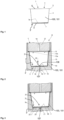
- the portion capsule 1 comprises a frustoconical capsule body 2 with a closed capsule base 3 and with a collar edge 5 arranged on its filling side 4, to which a lidding film 6 is welded or glued. Between the capsule base 3 and the lidding film 6, a cavity 100 is thus formed, preferably airtight and aroma-tight, which is filled with a powdered and granular beverage substance 101.
- the beverage substance 101 comprises, for example, coffee, cocoa, tea and/or milk powder (or granules).
- a filter element 7 is arranged, which is explained in more detail with reference to the following figures.
- the filter element 7 rests on the inner side 3a of the capsule base 3 and is firmly, i.e., materially connected, to the inner side 3a of the capsule body base 3.
- the filter element 7 is materially attached to the capsule base 3 along a circular ring only in an edge region 3' of the capsule base 3.
- the filter element comprises at least one layer of nonwoven fabric, in particular a nonwoven fabric made of fine polyester fibers.
- the fibers are particularly preferably thermally bonded to one another by means of a calender; for example, a plurality of extruded polyester fibers are arranged on top of and next to one another and then consolidated (flat calendered) by means of heated rollers.
- the nonwoven fabric comprises a random-fiber and/or fiber-oriented nonwoven fabric.
- FIG 2 is a portion capsule 1 according to the Figure 1 illustrated first embodiment of the present invention, wherein the portion capsule 1 in the Figure 2 is arranged in a closed brewing chamber 8.
- the brewing chamber 8 consists of a first brewing chamber element 9 and a second brewing chamber element 10, wherein the first brewing chamber element 9 is provided so as to be movable relative to the second brewing chamber element 10 or vice versa for the introduction of the portion capsule 1.
- a seal 11 is arranged between the two brewing chamber elements 9, 10.
- the first brewing chamber element 9 essentially consists of a closing piston 12 with piercing elements 13a, 13b for opening the lid film 6 of the portion capsule 1, a preparation liquid supply 14 and the seal 11.
- the second brewing chamber element 10 essentially consists of a brewing chamber bell 15 partially enclosing the portion capsule 1, with an opening pin 16 arranged on the bottom of the brewing chamber bell 15, which is provided with drainage grooves 17, and a beverage outlet 18.
- the brewing chamber 8 is in an open state (not shown), in which the first and second brewing chamber elements 9, 10 are spaced apart from one another to ensure that the portion capsule 1 is supplied, and the closed state shown, in which a preparation process for producing a beverage can be carried out using the portion capsule 1. In the closed state, the brewing chamber 8 is pressure-tight.
- the lid film 6 When transferring the brewing chamber 8 from the open state to the illustrated closed state, the lid film 6 is pierced by the piercing elements 13a, 13b, so that preparation liquid, in particular hot brewing water, is fed through the preparation liquid supply 14 under pressure into the cavity 100 of the portion capsule 1. Furthermore, when the brewing chamber 8 is closed, the capsule base 3 is perforated by the perforation means designed as an opening pin 16, so that an outlet opening 107 is created in the portion capsule 1, through which the produced beverage liquid can emerge from the portion capsule 1 in the direction of the beverage outlet 18. To assist in the drainage of the beverage liquid, the opening pin 16 preferably has the drainage grooves 17 on its outer surface.
- the base 3 of the portion capsule 1 located in the brewing chamber 9, 10 is pierced by the opening pin 16 of the second brewing comb element, but the filter element 7 located above the puncture point is slightly raised by the piercing tip 19 of the opening pin 16, but not pierced.
- This is achieved in particular in that the central region 7" is not materially connected to the capsule base 3, but the filter element 7 is materially connected to the capsule base 3 only in the edge region 3' of the capsule base 3, so that as a result of the mechanical contact with the tip of the opening mandrel 16 it is only lifted by the capsule base 3 and thus remains unperforated (i.e. is not perforated by the opening mandrel 16).
- the capsule base 3 and the filter element 7 remain in contact with one another and in particular are materially connected to one another, so that no beverage substance 101 gets around the filter element 7 into the beverage outlet 18.
- the opening mandrel 16 it is also possible for the opening mandrel 16 to pierce and/or pierce at least one layer of the filter element 7.
- FIG 3 a portion capsule 1 according to a second embodiment of the present invention is shown, wherein the second embodiment essentially corresponds to the one shown in Figure 2 illustrated first embodiment and the portion capsule 1 is also shown in a closed brewing chamber 8.
- the portion capsule base 3 has, in the piercing area of the opening mandrel 16, a bulge 21 directed towards an indentation 20 in the brewing chamber base 3a (the bulge 21 is thus directed in a direction opposite to the filling side 4), into which the opening mandrel 16 pierces without piercing the filter element 7. Lifting the filter element 7 from the capsule base 3 is therefore not necessary.
- the brewing chamber 8 is closed again after the portion capsule 1 has been introduced into the brewing chamber 8.
- the lidding film 6 of the portion capsule 1 is perforated by means of the piercing means 13a, 13b, and after the first and second brewing chamber elements 9, 10 have been brought together and sealed (by means of the seal 11), brewing water is made available via the liquid inlet 6.
- the opening mandrel 16 pierces an opening in the base 3 of the portion capsule 1.
- the filter element 7 located above the puncture point is matched in terms of its thickness and tear resistance to the penetration depth of the piercing tip 19 of the opening mandrel 16, so that the filter element 7 is not punctured.
- the filter element 7 lies above the bulge 21 of the capsule base 3, which lies in the indentation of the brewing bell base 23, and the opening pin 16 merely pierces the bulge 21 of the capsule base 3 and does not reach the filter element 7.
- the liquid for example, hot water when making coffee, then flows into the capsule 1. In the capsule, this liquid flows through the beverage substrate 101 and extracts and/or dissolves the substances required for beverage production from the beverage substrate 101.
- the flow of the liquid in the beverage substrate 101 is illustrated by the reference numeral 22.
- the resulting beverage then flows through the filter element 7 arranged between the beverage substrate 101 and the filter element 7 on the capsule base 3, which prevents components of the beverage substrate 101 from entering the resulting beverage in particle form and from passing through the opening pierced in the capsule base 3 by the opening mandrel 16 and through the drainage grooves 17 of the opening mandrel 16 into a collecting vessel, for example a cup or jug.
- a collecting vessel for example a cup or jug.
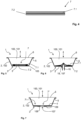
- Figure 4 shows a first embodiment of the filter element 7.
- This has, according to the invention, a first layer 7.1 and a second layer 7.2, which in the present case are each made of a fleece, i.e. a non-woven material.
- Both layers 7.1, 7.2 are connected to one another in a material-to-material manner, in particular by welding, preferably by ultrasonic welding. Both layers are provided here as circular disks.
- the connection is preferably made along a circular ring, which particularly preferably extends concentrically around the axis of rotation of the portion capsule.
- the two layers are preferably provided to be identical, but can also differ in terms of material, thickness and/or diameter.
- the two layers are first placed into the portion capsule, preferably as separate parts, and then the lower layer 7.2 is connected to the base 3 of the portion capsule.
- Filter element 7 is connected to the base 3 of the portion capsule by welding, in particular ultrasonic welding.
- the two layers 7.1 and 7.2 are connected to one another.
- the connection both between the filter element 7 and the capsule base 3 and between the two layers 7.1, 7.2 of the filter element to one another takes place along a circular ring.
- a sonotrode presses the two layers, preferably together, against the base of the portion capsule.
- the welding of the two layers to one another and the connection of the lower layer to the base of the portion capsule takes place at least essentially simultaneously.
- Figure 6 shows the piercing of the portion capsule by means of an opening pin 16, which first pierces the capsule base 3 and thereby provides an outlet for the beverage to be produced.
- the opening mandrel preferably pierces at least the lower layer of the filter element and at least partially pierces the upper layer 7.2. In particular, the distance between the two layers is increased locally, here in the central area of the filter element.
- Figure 7 shows another embodiment of the portion capsule according to the invention.
- a permanent opening is provided in the capsule base, which is closed here by a pull-off tab 109.
- This pull-off tab can be pierced by the opening mandrel or removed manually, for example by pulling it off, before the beverage is prepared.
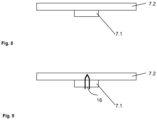
- Figure 8 shows a further embodiment of the filter 7, which is again provided in two layers, wherein the filter element in the present case has a first layer 7.2 consisting of a nonwoven fabric and a second layer 7.1 consisting of a felted material.
- the two layers are preferably bonded to one another, and most preferably, the flow-exposed area or the diameter of layer 7.1 is smaller than that of layer 7.2.
- the thickness of both layers can be the same or different.
- Figure 9 This diagram schematically shows the piercing of a portion capsule containing filter element 7. It is clearly visible that layer 7.1 is pierced, while layer 7.2 is only partially pierced. This ensures that no granules, for example, enter a beverage being produced.
Landscapes
- Engineering & Computer Science (AREA)
- Mechanical Engineering (AREA)
- Food Science & Technology (AREA)
- Life Sciences & Earth Sciences (AREA)
- Biodiversity & Conservation Biology (AREA)
- Apparatus For Making Beverages (AREA)
- Tea And Coffee (AREA)
- Packging For Living Organisms, Food Or Medicinal Products That Are Sensitive To Environmental Conditiond (AREA)
- Non-Alcoholic Beverages (AREA)
Claims (14)
- Dosette sous forme de capsule (1) pour préparer une boisson comportant un corps de dosette (2) doté d'un fond de dosette (3) et d'un côté de remplissage (4), un espace creux (100) servant à recevoir un substrat de boisson (101) sous forme de liquide ou de poudre entre le fond de dosette (3) et le côté de remplissage (4) et un élément de filtre (7) étant disposé entre le substrat de boisson (101) et le fond de dosette (3), l'élément de filtre (7) étant constitué d'un matériau non tissé disposé dans la zone du fond de dosette (3), l'élément de filtre étant constitué de deux couches (7.1, 7.2), caractérisée en ce que les deux couches (7.1, 7.2) sont connectées l'une à l'autre par un scellement et le scellement est réalisé localement sous forme de bague circulaire.
- Dosette sous forme de capsule (1) selon la revendication 1, caractérisée en ce que au moins une couche (7.1), de préférence les deux couches (7.1, 7.2), sont constituées d'un non-tissé.
- Dosette sous forme de capsule (1) selon la revendication 1, caractérisée en ce que l'élément de filtre (7) se compose d'une couche de non-tissé (7.1) et d'une couche de feutre (7.2).
- Dosette sous forme de capsule (1) selon la revendication 3, caractérisée en ce que la couche de feutre (7.2) présente une plus faible surface exposée au flux que la couche de non-tissé (7.1).
- Dosette sous forme de capsule (1) selon l'une quelconque des revendications 1-4, caractérisée en ce que le non-tissé comprend une matière de non-tissé fabriquée à partir de fines fibres de polyester et/ou que le non-tissé présente un taux massique d'occupation compris entre 50 et 150 grammes par mètre carré, de façon préférée entre 80 et 120 grammes par mètre carré et de façon particulièrement préférée de 100 grammes par mètre carré, et/ou que le non-tissé présente une épaisseur comprise entre 0,2 et 0,8 millimètre, de façon préférée entre 0,25 et 0,39 millimètre et de façon particulièrement préférée pour l'essentiel de 0,32 millimètre, et/ou que le non-tissé présente une perméabilité à l'air à une pression de 100 pascals comprise entre 1000 et 3000 l/(m2s), de façon préférée entre 1500 et 2500 l/(m2s) et de façon particulièrement préférée pour l'essentiel de 2000 l/(m2s).
- Dosette sous forme de capsule (1) selon l'une quelconque des revendications précédentes, caractérisée en ce que l'élément de filtre (7) est scellé au niveau du fond de la dosette, notamment scellé aux ultrasons et de préférence tendu.
- Dosette sous forme de capsule (1) selon l'une quelconque des revendications précédentes, caractérisée en ce que l'élément de filtre (7) recouvre entièrement ou seulement en partie le fond de dosette (3).
- Dosette sous forme de capsule (1) selon l'une quelconque des revendications précédentes, caractérisée en ce que le fond de dosette (3) comporte un bombement (21) dans une direction (103) opposée au côté de remplissage (4).
- Dosette sous forme de capsule (1) selon l'une quelconque des revendications précédentes, caractérisée en ce que l'élément de filtre (7) est réalisé de telle sorte qu'en cas de perforation du fond de dosette (3) par un moyen de perforation extérieur (16), un soulèvement de l'élément de filtre (7) par rapport au fond de dosette (3) se produit au moins en partie et/ou que le moyen de perforation perfore au moins une couche (7.1, 7.2) du filtre (7).
- Dosette sous forme de capsule (1) selon la revendication 9, caractérisée en ce que l'élément de filtre (7) se soulève seulement du fond de dosette (3) dans une zone centrale (7") et continue de reposer sur le fond de dosette (3) dans la zone de bordure (3') du fond de dosette (3) ou est fixé au fond de dosette (3).
- Dosette sous forme de capsule (1) selon la revendication 9 ou 10, caractérisée en ce que le moyen de perforation transperce et/ou perce les deux couches (7.1, 7.2).
- Dosette sous forme de capsule (1) selon l'une quelconque des revendications précédentes, caractérisée en ce que l'élément de filtre (7) est réalisé de telle sorte qu'en cas de perforation du fond de dosette (3) par un moyen de perforation extérieur (16), l'élément de filtre (7) se soulève du fond de capsule (3) dans sa région centrale (7") et/ou la distance entre les couches (7.1, 7.2) soit modifiée.
- Dosette sous forme de capsule (1) selon l'une quelconque des revendications précédentes, caractérisée en ce que le fond de dosette (3) présente une ouverture de sortie (107) de préférence étanchéifiée au moyen d'un film (108), le film (108) comportant de façon particulièrement préférée une languette de retrait (109) permettant de retirer le film à la main.
- Procédé de fabrication d'une boisson à l'aide d'une dosette sous forme de capsule (1) selon l'une quelconque des revendications 1-13, caractérisé en ce que la dosette sous forme de capsule (1) est amenée lors d'une première étape de procédé, que le fond de dosette (3) est perforé à l'aide d'un moyen de perforation extérieur (16) lors d'une deuxième étape de procédé et que la distance entre les couches (7.1, 7.2) est augmentée localement lors d'une troisième étape de procédé.
Applications Claiming Priority (2)
| Application Number | Priority Date | Filing Date | Title |
|---|---|---|---|
| DE102014105486 | 2014-04-17 | ||
| PCT/EP2015/058289 WO2015158838A1 (fr) | 2014-04-17 | 2015-04-16 | Capsule portion et procédé de préparation d'une boisson au moyen d'une capsule portion |
Publications (3)
| Publication Number | Publication Date |
|---|---|
| EP3131833A1 EP3131833A1 (fr) | 2017-02-22 |
| EP3131833B1 EP3131833B1 (fr) | 2018-06-27 |
| EP3131833B2 true EP3131833B2 (fr) | 2025-06-11 |
Family
ID=52997424
Family Applications (1)
| Application Number | Title | Priority Date | Filing Date |
|---|---|---|---|
| EP15717861.7A Active EP3131833B2 (fr) | 2014-04-17 | 2015-04-16 | Capsule pour la préparation de boissons et procédé de préparation de boissons l'utilisant |
Country Status (17)
| Country | Link |
|---|---|
| US (1) | US20170036857A1 (fr) |
| EP (1) | EP3131833B2 (fr) |
| JP (1) | JP6349457B2 (fr) |
| KR (1) | KR20160146859A (fr) |
| CN (1) | CN106232502A (fr) |
| AR (1) | AR100100A1 (fr) |
| AU (1) | AU2015248756B2 (fr) |
| BR (1) | BR112016024081A2 (fr) |
| CA (1) | CA2945550A1 (fr) |
| IL (1) | IL248289A0 (fr) |
| MX (1) | MX2016013407A (fr) |
| PH (1) | PH12016502020A1 (fr) |
| RU (1) | RU2657689C9 (fr) |
| SG (1) | SG11201608479SA (fr) |
| TW (1) | TW201545957A (fr) |
| WO (1) | WO2015158838A1 (fr) |
| ZA (1) | ZA201607021B (fr) |
Families Citing this family (25)
| Publication number | Priority date | Publication date | Assignee | Title |
|---|---|---|---|---|
| US10722066B2 (en) * | 2010-12-04 | 2020-07-28 | Adrian Rivera | Windowed single serving brewing material holder |
| US11832755B2 (en) * | 2007-07-13 | 2023-12-05 | Adrian Rivera | Brewing material container for a beverage brewer |
| US10071851B2 (en) | 2010-07-12 | 2018-09-11 | Robert Bao Vu | Apparatus and products for producing beverages, and methods for making and using same |
| DK3521210T3 (da) * | 2010-07-22 | 2020-04-14 | K Fee System Gmbh | Portionskapsel med stregkode |
| DE102012105282A1 (de) * | 2012-06-18 | 2013-12-19 | K-Fee System Gmbh | Portionskapsel und Verfahren zur Herstellung eines Getränks mit einer Portionskapsel |
| EP3042860B1 (fr) * | 2015-01-08 | 2018-02-28 | Stas I.P. B.V. | Récipient contenant un produit à extraire, ainsi que la méthode pour la production du récipient |
| PL3368447T3 (pl) | 2015-10-27 | 2020-08-10 | Koninklijke Douwe Egberts B.V. | Kapsułka, system i sposób przyrządzania napoju |
| DE102016201498B4 (de) * | 2016-02-01 | 2017-08-17 | Norbert Kuhl | Sauerstoffdichter lebensmittelbehälter |
| NL2017280B1 (en) | 2016-08-03 | 2018-02-14 | Douwe Egberts Bv | System for preparing a beverage |
| NL2017285B1 (en) | 2016-08-03 | 2018-02-14 | Douwe Egberts Bv | System, apparatus, method, capsule and kit of capsules for preparing a beverage |
| NL2017279B1 (en) | 2016-08-03 | 2018-02-14 | Douwe Egberts Bv | System for preparing a beverage |
| NL2017284B1 (en) | 2016-08-03 | 2018-02-14 | Douwe Egberts Bv | System and method for preparing a beverage field and background |
| NL2017283B1 (en) | 2016-08-03 | 2018-02-14 | Douwe Egberts Bv | System and apparatus for preparing a beverage |
| NL2017277B1 (en) | 2016-08-03 | 2018-02-14 | Douwe Egberts Bv | Apparatus and method for preparing a beverage and system comprising the apparatus and an exchangeable capsule |
| NL2017281B1 (en) | 2016-08-03 | 2018-02-14 | Douwe Egberts Bv | System for preparing a beverage |
| NL2017282B1 (en) | 2016-08-03 | 2018-02-14 | Douwe Egberts Bv | System for preparing a beverage |
| NL2017278B1 (en) | 2016-08-03 | 2018-02-14 | Douwe Egberts Bv | System, apparatus, method, capsule and kit of capsules for preparing a beverage |
| NL2019216B1 (en) | 2016-08-03 | 2018-05-04 | Douwe Egberts Bv | System for preparing a quantity of beverage suitable for consumption |
| IT201600082459A1 (it) * | 2016-08-04 | 2018-02-04 | Bisio Progetti Spa | Capsula per la preparazione di bevande ad infusione e solubili |
| CN109077617A (zh) * | 2018-04-06 | 2018-12-25 | 彩盛咖啡茶(北京)有限公司 | 封闭容器和利用封闭容器萃取饮品的方法 |
| US20240140047A1 (en) * | 2018-11-12 | 2024-05-02 | Opem S.P.A. | Method and device for manufacturing containers adapted to contain a food substance for the preparation of beverages |
| NL2022190B1 (en) | 2018-12-12 | 2020-07-03 | Douwe Egberts Bv | Air purge groove |
| US11805934B1 (en) * | 2020-10-21 | 2023-11-07 | Adrian Rivera | Brewing material lid and container for a beverage brewer |
| US20220287494A1 (en) * | 2021-03-12 | 2022-09-15 | Nexe Innovations Inc. | Beverage pod |
| KR102780961B1 (ko) * | 2021-11-30 | 2025-03-12 | 김병규 | 나선형 구조를 갖는 커피캡슐 |
Citations (2)
| Publication number | Priority date | Publication date | Assignee | Title |
|---|---|---|---|---|
| EP1344724A1 (fr) † | 2002-03-14 | 2003-09-17 | Robert Hale | Cartouche a filtre pour boisson et filtre pour ceci |
| WO2010112353A1 (fr) † | 2009-03-31 | 2010-10-07 | Nestec S.A. | Capsule avec filtre pour préparer une composition nutritionnelle ou alimentaire liquide et système apparenté de production de boissons |
Family Cites Families (17)
| Publication number | Priority date | Publication date | Assignee | Title |
|---|---|---|---|---|
| US2778739A (en) | 1954-07-16 | 1957-01-22 | Sealpak Corp | Package for beverage infusion material |
| TW305850B (fr) | 1992-11-17 | 1997-05-21 | Shell Int Research | |
| DE20100166U1 (de) * | 2001-01-05 | 2001-03-29 | Melitta Haushaltsprodukte GmbH & Co. KG, 32427 Minden | Portionspackung zur Herstellung eines Brühgetränkes |
| DE20221780U1 (de) | 2002-03-14 | 2007-10-18 | Caffita System S.P.A., Gaggio Montano | Portionenkapsel mit einer partikelförmigen mittels Wasser extrahierbaren Substanz zur Herstellung eines Getränks |
| US20040045443A1 (en) * | 2002-06-19 | 2004-03-11 | Lazaris Nicholas G. | Disposable beverage filter package |
| US7444926B2 (en) * | 2003-09-09 | 2008-11-04 | Nottingham John R | Apparatus for brewing and method for making the same |
| DE102005016297A1 (de) * | 2005-04-08 | 2006-10-12 | Tchibo Gmbh | Portionskapsel |
| DE102005058336A1 (de) | 2005-12-02 | 2007-06-06 | Tchibo Gmbh | Portionskapsel |
| US9750370B2 (en) * | 2009-05-29 | 2017-09-05 | Keurig Green Mountain, Inc. | Cartridge with filter guard |
| DK3521210T3 (da) | 2010-07-22 | 2020-04-14 | K Fee System Gmbh | Portionskapsel med stregkode |
| DE102011012881A1 (de) * | 2010-09-22 | 2012-03-22 | Krüger Gmbh & Co. Kg | Portionskapsel und Verfahren zur Herstellung eines Getränks mit einer Portionskapsel |
| US8895090B2 (en) * | 2010-09-22 | 2014-11-25 | K-Fee System Gmbh | Portion capsule and method for producing the same |
| DE102011115833A1 (de) * | 2011-10-13 | 2013-04-18 | K-Fee System Gmbh | Portionskapsel zur Herstellung eines Getränks mit einer Portionskapsel |
| DE102012105282A1 (de) * | 2012-06-18 | 2013-12-19 | K-Fee System Gmbh | Portionskapsel und Verfahren zur Herstellung eines Getränks mit einer Portionskapsel |
| JP2015527898A (ja) * | 2012-06-29 | 2015-09-24 | ケイ‐フィー システム ゲーエムベーハー | 内部に識別子を有する1回量カプセル |
| RU2015102566A (ru) * | 2012-06-29 | 2016-08-20 | К-Фее Зюстем Гмбх | Порционная капсула из пищевого полимера с машиночитаемым идентификатором |
| DE102012109186A1 (de) * | 2012-09-27 | 2014-03-27 | K-Fee System Gmbh | Portionskapsel mit einem durch Siegeln verbundenen Filterelement |
-
2015
- 2015-04-16 KR KR1020167032099A patent/KR20160146859A/ko not_active Withdrawn
- 2015-04-16 EP EP15717861.7A patent/EP3131833B2/fr active Active
- 2015-04-16 BR BR112016024081A patent/BR112016024081A2/pt not_active Application Discontinuation
- 2015-04-16 WO PCT/EP2015/058289 patent/WO2015158838A1/fr not_active Ceased
- 2015-04-16 JP JP2017504271A patent/JP6349457B2/ja active Active
- 2015-04-16 RU RU2016144965A patent/RU2657689C9/ru not_active IP Right Cessation
- 2015-04-16 US US15/303,859 patent/US20170036857A1/en not_active Abandoned
- 2015-04-16 AR ARP150101153A patent/AR100100A1/es unknown
- 2015-04-16 TW TW104112198A patent/TW201545957A/zh unknown
- 2015-04-16 AU AU2015248756A patent/AU2015248756B2/en not_active Ceased
- 2015-04-16 CN CN201580019739.XA patent/CN106232502A/zh active Pending
- 2015-04-16 MX MX2016013407A patent/MX2016013407A/es unknown
- 2015-04-16 CA CA2945550A patent/CA2945550A1/fr not_active Abandoned
- 2015-04-16 SG SG11201608479SA patent/SG11201608479SA/en unknown
-
2016
- 2016-10-10 IL IL248289A patent/IL248289A0/en unknown
- 2016-10-11 PH PH12016502020A patent/PH12016502020A1/en unknown
- 2016-10-12 ZA ZA2016/07021A patent/ZA201607021B/en unknown
Patent Citations (2)
| Publication number | Priority date | Publication date | Assignee | Title |
|---|---|---|---|---|
| EP1344724A1 (fr) † | 2002-03-14 | 2003-09-17 | Robert Hale | Cartouche a filtre pour boisson et filtre pour ceci |
| WO2010112353A1 (fr) † | 2009-03-31 | 2010-10-07 | Nestec S.A. | Capsule avec filtre pour préparer une composition nutritionnelle ou alimentaire liquide et système apparenté de production de boissons |
Also Published As
| Publication number | Publication date |
|---|---|
| US20170036857A1 (en) | 2017-02-09 |
| RU2016144965A (ru) | 2018-05-17 |
| JP6349457B2 (ja) | 2018-06-27 |
| IL248289A0 (en) | 2016-11-30 |
| SG11201608479SA (en) | 2016-11-29 |
| CA2945550A1 (fr) | 2015-10-22 |
| JP2017517357A (ja) | 2017-06-29 |
| AU2015248756B2 (en) | 2018-01-18 |
| TW201545957A (zh) | 2015-12-16 |
| ZA201607021B (en) | 2018-11-28 |
| WO2015158838A1 (fr) | 2015-10-22 |
| AR100100A1 (es) | 2016-09-07 |
| RU2016144965A3 (fr) | 2018-05-17 |
| BR112016024081A2 (pt) | 2017-08-15 |
| RU2657689C2 (ru) | 2018-06-14 |
| AU2015248756A1 (en) | 2016-11-03 |
| CN106232502A (zh) | 2016-12-14 |
| KR20160146859A (ko) | 2016-12-21 |
| EP3131833B1 (fr) | 2018-06-27 |
| EP3131833A1 (fr) | 2017-02-22 |
| PH12016502020A1 (en) | 2017-01-09 |
| RU2657689C9 (ru) | 2018-07-16 |
| MX2016013407A (es) | 2017-02-15 |
Similar Documents
| Publication | Publication Date | Title |
|---|---|---|
| EP3131833B2 (fr) | Capsule pour la préparation de boissons et procédé de préparation de boissons l'utilisant | |
| EP3336013B1 (fr) | Capsule et procede de preparation d'une boisson utilisant cette capsule | |
| EP2861508B9 (fr) | Capsule et procédé de préparation d'une boisson au moyen d'une capsule | |
| EP2961671B1 (fr) | Capsule-dosette et procédé de préparation d'une boisson au moyen d'une capsule-dosette | |
| EP3418215B1 (fr) | Capsule portion pourvue de matière fibreuse calandrée | |
| EP2625120B1 (fr) | Capsule dosette permettant de préparer une boisson avec une capsule dosette | |
| EP3261957B1 (fr) | Capsule avec a filtre scellé | |
| WO2014090567A1 (fr) | Capsule-dosette et procédé de fabrication d'une boisson à l'aide d'une capsule-dosette | |
| EP3307647B1 (fr) | Capsule avec un toison à trois couches | |
| WO2015193451A1 (fr) | Système de préparation d'une boisson à base de thé | |
| EP3310693B1 (fr) | Capsule pour la production des boissons |
Legal Events
| Date | Code | Title | Description |
|---|---|---|---|
| STAA | Information on the status of an ep patent application or granted ep patent |
Free format text: STATUS: THE INTERNATIONAL PUBLICATION HAS BEEN MADE |
|
| PUAI | Public reference made under article 153(3) epc to a published international application that has entered the european phase |
Free format text: ORIGINAL CODE: 0009012 |
|
| STAA | Information on the status of an ep patent application or granted ep patent |
Free format text: STATUS: REQUEST FOR EXAMINATION WAS MADE |
|
| 17P | Request for examination filed |
Effective date: 20161117 |
|
| AK | Designated contracting states |
Kind code of ref document: A1 Designated state(s): AL AT BE BG CH CY CZ DE DK EE ES FI FR GB GR HR HU IE IS IT LI LT LU LV MC MK MT NL NO PL PT RO RS SE SI SK SM TR |
|
| AX | Request for extension of the european patent |
Extension state: BA ME |
|
| DAV | Request for validation of the european patent (deleted) | ||
| DAX | Request for extension of the european patent (deleted) | ||
| GRAP | Despatch of communication of intention to grant a patent |
Free format text: ORIGINAL CODE: EPIDOSNIGR1 |
|
| STAA | Information on the status of an ep patent application or granted ep patent |
Free format text: STATUS: GRANT OF PATENT IS INTENDED |
|
| INTG | Intention to grant announced |
Effective date: 20180313 |
|
| GRAS | Grant fee paid |
Free format text: ORIGINAL CODE: EPIDOSNIGR3 |
|
| GRAA | (expected) grant |
Free format text: ORIGINAL CODE: 0009210 |
|
| STAA | Information on the status of an ep patent application or granted ep patent |
Free format text: STATUS: THE PATENT HAS BEEN GRANTED |
|
| AK | Designated contracting states |
Kind code of ref document: B1 Designated state(s): AL AT BE BG CH CY CZ DE DK EE ES FI FR GB GR HR HU IE IS IT LI LT LU LV MC MK MT NL NO PL PT RO RS SE SI SK SM TR |
|
| REG | Reference to a national code |
Ref country code: GB Ref legal event code: FG4D Free format text: NOT ENGLISH |
|
| REG | Reference to a national code |
Ref country code: AT Ref legal event code: REF Ref document number: 1012105 Country of ref document: AT Kind code of ref document: T Effective date: 20180715 |
|
| REG | Reference to a national code |
Ref country code: IE Ref legal event code: FG4D Free format text: LANGUAGE OF EP DOCUMENT: GERMAN |
|
| REG | Reference to a national code |
Ref country code: DE Ref legal event code: R096 Ref document number: 502015004839 Country of ref document: DE |
|
| REG | Reference to a national code |
Ref country code: NL Ref legal event code: FP |
|
| PG25 | Lapsed in a contracting state [announced via postgrant information from national office to epo] |
Ref country code: BG Free format text: LAPSE BECAUSE OF FAILURE TO SUBMIT A TRANSLATION OF THE DESCRIPTION OR TO PAY THE FEE WITHIN THE PRESCRIBED TIME-LIMIT Effective date: 20180927 Ref country code: LT Free format text: LAPSE BECAUSE OF FAILURE TO SUBMIT A TRANSLATION OF THE DESCRIPTION OR TO PAY THE FEE WITHIN THE PRESCRIBED TIME-LIMIT Effective date: 20180627 Ref country code: NO Free format text: LAPSE BECAUSE OF FAILURE TO SUBMIT A TRANSLATION OF THE DESCRIPTION OR TO PAY THE FEE WITHIN THE PRESCRIBED TIME-LIMIT Effective date: 20180927 Ref country code: SE Free format text: LAPSE BECAUSE OF FAILURE TO SUBMIT A TRANSLATION OF THE DESCRIPTION OR TO PAY THE FEE WITHIN THE PRESCRIBED TIME-LIMIT Effective date: 20180627 |
|
| REG | Reference to a national code |
Ref country code: LT Ref legal event code: MG4D |
|
| PG25 | Lapsed in a contracting state [announced via postgrant information from national office to epo] |
Ref country code: GR Free format text: LAPSE BECAUSE OF FAILURE TO SUBMIT A TRANSLATION OF THE DESCRIPTION OR TO PAY THE FEE WITHIN THE PRESCRIBED TIME-LIMIT Effective date: 20180928 Ref country code: LV Free format text: LAPSE BECAUSE OF FAILURE TO SUBMIT A TRANSLATION OF THE DESCRIPTION OR TO PAY THE FEE WITHIN THE PRESCRIBED TIME-LIMIT Effective date: 20180627 Ref country code: HR Free format text: LAPSE BECAUSE OF FAILURE TO SUBMIT A TRANSLATION OF THE DESCRIPTION OR TO PAY THE FEE WITHIN THE PRESCRIBED TIME-LIMIT Effective date: 20180627 Ref country code: RS Free format text: LAPSE BECAUSE OF FAILURE TO SUBMIT A TRANSLATION OF THE DESCRIPTION OR TO PAY THE FEE WITHIN THE PRESCRIBED TIME-LIMIT Effective date: 20180627 |
|
| PG25 | Lapsed in a contracting state [announced via postgrant information from national office to epo] |
Ref country code: RO Free format text: LAPSE BECAUSE OF FAILURE TO SUBMIT A TRANSLATION OF THE DESCRIPTION OR TO PAY THE FEE WITHIN THE PRESCRIBED TIME-LIMIT Effective date: 20180627 Ref country code: SK Free format text: LAPSE BECAUSE OF FAILURE TO SUBMIT A TRANSLATION OF THE DESCRIPTION OR TO PAY THE FEE WITHIN THE PRESCRIBED TIME-LIMIT Effective date: 20180627 Ref country code: CZ Free format text: LAPSE BECAUSE OF FAILURE TO SUBMIT A TRANSLATION OF THE DESCRIPTION OR TO PAY THE FEE WITHIN THE PRESCRIBED TIME-LIMIT Effective date: 20180627 Ref country code: PL Free format text: LAPSE BECAUSE OF FAILURE TO SUBMIT A TRANSLATION OF THE DESCRIPTION OR TO PAY THE FEE WITHIN THE PRESCRIBED TIME-LIMIT Effective date: 20180627 Ref country code: IS Free format text: LAPSE BECAUSE OF FAILURE TO SUBMIT A TRANSLATION OF THE DESCRIPTION OR TO PAY THE FEE WITHIN THE PRESCRIBED TIME-LIMIT Effective date: 20181027 Ref country code: EE Free format text: LAPSE BECAUSE OF FAILURE TO SUBMIT A TRANSLATION OF THE DESCRIPTION OR TO PAY THE FEE WITHIN THE PRESCRIBED TIME-LIMIT Effective date: 20180627 |
|
| PG25 | Lapsed in a contracting state [announced via postgrant information from national office to epo] |
Ref country code: IT Free format text: LAPSE BECAUSE OF FAILURE TO SUBMIT A TRANSLATION OF THE DESCRIPTION OR TO PAY THE FEE WITHIN THE PRESCRIBED TIME-LIMIT Effective date: 20180627 Ref country code: SM Free format text: LAPSE BECAUSE OF FAILURE TO SUBMIT A TRANSLATION OF THE DESCRIPTION OR TO PAY THE FEE WITHIN THE PRESCRIBED TIME-LIMIT Effective date: 20180627 Ref country code: ES Free format text: LAPSE BECAUSE OF FAILURE TO SUBMIT A TRANSLATION OF THE DESCRIPTION OR TO PAY THE FEE WITHIN THE PRESCRIBED TIME-LIMIT Effective date: 20180627 |
|
| REG | Reference to a national code |
Ref country code: DE Ref legal event code: R026 Ref document number: 502015004839 Country of ref document: DE |
|
| PLBI | Opposition filed |
Free format text: ORIGINAL CODE: 0009260 |
|
| PLAX | Notice of opposition and request to file observation + time limit sent |
Free format text: ORIGINAL CODE: EPIDOSNOBS2 |
|
| 26 | Opposition filed |
Opponent name: DELICA AG Effective date: 20190326 |
|
| PG25 | Lapsed in a contracting state [announced via postgrant information from national office to epo] |
Ref country code: DK Free format text: LAPSE BECAUSE OF FAILURE TO SUBMIT A TRANSLATION OF THE DESCRIPTION OR TO PAY THE FEE WITHIN THE PRESCRIBED TIME-LIMIT Effective date: 20180627 |
|
| PLBB | Reply of patent proprietor to notice(s) of opposition received |
Free format text: ORIGINAL CODE: EPIDOSNOBS3 |
|
| PG25 | Lapsed in a contracting state [announced via postgrant information from national office to epo] |
Ref country code: SI Free format text: LAPSE BECAUSE OF FAILURE TO SUBMIT A TRANSLATION OF THE DESCRIPTION OR TO PAY THE FEE WITHIN THE PRESCRIBED TIME-LIMIT Effective date: 20180627 |
|
| PG25 | Lapsed in a contracting state [announced via postgrant information from national office to epo] |
Ref country code: AL Free format text: LAPSE BECAUSE OF FAILURE TO SUBMIT A TRANSLATION OF THE DESCRIPTION OR TO PAY THE FEE WITHIN THE PRESCRIBED TIME-LIMIT Effective date: 20180627 |
|
| REG | Reference to a national code |
Ref country code: BE Ref legal event code: MM Effective date: 20190430 |
|
| PG25 | Lapsed in a contracting state [announced via postgrant information from national office to epo] |
Ref country code: LU Free format text: LAPSE BECAUSE OF NON-PAYMENT OF DUE FEES Effective date: 20190416 Ref country code: MC Free format text: LAPSE BECAUSE OF FAILURE TO SUBMIT A TRANSLATION OF THE DESCRIPTION OR TO PAY THE FEE WITHIN THE PRESCRIBED TIME-LIMIT Effective date: 20180627 |
|
| PG25 | Lapsed in a contracting state [announced via postgrant information from national office to epo] |
Ref country code: BE Free format text: LAPSE BECAUSE OF NON-PAYMENT OF DUE FEES Effective date: 20190430 |
|
| PG25 | Lapsed in a contracting state [announced via postgrant information from national office to epo] |
Ref country code: TR Free format text: LAPSE BECAUSE OF FAILURE TO SUBMIT A TRANSLATION OF THE DESCRIPTION OR TO PAY THE FEE WITHIN THE PRESCRIBED TIME-LIMIT Effective date: 20180627 |
|
| PG25 | Lapsed in a contracting state [announced via postgrant information from national office to epo] |
Ref country code: IE Free format text: LAPSE BECAUSE OF NON-PAYMENT OF DUE FEES Effective date: 20190416 |
|
| PG25 | Lapsed in a contracting state [announced via postgrant information from national office to epo] |
Ref country code: PT Free format text: LAPSE BECAUSE OF FAILURE TO SUBMIT A TRANSLATION OF THE DESCRIPTION OR TO PAY THE FEE WITHIN THE PRESCRIBED TIME-LIMIT Effective date: 20181029 |
|
| PG25 | Lapsed in a contracting state [announced via postgrant information from national office to epo] |
Ref country code: CY Free format text: LAPSE BECAUSE OF FAILURE TO SUBMIT A TRANSLATION OF THE DESCRIPTION OR TO PAY THE FEE WITHIN THE PRESCRIBED TIME-LIMIT Effective date: 20180627 |
|
| PG25 | Lapsed in a contracting state [announced via postgrant information from national office to epo] |
Ref country code: HU Free format text: LAPSE BECAUSE OF FAILURE TO SUBMIT A TRANSLATION OF THE DESCRIPTION OR TO PAY THE FEE WITHIN THE PRESCRIBED TIME-LIMIT; INVALID AB INITIO Effective date: 20150416 Ref country code: MT Free format text: LAPSE BECAUSE OF FAILURE TO SUBMIT A TRANSLATION OF THE DESCRIPTION OR TO PAY THE FEE WITHIN THE PRESCRIBED TIME-LIMIT Effective date: 20180627 |
|
| APBM | Appeal reference recorded |
Free format text: ORIGINAL CODE: EPIDOSNREFNO |
|
| APBP | Date of receipt of notice of appeal recorded |
Free format text: ORIGINAL CODE: EPIDOSNNOA2O |
|
| PLAB | Opposition data, opponent's data or that of the opponent's representative modified |
Free format text: ORIGINAL CODE: 0009299OPPO |
|
| R26 | Opposition filed (corrected) |
Opponent name: DELICA AG Effective date: 20190326 |
|
| APAH | Appeal reference modified |
Free format text: ORIGINAL CODE: EPIDOSCREFNO |
|
| APBQ | Date of receipt of statement of grounds of appeal recorded |
Free format text: ORIGINAL CODE: EPIDOSNNOA3O |
|
| PG25 | Lapsed in a contracting state [announced via postgrant information from national office to epo] |
Ref country code: MK Free format text: LAPSE BECAUSE OF FAILURE TO SUBMIT A TRANSLATION OF THE DESCRIPTION OR TO PAY THE FEE WITHIN THE PRESCRIBED TIME-LIMIT Effective date: 20180627 |
|
| APBU | Appeal procedure closed |
Free format text: ORIGINAL CODE: EPIDOSNNOA9O |
|
| P01 | Opt-out of the competence of the unified patent court (upc) registered |
Effective date: 20230521 |
|
| PLAY | Examination report in opposition despatched + time limit |
Free format text: ORIGINAL CODE: EPIDOSNORE2 |
|
| PLBC | Reply to examination report in opposition received |
Free format text: ORIGINAL CODE: EPIDOSNORE3 |
|
| PLAY | Examination report in opposition despatched + time limit |
Free format text: ORIGINAL CODE: EPIDOSNORE2 |
|
| PLBC | Reply to examination report in opposition received |
Free format text: ORIGINAL CODE: EPIDOSNORE3 |
|
| PUAH | Patent maintained in amended form |
Free format text: ORIGINAL CODE: 0009272 |
|
| STAA | Information on the status of an ep patent application or granted ep patent |
Free format text: STATUS: PATENT MAINTAINED AS AMENDED |
|
| PGFP | Annual fee paid to national office [announced via postgrant information from national office to epo] |
Ref country code: NL Payment date: 20250422 Year of fee payment: 11 |
|
| 27A | Patent maintained in amended form |
Effective date: 20250611 |
|
| AK | Designated contracting states |
Kind code of ref document: B2 Designated state(s): AL AT BE BG CH CY CZ DE DK EE ES FI FR GB GR HR HU IE IS IT LI LT LU LV MC MK MT NL NO PL PT RO RS SE SI SK SM TR |
|
| REG | Reference to a national code |
Ref country code: DE Ref legal event code: R102 Ref document number: 502015004839 Country of ref document: DE |
|
| PGFP | Annual fee paid to national office [announced via postgrant information from national office to epo] |
Ref country code: FI Payment date: 20250417 Year of fee payment: 11 |
|
| PGFP | Annual fee paid to national office [announced via postgrant information from national office to epo] |
Ref country code: DE Payment date: 20250417 Year of fee payment: 11 |
|
| PGFP | Annual fee paid to national office [announced via postgrant information from national office to epo] |
Ref country code: GB Payment date: 20250423 Year of fee payment: 11 |
|
| PGFP | Annual fee paid to national office [announced via postgrant information from national office to epo] |
Ref country code: FR Payment date: 20250424 Year of fee payment: 11 |
|
| PGFP | Annual fee paid to national office [announced via postgrant information from national office to epo] |
Ref country code: CH Payment date: 20250501 Year of fee payment: 11 |
|
| PGFP | Annual fee paid to national office [announced via postgrant information from national office to epo] |
Ref country code: AT Payment date: 20250416 Year of fee payment: 11 |
|
| PG25 | Lapsed in a contracting state [announced via postgrant information from national office to epo] |
Ref country code: NL Free format text: LAPSE BECAUSE OF FAILURE TO SUBMIT A TRANSLATION OF THE DESCRIPTION OR TO PAY THE FEE WITHIN THE PRESCRIBED TIME-LIMIT Effective date: 20180627 |