EP3131992B1 - Schnell härtende migrationsfreie zusammensetzung auf basis von silangruppen-haltigen polymeren - Google Patents
Schnell härtende migrationsfreie zusammensetzung auf basis von silangruppen-haltigen polymeren Download PDFInfo
- Publication number
- EP3131992B1 EP3131992B1 EP15715766.0A EP15715766A EP3131992B1 EP 3131992 B1 EP3131992 B1 EP 3131992B1 EP 15715766 A EP15715766 A EP 15715766A EP 3131992 B1 EP3131992 B1 EP 3131992B1
- Authority
- EP
- European Patent Office
- Prior art keywords
- bis
- catalyst
- formula
- carbon atoms
- groups
- Prior art date
- Legal status (The legal status is an assumption and is not a legal conclusion. Google has not performed a legal analysis and makes no representation as to the accuracy of the status listed.)
- Active
Links
Classifications
-
- C—CHEMISTRY; METALLURGY
- C09—DYES; PAINTS; POLISHES; NATURAL RESINS; ADHESIVES; COMPOSITIONS NOT OTHERWISE PROVIDED FOR; APPLICATIONS OF MATERIALS NOT OTHERWISE PROVIDED FOR
- C09D—COATING COMPOSITIONS, e.g. PAINTS, VARNISHES OR LACQUERS; FILLING PASTES; CHEMICAL PAINT OR INK REMOVERS; INKS; CORRECTING FLUIDS; WOODSTAINS; PASTES OR SOLIDS FOR COLOURING OR PRINTING; USE OF MATERIALS THEREFOR
- C09D183/00—Coating compositions based on macromolecular compounds obtained by reactions forming in the main chain of the macromolecule a linkage containing silicon, with or without sulfur, nitrogen, oxygen, or carbon only; Coating compositions based on derivatives of such polymers
- C09D183/10—Block or graft copolymers containing polysiloxane sequences
-
- C—CHEMISTRY; METALLURGY
- C07—ORGANIC CHEMISTRY
- C07C—ACYCLIC OR CARBOCYCLIC COMPOUNDS
- C07C279/00—Derivatives of guanidine, i.e. compounds containing the group, the singly-bound nitrogen atoms not being part of nitro or nitroso groups
- C07C279/04—Derivatives of guanidine, i.e. compounds containing the group, the singly-bound nitrogen atoms not being part of nitro or nitroso groups having nitrogen atoms of guanidine groups bound to acyclic carbon atoms of a carbon skeleton
-
- C—CHEMISTRY; METALLURGY
- C07—ORGANIC CHEMISTRY
- C07C—ACYCLIC OR CARBOCYCLIC COMPOUNDS
- C07C279/00—Derivatives of guanidine, i.e. compounds containing the group, the singly-bound nitrogen atoms not being part of nitro or nitroso groups
- C07C279/04—Derivatives of guanidine, i.e. compounds containing the group, the singly-bound nitrogen atoms not being part of nitro or nitroso groups having nitrogen atoms of guanidine groups bound to acyclic carbon atoms of a carbon skeleton
- C07C279/08—Derivatives of guanidine, i.e. compounds containing the group, the singly-bound nitrogen atoms not being part of nitro or nitroso groups having nitrogen atoms of guanidine groups bound to acyclic carbon atoms of a carbon skeleton being further substituted by singly-bound oxygen atoms
-
- C—CHEMISTRY; METALLURGY
- C07—ORGANIC CHEMISTRY
- C07C—ACYCLIC OR CARBOCYCLIC COMPOUNDS
- C07C279/00—Derivatives of guanidine, i.e. compounds containing the group, the singly-bound nitrogen atoms not being part of nitro or nitroso groups
- C07C279/16—Derivatives of guanidine, i.e. compounds containing the group, the singly-bound nitrogen atoms not being part of nitro or nitroso groups having nitrogen atoms of guanidine groups bound to carbon atoms of rings other than six-membered aromatic rings
-
- C—CHEMISTRY; METALLURGY
- C07—ORGANIC CHEMISTRY
- C07D—HETEROCYCLIC COMPOUNDS
- C07D233/00—Heterocyclic compounds containing 1,3-diazole or hydrogenated 1,3-diazole rings, not condensed with other rings
- C07D233/04—Heterocyclic compounds containing 1,3-diazole or hydrogenated 1,3-diazole rings, not condensed with other rings having one double bond between ring members or between a ring member and a non-ring member
- C07D233/06—Heterocyclic compounds containing 1,3-diazole or hydrogenated 1,3-diazole rings, not condensed with other rings having one double bond between ring members or between a ring member and a non-ring member with only hydrogen atoms or radicals containing only hydrogen and carbon atoms, directly attached to ring carbon atoms
-
- C—CHEMISTRY; METALLURGY
- C07—ORGANIC CHEMISTRY
- C07D—HETEROCYCLIC COMPOUNDS
- C07D239/00—Heterocyclic compounds containing 1,3-diazine or hydrogenated 1,3-diazine rings
- C07D239/02—Heterocyclic compounds containing 1,3-diazine or hydrogenated 1,3-diazine rings not condensed with other rings
- C07D239/20—Heterocyclic compounds containing 1,3-diazine or hydrogenated 1,3-diazine rings not condensed with other rings having two double bonds between ring members or between ring members and non-ring members
-
- C—CHEMISTRY; METALLURGY
- C08—ORGANIC MACROMOLECULAR COMPOUNDS; THEIR PREPARATION OR CHEMICAL WORKING-UP; COMPOSITIONS BASED THEREON
- C08G—MACROMOLECULAR COMPOUNDS OBTAINED OTHERWISE THAN BY REACTIONS ONLY INVOLVING UNSATURATED CARBON-TO-CARBON BONDS
- C08G77/00—Macromolecular compounds obtained by reactions forming a linkage containing silicon with or without sulfur, nitrogen, oxygen or carbon in the main chain of the macromolecule
- C08G77/04—Polysiloxanes
- C08G77/14—Polysiloxanes containing silicon bound to oxygen-containing groups
- C08G77/16—Polysiloxanes containing silicon bound to oxygen-containing groups to hydroxy groups
-
- C—CHEMISTRY; METALLURGY
- C08—ORGANIC MACROMOLECULAR COMPOUNDS; THEIR PREPARATION OR CHEMICAL WORKING-UP; COMPOSITIONS BASED THEREON
- C08G—MACROMOLECULAR COMPOUNDS OBTAINED OTHERWISE THAN BY REACTIONS ONLY INVOLVING UNSATURATED CARBON-TO-CARBON BONDS
- C08G77/00—Macromolecular compounds obtained by reactions forming a linkage containing silicon with or without sulfur, nitrogen, oxygen or carbon in the main chain of the macromolecule
- C08G77/42—Block-or graft-polymers containing polysiloxane sequences
-
- C—CHEMISTRY; METALLURGY
- C09—DYES; PAINTS; POLISHES; NATURAL RESINS; ADHESIVES; COMPOSITIONS NOT OTHERWISE PROVIDED FOR; APPLICATIONS OF MATERIALS NOT OTHERWISE PROVIDED FOR
- C09J—ADHESIVES; NON-MECHANICAL ASPECTS OF ADHESIVE PROCESSES IN GENERAL; ADHESIVE PROCESSES NOT PROVIDED FOR ELSEWHERE; USE OF MATERIALS AS ADHESIVES
- C09J183/00—Adhesives based on macromolecular compounds obtained by reactions forming in the main chain of the macromolecule a linkage containing silicon, with or without sulfur, nitrogen, oxygen, or carbon only; Adhesives based on derivatives of such polymers
- C09J183/10—Block or graft copolymers containing polysiloxane sequences
-
- C—CHEMISTRY; METALLURGY
- C07—ORGANIC CHEMISTRY
- C07C—ACYCLIC OR CARBOCYCLIC COMPOUNDS
- C07C2601/00—Systems containing only non-condensed rings
- C07C2601/12—Systems containing only non-condensed rings with a six-membered ring
- C07C2601/14—The ring being saturated
Definitions
- the invention relates to compositions curable at room temperature based on polymers containing silane groups, which are particularly suitable as an adhesive, sealant or coating.
- compositions curable at room temperature based on polymers containing silane groups are known.
- Polymers containing silane groups are in particular polyorganosiloxanes, which are commonly referred to as “silicones” or “silicone rubbers”, and silane group-containing organic polymers, which are also referred to as “silane-functional polymers", “silane-modified polymers” (SMP) or “silane-terminated polymers”. (STP).
- SMP silane-modified polymers
- STP silane-terminated polymers
- Such compositions play an important role in many technical applications, for example as adhesives, sealants or coatings. They are hardened by cross-linking reactions of the silane groups, which hydrolyze under the influence of moisture, condense with one another as silanol groups and thereby form siloxane bonds.
- Catalysts are often used to accelerate curing. Very often, these are toxicologically questionable substances that pose a potential risk to processors and the environment, especially after curing, when the catalysts or their degradation products are released by outgassing, migration or washing out.
- Organotin compounds in particular dialkyltin (IV) carboxylates, are conventionally used as crosslinking catalysts. These are characterized by good activity in relation to the silanol condensation and are very resistant to hydrolysis; however, they are harmful to health and extremely hazardous to water. They are often used in combination with other catalysts, mainly basic compounds, especially amines, which above all accelerate the upstream hydrolysis of the silane groups.
- organotitanates, zirconates and aluminates have been described as alternative metal catalysts.
- these usually have a lower catalytic activity in relation to the silanol condensation than organotin compounds and result in a significantly slower crosslinking.
- they can also lose a large part of their activity when the composition is stored due to the residual moisture content of the ingredients, as a result of which the hardening is further slowed down or comes to a complete standstill.
- organotin compounds are strongly basic nitrogen compounds from the class of amidines and guanidines, which can be used in combination with the metal catalysts mentioned or else alone.
- many of the common amidine and guanidine catalysts such as, in particular, 1,8-diazabicyclo [5.4.0] undec-7-ene (DBU) and 1,1,3,3-tetramethylguanidine (TMG)
- DBU 1,8-diazabicyclo [5.4.0] undec-7-ene
- TMG 1,1,3,3-tetramethylguanidine
- DBU 1,8-diazabicyclo [5.4.0] undec-7-ene
- TMG 1,1,3,3-tetramethylguanidine
- aromatic amidines and guanidines which are solid at room temperature provides a remedy here, but requires the use of suitable solvents and brings about losses in the catalytic activity and thus in the rate of crosslinking.
- the document FR 2 925 496 relates to the use of guanidine derivatives as catalysts for the curing of polysiloxanes which have silane groups.
- This object is achieved by a composition according to claim 1 containing a catalyst of the formula (I).
- the catalyst of formula (I) contains aliphatic amidine or guanidine groups and shows a high catalytic activity, while aromatic amidines or guanidines are hardly or not at all catalytically active.
- compositions according to the invention have very rapid curing which is due to the presence of the catalyst of the formula (I), even if the catalyst of the formula (I) is relatively large and not very mobile.
- silane group denotes a silyl group bonded to an organic radical or to a polyorganosiloxane radical with one to three, in particular two or three, hydrolyzable substituents on the silicon atom.
- the hydrolyzable substituents are in particular alkoxy, acetoxy, ketoximato, amido or enoxy radicals having 1 to 13 carbon atoms, preferably alkoxy or ketoximato radicals, particularly preferably alkoxy radicals; the latter silane groups are referred to below as "alkoxysilane groups”.
- silane groups is further understood to mean silanol groups which correspond formally to partially or fully hydrolyzed silane groups and have one or more hydroxyl radicals on the silicon atom.
- “Hydroxysilane”, “isocyanatosilane”, “aminosilane” or “mercaptosilane” are organoalkoxysilanes which have one or more hydroxyl, isocyanato, amino or mercapto groups on the organic radical in addition to the silane group.
- organic polymer encompasses a collective of chemically uniform macromolecules which differ in terms of degree of polymerization, molar mass and chain length, which was produced by a polyreaction (polymerization, polyaddition, polycondensation) and which predominantly has carbon atoms in the polymer backbone, and reaction products of such Collective of macromolecules.
- Polymers with a polydiorganosiloxane backbone commonly referred to as "silicones" are not organic polymers in the sense of the present document.
- silane group-containing polyether also includes silane group-containing organic polymers which, in addition to polyether units, can also contain urethane groups, urea groups or thiourethane groups.
- silane group-containing polyethers can also be referred to as "silane group-containing polyurethanes".
- “molecular weight” means the molar mass (in grams per mole) of a molecule or part of a molecule, also referred to as the “residue”.
- the “average molecular weight” is the number average M n of an oligomeric or polymeric mixture of molecules or residues, which is usually determined by means of gel permeation chromatography (GPC) against polystyrene as the standard.
- GPC gel permeation chromatography
- a substance or a composition is said to be “stable in storage” or “storable” if it can be stored at room temperature in a suitable container for a longer period of time, typically at least 3 months up to 6 months and more, without the use thereof - Or usage properties, in particular the viscosity and the rate of crosslinking, changed by the storage to an extent relevant to their use.
- a dashed line in the formulas in this document represents the bond between a substituent and the associated molecular moiety.
- a temperature of approximately 23 ° C. is referred to as “room temperature”.
- the catalyst of formula (I) can also be in tautomeric form. All possible tautomer forms of the catalyst of formula (I) are considered equivalent within the scope of the present invention.
- the catalyst of the formula (I) can furthermore be present in protonated form.
- the catalyst of the formula (I) can also be in complexed form, in particular with cations of zinc, iron or molybdenum.
- A preferably represents an n-valent aliphatic or cycloaliphatic or arylaliphatic hydrocarbon radical with 2 to 50, in particular 2 to 20, carbon atoms, which optionally contains ether oxygen or amine nitrogen, in particular one up to three ether oxygens or one to five amine nitrogen.
- A is particularly preferably selected from the group consisting of 1,2-ethylene; 1,3-propylene; 1,2-propylene; 1,4-butylene; 1,3-butylene; 1,2-butylene; 2,3-butylene; 1,3-pentylene; 2-methyl-1,5-pentylene; 1,6-hexylene; 2,2 (4), 4-trimethyl-1,6-hexamethylene; 1,8-octylene; 1,10-decylene; 1,12-dodecylene; (1,5,5-trimethylcyclohexan-1-yl) methan-1,3; 1,3-cyclohexylene bis (methylene); 1,4-cyclohexylene bis (methylene); 1,3-phenylene bis (methylene); 2- and / or 4-methyl-1,3-cyclohexylene; 4-aza-N-methyl-1,7-heptylene; 4-aza-N-ethyl-1,7-heptylene; 3-aza-1,5-pentylene; 3,6-
- radicals A having 2 to 18 carbon atoms Particularly preferred are radicals A with 2 to 12 carbon atoms, which optionally contain 1 to 3 ether oxygens and optionally 1 to 3 secondary or tertiary amino groups.
- n is preferably an integer from 2 to 10. n is particularly preferably 2 or 3, in particular 2.
- R 1 and R 0 preferably each independently represent hydrogen or an alkyl radical having 1 to 4 carbon atoms, in particular hydrogen.
- R 2 preferably represents hydrogen or an alkyl, cycloalkyl or aralkyl radical having 1 to 12 carbon atoms, in particular 1 to 8 carbon atoms, which optionally contains heteroatoms.
- R 3 preferably represents -NR 4 R 5 or hydrogen or an alkyl, cycloalkyl or aralkyl radical having 1 to 8 carbon atoms.
- R 3 particularly preferably represents -NR 4 R 5 .
- R 4 and R 5 preferably each independently represent hydrogen or an alkyl, cycloalkyl or aralkyl radical having 1 to 12 carbon atoms, which optionally contains an oxygen atom or a nitrogen atom.
- R 4 and R 5 together preferably represent an alkylene radical having 4 to 7 carbon atoms, which optionally contains an oxygen atom or a nitrogen atom.
- R 1 and R 2 together preferably represent an alkylene radical having 2 to 4 carbon atoms, in particular 2 or 3 carbon atoms.
- R 2 and R 0 together preferably represent an alkylene radical having 4 to 6 carbon atoms, which optionally contains heteroatoms.
- R 2 and R 3 together preferably also represent an alkylene radical having 3 to 5 carbon atoms.
- R 2 and R 5 together preferably represent an alkylene radical having 2 to 4 carbon atoms.
- the weight ratio between the silane group-containing polymer and the catalyst of the formula (I) is preferably at least 10/1, in particular at least 20/1, particularly preferably at least 40/1.
- the weight ratio between the silane group-containing polymer and the catalyst of the formula (I) is preferably at most 10,000 / 1, in particular at most 2,000 / 1, particularly preferably at most 1,000 / 1.
- the weight ratio between the silane group-containing organic polymer and the catalyst of the formula (I) is in the range from 10/1 to 2,000 / 1, particularly preferably 20/1 to 2,000 / 1, in particular 40/1 to 1 '000/1.
- Such a composition has a good shelf life and quick curing.
- R 3 is hydrogen or an alkyl, cycloalkyl or aralkyl radical having 1 to 12, preferably 1 to 8, in particular 1 to 4, carbon atoms, or R. 2 and R 3 stand together for an alkylene radical having 3 to 6, in particular 3 to 5, carbon atoms.
- These catalysts of the formula (I) have amidine groups.
- R 3 preferably represents hydrogen or methyl, in particular methyl.
- R 1 is preferably hydrogen or together with R 2 is 1,2-ethylene or 1,3-propylene.
- R 2 is preferably hexyl, cyclohexyl, benzyl, 2-ethylhexyl, octyl, decyl, dodecyl or 2-methoxyethyl, or together with R 1 is 1,2-ethylene or 1,3-propylene.
- the preferred embodiments of the catalysts of the formula (I) containing amidine groups are notable for good catalytic activity and excellent compatibility in the composition. Compared to catalysts of the formula (I) containing guanidine groups, they have the advantage that they have a not quite as high catalytic activity and can therefore be used in somewhat higher amounts, as a result of which they are less susceptible to interference from other constituents of the composition, in particular the impurities contained therein.
- catalysts of the formula (I) containing amidine groups are selected from the group consisting of 1,2-bis (2-methyl-5,6-dihydropyrimidin-1 (4H) -yl) ethane, 1, 2-bis (2- methyl-4,5-dihydro-1 H-imidazol-1-yl) ethane, bis (2- (2-methyl-4,5-dihydro-1H-imidazol-1-yl) ethyl) amine, N, N "- (2,2 (4), 4-trimethylhexane-1,6-diyl) bis (N'-hexylacetimidamide), N, N" - (2,2 (4), 4-trimethylhexane-1,6-diyl ) bis (N '- (2-methoxyethyl) acetimidamide), N, N "- (2-methylpentane-1,5-diyl) bis (N'-hexylacetimidamide), N, N" - (
- R 3 is -NR 4 R 5 .
- catalysts of the formula (I) have guanidine groups. They are characterized by an even higher catalytic activity compared to the catalysts containing amidine groups and an excellent compatibility in the composition.
- R 4 is preferably hydrogen; R 2 and R 5 preferably each independently represent an alkyl, cycloalkyl or aralkyl radical having 1 to 18 carbon atoms, which optionally contains heteroatoms; and R 1 preferably represents hydrogen.
- R 4 is preferably hydrogen; R 2 and R 5 preferably each independently represent an alkyl, cycloalkyl or aralkyl radical having 1 to 18 carbon atoms, which optionally contains heteroatoms; and R 1 preferably represents hydrogen.
- the preferred embodiments of the guanidine group-containing catalysts of the formula (I) have the formula (I a). Catalysts of the formula (I a) are particularly easy to prepare and have a particularly high catalytic activity.
- R 2 and R 5 are particularly preferably each independently ethyl, isopropyl, tert-butyl, 3- (dimethylamino) propyl or cyclohexyl, in particular isopropyl or cyclohexyl, most preferably cyclohexyl.
- A preferably represents an n-valent aliphatic or cycloaliphatic or arylaliphatic hydrocarbon radical having 2 to 18 carbon atoms, which optionally contains heteroatoms and optionally has amino groups.
- N is preferably 2 or 3, in particular 2.
- Particularly preferred guanidine group-containing catalysts of the formula (I) are selected from the group consisting of 1,1 '- (1,2-ethylene) bis- (2,3-diisopropylguanidine), 1,1' - (1,2-ethylene) bis (2,3-dicyclohexylguanidine), 1,1 '- (1,3-propylene) bis (2,3-diisopropylguanidine), 1,1' - (1,3-propylene) bis (2,3-dicyclohexylguanidine) , 1,1 '- (1,2-propylene) bis (2,3-diisopropylguanidine), 1,1' - (1,2-propylene) bis (2,3-dicyclohexylguanidine), 1,1 '- (1st , 4-butylene) bis (2,3-diisopropyl-guanidine), 1,1 '- (1,4-butylene) bis (2,3-dicyclohexylguan
- the preferred embodiments of the catalyst of the formula (I) can be prepared from commercially available, inexpensive raw materials and have particularly good properties with regard to the catalytic activity and compatibility of the catalyst.
- the catalyst of the formula (I) is in particular obtained by reacting at least one suitable polyamine with at least one reagent to introduce an amidine or guanidine group selected from the group consisting of orthoesters, 1,3-keto esters, 1,3-ketoamides, nitriles, imidic acid esters, imidic acid chlorides, amides, lactams, cyanamide, carbodiimides, ureas, O-alkylisoureas, thioureas , S-alkylisothioureas, aminoiminomethanesulfonic acids, guanylpyrazoles and guanidines.
- an amidine or guanidine group selected from the group consisting of orthoesters, 1,3-keto esters, 1,3-ketoamides, nitriles, imidic acid esters, imidic acid chlorides, amides, lactams, cyanamide, carbodiimides, ureas, O-alkylisoure
- Ortho esters, 1,3-keto esters, 1,3-keto amides, nitriles, imidic acid esters, imidic acid chlorides, amides and lactams are suitable for introducing amidine groups, especially orthoesters, 1,3-keto esters and nitriles.
- R 3 is hydrogen or an alkyl, cycloalkyl or aralkyl radical having 1 to 12 carbon atoms
- at least one suitable polyamine is used with at least one orthoester or at least one 1,3-keto ester or at least one nitrile. This gives a catalyst of the formula (I) containing amidine groups.
- Preferred orthoesters are orthoformates, orthoacetates, orthopropionates, orthobutyrates and orthovalerates, in particular trimethyl orthoformate, triethyl orthoformate, trimethyl orthoacetate and triethyl orthoacetate.
- Preferred 1,3-keto esters are methyl acetoacetate, ethyl acetoacetate, isopropylacetoacetate or tert-butyl acetoacetate, especially ethyl acetoacetate.
- Preferred nitriles are acetonitrile, propionitrile, butyronitrile, isobutyronitrile, valeronitrile and capronitrile, especially acetonitrile.
- a catalyst of the formula (I) containing amidine groups is preferably obtained by reacting at least one polyamine with at least one orthoester of the formula R 3 -C (OR a ) 3 and optionally at least one monoamine of the formula R 2 -NH-R 0 , in particular R 2 -NH 2 , with the liberation of alcohol R a OH, where R a is in particular an alkyl radical having 1 to 4 carbon atoms.
- This reaction is preferably carried out at elevated temperature, in particular at 40 to 160 ° C. and particularly preferably at 60 to 140 ° C., and elevated pressure in the presence of a catalyst.
- a catalyst of the formula (I) containing amidine groups is furthermore preferably obtained by reacting at least one polyamine with at least one a 1,3-keto ester of the formula R 3 -C (O) CH 2 C (O) OR a .
- This reaction is preferably carried out at a temperature of 20 to 100 ° C., in particular 40 to 80 ° C., the released ester CH 3 C (O) OR a preferably being removed by distillation.
- a catalyst is preferably used, in particular an acid, preferably a sulfonic acid.
- Preferred monoamines for this are n-hexylamine, cyclohexylamine, benzylamine, 2-ethylhexylamine, n-octylamine, n-decylamine, laurylamine and 2-methoxyethylamine.
- the implementation can take place in one or more stages.
- a polyalkylene amine having two primary and at least two secondary amino groups, in particular TETA, TEPA or N4-amine is reacted with the orthoester or 1,3-ketoester in such a way that at least two moles of orthoester or 1,3-ketoester are present per mole of polyalkylenamine molecule.
- a catalyst of the formula (I) is formed with two amidine groups, in which R 1 and R 2 together each for 1,2-ethylene or 1,3-propylene.
- a polyamine with two primary amino groups which is free of secondary amino groups, is reacted with the orthoester or 1,3-ketoester in such a way that the polyamine and the orthoester or 1,3-ketoester are mixed in a molar ratio Range from 1.2 to 1.5 are available.
- mixtures which, in addition to a catalyst of the formula (I), also contain oligomeric by-products with several amidine groups.
- at least one polyamine having two primary amino groups, at least one orthoester or 1,3-ketoester and at least one monoamine of the formula R 2 -NH-R 0 , in particular of the formula R 2 -NH 2 are reacted in this way that at least two moles of orthoester or 1,3-ketoester and at least two moles of monoamine are present per mole of polyamine.
- Cyanamides, carbodiimides, ureas, O-alkylisoureas, thioureas, S-alkylisothioureas, aminoiminomethanesulfonic acids, guanylpyrazoles and guanidines are suitable for introducing guanidine groups. Cyanamides and carbodiimides are preferred. Carbodiimides are particularly preferred. In this way, particularly active catalysts of the formula (I) can be obtained in a particularly simple manner.
- Suitable carbodiimides are typically aliphatic, cycloaliphatic or arylaliphatic carbodiimides, in particular simple, commercially available aliphatic and cycloaliphatic carbodiimides, preferably N, N'-diisopropylcarbodiimide (DIC), N, N'-di-tert.butylcarbodiimide, N, Dicyclohexylcarbodiimide (DCC) or N-ethyl-N '- (3-dimethylaminopropyl) carbodiimide (EDC), particularly preferably N, N'-diisopropylcarbodiimide (DIC) or N, N'-dicyclohexylcarbodiimide (DCC), in particular DCC.
- DIC N'-diisopropylcarbodiimide
- DCC Dicyclohexylcarbodiimide
- EDC N-ethyl-N '- (3-di
- the reaction of the polyamine with the carbodiimide is preferably carried out at elevated temperature, in particular at 40 to 160 ° C. and particularly preferably at 60 to 140 ° C.
- the reaction can be carried out without the use of VOC solvents.
- a Catalyst are used, in particular an acid such as a carboxylic acid or carbonic acid, or a Lewis acid such as boron trifluoride etherate, aluminum chloride, aluminum acetylacetonate, iron (III) chloride, lithium perchlorate, zinc chloride, zinc acetate, zinc neodecanoate, zinc acetylacetonate, zinc triflate or lanthanum triflate.
- the implementation can take place in one or more stages.
- the reaction preferably at most as much carbodiimide is used that at most one mole of carbodiimide is present per equivalent of guanidine group to be formed.
- the carbodiimide is used stoichiometrically with respect to the primary amino groups of the polyamine.
- the catalyst of formula (I) obtained is largely free of primary amino groups.
- the reaction product from this process is preferably used in the composition without working up and / or purification, with the exception of the removal of volatile compounds by distillation, if appropriate under vacuum.
- polyamines with at least two primary amino groups are preferred.
- polyamines having 2 to 50, in particular 2 to 20, carbon atoms are also preferred.
- a process for the preparation of a catalyst of the formula (I) can in particular also “in situ”, ie in the presence of the silane group-containing polymer, be performed.
- the polyamine and reagent for introducing an amidine or guanidine group are mixed with the silane group-containing polymer and reacted at a temperature in the range from 40 to 120 ° C.
- the in situ reaction can in particular also be carried out in the presence of further ingredients, as are typical for compositions based on silane group-containing polymers.
- This process is particularly preferred for the preparation of a catalyst of the formula (I) containing guanidine groups from the reaction of a polyamine with a carbodiimide.
- the conversion to a catalyst of the formula (I) can also take place in a fully formulated sealant or adhesive or in a fully formulated coating, that is to say also in the presence of, for example, drying agents and / or plasticizers and / or fillers and / or rheology modifiers.
- the in-situ preparation of the catalyst of the formula (I) in the composition is particularly advantageous since the catalyst thus only arises with a certain time delay and therefore has little effect on the compounding process. In practice, this can be a significant advantage, for example in the case of moist components such as fillers, which can be dried in the composition with drying agents and whose moisture thus does not react with silane groups of the silane group-containing polymer, including the catalyst. This does not undesirably increase the viscosity of the composition.
- R preferably represents methyl, vinyl or phenyl.
- R 'and R preferably each independently represent an alkyl radical having 1 to 5, preferably 1 to 3, carbon atoms, in particular methyl.
- X preferably represents a hydroxyl radical or an alkoxy or ketoximato radical having 1 to 6 carbon atoms, in particular a hydroxyl, methoxy, ethoxy, methylethylketoximato or methylisobutylketoximato radical.
- X particularly preferably represents a hydroxyl radical.
- a is preferably 0 or 1, in particular 0.
- m is preferably selected such that the polyorganosiloxane of the formula (III) has a viscosity in the range from 100 to 500,000 mPa ⁇ s, in particular from 1000 to 100,000 mPa ⁇ s, at room temperature.
- Such polyorganosiloxanes are easy to handle and crosslink with moisture and / or silane crosslinkers to form solid silicone polymers with elastic properties.
- Suitable commercially available polyorganosiloxanes are available, for example, from Wacker, Momentive Performance Material, GE Advanced Materials, Dow Corning, Bayer or Shin Etsu.
- silanes of formula (IV) are methyltrimethoxysilane, ethyltrimethoxysilane, Propytrimethoxysilan, vinyltrimethoxysilane, methyltriethoxysilane, vinyltriethoxysilane, phenyltriethoxysilane, tetramethoxysilane, tetraethoxysilane, methyltris (methylethylketoximo) silane, vinyltris (methylethylketoximo) silane, and methyltris (isobutyl ketoximo) silane.
- the silane group-containing polymer is a silane group-containing organic polymer, in particular a polyolefin, polyester, polyamide, poly (meth) acrylate or polyether or a mixed form of these polymers, each of which carries one or preferably more silane groups.
- the silane groups can be on the side of the chain or at the ends and are bonded to the organic polymer via a carbon atom.
- the silane group-containing organic polymer is particularly preferably a silane group-containing polyolefin or a silane group-containing polyester or a silane group-containing poly (meth) acrylate or a silane group-containing polyether or a mixed form of these polymers.
- a silane group-containing polyether is most preferred.
- the radical R 7 preferably stands for an ethyl group, since in this case ecologically and toxicologically harmless ethanol is released when the composition is cured. Trimethoxysilane groups, dimethoxymethylsilane groups or triethoxysilane groups are particularly preferred.
- methoxysilane groups have the advantage that they are particularly reactive
- ethoxysilane groups have the advantage that they are toxicologically advantageous and are particularly stable on storage.
- the silane group-containing organic polymer preferably has on average 1.3 to 4, in particular 1.5 to 3, particularly preferably 1.7 to 2.8 silane groups per molecule.
- the silane groups are preferably terminal.
- the silane group-containing organic polymer preferably has an average molecular weight, determined by means of GPC compared to the polystyrene standard, in the range from 1000 to 30,000 g / mol, in particular from 2000 to 20,000 g / mol.
- the silane group-containing organic polymer preferably has a silane equivalent weight of 300 to 25,000 g / eq, in particular 500 to 15,000 g / eq.
- the silane group-containing organic polymer can be solid or liquid at room temperature. It is preferably liquid at room temperature.
- the silane group-containing organic polymer is most preferably a silane group-containing polyether which is liquid at room temperature, the silane groups being in particular dialkoxysilane groups and / or trialkoxysilane groups, particularly preferably trimethoxysilane groups or triethoxysilane groups.
- silane group-containing polyethers are obtainable from the reaction of allyl group-containing polyethers with hydrosilanes, optionally with chain extension using, for example, diisocyanates.
- polyethers containing silane groups are obtainable from the copolymerization of alkylene oxides and epoxysilanes, optionally with chain extension using, for example, diisocyanates.
- polyethers containing silane groups are obtainable from the reaction of polyether polyols with isocyanatosilanes, optionally with chain extension using diisocyanates.
- silane group-containing polyethers are obtainable from the reaction of polyethers containing isocyanate groups, in particular NCO-terminated urethane polyethers from the reaction of polyether polyols with an over-stoichiometric amount of polyisocyanates, with aminosilanes, hydroxysilanes or mercaptosilanes.
- Polyethers containing silane groups from this process are particularly preferred. This process enables the use of a large number of commercially available, inexpensive starting materials, which can be used to obtain different polymer properties, for example high ductility, high strength, low modulus of elasticity, a low glass transition point or high weather resistance.
- the silane group-containing polyether is particularly preferably obtainable from the reaction of NCO-terminated urethane polyethers with aminosilanes or hydroxysilanes.
- Suitable NCO-terminated urethane polyethers are obtainable from the reaction of polyether polyols, in particular polyoxyalkylene diols or polyoxyalkylene triols, preferably polyoxypropylene diols or polyoxypropylene triols, with an over-stoichiometric amount of polyisocyanates, in particular diisocyanates.
- the reaction between the polyisocyanate and the polyether polyol is preferably carried out with the exclusion of moisture at a temperature of 50 ° C.
- the polyisocyanate being metered in such a way that its isocyanate groups are stoichiometric in relation to the hydroxyl groups of the polyol There are excess.
- the excess of polyisocyanate is chosen so that in the resulting urethane polyether, after the conversion of all hydroxyl groups, a free isocyanate group content of 0.1 to 5% by weight, preferably 0.2 to 4% by weight, particularly preferably 0.3 to 3% by weight, based on the total polymer, remains.
- IPDI or TDI are particularly preferred. IPDI is most preferred. This gives polyethers containing silane groups with particularly good light fastness.
- polyether polyols are polyoxyalkylene diols or polyoxyalkylene triols with a degree of unsaturation lower than 0.02 mEq / g, in particular lower than 0.01 mEq / g, and an average molecular weight in the range from 400 to 25,000 g / mol, in particular 1000 to 20,000 g / mol.
- polyether polyols other polyols can also be used proportionately, in particular polyacrylate polyols, and also low molecular weight diols or triols.
- Suitable aminosilanes for the reaction with an NCO-terminated urethane polyether are primary and secondary aminosilanes. Preferred are 3-aminopropyltrimethoxysilane, 3-aminopropyldimethoxymethylsilane, 4-aminobutyltrimethoxysilane, 4-amino-3-methylbutyltrimethoxysilane, 4-amino-3,3-dimethylbutyltrimethoxysilane, N-butyl-3-aminopropyltrimethoxysilane 3-aminopropyltrimethoxysilane, adducts of primary aminosilanes such as 3-aminopropyltrimethoxysilane, 3-aminopropyldimethoxymethylsilane or N- (2-aminoethyl) -3-aminopropyltrimethoxysilane and Michael acceptors such as acrylonitrile, (meth) acrylic acid esters, (me
- Suitable hydroxysilanes for the reaction with an NCO-terminated urethane polyether are in particular obtainable from the addition of aminosilanes to lactones or to cyclic carbonates or to lactides.
- Aminosilanes suitable for this purpose are in particular 3-aminopropyltrimethoxysilane, 3-aminopropyltriethoxysilane, 4-aminobutyltrimethoxysilane, 4-aminobutyltriethoxysilane, 4-amino-3-methylbutyltrimethoxysilane, 4-amino-3-methylbutylanetriethoxysilane -Amino-3,3-dimethylbutyl-trimethoxysilane, 4-amino-3,3-dimethylbutyl-triethoxysilane, 2-aminoethyl-trimethoxysilane or 2-aminoethyltriethoxysilane.
- 3-Aminopropyl-trimethoxysilane, 3-aminopropyl-triethoxysilane, 4-amino-3,3-dimethylbutyl-trimethoxysilane or 4-amino-3,3-dimethylbutyl-triethoxysilane are particularly preferred.
- Suitable lactones are in particular ⁇ -valerolactone, ⁇ -octalactone, ⁇ -decalactone, and ⁇ -decalactone, in particular ⁇ -valerolactone.
- Particularly suitable cyclic carbonates are 4,5-dimethyl-1,3-dioxolan-2-one, 4,4-dimethyl-1,3-dioxolan-2-one, 4-ethyl-1,3-dioxolan-2- on, 4-methyl-1,3-dioxolan-2-one or 4- (phenoxymethyl) -1,3-dioxolan-2-one.
- lactides are 1,4-dioxane-2,5-dione (lactide from 2-hydroxyacetic acid, also called “glycolide”), 3,6-dimethyl-1,4-dioxane-2,5-dione (lactide from Lactic acid, also called “lactide”) and 3,6-diphenyl-1,4-dioxane-2,5-dione (lactide from mandelic acid).
- Preferred hydroxysilanes obtained in this way are N- (3-triethoxysilylpropyl) -2-hydroxypropanamide, N- (3-trimethoxysilylpropyl) -2-hydroxypropanamide, N- (3-triethoxysilylpropyl) -4-hydroxypentanamide, N- ( 3-triethoxysilylpropyl) -4-hydroxyoctanamide, N- (3-triethoxysilylpropyl) -5-hydroxydecanamide and N- (3-triethoxysilylpropyl) -2-hydroxypropylcarbamate.
- Suitable hydroxysilanes are also obtainable from the addition of aminosilanes to epoxides or from the addition of amines to epoxysilanes.
- Preferred hydroxysilanes obtained in this way are 2-morpholino-4 (5) - (2-trimethoxysilylethyl) cyclohexan-1-ol, 2-morpholino-4 (5) - (2-triethoxysilylethyl) cyclohexan-1-ol or 1-morpholino-3- (3- (triethoxysilyl) propoxy) propan-2-ol.
- silane group-containing polyethers are also suitable as silane group-containing polyethers, in particular the following: MS Polymer TM (from Kaneka Corp .; in particular types S203H, S303H, S227, S810, MA903 and S943); MS Polymer TM or Silyl TM (from Kaneka Corp .; in particular the types SAT010, SAT030, SAT200, SAX350, SAX400, SAX725, MAX450, MAX951); Excestar® (from Asahi Glass Co.
- MS Polymer TM from Kaneka Corp .; in particular types S203H, S303H, S227, S810, MA903 and S943
- MS Polymer TM or Silyl TM from Kaneka Corp .; in particular the types SAT010, SAT030, SAT200, SAX350, SAX400, SAX725, MAX450, MAX951)
- Excestar® from Asahi Glass Co.
- R 9 particularly preferably represents 1,3-propylene.
- composition according to the invention can contain further catalysts for crosslinking the silane groups.
- Metal catalysts and / or basic nitrogen or phosphorus compounds are particularly suitable as further catalysts.
- Possible metal catalysts are in particular compounds of tin, titanium, zirconium, aluminum or zinc, in particular diorganotin (IV) compounds such as in particular dibutyltin (IV) diacetate, dibutyltin (IV) dilaurate, dibutyltin (IV) dineodecanoate or dibutyltin ( IV) bis (acetylacetonate) and dioctyltin (IV) dilaurate, as well as titanium (IV) or zirconium (IV) or aluminum (III) or zinc (II) complexes with in particular alkoxy, carboxylate, 1, 3-diketonate, 1,3-ketoesterate or 1,3-ketoamidate ligands.
- diorganotin (IV) compounds such as in particular dibutyltin (IV) diacetate, dibutyltin (IV) dilaurate, dibutyltin (IV) dineodecanoate or dibutylt
- Possible basic nitrogen or phosphorus compounds are in particular imidazoles, pyridines, phosphazene bases or, preferably, amines, hexahydrotriazines or biguanides, and amidines or guanidines, which do not correspond to the formula (I).
- Suitable amines are in particular alkyl, cycloalkyl or aralkylamines such as triethylamine, triisopropylamine, 1-butylamine, 2-butylamine, tert-butylamine, 3-methyl-1-butylamine, 3-methyl-2-butylamine, dibutylamine, tributylamine, hexylamine, Dihexylamine, cyclohexylamine, dicyclohexylamine, dimethylcyclohexylamine, benzylamine, dibenzylamine, dimethylbenzylamine, octylamine, 2-ethylhexylamine, di- (2-ethylhexyl) amine, laurylamine, N, N-dimethyl-laurylamine, stearylamine, N, N-dimethyl-stear; fatty amines derived from natural fatty acid mixtures, such as, in particular, cocoalkylamine, N
- N-dimethyl-1,3-propanediamine and phenalkamines commercially available under the brand names Cardolite® (from Cardolite), Aradur® (from Huntsman) and Beckopox® (from Cytec); Polyamides containing amide groups, so-called polyamidoamines, as are commercially available, for example under the brand names Versamid® (from Cognis), Aradur® (from Huntsman), Euretek® (from Huntsman) or Beckopox® (from Cytec); or aminosilanes, such as in particular 3-aminopropyltrimethoxysilane, 3-aminopropyldimethoxymethylsilane, N- (2-aminoethyl) -3-aminopropyltrimethoxysilane, N- (2-aminoethyl) -3-aminopropylmethyldimethoxysilane, N- (2-aminoethyl) -N'- [3- (tri
- Suitable triazines are in particular 1,3,5-hexahydrotriazine or 1,3,5-tris (3- (dimethylamino) propyl) hexahydrotriazine.
- Suitable biguanides are in particular biguanide, 1-butyl biguanide, 1,1-dimethyl biguanide, 1-butyl biguanide, 1-phenyl biguanide or 1- (o-tolyl) biguanide (OTBG).
- Suitable amidines which do not correspond to the formula (I) are in particular 1,8-diazabicyclo [5.4.0] undec-7-ene (DBU), 1,5-diazabicyclo [4.3.0] non-5-ene (DBN ), 6-dibutylamino-1,8-diazabicyclo [5.4.0] undec-7-ene, 6-dibutylamino-1,8-diazabicyclo [5.4.0] undec-7-ene, N, N'-di-n -hexylacetamidine (DHA), 2-methyl-1,4,5,6-tetrahydropyrimidine, 1,2-dimethyl-1,4,5,6-tetrahydropyrimidine, 2,5,5-trimethyl-1,4,5, 6-tetrahydropyrimidine, N- (3-trimethoxysilylpropyl) -4,5-dihydroimidazole or N- (3-triethoxysilylpropyl) -4,5-dihydroimidazo
- Suitable guanidines which do not correspond to formula (I), are in particular 1-butylguanidine, 1,1-dimethylguanidine, 1,3-dimethylguanidine, 1,1,3,3-tetramethylguanidine (TMG), 2- (3- (trimethoxysilyl ) propyl) -1,1,3,3-tetramethylguanidine, 2- (3- (methyldimethoxysilyl) propyl) -1,1,3,3-tetramethylguanidine, 2- (3- (triethoxysilyl) propyl) -1.1, 3,3-tetramethylguanidine, 1,5,7-triazabicyclo [4.4.0] dec-5-ene (TBD), 7-methyl-1,5,7-triazabicyclo [4.4.0] dec-5-ene, 7-cyclohexyl-1,5,7-triazabicyclo [4.4.0] dec-5-ene, 1-phenylguanidine, 1- (o-tolyl) guanidine
- composition according to the invention can contain an acid, in particular a carboxylic acid, as cocatalyst.
- an acid in particular a carboxylic acid, as cocatalyst.
- Aliphatic carboxylic acids such as formic acid, lauric acid, stearic acid, isostearic acid, oleic acid, 2-ethyl-2,5-dimethylcaproic acid, 2-ethylhexanoic acid, neodecanoic acid, fatty acid mixtures from the saponification of natural fats and oils or di- and polycarboxylic acids, in particular poly (meth ) acrylic acids.
- the composition according to the invention is essentially free of organotin compounds.
- Organotin-free compositions are beneficial in terms of health and environmental protection.
- the tin content of the composition is less than 0.1% by weight, in particular less than 0.05% by weight.
- Tyzor® AA GBA, GBO, AA-75, AA-65, AA-105, DC, BEAT, BTP, TE, TnBT, KTM, TOT, TPT or IBAY (all from Dorf Ketal) are particularly suitable.
- Tytan PBT, TET, X85, TAA, ET, S2, S4 or S6 all from Borica Company Ltd.
- Ken-React® KR® TTS, 7, 9QS, 12, 26S, 33DS, 38S, 39DS, 44, 134S , 138S, 133DS, 158FS or LICA® 44 all from Kenrich Petrochemicals).
- organotitanates are selected from bis (ethylacetoacetato) diisobutoxy-titanium (IV) (commercially available for example as Tyzor® IBAY from Dorf Ketal), bis (ethylacetoacetato) diisopropoxy-titanium (IV) (commercially available for example as Tyzor® DC from Dorf Ketal), bis (acetylacetonato) diisopropoxy titanium (IV), bis (acetylacetonato) diisobutoxy titanium (IV), tris (oxyethyl) amine isopropoxy titanium (IV), bis [tris (oxyethyl) amine] diisopropoxy titanium (IV), bis (2-ethylhexane-1,3-dioxy) titanium (IV), tris [2 - ((2-aminoethyl) amino) ethoxy] ethoxy titanium (IV), bis (neopentyl (diallyl) oxy ) diethoxy
- the weight ratio between the silane group-containing polymer and the catalyst of the formula (I) is preferably in the range from 40/1 to 2000/1.
- the weight ratio between the organotitanate and the catalyst of the formula (I) is preferably in the range from 10/1 to 1/10, particularly preferably 5/1 to 1/5, in particular 5/1 to 1/3.
- the composition contains at least one drying agent and at least one adhesion promoter and / or crosslinker. In a preferred embodiment, the composition contains no phthalates as plasticizers. Such compositions are toxicologically advantageous and have fewer problems with migration effects.
- composition according to the invention is preferably produced and stored in the absence of moisture.
- the composition is typically stable in storage in a suitable packaging or arrangement, such as in particular a bottle, a can, a bag, a bucket, a barrel or a cartridge, with the exclusion of moisture.
- composition according to the invention can be in the form of a one-component or in the form of a multi-component, in particular two-component, composition.
- one-component means a composition in which all components of the composition are stored mixed in the same container and which is curable with moisture.
- two-component means a composition in which the components of the composition are in two different components, which are stored in separate containers. Only shortly before or during the application of the composition, the two components are mixed with one another, whereupon the mixed composition cures, possibly under the action of moisture.
- composition as a silane group-containing polymer contains a polyorganosiloxane with terminal silane groups
- a one-component composition also referred to as RTV-1
- a two-component composition also referred to as RTV-2
- the polyorganosiloxane with terminal silane groups is preferably a component of the first component and the silane crosslinking agent, in particular a silane of the formula (IV), preferably a constituent of the second component, and the catalyst of the formula (I) can be contained either in the first and / or in the second component.
- composition as a silane group-containing polymer contains a silane group-containing organic polymer
- the composition is preferably one component.
- composition according to the invention is applied in particular in a temperature range between 5 and 45 ° C., preferably at ambient temperature, and also cures under these conditions.
- the silane groups contained in the composition come into contact with moisture.
- the silane groups hydrolyze on contact with moisture. This forms silanol groups (Si-OH groups) and siloxane groups (Si-O-Si groups) through subsequent condensation reactions. Any other moisture-reactive groups that may be present also react with existing moisture. As a result of these reactions, the composition cures.
- the catalyst of formula (I) accelerates this curing.
- water is required for the curing, this can either come from the air (atmospheric humidity), or the composition described above can be brought into contact with a water-containing component, for example by brushing, for example with a smoothing agent, or by spraying, or water or a water-containing component can be added to the composition during application, for example in the form of a water-containing or water-releasing liquid or paste.
- a paste is particularly suitable if the composition itself is in the form of a paste.
- Such a water-containing component is typically added to the composition according to the invention in a weight ratio of the composition according to the invention added to water-containing components in the range from 5: 1 to 200: 1, preferably 10: 1 to 100: 1, in particular 10: 1 to 50: 1.
- a second or possibly further components are or are mixed with the first component, in particular via a static mixer or via a dynamic mixer.
- the composition hardens from the outside inwards, a skin initially being formed on the surface of the composition.
- the so-called skin formation time is a measure of the curing speed of the composition.
- the speed of curing is generally determined by various factors, such as the availability of water, the temperature, etc.
- composition according to the invention has a good shelf life without a tendency to separate, due to the low toxicity and low volatility of the catalyst of the formula (I) allows a low hazard classification and enables low-emission and low-odor compositions which harden quickly and thereby form a mechanically high-quality and stable material.
- This material is hardly prone to migration-related errors such as exudation or substrate contamination is particularly advantageous, in contrast to compositions containing catalysts according to the prior art, such as DBU, TMG, DHA or titanium (IV) complexes.
- Compositions containing such catalysts tend to have migration effects, which can manifest itself before the hardening by separation and after the hardening by sticky and / or greasy surfaces and / or substrate contamination. The latter effects are extremely undesirable, since sticky and greasy surfaces quickly become dirty and difficult to paint over, and substrate contamination can lead to permanent discolouration.
- composition according to the invention is suitable for a large number of uses, in particular as a paint, varnish or primer, as a resin for producing fiber composite material, as a casting compound, Sealant, adhesive, covering, coating or paint for construction and industrial applications, for example as seam sealing, cavity sealing, electrical insulation compound, filler, joint sealant, welding or flanged seam sealant, assembly adhesive, body adhesive, pane adhesive, sandwich element adhesive, laminating adhesive, packaging adhesive, packaging adhesive, laminate adhesive, laminate adhesive, laminate adhesive, Anchoring adhesive, floor covering, floor coating, balcony coating, roof coating, concrete protection coating, parking garage coating, sealing, pipe coating, corrosion protection coating, textile coating, damping element, sealing element or filler.
- Sealant, adhesive, covering, coating or paint for construction and industrial applications, for example as seam sealing, cavity sealing, electrical insulation compound, filler, joint sealant, welding or flanged seam sealant, assembly adhesive, body adhesive, pane adhesive, sandwich element adhesive, laminating adhesive, packaging adhesive, packaging adhesive, laminate adhesive, laminate adhesive, laminate adhesive, Anchoring adhesive,
- the substrates can be pretreated before the composition is applied, in particular by physical and / or chemical cleaning processes or by applying an adhesion promoter, an adhesion promoter solution or a primer.
- the composition according to the invention is particularly suitable for contact with substrates which are particularly sensitive to disturbances caused by migrating substances, in particular due to the formation of discoloration or stains. These are in particular fine-pored substrates such as marble, limestone or other natural stones, plaster, cement mortar or concrete, but also plastics.
- catalysts such as DBU or TMG, in particular, strong discolourations are observed on PVC, which cannot be removed by cleaning. Such effects are not observed with the catalysts of the formula (I).
- composition is particularly suitable as an adhesive and / or sealant, in particular for joint sealing and for elastic adhesive connections in construction and industrial applications, and as an elastic coating with crack-bridging properties, in particular for protecting and / or sealing roofs, floors, balconies, parking decks, for example or concrete pipes.
- the present invention thus also relates to the use of a previously described composition as an adhesive, sealant or coating.
- a composition typically contains plasticizers, fillers, adhesion promoters and / or crosslinking agents and drying agents and optionally further auxiliaries and additives.
- the proportion of polymer containing silane groups in the composition according to the invention is usually 10 to 80% by weight, in particular 15 to 60% by weight, preferably 15 to 50% by weight, based on the total weight of the composition.
- the composition preferably has a pasty consistency with pseudoplastic properties.
- a pasty sealant or adhesive is applied to a substrate, in particular from commercially available cartridges which are operated manually, by means of compressed air or battery, or from a barrel or hobbock by means of a feed pump or an extruder, if appropriate by means of an application robot.
- the composition preferably has a liquid consistency with self-leveling properties at room temperature. If necessary, it is slightly thixotropic, so that the coating can be applied to sloping to vertical surfaces without immediately flowing away. It is applied in particular using a roller or brush or by pouring and distributing using, for example, a roller, a scraper or a toothed trowel.
- Two identical or two different substrates in particular the substrates mentioned above, can be glued or sealed.
- the invention further relates to a cured composition which is obtainable from a composition as described above after it has been cured. Curing takes place with water, in particular in the form of atmospheric moisture, and / or with a suitable crosslinking agent.
- the cured composition is characterized by the fact that it has little or no tendency to migration-related errors such as exudation or substrate contamination. This is in contrast to cured compositions based on silane group-containing polymers containing amidine or guanidine catalysts, as are known from the prior art, where catalyst-related migration effects are known.
- the use as an adhesive, sealant or coating creates an article that has been glued, sealed or coated with the composition described.
- the article is in particular a building, in particular a building of civil engineering, an industrial manufactured goods or around a consumer good, in particular a window, a household machine or a means of transport such as in particular an automobile, a bus, a truck, a rail vehicle, a ship, an aircraft or a helicopter; or the article can be an attachment of it.
- the present invention further relates to the use of a catalyst of the formula (I) as described above as a crosslinking catalyst for curable compositions, in particular for silane group-containing curable compositions, in particular as described above.
- a catalyst of the formula (I) as described above as a crosslinking catalyst for curable compositions, in particular for silane group-containing curable compositions, in particular as described above.
- the moisture-curing composition is essentially free of organotin compounds.
- the tin content of the composition is less than 0.06% by weight, in particular less than 0.01% by weight.
- A preferably represents an n-valent aliphatic or cycloaliphatic or arylaliphatic hydrocarbon radical having 2 to 12 carbon atoms, which optionally contains 1 to 3 ether oxygens and optionally 1 to 3 secondary or tertiary amino groups.
- R 2 ' and R 5' preferably each independently represent an alkyl, cycloalkyl or aralkyl radical having 1 to 12 carbon atoms, in particular 1 to 8 carbon atoms, which optionally contains heteroatoms, in particular a nitrogen atom, where the catalyst is free of silane groups.
- R 2 ' and R 5' are particularly preferably each independently of the other ethyl, isopropyl, tert-butyl, 3- (dimethylamino) propyl or cyclohexyl, in particular in each case isopropyl or cyclohexyl, most preferably in each case cyclohexyl.
- a catalyst of formula (I a ') is odorless and therefore particularly advantageous. It is particularly easy to produce and has a particularly high catalytic activity and good selectivity with regard to the hydrolysis and condensation reaction of silane groups. As a result, it enables silane-crosslinking compositions with a good shelf life before and rapid curing, with the formation of mechanically high-quality and durable materials after application, and as a component of a curable composition, it tends neither before nor after curing to cause migration-related errors such as separation, sweating and substrate contamination.
- the preferred embodiments are particularly easy to manufacture and catalytically particularly active.
- the catalyst of the formula (I a ') can advantageously be used in a curable composition, in particular in a composition containing silane groups.
- a "standard climate” is a temperature of 23 ⁇ 1 ° C and a relative humidity of 50 ⁇ 5%.
- Viscosities were measured on a thermostatted Rheotec RC30 cone-plate viscometer (cone diameter 50 mm, cone angle 1 °, cone tip-plate distance 0.05 mm, shear rate 10 S -1 ).
- the skin formation time (HBZ) was determined by applying a few grams of the composition in a layer thickness of approx. 2 mm to cardboard and measuring the time in the standard climate until no residues were found for the first time when the surface of the composition was gently tapped with a pipette made of LDPE left more on the pipette. The texture of the surface was checked haptically.
- the mechanical properties of tensile strength, elongation at break and modulus of elasticity were determined in accordance with DIN EN 53504 at a tensile speed of 200 mm / min. measured.
- the Shore A hardness was determined according to DIN 53505 on test specimens cured for 7 days in a standard atmosphere.
- Catalyst K-1 1,1 '- (2,2 (4), 4-trimethyl-1,6-hexamethylene) bis (2,3-diisopropylguanidine)
- Catalyst K-2 1,1 '- (4-aza-N-methyl-1,7-heptylene) bis (2,3-diisopropylguanidine)
- Catalyst K-3 1,1 '- (2,2 (4), 4-trimethyl-1,6-hexamethylene) bis (2,3-dicyclohexylguanidine)
- Catalyst K-4 1,1 '- (2-methyl-1,5-pentylene) bis (2,3-dicyclohexylguanidine)
- Catalyst K-5 1,1 '- (3,6-dioxa-1,8-octylene) bis (2,3-dicyclohexylguanidine)
- Catalyst K-6 1,1 '- ( ⁇ , ⁇ ) -polyoxypropylene) bis (2,3-dicyclohexylguanidine) with a molecular weight of about 840 g / mol
- Catalyst K-7 1,1 '- ( ⁇ , ⁇ ) -polyoxypropylene) bis (2,3-diisopropylguanidine) with a molecular weight of about 680 g / mol
- Catalyst K-8 1,1 '- (4-aza-N-methyl-1,7-heptylene) bis (2,3-dicyclohexylguanidine)
- Catalyst K-9 1,1 '- (3,6-diaza-1,8-octylene) bis (2,3-dicyclohexylguanidine)
- Catalyst K-10 1,1 '- (3,6,9-triaza-1,11-undecylene) bis (2,3-dicyclohexylguanidine)
- Catalyst K-13 1,2-bis (2-methyl-5,6-dihydropyrimidine-1 (4H) -yl) ethane
- Catalyst K-14 bis (2- (2-methyl-4,5-dihydro-1H-imidazol-1-yl) ethyl) amine
- Catalyst K-15 N, N "- (2,2 (4), 4-trimethylhexane-1,6-diyl) bis (N'-hexylacetimide amide)
- Catalyst K-16 N, N "- (2,2 (4), 4-trimethylhexane-1,6-diyl) bis (N '- (2-methoxyethyl) acetimidamide)
- Catalyst K-17 N, N "- (2-methylpentane-1,5-diyl) bis (N'-hexylacetimidamide)
- Catalyst K-18 N, N "- (propane-1,3-diyl) bis (N'-hexylacetimidamide)
- Catalyst K-20 N, N "- (3,6-dioxaoctane-1,8-diyl) bis (N'-hexylacetimidamide)
- Catalyst K-21 N, N "- (2,2 (4), 4-trimethylhexane-1,6-diyl) bis (N '- (2-methoxyethyl) acetimidamide)
- Catalyst K-22 N, N "- ((methylazanediyl) bis (propane-3,1-diyl)) bis (N'-hexyl-acetimidamide)
- Polyol Acclaim® 12200 polyoxypropylene diol with a low degree of unsaturation, from Bayer; OH number 11.0 mg KOH / g), 43.6 g of isophorone diisocyanate (IPDI; Vestanat® IPDI, from Evonik), 126.4 g of diisodecyl phthalate (DIDP) and 0.1 g of bismuth tris (neodecanoate) (10% by weight in DIDP) heated to 90 ° C. with constant stirring and left at this temperature until the titrimetrically determined free isocyanate group content had reached a stable value of 0.63% by weight.
- IPDI isophorone diisocyanate
- DIDP diisodecyl phthalate
- DIDP bismuth tris
- Polyol Acclaim® 12200 polyoxypropylene diol with a low degree of unsaturation, from Bayer; OH number 11.0 mg KOH / g), 43.6 g of isophorone diisocyanate (IPDI; Vestanat® IPDI, from Evonik), 126.4 g of diisodecyl phthalate (DIDP) and 0.1 g of bismuth tris (neodecanoate) (10% by weight in DIDP) heated to 90 ° C. with constant stirring and left at this temperature until the titrimetrically determined free isocyanate group content had reached a stable value of 0.64% by weight.
- IPDI isophorone diisocyanate
- DIDP diisodecyl phthalate
- DIDP bismuth tris
- diethyl N- (3-triethoxysilylpropyl) amino succinate (adduct of 3-aminopropyltriethoxysilane and diethyl maleate) were mixed in and the mixture was stirred at 90 ° C. until free isocyanate was no longer detected by FT-IR spectroscopy.
- the resulting triethoxysilane group-containing polyether with a silane equivalent weight of about 6920 g / eq (calculated from the amounts used) was cooled to room temperature and stored with the exclusion of moisture.
- compositions based on polymers containing silane groups are provided.
- compositions Z1 to Z63 are examples according to the invention, compositions V1 to V16 are comparative examples.
- compositions Z1 to Z11 and comparisons V1 to V2 are Compositions Z1 to Z11 and comparisons V1 to V2:
- a composition of 96.5 g of polymer STP-1, 0.5 g of vinyltrimethoxysilane and 3.0 g of 3-aminopropyltrimethoxysilane was mixed with various catalysts in the amount indicated in Table 1 and the mixture was tested for viscosity and skin formation time (HBZ) in a standard atmosphere before and after storage .
- the skin formation time serves as a measure of the activity of the catalyst in relation to the crosslinking reaction of the silane groups, ie for the rate of crosslinking; the change in viscosity and skin formation time after storage are a measure of the storage stability.
- compositions Z12 to Z21 and comparisons V3 to V4 are Compositions Z12 to Z21 and comparisons V3 to V4:
- composition 96.5 g of polymer STP-1, 0.5 g of vinyltrimethoxysilane and 3.0 g of 3-aminopropyltrimethoxysilane was mixed with various catalysts in the amount indicated in Table 3 and the mixture as described for composition Z1 on viscosity, skin formation time (HBZ), surface texture and mechanical Properties checked. The results are shown in Tables 3 and 4. "Addition” stands for "composition”. Table 3: Add.
- compositions Z22 to Z31 and comparisons V5 to V6 are Compositions Z22 to Z31 and comparisons V5 to V6:
- composition of 95.9 g of polymer STP-2, 0.4 g of vinyltriethoxysilane and 3.7 g of 3-aminopropyltriethoxysilane was mixed with various catalysts in the amount indicated in Table 5 and the mixture as described for composition Z1 on viscosity, skin formation time (HBZ), surface texture and mechanical Properties checked. The results are shown in Tables 5 and 6. "Addition” stands for "composition”. Table 5: Add.
- compositions Z32 to Z46 and comparison V7 are Compositions Z32 to Z46 and comparison V7:
- the thixotropic paste was prepared by placing 300 g of diisodecyl phthalate (Palatinol® Z, from BASF) and 48 g of 4,4'-methylenediphenyl diisocyanate (Desmodur® 44 MC L, from Bayer) in a vacuum mixer and slightly warmed up and then, with vigorous stirring, 27 g n-butylamine were slowly added dropwise. The resulting paste was further stirred under vacuum and cooling for one hour. Table 7: Add.
- compositions Z47 to Z55 and comparison V8 are Compositions Z47 to Z55 and comparison V8:
- compositions Z56 to Z57 and comparison V9 to V12 are Compositions Z56 to Z57 and comparison V9 to V12:
- composition 96.5 g of silane group-containing polyether TEGOPAC® Bond 150 (from Evonik), 0.5 g of vinyltriethoxysilane and 3.0 g of 3-aminopropyltriethoxysilane was mixed with various catalysts in the amount specified in Table 9 and the mixture as described for skin formation time (HBZ) and Surface quality checked after 7 days in standard climate. The results are shown in Table 9. "Addition” stands for "composition”. Table 9: Add.
- compositions Z58 to Z59 and comparisons V13 to V14 are Compositions Z58 to Z59 and comparisons V13 to V14:
- a first component consisting of 99 parts by weight (GT) of an OH-terminated linear polydimethylsiloxane with a viscosity of approx. 50,000 mPas at 23 ° C.
- GT 99 parts by weight
- Wacker® Silicone Rubber Polymer FD 50 from Wacker
- 1 GT Wacker® E 2 silicone oil emulsion non-ionically emulsified in water viscous OH-terminated linear polydimethylsiloxane, from Wacker; solids content 37-40%)
- VTMO vinyltrimethoxysilane
- composition Z60 (in situ preparation of the catalyst):
- a composition of 30.0 g of polymer STP-1, 0.15 g of vinyltrimethoxysilane and 1.2 g of 3-glycidoxypropyltrimethoxysilane was excluded from moisture with 0.8 g of polyoxypropylenediamine with an average molecular weight of approx. 430 g / mol (Jeffamine® D-400 from Huntsman, amine content approx. 4.4 meq / g) and 0.4 g of N, N'-diisopropylcarbodiimide are mixed, the mixture is filled into an internally coated aluminum tube and heated in the oven to 80 ° C.
- composition Z61 (in situ preparation of the catalyst):
- compositions Z62 to Z63 and comparisons V15 and V16 are Compositions Z62 to Z63 and comparisons V15 and V16:
- composition of 96.0 g silane group-containing polyether either GENIOSIL® STP-E 15 (from Wacker) or Desmoseal® S XP 2821 (from Bayer), 0.35 g vinyltrimethoxysilane and 3.72 g 3-aminopropyltrimethoxysilane was used in accordance with various catalysts in the stated amount Table 13 blended and the mixture checked as described for composition Z1. The results are shown in Table 13. "Addition” stands for "composition”. Table 13: Add.
Landscapes
- Chemical & Material Sciences (AREA)
- Organic Chemistry (AREA)
- Chemical Kinetics & Catalysis (AREA)
- Health & Medical Sciences (AREA)
- Medicinal Chemistry (AREA)
- Polymers & Plastics (AREA)
- Life Sciences & Earth Sciences (AREA)
- Engineering & Computer Science (AREA)
- Materials Engineering (AREA)
- Wood Science & Technology (AREA)
- Paints Or Removers (AREA)
- Compositions Of Macromolecular Compounds (AREA)
- Adhesives Or Adhesive Processes (AREA)
- Sealing Material Composition (AREA)
Description
- Die Erfindung betrifft bei Raumtemperatur härtbare Zusammensetzungen auf Basis von Silangruppen-haltigen Polymeren, welche insbesondere geeignet sind als Klebstoff, Dichtstoff oder Beschichtung.
- Bei Raumtemperatur härtbare Zusammensetzungen auf Basis von Silangruppen-haltigen Polymeren sind bekannt. Silangruppen-haltige Polymere sind dabei insbesondere Polyorganosiloxane, welche gemeinhin als "Silicone" bzw. "Siliconkautschuke" bezeichnet werden, und Silangruppen-haltige organische Polymere, welche auch als "silanfunktionelle Polymere", "silanmodifizierte Polymere" (SMP) oder "silanterminierte Polymere" (STP) bezeichnet werden. Solche Zusammensetzungen spielen eine bedeutende Rolle in vielen technischen Anwendungen, beispielsweise als Klebstoffe, Dichtstoffe oder Beschichtungen. Ihre Aushärtung erfolgt über Vernetzungsreaktionen der Silangruppen, welche unter dem Einfluss von Feuchtigkeit hydrolysieren, als Silanolgruppen untereinander kondensieren und dabei Siloxanbindungen bilden. Zur Beschleunigung der Aushärtung werden häufig Katalysatoren eingesetzt. Sehr oft handelt es sich dabei um toxikologisch bedenkliche Stoffe, welche eine potentielle Gefährdung von Verarbeiter und Umwelt darstellen, insbesondere auch nach der Aushärtung, wenn die Katalysatoren oder ihre Abbauprodukte durch Ausgasen, Migration oder Auswaschen freigesetzt werden.
Als Vernetzungskatalysatoren werden klassischerweise Organozinn-Verbindungen, insbesondere Dialkylzinn(IV)-carboxylate, eingesetzt. Diese zeichnen sich durch eine gute Aktivität in Bezug auf die Silanol-Kondensation aus und sind sehr hydrolysebeständig; allerdings sind sie gesundheitsschädlich und stark wassergefährdend. Oft werden sie in Kombination mit weiteren Katalysatoren verwendet, hauptsächlich basischen Verbindungen, insbesondere Aminen, welche vor allem die vorgeschaltete Hydrolyse der Silangruppen beschleunigen. - Aufgrund einer stärkeren Gewichtung von EHS-Aspekten durch Berufsverbände und Verbraucher sowie schärferer staatlicher Regulierung werden seit einiger Zeit vermehrt Anstrengungen unternommen, die Organozinn-Verbindungen durch andere, weniger toxische Katalysatoren auszutauschen. So wurden etwa Organotitanate, -zirkonate und -aluminate als alternative Metall-Katalysatoren beschrieben. Diese haben aber zumeist eine geringere katalytische Aktivität in Bezug auf die Silanol-Kondensation als Organozinn-Verbindungen und bewirken eine deutlich langsamere Vernetzung. Wegen ihrer mangelnden Hydrolysestabilität können sie zudem beim Lagern der Zusammensetzung durch den Restfeuchtegehalt der Inhaltsstoffe einen Grossteil ihrer Aktivität verlieren, wodurch sich die Aushärtung zusätzlich stark verlangsamt oder ganz zum Erliegen kommt.
Eine weitere bekannte Alternative zu Organozinn-Verbindungen stellen stark basische Stickstoff-Verbindungen aus der Klasse der Amidine und Guanidine dar, welche in Kombination mit den erwähnten Metall-Katalysatoren oder auch allein eingesetzt werden können. Viele der gebräuchlichen Amidin- und Guanidin-Katalysatoren, wie insbesondere 1,8-Diazabicyclo[5.4.0]undec-7-en (DBU) und 1,1,3,3-Tetramethylguanidin (TMG), sind allerdings leichtflüchtige und geruchsintensive sowie ebenfalls gesundheitsschädliche und umweltgefährdende Verbindungen. Ausserdem neigen sie dazu, aufgrund geringer Verträglichkeit in der Zusammensetzung zu migrieren und dadurch Separation, Ausschwitzen oder Substratverschmutzung zu verursachen. Die beschriebene Verwendung von aromatischen, bei Raumtemperatur festen Amidinen und Guanidinen schafft hier Abhilfe, erfordert aber den Einsatz von geeigneten Lösemitteln und bringt Einbussen bei der katalytischen Aktivität und damit der Vernetzungsgeschwindigkeit. - Das Dokument
FR 2 925 496 - Aufgabe der vorliegenden Erfindung ist es daher, eine bei Raumtemperatur härtbare Zusammensetzung auf Basis von Silangruppen-haltigen Polymeren bereitzustellen, welche eine niedrige Gefahreneinstufung erlaubt, emissions- und geruchsarm ist, eine gute Lagerfähigkeit ohne Separationsneigung aufweist, mittels Feuchtigkeit unter Vernetzung der Silangruppen rasch aushärtet und dabei ein mechanisch hochwertiges und beständiges Material bildet, welches kaum zu migrationsbedingten Fehlern wie Ausschwitzen und Substratverschmutzung neigt.
Diese Aufgabe wird durch eine Zusammensetzung nach Anspruch 1 enthaltend einen Katalysator der Formel (I) gelöst. Diese Eigenschaften werden auch ohne die Verwendung von Metall-haltigen Verbindungen als Co-Katalysatoren erreicht, insbesondere ohne oder mit einer reduzierten Menge an Organozinn-Verbindungen. Der Katalysator der Formel (I) enthält aliphatische Amidin- oder Guanidin-Gruppen und zeigt eine hohe katalytische Aktivität, während aromatische Amidine oder Guanidine kaum oder gar nicht katalytisch aktiv sind. Überraschenderweise weisen erfindungsgemässe Zusammensetzungen eine sehr schnelle, auf die Gegenwart des Katalysators der Formel (I) zurückgehende Aushärtung auf, auch wenn der Katalysator der Formel (I) relativ gross und nicht sehr mobil ist. Weiterhin überraschend ist der Umstand, dass erfindungsgemässe Zusammensetzungen weder vor noch nach der Aushärtung zu migrationsbedingten Fehlern wie Separation, Ausschwitzen und Substratverschmutzung neigen, im Gegensatz zu vielen ähnlichen Zusammensetzungen mit aliphatischen Amidin- und Guanidin-Katalysatoren nach dem Stand der Technik, wo Katalysator-bedingte Migrationseffekte eine starke Rolle spielen. Dies ist überraschend, da der Katalysator der Formel (I) frei von Silangruppen ist und somit bei der Aushärtung nicht ans Polymer angebunden wird.
Weitere Aspekte der Erfindung sind Gegenstand weiterer unabhängiger Ansprüche. Besonders bevorzugte Ausführungsformen der Erfindung sind Gegenstand der abhängigen Ansprüche. - Die vorliegende Erfindung betrifft eine Zusammensetzung umfassend
- mindestens ein Silangruppen-haltiges Polymer; und
- mindestens einen Katalysator der Formel (I),
A⁅Z]n (I)
wobei- n für eine ganze Zahl von 2 bis 20 steht,
- A für einen n-wertigen aliphatischen oder cycloaliphatischen oder arylaliphatischen Kohlenwasserstoff-Rest mit 2 bis 100 C-Atomen, welcher gegebenenfalls ungesättigte Anteile enthält, gegebenenfalls Heteroatome enthält und gegebenenfalls Aminogruppen aufweist, steht, und
- Z für einen Rest der Formel

wobei- R1 und R0 unabhängig voneinander jeweils für Wasserstoff oder für einen Alkyl- oder Cycloalkyl- oder Aralkyl-Rest mit 1 bis 8 C-Atomen stehen,
- R2 für Wasserstoff oder für einen Alkyl-, Cycloalkyl- oder Aralkyl-Rest mit 1 bis 18 C-Atomen, welcher gegebenenfalls Heteroatome enthält und welcher gegebenenfalls endständige primäre oder sekundäre Aminogruppen aufweist, steht,
- R3 für -NR4R5 oder für Wasserstoff oder für einen Alkyl-, Cycloalkyl- oder Aralkyl-Rest mit 1 bis 12 C-Atomen steht, R4 und R5 unabhängig voneinander jeweils für Wasserstoff oder für einen Alkyl-, Cycloalkyl- oder Aralkyl-Rest mit 1 bis 18 C-Atomen, welcher gegebenenfalls Heteroatome enthält, stehen,
wobei - R1 und R2 auch zusammen für einen Alkylen-Rest mit 2 bis 6 C-Atomen stehen können,
- R2 und R0 auch zusammen für einen Alkylen-Rest mit 3 bis 6 C-Atomen, welcher gegebenenfalls Heteroatome enthält, stehen können,
- R2 und R3 auch zusammen für einen Alkylen-Rest mit 3 bis 6 C-Atomen stehen können,
- R4 und R5 auch zusammen für einen Alkylen-Rest mit 4 bis 7 C-Atomen, welcher gegebenenfalls Heteroatome enthält, stehen können, und
- R2 und R5 auch zusammen für einen Alkylen-Rest mit 2 bis 12 C-Atomen stehen können;
- Im vorliegenden Dokument bezeichnet der Begriff "Silangruppe" eine an einen organischen Rest oder an einen Polyorganosiloxan-Rest gebundene Silylgruppe mit einer bis drei, insbesondere zwei oder drei, hydrolysierbaren Substituenten am Silicium-Atom. Die hydrolysierbaren Substituenten stellen dabei insbesondere Alkoxy-, Acetoxy-, Ketoximato-, Amido- oder Enoxy-Reste mit 1 bis 13 Kohlenstoffatomen dar, bevorzugt Alkoxy- oder Ketoximato-Reste, besonders bevorzugt Alkoxy-Reste; letztere Silangruppen werden im folgenden als "Alkoxysilangruppen" bezeichnet. Unter dem Begriff "Silangruppen" werden weiterhin Silanolgruppen verstanden, welche formal partiell oder vollständig hydrolysierten Silangruppen entsprechen und eine oder mehrere Hydroxyl-Reste am Siliciumatom aufweisen.
Als "Hydroxysilan", "Isocyanatosilan", "Aminosilan" bzw. "Mercaptosilan" werden Organoalkoxysilane bezeichnet, die am organischen Rest zusätzlich zur Silangruppe eine oder mehrere Hydroxyl-, Isocyanato-, Amino- bzw. Mercaptogruppen aufweisen.
Mit "Poly" beginnende Substanznamen wie Polyol oder Polyisocyanat bezeichnen Substanzen, die formal zwei oder mehr der in ihrem Namen vorkommenden funktionellen Gruppen pro Molekül enthalten.
Der Begriff "organisches Polymer" umfasst ein Kollektiv von chemisch einheitlichen, sich aber in Bezug auf Polymerisationsgrad, Molmasse und Kettenlänge unterscheidenden Makromolekülen, das durch eine Polyreaktion (Polymerisation, Polyaddition, Polykondensation) hergestellt wurde und im PolymerRückgrat mehrheitlich Kohlenstoffatome aufweist, sowie Umsetzungsprodukte eines solchen Kollektivs von Makromolekülen. Polymere mit einem Polydiorganosiloxan-Rückgrat (gemeinhin als "Silicone" bezeichnet) stellen keine organischen Polymere im Sinne des vorliegenden Dokuments dar.
Der Begriff "Silangruppen-haltiger Polyether" umfasst auch Silangruppen-haltige organische Polymere, welche zusätzlich zu Polyether-Einheiten auch Urethangruppen, Harnstoffgruppen oder Thiourethangruppen enthalten können. - Solche Silangruppen-haltige Polyether können auch als "Silangruppen-haltige Polyurethane" bezeichnet werden.
Unter "Molekulargewicht" versteht man im vorliegenden Dokument die molare Masse (in Gramm pro Mol) eines Moleküls oder eines Teils eines Moleküls, auch als "Rest" bezeichnet. Als "mittleres Molekulargewicht" wird das Zahlenmittel Mn einer oligomeren oder polymeren Mischung von Molekülen oder Resten bezeichnet, welches üblicherweise mittels Gelpermeationschromatographie (GPC) gegen Polystyrol als Standard bestimmt wird.
Als "lagerstabil" oder "lagerfähig" wird eine Substanz oder eine Zusammensetzung bezeichnet, wenn sie bei Raumtemperatur in einem geeigneten Gebinde während längerer Zeit, typischerweise mindestens 3 Monaten bis zu 6 Monaten und mehr, aufbewahrt werden kann, ohne dass sie sich in ihren Anwendungs- oder Gebrauchseigenschaften, insbesondere der Viskosität und der Vernetzungsgeschwindigkeit, durch die Lagerung in einem für ihren Gebrauch relevanten Ausmass verändert.
Eine gestrichelte Linie in den Formeln in diesem Dokument stellt jeweils die Bindung zwischen einem Substituenten und dem zugehörigen Molekülrest dar. Als "Raumtemperatur" wird eine Temperatur von ca. 23 °C bezeichnet. - Der Katalysator der Formel (I) kann auch in tautomerer Form vorliegen. Alle möglichen Tautomerformen des Katalysators der Formel (I) werden im Rahmen der vorliegenden Erfindung als gleichwertig angesehen.
Weiterhin kann der Katalysator der Formel (I) in protonierter Form vorliegen. Ebenfalls kann der Katalysator der Formel (I) in komplexierter Form vorliegen, insbesondere mit Kationen von Zink, Eisen oder Molybdän. - Im Katalysator der Formel (I) steht A bevorzugt für einen n-wertigen aliphatischen oder cycloaliphatischen oder arylaliphatischen Kohlenwasserstoff-Rest mit 2 bis 50, insbesondere 2 bis 20, C-Atomen, welcher gegebenenfalls Ether-Sauerstoff oder Amin-Stickstoff enthält, insbesondere einen bis drei EtherSauerstoffe oder einen bis fünf Amin-Stickstoffe.
- Besonders bevorzugt ist A ausgewählt aus der Gruppe bestehend aus 1,2-Ethylen; 1,3-Propylen; 1,2-Propylen; 1,4-Butylen; 1,3-Butylen; 1,2-Butylen; 2,3-Butylen; 1,3-Pentylen; 2-Methyl-1,5-pentylen; 1,6-Hexylen; 2,2(4),4-Trimethyl-1,6-hexamethylen; 1,8-Octylen; 1,10-Decylen; 1,12-Dodecylen; (1,5,5-Trimethylcyclohexan-1-yl)methan-1,3; 1,3-Cyclohexylen-bis(methylen); 1,4-Cyclohexylen-bis(methylen) ; 1,3-Phenylen-bis(methylen); 2- und/oder 4-Methyl-1,3-cyclohexylen; 4-Aza-N-methyl-1,7-heptylen; 4-Aza-N-ethyl-1,7-heptylen; 3-Aza-1,5-pentylen; 3,6-Diaza-1,8-octylen; 3,6,9-Triaza-1,11-undecylen; 4-Aza-1,7-heptylen; 3-Aza-1,6-hexylen; 4,7-Diaza-1,10-decylen; 7-Aza-1,13-tridecylen; Piperazin-1,4-diyl-bis(1,2-ethylen); Piperazin-1,4-diyl-bis(1,3-propylen); 3-Oxa-1,5-pentylen; 3,6-Dioxa-1,8-octylen; 4,7-Dioxa-1,10-decylen und α,ω-Polyoxypropylen mit einem Molekulargewicht im Bereich von etwa 180 bis 500 g/mol.
- Davon besonders bevorzugt sind Reste A mit 2 bis 18 C-Atomen. Insbesondere bevorzugt sind Reste A mit 2 bis 12 C-Atomen, welche gegebenenfalls 1 bis 3 Ethersauerstoffe und gegebenenfalls 1 bis 3 sekundäre oder tertiäre Aminogruppen enthalten.
- Davon weiterhin besonders bevorzugt sind diejenigen Reste A, welche bei Raumtemperatur flüssige Katalysatoren der Formel (I) ermöglichen. Bei Raumtemperatur flüssige Katalysatoren lassen sich besonders einfach und ohne Lösemittel verarbeiten.
- n steht bevorzugt für eine ganze Zahl von 2 bis 10. Besonders bevorzugt steht n für 2 oder 3, insbesondere für 2.
R1 und R0 stehen bevorzugt unabhängig voneinander jeweils für Wasserstoff oder für einen Alkyl-Rest mit 1 bis 4 C-Atomen, insbesondere für Wasserstoff. R2 steht bevorzugt für Wasserstoff oder für einen Alkyl-, Cycloalkyl- oder Aralkyl-Rest mit 1 bis 12 C-Atomen, insbesondere 1 bis 8 C-Atomen, welcher gegebenenfalls Heteroatome enthält.
R3 steht bevorzugt für -NR4R5 oder für Wasserstoff oder für einen Alkyl-, Cycloalkyl- oder Aralkyl-Rest mit 1 bis 8 C-Atomen.
Besonders bevorzugt steht R3 für -NR4R5. - R4 und R5 stehen bevorzugt unabhängig voneinander jeweils für Wasserstoff oder für einen Alkyl-, Cycloalkyl- oder Aralkyl-Rest mit 1 bis 12 C-Atomen, welcher gegebenenfalls ein Sauerstoffatom oder ein Stickstoffatom enthält. Weiterhin bevorzugt stehen R4 und R5 zusammen für einen Alkylen-Rest mit 4 bis 7 C-Atomen, welcher gegebenenfalls ein Sauerstoffatom oder ein Stickstoffatom enthält.
Weiterhin bevorzugt stehen R1 und R2 zusammen für einen Alkylen-Rest mit 2 bis 4 C-Atomen, insbesondere 2 oder 3 C-Atomen.
Weiterhin bevorzugt stehen R2 und R0 zusammen für einen Alkylen-Rest mit 4 bis 6 C-Atomen, welcher gegebenenfalls Heteroatome enthält.
Weiterhin bevorzugt stehen R2 und R3 zusammen für einen Alkylen-Rest mit 3 bis 5 C-Atomen.
Weiterhin bevorzugt stehen R2 und R5 zusammen für einen Alkylen-Rest mit 2 bis 4 C-Atomen.
Besonders bevorzugt steht R4 für Wasserstoff. - Das Gewichtsverhältnis zwischen dem Silangruppen-haltigen Polymer und dem Katalysator der Formel (I) beträgt bevorzugt mindestens 10/1, insbesondere mindestens 20/1, besonders bevorzugt mindestens 40/1.
Das Gewichtsverhältnis zwischen dem Silangruppen-haltigen Polymer und dem Katalysator der Formel (I) beträgt bevorzugt höchstens 10'000/1, insbesondere höchstens 2'000/1, besonders bevorzugt höchstens 1'000/1. Bevorzugt liegt das Gewichtsverhältnis zwischen dem Silangruppen-haltigen organischen Polymer und dem Katalysator der Formel (I) im Bereich von 10/1 bis 2'000/1, besonders bevorzugt 20/1 bis 2'000/1, insbesondere 40/1 bis 1'000/1.
Eine solche Zusammensetzung weist eine gute Lagerfähigkeit und eine schnelle Aushärtung auf. - In einer Ausführungsform der Erfindung steht im Katalysator der Formel (I) R3 für Wasserstoff oder für einen Alkyl-, Cycloalkyl- oder Aralkyl-Rest mit 1 bis 12, bevorzugt 1 bis 8, insbesondere 1 bis 4, C-Atomen, oder R2 und R3 stehen zusammen für einen Alkylen-Rest mit 3 bis 6, insbesondere 3 bis 5, C-Atomen. Diese Katalysatoren der Formel (I) weisen Amidingruppen auf.
Bevorzugt steht R3 für Wasserstoff oder für Methyl, insbesondere für Methyl. Bevorzugt steht R1 für Wasserstoff oder zusammen mit R2 für 1,2-Ethylen oder 1,3-Propylen.
Bevorzugt steht R2 für Hexyl, Cyclohexyl, Benzyl, 2-Ethylhexyl, Octyl, Decyl, Dodecyl oder 2-Methoxyethyl, oder zusammen mit R1 für 1,2-Ethylen oder 1,3-Propylen.
Die bevorzugten Ausführungsformen der Amidingruppen aufweisenden Katalysatoren der Formel (I) zeichnen sich durch eine gute katalytische Aktivität und eine ausgezeichnete Verträglichkeit in der Zusammensetzung aus. Gegenüber Guanidingruppen aufweisenden Katalysatoren der Formel (I) weisen sie den Vorteil auf, dass sie eine nicht ganz so hohe katalytische Aktivität besitzten und somit in etwas höherer Menge eingesetzt werden können, wodurch sie weniger anfällig sind für Störungen durch andere Bestandteile der Zusammensetzung, insbesondere den darin enthaltenen Verunreinigungen. - Besonders bevorzugte Amidingruppen aufweisende Katalysatoren der Formel (I) sind ausgewählt aus der Gruppe bestehend aus 1,2-Bis(2-methyl-5,6-dihydropyrimidin-1 (4H)-yl)ethan,1 ,2-Bis(2-methyl-4,5-dihydro-1 H-imidazol-1-yl)-ethan, Bis(2-(2-methyl-4,5-dihydro-1H-imidazol-1-yl)ethyl)amin, N,N"-(2,2(4),4-Trimethylhexan-1,6-diyl)bis(N'-hexylacetimidamid), N,N"-(2,2(4),4-Trimethylhexan-1,6-diyl)bis(N'-(2-methoxyethyl)acetimidamid), N,N"-(2-Methylpentan-1,5-diyl)bis(N'-hexylacetimidamid), N,N"-(Propan-1,3-diyl)bis(N'-hexylacetimidamid), N,N"-(3,6-Dioxaoctan-1,8-diyl)bis(N'-hexylacetimidamid), N,N"-(3,6-Dioxaoctan-1,8-diyl)bis(N'-(2-methoxyethyl)acetimidamid) und N,N"-((Methylazandiyl)bis(propan-3,1-diyl))bis(N'-hexylacetimidamid).
Davon bevorzugt sind Katalysatoren mit cyclischen Amidingruppen, welche einen sechsgliedrigen Ring darstellen. Diese Katalysatoren weisen eine besonders hohe katalytische Aktivität auf. - In einer bevorzugten Ausführungsform der Erfindung steht im Katalysator der Formel (I) R3 für -NR4R5.
- Diese Katalysatoren der Formel (I) weisen Guanidingruppen auf. Sie zeichnen sich durch eine im Vergleich zu den Amidingruppen aufweisenden Katalysatoren noch höheren katalytischen Aktivität und eine ausgezeichnete Verträglichkeit in der Zusammensetzung aus.
- In einem Guanidingruppen aufweisenden Katalysator der Formel (I) steht
R4 bevorzugt für Wasserstoff;
R2 und R5 stehen bevorzugt unabhängig voneinander jeweils für einen Alkyl-, Cycloalkyl- oder Aralkyl-Rest mit 1 bis 18 C-Atomen, welcher gegebenenfalls Heteroatome enthält; und
R1 steht bevorzugt für Wasserstoff.
Diese Katalysatoren sind weitgehend geruchlos und somit besonders vorteilhaft.
Die bevorzugten Ausführungsformen der Guanidingruppen aufweisenden Katalysatoren der Formel (I) weisen die Formel (I a) auf.
R2 und R5 stehen besonders bevorzugt unabhängig voneinander jeweils für Ethyl, Isopropyl, tert.Butyl, 3-(Dimethylamino)propyl oder Cyclohexyl, insbesondere für Isopropyl oder Cyclohexyl, am meisten bevorzugt für Cyclohexyl. Diese Katalysatoren sind besonders gut zugänglich.
A steht bevorzugt für einen n-wertigen aliphatischen oder cycloaliphatischen oder arylaliphatischen Kohlenwasserstoff-Rest mit 2 bis 18 C-Atomen, welcher gegebenenfalls Heteroatome enthält und gegebenenfalls Aminogruppen aufweist.
Besonders bevorzugt steht A für einen n-wertigen aliphatischen oder cycloaliphatischen oder arylaliphatischen Kohlenwasserstoff-Rest mit 2 bis 12 C-Atomen, welcher gegebenenfalls 1 bis 3 Ethersauerstoffe und gegebenenfalls 1 bis 3 sekundäre oder tertiäre Aminogruppen enthält. - Bevorzugt steht n für 2 oder 3, insbesondere für 2.
- Besonders bevorzugte Guanidingruppen aufweisende Katalysatoren der Formel (I) sind ausgewählt aus der Gruppe bestehend aus1,1'-(1,2-Ethylen)bis-(2,3-diisopropylguanidin), 1,1'-(1,2-Ethylen)bis(2,3-dicyclohexylguanidin), 1,1'-(1,3-Propylen)bis(2,3-diisopropylguanidin), 1,1'-(1,3-Propylen)bis(2,3-dicyclohexylguanidin), 1,1'-(1,2-Propylen)bis(2,3-diisopropylguanidin), 1,1'-(1,2-Propylen)bis(2,3-dicyclohexylguanidin), 1,1'-(1,4-Butylen)bis(2,3-diisopropyl-guanidin), 1,1'-(1,4-Butylen)bis(2,3-dicyclohexylguanidin), 1,1'-(1,3-Butylen)-bis(2,3-diisopropylguanidin), 1,1'-(1,3-Butylen)bis(2,3-dicyclohexylguanidin), 1,1'-(1,2-Butylen)bis(2,3-diisopropylguanidin), 1,1'-(1,2-Butylen)bis(2,3-dicyclohexylguanidin), 1,1'-(2,3-Butylen)bis(2,3-diisopropylguanidin), 1,1'-(2,3-Butylen)bis(2,3-dicyclohexylguanidin), 1,1'-(1,3-Pentylen)bis(2,3-diisopropylguanidin), 1,1'-(1,3-Pentylen)bis(2,3-dicyclohexylguanidin), 1,1'-(2-Methyl-1,5-pentylen)bis(2,3-diisopropylguanidin), 1,1'-(2-Methyl-1,5-pentylen)bis(2,3-dicyclohexylguanidin), 1,1'-(1,6-Hexylen)bis(2,3-diisopropylguanidin), 1,1'-(1,6-Hexylen)bis(2,3-dicyclohexylguanidin), 1,1'-(2,2(4),4-Trimethyl-1,6-hexamethylen)bis(2,3-diisopropylguanidin), 1,1'-(2,2(4),4-Trimethyl-1,6-hexamethylen)-bis(2,3-dicyclohexylguanidin), 1,1'-(1,8-Octylen)bis(2,3-diisopropylguanidin), 1,1'-(1,8-Octylen)bis(2,3-dicyclohexylguanidin), 1,1'-(1,10-Decylen)bis(2,3-diisopropylguanidin), 1,1'-(1,10-Decylen)bis(2,3-dicyclohexylguanidin), 1,1'-(1,12-Dodecylen)bis(2,3-diisopropylguanidin), 1,1'-(1,12-Dodecylen)bis(2,3-dicyclohexylguanidin), 1-((5-(2,3-Diisopropylguanidino)-1,3,3-trimethylcyclohexyl)methyl)-2,3-diisopropylguanidin, 1-((5-(2,3-Dicyclohexylguanidino)-1,3,3-trimethylcyclohexyl)methyl)-2,3-dicyclohexylguanidin, 1,1'-(1,3-Cyclohexylenbis(methylen))bis(2,3-diisopropylguanidin), 1,1'-(1,3-Cyclohexylen-bis(methylen))bis(2,3-dicyclohexylguanidin), 1,1'-(1,4-Cyclohexylen-bis(methylen))bis-(2,3-diisopropylguanidin), 1,1'-(1,4-Cyclohexylen-bis(methylen))bis(2,3-dicyclohexylguanidin), 1,1'-(1,3-Phenylen-bis(methylen))bis(2,3-diisopropylguanidin), 1,1'-(1,3-Phenylen-bis(methylen))bis(2,3-dicyclohexylguanidin), 1,1'-(2-und/oder 4-Methyl-1,3-cyclohexylen)bis(2,3-diisopropylguanidin), 1,1'-(2-und/oder 4-Methyl-1,3-cyclohexylen)bis(2,3-dicyclohexylguanidin), 1,1'-(4-Aza N-methyl-1,7-heptylen)bis(2,3-diisopropylguanidin), 1,1'-(4-Aza N-methyl-1,7-heptylen)bis(2,3-dicyclohexylguanidin), 1,1'-(4-Aza N-ethyl-1,7-heptylen)bis-(2,3-diisopropylguanidin), 1,1'-(4-Aza N-ethyl-1,7-heptylen)bis(2,3-dicyclohexylguanidin), 1,1'-(3-Aza-1,5-pentylen)bis(2,3-diisopropylguanidin), 1,1'-(3-Aza-1,5-pentylen)bis(2,3-dicyclohexylguanidin), 1,1'-(3,6-Diaza-1,8-octylen)bis(2,3-diisopropylguanidin), 1,1'-(3,6-Diaza-1,8-octylen)bis(2,3-dicyclohexylguanidin), 1,1'-(3,6,9-Triaza-1,11-undecylen)bis(2,3-diisopropylguanidin), 1,1'-(3,6,9-Triaza-1,11-undecylen)bis(2,3-dicyclohexylguanidin), 1,1'-(4-Aza-1,7-heptylen)-bis(2,3-diisopropylguanidin), 1,1'-(4-Aza-1,7-heptylen)bis(2,3-dicyclohexylguanidin), 1,1'-(3-Aza-1,6-hexylen)bis(2,3-diisopropylguanidin), 1,1'-(3-Aza-1,6-hexylen)bis(2,3-dicyclohexylguanidin), 1,1'-(4,7-Diaza-1,10-decylen)bis(2,3-diisopropylguanidin), 1,1'-(4,7-Diaza-1,10-decylen)bis(2,3-dicyclohexylguanidin), 1,1'-(7-Aza-1,13-tridecylen)bis(2,3-diisopropylguanidin), 1,1'-(7-Aza-1,13-tridecylen)bis(2,3-dicyclohexylguanidin), 1,1'-(Piperazin-1,4-diyl-bis(1,2-ethylen))bis(2,3-diisopropylguanidin), 1,1'-(Piperazin-1,4-diyl-bis(1,2-ethylen))bis-(2,3-dicyclohexylguanidin), 1,1'-(Piperazin-1,4-diyl-bis(1,3-propylen))bis(2,3-diisopropylguanidin), 1,1'-(Piperazin-1,4-diyl-bis(1,3-propylen))bis(2,3-dicyclohexylguanidin), 1,1'-(3-Oxa-1,5-pentylen)bis(2,3-diisopropylguanidin), 1,1'-(3-Oxa-1,5-pentylen)bis(2,3-dicyclohexylguanidin), 1,1'-(3,6-Dioxa-1,8-octylen)-bis(2,3-diisopropylguanidin), 1,1'-(3,6-Dioxa-1,8-octylen)bis(2,3-dicyclohexylguanidin), 1,1'-(4,7-Dioxa-1,10-decylen)bis(2,3-diisopropylguanidin), 1,1'-(4,7-Dioxa-1,10-decylen)bis(2,3-dicyclohexylguanidin), 1,1'-(α,ω-Polyoxypropylen)-bis(2,3-diisopropylguanidin) mit einem Molekulargewicht im Bereich von etwa 460 bis 700 g/mol und 1,1'-(α,ω-Polyoxypropylen)bis(2,3-dicyclohexylguanidin) mit einem Molekulargewicht im Bereich von etwa 620 bis 850 g/mol.
- Die bevorzugten Ausführungsformen des Katalysators der Formel (I) lassen sich aus handelsüblichen, preisgünstigen Rohstoffen herstellen und haben besonders gute Eigenschaften in Bezug auf katalytische Aktivität und Verträglichkeit des Katalysators.
- Der Katalysator der Formel (I) wird insbesondere erhalten durch die Umsetzung von mindestens einem geeigneten Polyamin mit mindestens einem Reagens zur Einführung einer Amidin- oder Guanidin-Gruppe ausgewählt aus der Gruppe bestehend aus Orthoestern, 1,3-Ketoestern, 1,3-Ketoamiden, Nitrilen, Imidsäureestern, Imidsäurechloriden, Amiden, Lactamen, Cyanamid, Carbodiimiden, Harnstoffen, O-Alkylisoharnstoffen, Thioharnstoffen, S-Alkylisothioharnstoffe, Aminoiminomethansulfonsäuren, Guanylpyrazolen und Guanidinen.
- Zur Einführung von Amidingruppen sind Orthoester, 1,3-Ketoester, 1,3-Ketoamide, Nitrile, Imidsäureester, Imidsäurechloride, Amide und Lactame geeignet, insbesondere Orthoester, 1,3-Ketoester und Nitrile.
In einem bevorzugten Verfahren zur Herstellung eines Katalysators der Formel (I), bei welchem R3 für Wasserstoff oder für einen Alkyl-, Cycloalkyl- oder Aralkyl-Rest mit 1 bis 12 C-Atomen steht, wird mindestens ein geeignetes Polyamin mit mindestens einem Orthoester oder mindestens einem 1,3-Ketoester oder mindestens einem Nitril umgesetzt. Dabei entsteht ein Amidingruppen aufweisender Katalysator der Formel (I).
Bevorzugte Orthoester sind Orthoformiate, Orthoacetate, Orthopropionate, Orthobutyrate und Orthovalerate, insbesondere Trimethylorthoformiat, Triethylorthoformiat, Trimethylorthoacetat und Triethylorthoacetat.
Bevorzugte 1,3-Ketoester sind Methylacetoacetat, Ethylacetoacetat, Isopropylacetoacetat oder tert.Butylacetoacetat, insbesondere Ethylacetoacetat. Bevorzugte Nitrile sind Acetonitril, Propionitril, Butyronitril, Isobutyronitril, Valeronitril und Capronitril, insbesondere Acetonitril. - Bevorzugt wird ein Amidingruppen aufweisender Katalysator der Formel (I) erhalten durch die Umsetzung von mindestens einem Polyamin mit mindestens einem Orthoester der Formel R3-C(ORa)3 und gegebenenfalls mindestens einem Monoamin der Formel R2-NH-R0, insbesondere R2-NH2, unter Freisetzung von Alkohol RaOH, wobei Ra insbesondere für einen Alkylrest mit 1 bis 4 C-Atomen steht. Diese Umsetzung wird bevorzugt bei erhöhter Temperatur, insbesondere bei 40 bis 160 °C und besonders bevorzugt bei 60 bis 140 °C, und erhöhtem Druck in Gegenwart eines Katalysators durchgeführt.
Weiterhin bevorzugt wird ein Amidingruppen aufweisender Katalysator der Formel (I) erhalten durch die Umsetzung von mindestens einem Polyamin mit mindestens einem 1,3-Ketoester der Formel R3-C(O)CH2C(O)ORa. Diese Umsetzung wird bevorzugt bei einer Temperatur von 20 bis 100 °C, insbesondere 40 bis 80 °C, durchgeführt, wobei der freigesetzte Ester CH3C(O)ORa bevorzugt destillativ entfernt wird. Bevorzugt wird dabei ein Katalysator eingesetzt, insbesondere eine Säure, bevorzugt eine Sulfonsäure.
Dafür bevorzugte Monoamine sind n-Hexylamin, Cyclohexylamin, Benzylamin, 2-Ethylhexylamin, n-Octylamin, n-Decylamin, Laurylamin und 2-Methoxyethylamin.
Die Umsetzung kann einstufig oder mehrstufig erfolgen.
In einer bevorzugten Ausführungsform dieses Verfahrens wird ein Polyalkylenamin mit zwei primären und mindestens zwei sekundären Aminogruppen, insbesondere TETA, TEPA oder N4-Amin, mit dem Orthoester oder 1,3-Ketoester so umgesetzt, dass mindestens zwei mol Orthoester oder 1,3-Ketoester pro mol Polyalkylenamin-Molekül vorhanden sind. Unter Freisetzung von sechs mol Alkohol RaOH bzw. zwei mol Ester CH3C(O)ORa entsteht dabei ein Katalysator der Formel (I) mit zwei Amidingruppen, bei welchen R1 und R2 jeweils zusammen für 1,2-Ethylen oder 1,3-Propylen stehen.
In einer weiteren bevorzugten Ausführungsform dieses Verfahrens wird ein Polyamin mit zwei primären Aminogruppen, welches frei ist von sekundären Aminogruppen, mit dem Orthoester oder 1,3-Ketoester so umgesetzt, dass das Polyamin und der Orthoester oder 1,3-Ketoester in einem Molverhältnis im Bereich von 1.2 bis 1.5 vorhanden sind. Dabei entstehen unter Alkohol- oder Esterfreisetzung Gemische, welche neben einem Katalysator der Formel (I) noch oligomere Nebenprodukte mit mehreren Amidingruppen enthalten.
In einer weiteren bevorzgten Ausführungsform dieses Verfahrens werden mindestens ein Polyamin mit zwei primären Aminogruppen, mindestens ein Orthoester oder 1,3-Ketoester und mindestens ein Monoamin der Formel R2-NH-R0, insbesondere der Formel R2-NH2, so umgesetzt, dass pro mol Polyamin mindestens zwei mol Orthoester oder 1,3-Ketoester und mindestens zwei mol Monoamin vorhanden sind. Für den Fall, dass ein Polyamin mit mehr als zwei primäre Aminogruppen verwendet wird, werden bevorzugt soviel Orthoester oder 1,3-Ketoester und soviel Monoamin eingesetzt, dass pro Equivalent primäre Aminogruppe ein mol Orthoester oder 1,3-Ketoester und ein mol Monoamin vorhanden sind. Dabei entstehen Katalysatoren der Formel (I), welche frei sind von primären Aminogruppen. Es ist aber auch möglich, nur ein Teil der primären Aminogruppen mit Orthoester oder 1,3-Ketoester und Monoamin umzusetzen, wobei Katalysatoren der Formel (I) mit primären Aminogruppen entstehen. - Zur Einführung von Guanidingruppen sind Cyanamide, Carbodiimide, Harnstoffe, O-Alkylisoharnstoffe, Thioharnstoffe, S-Alkylisothioharnstoffe, Aminoiminomethansulfonsäuren, Guanylpyrazole und Guanidine geeignet. Bevorzugt sind Cyanamide und Carbodiimide.
Besonders bevorzugt sind Carbodiimide. Auf diesem Weg sind besonders aktive Katalysatoren der Formel (I) auf besonders einfache Weise erhältlich. - In einem weiteren bevorzugten Verfahren zur Herstellung eines Katalysators der Formel (I), bei welchem R3 für -NR4R5 steht, wird mindestens ein Polyamin der Formel A-(NHR1)n mit mindestens einem Carbodiimid der Formel R5-N=C=N-R2 umgesetzt. Dabei entsteht insbesondere ein Guanidingruppen aufweisender Katalysator der Formel (I a). R1, R2, R3, R4, R5 und n weisen die bereits beschriebenen Bedeutungen auf.
- Als Carbodiimid eignen sich typischerweise aliphatische, cycloaliphatische oder arylaliphatische Carbodiimide, insbesondere einfache, im Handel erhältliche aliphatische und cycloaliphatische Carbodiimide, bevorzugt N,N'-Diisopropylcarbodiimid (DIC), N,N'-Di-tert.butylcarbodiimid, N,N'-Dicyclohexylcarbodiimid (DCC) oder N-Ethyl-N'-(3-dimethylaminopropyl)carbodiimid (EDC), besonders bevorzugt N,N'-Diisopropylcarbodiimid (DIC) oder N,N'-Dicyclohexylcarbodiimid (DCC), insbesondere DCC.
- Die Umsetzung des Polyamins mit dem Carbodiimid wird bevorzugt bei erhöhter Temperatur, insbesondere bei 40 bis 160 °C und besonders bevorzugt bei 60 bis 140 °C durchgeführt. Die Umsetzung kann ganz ohne die Verwendung von VOC-Lösemitteln erfolgen. Zur Beschleunigung der Umsetzung kann ein Katalysator eingesetzt werden, insbesondere eine Säure wie z.B. eine Carbonsäure oder Kohlensäure, oder eine Lewis-Säure wie z.B. Bortrifluorid-Etherat, Aluminiumchlorid, Aluminiumacetylacetonat, Eisen(III)chlorid, Lithiumperchlorat, Zinkchlorid, Zinkacetat, Zink neodecanoat, Zinkacetylacetonat, Zinktriflat oder Lanthantriflat.
Die Umsetzung kann einstufig oder mehrstufig erfolgen.
Bei der Umsetzung wird bevorzugt höchstens soviel Carbodiimid eingesetzt, dass pro Equivalent Guanidingruppe, die gebildet werden soll, höchstens ein mol Carbodiimid vorhanden ist.
Insbesondere wird das Carbodiimid stöchiometrisch in Bezug auf die primären Aminogruppen des Polyamins eingesetzt. Auf diese Weise ist der erhaltene Katalysator der Formel (I) weitgehend frei von primären Aminogruppen.
Das Reaktionsprodukt aus diesem Verfahren wird bevorzugt ohne Aufarbeitung und/oder Reinigung in der Zusammensetzung verwendet, mit Ausnahme der destillativen Entfernung von flüchtigen Verbindungen, gegebenenfalls unter Vakuum. - Ein für die Herstellung eines Katalysators der Formel (I) geeignetes Polyamin ist ein aliphatisches, cycloaliphatisches oder arylaliphatisches Polyamin ausgewählt aus der folgenden Gruppe:
- aliphatische, cycloaliphatische oder arylaliphatische Polyamine mit zwei primären Aminogruppen und gegebenenfalls sekundären und/oder tertiären Aminogruppen und gegebenenfalls Ethergruppen, insbesondere Ethylendiamin, 1,2- und 1,3-Propandiamin, 2-Methyl-1,2-propandiamin, 2,2-Dimethyl-1,3-propandiamin, die isomeren Butandiamine, 1,3-Pentandiamin (DAMP), 1,5-Pentandiamin, 1,5-Diamino-2-methylpentan (MPMD), 2-Butyl-2-ethyl-1,5-pentandiamin (C11-Neodiamin), 1,6-Hexandiamin, 2,5-Dimethyl-1,6-hexandiamin, 2,2,4- und 2,4,4-Trimethylhexamethylendiamin (TMD), 1,7-Heptandiamin, 1,8-Octandiamin, 1,9-Nonandiamin, 1,10-Decandiamin, 1,11-Undecandiamin, 1,12-Dodecandiamin, 1,2-, 1,3- und 1,4-Diaminocyclohexan, Bis(4-aminocyclohexyl)methan, Bis(4-amino-3-methylcyclohexyl)methan, Bis(4-amino-3-ethylcyclohexyl)methan, Bis(4-amino-3,5-dimethylcyclohexyl)methan, Bis(4-amino-3-ethyl-5-methylcyclohexyl)methan, 1-Amino-3-aminomethyl-3,5,5-trimethylcyclohexan (= Isophorondiamin oder IPD), 2- und 4-Methyl-1,3-diaminocyclohexan und Mischungen davon, 1,3- und 1,4-Bis(aminomethyl)cyclohexan, 2,5(2,6)-Bis(aminomethyl)bicyclo[2.2.1]heptan (NBDA), 3(4),8(9)-Bis(aminomethyl)tricyclo[5.2.1.02,6]decan, 1,4-Diamino-2,2,6-trimethylcyclohexan (TMCDA), 1,8-Menthandiamin, 3,9-Bis(3-aminopropyl)-2,4,8,10-tetraoxaspiro[5.5]undecan, 1,3-Bis(aminomethyl)benzol, 1,4-Bis(aminomethyl)benzol, N,N'-Bis(aminopropyl)piperazin, N,N-Bis(3-aminopropyl)methylamin, N,N-Bis(3-aminopropyl)ethylamin, N,N-Bis(3-aminopropyl)propylamin, N,N-Bis(3-aminopropyl)cyclohexylamin, N,N-Bis(3-aminopropyl)-2-ethyl-hexylamin, Produkte aus der doppelten Cyanoethylierung und nachfolgender Reduktion von Fettaminen, welche abgeleitet sind von natürlichen Fettsäuren, wie N,N-Bis(3-aminopropyl)dodecylamin und N,N-Bis(3-aminopropyl)talgalkylamin, erhältlich als Triameen® Y12D und Triameen® YT (von Akzo Nobel), Diethylentriamin (DETA), Triethylentetramin (TETA), Tetraethylenpentamin (TEPA), Pentaethylenhexamin (PEHA), Polyethylenpolyamin mit 5 bis 7 Ethylenamin-Einheiten (sogenanntes "higher ethylenepolyamine", HEPA), Dipropylentriamin (DPTA), N-(2-Aminoethyl)-1,3-propandiamin (N3-Amin), N,N'-Bis(3-aminopropyl)ethylendiamin (N4-Amin), Bis-hexamethylentriamin (BHMT), 3-(2-Aminoethyl)aminopropylamin, N3-(3-Aminopentyl)-1,3-pentandiamin, N5-(3-Aminopropyl)-2-methyl-1,5-pentandiamin und N5-(3-Amino-1-ethylpropyl)-2-methyl-1,5-pentandiamin, Bis(2-aminoethyl)ether, 3,6-Dioxaoctan-1,8-diamin, 4,7-Dioxadecan-1,10-diamin, 4,7-Dioxadecan-2,9-diamin, 4,9-Dioxadodecan-1,12-diamin, 5,8-Dioxadodecan-3,10-diamin, 4,7,10-Trioxatridecan-1,13-diamin, cycloaliphatische ethergruppenhaltige Diamine aus der Propoxylierung und nachfolgenden Aminierung von 1,4-Dimethylolcyclohexan, erhältlich insbesondere als Jeffamine® RFD-270 (von Huntsman), Polyoxyalkylendiamine mit einem mittleren Molekulargewicht im Bereich von 200 bis 2'000 g/mol, wie sie im Handel beispielsweise unter den Handelsnamen Jeffamine® (von Huntsman), Polyetheramine (von BASF) und PC Amine® (von Nitroil) erhältlich sind, dadurch gekennzeichnet, dass sie 2-Aminopropyl- oder 2-Aminobutyl-Endgruppen tragen, insbesondere Jeffamine® D-230, Jeffamine® D-400, Jeffamine® D-2000, Jeffamine® XTJ-582, Jeffamine® XTJ-578, Jeffamine® HK-511, Jeffamine® ED-600, Jeffamine® ED-900, Jeffamine® ED-2003, Jeffamine® XTJ-569, Jeffamine® XTJ-533, Jeffamine® XTJ-536, Jeffamine® THF-100, Jeffamine® THF-170, Jeffamine® THF-140 und Jeffamine® THF-230 (alle von Huntsman), sowie dazu analoge Typen von BASF und Nitroil, sowie aminopropylierte Polyoxyalkylenamine, wie sie durch Umsetzen von Polyoxyalkylenaminen mit Acrylnitril und nachfolgender Hydrierung erhältlich sind.
- aliphatische, cycloaliphatische oder arylaliphatische Polyamine mit drei primären Aminogruppen und gegebenenfalls sekundären und/oder tertiären Aminogruppen und gegebenenfalls Ethergruppen, insbesondere 4-Aminomethyl-1,8-octandiamin, 1,3,5-Tris-(aminomethyl)-cyclohexan, 1,3,5-Tris-(aminomethyl)-benzol, Tris(2-aminoethyl)amin, Polyoxyalkylentriamine mit einem mittleren Molekulargewicht im Bereich von 200 bis 2'000 g/mol, wie sie im Handel beispielsweise unter den Handelsnamen Jeffamine® (von Huntsman), Polyetheramine (von BASF) und PC Amine® (von Nitroil) erhältlich sind, dadurch gekennzeichnet, dass sie 2-Aminopropyl- oder 2-Aminobutyl-Endgruppen tragen, insbesondere Jeffamine® T-403 und Jeffamine® XTJ-566 (beide von Huntsman), sowie dazu analoge Typen von BASF und Nitroil.
- Polyethylenimine, d.h. Produkte aus der Polymerisation von Ethylenimin mit verzweigter Struktur enthaltend primäre, sekundäre und tertiäre Aminogruppen, wie untenstehend anhand eines einzelnen Moleküls beispielhaft dargestellt. Es handelt sich dabei um Mischungen verschiedener Moleküle mit Molekulargewichtsverteilungen, wie sie typischerweise bei Polymerisationen entstehen.
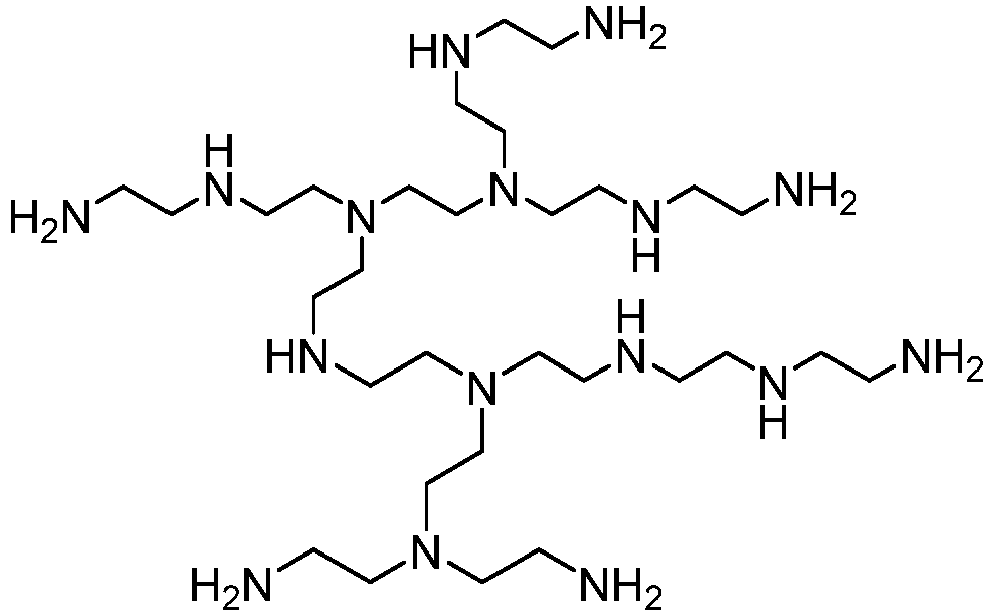
- Polyvinylamine, insbesondere die im Handel unter dem Markennamen Lupamin® (von BASF) erhältlichen Typen.
- aliphatische, cycloaliphatische oder arylaliphatische Polyamine mit einer primären, einer sekundären und gegebenenfalls einer tertiären Aminogruppe, insbesondere N-Methyl-1,2-ethandiamin, N-Ethyl-1,2-ethandiamin, N-Butyl-1,2-ethandiamin, N-Hexyl-1,2-ethandiamin, N-(2-Ethylhexyl)-1,2-ethandiamin, N-Cyclohexyl-1,2-ethandiamin, N-Methyl-1,3-propandiamin, N-Ethyl-1,3-propandiamin, N-Butyl-1,3-propandiamin, N-Hexyl-1,3-propandiamin, N-(2-Ethylhexyl)-1,3-propandiamin, N-Dodecyl-1,3-propandiamin, N-Cyclohexyl-1,3-propandiamin, 3-Methylamino-1-pentylamin, 3-Ethylamino-1-pentylamin, 3-Butylamino-1-pentylamin, 3-Hexylamino-1-pentylamin, 3-(2-Ethylhexyl)amino-1-pentylamin, 3-Dodecylamino-1-pentylamin, 3-Cyclohexylamino-1-pentylamin, 4-Aminomethyl-piperidin, 3-(4-Aminobutyl)-piperidin,N-(2-Aminoethyl)piperazin, N-(2-Aminopropyl)piperazin, N1-((3-Dimethylamino)propyl)-1,3-diaminopropan, sowie 3-aminopropylierte Fettamine wie insbesondere N-Cocoalkyl-1,3-propandiamin, N-Oleyl-1,3-propandiamin, N-Soyaalkyl-1,3-propandiamin, N-Talgalkyl-1,3-propandiamin und N-(C16-22-Alkyl)-1,3-propandiamin, wie sie beispielsweise unter dem Handelsnamen Duomeen® (von Akzo Nobel) erhältlich sind.
- aliphatische, cycloaliphatische oder arylaliphatische Polyamine mit zwei oder drei sekundären Aminogruppen, insbesondere N,N-Dimethyl-1,2-ethandiamin, N,N-Diethyl-1,2-ethandiamin, N,N-Dimethyl-1,3-propandiamin, N,N-Diethyl-1,3-propandiamin, N1,N1-Diethyl-1,4-pentandiamin, sowie sekundäre Polyoxyalkylenamine mit einem mittleren Molekulargewicht im Bereich von 200 bis 2000 g/mol, insbesondere Jeffamine® SD-231, Jeffamine® SD-401, Jeffamine® SD-2001 und Jeffamine® ST-404 (alle von Huntsman).
- Davon bevorzugt sind Polyamine mit mindestens zwei primären Aminogruppen.
Davon bevorzugt sind weiterhin Polyamine mit 2 bis 50, insbesondere 2 bis 20, C-Atomen. - Ein besonders bevorzugtes Polyamin ist ausgewählt aus der Gruppe bestehend aus 1,2-Ethandiamin, 1,3-Propandiamin, 1,2-Propandiamin, 1,4-Butandiamin, 1,3-Butandiamin, 1,2-Butandiamin, 2,3-Butandiamin, 1,3-Pentandiamin (DAMP), 1,5-Diamino-2-methylpentan (MPMD), 1,6-Hexandiamin, 2,2,4- und 2,4,4-Trimethylhexamethylendiamin (TMD), 1,8-Octandiamin, 1,10-Decandiamin, 1,12-Dodecandiamin, 1-Amino-3-aminomethyl-3,5,5-trimethylcyclohexan (= Isophorondiamin oder IPD), 1,3-Bis(aminomethyl)cyclohexan, 1,4-Bis(aminomethyl)cyclohexan,1,3-Bis(aminomethyl)benzol, 2- und 4-Methyl-1,3-diaminocyclohexan und Mischungen davon, N,N-Bis(3-aminopropyl)methylamin, N,N-Bis(3-aminopropyl)ethylamin, Diethylentriamin (DETA), Triethylentetramin (TETA), Tetraethylenpentamin (TEPA), Dipropylentriamin (DPTA), N-(2-Aminoethyl)-1,3-propandiamin (N3-Amin), N,N'-Bis(3-aminopropyl)ethylendiamin (N4-Amin), Bis-hexamethylentriamin (BHMT), N,N'-Bis(aminoethyl)piperazin, N,N'-Bis(aminopropyl)piperazin, Bis-(2-aminoethyl)ether, 3,6-Dioxaoctan-1,8-diamin, 4,7-Dioxadecan-1,10-diamin und Polyoxypropylendiamin mit einem Molekulargewicht im Bereich von etwa 210 bis 500 g/mol, insbesondere Jeffamine® D-230 und Jeffamine® D-400.
Davon bevorzugt sind Polyamine mit 2 bis 18 , insbesondere 2 bis 12, C-Atomen. - Ein Verfahren zur Herstellung eines Katalysators der Formel (I) kann insbesondere auch "in situ", d.h. in Gegenwart des Silangruppen-haltigen Polymers, durchgeführt werden. Dazu werden das Polyamin und Reagens zur Einführung einer Amidin- oder Guanidin-Gruppe mit dem Silangruppen-haltigen Polymer vermischt und bei einer Temperatur im Bereich von 40 bis 120 °C umgesetzt. Die in situ-Umsetzung kann insbesondere auch in Gegenwart weiterer Inhaltsstoffe, wie sie für Zusammensetzungen auf Basis Silangruppen-haltiger Polymere typisch sind, durchgeführt werden.
Besonders bevorzugt ist dieses Verfahren für die Herstellung eines Guanidingruppen aufweisenden Katalysators der Formel (I) aus der Umsetzung eines Polyamins mit einem Carbodiimid.
Überraschenderweise kann die Umsetzung zu einem Katalysator der Formel (I) auch in einem voll formulierten Dichtstoff oder Klebstoff oder einer voll formulierten Beschichtung erfolgen, also auch in Gegenwart von beispielsweise Trocknungsmitteln und/oder Weichmachern und/oder Füllstoffen und/oder Rheologie-Modifizierern. Die in-situ Herstellung des Katalysators der Formel (I) in der Zusammensetzung ist besonders vorteilhaft, da der Katalysator somit erst mit einer gewissen zeitlichen Verzögerung entsteht und dadurch den Compoundierprozess wenig stört. Dies kann in der Praxis einen bedeutenden Vorteil darstellen, beispielsweise im Fall von feuchten Bestandteilen wie Füllstoffen, die so in der Zusammensetzung mit Trocknungsmitteln getrocknet werden können und deren Feuchtigkeit somit nicht unter Einbezug des Katalysators mit Silangruppen des Silangruppen-haltigen Polymers reagieren. Dadurch wird die Viskosität der Zusammensetzung nicht unerwünscht erhöht. - Das Silangruppen-haltige Polymer ist in einer Ausführungsform ein Polyorganosiloxan mit endständigen Silangruppen, welches bevorzugt die Formel (III) aufweist,

- R, R' und R" unabhängig voneinander jeweils für einen einwertigen Kohlenwasserstoff-Rest mit 1 bis 12 C-Atomen stehen;
- X für einen Hydroxyl-Rest oder für einen Alkoxy-, Acetoxy-, Ketoximato-, Amido- oder Enoxy-Rest mit 1 bis 13 C-Atomen steht;
- a für 0, 1 oder 2 steht; und
- m für eine ganze Zahl im Bereich von 50 bis etwa 2'500 steht.
- R steht bevorzugt für Methyl, Vinyl oder Phenyl.
R' und R" stehen bevorzugt unabhängig voneinander jeweils für einen Alkylrest mit 1 bis 5, bevorzugt 1 bis 3 C-Atomen, insbesondere für Methyl.
X steht bevorzugt für einen Hydroxyl-Rest oder für einen Alkoxy- oder Ketoximato-Rest mit 1 bis 6 C-Atomen, insbesondere für einen Hydroxyl-, Methoxy-, Ethoxy-, Methylethylketoximato- oder Methylisobutylketoximato-Rest. Besonders bevorzugt steht X für einen Hydroxylrest.
a steht bevorzugt für 0 oder 1, insbesondere für 0.
Weiterhin ist m bevorzugt so gewählt, dass das Polyorganosiloxan der Formel (III) bei Raumtemperatur eine Viskosität im Bereich von 100 bis 500'000 mPa·s, insbesondere von 1000 bis 100'000 mPa·s, aufweist. - Solche Polyorganosiloxane sind gut handhabbar und vernetzen mit Feuchtigkeit und/oder Silanvernetzern zu festen Silicon-Polymeren mit elastischen Eigenschaften.
Geeignete kommerziell erhältliche Polyorganosiloxane sind beispielsweise erhältlich von Wacker, Momentive Performance Material, GE Advanced Materials, Dow Corning, Bayer oder Shin Etsu. - Bevorzugt enthält die Zusammensetzung zusätzlich zum Polyorganosiloxan mit endständigen Silangruppen einen Silanvernetzer, insbesondere ein Silan der Formel (IV),
(R'")q-Si-(X')4-q (IV)
wobei - R'" für einen einwertigen Kohlenwasserstoff-Rest mit 1 bis 12 C-Atomen steht,
- X' für einen Hydroxyl-Rest oder für einen Alkoxy-, Acetoxy-, Ketoximato-, Amido- oder Enoxy-Rest mit 1 bis 13 C-Atomen steht; und
- q für einen Wert von 0, 1 oder 2, insbesondere für 0 oder 1, steht.
- Besonders geeignete Silane der Formel (IV) sind Methyltrimethoxysilan, Ethyltrimethoxysilan, Propytrimethoxysilan, Vinyltrimethoxysilan, Methyltriethoxysilan, Vinyltriethoxysilan, Phenyltriethoxysilan, Tetramethoxysilan, Tetraethoxysilan, Methyltris(methylethylketoximo)silan, Vinyltris(methylethylketoximo)silan und Methyltris(isobutyl ketoximo)silan.
- Das Silangruppen-haltige Polymer ist in einer bevorzugten Ausführungsform der Erfindung ein Silangruppen-haltiges organisches Polymer, insbesondere ein Polyolefin, Polyester, Polyamid, Poly(meth)acrylat oder Polyether oder eine Mischform dieser Polymere, welches jeweils eine oder bevorzugt mehrere Silangruppen trägt. Die Silangruppen können seitlich in der Kette oder endständig stehen und sind über ein C-Atom an das organische Polymer gebunden. Besonders bevorzugt ist das Silangruppen-haltige organische Polymer ein Silangruppen-haltiges Polyolefin oder ein Silangruppen-haltiger Polyester oder ein Silangruppen-haltiges Poly(meth)acrylat oder ein Silangruppen-haltiger Polyether oder eine Mischform dieser Polymere. Am meisten bevorzugt ist ein Silangruppen-haltiger Polyether.
- Als Silangruppen am organischen Polymer bevorzugt sind Alkoxysilangruppen, insbesondere Endgruppen der Formel (V),

- R7 für einen linearen oder verzweigten, einwertigen Kohlenwasserstoffrest mit 1 bis 5 C-Atomen, insbesondere für Methyl oder für Ethyl oder für Isopropyl, steht;
- R8 für einen linearen oder verzweigten, einwertigen Kohlenwasserstoffrest mit 1 bis 8 C-Atomen, insbesondere für Methyl oder für Ethyl, steht; und
- x für einen Wert von 0 oder 1 oder 2, bevorzugt für 0 oder 1, insbesondere für 0, steht.
- Für bestimmte Anwendungen steht der Rest R7 bevorzugt für eine Ethylgruppe, da in diesem Fall bei der Aushärtung der Zusammensetzung ökologisch und toxikologisch harmloses Ethanol freigesetzt wird.
Besonders bevorzugt sind Trimethoxysilangruppen, Dimethoxymethylsilangruppen oder Triethoxysilangruppen.
Dabei weisen Methoxysilangruppen den Vorteil auf, dass sie besonders reaktiv sind, und Ethoxysilangruppen weisen den Vorteil auf, dass sie toxikologisch vorteilhaft und besonders lagerstabil sind. - Das Silangruppen-haltige organische Polymer weist im Mittel bevorzugt 1.3 bis 4, insbesondere 1.5 bis 3, besonders bevorzugt 1.7 bis 2.8 Silangruppen pro Molekül auf. Die Silangruppen sind bevorzugt endständig.
Das Silangruppen-haltige organische Polymer weist bevorzugt ein mittleres Molekulargewicht, bestimmt mittels GPC gegenüber Polystyrol-Standard, im Bereich von 1000 bis 30'000 g/mol, insbesondere von 2000 bis 20'000 g/mol, auf. Das Silangruppen-haltige organische Polymer weist bevorzugt ein Silan-Equivalentgewicht von 300 bis 25'000 g/Eq, insbesondere von 500 bis 15'000 g/Eq, auf. - Das Silangruppen-haltige organische Polymer kann bei Raumtemperatur fest oder flüssig vorliegen. Bevorzugt ist es bei Raumtemperatur flüssig.
- Meist bevorzugt handelt es sich beim Silangruppen-haltigen organischen Polymer um einen bei Raumtemperatur flüssigen Silangruppen-haltigen Polyether, wobei die Silangruppen insbesondere Dialkoxysilangruppen und/oder Trialkoxysilangruppen, besonders bevorzugt Trimethoxysilangruppen oder Triethoxysilangruppen, sind.
- Verfahren zur Herstellung von Silangruppen-haltigen Polyethern sind dem Fachmann bekannt.
In einem Verfahren sind Silangruppen-haltige Polyether erhältlich aus der Umsetzung von Allylgruppen-haltigen Polyethern mit Hydrosilanen, gegebenenfalls unter Kettenverlängerung mit beispielsweise Diisocyanaten. - In einem weiteren Verfahren sind Silangruppen-haltige Polyether erhältlich aus der Copolymerisation von Alkylenoxiden und Epoxysilanen, gegebenenfalls unter Kettenverlängerung mit beispielsweise Diisocyanaten.
In einem weiteren Verfahren sind Silangruppen-haltige Polyether erhältlich aus der Umsetzung von Polyetherpolyolen mit Isocyanatosilanen, gegebenenfalls unter Kettenverlängerung mit Diisocyanaten.
In einem weiteren Verfahren sind Silangruppen-haltige Polyether erhältlich aus der Umsetzung von Isocyanatgruppen-haltigen Polyethern, insbesondere NCO-terminierten Urethan-Polyethern aus der Umsetzung von Polyetherpolyolen mit einer überstöchiometischen Menge an Polyisocyanaten, mit Aminosilanen, Hydroxysilanen oder Mercaptosilanen. Silangruppen-haltige Polyether aus diesem Verfahren sind besonders bevorzugt. Dieses Verfahren ermöglicht den Einsatz einer Vielzahl von kommerziell gut verfügbaren, kostengünstigen Ausgangsmaterialien, womit unterschiedliche Polymereigenschaften erhalten werden können, beispielsweise eine hohe Dehnbarkeit, eine hohe Festigkeit, ein niedriges Elastizitätsmodul, ein tiefer Glasübergangspunkt oder eine hohe Witterungsbeständigkeit. - Besonders bevorzugt ist der Silangruppen-haltige Polyether erhältlich aus der Umsetzung von NCO-terminierten Urethan-Polyethern mit Aminosilanen oder Hydroxysilanen. Geeignete NCO-terminierte Urethan-Polyether sind erhältlich aus der Umsetzung von Polyetherpolyolen, insbesondere Polyoxyalkylendiolen oder Polyoxyalkylentriolen, bevorzugt Polyoxypropylendiolen oder Polyoxypropylentriolen, mit einer überstöchiometrischen Menge an Polyisocyanaten, insbesondere Diisocyanaten.
Bevorzugt wird die Umsetzung zwischen dem Polyisocyanat und dem Polyetherpolyol unter Feuchtigkeitsausschluss bei einer Temperatur von 50 °C bis 160 °C durchgeführt, gegebenenfalls in Anwesenheit geeigneter Katalysatoren, wobei das Polyisocyanat so dosiert ist, dass dessen Isocyanatgruppen im Verhältnis zu den Hydroxylgruppen des Polyols im stöchiometrischen Überschuss vorhanden sind. Insbesondere wird der Überschuss an Polyisocyanat so gewählt, dass im resultierenden Urethan-Polyether nach der Umsetzung aller Hydroxylgruppen ein Gehalt an freien Isocyanatgruppen von 0.1 bis 5 Gewichts-%, bevorzugt 0.2 bis 4 Gewichts-%, besonders bevorzugt 0.3 bis 3 Gewichts-%, bezogen auf das gesamte Polymer, verbleibt.
Bevorzugte Diisocyanate sind ausgewählt aus der Gruppe bestehend aus 1,6-Hexamethylendiisocyanat (HDI), 1-Isocyanato-3,3,5-trimethyl-5-isocyanatomethyl-cyclohexan (=Isophorondiisocyanat oder IPDI), 2,4- und 2,6-Toluylendiisocyanat und beliebige Gemische dieser Isomeren (TDI) und 4,4'-, 2,4'- und 2,2'-Diphenylmethandiisocyanat und beliebige Gemische dieser Isomeren (MDI). Besonders bevorzugt sind IPDI oder TDI. Meist bevorzugt ist IPDI. Damit werden Silangruppen-haltige Polyether mit besonders guter Lichtechtheit erhalten. - Speziell geeignet als Polyetherpolyole sind Polyoxyalkylendiole oder Polyoxyalkylentriole mit einem Ungesättigtheitsgrad tiefer als 0.02 mEq/g, insbesondere tiefer als 0.01 mEq/g, und einem mittleren Molekulargewicht im Bereich von 400 bis 25'000 g/mol, insbesondere 1000 bis 20'000 g/mol.
Neben Polyetherpolyolen können anteilig auch andere Polyole eingesetzt werden, insbesondere Polyacrylatpolyole, sowie niedrigmolekulare Diole oder Triole. - Geeignete Aminosilane für die Umsetzung mit einem NCO-terminierten Urethan-Polyether sind primäre und sekundäre Aminosilane. Bevorzugt sind 3-Aminopropyltrimethoxysilan, 3-Aminopropyldimethoxymethylsilan, 4-Aminobutyl-trimethoxysilan, 4-Amino-3-methylbutyl-trimethoxysilan, 4-Amino-3,3-dimethylbutyl-trimethoxysilan, N-Butyl-3-aminopropyltrimethoxysilan, N-Phenyl-3-aminopropyltrimethoxysilan, Addukte aus primären Aminosilanen wie 3-Aminopropyltrimethoxysilan, 3-Aminopropyldimethoxymethylsilan oder N-(2-Aminoethyl)-3-aminopropyltrimethoxysilan und Michael-Akzeptoren wie Acrylnitril, (Meth)acrylsäureestern, (Meth)acrylsäureamiden, Maleinsäure- oder Fumarsäurediestern, Citraconsäurediestern oder Itaconsäurediestern, insbesondere N-(3-Trimethoxysilylpropyl)amino-bernsteinsäuredimethyl- oder -diethylester. Ebenfalls geeignet sind Analoga der genannten Aminosilane mit Ethoxy- oder Isopropoxygruppen anstelle der Methoxygruppen am Silicium. Geeignete Hydroxysilane für die Umsetzung mit einem NCO-terminierten Urethan-Polyether sind insbesondere erhältlich aus der Addition von Aminosilanen an Lactone oder an cyclische Carbonate oder an Lactide.
Dafür geeignete Aminosilane sind insbesondere 3-Aminopropyl-trimethoxysilan, 3-Aminopropyl-triethoxysilan, 4-Aminobutyl-trimethoxysilan, 4-Aminobutyl-triethoxysilan, 4-Amino-3-methylbutyl-trimethoxysilan, 4-Amino-3-methylbutyl-triethoxysilan, 4-Amino-3,3-dimethylbutyl-trimethoxysilan, 4-Amino-3,3-dimethylbutyl-triethoxysilan, 2-Aminoethyl-trimethoxysilan oder 2-Aminoethyltriethoxysilan. Besonders bevorzugt sind 3-Aminopropyl-trimethoxysilan, 3-Aminopropyl-triethoxysilan, 4-Amino-3,3-dimethylbutyl-trimethoxysilan oder 4-Amino-3,3-dimethylbutyl-triethoxysilan.
Als Lactone geeignet sind insbesondere γ-Valerolacton, γ-Octalacton, δ-Decalacton, und ε-Decalacton, insbesondere γ-Valerolacton.
Als cyclische Carbonate eignen sich insbesondere 4,5-Dimethyl-1,3-dioxolan-2-on, 4,4-Dimethyl-1,3-dioxolan-2-on, 4-Ethyl-1,3-dioxolan-2-on, 4-Methyl-1,3-dioxolan-2-on oder 4-(Phenoxymethyl)-1,3-dioxolan-2-on.
Als Lactide eignen sich insbesondere 1,4-Dioxan-2,5-dion (Lactid aus 2-Hydroxyessigsäure, auch "Glycolid" genannt), 3,6-Dimethyl-1,4-dioxan-2,5-dion (Lactid aus Milchsäure, auch "Lactid" genannt) und 3,6-Diphenyl-1,4-dioxan-2,5-dion (Lactid aus Mandelsäure).
Bevorzugte Hydroxysilane, welche auf diese Weise erhalten werden, sind N-(3-Triethoxysilylpropyl)-2-hydroxypropanamid, N-(3-Trimethoxysilylpropyl)-2-hydroxypropanamid, N-(3-Triethoxysilylpropyl)-4-hydroxypentanamid, N-(3-Triethoxysilylpropyl)-4-hydroxyoctanamid, N-(3-Triethoxysilylpropyl)-5-hydroxydecanamid und N-(3-Triethoxysilylpropyl)-2-hydroxypropylcarbamat. - Weiterhin sind geeignete Hydroxysilane auch erhältlich aus der Addition von Aminosilanen an Epoxide oder aus der Addition von Aminen an Epoxysilane. Bevorzugte Hydroxysilane, welche auf diese Weise erhalten werden, sind 2-Morpholino-4(5)-(2-trimethoxysilylethyl)cyclohexan-1-ol, 2-Morpholino-4(5)-(2-triethoxysilylethyl)cyclohexan-1-ol oder 1-Morpholino-3-(3-(triethoxysilyl)propoxy)propan-2-ol.
- Als Silangruppen-haltige Polyether sind auch kommerziell erhältliche Produkte geeignet, insbesondere die Folgenden: MS Polymer™ (von Kaneka Corp.; insbesondere die Typen S203H, S303H, S227, S810, MA903 und S943); MS Polymer™ bzw. Silyl™ (von Kaneka Corp.; insbesondere die Typen SAT010, SAT030, SAT200, SAX350, SAX400, SAX725, MAX450, MAX951); Excestar® (von Asahi Glass Co. Ltd.; insbesondere die Typen S2410, S2420, S3430, S3630); SPUR+* (von Momentive Performance Materials; insbesondere die Typen 1010LM, 1015LM, 1050MM); Vorasil™ (von Dow Chemical Co.; insbesondere die Typen 602 und 604); Desmoseal® (von Bayer MaterialScience AG; insbesondere die Typen S XP 2458, S XP 2636, S XP 2749, S XP 2774 und S XP 2821), TEGOPAC® (von Evonik Industries AG; insbesondere die Typen Seal 100, Bond 150, Bond 250), Polymer ST (von Hanse Chemie AG/Evonik Industries AG, insbesondere die Typen 47, 48, 61, 61LV, 77, 80, 81); Geniosil® STP (von Wacker Chemie AG; insbesondere die Typen E10, E15, E30, E35).
- Besonders bevorzugte Endgruppen der Formel (V) sind Endgruppen der Formel (VI),
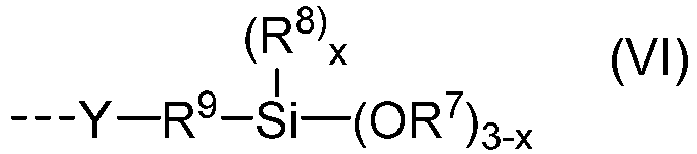
- R9 für einen linearen oder verzweigten, zweiwertigen Kohlenwasserstoffrest mit 1 bis 12 C-Atomen, welcher gegebenenfalls cyclische und/oder aromatische Anteile und gegebenenfalls ein oder mehrere Heteroatome, insbesondere ein oder mehrere Stickstoffatome, aufweist, steht;
- Y für einen zweiwertigen Rest ausgewählt aus -O-, -S-, -N(R10)-, -O-CO-N(R10)-, -N(R10)-CO-O- und -N(R10)-CO-N(R10)- steht,
wobei R10 für Wasserstoff oder für einen linearen oder verzweigten Kohlenwasserstoff-Rest mit 1 bis 20 C-Atomen, welcher gegebenenfalls cyclische Anteile aufweist, und welcher gegebenenfalls eine Alkoxysilyl-, Ether- oder Carbonsäureestergruppe aufweist, steht; und - R7, R8 und x die bereits genannten Bedeutungen aufweisen.
- Besonders bevorzugt steht R9 für 1,3-Propylen.
- Zusätzlich zum Katalysator der Formel (I) kann die erfindungsgemässe Zusammensetzung weitere Katalysatoren für die Vernetzung der Silangruppen enthalten. Als weitere Katalysatoren geeignet sind insbesondere Metall-Katalysatoren und/oder basische Stickstoff- oder Phosphorverbindungen.
- Mögliche Metall-Katalysatoren sind insbesondere Verbindungen von Zinn, Titan, Zirkonium, Aluminium oder Zink, insbesondere Diorganozinn(IV)-Verbindungen wie insbesondere Dibutylzinn(IV)-diacetat, Dibutylzinn(IV)-dilaurat, Dibutylzinn(IV)-dineodecanoat oder Dibutylzinn(IV)-bis(acetylacetonat) und Dioctylzinn(IV)-dilaurat, sowie Titan(IV)- oder Zirkonium(IV)- oder Aluminium(III)- oder Zink(II)-Komplexe mit insbesondere Alkoxy-, Carboxylat-, 1,3-Diketonat-, 1,3-Ketoesterat- oder 1,3-Ketoamidat-Liganden.
- Mögliche basische Stickstoff- oder Phosphorverbindungen sind insbesondere Imidazole, Pyridine, Phosphazen-Basen oder bevorzugt Amine, Hexahydrotriazine oder Biguanide sowie Amidine oder Guanidine, welche nicht der Formel (I) entsprechen.
- Geeignete Amine sind insbesondere Alkyl-, Cycloalkyl- oder Aralkylamine wie Triethylamin, Triisopropylamin, 1-Butylamin, 2-Butylamin, tert.Butylamin, 3-Methyl-1-butylamin, 3-Methyl-2-butylamin, Dibutylamin, Tributylamin, Hexylamin, Dihexylamin, Cyclohexylamin, Dicyclohexylamin, Dimethylcyclohexylamin, Benzylamin, Dibenzylamin, Dimethylbenzylamin, Octylamin, 2-Ethylhexylamin, Di-(2-ethylhexyl)amin, Laurylamin, N,N-Dimethyl-laurylamin, Stearylamin, N,N-Dimethyl-stearylamin; von natürlichen Fettsäuregemischen abgeleitete Fettamine, wie insbesondere Cocoalkylamin, N,N-Dimethyl-cocoalkylamin, C16-22-Alkylamin, N,N-Dimethyl-C16-22-alkylamin, Soyaalkylamin, N,N-Dimethyl-soyaalkylamin, Oleylamin, N,N-Dimethyl-oleylamin, Talgalkylamin oder N,N-Dimethyl-talgalkylamin, erhältlich beispielsweise unter den Handelsnamen Armeen® (von Akzo Nobel) oder Rofamin® (von Ecogreen Oleochemicals); aliphatische, cycloaliphatische oder araliphatische Diamine wie Ethylendiamin, Butandiamin, Hexamethylendiamin, Dodecandiamin, Neopentandiamin, 2-Methyl-pentamethylendiamin (MPMD), 2,2(4),4-Trimethylhexamethylendiamin (TMD), Isophorondiamin (IPD), 2,5(2,6)-Bis-(aminomethyl)-bicyclo[2.2.1]heptan (NBDA), 1,3-Xylylendiamin (MXDA), N,N'-Di(tert.butyl)ethylendiamin, N,N,N',N'-Tetramethyl-ethylendiamin, N,N,N',N'-Tetramethyl-propylendiamin, N,N,N',N'-Tetramethyl-hexamethylendiamin, 3-Dimethylaminopropylamin, 3-(Methylamino)propylamin, 3-(Cyclohexylamino)propylamin, Piperazin, N-Methylpiperazin, N,N'-Dimethylpiperazin, 1,4-Diazabicyclo[2.2.2]octan, Fettpolyamine wie N-Cocoalkyl-1,3-propandiamin, N-Oleyl-1,3-propandiamin, N-Soyaalkyl-1,3-propandiamin, N-Talgalkyl-1,3-propandiamin oder N-(C16-22-Alkyl)-1,3-propandiamin, erhältlich beispielsweise unter dem Handelsnamen Duomeen® (von Akzo Nobel); Polyalkylenamine wie Diethylentriamin, Dipropylentriamin, Triethylentetramin (TETA), Tetraethylenpentamin (TEPA), Pentamethylenhexamin (PEHA), 3-(2-Aminoethyl)aminopropylamin, N,N'-Bis(3-aminopropyl)ethylendiamin, N-(3-Aminopropyl)-N-methylpropandiamin, Bis(3-dimethylaminopropyl)amin, N-(3-Dimethylaminopropyl)-1,3-propylendiamin, N-(2-Aminoethyl)piperazin (N-AEP), N-(2-Aminopropyl)piperazin, N,N'-Di-(2-aminoethyl)piperazin, 1-Methyl-4-(2-dimethylaminoethyl)piperazin, N,N,N',N",N"-Pentamethyldiethylentriamin, N,N,N',N",N"-Pentamethyldipropylentriamin, Polyethylenimine, erhältlich beispielsweise unter den Handelsnamen Lupasol® (von BASF) und Epomin® (von Nippon Shokubai); Etheramine, wie insbesondere 2-Methoxyethylamin, 2-Ethoxyethylamin, 3-Methoxypropylamin, 3-Ethoxypropylamin, 3-(2-Ethylhexyloxy)propylamin, 3-(2-Methoxyethoxy)propylamin, 2(4)-Methoxyphenylethylamin, Morpholin, N-Methylmorpholin, N-Ethylmorpholin, 2-Aminoethylmorpholin, Bis(2-aminoethyl)ether, Bis(dimethylaminoethyl)-ether, Bis(dimorpholinoethyl)ether, N,N,N'-Trimethyl-N'-hydroxyethylbis(2-aminoethyl)ether, 3,6-Dioxaoctan-1,8-diamin, 4,7-Dioxadecan-1,10-diamin, 4,7-Dioxadecan-2,9-diamin, 4,9-Dioxadodecan-1,12-diamin, 5,8-Dioxadodecan-3,10-diamin, 4,7,10-Trioxatridecan-1,13-diamin oder 2-Aminopropyl-terminierte Glykole, wie sie beispielsweise unter dem Handelsnamen Jeffamin® (von Huntsman) erhältlich sind; Aminoalkohole, wie insbesondere Ethanolamin, Isopropanolamin, Diethanolamin, Diisopopanolamin, Triethanolamin, Triisopropanolamin, N-Butylethanolamin, Diglykolamin, N,N-Diethylethanolamin, N-Methyldiethanolamin, N-Methyldiisopropylamin, N,N,N'-Trimethylaminoethyl-ethanolamin, N-(3-Dimethylaminopropyl)-N,N-diisopropanolamin, N,N-Bis(3-dimethylaminopropyl)-N-isopropanolamin, 2-(2-Dimethylaminoethoxy)ethanolamin oder Addukte aus Mono- und Polyaminen mit Epoxiden oder Diepoxiden; Phenolgruppen-haltige Amine, wie insbesondere Kondensationsprodukte aus Phenolen, Aldehyden und Aminen (sogenannte Mannich-Basen und Phenalkamine) wie insbesondere 2-(Dimethylaminomethyl)phenol, 2,4,6-Tris(dimethylaminomethyl)phenol oder Polymere aus Phenol, Formaldehyd und N,N-Dimethyl-1,3-propandiamin sowie im Handel unter den Markennamen Cardolite® (von Cardolite), Aradur® (von Huntsman) und Beckopox® (von Cytec) erhältliche Phenalkamine; Amidgruppen-haltige Polyamine, sogenannte Polyamidoamine, wie sie im Handel erhältlich sind, beispielsweise unter den Markennamen Versamid® (von Cognis), Aradur® (von Huntsman), Euretek® (von Huntsman) oder Beckopox® (von Cytec); oder Aminosilane, wie insbesondere 3-Aminopropyltrimethoxysilan, 3-Aminopropyldimethoxymethylsilan, N-(2-Aminoethyl)-3-aminopropyltrimethoxysilan, N-(2-Aminoethyl)-3-aminopropyl-methyldimethoxysilan, N-(2-Aminoethyl)-N'-[3-(trimethoxysilyl)propyl]ethylendiamin oder deren Analoga mit Ethoxy- anstelle der Methoxygruppen am Silicium.
Geeignete Triazine sind insbesondere 1,3,5-Hexahydrotriazin oder 1,3,5-Tris(3-(dimethylamino)propyl)-hexahydrotriazin.
Geeignete Biguanide sind insbesondere Biguanid, 1-Butylbiguanid, 1,1-Dimethylbiguanid, 1-Butylbiguanid, 1-Phenylbiguanid oder 1-(o-Tolyl)biguanid (OTBG).
Geeignete Amidine, welche nicht der Formel (I) entsprechen, sind insbesondere 1,8-Diazabicyclo[5.4.0]undec-7-en (DBU), 1,5-Diazabicyclo[4.3.0]non-5-en (DBN), 6-Dibutylamino-1,8-diazabicyclo[5.4.0]undec-7-en, 6-Dibutylamino-1,8-diazabicyclo[5.4.0]undec-7-en, N,N'-Di-n-hexylacetamidin (DHA), 2-Methyl-1,4,5,6-tetrahydropyrimidin, 1,2-Dimethyl-1,4,5,6-tetrahydropyrimidin, 2,5,5-Trimethyl-1,4,5,6-tetrahydropyrimidin, N-(3-Trimethoxysilylpropyl)-4,5-dihydroimidazol oder N-(3-Triethoxysilylpropyl)-4,5-dihydroimidazol. - Geeignete Guanidine, welche nicht der Formel (I) entsprechen, sind insbesondere 1-Butylguanidin, 1,1-Dimethylguanidin, 1,3-Dimethylguanidin, 1,1,3,3-Tetramethylguanidin (TMG), 2-(3-(Trimethoxysilyl)propyl)-1,1,3,3-tetramethylguanidin, 2-(3-(Methyldimethoxysilyl)propyl)-1,1,3,3-tetramethylguanidin, 2-(3-(Triethoxysilyl)propyl)-1,1,3,3-tetramethylguanidin, 1,5,7-Triazabicyclo[4.4.0]-dec-5-en (TBD), 7-Methyl-1,5,7-triazabicyclo[4.4.0]dec-5-en, 7-Cyclohexyl-1,5,7-triazabicyclo[4.4.0]dec-5-en, 1-Phenylguanidin, 1-(o-Tolyl)guanidin (OTG), 1,3-Diphenylguanidin, 1,3-Di(o-tolyl)guanidin oder 2-Guanidinobenzimidazol.
- Weiterhin kann die erfindungsgemässe Zusammensetzung als Co-Katalysator eine Säure enthalten, insbesondere eine Carbonsäure. Bevorzugt sind aliphatische Carbonsäuren wie Ameisensäure, Laurinsäure, Stearinsäure, Isostearinsäure, Ölsäure, 2-Ethyl-2,5-dimethylcapronsäure, 2-Ethylhexansäure, Neodecansäure, Fettsäuregemische aus der Verseifung von natürlichen Fetten und Ölen oder Di- und Polycarbonsäuren, insbesondere Poly(meth)acrylsäuren.
- Die erfindungsgemässe Zusammensetzung ist in einer bevorzugten Ausführungsform im Wesentlichen frei von Organozinn-Verbindungen. Organozinnfreie Zusammensetzungen sind hinsichtlich Gesundheitsschutz und Umweltschutz vorteilhaft. Insbesondere beträgt der Zinngehalt der Zusammensetzung weniger als 0.1 Gew.-%, insbesondere weniger als 0.05 Gew.-%.
- In einer Ausführungsform der Erfindung enthält die Zusammensetzung neben dem Silangruppen-haltigen organischen Polymer und einem Katalysator der Formel (I) zusätzlich mindestens ein Organotitanat. Eine Kombination aus Katalysator der Formel (I) und Organotitanat weist eine besonders hohe katalytische Aktivität auf. Dadurch wird eine schnelle Aushärtung der Zusammensetzung bei verhältnismässig geringer Einsatzmenge des Katalysators der Formel (I) ermöglicht.
Als Organotitanat geeignet sind insbesondere Titan(IV)-Komplexverbindungen. Bevorzugte Organoititanate sind insbesondere ausgewählt aus - Titan(IV)-Komplexverbindungen mit zwei 1,3-Diketonat-Liganden, insbesondere 2,4-Pentandionat (=Acetylacetonat), und zwei Alkoholat-Liganden;
- Titan(IV)-Komplexverbindungen mit zwei 1,3-Ketoesterat-Liganden, insbesondere Ethylacetoacetat, und zwei Alkoholat-Liganden;
- Titan(IV)-Komplexverbindungen mit einem oder mehreren Aminoalkoholat-Liganden, insbesondere Triethanolamin oder 2-((2-Aminoethyl)amino)ethanol, und einem oder mehreren Alkoholat-Liganden;
- Titan(IV)-Komplexverbindungen mit vier Alkoholat-Liganden;
- sowie höherkondensierte Organotitanate, insbesondere oligomeres Titan(IV)-tetrabutanolat, auch als Polybutyltitanat bezeichnet;
- Insbesondere geeignet sind die kommerziell erhältlichen Typen Tyzor® AA, GBA, GBO, AA-75, AA-65, AA-105, DC, BEAT, BTP, TE, TnBT, KTM, TOT, TPT oder IBAY (alle von Dorf Ketal); Tytan PBT, TET, X85, TAA, ET, S2, S4 oder S6 (alle von Borica Company Ltd.) und Ken-React® KR® TTS, 7, 9QS, 12, 26S, 33DS, 38S, 39DS, 44, 134S, 138S, 133DS, 158FS oder LICA® 44 (alle von Kenrich Petrochemicals).
- Ganz besonders geeignete Organotitanate sind ausgewählt aus Bis(ethylacetoacetato)diisobutoxy-titan(IV) (kommerziell erhältlich beispielsweise als Tyzor® IBAY von Dorf Ketal), Bis(ethylacetoacetato)diisopropoxy-titan(IV) (kommerziell erhältlich beispielsweise als Tyzor® DC von Dorf Ketal), Bis(acetylacetonato)diisopropoxy-titan(IV), Bis(acetylacetonato)diisobutoxy-titan(IV), Tris(oxyethyl)-amin-isopropoxy-titan(IV), Bis[tris(oxyethyl)amin]diisopropoxy-titan(IV), Bis(2-ethylhexan-1,3-dioxy)-titan(IV), Tris[2-((2-Aminoethyl)amino)ethoxy]ethoxy-titan(IV), Bis(neopentyl(diallyl)oxy)-diethoxy-titan(IV), Titan(IV)-tetrabutanolat, Tetra(2-ethylhexyloxy)titanat, Tetra(isopropoxy)titanat und Polybutyltitanat. Am meisten bevorzugt sind Bis(ethylacetoacetato)diisobutoxy-titan(IV) oder Bis(ethylacetoacetato)diisopropoxy-titan(IV).
- In einer Organotitanat-haltigen Zusammensetzung liegt das Gewichtsverhältnis zwischen dem Silangruppen-haltigen Polymer und dem Katalysator der Formel (I) bevorzugt im Bereich von 40/1 bis 2000/1.
Das Gewichtsverhältnis zwischen dem Organotitanat und dem Katalysator der Formel (I) liegt bevorzugt im Bereich von 10/1 bis 1/10, besonders bevorzugt 5/1 bis 1/5, insbesondere 5/1 bis 1/3. - Die erfindungsgemässe Zusammensetzung kann weitere Bestandteile enthalten, insbesondere die folgenden Hilfs- und Zusatzmittel:
- Haftvermittler und/oder Vernetzer, insbesondere Aminosilane wie insbesondere 3-Aminopropyl-trimethoxysilan, 3-Aminopropyl-dimethoxymethylsilan, N-(2-Aminoethyl)-3-aminopropyl-trimethoxysilan, N-(2-Aminoethyl)-3-aminopropyl-dimethoxymethylsilan, N-(2-Aminoethyl)-N'-[3-(trimethoxysilyl)propyl]ethylendiamin oder deren Analoga mit Ethoxy- anstelle von Methoxygruppen, weiterhin N-Phenyl-, N-Cyclohexyl- oder N-Alkylaminosilane, Mercaptosilane, Epoxysilane, (Meth)acrylosilane, Anhydridosilane, Carbamatosilane, Alkylsilane oder Iminosilane, oligomere Formen dieser Silane, Addukte aus primären Aminosilanen mit Epoxysilanen oder (Meth)acrylosilanen oder Anhydridosilanen, aminofunktionelle Alkylsilsesquioxane, insbesondere aminofunktionelles Methylsilsesquioxan oder aminofunktionelles Propylsilsesquioxan. Insbesondere geeignet sind 3-Aminopropyltrimethoxysilan, 3-Aminopropyltriethoxysilan, N-(2-Aminoethyl)-3-aminopropyltrimethoxysilan, N-(2-Aminoethyl)-3-aminopropyl-triethoxysilan, 3-Glycidoxypropyltrimethoxysilan, 3-Glycidoxypropyltriethoxysilan oder 3-Ureidopropyltrimethoxysilan, oder oligomere Formen dieser Silane;
- Trocknungsmittel, insbesondere Tetraethoxysilan, Vinyltrimethoxysilan, Vinyltriethoxysilan oder Organoalkoxysilane, welche in α-Stellung zur Silangruppe eine funktionelle Gruppe aufweisen, insbesondere N-(Methyldimethoxysilylmethyl)-O-methyl-carbamat, (Methacryloxymethyl)silane, Methoxymethylsilane, Orthoameisensäureester, Calciumoxid oder Molekularsiebe, insbesondere Vinyltrimethoxysilan oder Vinyltriethoxysilan;
- Weichmacher, insbesondere trialkylsilylterminierte Polydialkylsiloxane wie insbesondere trimethylsilylterminierte Polydimethylsiloxane, insbesondere mit Viskositäten im Bereich von 10 bis 1'000 mPa·s, oder entsprechende Verbindungen, bei denen einige der Methylgruppen ersetzt sind durch andere organische Gruppen, insbesondere Phenyl-, Vinyl- oder Trifluorpropylgruppen, sogenannte Reaktivweichmacher in Form von monofunktionellen, also einseitig reaktiven, Polysiloxanen, Carbonsäureester wie Phthalate, insbesondere Dioctylphthalat, Bis(2-ethylhexyl)phthalat, Bis(3-propylheptyl)phthalat, Diisononylphthalat oder Diisodecylphthalat, Diester von ortho-Cyclohexandicarbonsäure, insbesondere Diisononyl-1,2-cyclohexandicarboxylat, Adipate, insbesondere Dioctyladipat, Bis(2-Ethylhexyl)adipat, Azelate, insbesondere Bis(2-ethylhexyl)acelat, Sebacate, insbesondere Bis(2-ethylhexyl)sebacat oder Diisononylsebacat, Polyole, insbesondere Polyoxyalkylenpolyole oder Polyesterpolyole, Glykolether, Glykolester, organische Phosphor- oder Sulfonsäureester, Sulfonsäureamide, Polybutene oder von natürlichen Fetten oder Ölen abgeleitete Fettsäuremethyl- oder -ethylester, auch "Biodiesel" genannt, wobei Siloxangruppen-haltige Weichmacher besonders geeignet sind für Silangruppen-haltige Polymere in Form von Polyorganosiloxanen;
- Lösemittel;
- anorganische oder organische Füllstoffe, insbesondere natürliche, gemahlene oder gefällte Calciumcarbonate, welche gegebenenfalls mit Fettsäuren, insbesondere Stearinsäure, beschichtet sind, Baryt (Schwerspat), Talke, Quarzmehle, Quarzsand, Dolomite, Wollastonite, Kaoline, calcinierte Kaoline, Mica (Kalium-Aluminium-Silikat), Molekularsiebe, Aluminiumoxide, Aluminiumhydroxide, Magnesiumhydroxid, Kieselsäuren inklusive hochdisperse Kieselsäuren aus Pyrolyseprozessen, industriell hergestellte Russe, Graphit, Metall-Pulver wie Aluminium, Kupfer, Eisen, Silber oder Stahl, PVC-Pulver oder Hohlkugeln;
- Fasern, insbesondere Glasfasern, Kohlefasern, Metallfasern, Keramikfasern oder Kunststofffasern wie Polyamidfasern oder Polyethylenfasern;
- Farbstoffe;
- Pigmente, insbesondere Titandioxid oder Eisenoxide;
- Rheologie-Modifizierer, insbesondere Verdickungsmittel, insbesondere Schichtsilikate wie Bentonite, Derivate von Rizinusöl, hydriertes Rizinusöl, Polyamide, Polyurethane, Harnstoffverbindungen, pyrogene Kieselsäuren, Celluloseether oder hydrophob modifizierte Polyoxyethylene;
- Stabilisatoren gegen Oxidation, Wärme, Licht und UV-Strahlung;
- natürliche Harze, Fette oder Öle wie Kolophonium, Schellack, Leinöl, Rizinusöl oder Sojaöl;
- nicht-reaktive Polymere, wie insbesondere Homo- oder Copolymere von ungesättigten Monomeren, insbesondere aus der Gruppe umfassend Ethylen, Propylen, Butylen, Isobutylen, Isopren, Vinylacetat oder Alkyl(meth)acrylate, insbesondere Polyethylene (PE), Polypropylene (PP), Polyisobutylene, Ethylenvinylacetat-Copolymere (EVA) oder ataktische Poly-α-Olefine (APAO);
- flammhemmende Substanzen, insbesondere die bereits genannten Füllstoffe Aluminiumhydroxid und Magnesiumhydroxid, oder insbesondere organische Phosphorsäureester wie insbesondere Triethylphosphat, Trikresylphosphat, Triphenylphosphat, Diphenylkresylphosphat, Isodecyldiphenylphosphat, Tris(1,3-dichlor-2-propyl)phosphat, Tris(2-chlorethyl)phosphat, Tris(2-ethylhexyl)phosphat, Tris(chlorisopropyl)phosphat, Tris(chlorpropyl)-phosphat, isopropyliertes Triphenylphosphat, Mono-, Bis- oder Tris(isopropylphenyl)phosphate unterschiedlichen Isopropylierungsgrades, Resorcinol-bis(diphenylphosphat), Bisphenol-A-bis(diphenylphosphat) oder Ammoniumpolyphosphate;
- oberflächenaktive Substanzen, insbesondere Netzmittel, Verlaufsmittel, Entlüftungsmittel oder Entschäumer;
- Biozide, insbesondere Algizide, Fungizide oder das Pilzwachstum hemmende Substanzen;
- In einer bevorzugten Ausführungsform enthält die Zusammensetzung mindestens ein Trocknungsmittel und mindestens einen Haftvermittler und/oder Vernetzer.
In einer bevorzugten Ausführungsform enthält die Zusammensetzung keine Phthalate als Weichmacher. Solche Zusammensetzungen sind toxikologisch vorteilhaft und weisen weniger Probleme mit Migrationseffekten auf. - Die erfindungsgemässe Zusammensetzung wird vorzugsweise unter Ausschluss von Feuchtigkeit hergestellt und aufbewahrt. Typischerweise ist die Zusammensetzung in einer geeigneten Verpackung oder Anordnung, wie insbesondere einer Flasche, einer Büchse, einem Beutel, einem Eimer, einem Fass oder einer Kartusche, unter Ausschluss von Feuchtigkeit lagerstabil.
- Die erfindungsgemässe Zusammensetzung kann in Form einer einkomponentigen oder in Form einer mehrkomponentigen, insbesondere zweikomponentigen, Zusammensetzung vorliegen.
Als "einkomponentig" wird im vorliegenden Dokument eine Zusammensetzung bezeichnet, bei welcher alle Bestandteile der Zusammensetzung vermischt im gleichen Gebinde gelagert werden und welche mit Feuchtigkeit härtbar ist. Als "zweikomponentig" wird im vorliegenden Dokument eine Zusammensetzung bezeichnet, bei welcher die Bestandteile der Zusammensetzung in zwei verschiedenen Komponenten vorliegen, welche in voneinander getrennten Gebinden gelagert werden. Erst kurz vor oder während der Applikation der Zusammensetzung werden die beiden Komponenten miteinander vermischt, worauf die vermischte Zusammensetzung aushärtet, gegebenenfalls unter Einwirkung von Feuchtigkeit. - Für den Fall, dass die Zusammensetzung als Silangruppen-haltiges Polymer ein Polyorganosiloxan mit endständigen Silangruppen enthält, ist sowohl eine einkomponentige Zusammensetzung, auch als RTV-1 bezeichnet, als auch eine zweikomponentige Zusammensetzung, auch als RTV-2 bezeichnet, bevorzugt. Im Fall einer RTV-2 Zusammensetzung ist das Polyorganosiloxan mit endständigen Silangruppen bevorzugt ein Bestandteil der ersten Komponente und der Silanvernetzer, insbesondere ein Silan der Formel (IV), bevorzugt ein Bestandteil der zweiten Komponente, und der Katalysator der Formel (I) kann entweder in der ersten und/oder in der zweiten Komponente enthalten sein.
- Für den Fall, dass die Zusammensetzung als Silangruppen-haltiges Polymer ein Silangruppen-haltiges organisches Polymer enthält, ist die Zusammensetzung bevorzugt einkomponentig.
- Die erfindungsgemässe Zusammensetzung wird insbesondere in einem Temperaturbereich zwischen 5 und 45 °C, bevorzugt bei Umgebungstemperatur, appliziert und härtet auch bei diesen Bedingungen aus.
- Bei der Applikation der beschriebenen Zusammensetzung auf mindestens einen Festkörper oder Artikel kommen die in der Zusammensetzung enthaltenen Silangruppen in Kontakt mit Feuchtigkeit. Bei Kontakt mit Feuchtigkeit hydrolysieren die Silangruppen. Dabei bilden sich Silanolgruppen (Si-OH-Gruppen) und durch nachfolgende Kondensationsreaktionen Siloxangruppen (Si-O-Si-Gruppen). Gegebenenfalls vorhandene weitere feuchtigkeitsreaktive Gruppen reagieren ebenfalls mit vorhandener Feuchtigkeit. Als Ergebnis dieser Reaktionen härtet die Zusammensetzung aus. Der Katalysator der Formel (I) beschleunigt diese Aushärtung.
Falls für die Aushärtung Wasser benötigte wird, kann dieses entweder aus der Luft stammen (Luftfeuchtigkeit), oder aber die vorgängig beschriebene Zusammensetzung kann mit einer Wasser enthaltenden Komponente in Kontakt gebracht werden, zum Beispiel durch Bestreichen, beispielsweise mit einem Abglättmittel, oder durch Besprühen, oder es kann der Zusammensetzung bei der Applikation Wasser oder eine Wasser enthaltende Komponente zugesetzt werden, zum Beispiel in Form einer wasserhaltigen oder Wasser freisetzenden Flüssigkeit oder Paste. Eine Paste ist insbesondere geeignet für den Fall, dass die Zusammensetzung selber in Form einer Paste vorliegt. Eine derartige Wasser enthaltende Komponente wird der erfindungsgemässen Zusammensetzung typischerweise in einem Gewichtsverhältnis von erfindungsgemässer Zusammensetzung zu Wasser enthaltenden Komponente im Bereich von 5:1 bis 200:1, bevorzugt 10:1 bis 100:1, insbesondere 10:1 bis 50:1, zugesetzt.
Eine zweite oder gegebenenfalls weitere Komponenten wird bzw. werden mit der ersten Komponente vermischt, insbesondere über einen Statikmischer oder über einen dynamischen Mischer.
Bei einer Aushärtung mittels Luftfeuchtigkeit härtet die Zusammensetzung von aussen nach innen durch, wobei zunächst eine Haut an der Oberfläche der Zusammensetzung gebildet wird. Die sogenannte Hautbildungszeit stellt ein Mass für die Aushärtungsgeschwindigkeit der Zusammensetzung dar. Die Geschwindigkeit der Aushärtung wird dabei im Allgemeinen von verschiedenen Faktoren, wie beispielsweise der Verfügbarkeit von Wasser, der Temperatur usw., bestimmt. - Die erfindungsgemässe Zusammensetzung verfügt über eine gute Lagerfähigkeit ohne Separationsneigung, erlaubt aufgrund der geringen Toxizität und geringen Flüchtigkeit des Katalysators der Forrmel (I) eine niedrige Gefahreneinstufung und ermöglicht emissions- und geruchsarme Zusammensetzungen, welche rasch aushärten und dabei ein mechanisch hochwertiges und beständiges Material bilden. Besonders vorteilhaft ist dabei der Umstand, dass dieses Material kaum zu migrationsbedingten Fehlern wie Ausschwitzen oder Substratverschmutzung neigt, im Gegensatz zu Zusammensetzungen enthaltend Katalysatoren nach dem Stand der Technik, wie beispielsweise DBU, TMG, DHA oder Titan(IV)-Komplexe. Zusammensetzungen enthaltend solche Katalysatoren neigen zu Migrationseffekten, was sich vor der Aushärtung durch Separation und nach der Aushärtung durch klebrige und/oder schmierige Oberflächen und/oder Substratverschmutzungen äussern kann. Letztere Effekte sind äusserst unerwünscht, da klebrige und schmierige Oberflächen schnell verschmutzen und schlecht überstreichbar sind, und Substratverunreinigungen zu bleibenden Verfärbungen führen können.
- Die erfindungsgemässe Zusammensetzung eignet sich für eine Vielzahl von Verwendungen, insbesondere als Anstrich, Lack oder Primer, als Harz zur Herstellung von Faserverbundwerkstoff (Composite), als Vergussmasse, Dichtstoff, Klebstoff, Belag, Beschichtung oder Anstrich für Bau- und Industrieanwendungen, beispielsweise als Nahtabdichtung, Hohlraumversiegelung, Elektroisolationsmasse, Spachtelmasse, Fugendichtstoff, Schweiss- oder Bördelnahtdichtstoff, Montageklebstoff, Karrosserieklebstoff, Scheibenklebstoff, Sandwichelementklebstoff, Kaschierklebstoff, Laminatklebstoff, Verpackungsklebstoff, Holzklebstoff, Parkettklebstoff, Verankerungsklebstoff, Bodenbelag, Bodenbeschichtung, Balkonbeschichtung, Dachbeschichtung, Betonschutzbeschichtung, Parkhausbeschichtung, Versiegelung, Rohrbeschichtung, Korrosionsschutzbeschichtung, Textilbeschichtung, Dämpfungselement, Dichtungselement oder Spachtelmasse.
- Bei der Applikation wird die erfindungsgemässe Zusammensetzung auf mindestens ein Substrat appliziert.
Geeignete Substrate sind insbesondere - Glas, Glaskeramik, Beton, Mörtel, Backstein, Ziegel, Gips oder Natursteine wie Kalkstein, Granit oder Marmor;
- Metalle und Legierungen, wie Aluminium, Eisen, Stahl oder Buntmetalle, sowie oberflächenveredelte Metalle oder Legierungen, wie verzinkte oder verchromte Metalle;
- Leder, Textilien, Papier, Holz, mit Harzen, beispielsweise Phenol-, Melamin- oder Epoxidharzen, gebundene Holzwerkstoffe, Harz-Textil-Verbundwerkstoffe und weitere sogenannte Polymer-Composites;
- Kunststoffe, wie Polyvinylchlorid (Hart- und Weich-PVC), Acrylonitril-Butadien-Styrol-Copolymere (ABS), Polycarbonat (PC), Polyamid (PA), Polyester, Poly(methylmethacrylat) (PMMA), Epoxidharze, Polyurethane (PUR), Polyoxymethylen (POM), Polyolefine (PO), Polyethylen (PE) oder Polypropylen (PP), Ethylen/Propylen-Copolymere (EPM) oder Ethylen/Propylen/Dien-Terpolymere (EPDM), oder faserverstärkte Kunststoffe wie Kohlefaserverstärkte Kunststoffe (CFK), Glasfaser-verstärkte Kunststoffe (GFK) oder Sheet Moulding Compounds (SMC), wobei die Kunststoffe bevorzugt mittels Plasma, Corona oder Flammen oberflächenbehandelt sein können;
- beschichtete Substrate, wie pulverbeschichtete Metalle oder Legierungen;
- Farben oder Lacke, insbesondere Automobildecklacke.
- Die Substrate können bei Bedarf vor dem Applizieren der Zusammensetzung vorbehandelt werden, insbesondere durch physikalische und/oder chemische Reinigungsverfahren oder durch das Aufbringen eines Haftvermittlers, einer Haftvermittlerlösung oder eines Primers.
Besonders geeignet ist die erfindungsgemässe Zusammensetzung für den Kontakt mit Substraten, die besonders empfindlich sind auf Störungen durch migrierende Substanzen, insbesondere durch das Ausbilden von Verfärbungen oder Flecken. Dies sind insbesondere feinporige Substrate wie Marmor, Kalkstein oder andere Natursteine, Gips, Zementmörtel oder Beton, aber auch Kunststoffe. Insbesondere auf PVC werden bei der Anwesenheit von Katalysatoren wie beispielsweise DBU oder TMG starke Verfärbungen beobachtet, die sich durch Reinigung nicht entfernen lassen. Solche Effekte werden mit den Katalysatoren der Formel (I) nicht beobachtet. - Besonders geeignet ist die Zusammensetzung als Klebstoff und/oder Dichtstoff, insbesondere für die Fugenabdichtung und für elastische Klebeverbindungen in Bau- und Industrieanwendungen, sowie als elastische Beschichtung mit rissüberbrückenden Eigenschaften, insbesondere zum Schützen und/oder Abdichten von beispielsweise Dächern, Böden, Balkonen, Parkdecks oder Betonröhren.
- Insbesondere betrifft die vorliegende Erfindung somit auch die Verwendung einer vorhergehend beschriebenen Zusammensetzung als Klebstoff, Dichtstoff oder Beschichtung.
Eine solche Zusammensetzung enthält typischerweise Weichmacher, Füllstoffe, Haftvermittler und/oder Vernetzer und Trocknungsmittel und gegebenenfalls weitere Hilfs- und Zusatzstoffe.
Üblicherweise beträgt dabei der Anteil an Silangruppen-haltigem Polymer in der erfindungsgemässen Zusammensetzung 10 bis 80 Gew.-%, insbesondere 15 bis 60 Gew.-%, bevorzugt 15 bis 50 Gew.-%, bezogen auf das Gesamtgewicht der Zusammensetzung. - Für eine Anwendung als Klebstoff oder Dichtstoff weist die Zusammensetzung bevorzugt eine pastöse Konsistenz mit strukturviskosen Eigenschaften auf. Ein solcher pastöser Dichtstoff oder Klebstoff wird insbesondere aus handelsüblichen Kartuschen, welche manuell, mittels Druckluft oder Batterie betrieben werden, oder aus einem Fass oder Hobbock mittels einer Förderpumpe oder eines Extruders, gegebenenfalls mittels eines Applikationsroboters, auf ein Substrat aufgetragen.
Für eine Anwendung als Beschichtung weist die Zusammensetzung bevorzugt eine bei Raumtemperatur flüssige Konsistenz mit selbstverlaufenden Eigenschaften auf. Gegebenenfalls ist sie leicht thixotrop, so dass die Beschichtung an abschüssigen bis senkrechten Flächen applizierbar ist, ohne sofort wegzufliessen. Sie wird insbesondere appliziert mittels Roller oder Pinsel oder durch Ausgiessen und Verteilen mittels beispielsweise einem Roller, einem Schaber oder einer Zahntraufel. - Verklebt oder abgedichtet werden können zwei gleichartige oder zwei verschiedene Substrate, insbesondere die vorgängig genannten Substrate.
- Weiterhin betrifft die Erfindung eine ausgehärtete Zusammensetzung, welche erhältlich ist aus einer Zusammensetzung, wie sie vorhergehend beschrieben worden ist, nach deren Härtung. Die Aushärtung erfolgt mit Wasser, insbesondere in Form von Luftfeuchtigkeit, und/oder mit einem geeigneten Vernetzer. Die ausgehärtete Zusammensetzung zeichnet sich dadurch aus, dass sie kaum oder gar nicht zu migrationsbedingten Fehlern wie Ausschwitzen oder Substratverschmutzung neigt. Dies im Gegensatz zu ausgehärteten Zusammensetzungen auf Basis von Silangruppen-haltigen Polymeren enthaltend Amidin- oder Guanidin-Katalysatoren, wie sie aus dem Stand der Technik bekannt sind, wo katalysatorbedingte Migrationseffekte bekannt sind.
- Aus der Verwendung als Klebstoff, Dichtstoff oder Beschichtung entsteht ein Artikel, welcher mit der beschriebenen Zusammensetzung verklebt, abgedichtet oder beschichtet wurde. Beim Artikel handelt es sich insbesondere um ein Bauwerk, insbesondere ein Bauwerk des Hoch- oder Tiefbaus, um ein industriell gefertigtes Gut oder um ein Konsumgut, insbesondere ein Fenster, eine Haushaltmaschine oder ein Transportmittel wie insbesondere ein Automobil, ein Bus, ein Lastkraftwagen, ein Schienenfahrzeug, ein Schiff, ein Flugzeug oder ein Helikopter; oder der Artikel kann ein Anbauteil davon sein.
- Weiterhin betrifft die vorliegende Erfindung die Verwendung eines Katalysators der Formel (I), wie er vorhergehend beschrieben worden ist, als Vernetzungskatalysator für härtbare Zusammensetzungen, insbesondere für Silangruppen-haltige härtbare Zusammensetzungen, insbesondere wie sie vorhergehend beschrieben worden sind.
In einer bevorzugten Verwendung des Katalysators der Formel (I) ist die feuchtigkeitshärtende Zusmmensetzung im Wesentlichen frei von Organozinn-Verbindungen. Insbesondere beträgt der Zinngehalt der Zusammensetzung weniger als 0.06 Gew.-%, insbesondere weniger als 0.01 Gew.-%. - Ein weiterer Gegenstand der vorliegenden Erfindung ist ein Katalysator der Formel (I a'),

- n' für 2 oder 3, insbesondere für 2, steht;
- A' für einen n'-wertigen aliphatischen oder cycloaliphatischen oder arylaliphatischen Kohlenwasserstoff-Rest mit 2 bis 18 C-Atomen, welcher gegebenenfalls Heteroatome enthält und gegebenenfalls Aminogruppen aufweist, steht; und
- R2' und R5' unabhängig voneinander jeweils für einen Alkyl-, Cycloalkyl- oder Aralkyl-Rest mit 1 bis 18 C-Atomen, welcher gegebenenfalls Heteroatome enthält, stehen.
- A steht bevorzugt für einen n-wertigen aliphatischen oder cycloaliphatischen oder arylaliphatischen Kohlenwasserstoff-Rest mit 2 bis 12 C-Atomen, welcher gegebenenfalls 1 bis 3 Ethersauerstoffe und gegebenenfalls 1 bis 3 sekundäre oder tertiäre Aminogruppen enthält.
R2' und R5' stehen bevorzugt unabhängig voneinander jeweils für einen Alkyl-, Cycloalkyl- oder Aralkyl-Rest mit 1 bis 12 C-Atomen, insbesondere 1 bis 8 C-Atomen, welcher gegebenenfalls Heteroatome, insbesondere ein Stickstoffatom, enthält, wobei der Katalysator frei von Silangruppen ist.
Besonders bevorzugt stehen R2' und R5' unabhängig voneinander jeweils für Ethyl, Isopropyl, tert.Butyl, 3-(Dimethylamino)propyl oder Cyclohexyl, insbesondere jeweils für Isopropyl oder Cyclohexyl, am meisten bevorzugt jeweils für Cyclohexyl. - Ein Katalysator der Formel (I a') ist geruchlos und somit besonders vorteilhaft. Er ist besonders gut herstellbar und weist eine besonders hohe katalytische Aktivität und gute Selektivität in Bezug auf die Hydrolyse und Kondensationsreaktion von Silangruppen auf. Dadurch ermöglicht er silanvernetzende Zusammensetzungen mit einer guten Lagerfähigkeit vor und einer raschen Aushärtung unter Ausbildung mechanisch hochwertiger und beständiger Materialien nach der Applikation, und er neigt als Bestandteil einer härtbaren Zusammensetzung weder vor noch nach der Aushärtung zu migrationsbedingten Fehlern wie Separation, Ausschwitzen und Substratverschmutzung.
Die bevorzugten Ausführungsformen sind besonders gut herstellbar und katalytisch besonders aktiv.
Der Katalysators der Formel (I a') kann vorteilhaft verwendet werden in einer härtbaren Zusammensetzung, insbesondere in einer Silangruppen-haltigen Zusammensetzung. - Im Folgenden sind Ausführungsbeispiele aufgeführt, welche die beschriebene Erfindung näher erläutern sollen. Selbstverständlich ist die Erfindung nicht auf diese beschriebenen Ausführungsbeispiele beschränkt.
- Als "Normklima" wird eine Temperatur von 23±1 °C und eine relative Luftfeuchtigkeit von 50±5% bezeichnet.
- 1H-NMR-Spektren wurden auf einem Spektrometer des Typs Bruker Ascend 400 bei 400.14 MHz gemessen; die chemischen Verschiebungen δ sind angegeben in ppm relativ zu Tetramethylsilan (TMS). Echte und Pseudo-Kopplungsmuster wurden nicht unterschieden.
Infrarotspektren (FT-IR) wurden auf einem mit horizontaler ATR-Messeinheit mit Diamant-Kristall ausgestatteten FT-IR Gerät Nicolet iS5 von Thermo Scientific gemessen. Flüssige Proben wurden unverdünnt als Filme aufgetragen, feste Proben wurden in CH2Cl2 gelöst. Die Absorptionsbanden sind in Wellenzahlen (cm-1) angegeben (Messfenster: 4000-650 cm-1). Viskositäten wurden auf einem thermostatisierten Kegel-Platten-Viskosimeter Rheotec RC30 (Kegeldurchmesser 50 mm, Kegelwinkel 1°, Kegelspitze-Platten-Abstand 0.05 mm, Scherrate 10 S-1) gemessen.
Die Hautbildungszeit (HBZ) wurde dadurch bestimmt, dass einige Gramm der Zusammensetzung in einer Schichtdicke von ca. 2 mm auf Pappkarton aufgetragen wurden und im Normklima die Zeitdauer gemessen wurde, bis beim leichten Antippen der Oberfläche der Zusammensetzung mittels einer Pipette aus LDPE erstmals keine Rückstände auf der Pipette mehr zurückblieben.
Die Beschaffenheit der Oberfläche wurde haptisch geprüft.
Die mechanischen Eigenschaften Zugfestigkeit, Bruchdehnung und E-Modul (bei 0-5% und bei 0-50% Dehnung) wurden gemäss DIN EN 53504 bei einer Zuggeschwindigkeit von 200 mm/min. gemessen.
Die Shore A-Härte wurde bestimmt nach DIN 53505 an während 7 Tagen im Normklima ausgehärteten Prüfkörpern. - In einem Rundkolben wurden 3.17 g Vestamine® TMD (von Evonik) und 5.05 g N,N'-Diisopropylcarbodiimid vermischt und die Mischung unter Rühren auf 120 °C erwärmt. In regelmässigen Abständen wurde das Reaktionsgemisch mittels FT-IR-Spektroskopie untersucht. Nach 24 Stunden war die Carbodiimid-Bande bei ca. 2120 cm-1 vollständig verschwunden. Darauf wurde das Reaktionsgemisch im Vakuum von den flüchtigen Bestandteilen befreit. Man erhielt 8.21 g eines hellgelben, geruchlosen Öls.
FT-IR: 3305 (N-H), 2959, 2927, 2867, 1632 (C=N), 1504, 1465, 1361, 1327, 1172, 1125, 860, 713. - In einem Rundkolben wurden 2.92 g N,N-Bis(3-aminopropyl)methylamin und 4.91 g N,N'-Diisopropylcarbodiimid vermischt und die Mischung unter Rühren auf 120 °C erwärmt. In regelmässigen Abständen wurde das Reaktionsgemisch mittels FT-IR-Spektroskopie untersucht. Nach 19 Stunden war die Carbodiimid-Bande bei ca. 2120 cm-1 vollständig verschwunden. Darauf wurde das Reaktionsgemisch im Vakuum von den flüchtigen Bestandteilen befreit. Man erhielt 7.74 g eines hellgelben, geruchlosen Öls.
FT-IR: 3271 (N-H), 2960, 2925, 2866, 2796, 1632 (C=N), 1505, 1464, 1361, 1355, 1173, 1124, 860, 714. - In einem Rundkolben wurden 2.25 g Vestamine® TMD (von Evonik) und 5.85 g N,N'-Dicyclohexylcarbodiimid vermischt und die Mischung unter Rühren auf 120 °C erwärmt. In regelmässigen Abständen wurde das Reaktionsgemisch mittels FT-IR-Spektroskopie untersucht. Nach 26 Stunden war die Carbodiimid-Bande bei ca. 2120 cm-1 vollständig verschwunden. Dann wurden 8.86 g Acclaim® 4200 (Polyoxypropylendiol, von Bayer) dazugegeben und 10 Minuten gerührt. Darauf wurde das Reaktionsgemisch im Vakuum von den flüchtigen Bestandteilen befreit. Man erhielt 16.97 g eines hellgelben, geruchlosen Öls. FT-IR: 3436, 2968, 2925, 2852, 1641 (C=N), 1497, 1448, 1372, 1342, 1255, 1114, 1013, 926, 889, 713.
- In einem Rundkolben wurden 1.67 g 1,5-Diamino-2-methylpentan (Dytek® A, von Invista) und 5.30 g N,N'-Dicyclohexylcarbodiimid vermischt und die Mischung unter Rühren auf 120 °C erwärmt. In regelmässigen Abständen wurde das Reaktionsgemisch mittels FT-IR-Spektroskopie untersucht. Nach 24 Stunden war die Carbodiimid-Bande bei ca. 2120 cm-1 vollständig verschwunden. Dann wurden 6.93 g Acclaim® 4200 (Polyoxypropylendiol, von Bayer) dazugegeben und 10 Minuten gerührt. Darauf wurde das Reaktionsgemisch im Vakuum von den flüchtigen Bestandteilen befreit. Man erhielt 13.89 g eines hellgelben, geruchlosen Öls.
FT-IR: 2924, 2851, 1641 (C=N), 1497, 1448, 1371, 1343, 1255, 1100, 1013, 926, 888, 712. - In einem Rundkolben wurden 2.13 g 3,6-Dioxaoctan-1,8-diamin (Jeffamine® EDR-148 von Huntsman) und 5.85 g N,N'-Dicyclohexylcarbodiimid vermischt und die Mischung unter Rühren auf 120 °C erwärmt. In regelmässigen Abständen wurde das Reaktionsgemisch mittels FT-IR-Spektroskopie untersucht. Nach 24 Stunden war die Carbodiimid-Bande bei ca. 2120 cm-1 vollständig verschwunden. Dann wurden 6.62 g Acclaim® 4200 (Polyoxypropylendiol, von Bayer) dazugegeben und 10 Minuten gerührt. Darauf wurde das Reaktionsgemisch im Vakuum von den flüchtigen Bestandteilen befreit. Man erhielt 14.60 g eines hellgelben, geruchlosen Öls.
FT-IR: 3362, 2921, 2849, 1627 (C=N), 1505, 1447, 1337, 1237, 1113, 888, 715. - In einem Rundkolben wurden 10.54 g Polyoxypropylendiamin mit einem mittleren Molekukargewicht von ca. 430 g/mol (Jeffamine® D-400 von Huntsman, Amingehalt ca. 4.4 meq/g) und 8.23 g N,N'-Dicyclohexylcarbodiimid vermischt und die Mischung unter Rühren auf 120 °C erwärmt. In regelmässigen Abständen wurde das Reaktionsgemisch mittels FT-IR-Spektroskopie untersucht.
- Nach 24 Stunden war die Carbodiimid-Bande bei ca. 2120 cm-1 vollständig verschwunden. Darauf wurde das Reaktionsgemisch im Vakuum von den flüchtigen Bestandteilen befreit. Man erhielt 18.77 g eines hellgelben, geruchlosen Öls mit einer Viskosität bei 25 °C von 12.3 Pa·s.
FT-IR: 3357 (N-H), 2968, 2924, 2951, 1637 (C=N), 1498, 1448, 1372, 1340, 1256, 1237, 1100, 1018, 926, 889, 845, 715. - In einem Rundkolben wurden 10.54 g Polyoxypropylendiamin mit einem mittleren Molekukargewicht von ca. 430 g/mol (Jeffamine® D-400 von Huntsman, Amingehalt ca. 4.4 meq/g) und 2.95 g N,N'-Diisopropylcarbodiimid vermischt und die Mischung unter Rühren auf 120 °C erwärmt. In regelmässigen Abständen wurde das Reaktionsgemisch mittels FT-IR-Spektroskopie untersucht. Nach 18 Stunden war die Carbodiimid-Bande bei ca. 2120 cm-1 vollständig verschwunden. Darauf wurde das Reaktionsgemisch im Vakuum von den flüchtigen Bestandteilen befreit. Man erhielt 8.50 g eines hellgelben, geruchlosen Öls mit einer Viskosität bei 25 °C von 0.4 Pa·s.
FT-IR: 3365 (N-H), 2955, 2929, 2967, 1640 (C=N), 1452, 1372, 1338, 1295, 1099, 1018, 923, 859, 845, 713. - In einem Rundkolben wurden 1.52 g N,N-Bis(3-aminopropyl)methylamin und 4.26 g N,N'-Dicyclohexylcarbodiimid vermischt und die Mischung unter Rühren auf 120 °C erwärmt. In regelmässigen Abständen wurde das Reaktionsgemisch mittels FT-IR-Spektroskopie untersucht. Nach 24 Stunden war die Carbodiimid-Bande bei ca. 2120 cm-1 vollständig verschwunden. Dann wurden 4.50 g Acclaim® 4200 (Polyoxypropylendiol, von Bayer) dazugegeben und 10 Minuten gerührt. Darauf wurde das Reaktionsgemisch im Vakuum von den flüchtigen Bestandteilen befreit. Man erhielt 10.28 g eines hellgelben, geruchlosen Öls.
FT-IR: 3270, 2921, 2849, 1633 (C=N), 1495, 1447, 1360, 1325, 1255, 1236, 1145, 1112, 888, 714. - In einem Rundkolben wurden 1.86 g Triethylentetramin (techn., Amingehalt ca. 25.7 mmol N/g) und 5.20 g N,N'-Dicyclohexylcarbodiimid vermischt und die Mischung unter Rühren auf 120 °C erwärmt. In regelmässigen Abständen wurde das Reaktionsgemisch mittels FT-IR-Spektroskopie untersucht. Nach 6 Stunden war die Carbodiimid-Bande bei ca. 2120 cm-1 vollständig verschwunden. Dann wurden 7.66 g Acclaim® 4200 (Polyoxypropylendiol, von Bayer) dazugegeben und 10 Minuten gerührt. Darauf wurde das Reaktionsgemisch im Vakuum von den flüchtigen Bestandteilen befreit. Man erhielt 14.72 g eines hellgelben, geruchlosen Öls.
FT-IR: 3270, 2921, 2849, 1632 (C=N), 1506, 1447, 1398, 1359, 1255, 1236, 1146, 888, 717. - In einem Rundkolben wurden 2.88 g Tetraethylenpentamin (Epikure™ Curing Agent 927, von Momentive) und 6.20 g N,N'-Dicyclohexylcarbodiimid vermischt und die Mischung unter Rühren auf 120 °C erwärmt. In regelmässigen Abständen wurde das Reaktionsgemisch mittels FT-IR-Spektroskopie untersucht. Nach 4 Stunden war die Carbodiimid-Bande bei ca. 2120 cm-1 vollständig verschwunden. Darauf wurde das Reaktionsgemisch im Vakuum von den flüchtigen Bestandteilen befreit. Man erhielt 9.07 g eines hellgelben, glasartigen Feststoffs.
FT-IR: 3270 (N-H), 2921, 2948, 1632 (C=N), 1497, 1446, 1335, 1254, 1237, 1145, 888, 718. - In einem Rundkolben wurden 3.70 g Polyethylenimin (Lupasol® FG, von BASF; mittleres Molekulargewicht ca. 800 g/mol) und 7.27 g N,N'-Dicyclohexylcarbodiimid vermischt und die Mischung unter Rühren auf 120 °C erwärmt. In regelmässigen Abständen wurde das Reaktionsgemisch mittels FT-IR-Spektroskopie untersucht. Nach 3 Stunden war die Carbodiimid-Bande bei ca. 2120 cm-1 vollständig verschwunden. Dann wurden 10.31 g Acclaim® 4200 (Polyoxypropylendiol, von Bayer) dazugegeben und 10 Minuten gerührt. Darauf wurde das Reaktionsgemisch im Vakuum von den flüchtigen Bestandteilen befreit. Man erhielt 21.28 g eines hellgelben, geruchlosen Wachses.
FT-IR: 3281 (N-H), 2923, 2849, 1634 (C=N), 1496, 1447, 1371, 1337, 1255, 1102, 1014, 908, 888, 715. - In einem Rundkolben wurden 6.62 g Polyethylenimin (Lupasol® FG, von BASF; mittleres Molekulargewicht ca. 800 g/mol) und 3.36 g N,N'-Dicyclohexylcarbodiimid vermischt und die Mischung unter Rühren auf 120 °C erwärmt. In regelmässigen Abständen wurde das Reaktionsgemisch mittels FT-IR-Spektroskopie untersucht. Nach 90 Minuten war die Carbodiimid-Bande bei ca. 2120 cm-1 vollständig verschwunden. Darauf wurde das Reaktionsgemisch im Vakuum von den flüchtigen Bestandteilen befreit. Man erhielt 9.99 g eines hellgelben, geruchlosen Öls.
FT-IR: 3277 (N-H), 2922, 2848, 2811, 1633 (C=N), 1447, 1358, 1331, 1270, 1257, 1114, 1048, 888, 844, 761. - In einem Reagensglas wurden 2.01 g N,N'-Bis(3-aminopropyl)ethylendiamin (N4-Amin, von BASF), 3.29 g Trimethyl-orthoacetat und 0.07 g Lanthan(III)-trifluormethansulfonat vermischt und in einem Mikrowellengerät bei einem Maximaldruck von 150 Pa unter Rühren während 30 Minuten auf 180 °C erwärmt. Darauf wurde das Reaktionsgemisch in einen Rundkolben transferiert und im Vakuum von den flüchtigen Bestandteilen befreit. Man erhielt 2.89 g eines transparenten, geruchsarmen Öls.
1H-NMR (CDCl3): δ 1.8-1.9 (m, 4 H, =NCH2CH 2CH2N-), 2.0 (s, 6 H, Me), 3.23 (t, 4 H, =NCH2CH2CH 2N-), 3.27 (s, 4 H, NCH2CH2N), 3.31 (t, 4 H, CH2N=). FT-IR: 3270 (N-H), 2924, 2824, 1605 (C=N), 1475, 1422, 1379, 1311, 1237, 1218, 1111, 1040, 943, 882, 713. - In einem Rundkolben wurden 5.68 g Tetraethylenpentamin (Epikure™ Curing Agent 927, von Momentive), 10.73 g Trimethyl-orthoacetat und 0.19 g Lanthan(III)-trifluormethansulfonat vermischt und unter Rühren während 44 Stunden unter Rückfluss erwärmt. Darauf wurde das Reaktionsgemisch im Vakuum von den flüchtigen Bestandteilen befreit. Man erhielt 7.67 g eines hellgelben, geruchsarmen Öls.
FT-IR: 3256 (N-H), 2925, 2813, 1665, 1609 (C=N), 1557, 1418, 1364, 1261, 1144, 1031, 1009, 934, 767. - In einem Reagensglas wurden 1.90 g Vestamine® TMD (von Evonik), 2.44 g n-Hexylamin, 3.03 g Trimethyl-orthoacetat und 0.07 g Lanthan(III)-trifluormethansulfonat vermischt und in einem Mikrowellengerät bei einem Maximaldruck von 150 Pa unter Rühren während 30 Minuten auf 160 °C erwärmt. Darauf wurde das Reaktionsgemisch in einen Rundkolben transferiert und im Vakuum von den flüchtigen Bestandteilen befreit. Man erhielt 4.62 g eines leicht trüben, geruchsarmen Öls.
1H-NMR (CDCl3): δ 0.8-1.0 (mehrere s, 15 H, CH3), 1.25-1.38 (m, 12 H, CH2), 1.4-1.55 (m, 3 H), 1.78-1.85 (m, 6 H, CH3C=N), 3.05-3.20 (m, 4 H, CH2N). FT-IR: 3270 (N-H), 2954, 2923, 2855, 1633 (C=N), 1537, 1466, 1376, 1281, 1201, 1095, 1031, 970, 725. - In einem Reagensglas wurden 1.79 g Vestamine® TMD (von Evonik), 1.71 g 2-Methoxyethylamin, 2.86 g Trimethyl-orthoacetat und 0.07 g Lanthan(III)-trifluormethansulfonat vermischt und in einem Mikrowellengerät bei einem Maximaldruck von 150 Pa unter Rühren während 30 Minuten auf 180 °C erwärmt. Darauf wurde das Reaktionsgemisch in einen Rundkolben transferiert und im Vakuum von den flüchtigen Bestandteilen befreit. Man erhielt 3.92 g eines leicht trüben, geruchsarmen Öls.
1H-NMR (CDCl3): δ 0.8-1.0 (m, 9 H, CH3), 1.1-1.55 (m, 5 H), 1.78-1.85 (m, 6 H, CH3C=N), 2.8-3.2 (m, 8 H, CH2N und CH2O), 3.3-3.4 (breites s, 6 H, CH3O), 3.5-3.6 (m, 4 H, CH2N).
FT-IR: 3381 (N-H), 2952, 2891, 2869, 1639 (C=N), 1525, 1455, 1373, 1255, 1196, 1119, 1030, 965, 839. - In einem Reagensglas wurden 1.34 g 1,5-Diamino-2-methylpentan (Dytek® A, von Invista), 2.38 g n-Hexylamin, 2.96 g Trimethyl-orthoacetat und 0.06 g Lanthan(III)-trifluormethansulfonat vermischt und in einem Mikrowellengerät bei einem Maximaldruck von 150 Pa unter Rühren während 30 Minuten auf 160 °C erwärmt. Darauf wurde das Reaktionsgemisch in einen Rundkolben transferiert und im Vakuum von den flüchtigen Bestandteilen befreit. Man erhielt 3.95 g eines leicht trüben, geruchsarmen Öls.
1H-NMR (CDCl3): δ 0.85-0.95 (m, 9 H, CH3), 1.15-1.2 (m, 2 H, CH2), 1.25-1.38 (m, 12 H, CH2), 1.4-1.7 (m, 7 H), 1.85 (s, 6 H, CH3C=N), 2.85-3.20 (m, 8 H, CH2N).
FT-IR: 3270 (N-H), 2954, 2923, 2853, 1633 (C=N), 1532, 1456, 1376, 1278, 1158, 1090, 1031, 983, 725. - In einem Reagensglas wurden 0.85 g 1,3-Diaminopropan, 2.37 g n-Hexylamin, 2.82 g Trimethyl-orthoacetat und 0.07 g Lanthan(III)-trifluormethansulfonat vermischt und in einem Mikrowellengerät bei einem Maximaldruck von 150 Pa unter Rühren während 30 Minuten auf 160 °C erwärmt. Darauf wurde das Reaktionsgemisch in einen Rundkolben transferiert und im Vakuum von den flüchtigen Bestandteilen befreit. Man erhielt 2.69 g eines leicht trüben, geruchsarmen Öls.
1H-NMR (CDCl3): δ 0.85-0.95 (m, 6 H, CH3), 1.25-1.38 (m, 12 H, CH2), 1.52 (q, 4 H, CH2 CH2N), 1.76 (m, 2 H, NCH2CH 2CH2N), 1.85 (s, 6 H, CH3C=N), 3.10 (m, 4 H, CH2N), 3.27-3.35 (q, 4 H, NCH 2CH2CH 2N).
FT-IR: 3231 (N-H), 2955, 2924, 2854, 1634 (C=N), 1539, 1439, 1381, 1362, 1321, 1294, 1159, 1140, 1096, 1031, 977, 839, 724. - In einem Reagensglas wurden 3.52 g 3,6-Dioxaoctan-1,8-diamin (Jeffamine® EDR-148 von Huntsman), 3.42 g Trimethyl-orthoacetat und 0.11 g Lanthan(III)-trifluormethansulfonat vermischt und in einem Mikrowellengerät bei einem Maximaldruck von 150 Pa unter Rühren während 30 Minuten auf 160 °C erwärmt. Darauf wurde das Reaktionsgemisch in einen Rundkolben transferiert und im Vakuum von den flüchtigen Bestandteilen befreit. Man erhielt 4.85 g eines hellgelben, geruchlosen Öls.
1H-NMR (CDCl3): δ 1.87 und 1.88 (beide s, 3 H, CH3), 3.32-3.45 (m, 4 H, CH2O), 3.57-3.65 (m, 8 H, CH2N und CH2O).
FT-IR: 3367 (N-H), 2863, 1682, 1638 (C=N), 1529, 1440, 1372, 1349, 1257, 1115, 1031, 932, 820, 779. - In einem Reagensglas wurden 1.63 g 3,6-Dioxaoctan-1,8-diamin (Jeffamine® EDR-148 von Huntsman), 2.06 g n-Hexylamin, 3.15 g Trimethyl-orthoacetat und 0.10 g Lanthan(III)-trifluormethansulfonat vermischt und in einem Mikrowellengerät bei einem Maximaldruck von 150 Pa unter Rühren während 30 Minuten auf 160 °C erwärmt. Darauf wurde das Reaktionsgemisch in einen Rundkolben transferiert und im Vakuum von den flüchtigen Bestandteilen befreit. Man erhielt 4.26 g eines leicht trüben, geruchsarmen Öls.
1H-NMR (CDCl3): δ 0.89 (t, 6 H, CH 3CH2), 1.25-1.38 (m, 12 H, CH2), 1.50 (q, 4 H, NCH2CH 2), 1.85-1.88 (m, 3 H, CH3C=N), 3.12 (t, 4 H, CH2N), 3.35 (q, 4 H, CH2O), 3.58-3.68 (m, 8 H, CH2N und CH2O).
FT-IR: 3373 (N-H), 2954, 2923, 2856, 1685, 1638 (C=N), 1530, 1456, 1440, 1375, 1350, 1257, 1119, 1030, 931, 725. - In einem Reagensglas wurden 1.68 g 3,6-Dioxaoctan-1,8-diamin (Jeffamine® EDR-148 von Huntsman), 1.70 g 2-Methoxyethylamin, 2.86 g Trimethyl-orthoacetat und 0.07 g Lanthan(III)-trifluormethansulfonat vermischt und in einem Mikrowellengerät bei einem Maximaldruck von 150 Pa unter Rühren während 30 Minuten auf 160 °C erwärmt. Darauf wurde das Reaktionsgemisch in einen Rundkolben transferiert und im Vakuum von den flüchtigen Bestandteilen befreit. Man erhielt 3.77 g eines leicht trüben, geruchsarmen Öls.
1H-NMR (CDCl3): δ 1.85 (s, 6 H, CH3C=N), 3.20-3.40 (m, 14 H, CH3O, CH2N und CH2O), 3.51 (m, 4 H, CH2N), 3.55-3.65 (m, 8 H, CH2N und CH2O).
FT-IR: 3374 (N-H), 2866, 1638 (C=N), 1525, 1455, 1374, 1350, 1285, 1196, 1114, 1030, 965, 926, 837. - In einem Reagensglas wurden 1.80 g N,N-Bis(3-aminopropyl)methylamin, 2.37 g n-Hexylamin, 2.82 g Trimethyl-orthoacetat und 0.07 g Lanthan(III)-trifluormethansulfonat vermischt und in einem Mikrowellengerät bei einem Maximaldruck von 150 Pa unter Rühren während 30 Minuten auf 160 °C erwärmt. Darauf wurde das Reaktionsgemisch in einen Rundkolben transferiert und im Vakuum von den flüchtigen Bestandteilen befreit. Man erhielt 4.36 g eines leicht trüben, geruchsarmen Öls.
1H-NMR (CDCl3): δ 0.85-0.95 (m, 6 H, CH3), 1.10-1.38 (m, 14 H, CH2), 1.4-1.7 (m, 3H), 1.85 (s, 6H, CH3C=N), 2.85-3.2 (m, 8 H, NCH2), 3.05-3.2 (m, 4 H, CH2N).
FT-IR: 3270 (N-H), 2924, 2853, 2793, 1633 (C=N), 1532, 1456, 1376, 1353, 1294, 1261, 1154, 1051, 1031, 837, 725. - Unter Feuchtigkeitsausschluss wurden 1000 g Polyol Acclaim® 12200 (Polyoxypropylendiol mit niedrigem Ungesättigtheitsgrad, von Bayer; OH-Zahl 11.0 mg KOH/g), 43.6 g Isophorondiisocyanat (IPDI; Vestanat® IPDI, von Evonik), 126.4 g Diisodecylphthalat (DIDP) und 0.1 g Bismuttris(neodecanoat) (10 Gew.-% in DIDP) unter stetigem Rühren auf 90 °C aufgeheizt und auf dieser Temperatur belassen, bis der titrimetrisch bestimmte Gehalt an freien Isocyanatgruppen einen stabilen Wert von 0.63 Gew.-% erreicht hatte. Anschliessend wurden 63.0 g N-(3-Trimethoxysilylpropyl)-amino-bernsteinsäurediethylester (Addukt aus 3-Aminopropyltrimethoxysilan und Maleinsäurediethylester; hergestellt nach den Angaben in
US 5,364,955 ) eingemischt und die Mischung bei 90 °C solange gerührt, bis mittels FT-IR-Spektroskopie kein freies Isocyanat mehr nachgewiesen wurde. Der so erhaltene Trimethoxysilangruppen-haltige Polyether mit einem Silan-Equivalentgewicht von ca. 6880 g/Eq (aus den Einsatzmengen berechnet) wurde auf Raumtemperatur abgekühlt und unter Ausschluss von Feuchtigkeit aufbewahrt. - Unter Feuchtigkeitsausschluss wurden 1000 g Polyol Acclaim® 12200 (Polyoxypropylendiol mit niedrigem Ungesättigtheitsgrad, von Bayer; OH-Zahl 11.0 mg KOH/g), 43.6 g Isophorondiisocyanat (IPDI; Vestanat® IPDI, von Evonik), 126.4 g Diisodecylphthalat (DIDP) und 0.1 g Bismuttris(neodecanoat) (10 Gew.-% in DIDP) unter stetigem Rühren auf 90 °C aufgeheizt und auf dieser Temperatur belassen, bis der titrimetrisch bestimmte Gehalt an freien Isocyanatgruppen einen stabilen Wert von 0.64 Gew.-% erreicht hatte. Anschliessend wurden 70.6 g N-(3-Triethoxysilylpropyl)-amino-bernsteinsäurediethylester (Addukt aus 3-Aminopropyltriethoxysilan und Maleinsäurediethylester) eingemischt und die Mischung bei 90 °C solange gerührt, bis mittels FT-IR-Spektroskopie kein freies Isocyanat mehr nachgewiesen wurde. Der so erhaltene Triethoxysilangruppen-haltige Polyether mit einem Silan-Equivalentgewicht von ca. 6920 g/Eq (aus den Einsatzmengen berechnet) wurde auf Raumtemperatur abgekühlt und unter Ausschluss von Feuchtigkeit aufbewahrt.
-
- DBU
- 1,8-Diazabicyclo[5.4.0]undec-7-en
- TMG
- 1,1,3,3-Tetramethylguanidin
- TMTHP
- 2,5,5-Trimethyl-1,4,5,6-tetrahydropyrimidin
- Si-MDHI
- 1-(3-(Trimethoxysilyl)propyl)-2-methyl-4,5-dihydro-1H-imidazol
- IBAY
- Tyzor® IBAY, Bis(ethylacetoacetato)diisobutoxy-titan(IV), von Dorf Ketal
- Die Zusammensetzungen Z1 bis Z63 sind erfindungsgemässe Beispiele, die Zusammensetzungen V1 bis V16 sind Vergleichsbeispiele.
- Eine Zusammensetzung aus 96.5 g Polymer STP-1, 0.5 g Vinyltrimethoxysilan und 3.0 g 3-Aminopropyltrimethoxysilan wurde mit verschiedenen Katalysatoren in der angegebenen Menge gemäss Tabelle 1 vermengt und die Mischung auf Viskosität und Hautbildungszeit (HBZ) im Normklima, vor und nach Lagerung, geprüft. Die Hautbildungszeit dient dabei als Mass für die Aktivität des Katalysators in Bezug auf die Vernetzungsreaktion der Silangruppen, d.h. für die Vernetzungsgeschwindigkeit; die Veränderung der Viskosität und der Hautbildungszeit nach Lagerung sind ein Mass für die Lagerstabilität. Weiterhin wurde die applizierte Mischung nach 24 Stunden im Normklima daraufhin geprüft, ob die Oberfläche wie gewünscht trocken war oder sich ein schmieriger Film gebildet hatte, was ein Anzeichen für das Ausschwitzen des Katalysators aufgrund schlechter Verträglichkeit mit dem ausgehärteten Kunststoff ist, und/oder ob die Oberfläche klebrig war, was ein Anzeichen für eine unvollständige Aushärtung ist. Weiterhin wurde von der Mischung ein Film von 2 mm Dicke hergestellt, während 7 Tagen im Normklima aushärten gelassen und auf mechanische Eigenschaften geprüft. Die Ergebnisse sind in Tabelle 1 und 2 wiedergegeben. "Zus." steht für "Zusammensetzung".
Tabelle 1: Zus. Katalysator Menge Konzentration1 Viskosität [Pa·s] HBZ frisch gelagert2 Zunahme frisch gelagert2 V1 DBU 0.28 g 1.9 27.2 36.9 36% 25' 29' V2 TMG 0.21 g 1.9 22.3 24.6 1 0% 65' 75' Z1 K-1 0.38 g 1.9 25.4 33.1 30% 10' 16' Z2 K-2 0.36 g 1.9 25.7 36.6 42% 7' 10' Z3 K-3 1.10 g 1.9 22.2 26.1 18% 17' 17' Z4 K-4 0.99 g 1.9 22.1 27.5 24% 11' 13' Z5 K-5 0.94 g 1.9 22.5 27.7 23% 14' 14' Z6 K-6 0.86 g 1.9 27.8 37.4 34% 13' 12' Z7 K-7 0.67 g 1.9 25.7 33.0 28% 12' 17' Z8 K-8 0.91 g 1.9 23.3 26.1 12% 9' 10' Z9 K-10 0.55 g 1.9 27.8 33.1 19% 9' 16' Z10 K-11 1.05 g 1.8 20.6 22.8 11% 26' 20' Z11 K-12 1.12 g 1.9 26.7 38.3 43% 17' 18' 1 mmol Amidin- oder Guanidin-Gruppen auf 100 g Silangruppen-haltiges Polymer.
2 während 7 Tagen bei 60 °C in geschlossenem Gebinde.Tabelle 2: Zus. Oberfläche nach 24h Zugfestigkeit Bruchdehnung E-Modul 0-5% 0-50% V1 schmierig 0.58 MPa 72% 1.16 MPa 0.77 MPa V2 klebrig 0.62 MPa 90% 1.19 MPa 0.75 MPa Z1 trocken 0.61 MPa 84% 1.05 MPa 0.76 MPa Z2 trocken 0.65 MPa 97% 1.05 MPa 0.74 MPa Z3 trocken 0.62 MPa 79% 1.11 MPa 0.77 MPa Z4 trocken 0.66 MPa 89% 1.08 MPa 0.78 MPa Z5 trocken 0.66 MPa 86% 1.09 MPa 0.79 MPa Z6 trocken 0.62 MPa 89% 1.11 MPa 0.75 MPa Z7 trocken 0.61 MPa 84% 1.09 MPa 0.76 MPa Z8 trocken 0.67 MPa 89% 1.14 MPa 0.77 MPa Z9 trocken 0.67 MPa 100% 0.99 MPa 0.73 MPa Z10 trocken 0.66 MPa 95% 1.07 MPa 0.74 MPa Z11 trocken 0.75 MPa 119% 1.10 MPa 0.75 MPa - Eine Zusammensetzung aus 96.5 g Polymer STP-1, 0.5 g Vinyltrimethoxysilan und 3.0 g 3-Aminopropyltrimethoxysilan wurde mit verschiedenen Katalysatoren in der angegebenen Menge gemäss Tabelle 3 vermengt und die Mischung wie für Zusammensetzung Z1 beschrieben auf Viskosität, Hautbildungszeit (HBZ), Oberflächenbeschaffenheit und mechanische Eigenschaften geprüft. Die Ergebnisse sind in Tabelle 3 und 4 wiedergegeben. "Zus." steht für "Zusammensetzung".
Tabelle 3: Zus. Katalysator Menge Konzentration1 Viskosität [Pa·s] HBZ frisch gelagert2 Zunahme frisch gelagert2 V3 TMTHP3 0.23 g 1.9 24.4 28.7 18% 23' 23' V4 Si-MDHI 0.45 g 1.9 22.8 25.6 12% 90' 85' Z12 K-133 0.20 g 1.9 28.3 31.8 12% 37' 44' Z13 K-14 0.22 g 1.9 26.6 28.9 9% 82' 105' Z14 K-15 0.37 g 1.9 27.8 33.7 21% 47' 47' Z15 K-16 0.33 g 1.9 27.7 37.4 35% 49' 36' Z16 K-17 0.37 g 1.9 28.4 38.5 36% 43' 35' Z17 K-18 0.30 g 1.9 26.2 31.9 22% 21' 28' Z18 K-19 0.31 g 1.9 27.9 43.1 54% 105' 50' Z19 K-20 0.37 g 1.9 27.0 33.8 25% 50' 49' Z20 K-21 0.32 g 1.9 28.2 37.0 31% 55' 43' Z21 K-22 0.36 g 1.9 26.8 31.4 17% 35' 41' 1 mmol Amidin- oder Guanidin-Gruppen auf 100 g Silangruppen-haltiges Polymer.
2 während 7 Tagen bei 60 °C in geschlossenem Gebinde.
3 als Lösung (25 Gew.-%) in N-Ethylpyrrolidon.Tabelle 4: Zus. Oberfläche nach 24h Zugfestigkeit Bruchdehnung E-Modul 0-5% 0-50% V3 schmierig 0.63 MPa 86% 1.05 MPa 0.74 MPa V4 leicht klebrig 0.48 MPa 49% 1.13 MPa 0.78 MPa Z12 trocken 0.72 MPa 111% 1.19 MPa 0.77 MPa Z13 trocken 0.74 MPa 120% 0.98 MPa 0.73 MPa Z14 trocken 0.67 MPa 88% 1.08 MPa 0.78 MPa Z15 trocken 0.66 MPa 90% 1.23 MPa 0.80 MPa Z16 trocken 0.68 MPa 93% 1.29 MPa 0.80 MPa Z17 fast trocken 0.63 MPa 82% 1.14 MPa 0.77 MPa Z18 trocken 0.78 MPa 123% 1.09 MPa 0.77 MPa Z19 fast trocken 0.65 MPa 85% 1.08 MPa 0.78 MPa Z20 trocken 0.72 MPa 106% 1.19 MPa 0.80 MPa Z21 fast trocken 0.68 MPa 101% 1.08 MPa 0.74 MPa - Eine Zusammensetzung aus 95.9 g Polymer STP-2, 0.4 g Vinyltriethoxysilan und 3.7 g 3-Aminopropyltriethoxysilan wurde mit verschiedenen Katalysatoren in der angegebenen Menge gemäss Tabelle 5 vermengt und die Mischung wie für Zusammensetzung Z1 beschrieben auf Viskosität, Hautbildungszeit (HBZ), Oberflächenbeschaffenheit und mechanische Eigenschaften geprüft. Die Ergebnisse sind in Tabelle 5 und 6 wiedergegeben. "Zus." steht für "Zusammensetzung".
Tabelle 5: Zus. Katalysator Menge Konzentration1 Viskosität [Pa·s] HBZ frisch gelagert2 Zunahme frisch gelagert2 V5 DBU 0.55 g 3.8 34.4 37.7 10% 185' 150' V6 TMG 0.42 g 3.8 34.5 42.4 23% >12h >12h Z22 K-1 0.75 g 3.8 34.8 42.1 21% 70' 80' Z23 K-2 0.72 g 3.8 35.0 41.1 17% 53' 47' Z24 K-3 2.12 g 3.7 35.2 35.8 2% 90' 95' Z25 K-4 1.92 g 3.7 37.0 37.8 2% 75' 70' Z26 K-5 1.88 g 3.8 35.3 37.2 5% 60' 75' Z27 K-6 1.71 g 3.8 38.8 39.5 2% 65' 80' Z28 K-7 1.29 g 3.7 35.1 41.2 17% 105' 82' Z29 K-8 1.86 g 3.9 36.3 37.4 3% 50' 72' Z30 K-103 1.07 g 3.7 26.8 29.4 10% 50' 72' Z31 K-6 0.68 g 1.5 43.8 44.0 1% 125' 135' IBAY 0.82 g 1.9 1 mmol Amidin- oder Guanidin-Gruppen oder Metallatome auf 100 g Silangruppen-haltiges Polymer.
2 während 7 Tagen bei 60 °C in geschlossenem Gebinde.
3 als Lösung (25 Gew.-%) in N-Ethylpyrrolidon.Tabelle 6: Zus. Oberfläche nach 24h Zugfestigkeit Bruchdehnung E-Modul 0-5% 0-50% V5 schmierig, klebrig 0.65 MPa 124% 0.85 MPa 0.62 MPa V6 sehr stark klebrig n.b. n.b. n.b. n.b. Z22 trocken 0.69 MPa 141% 0.87 MPa 0.60 MPa Z23 trocken 0.63 MPa 133% 0.74 MPa 0.56 MPa Z24 trocken 0.64 MPa 120% 0.83 MPa 0.61 MPa Z25 trocken 0.63 MPa 114% 0.83 MPa 0.62 MPa Z26 trocken 0.72 MPa 143% 0.83 MPa 0.62 MPa Z27 trocken 0.51 MPa 77% 0.87 MPa 0.62 MPa Z28 trocken 0.59 MPa 104% 0.92 MPa 0.60 MPa Z29 trocken 0.73 MPa 143% 0.89 MPa 0.64 MPa Z30 trocken 0.70 MPa 139% 0.80 MPa 0.61 MPa Z31 trocken 0.65 MPa 137% 0.84 MPa 0.57 MPa "n.b. steht für "nicht bestimmt" (nicht messbar) - In einem Planetenmischer wurden 36.2 g Polymer STP-1, 60.2 g gemahlene Kreide (Omyacarb® 5 GU, von Omya), 1.2 g Thixotropierpaste, deren Herstellung nachfolgend beschrieben ist, 1.2 g Vinyltrimethoxysilan, 1.2 g 3-Aminopropyltrimethoxysilan sowie verschiedene Katalysatoren in der angegebenen Menge gemäss Tabelle 7 vermengt und die wie für Zusammensetzung Z1 beschrieben auf Hautbildungszeit (HBZ), Oberflächenbeschaffenheit und mechanische Eigenschaften geprüft. Die Ergebnisse sind in Tabelle 7 wiedergegeben. "Zus." steht für "Zusammensetzung".
Die Thixotropierpaste wurde hergestellt, indem in einem Vakuummischer 300 g Diisodecylphthalat (Palatinol® Z, von BASF) und 48 g 4,4'-Methylendiphenyldiisocyanat (Desmodur® 44 MC L, von Bayer) vorgelegt und leicht aufgewärmt und anschliessend unter starkem Rühren 27 g n-Butylamin langsam zugetropft wurden. Die entstehende Paste wurde unter Vakuum und Kühlung eine Stunde weitergerührt.Tabelle 7: Zus. Katalysator Menge Konzentration HBZ Oberfläche nach 24h Zugfestigkeit Bruchdehnung E-Modul [MPa] 0-5% 0-100% V7 DBU 0.12 g 0.8 25' leicht schmierig 2.5MPa 103% 6.1 2.8 Z32 K-1 0.16 g 0.8 15' trocken 3.0MPa 124% 5.9 2.7 Z33 K-3 0.48 g 0.8 14' trocken 2.8MPa 118% 5.9 2.6 Z34 K-5 0.41 g 0.8 10' trocken 3.0MPa 105% 6.0 2.9 Z35 K-6 0.38 g 0.8 9' trocken 3.1 MPa 125% 5.9 2.9 Z36 K-7 0.29 g 0.8 12' trocken 2.9MPa 131% 5.8 2.7 Z37 K-8 0.40 g 0.8 8' trocken 2.8MPa 109% 5.8 2.7 Z38 K-9 0.47 g 0.8 8' trocken 2.9MPa 111% 6.0 2.8 Z39 K-11 0.48 g 0.8 20' trocken 3.0MPa 134% 5.8 2.7 Z40 K-12 0.49 g 0.8 16' trocken 3.0MPa 131% 5.6 2.6 Z41 K-13 0.09 g 0.8 35' trocken 2.8MPa 139% 5.4 2.6 Z42 K-16 0.14 g 0.8 60' trocken 3.0MPa 130% 6.1 2.7 Z43 K-17 0.16 g 0.8 40' trocken 2.9MPa 128% 5.7 2.6 Z44 K-19 0.14 g 0.8 60' trocken 2.5MPa 166% 5.6 2.2 Z45 K-20 0.16 g 0.8 50' trocken 2.7MPa 146% 5.9 2.4 Z46 K-21 0.14 g 0.8 70' trocken 2.8MPa 137% 6.0 2.5 1 mmol Amidin- oder Guanidin-Gruppen auf 100 g Zusammensetzung. - In einem Planetenmischer wurden 36.2 g Polymer STP-2, 60.2 g gemahlene Kreide (Omyacarb® 5 GU, von Omya), 1.2 g Thixotropierpaste, hergestellt wie für Zusammensetzung Z31 beschrieben, 1.2 g Vinyltriethoxysilan, 1.2 g 3-Aminopropyltriethoxysilan sowie verschiedene Katalysatoren in der angegebenen Menge gemäss Tabelle 8 vermengt und die Mischung wie beschrieben auf Hautbildungszeit (HBZ), Oberflächenbeschaffenheit und mechanische Eigenschaften geprüft. Die Ergebnisse sind in Tabelle 8 wiedergegeben. "Zus." steht für "Zusammensetzung".
Tabelle 8: Zus. Katalysator Menge Konzentration1 HBZ Oberfläche nach 24h Zugfestigkeit Bruchdehnung E-Modul [MPa] 0-5% 0-100% V8 DBU 0.40 g 2.6 83' leicht schmierig 2.5MPa 155% 4.0 2.0 Z47 K-2 0.52 g 2.6 45' trocken 3.4MPa 139% 5.8 2.7 Z48 K-3 1.56 g 2.6 78' trocken 3.3MPa 154% 4.4 2.5 Z49 K-5 1.34 g 2.6 64' trocken 3.8MPa 155% 4.9 2.7 Z50 K-6 1.22 g 2.6 57' trocken 3.1 MPa 167% 5.0 2.5 Z51 K-7 0.95 g 2.6 60' trocken 3.0MPa 148% 5.1 2.5 Z52 K-8 1.29 g 2.6 45' trocken 3.5MPa 138% 5.0 2.7 Z53 K-9 1.52 g 2.6 75' trocken 3.2MPa 145% 4.6 2.5 Z54 K-12 1.60 g 2.6 59' trocken 2.0MPa 161% 4.4 2.3 Z55 K-6 0.61 g 1.3 57' trocken 2.2MPa 196% 4.7 1.9 IBAY 0.59 g 1.3 1 mmol Amidin- oder Guanidin-Gruppen oder Metallatome auf 100 g Zusammensetzung. - Eine Zusammensetzung aus 96.5 g Silangruppen-haltiger Polyether TEGOPAC® Bond 150 (von Evonik), 0.5 g Vinyltriethoxysilan und 3.0 g 3-Aminopropyltriethoxysilan wurde mit verschiedenen Katalysatoren in der angegebenen Menge gemäss Tabelle 9 vermengt und die Mischung wie beschrieben auf Hautbildungszeit (HBZ) und Oberflächenbeschaffenheit nach 7 Tagen im Normklima geprüft. Die Ergebnisse sind in Tabelle 9 wiedergegeben. "Zus." steht für "Zusammensetzung".
Tabelle 9: Zus. Katalysator Menge Konzentration1 HBZ Oberfläche nach 7d V9 DBU 2.28 g 15 4h 20' schmierig V10 DBTDL 0.79 g 1.25 1h 45' trocken V11 IBAY 7.25 g 15 2h weich und klebrig V12 DBU 4.93 g 5 3h klebrig IBAY 2.40 g 5 Z56 K-6 6.25 g 14.7 1h fast trocken Z57 K-6 2.10 g 5 2h 50' trocken IBAY 2.40 g 5 1 mmol Amidin- oder Guanidin-Gruppen bzw. Metallatome auf 100 g Silangruppen-haltiger Polyether. - In einem Kunststoffbecher wurden 20.2 g einer ersten Komponente bestehend aus 99 Gewichtsteilen (GT) eines OH-terminierten linearen Polydimethylsiloxans mit einer Viskosität von ca. 50'000 mPas bei 23 °C (Wacker® Silicone Rubber Polymer FD 50, von Wacker) und 1 GT Wacker® E 2 Siliconöl-Emulsion (nichtionisch in Wasser emulgiertes mittelviskoses OH-terminiertes lineares Polydimethylsiloxan, von Wacker; Feststoffgehalt 37-40%) mit einer zweiten Komponente bestehend aus 0.80 g Vinyltrimethoxysilan (VTMO) und einem Katalysator in der in der Tabelle 10 angegebenen Art und Menge innig vermischt und und die Mischung wie beschrieben auf Hautbildungszeit (HBZ) und Oberflächenbeschaffenheit geprüft. Weiterhin wurde die applizierte Mischung nach 7 Tagen im Normklima auf Shore A-Härte geprüft. Die Ergebnisse sind in Tabelle 10 wiedergegeben. "Zus." steht für "Zusammensetzung".
Tabelle 10: Zus. Katalysator Menge Konzentration1 HBZ Oberfläche nach 24h Shore A nach 7 d V13 DBU 0.06 g 2.0 55' trocken 3 V14 IBAY 0.48 g 5.0 40' trocken <2 Z58 K-2 0.08 g 2.0 30' trocken 6 Z59 K-9 0.23 g 2.0 26' trocken 7 1 mmol Amidin- oder Guanidin-Gruppen oder Metallatome auf 100 g OH-terminiertes Polydimethylsiloxan. - Eine Zusammensetzung aus 30.0 g Polymer STP-1, 0.15 g Vinyltrimethoxysilan und 1.2 g 3-Glycidoxypropyltrimethoxysilan wurde unter Feuchtigkeitsausschluss mit 0.8 g Polyoxypropylendiamin mit einem mittleren Molekukargewicht von ca. 430 g/mol (Jeffamine® D-400 von Huntsman, Amingehalt ca. 4.4 meq/g) und 0.4 g N,N'-Diisopropylcarbodiimid vermengt, die Mischung in eine innenlackierte Aluminiumtube abgefüllt und im Ofen auf 80 °C erwärmt. Nach den in der Tabelle 11 angegebenen Zeitabständen wurde die Mischung auf Hautbildungszeit (HBZ) im Normklima sowie auf den Umsatz des Carbodiimids (via Abnahme der Intensität der Carbodiimid-Bande bei ca. 2120 cm-1 im FT-IR, Intensität zu Beginn = 0% Umsatz, keine Bande mehr nachweisbar = 100% Umsatz) geprüft. Die Ergebnisse sind in Tabelle 11 wiedergegeben.
Tabelle 11: Zeit HBZ Carbodiimid-Umsatz 0h > 9h 0% 2h 3h 05' 21% 4h 1h 05' 39% 6h 52' 64% 26h 43' 100% - Die in situ-Herstellung des Katalysators aus Zusammensetzung Z60 wurde wiederholt, wobei aber das 3-Glycidoxypropyltrimethoxysilan weggelassen wurde . Die Ergebnisse sind in Tabelle 12 wiedergegeben.
Tabelle 12: Zeit HBZ Carbodiimid-Umsatz 0h 7h 0% 2h 2h 20' 20% 4h 50' 51% 6h 32' 69% 26h 26' 100% - Eine Zusammensetzung aus 96.0 g Silangruppen-haltigem Polyether, entweder GENIOSIL® STP-E 15 (von Wacker) oder Desmoseal® S XP 2821 (von Bayer), 0.35 g Vinyltrimethoxysilan und 3.72 g 3-Aminopropyltrimethoxysilan wurde mit verschiedenen Katalysatoren in der angegebenen Menge gemäss Tabelle 13 vermengt und die Mischung wie für Zusammensetzung Z1 beschrieben geprüft. Die Ergebnisse sind in Tabelle 13 wiedergegeben. "Zus." steht für "Zusammensetzung".
Tabelle 13: Zus. Polymer Katalysator, Menge Konzentration1 HBZ Oberfläche nach 24h Zugfestigkeit Bruchdehnung E-Modul 0-5% V15 E-152 DBU, 0.28 g 1.8 60' schmierig 0.72 MPa 48% 1.84 MPa Z62 E-152 K-6, 0.78 g 1.7 13' trocken 0.79 MPa 54% 1.83 MPa V16 28213 DBU, 0.28 g 1.8 55' trocken 0.85 MPa 28% 3.2 MPa Z63 28213 K-6, 0.78 g 1.7 40' trocken 0.92 MPa 29% 3.2 MPa 1 mmol Amidin- oder Guanidin-Gruppen auf 100 g Silangruppen-haltiger Polyether.
2 GENIOSIL® STP-E 15 (von Wacker); 3 Desmoseal® S XP 2821 (von Bayer)
Claims (16)
- Zusammensetzung umfassend- mindestens ein Silangruppen-haltiges Polymer; und- mindestens einen Katalysator der Formel (I)
A⁅Z]n (I)
wobein für eine ganze Zahl von 2 bis 20 stehtA für einen n-wertigen aliphatischen oder cycloaliphatischen oder arylaliphatischen Kohlenwasserstoff-Rest mit 2 bis 100 C-Atomen, welcher gegebenenfalls ungesättigte Anteile enthält, gegebenenfalls Heteroatome enthält und gegebenenfalls Aminogruppen aufweist, steht, undZ für einen Rest der Formel
wobeiR1 und R0 unabhängig voneinander jeweils für Wasserstoff oder für einen Alkyl- oder Cycloalkyl- oder Aralkyl-Rest mit 1 bis 8 C-Atomen stehen,R2 für Wasserstoff oder für einen Alkyl-, Cycloalkyl- oder Aralkyl-Rest mit 1 bis 18 C-Atomen, welcher gegebenenfalls Heteroatome enthält und welcher gegebenenfalls endständige primäre oder sekundäre Aminogruppen aufweist, steht,R3 für -NR4R5 oder für Wasserstoff oder für einen Alkyl-, Cycloalkyl- oder Aralkyl-Rest mit 1 bis 12 C-Atomen steht,R4 und R5 unabhängig voneinander jeweils für Wasserstoff oder für einen Alkyl-, Cycloalkyl- oder Aralkyl-Rest mit 1 bis 18 C-Atomen, welcher gegebenenfalls Heteroatome enthält, stehen,
wobeiR1 und R2 auch zusammen für einen Alkylen-Rest mit 2 bis 6 C-Atomen stehen können,R2 und R0 auch zusammen für einen Alkylen-Rest mit 3 bis 6 C-Atomen, welcher gegebenenfalls Heteroatome enthält, stehen können,R2 und R3 auch zusammen für einen Alkylen-Rest mit 3 bis 6 C-Atomen stehen können,R4 und R5 auch zusammen für einen Alkylen-Rest mit 4 bis 7 C-Atomen, welcher gegebenenfalls Heteroatome enthält, stehen können, undR2 und R5 auch zusammen für einen Alkylen-Rest mit 2 bis 12 C-Atomen stehen können;wobei der Katalysator der Formel (I) kein Stickstoffatom enthält, welches direkt an einen aromatischen Ring gebunden oder Teil eines heteroaromatischen Ringsystems ist und wobei der Katalysator der Formel (I) frei von Silangruppen ist. - Zusammensetzung nach Anspruch 1, dadurch gekennzeichnet, dass A für einen n-wertigen aliphatischen oder cycloaliphatischen oder arylaliphatischen Kohlenwasserstoff-Rest mit 2 bis 50 C-Atomen, welcher gegebenenfalls Ether-Sauerstoff oder Amin-Stickstoff enthält, steht.
- Zusammensetzung nach einem der vorhergehenden Ansprüche, dadurch gekennzeichnet, dass A ausgewählt ist aus der Gruppe bestehend aus 1,2-Ethylen; 1,3-Propylen; 1,2-Propylen; 1,4-Butylen; 1,3-Butylen; 1,2-Butylen; 2,3-Butylen; 1,3-Pentylen; 2-Methyl-1,5-pentylen; 1,6-Hexylen; 2,2(4),4-Trimethyl-1,6-hexamethylen; 1,8-Octylen; 1,10-Decylen; 1,12-Dodecylen; (1,5,5-Trimethylcyclohexan-1-yl)methan-1,3; 1,3-Cyclohexylen-bis(methylen); 1,4-Cyclohexylen-bis(methylen); 1,3-Phenylen-bis(methylen); 2- und/oder 4-Methyl-1,3-cyclohexylen; 4-Aza-N-methyl-1,7-heptylen; 4-Aza-N-ethyl-1,7-heptylen; 3-Aza-1,5-pentylen; 3,6-Diaza-1,8-octylen; 3,6,9-Triaza-1,11-undecylen; 4-Aza-1,7-heptylen; 3-Aza-1,6-hexylen; 4,7-Diaza-1,10-decylen; 7-Aza-1,13-tridecylen; Piperazin-1,4-diyl-bis(1,2-ethylen); Piperazin-1,4-diyl-bis(1,3-propylen); 3-Oxa-1,5-pentylen; 3,6-Dioxa-1,8-octylen; 4,7-Dioxa-1,10-decylen und α,ω-Polyoxypropylen mit einem Molekulargewicht im Bereich von 180 bis 500 g/mol, bestimmt durch GPC gegen polystyrol als Standard.
- Zusammensetzung nach einem der vorhergehenden Ansprüche, dadurch gekennzeichnet, dass im Katalysator der Formel (I) R3 für -NR4R5 steht,
R4 für Wasserstoff steht,
R2 und R5 unabhängig voneinander jeweils für einen Alkyl-, Cycloalkyl- oder Aralkyl-Rest mit 1 bis 18 C-Atomen, welcher gegebenenfalls Heteroatome enthält, stehen, und
R1 für Wasserstoff steht. - Zusammensetzung nach Anspruch 4, dadurch gekennzeichnet, dass im Katalysator der Formel (I) R2 und R5 unabhängig voneinander jeweils für Ethyl, Isopropyl, tert.Butyl, 3-(Dimethylamino)propyl oder Cyclohexyl stehen.
- Zusammensetzung nach einem der vorhergehenden Ansprüche, dadurch gekennzeichnet, dass das Silangruppen-haltige Polymer ein Polyorganosiloxan mit endständigen Silangruppen ist.
- Zusammensetzung nach einem der Ansprüche 1 bis 5, dadurch gekennzeichnet, dass das Silangruppen-haltige Polymer ein Silangruppen-haltiges Polyolefin oder ein Silangruppen-haltiger Polyester oder ein Silangruppen-haltiges Poly(meth)acrylat oder ein Silangruppen-haltiger Polyether oder eine Mischform dieser Polymere ist.
- Zusammensetzung nach einem der vorhergehenden Ansprüche, dadurch gekennzeichnet, dass zusätzlich mindestens ein Organotitanat enthalten ist.
- Verfahren zur Herstellung einer Zusammensetzung nach einem der Ansprüche 1 bis 8, umfassend einen Schritt zur Herstellung eines Katalysators der Formel (I), bei welchem R3 für Wasserstoff oder für einen Alkyl-, Cycloalkyl- oder Aralkyl-Rest mit 1 bis 12 C-Atomen steht, dadurch gekennzeichnet, dass mindestens ein Polyamin mit mindestens einem Orthoester oder mindestens einem 1,3-Ketoester oder mindestens einem Nitril umgesetzt wird.
- Verfahren zur Herstellung einer Zusammensetzung nach einem der Ansprüche 1 bis 8, umfassend einen Schritt zur Herstellung eines Katalysators der Formel (I), bei welchem R3 für -NR4R5 steht, dadurch gekennzeichnet, dass mindestens ein Polyamin der Formel A-(NHR1)n mit mindestens einem Carbodiimid der Formel R5-N=C=N-R2 umgesetzt wird.
- Verfahren nach einem der Ansprüche 9 oder 10, dadurch gekennzeichnet, dass das Polyamin ausgewählt ist aus der Gruppe bestehend aus 1,2-Ethandiamin, 1,3-Propandiamin, 1,2-Propandiamin, 1,4-Butandiamin, 1,3-Butandiamin, 1,2-Butandiamin, 2,3-Butandiamin, 1,3-Pentandiamin, 1,5-Diamino-2-methylpentan, 1,6-Hexandiamin, 2,2,4- und 2,4,4-Trimethylhexamethylendiamin, 1,8-Octandiamin, 1,10-Decandiamin, 1,12-Dodecandiamin, 1-Amino-3-aminomethyl-3,5,5-trimethylcyclohexan, 1,3-Bis(aminomethyl)cyclohexan, 1,4-Bis(aminomethyl)cyclohexan,1,3-Bis(aminomethyl)benzol, 2- und 4-Methyl-1,3-diaminocyclohexan und Mischungen davon, N,N-Bis(3-aminopropyl)methylamin, N,N-Bis(3-aminopropyl)ethylamin, Diethylentriamin, Triethylentetramin, Tetraethylenpentamin, Dipropylentriamin, N-(2-Aminoethyl)-1,3-propandiamin, N,N'-Bis(3-amino-propyl)ethylendiamin, Bis-hexamethylentriamin, N,N'-Bis(aminoethyl)piperazin, N,N'-Bis(aminopropyl)piperazin, Bis(2-aminoethyl)ether, 3,6-Dioxaoctan-1,8-diamin, 4,7-Dioxadecan-1,10-diamin und Polyoxypropylendiamin mit einem Molekulargewicht im Bereich von 210 bis 500 g/mol, bestimmt durch GPC gegen polystyrol als Standard.
- Verfahren nach einem der Ansprüche 9 bis 11, dadurch gekennzeichnet, dass die Umsetzung in Gegenwart des Silangruppen-haltigen Polymers erfolgt.
- Verwendung einer Zusammensetzung nach einem der Ansprüche 1 bis 8 als Klebstoff, Dichtstoff oder Beschichtung.
- Ausgehärtete Zusammensetzung, erhalten aus einer Zusammensetzung nach einem der Ansprüche 1 bis 8 nach deren Härtung.
- Verwendung eines Katalysators der Formel (I), wie er in Anspruch 1 beschrieben ist, als Vernetzungskatalysator für härtbare Zusammensetzungen.
- Katalysator der Formel (Ia'),
 n' für 2 oder 3, insbesondere für 2, steht;A' für einen n'-wertigen aliphatischen oder cycloaliphatischen oder arylaliphatischen Kohlenwasserstoff-Rest mit 2 bis 18 C-Atomen, welcher gegebenenfalls Heteroatome enthält und gegebenenfalls Aminogruppen aufweist, steht; undR2' und R5' unabhängig voneinander jeweils für einen Alkyl-, Cycloalkyl- oder Aralkyl-Rest mit 1 bis 18 C-Atomen, welcher gegebenenfalls Heteroatome enthält, stehen; wobei der Katalysator der Formel (Ia') frei von Silangruppen ist.
Applications Claiming Priority (2)
| Application Number | Priority Date | Filing Date | Title |
|---|---|---|---|
| EP14164923 | 2014-04-16 | ||
| PCT/EP2015/058326 WO2015158860A1 (de) | 2014-04-16 | 2015-04-16 | Schnell härtende migrationsfreie zusammensetzung auf basis von silangruppen-haltigen polymeren |
Publications (2)
| Publication Number | Publication Date |
|---|---|
| EP3131992A1 EP3131992A1 (de) | 2017-02-22 |
| EP3131992B1 true EP3131992B1 (de) | 2020-06-17 |
Family
ID=50479111
Family Applications (1)
| Application Number | Title | Priority Date | Filing Date |
|---|---|---|---|
| EP15715766.0A Active EP3131992B1 (de) | 2014-04-16 | 2015-04-16 | Schnell härtende migrationsfreie zusammensetzung auf basis von silangruppen-haltigen polymeren |
Country Status (3)
| Country | Link |
|---|---|
| EP (1) | EP3131992B1 (de) |
| JP (2) | JP6723161B2 (de) |
| WO (1) | WO2015158860A1 (de) |
Cited By (1)
| Publication number | Priority date | Publication date | Assignee | Title |
|---|---|---|---|---|
| WO2022139594A1 (en) | 2020-12-23 | 2022-06-30 | Klingelberg Products As | Amides and solvent free method for their manufacture |
Families Citing this family (14)
| Publication number | Priority date | Publication date | Assignee | Title |
|---|---|---|---|---|
| US10647681B2 (en) * | 2015-06-22 | 2020-05-12 | Sika Technology Ag | Amidine catalyst for curable compositions |
| EP3390552B1 (de) * | 2015-12-15 | 2021-01-13 | Sika Technology AG | Katalysator mit polysiloxan-struktureinheit für härtbare zusammensetzungen |
| MX2018007987A (es) * | 2015-12-28 | 2019-01-10 | Novartis Ag | Composiciones y metodos para el tratamiento de hemoglobinopatias. |
| US11097259B2 (en) | 2016-07-18 | 2021-08-24 | Sika Technology Ag | Catalyst for curable compositions containing hexahydrotriazine structural units |
| EP3339295A1 (de) | 2016-12-21 | 2018-06-27 | Sika Technology Ag | Amidin-katalysator für härtbare zusammensetzungen |
| US20200048189A1 (en) | 2017-03-24 | 2020-02-13 | Sika Technology Ag | Guanidine catalyst for curable compositions |
| CA3084599C (en) * | 2017-12-14 | 2021-12-21 | Akzo Nobel Coatings International B.V. | Substrate coated with a multi-layer coating system and a process for controlling aquatic biofouling on man-made objects using such multi-layer coating system |
| WO2019225424A1 (ja) * | 2018-05-22 | 2019-11-28 | 日本ゼオン株式会社 | 接着性樹脂の製造方法 |
| KR102071307B1 (ko) * | 2018-05-25 | 2020-01-30 | 신영기술개발(주) | 태양광 효율을 높이는 각도조절이 가능한 태양광 겸용 방음판 |
| CN109135650B (zh) * | 2018-08-06 | 2021-01-29 | 广东睿住住工科技有限公司 | 单组份硅烷改性聚醚密封胶及其制备方法 |
| JP7305158B2 (ja) * | 2019-05-13 | 2023-07-10 | 国立大学法人滋賀医科大学 | 修飾ポリエチレンイミン及びその製造方法 |
| JP7486443B2 (ja) * | 2021-01-26 | 2024-05-17 | 信越化学工業株式会社 | 縮合硬化型シリコーン組成物、硬化物及び該硬化物の製造方法 |
| IT202200012896A1 (it) * | 2022-06-17 | 2023-12-17 | Itt Italia Srl | Organo-titanati come promotori di adesione per spessori (shim) antirumore su pastiglie freno, pastiglia freno e metodo associati |
| CN118126624B (zh) * | 2024-03-14 | 2026-04-24 | 上海暄洋化工材料科技有限公司 | 稀土荧光粉复合有机硅树脂温控涂层及其制备方法和应用 |
Family Cites Families (10)
| Publication number | Priority date | Publication date | Assignee | Title |
|---|---|---|---|---|
| JP2742084B2 (ja) * | 1989-03-13 | 1998-04-22 | キヤノン株式会社 | グアニジン二量化物およびグアニジン二量化物を含有する静電荷像現像用トナー |
| ATE491753T1 (de) * | 2006-02-16 | 2011-01-15 | Kaneka Corp | Härtbare zusammensetzung |
| JP5025162B2 (ja) * | 2006-05-10 | 2012-09-12 | 株式会社カネカ | 硬化性組成物 |
| US8008386B2 (en) * | 2006-12-25 | 2011-08-30 | Kaneka Corporation | Curable composition |
| FR2925496A1 (fr) * | 2007-12-20 | 2009-06-26 | Bluestar Silicones France Soc | Composes a structure guanidine et leurs utilisations comme catalyseurs de polycondensation d'organopolysiloxanes. |
| JP5592273B2 (ja) * | 2009-01-16 | 2014-09-17 | 株式会社カネカ | 硬化性組成物およびその硬化物 |
| DE102013216777A1 (de) * | 2013-08-23 | 2015-02-26 | Evonik Industries Ag | Bei Raumtemperatur härtbare Silikonharz-Zusammensetzungen |
| DE102013216787A1 (de) * | 2013-08-23 | 2015-02-26 | Evonik Degussa Gmbh | Guanidingruppen aufweisende semi-organische Siliciumgruppen enthaltende Verbindungen |
| JP2016536408A (ja) * | 2013-08-23 | 2016-11-24 | モーメンティブ・パフォーマンス・マテリアルズ・インク | 湿気硬化性組成物 |
| EP3131670B1 (de) * | 2014-04-16 | 2021-08-25 | Sika Technology AG | Vernetzungskatalysator mit polyether-struktureinheiten |
-
2015
- 2015-04-16 JP JP2016562546A patent/JP6723161B2/ja not_active Expired - Fee Related
- 2015-04-16 WO PCT/EP2015/058326 patent/WO2015158860A1/de not_active Ceased
- 2015-04-16 EP EP15715766.0A patent/EP3131992B1/de active Active
-
2019
- 2019-02-05 JP JP2019018641A patent/JP6723396B2/ja not_active Expired - Fee Related
Non-Patent Citations (1)
| Title |
|---|
| None * |
Cited By (2)
| Publication number | Priority date | Publication date | Assignee | Title |
|---|---|---|---|---|
| WO2022139594A1 (en) | 2020-12-23 | 2022-06-30 | Klingelberg Products As | Amides and solvent free method for their manufacture |
| WO2022139593A1 (en) | 2020-12-23 | 2022-06-30 | Klingelberg Products As | Amidines and solvent free method for their manufacture |
Also Published As
| Publication number | Publication date |
|---|---|
| JP2019070164A (ja) | 2019-05-09 |
| WO2015158860A1 (de) | 2015-10-22 |
| EP3131992A1 (de) | 2017-02-22 |
| JP6723161B2 (ja) | 2020-07-15 |
| JP6723396B2 (ja) | 2020-07-15 |
| JP2017516884A (ja) | 2017-06-22 |
Similar Documents
| Publication | Publication Date | Title |
|---|---|---|
| EP3131992B1 (de) | Schnell härtende migrationsfreie zusammensetzung auf basis von silangruppen-haltigen polymeren | |
| EP3131907B1 (de) | Amidin - oder guanidingruppen-haltiges silan | |
| EP3154688B1 (de) | Vernetzungskatalysator mit siloxan-struktureinheiten | |
| EP3757094B1 (de) | Amidin-katalysator für härtbare zusammensetzungen | |
| EP3131670B1 (de) | Vernetzungskatalysator mit polyether-struktureinheiten | |
| EP3294803B1 (de) | Guanidingruppen-haltiger katalysator | |
| EP3484857B1 (de) | Katalysator für härtbare zusammensetzungen enthaltend hexahydrotriazin-struktureinheiten | |
| EP3558949B1 (de) | Amidin-katalysator für härtbare zusammensetzungen | |
| EP3390552B1 (de) | Katalysator mit polysiloxan-struktureinheit für härtbare zusammensetzungen | |
| EP3601217A1 (de) | Guanidin-katalysator für härtbare zusammensetzungen | |
| EP3362491B1 (de) | Katalysatorsystem für härtbare zusammensetzungen auf basis von silangruppen-haltigen polymeren |
Legal Events
| Date | Code | Title | Description |
|---|---|---|---|
| STAA | Information on the status of an ep patent application or granted ep patent |
Free format text: STATUS: THE INTERNATIONAL PUBLICATION HAS BEEN MADE |
|
| PUAI | Public reference made under article 153(3) epc to a published international application that has entered the european phase |
Free format text: ORIGINAL CODE: 0009012 |
|
| STAA | Information on the status of an ep patent application or granted ep patent |
Free format text: STATUS: REQUEST FOR EXAMINATION WAS MADE |
|
| 17P | Request for examination filed |
Effective date: 20161116 |
|
| AK | Designated contracting states |
Kind code of ref document: A1 Designated state(s): AL AT BE BG CH CY CZ DE DK EE ES FI FR GB GR HR HU IE IS IT LI LT LU LV MC MK MT NL NO PL PT RO RS SE SI SK SM TR |
|
| AX | Request for extension of the european patent |
Extension state: BA ME |
|
| DAV | Request for validation of the european patent (deleted) | ||
| DAX | Request for extension of the european patent (deleted) | ||
| GRAP | Despatch of communication of intention to grant a patent |
Free format text: ORIGINAL CODE: EPIDOSNIGR1 |
|
| STAA | Information on the status of an ep patent application or granted ep patent |
Free format text: STATUS: GRANT OF PATENT IS INTENDED |
|
| INTG | Intention to grant announced |
Effective date: 20200120 |
|
| GRAS | Grant fee paid |
Free format text: ORIGINAL CODE: EPIDOSNIGR3 |
|
| GRAA | (expected) grant |
Free format text: ORIGINAL CODE: 0009210 |
|
| STAA | Information on the status of an ep patent application or granted ep patent |
Free format text: STATUS: THE PATENT HAS BEEN GRANTED |
|
| AK | Designated contracting states |
Kind code of ref document: B1 Designated state(s): AL AT BE BG CH CY CZ DE DK EE ES FI FR GB GR HR HU IE IS IT LI LT LU LV MC MK MT NL NO PL PT RO RS SE SI SK SM TR |
|
| REG | Reference to a national code |
Ref country code: GB Ref legal event code: FG4D Free format text: NOT ENGLISH |
|
| REG | Reference to a national code |
Ref country code: CH Ref legal event code: EP |
|
| REG | Reference to a national code |
Ref country code: IE Ref legal event code: FG4D Free format text: LANGUAGE OF EP DOCUMENT: GERMAN |
|
| REG | Reference to a national code |
Ref country code: DE Ref legal event code: R096 Ref document number: 502015012813 Country of ref document: DE |
|
| REG | Reference to a national code |
Ref country code: AT Ref legal event code: REF Ref document number: 1281278 Country of ref document: AT Kind code of ref document: T Effective date: 20200715 |
|
| REG | Reference to a national code |
Ref country code: NL Ref legal event code: FP |
|
| PG25 | Lapsed in a contracting state [announced via postgrant information from national office to epo] |
Ref country code: GR Free format text: LAPSE BECAUSE OF FAILURE TO SUBMIT A TRANSLATION OF THE DESCRIPTION OR TO PAY THE FEE WITHIN THE PRESCRIBED TIME-LIMIT Effective date: 20200918 Ref country code: FI Free format text: LAPSE BECAUSE OF FAILURE TO SUBMIT A TRANSLATION OF THE DESCRIPTION OR TO PAY THE FEE WITHIN THE PRESCRIBED TIME-LIMIT Effective date: 20200617 Ref country code: LT Free format text: LAPSE BECAUSE OF FAILURE TO SUBMIT A TRANSLATION OF THE DESCRIPTION OR TO PAY THE FEE WITHIN THE PRESCRIBED TIME-LIMIT Effective date: 20200617 Ref country code: SE Free format text: LAPSE BECAUSE OF FAILURE TO SUBMIT A TRANSLATION OF THE DESCRIPTION OR TO PAY THE FEE WITHIN THE PRESCRIBED TIME-LIMIT Effective date: 20200617 Ref country code: NO Free format text: LAPSE BECAUSE OF FAILURE TO SUBMIT A TRANSLATION OF THE DESCRIPTION OR TO PAY THE FEE WITHIN THE PRESCRIBED TIME-LIMIT Effective date: 20200917 |
|
| REG | Reference to a national code |
Ref country code: LT Ref legal event code: MG4D |
|
| PG25 | Lapsed in a contracting state [announced via postgrant information from national office to epo] |
Ref country code: HR Free format text: LAPSE BECAUSE OF FAILURE TO SUBMIT A TRANSLATION OF THE DESCRIPTION OR TO PAY THE FEE WITHIN THE PRESCRIBED TIME-LIMIT Effective date: 20200617 Ref country code: RS Free format text: LAPSE BECAUSE OF FAILURE TO SUBMIT A TRANSLATION OF THE DESCRIPTION OR TO PAY THE FEE WITHIN THE PRESCRIBED TIME-LIMIT Effective date: 20200617 Ref country code: BG Free format text: LAPSE BECAUSE OF FAILURE TO SUBMIT A TRANSLATION OF THE DESCRIPTION OR TO PAY THE FEE WITHIN THE PRESCRIBED TIME-LIMIT Effective date: 20200917 Ref country code: LV Free format text: LAPSE BECAUSE OF FAILURE TO SUBMIT A TRANSLATION OF THE DESCRIPTION OR TO PAY THE FEE WITHIN THE PRESCRIBED TIME-LIMIT Effective date: 20200617 |
|
| PG25 | Lapsed in a contracting state [announced via postgrant information from national office to epo] |
Ref country code: AL Free format text: LAPSE BECAUSE OF FAILURE TO SUBMIT A TRANSLATION OF THE DESCRIPTION OR TO PAY THE FEE WITHIN THE PRESCRIBED TIME-LIMIT Effective date: 20200617 |
|
| PG25 | Lapsed in a contracting state [announced via postgrant information from national office to epo] |
Ref country code: PT Free format text: LAPSE BECAUSE OF FAILURE TO SUBMIT A TRANSLATION OF THE DESCRIPTION OR TO PAY THE FEE WITHIN THE PRESCRIBED TIME-LIMIT Effective date: 20201019 Ref country code: ES Free format text: LAPSE BECAUSE OF FAILURE TO SUBMIT A TRANSLATION OF THE DESCRIPTION OR TO PAY THE FEE WITHIN THE PRESCRIBED TIME-LIMIT Effective date: 20200617 Ref country code: CZ Free format text: LAPSE BECAUSE OF FAILURE TO SUBMIT A TRANSLATION OF THE DESCRIPTION OR TO PAY THE FEE WITHIN THE PRESCRIBED TIME-LIMIT Effective date: 20200617 Ref country code: RO Free format text: LAPSE BECAUSE OF FAILURE TO SUBMIT A TRANSLATION OF THE DESCRIPTION OR TO PAY THE FEE WITHIN THE PRESCRIBED TIME-LIMIT Effective date: 20200617 Ref country code: SM Free format text: LAPSE BECAUSE OF FAILURE TO SUBMIT A TRANSLATION OF THE DESCRIPTION OR TO PAY THE FEE WITHIN THE PRESCRIBED TIME-LIMIT Effective date: 20200617 Ref country code: EE Free format text: LAPSE BECAUSE OF FAILURE TO SUBMIT A TRANSLATION OF THE DESCRIPTION OR TO PAY THE FEE WITHIN THE PRESCRIBED TIME-LIMIT Effective date: 20200617 Ref country code: IT Free format text: LAPSE BECAUSE OF FAILURE TO SUBMIT A TRANSLATION OF THE DESCRIPTION OR TO PAY THE FEE WITHIN THE PRESCRIBED TIME-LIMIT Effective date: 20200617 |
|
| PG25 | Lapsed in a contracting state [announced via postgrant information from national office to epo] |
Ref country code: SK Free format text: LAPSE BECAUSE OF FAILURE TO SUBMIT A TRANSLATION OF THE DESCRIPTION OR TO PAY THE FEE WITHIN THE PRESCRIBED TIME-LIMIT Effective date: 20200617 Ref country code: PL Free format text: LAPSE BECAUSE OF FAILURE TO SUBMIT A TRANSLATION OF THE DESCRIPTION OR TO PAY THE FEE WITHIN THE PRESCRIBED TIME-LIMIT Effective date: 20200617 Ref country code: IS Free format text: LAPSE BECAUSE OF FAILURE TO SUBMIT A TRANSLATION OF THE DESCRIPTION OR TO PAY THE FEE WITHIN THE PRESCRIBED TIME-LIMIT Effective date: 20201017 |
|
| REG | Reference to a national code |
Ref country code: DE Ref legal event code: R097 Ref document number: 502015012813 Country of ref document: DE |
|
| PLBE | No opposition filed within time limit |
Free format text: ORIGINAL CODE: 0009261 |
|
| STAA | Information on the status of an ep patent application or granted ep patent |
Free format text: STATUS: NO OPPOSITION FILED WITHIN TIME LIMIT |
|
| PG25 | Lapsed in a contracting state [announced via postgrant information from national office to epo] |
Ref country code: DK Free format text: LAPSE BECAUSE OF FAILURE TO SUBMIT A TRANSLATION OF THE DESCRIPTION OR TO PAY THE FEE WITHIN THE PRESCRIBED TIME-LIMIT Effective date: 20200617 |
|
| 26N | No opposition filed |
Effective date: 20210318 |
|
| PG25 | Lapsed in a contracting state [announced via postgrant information from national office to epo] |
Ref country code: SI Free format text: LAPSE BECAUSE OF FAILURE TO SUBMIT A TRANSLATION OF THE DESCRIPTION OR TO PAY THE FEE WITHIN THE PRESCRIBED TIME-LIMIT Effective date: 20200617 |
|
| PG25 | Lapsed in a contracting state [announced via postgrant information from national office to epo] |
Ref country code: MC Free format text: LAPSE BECAUSE OF FAILURE TO SUBMIT A TRANSLATION OF THE DESCRIPTION OR TO PAY THE FEE WITHIN THE PRESCRIBED TIME-LIMIT Effective date: 20200617 |
|
| PG25 | Lapsed in a contracting state [announced via postgrant information from national office to epo] |
Ref country code: LU Free format text: LAPSE BECAUSE OF NON-PAYMENT OF DUE FEES Effective date: 20210416 |
|
| PG25 | Lapsed in a contracting state [announced via postgrant information from national office to epo] |
Ref country code: CH Free format text: LAPSE BECAUSE OF NON-PAYMENT OF DUE FEES Effective date: 20210430 Ref country code: LI Free format text: LAPSE BECAUSE OF NON-PAYMENT OF DUE FEES Effective date: 20210430 |
|
| PG25 | Lapsed in a contracting state [announced via postgrant information from national office to epo] |
Ref country code: IE Free format text: LAPSE BECAUSE OF NON-PAYMENT OF DUE FEES Effective date: 20210416 |
|
| PGFP | Annual fee paid to national office [announced via postgrant information from national office to epo] |
Ref country code: GB Payment date: 20220324 Year of fee payment: 8 |
|
| PG25 | Lapsed in a contracting state [announced via postgrant information from national office to epo] |
Ref country code: IS Free format text: LAPSE BECAUSE OF FAILURE TO SUBMIT A TRANSLATION OF THE DESCRIPTION OR TO PAY THE FEE WITHIN THE PRESCRIBED TIME-LIMIT Effective date: 20201017 |
|
| PGFP | Annual fee paid to national office [announced via postgrant information from national office to epo] |
Ref country code: NL Payment date: 20220322 Year of fee payment: 8 Ref country code: FR Payment date: 20220323 Year of fee payment: 8 Ref country code: BE Payment date: 20220322 Year of fee payment: 8 |
|
| REG | Reference to a national code |
Ref country code: AT Ref legal event code: MM01 Ref document number: 1281278 Country of ref document: AT Kind code of ref document: T Effective date: 20210416 |
|
| PG25 | Lapsed in a contracting state [announced via postgrant information from national office to epo] |
Ref country code: AT Free format text: LAPSE BECAUSE OF NON-PAYMENT OF DUE FEES Effective date: 20210416 |
|
| PG25 | Lapsed in a contracting state [announced via postgrant information from national office to epo] |
Ref country code: HU Free format text: LAPSE BECAUSE OF FAILURE TO SUBMIT A TRANSLATION OF THE DESCRIPTION OR TO PAY THE FEE WITHIN THE PRESCRIBED TIME-LIMIT; INVALID AB INITIO Effective date: 20150416 |
|
| PG25 | Lapsed in a contracting state [announced via postgrant information from national office to epo] |
Ref country code: CY Free format text: LAPSE BECAUSE OF FAILURE TO SUBMIT A TRANSLATION OF THE DESCRIPTION OR TO PAY THE FEE WITHIN THE PRESCRIBED TIME-LIMIT Effective date: 20200617 |
|
| REG | Reference to a national code |
Ref country code: NL Ref legal event code: MM Effective date: 20230501 |
|
| GBPC | Gb: european patent ceased through non-payment of renewal fee |
Effective date: 20230416 |
|
| REG | Reference to a national code |
Ref country code: BE Ref legal event code: MM Effective date: 20230430 |
|
| PG25 | Lapsed in a contracting state [announced via postgrant information from national office to epo] |
Ref country code: GB Free format text: LAPSE BECAUSE OF NON-PAYMENT OF DUE FEES Effective date: 20230416 |
|
| PG25 | Lapsed in a contracting state [announced via postgrant information from national office to epo] |
Ref country code: NL Free format text: LAPSE BECAUSE OF NON-PAYMENT OF DUE FEES Effective date: 20230501 Ref country code: GB Free format text: LAPSE BECAUSE OF NON-PAYMENT OF DUE FEES Effective date: 20230416 Ref country code: FR Free format text: LAPSE BECAUSE OF NON-PAYMENT OF DUE FEES Effective date: 20230430 |
|
| PG25 | Lapsed in a contracting state [announced via postgrant information from national office to epo] |
Ref country code: BE Free format text: LAPSE BECAUSE OF NON-PAYMENT OF DUE FEES Effective date: 20230430 |
|
| PG25 | Lapsed in a contracting state [announced via postgrant information from national office to epo] |
Ref country code: MK Free format text: LAPSE BECAUSE OF FAILURE TO SUBMIT A TRANSLATION OF THE DESCRIPTION OR TO PAY THE FEE WITHIN THE PRESCRIBED TIME-LIMIT Effective date: 20200617 |
|
| PG25 | Lapsed in a contracting state [announced via postgrant information from national office to epo] |
Ref country code: MT Free format text: LAPSE BECAUSE OF FAILURE TO SUBMIT A TRANSLATION OF THE DESCRIPTION OR TO PAY THE FEE WITHIN THE PRESCRIBED TIME-LIMIT Effective date: 20200617 |
|
| PGFP | Annual fee paid to national office [announced via postgrant information from national office to epo] |
Ref country code: DE Payment date: 20250319 Year of fee payment: 11 |
|
| PG25 | Lapsed in a contracting state [announced via postgrant information from national office to epo] |
Ref country code: TR Free format text: LAPSE BECAUSE OF FAILURE TO SUBMIT A TRANSLATION OF THE DESCRIPTION OR TO PAY THE FEE WITHIN THE PRESCRIBED TIME-LIMIT Effective date: 20200617 |